February 17, 1981
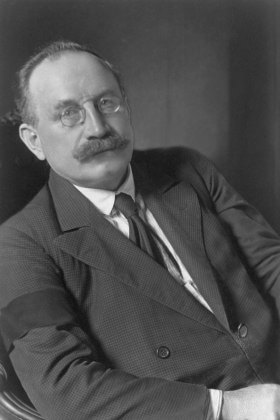
Joseph (Josef) Strzygowski (7 March 1862-2 January 1941) was a Polish-Austrian art historian, a member of the Vienna School of Art History, and a rival of his more famous colleague Aloïs Riegl (1858-1905)
Deleuze briefly refers to Strzygowski’s work Greece in the Arms of the Orient (Hellas in des Orients Umarmung) in his Spinoza seminar of 17 February 1981. This is the only reference to Strzygowski in Deleuze’s entire oeuvre, and Deleuze does not seem to have been influenced by his work.
The book Deleuze is referring to is actually a 21-page article by Strzygowski titled “Hellas in des Orients Umarmung” (“Greece in the Embrace of the Orient”) that appeared in the Allgemeine Zeitung (supplement), Munich, in 1902. The article was one of several pieces Strzygowski published to popularize the theses of his 1901 book Orient or Rome: A Contribution to the History of Late Antique and Early Christian Art (Orient oder Rom: Beitrag zur Geschichte der spätantiken und frühchristlichen Kunst, Leipzig: J. C. Hinrichs’sche Buchhandlung, 1901). David Lapoujade, in Sur Spinoza (Paris: Minuit, 2024), notes that Deleuze almost certainly knew of Strzygowski’s article through Henri Maldiney’s passing reference to it in his book Sight, Speech, Space (Regard, parole, espace, Lausanne: L’Âge d’homme, 1973, 207; new ed: Paris: Les Éditions du Cerf, 2012, 270). At the time of this seminar session, Deleuze was no doubt (re)reading Maldiney’s book in preparation for his subsequent seminar on painting, which would begin six weeks later on 31 March 1981. There is no French (or English) translation of either Strzygowski’s 1902 article or 1901 book, and Deleuze primarily seems to be referring approvingly to the general theme indicated by the title.
Revealingly, although both Strzygowski and Aloïs Riegl, whom Deleuze cites frequently, were both members of the Vienna School of Art History, they were bitter enemies. Riegl’s Late Roman Art Industry was published in 1901, the same year as Strzygowski’s Orient or Rome, but they had opposing methodologies and ideologies. (See Aloïs Riegl, Spätrömische Kunstindustrie, Vienna: Druck und Verlag der Österr-Staatsdruckerei, 1901; English translation: Late Roman Art History, trans. Rolf Winkes, Rome: G. Bretschneider, 1985.) Riegl emphasized stylistic evolution, famously coining the term Kunstwollen (artistic will) to explain the internal cultural development of Roman art, while Strzygowski emphasized the external influence of the imperial power of the “Orient” (Machtkunst, power-art), which he contrasted with more authentic folk and ornamental art. Moreover, Riegl firmly rejected the pan-German nationalism and ethnically purist art history that was then developing, whereas Strzygowski’s work was marred by his racism and eventual support of the Nazi regime. For a helpful analysis of the Riegl-Strzygowski relation, see Jaś Elsner, “The Birth of Late Antiquity: Riegl and Strzygowski in 1901, in Art History 25/3 (June 2002), 358-79.