February 12, 1973

There is all this at the same time on the body without organs: the paranoid position of the mass, the schizo position of the pack, and I mean: packs, masses, all these types of multiplicity. The unconscious is the art of multiplicities; it is a way of saying that psychoanalysis understands nothing about anything since it has always treated the unconscious from the point of view of an art of units: father, mother, castration. Whenever psychoanalysts are faced with multiplicities — we have seen it about the Wolf Man for Freud — it is a question of denying that there are any multiplicities.

Seminar Introduction

With only five sessions available in this seminar, Deleuze continues to expand the concepts developed for Anti-Oedipus with the long view of the second volume, A Thousand Plateaus. Moreover, alongside these sessions, Deleuze alone and with Guattari develop texts for publication that correspond directly to the seminar: Deleuze’s conference presentation, ‘Nomadic Thought’ for the July 1972 conference ‘Nietzsche aujourd’hui?’ at Cerisy-la-Salle appears in 1973; second, Deleuze and Guattari’s ‘Bilan-Programme pour machines désirantes’ appears in Minuit 2 (January 1973), and then is included as an appendix to a revised edition of Anti-Oedipus (1975).

English Translation
Edited
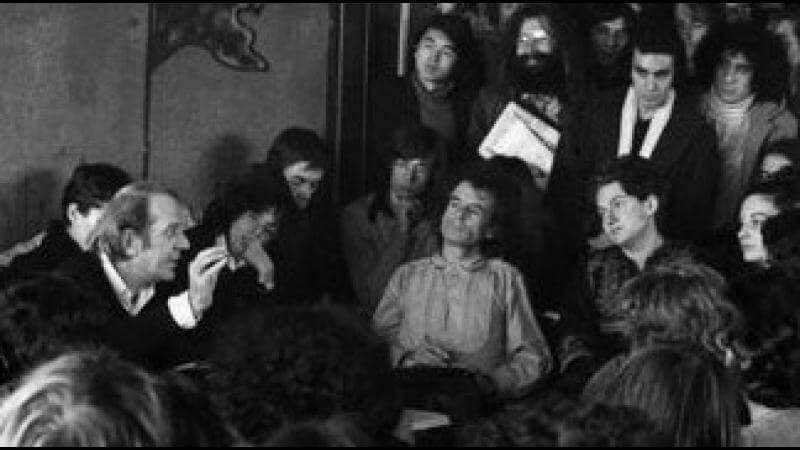
Deleuze at Vincennes
Deleuze teaching at the University of Paris, Vincennes.


Deleuze’s initial comment concerns his and Guattari’s goal of searching for the conditions of statements (énoncés) within, for example, psychoanalysis, i.e. regarding desire and the unconscious. Referring then to the previous session, he quickly shifts to how mass groupings or distributions function in relation to a subject’s trajectory on a body without organs, and he identifies the mass system as inscribing a network of signs on the body without organs as a territory. Deleuze points to two coexistent states of the sign, one paranoid, another freed from the signifier, and he maintains that these states correspond to two positions on the body without organs, a position of mass and a position of packs (meute). These two positions intersect in the unconscious, not in opposition, but in interplay within a bi-polar machinic apparatus, the mass machine as the signifying semiotic machine, hierarchized and egalitarian, on one hand, and on the other, the pack machine of particle-signs, types of Brownian movement, as the a-signifying semiotic machine. Deleuze examines Kafka’s love for Felice, an example of how one cannot know which apparatus might come to dominate in a given situation, mass or pack, with Kafka seeking to convert an Oedipus position into a writing machine (e.g., his Letter to the Father). Finally, Deleuze returns to the initial student question about schizo incest, stating that this incest opens the schizo to a world of connections and a kind of defamiliarization of the individual.


Gilles Deleuze

On Anti-Oedipus II, 1972-1973

Session 1, 12 February 1973

BwO – Drugs – Signifier – Paranoia

Transcription: WebDeleuze; modified transcription, Charles J. Stivale and Christian Kerslake

Translated by Christian Kerslake


Kyril Ryjik: […] in incest in psychoanalysis and in anthropology, there is an aspect of incest that you leave aside, the place of which one does not see in schizo incest. So why the word ‘incest’ in that case?

Deleuze: To state the basic principle, it was a question of seeking what the conditions of statements [énoncés] were in general[1]; and after all, one could pose psychoanalysis under this form: what are the conditions of statements, supposing that statements have relations with desire, that is to say, with the unconscious? Statements are not at all the products of a system of signification; they are the product of machinic assemblages[2], they are the product of collective agents of enunciation. Which implies that there are no individual statements, and that behind statements – when for example one is able to assign some epoch where statements change, a historical epoch where a new type of statement is created, for example the great breaks of the Russian revolution type, or indeed of the phalanx type in the Greek city;[3] a new type of statement appears, and on the horizon of this type of statement there is a machinic assemblage that makes it possible, i.e. a system of political agents of enunciation. ‘Collective’ does not mean ‘people’, nor ‘society’, but something more [phrase missing – ‘like multiplicities’?].[4] We must seek in machinic assemblages that belong to the unconscious the conditions for the emergence of new statements, the bearers of desire, or what concerns desire.

Once again, it is no longer a question of opposing, like two poles, a pole that we would assign to paranoia, and a pole that we would assign to schizophrenia. On the contrary, it’s about saying that everything, absolutely everything, is part at the same moment of a machinic assemblage which is determinable, and we simply have to see how this assemblage is made insofar as it is productive of statements.

It seemed to me that every machinic assemblage literally hooked itself onto a certain type of body without organs. The question we are dealing with is: assuming that every machinic assemblage happens, hooks itself onto, mounts itself on a body without organs, how is that fabricated, a body without organs? What can serve this or that person as a body without organs? This is also the drug-user’s problem: how do they make it so that, assuming this is true, this really is a formation of the unconscious, upon which [phrase missing], and that it functions as a condition so that assemblages, connections, are established, so that there is something that one can call a body without organs? Groups are bodies without organs; political groups, community groups, etc., imply species of bodies without organs, sometimes imperceptible, sometimes perceptible, on which the entire machine assemblage that will produce statements will attach itself. The archetype of the body without organs is the desert. It is like the support, like the support of desire itself.

What is going to attach itself? In a schizoanalysis, the problem of the unconscious is not a problem of generations. [André] Green has dispatched an article on Anti-Oedipus, and he says: in any case, these guys are a bit dim, because they’re forgetting that a schizo still has a father and a mother.[5] Well, that’s just lamentable: listen to a schizo. A schizo has neither father nor mother, it’s so obvious. It is not as a schizo that he is born of a father and of a mother – a schizo, as schizo, has no father or mother, he has a body without organs. The problem of the unconscious is not a problem of generations, but of population.[6] What populates the body without organs, what makes assemblages, connections? Someone’s happiness is their own way of making bodies without organs. As a fundamental difference with psychoanalysis, I insist once again: we do not know in advance. This duff concept of regression, it’s a way of saying: what you are is your affair, at least in principle, we know it in advance, since what you are is what you are. While here it’s the opposite principle: you don’t know in advance what you are. It’s the same with accounts of drugs: you don’t know in advance.

There is a very beautiful book by a gentleman called [Carlos] Castaneda which recounts his apprenticeship in peyote with an Indian, and the Indian explains to him that whatever the case, you need an ally.[7] You need a benefactor to guide you in this apprenticeship, this is the Indian himself, but you also need an ally, that is to say something which has a power. In order to make yourself a body without organs – a very lofty task, a very sublime task – an ally is necessary, not necessarily someone else, but you need an ally which will be the point of departure for a whole assemblage capable of functioning on such a body.

We saw, last time, on this body without organs, a kind of mass distribution, phenomena of mass, of population.[8] Why do these organize themselves? Because the immediate effect of the body without organs is identical with the experience, the experimentation, of a depersonalization. What seems fascinating to me is that it is at the very moment of an attempt at depersonalization that one acquires the true meaning of proper names, that is to say, one receives one’s true proper name at the very moment of depersonalization. Why?

Let’s suppose that there are groupings of mass, these are not necessarily social masses, because here, in relation to the body without organs, as opposed to the organism of a subject, the subject itself gives itself over to crawling around on the BwO, to tracing spirals. It conducts its search on the body without organs like a guy walking about [se balade] in the desert. This is the test of desire. Like the Unnameable in Beckett, it traces its spirals.[9] It itself, as depersonalized on the BwO, even its very organs, which in so far as they are now related, not to its organism, but to the body without organs – they have all completely changed their relationships. Once again, the BwO is indeed a defection from the organism, the disorganization of the organism for the benefit of another instance; and this other instance, the organs of the subject, the subject itself, etc., are as if projected onto it, and enter into a new kind of relation with other subjects. All that takes shape like masses, pullulations, where, literally, on the body without organs, one no longer really knows who is who: my hand, your eye, a shoe. A camel on the BwO of the desert, a jackal, a man on the camel, that makes up a chain.

At this level, in any case, the mass inscribed on the body without organs delimits like a territory. The elements of mass, whatever they are, define signs. And what ensures the coherence, the connections between signs?

What defines the mass, it seems to me, is a whole system of networks between signs. Sign refers to sign. That’s the mass system. And it refers to the sign under the condition of a major signifier. Here we have the paranoid system. The whole force of Lacan is to have made psychoanalysis pass from the Oedipal apparatus to the paranoid machine. There is a major signifier which subsumes the signs, which maintains them in the mass system, which organizes their network. That seems to me to be the criterion of paranoid delirium: it’s the phenomenon of the network of signs, where sign refers to sign.[10]

Ryjik: You’re making some kind of description, it’s not very clear, but you’re describing something. And if there is the same collection without a signifier, what is that?

Deleuze: That’s next.

Ryjik: But does that form a network, or does it not form a network?

Deleuze: It forms a thread [enfilade], not a network.

It is necessary to see how this major signifier appears. The purely descriptive system says: there is a regime of the sign under the signifier, and this is the network such as we find it in paranoid delirium. This seems to me the first stage of what it would be necessary to call the deterritorialization of the sign. It’s when, on a territory, the sign, instead of being a sign as such, passes – Have you finished coughing up? It’s disgusting – passes under the domination of a signifier. Your question is substantial: where does this signifier come from?

Signs, in another mode altogether, follow trajectories of flight; there is all the same a concrete criterion. This time, it is no longer the sign referring to another sign in a network, it is a direction starting from which a sign enters into a linear thread [s’enfile] with other signs. As opposed to paranoid delirium, it is for example erotomaniac delirium[11], or grievance delusion.[12] All of this still happens on the BwO. The sign, this time, has liberated itself from the mortgage and domination of the signifier. In which form it liberates itself from it in order to become and take on the status of director, accelerator and retarder of particles.

The two coexisting states of the sign are: the paranoid sign, namely the sign under the signifier, forming a network insofar as it is subsumed by the signifier, and then: the sign-particle, liberated from the signifier and serving as teleguidance for a particle.

The body without organs is populated in a singular fashion. It is no longer masses, species of coexisting lines, that always traverse this desert, and that guide particles on coexisting lines that diverge and intersect. Anything is possible in things like this. It is no longer the mass phenomenon, it is the pack [meute] phenomenon. It’s not at all the same thing because the subject, i.e. this weird kind of thing which is sometimes in the mass, sometimes in packs, enters into connection under the form of a network with other subjects, other organs, but sometimes in accordance with its lines of flight, where it also enters into specific types of relationship with others, but in pack relationships and no longer ones of mass.

The huge difference between the position of mass and the position of pack is why I’m so interested in the Wolf Man, and Freud’s radical non-understanding. The position of mass is always a position affected with paranoid characteristics; this is all the less pejorative as for me, this year, it’s all about saying: long live paranoia, there is not enough of it, we need to fix that …

Ryjik: Well, that’s something different! [Laughter]

Deleuze: The paranoid position of mass is: I will be in the mass, I will not separate myself from the mass, and I will be at the heart of the mass, in two possible capacities: either as chief, and therefore having a certain relationship of identification with the mass – for the mass can be the grave[13], it can be an empty mass, it doesn’t matter; or as partisan where, in any case, it is necessary to be swept up in the crowd [masse], to be as close as possible to the crowd, with one condition: to avoid being on the edge [bordure]. It is necessary to avoid being on the edge, being on the margins, in the position of mass: to not be last, you have to be close to the chief. The border is a position that it is only possible to guarantee in a mass, so that when one is in service, one must be there.

Henri Gobard: On the problem of the edge: if one is on the inside, there is no edge … Everything you say is a kind of fantastic justification of anything whatever, in any way whatever, for anywhere wherever …

Richard Zrehen: … and for anyone whoever!

Gobard: Maybe not for anyone whoever, that’s the problem; in your desert, instead of putting a camel, put a white bear: what will happen? How would your analysis work on something which, to me, seems monstrous, truly worse than Nazism, if that’s possible: namely the transplantation of organs! Cardiac patients no longer have organs, an organ is transplanted into them, … I’m against it, because it leads to the transformation of bodies into systems of spare parts, and that is precisely the Nazi mentality of the concentration camps … [Christiaan] Barnard is a Nazi, and contemporary science, biology and medicine belongs to the Nazi type …[14]

A student: Why did you have to sit there next to Deleuze, instead of sitting at the back?

Gobard: No, no, if you had arrived earlier, you would have seen that I sat here in order to make a sounding board. Someone was making a recording; and secondly, because it was pissing me off with all the assholes smoking …[15]

Richard Zrehen: I was wondering whether the intensive powers on the body without organs, the thresholds of intensity, the energetic passages, if you like, whose schema has been borrowed from embryology, even if it is no longer just that, since it is all the same a serious basis, I wondered if there was not a way of ‘quantifying’ or ‘qualifying’ these thresholds, these passages, these fillings-up through intensive quantities, of the body without organs; and immediately, the only association I could make was the modification of colors indicating an intensity in the level of the cold or the heat given off, something like that. You just talked about statements which, visibly, on the body without organs, exactly fulfill, perhaps at another level, the foundation of intensive powers.

Deleuze: Yes, yes, yes, but I am so far from having finished. The intensities, I haven’t placed them on the inside yet, but I would see no reason to privilege colors or phenomena of hot or cold; localizations also count for a lot. The Wolf Man, his relationship with wolves, is absolutely inseparable from two bodily localizations, which are the jaw and the anus. The psychoanalyst who took over with the young man after Freud says that the Wolf Man says that one of his dentists keeps telling him: you have too hard a bite, your teeth will fall out.[16] There, we clearly see something of a kind of current of intensity: a higher intensity, the jaw-bite; the teeth too fragile for such a jaw-bite: lower intensity; and what we have there is a definite kind of passage of intensity between a minimum and a maximum, which is of a very particular type, of a localization type.

To return to the position of mass, one can say that there is no edge, for the simple reason that the problem of the mass is: to determine segregation and exclusion. There are simply falls and rises. The position of pack is completely different. Its essential character is that there is a border-phenomenon. The essential always happens at the edge. In the book Crowds and Power [Masse et Puissance] by [Elias] Canetti there is a very good description of the pack. He says something very important about the distinction between mass and pack (page 109): “In the pack which, from time to time, forms out of the group, and which most strongly expresses its feeling of unity” – that’s strange, that’s not true – “the individual can never lose itself as completely as modern man can in any crowd today. In the changing constellation of the pack …” – he, at least, understands wolves: in the pack each member guides itself through its companion, and at the same time, the positions never cease varying. They vary all the time, and they define themselves through distances. Distances between the members of the pack. Distances which are constantly variable and indecomposable. This is what makes it so that the pack is always distributed over, that the members of the pack are always on, a periphery. “In the changing constellation of the pack […], he will again and again find himself at its edge. He may be in the center, and then, immediately afterwards, at the edge again; at the edge and then back in the center. When the pack forms a ring round the fire” – that’s quite stirring, that bit – “each man will have neighbors to right and left, but no one behind him; his back is naked and exposed to the wilderness.”[17] This is absolutely the position of pack. I adhere to the pack through – so here, it is indeed another regime of organs, it is not a regime of networks – I adhere to the pack through a foot, a hand, a paw, through the anus, through an eye. This is the position of pack.

I add, there is all that at the same time on the body without organs: the paranoid [parano] position of mass, the schizo position of pack, and I mean: packs, masses, all these types of multiplicity. The unconscious is the art of multiplicities; this is a way of saying that psychoanalysis understands nothing at all since it has always treated the unconscious from the point of view of an art of unities: the father, the mother, castration. Every time psychoanalysts find themselves faced with multiplicities, as we have seen with the Wolf Man, it is a question of denying that there are multiplicities. Freud cannot bear the idea that there are six or seven wolves in the story of the Wolf Man; it is necessary that there is only one, because a single wolf, that’s the father. And the Wolf Man can cry all he likes: the wolves, the wolves, the wolves; Freud says: a single wolf, a single wolf, a single wolf.

These masses and these packs of the unconscious can just as well be existing groups, but these existing groups, for example, political groups, they also have an unconscious, an unconscious – and here, I’m saying at the same time – that’s why everything functions together. It is no longer a question of saying: let’s oppose paranoid/schizophrenic in a duality, because the same group has a mass unconscious and a pack unconscious as well. It lives off a whole system of signifying signs, under the signifier, but at the same time, it lives off a whole system of particle-signs which are its ways of getting the hell out, its ways of drifting. It is at once the most immobile bloc and simultaneously the most adrift thing there is. It is therefore at the same time that it is necessary to make all that function. To these two machinic poles apparatuses are added. If I try to define the two machinic poles which, for the moment, cover the bodies without organs, I would say that the one is the mass machine, which one could call the semiotic signifying machine: it is the system of signs under the domination of the signifier, and forming the paranoid network. The other machine, that of the sign-particles, the pack machine, is the semiotic a-signifying machine: it is the sign-particle system, the coupling of sign and particle. Each member of a pack is a particle, each particle could be anything; as a mass element, it could be anything.

So, upon that, apparatuses intervene that are certainly linked to these machines. And again, it’s not a question of saying: Oedipus does not exist. It’s about saying: there is only an Oedipal apparatus, and the Oedipal apparatus, it’s a funny thing, because it plays between the mass machines and the pack machines. Its whole play is between the two; it borrows elements from mass machines. I believe that the meaning of the Oedipal apparatus is to plug the flights of packs, to bring them back to the masses … I’m forgetting a lot of things in the current, but another distinction that it would be necessary to make between mass machines and those belonging to packs, would be that masses, at least in appearance, always present, at a certain moment, a phenomenon of unity of direction. They are simultaneously egalitarian and hierarchised. We must not at all say, like the Marxists, that egalitarianism is an ideological phenomenon, or that it is a certain formal phenomenon; it must be said that class organization, in historical formations, in its most diverse forms, has always been made in real relation – it does not at all belong to ideology – with some form of communitarian egalitarianism. Class organization in the bourgeois system is made in the form of a real equality determined under the conditions of capitalism. Class formation in the so-called despotic systems implies the real egalitarianism of rural communities. Class organization in the ancient city implies the victory of the plebs; that, as Engels says very well, implies a certain position of egalitarianism in relation to which slavery will be able to take place and be produced. So it is not at all opposed, that the mass structure is simultaneously an egalitarian structure, and that it is all the more strongly and more severely hierarchised, presenting a kind of unity of direction at every moment. Whereas the pack phenomenon is really what one calls Brownian motion; whenever there is a pack, you will find this kind of pattern traced on the body without organs.

The Oedipal apparatus is this strange thing that tries to plug these kinds of flights of particles, and which tries to lead them back. It is necessary to make the four things function in the machinic assemblage at the same time, and this is perhaps what produces the statements of the unconscious. There are counter-Oedipean apparatuses …

Ryjik: With what you were saying before, are you trying to say that the Oedipal apparatus has a privileged situation between the two?

Deleuze: No! No more than the counter-Oedipal apparatus. The counter-Oedipal apparatus must no doubt make the inverse manoeuvre; it will let packs loose. You understand, nobody knows in advance for anyone: what might seem most Oedipal, it could very well be that it’s a guy in the process of tipping over into an anti-Oedipal apparatus that will make everything crack. We will never say to someone: you are in regression. Never, never. Or else we will never say to him: you are this because you were that. First of all, it is disgusting, and then it is not true.

I resume. This love so strange of Kafka for Felice[18], what is going on in there? Well, Felice is everywhere. Kafka, what is he up to? First, he has his method … let’s suppose he has found a little something which can serve him as a body without organs. On it, he is in love with Felice. Kafka is all the same an executive, a future great bureaucrat, the whole machine of commerce fascinates him. His problem is once again the situation of the Jews in the Austrian empire; he is caught up in a problem of mass: the imperial mass of the Austrian empire which will precisely be described in The Castle in marvelous terms: when one is far from the castle, it is truly an imperial ensemble, it is a mass, and when one approaches the castle, it is much more like a system of hovels at a distance from each other, as if, to the extent that one approaches, the mass figure melts into a pack figure. And that corresponds very well to the Austrian empire which, experienced from within, is a kind of marquetry, not at all a pyramidal system, but rather a kind of segmentary system. He is caught up in all that, with modern machines, work accidents. He had connections with anarchist circles. The political mass, the imperial mass, the commercial mass, the bureaucratic mass, that’s what he’s concerned with. It is obviously impossible to separate Felice from what she is as well. Kafka, however, takes her for a maid, and it turns out that Felice is not a maid. So here is Felice, who has a certain position in a mass structure, and at the same time, she has big carnivorous teeth, which attracts and disgusts Kafka. He is vegetarian and will cease being vegetarian from the moment of his love affair with Felice; he is fascinated by the idea of teeth between which, in which bits of meat remain, he’s got a weird thing about it.[19] One of Kafka’s fundamental problems is: where does [missing word – ‘food’][20] come from, and this is undoubtedly connected to a position of the body without organs … and these huge carnivorous teeth, that’s another side of it. It is the particle which makes Felice escape, which tears her in some way from the imperial bureaucratic technocratic signifier, makes her break loose onto a completely different line, where, this time, the sign of the big teeth, or rather the Felice-sign, guides, accelerates, and precipitates huge teeth particles, which are set racing in the other coexisting system. Thereupon, third element. Of course, there is Oedipus, and this is Kafka’s problem: how am I going to manage, in the situation I’ve put myself, to not marry Felice? She wants marriage, while he sets his extraordinary conditions: this, this, this. She wants a family right away, she paints him a picture of marriage, it is an innocent one: she wants a homestead, you’ll eat meat everyday …; he faints. Kafka has a habit of turning tricks like that, and it’s fantastic, because that explains the existence of Marthe Robert.[21] There’s a proof of the existence of Marthe Robert for you. Kafka always played a formidable game with his father. His father never stopped winding him up, it’s true: there is therefore an Oedipal statement; but moving quickly, what did Kafka tell himself?

He said to himself what we need to say to ourselves today about paranoia, but he said it to himself at the level of Oedipus. In the prodigious letters to his sister who had a child, he says that this kid must not be left in the family, he has to get the hell out of there.[22] And for his part, in order to ward off Oedipal statements – because they do exist – he will ward them off in the form: transform the Oedipal statement into an enunciation-machine for making letters.

Once again, there is no freedom, there are ways out. If one wants freedom, one is asking too much: then one is lost and it’s all fucked in advance. What is needed is to find ways out, and Kafka’s way out is: my father is winding me up, so I’m going to write to him. That will always be the Kafkian way out, converting Oedipus into a writing machine. It is a great idea; and so he writes his famous letter to his father. It is a way out because, thanks to the writing machine, he can add: in other words, I am going to be more Oedipal than you. Exactly as with the paranoiac, one has to succeed at being more paranoid than him. This is why we have to revalorize the paranoid: the only defense against the paranoiac is even more paranoia.

So Marthe Robert says: you can clearly see how Oedipal he is. Necessarily, he doesn’t stop ladling it on in order to make all Oedipean statements pass into the enunciation of a writing machine that is apparently Oedipal, but in fact is anti-Oedipal, that is to say which is going to splinter Oedipal connections in favor of a system of connections of a perverse writing machine. Once he pulls this off with his father, you know it’s going to work like that even more with the women he loves.

Felice offers him conjugality, that is to say, the adult form of Oedipus. Very quickly, he will counter with the parade he put into effect so well with his father. He is never able to come and see her where she is, because it is necessary that he writes to her; that’s the insurance against conjugality. He sends her all manner of letters, he can only love through letters; he sets conditions, conditions of conditions, etc. In all of that, it is the whole of Oedipus and the whole problem of conjugality that is dissolved, to the benefit of something else altogether.

Anything can work like that. Everything that one puts on the side of the Oedipal apparatus, namely incest, castration, the vacation letter (“My dear Dad, my dear Mum, I am having a lovely holiday”), anything at all, can pass into non-Oedipal apparatuses. And a whole analysis is necessary to arrive at knowledge; that’s why there is always hope. Homosexuality can be like [missing word], completely Oedipal from one end to the other. It all depends on the use; it can pass into other conditions, into an anti-Oedipal apparatus of an entirely different nature.

When I speak of a schizo incest, as making up part of an anti-Oedipal apparatus, ie. incest with the sister – but the sister can be anyone, – Oedipal incest is love with someone assimilated with the mother in one way or another; schizo incest is love with someone somehow assimilated with the sister. The passage from Oedipal incest to schizo incest is like a conversion, a transformation of the Oedipal apparatus into an anti-Oedipal apparatus, which means that schizo incest is what opens onto a kind of world of connections and which will lead, literally, to a kind of de-familiarization of the individual. Now, it may very well be that there are incests with the sister which are Oedipal, to the extent that the sister would be treated as the substitute for the mother.[23]

In order to finish with all this, I would like, just as a bit of a proof, to comment on a text by Kafka, ‘Jackals and Arabs.’[24] One can see very well why he mixes everything up, why he sets traps. In ‘Jackals and Arabs’, we can say that everything is there, for Freud or for Marthe Robert. There are the Arabs who explicitly belong to the male line; and then there are the jackals which are explicitly attached to the maternal line. Right at the beginning, the jackal says: “we have been waiting for you for eternity; my mother waited for you, and her mother, and all our foremothers right back to the first mother of all the jackals.”[25] Between the jackals and the Arabs, there is, on the edge, the man of the North, that is to say the Jackal Man. It’s only Freud who doesn’t know what a pack of wolves is. The jackals take the man of the North aside and say to him that the Arabs are disgusting, and they’re disgusting because they kill animals for food. They kill calves to eat. That’s really Kafka’s fundamental obsession: where does food come from?

The jackals say that it can’t continue, because they are against it; they say: us, we’re the opposite: we eat to clean up carrion. So: either kill living animals to eat, or eat to clean up dead animals. Hence the Arab-jackal tension. Now the man of the North shows up and the jackals say to him: you’re going to kill the Arabs; and they bring a large pair of rusty scissors. I won’t stop to dwell on what the psychoanalysts are able to make of these scissors. All this is happening in the desert. The Arabs are presented as an armed mass, extended throughout the desert. The jackals are presented as a pack that goes deeper and deeper into the desert, which is forced to plunge deeper and deeper into the desert: mad particles. And at the end of the text, the Arab says about the jackals: “they’re madmen, complete madmen.”[26] And the jackals reveal the secret of the story of the scissors – the man of the North was ready to say: you want me to kill them, but the jackals aren’t interested in that: it’s a question of cleanliness, it’s the test of the desert. That means that, in this kind of tension, the Arab mass, the pack of jackals, a manifest Oedipal apparatus and a counter-Oedipal apparatus, will put in play the test of desire under the form: it is a question of cleanliness.

Once these four elements are given, what will happen, if I am granted that every statement is the product of an assemblage? How might we define a statement as the product of a machinic assemblage? It goes without saying that all that is indeed the problem of unconscious, i.e. that an analysis which does not reach multiplicities, a double type of multiplicities, multiplicities of mass and multiplicities of packs, which are now in a double way what an individual participates in, as well as being what is internal to an individual – well, we can say that the analysis has not even begun. When one has not reached the edge-positions, the paranoiac positions of mass, the type of anti-Oedipal apparatus someone is in the process of setting up, their Oedipal apparatus, one has got absolutely nowhere near the formations of the unconscious – and above all when one does not know what assemblage is involved, and how it functioned for them and in them, that is to say, what type of statement it was capable of producing; and types of statements, when necessary, which are very far from what happens in the unconscious.

This is the problem of multiplicities, to put each thing into play in the others, like multiplicities of multiplicities. It is this analysis of multiplicities as being simultaneously exterior and interior to the individual that must be achieved, otherwise one has attained nothing of the unconscious. [End of the session]

Notes

[1] The term énoncé can be translated as ‘statement’ or ‘utterance’. In this Seminar, Deleuze is playing off various contemporary uses of the term énoncé, e.g., in Michel Foucault, The Archaeology of Knowledge (translated by A.M. Sheridan-Smith, London: Tavistock, 1972 [1969]); in Jean-Pierre Faye, Théorie du Récit [Theory of Narrative] (Paris: Hermann, 1972) (discussed in the fourth and fifth sessions of this Seminar); and in Jacques Lacan’s opposition between the sujet de l’énoncé [‘subject of the statement’] and the sujet de l’énonciation [‘subject of enunciation’]; cf. Lacan, ‘The Subversion of the Subject and the Dialectic of Desire’, in Écrits (translated by Bruce Fink et al., New York: W.W. Norton, 2006 [1966]), pp. 800-802 [French pagination].

[2] The term agencement has no exact English translation, and might be translated as ‘arrangement’, ‘layout’, ‘configuration’, or ‘assemblage’. The last-named term is used here, but it should be borne in mind that the French term carries connotations of agency and activation that are absent from the English ‘assemblage’.

[3] Cf. Marcel Detienne, ‘La phalange. Problèmes et controverses’, in Jean-Pierre Vernant, Problèmes de la guerre en Grèce ancienne (Paris – La Haye: Mouton and Co., 1968), discussed in A Thousand Plateaus (translated by Brian Massumi, Minneapolis: University of Minnesota Press, 1987 [1980]), pp. 399 and 560 n.78.

[4] Cf. A Thousand Plateaus, p. 37: “There are no individual statements, there never are. Every statement is the product of a machinic assemblage, in other words, of collective agents of enunciation (take “collective agents” to mean not peoples or societies but multiplicities).” The missing French phrase would be comme multiplicités. Much of the material developed in this session finds its way into this plateau, ‘1914: One or Several Wolves’, in A Thousand Plateaus (pp. 26-38).

[5] André Green’s review of Anti-Oedipus, ‘À quoi ça sert’, was published in Le Monde on 28 April 1972, and then republished in expanded form in the Revue française de psychanalyse, vol. 36(3), 1972, pp. 491-499. Deleuze is presumably referring to the closing passage: “The whole book is based on the assertion that the schizo does not play Oedipus and rejects our system. Does this mean that he has neither father nor mother? Can we affirm that the schizo, in his psychosis, maintains no relationship with the imago of his progenitors? The whole of experience and theory are against this” (Revue française version, p. 499).

[6] In the article, Green claims that “Anti-Oedipus is the negation of the double difference (of the sexes and generations)” (ibid, p. 497).

[7] Carlos Castaneda, The Teachings of Don Juan: A Yaqui Way of Knowledge (Berkeley: University of California Press, 1972 [1968]). On the ‘ally’, see pp. 9, 32-34. For discussions of Castaneda in A Thousand Plateaus, cf. pp. 227-229, 248-249.

[8] The reference to the “last session” points to the existence of a session (or sessions) prior to this one. The final session of the first Seminar on Anti-Oedipus (18 April 1972) ends with a discussion of the body without organs, but there is no discussion of ‘masses.’ Elias Canetti’s Crowds and Power (translated by Carol Stewart, Harmondsworth: Penguin, 1973 [1960]) is not mentioned in the first Seminar, nor is the idea of ‘mass’ thematized. However, Canetti’s distinction between crowds and packs is briefly mentioned in Anti-Oedipus itself (translated by Robert Hurley, Mark Seem and Helen R. Lane, Minneapolis: University of Minnesota, 1983), p. 279, where it is discussed in relation to paranoia (with a reference to the closing chapter of Crowds and Power, ‘Rulers and Paranoiacs’). Crowds and Power was originally entitled Masse und Macht in German (1960) and was translated into French as Masse et puissance (Paris: Gallimard, 1966). In German, Freud’s Group Psychology is Massenpsychologie. The term ‘mass’ in the present Seminar often means ‘crowd’, and its use can be related to themes in the first part of Canetti’s Crowds and Power, ‘The Crowd’, pp. 15-87. See the discussion of masses and packs in A Thousand Plateaus, p. 33-34.

[9] Cf. Samuel Beckett, The Unnameable, in Trilogy (London: Picador, 1979 [1959]): “I must have got embroiled in a kind of inverted spiral” (p. 290); “I’ve never left the island, God help me. I was under the impression I spent my life in spirals round the earth” (p. 300).

[10] In a discussion of early 20th century psychiatry in A Thousand Plateaus (pp. 119-120), singling out the work of Paul Sérieux and Joseph Capgras on the one hand and Gaëtan de Clérambault on the other, Deleuze and Guattari develop a contrast between a “paranoid-interpretive ideal regime of significance”, which they associate with ‘delusion [or delirium] of interpretation’, and a “passional, postsignifying subjective regime”, associated with ‘passional’ delusions like erotomania and grievance delusion [délire de revendication]. It is likely that this distinction also has a source in Lacan’s extensive discussion of Sérieux and Capgras’ work Les Folies raisonnantes [Reasoning Madness] (1st ed. 1906), along with Clérambault’s work and other related works from the French school, in his doctoral thesis De la psychose paranoiaque dans ses rapports avec la personnalité [On Paranoid Psychosis in its Relations with the Personality] (Paris: Seuil, 1975 [1932]), pp. 64-76. Delirium of interpretation is twice described there as “radiating” out from a central delusion (p. 67; cf. 71). Lacan in turn roots Sérieux and Capgras’ account of paranoid interpretation in Kraepelin’s classic formulation of paranoia as “the insidious development, under the dependence of internal causes and according to a continuous evolution, of a durable and unshakable delirious system [système délirant], and which is established with a complete retention of clarity and of order in thought, will and action” (first given in the 1899 edition of his Lehrbuch der Psychiatrie) (Lacan, p. 23). Deleuze’s formulation here of paranoid interpretation as involving networks in which ‘sign refers to sign’ seems to arise out of this context.

[11] Lacan, De la psychose paranoiaque dans ses rapports avec la personnalité, pp. 24 and 72 (where Clérambault’s work on erotomania is discussed).

[12] There is no exact English translation for the French term revendication, frequently used in Lacan’s 1932 dissertation on paranoid psychosis and common among the French psychiatrists he discusses. Délire de revendication is sometimes translated into English as ‘litigious delusion’, sometimes more literally as ‘delusion of claim’. The translation ‘grievance delusion’ has a greater extension than ‘litigious delusion’ (which is more suited to the specific phenomenon of vexatious litigation).

[13] Possibly a reference to Elias Canetti, Crowds and Power, ‘Cemeteries’, p. 275.

[14] The transcript of this passage ends with the non-word “esclaruerunt …?”

[15] A note in the WebDeleuze transcript adds: “Nota Bene: Richard III, on this day, had no ‘havana’ at his disposal.”

[16] Ruth Mack Brunswick, ‘A Supplement to Freud’s History of an Infantile Neurosis’ (1928), republished in Muriel Gardiner (ed.) The Wolf-Man by the Wolf-Man (New York: Basic Books, 1971), p. 277: “The dentist now told him […] that he had a ‘hard bite’ and would soon probably lose not only the fillings, but all his teeth as well.” With regard to the anus, see Sigmund Freud, ‘From the History of an Infantile Neurosis’ (The ‘Wolf Man’), chapter VII, ‘Anal Erotism and the Castration Complex’.

[17] Elias Canetti, Crowds and Power, p. 109, cited in A Thousand Plateaus, p. 33-34.

[18] Franz Kafka, Letters to Felice, edited by Erich Heller and Jürgen Born, translated by James Stern and Elisabeth Duckworth, New York: Schocken Books, 1973). Elias Canetti published a guide to the voluminous letters, Kafka’s Other Trial: The Letters to Felice (translated by Christopher Middleton, London: Calder and Boyars, 1974 [1969]). See Deleuze and Guattari, Kafka: Toward a Minor Literature (translated by Dana Polan, Minneapolis: University of Minnesota Press, 1986 [1975]), pp. 29-34, and A Thousand Plateaus, p. 36.

[19] Kafka, Letters to Felice, p. 355.

[20] That ‘food’ is the missing term is made clear in a later paragraph. Cf. also Deleuze and Guattari, Kafka: Toward a Minor Literature, p. 20.

[21] In Kafka: Toward a Minor Literature, Deleuze and Guattari criticise Marthe Robert’s annotations to the French 1963 Cercle du livre précieux critical edition of Kafka’s Oeuvres complètes for introducing “a psychoanalytical Oedipal interpretation” (p. 92, cf. 93), but praise her “excellent study” on Kafka, ‘Citoyen de l’utopie’, Les Critiques de notre temps et Kafka (Paris: Garnier, 1973) (p. 95). Robert’s 1979 book-length study of Kafka, Seul comme Kafka was published in English as Franz Kafka’s Loneliness (translated by Ralph Manheim, London: Faber & Faber, 1982).

[22] See Kafka’s letters of 1921 to his sister Elli, in Franz Kafka, Letters to Friends, Family, and Editors (translated by Richard and Clara Winston, New York: Schocken, 1977).

[23] On schizo incest in Kafka, see Kafka: Toward a Minor Literature, pp. 66-68. On incest with the sister in anthropology, see Anti-Oedipus, pp. 159, 200.

[24] Franz Kafka, ‘Jackals and Arabs’, in Wedding Preparations in the Country and Other Stories (Harmondsworth: Penguin, 1970), pp. 129-132; cited in A Thousand Plateaus, p. 37.

[25] Kafka, ‘Jackals and Arabs’, p. 129 (translation modified).

[26] Kafka, ‘Jackals and Arabs’, p. 132 (translation modified).

French Transcript

Edited

La séance est évidemment un fragment, dominé par la discussion entre Deleuze and quelques participants. Beaucoup des concepts considérés seront développés dans Mille Plateaux, notamment le corps sans organes, le signifiant et le paranoïa.

Gilles Deleuze

Sur L’Anti-Œdipe II, 1972-1973

1ère séance, 12 fevrier 1973

CSO-Drogue-Signifiant-Paranoia

Transcription : WebDeleuze et Le Terrier; transcription modifiée, Charles J. Stivale et Christian Kerslake

Kyril Ryjik : […] Dans l’inceste en psychanalyse et en anthropologie, il y a une note d’inceste que tu abandonnes, dont on ne voit pas la place dans l’inceste schizo. Alors pourquoi le mot “inceste” dans ce cas-là ?

Deleuze : Comme principe de base à proposer, il s’agissait de chercher qu’elles étaient les conditions des énoncés en général, et que après tout, la psychanalyse, on pouvait la poser sous cette forme : qu’est-ce que c’est que les conditions des énoncés, à supposer que les énoncés aient des rapports avec le désir, c’est-à-dire avec l’inconscient ? Les énoncés, ce n’est pas du tout les produits d’un système de signification ; c’est le produit d’agencements machiniques, c’est le produit d’agents collectifs d’énonciation. Ce qui implique qu’il n’y a pas d’énoncés individuels, et à l’arrière des énoncés, quand par exemple on peut assigner telle époque où les énoncés changent, une époque historique où un nouveau type d’énoncé se créé, par exemple les grandes coupures du type la révolution russe, ou bien du type la phalange dans la cité grecque ; un nouveau type d’énoncé apparaît, et à l’horizon de ce type d’énoncé, il y a un agencement machinique qui le rend possible, i.e. un système d’agents politiques d’énonciation. « Collectif », ça veut dire ni peuple, ni société, mais quelque chose de plus [mot qui manque]. Il faut chercher dans les agencements machiniques qui appartiennent à l’inconscient, les conditions de surgissement d’énoncés nouveaux, porteurs de désir, ou concernant le désir.

Encore une fois, il ne s’agit plus du tout d’opposer comme deux pôles, un pôle qu’on assignerait à la paranoïa, et un pôle qu’on assignerait à la schizophrénie. Il s’agit, au contraire, de dire que tout, absolument tout, fait partie à un même moment, d’un agencement machinique qui est déterminable, et il faut simplement voir comment cet agencement se fait en tant qu’il est producteur d’énoncés.

Il me semblait que tout agencement machinique, à la lettre, s’accrochait sur un certain type de corps sans organes. La question qu’on traite, à supposer que tout agencement machinique se passe, s’accroche, se monte sur un corps sans organes, comment ça se fabrique, un corps sans organes ? Qu’est-ce qui peut servir à telle ou telle personne, de corps sans organes ? C’est aussi le problème des drogués; comment font-ils, à supposer que ce soit vrai, que ce soit bien une formation de l’inconscient, sur laquelle des [mot qui manque] et que c’est comme une condition pour que des agencements, des connections s’établissent, qu’il y ait une telle qu’il puisse appeler corps sans organes. Les groupes, ce sont des corps sans organes ; les groupes politiques, les groupes communautaires, etc., impliquent des espèces de corps sans organes, parfois imperceptibles, parfois perceptibles, sur lesquels tout l’agencement de machine qui va être producteur d’énoncés va s’accrocher. L’archétype du corps sans organes, c’est le désert. Il est comme le support, ou comme le support du désir lui-même.

Qu’est-ce qui va s’accrocher ? Dans une schizo-analyse, le problème de l’inconscient, ce n’est pas un problème de générations : [André] Green a envoyé un article sur l’Anti-Oedipe, et il dit : “quand même, c’est des pauvres types, parce qu’ils oublient qu’un schizo, ça a quand même un père et une mère”. Alors là, c’est lamentable, écoutez un schizo. Un schizo n’a ni père ni mère, c’est tellement évident. Ce n’est pas en tant que schizo qu’il est né d’un père et d’une mère, un schizo, en tant que schizo, n’a pas de père ou de mère, il a un corps sans organes. Le problème de l’inconscient, ce n’est pas un problème de générations, mais de population. Qu’est-ce qui peuple le corps sans organes, qu’est-ce qui fait les agencements, les connections ? Le bonheur de quelqu’un, c’est sa manière à lui de se faire des corps sans organes. Comme différence fondamentale avec la psychanalyse, j’insiste encore une fois : on ne sait pas d’avance. Cette saleté de concept de régression, c’est une manière de dire : ce que tu es est ton affaire, au moins en droit, on la sait d’avance, puisque ce que tu es, c’est ce que tu es. Tandis que là, c’est le principe opposé, vous ne savez pas d’avance ce que vous êtes. C’est pareil pour les histoires de drogues : vous ne savez pas d’avance.

Il y a un très beau livre d’un monsieur qui s’appelle [Carlos] Castaneda, qui raconte son apprentissage du peyotl avec un indien, et l’indien, lui explique que de toutes manières, il faut un allié. [A ce propos, voir Mille plateaux, pp. 199-200 ; le premier livre de Castaneda est L’herbe du diable et la petite fumée (1971 ; Paris : Éditions du Soleil noir) ; cité dans le contexte décrit ici est Histoires de pouvoir (1974)] Il faut un bienfaiteur pour te mener dans cet apprentissage, c’est l’indien lui-même, mais aussi il faut un allié, c’est-à-dire quelque chose qui a un pouvoir. Pour se faire un corps sans organes, tâche très haute, tâche très sublime, il faut un allié, pas forcément quelqu’un d’autre, mais il faut un allié qui va être le point de départ de tout un agencement capable de fonctionner sur un tel corps.

On a vu, la dernière fois, sur ce corps sans organes, une espèce de distribution de masse, les phénomènes de masse, de population. Ils s’organisent pourquoi ? Parce que l’effet immédiat du corps sans organes, ça ne fait qu’un avec l’expérience, l’expérimentation d’une dépersonnalisation. Ce qui me paraît fascinant, c’est que c’est au moment même d’une tentative de dépersonnalisation, que on acquiert le vrai sens des noms propres, c’est à dire on reçoit son vrai nom propre au moment même de la dépersonnalisation. Pourquoi ?

Supposons qu’il y ait des groupements de masse, ce n’est pas forcément des masses sociales, c’est que, par rapport au corps sans organes, dans sa différence avec l’organisme d’un sujet, le sujet lui-même, voilà qu’il se met comme à ramper sur le CSO, à tracer des spirales. Il mène sa recherche sur le corps sans organes, comme un type qui se balade dans le désert. C’est l’épreuve du désir. Il trace, comme l’innommable dans Beckett, il trace ses spirales. Lui-même, en tant que dépersonnalisé sur le CSO, ou bien ses propres organes, qui en tant qu’ils sont rapportés maintenant, non pas à son organisme, mais au corps sans organes, ils ont complètement changé de rapports. Encore une fois, le CSO, c’est bien la défection de l’organisme, la désorganisation de l’organisme au profit d’une autre instance; et cette autre instance, les organes du sujet, le sujet lui-même, etc., est comme projeté sur elle, et entretient avec d’autres sujets, un nouveau type de rapports. Tout ça forme comme des masses, des pullulements, ou, à la lettre, sur le corps sans organes, on ne sait pas très bien qui est qui : ma main, ton œil, une chaussure. Un dromadaire sur le CSO du désert, un chacal, un bonhomme sur le dromadaire, ça fait une chaîne.

A ce niveau, de toutes manières, la masse inscrite sur le corps sans organes délimite comme un territoire. Les éléments de masse, quels qu’ils soient, définissent des signes. Et qu’est-ce qui assure la cohérence, les connections entre signes ?

Ce qui définit la masse, il me semble, c’est tout un système de réseaux entre signes. Le signe renvoie au signe. Ça, c’est le système de masse. Et il renvoie au signe sous la condition d’un signifiant majeur. C’est ça le système paranoïaque. Toute la force de Lacan, c’est d’avoir fait passer la psychanalyse de l’appareil œdipien à la machine paranoïaque. Il y a un signifiant majeur qui subsume les signes, qui les maintient dans le système de masse, qui organise leur réseau. Ça me paraît le critère du délire paranoïaque, c’est le phénomène du réseau de signes, où le signe renvoie au signe.

Ryjik : Tu décris, on ne sait pas très bien, mais tu décris. Et si il y a une même collection sans signifiant, c’est quoi ?

Deleuze : C’est la seconde.

Ryjik : Mais ça forme réseau ou ça ne forme pas réseau ?

Deleuze : Ça forme enfilade, et non pas réseau.

Il faut voir comment apparaît, ce signifiant majeur. Le système purement descriptif dit : il y a un régime du signe sous le signifiant, et c’est le réseau tel qu’on le trouve dans le délire paranoïaque. Ça me paraît le premier stade de ce qu’il faudrait appeler la déterritorialisation du signe. C’est lorsque, sur un territoire, le signe, au lieu d’être signe tel quel, passe – tu as fini de cracher ? C’est dégoûtant — passe sous la domination d’un signifiant. Ta question est pleine, d’où vient ce signifiant ?

Les signes, sur un tout autre mode, suivent des trajectoires de fuite, il y a quand même un critère concret. Cette fois-ci, ce n’est plus le signe renvoie au signe dans un réseau, c’est une direction à partir de laquelle un signe s’enfile comme linéairement avec d’autre signes. Par opposition au délire paranoïaque, c’est par exemple le délire érotomaniaque, ou bien le délire de revendication. Tout ça se passe toujours sur le CSO. Le signe, cette fois-ci s’est libéré de l’hypothèque et de la domination du signifiant. Sous quelle forme s’en est-il libéré pour devenir et pour prendre un statut de directeur, accélérateur, retardateur de particules.

Les deux états coexistants du signe, c’est : le signe paranoïaque, à savoir le signe sous le signifiant, formant réseau en tant que subsumer par le signifiant, et puis : le signe – particule, libéré du signifiant et servant comme de téléguidage à une particule.

Le corps sans organes se peuple singulièrement. Ce ne sont plus des masses, espèces de lignes coexistantes, qui traversent toujours ce désert et qui guident des particules sur des lignes coexistantes, divergeantes et s’entrecroisant. Tout est possible dans des trucs comme ça. Ce n’est plus le phénomène de masse, c’est le phénomène de meute. Ce n’est pas du tout pareil parce que le sujet, i.e. cette espèce de drôle de chose qui, tantôt est dans la masse, tantôt est dans les meutes, entre en connection sous forme de réseau avec d’autres sujets, d’autres organes, tantôt d’après ses lignes de fuite, où il entre aussi dans un type de rapports particuliers avec les autres, mais dans des rapports de meute et non plus de masse.

La grande différence entre la position de masse et la position de meute, c’est pourquoi m’intéresse tellement l’homme aux loups et la non compréhension radicale de Freud. La position de masse, c’est toujours une position affectée de caractères paranoïaques; c’est d’autant moins péjoratif que pour moi, il s’agit cette année de dire : vive la paranoïa, il n’y en a pas assez, faut arranger ça …

Ryjik : Ben, voilà autre chose ! [Rires]

Deleuze : La position paranoïaque de masse, c’est : je serai dans la masse, je ne me séparerai pas de la masse, et je serai au cœur de la masse, à deux titres possibles : soit à titre de chef, donc ayant un certain rapport d’identification avec la masse, car la masse peut être la tombe, elle peut être masse vide, peu importe ; soit à titre de partisan où, de toute manière, il faut être pris dans la masse, être au plus près de la masse, avec une condition : éviter d’être en bordure. Il faut éviter d’être en bordure, d’être en marge, dans la position de masse : ne pas être le dernier, il faut être près du chef. La bordure n’est qu’une position qu’il est possible d’assurer dans une masse, que lorsqu’on est en service, qu’il faut être là.

Henri Gobard : Sur le problème de la bordure, si on est dedans, il n’y a pas de bordure … Tout ce que tu dis, c’est une espèce de justification fantastique du n’importe quoi, dans le n’importe comment, au profit du n’importe où … [Henri Gobard écrit L’Aliénation linguistique : analyse tétraglossique (Paris : Flammarion, 1976) dont Deleuze écrit la préface, « Avenirs de linguistique », Deux régimes de fous (Paris : Minuit, 2003)]

Richard Zrehen : Pour n’importe qui !

Gobard : Peut-être pas pour n’importe qui, c’est là le problème; dans ton désert, au lieu de mettre un dromadaire, met-toi un ours blanc, qu’est-ce qui va arriver ? Comment fonctionnerait ton analyse sur quelque chose qui, à moi, me semble monstrueux, vraiment pire que le nazisme, si c’est possible, à savoir la transplantation des organes !! Les cardiaques n’ont plus d’organes, on leur en transplante un, … moi je suis contre, parce que ça aboutit à la transformation des corps en systèmes de pièces détachées, et c’est exactement la mentalité nazie des camps de concentration … Barnard est un nazi, et la science, la biologie et la médecine actuelle est de type nazi … esclaruerunt …??

Un étudiant : Pourquoi est-ce que tu t’es mis là, à côté de Deleuze, au lieu de te mettre au fond ?

Gobard : Non, non, si tu étais arrivé tout à l’heure, tu aurais vu que je me suis mis là pour faire une caisse de résonance. On a passé un enregistrement et, deuxièmement, parce qu’on me fait chier avec tous les connards qui m’enfument …

[Dans la transcription de WebDeleuze : Nota Bene : Richard III, ce jour, n’avait point de “havane” à sa disposition.]

Richard Zrehen : Je me posais la question de savoir si les puissances intensives sur le corps sans organes, les seuils d’intensités, les passages énergétiques, si tu veux, dont le schème a été emprunté à l’embryologie, même si ce n’est plus ça, parce que c’est quand même une base sérieuse, je me demandais s’il n’y avait pas un moyen de “quantifier” ou de “qualifier” ces seuils, ces passages, ces remplissages par des puissances intensives, du corps sans organes; et immédiatement, la seule association que j’ai pu faire, c’était des qualifications de couleurs, ressortir une intensité au niveau du froid ou de la chaleur qu’elle dégage, quelque chose comme ça. Tu es venu parler d’énoncés qui, visiblement, sur le corps sans organes, remplissent exactement, peut-être à un autre niveau, la fondation des puissances intensives.

Deleuze: Oui, oui, oui, mais je suis si loin d’avoir fini. Les intensités, je ne les ai pas encore placées là-dedans, mais je ne verrais aucune raison de privilégier les couleurs ou les phénomènes de chaud ou de froid, les localisations comptent beaucoup aussi. L’homme aux loups, son rapport avec les loups, c’est absolument inséparable de deux localisations corporelles qui sont la mâchoire et l’anus. La psychanalyste qui a repris le gars après Freud, dit que l’homme aux loups raconte qu’un de ses dentistes ne cesse pas de lui dire : vous avez un coup de mâchoire trop fort, vos dents tomberont. Là, on voit bien quelque chose d’une espèce de courant d’intensité, une intensité supérieure : mâchoire, les dents trop fragiles pour un tel coup de mâchoire : intensité inférieure et là, il y a une espèce de passage d’intensité défini entre un minimum et un maximum, qui est d’un type très particulier, d’un type localisation.

Pour en revenir à la position de masse, on peut dire qu’il n’y a pas de bordure, pour la simple raison que le problème de la masse, c’est : déterminer la ségrégation et l’exclusion. Simplement, il y a des chutes, des remontées. La position de meute est complètement différente. Son caractère essentiel, c’est qu’il y a un phénomène de bordure. L’essentiel se passe toujours en bordure. Il y a dans le livre Masse et Puissance de [Elias] Canetti [1960 ; Paris : Gallimard, 1966] une très bonne description de la meute. [Voir à ce propos Mille plateaux, pp. 46-47] Il dit quelque chose de très important sur la distinction masse et meute (page 97) : “Dans la meute, il se constitue de temps en temps, à partir du groupe, et exprime avec la plus grande force le sentiment de son unité” — ça c’est bizarre, ce n’est pas vrai — “l’individu ne peut jamais se perdre aussi complètement qu’un homme moderne dans n’importe quelle masse. Dans les constellations changeantes de la meute” – lui, au moins, comprend les loups, dans la meute chacun se guide sur son compagnon, et en même temps, les positions ne cessent pas de varier. Ça varie tout le temps, et ils se définissent par des distances. Les distances entre les membres de la meute. Des distances qui sont constamment variables et indécomposables. C’est ce qui fait que la meute est toujours répartie sur, et que le membres de la meute sont toujours sur un pourtour. “Dans les constellations changeantes de la meute, l’individu se tiendra toujours à son bord. Il sera dedans, et aussitôt après en bordure, en bordure et aussitôt après, dedans. Quand la meute fait cercle autour de son feu – c’est très émouvant ça -, chacun pourra avoir des voisins à droite et à gauche, mais le dos est libre. Le dos est exposé découvert à la nature sauvage.” C’est tout à fait la position de meute. Je tiens à la meute par – alors là, c’est bien un autre régime d’organes, ce n’est pas un régime de réseaux, je tiens à la meute par un pied, une main, une patte, par l’anus, par un œil. C’est la position de meute.

J’ajoute, il y a tout ça en même temps sur le corps sans organes : la position parano de masse, la position schizo de meute, et je veux dire: les meutes, les masses, tous ces types de multiplicité. L’inconscient, c’est l’art des multiplicités ; c’est une façon de dire que la psychanalyse ne comprend rien à rien puisqu’elle a toujours traité l’inconscient du point de vue d’un art des unités : le père, la mère, la castration. Chaque fois que les psychanalystes se trouvent devant des multiplicités, on l’a vu à propos de l’homme aux loups, il s’agit de nier qu’il y a des multiplicités. Freud ne peut pas supporter l’idée qu’il y ait six ou sept loups dans l’histoire de l’homme aux loups; il faut qu’il y en ait qu’un, parce que un seul loup, c’est le père. Et l’homme aux loups a beau crier les loups, les loups, les loups, Freud dit : un seul loup, un seul loup, un seul loup.

Ces masses et ces meutes de l’inconscient, ça peut aussi bien être des groupes existants, mais ces groupes existants, par exemple, des groupes politiques, ils ont aussi un inconscient, un inconscient — et là, je dis à la fois –, c’est pour ça que tout fonctionne ensemble. Il ne s’agit plus de dire : opposons dans une dualité paranoïaque/schizophrénie, parce qu’un même groupe a un inconscient de masse et aussi un inconscient de meute. Il vit de tout un système de signes signifiants, sous le signifiant, mais en même temps, il vit tout un système de signes particules qui sont ses manières de foutre le camp, ses manières de dériver. C’est à la fois le bloc le plus immobile, et à la fois le truc le plus à la dérive qui soit. C’est donc en même temps qu’il faut faire fonctionner tout ça. A ces deux pôles machiniques, il s’ajoute des appareils. Si j’essaie de définir les deux pôles machiniques qui, pour le moment, recouvrent le corps sans organes, je dirais que l’un, c’est la machine de masse qu’on pourrait appeler la machine sémiotique signifiante : c’est le système des signes sous la domination du signifiant, et formant le réseau paranoïaque. L’autre machine, celle des signes-particules, la machine de meute, c’est la machine sémiotique a-signifiante : c’est le système signe-particule, le couplage du signe et de la particule. Chaque membre d’une meute, c’est une particule, chaque particule, ça peut être n’importe quoi; comme un élément de masse, ça peut être n’importe quoi.

Alors, là-dessus, interviennent des appareils qui sont sûrement liés à ces machines. Et encore, il ne s’agit pas de dire : Œdipe, ça n’existe pas. Il s’agit de dire : il n’y a qu’un appareil œdipien, et l’appareil œdipien, c’est un drôle de truc parce qu’il joue entre les machines de masse et les machines de meute. Il a tout son jeu entre les deux ; il emprunte les éléments aux machines de masse. Je crois que le sens de appareil œdipien, c’est colmater les fuites de meutes, les ramener aux masses … J’oublie beaucoup de choses dans le courant, mais une autre distinction qu’il faudrait faire entre les machines de masse et celles de meute, ce serait que les masses, au moins en apparence, elles présentent toujours, à un moment, un phénomène d’unité de direction. Elles sont à la fois égalitaires et hiérarchisées. Il ne faut pas dire du tout comme les marxistes, que l’égalitarisme, c’est un phénomène idéologique, ou que c’est un certain phénomène formel ; il faut dire que l’organisation de classe, dans les formations historiques, sous ses formes les plus diverses, s’est toujours faite en rapport réel – ce n’est pas du tout de l’idéologie –, avec une forme quelconque d’égalitarisme communautaire. L’organisation de classe dans le système bourgeois se fait sous forme d’une égalité réelle déterminée dans les conditions du capitalisme. La formation de classe, dans les systèmes dits despotiques, implique réellement l’égalitarisme des communautés rurales. L’organisation de classe dans la cité antique implique la victoire de la plèbe, ça, Engels le dit très bien, i.e. une certaine position d’égalitarisme par rapport à laquelle va pouvoir se faire et se produire l’esclavage. Donc, ce n’est pas du tout opposé que la structure de masse soit à la fois une structure égalitaire, et qu’elle soit le plus fortement et le plus sévèrement hiérarchisée, et qu’elle présente une espèce d’unité de direction à tout moment. Tandis que le phénomène de meute, c’est vraiment ce qu’on appelle les mouvements browniens, chaque fois qu’il y a meute, vous trouverez cet espèce de tracé sur le corps sans organes.

L’appareil œdipien, c’est ce drôle de truc qui essaie de colmater ces espèces de fuites particulaires, et qui essaie de les ramener. Il faut faire fonctionner dans l’agencement machinique les quatre choses à la fois, et c’est peut-être ça qui est producteur des énoncés de l’inconscient. Il y a les appareils contre-œdipiens …

Kyril : Est-ce qu’avec ce que tu disais avant, tu essaies de dire que l’appareil œdipien a une situation privilégiée entre les deux ?

Deleuze : Non ! Pas plus que l’appareil contre-œdipien. L’appareil contre-œdipien doit faire sans doute le rabattement inverse ; il fait filer : meutes. Vous comprenez, personne ne sait d’avance pour personne : ce qui peut paraître le plus œdipien, il se peut très bien que le type soit en train de le faire basculer dans un appareil anti-œdipien qui va tout faire craquer. On ne dira jamais à quelqu’un : tu es en régression. Jamais, jamais. Ou bien on ne lui dira jamais : tu es ceci parce que tu étais cela. D’abord, c’est dégueulasse, ensuite ce n’est pas vrai.

Je reprends. Cet amour si étrange de Kafka pour Félice, qu’est-ce qui se passe là-dedans? [Sur Kafka et Félice, voir Mille plateaux, pp. 49-50] Eh bien, Félice est partout. Kafka, qu’est-ce que c’est son affaire à lui ? D’abord, il a sa méthode … supposons qu’il ait trouvé un petit quelque chose sur ce qui peut lui servir à lui de corps sans organes. Là-dessus, il est amoureux de Felice. Kafka, c’est quand même un cadre, un futur grand bureaucrate, toute la machine de commerce le fascine, son problème c’est encore une fois la situation des juifs dans l’empire autrichien; il est pris dans un problème de masse : la masse impériale de l’empire autrichien qui sera précisément décrite dans Le Château en termes merveilleux : quand on est loin du château, c’est vraiment un ensemble impérial, c’est une masse, et quand on s’approche du château, c’est beaucoup plus un système de masures à distance les unes des autres, comme si, à mesure qu’on s’approche, on faisait fondre la figure de masse en une figure de meute. Et ça répond très bien à l’empire autrichien qui, vécu du dedans est une espèce de marqueterie, pas du tout un système pyramidal, mais plutôt une espèce de système segmentaire. Il est pris là-dedans, les machines modernes, les accidents du travail, il était très lié avec des milieux anars. La masse politique, la masse impériale, la masse commerciale, la masse bureaucratique, c’est son affaire à lui. Felice, il est évident qu’elle est impossible à séparer de ce qu’elle est aussi. Or, Kafka la prend pour une bonne, et il s’avère que Felice n’est pas une bonne. Voilà donc Felice, qui a une certaine position dans une structure de masse, et en même temps, elle a de grandes dents carnivores, ce qui attire et dégoûte Kafka. Il est végétarien et il cessera d’être végétarien au moment de ses amours avec Felice; il est fasciné par l’idée de dents entre lesquelles, dans lesquelles restent des bouts de viande, c’est ses trucs à lui. Un des problèmes fondamentaux de Kafka, c’est : d’où vient la [mot qui manque], et c’est sans doute lié à une position de corps sans organes … et ces grandes dents de carnivore; ça, c’est l’autre aspect. C’est la particule qui fait fuir Felice, qui l’arrache en quelque sorte au signifiant impérial bureaucratique technocratique, la fait fuir sur une tout autre ligne, où, cette fois-ci, le signe les grandes dents, ou plutôt le signe Felice, guide, accélère, précipite les grandes dents particules, et la voilà qui file dans l’autre système co-existant. Là-dessus, troisième élément. Bien sûr, il y a Œdipe, et c’est le problème de Kafka : comment je vais faire, dans la situation où je me suis mis pour ne pas épouser Felice. Elle veut le mariage, alors il pose ses extraordinaires conditions : ceci, ceci, ceci. Elle veut tout de suite la famille, elle lui fait un tableau du mariage, c’est une innocente … elle veut un foyer, tu mangeras de la viande tous les jours, il s’évanouit. Il a l’habitude, Kafka, de tourner ces trucs-là, et ça, c’est joyeux parce que ça explique l’existence de Marthe Robert. Je vous donne une preuve de l’existence de Marthe Robert. Kafka a toujours joué avec son père un jeu formidable. Son père n’a pas cessé de l’emmerder, c’est vrai : il y a donc un énoncé œdipien, mais assez vite, Kafka, il s’est dit quoi ?

Il s’est dit ce qu’il faut que nous nous disions aujourd’hui pour la paranoïa, mais il se l’est dit, lui, au niveau d’Œdipe. Dans des lettres prodigieuses à sa sœur qui a un enfant, il dit qu’il ne faut pas laisser ce gosse en famille, il faut qu’il foute le camp. Et pour son compte, pour conjurer les énoncés œdipiens, parce qu’il y en a, il va les conjurer sous la forme : transformer l’énoncé œdipien en une machine d’énonciation à faire des lettres.

Encore une fois, il n’y a pas de liberté, il y a des issues. Si on veut la liberté, on en demande beaucoup trop, alors on est paumé et c’est foutu d’avance. Ce qu’il faut, c’est trouver des issues, et son issue à Kafka, c’est : mon père m’emmerde, je vais lui écrire. Ce sera toujours l’issue kafkaïenne ça : convertir Œdipe en machine d’écriture. C’est une grande idée; et il fait sa fameuse « Lettre au père ». C’est une issue parce que, grâce à la machine d’écriture, il peut en rajouter, à savoir, je serai plus œdipien que toi. Exactement comme avec le paranoïaque, il faut arriver à être plus paranoïaque que lui; c’est pour ça qu’il faut revaloriser le paranoïaque : la seule défense contre le paranoïaque, c’est encore plus de paranoïa.

Alors, Marthe Robert dit : vous voyez bien comme il est œdipien. Forcément il ne cesse pas d’en rajouter pour faire passer tous les énoncés œdipiens dans l’énonciation d’une machine d’écriture d’apparence œdipienne, et en fait, anti-œdipienne, c’est-à-dire qui va faire craquer les connections œdipiennes au profit d’un système de connections d’une machine perverse d’écriture. Une fois qu’il tient ce coup-là avec son père, vous pensez que ça marche encore plus avec les femmes aimées.

Félice lui propose la conjugalité, c’est-à-dire la forme adulte d’Œdipe. Très vite, il va lui opposer sa parade qu’il a bien mis au point avec son père. Il ne pourra jamais la voir où elle est puisqu’il faut qu’il lui écrive, ça c’est une assurance contre la conjugalité. Il lui envoie toutes sortes de lettres, il ne peut l’aimer que par lettres, il pose des conditions de conditions, etc. Dans tout ça, c’est tout Œdipe et tout le problème de la conjugalité qui se dissout au profit de tout autre chose.

Tout peut marcher de cette manière. Tout ce que l’on met du côté de l’appareil œdipien, à savoir l’inceste, la castration, la lettre de vacances, “mon cher papa, ma chère maman, je passe de bonnes vacances”, n’importe quoi, peut passer dans des appareils non oedipiens. Et il faut toute une analyse pour savoir ; c’est pour ça qu’il y a toujours de l’espoir. L’homosexualité peut être comme au [mot qui manque], complètement oedipienne d’un bout à l’autre. Tout dépend de l’usage ; elle peut passer dans d’autres conditions, dans un appareil anti-œdipien d’une tout autre nature.

Quand je parlerai d’un inceste schizo, comme faisant partie d’un appareil anti-œdipien, c’est-à-dire l’inceste avec la sœur — mais la sœur, ça peut être n’importe qui –, l’inceste œdipien c’est l’amour avec quelqu’un assimilé avec la mère d’une manière ou d’une autre. L’inceste schizo, c’est l’amour avec quelqu’un assimilé d’une manière ou d’une autre avec la sœur. Le passage de l’inceste œdipien à l’inceste schizo est comme une conversion, une transformation d’appareil œdipien en appareil anti-œdipien ; ça veut dire que l’inceste schizo est celui qui ouvre sur une espèce de monde de connections et qui va entraîner, à la lettre, une espèce de défamiliarisation de l’individu. Maintenant, il se peut très bien qu’il y ait des incestes avec la sœur qui soient œdipiens, dans la mesure où la sœur serait traitée comme substitut de la mère.

Pour en finir avec tout ça, je voudrai, juste un peu comme preuve, commenter un texte de Kafka : “Chacals et Arabes” [Voir Mille plateaux, pp. 50-51]. On voit très bien pourquoi il mélange tout, pourquoi il tend des pièges. Dans “Chacals et Arabes”, on peut dire que tout y est, pour Freud ou pour Marthe Robert. Il y a les Arabes qui sont explicitement à la ligne mâle; et puis il y a les chacals qui sont explicitement rattachés à la ligne mère. Dès le début, le chacal dit :”il y a une éternité que nous t’attendions, ma mère t’attendait, et sa mère et toutes les mères, en remontant jusqu’à la mère de tous les chacals”. Entre les chacals et les Arabes, il y a en bordure l’homme du nord, c’est à dire l’homme aux chacals. Il n’y a que Freud qui ne sait pas ce que c’est qu’une horde de loups. Les chacals prennent à part l’homme du nord et lui disent que les Arabes, c’est dégoûtant, et c’est dégoûtant parce qu’ils tuent les bêtes pour manger. Ils tuent les veaux pour manger. Ça c’est vraiment l’obsession fondamentale de Kafka : d’où vient la nourriture?

Les chacals disent que ça ne peut pas continuer parce qu’ils sont contre ; ils disent : nous, on est le contraire : on mange pour nettoyer les charognes. Donc, ou bien tuer les bêtes vivantes pour manger, ou bien manger pour nettoyer les bêtes mortes. D’où la tension Arabes-chacals. Il y a l’homme du nord qui est là et les chacals lui disent : tu vas tuer les Arabes, et ils emmènent une grande paire de ciseaux rouillés. Je n’insiste même pas sur ce que les psychanalystes peuvent faire avec ces ciseaux ; tout ça se passe dans le désert. Les Arabes sont présentés comme une masse armée étendue dans tout le désert. Les chacals sont présentés comme une meute qui va de plus en plus loin dans le désert, qui est forcée de s’enfoncer de plus en plus dans le désert, des particules folles. Et, à la fin du texte, l’Arabe dit à propos des chacals : ce sont des fous, des vrais fous. Et les chacals disent le secret de l’histoire lorsqu’ils disent, avec l’histoire des ciseaux, l’homme du nord est tout prêt à dire : vous voulez que je les tue, et les chacals, ça, ça ne les intéresse pas. C’est une question de propreté, c’est l’épreuve du désert. Ça veut dire que, dans cette espèce de tension, la masse arabe, la meute des chacals, un appareil oedipien manifeste et un appareil contre-oedipien, va se jouer l’épreuve du désir sous la forme : c’est une question de propreté.

Une fois donnés ces quatre éléments, qu’est-ce qui va se passer, si on m’accorde que tout énoncé est le produit d’un agencement ? Comment est-ce qu’on pourra définir un énoncé comme produit d’un agencement machinique ? Il va de soi que tout ça, c’est bien le problème de l’inconscient, i.e. qu’une analyse qui n’atteint pas aux multiplicités, double type de multiplicités, aux multiplicités de masse et aux multiplicités de meutes, qui, à nouveau d’une manière double, sont celles auxquelles un individu participe, et sont aussi bien intérieures à un individu, et bien, on peut dire que l’analyse n’a même pas commencé. Quand on n’a pas atteint les positions de bordures, les positions paranoïaques de masse, le type d’appareil anti-oedipien que quelqu’un est en train de monter, son appareil oedipien, on n’a absolument touché à rien des formations de l’inconscient, et quand on n’a pas su surtout quel agencement, et comment ça fonctionnait pour lui et chez lui, c’est à dire quel type d’énoncé c’était capable de produire, et des types d’énoncés au besoin très loin de ce qui se passe dans l’inconscient.

C’est ce problème des multiplicités à faire jouer les unes dans les autres, comme des multiplicités de multiplicités. C’est cette analyse des multiplicités comme étant à la fois extérieures et intérieures à l’individu, qu’il faut atteindre sinon on n’a rien atteint de l’inconscient. [Fin de la séance]

Notes

For archival purposes, the original transcript was prepared by WebDeleuze, with a modified version prepared in February 2023. However, the transcripts have been updated (in June 2023) based on the alternate and, in fact, complete transcripts available at Le-Terrier.net (http://www.le-terrier.net/index2.html). While the session 2 translation was prepared for WebDeleuze, the other four translations of each session were completed (in September 2023) for the Deleuze Seminars as well as revised descriptions.
April 18, 1972

Deterritorialization of wealth in its capitalist form means that wealth is no longer understood except as a function of any production activity and no longer as a function of a determined element which would be land or which would be the state and the movement to deterritorialize desire, which no longer allows itself to be measured either by its objects, its goals, or its sources. Only here, we must immediately add a second point: Barely has the political economy done that, and … it must be said at the same time, at the same time as that it does that, it does something else too . … which is what? There too, we must follow, it seems to me, this idea from Marx regarding political economy, this activity of producing or of undetermined work, this abstract work, this deterritorialized work, hardly does the political economy discovers this than, Marx tells us, [the economy] realienates it.

Seminar Introduction

The opening seminars  at Vincennes (1970-71 & 1971-72) not only provided a site for the ground work from which Anti-Oedipus emerged, but also the transitional discussions with which the long sequence of ‘plateaus’ would be developed. As Deleuze indicates in the opening seminar, he had already spent the 1970-71 academic year outlining the ongoing collaboration with Félix Guattari. Thus, with the book’s publication quite imminent (appearing in early 1972), these sessions allow Deleuze to refine the ongoing developments with Guattari, most notably concerning the tasks of schizoanalysis and the intersection of the fields of political economy and psychoanalysis, as well as the continuing dominant and oppressive impact of this intersection both on society and subjectivity. Note that Deleuze and Guattari had only published one essay derived from this ongoing collaboration, titled ‘La synthèse disjonctive’, in L’Arc 43 (on Klossowski), 1970, 54-62, but with the publication of Anti-Oedipus, numerous interviews will appear in 1972, notably in L’Arc 49 (on Deleuze) and in La Quinzaine littéraire 143 (16-30 June 1972).


English Translation

Edited

While the transcript of this final session of seminar 1 is divided into two specific parts, the second section (bearing the title “The body without organs”) seems incomplete given its brevity. With Deleuze returning to session 6’s discussion of Marx’s analysis of bourgeois political economy and to analyses from sessions 7 and 8, this session serves in many ways as a review of the intersections between psychoanalysis and political economy, hence material corresponding to both to chapters I and III of Anti-Oedipus. Following Marx, Deleuze says that a new form of realienation occurred for economy, within conditions of private property, i.e. wealth as the generalized activity of production detached from any object, and subjective essence realienated in a system of subjective representation for desire. The coordinates for desire determined as libido are within the familial act, specifically Oedipal coordinates, suggesting that in this shift, psychoanalysts created an entirely ambiguous relationship with myth and tragedy, a new reterritorialized form emerging either as the bourgeois family or bourgeois private property. Deleuze outlines two steps in this process: on one hand, human beings that furnish a labor force gain an abstract equality insofar as such individuals and the family gain a theoretically equal value from the perspective of capital’s reproduction. On the other hand, social reproduction creates an overlap between economic and political figures and specifically familial figures. Under the capitalism’s axiomatic, psychoanalysis becomes the necessary application corresponding to capitalism’s political economy, three aspects of which Deleuze outlines. Deleuze concludes this first part of the session by considering how psychoanalysis reveals its own ambition of constituting its own axiomatic, at once in direct relation to the real, but also breaking with political economy. In the brief final section, Deleuze returns to discuss the body without organs as an intensive matrix, crisscrossed by flows, notably delirium crossing thresholds of intensity and between thresholds. He then begins to outline this process on four kinds of body without organs (masochistic, addicted, schizophrenic, hysterical). For the masochist body, the intensity is that of pain; for the addicted body, the intensity is that of cold and heat; as for the schizo and hysterical bodies, Deleuze seems to liken these to the egg’s systems of coordinates, and he closes this final fragment with discussion of the intensive grids and flows of the egg’s topology.

Gilles Deleuze

Anti-Oedipus I, 1971-1972

Lecture 9: April 18, 1972

Transcript: WebDeleuze, modified by Charles J. Stivale

Translation: Billy Dean Goehring

Marx-Freud; Capitalism; Despotism-Axiomatics


Part I

In his attempt to pin down the birth of bourgeois political economy, Marx is very clear: he claims that bourgeois political economy was established as soon as wealth was no longer linked to an external objective element, to an extrinsic objective element, but [became tied] to subjective activity as such, i.e., not to any determinate objectity but to indeterminate subjective activity.[1] See, Marx says, there was no political economy in the way we mean it now; there was the analysis of wealth, and the analysis of wealth fundamentally comes down to relating wealth to some determinate objectity; it varies. This determinate objectity is the earth [terre].[2] For mercantilists, wealth is essentially tied to a determinate objectity, the state, as the distributor of money.

Now, we have to pay attention to what Marx is saying: there was no political economy. When does political economy come about? It begins as soon as wealth is essentially tied to indeterminate activity, in relation to which no objective element is privileged over any other. That is, it’s when so-called economists begin to distinguish what they call labor, which includes agricultural labor as much as manufacturing or industrial labor… [text missing] defining the general act of producing-whatever, which the field of political economy makes possible. Thus, the tipping point behind political economy involves relating wealth not to any determinate objectity, but to subjective activity, defined as general production. Now, that’s basically what [Adam] Smith and [David] Ricardo do. But I’m wondering whether, given this basic assumption concerning the very foundation of political economy, something is at stake in our analysis, though it seems like merely a parallel for the moment.[3]

Now, in the same way, or in an analogous way, what stands out in Freud’s early work? It’s a completely analogous kind of shift. Namely, just as political economy hinges on the revelation that the essence of wealth no longer lies in any determinate objectity but is based on a general subjective activity—production—the reversal Freud carries out in terms of desire is analogous.[4] Perhaps it’s the only circumstance in which desire’s fundamentally unconscious nature could come to light, i.e., when desire is associated with a general subjective activity, a general productivity, which Freud will name—highlighting the originality of his discovery—will name the libido.

And, just at the surface-level of the text, what’s so striking about his Three Essays? In particular, it’s how Freud demonstrates that desire, as libido, cannot be identified with just any objects, cannot be identify with just any sources, cannot be identified with just any goals—as if the libido, as subjective activity, held the key to the objects it selected, the sources it channeled through, and the goals it intended. So, in that respect, in the same way that, in the context of political economy, wealth gets linked to general productive activity instead of being linked to an objectity, the essence of desire will from the very beginning—and this might be the very start of psychoanalysis, and it’s why the Three Essays portrays a kind of contingency in its sources, a kind of contingency in its objects, a kind of contingency in its aim within sexuality, in the realm of sexuality—it all ties back to so-called libidinal production, an activity producing symptoms, deviations, perversions.

In this respect, it seems to me that we’re looking at is still merely a parallel; we have to ask ourselves what makes them similar, whether it isn’t anything more than that. At the same time, it’s already something more. How so? Why does it already feel like it’s more than that? I see it as fundamental, but the sign that psychoanalysis—as much as political economy—belongs to the world of… [text missing] namely, that when we locate the essence of wealth in a subjective activity beyond objects, beyond aims, beyond entities, beyond objectities, that’s only the aftershock of the most deep-rooted process of the capitalist domain, the movement of deterritorialization. The deterritorialization of the capitalist form of wealth, whereby wealth is now only understood as a function of any-and-all productive activity and no longer as a function of some determinate element, neither the earth nor the state, and the process of deterritorializing desire, which can no longer be reduced to its objects, goals, or sources.

But we should immediately add that, right after that happens with political economy—we shouldn’t even say “right after,” we ought to say “as soon as”— as soon as that happens, something else takes place. As soon as it breaks ties with objectities, as soon as it lays bare a general form of productive activity, there’s something else that takes place. What? Here again, I think, we should pay attention to how Marx develops this with respect to political economy, this idea of productive activity or indeterminate labor, abstract labor, deterritorialized labor—no sooner than it gets discovered by political economy, it gets alienated again. Only look, he’s very explicit—don’t worry about the concept of alienation; Marx’s point is that this re-alienation doesn’t entail returning to a form of objectity. It’s a completely new form of alienation. Instead of alienating the activity of production into something—the earth, the state—such that its activity cannot be grasped, cannot even be perceived or made out, right, instead of alienating it as a thing, as an objectity, as the state of a thing, just as the activity of production comes to light, it gets re-alienated as an act, and not at all as a state. Thus, it’s not a return to how things were before; what gets re-alienated is the act itself.

And when it’s re-alienated as an act, what form does that take? It is re-alienated under the conditions of private property. And that strikes me as crucial because private property doesn’t show up in Marx as some new objectity in the world of capitalism, but as the form of a new type of alienation, alienation in action, as opposed to alienation as the state of something. Which, I think, amounts to saying that political economy simultaneously cuts ties with major objective representations, representations of the earth, the state. Thanks to this rupture, the essence of wealth is revealed to be general productive activity, subjective activity that cannot be reduced to an object. At the same time, this subjective essence is re-alienated in a completely different way—not circling back to a state of things, but a re-alienation in action. That is, it gets re-alienated not in some new objective representation but instead through systems of subjective representation. And the system of subjective representation is that of private property.

At this stage, so far, so good; all the more reason, I think, to explore the seeming parallel situation in psychoanalysis. I mean, all you need to do is change the words; that’s all we’re doing. Why are the situations so aligned, and why is it more than a mere similarity? All one has to do is swap some words out to see this play out in psychoanalysis. Namely, how at the same time as he cuts ties with the system of objective representation linking desire to extrinsic elements, to objects, to aims, Freud actually reveals its subjective essence as the libido. But at the same time, he re-alienates—not as another state of things, but as something equivalent to private property, something that certainly isn’t identical. We’ll have to say how they’re related, what the realm of subjective representation will be when it comes to desire, just as private property was the realm of subjective representation for labor-production. This time, desire’s essence, understood as libido—which cannot be understood in terms of objects, in terms of its aims, in terms of its sources—will get re-alienated in action, in the act itself, i.e., in family actions. And its system of subjective representation will be represented through oedipal coordinates.

Hence it seems to me that, literally, without forcing anything, it’s the same development, the same discovery, and the discovery is used in the same way—whether it’s the revelation that wealth essentially belongs to a subject as general production, which is subsequently re-alienated as an activity in terms of private property, or whether it’s the Freudian revelation that desire, as subjective activity, can only be understood as libido, beyond the objects and aims of desire, which is immediately re-alienated—not as a state of things but as an activity, using the coordinates of the family. It’s the same story. What I’d like to emphasize, then, is: in both the economic discovery and the psychoanalytic discovery, there’s simultaneously something irreducible, something specific, as well as something non-specific. There’s a real cut-off, and there’s a way to recover what’s been cut off. And yet, the rupture is there—I’m referring to psychoanalysis’s extremely ambiguous attitude towards the whole subject of myth and tragedy.

I say “ambiguous” because, from a certain perspective, there’s a profound disconnect between psychoanalysis and mythology, and then from another point of view, there are attempts to invoke or reinvoke an approach to mythology, one that purports to be new and purports to be incommensurable to the way, to the way experts think about mythology. I mean, why do we get the feeling that ethnologists or Hellenists and psychoanalysts seem to be constantly talking past one another? Both their approaches are actually irreducible. How does a Hellenist approach a myth? As a historian, they bring myths back to some underlying objectity, which the myth expresses in a particular way… [text missing] With psychoanalysis, they don’t believe in myths or tragedies. Myths and tragedies are never linked to any objectity whatsoever because that’s beside the point for analysis. Myths aren’t correlated to the earth’s demands; tragedies aren’t correlated to the despot’s demands. In other words, psychoanalysis doesn’t treat myth and tragedy as objective representations to be understood as referring back to their corresponding objectities.[5]

What do they do? While there is a real critique of myth and tragedy, and they are devalued in an odd sort of way, at the same time, there is—in a completely different way, not at all contradictory—at the same time, there’s a curious revalorization of myth and tragedy because, rather than taking them to be objective representations that ought to be understood by way of some objectity holding the key to the society in question, psychoanalysis treats myth and tragedy as subjective representations fully capable of expressing the subjective essence of desire, of the libido. And I think that’s why, in the history of psychoanalysis, there’s this strange ambivalence regarding myth and tragedy, this two-faced impression we get that varies from period to period: there’s a long period where psychoanalysts made major inquiries into myth, into tragedy. And then we also sense how Freud sort of takes back over, especially given his break with Jung, where some doubt is cast on psychoanalytic interpretations of myth and tragedy.

I think we need to pay attention to what’s going on here in order to understand this double aspect: they devalue myth and tragedy specifically because desire is no longer tied to some big objectities that might have shown up through myths and tragedies. At the same time, they revalorize and take myth and tragedy further than ever before, because before, they were associated with objectities that governed how they were used and interpreted. Now, with psychoanalysis, myth and tragedy sort of take on the capacity to fully express the universality of the libido, since they’re understood as subjective representations corresponding to the libido-as-production. So that, at some level, we find a kind of false belief in psychoanalysis. Psychoanalysis will come running back to, in a modified form—we might call it a form of denial—to everything that was once believed: Oedipus, the earth, everything is brought back.

In other words, to make a long story short, they leave behind objective representation—whether it’s economists or psychoanalysts. They discover subjective activity, and they reestablish a new form of representation, subjective representation itself. They tie it back down, i.e., in the terms I used before, no sooner than they uncover a deterritorialized essence, deterritorialized desire, one no longer tied to any objectity, deterritorialized labor—as soon as it gets revealed, it gets reterritorialized, only it doesn’t simply go back. They reterritorialize it in a new way: either under the conditions of the bourgeois family or the conditions of bourgeois private property.

If what I’m saying is true, in short, that there appears to be a parallel situation with what happens in economics and what happens in psychoanalysis—if that’s really the case, why? Why both processes? Why was productive activity discovered twice, once as labor and again as desire? And not only why it came up twice, but why were they re-alienated into subjective representations—on the one hand, private property, on the other, the family? Why these two moments? It seems to me that we ought to look for our answer in the structure of capitalism itself.

Generally speaking, what stands out as specifically characteristic of capitalism? I believe it’s that there’s a certain disconnect between social production and, if you will, between the form of social production and the form of human production. Why? With objectities, social production is never independent from a social form of human reproduction as such. What I mean is that the way in which wealth is reproduced is never independent of the categories of human production, i.e., the two basic categories of human production: alliance and descent [filiation]. And it goes through a social machine, a machine conjugating alliances and lines of descent—never deriving alliances from descent, obviously. Alliance is never derived from a kinship system [un régime filiatif]; the two are conjugated within a social machine, which can vary quite a bit. The need for social reproduction to depend on the form of human reproduction is evidenced precisely by this machine conjugating alliances and lines of descent. In other words, wealth is reproduced in a series of relationships determined by how humans are reproduced.

Which is why under such conditions, the family, however we’re considering the family, is really a strategy investing the entire social field, whether as the most basic family, conjugating alliances and lines of descent, or later as big empires, where we get fundamental categories indicating a shift, such a crucial shift—however, that’s not what I’m getting at, which is that a despotic form of society brings with it categories that originate new alliances and, therefore, a new kind of descent.

The despot is really the new alliance type. He’s someone who tells his people, “I bring you a new covenant [alliance].” In any case, the form of human reproduction then completely changes, which is clear when we look at the type of dynasty (see the Chinese). Really, the dynasty comes down to a new alliance—their differences here don’t matter—under another lens; the fundamental difference is that between primitive forms of alliance and descent and the new alliance. But at this juncture, that doesn’t matter; at any rate, social reproduction involves a determinate form of human reproduction, a determinate form concerning alliances and lines of descent.

In capitalism, there’s a clear departure from both primitive contexts, i.e., territorial systems, and from imperial systems, and for one simple reason: money-capital takes charge of both descent and alliance. Lines of descent and alliances now fall under capital and become its immediate properties. They don’t really need to go through humans anymore. Strike that—there is a need for humans, but in a very different way from before. As I’ll explain in a moment, humans will be necessary as a resource [matériau], which effectively means that descent falls under capital as a bona fide filiative capital [capital filiatif].

Now, filiative capital is well accounted for in Marx: it’s the production of surplus value. How is money able to produce money? The way money produces money in the capitalist system, under capitalist conditions, i.e., capital producing surplus value, is what we described earlier as x = Dx, what Marx calls the expansion of money, demonstrating how capital appropriates descent, as industrial capital. Previously, I tried to show how, on the other hand, as opposed to industrial capital, market capital is alliance capital, without which capitalist industry would not function, which determines, which has a determinant role in relation to industrial capital. Market capital is the form in which capital really is alliance capital.

Well, alliance and descent are no longer determinations of human reproduction and are now determinations whereby money produces money and allies itself with money. Henceforth, I understand that, as with any system, there de facto need to be guys in capitalism. Social reproduction no longer presupposes a form of human reproduction. In other words, everything’s as though what capitalism basically does is take human reproduction and its form—the form of human reproduction as in the most general sense of the word “family”—out of the social domain. At the same time, of course, there is a need for guys. What do I mean by that?

Here again, that’s not to say it returns to an earlier stage, but it means that human reproduction continues to have a form. In the capitalist regime it’s the form of the family, but on its own, as human reproduction, it’s no more than resource material for the application of the reproduction of capital, which has its own form, i.e., it’s the material that gets applied to. Which is what? Of course, this resource material has its own form; there’s a form of the material. In the capitalist system, the form of the material of human reproduction is the family. But the form of social reproduction no longer involves the form of this material; the family’s only function is to inform, to give a form to human reproduction, a form subordinate to the autonomous form of social reproduction.

Where does that leave us, then? It seems we ought to distinguish between two stages. When it comes to capitalist regimes, the form of social reproduction must be applied to a resource of human reproduction, that is, families or human reproduction must provide human beings whose place it will not determine by itself but will determine based on how the family is situated within social reproduction, i.e., you have your capital, you have your labor power. It’s inevitable, then, that capitalism fosters a certain abstract equality. Precisely because the form of human reproduction is, as it were, removed from the social field, with social reproduction taking other means and having its own form in capital itself. And for this very reason, the family can be thought of abstractly as the production of individuals who, in the abstract, are all equal since they receive their social standing, their basic social inequality, from the other form of reproduction, social reproduction as such, i.e., the reproduction of capital.

But then, at the same time—and this is what I find so crucial—this social reproduction must in some way be applied, the form of social reproduction must in some way be applied to the form of human reproduction. A system of correspondence must be established between the form of social reproduction, whose secret lies in the ownership of capital, and the extrinsic form of human reproduction, determined as a family in the capitalist world. So that social reproduction no longer goes through human reproduction; it’s assumed its own form, obtained a form of its own. But at the same time, it bears witness to a fundamental need, based on what we’ve just seen, to apply itself to the form of human reproduction itself. And it involves the political-economic figures of the social field sort of reflecting [une espèce de rabattement] onto the family roles particular to the family field. Namely, in the social political-economic field, we have the capitalist, the banker, the industrialist, the worker—and in familial reproduction, we have the father, the mother, and the child. And precisely because the form of social reproduction no longer involves the form of human reproduction but instead finds in the form of human reproduction a mere form for its own resource material, the first man, social reproduction, is reflected [se fait un rabattement] onto the figures of human reproduction. So, here, it’s clear why this double ligature is necessary: that once subjective activity is shown to be production, that this subjective activity is revealed once to be production recoded, represented in the context of private property, i.e., a subjective system of representation, and once again in the family, and that moreover, the determinations of the social field get applied to the determinations of the family.

In other words, if the axiomatics of capitalism fully emerged with the bourgeois political economy of the 19th century, psychoanalysis is its application, the necessary and inevitable application of such an axiomatic. Psychoanalysis is the application of the axiomatic corresponding to the political economy of capitalism. Which means that, in a sense—and this is where I’d like to stop—we can delineate three aspects I find most the most crucial when it comes to the idea of axiomatics:

The first is what’s radically distinct about axiomatics, since an axiomatic doesn’t work the same way code does. Why doesn’t it work like a code? Because codes refer labor and desire to underlying objectities, be it a territorial system, a despotic system… [text missing] whereas an axiomatic is a system of relations representing a subjective activity, a fundamentally deterritorialized activity. Which harks back to our hypothesis from the start of the year, that when flows are decoded—which is one of the processes of decoding—well, when flows are decoded, an axiomatic is substituted for a code; instead of a code, a system of differential relationships between decoded flows. So there’s something specific, something radically different about axiomatics in comparison to the process of code itself. And again, what I find so striking about what we today refer to as genetic code is—I think it can be demonstrated that it both has parts that are code-related as well as parts that are completely different, that are axiomatic. The concept of genetic code is totally mixed together, thus there’s a specificity to axiomatics. Which basically means yes, axiomatics describes subjective activity that’s revealed to be indeterminate, breaking with the big objectities that sought to code it.

At the same time, secondly, in a way, like a shadow theater, axiomatics returns us to everything codes had led us to believe. Only the way we come back to them is something different from belief. A mode of images where there’s no need to believe; who cares if you don’t believe in them? Regardless, that’s how it is. A very interesting sort of world that no longer needs belief but still requires lifeless images of whatever used to be believed. Nietzsche was the only one to profoundly see that, when he defined the man of… [word missing] as a “motley painting of everything that’s been believed,” the last of the popes. It doesn’t make any difference because it no longer needs to be addressed, no longer needs to be believed; it doesn’t need belief to function. It runs on images produced via an axiomatic of flows. Right, I said that axiomatics somehow brings everything back—why? Because, in the form of subjective representation, it brings us back to all the instances that were dethroned as objectities. The insistence of the great despot, which returns with Oedipus, and territorial insistence, which returns in every capitalist reterritorialization—which certainly isn’t the objectity of the earth as it appeared in territorial systems of alliance and descent but is the sort of artificial territoriality fundamental to the capitalist system.

And so, approaching it in the first way, which I talked about before, there’s absolutely something unique about axiomatics; in no way can it be confused for a code or coding process. Coming at it in the second way, I’d say the opposite, but it’s perfect, [it’s] the same way but without being unique, because it’s always getting torn between two poles: escape on one end, getting choked out on the other. With its escape, as we’ve seen from the very beginning, it’s that flows get decoded, completely deterritorialized. But axiomatics avoids that by establishing a whole system of enunciable relationships between coded flows, a new type of relationship, which is what axiomatics is all about, i.e., a system of differential relationships. Thus, at one end, you have its escape, but at the same time, it cuts things off—and how does it cut it off? Again, not by reverting to its prior code of objective representation, but by re-alienating, re-attaching, re-ligating anything that’s about to escape—by creating the ligatures again, this time at the level of subjective representation itself. And at the level of subjective representation, there will be an internalized despot, an internalized earth.

Which allows me to say that, on the one hand, axiomatics absolutely cannot be reduced to any code, to any code whatsoever, insofar as code, again, is what refers labor and desire to objectities. On the other hand, axiomatics lacks any specificity because it always oscillates between two poles, escaping at one end and, at the other end, resurrecting old bodies to counter its escape—this time not as a fictitious element, but as an element of subjective representation. Through this lens, it’s not contradictory to say that, simultaneously, there is both something absolutely specific to axiomatics and, at the same time, that it’s constantly torn between its two extremes, between a new way of resurrecting old instances and its escape.

And finally, as the third aspect of axiomatics, having described it in its specificity as well as its two poles, it absolutely needs—both with regard to its specificity and in order to avoid its tendency to escape—what it truly [needs] is to be applied. Insofar as it governs or expresses the laws of social production in the capitalist regime, it’s vitally necessary that it be applied to the form of human reproduction, in the form of the family. In other words, I don’t think it’s any coincidence that political economy, defined as the science of economics under capitalism, requires an exercise in its application, a sort of accessory—psychoanalysis, in particular, as its application. As an application, the trajectory psychoanalysis follows is that whereby the entire form of social reproduction is reduced onto [se rabat sur] the form of the family’s reproduction, and it’s only by way of this application that capitalist axiomatics effectively cuts off, is able to stifle the tendency of flows to get away or escape.

Until the day when—and this here is what I’d like to end on—until the day when, assuming that it’s a market, things stop working.[6] No one believes in it anymore. Or this sort of implementation loses its grip, can no longer hold onto its flows. We’ve seen countless reasons why, that is, this sort of re-alienation of desire, applied using the coordinates of the family, no longer works. There’s a generation where the social field is no longer reflected onto that of the family—new men [sic].

What’s going on? I mean, in a way, it’s what psychoanalysis calls malaise. Only, for psychoanalysis, so-called malaise is when, however psychoanalysts refer to it—because it comes in extremely different shades—and say it isn’t even worth trying to figure out what’s behind it because, strictly speaking, there isn’t anything behind it at all. [Serge] Leclaire’s Démasquer le réel [Unmasking the Real]: enough is enough—psychoanalysis should be its own axiomatic. Leclaire’s book strikes me as rather characteristic in this regard, when he says, alright, there’s an uneasiness or malaise in psychoanalysis at the moment [which] cannot be divorced from a process of decentering occurring in the field psychoanalysis operates in. This decentering, he claims, is a genuine shift from the “parent’s room” to the “analyst’s office,” i.e., the psychoanalytic process, strictly speaking, doesn’t require an “intrinsic referent,” as though the parent’s room were still too external. There’s something even worse than the analyst’s office—the (windowless) waiting room.

Now, what I find interesting about an idea like Leclaire’s is that both aspects are there. I mean, there’s the idea that psychoanalysis ought to pin down the real, to win back the real, to put psychoanalysis back in touch with the real, while at the same time, the approach is to make it so that psychoanalysis is no longer a mere inculcation of a different kind of axiomatic, the capitalist axiomatic of the social field. And he concludes that it should become its own axiomatic. In other words, what happens in the analyst’s office, as Leclaire explains, doesn’t need to refer to anything outside of the office itself, what so-called rationalist philosophers have long described as verum index sui—that truth is its own sign, that it doesn’t refer to anything other than itself, and that it can be made out using its own outward characteristics. Which means that castration, Oedipus, and the like, are proven in the psychoanalytic process itself, having a place in none other than the analyst’s office. Having left the parents’ bedroom behind, psychoanalysis ceases to be the application of some other type of axiomatic in order to stand on its own as a true axiomatic. Now, I think this gesture is something of an achievement; psychoanalysis severed its ties with political economy in order to itself become political economy… [End of Part I]

Part II: The Body without Organs

An axiom is an event’s forward momentum. I’d like to try to do a bit of pop philosophy, pop analysis. The body without organs is effectively an intensive matrix. And if it seems like it’s totally closed off, that’s because we can’t look in extension for its potential dynamism. I’m not even sure whether there is any dynamism, but if there is, it isn’t in extension. It’s sewn shut, closed off, it’s without organs. At the same time, something happens upon it. It’s like a surface; there’s something courses over it—a flow, let’s say. Let’s say it’s traversed by an intensive flow, and that it reacts to fluctuations in this flow.

Fluctuations in this flow over the body without organs—which already implicates what I’ve been looking for since last year, which I haven’t made much progress on, since you aren’t helping me. You might say that that already entails the sort of perspective we’re trying to find in all these aspects of delirium, since delirium is what I’m interested in. For me, thought is delirium—it’s the same thing. But precisely what it means to be delirious—and this has been my claim from the start—is to cross thresholds of intensity, to pass the threshold between one intensity and another. In other words, before being delirious, someone with delusions is someone who feels, and to feel means sensing intensive transitions in one’s body without organs. Let’s consider the example of Judge Schreber: no larynx, his stomach eaten away, a body without organs—and on his body without organs, he feels that he’s becoming a woman, he’s crossing into a flow… [text missing]

We’ve come to a domain of purely sensible experimentation, and I’m thinking of three bodies, or four—the masochist, schizophrenic, addicted, hysterical—they’re so many approximations for the limit of the body without organs, a pure limit each of them is distinguished from. And yet, they all tend towards one same limit. How are they all distinct from each other? Here, it might be helpful for us to get into what happens with intensity. It’s true that, ultimately, the masochistic body is touched; I’m not saying that that’s what it’s looking for, but anything inscribed upon it should be informed by a flow or an intensity of pain. I’m referring to so-called erogenous masochists—what runs along their body without organs is only collected according to some intensity or other, either a decrease or increase in an intensity of pain. It’s what you might call writing on their body without organs, and if it isn’t pain—whether less or more—their body without organs doesn’t register it.

The drug addict, at least in some cases—and once again we have to know a little pharmacy, and I’ve been saying all along, pharmacy and psychiatry have it wrong—it supports a fundamental pharmaceutical experiment. The drugged body—with opium and opiates, at least—when it comes to drugs, the body without organs [is] a kind of full body; the body is so organ-less that the guy doesn’t even know how to inject his stuff. With this body, it situates itself based on a flow of intensity running throughout the drug experience. Which means that, as much for delirium as for hallucinating on drugs, it becomes necessary to re-establish—just like with schizophrenia, with Schreber—an “I feel” that’s deeper than delirium, an “I feel” deeper than hallucination. Prior to saying “I’m becoming a woman,” prior to the delusion of becoming-woman, Schreber feels that he’s becoming a woman, and he’s becoming-woman in intensity.

What does that mean? Well, the drug addict isn’t like the masochist, [where] things happen on their body without organs based on a flow of pain that fluctuates in intensity, as if nothing stuck to the body without organs, in the case of the masochist, if it didn’t capture the point where something running through the body without organs, which can only rouse it through pain, in the form of a fluctuating flow of pain. With the drug addict, it isn’t about pain; it’s about cold. The reason behind Americans’ reference to cold as zero degrees is precisely in order to indicate the limit of intensity, just like the schizo. I mentioned an intensity = 0, which will form the scale of intensity corresponding to the schizo’s delirium. Here, with the absolute zero cold on the body without organs, it’s as though, just like the masochist started with a flow of pain, now what distributes intensity is a flow of hold and cold. It’s no longer pain; what actually delineates zones of intensity is hot-and-cold, only a very particular cold and hot—an icy cold, sort of an absolute ice, an intensive ice, which the intensive metric for the drug experience itself is based on.

And in the case of schizophrenia, it’s something different again, and when it comes to hysteria, like we were just saying, is it possible to define a mimetic flow in intensity? Now our problem is starting to take shape, as to the status of this body without organs—as the metaphor I can’t get away from, at least—which makes me think it’s something more than a metaphor. It goes back to the basic stuff we learn from embryologists, again, about the egg: how they claim, uh, well, before it’s developed, there are dedicated parts of the egg—if nothing disturbs it, a certain region of the egg will generate a certain thing, e.g., generating the newt’s tail, the newt’s eye, the newt’s respiratory system.

But the egg really comes across as a body without organs, precisely because its organs are still no more than blueprints. It takes the sacred form of an egg, a form that negates the organ, that negates organs, that negates any organic growth. And it goes without saying that the region dedicated to generating the oral apparatus, or the ocular apparatus, or the neural tube—all these regions predetermined to generate this rather than that—none of them resemble the organ they will later incur. The region of the newt egg that generates the neural arch doesn’t resemble what it generates, and embryologists say, see, an egg is a closed circuit, but it’s completely gridded, shot through by extremely complex systems of coordinates.

We ought to interpret these coordinate systems in terms of intensity; in other words, in any given space there are axes, parallels—the egg has a whole topology to it. If you’re between such and such gradient of intensity, that’s the region that develops into such and such. If you get its regions out of order, it’s no surprise that the part that normally would have developed the newt’s tail ends up developing its neural plate… The whole egg is covered by a grid, but the grid is intensive, as if a flow… [End of Part II]

Notes

[1] For Marx’s perspective on this, see Anti-Oedipus, pp. 302-303. Deleuze and Guattari introduce the term, “objectities,” in Anti-Oedipus, p. 301.

[2] For the sake of Deleuze and Guattari’s constant reference to territoriality and de/re-territorialization, “earth” translates terre.

[3] See Anti-Oedipus, pp. 299-300.

[4] Cf. Anti-Oedipus, pp. 301-302.

[5] Cf. Anti-Oedipus, pp. 299-306.

[6] Literally, when the marché no longer marches.

French Transcript

Edited

Cette neuvième et dernière session, du moins pour les documents dont nous nous disposons, consiste en une discussion détaillée des aspects socio-économiques liés à la troisième partie de l’Anti-Œdipe.

Gilles Deleuze

Sur L’Anti-Œdipe I, 1971-1972

9ème séance, 18 avril 1972

Transcription : WebDeleuze ; transcription modifiée, Charles J. Stivale

Marx-Freud; Le capitalisme; Axiomatique-despotisme

Partie 1

Lorsque Marx cherche l’acte de baptême de l’économie politique bourgeoise, sa réponse est très claire : elle consiste à nous dire que l’économie politique bourgeoise a été fondée à partir du moment où l’essence de la richesse n’a plus été rapportée à un élément objectif extérieur, à un élément objectif extrinsèque, mais à une activité subjective en tant que telle, en tant que telle, c’est-à-dire, non pas à une objectité déterminée, mais à une activité subjective indéterminée. [Sur les perspectives de Marx à ce propos, voir L’Anti-Œdipe, pp. 360-361] Vous comprenez, dit Marx, avant, il n’y a pas d’économie politique au sens même ; il y a une analyse des richesses, et l’analyse des richesses, ça consiste fondamentalement à rapporter la richesse à une objectité déterminée; elle est variable. Cette objectité déterminée, c’est la terre. Les mercantilistes, ils rapportent l’essence de la richesse à une objectité déterminée, à savoir l’état comme émetteur d’argent.

Or, là, il faut bien suivre ce que dit Marx : il n’y a pas d’économie politique. Quand commence-t-elle, l’économie politique ? Elle commence à partir du moment où l’essence de la richesse est rapportée à une activité indéterminée par rapport à laquelle aucun élément objectif n’a pas de privilège. A savoir, c’est lorsque ce qu’on appelle les économistes dégagent une activité qu’ils nomment le travail, et qui est aussi bien du travail agricole que manufacturier ou industriel … [texte qui manque] définit une activité de produire quoi que ce soit en général que le champ de l’économie politique devient possible. Donc, le renversement qui fonde l’économie politique, c’est cet acte de rapporter la richesse, non plus à une objectité déterminée, mais une activité subjective définie comme production en général. Or ça, c’est l’acte fondamental de [Adam] Smith et de [David] Ricardo. Or, je me dis que, selon cette proposition de base concernant la fondation même de l’économie politique, apparaît sous forme pour le moment d’un simple parallèle quelque chose qui va déjà engager l’analyse. [Voir L’Anti-Œdipe, pp. 356-358]

Or, de la même manière ou d’une manière analogue, qu’est-ce qui frappe dès les premiers livres de Freud ? C’est un renversement tout à fait analogue. A savoir que, de même que l’économie politique se fonde à partir de la découverte de l’essence de la richesse, non plus du côté d’une objectité déterminée, mais en fonction d’une activité subjective en général, à savoir la production, Freud opère un renversement analogue au niveau du désir. [Voir à ce propos L’Anti-Œdipe, pp. 358-360] Et peut-être que le caractère fondamentalement inconscient du désir ne pouvait être découvert qu’à cette condition-là, à savoir lorsque le désir n’est plus rapporté à une activité subjective en général, un produire en général, auquel Freud donnera le nom, pour bien marquer l’originalité de sa découverte, donnera le nom de libido.

Et, en rester vraiment à la surface du texte, qu’est-ce qui est frappant dans les Trois Essais ? C’est précisément la manière dont Freud nous montre que le désir défini comme libido ne peut pas être simplement déterminé par des objets quels qu’ils soient, ne peut pas être déterminé par des sources quelles qu’elles soient, ne peut pas être déterminé par des buts quels qu’ils soient, comme si c’était la libido comme activité subjective qui contenait le secret et des objets dont elle faisait élection et des sources par lesquelles elle émanait, et des buts qu’elle se proposait. Si bien qu’à cet égard, de la même manière que la richesse dans le champ de l’économie politique va être rapportée à l’activité de produire en général et non plus à une objectité, l’essence du désir va dès le début — et c’est peut-être le premier mot de la psychanalyse, et c’est pourquoi les Trois Essais nous montrent une espèce de contingence de la source, une espèce de contingence de l’objet, une espèce de contingence du but dans le domaine de la sexualité, dans le domaine de la sexualité — tout est rapporté à une activité productrice dite libidinale, productrice de symptômes, de déviations, de perversions.

A cet égard, il me semble que nous en restons à un simple parallèle ; il faudra se demander pourquoi c’est un parallèle, pourquoi ce n’est pas quelque chose de plus ? Et en même temps, c’est déjà quelque chose de plus. Pourquoi ? Pourquoi on sent déjà que c’est quelque chose de plus ? Moi, je crois que c’est cela qui est fondamental, mais qui marque une espèce d’appartenance de la psychanalyse autant que de l’économie politique classique au monde de … [texte qui manque] à savoir que lorsque l’essence de la richesse est cherchée du côté d’une activité subjective par-delà les objets, par-delà les buts, par-delà les entités, par-delà les objectités, ça n’est rien d’autre que recevoir l’effet du mouvement, le plus profond du monde capitaliste, à savoir le mouvement de la déterritorialisation, déterritorialisation de la richesse sous sa forme capitaliste qui fait que la richesse n’est plus comprise qu’en fonction d’une activité de produire quelconque et non plus en fonction d’un élément déterminé qui serait la terre ou qui serait l’état et le mouvement de déterritorialisation du désir qui ne se laisse plus mesurer ni à ses objets, ni à ses buts, ni à ses sources.

Seulement voilà, il faut tout de suite ajouter un second point : à peine l’économie politique a-t-elle fait cela — et il ne faut même me pas dire “à peine”, il faut dire en même temps — en même temps qu’elle fait cela, elle fait autre chose aussi. En même temps qu’elle rompt avec les objectités, en même temps qu’elle dépouille une activité de produire en général, elle fait autre chose, qui est quoi ? Là aussi, il faut suivre, il me semble, cette idée de Marx quant à l’économie politique, cette activité de produire ou de travail non déterminée, ce travail abstrait, ce travail déterritorialisé, à peine l’économie politique le découvre-t-elle que, nous dit Marx, elle le réaliène. Seulement voilà, il est très précis, peu importe le concept d’aliénation, Marx nous dit, attention, cette réaliénation, ça ne consiste pas à revenir à une objectité quelconque. C’est une forme d’aliénation tout à fait nouvelle. Au lieu d’aliéner l’activité de produire dans quelque chose, la terre, l’état, de telle manière que cette activité ne puisse pas être saisie, ne puisse même pas être perçue, dégagée, eh bien, au lieu de l’aliéner à une chose, à une objectité, à un état de chose, voilà que l’activité de produire en même temps qu’elle est découverte, elle est réaliénée dans un acte, et plus du tout dans un état de chose. Ce n’est donc plus un retour à la situation précédente, elle est réaliénée dans son acte même.

Et comment s’exprime cette réaliénation dans un acte? C’’est la réaliénation dans les conditions de la propriété privée. Et cela me semble très important car la propriété privée n’est pas du tout traitée ici par Marx comme une nouvelle objectité qui serait celle du monde capitaliste, mais comme la forme même d’un nouveau type d’aliénation, l’aliénation en acte par opposition à l’aliénation dans un état de chose. Cela revient à dire, il me semble, que à la fois l’économie politique rompt avec les grandes représentations objectives, représentations de la terre, de l’état. Grâce à cette rupture, elle découvre l’essence de la richesse comme activité de produire en général, comme activité subjective qui ne se laisse expliquer par aucun objet. Et en même temps enfin, cette essence subjective, elle la réaliène sous une tout autre forme, non plus retour à un état de chose, mais une réaliénation en acte. À savoir elle la réaliène non plus dans une nouvelle représentation objective, mais elle la réaliène dans le système de la représentation subjective. Et le système de la représentation subjective, c’est cela la propriété privée.

Cela marche à ce niveau ; j’ai le sentiment qu’à plus forte raison, l’apparent parallélisme avec la situation psychanalytique doit être poursuivi tout à fait. Je veux dire qu’il suffit de changer les mots ; c’est ce qu’on est en train de faire. Pourquoi il y a un parallélisme et bien autre chose qu’un parallélisme ? Il suffit de changer les mots pour que ce soit une histoire de la psychanalyse. À savoir qu’en même temps il rompt avec le système de la représentation objective qui rapporterait le désir à des éléments extrinsèques, à des objets, à des buts, Freud découvre vraiment l’essence subjective comme libido. Mais en même temps il la réaliène non pas du tout dans un nouvel état de choses, mais dans ce qui va être comme l’équivalent de la propriété privée, à savoir non pas du tout l’identique. Il faudra dire quel rapport il y a, mais qui va être au niveau du désir le monde de la représentation subjective exactement comme la propriété privée était au niveau de la production travail le monde de la représentation subjective. Et cette fois, cette essence du désir déterminé comme libido qui ne peut être comprise par rapport à aucun objet, par rapport à aucun but, par rapport à aucune source, elle va être réaliénée en acte, dans son acte même, à savoir dans l’acte familial. Et le système de la représentation subjective va se représenter comme l’ensemble des coordonnées oedipiennes.

Si bien qu’il me semble à la lettre, sans forcer quoi que ce soit, en disant que c’est la même histoire, c’est la même découverte et c’est le même usage de la découverte, que ce soit la richesse dont l’essence découverte du côté d’un sujet comme production générale, puis cette production réaliénée en acte dans les conditions de la propriété privée, ou que ce soit la découverte freudienne du désir comme activité subjective qui n’est plus déterminable que comme libido par-delà ses objets et ses buts, mais qui est en même temps réaliénée non dans un état de chose mais en acte dans les coordonnées familiales, c’est la même histoire. Et alors je voudrais insister sur ceci: dans la découverte économique et dans la découverte psychanalytique, il y a à la fois quelque chose d’irréductible, de spécifique, et puis quelque chose de non spécifique. Il y a une rupture réelle et il y a une manière de retrouver ce avec quoi on a rompu, et pourtant la rupture est là, je veux dire la position extrêmement ambiguë de la psychanalyse par rapport à tout le domaine du mythe et de la tragédie.

Je dis ambiguë parce qu’à un certain point de vue en effet, il y a une profonde rupture de la psychanalyse avec la mythologie, puis d’un autre point de vue, il y a l’acte de ressusciter ou de susciter une compréhension de la mythologie qui se veut nouvelle et qui finalement se veut incommensurable à la manière, avec la manière, dont les spécialistes considèrent la mythologie. Je veux dire, d’où vient l’impression que nous avons perpétuellement d’un étonnant dialogue de sourds entre soit les ethnologues, soit les hellénistes d’une part, et d’autre part les psychanalystes ? Ils parlent en fait sur deux modes tellement irréductibles. Qu’est-ce qui fait un helléniste devant un mythe? Ce qu’il fait en tant qu’historien, c’est un mythe étant donné le rapporter à l’objectité sous-jacente que ce mythe exprime d’une manière quelconque… [texte qui manque] Quant aux psychanalystes, ils ne croient pas au mythe ou à la tragédie. Mythe et tragédie ne sont jamais rapportés parce que ce n’est pas la problème analytique à des objectités quelconques. Le mythe n’est pas rapporté aux instances de la terre, la tragédie n’est pas rapportée aux instances du despote. En d’autres termes la psychanalyse ne traite pas mythe et tragédie comme des représentations objectives qu’il faudrait expliquer en les rapportant aux objectités correspondantes. [Voir à ce propos L’Anti-Œdipe, pp. 356-365]

Qu’est-ce qu’ils font? En même temps qu’il y a donc une très étrange dévalorisation, une véritable critique du mythe et de la tragédie, il y a sur un mode tout à fait différent et pas du tout contradictoire. En même temps, il y a une très curieuse revalorisation du mythe et de la tragédie, parce que au lieu d’être saisi comme représentation objective qui doit être expliquée par rapport à une objectité à découvrir comme secret de telle société, le mythe et la tragédie sont traités par la psychanalyse comme des représentations subjectives capables d’exprimer adéquatement l’essence subjective du désir ou libido. Et il me semble que c’est bien pour ça que, dans l’histoire même de la psychanalyse, il y a cette curieuse ambivalence par rapport au mythe et à la tragédie, la double impression que nous avons et qui varie selon les époques : il y a une grande où les psychanalystes faisaient des grandes analyses de mythes, de tragédies. Et puis on sent aussi l’espèce de reprise en main par Freud, notamment en fonction de la rupture avec Jung, où là se produit une espèce de discrédit jeté sur les interprétations psychanalytiques du mythe et de la tragédie.

Ce double aspect, je crois pour le comprendre, il faut précisément être sensible à ceci : ils opèrent une véritable dévalorisation du mythe et de la tragédie précisément parce que le désir n’est plus rapporté à des grandes objectités qui pourraient apparaître à travers des mythes ou des tragédies correspondantes. Et en même temps, ils revalorisent et donnent au mythe et à la tragédie une extension qu’ils n’ont jamais eue, qu’ils n’ont jamais eue tant qu’on les rapportait à des objectités puisque ces objectités mesuraient leur usage et leur sens. Là au contraire, avec la psychanalyse, le mythe et la tragédie vont acquérir une espèce de pouvoir d’exprimer adéquatement l’universalité de la libido parce que ils vont être compris comme la représentation subjective qui correspond à la libido comme production. Si bien qu’à un certain niveau, avec la psychanalyse on va retrouver une espèce de fausse croyance. La psychanalyse va revenir au galop sous une forme modifiée ou, comme on dirait, sous une forme de dénégation, l’ensemble de tout ce qui a été cru, Œdipe, la terre ; tout va être ressuscité.

En d’autres termes, si j’essaie de résumer ce mouvement, ils rompent avec la représentation — que ce soit les économistes ou les psychanalystes – objective. Ils découvrent l’activité subjective, et ils restaurent une nouvelle forme de représentation, la représentation subjective elle-même. Ils religotent, c’est-à-dire, qu’ils opèrent, dans le langage que j’ai employé précédemment, à peine ils ont découvert une essence déterritorialisée, le désir déterritorialisé, c’est-à-dire qui n’est plus rapporté à une objectité, le travail déterritorialisé, à peine ils ont découvert cela que ils reterritorialisent, mais non pas par un simple retour. Ils reterritorialisent sous une nouvelle forme : soit dans les conditions de la famille bourgeoise, soit dans les conditions de la propriété privée bourgeoise.

Si c’est juste ce que je dis là en survol, ce qui apparaît sous une forme de parallèle entre le problème de l’économie et le problème de la psychanalyse, s’il en est bien ainsi, pourquoi ? Pourquoi il a fallu deux opérations ? Pourquoi est-ce que l’activité productrice, pourquoi a-t-elle été découverte deux fois, d’une part comme travail, d’autre part comme désir ? Et pourquoi non seulement elle a été découverte deux fois, mais pourquoi est-ce qu’elle a été réaliénée dans des représentations subjectives, d’une part, dans la propriété privée, d’autre part, dans la famille ? Pourquoi il a fallu ces deux moments ? Il me semble que là, c’est bien la structure même du capitalisme qu’il y a lieu de chercher la raison.

Qu’est-ce qui apparaît là, pour dire des choses générales, comme caractères spécifiques du capitalisme ? Je crois que c’est une certaine rupture entre la production sociale et, si vous voulez, entre la forme de la production sociale et la forme de la production humaine. Pourquoi ? Du temps des objectités, la production sociale, elle n’est jamais indépendante d’une forme sociale de la production humaine elle-même. Je veux dire, la manière dont les richesses se reproduisent n’est jamais indépendante des catégories de la production humaine, à savoir les deux catégories fondamentales de la production humaine : l’alliance et la filiation. Et c’est à travers une machine sociale qui est une machine à conjuguer les alliances et les filiations, jamais à déduire les alliances des filiations, cela est évident. L’alliance, elle ne se déduit jamais d’un régime filiatif ; elle se conjugue au sein d’une machine sociale qui est très variable. La dépendance nécessaire de la reproduction sociale par rapport à la forme de la production humaine est mesurée précisément par cette machine propre à conjuguer les alliances et les filiations. C’est-à-dire que les richesses, elles se reproduisent dans un ensemble de rapports déterminés avec la manière dont les hommes se reproduisent.

Et c’est pour ça que dans telles conditions, la famille, à quelque niveau que l’on prenne la famille, c’est vraiment une stratégie qui investit l’ensemble du champ social, soit sous la forme vraiment primitive de la famille, qui conjugue les alliances et les filiations, soit sous la forme ultérieure des grands empires où apparaissent des catégories fondamentales, qui mesurent un changement, mais un changement tellement important et qui, pourtant, ne porte pas sur le point que je dis, à savoir avec une formation despotique, apparaissent vraiment les catégories originales de nouvelles alliances et, dès lors, d’un nouveau type de filiation.

Le despote, c’est vraiment le type de la nouvelle alliance. C’est celui qui dit au peuple “je t’apporte la nouvelle alliance”. De toute manière, la forme de la reproduction humaine change alors tout à fait, ce qu’on voit bien dans le type de la dynastie (voir les Chinois). La dynastie, c’est vraiment la chose de la nouvelle alliance — la différence ici importe peu — à d’autres égards ; c’est fondamental, la différence entre alliance et filiations primitives, et puis la nouvelle alliance. Mais là où on se place, ça importe peu ; de toute manière, la reproduction sociale passe par une forme déterminée de la reproduction humaine, cette forme déterminée concernant les alliances et les filiations.

Dans le capitalisme, c’est évident, cette espèce de grande rupture, tant avec le milieu primitif, c’est-à-dire tant avec les systèmes territoriaux, qu’avec les systèmes impériaux, et pour une raison très simple : c’est que c’est le capital Argent qui prend sur soi et la filiation et l’alliance. Filiations et alliances deviennent les choses du capital et deviennent propriété immédiate du capital. A la limite, ils n’ont plus besoin de passer par les hommes. Je corrige immédiatement : il y aura besoin d’hommes, mais sous une forme très différente de la façon précédente. Il y aura besoin d’hommes, je précise tout de suite, comme matériau, ce qui veut dire en effet, la filiation devient chose du capital sous la forme d’un véritable capital filiatif.

Or le capital filiatif, il est très bien décrit par Marx : c’est la production de la plus-value. Comment l’argent peut-il produire de l’argent ? Cette façon dont l’argent produit de l’argent dans le système du capitalisme et dans les conditions du capitalisme, à savoir le capital producteur d’une plus-value, tout ce qu’on a vu précédemment sous la forme x = Dx, ce que Marx appelle aussi bien l’argent bourgeonnant, exprime cette manière dont le capital s’approprie la filiation au niveau et comme capital industriel. J’ai essayé précédemment de montrer comment, en revanche, le capital marchand par rapport au capital industriel est un véritable capital d’alliance sans lequel l’industrie capitaliste ne marcherait pas, c’est-à-dire qui détermine qui a un rôle déterminant par rapport au capital industriel. Et le capital marchand, c’est la forme sous laquelle le capital est véritablement capital d’alliance.

Bon, voilà que alliance et filiation cessent d’être des déterminations de la reproduction humaine pour devenir les déterminations sous lesquelles l’argent produit l’argent et s’allie avec de l’argent. Dès lors en droit, j’entends bien que, dans le capitalisme comme dans tous systèmes, il faut bien des bonhommes. La reproduction sociale ne présuppose plus une forme de la reproduction humaine. La reproduction du capital se fait indépendamment de la reproduction humaine. En d’autres termes, tout se passe comme si l’acte fondamental économique du capitalisme, c’était une mise hors champ social de la reproduction humaine et de sa forme, la forme de la reproduction humaine étant au sens au plus général du mot “la famille”. Et en même temps, je dis bien sûr, il y a besoin de bonhommes ; ça veut dire quoi ?

Là aussi ce n’est pas du tout un retour à un état précédent ce qu’on vient de dire, mais ça veut dire là que la reproduction humaine, elle continue à avoir une forme. C’est la forme de la famille dans le régime capitaliste, mais par elle-même, en tant que reproduction humaine, elle n’est plus que le matériau auquel s’applique la reproduction du capital qui a sa propre forme, à savoir le matériau auquel ça s’applique. C’est quoi ? Bien sûr, ce matériau a lui-même sa forme ; il y a une forme du matériau. La forme du matériau de la reproduction humaine, c’est la famille dans le système capitaliste. Mais la forme de la reproduction sociale ne passe plus par la forme de ce matériau ; la famille n’a plus que comme fonction que d’informer, donner une forme à la reproduction humaine, forme subordonnée à la forme autonome de la reproduction sociale.

Alors, en quoi ça nous fait avancer, ça ? C’est qu’il semble, il faut distinguer deux étages. Si l’on considère la forme de la reproduction sociale en régime capitaliste, cette forme de la reproduction sociale, il faut bien qu’elle s’applique à un matériau de reproduction humaine, à savoir qu’il faut que les familles ou la reproduction humaine fournissent des êtres humains dont elle ne déterminera pas par elle-même la place, mais dont la place sera déterminée en fonction de la place de la famille elle-même dans la reproduction sociale, à savoir allez toi ton capital, toi ta force de travail. Et c’est forcé, alors, qu’avec le capitalisme surgisse un certain thème de l’égalité abstraite. C’est précisément parce que la forme de la reproduction humaine est comme mise hors champ social, la reproduction sociale passant par d’autres moyens et ayant sa propre forme dans le capital lui-même, et pour cette raison même que la famille peut être considérée abstraitement comme production d’individus qui, dans l’abstrait, se valent tous puisqu’ils reçoivent en effet leur place sociale, leur inégalité sociale fondamentale de l’autre forme de reproduction, la reproduction sociale en tant que telle, c’est-à-dire la reproduction du capital.

Mais alors, en même temps, et c’est ça qui me paraît très important, il faut que cette reproduction sociale en quelque sorte s’applique, il faut que la forme de la reproduction sociale s’applique en quelque sorte à la forme de la reproduction humaine. Il faut que se fasse une espèce de système de correspondance entre la forme de la reproduction sociale qui trouve son secret dans la propriété du capital et la forme extrinsèque de la reproduction humaine déterminée comme famille dans le monde capitaliste. Si bien que la reproduction sociale ne passe plus par la forme de la reproduction humaine ; elle a saisi sa propre forme, elle a comme conquis sa propre forme. Mais en même temps, elle éprouve un besoin fondamental, en fonction de ce qu’on vient de voir, de s’appliquer à la forme de la reproduction humaine elle-même. Et il va se faire une espèce de rabattement de tout le champ social dans ses figures économico-politiques sur le champ familial dans ses figures proprement familiales. À savoir dans le champ social économico-politique, nous avons le capitaliste, le banquier, l’industriel, l’ouvrier, et dans la reproduction familiale, nous avons le père, la mère et l’enfant. Et précisément parce que la forme de la reproduction sociale ne passe plus par la forme de la reproduction humaine, mais trouve, dans la forme de la reproduction humaine, une simple forme pour son matériau à elle, reproduction sociale, se fait un rabattement du premier homme, à savoir que la reproduction sociale sur les figures de la reproduction humaine. Si bien que là, on voit bien comme la nécessité de faire double ligature que, une fois que l’activité subjective est découverte comme production, que une fois cette activité subjective est découverte comme production soit comme recodée, représentée dans les conditions de la propriété privée, c’est-à-dire dans un système de la représentation subjective et une seconde fois dans la famille, et que bien plus se passe un mouvement d’application des déterminations du champ social aux déterminations du champ familial.

En d’autres termes, si l’économie politique bourgeoise au 19ème siècle a dégagé réellement l’axiomatique du capitalisme, la psychanalyse est l’application, et l’application nécessaire et inévitable de cette axiomatique-là. La psychanalyse, c’est l’application de l’axiomatique qui correspond à l’économie politique du capitalisme. Si bien qu’en un sens, et c’est là-dessus que je voudrais m’arrêter, qui me semble très important quant à la notion même d’axiomatique, on peut dégager trois aspects :

Le premier aspect, c’est la spécificité radicale de l’axiomatique, à savoir qu’une axiomatique ça ne fonctionne pas comme un code. Et pourquoi ça ne fonctionne pas comme un code ? C’est parce que les codes, c’est ce qui rapporte le travail et le désir à des objectités sous-jacentes, que ce soit un système territorial, un système despotique … [texte qui manque] tandis que l’axiomatique, c’est un système de rapports qui représentent une activité subjective en tant que telle, une activité fondamentalement déterritorialisée. Ça revient à reprendre l’hypothèse dont on était parti cette année, à savoir quand les flux sont décodés, ce qui est un des processus de décodage, eh bien, quand les flux sont décodés, se substitue une axiomatique, c’est-à-dire au lieu d’un code, un système de rapports différentiels entre flux décodés. Donc là, il y a une spécificité, une originalité radicale de tout axiomatique par rapport au processus même du code. Et encore une fois, ce qui me paraît très frappant dans ce qu’on appelle aujourd’hui le code génétique, c’est je crois qu’il est possible de montrer qu’il y a des éléments qui se rapportent au code et qu’il y a des éléments d’une tout autre manière, des éléments du type axiomatique. La notion du code génétique est une notion tout à fait mixte, donc qu’il y ait une spécificité de l’axiomatique. Ça revient à dire, oui, l’axiomatique, c’est le statut de l’activité subjective découverte comme indéterminée par rupture avec les grandes objectités qui arrivaient à la coder.

En même temps, deuxième point, d’une certaine manière, l’axiomatique nous fait revenir comme dans un théâtre d’ombres tout ce à quoi les codes nous avaient fait croire. Simplement il nous le fait revenir sur un autre mode que la croyance. Plus besoin de croire, une espèce de mode d’images ; vous n’y croyez pas, aucune importance. De toute manière, c’est comme ça. Très curieux, ce statut d’un monde qui n’a plus besoin de croyance et a encore besoin des images dévitalisées de tout ce qui a été cru. Ça, il n’y a que Nietzsche à avoir vu ça profondément quand il définit l’homme de s… [mot qui manque] comme peinture bigarrée de tout ce qui a été cru, le dernier des papes. Ça ne change rien puisqu’on ne s’adresse plus, il n’y a plus besoin de croyance ; ça ne marche plus à force de croyance. Ça marche à force d’images produites par une axiomatique des flux. Bon, je dis, d’une certaine manière, l’axiomatique, elle nous fait tout revenir, pourquoi? Parce qu’elle nous fait revenir sous forme de représentation subjective toutes les instances qui ont été détrônées comme objectités. Et l’instance du grand despote, voilà que ça se ramène avec Œdipe, et l’instance territoriale, voilà que ça se ramène avec toutes les reterritorialisations capitalistes qui ne sont pas du tout à l’objectité de la terre telle qu’on la voit dans les systèmes territoriaux d’alliance et de filiation, mais qui sont des espèces de territorialités artificielles qui sont fondamentales dans le système capitaliste.

Si bien qu’à ce premier niveau dont je parlais tout à l’heure, l’axiomatique, elle est absolument spécifique ; elle ne peut être confondue avec aucun code, avec aucun processus de codage. Au second niveau, je dirais l’inverse, mais c’est parfait, le même niveau, mais elle n’est pas spécifique parce qu’elle est tout le temps déchirée entre deux pôles : son pôle de fuite et son pôle de garrot. Son pôle de fuite, on l’a vu dès le début : c’est que les flux se décodent, se détérritorialisent complètement. Or ça, l’axiomatique le conjure en établissant entre les flux codés tout un système de rapports énonçables, de rapports d’un type nouveau qui vont être l’objet même de l’axiomatique, à savoir un système de rapports différentiels. Donc elle a bien ce pôle de fuite, mais en même temps, elle fait garrot, et elle fait garrot comment? Non pas, encore une fois, en revenant au vieux code de la représentation de objective, mais en réaliénant, en rattachant, en religaturant ce qui est sur le point de fuir au niveau cette fois, en refaisant des ligatures, cette fois au niveau de la représentation subjective elle-même. Et au niveau de la représentation subjective il va y avoir un despote intériorisé, une terre intériorisée.

Si bien que je peux dire, tantôt oui, l’axiomatique est quelque chose d’absolument irréductible à tout code, à tout code dans la mesure où le code, c’est encore une fois le rapport du travail et du désir à des objectités. Et dire d’autre part, il n’y a pas de spécificité de l’axiomatique parce qu’elle oscille toujours entre ses deux pôles, son pôle de fuite et son pôle qui consiste à ressusciter contre la fuite les anciennes instances, non plus cette fois-ci comme élément fictif, mais comme élément de la représentation subjective. Ce n’est pas contradictoire à ce niveau de dire oui, à la fois il y a une spécificité absolue de l’axiomatique, et en même temps, elle est constamment déchirée entre ses deux pôles, le pôle des résurrections des vieilles instances sur un mode nouveau et le pôle de la fuite.

Et enfin, comme le troisième aspect de l’axiomatique, c’est que définie comme on vient de le faire dans sa spécificité et aussi dans ses deux pôles, elle a absolument besoin, tant par rapport à sa spécificité que pour conjurer son pôle de fuite, elle a [besoin] véritablement d’un mouvement d’application; elle a besoin en tant qu’elle régit ou qu’elle exprime les règles de la production sociale en régime capitaliste, elle a un besoin indispensable de s’appliquer à la forme de la reproduction humaine telle qu’elle apparaît à travers la famille. En d’autres termes, je ne crois pas que ce soit une espèce de rapport extérieur, que cette économie politique définie comme science de l’économie dans le monde capitaliste, a besoin d’un exercice d’application, d’une espèce d’appendice qui est précisément la psychanalyse en tant qu’application. La psychanalyse en tant qu’application, elle suit ce mouvement par lequel toute la forme de la reproduction sociale se rabat sur la forme de la reproduction familiale, et c’est seulement par cet intermédiaire de cette application, que l’axiomatique capitaliste fait effectivement garrot, peut ligaturer les flux dans leur tendance à fuir.

Jusqu’au jour où — et c’est là-dessus que je voudrais en terminer, avec tout cela — jusqu’au jour où, à supposer que c’est un marché, ça ne marche plus. Plus personne n’y croit. Ou cette manière d’application, ça ne mord plus, ça ne prend plus sur ses flux. On a vu mille raisons, c’est-à-dire où cette espèce de réaliénation du désir, dans les coordonnées familiales d’application, ça ne marche plus. Il y a une génération où le rabattement du champ social sur le champ familial, n’opère plus, il y a des nouveaux homme.

Qu’est-ce qui se passe ? Je veux dire, c’est bien ce qu’on appelle, d’une certaine manière, malaise dans la psychanalyse. Mais ce qu’on appelle malaise dans la psychanalyse, c’est lorsque, sur quelque ton que ce soit — car là, les tons deviennent extrêmement différents — les psychanalystes se disent et disent vraiment ce n’est même pas la peine de chercher à quoi ça se rapporte, à quoi ça renvoie, parce que, à proprement parler, ça ne renvoie à rien du tout. Le livre de [Serge] Leclaire, Démasquer le réel [Paris : Seuil, 1971 ; voir à ce propos, L’Anti-Œdipe, pp. 374-375]: on en a marre ; la psychanalyse doit être à elle-même sa propre axiomatique. Les pages de Leclaire me paraissent à cet égard tout à fait caractéristiques lorsqu’il dit, eh bien voilà, il y a en ce moment le malaise dans la psychanalyse [qui] ne peut pas être séparé d’une opération de décentrement qui s’est produit dans le champ dont traite la psychanalyse. Et ce décentrement, comme il dit, c’est un véritable glissement de la “chambre des parents” au “bureau de l’analyste”, à savoir l’opération psychanalytique n’a strictement pas besoin d’un “référent intrinsèque”, comme si la chambre des parents était encore un dehors excessif. Il y a encore quelque chose de pire que le cabinet de l’analyste, c’est la salle d’attente (sans fenêtres).

Or ce qui m’intéresse dans une pensée comme Leclaire, c’est qu’il y a chez lui les deux aspects. Je veux dire qu’il y a l’idée que la psychanalyse doit mordre sur le réel, reconquérir le réel, remettre la psychanalyse en branchement sur le réel, et en même temps, le moyen, c’est faire que la psychanalyse cesse d’être une simple inculcation d’une axiomatique d’une autre nature, à savoir l’axiomatique capitaliste du champ social. Et l’issue qu’il voit, c’est qu’elle devienne elle-même sa propre axiomatique. En d’autres termes, ce qui se passe dans le cabinet de l’analyste, comme il l’explique, Leclaire, n’a besoin d’aucun référent extérieur au cabinet même que les philosophes dits rationalistes ont toujours exprimé sous la forme verum index sui, la vérité signe de soi-même qui ne renvoie pas à autre chose que soi et qui se fait reconnaître d’après ses propres caractères extrinsèques. Si bien que la castration, Œdipe, tout ça se prouve dans la démarche psychanalytique elle-même, n’ayant pas d’autre lieu que le cabinet du psychanalyste. Ayant déserté la chambre des parents, la psychanalyse cesse d’être l’application d’une axiomatique d’une autre nature pour se présenter elle-même comme une véritable axiomatique. Or ça, je crois que dans ce mouvement, il y a quelque espèce d’achèvement, la psychanalyse rompait son rapport avec l’économie politique pour devenir elle-même économie politique… [Fin de la première partie]

Partie 2 Le corps sans organes

Un axiome, c’est la lancée d’un événement. Je voudrais essayer de faire de la pop-philosophie, de la pop-analyse. Le corps sans organes, c’est en fait une matrice intensive. Et si il a l’air complètement fermé sur soi, c’est parce que ce n’est pas en étendue que l’on peut saisir son dynamisme éventuel. Je ne suis même pas sûr qu’il y ait un dynamisme, mais s’il y en a, ce n’est pas en étendue, ce n’est pas en extension. Il est cousu, fermé, sans organes. Et en même temps, quelque chose se passe sur lui ; il est comme une surface, il est parcouru par quelque chose, mettons un flux. Mettons qu’il est traversé par un flux intensif, et il réagit aux variations de ce flux.

Variation de ce flux sur le corps sans organes, ça implique déjà ce que je cherche depuis l’année dernière, mais où je fais peu de progrès, parce que vous ne m’aidez pas. Comme dirait l’autre, ça implique déjà que ceux qui seraient d’accord avec un tel point de vue, qu’on essaie de voir dans tous les phénomènes du délire, car c’est ça qui m’intéresse, le délire. Pour moi la pensée, c’est le délire, c’est la même chose. Or délirer, c’est précisément — et c’est mon hypothèse depuis le début — franchir des seuils d’intensité, passer d’un seuil d’intensité à un autre. C’est-à-dire qu’avant de délirer, le délirant, c’est quelqu’un qui sent, et sentir, c’est sentir des passages intensifs sur le corps sans organes. Prenons l’exemple du président Schreber, pas de larynx, son estomac rongé, corps sans organes et sur son corps sans organes, il sent qu’il devient femme, il franchit un flux … [texte qui manque]

Là, on est dans le domaine d’une expérimentation purement sensée, et je me dis mes trois corps, ou mes quatre — masochiste, schizophrénique, drogué, hystérique — ils sont tellement des approximations de cette limite du corps sans organes, de cette limite pure que ils se distinguent chacun. Et pourtant, ils tendent tous vers un même limite. Comment ils se distinguent les uns des autres ? Là, peut-être que l’histoire des intensités va nous aider. Le corps masochiste, c’est vrai que finalement il est touché. Je ne veux pas dire que c’est ça qu’il cherche, mais tout ce qui s’inscrit en lui doit être instruit par un flux ou par une intensité de douleur. Je parle du masochiste dit érogène, ce qui passe sur son corps sans organes n’est recueilli que dans le cadre d’une intensité quelconque, soit une baisse, soit une augmentation d’une intensité de douleur. C’est ça, si l’on peut dire, son écriture à lui sur son corps sans organes, et si ce n’est pas de la douleur, soit en moins, soit en plus, ça ne prend pas sur son corps sans organes à lui.

Le drogué, tout au moins dans certains cas — et là aussi il faut faire de la pharmacie, et là je l’ai dit depuis le début, la pharmacie et la psychiatrie, ils n’ont pas raison — ça va dans le sens d’une expérimentation pharmaceutique fondamentale. Or le corps drogué, au moins sous la forme opium et dérivés, le corps sans organes du point de vue de la drogue, une espèce de corps plein, le corps est tellement sans organes que le type ne sait même plus s’injecter son produit. Ce corps là, il se situe lui-même en fonction d’un flux d’intensité que va parcourir l’expérience de la drogue. Si bien que, aussi bien dans le délire que dans les hallucinations de la drogue, il faudra rétablir, tout comme dans le cas de la schizophrénie et de Schreber, un “je sens” plus profond que le délire, un “je sens” plus profond que l’hallucination, avant de dire je deviens femme, et de délirer son devenir-femme. Schreber sent qu’il devient femme, et il devient femme en intensité.

Qu’est-ce que ça veut dire ? Eh bien, le drogué, ce n’est pas comme le masochiste, à partir d’un flux intensif de variation de douleur, que les choses se passent sur son corps sans organes comme si rien ne prenait sur son corps sans organes, dans le cas du masochiste, si ça n’était pas décrit à la pointe de quelque chose qui parcourt le corps sans organes et qui ne peut l’éveiller que sous forme de douleur, sous forme d’un flux variable de douleur. Lui, le drogué, son affaire, ce n’est pas la douleur ; c’est le froid, et les Américains emploient précisément la notion de froid zéro pour indiquer la limite d’intensité, exactement comme la schizo. Je parlais d’une intensité = 0 à partir duquel va se construire l’échelle d’intensité qui correspond au délire du schizo. Là, cette espèce de 0 absolu du froid sur le corps sans organes, tout se passe comme si, comme pour le maso, c’était à partir d’une espèce de flux de douleur, ce flux de chaud et de froid qui répartit, cette fois-ci, les intensités. Ce n’est plus la douleur, c’est vraiment le chaud et le froid qui répartissent les zones d’intensité, mais un froid et un chaud très spécial, un froid glacial, une espèce de glace absolue, une glace intensive à partir de laquelle s’établit l’échelle intensive de l’expérience drogué elle-même.

Et dans le cas du schizo, ce sera encore autre chose, et quant à l’hystérique, comme on vient de le dire, est-il possible de définir un flux mimétique en intensité ? Là, notre problème commence à se dessiner, à savoir : le statut d’un tel corps sans organes, c’est-à-dire du moins la métaphore dont je n’arrive pas à me sortir, en pensant que, dès lors, c’est le signe de bien autre chose qu’une métaphore. C’est ceci, c’est des choses rudimentaires que les embryologistes, encore une fois, disent sur l’œuf : quand ils nous disent, eh bien, oui, l’œuf avant d’être développé, il a des régions qui sont destinées, si rien ne le trouble, telle région de l’œuf donnera telle chose, par exemple donnera de la queue de triton, donnera de l’œil de triton, donnera la machine respiratoire de triton.

Mais précisément quand les organes ne sont encore que des ébauches, l’œuf se présente vraiment comme corps sans organes. Il se présente sous la forme sacrée ovoïde, cette forme qui nie l’organe, qui nie les organes, qui nie les excroissances organiques. Et il va de soi que la région qui est appelée à donner de l’appareil buccal ou de l’appareil oculaire ou du tube neural, toutes ces régions qui sont destinées à donner ceci plutôt que cela, ne ressemblent pas à l’organe qui sera plus tard induit sur elle. La région de l’œuf de triton qui donnera l’arc neural ne ressemble pas à ce qu’elle donnera, et les embryologistes nous disent, et vous comprenez, un œuf, c’est quelque chose qui est fermé sur soi, mais qui est complètement quadrillé, qui est traversé par des systèmes de coordonnées extrêmement complexes.

Et ces systèmes de coordonnées, il faut les comprendre en intensité, c’est-à-dire entre telle ou telle, c’est traversé donc d’axes, c’est traversé de parallèles, il y a toute une topologie de l’œuf. Et si vous être entre tel ou tel gradient d’intensité, vous êtes dans la région qui donnera ceci ; si vous bouleversez l’ordre des régions, vous ne serez pas étonnés que la région qui aurait dû, normalement, donner de la queue de triton, se mette à donner de la plaque neurale … Tout l’œuf est quadrillé, mais en vertu d’un quadrillage intensif, comme si un flux …. [Fin de la deuxième partie]

Notes

For archival purposes, the original transcript was prepared by WebDeleuze, and its revision took place in February 2023. The translation was completed in May 2023, with additional revisions and descriptions completed in September 2023.

March 7, 1972

Social axiomatics which must be understood as a kind of extension of scientific axiomatics, it’s on the contrary scientific axiomatics or science which takes an axiomatic form in a regime and in a social formation that, for its part, has replaced codes by a specific social, accountable axiomatic. As a result scientific axiomatics are, by nature, the expression within the scientific field of a new type of social registration.

Seminar Introduction

The opening seminars  at Vincennes (1970-71 & 1971-72) not only provided a site for the ground work from which Anti-Oedipus emerged, but also the transitional discussions with which the long sequence of ‘plateaus’ would be developed. As Deleuze indicates in the opening seminar, he had already spent the 1970-71 academic year outlining the ongoing collaboration with Félix Guattari. Thus, with the book’s publication quite imminent (appearing in early 1972), these sessions allow Deleuze to refine the ongoing developments with Guattari, most notably concerning the tasks of schizoanalysis and the intersection of the fields of political economy and psychoanalysis, as well as the continuing dominant and oppressive impact of this intersection both on society and subjectivity. Note that Deleuze and Guattari had only published one essay derived from this ongoing collaboration, titled ‘La synthèse disjonctive’, in L’Arc 43 (on Klossowski), 1970, 54-62, but with the publication of Anti-Oedipus, numerous interviews will appear in 1972, notably in L’Arc 49 (on Deleuze) and in La Quinzaine littéraire 143 (16-30 June 1972).


English Translation

Edited

After reviewing points from the previous session regarding the capitalist machine’s three aspects of the system of immanence as well as presenting the five differences between codes and axiomatics, Deleuze argues that under capitalism, a new regime of alliance emerges with filiation as the operation through which capital produces money as industrial capital and continues to expand its schizo-limit through two sorts of displacement. Deleuze considers different examples from ethnography (researched by Robert Jaulin and Victor Turner) and then, after an unrecorded discussion concerning the Pierre Overney affair, he shifts focus to the intersections of capitalist economics and psychoanalysis. He refers to the role played by Christianity and its trick of placing subjects under the regime of infinite interiorized debt, with a pole of the despotic formation and a pole with the regime of immanence under capitalism. He links these poles to the death drive in the successive social formations, and he concludes that with capitalism, death is decoded. The session is interrupted as Deleuze refers to Freud belief that the death drive is transcendent and silent.


Gilles Deleuze

Anti-Oedipus I (1971-1972)

Lecture 8: March 7, 1972

Transcript: WebDeleuze, modified by Charles J. Stivale

Translation: Billy Dean Goehring

Code / Axiomatics; The Regime of Debt; Capitalist Immanence; Concealment in Axiomatics; Marking – Alliance and Filiation; On Christianity

… We tried to figure out how the capitalist machine could take the form of a system of immanence, defined by three of the machine’s rather afferent and inter-connected aspects:

1) A complex system of differential relationships between decoded and deterritorialized flows. This differential system doesn’t replace one code with another or faulty territorialities with new territorialities. The first aspect of capitalist immanence is this kind of bookkeeping axiomatics, which consists in establishing differential relationships between decoded and deterritorialized flows as such.[1]

2) If it’s true that decoded flows as such, deterritorialized flows as such, have a specifically schizophrenic external limit, i.e., that their limit is the “schizz,” on the other hand, the differential between them wards off and resists this limit, substituting a set of internal limits that get reproduced on a wider and wider scale. The second aspect of capitalist immanence is the reproduction of the limits immanent to capital on an ever-larger scale.

3) The general effusion of anti-production into the apparatus of production, to the point that in such a system, no productive activity can occur without attesting to its place in an apparatus of anti-production. A point that allowed us to distinguish between ancient, imperial kinds of bureaucracy and modern bureaucracy, which served to make the apparatus of anti-production permeate throughout all productive activity.

If these are the three aspects of capitalist immanence, as an immanent machine, we can now determine how an axiomatic differs from coding [codage]. Capitalism doesn’t restore code; it ushers in an axiomatic of decoded flows, which only happens to restore code.

I’m proposing that there are five differences between axiomatics and code, assuming that we won’t find the model for axiomatics in science, though axiomatics does imply that science has reached a certain state, has taken on a certain shape.[2] Social axiomatics, which we have to interpret as a sort of extension of scientific axiomatics. On the contrary, it’s scientific axiomatics, or science, that assumes an axiomatic form in a regime, in a form of society that, on its own terms, replaced codes with a properly social, quantifying axiomatic [axiomatique comptable]. Which means that scientific axiomatics, essentially, a new kind of social recording process,[3] expressed in the scientific domain.

The first difference—in any regime of code, what do we find? A code is never homogeneous; a code is made up of shreds, of chunks, joined together piece-by-piece and, piece- by-piece, crisscrossing a social field. Don’t bother thinking in terms of linguistic homogeneity: a code borrows and mobilizes all sorts of signs; it mixes these signs together, and with this sort of multiplicity particular to code, a grid covers the social field by conjugating really diverse elements.

Yet, in every code, there are secret zones bound up with whatever collective investments of organs, which is included in any code. I’m saying that the collectivity, the group, invests organs. It’s what [Paul] Parin demonstrates in his frustrating, awful book: Les blancs pensent trop.[4] He does a good job of demonstrating how, if there’s any castration in so-called primitive societies, it comes from the mouth of cousins, based on a collectively invested organ, I believe that the collective investment of organs is a fundamental aspect of code. In Mythologiques, [Claude] Lévi-Strauss demonstrates the collective investment of organs and prohibitions: like, under particular circumstances, given particular conditions, you don’t have the right to use particular organs—which certainly doesn’t imply a defense or prohibition in general, but [it does imply] something positive regarding code, i.e., collective investment.

All organs are coded, or over-coded: you’re not going to use your eyes in certain conditions, you’re not going to see this. You won’t use your nose, or, on the other hand, you’re called on after a system of initiation. And initiation means marking the body, and what follows are instances of displacement. A mask cannot be understood as the very depiction of a collective investment of organs; what I find so interesting about a mask is the displacement between the organs of the wearer and the organs represented on the mask—for example, those masks where the wearer doesn’t see through the holes in the eyes but through some other orifice. What does that suggest? It suggests this gap between one’s own organs and organs taking on a new capacity by virtue of their collective investment.

This whole regime of collectively investing organs implies zones that are necessarily secret—you’re not in a position to make use of a collectively invested organ under such-and-such conditions. It requires a system of initiation to reach the point where you can use such an organ under those conditions. We have to bear in mind that such collective investments occur whenever there’s a marking of bodies. Thus, every code harbors secret zones that play a fundamental role… [text missing] Strictly speaking, you could say that, everywhere, the secret weighs down on singular points, singularities of code, singularities of code that appear to be fundamentally linked to organs defined by their collective investment. In a way, nothing is unspeakable. The secret might be that of a secret society, or else it’s something that quite literally cannot be spoken of without contradiction or cannot be spoken of without the system rupturing. There’s no hiding it. The worst crimes—there’s no covering it up, even if they involve secret codes, because concealment is a horse of a different color entirely.

We ought to maintain a categorical distinction between secrecy and objective concealment. I mean, it’s very different in a capitalist system: you’re told that you don’t have the right to know this, or you don’t have the right to participate in that, because you lack the enjoyment or use of the organ presupposed by such knowledge or such participation. That’s the secret. In code there are two ways of handling the worst crimes: by over-coding one’s organs—you haven’t been coded enough, you did because you escaped the code, so we’re going to over-code you, which might mean torturing you—or else by moving, expelling: get the hell out, get lost. And in primitive societies, you often find a guy who’s been expelled from his territoriality, from his group, who’s gone away. He has a special status; sometimes he gets integrated somewhere else. Consider its latest forms in Greek cities, as the exile. You broke the secret, or you committed a crime—it was the movement of being run off.

What goes on these days? Every time we try to figure out how this machine works, we run into a wall. It’s been the cornerstone of leftism: we’re going to try and figure out what’s going on in this system! A wall of police, of silence, opposes any such attempt, which leads us to believe that the search for or demand for information is singularly active. It’s awful enough simply knowing what goes on in a factory.  Literally, go to Renault on Émile-Zola, and see to what extent factories are prisons.[5] When you want to know what happens in a prison, what you’re dealing with isn’t a secret as a function of code; it’s something else. We must know how a Swiss bank functions.

Once you concretely understand how a capitalist institution functions, you enter a domain where, literally, you either collapse or you get riled up. It’s a regime that, in one sense, doesn’t tolerate anything even when it comes to the simplest information, doesn’t tolerate anything nearby—on one hand, that’s what makes it fragile, but it makes up for its fragility with a global repressive force which, on the other hand, constitutes its strength. This system isn’t one of secrecy—the striking example of Dr. Rose at Toul, reporting on what goes on in a prison, violating a sort of capitalist understanding that an institution’s participants will be silent; they might object to the institution in principle, but they’re not to say anything about it—[it isn’t a system of secrecy] but a system of concealment [dissimulation], not the subjective, psychological sort of concealment of capitalists, but an objective concealment, per the apparent objective movement of capital.[6]

We’d be mistaken were we to say that, in capitalism, there are two forms of money, but we should recognize that the money-form functions in two different ways: as finance and as revenue, financial flows and revenue flows fundamentally linked in a kind of differential relationship, since that’s part of the system of differential relationships at the heart of capitalism. Such a system, with money assuming two forms and there being an established relationship between both forms, can only work on the condition that a fictitious principle of homogeneity is projected between both forms, both figures. Namely, the nature of finance flows and revenue flows is such that, in terms of how they’re related, they appear as though they’re convertible, in the form of a “uniform interest rate” or “gold standard,” and that’s the real purpose of gold in capitalist regimes: rather than preserving it, [its purpose is] fundamentally to cover up [dissimuler] the heterogeneity between both kinds of flows and the nature of the relationship between both kinds of flows.

I’d say that the first broad, illustrative way of distinguishing code and axiomatics is that codes always function based on and in relation to zones of secrecy, while an axiomatic always functions on the basis and in relation to objective concealment.

The second point of contrast is this: in a code, due to its fundamental heterogeneities, its fragments linking together piece-by piece, etc., a code or coding always applies to flows. What code specifically does is work out the qualification of flows, independently of how they’re related, i.e., the relationship between coded flows will result from said flows having been qualified by code. For example, in a type of primitive society where, for example, you make out a machine with three or four flows—the flow of objects of consumption, the flow of prestige objects, the flow of rights over human beings (marriages, offspring, women, children, etc.)—I’m saying that code carries out coding, i.e., a qualification of such flows, each having its own circuit, where both the relationships between flows and the places where such relationships are established strictly depend on their first being qualified by way of code.

For example, in some places, usually on the outskirts of the group’s territory, there might be exchanges between prestige objects and objects of consumption. Such relationships between withdrawn flows [prélèvements sur les flux] are strictly determined by the quality of the flows and each of their own autonomous circuits. We ought to say that code is an indirect system of relations deriving from the qualification of flows that code carries out.

In an axiomatic, it’s the opposite, and it’s clear why an axiomatic entails a generalized decoding. Now there aren’t indirect relations between flows qualified by code, but on the contrary, the qualification of flows stems from the differential relationships between said flows, flows which possess no quality apart from how they’re situated in their differential relationship. And that’s fundamentally what characterizes axiomatics, that what determines the quality of each flow is the system of differential relationships between flows.

Example: we can’t talk about a flow of labor and a flow of capital, we can’t qualify these flows independently and prior to the differential relationship between them. And it’s only from the encounter between virtual capitalism and the virtual worker — that is, the differential between both kinds of flows – that will result the qualification of one of these flows as the flow of capital purchasing labor power and the other as the flow of labor purchased by capital. Otherwise, there would be no way of qualifying flows, since if they didn’t actually meet—forming differential relationships between flows with different capacities—if they didn’t actually cross paths, the capitalist would forever remain a capitalist, and the worker, a virtual worker, unable to sell their labor force. In this respect, I can make out a second contrast, and I believe that historically, axiomatics began as a new interpretation, a static and ordinal interpretation of differential calculus, and that that was its origin.

Third contrast: If it’s true that codes harbor and carry out qualifications of flows—which informs how flows are related to each other, and not the other way around—if that is indeed a point of contrast, I believe we can take the distinction further. In non-capitalist formations, just as flows are qualified and do not form indirect relationships stemming from their prior qualification, at certain points, points which can, by the way, constitute secrets, which can also be the subject of initiation, which is why all these distinctions are linked together. If that’s true, the fact remains that coding consists in a three-part operation precisely because there isn’t one code that spits everything out. Fundamentally, a code is a rule for recording or registering distribution [enregistrement de distribution]. Coding always operates where it affords the means; it’s a system of rules for siphoning off flows [prélèvements sur les flux], breaking off parts of chains [détachements sur les chaînes], and from there, distributing what remains, the residue, to consuming subjects. There are these three sides to any code: siphoning off flows, detaching from chains, and then distributing what’s left. See [Pierre] Bonnafé’s essay in Nouvelle Revue de Psychanalyse on the magic object,[7] where these three aspects of the magic object are delineated very clearly.

At this level, each fragment of code unites all the heterogeneous aspects at issue in an inherently finite combination, in a mobile, open, and finite combination. In the primitive market, in other words, if we’re sticking to these kinds of flows, there’s always an imbalance because, in point of fact, there is no form of exchange; there’s no form of equivalence. There’s a fundamental imbalance when it comes to each flow qualified in a particular way in the exchange relationship at stake in a combination. In other words, there is no exchange; there’s a system of debt, and debt is fundamentally affected by a functional imbalance, a functional imbalance at the level of each finite combination, involving every aspect of coding and thereby all the different qualified flows, an imbalance compensated for by heterogeneous elements borrowed from another flow.

For example, the lack of equilibrium between giving and receiving objects of consumption effectively isn’t rebalanced; its imbalance is fundamental, constant. It only works insofar as it’s unbalanced. That’s fundamentally what’s in dispute with Leach and Lévi-Strauss: both agree that there’s an imbalance, Leach claiming that the imbalance is a fundamental aspect of the system, integral to how it functions, while Lévi-Strauss maintains that it’s a pathological outcome of the system. Leach is right. Looking at each flow, each combination, each flow contributing to a compound product, there’s a fundamental imbalance relative to the flows in question, and it’s as though this imbalance were perpetually made up for by siphoning off another flow, a flow with a different character.[8]

For example, the imbalance between the one distributing objects for consumption and the one receiving them will be compensated for by drawing off [par un prélèvement] a completely different flow, the flow of prestige, where the distributor gains prestige, or, from a third kind of flow, receives privileges over human beings, or from coats of arms, etc. I’d argue that, at that point, the economic unit in so-called primitive society are fundamentally finite combinations that both in themselves and in their unbalanced way of functioning inherently bring in flows of all different qualities, and there’s a whole cycle of debt that forms around these circulating finite compounds. It’s the regime of finite debt, and the regime of alliances is precisely what delineates the trajectory of finite debt.

On the other hand, what changes with axiomatics is how the system of finite and mobile combinations gets replaced by a regime of infinite debt, and how infinity fundamentally belongs to the regime of axiomatics, whereas coding implies the finitude of what it codes. And here, too, the infinite appears at the level of capitalist economics in the way money produces money. Marx highlights this infinite growth, whereby money makes money. And in what seems like a different form—but which is only the extension of the first—the infinite of capital, whose mode is the process whereby, at every turn, capital has immanent limits, but limits that it reproduces on an ever-wider scale. In other words, this regime of infinity is one of destruction-creation, and we’ve seen why the money form is necessarily tied to the destruction and creation of money. If there is no axiomatics of infinity vis à vis its form as axiomatics, it is the case that the material such axiomatics bears upon is fundamentally an infinite material. In other words, axiomatics is the system of finite rules structuring a subject matter that itself is properly infinite. That much should be clear for scientific axiomatics, but also at a more basic consideration of axiomatics, of axioms, both as a way of treating and mixing a properly infinite material, one which is accounted for by the axiomatics of the infinite number of possible combinations deriving from the axiomatics itself.

Just as code is the system of finite debt and finite economics, so too is axiomatics the system of infinite debt. In the most basic terms, we will never fully pay our debt—infinite punishment, infinite repayment—economically, the great shift from archaic codes handling finite matter, with the capitalist sort of axiomatics that instead handle material that’s fundamentally infinite.

The fourth difference: In a society, whether coded or axiomatized, there’s a basic social component [instance], that of the body without organs, of the unproductive, of anti-production. With so-called primitive societies, we’ve seen that the Earth, as an indivisible entity, acts as the full body, as the body without organs, as the instance of anti-production. In imperial societies, the despot and his two-fold incest, with his sister and his mother—both kinds of incest outlining the two ends of imperial over-coding, one incest at the periphery and one incest at the center, so that everything gets over-coded—it isn’t at all about fecundity. It’s about sterility, one that appropriates all productive forces: nothing must be born from incestuous unions. On the other hand, whatever is born must depend on the sterile union itself, i.e., the great despotic incest—see the case of Oedipus, the club-footed despot—along the surface of the imperial full body, the great despotic incest forms its double union, with sister and mother, thereby ensuring an over-coding of the older territorial codes that are falling apart all over the place.

And here, indeed, imperial codes get added onto prior territorial codes a new full body, the full body. The body without organs of the despot, acting as an instance of anti-production and projecting [se rabat] onto every productive force, just as the full body of the Earth in so-called primitive societies was projected onto productive forces in order to appropriate them. I believe that, with such code, it’s absolutely necessary for the full body being the appropriation, appropriating the forces of production, to be extra-economic in nature. That is, insofar as it’s a prerequisite for the apparent movement, the objective movement of the recording process [enregistrement] in a particular form of society, it’s inevitable that in a code, this apparent, objective movement emanates from and goes back to a non-economic entity. As Marxists might put it, that doesn’t mean that the state of the economic process isn’t what necessitates erecting such an economic full body, and the apparent movement whereby productive forces are attributed to the full body might come down to the state of these forces themselves.

The fact remains that, from the point of view of its objective movement, what appropriates productive forces is something extra-economic. Which itself explains the two-fold aspect of how anti-production operates: inhibiting, limiting productive forces on the one hand, and on the other, projecting [se rebattre] onto them in order to appropriate the productive forces. These two aspects are then separated in quality and in temporality from the work of productive forces themselves. The body of the earth, insofar as it both limits and appropriates productive forces, makes use of something it conjugates on its own surface—upon the full body of the earth, the primitive territorial machine conjugates filiations and alliances, a range of filiations and alliances appropriating the productive forces. And as its own nature isn’t economic but geological and political, to the extent that there is a geology of politics, to the extent that the earth is what functions as a full body without organs. With imperial regimes, the full body of the despot securing these same functions shows up as a transcendent instance, an instance of anti-production whose nature is political, administrative, or even religious.

I believe that capitalist axiomatics offers us the only form society where what plays the role, functions as a full body, becomes a directly economic instance. Something no code could ever withstand; it goes without saying that this is what grounds concealment. It must be hidden, i.e., the full body of such a society is directly economic; it’s money capital. It’s what all flows run on, and what productive forces are attributed to. In contrast to previous systems, there’s no longer a difference in nature or timing between labor and surplus labor. In the worker’s workday, it’s impossible to distinguish—except abstractly, in the form of an arithmetical difference which allegedly belied the true nature of capitalism, the nature of its differential relations—it’s impossible to find the line between labor and surplus labor, as opposed to what happens with despotic over-coding, where the part of labor and the part of surplus labor are qualitatively and temporally distinct.

The fifth and final point of contrast: just as an aside, when biologists today talk about genetic codes, it’s interesting how they use the word, “code,” because it also has aspects of an axiomatic. We can come at the word, “code,” in two ways. The reason they say there’s a biological code is precisely because everything depends on something extra-chemical, on some entity [instance] or on forms of connection, capable of relating bodies stripped of any chemical affinity, in the same way I was saying that, if we’re talking about code, it’s because there’s some extra-economic instance which productive forces are attributed to. Indeed, whenever we find an entity whose objective appearance is external to or transcends the field of linkage in question, then we’re dealing with code.

And the second characteristic that supports modern biological code being code is that it’s a system of indirect relationships—for example, with so-called allosteric bodies, where any relationship can only be indirect, precisely because the bodies involved have no chemical affinity. Under both these aspects, the concept of code is perfectly justifiable. In an axiomatic, there are direct relationships that qualities are derived from, and the appropriating entity is itself economic.

In both codes and axiomatics, people aren’t what gets marked. Code marks flows, only in a primitive society, flows are marked according to how poorly developed productive forces are. Flows are marked based on organs, and the fact that flows are coded implies the collective investment of organs—this shows up with cultural relativists—the investment of organs is integral to coding flows, and it motivates the whole system of prohibitions. I suppose that such prohibitions are only a cover for some positive operation, this process of collectively investing organs. On the other hand, with capitalism, we’ve always said that it’s built on the basis of a generalized decoding, and decoding doesn’t affect flows without also affecting organs. Organs have gone through a fundamental collective disinvestment. The first organ to have been disinvested was the anus (see Max Weber). We can’t ignore how African mythology illustrates that, whenever organs get disinvested, organic codes, the coding of organs, will lean towards the anus. The other organs followed. If this collective disinvestment of organs is what we call castration, then the anus is what’s behind the main castration, and the phallus, as a transcendent object, wouldn’t exist were it not for what the anus does. Oedipus is anal, from top to bottom.[9]

What led to a collective disinvestment of organs in capitalism? It’s like, go ahead and use your eyes, your mouth, your anus, do whatever you want—our collective investments no longer involve collectively investing organs; your organs are your business. How come? Because the collective investment of organs always points back to something essential about code, that code is a machine for ripping up alliances with filiations. If I use the word, “machine,” it’s to indicate that it isn’t an axiomatic, nor is it a deductive system. Alliances are never drawn from filiations; they never follow or are deduced from filiations. There’s a machine that conjugates alliances with filiations, a machine that does something incredible when it comes to code, where the form of social reproduction goes through the form of human reproduction, and where the family, whether in the narrow or broad sense, is always a protocol, a strategy, a tactical approach in a society of codes. In other words, the family is anything but familial. The family is the direct embodiment of investments in the extra-familial social field, and there it acquires its strategic function as it conjugates alliances with filiations.

In that sense, it’s coextensive with the social field insofar as family stimuli are like bases, elements of social investment, which is another way of saying that social reproduction goes through human reproduction, hence the need for a collective coding of organs. Everything changes in imperial societies, yet it remains the same. The whole system of alliances and filiations in primitive communities is preserved, and the specifically despotic category of the new alliance is overlayed on top of it. It’s a new category of alliances; the despot ushers in new alliances which direct filiations derive from. Imperial societies keep it so that social reproduction, at both ends, takes the form of human reproduction: at one end, the despot’s reproduction, the despot’s body without organs addressing the question of the dynasty, and at the other end, the village communities still upholding the regime of ancient alliances and indirect filiation.

In capitalism, alliances and filiations retain their old meanings, only now in the context of the full body’s new characteristics, as money capital. Capital is now what the categories of alliances and filiations are attributed to. We enter a regime of new alliances, and filiation is the process whereby capital produces money as industrial capital. Industrial capital is the capital of filiation, while alliance capital is market capital in its banking and its commercial forms. And it’s true about capitalism that, in its essence, in its specificity as a form of society, it is industrial—neither the merchant nor the banker would have been enough to establish the capitalist system. Had it not been for industrialization, they would have still found their roles and functions in the pores (as Marx puts it) of the previous form of society. Pores which are the little holes on the body without organs, whether territorial or despotic.[10]

It’s true that the essence and specificity of capitalism lies in the industrial process whereby capital buys the means of production and the labor power of the deterritorialized worker. But if the specificity of capitalism resides with industrial capital, on the other hand, the functioning of capitalism is determined by banking and commercial capital, which then become fully autonomous and take on a leading role, based industrial capital. From there, it’s appropriate to say that filiation is now something about capital, in the form of filial capital, money generating money ad infinitum, and on the other hand, alliance is a capital thing in the form of alliance capital, in the form of banking and trade. Then, not only does the registration of capital not apply to people, but neither does it apply to organs: capital is now geared towards alliances and filiations.

In capitalism, in an axiomatic regime, social reproduction no longer takes the form of human reproduction. Which means that the form of human reproduction stops determining, informing social reproduction. To put it like some of Aristotle’s commentators, human reproduction is now only the form of the material; social reproduction still needs material, material provided by human reproduction, but the form of social reproduction has become independent of the form of familial reproduction. The family is no longer a protocol or strategy.[11] What is the purpose of human reproduction then? Among the characteristics of the capitalist machine we looked at earlier, one was that differential relationships have an internal limit that’s reproduced on an ever-broader scale, whereby they ward off and drive back capitalism’s real external limit, schizophrenia.

As for capitalism pushing its schizo-limit back further and further, its first method for doing so was to substitute internal limits, to be reproduced on a larger and larger scale. The act of displacing its limit, the different scales of capital. But there’s another way in which its limit gets displaced, since the form of human reproduction no longer shapes social reproduction, precisely because the latter is secured by filiation capital and alliance capital, insofar as they’ve taken it upon themselves to conjugate alliance and filiation—the reproduction of capital, in and of itself, no longer needs human reproduction except for as a material. The limit gets displaced in a second way: far from being a strategic and tactical impulse coextensive with the entire social field, the family now forms a subset to which… far from lending its form to social reproduction, [it is a subset] whose form is imposed by social reproduction, and social reproduction will intersect with its entire form and every aspect of its form. This second displacement isn’t about internal limits which are ever-expanding, but internal limits which are ever-narrowing. That’s not a contradiction, since it comes down to two completely different displacements, which are closely interrelated: just as capital takes over the functions of alliance and filiation and thus reproduces itself on a wider and wider scale, the form of human reproduction characterizes a more and more limited milieu, whereupon the now-autonomous capitalist social field can be reflected [se rabattre], applied to as its sub-set.

So much to say that: the more capitalist axiomatics distances itself from code, operating according to its always-expanding internal limits, the more restricted its field of application needs to be, and every capitalist determination finds its field of application in one sub-set, that of the family.

In La Paix blanche [The White Peace],[12] [Robert] Jaulin analyzes the example of deals missionaries make with Indians [sic]. The missionaries say, “We’re going to build small personal houses for you”—we’re witnessing the birth of Oedipus—“You’ll have your own place, no more collective houses.” And the Indians [sic] agree to it, thinking, this is the first time that white people are offering us part of their lives, so the Indians offer something from their own lives as well; they build a big collective house. A church! So, here’s what Jaulin says, which sounds to me exactly like the birth of Oedipus: “The condition of the colonized can lead to a reduction in the humanization of the universe, so that any solution that is sought will be a solution on the scale of the individual and the restricted family.”[13] To that, I’ll add that there’s an initial displacement of the limit. The limit is brought, in the condition of the colonized, to a more and more restricted scale: before, the Indian [sic] had whatever social field, and they invested it along with the social reproduction in said field. With its open family, its system of alliance and filiation, as Jaulin says, “the reduction of the humanization of the universe,” the limit of this field is no longer territorial or inter-territorial between allied groups, and undergoes a bizarre reflection [rabattement] where social reproduction completely escapes the Indian [sic]. It’s taken over by the colonizer, and it’s brought back under its limit: you will no longer believe that the one who gave you life is a chief—we are the chief. The one who gave you life is just your dad.[14]

See also [Victor] Turner’s account of the village where the chieftainship has been abolished, you get pinned down with a tighter and tighter limit, “with, by way of consequence, an extreme anarchy or disorder at the level of the collective: an anarchy whose victim will always be the individual—with the exception of those who occupy the key positions in such a system, namely the colonizers, who, during this period when the colonizers reduce the universe, will tend to extend it.”[15] His text offers us a way of expressing the connection between two displacements of the limit.[16] As the universe of the colonized shrinks, we see the limit makes two complementary moves: on the one hand, the internal limit expands further and further, and on the other hand, the internal limit defines a smaller and smaller subset, which becomes less and less capable of influencing the mechanisms of reproduction. In other words, the history and the constitution of the Western world, this heterogeneous whole, which can be taken up at any time and in any of its regions… [Text interrupted]

…this development concerning small personal houses represents the second way the limit gets displaced, and this is what Jaulin says: he gives us his depiction of the earlier collective houses, and from what I can gather it isn’t about there being large families. It’s not that the so-called primitive family was large; the houses were collective because fundamentally, as a strategy, insofar as it determines the form of social reproduction, they were open to the outside, to what Jaulin calls the other. What’s more, as a family, as subject to the investments of individual members, what the individual invests through [the family] are non-familial determinations in their social field: the land, alliances, etc. [The family] is fundamentally open to the other, i.e., to what isn’t family—to the ally, if you will.

Which certainly doesn’t suggest any shortcoming in the structure of the family. The fact that, under capitalism, it’s now no more than material lends it a powerful function. It assumes a very specific function under capitalist axiomatics. I think that with capitalist systems, all revolutionary forms are those that break down, slip out from under the axiomatics of order. The problem we always run into is how to ensure that acts of decoding, acts of deterritorialization, are both revolutionarily positive and don’t recreate some perverse or artificial version of the family, i.e., that they don’t form their own codes and territorialities.

I’ll elaborate using a somewhat less flashy example: psychiatry. Psychoanalysis has always been equal parts lovely and lousy. I’m of the persuasion that theories are formed piece-meal; the lovely is mixed in with the lousy. What’s great about Freud is that you’ll find gems and eyesores on the same page. Psychoanalysis entails—and here, it’s revolutionary—breaking down codes, a kind of decoding of desire (Three Essays on the Theory of Sexuality). At high moments, we learn that dream interpretation shouldn’t be confused for the dream dictionaries from Antiquity, because dream dictionaries are codes. Don’t mistake that for psychoanalysis! But in the same book, this trickster gives us his account of Oedipus, and he doesn’t know what to do with it; he’s making a code. They make detention centers with groups, if necessary, almost militant groups, and what they’re up against: preventing artificial families from forming again, artificial Oedipuses, at which point they’d be reterritorializing, recoding. The question is how to make way for decoded, positive, and revolutionary flows without reconstituting depraved families. That’s the danger with militant groups.

In terms of the unconscious and how it relates to the social field, the territoriality of the party is a fundamental danger. How can there be a revolutionary link between people that mobilizes the libido, that mobilizes Eros, Desire, but doesn’t wind up trapped in the coded or axiomatized structures of Oedipus? It’s a problem at the level of practice.

[Unrecorded discussion about the burial of Pierre Overney][17]

… Jaulin does a good job of demonstrating how intimacy or one’s private life were completely upheld for the different families in the confines of a collective home,[18] since the family is always open to the non-family, to the ally. Collective houses provide small, private territorialities open to the ally, and there are rules for alliance and filiation so that some things are not permitted of allies. There’s some kind of intense private life, which doesn’t prevent the Indian [sic] in the collective home, by way of this private life, from investing the whole group. Jaulin, on the subject of individual houses: “There occurred an excessive ferment of the elements of the group”—he saw the urban state of Oedipus—“affecting the group itself most often results in exacerbating each element’s familial or sociological characteristics and is translated by a domestic opposition experienced in the home, between the couple’s original ‘dimensions.’ Children are tossed around in this system, each (parent) vying to ‘hoard’ them for themselves, i.e., for the sake of their reference lineage.”[19] Oedipus is born!

Oedipus, for us cultured Europeans, is our little internal colony, and for Indians or Africans, it’s forced colonization. It’s one of the most immediate products of colonization, taking the form of: your father isn’t what you think, i.e., an agent of social reproduction, end of story. Social reproduction involves every colonizer. Jaulin says that, at that point, he looks at the kid, and one says, “he’s from my lineage,” and the other says “he’s from my lineage.” They take the kid by the arm and ask what the child prefers, which doesn’t come up in a regime of alliance or filiation, i.e., in the lineage machine, because there’s a system for visitation, for opening up to the outside, where lineage isn’t a problem.

Why does the capitalist system’s internal limit get displaced in two conjoined ways, as the more and more protracted reproduction of social limits, on an ever-wider scale, and consequently with increasingly narrow limits circumscribing the family? And how are the two related? Capitalist axiomatics, insofar as it concerns a regime where social reproduction has become autonomous, needs a subset for its application. As social reproduction, it’s constitutive of a first kind of image: the capitalist, the industrialist, the banker, the worker—the first order of images produced by social axiomatics. Consequently, its limits increasingly tighten around the family, which is where axiomatics finds its application, furnished by a second order of images. The second images are those formed using the material of human reproduction, i.e., family figures: daddy, mommy, me.

What capitalist political economy needs is a process called psychoanalysis. Psychoanalysis is the application whereby political economy defines its corresponding axiomatics. A perfectly acceptable formula.

There is transcendence not just when flows are coded, but when, on top of territorial codes, which don’t invoke any transcendence, which are an underlying system, a despotic over-coding is overlayed. Then there’s transcendence. The question of Christianity’s imperial character immediately shows up in the very form of catholicity, i.e., of one transcendent universal, or one truth for all religions. And historically, the way it shows up bears on the very essence of early Christianity: what will be our relationship with the Roman Empire, a decadent form of empire? In other words, do we go with entrism, using the debris of the Roman Empire to end up rebuilding a spiritually motivated empire? Or should we dissolve the Roman empire, start from scratch, return to the desert? Return to the desert in order to recreate a despotic formation from this sort of pact with the Roman Empire; we’ll build despotic formations from scratch, i.e., from anchorites, from convents. Early Christianity’s return to the East, against the Christians allying themselves with the Romans; in that respect, Christianity is like the last great imperial form of society. Indeed, what we might call the transcendent regime of infinite debt really begins with the great empires. What real punishment looks like has changes; all countries have made a sacred pact—you aren’t getting out of it; the debt is infinite.

But I wouldn’t say that Christianity offers us a dialectic of transcendence and immanence. What I would say is that it comes in bits and pieces. On the one hand, it’s the final attempt to rebuild an imperial society, but with this imperial form of society, the conditions are such that it cannot be rebuilt that way. It has to be formed spiritually, i.e., the great empires are what establish infinite debt, what Nietzsche refers to as a cunning ploy: it takes some troubling artists to pull it off, but infinite debt was still external. The trick with Christianity—and this is very closely tied to its becoming—is that it not only subjects us to the regime of infinite debt, but the regime of internalized infinite debt. On the one hand, there’s the aspect of despotic formation renewed by Christianity, and on the other hand, there’s the way its formation lies deep within the development of capitalism, where it’s no longer a regime of transcendence, but one of immanence.[20]

With immanence, assuming that it runs on an axiomatic and no longer on code, there’s no more need for belief. Religion as belief only makes sense in the context of Christianity’s place in an imperial form of society. When it comes to axiomatics, it’s no longer a question of belief. That’s why Christianity, as contemporary to capitalism, as we see it now, has always been like this: who cares whether they believe or not? It rubs me the wrong way granting Christianity an autonomy in terms of belief or religion because, when it goes through its conversion from transcendence to immanence, in its immanent aspect where it belong to capitalism, Christianity is the religion, and what makes it the religion of capitalism is that it doesn’t operate in terms of belief. What they care about is it being the main religion, and looking at it that way, it’s no longer a religion once belief isn’t what matters. But Christianity guarantees a certain production of images in capitalism, and a certain relationship between such images, images which are part of the way in which the apparatus of capitalist immanence is fed. Religion is part of the economic machine.[21]

This business with the two poles of Christianity is the same as what we get with the death drive. Consider how death is coded in primitive systems: there is no death drive because it is more or less coded. It’s when territorial codes break down that the death drive starts to show up, in processes of decoding. In imperial and despotic systems, the lion of the despot and death is ensured by a phenomenon that belongs to despotic formations—Freud lumped everything together under imperial forms of society, which is why he didn’t understand capitalism—latency, everyone has a good laugh when latency comes up. Why did Freud invent latency? The real point of latency’s implementation was as a historical determination, concerning the fate of despotic formations. Namely, why they were afflicted with a collective forgetfulness, which put them into a latent state—why the Greeks, the Egyptians, the Africans rejected, tamped down their imperial past into latency.[22]

How did the Greeks forget Mycenae? In despotic forms of society, the death drive is the great transcendent instance of anti-production, and it gets over-coded in the form of the new alliance, the revenge of the new alliance. Death is over-coded and turned into a veritable transcendent instinct. At the same time, for despotic regimes, it’s a transcendent instinct because mortifying anti-production is separate from production, separated both in quality and in time. With capitalism, death is decoded: the whole apparatus of mortifying anti-production effuses into production. Freud says that the death drive is something transcendent and silent… [End of session]

Notes

[1] Deleuze and Guattari flesh out this analysis in Anti-Oedipus, especially in Chapter Three, under the section, “The Civilized Capitalist Machine,” which begins on p. 222.

[2] This line of analysis gets developed in Anti-Oedipus, starting around p. 248.

[3] See the translators’ note for “enregistrement” on Anti-Oedipus, p. 4.

[4] Text untranslated. Title reads, “White People Think Too Much.” Paul Parin et al, Les blancs pensent trop, (Paris: Payot, 1963). Referenced twice in Anti-Oedipus, pp. 144 and 178.

[5] A reference to the assassination of Pierre Overney on February 25, 1972, right on Renault’s doorstep; see details below.

[6] Deleuze refers to Dr. Rose in Lecture 3 (December 21, 1971).

[7] Pierre Bonnafé, “Objet majique, sorcellerie et fétichisme,” in Nouvelle revue de psychanalyse, no. 2 (1970). See Anti-Oedipus, p. 326.

[8] On this disagreement, see Anti-Oedipus, pp. 187-188. See also the Foucault Seminar, Lecture 9 (January 7, 1986).

[9] For more on this, specifically, see Anti-Oedipus, p. 144.

[10] On this reference to Marx, see Anti-Oedipus, pp. 225, esp. Etienne Balibar’s comments from Reading Capital.

[11] For more on Aristotle in this context, see Anti-Oedipus, pp. 263.

[12] Robert Jaulin, La Paix blanche, Introduction à l’ethnocide (Paris: Seuil, 1970).

[13] Following the translation of this passage in Anti-Oedipus, p. 169.

[14] On Jaulin’s analysis and these passages, see Anti-Oedipus, pp. 169-170.

[15] Although he mentions Turner and the direct citation is unacknowledged, Deleuze here (perhaps mistakenly) quotes the rest of the Jaulin passage cited in Anti-Oedipus, p. 169. Quotation marks have been added to the original text.

[16] On Turner’s A Ndembu Doctor in Practice (New York: Collier-Macmillan, 1964), see Anti-Oedipus, pp. 167-168.

[17] A militant Maoist worker who was assassinated by a Renault security officer at the Regie Renault door in Boulogne-Billancourt on February 25, 1972. On March 4, 200,000 people marched with his coffin through Paris, carrying him on their shoulders. He was buried at Pere-Lachaise cemetery.

[18] La Paix blanche, p. 395f.

[19] The start of this passage follows the translation found in Anti-Oedipus, p. 169—adjusted to reflect Deleuze’s changes to the original quote.

[20] On Nietzsche and infinite debt, see Anti-Oedipus, pp. 216-217, as well as The Genealogy of Morality, II, para. 21.

[21] See Anti-Oedipus, pp. 213-216, for the links between religion, psychoanalysis, and capitalism.

[22] On latency and these turns of events, see Anti-Oedipus, pp. 213-216

French Transcript

Edited

La huitième séance considère en détail la fonction de l’axiomatique en termes de développement scientifique et enrichit ainsi considérablement les aspects des troisième et quatrième parties de l’Anti-Oedipus qui y sont moins développés.

Gilles Deleuze

Sur L’Anti-Œdipe I, 1971-1972

8ème séance, 7 mars 1972

Transcription : WebDeleuze ; transcription modifiée, Charles J. Stivale

Code / axiomatique; Régime de la dette; Immanence capitaliste; Dissimulation dans l’axiomatique; Marquage – alliance et filiation; Sur le christianisme

… On a essayé de voir comment la machine capitaliste pouvait se présenter comme un système d’immanence se définissant par trois aspects très afférents et liés dans la machine :

1/ Un système complexe de rapports différentiels entre flux décodés et déterritorialisés. Ce système de rapports différentiels ne remplace pas un code par un autre, les territorialités défaillantes par d’autres territorialités. Le premier aspect de l’immanence capitaliste, c’est cette espèce d’axiomatique comptable consistant en une instauration de rapports différentiels entre flux décodés et déterritorialisés en tant que tels. [Dans L’Anti-Œdipe, les auteurs développent cette analyse surtout dans le chapitre trois, sous “La machine capitaliste civilisée”]

2/ S’il est vrai que les flux décodés comme tels, les flux déterritorialisés comme tels, ont une limite extérieure proprement schizophrénique, c’est-à-dire une limite extérieure qui est la schize, en revanche les rapports différentiels conjurent et repoussent cette limite et substituent un ensemble de limites intérieures qui sont reproduites à une échelle toujours élargie. Le deuxième aspect de l’immanence capitaliste, c’est la reproduction à échelle toujours plus grande des limites immanentes au capital.

3/ L’effusion générale de l’anti-production dans l’appareil de production au point que dans un tel système, aucune activité productive ne peut être posée sans qu’effuse en elle son appartenance à un appareil d’anti-production. C’est ce point qui nous permettait de distinguer les bureaucraties antiques de type impérial, et les bureaucraties modernes assumant la fonction de faire effuser partout au sein des activités productives, l’appareil d’anti-production.

Si on m’accorde ces trois aspects de l’immanence capitaliste comme machine immanente, c’est le moment de dire en quoi une axiomatique se distingue d’un codage. Le capitalisme ne restaure pas de code ; avec lui apparaît une axiomatique de flux décodés qui ne restaure des codes que très secondairement.

Je proposerais cinq différences entre axiomatique et code, une fois dit que le modèle de l’axiomatique, il ne faut pas le chercher dans la science encore que l’axiomatique entraîne un certain état, une certaine figure de la science. [Cette analyse se développe dans L’Anti-Œdipe à partir de la page 295 (à peu près)] L’axiomatique sociale qu’il faut comprendre comme une espèce de prolongement des axiomatiques scientifiques. C’est au contraire les axiomatiques scientifiques ou la science qui prend une forme axiomatique dans un régime et dans une formation sociale qui, pour son compte, a remplacé les codes par une axiomatique sociale, comptable, propre. Si bien que l’axiomatique scientifique est, par nature, l’expression dans le domaine scientifique d’un nouveau type d’enregistrement social.

Première différence: dans tous les régimes de code, qu’est-ce qui se passe ? Jamais un code n’est homogène, un code c’est fait de lambeaux, de morceaux qui se rajoutent de proche en proche, et qui, de proche en proche, quadrillent un champ social. Il ne faut même pas penser à la moindre homogénéité linguistique : un code emprunte et mobilise des signes de toutes natures, il fait un mélange de ces signes, et dans cette multiplicité propre à un code, se fait un quadrillage du champ social par conjugaison d’éléments très divers.

Or, dans tous les codes, il y a des zones de secret qui sont liées à ce que tout code comporte des investissements collectifs d’organes. Je veux dire la collectivité, le groupe, investit des organes. C’est ce que montre [Paul] Parin dans son livre si fâcheux, si mauvais : Les Blancs pensent trop [Paris : Payot, 1963, ouvrage cité deux fois dans L’Anti-Œdipe, pp. 168 et 210] Il montre bien que, s’il y a une castration dans les sociétés dites primitives, elle se fait par la bouche des cousins, d’où à partir d’un organe investi collectivement, et l’investissement collectif d’organes, je crois que c’est une pièce fondamentale des codes. Le Lévi-Strauss des Mythologiques montre très bien les investissements collectifs d’organes et les interdits ; c’est : toi, tu n’as pas le droit, dans de telles circonstances et dans de telles conditions, de te servir de tels organes, ce qui n’implique pas du tout une défense ou un interdit en général, mais quelque chose de positif du point de vue d’un code, à savoir l’investissement collectif.

Tous les organes sont codés ou surcodés : tu ne te serviras pas de tes yeux dans de telles conditions, tu ne verras pas ceci, tu te ne serviras pas de ton nez, ou, au contraire, tu es appelé à l’issue d’un système d’initiation. Et l’initiation, c’est le marquage du corps, et s’opèrent des phénomènes de déplacement. Et un masque, cela ne peut pas être compris comme la figuration même d’un investissement collectif d’organes; ce qui me paraît très intéressant dans un masque, c’est le déplacement entre les organes du porteur et les organes représentés sur le masque, par exemple tous ces masques où le porteur ne voit pas par le trou des yeux mais voit par un autre orifice : qu’est-ce que cela signifie ? C’est ce décalage entre les organes privés et les organes portés à une autre puissance en vertu de l’investissement collectif.

Tout ceci et ce régime des investissements collectifs d’organes impliquent des zones forcément de secret, à savoir : toi, tu n’es pas en état de te servir de l’organe investi collectivement dans telles conditions. Et il faut un système d’initiation pour accéder à l’état où on est capable de se servir de l’organe dans telle ou telle condition. Il faut rappeler que tous les marquages de corps opèrent de tels investissements collectifs. Donc tous les codes comportent des zones secrètes dont le rôle est fondamental … [texte qui manque] À la lettre, on peut dire que le secret pèse partout dans des points singuliers, dans des singularités de code, et ces singularités de code et ces singularités me paraissent fondamentalement liées aux organes définis par leur investissement collectif. D’une certaine manière, il n’y a rien qui soit inavouable. Le secret, cela peut être le secret de la société secrète ou quelque chose d’autre qui, à la lettre, ne peut pas être avoué sans contradiction, ou bien ne peut pas être avoué sans entraîner l’éclatement du système. Il n’y a pas de dissimulation. Les pires crimes, il n’y a pas de dissimulation même si elles passent par des codes secrets parce que le domaine de la dissimulation, c’est tout à fait autre chose.

Il faudrait opposer la catégorie de secret et la catégorie de dissimulation objective. Je veux dire, dans un système capitaliste, c’est très différent ; on nous dit : tu n’as pas le droit de savoir ceci ou tu n’as pas le droit de participer à ceci parce que tu n’as pas la jouissance ou l’usage de l’organe qui serait supposé par un tel savoir ou une telle participation. Ça, c’est le secret. Les pires crimes dans un code sont traités sous deux formes : soit sous forme d’un surcodage d’organes : tu n’as pas été assez codé, tu as fait cela parce que tu as échappé au code, on va te surcoder, ce qui implique au besoin, de grands supplices ; ou bien un mouvement qui est celui de l’expulsion : fous le camp, va ailleurs. Et dans les sociétés primitives, on rencontre souvent un type qui est chassé de sa territorialité, de son groupe et qui va ailleurs. Il a un statut spécial, parfois il est intégré ailleurs : pensez aux cités grecques où les dernières formes, c’était l’exil. Tu as brisé le secret ou tu as commis un crime, c’était le mouvement d’être chassé.

Aujourd’hui, qu’est-ce qui se passe ? Chaque fois qu’on essaie de savoir quelque chose sur la façon dont comment cela marche, cette machine-là, on rencontre des murs. Le gauchisme s’est constitué là-dessus : on va essayer de savoir ce qui se passe dans ce système-là! Un mur de police et de silence s’oppose à toute tentative, ce par quoi nous finissons par penser que la recherche où la besogne d’information est singulièrement active. Savoir ce qui se passe dans une usine, c’est déjà terrible ; à la lettre, rendez-vous à l’entrée de la rue Emile Zola, chez Renault, pour voir à quel point les usines ce sont des prisons. [Référence à l’assassinat de Pierre Overney le 25 février 1972 précisément aux portes de Renault ; voir les détails ci-dessous] Quand on veut savoir ce qui se passe dans une prison, on ne se trouve pas dans la catégorie du secret en fonction d’un code, mais devant tout autre chose. Savoir comment fonctionne une banque suisse, il faut le faire.

Dès qu’on apprend comment une institution de la formation capitaliste fonctionne concrètement, on entre dans un tel domaine que, à la lettre, soit on s’évanouit, soit on s’agite. C’est un régime qui, à la fois, en un sens, ne supporte rien même au niveau de la plus simple information, il ne supporte rien au niveau local, c’est sa fragilité en un sens, mais il compense sa fragilité par une force de répression globale qui, en revanche, fait sa force. Ce système n’est pas un système de secret. Cas extraordinaire : le docteur Rose de Toul qui dit ce qui se passe dans une prison et qui rompt une espèce de grand pacte capitaliste où il est entendu que ceux qui participent à une institution, il y a le silence ; ils dénoncent au besoin l’institution dans son principe mais ils ne diront pas : voilà ce qui ce passe, mais un autre domaine qui est celui de la dissimulation, non pas subjective, psychologique des capitalistes, mais une dissimulation objective appartenant au mouvement objectif apparent du capital. [Deleuze se réfère au docteur Rose dans la séance 3, le 21 décembre 1971]

Dans le capitalisme, il serait faux de dire qu’il y a deux formes d’argent, mais il faut dire que la forme argent fonctionne sous deux formes : financements et revenus, flux de financements et flux de revenus qui sont fondamentalement liés l’un à l’autre par un type de rapport différentiel puisque cela fait partie du système des rapports différentiels à la base du capitalisme. Un tel système, l’argent sous ses deux formes et les rapports établis entre ces deux formes, cela ne peut marcher qu’à condition de projeter comme un principe fictif d’homogénéité entre les deux formes, entre les deux figures. À savoir, les flux de financements et les flux de revenus sont de telle nature que, dans leurs rapports, ils doivent projeter une image apparente de leur convertibilité sous la forme “taux d’intérêt unique” ou “convertibilité or”, et que cela est la vraie fonction de l’or dans le régime capitaliste : dissimuler fondamentalement, et non pas maintenir dans un code secret, l’hétérogénéité de deux sortes de flux et la nature du rapport entre les deux sortes de flux.

Je dirais que la première distinction, très grossière, très descriptive entre un code et une axiomatique, c’est que le code fonctionne toujours en fonction et en rapport avec des zones de secret, tandis qu’une axiomatique fonctionne toujours à base et en fonction d’une dissimulation objective.

Le deuxième point d’opposition est celui-ci : Dans un code, en vertu de ses hétérogénéités fondamentales, de ses fragments qui s’enchaînent les uns aux autres bout à bout, etc., un code ou un codage opère toujours sur des flux. Mais l’opération propre à un code, c’est d’opérer une qualification des flux, indépendamment de leur rapport, c’est-à-dire que le rapport entre flux codés va découler de la qualification de ces flux par le code. Par exemple, dans tel ou tel type de société primitive où l’on distingue, par exemple, une machine à trois ou quatre flux — c’est-à-dire : flux d’objets de consommation, flux d’objets de prestige, et flux de droits sur des êtres humains (mariages, descendance, femmes, enfants, etc.) — je dis que le code opère un codage, c’est-à-dire une qualification de ce flux dont chacun a son circuit propre, et les rapports entre ces flux, et les lieux où s’établissent le rapport dépendant étroitement de la qualification première qu’ils reçoivent en vertu du code.

Par exemple, en certains endroits, généralement à la périphérie du territoire du groupe, des échanges peuvent se faire entre objets de prestige et objets de consommation. De tels rapports entre prélèvements sur les flux sont étroitement déterminés par la qualité des flux et le circuit autonome que chacun possède. Il faudrait dire que le code est un système indirect de rapports qui découlent de la qualification des flux telle que le code l’opère.

Dans une axiomatique, c’est le contraire, et on voit en quoi une axiomatique, cela implique un décodage généralisé. Cette fois-ci, il n’y a plus des rapports indirects entre flux qualifiés par le code, mais au contraire, la qualification des flux découlant des rapports différentiels entre ces flux qui ne possèdent aucune qualité indépendamment de leur mise en rapport différentiel. Et cela c’est fondamentalement le caractère de l’axiomatique, à savoir que c’est le système des rapports différentiels entre flux qui détermine la qualité de chacun des flux.

Exemple : on ne peut parler d’un flux de travail et d’un flux de capital ; on ne peut pas qualifier ces flux indépendamment et préalablement au rapport différentiel où ils entrent. Et c’est seulement la rencontre du capitalisme virtuel et du travailleur virtuel, c’est-à-dire le rapport différentiel entre les deux types de flux, va découler la qualification d’un de ces flux comme capital acheteur de la force de travail, et la qualification de l’autre flux comme flux de travail acheté par le capital. Et sinon il n’y avait aucun moyen de qualifier les flux puisque, sinon, hors de la rencontre effective, c’est-à-dire la mise en rapports différentiels des deux types de flux à puissance différente, hors de cette rencontre, le capitaliste serait resté éternellement capitaliste, et le travailleur, un travailleur virtuel n’arrivant pas à vendre sa force de travail. A cet égard, je vois une seconde opposition, et je crois qu’historiquement, l’axiomatique a commencé par être une néo-interprétation, une interprétation statique et ordinale du calcul différentiel et que cela a été son origine.

Troisième opposition : Si c’est vrai que les codes portent et opèrent des qualifications de flux d’où les rapports entre flux découlent au lieu que cela soit l’inverse, que les rapports entre flux opèrent la qualification respective, s’il y a bien cette opposition, je crois que l’opposition peut se poursuivre. Dans une formation non capitaliste, en même temps que les flux sont qualifiés et n’entrent pas dans des rapports indirects découlant de leur qualification préalable, qu’en des points déterminés, qui peuvent d’ailleurs constituer des secrets, qui peuvent aussi constituer des matières d’initiation, c’est pour cela que toutes ces distinctions s’enchaînent. Si c’est vrai, il n’en reste pas moins que le codage consiste en une triple opération précisément parce qu’il n’y a pas un code qui se débite tout entier. Un code, c’est fondamentalement une règle d’enregistrement de distribution. Un codage, cela opère toujours où cela donne les moyens ; c’est un système de règles pour opérer des prélèvements sur les flux, des détachements sur les chaînes, et dès lors, de distribuer des restes, des résidus aux sujets consommateurs. Il y a ces trois aspects dans tout code : prélèvement sur le flux, détachement de chaîne, et puis distribution des restes. Voir l’article de [Pierre] Bonnafé, dans la Nouvelle Revue de Psychanalyse [2 (1970)] sur l’objet magique, [“Object magique, sorcellerie et fétichisme”] où ces trois aspects de l’objet magique sont très bien marqués. [A ce propos, voir L’Anti-Œdipe, p. 390]

A ce niveau, chaque fragment de code réunit dans une combinaison, par nature finie, dans une combinaison mobile, ouverte et finie, tous les aspects hétérogènes considérés, c’est-à-dire dans le marché primitif, si on en reste de tels types de flux. Il y a toujours déséquilibre car, en effet, il n’y a pas de forme d’échange, il n’y a pas de forme d’équivalence. Il y a un déséquilibre fondamental au niveau de chaque flux qualifié de telle ou telle manière dans le rapport d’échange portant sur une combinaison. Cela revient à dire, il n’y a pas d’échange, il y a un système de dette, et la dette est affectée fondamentalement d’un déséquilibre fonctionnel. Ce déséquilibre fonctionnel au niveau de chaque combinaison finie, qui fait intervenir tous les aspects du codage et tous les flux qualifiés divers correspondants, ce déséquilibre est compensé par des éléments hétérogènes empruntés à un autre flux.

Par exemple, le déséquilibre entre l’acte de donner et de recevoir des objets de consommation se trouve fonctionnellement non pas rééquilibré, le déséquilibre est fondamental et constant ; cela ne marche que déséquilibré. C’est bien cela l’objet fondamental d’une polémique entre Leach et Lévi-Strauss : tous les deux sont d’accord pour dire qu’il y a du déséquilibre, Leach affirmant que ce déséquilibre est une partie fondamentale du système, une partie de son fonctionnement, tandis que Lévi-Strauss essaie de maintenir que c’est une conséquence pathologique du système. Leach a raison : au niveau de chaque flux, de chaque combinaison, de chaque flux entrant dans un produit composé, il y a un déséquilibre fondamental relatif à tels flux concernés, et que ce déséquilibre est comme perpétuellement rattrapé par un prélèvement sur un autre flux, sur un flux qualifié autrement. [Sur cette polémique, voir L’Anti-Œdipe, pp. 221-222 ; voir aussi le séminaire sur Foucault, séance 9, 7 janvier 1986]

Par exemple, le déséquilibre entre celui qui distribue des objets de consommation et celui qui les reçoit va être compensé par un prélèvement sur un tout autre flux, le flux de prestige où celui qui distribue reçoit un prestige, ou reçoit, sur un troisième type de flux, des titres sur les êtres humains, sur les blasons, etc. Je dirais qu’à ce moment-là, l’unité économique dans les sociétés dites primitives, c’est fondamentalement des combinaisons finies qui font intervenir en elles et dans leur fonctionnement déséquilibré tous les flux qualifiés de manières différentes, et il y a tout un circuit de la dette qui se dessine à partir de ces composés finis circulant. C’est le régime de la dette finie, et le régime des alliances dessine précisément le circuit de la dette finie.

Au contraire, du point de vue d’une axiomatique, ce qui est nouveau, c’est qu’au système de combinaisons finies et mobiles se substitue un régime de la dette infinie, et que l’infini appartient fondamentalement au régime de l’axiomatique, alors que tout codage implique, au contraire, la finitude de ce qu’il code. Et l’infini, là aussi, nous le trouvons au niveau de l’économie capitaliste, sous la forme, la manière dont l’argent produit de l’argent. Marx insiste sur ce bourgeonnement infini sous lequel l’argent produit de l’argent. Et sous une forme apparemment différente, mais qui n’est que le développement de cette première forme, à savoir l’infini du capital, le mode de cet infini, c’est l’opération par laquelle, à chaque instant, le capital a des limites immanentes, mais des limites immanentes qu’il reproduit à une échelle toujours élargie. En d’autres termes, ce régime de l’infini, c’est un régime de la destruction-création, là aussi, dont on a vu la nécessité de le rattacher à la forme de la monnaie, destruction et création de monnaie. S’il n’y a pas d’axiomatique de l’infini au sens de sa forme en tant qu’axiomatique, il est vrai que la matière sur laquelle porte cette axiomatique est fondamentalement une matière infinie. À savoir que l’axiomatique, c’est le système des règles finies qui permet la structuration d’une matière par elle-même proprement infinie, et que cela doit se voir au niveau des axiomatiques scientifiques, mais encore plus profondément au niveau de l’axiomatique, c’est-à-dire des axiomes, et le moyen de traiter et de brasser une matière qui est proprement infinie et dont on va rendre compte par l’axiomatique du nombre infini possible des combinaisons qui découlent de l’axiomatique même.

Autant le code c’est le système de la dette finie et de l’économie finie, autant l’axiomatique c’est le système de la dette infinie. Au niveau le plus simple, on n’en aura jamais fini de payer la dette; le châtiment infini, le remboursement infini, cela c’est, au niveau économique, le grand passage des codes archaïques qui brassent une matière fondamentalement finie, avec les axiomatiques de type capitaliste qui brassent, au contraire, une matière fondamentalement infinie.

Quatrième opposition : Dans une société, codée ou axiomatisée, il y a une instance sociale fondamentale qui est celle du corps sans organes ou de l’improductif ou de l’anti-production. On a vu dans les sociétés dites primitives comment ce qui joue le rôle de corps plein, de corps sans organes, d’instance d’anti-production, c’est la terre comme entité indivisible. Dans les sociétés impériales, le despote et son double inceste avec sa sœur et avec sa mère — les deux incestes différents qui marquent comme les deux bouts du surcodage impérial, un inceste à la périphérie et un inceste au centre, pour que tout soit bien surcodé – ce n’est pas du tout au niveau d’une fécondité. C’est au niveau d’une stérilité qui va s’approprier toutes les forces productives : de l’union incestueuse, rien ne doit naître. En revanche, tout ce qui naît doit dépendre de l’union elle-même stérile, c’est-à-dire le grand inceste despotique — ce qui est le cas d’Œdipe, le despote au pied bot –, il fait sur le corps plein impérial la double union avec la sœur et avec la mère, et assure ainsi un surcodage de vieux codes territoriaux qui foutent le camp partout.

Et là, en effet, il faut dire que les codes impériaux se surajoutent aux vieux codes territoriaux un nouveau corps plein, le corps plein. Le corps sans organes du despote sert d’instance d’anti-production et se rabat sur toutes les forces productives, exactement comme le corps plein de la terre dans les sociétés dites primitives se rabattait sur les forces productives, pour s’en approprier. Je crois que dans un tel code, il est absolument nécessaire que le corps plein qui opère l’appropriation et qui s’approprie les forces productives soit d’une nature extra-économique. C’est-à-dire qu’en tant qu’il est la condition du mouvement apparent, de mouvement objectif de l’enregistrement dans telle forme de société, il est inévitable que dans un code, ce mouvement objectif apparent émane et revienne à une instance non économique. Comme disent très bien les Marxistes, cela n’empêche pas que c’est l’état du procès économique qui nécessite l’érection d’un tel corps plein économique, et le mouvement apparent par lequel le corps plein s’attribue les forces productives, c’est peut-être l’état même de ces forces.

Il n’en reste pas moins que, du point de vue du mouvement objectif, ce qui s’approprie les forces productives, c’est une instance extra-économique. Par-là même, l’opération d’anti-production sous son double aspect : inhiber, limiter les forces productives, d’une part, et d’autre part, se rabattre sur elles pour s’approprier les forces productives. Ces deux aspects sont dès lors séparés en qualité et en temporalité du travail des forces productives elles-mêmes. Le corps de la terre en tant qu’il limite à la fois les forces productives et en tant qu’il s’approprie ces forces productives, procède par quelque chose qu’il conjugue sur lui-même : sur le corps plein de la terre, la machine territoriale primitive conjugue le jeu des filiations et des alliances, et le jeu des filiations et des alliances s’approprie les forces productives. Et comme n’étant pas elle-même d’une nature économique, mais d’une nature géologique et politique dans la mesure où la politique a une géologie, dans la mesure où ce qui fait fonction de corps plein sans organes, c’est la terre. Au niveau des régimes impériaux, le corps plein du despote qui assure les mêmes fonctions se présente comme une instance transcendante, une instance d’anti-production de nature politique, administrative ou même religieuse.

Dans l’axiomatique capitaliste, je crois que c’est la seule formation sociale où ce qui joue le rôle, ce qui a la fonction de corps plein, devient une instance directement économique. Aucun code ne pourrait supporter une pareille chose; il va de soi que c’est là le fondement de la dissimulation. Il faut que ce soit caché, à savoir : le corps plein de cette société-là est directement économique ; c’est le capital argent. C’est sur lui que tous les flux coulent, et c’est lui qui s’attribue les forces productives. Par opposition aux systèmes précédents, il n’y a plus une différence de nature ni de temps entre le travail et le surtravail. Dans la journée de travail de l’ouvrier, il est impossible de distinguer — sauf abstraitement sous forme d’une différence arithmétique dont on a cru qu’elle trahissait la vraie nature du capitalisme, à savoir la nature des rapports différentiels — à savoir il est impossible de distinguer la part de travail et celle de surtravail, contrairement à ce qui se passe en vertu du surcodage despotique où le moment du travail et le moment du surtravail sont qualitativement et temporellement distincts.

Cinquième et dernière opposition : J’ajoute une parenthèse : lorsque les biologistes aujourd’hui nous parlent de codes génétiques, ce qui est intéressant, c’est pourquoi ils emploient le mot code car cela a aussi des aspects d’une axiomatique. Le mot code est fondé à deux égards ; c’est pourquoi ils nous disent qu’il y a un code biologique précisément parce que tout repose sur une instance extra-chimique, sur une instance ou sur des formes de liaison, capables de mettre en rapport des corps dénués d’affinités chimiques, de la même manière où je disais que, si on peut parler d’un code, c’est parce qu’il y avait une instance extra-économique qui s’attribue les forces productives. Et en effet, lorsque apparaît une instance dont l’apparence objective est extérieure ou transcendante au domaine de liaison considéré, à ce moment-là, il faut parler d’un code.

Et le deuxième caractère qui renforce le caractère de code du code biologique moderne, c’est qu’il s’agit d’un système de relations indirectes, par exemple, au niveau des corps dits allostériques où les relations ne peuvent être qu’indirectes précisément parce qu’elles se font entre corps dénués d’affinités chimiques. Le concept de code est parfaitement justifié par ces deux aspects-là. Dans une axiomatique, il y a des relations directes d’où dérivent les qualités et l’instance appropriatrice est directement économique.

Ni dans un code, ni dans une axiomatique, ce n’est pas les personnes qui sont marquées. Dans un code, c’est les flux, mais dans une société primitive, les flux sont marqués en vertu du faible état de développement des forces productives. Les flux sont marqués en fonction des organes, et le codage des flux implique l’investissement collectif des organes — on voit cela chez les culturalistes –, c’est un investissement d’organes qui est une pièce fondamentale dans le codage des flux et qui anime tout le système des interdits. Je suppose que les interdits ne sont qu’une apparence pour une opération positive, à savoir le processus de cet investissement collectif à organes. Au contraire, dans le capitalisme, on dit depuis le début que ça s’est construit à base de décodages généralisés, et le décodage n’a pas porté sur les flux sans porter aussi dur les organes. Les organes sont passés par un désinvestissement collectif fondamental. Le premier organe à avoir été désinvesti, cela a été l’anus (voir Max Weber). Il faut voir comment la mythologie africaine fait vivre le danger que si le désinvestissement des organes doit se faire, ce sera du côté de l’anus que les codes organiques, que le codage d’organes va basculer. Les autres organes ont suivi. Si on appelle castration ce désinvestissement collectif des organes, c’est bien l’anus qui opère la grande castration, et le phallus comme objet transcendant n’existerait pas sans l’opération de l’anus. Oedipe est anal d’un bout à l’autre. [Voir à ce propos précis, L’Anti-Œdipe, p. 168]

Pourquoi s’est produit un désinvestissement collectif des organes dans le capitalisme ? Cela revient à dire : tu te sers de tes yeux, de ta bouche, de ton anus, tu fais ce que tu veux, les investissements collectifs ne passent plus par les investissements collectifs d’organes, tes organes c’est ta propre affaire. Pourquoi ? C’est que l’investissement collectif d’organes renvoie de toute manière à ce qui est essentiel dans un code, à savoir qu’un code, c’est une machine à déchirer les alliances avec les filiations. Si j’emploie le mot “machine”, c’est pour indiquer qu’il ne s’agit pas d’une axiomatique, ni d’un système déductif. Jamais les alliances ne sont conclues des filiations ; jamais elles ne découlent ou ne se déduisent des filiations. Il y a une machine à conjuguer les alliances avec les filiations, et c’est cette machine qui opère au niveau des codes cette chose fantastique, à savoir que la forme de la reproduction sociale passe par la forme de la reproduction humaine, et que la famille, restreinte ou élargie, c’est toujours, dans une société à codes, une politique et une stratégie et une tactique. En d’autres termes, la famille, cela n’est absolument pas familial. La famille c’est la forme directe de l’investissement du champ social extra-familial, et elle trouve là sa fonction stratégique en tant qu’elle conjugue des alliances avec des filiations.

En ce sens, elle est coextensive au champ social en tant que les stimuli familiaux sont comme les bases, les éléments de l’investissement social, ce qui revient à dire que la reproduction sociale passe par la forme de la reproduction humaine, d’où la nécessité d’un codage collectif d’organes.
Dans les formations impériales, tout est changé, et pourtant cela reste pareil; elles conservent tout le système des alliances et filiations de communautés primitives et y superposent les catégories proprement despotiques de la nouvelle alliance. C’est une nouvelle catégorie de l’alliance ; le despote apporte la nouvelle alliance d’où découle la filiation directe. Les formations impériales maintiennent que la reproduction sociale, à ses deux bouts, passe par la forme de la reproduction humaine : à un bout, qui est le bout du despote, à savoir le corps sans organes du despote où s’affirme le thème de la dynastie, et à l’autre bout, les communautés villageoises qui continuent à maintenir le régime des alliances anciennes et des filiations indirectes.

Dans le capitalisme, alliances et filiations gardent tout leur sens, mais en fonction de la nouvelle nature du corps plein comme capital argent ; c’est le capital qui s’attribue maintenant les catégories d’alliances et de filiations. On entre dans un régime de la nouvelle alliance, et la filiation, c’est l’opération par laquelle le capital produit de l’argent comme capital industriel. Le capital industriel, c’est le capital de filiation, et le capital d’alliance c’est le capital marchand sous sa forme bancaire et sous sa forme commerciale. Et il faut dire du capitalisme que c’est vrai que, dans son essence, dans sa spécificité propre en tant que formation sociale, qu’il est industriel; jamais le marchand, ni le banquier n’auraient suffi à instaurer ce système-là. Ils auraient continué, s’il n’y avait pas eu l’opération industrielle, à trouver leurs rôles et leurs fonctions dans les pores (comme dit Marx) de l’ancienne société. Les pores de l’ancienne société, ce sont les petits trous du corps sans organes, soit territoriale, soit despotique. [Sur cette référence à Marx, voir L’Anti-Œdipe, pp. 266-267, surtout le commentaire d’Étienne Balibar dans Lire le Capital]

Il est vrai que l’essence et la spécificité du capitalisme, c’est l’opération industrielle par laquelle le capital se porte acheteur de moyens de production et achète la force de travail du travailleur déterritorialisé. Mais s’il est vrai que la spécificité du capitalisme est au niveau du capital industriel, en revanche, le fonctionnement du capitalisme est déterminé par le capital bancaire et commercial qui, dès lors, prend toute son autonomie et son rôle directeur, en fonction du capital industriel. Dès lors, il convient de dire que la filiation est devenue la chose du capital sous forme du capital filiatif, l’argent qui engendre de l’argent à l’infini, et d’autre part, l’alliance devenue la chose du capital sous forme du capital d’alliance, sous la forme bancaire et commerciale. A partir de ce moment-là, non seulement l’enregistrement du capital n’a pas à porter sur les personnes, mais il ne porte plus sur les organes : alliances et filiations sont devenues les choses mêmes du capital.

Dans le capitalisme, et dans le régime d’une axiomatique, la reproduction sociale ne passe plus par la forme de la reproduction humaine. Cela veut dire que la forme de la reproduction humaine cesse de déterminer, d’informer la reproduction sociale. Pour parler comme certains commentateurs d’Aristote, il faudrait dire : la reproduction humaine n’est plus que la forme du matériau; la reproduction sociale a encore besoin d’un matériau, et ce matériau est fourni par la reproduction humaine mais la forme de la reproduction sociale est devenue indépendante de la forme de la reproduction familiale; la famille a cessé d’être une politique et une stratégie. [Pour la référence à Aristote dans ce contexte, voir L’Anti-Œdipe, pp. 313-314] A quoi sert la reproduction humaine à ce moment-là ? Parmi les caractères que l’on a vu précédemment de la machine capitaliste, il y en avait un qui était : les rapports différentiels ont une limite intérieure qu’ils reproduisent à une échelle toujours plus large, et par là, ils conjurent et repoussent la vraie limite extérieure du capitalisme, qui est la schizophrénie.

Or, s’il s’agissait pour le capitalisme de repousser toujours plus loin sa schizo-limite, le premier moyen, c’était de substituer des limites intérieures que l’on reproduirait à échelles toujours plus larges. Les échelles du capital, c’est l’opération de déplacement de la limite. Mais il y a un second déplacement de la limite précisément parce que la forme de la reproduction humaine a cessé d’informer la reproduction sociale, précisément parce que le capital filiation et le capital d’alliance, en tant qu’ils ont pris sur soi la conjugaison de l’alliance et de la filiation, assurent une reproduction sociale : la reproduction du capital, en soi ou en droit autonome, qui n’a plus besoin de la reproduction humaine que comme un matériau. Va se faire un second déplacement de la limite : à savoir loin d’être un stimulus de stratégie et de tactique qui est coextensif à tout le champ social, la famille va former un sous-ensemble auquel… qui, bien loin de donner sa forme à la reproduction sociale, auquel la reproduction sociale va imposer sa forme, et que la reproduction sociale va recouper de toute sa forme et de tous les caractères de sa forme. Le second déplacement de la limite, cela ne sera pas des limites intérieures de plus en plus larges, mais des limites intérieures de plus en plus étroites. Ce n’est pas contradictoire puisqu’il s’agit de deux déplacements complètement différents, mais strictement corrélatifs l’un de l’autre : en même temps que le capital se charge des fonctions d’alliance et de filiation dès lors se reproduit, à une échelle de plus en plus large, la forme de la reproduction humaine, elle, définit un milieu de plus en plus restreint sur lequel le champ social capitaliste devenu autonome va pouvoir se rabattre, s’appliquer comme sur son sous-ensemble.

Cela revient à dire ceci : plus l’axiomatique capitaliste va se séparer des codes, va opérer en fonction de ses limites intérieures de plus en plus larges, plus elle aura besoin d’un lieu d’application restreint, et toutes les déterminations capitalistes vont trouver leur champ d’application dans un sous-ensemble, le sous-ensemble familial.

Dans La Paix Blanche [Paris : Seuil, 1970], [Robert] Jaulin analyse un cas : qu’est-ce qui se passe avec les missionnaires qui font des marchés avec les Indiens ? Les missionnaires leur disent : on va vous faire des petites maisons individuelles — on est en plein dans la naissance d’Œdipe –, tu vas être chez toi, plus de maison collective. Et les Indiens acceptent parce qu’ils se disent que les blancs. C’est la première fois qu’ils offrent quelque chose de leur vie, alors les Indiens vont aussi offrir quelque chose de leur vie, ils vont bâtir une grande maison collective. Ce sera l’église! Ils sont déjà faits comme des rats. Voilà ce que Jaulin dit et qui me paraît exactement la naissance d’Œdipe : “L’état de colonisé peut conduire à une réduction de l’humanisation de l’univers tel que toute solution recherchée le saura à la mesure de l’individu ou de la famille restreinte”. J’ajoute qu’il y a un premier déplacement de la limite. On va faire passer la limite, dans l’état de colonisé, à une échelle de plus en plus restreinte : avant, l’Indien avait un champ social quelconque, et il l’investissait ainsi que la reproduction sociale dans ce champ. Et de ce champ, avec sa famille ouverte, son système d’alliance et de filiation, comme le dit Jaulin, “la réduction de l’humanisation de l’univers”, la limite n’est plus territoriale ou inter-territoriale avec les groupes alliés, se fait un étrange rabattement où la reproduction sociale échappe complètement à l’Indien. Elle est prise en main par le colonisateur, et lui est repoussé en deçà de sa limite : tu ne vas pas croire que celui qui t’a donné le jour, c’est un chef ; le chef, c’est nous; celui qui t’a donné le jour, ce n’est rien que ton papa. [Sur l’analyse de Jaulin et ces mêmes textes, voir L’Anti-Œdipe, pp. 199-200]

Voir aussi le texte de [Victor] Turner du village où l’on a supprimé la chefferie, va te faire trianguler dans ton coin avec une limite de plus en plus restreinte, “avec, par voie de conséquence, une anarchie ou un désordre extrême au niveau du collectif, anarchie dont l’individu sera toujours victime à l’exception de ceux qui sont à la clé d’un tel système, les colonisateurs qui, dans un même temps où le colonisé réduira l’univers, lesquels tendront à l’étendre.” [Tout en semblant citer Turner, il s’agit du texte pré-cité de Jaulin; voir L’Anti-Œdipe, pp. 199-200] Ce texte nous donne la formule de la connexion de deux déplacements de la limite. [Sur le texte de Turner, A Ndembu Doctor in Practice (New York : Collier-Macmillan, 1964), voir L’Anti-Œdipe, pp. 197-198] A mesure que se réduit l’univers du colonisé, c’est les deux jeux complémentaires de la limite : d’un côté, la limite intérieure s’accroît de plus en plus loin, et d’un autre côté, la limite intérieure détermine un sous-ensemble de plus en plus restreint qui devient de moins en moins capable de peser sur les mécanismes de la reproduction. Cela, c’est-à-dire l’histoire et la constitution du monde occidental, cet ensemble hétérogène, qu’on le prenne à n’importe quel moment et dans une de ses régions …. [Interruption du texte]

… L’histoire de la petite maison individuelle représente ce second déplacement de la limite, et voilà ce que dit Jaulin : il fait le tableau de l’ancienne maison collective, et ce que j’en retiens, c’est que ce n’est pas du tout l’histoire d’une famille large. La famille dite primitive, ce n’est pas qu’elle soit large ; c’est que, fondamentalement, à titre de stratégie, et en tant qu’elle détermine la forme de la reproduction sociale, elle est ouverte sur le dehors, sur ce que Jaulin appelle l’autre. Et bien plus, en tant que famille et en tant que sujet d’investissements de l’individu qui en fait partie, ce que le sujet investit à travers elle, ce sont des déterminations non familiales du champ social, à savoir la reproduction, la terre, les alliances, etc. Elle est fondamentalement ouverte sur l’autre, c’est à dire celui qui n’est pas de la famille, ou si vous préférez : l’allié.

Ce que je viens de dire ne signifie pas du tout une faillite de la structure familiale. Le fait que dans le capitalisme, elle ne soit plus qu’un matériau lui donne une fonction formidable. Elle prend une fonction très précise dans l’axiomatique capitaliste. Je crois que dans le système capitaliste, toutes les formes révolutionnaires sont comme des formes de décodage qui crèvent, passent en dessous des axiomatiques de l’ordre. Le problème auquel on se heurte toujours, c’est comment faire pour que les mouvements de décodage, les mouvements de déterritorialisation soit à la fois révolutionnairement positifs et qu’à la fois ils ne recréent pas des formes comme perverses ou des formes artificielles de famille, c’est-à-dire qu’ils ne recréent pas à leur manière des espèces de codes et de territorialités.

Je m’explique dans un domaine un peu moins brûlant : la psychiatrie. La psychanalyse, dès le début, c’était à la fois jolie et aussi pourrie. Je suis persuadé qu’une théorie, c’est vraiment fait de pièces et de morceaux ; il y a un joli truc et une infamie à côté. Ce qu’il y a de chouette chez Freud, c’est que les belles choses et les horreurs, c’est dans les mêmes pages. La psychanalyse, cela veut dire — et c’est révolutionnaire par-là — l’écroulement des codes ; c’est une espèce de décodage du désir (Trois Essais sur la Sexualité). C’est les grands moments de l’interprétation des rêves où il est dit qu’il ne faut pas confondre avec la clé des songes de l’antiquité parce que la clé des songes, c’est un code. Ne croyez pas que la psychanalyse ce soit cela ! Mais dans le même livre, le sournois, il monte son histoire d’Œdipe, et il ne sait pas quoi en faire ; il est en train de refaire un code. Ils font des structures d’accueil avec des groupes, au besoin des groupes presque militants et contre quoi ils se heurtent : éviter que ça réforme des familles artificielles, des Œdipes artificiels; à ce moment-là, ils font une reterritorialisation, un recodage. La question, c’est comment faire passer des flux décodés, positifs, et révolutionnaires, et ne reconstituent pas de familles perverses; c’est aussi le danger des groupes militants.

Au niveau de l’inconscient dans ses rapports avec le champ social, c’est un danger fondamental, la territorialité de parti. Comment peut-il y avoir entre les gens un lien révolutionnaire qui mobilise la libido, qui mobilise Eros, le Désir, mais qui ne se laisse pas à nouveau renfermer dans les structures codées ou axiomatisées d’Œdipe ? C’est un problème au niveau de la pratique.

Discussion au sujet de l’enterrement de Pierre Overney [Il s’agit d’un militant ouvrier maoiste à Renault qui a été assassiné par un agent de sécurité de Renault à la porte de la Régie Renault à Boulogne-Billancourt le 25 février 1972 ; le 4 mars, 200,000 personnes suivent le cercueil à travers Paris, cercueil porté aux épaules d’hommes ; il est enterré au cimetière du Père-Lachaise]

… Jaulin montre très bien comment l’intimité ou la vie privée des diverses familles restreintes dans la maison collective (page 395 et suivantes [dans La Paix blanche]) est complètement préservée parce que la famille est toujours ouverte sur du non-familial, sur l’allié. La maison collective assure des petites territorialités privées qui sont à la fois ouvertes sur l’allié, et avec des règles d’alliance et de filiation telles que l’allié a des choses qu’il ne se permet pas. Il y a une espèce de vie privée intense qui n’empêche pas, qu’à travers cette vie privée, l’Indien dans sa maison collective, investit l’ensemble du groupe. Jaulin, au sujet de la maison individuelle : “la fermentation abusive des éléments du groupe” — il a vu la condition urbaine d’Oedipe – “sur eux-mêmes entraîne le plus souvent une exacerbation des caractéristiques familiales ou sociologiques en chacun de ses éléments et se traduit par une opposition domestique vécue à l’intérieur du foyer, des dimensions d’origine des époux. Les enfants sont pris à partie dans ce système, chacun (des parents) visant à les thésauriser à son profit, c’est-à-dire au profit de son lignage de référence”. Œdipe est né!

Œdipe, pour nous, Européens cultivés, c’est notre petite colonie intérieure, et pour les Indiens ou les Africains, c’est la colonisation forcée. C’est un des produits les plus directs de la colonisation sous la forme : ton père, ce n’est pas ce que tu crois, c’est-à-dire un agent de la reproduction sociale, fini tout cela. La reproduction sociale passe par tout colonisateur. Jaulin dit qu’à ce moment-là, il regarde le gosse, et l’un dit : “il est de mon lignage à moi”, et l’autre réplique aussi : “il est de mon lignage à moi”. Ils prennent le gosse chacun par un bras et lui demandent ce que le gosse préfère, chose qui, dans un régime ou alliance et filiation, c’est-à-dire dans la machine lignagère, ne se pose pas car il y a un système de visite, d’ouverture sur le dehors où il n’y a pas de problème de lignage.

Pourquoi le déplacement de la limite à l’intérieur du système capitaliste se fait conjointement de deux manières, sous forme d’une reproduction de limites sociales de plus en plus longues, à échelle toujours élargie, et corrélativement limitées de plus en plus étroites qui circonscrivent la famille restreinte ? Et quel va être le rapport entre les deux ? L’axiomatique capitaliste, en tant qu’elle concerne le régime d’une reproduction sociale devenue autonome, a besoin d’un sous-ensemble d’application. En tant que reproduction sociale, elle est constitutive d’une première sorte d’images : le capitaliste, l’industriel, le banquier, le travailleur, images de premier ordre produites par l’axiomatique sociale. Corrélativement, les limites de plus en plus restreintes circonscrivent la famille, et cela, c’est le lieu d’application de l’axiomatique, nourrie par des images de second ordre. Et les images de second ordre, c’est les images produites par les matériaux de la reproduction humaine, c’est-à-dire les figures familiales, papa, maman, moi.

L’économie politique capitaliste a besoin d’une opération bien connue qu’on appelle psychanalyse. La psychanalyse, c’est l’application dont l’économie politique définit l’axiomatique correspondante. Formule pleinement satisfaisante.

Il y a transcendance lorsque les flux ne sont pas seulement codés mais lorsque, par-dessus les codes territoriaux qui, eux, ne font appel à aucune transcendance, qui sont un système de sous-jacence, s’impose un surcodage despotique. Il y a là la transcendance. Le problème du caractère impérial du christianisme se pose immédiatement sous la forme même de la catholicité, c’est-à-dire d’un universel transcendant ou d’une vérité de toutes les religions. Et historiquement, cela se pose sous la forme qui a une importance essentielle du christianisme primitif : quels vont être nos rapports avec l’empire romain qui est une forme décadente d’empire ? À savoir, est-ce qu’on va faire de l’entrisme, c’est-à-dire avec les débris de l’empire romain arriver à refaire un empire même animé de puissance spirituelle ? Ou bien est-ce qu’il faut liquider l’empire romain, repartir à zéro, retourner dans le désert ? Pour refaire une formation despotique de cette espèce de pacte avec l’empire romain, retour dans le désert, on va refaire des formations despotiques à partir de zéro, à savoir à partir des anachorètes, des couvents. Le retour à l’Orient dans le christianisme primitif contre le pouvoir chrétien pactisant avec les Romains ; c’est l’aspect par lequel le christianisme est comme la dernière grande formation impériale. Et en effet, ce qu’on peut appeler le régime transcendant de la dette infinie, cela commence vraiment avec les grands empires. Le vrai châtiment a changé d’allure, tous les pays ont fait un pacte sacré : tu ne t’en sortiras pas, c’est la dette infinie.

Mais je ne dirais pas que le christianisme dialectise des rapports de transcendance et d’immanence. Je dirais que tout cela c’est pièces et morceaux. D’un côté, il est le dernier effort pour réformer une formation impériale, mais précisément cette formation impériale, c’est dans des conditions telles qu’elle ne peut pas être réformée comme ça. Il faut qu’elle soit reformée spirituellement, à savoir c’est les grands empires qui vont instaurer la dette infinie, ce coup formidable comme dit Nietzsche : il faut d’inquiétants artistes pour faire cela, mais la dette infinie restait extérieure. Et l’astuce du christianisme, là aussi, c’est très lié à son devenir, c’est que, non seulement il nous met sous le régime de la dette infinie, mais dans le régime de la dette infinie intériorisée. D’un côté, il y a le pôle formation despotique renouvelé par le christianisme, et d’un autre côté, il y a sa formation profonde à la formation du capitalisme où là, alors, ce n’est plus un régime de transcendance, c’est un régime d’immanence. [Sur Nietzsche et la dette infinie, voir L’Anti-Œdipe, pp. 256-257, et Généalogie de la morale, II, para. 21]

Dans l’immanence, si vous m’accordez que cela marche avec une axiomatique et plus avec un code, il n’y a plus besoin de croyance. La religion comme croyance, cela a son sens uniquement dans le domaine de l’appartenance du christianisme à une formation impériale. Au niveau de l’axiomatique, ce n’est plus une question de croyance. C’est pour cela que le christianisme, dans son aspect contemporain du capitalisme, ce qu’on voit maintenant, c’était déjà comme cela depuis le début : qu’ils croient ou qu’ils ne croient pas, on s’en fout absolument. Cela me gêne d’accorder au christianisme une autonomie du point de vue d’une forme de croyance ou de religion parce que, lorsqu’il fait sa conversion de la transcendance à l’immanence, dans son aspect immanent où il appartient au capitalisme, le christianisme, c’est la première religion, et c’est par-là qu’elle est vraiment la religion du capitalisme, qui ne marche pas sur un fond de croyance. Ce qui les intéresse, c’est que c’est la première religion, et en ce sens, elle cesse d’être une religion où ce n’est pas la croyance qui compte. Mais le christianisme assure dans le capitalisme une certaine production d’images et un certain rapport entre ces images, et ces images font partie de la manière dont est nourri l’appareil d’immanence capitaliste. La religion, c’est une pièce de la machine économique. [Voir L’Anti-Œdipe pp. 252-256 pour les liens entre la religion, la psychanalyse et le capitalisme]

Cette histoire des deux pôles du christianisme, c’est la même chose qu’on retrouve avec la pulsion de mort. Voir la manière dont la mort est codée dans les systèmes primitifs; il n’y a pas de pulsion de mort parce qu’elle est rudement codée. C’est lorsque les codes territoriaux s’écroulent que commence à y avoir de la pulsion de mort dans les décodages. Dans les systèmes impériaux et despotiques, le lion du despote et de la mort est assuré par un phénomène qui appartient aux formations despotiques — Freud a tout recueilli des formations impériales, c’est pour cela qu’il n’a pas compris le capitalisme –, toute l’histoire de la latence, tout le monde rigole quand on parle de la latence. Pourquoi Freud a inventé la latence ? Le vrai point d’application de la latence, c’est une détermination historique qui concerne la destinée des formations despotiques, à savoir pourquoi elles ont été frappées d’un oubli collectif qui les a mises dans un état de latence, pourquoi les Grecs, les Égyptiens, les Africains ont refusé, poussé dans la latence leur passé impérial. [Sur la latence et ces développements, voir L’Anti-Œdipe, pp. 252-256]

Pourquoi les Grecs ont-ils oublié Mycène ? Dans la formation despotique, l’instinct de mort, c’est la grande instance transcendante d’anti-production, et il est surcodé sous la forme de la nouvelle alliance, à savoir la vengeance de la nouvelle alliance. Il y a un surcodage de la mort qui en fait un véritable instinct transcendant. En même temps, dans les régimes despotiques, c’est un instinct transcendant parce que l’anti-production mortifère est séparée de la production, séparée et en qualité et dans le temps. Avec le capitalisme se produit un décodage de la mort : tout l’appareil d’anti-production mortifère effuse dans la production. Freud dit que l’instinct de mort, c’est quelque chose de transcendant et de silencieux… [Fin de la séance]

Notes

For archival purposes, the original transcript was prepared by WebDeleuze, and its update was prepared in February 2023. The translation was completed in May 2023, with additional revisions and descriptions completed in September 2023.

February 22, 1972

I would like to come back to the structure and the state of flows in the capitalist state. Our problem is always how the flows flow over the full body of this society; how flows flow over the body without organs of money since money capital is, literally, the socius of capitalist society. I would like to try to show that capitalist society, in its very economy, forms a system of immanence: capitalist immanence has three aspects that must be defined at the economic level. It is a matter for us of knowing how the libido in a social field invests flow. And if it is true that libidinal investment is an investment of flows, the status of flows in a social formation will have to inform us about the nature of social investments, collective investments, unconscious investments in the social field itself.

Seminar Introduction

The opening seminars  at Vincennes (1970-71 & 1971-72) not only provided a site for the ground work from which Anti-Oedipus emerged, but also the transitional discussions with which the long sequence of ‘plateaus’ would be developed. As Deleuze indicates in the opening seminar, he had already spent the 1970-71 academic year outlining the ongoing collaboration with Félix Guattari. Thus, with the book’s publication quite imminent (appearing in early 1972), these sessions allow Deleuze to refine the ongoing developments with Guattari, most notably concerning the tasks of schizoanalysis and the intersection of the fields of political economy and psychoanalysis, as well as the continuing dominant and oppressive impact of this intersection both on society and subjectivity. Note that Deleuze and Guattari had only published one essay derived from this ongoing collaboration, titled ‘La synthèse disjonctive’, in L’Arc 43 (on Klossowski), 1970, 54-62, but with the publication of Anti-Oedipus, numerous interviews will appear in 1972, notably in L’Arc 49 (on Deleuze) and in La Quinzaine littéraire 143 (16-30 June 1972).


English Translation

Edited

Beginning in progress, the session continues Deleuze’s reflections on socio-economic theories under capitalism and their relationship to schizophrenia and psychoanalysis, with the session’s main topic being the structure and status of flows in the capitalist State. Deleuze addresses how flows traverse the monetary body without organs by considering the “system of immanence” of capitalist society, specifically how the libido invests flows in a social field, linked to the collective and unconscious investments in this very social field. The first aspect addressed is the system of differential relations between decoded flows (the axiomatic’s very definition), on the levels of industrial capital, financial capital, and merchant capital. Raising a second aspect, Deleuze emphasizes the infinite nature of accumulation, labor’s flow ceaselessly deterritorialized, capital’s flows ceaselessly decoded, capitalism gleefully extending its machine to its limit only in the schizo flow, schizophrenia as the limit of capitalism’s decoding and deterritorializing. This process corresponds to how Deleuze understands the axiomatic’s mode of functioning and argues that all axiomatics are the means of drawing science into the capitalist market as abstract, decoded Oedipuses. Deleuze locates such abstract Oedipal expressions in art and music, providing a detailed analysis of Lawrence’s Lady Chatterley’s Lover, concluding that in art, Oedipus can cause awful expressions of the great phallus-Oedipus-anus trilogy. Deleuze returns to distinctions between codes and flows: whereas the codes in the primitive machine can only be composed in their indirect relations as finite blocs, not the same as flows, the axiomatic reveals no quality of flows outside their relations, with capitalism inventing the infinite on the economic level, and the axiomatic being a finite operation working on infinite matter. Whereas psychoanalysis initially applies the social axiomatic, at once capitalism’s social coordinates regarding subjectivity, Deleuze suggests that psychoanalysis sought to impose its own axiomatic, or finite principles, hence a structural Oedipus, again, the axiomatic initiating formal relations between fluid quantities. He concludes in response to a student question about the body without organs under capitalism which encompasses money as a tool and thereby causes something to be produced, to flow.

Gilles Deleuze

Anti-Oedipus I, 1971-1972

Lecture 7 – February 22, 1972

Transcript: WebDeleuze; transcript modified by Charles J. Stivale

Translation: Billy Dean Goehring

Code Surplus value – The Wasp and the Orchid – Oedipus, Musical Axiomatics (Stockhausen), Finite Blocks, Axiomatics – Aspects of Capitalist Immanence

… A perfectly good argument levied against anti-psychiatry: yeah, anti-psychiatrists are people who say, “Hurray for schizophrenia”—and they ascribe to [R.D.] Laing the idea that anti-psychiatry boils down to arguing that schizophrenia is what’s actually healthy. It’s such a misrepresentation.

I’d like for us to recall Laing’s basic idea, which isn’t at all what this article’s author claims it to be. Laing’s position is that schizophrenia ought to be understood as part of a process, and the question he asks is: how are schizophrenic patients produced? And he explores that question in the following way: do they come about following a schizophrenic process, or is it the opposite, i.e., are they the result of that process being interrupted, from its protracted absence, from its aggravation? And far from ignoring the fact that schizophrenic patients are suffering and unwell, he thinks they’re all the more so, since their being made into schizophrenics is linked, not to what we might call the schizophrenic process, but to what we should recognize as the interruption of such a process. It’s so dishonest to attribute to Laing and other anti-psychiatrists the idea that schizophrenia, as a diagnosis, is something to be admired.

Because there’s something else going on that gets overlooked: this same author explains how the main thing troubling psychiatrists is their fraught relationship with their patients. Not a word about what really stresses out young psychiatrists, namely, how from the very beginning, psychiatrists have not only had to help people re-adjust, but have had to act as quasi-police, policing patients in troubling ways. What’s the point of involuntary admissions, which aren’t about figuring out madness, but figuring out who to send to a psychiatric hospital—to what extent administration and psychiatry work together when it comes to involuntary admissions—what about medical-legal files that come down hard on any children who are the least bit disturbed, even those who are emotionally unstable and who actually have a psychiatric record? This Nouvel Observateur article doesn’t mention it at all. You might remember how a prisoner named Buffet took two hostages at Clairvaux Prison and ended up killing them. Shortly after, the Minister of the Interior made a statement to prefects, something like: You should be on high alert regarding open hospitals, after seeing what happened at Clairvaux. The current campaign is moving toward a more rigid structure for internment.[1]

I’d like us to go back to the state of flows and how they’re structured in the capitalist state. Our problem is always how flows run along the surface of the full body of such a society, how flows run along the body without organs of money, since money-capital is, strictly speaking, the socius of capitalist society. I’d like to try to demonstrate that capitalist society, in the very form of its economics, forms a system of immanences. Capitalist immanence has three aspects, which we should describe economically. For us, the point is to figure out how the libido invests flows in a social field. But if it’s true that libidinal investment is an investment of flows, the state of flows in a social formation ought to clue us in on the nature of the social investments, the collective investments, the unconscious investments within the social field itself.[2]

The first aspect of capitalist immanence has to do with a system of differential relationships between decoded flows (the first definition of axiomatics). These relationships have shown up at varying levels. They’ve shown up first at the level of industrial capital: a differential relationship between two flows with different capacities [de puissance différente], between incommensurable flows, the flow of capital and the flow of labor. These flows are incommensurable in that they have different capacities, and at the same time, they’d still only be virtual, mutually independent, i.e., independent of their reciprocal determination. And then, at the same time, in terms of financial capital, we saw a differential relationship between the flow of finance and the flow of revenue or payment. It’s not about there being two forms of money, it’s that money contains both of these forms, they’re two sides of the same coin. On one side, as money-capital, there’s a financial flow, and on the other side, there’s a flow of revenue or wages. Then we saw a third sort of differential relationship at the level of market capital, namely the differential relationship between what could be called the market flow and the flow of knowledge, or innovation.

I always come back to Marx has famously written on the “tendency of the rate of profit to fall.”[3] The gist of these passages is that, in capitalism, obviously there have been developments with machines and even automation. As automation improves, human labor becomes more and more closely bound to the machine. How then can we maintain that capitalism is based on human surplus value, with human surplus value being exported according to the flow of human labor, when it comes to the development of machines in at least some parts of capitalism, where human labor is increasingly tied to machines, and where are machines more and more productive? It seems that human surplus value is steadily declining in capitalism. [Maurice] Clavel, who isn’t an economist and doesn’t pretend to be an economist, asks Marxist economists to explain how they can maintain both that capitalism depends on human surplus value and that, at the same time, machines appear to be getting more and more productive, and human labor more and more tied to them.[4]

Now, Marx says: yes, there is a tendency for relative surplus value to fall, but there are multiple independent factors counteracting this tendency. We only find one of these factors in our third differential relationship: when it comes to the parts of capitalism that get automated, what happens? First off, when does capitalism invest in so-called innovation (innovating machines and automation)? We all know that it doesn’t make such an investment to keep up with science and technology; it’s based on profitability of project in question, the venture’s profitability defined in terms relative to other ventures in the broader market. Which implies that areas with high levels of innovation—see the book, Monopoly Capital, from Maspero[5]—implies that, by contrast, there are areas where old and outdated equipment is maintained, and where machines are only invested in when it’s possible to lower the cost of production, which involves how the innovating business relates to businesses that have to keep their equipment in another area, and to the general market.

This third differential relationship is, as neo-economists say—the knowledge flow or the innovation flow in capitalist regimes—it’s proprietary, it’s paid, paid on the basis of an innovation flow and a knowledge flow, which is financially just like the revenue flow, the payment flow we discussed earlier in the context of finance capital. On the other hand, the market flow, where innovation is inscribed and which determines the latter’s profitability, has a completely different character and an incommensurable capacity [puissance]—the case of a typically capitalist differential, a differential relationship between quantities that don’t have the same capacity, by all appearances. For example: the form of money used to pay for innovation isn’t the same as that used to ascertain the profitability of said innovation. Thus, we end up with three fundamental differential relationships corresponding to three fundamental forms of capital.

This system of differential relationships represents a fundamental shift in the capitalist machine compared to non-capitalist societies; generally speaking, the phenomenon of surplus value does not begin with capitalism. Surplus value is actually a component in all social formations. What we should say, however, is that, for non-capitalist social arrangements, surplus value is a surplus value of code. For example, there is a feudal surplus value, a despotic surplus value, because you get surplus value whenever there is surplus labor. Now, non-capitalist societies already have surplus labor, already have surplus value—only it’s a surplus value of code. A surplus value of code; how might that work? It’s almost as though there were a chain, a signifying chain, and then all of a sudden it intercepts a fragment of another chain. Bizarre, this phenomenon of interception. What I’m saying is that there are chains everywhere you look; there isn’t one single chain. A major signifier is like a strip, where there are a ton of things going by, then one fragment intercepts another.

There’s an orchid, for example, and this orchid’s flower bears an incredible likeness of a wasp.[6] What’s more, it [the flower] forms both bodies, bizarrely. The orchid’s phylogenetic chain snatches up a fragment of a completely different chain: a wasp—there’s a biologist who works on this, which he calls “aparallel evolution”—the signifying chain of the wasp, where the wasp’s code and the orchid’s code suddenly collide.[7] The orchid forms the pattern of a female wasp, to the point where the male wasp is fooled and lands on the orchid, believing he’s found a female wasp. It’s a well-known short-circuit, an interception between two chains.

I’d argue that in this area, there’s a surplus value of code; it’s like an animated code. A sort of bio-code pounces onto a fragment of a completely different code and appropriates it. Here, the orchid starts to depict female wasps. I’m simply assuming that that’s how surplus value works in non-capitalist societies: at the level of code, there are jumps, what [Marcel] Griaule also calls the fructification of wealth, that show up as interceptions between chains of instances of surplus value. Such surplus value is a surplus value of code.[8]

With capitalism, what’s the major shift? With capitalism, there’s no longer a surplus value of code. How does it work under capitalism, looking specifically at code? There’s this sort of conversion of surplus value: surplus value ceases to be that of code and becomes a surplus value of flow. One of the outcomes of capitalism isn’t the existence of surplus value—since, again, it existed before—but the transformation of code surplus value into flow surplus value. And the surplus value of flow results from the differential relationship between the different types of flow that we were just discussing. I’d also say that the differential relationship between the flow of capital and the flow of labor generates what we ought to call human surplus value, since it’s produced from human labor. The differential relationship between finance/revenue flows generates what we might call financial surplus value. And lastly, the third market/innovation relationship generates a specifically machinic surplus value. Those are the three forms of flow surplus value in capitalist systems.

As for how the most sterile, the sterile body, the unproductive body of money, can manage to produce something—in other words, if money is x, how can this x be added to a “+ Dx” which stands for the fluctuation and fructification of money? The answer comes to us in the following way: behind the fluctuation itself is the differential relationship between flows. In other words, if we write capital/surplus value as x + Dx, where does Dx come from? It always comes from these Dy / Dx sort of differential relationships, such as the three we just saw with human surplus value, financial surplus value, and machinic surplus value.

I’d like to return to the idea that none of these flows can be defined independently, since their differential relationship is one of reciprocal determination. There’s no flow of capital if wealth is not convertible into means of production. It can be converted into means of production only when the capitalist encounters the worker who possesses nothing but his/her labor force. In other words, capital as industrial capital remains purely virtual if the capitalist cannot find anyone selling their labor on the market. And conversely, the worker is only virtually a worker if they do not find the capitalist to buy their labor force. In other words, both of these flows—the flow of labor and the flow of capital—are incommensurable and caught up in a reciprocally determining relationship, to the point that one cannot be determined outside its differential relationship with the other.

It’s not at all a two-part sequence where, on the one hand, capitalism decodes and deterritorializes flows and then introduces an axiomatic to salvage it. Strictly speaking, it’s in one fell swoop, and that’s why, from the very outset, state capitalism—as historians well know, there’s never been the slightest contradiction between private capitalism and state capitalism. In the very same move, capitalism substitutes an axiomatic for ruined code. That way, the differential relationships already fill in some of the immanence of the capitalist machine, this immanence being like the hollow of money-capital. That’s clear enough.

This second aspect amounts to saying that, not only does it work, and not only does it presuppose decoded and deterritorialized flows, but it decodes more and more, deterritorializes further and further. Capitalism only appears to reintroduce code. There’s an axiomatic of money; at any given moment, everything in the machine is simultaneous. It decodes, it deterritorializes at every turn: the deterritorialization of the worker and their decoding is never done. We shouldn’t interpret primitive accumulation as something that only happened early on—primitive accumulation doesn’t stop! The flow of workers doesn’t stop getting deterritorialized; the flow of capital doesn’t stop getting decoded. It’s always too coded for capitalism’s needs, even though, in another sense, it hasn’t been coded from the very beginning.

At the same time, it must be said: mutant capital, short-term capital, this sort of capital migration, all this about decoding and deterritorialization—it shouldn’t be taken as metaphorical. These are physical processes, economic-physical processes. For all other societies, there was only the fear that flows would decode and deterritorialize, and the prayer in these societies was: God, spare us from the flood! God, don’t let anything spill over. And all desire was involved; all of society’s libidinal investments were involved—keep this horrible thing from happening, this unspeakable thing, i.e., flows running with no code, flowing with no lands [terres].

Yet, on the other hand, here capitalism is, fat and happy; it’s a really devious turn of events. There’s this wicked illustration by some Englishman: people are crying in a movie theater—we don’t know why; we can’t see the screen. And there’s a little old man tucked away in the corner alone, who looks ridiculously spiteful, with beady little eyes, and he’s busting a gut. It must be a vampire movie. Everyone’s crying, but he’s laughing. Well, that’s capitalism. In what way does the machine work even harder with capitalism? This is the second aspect of capitalist immanence: looking at the capitalist flow itself, without qualifying it any further, an unnamable thing flowing over the body of money-capital—it’s the flow of the unnamable, the unnamable out on a stroll. It’s the flow whose limit is the schizo flow. In this sense, schizophrenia is the external limit of all decoding and all deterritorialization… [Interruption]

… Schizophrenia as the limit for the processes of decoding and deterritorialization. In that sense, capitalism does have an external limit, and saying that its external limit is schizophrenia is just another way of saying that it functions on the basis of decoded and deterritorialized flows. Hence capitalist economic processes and schizophrenic circuits are tightly intertwined. They don’t cross wires because they describe different domains. But were we to make a sort of topography of so-called short term migrant capital, it would be constantly moving, deterritorializing. And were we to map the migrations of Beckett’s characters, the great Schizo stroll, from an economic perspective, it wouldn’t be any different. It all falls under the heading of deterritorialization and decoding, where schizophrenia is indeed the external limit. But it’s true of the flows coursing over the surface of capital in and of themselves—it’s their external limit.

And at the same time, we’ve seen that capitalism constantly counteracts its tendency, i.e., it fends off its limit. It’s what I had proposed as an equivalent for the Marxist principle of declining surplus value: [capitalism] tends towards a limit that it perpetually resists; it constantly counteracts its tendency. The making of Schizos is fundamentally capitalist production. From the point of view of our differential relationships, it’s an unconsumable product. It keeps driving away its own limit, to the point that we could say it has no external limit, that it only has internal limits, those of capital itself, internal limits that are constantly reproduced on a larger and larger scale. That’s what I was getting at last week regarding Bernard Schmitt and his theory of financial capitalism.[9] He highlighted how the reproduction of capitalism by no means occurs in the form of extensive reproduction; it happens sporadically through destruction-creation, according to the notorious capitalist understanding of money-economies—creating money, destroying money, creating money—and that at each sphere of destruction-creation, there’s a sort of widening of limits. The way it happens isn’t contained at all; like everything that happens on a full body’s surface, it takes place in intensity.

In that regard, flows do have an external limit in capitalism: schizophrenia, the schizo flow, the schiz-flow. But just as they’re caught up in differential relationships that make up an axiomatic, their external limit is constantly warded off. Strictly speaking, this machine has no external limit. From the perspective of its flows, there are, [but] there not from the point of view of the differential relationships between flows. On the other hand, the differential relationships between flows always have internal limits set by the state of capital and the differential relationships between the three differential relationships themselves, i.e., the second-degree differential relationships between industrial capital, finance capital, and market capital. There are thus internal limits that constantly get reproduced on a larger and larger scale. This is the second aspect of capitalist immanence as an economic system: the reproduction of internal limits on an ever-wider scale, this way of countering the external limit of decoded flows by substituting prior limits that refer to the differential relationships between decoded flows and that are constantly reproduced on a wider scale.

How does an axiomatic work, in the most concrete terms possible? Even if we approach the word through its mathematical roots—I don’t believe that’s where we’ll get its true meaning—there’s a social aspect to it; true axiomatics is social and not scientific. Scientific axiomatics is only one method whereby flows of science, flows of knowledge, are stored and maintained in the capitalist machine. It’s no good to assume that the notion of axiomatics is consistent. Scientists do, because axiomatics allow them to ensure a kind of consistency. In fact, it’s a thoroughly inconsistent notion; it’s a mess, from top to bottom. An axiomatic consists of a process. But it’s never fully exhausted by this process. What’s more, this process is always anti-axiomatic, i.e., it’s something that flows, and in flowing, increasingly verges toward its limit, toward a schizz. And the role of axiomatics is to counteract, to compensate for its limit, to bring it all back as best it can, not a code, but to substitute internal limits corresponding to the differential relationships between decoded flows, to substitute that for the very process of decoding flows in and of themselves.

Axiomatics follows the process of decoding and substitutes a combinatorial system for faulty codes, i.e., what it loses at one end it makes up for at the other. Every axiomatic is a way of tying science back to the capitalist market. All axiomatics are abstract forms of Oedipus; they’re processes of abstract oedipalization, oedipalization without mommy and daddy. It consists in axiomatizing decoded Oedipus [missing text]… The ever-widening scale is—we add an axiom, we rework the axiomatic, something leaks [fuit] out the side. The axiomatic no longer holds—you rework the axiomatic, you re-axiomatize.

I’d like to offer an example from art and music. There’s a certain trend in contemporary music towards combinatorial or axiomatic music. One of the most brilliant representatives—you’ll understand where Oedipus fits in: there’s a figurative Oedipus, the little daddy-mommy-me triangle, and we have to ask ourselves what it has to do with capitalism. It’s not enough to point to bourgeois families; we need to show how Oedipus, defined by the daddy-mommy-me triangle, is necessarily bound up with capitalist economic axiomatics. When the figurative Oedipus doesn’t work, there are all kinds of Oedipus we don’t recognize because they aren’t figurative—abstract versions of Oedipus. Hence, we can talk about Oedipal music or Oedipal painting. An Oedipal form of music might be great, but it’s still Oedipal. How so? Through its opposition to Schizo music.

In Lady Chatterley’s Lover, you have the gamekeeper, and Lady Chatterley is carrying his child. Because she needs a legitimate father—and it can’t be the gamekeeper—she approaches one of her painter friends, who says, “I’ll do it on one condition, that you pose as a model for me.”[10] And Lady Chatterley is annoyed, not at the idea of posing as a model, but because she isn’t sure what he’s up to. And then there’s this dreadful exchange between the gamekeeper and the painter, and the painter is pretty hostile, totally deranged. He bristles at the gamekeeper and despises him, and the gamekeeper sends it right back. Looking at his paintings, the gamekeeper says, “”It murders all the bowels of compassion in a man.” And the painter responds—as twisted and hateful as he can—“Perhaps stupidity is murdered; sentimental stupidity.” The game keeper looks and says, “No, I think all these tubes and corrugated vibrations”—going right for the jugular—“are stupid enough for anything, and pretty sentimental.”[11]

I like this passage because it shows us how both versions of Oedipus can coexist. The gamekeeper is right. No one has gone as far as [D.H.] Lawrence in sort of de-oedipalizing sexuality, nature. The more Oedipus is concealed or abstracted, the harder it will be to scrape it out [curettage]. You can take the curette to the figurative Oedipus, but the most pitiful and brilliant things can survive in the secret corners where Oedipus finds shelter, in art. You have to think like that gamekeeper: in all modern art, there are some truly ugly, dirty things. If necessary, what started out glorious has become mortifying, has become anal. Now, Oedipus is anal. Anality is foundational for Oedipus, since, as everyone knows, Oedipus is founded on castration. But what’s behind the castration? It’s obviously not the phallus; it’s the anus. The anus is the very act of castration, and the phallus wouldn’t exist without the anus. In other words, this whole aspect of Oedipus is defined by this infamous trinity (phallus – Oedipus – anus). But I think it started off gloriously and then began to go foul.

Take an international example: something that started out as a sort of song of life, something that was revolutionary—because I can’t think of anything revolutionary that isn’t a song of life. When that turns into a filthy culture of death. At first, pop art was incredible, not the least bit surrealist, in both music, like John Cage, and in painting; there was a great outpouring of life. And then before long, by the time you get to the tail-end of pop art, it turns to death, and not just because they were merely copying what had already been done. It goes much deeper than that. All of a sudden, its flow becomes disgusting: tortured bodies, machines, tubes—something like a non-figurative axiomatic.

When it comes to schizo-analysis, you have to look for both versions of Oedipus. Before he died, Stravinsky said, “Everything I’ve done has been because my mother didn’t love me and my father was never there.”[12] That’s his big, figurative Oedipus; that’s the musician’s Oedipus. But on another level, there might be an Oedipal painting, and that’s more or less what we find in Lawrence: these tubes and corrugations, this abstract painting which has become something dead, or pop art which has turned into a sort of death scare.

What are we to make of this axiomatic, which is no more than abstract Oedipus, informal Oedipus? So much so that when Oedipus has been run out of his little nook in the family, he necessarily shows back up in forms that have to be confronted all over again, combinatorial forms, axiomatic forms. Again, it’s for this reason that we’re taught we shouldn’t confuse psychoanalytic Oedipus and familial Oedipus—because the psychoanalytic Oedipus is an abstract Oedipus, one that tends towards non-figurative versions.

When a musician as brilliant as Stockhausen tries to explain what’s specified by a combinatory system, in what it does musically, I find his choice of words rather instructive: “My work constructs a multiplicity.” That’s very close to the very movement of the process of flows. What really makes up a multiplicity are flows that are decoded and deterritorialized. Stockhausen uses a term from physics and mathematics—where the term, “multiplicity,” was a noun referring to something that completely side-steps the choice between the one and the many. Multiplicity as a noun, the noun-form of multiplicity—that really dissolves everything about the one as well as the many, because “multiple” could no longer work as an adjective.

An ever-growing multiplicity of musical interpretation perhaps becomes possible through series of 17 periods.[13] So, his work will have 17 periods, and from one periodicity to the next, the multiplicity grows—what I had described as creeping or leaking [fuir] from one end. A sound flow slips under—under what? We know the extent to which Stockhausen participated in the whole movement of decoding that characterizes contemporary music; decoding, not in the sense of deciphering a code, but in the sense of destroying musical codes. He tells us: the idea of an ever-growing multiplicity means that it slips out from under anything you might reintroduce as code.

The result is a free dynamic process, dynamic because the multiplicity is constantly growing; that’s what I was getting at when I was describing a decoded flow tending towards its external limit. Multiplicity is process, not combinatory—since multiplicities are always growing and free, since they don’t reach limits and have no end in sight—indeed, its movement, its process tends towards its external limit, which is always beyond it, pushed further away as the decoded flow spills over. But we shouldn’t take that too far. What he was saying is: I’m going to unleash a dynamic process of growing multiplicities which is continually decoded, and which continually tends towards its limit. I argue that at this point, it’s not about combination or axiomatics; we’re dealing with process, but at the same time, any increase in multiplicity has to be compensated for by reducing and converging the formal elements to be interpreted and by a limitation concerning laws of combination. Great: in the first sentence, he was talking about process; in the second, he’s putting it in terms of combination and axiomatics.

What I’d like for you to appreciate is that, from our current perspective, this way of describing Stockhausen’s music is absolutely no different from what we were saying earlier about the purest form of monetary political economy. Swap out the properties of the flows, and it’s exactly the same thing. I’m well aware of what a genius Stockhausen is, but being brilliant doesn’t stop you from making all sorts of compromises, or from producing what appears to be the most axiomatized or combinatorial work possible, while at the same time involving all sorts of pieces and fragments. Its combinatorial, axiomatic aspect is absolutely non-consistent; that doesn’t stop it from working, from having a really peculiar function. In one sentence, he says: I’m going to put you through a dynamic process of growing multiplicities and decoding flows. But hang on, let’s not get ahead of ourselves; the flow process itself—the growth of flows, the fluctuation of what’s flowing—the flow flows via the multiplicity’s expansion. That has to be compensated for. “Should be compensated for”—there’s a legitimate and an illegitimate way of understanding “should.” Either he says it “should” because I, Stockhausen, want it to be that way, or he’s describing the nature of how multiplicities expand, that the increase in its multiplicity be compensated for. Why, then? Sure, for Stockhausen since that’s what he’s doing. But does it inherently have to be so? Is it part of the music? It’s what makes Stockhausen original, but one could very well imagine investigating the sonic process of expanding multiplicity, where the increase in multiplicities doesn’t have to be compensated for. Why “should” it be? It’s possible, but it doesn’t have to be.

What does he mean by “compensate”? The flowing process with growing multiplicities is a process affecting time and space. It’s a process whose basis is Space-Time, or duration, even. In such a spatio-temporal process with growing multiplicities, there’s a whole outpouring of flows, and what’s more, the flow increasingly has a ton of fluctuation. When he says that it should be compensated for, he’s telling us that the mounting freedom in its spatio-temporal multiplicity has to be compensated for by restricting the combination of its formal elements: timbres, pitches. His thing has 17 periods—from one period to the next, the multiplicity expands, as he puts it, with “gradual indeterminacy in attack intervals and their sequence.” So, from one period to the next, this indeterminism, this musical indeterminism, which is tied to the multiplicity’s growth across periods, is shaped and defined as a continuously expanding spatio-temporal multiplicity. That’s what I’d call a more and more extended decoding and deterritorialization of flows.

But at the same time, there’s something else covering that up: namely, the closer you get to the 17th period—where the growing multiplicity is closest to its limit—as you move toward the 17th period, the more this growing multiplicity and the freedom of its flow gets compensated for by a combinatorics of its formal elements—to the point where, Stockhausen says in the rest of the text, the 17th period—where the multiplicity has expanded the most—should also be the one closest to the first period, where the multiplicity was equivocal. There’s no better way of describing how combinatorics replaces the process and its external limit with a set of formal internal relations.

When it comes to musical combinatorics, you could reach the same conclusions we did in our examination of an economic axiomatics of money. The first dimension has to do with the fluctuation and fluxion of flows moving toward an external limit and constantly coming up to this limit which then tend to put something over the limit. Such art forms that have nothing to do with the schizophrenic as a clinical phenomenon. I ought to call them schizophrenic Art forms. The schizoid Arts, whatever form they might take, are about taking deterritorialization, decoding, all the way, causing flows of expanding multiplicity—our task will be to circle back later to this notion of increasing multiplicity—and then on that note, there’s a quite different law that presupposes decoding and deterritorialization, one that backpedals. Namely: the external limit, as the threshold of absolute decoding, as the breaking through the wall and the wall’s wall—thus, as the reality of the Schizo Arts—ends up getting replaced by something else.

The growth process of flows will get axiomatized, will get taken up in a combinatory system. At that point, rather than an external relationship limiting decoded flows, there’ll be internal relationships limiting the differential relationships between decoded flows, i.e., what [Stockhausen] is calling the relationship between formal elements. It’s the same operation as that of capitalism: it’s a matter of warding off the external limit. It’s about preventing flows from fluctuating in free multiplicities. So, instead of an external limit, an outside threshold as the limit of decoded flows, we instead find a system of internal relationships reproducing on a wider scale. […] [Interruption]

… One side of axiomatics—but it’s only an aspect of axiomatics inasmuch as they’re failing, vanishing codes—at the other end, there’s the process of decoding, the deterritorializing process of expanding multiplicities, with its external threshold, its external limit. Axiomatics swings from one end to the other: it takes the process a step further, but then it hast to tie it off, prevent it from leaking out [fuir]. It recaptures it by combining formal elements; in place of the process tending toward its external limit, it substitutes an internal limit system, corresponding to its formal relationship. That’s precisely how axiomatics operates.

There’s no reason to talk about political economy any differently than we do music, if we’re framing things in terms of flow, since the problem is this—don’t all axiomatics, whatever they may be, form abstract Oedipuses, these figurative Oedipuses that constitute bringing back [possible missing words]?

As for the second aspect of capitalist immanence, it seems to me that it—if the first was a system of differential relationships between decoded flows—the second aspect is that, instead of the external limit of decoded flows, it substitutes a system or aggregate [ensemble] of internal limits that correspond to its differential relationships, a system of reproducible internal limits that can be replicated on an ever-wider scale.

An axiomatics that carries and operates on decoded flows—it compensates for the flows’ free expansion by restricting the system of formal relationships defining the system’s internal limits, even if that means reproducing these limits on a larger and larger scale.

Geometry has long been linked to signs we might think of as territorial, which are themselves linked to a set of codes. There are codes—right up to the end of feudalism—so long as there is no capitalist machine. Cartesian geometry: looking at it one way, doesn’t it ruin a whole array [tout un ensemble] of prior geometric codes? But from another angle, isn’t it still a code, with a whole coordinate system, a whole system of territorialization? For territorialization isn’t just about land [terre]; it’s whenever signs are reflected onto whatever serves as territoriality for said signs.

The Cartesian coordinate system strikes me as an attempt to reterritorialize mathematical signs which are in the process of being decoded. As far as I can tell, [it comes down to] acknowledging a scientific endeavor that no longer goes through code but in fact goes through an axiomatic. It first happens in mathematics, around the middle of the 19th century, and it takes place in the context of differential calculus, that is, with [Karl] Weierstrass. He proposes a static interpretation of differential calculus, whereby differentiation is no longer understood as a process, and he turns differential relationships into an axiomatic. That only really takes shape under 19th century capitalism.[14]

Student: You said that in a code, each element is determined in itself, whereas in an axiomatic, flows are determined through their differential relationships. Morse code, for example: dot, dash, dot, dash—each element is determined separately. But when we have a group [ensemble] of elements, they’re differentiated from each other, and we pin a meaning onto them.

Deleuze: I’m not so sure Morse code is a code. Neither is it a purely combinatorial system. It’s a sort of residual combinatorics.

In the case of code, or a coding of flows, flows get their own qualities based on the code, i.e., they can only be indirectly related to each other. It makes no difference whether the flows are described separately or are necessarily related to each other indirectly, be it code or axiomatic, the [word unclear] only in their relationships with each other. In the case of a code, flows are interrelated, but their qualities are distributive, i.e., they inherently belong to the flow in question—that’s how the flow of the unnamable is avoided. With code, flows each have to be described on their own, and they have to relate to each other indirectly.

For example: we’re told that in a primitive machine, there are three flows: consumer goods, prestige goods, and authority over human beings. That gives us three loops: these flows are delineated separately. Granted, they don’t exist outside the relationship they have with each other; the nature of their relationship is such that the relationship between flows [unclear]… and that, by virtue of the indirect relationship between flows, that is, under certain conditions, in certain places, under certain circumstances where, e.g., the flow of consumer goods ties back to the flow of prestige goods. Prestige goods will only be exchanged for consumer goods at the territory’s periphery.

A whole system of indirect relationships between qualified flows; that’s what a code is. From there, it follows that units of code are, by nature, finite blocks, because so far as code is concerned, a unit of code is something that draws in samples [prélèvements] from different flows. Each unit of code will be laden with different samples, and will be able to compound them, in their indirect relationships, in the form of a finite block—you restore the balance between these qualified flows, for example, in the form of consumption. But what goes into consumption loses something; there’s a functional imbalance. It never works in the form of exchange—it’s always imbalanced, and this imbalance is compensated for by the prestige of the one giving to consumption, or by their right to women. It forms a finite block. Finite blocks are units of code, units of code not being the same thing as flows, but are veritable finite cuts, cuts forming finite blocks.

In an axiomatic, flows have no quality outside of their relationships. The capitalist is not the owner of a flow of capital; he’s only the owner of a flow of virtual capital so long as he hasn’t converted his titles to wealth into means of production, into machines, for example. And he doesn’t convert his titles to wealth until he finds someone whose labor he can buy, and vice versa: flows cannot be characterized apart from their reciprocal determination, which has priority over their characterization. It follows that axiomatics always deals with the infinite; its matter is infinite, whereas there isn’t any code for the infinite. That’s why theologians, despite themselves, are progressive: they get into atheism, and find themselves confronted with the challenge—is this thing codable?

Here again, ideology is bullshit—we shouldn’t think about theology in the Middle Ages through the lens of ideology; it’s stranger than that: some aspect of social organization starts unfolding right away. Ideology does not exist. In the ideological field, what’s at play is much more immediate. Theologians find themselves faced with something that calls into question the very form of their society: is it possible to code infinity? And the problem of heresy arises in their Trinitarian coding… [Interruption]

Once we’re dealing with an infinite process, codes break down. Capitalism invents infinite, even economically speaking: at the level of capitalist production, of producing in order to produce. And, as a second infinity, capital in the form of x / Dx ad infinitum. Capitalism is what makes infinite debt possible. With capitalism, production, the social body in the form of money capital, and debt all become infinite processes, and it gets axiomatized. What escapes code, the process as infinite process, will be the sort of material or expanding multiplicity that axiomatics is responding to. As for axiomatics, what it carries back to the finitude of axiomatics is always an infinite material—it’s the finite representation of an infinite process.

An axiomatic is an act of finitude performed on infinite matter. Weierstrass was the one who took every way of interpreting differential calculus, from Leibniz to [Joseph Louis] Lagrange, and threw it all out the window, claiming it had nothing to do with process. Yes, there is a process as pure matter, but we can’t stop there; it all has to be axiomatized. Which means finding the finite grid to choke out the infinite number of possible combinations. Weierstrass interprets differential and infinitesimal calculus in a way he himself calls “static,” where there’s no longer any flux towards a limit, no longer any concept of threshold, but instead a system of choices, from the perspective of an ordinal interpretation. Differential calculus is completely turned around from the perspective of ordinal numbers, no longer from the perspective of cardinal numbers—thus, a static order with a system of assumptions or choices in an ordinal series, where the concepts of limit, threshold, of movement towards, have lost all meaning. In other words, differential calculus brings with it an infinite matter which relatively decodes mathematics, compared to its previous state. Axiomatics is a finite network applied onto infinite material, since such infinite material had gotten away from codes.

Theologians have this machine: the Christian flow is one of infinite debt, the flow of its infinite process. It contaminates every code; the Roman code falters beneath it. The challenge is how to save the Roman Empire and Christianity at the same time. Theologians talk about the Trinity, but their discussion isn’t what’s important. What matters is the formal operation they carry out: through their theology, they’re also working out a political economy. Christianity offers us the infinite, which is to say, we’re in a social regime where nothing ends—it’s for life. We need to approach infinity economically. In other words, I’ll take the codes that caused finite blocks to circulate, and I’ll make a finite block of alliance and kinship. The prisoner said to himself, “Well, they’re going to kill me, and then it’s over for me,” in the sense of “this is finite.” That’s what Nietzsche’s talking about in the second essay of The [Genealogy of] Morality: during the prehistoric age, debt is finite.

It takes an incredible series of events before you get an economy of infinite debt. There’s never been an economy of exchange; exchange is a guise for the circulation of debt when it becomes infinite, but when it’s still debt, it never looks like an exchange. When we’re dealing with the problem of how to stop a process without reintroducing codes, the answer comes in the form of axiomatics, a finite grid, a number of finite principles marshalling a combinatorial system whose figures are infinite. That’s how Oedipus works: the figurative Oedipus, the imaginary Oedipus, has a special territory, one of pure, infinite matter, since, no matter what happens, Oedipus will be there: you love your father, you don’t love him, you’re perverted, neurotic, or psychotic—regardless, it’s Oedipus (infinite process), the figurative form of Oedipus. It’s no secret that Oedipus has an unlimited number of permutations.

Psychoanalysis is the application of an axiomatic that far exceeds it. In part, it applies the social coordinates of capitalism: it’s essential for capitalism that there be two sorts of individual: social individuals and private individuals. Social individuals—capitalists, bankers, workers—and private persons—family members—do not belong to the same order. Part of capitalism is how one sort of individual gets reflected [rabattre] onto another, and psychoanalysis is an application of capitalist axiomatics. But in its unending ambition, it gets sick of acting as a field of application for a pre-existing Oedipus—it tells us, for example, that the infinite versions of Oedipus are only imaginary. Which means that its Oedipal material is precisely the infinite process as reduced by psychoanalysis, but the problem is how to avoid an infinite process and to find a finite grid.

Fed up with being the application of capitalist axiomatics, psychoanalysis wanted to become an axiomatics in and of itself, i.e., to find a handful of finite principles the infinite combinations of its infinite material depend on. That’s the structural Oedipus, the psychoanalytic Oedipus. It was axiomatized the moment it said, “But the infinity of Oedipus is imaginary,” and that depends on a handful of principles forming a structure, which are able to generate, produce all the imaginary forms of Oedipus. At that point, axiomatization is exactly what the structural Oedipus does.

Student: Could we say that the way the stock market operates depends on an axiomatic?

Deleuze: Accounting activities, on the one hand, and stock market activities, on the other, might not be axiomatics per se, but they directly depend on economic axiomatics. An axiomatic is not defined by the constancy of certain quantities but by the establishment of formal relationships between flowing quantities.

Student: The body without organs of capital?

Deleuze: The body without organs of capital isn’t the entire capitalist machine. The body without organs of capitalism is an idea that only works at the next level. Money qua money is incapable of producing anything; its role is sterile, unproductive. Therein lies a major paradox: it turns out that this big unproductive, sterile entity does produce—that money makes money. So, something has to be stuck onto money’s BwO, but it doesn’t come down to claiming that capitalism is money-as-BwO. It means that capitalism understands money as BwO and, thanks to a whole series of cogs and wheels, it makes money produce something. Money as BwO indicates a part of the machine. Something has to flow over the BwO, and capitalist desire is aimed at this whatsit flowing over the BwO of money capital. The latter precisely being flows caught in reciprocal determination.

Student: Schizophrenia is when someone lives in a space and time different from ours. Is it possible for the schizophrenic to latch back onto our space-time, and if so, how would we relate capitalism to this modification in the space-time continuum?

Deleuze: I’ll borrow the example of Mrs. [Gisela] Pankow’s psychotherapy—she ends her account by saying, “Thus, I turned this bold schizophrenic into a timid paranoiac.” A recoding of the schizo, then, converting the schizo into a paranoiac. Laing doesn’t propose bringing schizos back to the reality of capitalism at work in our society. In reality, it can’t come down to bringing the schizo back to this or that social code. Laing rejects that… [End of the session]

Notes

[1] Although the specific article reference is unclear, this comment refers to the riot at Clairvaux Prison in 1971 during which two prisoners took a prison nurse and guard hostage, then murdered them, for which they were executed in November 1972.

[2] These comments roughly correspond to Anti-Oedipus, pp. 226-229 and 249-253.

[3] Given the context of a discussion on Anti-Oedipus, it might be Marx’s Grundrisse, as well as Capital, volume I, Part 2, Ch. 4. See Anti-Oedipus, p. 392, notes 71 and 72. See also their reference to Suzanne de Brunhoff, especially Marx on Money, trans. Maurice J. Goldbloom (New York: Urizen, 1976) on Anti-Oedipus, p. 392, note 73.

[4] On Clavel, see Anti-Oedipus, p. 232, and 392 note 76.

[5] Paul Baran and Paul Sweezy, Monopoly Capital (New York: Monthly Review Press, 1966). See Anti-Oedipus, p. 392, notes 77 and 81.

[6] On this subject in an economic context, see Anti-Oedipus, pp. 283-285. See also Guattari’s notes in The Anti-Oedipus Papers, trans. Kélina Gotman (New York and Cambridge, MA: Semiotext(e) and MIT Press, 2006) since he developed this example as early as April 1970 (pp. 179-182).

[7] He’s referring to Remy Chauvin, Entretiens sur la sexualité (Paris: Plon, 1969). See Thousand Plateaus, p. 10.

[8] On this reference to Griaule, see Anti-Oedipus, p. 163.

[9] See Anti-Oedipus, pp. 236-238, 249-250.

[10] This exchange occurs in Chapter 18 of D.H. Lawrence’s Lady Chatterley’s Lover.

[11] Quote adjusted to match Lawrence’s text.

[12] On this Stravinsky reference, see Anti-Oedipus, p. 121.

[13] Deleuze is referring to Stockhausen’s “Zyklus” (1959), which is divided into 17 equal “periods.”

[14] Deleuze returns to Weierstrass in his discussion of Leibniz; see Lecture 3 of the first Leibniz Seminar (April 29, 1980), as well as Lectures 7 and 8 from the “Leibniz and the Baroque” Seminar (January 20 and 27, 1987).

French Transcript

Edited

La septième séance se poursuit avec des réflexions sur les théories socio-économiques, mais aussi avec une référence particulière à R.D. Laing. Par conséquent, le texte se développe avec une référence implicite à la quatrième partie, mais aussi à la suite, Mille Plateaux.

Gilles Deleuze

Sur L’Anti-Œdipe I, 1971-1972

7ème séance, 22 février 1972

Transcription : WebDeleuze ; transcription modifiée, Charles J. Stivale

Plus-value de code; la guêpe et l’orchidée; Œdipe, axiomatique musicale (Stockhausen), Blocs finis, L’axiomatique; Aspects de l’immanence capitaliste

… Un argument tout à fait bon, utilisé contre l’antipsychiatrie : oui, les antipsychiatres ce sont des gens qui disent : “Vive la schizophrénie”, et ils prêtent à [R.D.] Laing l’idée que l’antipsychiatrie consisterait à dire que la schizophrénie c’est la vraie santé. C’est une telle falsification.

Je me permets de rappeler la thèse fondamentale de Laing qui n’est pas le moins du monde celle que l’auteur de l’article prétend. La position de Laing, c’est que la schizophrénie doit être comprise en fonction d’un processus, et la question qu’il pose est : comment un schizophrène malade est-il produit ? Et la question se développe sous la forme suivante : est-ce qu’il est produit en fonction d’un processus schizophrénique, ou bien est-ce qu’il est produit par quelque chose qui en est le contraire, c’est-à-dire par l’interruption du processus, par la continuation dans le vide, par son exaspération ? Et loin d’ignorer que le schizophrène clinique est malade et souffrant, il pense qu’il est d’autant plus malade et souffrant que sa production comme schizo-clinique est liée, non pas à ce qu’il faut appeler processus schizophrénique, mais à ce qu’il faut appeler interruption d’un tel processus. Prêter à Laing et aux autres antipsychiatres la pensée que le schizo comme entité clinique est une chose admirable est une telle malhonnêteté.

Que ça cache une opération d’une autre nature : le même auteur explique que la souffrance principale du psychiatre, c’est un rapport d’angoisse avec les malades. Il ne dit pas un mot de ce qui fait l’angoisse réelle des jeunes psychiatres, à savoir que de tous temps, les psychiatres étaient amenés à remplir des fonctions non seulement d’adaptation, mais quasi policières, et ces fonctions policières vont se développer d’une façon inquiétante. Qu’est-ce que ça veut dire qu’un placement d’office, ce qui amène, non pas à poser la question de savoir ce qu’est la folie, mais de savoir qui va dans les hôpitaux psychiatriques — quelle entente il y a entre la préfecture et la psychiatrie au niveau des placements d’office –, qu’est-ce que c’est qu’un dossier médico-légal qui tend à se refermer sur tous les enfants un peu déviants et même sur les caractériels où là, vraiment, il y a un casier psychiatrique ? Dans cet article du Nouvel Observateur, pas un mot là-dessus. Vous vous rappelez peut-être qu’un détenu nommé Buffet a été amené dans la prison de Clairvaux à prendre deux otages et a été amené à les tuer. Peu après, une note du Ministère de l’Intérieur a été distribuée aux préfets ; elle aurait été du type suivant : vous voyez qu’une histoire comme Clairvaux doit vous amener à la plus grande vigilance sur les hôpitaux ouverts. La campagne actuelle tend à vouloir refermer dans une structure d’internement plus rigide. [Il n’est pas clair à quel article Deleuze fait référence]

Je voudrais revenir sur la structure et l’état des flux dans l’état capitaliste. Notre problème, c’est toujours comment les flux coulent sur le corps plein de cette société-là, comment les flux coulent sur le corps sans organes de l’argent puisque le capital argent est, à la lettre, le socius de la société capitaliste. Je voudrais essayer de montrer que la société capitaliste, dans son économie même, forme un système d’immanences. L’immanence capitaliste a comme trois aspects qu’il faut définir au niveau économique. Il s’agit pour nous de savoir comment la libido dans un champ social investit de flux. Or s’il est vrai que l’investissement libidinal est un investissement de flux, le statut des flux dans une formation sociale devra nous renseigner sur le caractère des investissements sociaux, des investissements collectifs, des investissements inconscients dans le champ social lui-même. [Cette discussion correspond grosso modo à L’Anti-Œdipe, pp. 268-272 et 297-301]

Le premier aspect de l’immanence capitaliste, c’est un système de rapports différentiels entre flux décodés (première définition de l’axiomatique). On a trouvé ces rapports à des niveaux très divers. On les a trouvés à un premier niveau qui est celui du capital industriel : rapport différentiel entre deux flux de puissance différente, entre deux flux incommensurables directement, à savoir le flux de capital et le flux de travail. A la fois, ces flux sont incommensurables en ce sens qu’ils sont de puissance différente, et en même temps, ils ne resteraient que virtuels, indépendamment de l’un avec l’autre, c’est-à-dire indépendants de leur détermination réciproque. Et puis, en même temps, au niveau du capital financier, nous avions trouvé un rapport différentiel entre le flux de financement et le flux de revenu ou de paiement. Il ne s’agit pas de deux formes de l’argent, mais de ce que l’argent porte ces deux formes, c’est le pile et face de l’argent : sur une face de son corps comme capital argent, coule un flux de financement, et sur l’autre face, coule un flux de revenu ou de paiement. Puis, nous avions trouvé une troisième forme de rapports différentiels au niveau du capital marchand, à savoir le rapport différentiel entre ce qu’on pourrait appeler le flux de marché et le flux de connaissance ou d’innovation.

J’en reviens toujours aux célèbres textes de Marx sur la “baisse tendancielle du taux de profit”. [Dans le contexte de la discussion dans L’Anti-Œdipe, il s’agit peut-être d’Introduction générale à la critique de l’économie politique (Paris : Gallimard, Pléiade, 1963) tome I, aussi bien que Le Capital, tome I, partie 2, ch. 4 (L’Anti-Œdipe, p. 269, notes 78 & 79); voir aussi les références à Suzanne de Brunhoff, notamment La Monnaie chez Marx (Paris : Editions sociales, 1967), L’Anti-Œdipe, p. 271, note 80] La base de ces textes consiste à dire que, dans le capitalisme, le développement machinique et même l’automation apparaît de toute évidence. À mesure que l’automation progresse, le travail humain devient de plus en plus adjacent à la machine. Dès lors, comment maintenir que le capitalisme repose sur la plus-value humaine, la plus-value humaine étant exportée à partir du flux de travail humain, dans le développement machinique d’au moins certaines zones du capitalisme où le travail humain est de plus en plus adjacent à la machine, et où la machine est de plus en plus productrice ? Il semble que la plus-value humaine tend à se réduire de plus en plus dans le capitalisme. [Maurice] Clavel, qui n’est pas économiste, pose des questions avec ce stricte droit à l’incompétence, et il dit aux économistes marxistes : expliquez-moi comment vous pouvez maintenir à la fois que le capitalisme fonctionne à la base de plus-value humaine et qu’en même temps la machine semble devenir de plus en plus productrice, et le travail humain de plus en plus adjacent. [Sur Clavel, voir L’Anti-Œdipe, pp. 275-276 et note 85]

Or Marx disait : oui, il y a bien une baisse tendancielle de la plus-value relative, mais cette tendance est contrariée par une multiplicité de facteurs indépendants les uns des autres. Dans notre troisième rapport différentiel, il y a un seul de ces facteurs : dans les régions d’automation du capitalisme, qu’est-ce qui se passe ? D’abord le capitalisme, quand est-ce qu’il investit dans les régions dites d’innovation (innovation de machines et automation) ? Chacun sait qu’il n’investit pas dans ces régions quand l’heure est venue du point de vue de la science et de la technique mais du point de vue de la rentabilité de l’entreprise correspondante, la rentabilité de l’entreprise étant définie au niveau des rapports de cette entreprise avec les autres entreprises et avec le marché en général. Ce qui implique que les régions de hautes innovations — voir le livre chez Maspero “Le Capitalisme monopoliste” [de Paul Baran et Paul Sweezy (1966 ; Paris : Maspero, 1968) ; voir L’Anti-Œdipe, p. 277] — implique comme par contrecoup des régions où un matériel vieux et périmé est maintenu et où les investissements machiniques ne se font qu’à un moment où est possible un abaissement des coûts de production qui met en jeu le rapport de l’entreprise novatrice avec les entreprises qui doivent garder le matériel dans un autre domaine, et les rapports de marché en général.

Ce troisième rapport différentiel est, comme disent les néo-économistes — à savoir le flux de connaissance ou le flux d’innovation dans le régime capitaliste — il est breveté, et il est payé, mais il est payé sur mode d’un flux d’innovation et flux de connaissance, qui est tout à fait du type financièrement, du flux de revenu, du flux de paiement dont on parlait tout à l’heure au niveau du capital financier. Et en revanche, le flux de marché où s’inscrit l’innovation et où elle trouve sa rentabilité, est d’une tout autre nature et tout à fait d’une puissance non commensurable, à savoir le cas d’un rapport différentiel typiquement capitaliste, à savoir rapport différentiel entre quantités qui ne sont pas à la même puissance, sous la forme évidente. Par exemple, ce n’est pas la même forme de l’argent qui sert, d’une part, à payer l’innovation et qui, d’autre part, définit la rentabilité de cette innovation. Nous avons donc trois formes fondamentales de rapports différentiels correspondant aux trois formes fondamentales du capital.

Ce système de rapports différentiels, ça exprime dans la machine capitaliste une transformation fondamentale par rapport aux formations non capitalistes, à savoir le phénomène général de la plus-value ne commence pas avec le capitalisme. La plus-value (P.L), c’est en effet un rouage de toute formation sociale. Par contre, ce qu’il faut dire, c’est que dans les formations sociales non capitalistes, la plus-value est une plus-value de code. Par exemple, il y a une plus-value féodale, il y a une plus-value despotique, car en effet, il y a plus-value dès qu’il y a surtravail. Or, dans les formations non capitalistes, il y a déjà du surtravail, déjà de la plus-value, seulement c’est de la plus-value de code. Comment peut fonctionner la plus-value de code ? C’est un peu comme si tout à coup il y avait une chaîne, une chaîne signifiante, puis elle intercepte un fragment d’une autre chaîne signifiante. Bizarre, ce phénomène d’interception. Je veux dire que dans une société, il y a des chaînes à tous les bouts ; il n’y a pas une seule chaîne. Un signifiant majeur, c’est comme une bande où il y a des tas de trucs qui passent, puis un fragment intercepte un autre fragment.

Par exemple, il y a une orchidée, et cette orchidée, dans sa fleur, elle forme un merveilleux dessin de guêpe. [A ce propos dans le contexte économique, voir L’Anti-Œdipe, pp. 337-339 ; voir aussi “l’intermède” sur les orchidées que développe Guattari dans ses Écrits pour l’Anti-Œdipe (Paris : Lignes et Manifestes, 2004) pp. 257-260] Bien plus, elle forme les deux corps, bizarre. Dans la chaîne phylogénique de l’orchidée, un tout autre fragment de chaîne est pris : une guêpe — il y a un biologiste qui s’occupe de ça, et il appelle ça “évolution aparallèle” –, voilà que la chaîne signifiante de la guêpe où le code de la guêpe et le code de l’orchidée, tout d’un coup, se percutent. [Il s’agit de René Chauvin, Entretiens sur la sexualité (Paris : Plon, 1969) ; voir Mille plateaux, pp. 17-18] L’orchidée forme un dessin de guêpe femelle au point où la guêpe mâle se trompe et va sur l’orchidée croyant trouver une guêpe femelle. C’est un fameux court-circuitage, une fameuse interception de deux chaînes.

Je dirais que dans cette région, il y a une plus-value de code; c’est comme un code animé. Une espèce de bio-code y saute sur un fragment, d’un tout autre code ; il se l’approprie. Voilà que l’orchidée se met à faire des dessins de guêpe femelle. On suppose juste que dans les formations sociales non capitalistes, ça marche comme ça, la plus-value : il y a des bonds au niveau des codes, ce que [Marcel] Griaule appelle aussi bien des fructifications de biens qui viennent comme interception de chaînes des phénomènes de plus-value. La plus-value est une plus-value de code. [Sur cette référence à Griaule, voir L’Anti-Œdipe, p. 192]

Avec le capitalisme, quel est le grand renversement ? Avec le capitalisme, il n’y a plus de plus-value de code. Comment cela fonctionne précisément à base de code avec le capitalisme? Il y a une espèce de conversion de la plus-value : la plus-value cesse d’être une plus-value de code pour devenir une plus-value de flux. Et une des déterminations du capitalisme, ce n’est pas l’existence de la plus-value — car encore une fois elle existe avant — ; c’est la mutation de la plus-value de code en plus-value de flux, et la plus-value de flux, c’est le résultat du rapport différentiel entre ces différents types de flux que l’on vient de considérer. Je dirais aussi bien que le rapport différentiel flux de capital/flux de travail, est générateur d’une plus-value qu’il faut appeler humaine puisque produite à partir du travail humain. Le rapport différentiel flux de financement/flux de revenus est producteur d’une plus-value qu’il faudrait appeler plus-value proprement financière. Et enfin, le troisième rapport flux de marché/flux d’innovation est générateur d’une plus-value proprement machinique. Et ce sont les trois formes de la plus-value de flux dans le système capitaliste.

Et à la question : comment le plus stérile, le corps stérile, le corps improductif de l’argent, arrive-t-il à produire quelque chose, à savoir, en appelant l’argent X, comment ce X peut-il s’adjoindre un plus Dx exprimant la fluctuation et la fructification de l’argent? La réponse nous est donnée sous la forme : ce qui fournit la fluctuation même, c’est le rapport différentiel des flux, c’est-à-dire si l’on écrit capital/plus-value sous la forme X + Dx. D’où vient Dx ? Il vient chaque fois des rapports différentiels considérés du type Dy/Dx tel qu’on vient de la voir dans les trois cas considérés de la plus-value humaine, de la plus-value financière et de la plus-value machinique.

Je voudrais revenir sur le point suivant : aucun de ces flux n’est définissable indépendamment de l’autre puisque le rapport différentiel est un rapport de détermination réciproque. Il n’y a pas de flux de capital si les richesses ne sont pas convertibles en moyens de production. Ils ne sont convertibles en moyens de production qu’à partir du moment où le capitaliste rencontre le travailleur ne possédant que sa force de travail. En d’autres termes, le capital ne reste qu’une pure virtualité comme capital industriel si le capitaliste ne rencontre pas sur le marché un vendeur de sa force de travail. Et inversement, le travailleur reste travailleur virtuel s’il ne rencontre pas le capitaliste qui lui achète sa force de travail. En d’autres termes, ces flux sont à la fois incommensurables et pris — flux de travail et flux de capital — dans des rapports de détermination réciproque au point que l’un n’est pas déterminable hors du rapport différentiel qu’il a avec l’autre.

Ce n’est pas du tout en deux opérations successives que, d’une part, le capitalisme décode et déterritorialise les flux, et puis ensuite introduirait une axiomatique pour sauver ça. C’est strictement la même opération, et c’est pour ça que, dès le début, le capitalisme d’état, comme le savent bien les historiens, et qu’il n’y a jamais eu la moindre opposition entre le capitalisme privé et le capitalisme d’état. C’est dans la même opération que le capitalisme substitue une axiomatique aux codes tombés en ruine. C’est par-là que les rapports différentiels remplissent déjà comme quelque chose de l’immanence de la machine capitaliste, cette immanence étant comme le creux du capital argent. Ça, c’est très clair.

Ce deuxième aspect revient à dire, c’est que non seulement ça marche et que ça suppose des flux décodés et déterritorialisés, mais ça décode toujours plus loin, ça déterritorialise toujours plus loin. Ce n’est qu’en apparence que le capitalisme réintroduit des codes. Il y a une axiomatique de l’argent; à chaque instant tout est simultané dans la machine. Il décode, il déterritorialise à tour de bras : la déterritorialisation du travailleur et le décodage, il n’a jamais fini. Il ne faut pas prendre l’accumulation primitive comme ce qui s’est passé au début ; l’accumulation primitive, elle ne cesse pas ! Le flux de travailleurs ne cesse pas d’être déterritorialisé ; le flux capital ne cesse pas d’être décodé, et il est toujours encore trop codé par rapport aux exigences du capitalisme bien que, en un autre sens, dès le début il ait cessé de l’être.

Il faut dire tout à la fois : le capital mutant, le capital à court terme, cette espèce de migration du capital, tout ce que je dis à propos de décodage et de déterritorialisation, ça ne doit pas être considérés comme des métaphores. C’est des processus physiques, des processus économiques-physiques. Toutes les autres formations sociales n’avaient que cette peur-là, que les flux se décodent et se déterritorialisent, et que la prière des formations sociales, c’était : mon Dieu, épargnez-nous le déluge ! Mon Dieu, faites que quelque chose ne coule pas. Et tout le désir était en jeu et tous les investissements libidinaux de la société étaient en jeu : faites que cet horreur ne se produise pas, faites que l’innommable ne se produise pas, à savoir des flux qui couleraient sans codes ou qui couleraient sans terres.

Or, au contraire, le capitalisme en fait son lit et son délice; c’est très pervers cette histoire-là. Il y a un dessin très pervers d’un anglais : des gens dans une salle de cinéma pleurent, on ne sait pas pourquoi, on ne voit pas l’écran. Et dans un coin, il y a un petit vieux tout tassé sur lui-même, qui a l’air d’une méchanceté ridicule, avec des petits yeux ronds, et lui se marre énormément. Ce doit être un film de vampires. Tout le monde pleure mais lui rigole bien. Eh bien, c’est ça le capitalisme. En quel sens avec le capitalisme, la machine va fonctionner encore plus dure ? C’est le deuxième aspect de l’immanence capitaliste : si l’on considère le flux capitaliste en lui-même, sans autre qualification, le truc innommable qui coule sur le corps du capital de l’argent, c’est vraiment le flux de l’innommable, la promenade de l’innommable. C’est le flux qui a pour limite le flux schizo. En ce sens, la schizophrénie, c’est la limite extérieure de tout décodage et de toute déterritorialisation… [Interruption de la séance]

… La schizophrénie comme limite du processus de décodage et de déterritorialisation en ce sens le capitalisme a bien une limite externe, et dire qu’il a la schizophrénie comme limite externe, c’est exactement dire qu’il fonctionne à base de flux décodés et déterritorialisés. D’où l’intimité des opérations économiques capitalistes et des circuits schizophréniques. Ils ne rencontrent pas parce que ce n’est pas le même domaine des qualifications. Mais si on faisait une espèce de topographie de ce qu’on appelle le capital migrant à court terme, ça ne cesse pas de bouger, de déterritorialiser. Et si on faisait une carte des migrations des personnages de Beckett, la grande promenade du Schizo, au niveau du processus économique, il n’y aurait pas de différence. Tout ça, c’est le grand domaine de la déterritorialisation et de décodage par quoi la schizophrénie, c’est vraiment la limite externe. Mais c’est vrai des flux qui coulent sur le capital, pris en eux-mêmes ; ils ont cette limite extérieure-là.

Et on a vu en même temps que le capitalisme, il ne cesse pas de contrarier sa tendance, c’est-à-dire de repousser sa limite. C’est la forme que je proposais comme identique à la loi marxiste de la baisse de la plus-value : il tend vers une limite qu’il ne cesse de repousser, il ne cesse de contrarier la tendance. La production du Schizo, c’est la production fondamentale du capitalisme. C’est un produit inconsommable, du point de vue des rapports différentiels. Il faut dire qu’il ne cesse pas de repousser la limite au point qu’il faut dire qu’il n’a pas de limite extérieure, qu’il n’a plus que des limites internes, celles du capital lui-même, et ces limites internes ne cessent d’être reproduites à une échelle toujours plus large. C’est de ça que je parlais la semaine dernière au sujet de Bernard Schmitt, la théorie du capitalisme financier qu’il nous proposait. [Voir L’Anti-Œdipe, pp. 281-282] Il insistait sur ceci : que la reproduction du capitalisme ne se présentait pas du tout sous forme de reproduction extensive, mais d’une façon spasmodique, à base de destruction-création, sous la fameuse notion capitaliste de l’économie monétaire — la création de monnaie; destruction de monnaie, création de monnaie — et qu’à chaque sphère destruction-création, il y a une espèce d’élargissement de limites. Ça ne se fait pas du tout d’une manière contenue ; ça se fait comme tout ce qui se passe sur un corps plein, ça se fait en intensité.

A ce niveau, les flux du capitalisme ont une limite extérieure : la schizophrénie, le flux schizo, le flux schize. Mais en même temps qu’ils sont pris dans des rapports différentiels qui constituent une axiomatique, la limite extérieure est constamment conjurée. À la lettre, il n’y a pas de limite extérieure à cette machine-là. Il y en a du point de vue de ses flux, il n’y en a pas du tout du point de vue des rapports différentiels entre les flux. En revanche, les rapports différentiels entre les flux ont à chaque instant des limites intérieures définie par l’état du capital et les rapports différentiels eux-mêmes entre les trois formes de rapports différentiels, c’est-à-dire les rapports différentiels à un second degré entre capital industriel, capital financier et capital marchand. Il y a donc des limites intérieures qui sont constamment reproduites à une échelle toujours plus large. C’est ça le second aspect de l’immanence capitaliste comme système économique : la reproduction des limites internes à une échelle toujours plus large, à savoir cette manière de contrarier cette limite extérieure des flux décodés en y substituant des limites antérieures qui renvoient, elles, aux rapports différentiels entre flux décodés et qui ne cessent de se reproduire à échelle élargie.

Une axiomatique, au niveau le plus concret, ça marche comment ? Si on prend le mot même dans son origine mathématique — je ne crois pas que ce soit là son vrai sens — il l’a au niveau social; la vraie axiomatique, elle est sociale et pas scientifique. L’axiomatique scientifique, ce n’est qu’un des moyens par lesquels les flux de science, les flux de connaissance, sont gardés et pris en charge dans la machine capitaliste. C’est très mauvais de prendre la notion d’axiomatique comme étant consistante. Les savants font ça parce que c’est par l’axiomatique qu’ils assurent une espèce de consistance. En fait, c’est une notion tout à fait inconsistante ; elle fout le camp par tous les bouts. Une axiomatique, ça consiste en un processus. Or le processus, elle ne le digère jamais. Bien plus, le processus, il est toujours anti-axiomatique, c’est-à-dire quelque chose qui coule et qui, en coulant, tend de plus en plus vers une limite, vers une Schize. Et le rôle de l’axiomatique, c’est de contrarier, c’est compenser la limite, tant bien que mal ramener le truc, pas un code, mais substituer des limites intérieures correspondant à des rapports différentiels entre flux décodés; substituer cela au processus même de décodage des flux pris en eux-mêmes.

L’axiomatique suit le processus de décodage et substitue aux codes défaillants une combinatoire, c’est-à-dire qu’elle rattrape par un bout ce qu’elle perd par l’autre bout. Toutes les axiomatiques sont les moyens de ramener la science au marché capitaliste. Toutes les axiomatiques sont des Œdipes abstraits ; ce sont des opérations d’oedipianisation abstraite, à savoir de l’oedipianisation sans papa-maman. Ça consiste à axiomatiser l’Œdipe décodé [texte qui manque] … L’échelle toujours plus large, c’est : on ajoute un axiome, on remanie l’axiomatique, quelque chose fuit par un côté. L’axiomatique ne tient plus : on remanie l’axiomatique, on re-axiomatise.

Je voudrais prendre un exemple en art et en musique. Il y a certaines tendance dans la musique contemporaine à une musique combinatoire, ou axiomatique. Un des représentants les plus géniaux — vous comprendrez l’histoire Œdipe : il y a un Œdipe figuratif, c’est le petit triangle papa-maman-moi, et il faut se demander quel est le rapport avec le capitalisme. Il ne suffit pas de le montrer dans la famille bourgeoise, il faut montrer comment Œdipe, défini par le triangle papa-maman-moi, soit nécessairement de l’axiomatique capitaliste économique. Quand il ne marche pas, l’Œdipe figuratif, il y a toutes sortes d’Œdipes qu’on ne connaît pas parce qu’ils ne sont pas figuratifs, les Œdipes abstraits. C’est pour ça qu’on peut parler d’une musique ou d’une peinture oedipienne. Une musique oedipienne peut être géniale, mais elle sera oedipienne. Pourquoi ? Par opposition à une Schizo musique.

Dans l’Amant de Lady Chatterley, il y a le garde-chasse, et Lady Chatterley attend un enfant de lui, et comme il lui faut un père juridique, et que cela ne peut être le garde-chasse, elle pense à un de ses amis peintre qui lui dit : moi je veux bien mais à une condition : il faut que vous posiez pour moi. Et Lady Chatterley est embêtée, pas du tout à l’idée de poser devant un peintre, mais parce qu’elle n’est pas sûre de ce qu’il fait. Et puis, il y a une rencontre redoutable entre le garde-chasse et le peintre, et le peintre est très agressif, tout à fait pervers. Il trouve le garde-chasse inquiétant et le méprise, puis il montre des tableaux avec mépris. Il hait le garde-chasse ; le flux de haine a passé, et le garde-chasse lui rend bien. Le garde-chasse regarde le tableau, et il dit juste : “Mes entrailles de pitié sont assassinées”, et le peintre répond, pervers et méchant comme tout : “Est-ce que ce n’est pas votre bêtise qui est assassinée et même votre petite sentimentalité prétentieuse ?” Et le garde-chasse regarde et dit encore : “Non, ça ne peut pas être ça parce que ce que je vois, ces tubes et ces pompons” – ça, c’est sanglant pour le peintre – “me paraissent finalement assez sentimentaux et prétentieux”.

J’aime ce texte parce qu’on voit les deux Œdipes coexister. C’est le garde-chasse qui a raison ; il n’y a personne comme [D.H.] Lawrence qui a poussé aussi loin une espèce de desoedipianisation de la sexualité, de la nature. Plus Œdipe se cache, abstrait, et plus dur sera le curetage. Le curetage d’Œdipe figuratif, ça peut se faire, mais les coins les plus secrets où Œdipe se réfugie, dans l’art, ça peut entretenir les choses les plus pauvres mais aussi les choses les plus géniales. Il faut penser comme le garde-chasse : dans tout l’art moderne, il y a des trucs vraiment moches, vraiment salés. Au besoin, ça partait glorieux, c’est devenu mortifère, c’est devenu anal. Or Œdipe, il est anal ; c’est l’analité qui est fondatrice d’Œdipe puisque, comme chacun sait, qu’Œdipe a pour fondement la castration. Or qu’est-ce qui est castrateur ? Ce n’est évidemment pas le phallus, c’est l’anus. C’est l’anus qui est l’opération même de la castration, et le phallus, il n’existerait pas sans l’anus. C’est-à-dire cette trinité infâme, phallus-Œdipe-anus, définit toute cette dimension de l’Œdipe. Mais je dis ça partait glorieux et puis ça se met à couler sale.

Je prends un exemple à l’étranger : ce qui partait comme une espèce de chant de vie et qui était donc révolutionnaire, car je ne vois pas de chose qui soit révolutionnaire et qui ne soit pas un chant de vie. Quand ça tourne en une sale culture de la mort, par exemple, le début du pop’art, c’était formidable, pas du tout surréaliste, à la fois dans la musique du côté de John Cage, et dans la peinture, ils étaient en train de faire un grand flux de vie. Et puis très vite, quand vous prenez la queue du pop’art, c’est devenu de la mort, et pas seulement parce qu’ils recopient ce qui a été fait, c’est beaucoup plus profond que ça. Tout d’un coup, ça se met à couler dégueulasse, des corps suppliciés, des machins, des tubes ; c’est quelque chose comme une axiomatique non figurative.

Au niveau d’une schizo-analyse, il faut chercher les deux niveaux d’Œdipe. Stravinsky, avant de mourir, a dit : tout ce que j’ai fait, c’est parce que ma maman ne m’aimait pas et que mon papa n’était jamais là. [Sur la citation de Stravinsky, voir L’Anti-Œdipe, p. 144] Ça, c’est du gros Œdipe figuratif ; ça c’est l’Œdipe du musicien. Mais à un autre niveau, il peut y avoir une peinture oedipienne, et Lawrence nous dit quelque chose comme ça : ces tubes et ces pompons, cette peinture abstraite devenue chose morte, ou le pop’art est devenu une espèce de trouille de mort.

Qu’est-ce que c’est que cette axiomatique qui n’est rien d’autre que l’Œdipe abstrait, l’Œdipe informel ? Si bien que lorsqu’on aura chassé Œdipe de son petit coin de famille, il resurgira forcément sous des formes où il faudra l’attaquer à nouveau, des formes de combinatoire, des formes axiomatiques. C’est encore une fois pour ça qu’on nous apprend qu’il ne faut pas confondre l’Œdipe psychanalytique et l’Œdipe familial ; c’est que l’Œdipe psychanalytique, c’est un Œdipe abstrait, c’est un Œdipe qui tend vers les Œdipes non figuratifs.

Un musicien de génie comme Stockhausen, quand il essaie de nous dire ce que c’est qu’une combinatoire précise, dans ce qu’il fait en musique, les mots mêmes qu’il emploie me semblent très significatifs : “Mon œuvre construit une multiplicité”, c’est très près du mouvement même du processus des flux. Les flux qui se décodent et qui se déterritorialisent, ça constitue vraiment une multiplicité. L’emploi par Stockhausen d’un mot qui avait son origine en physique et en mathématique, lorsqu’ils ont formé un substantif “multiplicité”, un substantif renvoyait à quelque chose qui dépassait complètement les alternatives de l’un et du multiple. La multiplicité substantielle, la multiplicité substantive, ça c’était le vrai effondrement de tout ce qui est un et également de ce qui était multiple parce que multiple ne pouvait plus servir d’adjectif.

Une multiplicité toujours croissante de l’interprétation musicale peut être, ici, rendue possible par une suite de 17 périodes. [Deleuze se réfère à l’œuvre de Stockhausen, “Zyklus” (1959), divisée en 17 “périodes” égales] Donc l’œuvre va avoir 17 périodes, et d’une périodicité à l’autre, la multiplicité va croître ; c’est ce que je traduis par fuir par un bout. Un flux sonore va passer, passer sous quoi ? On sait à quel point Stockhausen a participé à tout le mouvement de décodage qui définit la musique contemporaine : à savoir décodage, pas au sens de découvrir le secret d’un code, mais de détruire les codes musicaux. Il nous dit : la notion de multiplicité toujours croissante, ça veut dire, ça va passer sous tout ce que vous pourrez réintroduire comme codes.

Il en résulte un processus dynamique libre, dynamique puisque la multiplicité croît constamment ; c’est ce que j’essayais de dire lorsque je parlais de flux décodé qui tend vers sa limite extérieure. La multiplicité est processus, pas combinatoire — puisque la multiplicité toujours croissante et libre, puisqu’elle n’atteint pas de limite et n’entrevoit pas de fin — en effet, le mouvement, le processus tend vers sa limite extérieure qui est toujours extérieure et repoussée à mesure que le flux décodé s’écoule. Mais il ne faut pas aller trop loin dans cette direction. Il était en train de nous dire : je vais libérer un processus dynamique à multiplicités croissantes qui ne cessera de se décoder et qui ne cessera de tendre vers sa limite. Je dis qu’à ce niveau, pas question de combinatoire ou d’axiomatique ; c’est le domaine du processus, mais en même temps, tout accroissement de la multiplicité doit être compensé par une réduction et une convergence des éléments formels à interpréter et par une limitation correspondante des lois de la combinaison. Formidable : dans la première phrase, il parlait en termes de processus ; deuxième phrase, il parle en termes de combinatoire et d’axiomatique.

Je voudrais que vous sentiez que ce qu’on est en train de dire de la musique de Stockhausen, ce n’est absolument pas différent au niveau où nous nous plaçons de ce que nous disions tout à l’heure de l’économie politique monétaire la plus pure. Si on remplace une qualité de flux par une autre, c’est exactement la même chose. Je suis très sensible au génie de Stockhausen, mais avoir du génie, ça n’empêche pas de faire toutes sortes de compromis ou bien de faire une œuvre qui paraît la plus axiomatisée ou la plus combinatoire possible, et en même temps participer à toutes sortes de pièces et de morceaux. La combinatoire, l’axiomatique, c’est absolument non-consistant ; ça n’empêche pas que ça marche et que ça a une fonction très curieuse. Dans une première phrase, il nous dit : je vais vous faire passer un processus dynamique libre de multiplicités croissantes et de décodage de flux. Mais attention il ne faut pas exagérer, il faut que le processus même des flux — la croissance des flux : fluctuation de ce qui flue — le flux flue par accroissement de la multiplicité. Il faut compenser ça : “doit être compensé” : “doit”, cela a un sens légitime ou illégitime. Ou bien il nous dit “doit” parce que c’est moi Stockhausen qui le désire, que cela soit ainsi; ou bien il nous dit c’est la nature du processus de multiplicités croissantes que la croissance de sa multiplicité soit compensée. Alors pourquoi ? Oui, dans l’intérieur, de Stockhausen puisque c’est ce qu’il fait, lui. Mais est-ce que c’est forcé en soi ? Est-ce que ça appartient à la musique ? C’est l’originalité de Stockhausen, mais on concevrait très bien des recherches sonores sur le processus sonore à multiplicité croissante où la croissance de multiplicités ne doit pas être compensée. Pourquoi elle “doit” ? C’est possible, mais ce n’est pas forcé.

Qu’est-ce qu’il appelle “compenser” ? Le processus de flux à multiplicités croissantes, c’est un processus qui affecte le temps et l’espace. C’est un processus qui a pour base Espace-Temps ou même durée. Dans un tel processus spatio-temporel à multiplicités croissantes, il y a tout un écoulement de flux et en plus, il y a toute une fluctuation croissante de flux. Quand il nous dit : ça doit être compensé, il nous dit que la liberté croissante dans la multiplicité spatio-temporelle doit être compensée par une restriction dans la combinatoire des éléments formels : timbres, fréquences. Dans son truc, il y a 17 périodes, d’une période à l’autre, la multiplicité croît avec, comme il dit : des principes “indétermination graduelle des intervalles d’attaque et de leur succession”. Donc d’une période à l’autre, cette indétermination ou cet indéterminisme musical qui ne fait qu’un avec la croissance de la multiplicité d’une période à l’autre se dessine et se définit comme multiplicité spatio-temporelle en croissance continue. C’est ce que j’appellerais un décodage et une déterritorialisation de plus en plus poussée des flux.

Mais en même temps, cela va être recouvert par autre chose : à savoir plus on approche de la 17ème période, là où la multiplicité accrue est la plus proche de sa limite, plus on approche de la 17ème période et plus la multiplicité croissante et sa liberté de flux va être compensée par une combinatoire des éléments formels au point où, dit Stockhausen dans la suite du texte, la 17ème période — celle de la multiplicité la plus croissante — devra également être la plus proche de la première période, celle où la multiplicité était équivoque. On ne peut pas mieux dire que la combinatoire substitue un ensemble de rapports formels intérieurs au processus et à la limite extérieure du processus.

Au niveau d’une combinatoire musicale, on pourrait retrouver les mêmes résultats qu’au niveau de notre analyse d’une axiomatique économique de l’argent. La première dimension est une dimension de fluctuation et de fluxion des flux qui tendent vers une limite extérieure et qui s’approchent sans cesse de cette limite, et puis tendent à faire que quelque chose passe la limite. De telles formes d’art qui n’ont rien à faire avec le schizophrène comme entité clinique. Je devrais dire que ce sont des formes schizophréniques de l’Art. Les Arts schizoïdes, en toute manière que ce soit, c’est ça : il s’agit de pousser la déterritorialisation, le décodage, jusqu’au bout, de faire passer des flux à multiplicité croissante — à charge pour nous de revenir plus tard sur cette notion de multiplicité croissante — et puis là-dessus, il y a une tout autre loi qui présuppose le décodage et la déterritorialisation, et qui fait machine arrière. À savoir : la limite extérieure comme seuil de décodage absolu, comme franchissement du mur et du mur du mur, comme donc réalité des Arts Schizos, cela va être remplacé par autre chose.

Le processus de la croissance du flux va être comme axiomatisé, va être pris dans une combinatoire. A ce moment-là, au lieu d’un rapport extérieur comme limite des flux décodés, il va y avoir des rapports intérieurs comme limite des rapports différentiels entre flux décodés, c’est-à-dire ce qu’il [Stockhausen] appelle les rapports entre éléments formels. C’est cette même opération qui est celle du capitalisme : il s’agit de conjurer la limite extérieure ; il s’agit de conjurer cette fluctuation des flux à multiplicités libres. Alors au lieu d’une limite extérieure, d’un seuil extérieur comme limite des flux décodés, on substitue un système de rapports intérieurs reproductifs à l’échelle élargie. … [Interruption du texte]

… Un des pôles de l’axiomatique — mais ce n’est un pôle de l’axiomatique qu’en tant qu’ils sont codes en faillites, disparus –, l’autre pôle, c’est le processus de décodage et le processus de déterritorialisation à multiplicités croissantes, avec son seuil extérieur, sa limite extérieure. L’axiomatique oscille entre les deux pôles : un pas vers le processus, mais alors il faut faire garrot, l’empêcher de fuir. On rattrapera par une combinatoire d’éléments formels; on substituera au mouvement du processus qui tend vers sa limite extérieure, un système de limite intérieure correspondant au rapport formel. Ça, c’est l’opération propre de l’axiomatique.

Il n’y a aucune raison de parler de l’économie politique autrement que de musique, si on arrive à tenir un langage des flux, car le problème est celui-ci : est-ce que toutes les axiomatiques quelles qu’elles soient, ne constituent pas ces Œdipes abstraits, ces Œdipes figuratifs qui constituent à ramener [peut-être une phrase incomplète] ?

Ce qui me paraît le second aspect de l’immanence capitaliste — si le premier aspect était un système de rapports différentiels entre flux décodés –, le deuxième aspect, c’est la substitution à la limite extérieure des flux décodés ; le deuxième aspect, c’est la substitution à la limite extérieure des flux décodés, d’un système ou d’un ensemble de limites intérieures correspondant aux rapports différentiels, d’un système de limites intérieures reproductibles et qui se reproduisent à une échelle toujours plus large.

Une axiomatique, ça porte et ça travaille sur flux décodés, ; ça va compenser la libre croissance des flux par une restriction du système des rapports formels que définissent des limites intérieures au système quitte à reproduire ces limites à une échelle de plus en plus large.

La géométrie a longtemps été liée à des signes qu’on peut appeler territoriaux et liés en même temps à un ensemble de codes. Il y a des codes — y compris jusqu’à la fin de la féodalité — tant qu’il n’y a pas de machine capitaliste. La géométrie cartésienne : en quel sens cela brise tout un ensemble de codes géométriques passés ? Mais en quel sens c’est encore un code avec tout un système de coordonnées, tout un système de territorialisation ? Car la territorialisation, ce n’est pas seulement la terre ; c’est tout rabattement de signes sur ce qui peut par rapport à ces signes servir de territorialité.

Les coordonnées cartésiennes, cela me paraît une tentative de reterritorialisation par rapport à ces signes mathématiques qui sont en train de se décoder. A ma connaissance, la prise de conscience d’une tâche scientifique qui ne passe plus par des codes mais vraiment par une axiomatique. Cela se fait d’abord en mathématiques et vers le milieu du 19ème siècle, et cela se fait en rapport avec le calcul différentiel, c’est-à-dire avec [Karl] Weierstrass. C’est lui qui lance une interprétation statique du calcul différentiel où alors l’opération de différentiation n’est plus du tout interprétée comme un processus, et qui fait une axiomatique des rapports différentiels. On ne trouve cela bien formé qu’avec le capitalisme au 19ème. [Deleuze reviendra à Weierstrass en parlant de Leibniz ; voir le premier séminaire sur Leibniz, la séance 3 (29 avril 1980 ) ; puis deux séances, 7 et 8, du séminaire “Leibniz et le Baroque” (le 20 et le 27 janvier 1987)]

Un étudiant : Vous avez dit que dans un code, chaque élément est déterminé en lui-même, alors que les flux dans une axiomatique sont déterminés dans leurs rapports différentiels. L’alphabet Morse par exemple : point, trait, point, trait : chaque élément est déterminé par lui-même. Mais aussi quand on s’est donné un ensemble d’éléments, ils sont différenciés les uns par rapport aux autres, et on va accrocher une signification.

Deleuze : L’alphabet Morse n’est évidemment pas un code ; ce n’est pas non plus une combinatoire à l’état pur. C’est une espèce de combinatoire résiduelle.

Dans le cas d’un code ou dans un codage de flux, les flux reçoivent une qualité propre en fonction de code, c’est-à-dire que leurs rapports ne peuvent être que des rapports indirects. C’est la même chose que les flux soient qualifiés chacun pour soi par le code et que les rapports entre flux soient forcément des rapports indirects, que ce soit un code ou une axiomatique, les [mot pas clair] ne sont que dans des rapports les uns avec les autres. Dans le cas d’un code, les flux sont dans des rapports les uns avec les autres, mais les qualités sont distributives, c’est-à-dire appartiennent à un flux considéré comme tel : c’est par-là que l’on conjure le flux de l’innommable. Il faut que les flux soient, en fonction du code, qualifiés chacun pour soi et qu’ils entrent les uns avec les autres dans des rapports indirects.

Exemple : on nous dit que dans une machine primitive, cela fonctionne à trois flux : biens de consommation, biens de prestige et droit sur l’être humain. Cela fait comme trois circuits : ces flux ne sont qualifiés que par eux-mêmes. Bien entendu, ils n’existent que dans leurs rapports les uns avec les autres; la nature de ces rapports est telle que les rapports entre ces flux [propos pas clairs] … et que, en vertu dès lors des rapports indirects entre les flux, c’est-à-dire dans certaines conditions, dans certains lieux, dans certaines circonstances que, par exemple, le flux biens de consommation rentrera en rapport avec le flux biens de prestige. On n’échangera des biens de prestige contre des objets de consommation qu’à la périphérie du territoire.

Il y a tout un système de rapports indirects entre flux qualifiés ; ça c’est un code. Il en découle que les unités de code, c’est par nature de blocs finis parce que, au niveau du code, une unité de code, c’est quelque chose qui rassemble sur soi des prélèvements des flux différents. Chaque unité de code aura sur soi des prélèvements différents et ne pourra les composer dans leurs rapports indirects que sous forme d’un bloc fini : on rétablit l’équilibre entre ces flux qualifiés sous la forme, par exemple de la consommation. Mais celui qui donne à consommer perd quelque chose ; il y a un déséquilibre fonctionnel. Ça ne marche jamais en forme d’échange mais toujours en déséquilibre, et le déséquilibre est compensé toujours : donner à consommer, c’est rattraper, compenser par le prestige de celui qui donne à consommer, ou par un droit sur les femmes. Cela compose un bloc fini. Les blocs finis sont des unités de codes, les unités de codes n’étant pas la même chose que des flux, mais de véritables coupures finies, des coupures qui constituent des blocs finis.

Dans une axiomatique, les flux n’ont aucune qualité indépendamment de leurs rapports. Le capitaliste n’est pas possesseur d’un flux de capital, il n’est possesseur que d’un flux de capital virtuel tant qu’il n’a pas converti ses titres de richesse en moyens de production, en machines par exemple. Et il ne convertit pas ses titres de richesse tant qu’il n’a pas rencontré quelqu’un dont il achète la force de travail, et inversement : les flux sont inqualifiables indépendamment de leur rapport de détermination réciproque qui est premier par rapport à leur qualité. Il s’en suit que l’axiomatique manie toujours de l’infini ; sa matière, c’est l’infini, alors qu’il n’y a pas de code de l’infini. C’est pour cela que les théologiens, malgré eux, sont progressistes : ils lancent l’athéisme et se trouvent devant la tâche, est-ce que c’est codable, ce truc ?

Là encore, l’idéologie, c’est de la connerie : ce n’est pas au niveau de l’idéologie qu’il faut penser la théologie du Moyen-Age ; c’est bien plus marrant : quelque chose de l’organisation sociale se joue immédiatement. L’idéologie, ça n’existe pas. Dans le champ idéologique, c’est quelque chose de beaucoup plus direct qui se joue. Les théologiens se trouvent devant un truc qui met en cause la formation sociale elle-même : est-ce que c’est possible de coder l’infini ? Et le problème de l’hérésie, c’est leur codage trinitaire … [Interruption du texte]

Quand on se trouve devant un processus infini, les codes défaillent. Le capitalisme au niveau même de l’économie, invente l’infini : au niveau de la production, du produire pour produire dans les conditions du capital. Et le capital comme deuxième infini sous la forme x/Dx à l’infini. C’est le capitalisme qui fait marcher la dette infinie : avec le capitalisme, à la fois la production, le corps social sous la forme du capital argent, et la dette, deviennent des processus infinis et cela s’axiomatise. Ce qui échappe au code, le processus comme processus infini, il va être cette espèce de matière ou de multiplicité croissante contre laquelle réagit l’axiomatique. En tant qu’axiomatique, ce qu’elle ramène à la finitude de l’axiomatique, c’est toujours une matière infinie : elle est la représentation finie d’un processus infini.

Une axiomatique, c’est une opération de finitude qui travaille sur une matière infinie. Weierstrass, c’est celui qui fait sauter toutes les interprétations du calcul différentiel, de Leibniz à [Joseph-Louis] Lagrange, en disant que ça n’a rien à voir avec un processus. Oui, il y a un processus comme pure matière, mais il ne faut pas laisser cela comme ça ; on va axiomatiser tout ça . Cela veut dire trouver la grille finie qui va garroter l’infinité des combinaisons possibles. Weierstrass fait une interprétation qu’il appelle lui-même “statique” du calcul différentiel et infinitésimal, où il n’y a plus aucune fluxion vers une limite, plus aucune idée de seuil, mais l’idée d’un système de choix, d’un point de vue d’interprétation ordinal. Tout le calcul différentiel est reversé du point de vue du nombre ordinal et plus du tout du point de vue des cardinaux, donc un ordre statique avec un système d’assomption ou de choix dans un ordre ordinal où les notions de limite, de seuil, de mouvement vers, perdent tout sens. En d’autres termes, le calcul différentiel amène une matière infinie qui décode relativement les mathématiques par rapport à leur état précédent. L’axiomatique, c’est un réseau fini qui vient s’appliquer sur une matière infinie parce que cette matière infinie échappait aux codes.

Les théologiens ont cette machine : le flux chrétien, c’est le flux de la dette infinie, c’est le flux du processus infini. Cela contamine tous les codes ; le code romain vacille là-dessous. Le problème, ça va être : comment, à la fois, sauver l’empire romain et le christianisme. Les théologiens discutent de la Trinité, mais ce n’est pas important ce dont ils parlent. Ce qui compte, c’est l’opération formelle qu’ils font : à travers leur théologie, ils font aussi bien de l’économie politique. Le christianisme nous a foutu l’infini, ce qui revient à dire qu’on est dans un régime social où on n’en finit avec rien, c’est pour la vie. Il faut prendre l’infini au sens économique, à savoir : les codes cela faisait circuler des blocs finis ; je te compose un bloc fini d’alliance et de parenté. Le prisonnier, il se disait : bon, on va me tuer, et voilà, c’est fini; ça a un sens “c’est fini”. C’est ce que dit Nietzsche dans la deuxième dissertation de la [Généalogie de la] Morale : l’époque préhistorique c’est l’époque où la dette est finie.

Il faut d’incroyables événements pour assister à une économie qui soit l’économie de la dette infinie. Il n’y a jamais eu d’économie de l’échange ; l’échange, c’est une apparence prise par la circulation de la dette quand elle devient infinie, mais quand elle reste dette, ça n’a jamais l’air d’un échange. Quand on se trouve devant le problème de comment arrêter un processus sans restaurer les codes, la réponse vient, c’est l’axiomatique, une grille finie, un nombre de principes finis qui va commander une combinatoire dont les figures sont infinies. Œdipe, c’est comme ça que cela marche : l’Œdipe figuratif, l’Œdipe imaginaire, c’est dans un territoire spécial, du pur matériau infini, puisque, quoi qu’il se passe, ce sera de l’Œdipe : vous aimez votre père, ne l’aimez pas, vous êtes pervers, névrotique ou psychotique, de toute manière c’est Œdipe (processus infini), c’est l’Œdipe figuratif . Chacun sait que les combinaisons d’Œdipe sont en nombre illimité.

La psychanalyse est l’application d’une axiomatique sociale qui la dépasse de loin. Pour une part, elle applique les coordonnées sociales du capitalisme : ça appartient vraiment à l’essence du capitalisme de faire deux sortes de personnes : les personnes sociales et les personnes privées. Les personnes sociales : le capitaliste, le banquier, le travailleur ; et les personnes privées, les personnes familiales : ce n’est pas du même ordre. Ça appartient au capitalisme de rabattre un ordre de personne sur un autre ordre de personne, et la psychanalyse est une application de l’axiomatique capitaliste. Mais dans son ambition démesurée, elle en a marre d’être comme un champ d’application d’un Œdipe préexistant : elle nous dit, par exemple, que les combinaisons infinies d’Œdipe ne sont que de l’imaginaire. Cela veut dire que le matériau oedipien, c’est précisément le processus infini tel qu’il est réduit par la psychanalyse, mais le problème c’est de ne pas laisser un processus infini et de trouver une grille finie.

En ayant marre d’être l’application de l’axiomatique capitaliste, la psychanalyse a souhaité devenir par elle-même, en elle-même, une axiomatique, c’est-à-dire trouver un petit nombre de principes finis d’où les combinaisons infinies du matériau infini dépendent. Ça, c’est l’Œdipe structurel qui est l’Œdipe psychanalytique. Elle s’est axiomatisée à partir du moment où elle a dit : “mais l’infini d’Œdipe, c’est de l’imaginaire”, et ça dépend d’un petit nombre de principes qui définissent une structure et qui sont capables d’engendrer, de produire toutes les figures imaginaires d’Œdipe. À ce moment-là, l’opération de l’Œdipe structural, c’est exactement l’axiomatisation.

Un étudiant : Est-ce qu’on peut dire que les opérations boursières dépendent d’une axiomatique ?

Deleuze : Les opérations comptables, d’une part, les opérations boursières, d’autre part, ne sont peut-être pas en elles-mêmes des axiomatiques, mais sont des dépendances directes des axiomatiques économiques. Une axiomatique ne se définit pas par la constance de certaines quantités, mais par l’instauration de rapports formels entre des quantités fluantes.

L’étudiant : Le corps sans organes du capital ?

Deleuze : Le corps sans organes du capital, ce n’est pas l’ensemble de la machine capitaliste. Le corps sans organes du capitalisme est une notion qui convient uniquement au niveau suivant. L’argent en tant qu’argent est incapable de produire quoi que ce soit ; il joue rôle de l’instance improductive stérile. Là-dessus un grand paradoxe : il se trouve que ce grand improductif stérile, il produit, que l’argent produit de l’argent. Il faut donc que quelque chose se soit accroché sur le CSO de l’argent, mais il ne s’agit pas de dire que le capitalisme, c’est l’argent comme CSO. Il s’agit de dire que le capitalisme comprend comme CSO l’argent et à l’aide de rouages très compliqués, il va faire que l’argent produise quelque chose. Argent comme CSO, cela désigne une pièce de la machine. Il faut quelque chose qui coule sur le CSO, et le désir capitaliste, il est pour ce machin qui coule sur le CSO du capital argent. Ce qui coule, c’est précisément des flux dans des rapport de détermination réciproque.

Un étudiant : La schizophrénie, c’est quelqu’un qui vit dans un espace et dans un temps différent du nôtre. Est-ce qu’il y aurait une possibilité pour le schizophrène de se recoller à notre espace-temps, et ensuite quel serait le rapport du capitalisme avec sa modification du continuum spatio-temporel ?

Deleuze : Je prends l’exemple d’une psychothérapie de Mme [Gisela] Pankow ; elle termine son récit en disant : “Et ainsi, j’ai transformé ce brave schizophrène en léger paranoïaque.” Alors un recodage du schizo, c’est la conversion du schizo en paranoïaque. Laing ne se propose pas de ramener le schizo à la réalité du capitalisme tel qu’il fonctionne dans nos sociétés. La réalité, ça ne peut pas être : ramener le schizo à un code social donné. Laing refuse ça. … [Fin de la séance]

Notes

For archival purposes, the original transcription was created at WebDeleuze, its revision completed in February 2023. The translation was completed in April 2023, with additional revisions and descriptions completed in September 2023.

February 15, 1972

In this respect, psychoanalysis belongs to capitalism no less than the merchant, no less than the banker, no less than the industrialist. There is an extraordinarily precise role at the very level of the capitalist economy; if there is a justification for the very curious circuit of money in psychoanalysis, because there at least, all the justifications regarding money and the role of money in psychoanalysis, everyone laughs, it’s great because it both works and nobody believes in it. But we don’t need to believe it; it’s like in capitalism, there is no longer any need to believe in anything. The codes need belief, the axiomatic absolutely not, we could care less.

Seminar Introduction

The opening seminars  at Vincennes (1970-71 & 1971-72) not only provided a site for the ground work from which Anti-Oedipus emerged, but also the transitional discussions with which the long sequence of ‘plateaus’ would be developed. As Deleuze indicates in the opening seminar, he had already spent the 1970-71 academic year outlining the ongoing collaboration with Félix Guattari. Thus, with the book’s publication quite imminent (appearing in early 1972), these sessions allow Deleuze to refine the ongoing developments with Guattari, most notably concerning the tasks of schizoanalysis and the intersection of the fields of political economy and psychoanalysis, as well as the continuing dominant and oppressive impact of this intersection both on society and subjectivity. Note that Deleuze and Guattari had only published one essay derived from this ongoing collaboration, titled ‘La synthèse disjonctive’, in L’Arc 43 (on Klossowski), 1970, 54-62, but with the publication of Anti-Oedipus, numerous interviews will appear in 1972, notably in L’Arc 49 (on Deleuze) and in La Quinzaine littéraire 143 (16-30 June 1972).


English Translation

Edited

Another session starting in progress focuses initially on the intersection of psychoanalytical concepts with Marxist analysis, hence material developed in chapter III of Anti-Oedipus, but also the framework of schizo-analysis already proposed in previous sessions. Deleuze continues to insist on understanding the unconscious rather in terms of political economy, and specifically concerning “objectities”, i.e. the objects to which economists attached importance for wealth (land for the Physiocrats, the State for mercantilists). As capitalism functions through the axiomatic, always reterritorializing, it matters little if one believes in this assemblage; it still functions through the real flow of finance and revenues, in both domains. Hence, Deleuze considers the psychoanalytical reliance on figures such as Oedipus, i.e., on tragedy and myths, and following a student’s comments, Deleuze adds Claude Lévi-Strauss to the Freud-Ricardo duo, notably his discovery in ethnology of the incest prohibition which he reinserts into the system of lineage. Following a missing segment, Deleuze’s focus jumps to how intensities function at a cellular level, with trips and passages, the egg’s movement similar to the schizo’s stroll, i.e., becomings in intensity. Here Artaud serves as stating that the organism is the enemy of the body without organs, whereas the schizo stroll encompasses passages through zones, and Deleuze again proposes the egg as this pre-organic, undifferentiated zone of intensity from which the extensive migration proceeds. To another query regarding Deleuze sharing with Lacan the idea that a structure only functions as a machinic element and not a structural element, Deleuze argues that this is evident in the context of analysis where the analyst, rather than invent these structures, confirms them, whereas the unconscious ignores Oedipus and castration entirely which are conscious projections on the unconscious. The session ends abruptly, presumably with the recording excluding additional discussion.


Gilles Deleuze

Seminar On Anti-Oedipus I, 1971 – 1972

Lecture 06, February 15, 1972

Transcript: WebDeleuze, modified by Charles J. Stivale

Translation: Billy Dean Goehring

Libido and labor as subjective activities and their re-alienation – psychoanalysis and myth – bodies without organs and intensities

… It would be a disaster if I came up with a theory of the unconscious. For me, it’s really a practical problem: how does the unconscious function? And what I’m saying is that the way it works has never been about Oedipus, about castration or the death drive; I’m say all that gets introduced by psychoanalysis. There’s a process that makes psychoanalysis fundamentally a part of capitalism—and again, I don’t mean ideologically; I strictly mean in terms of practice. When Marx asks, “What lies at the root of political economy?”—a problem Foucault revisits in The Order of Things—Marx’s answer is that political economy really begins with Adam Smith and Ricardo because before them, to understand the nature of wealth, one looked at what we could call the object, objectity [objectité]. At which point we didn’t have political economy; we had something else, an analysis of wealth. The nature of wealth was bound up with major objectities—the land, for physiocrats; the state, for mercantilists.[1]

What’s going on with this major revolution in political economy at the end of the 18th and beginning of the 19th century with Smith and Ricardo? Marx says it best: with the development of capitalism, one no longer looked for the nature of wealth in terms of objectities but, in a radical about-face—a sort of Kantian transformation at the level of political economy—it came back to the subject. Back to the subject, what does that mean? Smith and Ricardo, he says, did what Luther did in the world of religion: instead of tying religiosity to major objectities, they turned it around in order to relate it to the subject, to subjective faith. Ricardo locates the nature or essence of wealth alongside the subject as a productive activity, as an act of production, any act whatsoever. Hence Marx’s beautiful turn of phrase: “It was an immense step forward for Adam Smith to attribute the essence of wealth to productive activity in general, without privileging any form of production over another. Agricultural production was no longer privileged. And it took the conditions of industrial labor, that is, the development of capitalism, for the nature of wealth to be turned around and be revealed to belong to productive activity in general, for the essence of wealth to prop up this conversion and be discovered on the side of general productive activity, and it is on that basis that political economic was founded.”[2]

In The Order of Things, Foucault revisits this in another form, looking for what constituted the birth of political economy. With A. Smith and Ricardo, we found in the subjective act of production something irreducible to the domain of representation. It’s rather clear this epistemological change transforming the domain of knowledge, steering towards a knowledge bearing on the non-representative: productive activity insofar as it subtends, passes through representation.[3]

What does Freud do? Before, the insane were linked to major objectities—the madman of the earth, the madman of the despot. The same goes for wealth; wealth referred back to objective entities. 19th century psychiatry undergoes a rather similar transformation to what Ricardo undertook with political economy. This transformation takes off, that is, madness is no longer linked to great objectities, but to a general subjective activity. What activity? Things break loose with Freud, which is why the divide isn’t between Freud and 19th century psychiatry. Freud—just like the major reversal whereby Ricardo discovers the abstract nature of wealth, by no longer relating wealth to objectities but to a general, unqualified act of production, which allows him to discover abstract labor.

Freud does the same thing. Freud is Ricardo; he’s Smith; he’s the Ricardo of psychiatry. He discovers the abstract nature of desire, and it’s no longer alongside major objectities— the madman of the earth or the madman of the despot. He finds it in the subjective activity of desire. He calls this subjective activity, or abstract essence, the “libido”—and this libido will have goals, sources, and objects. But Freud recognizes that the libido is more than its goals, sources, and objects. These objects, sources, and goals are still ways of attributing desire to objectities, to territories. On a deeper level, the libido is a subjective activity of desire. From that angle, Freud and Ricardo are the same. Their similarities don’t stop there; it goes even further.

Marx has more to say: he says that they revealed the essence of wealth as the general activity of production, and they call such general productive activity “abstract labor.” The Freudian equivalent is only a few steps away: he uncovers the general activity of desire, and his name for it is abstract libido. But, but, but—the similarities go further, because then, both Freud and Ricardo do something funny. Marx puts it well: “But as soon as Ricardo identifies the essence of wealth as productive activity in general, he keeps re-alienating it.”[4] What does that mean? There’s no more objectity; that’s a given. But this productive activity will be alienated all over again. Does that mean Ricardo is reinstating big, objective representations and retreating to previous alienations? No. It comes down to inventing a sort of mystification for what they just discovered. Namely, Marx tells us, whereas before, wealth and labor were alienated in objectities, i.e., as states (as in a state of affairs), now they take on a new form of alienation, to wit, a specifically subjective alienation corresponding to their subjective discovery. They get alienated as activities rather than as states, rather than alienating as an objective state of affairs. They’re alienated as a subjective act, lining up with what they’ve revealed to be a subjective essence. Marx spells it out: from there, alienation will no longer be understood as and limited to an objective state of affairs; it will be grasped in its very act. What act? They’ll alienate labor again, as the subjective essence of production; they’ll re-alienate it under the conditions of private property.

Freud discovers the abstract libido, it sparks huge transformation: desire must no longer be understood in terms of its objects, nor in terms of its goals. It ought to be understood as libido. But Freud re-alienates this discovery on a new basis, corresponding to his own discovery; the new basis for the alienation of the subjective activity of desire, understood as libido, is under the subjective conditions of the family, which leads to Oedipus. Psychoanalysis is a sub-set of capitalism, which is why, in certain respects, all of capitalism is folded into psychoanalysis. In what sense? Ricardo says, “Alright, boys—I’ve discovered productive activity in general, but look out: private property ought to be the measure for this general productive activity, the essence of which I’ve attributed to the subject.” And Freud does much the same: we don’t get out of the family.

Why is it that way? Why couldn’t it be otherwise? Why is that fundamentally a part of both psychoanalysis and capitalism? There are two movements that always co-exist within capitalism. On the one hand, [you have] the decoding and deterritorialization of flows, the subjective activity that’s been uncovered. But at the same time, things constantly reterritorialize, neo-territorialize. Despite appearances, that doesn’t consist in resurrecting the body of the earth as an objectity, nor the body of the despot as an objectity, except at a local level. There is local despotism, but that’s not what this is. Reterritorialization doesn’t just mean resurrecting pure archaisms, i.e., bygone objectities; reterritorialization should be subjective. On the one hand, it first takes place under the conditions of private property, which is political economy, and a second time in the modern subjective family, which is psychoanalysis. It needs both. What’s come about is the process of reterritorializing abstract activity.

In this respect, psychoanalysis is as much a part of capitalism as merchants, bankers, industrialists. It plays an incredibly precise role in capitalist economies. If there’s any justification for the peculiar exchange of money in psychoanalysis—because everyone jokes about the justifications for money and how it fits into psychoanalysis—it’s great because it works, and at the same time, no one believes it. But you don’t have to believe in it. It’s like in capitalism: you don’t have to believe in anything anymore. Codes need belief—absolutely not so with axiomatics; who cares?

The way money is exchanged in psychoanalysis is a lesser version of what we find in capitalism. The whole capitalist machine operates thanks to money’s being double-sided:  as financial flows and payment flows. They’re completely different flows, and both are folded into money; the incommensurability of these flows is a necessary condition for the capitalist machine to function. In psychoanalysis, there’s a financing flow and a payment flow, and ultimately the psychoanalytic machine works thanks to both flows, whose dualism is concealed.

For example, say a woman goes in for analysis. In many cases, the analyst will have no trouble revealing conflicts with her husband, and at the same time, the husband is the one paying for the analysis. In which case, the financing flow that stems from the husband, the payment that goes from the woman to her analyst—how do you expect her to get out? The analyst is blissfully indifferent to where the money comes from; when it comes time to justify his fees, the question “Who’s paying?” never arises. It’s a funny sort of loop where, literally, it’s just like the back-and-forth of deterritorialization and reterritorialization.

I’m thinking about the psychoanalytic attitude towards myth and tragedy, because in the end, it’s no coincidence that they turned to Oedipus. Did old Freud discover the Oedipus complex in his self-analysis, as everyone says, or did he find it in his culture? His culture was Goethean. He likes Goethe, he reads him at night. Is he pulling it from Sophocles or from his self-analysis?

A capitalist regime doesn’t require anyone to believe. What is required of them? Something that applies to capitalism as much as it does to the Roman empire, which Nietzsche captured so definitively in his depiction of people of the time, in what he calls a “motley painting of everything that has ever been believed”—everything that’s been the subject of belief is fit for reterritorializing. Like the Romans: we’ll take your God and set him up in Rome, so you get reterritorialized onto Roman land. Capitalism, too: over there is a feathered serpent—very well, the serpent’s coming with us.[5]

What about psychoanalysis’s peculiar attitude towards myth? There’s an article by [Didier] Anzieu on the subject.[6] He says there are stages. It’s smooth sailing at first—all myths get analyzed; every myth, every tragedy gets thoroughly picked apart. And then that falls out of fashion; that’s what Jung does, so we don’t want to get mixed up with him. Why weren’t they ever included with ethnologists or Hellenists? There’s a reason for such immense ambiguity, such an immense misunderstanding.

Student: And Lévi-Strauss—we have to explain how all myth analysis is picked up again after Freud, and any analysis of kinship is based on a kinship atom that determines the entire system of possible kinship, and this kinship atom is the [audio unclear—perhaps “symbol”] with a fourth term of either the brother or mother, which gets taken up by analysts like [M.C. and Edmond] Ortigues, claiming they’ve understood this fourth term to be symbolic. Lévi-Strauss is the one—which is why Lacan agrees with him on a bunch of points—the one who analyzed myth, and analysts don’t have to do it anymore.[7]

Deleuze: Then we should say it happens three times: there’s what Ricardo does in economics, what Freud does in psychiatry, and what Lévi-Strauss does in ethnology. Are we dissolving imaginary variations of the Oedipus complex while nevertheless maintaining a structure preserving the law-prohibition-transgression trinity? Oedipus isn’t preserved in the form of an abstract disfiguration.

Student: Lévi-Strauss starts dismantling Oedipus by demonstrating that the story isn’t what matters; he analyzes it in order to then generalize its structure, through the structure of the kinship atom.

Deleuze: Hmmm, hmmm. He discovered what he took to be ethnology’s most basic subjective activity, the prohibition of incest, and he re-alienated or folded it over into the kinship system.

Lastly: ethnologists and Hellenists are profoundly functionalist when they find themselves working with myth. What they really want to know is “How does this thing work?” And when they explain what a myth or tragedy means, they go about it as historians; they relate it to the objectities the myths refer to—the objectity of the earth, for example. And what else can they do, from their rigorous scientific point of view, other than explain, e.g., the role of a myth or oedipal ritual in the context of territorial objectities, despotic objectities? Lévi-Strauss on Oedipus, for example. He demonstrates that it simultaneously refers to a perpetuation of autochthony, the fact of territorial objectity, and to a failure of autochthony, the birth of despotic formations. Myths, tragedies are sent back to their objective references, and they’re right because [the myth, etc.] is about a particular century, a particular Greek city, etc. For them, interpreting myth and tragedy is unintelligible without this systematic framework of historical objectities.

From the outset, psychoanalysts have never been interested in historical objectities; what they’re trying to do is link myth and tragedy to the libido as a subjective activity, which is reflected in [Karl] Abraham’s naïve formulation: “myth dreams of humanity.”[8] In other words, myths are analogous to dreams on a humanity-wide scale. They tie myth to the subjective activity of the libido, accounting for changes in the unconscious and for work done on the unconscious. Hence the rather ambiguous attitude psychoanalysis has towards myth, where one moment, it appeals to myth, and the next, it renounces it. They’re the first to ascribe myth and tragedy to the libido as their abstract, subjective essence, but at the same time—why do they keep myth and tragedy? It’s unbelievable what it’s gone through, [with respect to] understanding myth and tragedy as expressive units of the unconscious. How did they end up screwing around with myth and tragedy? How did they end up defining units of the unconscious in myths and tragedy?

Again, I’m asking from a clinical perspective: when a guy suffering from neurosis—or better yet, suffering from psychosis—Schreber comes along, and Freud says, “See, what he’s saying sounds like a myth.” Freud didn’t find it in his unconscious; he found it in all the bad readings he was feeding on. He thought, “Hang on, doesn’t this guy sound like Oedipus?” When a guy comes along, and things aren’t going well for him, it makes you feel like there’s a whole set of panicked, haywire machines. It’s like we’re in a garage, in a sabotaged factory where a wrench has suddenly been thrown in the works. Then—Boom! Bang!—it goes off all over the place; it’s a crazy factory, but it’s still a factory, and on top of that, Freud here comes along and says, “It’s a theater, it’s a myth”—we have to… [text missing]

Cell migration, for example, is when a group of cells cross a threshold. Thresholds are lines of intensity. It’s intensive matter before it’s an extended biological reality. The unfertilized egg, the non-active egg, is really an intensity = 0. I’m not speaking metaphorically when I say that it’s the catatonic body, the catatonic egg. As soon as it’s activated—all sorts of trajectories and transitions. Of course, these trajectories and transitions take place in extension, a group of cells migrating across the egg, but what do we find beneath their extensive path, their schizo promenade? There are transitions and becomings of a completely different nature, i.e., transitions and becomings in intensity. And that’s why I’m not on board with the anti-psychiatric habit of renouncing medication. Medication has two uses: one possible use for it is “This one’s bothering us, we need to calm him down,” and calming them down means bringing them as close as possible to zero intensity.  There are cases where psychiatrists intervene during an anxiety attack, and stopping it is catastrophic. But medicinal use can mean something else, as in drugs; a real psychiatric pharmacy comes down to ways of activating the egg—i.e., drugs can carry out transitions between one threshold of intensity and another, can guide its trajectory in intensity.

It does have a trajectory in extension, an extensive migration, but beneath that there’s a trajectory in intensity, i.e., on the body without organs, passing from one gradient to another, from one threshold of intensity to another. And that’s not the same thing as delirium or hallucination; it’s more fundamental—hallucinations and delirium are only secondary expressions of these intensive transitions. We go from one zone to another—strictly speaking, what does Judge Schreber mean when he says, “I’m growing real breasts”? What could that mean? It isn’t a hallucination, but he will have hallucinations based on it. Is it delirium? I don’t think so, but he will form delusions from it.[9]

It’s the matrix that delusion and hallucination share. The female torso is literally there, on Schreber’s body without organs. It transitions, it follows astonishing trajectories—historical, geographical, biological developments—and at this level, again, all the flows mix together: historical flows, geographical flows. Because he only becomes a woman from a historical perspective, hence the necessity of defending Alsace, being a young Alsatian woman defending Alsace against France. Everything’s mixed together: the Judge’s becoming-woman combines with Alsace’s becoming-German again. The becoming-woman that Judge Schreber experiences physically follows a course in intensity. On his body without organs, he’s entered the being-woman gradient; he’s crossed over, reached another threshold—and these trajectories need to be helped along in extension, generally. Circling back to what I find so interesting about transvestites,[10] they’re the ones where this journey, this trajectory, is the least metaphorical; they’re the ones who risk and are the most invested in a journey with no turning back—and they know it. You can think about it in terms of extension—they dress like a woman, they take hormones—but beneath that, they pass through thresholds of intensity.

To make sense of all these phenomena, we need to disorganize them, to unravel them, to bracket the reality of something we’re all too familiar with—the organism. Because the organism isn’t organs in a body. An organism is a coding [codage], a combinatorial [combinatoire]—the very same way we talk about a genetic code—of organs onto the body without organs. But my question is: as partial objects, do the organs not have a deeper, pre-organic relationship with the body without organs? This deeper, pre-organic relationship seems to entail abandoning any extensional point of view, i.e., organs are no longer territories with certain forms or certain functions. They are degrees of pure intensity. Embryology goes quite some distance in this regard: this gradient outlines the eye, that gradient outlines something else. They are thus intensive powers on the body without organs. But zero intensity is not the opposite of these intensive powers; it is the pure intensive matter that gets filled by intensive powers to one degree or another. That’s what I mean when I say that the body without organs and the organs are the same in their common struggle against their organism.

Artaud has does a marvelous job of highlighting that: the true enemy of the body without organs is the organism.[11] So, beneath the organism, having bracketed the organism, we can clearly see the relationship between organs as intensive powers that end up filling matter to varying degrees, to the point where, ultimately, the two are the same thing, strictly speaking. The schizophrenic journey or trajectory [voyage] is this way of passing through zones, and only subsequently does it take place in extension, in the form of going out on a walk or a journey—and only subsequently are there delusions and hallucinations. But there’s a reality beneath the hallucinations and under the delusions—the reality of “I feel.”

Back to the egg. Even before there are determinate organs, it isn’t simply undifferentiated—there are distributions in intensity, and these zones of intensity don’t at all resemble the organs that will eventually occupy them in extension. What outlines the blueprint for the eye is a gradient. Something happens when a group of cells moves from one area to another; it isn’t at all undifferentiated. But beneath this extensive migration, there’s a transition from one intensity to another, without organs having any distinct shape yet. Later, out of these migrations, we will be able to make out, in extension, the organs’ blueprints, and then the organs.

Student: It isn’t enough to say there’s a difference between the body without organs and the organism—that’s obvious. Something more troubling is the idea that there are processes carried out on the body without organs. There are paranoid sorts of processes of repulsion, and [there is the] schizophrenic sorts of processes. But there’s one issue you haven’t brought up: if you think there’s a life of the unconscious, and that the life of the unconscious comes down to the function of desiring machines, and you tack on “and then” there is the body without organs, as a full, unproductive, and sterile body, you haven’t broached the subject of this body’s production itself, i.e., how is it that at some point in the life of the unconscious, things take a turn? Where does the body without organs come from? What process produces this full body? For Artaud, an even greater foe than the organism is God, Satan, the great thief. A delirium and an intensity—perhaps it works at the same time. Artaud, for example, literally felt annihilated, dispossessed by God, who robbed him of his life, to the point that Artaud says, “I’ve carried out a reversion toward the breast-matrix.” And to avoid this theft, Artaud initiates this reversal on his body without organs. How is it that such a body is able to come about?

Deleuze: The relationship with God is rather straightforward. What Artaud calls God is the organizer of the organism. The organism is what codes, stifles flows; it’s what combines them, what axiomatizes them, and looking at it that way, God is the one who makes an organism from the body without organs. That’s what’s unbearable for Artaud. Artaud’s writing is one of the greatest attempts to channel flows under codes, or through the cracks, whatever those might be—his is the greatest attempt to decode writing. What he calls cruelty is a process of decoding, and when he writes, “all writing is rubbish,” what he means is that all codes, all combinatorics inevitably transform a body into an organism, and that’s God’s doing.

As for your other question: We do need to demonstrate how the body without organs, an unproductive entity, is produced where it is, in its place, within desiring production. I agree, but that’s what I did last year. We get our cue from the fact that a similar phenomenon takes place in a social body, namely, what always forms in a social body, based on productive forces, there emerges, or is produced, a sort of full social body, which is unproductive on its own [but] takes credit for productive forces.

The problem isn’t fundamentally different with schizophrenia, where it’s necessary to show how, based on desiring production, which is connected in every way, an unproductive entity, the body without organs, is produced in the midst of such production. Coming at the problem the way you’ve presented it: the body without organs must itself be produced in the interplay between productive partial objects/organs; we need to explain how.

Georges Comtesse: You say that the life of the unconscious is that of desiring machines, and if it’s desiring machines, it’s precisely the “objet petit a.” Desiring machines have nothing to do with life—they are mortifying machines, fundamentally mortifying.

Deleuze: Why?

Comtesse: Because they’re the objet a. If we identify them as the objet a, they can’t be anything other than mortifying machines, and from there, we can understand how the very operation of these mortifying machines could at some point produce a full body.

Deleuze: That’s terrible! When I said that desiring machines were the objet a, all I meant was that, even in Lacan, a structure can only function if he sneaks in a machinic element, and the objet a is ultimately a machinic element, and not a structural one. Since last year, I’ve tried to argue that Oedipus is absolutely meaningless when it comes to the unconscious. Lacan is the first to say as much, but tragically, he didn’t want to say the same for castration. And I’m claiming the same thing regarding castration. Moreover, castration only ever served as a foundation for Oedipus. Last year, I was told that Oedipus was a sort of disastrous, unfortunate code explaining the great misery of psychoanalysis. For castration, it was more difficult.

Comtesse: You don’t say what castration is. When someone doesn’t say what castration is, I don’t see how, on that basis, one could wind it back.

Deleuze: But then, suppose we’re only focusing on what I’ve said about Oedipus, I’m struck by this: if you more or less agree with me on Oedipus and castration, there are some who said: yeah, sure, but watch out for what’s around the bend. There’s the death drive, and don’t think you’re going to get rid of that one. As I see it, Oedipus, castration, and the death drive are three forms of sheer mystification, and we haven’t gotten anywhere if we reintroduce the death drive. Hence why hearing you describe desiring machines as mortifying fills me with dread—because we’ll end up with Oedipus again.

Comtesse: There’s not a death cult. It exists, but for psychoanalysts wanting to work, the breakthrough of psychoanalysis is being able to say what about the processes of castration affecting…

Deleuze: You’re on the same page, since our problem is this—what psychoanalysis puts the unconscious through: are they [really] processes of the unconscious, or are they artificial processes relayed via one’s social field?

Comtesse: There were only positive desiring machines; I don’t see how that could produce a full body.

Deleuze: Now, you’re saying: you’ll never get be able to generate the body without organs without introducing mortifying elements. I hope that’s not the case. If the body without organs is a mortifying lump, everything I’m trying to do falls apart.

Subjects come in to be analyzed, with a particular request, Oedipus and castration. They bring it with them; it’s not that the analyst introduces it. The question is whether these effects—given the transformations in the work of the unconscious—amount to formations of the unconscious or to completely different kinds of mechanisms, mechanisms whose goal and function is to prevent the formations of the unconscious from functioning? My claim is that psychoanalysts don’t invent Oedipus and castration, but the entire analytic procedure consists in short-circuiting the problem: is what the subject brings with them equivalent to their unconscious formations? Obviously, it’s sufficient for the analyst—Oedipus and castration are expressions, expressive components of one’s unconscious formations. So, it’s not that they’ve invented Oedipus, but in a way, it’s worse: [the analyst] confirms [Oedipus and castration] by analytically enshrining them.

A guy brings in Oedipus, and the analyst turns it into an Oedipus of transference, i.e., an Oedipus of Oedipus. A guy brings his castration, and the analyst turns it into a castration of castration. It’s just like with abortions: you have an abortion twice—once with the backroom “knitting mother” and again with a specialist in an asepticized clinic.[12] The guy’s been castrated once by family and society. He lies on the couch and is castrated again, brilliantly described as a “successful castration.” We’ll succeed where the knitting mother failed. The opposition doesn’t at all seem to be between analysts working in the clinic and philosophers working outside of the clinic. I think my main through-line has been: look at how the unconscious functions, and [you’ll see that] the unconscious doesn’t know anything about Oedipus, castration. All that’s what consciousness projects onto the unconscious. I draw the line where analysts are wedded to the material their subjects bring to them, reckoning that, considering the work of the unconscious, [such material] represents the formations of the unconscious itself… [End of session]

Notes

[1] Deleuze and Guattari introduce the term, “objectities,” in Anti-Oedipus, p. 301.

[2] See Anti-Oedipus, pp. 270-271. The text in question (which Deleuze loosely paraphrases) is from Marx’s Grundrisse.

[3] See Anti-Oedipus, pp. 299-300.

[4] The translator cannot find this line in Marx’s Grundrisse, and so cannot cross-reference Deleuze’s wording with the original text.

[5] See Anti-Oedipus, pp. 215-217.

[6] “Freud et la mythologie,” Incidences de la psychanalyse, no. 1 (1970), pp. 126-129. See Anti-Oedipus, p. 300.

[7] Deleuze and Guattari seem to have adopted this line of thinking. See Anti-Oedipus, p. 157.

[8] Deleuze cites Abraham here, but—although they repeat this line—he and Guattari do not cite him in Anti-Oedipus, p. 362. See Karl Abraham, “Dreams and Myths: A Study in Race Psychology,” in Selected Papers of Karl Abraham, trans. Douglas Bryan and Alix Strachey (London: Hogarth, 1909).

[9] On Schreber and thresholds, gradients, see Anti-Oedipus, p. 19.

[10] The term, “transvestite,” has been preserved here, since “transgender” would only later become the more acceptable and encompassing term. Given his reference to hormones, however, it is unlikely that Deleuze only has “cross-dressing” in mind. Note that the original text strictly uses masculine pronouns when discussing transvestites.

[11] On Artaud and the body without organs, see Anti-Oedipus, pp. 7-9, and elsewhere.

[12] Although the revolutionary sense of tricoteuse might seem unlikely (that is, the women sitting with their knitting in the front row watching executions on the guillotine), Deleuze’s use of tricoteuse here refers to the back-room practice of abortion using needles to incite a miscarriage. Hence the contrast here between tricoteuse and clinique aseptisée, backroom operation (literally, “knitting mother”) and asepticized clinic, which follows the translation in Anti-Oedipus, p. 334.

French Transcript

Edited

Encore une fois, étant donné la brièveté de cette séance et le fait qu’elle se termine au milieu de la phrase, ce document est un segment de l’ensemble de la discussion, concernant principalement les questions économiques, d’où la troisième partie de l’Anti-Œdipe, mais également les questions abordées également, huit ans plus tard dans Mille Plateaux.

Gilles Deleuze

Sur L’Anti-Œdipe I, 1971-1972

6ème séance, 15 février 1972

Transcription : WebDeleuze ; transcription modifiée, Charles J. Stivale

La libido et le travail comme activités subjectives et leur réaliénations; la psychanalyse et les mythes; corps sans organes et intensités

… Ce serait catastrophique que j’arrive avec une théorie de l’inconscient. Pour moi, le problème est bien pratique : comment ça fonctionne, l’inconscient ? Et je dis que ça n’a jamais fonctionné en termes oedipiens, en termes de castration ou en termes de pulsion de mort; et je dis que c’est la psychanalyse qui vous injecte tout ça. Il y a une opération par laquelle la psychanalyse appartient fondamentalement au capitalisme, et une fois de plus, ce n’est pas au niveau idéologique, c’est au niveau de la pure pratique. Lorsque Marx demande, “qu’est-ce qui est à la base de l’économie politique ?”  — Foucault a repris ce problème dans Les mots et les choses — la réponse de Marx c’est que l’économie politique, ça commence vraiment avec Adam Smith et avec Ricardo, parce qu’avant l’essence de la richesse était cherchée du côté de ce qu’on pourrait appeler objet, ou du côté de l’objectité. A ce moment-là, il n’y avait pas d’économie politique, il y avait autre chose, une analyse des richesses. L’essence de la richesse était rattachée à de grandes objectités, par exemple, chez les physiocrates : la terre; chez les mercantilistes : l’état. [Deleuze et Guattari introduisent le terme “objectités” dans L’Anti-Œdipe, p. 358]

Qu’est-ce que ça a été la grande révolution de l’économie politique à la fin du 18ème et au début du 19ème avec Smith et Ricardo ? Marx le dit très bien : avec le développement du capitalisme, on s’est mis à rechercher l’essence de la richesse non plus du côté des objectités, mais en faisant une conversion radicale, une espèce de déconversion kantienne au niveau de l’économie politique, i.e. on l’a rapportée au sujet. Qu’est-ce que ça veut dire de la rapporter au sujet ? Smith et Ricardo ont fait, dit-il, ce que Luther a fait dans le domaine de la religion : au lieu de rattacher la religiosité à de grandes objectités, ils ont fait la conversion qui la rapportait au sujet, à savoir à la foi subjective. Ricardo trouve l’essence de la richesse à cote du sujet comme activité de produire, comme acte de produire, et comme acte quelconque. D’où le très beau texte de Marx : “Ce fut un immense progrès lorsque Adam Smith assigna l’essence de la richesse comme activité de produire en général, sans aucun privilège d’une production sur une autre. La production agricole n’avait plus de privilèges. Et il fallait sûrement les conditions du travail industriel, c’est-à-dire, le développement du capitalisme pour que l’essence de la richesse hisse cette conversion et soit découverte du côté de l’activité de produire en général, et c’est à partir de là que se fonde l’économie politique.” [Sur ces propos, voir L’Anti-Œdipe, pp. 321-323 ; le texte de Marx est Introduction générale à la critique de l’économie politique]

Foucault, dans Les mots et les choses, reprend ça sous une autre forme, en disant : qu’est-ce qui a constitué l’acte de naissance de l’économie politique? avec A. Smith et Ricardo, ça a été lorsque on a découvert dans l’activité subjective de produire, quelque chose d’irréductible au domaine de la représentation. C’est assez clair cette conversion épistémologique qui change le domaine du savoir, qui tend vers un savoir portant sur un domaine non représentatif : l’activité de produire en tant qu’elle est sous-jacente, en tant qu’elle passe à travers la représentation. [À ce propos, voir L’Anti-Œdipe, pp. 356-358]

Qu’est-ce qu’il fait, Freud ? Avant, le fou est rapporté à de grandes objectités, c’est le fou de la terre, le fou du despote. C’est la même histoire que pour la richesse : il est rapporté à des corps objectifs. La psychiatrie du 19ème fait une conversion tout à fait semblable à celle de Ricardo en économie politique. Elle commence cette conversion, à savoir la folie n’est plus rapportée à de grandes objectités, mais à une activité subjective en général, qui est quoi ? Ca va éclater avec Freud; c’est pour ça que la rupture, elle n’est pas entre Freud et la psychiatrie du 19ème. Freud, exactement comme Ricardo, découvre l’essence abstraite de la richesse en faisant le grand renversement, c’est-à-dire en rapportant la richesse, non plus à des objectités, mais à une activité de produire en général, non qualifiée, ce qui lui permet de découvrir le travail abstrait.

Freud fait le même coup ; Freud, c’est Ricardo, c’est Smith, c’est le Ricardo de la psychiatrie. Il découvre l’essence abstraite du désir et il ne la découvre plus du côté des grandes objectités, le fou de la terre ou le fou du despote. Il la découvre dans l’activité subjective du désir. Cette activité subjective ou essence abstraite, il l’appelle “libido”, et cette libido, elle aura des buts, des sources et des objets. Mais il est entendu, chez Freud, que cette libido dépasse ses propres buts, ses propres sources et ses propres objets. Les objets, les sources et les buts, c’est encore des manières de ramener le désir à des objectités, à des territoires. Mais, plus profond que ça, il y a la libido comme activité subjective du désir. A ce niveau-là, Freud et Ricardo, c’est la même chose. La ressemblance ne s’arrête pas là, elle va encore plus loin.

Marx ajoute quelque chose : il dit qu’ils ont découvert l’essence de la richesse dans l’activité de produire en général, et ils ont donné un nom à l’activité de produire en général : le travail abstrait. Il n’y a qu’à décalquer pour obtenir l’opération freudienne : il découvre l’activité de désirer en général, et il lui donne un nom : la libido abstraite. Mais, mais, mais, là où la ressemblance va encore plus loin, c’est que Freud et Ricardo vont faire une drôle d’opération commune. Marx ajoutait très bien : “Mais dès que Ricardo a découvert l’essence de la richesse dans l’activité de produire en général, il n’a pas cessé de la réaliéner”. Qu’est-ce que ça veut dire ? Il n’y a plus d’objectité, ça c’est acquis. Mais cette activité de produire va être réaliénée. Est-ce qu’il s’agit de dire que Ricardo restaure de grandes représentations objectives et retombe dans les aliénations précédentes ? Non ; il s’agit d’inventer un type de mystification qu’ils viennent de découvrir. À savoir, nous dit Marx, alors que, auparavant, la richesse et le travail était aliénés dans des objectités, c’est-à-dire dans des états (au sens de l’état de chose), là, ils vont réaliéner une nouvelle forme d’aliénation, à savoir l’aliénation proprement subjective qui répond à leur découverte de l’essence subjective. Ils vont aliéner en acte au lieu d’aliéner en état, au lieu d’aliéner dans un état de chose objectif ; ils vont aliéner dans un acte subjectif correspondant à l’essence subjective qu’ils ont découverte. Et Marx dit ce que ça va être : l’aliénation à partir de ce moment-là ne sera plus saisie et localisée dans un état de chose objectif ; elle sera saisie dans son acte même. Et qu’est-ce que c’est l’acte même ? Ils vont réaliéner le travail comme essence subjective de la production, ils vont le réaliéner dans les conditions de la propriété privée.

Freud découvre la libido abstraite, il fait la grande conversion : le désir ne doit plus être compris du côté de ses objets, ni même de ses buts. Il doit être découvert comme libido. Mais Freud réaliène cette découverte sur une nouvelle base correspondant à la découverte même, et cette nouvelle base, c’est la réaliénation de l’activité subjective du désir déterminée comme libido dans les conditions subjectives de la famille, et ça donne Œdipe. Les psychanalyses, c’est un sous-ensemble de l’ensemble capitaliste, et c’est pour ça que, à certains égards, tout l’ensemble du capitalisme se rabat sur la psychanalyse. En quel sens ? Ricardo nous dit : d’accord, les petits gars, j’ai découvert l’activité de produire en général, mais attention, c’est la propriété privée qui doit être la mesure de cette activité de produire en général, dont j’ai découvert l’essence du côté du sujet. Et Freud dit pareil, ça ne sortira pas de la famille.

Pourquoi c’est comme ça et que ça ne peut pas être autrement? Pourquoi ça appartient, ça, fondamentalement à la psychanalyse et au capitalisme aussi bien ? Dans le capitalisme, il y a perpétuellement l’existence de ces deux mouvements : d’un côté, le décodage et la déterritorialisation des flux, et ça, c’est le pôle découverte de l’activité subjective. Mais en même temps, on ne cesse de reterritorialiser, de néo-territorialiser. Ça ne consiste pas, malgré les apparences, à ressusciter le corps de la terre comme objectité, ni le corps du despote comme objectité, sinon localement. On fait du despotisme local, mais ce n’est pas ça. La reterritorialisation n’est pas simplement une résurrection de purs archaïsmes, c’est-à-dire des objectités de l’ancien temps; la reterritorialisation doit être subjective. Elle se fait, d’une part la première fois, dans les conditions de la propriété privée, et ça c’est l’économie politique, et une seconde fois, dans la famille subjective moderne, et ça, c’est le moment de la psychanalyse. Et il faut les deux. C’est l’opération de la reterritorialisation de l’activité abstraite qu’on a découverte.

A cet égard, la psychanalyse appartient au capitalisme non moins que le marchand, non moins que le banquier, non moins que l’industriel. Il y a un rôle extraordinairement précis au niveau même de l’économie capitaliste. Si il y a une justification au circuit très curieux de l’argent dans la psychanalyse — parce que là au moins, toutes les justifications quant à l’argent et au rôle de l’argent dans la psychanalyse, tout le monde se marre — c’est formidable parce que à la fois ça marche et personne n’y croit. Mais on n’a pas besoin d’y croire ; c’est comme dans le capitalisme, il n’y a plus besoin de croire à quoi que ce soit. Les codes ont besoin de croyance, l’axiomatique absolument pas, on s’en fout.

Le vrai circuit de l’argent dans la psychanalyse reprend à un niveau plus faible de ce qu’on a vu dans le capitalisme. Toute la machine capitaliste, ça marche à l’aide d’un double face de l’argent, à savoir des flux de financement et des flux de revenus. C’est des flux d’une nature complètement différente, et l’argent porte les deux, et c’est l’incommensurabilité de ces flux qui est une condition du fonctionnement de la machine capitaliste. Dans la psychanalyse, il y a un flux de financement et un flux de paiement, et la machine analytique marche finalement à l’aide de ces deux flux, dont la dualité est cachée.

Par exemple, une femme va se faire analyser. Dans beaucoup de cas, l’analyste n’aura pas de peine à découvrir des conflits avec son mari, et en même temps, c’est le mari qui paie l’analyse. Dans ce cas, le flux de financement qui a comme source le mari, et le paiement qui va de la femme à l’analyste : comment voulez-vous qu’elle s’en tire ? L’analyste a une splendide indifférence là d’où vient l’argent; quand il fait la justification de l’argent, jamais n’est pose la question : qui paie ? Il y a un drôle de circuit où, à la lettre, c’est la même chose que le double jeu de la déterritorialisation et de la reterritorialisation.

Je pense à l’attitude de la psychanalyse vis-à-vis du mythe et de la tragédie, car enfin, ce n’est pas par hasard qu’ils sont allés chercher Œdipe. Le vieux Freud, est-ce qu’il trouve Œdipe dans son auto-analyse comme le dit tout le monde, ou est-ce qu’il le trouve dans sa culture ? Il a une culture goethéenne. Goethe, il aime ça, il lit ça le soir. Il trouve ça dans Sophocle ou dans son auto-analyse?

Dans un régime capitaliste, on ne demande pas aux gens de croire. Qu’est-ce qu’on leur demande ? Celui qui a dit définitivement ce qu’il en est pour le capitalisme, c’est pareil pour l’Empire romain, c’est Nietzsche, quand il fait la peinture des hommes de ce temps, et qu’il dit : “peinture bigarrée de tout ce qui a été cru”; tout ce qui fut objet de croyances, c’est bon pour reterritorialiser. Comme les Romains : ton Dieu, on l’emmène avec nous, on va le mettre à Rome, comme ça tu te reterritorialiseras en terre romaine. Le capitalisme aussi : là-bas, il y a le sergent à plumes; très bien, le serpent à plumes avec nous. [Sur ces propos, voir L’Anti-Œdipe, pp. 254-257]

Quelle est l’attitude très curieuse de la psychanalyse vis-à-vis du mythe ? Il y a un article de [Didier] Anzieu là-dessus. [“Freud et la mythologie”, dans Incidences de la psychanalyse 1 (1970) ; voir L’Anti-Œdipe, pp. 357-358, note 19] Il dit qu’il y a comme deux périodes : à un moment ça marche bien, on analyse tous les mythes, on fait une étude exhaustive de tous les mythes, des tragédies. Et puis, il y a un moment où la mode passe ; Jung a pris ça, alors il ne faut pas confondre avec lui. Pourquoi ne se sont-ils jamais compris avec les ethnologues ou avec les hellénistes ? Il y a une raison de cette formidable ambiguïté, formidable incompréhension.

Un étudiant : Et Lévi-Strauss, il faut expliquer que toute l’analyse des mythes est reprise d’après Freud, et toute l’analyse de la parenté est fondée sur un atome de parenté comme déterminant l’ensemble du système de parente possible, et cet atome de parenté, c’est le [mot pas clair ; peut-être, le symbole] avec un quatrième terme qui est le frère ou la mère et qui est repris par les analystes comme [M.C. et Edmond] Ortigues, en disant : on a compris, le quatrième terme est symbolique; Lévi-Strauss, c’est celui — c’est pour ça que Lacan marche avec sur tout un tas de points — qui fait l’analyse des mythes, et les analystes n’ont plus à le faire. [Deleuze et Guattari semblent avoir repris ces mêmes propos ; voir L’Anti-Œdipe, p. 185]

Deleuze : Il faut ajouter que ça marche par trois : ce que Ricardo a fait en économie, ce que Freud fait en psychiatrie, Lévi-Strauss l’a fait en ethnologie. Est-ce que quand on liquide Œdipe au niveau des variations imaginaires, tout en gardant une structure qui conserve la trinité loi-interdit-transgression ? On ne conserve pas Œdipe sous forme d’une défiguration abstraite.

L’étudiant : Lévi-Strauss commence à faire sauter Œdipe en montrant que ce n’est pas le récit qui est important ; il analyse celui-là pour ensuite généraliser sa structure par le biais de l’atome de parenté comme structure.

Deleuze : Hum, hum. Il a découvert ce qui, pour lui, était l’activité subjective fondamentale dans le domaine de l’ethnologie, à savoir la prohibition de l’inceste, et il l’a réaliénée ou rabattue dans le système de la parenté.

Pour finir : les ethnologues ou les hellénistes, quand ils se trouvent devant un mythe, ils sont profondément fonctionnalistes. Leur problème, c’est vraiment : comment ça marche, ce truc-là. Et quand ils expliquent le sens d’un mythe ou d’une tragédie, ils les rapportent, ils font œuvre d’historiens ; ils les rapportent aux objectités auxquelles ces mythes renvoient, par exemple l’objectité de la terre. Et que faire d’autre du point de vue rigoureux scientifique qui est le leur qu’expliquer, par exemple, le rôle d’un mythe ou d’un rituel œdipien par rapport, et aux objectités territoriales, et aux objectités despotiques ? Exemple : Lévi-Strauss sur Œdipe. Lorsqu’il nous montre que, à la fois, ça renvoie à une persistance de l’autochtonie, c’est-à-dire l’existence de l’objectité territoriale, et à une faillite de l’autochtonie, c’est-à-dire à la naissance des formations despotiques. Le mythe, la tragédie sont reverses du côté de leurs références objectives, et ils ont raison puisqu’il s’agit de tel siècle, de telle cité grecque, etc. Et pour eux, l’explication du mythe et de la tragédie est incompréhensible indépendamment de ce système de référence à des objectités historiques.

Les psychanalystes, dès le début, ne vont pas être intéressés par les objectités historiques; ils cherchent à rapporter les mythes et la tragédie à la libido comme activité subjective, ce qu’exprime la formule naïve de [Karl] Abraham : “le mythe rêve de l’humanité”, c’est-à-dire, que c’est un analogue du rêve à l’échelle de l’humanité. Ils rapportent le mythe à l’activité subjective de la libido, compte tenu des transformations de l’inconscient et du travail sur l’inconscient. Si bien que l’attitude très ambiguë de la psychanalyse envers les mythes qui fait que, à un moment, elle recherche, et que, à un autre moment, elle renonce. C’est les premiers à rattacher les mythes et les tragédies à la libido comme essence subjective abstraite, mais en même temps, pourquoi gardent-ils le mythe et la tragédie ? C’est incroyable cette histoire que ça a été, le mythe et la tragédie considérés comme des unités expressives de l’inconscient. Qu’est-ce qui les a amenés à déconner en termes de mythe et de tragédie ? Qu’est-ce qui les a amenés à mesurer les unités de l’inconscient aux mythes et à la tragédie ?

Encore une fois, ma question se pose au niveau clinique : quand un type souffrant de névrose, ou mieux, souffrant de psychose, Schreber arrive, et Freud dit : vous voyez, il parle comme un mythe. Freud n’a pas trouvé ça dans son inconscient ; il a trouvé ça dans toutes les mauvaises lectures dont il se nourrissait. Il s’est dit : tiens, mais il parle comme Œdipe, ce type-là. Quand un type, chez qui ça ne va pas fort, arrive, on a l’impression de tout un ensemble de machines affolées, détraquées. À la lettre, on se trouve dans un garage, dans une usine sabotée où il y a tout à coup une clé anglaise qui est vomie dans un atelier. Alors, pam, poum, ça part dans tous les sens; c’est une usine folle, mais c’est du domaine de l’usine, et là-dessus, il y a le Freud qui se ramène et qui dit : c’est du théâtre, c’est du mythe : faut le faire … [Interruption dans le texte]

Une migration cellulaire, c’est, par exemple, un groupe de cellules qui franchit un seuil. Les seuils, c’est des lignes d’intensité. Avant d’être une réalité biologique étendue, c’est une matière intensive. L’œuf non fécondé ou l’œuf non active, c’est vraiment l’intensité = 0. Ce n’est pas une métaphore si je dis : c’est le corps catatonique, c’est l’œuf catatonique; dès qu’il est activé, la, toutes sortes de voyages et de passages. Bien sûr que ce sont des voyages et des passages là en étendue: un groupe cellulaire fait une migration sur l’œuf, mais sous ce cheminement extensif, tout comme sous la promenade du schizo, qu’est-ce qu’il y a ? Il y a des passages et des devenirs d’une toute autre nature, à savoir des passages et des devenirs en intensité. Et c’est pour ça que je ne suis pas du tout pour tous les courants antipsychiatriques qui veulent renoncer aux médicaments. Les médicaments, ça a deux usages : ça peut avoir l’usage : “celui-là, il nous emmerde, il faut le calmer”, et le calmer, ça veut dire le ramener le plus proche possible de l’intensité zéro. Il y a des cas où les psychiatres arrêtent une bouffée d’angoisse et que cet arrêt d’angoisse est catastrophique. Mais l’usage des médicaments peut avoir un autre sens qui est aussi le sens des drogues; une véritable pharmacie psychiatrique, c’est du niveau : les modes d’activation de l’œuf, à savoir, les médicaments peuvent amener des passages d’un seuil d’intensité à un autre, peuvent diriger le voyage en intensité.

Il y a bien un voyage en extension, une migration extensive, mais sous elle, il y a le voyage en intensité, à savoir : sur le corps sans organes, le type passe d’un gradient à un autre, d’un seuil d’intensité à un autre. Et ça, c’est autre chose que le délire ou l’hallucination, c’est à la base; les hallucinations et les délires ne font qu’exprimer secondairement ces passages intensifs. On passe d’une zone à une autre, et, à la lettre, qu’est-ce que veut dire le Président Schreber lorsqu’il dit : “me poussent de véritables seins” ? Qu’est-ce que ça veut dire ? Ce n’est pas une hallucination, mais à partir de là, il aura des hallucinations. Est-ce du délire ? Je ne crois pas, mais à partir de là il construira du délire. [Sur Schreber et les seuils et les gradients, voir L’Anti-Œdipe, p. 26]

C’est la matrice commune du délire et de l’hallucination. Le torse féminin, c’est à la lettre, sur le corps sans organes de Schreber, il passe, il fait d’étonnants voyages, historiques, géographiques, biologiques, et à ce niveau, encore, tous les flux se mélangent : les flux historiques, les flux géographiques – parce qu’il ne devient femme que dans une perspective historique : par exemple la nécessité de défendre l’Alsace, d’être une jeune alsacienne qui défend l’Alsace contre la France. Tout est mélange : le devenir femme du Président se mélange à un redevenir-allemand de l’Alsace. Le devenir-femme physiquement éprouve par le Président Schreber, c’est un voyage en intensité. Il a franchi sur le corps sans organes le gradient être femme; il l’a franchi, et il a atteint un autre seuil, et généralement il faut les aider en extension, ces voyages. Si je reviens au problème si fascinant des travestis, c’est celui chez qui le voyage est la chose la moins métaphorique, c’est lui qui risque et qui s’engage le plus dans un voyage sans issue et il le sait lui-même; on peut le considérer en étendue : il s’habille en femme, il se fait faire des hormones, mais là-dessous, il franchit des seuils d’intensité.

Les organes, pour comprendre tous ces phénomènes, il faut les désorganiser, il faut défaire, mettre entre parenthèses la réalité que nous connaissons trop bien : organisme. Car l’organisme, ce n’est pas des organes sur un corps. Un organisme, c’est un codage ou une combinatoire — c’est même en ce sens qu’on parlera d’un code génétique — des organes sur le corps sans organes. Mais ma question, c’est : est-ce que les organes à titre d’objets partiels n’ont pas, avec le corps sans organes, un rapport plus profond, pré-organique ? Et ce rapport plus profond pré-organique semble impliquer qu’on abandonne tout point de vue d’extension, à savoir, les organes, ce ne sont plus des territoires ayant telles formes et tels fonctionnements. Ce sont des degrés d’intensité pure. Et là, l’embryologie est très avancée : tel gradient donne l’ébauche de l’œil, tel autre gradient donne telle autre ébauche. Ce sont donc des puissances intensives sur le corps sans organes. Mais l’intensité zéro, ce n’est pas le contraire des puissances intensives ; elle est la matière intensive pure que les puissances intensives viennent remplir à tel ou tel degré. C’est en ce sens que je dis que le corps sans organes et les organes, c’est la même chose dans leur lutte commune contre l’organisme.

Artaud a montré ça à merveille : le véritable ennemi du corps sans organes, c’est l’organisme. [Sur Artaud et le corps sans organes, voir L’Anti-Œdipe, pp. 13-15, et ailleurs] Alors, sous l’organisme, et l’organisme étant mis entre parenthèses, on voit très bien le rapport entre les organes comme puissances intensives qui viennent remplir la matière à tel ou tel degré, au point ou à la limite, les deux c’est strictement la même chose. Le voyage schizophrénique, c’est ce passage de zones à d’autres, tel que c’est seulement secondairement qu’il se fait en extension sous forme de promenade ou sous forme de voyage, et c’est secondairement qu’il y a les délires et les hallucinations. Mais sous les hallucinations et sous les délires, il y a une réalité qui est celle du “je sens”.

Je reviens à l’œuf. Avant même qu’il y ait des organes fixes, il n’y a pas le simple indifférencié, il y a des répartitions d’intensité, et ces zones d’intensité ne ressemblent pas du tout aux organes qui viendront les occuper en extension. Ce qui donnera l’ébauche de l’œil, c’est un gradient. Quand un groupe cellulaire passe d’une région à une autre, quelque chose se fait, ce n’est pas du tout de l’indifférencié. Mais sous cette migration extensive, il y a passage d’une intensité à une autre, sans que pourtant aucune figure d’organes ne soit encore distincte. C’est ensuite et à l’issue de ces migrations que l’on discernera en extension des ébauches d’organes et puis des organes.

Un étudiant : Il ne suffit pas de dire qu’il y a une différence entre le corps sans organes et l’organisme, c’est évident. Un autre point qui est plus problématique, c’est qu’on peut dire que sur le corps sans organes, il y a des opérations qui se produisent. Il y a des opérations de répulsion de type paranoïaque et des opérations de type schizophrénique. Mais il y a un point que tu n’as pas soulevé : si tu penses qu’il y a une vie de l’inconscient et que la vie de l’inconscient équivaut au fonctionnement des machines désirantes, et tu ajoutes “et puis” il y a le corps sans organes comme corps plein, improductif et stérile, tu n’as pas soulevé le point de la production même du corps sans organes, c’est-à-dire comment se fait-il qu’à un moment de la vie de l’inconscient, il se retourne ? D’où vient le corps sans organes ? Quel est le processus de production de ce corps plein ? Pour Artaud, encore plus ennemi que l’organisme, il y a Dieu, Satan, le grand voleur. Un délire et une intensité, peut-être que ça marche en même temps. Artaud, par exemple, se sentait littéralement anéanti, dépossédé par Dieu qui lui volait la vie au point ou Artaud dit : “j’ai opéré une réversion vers la mamelle matrice”. Et pour s’écarter de ce vol, Artaud a entamé sur son corps sans organes cette opération de réversion. Comment se fait-il qu’un tel corps puisse se produire ?

Deleuze : Le rapport avec Dieu est tout simple. Ce que Artaud appelle Dieu, c’est l’organisateur de l’organisme. L’organisme, c’est ce qui code, ce qui fait garrot sur les flux, c’est ce qui les combine, ce qui les axiomatise, et en ce sens, Dieu c’est celui qui fabrique avec le corps sans organes un organisme. Ça, c’est pour Artaud la chose insupportable. L’écriture d’Artaud fait partie des grandes tentatives pour faire passer des flux sous, et à travers les mailles de codes quels qu’ils soient, c’est la plus grande tentative pour décoder l’écriture. Ce qu’il appelle la cruauté, c’est un processus de décodage, et quand il écrit : “toute écriture est de la cochonnerie”, il veut bien dire : tout code, toute combinatoire finit toujours par transformer un corps en organisme et c’est l’opération de Dieu.

Réponse à l’autre question : Il faut bien lui montrer comment le corps sans organes, en tant que instance improductive, est produite en son lieu, à sa place, dans la production désirante. Là, je suis d’accord, mais je l’ai fait l’année dernière. On a un guide qui est que dans un corps social, un phénomène équivalent se produit, à savoir que se forme toujours dans un corps social, que à partir des forces productives se produit ou est produit une espèce de corps plein social qui, par lui-même, est improductif et s’attribue les forces productives.

Le problème n’est pas fondamentalement différent au niveau de la schizophrénie où il faut montrer comment, à partir de la production désirante, qui vraiment se connecte dans tous les sens, se produit dans le courant de cette production une instance improductive qui est le corps sans organes. Sur le problème tel que tu le poses, à savoir : il faut que le corps sans organes soit lui-même produit dans le jeu des organes-objets partiels productifs, il faut expliquer comment.

Georges Comtesse : Tu dis que la vie de l’inconscient, c’est la vie des machines désirantes, et si c’est machines désirantes, c’est exactement l’objet petit (a). Les machines désirantes, ça n’a rien à voir avec la vie, c’est des machines mortifères, fondamentalement mortifères.

Deleuze : Pourquoi ?

Comtesse : Parce que c’est l’objet (a). Si on les identifie à l’objet (a), ça ne peut pas être autre chose que des machines mortifères, et à ce moment-là, on peut comprendre que le fonctionnement même de ces machines mortifères puisse produire, à un certain moment, un corps plein.

Deleuze : C’est terrible ça! Quand j’avais dit que les machines désirantes, c’est l’objet (a), je voulais juste dire que même chez Lacan, une structure ne peut fonctionner que s’il introduit en douce un élément machinique, et l’objet (a), c’est finalement un élément machinique et non pas un élément structural. Depuis l’année dernière, j’ai essayé de dire que pour l’inconscient, Œdipe, ça ne veut absolument rien dire. Le premier à l’avoir dit, c’est Lacan, mais catastrophe, il n’a pas voulu dire la même chose pour la castration. Et moi, j’ai dit la même chose pour la castration. Bien plus : que la castration, ça n’existait que comme fondement d’Œdipe. L’année dernière, on m’a consenti que Œdipe, c’était une espèce de code catastrophique, fâcheux, qui expliquait la grande misère de la psychanalyse. Pour la castration, ça a été plus difficile.

Comtesse : Tu ne dis pas ce que c’est que la castration. De sorte que quelqu’un qui ne dit pas ce que c’est que la castration, je ne vois pas comment est-ce que, à partir de là, on peut la retourner.

Deleuze : Mais alors, en supposant qu’on m’accordait juste des choses sur Œdipe, j’ai été frappé par ceci : que, si en gros, on m’a accordé des trucs sur Œdipe et sur la castration, il y en a qui ont dit : oui, oui, mais attention, on t’attend au tournant. Il y a la pulsion de mort, et ne vas pas croire que tu vas t’en débarrasser. Pour moi, Œdipe, la castration et la pulsion de mort, ce sont les trois formes de la mystification pure et que, si on réintroduit la pulsion de mort, on n’a rien fait. C’est pour ça que ce que tu dis là sur le caractère mortifère des machines désirantes, ça me remplit d’effroi, parce que on se retrouvera avec Œdipe.

Comtesse : Il n’y a pas de culte de la mort. Ça existe, mais pour les psychanalystes qui veulent travailler la découverte de la psychanalyse, c’est de dire ce qu’il en est des opérations de castration qui ont des effets …

Deleuze : Tu t’accordes tout puisque notre problème est : est-ce que c’est les opérations de l’inconscient, ou est-ce que c’est les opérations artificielles que le champ social relaye par la psychanalyse font subir par l’inconscient ?

Comtesse : Il n’y avait que des machines désirantes positives ; on ne voit pas comment il pourrait se produire un corps plein.

Deleuze : Là, tu me dis : jamais tu ne pourras faire une genèse du corps sans organes, sans introduire des éléments mortifères. Mais moi, j’espère bien que si. Si le corps sans organes est une boule mortifère, tout ce que j’essaie de faire s’écroule.

Des sujets arrivent se faire analyser, et ils ont une certaine demande, Œdipe et la castration ; ils l’emmènent, ce n’est pas l’analyste qui leur injecte. La question est de savoir : est-ce que ces effets, compte tenu des transformations du travail de l’inconscient, sont adéquates aux formations de l’inconscient, ou est-ce que ce sont des mécanismes d’une tout autre nature qui ont pour but et pour fonction d’empêcher le fonctionnement des formations de l’inconscient ? Je dis que le psychanalyste n’invente pas Œdipe et la castration, mais toute l’opération analytique consiste à court-circuiter le problème : est-ce que ce que le sujet amène est adéquat a ses formations de l’inconscient ? Et pour l’analyste, ça va de soi que c’est adéquat, à savoir que Œdipe et la castration sont des expressions, des unités expressives des formations de l’inconscient. Si bien que ce n’est pas lui qui invente Œdipe, mais en un sens, il fait pire : il les confirme parce qu’il les élève à une puissance analytique.

Un type amène Œdipe, l’analyste en fait un Œdipe de transfert, c’est-à-dire un Œdipe d’Œdipe. Un type amène sa castration, et l’analyste en fait une castration de castration. C’est exactement comme dans les avortements : on se fait avorter deux fois, une fois avec la tricoteuse, une fois avec le médecin spécialiste en clinique aseptisée. Le type s’est fait castrer une fois en famille et en société. Il va sur le divan et se fait recastrer dans la formule géniale de la “castration réussie”. On va nous réussir ce que la tricoteuse avait raté. L’opposition ne me paraît pas du tout entre des analystes qui se trouvent devant un matériel clinique, et la position du philosophe en tant qu’il parle hors du matériel clinique. Il me semble que tout mon thème, ça a été : regardez comment ça marche l’inconscient, et l’inconscient, il ignore Œdipe, la castration. Tout ça, c’est des projections de la conscience sur l’inconscient. La frontière est au niveau où l’analyste épouse le matériel que lui apporte le sujet, en estimant que, compte tenu du travail de l’inconscient, il est adéquat aux formations de l’inconscient même… [Fin de la séance]

Notes

For archival purposes, the original transcription is from WebDeleuze, the revision of which was completed in February 2023. The translation was completed in March 2023, with additional revisions and descriptions completed in September 2023.

January 25, 1972

Everything is a schizophrenic process because it is in relation to it that all the other dimensions are defined. We are perpetually in situations tangential to the schizophrenic process, and we can say that everything is psychosis because, ultimately, even when it comes to other territorialities, what is in question through it is the body without organs; and as long as, in any analysis, we will not have reached the repulsion mechanisms of the body without organs, we will have done nothing.

Seminar Introduction

The opening seminars  at Vincennes (1970-71 & 1971-72) not only provided a site for the ground work from which Anti-Oedipus emerged, but also the transitional discussions with which the long sequence of ‘plateaus’ would be developed. As Deleuze indicates in the opening seminar, he had already spent the 1970-71 academic year outlining the ongoing collaboration with Félix Guattari. Thus, with the book’s publication quite imminent (appearing in early 1972), these sessions allow Deleuze to refine the ongoing developments with Guattari, most notably concerning the tasks of schizoanalysis and the intersection of the fields of political economy and psychoanalysis, as well as the continuing dominant and oppressive impact of this intersection both on society and subjectivity. Note that Deleuze and Guattari had only published one essay derived from this ongoing collaboration, titled ‘La synthèse disjonctive’, in L’Arc 43 (on Klossowski), 1970, 54-62, but with the publication of Anti-Oedipus, numerous interviews will appear in 1972, notably in L’Arc 49 (on Deleuze) and in La Quinzaine littéraire 143 (16-30 June 1972).


English Translation

Edited

This is yet another fragmentary session, solely with responses by Deleuze to students’ questions, first, regarding contrasts between community psychiatry versus institutional analysis, which includes group psychotherapy, shifting the focus briefly to reflect on which writers present a perverted text (Raymond Roussel, who invents a territoriality and group) versus a psychotic text (Antonin Artaud). To another query about what authentic reterritorialization would be, Deleuze sidesteps this to ask whether deterritorialization might create a new land [nouvelle terre], but the transcript omits his complete response. Responding to a student who seems to see “the real as sexed”, Deleuze agrees but also opens this possibility to bisexuality, and he maintains that the main distribution point arises in the human representation of sexuality culminating in the phallus as principle, this representation being an illusion that consciousness forms about the unconscious. To a proposal that one can still think difference as life and death, as real otherness, Deleuze considers the death drive as a Freudian trick, but he also argues that one would need to discuss the relationship of death and desiring machines. This discussion continues actively between several students with Deleuze, but ultimately Deleuze interprets the comments as agreeing with his own, i.e., desexualization as the operation whereby some portion of the libido is desexualized and moves over to the death drive, hence a middle term through which the libido passes while moving toward other investments. The session’s fragmentary nature is confirmed as it ends in mid-sentence with a student speaking.


Gilles Deleuze

Seminar on On Anti-Oedipus I, 1971-1972

Lecture 05, January 25, 1972

Transcript: WebDeleuze; modified by Charles J. Stivale

Translation: Billy Dean Goehring

… [either that or] community psychiatry, i.e., a sort of adaptation police force, as Mrs. [Maud] Mannoni says, where you get split up into districts or sectors—that is, you get oedipalized (Hochman’s work).[1] The point is to triangulate people as much as possible, extending the triangular relationship beyond the family. For those not doing community psychiatry, there are three fundamental problems—institutional analysis, for example, uses group psychotherapy.[2]

What’s risky about group psychotherapy—I’m not trying to criticize psychiatry as though individual psychiatrists had to find everything on their own; there needs to be a mass movement behind it. An individual psychiatrist can’t be expected to figure it out on their own—they’re well aware that lots of things can go wrong with their groups. Sometimes the group ends up being just perverts—a pervert slips in, pretty dangerous, everyone is dangerous except for me—neurotics pose the greatest risk. They won’t let you go until they pass their stuff onto you: they’re contagious par excellence. Better to have ten times as many schizos [sic] than a single neurotic, since a schizo will leave you alone. A neurotic person is the spitting image of what Nietzsche calls a “toxic patient.” They’ll do whatever they can to get their vampire fangs in you—they can’t bear the fact that you aren’t depressed or depressive.

One of the potential risks with institutional analysis is that its group therapy sessions might be infiltrated by perverts, perverting the whole group, or—which isn’t any better—the group might be oedipalized, neuroticized, with a group superego, a group father, or at worst,[3] [group therapy risks] reconstituting so-called catatonic schizophrenia, and the most open groups an asylum structure will form around catatonic schizophrenics. How do you prevent any of these three sorts of groups from forming? When a pervert starts working a group over from the inside, or starts oedipalizing at top speed—the risks are clear.

The pervert falls under the third [?] category; they’re proud and want to [be] treated as an equal, on an even playing field. It isn’t about drive, or whatever; it’s about desire’s place in relation to territorialities. There’s an insane fear of madness and catatonia. They’ve over-adapted; it made them cold inside. No matter the perversion, what all perverts have in common, I think, [is] this two-fold aspect of over-comfort, over-adaptation—I don’t think there are many perverts—that manifests as a sort of joviality, but not at all as some psychotic euphoria. You have to be wary and can’t trust your little girl, and at the same time, you get the feeling that they’ve been hollowed out—a little shard of ice behind the massive armor of their over-adaptation. What do they do with it? The perverse body is certainly no longer catatonic; it’s what Sade calls apathy, the sadistic apathy Klossowski famously focused on so much. Either that or the explicit theory of coldness we find in the anti-Sade, in Masoch. [The pervert] doesn’t want a territoriality like Oedipus. “It’s beneath me.” They’re proud. They don’t want a sub-aggregate.[4] They build themselves magnificent territorialities—[Raymond Roussel’s] Impressions of Africa is a perverted text. [5] The definitive text on the body without organs and catatonic-psychotic territorialization is Schreber, it’s Artaud. Most writing is run-of-the-mill neurosis.

Impressions of Africa [by Raymond Roussel] is about constructing an exotic, artificial territoriality, which, from the depths of its coldness and over-comfort, will claim to be on equal footing with any other power. The pervert has invented their territoriality, their group, their secret society—it has nothing to do with a drive; everything is neurosis, everything is psychosis. You could say that everything is a schizophrenic process, only not in the same way, fortunately. Everything is a schizophrenic process insofar as every other aspect is defined in relation to [schizophrenia].

We perpetually find ourselves situated tangentially to the schizophrenic process. We could say that everything is psychosis because, ultimately, even when it comes to other territorialities, what’s at stake is the body without organs. And in any analysis, you haven’t done anything until you get to the repulsing mechanisms of the body without organs. And then, we could say that everything is neurosis insofar as it is the only sickness, and all sicknesses are defined in relation to the neurosis of Oedipus and castration, because Oedipus is the primary frame of reference, the primary means for recoding [recodage].[6] And the psychotic is someone who refuses Oedipus, who says, “Better the desert of my body without organs than Oedipal territoriality. I’d rather say nothing than say ‘daddy-mommy.’” And the pervert is someone whose way of relating themselves to Oedipus is to say, “I would be so ashamed.” In that sense, everything is neurosis.

And everything is also perversion, since perversion is the archetypical model of reterritorialization: with how perversion operates, we see the creation of artificial territorialities, of so-called perverse groups, recognizing that the schizophrenic process isn’t the same thing as clinical schizophrenia [Responding to Eric].

How is clinical schizophrenia produced?

A student: What would authentic reterritorialization be?

Deleuze: You’re skipping ahead. We’re not going to ever make the mistake of saying, “Ah, the good old days, when the earth [terre] was real earth.” Capitalism—I forget who said it—was about neo-archaisms, i.e., restoring what appear to be archaisms but with modern functions, returning to the land [terre], for example. It’s only apparently archaic; it’s a neo-archaism because it actually has a perfectly current function for the societies bringing it back.

The third point would be to ask the question: Is the process of deterritorialization itself—not insofar as it gets reterritorialized in a factitious or artificial way in capitalism—is it capable of creating new land [terre], or something equivalent to new land? Is it possible to create new land? That remains to be seen; it comes back to the problem of revolution… [Continuing his response to Laurent]

Deleuze: You say the real as sexed. For me, even with your stipulated conditions, I would agree. For me it gets tricky when we ask, what sexuality are we talking about? You mentioned human sexuality, but that isn’t just Oedipus. It’s also a bisexuality, that is, there are men and there are women. There’s also the assertion that castration is valid for both sexes. All that together: Oedipus, sexual difference, castration, as the source of difference, the main distributer of Oedipus. Together they define, not sexuality, but the anthropomorphic representation of sex.

What I’m getting at is that there is no human sexuality; the only thing human is a representation of sexuality. It’s the anthropomorphic representation of sex that culminates in the phallus: the phallus is the fundamental principle of the anthropomorphic representation of sex. The question isn’t whether it exists but how it exists, how it works. I’m asking whether this anthropomorphic representation of sex is a determination of the unconscious, or an element of the preconscious, or even an illusion consciousness has of the unconscious. Is the castration machine, the phallic machine and its oedipal offspring, part of an illusion consciousness is led to form about the unconscious? Schizo-analysis has to reach non-human sex… [text missing]

… It seems to me that any introduction, even indirectly, of chains of foreclosure, of lack, of the name of the father, would fall back onto an anthropomorphic representation of sex. So, I’m not all that receptive to the question of “sexual undifferentiation.” It’s not a real problem; it’s the existence of n sexes, that statistically there are good men and good women, as molar aggregates. At the molecular level of schizo-analysis or the delirious unconscious, it’s impossible to distinguish a man from a woman—certainly not owing to some bisexuality, which does nothing to distance us from anthropomorphic representation—but at a completely different level, the level of n, little ‘n’ sexes. There, distinguishing man or woman is absolutely impossible. In anthropomorphic representation, there are men and women; when it comes to non-human sex, there’s neither man nor woman.[7]

Now, to my delight, one author who’s taken to be the most oedipal, but who understood and knew how to smash Oedipus once and for all, was Proust. There’s a level of sexuality, the relationships between n sexes have this sort of character. Homosexuality, heterosexuality, man, woman—it’s lost all meaning. Words that can be used in one context and not in another. At the level of non-human sex, there’s no name of the father, no foreclosure, no castration, no… and so on. In these contexts, those things don’t exist. It doesn’t describe the unconscious; it’s part of the image that consciousness forms of the unconscious. In fact, under the name of the father, you find Joan of Arc, President Schreber, Mao—names from history.

Richard Pinhas: Would you agree that… and I’m on board with what you said about difference and how we think about castration. In the system you’re describing as the anthropomorphic representation of sex, [there are] like oppositions, simple oppositions in a positivity, and on the other side, you have difference—that is, we can no longer think of difference as sexual difference, but difference still exists—a difference other than opposition. I’d opt to think of it in terms of life and death, through a Freudian lens: the constancy principle and the nirvana principle, average tension and absolute zero; that’s ultimately what life and death is. What if we took that as real otherness, as difference in the face of castration, which we could consider an opposition only within the same unity?

Deleuze: No, I wouldn’t agree—any time we’re dealing with difference, what matters to me is the number of terms involved. If there are two terms at play, it seems to me it would inherently depend on anthropomorphic representation—unless we’re working with n terms, where “man” and “woman” have lost all meaning, strictly speaking.

Pinhas: That doesn’t work with life and death.

Deleuze: Well, in that case, sure, but life and death… then death is going to bring us back to…

Pinhas: Real death!

Deleuze: Should I ask what you mean by real?

Pinhas: When it stops flowing…

Deleuze: We haven’t even touched on the role death plays in this. For me, the question would come down to the relationship between death and desiring machines. But here, again, I don’t think I’m all that Freudian, i.e., the death drive still strikes me as horrible, like some nasty trick played on the unconscious.

A student: On the power of affect being measured in n gradients…

Deleuze: Yes, exactly—they’re “names in history,” big gradient operators. If the body without organs is a plenitude, it’s because it spreads itself out. It’s effectively the intensity = 0 on the basis of which all the intensities of the unconscious are produced—non-figurative intensities, intensities that don’t represent anything, but which are designated by names in history.

This level of zero intensity is where death comes in. In other words, contrary to what Freud says, there is no death drive, but there is a model. Freud says the opposite: there is a drive but no model.

Pinhas: We might find a model of death, a representation or rather a glimpse into what death might be—in jouissance, in orgasm.

Deleuze: That’s not [what we find in] Freud’s Inhibitions, Symptoms, and Anxiety. There is a death drive, and there is no death model.

Richard Zrehen: If you have a body without organs that’s full, indeed, a death drive is out of the question. Only when your body without organs is full, but [there’s some] middle ground afterwards where you can indeed have a death drive, [but] you can’t maintain both…

Deleuze: So, there isn’t any [death drive].

Zrehen: It’s logical to exclude it. That’s where there’s a major disagreement: it isn’t exactly a life force. What he meant was that when we think about these terms in terms of life and death, it isn’t a symmetrical difference. There’s precisely a divide that goes so far it can’t be pinned down to anything, and it’s because of that that no model is possible, that whenever we try to talk about it, we can’t help but be reductive. We say, “stuff gets out of the system,” or we’ll say, “there’s something that gets out of the system,” and we talk about it, and we end up back with Lacan. That’s the real threshold in store for us, the way you portrayed capitalism, how whenever capitalism reaches its limit it pushes it further away. Here, it’s the other way around: every time we get our hands on the ungraspable, whenever we get it up close, it becomes grasped—and we have to look even further. We might largely disagree about fullness without lack. Perhaps it’s no longer a lack; it’s something else. Something more radical, something unattributable to a subject. A death drive is not attributable to a subject, they aren’t tied together. It runs its course without any regard whatsoever. It isn’t assigned, it doesn’t provide—it just runs.

Deleuze: There’s an awful idea I’m trying to avoid. If it’s true that psychoanalysis and Freud completely missed desiring machines, the production of desire, i.e., everything that makes up unconscious life, that makes me feel pretty romantic, pretty vitalist. The truth of the matter is really on the side of [D.H.] Lawrence and [Henry] Miller; they’re the only ones who’ve understood anything about the unconscious.[8]

After psychoanalysis screwed that up, it could only approach the essence of desire as something turned against life, and they did their thing with the death drive [Deleuze sighs]. It’s awful. This chapter of psychoanalysis is stained by a sort of death cult. [Wilhelm] Reich described it so well; it was all downhill from there. Reich’s The Function of the Orgasm is great: once they introduced the death drive, it just so happened that everyone stopped talking about libido and starting talking about Eros. It was all downhill from there—people were talking about Eros, and nobody talked about sexuality anymore. That’s not to say that the sort of anti-sexuality found in Jung and Adler primarily took place in high church Freudian psychoanalysis, and that the death drive was a way of conforming to conventional standards, which is what the death drive was used for.[9]

Zrehen: Sexuality isn’t what’s important. We’re on the same page. When Freud does the death drive or Eros (see An Outline of Psychoanalysis [1938])… we land right back in the neo-Heyelianism [sic] of 1935, and when Reich is done, there’s Marcuse, and then it’s perfect; we’ll find reconciliation. Not only will we return to the earth, but we’ll be screwing in our cars (thank goodness!).

Pinhas: Freud says that the libido is on both sides, since the libido is the energy powering both Eros and the death drive, and the libido belongs to the reservoir of energy that is the self.

Deleuze: That isn’t so self-evident. That’s [Jean] Laplanche’s interpretation, and we need to look at Freud’s own writing. Personally, I can make out two key works: Inhibitions, Symptoms, and Anxiety—the parts where he attacks [Otto] Rank—and a great text of his, The Ego and The Id, where he explicitly says, “there isn’t any immediate conversion of energy; I maintain a dualism between drives.” And monism would be romanticizing the unconscious—he insists on dualism. His dualism precludes any direct conversion from one type of energy to another. Any direct transformations happen within libidinal energy; at no point is there a direct energetic conversion between the libidinal drives then labeled as Eros—bizarrely, you could very well object that it doesn’t matter, but it matters quite a bit—and death drives. No direct conversion. Any conversion takes place via what Freud calls desexualization, whereby he claims to reestablish his annoying concept of sublimation. What I’m saying is that, if it’s true that the death drive doesn’t have its own energy—as Laplanche claims, or as you seem to claim—then I can no longer make heads or tails of these passages. Because if the death drive doesn’t have its own energy, I fail to see why this stage of desexualization is necessarily, or why Freud thinks direct transformations are impossible.[10]

Pinhas: That’s easy enough to explain [Laughter]. We can’t forget that for Freud, first in Inhibitions, Symptoms, and Anxiety and then in An Outline—he picks these ideas back up in An Outline—he says: now, I said this, then afterward I said that, but in the end, I’m convinced that it’s this. You know Freud’s style of exposition. Now, why there is desexualization: the energy that gets desexualized is what will transform—“transform” is a bad way of putting it, a poor metaphor—into Eros because it gets sublimated, Freud says. But what that means is that it turns into something socially and culturally invested. We go from an individual and family register to one that’s fully cultural. That doesn’t mean there isn’t always this libidinal reservoir belonging to the ego, which, following a very rough outline, distributes energy to the death drives and to Eros, energy which converts to Eros. I don’t know, then, whether there’s a part that remains as it is and another part that gets desexualized. But there definitely is a big part that is desexualized, in order to constitute higher, ever more complex units. Right, but that’s not the case with the death drive. The death drive stays that way; it has energy, and it uses it.

Deleuze: Desexualization, he tells us—explicitly, as I see it—is accomplished by transferring an amount of libidinal energy it has worked on, desexualized, into the death drive; the death drive is thereby transformed, right, but desexualization, the operation whereby some portion of the libido is desexualized and moves over to the death drive. Thus, what’s missing is the middle term which ensuring that its conversion is indirect; we need desexualization as this middle term. For me, that says it all. Everything you just said amounts to saying: yes, for Freud, the libido—the sexual libido—falls under the domain of the ego, daddy-mommy, Oedipus, and beyond that, the libido must go through desexualization to carry out other investments. Which is what I’ve been saying from the start. That’s what I think is confining the libido, its broad mystification. You might think he’s right, then, but we’re in total agreement on how to interpret these texts.

Pinhas: We’ll see next week. I believe that through mediation [Laughter] as a means of exposure, of making things mobile, we’ll be able to account for the death drive. [End of lecture. However, as Deleuze didn’t speak last as he does usually, it is likely the recording stopped abruptly]

Notes

[1] In Chapter 2 of Anti-Oedipus, Deleuze and Guattari cite Mannoni’s Le Psychiatre, son fou et la psychanalyse (Paris: Seuil, 1970), and Jacques Hochman, Pour une psychanalyse Communautaire (Paris: Seuil, 1971); see pp. 90 and 93, respectively. On the “adaptation police force,” see p. 95.

[2] See the note on institutional analysis, Anti-Oedipus, p. 30.

[3] The text reads “au père,” which may be a typo for “au pire.

[4] This translation follows Hurley, Seem, and Lane in putting ensemble as “aggregate.” For example, see Anti-Oedipus, p. 181.

[5] Raymond Roussel, Les Impressions d’Afrique (Paris: Alphonse Lemerre, 1910).

[6] The punctuation in the text is as follows: “… recording and the psychotic. It’s…” This translation moves the period such the second sentence describes “the psychotic.”

[7] On sexuality and n sexes, see Anti-Oedipus, pp. 294-296.

[8] Although the transcript from WebDeleuze reads “Lorenz”, Deleuze and Guattari make no references in Anti-Oedipus at all to Konrad Lorenz whereas Lawrence and Miller are a pairing that one finds throughout the book.

[9] For more on Reich, see the note that begins on Anti-Oedipus, p. 291.

[10] On the impossibility of energetic conversion, in the context of these same writings, see the note on Anti-Oedipus, p. 333. Deleuze cites Jean Laplanche, Vie et mort en psychanalyse (Paris: Flammarion, 1970), p. 211.

French Transcript

Edited

Etant donné la brièveté du texte français ainsi que de la discussion de clôture évidente de la séance, elle est clairement un fragment (la dernière partie) de toute la classe, se concentrant sur la schizo-analyse psychanalytique, et faisant donc implicitement référence à la deuxième et à la quatrième section de l’Anti-Œdipe.

Gilles Deleuze

Sur L’Anti-Œdipe I, 1971-1972

5ème séance, 25 janvier 1972

Transcription: WebDeleuze; transcription modifiée, Charles J. Stivale

… ou bien psychiatrie de secteur, à savoir une espèce de police d’adaptation, comme dit Madame [Maud] Mannoni, où l’on vous quadrille en quartiers ou en secteurs, c’est à dire on oedipianise (Textes de Hochmann). [Dans L’Anti-Œdipe, chapitre II, Deleuze et Guattari cite Mannoni, Le psychiatre, son fou et la psychanalyse (Paris : Seuil, 1970), et Jacques Hochmann, Pour une psychanalyse communautaire (Paris : Seuil, 1971), respectivement, pp. 108 et 112 ; sur “la police d’adaptation”, voir p. 113] Il s’agit de trianguler les gens le plus possible, d’étendre la relation triangulaire hors de la famille. Les autres qui ne font pas de la psychiatrie de secteur ont trois problèmes fondamentaux : par exemple l’analyse institutionnelle : ils font de la psychothérapie de groupe.

Les dangers de la psychothérapie de groupe — il ne s’agit pas de faire une critique de la psychiatrie comme si les psychiatres avaient tout à trouver par eux-mêmes, il doit y avoir un mouvement de masse, qui est créateur et qui impose des choses, les psychiatres tout seuls non aucune raison de pouvoir s’en tirer tout seuls — leurs groupes, il savent bien eux, que c’est plein de dangers : tantôt ils finissent par constituer de simples groupes pervers — il y a un pervers qui se glisse, très dangereux, tout le monde est dangereux, sauf moi — les névrosés représentent le pire danger. Ils ne vous lâchent pas tant qu’ils ne vous passent pas leur truc, c’est les contagieux par excellence : plutôt dix fois des schizos qu’un seul névrosé parce que le schizo, lui, vous fout la paix. Le névrosé répond exactement à la description de Nietzsche : “le malade venimeux”. Il ne vous lâchera pas tant qu’il ne vous aura pas fait le baiser du vampire, il ne peut supporter qu’on ne soit pas déprimé ou dépressif.

Un des dangers de l’analyse institutionnelle, c’est que les groupes thérapeutiques qu’elle forme soient noyautés par des pervers et deviennent des groupes pervers, ou bien, et ce n’est pas mieux, se fassent oedipianiser, se névrotisent, avec un Surmoi de groupe, un père de groupe, ou bien au père reconstitution d’une schizophrénie dite catatonique, et dans le groupe le plus ouvert se reconstituera une structure asilaire autour de catatoniques. Comment éviter la reconstitution de ces trois types de groupes ? Quand un groupe commence à être travaillé à l’intérieur par un pervers, on commence à s’oedipianiser à toute vitesse, on voit bien les dangers.

Le pervers lui, c’est le troisième cas, il est fier, et il veut traiter de puissance, à puissance d’égal à égal. Ce n’est pas affaire de pulsion, tout cela ; c’est affaire de position du désir par rapport à des territorialités : il y a une terreur folle de la folie et de la catatonie. Il est suradapté, il a mis le froid en lui. Quelle que soit sa perversion, un point commun de tous les pervers, je pense, [est] ce double aspect de surconfort, de suradaptation — je ne crois pas qu’il y ait beaucoup de pervers –, qui se manifeste par une espèce de jovialité, mais pas du tout l’euphorie psychotique. Il faut vous méfier et ne pas confier votre petite fille, et en même temps donne l’impression qu’il s’est vidé du dedans, un petit morceau de glace couvert d’une énorme cuirasse de suradaptation. Qu’est-ce qu’il fait avec cela ? Plus du tout le corps catatonique, le corps pervers, c’est ce que Sade appelle l’apathie, la fameuse apathie sadique sur laquelle Klossowski a tant insisté, ou bien chez l’anti-Sade, chez Masoch, il y a une théorie directe du froid. Lui ne veut pas d’une territorialité comme Œdipe. Son mot c’est : “c’est indigne de moi”. Il est fier, il ne veut pas d’un sous-ensemble : il se construit des territorialités magnifiques : les “Impressions d’Afrique” [de Raymond Roussel], ça c’est un texte pervers. Le grand texte du corps sans organes et de la territorialisation catatonique-psychotique, c’est Schreber et Artaud ; le texte de la névrose médiocre, c’est la majorité.

“Les Impressions d’Afrique” (de Raymond Roussel), c’est la construction d’une territorialité artificielle exotique qui va prétendre du fond de la froideur et du surconfort, traiter d’égal à égal avec n’importe quelle puissance. Le pervers, lui, a inventé sa territorialité, son groupe, la société secrète : ce n’est pas du tout de la pulsion ; tout est névrosé, tout est psychose. On peut dire tout est processus schizophrénique, seulement on ne peut pas le dire de la même manière, heureusement. Tout est processus schizophrénique parce que c’est par rapport à lui que toutes les autres dimensions se définissent.

Nous sommes perpétuellement dans des situations de tangente au processus schizophrénique, et on peut dire que tout est psychose parce que, finalement, même lorsqu’il s’agit d’autres territorialités, ce qui est en question au travers elle, c’est le corps sans organes. Et tant que, dans une analyse quelconque, on n’aura pas atteint aux mécanismes de répulsion du corps sans organes, on n’aura rien fait. Et puis on peut dire : tout est névrose, parce que c’est la seule maladie et que toutes les maladies se définissent par rapport à la névrose d’Œdipe et de la castration parce que c’est Œdipe le grand axe de référence, le grand moyen de recodage et le psychotique. C’est celui qui a refusé Œdipe et qui dit : plutôt le désert de mon corps sans organes, plutôt que la territorialité oedipienne, plutôt ne rien dire que dire papa-maman. Et le pervers, c’est celui qui se situe par rapport à Œdipe en disant : quelle honte ce serait, pour moi. En ce sens, tout est névrose.

Et aussi tout est perversion parce que la perversion, c’est le modèle typique de la reterritorialisation : c’est dans l’opération de la perversion que l’on assiste à la création de territorialités artificielles, de groupes dits pervers, une fois dit que le processus schizophrénique n’est pas la même chose que la schizophrénie comme entité clinique (Réponse à Éric).

Comment le schizo comme entité clinique est-il produit ?

Un étudiant : Qu’est-ce que ce serait la reterritorialisation authentique?

Deleuze : Tu vas en avant. Nous ne tomberons jamais dans le danger qui est de dire : ha, le bon temps, quand la terre était vraiment la terre. Le capitalisme, c’était, a dit je ne sais plus qui, les néo-archaïsmes, c’est-à-dire la restauration d’apparences correspondant à des archaïsmes mais qui ont des fonctions actuelles, par exemple le retour à la terre. C’est une apparence archaïque, et c’est un néo-archaïsme parce qu’en fait, cette apparence d’archaïsme a une fonction parfaitement actuelle dans les sociétés qui le réintroduisent.

Le troisième point consisterait à poser la question : est-ce que le processus de déterritorialisation comme tel, et pas en tant qu’il se fait reterritorialiser de manière factice ou artificielle dans le capitalisme, est capable de créer soit une nouvelle terre, soit quelque chose d’équivalent à une nouvelle terre ? Une nouvelle terre est-elle créable ? [C’est] à voir ; c’est le problème de l’action révolutionnaire…

[Suite de la réponse à Laurent]

Deleuze: Tu dis le réel comme sexué. Pour moi, même avec les conditions que tu as maintenues, je serais d’accord. Mon problème commence avec la question : de quelle sexualité on nous parle ? On nous a parlé de la sexualité comme sexualité humaine, et celle-ci, ce n’est pas seulement Œdipe. C’est aussi la bisexualité, à savoir qu’il y a des hommes et qu’il y a des femmes. C’est aussi l’affirmation de la castration comme valable par l’un et l’autre des sexes. Tout cet ensemble : Œdipe, différence sexuelle, castration, comme source de la différence, et grand distributeur d’Œdipe. C’est tout cet ensemble qui définit non pas la sexualité mais la représentation anthropomorphique du sexe.

Je veux dire qu’il n’y a pas de sexualité humaine, il n’y a d’humain que la représentation de la sexualité. C’est la représentation anthropomorphique du sexe qui culmine avec le phallus : le phallus est le principe fondamental de la représentation anthropomorphique du sexe. La question n’est pas de savoir si cela existe mais de savoir comment cela existe et comment cela marche. Je demande si cette représentation anthropomorphique du sexe est une détermination qui appartient à l’inconscient ou si ce n’est pas une simple donnée du préconscient, ou même si ce n’est pas une illusion de la conscience sur l’inconscient. Est-ce que la machine à castrer, la machine phallique et son rejeton œdipien, appartient à une illusion que la conscience est déterminée à le faire sur l’inconscient ? La schizo-analyse doit atteindre le sexe non-humain… [Interruption du texte]

…. Toute introduction, même indirecte, des chaînes de la forclusion, du manque et du nom du père, me paraîtrait retomber dans le domaine d’une représentation anthropomorphique du sexe. Alors, quant à la question “indifférenciation sexuelle”, moi j’y suis très peu sensible. Ce n’est pas un vrai problème ; c’est l’existence de ‘n’ sexes, c’est statistiquement qu’il y a des bonhommes et des bonnes femmes, ce sont des ensembles molaires. Au niveau moléculaire de la schizo-analyse ou de l’inconscient délirant, impossible de reconnaître un homme d’une femme, non pas du tout en vertu d’une bisexualité, ce qui ne nous fait absolument pas sortir de la représentation anthropomorphique, mais au niveau de tout à fait autre chose, à savoir: au niveau des ‘n’, petit ‘n’ sexes. Alors là, il est absolument impossible de reconnaître homme ou femme. Dans la représentation anthropomorphique il y a des hommes et des femmes ; au niveau du sexe non-humain, il n’y a ni homme ni femme. [Sur la sexualité et les ‘n’ sexes, voir L’Anti-Œdipe, pp. 350-352]

Or, pour ma joie, un des auteurs qui passe pour des plus oedipiens, a su lire et pulvériser Œdipe d’une manière définitive : c’est Proust. Il y a un niveau de la sexualité, les rapports entre ‘n’ sexes sont de telle nature. Homosexualité, hétérosexualité, homme, femme, cela n’a plus de sens : c’est comme des mots qu’on peut employer à un niveau et pas à un autre niveau. Au niveau du sexe non humain, il ne peut connaître ni nom du père, ni forclusion, ni castration, ni … etc. Dans ces régions-là, ces choses n’existent pas : cela ne concerne pas l’inconscient, cela fait partie des images que la conscience se fait de l’inconscient. En fait, sous le nom du père, il y a Jeanne d’Arc, il y a le président Schreber, il y a Mao, il y a les noms de l’histoire.

Richard Pinhas : Est-ce que tu es d’accord… et moi je te suis sur ce que tu as dit sur la différence en ce qu’on peut penser de la castration, dans ce que tu appelles un système de représentation anthropomorphique du sexe, comme des oppositions, comme des simples oppositions dans une positivité, et qu’à côté de cela, il y a une différence, c’est-à-dire qu’on ne peut plus penser la différence des sexes comme étant la différence, mais que la différence elle existe quand même, une différence qui ne soit pas une opposition. Je serais pour la penser en termes de vie et de mort, à un niveau mis à jour par Freud : principe de constance et principe de Nirvana, tension moyenne et zéro absolu ; c’est cela vie et mort finalement. Es-tu d’accord pour penser cela comme véritable altérité, comme différence en face de la castration qui ne serait plus à considérer que comme une opposition au sein d’une même unité ?

Deleuze : Non, je ne serais pas d’accord ; que quelque manière que l’on présente une différence, ce qui m’importe, c’est le nombre des termes qu’elle met en question. Si elle joue sur deux termes, cela me paraît par nature en rester à la représentation anthropomorphique, si on ne me donne pas petit ‘n’ termes où être homme ou femme perd strictement tout sens.

Pinhas : Dans le cas de vie et de mort, ça perd ce sens.

Deleuze : Alors, si c’est cela, oui mais vie et mort…, et puis la mort ça va nous réintroduire …

Pinhas : La vraie !

Deleuze : Il faudrait savoir ce que tu appelles la vraie ?

Pinhas : Quand ça ne coule plus …

Deleuze : Le problème du rôle de la mort là-dedans, on ne l’a pas du tout abordé. Pour moi, je poserais la question : rapport de la mort et des machines désirantes. Mais là, de nouveau, je me sens très peu freudien, à savoir la pulsion de mort, cela apparaît comme une abomination encore, comme un méchant tour qu’on a joué à l’inconscient.

Un étudiant : Sur la puissance d’affect mesurée en ‘n’ gradients …

Deleuze : Oui, tout à fait, c’est cela les noms de l’histoire, c’est des grands opérateurs de gradients, le corps sans organes, s’il est une plénitude. C’est parce que se répartit sur lui, il est vraiment l’intensité = 0 à partir de laquelle sont produites toutes les intensités de l’inconscient, des intensités non figuratives, et ces intensités ne représentent rien, mais sont désignées par des noms de l’histoire.

La mort se pose au niveau de l’intensité zéro, à savoir : il y a un modèle de la mort, contrairement à ce que dit Freud, il n’y a pas de pulsion de mort, mais il y a un modèle. Freud dit le contraire : il y a une pulsion et pas de modèle.

Pinhas : On peut trouver un modèle de la mort, une représentation ou plutôt un aperçu de ce que pourrait être la mort, c’est le cas de la jouissance, de l’orgasme.

Deleuze : Ça, ce n’est pas Freud, “Inhibition, symptômes et angoisses” ; il y a une pulsion de mort et il n’y a pas de modèle de la mort.

Richard Zrehen : Si tu as un corps sans organes qui est une plénitude, tu ne peux effectivement pas admettre une pulsion de mort. Il n’y a que si ton corps sans organes est une plénitude, mais un intermédiaire qui après qu’effectivement tu peux avoir une pulsion de mort, tu ne peux pas la tenir à la fois, donc c’est logique que tu l’exclues …

Deleuze : Donc, il n’y en a pas [de pulsion de mort].

Zrehen : C’est logique que tu l’exclues ; c’est là qu’il y a un gros désaccord : ce n’est pas de la force de vie justement. Ce qu’il voulait dire, c’est lorsqu’on pense les termes en termes de vie et de mort, c’est une différence en ce que ce n’est pas symétrique. Il y a justement un écart qui va plus loin que ce qui peut être ramené à quelque chose, et c’est ce plus qui fait qu’il n’y a pas de modèle possible et que lorsqu’on commence à en parler, on commence déjà à le ramener comme cela. On dit : “il y a des trucs qui sortent du système”, ou on va dire “il y a un truc qui sort du système”, et on en parle, et on se retrouve du côté de Lacan. Ça c’est véritablement le seuil qui nous guette, c’est l’image que tu donnais quand tu disais que le capitalisme, chaque fois qu’il touche sa limite, il l’éloigne. Là, on fait le contraire : chaque fois qu’on fout la main sur l’insaisissable, et dès qu’on a foutu la main dessus de très près, il devient saisi, et il faut encore chercher plus loin. Il y a peut-être un gros désaccord sur la plénitude sans manque. Ce ne serait peut-être plus un manque, ce sera autre chose : quelque chose de plus radical, quelque chose qui ne peut être impliqué à un sujet. Une pulsion de mort, cela ne s’impute pas à un sujet, ce n’est pas rapporté ; c’est quelque chose qui coule sans préoccupation d’aucune sorte : cela ne s’attribue pas, cela ne se donne pas, cela coule.

Deleuze : J’ai une hypothèse abominable devant laquelle je recule : c’est que, en effet, une fois dit que la psychanalyse avec Freud a raté tout le domaine de machines désirantes et de la production de désir, c’est-à-dire tout ce qui est la vie de l’inconscient, moi je me sens tout romantique et vitaliste. La vraie vérité, elle est du côté de [D.H.] Lawrence et de [Henry] Miller ; ce sont les seuls à avoir compris quelque chose à l’inconscient. [Le texte de WebDeleuze présente “Lorenz” au lieu de “Lawrence” ; pourtant, ils ne citent jamais Konrad Lorenz dans L’Anti-Œdipe tandis que Lawrence et Miller se trouvent ensemble partout dans le texte]

Une fois que la psychanalyse a raté ça, elle n’a pu retrouver l’essence du désir que dans une instance qui était retournée contre la vie, et ils ont fait leur truc de la pulsion de mort [Deleuze soupire]. C’est affreux ça, cette espèce de culte de la mort qui marque la psychanalyse à partir de telle époque et que [Wilhelm] Reich a si bien su dire : à partir de ce moment-là, tout était foutu, il a dit. Il est bien, Reich, dans La Fonction de l’orgasme : quand ils ont amené la pulsion de mort, comme par hasard on a cessé de parler de la libido, on s’est mis à parler d’Eros. Dès ce moment tout était fichu, on parlait d’Eros, et plus personne ne parlait de sexualité. On ne dit pas que la réaction anti-sexualité qui a eu lieu chez Jung et chez Adler a eu lieu avant tout au sein même de la psychanalyse freudienne la plus orthodoxe, et que la pulsion de mort cela a été une de ces opérations de réconciliation avec les convenances, ce à quoi cela a servi la pulsion de mort. [Sur ces perspectives de Reich, voir L’Anti-Œdipe, pp. 346-347, note 13]

Zrehen : La sexualité, cela n’est pas l’important. On est d’accord avec toi. Quand il fout la pulsion de mort ou Eros (voir L’Abrégé de psychanalyse [de Freud, 1938]) … on retombe dans le néo-Héyélianisme de 1935, et au bout de Reich, il y a Marcuse, et ce sera parfait après, on sera réconciliés avec nous-mêmes : non seulement on sera retournés à la terre, mais on baisera dans les bagnoles (oh, joies !).

Pinhas : Freud dit bien que la libido, on la retrouve des deux côtés, parce que l’énergie qui est le moteur aussi bien d’Eros que de la pulsion de mort, c’est la libido, et la libido appartient au réservoir d’énergie qui est celui du moi.

Deleuze : Cela ne va pas tellement de soi. C’est l’interprétation de [Jean] Laplanche, et il faut voir les textes de Freud même. Moi, j’en vois deux d’essentiels : “Inhibition, symptômes et angoisses ” — dans les passages où il s’en prend à [Otto] Rank — et le grand texte du “Moi et du ça” où il dit très exactement : “il n’y a pas de transformations énergétiques directes ; je tiens au dualisme des pulsions”. Et le monisme, ça serait le romantisme de l’inconscient ; il tient au dualisme comme tout. Et son dualisme est tellement un dualisme qu’il exclut toute transformation directe d’un type d’énergie en un autre. Les transformations directes, elles se font à l’intérieur de l’énergie libidinale, et en tout cas, il n’y a pas de passage énergétique direct des pulsions libidinales nommées à ce moment-là Eros — bizarrement, vous avez beau dire que cela n’a pas d’importance, mais cela en a une rudement — et d’autre part, les pulsions de mort . Pas de passage direct : le passage se fait à la faveur de ce que Freud appelle une désexualisation, à la suite de quoi il prétend refonder son concept fâcheux de sublimation. Je dis que s’il est vrai que la pulsion de mort n’a pas d’énergie propre comme le dit Laplanche, ou comme tu sembles le dire, je ne comprends plus rien à ces textes parce que s’il n’y a pas d’énergie propre à la pulsion de mort, je ne vois pas pourquoi il faut un stade de désexualisation et pourquoi les transformations directes sont absolument impossibles selon Freud. [Sur l’impossibilité de ces conversions avec référence à ces mêmes œuvres, voir L’Anti-Œdipe, p. 398, note 46 ; il s’agit de Laplanche, Vie et mort en psychanalyse (Paris : Flammarion, 1970)]

Pinhas : Cela s’explique assez facilement [Rires] : il ne faut pas oublier que, chez Freud, d’abord dans “Inhibition, symptômes et angoisses”, et ensuite dans l’Abrégé — mais dans l’Abrégé, il reprend les idées — il va dire : maintenant j’ai dit cela, puis après j’ai dit ça, mais maintenant, finalement, je suis persuadé que c’est ça. Tu connais la méthode d’exposition de Freud. Maintenant, pourquoi il y a désexualisation : l’énergie qui est désexualisée, c’est celle qui va se transformer — transformer est un mauvais terme, une mauvaise métaphore — en Eros parce qu’elle va être sublimée comme le dit Freud. Mais ça, ça veut dire que ça va devenir quelque chose qui s’investit socialement et culturellement. On sort du registre de l’individu et de la famille pour rentrer dans celui de la culture, pleinement. Cela n’empêche pas qu’il y ait toujours ce réservoir de libido qui appartient au moi, qui distribue, selon une description très schématique, de l’énergie aux pulsions de mort et à Eros, cette énergie qui passe vers Eros. Alors je ne sais pas s’il y a une partie qui est conservée comme telle et une autre partie qui est désexualisée. Mais il y a une autre grande partie qui est désexualisée, effectivement, pour constituer des unités supérieures toujours plus complexes. Bon, mais ça, ce n’est pas le cas de la pulsion de mort. La pulsion de mort, elle reste comme ça, elle a de l’énergie qui est là et qui sert.

Deleuze : La désexualisation, nous dit-il, explicitement à mon avis, se fait par apport d’une quantité d’énergie libidinale qu’il a subi, désexualisé, à la pulsion de mort ; que, par-là, la pulsion de mort soit transformée, d’accord, mais la désexualisation, l’opération par laquelle une quantité de libido est désexualisée et passe du côté des pulsions de mort. Donc, il faut le moyen terme qui assure la transformation comme indirecte ; il faut ce moyen terme de la désexualisation. Moi, je n’en demande pas plus. Tout ce que tu viens de dire, ça revient à dire : oui pour Freud, la libido comme libido sexuelle a pour domaine le moi et le papa-maman, Œdipe, et sorti de là, la libido doit procéder à une désexualisation pour procéder à d’autres investissements. C’est ce que je dis depuis le début ; c’est cela qui me paraît être l’emprisonnement de la libido, la vaste mystification. Alors tu peux me dire, il a raison, mais nous sommes tout à fait d’accord sur l’interprétation donnée à ces textes.

Pinhas : À voir la semaine prochaine : je crois que c’est par la médiation [Rires] en tant que moyen d’exposition, de la déplaçabilité qu’on va pouvoir rendre compte de la pulsion de mort. [Fin de la séance ; pourtant, il est peu probable que Deleuze ne parle pas le dernier à moins que l’enregistrement d’où la transcription est tirée soit interrompu]

Notes

For archival purposes, the transcription was prepared by WebDeleuze, and revised in February 2023. The translation was completed in March 2023, with additional revisions and descriptions completed in September-October 2023.

January 18, 1972

Where things get tricky—I suppose—in schizo-analysis, is finding someone’s desiring machines. What’s the deal with your things, what are your machines? Then, if the person doesn’t answer in terms of machines, or if we can’t manage to find their machinic elements… obviously, that raises the question: what is our criterion? What allows us to say, ah, there, we’ve pinned down someone’s desiring machines? I think there are very solid criteria, and they specifically come down to this: desiring machines are molecular formations, never molar aggregates.

Seminar Introduction

The opening seminars  at Vincennes (1970-71 & 1971-72) not only provided a site for the ground work from which Anti-Oedipus emerged, but also the transitional discussions with which the long sequence of ‘plateaus’ would be developed. As Deleuze indicates in the opening seminar, he had already spent the 1970-71 academic year outlining the ongoing collaboration with Félix Guattari. Thus, with the book’s publication quite imminent (appearing in early 1972), these sessions allow Deleuze to refine the ongoing developments with Guattari, most notably concerning the tasks of schizoanalysis and the intersection of the fields of political economy and psychoanalysis, as well as the continuing dominant and oppressive impact of this intersection both on society and subjectivity. Note that Deleuze and Guattari had only published one essay derived from this ongoing collaboration, titled ‘La synthèse disjonctive’, in L’Arc 43 (on Klossowski), 1970, 54-62, but with the publication of Anti-Oedipus, numerous interviews will appear in 1972, notably in L’Arc 49 (on Deleuze) and in La Quinzaine littéraire 143 (16-30 June 1972).


English Translation

Edited

This extremely fragmentary session consists mainly of two responses by Deleuze to student questions and also of Deleuze’s reiteration of the three tasks of schizo-analysis. The first question concerns the axes of code and axiomatics proposed by Deleuze, then desire’s investment of the social field, and also the investment of the social field by desiring machines. While the first positive task of schizo-analysis is to reach the lines of flight of the unconscious, he recognizes that all investments are necessarily molar or social. Hence the second task, discovering how social investments function at the level of the unconscious, and he notes that this usually requires recognizing how desiring machines are repressed by molar apparatuses of the State or the family. Another question concerns the Schreber case, whether the social investment takes several generations for the paranoiacs to be established. Deleuze points to several approaches (anti-psychiatry; Lacan) toward this aspect, and he considers such chicken-or-egg questions difficult but necessary, yet provided one avoids the indefinite familial reduction. Deleuze manages to express a certain hope that rather than ultimately reterritorializing on artificial land, the movement of deterritorialization might create a new earth. The session ends with Deleuze disagreeing with a student’s Lacanian emphasis who insists that the generational question is relevant, to be pursued the following week.


Gilles Deleuze

Seminar on Anti-Oedipus I, 1971-1972

Lecture 04, 18 January 1972

Translation: Billy Dean Goehring; revised transcription, Charles J. Stivale


Richard Pinhas: One thing I’d like to bring up—not that I’m necessarily arguing against it—earlier you outlined the two main axes for our investigation, the first being “code and axiomatics” and the second being the way in which desire invests the social field, the question being how it does so. I’m curious why you didn’t take that line of inquiry further and ask why. What I’m getting at is something along the lines of what happens in fascism—to take a random example—there’s a relationship which shows us why the desire/social field relationship is sort of transformed; it’s the fact that the object [of desire] completely disappears. [Its] link has been severed, wrecked. This is illustrated rather well in certain surrealist films from 1940-40 [sic], where we see money depreciating, inflation, for example. And there’s an element that sort of makes the object of desire completely disappear; some essential aspect gives rise to, lends itself to fascism as we know it. I suppose that after a given period of transformation, we more or less find the same process—different, but similar.

Gilles Deleuze: You began with the necessity of asking “why.” I understand everything you said afterwards, but I don’t quite understand why this question is necessary, and how it fits in with the rest of what you said. I think there’s no need to ask “why” because this whole system of machines is due to functionalism. If you ask “why,” you’re back to working with categories of signifiers; it’s a risky question. I believe there’s a domain—the domain of machines we call machines of desire, or desiring machines—where what we get is functionalism, that is, our only question is “How does it work?”—“How” and not “Why.” And this is why certain ethnologists are still in touch with how desire manifests in the social field—when they ask themselves, “What exactly is the purpose of psychoanalysis? Does it really serve our purposes as ethnologists?” And they say yes and no, because for us, as ethnologists, at the end of the day what we’re interested in has nothing to do with what something means—however one poses that question—it’s actually: “How does it work in the social field?”

Then it’s clear where the argument goes from there: never does the function or the use of something explain its production. For example, the way in which an organism functions could never explain that organism’s mode of production, or how an institution functions could never explain how the institution itself is formed. I think this anti-functionalist argument is spot-on, but in what context? [It’s spot-on] at the level of large aggregates, of molar aggregates.[1] There, indeed, how something is used always comes second to how something is formed. But if we’re trying to approach the unconscious in terms of machines, in terms of factories, in terms of units of production, in terms of desiring machines, I don’t think these are big machines; they are micro-machines. The machinic unconscious, the unconscious of desiring machines, is essentially a micro-unconscious, a micro-logical, micro-physical unconscious. Or, if you prefer, it’s a molecular unconscious.

Yet, in other words, at the level of molecular formations, as opposed to molar aggregates, strictly speaking, there is no possible difference between form and function. If I say how something works, there’s nothing else I can say. For schizo-analysis, the question isn’t at all — I recognize that the question “What does it mean” is rather complex because at a certain point, “What does it mean” might simply refer to a signified, or as they say, the whole question is knowing, when talking about the signifier, whether the question is still “What does it mean,” or whether it’s something else. Personally, I think it’s the same question. The question is still “What does it mean,” only crossed out, but it still falls under “What does it mean,” while desiring machines, strictly speaking, don’t mean anything—neither in terms of signifieds, nor in terms of signifiers — for schizo-analysis, the problem is: “What are your machines?” And that’s not easy to figure out.

A guy comes in; what are his desiring machines? It’s not enough to point out that he likes to drive, that he has a fridge—that’s all related to his desiring machines, but that’s not what his desiring machines are. On the other hand, neither are his desiring machines fantasies; they aren’t imaginary objects that function as doubles—it isn’t the dreamed car as the real car’s double… Desiring machines are molecular formations that exist objectively in larger technical machines and in larger social machines. That’s why, I think, we have to critique everything that’s dream, fantasy—the unconscious doesn’t dream, doesn’t fantasize, no more than the unconscious is a theatre. Dreams and fantasies are by-products of one’s reflection. They are territorialities of Oedipus; dreams are always oedipal. If analysts always stuck to dreams, they’d necessarily come back to Oedipus.

There’s a wonderful part of Bergson where he writes that it’s no surprise that matter and intelligence dovetail together, that matter and intelligence are tailormade for each other, since they both come from differenciating the same one movement, and well, it’s the same with Oedipus and dreams. It’s not surprising that all dreams are inherently Oedipal, because the same movement constitutes both dreams and Oedipus.

But that has nothing to do with desiring machines, so where things get tricky—I suppose—in schizo-analysis, is finding someone’s desiring machines. What’s the deal with your things, what are your machines? Then, if the person doesn’t answer in terms of machines, or if we can’t manage to find their machinic elements… obviously, that raises the question: what is our criterion? What allows us to say, ah, there, we’ve pinned down someone’s desiring machines? I think there are very solid criteria, and they specifically come down to this: desiring machines are molecular formations, never molar aggregates—but I get the feeling I’m not addressing your comment—all I’m saying is that, at the molecular level and only at the molecular level, functionalism reigns supreme, and that’s because function, production, form, are all one, strictly speaking. A desiring machine is defined only by how it functions, which is to say how it’s formed, which is to say how it’s produced. As it stands, I’d say that the question “why” never comes up.

Pinhas: I think maybe I didn’t word my question the right way. I wasn’t trying to question the fact that it works, or to reintroduce linguistic-psychoanalytic categories, etc. What I was trying to ask is, after the question of how, there are processes—I tried to offer an example of something I think fits the description: fascism—there’s why it works, in that sense, and then there’s why it works in another way, if you will. It works this way at one moment, and meanwhile, in another country, for example, it works another way. I think that, in that context, over and above the question how, we might afterwards ask the question why.

Deleuze: Yes, yes, yes, yes, yes. That’s a very particular “why,” then. It’s a “why” concerning the nature of the social field invested by desire and desiring machines. Where the social field’s characteristics come from, at such and such time, under such and such circumstances. Here, again, it’s pretty complicated. We’d need to maintain, like, two practical guidelines or principles, alongside there being desiring machines, which run along molecular lines, what I’d like to call lines of flight.[2] It’s not even enough to reach lines of resistance in the unconscious. The essential thing about the unconscious is that it escapes; it goes along lines of flight. Yet Oedipus, fantasies, dream, and what not—far from being real productions or formations of the unconscious—are all tourniquets, plugging up the unconscious’s lines of flight or escape. That’s why we have to blow all that up to reveal its lines of flight, which then lead us to a molecular unconscious of desiring machines. These are molecular formations, micro-formations, whereby it becomes a non-figurative, non-symbolic unconscious. It’s neither figurative nor symbolic—it’s what Lacan calls the Real, only not just a possible real, but a functional real.

Then, we have to simultaneously maintain, basically, two poles: one pole would be one like—it gets tricky; fortunately, at one level we’d distinguish two poles: the first being investments of molar aggregates, investments of the social field and everything that comes with that, including family investments, the family being one molar aggregate among others, a molar sub-aggregate.

And then, at the other end, there’d be molecular lines of flight, just as you might distinguish between macro-physics and micro-physics. Really, then, schizo-analysis would operate in terms of units of production of the micro-unconscious of small, molecular formations—that would have to be our first principle, but at the same time—so, again, we’d need to distinguish between investments of molar aggregates and investments of molecular formations, of desiring machines, on the other side of social and technical machines. Which is how we would define one of the main activities involved in the practice of schizo-analysis: nothing can get off the ground until we get to the desiring machines of someone’s unconscious, i.e., their molecular functioning formations. If we can’t reach them, we can’t do anything; we’re still dealing with big aggregates: Oedipus, the family, etc. As I see it, the signifier is a molar sign, fundamentally, a sign structuring big, molar aggregates, thus completely unrelated to desiring machines.[3]

So, that would be the first task for schizo-analysis: reaching the lines of flight of the unconscious. Which means the unconscious doesn’t express itself, doesn’t attract; it escapes, and it causes its desiring machines to function based on its lines of flight. As Plato might put it, when it draws near its opposite, it either retreats or perishes[4]—in the same way, the unconscious either perishes under Oedipus or escapes through its lines of flight.

But, from another perspective—one which doesn’t cancel out the first—we’d have to make what seems like the opposite point: that all investments, no matter what kind, are necessarily molar or social. Any investment is necessarily the investment of big aggregates; all investments are investments of big aggregates by molecular formations one can identify as desiring machines. No matter what, desiring machines—their parts and their cogs—invest big molar aggregates.

The second task of schizo-analysis would be to discover the nature of these social investments in a person, at the level of the unconscious. And I’m saying the two aren’t contradictory: in one, we say there are two positions: big aggregates defined by social and technical machines, and on the other side, molecular lines of flight and desiring machines. With the other, it’s that all investments are molar and social, just that social investments have two poles: a paranoid pole, which we could just as easily call fascist, reactionary investment, which consists in subordinating desiring machines to big, repressive apparatuses, to the big apparatuses of the state or of the family. The vulgarized psychoanalytical framework has to be flipped: paranoia is what comes first, what comes second is oedipal neurosis, and then third is Narcissus. The Oedipus complex is first of all a paranoid idea; it’s only secondarily a neurotic feeling, i.e., the neurotic is someone who’s been fooled, who’s been fooled by the paranoiac. It’s a father’s notion, and it’s not a father’s notion regarding his son—he doesn’t care about his son—the paranoiac is someone who starts hallucinating their social field by sadistically subordinating all their desiring machines to the repressive apparatuses of their social field.

At any rate, desiring machines are within real machines; they don’t resemble them, as in that absurd way of understanding dreams, and so on…it’s not about saying, ah, yes, uh, uh—it’s not about making psychoanalysis some kind of gizmo, uh, for market research, where we go, hmm, what dream car lies behind the real car? That’s not it. Desiring machines exist objectively. They exist in the cogs and parts of social machines and technical machines; they just can’t be extracted at the macroscopic level. That’s why it takes a microscopic analysis to draw out someone’s desiring machines. Someone who’s paranoid isn’t worried about their son. Schreber’s father is the paranoiac. You can see how his paranoia works, and in this regard, you can see the extent to which psychiatric understandings of paranoia are reactionary. If they didn’t link paranoia to family events, they’d be forced to acknowledge that paranoia, precisely because it has nothing to do with family relationships, is an inherently fascist, reactionary investment of one’s social field. The paranoid man’s delusions aren’t about his wife or about his son; his delusions are about race, education, culture. The schizophrenic too, but in a different way. At its root, the paranoiac’s delusion is “let’s create a pure race”: a sense that everything is in decline, that we’re no longer pure Aryans. Although he’s looking at his little kid, that’s only secondary. And there he applies—Oedipus is always an act of reduction [rabattement], application—he presents himself as the great pedagogue, the great restorer to the races. Schreber’s father started with a whole other dimension: the deviation of his social field. Our world’s been ruined; let’s recreate the pure race—and with what? With machines.

First, the paranoiac is delusional about the social field. I argue that paranoia ought to be defined in absolutely non-oedipal terms, as a particular way of investing the social field. A kind of investment of the social field, an investment that completely subordinates the system of desiring machines, or molecular formations, to greater molar aggregates. That in mind, in application to his family, as a privileged molar sub-aggregate, he applies his reform, his pure race, and produces an oedipalized little guy. Which is thus a product of earlier paranoid investment. It’s in this sense that the Oedipus complex is something experienced by the neurotic son inheriting his paranoid father’s big idea, but the latter’s idea isn’t oedipal; it consists in investing the entire social field.

The other idea is that everything is social investment, only it ranges between two poles: from paranoia, which broadly subordinates desiring machines to the apparatuses of large aggregates, to schizophrenia, schizophrenic escape, molecular lines of flight, desiring machines—it’s the same thing. And it’s no less deeply connected to the social field than paranoia’s sweeping integrations. It isn’t more delirious; it’s just a different sort of delirium. Because delirium has like two ends of the spectrum (constantly oscillating), and the schizophrenic side of delirium carries out the inverse sort of subordination, subordinating big molar aggregates to molecular formations. Which is why lines of flight don’t just consist in doing something; they also entail driving something away.

As a result, schizo-analysis basically has three tasks.

–  A destructive task: taking a big curette to the unconscious, i.e., has to blow up: Oedipus, dream, fantasy, myth, tragedy, no more theater—at the same time (not later on).

— Its first positive goal: reaching someone’s desiring machines. And you can never get at them directly; all we have are machinic indices, which might as well be practically hidden—that’s fine, that’s inevitable, there are only indices, not at all in the sense of “why” that I denounced earlier, but because they belong to a different regime, they’re micro-formations and only along lines of flight, or what amounts to the same, lines of decoding, of deterritorialization. The unconscious constantly deterritorializes itself; there are endless lines, lines of flight, abstract lines—again, neither symbolic, nor figurative, nor imaginary, nothing of the sort—lines of flight marked out with machinic indices. The only thing noteworthy about dreams is that they’re full of machinic indices. In dreams and fantasy, we get nothing but indices of desiring machines, and we get them in the form of molar machines; as often as daddies-mommies appear in dreams, so too do machinic indices. It isn’t a desiring machine because desiring machines aren’t dreamt, but they’re machinic indices. All the time, in fantasies, little machines appear; you have to follow their escape routes [voies de fuite] to get out of dream analysis; you have to delve into these kinds of machinic lines in order to go further.

— Alongside the work of scraping everything out, the sort of violent countermeasure to the unconscious pseudo-formations that have to be ruthlessly destroyed, stamped out, and the main positive task of uncovering desiring machines, the second positive task—there are criteria if you follow the lines of flight as far as you can—the second task is uncovering the nature of the social field’s unconscious investments, granted that the social field’s preconscious investments don’t work the same way. You could have rather revolutionary preconscious investments and still have paranoid, reactionary unconscious investments. What analysis needs is some equivalent to the revolution of abstract painting—that is, it needs to reach parts of the unconscious that are no longer figurative or symbolic: a molecular, abstract, machinic unconscious.

A student [comment about Schreber’s father]: It doesn’t start with the father’s generation; we have to go up a level (the grandmother), which is also quite something (dreaming of having a “real” man). You get the sense that it’s the paranoiac’s father who should be committed, and not his delusional son (delirium being the imaginary resolution of his fantasies). The one driving things is perfectly socially integrated, and it’s in that sense that he has delusions about the whole social field and then afterwards applies it to his son—but he’s firmly planted in his social field, which is why he avoids getting sent to the asylum. Whereas those who end up in the asylum, like paranoiacs, are those who aren’t connected enough to be spurred on by familial investments; there’s a barrier that absolutely prevents them from having any delusion about the social field. It takes three generations to make someone paranoid; as for schizos, who’s to say?

Deleuze: I take issue with your wording, but that’s beside the point. If there were only paranoiacs, there never would have been asylums. The paranoiac gets along fine. The paranoiacs who do get hospitalized are either really poor, so they think they’re little leaders, or else it’s because of schizoid elements that always get mixed in with paranoia. If they’re hospitalized, it’s certainly not because of their paranoia; it’s owing to some latent schizoid element, lying beneath the paranoia.

[Maud] Mannoni’s argument about the decision on Schreber’s case as the first act of anti-psychiatry misses the mark, since the reason Schreber was released was that his schizophrenic elements did not prevail.[5] I’m reminded of another case, perhaps the opposite of Schreber’s, of someone with quite pronounced paranoid aspects and even more pronounced schizophrenic tendencies: Nijinsky, the dancer. No way the court would let Nijinsky go free—he went around shouting, “I am the clown of God, death to the Stock Market, the Stock Market is death, money is death!”[6]  You could argue that saying that is unreasonable since it was just said here.

With rich paranoiacs, it’s great; they have a fundamental social function. The paranoiac is well integrated, and no one who’s paranoid will get committed to an asylum unless they fall into one of those two categories.

My second point addresses matters regarding the three family members. Looking at the three generations, we find with the most ardent anti-psychiatrists—Gisela Pankow, [R.D.] Laing, [David] Cooper—what do we end up with? When it comes to psychosis, the Oedipus complex obviously falls apart, so the question is how to salvage Oedipus. As [Guy] Rosalato naively puts it: “How do we bring psychosis back into an Oedipal framework?”[7] Posed in that way, the problem can play out in one of several ways. We can take a structuralist route—which isn’t at all what Lacan is doing—we can use structuralism to form a structural Oedipus complex and figure out where psychosis fits into said structure. Or—these aren’t mutually exclusive—we can extend Oedipus. If the Oedipus complex doesn’t work, we widen it a bit, i.e., we bring in the grandmother, the grandfather; we argue that Oedipus no longer involves two generations but three. We’ll have to account for the grandfather. If that doesn’t work, we’ll bring in a fourth generation.

If I’m privileging the role of the father or the role of the grandfather, it’s certainly not for the sake a new take on Oedipus. At a certain point, I could ask: what comes first, the father or the child? That is, the chicken-or-egg questions doesn’t make any sense—but at the same time, it must be addressed. The father or mother comes before the child. If I claim that the father has primacy over the child, that can be interpreted in one of two ways. [First,] regressively, as an infinite regress—every child has a father—we can keep climbing further and further back up to the presupposition of a first father, the Father of the primal horde, for example. But there’s another, completely different way of interpreting it, in a way where we don’t get caught up in an indefinite familial reduction. It could mean—and this is where the question becomes nonsense—what comes first is actually the social field covering both father and child, who are simultaneously immersed in said social-historical field. In truth, the idea that the father has primacy over the child means that social investments come before familial investments.

That means understanding the unconscious as a cycle, as per Marx’s well-known response to Aristotle regarding the “cause of man [sic]”—yes, but there’s a cycle, the cycle whereby man produces man. The unconscious of desiring machines is a cyclical unconscious. Accounts of schizophrenogenic families fail to explain anything about how schizophrenia is produced; the most ordinary family mechanisms get portrayed as schizophrenogenic mechanisms. The father has primacy over the child, but not as a father—it’s that the social field and social investments have primacy over father and son.

Why do we only find indices of the little desiring machines that invest the entire social field? These machinic lines of flight are necessarily lines of deterritorialization as such, because deterritorialization is like the inverse or opposite of the movements of reterritorialization. Even Beckett’s most extreme protagonists can’t completely deterritorialize themselves; they integrate small patches of land[8], Malone’s room, a trash can. The movement of deterritorialization can only be grasped through the gene and the nature of the reterritorializations carried out by an individual.

It’s always by way of a reterritorialization’s countermovement that we can determine the degree of deterritorialization. For example, the neurotic has already found a foothold to cling onto: Oedipus. The analyst’s couch is the second thing that won’t budge, the bit of land one must cling to—otherwise everything gets rocky.

We have to demonstrate how capitalism never stops deterritorializing and, with its axiomatics, reterritorializing. For example, fascism was a process of reterritorializing the masses, however terrible. You can only read someone’s deterritorialization—and how far it’s gone—that is, someone’s schizophrenic terror, through their counter-terrors, the reterritorializations they carry out. That’s why we shouldn’t think of perverts in terms of their impulses. We should think of them in terms of their territory: perverts are folks who want neither the territoriality of Oedipus nor the territoriality of the couch. That won’t do—they invent artificial territory, artificial groups. They have their own way of reterritorializing themselves, and if all else fails, as a last resort, you reterritorialize yourself as a body without organs, i.e., lying catatonic in the hospital, the poorest territory of all. You’ve recreated your little foothold.

What matters is that the movement of deterritorialization isn’t simply susceptible to getting taken up in a perverse reterritorialization, be it psychoanalytic or perverse in the strict sense, but that the movement of deterritorialization is strong enough to—cleaving to its revolutionary lines of flight—create for itself a new type of land. Perhaps that’s what Nietzsche means when he says that one day “the earth shall become a place of healing.”[9] Perhaps, rather than being reterritorialized on artificial land, under certain conditions, the movement of deterritorialization might come to be the creator of a new earth. It would be nice, at any rate.

Eric: Three generations are relevant. It doesn’t go any further than that. There’s been a psychotic episode—there must be a mechanism there linking it to something, the “name of the father,” triggering the patient’s hospital psychosis. The same way you distinguish between schizophrenia and hospital schizophrenia, there’s also a difference between psychosis and hospital psychosis. Hence Lacan’s work, which demonstrates the role of exclusion, which is linked to the father in a certain way—not the real father, but the father as an investment of the social field—in this idea of hospital paranoia.

Deleuze: We’ll have to pick back up on this next week. I disagree.


Notes

[1] Per Hurley, Seem, and Lane’s translation, ensemble here has been translated as “aggregate.” See, for example, Gilles Deleuze and Félix Guattari, Anti-Oedipus: Capitalism and Schizophrenia, trans. Robert Hurley, Mark Seem, and Helen R. Lane (Minneapolis: UMP, 1983), p. 181.

[2] Ligne de fuite is a ubiquitous term in Deleuze and Guattari’s work (and in the scholarship surrounding their work). In addition to translating fuite as “flight,” it also appears here as “escape,” or “getting out.” For readers with a background in electrical engineering, ligne de fuite is a term for “leakage distance” or “creepage distance.”

[3] The tasks of schizo-analysis are defined in Anti-Oedipus, chapter IV.

[4] Phaedo 102d.

[5] See Anti-Oedipus, p. 364. Deleuze and Guattari cite Chapter 7 of Maud Mannoni, Le Psychiatre, son fou et la psychanalyse.

[6] Deleuze and Guattari quote Vaslav Nijinsky’s Journal, or Diary (Paris: Gallimard, 1953), in Anti-Oedipus, p. 77.

[7] A possible reference is to Guy Rosalato’s Essais sur le symbolique (Paris : Gallimard, 1969), cited in Anti-Oedipus, p. 210.

[8] In this translation, terre appears as a patch of land, a foothold, a territory—for the sake of more comfortable English, the translation may obscure the word’s connection to Deleuze and Guattari’s paired terms, “deterritorialization” and “reterritorialization.”

[9] Thus Spake Zarathustra.

French Transcript

Edited

Étant donné la brièveté du texte français et l’ouverture en medias res, cette séance est évidemment un fragment, c’est-à-dire le dernier segment du cours où il s’agit des questions que soulève la schizo-analyse, avec une référence implicite à la quatrième partie de l’Anti-Oedipe.

Gilles Deleuze

Sur L’Anti-Œdipe I, 1971-1972

4ème seance, 18 janvier 1972

Transcription : WebDeleuze ; transcription modifiée, Charles J. Stivale

Richard Pinhas : Je voudrais intervenir sur un point sans pour autant apporter la contradiction : tu as parlé tout à l’heure de deux grands axes interrogatifs qui sont : le premier de “code et d’axiomatique” et de deuxième, la manière dont le désir investit le champ social, et en posant la question : comment ? Je me demande pourquoi tu n’as pas été plus loin dans le sens de cette question, et de poser le pourquoi. J’essaie d’apporter un élément en ce sens que dans le procès du fascisme – c’est un élément donné au hasard -, il y a une relation qui permet de voir pourquoi il y a une espèce de mutation dans le rapport désir-champ social : c’est le fait que l’objet disparaisse complètement : le rapport à l’objet est coupé, foutu en l’air. C’est très bien illustré par certains films surréalistes de 1940-40 où on voit des chutes de monnaies, l’inflation par exemple. Et on a un élément c’est à dire qui fait que l’objet du désir disparaît complètement : il y a une espèce d’essence qui va donner lieu, qui va laisser apparaître le fascisme tel qu’on le connaît. Je suppose qu’à une période déterminée de mutation, il y a à peu près le même processus, différent mais similaire.

Gilles Deleuze : Tu es parti sur la nécessité de poser une question “pourquoi” ? je comprends bien tout ce que tu dis ensuite, mais pas très bien la nécessité de cette question et en quoi tu la poses dans la suite de ce que tu as dit. Moi, je crois qu’il n’y a pas lieu de poser de question “pourquoi” parce que tout ce système de machine, c’est dû par fonctionnalisme. Si tu poses la question “pourquoi” on se retrouvera dans toutes les catégories du signifiant, c’est une question perfide. Moi, je crois que il y a une région, dans la région des machines qu’on peut appeler les machines de désir ou des machines désirantes, il y a un fonctionnalisme, c’est-à-dire la seule question c’est : comment ça marche ? Comment et pas pourquoi et c’est là que certains ethnologues restent très en rapport avec les phénomènes du désir dans le champ social : c’est lorsqu’ils s’interrogent, “à quoi ça sert au juste la psychanalyse ?”, “est-ce que cela nous sert vraiment dans notre tâche à nous d’ethnologues ?”Et ils disent oui et non, parce que nous, en tant ethnologues, ce qui nous intéresse avant tout, ce n’est pas, qu’est-ce que ça veut dire de quelque manière que soit posée la question, mais c’est vraiment : comment ça marche dans le champ social ?

Alors, là-dessus viennent les arguments que l’on connaît très bien, à savoir : jamais la fonction ou jamais l’usage de quelque chose n’explique la production de cette chose, par exemple jamais la manière dont un organisme fonctionne n’a pu expliquer le mode de production de l’organisme ou jamais le fonctionnement d’une institution n’a pu expliquer la formation de l’institution même. Moi je crois que c’est très vrai, cet argument antifonctionnaliste, mais à quel niveau : au niveau des grands ensembles du niveau des ensembles molaires. Là, en effet, l’usage est toujours second par rapport à la formation. Mais si on essaie de penser l’inconscient en termes de machines, en termes d’usines, en termes d’unités de production, en termes de machines désirantes, je crois que ce ne sont pas des grosses machines, ce sont des micro-machines : l’inconscient machinique, l’inconscient des machines désirantes, c’est essentiellement un micro-inconscient, un inconscient micro-logique, microphysique, ou si vous préférez c’est un inconscient moléculaire.

Or, au niveau c’est à dire formations moléculaires, contrairement au niveau des ensembles molaires, à la lettre, il n’y a pas de différence possible entre la formation et le fonctionnement. Si je dis comment ça marche, je ne peux rien dire d’autre. La question de la schizo-analyse, ce n’est pas du tout — j’entends bien la question, “qu’est-ce que ça veut dire ?”, est très complexe, parce qu’à un certain stade, la question “qu’est-ce que ça veut dire ?”, ça peut renvoyer à un simple signifié ou comme on dit, au fond, toute la question ça serait de savoir quand on parle du signifiant, est-ce que c’est encore qu’est-ce que ça veut dire ou est-ce que c’est un autre type de question ? Moi, je crois que c’est la même question ; c’est encore la question “qu’est-ce que ça veut dire ? simplement barrée, mais c’est encore du domaine “qu’est-ce que ça veut dire ?”, tandis que les machines désirantes, à la lettre, ça ne veut rien dire, ni en termes de signifié, ni en termes de signifiant — Or le problème de la schizo-analyse, c’est : qu’est-ce que c’est tes machines à toi ? Et ça ce n’est pas facile à trouver.

Un type arrive, et qu’est-ce que c’est que ses machines désirantes à lui ? Il ne suffit pas de constater qu’il aime bien faire de l’auto, qu’il a un frigidaire ; tout ça, c’est un rapport avec les machines désirantes, mais ce n’est pas ça les machines désirantes. D’autre part, les machines désirantes, ce n’est pas des fantasmes ; ce n’est pas des objets imaginaires qui viennent doubler, ce n’est pas l’auto rêvée qui vient doubler l’auto réelle et … Les machines désirantes, ce sont de formations moléculaires qui existent objectivement dans les grandes machines techniques et dans les grandes machines sociales. C’est pour cela qu’il faut faire, il me semble, la critique de tout ce qui est rêve, fantasme. Pas plus que l’inconscient n’est un théâtre, l’inconscient ne rêve, l’inconscient ne fait de fantasme; tout ça, ce sont des produits second de la réflexion ; tout ça, c’est des territorialités d’Œdipe, le rêve c’est toujours oedipien : si les analystes en restaient toujours au rêve, ça serait forcé qu’ils retrouvent Œdipe.

Il y a des belles pages de Bergson où il dit : ce n’est pas étonnant que la matière et l’intelligence ça s’entendent et que la matière et l’intelligence soient taillés l’une sur l’autre puisque c’est les deux produits d’une différenciation dans un même mouvement, et bien le rêve et Œdipe c’est pareil : que tous les rêves soient oedipiens par nature, il n’y a pas lieu de s’en inquiéter parce que c’est le même mouvement qui constitue le rêve et qui constitue Œdipe.

Mais les machines désirantes, ça n’a rien à voir avec tout ça. Alors ce qui serait compliqué — je suppose –, dans une schizo-analyse, ça serait de trouver les machines désirantes de quelqu’un : qu’est-ce que c’est que tes trucs à toi, tes machines à toi : alors, s’il ne répond pas en termes de machines ou si on n’arrive pas à trouver les éléments machiniques … évidemment, ça pose un problème : quel est le critère ? Qu’est-ce qui nous permet de dire : ah, enfin, on a trouvé les machines désirantes de quelqu’un ? Je crois qu’il y a des critères très sûrs et qui précisément tiennent à ceci : les machines désirantes, ce sont des formations moléculaires, jamais des ensembles molaires — mais j’ai l’impression que je ne réponds pas à ta remarque — je veux juste dire : au niveau moléculaire et uniquement à ce niveau, le fonctionnalisme est roi, et ce, parce que le fonctionnement, la production, la formation, ça ne fait strictement qu’un : une machine désirante se définit uniquement par son fonctionnement, c’est à dire par sa formation, c’est à dire par sa production. A première vue, toute question “pourquoi”, je dirais que cela ne se pose pas.

Richard : Je crois que j’ai dû mal poser ma question. Je ne tenais pas du tout à remettre en question le fait que ça ne fonctionne ni à réintroduire des catégories linguistico-psychanlytico-, etc. Je voulais te demander après la question du comment, il y a des processus dont j’ai essayé de donner une des descriptions que je pense comme étant juste, c’est celle du fascisme : il y a du pourquoi ça marche comme ça et du pourquoi ça fonctionne d’une autre manière, si tu veux. Ça fonctionne d’une manière à un moment et d’une autre manière mais au même moment dans un pays différent par exemple. Je pense que, posé en ces termes-là, au-dessus de la question comment, c’est à dire après, on peut poser la question pourquoi.

Deleuze : Oui, oui, oui, oui, oui. Alors c’est un pourquoi très spécial, c’est un pourquoi qui porte sur la nature du champ social qui est investi par le désir et les machines désirantes : à savoir d’où viennent les caractéristiques du champ social à tel moment, dans telles circonstances. Là aussi c’est très compliqué : il faudrait maintenir comme deux principes pratiques, à la fois que les machines désirantes, elles sont le long de lignes moléculaires, c’est ça que je voudrais appeler les lignes de fuite. Il ne suffit même pas de toucher les lignes de résistance dans l’inconscient; ce qui est essentiel dans l’inconscient, c’est qu’il fuit : il épouse des lignes de fuite. Or Œdipe, les fantasmes, le rêve, tout ça, loin d’être de véritables productions ou formations de l’inconscient, ce sont des garrots, ce sont des colmatages de lignes de fuite de l’inconscient. C’est pour cela qu’il faut faire sauter tout ça pour trouver des lignes de fuite, qui nous précipitent alors dans une espèce d’inconscient moléculaire des machines désirantes. Ce sont des formations moléculaires, des micro-formations, c’est pour ça que c’est un inconscient non figuratif, non symbolique : il n’est ni figuratif, ni symbolique : il est ce que Lacan appelle le réel, mais le réel devenu non seulement possible, mais le réel qui fonctionne.

Alors il faut maintenir, à la fois : il y a comme deux pôles : un pôle qui serait celui comme – c’est compliqué tout ça, heureusement à un niveau on distinguerait deux pôles : l’un serait les investissements des ensembles molaires, les investissements préconscients des ensembles molaires, ce serait les investissements du champ social et tout ce qui en dépend, y compris les investissements familiaux, la famille c’est un ensemble molaire parmi d’autres, plutôt c’est un sous ensemble molaire.

Et puis, à l’autre pôle, il y aurait les lignes de fuites moléculaires, exactement comme on distinguerait une macro-physique et une microphysique. Alors la schizo-analyse, elle travaillerait vraiment au niveau des unités de production du micro-inconscient des petites formations moléculaires — il faut dire ça comme premier principe, mais en même temps –, donc il faudrait distinguer encore une fois les investissement d’ensembles molaires et les investissement inconscients de formations moléculaires, machines désirantes. De l’autre côté, les machines sociales et techniques : ça serait la définition d’une première activité pratique de la schizo-analyse : rien à commencer tant qu’on n’a pas atteint les machines désirantes de l’inconscient de quelqu’un, c’est-à-dire ses formations fonctionnement moléculaire. Si on ne l’a pas atteint, c’est qu’on n’a rien fait, c’est qu’on est resté dans les gros ensembles, Œdipe, famille, etc. Pour moi, le signifiant, c’est un signe fondamentalement molaire, un signe qui structure les grands ensembles molaires, donc rien à voir avec les machines désirantes. [La tâches de la schizo-analyse sont définies dans L’Anti-Œdipe dans la partie IV]

Donc, ça serait la première tâche pratique de la schizo-analyse : atteindre aux lignes de fuite de l’inconscient; à partir de ceci, l’inconscient ne s’exprime pas, il n’attire pas, il fuit et il forme et fait fonctionner ses machines désirantes d’après ses lignes de fuite. Comme Platon dit, pour rameuter tous les philosophes de l’idée : à l’approche de son contraire, elle fuit ou elle périt, l’inconscient il est comme ça : ou bien il périt sous Œdipe, ou bien il fuit selon ses lignes de fuite.

Mais, à un second niveau, et qui ne détruit pas le premier, il faudrait dire quelque chose qui, en apparence, est opposé : tout investissement de quelque nature qu’il soit, est forcément molaire ou social, tout investissement est forcément investissement de grands ensembles, et tout investissement est investissement de grands ensembles par les formations moléculaires identifiables comme machines désirantes. Les machines désirantes, de toute manière, leurs pièces et leurs rouages, investissent les grands ensembles molaires.

La seconde tâche de la schizo-analyse, ça serait de découvrir chez quelqu’un, au niveau de l’inconscient, la nature de ces investissements sociaux. Et je dis, les deux ne sont pas contradictoires. Dans un cas, on dit : il y a deux postes : les grands ensembles définis par les machines sociales et techniques et l’autre pôle défini par les lignes de fuite moléculaires et les machines désirantes; au second niveau, on dit : tout investissement est molaire et social, seulement les investissements sociaux ont deux pôles, un pôle paranoïaque, qu’on peut aussi bien appeler l’investissement réactionnaire fasciste, et qui consiste à subordonner les machines désirantes aux grands appareils répressifs, aux grands appareils d’état et à l’appareil familial. Il faut retourner le schéma de vulgarisation psychanalytique : ce qui est premier, c’est la paranoïa ; ce qui est second, c’est la névrose oedipienne ; ce qui est troisième, c’est Narcisse : Œdipe, c’est d’abord une idée de paranoïaque. Ce n’est qu’en second lieu que c’est un sentiment de névrosé, à savoir le névrosé c’est le type qui s’est fait avoir, qui s’est fait avoir par le grand paranoïaque, et c’est une idée de père, et ce n’est pas une idée de père par rapport à son fils. Il s’en fout de son fils ; le paranoïaque, c’est un type qui commence à halluciner le champ social en opérant une subordination sadique de toutes les machines désirantes aux appareils répressifs du champ social.

De toute manière, les machines désirantes, elles sont dans les machines réelles, elles n’y ressemblent pas : pour ça, bêtise de la notion de rêve, tout ça … Il ne s’agit pas de dire, ah oui, euh, euh… il ne s’agit pas de faire de la psychanalyse une espèce de gadget, euh, d’études de marché où l’on dit : “aaah, quelle est l’auto rêvée derrière l’auto réelle ?” Ce n’est pas ça. Les machines désirantes, elles existent objectivement ; elles existent dans les rouages et les pièces des machines sociales et des machines techniques, simplement elles ne sont pas extrayables au niveau macroscopique. C’est pour ça qu’il faut une analyse microscopique pour dégager les machines désirantes de quelqu’un. Le paranoïaque, ce n’est pas quelqu’un qui s’occupe de son fils. Le premier paranoïaque, c’est le père de Schreber : on voit bien comment ça fonctionne la paranoïa, et à cet égard, à quel point les psychiatres ont une conception réactionnaire de la paranoïa. S’ils ne rattachent pas la paranoïa avec les événements familiaux, ils seraient obligés de dire la vérité, à savoir que la paranoïa, précisément comme détermination sans aucun rapport avec les relations familiales. C’est par nature l’investissement réactionnaire fasciste du champ social : le paranoïaque ne délire pas sur sa femme ou sur son fils, il délire sur les races, il délire sur l’éducation, sur la culture — le schizo aussi, mais d’une autre manière — c’est ça, le noyau du délire du paranoïaque. C’est : faisons une race pure, une impression que tout est en décadence ; on n’est plus des purs aryens, et c’est seulement en second lieu, bien qu’il voit son petit gamin; et là, il applique — Oedipe c’est toujours une opération de rabattement, d’application –, il se délivre comme le grand pédagogue, le grand restaurateur des races : le père de Schreber, il a commencé par une tout autre dimension, la dérive du champ social : ce monde est foutu, refaisons la race pure, et avec quoi, avec des machines.

Premièrement, le paranoïaque délire le champ social : je dis que le paranoïaque doit être défini en termes absolument non oedipiens, par un certain type d’investissement du champ social. Ce type d’investissement du champ social, c’est un investissement qui subordonne entièrement le système des machines désirantes, c’est-à-dire les formations moléculaires, aux grands ensembles molaires. Là-dessus, par application à sa famille, comme sous ensemble molaire privilégié, il applique sa réforme, sa race pure, et il produit un petit gars tout oedipianisé. C’est donc un résultat de l’investissement paranoïaque premier. C’est en ce sens qu’Œdipe, c’est le sentiment du fils névrosé qui succède à la grande idée du père paranoïaque, mais la grande idée de celui-ci n’est pas oedipienne : elle consiste à investir tout le champ social.

La seconde idée, c’est tout est investissement social, seulement il y a deux pôles : le pôle paranoïaque qui opère la grande subordination des machines désirantes aux appareils de grands ensembles et le pôle schizo ; la fuite schizophrénique où les lignes de fuite moléculaires, ou les machines désirantes, c’est la même chose, et c’est aussi profondément branché sur le champ social que les grandes intégrations paranoïaques. Ce n’est pas plus délirant seulement ; c’est un autre délire. C’est comme les deux pôles du délire, oscillations constantes, et le pôle schizophrénique du délire, c’est celui qui opère la subordination inverse, la subordination des grands ensembles molaires aux formations moléculaires. C’est pour ça qu’il n’y a pas seulement des lignes de fuite qui consistent à faire quelque chose, mais des lignes qui consistent à faire fuir quelque chose.

Si bien qu’il y a comme trois tâches pour la schizo-analyse :

– Une tâche destructrice : c’est le grand curetage de l’inconscient, c’est-à-dire, il faut faire sauter : Oedipe, rêve, fantasme, mythe, tragédie, plus de théâtre, en même temps, pas après.

Première tâche positive : atteindre aux machines désirantes de quelqu’un, et on ne peut jamais les saisir directement ; on n’a que des indices machiniques. Autant être le plus obscur que possible, c’est chouette, c’est forcé, il n’y a que des indices, pas du tout au sens de “pourquoi” au sens où je le dénonçais tout à l’heure, mais parce qu’elles sont d’un autre régime. Ce sont des micro-formations, et elles ne sont que suivant des lignes de fuite, ou ce qui revient au même, des lignes de décodage, de déterritorialisation. L’inconscient, il ne cesse pas de se déterritorialiser, il y a des lignes sans fin, des lignes de fuite, des lignes abstraites, encore une fois, ni symboliques, ni figuratives, ni imaginaires, ni rien du tout, des lignes de fuite qui sont jalonnées d’indices machiniques. Et pourquoi la seule chose qui soit intéressante dans le rêve, c’est qu’il est plein d’indices machiniques : à travers les rêves et le fantasme, on ne tient que des indices de machines désirantes, et on les tient sous forme de machines molaires. Aussi souvent qu’apparaissent des papas-mamans dans les rêves, aussi souvent apparaissent des indices machiniques. Ce n’est pas une machine désirante car elles ne sont pas rêvées, mais c’est des indices machiniques. Tout le temps, dans les fantasmes, apparaissent des petites machines : il faut suivre ses voies de fuite pour sortir de l’analyse du rêve, il faut s’enfoncer dans ces espèces de lignes machiniques pour aller plus loin.

— En même temps que la besogne de curetage, l’espèce de violence négative contre les pseudo-formations de l’inconscient, qu’il faudrait détruire sans pitié, les piétiner, de fait la première tâche positive qui est la découverte des machines désirantes, et la seconde tâche positive, on suit des lignes de fuite aussi longtemps qu’on peut ; les critères existent. La deuxième tâche, c’est de découvrir quelle est la nature des investissements inconscients du champ social, une fois dit que les investissements préconscients du même champ social ne fonctionnent pas de la même manière. On peut avoir des investissements préconscients réellement révolutionnaires, tout en gardant des investissements inconscients de type paranoïaque et réactionnaire. Il faut faire, en analyse, l’équivalent de ce qu’a signifié la révolution picturale de la peinture abstraite, à savoir atteindre des régions de l’inconscient qui ne sont plus ni figuratives, ni symboliques, un inconscient moléculaire, abstrait, machinique.

Un étudiant (intervention sur le père Schreber) : Le début, on ne le trouve pas à la génération du père ; il faut prendre un point 3 (la grand-mère) qui est aussi très gratinée (rêve d’avoir un “vrai” homme). On a l’impression que c’est le père d’un paranoïaque qu’on devrait interner et non le fils qui délire (ce qui est la solution imaginaire à ses fantasmes) : celui qui est le moteur est parfaitement intégré socialement, et c’est dans ce sens qu’il délire tout le champ social et qu’il l’applique après sur son fils, mais lui est complètement branché sur ce champ social, c’est pour cela qu’il échappe à l’asile. Tandis que ceux qui arrivent comme paranoïaques à l’asile sont ceux qui n’ont pas fait des branchements nécessaires avec le coup de fouet en retour des investissements familiaux : il y a un tel barrage qu’ils ne peuvent absolument pas délirer le champ social. Il faut trois générations pour faire un parano ; sais-tu quelque chose sur les schizos ?

Deleuze : Pas d’accord avec la formulation, mais c’est secondaire, s’il n’y avait que des paranoïaques, jamais il n’y aurait eu d’asiles; le paranoïaque ça marche très bien : les paranoïaques qu’on hospitalise c’est, ou bien des paranoïaques vraiment trop pauvres, alors ils se prennent pour des petits chefs, ou bien c’est à cause des éléments schizoïdes qui se mêlent toujours à une paranoïa; s’ils sont hospitalisés ce n’est pas du tout en fonction de la paranoïa, mais en fonction d’une schizoïde latente sous la paranoïa.

Texte de Mannoni sur le jugement de Schreber : c’est le premier acte d’antipsychiatrie, elle se trompe car Schreber a été libéré parce que les éléments schizophréniques ne l’ont pas emporté. [Voir le texte de Maud Mannoni, Le psychiatre, son fou et la psychanalyse (Paris : Seuil, 1970), cité dans L’Anti-Œdipe, p. 437] Je pense à un autre cas qui serait l’anti-Schreber : un pôle paranoïaque très accusé et un pôle schizophrénique encore plus prononcé : c’est Nijinski, le danseur. Aucune chance pour que le tribunal lui rende sa liberté : il passait son temps à gueuler : “je suis le clown de Dieu, mort à la Bourse, la Bourse, c’est la mort, l’argent, c’est la mort.” [Dans L’Anti-Œdipe, p. 92, les auteurs cite Vaslav Nijinski de son texte, Journal (Paris : Gallimard, 1953 ; 1976)] On peut dire que ce soit déraisonnable de dire ça puisque ça vient d’être dit ici-même.

Un paranoïaque riche, c’est formidable : ça a une fonction sociale fondamentale. Le paranoïaque est très bien intégré, et aucun paranoïaque ne sera mis à l’asile sauf les deux cas cités.

Le deuxième point, c’est l’histoire des trois membres de la famille. Les trois générations qu’on retrouve chez les anti-psychiatres les plus profonds, Gisèle Pankow, Laing, Cooper, ça mène à quoi ? Quant au psychotique, c’est évident qu’Œdipe rate, alors leur idée ça a été comment on va sauver Oedipe ? Comme dit [Guy] Rosalato d’une manière ingénue : “comment ramener le psychotique à des axes oedipiens ?” [La seule référence à Rosalato dans L’Anti-Œdipe, p. 249, est à son ouvrage Essais sur le symbolique (Paris : Gallimard, 1969)] Une fois que le problème est posé comme ça, il y a plusieurs solutions : on peut faire du structuralisme — ce n’est pas du tout ce que fait Lacan — on peut se servir du structuralisme pour faire un Œdipe structural et déterminer dans la structure des points où on pourrait accrocher le psychotique. Ou bien, et ça ne s’exclut pas, on peut étendre Œdipe : comme Œdipe ne marche pas, on l’élargit un peu, c’est à dire qu’on convoque la grand-mère, le grand-père, on dit, ce n’est plus un Œdipe à deux générations, mais à trois générations : il faut tenir compte du grand-père, si ça ne marche pas, on mettra quatre générations.

Quand j’invoque le primat du père ou le primat du grand-père, ce n’est pas du tout vouloir commencer Œdipe par un autre bout. À un certain niveau, je peux poser la question, qu’est-ce qui est premier, du père ou de l’enfant ? à savoir, qu’est-ce qui est premier de la poule ou de l’œuf ? Cette question, c’est un non-sens, mais en même temps, il faut répondre. Ce qui est premier c’est le père ou la mère par rapport à l’enfant. Si je dis le père est premier par rapport à l’enfant, ça peut s’interpréter de deux manières : d’une manière régressive, la régression à l’infini ; tout enfant a un père. On peut faire cette régression jusqu’à la présupposition d’un père premier qui serait par exemple le père de la horde. Mais ça peut avoir un sens complètement différent qui ne nous engage pas du tout dans la réduction familialiste indéfinie, ça peut vouloir dire, et c’est par-là que la question est un non-sens, ce qui est premier, en fait, c’est le champ social sur, et le père et l’enfant, qui sont simultanément plongés dans ce champ social historique, et quand on dit que le père est premier par rapport à l’enfant, ça veut dire en vérité : les investissements sociaux sont premiers par rapport aux investissements familiaux.

Ça engage une conception de l’inconscient comme cycle suivant la page célèbre de Marx, suivant Aristote, sur qui, à la cause de l’homme, Marx répond : oui, mais il y a le cycle, le cycle par lequel l’homme produit l’homme. L’inconscient des machines désirantes est un inconscient cyclique. Les familles schizogènes décrites n’expliquent en rien la production du schizo, on nous présente comme mécanismes schizogènes les mécanismes familiaux les plus ordinaires. C’est le père qui est premier par rapport à l’enfant, mais pas en tant que père : ça signifie que c’est le champ social et les investissements sociaux qui sont premiers par rapport au père et au fils.

Pourquoi ne découvre-t-on les petites machines désirantes qui investissent tout le champ social, qu’au travers des indices ? Ces lignes de fuite machiniques, c’est des lignes de déterritorialisation comme telles, forcément, parce que la déterritorialisation elle est comme l’envers de mouvements ou de contre mouvements de reterritorialisation. Même les héros extrêmes de Beckett ne peuvent pas se déterritorialiser complètement : ils intègrent des petites terres, la chambre de Malone, une poubelle. Le mouvement de déterritorialisation ne peut être saisi qu’à travers le gène et la nature des reterritorialisations auxquelles procède un individu.

C’est toujours à travers du contre mouvement d’une reterritorialisation qu’on évalue le degré de déterritorialisation. Par exemple, le névrosé a déjà retrouvé une terre, c’est Œdipe, auquel il se raccroche. Le divan de l’analyste, c’est la deuxième chose qui ne bouge pas, la petite terre à laquelle il faut s’accrocher sinon tout vacille.

Il faut montrer comment le capitalisme ne cesse de déterritorialiser et, par son axiomatique, il reterritorialise. Par exemple, le fascisme a été aussi une espèce de procédé de reterritorialisation des grandes masses, mais quelque chose de terrible. On ne peut lire la déterritorialisation et son degré de quelqu’un, c’est à dire sa terreur schizophrénique qu’à travers les contre-terreurs, les reterritorialisations auxquelles il procède. C’est pourquoi le pervers, ce n’est pas quelqu’un qu’il faut penser en termes de pulsions ; c’est quelqu’un qu’il faut penser en termes de terres. C’est un type qui ne veut ni de la territorialité d’Œdipe, ni de celle du divan, ça ne lui plaît pas. Il invente des terres artificielles, des groupes artificiels. Il se reterritorialise de sa manière à lui, et si rien ne va, dernière limite : on se reterritorialise sous forme du corps sans organes, c’est-à-dire la catatonie dans l’hôpital. C’est la terre la plus pauvre; il a refait sa petite terre.

Ce qui est important, c’est que le mouvement de déterritorialisation n’est pas simplement susceptible d’être repris dans la reterritorialisation perverse, qu’elle soit psychanalytique ou perverse à proprement parler, mais que le mouvement de déterritorialisation est assez fort pour, épousant ses lignes de fuite révolutionnaires, créer à lui-même un nouveau type de terre. C’est peut-être ça que Nietzsche veut dire [dans Ainsi parla Zarathoustra] lorsqu’il dit qu’un jour la terre sera un lieu de guérison : peut-être qu’au lieu de se reterritorialiser sur des terres factices, le mouvement de déterritorialisation dans des conditions déterminées, peut devenir créateur d’une terre nouvelle, ce serait bien en tout cas.

Eric : Trois générations, c’est pertinent. On ne va pas plus loin. Il y a eu un déclenchement de la psychose : il faut qu’il y ait un mécanisme branché sur quelque chose qui est le nom du père, ce qui déclenche la formation du psychotique d’hôpital. De même que tu fais des distinctions entre la schizophrénie et la schizophrénie d’hôpital, la psychose et la psychose de l’hôpital sont aussi à distinguer. C’est pour cela que le travail de Lacan qui est de montrer le travail d’exclusion, qui ont un rapport certain avec le père, non pas le père réel, mais ce père comme investissement du champ social, dans cette idée de paranoïa d’hôpital.

Deleuze : Il faut reprendre cela la semaine prochaine, je ne suis pas d’accord.


Notes

The transcript was developed by WebDeleuze and modified in March 2023, and the translation was completed in March 2023, with additional revisions and descriptions completed in September 2023.

December 21, 1971

Our entire hypothesis is, on the contrary, that the social field is invested by a sexual libido as such and that this is even the fundamental activity of the libido: to feed these unconscious investments of desire of the social field. Why does this pass through the individual’s sexuality? Here, there’s a hypothesis that is crucial – and that does not correspond at all to the inverse rapport introduced by Freud – as the field of consciousness being entirely filled with preconscious investments of interest of the social field; underneath, the true libidinal investments of the social field… can manifest themselves only within the set of erotic sexual relations and within the conception that an individual and a group, or a group, make of sexuality itself.

Seminar Introduction

The opening seminars  at Vincennes (1970-71 & 1971-72) not only provided a site for the ground work from which Anti-Oedipus emerged, but also the transitional discussions with which the long sequence of ‘plateaus’ would be developed. As Deleuze indicates in the opening seminar, he had already spent the 1970-71 academic year outlining the ongoing collaboration with Félix Guattari. Thus, with the book’s publication quite imminent (appearing in early 1972), these sessions allow Deleuze to refine the ongoing developments with Guattari, most notably concerning the tasks of schizoanalysis and the intersection of the fields of political economy and psychoanalysis, as well as the continuing dominant and oppressive impact of this intersection both on society and subjectivity. Note that Deleuze and Guattari had only published one essay derived from this ongoing collaboration, titled ‘La synthèse disjonctive’, in L’Arc 43 (on Klossowski), 1970, 54-62, but with the publication of Anti-Oedipus, numerous interviews will appear in 1972, notably in L’Arc 49 (on Deleuze) and in La Quinzaine littéraire 143 (16-30 June 1972).


English Translation

Edited

Deleuze considers psychoanalysis as related to economics, predominantly material from chapters II and III. He begins with social investments of the unconscious, particularly as related to libidinal investments, a linkage disconnected by Freud, whereas for schizo-analysis, the libido’s primary function is to fuel the social field’s unconscious investments of desire, and schizo-analysis emphasizes rich-and-poor as apprehension of class struggle by unconscious desire, as a nonfamilial Other, thus rendering the family exterior to this process. Deleuze maintains that the traditional perspective is a race towards death, desire choked off, and the Oedipal framework focusing on the triangle father-mother-me, thereby creating an Oedipal-narcissist machine, eliding any fourth term (which would be the phallus, missing in place). Deleuze focuses on how Freud constructed this emphasis on familialism and toward the death drive, comparing this construction to how certain proponents of anti-psychiatry remain stuck in familialism, emphasizing the need to sever the linkage between desire and the family. Shifting to an economic perspective, Deleuze emphasizes the fundamental linkage between schizophrenia and the capitalist machine’s schizo mode of functioning, and he recalls the previous session’s discussion of the schizo’s channeling of decoded flows in contrast to the neurotic’s grounding within Oedipal recoding. Deleuze pursues an economic analysis of the two heterogeneous flows, constant capital and variable capital, as mechanisms of capitalism, leading to the distinction of money of exchange and credit money. After an unspecified question about economics, the truncated session ends with Deleuze raising additional distinctions about the types of money in banking circuit and the credit domain.


Gilles Deleuze

Seminar on Anti-Oedipus I, 1971-1972

Lecture 03, 21 December 1971

Translation: Billy Dean Goehring; updated transcript, Charles J. Stivale


… What Toul [Prison]’s Dr. [Edith] Rose is doing goes further than denouncing an institution; it turns out she’s denouncing the authorities behind the institution. Hence why, like she can’t take anymore, she kind of breaks one of the system’s unwritten rules, i.e., that anything said to a psychiatrist never leaves the room. She goes over a lot of things—an epileptic locked and chained in solitary confinement for eight days—things newspapers had only glossed over. Denouncing the institution in general… The GIP [Prison Information Group] has been rallying support for Dr. Rose from psychiatrists and analysts.

There’s something I’d like to come back to. Last year, I tried to argue that social investments are what the libido is working with.[1] So far as the libido is concerned, parents only figure in as either agents of production or agents of anti-production—they never come in at the level of the unconscious. The unconscious is ignorant of parents; the idea of an unconscious libidinal investment of the social field implies a clear distinction between investments of the social field we should think of as the preconscious investment of interests and a completely different type of investments: the unconscious investments of desire, or libidinal investments. Something that initially bothered me in Freud’s writings is the way in which he establishes a kind of inverse relationship between sexual investment and social investment. There are clear-cut moments in the Schreber case where Freud writes: you know, social investment implies a desexualization—the unfortunate concept of sublimation—And the social field as such is resexualized only in the case of regression. And that’s how he interprets the whole social aspect of Judge Schreber’s delirium, i.e., that it’s a regression undoing desexualization, the original sublimation. Our whole assumption, on the other hand, is that the social field is invested by a sexual libido as such, and that that’s actually the libido’s primary function: to fuel the social field’s unconscious investments of desire.

Where does individual sexuality come in? Here, there’s already an assumption—one that doesn’t line up with the inverse relationship Freud suggests: since the field of consciousness is entirely filled by the social field’s preconsciously invested interests—beneath the real libidinal investments of the social field, investments of desire that don’t necessarily coincide with the preconscious investments of interests—they can only manifest across erotic sexual relations and in the way individuals and groups conceptualize sexuality itself, i.e., that it [missing] mean just anything, taking Marx’s well-known expression literally, where the relationship between man and woman offers a way of measuring his [sic] relationship with his fellow man [sic]. In other words, unconscious libidinal investments in the social field only appear through the series of a person’s or group’s lovers, series of sexual relationships, and in that sense it’s really true that libidinal or sexual investment, through its erotic objects, invests an entire social field. And not for the sake of desexualization—it throws everything up in the air.[2]

Yet, in concrete terms, in his writing, there’s something rather curious in Freud, completely in line with the bourgeois families he’s describing, and it has to do with the role of maids. Roughly speaking, this comes either from Freud himself or from one of his cases.[3] The first basic feature: when he discovers the Oedipus complex, it’s in relation—he says so himself[4]—it’s in relation to his own situation; it’s funny, when it comes to his childhood, folks always bring up his father and mother. Really, there are two key figures: a maid who gets accused of theft, and a half-brother who has the maid locked up, who has the maid “locked up,” as he puts it. So, there’s a link between this half-brother and the maid. That alone is enough to break down any pseudo-Oedipal structure because it turns out the half-brother goes to live in Manchester, and that’s the rich side of the family.

Right away, I’d like to point out how Freud, per his psychoanalytical custom, has always oedipalized that, i.e., projecting it [rabattre] onto daddy-mommy—meaning that he only ever depicts his half-brother as a stand-in for his father and the maid as representing his mother. That might well be—that’s not for me to say—but I think it was a tough decision for Freud, when he was discovering Oedipus, faced with a context where the libido obviously didn’t just fill in familial roles but social agents of projection or social agents of enunciation—the maid and the half-brother—that option was on the table, where the libido was an unconscious investment of the social field rooted in a childhood divide between Rich-Poor. A possible direction he was aware of—we’ll see—he represses it, he sublimates it for the sake of a wholly familial, oedipal interpretation. Freud’s arguments always, constantly allude to or even directly cast the theme of rich-and-poor in terms of unconscious libidinal investment—in the Rat Man, for example. In what he’s so beautifully written in “The Neurotic’s Individual Myth,” Lacan is the first to underscore how significant this theme was even in childhood, the choice between rich woman and poor woman in the case of the Rat Man, rooted in a running theme throughout the Rat Man’s case, i.e., this sort of circulating debt, a circulating debt which the Rat Man libidinally invests around the two poles of rich woman and poor woman.

In the Wolf man, the same sort of problem: the Wolf Man invests heavily in a maid he saw as a child washing the floor on her hands and knees, and this poor woman’s position gives rise to an incredibly powerful investment that has a part in determining his adult sexuality. What does Freud say? He waffles between two positions, but we can tell he’s already made up his mind—the first option is that the libido invests class determinations the child only apprehends empirically in the form of wealth-or-poverty. And what does the middle-class Wolf Man do, according to Freud? Having caught the maid on the floor, he develops a life-long habit of debasing women, as if all women belonged on the side of the poor woman. At once debasement and love. If we take that route—and we’re not used to hearing Freud speak this way—there’s only one way out: recognizing that libidinal or sexual investment, insofar as it is sexual, doesn’t invest familial determinations at all, but through family arrangements, invests social divides from one’s social field.

But that’s not what he wants, and in these passages, he tells us that the tendency to debase women and view every woman as a poor woman is only a rationalization. We can see when Freud moves in one direction, explores it for a bit and then no, he says, I was only trying to show how that was a dead end. He says that has nothing to do with the Wolf Man’s habit of debasing women because the child, he claims, identifies servants helping him as his mother insofar as they show him affection. We’re seeing the detours and doubts of a brilliant mind play out in real time: he almost goes one way and then ends up turning back. You know why the child invested his maid on all fours: it’s because—recalling the famous thesis affording him his bizarre oedipal reduction—because he had previously caught his mother in the same position. Not washing the floor, but in a sexual position with his father. Which means the fact that the woman scrubbing the floor is poor no longer matters; that rationalization comes second to the daddy-mommy investment—the only investment.

A third kind of passage—A bourgeois family in the 19th century, it’s easy to see why maids come up in Freud’s writing; what might he say about us today, when many families have their children looked after by Portuguese women, who have children of their own? My first question is whether the child, small as they are, confuses and identifies his mother—the poor Portuguese woman—with the bourgeois woman whose house she works in. I believe that, even if her baby tends to mix them up, that gets straightened out soon enough. And conversely, whether the child, small as they are, confuse the poor Portuguese woman washing the floor with their mother making love to their father.

I wonder if, from childhood, there aren’t properly unconscious and libidinal investments that aren’t at all directed at the family or family determinations, that only target the family coincidently, or where the parents are understood in relation to other social agents and aren’t confused with them, such that the libido, from early childhood, invests determinations from their social-historical field, and invests them—not as a Marxist thinker would, obviously, that only comes later, and at the level of the preconscious investments of interests—but invests them in the directly empirical form of: rich – poor. In other words, the rich and poor play, as Lacan might put it—though perhaps in a non-Lacanian way—they play the role of the other, the big Other, which is non-familial, which comes through in the structure of the family; they are extra-familial divisions in the social sphere; and that’s what the libido invests.

Third, in his writing, there’s this whole Freudian business with family romance.[5] It’s always about maids, and with bourgeois families, it has to get framed that way. With the family romance, we again see Freud’s oscillation and the choice he makes. He only hesitates inasmuch as he’s already decided between his two options, has already opted for the puerile, familial understanding. Freud discovers the family romance in the context of neurosis, and the neurotic’s family romance is presented as a fiction whereby the neurotic fantasizes their origins in one way or another. Again, we find the libidinal theme of wealth and poverty—sometimes the subject’s fantasy about their origins takes the form, “I’m from a lesser background, I am not my mom’s son, I’m the maid’s son”; sometimes it takes the form, “I’m of superior descent, I am the son of a prince, Mom had me with a prince.”

A famous example of the first sort of fantasy, the turn toward lower origins, is what we find in Sophocles’ famous Oedipus Rex: recall the famous exchange between Oedipus and Jocasta where Oedipus says, “I absolutely have to know where I come from,” and Jocasta—who understands the Oedipus complex well enough to know it isn’t a problem—responds, “Don’t worry about it, why does it matter?” And he is already so oedipalized that he says, “You don’t care about your origins because you’re from a rich, lustrous family, while, as the son of a poor shepherd, from a poor family, I’ve had to make my own success.” It really makes for a family romance, and he turns on Jocasta, saying, “Well, if you don’t want to talk about where I really come from, it’s because you’re ashamed of it.” So, he fantasizes his origin: I’m the son of a poor family, I’m the servant’s son.

What happens in Freud’s case? At first, when he discovers the family romance, it isn’t linked to neurosis is general; it was more precisely related to paranoia, and he had to some extent grasped the fullness of a sexual investment of the social field qua sexual investment. But that’s not what he wants; he’ll continue to stifle the possibility of that line of thinking, to the point that, when Reich brings it back up in a distorted form, he takes it badly, maintaining that the family romance is solely a defense against oedipal incest. That is, if the neurotic reconfigures their origins, it’s to escape the pressure of incestuous desire, so that again, when he’s on the verge of understanding the properly libidinal and sexual investments of the social field, he recants and falls back to the oedipal triangle, turning any social investments into merely preconscious derivatives of the only really libidinal investments, solely reserved for the incestuous oedipal familial arrangement.

This other theme, which Freud constantly muffles out, is always there, subsisting as a haunting reminder. What about the maid ultimately disturbed little Freud so much? I argue that if there’s a sexual investment of the social field, it happens at the level of childhood. It’s so important to Freud that it forms as an adult—ah, yes, any investment of the social field comes later—it’s because he wants for investments of the social field to not be libidinal, strictly speaking, but for them to presuppose a desexualization of the libido in order to maintain the libido’s narrow familial scope. But our whole hypothesis is that rich-and-poor, on the contrary, is really the sort of empirical apprehension of a class struggle as it’s invested, not by preconscious interests, but by unconscious desire: the child’s libidinal investment, insofar as it directly bears upon the social field, follows suit. Rich-and-poor is the Other in the sense of the nonfamilial, and there is, directly and immediately through the family—I believe children don’t have any familial investments, it’s laughable—on the contrary, through family determinations, family determinations playing an inciting rather than an organizing role, we find a different, non-familial, investment, along the lines of rich and poor; it’s in this sense that class struggle involves more than simply preconscious investments (although it plays a rather decisive role in preconscious investments); it goes through the ordeal of desire, and does so from childhood. It’s easy to see how what plays out next is the kind of fanatic oedipalization carried out by psychoanalysis. Everything proceeds as though even child sexuality opened onto a social historical field, investing it in its childish or unconscious way. What it invests in such a field based on major rich/poor divides that thereby determine an exteriority regarding the family. The family is divided and split by these cuts; it’s not that such cuts are determined by the family. What these divisions are, are veritable schizzes.

From the start, what’s invested is a transfinite set, the transfinite set of the social field—it isn’t a closed set by any stretch; it’s a transfinite set with divisions, and divisions of divisions. You cannot close it; it’s a kind of open set. This transfinite set of the social field includes machines, agents of production, agents of anti-production, and all that gets invested by the sexual libido. And what we look for in the succession of our later lovers—assuming we’re looking for something from our childhood—is certainly not some family nonsense but something more profound, namely familial investments of the non-familial from our childhood.

When psychoanalysts are shameful enough to claim that the worries of a child or woman going in for analysis—Why do they go in for psychoanalysis? The typical response is that it has something to do with the phallus. In Freudian terms, famously, a woman’s basic motivation for seeking analysis is her penis envy, and the same goes for children because, being the phallus without having one, they’re in a conflicting situation. It’s an oedipal reinterpretation. But it’s more than obvious that—to put it moralistically—taking up the position of being a woman or the position of being a child in our capitalist society is really impossible; and if it’s impossible, then, it takes unusual means to get out of it. Why? It’s certainly not “phallus or no phallus,” we’re missing something, namely that what makes it impossible for a child to assume their situation as a child is their economic dependence, both politically and libidinally. For a woman, it’s her economic dependence, which prevents or compromises investments of the social field. Yet it’s necessary, when socio-libidinal investments are blocked off by veritable impasses set up by said social field, it’s necessary that things come back to the familial field where the child or woman finds themselves totally imprisoned, tied down, and as a result, they may very well be sympathetic to the idea that there [in the family] lies the root of your troubles—and that isn’t the source of their worries at all; on the contrary, it’s a symptom and way of sidestepping the issue. That’s still the best way of repressing things.

The best means of repression: if you want to stifle social investments at the level of the unconscious and the libido, because that is something, there’s already the investment of the social field by preconscious interests; there’s already a whole system of repression at work when it comes to revolutionary or class interests, but with the unconscious libidinal investments of the same social field, taking place in a whole other mode, they don’t just need to be repressed; they need to be driven back. They’re just as shaped by society and by social determinations; they create real impasses in the social field that take desire back to the familial domain… You can see how it works: starting with a transfinite set invested by the libido, the social field is sexually invested by the libido. It’s not a coincidence that the characters in the family romance are always presented as connected to, or as having been derived from historical characters. It’s like the family romance says: yes, Genghis Khan is my real father, Catherine de Medici is my real mother, or the maid is the proletarian. That’s exactly the way in which, by way of some stimulus or other from the family, child sexuality starts to search for suitable divides in the social field and what it might invest therein.

It’s a transfinite set. Regardless how we describe what Oedipus does, whether we call it symbolic, imaginary, etc.—it’s always an act of reflection [rabattement], in a mathematician’s sense of the term. Which is when you project or rotate [rabattre] a starting set onto a target set, only the starting set is the social field invested by the libido, a transfinite set, [and] the target set is a finite set, the familial set. You go through this reflection or projection [rabattement], unseen and unknown, desire is trapped, sort of like, “Hey, this is what you wanted, buddy.” The part psychoanalysis plays is encouraging or, through its own means, carrying out this reflection—which it certainly didn’t invent, but for which it has found new methods.

This reflection is basically a race towards death. The familial target set everything gets projected onto is finite. 4, 3, 2, 1 0—the more it narrows in, the better, until desire is completely choked off and the only desire left is what gets psychoanalyzed. Tragic. 4, 3, 2, 1… Four—indeed, we’re told that in order for there to be an Oedipus, there must be a fourth term, as a prerequisite for its triangulation: this fourth term is famously missing: the phallus, missing in place, etc. The prerequisite for Oedipus is that its fourth term is always missing in place. Traditionally, there are three terms in the oedipal arrangement—they say there’s father, mother, and me. I’ll let you in on a secret. Narcissus, narcissism, comes after Oedipus, not before. The oedipal machine is an oedipal-narcissist machine; they were wrong to place Oedipus before—a fatal error. It’s a set-up of three, and then the entire social domain, with all its investments, is reflected onto it. That’s what desire gets reduced down to while it was beginning to conduct a fantastic experiment, a machinic experiment—humanity’s greatest activity: machining things. Three, Oedipus enters the scene; the fourth term was necessary for setting things up, then it wanders around the other three, it won’t stand on its own—the notorious phallus in relation to which all three positions get defined.

The motivation (save for those who have already gone through their first analysis) is always economic, i.e., a subject’s dependence, and not their dependence on daddy and mommy. That money matters are so embedded in psychoanalysis; it isn’t the first time that monetarization is hidden behind means of payment. If, for psychoanalysis, monetary relationships are so embedded in the patient/doctor relationship, and if gets justified under the silliest, most laughable pretexts, it’s because such internalization has the advantage of hiding something, namely the basic economic dependence defining [the patient’s] motivation to get analyzed. None of us see how, as such, women and children—I can’t see how a woman, as woman, could possibly assume her role as a woman in such a society. Even less so for children. From the perspective of desire, it’s impossible, and again, it’s not because of any penis-envy. As soon as the oedipal machine starts to function, it gets reduced again; it’s down to only two.

There are actually several possible outcomes; the oedipal machine can work in three different ways, depending on which of the three terms is excluded. First, father and mother join forces to dump the child. The first function of the oedipal machine, the giant grinder, is something we find all over part of Oedipus: the primitive scene, parental coitus, the child’s castration—father and mother join forces to maintain order, a secret order.

The second outcome is when it’s the child who gets rid of the father in order to join up with the mother. The incestuous side of things, the other aspect of Oedipus. Third: the mother joins forces with one or the other to suppress the third—the terrible mother, the so-called pre-oedipal mother, who is absolutely integral to Oedipus. Now, with only two terms left, another effort to get to its sought-after result, the death of desire. Already, when desire learns that what it desires above all is really to kill one’s father, to love one’s mother, it finds itself in a small territoriality, its private life, its tiny little secret—only two terms is still too many, which leads to the oedipal machine’s third phase. Here there’s only one term left, and it’s narcissism. It’s pretty obvious that narcissism is the result of the oedipal machine and not the other way around. And big Narcissus is still too much; the outcome of this race toward death is zero, and zero is what Freud, out of psychoanalysis, labels as “the death drive.” Desire can no longer be anything other than a desire for abolition—sadness.

Here’s where I claim schizo-analysis is the opposite; where do we find this kind of infinite reduction? It’s what I find so striking in recent books written by certain analysts, who go so far as to say, ([Serge] Leclaire) there’s a sort of radical decentering of analysis today, i.e., where you don’t even need to refer to the familial scene anymore, the psychoanalytic scene stands on its own; it’s never been better said: psychoanalysis has become axiomatic, verum index sui, i.e., the psychoanalytic scene no longer needs external references, even the family is too extrinsic; it draws on its own internal references, it props itself up—the real proving ground is now the couch. The zero term approaches; after leaving the couch, there’s abolition.

Let’s picture a schizo-analytic process. It should absolutely regroup this field, i.e., in practice, in terms of individual analyses, [it should] denounce the death drive, i.e., its practice should combat the extreme lengths the oedipal machine takes to bring us to zero, and then shatter its familial prison at the level of investments and recover its opening—and this is what makes it schizo-analysis—bringing the subject to delusions about their social historical field instead of bringing them to neurosis about daddy-mommy. Whereby it ought to be thought of as a militant analysis since, again, class struggle doesn’t simply take place at the level of preconscious interests; it moves to the level of the libidinal investments of the unconscious. To use a proposition as classical as Freud’s, the libido invests the social field only inasmuch as it is desexualized (see the ego and the id and the Schreber case). I see that as just a way of telling us: desire has nothing to do with the social field; the domain of desire qua unconscious desire is Oedipus. Which is why schizo-analysis’s basic proposition is, on the contrary, that libidinal investment as such concerns the social field and, as such, doesn’t entail any desexualization. And an individual’s sexual relations or a group’s sexual relations are only exponents of such investments by unconscious desire of the social historical field.

We should revisit what Freud says about maids. Last year, I said: acknowledged or not, explicit or latent, all this familialism driving psychoanalysis is rather serious because, once desire has been oedipalized, the only freedom desire enjoys takes the form of a death drive. What I mean is that once we’ve oedipalized life—as Nietzsche might put it—one can only find the essence of life in the guise of life turned against itself, as death. And again, it’s not that any desire from one’s social field only appears in adulthood—that wouldn’t make sense because it would be like saying, okay, child sexuality has to be desexualized in order to invest the social field; it’s that way even in childhood. Before, the patient wasn’t anchored in the family; that was a 19th century development in psychiatry, a bourgeois idea, as Foucault demonstrated. And he’s absolutely correct in saying that psychoanalysis—through completely new means—isn’t opposed to 19th century psychiatry; it pulls off what 19th century psychiatry had started and failed to achieve, since the latter didn’t have the powerful family tool, the couch. It had the asylum. Freud finished what Pinel started. You have to see where the cuts are made.

What I can’t help but notice is how even the most leftist takes—no matter how daring, even the folks who are anti-psychiatry—come up short because they don’t get past this damned familialism. [R.D.] Laing sees the danger; his account of schizophrenogenic families is a lot of fun.[6] See Laing and [Aaron] Esterson’s Sanity, Madness, and the Family[7] — they analyze families and attempt to show what makes a family schizophrenogenic. They first begin with a schizo and work up to the family. They set the scene for us and then, when we look at what they describe as a schizophrenogenic family, the big twist is that it’s actually a typical oedipal family. What they call a schizophrenogenic factor is an organizing determination of the family: the famous double bind, i.e., sending contradictory signals where the subject supposedly goes crazy, caught in a double impasse. For a characteristic example, see the book written by one of Laing’s patients, who was miraculously cured[8]—she was painting with her excrement. In group discussions, some patients argued to let her do it, others didn’t because it wasn’t clean. One day Laing, looking at one of her scatological paintings, said, “Not bad, but it needs color.” The woman starts to add color and then becomes a painter—she offers an account of her life, a description of her family.

But what family doesn’t constantly put out double binds? What father doesn’t take his kid with one hand and say, “I’m your best friend,” and at the same time, with the other hand, “You’ll get a smack if you act up.” That’s exactly what the double bind is, and the joke’s on all of us if that’s what we’re calling schizophrenogenic. [Gregory] Bateson’s whole deal is how the neurotic is determined by the oedipal family. In The Self and Others, Laing says at the end that the schizo is someone who has fundamentally—he proposes the two concepts of infirmation and confirmation—who has been infirmed, or who has only gotten a false confirmation à la the double bind. This etiology of schizophrenia is still familialist and ultimately brings things back to a neurotic framework: the so-called schizophrenogenic factor is a factor normally attributed to Oedipus, and it’s back to business as usual, still oedipalizing things. But when we’re dealing with a schizo, we’re sure they have family problems, but it’s somewhere else, they’re from another world, so much so that they’ll agree, “Sure, fine, my father, my mother…” [because] they’re fed up, they’re tired. They hear voices, and these voices aren’t daddy-and-mommy; it’s their social-historical field.

It seems to me that neither anti-psychiatry nor institutional psychiatry get out of this familialism, but I argue that the study of schizophrenia can only begin to understand its object if we sever this pseudo-relationship between desire and family.

I’m told that I’m being totally unfair to Leclaire; I claim that isn’t my intent whatsoever. What stands out to me in S[erge] Leclaire’s work is how there are two poles: one pole is completely oriented toward overcoming Oedipus and the other leans toward making psychoanalysis into a sort of internal axiomatics, and I don’t know how he’s able to reconcile these two directions.[9]

Moving over to the economic side of things, my whole basic assumption is that there’s a major affinity between the capitalist machine and schizophrenia. In other words, the functioning of capitalism is sort of a schizo way of functioning. But, but, but the hypothesis I’d like to work toward is that they are, at the same time, perfectly similar—the processes of capitalism and schizophrenia ought to be evaluated economically and not at all ideologically; the affinity between the capitalist machine and the schizophrenic machine breaks out at the level of economic activity—and at the same time, they are completely different, because… the affinity between the capitalist and schizophrenic processes is due to the identity in their nature, but their difference is owing to the fact that there’s an essential difference in their regimes. Identity of nature, difference of regime—that’s where we’re aiming. Last time, we started with the idea that the identity in their nature is as follows: if the schizo is someone who emits and channels decoded flows, who decodes every flow—which is why he doesn’t get caught up in Oedipus, because Oedipus is a recoding [recodage]—the neurotic is someone who avoids schizophrenia thanks to a recoding, only this recoding can’t be an ordinary (social) recording; it’s an Oedipal recoding.

Capitalism, historically, has been constituted on the basis of decoded flows, and it’s the decoding of flows which has made capitalism possible as such. Its existence doesn’t come down to decoding flows, because flows can be decoded without making and forming a capitalist machine, as is clear with Ancient Rome, with feudalism—capitalism comes to be when a conjugation of decoded flows is established, when decoded flows as such enter a determinable relationship.

In the pre-capitalist social field, it’s decoded all over, literally, it escapes as a series of independent leaks [fuites], and we’ve seen how capitalism emerges when two decoded flows form a conjugation, namely, the decoded flow of money and the deterritorialized flow of labor. And when the money-owner—money which will turn into capital via this conjugation, this encounter—and the deterritorialized, possessing only the force of their labor, come face to face in the market. And we can only make sense of this development if we recognize how this double decoding entails two completely independent series—which is why their encounter might not have happened, why we find decoding at a certain point in Roman history without their conjugation taking place—it’s radically contingent.

But what form does this encounter take? The money-owner—with all the historical circumstances we’ve seen—once it was in their interest to sell their land and once it was in their interest to invest their money in industry, well, private owners of decoded money will purchase the labor of deterritorialized workers. And in the process, it appears that capital truly becomes—insofar as capital buys labor—industrial capital. There was capital before, but not in a capitalist sense; there was merchant’s (commercial) capital and bank capital, but—to borrow Marx’s wonderful turn of phrase—it only functioned in the pores of the old formation. What does that mean? Literally, that means it functioned as alliance capital, allied with prior pre-capitalist societies, be they feudal or despotic.

The Chinese empire, for example: there is fully merchant capital, fully bank capital, which works in alliance, with everything that entails such as surveillance, with everything that entails such as state power, the great despot—it functions as capital in alliance with previous pre-capitalist society. After the encounter between both series of decoded flows, which will be constitutive of industrial capital, the capital which will become industrial capital undergoes a sort of mutation, a mutation whereby alliance capital is transformed into what we might call filiation capital. This transformation is well-described in a great passage from Capital, the section of Book I titled, “The General Formula for Capital,” where Marx writes, “[value] suddenly presents itself as an independent substance, endowed with a motion of its own […] in which money and commodities are mere forms which it assumes and casts off”—that is, as merchant capital and bank capital, commodities and money now fall under this new form. “Nay, more: instead of simply representing the relations of commodities, it enters now, so to say, into private relations with itself. It differentiates itself as original value from itself as surplus-value,” in the same way that, in his person, God differentiates himself from himself as Father and Son. There’s no better way of describing how capital becomes filial capital. Thus, it’s the work of surplus value, which itself depends on the conjunction of both decoded flows, the flow of money and the flow of labor, which turns capital into industrial filial capital. But what is the formula for this filial capital? If you like, we might represent it as x + ax. It’s the form whereby money becomes capital, and money becomes capital to the extent that money engages in what Marx calls expansion [bourgeonnement] that is, to the extent that money produces money. An ineffable mystery: how money can produce money. X + ax, “ax” here referring to surplus value, i.e., the form whereby money makes money—that’s the “+ ax.” Where does this surplus value come from? We know that, according to Marx, it comes precisely from this encounter, this conjugation between whoever owns the flow of money and whoever owns the flow of labor, because the latter sells their labor.

From there, there are basically two patterns: an arithmetical pattern that might be expressed as A’ – A = surplus value, where surplus value is understood as an arithmetical difference. That’s the tendency in all of Marx’s writing; he says the one buying labor does so in the form of paying wages. These wages correspond to what it takes to maintain and renew the worker’s labor force. Let’s say it’s 6 hours—so, 6 hours = what’s needed for the maintenance and reproduction of the labor force. But when he buys the labor, he hasn’t bought 6 hours, even if he pays by the hour; he’s bought a day’s worth of labor, let’s say 12 hours. Therefore, there’s a difference between what the buyer gets from labor (by making them work for 12 hours) and what he pays for it, which is for 6 hours—hence the formula for surplus value is A’ – A, an arithmetical difference. Obviously anti-Marxist economists are working on a similar basis, which isn’t a Marxist idea. Yet, in the same passages, he says something quite different. He tells us that there’s a difference between labor power with respect to its exchange value and labor power with respect to its use value.

At these points of the text, the difference is no longer arithmetical because the difference between considering something in terms of its exchange value and considering the same thing in terms of its use value comes down to a quantitative [sic] difference. Indeed, he says, wages paid by the owner of money-capital represent the exchange value of labor power, while the labor supplied by the owner of labor power itself has to do with use value. As a result, it’s no longer an arithmetical difference, but a qualitative one. At which point, the formula for surplus value is no longer A’ – A, i.e., 12 – 6 = 6 surplus value, but is Æy / Æx, where Æy is the fluctuation at a given moment in the flow of capital possessed by the money-capital owner, and Æx the fluctuation in the flow of labor possessed by the owner of labor power. In other words, it’s no longer an arithmetical difference; it conforms to the difference in nature between the two flows. It’s a differential relationship. This second formula, Æy / Æx, has the upper hand, and we’ll see right away where this Æx just now comes from: it’s precisely because Æx and Æy are the elements of a differential relationship that Æx is produced by adding it to x. There, the variation whereby the filiative form of capital produces Æx provides the nature of the differential relationship Æy / Æx. We have to try to understand what this differential relationship is, and perhaps the entire capitalist economy hinges on such a relationship, and it does, but that remains to be verified.

And here my hypothesis bears out, namely, my assumption that capitalism either never runs on codes, or else, any codes are there for fun. It’s the first social regime that doesn’t use codes, and in that sense it’s very close to schizophrenia. But in another way, they aren’t close, because [capitalism] has come upon a wonderful trick: in place of failing and absent codes, it’s swapped in an axiomatic, an axiomatic machine a thousand times crueler, more cynical, more terrifying than the code of the great despot. More than anything, an axiomatic implies that—perhaps for the first time—capitalism presents itself as a society determining a field of immanence, and it forms the conjugation of decoded flows therein. The axiomatics of flows forms a field of immanence which capitalism will fill in with its own content, whereas before, there was always a relationship between the social field and codes invoking ideologically transcendent determinations.

What do we make of this qualitative difference? We can no longer get away with calling them two heterogeneous flows, especially since we no longer have codes qualifying these flows; we’ve gone beyond such a simple perspective now that we’ve seen how these two qualitatively distinct flows are caught up in a very particular sort of relationship, a differential relationship, just like how in differential calculus you have the relationship of the differential of the abscissa and the differential of the ordinate. If it’s true that both flows concerned are the flow of money capital convertible into means of production, of which part, if you like, is convertible into constant capital, and the other part into the purchase of labor power, i.e., into variable capital. [If that’s true,] the two flows are heterogeneous, but they’re like two parts of capital: constant capital, variable capital. From there, there’s no doubt that the qualitative duality of these flows must show up again in money, and that moreover, the mechanism of money brings us to the type of relationship that exists between the two.

The nature of their differential relationship is such that the two quantities [grandeurs], understood as heterogeneous, qualitatively distinct, are not of the same power [puissance]. One of the two must be a power, with the other a mere quantity. We should get a handle on the nature of both flows and how they’re related to money. I’d like to propose the following principle: in essence, money sort of plays out on two tables, and the coexistence of these two tables will form the most general basis for the mechanisms of capitalism. I’m relying on two current economists: Suzanne de Brunhoff[10] and then a neo-capitalist economist whose theory is unwittingly completely schizophrenic, so much so that we might ask what difference there is between a text of scientific ambition in economics and a schizophrenic text when it comes to the mechanisms of capitalism. This economist, who is so spirited, so talented, is Bernard Schmitt, and I’ll refer to his book, Money, Wages, and Profit [Paris: PUF, 1966].[11]

Now, phenomenologically speaking—which is the only thing I’m concerned with, at the moment—Suzanne de Brunhoff, a Marxist, and the other one, who certainly isn’t Marxist, both say exactly the same thing. Basically: there are two forms of money, which lead to two different consequences. The Marxist’s takeaway is that the mechanisms of capitalism can only function by establishing a fictitious convertibility, more specifically, between both kinds of money. This convertibility is completely fictitious—it depends on the gold standard, it depends on the unity of markets, it depends on interest rates. In fact, it isn’t meant to function; according to Suzanne de Brunhoff, it’s meant to conceal the working of capitalism. This fictitious, hypothetical, constant convertibility from one form of money to the other ensures that how it works remains hidden. What I find interesting about this concept of concealment is that, where Brunhoff’s analysis is concerned, it’s no longer an ideological concept but an operational, organizational concept. That is, the capitalist monetary circuit can only function on the basis of an objective concealment, which comes down to the convertibility of one form of money to another.

What Schmitt has to say comes down to the same thing: he fully acknowledges both forms of money and attempts to define them. One, he says, is a pure creative flow—you can already sense how the basic phenomenon in capitalism is what every banker recognizes as the creation of money, a creative flow in the form of the creation of money. The other, completely different form is revenue-money, i.e., money defined as purchasing power. What’s so devious about Schmitt’s argument is how he says, look, what creates purchasing power is the transformation of the first form of money, the flow creating money, into the second form, revenue-money; purchasing power does not predate the form of revenue-money. That could be—why not? In fact, there is a form of money, creation of money, mutant power—monetarization famously transforming an economy by creating money. Central banks play a determining role here, creating money. There’s another form, revenue-money, purchasing power. What creates purchasing power is revenue-money and mutations in the flow of creating revenue-money; purchasing power doesn’t exist beforehand. One immediate consequence: the worker hasn’t been bought; there can’t be theft, there is no surplus value. Schmitt says that Marx was wrong, that, for there to be surplus value, it’s necessary that the worker’s labor power be bought, but it can’t be through wage-income because purchasing power is created by income; income cannot presuppose it. Therefore, he says, wages are not a form of purchase; it’s a form of mutating one money into another.

At this level, Brunhoff and Schmitt say more or less the same thing: in both cases, there are two irreducible forms of money, there’s a passage or mutation from one form to the other, and that’s the only way a capitalist system can function. On a purely descriptive level, it’s all too obvious that the money flowing through a firm or from a bank are signs of capital’s power, or if you like, it’s a force prospective in nature, which, strictly speaking—save for when the firm declares bankruptcy—at that point passes from one form of money to the other, signs of economic power which cannot be actualized here and now since, in effect, they imply an entire system of relationships between differential coefficients, involving other firms, finance banks, etc.

So, on the one hand, you have a system of signs of economic power, of unrealizable prospective forces, a detachment-cut in a system of capitalism’s monetary signs, and broadly speaking, we’ll file these signs of economic power away under the general heading of the structure of finance. It’s the whole structure of finance that goes through a company, connecting it to banks, going to other companies, connected to other banks.

As for employees, what they receive, the money they’re working with doesn’t have to do with signs of economic power that can’t be realized here and now, with a prospective value, but with signs of exchange value that don’t represent a financial structure but a means of payment, i.e., payment for their labor, payment they’ll actualize by buying goods. This system of means of payment and exchange values is convertible into goods and into use-values, and it [missing, enters] into a sort of one-to-one relationship with an imposed range of products, suggested by the market. They have their means of payment; they acquire certain types of suggested goods. This time it’s not as a detachment-cut [coupure-détachement] into a set of signs of economic power; they’re withdrawal-cuts [coupures-prélévements] on a series of products, the appropriation of which depends on my possessing a number of means of payment.

I’m just trying to mark out concrete domains. Money has two distinct, fundamental aspects that confirm our initial assumption: Æy and Æx refer to quantities which evidently don’t have the same power [puissance], i.e., the money that goes in and out of a company is not at all the same as the money going in and out of the employee’s pocket. And again, once we pretend that the two are interchangeable, they are, effectively—and that’s what’s funny about it, because it doesn’t matter, since that doesn’t change anything about their difference in nature. By no means do they have the same capacity [puissances]. One is really a sign of economic power, while the other is nothing of the sort—strictly speaking, it’s the sign of the employee’s powerlessness. One defines a financial structure; the other defines a series of payment methods—but that isn’t the same thing at all, and that at least confirms our initial assumption, namely, that it was necessary for at least one of the two quantities [grandeurs] to be an incommensurable power unrelated to the other, the other being quantity [grandeur] pure and simple. As a result, when we try to use one to measure the other, it’s like trying to use centimeters to measure astronomical distances. It’s an aspect of money that functions in a completely different way.

There are two things I’d add. This same duality, if we try to define it in more precise terms, the first idea that comes to mind is that means of payment are more or less what we call the money of exchange, and the other, the making of money, would refer to so-called credit money.

But it turns out that won’t do, and we can take this relationship even deeper: we actually find these two forms within credit money. How so? The distinction made between bank credit and commercial credit—commercial credit refers to phenomena of circulation, so-called simple circulation. For example: bills of exchange with a fixed maturity are credit money acting as payment money. The nature of bank credit is completely different; it implies a particular sort of circulation which is completely unrelated to the circulation of commodities. It implies a special circuit, the circulation of drafts, throughout which credit gains and loses its exchange value.

Thus, it’s not just in the overall dualism between exchange-money/credit-money—more specifically, we find it there in credit money as such, in the dualism between commercial credit and bank credit: the dualism between payment and financing. In the end, the two flows we started with, the flow of money-capital and the flow of labor, have been transformed by the differential relationship between two very different flows of money: the flow of money as financial structure and the flow of money as means of payment. Which puts us in a position to amend something I said earlier, which turns out to be false, that we only get capitalism as such with industrial capitalism. Yes and no. I mean, it’s true that capitalism as such can only emerge in the form of commercial or banking capital—which always colludes with, or would have always colluded with, other forms of society—were it not for industrial capital, but we ought to add that, sure, capitalism is fundamentally industrial, but it functions solely as commercial and banking capital, which has its sights set on industrial production. And there, then, such commercial and banking capital is no longer allied with pre-capitalist society. It finds its true ally, its alliance with industrial capital itself, an alliance which entails all sorts of violence, all the pressure and power that banking capital exerts over the very organization of production.

A student: [A question regarding economics]

Deleuze: I have a concern (souci). I’ve given two approximations of the regions where this form of money appears: one is the distinction between money in a bank-business circuit and the other form of money as means of payment, i.e., what goes in and out of an employee’s pocket. The second was the distinction between two domains of credit money: commercial credit and bank credit. It would be interesting to add other domains where this distinction is borne out; we’d have to demonstrate how the bank has power over both forms of money, i.e., how it issues payments and how it works out finance structures, and how that corresponds to banking activities that are theoretically convertible but which are, in reality, distinct.


Notes

[1] “Invest” and “investment” for forms of investir, following Hurley, Seem, and Lane’s translation. See the translators’ note in Gilles Deleuze and Félix Guattari, Anti-Oedipus: Capitalism and Schizophrenia, trans. Robert Hurley, Mark Seem, and Helen R. Lane (Minneapolis: University of Minnesota Press, 1983), p. 9.

[2] See Anti-Oedipus (New York: Viking, 1977), pp. 352-353, for this discussion of sexual relations and investments. In what follows, see pp. 353-356.

[3] Deleuze refers to the Five Cases, a collection of famous Freud cases published in French. The collection includes the case of Dora, Little Hans, the Rat Man, Judge Schreber, and the Wolf Man.

[4] See Ch.1 of Ernest Jones, The Life and Work of Sigmund Freud, vol. 1 (New York: Basic Books, 1953).

[5] Roman familial as “family romance,” following precedence in English translations of Freud, however outdated this use of “romance” may be for modern anglophone readers.

[6] The main reference to R.D. Laing in this context is to Self and Others, (New York: Pantheon, 1970), first published in 1961, then reissued in 1969; see Ant-Oedipus (New York: Viking, 1977), p. 360.

[7] R.D. Laing and Aaron Esterson, Sanity, Madness and the Family (New York: Pelican, 1970).

[8] Mary Barnes. See Mary Barnes and Joseph Berke, Mary Barnes: Two Accounts of a Journey Through Madness (Harcourt Brace Jovanovich, 1971).

[9] Regarding these poles, see Anti-Oedipus (New York: Viking, 1977), p. 27 where, in a footnote, the authors attribute these poles both to Lacan and to Leclaire, in the latter’s essay “La réalité du désir,” a contribution to a collective edition from the Centre Laennec, Sexualité humaine (Paris: Aubier-Montaigne, 1970).

[10] See Suzanne de Brunhoff, Marx on Money, trans. Maurice J. Goldbloom (Paris: Editions sociales, 1967; London: Verso, 2015). Besides this title, Deleuze refers to another title by de Brunhoff, L’offre de monnaie (Paris: Maspero, 1971).  See Anti-Oedipus (New York: Viking, 1977) pp. 229-232, for Deleuze and Guattari’s references to de Brunhoff.

[11] See Anti-Oedipus (New York: Viking, 1977), p. 237, for this precise reference to Schmitt.

French Transcript

Edited

La troisième séance s’adresse à la confrontation cruciale avec la psychanalyse et les formations économiques, développée dans l’Anti-Oedipe entier, mais surtout dans sa troisième partie.

Gilles Deleuze

Sur L’Anti-Œdipe I, 1971-1972

3ème séance, 21 décembre 1971

Transcription modifiée: Charles J. Stivale

… Le docteur [Edith] Rose de [la prison de] Toul va plus loin que dénoncer une institution, il se trouve qu’elle va dénoncer les autorités responsables faisant marcher l’institution; c’est pour ça que comme si, n’en pouvant plus, elle brise une espèce de pacte tacite propre au système d’autorité, à savoir ce qui est dit devant le psychiatre ne sera pas répété; elle dit beaucoup de choses (un épileptique foutu pour huit jours au mitard et enchaîné), dont les journaux n’ont gardé uniquement que l’aspect : dénoncer l’institution en général … Le GIP a suscité un mouvement de soutien chez les psychiatres et les analystes au Dr. Rose.

Je voudrais revenir sur un point : l’année dernière, j’ai essayé de dire que la libido procède à des investissements sociaux; du point de vue de la libido, les parents n’interviennent jamais que comme agents de production parmi d’autres ou comme agents d’anti-production parmi d’autres, et jamais du point de vue de l’inconscient; l’inconscient ignore les parents; cette idée qu’il y aurait un investissement libidinal inconscient du champ social implique que soit bien distingué les investissements du champ social qu’il faudrait appeler investissements préconscients d’intérêts, et un tout autre type d’investissements du champ social : les investissements inconscients de désir ou investissements libidinaux. Et un premier point qui me semblait gênant dans les textes de Freud, c’était la manière dont il établissait une espèce de rapport inverse entre l’investissement sexuel et l’investissement social; il y a des textes formels dans le cas Schreber où Freud dit : vous comprenez, l’investissement social ça implique une désexualisation, c’est le concept fâcheux de sublimation; et le champ social comme tel, il n’est resexualisé que dans le cas de régression, et c’est comme ça qu’il interprète tout l’aspect social du délire du Président Schreber, à savoir c’est une régression qui défait la désexualisation, la sublimation originaire. Toute notre hypothèse est, au contraire, que le champ social est investi par une libido sexuelle en tant que telle et que c’est même ça l’activité fondamentale de la libido : alimenter les investissements inconscients de désir du champ social.

Pourquoi ça passe par la sexualité de l’individu ? Là, il y a déjà une hypothèse qui s’impose, et qui ne correspond pas du tout au rapport inverse introduit par Freud : comme le champ de la conscience est entièrement rempli par les investissements préconscients d’intérêts du champ social, en dessous les vrais investissements libidinaux du champ social, les investissements de désir qui ne coïncident pas forcément avec les investissements préconscients d’intérêts, ils ne peuvent se manifester que dans l’ensemble des relations sexuelles érotiques et dans la conception qu’un individu et un groupe ou un groupe se font de la sexualité même. C’est-à-dire, qu’il [mot inaudible] donner n’importe quel sens, prendre à la lettre la célèbre formule de Marx selon laquelle le rapport sexuel de l’homme et de la femme, c’est comme le gradimètre du rapport de l’homme avec l’homme, à savoir l’investissement libidinal inconscient du champ social n’apparaît que à travers la série des amours d’un groupe ou de quelqu’un, la série de ses relations sexuelles. Et en ce sens, c’est bien vrai que l’investissement libidinal ou sexuel, à travers ses objets érotiques, investit tout un champ social, et pas du tout à la faveur d’une désexualisation ; ça flanque tout en l’air. [Voir L’Anti-Œdipe, pp. 422-423, sur ces rapports et le gradimètre ; pour ce qui suit, voir pp. 423-426]

Or au niveau du concret, et des textes, il y a un truc très curieux chez Freud, tout à fait conforme aux familles bourgeoises dont il nous entretient, c’est le rôle des bonnes. Je prends les faits bruts, soit à travers Freud lui-même, soit à travers les Cinq psychanalyses. Premier trait brut : quand il découvre le complexe d’Œdipe, c’est en rapport, il le dit lui-même (voir Jones tome I, ch. I), c’est en rapport avec sa propre situation. Elle est très curieuse, lorsqu’il était enfant, on parle toujours de son père et de sa mère. En fait, il y a deux personnages clés : une bonne qui sera accusée de vol et un demi-frère qui fera enfermer la bonne, qui fera “coffrer” la bonne, comme il le dit lui-même. Il y a donc un rapport entre ce demi-frère et la bonne. Rien que ça suffit à faire éclater les pseudo structures oedipiennes parce qu’il se trouve que le demi-frère ira s’établir à Manchester, et c’est le groupe riche de la famille. Je signale tout de suite que Freud, suivant sa coutume psychanalytique, n’a pas cessé d’oedipianiser dès le début ça, c’est-à-dire de rabattre ça sur papa-maman. En ce sens-là, il n’a pas cessé d’expliquer que ce demi-frère, c’était un substitut du père et que la bonne, c’était une image de la mère.

Peut-être que ça peut se faire, je n’en sais rien, mais je dis que c’est un rude choix que Freud, au moment où il découvrait Oedipe, se trouve devant un contexte où manifestement la libido investit non pas simplement des personnages familiaux, mais des agents de production sociaux ou des agents d’énonciation sociaux, la bonne, le demi-frère, et que c’était une direction possible, la libido comme investissement inconscient du champ social à partir des coupures enfantines Riche-Pauvre. Cette direction possible qu’il pressent — on va voir pourquoi –, il la refoule, il la sublime au profit d’une interprétation toute familiale, oedipienne. Constamment les thèses de Freud ne cesseront de présenter des allusions, et même de courtes présentations directes concernant le thème du riche et du pauvre au niveau de l’investissement libidinal inconscient. Exemple : “l’Homme aux Rats”. Lacan, dans son très beau texte du “Mythe Individuel du Névrosé”, est le premier à avoir montré l’importance, dans le cas de l’homme aux rats, du thème déjà infantile du choix de la femme riche et de la femme pauvre à partir de l’idée qui traverse tout le cas de l’homme aux rats, à savoir cette espèce de circulation de la dette. Et cette circulation de la dette qui investit libidinalement par l’homme aux rats a comme pôles la femme riche et la femme pauvre.

Dans “l’Homme aux Loups”, même type de problème : l’homme aux loups investit fort encore une bonne qu’il a vue tout enfant en train de laver, à genoux, le plancher, et cette position de femme pauvre suscite en lui un investissement très, très fort qui va déterminer une partie de sa sexualité d’adulte. Qu’est-ce que dit Freud ? Il oscille entre deux positions, mais on sent d’avance qu’il a déjà choisi. La première position, ce serait : la libido investit des déterminations de classes que l’enfant n’appréhende que sous une forme empirique, à savoir richesse-pauvreté. Et le petit bourgeois, l’homme aux loups, qu’est-ce qu’il fait, nous dit Freud ? À partir de cette saisie de la bonne au plancher, il a toute sa vie une tendance au rabaissement de la femme comme si la femme passait fondamentalement du côté de la femme pauvre, à la fois abaissement et amour. Si on va dans cette direction — et on n’a pas tellement l’habitude d’entendre Freud parler comme ça –, une seule issue : reconnaître que l’investissement libidinal ou sexuel en tant que sexuel n’investit pas du tout des déterminations familiales, mais à travers des situations de familles, investit des coupures du champ social.

Mais il ne veut pas, et de ces textes-là, il nous dit que la tendance à rabaisser la femme et à la faire passer du côté de la femme pauvre, ce n’est qu’une rationalisation. On saisit sur le vif le moment où Freud s’avance dans une direction, il l’explore un petit peu et puis non, il dit je n’ai fait ça que pour montrer que c’était sans issue. Il dit que la tendance à rabaisser la femme chez l’homme aux loups, ce n’est pas du tout lié à ça car l’enfant — dit-il –, identifie les personnes qui le servent, du moment qu’elles lui témoignent de l’affection, il les identifie à sa mère. On prend sur le vif les détours ou les hésitations d’un grand génie : il a failli aller dans une direction, et en fin de compte, il rabat. Vous savez pourquoi l’enfant a investi sa bonne à quatre pattes : c’est parce que, et là il ressort la fameuse thèse qui lui permet le rabattement oedipien si étrange, parce qu’il a surpris auparavant sa mère dans la même position, mais pas en train de laver le plancher, mais dans une position de scène sexuelle avec le père. Si bien que le fait que ce soit la femme pauvre qui lave le plancher n’a plus aucune importance ; c’est une rationalisation seconde par rapport au seul investissement libidinal qui est l’investissement de papa-maman.

Troisième sorte de textes : il y a chez Freud un problème des bonnes qui se comprend facilement, famille bourgeoise au 19ème siècle; qu’est-ce qu’il nous dirait aujourd’hui où beaucoup de familles font garder leurs enfants par des Portugaises qui ont elles-mêmes des enfants ? Je demande premièrement si l’enfant, aussi petit qu’il soit, confond et identifie sa maman — la Portugaise pauvre –, avec la bourgeoise chez qui elle travaille. Je crois que même si le bébé a tendance à confondre, il sera vite ramené à la raison du plus fort, et inversement, est-ce que l’enfant, aussi petit qu’il soit, fait la confusion entre la Portugaise pauvre qui lave le plancher devant lui, et sa maman faisant l’amour avec le papa ?

Je demande si dès l’enfance, il n’y a pas des investissements proprement inconscients et libidinaux qui n’ont pas du tout la famille ou les déterminations familiales comme objet, qui ne les ont que comme lieu quelconque et où les parents sont saisis dans leurs rapports avec d’autres agents sociaux et pas du tout confondus, de telle manière que la libido, dès la petite enfance, investit les déterminations du champ social historique, et les investit, pas évidemment à la façon d’un penseur marxiste, ça ne viendra que plus tard et au niveau des investissements préconscients d’intérêts, mais les investit sous la forme empirique immédiate : le riche, le pauvre. En d’autres termes, le riche et le pauvre jouent, pour parler comme Lacan, mais dans un sens qui n’est peut-être pas lacanien, ils jouent le rôle de l’autre, c’est ça le grand Autre, c’est le non familial, ce qui est saisi à travers l’organisation familiale, ce sont de coupures extra-familiales du champ social, et la libido c’est ça qu’elle investit.

Troisième sorte de texte, c’est toute la fameuse histoire freudienne du roman familial, c’est toujours le problème des bonnes et c’est forcé que ça se pose comme ça dans une famille bourgeoise. Au niveau du roman familial, on va retrouver l’oscillation de Freud et son choix : il n’oscille que dans la mesure où il a déjà choisi entre les deux directions, il a déjà choisi la conception puérile familialiste; Freud découvrira le roman familial comme appartenant à la névrose et le roman familial du névrosé est présenté comme le roman dans lequel le névrosé fantasme ses origines dans un sens ou dans un autre; là aussi, nous retrouvons le thème libidinal de la richesse et de la pauvreté; tantôt le sujet fantasme ses origines sous la forme : je suis d’origine inférieure, je ne suis pas le fils de maman, je suis le fils de la bonne, tantôt sous la forme : je suis d’origine supérieure, je suis le fils d’un prince, maman m’a eu avec un prince.

Voilà un exemple fameux du premier type de fantasme, conversion vers l’origine pauvre, on le trouve dans le texte célèbre de Sophocle “Œdipe Roi” : vous vous rappelez le fameux entretien d’Œdipe avec Jocaste où Œdipe dit : il faut à tout prix que je sache mes origines, et Jocaste qui a sur le complexe d’Œdipe une compréhension profonde, à savoir que ce n’est pas du tout un problème, lui répond : t’occupes pas de ça, qu’est-ce que ça peut faire, et lui, il est déjà tellement oedipianisé qu’il dit : toi, tu t’en moques du problème de l’origine parce que tu es une famille brillante et riche, tandis que moi, je suis fils de pauvre berger, je suis fils de famille pauvre, j’ai réussi grâce à mon propre mérite. Il fait un véritable roman familial, et il se retourne sur Jocaste et lui dit : oui, si tu ne veux pas connaître ma véritable origine, c’est que tu as honte de ma véritable origine. Donc, il fantasme son origine : je suis fils de famille pauvre, je suis fils de la servante.

Qu’est-ce qui se passe dans le cas de Freud ? Dans un premier temps, lorsqu’il a découvert le roman familial, ce n’était pas en relation avec la névrose en général, c’était en relation avec la paranoïa précisément, et là, il a saisi dans une espèce d’appréhension toute la richesse d’un investissement sexuel du champ social en tant qu’investissement sexuel. Or, c’est ce dont il ne voudra plus, il ne cessera pas d’étouffer cette direction possible au point où, lorsqu’elle reviendra sous une forme déformée par Reich, il prendra ça très mal, et il maintient que le roman familial c’est uniquement une défense contre l’inceste oedipien, à savoir : si le névrosé remanie ses origines, c’est pour échapper à la pression du désir incestueux, si bien que là aussi, alors qu’il est sur le point d’appréhender les investissements proprement libidinaux et sexuels du champ social, il renonce et rabat dans le triangle oedipien et fait de ces investissements sociaux simplement des dérivés préconscients des seuls investissements vraiment libidinaux qui sont réservés à la seule situation familiale incestueuse oedipienne.

La présence de l’autre thème perpétuellement étouffé par Freud subsiste toujours sous forme de rappel obsédant. Finalement qu’est-ce que c’est que la bonne qui a tant troublé le petit Freud ? Je dis que si il y a un investissement sexuel du champ social, il passe au niveau de l’enfance, Freud il tient tellement à ce que ça se forme adulte : ah, oui, les investissements du champ social ça vient après, c’est parce qu’il veut que les investissements du champ social ne soient pas à proprement parler libidinaux, mais présupposent une désexualisation de la libido de manière à conserver la libido dans l’étroit cadre familialiste; or toute notre hypothèse c’est que, au contraire, le riche et le pauvre, c’est en effet l’appréhension empirique d’une espèce de lutte des classes en tant que investie, non par les intérêts préconscients, mais investie par le désir inconscient : l’investissement libidinal de l’enfant, en tant qu’il porte directement sur le champ social, il passe par là : riche et pauvre, c’est l’Autre au sens de le non familial, et il y a immédiatement et directement à travers la famille – je crois qu’il n’y a pas d’investissements familiaux chez l’enfant, c’est des blagues -, que en revanche, à travers les déterminations familiales, les déterminations familiales servant uniquement de stimulus et pas du tout d’organisateur, il y a un investissement de l’autre, c’est-à-dire, du non familial, sur les espèces du riche et du pauvre; et c’est en ce sens que la lutte des classes ne passe pas simplement par les investissements préconscients (encore que son passage par les investissements préconscients soit tout à fait déterminant), mais elle passe par l’épreuve du désir, et cela dès l’enfance. On voit bien comment ça marche ensuite cette espèce d’oedipianisation forcenée qu’opère la psychanalyse. Tout se passe comme si la libido même infantile s’ouvrait sur un champ social historique, et elle l’investit à sa manière puérile ou à sa manière inconsciente. Qu’est-ce qu’elle investit dans un tel champ en fonction des grandes coupures riche/pauvre qui déterminent là une extériorité par rapport à la famille, c’est la famille qui est coupée et recoupée par ces coupures et non ces coupures qui sont déterminées par la famille; ces coupures sont de véritables schizes.

Ce qui est investi dès le début, c’est un ensemble trans-fini, l’ensemble trans-fini du champ social, il n’est pas du tout clos, c’est un ensemble trans-fini où il y a des coupures, des coupures de coupures, vous ne pouvez pas le clore, c’est une espèce d’ensemble ouvert. Cet ensemble trans-fini du champ social, il comporte des machines, des agents de production, des agents d’anti-production, et la libido sexuelle investit tout ça et ce que l’on recherche dans la succession de nos amours ultérieures, à supposer que l’on recherche quelque chose de l’enfance, ce n’est sûrement pas les pitreries familiales mais quelque chose de plus profond, à savoir des investissements familiaux du non familial dès l’enfance.

Quand les psychanalystes poussent la honte jusqu’à dire que les troubles d’un enfant ou d’une femme qui va se faire psychanalyser – pour quoi on va se faire psychanalyser quand on le fait ? -, la réponse fréquente c’est que c’est pour des motifs qui ont un rapport avec le phallus; dans la terminologie de Freud, c’est le fameux désir du pénis de la femme, c’est la motivation basse pour laquelle les femmes vont se faire analyser et c’est pareil pour l’enfant parce que, être le phallus sans l’avoir, c’est une situation conflictuelle. Ça, c’est une réinterprétation d’Œdipe. Or c’est trop évident que – pour parler comme les moralistes – assumer la situation d’être femme ou assumer la situation d’être enfant dans cette société capitaliste, est vraiment une chose impossible, et s’il est impossible alors, on peut s’en tirer par d’étranges détours, et pourquoi ? Pas du tout phallus ou pas phallus, on nous cache quelque chose, à savoir que ce qui rend à un enfant impossible d’assumer sa situation d’enfant, c’est la dépendance économique, à la fois au sens politique et au sens libidinal, où il est. Pour la femme c’est la dépendance économique où elle est qui empêche ou qui compromet le libre jeu des investissements du champ social. Or c’est forcé que, quand le libre jeu des investissements socio-libidinaux sont empêchés par de véritables impasses aménagées par ce champ social, c’est forcé que se fasse ce rabattement sur le champ familial où l’enfant, ou bien la femme, se trouve complètement prisonnière, ligotée, et du coup, elle risque de prêter une oreille complaisante à ceux qui lui diraient : c’est là l’origine de tes troubles et ce n’est pas du tout l’origine du trouble, c’est au contraire l’effet et une voie de dérivation du trouble. C’est encore le meilleur moyen de répression.

Le meilleur moyen de répression : si vous voulez réprimer le libre jeu des investissements sociaux au niveau de l’inconscient et de la libido, parce que c’est quelque chose, il y a déjà l’investissement du champ social par les intérêts préconscients : là il y a déjà tout un système de répression qui joue au niveau des intérêts révolutionnaires ou des intérêts de classe, mais les investissements libidinaux inconscients du même champ social qui se font sur un tout autre mode, il faut des puissances encore plus fortes que celles de répression, ce sont les puissances de refoulement et elles ne sont pas moins maniées par la société et par les déterminations sociales, elles créent dans le champ social de véritables impasses qui rabattent le désir sur le champ familial … On voit bien comment ça marche : vous partiez d’un ensemble trans-fini investi par la libido, le champ social est investi sexuellement par la libido. Ce n’est pas par hasard que les personnages du roman familial se présentent toujours comme en liaison, ou étant eux-mêmes des dérivés de personnages historiques. Le roman familial ça revient à dire : oui, mon vrai père, c’est Gengis Khan, ma vraie mère c’est Catherine de Médicis, ou bien la bonne, la prolétaire. C’est exactement la manière dont, à travers les stimuli quelconques de la famille, la libido infantile commence à chercher quelles coupures du champ social lui conviennent et qu’est-ce qu’elle va investir là-dedans.

C’est un ensemble trans-fini. L’opération d’Œdipe sous quelque nom qu’elle soit, on appelle ça du symbolique, de l’imaginaire, etc. C’est toujours une opération de rabattement. Pour parler comme les mathématiciens. Il s’agit de rabattre un ensemble de départ sur un ensemble d’arrivée, seulement l’ensemble de départ c’est le champ social investi par la libido, c’est un ensemble trans-fini, l’ensemble d’arrivée c’est un ensemble fini, l’ensemble familial. Vous faites l’opération de rabattement, ni vu ni connu, le désir est pris au piège, sous la forme “hein, c’est ça que tu veux mon gars”. Est-ce le rôle de la psychanalyse de favoriser ou avec ses moyens propres d’appuyer ce rabattement qu’elle n’a certes pas inventé, mais pour lequel elle a trouvé des moyens nouveaux.

Ce rabattement, c’est comme une course à la mort. L’ensemble familial d’arrivée sur lequel on rabat tout, c’est un ensemble fini. 4,3,2,1,0, plus que ça se rétrécira et mieux que ce sera jusqu’à ce que le désir soit complètement étranglé et ne soit plus que désir de se faire psychanalyser. Catastrophe. 4, 3, 2, 1 … 4, en effet, on nous explique que pour qu’il y ait Œdipe, il faut un quatrième terme qui est la condition de la triangulation, le quatrième terme c’est le fameux terme manquant, c’est le phallus, c’est ce qui manque à sa place, etc. Le quatrième terme qui manque toujours à sa place, c’est la condition d’Œdipe; là-dessus trois termes : c’est l’Œdipe mis en place, classiquement, on les appelle le père, la mère, et moi. Je vais vous dire un secret : Narcisse, le narcissisme, ça vient après Œdipe, pas avant; la machine oedipienne, c’est la machine oedipienne-narcissique, ils se sont trompés en mettant Œdipe avant, erreur fatale; trois c’est la mise en place, et puis tout le champ social, tous les investissements sont rabattus là-dessus, le désir est réduit à ça, alors qu’il commençait à mener une expérience fantastique, une expérience machinique, la plus belle activité de l’homme : il machinait des trucs; trois, Œdipe entre en scène; le quatrième terme était nécessaire pour la mise en place, ensuite il va se balader parmi les trois autres, il ne vaudra plus pour lui-même, ça va être le fameux phallus par rapport auquel les trois termes se définissent.

La motivation — à part ceux qui ont déjà subi une première analyse –, c’est toujours une motivation économique, à savoir l’état de dépendance d’un sujet, et pas l’état de dépendance par rapport au papa et à la maman; c’est pour ça que les relations d’argent sont tellement intériorisées dans la psychanalyse, ce n’est pas la première fois que la monétarisation est cachée par les moyens de paiement. Si la psychanalyse intériorise tellement la relation d’argent dans la relation traitant/traité, et la justifie sous les prétextes les plus bouffons, les plus comiques, c’est parce que cette intériorisation a pour avantage de cacher quelque chose, à savoir l’origine économique de la dépendance définit la motivation de se faire analyser. Aucun de nous ne voit comment, en tant que tels, les femmes et les enfants, en tant que femme je ne vois aucune possibilité pour une femme d’assumer sa situation d’être une femme dans une société comme ça, et pour l’enfant à plus forte raison; du point de vue du désir, c’est impossible, et encore une fois, ce n’est pas parce que c’est le désir du phallus. Dès que la machine oedipienne se met à fonctionner, ça se réduit encore, on ne va plus être que deux.

En effet, [il y a] plusieurs solutions possibles, la machine oedipienne fonctionne de trois manières possibles qui correspondent à l’exclusion de l’un des trois termes : premier cas : père et mère s’unissent pour vider l’enfant, premier fonctionnement de la machine oedipienne, de la grande broyeuse, c’est ce qu’on voit dans tout un pôle d’Œdipe : la scène primitive, le coït parental, la castration de l’enfant; père et mère s’unissent pour maintenir l’ordre comme ordre du secret.

Second cas : c’est l’enfant qui liquide le père pour s’unir à la mère, c’est le pôle inceste, second pôle oedipien; troisième cas : la mère s’unit à l’un des deux autres termes pour supprimer le troisième, ça c’est la mère terrible, la mère dite pré-oedipienne qui fait absolument partie intégrante d’Œdipe; là, il n’y a plus que deux termes, encore un effort pour aboutir au résultat recherché qui est la mort du désir. Déjà, quand le désir apprend que ce qu’il désire vraiment avant tout c’est tuer le père, c’est l’amour de la mère, il se trouve sur une petite territorialité, sa vie privée, son petit secret de rien du tout, mais deux termes, c’est encore trop, d’où troisième stade de la machine oedipienne : il n’y aura plus qu’un terme et ça, c’est le narcissisme; il est bien évident que le narcissisme est le produit de la machine oedipienne et pas l’inverse; et le gros Narcisse c’est encore de trop, le résultat de cette course à la mort c’est le zéro, et zéro c’est ce que Freud, à l’issue de la psychanalyse a identifié sous le terme de pulsion de mort : le désir ne peut plus être que désir d’abolition – tristesse.

C’est là que je dis que la schizo-analyse c’est tout le contraire; où voit-on cette espèce de réduction à l’infini; c’est ce qui me frappe tant dans les livres actuels de certains analystes qui vont jusqu’à dire : ([Serge] Leclaire) il y a une espèce de décentrement radical aujourd’hui de l’opération analytique, c’est-à-dire, qu’il n’y a même plus besoin de se référer à la scène familiale, la scène psychanalytique vaut pour elle-même; on n’a jamais mieux dit : la psychanalyse est devenue axiomatique; verum index sui, c’est-à-dire, la scène psychanalytique n’a plus besoin d’aucun référent extérieur, même la famille est un référent trop extrinsèque, elle se nourrit de sa propre référence interne, elle se prouve elle-même, et le divan devient l’épreuve de la réalité; c’est l’approche du terme zéro, à l’issue du divan, il y a l’abolition.

Supposons une opération de schizo-analyse, elle doit absolument regrouper ce champ, c’est-à-dire, dénoncer pratiquement au niveau des analyses individuelles, la pulsion de mort, c’est-à-dire, combattre pratiquement cette extrême tendance au terme zéro que nous lance la machine oedipienne et puis briser la prison familiale au niveau des investissements et retrouver l’ouverture – et c’est par là que c’est une schizo-analyse -, amener le sujet à délirer sur le champ social historique au lieu de l’amener à névrotiser sur papa-maman. c’est par là que ça doit être conçu comme une analyse militante puisque encore une fois, la lutte de classes ne passe pas simplement au niveau des intérêts préconscients, elle passe au niveau des investissements libidinaux de l’inconscient et dans une proposition aussi classique que celle de Freud, à savoir : la libido n’investit le champ social que dans la mesure où elle se désexualise (voir le moi et le ça et le cas Schreber), je vois que c’est exactement la façon de nous dire : le désir n’a rien à voir avec le champ social, le domaine du désir en tant que désir inconscient, c’est Œdipe. C’est pour ça que la proposition de base de la schizo-analyse ce serait : l’investissement libidinal en tant que libidinal porte sur le champ social et n’implique, en tant que tel, aucune désexualisation, au contraire; et les relations sexuelles d’un individu ou d’un groupe ne sont que les exposants de ces investissements de désir inconscient du champ social historique.

Il faut revoir les textes de Freud sur les bonnes. L’année dernière, je me disais : tout ce familialisme ouvert ou bien pas avoué, explicite ou latent, qui anime la psychanalyse, c’est très grave parce que, une fois qu’on a oedipianisé le désir, on ne peut retrouver les libres formations du désir que sous forme d’une pulsion de mort. Je veux dire que une fois qu’on a oedipianisé la vie, on ne peut – pour parler comme Nietzsche -, retrouver l’essence de la vie que sous une forme de la vie retournée contre soi, à savoir la mort. Et encore une fois, ce n’est pas adulte qu’il y a un désir du champ social, ça n’aurait pas de sens parce que ça reviendrait à dire : d’accord, il faut que la libido infantile se désexualise pour investir le champ social, c’est comme ça dès l’enfance. Avant, le malade n’était pas référé à la famille, c’est la découverte de la psychiatrie du 19ème, c’est la grande idée bourgeoise, Foucault l’a bien montré, et il a parfaitement raison de dire que la psychanalyse – ses moyens sont complètement nouveaux -, ne s’oppose pas à la psychiatrie du 19ème, elle réussit ce que la psychiatrie du 19ème s’est proposée et n’a pas su réussir parce qu’elle n’avait pas ce formidable moyen familialiste : le divan, elle avait l’asile; Freud réussit à faire ce que Pinel a cherché. Il faut voir où on fait passer les coupures.

Ce qui me frappe, c’est que les tentatives les plus à gauche, les plus audacieuses, les types de l’anti-psychiatrie, ça ne va pas plus fort parce qu’ils ne sortent pas de ce foutu familialisme. [R.D.] Laing voit le danger, leur histoire de familles schizogènes, c’est la grande marrade. [Dans L’Anti-Œdipe, la référence est à Laing, Soi et les autres, trad. Gilberte Lambrichs (1961 et 1969 ; Paris : Gallimard, 1971)] Prenez le livre de Laing et Esterson, L’Équilibre mental [1970 ; Paris : Maspero, 1971], ils analysent des familles et essaient de montrer en quoi ces familles sont schizogènes; d’abord, ils partent d’un schizo et puis ils remontent : la famille; ils nous font un tableau et quand on voit ce qu’ils décrivent comme familles schizogènes : il y a une grosse tromperie : ce sont en fait des familles typiquement oedipiennes; c’est une détermination organisationnelle de la famille qu’ils appellent facteur schizogène : c’est le fameux double bind, c’est-à-dire, l’émission de deux ordres contradictoires où le sujet est censé à se mettre à folleyer dans cette situation-là de double impasse; exemple typique : on a traduit le livre d’une malade de Laing qui a eu une guérison miracle. [Il s’agit de Mary Barnes; voir Mary Barnes and Joseph Berke, Mary Barnes: Two Accounts of a Journey Through Madness (New York: Harcourt Brace Jovanovich, 1971)]. Elle peignait partout avec ses excréments; certains malades, lors des discussions de groupes étaient pour qu’on la laisse, d’autres non, parce que ce n’est pas propre; Laing, un jour, en regardant un tableau scatologique, a dit : ce n’est pas mal, mais ça manque de couleurs; la dame a essayé de mettre des couleurs là-dedans, et elle est devenu un peintre; elle fait le récit de sa vie, la description de sa famille.

Mais quelle est la famille qui ne cesse d’émettre des doubles bind ? Quel est le père qui ne tient pas son gosse d’une main en lui disant : je suis ton meilleur ami, et de l’autre main, en même temps : si t’es pas poli, t’auras une claque ? C’est ça la définition exacte du double bind, et dire que ça, c’est schizogène, c’est se foutre du monde. Toute l’histoire de [Gregory] Bateson, c’est la détermination du névrosé par la famille oedipienne. Dans Soi et les Autres, Laing dit à la fin que le schizo c’est quelqu’un qui a été fondamentalement – et il lance les deux concepts d’infirmation et de confirmation -, qui a été infirmé, ou qui n’a eu que une fausse confirmation sur le mode du double bind; c’est encore une étiologie familialiste de la schizophrénie qui la ramène absolument à un schéma névrotique : on a appelé facteur schizogène un facteur appartenant normalement à Oedipe, et on continue la vieille entreprise, toujours oedipianiser. Or, quand on se trouve devant un schizo, on est sûr qu’il a des problèmes familiaux, mais il est ailleurs, il est d’un autre monde au point où il vous dirait : oui, oui, mon père, ma mère, il en a marre, il est fatigué, il a ses voix; et ses voix, ce n’est pas papa-maman, c’est le champ social historique.

Il me semble que, ni l’anti-psychiatrie, ni la psychiatrie institutionnelle ne sortent de ce familialisme, or je crois que l’étude de la schizophrénie ne peut commencer d’appréhender son objet que si est rompu ce pseudo rapport désir/famille.

On me dit que je suis tout à fait injuste avec Leclaire; je dis que c’est tout à fait involontaire. Ce qui me frappe dans l’œuvre de S[erge] Leclaire, c’est qu’il y a deux pôles, un pôle qui va tout à fait dans le sens d’un dépassement de l’Œdipe et un pôle qui tend à refaire de la psychanalyse une espèce d’axiomatique interne, et je ne sais comment il trouve comme conciliables ces deux tendances. [En ce qui concerne ces deux pôles, voir L’Anti-Œdipe, p. 34, note 25, où les auteurs renvoient à Lacan et à Leclaire, notamment de celui-ci, le texte “La Réalité du désir”, dans un ouvrage collectif du Centre Laennec, Sexualité humaine (Paris : Aubier-Montaigne, 1970)]

On va passer à l’aspect économique. Toute mon hypothèse de départ est qu’il y a une grande affinité entre la machine capitaliste et la schizophrénie, en d’autres termes, le fonctionnement du capitalisme est une espèce de fonctionnement schizo. Mais, mais, mais l’hypothèse que je voudrais poursuivre c’est qu’à la fois c’est parfaitement proche, le processus capitaliste et le processus schizophrénique qui doivent être tous jugés au niveau économique, pas du tout au niveau idéologique, c’est au niveau du processus économique que l’affinité machine capitaliste-machine schizophrénique éclate et en même temps c’est complètement différent car, entre le processus capitaliste et le processus schizo, l’affinité vient de ceci que, en fait, il y a une identité de nature, mais la différence vient de cela qu’il y a une différence essentielle de régime. Identité de nature et différence de régime, c’est notre objet. La dernière fois, on était parti de l’idée que l’identité de nature est la suivante, à savoir que si le schizo est l’homme qui émet et fait passer des flux décodés, qui décode tous les flux – et c’est bien pour ça qu’il ne se laisse pas prendre à Oedipe parce que Oedipe c’est un recodage, le névrosé c’est celui qui fuit la schizophrénie grâce à un recodage, seulement ce recodage ne peut pas être un recodage ordinaire (social), c’est le recodage oedipien.

Le capitalisme, historiquement, ça s’est constitué sur base de flux décodés et c’est le décodage des flux qui a rendu possible le capitalisme comme tel, et son acte d’existence, ce n’est pas encore le décodage des flux parce que les flux peuvent être décodés sans faire et sans former une machine capitaliste, on l’a vu dans la Rome antique, on l’a vu dans la féodalité, il se constitue lorsqu’il instaure une conjugaison des flux décodés, lorsque les flux décodés en tant que tels entrent dans un rapport déterminable.

Dans le champ social précapitaliste, ça se décode de tous les côtés, à la lettre, ça fuit sous forme de séries de fuites indépendantes et on a vu que le capitalisme allait surgir lorsque deux flux décodés entrent en conjugaison, à savoir le flux décodé d’argent et le flux déterritorialisé de travail. Et lorsque, se trouvent face à face sur le marché, le possesseur de l’argent qui va devenir capital par la conjugaison (dans la rencontre avec l’autre), et le grand déterritorialisé qui ne possède plus que sa force de travail. Et on ne peut comprendre cette histoire que si on voit bien que ce double décodage fait intervenir deux séries complètement indépendantes – c’est pour ça que leur rencontre aurait pu ne pas se faire, c’est pour ça que le décodage se produit à un certain moment dans la Rome antique sans que la conjugaison se fasse, il y a une contingence radicale.

Or la rencontre se fait sous quelle forme ? Le possesseur d’argent, avec toutes les circonstances historiques qu’on a vues, à savoir : à un moment où il a eu intérêt à vendre des propriétés terriennes et où il a eu intérêt à investir son argent dans le secteur industriel, eh bien, le possesseur privé d’argent décodé va acheter la force de travail du travailleur déterritorialisé. Et dans cette opération, il apparaît que le capital devient vraiment – en tant que le capital achète la force de travail -, devient capital industriel. Avant, il y avait bien du capital, mais en un sens pas de capitalisme, il y avait du capital marchand (commercial) et du capital bancaire, mais seulement selon la belle formule de Marx, qui fonctionne dans les pores de l’ancienne formation. Ça veut dire quoi ? A la lettre, ça veut dire que il fonctionne comme capital d’alliance, d’alliance avec l’ancienne formation précapitaliste, soit avec la formation féodale, soit la formation despotique.

Par exemple, dans l’empire chinois, il y a tout un capital marchand, tout un capital bancaire qui fonctionne en alliance, avec tout ce que ça comporte comme surveillance, avec tout ce que ça comporte comme pouvoir de l’état, du grand despote, il fonctionne comme capital d’alliance avec l’ancienne formation précapitaliste. Lorsque se fait la rencontre entre les deux séries de flux décodés qui va être constitutive du capital industriel, là se fait une espèce de mutation du capital qui devient capital industriel, et cette mutation c’est la transformation du capital d’alliance en capital qu’il faut appeler capital de filiation. Un très beau texte du “Capital” montre bien cette transformation, dans le livre I, la section intitulée “La formule générale du capital”, lorsque Marx dit : “maintenant la valeur se présente tout à coup comme une substance motrice elle-même et pour laquelle argent et marchandise ne sont que de pures formes”, c’est-à-dire, que le capital marchand et le capital bancaire, marchandise et argent sont passés au service de cette nouvelle forme; bien plus, au lieu de représenter des rapports entre marchandises, la valeur entre en rapport privé avec soi-même, elle distingue en soi la valeur primitive et sa plus-value de la même façon que Dieu distingue en sa personne le père et le fils, “on ne peut pas mieux dire, le capital devient un capital filiatif”. C’est donc l’opération de la plus-value, qui dépend elle-même de la conjonction des deux flux décodés, flux d’argent et flux de travail, qui fait du capital un capital filiatif industriel. Or la formule de ce capital filiatif, c’est quoi ? Si vous voulez on peut la représenter sous forme: x + ax, c’est la forme sous laquelle l’argent devient capital et l’argent devient capital dans la mesure où l’argent se lance dans cette opération que Marx appelle le bourgeonnement, à savoir produit de l’argent : mystère insondable : comment l’argent peut-il produire de l’argent : x + ax, ax étant ici la plus-value, c’est-à-dire, la forme sous laquelle de l’argent est produit par de l’argent, c’est le + ax. D’où vient cette plus-value ? Nous savons que, selon Marx, elle vient précisément de cette rencontre et de cette conjugaison entre le possesseur du flux d’argent et le possesseur du flux de travail parce que le possesseur du flux de travail vend sa force de travail.

A partir de là, il y a comme deux schèmes : un schéma arithmétique que l’on peut exprimer sous la forme : A’ – A = plus-value et ça répondrait à la plus-value conçue comme différence arithmétique; ça c’est la tendance de tous les textes de Marx, il nous dit : l’acheteur de la force de travail, il achète la force de travail sous la forme d’un salaire qu’il donne. Ce salaire correspond à ce qui est nécessaire pour l’entretien et pour le renouvellement de la force de travail du travailleur; supposons que ce soit 6 heures, donc 6 heures = ce qui est nécessaire à l’entretien et à la reproduction de la force de travail. Mais en achetant la force de travail, il n’a pas acheté pour 6 heures, même s’il paie à l’heure, il l’a acheté pour la journée de travail, supposons 12 heures; donc, il y a une différence entre ce que l’acheteur tire de la force de travail en la faisant travailler 12 heures et ce qu’il la paie, qui correspond à 6 heures, d’où la formule de la plus-value devient : A’ – A, différence arithmétique. Il est évident qu’une pareille conception qui n’est pas celle de Marx va animer les économistes anti-marxistes. Or, dans les mêmes pages, il dit tout à fait autre chose : il nous dit : il y a une différence entre la force de travail considérée dans sa valeur d’échange et la force de travail considérée dans sa valeur d’usage.

Dans ces textes-là, la différence ne peut plus être arithmétique car la différence entre quelque chose considéré sous l’aspect de sa valeur d’échange, et la même chose considérée sous l’aspect de sa valeur d’usage, c’est une différence quantitative. Et en effet, nous dit-il : le salaire donné par le possesseur de capital-argent correspond à une valeur d’échange de la force de travail, tandis que le travail fourni par le possesseur de la force de travail même correspond à la valeur d’usage. Du coup, ce n’est plus une différence arithmétique, c’est bien une différence qualitative. A ce moment-là, la formule de la plus-value ce n’est plus : A’ – A, à savoir 12 – 6 = plus-value de 6, mais c’est Æy/ÆX, si on appelle Æy la fluctuation à un moment donné du flux de capital possédé par le possesseur d’argent-capital et Æx la fluctuation du flux de travail possédé par le possesseur de la force de travail, en d’autres termes, ce n’est plus une différence arithmétique, c’est conformément à la différence de nature entre les deux flux, c’est un rapport différentiel. Cette seconde formule Æy/Æx a l’avantage et on voit tout de suite d’où vient le Æx de tout à l’heure : c’est précisément parce que Æx et Æy sont les éléments d’un rapport différentiel qu’il y a production de Æx comme venant l’ajouter à x. Là, la variation par laquelle le capital produit sous forme filiative Æx, est fourni la nature du rapport différentiel Æy/Æx. Il faut essayer de comprendre ce que c’est que ce rapport différentiel et peut-être que toute l’économie capitaliste fonctionne sur ce type de rapports, et elle fonctionne là-dessus mais c’est à vérifier.

Et là je vérifierai mon hypothèse, à savoir que le capitalisme ne marche jamais à base de codes ou alors il y a des codes pour rigoler. C’est le premier régime social qui ne passe pas par des codes, et en ce sens il est très proche de la schizophrénie. Mais il n’en est pas proche d’une autre manière parce qu’il a trouvé un truc formidable, à savoir : aux codes défaillants et disparus, il a substitué une axiomatique, une machine axiomatique mille fois plus cynique, plus cruelle, plus terrifiante que le code du grand despote. Une axiomatique implique avant tout que, pour la première fois peut-être, le capitalisme se présente comme une société déterminant un champ d’immanence et à l’intérieur il constitue la conjugaison des flux décodés. L’axiomatique des flux constitue un champ d’immanence que le capitalisme va remplir par ses propres contenus alors qu’avant, il y a toujours un rapport du champ social avec des codes qui font appel à des déterminations idéologiquement transcendantes.

Qu’est-ce que c’est que cette différence qualitative ? On ne peut plus s’en tirer en disant que c’est deux flux hétérogènes d’autant plus que on ne dispose plus de codes pour qualifier ces flux, on a dépassé ce simple point de vue en montrant que ces deux flux qualitativement distincts étaient pris dans un rapport de type très particulier, un rapport différentiel, comme en calcul différentiel il y a le rapport de la différentielle de l’abscisse et la différentielle de l’ordonnée. S’il est vrai que les deux flux concernés c’est le flux du capital argent convertible en moyens de production, dont une partie, si vous voulez, est convertible en capital constant, et l’autre partie en achat de la force de travail, c’est à dire en capital variable; les deux flux sont hétérogènes mais sont comme deux parties du capital : capital constant, capital variable. Dès lors, il n’y a pas de doute, il faut que la dualité qualitative de ces flux se retrouve dans la monnaie et que, bien plus, le mécanisme de la monnaie nous fasse avancer dans le type de rapports qu’il y a entre les deux.

La condition du rapport différentiel, c’est que les deux grandeurs considérées hétérogènes, qualitativement distinctes, ne soient pas à la même puissance. Il faut que l’une des deux soit une puissance et que l’autre soit une simple grandeur. Nous devons saisir la nature des deux flux et leur rapport du côté de la monnaie. Je voudrais proposer un principe : la monnaie, par essence, joue comme sur deux tableaux et c’est la coexistence de ces deux tableaux qui va être à la base la plus générale des mécanismes du capitalisme; je vais m’appuyer sur deux économistes actuels : Suzanne de Brunhoff (La monnaie chez Marx [Paris : Editions sociales, 1967] et L’offre de monnaie [Paris : Maspero, 1971]) et un économiste néo-capitaliste qui fait, sans le vouloir, une théorie économique complètement schizophrénique au point où ça nous permet de poser le problème : quelle est la différence entre un texte d’ambition scientifique dans le domaine de l’économie et un texte schizophrénique une fois dit que ça porte sur les mécanismes du capitalisme ? Cet économiste qui a beaucoup de fougue, de talent, c’est Bernard Schmitt, et je prendrai le livre Monnaies, salaires et profit [Paris : P.U.F., 1966].

Or, Suzanne de Brunhoff, marxiste, et lui, pas du tout marxiste, disent exactement la même chose au seul niveau qui m’intéresse pour l’instant, à savoir le niveau phénoménologique, et ça revient à dire : il y a deux formes de monnaie qui vont inspirer deux conséquences différentes. La marxiste va en tirer l’idée que les mécanismes capitalistes ne peuvent jouer qu’en instaurant une convertibilité fictive, notamment entre les deux sortes de monnaie; cette convertibilité est complètement fictive, elle dépend du rattachement à l’or, elle dépend de l’unité des marchés, elle dépend du taux d’intérêt; en fait, elle n’est pas faite pour fonctionner, elle est faite pour, suivant Suzanne de Brunhoff, dissimuler l’opération capitaliste : la convertibilité fictive, théorique, constante, d’une forme à une autre de monnaie assure la dissimulation de comment ça marche. Ce qui m’intéresse dans ce concept de dissimulation, c’est que au niveau où de Brunhoff l’analyse, ce n’est plus un concept idéologique, mais un concept opérationnel, organisationnel, à savoir : le circuit monétaire capitaliste ne peut fonctionner que sur base d’une dissimulation objective qui est la suivante : la convertibilité d’une forme de monnaie dans l’autre.

Schmitt, ce qu’il va dire ça revient au même, il reconnaît pleinement les deux formes de monnaie et il essaie de les définir : l’une, dit-il, c’est un pur flux créateur – on sent déjà que le phénomène fondamental dans le capitalisme c’est ce que tous les banquiers appellent : création de monnaie, un flux créateur qui se réalise dans la création de monnaie. L’autre forme, complètement différente, c’est la monnaie-revenus, c’est-à-dire la monnaie définie comme pouvoir d’achat. L’aspect diabolique de la thèse de Schmitt, c’est de dire : vous comprenez, c’est la transformation de la première forme de monnaie, flux créateur de monnaie, dans la seconde forme monnaie-revenus, c’est ça qui crée le pouvoir d’achat; le pouvoir d’achat ne préexiste pas à la forme de monnaie-revenus. On peut dire ça, pourquoi pas, en effet il y a une forme de monnaie, création de monnaie, pouvoir mutant, c’est la fameuse monétarisation d’une économie par création de monnaie; le rôle des banques centrales est ici déterminant : créer de la monnaie; il y a une autre forme qui est la monnaie revenu pouvoir d’achat; c’est la monnaie-revenus et donc la mutation du flux de création de monnaie-revenus qui crée le pouvoir d’achat, le pouvoir d’achat ne préexiste pas. Conséquence immédiate : l’ouvrier il n’est pas acheté, il ne peut pas y avoir de vol, il n’y a pas de plus-value; Schmitt dit que Marx s’est trompé; que, pour qu’il y ait de la plus-value, il faut que la force de travail de l’ouvrier soit achetée, mais le revenu-salaire ça ne peut pas être ça parce que le pouvoir d’achat il est créé par le revenu, ils n’est pas présupposé par le revenu; donc, comme il dit : le salaire ce n’est pas une forme d’achat, c’est une forme de mutation de la monnaie en une autre.

A ce niveau, de Brunhoff et Schmitt disent à peu près la même chose, à savoir : dans les deux cas, il y a deux formes de monnaie irréductibles, il y a passage ou mutation d’une forme à l’autre et le système capitaliste ne peut marcher que comme ça. A un niveau purement descriptif, il est trop évident que la monnaie qui parcourt une entreprise ou qui sort d’une banque, ce sont les signes de puissance du capital, ou si vous voulez, c’est une force de nature prospective qui, à la lettre, sauf lorsque l’entreprise dépose son bilan, et qu’à ce moment-là passe d’une forme de monnaie à une autre forme, ces signes de puissance économique ne sont pas réalisables ici et maintenant puisque, en effet, ils impliquent tout un système de rapports entre coefficients différentiels mettant en jeu les autres entreprises, les banques qui financent, etc.

Donc, d’un côté, vous avez un système de signes de puissance économique, de forces prospectives non réalisables, une espèce de coupure détachement dans un système de signes monétaires du capitalisme, et en très gros, on rangera ces signes de puissance économique sous le terme générique de structure de financement. C’est tout le domaine d’une structure de financement qui passe par une entreprise, qui la relie à des banques, qui va vers d’autres entreprises en rapport avec d’autres banques.

Du côté du salarié, ce qu’il reçoit, la monnaie qui le concerne ce n’est pas des signes de puissance économique non réalisable ici et maintenant et ayant une valeur prospective, c’est des signes de valeur d’échange qui représentent, non plus une structure de financement, mais qui représentent un ensemble de moyens de paiement, c’est-à-dire, paiement de son propre travail et paiement qu’il va effectuer en achetant des biens. Ce système de moyens de paiement et de valeur d’échange est convertible, lui, en biens et en valeur d’usage, et il [mot qui manque, entre] dans une espèce de relation biunivoque avec un éventail imposé de produits, ce qui lui est proposé sur le marché; c’est un type avec ses moyens de paiement, il acquiert certains types de biens qui lui sont proposés; c’est un type, cette fois-ci non plus du type coupure-détachement dans un ensemble de signes de puissance économique, ce sont des coupures-prélévements sur une série de produits dont l’appropriation se fonde sur la possession que j’ai d’un certain nombre de moyens de paiement.

Je cherche juste à définir des domaines concrets : se distinguent ces deux aspects fondamentaux de la monnaie qui vérifient notre hypothèse de départ, à savoir : Æy et Æx renvoient à des quantités qui, évidemment, ne sont pas du tout de la même puissance, à savoir c’est pas du tout la même monnaie qui entre et qui sort d’une entreprise, et qui entre et qui sort de la poche du salarié; et encore une fois, quand on fait semblant qu’elle soit convertible l’une dans l’autre, elles le sont effectivement et c’est ça qu’est marrant car ça n’a aucune importance puisque ça ne change rien à leur différence de nature, elles ne sont pas du tout à la même puissance : l’une est vraiment un signe de puissance économique, l’autre n’est rien du tout, c’est, à la lettre, le signe d’impuissance du salarié; l’une définit une structure de financement, l’autre définit un ensemble de moyens de paiement, or c’est pas du tout la même chose et ça réalise au moins notre hypothèse de départ, à savoir nécessité qu’au moins une des deux grandeurs soit une puissance incommensurable sans rapport avec l’autre qui est pure et simple grandeur. Si bien que quand on essaie de mesurer l’une par l’autre, c’est comme si on essayait de mesurer les distances astronomiques avec un centimètre; c’est un aspect de la monnaie qui fonctionne d’une manière complètement différente.

J’ajoute deux choses : cette même dualité, si on essaie de la définir à un niveau plus précis, la première idée qui vient c’est que les moyens de paiement c’est à peu près ce qu’on appelle la monnaie d’échange, et l’autre cas, la création de la monnaie ça renverrait plutôt à ce que l’on appelle monnaie de crédit.

En fait, ça ne va pas, et on n’en finit pas d’intérioriser la relation : c’est plutôt à l’intérieur de la monnaie de crédit qu’on trouverait ces deux formes, sous quelle forme ? La distinction que l’on fait entre crédit bancaire et crédit commercial; à savoir le crédit commercial renvoie à des phénomènes de circulation dite circulation simple. Exemple : lettres de change avec échéance déterminée, ça c’est la monnaie de crédit fonctionnant comme une monnaie de paiement; le crédit bancaire est d’une tout autre nature, il implique une circulation particulière qui n’est pas du tout en rapport avec la circulation des marchandises, il implique un circuit spécial qui est la circulation des traites, circuit spécial au cours duquel le crédit prend et perd sa valeur d’échange.

Donc, au sein non seulement d’une grosse dualité monnaie d’échange-monnaie de crédit, mais plus précisément à l’intérieur même de la monnaie de crédit, dans la dualité entre crédit commercial et crédit bancaire, on retrouverait la dualité moyens de paiement-structure de financement. Et enfin : nos deux flux de départ, flux de capital-argent et flux de travail, ils se sont transformés à la faveur du rapport différentiel où ils entraient dans un rapport entre deux flux de monnaie très différents : le flux de monnaie comme structure de financement et le flux de monnaie comme moyens de paiement. Ce qui nous permet de corriger un point évidemment faux lorsque je disais que le capitalisme n’existe comme capitalisme que à titre de capitalisme industriel. C’est vrai et c’est faux. Je veux dire c’est vrai que le capitalisme ne peut surgir comme tel que sous forme du capital marchand ou bancaire qui pactise toujours ou qui aurait pactisé toujours avec d’autre formations si il n’y avait pas eu le capital industriel, mais là, faut ajouter que oui, le capitalisme est fondamentalement industriel, mais il ne fonctionne que comme capital commercial et bancaire qui fixe à la production industrielle ses buts. Et là, alors, ce capital commercial et bancaire n’est plus en alliance avec les formations précapitalistes. Il réalise sa véritable alliance qui est son alliance avec le capital industriel même; alliance qui implique toutes sortes de violences, à savoir toute la pression et tout le pouvoir que le capital bancaire a sur l’organisation de la production même.

Un étudiant : [Question à propos d’économie]

Deleuze : J’ai un souci, j’ai donné deux approximations des régions où apparaît cette forme de monnaie; l’une, c’est la distinction entre la monnaie qui traverse le circuit banque-entreprise, l’autre, la forme de monnaie moyens de paiement, c’est-à-dire, ce qui rentre et ce qui sort de la poche d’un salarié. La seconde, c’était la distinction de deux régions dans la monnaie de crédit : crédit commercial et crédit bancaire; il serait intéressant d’ajouter d’autres domaines où apparaît clairement cette distinction; il faudrait montrer comment la banque a puissance sur les deux formes de monnaie, c’est-à-dire, comment elle émet des moyens de paiement et comment elle opère des structures de financement et en quoi ça correspond à des opérations bancaires théoriquement convertibles, mais réellement distinctes. [Fin de la séance]

Notes

For archival purposes, the original transcription was prepared for WebDeleuze, with its revision taking place in February 2023. The new translation is also from February 2023, with additional revisions and descriptions completed in September 2023.

December 14, 1971

We have just seen the correlation between the notion of flux and five other notions: pole, code or accounting system, stage of transformation, sector and stock. If we try to simplify all of this, I think that the notion which I was attempting to launch last time may be able to concentrate or group together all of these five references, this notion being that of the break-flow. For this notion of the break-flow has to be understood simultaneously in two ways: it is to be understood as the very correlation of flux and code, and if, returning once more to capitalism, we are aware that flows are “accounted for”, it is in favour of a movement of decoding such that the accounting system has simply taken the place of codes; it is at this point that we come to realize that it’s no longer sufficient to speak of an accounting system, but rather of a financing system or structure.

Seminar Introduction

The opening seminars  at Vincennes (1970-71 & 1971-72) not only provided a site for the ground work from which Anti-Oedipus emerged, but also the transitional discussions with which the long sequence of ‘plateaus’ would be developed. As Deleuze indicates in the opening seminar, he had already spent the 1970-71 academic year outlining the ongoing collaboration with Félix Guattari. Thus, with the book’s publication quite imminent (appearing in early 1972), these sessions allow Deleuze to refine the ongoing developments with Guattari, most notably concerning the tasks of schizoanalysis and the intersection of the fields of political economy and psychoanalysis, as well as the continuing dominant and oppressive impact of this intersection both on society and subjectivity. Note that Deleuze and Guattari had only published one essay derived from this ongoing collaboration, titled ‘La synthèse disjonctive’, in L’Arc 43 (on Klossowski), 1970, 54-62, but with the publication of Anti-Oedipus, numerous interviews will appear in 1972, notably in L’Arc 49 (on Deleuze) and in La Quinzaine littéraire 143 (16-30 June 1972).


English Translation

Edited
Deleuze with his son Julien
Deleuze with his son Julien in the early 1960s.


As previously, this session begins in progress, and its brief length indicates that this only a fragment of a longer session. Deleuze starts by suggesting the need to define flows more clearly in order to render an initial system of concepts related to flows and their interruption as social investment of desire. Deleuze’s development yields additional concepts, in rates of transformation, sectors, and stocks, and he indicates that the utility of stocks varies with each case, and yet they maintain linkages through flows which yield movements of value between the poles (cf. Anti-Oedipus ch. III, sections 9 & 10). Deleuze proposes to focus on the notion of break-flow, a notion emergiing both as a break-subtraction of flow and break-detachment of code, which Deleuze calls the mechanism of delirium in the double schizz operation. Deleuze suggests that the economic operation of coding flows entails the double break-flow operations, with capitalism’s formation as madness in its pure state, yet also the opposite of madness, at once producing decoded flows, and yet establishing itself on that which terrified all other social formations. Here lies the deep link between capitalism and schizophrenia, the decoding of flows, yet also capitalism’s harsh repression of madness for this very reason. Deleuze then shifts to a detailed historical presentation of this unfolding linkage, starting with Marx’s depiction of the Asiatic state, demonstrating the radical contingency of capital’s formation, its generalized decoding of flows yet also an apparatus for conjugating such flows. The session ends with an interruption as Deleuze, describing the merchant capitalists’ seizure of production by turning associations of producers into sub-contractors, follows Marx toward a second aspect of this movement, which is cut off.


Gilles Deleuze

Seminar on Anti-Oedipus I, 1971-1972

Lecture 02, 14  December 1971

Transcribed by WebDeleuze

Translated by Karen Isabel Ocaña; translation modified, Charles J. Stivale


… I would like to pursue the problem of the economy of flows; last time, someone wanted a more precise definition of flows, more precise, that is, than something which flows upon the socius. What I call the socius is not society, but rather a particular social instance which plays the role of a full body. Every society presents itself as a socius or full body upon which all kinds of flows flow and are interrupted, and the social investment of desire is this basic operation of the break-flow to which we can easily give the name of schizz. It is not yet important for us to have a real definition of flows, but it is important, as a starting point, to have a nominal definition and this nominal definition must provide us with an initial system of concepts.

As a point of departure for our search for a nominal definition of flows, I’ll take a recent study by a specialist in the flows of political economy: Flows and stocks by Daniel Antier.[1] Stocks and flows are two primary notions in modern political economy, remarked upon by [J.M.] Keynes, such that we find in Keynesian economy the first great theory of flows in his General Theory of Employment, Interest and Money [1936]. Antier informs us that, “from the economic point of view, we can call flows the values of the quantities of goods and services or money that are transmitted from one pole to another”; the first concept to be placed in relation with that of flows is that of pole: a flow, inasmuch as it flows on the socius, enters by one pole and exits by another.

At our last session, we had tried to show that flows implicated codes, in the sense that a flow could be called economic insofar as something passed, and where something else blocked it and made it pass; the example given was that of the rules of alliance in so-called primitive societies, where taboos represent a blockage of the flow of possible marriages; the first permitted marriages, i.e. the first permitted incests, called preferential unions, which are, in fact, hardly ever realized, represent something like the first modes of passage: something passes, something is blocked (this blockage taking the form of incest taboos), something passes, the preferential unions, something blocks it and makes it pass, for example the maternal [utérine] uncle. There is, in any case, the determination of an incoming and of an outgoing flow; the notion of a pole implicates or is implicated in the movement of flows, and this takes us back to the idea that something flows, that something is blocked, that something makes it flow, that something blocks the flow.

Antier continues: “In the knowledge that the term pole will be given to an individual or a firm, or alternately a group of individuals or group of firms, or even a fraction of a firm…” — Here are defined the interceptors of flows… when the operations carried out by these – “the interceptions of flows can be described by a coherent accounting system…” Thus, a correlative of the notion of flow is that of an accounting system; when the operation carried out – such as the passage of a flow from one pole to another – may be described by a coherent system, this evidently being expressed in terms of capitalism, by which I mean that in this context we are in the framework of capitalism at the level of abstract quantities, as the final residue of something that has an entirely different scope in pre-capitalist societies, to wit, what in pre-capitalist societies present themselves as veritable codes. It’s when a society is completely decoded that flows are prone to incorporation into an accounting system, that is, into an axiomatic of abstract quantities instead of referring to qualified codes; the accounting system under capitalism is the residue of quantities, abstracted from the coding of flows, and capitalism functions on the basis of decoded flows, from which point on these flows are taken up by a system based on accounting.

Antier continues: “…We can consider all goods arriving at the same level of material or legal transformation at the precise moment at which they arrive as constituting one and the same flow…” Here you have a third correlative notion: material or legal transformation, “and if one is speaking of flows that are exchanged between industrial sectors, one must specify the notion of sector, if one is interested in precisely determining the flow of production, the flow of revenues, the flow of consumption, then one has to determine these terms carefully; take for example the flow of monetary revenue reached by calculating the totals of all liquid assets…”

The question is, what is meant by ‘all liquid assets’ [tous les biens en monnaie]? This is what economists refer to as nominal salaries – a concept that covers real wages, as well as management salaries and dividends (interest on assets). Take for example the flow of cash revenues [flux de revenus monétaires]: this is determined by the total of all liquid assets at the disposal of all of the individuals making up the collectivity, where the revenue of a large number of individuals can be precisely evaluated since it is paid out by other individuals, such as state contractors, and since it has been precisely calculated; but for many kinds of revenue the importance of which must not be undervalued, one can’t give an exact definition; well, well, so there’s a sphere of indetermination in the sector?

This is doubtless related to something very profound in what is, as we shall see, the accounting sector; but, for all that, we now have a triple reference: the flows refer for one thing to poles and for another to codes or accounting systems, then – in fourfold fashion – to rates of transformation, next to sectors and finally to stocks. This amounts to five correlative notions. From an economic viewpoint we will refer to stocks of goods and monetary stocks, as the goods held and the money held by only one pole; the flow, then, is what flows from one pole to another, what goes in and what goes out, and the stock is what is brought back as the material and legal possession of one of the poles considered; this clearly shows the correlative character of the two notions.

We can thus define stocks in the following way: the utility of stocks changes from case to case, but is linked in one way or another, at one time or another, to the existence of flows — we will, nevertheless, receive the distinct impression that stocks and flows are effectively the same thing as they relate to two different units: first, the passage from one pole to the other, and secondly, attribution to one of the two poles, as two units of measure for one and the same thing. — The utility of stocks varies with every given case, but is linked in one way or another, and at one time or another, to the existence of flows; and yet, whereas flows allow one to extract the movements of values between different poles, stocks represent a sum of values that are at the disposal of a given pole; there are no goods related to a stock which are not, at a specified time, also correlated to a flow; this is, in fact, one of the fundamental principles of accounting, because the influx and output of a stock constitute flows; only the study of flows allows one to realize the role of the incoming and outgoing movements involved in stock variations.

So, we have just seen the correlation between the notion of flux and five other notions: pole, code or accounting system, stage of transformation, sector and stock. If we try to simplify all of this, I think that the notion which I was attempting to launch last time may be able to concentrate or group together all of these five references, this notion being that of the break-flow. For this notion of the break-flow has to be understood simultaneously in two ways: it is to be understood as the very correlation of flux and code, and if, returning once more to capitalism, we are aware that flows are “accounted for”, it is in favour of a movement of decoding such that the accounting system has simply taken the place of codes; it is at this point that we come to realize that it’s no longer sufficient to speak of an accounting system, but rather of a financing system or structure.

The strict correlation of flux and code implies, apparently, that in a society – and this is clearly our point of departure – it’s impossible to seize flows other than by and through the operation which codes them; the fact is that a non-coded flow is, strictly speaking, an unnamable or merely a thing. This is what I was getting at last time, this is the terror of society – it is the flood, the deluge which is the flow that breaks through the barriers of codes. Societies aren’t exactly in mortal dread because everything is coded – the family is coded, death is coded; but what makes societies panic is when something or other breaks down, something that forces the codes to crack. A flow is thus not recognizable as an economic and social flow except by and through the code which encodes it.

And this operation of coding implies two simultaneous interruptions, and it is this simultaneity which allows us to define the notion of a break-flow: simultaneously, in an operation of coding the flows, a subtraction [prélèvement] from the flows is produced, due to the code, and this subtraction from the flows defines its poles: it defines a certain entry point and a certain exit, and it is between the two that the break-subtraction takes place; this occurs at the same time as the code itself relates to a break of another sort which is strictly simultaneous, meaning once more that… there is no subtraction from a flow which is not accompanied by a detachment of or from the code which encodes this flow, although it is the simultaneity of the subtraction of the flow and the detachment of a segment of code that permits one to define the flow with reference to poles, sectors, rates and stocks. This notion of a break-flow presents itself in two-fold fashion, for it implies at once a break-subtraction of a flow and a break-detachment of a code. Here you’ve got the mechanism of delirium: it’s this double schizz operation — it’s the schizz which consists both in an operation of subtractions of flow as a function of detachments of code, and vice versa.[2]

If, to begin, I take an indeterminate flow as a purely nominal starting point, then what flows on the socius, cannot appear socially speaking as a flow, except in correlation to a code, or at least to an accounting system, and the flow itself is qualified as a function of the code, and the correlation of the two is where you have a break-subtraction on this flow itself (as qualified by the code), at the same time as and in reaction to which you have a break-detachment of the code. A detachment of code is correlative to a subtraction of flow. This is simply a formal description.

At first glance, a madman is someone who passes on the unnamable, who carries decoded flows: “a god speaks to me, but it’s not your god”. The Greeks had a notion of the daimon, they had gods and the gods were allotted, everything was very properly allocated, they had powers and spaces; in a way, they couldn’t move, they were sedentary, they had their territory and the daimons carried out the coding. Religions are not to be understood from an ideological viewpoint, but at the level of their pertaining to a social code. Daimons were above all powers which did not respect the codes. In Oedipus there is a text which is badly translated, and which reads, “which daimon has leapt the longest leap,” a text which frankly leaps beyond the limits, it had to do with unnamable powers, with excess, and it is not forcing things to translate this as “decoding”. Thus, a daimon speaks in a certain way so that a madman receives decoded flows, and in turn emits decoded flows, such that it flows and escapes on all sides, messing up all the codes. Which is why in Oedipus’ case, it just won’t stick, because literally, Oedipus is a screwed-up code.

When something goes bad, you always have to go back up to a higher level to see where things start to go bad (cf. the USSR), and psychoanalysis goes bad, but why and how so? Derrida has seen very clearly in what way psychoanalysis, at least at the level of its first intentions, is opposed to the code; it is in fact a system of decoding, and this is why this affair just couldn’t help going bad.[3] Because decoding means either to read a code, to penetrate the secret of a code, or else it means to decode in an absolute sense, i.e. to destroy the codes in order to make the flows flow freely; a major part of the project of psychoanalysis was intended as an absolute decoding of the flows of desire and not as a relative decoding, to make the walls of the code cave in, and to make the flows of desire run wild.

It is in this sense that psychoanalysis was very close to a desiring economy, and properly speaking, to desiring-machines, the producers of the flows of desire; and this is seen very clearly in Freud’s writings, such as The Interpretation of Dreams, where he says: what distinguishes my method from the method of the key of dreams? The major difference is that the key of dreams proposes a code of desire; Freud says that they have seen everything, but that they propose a systematic coding : this means that, that is the key of dreams; and from the perspective of a key of dreams, if one decodes the dream, one decodes it in a relative sense, i.e. one discovers the cipher of its code. Now Freud says that psychoanalysis has nothing to do with all of that, that it does not interpret. And Derrida, in his article on Freud in Writing and Difference shows this very well. It carries out an absolute decoding, rendering the codes as flows in the raw state, and thereby psychoanalysis is opposed to codes. It goes without saying that, at the same time, and from the outset, they are inventing a new code, that is, the oedipal code which is even more of a code than any other code; thus, the flows of desire pass into the oedipal code, or else, whatever the flow of desire, it is stuffed into the oedipal grid. At this stage, psychoanalysis proves less and less capable of understanding madness, for the madman is really the being of decoded flows.

And who has shown this in a most vital and convincing way if not [Samuel] Beckett, whose strange creatures spend their time decoding things, they make non-codable flows pass. Social processes can’t capture flows except in relation to codes which operate on them, and which are simultaneously a detachment of a flow and a subtraction of chains or codes, and the madman makes flows pass on it, flows from which it is no longer possible to detach anything; there are no more codes, there is a chain of decoded flows, but one can’t cut into it. There is a sort of deluge or failure of the body, maybe that’s it, after all, the body-without-organs, when on the body, or from the body flows enter and exit by way of poles, flows on which one can no longer carry out any subtraction because there are no longer any codes from which to detach anything.

The state of the body of someone who has undergone a fairly severe operation, the eyes of this patient are the eyes of someone who has not been very far from death, who has not been very far from madness, the eyes are elsewhere in a certain sense – he has gone through the wall. It is interesting that what we call convalescence is a kind of return. He’s had a brush with death, it is an experience of the body, very strange, psychoanalysis: why does Freud cling so strongly to the notion of a death instinct? He tells his secret in “Inhibition, Symptom and Anxiety.” [1926] It seems that if there is a death instinct, it’s because there is neither a model nor an experience of death. When pressed, he admits that there is a model of birth but not of death, thus, all the more reason to make of it a transcendent instinct. Bizarre. Perhaps the model of death could be something like the body-without-organs.[4]

Horror-story writers have understood, after Edgar Allen Poe, that death wasn’t the model for schizophrenic catatonia, but that the contrary was true, and that the catatonic was the one who made of his body a body-without-organs, a decoded body, and that on such a body there is a kind of nullification of the organs.[5] On this decoded body, flows can flow under conditions where they can no longer be decoded. This is why we fear decoded flows – the deluge; because once flows have been decoded, you can no longer subtract anything or break into them, no more than you can detach segments from any codes in order to dominate, orient or direct the flows.

And the experience of one who has been operated on, of her body-without-organs, is that, on this body, there are literally noncodable flows which constitute a thing, an unnamable thing. At the very moment that she breathes, there is great confusion of the flows that form one great indivisible flow, no longer susceptible to subtractions, one can no longer interrupt it. One long stream that cannot be tamed, where all of the flows that are usually distinguished by their codes are united in one and the same indivisible flow all flowing on one and the same non-differentiated body, the body without organs. And as for the mad patient who has undergone an operation, every breath of air he takes is at the same time a breath of spittle, a flow of air and spit that tend to get mixed up together, so that there are no longer any distinctions. Moreover, each time that he breathes and spits, he feels a vague desire to defecate, a vague erection: it’s the body-without-organs that escapes on every side. It is sad, but then again, it has moments of great joy, mixing up all the codes, it has its great moments, and this is what makes Beckett a comic writer.

Though here again, one can’t help saying, and then, and then, though this is what constitutes the madman and his place in society, as the place of one through whom all of the decoded flows pass, which is why he is perceived as the fundamental danger. The madman doesn’t decode in the sense that he would harbour a secret the meaning of which ordinary people have forgotten, but rather he decodes in the sense that he sits in his little corner and makes little machines which make the flows pass and which make social codes break down. The schizophrenic process as such, of which a schizo is only the schizophrenic continuation, well that schizophrenic process is a revolutionary potential in itself, in opposition to paranoid investments which are fundamentally of a fascist type.

This leads to a first result, namely, that the economic operation of coding flows involves a double break-flow, a break-detachment and a break-subtraction; and on the socius of a society one encounters these strange creatures, the mad, who make all of these decoded flows carry on. The strangest phenomenon of world history is the formation of capitalism because, in a certain sense, capitalism is madness in its pure state, and in another sense, it is likewise the opposite of madness. Capitalism is the only social formation which presupposes, as its condition of emergence, the breakdown of all preceding codes. In this sense, the flows of capitalism are decoded flows, and this poses the following problem: how could a society, with of all of its repressive formations, create itself on the basis of what constituted the terror of all other social formations: namely, the decoding of flows.

The intimate bond between capitalism and schizophrenia consists in their common basis and installation on decoded flows (insofar as they are decoded). How then was this decoding carried out? One has to keep the following two requirements clearly in mind: the basic affinity between schizophrenia and capitalism, but, at the same time, find in this basic affinity the reason for which the repression of madness under capitalism is conducted with much greater harshness and specificity than under pre-capitalist formations. In the one case there is a political economy and a libidinal economy, and, in the other, an economy of decoded flows.

I’d like to show that, historically, this shift took place over a long period of time: there are synchronic social machines and there are diachronic social machines; despotic Asiatic social machines are of a truly synchronic nature – Marx’s Asiatic state emerges in one blow, and all of the cogs and wheels of its state apparatus appear synchronically. The formation of the capitalist machine extends over many centuries. It’s a diachronic machine and has taken two long periods to come about; it isn’t capitalism that decodes the flows, rather, they are decoded on what we call the ruin and decline of great empires, and feudalism is only one of the forms of this ruin and decline. Capitalism does not proceed from the decoding of flows because it presupposes them, it presupposes flows that have lost their codes.

Marx is the author who has demonstrated the radical contingency of the formation of capital. Any history of philosophy is either theological, or else it is the history of contingencies and unforeseen encounters. The originary phenomenon of capitalism is this: decoded flows qua decoded flows must enter into conjunction. What then assures that this conjunction will take place? Here, one feels that history can teach us as much about the process of the decoding of flows, as about what ensures the conjunction of the decoded flows as such, and this can be nothing else than the processes of a specific historic sector. This tale of capitalism implies a generalized decoding of flows and at the same time something else, as if what ought to be put in place were an apparatus for conjugating decoded flows.

This is what gives capitalism its purely illusory appearance of liberalism. It has in fact never been liberal, it has always been state capitalism. This tale begins in Portugal in the 12th century, this tale of state capitalism. There has never been a time when flows were decoded and when everything was free, bringing recuperation, which is an awful thing. If it’s true that capitalism replaces the old ruined codes with conjugating machines, and axiomatic machines which are infinitely more cruel, crueler than the cruelest despot, although of another cruelty, it is at the same time as the decoding takes place [que ça se décode] that it is taken up by another machine which is a machine for conjugating decoded flows; whence capitalism’s affinity with schizophrenia, for it is based on decodings, and its opposition to schizophrenia, because instead of making the decoded flows pass, it blocks them in another way, and it makes them enter into a machine for conjugating decoded flows.

Take an example from the history of painting, the very bizarre history of the Venetian School: it is marked very late by the so-called Byzantine style, while Venice itself was already very advanced in mercantile capitalism, but this merchant and banking capitalism remained entirely nestled in the pores of the old despotic society. And all of Christianity at that time finds something like its pictorial form in these pyramidal structures, literally, in hierarchical mode, which respond to despotic overcoding. These Byzantine paintings of the Venetian school continue until the middle of the 15th century.[6]

Here you have this beautiful Byzantine style, and what do you see? – overcoded Christianity, Christianity interpreted according to the style and the manner of overcoding: there is an old despot, there is the father, there’s Jesus and there are the tribes of the Apostles. In one of [Jacobello] del Fiore’s paintings, there are rows of pyramids which are spread in fine rows facing straight ahead. It is not just the people who are coded and overcoded in Byzantine art, it is also their organs which are coded, coded and overcoded, under the great unifying influence of the despot, whether this despot is God or the father or whether he is the great Byzantine Emperor. We get the impression that their organs are the object of a collective hierarchic investment. It would be mad for a Virgin to be looking to the right while baby Jesus was looking the other way. You’ve got to be mad to invent something like that; you couldn’t do something like that under a regime where organs are collectively invested, are coded by the collectivity and are overcoded.

Under Christianity, the codes are mixed up, but this is because despotic codes coexist with territorial codes, and the colors themselves enter into the pictorial code. And if, in a museum, you change rooms, you will discover something else altogether, it is a great joy and a great anxiety too, for they are in the process of decoding the flows, a process which doesn’t coincide with the explosion of capitalism but comes quite a bit later. The great decoding of the flows of painting takes place around 1450, right in mid-15th century, and it’s a kind of radical break: all of a sudden we see the hierarchy of overcoding breaking down, the ruin of the territorial codes, the flows of painting go insane too, destroying all of the codes, a flow passes. We get the impression that painters – occupying their usual position amongst artists in relation to the social system – create Christs that are totally queer, they are totally mannerist Christs, it’s all sexualized, they create Virgins who stand in for all women, and baby boys who have just nursed, little boys pooping, they really play at this process of decoding flows of colour.

And how does this happen? Everything happens as if, for the first time, the characters represented became the owners of their own organs: the collective hierarchic codification of organs, the social investment of organs is done with; from now on the Virgin and every other character will, literally, start to run their own affair; in fact the painting escapes on all sides: the Virgin looks to one side, there are two guys looking at baby Jesus, a third is looking on as if something were happening, there are scenes in the background and the picture explodes in all directions so that every one starts possessing their own organs. They are not insane, there is one member of the Venetian School who makes a creation of the world that is incredible: generally the creation of the world ‘a la Byzantine’ was done according to a hierarchy; there was a kind of cone or big pyramid of the despotic order and at the very bottom, the territorial codes. The creation of the world that interests me is a departure from this: there is God the Father up in the sky in the position of a runner, and he gives a starting signal; in front of him are ducks and chickens who are racing away as fast as they can, and in the sea there are fish who are also racing away, and God is the one who sends it all away, it is the end of all the codes.

And what do they do with the body of Christ? The body of Christ is useful as a body without organs; so they machine it in every way and direction, they make it amorous, suffering, tortured, but you can feel that it is joyous. The perspective, you see, the perspective, that’s nothing, a useless trick; those who have done without it, it’s because they didn’t need it, they had other problems. Perspective is lines of flight and can only be useful in a painting of decoding, but it is very secondary, it doesn’t even count in the organization of a painting. So what are they trying to do, we’re going to cut low along Christ’s hip, we’re going to make a mannerist Christ, all the tortured bodies are good bodies without organs, Saint Sebastian with his arrows sticking out in all directions.

Once again, in this overthrowing of the pictorial system, perspective is only a little thing. The generalized decoding of flows has to be taken up again by something other than a code, and in effect, there is no longer a pictorial code, but instead a strange sort of pictorial machine that conjoins and that will give rise to the unity of the picture, no longer a signifying unity of a code or overcode, but a system of echoes, of repetitions, of oppositions, of symmetries, a veritable conjugating machine, where flows of colors and decoded features are conjugated. There emerges a real pictorial axiomatic that replaces the failing codes. Capitalism doesn’t arise by means of the simple decoding of flows, for it does not appear until such time as flows, inasmuch as they are decoded, enter into conjunction with one another.

Marx has said that when this happens it proves his great theory of contingency. In Rome, as at the end of feudalism, the decoding of flows brought in a new kind of slavery and not at all capitalism. For what had to take place was the meeting of the flow of decoded capital and that of deterritorialized labor. Why did this encounter take place? Refer to Marx’s notion of primitive accumulation, on one condition and that is that primitive accumulation, this can be a dangerous thing, if we say: oh yes, primitive accumulation, this is what served to fuel the process of accumulation, and we might as well say the formation of stocks at the beginning of capitalism. One has to see that primitive accumulation is called primitive to distinguish it from other types of accumulation, not primitive because it comes first.

The way capitalism functions, even if we are talking about its industrial essence, is the way banking and trading work, and we must hold that capitalism is essentially industrial, although it only functions through its banking system and through its trade circuits. Why? There is a kind of conjunction: capital starts to take control of production, but is it the first time? No. So, we take up Marx’s analysis again, an analysis which Marx insists on: the control of production by capital has existed in a certain guise from the beginning, but it appears in another guise with capitalism. I mean to say that even from the perspective of banking and mercantile capitalism, the banks and merchants create a monopoly for themselves: there is at the outset of capitalism, the way in which English mercantile capitalism forbids foreign capitalists from buying wool and woollen cloth; in that case, this exclusive clause is the means whereby the local merchant capitalists ensure that they control production because the producers can only sell through them.

So, we have to mark two times: a first time where merchant capitalists, in England for example, make the producers work for them by means of a system of delegation whereby the producer becomes a sort of sub-contractor, and this is where commercial capital directly takes possession of production; it is the great historic moment when merchant capital declared war on the leagues, i.e. the associations of producers. It’s a war between producers who looked with trepidation upon their being in the service of merchant capital, and merchant capital which, on the contrary, was trying to obtain greater and greater control of production via this sub-contracting method.

But it would take, as Marx declared, a second time … [End of the session]


Notes

[1] Although this work is in neither Anti-Oedipus nor A Thousand Plateaus, the reference is to Daniel Antier, L’Étude des flux et des stocks (Paris: SEDES, 1957).

[2] On the breaks and schizz operation, see Anti-Oedipus, trans. Robert Hurley, Mark Seem, Helen R. Lane (New York: Viking, 1977), pp. 245-247.

[3] This reference no doubt corresponds to the on added by Deleuze and Guattari, Anti-Oedipus, p. 301 footnote, to “Freud and the Scene of Writing,” in Writing and Difference, trans. Alan Bass (1967; Chicago: University of Chicago Press, 1978).

[4] On death in Freud, see Anti-Oedipus, pp. 331-333.

[5] On this point, see Anti-Oedipus, pp. 329-330.

[6] On Venetian art at this period, see Anti-Oedipus, pp. 368-370.

French Transcript

Edited

La deuxième séance, avec une longueur de transcription assez tronquée qui indique qu’il s’agit d’un fragment, continue la discussion des concepts socio-économiques qui soutiennent le déroulement de l’Anti-Oedipe, avec des références à la troisième et quatrième parties.

Gilles Deleuze

Sur L’Anti-Oedipe I, 1971-1972

2ème seance, 14 decembre 1971

Transcription : WebDeleuze; transcription modifiée, Charles J. Stivale

Flux et stocks, coupures-flux, codage et décodage, psychanalyse, code oedipien, corps et corps sans organes, art et décodage, le christianisme et codes, capitalisme marchand

… Je voudrais avancer le problème de l’économie des flux; la dernière fois, quelqu’un voulait une définition plus précise des flux, plus précise que quelque chose qui coule sur le socius; ce que j’appelle socius, ce n’est pas la société mais une instance sociale particulière jouant le rôle de corps plein. Toute société se présente comme un socius ou corps plein sur lequel coulent des flux de toutes natures et sont coupés, et l’investissement social du désir, c’est cette opération fondamentale d la coupure-flux à laquelle on peut donner le nom commode de schize. Il n’importe pas encore pour nous d’avoir une définition réelle des flux, mais il importe, comme point de départ, d’avoir une définition nominale et cette définition nominale doit nous fournir un premier système de concepts.

Je prends comme point de départ pour la recherche d’une définition nominale des flux, une étude récente d’un spécialiste des flux en économie politique : Daniel Antier, Flux et stocks [L’Étude des flux et des stocks (Paris : SEDES, 1957)]. Stocks et flux sont deux notions fondamentales de l’économie politique moderne marquées par [J.M.] Keynes au point qu’on trouve chez lui la première grande théorie des flux dans: La théorie générale de l’emploi et de l’intérêt. Entier nous dit: “du point de vue économique, on peut appeler flux la valeur des quantités de biens de service ou de monnaie qui sont transmises d’un pôle à un autre”; le premier concept à mettre en rapport avec celui de flux, c’est celui de pôle; le flux en tant qu’il coule sur le socius, entre par un pôle et sort par un autre pôle.

La dernière fois, on avait essayé de montrer que les flux impliquaient des codes en ce sens qu’un flux pouvait être dit économique dans la mesure où quelque chose passait et où quelque chose d’autre était bloqué, et quelque chose d’autre le bloquait et le faisait passer. L’exemple, c’était les règles d’alliance dans les sociétés dites primitives où les interdits représentent bien un blocage dans le flux de mariage possible, par exemple. Les premiers mariages permis, c’est-à-dire, les premiers incestes permis qu’on appelle les unions préférentielles et qui, en fait, ne sont presque jamais réalisés, représentent comme les premiers modes de passage : quelque chose passe, quelque chose est bloqué. Ce sont les interdits d’inceste, quelque chose passe, ce sont les unions préférentielles ; quelque chose bloque et fait passer, c’est par exemple l’oncle utérin. Donc, de toutes manières, il y a détermination d’un flux d’entrée et de sortie; la notion de pôle implique ou est impliquée par le mouvement des flux, et elle nous renvoie à l’idée que quelque chose coule, que quelque chose est bloqué, quelque chose fait couler, quelque chose bloque.

Entier continue : “Sachant qu’on appellera pôle un individu ou une entreprise ou bien un ensemble d’individus ou d’entreprises, voire même de fractions d’entreprises …” — Là, sont définis les intercepteurs de flux ; lorsque les opérations effectuées par celles-ci – “les interceptions des flux pourront être décrites dans un système comptable cohérent …” Est donc corrélative de la notion de flux la notion de système comptable. Lorsque les opérations effectuées, c’est-à-dire, le passage du flux d’un pôle à un autre, peuvent être décrites dans un système cohérent, c’est évidemment exprimé en termes de capitalisme. Je veux dire que dans ce contexte, c’est dans la cadre du capitalisme et au niveau des quantités abstraites, comme le dernier résidu de ce qui a une tout autre ampleur dans les sociétés pré-capitalistes, à savoir ce qui, dans les sociétés pré-capitalistes, se présente comme de véritables codes. C’est lorsqu’une société est complètement décodée que les flux ressortissent à un système comptable, c’est-à-dire, à une axiomatique des quantités abstraites au lieu de renvoyer à des codes qualifiés. Le système comptable dans le système capitaliste, c’est le résidu de quantités, abstractifié du codage des flux, le capitalisme fonctionne à base de flux décodés ; dès lors, ces flux sont repris dans un système à base comptable.

Entier continue : “On peut considérer comme constituant un même flux, tous les biens arrivés à un même stade de transformation matérielle ou juridique au moment où ils arrivent …” — Voilà une troisième notion corrélative : transformation matérielle ou juridique — “et si on parle de flux échangés entre des secteurs industriels, il faudra préciser la notion de secteur, s’il s’agit de déterminer exactement le flux de production, le flux de revenus, le flux de consommation, il faudra déterminer ces termes soigneusement; prenons par exemple le flux de revenu monétaire, il a constitué par le total de tous les gains en monnaie …”

Qu’est-ce que ça veut dire tous les biens en monnaie ? C’est ce que les économistes appellent les “salaires nominaux”, ça couvre aussi bien le revenu salarial que les salaires de la direction, que les dividendes. Prenons l’exemple du flux de revenus monétaires. Il est déterminé par le total de tous les biens en monnaie mis à la disposition de tous les individus composant la collectivité, le revenu d’un grand nombre d’individus peut être évalué avec précision parce qu’il est versé par d’autres personnes, entrepreneurs d’état, et qu’il est nettement déterminé; mais pour bien des revenus dont l’importance ne peut être négligé, une définition exacte ne peut être donnée; tiens, tiens, il y a une sphère d’indétermination dans le secteur ?

C’est sans doute lié à quelque chose de très profond dans ce qu’on verra être le système comptable; pour tout ça nous voilà déjà avec une triple référence : les flux renvoient d’une part à des pôles, d’autre part, à des codes ou des systèmes comptables, d’autre part, en quadruple référence à des stades de transformations, d’autre part à des secteurs, et enfin à des stocks. Voilà cinq notions corrélatives. Au point de vue économique, on appellera “stocks de biens” et “stock de monnaie”, les biens détenus et la monnaie détenue par un seul pôle. Donc le flux, c’est ce qui coule d’un pôle à un autre, qui entre et qui sort, et le stock, c’est ce qui est rapporté comme la possession matérielle et juridique de l’un des deux pôles considérés. On voit bien là le caractère corrélatif des deux notions.

Alors le stock sera défini comme ceci : l’utilité des stocks est variable selon les cas, mais est liée d’une façon ou d’une autre à un moment ou à un autre, à l’existence des flux, cependant. — En effet, on va avoir l’impression très nette que stock et flux, c’est la même chose rapportée à deux unités différentes, l’une le passage d’un pôle à un autre, l’autre l’attribution à l’un des deux pôles, comme deux unités de mesure d’une seule et même chose — Donc, l’utilité des stocks est variable suivant les cas, mais est liée d’une façon ou d’une autre, à un moment ou à un autre, à l’existence des flux, cependant. Alors que les flux permettent de dégager des mouvements de valeurs entre pôles différents, les stocks représentent une somme de valeurs à la disposition d’un pôle. Il n’y a pas de biens figurants dans un stock qui, à un moment donné, ne figurent pas dans un flux ; c’est même là l’une des bases de la comptabilité, puisque l’entrée et la sortie d’un stock constitue des flux. Seule l’étude des flux permet de rendre compte du rôle des entrées et des sorties sur les variations de stocks.

Voilà, on vient de voir la corrélation de la notion de flux avec cinq notions : pôle, code ou système comptable, stade de transformations, secteur, stock. Si l’on essaie de réduire tout ça, je crois que la notion dont j’essayais de partir l’autre fois, opère une telle réduction ou réunit ces cinq références, à savoir celle de coupure-flux. Car la notion de coupure-flux doit s’entendre simultanément de deux manières : elle s’entend dans une corrélation du flux lui-même et du code. Et si, dans le capitalisme encore une fois, on s’aperçoit que les flux sont comptabilisés, c’est à la faveur d’un mouvement de décodage tel que le système comptable a simplement pris la place des codes. C’est alors qu’on s’aperçoit déjà qu’il ne suffit plus de parler de système comptable, mais qu’il faudrait parler d’un système ou d’une structure de financement.

La stricte corrélation du flux et du code implique que dans une société, en apparence — et c’est bien notre point de départ –, on ne peut pas saisir les flux autrement que dans et par l’opération qui le code. C’est que, en effet, un flux non codé, c’est à proprement parler la chose ou l’innommable. C’est ce que j’essayais de vous dire la dernière fois : la terreur d’une société, c’est le déluge ; le déluge, c’est le flux qui rompt la barrière des codes. Les sociétés n’ont pas tellement peur parce que tout est codé — la , c’est codé, la mort c’est codé — mais ce qui les panique, c’est l’écroulement d’un quelque chose qui fait craquer les codes. Donc un flux n’est reconnaissable comme flux économique et social que par et dans le code qui l’encode.

Or cette opération de codage implique deux coupures simultanées, et c’est cette simultanéité qui permet de définir cette notion de coupure-flux : simultanément, dans une opération de codage des flux, se produit, grâce au code, un prélèvement sur le flux, et c’est ce prélèvement sur le flux qui définit ses pôles : il entre à tel endroit et il sort à tel autre endroit. Entre les deux, s’est fait la coupure-prélèvement; en même temps que le code renvoie lui-même à une coupure d’une autre sorte et strictement simultanée, à savoir cette fois-ci : il n’y a pas de prélèvement sur un flux qui ne s’accompagne d’un détachement sur ou dans le code qui encode ce flux. Si bien que c’est la simultanéité du prélèvement de flux et du détachement d’un segment de code qui permet de définir le flux dans la préférence à des pôles, à des secteurs, à des stades, à des stocks. Cette notion de coupure-flux se présente double puisqu’elle est à la fois coupure-prélèvement portant sur le flux et coupure-détachement portant sur le code. On retrouve le mécanisme du délire : c’est cette opération de double schize, c’est la schize qui consiste simultanément à opérer des prélèvements de flux en fonction des détachements de code et inversement. [Voir à propos des coupures-flux et schizes, L’Anti-Œdipe, pp. 292-294]

Si je me donne, au départ, d’une manière toute nominale, un flux indéterminé. La chose qui coule sur le socius, cela ne peut apparaître socialement comme flux que dans la corrélation code, ou au moins système comptable, et le flux est qualifié en fonction du code. Et dans la corrélation des deux s’opère précisément sur ce flux lui-même, qualifié par le code, une coupure-prélèvement en même temps que par réaction, le code lui-même éprouve ou est le siège d’une coupure-détachement, de code corrélatif à un prélèvement de flux. C’est uniquement une description formelle.

Un fou, à première vue, c’est un type qui fait passer l’innommable ; c’est quelqu’un qui porte des flux décodés : “un dieu me parle, mais ce n’est pas votre dieu”. Les Grecs avaient une notion qui est celle de dainmon, ils avaient les dieux et les dieux étaient lotis, tout était bien quadrillé, ils avaient des puissances et des espaces; d’une certaine manière, ils avaient beau bouger, ils étaient sédentaires, ils avaient leur territoire et les daimons opéraient leur codage. Le système religieux, il ne faut pas le prendre à un niveau idéologique, mais au niveau de son appartenance au code social; les daimons, c’étaient avant tout des puissances qui ne respectaient pas les codes. Dans Œdipe, il y a un texte qui est mal traduit et qui est : “quel daimon a sauté d’un plus long saut”, texte bondissant franchissant les limites, c’était une puissance innommable, c’était de la démesure, et ce n’est pas forcer les choses que de traduire ça “décodage”. Donc un daimon parle de telle manière que le fou reçoit des flux décodés ; il émet des flux décodés, ça fuit de partout, il brouille tous les codes. C’est pour ça qu’Œdipe, ça ne risque pas de prendre sur lui, parce qu’à la lettre, Œdipe, c’est un foutu code.

Quand ça tourne mal quelque part, il faut toujours remonter plus haut pour voir où ça commence à mal tourner (voir l’URSS), et la psychanalyse, ça tourne mal. Pourquoi et comment ? Derrida a très bien vu dans quel sens la psychanalyse, au moins dans une de ses intentions premières, elle s’oppose au code; c’est un système de décodage, et c’est pour ça que ça ne pouvait que mal tourner cette histoire-là. [La référence est celle qu’ajoute Deleuze et Guattari dans L’Anti-Œdipe, p. 359, note 21, à “Freud et la scène de l’écriture,” L’Écriture et la différence (Paris : Seuil, 1967)] Parce que décodage, ça veut dire, ou bien lire un code, pénétrer le secret d’un code, ou bien ça veut dire décoder en un sens absolu, i.e. détruire les codes pour faire passer les flux à l’état brut; toute une partie de la psychanalyse se proposait d’être un décodage absolu des flux de désir et pas un décodage relatif, le faire passer aux flux le mur des codes, et faire culer des flux de désir à l’état brut.

C’est par-là que la psychanalyse était toute proche de l’économie désirante et, à proprement parler, des machines désirantes, productrice de flux de désir; et ça, on le voit très bien dans des textes de Freud, tels que L’Interprétation des rêves, où il dit : qu’est-ce qui distingue ma méthode de la clé des songes ? La grande différence, c’est que la clé des songes propose un code du désir; Freud dit qu’ils ont tout vu, mais qu’ils proposent un codage systématique : ceci veut dire cela, c’est ça la clé des songes; et dans la perspective d’une clé des songes, si on décode le rêve, on le décode au sens relatif, i.e. on découvre le chiffre de son code. Or, Freud dit que la psychanalyse n’a rien à voir avec ça, elle ne traduit pas. Et Derrida, dans son article sur Freud, dans L’Écriture de la différence, le montre très bien. Elle opère un décodage absolu, elle traduit les codes en flux à l’état brut, et par-là, la psychanalyse s’oppose aux codes. Il va de soi que, en même temps, et dès le début, ils inventent un nouveau code, à savoir le code oedipien qui est un code encore plus codé que tous les codes; et voilà que les flux de désir passent dans le codage d’Œdipe, ou quel que soit le flux de désir, on le fout dans la grille oedipienne. A ce moment-là, la psychanalyse se révèle de moins en moins capable de comprendre la folie, car le fou, c’est vraiment l’homme des flux décodés.

Et l’homme qui a montré ça d’une façon vivante et convaincante, c’est [Samuel] Beckett. Les étranges créatures de Beckett passent leur temps à décoder des trucs ; elles font passer des flux non codables. L’opération sociale ne peut saisir des flux par rapport à des codes qui opèrent sur eux, dans la simultanéité, détachement de flux prélèvement de chaînes ou de codes. Et le fou, là-dessus, fait passer des flux sur lesquels on ne peut plus rien prélever; il n’y a plus de codes, il y a une chaîne des flux décodés, mais on ne peut pas couper. Il y a une espèce de déluge ou de faillite du corps ; c’est peut-être ça, après tout, le corps sans organes, lorsque sur le corps, ou du corps, s’écoulent, par des pôles d’entrée et de sortie, des flux sur lesquels on ne peut plus opérer de prélèvement parce qu’il n’y a plus de codes sur lesquels on puisse opérer des détachements.

L’état du corps de quelqu’un qui sort d’une opération relativement grave, les yeux d’un opéré, ce sont les yeux de quelqu’un qui a été pas très loin de la mort, ou pas très loin de la folie. Ils sont ailleurs ; d’une certaine façon, il a passé le mur. Il est intéressant que ce qu’on appelle convalescence, c’est une espèce de retour. Il a frôlé la mort, c’est une expérience du corps. Très bizarre, la psychanalyse : pourquoi Freud tient-il tellement à ce qu’il y ait un instinct de mort ? Il dit son secret dans “Inhibition, symptôme et angoisse” [1926] : vous comprenez, si il y a un instinct de mort, c’est parce que il n’y a ni modèle ni expérience de la mort, à la rigueur, il admet qu’il y ait un modèle de la naissance, pas de modèle de la mort, donc raison de plus pour en faire un instinct transcendant. Curieux. Peut-être que le modèle de la mort, ce serait quelque chose comme le corps sans organes. [Sur la mort chez Freud, voir L’Anti-Œdipe, pp. 396-398]

Les auteurs de terreurs ont compris, à partir d’Edgar Poe, que ce n’est pas la mort qui était le modèle de la catatonie schizophrénique, mais le contraire, et le catatonique, c’est celui qui fait de son corps un corps sans organes. C’est un corps décodé, et sur un tel corps, il y a une espèce d’annulation des organes. [A ce propos, voir L’Anti-Œdipe, pp. 393-394] Sur ce corps décodé, les flux coulent dans des conditions telles qu’ils ne peuvent plus être décodés. Ce par quoi on redoute les flux décodés, le déluge, c’est que lorsque des flux coulent décodés, on ne peut plus opérer des prélèvements qui les coupent, pas plus qu’il y a de codes sur lesquels on puisse opérer des détachements de segments permettant de dominer, d’orienter, de diriger les flux.

Et l’expérience de l’opéré sur un corps sans organes, c’est que, à la lettre, sur son corps coulent des flux non codables qui constituent la chose, l’innommable. Au moment même où il respire, c’est l’espèce de grande confusion des flux en un seul flux indivis qui n’est plus susceptible de prélèvements, on ne peut plus couper. Un long ruisseau non dominable où tous les flux, qui sont normalement distingués par leurs codes, se réunissent en un seul et même flux indivis, coulant sur un seul et même corps non différentié, le corps sans organes. Et l’opéré fou, chaque bouffée de respiration qu’il prend, c’est en même temps de la bave, le flux d’air et de salive qui tendent à s’entremêler l’un l’autre, de telle manière qu’il n’y a plus de nuances. Bien plus, à chaque fois qu’il respire et qu’il bave, à la fois il y a une vague envie de défécation, une vague érection : c’est le corps sans organes qui fuit par tous les bouts. C’est triste, mais d’autre part, ça a des moments très joyeux, brouiller tous les codes, ça a ses grands moments, c’est pour ça que Beckett, c’est un auteur comique.

Là aussi, il faut dire, et puis, et puis, mais ça constitue le fou et sa place dans la société comme celui par où passent les flux décodés, et c’est pour ça qu’il est saisi comme le danger fondamental. Le fou ne décode pas au sens où il disposerait d’un secret dont les gens normaux auraient perdu le sens. Il décode au sens que, dans son petit coin, il machine des petites machines qui font passer les flux et qui font sauter les codes sociaux. Le processus schizophrénique en tant que tel, dont le schizo n’est que la continuation schizophrénique, eh bien, le processus schizophrénique est le potentiel propre de la révolution par opposition aux investissements paranoïaques qui sont fondamentalement de type fasciste.

On arrive à ce premier résultat, à savoir : l’opération économique du codage des flux avec la double coupure, coupure détachement et coupure prélèvement, et sur le socius dans une société ces étranges créatures, les fous, qui font passer les flux décodés. Le phénomène le plus étrange de l’histoire mondiale, c’est la formation du capitalisme parce que, d’une certaine manière, le capitalisme, c’est la folie à l’état pur, et d’une autre manière, c’est en même temps le contraire de la folie. Le capitalisme, c’est la seule formation sociale qui suppose, pour apparaître, l’écroulement de tous les codes précédents. En ce sens, les flux du capitalisme sont des flux décodés et ça pose le problème suivant : comment une société, avec toutes ses formations répressives bien constituées, a-t-elle pu se former sur la base de ce qui faisait la terreur des autres formations sociales, à savoir : le décodage des flux ?

Le rapport intime entre le capitalisme et la schizophrénie, c’est leur commune installation, leur commune fondation sur des flux décodés en tant que décodés. Comment il s’est fait, ce décodage ? Il faudra tenir très présentes à l’esprit ces deux exigences : à savoir, l’affinité fondamentale de la schizophrénie et du capitalisme, mais en même temps, dans cette affinité fondamentale, trouver la raison pour laquelle la répression de la folie s’est faite dans le capitalisme d’une manière incroyablement plus dure et plus spécifique par rapport aux formations précapitalistes. On a, dans un cas, une économie politique, une économie libidinale, dans l’autre cas, une économie de flux décodés.

Je voudrais montrer que, historiquement, ça s’est produit sur une longue période de temps. Il y a des machines sociales qui sont synchroniques ; il y a des machines sociales qui sont diachroniques. Les machines despotiques asiatiques sont une forme comme vraiment synchroniques ; l’état asiatique de Marx surgit d’un coup, toutes les pièces et tous les rouages de l’appareil d’état apparaissent synchroniquement. La formation de la machine capitaliste s’étend sur plusieurs siècles. C’est une machine diachronique, et il a fallu deux grands temps : ce n’est pas le capitalisme qui décode les flux. Ça se décode sur ce qu’on appelle ruine et décadence des grands empires, et la féodalité, ce n’est qu’une des formes de la ruine et de la décadence. Le capitalisme ne procède pas du décodage des flux parce qu’il le suppose, il suppose des flux qui ont perdu leurs codes.

Marx, c’est l’auteur qui a montré la contingence radicale de la formation du capital. Toute philosophie de l’histoire est ou bien théologique, ou bien histoire des contingences et des rencontres imprévues. Le phénomène originaire du capitalisme : il faut que ces flux décodés en tant que décodés, entrent en conjonction. Or, cette conjonction, qu’est-ce qui l’assure ? Là, on sent que autant l’histoire peut nous renseigner sur les processus de décodage des flux, autant ce qui assure la conjonction des flux décodés en tant que tels, ça ne peut être que des processus d’un secteur historique particulier. Cette histoire du capitalisme, que ça implique un décodage généralisé des flux et en même temps quelque chose d’autre, comme si devait être mis en place un appareil à conjuguer les flux décodés.

C’est ça qui donne au capitalisme son apparence, pure illusion, de libéralisme. Il n’a jamais été libéral, il a toujours été capitalisme d’État. Ça commence au Portugal au 12ème siècle, les histoires de capitalisme d’État. Il n’y a pas eu un moment où les flux se décodaient et où tout était libre, et après une récupération. C’est mauvais ça, la récupération. Et si il est vrai que le capitalisme substitue aux vieux codes écroulés des machines à conjuguer, des machines axiomatiques infiniment plus cruelles que le despote le plus cruel, quoi que d’une autre cruauté, c’est en même temps que ça se décode, que c’est repris par une autre machine qui est une machine à conjuguer les flux décodés. D’où l’affinité avec la schizophrénie parce que ça fonctionne à base de décodages et opposition avec la schizophrénie, parce qu’au lieu de faire passer des flux décodés, ça les arrête d’une autre manière, et ça les fait rentrer dans une machine à opérer des conjugaisons de flux décodés.

Par exemple, l’histoire de la peinture. Très bizarre l’histoire de l’école vénitienne : très tard, ça reste marqué du style dit byzantin alors que Venise a déjà bien avancé dans le capitalisme marchand. Mais ce capitalisme marchand et bancaire, il reste tout à fait dans les pores de l’ancienne société despotique. Et tout le christianisme à ce moment-là trouve comme sa forme picturale dans les agencements, à la lettre, pyramidaux sur un mode hiérarchique, qui répondent au surcodage despotique. Ces tableaux byzantins de l’école vénitienne vont jusqu’au milieu du 15ème siècle. [Sur l’art vénitien de cette époque, voir L’Anti-Œdipe, pp. 442-443]

Vous avez ce beau style byzantin, et qu’est-ce qu’on voit : du christianisme surcodé, du christianisme interprété sur le style et le mode du surcodage. Il y a le vieux despote, il y a le père, il y a le Jésus, les tribus d’apôtres. Dans un tableau de [Jacobello] del Fiore, il y a des files pyramidales qui sont éparpillées bien en rang, le regard bien droit. Ce n’est pas seulement les gens qui sont codés et surcodés dans l’art byzantin, c’est leurs organes qui sont codés qui sont codés et surcodés sous la grande unité du despote, que ce despote soit Dieu le père ou qu’il soit le grand byzantin. On a l’impression que leurs organes sont l’objet d’un investissement collectif hiérarchisé. Ça serait fou qu’une vierge regarde à droite pendant que le petit Jésus regarderait d’un autre côté. Pour inventer un truc comme ça, il faut être fou. Ça ne peut pas se faire dans un régime où les organes sont collectivement investis, sont codés par la collectivité et surcodés.

Dans le christianisme, les codes sont brouillés, mais c’est parce que coexistent avec les codes territoriaux des codes despotiques, les couleurs mêmes interviennent dans le code pictural. Et si, dans le musée, vous changez de salle, vous découvrez tout à fait autre chose : c’est la grande joie et la grande angoisse aussi. Ils sont en train de décoder les flux, et ça ne coïncide pas avec l’explosion du capitalisme, c’est assez en retard. Le grand décodage des flux de peinture s’est fait autour de 1450, en plein 15ème, et c’est une espèce de coupure radicale : tout d’un coup, on voit l’écroulement de la hiérarchie des surcodages, l’écroulement des codes territoriaux, les flux de peinture deviennent fous. Ça crève tous les codes, un flux passe. On a l’impression que les peintres, leur position comme toujours chez les artistes par rapport au système social, ils font des Christ complètement pédés ; ils font des Christ complètement maniérés, tout ça, c’est sexualisé. Ils font des Vierges qui valent pour toutes les femmes, des petits garçons qui viennent de boire, des petits garçons qui font caca. Ils jouent vraiment à cette opération de décodage des flux de couleurs.

Et comment font-ils ? Tout ce qui passe comme si, pour la première fois, les personnages représentés devenaient possesseurs de leurs organes. C’est fini les codages collectifs hiérarchisés des organes, les investissements sociaux des organes; voilà que la vierge et chaque personnage se mettent, à la lettre, à mener leur propre affaire. A la lettre, le tableau fuit par tous les bouts : la vierge regarde d’un côté, il y a deux types qui regardent le petit Jésus, un troisième regarde par là comme si quelque chose se passait, il y a des scènes à l’arrière-plan. Le tableau éclate dans toutes sortes de directions où chacun se met à posséder ses propres organes. Ils ne sont pas fous ; il y en a un de l’école vénitienne qui fait une création du monde pas croyable. Généralement la création du monde à la byzantine, ça se faisait dans l’ordre hiérarchique. Il y avait une espèce de cône ou de grande pyramide de l’ordre despotique, et tout en bas, les codes territoriaux. La création du monde qui m’intéresse, c’est un départ : il y a le Bon Dieu qui est dans l’air dans une position de coureur, et il donne un départ. Il a devant lui des canards et des poulets qui s’en vont à toute allure, et dans la mer, il y a des poissons qui s’en vont aussi ; il y a Dieu qui renvoie tout ça. C’est la fin de tous les codes.

Et qu’est-ce qu’ils font avec le corps du Christ ? Le corps du Christ, ça leur sert de corps sans organes. Alors ils le machinent dans tous les sens : ils lui donnent des attitudes d’amoureux, de souffrance, de torture, mais on sent que là, c’est la joie. La perspective, vous comprenez la perspective, ce n’est rien comme truc. Ceux qui s’en sont passés, c’est qu’ils n’en avaient pas besoin ; leurs problèmes étaient autres. La perspective, c’est des lignes de fuite ; ça ne peut servir que dans une peinture de décodage, mais c’est très secondaire. Ça ne compte même pas dans l’organisation d’un tableau. Alors, qu’est-ce qu’ils sont en train de faire ? On va décoller la hanche du Christ, on va faire du maniérisme ; tous les corps de supplice, ça sert de corps sans organes, San Sebastian avec ses flèches dans tous les sens.

Encore une fois, dans ce bouleversement du système pictural, la perspective, ça n’est qu’un tout petit truc. Ce décodage généralisé des flux, ça doit être repris par autre chose qu’un code et, en effet, il n’y a plus de code pictural. Mais il va y avoir une étrange machine picturale de mise en conjonction, et ce qui va faire l’unité du tableau, ça ne va plus être une unité signifiant de code ou de surcode. Ça va être un système d’échos, de répétitions, d’oppositions, de symétries ; ça va être une véritable machine conjonctive. Il s’agit de mettre en conjonction les flux de couleurs et de traits décodés. Il y a une véritable axiomatique picturale qui va remplacer les codes défaillants. Le capitalisme ne se forme pas par la simple vertu du décodage des flux ; il n’apparaît que au moment où les flux décodés en tant que décodés entrent en conjonction les uns avec les autres.

Marx a dit quand ça se fait, c’est la grande théorie de la contingence. A Rome, comme à la fin de la féodalité, le décodage des flux a entraîné une nouvelle forme d’esclavagisme et pas du tout le capitalisme. Il a fallu la rencontre entre le flux de capital décodé et le flux de travail déterritorialisé. Pourquoi s’est faite cette rencontre ? Voir dans Marx l’accumulation primitive, à une condition parce que accumulation primitive, ça peut être un truc dangereux. Si on se dit : ah oui, accumulation primitive, c’est le truc qui a servi au processus d’accumulation, on dirait aussi bien à la formation des stocks au début du capitalisme. Il faut bien voir que l’accumulation primitive, elle est dite primitive pour la distinguer d’autres formes d’accumulation, mais elle n’est pas primitive au sens où elle aurait un premier temps.

Le fonctionnement du capitalisme, même pris dans son essence industrielle, c’est un fonctionnement bancaire et marchand. Il faut maintenir que le capitalisme est essentiellement industriel, mais qu’il ne fonctionne que par son système bancaire et par ses circuits marchands. Pourquoi ? Il y a une espèce de conjonction; le capital se met à contrôler la production, mais est-ce que c’est la première fois? Non, mais si on reprend l’analyse de Marx, et Marx insiste là-dessus, le contrôle de la production par le capital, d’une certaine manière il a toujours existé, et d’une autre manière il apparaît avec le capitalisme. Je veux dire que même dans la perspective d’un capitalisme bancaire et marchand, les banques et les marchands se réservent un monopole : il y a au début du capitalisme, la manière dont le capitalisme marchand anglais interdit aux capitalistes étrangers l’achat de la laine et du drap. Dans ce cas-là, cette clause d’exclusivité est une forme sus laquelle les capitalistes marchands locaux s’assurent le contrôle de la production puisque les producteurs ne peuvent vendre à part eux.

Il faut marquer deux temps : un premier temps, lorsque les capitalistes marchands, par exemple en Angleterre, font travailler à leur compte des producteurs avec une espèce de système de délégation où le producteur devient comme un sous-traitant. Là, le capital commercial s’empare directement de la production, ce qui a impliqué historiquement le grand moment où le capitalisme marchand s’est mis en guerre contre les ligues, c’est-à-dire, les associations de producteurs. Lutte entre les producteurs qui ne voyaient pas sans inquiétude leur asservissement au capital marchand, et le capitalisme marchand qui, au contraire, voulait s’assurer de plus en plus le contrôle de la production par ce système de sous-traitement.

Mais il faudra, comme le dit Marx, un second temps… [Fin de la séance]


Notes

For archival purposes, the original transcript is from WebDeleuze as well as the translation. Both were modified in February 2023, with additional revisions and descriptions completed in September 2023.

November 16, 1971

Traditional psychoanalysis enclosed the libidinal investments of desire in the familial triangle and structuralism is the last attempt [tentative] to save Oedipus at the moment when Oedipus is coming apart at the seams. The task of schizoanalysis is to see that parents play a role in the unconscious only as agents of interception, agents of transmission in a system of the flows of desire, of desiring machines, and what counts is my unconscious relation with my desiring machines.

Seminar Introduction

The opening seminars  at Vincennes (1970-71 & 1971-72) not only provided a site for the ground work from which Anti-Oedipus emerged, but also the transitional discussions with which the long sequence of ‘plateaus’ would be developed. As Deleuze indicates in the opening seminar, he had already spent the 1970-71 academic year outlining the ongoing collaboration with Félix Guattari. Thus, with the book’s publication quite imminent (appearing in early 1972), these sessions allow Deleuze to refine the ongoing developments with Guattari, most notably concerning the tasks of schizoanalysis and the intersection of the fields of political economy and psychoanalysis, as well as the continuing dominant and oppressive impact of this intersection both on society and subjectivity. Note that Deleuze and Guattari had only published one essay derived from this ongoing collaboration, titled ‘La synthèse disjonctive’, in L’Arc 43 (on Klossowski), 1970, 54-62, but with the publication of Anti-Oedipus, numerous interviews will appear in 1972, notably in L’Arc 49 (on Deleuze) and in La Quinzaine littéraire 143 (16-30 June 1972).


English Translation

Edited
Deleuze at Mas Revery with son Julien
Deleuze with his son Julien at Le Mas Revery, near Saint-Léonard-de-Noblat, in the early 1960s.


Deleuze had already spent one academic year (1970-71)  considering key elements that would appear in Anti-Oedipus, which was published in early 1972. Here Deleuze lays out material from Anti-Oedipus chapter four, notably the grounds for the important tasks of schizo-analysis, in contrast to traditional psychoanalysis, and also returning to the positions developed in “Introduction to Schizo-analysis” (chapter 4). Deleuze connects capitalism directly to schizophrenia, both based on decoded and deterritorialized flows, their identity occurring at the level of the economic process, through a system of conjunction, deterriorializing flows and then tying together an identity. Responding to student questions, Deleuze explores the internal threats to society, the danger of flows decoding themselves, and he considers competing anthropological explanations of flows and their blockages and possible recourses for continued flows, including sorcery, all of which is swept away by the introduction of money with a new circuit of consumption given that capitalism no longer counts on any code. Deleuze also details the opposition posed by schizo-analysis to psychoanalysis’s introduction of the triangular axiomatic by emphasizing dual dimensions of desire: desiring machines working within the unconscious with no reference to Oedipus or castration, and desire understood in terms of its socio-political investments rather than familial. Hence the three tasks of schizo-analysis: the first destructive task, countering the Oedipal and castrating structures; a first positive task, a functional analysis of desiring machines; and a second positive task, understanding the investment of desiring machines in the social machines.

Gilles Deleuze

Seminar on Anti-Oedipus I, 1971-1972

Lecture 01, 16 November 1971

Translated by Rojan Josh; transcribed by WebDeleuze; revised transcript, Charles J. Stivale

Codes, Capitalism, Flows, Decoding Flows, Capitalism and Schizophrenia, Psychoanalysis


… What is it that moves over the body of a society? It is always flows, and a person is always a cutting off [coupure] of a flow. A person is always a point of departure for the production of a flow, a point of destination for the reception of a flow, a flow of any kind; or, better yet, an interception of many flows.

If a person has hair, this hair can move through many stages: the hairstyle of a young girl is not the same as that of a married woman, it is not the same as that of a widow: there is a whole hairstyle code. A person, insofar as she styles her hair, typically presents herself as an interceptor in relation to flows of hair that exceed her and exceed her case and these flows of hair are themselves coded according to very different codes: widow code, young girl code, married woman code, etc. This is ultimately the essential problem of coding and of the territorialization which is always coding flows with it, as a fundamental means of operation: marking persons (because persons are situated at the interception and at the cutting off [coupure] of flows, they exist at the points where flows are cut off [coupure]).

But now, more than marking persons—marking persons is the apparent means of operation—coding has a deeper function, that is to say, a society is only afraid of one thing: the deluge; it is not afraid of the void, it is not afraid of dearth or scarcity. Over a society, over its social body, something flows [coule] and we do not know what it is, something flows that is not coded, and something which, in relation to this society, even appears as the uncodable. Something which would flow and which would carry away this society to a kind of deterritorialization which would make the earth upon which it has set itself up dissolve: this, then, is the crisis. We encounter something that crumbles, and we do not know what it is, it responds to no code, it flees underneath the codes.

And this is even true, in this respect, for capitalism which for a long time believed it could always secure simili-codes; this, then, is what we call the well-known power [puissance] of recuperation within capitalism—when we say recuperate we mean: each time something seems to escape capitalism, seems to pass beneath its simili-codes; it reabsorbs all this, it adds one more axiom and the machine starts up again. Think of capitalism in the 19th century: it sees the flowing of a pole of flow that is, literally, a flow, the flow of workers, a proletariat flow: well, what is this which flows, which flows wickedly and which carries away our earth, where are we headed? The thinkers of the 19th century have a very strange response, notably the French historical school: it was the first in the 19th century to have thought in terms of classes, they are the ones who invent the theoretical notion of classes and invent it precisely as an essential fragment of the capitalist code, namely: the legitimacy of capitalism comes from this: the victory of the bourgeoisie as a class opposed to the aristocracy.

The system that appears in the works of Saint Simon, Augustin Thierry, Edgar Quinet is the radical seizure of consciousness by the bourgeoisie as a class and they interpret all of history as a class struggle. It is not Marx who invents the understanding of history as a class struggle, it is the bourgeois historical school of the 19th century: 1789, yes, it is a class struggle, they are struck blind when they see flowing, on the actual surface of the social body, this weird flow that they do not recognize: the proletariat flow. The idea that this is a class is not possible, it is not one at this moment: the day when capitalism can no longer deny that the proletariat is a class, this coincides with the moment when, in its head, it found the moment to recode all this.

That which we call the power [puissance] of recuperation of capitalism, what is it? [It consists] in having at its disposal a kind of axiomatic, and when it sets upon [dispose de] some new thing which it does not recognize, as with every axiomatic, it is an axiomatic with a limit that cannot be saturated: it is always ready to add one more axiom to restore its functioning.

When capitalism can no longer deny that the proletariat is a class, when it comes to recognize a type of class bipolarity, under the influence of workers’ struggles in the 19th century, and under the influence of the revolution, this moment is extraordinarily ambiguous, for it is an important moment in the revolutionary struggle, but it is also an essential moment in capitalist recuperation: I make you one more axiom, I make you axioms for the working class and for the union power [puissance] that represents them, and the capitalist machine grinds its gears and starts up again, it has sealed the breach. In other words, all the bodies of a society are essential: to prevent the flowing over society, over its back, over its body, of flows that it cannot code and to which it cannot assign a territoriality.

Need, scarcity, famine, a society can code these, what it cannot code, is when this thing appears, when it says to itself: what is up with these guys? So, in a first phase, the repressive apparatus puts itself into motion, if we can’t code it, we will try to annihilate it. In a second phase, we try to find new axioms which allow it to be recoded for better or worse.

A social body is well defined as follows: there is perpetual trickery, flows flow over from one pole to another, and they are perpetually coded, and there are flows that escape from the codes. And then there is the social effort to recuperate all that, to axiomatize all this, to manipulate the code a little, so as to make room for flows that are also dangerous: all of a sudden. There are young people who do not respond to the code: they insist on having a flow of hair which was not expected, what shall we do now? We try to recode it, we will add an axiom, we will try to recuperate [it] but then [if] there is something within it that continues not to let itself be coded, what then?

In other words, this is the fundamental action of a society: to code the flows and to treat as an enemy anyone who presents himself, in relation to society, as an uncodable flow, because, once again, it challenges [met en question] the entire earth, the whole body of this society.

I will say this of every society, except perhaps of our own—that is, capitalism, even though just now I spoke of capitalism as if it coded all the flows in the same way as all other societies and did not have any other problems, but perhaps I was going too fast.

There is a fundamental paradox in capitalism as a social formation: if it is true that the terror of all the other social formations was decoded flows, capitalism, for its part, historically constituted itself on an unbelievable thing: namely, that which was the terror of other societies: the existence and the reality of decoded flows and these, capitalism made its proper concern.

If this were true, it would explain that capitalism is, in a very precise sense, the universal form of all societies: in a negative sense, capitalism would be that which all societies dreaded above all, and we cannot help but have the impression that, historically speaking, capitalism… In a certain sense, is what every social formation constantly tried to exorcise, what it constantly tried to avoid, why? Because it was the ruin of every other social formation. And the paradox of capitalism is that a social formation constituted itself on the basis of that which was the negative of all the others. This means that capitalism was not able to constitute itself except through a conjunction, an encounter between decoded flows of all kinds. The thing which was dreaded most of all by every social formation was the basis for a social formation that had to engulf all the others: that what was the negative of all formations has become the very positivity of ours, this makes one shudder.

And in what sense was capitalism constituted on the conjunction of decoded flows? It required extraordinary encounters at the end of a process [processus] of decodings of every kind, which were formed with the decline of feudalism. These decodings of all kinds consisted in the decoding of land flows, under the form of the constitution of large private properties, the decoding of monetary flows, under the form of the development of merchant fortunes, the decoding of a flow of workers under the form of expropriation, of the deterritorialization of serfs and peasant landholders. And this is not enough, for if we take the example of Rome, the decoding in decadent Rome, all this clearly happened: the decoding of flows of property under the form of large private properties, the decoding of monetary flows under the forms of large private fortunes, the decoding of laborers with the formation of an urban sub-proletariat: everything is found here, almost everything. The elements of capitalism are found here all together, only there is no encounter.

What was necessary for the encounter to be made between the decoded flows of capital or of money and the decoded flows of laborers, for the encounter to be made between the flow of emergent capital and the flow of deterritorialized manpower, literally, the flow of decoded money and the flow of deterritorialized laborers. Indeed, the manner in which money is decoded so as to become money capital and the manner in which the laborer is ripped from the earth in order to become the owner of his/her labor power [force de travail] alone: these are two processes totally independent from each other, there must be an encounter between the two.

Indeed, for the process of the decoding of money to form capital that is made all across the embryonic forms of commercial capital and banking capital, the flow of labor, the free possessor of his/her labor power alone, is made across a whole other line that is the deterritorialization of the laborer at the end of feudalism, and this could very well not have been encountered. A conjunction of decoded and deterritorialized flows, this is at the basis of capitalism. Capitalism is constituted on the failure of all the pre-existent codes and social territorialities.

If we admit this, what does this represent? The capitalist machine, it is literally demented. A social machine that functions on the basis of decoded, deterritorialized flows, once again, it is not that societies did not have any idea of this; they had the idea in the form of panic, they acted to prevent this — it was the overturning of all the social codes known up to that point — ; so, a society that constitutes itself on the negative of all pre-existing societies, how can it function? A society for which it is proper to decode and deterritorialize all the flows — flow of production, flow of consumption — how can it function, under what form? Perhaps capitalism has other processes than coding to make it work, perhaps it is completely different.

What I have been seeking up until now was to reground, at a certain level, the problem of the relation capitalism / schizophrenia, and the grounding of a relation is found in something common between capitalism and the schizo: what they have totally in common. And it is perhaps a community that is never realized, that does not assume a concrete figure; it is a community of a principle that remains abstract, namely, the one like the other does not cease to filter, to emit, to intercept, to concentrate decoded and deterritorialized flows.

This is their profound identity, and it is not at the level of a way of life that capitalism renders us schizophrenic. It is at the level of the economic process: all this only works through a system of conjunction — say the word then — on condition of accepting that this word implies a veritable difference in nature from codes. It is capitalism that functions like an axiomatic, an axiomatic of decoded flows. All other social formations functioned on the basis of a coding and of a territorialization of flows and between a capitalist machine that makes an axiomatic of decoded flows such as they are or deterritorialized flows, such as they are, and other social formations, there is truly a difference in nature that makes capitalism the negative of other societies. Now, the schizo, in his own way, with his own tottering walk, he does the same thing. In a sense, he is more capitalist than the capitalist, more `prole’ than the `prole’: he decodes, he deterritorializes the flows and knots together a kind of identity in nature of capitalism and the schizo.

Schizophrenia is the negative of the capitalist formation. In a sense, schizophrenia goes further, capitalism functioned on a conjunction of decoded flows, on one condition, that is, at the same time that it perpetually decoded flows of money, flows of labor, etc., it incorporated them, it constructed a new type of machine, at the same time, not afterwards, that was not a coding machine, but an axiomatic machine.

It is in this way that it succeeds in making a coherent system, on condition that we say what profoundly distinguishes an axiomatic of decoded flows and a coding of flows. Whereas the schizo, he does more, he does not let himself be axiomatized either, he always goes further with the decoded flows, making do with no flows at all, rather than letting himself be coded, no earth at all, rather than letting himself be territorialized.

What is their relation to each other? It is from this point that the problem arises. One must study more closely the relation capitalism / schizophrenia, giving the greatest importance to this: is it true and in what sense can we define capitalism as a machine that functions on the basis of decoded flows, on the basis of deterritorialized flows? In what sense is it the negative of all social formations, and along the same lines, in what sense is schizophrenia the negative of capitalism, that it goes even further in decoding and in deterritorialization? And just where does it go, and where does that take it? Towards a new earth, towards no earth at all, towards the deluge?

If I try to link up with the problems of psychoanalysis, in what sense, in what manner—this is strictly a beginning—, I assume that there is something in common between capitalism, as a social structure, and schizophrenia as a process. Something in common that makes it so that the schizo is produced as the negative of capitalism — itself the negative of all the rest –, and that this relation, we can now comprehend it by considering its terms: coding of flows, decoded and deterritorialized flows, axiomatic of decoded flows, etc.

It remains to be seen what in the psychoanalytic and psychiatric problem continues to preoccupy us. One must reread three texts of Marx: in book I: the production of surplus value, the chapter on the tendential fall in the last book, and finally, in the Grundrisse, the chapter on automation.

Richard Zrehen: I did not understand what you said in regard to the analogy between capitalism and schizophrenia, when you said capitalism is the negative of other societies and the schizo is the negative of capitalism, I would have understood that capitalism is to other societies what the schizo is to capitalism, but, I would have thought, on the contrary, that you were not going to make this opposition. I would have thought of the opposition: capitalism / other societies and schizophrenia/ something else, instead of an analogy in three terms, to make one in four terms.

Kyril Ryjik: Richard means to say the opposition between: capitalism/ other societies and schizophrenia and neuroses, for example.

Deleuze: Haaa, yes, yes, yes, yes. We are defining flows in political economy, its importance with actual economists confirms what I have been saying. For the moment, a flow is something, in a society, that flows from one pole to another, and that passes through a person, only to the degree that persons are interceptors.

A student: [Inaudible comment]

Deleuze: Let me take an example, you say that in a society one does not stop decoding, I’m not sure: I believe that there are two things in a society, one of which pertains to the principle by which a society comes to an end [se termine], one of which pertains to the death of a society: all death, in a certain manner, appears—this is the great principle of Thanatos—from inside [dedans] and all death comes from outside [dehors]. I mean that there is an internal menace in every society, this menace being represented by the danger of flows decoding themselves, it makes sense.

There is never a flow first, and then a code that imposes itself upon it. The two are coexistent. Which is the problem, if I again take up the studies, already quite old, of [Claude] Levi-Strauss on marriage: he tells us: the essential in a society is circulation and exchange. Marriage, alliance, is exchanging, and what is important is that it circulates and that it exchanges. There is, then, a flow of women—raising something to a coefficient flow seems to me to be a social operation, the social operation of flows. At the level of society, there are no women, there is a flow of women that refers to a code, a code of age-old things, of clans, of tribes, but there is always flow of women, and then, in a second moment, a code: the code and the flow are absolutely formed face to face with one another.

What is it the problem then, at the level of marriage, in a so-called primitive society? It is that, in relation to flows of women, by virtue of a code, there is something that must pass through. It involves forming a sort of system, not at all like Levi-Strauss suggests, not at all a logical combinatory [combinatoire], but a physical system with territorialities: something enters, something exits. So here we clearly see that, brought into relation with a physical system of marriage, women present themselves in the form of a flow. Regarding this flow, the social code means this: in relation to such a flow, something of the flow must pass through, i.e.: flow; something must not go through; and, third — this will make up the three fundamental terms of every code — something must effect the passing through or, on the contrary, the blocking: for example, in matrilineal systems, everyone knows the importance of the maternal [utérine] uncle, why, in the flow of women, what passes through is the permitted or even prescribed marriage.

A schizo, in a society like that, he is not there; literally, it belongs to us, over there, it is something else.

There, it is different: there is a very good case studied by Pierre Clastres; there is a guy who does not know, he does not know whom he must marry, he attempts a voyage of deterritorialization to see a faraway sorcerer.[1] There is a great English ethnologist named [Edmund] Leach whose whole thesis consists in saying: it never works like Levi-Strauss says it does, he does not believe in Levi-Strauss’s system: no one knows who to marry; Leach makes a fundamental discovery, that which he calls local groups and distinguishes from groups of filiation. Local groups, these are the little groups that machine [machinent] marriages and alliances and they do not deduce them from filiations: the alliance is a kind of strategy that responds to political givens. A local group is literally a group (perverse, specialists in coding) that determines, for each caste, what can pass through, what cannot pass through, that which must be blocked, that which can flow.[2]

In a matrilineal system, what is blocked? That which is blocked in all systems, that which falls under the rules of the prohibition of incest. Here, something in the flow of women is blocked; namely, certain persons are eliminated from the flow of marriageable women, in relation to other persons. That which, on the contrary, passes through is, we could say, the first permitted incest: the first legal incests in the form of preferential marriages; but everyone knows that the first permitted incests are never practiced in fact, it is still too close to that which is blocked. You see that the flow is interrupted here, something in the flow is blocked, something passes through, and here, there are the great perverts who machine marriages, who block or who effect passages. In the history of the maternal uncle, the aunt is blocked as an image of forbidden incest, in the form of a jesting kinship, the nephew has, with his aunt, a very joyous relation, with his uncle, a relation of theft, but theft, injuries, these are coded; see [Bronislaw] Malinowski.

A student: These local groups have magical powers?

Deleuze: They have an overtly political power [pouvoir], they sometimes call upon sorcery, but they are not witchcraft groups, they are political groups who define the strategy of a village in relation to another village, and a clan in relation to another clan.

Every code in relation to flows implies that we prevent something of this flow from passing through, we block it, we let something pass: there will be people having a key position as interceptors, i.e. so as to prevent passage or, on the contrary, to effect passage, and when we take note that these characters are such that, according to the code, certain prestations return to them; we better understand how the whole system works.

In all societies, the problem was always to code flows and to recode those that tended to escape—when is it that the codes vacillate in so-called primitive societies: essentially at the moment of colonialization, there where the code flees under the pressure of capitalism. For that is what it represents in a society of codes, the introduction of money; it scatters to the winds their entire circuit of flows, in the sense that they distinguish essentially three types of flows: the flows of production to be consumed, the flows of prestige, objects of prestige and flows of women. When money is introduced therein, it is a catastrophe — see what [Robert] Jaulin analyses as ethnocide: money, Oedipus complex.[3]

They try to relate money to their code, as such it can only be a prestige good. It is not a production or consumption good, it is not a woman, but the young people of the tribe who understand quicker than the elders take advantage of money in order to seize hold of the circuit of consumption goods, the circuit of consumption that was traditionally, in certain tribes, controlled by women. So the young people, with money, seize hold of the circuit of consumption. With money which itself can no longer be coded, within a certain framework, we begin with money, and we end with money.

M[oney]-C[ommodity]-M[oney], there is absolutely no means of coding this thing here because the qualified flows are replaced by a flow of abstract quantity whose proper essence is the infinite reproduction for which the formula is M-C-M. No code can support infinite reproduction. What is formidable in so-called primitive societies is how debt exists, but exists in the form of a finite block, debt is finite.

So, in this sense flows pass their time by fleeing, it does not prevent the codes from being correlative and coding the flows. Undoubtedly, it escapes from all sides, and the one who does not let her/himself be coded, and so we say: that’s a madman; we will code him/her: the village madman, we will make a code of the code.

The originality of capitalism is that it no longer counts on any code. There are code residues, but no one believes in them: we no longer believe in anything. The last code that capitalism knew how to produce was fascism: an effort to recode and reterritorialize even at the economic level, at the level of the functioning of the market in the fascist economy. Here we clearly see an extreme effort to resuscitate a kind of code that would function like the code of capitalism; literally, it could have lasted in the form in which it has lasted. As for capitalism, it is incapable of furnishing a code that covers the ensemble of the social field like a grid [quadrille], because its problems no longer pose themselves in terms of code. Its problem is to make a mechanism of decoded flows as such, so it is uniquely in this sense that I oppose capitalism as a social formation to all the other known social formations.

Can we say that between a coding of flows corresponding to pre-capitalist formations and a decoded axiomatic, there is a difference in nature, or is there simply a variation? There is a radical difference in nature! Capitalism cannot furnish any code.

We cannot say that the struggle against a system is totally independent of the manner in which this system was characterized. It is difficult to consider that the struggle of socialism against capitalism in the 19th century was independent of the theory of surplus value, in so far as this theory specified the characteristic of capitalism.

Suppose that capitalism can be defined as an economic machine excluding the codes and making decoded flows function by taking them into an axiomatic. This already permits us to bring together the capitalist situation and the schizophrenic situation. Even at the level of analysis that has a practical influence, the analysis of monetary mechanisms (the neocapitalist economists, this is schizophrenic) when we see how the monetary practice of capitalism works, at the concrete level, and not just in theory, its schizoid character, can we say that it is totally indifferent to revolutionary practice?

All that we are doing in relation to psychoanalysis and psychiatry comes down to what? Desire, or, it matters little, the unconscious: it is not imaginary or symbolic, it is uniquely machinic, and as long as you have not reached the region of the machine of desire, as long as you remain in the imaginary, the structural or the symbolic, you do not have a genuine hold on the unconscious. They are machines that, like all machines, are confirmed as such by their functioning. Confirmations: the painter [Richard] Lindner obsessed by “Boy with machine”, a huge little boy in the foreground holding a strange little machine, a kind of little kite and behind him, a big social technical machine and his little machine is plugged into the big one, in the background.[4] That is what I attempted last year to call the orphan unconscious, the true unconscious, the one that does not pass through daddy-mommy, the one that passes through delirious machines, these being in a given relation with the large social machines.

Second confirmation: an Englishman, W.G. Niederland, did research on Schreber’s father.[5] This is what I object to in the text of Freud: it is as if psychoanalysis was a veritable millstone which crushed the deepest character of the guy, namely, his social character… When we read Schreber, the Great Mongol, the Aryans, the Jews, etc. And when we read Freud, not a word about all this, it is as if it was just some manifest content and that one had to discover the latent content = the eternal daddy-mommy of Oedipus. All the political, politico-sexual, politico-libidinal content, because in the end, when Schreber père imagined himself to be a little Alsatian girl defending Alsace against a French officer, there is political libido here. It is sexual and political at the same time, the one in the other; we learn that Schreber was well-known because he had invented a system of education == Schreber Gardens. He had produced a system of universal pedagogy.

Schizoanalysis procedes in a direction that is the opposite of psychoanalysis, indeed, each time that the subject narrates something that brings her/him in the vicinity of Oedipus or castration, the schizo being analyzed says “Enough.” What he sees as important, is that: Schreber père invents a pedagogic system of universal value, that is not brought to bear on his own child, but globally: Pangymnasticon. If we suppress from the delirium [delire] of the son the politico-global dimension of the paternal pedagogic system, we can longer understand anything. The father does not supply a structural function, but a political system: I am saying that the libido passes through here, not through daddy and mommy, through the political system. In the Pangymnasticon, there are machines: no system without machines, a system, rigorously speaking, is a structural unity of machines, so much so that one must burst the system to reach the machines. And what are Schreber’s machines: they are sado-paranoiac machines, a type of delirious machine. They are sado-paranoiac in the sense that they are applied to children, preferably to little girls.

With these machines, the children stay calm; in this delirium, the universal pedagogic dimension clearly appears: it is not a delirium about his son, it is a delirium that he constructs about the formation of a higher race. Schreber père acts against his son, not as a father, but as a libidinal promoter of a delirious investment of the social field. It is no longer the paternal function, but rather that the father is there to make something delirious pass through. This is certain, but the father acts here as an agent of transmission in relation to a field that is not the familial field, but that is a political and historical field, once again, the names of history and not the name of the father.

Georges Comtesse: We do not catch flies with vinegar, even if it’s machinic.

Deleuze: Schreber père’s system had a global development (belts for good conduct). It was a big social machine, and it was, at the same time, sown in the social machine, full of little delirious sado-paranoiac machines. So too, in the delirium of the son, certainly it is papa, but as a representative of what authority does he intervene. He intervenes as an agent of transmission in a libidinal investment of a certain type of social formation. On the contrary, the drama of psychoanalysis is the eternal familialism that consists in referring the libido, and with it all sexuality, to the familial machine, and we can go on to structuralize it, it changes nothing, we remain within the closed circle of: symbolic castration, structuring function of the family, parental characters, and we continue to crush all the outside [dehors]. [Maurice] Blanchot: a new type of relation with the outside.[6]

Yet, and this is the critical point, psychoanalysis tends to suppress any relation of itself and of the subject who has just been analyzed with the outside. On itself alone it pretends to reterritorialize us, onto the territoriality or onto the most mediocre earth, the most shabby, the oedipal territoriality, or worse, onto the couch. Here, we clearly see the relation of psychoanalysis and capitalism: if it is true that in capitalism, flows are decoded, are deterritorialized constantly, i.e. that capitalism produces the schizo like it produces money, the whole capitalist project [tentative] consists in reinventing artificial territorialities in order to reinscribe people, to vaguely recode them: they invent anything: HLM [Habitation à Loyer Moyen, i.e.: government-controlled housing], home, and there is familial reterritorialization, the family, it is after all the social cell, so they will reterritorialize the guy in a family (community psychiatry): they reterritorialize people there where all the territorialities are floating ones, they proceed through an artificial, imaginary, residual reterritorialization.

And psychoanalysis—classical psychoanalysis—fabricates familial reterritorialization, most of all by skipping over all that is effective in delirium, all that is aggressive in delirium, namely, that delirium is a system of politico-social investments, not just of any type: it is the libido that hooks itself onto political social determinations. Schreber is not dreaming at all when he makes love to his mother; he dreams when he is being raped like a little Alsacian girl by a French officer. This depends on something much deeper than Oedipus, namely, the manner in which the libido invests social formations, to the point that one must distinguish two types of social investments by desire: social investments of interests that are of the preconscious type, that, if necessary, pass through classes. And below these, not exactly in harmony with them, unconscious investments, the libidinal investments of desire.

Traditional psychoanalysis enclosed the libidinal investments of desire in the familial triangle and structuralism is the last attempt [tentative] to save Oedipus at the moment when Oedipus is coming apart at the seams.

The task of schizoanalysis is to see that parents play a role in the unconscious only as agents of interception, agents of transmission in a system of the flows of desire, of desiring machines, and what counts is my unconscious relation with my desiring machines. What are my own desiring machines, and, through them, the unconscious relation of these desiring machines with the large social machines with which they carry out…and that hence, there is no reason to support psychoanalysis in its attempt to reterritorialize us.

I take an example from [Serge] Leclaire’s last book [Démasquer le réel (Paris: Seuil, 1971); see Anti-Oedipus, pp. 323-324]; there is something that no longer works: “The most fundamental act in the history of psychoanalysis was a decentering that consisted in passing from the parents’ room as referent to the analytical office.” There was a time when we believed in Oedipus, and in the reality of seduction, it was not going strong even then, because the whole unconscious had been familiarized, a crushing of the libido onto daddy-mommy-me: the whole development of psychoanalysis was made in this direction [sens]: substitution of the phantasm for real seduction and substitution of castration for Oedipus. Leclaire: “To tell the truth, the displacement of the living kernel of the oedipal conjuncture, of the familial scene to the psychoanalytic scene, is strictly correlative to a sociological mutation in which we can psychoanalytically demarcate a recourse to the level of the familial institution,” page 30. The family is shabby: the unconscious protests and no longer works to triangulate itself, happily there is the analyst to serve as a relay.

It no longer supports the family, custody and the concealment [dérobement] of an all-powerful real. We say, ouf!, we will finally have a relation with the extra familial real, ha! no! says Leclaire, for that which serves as a relay for the family, and that which becomes the guardian, the unveiling veiling of the all-powerful real is the office of the analyst.

You can no longer triangulate, oedipalize in the family; it no longer works. You will come onto the couch to triangulate and oedipalize yourself. And indeed, adds Leclaire: “If the psychoanalytic couch has become the place where the confrontation with the real is unfolded.” The confrontation with the real does not take place on the earth, in the movement of territorialization, reterritorialization, of deterritorialization, it takes place on this rotten earth that is the couch of the analyst. “It is of no importance that the oedipal scene has no referent exterior to the office, that castration has no referent outside the office of the analyst,” which signifies that psychoanalysis, like capitalism, finds itself faced with the decoded flows of desire, finds itself before the schizophrenic phenomena of decoding and deterritorialization, has chosen to make for itself a little axiomatic. The couch, the ultimate earth of European man today, his very own little earth.

This situation of psychoanalysis tends to introduce an axiomatic excluding all reference, excluding all relation with the outside whatever it may be, appears as a catastrophic movement of interiority when it comes to understanding the true investments of desire. From the moment we seized upon the family as referent, it was all screwed up. The last earth, the couch that valorizes and justifies itself on its own terms. It was compromised from the beginning, from the moment when we cut desire off from the double dimension—what I call the double dimension of desire: and its relation, on the one hand, with desiring machines irreducible to any symbolic or structural dimension, to functional desiring machines, and the problem of schizoanalysis is to know how these desiring machines work, and to reach the level where they work in someone’s unconscious, which assumes that we will skip over Oedipus, castration, etc.

On the other hand, with social-political-cosmic investments, and here one must not say, that there would be any desexualization of the findings of psychoanalysis, for I am saying that desire, in its fundamental sexual form, can only be understood in its sexual investments. In so far as they do not bear on daddy-mommy, this is secondary, but in so far as they bear, on the one hand, on desiring machines, and on the other hand, in so far as they traverse our sexual, homosexual, heterosexual loves.

What is invested is always what cuts up [des coupures] of the dimensions of a historical social field, and certainly, the father and the mother play a role within it, they are agents of communication of desiring machines, on one hand of the machines with each other, and on the other hand, of the desiring machines with the large desiring machines.

Schizoanalysis is made up of three operations: A destructive task: skipping over the oedipal and castrating structures in order to reach a region of the unconscious where there is no castration etc., because desiring machines ignore this.

A positive task: That is to see and to analyze functionally, there is nothing to interpret = we do not interpret a machine, we grasp its functioning and its failures, the why of its failures: it is the oedipal collar, the psychoanalytic collar of the couch that introduces failures into desiring machines.

The third task: Desiring machines only work as long as they invest the social machines. And what are the types of libidinal investments, distinct from the preconscious investments of interests? These sexual investments — cross all the beings that we love, all our loves — it is a complex of deterritorialization and reterritorialization, that which we love. It is always a certain mulatto, a movement of deterritorialization and reterritorialization; it is not the scrawny and hysteric territoriality of the couch. And across each being that we love, what we invest is a social field; these are the dimensions of this social field, and the parents are agents of transmission in the social field.

See George Jackson’s letter,[7] the classic black mother who says to her son, don’t fool around and marry well, make money. This classic mother here, is she acting like a mother and like an oedipal object of desire, or is she acting in such a way that she transmits a certain type of libidinal investment of the social field, namely the type that marries well, he makes love, and this in the strictest sense of the term, with something through his wife, unconsciously, with a certain number of economic, political, social processes? And that love has always been a means through which the libido attains something other than the beloved person, namely a whole cutting up [découpage] of the historical social field, ultimately we always make love with the names of history.

The other mother [of Jackson] — the one who says “grab your gun” — it follows that the two act as agents of transmission in a certain type of social-historical investment, that from one to the other the pole of these investments has singularly changed, that in one case, we can say that they are reactionary investments, at the limit fascist, in the other case, it is a revolutionary libidinal investment. Our loves are like the conduits and the pathways of these investments that are not, once again, of a familial nature, but of a historico-political nature. And the final problem of schizoanalysis is not only the positive study of desiring machines, but the positive study of the manner in which desiring machines carry out the investment of social machines, whether it be in forming investments of the libido of a revolutionary type, whether it be in forming libidinal investments of the revolutionary type.

The domain of schizoanalysis distinguishes itself at this moment from the domain of politics, in the sense that the preconscious political investments are investments of class interests that are determinable by certain types of studies. But these still do not tell us anything about the other type of investments, namely specifically libidinal investments — desire. To the point that it can happen that a preconscious revolutionary investment can be doubled by a libidinal investment of the fascist type = which explains how displacements are made from one pole of delirium to another pole of delirium, how a delirium has fundamentally two poles—which Artaud said so well: “the mystery of all is `Heliogabalus the Anarchist,” because these are the two poles. It is not only a contradiction; it is a fundamental human contradiction, namely a pole of unconscious investment of the fascist type, and an unconscious investment of the revolutionary type. What fascinates me in a delirium is the radical absence of daddy-mommy, except as agents of transmission, except as agents of interception for there they have a role. But on the other hand, the task of schizoanalysis is to release in delirium the unconscious dimensions of a fascist investment and a revolutionary investment, and at a certain point, it slips; at a certain point it oscillates, this is the deep domain of the libido.

In the most reactionary, most folkloric territoriality, a revolutionary ferment can surge forth — we never know — something schizo, something mad, a deterritorialization: the Basque problem. They did much for fascism; in other conditions, these same minorities could have determined — I am not saying this happens by chance — they could have secured a revolutionary role. It is extremely ambiguous: it is not at the level of political analysis, it is at the level of analysis of the unconscious: the way it whirls about [comment ça tourne]. (Maud Mannoni: antipsychiatry in the question of the court judgement on Schreber = a completely fascist delirium).[8] If antipsychiatry has a sense, if schizoanalysis has a sense, it is at the level of an analysis of the unconscious, to tip delirium from the pole that is always present, the reactionary fascist pole that implies a certain type of libidinal investment, towards the other pole, no matter if it is hard and slow, the revolutionary pole.

Richard Zrehen: Why only two poles?

Deleuze: We can make many, but fundamentally, there are clearly two great types of investment, two poles. The reference of libidinal investments is daddy-mommy; these are the territorialities, and the deterritorializations, this must be found in the unconscious, especially at the level of its loves. Phantasm of naturality: of a pure race, movement of the pendulum = revolutionary phantasm of deterritorialization.

If you’re saying that, on the analyst’s couch, what flows still flows, alright then. But the problem that I would pose here is: there are types of flow that pass beneath the door, what psychoanalysts call the viscosity of the libido, an overly viscous libido that does not let itself be grasped by the code of psychoanalysis, alright here yes, there is deterritorialization. But psychoanalysis says: negative reaction [contre-indication]. What annoys me in psychoanalysis of the Lacanian camp is the cult of castration.

The family is a system of transmission, the social investments of one generation passed on to another, but I absolutely do not think that the family is a necessary element in the making of social investments because, in any case, there are desiring machines that, on their own, constitute social libidinal investments of the large social machines. If you say: the madman is someone who remains with his desiring machines and who does not carry out social investments, I do not follow you. In all madness, I see an intense investment of a particular type of historical, political, social field, even in catatonic persons. This goes for adults as well as children, it is from earliest childhood that the desiring machines are plugged into the social field.

In themselves, all territorialities are equal to each other in relation to the movement of deterritorialization, but there is something like a schizoanalysis of territorialities, of their types of functioning. And by functioning, I understand the following: if the desiring machines are on the side of a great deterritorialization, i.e. on the path of desire beyond territorialities, if to desire is to be deterritorialized, one must say that each type of territoriality is able to support such or such a genre of machinic index: the machinic index is that which, in a territoriality, will be able to make it flee in the direction [sens] of a deterritorialization.

So, I take the example of the dream, from the point of view that I am attempting to explicate the role of machines, it is very important, different from that of psychoanalysis. When a plane flies or a sewing machine — the dream is a kind of little imaginary territoriality, sleep or a nightmare is a deterritorialization — we can say that deterritorialization and the reterritorialities only exist as a function of each other. But you can evaluate the force of a possible deterritorialization from the indexes on such or such a territoriality, i.e. how much it supports of a flow that flees. Flee and in fleeing, makes flee, not the others, but something from the system, a fragment.

A machinic index in a territoriality is what measures the power [puissance] of flight in this territoriality by making flows flee, in this regard all territorialities are not equal to each other. There are artificial territorialities; the more it flees and the more we can flee while fleeing, the more it is deterritorialized. Our loves are always situated on a territoriality that, in relation to us, deterritorializes us or else reterritorializes us. In this regard, there are misunderstandings + a whole game of investments that are the problem of schizoanalysis. Instead of having the family as a referent, it has as a referent the movements of deterritoralization and reterritorialization.

Richard Zrehen: I want to say that you employed the term “code” for so-called primitive societies. While I think it is not possible to think of them in terms of code, because of the well-known mark, because there is a mark, which requires exchange, it is because there is a debt that we have an obligation to exchange. What happens from their society to ours, is the loss of the debt, so when you say that the schizo is the negative of the capitalist and that capitalism is the negative of primitive societies, it is evident exactly what is lost, it is castration.

With this mark of principle, you are anticipating what makes up capitalism while crossing out castration. What is foreclosed in capitalism is this initial mark and what Marx tried to do was to reintroduce the notion of debt. When you propose to me a reactionary pole of investments and a revolutionary pole, I say that you are already taking the concepts of “revolutionary” and of `reactionary as already instituted in a field that does not permit an appreciation of what you are trying to say. You are using breaks [coupure], I will certainly admit that Oedipus and castration are dépassé, but capitalism… [End of the session]


Notes

[1] See Anti-Oedipus, trans. Robert Hurley, Mark Seem, and Helen R. Lane (New York: Viking, 1977), p. 148; the reference is to Pierre Clastres, “L’arc et le panier”, L’Homme (April 1966) p. 20.

[2] On Leach, see Anti-Oedipus, pp. 149-150.

[3] On Jaulin’s analysis, see Anti-Oedipus, pp. 168-169.

[4] For the Richard Lindner painting, see the reproduction opposite the title page of the Vintage Anti-Oedipus.

[5] On the “W.G. Nierderland” reference in Anti-Oedipus, see p. 297, the reference to Schreber, Father and Son”, Psychoanalytic Quarterly, vol. 28 (1959), pp. 151-169.

[6] See Michel Foucault’s essay on Blanchot, often quoted by Deleuze: “The Thought from Outside,” in Foucault/Blanchot, trans. Brian Massumi, Maurice Blanchot, and Michel Foucault (New York: Zone Books, 1987).

[7] The actual reference is missing in Anti-Oedipus, p. 277, to Soledad Brother: Prison Letters of George Jackson (New York: Bantam, 1970).

[8] This parenthesis in the transcript is quite ambiguous given that in Anti-Oedipus, Deleuze and Guattari state their opposition to Mannoni on this question: “We can’t go along with Maud Mannoni when she sees the first historical act of antipsychiatry in the 1902 decision granting Judge Schreber his liberty and responsibility, despite the recognized continuation of his delirious ideas”, p. 364; the reference is to Mannoni’s Le psychiatre, son fou et la psychanalyse (Paris: Seui, 1970)].


French Transcript

Edited

Deleuze avait déjà passé une année universitaire (1970-71) à développer les éléments clés qui apparaîtraient dans L’Anti-Œdipe, publié au début de 1972. Deleuze présente ici des éléments du chapitre quatre de L’AntiŒdipe, notamment les fondements des tâches importantes de la schizo-analyse, par opposition à la psychanalyse traditionnelle, et en revenant également aux positions développées dans « Introduction à la schizo-analyse » (chapitre 4).

Gilles Deleuze

Sur L’Anti-Œdipe I, 1971-1972

1ère séance, 16 novembre 1971

Transcription: WebDeleuze; transcription modifiée, Charles J. Stivale

Les codes, le capitalisme, les flux, décodage des flux, capitalisme et schizophrénie, la psychanalyse

… Qu’est-ce qui passe sur le corps d’une société ? C’est toujours des flux, et une personne, c’est toujours une coupure de flux. Une personne, c’est toujours un point de départ pour une production de flux, un point d’arrivée pour une réception de flux, de flux de n’importe quelle sorte; ou bien une interception de plusieurs flux.

Si une personne a des cheveux, ces cheveux peuvent traverser plusieurs étapes : la coiffure de la jeune fille n’est pas la même que celle de la femme mariée, n’est pas la même que celle de la veuve : il y a tout un code de la coiffure. La personne en tant qu’elle porte ses cheveux, se présente typiquement comme interceptrice par rapport à des flux de cheveux qui la dépassent et dépassent son cas et ces flux de cheveux sont eux-mêmes codes suivant des codes très différents : code de la veuve, code de la jeune fille, code de la femme mariée, etc. C’est finalement ça, le problème essentiel du codage et de la territorialisation qui est de toujours coder les flux avec, comme moyen fondamental : marquer les personnes, parce que les personnes sont à l’interception et à la coupure des flux, elles existent aux points de coupure des flux.

Mais donc, plus que marquer les personnes – marquer les personnes, c’est le moyen apparent -, pour la fonction la plus profonde, à savoir : une société n’a peur que d’une chose : le déluge; elle n’a pas peur du vide, elle n’a pas peur de la pénurie, de la rareté. Sur elle, sur son corps social, quelque chose coule et on ne sait pas ce que c’est, quelque chose coule qui ne soit pas code, et même qui, par rapport à cette société, apparaît comme non codable, quelque chose qui coulerait et qui entraînerait cette société à une espèce de déterritorialisation, qui ferait fondre la terre sur laquelle elle s’installe : alors ça, c’est le drame. On rencontre quelque chose qui s’écroule, et on ne sait pas ce que c’est, ça ne répond à aucun code, ça fout le camp sous ces codes.

Et c’est même vrai, à cet égard, pour le capitalisme depuis longtemps qui croit toujours avoir assuré des simili-codes ; là, c’est ce que l’on appelle la fameuse puissance de récupération dans le capitalisme. Quand on dit “récupère” : chaque fois que quelque chose semble lui échapper, semble passer en dessous de ces simili-codes, il retamponne tout ça, il ajoute un axiome en plus, et la machine repart. Pensez au capitalisme au 19ème siècle : il voit couler un pôle de flux qui est, à la lettre, le flux, le flux de travailleurs, le flux prolétariat : eh bien, qu’est-ce que c’est que ça qui coule, qui coule méchant et qui entraîne notre terre, où va-t-on ? Les penseurs du 19ème siècle ont une réaction très bizarre, notamment l’école historique française : c’est la première à avoir pensé au 19ème siècle en termes de classes, ce sont eux qui inventent la notion théorique de classes et qui l’inventent précisément comme une pièce essentielle du code capitaliste, à savoir : la légitimité du capitalisme vient de ceci : la victoire de la bourgeoisie comme classe contre l’aristocratie.

Le système qui apparaît chez Saint Simon, A. Thierry, E. Quinet, c’est la prise conscience radicale de la bourgeoisie comme classe et toute l’histoire, ils l’interprètent comme une lutte des classes. Ce n’est pas Marx qui invente la compréhension de l’histoire comme lutte des classes, c’est l’école historique bourgeoise du 19ème siècle : 1789, oui, c’est la lutte des classes, ils se trouvent frappés de cécité lorsqu’ils voient couler à la surface actuelle du corps social, ce drôle de flux qu’ils ne connaissent pas : le flux prolétariat. L’idée que ce soit une classe, ce n’est pas possible, ce n’en est pas une à ce moment-là : le jour où le capitalisme ne peut plus nier que le prolétariat soit une classe, ça coïncide avec le moment où, dans sa tête, il a trouvé le moment pour recoder tout ça.

Ce que l’on appelle la puissance de récupération du capitalisme, c’est quoi ça ? C’est qu’il dispose d’une espèce d’axiomatique, et lorsqu’il dispose de quelque chose de nouveau qu’il ne connaît pas, c’est comme pour toute axiomatique, c’est une axiomatique à la limite pas saturable : il est toujours prêt à ajouter une axiome de plus pour refaire que ça marche.

Quand le capitalisme ne pourra plus nier que le prolétariat soit une classe, lorsqu’il arrivera à reconnaître une espèce de bipolarité de classe, sous l’influence des luttes ouvrières au 19ème siècle, et sous l’influence de la révolution, ce moment est extraordinairement ambigu, car c’est un moment important dans la lutte révolutionnaire, mais c’est aussi un moment essentiel dans la récupération capitaliste : je te fous un axiome en plus, je te fais des axiomes pour la classe ouvrière et pour la puissance syndicale qui la représentent, et la machine capitaliste repart en grinçant, elle a colmaté la brèche. En d’autres termes, tous les corps d’une société sont l’essentiel : empêcher que coulent sur elle, sur son dos, sur son corps, des flux qu’elle ne pourrait pas coder et auxquels elle ne pourrait pas assigner une territorialité.

Le manque, la pénurie, la famine, une société, elle peut les coder. Ce qu’elle ne peut pas coder, c’est lorsque cette chose apparaît, où elle se dit : qu’est-ce que c’est que ces mecs-là ! Alors, dans un premier temps, l’appareil répressif se met en branle, si on ne peut pas coder ça, on va essayer de l’anéantir. Dans un deuxième temps, on essaie de trouver de nouveaux axiomes qui permettraient de recoder tant bien que mal.

Un corps social, ça se définit bien comme ça : perpétuellement des trucs, des flux coulent dessus, des flux coulent d’un pôle à un autre, et c’est perpétuellement codé. Et il y a des flux qui échappent aux codes, et puis il y a l’effort social pour récupérer tout cela, pour axiomatiser tout ça, pour remanier un peu le code, afin de faire de la place à des flux aussi dangereux : tout d’un coup, il y a des jeunes gens qui ne répondent pas au code ; ils se mettent à avoir un flux de cheveux qui n’était pas prévu, qu’est-ce qu’on va faire ? On essaie de recoder ça, on va ajouter un axiome, on va essayer de récupérer ou bien alors il y a quelque chose là-dedans, qui continue à ne pas se laisser coder, alors là ?

En d’autres termes, c’est l’acte fondamental de la société : coder les flux et traiter comme ennemi ce qui, par rapport à elle, se présente comme un flux non codable, parce qu’encore une fois, ça met en question toute la terre, tout le corps de cette société.

Je dirais ça de toute société, sauf peut-être de la nôtre, à savoir le capitalisme, bien que tout à l’heure, j’aie parlé du capitalisme comme si, à la manière de toutes les autres sociétés, il codait les flux et n’avait pas d’autres problèmes, mais j’allais peut-être trop vite.

Il y a un paradoxe fondamental du capitalisme comme formation sociale : s’il est vrai que la terreur de toutes les autres formations sociales, ça a été les flux décodés, le capitalisme, lui, s’est constitué historiquement sur une chose incroyable, à savoir : ce qui faisait toute la terreur des autres sociétés : l’existence et la réalité de flux décodés et qu’il en a fait son affaire à lui.

Si c’était vrai, cela expliquerait que le capitalisme est l’universel de toute société en un sens très précis : en un sens négatif, il serait ce que toutes les sociétés ont redouté par-dessus tout, et on a bien l’impression que, historiquement, le capitalisme. D’une certaine manière, est ce que toute formation sociale n’a cessé d’essayer de conjurer, n’a cessé d’essayer d’éviter, pourquoi ? Parce que c’était la ruine de toutes les autres formations sociales. Et le paradoxe du capitalisme, c’est qu’une formation sociale s’est constituée sur la base de ce qui était le négatif de toutes les autres. Ça veut dire que le capitalisme n’a pu se constituer que par une conjonction, une rencontre entre flux décodés de toutes natures. Ce qui était la chose la plus redoutée de toutes formations sociales, était la base d’une formation sociale qui devait engloutir toutes les autres : ce qui était le négatif de toutes formations soit devenu la positivité même de notre formation, ça fait frémir ça.

Et en quel sens le capitalisme s’est-il constitué sur la conjonction des flux décodés ? Il a fallu d’extraordinaires rencontres à l’issue de processus de décodage de toutes natures, qui se sont formées au déclin de la féodalité. Ces décodages de toutes natures ont consisté en décodage de flux fonciers, sous forme de constitution de grandes propriétés privées, décodage de flux monétaires, sous forme de développement de la fortune marchande, décodage d’un flux de travailleurs sous forme de l’expropriation, de la déterritorialisation des serfs et des petits paysans. Et ça ne suffit pas, car si on prend l’exemple de Rome, le décodage dans la Rome décadente, il apparaît en plein : décodage des flux de propriétés sous forme de grandes propriétés privées, décodage des flux monétaires sous formes de grandes fortunes privées, décodage des travailleurs avec formation d’un sous-prolétariat urbain : tout s’y trouve, presque tout. Les éléments du capitalisme s’y trouvent réunis, seulement, il n’y a pas la rencontre.

Qu’est-ce qu’il a fallu pour que se fasse la rencontre entre les flux décodés du capital ou de l’argent et les flux décodés des travailleurs, pour que se fasse la rencontre entre le flux de capital naissant et le flux de main d’œuvre déterritorialisée, à la lettre, le flux d’argent décodé et le flux de travailleurs déterritorialisés ? En effet, la manière dont l’argent se décode pour devenir capital argent et la manière dont le travailleur est arraché à la terre pour devenir propriétaire de sa seule force de travail, ce sont deux processus totalement indépendants l’un de l’autre. Il faut qu’il y ait rencontre entre les deux.

En effet, le processus de décodage de l’argent pour former un capital qui se fait à travers les formes embryonnaires du capital commercial et du capital bancaire, le flux de travail, leur libre possesseur de sa seule force de travail, se fait à travers une tout autre ligne qui est la déterritorialisation du travailleur à la fin de la féodalité, et cela aurait très bien pu ne pas se rencontrer. Une conjonction de flux décodés et déterritorialisés, c’est ça qui est à la base du capitalisme. Le capitalisme s’est constitué sur la faillite de tous les codes et territorialités sociales préexistantes.

Si on admet ça, qu’est-ce que ça représente ? La machine capitaliste, c’est proprement dément. Une machine sociale qui fonctionne à base de flux décodés, déterritorialisés, encore une fois, ce n’est pas que les sociétés n’en aient pas eu l’idée; elles en ont eu l’idée sous forme de panique, il s’agissait d’empêcher ça – c’était le renversement de tous les codes sociaux connus jusque là -, alors une société qui se constitue sur le négatif de toutes les sociétés préexistantes, comment est-ce que cela peut fonctionner ? Une société dont le propre est de décoder et déterritorialiser tous les flux : flux de production, flux de consommation, comment ça peut fonctionner, sous quelle forme : peut-être que le capitalisme a d’autres procédés que le codage pour faire marcher, peut-être est-ce complètement différent.

Ce que je recherchais jusqu’à maintenant, c’était de refonder, à un certain niveau, le problème du rapport CAPITALISME-SCHIZOPHRENIE – et le fondement d’un rapport se trouve en quelque chose de commun entre le capitalisme et la schizophrénie : ce qu’ils ont complètement de commun, et c’est peut-être une communauté qui ne se réalise jamais, qui ne prend pas une figure concrète, c’est la communauté d’un principe encore abstrait, à savoir, l’un comme l’autre ne cessent pas de faire passer, d’émettre, d’intercepter, de concentrer des flux décodés et déterritorialises.

C’est ça leur identité profonde, et ce n’est pas au niveau du mode de vie que le capitalisme nous rend schizo ; c’est au niveau du processus économique : tout ça ne marche que par un système de conjonction, alors disons le mot, à condition d’accepter que ce mot implique une véritable différence de nature avec les codes. C’est le capitalisme qui fonctionne comme une axiomatique, une axiomatique des flux décodés. Toutes les autres formations sociales ont fonctionné sur la base d’un codage et d’une territorialisation des flux et entre la machine capitaliste qui fait une axiomatique de flux décodés en tant que tels ou déterritorialisés, en tant que tels, et les autres formations sociales, il y a vraiment une différence de nature qui fait que le capitalisme est le négatif des autres sociétés. Or, le schizo, à sa manière, avec sa marche trébuchante à lui, il fait la même chose. En un sens, il est plus capitaliste que le capitaliste, plus prolo que le prolo : il décode, il déterritorialise les flux et là, se noue l’espèce d’identité de nature du capitalisme et du schizo.

La schizophrénie, c’est le négatif de la formation capitaliste. En un sens, il va plus loin, le capitalisme fonctionnait sur une conjonction de flux décodés, à une condition, c’était que, en même temps qu’il décodait perpétuellement les flux d’argent, flux de travail, etc., il les introduisait, il construisait un nouveau type de machine, en même temps, pas après, qui n’était pas une machine de codage, une machine axiomatique.

C’est comme ça qu’il arrivait à faire un système cohérent, à charge pour nous de dire en quoi se distingue profondément une axiomatique des flux décodés et un codage des flux. Tandis que le schizo, il en donne plus, il ne se laisse pas axiomatiser non plus, il va toujours plus loin avec des flux décodés, au besoin avec pas de flux du tout, plutôt que de se laisser coder, plus de terre du tout, plutôt que de se laisser territorialiser.

Dans quel rapport ils sont l’un avec l’autre ? C’est à partir de là que le problème se pose. Il faut étudier de plus près le rapport capitalisme / schizophrénie, en accordant la plus grande importance à ceci : est-il vrai et en quel sens, peut-on définir le capitalisme comme une machine qui fonctionne à base de flux décodés, à base de flux déterritorialisés ? En quel sens il est le négatif de toutes les formations sociales et par là-même, en quel sens la schizophrénie c’est le négatif du capitalisme, qu’il va encore plus loin dans le décodage et dans la déterritorialisation, et jusqu’ou ça va, et où cela mène-t-il ? Vers une nouvelle terre, vers pas de terre du tout, vers le déluge ?

Si j’essaie de relier avec les problèmes de psychanalyse, en quel sens, de quelle manière – c’est uniquement un départ -, je suppose qu’il y a quelque chose de commun entre le capitalisme, comme structure sociale, et la schizophrénie comme processus. Quelque chose de commun qui fait que le schizo est produit comme le négatif du capitalisme (lui-même négatif de tout le reste), et que ce rapport, nous pouvons maintenant le comprendre en considérant les termes : codage de flux, flux décodé et déterritorialisé, axiomatique de flux décodé, etc. Reste à voir en quoi le problème psychanalytique et psychiatrique continue à nous préoccuper.

Il faut relire trois textes de Marx : dans le livre I, la production de la plus-value ; le chapitre sur la baisse tendancielle dans le dernier livre ; et enfin, dans les « Gründisse », le chapitre sur l’automation.

Richard Zrehen : Je n’ai pas compris ce que tu as dit à propos de l’analogie entre le capitalisme et la schizophrénie, quand tu dis que le capitalisme est le négatif des autres sociétés et que le schizo est le négatif du capitalisme, j’aurais compris, moi, que le capitalisme est aux autres sociétés ce que le schizo est au capitalisme. Or, j’aurais cru, au contraire, que tu n’allais pas faire cette opposition-là. J’aurais cru à l’opposition : capitalisme / autres sociétés et schizophrène / autre chose, au lieu d’une analogie en 3 termes, en faire une en 4 termes.

Kyril Ryjik : Richard veut dire opposition entre : capitalisme / autres sociétés et schizophrènes et névroses, par exemple.

Deleuze : Haaa, oui, oui, oui, oui. On définira le flux en économie politique, son importance me confirme, chez les économistes actuels. Pour l’instant, le flux, c’est quelque chose, dans une société, qui coule d’un pôle à un autre, et qui passe par une personne, uniquement dans la mesure où les personnes sont des intercepteurs.

Un étudiant : [Propos inaudibles]

Deleuze : Je prends un exemple, vous me dites, dans une société, ça ne cesse pas de décoder ; pas sûr : je crois qu’il y a deux choses dans une société, quant au principe dont une société se termine, quant à la mort d’une société : il y a toujours deux moments qui coexistent : toute mort, d’une certaine manière, monte – c’est le grand principe de Thanatos -, du dedans, et toute mort vient du dehors; je veux dire qu’il y a menace interne dans toute société, cette menace étant représentée par le danger de flux qui se décodent, ça d’accord.

Il n’y a jamais un flux d’abord, puis un code qui s’amène dessus. Les deux sont coexistants. Quel est le problème ? Si je reprends les études déjà anciennes de Lévi-Strauss sur le mariage, il nous dit : l’essentiel dans une société, c’est la circulation, et c’est l’échange. Le mariage, l’alliance, c’est l’échanger, et l’important, c’est que ça circule et que ça s’échange. Il y a donc un flux de femmes. Élever quelque chose au coefficient flux me paraît une opération sociale, l’opération sociale flux; au niveau de la société, il n’y a pas de femmes, il y a un flux de femmes qui renvoie à un code, code de choses d’âges, de clans, de tribus, mais il n’y a jamais un flux de femmes, et puis en second lieu, un code : le code et le flux sont absolument formés vis à vis l’un de l’autre.

Qu’est-ce que c’est alors, au niveau du mariage, le problème dans une société dite primitive ? C’est que, par rapport aux flux de femmes, en vertu du code, il y a quelque chose qui doit passer. Il s’agit de former une sorte de système, pas du tout comme Lévi-Strauss le suggère, pas du tout une combinatoire logique, mais un système physique avec des territorialités. Quelque chose entre, quelque chose sort. Donc là, on voit bien que, rapportées au système physique mariage, les femmes se présentent sous forme d’un flux, de ce flux, le code social veut dire ceci : par rapport à un tel flux, quelque chose du flux doit passer, c’est-à-dire couler; quelque chose doit ne pas passer, et troisièmement – ça ferait les 3 termes fondamentaux de tout code -, quelque chose doit faire passer ou bloquer, au contraire : exemple, dans les systèmes matrilinéaires, tout le monde sait l’importance de l’oncle utérin, pourquoi ? Dans le flux de femmes, ce qui passe c’est le mariage permis ou même prescrit.

Un schizo, dans une société comme ça, il n’y en pas, à la lettre, ça nous appartient, là-bas, c’est autre chose.

Là-bas, c’est différent : il y a un très beau cas étudié par P. Clastres; il y a un type qui ne sait pas, il ne sait pas avec qui il doit se marier, il essaie le voyage de déterritorialisation pour aller voir le sorcier très loin. [Voir L’Anti-Œdipe, p. 174 ; il s’agit du texte de Pierre Clastres, “L’Arc et le panier”, L’Homme, avril 1966, p. 20] Il y a un grand ethnologue anglais qui s’appelle [Edmund] Leach et dont toute la thèse consiste à dire : ça ne marche jamais comme dit Lévi-Strauss, il ne croit pas à son système : personne ne saurait qui épouser. Leach fait une découverte fondamentale, ce qu’il appelle les groupes locaux, il distingue les groupes de filiation. Les groupes locaux, ce sont les petits groupes qui machinent les mariages, les alliances et ils ne les déduisent pas des filiations : l’alliance, c’est une espèce de stratégie qui répond à des données politiques. Les groupes locaux, c’est à la lettre un groupe (pervers, spécialiste du codage), qui détermine pour chaque caste, ce qui peut passer, ce qui ne peut pas passer, ce qui doit être bloqué, ce qui peut couler. [Pour Edmund Leach, voir L’Anti-Œdipe, pp. 175-176]

Dans un système matrilinéaire, qu’est-ce qui est bloqué ? Ce qui est bloqué dans tout système, c’est ce qui tombe sous les règles de prohibition de l’inceste. Là, quelque chose dans le flux de femmes est bloqué; à savoir certaines personnes sont éliminées du flux de femmes dans la vue du mariage, par rapport à telles autres personnes. Ce qui passe au contraire, c’est, on pourrait dire, les premiers incestes permis : les premiers incestes légaux sous la forme du mariage préférentiel; mais chacun sait que les premiers incestes permis ne sont jamais pratiqués en fait, c’est encore trop proche de ce qui est bloqué. Vous voyez que le flux s’est disjoigne là, quelque chose dans le flux est bloqué, quelque chose passe, et là il y a les grands pervers qui machinent les mariages, qui bloquent ou qui font passer. Dans l’histoire de l’oncle utérin, la tante est bloquée comme image de l’inceste défendu, sous forme de la parente à plaisanterie, le neveu a, avec sa tante, un rapport très joyeux, avec son oncle, un rapport de vol, mais le vol, les injures, elles sont codées, voir Malinowski.

Question : Ces groupes locaux ont des pouvoirs magiques ?

Deleuze : Ils ont un pouvoir ouvertement politique, ils font parfois appel à la sorcellerie, mais ce ne sont pas des groupes de sorcellerie, ce sont des groupes politiques qui définissent la stratégie d’un village par rapport avec un autre village, et un clan par rapport à un clan.

Tout code par rapport à un flux implique qu’on empêche quelque chose de ce flux de passer. On le bloquera, on laissera passer quelque chose : il y aura des gens ayant une position clé comme intercepteur, c’est à dire comme empêchant de passer, ou au contraire comme faisant passer, et quand, ensuite, on s’aperçoit que ces personnages sont tels que, d’après le code, leur revient certaines prestations, on comprend mieux comment tout le système marche.

Dans toutes sociétés, le problème a toujours été de coder les flux et de recoder ceux qui tendaient à s’échapper – quand est-ce que les codes vacillent dans les sociétés dites primitives : essentiellement au moment de la colonisation, où, là, le code fout le camp sous la pression du capitalisme : voir ce que ça représente dans une société à code, l’introduction de l’argent : ça fout en l’air tout leur circuit de flux. En ce sens, ils distinguent essentiellement trois types de flux : les flux de production à consommer, les flux de prestige, objets de prestige et flux de femmes. Quand l’argent s’introduit là-dedans, c’est la catastrophe ; voir ce que [Robert] Jaulin analyse comme l’ethnocide : argent, complexe d’Œdipe. [Voir L’Anti-Œdipe, p. 199-200 pour l’analyse de Jaulin]

L’argent, ils essaient de le rapporter à leur code, comme tel ce ne peut être qu’un bien de prestige, ce n’est pas un bien de production ou de consommation, ce n’est pas une femme. Mais avec l’argent, les jeunes de la tribu qui comprennent plus vite que les anciens, en profitent pour s’emparer du circuit des biens de consommation, le circuit de consommation qui était traditionnellement dans certaines tribus, tenu par les femmes. Voilà que des jeunes gens, avec l’argent, s’emparent du circuit de consommation. Avec l’argent qui, lui ne peut plus être codé, dans un cadre précis, on commence avec de l’argent, et on finit avec de l’argent.

A[rgent]-M[atière]-A[rgent], il n’y a absolument plus moyen de coder ce truc là parce que les flux qualifiés sont remplacés par un flux de quantité abstraite dont le propre est la reproduction infinie dont le type est A-M-A. Aucun code ne peut supporter la reproduction infinie. Ce qu’il y a de formidable dans les sociétés dites primitives, c’est comment la dette existe, mais existe sous forme de bloc fini, la dette est finie.

Alors, en ce sens, les flux passent leur temps à fuir, ça n’empêche pas que les codes sont corrélatifs et qu’ils codent les flux : sans doute, ça s’échappe de tous les côtés, et celui qui ne se laisse pas coder, eh bien, on dira : c’est un fou, on le codera : le fou du village, on fera un code de code.

L’originalité du capitalisme, c’est que lui ne compte plus sur aucun code, il y a les résidus de code, mais plus personne n’y croit. Nous ne croyons plus à rien : le dernier code que le capitalisme a su produire a été le fascisme, un effort pour recoder et reterritorialiser même au niveau économique, au niveau du fonctionnement du marché dans l’économie fasciste. Là on voit bien un extrême effort de ressusciter une espèce de code qui aurait fonctionné comme code du capitalisme. A la lettre, ça pouvait durer sous la forme que ça a duré ; quant au capitalisme, il est incapable de fournir un code qui quadrille l’ensemble du champ social, parce que ses problèmes ne se posent plus en termes de code. Ses problèmes, c’est de faire une mécanique des flux décodés comme tels. Alors c’est uniquement en ce sens que j’oppose le capitalisme comme formation sociale à toutes les autres formations sociales connues.

Peut-on dire qu’entre un codage de flux correspondant aux formations pré-capitalistes et une axiomatique décodée, est-ce qu’il y a une différence de nature, ou est-ce simplement une variation ? Il y a une différence de nature radicale ! Le capitalisme ne peut fournir aucun code.

On ne peut pas dire que la lutte contre un système soit totalement indépendante de la manière dont ce système a été caractérisé : c’est difficile de considérer que la lutte du socialisme au 19ème siècle contre le capitalisme ait été indépendante de la théorie de la plus-value, en tant que cette théorie assignait la caractéristique du capitalisme.

Supposons que le capitalisme puisse se définir comme une machine économique excluant les codes et faisant fonctionner, prenant dans une axiomatique des flux décodés, ça nous permet déjà de rapprocher la situation capitaliste de la situation schizophrénique. Est-ce qu’au niveau même de l’analyse qui a une influence pratique, l’analyse des mécaniques monétaires (les économistes néocapitalistes, c’est de la schizophrénie), quand on voit comment marche, au niveau concret, non seulement la théorie, mais la pratique monétaire du capitalisme, son caractère schizoïde, pouvez-vous dire que c’est totalement indifférent pour la pratique révolutionnaire ?

Tout ce qu’on a fait du côté de la psychanalyse et de la psychiatrie, ça revenait à quoi ? Le désir, ou peu importe, l’inconscient. Il n’est pas imaginaire ou symbolique, il est uniquement machinique, et tant que vous n’aurez pas atteint la région de la machine du désir, tant que vous en restez à l’imaginaire, au structural ou au symbolique, vous n’avez pas de véritable prise sur l’inconscient. Ce sont des machines qui, comme toutes machines, se confirment par leur fonctionnement. Confirmations : le peintre [Richard] Lindner obsédé par « les enfants avec machine » : énormes petits garçons au premier plan tenant une drôle de petite machine, espèce de petit cerf-volant et derrière lui, une grosse machine technique sociale et sa petite machine est branchée sur la grosse, derrière. [Voir L’Anti-Œdipe, p. 6] Ça c’est ce que j’ai essayé d’appeler l’année dernière l’inconscient orphelin, le vrai inconscient, celui qui ne passe pas par papa-maman, celui qui passe par des machines délirantes, celles-ci étant dans un rapport donné avec les grandes machines sociales.

Seconde confirmation : un Anglais, Niederland, a été voir du côté du père de Schreber. [Voir la référence à “W.G. Nierderland” dans L’Anti-Œdipe, p. 353, note 16 ; il s’agit du texte “Schreber, Father and Son”, Psychoanalytic Quarterly, tome 28 (1959, pp. 151-169)] Ce que je reprochais au texte de Freud, c’était comme si la psychanalyse était une véritable moulinette qui écrasait le caractère le plus profond du type, à savoir son caractère socio-historique. Quand on lit Schreber, le grand mongol, les aryens, les juifs, etc., et quand on lit Freud, pas un mot de tout ça. C’est comme si c’était du contenu manifeste et qu’il fallait découvrir le contenu latent, l’éternel papa-maman d’Œdipe. Tout le contenu politique, politico-sexuel, politico-libidinal… parce qu’enfin, quand le père Schreber, qui s’imagine être une petite Alsacienne qui défend l’Alsace contre un officier français, il y a de la libido politique là. C’est à la fois du sexuel et du politique l’un dans l’autre; on apprend que le père Schreber était très connu parce qu’il avait inventé un système d’éducation : les Jardins Schreber. Il avait fait un système de pédagogie universelle.

La schizo-analyse procéderait à l’inverse de la psychanalyse. En effet, chaque fois que le sujet raconterait quelque chose qui se rapporterait de près ou de loin à Œdipe ou à la castration, le schizo-analyse dirait “zut”. Ce qu’il verrait d’important, c’est que : le père Schreber invente un système pédagogique de valeur universelle qui ne porte pas sur son petit à lui, mais mondialement : pangymnasticon. Si on supprime du délire du fils la dimension politico-mondiale du système pédagogique paternel, on ne peut plus rien comprendre. Le père apporte non pas une fonction structurale, mais un système politique. Moi, je dis que la libido, ça passe par là, pas par papa et maman, [mais] par le système politique. Dans le pangymnasticon, il y a des machines : pas de système sans machines, un système à la rigueur est une unité structurale de machines, si bien qu’il faut crever le système pour arriver jusqu’aux machines. Et qu’est-ce que c’est que les machines de Schreber ? Ce sont des machines sadico-paranoiaques, un type de machines délirantes. Elles sont sadico-paranoiaques en ce sens qu’elles s’appliquent aux enfants, de préférence aux petites filles.

Avec ces machines, les enfants restent tranquilles, dans ce délire, la dimension pédagogique universelle apparaît clairement : ce n’est pas un délire sur son fils, c’est un délire qu’il fait sur la formation d’une meilleure race. Le père Schreber agit sur son fils, non pas en tant que père, mais en tant que promoteur libidinal d’un investissement délirant du champ social. Ce n’est plus de la fonction paternelle, que le père soit là pour faire passer quelque chose du délire, c’est sûr, mais le père n’agit ici que comme agent de transmission par rapport à un champ qui n’est pas le champ familial, mais qui est un champ politique et historique, encore une fois, les noms de l’histoire et pas le nom du père.

Georges Comtesse : On n’attrape pas les mouches avec du vinaigre, même machinique !

Deleuze : Le système du père Schreber avait un développement mondial, ceintures de bonne tenue. C’était une grosse machine sociale, et c’était en même temps, semées dans la machine sociale, plein de petites machines délirantes sadico-paranoiaques. Alors, dans le délire du fils, bien sûr, c’est papa, mais à quel titre intervient-il ? Il intervient comme agent de transmission dans un investissement libidinal d’un certain type de formation sociale. Au contraire, le drame de la psychanalyse, c’est l’éternel familialisme qui consiste à référer la libido et avec elle, toute la sexualité, à la machine familiale, et on aura beau les structuraliser, ça ne changera rien. On restera dans le cercle étroit de : castration symbolique, fonction familiale structurante, personnages parentaux, et on continue à écraser tout le dehors. Blanchot : un nouveau type de rapport avec le dehors. [Voir l’analyse de Foucault, à propos de Maurice Blanchot et d’une forme d’extériorité de la pensée : « La pensée du dehors », in Critique (juin 1966) ; Dit et écrits, vol. I, pp. 518-539]

Or, et c’est le drame, la psychanalyse tend à supprimer tout rapport d’elle-même et du sujet qui vient se faire analyser avec le dehors. A elle toute seule, elle prétend nous reterritorialiser, sur la territorialité ou sur la terre la plus médiocre, la plus mesquine, la territorialité oedipienne, ou pire sur le divan. Là, on voit bien le rapport de la psychanalyse et du capitalisme : si c’est vrai que dans le capitalisme, les flux se décodent, se déterritorialisent constamment, c’est-à-dire que le capitalisme produit du schizo exactement comme il produit de l’argent. Toute la tentative capitaliste consiste à réinventer des territorialités artificielles pour y inscrire les gens, pour les recorder vaguement : on invente n’importe quoi : HLM, maison, et puis il y a la reterritorialisation familiale, la famille, c’est quand même la cellule sociale, alors on va reterritorialiser le bonhomme en famille (psychiatrie communautaire) : on reterritorialise les gens là où toutes les territorialités sont flottantes, on procède par reterritorialisation artificielle, résiduelle, imaginaire.

Et la psychanalyse fait – la psychanalyse classique -, de la reterritorialisation familiale, surtout en faisant sauter tout ce qui est effectif dans le délire, tout ce qui est agressif dans le délire, à savoir que le délire c’est un système d’investissements politico-social, pas n’importe quel type. C’est la libido qui s’accroche à des déterminations politiques sociales : Schreber ne rêve pas du tout lorsqu’il fait l’amour à sa maman, il rêve qu’il se fait violer comme petite alsacienne par un officier français : ça dépend de quelque chose de beaucoup plus profond qu’Œdipe, à savoir la manière dont la libido investit les formations sociales, au point qu’il faut distinguer deux types d’investissements sociaux par le désir : les investissements sociaux d’intérêts qui sont des types préconscients, qui passent au besoin par les classes ; et là-dessous, pas forcément en accord avec eux, les investissements inconscients, les investissements libidinaux de désir.

La psychanalyse traditionnelle a enfermé les investissements libidinaux de désir dans le triangle familial et le structuralisme est la dernière tentative de sauver Œdipe au moment où Œdipe crève par tous les bouts.

La tâche de schizo-analyse est de voir que les parents ne jouent dans l’inconscient que comme agents d’interception, agents de transmission dans un système de flux de désirs, de machines désirantes, et que ce qui compte, c’est mon rapport inconscient avec mes machines désirantes. Qu’est-ce que c’est mes machines désirantes à moi, et par là-même, le rapport inconscient de ces machines désirantes avec les grandes machines sociales dont elles procèdent à… et que donc, il n’y a aucune raison de maintenir la psychanalyse dans la tentative de nous reterritorialiser ?

Je prends l’exemple du dernier livre de [Serge] Leclaire [Il s’agit sans doute de Démasquer le reel (Paris : Le Seuil, 1971) ; voir L’Anti-Œdipe, pp. 366-367] : il y a quelque chose qui ne va plus : “L’acte le plus fondamental dans l’histoire de la psychanalyse, ça été un décentrement qui a consisté à passer de la chambre des parents comme référent au cabinet analytique”. Il fut un temps, on croyait à Œdipe, puis à la réalité de la séduction, ça n’allait pas fort déjà, parce que tout l’inconscient était familiarisé, écrasement de la libido sur le papa-maman-moi : tout le développement de la psychanalyse s’est fait dans le sens : substitution du fantasme à la séduction réelle et substitution de la castration à Œdipe. Leclaire : “A vrai dire, le déplacement du noyau vif de la conjoncture oedipienne, de la scène familiale à la scène psychanalytique est strictement corrélatif d’une mutation sociologique dont on peut repérer psychanalytiquement le ressort au niveau de l’institution familiale,” page 30 . La famille, c’est rapé ; l’inconscient proteste et ne marche plus pour se faire trianguler, heureusement il y a l’analyste pour prendre le relais.

Elle n’assure plus, la famille, la garde et le dérobement d’un réel tout puissant. On se dit, ouf, on va enfin avoir du rapport avec le réel extra familial. Ha!, non!, dit Leclaire, car ce qui prend le relais de la famille, et ce qui devient le gardien, le voilant dévoilant du réel tout puissant, c’est le cabinet de l’analyste.

Tu ne te fais plus trianguler, œdipianiser dans ta famille, ça ne marche plus, tu viendras sur le divan te faire trianguler et œdipianiser, et en effet, ajoute Leclaire : “Si le divan psychanalytique est devenu le lieu où se déroule la confrontation avec le réel”. La confrontation avec le réel ne se fait pas sur la terre, dans le mouvement de la territorialisation, reterritorialisation, de la déterritorialisation, il se fait sur cette terre pourrie qu’est le divan de l’analyste. “Aucune importance que la scène oedipienne n’ait pas de référent à l’extérieur du cabinet, que la castration n’ait pas de référent en dehors du cabinet de l’analyste”, ce qui signifie que la psychanalyse comme le capitalisme, se trouvant devant les flux décodés du désir, se trouvant devant le phénomène schizophrénique du décodage et de la déterritorialisation, a choisi de faire pour elle-même une petite axiomatique. Le divan, terre ultime de l’homme européen d’aujourd’hui, sa petite terre à lui.

Cette situation de la psychanalyse tend à introduire une axiomatique excluant toute référence, excluant tout rapport avec le dehors quel qu’il soit, paraît un mouvement de l’intériorité catastrophique quant à comprendre les véritables investissements du désir. Dès qu’on prenait comme référent la famille, c’était foutu. Dernière terre, le divan qui vaudrait et se justifierait par elle-même. C’était compris dès le début, dès le moment où on avait coupé le désir de la double dimension. J’appelle double dimension libidinale du désir : et son rapport, d’une part, avec des machines désirantes irréductibles à toute dimension symbolique ou structurale, à des machines désirantes fonctionnelles, et le problème de la schizo-analyse, c’est de savoir comment ça marche, ces machines désirantes, et arriver au niveau où elles marchent dans l’inconscient de quelqu’un, ce qui suppose qu’on ait fait sauter Œdipe, la castration, etc.

D’autre part, avec les investissements sociaux-politiques-cosmiques, et il ne faut pas dire que là, il y ait la moindre désexualisation des acquis de la psychanalyse, car je dis bien que le désir, sous sa forme sexuelle fondamentale, ne peut être compris que dans ses investissements sexuels, qu’en tant qu’il porte non pas sur papa-maman, c’est secondaire, mais en tant qu’il porte – d’une part, sur les machines désirantes, parce que la libido, c’est l’énergie libre des machines désirantes, et d’autre part, en tant qu’à travers nos amours sexuelles, homosexuelles, hétérosexuelles.

Ce qui est investi, ce sont toujours des coupures des dimensions d’un champ social historique, et que bien sûr, le père et la mère, ça joue là-dedans ; ce sont des agents de communication de machines désirantes, et d’une part, les unes avec les autres, et d’autre part, les machines désirantes avec les grandes machines désirantes.

La schizo-analyse, c’est faire three opérations : une tâche destructrice : Faire sauter les structures oedipiennes et castratrices pour arriver à une région de l’inconscient où il n’y a pas castration etc. Parce que les machines désirantes ignorent cela.

Une tâche positive : Qui a à voir et à analyser fonctionnellement, il n’y a rien à interpréter. On n’interprète pas une machine, on en saisit son fonctionnement ou ses ratés, le pourquoi de ses ratés : c’est le carcan oedipien, le carcan psychanalytique du divan qui introduit dans les machines désirantes des ratés.

La troisième tâche : Les machines désirantes ne marchent qu’en tant qu’elles investissent des machines sociales. Et quelles sont ces types d’investissements libidinaux, distincts des investissements préconscients d’intérêts, ces investissements sexuels ? A travers tous les êtres que nous aimons, toutes nos amours, c’est un complexe de déterritorialisation et de reterritorialisation. Ce que nous aimons, c’est toujours un certain mulâtre ou une certaine mulâtresse, un mouvement de déterritorialisation et de reterritorialisation — ce n’est pas la territorialité maigre et hystérique du divan — et à travers chaque être que nous aimons, ce que nous investissons, c’est un champ social, ce sont les dimensions de ce champ social, et les parents sont agents de transmission dans le champ social.

Voir lettre de [George] Jackson [Sans référence dans L’Anti-Œdipe, pp. 329-330 ; il s’agit sans doute de Soledad Brother : Prison Letters of George Jackson (New York : Bantam, 1970)] ; la mère noire classique qui dit à son fils, ne fais pas d’histoires et fais un bon mariage, gagne de l’argent. Cette mère classique-là, est-ce qu’elle agit comme mère et comme objet du désir oedipien, ou est-ce qu’elle agit en tant qu’elle transmet un certain type d’investissement libidinal du champ social, à savoir le type qui fait un bon mariage, ce avec quoi il fait l’amour, et ceci au sens le plus strict du terme ? C’est à travers sa femme, inconsciemment, avec un certain nombre de processus économiques, politiques, sociaux, et que l’amour, ça a été toujours le moyen par lequel la libido atteignait à autre chose que la personne aimée, à savoir tout un découpage du champ social historique, finalement on fait toujours l’amour avec les noms de l’histoire.

L’autre mère (de Jackson) — celle qui dit « prends ton fusil » — il va de soi que les deux agissent comme agents de transmission dans un certain type d’investissement social-historique, que de l’un à l’autre le pôle de ces investissements a singulièrement changé. Que dans un cas, on pourrait dire que ce sont des investissements réactionnaires, à la limite fascistes, dans l’autre cas, que c’est un investissement libidinal révolutionnaire. Nos amours sont comme les conduits et les voies de ces investissements qui ne sont, encore une fois, pas de nature familiale, mais qui sont de nature historico-politique, et que le dernier problème de la schizo-analyse, c’est non seulement l’étude positive des machines désirantes, mais l’étude positive de la manière dont les machines désirantes procèdent à l’investissement des machines sociales, soit en formant des investissements de libido de type révolutionnaire, soit en formant des investissements libidinaux de type réactionnaire.

Le domaine de la schizo-analyse se distingue à ce moment-là du domaine de la politique, en ce sens que les investissements politiques préconscients sont des investissements d’intérêts de classes qui sont déterminables par certains types d’études, mais qui ne nous disent rien encore sur l’autre type d’investissements, à savoir les investissements proprement libidinaux – ou investissements de Désir. Au point qu’il peut arriver qu’un investissement préconscient révolutionnaire peut être doublé par un investissement libidinal de type fasciste ; ce qui explique comment se font les déplacements d’un pôle du délire à un autre pôle du délire, comment un délire a fondamentalement deux pôles – ce que Artaud disait si bien : “Le mystère de tout, c’est Heliogabale l’anarchiste”, parce que ce sont les deux pôles – c’est non seulement une contradiction, c’est la contradiction humaine fondamentale – à savoir le pôle d’investissement inconscient de type fasciste, et l’investissement inconscient de type révolutionnaire. Ce qui me fascine dans un délire, c’est l’absence radicale de papa-maman, sauf comme agents de transmission, sauf comme agents d’interception où là, ils ont un rôle. Mais en revanche, la tâche de la schizo-analyse, c’est de dégager dans un délire les dimensions inconscientes de l’investissement fasciste et de l’investissement révolutionnaire, et à un tel point, ça glisse, à tel point ça oscille, c’est du domaine profond de la libido.

Dans la territorialité la plus réactionnaire, la plus folklorique peut surgir (on ne sait jamais) un ferment révolutionnaire, quelque chose de schizo, quelque chose de fou, une déterritorialisation : le problème basque : ils ont beaucoup fourni au fascisme, dans d’autres conditions, ces mêmes minorités peuvent être déterminées, je ne dis pas que ça se fait par hasard, elles peuvent assurer un rôle révolutionnaire. C’est extrêmement ambigu : ça ne l’est pas au niveau de l’analyse politique, ça l’est au niveau de l’analyse de l’inconscient : comment ça tourne. (Maud Mannoni : antipsychiatrie dans la question du jugement de la cour sur Schreiber = délire complètement fasciste). [Cette parenthèse dans la transcription est ambiguë dans la mesure où Deleuze et Guattari, dans L’Anti-Œdipe se prononce en désaccord avec Mannoni sur cette question : “Nous ne pouvons pas suivre Maud Mannoni quand elle voit le premier acte historique d’anti-psychiatrie dans le jugement de 1902 qui rendit au Président Schreber liberté et responsabilité malgré le maintien reconnu de ses idées délirantes”, p. 437, avec référence à Mannoni, Le psychiatre, son fou et la psychanalyse (Paris : Seuil, 1970)] Si l’antipsychiatrie a un sens, si la schizo-analyse a un sens, c’est au niveau d’une analyse de l’inconscient, faire basculer le délire de son pôle qui est toujours présent, pole fasciste réactionnaire qui implique un certain type d’investissement libidinal, vers l’autre pôle, quoique ce soit dur et lent, le pôle révolutionnaire.

Richard Zrehen : Pourquoi uniquement deux pôles ?

Deleuze : On peut en faire beaucoup, mais fondamentalement, il y a bien deux grands types d’investissements, deux pôles. La référence des investissements libidinaux, c’est papa-maman, ce sont les territorialités et les déterritorialisations, c’est ça qu’il faut trouver dans l’inconscient, surtout au niveau de ses amours. Fantasme de naturalité : de la race pure mouvement de pendule et d’autre part fantasme révolutionnaire de déterritorialisation.

Si vous dites sur le divan de l’analyste ce qui coule, c’est encore des flux, alors d’accord, mais le problème que je poserais là, c’est : il y a des types de flux qui passent sous la porte, ce que les psychanalystes appellent la viscosité de la libido, une libido trop vicieuse qui ne se laisse pas prendre au code de la psychanalyse, alors la oui, il y a déterritorialisation, mais la psychanalyse dit : contre-indication. Ce qui m’embête dans la psychanalyse du côté de Lacan, c’est le culte de la castration.

La famille est un système de transmission, les investissements sociaux d’une génération à une autre, mais je ne pense pas du tout que ce soit un élément nécessaire que l’investissement social se fasse parce que, de toutes manières, il y a des machines désirantes qui, par elles-mêmes, constituent des investissements sociaux libidinaux des grandes machines sociales. Si vous dites : le fou, c’est quelqu’un qui reste avec ses machines désirantes et qui ne procède pas à des investissements sociaux, je ne vous suis pas : dans toute folie, je vois un intense investissement d’un type particulier d’un champ historique, politique, social, même dans les personnes catatoniques. Ça vaut d’autant pour l’adulte que pour l’enfance, c’est dès la plus petite enfance que les machines désirantes sont branchées sur le champ social.

En soi, toutes les territorialités se valent par rapport au mouvement de déterritorialisation, mais il y a comme une espèce de schizo-analyse des territorialités, de leurs types de leur fonctionnement et par fonctionnement, j’entends : si les machines désirantes sont du côté de la grande déterritorialisation, c’est-à-dire du chemin du désir par-delà des territorialités, si désirer, c’est se déterritorialiser, il faut dire que chaque type de territorialité est apte à supporter tel ou tel genre d’indice machinique. L’indice machinique, c’est ce qui, dans une territorialité, serait apte à la faire fuir dans le sens d’une déterritorialisation.

Alors, je prends l’exemple du rêve. Du point de vue que j’essaie d’expliquer le rôle des machines, c’est très important, différent de celui de la psychanalyse : quand un avion passe ou une machine à coudre – le rêve, c’est une espèce de petite territorialité imaginaire ; le sommeil ou le cauchemar, ce sont des déterritorialisations – on peut dire la déterritorialisation et les reterritorialités n’existent qu’en fonction les unes des autres, mais vous pouvez évaluer la force de déterritorialisation possible aux indices qui sont sur telle ou telle territorialité, c’est-à-dire ce qu’elle supporte de flux qui fuit, fuir, et en fuyant, faire fuir, non pas les autres, mais quelque chose du système, un bout.

Un indice machinique dans une territorialité, c’est ce qui mesure dans cette territorialité la puissance de la fuir en faisant fuir les flux. A cet égard, toutes les territorialités ne se valent pas. Il y a des territorialités artificielles, plus ça fuira et plus on pourra fuir en fuyant, plus ça se déterritorialisera. Nos amours sont toujours situées sur une territorialité qui, par rapport à nous, nous déterritorialisent ou bien nous reterritorialisent. A cet égard, il y a des malentendus plus tout un jeu d’investissements qui sont le problème de la schizo-analyse : au lieu d’avoir comme référent la famille, ça a comme référent les mouvements de déterritorialisation, de reterritorialisation.

Richard Zrehen : Je veux dire que tu as employé le terme de code pour les sociétés dites primitives, alors que je pense que ce n’est pas possible de les penser en termes de code, parce que la fameuse marque, parce qu’il y a une marque, que ça oblige à échanger, c’est parce qu’il y a une dette qu’on a l’obligation d’échanger. Ce qui passe de leur société à la nôtre, c’est la perte de la dette, alors quand tu dis que le schizo est le négatif du capitaliste et que le capitalisme est le négatif des sociétés primitives, il se trouve que justement ce qui est paumé, c’est la castration.

Cette marque principielle, tu viens au-devant de ce que fait le capitalisme en biffant la castration. Ce qui est forclos dans le capitalisme, c’est cette marque initiale, et ce que Marx a tenté de faire, c’est de réintroduire la notion de dette. Quand tu me proposes un pôle réactionnaire d’investissement et un pôle révolutionnaire, je dis que tu te donnes déjà les concepts de “révolutionnaire” et de “réactionnaire” comme déjà institués dans un champ qui ne permet pas d’apprécier ce que tu veux dire toi. Tu emploies coupure ; je veux bien admettre que Œdipe et castration, c’est dépassé, mais le capitalisme… [Fin de la séance]

Notes

For archival purposes, the transcript from WebDeleuze and translation for WebDeleuze were both revised in February-March 2023, with additional revisions and descriptions completed in September 2023.