April 15, 1986

Power is always a set of relations of well-determined forces. It is always a set of relations of forces. Remember a set of relations of forces is presented in what Foucault at one point calls a diagram. It is the diagram that is the presentation of relations of forces at a given moment. Well, I would say, first direction: we seek the relation [rapport] between … or rather the relationship [relation] between the relations of forces and the forms that follow from them.

.

Seminar Introduction

After Michel Foucault’s death from AIDS on June 25, 1984, Deleuze decided to devote an entire year of his seminar to a study of Foucault’s writings. Deleuze analyses in detail what he took to be the three “axes” of Foucault’s thought: knowledge, power, and subjectivation. Parts of the seminar contributed to the publication of Deleuze’s book Foucault (Paris: Minuit, 1986), which subsequently appeared in an English translation by Seán Hand (Minneapolis: University of Minnesota Press, 1988).

For archival purposes, the English translations are based on the original transcripts from Paris 8, all of which have been revised with reference to the BNF recordings available thanks to Hidenobu Suzuki, and with the generous assistance of Marc Haas.

English Translation

Edited

Starting the session with a brief profile of William S. Burroughs, notably his book Naked Lunch, then recalling the previous reflection on formations of powers and rights, Deleuze examines regimes of images, notably regarding Foucault’s three pictorial interventions (on Velasquez, Manet, René Magritte). With help from Serge Daney’s La Rampe, Deleuze pursues the possibility of linking regimes of images to formations, i.e., sovereignty, discipline and control: Velasquez’s “Las Meninas” linked to the sovereign image. With the second regime of images emerging following World War II (cf. Alain Resnais) as a pedagogy of perception, a third regime was a mannerism of the image, via television programs, radio, but also regimes of control of the image by the image (cf. Coppola, Syberberg, and New Wave as a passage from second to third). Deleuze then reviews the seminar’s previous steps yet raises the question of why diagrammatic mutations arise from one historical formation to another, within a social field that is inherently strategic, a combat between affecting forces and affected forces, occurring at singular points of forces acting on each other. Foucault’s “evolution” through his works serves to clarify this: within a year of introducing the mutation of the diagram (Discipline and Punish), Foucault proposed the importance of points of resistance (The History of Sexuality I), from the political anatomy of the body to the biopolitics of populations, and here Deleuze derives a third singularity or point of resistance, a third form of affect, as a counter-power, hence the vitalism in Foucault’s work, that power invests life while life turns back against power. Deleuze maintains that from The Archeology of Knowledge onward (1969), Foucault was developing his perspectives on power through practice (cf. the Prison Information Group), but he also imagines Foucault’s inner crisis, whether to remain on the side of power or to find the means to “cross the line”. For Deleuze, this theme of “crossing the line” is fundamental, and he constructs three possible interventions regarding “crossing the line”: a desperate one, with no way to cross the line; a moderate one, that crossing the line, while possible, may lead to a new formation that is no better than previously; and an extreme one, to cross the line and leave the side of power, hence Blanchot’s “the line of the outside”, that tears the void apart, that overturns death (cf. The History of Sexuality II: The Use of Pleasure).
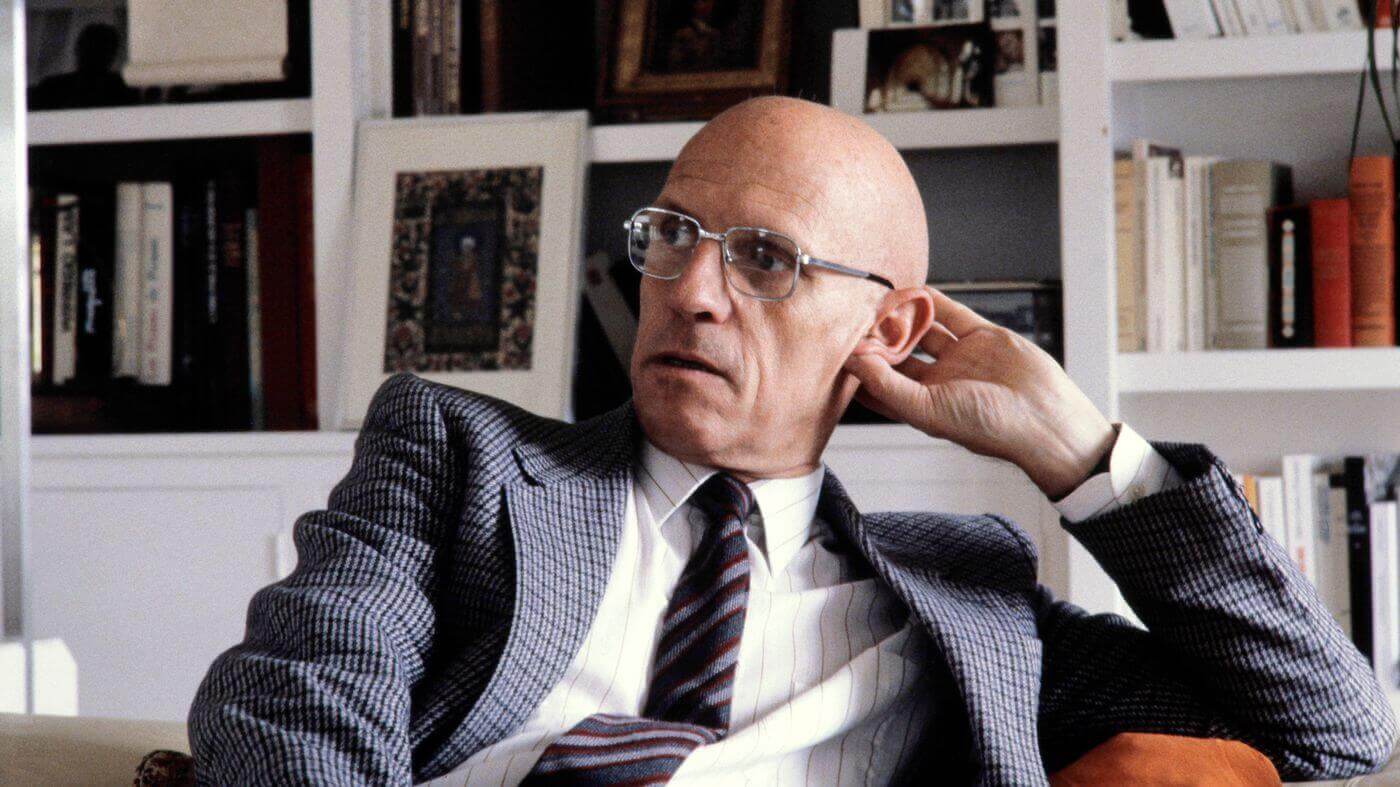
 

Foucault in Paris 1984
Foucault in Paris, May 1984. Photograph by Michelle Bancilhon. Source: RTS Culture


Gilles Deleuze

Seminar on Foucault, 1985-1986

Part III: Power

Lecture 19, 15 April 1986

Translated by Christian Kerslake; additional revisions and time stamp, Charles J. Stivale


Part 1

… I’ve been asked by some of you who don’t know about, which is quite natural, [William] Burroughs where you should start with this author, who is so significant for American literature, and for modern literature in general. I think that the best way in, for those who don’t already know him, is to start from one of his better-known novels. It would be better to avoid … he has produced some theoretical essays on control, on all that, but I don’t think that it’s the finest part of his work; it would be better to start with The Naked Lunch,[1] one of the better-known novels, which has been very nicely translated by Gallimard. In The Naked Lunch, you will see, there is a whole confrontation between groups of control, along with a very interesting preface by Burroughs. And I also recommend, especially if it’s your first contact – for those who already know him, you can ignore this – there’s an interesting number of [Cahiers de] L’Herne on Burroughs,[2] an interesting issue of L’Herne on Burroughs, although it’s not just on him, it’s on [Allen] Ginsberg as well, because Burroughs is one of the three greats of the Beat generation, the two others being the poet Ginsberg and [Jack] Kerouac. Yes, it’s on those three … In the light of what we have already said about modern literature, Burroughs, Kerouac and Ginsberg would also be key, fundamental figures in modern literature.

You will recall that last time we had somewhat displaced our problem of the relations of forces and the forms that follow from them, and which we had posed at the level of formations, formations of right [droit], formations of power or of right, or rather formations of power and of right. And so, we sought to sketch out from the juridical point of view, always focusing on a brief period, since this is the period considered by Foucault, a kind of table of formations of sovereignty, of formations of discipline and formations of control. And I ended by saying: yes, we could also look at the level of the formation of images (which would link up with what we have done in previous years), the formations of the image, so as to see … not at all in order to apply it, not at all …  but so as to gain some reference points. If I turn to the theme of regimes of images, can I find something equivalent there, as a way to bring about a consolidation.

And this would have its foundations in Foucault because Foucault makes three interventions on the pictorial image. One is the famous text on Velasquez’s Las Meninas, and which corresponds to the classical formation. Another is the manuscript on Manet he did not want to publish. And the other is the text on [René] Magritte, to which we have often referred. Well, … it is very vague things I have to say. From the point of view of the image – which was our concern in previous years, when we were preoccupied with cinema – is it possible to speak of regimes of images and if so, what could one bring to light? Could one find a confirmation there? I could even say, because of what we did in previous years, that there is the possibility here of defining different regimes of images. And in that case, might one be able to retrieve something like – without forcing it too much, without wanting a coincidence on all points – something like a regime of sovereignty as a regime of images, along with a regime of discipline, a regime of control?

I am thinking of a book to which Foucault nevertheless does not refer, which is quite independent, a book by Serge Daney that is a critique of cinema from the stable of the Cahiers. This book is called La Rampe.[3] And what interests me is that he distinguishes three, really three, regimes of images and of the cinematographic image. The first he takes to run up until the war. In effect, this is a periodization proper to the cinema. Up until the war: first regime. Now, how does he go about defining this regime? He defines it via a question. He says that the fundamental question is: ‘To what does the image refer?’, that is, ‘What is there behind the image?’ ‘What is there behind the image?’ What does that mean? He says: Yes, in this kind of regime of images, if you like, every element of the image plays the role, or can play the role, of a mask [cache],[4]  a temporary mask, so that it is only in the following image that one sees what lies behind it. And he says: the formula of this regime of images would be: the secret behind the door. And it is indeed true that in the whole of the classical cinema of the pre-war period, the door is something fundamental. Notably in the American comedy, the role of the door is … [Éric] Rohmer has done a whole course at IDHEC[5] on the role of doors in [Ernst] Lubitsch. But the door is … in effect the door is the temporary mask. So, what there is behind the door, everything that is behind the image, will naturally appear in the following image. However, that implies that this regime of the image, this first regime of the image, is a regime of totalization. A film is a beautiful totality. And how does this whole present itself? It is a succession of images always tending towards something that lies behind. It is this something that lies behind that will bring about the totalization. One might put it like that.

I am also thinking of someone else, a great art critic from the 19th century called [Alois] Riegl, who made periodizations out of three functions of art, or of the plastic arts in particular: to beautify nature, to spiritualize nature, to compete with nature.[6] I would say that this first regime of the image, the secret behind the door, what there is behind the image, precisely gives the first formula: to beautify nature. To beautify nature by making a totality of images, a whole of images. Thus, every image is transcended in the following image, but the set of images tends towards a whole. Fine. This is what formed the ambition of the earliest cinema: it is this regime of images, a ‘something behind the image’, that will constitute the whole of images, or that will constitute the determining center of images. Hence, at the summit of its ambition, you get great constructions in triptych. What was it that killed this kind of cinema?

Note that this corresponds well with the analysis, if you recall, that Foucault made of the Meninas. What was that? What is there behind the image? The king: what Foucault calls the place of the king. The king, whom one only sees in the image in the form of a reflection in the mirror. And the whole painting is organized towards this point that is behind the image, since one does not see it; so one can see that, in the Meninas, everything functions as a function of masks [caches]. For instance, one sees the other side of the painting that the painter is in the process of creating, but one does not see the painting itself. One sees the reflection of the king in the background, but one does not see the king himself. And all the elements of the image tend towards the king who one does not see. Therefore, the Meninas would correspond rather well to Daney’s formula: ‘what is there behind the image?’ Well, behind the image, there is the king, that is, the sovereign of the image.

Okay, that is just in order to … I don’t wish to insist on everything here. It is interesting, this is the question … okay, I’ll return to the cinema. Why did this great cinema, this first cinema disappear? This great cinema that one could call classical cinema. It disappeared with the war, why? Well, we would have to gather together the texts we looked at more closely in previous years; just recall the texts of Walter Benjamin on the relation between what he calls the arts of reproduction and the formation of totalitarian regimes.[7] We would have to take up the way in which a director like [Hans-Jürgen] Syberberg is inspired by Benjamin and goes on to push things further. When Syberberg said: it is necessary to judge Hitler as a film director, what does that mean, ‘judge Hitler as a film director’? It means that totalitarian regimes, and above all the Nazi regime, are presented under what form? As a kind of mise en scène. It cannot be reduced to that, but it is a kind of mise en scène of the masses. The massive direct palpations [manutentions] of the masses, the great mises en scène that end up making it … on this point it is [Paul] Virilio who connects up with Benjamin and Syberberg, when he shows that right up to the end Nazism is lived as a kind of super Hollywood, as a kind of competition with Hollywood to go the furthest in a kind of colossal mise en scène of State propaganda and direct palpation of the masses.[8]

Why is it that this sounds the death-knell of cinema? Why in a certain way does this toll the bell for the ambitions of [Sergei] Eisenstein and [Abel] Gance? It is obvious: what terminates the cinema called classical is Leni Riefenstahl. Classical cinema does not die from any mediocrity in its production, it really dies from something completely different: namely that in its deepest ambition, it is as if it is itself realized and then transcended, abominably transcended, by the great mises en scène of the State. So that, if cinema revives after the war, it is as a function of a completely different regime. It will no longer be the regime of sovereignty, and it will no longer involve the question ‘What is there to see behind the image?’ In a certain way, Nazism gave the answer to the question of what there is to see behind the image. What there is to see behind the image is the extermination camps. What is there to see behind the propaganda of the State? What is there to see behind the direct palpations of the masses? The camps. And I would say – or rather Daney shows it very well – that the whole of post-war cinema is formed as a function of this situation.

And in this regard, I think that an oeuvre like that of [Alain] Resnais is absolutely exemplary and fundamental, in this regard and in others besides. What makes Resnais important, in the second regime of the image, is that he has only ever had one subject, he has simply known how to vary it. Resnais’s single and unique subject, or his single and unique preoccupation, is the man who comes back from the dead. What is this ‘coming back from the dead?’ One feels strongly that this is his problem. I mean, it is strange; how does it happen that something like that is someone’s problem? I mean: even the physical kind of beauty …. I don’t know, I have never seen him in person, Resnais, I’m talking about the photos, but there is a kind of zombie beauty in Resnais. The man who comes back from the dead. All his work is … Think about his last film, which is incredible, Love unto Death [1984]… The man who comes back from the dead.

This is incomprehensible without taking into account one of Resnais’s first films, Night and Fog [1956] What was there after the camps? What was it to come back from the camps? So, I would say that cinema could not reconstitute itself after the war except by changing, by a changing of the regime of images. And what will this be? The way in which Daney defines the regime of image through neo-realism and starting from neo-realism is down to the fact that one can no longer ask what there is to see behind the image, but rather what there is to be seen in the image and on the surface of the image. What there is to see in the image and on the surface of the image: start by just looking. You are incapable of seeing what there is in an image. You had been incapable of seeing that, behind the great images of State propaganda, there was the camps. Don’t search for what is behind the images, start by reading an image. Start by perceiving an image. In a certain way, the first cinema proposed itself as an encyclopedia of the world. Well, no. There is no place for a sovereign encyclopedia now. So, what is there left to do? What amounts to a pedagogy of the image… [Interruption of the recording] [19:13]


Part 2

… Daney uses a word … I would call the first age the ‘encyclopedia’, the ‘encyclopedia of the world’. Now, after the war, arrives the great moment of a pedagogy of perception. To learn to look and to read the image. This will be [Roberto] Rossellini’s pedagogy. The work of Rossellini terminates explicitly with a pedagogical endeavour. And there will also be what Daney nicely calls Godardian pedagogy, or Straubian pedagogy; one could make a long list.[9] I will recall a formula from Daney: the métier of director had stopped being innocent, that is, this is what the great directors had declared. From then on, in a certain way, the cinema really has to fall back onto new bases; once again, it will no longer be ‘what is there to see behind the image?’, but ‘What is there to see on and in the image?’

And I would say that this is a pedagogical formation. One could say, without forcing things too much, that it is a disciplinary formation. A discipline of the image. The sovereignty of the image has made way – with everything that means, the ‘sovereignty of the image’: that there is something to see behind the image, the place of the king – for a discipline or pedagogy of the image. And what is that? According to Daney, it is the sign that this cinema will involve the image taking on its planitude [planitude]. The cinematographic image assuming its planitude. To the extent that it assumes its planitude, the eye that sees the image becomes the spiritual eye; this will be the stage in which the eye spiritualizes nature. The eye that sees the image must become an eye of the seer [voyant]. The eye of the seer is the eye that spiritualizes nature.

Okay, I’ll make a quick parallel with painting: it is at the level of impressionism that pictorial space is presented as if before a pure optics, and as assuming its planitude. The painting assuming its planitude is usually seen as a triumph of impressionism, little matter if this is right or wrong. So that one could make all sorts of parallels here as well. I would also say, although we don’t have time to go into it, that at this stage of the image, where the image assumes its own planitude in the way that you find in [Carl Theodor] Dreyer and in [Yasujiro] Ozu, one might be tempted to say that it is opposed to the depth of field in [Orson] Welles – but this isn’t true. The depth of field in Welles is radically novel with respect to the depth of the first regime. The depth of field in Welles is a depth that gives everything up to be seen. I mean it yields up everything to be seen in the image, that is, it yields up all the interactions to be seen from one plane to another, from the background to the foreground. This is: it’s the contrary of the depth of early cinema, the classical cinema, which was a depth in which the planes would serve to conceal some in relation to others, where the foreground is a kind of mask in relation to what is happening on other planes.[10]

So, in this sense both the depth of field in Welles and the planitude of Dreyer are fully a part of the second regime of the image – ‘to see what there is to see in the image and on the surface of the image.’ And then, just as Hitler was akin to the destruction or the impossibility of continuing with the first cinema, today one feels that in fact we are once more at an epochal turning point. After all, what was Hitler from the perspective we are exploring? That was radio. That was radio, everything happened through the radio. The contemporary crisis, on the other hand, well, everyone knows this, and it comes up all the time: it now passes through the television. It is no longer the radio; it is the television. And, in fact, could we say that what is currently being constituted as a third regime of the image, which will no longer be the encyclopedic or sovereign regime, nor the pedagogic or disciplinary regime, but a third regime? Well, Daney attempts to define it in the following manner: he says that today – and it is without doubt the same auteurs, the same modern auteurs, who straddle the two regimes – we are, in a very specific sense, in a new regime of images.

What is this new regime? It is a regime in which image always slides over image. That is, there is something behind the image, but it is no longer at all in the sense of the first regime. In what sense then? It is no longer at all in the same way, because what there is behind the image is always already an image. The images slide over each other. The image refers back to a prior, pre-existing image. An image slides over an image. In the very depths of the image, there is already an image. Or, as Daney says: nothing happens to humans anymore, everything that happens, happens through the image. This is striking, and he tries to give it a name, to form a concept, arriving at the notion – and here he also borrows from painting, from the history of painting – he calls modern mannerism. This is a mannerist regime of images.

But from our point of view, we could equally say that it is a regime of the control of images, where image controls image. This is no longer the same thing as the pedagogic or disciplinary regime. This is a regime … Perhaps there is an equivalent of this mannerism in contemporary cinema, where image always refers back to image, and where the image has no ground other than yet another image, as if the image does not cease to … You can see that this is very different to the first regime where, on the contrary, with the place of the king, the images refer back to something which is not an image, even if this something cannot be given beyond images; the images in any case tend toward something that is the ‘behind of the image.’ Here there is no longer any of that, the images slide over each other in such a way that there is always another image behind the image. And here, once again, in all our categories, I always insist on this: it is neither good nor bad. It includes the most worthless and the most beautiful. Every regime has its mediocrity of production and its masterpieces.

So, if I attempt to specify a little: where do we find this mannerism of images at the moment, or in this third regime, where the image controls the image? Well, we find it in television. This concerns television, not excluding its most execrable forms. With television, there is no longer any need to make cinema, since it is the world that makes cinema. It is the world that makes cinema: very nice. There is no longer any need to travel to the farthest reaches, since to travel is just to confirm how television functions over there. [Laughter] Some serious studies have dwelled upon the very important question: what kind of spectacle is most pleasing to people at the moment? And well, it would seem that … There was an article in Libération that echoed this problem. It transpired that one of the most prized spectacles at the moment is participation in a transmission as spectator. Not to actively participate – to go on television to talk about and explain one’s problem, that’s legitimate enough – but to be a spectator at a show that is in the process of being made. Observe also that currently shows are increasingly integrating spectators. You might ask: is this disturbing? Is it promising?

People seem to consider this the most valuable thing. Perhaps this is what is most disturbing about it, but as a spectacle, I see it as the equivalent of the visit to the factory. Now, the visit to the factory, that has never been very … You know: one goes around touching the technology [on touche de la technique]. With this kind of spectacle, there is a word that takes perfect account of the nature of the spectacle: it is said that ‘it is enriching’ [enrichissant]. [Laughter]. So, it is very enriching, … The shows on television, you know, it is always rather interesting, you have always these groups of people about whom you think: ‘what are they doing there?’. [Laughter] And well, it seems that their point of view must be that of technical spectators. It is not at all that they find it beautiful, or intelligent, but … they find it enriching. Why? Because they see how it happens, or they believe they see how it is constructed [se fabrique]. And that can be at the level where you get spectators watching a television presenter being made up before the transmission, for example. Thus, the show takes place before the show. Since finally there is always an image before the image, and the image will slide over the image. And the participation and presence of spectators at the show that is in the process of being made will serve as a guarantee of this sliding of the image over the image.

Good. I also saw – I couldn’t understand it – that there was a show where there are spectators, but one does not see them. So, it’s funny, there are cases where one sees the spectators, and there are cases … But, either way, it is necessary for the show in the process of being made to be done in front of spectators, so that the image is bottomless. So, these are, let us put it this way, the ‘enriching’ forms, but not the most ….  The technology [la technique], the contact with technology … To touch the technology. This is a wonderful thing, to touch the technology. It is not to become a technician, that is not at all what people want …. No, they want to touch the technology. That makes them dream. … It’s strange because …. It enters into the aesthetic dimension.

Take a case like [Francis Ford] Coppola. Even just technically. There is, as one says, a pre-visualization. This is a regime of images by way of pre-visualization. Previsualization. Previsualization by video. So that the film is filmed beyond the camera. In Coppola, in forms that are often very interesting, there will be a typical case of this modern mannerism where every image has pre-existing images for a basis. I don’t need to go further into the issue of the technology, I’m just indicating that the new images, or as is said, the numerical images, typically have the processes themselves (or other processes) as incrustations and are typically regimes of images where the image slides over the image; where what happens, happens to the image; and where the image has always had an image for basis. But, as always there is no need for very complex technologies, such as numerical images – I do not want to say that they are of no use, numerical images, but they are typically images of control. The numerical image, as a new form of image implying a new regime of images, refers back to a regime of control in which image controls image.

But I would say, independently of that, that you also have much simpler techniques that allow for the same thing. Think of a director like Syberberg, the whole question (for those who know his work) of frontal perspectives, and the technique of frontal perspectives as it appears in Syberberg, what does it make possible? Well, to film an actor on a transparent background; the frontal perspective in Syberberg is typically an illustration of a regime of the control of the image. This all works very well, because now I can say to myself: these three regimes … What can be found in the most important auteurs of contemporary cinema? I think that it’s the passage from the second to the third, from the second to the third stage. They started like …. Take the New Wave. They too are on the cusp of this. They have a foot in the new regime. You can see that Godard will be exemplary in this regard. They had been the creators of the great pedagogical regime, and then …. But I don’t really want to develop this, unless there are any of you who have comments to make. What I mean to say is: at this level of the regime of images, one can find an equivalent of the [historical] sequence but displaced [décalée] in time – because it is not the same temporalization. One could find a kind of regime of the sovereignty of the image, of the discipline of the image, and of the control of the image. That’s all I wanted to add, and now we can finish with that. Good, are there any, are there any comments?

A student: Yes, could I say something?

Deleuze: Ah … We have missed the broadcast, we forgot about 10 o’clock. We’ve missed the news.

Another person: [Inaudible] … all hours.

Deleuze: At all hours? Then tell me at 11 o’clock. Because if the Libyan airplanes arrive, it would be better to be tuned in. … Yes?[11]

First student: Yes, I wanted to say something. It is that there is always a kind of ambiguity at the level of the image, since it is the same word that is used, in my opinion, for several things. It has been taken up and developed, in my opinion, notably by Sartre, who in his theory of the imagination, says that on the one hand, there is a vignette-image – that says clearly enough what is meant, it is the image which is there; and on the other hand, what’s nonetheless fundamental in all that concerns in the cinematic image, there is movement, it moves! There is always something that moves. It is different from the fact of contemplation, the gaze, and whatever else is involved in what can be called a vignette-image. So, with the introduction of movement, Sartre said with some justice: these are ultimately two different types of consciousnesses. When I watch a film, I have a certain distance in relation to the film, whatever that implies, but at the end of the day I have a distance in relation to the film; whereas with the vignette-image, most often it is an imaging consciousness that supervenes on me, and in relation to which I am in some way, let’s say, passive, that I receive. And this dimension disappears in the image-movement which is that of cinema.

So, I’ll say it again, the first remark I wanted to make is that there is a kind of ambiguity: it is the same word image which serves simultaneously for the vignette that is immobile and for what runs off in the film, that runs off in the cinema. There is the introduction of movement, which involves difference, and which therefore provokes a different consciousness in the spectator. Sartre would say that in the imaging consciousness, there is something which supervenes on me, it is not something that I take, or an attitude that I control, it is something which happens to me. I’ll finish with an example from … the name escapes me, the author of Lady Chatterley’s Lover.[12] He says that unlike in former times, in antiquity, one no longer finds people who, all of a sudden, deeply live an image (it could be a flask of water or whatever). People who are imprinted by an image and live it profoundly. That fades away … probably precisely because of the introduction of movement. Anyway, there is this ambiguity, amongst others, of the vignette-image on the one hand, and the film-image on the other: in my opinion, it is the same word that is used for different things. I do not know if this is comprehensible or if one can draw important consequences from it. But this kind of imaging consciousness, in relation to perceptual consciousness – since the pedagogy of perception was being discussed – there was something there that leaves me a little unsatisfied and …

Deleuze. Yeah. With regard to that, it is not exactly our problem because I was taking the image in a sense as understood [sous-entendu]. For myself, I am no longer satisfied by … In fact, I understand the choice … You are right to recall that, in Sartre, there is a certain … Okay, but I mean the choice is not between an image where there is movement and what you are calling the vignette-image. Because take a picture, it does not move … but nobody thinks of reducing a picture to a vignette. In a certain way, strangely enough, it does move. What movement is there in a painting? There is obviously a movement. This movement nevertheless does not involve things moving in the painting. Then, as you say, in the cinematographic image, there really is movement, and you ask whether this might not be a reason for why there is not as much contemplation as during the times when the image doesn’t contain movement. I’m not sure. Contemplation: that has always been reserved to a minority of people. Painting was also reserved for a minority of people. What do people who love cinema find in cinema at the moment? What do I mean? Well, it seems to me to be a source of very intense contemplation. Among all the great auteurs of cinema, the factor of contemplation is intense, intense. Otherwise, how can one talk of ‘the rain’ in this or that auteur? The rain in [Michelangelo] Antonioni, one does not confuse that with the rain in …  who is another auteur of the rain?

A student: [Akira] Kurosawa.

Deleuze: … in Kurosawa. Okay, rain is of course something that falls and moves. This does not prevent it from being the object of a fundamental contemplation, the rain. The rain has a signature. Images of rain are signed. It’s true: the rain of Antonioni, I think everyone who loves Antonioni would recognize it. It moves beautifully, it is an object of an absolute contemplation. The rain falls, voilà. It is as signed as a painting; it is an object of contemplation just as much as a painting. One must not say, for example, that one does not contemplate in the cinema. It is an object of fantastic contemplation, the cinema.

For myself, what doesn’t gel with me, if you like, in what you say, is that I end up rediscovering the duality between what you call a vignette-image and the image-movement; that’s much too simple. Because once again, what is it that moves? It goes without saying that the relations between colors is a movement in a painting. It is necessary to arrive at a clearer definition of what movement is and what movement is not. The relations between colors are by all evidence a movement. When you have a relation between blue and a red, this is a movement, this is a movement, and it is a movement that is in the painting. It is simply a movement … For myself, I would say more: in the pictorial image, the movement is not extensive, but there are indeed other movements than extensive movements. In cinema, there are extensive movements, but there are also movements of another nature. But anyway, what I was just saying was on track. I was developing a line of thought on the image … a little parallel to what … You see …

A woman student: The question is not between the image that does not move and the image which moves, but it is rather between … between the new images, that is, television images and the cinema image, the latter which in my opinion belongs to the same epoch as the painting-image, on the same side, while I had the impression that the television image is … [inaudible]

Deleuze: Yes, yes, yes, yes.

The student: Also, I would really like a course …

Deleuze: On the televisual image? Ah, I am incapable of that … Yes, to be sure, yes. … But that is partly, it seems to me, because the regime of the televisual image is typically already a regime of the control of the image.

The student: Yes.

Deleuze: At the bottom of the image, it’s an image; that is: what happens, happens to images.

The student: Yes, which is not at all the case …

Deleuze: Which is not at all the case in post-war cinema … Good, let’s move on. Let’s leave that, eh?

So, finally, at the point we’ve reached, we have reached the point, at last we are close – or at least we might have the impression that we are close – to having finished with our question of power, with Foucault’s question concerning power. And, finally, if you wish, it seems to me that the relation – since we spent a first semester on knowledge, a second semester on power – well then, we are finally reaching the goal, under what form? Well, this seems on three principal points.

We have tried to develop, in Foucault, the necessity of the confrontation power – knowledge. Power is always a set of relations of well-determined forces. It is always a set of relations of forces. Remember a set of relations of forces is presented in what Foucault at one point calls a diagram. It is the diagram that is the presentation of relations of forces at a given moment. Well, I would say, first direction: we seek the relation [rapport] between … or rather the relationship [relation] between the relations of forces and the forms that follow from them. And we have found that the forms that will be the forms of knowledge follow from relations of forces. For example, we saw recently how the “God-form”, the “man-form”, and the “overman-form” can be considered as proceeding from changing relations of forces. This is a whole first aspect that we have [encountered].

Second direction: one considers the focal points [foyers] of power, the focal points of power presented in the diagram. This is the equivalent of relations of forces, but the accent is put on another aspect, it is no longer placed on the relations but on the points of power, once we remember that relations of forces in Foucault always go from one point to another in a social field. One considers the focal points of power and what follows from the focal points of power. What follows from them are regimes of statements or what Foucault calls the corpus. What follows is what we saw a while ago: to the question ‘How to select the dominant statements of an epoch? How to constitute the body of statements?’, Foucault answers: it is necessary first to determine the focal points of power and to see which words, which phrases, are exchanged at the level of these focuses.

For example: what are the statements concerning sexuality in the 19th century or at the 18th century? Let us first determine the focal points of power around which discourses on sexuality were formed. And it will be from these focal points of power that the dominant statements of the epoch on sexuality will follow. So, what are they, these focal points? Well, it will be the confessional, it will be the school, it will be medicine, certain sectors of medicine, etc. And Foucault’s method seems to us very important on this point, because in effect without it he would have no rule of method for selecting the characteristic statements of a historical formation. How to choose, how to select the statements? Well, if you have first determined the focal points of power around which discourses are exchanged. Therefore, it was no longer ‘relations of forces from which forms follow’, but rather: ‘focal points of power from which dominant statements follow’. I do not need to indicate that this is simultaneously a different answer and that, at the same time, the two responses are absolutely related.

The third direction we have encountered, still on this problem ‘what is the relation between power and knowledge?’ is that power – and this was a new way of determining power – consists in a set of abstract matters, or, if you prefer, of non-formed matters and non-formalized functions. But from it ensues formed or qualified matters and formalized or finalized functions. You see that this is still the same thing. This is still the same thing as the two other cases, but a different aspect is illuminated. Starting from non-formed matters and from non-formalized functions, concrete functions ensue, that is, formed matters, formalized functions. What does that mean? Well, in fact, what will power be?

I take up my examples again, which I will not develop further: to impose a task on any multiplicity, that is the formula of discipline, that is disciplinary power, pure disciplinary power, disciplinary power in the pure state. Go ahead and already correct yourself: there is never power in the pure state; nevertheless, I can still make an abstraction. In fact, I remind you of Foucault’s principle: in the concrete, everything is always a mixture of power and knowledge, there is no pure power, nor pure knowledge. But I can, though abstraction, derive a power in the abstract sense. Power in the abstract sense, disciplinary power in the abstract sense, will be: to impose any task on any multiplicity. Good, I say: any multiplicity whatever, that is what I am calling a non-formed matter. It is not specified which multiplicity. Are we talking about children? Is it men? And is it women? Is it workers? Is it soldiers? I know nothing about it. ‘Any multiplicity whatever’, that is, non-formed matter. To impose any task: I do not specify which. Is it to educate? Is to make people labor? Is it to care? Is it to carry out an exercise? I do not say. Any task whatever.

That is the pure diagram: to impose any task on any multiplicity. What ensues from it? That is, how is the diagram effectuated? Well, through the formalized functions and formed matters which, from that moment on, make up the entirety of the holders [détentrices] of knowledge. Example: the multiplicity is no longer any multiplicity whatsoever; it is a multiplicity of children. A formed matter. The child is a formed matter. And the corresponding function is no longer to impose any task whatever, it is to educate. This will be the school. If the any-multiplicity-whatever is no longer the child, but the sick, the corresponding formalized function will be: to care. And the form will no longer be the form ‘school’, but the form ‘hospital’. If the any-multiplicity-whatever is ‘young people with a sound constitution’ – what age did one do one’s service in the 19th century? 21 years old – in that case, ‘young people with a sound constitution of 21 years of age’. Well, then the formed matter will be: soldier. And the any-task-whatever will no longer be any one whatever, it will be: to train soldiers. You see, each time I can say: what defines power, or the diagram is the ensemble of non-formalised functions and non-formed matters flowing from concrete formalizable functions and concrete formable matters.

So, it’s as if there are three aspects, all of which come down to the same thing. With this I’ve summarized the object of our research on the relations power-knowledge, knowledge-power. How power is always incarnated or actualized in historical formations, historical formations that themselves constitute types of knowledge. Hence the idea: all power implies knowledge, all knowledge implies power. But you see how the three different ways, Foucault’s method, involves a kind of variation. But the whole is extremely rigorous and coherent. Only, at the moment when we thought we were finished – it is always like that, it’s great – when we thought we had finished, we come up against what? Okay, assuming all that, then what? What is that makes diagrams change? What is it that makes one pass from one relation of forces to another relation of forces? What is it that produces change? It’s already been said, it’s already been indicated: there are mutations, there are mutations of diagrams, and these mutations of diagrams have been verified up to this day. Change in the regimes of images is a mutation. Change in juridical formations, we saw that last time, that is a mutation. These are mutations. Change in the relations of forces leading to the forms God, man and overman: it is, if one may put it like this, the diagrammatic mutations that always bring new forms with them, new social formations. Good, that’s all fine, ‘mutation’, but it seems a bit easy. What are these mutations? The word ‘mutation’, okay, Foucault employs it …. Foucault invokes mutation, and at the level of relations of forces.

Fine, but does he just leave us with that? He abandons us, he says nothing more. How to take account of these mutations? How to explain the passage from one diagram to another diagram? And what relation is there between diagram B and diagram A? We have attempted to demonstrate all that, we have attempted to, but I believe that, to conclude, the moment has come to try to be a bit more … Well, what we know is that every diagram is strategic, and that, in appearance at least, to the question ‘what happens in a social field?’ Foucault’s own response, which has a great importance, will be: well, what happens in a social field is that “it strategizes” [ça stratégise]. A social field is the place of a strategy. What defines a strategy? Well, the relation of forces presented in the diagram. The relations of forces define the strategy corresponding to the social formation under consideration. This means, in effect, that every diagram is the place of a combat. A combat of forces. And it is from the combat of forces that the forms ensue. But I go back to the question: what does combat consist in? Between what or whom does combat take place? This is what I would like to … there is a need to be totally meticulous since this is the question we’ve been left with. We realize now that we were talking of mutation, about the substitution of one diagram for another, but, once again, the motor of substitution, of the replacement of one diagram by another, has been left for us to think through.

So, what happens to explain the change of diagram, that is, the passage from one historical formation to another? One could think up a first answer as follows: who is the combat happening between, in the strategy? We have already given an answer to that during the second semester a while back. Every force has a double power, a power of affecting and power of being affected. The power of being affected should be considered to be a power no less than the power of affecting. To affect and to be affected. As what? Well, the power of being affected by another force, the power of affecting another or other forces (force is always in the plural). Okay. So, I will say: there are forces; combat comes about between affecting and affected forces.

Moreover, I can even say: affecting forces and affected forces, this is already the result of combat. But better, what does that mean? Every power, Foucault says to us, goes from one point to another. What is a point in the social field? He hasn’t told us, and that speaks for itself; but for us, a definition must be proposed that seems to us to conform to the thought of Foucault. I would say: it seems to me that for Foucault, a point – in the sense in which he says ‘every power or every relation of forces goes from one point to another’ – a point is always the point of application of one force upon another. The point of application of one force upon another. And the synonym of ‘point’ would be ‘singularity.’ A singularity is the point of application of a force upon another force.

Hence the expression current in mathematics: ‘singular point.’ But we can see in what sense it can serve us in a theory of forces: points as singular points will be the points of application of a force upon another force. The result is that I can distinguish two sorts of points or two sorts of singularities. The points that mark or the singularities that mark the way in which a force is affected by another, and the singularities that mark the way in which one force affects others. For convenience’s sake, let us place what we can call ‘active points’ on the one side, points of application of the affecting force, and on the other what we can call ‘reactive points’, ‘points of reaction’, or ‘singularities of reaction’, points of application on the affected force… [Interruption of the recording] [1:05:35]

Part 3

… Can I say that it is as if the reactive points are the ‘vis-à-vis’ of the active points?[13] That is, the points that express the affecting force, and the points that express the affected force. What does that mean concretely speaking? Well, we have already seen. Take the relations of forces. For example, in the disciplinary regime, in disciplinary power, you will recall, they were painstakingly examined, arranged in series, lined up, to compose a force greater than the composing forces, to put in order [rang]. I’ll focus on ‘putting in order’. Putting in order is a force which affects other forces, it is the affecting force. The headmaster in a school says: ‘Now! Get in line.’ He is the affecting one, there is the singularity of the master. When he speaks, it is the singularity put into order [mise en rang]. It is the point put into order.

In fact, he will not be the only point. I no longer remember the exact sequence, but it involves first putting into order, and then filing into the class, the boys stand up, they sit down, they get out their belongings, they arrange them, they get to work. They get a smack because they have not done their work. You see, there is a succession of operations; to order here, they do not vary. This concerns ordering, putting into order, at the start and then at the end. Okay, but ‘being ordered’, that is a reactive point. Th active point: the master says, ‘Get in line!’ The boys put themselves in line: there is a reactive point, a being-affected. And the one cannot be concluded from the other, it is necessary to take account of the whole … it is a pair of affects. To every affecting affect there corresponds an affected affect, but the two do not resemble each other. There is a point of application.

For example, one can easily envisage a point of application: think back to your childhood. The headmaster says: ‘Get in line!’ You will find proof that there are points of application here. As Foucault said, this is an anatomy of the body, a political anatomy of the body. It can be that one finds oneself waiting with an almost sickly febrility for the end of the hour, for the moment when the master says, ‘Get in line!’, it’s the end of the class. It is not at all the same affect that is involved in the ‘getting in line!’ of “Come back in!’; so, there are already two affects of rank and file. But in fact, there are four affects: for there is the affecting affect of the master, also double – it is not the same at the beginning and the end — the master can be glad that it is over, or sad that it is over if he is a good master, he can be sad that the course is over. Anyway, I can thus furnish my diagram with all kinds of points. So, I ask you to keep this in mind, as we will need it. It is necessary to provide points, singularities. Now, is there in any of that anything that explains how a diagram passes away to the benefit of another diagram? I have looked hard, and there isn’t. No! The relations of power put all these points, or all the singularities, into relation with each other in such a way as to compose a stable whole.

What is capable of changing a diagram? You sense that there is a problem here. I hope you can sense that what needs to be retrieved here is Foucault’s path, his very path of research. He maintained the idea that diagrams change by mutation, but he could not content himself with a simple invocation of ‘mutation’. He had to ask himself: but who guarantees the transformation of a diagram? What had he maintained? He had maintained that there were affects or points between which relations of power are woven, but between these points, one does not actually come across the reason why a diagram changes.

And note, this is what matters to me today, I would like to insist in particular on this story of Foucault’s evolution. What is the evolution of a great philosopher like Foucault? When I say to you ‘one has no choice’, well, he had no choice; it was necessary that he find … something. And what will that be? At this point, we can make an attempt … but what does that mean, to ‘make an attempt to reconstitute a history of Foucault’s thought’? Well, we have the mapping points. Reading Discipline and Punish, one can see that it is already a question of the diagram, since it is there that the word appears. It is also already a question of the mutation of a diagram into another, since he studies two periods, two historical formations. But there is something about which he does not say a word, and which only emerges a year later — since there is one year, I believe, between the two books; yes, Discipline and Punish is 1975, The Will to Knowledge 1976 — What emerges in the course of one year is the idea that a diagram also involves points of resistance.

And here it is obviously necessary to pause a little. For, I believe, the notion of resistance does not yet make an appearance in Discipline and Punish. Discipline and Punish concludes in a very curious manner; it terminates abruptly, as if Foucault were laughing … And he ends with an invocation of a combat, ‘the distant roar of battle’, he says, that is the last sentence, aside from a little note announcing the sequels to the book. It ends on the announcement of the rumbling of a battle. Fine.

At that point, a year later, The Will to Knowledge appears. You will say to me: the subject is not the same; but that is what interests me. The Will to Knowledge is the first volume of The History of Sexuality. My question is different: it is that in the first volume of The History of Sexuality the question of power is largely taken up again from scratch. I’m asking: for what reasons? I mean: what are the innovations in The Will to Knowledge with respect to Discipline and Punish a year earlier? I say that there are two innovations – considerable innovations. These are: first innovation, Discipline and Punish in the end only considers a single form of disciplinary power, which Foucault already calls ‘the political anatomy of the body’. To discipline the body. The political anatomy of the body. This is the sole point; and he pursues this political anatomy, which consists in this: to impose any task whatever on any multiplicity whatever. And he identifies this at the levels of school, hospital, barracks, prison, factory, atelier. This is what Discipline and Punish does.

The first great innovation of The Will to Knowledge is that Foucault combines this with a second function … A disciplinary one? Maybe. Or maybe it is already something other than disciplinary, that is, a function of control? In any case, a function that straddles the disciplinary regime, but which also points to another regime. And this second function, he no longer calls it ‘political anatomy of the body’, but ‘biopolitics of populations’. That was not the question in Discipline and Punish. And the formula is no longer to impose a task on a confined multiplicity, but to administer [gérer] my life in a large, extended multiplicity. So that is the first innovation. I will not return to that, we have already commented on it, but I want to mark it as the first innovation.

Second innovation: at a fundamental level there appears the idea that in a society, in a social field, there are no longer only the points of affecting and the points of being affected, but there is a third sort of point: there are points of resistance, there are singularities of resistance. And here is a text which appears very strange to me. Listen to this carefully. It is necessary “not to misunderstand the strictly relational character of power relationships” (History of Sexuality 126/95 Eng). We have seen that force is always in relation with force. It is therefore necessary not to misrecognize the relational character of relations of power. “Their existence depends on a multiplicity of points of resistance” (126/95 Eng). Here appears the explicit formula of points of resistance. “Their existence depends on a multiplicity of points of resistance: these play the role of adversary…” (126/95 Eng). This is rather curious! You must already feel why it is curious, this text. “These play the role of adversary, target, support, or handle in power relations. These points of resistance are present everywhere in the power network. Hence there is no single locus of great Refusal” (126/95-96 Eng).

So, he rediscovers his usual theme: there is a dissemination of the points of resistance. Resistances are not “only a reaction or rebound, forming with respect to the basic domination an underside that is in the end always passive, doomed to perpetual defeat” (126/96 Eng, trans. modified). Therefore, these points of resistance are effective. “Resistances do not derive from a few heterogeneous principles” – that complicates it, it’s not heterogeneous to power, it also passes into and through the relations of power – “but neither are they a lure or a promise that is of necessity betrayed.” They pass through relations of power, but they are something else. “They are the odd term [l’autre terme] in relations of power; they are inscribed in the latter as an irreducible opposite [vis-à-vis].” Keep hold of that. “They are the odd term in relations of power; they are inscribed in the latter as an irreducible opposite. Hence, they too are distributed in irregular fashion” — just like the relations of power –“Hence they too are distributed in irregular fashion: the points, knots, focuses [foyers] of resistance are disseminated” [127/96 Eng]. You see, let me remind you. ‘Points, knots, focuses’: this is a mathematical vocabulary through which mathematicians give a precise definition to the singular points of a curve. So, there is an explicit allusion to singularities. With regard to what? To the points of resistance. There are therefore singularities of resistance. What should appear extraordinary to you in this text? The thing is, if you have been following me, even slightly, one would be expecting something completely different.

A student: [Inaudible comment]

Deleuze: Is it 11 o’clock?

Another student:  3 minutes to, 3 minutes to, 3 minutes to.

Deleuze: Pages 126-127 [95-96 Eng] … Ah, okay. Recreation, if we can call it that… [Interruption of the recording] [1:22:30]

… [Page] 127 [95-6 Eng] of The Will to Knowledge [The History of Sexuality, Volume I]: two expressions give me a problem. These are: “the resistances play the role of adversary, target, support or handle in power relations” (95 Eng). And a little further: “the resistances are inscribed in relations of power as an irreducible vis-à-vis” (96 Eng). Because, even so, one would be expecting something absolutely different. If I consider a force of affecting in a relation of power, for example, ‘to put in order’ [rang], what is its ‘vis-à-vis’? Or, if you prefer, what is its adversary, its target and its support? Obviously, the corresponding force of being affected. To the force of the master of putting in order corresponds, as vis-à-vis, the force of the pupil, that is, the power of the pupil, the capacity of the pupil to be put in order. In other words, to the singularities or to the points of action, correspond, as vis-à-vis, the points of reaction, and there you have the relation action-reaction. And, in The Will to Knowledge, Foucault does not tell us that. He tells us: the true vis-à-vis of power relations are points of resistance. Understand this, this is essential! This is essential, this slippage. One must understand: power relations put two vis-à-vis into relation, the force of affecting and the force of being affected, that is, the point of action and the point of reaction. That’s the first thing.

But more importantly, there is a vis-à-vis of the relation of power, and the vis-à-vis of the relation of power involves points of resistance. This is because points of resistance are not at all the same thing as points of reaction. The point of reaction is, for example, the capacity to be put into order. I put myself in line; there you have a point of reaction. I put myself in line, in fact, when the master says, ‘Get in line’. There are two vis-à-vis. But the point of resistance is something completely different. That’s all of you a bit earlier, a bad example, I know [Laughter]: I say: ‘Come back in, come back! [Rentrez] Come back in!’ and … nothing at all! That was a case of the resistance known as passive. A step further, go ahead, and at that point, you’d have stampeded over me: active resistance. But whether it be passive or active, the point of resistance is absolutely different from the point of reaction. When Foucault talks about ‘the vis-à-vis of the relation of power’, these are points of resistance. I’m saying: the second innovation of The Will to Knowledge in relation to Discipline and Punish is the discovery of a third sort of singularity, or the discovery of points of resistance. In other words, I can no longer say, as I was happy to do up until now, that there is a fundamentally a double power in relation, namely, a power to affect and a power to be affected. Now I must link it up with a third power: the power to resist. The power to resist is a third sort of affect, irreducible to the active affects and to reactive affects. It is a third kind of singularity.

Well, you can see that this whole text … it fascinates me, this text, because if one turns back to a year before, it would have been completely unintelligible. The power of affecting in Discipline and Punish can only have a single vis-à-vis, and that is the power of being affected. That there is a power of resisting that is not to be reduced to the power of affecting, nor to the power of being affected, why does Foucault discover this? Because he absolutely has need of it. My question is: what are the consequences going to be? First: why does he absolutely need it? Let us respond to this question first. Why does he have need of it? Because it seems obvious to me that it is only by focusing on points of resistance that one can understand the mutation of a diagram; namely, why a diagram changes to the advantage of a new distribution of the relations of power. Everything happens as if – do you have a little piece of chalk? Thank you — you will understand. [Deleuze writes on the board]: There, that’s nice, eh? That is a set of relations of forces, going from one point to another, point of action and point of reaction. Each time there is a line, I can write: PA, PR. I would say: that’s a diagram, that’s what that is. It is enough to specify the PA and the PR, the points of action and points of reaction. One specifies it by determining the focal points of power in an epoch. The focal points of power are the points where specifically confront each other … where the lines that connect points of action and points of reaction. Now, that is what I would say if I remained within the confines of Discipline and Punish. The points of action and points of reaction are fundamentally bound to each other. Hence you can recognize them by the way they are joined to each other.

You will ask me: [Gesturing to the board] why don’t I join up that and that instead? Because there is dissemination: not every focus of power is bound to every focus of power. Sometimes it is bound, sometimes it is not bound. In any case, you have this: the set of the diagram will join the assigned points in a certain order. But now I need to join the points of resistance to the diagram, as in some way the non-bound points, or rather – actually, it’s not right to say non-bound; they are indeed bound, since in fact they’re not abstract. They resist existing centers of power. But, in order to indicate that they are not bound in the same manner as the preceding ones, I’ll write them with dots. You follow? The points of resistance. If these points of resistance, then, which are virtually tied to points of action and reaction, join among themselves … Imagine I’ve got a blue or red chalk, and I make a blue line from there to there. Suppose therefore that these points of resistance enter into relation and thus take on consistency and resonate with each other, then your diagram will collapse to the benefit of another diagram. All the relations of forces will be redistributed. How’s that sound? Is it clear? Question?

A student: Does this diagram encompass societies other than western, or…

Deleuze: Oh, no! Listen… there’s no answer to that since Foucault does not deal with other societies. But to the extent that we have seen that it can seem to us that every society has a strategy and a diagram, the East [l’Orient] would confirm it if there were societies which are thought, and perpetually thought, under the species of a strategy. There are indeed extreme oriental varieties, societies that are strategic by nature; the Chinese never stopped thinking strategically in their social formation. So, it seems to me to hold for all … But understand the importance of these points of resistance that, precisely, will guarantee the way in which a diagram is overturned, giving place to another diagram which will be the expression of a new relation of forces, to which points of resistance will also be attached. In other words, it is at the level of the points of resistance that the diagram is fundamentally malleable, reversible, and the object of possible mutations.

Hence that text seems to me to be extremely curious, extremely important, because it explains the point of resistance, the points of resistance, literally as counter-powers. Except that this will bring with it enormous consequences for Foucault’s philosophy, and even more for his political conceptions. I’ll dwell on this a little before moving to the consequences: what does that mean, that these are counter-powers? Well, it means: every time power determines an object that is proper to it or determines the object upon which it bears – and we have seen: every time there is a diagram, there is a determination of the object upon which the power bears – this object can always equally be related to a capacity for resistance which turns it back against power. Example: we have seen that in the formations of control, power and even right [droit] take life as their object. But power and even right under which form? Under the form ‘to administer life, administration of populations’; or under the form of right, social right, namely how to ‘insure life in man.’ I’m using ‘insure’ in the proper sense of the word, in the literal sense of the word, since we saw last time that in this formation of social right, insurance played the fundamental role. But, when power and right take life for an object, it is this same life that is turned back against power and against right and becomes the resistance of life against power and against right.

And this is what Foucault tells us, in one very beautiful page, also from The Will to Knowledge, pages 190-1 [144-45 Eng, translation modified] this time, and since it cannot be put any better, I am content to read it: “And against this power that was still new in the nineteenth century” – the administration of the life of populations, administering life, the biopolitics of populations – “against this power that was still new in the nineteenth century, the forces that resist …” – you see, it is not forces that affect or that are affected – “the forces that resist relied for support on the very thing that this power invests”[14], the forces of resistance relied for support on the very thing that this power invests, and this power invests life. Power, the administration of the life of populations, invests life. But the forces that resist relied for support on the very thing that it invests, that is, on life, and man insofar as he is a living being. In other words, it is: power takes life for object, life turns against power.

“Since the last century, the great struggles that have challenged the general system of power were not guided by the belief in a return to former rights, or by the age-old dream of a cycle of time or a Golden Age. One no longer aspired toward the coming of the emperor of the poor, or the kingdom of the latter days, or even the restoration of our imagined ancestral rights; what was demanded and what served as an objective was life […].” “What was demanded and what served as an objective was life, understood as the basic needs, man’s concrete essence, the accomplishment of his virtualities, a plenitude of the possible” [190-191/144-145 Eng]. To my knowledge, this is very curious, because “plenitude of the possible” is such a Spinozist term, it is so … This is a very unusual expression coming from the pen of Foucault. I have been trying to say to you from the beginning: there is a vitalism in Foucault, there is a very strange vitalism in Foucault. And I think that this vitalism comes directly from Foucault’s relation with [Xavier] Bichat. I have attempted to say it in various ways, but if there is a vitalist text in which this vitalism of Foucault is expressed, it is this one, 190-191 [144-45 Eng]. It is life: “What was demanded and what served as an objective was life, understood as the basic needs, man’s concrete essence.” This pays homage to Marx: “Man’s concrete essence”, that comes from Marx. “Accomplishment of his virtualities, a plenitude of the possible”, that comes from Spinoza. This is very odd.

I don’t mean that this is styled like a patchwork, it is unified in Foucault’s own style, but it is as if one sees the strata of reading right there in a text like that. But still more a kind of stratum of life that is very curious. “Whether or not it was Utopia that was wanted is of little importance” in contemporary struggles — “Whether or not it was Utopia that was wanted is of little importance; what we have seen has been a very real process of struggle. Life as a political object” — this is the essential text here, I’ll read it slowly — “Life as a political object was in a sense taken at its word and turned back against the system that was bent on controlling it,” “life as a political object was in a sense taken at its word and turned back against the system that was bent on controlling it. It was life more than the law that became the issue of political struggles, even if the latter” – political struggles – “were formulated through affirmations concerning rights.” The ‘right’ to life, to one’s body, to health, to happiness, to the satisfaction of needs, and beyond all the oppressions or ‘alienations,’ the “‘right’, … which the classical juridical system was utterly incapable of comprehending, was the political response to all these new procedures of power.”

Fine, but what does that mean: power takes life for object, life turns back against power? I would say that this is a part of the contribution made by The Will to Knowledge that is completely different to Discipline and Punish. Only, if you have followed me so far, I would say: the consequences are enormous. It is very strange: these points of resistance disseminated in the diagrams, which have the power of making the diagram mutate under certain conditions: where do they come from? From where do they get their status? Do you sense that Foucault has found himself in a peculiar situation? Can he maintain that the points of resistances … will he be able to maintain any longer that the points of resistances are the vis-à-vis of relations of power, as he said on p. 126-27 [95-96 Eng]? Will he be able to sustain that? I’ve already insisted, from the outset, upon the very ambiguous character of an expression like ‘vis-à-vis’, because rigorously speaking the only vis-à-vis of a force of affecting is the force of being affected. Resistance, the power of resistance, does not have power as a property under any conditions, but under certain conditions to be determined, of being capable of overturning diagrams. Diagrams are presentations of relations of existing forces. But ‘power of resistance’ far exceeds a simple vis-à-vis. And can Foucault maintain his definition of the social field, “it strategizes”; that it is constituted as strategy? I mean: is it not that, one way or another, he will end up being forced into saying (which is bizarre): the points of resistance are primary in relation to power; they are not vis-à-vis, they have to be primary. From this moment a social field must be defined by this: it resists everywhere. It resists everywhere. Meaning: it resists power, and not: it strategizes everywhere. It is necessary, in a certain manner, that the points of resistance should be primary in relation to power.

It is necessary that the resistance to power should be primary in relation to power itself. Is it not necessary to go that far? And that is Foucault tells us in a text published by [Hubert] Dreyfus and [Pau] Rabinow, p. 300 of Foucault Un Parcours Philosophique,[15] but this is a text by Foucault; if it wasn’t, I wouldn’t make use of it. This is what he tells us: “I would like to suggest another way to go further toward a new economy of power relations.” So, it is a new way, different to what he has considered up to this point in his written work. This is a transcription of a conversation. This new mode of investigation “consists of taking the forms of resistance against different forms of power as a starting point.” “To take the forms of resistance against different forms of power as a starting point”. Okay. “To use another metaphor, it consists of using this resistance as a chemical catalyst so as to bring to light power relations, locate their position, and find out their point of application and the methods used.” “Point of application”: in our commentary so far, this has involved the power to affect and the power to be affected; it is the application of force on force.

Now he tells us: from a certain point of view, it is necessary to consider the resistances as primary. Except if you listened carefully to the text I read, he says it under very prudent conditions, because according to the letter of the text, what is concerned is a primacy solely from the point of view of knowledge [connaissance]. That is, he tells us in this text: perhaps in order to know the relations of power in a social formation, it is best to start by studying the points of resistance. Keeping to the letter, I would say that he says nothing more. Do we have the right to think that he is already led to say more, that it is not simply from the point of view of knowledge, but it is in itself that the points of resistance in a society are primary with respect to the relations of power? In this sense, the points of resistance are not once again the vis-à-vis of relations of power, they are primary. In other words, a social field resists power, before strategizing itself, in the relations of power. What would make someone say that? Who might articulate that? Who might think that Foucault is turning around something like that? For myself, I would almost say, if it did not take risks with Foucault’s thought, that he knew very well that he would end up there. He knew very well that he would arrive there; it was just that at this point, it wasn’t the right moment, so he takes a very prudent position, from the point of view of knowledge.

Why is it that he would reach that point? Because that had already occurred. [Éric] Alliez and [Giorgio] Passerone brought it up once, but they only brought it up briefly, and we too will only briefly touch on it – that, in what is known as Italian Marxism (and even in other forms, already in a certain way in [Georg] Lukacs, then in everything that was of importance in the evolution of Marxism), but particularly in a book by [Mario] Tronti, an Italian Marxist, T-R-O-N-T-I, resistance is posited as primary in relation to what it resists?[16] Now Foucault knew these works. So why does he hesitate? Surely because he is not satisfied with the way in which Tronti demonstrates it, and because, as far as he is concerned, he has not yet found a satisfactory way of showing in what sense resistance is primary in the social field. But I think that … well, once again this is the case of a body of work too quickly interrupted in so many respects. At the end of his work, and certainly at the level of The Will to Knowledge in its difference from Discipline and Punish, Foucault discovers points of resistance as irreducible to relations of power, and as having the strange property of turning against power, and as being that out of which power makes its object; that is to say, it is what power has undertaken to control. The point of resistance is something uncontrollable in the object of power. And this something uncontrollable in the object of power is primary in relation to power… [Interruption of the recording] [1:52:14]

Part 4

… But you can rightly sense that this will play a decisive role. A decisive role in what? If you are not too tired, I would like to continue this evolutionary story. What happened? What happened in Foucault? What happened in Foucault at this precise moment? Why does he think, in my opinion completely wrongly (but he lived it in this way) … what has made him think of himself as being in a kind of state of crisis? What happened? What happened after The Will to Knoweldge? I pose the question because this is a question that is important to us, one of development. It was a part of the development of the thought of a philosopher like Foucault. And I can mark right it there at this point, even if only from the outside – I wouldn’t allow myself to assume anything about what happened in Foucault’s head – I’m only stating how things look from outside.

The Archaeology of Knowledge is from 1969. What can I say of The Archaeology of Knowledge? This is a great book which is presented as a book of method, and which concludes a whole series of books that bear upon knowledge [savoir], the first axis of Foucault’s thought. All the preceding books were focused upon knowledge, which is not to say upon science, since Raymond Roussel has a knowledge which forms a unity with his own poetry. You will recall (I won’t go back over it beyond saying this), that knowledge is not at all the same thing as science, poetry is also knowledge. Science is knowledge and other things are indeed also knowledge. But all these books on knowledge culminate with The Archaeology of Knowledge, 1969. Of course, something else was already underway. In other words, Foucault had already known for a long time that the axis of knowledge was not sufficient. In fact, The Archaeology of Knowledge concludes and draws all its consequences at the level of a great theory of statements (the details of which we saw in the first semester), but he remains silent on how to choose the statements [énoncés] of a corpus, no doubt because the selection of statements of a corpus refers to another axis than that of knowledge. Therefore, there is already another axis that puts pressure on the axis of knowledge, but Foucault was not yet at the point of studying this second axis for itself, even though this second axis had already been active within and underneath the first. Now a long reflection will be necessary for him, and not only a reflection, but a practice.

In fact, if The Archaeology of Knowledge is from 1969, the following book appears in 1975. Six years with no book. What does that mean? And what did he do during those six years? He engaged in the practice of struggle, that is, he founded – and I have often mentioned this – the Group Information Prison, he participated in all the struggles around the prison movement; this was an epoch that was rich in struggles. So, he did not have, or I do not think that Foucault had, a political practice, as some have said, before ’68. The great moment of his political practice is after ’68, in the Group Information Prison, which in my opinion was one of the successes of leftism after ’68, that is, one of the rare groups that did not give in once again to a Stalinist form. And he delivers himself over in parallel to a theoretical reflection. Is it by chance that his practice was centered on prisons and the problem of prisons? Obviously not. In 1975 Discipline and Punish burst on the scene, and it is through the problem of prisons and the problem of punishment that he accedes to the second axis, the axis of power. Discipline and Punish is the first book on this axis of power. There, power and power relations are considered for themselves. From this moment the sense in which the formations of knowledge implied, demanded, this second axis of power, becomes clear. It will have taken six years for Foucault to clarify this changing of axis. And then, almost immediately, The Will to Knowledge appears, which is in effect the second book on power. You will ask me: why call it ‘knowledge’? There is no problem in this regard, because if it is called ‘knowledge’ it is alongside a ‘will to knowledge’; and ‘will to knowledge’ precisely designates the concrete mixture power-knowledge.

I have just tried to show how The Will to Knowledge brings innovations with it, two fundamentally new themes. First theme: the relation of power and life; second theme: the specificity of the points of resistance. These are therefore two closely related books. What has happened and what is the crisis, what kind of crisis has Foucault traversed with the publication of The Will to Knowledge? I think that there is no doubt, because he said that he had the impression of a misunderstanding about this book, he had the impression of a misunderstanding, and peculiarly enough, this misunderstanding was painful for him, as it happens. He took it to heart in a certain way … it is quite curious because there were many misunderstandings concerning The History of Madness, and he took them very well to my knowledge, although I don’t know … But he finds the misunderstanding … well, it must have been much more serious, this misunderstanding. And it was not only that, in my opinion. What else? For myself, I think that if Foucault had the impression, rightly or wrongly, of a misunderstanding, it was because there was also a kind of crisis of survival, and I think that this crisis was manifested in the most noble manner in which a crisis can manifest itself, namely, as a kind of withdrawal, leave me, leave me…

I have to try to picture things clearly. So, Foucault underwent a retreat, and he was at this moment no doubt more alone than he ever had been. I think that this sort of thing is truly a part of philosophy. But what was it all about? Well, I think that the crisis, if I were to try to explain it — without claiming to divulge the slightest secret; this is my hypothesis, a hypothesis completely from outside — I think that in fact he had a crisis and that he thought that, before everything else, there was not only a misunderstanding at the level of The Will to Knowledge, a misunderstanding between him and his readers, but that something much more serious was involved, namely, that he was in an impasse. And what was this impasse? That he had formed his system of knowledge-power with its whole variety of landscapes, with all its enormous diversity – Foucault is not one of those authors who repeat the same thing over and over again, every time it was full of diversity, each time he started over. But what was it? What was this impasse? My God, I no longer have the means, I no longer have the means of breaking away from the point of view of power. Will I be a man of power? In the end, despite all my efforts, aren’t I still on the side of power? And, if you will, in order to make myself understood, Foucault was a man who, for example, in the demonstrations of the period, possessed a kind of violence, but a contained violence; it was as if he trembled in himself, but not out of fear, he trembled in himself with violence.

And the question is: philosophically, am I no longer on the side of power? Do I have the means philosophically to think as a function of a category that would no longer be that of knowledge, since knowledge in his philosophy finds its reason, precisely, in the consecutive force-relations of power. In other words: am I able to cross the line? And finally, where is the author, whether in literature or philosophy, who doesn’t live in a certain way with this question: Am I just being clever [malin] or am I … am I capable of crossing the line? Although obviously ‘what line?’ is the question. And without doubt it varies, not everyone has the same line as everyone else. But, you know, in literature or in thought, there is no difference between literature and philosophy, what is always involved is crossing the line. And in the event that the readers applaud and say, ‘that is good’, the author is aware that it is of course a good thing if people like it, but nevertheless, that it is still so far, so very far, from what he wanted. And for my part, I think that Foucault told himself about power: am I going to be able to cross the line of power, or will I stay on the side of power?

Hence, the importance of this affair of the points of resistance, and I’m telling you: it’s fate! It is truly fate; it’s fate that must have drawn him to posit more and more the points of resistance as primary, because to say “the points of resistance are primary” is already to have crossed the line. But one cannot cross the line by simply saying something that arranges things in a different order – it must be necessary, it must be absolutely necessary in such a way that one cannot do otherwise.

So, although I have already read it, I think the time has come to re-read this fundamental text, since it persuades me that I am not in the process of delivering myself over to a grotesque interpretation, but that this is indeed what explains Foucault’s silence for much of the year after the publication of The Will to Knowledge.[17] This is the moment Foucault says to us: “I will be told: ‘That’s so like you, always with the same inability to cross the line”,[18] that is, to transcend the category of power. “That’s so like you, always with the same inability to cross the line”: this text is from 1977, and so after The Will to Knowledge, which is ’76: “Always with the same inability to cross the line, to pass to the other side, to listen and to convey the language that comes from elsewhere or from below; always the same choice, on the side of power, of what it says or causes to be said.” That is a kind of objection that Foucault, to the extent that he progressed, had to make to himself, and which he had to hold onto to the point that he said: no, leave me the fuck alone, I have to find, I have to get myself together.

How to cross the line? You understand? And in my opinion, this is the sole explanation of the fact that The Will to Knowledge is 1976, and that the next book, in which he has found an answer, will only appear in 1984 (it was ready before that, but will only appear then), that is, eight years later. There, he has found what he was looking for. At what cost did he find it? … Well, what does that mean? What does all this mean: that he discovered, he found how to cross the line? I would say that in a way, one can mark the precise moment in The Will to Knowledge at which he has not yet crossed over: this is the discovery of the points of resistance. Because, in fact, what can one say? Foucault objects to himself, and it is indeed much more than an objection, it is truly something … it is an affair of State. He objects to himself, he tells himself: but you are unable to cross the line, you remain on the side of power; all you are capable of doing is giving an account of the forms of knowledge through the relations of power and that’s it. He discovers the points of resistance, but he does not yet have a status for these points of resistance. He cannot yet cross the line. He sees beyond the line. He sees beyond the line that there are the points of resistance, but what to do about it? Well one can always have a debate; and he debates. Recall how he debates: he says ‘Okay, there, I could have…’ He was fond of this method, several of his books end with a kind of dialogue with himself. Let us try to reconstitute, if we can, a kind of dialogue of Foucault with himself, at the level of this problem: to cross the line.

Well, I see a first possible intervention. He could say to himself: well, yes, but it’s not my fault, it’s the sign of the modern world, namely what has become destiny is, as others might say, politics. Politics has become destiny or, if you prefer, our destiny is always our relation with power and no matter how humble we are, the hour will always come when power, if one can say this, interpellates us. And Foucault can say to himself: it’s not even my fault, it’s just like that! Therefore, you see, he will accept it, he will say: well, yes, I don’t cross the line, because it is uncrossable. It is uncrossable. I stay on the side of power because we are all on the side of power, that is, one is under it. One receives its blows, and that’s that. And, in fact, whether it is the most powerful or the humblest, I would say that power soon calls us and says to us ‘Come here’, ‘Come and render accounts’. And what recourse does one have? One can with all rigour invoke a power that is against other powers, yes. ‘Give an account of yourself, show yourself in the light!’, or ‘Come and explain yourself’. The two forms of knowledge, the visible and the statement, once again, are indeed the two branches corresponding to the injunctions of power: ‘Show yourself, explain yourself.’ ‘Show yourself, come into the light a little’, the identity photo; then ‘Explain yourself, say a bit about what you did there’, the inquest.

And so, in 1977, Foucault writes on the theme that pursues him the whole time, the infamous man. What is an infamous man? Well, the infamous man is any man whatever, the ordinary man in so far as he comes up against power, in so far as he is interpellated by power, in so far as he must give an account to power. You have beaten your wife? — This is the lettre, this is the man under the lettre de cachet or the man of voluntary injunction — You have beaten our wife? Well, what happened? And the woman who is beaten, she herself makes a petition and says ‘Defend me’; she invokes a power. Okay, but first answer will be: the decisive moment of our lives is always the moment at which we run up against power. Indeed. One can indeed say that. But it is a desolate answer, because there is no way in which one can cross the line.

Second possible intervention: Yes, there are points of resistance, the discovery of The Will to Knowledge, which brings with it the mutation of diagrams, etc., which can give a meaning to political struggle. Well, okay. There is that. It is already better. Can one link up the points of resistances? Yes, one can. Can one struggle? Yes, one can struggle, from this point: one can cross the line. Yes. Answer: on condition that one does not quickly go back to the other side of the line. For, if the points of resistance enter into relation with each other, that is, deliver themselves back over to operations of centralization, of reinforcement, if they transcend their dissemination – and they are indeed forced to transcend their dissemination, if not how would they prevail? – if they remold a centralism, the famous democratic centralism …. if they reforge a democratic centralism, in other words, if they restratify, they engender a new formation. But, well, the new formation, we learn from experience that it risks being worse than what went before; or it engenders focal points of power that render resistance ever more aleatory. Fine. These are the great setbacks of revolutions. So, there you are: the points of resistance.

Third intervention: so, what is left? If I cannot even count on the points of resistance, because the points of resistance are good in so far as they are disseminated, insofar as they are specific in their relation to the relations of power, but from the moment that they co-aggregate, from the moment that they aggregate amongst each other, from the moment they reform the lines, they reform strata that are just as hardened as the strata they have just undone. So, what would the line be, to cross the line? Is it simply to invoke a life? To turn life back against power, what is this vitalism? To cross the line, this means what? To go beyond power, no longer to be on the side of power. Is it to reclaim life? Like a poet or a great novelist can reclaim life: [D.H.] Lawrence, Henry Miller …. Yes, in a certain manner, they have not ceased to resist, their work is a resistance. Good.

What is this line? Let us call it, because this will be convenient for us – to go beyond power is to cross a very bizarre line – the line of the outside. The outside of power. The line of the outside. To cross the line of the outside. This, no shadow of a doubt, is what writing tries to do, what the great writers and philosophers try to do. To attain the line of the outside or to cross it, it is the same thing: but what can it be, the line of the outside? We found this expression in both Foucault and [Maurice] Blanchot: the Outside! And what is that? And what is the line of the outside? What is there on the other side? The void? Death? The void, death … After all, Foucault’s vitalism, as I pointed out to you, arises in relation to Bichat, and as Foucault said with regard to Bichat, this is a vitalism on the basis of mortalism.[19] Death for Bichat, that is to say, violent death, multiple death, plural death, all of that is the object of Bichat’s book on death. So to cross the line, is that finally …? Is it death? Or the void? It is falling into the void; it is to die. After all, these themes are close to both Foucault and Blanchot. At least, at least … what?

Well, suppose … suppose that the outside, the line of the outside, this beyond of power, is taken up into a movement that tears the void apart, or that overturns death. All this is words for the moment. The line of the outside that risks falling into the void or into death: suppose that it conjugates with a movement that tears the void apart and overturns death. You will say to me: easy to suppose. That doesn’t matter, let us suppose it. At this precise moment, what would happen? At this moment, one would have a third axis. At this precise moment, beyond the axis of knowledge and the axis of power, there would be a third axis. In fact, if the line of the outside leads back to the void and to death, one can’t say that there must be a third axis. However, if something other than the void and death is involved, there would indeed be a third axis. How could he not have seen this from the beginning? He was too immersed in the two others. He was too immersed in the two others. It was necessary to discover it. It was necessary to discover it as a kind of subterranean thing already working under the two others. It was present from the beginning, but one did not know that one saw it. An axis that would be neither knowledge nor power. And this axis would be what permits him to cross the line, it would itself be the crossing of the line.

And look at the point we’ve reached. I firmly believe that, on the one hand, this third axis will only be discovered by Foucault in his final books, that is, in The Use of Pleasure. And this third axis will be discovered under exceptional conditions, completely bizarre, for even in all that I just said, this third axis is an axis of violent passion, a kind of stake of life and death. Foucault will put all his strength into uncovering it under neutral conditions and, in a kind of ultimate joke, he will discover it in the Greeks, although he is – I exaggerate a little – somewhat mischievous with the Greeks.

Why did he need to put maximum coolness into the uncovering of this third dimension? And to make out that it concerns an ancient affair that does not concern us at a vital level, when it precisely does concern us at a vital level? There is the first question and the second question. This third dimension, this third axis that he uncovers at this moment, he … in a certain way he had never ceased speaking about it, and almost had never talked of anything but that, only under conditions that were overlain by the problem of knowledge and by the problem of power. But what I would like to show is that in a number of books, from the beginning until the end, notably in Raymond Roussel, this was what was in question: to cross the line, how to cross the line? How to go beyond both knowledge and power? What axis, literally, will it be necessary to mount? In what dimension will it be necessary to approach it? This was truly his most profound, passional problem, but which, as passional problem, could only exist in a subterranean way in knowledge and power, so that he could only isolate it under the conditions of a feigned coolness, an extreme coolness, and under the form of a return to the Greeks. What happened amongst the Greeks? Perhaps the Greeks had invented this third axis. [End of the session] [2:22:32]

Notes

[1] William Burroughs, Naked Lunch (Paris: Olympia Press, 1959; New York: Grove Press, 1962).

[2] Cahiers de L’Herne, 9 (1967).

[3] Serge Daney, La Rampe (Paris: Cahiers du Cinéma-Gallimard, 1983) ; see also The Time-Image, where Daney’s book is a frequent reference, notably in chapter 9, and also in Cinema seminar 4, notably session 1, October 30, 1984, and elsewhere in the seminar.

[4] Deleuze’s use of the term ‘cache’ refers to André Bazin’s idea that “the screen is not a frame like that of a picture but a mask [cache] which allows only a part of the action to be seen” (‘Theater and Cinema’, Part Two, What is Cinema, Volume 1, trans. Hugh Gray, Berkeley: University of California Press, 1967, p. 105).

[5] L’Institut des hautes études cinématographiques (Institute of advanced cinema studies).

[6] On Riegl, see sessions 5, 6, and 7 of the seminar on Painting, May 12, 19 and 26, 1981.

[7] Benjamin, “The Work of Art in the Age of Mechanical Reproduction,” in Illuminations (New York: Schocken Books, 1969).

[8] On Virilio, see The Time-Image, pp. 164-164 and p. 309, note 16. The reference is to Guerre et Cinéma, I. Logistique de la perception (Paris: Cahiers du Cinéma-Éditions de l’Étoile, 1984).

[9] Deleuze provides this precise reference in The Time-Image (p. 311, note 32), to Daney’s La Rampe (p. 80).

[10] On planitude and other topics in these filmmakers, see The Time-Image, pp. 175-176.

[11] This reference may be to concerns about possible reprisals against France by Libyan military forces since this date, April 15, 1986, marks the attack by American planes and other military personnel against Libya with bombs creating extensive damage, as a response to the Libyans having exploded a bomb in a West Berlin night club on April 5. France, Spain and Italy refused to allow American planes access to their air space as well as any use of air bases, but that caution did not allay nervousness.

[12] D.H. Lawrence.

[13] Foucault’s La Volonté du Savoir describes “resistances” as follows: “Elles sont l’autre terme, dans les relations de pouvoir; elles s’y inscrivent comme l’irréductible vis-à-vis” (127). This is translated by Robert Hurley as: “They are the odd term in relations of power; they are inscribed in the latter as an irreducible opposite” (The History of Sexuality: An Introduction, p. 96). We retain the term ‘vis-à-vis’ in this translation.

[14] Foucault’s text reads: “les forces qui résistent ont pris appui sur cela même qu’il investit” (Histoire de la sexualité, Vol. I (Paris: Gallimard, 1976), 190.

[15] Hubert Dreyfus and Paul Rabinow, Michel Foucault, Un Parcours philosophique (Paris : Gallimard, 1984) ; Michel Foucault, Beyond Structuralism and Hermeneutics (Chicago: University of Chicago Press, 1982).

[16] Tronti’s book may well have been the influential Operai e capitale (Turin: Einaudi, 1966); Workers and Capital, trans. David Broder (New York: Verso, 2019).

[17] Deleuze begins the final chapter of Foucault, “Foldings, or the Inside of Thought”, with this same question as well as the reference to the same text cited in the following footnote.

[18] ‘The Lives of Infamous Men’, translated in Foucault, Power: The Essential Works, ed. James D. Faubion. New York: Allen Lane, 1994, p. 161; initially published in Michel Foucault: Power, Truth, Strategy, eds. Meaghan Morris and Paul Patton, trans. Paul Foss & Meaghan Morris (Sydney: Feral Publications, 1979), pp. 76-91; The text, “The Life of Infamous Men” is an introduction to an anthology of prison archives but appeared in an issue of Les Cahiers du chemin 29 (15 January 1977), pp. 12-29, and also in Foucault’s collected occasional pieces, Dits et écrits III (Paris: Gallimard, 1994), pp. 237-252.

[19] Regarding Bichat, Blanchot, and the Outside, see Foucault, pp. 93-98.

French Transcript

Edited

Dans la conférence du 15 avril 1986, les sujets de discussion comprennent: l’écrivain américain William S. Burroughs et son livre Le festin nu; les régimes d’images chez Foucault; le cinéma d’après-guerre ou le second régime de l’image, le derrière de l’image et les camps de concentration; la porte (cache temporaire) dans le cinéma; Benjamin et les arts de la reproduction; Syberberg et les mises en scène des masses par le nazisme; Paul Virilio; le réalisateur français Alain Resnais et l’homme qui revient des morts; le cinéma, lire une image, la discipline et la pédagogie de l’image; le critique de cinéma français Serge Daney; le maniérisme de l’image, les émissions de la télévision et la radio; la pré-visualisation des images dans l’œuvre du cinéaste américain Francis Ford Coppola; les régimes de contrôle de l’image par l’image; les mutations diagrammatiques d’une formation historique à une autre; les rapports de forces; que tout diagramme est stratégique; les champs sociaux et les points singuliers; l’idée de Foucault de la transformation des diagrammes; les livres de Foucault Surveiller et punir (une seule forme de pouvoir disciplinaire) et Histoire de la sexualité, vol. 1: La volonté de savoir (biopolitique des populations); les pouvoirs d’être affecté, d’affecter, de la résistance, et la transformation des diagrammes; le droit social et la vie des populations; le vitalisme chez Foucault; les points de résistance et rapports de pouvoir; que dans un champ social la résistance est toujours première par rapport à ce qu’elle résiste, au pouvoir; Tronti; le silence de Foucault après Histoire de la sexualité, vol. 1; Foucault et ses luttes; le Groupe d’information sur les prisons (GIP) après 1968; la question du franchissement de la ligne de pouvoir ou de la ligne du dehors; la découverte par Foucault des points de résistance; et l’homme ordinaire et le pouvoir.

Gilles Deleuze

Sur Foucault

2ème partie : Pouvoir

19ème séance, 15 avril 1986

Transcription : Annabelle Dufourcq (avec le soutien du College of Liberal Arts, Purdue University) ; l’horodatage et révisions supplémentaires, Charles J. Stivale


Partie 1

… Certains d’entre vous, qui connaissent mal ou pas du tout, ce qui est très naturel, [William] Burroughs, m’ont demandé comment… comment prendre cet auteur qui a une grande importance dans la littérature américaine et dans la littérature moderne en général. Je crois que la meilleure manière, pour ceux qui ne le connaissent pas, c’est de prendre un de ses romans les plus connus. Il vaut mieux éviter… il a fait des essais théoriques sur le contrôle, sur tout ça, mais je crois que ce n’est pas le meilleur de son œuvre. Il vaut mieux prendre un de ses romans les plus connus qui est Le festin nu, qui a été très, très bien traduit chez Gallimard [1964, trad. Éric Kahane]. Et dans Le festin nu, vous verrez, il y a [1 :00] tout un affrontement des groupes de contrôle, et il y a une préface très intéressante de Burroughs. Et aussi, je signale, uniquement comme prise de contact — pour ceux qui le connaissent déjà, ça ne vaut pas ce que je dis — il y a un numéro de [Cahiers de] L’Herne intéressant [numéro 9, 1967]. Il y a un numéro de L’Herne intéressant sur Burroughs et, je crois, il n’est pas tout seul : Burroughs et peut-être [Allen] Ginsberg puisque Burroughs est un des trois grands de la génération Beat, les deux autres étant Ginsberg le poète et [Jack] Kerouac. [Pause] Oui, les trois là… Quant à ce qu’on a fait précédemment sur la littérature moderne, Burroughs, Kerouac et Ginsberg seraient aussi des… des clefs, des personnages fondamentaux [2 :00] de la littérature moderne.

Bon, alors, vous vous rappelez, la dernière fois, on avait un peu déplacé notre problème des rapports de forces et des formes qui en découlent, et on l’avait posé au niveau des formations, des formations de droit, des formations de pouvoir ou de droit, plutôt des formations de pouvoir et de droit. Et on avait cherché, même, du point de vue juridique, à esquisser sur une courte période toujours, puisque c’est la période considérée par Foucault, on avait esquissé une espèce de tableau des formations de souveraineté, des formations de discipline et des formations de contrôle. Et puis, [3 :00] j’avais terminé en disant : oui, on pourrait très bien aussi chercher — comme ça, ça nous ferait une soudure avec ce que nous faisions les autres années — on pourrait très bien chercher aussi au niveau des formations d’images, des formations de l’image, pour voir… Pas du tout pour appliquer, pas du tout… mais pour avoir des points de repère. Si je reviens au thème des régimes d’images, est-ce que je peux trouver quelque chose d’équivalent, comme ça, pour faire des regroupements ?

Et ce serait fondé chez Foucault car il y a trois interventions, il y a trois interventions de Foucault concernant l’image picturale. L’une, [4 :00] c’est le texte célèbre sur « les Ménines » de Velasquez et qui correspond à la formation classique. L’autre, c’est le manuscrit qu’il n’a pas voulu publier sur [Édouard] Manet. Et l’autre, c’est le texte auquel nous nous sommes souvent référés sur [René] Magritte. Alors ce… ce… là, c’est des choses très vagues que je voudrais dire. Est-ce que, du point de vue de l’image, et même, alors, notre souci des autres années, notre souci quand on s’occupait de cinéma… est-ce qu’on peut parler de régimes d’images et qu’est-ce qu’on pourrait découvrir ? Est-ce qu’on pourrait y découvrir une [5 :00] confirmation ? Je me dis même, en fonction de ce qu’on a fait les autres années, je vois bien la possibilité de définir des régimes d’images. Et alors est-ce qu’on pourrait retrouver quelque chose comme — sans vouloir beaucoup, sans vouloir que ça coïncide sur tous les points, mais quelque chose comme un régime de souveraineté dans… — comme régime d’images, un régime de discipline, un régime de contrôle ?

Je pense à un livre qui, pourtant, ne se réclame pas de Foucault, est très indépendant, un livre de Daney, Serge Daney, D-A-N-E-Y, qui est un critique… un critique de cinéma venu des Cahiers [du cinéma]. Ce livre s’appelle La Rampe [Paris : Cahiers du Cinéma-Gallimard, 1983 ; pour cette référence, voir L’Image-Temps, notamment dans le chapitre 9, aussi bien que le séminaire Cinéma 4, notamment la séance 1, le 30 octobre 1984, mais ailleurs aussi] [6 :00] Et, ce qui m’intéresse, c’est qu’il distingue trois, vraiment, trois régimes d’images et de l’image cinématographique. Et, le premier, il le fait aller jusqu’à la guerre. En effet, c’est une périodisation propre au cinéma. Jusqu’à la guerre : premier régime. Or comment est-ce qu’il le définit ? Il le définit par une question. Il dit : la question fondamentale, c’est « à quoi renvoie l’image, c’est-à-dire qu’est-ce qu’il y a derrière l’image ? ». « Qu’est-ce qu’il y a derrière l’image ? ». [Pause] [7 :00] Ça veut dire quoi ? Il dit : oui, dans un tel régime d’images, si vous voulez, chaque élément de l’image joue le rôle ou peut jouer le rôle d’un cache, d’un cache temporaire, et c’est dans l’image suivante qu’on voit ce qu’il y avait derrière. Et il dit, la formule de ce régime d’images, ce serait : le secret derrière la porte. Et c’est vrai que, dans tout le cinéma classique, d’avant-guerre, la porte est quelque chose de fondamental. Notamment dans la comédie américaine, le rôle de la porte est… [Éric] Rohmer avait fait tout un cours, tout un cours à l’IDHEC [Institut des hautes études cinématographiques], sur le rôle des portes chez [Ernst] Lubitsch. Mais, la porte, c’est… [8 :00] en effet, c’est le cache temporaire. Alors ce qu’il y a derrière la porte, tout ce qu’il y a derrière l’image, bien sûr ça apparaîtra dans l’image suivante, mais ça implique que ce régime de l’image, ce premier régime de l’image est un régime de totalisation. Un film, c’est une belle totalité. Et cette totalité se présente comment ? C’est une succession des images qui tend toujours vers un quelque chose qui est derrière, c’est ce quelque chose qui est derrière qui va opérer la totalisation. On peut dire ça comme ça.

Je pense à un autre, un très grand critique d’art qui s’appelle [Alois] Riegl, du XIXème siècle [9 :00] et qui, lui, faisait des périodisations avec trois fonctions de l’art, des arts plastiques : embellir la nature, spiritualiser la nature, rivaliser avec la nature. [Sur Riegl, voir les séances 5, 6 et 7 dans le séminaire sur la Peinture, le 12, 19 et 26 mai, 1981] Je dirais que ce premier régime de l’image, le secret derrière la porte, qu’est-ce qu’il y a derrière l’image, c’est précisément la première formule : embellir la nature. Embellir la nature en faisant une totalité des images, un Tout des images. Alors chaque image se dépasse dans l’image suivante, mais l’ensemble des images tend vers un tout. Bon. Or c’est ça qui a fait, il me semble, l’ambition du premier cinéma, c’est ce régime de l’image, [10 :00] un « quelque chose derrière l’image » qui va constituer le Tout des images, ou qui va constituer le centre déterminant des images. D’où, au sommet de son ambition, les grandes constructions en triptyque. Qu’est-ce qui a tué ce cinéma ?

Remarquez que ça répondrait assez bien si vous reprenez, si vous vous rappelez l’analyse que Foucault fait des « Ménines », qu’est-ce que c’est ? Qu’est-ce qu’il y a derrière l’image ? Le roi, ce que Foucault appelle la place du roi, le roi qu’on ne voit dans l’image que sous forme d’un reflet dans le miroir. Et tout le tableau est organisé vers ce point qui est derrière [11 :00] l’image, puisqu’on ne le voit pas, et on voit bien que, dans « les Ménines », tout fonctionne en fonction de caches. Par exemple, on voit l’envers du tableau que le peintre est en train de faire, on ne voit pas le tableau lui-même. On voit le reflet du roi dans le fond, mais on ne voit pas le roi lui-même. Et tous les éléments de l’image tendent vers le roi qu’on ne voit pas. Donc « les Ménines » répondraient assez bien à la formule de Daney : qu’est-ce qu’il y a derrière l’image ? Ben, derrière l’image, il y a le roi, c’est-à-dire le souverain de l’image.

Bon, c’est juste pour… bon, je ne souhaite pas du tout insister. C’est intéressant, c’est la question… bon, je reviens au cinéma. Pourquoi ce grand cinéma, ce premier cinéma a-t-il disparu ? Ce grand cinéma, là, qu’on pourrait appeler le cinéma classique. Il disparaît avec la guerre, pourquoi ? [12 :00] Ben, là, il faut… il faut réunir, en effet, les textes ; on les avait mieux vu les autres années. Je rappelle juste, les textes de Walter Benjamin, sur le rapport entre ce qu’il appelle les arts de reproduction et la formation des régimes totalitaires [Il s’agit du texte « L’œuvre d’art à l’ère de sa reproductibilité technique », in Poésie et révolution, II (Paris : Denoël, 1971). Il faut reprendre la manière dont un cinéaste comme [Hans-Jürgen] Syberberg s’inspire de Benjamin pour aller plus loin. Lorsque Syberberg dit : il faut juger aussi Hitler comme cinéaste. Qu’est-ce que ça veut dire « juger Hitler comme cinéaste » ? Ça veut dire que [13 :00] les régimes totalitaires et avant tout le régime nazi s’est présenté sous quelle forme ? Une espèce de mise en scène. Il ne se réduit pas à cela, mais une espèce de mise en scène des masses. Les grandes manutentions de masse, les grandes mises en scène qui font que…, et là, du coup, c’est [Paul] Virilio qui s’enchaîne avec Benjamin et avec Syberberg, lorsque Virilio montre que, jusqu’au bout, le nazisme s’est vécu comme une espèce de super Hollywood, comme une espèce de… en concurrence avec Hollywood pour aller plus loin dans une espèce de mise en scène, de mise en scène colossale [14 :00] qui était la propagande d’Etat et la manutention des masses. [Sur cette référence à Virilio, voir L’Image-Temps, p. 214, et l’œuvre de Virilio, Guerre et Cinéma, I. Logistique de la perception (Paris : Cahiers du Cinéma-Éditions de l’Étoile, 1984)]

Pourquoi est-ce que ça, ça sonne le glas du cinéma ? Pourquoi d’une certaine manière ça sonne le glas des ambitions de [Sergei] Eisenstein et de [Abel] Gance ? Ben, c’est évident : ce qui termine le cinéma dit classique, c’est Leni Riefenstahl. Le cinéma classique, il ne meurt pas d’une médiocrité de sa production, il meurt vraiment de tout à fait autre chose, à savoir que, dans son ambition la plus profonde, il est comme réalisé et dépassé, et abominablement dépassé, par les grandes mises en scène d’Etat. [15 :00] Si bien que, après la guerre, si le cinéma ressuscite, c’est en fonction d’un tout autre régime. Ce ne sera plus un régime de souveraineté, ce ne sera plus la question « Qu’est-ce qu’il y a à voir derrière l’image ? ». D’une certaine manière, qu’est-ce qu’il y a à voir derrière l’image ? Le nazisme nous avait donné la réponse. Ce qu’il y a à voir derrière l’image, c’est les camps d’extermination. Qu’est-ce qu’il y a à voir derrière la propagande d’Etat ? Qu’est-ce qu’il y a à voir derrière les manutentions de masse ? Les camps. Et je dis que tout le cinéma d’après la guerre, ou plutôt Daney montre très bien que tout le cinéma d’après la guerre [16 :00] s’est formé en fonction de cette constatation.

Et, à cet égard, je crois qu’est absolument exemplaire, à cet égard comme à d’autres d’ailleurs, est exemplaire et fondamentale une œuvre comme celle de [Alain] Resnais. Ce qui fait l’importance de Resnais dans, comme ce second régime de l’image, c’est que Resnais n’a jamais eu qu’un sujet, simplement il a su le varier. Le seul et unique sujet de, ou la seule et unique préoccupation de Resnais, c’est l’homme qui revient des morts. Qu’est-ce que c’est « revenir des morts » ? Et c’est bien, on sent tellement que c’est ça son problème. Je veux dire, [17 :00] c’est curieux… Qu’est-ce qui fait que c’est le problème de quelqu’un, ça ? Je veux dire : même physiquement l’espèce de beauté…, je ne sais pas, je ne l’ai jamais vu, Resnais, alors j’en parle… mais d’après les photos, il y a une espèce de beauté zombie chez Resnais. L’homme qui revient des morts. Ensuite quand toute son œuvre est… Pensez à son… au dernier film, là, qui est une splendeur, “L’Amour à mort” [1984], l’homme qui revient des morts.

C’est incompréhensible sans un des premiers films de Resnais qui était “Nuit et brouillard” [1956]. Qu’est-ce qu’il y a après les camps ? Qu’est-ce que c’est revenir des camps ? Mais alors, je dis que le cinéma ne pouvait se reconstituer après la guerre qu’en changeant, en changeant de régime d’image. Et ça allait être quoi ? [18 :00] Ce que Daney assigne… ou la manière dont il définit le régime d’image avec le néo-réalisme et à partir du néo-réalisme, c’est qu’on ne se demande plus ce qu’il y a à voir derrière l’image, mais ce qu’il y a à voir dans l’image et sur l’image. Ce qu’il y a à voir dans l’image et sur l’image : commencez par voir ! Vous êtes incapables de voir ce qu’il y a dans une image. Vous avez été incapables de voir que, derrière les grandes images de propagande d’Etat, il y avait les camps. Ne cherchez pas ce qu’il y a derrière les images, commencez à lire une image. Commencez à percevoir une image. D’une certaine manière, le premier cinéma se proposait d’être une encyclopédie du monde. Ben non. Il n’y a pas lieu de faire une [19 :00] encyclopédie souveraine. Qu’est-ce qu’il y a lieu de faire ? Vraiment une pédagogie de l’image… [Interruption de l’enregistrement] [19 :13]

Partie 2

… Daney emploie le mot qu’il faut… j’appelais « encyclopédie » le premier âge, « encyclopédie du monde », maintenant arrive, après la guerre, le grand moment d’une pédagogie de la perception, apprendre à voir et à lire l’image. Et ce sera la pédagogie [Roberto] Rossellini, l’œuvre de Rossellini se terminant explicitement dans une tentative pédagogique. Et ce sera ce que Daney [20 :00] appelle très bien la pédagogie godardienne, ou la pédagogie straubienne. [Deleuze donne cette référence précise dans L’Image-Temps (p. 224, note 32), au texte de Daney (p. 80)] Et on pourrait faire une longue liste. Comme il dit, comme dit Daney, je me rappelle une formule : le métier de metteur en scène avait cessé d’être innocent, c’est-à-dire le plus grand metteur en scène, ça avait été Hitler. Dès lors, d’une certaine manière, le cinéma devait vraiment se rabattre sur de nouvelles bases, encore une fois non plus « ce qu’il y a à voir derrière l’image », mais « ce qu’il y a à voir sur et dans l’image ».

Et ça, je peux dire c’est, bon, c’est une formation pédagogique. On pourrait dire, sans trop forcer les choses, une formation [21 :00] disciplinaire, une discipline de l’image. La souveraineté de l’image a fait place… avec ce que ça veut dire : « la souveraineté de l’image », ça veut dire : il y a quelque chose à voir derrière l’image : la place du roi. Eh ben, la souveraineté de l’image fait place à une discipline ou pédagogie de l’image. Et c’est quoi alors ? C’est le signe de… ce cinéma, ce serait, selon Daney, ce serait l’image assumant sa planitude, l’image cinématographique assumant sa planitude. Dans la mesure où elle assume sa planitude, [22 :00] l’œil qui regarde l’image devient œil spirituel ; ce serait le stade où l’œil spiritualise la nature. L’œil qui voit l’image doit devenir un œil de voyant. L’œil du voyant, c’est l’œil qui spiritualise la nature.

Bon, remarquez, je fais un très rapide parallèle avec… en peinture : c’est au niveau de l’impressionnisme que l’espace pictural est présenté comme devant optique pur et assumant sa planitude. Le tableau qui assume sa planitude passe pour une conquête impressionniste, peu importe si c’est à tort ou a raison. Si bien que l’on pourrait faire, là aussi, toutes sortes de parallèles. [23 :00] Je dirais même et, là, on n’a pas le temps, le… quand, à ce stade de l’image ou l’image assume sa propre planitude, telle que vous la trouvez chez [Carl Theodor] Dreyer, chez [Yasujiro] Ozu, ça va de soi… on pourrait dire ça s’o… – oui, tout de suite — on pourrait dire que ça s’oppose à la profondeur de champ chez [Orson] Welles, mais ce n’est pas vrai. La profondeur de champ chez Welles, elle est radicalement nouvelle par rapport à la profondeur du premier régime. La profondeur de champ chez Welles, c’est une profondeur qui donne tout à voir, je veux dire : qui donne tout à voir dans l’image, à savoir [24 :00] qui donne tout à voir des interactions d’un plan à un autre, du plan de fond à l’avant-plan. C’est-à-dire : c’est le contraire de la profondeur du premier cinéma, le cinéma classique, qui était une profondeur où les plans servaient de cache les uns par rapport aux autres, où l’avant-plan était une espèce de cache par rapport à ce qui se passait aux autres plans. [Sur la planitude chez ces cinéastes, voir L’Image-Temps, pp. 228-229]

Donc, en ce sens, la profondeur de champ de Welles, aussi bien que la planitude de Dreyer est pleinement dans le second régime, serait pleinement dans le second régime de l’image, « voir ce qu’il y a à voir sur dans l’image et sur l’image ». Et puis tout comme Hitler était comme la [25 :00] destruction ou l’impossibilité de continuer le premier cinéma, on sent bien qu’on est à une époque charnière, là, aujourd’hui ; et Hitler, après tout, c’était quoi, du point de vue de ce qui nous occupe ? C’était la radio. C’était la radio, tout est passé par la radio. Et la crise actuelle, la crise actuelle, ben elle est bien connue, elle est indiquée de partout, la crise actuelle, elle passe par la télévision. Ce n’est plus la radio, c’est la télévision. Et, en effet, est-ce qu’on peut dire que, actuellement, se constitue comme un troisième régime de l’image, qui ne serait plus ni le régime encyclopédique ou souverain, ni le régime pédagogique ou disciplinaire, mais comme un troisième ? [26 :00] Daney essaye de le définir de la manière suivante, il dit : oh, vous savez, aujourd’hui… — et sans doute c’est les mêmes auteurs, les mêmes auteurs modernes qui sont à cheval sur les deux régimes — il dit : d’une certaine manière, on est dans un nouveau régime d’image.

Qu’est-ce que c’est ce nouveau régime, c’est un régime où l’image glisse toujours sur l’image. C’est-à-dire : il y a quelque chose derrière l’image, quelque chose derrière l’image, mais ce n’est plus du tout au sens du premier régime, c’est en quel sens ? Ce n’est plus du tout de la même manière, parce que ce qu’il y a derrière l’image, c’est toujours déjà une image. Les images glissent les unes sur les autres. L’image renvoie à une image préalable, préexistante. Une image glisse sur [27 :00] une image, au fond de l’image, on retrouve un fond de l’image, mais, au fond de l’image, il y a déjà une image. Ou, comme dit Daney : plus rien n’arrive aux humains, tout ce qui arrive, arrive à l’image. C’est curieux, ça, et il essaie de donner un nom, de former un concept… Et il trouve la notion — et là aussi il emprunte ça à la peinture, à l’histoire de la peinture — il appelle ça le maniérisme moderne. C’est un régime maniériste de l’image.

Mais, nous, on peut dire aussi bien que c’est un régime de contrôle de l’image, où l’image contrôle l’image. Ce n’est plus la même chose que le régime pédagogique ou disciplinaire. C’est un régime… Alors on trouverait [28 :00] peut-être l’équivalent de ce maniérisme du cinéma actuel où l’image renvoie toujours à une image et où l’image n’a pas d’autre fond que déjà une image, comme si l’image ne cessait de se… Vous voyez que c’est très différent du premier régime où, au contraire, la place du roi… les images renvoient à quelque chose qui n’est pas image, même si ce quelque chose ne peut pas être donné hors des images, mais les images tendent vers quelque chose qui est le « derrière l’image ». Là ce n’est plus du tout ça ; les images glissent les unes sur les autres de telle manière que ce qu’il y a derrière une image, c’est toujours déjà une image. Et, là, encore une fois, dans toutes nos catégories, j’insiste toujours sur ceci : ce n’est ni bon ni mauvais. Ça contient le plus nul et le plus beau. Chaque régime a sa médiocrité de production et a ses chefs d’œuvre.

Alors, si j’essaie de préciser un peu : qu’est-ce qu’il y a dans [29 :00] ce maniérisme des images actuellement, ou bien dans ce troisième régime : l’image contrôle l’image ? Ben, il y a la télé. Il y a la télé dans ce… y compris, y compris dans ses formes les plus exécrables. Avec la télé, il n’y a plus besoin de faire du cinéma puisque c’est le monde qui fait du cinéma. C’est le monde qui fait du cinéma, très bien. Ce n’est plus la peine de voyager à la limite, puisque voyager, c’est vérifier comment fonctionne, là-bas, la télé. Alors, c’est… c’est… Des études sérieuses se sont intéressées à la question très, très importante : quel est le genre de spectacle qui plaît le plus aux gens actuellement ? Eh ben, il semblerait que… [30 :00] il y avait un article dans Libération qui s’était fait l’écho de ce problème, il semble que l’un des spectacles les plus prisés actuellement ce soit la participation à une émission, comme spectateur. Pas participer activement ; que on veuille aller à la télé parler et expliquer son problème, c’est très légitime, ça, mais… mais, mais assister à une émission en train de se faire… Aussi vous remarquez que, actuellement, de plus en plus d’émissions intègrent les spectateurs. Vous direz : est-ce inquiétant ? Est-ce prometteur ? [Pause]

Les gens semblent considérer que, peut-être est-ce que c’est inquiétant, parce que, comme spectacle, je vois comme équivalent que la visite à l’usine. Or la visite à l’usine, ça n’a jamais été très… Vous savez : on touche [31 :00] de la technique. D’un tel genre de spectacle, il y a un mot qui rend compte parfaitement de la nature du spectacle, on dit : c’est enrichissant. [Rires] C’est très enrichissant, alors… Les émissions, vous savez, à la télé, c’est toujours très intéressant, vous avez toujours une bande de types dont on se demande : qu’est-ce qu’ils font là ? Eh ben, il semble que leur point de vue soit celui de spectateurs techniques. Ce n’est pas du tout qu’ils trouvent ça beau, ni intelligents, mais… ils trouvent ça enrichissant. Pourquoi ? Parce qu’ils voient comment ça se passe, ou ils croient voire comme ça se fabrique. Alors ça peut être au niveau où les types, les gens…, alors il y a des spectateurs pour voir, par exemple, un présentateur de télé se maquiller avant l’émission. Donc l’émission est avant l’émission. Puisque, finalement, [32 :00] il y a toujours une image avant l’image, et l’image glissera sur l’image. Et la participation et la présence de spectateurs à l’émission en train de se faire sera comme garante de ce glissement de l’image sur l’image.

Bon, alors… Bien plus j’ai remarqué… je ne comprenais rien… Il y a une émission où il y a des spectateurs, mais on ne les voit pas. Alors c’est très curieux, il y a des cas où l’on voit les spectateurs, il y a des cas… Mais, de toute manière, il faut que l’émission en train de se faire se fasse devant des spectateurs pour que l’image ait pour fond des images. Alors, ça, c’est, mettons, les formes « enrichissantes », mais pas les plus… mais pas… la technique, le contact avec la technique. Toucher de la technique. C’est formidable, ça, [33 :00] toucher de la technique. Ce n’est pas de devenir technicien, ce n’est pas du tout des gens qui veulent… Non, ils veulent toucher de la technique. Alors, ça fait rêver… Curieux parce que… Bon, mais… Alors quand même on monte dans les exigences esthétiques.

Prenez un cas comme [Francis Ford] Coppola. Même techniquement, il y a comme on dit prévisualisation. C’est un régime de l’image par prévisualisation. Prévisualisation. Prévisualisation par vidéo. Si bien que le film est filmé hors de la caméra. [Pause] Chez Coppola, sous des formes souvent très, très intéressantes, [34 :00] ce sera un cas typique de ce maniérisme moderne où toute image a pour fond des images préexistantes. En allant plus loin dans la technique, je n’ai pas besoin de dire, je l’indique juste, que les nouvelles images, comme on dit, les images numériques, sont typiquement avec des procédés comme incrustations ou… ou bien d’autres procédés, sont typiquement des régimes d’image où l’image glisse sur l’image, où ce qui arrive, arrive à l’image et où l’image a toujours pour fond une image. Mais, comme toujours, il n’y a pas besoin de techniques très, très complexes, comme les images numériques, je ne veux pas dire qu’elles ne servent à rien, les images numériques, mais c’est typiquement des images de contrôle. L’image numérique, comme nouvelle forme d’image impliquant un nouveau régime d’image, renvoie à un régime [35 :00] de contrôle où l’image contrôle l’image.

Mais je dis, indépendamment de ça… vous avez des techniques beaucoup plus simples qui assurent ça. Pensez à un cinéaste comme Syberberg ; toute la question, là, pour ceux qui savent, des perspectives frontales et de la technique des perspectives frontales telle qu’elle apparaît chez Syberberg, lui permet quoi ? Ben, de filmer un acteur sur fond de diapositives, et c’est typiquement… la perspective frontale chez Syberberg est typiquement une illustration d’un régime de contrôle de l’image. [Pause] Ce serait bien parce que je me dis : ces trois régimes… Alors [36 :00] qu’est-ce qu’il y a chez des auteurs les plus importants du cinéma actuel ? Je crois qu’il y a le passage du deuxième au troisième, du deuxième au troisième stade. Ils ont commencé comme… prenez la Nouvelle Vague, prenez… même ils sont, ils sont complètement à cheval. Ils ont un pied dans le nouveau régime. Vous voyez [Jean-Luc] Godard serait exemplaire à cet égard. Et ils ont été le créateurs du grand régime pédagogique, et… Bref, bon, je ne veux pas développer, ça, à moins que certains d’entre vous aient des remarques à faire. Je veux dire : à ce niveau de régime de l’image, on pourrait retrouver, retrouver un équivalent de cette succession, mais décalée dans le temps — parce que ce n’est pas, ce n’est pas [37 :00] la même temporalisation — décalée dans le temps, on pourrait trouver une espèce de régime de la souveraineté de l’image, de la discipline de l’image, et du contrôle de l’image. Voilà donc ce que je voulais ajouter, et on en a fini avec ça. Bon, il n’y a pas de …, il n’y a pas de remarque ?

Un étudiant : Si, je voulais dire quelque chose.

Deleuze : Oh, zut ! On ne m’avait pas dit 10 h, on a raté les nouvelles…

Un autre étudiant : [Propos inaudibles] … toutes les heures.

Deleuze : Toutes les heures ? Alors dites-le moi à 11h, hein ! Parce que si les avions libyens arrivent, [Rires] [Pause] il vaut mieux être au courant quoi… Oui ? [Il s’agit peut-être de la crainte d’une réponse militaire de la part des Libyens contre la France car le 15 avril 1986 est la date de l’attaque aérienne d’une vingtaine d’avions américains contre la Libye comme réponse d’un bombardement par les agents libyens d’une boîte de nuit à Berlin-Ouest le 5 avril. La France, l’Espagne et l’Italie refusent aux appareils américains qui participent à l’attaque le passage au-dessus de leur territoire aussi bien que l’emploi de leurs bases continentales européennes.]

Le premier étudiant : Oui, je voulais dire quelque chose, c’est qu’il y a toujours une espèce d’ambiguïté au niveau de l’image, parce que c’est le même mot qui sert, à mon avis, pour plusieurs choses. Ça avait été repris et développé, à mon avis, par [38 :00] [Jean-Paul] Sartre, notamment qui, dans sa théorie de l’imagination, dit : il y a image-vignette, bon, ça dit bien ce que ça veut dire, c’est l’image qui est là alors que, au cinéma, il y a ce qui est fondamental quand même dans tout ce qu’il y a de l’image de cinéma, il y a le mouvement, ça bouge ! Il y a toujours quelque chose qui bouge, quand même. C’est quand même différent du fait de la contemplation, le regard ou tout ce qu’on veut d’une image dite vignette. Alors il y a l’introduction, là, du mouvement, et Sartre disait justement : c’est deux types de consciences différentes finalement… Je peux regarder, comme ça, un film, j’ai une certaine distance par rapport au film, elle vaut ce qu’elle vaut, mais enfin j’ai une distance par rapport au film, tandis que, dans l’image-vignette, très souvent c’est une conscience imageante qui me survient, dont je suis en quelque sorte, disons, tout au passif, que je reçois et cette dimension-là disparaît dans [39 :00] l’image-mouvement qui est celle du cinéma.

Donc je redis, là, la première remarque que je voulais dire, c’est qu’il y a une espèce d’ambiguïté, c’est le même mot image qui sert à la fois pour la vignette qui est immobile et pour ce qui défile pour le film, qui défile au cinéma, il y a l’introduction du mouvement qui peut être différent et qui peut donc provoquer, chez le spectateur, une conscience différente. Sartre disait que, dans la conscience imageante, il y a quelque chose qui me survient, ce n’est pas quelque chose que je prends, ou une attitude que je règle, c’est quelque chose qui m’arrive. Et je termine par un exemple que, par exemple, dans le… le nom m’échappe, celui qui a écrit L’Amant de Lady Chatterley, [D.H. Lawrence] là, il dit : aujourd’hui, on ne voit plus comme autrefois, comme dans l’antiquité, des types qui, tout d’un coup, vivent profondément une image, que ce soit une flaque d’eau ou n’importe quoi. Les types sont frappés par une image et la vivent profondément. Ça glisse… A cause justement de l’introduction du mouvement probablement. [40 :00] Alors c’est cette ambiguïté notamment, entre autres, que… de l’image, image vignette, image film etc. c’est le même mot qui sert, à mon avis, pour des choses différentes. Je ne sais pas si c’est recevable ou si on peut en tirer des conséquences importantes. Mais, cette espèce aussi de conscience imageante, par rapport à la conscience perceptive, puisqu’on parlait de pédagogie de la perception, il me semble qu’il y a quelque chose, là, qui me laisse un peu insatisfait et…

Deleuze : Ouais. Quant à ça, ce n’est pas exactement notre problème parce que, là, je prenais l’image en un sens, comme sous-entendu… Moi, je ne suis pas non plus satisfait par… Je comprends le choix, en effet… tu as raison de rappeler que, chez Sartre, il y a un certain… ouais, je veux dire : [41 :00] le choix, il n’est pas entre une image où il y a du mouvement et l’image…, ce que tu appelles l’image-vignette. Parce que, prends un tableau, ça ne bouge pas. Personne ne considère ou ne peut réduire un tableau à une vignette. D’une certaine manière, ça bouge étrangement. Quel mouvement, quel mouvement est-ce qu’il y a dans un tableau ? Il y a évidemment un mouvement. Ce mouvement, pourtant, il n’y a pas des choses qui bougent dans le tableau. Alors, dans l’image cinématographique, ça bouge vraiment… Tu dis : est-ce que ce n’est pas une raison pour laquelle… ça, que… il n’y a pas tellement de contemplation comme du temps où l’image ne contenait pas de mouvement. Je n’en suis pas sûr. Contemplation, contemplation, ça a toujours été réservé à une minorité de gens. La peinture [42 :00] aussi, c’était réservé à une minorité de gens. Qu’est-ce que les gens qui aiment le cinéma trouvent dans le cinéma actuellement ? Qu’est-ce que ça veut dire ? Mais ça me paraît une source de contemplation très intense, chez tous les grands auteurs de cinéma, le facteur contemplation est intense, intense. Sinon, comment est-ce qu’on parlerait de la pluie chez tel ou tel auteur ? La pluie chez [Michelangelo] Antonioni, on ne la confond pas avec la pluie, … qui c’est qu’il y a encore comme auteur de la pluie ?

Un étudiant : [Akira] Kurosawa.

Deleuze : …chez Kurosawa. Alors, la pluie, bien sûr, c’est quelque chose qui tombe et qui bouge. N’empêche que c’est l’objet d’une contemplation fondamentale, la pluie. Or, la pluie, elle est signée. Les images de pluie, elles sont signées. Encore une fois, c’est vrai que… la pluie d’Antonioni, je crois que tout le monde… enfin tous ceux qui aiment Antonioni la reconnaissent… [43 :00] ça a beau bouger, c’est objet d’une contemplation absolue, hein. La pluie tombe, voilà. C’est aussi signé qu’un tableau, c’est aussi objet de contemplation qu’un tableau. Il ne faudrait pas dire, par exemple, que l’on ne contemple pas au cinéma. C’est un objet de contemplation fantastique, le cinéma.

Moi, ce qui ne me conviendrait pas, si tu veux, dans ce que tu dis, c’est que je trouverais que la dualité entre ce que tu appelles une image-vignette et l’image-mouvement est beaucoup trop simple, est beaucoup trop… Parce qu’encore une fois, qu’est-ce qui se meut ? Ça va de soi que, des rapports de couleurs, c’est un mouvement dans un tableau. Il faut arriver à définir beaucoup plus ce qui est mouvement et ce qui n’est pas mouvement. Les rapports de couleurs, c’est de toute évidence un mouvement. Quand vous avez un rapport entre un bleu et un rouge, c’est un mouvement, [44 :00] et c’est un mouvement qui est dans le tableau. Simplement, c’est un mouvement… moi je dirais beaucoup plus : dans une image picturale, le mouvement n’est pas extensif, mais il y a tellement d’autres mouvements que des mouvements extensifs. Dans le cinéma, il y a des mouvements extensifs, mais il y a aussi des mouvements d’une autre nature. Mais enfin, ça, c’était juste… je développais ce truc sur l’image pour… un peu parallèlement à ce que… Vous voyez…

Une étudiante : La question, elle n’est pas entre l’image qui ne bouge pas et l’image qui bouge, mais elle est plutôt entre… entre les nouvelles images, c’est-à-dire les images télé et l’image cinéma qui est, à mon avis, de la même époque que l’image-peinture, du même côté, quoi… Alors que j’ai l’impression que l’image télé, c’est tout un [mot indistinct]

Deleuze : Oui, oui, oui, oui.

L’étudiante : … enfin, là, moi je voudrais un cours…

Deleuze : … sur [45 :00] l’image télé ? Ah j’en suis bien incapable. Oui, oui, oui, sûrement, sûrement, oui… Mais c’est en partie, il me semble, parce que le régime de l’image télé est typiquement, déjà, un régime de contrôle de l’image.

L’étudiante : Oui.

Deleuze : Au fond de l’image, une image, c’est-à-dire : ce qui arrive arrive aux images.

L’étudiante : Oui, ce qui n’est pas du tout le cas…

Deleuze : Ce qui n’est pas du tout le cas du cinéma d’après-guerre… Bon allez ! On laisse, hein !

Alors, finalement, au point où nous en sommes, nous sommes enfin, enfin tout près, ou on peut croire que nous sommes tout près d’en avoir fini avec notre question du pouvoir, avec la question de Foucault concernant le pouvoir. Et, finalement, si vous voulez, il me semble que le rapport… [46 :00] puisqu’on avait fait un premier trimestre sur le savoir… et puis un second trimestre sur le pouvoir… eh ben, enfin on touche au but, sous quelle forme ? Ben, il me semble que sur trois points principaux.

Nous avons essayé de développer, chez Foucault, la nécessité de la confrontation pouvoir – savoir. Le pouvoir, c’est toujours un ensemble de rapports de forces bien déterminé. C’est toujours un ensemble de rapports de forces. Un ensemble de rapports de forces, je vous rappelle, se présente dans ce que Foucault appelle une fois un diagramme. C’est le diagramme qui est la [47 :00] présentation des rapports de forces à un moment donné. Eh bien, je dirais, première direction : on cherche quel est le rapport entre… ou plutôt quelle est la relation entre des rapports de forces et des formes qui en découlent. [Pause] Et, ça, on l’a vu, des formes qui seront des formes de savoir découlent des rapports de forces. Par exemple, on l’a vu tout récemment, la forme Dieu, la forme homme, [48 :00] la forme surhomme peuvent être considérées comme découlant de rapports de forces changeants. Ça, c’est tout un premier aspect sur lequel on a… [Deleuze ne termine pas la phrase]

Deuxième direction : on considère des foyers de pouvoir ; les foyers de pouvoir présentés dans le diagramme, c’est l’équivalent des rapports de forces, mais avec une autre… l’accent est mis sur un autre aspect. Il est mis sur… non plus sur les rapports, mais sur les points de pouvoir, une fois dit que les rapports de forces, vous vous rappelez, chez Foucault, vont toujours d’un point à un autre point dans un champ social. On considère les foyers [49 :00] de pouvoir, et qu’est-ce qui découle des foyers de pouvoir ? Il en découle des régimes d’énoncés ou ce que Foucault appelle des corpus. Si bien que, ça, on l’a vu il y a longtemps, à la question « comment choisir les énoncés dominants d’une époque ? Comment constituer les corpus d’énoncés ? », Foucault répondait : il faut d’abord déterminer les foyers de pouvoir et voir quels mots, quelles phrases s’échangent au niveau de ces foyers.

Par exemple : quel sont les énoncés concernant la sexualité au XIXème siècle ou au XVIIIème siècle ? [Pause] [50 :00] Déterminons d’abord les foyers de pouvoir autour desquels se forment des discours sur la sexualité. Et ce sera de ces foyers de pouvoir que découlent les énoncés dominants de l’époque sur la sexualité. Et qu’est-ce que c’est alors, ces foyers ? Eh bien, ce sera le confessionnal, ce sera l’école, ce sera la médecine, certains secteurs de médecine, etc. Et la méthode de Foucault nous avait paru, là, très importante, puisque, en effet, sinon il n’y aurait pas de règle de la méthode pour choisir… qui nous permette de choisir les énoncés caractéristiques d’une formation historique. Comment choisir, comment sélectionner les énoncés si vous avez d’abord déterminé les [51 :00] foyers de pouvoir autour desquels les discours s’échangent ? Donc ça n’était plus : rapports de forces dont découlent des formes, mais c’était : foyers de pouvoir dont découlent des énoncés dominants. Je n’ai pas besoin d’indiquer que c’est à la fois une autre réponse et que, en même temps, les deux réponses sont absolument liées.

Troisième direction que nous avions vu sur, toujours, ce problème « quel rapport y a-t-il entre le pouvoir et le savoir ? ». Eh bien, c’est que le pouvoir — et c’était une nouvelle manière de déterminer le pouvoir — le pouvoir consiste en… en un ensemble de matières abstraites, [52 :00] ou, si vous préférez, de matières non-formées et de fonctions non-formalisées. Mais il en découle des matières formées ou qualifiées et des fonctions formalisées ou finalisées. Cette fois-ci, vous voyez, ça va être la même chose, toujours. C’est encore la même chose que les deux autres cas, mais c’est, c’est… l’éclairage est mis sur un autre aspect. A partir de matières non-formées et de fonctions non-formalisées, découlent des fonctions concrètes, c’est-à-dire des matières formées, des fonctions formalisées. Qu’est-ce que ça veut dire ? [53 :00] Ben, en effet, qu’est-ce que ce sera, le pouvoir ?

Je reprends mes exemples que je ne développe plus : imposer une tâche quelconque à une multiplicité quelconque, voilà la formule de la discipline, voilà le pouvoir disciplinaire, le pouvoir disciplinaire pur, à l’état pur. Maintenant vous pouvez déjà corriger de vous-mêmes : il n’y a jamais de pouvoir à l’état pur, mais je peux toujours faire une abstraction. En effet, je vous rappelle le principe de Foucault : tout est toujours… dans le concret, tout est mixte de pouvoir et de savoir, il n’y a pas de pouvoir pur, ni de savoir pur. Mais je peux, par abstraction dégager un pouvoir au sens abstrait. Le pouvoir au sens abstrait, ce sera, le pouvoir disciplinaire, ce sera : imposer une tâche quelconque à une multiplicité quelconque. Bon, [54 :00] je dis : multiplicité quelconque, c’est ça que j’appelle une matière non-formée. On ne dit pas quelle multiplicité, est- ce que c’est des enfants ? Est-ce que c’est des hommes ? Est-ce que c’est des femmes ? Est-ce que c’est des ouvriers ? Est-ce que c’est des soldats ? Je n’ai pas à le savoir. « Multiplicité quelconque », c’est-à-dire matière non-formée. Imposer une tâche quelconque : je ne précise pas laquelle. Est-ce que c’est éduquer ? Est-ce que c’est faire travailler ? Est-ce que c’est soigner ? Est-ce que c’est faire faire l’exercice ? Je ne dis pas. Une tâche quelconque.

Voilà le pur diagramme : imposer une tâche quelconque à une multiplicité quelconque. [55 :00] Mais qu’est-ce qui en découle ? C’est-à-dire dans quoi le diagramme va-t-il s’effectuer ? Ben, dans des fonctions formalisées et des matières formées qui, dès lors, seront toutes détentrices de savoir. Exemple : la multiplicité n’est plus une multiplicité quelconque, c’est une multiplicité d’enfants. Matière formée. L’enfant est une matière formée. Et la fonction correspondante, ça n’est plus imposer une tâche quelconque, c’est éduquer. Ce sera l’école. [Pause] Si la multiplicité quelconque [56 :00] n’est plus l’enfant, mais les malades. La fonction formalisée correspondante sera : soigner. Et la forme ce sera non plus la forme école, mais la forme hôpital. Si la multiplicité quelconque est « jeunes gens bien constitués de… », à quel âge on faisait son service au XIXème siècle ? 21 ans ? … jeunes gens bien constitués de 21 ans. Bon, la matière formée sera : soldat. Et la tâche quelconque ne sera plus quelconque, ce sera : dresser des soldats. Vous voyez : à chaque fois, je peux dire : ce qui définit le pouvoir ou le diagramme, c’est-à-dire l’ensemble de fonctions [57 :00] non- formalisées et de matières non-formées découlent des fonctions concrètes formalisables et des matières concrètes formables.

Donc c’est comme trois aspects, mais qui reviennent au même. Par-là j’ai résumé ce qui a fait l’objet, là, de notre recherche sur les rapports pouvoir-savoir, savoir-pouvoir, comment du pouvoir s’incarne, s’actualise toujours dans des formations historiques, formations historiques qui constituent elles-mêmes des savoirs. D’où l’idée : tout pouvoir implique savoir, tout savoir implique pouvoir. Mais vous voyez comme de trois manières différentes, la méthode de Foucault, là, est une espèce de variété… Mais l’ensemble est extrêmement rigoureux et cohérent. Seulement, au moment où on croyait en avoir fini — c’est toujours comme ça que c’est beau – quand [58 :00] on croyait en avoir fini, on bute sur quoi ? D’accord, tout ça, d’accord, mais alors, quoi ? Qu’est-ce qui fait changer les diagrammes ? Qu’est-ce qui fait passer d’un rapport de forces à un autre rapport de forces ? Qu’est-ce qui fait changer… On a toujours dit… on a toujours indiqué : il y a des mutations, il y a des mutations de diagrammes, et on l’a vérifié jusqu’à aujourd’hui les mutations de diagrammes. Changement dans les régimes d’images, c’est une mutation. Changement dans les formations juridiques, on l’a vu la dernière fois, c’est une mutation, c’est des mutations. Changement dans… dans les rapports de forces dont découlent les formes Dieu, homme, surhomme, c’est, si l’on peut dire, des mutations diagrammatiques qui entraînent toujours de nouvelles formes, [59 :00] de nouvelles formations sociales. Ben, c’est très joli, « mutation », mutation, mutation, mais ça paraît un peu facile, ça. Qu’est-ce que c’est que ces mutations ? Le mot « mutation » d’accord, Foucault l’emploie… Foucault invoque la mutation, et au niveau des rapports de forces.

Bon, bien, mais est-ce qu’il nous laisse, comme ça, il nous abandonne, il ne dit pas quelque chose de plus. Comment rendre compte de ces mutations ? Comment expliquer que l’on passe d’un diagramme à un autre diagramme ? Et quel rapport y a-t-il entre le diagramme B et le diagramme A ? On a essayé de montrer tout ça, on a essayé, mais je crois que, pour finir, le moment est venu d’essayer d’être plus… [60 :00] Ce que nous savons, c’est que tout diagramme est stratégique, et que, en apparence au moins, à la question « qu’est-ce qui se passe dans un champ social ? », la réponse propre de Foucault, et qui a une grande importance, la réponse propre de Foucault c’est, ce serait : eh bien, ce qui se passe dans un champ social, c’est que ça stratégise. Un champ social, c’est le lieu d’une stratégie ? Qu’est- ce qui définit une stratégie ? Eh bien, le rapport de forces présenté dans le diagramme, les rapports de forces définissent la stratégie correspondant à une formation sociale considérée. Ce qui veut dire, en effet, [61 :00] tout diagramme est le lieu d’un combat, combat de forces. Et c’est du combat des forces que les formes découlent. Mais je reprends la question : en quoi consiste le combat ? Entre qui et qui est-ce qu’il se fait, le combat ? C’est là que je voudrais que… il y a nécessité d’être tout à fait minutieux puisqu’on a laissé cette question. On s’aperçoit maintenant, on s’aperçoit qu’on parlait de mutation, on parlait de substitution d’un diagramme à un autre, mais, encore une fois, le moteur de la substitution, du remplacement d’un diagramme par un autre, on avait laissé… [Deleuze ne termine pas la phrase]

Alors qu’est-ce qui se passe qui expliquerait le changement de diagramme, c’est-à-dire le passage d’une formation [62 :00] historique à une autre ? On pourrait concevoir une première réponse, à savoir : entre qui et qui se fait le combat, dans la stratégie ? Ça, on a déjà répondu, on a répondu dès le second trimestre, il y a déjà longtemps. Toute force a un double pouvoir, pouvoir d’affecter et pouvoir d’être affecté. Considérez que le pouvoir d’être affecté est un pouvoir non moins que le pouvoir d’affecter. Affecter et être affecté… quoi ? Comme quoi ? Ben, pouvoir d’être affecté par une autre force, pouvoir d’affecter une autre ou d’autres forces (la force est toujours au pluriel). Bien. Je dirais donc : il y a des forces… le combat se fait entre forces affectantes et forces affectées.

Bien plus, je peux même dire : forces affectantes [63 :00] et forces affectées, c’est déjà le résultat du combat. Mais qu’est-ce que ça veut dire, mieux ? Tout pouvoir, nous dit-il, Foucault, va d’un point à un autre. Qu’est-ce que c’est un point dans un champ social ? Il n’a pas à nous le dire, ça parle tout seul, mais, nous, il faut bien qu’on propose une définition qui nous paraisse conforme à la pensée de Foucault. Je dirais : il me semble, pour Foucault, un point — au sens où il dit « tout pouvoir ou tout rapport de forces va d’un point à un autre » — un point, c’est toujours le point d’application d’une force sur une autre. Point d’application d’une force sur une autre. Et le synonyme de point ce serait « singularité ». [64 :00] Une singularité, c’est le point d’application d’une force sur une autre force.

D’où l’expression courante en mathématique : « point singulier ». Mais on voit en quel sens elle peut nous servir dans une théorie des forces, les points comme points singuliers ce seront les points d’application d’une force sur une autre force. Si bien que je peux distinguer deux sortes de points ou deux sortes de singularités. Les points qui marquent ou les singularités qui marquent la manière dont une force est affectée par une autre et les singularités qui marquent la manière dont une force en affecte d’autres. [65 :00] Mettons, uniquement par commodité, on appellerait « points actifs » les uns, les points d’application de la force qui affecte, et on appellerait « points réactifs », « points de réactions » ou « singularités de réactions », les points d’application sur la force affectée… [Interruption de l’enregistrement] [1 :05 :35]

Partie 3

… Est-ce que je peux dire : les points réactifs sont comme le vis-à-vis des points actifs ? C’est-à- dire : les points qui expriment [66 :00] l’affectant, les points qui expriment l’affecté… concrètement, ça veut dire quoi ? Ben, on l’a vu. Prenons des rapports de forces. Par exemple, dans le régime disciplinaire, dans le pouvoir disciplinaire, vous vous rappelez, on les a longuement étudiés, sériés, rangés… composer une force plus grande que les forces composantes…, mettre en rang. Je prends « mettre en rang ». Mettre en rang, c’est une force qui affecte d’autres forces, c’est de l’affectant. Le maître à l’école dit : allez ! En rang. C’est de l’affectant, ça, il y a une singularité du maître. Quand il dit… c’est la singularité mise en rang. C’est le point mis [67 :00] en rang.

En effet, ce ne sera pas le seul point ; je ne me souviens plus, dans l’ordre on met en rang d’abord, puis on entre dans la classe. Les petits gars ils sont debout, ils s’assoient, ils s’asseyent, ils s’assoient, ils défont leurs machins, ils rangent, ils se mettent au travail, bon… Ils reçoivent de grands coups parce qu’ils ne savent pas leurs leçons… Vous voyez, il y a une succession d’opérations. Ranger, là aussi, ils ne sortent pas. Ce sera ranger, mettre en rang, au début et puis à la fin. Bien, mais « être rangé », ça c’est un point réactif. Point actif : le maître dit « En rang ! ». Les gars se mettent en rang, [68 :00] c’est un point réactif, être affecté. Or l’un ne se conclut pas de l’autre, il faut tenir compte absolument… c’est un couple d’affects. A tout affect affectant correspond un affect affecté, mais les deux ne se ressemblent pas. Il y a un point d’application.

Par exemple… on le voit bien qu’il y a un point d’application… supposez, rappelez votre enfance, le maître, il dit : en rang ! La preuve qu’il y a points d’application, ils sont…, ils sont là, quoi… on les… c’est, comme dit Foucault, une anatomie du corps, une anatomie politique du corps. Il arrive, il arrive qu’on attende avec une fébrilité presque maladive, la fin de l’heure, le moment où le maître va dire « en rang », la fin de la classe ; [69 :00] ce n’est pas du tout le même affect que le « en rang » de « rentrez ! », donc déjà deux affects du rang. Mais il y a quatre affects en fait : car il y a l’affect affectant du maître, deux – ce n’est pas le même au début et à la fin — le maître, il peut être ou content que ce soit fini, ou triste que ce soit fini, si c’est un bon maître, il est triste que le cours soit fini, et puis voilà… bon, voilà, je n’ai pas besoin…. Je peux ainsi garnir mon diagramme de toutes sortes de points et, ça, je vous demande de vous le rappeler vaguement, parce que j’en aurai besoin pour la… Il faut fournir des points, des singularités, là. [Pause] Je dis : est-ce qu’il y a là-dedans quelque chose qui justifie [70 :00] qu’un diagramme passe au profit d’un autre diagramme ? J’ai beau chercher, non. Non ! Les rapports de pouvoir mettent tous ces points ou toutes ces singularités en relation les unes avec les autres de manière à composer un ensemble stable.

Qu’est-ce qui peut faire changer un diagramme ? Vous sentez que, ça, c’est un problème. Je veux dire, là, on essaie de retrouver…. Ce que je voudrais que vous sentiez, c’est qu’on essaie de retrouver quelque chose qui a été le cheminement de Foucault ou bien sa recherche même. Il tenait… [71 :00] il tenait l’idée, l’idée que les diagrammes changent par mutation, mais il ne pouvait pas se contenter d’une invocation à « mutation ». Il se devait, il devait se demander : mais qu’est-ce qui assure la transformation d’un diagramme ? Et qu’est-ce qu’il tenait ? Il tenait des affects ou des points entre lesquels se tissaient les rapports de pouvoir, mais, entre ces points, on ne voit pas tellement de raisons pour qu’un diagramme change. [Pause]

Et, vous remarquerez, c’est pour ça que ça m’importe ; là, aujourd’hui, je voudrais particulièrement insister sur cette histoire de l’évolution. Qu’est-ce que c’est l’évolution d’un grand philosophe comme Foucault ? [72 :00] Quand je vous dis « on n’a pas le choix », ben, il n’avait pas le choix ; il fallait bien qu’il trouve une… quelque chose. Et qu’est-ce que ça va être ? On peut essayer, à ce moment-là… Qu’est-ce que ça veut dire « essayer de reconstituer une histoire de la pensée de Foucault » ? On a les points de repère. Je lis Surveiller et punir ; je vois qu’il est déjà question du diagramme, puisque c’est là que le mot apparaît. Il est question de la mutation d’un diagramme à un autre puisqu’il étudie deux périodes, deux formations historiques. Mais, il y a quelque chose dont il ne dit pas un mot, et qui va surgir un an après — puisqu’il y a un an, je crois, entre les deux… Oui, Surveiller et punir, c’est [19]75, Volonté de savoir, c’est [19]76 — qui va surgir en un an, à savoir : [73 :00] l’idée qu’un diagramme comporte aussi des points de résistance.

Et, là-dessus, il faut évidemment, il faut un peu s’arrêter. Car, je crois bien, dans Surveiller et punir, la notion de résistance n’intervient pas encore. Surveiller et punir se termine de manière très curieuse. Surveiller et punir se termine abruptement, comme si Foucault lâchait… Et se termine sur l’invocation d’un combat, « le grondement d’une bataille », dit-il, c’est la dernière phrase. Et une petite note qui annonce des livres suivants. Ça se termine sur l’annonce [74 :00] du grondement d’une bataille. Bien.

Là-dessus, un an après : Volonté de savoir. Vous me direz : le sujet n’est pas le même, mais ce n’est pas ça qui m’intéresse. Volonté de savoir, c’est le premier tome de L’Histoire de la sexualité. Ma question est autre : c’est que, dans ce premier tome de L’Histoire de la sexualité, la question du pouvoir est largement reprise. Je demande : pour quelles raisons ? Je veux dire : quelles sont les nouveautés de La volonté de savoir par rapport à Surveiller et punir un an avant ? Je dis : il y a deux nouveautés, deux nouveautés considérables. C’est que, première nouveauté, Surveiller et punir ne considérait finalement qu’une seule forme de pouvoir disciplinaire [75 :00] que Foucault appelait déjà « l’anatomie politique des corps ». Discipliner les corps. L’anatomie politique des corps. C’est le seul point et, cette anatomie politique, il la poursuivait, elle consistait en ceci : imposer une tâche quelconque à une multiplicité quelconque, et il la repérait à tous les niveaux de l’école, l’hôpital, la caserne… l’école, l’hôpital, la caserne, la prison, l’usine… l’atelier, voilà. C’était ça, Surveiller et punir.

La première grande nouveauté de [76 :00] La Volonté de savoir, c’est que Foucault y joint une seconde fonction… disciplinaire ? Peut-être. Ou déjà autre chose que disciplinaire, c’est-à-dire de contrôle ? Peut-être. En tout cas, une fonction qui est comme à cheval sur le régime disciplinaire et, peut-être, un autre régime qui pointe. Et cette seconde fonction, il l’appelle non plus « anatomie politique des corps », mais « biopolitique des populations ». Il n’en était pas question dans Surveiller et punir. Et la formule, ce n’est plus imposer une tâche dans une multiplicité restreinte, mais gérer ma vie dans une multiplicité [77 :00] large, étendue. Donc, ça, c’est la première nouveauté. Je ne reviens pas là-dessus, on l’a déjà commenté, mais je veux marquer que, ça, c’est une première nouveauté.

Deuxième nouveauté : apparaît fondamentalement l’idée que dans une société, dans un champ social, il n’y a pas seulement des points d’affecter et des points d’être affecté, mais qu’il y a une troisième sorte de points : il y a des points de résistance, il y a des singularités de résistance. [Pause] Et voilà un texte qui me paraît très étrange. [Pause] Je vous demande, là, de bien l’écouter, [78 :00] parce que… Il ne faut pas « méconnaître le caractère strictement relationnel des rapports de pouvoir » [La Volonté de savoir, p. 126]. On l’a vu, ça, la force est toujours en rapport avec la force. Il ne faut pas méconnaître, donc, le caractère relationnel des rapports de pouvoir. « Ils ne peuvent exister qu’en fonction d’une multiplicité de points de résistance » [p. 126] : apparaît ici la formule explicite des points de résistance. « Ils ne peuvent exister qu’en fonction d’une multiplicité de points de résistance : ceux-ci » — ces points de résistance – « jouent, dans les relations de pouvoir, le rôle d’adversaire… » [Pause] [79 :00] — qu’est-ce que c’est curieux ! Vous devez déjà sentir pourquoi il est curieux, ce texte — « ceux-ci jouent, dans les relations de pouvoir » — les points de résistance – « jouent, dans les relations de pouvoir le rôle d’adversaire, de cible, d’appui, de saillie pour une prise. Ces points de résistance sont présents partout dans le réseau de pouvoir. Il n’y a donc pas par rapport au pouvoir un lieu du grand Refus » [p. 126].

Donc il retrouve son thème ordinaire : il y a dissémination des points de résistance. [Pause] Les résistances « ne sont pas le contrecoup, la marque en creux [80 :00] du pouvoir ». Elles ne forment pas « par rapport à l’essentielle domination un envers, [un envers] finalement toujours passif voué à l’indéfinie défaite » [p. 126] — Donc ces points de résistance sont efficaces — « Les résistances ne relèvent pas de quelques principes hétérogènes au pouvoir… » — Ça se complique, ce n’est pas hétérogène au pouvoir ; ça passe aussi dans les relations et par les relations de pouvoir — « mais elles ne sont pas pour autant leurre ou promesse nécessairement déçue » — Elles passent par les relations de pouvoir, mais elles sont autre chose – « Elles sont l’autre terme, dans les relations de pouvoir ; et elles s’y inscrivent comme l’irréductible vis-à-vis » — retenez ça parce qu’on va… — « Elles sont l’autre [81 :00] terme dans les relations de pouvoir ; et elles s’y inscrivent comme l’irréductible vis-à-vis. Elles sont donc, elles aussi, distribuées de façon irrégulière » — tout comme les relations de pouvoir — « Elles sont donc, [elles aussi], distribuées de façon irrégulière : les points, les nœuds, les foyers de résistance sont disséminés » [p. 127] Vous voyez, je rappelle : « les points, les nœuds, les foyers », c’est un vocabulaire mathématique par lesquels les mathématiciens définissent précisément les points singuliers d’une courbe. Donc il y a allusion explicite aux singularités. A propos de quoi ? Des points de résistance. Il y a donc des singularités de résistance. Qu’est-ce qui doit vous paraître extraordinaire dans ce texte ? Mais, si, vous me suivez, si vous avez suivi un peu, on se serait attendu à tout à fait [82 :00] autre chose.

Un étudiant : [Propos inaudibles]

Deleuze : Il est 11heures ?

Un autre étudiant : moins 3 minutes, moins 3 minutes, moins 3 minutes.

Deleuze : [Pause ; bruits des étudiants] [pages] 126-127. [Pause] Ah ! Bon ! Récréation, si on peut dire… [Interruption de l’enregistrement] [1 :22 :30]

… [page] 127 de La Volonté de savoir, deux expressions qui me font problème. C’est : « les résistances jouent dans les relations de pouvoir le rôle d’adversaires, de cibles, d’appuis » [p. 126]. Et, un peu plus loin : [83 :00] « les résistances s’inscrivent dans les relations de pouvoir comme l’irréductible vis-à- vis » [p. 127]. Parce que, quand même, on se serait attendu à tout à fait autre chose. Si je considère une force d’affecter, dans une relation de pouvoir, par exemple, « ranger, mettre en rang », quel est son vis-à-vis ? Ou, si vous préférez, quel est son adversaire, sa cible et son appui ? Evidemment la force d’être affecté correspondante. A la force du maître de mettre en rang, [84 :00] correspond, comme vis-à-vis, la force de l’élève, c’est-à-dire le pouvoir de l’élève, la capacité de l’élève d’être mis en rang. En d’autres termes, à des singularités ou à des points d’action, correspondent, comme vis-à-vis, des points de réaction et vous avez la relation de pouvoir action-réaction. Or, dans La Volonté de savoir, dans ce texte, Foucault ne nous dit pas cela. Il nous dit : le vrai vis-à-vis des relations de pouvoir, ce sont les points de résistance. Vous comprenez, c’est essentiel ! C’est essentiel, ce glissement. [85 :00] Il faut comprendre : les relations de pouvoir mettent en relation deux vis-à-vis, la force d’affecter et la force d’être affecté, c’est-à-dire le point d’action et le point de réaction. D’abord.

Mais en plus, il y a un vis-à-vis de la relation de pouvoir, et le vis-à-vis de la relation de pouvoir, c’est les points de résistance. C’est que les points de résistance, ce n’est pas du tout la même chose que des points de réaction. Le point de réaction, c’est, par exemple, la capacité d’être mis en rang. Je me mets en rang, voilà. Voilà un point de réaction. En effet, je me mets en rang quand le maître dit : mettez-vous en rang. Vis-à-vis, c’est deux vis-à-vis. [86 :00] Mais, le point de résistance, c’est tout à fait autre chose ; c’est vous tout à l’heure, exemple déplorable [Rires], je dis : Rentrez, rentrez ! Rentrez ! Et : rien du tout ! C’est un cas-là de résistance dite passive, hein. Alors un pas de plus, allez-y, résistance active, à ce moment-là vous me piétinez, vous… Résistance active. Mais qu’elle soit passive ou active, le point de résistance est tout à fait différent du point de réaction. Lorsque Foucault nous dit « le vis-à-vis de la relation de pouvoir », ce sont les points de résistance. Je dis : la seconde nouveauté de La Volonté de savoir par rapport à Surveiller [87 :00] et punir, c’est la découverte d’une troisième sorte de singularité ou la découverte des points de résistance. En d’autres termes, je ne peux plus dire, comme je me suis contenté de le faire jusqu’à maintenant, il y a un double pouvoir fondamentalement en rapport, à savoir : pouvoir d’affecter et pouvoir d’être affecté. Il faut que j’y joigne un troisième pouvoir : pouvoir de résister. Le pouvoir de résister est une troisième sorte d’affects, irréductibles aux affects actifs et aux affects réactifs. C’est une troisième sorte de singularités. [88 :00]

Bien, vous voyez que tout ce texte… il me fascine, ce texte, parce que, si l’on se reportait un an avant, il aurait été complètement inintelligible. Le pouvoir d’affecter, dans Surveiller et punir, il ne peut avoir qu’un seul vis-à-vis, c’est le pouvoir d’être affecté. Qu’il y ait un pouvoir de résister qui ne se réduit ni au pouvoir d’affecter, ni au pouvoir d’être affecté, Foucault le découvre, pourquoi ? Parce qu’il en a absolument besoin. Je demande : quelles vont être les conséquences ? D’abord : il en a absolument besoin, pourquoi ? D’abord, répondons à la question : pourquoi en a-t-il besoin ? Parce qu’il me paraît évident que c’est seulement [89 :00] en centrant sur les points de résistance qu’on peut comprendre la mutation d’un diagramme. A savoir : pourquoi un diagramme change au profit d’une nouvelle distribution des rapports de pouvoir ? Tout se passe comme si – tu as une petite craie ? merci beaucoup — vous allez comprendre… [Pause ; Deleuze écrit au tableau] Diagramme A ; [Pause] voilà, c’est joli, hein ? Ça, c’est un ensemble [90 :00] de rapports de forces, bon, qui va d’un point à un autre, point d’action et point de réaction. Chaque fois qu’il y a une ligne, je peux dire : PA, PR. [Pause ; Deleuze écrit au tableau] Voilà, je dirais : un diagramme, c’est ça. Il suffit de préciser les PA et les PR, les points d’action et les points de réaction. On le précisera en déterminant les foyers de pouvoir à une époque, les foyers de pouvoir sont des points où s’affrontent précisément… ou des lignes qui lient points d’action et points de réaction. Ça, c’est ce que je pourrais dire si j’en reste à Surveiller et punir. Les points d’action et les points de réaction sont fondamentalement liés les uns aux autres. D’où : vous les reconnaissez à ceci qu’ils sont unis. [91 :00]

Vous me direz : pourquoi je n’unis pas ça et ça ? [Deleuze indique le tableau] Parce qu’il y a dissémination, tout foyer de pouvoir n’est pas lié à tout foyer de pouvoir. Tantôt c’est lié, tantôt ce n’est pas lié. En tout cas, vous avez : l’ensemble du diagramme unira dans un certain ordre, tous les points assignés. Et puis, maintenant, je suis forcé de joindre au diagramme des points de résistance, comme en quelque sorte des points non-liés, ou bien — je ne peux pas dire non-liés — ils sont bien liés, puisqu’en effet ils ne sont pas abstraits, ils résistent aux foyers de pouvoir qui existent, mais, pour indiquer qu’ils ne sont pas liés de la même manière que les précédents, je les mets en [92 :00] pointillés. Vous me suivez : les points de résistance. Si ces points de résistance, alors, qui sont virtuellement liés aux points d’action et de réaction, si ces points de résistance s’unissent entre eux… Supposez que j’aie une craie bleue, hein, ou rouge, je fais un trait bleu de là à là. De là à là. Vous voyez. Supposez donc que ces points de résistance entrent en rapport et prennent ainsi de la consistance et résonnent les uns dans les autres, votre diagramme, votre diagramme s’écroule au [93 :00] profit d’un autre diagramme, c’est tous les rapports de forces qui sont redistribués. [Deleuze revient à sa place] Ça va ? C’est clair ? Question ?

Un étudiant : Est-ce que ce diagramme ne concerne que des sociétés autres qu’occidentales ou…

Deleuze : Ah, non ! Ça, écoutez… pas de réponse puisque Foucault ne traite pas des autres sociétés, mais dans la mesure où nous avons vu qu’il pouvait nous sembler que toute société avait une stratégie et un diagramme, alors l’Orient le confirmerait s’il y a des sociétés qui sont pensées et perpétuellement pensées sous les espèces d’une stratégie ; c’est bien les espèces extrême-orientales, c’est des sociétés par nature stratégiques, les Chinois n’ont jamais cessé de se penser stratégiquement dans leur formation sociale, [94 :00] donc ça me paraît valoir pour toute… Mais vous comprenez l’importance de ces points de résistance qui, précisément, vont assurer la manière dont un diagramme bascule, fait place à un autre diagramme qui va être l’expression d’un nouveau rapport de forces, qui va comporter aussi ses points de résistance. En d’autres termes, c’est au niveau des points de résistance que le diagramme est fondamentalement friable, renversable, objet de mutations possibles.

D’où : c’est très curieux ce texte ; il me paraît extrêmement curieux, extrêmement important, car il va expliquer le point de résistance, les points de résistance, c’est à la lettre comme des contre-pouvoirs. [Pause] Seulement ça va entraîner [95 :00] des choses, ça va entraîner des conséquences énormes pour la philosophie de Foucault, à plus forte raison pour ses conceptions politiques. Je dis — je continue à développer avant de passer aux conséquences — je dis : ce sont des contre-pouvoirs, ça veut dire quoi ? Ben, ça veut dire : chaque fois que le pouvoir détermine un objet qui lui est propre, détermine l’objet sur lequel il porte — et on a vu : chaque fois qu’il y a diagramme, il y a détermination de l’objet sur lequel porte le pouvoir [Pause] [96 :00] — cet objet peut être rapporté également à une capacité de résistance qui le retourne contre le pouvoir. Exemple : on a vu que dans les formations de contrôle, le pouvoir et même le droit prenaient pour objet la vie. Mais que le pouvoir et même le droit…, sous quelle forme ? Sous la forme « gérer la vie, gestion des populations » ou sous la forme du droit, du droit social, à savoir [97 :00] « assurer la vie dans l’homme », j’emploie « assurer » au sens propre du mot, au sens littéral du mot, puisque nous avons vu la dernière fois que, dans cette formation du droit social, les assurances ont joué le rôle fondamental. Mais, quand le pouvoir et le droit prennent pour objet la vie, c’est cette même vie qui se retourne contre le pouvoir et contre le droit et devient résistance de la vie contre le pouvoir contre le droit.

Et c’est ce que Foucault nous dit, dans une page très belle, aussi, de La Volonté de savoir, pages, cette fois-ci, 190-191 ; comme on ne peut pas dire  [98 :00] mieux, je me contente de lire : « Et contre ce pouvoir encore nouveau au XIXème siècle » — la gestion de la vie des populations, gérer la vie, la biopolitique des populations, eh bien — contre ce pouvoir, contre, « contre ce pouvoir encore nouveau au XIXème siècle, les forces qui résistent… » — vous voyez, ce n’est pas les forces qui affectent ou qui sont affectées — « les forces qui résistent ont pris appui sur cela même que ce pouvoir investit », « les forces de résistance ont pris appui sur cela même que ce pouvoir investit », or ce pouvoir investit la vie. Le pouvoir, la gestion de la vie des populations, [99 :00] investit la vie. Mais les forces qui résistent ont pris appui sur cela même qu’il investit, c’est-à-dire sur la vie et l’homme en tant qu’il est vivant. En d’autres termes c’est : le pouvoir prend pour objet la vie, la vie se tourne contre le pouvoir.

« Depuis le siècle passé, les grandes luttes qui mettent en question le système général du pouvoir ne se font plus au nom d’un retour aux anciens droits, ni en fonction du rêve millénaire d’un cycle des temps et d’un âge d’or. On n’attend plus l’empereur des pauvres, ni le royaume des derniers jours, ni même seulement le rétablissement des justices qu’on imagine ancestrales. Ce qui est revendiqué et sert d’objectif, c’est la vie… » [100 :00] … « Ce qui est revendiqué et sert d’objectif, c’est la vie, entendue comme besoins fondamentaux, essence concrète de l’homme, accomplissement de ses virtualités, plénitude du possible » [pp. 190-191] A ma connaissance, ça c’est très curieux, parce que « plénitude du possible », c’est un terme tellement spinoziste, c’est tellement…, c’est très insolite, ça, sous la plume de Foucault, ça, une expression… J’essaie de vous dire depuis le début : il y a un vitalisme de Foucault, il y a un très étrange vitalisme de Foucault. Et je crois que ce vitalisme est directement, directement dans le rapport de Foucault avec [Xavier] Bichat. J’ai essayé de le dire de plusieurs manières, mais s’il y a un texte vitaliste ou exprimant le vitalisme de Foucault, c’est celui-là, pages 190-191. C’est la vie, « Ce qui est revendiqué et sert d’objectif, c’est la vie, [101 :00] entendue comme besoins fondamentaux, essence concrète de l’homme… », ça ,c’est un hommage à Marx : « essence concrète de l’homme », ça vient de Marx, « accomplissement de ses virtualités, mais plénitude du possible », ça, ça vient de Spinoza, c’est très curieux.

Je ne veux pas dire que c’est un style bariolé, c’est uni dans le style de Foucault, mais c’est comme si on voyait des strates de lecture, là, dans un texte comme ça. Mais, encore plus, une espèce de strate de vie, très curieuse… « Peu importe s’il s’agit ou non d’utopie » dans les luttes actuelles. « Peu importe s’il s’agit ou non d’utopie ; on a là un processus très réel de lutte ; la vie comme objet politique… » — c’est ça le texte essentiel, je le lis lentement — « la vie comme objet politique a été en quelque sorte prise au mot et retournée contre le système qui entreprenait de la contrôler », [102 :00] « la vie comme objet politique a été prise au mot et retournée contre le système qui entreprenait de la contrôler. C’est la vie beaucoup plus que le droit qui est devenue alors l’enjeu des luttes politiques, même si celles-ci » — les luttes politiques – « se formulent à travers des affirmations de droit. Le ‘droit’ à la vie, au corps, à la santé, au bonheur, à la satisfaction des besoins, le ‘droit’, … si incompréhensible pour le système juridique classique, a été la réplique politique à toutes ces procédures nouvelles de pouvoir » [p. 191].

Bon, le pouvoir prend pour objet la vie, la vie se retourne contre le pouvoir, ce qui veut dire quoi, là ? [103 :00] Je dis, ça, ça fait partie de l’apport complet de… de La Volonté de savoir dans sa différence avec Surveiller et punir. Seulement, si vous m’avez suivi, je dis : les conséquences sont énormes… Quel est le statut… ? Bon, d’accord… C’est curieux, hein, ces points de résistances disséminés dans les diagrammes, qui ont le pouvoir de faire muter le diagramme, sous certaines conditions. Mais d’où ils viennent ? Quel va être leur statut ? Est-ce que vous ne sentez pas que Foucault se trouve dans une drôle de situation ? Est-ce [104 :00] qu’il peut maintenir que les points de résistances… ou est-ce qu’il pourra maintenir longtemps que les points de résistances sont des vis-à-vis des rapports de pouvoir comme il le dit page, … page 126-127 ? Est-ce qu’il pourra maintenir ça ? J’insistais déjà, dès le début, sur le caractère très ambigu d’une telle expression « vis-à-vis », car en toute rigueur, le seul vis-à-vis d’une force d’affecter, c’est la force d’être affecté. [Pause] La résistance, le pouvoir de résistance a pour propriété de pouvoir, pas dans n’importe quelles conditions, mais dans certaines conditions à déterminer, de pouvoir faire basculer les diagrammes. [105 :00] Les diagrammes, c’est les présentations de rapports de forces existants. Mais « pouvoir de résistance » excède de loin un simple vis-à-vis. Et est-ce que Foucault pourra maintenir sa définition du champ social, « ça stratégise », c’est de la stratégie ? Je veux dire : est- ce que, d’une manière ou d’une autre, il ne sera pas forcé de dire : ce qui devient alors, c’est bizarre, les points de résistance sont premiers par rapport au pouvoir, ils ne sont pas vis-à-vis, il faut bien qu’ils soient premiers. A ce moment-là, un champ social, ça doit se définir par : ça résiste de partout. Ça résiste de partout. Sous-entendu : ça résiste au pouvoir, [106 :00] et non pas : ça stratégise partout. Il faut bien, d’une certaine manière, que les points de résistance soient premiers par rapport au pouvoir.

Il faut bien que la résistance au pouvoir soit première par rapport au pouvoir lui-même. Est-ce qu’il ne faut pas aller jusque-là ? Et voilà que Foucault nous dit, dans un texte publié par Dreyfus et Rabinow, page 300 de Michel Foucault, un parcours philosophique, mais c’est un texte de Foucault, sinon ça… je ne m’en servirais pas. Voilà ce qu’il nous dit : « je voudrais suggérer ici » — page 300 — « je voudrais suggérer ici une manière d’avancer [107 :00] vers une nouvelle économie des relations de pouvoir », donc une nouvelle manière que celle qu’il a considérée jusqu’à maintenant dans son œuvre écrite. Là, c’est la transcription d’un entretien. « Ce nouveau mode d’investigation consiste à prendre les formes de résistance aux différents types de pouvoir… » « à prendre les formes de résistance aux différents types de pouvoir comme point de départ ». Ah bon ? « Ou, pour utiliser une autre métaphore, il consiste à utiliser cette résistance comme un catalyseur chimique qui permet de mettre en évidence les relations de pouvoir, de voir où elles s’inscrivent, de découvrir leurs points d’application ». « Point d’application » : on l’a commenté, [108 :00] c’est pouvoir d’affecter-pouvoir d’être affecté, c’est l’application de la force sur la force.

Or il nous dit : d’un certain point de vue, il faut considérer les résistances comme premières. Seulement il le dit dans des… si vous avez été sensibles au texte que je lisais, il le dit dans des conditions très, très prudentes, car, dans la lettre du texte, il s’agit d’un primat uniquement du point de vue de la connaissance. A savoir, ce qu’il nous dit dans ce texte : peut-être bien que pour connaître les relations de pouvoir, dans une formation sociale, il est mieux de commencer l’étude des points de résistances. A la lettre, je veux dire, il ne dit pas plus. [109 :00] Est-ce que nous sommes en droit de penser qu’il est déjà amené à dire plus, que ce n’est pas simplement du point de vue de la connaissance, mais que c’est en soi que les points de résistances dans une société sont premiers par rapport aux rapports de pouvoir ? En ce sens, les points de résistances, ce ne sont pas, encore une fois, des vis-à-vis des rapports de pouvoir, ils sont premiers. En d’autres termes, un champ social résiste au pouvoir avant de se stratégiser dans des rapports de pouvoir. Qu’est-ce qui fait dire ça ? Qu’est-ce qui pourrait faire dire ça ? Qu’est-ce qui pourrait faire penser que Foucault tourne autour de ça ? Moi, je dirais presque, quitte à prendre des risques quant à la pensée de Foucault, [110 :00] je dirais : il savait très bien qu’il en arriverait là. Il savait très bien qu’il en arriverait là, seulement ce n’était pas encore au point, donc il prend une position très prudente du point de vue de la connaissance.

Pourquoi est-ce qu’il savait qu’il en arriverait là ? Parce que ça avait déjà été fait. [Éric] Alliez et [Giorgio] Passerone l’ont rappelé une fois, mais ils l’ont rappelé très brièvement, et nous, on reviendra très brièvement là-dessus, que, dans ce qu’on a appelé le marxisme italien et même d’autres formes, déjà, d’une certaine manière, chez [Georg] Lukacs, dans tout ce qui a été important dans l’évolution du marxisme, mais particulièrement dans un livre de [Mario] Tronti, marxiste italien, T-R-O-N-T-I, la résistance est posée comme première par rapport à ce à quoi elle résiste. [Il s’agirait du livre de Tronti Ouvriers et capital (1966 ; Paris : Bourgois, 1977)]. Or [111 :00] Foucault connaissait ces travaux. Alors pourquoi est-ce qu’il hésite ? Parce que, sûrement, il n’est pas satisfait de la manière dont Tronti le montre et que, pour son compte, il n’a pas encore trouvé la manière satisfaisante de montrer en quel sens la résistance est première dans un champ social. Mais je pense que… là c’est le cas d’une œuvre, encore une fois et à mille égards, trop vite interrompue, à la fin de son œuvre, en tout cas au niveau de La Volonté de savoir, par différence avec Surveiller et punir, Foucault découvre les points de résistance comme irréductibles aux rapports de pouvoir et comme ayant l’étrange propriété de retourner contre le pouvoir, ce dont le pouvoir fait son objet, c’est-à-dire ce que le pouvoir [112 :00] a entrepris de contrôler. Le point de résistance, c’est quelque chose d’incontrôlable dans l’objet de pouvoir. Or ce quelque chose d’incontrôlable dans l’objet de pouvoir est premier par rapport au pouvoir… [Interruption de l’enregistrement] [1 :52 :14]

Partie 4

… Mais vous sentez juste que ça va jouer un rôle décisif. Rôle décisif dans quoi ? Si vous n’êtes pas trop fatigués, je voudrais continuer cette histoire d’évolution. Qu’est-ce qui se passe ? Qu’est-ce qui se passe chez Foucault ? Qu’est-ce qui se passe chez Foucault à ce moment-là ? Pourquoi est-ce qu’il pense, à mon avis complètement à tort, mais il l’a vécu comme ça, qu’est-ce qui fait qu’il se pense dans une espèce d’état de crise ? Qu’est-ce qui s’est passé ? Qu’est-ce qui s’est passé après La Volonté de savoir ? [113 :00] Je pose la question parce que c’est une question qui nous importe, l’évolution… Elle fait pleinement partie de l’évolution de la pensée d’un philosophe comme Foucault. Et je veux marquer, là, même vraiment du dehors — je ne me permettrais pas de supposer ce qui s’est passé dans la tête de Foucault — mais je constate des choses du dehors.

L’Archéologie du savoir est de 1969. Qu’est-ce que je peux dire de L’Archéologie du savoir ? C’est un grand livre qui se présente comme livre de la méthode et qui conclut toute une série de livres qui portaient sur le savoir, premier axe de la pensée de Foucault. Tous les livres précédents portaient sur le savoir, ce qui ne veut pas dire sur la science, puisque Raymond Roussel a un savoir [114 :00] qui ne fait qu’un avec sa propre poésie. Vous vous rappelez, je ne reviens pas là-dessus, le savoir, ce n’est pas du tout la même chose que la science ; en revanche, la poésie est savoir. La science est savoir et bien d’autres choses sont savoir. Mais tous ces livres sur le savoir culminent avec L’Archéologie du savoir, 1969. Bien sûr, quelque chose était déjà en train, quelque chose d’autre. A savoir : il y a bien longtemps que Foucault savait que l’axe du savoir n’était pas suffisant. En effet, L’Archéologie du savoir se conclut et tire toutes les conséquences au niveau d’une grande théorie des énoncés dont nous avons vu le détail au premier trimestre, mais se [115 :00] tait sur : comment choisit-on les énoncés d’un corpus ? Sans doute parce que la sélection des énoncés d’un corpus renvoie à un autre axe que celui du savoir. Donc il y a déjà un autre axe qui travaillait l’axe du savoir, mais Foucault n’était pas encore en mesure d’étudier pour lui-même ce deuxième axe, bien que ce deuxième axe ait déjà été actif dans et sous le premier. Or il lui faudra une longue réflexion, et pas seulement une réflexion, mais une pratique.

En effet, si L’Archéologie du savoir est de 69, le livre suivant est de 75, 6 ans, 6 ans sans livre. [116 :00] Qu’est-ce que ça veut dire ? Et qu’est-ce qu’il fait pendant 6 ans ? Il fait de la pratique de lutte, c’est-à-dire il instaure — j’en ai souvent dit quelques mots — il instaure le Groupe Information Prison, il participe à toutes les luttes autour du mouvement des prisons et dans cette époque qui fut riche en luttes. Donc, il n’a pas, je ne crois pas que Foucault ait eu une pratique politique, comme on dit, avant 68. Le grand moment de sa pratique politique est après 68, à la fois dans ce Groupe Information Prison qui, à mon avis, a été [117 :00] une des réussites du gauchisme après 68, c’est-à-dire un des rares groupes qui n’a pas réengendré une forme stalinienne. Et il se livre parallèlement à une réflexion théorique. Est-ce que c’est par hasard que sa pratique était centrée sur les prisons et le problème des prisons ? Evidemment non. En ‘75 éclate Surveiller et punir, c’est par le problème des prisons et le problème du châtiment qu’il accède au deuxième axe, l’axe du pouvoir. Surveiller et punir est le premier livre sur cet axe du pouvoir. Là, le pouvoir et les rapports de pouvoir sont considérés pour eux-mêmes. A [118 :00] ce moment-là éclate, en quel sens les formations de savoir impliquaient, exigeaient ce deuxième axe du pouvoir. Il aura fallu 6 ans à Foucault pour mettre au point ce changement d’axe. Et puis, presque aussitôt s’enchaîne La Volonté de savoir, qui en fait est le second livre sur le pouvoir. Vous me direz : pourquoi s’appelle-t-il « savoir » ? Il n’y a aucun problème à cet égard, car s’il s’appelle savoir, c’est avec « volonté de savoir », et « volonté de savoir » désigne très précisément le mixte concret pouvoir-savoir.

Je viens d’essayer de montrer en quoi La Volonté de savoir apportait des choses nouvelles, deux thèmes fondamentaux nouveaux : [119 :00] le rapport (premier thème) du pouvoir et de la vie ; deuxième thème : la spécificité des points de résistances. C’est donc deux livres très rapprochés, là. Qu’est-ce qui se passe, et qu’est-ce que c’est que la crise, l’espèce de crise que Foucault a traversée à l’issue de La Volonté de savoir ? Je crois qu’il n’y a pas de doute, parce qu’il l’a dit, il a eu l’impression d’un malentendu sur ce livre ; il a eu l’impression d’un malentendu et, bizarrement, ce malentendu lui a été pénible, comme on le fait. Il l’a pris d’une manière… c’est très curieux parce qu’il y a eu beaucoup de malentendus concernant L’Histoire de la folie, il les a très bien pris à ma connaissance, je ne sais pas… [120 :00] Mais il se trouve que le malentendu…, il a dû être plus grave ce malentendu. Et il n’y a pas eu que ça, à mon avis ; qu’est-ce qu’il y a eu ? Moi, je crois que si Foucault a eu l’impression, à tort ou à raison, d’un malentendu, c’est parce qu’il y avait aussi une espèce de crise de survie, et je crois que cette crise s’est manifestée de la manière la plus noble sous laquelle une crise peut se manifester, à savoir une espèce de retraite : laissez-moi, laissez- moi…

Bon, il faut que j’y voie clair. Bon, et Foucault, là, s’est mis comme en retrait et, sans doute, à ce moment-là, il a été plus seul qu’il n’a jamais été seul. Eh bon, je crois que ça [121 :00] fait vraiment partie de la philosophie, quoi. Mais alors qu’est-ce que c’était ? Alors je crois que la crise, si j’essaie d’expliquer — sans prétendre détenir le moindre secret, c’est une hypothèse que je fais, moi, et une hypothèse complètement du dehors — je pense qu’en effet, il y a eu crise et qu’il a pensé avant tout qu’il n’y avait pas seulement malentendu au niveau de La Volonté de savoir, malentendu entre lui et les lecteurs, mais que c’était quelque chose de beaucoup plus grave, à savoir qu’il était dans une impasse, et que cette impasse, c’était quoi ? Qu’il avait formé son système savoir-pouvoir avec toute la variété des paysages, toute l’énorme diversité, Foucault n’est pas de ces auteurs qui répètent la même chose tout le temps, c’était chaque fois d’une diversité, chaque fois, il redonnait tout. Mais, quoi ? [122 :00] Mais une impasse qui était quoi ? Bon dieu, je n’ai pas les moyens, je n’ai pas les moyens de sortir du point de vue du pouvoir. Est-ce que je serai un homme de pouvoir ? Finalement, j’ai beau faire, est-ce que je ne suis pas encore du côté du pouvoir ? [Pause] Et, si vous voulez, pour essayer de me faire comprendre, Foucault est un homme qui, par exemple, dans les manifestations de l’époque, avait une espèce de violence, de violence, mais de violence, de violence contenue, c’était comme s’il [123 :00] tremblait sur lui-même, mais pas de peur, mais il tremblait sur lui-même de violence.

Et la question, la question : est-ce que philosophiquement je ne reste pas du côté du pouvoir ? Est-ce que j’ai les moyens philosophiquement de penser en fonction d’une catégorie qui ne serait plus ni celle du savoir, puisque le savoir, dans sa philosophie trouvait sa raison, précisément, dans les rapports de forces constitutifs du pouvoir. En d’autres termes : est-ce que je peux franchir la ligne ? Et finalement, quel est l’auteur soit en littérature, soit en philosophie, qui ne vive d’une certaine manière avec cette question : [124 :00] est-ce que je fais le malin ou est-ce que… est-ce que je suis capable de franchir la ligne, avec, bien entendu, « quelle ligne ? » comme question. Et, sans doute, ça varie ; chacun n’a pas pour ligne la même ligne. Mais, vous savez, en littérature ou dans la pensée, il n’y a aucune différence entre la littérature et la philosophie, il s’agit toujours de franchir la ligne. Et quand les lecteurs… quand il arrive que les lecteurs applaudissent et disent « ça, c’est bien », le type sait bien que tant mieux si les gens trouvent ça bien, mais c’est tellement loin, tellement loin de ce qu’il voulait. Et moi, je pense que Foucault se disait vraiment du pouvoir : mais la ligne du pouvoir, est-ce que je vais pouvoir la franchir ou est-ce que je vais m’arrêter du côté du pouvoir ?

D’où l’importance [125 :00] de ce truc sur les points de résistances, et quand je vous dis : un destin ! Et c’est vraiment un destin, un destin devait l’entraîner à poser de plus en plus les points de résistances comme premiers, parce que dire « les points de résistance sont premiers », c’est déjà avoir franchi la ligne. Mais on ne peut pas franchir la ligne en disant simplement quelque chose qui arrange, il faut que ce soit nécessaire, il faut que ce soit absolument nécessaire qu’on ne puisse pas faire autrement.

D’où, je l’ai déjà lu, mais, je crois, l’heure est venue de relire ce texte fondamental, puisqu’il me persuade que je ne suis pas en train de me livrer à une interprétation grotesque, mais que c’est bien ça, c’est bien ça qui explique le silence de Foucault pendant tant d’années après La Volonté de savoir. [Deleuze commence le dernier chapitre de Foucault, « Les plissements, ou le dedans de la pensée », avec cette même recherche aussi bien que la même référence au texte de Foucault cité ci-dessous] C’est lorsque Foucault nous dit : [Pause] « on me dira… », « on me dira : vous voilà bien avec toujours la même incapacité à franchir la ligne », c’est-à-dire à dépasser la catégorie du pouvoir. « Vous voilà bien avec toujours la même incapacité à franchir la ligne », ce texte est de 1977. [Il s’agit du texte, « La Vie des hommes infâmes », paru dans Les Cahiers du chemin, 29 (le 15 janvier 1977), pp. 12-29 ; voir Dits et écrits III (Paris : Gallimard, 1994), pp. 237-252, que nous citons, page 241] Donc après La Volonté de savoir qui est de 76, « Vous voilà bien avec toujours la même incapacité à franchir la ligne, à passer de l’autre côté, à écouter et à faire entendre le langage qui vient d’ailleurs ; toujours le même choix : du côté du pouvoir, de ce qu’il dit ou fait dire », ça, c’est une espèce d’objection que Foucault, [127 :00] à mesure qu’il avançait, a dû se faire et qui a dû retentir en lui au point qu’il a dit : non, foutez-moi la paix, il faut que je trouve, il faut que je me reprenne.

Comment franchir la ligne ? Vous comprenez ? Et, à mon avis, c’est la seule explication au fait que Volonté de savoir, 1976, et le livre suivant où il a trouvé paraîtra… sera prêt bien avant… sera prêt bien avant, mais paraîtra en 1984, C’est-à-dire 8 ans après, 8 ans après. Là, il a trouvé. A quel prix il a trouvé… bon, qu’est-ce que ça veut dire ? Qu’est-ce que ça veut dire, tout ça : il a trouvé, il a trouvé comment franchir la ligne ? Je dis, d’une certaine manière, [128 :00] on peut marquer dans La Volonté de savoir ce moment précis où il n’a pas encore franchi, c’est la découverte des points de résistances. Car en effet, qu’est-ce qu’on peut dire ? Foucault s’objecte à lui-même, et c’est bien plus qu’une objection, c’est vraiment quelque chose. C’est une affaire d’Etat. Il s’objecte à lui-même, il se dit : mais, tu ne peux pas franchir la ligne, tu restes du côté du pouvoir, tout ce que tu es capable de faire, c’est rendre compte des formes de savoir par des rapports de pouvoir, et puis voilà. Il découvre les points de résistances, mais il n’a pas encore de statut pour ces points de résistances. Il ne peut pas encore franchir la ligne. Il voit au-delà de la ligne. Il [129 :00] voit au-delà de la ligne qu’il y a des points de résistances, mais qu’en faire ? Alors on peut toujours discuter, et il discute. Supposons qu’il discute, il dit : d’accord, voilà, je pourrais… Il aimait, lui, cette méthode, il y a plusieurs de ses livres qui se terminent par une espèce de dialogue avec soi- même, hein. Essayons de reconstituer, si l’on peut, une espèce de dialogue de Foucault avec soi, au niveau de ce problème : franchir la ligne.

Alors je vois une première intervention possible, il pourrait se dire à lui-même : ben oui, mais ce n’est pas ma faute, c’est le signe du monde moderne, à savoir ce qui est devenu destin ; c’est, comme disait l’autre, la politique. La politique est devenue destin ou, [130 :00] si vous préférez, notre destin, c’est toujours notre rapport avec le pouvoir et si humbles que nous soyons, vient toujours l’heure où le pouvoir, si l’on peut dire, nous interpelle. Et Foucault peut se dire : ce n’est quand même pas ma faute, c’est ainsi ! Donc, vous voyez, il accepterait, il dirait : ben oui, je ne franchis pas la ligne parce qu’elle est infranchissable. Elle est infranchissable. Je reste du côté du pouvoir parce qu’on est tous du côté du pouvoir, c’est-à-dire on est en-dessous. On en reçoit les coups et puis voilà. Et, en effet, du plus puissant au plus humble, je dis : le pouvoir [131 :00] tantôt nous appelle et nous dit « viens » « viens rendre des comptes », et qu’est-ce qu’on peut invoquer ? On peut invoquer à la rigueur un pouvoir contre d’autres pouvoirs, ouais. « Viens rendre des comptes, montre-toi à la lumière ! », ou bien « viens t’expliquer », et les deux formes du savoir, encore une fois le visible et l’énoncé, sont bien ces deux branches qui correspondent aux injonctions du pouvoir, « montre-toi, explique-toi ». « Montre-toi, qu’on te voie un peu à la lumière », la photo d’identité, et puis « explique-toi, raconte un peu qu’est-ce que t’as fait là », l’enquête.

Et [132 :00] Foucault, en 77, écrit donc ce thème qui le poursuivait de tout temps, l’homme infâme, qu’est-ce qu’un homme infâme ? Ben, l’homme infâme, c’est l’homme quelconque, l’homme ordinaire en tant qu’il butte contre le pouvoir, en tant qu’il est interpelé par le pouvoir, en tant qu’il doit rendre des comptes au pouvoir. Tu as battu ta femme ? — C’est la lettre, c’est l’homme sous la lettre de cachet ou l’homme sous le placement volontaire – Tu as battu ta femme ? Eh ben, qu’est-ce qui se passe ? Et la femme qui est battue, elle-même, elle fait un placet, et elle dit « défendez-moi », elle invoque un pouvoir. Bon, donc la première réponse ce serait : le moment décisif de notre vie, c’est toujours le moment où nous nous heurtons au pouvoir. [133 :00] Bien. On peut dire ça. Mais, c’est une réponse désolée, c’est que d’aucune manière on ne peut franchir la ligne.

Deuxième, deuxième intervention possible : Ah ben oui, il y a les points de résistances, cette découverte de La Volonté de savoir, bon, qui entraînent la mutation des diagrammes, etc., qui donnent un sens à la lutte politique. Bien, d’accord. Il y a ça. C’est déjà mieux. Est-ce qu’on peut rejoindre les points de résistances ? Oui, on [134 :00] peut. Est-ce qu’on peut lutter ? Oui, on peut lutter, dès lors : on peut franchir la ligne. Oui, réponse : à condition de pas être ramené de l’autre côté de la ligne, et vite. Car, si les points de résistances entrent en rapport les uns avec les autres, c’est-à-dire se relivrent à des opérations de centralisation, de renforcement, s’ils dépassent leur dissémination — et ils sont bien forcés de dépasser leur dissémination, sinon comment est-ce qu’ils l’emporteraient ? — S’ils refont du centralisme, hein, le fameux centralisme démocratique … s’ils refont du centralisme démocratique, en d’autres termes s’ils se restratifient, [135 :00] s’ils engendrent une nouvelle formation, ils engendrent une nouvelle formation, d’accord, eh ben oui. Mais, la nouvelle formation, l’expérience nous apprend qu’elle risque d’être pire que la précédente, ou de se… ou d’engendrer des foyers de pouvoir qui rendront la résistance encore plus aléatoire. Bon. C’est les grands échecs des révolutions. Donc, les points de résistances.

Troisième, troisième intervention : mais alors, qu’est-ce [136 :00] qu’il y a ? Si je ne peux même pas compter sur les points de résistances, parce que les points de résistances, ils sont bons tant qu’ils sont disséminés, tant qu’ils sont spécifiques par rapport aux relations de pouvoir, mais dès qu’ils se co-agrègent, dès qu’ils s’agrègent les uns aux autres, dès qu’ils reforment des lignes, ils reforment des strates aussi dures que les strates qu’ils ont défaites. Alors, qu’est-ce que ce serait la ligne, franchir la ligne ? Est-ce que c’est simplement invoquer une vie ? Retourner la vie contre le pouvoir, qu’est-ce que c’est ce vitalisme ? Franchir la ligne, c’est quoi ? Aller au-delà du pouvoir, ne plus être du côté du pouvoir. Est-ce que c’est se réclamer de la vie ? Comme un poète [137 :00] ou comme un grand romancier peut se réclamer de la vie, [D.H.] Lawrence, Henry Miller… ouais, d’une certaine manière, ils n’ont pas cessé de résister, leur œuvre est une résistance. Bon.

Qu’est-ce que c’est que cette ligne ? Appelons-la, puisque ça nous sera commode, aller au-delà du pouvoir, c’est franchir une ligne très bizarre : la ligne du dehors. Le dehors du pouvoir. La ligne du dehors. Franchir la ligne du dehors. C’est ça, sans doute, que l’écriture, c’est ça que les grands écrivains et les grands philosophes s’efforcent de faire. Atteindre la ligne du dehors ou la franchir, c’est pareil, mais qu’est-ce que ça peut bien être, la ligne du dehors. On a trouvé cette expression revenant et chez [Maurice] Blanchot et chez Foucault : le dehors ! [138 :00] Et qu’est-ce que c’est que ça ? Et qu’est-ce que c’est que la ligne du dehors ? Qu’est-ce qu’il y a de l’autre côté ? Le vide ? La mort ? Le vide, la mort… Après tout le vitalisme de Foucault, je vous l’ai dit, il est en rapport avec Bichat, et, comme disait Foucault à propos de Bichat, c’est un vitalisme sur fond de mortalisme. [A propos de Bichat, de Blanchot et du dehors, voir Foucault, pp. 98-104] La mort à la Bichat, c’est-à-dire la mort violente, la mort multiple, la mort plurielle, tout ce qui faisait l’objet du livre de Bichat sur la mort. Alors, franchir la ligne, est-ce que c’est finalement… ? C’est la mort, quoi. Ou c’est le vide. C’est tomber dans le vide, c’est mourir, bon. Après tout, ces thèmes sont assez proches et de Foucault et de Blanchot. A moins que… à moins que, à moins que… A moins que quoi ? [139 :00]

Eh bien, supposez… voilà, supposez que le dehors, la ligne du dehors, cet au-delà du pouvoir, soit pris dans un mouvement qui l’arrache au vide ou qui la détourne de la mort. Tout ça, c’est des mots pour le moment. La ligne du dehors qui risque de tomber dans le vide ou dans la mort, supposez qu’elle épouse un mouvement qui l’arrache au vide et la détourne de la mort. Vous me direz : facile à supposer. Ça ne fait rien, supposons. A ce moment-là, qu’est-ce qui se passerait ? A ce moment-là, on aurait un troisième axe. [140 :00] A ce moment-là, au-delà de l’axe du savoir et de l’axe du pouvoir, il y aurait un troisième axe. En effet, si la ligne du dehors se ramène au vide et à la mort, on ne peut pas dire qu’elle soit un troisième axe. Mais si c’est autre chose que le vide et la mort, alors là, oui, il y aurait un troisième axe. Pourquoi on ne l’aurait pas vu depuis le début ? Il était trop emmêlé dans les deux autres. Il était trop emmêlé dans les deux autres. Il faut le découvrir, là. Il faut le découvrir comme une espèce de truc souterrain qui travaillait déjà sous les deux autres. Il était présent dès le début, mais on ne savait pas le voir. Un axe qui ne serait ni savoir, [141 :00] ni pouvoir. Et cet axe, ce serait lui qui permettrait de franchir la ligne, il serait lui-même le franchissement de la ligne.

Or voilà où nous en sommes. Je crois très vivement que, d’une part, ce troisième axe ne sera découvert par Foucault que dans ses livres finaux, c’est-à-dire dans L’Usage des plaisirs, et que ce troisième axe sera découvert dans des conditions exceptionnelles, tout à fait bizarres. Car alors que, dans tout ce que je viens de dire, ce troisième axe est un axe de passion violente, une espèce [142 :00] d’enjeu vie et mort, Foucault mettra toute sa force à le découvrir dans des conditions neutres et, par une espèce de plaisanterie ultime, il le découvrira chez les Grecs, alors qu’il s’est toujours — j’exagère un peu — alors qu’il s’est toujours foutu des Grecs.

Pourquoi est-ce qu’il a besoin de mettre le maximum de froideur dans la découverte de cette troisième dimension ? Et de faire comme s’il s’agissait d’un très vieux truc qui ne nous concerne pas vitalement, alors que ça nous concerne vitalement. Voilà la première question et la deuxième question : cette troisième dimension, ce troisième axe qu’il découvre à ce moment-là, il le… d’une certaine manière, il n’avait [143 :00] jamais cessé d’en parler et presque de ne parler que de ça, seulement dans des conditions qui étaient recouvertes par le problème du savoir et par le problème du pouvoir. Mais ce que je voudrais montrer, c’est que, dans un certain nombre de livres, du début jusqu’à la fin, notamment dans Raymond Roussel, c’était de ça qu’il était question : franchir la ligne, comment franchir la ligne ? Comment aller au-delà et du savoir et du pouvoir ? Quel axe, à la lettre, faut-il enfourcher ? Quelle dimension faut-il prendre ? Et que c’était vraiment là son problème passionnel profond, [144 :00] mais qui, en tant que problème passionnel, ne pouvait exister que souterrain au savoir et au pouvoir. Si bien qu’il ne pourra le dégager que dans des conditions de froideur feinte, de froideur extrême, et sous la forme d’un retour aux Grecs : Qu’est-ce qui se passait chez les Grecs ? Les Grecs, peut-être, avaient inventé ce troisième axe. [Fin de la séance] [2 :24 :32]


Notes

For archival purposes, the transcription of this seminar by Annabelle Dufourcq took place starting in 2011 with the support of a Purdue University College of Liberal Arts grant. The translation was completed in 2018, and subsequent revision of the transcript and translation and time stamp were completed in March 2022, and additional revisions were completed in June 2022 as well as in February 2024 and February 2026.
Lectures in this Seminar

square
Reading Date: October 22, 1985
right_ol
square
Reading Date: October 29, 1985
right_ol
square
Reading Date: November 5, 1985
right_ol
square
Reading Date: November 12, 1985
right_ol
square
Reading Date: November 19, 1985
right_ol
square
Reading Date: November 26, 1985
right_ol
square
Reading Date: December 10, 1985
right_ol
square
Reading Date: December 17, 1985
right_ol
square
Reading Date: January 7, 1986
right_ol
square
Reading Date: January 14, 1986
right_ol
square
Reading Date: January 21, 1986
right_ol
square
Reading Date: January 28, 1986
right_ol
square
Reading Date: February 25, 1986
right_ol
square
Reading Date: March 4, 1986
right_ol
square
Reading Date: March 11, 1986
right_ol
square
Reading Date: March 18, 1986
right_ol
square
Reading Date: March 25, 1986
right_ol
square
Reading Date: April 8, 1986
right_ol
square
Reading Date: April 15, 1986
right_ol
square
Reading Date: April 22, 1986
right_ol
square
Reading Date: April 29, 1986
right_ol
square
Reading Date: May 6, 1986
right_ol
square
Reading Date: May 13, 1986
right_ol
square
Reading Date: May 20, 1986
right_ol
square
Reading Date: May 27, 1986
right_ol
square
Reading Date: June 3, 1986
right_ol

May 13, 1986

The real problem [with giving up drugs], says [Michaux], is that with the infinite speeds that traverse us, how do we constitute a slow being? We could say that that is the problem of subjectification. It is no longer a matter of straddling electrons. How do we straddle electrons? We have to be able to constitute, with infinite speeds, the slow being that we are or that we must be. Folding the outside, folding the line of the outside, that’s what subjectification will be; according to Foucault, subjectification, that is, constituting an inside of the outside, constituting oneself as the passenger par excellence, placing oneself on the inside of the outside—you can see that it is not at all about a personal sort of interiority, [but] placing oneself on the inside of the outside.


Seminar Introduction

After Michel Foucault’s death from AIDS on June 25, 1984, Deleuze decided to devote an entire year of his seminar to a study of Foucault’s writings. Deleuze analyses in detail what he took to be the three “axes” of Foucault’s thought: knowledge, power, and subjectivation. Parts of the seminar contributed to the publication of Deleuze’s book Foucault (Paris: Minuit, 1986), which subsequently appeared in an English translation by Seán Hand (Minneapolis: University of Minnesota Press, 1988).

For archival purposes, the English translations are based on the original transcripts from Paris 8, all of which have been revised with reference to the BNF recordings available thanks to Hidenobu Suzuki, and with the generous assistance of Marc Haas.

English Translation

Edited

Deleuze invites Félix Guattari to present what will be his last major intervention in Deleuze’s seminars (here newly transcribed and updated). After outlining key points of the previous session, Deleuze again returns to Foucault’s 1984 interview with Rabinow and Dreyfus which constitutes for Deleuze Foucault’s close-to-final statements on these key points, which Deleuze systematically links to different schools of Marxist thinkers (Frankfurt School, Sartre, Lukacs, Gramsci, Tronti). Then, Foucault’s reflections on subjectification turn to Christianity, hence the link to the posthumous Confessions of the Flesh, with Deleuze gradually moving forward historically toward contemporary forms of subjectivation and three problems regarding today’s relationships of power, new forms of resistance and struggle, and relationships between these power relations and forms of resistance, with the question of what new forms of knowledge are at a given time, and how these relate to changes in the intellectual’s role, as well as new forms of  of subjectification for women and for men. Here Guattari intervenes, first on how May ’68 connects with Foucault’s reflections on subjectification, then on the importance of the mutations in the psychiatry movement, a linkage between pre-’68 politics and shifts in subjectification and social networks as transversality. With Deleuze and Guattari in dialogue as well as with students, Guattari responds about current modes of subjectification (cf. Les Années d’hiver [The Winter Years]), on links of these to Foucault’s perspectives on subjectification and problems of forces as diverse forms of becoming. Following on Guattari’s remarks, Deleuze returns to problems raised in Michaux’s texts on opening new perceptual fields, and Guattari responds with reflections on international forms of subjectification — European, Japan, Brazil, Italy. Deleuze relates these comments to Foucault’s discovery, in the third axis of subjectification, of points of resistance, openings of potentialities in the social field.


Foucault 1983 Berkeley Seminar
Foucault’s 1983 seminar at Berkeley. Left to right: Mark Maslan; Eric Johnson; Thomas Zummer (part-hidden); Stephen Kotkin; Kent Gerard (crouching); Michel Foucault; David Levin (seated); David Horn; Jonathan Simon; Arturo Escobar; Paul Rabinow; Jerome (Jerry) Wakefield. Photograph by Keith Gandal. Source: Progressive Geographies


Gilles Deleuze

Seminar on Foucault, 1985-1986

Part III: Subjectification 

Lecture 23, 13 May 1986

Transcribed by Annabelle Dufourcq; time stamp and additional revisions, Charles J. Stivale

Translated by Melissa McMahon; additional revisions, Charles J. Stivale


Part 1

So, this is the program I would like to follow. I would like today’s session to be devoted to this conception of subjectification according to Foucault, which is to say the nature of what we have characterized as the third axis, and for that I really needed Félix Guattari to agree to come and for me to be able to ask him things about that, because we are at a point where Foucault’s thought is connected with all sorts of currents that, on the one hand, were part of the causality—the multiple causalities—of May ‘68, but that, far from being stifled afterwards, underwent, I think, even in latent forms sometimes, extremely important developments. Hence the presence of Guattari, to whom I would like to ask some questions based on his own conceptions, his differences from Foucault, his similarities, all of that. So today, if possible, we will finish subjectification.

For May 20, I am setting the strictest possible program. On May 20, I will continue on my own account and, I hope, will draw some conclusions in relation to this whole set of ideas, the three axes and the unity of Foucault’s oeuvre. On May 27, I would like, thanks to one of you, to spend a session placing Foucault in relation to some great modern creators, writers among others, literary writers, but also other kinds. When I say “one of you,” I mean that one of you has suggested playing us some excerpts from [Pierre] Boulez’s Pli selon pli, and we will see in relation to that whether there is anything to say about this title, Pli selon pli, and perhaps we will attach some importance to it, once we learn that Boulez had had a specific relationship with [Henri] Michaux, a musical relationship with Michaux. What is the relationship between Pli selon pli and Michaux’s very beautiful text, La vie dans les plis? We will see this whole matter of the fold, also taking into consideration—I am getting ahead of our program—a very interesting remark made to me, namely: is this relationship we are seeing now between the outside and the fold that constitutes subjectivity, this line of the outside that folds to constitute a very special kind of interiority, is it a necessary, inevitable movement? Can we not conceive of other movements? Isn’t it all a bit suffocating? Isn’t there something suffocating in all of that, one of you asked, and I am inclined to agree: yes, there is no doubt something a little suffocating in that. Would other forms of line be less suffocating? I don’t know. So, all of these things. And finally, we will have a final session on the 34th, I mean [Laughter] the 2nd… the 3rd, I don’t know, in June, a last session in June for your own questions, or your own objections, etcetera, on the whole of our work this year. Is that clear? Any problems? Good.

So, today, before asking the questions I want to ask, I will start by recapitulating, so we are very clear about where we are.

A student: Tuesday, it’s Tuesday in June…?

Deleuze: The 2nd.

The student: Pardon, the 3rd, Tuesday June 3rd…

Deleuze: The third, the third, and then afterwards, filled with thoughts, we will part ways. Voilà! What work there is to be done between now and the 3rd.

So, we have seen how a third axis developed in Foucault’s thought, which is to say an axis beyond relationships of power and forms of knowledge. Or, if you prefer: beyond the constraining rules of power and the instituted codes of knowledge. And what is it? Well, beyond relationships of power and forms of knowledge, there was the relationship with the outside, a notion that seemed to us both very attractive and mysterious. The relationship with the outside that [Maurice] Blanchot already described as also being the absolute non-relationship or the absolute of the relationship. And the question was: what can we do to stop this line of the outside—which Foucault acknowledges comes from Blanchot—this idea of a line of the outside beyond knowledge and power, from simply being death, the void, or the unbreathable? How could this absolute outside not be the death of Blanchot’s “one dies” [“on meurt”], the void or the unbreathable?

And the answer that presented itself to us—but maybe this is the suffocating answer, we don’t know yet—was that the line of the outside had to fold. This was the only way, it seemed, for it to detach itself from the void and from death. By folding, it would form a relatively sheltered region, allowing us to live, and to live, no doubt, in a way… in what way? Can we say “authentic”? Is this a word Foucault would accept? We’ll see, we’ll set that aside. The line of the outside would be, in folding, as Michaux says, like the eye of the cyclone, a calm. In Mercier et Camier, a novel by [Samuel] Beckett, one asks the other: So, how are you? And the other replies: I’m fed up, but not to the point of bursting. And the other says: I’m well, but not as well as I was before I came down the stairs. And the first one continues and says: I am like a cork on the stormy sea.[1] “Like a cork on the stormy sea,” isn’t that the process by which the line—to speak like Foucault—constitutes an inside of the outside, is on the inside of the outside, the passenger par excellence. The passenger par excellence is the one located on the inside of the outside.[2] That’s what the fold of the line of the outside is.

Michaux has some admirable ways of putting it when he explains why and how he gave up drugs.[3] The real problem, he says, is that with the infinite speeds that traverse us, how do we constitute a slow being? We could say that that is the problem of subjectification. It is no longer a matter of straddling electrons. How do we straddle electrons? We have to be able to constitute, with infinite speeds, the slow being that we are or that we must be. Folding the outside, folding the line of the outside, that’s what subjectification is according to Foucault. Which is to say, constituting an inside of the outside, constituting oneself as the passenger par excellence, placing oneself on the inside of the outside—you can see that it is not at all about a personal sort of interiority. Placing oneself on the inside of the outside… [Interruption of the recording] [10:54]


Part 2

… and it’s not about saying that, there are as many modes of subjectification as there are… because the folds don’t always occur at the same place, it’s not always the same part of ourselves. And while the Greeks may have invented the fold of the outside, invented the inside of the outside, we have to say that what the fold isolates for the Greeks is the body and its pleasures. That’s the first aspect of the fold. And it is obvious that in Christianity, it won’t be that, it will be something else. It is obvious that, currently, the problem of subjectification… is that where it occurs? There are texts by Foucault that say: if we can draw a lesson from the Greeks, it is…. perhaps it was necessary to return to the body, in a certain way, and at the same time, you can never return, it can’t be a return to the body in the same way as the Greeks, but a return to the body as distinct from the flesh of Christianity. Fine.

First aspect of the fold, then: the part of ourselves that is surrounded by the fold. Second aspect: the rule according to which the fold is made. Is it a so-called natural rule? Is it a so-called divine rule? Is it a so-called moral rule? Is it an esthetic rule? There are all sorts of problems there as well. Third fold or third aspect of the fold, I don’t mind: what is the relationship of the true with myself and myself with the true? Which is not the same thing as “what is the truth?” The fold determines a relationship of the true with the subject, a subjectification of the true. But there as well, you can sense that the subjectification of the true doesn’t happen in at all the same way in Plato, in Descartes, or in Kant. And finally: what is the life in the folds entitled to look forward to [attendre]? As Blanchot said: the interiority of anticipation.[4] That’s the fourth fold, which determines what we look forward to. What we as subjects, or rather we as subjectified, are entitled to look forward to. In some cases it will be immortality, in others it will be memory, becoming memorable, in others it will be salvation, beauty, freedom, etc.

That’s the first point. We mustn’t forget these four folds. I would say, staying with Foucault, that the question of subjectification for Foucault will always be to ask someone — and even in the one era there will be many competing modes of subjectification — “What are you as a subject?” Which means, strangely: What folds do you surround yourself with? What are your folds? How are you folded? Second point: how does this fold of the line of the outside come about? How does Foucault conceive of it in concrete terms, and why does he tell us that the Greeks were the first? As we have seen, to go back over the answer given by Foucault, it’s that for Foucault, the subject is never first, the subject is always derivative, it is the result of an operation, the operation by which the line of the outside folds. That’s another way in which Foucault’s thought differs a great deal from others that on the face of it might seem close to it.

But he tells us that the Greeks are the first. Why? Because the Greeks were the ones who were in a position to fold the relationship of forces onto itself, to fold force onto itself. The relationship of force, the relationship of forces, is the relationship of one force with another force. It is the relationship of a force with a force that it affects or that affects it. But there is something special about the Greeks’ diagram of power—what is their relationship of power or relationship of forces? They invented the relationship of forces as a rivalry between free agents. Rivalry between free agents on the level… Well, if we take all of the institutions: on the political level, on the judicial level, on the level of war, on the level of love. They invented this extraordinary form of relationship of forces or power: the rivalry between free agents. And it is because they invented this new relationship of forces that they are able to fold force onto itself. Why? Because of the following idea: if it is a free man who governs free men, this man must be able to govern himself. Which does not mean that governing oneself comes first in relationship to governing the other. On the contrary, governing oneself is derived from governing the other. When you have a situation where the free man governs the free man, the regulatory principle of such a government is necessarily a government of the self, in the following form: for a free man to be able to govern other free men, the free man has to be able to govern himself.

This “government of the self” is thus the folding of force onto itself that follows from the specifically Greek relationship of forces: rivalry between free men. What derives from the specifically Greek relationship of forces—rivalry between free men—is the Greek form of subjectification—being able to govern oneself—which is to say that force folds onto itself. There is no longer a force that affects other forces or that is affected by other forces. Well yes, that exists, but the regulatory principle is only that force affects itself, the self affecting itself, which is precisely subjectification. Subjectification is the self affecting itself or, if you prefer, the process, the movement, the operation by which force bends onto itself to become the regulatory principle of the relationship of forces. Only the one who knows how to govern himself will be able to govern others. This auto-government of the self, which is obviously of a different nature to the government of others, it’s what? It’s what we said was… It is not a constraining rule, as in a relationship of power, it is an optional rule. Governing oneself is the optional rule of the free man in so far as its condition is—what? The fold, the fold of force, the operation by which force folds onto itself, and in so doing affects itself. So, I can say: the relationship to the self, the relationship to the self, which is really the third axis.

You can see that we’re making a lot of progress in our analysis of the third axis in Foucault, because at the beginning we started from this: the third axis is the relationship with the outside, it’s the line of the outside. But now we can see that while that is indeed the start of the third axis, the whole movement of the third axis is the movement by which the line of the outside folds, and in folding constitutes an interiority of anticipation or exception, which is to say the subjectivity of the free man under the condition of the fold. I would like something to be very clear, but I suppose we have already seen: it’s the domain of optional rules, which we found again, when we had already found them in relation to statements and the theory of statements in Foucault. Because of that I can say that the relationship to the self derives from the relationship of power; it presupposes it, it derives from the relationship of forces, but it derives from them in the literal sense, which is to say it becomes increasingly autonomous from them, increasingly independent, under the optional rule, which is to say under the condition of the fold. So it is, a fortiori, independent of knowledge in all its forms, both subjective awareness and empirical knowledge [et de la conscience, et de la connaissance]. Foucault will describe it as Greek subjectivity organizing itself, under the optional rule, as esthetic existence. Esthetic existence.

This level is very important, because he encounters a lot of ideas that I would say seem, or sometimes seem, close to—but are they close? Are they far away? You must already sense that the way the problem of art is posed here, for those who know a little about it, seems at first glance to be very close to the Frankfurt School, to [Theodor] Adorno, to Ernst Bloch… We will see this, but very quickly because otherwise it would take too long. And then in interviews very close to his death, Foucault even finds common ground—whereas this is rare—finds common ground with Sartre. I will read it very quickly. It’s in [Paul] Rabinow and [Hubert L.] Dreyfus, page 331:[5]What strikes me is the fact that in our society, art has become something which is related only to objects and not to individuals, or to life. That art is something which is specialized, or which is done by experts who are artists. But couldn’t everyone’s life become a work of art? Why should a painting or a house[6] be an art object, but not our life?

It’s a very brief passage, but a very complicated one, very ambiguous as well because obviously it’s a reference, an allusion, to the Frankfurt School. They’re the ones who struggled with this, and we will see why they struggled with this idea. Salvation is sought through art: there is no longer any other form of salvation. There is no salvation, there is no longer any other salvation we can expect, except through art. But what is the power of art? If we are seeking salvation through art, art needs to abandon, leave behind, go beyond its specific existence as a work of art. It has to go beyond the work of art itself.

A student: [Inaudible comment]

Deleuze: No, that’s not Kierkegaard, no. If you mix Kierkegaard into all this, we’re lost. No, that’s… that’s Adorno’s problem, that’s the problem of the Frankfurt School. The double aspect of art: art as manifested or borne by the work of art, but then if art is to have an effect, it really has to leave behind the work of art, to affect something else besides the work of art. It is a sort of antinomy of art.

But why did the Frankfurt School pose this problem? It’s almost that for art to be realized, it has to stop being a quality of the work of art, since the work of art is the form of art in so far as art is not realized anywhere else but in the work. So how can the work of art go beyond the work itself? And you can see what Foucault means when he says: the subjectification of the Greeks constituted existence as esthetic existence. That means, therefore, that art was a quality of existence and not simply of the work of art. So that was subjectification, but for art to become the operation of subjectification, it can’t just be about constituting specific objects called “works of art” anymore, it needs to become the movement of subjectification in general. But this is not the case with the work of art.

It goes on. Right afterwards: “make life or existence an esthetic existence.” This is what they ask Foucault: “Of course, that kind of project is very common in places like Berkeley where people think that everything from the way they eat breakfast, to the way they have sex, to the way they spend their day, should itself be perfected”. There was also this theme, sometimes, in the drug scene: making existence an art.

Foucault: “But I am afraid in most of those cases, most of the people think if they do what they do, if they live as they live, the reason is that they know the truth about desire, life, nature, body, and so on.” What makes him say that? In other words, they draw on a knowledge. He is saying to us that just as the operation of subjectification derives from relationships of power—it makes itself independent, it becomes autonomous with this problem; perhaps it can only become autonomous if art takes on a new sense which isn’t reduced to the production of works of art, but which becomes a genuine production of existence—in the same way subjectification, the production of existence, derives and makes itself independent of forms of knowledge. And then the interviewer continues. The key question: “But if one is to create oneself without recourse to knowledge or universal rules, how does your view differ from Sartrean existentialism?

I was saying just before that the first part of Foucault’s text comes very close to the Frankfurt School, and here they say to him: ah, but you are also very close existentialism. There’s nothing wrong with that. And Foucault’s response is extraordinarily vague: “In Sartre, there is a tension between a certain conception of the subject and a morality of authenticity. And I always wonder whether this morality of authenticity doesn’t actually go against what is said in ‘The transcendence of the ego.’ The theme of authenticity refers, explicitly or not, to a mode of being of the subject defined by its adequation to itself.[7] This is curious to me, and quite severe. I don’t see what Foucault is alluding to. He is basically saying—and this might not be wrong, I don’t know—that Sartre’s mode of subjectification implies, and presupposes, if not a process of knowledge, then at least a process of awareness, of self-awareness, to which it remains completely subordinate, whereas the relationship to self as Foucault understands it must be independent from both forms of knowledge, including of consciousness, and relationships of power. They derive from them. They derive from them, but they become independent of them. So it’s in relation to that that I keep on saying: subjectification, whatever its relationships with the two other axes, subjectification grasped as fold of the outside or the folding of force on itself, subjectification is really a third independent axis. Hence my third remark, but it is a third independent axis…

If I add this… This is where we find ourselves faced with a sort of big bubbling pot of ideas, a great ferment of thought that was essential, for example, in producing May ‘68. If I was trying to define what was behind the convergence of number of lines of thought, modes of thought that were very, very different to each other, I would say that it’s the idea that the perfect circle, the perfect circle of the old dialectic, was broken, shattered. And what was the old circle of the old dialectic? Well, it was the circle of knowledge-power-self. Knowledge, power and the self. And the dialectic of knowledge as it appeared in Hegel was supposed to produce a subject-object that were adequate to each other, the adequation of the subject and object. That was the ultimate product of the dialectic of knowledge. And similarly, although in a completely different way, the dialectic of power conceived as praxis in Marx. [Pause]

But in several ways in this area of the dialectic, cracks in the knowledge-power-self ring kept appearing, first of all in a very discreet way, then in a more complex way. I’ll just mention the important dates, the important moments here. [Georg] Lukacs—perhaps he is the first—began to introduce a necessity for the self to refer to a subjectification, a movement of subjectification that is irreducible to the movement of knowledge and of power as praxis. And already at that moment, there is a sort of esthetic dimension that appears, because subjectification doesn’t refer to art in an irreducible way, and in what form? But then, how was art supposed to stop being art?

I think the second stage was bizarrely—or not bizarrely actually—found in Italian Marxism. We will see in just a moment. In a certain way with [Antonio] Gramsci, then with [Mario] Tronti, it’s as though the dialectic seized up. There as well it was necessary to introduce a dimension of subjectification that was irreducible to the movement of the dialectic or that the dialectic was not able to produce without the help of something else.

The third moment, not coming afterwards for that matter, it’s one contemporary part: the Frankfurt School. In Adorno, in particular, the failure of the dialectic of knowledge will appear under dramatic conditions. The dialectic of knowledge, instead of producing the rational totality, produces what Adorno calls totalitarian rationality,[8] and the issue then fully emerges: that nothing can be set in motion again without modes of subjectification that the dialectic cannot account for. What will these modes of subjectification be? It will be Ernst Bloch’s utopia, for example, his concrete or positive utopia.

So everywhere, even from the point of view of the dialectic, the need is emerging to find a relatively autonomous process of subjectification that only derives from the dialectic on the condition of assuming autonomy and independence. So, it is really an autonomous axis that reacts and challenges the whole dialectical movement. That was much less of an obstacle for other currents of thought, like Foucault’s or others who, because they didn’t go via the requirements of the dialectic of knowledge or of power-praxis, posed the problem in such a way that the failure of the dialectic wasn’t a drama for them—on the contrary—but rather the continuation and perseverance of a movement which precisely went via other processes than the dialectical process. All right. All of that is very muddy but just grant me that the dialectical circle breaks apart precisely on the level of subjectification, the production of subjectivity, for example the dialectic of knowledge being unable to produce subjectivity.

Between the three axes—power, knowledge, and subjectification or self—what is going to happen? All sorts of reactions will happen, which again we saw last time. What are these reactions? The Greeks were the first to constitute the subject, they constituted the inside of the outside, they constituted the subject under the optional rule of the free man: to govern oneself, to affect oneself, auto-affection or the affect of self by self. That’s what the Greeks did. But once they did that, firstly power never stops wanting to re-conquer, recapture, this subjectivity, or this operation of subjectification, and subjugate it, which is to say it wants to subject the subjectification to itself. And then knowledge, for its part, wants to occupy this new form, the form of subject. Subjectification will cease to be the operation of the free man under the optional rule that makes existence esthetic and come under the reign of the constraining laws of power or under the forms of knowledge. Subjectification will be reappropriated by power and knowledge.

And I’ll repeat: this is what Foucault is analyzing when he says: “what is the formation of pastoral power with Christianity and what does it consist in?”, when he takes up Nietzsche’s great question, “what is the power of a priest?” And he answers that it is the pastor who invented a type of individuating power, which is to say—page 305 in the quoted interviews by Dreyfus and Rabinow, he gives a large number of the features of pastoral power, and among these features, the third feature is this: “It is a form of power which does not look after just the whole community, but each individual in particular, during his entire life.” And the fourth feature: this form of power, pastoral power “cannot be exercised without knowing the inside of people’s minds, without exploring their souls, without making them reveal their innermost secrets. It implies a knowledge of the conscience and an ability to direct it.”[9] In other words, when subjectification occurs, when it has derived from the relationships of power and become autonomous, power never stops trying to reappropriate it, to make it its own object, which is to say invent rules of individuation.

And the individuating rules of power, which is to say the rules that individuate the subject of power, first of all present themselves in pastoral power, and then—here we are making the connection with Discipline and Punish—towards the 18th century, the secular state takes over from pastoral power, which is becoming increasingly weak, and commandeers the individuating methods by which power is exercised over subjectivity. And at the same time, the procedures for knowing subjectivity will grow—I am covering this very quickly, we saw this is last time—which is to say that although subjectification has detached itself from relationships of power and forms of knowledge, now new relationships of power—they have to be new—new relationships of power and new forms of knowledge reappropriate it. But conversely, as I was saying, conversely, what can we expect of subjectification itself? Well, that it will reemerge, it will reemerge in other forms that escape, in turn, the new relationships of power, just as they escape the new forms of knowledge. Power had to vary to be able to capture the subject that had acquired its autonomy, but now subjectification will vary in turn, escaping in turn the new forms of power and knowledge.

What does that mean in concrete terms? Well yeah, fine… As a result, what kind of relationships will there always be between the three axes—power, knowledge and self, or subjectification? Relationships of struggle, opposition, and also of compromise, as Foucault says. All sorts of compromises will be established, and sometimes oppositions. But just as new relationships of power never stop emerging, and new forms of knowledge never stop emerging, new modes of subjectification never stop emerging as well, which are sometimes able to oppose the relationships of power and become independent of them, and sometimes enter into compromises with them.

Let’s take the example of Christianity, very quickly. Christianity, then, let’s say—I am really simplifying things—let’s say it invents this new type of power, pastoral power, which captures subjectivity in its relationships, it searches the depths of the soul. Won’t new forms of subjectification appear, forms of subjectification that we have to call Christian no less than pastoral power, which will constantly challenge pastoral power and which, in turn, will derive from pastoral power, and in such a way that they become autonomous and independent? You can use this schema to follow the whole history of Christianity. Still speaking very broadly, at the same time that Christianity penetrates all of the relationships of power of the Christianized Roman Empire, it gives rise to new processes of subjectification, new movements of subjectification that escape and resist the power of the Church. Christianity becomes imperial and at the same time there is the great movement of withdrawal, of derivation, of the Christianity of the anchorites. The subjectification of the desert, the Christianity of Syria and Egypt, this whole movement of the anchorites and not just the anchorites but also communities who already questioned the whole of pastoral power and Christianity. As Foucault says, it is not a question of reducing Christianity to a code or to the reformation of a code that takes possession of subjectification and makes it the object of a new knowledge or subjects it to a new power. We have to see that Christianity also, at the same time, provides and reproduces modes of subjectification which are opposed to the power of the Church, which challenge the new forms of knowledge, and which either enter into compromises or form a radical struggle against the power of the Church.

Needless to say, going from original subjectification to original subjectification in Christianity, you end up at a fundamental nexus that will be called the Reformation, and the Reformation will be very typically a movement of Christian subjectification that is formed against the power of the Church, as though every time power and knowledge reappropriate modes of subjectification, new modes of subjectification form, again challenging power and knowledge, the forms of power and the forms of knowledge. So, there are indeed three axes that never stop either opposing each other or compromising with each other. It is a very, very complex situation.

Hence, hence… I am saying, there are just two problems to note. No, there are three problems but, precisely in order to go quickly, we’ll set two of them aside, it is in fact logical to… but it is also logical to signal them now. Three historical problems, the first two of which we will leave aside for today, and we will position them, that way we won’t be surprised when we find them again. The first one, Foucault seems to say—he doesn’t even feel the need to say it, once again, I have pointed this out several times—that it is the Greeks who invented this process of the fold that constitutes subjectification, and he gives the reason why it was the Greeks. If there had not been a relationship of forces between free men, force would not have folded onto itself, which is to say there would never have been the idea that one had to know how to govern oneself in order to govern others. There would not have been the opposite idea either, but there wouldn’t have been this idea. That’s a Greek idea. And, once again, it is the Greek idea under the optional form of the free man, which is irreducible to power and to knowledge.

So, if the production of the self begins with the Greeks, this is the way Foucault accepts the question of why philosophy started in Greece. But you can see how enormous the difference is from Heidegger’s answer. On the other hand, it is quite close to a Nietzschean-style answer—not close to Nietzsche’s answer, but to a Nietzschean-style answer. What did the Greeks do? They folded force onto itself.

But even so, as I was saying, we have to wonder a little: in all of the Eastern formations, all of the non-European formations—and there are a lot—is there a production of the self in them or not? Obviously, you can’t refer to translations. When translations on the subject of Eastern wisdom suggest an abundance of self, we can say to ourselves: well, obviously the self existed, but in what form? I mean: did, in the East, using the overly metaphorical vocabulary we have at this point, did the line of the outside fold or is Eastern wisdom of a completely different nature? Not at all about folding the line of the outside, but in a certain way riding it, living in the unlivable, reaching—just being silly now—reaching the void, knowing how to breathe in the unbreathable, and not fold. Knowing how to breathe in the unbreathable… You need techniques, right? Are techniques of the East techniques of the self or techniques of life in the void?

So, I am just posing that as a question. I am simply saying that just because a given form of Oriental thought talks about the self doesn’t mean that we should be immediately convinced that this self must be understood as a process of subjectification and that — no, it would be very complicated, but on the other hand, it is possible; I leave the question completely open — But in Foucault’s terms, we couldn’t say yes, there is a self in the Eastern techniques, a self which corresponds to what we call the self, unless we discovered exercises which effectively consisted in folding force in such a way that an interiority, an interiority of anticipation, is formed. So, it’s not clear—is it another relationship? We could say, at this point, that this line, the line of the outside, is everywhere, in all the formations, but this particular adventure of the line of the outside of being folded in such a way that it produces, that it performs, a subjectification, that’s a problem.

The second problem is: how do we name this fold or these four folds? How do we name them and how do we explain that they bring something completely unexpected to Foucault’s work, which is only found in Foucault’s last books, namely positing and considering a lengthy period of time? I am bringing this problem together, which I have pointed out several times. It is, in effect, very curious: all of Foucault’s oeuvre has always involved short periods of time. That is very important historically; the source of all of that is, once again, [Fernand] Braudel, whereas I mentioned before you find the distinction and the historical importance of a tripartite—at least tripartite—distinction between short, medium, and long time periods, and how the historian, according to Braudel, should work with these three types of period, which don’t affect the same layers. But Foucault, throughout his oeuvre, focused on short periods of time or at most medium, I mean no longer than two and a half centuries. And now, with The Use of Pleasure, he sets himself the task of considering a very long period of time, since, strictly speaking, it goes from the Greeks—even leaving out what comes before the Greeks or what there is alongside it, namely the East—from the Greeks to us… [Interruption of the recording] [57:22]

Part 3

… the productions of subjectification going neither via knowledge nor via power. So, I could say: why? Why does he use a long period of time in this case? Why does subjectification imply a long period of time? It’s not that it doesn’t vary, we know in advance that it constantly varies. Perhaps there are two answers, and I will have almost finished what I had to say to get now to my problem. Perhaps there are two answers.

The first is negative and the second, positive; everything will be fine. If subjectification implies this very unusual phenomenon in Foucault’s work of a long period of time, it is for a simple reason, it seems to me. It is because in the domain of power we very quickly forget powers that are no longer exercised. The old powers are consigned to oblivion, a radical oblivion, we no longer have any use for them. We no longer have any use for the old powers. I mean, for example, the idea of restoring the monarchy in France, we have no use for such a thing. I mean, it doesn’t work. We forget the old powers straight away. The people forget the old powers. As soon as a power is no longer exercised, it is forgotten, it is forgotten in a flash. Knowledges that are of no more use, that are out of date, they are also forgotten, following a different rhythm. Who remembers, apart from historians—which is to say deviants—who remembers the old knowledges that are no longer of any use? Well, yes, on guided tours: “that’s the way they made flour…” Heritage things, okay. It doesn’t thrill the masses.

Whereas when it comes to subjectification, something very curious happens. The oldest subjectifications—which is to say ways of constituting oneself as a subject, the way that you, me, constitute ourselves as subjects—they might be completely unsuited to the environment, but they continue to work on us. They continue to work on us in an extraordinary way. There is no such thing as an archaism in the area of subjectification. The most old-fashioned subjectification, the least contemporary, suddenly emerges in one of our gestures, and each of us is constantly taking ourselves for a Greek or an early Christian.

What is going on? What is going on in the head of a fundamentalist Catholic? I don’t mean what is going on in the head of a fundamentalist Muslim, because this would be a problem that I would simple like to pose, which I am not claiming to be able to resolve today, because there is no doubt that… This also can help you to understand the problem, perhaps. We can currently conceive of Islam as a process of subjectification of a whole part of the world, which already has a whole history and which can’t be reduced to either the corresponding relationships of power—even though there are all sorts of compromises with the relationships of power—nor with modes of knowledge, which is to say that not all subjectifications are in the esthetic mode, and that there are terrible subjectifications and ones that have an impact on power struggles.

But in any case, I have the impression that we use the most antiquated subjectifications. If you take some people, sometimes… I say to you: what is the charm of this place? It’s still… I am not a living proof of the charm of this place, but when I myself go — I am opening an aside here to help you understand on the level of practical everyday life – when I go to make… The charm that saves Paris VIII, to the best of my knowledge, is that in the end there has been a sort of loyalty to the order of rupture, that, despite everything, despite everything that has happened, we have not fundamentally gone back to what I would call the 19th century. I swear to you that when that happens to me, and it doesn’t happen to me very often, to go to another university to participate in a thesis…

A student: You’d be better off not to!

Deleuze: Precisely! [Laughter] I’d be better off… because I am saying bad things about my colleagues. So, when I go to another university to pass a thesis, I have the impression that—a living impression, it it’s not a metaphor in my head, I have an impression in the way that a fish gauges salt levels, it’s a matter of the lungs—I have the impression of being transported to the 19th century. It is odd: they have resubjectified themselves in the mode of the 19th century! They have performed a very, very odd resubjectification, with these rhetorical flourishes where I say to myself: what on earth are they talking about? It’s a language that had disappeared, not even my own teachers used this language. It is a language from before, a language much closer to Victor Cousin. [Laughter] It is very strange. In a domestic quarrel—domestic quarrels are fantastic—you see these resubjectifications… you need a Petit Larousse to flip through at the same time and say: aha! You want to say to people: what are you playing at? Which means: what are you resubjectifying yourself in relation to, what is it? Where did you get that subject from? These archaic subjectifications are very strange.

So, in the domain of subjectifications, I’m saying, we might as well… [Deleuze does not finish the sentence] [Michelangelo] Antonioni put it wonderfully; he said: we are sick from Eros and we are sick from Eros because Eros is sick[10]. That connects with the History of Sexuality, Eros and the self. It’s the same, we saw the connection last time, the connection between subjectification and sexuality, but what did Antonioni mean? Eros is sick, but why? He says in the text: yes, the old knowledges, we chuck them out, the old powers, we no longer remember them, but the old manners [laughter], the old modes—meaning modes of subjectification—those, we don’t let go of.

So, this would be the negative reason why we are obliged to use longer time periods when it comes to subjectifications. But what would be the positive reason? No doubt it would be that the real name of subjectification is memory. The real name of the fold is memory. As Raymond Roussel’s text and Foucault’s text led us to: folding oneself, constituting folds in such a way as to discover absolute memory. All right, we will leave that to one side.

And the third problem… So, we are leaving the first two problems to one side, but we are grouping them together because they are our three remaining problems. In the end, the fundamental concern for us should be the variety of modes of subjectification, the variety of modes of subjectification which, with each historical formation, with each social formation, enter into a relationship with the existing relationships of power and the existing forms of knowledge, either forming compromises or opposing them. Because here we have the solution to something we’ve been carrying along with us. You remember that, as long as Foucault hadn’t spoken about it, as long as he hadn’t discovered this process of subjectification, we were at the stage of saying: where do the points of resistance in the relationships of power come from? Where do the points of resistance come from?

And the Will to Knowledge was only able to tell us that they are counterpoints [vis-à-vis], they are counterpoints to the relationships and yet they are not simply their negatives. And this page of Foucault’s that I have cited at length expressed a sort of unease, his momentary inability to give a status to the phenomenon of resistance in a social field. Now, obviously, he seems to suggest a reason. I am deliberately saying “he seems to suggest,” because in The Use of Pleasure his problem is the Greeks, but he is in a position to suggest a reason, namely that it is modes of subjectification that scatter the points of resistance in a social formation.

As a result… so there we are, if we find ourselves in a period… I was saying: in what sense do Foucault’s interviews form an integral part of his oeuvre? It’s that his work seems to be historical—whether it’s the eighteenth century, the nineteenth century, the Greeks even, with The Use of Pleasure—but the interviews show us the dotted line that reveals it has always been us, now, that Foucault is interested in, and that is why he gives interviews with the publication of each book. The interviews have the job, if there was any need—but who can read Discipline and Punish and not understand, not feel, that what interests Foucault is the problem of punishment today, and not in the eighteenth or nineteenth centuries, and who can read the Will to Knowledge and not understand that what interests Foucault is sexuality today, with all of the reservations he had about Reichian-style attempts at sexual liberation, but what direction would he follow, etc.?

It is really today, the here-and-now, and at this point we can say that we face three questions. The three questions are universal, but they don’t have a universal answer. For those of you who are philosophers, which is to say who remember the three great Kantian questions, I am referring to them. They obviously echo the Kantian questions, but they aren’t reducible to them. The three great questions of Foucault are: What can I do? What do I know? What am I?

What does that mean? This is what he calls the object of the three ontologies, but without there being any universal answer, since the answer is eminently variable with each social formation. And he will give Kant credit for perhaps being one of the first philosophers not to pose the question “I think therefore I am” in the form of the universal, but: what am I today, a man of a given period? What can I do? — the problem of the relationships of power. What do I know? — the problem of the forms of knowledge at a given period. What am I? — the problem of the process of subjectification?

Hence the problems. I say “first problem,” but it’s not in order, they all go around each other. The relationships of power in a given period, for example. So, to talk about today: what relationships of power do we live in and are we caught up in today? But also: what are the new resistances, if there are any? Or: can we identify new forms of struggle? What are these new forms of struggle? Furthermore: what compromises are there between the resistances and the relationships of power?

Second sort of problem: what are the new forms of knowledge at a given time? There as well the transformations happen at top speed. In the broad sense of the word “knowledge,” it is quite obvious that the modern—I would even say recent—transformations in advertising are part of the transformations of knowledge and enter into combinations with new relationships of power. What is happening today? What is happening today in that area and in others? And conversely, what are the new challenges to knowledge? The new critique of knowledge? And, as Foucault has formulated in a very rigorous way: is there, in this regard, a new role or not of the intellectual, or what we call an intellectual? Has the intellectual itself even changed in nature and does it have a new role, both in the critique of the forms of knowledge and the resistance to the relationships of power. Can we distinguish—just as we distinguish variations everywhere—can we distinguish variations in the intellectual and its role? Foucault has contributed to this problem in a very interesting way, by trying to form the notion of the “specific intellectual” who would be the modern figure of the intellectual. We will see that.

And finally, the third problem: what are the new modes of subjectification? What are the new modes of subjectification? Which also amounts to saying: what do the four folds become? Perhaps there are others. And it also means: how do they allow themselves to become subjected to the relationships of power? How do they resist the relationships of power? How can we evaluate them?

I was saying just before that Islam is a process of subjectification. For part of the world there is no doubt that the policy of John-Paul II, for example, is an attempt to reconstitute a Christian subjectification, which, in his mind, could form a counterpart to Islamic subjectification. It’s complicated, all of that. So, I’ll just mention some things at random, indiscriminately. Subjectification is not necessarily individual. There are collective subjectifications, that goes without saying. I mentioned the Christian communities before the Reformation and during the Reformation. Subjectification is just as much collective as individual. What has become of the communal subjectifications since ‘68? Well, the sexual liberation movements, which Foucault always had great reservations about—what failed in them? What didn’t work?

But we mustn’t go too far. You have to understand, a subjectification is a very delicate thing. I’ll take feminine subjectification, the subjectification of women. The fact that women constitute a self for themselves, a collective and individual self—what does that mean? There was the MLF of course.[11] There was the MLF, but we could say that the MLF confronted relationships of power and then, depending on your opinion of the MLF, you could say that it became reappropriated by the relationships of power, or that it developed compromises, or that it held its own, it was able to derive its autonomy and maintain it in relationship to the mov…

But a process of subjectification never happens alone, it implies groups, specific groups, but it also happens through fluid groups that are veritable generations. It seems—these are such platitudes, really—the way a girl subjectivates herself today, which is to say constitutes herself as a self, is so different from the way even girls who were described as progressive subjectivated themselves, constituted themselves as a self, before ‘68. That seems the most striking thing for me, among girls, since ‘68, the formation of a… I’m talking about it because that seems to me to be the only completely successful subjectification. To speak in phenomenological terms: their way of being in the world has completely changed, it seems to me, and that is really a relationship of subjectification. Their relationship with men has changed so much. All right.

Now, the MLF was certainly necessary for all of that, but it happened so much above and below the MLF that most of these girls who have collectively created their new subjectification didn’t go through the MLF, often they haven’t even heard of it. And that doesn’t mean that things like the pill, abortion, etcetera, didn’t play a big part in that, but that’s where relationships of knowledge or relationships of power intervene in modes of subjectification, and it’s always like that. And that’s why… I’ll mention some examples which don’t seem to have been as successful: the drug communities and the hopes that some had for them for a brief moment. The phenomena of subjectification in these communities, with ruptures there as well—so delicate are these problems of subjectification—with the danger of real resurgences in the drug communities, real paranoid resurgences, to use the technical term, where instead of new procedures of subjectification, there was a resurrection of authoritarian phenomena, imperialist phenomena, fascist phenomena, you name it.

What can we say about gangs? This is by way of saying that subjectification is also not necessarily very good. It is never very good; there are always good things, bad things. As Nietzsche says: there is always good and bad. What we need are instruments that are sensitive enough to weigh up the good and the bad. The case of gangs, then, that also varies a lot. Are the gangs in Bogotá, the gangs of kids in Bogotá, and the gangs of hoods in our Western societies the same thing? There is no doubt that the gang can only be thought of as, not the model, but a vehicle of a movement of subjectification. The gang is the very epitome of collective subjectification. And that doesn’t mean it doesn’t confront these relationships of power. It confronts relationships of power, it confronts knowledges. Hence the question, how does one subjectify oneself? As I was saying: what is happening with Islam? Some of you belong to this nation. What is happening in Brazil? Brazil, just like Islam, represents a sort of alarming, astonishing movement of collective subjectification. In Brazil there also seems to be some very very interesting things happening in this regard.

So, we are connecting with Foucault around these three problems, and you can sense that these are the three problems that were expressed in 1968. But to claim that ‘68 was a failure already seems stupid if you grasp these three problems, because these are the only three problems in the world today and they have continued. If we had to define ‘68, I would say that, in France, it was the time and place where there was not an answer but a raising of awareness of these three problems and their irreducibility to each other.

To summarize: what are the new struggles in relation to the new forms of power that come about? Second problem, which is a minor one, I think, but an interesting one: is there a new role of the intellectual in these struggles and in relationship to the new knowledges, or the old knowledges? Third problem: how and in what respect do the new modes of subjectification, which have their own specific rule, enter into a relationship with a new struggle, to the point where we could put forward the formula: all transformations of social relationships imply new modes of subjectification. So much so that we find Foucault’s three axes again, with always the possibility that these three problems might not be specific to Foucault, because Guattari for example — this is why I asked him to come—posed them I think, in any case the first and the third one, well before ‘68. Others too, Socialisme ou Barbarie,[12] for their part, posed them in different terms, in completely different terms, because they were coming from the dialectic. That’s where I would really like us to go with these struggles and modes of subjectification.

A student: Can I ask a question?

Deleuze: Yes…?

The student: It’s about Islam, a subject that I think about sometimes: couldn’t we think about this the other way around? Wouldn’t fundamentalism be a means of de-subjectification as if all the folds had become, I guess, unstable, and if as a result, we attempt here the tragic agency?

Deleuze: Perhaps… perhaps… Listen, if you have understood what I am saying, I am explaining that it is very difficult to know whether there is resistance, whether there is compromise, where there is a fold, whether there is an unfolding, all that. All I want is for you to have a sense, for now, of a series of problems, in any case, that can’t be resolved… Perhaps you are right, perhaps.

I myself would like to hear Felix’s response, first of all—which doesn’t mean others can’t contribute—to this way of posing the problem. Does he see himself as part of this because, once again, I think this is much more an area where Foucault connects up with ‘68, or pre-’68 or the problems of ‘68, rather than it being Foucault’s own contribution. Foucault’s own contribution is his specific distribution of the three axes, but this encounter with the problems of subjectification and the problems of new struggles, that is really a broader set of problems of which Foucault is a part… You’ve understood?

Guattari:[13] My impression is that Foucault’s path developed as a sort of tactic of orientation, in a situation that was in the throes of transformation, or you could even say in the throes of degradation. In relation to the essential point of, let’s say, the status of ideologies, as a function of ideological practices, etc., fine and, let’s say, what currently in the workers’ movement was called the place of subjective problems in action. At that particular moment, for Foucault, I think, there were always as counterpoint, in Foucault’s work, other parallel perspectives, there was the Frankfurt School thirty years ago, but in France, there was also the work of [Louis] Althusser, there was an entirely, excuse my bias, conservative attempt to reformulate the problems of ideology, the problems of the subjective factors, so to speak, schematically. Thus, the matter of social issues is perhaps…

Deleuze: That was an element, it seems to me — excuse me for… — of the people who, in order to rethink these problems, had to start or start again from the dialectic. They weren’t able to pose the question except on the level of ideology, by saying: we have to bring a creative subjective factor into ideology.

Guattari: So, instead of that, Foucault didn’t approach the problem, or at least he rarely approached the problem from the angle of the workers’ movement, he approached it from the perspective of the great subjective formations, like that of psychiatry, the system of penitential culture, and so on. He took current concrete subjective entities in order to try and trace their genealogy, and then took the folds, the stratification of folds that led to a given current situation, the situation – I don’t know what the importance is of… still, there’s the encounter that exists, still, in the perspective of, let’s say, actualization in Foucault’s work. This is why we always emphasize the importance of actualization for Foucault through genealogy.

So that is already a first break away from the classic way of approaching these questions, in the traditional workers’ movement, in the movements that were marked by Stalinism. These different points of subjectification were assigned to something that was called— I don’t if it’s still call this; I believe there must be another word for it now —mass organizations. Youth issues, women’s issues, and so on, each time there was a mass organization that in theory was autonomous but, in fact, was completely subordinate to the instrument of social practice constituted by the party, the party of a workers’ state, its officials, its apparatus of members, etc. You know the pattern.

So that meant that any transformation that could appear in new subjective domains, for example, in the student milieus, etc. there always were, well, [several indistinct words]  there were receptive surfaces to record them on, the mass organizations, the organization of the student movement, of French women, but in any case, that couldn’t alter the collective practice as a whole in any way, since it was under the supervision, under the hegemony, of certain political definitions, organizational definitions, of the party in its monolithic structure which, the party, influenced the grand norms of subjectification and organization, not only for the party but the working class, which is to say there is a definition of subjectivity as a whole, and I would say even further: not only for the working class but for the relationships between the working class and the bourgeoisie. In the end it was a sort of definition of subjectification as a whole at a given moment: not only what working class morality was supposed to be but bourgeois morality as well in a certain way.

In this regard, it is very interesting to see that one of the first movements I was involved with was a movement that challenged traditional psychiatry. That was before ‘58, psychiatric hospitals were called into question, what happened there, and so on, but there was… an [indistinct name] must have been there, because he can clarify…

Deleuze: That will be essential, because… yes

Guattari: So, there was a movement of contesting psychiatric hospitals, it was a matter of carrying on the first psychiatric revolutions and breaking the old hospital form, developing a conception of psychiatry that was more open to the city, creating facilities outside of hospitals, introducing techniques of psychotherapy or even psychoanalysis. As part of that—I don’t remember what the combination of circumstances was—I was led to suggest that rather than have this debate take place between psychiatrists, progressive psychiatrists for the most part and in some cases members of the Communist party, we try to develop the debate directly among psychiatric nurses. There wasn’t yet any question at that time of envisaging a movement with the psychiatrists themselves, that was still a long way off.

But then, what was extraordinary was that this movement, first of all, spread like a sort of wildfire, it took off all at once. In a few weeks, in a few months, there were dozens of nurses’ groups that started discussions, making use of an already-existing structure which had been put in place by the [indistinct name], the wife of a well-known completely psychiatrist. So, in the framework of training centers in these activities, in the framework of the use of a sort of fragment of Freinet techniques which were more or less used in pedagogical domains, and they trained, they had made a section to train psychiatric nurses. So that served as a framework, very quickly there was a sort of proto-’68, a mini-’68 in the domain of mental health, in the domain of psychiatric nurses.

And immediately—this was still ‘57—there was an outcry, not only from the CGT, but also from the CFDT in that era,[14] […] anyway, it was [indistinct words], saying: What’s this? You’re a class collaborator, it’s outrageous. In the first place, nurses don’t have to meet outside of the union organization, and secondly, in order to talk about workplace problems, that’s completely out of the question, in a way that’s like collaborating with the government… That was the first time I was personally accused of being some sort of Gaullist agent… [indistinct words] And it was immediately broken up. The leaders of the movement were kicked out of the CGT, etc. There were [indistinct words] with a kind of strike force, and the moment disappeared very rapidly.

All that by way of saying that this working-class morality, this control of subjectification, concerned not only the Communist party, not only the workers unions, not only the so-called “mass movements,” which is to say the dissident subjectifications that regularly got themselves kicked out, some dissident movements. But it didn’t matter, it was part of its metabolism… It also concerned every move of the intellectuals and even the bourgeoisie and bosses who were trying to lead working class subjectivity astray. In other words, what was interesting was that the Communist party could be very opportunistic, very open in relation to intellectuals, to members of the bourgeoisie who stayed in their place, in particular in relation to Catholic circles; there was already the great fraternity which was developed by [Roger] Garaudy[15] who in that period was still evil. But when psychiatrists, intellectuals or whoever paved the way for this sort of territorial debate—what happens as a mode of subjectification in one profession or another?— that was immediately denounced, it was a great perversion that was attacked using accusations of participationism,[16] the Gaullists, the people who wanted workers to share […] in other words, they wanted to manage subjectivity, whereas it had to be completely protected by the dichotomy of class oppositions. So, I am saying all of that because, in the end…

Deleuze: Can I ask you a question at this point? Because it seems to me that you are showing the emergence of new struggles, the emergence of a new type of struggle, and the constitution of new subjectifications is absolutely complementary to that. So, in relation to that you were led, I believe—I don’t remember when, before ‘68—you proposed I think the notion of transversality as a way of referring to the new types of struggle, or a certain new type of struggle, which was then taken up by Foucault in another context, to refer, in his case as well, to new types of struggle. And you were saying that these struggles are transversal as opposed to the centralized struggles led by the PC.[17] And then, afterwards or at the same time, but a little afterwards I think, the notion of transversality had, it seems to me, great effect. Transversal struggle was a theme that was taken up everywhere. What did transversal struggles consist in, as a new type of struggle today, in opposition to the old, centralized union-based or PC-type struggle? And then a little afterwards I think there was the development of the theme of alternatives, of alternative networks. That also interests me because it is an example of “derived” forms: “alternative” is really something that is derived. An alternative psychiatry for example derives from a certain state of psychiatry and assumes its full autonomy. It both forms both a new type of struggle and leads to the emergence of, it feeds, a new type of subjectification.

So, at this point, would you be able to say a little about how you understand this transversality, these alternative networks? And if we always come back to the psychiatric example and if you have chosen it—rightly in my view—as a point of departure, it’s not just because of your own personal taste, it’s because it is in the very chronology of events, that was one of the first sites where everything was stirred up. What I would like then, if it suits you: the transversal, alternative networks and their relationship with the new subjectification… What was the new psychiatric subjectification, which is to say the subjectification of mad people, who constituted themselves in a certain way?

Guattari: Well, just some quick flashes, because it’s…

Deleuze: Yes, yes, yes…

Guattari: … We’d never get done. We need to say that this emergence of a set of themes related to modes of subjectification and social networks […] happened both in an explosive way, as ultra new, and at the same time spread in a sort of transversal way—hence the expression “transversality”—moving across a certain number of themes, or more than themes: words, passwords, signs of recognition. At that period there was—well, we had organized ourselves around a research group, we had created a federation of research groups[18] at […]. It was the theme of institutional analysis, the idea of always questioning the processes of subjectification that had to be carried out in any situation, whether a pedagogical situation, psychotherapeutic situation, cultural activities, urban planning, etcetera. And the idea that kept coming up was that what had to be challenged was not just the modes of relationship that a teacher, a psychiatrist, an urban planner, etcetera, had with their object, there was the problem of the different relationships, let’s say the “polyphony” of possible entry points […] to an object like that, so already the insistence on the role of users, giving a voice to children, to […] and so on, and there was another theme that seems interesting to connect now to everything you have said […], there was also the idea of a need for research on research or more precisely that the act of teaching involved a certain reflection [repli].

So, you have to realize that—at the time we talked about institutional transference, we had imported a whole series of categories from psychoanalysis—and there was the idea that we couldn’t successfully carry out the objective project, let’s say in the pedagogical “outside,” in the psychiatric “outside,” in the urban planning “outside,” etcetera. without there being a very artificially staged or arranged “inside” which was the fact that we would talk amongst ourselves about what happens, and so on, things that were developed much more after ‘68, but which we had started to explore under the general theme of institutional analysis. And it was in that context that I was led to develop a series of notions around transference in particular with the categories of transversality, which is to say, how could something other than messages, how could something other than denotation or signification operate independently of circumscribed meanings or denoted registers, but which were, let’s say, subjective formations which could turn around, very quickly turn around, quite different situations to create an atmosphere. A positive atmosphere […] or an atmosphere of inhibition or anxiety, something like that. So those were already the initial stages of what I later called the existential function, the pragmatics of subjective existence precisely as it can function outside the manufacture of ideologies and relationships of forces.

Deleuze: So, can I say, as a first approximation, that a transversal relationship could be defined as one that by nature unites terms, which is to say heterogeneous agents, whose functions are heterogeneous. Which is to say its direction is transversal, whereas the more traditional kind of struggles before this time always carved up [taillaient] homogenous systems,

Guattari: Arborescent.

Deleuze: Ah! … systems that are so homogenous that, even if you were talking about a general strike, it covers all of the heterogeneous professional sectors, but grasps them in a homogenous system: all the laborers, all the workers, it was a homogenous system. What I want to say though is that “systematics”—if we want to refine our vocabulary—systematics, of which the Hegelian dialectic—I’m leaving it open for Marx, because the case of Marx is much more complicated— is the finest expression, has always operated with homogenous systems. And a tendency to global, maximum homogenization, not only in the Hegelian dialectic, but in the case of other methods, as we have seen, I have talked about it this year: linguistics, which has always considered the condition of its scientific status to be its carving up, the fact of carving up a homogenous system, a homogenous linguistic corpus. We can say it is the old schema of pyramidal struggles, literally, it is the shape of democratic centralism: a base, intellectuals, a summit—the party, which is the vanguard. It is the method of a system of homogenization.

What Felix, I think, and others after him, called transversal struggles—which Foucault takes up on page 320 of Rabinow and Dreyfus,[19] these are transversal struggles but very curiously in his case he only understands them, in the context, as happening in several heterogeneous countries. But I think we have to generalize Foucault’s remark and say that transversal struggles are ones that unite heterogeneous agents as such, for example…

Guattari: Not only as such, but ones that work their own heterogeneity…

Deleuze: That’s right…

Guattari: … not just a de facto heterogeneity, but a “processual” heterogeneity, if we can say that… [Interruption of the recording] [1:43:52]


Part 4

[Deleuze]: [It works at] the junction of homogeneous systems. It always works from one homogeneous system to another, between the two. It always works, in fact, between homogeneous systems, on the same level or on different levels, but there must constantly be a set of systems, each one of which is homogeneous, but heterogeneous in relation to each other, systems in disequilibrium. And if we wanted to give it a rigorous terminological sense, we would call that—to use to a fashionable term but not I think understood in this exact sense—systemics, as opposed to systematics. Systemics, as opposed to systematics, would be the study of systems in disequilibrium. It would be the study of transversal relationships between systems, which is to say it would be the study of relationships that go from heterogeneous term to heterogeneous term, as such.

So much so that, when I say Foucault—but to the best of my knowledge neither Felix nor I had any need to cry over the death of the dialectic, lots of others discovered that the dialectic didn’t apply here, on this level we are calling systemic, that it was systematic, it presupposed a homogenous set of knowledge. And, in a certain way, Foucault didn’t go through this stage, and nor did Felix because, obviously, I think we belonged much more to a domain that was already completely systemic and not at all systematic, where the units were really always heterogeneous in relation to each other and the relationships were transversal from one unit to another.

To make it more concrete, I’ll go back to the psychiatric example from Félix. What was important in a transversal struggle was obviously not to generate, as the old methods of the unions or Communist party would still have wanted, a movement of psychiatrists, a movement of nurses and even ultimately a movement of patients, a movement of sick people, and then, as required, reunite the three movements in a still-homogenous and dialectisable system which would be the homogenous system of everything to do with psychiatry. A transversal system is on the contrary about taking heterogeneous agents in their heterogeneity… So, I take a […] [sound of Deleuze’s hand banging on the table] and then a doctor [bang] and then one mustn’t be able to let go of the other, it’s like that [bang, bang, bang], it won’t at that moment be the formation of a homogenous system, it is at the point of disequilibrium between the two systems. The psychiatrist still has to go along with it of course, there are lots of psychiatrists…

Guattari: The system can split apart, that’s part of…

Deleuze: … and the system splits apart and all the more so for the fact that, in the end, these encounters can only happen in a system that is systemic, which is to say in a new type of clinic already. And then an architect arrives and says: are you crazy? How are you going to create a new nurse-patient relationship if you have corridors like that and rooms like that and windows like this? And then, as an architect, etcetera. And then you have the mad person’s parent, who says: you’re going to give him back to me this evening, right? [Laughter] But what happens in the evening when I pick him up? And then I don’t have anyone to take him back the next day. Suddenly another problem: how do we take them on outings? And then you find out that there’s the problem of how welcome they are, how welcome they are in the neighboring village, when the schizophrenics go on an outing. The great comedy of psychiatry is schizophrenics on an outing, they put them in a coach […] and twelve schizophrenics who turn up at a café, they don’t go unnoticed. It is high Beckett, it is tremendous, but there as well, there are all sorts of nuances between being welcoming and being hostile.

So, you can see what we will call a systemic approach, which has these heterogeneous terms confront each other without first forming homogenous systems that are ever more homogenizable as a pre-condition. We never reach a pyramid of pyramids that is “things to do with psychiatry.” We will always stay at the base or on the sides of the pyramid by creating a collision between a nurse, a psychiatrist, the parent of a mad person etcetera, etcetera. That’s a transversal relationship.

Guattari: So…

Deleuze: Yes…?

A student: [Inaudible question]

Deleuze: Yes, ask the question quickly, even if it means elaborating on it later…

The student: [Inaudible]

Deleuze: How did he confront it? He was obliged to confront it, obviously he was obliged to confront it…

The student: [Inaudible]

Deleuze: No! Not really…

The student: [Inaudible]

Deleuze: Yes, yes, I understand, but I think Felix will respond on that point.

Guattari: I think we have to try to re-situate these questions necessarily outside of the perspective, which was that, as I was saying, of a completely transitory period, where there was a breakdown of the ways of seeing things of that time. We also have to reframe them in relation to the current situation of subjectification which is this irresistible rise of a glacialization of archaic subjectivities—to use terms I have put forward—which I have put under the general heading of the “years of winter,” which is the fact that something didn’t work and, on the contrary, has made way for this extremely reactionary rise, not only in economic ideologies, such as Neoliberalism, etc., but also in the deep subjectivity of very large sectors of the population, which results in Lepenism, the rise of racism, etc.[20] I think we have to situate your problems in relation to this occurrence […] of the period we are in.

And it is in that sense that I would like, for my own part, to try to reframe what the projects of that era were—Foucault’s, those of a certain number of… Which is to say that what interests me, what I would like to do, if I can, is to try to reformulate the problem of these archaic forms and why they work so well and unfortunately work increasingly well and in a way that’s increasingly dangerous. It’s that all of these approaches are not completely separate from the transformational perspectives in the area of the relationships of forces, and in the area of a clarification of knowledge, in the area of a critical analysis of knowledges. There were some intertwinings, I think, which weren’t themselves transversalities, but on the contrary led, at the same time as there was progress in this attempt to think effervescent subjectifications, there were systems of […] which on the contrary resulted in very retrograde influences, very reactionary and conservative and not only on the global level where we see it now, but also on a completely microsocial level. This is what happened at the heart of the homosexual movement, the feminist movement, etc. We saw a very active, very virulent creation of groupuscules, which meant that what had been a very generous, very open, very free movement like the movement of ‘68, ended up in organizations that in a sense were ultra-conservative, like the Gauche Prolétarienne,[21] the Maoist movement with all its archaic aspects, etc. But the problem that I would like to try to throw back to Gilles is: how did we get to that point, and how was it that, in a certain way, the worm was already in the fruit of that particular time? That’s what leads me to try to look deeper into the problem…

Deleuze: Would you accept just the following correction? “How did we get to that point?,” but also: “How, at the same time, did the genuine process of subjectification make some astonishing leaps independently of those failures?”

Guattari: Well, that’s easy, relatively speaking, I mean it’s easy to agree on that point, to describe […]

Deleuze: Yes, but it is very important for us, I think, to clearly state that, in my opinion in any case, that May ‘68 wasn’t in any way a failure.

Guattari: Yes, agreed, but that’s been said time and time again. We can say it again. What I would to make is a more particular point about the themes already indicated regarding the three dimensions, knowledge, power, and subjectification. Foucault still conceives the problem of subjectification in terms of “large folds”—large folds that occupy small, medium, even long historical periods, and large folds that are established on very large layers, large eras of subjectification. In this way, in a certain sense, we haven’t completely broken away from other traditional methods —social-democratic, Stalinian or even Christian—the idea of wanting to transform subjectification through broad masses. This work of subjectification through large groups is what we are seeing with the production of mass-media subjectification, the one that is produced with collective equipment, except that in that case it is completely serial, completely universalizing. There we are still within a globalist perspective of folds.

The problem it brings out—but in a certain obscurity and I think it is this obscurity we need to look into—is that the folds in question, these productions of subjectivity, happen on all levels. They happen just as much on intrapersonal levels: transformations of vision, perception—the transformation of vision of someone like [Antonin] Artaud or Beckett, who see and feel literature, writing, theatre, cinema in another way. It is a transformation that we can call completely singular, completely individual. There are transformations that happen on other levels, there’s an interesting transformation for example which we can date—each time we can give a proper name, it isn’t completely by accident that we can assign a proper name, even though the proper name might go beyond the individual in question—which was the revolution introduced by Célestin Freinet in the pedagogical relationship, which was first expressed not at all in a critique of pedagogical theories, but in his own inability, the impossibility of performing his job as a school teacher, which led him to introduce relationships… to create another pedagogical space in a country classroom, and from there all sorts of things grew: theories, practices, technologies like a printing press at the school, a cooperative, or pedagogical movements which was more or less supposed to tear up […]. Another type of rupture, which is both individual and group-based, is that of Fernand Deligny, which is introduced not through ideology, but through his sensibility — he’s somone who will be considered as being a writer or poet — who can’t bear the profession given to him, which is to say his professional role in a psychiatric hospital, and then in relationships, afterwards, with children with difficulty, delinquents, the intellectually disabled, etc. Based on that, another type of vision develops, another mode of reference for those problems, and another arrangement of actors, with all the subsequent dialectical repercussions that might result and which obviously are without importance.

What I mean, what is interesting to see, is: what are the operators of these folds, what are these crystals of foldings? What are these points of bifurcation, to use the terminology that you indicated and used? Why is it that at a given moment it won’t fold in the same direction anymore? These are the operators that I think we have to think about: what is an operator of subjectification? Because, otherwise… What is an operator of a fold? What is a folding? How is a fold going to be catalyzed? So if you like, I will take two examples to try to come back to this question, which is always in the background, of the ever-possible resurgence of archaic forms, which means that when a fold, when an operator like that is powerful enough to completely change the coordinates of subjectification of a whole domain, as long it works, it has all sorts of consequences, it can infect the whole planet, like in ‘68: there was a certain fold of expression that took over Japan, the United States, everywhere. And then if that breaks up, then, on the contrary, there is a resurgence of old modes of subjectification that take back the power and reinstate themselves all the more violently for the fact that it was impossible for the new process of subjectification to find its own duration, to find its own memory, its own basis of memory [mémoire d’être], its own resurrection in territories of subjectification.

I am going to take two examples to show the very specific features of these operators. I’m going back before ‘68 to ‘65, ‘66, ‘67. In the student movement, there was, as you know, a whole upheaval linked to the fallout from the Algerian war, the fact that nobody had reacted in an intelligent way to the Algerian war, which is to say the Communist party and the socialists had, in the end, participated in this colonial war. The first subjective responses were completely singular, completely non-discursive. There were the revolts of people who refused to go, revolts in the trains, in the train stations, there were desertions, people who hid or worked with the FLN,[22] etc.

That created a sort of diffuse nucleus, which crystallized in different forms, in particular in the student movement. That implicated a first level of subjectification, which was a rupture difficult to explain, because even people like Cluade Bourdet, who was classified as someone very much on the left, etc., denounced these revolts. And helping the FLN was, at that time, very poorly regarded by the people who were able to articulate a position on the subject. More or less in the same way that all the people who were in a position to say something at the time of the Paris Commune, you could say that there were practically no intellectuals at that time, no one, no artists, bar a few exceptions like [Gustave] Courbet, who were able to realize the transformation of subjectification that happened in the Paris Commune. It took decades for people to start to rethink what happened during the Paris Commune. Well, it was the same with the Algerian war, and even with ‘68.

I would like to focus on a very tiny operator, microscopic—neglected for that matter, I think, by historians today—which was very important. You’ll see why I’ve chosen it. In the student movement before ‘68, there was the union of Communist students who were dissidents, influenced by currents from Italy, and there were also a certain number of currents from Christian sources, leftist, etc., which influenced this movement, which thus developed som alternative ideologies. But the decisive operator was what happened at the heart of the Mutuelle Nationale des Étudiants de France,[23] because in that case it was not just about challenging attitudes and ideas, but about little administrative territories, part of the state apparatus, namely student social security.

It was in those sectors that students were in a completely different position to that of other students, completely dependent on the professors, the university, etc., means of survival, they found themselves in the position of managing significant sums of money. Money […] for different types of accident, contingencies, of the French system of […]. But these students set about trying to transform a few little things, microscopic things, such as a university psychological support center, where they introduced psychotherapeutic methods, they referred to psychoanalysis, they examined problems of knowledge, the transformation of the teaching relationship, problems of sexuality in the student environment, etc. And based on that there was a crystallization of what I call operators of subjectification, which infected and animated everything that happened later in the UNEF,[24] and in the whole of the student movement. And in ‘68 we find these operators in full effect, in particular the people at the Strasbourg […], because one of the Strasbourg groups[25] simply dissolved its student social security fund branch and used the funds, embezzled the funds, to produce leaflets which were, as you know, the whole Situationist literature which then had significant reverberations.

There needed to be a minimum operator, a small territory where the usual relationships could be rearranged, a liberated territory, a little territory of reappropriation so that, in one stroke, the fold is formed. It was at that time for that matter that a whole series of people made contact with the student movements, non-student people: psychiatrists, people like me, people like urban planners, and a whole possibility of the proliferation of problematics appeared. What is very interesting to see is that it wasn’t an ideology that developed in this student fund, in [indistinct word], it was a series of possibilities that was simply a rupture; this margin, this proliferation so that something could be said, but what could be said wasn’t yet known.

So, second remark, an operator to be discovered, the vacuoles, the funds, the student movements, etc. Alongside all that, what happened at Nanterre. The group that later called itself the Movement of 22 March at Nanterre wasn’t at all a vanguard group, wasn’t at all a group with a defined ideological position. On the contrary, the university of Nanterre was a rather marginal, poor place, nothing was happening there, except people getting bored shitless in a new type of town planning, a miserable new type of architecture. It was in that context that a number of crystallizations of currents were created, spectacular ruptures were introduced, and it created this sort of field effect, this repercussion effect, which was one of the fundamental catalysts of May ‘68.

What I want to say, by underlining these two examples which seem a bit incomprehensible, is that it is precisely because they were incomprehensible, precisely because they could not be directly interpreted within the political coordinates of the time, the union coordinates, the coordinates of the groupuscule, that they created this effect of a rupture, which led to de Gaulle himself saying: really, after all I’ve done? At a moment when Gaullism had triumphed on all the other levels, he says: what on earth is this mess, what is this absolutely unclassifiable thing, this sort of monstrosity that has fallen across my path and tarnished my representation of French subjectivity, the thing I’ve fought for decades?

What I want to draw your attention to is that this practice of the fold doesn’t imply an extravagant rupture in relation to discursive statements or the reference points of struggles, but implies enough substance for a practice of subjectification to affirm itself as such, to be self-referential, to break away in such a way that it can serve either as a focal point in relation to opposing forces, forces of repression, etc., or as a catalyst for saying that something has happened. This type of rupture is distinctive not only because it is a rupture, but because it is affirmed as a rupture, because it is a fold to the nth degree, a fold of a fold. It is an affirmation of the rupture as such, not a simple statement of marginality, a reference point for people who are looking for their collective identity, saying we’re more or less dependent or independent, but it affirms itself as something that places itself outside of the usual games of manufacturing meaning and manufacturing systems of reference and relationships of forces.

Maybe that’s where we can make the connection to other types of practices that are no longer social practices but are for example poetic, or esthetic practices, like the rupture of the analyst who introduces a certain radically different way of constructing sentences, of constructing meaning. A certain type of rupture which, as long as it affirms itself in its singularity, can become a process of singularization, and it is this process of singularization, this mode of existentialization, this way of constructing existence in another mode, which itself involves […], which itself can be transmitted at the speed of light, at the speed of the media, at the speed of affects, which is to say not the speed of the comprehension of a problem or the speed of the transmission of relationships of forces. So that is what I wanted to say; I hope it wasn’t too dense, but I think that Gilles will be…

Deleuze: Yes, I’d like to…

Guattari: I’d like to finish if you don’t mind. What seems important to me here in relation to Foucault is that Foucault still left the spheres of knowledge and power too autonomous in relation to these spheres of subjectification. These problems of subjectification are still too connected to problems of forces. It is still forces, relationships of forces that are being folded, but at this level of subjectification it is no longer about forces, or even relationships of forces, we are no longer in the same logic of discursive systems which articulate territories that are distinct from one another. We are entering what Gilles, at another time, called a “logic of sense”, which we reworked as a logic of the body without organs. We are entering a logic of affect that doesn’t recognize distinctions between subjective entities in relation to each other. A becoming-feminine like that of the feminist movements isn’t opposed to a becoming-homosexual or a becoming-masculine or a becoming-child or a becoming-invisible or a becoming-plant. It’s an intensity, a flash of existential intensity that is affirmed in completely different subjectivities. You can be caught up in a becoming-feminine and be heterosexual. You can undertake a becoming-plant or a becoming-schizo and be in other respects a man of action connected to such or such a union structure where there are relationships of forces. It’s this transition to this other logic that matters. I don’t think the fold establishes itself between fields of forces; it is introduced as a structure of folding, as a process-based structure that creates another type of self-reference, and that’s what seems important to me, and it’s at that point that we see that, to the extent that this type of reversal takes place, something comes along, another mode of subjectification is established with all of its consequences and then, if not, it gives way to other modes of subjectification that themselves only connect with logics of knowledge and logics of the relationship of forces.

Deleuze: I would like, if you don’t mind, to draw out three things straight away in what you have said because they fit quite well with… The three things concern three features that don’t exhaust this production of subjectivity or this process of subjectification. It’s precisely because it doesn’t depend on power or knowledge, because it has this autonomy, this derived character, that it necessarily mobilizes, would not be possible without, a new field of perception and a new field of affect. Of perception and affect. That’s a theme that is widely shared… You find the call for a new perception very well expressed in [Herbert] Marcuse, for example, but you also find it in the drug communities that essentially championed a new form of perception. Now I’m not saying that was… we are maintaining the principle that there can be failures in these operations of subjectification. What interests me, independently of the successes or failures, are the themes, the sort of grand claims.

As Felix said, the claim to a new way of perceiving, a new field of perception and a new field of affect is fundamental. And it is all the more fundamental, once again, for the fact that subjectification doesn’t follow from a dialectic of knowledge. So, you can only sustain your autonomy through new perceptions, new affects. For example, in the text by Marcuse that goes the furthest in this direction, he says: go ahead! He doesn’t say: what is this new perception? It’s a small volume called An Essay on Liberation.[26] But I think that, in some cases, we’ve gone further in the analysis of these news ways of perceiving.

The second point that Felix brought out, and which I think is essential, is that not only do all processes of subjectification bring new fields of perception and affect with them, but they themselves constitute an opening of potentiality, which is to say they respond to the theme, not especially of spontaneity, but creativity. The determination of something new—and it is almost a principle of all creativity that something new is posited before we know what it will be, so much so that subjectification is the same as the question: how do we get to these constitutions of possible creativity, of potential creativity? I call potential creativity this positing of a new thing before we know what it is, what is new.

That would be the second point and the third point is that an identity can only be assigned in a process of subjectification if it is already reappropriated by the forms of power and knowledge. There are texts by Adorno that head in this direction: what corresponds to a process of subjectification is non-identity, the non-identical. And what is the non-identical, in a certain way? It is very close to what we were talking about in the beginning, and it comes back to the problem of perception. Making art, but also, I’m not saying just that, outside of art. Making art outside of art: there as well I maintain that it can contain the most mediocre, the most worthless or the most important, that’s why there is never… You know we’re not saying that subjectification will save you from power, because there are subjectifications where it would be better to immediately commit suicide than enter those particular subjectifications. There is no value judgment in these axes, there are subjectifications that are shameful, there are ways of making art outside of art that are shameful. I’ll give some very quick examples: the way American gangs—group subjectivity, group subjectification—paint the subway isn’t the same thing as the stencil painting we see kids doing today, where the heart contracts as much for art as for the outside of art.

But the example of Dadaism is very important because that was, I think, one of the first great modern attempts to make art outside of art, and then after, as Felix suggested, we find exactly the same pattern: the power of this subjectification is taken back over by Surrealism, which reinstates the relationship of power, and appeals again to new forms of knowledge, after the sort of explosion or opening of Dada, which opened up a potentiality, a creation of potentiality.

So, I really think that the three features of what Felix said, the three features he drew out, was the circumscription of a new field of perception and a new field of affect, the opening of potentialities—which has always been the aim, I think, of modern philosophy, as opposed to classical philosophy. For me the difference between modern philosophy and classical philosophy is that instead searching for, and most often finding, the eternal in one way or another, doing modern philosophy is thinking about what something new is; what is creativity? It’s not a recent thing, it’s the problem of the whole of the end of the nineteenth century, it’s Bergson’s problem, it’s the problem of art and the philosophy of art at that time, it’s Whitehead’s problem, who is one of the greatest Anglo-American philosophers of the end of the nineteenth and the beginning of the twentieth century. What is something new?

And so. this problem we have identified among all the philosophers, in all the streams of thought that lead to ‘68 and run through it and then continue after ‘68, namely this problem of art having a status that has to involve a sort of expropriation, if you like, concerning existence itself, in such a way that art is not reserved to the work of art.

But there again, even on the level of perception, you have fields of perception that really you’d be better off not sticking your nose into, or better off not touching, not only because they are dangerous—take the great texts of Michaux, which for me are marvelous texts in relation to this problem of subjectification. Michaux’s texts “Why I am giving up drugs”, in Miserable Miracle; “Why I am giving up the rule, drugs”.[27] And Michaux’s two answers, which are very simple, but wonderfully explained, are: because it is too dangerous—but if that’s all it was it would be nothing because it’s too banal. But how do you find the same problem that opens up perception, because for Michaux drugs are above all the opening of a new perceptual field, and at that time there was an opposition between opening up a new perceptual field through drugs and the contrary movement towards sexuality, which is to say towards affect. There were movements of liberation of perception, as distinct from movements of liberation of affect. But they were processes of subjectification that could coincide or compete with each other.

So, we move on to the last point. In effect, we are positing the principle—and I think Felix has often mentioned it—that all social transformation implies or expects, expects or invokes—even though it may or may not come about—a subjectification, a mode of subjectification or modes of subjectification. And modes of subjectification aren’t based on government regulations, on requirements of power, or on the organization of knowledge. They come about in another way, which in fact is a sort of creativity, something new. So, we could take the Arab world in its history over the last 50 years. Once again, there are bad subjectifications as well, catastrophic ones­—you say to yourself: oh God, anything but that subjectification. That’s not the question. There are some that seem wonderful and then to each of us, that changes. There’s certainly one in the Arab world, but in America as well. We all know for example that at the time of the New Deal, there was a vast operation of subjectification that dramatically transformed American society. And Felix alluded to Brazil—where some of you are also very aware of what is happening—as appealing to very unusual modes of subjectification in relation to power and in relation to technical knowledge… Yes?

Guattari: A few sweeping remarks. [Several side comments] How can subjectivities, archaic folds of subjectivity, assume, resume, acquire the efficiency they may not have even had in the past? It’s a question that was already raised at the dawn of Leninism with the famous National Question. The national questions were something that haunted the later rise to power of Stalinism: the subjectivity of the workers movement, but we could also capitalist subjectivity because at that level it is all part of the same group of things. What resisted the different modes of imperialist or imperialist-type subjectifications—the imperialism of […] Eastern countries, or general mass-media subjectivities around Western power—was the resurgence of questions that progressivist rationality thought were definitively out of the frame, these were the national questions which started to animate not only the USSR but different workers movements everywhere. At the moment when the forms of internationalist struggle were able establish themselves, there was a resurgence of national questions, or particularist questions, even corporatist questions, which we could say marked a brutal reterritorialization of subjectivity that prevented and prohibited the programs, the political programs, perspectives, etc. I think it is against the background of these questions that the problem of subjective identities, national identities, professional identities, corporatist identities, etc., is posed.

What seems interesting to me is that we have two main scenarios. We have a scenario where, to use Gilles’ expression, there is a compromise between forms of subjectification, and this compromise is managed to benefit the interests of, let’s say, the modernization of the country. We could characterize this compromise as being that of the Popular Front.[28] There is, I think, a sort of subjective complex of the Popular Front that consists not only in acknowledging differences in subjective polarity between the classes, not only acknowledging a form of power as a crystallizing instance, one that determines practices of powers that are both union-based and representative on the parliamentary level, and then a whole system of power alternating between the right and the left, etc., not only acknowledging this but even choosing it, electing it. It’s quite characteristic that a part of the New Deal subjectivity, the subjectivities—because there are several types of New Deal—are close to this Popular Front-type subjectivity. It favors a very relatively autonomous expression of the working classes, of the popular classes, on the condition that there are exchanges, a whole series of subjective services provided [prestations subjectives], in relationship to the elites, in relationship to the capitalist aristocracy.

So, there is a formula of the status quo. When this formula of the status quo doesn’t work, it must be made to work. In this sense we could consider that fascist countries, because they refused this type of status quo, created an imbalance that brought about the great war of subjectification that was the last world war, which was a much more a war between subjective models than a war between models of economic interest, if you look at it closely. Some countries that didn’t take this Popular Front-style turn, like Spain, lagged behind significantly when it came to being able to integrate the working classes into Spanish capitalism. If there was this significant lag of Spanish capitalism, it’s precisely because there wasn’t this management of relationships of subjectification of the Popular Front type in France or another country.

We see a new formula appear which is no longer the formula of a compromise between the models of subjectification, the New Deal-type formula: increasing working-class consumption will lead to a general revival of economic circuits and above all a global capacity of social groups to function not in order to overcome crises, but through crises, because of crises; it is crisis that is the very motor that inaugurates a certain mode of subjectification. You find this model pushed to its extreme precisely in the Italian formulas, the Italian formula of contestation, which is to say the fact that marginal entities themselves, the status of a certain number of non-guaranteed social strata, are part of the very motor of social structuration.

The other scenario, which appears, in my opinion, in Japan, is one that is no longer about compromise, but about integration. It isn’t about making the autonomous subjectivity of the popular stratum or working-class stratum coexist with the aristocratic stratum, it is about completely integrating them, creating something like a fusion, like a real nuclear fusion. What I think characterizes the mode of subjectification of the Japanese miracle is that the popular strata and capitalist strata both become continuations of each other—there is no rupture, no visible class divide, no completely distinct social spaces, first of all because the territory doesn’t really lend itself to it, there is not much possibility of creating residential zones that are completely autonomous from working class zones—and on top of that the modes of subjectification, the modes of work, are relatively homogenous in relation to each other wherever you are placed in the hierarchical system, and the hierarchies are as interiorized on the level of the most disadvantaged strata as on the level of the ruling strata. That leads to something very paradoxical, which is that, far from producing a purely modernist subjectivity—which exists, since there is a subjective vector of integration at the heart of the enterprise, taking on the most modern technologies at the techno-scientific level… [Interruption of the recording] [2:30:42]

Part 5

[Guattari]: … you find a certain mode of operation of archaic Japanese subjectivity, which are the same instruments that are used to produce the most, let’s say, modernist subjectivity, or postmodernist, if you will, it’s the same thing in this instance. So, this is the most efficient formula of integration and, in a sense, the most dangerous, because it is also the most de-singularizing. It singularizes processes in the economic domain, in the technological domain, but it also produces a general serialization of Japanese subjectivity. I give that example as one of the focal points today, and also one of the myths, of the new forms of subjectification.

Another focal point that I would like to contrast to this is Brazil, because there, on the contrary, a form of subjectification seems to be developing that is no longer of the let’s say populist form, the Popular Front form—which is to say relatively complementary provisions of services [prestations] between poles of subjectification—but a form of segmentarity that seems very mysterious to me, namely that Brazil is both I think the sixth or seventh ranked industrial power today and is a growing power that will certainly become stronger in the years to come, but at the same time it is a country with a population of 120 million, of which perhaps between 80 and 100 million do not participate in the monetary economy because they are in a state of absolute poverty. So we are no longer in a Popular Front economy, an economy of the reciprocal provision of services. It is as though there was an uneven, heterogeneous development of hyper-capitalist subjectivity that coexists with an extremely strong subjectivity of poverty. You also find a phenomenon that’s a bit similar in the United States with the ghettos, etcetera. But there…

Deleuze: …which are themselves, as you say, phenomena of a completely different subjectification, where there is a subjectification of this whole group of people who are outside of the market, who don’t participate in the market…

Guattari: So, I would just like to make two comments about Brazil, which I think are very worthy of reflection. Two points. The fact that alongside this heterogeneity of subjective poles is another type of general service provision, that of the media, because all of the players, including the very poorest ones, the ones dying in the favelas, have television. The television-based systems of subjectification reach all participants. So, it is not as though there is a reserve, like a native reservation, of people left in the middle of nowhere while they build an industrial bastion, no! There is an aim to create a great Brazil, a grand subjective market, via the intermediary of this instrument that isn’t an instrument of monetary exchange, which doesn’t go through the monetary system—because once again, more than half of Brazilians barely participate in the monetary economy, given the insane inflation rates they’ve experienced, but that runs the risk of recurring — but through the semiotics of mass media. First observation.

Second comment: archaic forms, obviously — in quotes, since they are processes of subjective territorialization — obviously exist, among the blacks, in the north of Brazil, in Bahia etc., they can be seen among the Indians—which is completely natural because it’s understandable that these groups latch onto, reconstitute, a subjectivity for themselves with whatever is on hand, with what they have brought over from the old African religions, things like that—but what is much more interesting is that these same archaic forms are active in Brazilian subjectivity as a whole. Which is to say that there is a double movement of subjectification. On the one hand, the capitalist media reaches all 120 million Brazilians, but as a trend alongside, the religions, religions like Candomblé, like African cults, such as [indistinct words] spoke about, affect the whole of the dominant subjectification.

There is a production of subjectivity in this case which seems to me to be completely different in nature to the state of subjectivity in the other scenarios, which developed in entities which could be more or less defined, a social class or a group, or, for example, the subjectivity of Bretons in France, etc. In this case, it is something that maintains transversal relationships. I am not making any value judgments—well, I do make one in relation to Japan, because we can wonder whether this process of integration won’t end up in a nuclear explosion; it’s hard to see how it can continue indefinitely, and there are also a few areas of absolute marginality like in […], where that will be quite marginal. Whereas in Brazil there is another mode of development which ultimately, in my opinion, will quite profoundly challenge the modes of subjectification on the planet today; it will end up challenging them in as intense a way as the Japanese model. I think we need to think about these two types of production of subjectivity, which are developing before our eyes.

Deleuze: Yes, that gives us the idea that not only is there historical variation, in effect, there is constant, constant geographical variation in modes of subjectification. It’s good because you have quickly analyzed more than two of them. There was, first of all, I’ve forgotten what it was…

Guattari: Italy.

Deleuze: Italy. You talked about Italy… Oh yes, Spain. Spain, Japan, Brazil. So… you agree, right? You agree. He even says that is the reason he went. [Laughter] All right. What I take from this, and what was the aim of this session, if you like, is to become aware of the way in which in each case, the ways… these are really complicated problems: the problem of subjectification, including and above all collective subjectification, insofar as it differs in nature, or is naturally distinct, from both relationships of power and forms of knowledge.

And—this is the second point—how there is obviously a constant reaction of modes of subjectification with forms of knowledge and relationships of power. But I genuinely think that by the end of the three final books, including The Confessions of the Flesh, Foucault was living and had lived this problem as the one that had become fundamental for him, once we say, based on what he wished, that he worked out how to break through the line constituted by power. He worked out how to call relationships of power into question without always staying on the side of these relationships of power. So, how he discovered this third axis, and his problem obviously became how to reorganize everything in the previous two axes, knowledge and power, as a function of the axis of subjectification and vice versa. And, if we can allow ourselves to predict how he would have continued his work, I think that this aspect would have become increasingly important for him, including… his whole thought on art and on literature was taking on a new meaning through that, because we constantly encountered the problem of new perceptions, new affects, and the problem of art in relation to this or the creation of potentialities.

And, if you like, what really created the impasse of the Will to Knowledge, it was as though Foucault had said to himself: in the end there is no place in my system, in my thought, for the creation of the new, except in the form of transformations whose origins are unknown. And it was when he felt caught in this impasse that he broke up, that he precisely broke up, as if starting again from zero with his series of three books, there, beginning with the Use of Pleasure. In discovering subjectification, he discovered something like a source of points of resistance, a source for opening up potentialities in a social field, to the point where, at that moment, a battle developed between the three axes.

So next time, if it suits you, I will ask someone else, I will ask Éric [Alliez], who will talk a little bit about Italy and the Italians, who we have referred to a lot, and then we will move towards a more general and more abstract reflection on the three axes, but today I am very happy that we have seen it in a concrete way. Voilà! [End of the recording] [2 :40 :12]


Notes

[1] Samuel Beckett, Mercier et Camier (Paris : Les Editions de Minuit, 1970), pp. 121-122. The novel was originally written in French, and Beckett’s English version was considerably reworked. It does not contain this exchange, which in the French reads in full: “Comment te sens-tu? dit Camier. J’oublie toujours de te demander. Je me sentais bien en descendant l’escalier. Maintenant ça va moins bien. Gonflé, si tu veux, mais pas à bloc. Et toi? Un bouchon, dit Camier, au milieu de l’Océan déchaîné.” (‘“How are you feeling, says Camier, “I always forget to ask you.” “I felt well when I came down the stairs. Now I’m not feeling as good. Fed up, if you like, but not to the point of bursting. And you?” “A cork,” says Camier, “in the middle of the stormy sea.”).

[2] See Madness & Civilization, p. 11.

[3] Cf. Michaux’s autobiographical essay “L’infini turbulent” (1957; “The Turbulent Infinity,” also translated as “Infinite Turbulence”): “Même dans les mouvements prodigieux comme on en perçoit souvent tout à coup comme sous l’effet d’une démultiplication inopinée, ou d’une réaction en chaîne, des mouvements en soudaine expansion, en ombelles, en éventail de fusées, ces mouvements si rapides, si extraordinairement accélérés qu’il soient, doivent périodiquement s’interrompre, cesser, stopper complètement, pour repartir soudain sur leur lancée retrouvée, pour s’arrêter à nouveau au repos parfait, pour reprendre de même leur élan à la vitesse maxima” (“Even in the prodigious movements as one often suddenly sees as though under the effect of an unexpected amplification or chain reaction, movements in sudden expansion, spiking out, a fan of rockets, these movements that are so quick, so extraordinarily accelerated that they must be periodically interrupted, stop, halt completely, and then suddenly start again with rediscovered momentum, and stop again in perfect repose, in order to again resume their impetus at maximum speed.”) (Oeuvres Complètes, Tome II, p. 811).

[4] “Interiorité d’attente,” in L’Entretien infini, Gallimard, 1969, p. 292. English translation: “interiority of anticipation” in Infinite Conversation, trans. Susan Hanson, University of Minnesota Press, 1993, p. 196.

[5] “À propos de la généalogie de l’éthique: un aperçu du travail en cours” translated from the English by G. Barbedette, in Michel Foucault, Hubert Dreyfus and Paul Rabinow, Michel Foucault: un parcours philosophique (Gallimard, 1984), pp. 322-346. Reproduced in Michel Foucault: Dits et Écrits, Tome IV, text no. 326. Foucault modified the text of the French edition. Original interview in English: “On the Genealogy of Ethics: A overview of a work in progress,” in Hubert L. Dreyfus and Paul Rabinow, Michel Foucault: Beyond Structuralism and Hermeneutics (University of Chicago Press, 1983), pp. 229-252. The quotes Deleuze gives here from this interview are on pages 236-237.

[6] In the English (p. 236): “the lamp or the house.”

[7] This quote is actually from the version of this same interview that Foucault himself modified for its publication in French (in the Dreyfus-Rabinow book on Foucault), appearing as text number 344 in Foucault’s Dits et écrits (the quote is on p. 617).

[8] The term Deleuze uses is ratio totalitaire. It isn’t clear which term exactly this corresponds to in Adorno’s work. It appears in a post-face by Hans-Günter Holl to the French translation of Adorno’s Negative Dialectics.

[9] “Le sujet et le pouvoir,” in Dits et écrits Tome IV, text no. 306. French translation by F. Durand-Bogaert of “The Subject and Power,” afterword by Michel Foucault in Dreyfus and Rabinow, Beyond Structuralism and Hermeneutics, p. 214.

[10] From statement made by Michelangelo Antonioni at the press conference following the May 1960 Cannes Film Festival premiere of L’avventura. “L’avventura: Cannes Statement,” English translation in Film Culture, Spring 1962. Deleuze cites this Antonioni statement in Foucault, p. 107.

[11] Mouvement de la Libération des Femmes/French women’s liberation movement.

[12] “Socialism or Barbarism”: a post-WWII radical libertarian socialist group.

[13]  Guattari’s voice is much fainter than Deleuze’s and has other noises over the top of it, hence the larger number of places where what he says is inaudible/undecipherable (marked with a […]).

[14] CGT – Confédération Générale du Travail/General Labor Confederation; CFDT – Confédération Française Démocratique du Travail/French Democrative Labor Confederation, both trade union associations.

[15] Garaudy, a decorated fighter in the resistance, was an ardent Catholic and also remained a Communist until 1970, occupying a position in the Party’s executive committee for 28 years. He was ousted by the Party in 1970 for criticizing the Party for its position on the student movements. He was also an elected member of the National Assembly, both as député and later as senator. He converted from Catholicism to Islam in 1982, supported the Palestinian cause, and eventually was convicted by a French tribunal for statements supporting Holocaust denial.

[16] “Participationnisme,” political platform supporting the idea of employee profit-sharing, associated with de Gaulle.

[17] PC – Parti commniste/French Communist Party.

[18] Fédération des Groupes d’Études et de Recherches Institutionnelles (FGERI)—Federation of Groups for Institutional Study & Research.

[19] Foucault’s Afterword: “The Subject and Power” in Hubert L. Dreyfus and Paul Rabinow, Michel Foucault: Beyond Structuralism and Hermeneutics (University of Chicago Press, 1983), p. 211 (“They are ‘transversal’ struggles; that is, they are not limited to one country.”).

[20] See Guattari’s book of essays and interviews Les Années d’hiver, 1980-1985 [The Winter Years] (Paris: Barrault, 1986), many texts from which appear in two volumes, Chaosophy, ed. Sylvère Lotringer (New York: Semiotext(e) 2009) and Soft Subversions, ed. Sylvère Lotringer (New York: Semiotext(e), 2009).

[21] “Proletarian Left” – French Maoist political party.

[22] Front de Libération Nationale/National Liberation Front.

[23] Mutuelle Nationale des Étudiants de France (MNEF)/national social security fund of French students.

[24] Union nationale des étudiants de France (UNEF)/French students’ union.

[25] AFGES – Association Fédérative Générale des Étudiants de Strasbourg (AFGES)/Strasbourg student association.

[26] Herbert Marcuse, An Essay on Liberty (Boston: Beacon Press, 1969).

[27] On Michaux’s views on drugs and “speeds,” Deleuze and Guattari refer to his Miserable Miracle: Mescaline, in A Thousand Plateaus 543, footnotes 70 & 73.

[28] The Front Populaire was a coalition of left-wing parties that governed France from 1936-1938.

French Transcript

Edited

Dans la conférence du 13 mai 1986, les sujets de discussion comprennent: la subjectivation selon Foucault; quatre aspects du pli: 1) le pli et le corps, 2) la règle du pli, 3) la rapport entre le sujet et le vrai, et 4) la vie dans les plis et ce que le sujet est en droit d’attendre; les Grecs et la subjectivation; le pli de la force sur soi-même; la rivalité entre les agents libres; le marxisme et la subjectivation; la dimension esthétique de la subjectivation; le philosophe marxiste allemand Ernst Bloch et son concept de l’utopie concrète; les méthodes individuantes du pouvoir s’exerҫant sur la subjectivation; la production de subjectivations historiques qui ne passent pas par le savoir et le pouvoir; l’oubli des anciennes pouvoirs et le manque d’archaïsme pour les subjectivations; la mémoire comme un pli, comme subjectivation; la variété des modes de subjectivation; la dialectique hégélienne; la différence entre le systémique (études des systèmes en déséquilibre, les unités hétérogènes entre elles, et les relations transversales d’une unité à une autre) et le systématique (dialectique et homogène); et luttes sociales et de nouveaux modes de subjectivation. Deleuze discute aussi les trois problèmes suivants: 1) Quelles sont les nouvelles luttes par rapport aux nouvelles formes de lutte éventuelles? Y a-t-il un nouveau rôle pour l’intellectuel dans ces luttes et par rapport aux savoirs anciens ou nouveaux? Comment des modes de subjectivation qui ont leurs propres règles entrent en rapport avec les nouvelles luttes?

Gilles Deleuze

Sur Foucault

3ème partie : Subjectivation

23ème séance, 13 mai 1986

Transcription : Annabelle Dufourcq (avec le soutien du College of Liberal Arts, Purdue University) ; l’horodatage et révisions supplémentaires, Charles J. Stivale

Partie 1

Alors voilà mon… voilà le programme que je voudrais tenir. Aujourd’hui je voudrais que la séance soit consacrée à cette conception de la subjectivation selon Foucault, c’est-à-dire la nature de ce que nous avons caractérisé comme troisième axe et, pour cela, j’avais très besoin que Félix Guattari veuille bien venir et que je puisse lui demander des choses à cet égard car on en est à un point — ce thème de la subjectivation, vous allez comprendre pourquoi — on en est à un point où la pensée de Foucault s’insère dans toutes sortes de courants qui, d’une part, ont [1 :00] participé aux causalités multiples de Mai 68, mais, bien loin d’être étouffés après, ont pris, je crois, même sous des formes parfois latentes, ont pris des développements, des développements extrêmement importants. D’où la présence de Guattari à qui je voudrais pouvoir poser des questions en fonction de ses propres conceptions, de ses différences avec Foucault, tout ça… de ses ressemblances. Donc aujourd’hui, si c’est possible, on finirait la subjectivation.

Le 20 mai, là, je fais un programme le plus strict possible, le 20 mai, je poursuivrai pour mon compte, et je tirerai… et je commencerai un… j’espère, je tirerai les conclusions sur [2 :00] tout cet ensemble, sur les trois axes et sur l’unité de l’œuvre de Foucault. Le 27 mai, je voudrais que, grâce à l’un d’entre vous, la séance se passe un peu… une forme de rapprochement de Foucault avec de grands auteurs modernes, entre autres écrivains, littéraires, mais aussi d’une autre nature. Et quand je dis « l’un d’entre vous », je veux dire que l’un d’entre vous propose de vous faire écouter certains morceaux de « Plis selon plis » de [Pierre] Boulez, et on verrait autour [3 :00] de ça s’il y a quelque chose à dire sur « qu’est-ce que c’est ce titre ‘Plis selon plis’ ? » — et l’on attacherait peut-être d’importance, une fois dit que Boulez a eu des rapports avec [Henri] Michaux très précis, des rapports musicaux avec Michaux — quel rapport y a-t-il entre « Plis selon plis » et La vie dans les plis, texte de Michaux, très beau texte de Michaux. On verrait toute cette histoire du pli, en tenant compte aussi — j’avance sur le programme — d’une remarque très intéressante qui m’a été faite et qui est : ce rapport que nous sommes en train de voir entre le dehors et le pli constitutif d’une subjectivité, cette ligne du dehors qui se plie pour constituer une intériorité très spéciale, [4 :00] eh ben, est-ce que c’est un mouvement nécessaire, inévitable ? Est-ce qu’on ne pourrait pas concevoir d’autres mouvements ? Est-ce que tout ça n’est pas un peu étouffant ? Est-ce qu’il n’y a pas quelque chose d’étouffant dans tout ça ? Demande l’un d’entre vous et moi je dirais… je… je… je me sentirais assez d’accord : oui, il y a sûrement quelque chose d’un peu étouffant… est-ce que d’autres tracés de ligne seraient moins étouffant ? Je ne sais pas… enfin toutes ces choses…. Donc. Et enfin, on ferait une dernière séance le 34, c’est-à-dire [Rires] le 2… le 3, je ne sais pas, enfin, en juin, une dernière séance en juin, sur les questions que vous avez vous-mêmes à poser ou bien les objections que vous avez à faire, etc., [5 :00] sur l’ensemble de notre travail cette année. Vous voyez ? Pas de problème ? Bien.

Alors, aujourd’hui, je commence, moi, par récapituler, avant de poser les questions que je voudrais poser, pour que soit bien entendu où on en est.

Un étudiant : Mardi, c’est mardi le 2 juin…

Deleuze : Le 2 ?

L’étudiant : Pardon, le 3, c’est mardi le 3 juin.

Deleuze : Le 3, le 3, et puis, après, pleins de pensées, nous nous séparerions. Quel travail d’ici le 3 !

Eh ben, nous avons vu, donc, comment s’esquissait un troisième axe dans la pensée de Foucault, c’est-à-dire, au-delà des rapports de pouvoir et des formes de savoir. Si vous préférez : au-delà des règles contraignantes du pouvoir et des codes institués [6 :00] de savoir. Et qu’est-ce que c’est ? Eh bien, au-delà des rapports de pouvoir et des formes de savoir, il s’agissait du rapport avec le dehors, notion qui, pour nous, nous paraissait à la fois très attirante et mystérieuse. Ce rapport avec le dehors dont [Maurice] Blanchot disait déjà que c’était en même temps le non-rapport absolu ou l’absolu du rapport, et la question, c’était : cette ligne du dehors que Foucault reconnaît reprendre à partir de Blanchot, cette idée d’une ligne du dehors au-delà du savoir et du pouvoir, cette ligne du dehors, comment faire pour qu’elle ne soit pas simplement la mort, le vide ou l’irrespirable ? Ce dehors absolu, comment [7 :00] ne serait-il pas la mort du « on meurt » chez Blanchot, le vide ou l’irrespirable ?

Et la réponse qui nous était suggérée — mais c’est peut-être cela, la réponse étouffante, on ne sait pas, on ne sait pas encore… — réponse qui nous était suggérée, c’était que la nécessité de la ligne du dehors se plie, et qu’en se pliant, c’était la seule manière, semblait-il, dont elle pouvait se détacher du vide et de la mort et, en se pliant, elle constitue une région relativement à l’abri, [Pause] qu’elle nous permet de vivre et de vivre, sans doute, d’une manière… d’une manière [8 :00] quoi ? Est-ce qu’on peut dire « authentique » ? Est-ce que ce serait un mot que Foucault accepterait ? On va voir… ça, on laisse… Bon, qui serait, comme dit Michaux, en se pliant, la ligne du dehors, elle serait comme l’œil du cyclone, un calme, un calme… Dans Mercier et Camier, roman de [Samuel] Beckett [1946], l’un demande à l’autre : eh bien, comment vas-tu ? Et l’un répond à l’autre : je suis gonflé, mais pas à bloc. [Rires]. Et l’autre dit : je vais bien, mais moins bien qu’avant d’avoir descendu l’escalier. Et le premier reprend et dit : [9 :00] je suis comme un bouchon sur la mer déchaînée. [Deleuze rigole] Ah ! Comme un bouchon sur la mer déchaînée… être comme un bouchon sur la mer déchaînée, est-ce que ce n’est pas là l’opération dans laquelle la ligne… en style Foucault : constituer un intérieur de l’extérieur, être à l’intérieur de l’extérieur, être le passager par excellence. Le passager par excellence, c’est celui qui se situe à intérieur de l’extérieur. C’est ça le pli de la ligne du dehors. [Pause]

Michaux aura des formules admirables quand il explique pourquoi il a renoncé et comment il a renoncé à la drogue. [Voir son essai, « L’infini turbulent », 1946 ; mais aussi dans Misérable miracle : mescaline, le texte auquel Deleuze se réfère vers la fin de cette séance, « Pourquoi j’abandonne la drogue »] Il dit : le vrai problème, c’est, avec des vitesses infiniment rapides qui nous traversent, [10 :00] comment constituer un être lent ? On pourrait dire : c’est ça le problème de la subjectivation. Il s’agit plus de chevaucher les électrons. Comment chevaucher des électrons ? Il faut bien qu’avec des vitesses infinies, on arrive à constituer l’être lent que nous sommes ou que nous devons être. Plier le dehors, plier la ligne du dehors, ce sera ça. Selon Foucault : la subjectivation, c’est-à-dire constituer un intérieur de l’extérieur. Vous voyez qu’il s’agit pas du tout d’une intériorité qui serait propre, se mettre à l’intérieur de l’extérieur… [Interruption de l’enregistrement] [10 :54]

Partie 2

… Et, là, il ne s’agit pas de dire ça. Il y a autant de modes de subjectivation qu’il y a de… [Pause] [11 :00] car les plis ne passent pas toujours au même endroit, ce n’est pas toujours la même partie de nous-mêmes. Et, s’il est vrai que c’est les Grecs qui ont inventé le pli du dehors, qui ont inventé l’intérieur de l’extérieur, il faut dire : ben oui, chez les Grecs, ce que le pli isole, c’est le corps et ses plaisirs. C’est ça le premier aspect du pli. Et il est évident que dans le christianisme, ce ne sera pas ça, ce sera autre chose. Il est évident que, actuellement, le problème de la subjectivation… est-ce qu’il passe par là ? Oui, il y a des textes de Foucault pour dire : ah ben si, les Grecs… si l’on peut recueillir une leçon des Grecs, c’est… peut-être qu’il fallait revenir au corps, d’une certaine manière, un retour au corps qui serait… et, en même temps, il n’y a jamais de retour, ça ne peut pas être un retour au corps à la manière des Grecs, mais un retour au corps [12 :00] par différence avec la chair chrétienne. Bien.

Premier aspect du pli, donc, la partie de nous-mêmes qui est cernée par le pli. Deuxième aspect : la règle suivant laquelle se fait le pli. Est-ce que c’est une règle dite naturelle ? Est-ce que c’est une règle dite divine ? Est-ce que c’est une règle dite morale ? Est-ce que c’est une règle esthétique ? Toutes sortes de problèmes là aussi. Troisième pli ou troisième aspect du pli, peu m’importe : quel est le rapport du vrai avec moi et de moi avec le vrai ? Qui n’est pas la même chose que : qu’est-ce que la vérité ? Ce que le pli détermine, c’est un rapport du vrai avec le sujet, une subjectivation du vrai. Or, là aussi, vous sentez [13 :00] que la subjectivation du vrai ne se fait pas du tout de la même manière chez Platon, chez Descartes, chez Kant. Et, enfin, la vie dans les plis, qu’est-elle en droit d’attendre ? Comme disait Blanchot : intériorité d’attente. Ça c’est le quatrième pli qui détermine ce que nous attendons. Ce que nous, sujets, ou plutôt nous subjectivés, nous sommes en droit d’attendre. Et tantôt ce sera l’immortalité, tantôt ce sera la mémoire — devenir mémorable –, tantôt [14 :00] ce sera le salut, tantôt ce sera la beauté, tantôt la liberté, etc.

Voilà le premier point. Le second point, c’est comment concrètement… Il ne faut pas oublier ces quatre plis ; si vous voulez, moi, je dirais, pour en rester à Foucault, la question de la subjectivation, ce sera toujours : dire à quelqu’un et même à une même époque, il y a plusieurs… il y a tant de modes de subjectivation qui concourent… Pour Foucault, « qu’es-tu comme sujet ? », bizarrement ça veut dire : de quels plis t’entoures-tu ? Quels sont tes plis, et de quelle manière tu te plies ? [15 :00] Deuxième remarque : comment se fait ce pli de la ligne du dehors ? Comment est-ce que Foucault le conçoit concrètement et pourquoi, nous dit-il, ce sont les Grecs les premiers ? On l’a vu, je récapitule la réponse donnée par Foucault, c’est que, une fois dit que, vous voyez, chez Foucault, le sujet n’est jamais premier, le sujet est toujours une dérivée, il est le produit d’une opération, l’opération par laquelle la ligne du dehors se plie. [Pause] Là aussi, ça marque une grande différence entre la pensée de Foucault et certaines pensées qui, en pure apparence pourrait apparaître voisines. [16 :00]

Mais il nous dit : les Grecs sont les premiers, pourquoi ? Parce que les Grecs sont ceux qui pouvaient… c’est-à-dire qui étaient en situation de… plier le rapport de forces sur soi-même, de plier la force sur soi. Le rapport de la force, le rapport de forces est le rapport d’une force avec une autre force. C’est le rapport d’une force avec une force qu’elle affecte ou avec une force qui l’affecte. Mais les Grecs ont une particularité, c’est que leur diagramme de pouvoir, le rapport de pouvoir ou le rapport de forces chez eux, c’est quoi ? Ils ont inventé le rapport de forces comme rivalité entre agents [17 :00] libres. La rivalité entre agents libres aussi bien au niveau… alors si on prend toutes les institutions… au niveau politique, au niveau judiciaire, au niveau guerrier, au niveau amoureux…, ils ont inventé cette forme extraordinaire de rapport de forces ou de pouvoir, rivalité entre agents libres. Et c’est parce qu’ils ont inventé ce nouveau rapport de forces, qu’ils sont capables de plier la force sur soi. Pourquoi ? En vertu de l’idée suivante que si c’est un homme libre qui gouverne des hommes libres, il faut que cet homme soit capable de se gouverner soi-même. Ce qui ne veut pas dire que se gouverner [18 :00] soi-même soit premier par rapport à gouverner l’autre. Au contraire, se gouverner soi-même en dérive, c’est lorsque l’on est dans la situation où l’homme libre gouverne l’homme libre, que, alors, le principe régulateur d’un tel gouvernement est nécessairement un se gouverner soi-même sous la forme suivante : eh oui, pour qu’un homme libre gouverne d’autres hommes libres, encore faut-il que l’homme libre qui gouverne les autres soit capable de se gouverner soi-même.

Le « se gouverner soi-même », c’est donc le pli de la force sur soi qui découle du rapport de forces spécifiquement grec, rivalité des hommes libres. Du rapport de forces spécifiquement grec, la rivalité des hommes libres, va découler la subjectivation grecque, être capable de se gouverner soi-même, [19 :00] c’est-à-dire la force se plie sur soi ; il n’y a plus une force qui affecte d’autres forces ou qui est affectée par d’autres forces… Si, il y a ça, mais comme… principe régulateur il y a que la force s’affecte elle-même, affect de soi par soi qui est précisément la subjectivation. La subjectivation, c’est l’affect de soi par soi, ou, si vous préférez, le processus, le mouvement, l’opération par laquelle la force se ploie sur elle-même pour devenir principe régulateur du rapport de forces. Seul pourra gouverner les autres, celui qui sait se gouverner lui-même. Cet autogouvernement de soi, évidemment d’une autre nature que le gouvernement des autres, [20 :00] et ça fait quoi ? C’est ce qu’on disait être… ce n’est pas une règle contraignante comme dans un rapport de pouvoir, c’est une règle facultative. Se gouverner soi- même, c’est la règle facultative de l’homme libre en tant qu’elle a pour condition quoi ? Le pli, le pli de la force, l’opération par laquelle la force se plie sur elle-même et, dès lors, s’affecte elle- même. Donc je peux dire : le rapport à soi, le rapport à soi qui est vraiment le troisième axe…

Vous voyez qu’on avance beaucoup dans l’analyse du troisième axe chez Foucault, puisque, au départ, on partait de ceci : c’est le rapport avec le dehors, c’est la ligne du dehors, le troisième axe. Mais maintenant l’on voit que, si c’est bien ça le départ [21 :00] du troisième axe, tout le mouvement du troisième axe, c’est le mouvement par lequel la ligne du dehors se plie et constitue par là-même une intériorité d’attente ou d’exception, à savoir, la subjectivité de l’homme libre sous la condition du pli. Je voudrais que ce soit très, très clair, mais je suppose… on l’a vu…. Et c’est le domaine des règles facultatives qu’on avait retrouvées, alors qu’on les avait déjà trouvées au niveau des énoncés et de la théorie des énoncés chez Foucault. Dès lors, je peux dire que le rapport à soi dérive du rapport de pouvoir, il le suppose, il dérive du rapport de forces, mais il en dérive à la lettre, c’est-à-dire il en devient de plus en plus autonome, de plus en plus indépendant, sous la règle facultative, [22 :00] c’est-à-dire sous la condition du pli. Et donc, à plus forte raison, il est lui-même indépendant du savoir sous toutes ses formes, et de la conscience, et de la connaissance. Foucault le déterminera comme : sous la règle facultative, la subjectivité grecque s’organise comme existence esthétique. Existence esthétique.

Or c’est très important à ce niveau, parce qu’il rencontre beaucoup de pensées dont je dis aussi qu’elles semblent… ou dont il semble être proche parfois… Est-ce qu’il en est proche ? Est-ce qu’il en est lointain ? Vous devez déjà pressentir que la manière dont le problème de l’art est convoqué, là, pour ceux qui connaissent un peu…, [23 :00] semble à première vue très proche de l’Ecole de Francfort, de [Theodor] Adorno, de Ernst Bloch… On verra ça, mais très vite parce que… sinon ce serait trop long. Et puis, dans des entretiens très… très proches de sa mort, Foucault même se rencontre — alors que c’est rare — se rencontre avec Sartre. [Pause] Voilà, je lis très rapidement. C’est dans [Paul] Rabinow et [Hubert L.] Dreyfus, page 331 : « ce qui m’étonne, c’est que, dans notre société, l’art n’ait plus de rapport qu’avec les objets et non plus avec les individus ou la vie, [24 :00] et aussi que l’art soit un domaine spécialisé, le domaine des experts que sont les artistes. Mais la vie de tout individu ne pourrait-elle pas être une œuvre d’art ? Pourquoi un tableau ou une maison sont-ils des objets d’art, mais non pas notre vie ? ». [“À propos de la généalogie de l’éthique: un aperçu du travail en cours”, traduit de l’anglais par G. Barbedette, dans Hubert L. Dreyfus and Paul Rabinow, Michel Foucault: un parcours philosophique (Gallimard, 1984), pp. 322-346 ; repris dans Michel Foucault, Dits et écrits, tome IV, texte no. 326 (Paris : Gallimard, 1994) p. 392 ; il s’agit de la version initiale de cette interview, qui sera remaniée par Foucault et paraît dans Dit et écrits, texte no. 344]

C’est un texte très rapide, hein… mais très compliqué, très ambigu aussi, car, évidemment, c’est un renvoi, c’est une allusion à l’Ecole de Francfort. C’est eux qui ont buté là… et on verra pourquoi ils ont buté sur ce point. On attend le salut de l’art : il n’y a plus d’autre salut… Il n’y a pas de salut, il n’y a plus d’autre salut à attendre, sauf de l’art. Mais quelle est la puissance de l’art ? Si l’on attend le salut de l’art, il faut bien que l’art déserte, quitte, déborde son existence proprement d’œuvre d’art ; il faut qu’il déborde l’œuvre d’art [25 :00] elle-même.

Un étudiant : [Propos inaudibles]

Deleuze : Oh, non, ça, ce n’est pas Kierkegaard, non. Alors, si tu mets Kierkegaard là-dedans, on est perdu, c’est… Ça, c’est le problème d’Adorno, c’est le problème de l’Ecole de Francfort : le double aspect… le double aspect de l’art, l’art en tant que manifesté ou porté par l’œuvre d’art, mais si l’art doit avoir un effet, il faut bien qu’il abandonne l’œuvre d’art, qu’il affecte autre chose que l’œuvre d’art. C’est une espèce d’antinomie de l’art.

Or pourquoi est-ce que l’Ecole de Francfort posait ce problème ? Pourquoi est-ce que… En effet, presque, pour que l’art se réalise, il faut qu’il cesse d’être la qualité de l’œuvre d’art, puisque l’œuvre d’art est la forme [26 :00] de l’art en tant que cette forme… ou plutôt en tant que l’art ne se réalise pas ailleurs que dans l’œuvre. Donc comment est-ce que l’art peut dépasser l’œuvre d’art elle-même ? Bien, ça… Et, vous voyez ce que veut dire Foucault lorsqu’il dit : la subjectivation chez les Grecs, elle constituait l’existence comme existence esthétique. Bon : ça veut dire, donc, que l’art qualifiait l’existence et pas l’œuvre d’art simplement. Alors c’était la subjectivation, mais pour que l’art devienne l’opération de subjectivation, il faut qu’il ne se contente plus de constituer des objets particuliers qu’on appellera « œuvres d’art », il faut qu’il devienne le mouvement de la subjectivation en général. [27 :00] Or ce n’est pas le cas de l’œuvre d’art.

Bon, et ça continue. Et, tout de suite après : « Faire de la vie ou de l’existence une existence esthétique » — voilà qu’on demande à Foucault — « mais ce genre de projet est très commun dans les lieux comme Berkeley où des gens pensent que tout ce qu’ils font — de ce qu’ils prennent au petit déjeuner jusqu’à l’amour fait de telle ou telle manière, ou à la journée passée ou à la manière dont on passe la journée — devrait trouver une forme accomplie. » Il y a eu aussi ce thème, parfois, dans la drogue : faire de l’existence un art, [28 :00] hein ?

Foucault : « Mais j’ai peur que, dans la plupart de ces exemples, les gens ne pensent que, s’ils font ce qu’ils font, s’ils vivent comme ils vivent, c’est parce qu’ils connaissent la vérité sur le désir, la vie, la nature, le corps » [Dits et écrits IV, texte no. 326 p. 392]. Qu’est-ce qui lui fait dire ça ? C’est-à-dire qu’ils disposent d’un savoir… Il est en train de nous dire : de même que l’opération de la subjectivation a beau dériver des rapports de pouvoir, elle s’en rend indépendante, elle s’autonomise avec ce problème : peut-être qu’elle ne peut s’autonomiser que si l’art prend un nouveau sens qui ne se réduit plus à la production d’œuvres d’art, mais qui devient une véritable production d’existence. Il dit, de même, la subjectivation, la production d’existence [29 :00] dérive et se rend indépendante des formes de savoir. Et voilà, l’interviewer reprend alors, question clef : « Mais si l’on doit se créer soi-même sans le recours à la connaissance et aux lois universelles, en quoi votre conception est-elle différente de l’existentialisme sartrien ? ».

Je disais tout à l’heure : la première partie du texte de Foucault frôle l’Ecole de Francfort, et là on lui dit : ah, mais tu frôles aussi l’existentialisme. Il n’y a pas de mal à ça… Et la réponse de Foucault est extraordinairement floue : « Il y a chez Sartre une tension entre une certaine conception du sujet et une morale de l’authenticité. Et je me demande toujours si cette morale de l’authenticité ne conteste pas en fait ce qui est dit dans La Transcendance [30 :00] de l’ego » — Peu importe — « Le thème de l’authenticité renvoie explicitement ou non à un mode d’être du sujet défini par son adéquation à lui-même ». [Dits et écrits IV, texte no. 344, p. 617 ; bien que cette citation se trouve dans la même interview citée dans le paragraphe précédent, Foucault a apporté des modifications au texte paru en français, c’est-à-dire texte no. 344] Ça me paraît curieux… très sévère pour ça… je ne vois pas à quoi fait allusion Foucault ; il nous dit en gros… ce qui ne serait pas faux… je ne sais pas… le mode de subjectivation chez Sartre implique, sinon… et suppose, sinon un processus de connaissance, du moins un processus de conscience, de conscience de soi auquel il reste tout à fait subordonné, tandis que le rapport à soi tel que l’entend Foucault doit être indépendant et des formes de savoir y compris de conscience et des rapports de pouvoir… ils en dérivent. [31 :00] Ils en dérivent, mais ils en deviennent indépendants. Alors, c’est par là que je n’ai pas cessé de dire : oui, la subjectivation, quels que soient ses rapports avec les deux autres axes, la subjectivation saisie comme pli du dehors ou pli sur soi de la force, eh bien, la subjectivation, elle est bien un troisième axe indépendant. D’où ma troisième remarque : mais… Elle est un troisième axe indépendant…

Si j’ajoute ceci… C’est là où on se trouve devant une… une espèce de grande bouillie des pensées, de grande effervescence de pensée qui a été essentielle, par exemple, dans la production de Mai 68… Si j’essayais de définir ce qui a fait la convergence d’un certain [32 :00] nombre de pensées, de modes de pensée très, très différents les uns des autres, c’est presque… je dirais : c’est… d’une certaine manière, c’est tout ça, c’est l’idée que le cercle parfait, le cercle parfait de la vieille dialectique était cassé, était brisé. Et le vieux cercle de la vieille dialectique, c’était quoi ? Eh ben, c’était le cercle savoir-pouvoir-soi, le savoir, le pouvoir et le soi. Et la dialectique du savoir telle qu’elle apparaissait chez Hegel était censée produire un sujet-objet dans son adéquation, [33 :00] l’adéquation du sujet et de l’objet. C’est cela le produit final de la dialectique du savoir. Et de même, quoique d’une tout autre façon, la dialectique du pouvoir conçu comme praxis chez Marx. [Pause]

Or de plusieurs manières, de ce côté de la dialectique, comment dire…, les brisures de l’anneau, savoir-pouvoir-soi, n’ont pas cessé de se faire, [34 :00] d’abord d’une manière très discrète, ensuite d’une manière plus complexe… Si je cite, là, uniquement les dates importante, les moments importants : [Georg] Lukacs — peut-être est-ce lui le premier — il commence à introduire la nécessité que le soi renvoie à une subjectivation, à un mouvement de subjectivation irréductible au mouvement du savoir et du pouvoir comme praxis. Et déjà, à ce moment-là, comprenez, il y a déjà une espèce de dimension [35 :00] esthétique qui apparaît, parce que la subjectivation ne renvoie pas à l’art d’une manière irréductible… et sous quelle forme ? Mais alors, comment l’art devait-il cesser d’être l’art ?

Je crois qu’un second stade a été bizarrement… pas bizarrement d’ailleurs… s’est trouvé dans le marxisme italien. On verra tout à l’heure. D’une certaine façon — on verra si on a le temps — d’une certaine façon avec [Antonio] Gramsci, puis avec [Mario] Tronti, c’est comme si la dialectique grippait, que là aussi il était nécessaire d’introduire une dimension [36 :00] de la subjectivation irréductible au mouvement de la dialectique ou que la dialectique était incapable de produire sans le secours d’autre chose.

Troisième moment… pas dans la suite d’ailleurs, c’est qu’une partie est contemporaine : l’Ecole de Francfort, où notamment chez Adorno, l’échec de la dialectique du savoir va apparaître dans des conditions dramatiques. La dialectique du savoir, au lieu de produire la totalité rationnelle, produit ce qu’Adorno appelle la ratio totalitaire, et où surgit en plein, alors, la question : [37 :00] que rien ne peut être relancé sans des modes de subjectivation dont la dialectique ne peut pas rendre compte. Quel seront ces modes de subjectivation ? Ce sera, par exemple, l’utopie chez Ernst Bloch, l’utopie concrète ou l’utopie positive.

Bon, partout se dessine même du point de vue de la dialectique la nécessité de trouver un processus de subjectivation relativement autonome et qui ne dérive de la dialectique qu’à condition de prendre son autonomie et son indépendance. Donc c’est bien un axe comme… comment dirais-je… comme autonome et qui réagit [38 :00] et qui finalement remet en cause l’ensemble du mouvement dialectique. Ça gênait beaucoup moins d’autres courants, comme Foucault ou comme d’autres, qui, ne passant pas par les exigences d’une dialectique du savoir ou d’un pouvoir-praxis, posaient le problème de telle manière que l’échec de la dialectique n’était pas pour eux un drame, au contraire, mais plutôt la continuation et la persévérance d’un mouvement qui, précisément, était passé par d’autres… est passé par d’autres processus que le processus dialectique. Bien. Tout ça est très confus, mais si vous m’accordez que le cercle dialectique se rompt au niveau précisément de la subjectivation, de la production de subjectivité, [39 :00] par exemple : la dialectique du savoir incapable de produire la subjectivité…

Entre les trois axes, pouvoir, savoir et subjectivation ou soi, qu’est- ce qui va se produire ? Il va se produire toutes sortes de réactions qu’on a vues la dernière fois encore. Ces réactions, c’est quoi ? Les Grecs les premiers ont constitué le sujet, ont constitué l’extérieur de l’extérieur, ils ont constitué le sujet sous la règle facultative de l’homme libre, se gouverner soi-même, s’affecter soi-même, l’auto-affection ou l’affect de soi par soi, voilà ce qu’ont fait les Grecs. Mais, une fois qu’ils ont fait ça, le pouvoir, premièrement, le pouvoir [40 :00] ne cesse de vouloir reconquérir, rattraper, cette subjectivité ou cette opération de subjectivation et de se l’asservir, c’est-à-dire il veut s’assujettir la subjectivation. Et le savoir, de son côté, veut investir cette nouvelle forme, la forme du sujet. La subjectivation cessera d’être l’opération de l’homme libre sous la règle facultative qui rend l’existence esthétique, pour devenir [41 :00] et pour passer sous le règne des lois contraignantes du pouvoir ou pour passer dans les formes du savoir. La subjectivation sera récupérée par le pouvoir et par le savoir.

Et je vous le redis : c’est ce que Foucault analyse quand il dit « qu’est-ce que c’est et en quoi consiste, avec le christianisme, la formation d’un pouvoir pastoral ? », quand il reprend le… quand il reprend la grande question de Nietzsche, « qu’est-ce que le pouvoir d’un prêtre ? » et qu’il répond : c’est le pasteur qui a inventé un type de pouvoir individuant, un type de pouvoir individuant, c’est-à-dire, page 305 dans les entretiens cités par [42 :00] Dreyfus et Rabinow… Parmi ces caractères, il donne un grand nombre de caractères du pouvoir pastoral ; le troisième caractère est celui-ci : « c’est une forme de pouvoir qui ne se soucie pas seulement de l’ensemble de la communauté, mais de chaque individu particulier pendant toute sa vie », et quatrième caractère, cette forme de pouvoir, le pouvoir pastoral « ne peut s’exercer sans connaître ce qui se passe dans la tête des gens, sans explorer leurs âmes, sans les forcer à révéler leurs secrets les plus intimes. Elle implique une connaissance de la conscience et une aptitude à la diriger » [Il s’agit d’un autre texte de Foucault qui paraît dans Dits et écrits IV, p. 229, sous le titre « Le sujet et le pouvoir », traduit de l’anglais par F. Durand-Bogaert, paru dans Dreyfus et Rabinow, Michel Foucault, Beyond Structuralism and Hermeneutics (Chicago : University of Chicago Press, 1982]. En d’autres termes, quand la subjectivation s’est produite, quand elle a dérivé des rapports de pouvoir et acquis son autonomie, [43 :00] le pouvoir ne va pas avoir de cesse d’essayer de la récupérer, d’en faire son propre objet, c’est-à-dire d’inventer des règles individuantes.

Et les règles individuantes du pouvoir, c’est-à-dire les règles qui individuent le sujet du pouvoir, vont d’abord se présenter dans le pouvoir pastoral, et puis, là on fait la liaison avec Surveiller et punir, vers le XVIIIème siècle, c’est l’Etat laïque qui prend le relais du pouvoir pastoral de plus en plus défaillant et qui va s’adjuger les méthodes individuantes par lesquelles le pouvoir s’exerce sur la subjectivité et, en même temps…, et en même temps les procédés de connaissance de la subjectivité vont croître – [44 :00] je passe très vite, on l’a vu la dernière fois — c’est-à-dire : alors que la subjectivation s’était détachée des rapports de pouvoir et des formes de savoir, voilà que de nouveaux rapports de pouvoir — il faut bien qu’ils soient nouveaux — de nouveaux rapports de pouvoir et de nouvelles formes de savoir la récupèrent. Mais je vous disais, inversement, inversement, la subjectivation elle-même, il faut s’attendre à quoi ? Eh ben, qu’elle renaisse, qu’elle renaisse sous d’autres formes qui échappent à leur tour aux nouveaux rapports de pouvoir, tout comme aux nouvelles formes de savoir. [45 :00] Il a fallu que le pouvoir varie pour s’emparer du sujet qui avait acquis son autonomie, mais voilà que la subjectivation va varier à son tour, échappant à son tour aux nouvelles formes du pouvoir et du savoir.

Qu’est-ce que ça veut dire concrètement ? Bon ben, ouais… Si bien que, entre les trois axes, pouvoir, savoir et soi, ou subjectivation, il va y avoir tout le temps des rapports de quoi ? De lutte, d’opposition ou aussi bien de compromis, comme dit Foucault. S’établiront toutes sortes de compromis et, parfois, [46 :00] d’oppositions. Mais, de même que de nouveaux rapports de pouvoir ne cessent de naître, et que de nouvelles formes de savoir ne cessent de naître, de nouveaux modes de subjectivation ne cessent de naître aussi, capables tantôt de s’opposer aux rapports de pouvoir et de s’en rendre indépendants, tantôt de passer avec eux des compromis.

Soit l’exemple du christianisme… je cite rapidement. Le christianisme, donc, invente — mettons… je vais vraiment très vite, c’est très sommaire — supposons qu’il invente ce nouveau type de pouvoir, le pouvoir pastoral, qui prend dans ses rapports la subjectivité, [47 :00] il fouille l’âme jusqu’au fond. Bon. Est-ce que de nouvelles formes de subjectivation ne vont pas apparaître, formes de subjectivation qu’il faudra dire chrétiennes non moins que le pouvoir pastoral et qui ne vont cesser de mettre en cause le pouvoir pastoral et qui, à leur tour, vont dériver du pouvoir pastoral et de telle manière qu’elles se rendent autonomes et indépendantes ? Vous pouvez suivre sur ce schéma toute l’histoire du christianisme, pour en rester à de très grosses… c’est à la même époque que le christianisme pénètre tous les rapports de pouvoir [48 :00] de l’Empire romain christianisé d’une part et, d’autre part, suscite de nouveaux procès de subjectivation, de nouveaux mouvements de subjectivation qui échappent et qui résistent au pouvoir de l’Eglise. Le christianisme devient impérial et, en même temps, se fait le grand mouvement de retrait de dérivation du christianisme des anachorètes, la subjectivation de désert, le christianisme de Syrie, d’Egypte, tout ce mouvement des anachorètes et pas seulement des anachorètes, [49 :00] mais aussi de communautés qui mettent déjà en question tout le pouvoir pastoral et le christianisme sera… comme dit Foucault, il n’est pas question de réduire le christianisme à un code ou à la reformation d’un code qui s’empare de la subjectivation et en fait l’objet d’un nouveau savoir ou la soumet à un nouveau pouvoir, il faut voir que, également, le christianisme, en même temps, refournit, reproduit des modes de subjectivation qui s’opposent au pouvoir de l’Eglise, qui remettent en question les formes de savoir nouvelles, et qui soit passent des compromis, soit forment une lutte radicale contre le pouvoir d’Eglise.

Inutile de dire que de procédé de subjectivation en subjectivations [50 :00] originales dans le christianisme, on aboutira à un nœud fondamental qui aura le nom de la Réforme. Et la Réforme sera très typiquement un mouvement de subjectivation chrétien qui se fait contre le pouvoir d’Eglise, comme si chaque fois que le pouvoir et le savoir récupéraient des modes de subjectivation, de nouveaux modes de subjectivation se formaient, remettant en question le pouvoir, le savoir, les formes de pouvoir et les formes de savoir. Il s’agit donc bien de trois axes qui ne cessent ou de s’opposer ou de passer des compromis. C’est une situation très, très… très complexe.

D’où… d’où… je dis : il y aurait juste deux problèmes à marquer… Non, il y aurait trois [51 :00] problèmes, mais, justement, pour aller vite, on va en laisser deux de côté ; d’ailleurs il est normal que… il est normal aussi que je les signale dès maintenant. Les trois problèmes historiques, dont nous laisserons de côté aujourd’hui les deux premiers, et on les situera, comme ça on ne sera pas étonné de les trouver, c’est : le premier Foucault semble… il n’éprouve pas le besoin de le dire, encore une fois, je l’ai fait remarquer plusieurs fois, dire que c’est les Grecs qui inventent ce processus du pli constitutif de la subjectivation et il donne les raisons pour lesquelles c’est les Grecs. S’il n’y avait pas eu rapport de force entre des hommes libres, la force ne se serait pas pliée sur elle-même, c’est-à-dire il n’y aurait jamais eu l’idée qu’il fallait savoir se gouverner soi-même pour gouverner les autres, il n’y aurait pas eu l’idée contraire non plus, mais il n’y aurait [52 :00] pas eu l’idée… Ça c’est une idée grecque. Et, encore une fois, c’est l’idée grecque sous la forme facultative de l’homme libre irréductible au pouvoir et au savoir.

Donc, si la production du soi commence avec les Grecs, c’est la manière dont Foucault accepte la question « pourquoi la philosophie en Grèce ? », mais, vous voyez l’énormité de la différence avec la réponse de Heidegger. En revanche, c’est assez proche d’une réponse d’inspiration… je ne dis pas… ce n’est pas proche de la réponse de Nietzsche, c’est assez proche d’une réponse d’inspiration nietzschéenne. Les Grecs, qu’est-ce qu’ils ont fait ? Ils ont plié la force sur soi.

Mais, je disais, mais… il faudrait quand même se demander un peu : toutes les formations orientales, toutes les formations non-européennes, toutes les formations… [53 :00] il y en a beaucoup, hein … est-ce qu’il y a production de soi ou pas ? Evidemment, on ne peut pas invoquer les traductions lorsque les traductions à propos des sagesses orientales nous proposent une abondance de soi telle que l’on peut se dire : ben évidemment, le soi existait, mais sous quelle forme ? Je veux dire : est-ce que, en Orient… est-ce que, pour parler, là, comme le vocabulaire trop métaphorique où l’on est, est-ce que la ligne du dehors se plie ou est-ce que la sagesse orientale est d’une tout autre nature ? Pas du tout plier la ligne du dehors, d’une certaine manière la… la chevaucher, vivre dans l’invivable, atteindre au… — alors pour parler, vraiment, dire des bêtises — atteindre au vide, [54 :00] savoir respirer dans l’irrespirable, ne pas plier. Savoir respirer dans l’irrespirable — il faut des techniques, hein — est-ce que les techniques d’Orient sont des techniques de soi ou des techniques de vie dans le vide ?

Alors, ça, je pose ça comme question ; je dis juste, ce n’est pas parce qu’on nous parlera du soi dans telle forme de pensée orientale qu’on sera immédiatement convaincu que ce soi doit être compris comme un processus de subjectivation et que — non, ce serait très compliqué… mais il se peut, en revanche… je laisse tout à fait ouverte la question : est-ce que… oui — Mais dans les termes de Foucault, on ne pourrait dire : oui, il y a un soi dans les techniques orientales, un soi qui correspond à ce que nous appelons le soi, que si l’on découvre des exercices qui consistent en effet à [55 :00] plier la force, comme on dit, de telle manière que soit constituée une intériorité, intériorité d’attente. Alors, ce n’est pas sûr… est-ce que c’est un autre rapport ? La ligne du dehors… on pourrait dire, au point où on en est, la ligne du dehors, elle, elle est partout, dans toutes les formations, mais cette aventure particulière de la ligne du dehors, être pliée de telle manière qu’elle produit de la… qu’elle opère une subjectivation, bon, ça, c’est un problème.

Deuxième problème : ce serait ce pli ou ces quatre plis, comment les nommer ? Comment les nommer et comment expliquer qu’ils apportent quelque chose de tout à fait insolite chez Foucault et qu’on ne découvre que dans les derniers livres de Foucault, c’est-à-dire la position et la considération d’une longue durée ? [56 :00] Je regroupe là ce problème que j’ai indiqué plusieurs fois. En effet, c’est très curieux, toute l’œuvre de Foucault s’est toujours réclamée des petites durées. C’est très important historiquement, la source de tout ça c’est une fois de plus [Fernand] Braudel, n’est-ce pas, dont je vous ai déjà dit que vous trouverez la distinction et l’importance historique d’une distinction tripartite, au moins tripartite, entre les durées courtes, moyennes et longues et comment l’historien, selon Braudel, devait travailler avec ces trois types de durée qui n’affectent pas les mêmes couches. Or Foucault dans toute son œuvre s’est installé dans des durées courtes ou, à la rigueur moyennes, je veux dire, n’excédant pas deux siècles et demi, et voilà que, avec L’Usage des plaisirs, [57 :00] il se donne la considération d’une très longue durée, puisque, à la lettre, c’est des Grecs…, même en supprimant ce qu’il y a avant les Grecs ou ce qu’il y a à côté, à savoir l’Orient…, mais des Grecs à nous… [Interruption de l’enregistrement] [57 :22]

Partie 3

… les productions de subjectivation ne passant par la connaissance ni par le pouvoir, alors… Pourquoi… ? Je pourrais dire, mais pourquoi est-ce qu’il utilise là une longue durée. Pourquoi la subjectivation implique la longue durée ? Ce n’est pas qu’elle soit invariable ; encore une fois, on sait d’avance qu’elle ne cesse pas de varier. Peut-être [58 :00] qu’il y aurait deux réponses, et j’aurai presque fini avec ce que j’avais à dire, vous retrouvez maintenant mon problème, peut-être qu’il y aurait deux réponses.

La première serait négative et la seconde, elle serait positive… Tout irait bien. Si la subjectivation implique ce phénomène tout à fait insolite chez Foucault de la longue durée, c’est pour une raison simple, il me semble, c’est parce que, vous voyez, dans le domaine du pouvoir, on a très vite fait de… d’oublier les pouvoirs qui ne s’exercent plus. Les vieux pouvoirs…, mais ils sont frappés d’un oubli… d’un oubli radical, on n’a plus rien à en faire. Les vieux pouvoirs, on n’a plus rien à en faire. Je veux dire, par exemple… je veux dire l’idée d’une restauration monarchique en France… [Pause] [59 :00] on n’a rien à en faire… Je veux dire : ça ne passe pas par là. Les vieux pouvoirs, on les oublie tout de suite. Le peuple oublie les vieux pouvoirs. Dès qu’un pouvoir ne s’exerce plus, il est oublié, il est oublié à toute allure. Les connaissances inutiles, les connaissances dépassées, elles sont complètement…. Elles sont oubliées aussi, sur un autre rythme, et qui se rappelle, sauf des historiens, c’est-à-dire des pervers, qui se rappelle des vieilles connaissances qui ne servent plus ? Alors, oui, les circuits touristiques, « là, on faisait de la farine comme ça… », oui, d’accord, [Rires] bon… enfin… le patrimoine… enfin ça… ça ne secoue pas les foules, hein ? [Rires] [60 :00]

Tandis qu’en matière de subjectivation il se passe quelque chose de très curieux. Les plus vieilles subjectivations, c’est-à-dire les manières de se constituer comme sujet… la subjectivation, c’est la manière dont toi, moi, on se constitue comme sujets… ben, les subjectivations, elles ont beau être complètement inadaptées, elles continuent à nous travailler. Elles continuent à nous travailler d’une manière extraordinaire. Dans le domaine des subjectivations, il n’y a pas d’archaïsme. Mais les subjectivations les plus vieillottes, les moins actuelles, surgissent à la faveur d’un de nos gestes… et chacun de nous ne cesse pas de se prendre ou pour un Grec ou pour un premier chrétien… [61 :00]

Qu’est-ce qui se passe… Qu’est-ce qui se passe dans la tête d’un intégriste catholique ? Je ne veux pas dire ce qui se passe dans la tête d’un intégriste musulman, hein, car ce serait un problème que j’aimerais uniquement poser, que je ne prétends pas résoudre aujourd’hui, car il n’y a pas eu de doute que… là aussi, ça vous fait comprendre peut-être le problème, on peut concevoir actuellement l’Islam comme un processus de subjectivation de toute une partie du monde, qui a déjà toute une histoire et qui ne se laisse réduire ni à des rapports de pouvoir correspondants — bien qu’il ait toutes sortes de compromis avec des rapports de pouvoir — ni avec des modes de savoir, c’est dire que toutes les subjectivations ne sont pas sur le mode esthétiques et qu’il y a des terribles subjectivations [62 :00] et qui retentissent sur les luttes de pouvoir…

Mais enfin, j’ai l’impression que les plus antiques subjectivations nous servent… Si vous prenez chez des gens, parfois, je vous dis… je vous dis : le charme d’ici, c’est quoi ? C’est pourtant, je n’en suis pas une preuve vivante du charme d’ici, mais moi, quand je vais — j’ouvre une parenthèse pour vous faire comprendre au niveau de la dynamique quotidienne — quand je vais faire… ce qui a sauvé Paris VIII, à ma connaissance, c’est… ça a été quand même une espèce de fidélité, alors, de rupture…, que, malgré tout, malgré tout ce qui s’est passé, on n’a pas fait un retour…, on n’a pas fait un retour fondamentalement à ce que j’appellerais le XIXème siècle. Je vous jure que quand ça m’arrive, ça ne m’arrive pas très, très souvent, d’aller faire passer une thèse dans une autre faculté…

Un étudiant : Il ne vaut mieux pas !

Deleuze : Justement [Rires], il vaut mieux [pas]… [63 :00] quand je vais faire… parce que je dis du mal de collègues, alors… quand je vais faire passer une thèse dans une autre faculté, mais j’ai l’impression que — vivante, ce n’est pas une métaphore dans ma tête — j’ai l’impression comme un poisson évalue une teneur… évalue une teneur de sel, c’est une question pulmonaire, j’ai l’impression d’être transporté au XIXème siècle. C’est curieux : ils se sont resubjectivés sur le mode XIXème siècle ! [Rires] Ils ont fait une resubjectivation très, très curieuse, alors avec des fleurs de rhétoriques où je me dis : mais de quoi ils parlent là ? C’est un langage où je me dis : mais il avait disparu, ce n’est même pas le langage que tenaient mes maîtres, alors… c’est un langage avant, c’est un langage beaucoup plus proche de Victor Cousin, donc… [Rires] Ça, c’est très curieux… Dans une scène de ménage, c’est formidables les scènes de ménage, vous voyez [64 :00] des resubjectivations, mais… il faudrait avoir un Petit Larousse pour feuilleter en même temps et dire : ah ah ! A quoi tu joues ?… On a envie de dire aux gens : mais à quoi tu joues ? À quoi tu joues ? Ça veut dire : mais à quoi que tu te resubjectives, qu’est-ce que c’est ? D’où tu sors ce sujet-là ? Ah, aah ! C’est très curieux ces subjectivations archaïques.

Or, dans le domaine des subjectivations je dis : autant… Antonioni disait ça à merveille ; il disait : nous sommes malades d’Eros, et nous sommes malades d’Eros parce que Eros est malade. [Il s’agit d’une référence à Antonioni qui parlait à Cannes, 1960, lors de la première du film « L’Avventura », cité par Deleuze dans Foucault, p. 114] Ça rejoint L’Histoire de la sexualité, Eros et le soi, c’est pareil, on a vu le lien la dernière fois, le lien entre la subjectivation et la sexualité, mais qu’est-ce qu’il voulait dire, Antonioni ? Eros est malade, pourquoi ? Il dit textuellement : oui, les vieilles connaissances, on les fout en l’air ; les vieux pouvoirs, [65 :00] on se les rappelle plus, mais les vieilles manières [Rires], les vieux modes — sous-entendu de subjectivation — ça, alors, on ne les quitte pas. Donc ce serait une raison pour laquelle…, ce serait une raison négative pour laquelle les longues durées s’imposeraient au niveau des subjectivations. Mais une raison positive, c’est quoi ? Là, ce serait sans doute que le vrai nom de la subjectivation, c’est mémoire. Le vrai nom du pli, c’est mémoire. Comme nous le faisait pressentir le texte emprunté à Raymond Roussel, le texte de Foucault : se plier, [66 :00] constituer les plis de manière à découvrir l’absolue mémoire. Bon, ça, donc, on le laisse de côté puisque ça nous… [Deleuze ne termine pas la phrase]

Et troisième problème… Donc on laisse de côté les deux premiers problèmes, mais on les groupe parce que c’est les trois problèmes qui nous restent, finalement ce qui doit nous intéresser fondamentalement, c’est la variété des modes de subjectivation, la variété des modes de subjectivation qui, sur chaque formation historique, sur chaque formation sociale, entrent en rapport, soit pour établir des compromis, soit pour s’y opposer, avec les rapports de pouvoir existants et avec les formes de savoir existantes. Car, là, nous tenons la solution [67 :00] de quelque chose qu’on traînait avec soi. Vous vous rappelez que, tant que Foucault ne nous avait pas parlé, qu’il n’avait pas découvert ce processus de la subjectivation, on en était à dire : mais dans les rapports de pouvoir, d’où viennent les points de résistance ? D’où viennent les points de résistance ?

Et La Volonté de savoir ne savait pas nous dire autre chose que : ce sont des vis-à-vis, ce sont des vis-à-vis des rapports de pouvoir et, pourtant, ils n’en sont pas le simple négatif et cette page de Foucault que je vous ai longuement citée traduisait une espèce de gêne, son impossibilité momentanée de donner un statut au phénomène de résistance dans un champ social. Maintenant, évidemment, il nous proposerait une raison… je dis bien « il nous proposerait » puisque son problème-là, dans [68 :00] L’Usage des plaisirs, c’est les Grecs, mais il est en mesure de nous proposer une raison, à savoir que ce sont les modes de subjectivation qui essaiment les points de résistance dans une… dans une formation sociale.

Si bien que… alors, voilà, si nous nous trouvons à une époque… et je vous disais : en quel sens est-ce que les entretiens de Foucault font-ils partie intégrante de son œuvre ? C’est que son œuvre a une apparence historique, que ce soit le XVIIIème siècle, le XIXème siècle, le… les Grecs, mêmes, avec L’Usage des plaisirs, mais le pointillé qui révèle que ce qui n’a jamais cessé d’intéresser Foucault, c’est [69 :00] nous maintenant, c’est les entretiens qui le montrent, et c’est pour ça qu’il donne les entretiens à chaque parution de livre. C’est les entretiens qui sont chargés, s’il y avait besoin… Mais qui peut lire Surveiller et punir sans savoir que ce qui intéresse Foucault, c’est le problème du châtiment aujourd’hui et pas au XVIIIème ou au XIXème siècles ? Et qui peut lire La Volonté de savoir sans savoir que ce qui intéresse Foucault, c’est la sexualité aujourd’hui, avec toutes les réserves et la… qu’il fait sur les tentatives de libération sexuelle du type reichien, mais alors quelles directions seraient les siennes, etc. ?

C’est bien l’aujourd’hui, le ici-maintenant, et on peut dire, dès lors : [70 :00] nous nous trouvons devant trois questions. Les trois questions, elles sont universelles, mais elles n’ont pas de réponse universelle. Les trois questions, et pour ceux qui sont philosophes, c’est-à-dire qui se rappellent les trois grandes questions kantiennes, je les renvoie, évidemment…, elles font écho avec les questions kantiennes, elles ne s’y ramènent pas. Les trois grandes questions de Foucault, c’est : Que puis-je ? Que sais-je ? Que suis-je ?

Qu’est-ce que ça veut dire ? C’est ce qu’il appellera l’objet de trois ontologies, mais sans aucune réponse universelle, puisque la réponse est éminemment variable avec chaque formation sociale. Et il fera gloire à Kant d’avoir été peut-être un des premiers philosophes [71 :00] à poser la question… donc non pas « je pense donc je suis » sous la forme de l’universel, mais : que suis-je aujourd’hui, homme de telle époque ? Que puis-je ? Problème des rapports de pouvoir. Que sais-je ? Problème des formes de savoir à une époque. Que suis-je ? Problème du processus de subjectivation.

D’où les problèmes — Je dis : premier problème, mais ce n’est pas dans l’ordre, ils vont tous court-circuiter — Les rapports de pouvoir, à une époque, par exemple, alors, on parle d’aujourd’hui, dans quels rapports de pouvoir vivons-nous et sommes-nous pris aujourd’hui ? [Pause] Mais aussi : [72 :00] quelles sont les nouvelles résistances, s’il y en a ? Ou : peut-on assigner de nouvelles formes de lutte ? Quelles sont ces nouvelles formes de lutte ? Et encore : quels compromis entre les résistances et les rapports de pouvoir ?

Deuxième sorte de problème : quelles sont les nouvelles formes de savoir à un moment donné ? Là aussi les transformations sont à toute allure. Au sens large du mot « savoir », il est bien évident que les transformations modernes, [73 :00] je dirais même récentes de la publicité font partie des transformations de savoir et entrent en combinaison avec de nouveaux rapports de pouvoir. Qu’est-ce qui se passe aujourd’hui ? Qu’est-ce qui se passe aujourd’hui à cet égard à d’autres ? Et inversement, quelles sont les nouvelles mises en cause du savoir ? La nouvelle critique du savoir et, comme Foucault l’a posé d’une manière très, très rigoureuse : y a-t-il, à cet égard, un nouveau rôle ou pas de l’intellectuel ou de ce qu’on appelle l’intellectuel ? L’intellectuel a-t-il lui-même changé de nature et a-t-il un nouveau rôle ? A la fois, dans la critique des formes de savoir et dans la résistance aux rapports de pouvoir, est-ce qu’on peut distinguer, de même qu’on distingue des variations partout, [74 :00] est-ce qu’on peut distinguer des variations de l’intellectuel et de son rôle ? Foucault a contribué à ce problème d’une manière très, très intéressante, en essayant de former la notion de l’intellectuel spécifique qui serait la figure moderne de l’intellectuel, on aura l’occ… on verra ça.

Et enfin troisième problème : quels sont les nouveaux modes de subjectivation ? Quels sont les nouveaux modes de subjectivation ? Ce qui reviendrait à dire aussi : que deviennent les quatre plis ? Et peut-être qu’il y en a d’autres. Et ce qui veut dire aussi bien : comment se laissent-elles assujettir par les rapports de pouvoir ? Comment résistent-elles aux rapports de pouvoir ? Comment peut-on les évaluer ? [Pause] [75 :00]

Je disais tout à l’heure : l’Islam est un processus de subjectivation, pour une partie du monde, il n’y a pas de doute que, par exemple, la politique de Jean-Paul II est la tentative de reconstituer une subjectivation chrétienne… ou, dans son esprit, qui pourrait faire… qui pourrait faire pendant à la subjectivation islamique… c’est compliqué tout ça. Alors je cite pêle-mêle, au hasard, bon, même dans des choses qui sont un peu… la subjectivation n’est pas forcément individuelle. Il y a des subjectivations collectives, ça va de soi. Je citais les communautés chrétiennes avant la Réforme et pendant la Réforme, la subjectivation est aussi bien collective [76 :00] que individuelle. Ce que je dis… bon… Les subjectivations communautaires depuis 68, qu’est-ce que c’est devenu ? Bien, les mouvements de libération sexuelle pour lesquels Foucault a toujours eu la plus grande… réticence, qu’est-ce qui ratait là-dedans ? Qu’est-ce qui n’allait pas ?

Mais il ne faut pas exagérer… Une subjectivation, c’est tellement délicat, vous comprenez. Je prends la subjectivation féminine. Subjectivation des femmes… que les femmes se constituent un soi, hein, collectif et individuel, ça veut dire quoi, ça, la subjectivation des femmes ? Eh bien, ça veut dire : bien sûr, il y a eu le MLF. Il y a eu le MLF, mais le MLF, on peut dire : il a fondé des rapports de pouvoir, alors, suivant votre appréciation du MLF, vous pouvez dire : [77 :00] il s’est fait récupérer par les rapports de pouvoir, ou bien il a établi des compromis, ou bien il s’est tenu à l’écart, il a su dériver et garder son autonomie par rapport au mouv…

Mais un processus de subjectivation ne se fait jamais seulement ; il implique des groupes, des groupes déterminés, mais il se fait aussi à travers des groupes fluents qui sont de véritables générations… ça paraît, là… — je dis de telles platitudes, à la lettre — la manière dont une fille aujourd’hui se subjective, c’est-à-dire se constitue comme soi, est tellement différente de la manière dont même les filles qui étaient dites en avance, se subjectivaient, se constituaient comme soi avant 68. Ça me paraît le plus frappant… chez les filles… vraiment la formation, là, d’une… depuis 68, ça me paraît… j’en parle parce que ça me paraît la seule subjectivation [78 :00] pleinement réussie… pour parler… pour parler la phénoménologie : leur manière d’être au monde a complètement, il me semble, a complètement et là c’est vraiment un rapport de subjectivation… leur rapport avec les hommes a tellement changé, leur rapport avec… Bon.

Or tout ça, il y avait certainement besoin du MLF, mais ça passait tellement en-dessus, au-dessous du MLF que la plupart de ces filles qui ont créé collectivement leur subjectivation nouvelle, ben elles ne sont pas passé par le MLF, elles n’ont même souvent jamais entendu parler, et ça n’empêche pas que des choses, alors, comme la pilule, le… l’avortement, etc. a joué un grand rôle là-dedans. Mais, là, interviennent des rapports de savoir ou des rapports de pouvoir avec les modes de subjectivation, et c’est tout le temps comme ça, et c’est pour ça, il me semble, que… alors, j’invoque des exemples où [79 :00] la réussite va paraître moins grande, les communauté de drogue et les espoirs que certains ont mis un court moment, les phénomènes de subjectivation dans ces communautés, est-ce qu’il y a eu, avec des éclatement là aussi — tellement ces problèmes de subjectivation sont délicats — avec le danger de véritables résurgences, comme on dit techniquement, de véritable résurgences paranoïaques dans les communauté de drogue où là, alors, au lieu d’être des procédés de subjectivation nouvelles, se restauraient des phénomènes d’autorité, des phénomènes impérialistes, des phénomènes fascistes… tout ce que vous voulez…

Bon, que dire de… comment… les bandes… les bandes… c’est pour vous dire que, la subjectivation, ce n’est pas forcément non plus très bien, ce n’est jamais très bien tout ça. Il y a toujours des choses bien, des choses pas bien. Comme dit Nietzsche, [80 :00] il y a toujours du bon et du mauvais…. Ce qu’on demande, c’est des instruments assez fins pour pouvoir peser le bon et le mauvais. Les bandes, alors… ça varie aussi beaucoup. Les bandes à… Les bandes à Bogota, les bandes de gamins de Bogota… les bandes de loubards dans nos sociétés occidentales, est-ce que c’est la même chose ? Il n’y a pas de doute que la… la bande ne peut être pensée que comme, non pas le modèle, mais que comme porteuse d’un mouvement de subjectivation, c’est… la bande, c’est un type même de subjectivation collective. Et ça n’empêche pas qu’elle affronte des rapports de pouvoir, elle affronte des rapports, elle affronte des savoirs, ça, bon. Comment… D’où la question : comment est-ce qu’on se subjective, je le disais, alors… L’Islam, qu’est-ce qui se passe… ? [81 :00] Certains d’entre vous appartiennent à cette nation, qu’est-ce qui se passe au Brésil ? Le Brésil, tout comme, je dis, l’Islam, représentent une espèce de mouvement de subjectivation collective effarant, étonnant… au Brésil se passe semble-t-il effectivement… voilà il se passe aussi des choses très, très curieuses à cet égard.

Je dis donc que nous rejoignons Foucault autour de ces trois problèmes, et vous sentez que c’était les trois problèmes qui ont trouvé leur expression en 1968. Or prétendre que 68 a été un échec apparaît déjà une bêtise si vous saisissez ces trois problèmes car il n’y a dans le monde actuel que ces trois problèmes là, et ils ont continué… ils n’ont pas cessé de continuer, et c’est que s’il fallait définir 68, je dis que c’est, en France, le lieu et le moment [82 :00] où il y a eu non pas réponse mais prise de conscience de ces trois problèmes et de leur irréductibilité les uns aux autres.

Je résume, c’est : quelles sont les nouvelles luttes par rapport à de nouvelles formes de pouvoirs éventuelles ? Deuxième problème, qui lui est mineur, il me semble, mais intéressant : y a-t-il un nouveau rôle de l’intellectuel dans ces luttes et par rapport aux nouveaux savoirs ou aux anciens savoirs ? Troisième problème : en quoi et comment des modes de subjectivation qui ont leur règle propre entrent en rapport avec une nouvelle lutte, à tel point que l’on pourrait dire comme formule : toute transformation des rapports sociaux implique des modes de subjectivation [83 :00] nouveaux ? Si bien qu’on retrouverait les trois axes de Foucault, avec toujours la possibilité que, peut-être, ces trois problèmes qui ne sont pas propres à Foucault car, par exemple, Guattari, c’est pour ça que je lui ai demandé de venir, les posaient, je crois, en tout cas posait le premier, le troisième… avant, bien avant 68… d’autres aussi, Socialisme ou Barbarie, les posaient dans d’autres termes, eux, dans tout à fait d’autres termes, parce que, eux, ils venaient de la dialectique… tout ça… c’est là que je voudrais… que, c’est là que je voudrais bien que on avance sur ces luttes et les modes de subjectivation.

Un étudiant : Est-ce que je peux poser une question ?

Deleuze : Oui…

L’étudiant : Il s’agit de l’Islam, [84 :00] un sujet auquel je pense parfois : est-ce qu’on ne pourrait pas penser à l’envers ? Est-ce que l’intégrisme ne serait pas un moyen de désubjectivation comme si tous les plis étaient devenus, je suppose, instables, et si on essaie là en retour l’instance tragique ?

Deleuze : Peut-être… peut-être, écoute… si tu m’as bien compris, j’explique que c’est très difficile, qu’on ne sait pas s’il y a résistance, s’il y a compromis, s’il y a pli, s’il y a dépli, tout ça. Moi, tout ce que je veux, c’est que vous ayez le sentiment, pour le moment, une série de problèmes, en tout cas, qui ne peut pas se régler… peut-être, peut-être que tu as raison, peut-être.

Moi, ce que je voudrais c’est la réaction de Félix… d’abord — ce qui n’exclut pas toute intervention des autres — à cette manière de… de poser le problème : est-ce qu’il s’y reconnaît puisque, encore une fois, je crois que c’est beaucoup plus le point par lequel Foucault a rejoint 68, ou l’avant 68, ou les problèmes [85 :00] de 68, que ce n’est un apport propre de Foucault. Ce qui est l’apport propre de Foucault, c’est sa distribution à lui des trois axes, mais cette rencontre des problèmes de subjectivation et des problèmes de nouvelles luttes, ça, c’est vraiment l’ensemble dont Foucault fait partie. [Pause] Tu as compris ?…

Félix Guattari : J’ai le sentiment que le parcours de Foucault s’est inscrit, comme tactique de repérage, dans une situation qui était en pleine transformation, ou bien en pleine dégradation. Sur un point essentiel qui était, disons, le statut des idéologies, comme une fonction de pratiques idéologiques, etc., [86 :00] bon, et disons ce qui actuellement dans le mouvement ouvrier, on appelait la place des problèmes subjectifs dans l’action, à ce moment-là, pour Foucault, je crois, toujours il y avait en contrepoint, dans le travail de Foucault, d’autres perspectives parallèles, il y a trente ans l’École de Frankfort, mais en France, aussi il y avait le travail d’Althusser, il y avait aussi la tentative tout à fait, pardon mon biais, conservatrice d’une certaine façon, pour reposer les problèmes de l’idéologie, les problèmes de facteurs subjectifs, pour ainsi dire, schématiquement. Donc la question sociale est peut-être…

Deleuze : Ça, ça faisait partie, il me semble, pardon de vous… ça fait partie de ceux qui ont dû partir, pour repenser ces problèmes, [87 :00] qui ont dû partir de la dialectique. Ils n’ont pu poser la question que sous la forme, au niveau de l’idéologie en disant : il faut faire intervenir un facteur créateur subjectif de l’idéologie.

Guattari : Alors, au lieu de ça, Foucault n’a pas pris le problème, ou du moins rarement a pris le problème sous l’angle du mouvement ouvrier, mais il l’a pris sous l’angle des grandes formations subjectives, bon, comme celles de la psychiatrie, le système de la culture pénitentiaire, etc., il a pris des entités subjectives concrètes actuelles pour essayer d’en remonter la généalogie, et puis a pris les plis, la stratification des plis qui avait amené à telle situation actuelle, la situation – je ne sais pas quelle est l’importance de… toujours la rencontre qui existe sur la perspective [88 :00] toujours de, disons, de l’actualisation chez Foucault. C’est pour dire toujours l’importance de l’actualisation pour Foucault à travers la généalogie.

Donc c’est déjà une première, une première rupture avec la façon classique d’aborder ces questions, dans le mouvement ouvrier traditionnel, dans les mouvements particulièrement marqués, disons, marqués par le Stalinisme. C’est que ces différents points de subjectivation, on les affectait à quelque chose qu’on appelait – je ne sais pas si on l’appelle toujours ; je crois que ça doit être un mot différent maintenant — les organisations de masse. Les problèmes de la jeunesse, les problèmes des femmes, à chaque fois, il y avait une organisation de masse qui avait théoriquement une autonomie, en fait qui était entièrement assujetti à l’instrument de pratique sociale que devait constituer le parti, le parti de l’état ouvrier, de son état-major, son appareils des cadres, etc. [89 :00] Vous connaissez le schéma.

Donc ce qui faisait que toute mutation pouvait apparaître dans des domaines subjectifs nouveau, par exemple, dans des milieux étudiants, etc., il y a toujours eu, enfin [quelques mots indistincts] il y avait des surfaces sensibles pour les enregistrer, c’était les organisations de masse, l’organisation du milieu étudiant, les femmes françaises, etc., mais, de toute façon, ça ne pouvait pas infléchir en aucune façon l’ensemble de la pratique collective, puisque c’était sous la tutelle, sous l’hégémonie de certaines définitions politiques, organisationnelles, du parti dans sa structure monolithique qui, lui, influençait les grands normes de subjectivation et d’organisation, non seulement pour le parti, mais aussi pour la classe ouvrière, c’est-à-dire c’était une sorte de définition de ce qu’était l’ensemble de la subjectivé, et je dirais plus, non seulement pour la classe ouvrière, mais pour les rapports entre la classe ouvrière et la bourgeoisie, et finalement, était une sorte de [90 :00] définition de l’ensemble de la subjectivation à un moment donné, qu’est-ce que devait être la morale non seulement ouvrière, mais aussi d’une certaine façon, bourgeoise.

A cet égard, il était très intéressant de voir que l’un des premiers mouvements auxquels j’ai participé, c’était un mouvement de contestation de la psychiatrie traditionnelle, c’était avant 58, il y avait une remise en question des hôpitaux psychiatriques, de ce qui se passait là, etc., et il y avait… et [nom indistinct] devait être là, parce qu’il peut éclairer…

Deleuze : Il va être très essentiel, parce que… oui…

Guattari : Il y avait un mouvement, donc, de contestation des hôpitaux psychiatriques, il s’agissait de continuer les premières révolutions psychiatriques et de casser le vieil hôpital, de concevoir une psychiatrie plus ouverte sur la cité, de créer des équipements extrahospitaliers, d’introduire des techniques de psychothérapie, ou même de psychanalyse. Là-dessus — je ne sais sur quel concours de circonstances — j’avais été amené à proposer que, plutôt que [91 :00] ce débat ne se passe entre psychiatres, qui étaient des psychiatres progressistes pour la plupart et, pour certains, membres du Parti Communiste, qu’on essaye de développer ce débat directement parmi les infirmiers psychiatriques. Il n’était à cette époque pas question d’envisager les débats avec les psychiatres eux-mêmes ; ça c’était encore très, très éloigné dans le temps.

Mais, alors, ce qui a été extraordinaire, c’est que ce mouvement, dans un premier temps, s’est développé comme une sorte de feu de brousse, c’est parti soudainement. En quelques semaines, en quelques mois, il y a eu des dizaines de groupes d’infirmiers qui se sont mis à discuter en s’appuyant sur une structure déjà antérieure qui avait été mise en place par le [nom indistinct], la femme d’un psychiatre tout à fait connu. Donc, dans le cadre des centres d’entraînement d’activités,, dans le cadre d’une utilisation d’une sorte de fragment des techniques de Freinet qui étaient plus ou moins utilisées dans les domaines pédagogiques, et où ils formaient [92 :00], ils avaient fait une section pour former les infirmiers psychiatriques. Alors ça avait servi de support ; répercussions, très vite, il y a eu une sorte de proto-68, de mini-68 dans le domaine de l’hygiène mentale, dans le domaine des infirmiers psychiatriques.

Et immédiatement, c’était donc en ’57, on a eu une levée de boucliers non seulement de la CGT, mais aussi de la CFDT à l’époque, enfin c’était [quelques mots indistincts] en disant : mais qu’est-ce que c’est que ça ? Vous faites de la collabo de classe, ce n’est pas possible ; les infirmiers n’ont pas à se réunir en dehors des instances syndicales, d’une part, et, d’autre part, pour parler de problèmes professionnels, c’est complètement exclu, c’est d’une certaine façon collaborer avec le gouvernement — C’est là que j’ai eu mes premières accusations personnelles comme étant une espèce d’agent du Gaullisme… [quelques mots indistincts] Et ça a été cassé immédiatement… Les responsables de ce mouvement ont été exclus [93 :00] de la CGT, etc. Il y a eu [mots indistincts] avec une force de frappe, et le moment s’est épuisé comme ça très vite.

Tout ça pour dire que cette morale ouvrière, donc, ce contrôle de la subjectivation, il ne concernait pas seulement le Parti Communiste, pas seulement les syndicats ouvriers, pas seulement les dits « mouvements de masse », c’est-à-dire les subjectivations dissidentes qui, régulièrement se faisaient exclure, des mouvements dissidentes. Mais, ça ne fait rien, ça faisait partie du métabolisme. Mais il concernait aussi tous les faits et gestes des intellectuels et des bourgeois mêmes et des patrons qui cherchaient à dévoyer la subjectivité ouvrière. C’est-à-dire que ce qui était intéressant, c’est que le Parti Communiste pouvait être très opportuniste, très ouvert à l’égard d’intellectuels, de bourgeois qui restaient dans son coin, notamment à l’égard des milieux catholiques, il y avait déjà la grande fraternité qui était développée par [Roger] Garaudy [94 :00] qui à l’époque était malveillant, mais que des psychiatres, des intellectuels ou n’importe qui tendent la perche pour que ce type de débat de terrain – qu’est-ce qui se passe comme un mode de subjectivation dans une profession ou un autre ? — alors ça, c’était immédiatement dénoncé, c’était la grande perversion qui était visée à travers le reproche de participationnisme — les Gaullistes sont les gens qui veulent faire participer, c’est-à-dire qui veulent faire gérer la subjectivité alors qu’elle doit être entièrement protégée par la dichotomie qui était celle des oppositions de classe. Alors je dis tout ça parce que, finalement…

Deleuze : Là je peux, à ce point, vous poser une question ? C’est que, là, en effet, vous montrez, il me semble, que l’émergence de nouvelles luttes, l’émergence d’un nouveau type de lutte, et la constitution de nouvelles subjectivations sont absolument… [95 :00] sont absolument complémentaires. Alors, là-dessus, ça vous a amené, à mon avis, je ne sais plus quand… ça vous a amené… vous proposiez, il me semble, avant 68, vous proposiez pour désigner les nouveaux types de luttes, ou un certain nouveau type de luttes, vous proposiez la notion de « transversalité », qui ensuite a été reprise par Foucault dans un autre contexte, pour désigner, lui aussi, les nouveaux types de luttes. Et vous disiez : ce sont des luttes transversales par opposition aux luttes… centralisées menées par le PC. Et puis, ensuite ou en même temps, mais plutôt, je crois, un peu ensuite, la notion de transversalité a eu, il me semble, beaucoup de conséquences hein… Les luttes transversales, c’est un thème qui a été repris partout. En quoi consistaient les luttes transversales comme nouveau type de luttes aujourd’hui, par opposition à la vieille lutte centralisée syndicale [96 :00] ou du type PC ? Et puis s’est développé, il me semble, plutôt après le thème des alternatifs, des réseaux alternatifs…, réseaux alternatifs, là ça m’intéresse également puisque ça montre des formes dérivées, là, « alternative » c’est bien quelque chose qui dérive, par exemple, une psychiatrie alternative dérive d’un certain état de la psychiatrie et prend sa pleine autonomie, etc., elle forme à la fois un nouveau type de lutte en même temps qu’elle fait émerger, qu’elle nourrit un nouveau type de subjectivation.

Alors, là, au point où vous en êtes, est-ce que vous pourriez me dire, je crois, nous dire un peu comment vous concevez, là, ce… transversalité, réseaux alternatifs. Et, en effet, si on revient toujours et si vous avez bien fait, il me semble, de partir de l’exemple psychiatrique, ce n’est pas seulement par goût personnel à vous… c’est que ça a été dans l’histoire même des faits, ça a été un des [97 :00] premiers lieux de… où tout a été remué, où tout a été… Alors, ce que je voudrais, c’est, si ça vous convient, c’est… transversal… réseaux alternatifs et leur rapport avec la nouvelle subjectivation… Qu’est-ce que ça a été, la nouvelle subjectivation psychiatrique, c’est-à-dire la subjectivation des fous, la subjectivation… quoi… se sont constitués d’une certaine manière ?

Guattari : Alors, justes quelques “flashes” parce que c’est…

Deleuze : Oui, oui – oui, oui…

Guattari : … On ne terminerait jamais. Il faut remarque que cette émergence de thématiques relatives aux modes de subjectivation de groupes sociaux particuliers s’est faite à la fois de façon éclatée, hyper nouveau, et, à la fois, a connu une sorte de traversée — d’où l’expression « transversalité » — de traversée d’un certain nombre de thèmes, même plus que de thèmes : de mots, de mots de passe, [98 :00] [mots inaudibles]. A cette période-là, il y a eu – eh ben, on s’est organisé autour d’un groupe de recherche, on a créé une fédération des groupes de recherche institutionnelle — c’était le thème de l’analyse institutionnelle, c’était l’idée que il y avait toujours une mise en question des processus de subjectivation qui devait être faite dans n’importe quelle situation, qu’il s’agisse d’une situation pédagogique, d’une situation psychothérapique, d’animation culturelle, urbanistiques, etc. Et alors revenait sans arrêt l’idée que ce qui devait être mis en cause, ce n’était pas seulement les modes de rapport, un pédagogue ou un psychiatre, ou un urbaniste, etc., avec son objet, il y avait le problème des différents rapports, la polyphonie des entrées [mot inaudible] possibles sur un objet comme cela, [99 :00] donc déjà l’insistance sur le rôle des usagers, donner la voix aux enfants, dans la psychiatrie, etc. Et il y avait un autre thème qui me semble intéressant à rapprocher dès à présent de ce que vous avez dit sur [mots indistincts], il y avait aussi l’idée d’une nécessité qu’il y ait une recherche sur la recherche ou plus exactement que l’acte pédagogique impliquait un certain repli.

Donc il faut savoir que, à l’époque on avait parlé de transfert institutionnel ; on avait importé toutes ces catégories psychanalytiques, et il y avait l’idée qu’on ne pouvait pas mener à bien l’entreprise objective, disons dans le dehors pédagogique, dans le dehors psychiatrique, dans le dehors urbanistique, etc., sans qu’il y ait un dedans très artificiellement mis en scène, mis en place qui était le fait qu’on va parler entre nous de ce qui se passe, etc., des choses qui se sont beaucoup développées après 68, [100 :00] mais qui avaient été amorcées, là, sous la thématique générale d’analyse institutionnelle. Et c’est dans ce contexte-là, en effet, que j’avais été amené à développer une série de notions, notamment autour du transfert avec des catégories de transversalité, c’est-à-dire : comment quelque chose d’autre que des messages, comment quelque chose d’autre qu’une dénotation ou des significations pouvaient opérer indépendamment des circonscriptions de sens ou des registres dénotés, mais qui étaient, disons, des formations subjectives qui pouvaient inverser, disons, inverser très vite des situations hétérogènes, inverser pour créer une ambiance positive, une ambiance positive [quelques mot indistincts] à l’époque, ou une ambiance d’inhibition ou d’angoisse, quelque chose comme ça. C’était donc là, déjà, l’amorce de ce que j’ai appelé ultérieurement la fonction existentielle, la pragmatique de l’existence subjective telle qu’elle pouvait être… [101 :00], telle qu’elle peut fonctionner en dehors, justement, de la fabrication des idéologies et des rapports de forces.

Deleuze : Alors, est-ce que je peux dire, en première approximation, qu’une relation transversale pourrait se définir comme ceci, comme unissant par nature des termes, c’est-à-dire des agents hétérogènes et dont les fonctions sont hétérogènes ? C’est-à-dire, elle est transversale en ce sens, tandis qu’on peut considérer que les luttes les plus classiques avant cette époque, taillaient toujours des systèmes homogènes…

Guattari : Arborescents.

Deleuze : Ah! … des systèmes tellement homogènes que, même si on parlait de la grève générale, vous comprenez, ça couvrait tous les secteurs professionnels hétérogènes, la grève générale, mais ça les saisissait dans le système homogène : tous les ouvriers, tous les travailleurs, c’était ça, [102 :00] c’était un système homogène. Or ce que je voudrais dire, c’est que la systématique, si l’on voulait faire du raffinement de vocabulaire, la systématique dont la dialectique hégélienne — je laisse ouvert pour Marx, parce que c’est beaucoup plus compliqué, le cas de Marx, mais dans la dialectique hégélienne — est la plus belle expression, la systématique a toujours opéré avec des systèmes homogènes, pas seulement… Et tendance à l’homogénéisation globale, maximum, pas seulement la dialectique hégélienne, mais avec d’autres procédés — on l’a vu, j’en ai parlé cette année — la linguistique, la linguistique qui considère toujours comme condition de sa scientificité le taillage, le fait de tailler un système, un corpus linguistique homogène. Ça, ce serait…, on peut dire, c’est le vieux schéma des luttes, à la lettre, pyramidales, c’est [103 :00] la forme du centralisme démocratique : une base, des intellectuels, un sommet — le parti — qui est l’avant-garde. C’est un procédé de système d’homogénéisation.

Ce que Felix, je crois, et après lui, on a appelé des luttes transversales et que Foucault reprend, page 320 de Rabinow et Dreyfus, ce sont des luttes transversales, mais très curieusement, lui, il entend, dans le contexte, uniquement qu’elles se passent dans plusieurs pays hétérogènes, mais je crois qu’il faut généraliser la remarque de Foucault et dire : les luttes transversales, c’est ce qui unit des agents hétérogènes en tant que tels, par exemple…

Guattari : Pas seulement en tant que tels, qui travaille leur propre hétérogénéité…

Deleuze : C’est juste…

Guattari : … non seulement l’hétérogénéité de fait, mais l’hétérogénéité processuelle si l’on peut dire… [Interruption de l’enregistrement] [1 :43 :52]

Partie 4

Deleuze : [Elle travaille à] la jonction des systèmes homogènes, elle travaille toujours d’un système homogène à l’autre, entre les deux. Elle travaille [104 :00] toujours, en fait, entre systèmes hétérogènes, à un même niveau ou à des niveaux différents, mais il faut qu’il y ait constamment un ensemble de systèmes dont chacun est homogène, mais hétérogènes entre eux, des systèmes en déséquilibre. Et c’est ça, alors, que si on voulait donner un sens terminologique rigoureux, on appellerait, suivant un mot à la mode — mais je ne crois pas qu’on lui donne ce sens exact — systémique par opposition à systématique. La systématique, la systémique plutôt, par opposition à la systématique, ce serait l’étude des systèmes en déséquilibre. Ce serait l’étude des relations transversales entre systèmes, c’est-à-dire ce serait l’étude des relations qui vont d’un hétérogène à un hétérogène, comme tel.

Si bien que, vous comprenez, quand je dis : Foucault…, mais à ma connaissance, ni Félix ni moi, [105 :00] nous n’avons eu besoin de pleurer sur la mort de la dialectique, c’est que beaucoup d’autres ont découvert que la dialectique, ben, en effet, elle ne s’appliquait pas, là, à ce niveau mettons systémique, qu’elle était systématique, qu’elle supposait un ensemble homogène du savoir. Et ben je veux dire : d’une certaine manière, Foucault n’est pas passé par ce stade. Quand je dis : Félix non plus, c’est que, évidemment, il me semble que… qu’on était déjà beaucoup plus installé dans un domaine déjà complètement systémique et pas du tout systématique, où vraiment les unités étaient toujours hétérogènes entre elles et les relations étaient transversales d’une unité à une autre.

Pour que ce soit concret, je reprends l’exemple psychiatrique de Félix. Mais, ce qui était important dans une lutte transversale, c’était évidemment pas [106 :00] de susciter, comme l’auraient voulu les vieilles méthodes syndicales ou du PC, un mouvement des psychiatres, un mouvement des infirmiers, et puis, même à la limite, un mouvement des patients, un mouvement des malades, et puis, au besoin, de réunir les trois mouvements, mais, à ce moment-là, dans un système encore homogène et dialectisable qui serait le système homogène de tout ce qui est concerné par la psychiatrie. Une lutte transversale, c’est au contraire prendre des agents hétérogènes dans leur hétérogénéité… allez ! Je prends un type [bruit de la main de Deleuze sur la table], et un médecin [un autre bruit], et puis il ne faudra pas que l’un lâche l’autre, c’est comme ça [un autre bruit] ; ce ne sera pas, à ce moment-là, une formation de système homogène, c’est au point de déséquilibre entre les deux systèmes, encore faut-il que le psychiatre s’y prête…

Guattari : Le système peut craquer, ça fait partie de…

Deleuze : … et que [107 :00] le système craque et il craque d’autant plus que, finalement, ces rencontres ne peuvent se faire que dans un système systémique, c’est-à-dire déjà dans un nouveau type de clinique. Et puis qu’un architecte arrive là-dedans en disant : mais ça ne va pas la tête ! Comment vous allez faire un nouveau… un nouveau rapport infirmier-malade si vous avez des couloirs comme ça et des chambres comme ça et des fenêtres comme ceci ? Et ce sera en tant qu’architecte que… et puis etc., etc. Et puis, vous aurez un parent de fou qui dit : bon, vous me le rendez ce soir ! Mais qu’est-ce qui se passe le soir quand je le récupère, hein ? [Rires] Et puis personne pour le reconduire le lendemain, bon. Du coup, autre problème : comment qu’on va les balader, hein ? Et puis on apprendra qu’il y a un problème d’accueil, accueil du village d’à côté, quand les schizophrènes vont en balade… [108 :00] le seul grand comique de la psychiatrie, c’est la balade des schizophrènes, lorsqu’on les fout dans un car pour voir du pays, et ben, douze schizophrènes qui arrivent au café, ça se remarque. [Rire] C’est du grand [Samuel] Beckett, c’est prodigieux, mais là aussi c’est très… entre l’accueil et l’hostilité, il y a toutes sortes de nuances.

Donc vous voyez ce qu’on appellera une approche systémique qui confrontera ces termes hétérogènes sans jamais former d’abord comme condition préalable des systèmes homogènes de plus en plus homogénéisables. On n’arrivera jamais à une pyramide des pyramides qui serait : ce qui concerne la psychiatrie. On sera toujours resté à la base ou sur les faces de la pyramide en faisant percuter un infirmier, un psychiatre, un parent de fou, etc., etc., etc. [109 :00] C’est ça, une relation transversale.

Guattari : Alors…

Deleuze : Oui… ?

Un étudiant : [Propos inaudibles]

Deleuze : Oui, tu poses la question vite, oui… quitte à la développer plus tard…

L’étudiant : [Question inaudible] … de trans…

Deleuze : … de transversalité, oui… ?

L’étudiant : [Question inaudible ; sur des aspects du terme transversalité] [110 :00]

Deleuze : Comment il l’affrontait ? Il était obligé d’affronter, évidemment il était obligé d’affronter…

Un étudiant : [Propos inaudible] [111 :00]

Deleuze : Non ! pas tellement…

Guattari : Le problème ne se pose pas en termes de pratique, mais en termes de savoir

L’étudiant : [Propos inaudibles]

Deleuze : Non, il n’y a…

L’étudiant : [Propos inaudibles] [112 :00]

Deleuze : Oui, oui, je comprends, je crois que Félix, là, va répondre.

Guattari : Vous voyez, je crois qu’il faut essayer de re-situer les questions nécessairement en dehors de l’optique qui était celle, je disais, non seulement de la période tout à fait vraiment transitoire de décomposition des façons de voir de cette époque, il faut aussi les recadrer par rapport à la situation de subjectivation actuelle qui est cette montée irrésistible de glaciation de subjectivités archaïsantes – pour prendre des termes que j’avais avancés — qui est celle que j’ai mis en général sous « les années [113 :00] d’hiver », qui est le fait que quelque chose n’a pas marché et, au contraire, a laissé place à cette montée extraordinairement réactionnaire, pas seulement dans les idéologies de référence économique telles que le néolibéralisme, etc., mais aussi dans la subjectivité profonde de très grands groupes de la population, qui aboutissent au lepénisme, à la montée du racisme, etc. [Voir le recueil d’écrits et d’interviews qui se prépare au même moment que cette séance, Les Années d’hiver, 1980-1985 (Paris : Barrault, 1986). Je pense que c’est par rapport à ce qui peut advenir, c’est-à-dire à l’époque où nous sommes, qu’il faut situer tes problèmes.

Et c’est en ce sens-là que je voudrais, pour ma part, essayer de recadrer ce qu’ont été les tentatives de cette époque, bon, celle de Foucault, celles d’un certain nombre de… C’est-à-dire que ce qui m’intéresse, ce que je voudrais essayer de faire, là, si je peux, c’est d’essayer de reposer la problématique des archaïsmes et pourquoi les archaïsmes marchent si bien et marchent, malheureusement, de mieux en mieux et de façon de plus en plus dangereuse. C’est que, [114 :00] en effet, toutes ces démarches ne se sont pas complètement démarquées d’une perspective de transformation dans l’ordre des rapports de forces et dans l’ordre d’une élucidation du savoir ou dans l’ordre d’une analyse critique des savoirs. Et il y a eu, je pense, là, des entrecroisement qui, eux, n’étaient pas transversalistes, mais qui, au contraire, aboutissaient à ce que, à mesure qu’on avançait dans cette tentative de penser des formes de subjectivation effervescentes, il y avait des systèmes de rabat qui finissaient au contraire à des emprises très rétrogrades, très réactionnaires, conservatrices, et ça non seulement au niveau global où nous le voyons maintenant, mais aussi au niveau tout à fait microsocial, c’est ce qui s’est passé au sein du mouvement homosexuel, du mouvement féministe, etc. On a vu une groupuscularisation [115 :00] très active, très virulente, et qui ont fait que ce qui avait été un mouvement très généreux, très ouvert, très libre comme le mouvement de 68 a abouti à des organisations hyper-conservatrices, en l’instance, la Gauche prolétarienne, [mots indistincts] le mouvement maoïste avec tout son archaïsme, etc. Mais je crois… le problème que je voudrais essayer de relancer à Gilles, c’est : comment est-ce que l’on en est venu là, et comment est-ce que, d’une certaine façon, le ver était déjà dans le fruit à cette époque-là ? C’est ce qui m’amène à essayer de creuser le problème…

Deleuze : Est-ce que vous acceptez juste la correction suivante : « comment on en est venu là ? », mais aussi : comment, en même temps, le véritable procès de subjectivation faisait des bonds étonnants indépendamment de ces ratés-là ?

Guattari : Oui, mais ça c’est facile, relativement, je veux dire, c’est facile de se mettre d’accord là-dessus, de faire la description, je veux dire, de faire l’analyse…

Deleuze : Oui, mais il nous importe beaucoup, il me semble, de bien marquer que, à mon avis en tout cas, que Mai 68 [116 :00] n’a nullement été un échec.

Guattari : Oui, d’accord, mais, ça, on l’a dit et redit… donc on peut le redire, ce que je voudrais dire, c’est un point un petit peu sur les thèmes qu’on a annoncés sur les trois dimensions, le savoir, le pouvoir, et la subjectivation. Foucault [mot indistinct, quelqu’un tousse] encore le problème de subjectivation en termes de « grands plis », de grands plis s’inscrivant sur des petites, moyennes, voire longues durées historiques, et grands plis s’instaurant sur des grandes couches, de très grandes ères de subjectivation. C’est ainsi que, d’une certaine façon, on n’a pas complètement tranché avec les autres méthodes traditionnelles, sociales-démocrates et… staliniennes ou voire chrétiennes, l’idée de vouloir transformer la subjectivation [117 :00] par larges masses. Ce travail de subjectivation par grands ensembles, c’est celui auquel on assiste avec la production de subjectivation de masses médiatiques, celui qui se produit avec des équipements collectifs sauf que, là, elle est complètement sérielle, complètement universalisante. Là on reste encore dans une appréhension, disons, globaliste des plis.

Le problème qu’il fait émerger, mais dans une certaine obscurité, et je crois que c’est cette obscurité qu’il faut creuser, c’est que les plis en question, ces productions de subjectivité, elle s’opère à tous les niveaux ; elle s’opère aussi bien à des niveaux infrapersonnels, des mutations de la vision, de la perception — ce sera la mutation de la vision chez quelqu’un comme [Antonin] Artaud ou comme Beckett qui verra, sentira [118 :00] la littérature, l’écriture, le théâtre, le cinéma d’une autre façon, c’est une mutation qu’on peut dire tout à fait singulière, tout à fait individuelle. Il y a des mutations qui se passent à un autre niveau, c’est par exemple une mutation très intéressante, datée – à chaque fois, on peut amener un nom propre ; ce n’est pas tout à fait par hasard que l’on pourra assigner un nom propre, quitte à ce que le nom propre déborde l’individu en question – ça a été la révolution introduite par Célestin Freinet dans le rapport pédagogique, qui s’est d’abord incarnée pas du tout dans une critique des savoirs pédagogiques, mais dans une incapacité pour lui, impossibilité d’assumer sa profession d’instituteur, ce qui fait qu’il a introduit des rapports… créé un autre espace pédagogique dans une classe à la campagne et à partir duquel se sont développées toutes sortes de choses, des théories, des pratiques, des technologies comme une imprimerie à l’école, le coopérative, ou des mouvements pédagogiques [119 :00] qui devaient plus ou moins de se déchirer eux-mêmes. Un autre type de rupture de celle-là qui est à la fois individuelle et de groupe, ce sera celle de Fernand Deligny qui introduit, pas par idéologie, mais par sa sensibilité – c’est quelqu’un qui sera considéré comme étant un écrivain ou un poète –qui ne peut pas supporter la profession qu’on lui donne, c’est-à-dire son rôle professionnel dans un hôpital psychiatrique et puis dans des rapports, ensuite, avec des enfants avec difficulté avec des délinquants, des débiles, etc. A partir de là, se développe un autre type de vision, un autre mode de référence sur ces problèmes-là, et puis une autre disposition des acteurs, avec toutes les répercussions dialectiques ultérieures que cela pourra avoir et qui ne sont évidemment pas importantes.

Ce que je veux dire, ce qui est intéressant de voir, c’est : quels sont ces opérateurs de pli, quels sont ces cristaux de pliages ? Quels sont ces points de bifurcation, pour reprendre [120 :00] la terminologie que vous avez indiquée et évoquée ? Qu’est-ce qui va faire qu’à un moment, eh bien, ça ne va plus se plier dans ce même sens ? Ce sont ces opérateurs sur lesquels, je crois, il faut réfléchir : qu’est-ce qu’un opérateur de subjectivation ? Parce que effectivement… Qu’est-ce qu’un opérateur… qu’est-ce qu’un pliage ? Comment [est-ce que] un pli va se catalyser ? Alors je vais prendre, si vous voulez, là, deux exemples et… pour essayer de rejoindre, toujours en arrière-fond, cette question de la remontée toujours possible des archaïsmes qui fait que, quand un pli, quand un opérateur comme celui-là est suffisamment puissant pour changer complètement les coordonnées de subjectivation d’un domaine, tant que ça marche, ça a toutes sortes de conséquences, toutes sortes d’effets, ça peut contaminer toute la planète, comme en 68. Il y a un certain pli d’expression qui va gagner y compris le Japon, les Etats-Unis…, partout. Et puis ça craque, alors, au contraire, il y a une remontée d’anciens [121 :00] modes de subjectivation qui vont reprendre le pouvoir, se réinstaurer d’autant plus violemment qu’il y a eu une impossibilité pour ce nouveau processus de subjectivation de trouver sa propre durée, de trouver sa propre mémoire, sa propre mémoire d’être, sa propre instauration dans des territoires de subjectivation.

Je vais prendre deux exemples pour montrer les caractéristiques très particulières de ces opérateurs. Et je reviens, avant 68, dans les années 65, 66, 67. Dans le mouvement étudiant, il y a eu, comme vous le savez, tout un bouleversement qui était lié au contrecoup de la guerre d’Algérie, au fait que, alors que personne n’avait réagi de façon intelligente vis-à-vis de la guerre d’Algérie, c’est-à-dire que le Parti communiste et les Socialistes, finalement, s’étaient engagés dans cette guerre coloniale. Les premières réponses [122 :00] subjectives ont été tout à fait singulières, tout à fait non-discursives. Ça a été les révoltes des gens qui refusaient de partir, les révoltes dans les trains, dans les gares, ça a été des désertions, ça a été les gens qui se sont cachés ou qui ont travaillé avec le FLN, etc.

Cela a créé une sorte de noyau diffus qui s’est cristallisé sous différentes formes, en particulier, dans le mouvement étudiant. Une première forme, un premier niveau de subjectivation qui était une rupture difficile à expliquer, parce que même des gens comme Claude Bourdet, qui était classé comme à gauche, etc., dénonçaient ces révoltes, et l’aide au FLN, à cette époque, a été mal vécu par l’ensemble des gens qui avaient une parole articulable là-dessus. A peu près de la même façon que l’ensemble des gens qui étaient en position d’énoncer quelque chose au moment de la Commune de Paris, eh bien, on peut dire qu’il n’y a eu pratiquement aucun intellectuel à cette époque, aucun artiste, à part quelques exceptions, [123 :00] qui ont pu prendre conscience de la mutation qui se passait dans la Commune de Paris. Il a fallu attendre des décennies pour qu’on se mette à repenser ce qui s’était passé lors de la Commune de Paris. Eh bien, il en va de même avec la guerre d’Algérie, et il en va de même avec 68.

Alors, là, je voudrais viser un tout petit opérateur, microscopique, méconnu d’ailleurs, je crois, par les historiens, qui était très important. Vous allez voir pourquoi je le choisis. Avant 68, dans le mouvement étudiant, il y avait l’union des étudiants communistes qui était dissidents, travaillés par les courants italiens, et puis il y avait aussi un certain nombre de courants d’origine chrétienne, de gauche, etc., qui travaillaient ce mouvement, qui développait donc des idéologies de rechange. Mais, ce qui a été l’opérateur décisif, c’est ce qui s’est passé au sein de la Mutuelle nationale des étudiants de France, car, là, il ne s’agissait pas seulement de contester des attitudes, des idées, [124 :00] mais il s’agissait de petits territoires de gestion, d’une partie de l’appareil d’Etat, à savoir la Sécurité Sociale étudiante.

C’est dans ces secteurs-là que des étudiants ont été en position tout à fait différente de celle des autres étudiants, dépendants des professeurs, de l’université etc., des moyens de survivance, ils se trouvaient en position de gérer des fonds très importants, des fonds envisagés pour de différentes sortes d’accidents, des contingences, du système français de [mot indistinct]. Mais ces étudiants se sont mis à essayer de transformer quelques petites choses, des choses microscopiques, du genre : bureau d’aide psychologique universitaire où on produisait des méthodes de psychothérapie, on se référait à la psychanalyse, où on posait les problèmes du savoir, de la transformation de la relation pédagogique, la sexualité, les problèmes de la sexualité dans le milieu étudiant, [125 :00] etc. Et, à partir de là se sont cristallisé ce que j’appelle des opérateurs de subjectivation tout à fait nouveaux qui ont contaminé et qui ont animé tout ce qui s’est passé ultérieurement dans l’UNEF et dans l’ensemble du mouvement étudiant. E l’on retrouvera en 68 ces opérateurs en plein effet, en particulier les gens du [mot indistinct] de Strasbourg, puisque, un des groupes de Strasbourg avait purement et simplement dissous son secteur de mutuelle étudiante et utilisait les fonds, faisait un détournement de fonds pour faire des tracts qui, comme vous le savez, ont été toute la littérature situationniste qui a eu, alors, un écho considérable.

Il fallait qu’il y ait un opérateur minimum, un petit territoire, disons, de remaniement des relations habituelles, un territoire libéré, un petit territoire de réappropriation pour que, d’un seul coup, le pli prenne. C’est à cette époque-là d’ailleurs que toute une série de gens sont entrés en contact avec les mouvements étudiants, donc des gens en dehors des [126 :00] étudiants, des psychiatres, des gens comme moi, des gens comme des urbanistes, etc., et il y a eu toute une possibilité de prolifération de problématiques qui est apparue. Ce qui est très intéressant à voir, c’est que ce n’était pas une idéologie qui était développée dans cette mutuelle des étudiants, dans [mot indistinct] ; c’était une série de possibilités qui était simplement une rupture, cette marge, cette prolifération pour que quelque chose pourrait se dire, mais on ne savait pas encore ce qui pouvait se dire.

Deuxième remarque, voilà, un opérateur à découvrir, les vacuoles, les mutuelles, les mouvements étudiants, etc. En parallèle avec ça, ce qui s’est passé à Nanterre : le groupe qui devait ensuite s’appeler 22 Mars à Nanterre, n’était pas du tout un groupe de point, n’était pas du tout un groupe qui avait une position idéologique affirmée. Au contraire, l’université de Nanterre était un lieu qui était plutôt [127 :00] marginal et pauvre, il ne s’y passait rien du tout, sinon que les gens s’y emmerdaient dans un nouveau type d’urbanisme, un nouveau type d’architecture tout à fait lamentable, [quelques mots à côté]. C’est dans ce contexte-là qu’un certain nombre de cristallisations de courants sont créées, ont introduit des ruptures spectaculaires et ont créé cet effet de champ, cet effet de répercussion qui a été un des éléments catalytiques fondamental de Mai 68.

Ce que je veux dire, en soulignant ces deux exemples apparemment un peu incompréhensibles, c’est que c’est justement parce qu’ils étaient incompréhensibles, c’est justement parce qu’ils n’étaient pas directement interprétables dans les coordonnées politiques de l’époque, dans les coordonnées syndicales, dans les coordonnées groupusculaires, qu’ils ont créé cet effet de rupture qui devait aboutir à ce que De Gaulle dise lui-même : mais enfin, après tout ce que j’ai fait… Au moment où le Gaullisme avait triomphé dans tous les autres registres, il dit, [128 :00] qu’est-ce que c’est que cette chienlit ? Qu’est-ce que c’est que cette chose absolument inclassable, cette espèce de monstruosité qui vient se mettre en travers de l’action et ternir ma représentation de la subjectivité française, ce pour quoi j’ai lutté depuis des décennies ?

Ce sur quoi je veux attirer l’attention, c’est que cette pratique du pli implique non pas une rupture délirante vis-à-vis des énoncés discursifs ou vis-à-vis des références de luttes, mais implique en tout cas suffisamment de consistance pour qu’une pratique de subjectivation s’affirme en tant que telle, soit auto-référente, se mette en rupture de telle sorte qu’elle va servir soit de point de mire vis-à-vis des forces adverses, de la répression etc., soit de point de catalyse pour dire : ben, il s’est passé quelque chose. Ce type de rupture, elle sera caractérisée non seulement parce qu’elle est [129 :00] rupture, mais parce qu’elle est rupture assumée, parce qu’elle est pli au énième degré, elle est pli de pli ; c’est une affirmation de la rupture comme telle, ce n’est pas le simple constat d’une marginalité, d’une référence, donc, de gens qui cherchent leur identité collective en disant on est dépendent ou pas dépendant, mais c’est qu’elle s’affirme comme quelque chose qui se met en dehors des jeux habituels de la fabrication du sens et de la fabrication des systèmes de référence et des rapports de forces.

C’est là, peut-être qu’on pourra faire la jonction avec les autres types de pratiques qui ne sont plus des pratiques sociales, mais des pratiques poétiques, esthétiques comme la rupture de l’analyste qui introduit un certain type d’usage radicalement différent de la construction des phrases, de la construction des significations. Un certain type de rupture pourtant qui, pour autant qu’il s’affirme dans sa singularité, peut devenir processus de singularisation, et c’est ce processus de singularisation, [130 :00] ce mode d’existentialisation, cette façon de construire de l’existence sur un autre mode qui, lui relève de [mots indistincts], qui, lui, peut se transmettre à la vitesse de la lumière, à la vitesse des médias, à la vitesse des affects, c’est-à-dire pas à la vitesse de la compréhension d’un problème ou à la vitesse de la transmission des rapports de forces. Donc voilà ce que je voulais dire ; j’espère que ce n’était pas trop concentré, mais je pense que Gilles sera là…

Deleuze : Moi, je voudrais…

Guattari : Je voudrais finir, s’il vous plaît, s’il vous plaît… ce qui me semble donc là important vis-à-vis de Foucault, c’est que Foucault a laissé encore trop autonomes les sphères du savoir et du pouvoir par rapport à ces sphères de subjectivation. C’est-à-dire que ces problèmes de subjectivation sont encore trop liés à des problèmes de forces. On plie encore des forces, des rapports de forces. Or, à ce niveau de subjectivation, [131 :00] il n’est plus question de forces, ni même de rapports de forces ; on n’est plus dans la même logique des ensembles discursifs qui vont articuler des territoires distincts les uns des autres. On rentre dans ce que Gilles, à une autre époque, a appelé une “logique du sens”, qu’on a refait comme une logique de corps sans organes. On rentre dans une logique de l’affect qui ne connaît pas les distinctions entre les entités subjectives les unes par rapport aux autres. Un devenir-féminin comme celui des mouvements féministes ne s’oppose pas à un devenir-homosexuel ou à un devenir-masculin ou à un devenir-enfant ou à un devenir-invisible ou à un devenir-plante. C’est un trait d’intensité existentielle qui s’affirme dans des configurations subjectives tout à fait autres. On peut être pris dans un devenir-féminin tout en étant hétérosexuel. On peut s’engager dans un devenir-plante ou dans un devenir-schizo tout en étant par ailleurs un homme d’action lié à telle ou telle structure [132 :00] syndicale où existent des rapports de forces. C’est ce passage à cette autre logique qui compte. Je pense que le pli ne s’instaure pas entre des champs de forces, il s’introduit comme structure de pliage, comme structure processuelle qui va créer un autre type d’auto-référence, et c’est ça qui me paraît important, et c’est à ce moment-là qu’on verra que, dans la mesure où ce type de renversement s’opère, quelque chose advient, un autre mode de subjectivation s’instaure avec toutes ses conséquences, et puis, sinon, il laisse la place à d’autres modes de subjectivation qui se renforce alors, eux, selon des logiques du savoir et des logiques du rapport de forces.

Deleuze : Alors, moi je voudrais, si vous voulez bien, dans ce que vous avez dit, dégager tout de suite trois choses parce qu’elles conviennent assez bien… Les trois [133 :00] choses, c’est concernant trois caractères qui n’épuisent pas cette production de subjectivité ou sur ce processus de subjectivation. C’est que, justement parce que… c’est parce qu’il ne dépend pas du pouvoir et du savoir, parce qu’il a cette autonomie, cette dérive, parce qu’il ne dépend pas du pouvoir et du savoir, il mobilise nécessairement, il ne serait pas possible sans un nouveau champ de perception et un nouveau champ d’affection, un nouveau champ de perception et d’affect. Et c’est ça ,par exemple… c’est un thème, alors là, qui est commun à beaucoup, je crois… qui… vous le trouverez très bien exprimé… l’appel à une nouvelle perception, vous le trouverez exprimé chez [Herbert] Marcuse, par exemple, mais vous le trouverez également… [134 :00] la drogue, les communautés de drogues se réclamaient essentiellement d’une nouvelle perception. Alors je ne dis pas du tout que c’était… Nous maintenons le principe que, dans ces opérations de subjectivation, il peut y avoir de ces faillites. Ce qui m’intéresse, c’est donc, indépendamment des réussites ou des échecs, les thèmes, les espèces de grandes revendications.

Or, là, comme l’a dit Félix, la revendication d’une nouvelle manière de percevoir, d’un nouveau champ de perception et d’un nouveau champ d’affect est fondamentale. Et il est d’autant plus fondamental, encore une fois, que la subjectivation ne découle pas d’une dialectique du savoir. Donc ne peut nourrir son autonomie que de nouvelles perceptions, de nouvelles affections. Par exemple, le texte de Marcuse allant le plus dans ce sens…, mais il dit : allez-y ! Il ne dit pas quelle est cette nouvelle perception… C’est… [Pause] [135 :00] c’est un petit volume qui s’appelle Vers la libération [An Essay on Liberation (Boston : Beacon Press, 1969 ; Paris : Denoël, 1981)]. Mais je pense que, dans certains cas, on a été plus loin dans l’analyse de ces nouvelles manières de percevoir.

Le deuxième point qu’a dégagé Félix et qui me paraît essentiel, c’est que tout processus de subjectivation non seulement entraîne de nouveaux champs de perception et d’affection, mais constitue lui-même une ouverture de potentialité, c’est-à-dire répond au thème pas spécialement de la spontanéité, mais de la créativité. La détermination d’un quelque chose de nouveau…, et c’est presque un principe de toute créativité que quelque chose de nouveau soit posé avant qu’on sache ce que ça va être. Si bien que la subjectivation ne fait qu’un avec : comment arrive-t-on à ces constitutions de créativité possible, [136 :00] de créativité potentielle ? J’appelle créativité potentielle cette position d’un nouveau avant qu’on sache ce que c’est, ce qui est nouveau.

Ça, ce serait le deuxième point et le troisième point, c’est que, dans un processus de subjectivation, une identité ne peut être assignée que si elle est déjà reprise par les formes de pouvoir et de savoir. Là, il y aurait à la lettre des textes de [Theodor] Adorno qui iraient dans ce sens… Ce qui correspond à un processus de subjectivation, c’est la non-identité, c’est le non-identique, et quand Félix cite… Et le non-identique, d’une certaine manière, c’est quoi ? C’est très proche de ce qu’on disait au début, et ça rejoint le problème de la perception… faire de l’art aussi — je ne dis [137 :00] pas seulement, mais aussi en dehors de l’art — alors faire de l’art en dehors de l’art, là aussi je maintiens que ça contient le plus médiocre, le plus nul ou le plus important, c’est pour ça qu’il n’y a jamais… on dit bien, vous savez, ce n’est pas la subjectivation qui vous sauvera du pouvoir, car il y a des subjectivations… qu’il vaudrait vraiment mieux se supprimer tout de suite que d’entrer dans ces subjectivations-là. Il n’y a pas de jugement de valeur dans ces axes, il y a des subjectivations qui sont ignominieuses, il y a des manières de faire de l’art hors de l’art qui sont ignominieuses… Je prends des exemple très rapides : ce n’est pas de la même manière que les bandes — tiens, subjectivation de groupe — que les bandes américaines peinturluraient le métro et que, aujourd’hui, nous voyons des petits gars faire de la peinture au pochoir, [138 :00] où le cœur se sert aussi bien pour l’art que pour le hors de l’art.

Or l’exemple du Dadaïsme est très important puisque ça a été, je crois, parmi les premières grandes tentatives modernes pour faire de l’art en dehors de l’art… Et alors, après, comme Félix le suggérait, on retrouverait exactement le même schéma, ensuite reprise du pouvoir de cette subjectivation par le Surréalisme qui réinstaure le rapport de forces, qui se réclame à nouveau de formes de savoir, après l’espèce d’explosion, d’ouverture du Dadaïsme, qui avait été l’ouverture d’une potentialité, création de potentiel.

Donc je crois vraiment, là, que les trois caractères au moins, tout ce qu’a dit Félix, les trois caractères qu’il dégageait, c’était l’investissement d’un nouveau champ de perception et d’un nouveau champ d’affection, l’ouverture de potentialités, ce qui a toujours été [139 :00] le but, il me semble, de la philosophie moderne, par opposition à la philosophie classique… Je veux dire, s’il y a une vraie… Pour moi, la différence entre la philosophie moderne et la philosophie classique, c’est, au lieu d’une manière ou d’une autre de chercher et le plus souvent de trouver l’éternel, c’est, faire de la philosophie moderne, réfléchir sur qu’est-ce qu’un quelque chose de nouveau…  Qu’est-ce que la créativité ? Vous me direz, ça, ce n’est pas récent, c’est le problème de toute la fin du XIXème siècle, c’est le problème bergsonien, c’est le problème de la philosophie de l’art à cette époque, c’est le problème de Whitehead qui est un des plus grands philosophes de la fin du XIXème, un des plus grands philosophes anglo-américains de la fin du XIXème et du début du XXème. Qu’est-ce que quelque chose de nouveau ? [140 :00]

Et enfin, ce problème qu’on a repéré chez tous les philosophes, dans tous les courants de pensée, qui aboutissent à 68 et traversent et ensuite se prolongent après 68, à savoir ce problème d’un statut de l’art qui doit comporter y compris, si vous voulez, une espèce d’expropriation qui concerne l’existence même de telle manière que l’art ne soit pas réservé à l’œuvre d’art.

Mais là, encore une fois, même au niveau de la perception, vous avez des champs de perception, vraiment, qu’il aurait mieux valu ne pas y mettre le nez, ou il aurait mieux valu ne pas y toucher, pas parce qu’elles sont seulement dangereuses, prenez les grands textes de Michaux qui pour moi sont des textes merveilleux à cet égard du problème de la subjectivation ; c’est le texte de Michaux « Pourquoi j’abandonne la drogue », dans Misérable miracle, « Pourquoi j’abandonne la règle, la drogue » [Sur ce texte de Michaux, voir Mille plateaux, p. 347 note 55, et p. 347 note 349] Et les deux réponses de Michaux, est très simple, [141 :00] mais expliquées splendidement, c’est parce que c’est trop dangereux, mais, si c’était que ça, ce ne serait rien, parce que c’est trop médiocre. Mais comment retrouver le même problème qui ouvrira la perception, puisque, pour Michaux, la drogue, c’est avant tout l’ouverture d’un nouveau champ perceptif, et on opposait, à ce moment-là, l’ouverture d’un nouveau champ perceptif par la drogue, au mouvement au contraire tendu vers la sexualité, c’est-à-dire l’affect. Il y avait des mouvements de libération de la perception par différence avec les mouvements de libération de l’affect. Mais c’était des procès de subjectivation qui pouvaient coexister ou se faire concurrence, etc.

Alors on passe au dernier point, si… si vous voulez bien, en effet, on pose comme principe, et je crois que Félix l’a souvent rappelé, toute mutation sociale implique ou attend… oui, attend ou appelle, bien qu’elle puisse [142 :00] se faire ou ne pas se faire, une subjectivation, un mode de subjectivation ou des modes de subjectivation. Et les modes de subjectivation ne se fondent pas sur règlements administratifs, sur exigence de pouvoir, ni sur organisation de savoir. Elles se font d’une autre manière qui est, en fait, une espèce de créativité, un quelque chose de nouveau. Alors on peut prendre, en effet, le monde arabe dans son histoire depuis 50 ans. Encore une fois, il y en a de mauvais aussi, il y en a de catastrophiques… on se dit : ouh la la, mon dieu ! Pourvu que ça se… que cette subjectivation ne se fasse pas. Ce n’est pas la question… Bon, il y en a qui paraissent merveilleux, et puis à chacun de nous, ça change, hein ? Bon, qu’il y en ait un dans le monde arabe, c’est sûr, mais en Amérique aussi… on sait tous que, par exemple, au moment du New Deal, il y a eu une vaste opération de subjectivation qui a très fort transformé la société américaine. Et… [143 :00] Félix faisait allusion, là, au Brésil, où un certain nombre d’entre vous savent aussi très bien ce qui se passe… comme faisant appel à des modes de subjectivation extrêmement curieux par rapport au pouvoir et par rapport au savoir technique… Ouais… ?

Guattari : Alors… quelques remarques à l’emporte-pièce… [quelques mots indistincts] Comment des subjectivités, des plis archaïques de subjectivité peuvent-ils prendre, reprendre, acquérir l’efficience même qu’ils n’avaient jamais eue auparavant. C’est une question qui s’est posée dès l’aube du léninisme avec la fameuse question nationale. [144 :00] Les questions nationales, c’est quelque chose qui hantait ce que sera la prise de pouvoir du stalinisme plus tard : la subjectivité du mouvement ouvrier, mais on pourrait dire aussi bien la subjectivité capitalistique parce que, à ce niveau, ça fait partie du même ensemble. Ce qui a résisté aux différents modes de subjectivation impérialistes, de type impérialiste, qu’il s’agisse de l’impérialisme stalinien, ou dans les pays de l’est, ou la subjectivité mass-médiatique générale autour de la puissance occidentale, c’est la résurgence de questions que la rationalité progressiste tenait pour définitivement hors-champ, ce sont des questions nationales qui ont commencé à travailler [145 :00] non seulement l’URSS, mais travailler les différents mouvements ouvriers partout. Au moment où une forme de lutte internationaliste pouvait s’instaurer, ressurgissaient des questions nationales ou des questions particularistes, voire des questions corporatistes qui, disons, marquaient une reterritorialisation brutale de la subjectivité qui empêchait et qui interdisait la programmation, les programmations politiques, les perspectives, etc. Je crois que c’est sur ce fond de ces questions que se pose le problème des identités subjectives, des identités nationales, des identités professionnelles, des identités corporatistes, etc.

Ce qui me semble intéressant, c’est qu’on a deux grands cas de figure. Un cas de figure où, selon l’expression que proposait Gilles, il y a compromis entre les formes [146 :00] de subjectivation, et ce compromis est géré au mieux des intérêts de la modernisation d’un pays. Ce compromis, on pourrait le caractériser comme étant celui du Front Populaire. Il y a, je pense, une sorte de complexe subjectif du Front Populaire qui consiste à non seulement prendre acte des différences de polarité subjectives entre les classes, non seulement de prendre acte comme un fait cristallisant une forme de pouvoir, c’est-à-dire déterminant des stru… des pratiques… de pouvoirs à la fois syndicaux, représentatifs au niveau parlementaire et puis tout un système d’alternance de pouvoir entre la droite et la gauche, etc…. non seulement en prenant acte, mais aussi en l’élisant, en le choisissant. C’est… Il est très caractéristique qu’une partie de la subjectivité du New Deal, que [147 :00] les subjectivités — parce qu’il y en a plusieurs types de New Deal — sont proches de cette subjectivité de type Front Populaire, c’est-à-dire qu’on favorise une expression très relativement autonome des classes ouvrières, des classes populaires à condition qu’il y ait des échanges, qu’il y ait toute une série de prestations subjectives par rapport aux élites, par rapport à l’aristocratie capitaliste.

Il y a donc une formule du statu quo. Cette formule du statu quo, quand elle ne fonctionne pas, il faut la faire fonctionner. C’est ainsi qu’on pourrait penser que les pays fascistes, pour avoir refusé ce type de statu quo ont créé un déséquilibre qui a entraîné cette grande guerre de subjectivation qu’a été la dernière guerre mondiale, qui a été une guerre de modèles subjectifs beaucoup plus qu’une guerre de modèles d’intérêt économique si on y regarde de près. Certains pays qui n’ont pas pris ce tournant Front populiste, [148 :00] comme l’Espagne, ont eu un retard considérable dans la capacité d’intégrer les classes ouvrières dans le capitalisme espagnol. Si le capitalisme espagnol a eu ce retard considérable c’est que, justement, il n’y a pas eu cette gestion des rapports de subjectivation qui était celle du type Front Populaire en France ou d’autres pays.

On voit qu’une nouvelle formule est apparue qui n’est plus la formule du compromis entre les modèles de subjectivation, la formule New Deal : renforcer la consommation de la classe ouvrière, ça fera une relance générale des circuits économiques et puis surtout une capacité de consistance globale des ensembles sociaux qui leur permettra de fonctionner non pas pour surmonter les crises, mais à travers les crises, à cause des crises ; c’est la crise qui est motrice même de l’instauration d’un certain mode de subjectivation ; ce modèle, on le trouvera poussé à son extrême dans, justement, les formules de contestation italienne, c’est-à-dire [149 :00] le fait que les marginalités mêmes, le statut d’un certain nombre de couches sociales non garanties font partie du moteur même de la structuration sociale.

Cette autre figure qui apparaît, à mon avis, avec le Japon, c’est qu’il ne s’agit plus de compromis, il s’agit d’intégration. Il ne s’agit pas de faire coexister une subjectivité autonome qui serait celle de couches populaires ou de couches ouvrières et puis de couche aristocratique, il s’agit de les intégrer complètement, de faire comme une fusion, comme une fusion nucléaire. Ce qui, je crois, caractérise le mode de subjectivation du miracle japonais, c’est que tout à la fois l’ensemble des couches populaires et des couches capitalistes se trouvent, d’une part, dans le prolongement les unes des autres ; il n’y a pas de rupture, de clivage de classes aussi visibles, pas d’espaces sociaux complètement distincts les uns par rapport aux autres, d’abord le territoire ne s’y prête pas vraiment, il n’y a pas tellement de possibilités [150 :00] de créer des zones résidentielles complètement autonomes des zones populaires ; mais en plus, les modes de subjectivation, les modes de travail sont relativement homogènes les uns par rapport aux autres à quelque niveau qu’on se place dans les systèmes hiérarchique, et les hiérarchies sont intériorisées aussi bien au niveau des couches les plus défavorisées qu’au niveau des couches les plus… les couches dirigeantes. Ça aboutit à cette chose très paradoxale, c’est que, loin qu’on fabrique une subjectivité purement moderniste, qui existe, puisqu’il y a un vecteur subjectif d’intégration au sein de l’entreprise, en assumant des technologies les plus modernes au niveau technico-scientifique… [Interruption de l’enregistrement] [2 :30 :42]

Partie 5

[Guattari] : … On retrouve un certain type de fonctionnement de la subjectivité archaïque japonaise qui sont les mêmes instruments qui servent à fabriquer la subjectivité la plus, disons, moderniste ou post-moderniste, si vous voulez, c’est pareil, en l’occurrence. C’est donc cette formule d’intégration qui est la plus efficace [151 :00] et, en un sens, la plus dangereuse parce qu’elle est aussi la plus désingularisante. Elle sert à singulariser des processus dans l’ordre économique, technologiques, mais elle sert aussi à faire une sérialité générale de la subjectivité japonaise. Je prends cet exemple-là comme un des pôles, aujourd’hui, et un des mythes aussi, des nouvelles formes de subjectivation.

Un autre pôle que je voudrais mettre en contrepartie, ce serait le Brésil, car, là, au contraire, il semble s’y développer, sous une forme qui n’est plus celle du Front Populaire, c’est-à-dire de prestations relativement complémentaires les unes par rapport aux autres entre des pôles de subjectivation, mais une forme de segmentarité qui, pour moi, m’apparaît très mystérieuse, à savoir que le Brésil est à la fois, je crois, la sixième ou septième puissance industrielle, aujourd’hui, et qui est une puissance montante qui va s’affirmer dans les années à venir, mais, en même temps, c’est un pays [152 :00] de 120 millions d’habitants au sein duquel, peut-être, entre 80 et 100 millions d’habitants ne participent pas à l’économie monétaire parce qu’ils sont dans un degré de pauvreté absolue. Alors là, on voit qu’on n’est plus dans l’économie Front Populaire, une économie de prestations réciproques, c’est comme s’il y avait développement inégal hétérogène, d’une subjectivité hyper-capitalistique qui coexiste avec une subjectivité de la misère qui est extrêmement forte. On trouve aussi un phénomène un peu similaire aux Etats-Unis avec les ghettos, etc., mais là…

Deleuze : Oui, mais qui sont eux-mêmes, comme vous dites, qui sont eux-mêmes des phénomènes d’une tout autre subjectivation où il y a une subjectivation de tout ce peuple hors-marché, qui ne participe pas au marché…

Guattari : Alors je voudrais faire juste deux remarques sur le Brésil qui me paraissent tout à fait mériter qu’on y réfléchisse, deux points. C’est que cette hétérogénéité des pôles [153 :00] subjectifs ne s’accompagne pas moins d’un autre type de prestation générale qui est celle des médias, car l’ensemble des acteurs, y compris les plus pauvres, ceux qui crèvent dans les favelas, ont la télévision. Les systèmes de subjectivation par la télévision gagnent l’ensemble des participants. Ce n’est donc pas comme s’il y avait une réserve d’aborigènes ou de gens complètement paumés dans un coin pendant qu’on crée un bastion industriel, non ! C’est qu’il y a prétention à créer un grand Brésil, un grand marché subjectif et, ça, c’est par l’intermédiaire de cet instrument qui n’est pas un instrument d’échange monétaire, qui ne passe pas par le système monétaire — puisque, encore une fois, plus de la moitié des Brésiliens ne participent pratiquement pas à l’économie monétaire, vus des taux d’inflation délirants qu’on a connus, mais qui a tout risque de se renaître — mais ça passe par les sémiotiques mass-médiatiques. Première observation.

Deuxième remarque : [154 :00] Les archaïsmes, évidemment — entre guillemets, parce c’est des processus de territorialisation subjective — évidemment existent, parmi les noirs, existe dans le nord du Brésil, à Bahia etc., on peut les voir parmi les Indiens, ce qui est tout naturel puisqu’on peut comprendre que ces groupes se raccrochent, se reconstituent une subjectivité avec les moyens du bord, avec ce qu’ils ont pu ramener des anciens cultes africains… Mais ce qui est beaucoup plus intéressant, c’est que ce sont ces mêmes archaïsmes qui travaillent l’ensemble de la subjectivité brésilienne. C’est-à-dire qu’on a un double mouvement de subjectivation, d’une part, les médias capitalistiques gagnent l’ensemble des 120 millions de brésiliens, mais aussi, tendanciellement, les cultes, comme les cultes du Candomblé, comme des cultes afro-… les cultes dont les [mot indistinct] ont parlés, gagnent aussi l’ensemble de la subjectivation dominante.

Là il y a production de subjectivité qui me paraît de nature complètement différente à celle qui était [155 :00] le fait que la subjectivité, dans les autres cas de figure, qui se développait dans des entités qu’on pouvait à peu près circonscrire, une classe sociale ou un groupe ou, par exemple, la subjectivité des Bretons, en France, etc. Là, c’est quelque chose qui entretient des rapports transversaux, je ne porte pas de jugement de valeur, j’en porte un quand même sur le Japon, parce qu’on peut se demander quand même jusqu’à quel point tout de même ce processus d’intégration ne va pas finir avec une explosion nucléaire, on ne voit pas comment est-ce que ça va pouvoir se développer à l’infini, encore qu’il y a aussi quelques régions de marginalité absolue comme dans [noms indistincts], alors ça va être très marginal, là. Tandis qu’au Brésil il y a un autre mode de développement qui, à mon avis, à terme, va remettre en question aussi profondément les modes de subjectivation sur la planète aujourd’hui, va finir par les remettre en question de façon aussi intense que le modèle japonais. Je crois qu’il va falloir réfléchir sur ces deux types [156 :00] de production de subjectivité qui sont en train de se développer sous nos yeux.

Deleuze : Oui, ça, ça donnerait l’idée que, non seulement, en effet, il y a variation historique, il y a variation géographique des modes de subjectivation constants, constants. C’est bien parce que vous en avez analysé rapidement plus de deux. Il y avait, en premier, je ne sais plus ce qu’il y avait…

Guattari : L’Italie…

Deleuze : L’Italie… vous avez parlé de l’Italie, oui… ah ! l’Espagne, oui. L’Espagne, le Japon, le Brésil, alors, ben, tu es d’accord, hein ? Tu es d’accord. Il dit que c’est même pour ça qu’il est parti. [Rires]  Bon. Eh ben, c’est bien, moi, ce que j’en retiens et, si vous le voulez bien, c’était le but de cette séance, c’était : prendre conscience de la manière dont se pose dans chaque cas… [157 :00] des manières… vraiment, c’est des problèmes compliqués, le problème de le subjectivation, y compris et surtout collective dans la mesure où elle est… où elle diffère en nature, où elle se distingue en nature et des rapports de pouvoir et des formes de savoir.

Et, second point : comment, évidemment, il y a réaction constante des modes de subjectivation avec les formes de savoir et les rapports de pouvoir. Or je crois, je crois réellement que, à l’issue des trois derniers livres, en comptant Les Aveux de la chair, à l’issue de ses trois derniers livres, Foucault vivait et a vécu ce problème comme étant le problème qui lui devenait fondamental. Une fois dit que, en effet, conformément à ce qu’il souhaitait, il avait su franchir [158 :00] la ligne constituée par le pouvoir, il avait su comment mettre en question les rapports de pouvoir sans rester toujours du côté de ces rapports de pouvoir, comment donc il avait découvert ce troisième axe et son problème devenait évidemment : comment tout réorganiser des deux axes précédents, savoir et pouvoir, en fonction de l’axe de subjectivation et inversement ? Et que, si l’on peut se permettre de… de préjuger de ce qu’il aurait… de la manière dont il aurait poursuivi son œuvre, je pense que cet aspect aurait pris une importance de plus en plus grande chez lui, y compris, alors, toute sa réflexion sur l’art et sur la littérature reprenait à nouveau sens, acquerrait un nouveau sens à travers cela puisqu’on a constamment rencontré le problème des nouvelles affections, des nouvelles affectivités et le problème de l’art à cet égard ou de la création [159 :00] des potentialités.

Et, si vous voulez, ce qui vraiment avait fait l’impasse de La Volonté de savoir, c’était comme si Foucault s’était dit : mais, dans mon système, là, dans ma pensée, il n’y a pas… il n’y a finalement aucune place pour la création de nouveau, sauf sous forme de mutations dont on ne sait pas d’où ça vient. Et c’est quand il se sent pris dans cette impasse qu’il a fait craquer, qu’il a fait craquer précisément, comme en repartant à zéro avec sa série de trois livres, là, à commencer par L’Usage des plaisirs. En découvrant la subjectivation, il va découvrir comme une source des points de résistance, comme une source pour une ouverture des potentialités dans un champ social, quitte à ce que, à ce moment-là, se déroule une bataille entre les trois axes.

Donc la prochaine fois, si vous le voulez bien, je demanderai à quelqu’un d’autre, je demanderai à Eric [Alliez] de parler un peu de l’Italie et des Italiens auquel on a beaucoup fait référence, et puis on avancera [160 :00] vers, alors, une considération plus générale et plus abstraite des trois axes. Mais, aujourd’hui, je suis bien content qu’on l’ait vu de manière concrète. Voilà ! [Fin de l’enregistrement] [2 :40 :12]

Notes

For archival purposes, the transcription of this seminar by Annabelle Dufourcq took place starting in 2011 with the support of a Purdue University College of Liberal Arts grant. The translation was completed in 2018, and subsequent revision of the transcript and translation and time stamp were completed in April 2022, with particular assistance from Melissa McMahon’s superb work on the transcription. Additional revisions were made in June 2022, and in October 2023 reference to the session’s Spanish language translation, Gilles Deleuze, La Subjectivacion. Curso sobre Foucault, vol. III (Buenos Aires: Cactus Editorial, 2015). Additional revisions were added in February 2024.

Lectures in this Seminar

square
Reading Date: October 22, 1985
right_ol
square
Reading Date: October 29, 1985
right_ol
square
Reading Date: November 5, 1985
right_ol
square
Reading Date: November 12, 1985
right_ol
square
Reading Date: November 19, 1985
right_ol
square
Reading Date: November 26, 1985
right_ol
square
Reading Date: December 10, 1985
right_ol
square
Reading Date: December 17, 1985
right_ol
square
Reading Date: January 7, 1986
right_ol
square
Reading Date: January 14, 1986
right_ol
square
Reading Date: January 21, 1986
right_ol
square
Reading Date: January 28, 1986
right_ol
square
Reading Date: February 25, 1986
right_ol
square
Reading Date: March 4, 1986
right_ol
square
Reading Date: March 11, 1986
right_ol
square
Reading Date: March 18, 1986
right_ol
square
Reading Date: March 25, 1986
right_ol
square
Reading Date: April 8, 1986
right_ol
square
Reading Date: April 15, 1986
right_ol
square
Reading Date: April 22, 1986
right_ol
square
Reading Date: April 29, 1986
right_ol
square
Reading Date: May 6, 1986
right_ol
square
Reading Date: May 13, 1986
right_ol
square
Reading Date: May 20, 1986
right_ol
square
Reading Date: May 27, 1986
right_ol
square
Reading Date: June 3, 1986
right_ol

March 25, 1986

In fact, no space of language can give an account of itself by itself, can justify itself, can inscribe itself in a principle of reason. A space of language emerges and disappears through a hitherto unheard-of outside; it is exposed to the erosion of the outside, to the subterranean pressure that cracks it, fissures it, fractures it, producing its break and its crumbling. Each space of language, each event of thinking language, each kind of episteme is opened and closed from the outside, opens and close the outside, the language that is other [le langage autre] of the outside.

Seminar Introduction

After Michel Foucault’s death from AIDS on June 25, 1984, Deleuze decided to devote an entire year of his seminar to a study of Foucault’s writings. Deleuze analyses in detail what he took to be the three “axes” of Foucault’s thought: knowledge, power, and subjectivation. Parts of the seminar contributed to the publication of Deleuze’s book Foucault (Paris: Minuit, 1986), which subsequently appeared in an English translation by Seán Hand (Minneapolis: University of Minnesota Press, 1988).

For archival purposes, the English translations are based on the original transcripts from Paris 8, all of which have been revised with reference to the BNF recordings available thanks to Hidenobu Suzuki, and with the generous assistance of Marc Haas.

English Translation

Edited

After reviewing the previous overview of formations, Deleuze suggests that the “man-form” was at its peak when language was dispersed; that is, as language gathers itself (se rassemble) through the action of new forces, the “man-form” is destined to disappear, as language attains its being in literature, as entirely distinct from linguistics. He then returns to his question about why Foucault does not treat similarly the other two forms of finitude, life and labor, and speculating on how this “reuniting” (rassemblement) would function for labor and biology, Deleuze provides hypotheses on why Foucault does not make this explicit correlation himself, with Georges Comtesse providing a complementary perspective. Then, Deleuze turns to constitutive force in the third formation: the first is the decoupling (décrochage) of literature from linguistics; second, biology’s decoupling from the raw (brut) being of life, implying the discovery of genetic codes, for which Deleuze considers how molecular biology currently examines different evolutionary schemas; third, a brute being of labor is prefigured in the shift toward digital machines, labor confronted with its own outside, and the revenge of silicon over carbon. Facing these triple forces, The “Overman” enters into relations with new forces, that Deleuze calls an “overfold” (surpli), and then, to describe the Overman’s efforts, Deleuze draws from Rimbaud’s “Letter of the Seer” (also evoked in the final paragraph of Foucault), detailing different characteristics of the Overman/Seer’s efforts. Despite reaching the end of the power-knowledge relation, Deleuze will still consider how this new formation implicates questions of law and rights, particularly as related to the possible liberation of life, labor and language.


Foucault portrait by Jean-Pierre Fouchet
Portrait of Foucault by Jean-Pierre Fouchet.


Gilles Deleuze, Seminar on Foucault, 1985-1986

Part II: Power, Lecture 17, 25 March 1986

Transcribed by Annabelle Dufourcq; time stamp and additional revisions, Charles J. Stivale

Translated by Alex Feldman; additional revisions, Charles J. Stivale


Part 1

This is going well since we are ending this long history, this long history of power-knowledge relations. And so, I’ll remind you that we ended on a general problem, one linked to these two axes of power and of knowledge: the problem of the relation that exists between the ensembles of forces and the forms. And so, I won’t go back over it, unless… This will be up to you later to say whether there would be an occasion to revisit a point. We have examined in succession the possibility that forms might change over a short period according to the force relations put in play at a particular moment of that period. And we saw an initial case where the forces in man —I won’t go back over the explanation of the forces in man — entered into relation with the forces of the outside [dehors], forces of such nature that the form that corresponded to and flowed from this aggregate of forces was or could be presented as the form “God,” and it is in this sense that the classical age thinks in terms of the “God” form. Good.

That meant that the forces in man entered into relation with the forces of elevation to infinity. We have tried to determine the archaeological movement of thought that corresponds to this classical formation, and we’ve grasped it through the form or the name of an unfolding [dépli], a mechanism of unfolding, of rolling-out of deployment [déploiement], deployment in tables, in extendable series, in a continuum. And then we saw that a sort of mutation occurred in the force relations coinciding with this passage towards the end of the eighteenth century and further developing in the nineteenth. This time, the forces in man were not unfolded within a relation to forces of infinite height, which are precisely the forces of deployment, of unfolding, but on the contrary, they were folded back up on the forces of the outside—but, this time, these were forces of finitude, and this finitude was found outside of man. This is the finitude of life, the finitude of labor, the finitude of language, and without doubt, the entire configuration of knowledge changed.

It would no longer be the age of the analysis of wealth, but the age of political economy; it would no longer be the age of natural history of the living being, but the age of biology; it would no longer be the age of general grammar, but the age of philology. And what could be called the general scientificities of the classical age, insofar as the general is an order of infinity, were now replaced by scientificities founded on comparison; the compared replaced the general, in the form of a comparative economy, a comparative philology, a biology or comparative anatomy. So, at this level, when the forces in man enter into relation with the forces of finitude, or, if you prefer, when the order of infinity of the eighteenth century, of the classical age, is replaced by the roots of finitude, by life-labor-language, then the form through which thought is exercised changes. The form is no longer the form “God,” even if many aspects of this form still subsist, the accent is placed now on the form “man.” Good. That, I think it was… I hope it’s become relatively clear. That’s where we were.

This is where I’d like to pick up this question because this is a problem that we’ve all, you could say, embarked on together with Foucault, and it’s a point in The Order of Things that seems to me to be delicate, complicated, complex. It’s that… This is where we are: when the forces in man are folded back upon [se replient sur] the forces of finitude, life-labor-language, these forces of finitude impose a dispersion upon man: the dispersion of languages, of modes of production, of planes of life. In other terms, at the same time that the form “man” emerges as deriving from new force relations, man only exists in accordance with this form within the dispersion of languages, the dispersion of modes of production, the dispersion of planes of life. Thus, we get the striking text from p. 397 [French; 386 English] of The Order of Things, which tells us — We’re going to go very slowly, so accept my slow rhythm — which tells us: “Man was constituted at a time when language was doomed to dispersion” [Deleuze repeats this phrase]. And a bit further down on the same page, the same idea finds a different expression: “Man composed his own figure in the interstices of a that fragmented language [langage]” [386e/397f].[1]

What does that mean? It means: the dispersion of languages [langues] – three small points: is it only [a dispersion] of languages [langues]? For the moment, the text says only the dispersion of languages [langues] — the dispersion of languages [langues], which, you’ll understand, is a direct consequence of the finitude of language [langage], well, the dispersion of languages [langues] is the correlate of the form “man.” As a result, the question of a third form, following the nineteenth century, which would no longer be either the form of God or that of man, will come up almost by logical necessity, by the logical sequence as follows: if it comes about that language [langage] gathers itself back up again, won’t man be replaced by another form? If it’s true, you understand, if it’s true that the form “man” has for a correlate the dispersion of languages [langues], if it comes about for other reasons that language gathers itself back up, won’t the form “man”, at that moment, crumble, so to speak? The form man was at its peak when language was dispersed.

Language gathers itself back up: won’t that be the disappearance of the form “man”? For the benefit of another form? OK. Now, Foucault shows — as I tried to develop last time – Foucault’s very interesting thesis, it seems to me, is the following: he is going to try to show that at the end of the nineteenth century (thus, the form “man” perhaps hasn’t be around very long), that the end of the nineteenth century begins occur a gathering [rassemblement] of language through the action of new forces. He will present this gathering up of language as the constitution of a being of language or of a “there is” [“il y a”] of language.

But careful here! Foucault does not make this into an adventure in linguistics. It’s in this respect that he stands apart, it seems to me, from the whole current to which he is contemporary. If language gathers itself back up, it’s not for the benefit of, nor in the hands of linguistics. Why? Because it happens by way of newer forces than those animating linguistics. Linguistics, in Foucault’s conception, was not separable from the dispersion of languages [langues]. If language is gathered back up and thereby, in a way, prefigures the arrival of a new form, this gathering up does not happen through linguistics, but through an entirely other side, literature.

And doubtless, literature in its modern form is not without relation to linguistics, but for Foucault, it’s not the relation that we had believed to have seen too quickly. For example, it’s not at all the relation that structuralism believed it saw, looking for a kind of unity of linguistics and literature. The relation is entirely different. The relation is a relation, Foucault tells us, of compensation. Modern literature, far from uniting with linguistics, defines itself as modern literature because it compensates for something that was putting a strain on linguistics. What was putting a strain on linguistics? It was that linguistics had its condition in the dispersion of languages, and so it couldn’t attain a being of language.

You’ll tell me: it was able to attain – and this would be the topic of another discussion if you were so inclined – so we say immediately, well, it was able to attain universal components and more. Let’s suppose that phonemes are considered as the universal components. Yes, here are some components, but they’re not what will allow a gathering up of language or the discovery of a being of language. For the components only exist insofar as they are actualized in irreducible languages [langues]. As Jakobson was saying from the beginning, he said, no doubt, if you take a problematic ensemble, you can say that it is present in a multiplicity of languages. Yes, but it cannot be actualized all together. A language will always be defined by a system of choices in the ensemble of phonemes and of distinctive traits, but a single language never actualizes the ensemble of potentialities of the language. Whereas Foucault tells us: what assures and operates a gathering up of language or the instauration of a being of language is not linguistics, but literature, as modern literature.

And I tried to say why. It’s not therefore through a unity, if you will, with linguistics that this third moment, this gathering up of language, comes about; it’s through a compensation for linguistics. And that, this idea, it seems to me very… There’s a risk here of missing something important, hence my insistence; it seems to me very hybrid…. Foucault is opposed, if you will, to what was currently a sort of opposition. It’s still a relation, an opposition, but an opposition of linguistics and literature. So, I tried… I took a bit of a risk last time by trying to say in what way it’s indeed a compensation: modern literature is something entirely different from linguistics. It operates in an entirely different way. And what I was trying to say was this: how modern literature, which however – an immediate objection: what is modern literature as a problematic of language? – how modern literature operates in national languages [langues], and thus it operates in the dispersion of languages [langues].

But that’s not the question. I have tried to show that modern literature, in what defines it as great and as modern, was a literature that tended or that passed through the language in use, as real vectors, and these vectors tended toward what? Well, they tended toward what could be called — and here you find one of Foucault’s notions — not something that would be outside [en dehors] language, but toward an outside [un dehors] of language. They tend neither toward something that would be in language, nor toward something that would be outside [hors] language, for example, pure ideas. They tend toward an outside [un dehors] of language. This outside of language is what I called the agrammaticals [agrammaticaux]. These agrammatical constructions constitute something like a limit of language.

Do you see the difference between agrammaticals and phonemes? Phonemes are strictly interior to language. Pure ideas are supposed to be outside of language. But agrammaticals are limits of language towards which grammatical variation tends. And I had tried to show, by taking very scattered, very different, scattered examples, that this can be said of [James] Joyce, that this can be said of [Louis-Fernand] Céline, about Céline, it can be said of authors Foucault really liked, such as [Raymond] Roussel, such as, uh… of [Jean-Pierre] Brisset, and of many others of whom I haven’t spoken, even to the point that we’ll be done, but we could return to this point for some among you, but it’s not my topic for the moment. We can see here that, in fact, literature indeed operates a sort of uncoupling from linguistics. Foucault says: it’s by a sort of compensation… Let’s say, more in order to underscore the originality of this thought, that it’s by an uncoupling from linguistics that modern literature constitutes a being of language by causing language to tend towards its proper agrammatical limit, whereas linguistics remained on the side of the internal components of language.

I see a confirmation of this interpretation that I’m proposing to you in a text by Foucault, The Order of Things, when he tells us, in order to define this modern literature: “that formless, mute, unsignifying region where language can find its freedom” [383 English / 395 French]. “That formless, mute region”: formless [informe], that is, non-formed [non-formée], not grammatically formed. “That formless, mute, [not spoken], unsignifying region”: we should understand “unsignifying” in the strong sense, as which does not refer to any signifier, where language can find its freedom. That is, in what sense does it find its freedom [se libère]? Precisely in literature. Language is shot through with vectors or with tensors that make language tend towards its own outside, not something that would be outside [en dehors] of it, but towards its own outside, [the outside] of language, and when language is brought back to this region, so, there you go. There’s the problem we were dealing with.

How is the third form or the third age after the classical age and the humanist age of the nineteenth century defined? For the moment, it’s defined thus: new forces of the outside appear and the foremost among these forces is the being of language. A gathering of being comes about. First result: there comes about a gathering of the being of language that does not derive from the linguistics of the nineteenth century. It’s a new result. Is this new result enough to make us say that a new form appears, one that would no longer be God or man, but would be something like the overman? Here… I don’t know. And immediately I said, it’s on this point, I believe, that today’s meeting will be established… Immediately I said: but we need to develop this idea of Foucault’s, because this is my question for you: Why not say the same thing about the two other forms of finitude? The triple root of finitude is life-labor-language.

Shouldn’t we say about life and labor what Foucault says about a third age of language, and in the same conditions? What does this mean, “in the same conditions”? The biology of the nineteenth century only discovers the form of finitude of life through the dispersion [inaudible]. For us moderns, won’t a gathering up of life or a discovery of being come about in the same as it did earlier for language? This discovery would put life into relation not with an outside, but with its own outside [son propre dehors] and thus gather the being of life. Mustn’t we still and also say this about labor? Isn’t labor as a force of finitude, that existed during the humanist age of the nineteenth century only insofar as it existed in the form of the dispersion of modes of production, going to integrate or tend to integrate into our modern world a gathering of the being of labor that would put labor into relation with its own outside? Must we not extend to the two other forces of finitude, life and labor, what Foucault has just said to us about language? And is it not necessary to extend to life and to labor under the same condition noticed by Foucault, namely: if literature gathers a being of language, it is not through an alliance with linguistics, but through a compensation for linguistics. Similarly, if life gathers a being of life, gathers itself up into a being of life, it doesn’t do so as an alliance or in evolution with biology, but through a compensation for and an uncoupling from biology. And if labor gathers a being of labor, it is not in alliance with political economy, but in a sort of compensation or rupture or uncoupling from political economy. That’s my question.

That’s my first question. We’re proceeding very slowly. This is still a very gentle session. We’ll develop things very, very progressively. Because see the advantage of this hypothesis that I’m considering here. I haven’t yet explained what this being of life or of labor would consist of. We’ve seen vaguely — and I’m not asking anything more for the moment than to see it “vaguely” — since we’re talking about life, we’re talking about the overman, you understand, and talking about the overman is not a small thing, even though we’ll learn that the overman is not something any greater than God or “man”, after all, so not enough to make big deal of it. The drama is that we’ll want to make something more out of the overman, but, you know, it’s not a big deal, or even just a little one, so… — [Deleuze does not pursue thisi]

I’m saying: what would be the advantage of this, before we even know what this extension of Foucault’s hypothesis would consist of? You see that at least there would then be a new figure of the forces of the outside, a new being of language discovered in an outside of language, a new being of labor, a new being of life. I’m saying: what would render this hypothesis, it seems to me, interesting, is if someone told me that, in order to give an account of the formation “overman,” that is, of the form that is neither God nor man, we would only need to invoke an adventure of language, my own reaction would be… I’d be very seduced, seduced from the start… But all the same, I’d have a bit of regret. I’d say to myself: oh, well then, it’s a literary concern. And, after all, we have no reason to believe that literature is its own concern.

I mean: we have no reason to believe that, if literature is something as serious as… that it would be something autonomous, a sort of ghetto, or if the avatars of literature do not also produce their shocks elsewhere and literature only received its shocks from elsewhere, I don’t see how literature would have a privilege while life or labor wouldn’t. For these reasons, the tendency to generalize Foucault’s hypothesis seems interesting to me. All at once, we get a kind of return shock…. You see, it’s delicate, all that, it’s delicate. We get a return shock, and what is it? It’s why Foucault tells us… Why does Foucault maintain that the theme he’s just sketched — and it really is a matter of a sketch, given that the texts are very short — concerning literature cannot be transported to life or to labor? He tells us: literature has the capacity to carry out an uncoupling with respect to linguistics, an uncoupling that will establish a new age. Here, I say: that’s literally his thesis. He doesn’t tell us: but at the same time life and labor operate analogous uncouplings. He tells us so little like that, moreover, he says the opposite of it. He says: life and labor do not have to do it and could not do it. Only literature does it. That troubles me enormously. For, we can say, fine, he has his reasons.

For my part, I only see two, at least insofar as they’re given in The Order of Things. The Order of Things is a very great book. I’m not teaching you anything in telling you that it’s a very great book. It has its very strong moments and those moments… that are not at all weak moments, nor moments in which things go faster, in which we get rid of something, etc. To the point that, in a very great book – and generally, this is the proof it’s a great book — you get tripped up, you collide against something. And for my part, I collide with these two reasons. Maybe there are some that I haven’t noticed…. We’ll see in a moment.

But for my part, I see two reasons given explicitly in The Order of Things that would reserve for language what Foucault refuses for life and labor, that is, the force of constituting a being [être] or a gathering. You’ll find the first reason on p. 304 [pp. 315-316 French]. I’ll read it aloud since it leaves me perplexed. “This dispersion [éparpillement], this dispersion imposes upon languages…,” what I called [the sound of a hammer pounding starts] or what Foucault calls, what he called the dispersion of languages, “This dispersion” — Listen closely because evidently [noises of the hammer continue] Oh no!! — “This dispersion imposes upon language, if not a privileged position, at least a destiny that seems singular” — it’s not far from a privilege – “when compared with that of labor or life” [304; 315 French]. All right. “When the table of natural history was dissociated….” — Recall that biology was constituted through the dissociation of the table of natural history of the seventeenth century, that is, by affirming the dispersion of planes of life and thus breaking apart the continuous series… — “When the table of natural history was dissociated, the living beings within it were not dispersed, but, on the contrary, regrouped around the central enigma of life” [304; 315 French]. I can’t help but react here! Can an enigma regroup? Indeed, since the defining feature of an enigma seems to me to be that it leaves open the question of the enigmatic thing’s power to regroup as something fundamentally problematic; otherwise, the enigma would no longer be enigmatic.

In any case, living beings haven’t been dispersed. Yet, when he was analyzing [Georges] Cuvier — and I took another look at those very important passages from The Order of Things — he was speaking to us of the heterogeneity of the planes of life in Cuvier, which for him is the founding act of biology, and the heterogeneity of the planes of life in Cuvier implied a dispersion of the living being. I’m not saying at all that this is contradictory: here, well, living beings haven’t completely been dispersed in the same way that languages were, but they remained grouped around the enigma of life. Fine. And he continues: “When the analysis of wealth had disappeared [to the benefit of political economy and of the diversity of modes of production], all economic processes were regrouped around the central fact of production….” [304/315 French]. “All economic processes were regrouped around the central fact of production [and all that rendered it possible].” Here too I am perplexed because production was [inaudible] and what made it possible were the radically diverse and dispersed conditions themselves. So, it’s complicated here.

Thus, he tells us — I’m not at all trying to object, I’m trying to tell you my state of mind regarding this text — he tells us, I’ll start again: when dispersion is imposed on language [langage], it’s something very particular that holds only for language, since the dispersion of the living being, on the other hand, did not prevent life from remaining grouped around the enigma of life, and the dispersion of economic processes did not prevent the economy from remaining grouped around production and what makes it possible. And Foucault continues: “On the other hand….” “On the other hand, when the unity of general grammar – discourse [as it appeared in the classical age] – was broken up [to the benefit of the diversity of languages and of comparative philology], language appeared in a multiplicity of modes of being, whose unity was doubtless” — the “doubtless” seems to me to be very curious – “something irrecoverable” [304 / 315-316 French]. Here it’s understood: except by an entirely different movement that would become modern literature in its disconnection from linguistics. This is the first formal text on this matter to affirm a privilege of language. And if I try to sum it up, and please believe that it’s not… here too it’s not… It’s a question that I’m asking, I see nothing other [in this passage] than [the following reasoning]: it’s like this because it’s like this. Why didn’t life, why didn’t … [Interruption of the recording] [40:03]

Part 2

… Why didn’t life need to recompose its being or gather its being through an uncoupling? Why didn’t labor need to gather its being through an uncoupling? [This would be in] just the same way as language needed to gather its being by an uncoupling of literature from linguistics. As a result of this first reason, it seems I’m being told: “in fact, it’s like that,” and I don’t understand why.

The second reason is on pages 292-93 [pp. 306-307 French]. And the validity of this second reason no longer stems from the perspective of a general parallel, language on the one hand, life and labor on the other; this second reason from pages 292-93 holds more strictly for and in the framework of a parallel language-life. And Foucault’s argument, there, is exactly the following, I’ll sum it up, you’ll see it on pages 292-93: when life became historical in the nineteenth century, that is, when it acquired a historicity, it only did so in a secondary sense. Its proof, Foucault will say, is no longer a question. It was only secondarily. In what sense? It’s not the composition of living beings, however diverse, that imposed a historicity of life; what imposed a history of life were rather the relations between the living being and the milieu. And that’s the whole theme, in Cuvier for example, of the conditions of existence. Thus, the biology of the nineteenth century discovers the components of the living being, but it is not yet the internal components of the living being that impose a historicity of life.

What imposes a historicity of life can be seen from the following consideration: composite organisms are in milieux or environments. It’s thus through the intermediary of milieux that life receives a historicity. And that’s obviously true in [Charles] Darwin, but it’s already true in [Jean-Baptiste] Lamarck. The share of historicity that Lamarck recognizes in the living being stems from what he calls the conditions and what he discovers — he’s the first to do a grand theory of conditions of existence, which is different from a simple theory of the action of the milieu on the living being. It’s on this level the historicity of life appears.

Whereas, Foucault tells us that, in the case of language, language is directly and immediately grasped in a movement of historicity. In other words, the philology of the nineteenth century discovers language immediately as diachronic, to the point that, in order to discover language as synchronic — Foucault adds on page 294/307 –, we had to wait for [Ferdinand de] Saussure, who, bizarrely, is forced here to restore something of the classical age and of the classical conception of language. But language is first discovered as historical force, without having to pass through the secondary character of a milieu. And, here, I’ll say that this looks more like a reason to me… But I’ll also admit here, and it’s not in my mind an objection, I don’t see… I don’t see why… [Interruption of the recording] [45:56]

… to which the philologists of the nineteenth century linked language. I don’t understand. I don’t understand why he establishes at this level, why he tells us: life, to become historical, needed the milieu, whereas language didn’t [sound distortion, hence several indistinct words]. And I see no reason given in the Order of Things on which to base this privilege of language or, as he puts it, this singular destiny. We’re thus at – I mean, it’s not in order to make of it a…, because it’s not serious — in any case, the two hypotheses will [several inaudible words].

I’m just saying that, given where we are, we can consider at this stage of our problem a narrow hypothesis that corresponds to the letter of Foucault; and we can consider an enlarged hypothesis, a generalized hypothesis that briefly leaves behind the letter of Foucault, but only in order, perhaps, to make clearer the conclusion that the two hypotheses will still share, specifically, the advent of a third form that is no longer either God or man…. I’m saying that this advent will lead to the same conclusion, that this advent of a third form that is no longer either God or man depends only on the factor of a gathering of a being of language (restricted hypothesis) or depends (enlarged hypothesis) on the gathering of the three aspects, being of language, being of life, being of labor, each of the three linking its relation with its outside. It’s for this reason that there’s no point in making a drama out of it; it’s not complicated.

So, what stays with me, given where I am here, what I would like to choose — in order to get back very quickly to the letter of Foucault, to the literal text of Foucault – what I’d like to choose is the enlarged hypothesis and, once again, for a reason that I’ll recapitulate: if we were told that something as important as a new form of thought that would no longer be either God or man depends only on literature, something would seem to be to be missing, to begin with the relationship of literature to life and labor. After all, literature is itself indissolubly linked with life as such and with labor as such. On the other hand, [Georges] Comtesse told us at last session that — understand where we are here, and it’s about a very precise point — Comtesse told me at the end of the last session: “Well, for my part, I see why Foucault gives this privilege or this singular destiny to language.” And he even added, if I’ve properly understood his thought, “I understand even why he is forced to do it.” There we are.

So, given where we are, at this point I would like to turn things over to Comtesse if he is willing, and he will tell us how he has read these texts, of this problem [inaudible]. Are you willing? And then afterwards we’ll see if together, I don’t know, he didn’t tell me what he was going to say.

Comtesse: [In the barely audible introduction, lasting about 75 seconds, Comtesse speaks about Foucault’s conception of language as related not only to literature, but also to a conception of the “outside.” In all, the intervention lasts approximately 27 minutes.]

… and it’s, as he says, the way in which language is doubled in representation. What is more, literature can be thought, Foucault says, only on the basis of a theory of signification, and Foucault defines it not simply as a gathering, but as a way, he says, of re-ascending, as a re-ascent from the representative function of language to its brute being. The brute being of language therefore differs from the depth of organization, for example, of organization [inaudible words] as from the structural diachronic system of language. The language in question can already be approached through something that was not very accentuated, from a space [indistinct words] which, however, I’ll show this, still circumvents it.

What Foucault discovers to his advantage in The Order of Things, what overturns or transforms or sweeps away the very traditional and classical philosophical form of thought as the site [a cough; word inaudible] of knowledge, this is what is certain: one only knows, whatever might be the figure of knowledge or the form of thought, one only knows and feels already on the basis of a space of language that simultaneously distributes all the knowledges of a determinate historical formation, through the unfolding or refolding of knowledges, and imposes even their form or their relative founding figure. The space of language, the episteme that he sometimes calls — there are several names — fundamental knowledge of language, [inaudible word] order of knowledge, historical a priori, the space of language is neither a ground [fondement] of truth, nor a soil of knowledge, but a foundation [fondation], a bedrock, a sub-soil, an archaeological layer anterior to any difference or opposition between theory and practice.

According to a famous text by Foucault, if we wish to oppose practice to pure speculation, each of them in any case represent a single and same fundamental knowledge. In a culture and at a given moment, there is only ever one single episteme that defines the conditions of possibility of every knowledge than the one manifested in a theory or one manifested in a practice. The space of language is not the thinking of being, that is, the thinking of a truth or of a founding form or constitutive figure. It deconstructs, almost ahead of itself, the primacy or the priority of an epistemology. It’s not thought AS SUCH [LA pensée], but only an event of thinking language where the relationship of the sign, of meaning and a law of language formally repeats itself or always reproduces itself, a law that assures, in fact, this relationship of sign and sense, which makes it, like all laws, constant, in other words, always, in every culture, in every age, in every formation, always a sense of signs for a law of language, always a play of signs measured by sense, kept by the law. The signs can be conjoined to the world as a textual surface. They can separate or withdraw from the world in order to be conjoined to the representative scene of order, of the chain of reasons or ideas. They can [inaudible word] to the representation in order to designate its irreducible outside, to express a unique depth that overflows them, at any rate.

The semantic conjunction of signs is always repeated by the law of language. It’s only the semantic conjunction that changes form, but the law goes on repeating in the disjunctive series of events of thinking language. What varies from one space of language to the other is only the function of the sign, the place of sense, the status of the law, the form of the conjunction and maybe the figure of the disjunction. Every [inaudible word] a sexual sense, specular destiny, given natural, opaque, according to the law of resemblance and that results in speaking not being seeing, but [rather] striving to read the ciphered, symbolic text of the world, and to try to mark its resemblance to the sacred text of the Book, that is, the sacred difference in sense or meaning between them.

Second [point]: a status, a sense internal to signs, representative, arbitrary, a transparent knot, according to the law of order or of difference [inaudible word], ensuring that speaking is not seeing but looking at a distance through the reflexive optic of the power to represent oneself, to judge, to put in series, to classify, to form a representative table, folded out.

Third [point], the modern age: a sense that is no longer interior, but an exterior sense, either a finite deep finite outside exterior to representation, or an outside of the transparent and full inside. Deep sense, precisely, of signs that now designate, express, according to the law of time, inclusive difference as a law of representative signification.

Time, says Foucault, is language’s interior mode of analysis and not its place of birth. Which means that speaking is not seeing, but elaborating representative significations, expressing complex organizations, up to the point of discovering structural systems as the very outside of these significations.

The spaces of language, put differently, are not deduced or induced from one another and are not to be described as a natural sedimentation of geological layers; it’s not even a geology of knowledges, for each space is a fragile bed, a foundation that will not hold, a moving subsoil, a space doomed to sink and to crumble. The differential series of spaces of language is a series of crises, ruptures, strange breaks, enigmatic discontinuities, and events that emerge and disappear at a blow without any natural evolution, without any regulated historical passage, without any dialectical becoming. The paradox of discontinuity, the aporia of the brusque mutation opens itself only to the enigma of the relationship between the event of thinking language (the episteme) and what Foucault calls “erosion from the outside [du dehors]” [50 English/64 French].

In fact, no space of language can give an account of itself by itself, can justify itself, can inscribe itself in a principle of reason. A space of language emerges and disappears through a hitherto unheard-of outside; it is exposed to the erosion of the outside, to the subterranean pressure that cracks it, fissures it, fractures it, producing its break and its crumbling. Each space of language, each event of thinking language, each kind of episteme is opened and closed from the outside, opens and close the outside, the language that is other [le langage autre] of the outside. The opening and the closing of the outside, of the space of the outside is the secret play [jeu] of the emergence and the disappearance of each space of play [espace de jeu] of the cultural machinery of an epoch or an age. What is repeated is the disjunction of the series of events of thinking language and of the space of the outside. No event of the thinking of language, no knowledge as unfolding or refolding of the event, no founding truth comes to think or effectuate the outside. The space of the outside, the language of the outside, the outside of language designates, says Foucault, is what remains always unthought at the heart of thought.

What literature serves to gather in its movement of ascent to the brute being of language [langage] is thus neither language [langue], nor the organization of language [langage], nor even the epistemic spaces of language [langage], but precisely the language of the outside as the outside of language. And the space of the outside also has a relation not only to literature, but to the genealogical event of the history of madness, an event of this space of the outside that undoes almost in advance the immemorial conjunction of signs and of sense according to an epistemic law of language; an event at the beginning of the history of madness, in the high Middle Ages, at the end of the fifteenth century; an event in which there is an abyssal whirlwind of forces, of agitated signs, of affects, of a violent intensity; an event of a pure, unsustainable, unsupportable insanity [démence] that will be annulled in the history of madness, the history of the infinite reserve of incommensurable knowledge closed from the genealogical event itself.

The history of madness, the history of specular difference with [inaudible word], of the exclusive difference with the mad person [insensé], of the inclusive difference with the mentally ill person. For, in the fifteenth century, in the high Middle Ages, there occurs this genealogical event of the history of madness as as event always covered over by the series of binarities that are [inaudible word] in history. It is an irresistible thrust, an incoercible power [puissance] that rises, that bursts in a gigantic delirium that invades everything, a violent eruption of madness with hallucinatory, intense, and terrifying figures.

As Foucault shows, following a triple movement, [there is], first, in eruptive madness, in the event of the space of the outside, in the explosion of violence, of madness, the beast [bête], the beast dominated, domesticated, trained, socialized, [that] returns, re-emerges, and imposes itself and seizes hold of man. Foucault is going to say, the beast frees itself in order to acquire a fantastic type of forces. Madness is already this becoming-beast of man, becoming that scatters, that is multiplied and dispersed in a multiplicity that Foucault calls the multiplicity of delirious animals. Which specifies this multiplicity is the bursting of power [puissance] freed from every sacred difference. Becoming-beast, becoming-delirious-animals effaces the great names, and not simply the founding forms, of God or of man. This effacement will become unsupportable and will be reappropriated in the founding forms of God or man, as founding forms or supposedly founding forms of knowledge. But when man as name is effaced in the becomings, Foucault says that animals became the secrete nature of man.

Second point, the eruption of the beast, animal madness that bursts apart, coincides with the thermodynamic explosion of the earth, with the explosion of nature, with the dislocation of the support of the power of nature. The earth catches fire and vomits its dead; the stars snuff out and sink into an unprecedented cosmic catastrophe; all life, says Foucault, is undone and comes to death, life as mortification of death dies.

Third point: the annihilation of the world, the cosmic power that is conjugated to the explosion of the earth or the dislocation of nature frees then what Foucault names pure destruction; this delirum is the extreme exasperation or becoming-beast or the intensification of becoming-animal. It is is the violent or savage intensity that incessantly rises. And Foucault insists on the somber [a cough, inaudible words] or the universal fury of delirious animals, the devastating fury of animals with their demented cries, their fanatic vociferations, the mad vengeance, their voluptuous devouring or their raw carnage.

Only Foucault doesn’t say only that the history of madness and the history of time, of these modes of integration, of differentiation as violent outpouring of the multiple event, the event multiplied with the eruptive power of madness—he doesn’t speak of time only as the effectuator of forgetting, nor even of the forgetting of forgetting. He does not speak of time or of the history of madness as a simple space of a project of rejection, exclusion, segregation, of a power to appropriate the re-appropriation of madness, the inspection of madness according to a figure of mastery or domination or according to the founding forms of knowledge ; he does not speak of time as a power from which a knowledge would be extracted, and he is not content to speak of the play between strategies and archives, the complex play of culture that societies need to survive. He does not annul the genealogical event of the history of madness, only he does not stop at this event either; he does not inscribe himself in it. He is not content to register it or to accentuate the break-up of power, the explosion, the dislocation or the affects of delirium of pure destruction or the annihilation of the world.

For the event, the genealogical event of madness does not belong to the space of the outside as outside of the spaces of language, this event is not mute; it is defined not by what happens but concerns, on the contrary, what is produced or arises [se produit] in what happens [se passe], that is, what is reproduced or what is repeated. Before, in other words, a power is exercised to annul or reject the event, to reduce it to what happens, what happened or what could happen; before a knowledge is withdrawn or extracted from this power to fix, to solidify, to consolidate, the event of the space of the outside itself repeats, strangely, a knowledge or a language. It is, as an event, the harbor [recel] of a buried knowledge or the veiling [cèlement] of a lost language. Animals called delirious are, says Foucault, the elements of a difficult, closed, esoteric language.

In this closed and guarded language kept by the mad, the cruelty of the final completion shows itself. Closed knowledge, the closed and foreign knowledge of the genealogical event of the history of madness as event of the space of the outside is that of the unleashed power of madness, of the violent intensity of desire, and it announces what Foucault calls the last happiness and the supreme punishment. It announces the catastrophe, the fulgurating crumbling; it’s the advent, Foucault writes, of a night where the old reason of the world is swallowed up.

One does not want to know anything of what the mad person wants; one wants the mad person not to come to say what he knows; that is what necessitates the gesture of power, by exclusion, the rejection, the segregation of the mad; the closed strange knowledge of the event of madness is what Foucault calls a knowledge forbidden and anterior to power and to knowledge that is extracted from this power. Power, with respect to the language of the outside and the language of this time, is elaborated as the radical non-knowledge of language, that is, the will to ignore the body of madness. [End of Comtesse’s intervention; shuffling sounds] [77:30]

Deleuze: It’s perfect! It’s perfect! [Pause] So, I should say that this seems to me obviously to have been a very remarkable intervention. It directly concerns our problem: for what reason does Foucault grant language this singular destiny with respect to life and labor? Well, there, I don’t wish at all to raise objections to Comtesse, just as Comtesse didn’t raise any about the direction I was going in. You have some elements; it’s not impossible that some among you can add still other elements. There’s no reason that we keep ourselves to two hypotheses. The advantage of Comtesse’s version—everyone will have felt it—is that it respects from one end to the other—or it presents itself as respecting—the letter of Foucault.

Well… For my part, I’d just like once again, on this point, to make a few remarks, that in spite of everything… I listened carefully… What Comtesse said, I maintain the possibility of a broad hypothesis, not in order to impose it on you, since in any case the two hypotheses meet each other at the level…. It’s like a bifurcation. If I try to classify my fashion… he classified… I’m going a bit in the vein of what Comtesse said; if I try to bring out the points, I’ll mark… where with each point I bifurcate from what Comtesse said. And once again, it’s not at all in order to prolong a discussion since I believe that, what he said was the best of what he could say, and what I’m saying is the best of what I can say, so there’s not… We each do what we can…. It’s up to you to choose or to find something else. But, once again, the world is large and there are a thousand things still to find.

I’m saying: the first point of intervention made by Comtesse was to take up and accept the problem, as I raised it, with an absolute honesty and rigor. So, no problem, let’s start there, let’s start from that problem: why this singular destiny of language? So, no question.

Second point in Comtesse’s intervention: he wanted to indicate from the outset that, when Foucault brings up literature, it’s not surprising that it involves an uncoupling from linguistics since literature grasps language under a form (a form is a bad word)—under a power that is not of linguistic nature. Namely, literature does not treat language from the point of view of designation or signification, nor even—this is included, I believe, in what Comtesse said—from the point of view of the signifier. But he was telling us, we should recall the importance in Foucault of the term “a brute being of language.” On this point, I agree entirely, since what I was suggesting myself was to define this brute being of language independently of any reference to designation-signification-signifier, and I think for my part that I can find it in those vectors that tend toward an outside of language.

So, on this point, I believe that my agreement with Comtesse was total. With a nuance, it’s that I understand very well that modern literature doesn’t grasp language at the level of linguistic components and doesn’t grasp it at the level of significations. But when I ask the question “and why would there not be a brute being of life?” I understand equally that such a brute being could only be discovered through an uncoupling from organisms and that, just as the language about which literature is concerned surpasses the dimension of signification, the brute being of life about which this third figure is concerned, if it existed, would also surpass the organization of life. The same holds with labor.

The third point… So, it seems to me that this first point does not yet settle the question “narrow or wide hypothesis?” because: why would life not be capable of a similar operation that would release a brute being just as literature does for language? Third strong point in Comtesse’s intervention… and now, this will put into play the significant differences between him and me… His third point is: don’t believe that language is a force like the others, or do not believe that the space of language is a space like the others, or – but this comes down to the same thing, given where we are—don’t believe that it is one stratum among the others. If then there is a destiny of language, it is, I’ll borrow here an expression from Comtesse, not decidable from a geology. Or it’s the bedrock of bedrocks, it’s whatever you’d like, but it’s not a bedrock, it’s really, he tells us… and it’s not a knowledge. So maybe life is a knowledge, maybe labor is a knowledge, a know-how [savoir-faire] and a savoir-vivre, but language is not a knowledge; it’s not a knowing-how-to-talk [savoir-parler], it’s something quite different, Comtesse tells us, and in his simplest and least lyrical expression, Comtesse tells us: it’s a condition of possibility… it’s the condition of possibility of all knowledge. Based on this, it’s doubtless… one cannot even say that it’s a basis… well…. It’s the condition of possibility of all knowledge—OK.

Here, I’d say: sure, why not? I’d certainly say: Comtesse is right, but it’s just that, for me, for me, that doesn’t exhaust the matter because “condition” has many meanings. I’ll take up the expression “condition of possibility” myself—if it doesn’t satisfy Comtesse, he can always correct me—by saying: yes, but possibility is a word quickly said. I am saying: whatever the meaning or the precision that one gives to “language is not a knowledge” … [Interruption of the recording] [1:27:09]

Part 3

… Language is not a knowledge, but the condition of — three small points — the condition of possibility, let’s put it, of all knowledge. My response: yes, and after that? Does that exclude my problem, from the point of view of the wide hypothesis? Does that settle my problem from the point of view of the wide hypothesis? For, from the point of view of the enlarged hypothesis I’m dreaming up, “condition” is like “finitude”; I mean that there are many meanings to condition just as there are many roots of finitude. If use the expression “sufficient reason” for a bit of an equivalent of “condition” in philosophy, I recall immediately a great text of [Arthur] Schopenhauer entitled On the Fourfold Root of the Principle of Sufficient Reason.[2] The fourfold root. So, there are many conditions.

In listening to Comtesse, I’ll accept that language is the condition of all knowledge. I don’t know if I’m convinced, but I understand what that means. On the other hand, I won’t understand if someone tells me: “condition of possibility” exhausts all the meanings of the word “condition.” If, for example, I take up Schopenhauer’s list of reasons [ratio], I see that there is a ratio called, in Latin, ratio cognoscendi, a reason of knowledge, a condition of knowledge [connaissance]. It’s not the same thing, but let’s add a condition of knowing [savoir]. But there is also a ratio fiendi, condition of becoming. There is also a condition of agendi, a condition of doing.

At this level, I rediscover my problem. I can grant to Comtesse all the privilege he wants to give to language, or a singular destiny of language. But I am saying: that doesn’t exclude my doubts on the… my doubts, on the contrary: my urges toward an enlarged hypothesis. For if it’s true that language is, or can be, called “condition of possibility of all knowledge,” isn’t life—for knowledge is not only said and spoken— isn’t life the ratio fiendi of all knowledge? And isn’t labor the conditio agendi of knowledge? As a result, to the extent that there would be a triple root of the condition, I could say of the two other powers, life and labor, exactly what Comtesse kept to language — with the simple restriction, of course, that it’s not the same sense of the word “condition.” So, in this sense, I’m not at all saying… Understand, I’m not in the process of saying: I’m the one who’s right! I’m saying, well yes, but I see the possibility of maintaining a wider hypothesis, and I see reasons that would make it a sort of necessity to keep this hypothesis.

Third remark, or fourth, I no longer know: with great… which confirms the preceding [remark], and here I’ll touch on what I call the essential differences between Comtesse’s reading of Foucault and my own. At several moments, and with great precision at several moments, Comtesse repeated, “To speak is not to see.” At a particularly brilliant moment during his intervention, he even made it into a kind of litany. To speak is not to see. Each time he showed in what way speaking wasn’t seeing. But we can see how, on the sly — well, “on the sly,” I’m afraid to say “on the sly”; he does nothing on the sly, as we can clearly see — In any case, I saw very well how each time it was a way to expel seeing [le voir]. He said, to speak is not to see, for example, it’s to read. But, each time, it was a way of overdetermining speaking [le parler]. As for the power of seeing, he recognized no domain and no particular force to it. From the beginning, I have believed for my part that one can very easily read Foucault through this form, from the start, and that was the starting point of these sessions on Foucault. Their purpose was to propose an entirely different interpretation of “to speak is not to see”… [Brief interruption in the recording] [1:32:54]

… put radically in question, it’s what we did in the first trimester, and on that point, I see strictly nothing wrong. I’ve always told you: if you prefer another reading, go for it. But I believe that in all this, well, at the level of this third point, the real difference between my reading and Comtesse’s falls on what “to speak is not to see” means. I would say — but then I would already be proving my point — that Comtesse gave an interpretation of “to speak is not to see” that better fits [Maurice] Blanchot than it does Foucault, but I’m not sure, because…. In any case he gave a very Blanchotian interpretation of “to speak is not to see.”

I myself believe in the irreducibility of seeing [du voir] in Foucault, so, in a sense, that confirms me when I say: no, no, language does not have a singular destiny. Because it does not have…. Rather, everything has a singular destiny. Language only has a singular destiny because seeing has a singular destiny. Another point — the last one, in my opinion, but a complex one, uh… complex because, here, I was… I was troubled and bothered that Comtesse landed so well on his feet, if I might say that –the real reason for the primacy [of language], Comtesse tells us, is in sum this: the space of language is the only one to be a condition (once again, I just said that it doesn’t seem to me to be obvious that the space of language is the only one to be a condition; everything depends on the meaning of “condition”), but he goes further in his final point, which was the longest point of his intervention.

In the longest point of his intervention, he not only told us that the space of language is the only one to be a condition, but, if language has this privilege, it’s because it alone is a relation with the outside, with what Foucault calls the outside, this space of power [puissance] that we haven’t yet seen, that we’ve approached, about which we haven’t yet sought what it… But that we feel that, and there Foucault… Comtesse would entirely agree, I suppose, the outside has nothing to do with the external world. It’s a power to the nth degree, but Comtesse tells us that it’s in fact the space of language, or it’s in fact language in its power that constitutes the space of the outside.

In other words, it’s through language that the true confrontation with the outside occurs. Or: that is the privileged site with respect to the outside. And this is what I understand what Comtesse to be saying. Again — but almost by virtue of my preceding remarks — I do not see why one would say that. I don’t see why life — I’m starting over — does not offer (tend) a space that would be entirely vectorized towards and on a relation with the outside. I don’t see why there isn’t an outside of life just as much as there’s an outside of language and that henceforth, as Comtesse so well says so well, this would be a life of the outside as well as a language of the outside. Maybe we’d have to put this aside for when we got to this notion of the outside as ultimate power [puissance], but ultimately, that does not seem to me at all obvious, especially since, on this point, given his wish to show that language weaves this space of the outside and confronts the outside in its space, Comtesse has made the problem of madness burst apart, a problem he can rightly or likely think traverses the entirely of Foucault’s body of works.

And, when he spoke to us of madness, what struck me is that he kept on invoking—in order to give an account of what he himself called this explosion of madness, that is, of this reason beyond all reason—he kept on invoking nature, life, the beast. Of course, he corrected himself: all that is part of the language of the outside. But I’ll repeat: why say that? Or why only say that? Why act all the time as if life, in all its exacerbated forms, belonged to the language of the outside, without affirming at the same time that the language of the outside belongs to the deepest level of life? Otherwise, why would Comtesse need to speak of a veritable explosion of nature? He may well tell us that all that is still the speech of the outside, but you know, I don’t see why we’d think that the process of madness happens or finds in language a singular destiny but doesn’t find in life or labor a singular destiny. I’m not at all saying…. Everything depends there also, I’ll come back to this… and this is almost my essential reaction to what Comtesse said: he only wants one meaning for a word like “condition”; he only wants one meaning for “beyond every condition,” but the conditions are multiple. Once again there is a condition of labor and a condition of life just as much as a condition of speaking.

And there is a beyond of these conditions that is very different. If you take the experience that’s the most… I don’t want to… I don’t dare to… Comtesse was rather lyrical and very lyrical and I don’t even need to try to be, and I wouldn’t know how to be…. If you take uh… uh… what we feel of madness, whatever our individual adventures have been, when we feel that madness concerns us, don’t you see that this concerns not only language in whatever sense you take it, even in the sense of this profound power [pouvoir] that traverses us and that Comtesse was talking about, but also that life traverses us no less and that there is a vitalism of madness just as there is a language, a language of madness and a labor of madness?

I mean, and here I am falling back on platitudes, how do you recognize someone who isn’t doing well, and how do you recognize…? Because, you know… madness…. For me, if I had a single reproach to make of Comtesse, it’s a very modest reproach that I’d make, it’s… uh… There is something still more beautiful than madness; it’s the one who comes out on the other side of it… uh… And it’s there that you’ll find life, language, and labor. Uh… otherwise, what madness has to teach us is nothing much, it’s something very derisory; its greatness begins from the moment that you leave it. And how does one get out on the other side? And how does it manifest itself when things aren’t going well, and how does it manifest itself when things are going better? It’s obvious that this already manifests itself from the outside, well, it’s quite flat: it’s through a certain way of speaking; yes, it’s true: you open up through all of language, and so there, you open up vectors, you open up vectors, you want to reach an outside of language. It happens that this fails, that your vectors crack, it happens that it’s… It happens that, here, you are aphasiac, you are a stammerer, you are uh… Nothing! Nothing passes. The vectors turn into jam, sirup, what, it’s… [Deleuze does not finish this thought]

But what else is happening? When that happens like that, in the power of language, well you know, it happens alongside. You are trying to construct an object; you are trying to write a page: how do you want to go about distinguishing the raw being of labor and the raw being of language? You try to finish your page. Did you… Did you… I suppose…. Did you ever see at some time schizophrenic handwriting? I’m supposing you have done so. Did you see how a page is crammed full? Did you see the pain, the sort of pain that this supposes? This sort of cramming, as if one were forcing something into a box? And if the schizo takes an object, or if he wants to make something — one of the most beautiful texts by [Henri] Michaux is the description of a table constructed by a schizophrenic. The cramming. We’re using “cramming” to indicate something that concerns language in schizophrenia, “crammed language” of the schizophrenic. But his production is crammed as well, the table is crammed, the table that never has enough, where there is an addition upon an addition, etc. What pain is there in this sort of perpetual addition? And life. And life. What is the life of madness? That’s why I was struck that… I am not at all speaking about what Comtesse said about beasts and becoming-beast [devenir-bête] since those are things Félix Guattari and I participated in, but for my part, I’ve never grasped, when we had spoken of this – something that Foucault did not do — when we discussed about the becomings-animal [devenirs-animaux] that traverse madness and schizophrenia, well uh… we had linked them fundamentally, I believe, to a power of life [puissance de vie] that was life within schizophrenia and that was something indissociable from the nature, from the life, from language. I don’t think… [Deleuze does not complete the sentence]

So, Comtesse carried out a reinstatement that, for me, seems astonishing because at the very moment where he was at his most lyrical — buried in his explosion of the nature uh, the crumbling of life, etc. — he explained to us nonetheless that all of this happened by way of the space of language. I’ll repeat my remark once again: yes, he’s right, that happens by way of the space of language—from the point of view, shall we say, of the condition of possibility, but it passes through the space of life from the point of view of the ratio fiendi, the condition of becoming, and it passes through the space of labor from the point of view of the conditio agendi, the condition of doing. Now, the mad person, you know, is not someone who speaks, but someone who pursues an experience with speech, someone who is thrown into a painful experience with respect to life, to labor and to language.

So, it’s in the name of these remarks… I won’t argue with anything in what Comtesse said. All of it seems to me to be of a very high quality, and that’s why I can say: there you go, you now have the data on two possible hypotheses…. At this level of The Order of Things. So, obviously Comtesse is right in a certain sense. He’s right because it’s a fact that Foucault reserves this singular destiny to language, in this text.

If I also wanted to as well, I wouldn’t attempt to argue with what Comtesse said. If I wanted to save my enlarged hypothesis — which I’m doing, in any case, which I’m trying to do — I’d have to appeal to other texts. And the texts I’d appeal to would no longer come from The Order of Things — but Comtesse himself gave himself the right to make abundant use of the texts of History of Madness, uh… To clarify this problem of The Order of Things, I’d appeal to all the texts that seem to me not to have really been noticed in Foucault. We’ll talk about them after Easter. They bear witness to a very deep kind of vitalism. And that’s why I have, on each occasion, underlined the importance of the texts on [Xavier] Bichat, on life and death in Foucault. Because, for example, the great text on Bichat that ends with “it’s a vitalism, yes, but a vitalism against the background of mortalism,”[3] — what I have told you, what I’ve felt the need to tell you the last time about Bichat’s book — that put us in a region where the power of life confronted death in a very reserved manner with respect to language; it no longer went through language, but rather the inverse held: it is language that passes through that region.

But that is all I wanted to say. You have before you the two hypotheses. What we still have to do is, I believe, finish with my enlarged hypothesis in order to recover our unanimity because the two hypotheses, at least, have almost the same result, namely: the emergence of a new form that is neither God nor man. And this is what we still have to explore. Shall I do that now so that we can then finish, or would you like a little break? [Several voices respond]

Deleuze: Shall we finish? OK, we’ll finish, then we won’t speak about it anymore! Uh… yes, no one has anything to say? It’s complicated, huh? Well, I like it, because it’s complicated and it doesn’t have to do with what’s essential, I mean. It’s not essential because, even if we slightly changed the restricted hypothesis, Comtesse and I could probably come to terms. I would give him his restricted hypothesis, and he would give me my enlarged hypothesis, but he does not like compromises. But finally, it’s not…. It’s not serious. OK then. Let’s just meditate, two minutes of meditation. I’m like that sometimes. During a silence… silence is really… Silence is great! When can one be quiet? [Pause] There was a professor of political economy in the nineteenth century, no, at the beginning of the twentieth, who gave shorter and shorter courses and longer and longer silences. [Laughter] It was great! [Several seconds of silence]

I’ve been told that Lacan – I never never heard Lacan; [Deleuze laughs] yes, I did but it was only in the provinces — People said that Lacan had a sort of enormous silence, enormous, enormous between two sentences… That’s great, but you have to know how to do it, there’s a technique [Laughter]. I mean everything is technical; it’s very difficult, very difficult. [20 seconds of silence] This is an exercise of silence before vacation. But you see, silence is so bizarre that I have to speak nonetheless. [Laughter]. There you go! That would be a beautiful problem, a beautiful problem for the DEA.[4] In what sense is speaking an aggression toward the other? It’s an aggression. For example, the cases vary: if you speak to me before I’ve had my morning coffee, it’s an aggression and indeed a terrible one; [Laughter] it’s as if you were sticking a needle in my brain. There are people, on the contrary, who get out of bed while babbling…. Wonderful! And yet… obviously…

A student near Deleuze: And children!

Deleuze: What?

The student: And children.

Deleuze: Children? Yes. There must be children that get up silently, right? Well, that could at least be arranged with a few whacks… [Laughter] No, there are certain natures, eh? A course only works because it’s a violence, a violence. A course must be a violence for the one who speaks and a violence for the one who listens. There’s no course in…. I mean… it’s better to keep quiet. That’s why we continue…. Well, OK!

So, the enlarged hypothesis is thus very simple, especially since I said that… OK, I really like to vulgarize the overman, and, indeed, I believe it’s a grotesque notion, this notion of the overman, if you don’t add: but the overman is something very simple. It’s really something simple. Moreover, there’s an error that we should not make, which is to believe that the overman is a splendid advent that ensures that the old problems are liquidated. But not at all! I’m forcing Nietzsche’s texts a bit here, but whatever; since Nietzsche doesn’t care, we can force them a bit. The overman himself has his mud, his… I don’t know what to say… his crabgrass. Don’t believe that everything is beautiful… Everything is not beautiful under the form of God. Everything is not beautiful under the form of man. But everything is not beautiful under the form of the overman. We should not believe that the overman burst forth with all the problems solved. Notably, the entire age of man had to argue with the remainders of God. What Nietzsche called the last pope. And the age of man is inseparable from the last pope. In other words, it’s not really settled. The struggle continues, and it seems to me… We’d have to re-read very closely…. We’ll see; maybe we’ll have the time if we finish with Foucault after we come back from break.

I believe that, if we take into account the texts of Nietzsche, the overman has to do with what Nietzsche sometimes calls the last man and sometimes the last men. Consequently, in each form, there’s always a very considerable sort of agitation, so much so that it helps me say: you know, the overman, don’t expect it to be extraordinary. It’s something else. It’s something else. But that’s even more reason to try to say what it is. And, well, I have an initial dimension of the overman, which we won’t come back to: I call overman…. Foucault doesn’t often use this word, and when he does, he relates it explicitly to Nietzsche; he doesn’t take it up on its own, but when he uses it, he refers explicitly to Nietzsche; he doesn’t use while taking credit, but what Foucault does take credit for is a form of life that would no longer be God or man. Thus, for the sake of convenience and in virtue of Foucault’s perfect knowledge of Nietzsche, I’ll say, to put it hastily, “the overman.”

So here, we see a first constitutive force of the overman, the force of gathering or of the being of language when literature uncouples from linguistics in the sense that Comtesse just clarified. Literature, thereafter, becomes indeed a real force. I won’t revisit this. I’ll just add, from the perspective of my enlarged hypothesis: well, let’s suppose that – it’s up to you to judge – life is capable of such a movement, such a gathering of a brute being of life, uncoupled from biology. You see, it’s our enlarged hypothesis. Just as the gathered force of language leaps up in literature when uncoupled from linguistics, so too does the gathering force of life leap up out of biology when it is uncoupled from biology, namely, through molecular biology. You will tell me: molecular biology is abstract, and ultimately what’s all this talk about the overman? You’re giving a scientistic interpretation of the overman! No, it would be stupid to take me as saying that. Exactly what do I take “molecular biology” to be? Not simply a science, nor even a knowledge [savoir], but rather something that brings in an entirely new evaluation of life. Although this implies a science, it doesn’t reduce to a science. What does that imply notably? I’d say: it’s truly the discovery of what can be called a genetic code. What is the discovery of the genetic code? It’s a leap out of biology, an uncoupling from biology.

Just as the brute being of language… leapt out of designations [as] “significations”, the genetic code and the components of the genetic chains uncouple from the problem of organization, from the problem of the organism. Once again, it’s a molecular biology, but it’s also an entirely different evaluation of the form of life; life gathers itself in a brute being, A brute being of life that is created by the chains of the human body and that, moreover, also cannot be said: just as it wasn’t a matter earlier of constituent pieces of language, in the form of phonemes, so too here we’re not dealing with constituent pieces of life in the form of cells or micro-cells. It’s really an outside [dehors] of life; it’s life that discovers its outside. But I’d tell you, I can understand it scientifically if I’m a biologist, but I can [also] understand it another way. And what is the… [Deleuze looks for a word]? In what respect is there indeed a brute being of life? The point is that all the evolutionary schemas are changed or are in the process of changing.

One of the deep schemas of evolution in the nineteenth century was essentially that evolution goes from the less differentiated to the more differentiated. You know that molecular biology considers evolutionary schemas of an entirely different nature, that is, schemas that go from a differentiated line to another line that is no less differentiated. Or it considers evolutionary schemas that go from a more differentiated line to a less differentiated one, that is, collateral evolutions—what’s striking is that this would be unintelligible for the nineteenth century—collateral evolutions or even retrograde evolutions.

What does that mean? You know the whole current of experiments at present on which we will all depend, namely, the experiments in which evolution finds a privileged agent and a singular destiny in the virus, namely, a virus that can borrow a fragment of code from lineages that have an entirely different code, e.g., a form of code of the baboon gets carried into the genetic chain of code of the cat, which leads [François] Jacob, for example, to say…. That is the type called collateral evolution, through the intermediary of a virus that is not a translator. This is the essential point: the virus does not translate a fragment of code into another code; it does much better. If it were only a translation, we would still be in the old biology. The virus enacts a capture of code, of another code, in the given code. Here, then, we see the idea, the vague idea appears of a brute being of life. Good. This is what makes Jacob say, in The Logic of Life,[5] that this is the modern way of reconstituting—I’m citing by memory—the abominable loves so dear to the Middle Ages, man and baboon, rabbit and… and… I don’t know, whatever. But the example seems to me still more beautiful: the wasp and the orchid. God [knows] that these creatures have nothing to do with one another and how one captures a fragment of code from the other.

So, we go from the vegetable to the animal, from the animal to the vegetable, etc. This is where I would see a sort of equivalent to the brute being of life, with, as a corresponding knowledge, molecular biology. Now just it’s proper that life must, in order to gather itself up in this way, uncouple from biology and leap into another element, because it has to leap into something that constitutes molecular biology, I’d say the same thing for labor, to go very fast. Today we all know what a being of labor, a brute being of labor is. We all know what it is: of course, it’s the so-called machines of the third kind; in the classical age, in the age of God, [what did they] correspond to? Simple machines — this is easy, and I am even ashamed of what I’m saying – [they] corresponded during the classical age to simple machines and clockwork mechanisms. These were the tools of God or God’s machines. God was proven through the movement of clockwork…. I’m exaggerating… uh… You can correct this yourself. OK.

The humanist age was the age of finitude, with energetic machines of the type of the steam engine. The forces in man folded back onto the forces of the outside that are the forces of finitude. It’s the great age of thermodynamics. What are machines of the third kind? Cybernetic and digital machines. You and I both know that these machines…. Is it exaggerated to say: yes, this is the prefiguration of a brute being of labor? It’s the vector in which labor finds itself confronted with its own outside. And that implies an uncoupling. That implies an uncoupling with respect to the economy and to human labor, exactly in the way that molecular biology implies an uncoupling with respect to biology, exactly in the way that modern literature in Foucault’s sense implies an uncoupling with respect to linguistics. And, I was saying to you, you’ll find this same schema again at the level of my triple root. You’ll find a revenge of literature against linguistics, but also a revenge of the genetic code against organism, the grand revenge of the virus…. The overman and his viruses: it’s marvelous! There are good viruses. The problem is to domesticate viruses. And then: revenge of silicon upon carbon. Revenge of silicon on carbon: yes, the human laborer is formed from carbon, like his organism. Machines of the third kind….

I was telling you: indeed, it’s a problem, and I really like this problem, maybe we’ll also have the time to come back to it. It’s an exciting problem: what did life pass through carbon? Why not something else? Why not silicon, which has marvelous properties? Well, we’re told that silicon couldn’t work and that all that couldn’t…. Nevertheless, there would be advantages to a life guaranteed on the basis of silicon, a life indexed on silicon; it’s a marvel, but it’s not stable; fine, that’s what we’re told. But that doesn’t prevent silicon from finding its stability on the level of the machines of the third kind. OK: revenge of silicon over carbon. This is maybe the most important of the revenges, and that why I’m sticking to my triple ratio.

So, what then? I would say: the overman is not something complicated, but rather that which confronts this new triple root, that which confronts this new triple force. The forces of the agrammaticals, the a-grammaticals in the gathered being of language, the force of genetic chains in the gathered being of life, the force of silicon in… the gathered force of labor. And what does that mean? I’ll add that we’ll finish there because all of this, it’s becoming so vague, so… My only question is: however vague it might be, does that authorize us to announce a new form? Yes. The forces in man indeed enter into relation with new forces. The forces in man enter into relation with new forces. The forces are no longer those of finitude, nor of the elevation to the infinite. Lacking anything better, I’d suggest calling these the forces of the unlimited finite [fini illimité]. The forces of the limited finite are defined in this way or characterized thus: a situation…. Each time there is a situation of force in which a finite number of components gives an unlimited number of combinations. Don’t believe that this means that everything depends upon a combinatorics; combinatorics is a special case of this situation.

What is the fundamental operation of this confrontation of forces in man with these new forces, of which silicon is an element? I was talking about it: let’s make use of a word, since we have unfolding [dépli] and fold [pli], let’s not resist calling this the overfold [surpli]. And what’s the overfold? It’s a very special fold that the age of the nineteenth century could not foresee; it’s precisely the fold onto outside. The fold on this line of the outside that we were just talking about and that we’re talking about again today. We have yet really attacked the subject. And how do I see the overfold? Well, it would be that operation that we saw the last time on language when, in fact, I was calling up the name of [William] Burroughs, in his fold-in methods [ses méthodes de surpliage]. Fold-ins operated upon language. It’s the fundamental problem of chains in the genetic code, which is a problem of what? How do they fold onto one another and how do they refold? What ensures that a chain folds onto itself at a given moment? You don’t have a popularizing book on the genetic code… the formula in this domain of molecular biology, the typical case of the overfold, of what I’m calling the overfold, is the double helix. It’s [James D.] Watson’s double helix that was the basis, that was one of the bases of molecular biology. But already since Watson—and it hasn’t been very long that, since Watson, there were… uh…. All of this developed, all these problems of foldings, of fold-ins of the chain, since everything depends precisely on these foldings… [Interruption of the recording] [2:14:08]

Part 4

… And then the possibilities that silicon presents for folding what are called memories and for overfolding memories in a microscopic space would allow me to establish — I’m going very fast; it’s just a hypothesis – establish onto this hypothesis of the mechanism of an overfold as distinct from both a fold and an unfolding, I could establish this in many ways, just in passing. I’m indicating it in passing all the same if we can come back to it later.

So, if you grant me that, it defines a new aggregate of forces, a new complex [of] forces in “man-forces” of the outside. It’s obvious that another form flows from that aggregate, one which is no longer God or man. But, once again, it’s no big deal; there’s nothing to be sorry about. There’s nothing to rejoice over, you know, there’s nothing much to rejoice over because it’s not silicon that will bring about our happiness. But neither is there anything to be sorry over because, as I was telling you, the form “man”, eh? When people tell you that you’d have to be heartless to threaten [toucher à] man, you shouldn’t exaggerate. The form “man”… We’re not, first of all, threatening man, and next, the form “man,” well, you know, I don’t know but this [form] isn’t all that good, so then if the form is changed a bit, it’s not all that bad. I mean: man did not exist very well under the form “man.” No, it wasn’t very great. He didn’t exist very well under the form “God” either. And I’m not saying that he’ll exist very well under the form “overman”. These monstruous alliances with silicon, some of them are held back from us [elles nous en réservent], or else these alliances with the being of language, aren’t always joyous [la gaieté]; that’ll happen as well through madness….

So, there we are. But what can we say, here, about this form “overman”? Well, I’ll choose a text, one of the most beautiful texts that exists, that uh… I could have chosen it from Nietzsche because he is the clearest. I’m taking it from somewhere else, and I’ll tell you very quickly: “He” — it could be the overman – “He takes on humanity’s burden,” that is, the forms in man are his burden, this is what the overman is “he takes on humanity’s burden, even of animals” — “human, and even the animals, are his burden.”[6] I think some of you will have recognized the text: “He takes on humanity’s burden, even of animals”. I’ll say that the scientific version of “even the burden of animals” is the genetic code. Let a virus have its nuptials with a baboon, with a rabbit, and all that, but a controlled virus. If you don’t control it, it will… so, fine. He even takes on the burden of the animals. It’s very simple: the man who takes on the animals’ burden is the overman, which doesn’t mean, although Saint Francis of Assisi attests, given his enormous importance in the history of Christianity, Francis of Assisi maybe took on the burden even of the animals; it’s not by accident that he passed for the village idiot, that he was the madman of Christianity. Fine, wasn’t he the first, one of the first approximations of the new man, of the overman? He even took on the burden of the animals.” And then we can add, — here we’re cutting up the text; no, I’ll continue — “if what he finds down below” … “if what he finds down below has a form, he offers form: if it is formless, he offers formlessness.”

I take this as our second characteristic: “if it is formless, he offers formlessness.” And I am saying: the overman is quite simply the man who takes the boulders themselves as a burden. It’s the man burdened with rocks. You’ll tell me that this “burdened with rocks” has been going on for a long while, right? What boulders we walk about with! You have to believe that this is happening in a different way. What is the rock? The rock here is the domain going all the way to the reign of silicon, of the inorganic, man taking on the burden of the inorganic. He takes on the burden of rocks themselves. This is his marriage ceremony [épousailles] with silicon. For too long we’ve [Interruption of the recording; recording quality is subsequently extremely diminished] …. [2:20:29]

… Burdened with [rocks, unclear words], we see that this business with silicon, we see, in fact, that these are powers that are no longer the powers of man. And then, I’ll continue the text: “To find a language,” you see?[7] So, the first theme is: “taking on the burden of humanity, and even the animals.” Second theme: to offer form if form is brought back, but to give formlessness if it’s formless. To take on the rocks’ burden, the rocks of silicon. Third theme: “to find a language,” this is neither classical discourse, nor linguistics; finding a language, that is, to create literature, to create literature itself. Fine, here we are. To take on the burden of the being of language, to take on the burden of the being of life, to take on the burden of the being of labor. That’s what the overman is. This text is [Arthur] Rimbaud’s great letter, the “Letter to Paul Demeny” [Deleuze spells out the name], and since there are several, it’s dated 15 May 1871, Pléiade Edition p. 275 [p. 252, 1972 edition]. It’s one of the texts on “the seer” [voyant, voyance]… [words unclear].

OK, so… I would say at this moment that I will just conclude that the overman designates nothing other than the third form of a compound of forces, the third form that emerges when the compound of forces changes. The form “God” responded to a certain compound of forces. The form “man” corresponds to a certain compound of forces. The form “overman” corresponds to a third compound of forces that, once again, [words unclear] the infinite list of worldly forms according to the civilizations, according to the periods, etc. [words unclear]

In any case, I consider that today, this works out fine, as we’ve finished with the knowledge-power relations, we still have to [words unclear] and that there was perhaps a way of showing in precisely what way we are [words unclear]. And we’d have to show it so that it might be interesting since we are today in the [age of] the new man, we’d have to show it starting from the domain that is in appearance the most obscure, of such a domain, namely, the domain of law or right [droit] itself, the domain of right itself. For, contrary to what we’re told about the interest in the rights of man, the evolution of rights has taken place for a long while, and that [words unclear; concerning the interest in the rights of man]. And there too, we rediscover literally what Foucault wrote: if we try to sum up in a word the evolution of right and law from the end of nineteenth up through the twentieth centuries, this evolution is in a certain way constituted to consider that the legal subject of rights [sujet de droit] was no longer the person in man, but was the living being [vivant] in man.[8]

And we can say that, if there’s something that attests to, uh… a disappearance [évanouissement] of the form “man,” it’s exactly where we still think that forms subsist, in law and right themselves. What has rights in man is no longer the person, but the living being. Is this true of the evolution of law, rights? Would that allow us [words unclear]? What does that mean to say, “the true legal subject of rights has become the living being in man”? In the name and by virtue of what do we accord the right to man of the veritable object of luxury? And, once again, it’s because [words unclear] the veritable object of luxury, it’s to liberate the life in man, liberate the language in man, liberate the labor in man. Liberating life in man, of course.

Moreover, in the nineteenth century, once again, the form “man” was a way of imprisoning life. When I speak of a vitalism in Foucault, I mean that, from the end of the first volume of The History of Sexuality there appears a great appeal to this theme: how to liberate the life in man? Of course, it’s man that is capable of liberating life in man since it’s within him that [words unclear]. But right and political struggle aren’t to be confused, but they do have something in common to the extent that right has an increasing tendency to take on as subject not the human person, but life, the living being. And, on the other hand, political struggle, turning back against right and law, increasingly has for its objective the liberation of life in man. That seems to me quite obvious, and, in my opinion, Foucault was very sensitive to this from the first volume of The History of Sexuality on. This is what we’ll rediscover after… after the vacation that’s so short [words unclear]. There you go. Have a great rest. [End of the recording] [2:28:16]


Notes

[1] The Order of Things (New York: Random House, 1970; Vintage Books, 1973), translator not indicated. Please note that as is Deleuze’s editing style, the discussion of “dispersion” and much of what follows occur in the four final paragraphs of Foucault (pp. 131-132 English; 139-141 French).

[2]  Über die vierfache Wurzel des Satzes vom zureichenden Grunde. Deleuze says “De la quadruple racine de raison suffisante.”

[3] Deleuze quotes very loosely here, obviously from memory. The actual phrase reads: “L’irréductibilité du vivant au mécanique ou au chimique n’est que seconde par rapport à ce lien de la vie et de la mort. Le vitalisme apparaît sur fond de ce ‘mortalisme’” (Naissance de la clinique, 148). The English translation reads: “The irreducibility of the living to the mechanical or chemical is secondary only in relation to the fundamental link between life and death. Vitalism appears against the background of this ‘mortalism’” (Birth of the Clinic, 145).

[4] Diplôme d’études approfondies.

[5] François Jacob, La Logique du vivant (Paris : Gallimard, 1970 ); The Logic of Life, trans.  Betty E. Spillman (Princeton : Princeton University Press, 1993).

[6]  “Il est chargé de l’humanité, des animaux même; il devra faire sentir, palper, écouter ses inventions; si ce qu’il rapporte de là-bas a forme, il donne forme; si c’est informe, il donne de l’informe.” (Fowlie trans., bilingual edition, 376). W. Fowlie translates, “He is responsible for humanity, even for the animals.” “Responsible,” however, is probably too moralistic for Deleuze. Another more recent translation by W. Mason (Rimbaud Complete, vol. I, New York: Modern Library, 2003, 376) suggests: “Humanity, and even the animals, are his burden; he must make sure his inventions live and breathe; if what he finds down below has a form, he offers form: if it is formless, he offers formlessness.” However, the word order is important since Deleuze clearly is emphasizing the masculine pronoun “il”, “he” to indicate the “overman”. Hence, the translation solution, although a bit more cumbersome, retains this agency.

[7] “Trouver une langue” (translation modified).

[8]Vivant” Although its primary meaning is “living being,” it also simply suggests unformed, non-organismic, brute life, or “the living.”

French Transcript

Edited

Dans la conférence du 25 mars 1986, les sujets de discussion comprennent: les forces qui composent les humains; l’infini et la pensée classique; le mécanisme du dépli ou déploiement; le répli des forces de la finitude, de la vie, du travail et du langage aux XVIIIe et XIXe siècles; la dispersion du langage comme corrélat de la forme Homme dans Let mots et les choses de Foucault; le rassemblement du langage dans la littérature moderne; l’être du langage comme différent de la linguistique; le langage, la linguistique, la littérature et la vie; le XIXe siècle et l’historicité de la vie comme dépendante du milieu;  le savoir, le langage du dehors et le langage de la vie; Nietzsche, la notion du Surhomme; le décrochage de la littérature de la linguistique, et de la biologie de l’être brut de la vie; les codes génétiques; la biologie moléculaire, carbone et silicium; l’agrammaticalité; les forces dans les humains et les forces du fini-illimité; et le surpli comme pliage sur le dehors. Cette séance est notable aussi grâce une intervention à la demande de Deleuze par un participant de longue date, Georges Comtesse, sur la primauté que donne Foucault au langage en tant que force transformatrice.

Gilles Deleuze

Sur Foucault

2ème partie : Pouvoir

17ème séance, 25 mars 1986

Transcription: Annabelle Dufourcq (avec le soutien du College of Liberal Arts, Purdue University); l’hordatage et transcription augmentée, Charles J. Stivale


Partie 1

… Ça va bien puisqu’on termine cette longue histoire, cette longue histoire des rapports savoir-pouvoir. Et donc je vous rappelle qu’on a terminé sur un problème général et lié à ces deux axes du savoir et du pouvoir, à savoir : quel rapport y a-t-il entre les ensembles de forces et les formes ? Et donc je ne reviens pas… à moins que…ce sera à vous tout à l’heure de dire s’il y a lieu de revenir sur des points — on a examiné successivement la possibilité sur une très courte période [1 :00] que les formes changent suivant les rapports de forces mis en jeu à tel ou tel moment de la période. Et on a vu un premier cas où les forces dans l’homme — je ne reviens pas sur l’explication des forces dans l’homme – où les forces dans l’homme entraient en rapport avec des forces du dehors, forces de telle nature que la forme qui correspondait et qui découlait de cet ensemble de forces était ou pouvait être présentée comme la forme « dieu ». Et qu’en ce sens l’âge classique pense [2 :00] sous la forme « Dieu ». Bien.

Cela voulait dire que les forces dans l’homme entraient en rapport avec des forces d’élévation à l’infini ; et le mouvement archéologique de la pensée correspondant à cette formation classique, nous avons essayé de le déterminer sous la forme, sous le nom de dépli, mécanisme du dépli ou du déploiement, déploiement en tableaux, en séries prolongeables, en continuum. Et puis on a vu que se faisait une espèce de mutation dans le rapport de forces coïncidant avec ce passage vers la fin du XVIIIème et se développant [3 :00] au XIXème. Cette fois-ci, les forces dans l’homme ne se dépliaient pas dans un rapport avec des forces d’élévation à l’infini qui sont précisément des forces de déploiement, de dépliement, mais au contraire elles se repliaient sur des forces du dehors, mais, cette fois, forces de finitude et cette finitude était trouvée hors de l’homme. C’est la finitude de la vie, la finitude du travail, la finitude du langage, et que sans doute, toute la configuration du savoir changeait.

Ce ne serait plus l’âge de l’analyse des richesses, mais l’âge [4 :00] de l’économie politique, ce ne serait plus l’âge de l’histoire naturelle du vivant, mais l’âge de la biologie, ce ne serait plus l’âge de la grammaire générale, ce serait l’âge de la philologie. Et à ce qu’on pourrait appeler les scientificités générales de l’âge classique, le général étant un ordre d’infinité, se substituaient des scientificités fondées sur la comparaison, le comparé se substituait au général sous forme d’une économie comparée, d’une philologie comparée, d’une biologie ou d’une anatomie comparées. Donc, à ce niveau, lorsque les forces dans l’homme entrent en rapport avec des forces de finitude ou, si vous préférez, lorsque les ordres d’infinité du XVIIème siècle, de l’âge classique, sont [5 :00] remplacés par les racines de la finitude vie-travail-langage, eh bien la forme sous laquelle la pensée s’exerce, change. La forme n’est plus la forme « Dieu », même si il subsiste beaucoup de choses de cette forme, mais l’accent est mis cette fois-ci sur une forme « homme ». Bon. Ça, je pense que c’était… j’espère que c’était devenu relativement clair. Et on en était là.

C’est là que je veux reprendre la question parce que c’est un problème dans lequel nous sommes tous – si vous le voulez bien – nous sommes tous embarqués avec Foucault, et un point qui me paraissait délicat, [6 :00] compliqué, complexe dans Les Mots et les choses. C’est que… voilà où nous en sommes : lorsque les forces dans l’homme se replient sur les forces de finitude vie-travail- langage, ces forces de finitude lui imposent une dispersion, dispersion des langues, dispersion des modes de production, dispersion des plans de vie. En d’autres termes, en même temps que la forme « homme » surgit, comme dérivant du nouveau rapport de forces, l’homme n’existe conformément à cette forme [7 :00] que dans la dispersion des langues, la dispersion des modes de production, la dispersion des plans de vie. D’où le texte frappant page 397 des Mots et les choses qui nous dit exactement… on va très lentement, donc acceptez mon rythme lent : « l’homme s’est constitué quand le langage était voué à la dispersion »; « l’homme s’est constitué lorsque le langage était voué à la dispersion ». Et un peu plus loin dans la même page, la même idée trouve une autre expression : « l’homme a composé sa propre figure [8 :00] dans les interstices d’un langage en fragments ».

Qu’est-ce que ça veut dire ? Ça veut dire : la dispersion des langues… trois petits points : est-ce seulement des langues? – pour le moment, le texte nous dit seulement la dispersion des langues… La dispersion des langues, qui, vous comprenez, est une conséquence directe de la finitude du langage, eh bien la dispersion des langues est le corrélat de la forme « homme ». Si bien que la question d’une troisième forme, après le XIXème siècle, qui ne serait plus ni la forme Dieu, ni la forme homme, [9 :00] va pouvoir se poser presque par nécessité logique, par enchaînement logique de la manière suivante : s’il arrive que le langage se rassemble, est-ce que l’homme ne va pas être remplacé par une autre forme encore ? S’il est vrai, vous comprenez, s’il est vrai que la forme « homme » a pour corrélat la dispersion des langues, s’il arrive pour d’autres raisons que le langage se rassemble, à ce moment-là, est-ce que la forme « homme » d’une certaine manière ne s’écroule pas ? Elle connaissait sa grandeur [10 :00] lorsque le langage était dispersé.

Le langage se rassemble : est-ce que ça ne va pas être l’évanouissement de la forme homme, au profit d’une autre ? Bien. Or Foucault montre — c’est ce que j’avais essayé de développer la dernière fois — la thèse de Foucault, très intéressante, il me semble, c’est que : il va essayer de montrer qu’à la fin du XIXème siècle (donc la forme « homme » n’aura peut-être pas duré très, très longtemps), qu’à la fin du XIXème siècle commence à se faire sous l’action de nouvelles forces, un rassemblement du langage. Ce rassemblement du langage, il le présentera comme [11 :00] la constitution d’un être du langage ou d’un « il y a » du langage.

Mais attention ! Il n’en fera pas une aventure de la linguistique. C’est ça l’essentiel. C’est par là qu’il s’oppose, il me semble, qu’il s’oppose à tout le courant qui lui est contemporain. Si le langage se rassemble, ce n’est pas au profit, ni entre les mains, de la linguistique, pourquoi ? Parce que c’est en fonction de nouvelles forces que celles qui animaient la linguistique. La linguistique n’était pas séparable de la dispersion des langues dans la conception de Foucault. Si le langage se rassemble et, par-là, va déjà comme préfigurer l’arrivée d’une nouvelle [12 :00] forme, ce n’est pas du côté de la linguistique que se fait ce rassemblement, c’est un tout autre côté, la littérature.

Et, sans doute, la littérature comme littérature moderne n’est pas sans rapport avec la linguistique, mais selon Foucault ce n’est pas du tout le rapport qu’on a cru voir trop vite. Par exemple, ce n’est pas du tout le rapport que le structuralisme a cru voir quand il a cherché une espèce d’unité de la linguistique et de la littérature. Le rapport est tout à fait différent. Le rapport est un rapport, nous dit Foucault, de compensation. La littérature moderne, loin de s’unir à la linguistique, [13 :00] se définit comme littérature moderne parce qu’elle compense quelque chose qui grevait la linguistique. Qu’est-ce qui grevait la linguistique ? C’est qu’elle trouvait sa condition dans la dispersion des langues, donc qu’elle ne pouvait pas atteindre un être du langage.

Vous me direz : elle pouvait atteindre – mais ça serait un autre objet de discussion si vous teniez – on dit tout de suite, mais si elle pouvait atteindre des composants universels et encore. Supposons que les phonèmes soient considérés comme des composants universels. Oui, c’est des composants, ce n’est pas ça qui permet un rassemblement du langage ou la découverte d’un être du langage, car ces composants n’existent que dans la mesure où ils s’actualisent dans des langues irréductibles. [14 :00] Comme disait [Roman] Jakobson depuis le début, qui dit, sans doute, si vous prenez un ensemble problématique, vous pouvez dire qu’il est présent dans une multiplicité de langues, oui, mais il ne peut pas s’actualiser tous ensemble. Une langue sera toujours définie par un système de choix dans l’ensemble des phonèmes et des traits distinctifs, mais jamais une seule langue n’actualise l’ensemble des potentialités du langage. Tandis que Foucault nous dit : ce qui assure et ce qui opère un rassemblement du langage ou une instauration d’un être du langage, ce n’est pas la linguistique, c’est la littérature comme littérature moderne.

Et j’ai essayé de dire [15 :00] pourquoi. Ce n’est donc pas, si vous voulez, par unité avec la linguistique que — troisième moment, un rassemblement de l’être du langage se fait, c’est par compensation de la linguistique. Et ça, cette idée, il me semble très… — on risque de passer à côté, c’est pour ça que j’insiste — hybride… Il s’oppose si vous voulez à ce qui était couramment une espèce d’opposition. C’est encore un rapport, une opposition, mais une opposition linguistique/ littérature. Alors, j’ai essayé… j’ai risqué un peu la dernière fois en essayant de dire en quoi, en effet, c’est bien une compensation : la littérature moderne, [16 :00] c’est autre chose que la linguistique. Elle opère d’une tout autre façon. Et ce que j’essayais de dire c’était ceci : comment la littérature moderne qui pourtant – objection immédiate : qu’est-ce que c’est la littérature moderne comme problématique du langage ? — la littérature moderne, elle opère dans des langues nationales, elle opère donc dans la dispersion des langues.

Oui, mais ce n’est pas la question. J’ai essayé de montrer que la littérature moderne, dans ce qui la définissait comme grande et comme moderne, c’était une littérature qui tendait ou qui passait à travers la langue utilisée, de véritables vecteurs et que ces vecteurs tendaient vers quoi ? [17 :00] Eh bien, ces vecteurs tendaient vers ce qu’on pourrait appeler, et là vous retrouvez une notion de Foucault non pas quelque chose qui serait en dehors du langage, mais vers un dehors du langage. Ils ne tendent ni vers quelque chose qui serait dans le langage, ni vers quelque chose qui serait hors du langage, par exemple des idées pures. Ils tendent vers un dehors du langage. Ce dehors du langage, c’est ce que j’appelais les agrammaticaux. Les constructions agrammaticales qui constituaient comme une limite du langage.

Vous voyez bien la différence entre les agrammaticaux et les phonèmes ? Les phonèmes [18 :00] sont strictement intérieurs au langage. Les idées pures sont censées être en dehors du langage. Mais les agrammaticaux sont des limites du langage vers lesquels tendent la variation grammaticale. Et j’avais essayé, en prenant des exemples très épars, très différents, ça pourrait se dire de [James] Joyce, ça peut se dire de [Louis-Ferdinand] Céline, ça peut se dire de Céline, ça peut se dire des auteurs que Foucault aimait tant, de [Raymond] Roussel, de… de [Jean-Pierre] Brisset, et bien d’autres dont je n’ai pas parlé, même au point quand on aura fini, on pourra revenir sur ce point pour certains d’entre vous, mais ce n’est pas [19 :00] mon objet pour le moment. On voit bien là qu’en effet, la littérature moderne opère une espèce de décrochage par rapport à la linguistique. Foucault dit : c’est par compensation… disons plus pour marquer l’originalité de cette pensée, c’est par décrochage d’avec la linguistique que la littérature moderne constitue un être du langage en faisant tendre le langage vers sa propre limite agrammaticale, tandis que la linguistique en restait aux composantes internes du langage. [20 :00]

Et je vois une confirmation de cette interprétation que je vous propose dans un texte de Foucault, Les Mots et les choses page 395, lorsqu’il nous dit, pour définir cette littérature moderne : « cette région informe muette insignifiante où le langage peut se libérer ». « Cette région muette, informe », informe c’est-à- dire non-formée, non grammaticalement formée… « Cette région informe muette, non parlée, insignifiante », comprenez au sens fort, in-signifiant, « qui ne renvoie pas à du signifiant, où le langage peut [21 :00] se libérer ». C’est-à-dire, en quel sens il se libère ? précisément dans la littérature. Il est traversé de vecteurs ou de tenseurs qui le font tendre vers son propre dehors, non pas quelque chose qui serait en dehors de lui, mais vers son propre dehors, du langage, et quand le langage est ramené à cette région, alors, voilà… voilà le problème où nous en étions.

La troisième forme ou le troisième âge après l’âge classique et l’âge humaniste du XIXème siècle, le troisième [22 :00] âge se définit comment ? Pour le moment il se définit comme ceci : de nouvelles forces du dehors apparaissent et la première de ces forces du dehors c’est l’être du langage. Se produit un rassemblement de l’être… Première donnée : se produit un rassemblement de l’être du langage qui ne découle pas de la linguistique du XIXème. Ça c’est une nouvelle donnée. Est-ce que cette nouvelle donnée est suffisante pour nous faire dire qu’une nouvelle forme apparaît qui ne serait plus ni Dieu [23 :00] ni l’homme, mais qui serait quelque chose comme le surhomme ? Ça… je ne sais pas. Et immédiatement je disais que c’est là-dessus, je crois, que ma séance d’aujourd’hui va s’établir… Immédiatement je disais : mais il faut développer cette idée de Foucault car ma question pour vous: Pourquoi ne pas dire la même chose des deux autres formes de finitude ? La triple racine de la finitude, c’est vie-travail-langage.

Ce que Foucault vient de dire d’un troisième âge du langage, ne faut-il pas le dire aussi de la vie et du travail et dans [24 :00] les mêmes conditions ? Qu’est-ce que ça veut dire « dans les mêmes conditions » ? La biologie du XIXème siècle ne découvrait la forme de finitude de la vie qu’à travers la dispersion des formes. Est-ce que, pour nous, modernes, de la même manière que tout à l’heure pour le langage, est-ce que ne va pas s’opérer un rassemblement de la vie ou une découverte d’un être de la vie qui met la vie en rapport non pas avec un dehors, mais qui met la vie en rapport avec son propre dehors et par là rassemble l’être de la vie ? [25 :00] Est-ce qu’il ne faut pas dire encore et aussi pour le travail ? Est-ce que le travail comme force de finitude qui n’existait au XIXème siècle, dans l’âge humaniste du XIXème siècle, que sous la forme de la dispersion des modes de production, ne va pas intégrer ou tendre à intégrer dans notre monde moderne un rassemblement de l’être du travail qui met le travail en rapport avec son propre dehors ? Est-ce qu’il ne faut pas étendre aux deux autres forces de finitude, la vie et le travail, ce que Foucault vient de nous dire pour le langage ? Et est-ce qu’il ne faut pas étendre à la vie et au travail sous la même [26 :00] condition remarquée par Foucault, à savoir : si la littérature rassemble un être du langage, ce n’est pas par alliance avec la linguistique, mais par compensation de la linguistique, de même, si la vie rassemble un être de la vie, se rassemble en un être de la vie, ce n’est pas comme alliance ou en évolution de la biologie mais en compensation et comme par décrochage avec la biologie. Et si le travail rassemble un être du travail, ce n’est pas en alliance avec l’économie politique, mais dans une espèce de compensation, [27 :00] de rupture ou de décrochage avec l’économie politique. Voilà ma question.

Ça, c’est ma première question. On va très, très doucement, hein ? C’est encore une séance très douce. On va très, très progressivement. Parce que, voyez l’avantage de cette hypothèse que je tiens là. Je n’ai pas encore expliqué en quoi ça consisterait cet être de la vie et cet être du travail. On a vu vaguement – et je ne demandais pas plus, pour le moment, que voir « vaguement » puisque l’on parle de la vie; on parle du surhomme, vous comprenez, et parler du surhomme n’est pas une petite chose, encore qu’on va apprendre que le surhomme n’est pas une plus grande chose ni que Dieu ni que l’homme, après tout, donc il ne faut pas en faire une [28 :00] histoire. Le drame, c’est qu’on veut faire une histoire du surhomme, mais, vous savez, ce n’est pas une histoire, ou un petit peu, quoi… Alors… [Deleuze ne continue pas]

Je dis : quel serait l’avantage, avant même de savoir en quoi consiste cet élargissement de l’hypothèse de Foucault ? Vous voyez qu’au moins, il y aurait alors une nouvelle figure des forces du dehors, nouvel être du langage découvert dans un dehors du langage, nouvel être du travail, nouvel être de la vie. Je dis : ce qui rendrait cette hypothèse, il me semble, intéressante, c’est que, si l’on me dit [29 :00] pour rendre compte de la formation « surhomme », c’est-à-dire cette forme qui n’est ni dieu ni l’homme, il n’y a lieu d’invoquer qu’une aventure du langage, moi, ma réaction c’est… elle est très séduite, elle est séduite d’avance… mais, quand même, j’ai un petit regret, je me dis : oh, ben alors c’est une affaire de littérature. Et, après tout, nous n’avons aucune raison de croire que la littérature est sa propre affaire.

Je veux dire : nous n’avons aucune raison de croire que, si la littérature est une chose aussi sérieuse que… qu’elle soit comme autonome [30 :00] et comme une espèce de ghetto, ou des avatars de la littérature ne produiraient pas aussi leurs secousses ailleurs et la littérature ne recevrait des secousses que d’ailleurs, je vois mal une littérature qui aurait un privilège alors que la vie n’en aurait pas ou que le travail n’en aurait pas. Si bien que la tendance à généraliser l’hypothèse de Foucault me paraît intéressante. Du coup, il nous vient un choc en retour… Vous voyez c’est délicat tout ça, c’est délicat. Il nous vient un choc en retour, c’est quoi ? Et c’est : pourquoi Foucault nous dit… Pourquoi est-ce que Foucault maintient [31 :00] que le thème qu’il vient d’ébaucher — car il s’agit bien d’une ébauche, les textes sont très courts — le thème qu’il vient d’ébaucher à propos de la littérature ne peut pas être transporté à la vie ni au travail ? Il nous dit : la littérature est capable d’opérer par rapport à la linguistique un décrochage qui va fonder un nouvel âge… là je dis : c’est sa thèse à la lettre. Il ne nous dit pas : mais en même temps la vie et le travail opèrent des décrochages analogues. Il nous le dit si peu que, bien plus, il dit le contraire. Il dit : la vie et le travail n’ont pas à le faire et ne peuvent pas le faire. Seule la littérature le fait. Ça me trouble énormément. [32 :00] Car on dit, bon, il a des raisons.

Moi je n’en vois que deux. Du moins telles qu’elles sont données dans Les Mots et les choses. Les Mots et les choses c’est un très grand livre. Je ne vous apprends rien en vous disant qu’un très grand livre, il est fait de ses moments très forts et de ces moments… qui ne sont pas du tout des moments faibles, ni des moments où les choses vont plus vite, ou l’on se débarrasse de quelque chose, etc. Au point que, dans un très grand livre – et généralement, c’est la preuve d’un grand livre — on bute, chacun de nous bute sur quelque chose. Et moi, voilà que je bute sur ces deux raisons. Peut-être qu’il y en a qui m’ont échappées… On va voir tout à l’heure.

Mais moi, je vois deux raisons explicitement données, dans Les Mots et les choses, [33 :00] pour réserver au langage ce qu’il refuse à la vie et au travail, c’est-à-dire la force de constituer un être ou un rassemblement. La première raison est dite pages 315-316. Et je la lis car elle me laisse perplexe : « cet éparpillement…, cet éparpillement des langues”, ce que j’appelais [on entend le bruit un mateau qui frappe] ou ce que Foucault appelle, ce qu’il appelait la dispersion des langues. [34 :00] « Cet éparpillement des langues » [Pause ; bruit d’un marteau] « cet éparpillement impose au langage » — écoutez bien parce que manifestement [inaudible, bruits de coups de marteau] oh non !! — « cet éparpillement impose au langage sinon un privilège du moins un destin qui apparaît singulier » — ce n’est pas loin d’un privilège… – « quand on le compare à celui du travail ou de la vie » Bien. « Quand le tableau de [35 :00] l’histoire naturelle fut dissocié… » — Je le rappelais, la biologie s’est constituée sur : dissociation du tableau de l’histoire naturelle au XVIIème c’est-à-dire en affirmant la dispersion des plans de vie, donc en brisant la série continue — « Quand le tableau de l’histoire naturelle fut dissocié, les êtres vivants n’ont pas été dispersés, mais regroupés au contraire autour de l’énigme de la vie ». Je réagis ! Je réagis : est- ce qu’une énigme peut regrouper ? Puisque, le propre d’une énigme, ça me paraît laisser fondamentalement problématique [36 :00] la question du regroupement de la chose énigmatique, sinon elle ne serait plus énigmatique.

En tout cas, les êtres vivants n’ont pas été dispersés. Pourtant, quand il analysait [Georges] Cuvier — et que j’ai repris tous ces passages très importants des Mots et les choses, il nous parlait de l’hétérogénéité des plans de vie chez Cuvier, dont il faisait l’acte fondateur de la biologie, et l’hétérogénéité des plans de vie chez Cuvier impliquait une dispersion du vivant. Je dis pas du tout que ce soit contradictoire. Il nous dit, là, eh ben les êtres vivants n’ont pas été complètement dispersés de la même manière que les langues l’ont été, mais ils sont restés groupés autour de l’énigme de la vie. Bien. Et il continue : « lorsque [37 :00] l’analyse des richesses eut disparu” — au profit de l’économie politique et de la diversité des modes de production –, « lorsque l’analyse des richesses eut disparu, tous les processus économiques sont restés regroupés autour de la production … ». Tous les processus économiques sont restés regroupés autour de la production [et de ce qui la rendait possible. Là aussi je reste songeur parce que la production était évidemment possible, et ce qui la rendait possible, c’était les conditions elles-mêmes radicalement diverses et dispersées. Alors c’est compliqué, ça.

Donc il nous dit… Je cherche pas du tout à objecter, je cherche à vous dire mon état d’âme quant à ce texte… Il nous dit, [38 :00] je reprends : quand l’éparpillement s’impose au langage ; c’est quelque chose de très particulier qui ne vaut que pour le langage, car la dispersion du vivant, en revanche, n’empêchait pas la vie de rester groupée autour d’une énigme de la vie et la dispersion des processus économiques n’empêchait pas l’économie de rester groupée autour de la production et de ce qui la rendait possible. Et il continue : « en revanche… » « en revanche lorsque l’unité de la grammaire générale – le discours » [tel qu’il apparaissait à l’âge classique]- s’est dissipée [au profit de la diversité des langues et de la philologie comparée], [39 :00] alors que le langage est apparu selon des êtres multiples dont l’unité, sans doute [le « sans doute » m’apparaît très curieux], ne pouvait pas être restaurée », sous-entendu : sauf par un tout autre mouvement qui allait être la littérature moderne dans son décrochage avec la linguistique. C’est le premier texte formel à cet égard pour affirmer un privilège du langage. Et si j’essaie de le résumer, et comprenez bien que, là aussi, ce n’est pas… là aussi ce n’est pas… c’est une question que je pose. Je n’y vois rien d’autre que « c’est comme ça, parce que c’est comme ça ». Pourquoi est-ce que [40 :00] la vie, pourquoi est-ce que… [Interruption de l’enregistrement] [40 :03]

Partie 2

[Chevauchement bref avec la fin de la partie 1 : … Et si j’essaie de le résumer, et comprenez bien que, là aussi, ce n’est pas… là aussi ce n’est pas… c’est une question que je pose… Je n’y vois rien d’autre que « c’est comme ça, parce que c’est comme ça ». Pourquoi est-ce que la vie, pourquoi est-ce que] [la vie] n’avait pas besoin de recomposer son être ou de rassembler son être par un décrochage ? Pourquoi est-ce que le travail n’avait pas besoin de rassembler son être par un décrochage exactement comme le langage avait besoin de rassembler son être par un décrochage de la littérature avec la linguistique? [41 :00] A l’issue de cette première raison, je vois qu’on me dit : « en fait, c’est comme ça », et je ne comprends pas pourquoi.

La deuxième raison est pages 306-307. Et là elle ne vaut plus dans la perspective d’un parallèle général, langage d’une part, d’autre part vie et travail, elle vaut plus étroitement, cette seconde raison — donnée pages 306-307 — elle vaut plus directement, uniquement pour et dans le cadre d’un parallèle langage-vie. Et l’argument de Foucault, là, est exactement [42 :00] celui-ci, je le résume, vous verrez ; c’est pages 306-307 : lorsque la vie au XIXème siècle est devenue historique, c’est-à-dire a acquis une historicité, ça n’a été que secondairement. La preuve, cela n’en est plus une question, dira Foucault. Ça n’a été que secondairement. En quel sens ? Ce n’est pas la composition des vivants, même [43 :00] diverse, qui a imposé une historicité de la vie, ce qui a imposé une histoire de la vie, c’est les rapports du vivant avec le milieu. Et c’est tout le thème, chez Cuvier par exemple, des conditions d’existence. Donc la biologie du XIXème siècle découvre les compositions du vivant, mais ce n’est pas encore les compositions internes du vivant qui imposent une historicité de la vie.

Ce qui impose une historicité de la vie, c’est la considération de : les organismes composés sont [44 :00] dans des milieux. C’est donc par l’intermédiaire des milieux que la vie reçoit une historicité. Et c’est vrai de [Charles] Darwin de toute évidence. Mais c’est déjà vrai de [Jean-Baptiste] Lamarck. La part d’historicité que Lamarck reconnaît au vivant tient à ce qu’il appelle les conditions — et ce qu’il découvre — il est le premier à faire une grande théorie des conditions d’existence, ce qui est différent d’une simple théorie de l’action du milieu sur le vivant et c’est à ce niveau que apparaît l’historicité de la vie.

Tandis que, nous dit Foucault, dans le cas du langage, c’est directement et immédiatement que le langage est saisi dans un mouvement d’historicité. En d’autres termes, [45 :00] la philologie du XIXème siècle découvre immédiatement le langage comme diachronique. Au point que, pour découvrir le langage comme synchronique — il ajoute dans la page 305 — il faudra attendre Saussure qui, bizarrement est forcé pour cela de restaurer quelque chose de l’âge classique et de la conception classique du langage. Mais le langage est d’abord découvert comme force historique, sans passer par la secondarité d’un milieu. Et, là, je dis : ça me paraît plus une raison. Mais là aussi j’avoue… et encore une fois ce n’est pas dans mon esprit une objection… je ne vois pas… je ne vois pas pourquoi… [Interruption brève de l’enregistrement] [45 :56]

… auquel les philologues [46 :00] du XIXème siècle rattachent le langage. Je ne comprends pas. Je ne comprends pas pourquoi il établit à ce niveau, pourquoi il nous dit : la vie, pour devenir historique a besoin du milieu, tandis que le langage n’en a pas besoin [distorsion sonore, d’où quelques mots indistincts], et je ne vois aucune autre raison dans Les Mots et les choses pour asseoir ce privilège du langage ou, comme il dit, ce destin singulier. Nous nous trouvons donc là et je veux dire, ce n’est pas pour en faire un… parce que ce n’est pas grave… de toute manière, les deux hypothèses vont [quelques mots inaudibles].

Je dis juste, au point où nous en sommes, que nous pouvons considérer, à ce stade de notre problème, [47 :00] une hypothèse étroite qui correspond à la lettre de Foucault ; et nous pouvons considérer une hypothèse élargie, une hypothèse généralisée qui quitte un instant la lettre de Foucault dans le seul but, peut-être, de rendre plus claire la conclusion même qui sera commune et qui est la même pour les deux hypothèses, à savoir : l’avènement d’une troisième forme qui n’est plus ni Dieu ni l’homme… que cet avènement, je dis, ce sera la même conclusion, que cet avènement d’une troisième forme qui n’est plus ni [48 :00] Dieu ni l’homme ne dépende que du facteur rassemblement d’un être du langage (hypothèse restreinte) ou dépende (hypothèse élargie) du rassemblement des trois aspects : être du langage, être de la vie, être du travail, chacun des trois nouant son rapport avec son dehors. C’est pour ça qu’il ne faut pas en faire un drame, ce n’est pas compliqué.

Donc ce qui me reste, je vous le dis, au point où j’en suis, ce que je voudrais choisir, pour retrouver très vite la lettre de Foucault, le texte littéral de Foucault, ce que je voudrais choisir, c’est l’hypothèse élargie et, encore une fois, pour une raison que je récapitule : [49 :00] si l’on nous dit que quelque chose d’aussi important qu’une forme de pensée nouvelle qui ne serait plus ni dieu ni l’homme ne dépend que de la littérature, quelque chose me paraît manquer, à commencer par le rapport de la littérature avec la vie et avec le travail. Car la littérature est elle-même et a une partie indissolublement liée avec la vie tout court et avec le travail tout court. En revanche [Georges] Comtesse, la dernière fois, nous disait que — comprenez bien où nous en sommes, c’est sur ce point très précis — Comtesse me disait à la fin de la dernière séance : eh bien, moi je vois pourquoi Foucault donne ce privilège ou ce destin singulier au langage, et il ajoutait même, si j’ai bien compris sa pensée : je comprends [50 :00] même pourquoi il est forcé de le faire. Voilà.

Donc au point où nous en sommes, là, je voudrais donner la parole à Comtesse s’il le veut bien et qu’il dise comment lui fait sa lecture de ces textes, de ce problème précis. Tu veux bien ? Et puis après, on va voir si ensemble, je ne sais pas, il ne m’a pas dit ce qu’il allait dire… [50 :32]

Georges Comtesse : [Dans l’introduction vaguement audible, qui dure à peu près 75 seconds, il parle de la conception de Foucault du langage relatif non seulement à la littérature, mais aussi à une conception du “dehors”. En tout, cette intervention dure 27 minutes, de 50 :36 à 77 :30 sur l’enregistrement]

[52 :10] et c’est, dit-il, la manière dont le langage est redoublé dans la représentation. Bien plus, la littérature ne peut, dit Foucault, être pensée qu’à partir d’une théorie de la signification, et Foucault ne la définit pas simplement comme un rassemblement, mais comme une manière, dit-il, de remonter, comme une remontée de la fonction représentative du langage à son être brut. L’être brut du langage diffère donc de la profondeur de l’organisation, [53 :00] par exemple, de l’organisation [mots inaudibles] comme du système structural diachronique de la langue. Le langage en question, on peut déjà l’approcher à partir de quelque chose qui n’a pas été très accentué, à partir de d’un espace [mots inaudibles] qui pourtant, je vais le montrer, le contourne encore.

Ce que Foucault découvre à son avantage dans Les Mots et les choses, ce qui bouleverse ou transforme ou emporte même la pensée philosophique classique et traditionnelle comme le lieu [un toux, mot inaudible] du savoir, [54 :00] c’est ce qui est certain: on ne sait, quelle que soit la figure du savoir ou la forme de pensée, on ne sent et on ne sait qu’à partir d’un espace déjà du langage qui à la fois distribue tous les savoirs d’une formation historique déterminée, à travers le dépli ou le repli des savoirs et impose même leur forme ou leur figure fondatrices relatives. L’espace de langage, l’épistémé, qu’il appelle parfois — il y a plusieurs appellations — savoir fondamental du langage, [55 :00] ordre [mot inaudible] du savoir, a priori historique, l’espace de langage n’est ni un fondement de vérité, ni un sol de savoir, mais une fondation, un socle, un sous-sol, une nappe archéologique antérieure à toute différence ou opposition entre théorie et pratique.

Selon un texte célèbre de Foucault, si on veut opposer la pratique à la spéculation pure, l’une et l’autre, de toute façon, représentent un seul et même savoir fondamental. Dans une culture [56 :00] et à un moment donné, il n’y a jamais une seule épistémé qui définit les conditions de possibilités de tout savoir que celui qui se manifeste dans une théorie ou celui qui est silencieusement investi dans une pratique. L’espace de langage n’est pas la pensée de l’être, c’est-à-dire la pensée d’une vérité ou d’une forme fondatrice ou d’une figure constituante. Il déconstruit, presque comme à l’avance, la primauté ou la priorité d’une épistémologie. Il n’est pas LA pensée, mais seulement [57 :00] un événement de pensée du langage où se répète formellement ou se reproduit toujours le rapport du signe, du sens et une loi du langage qui assure justement ce rapport du signe et du sens, qui le rend, comme toute loi, constant. Toujours, autrement dit, toujours dans toute culture, dans tout âge, dans toute formation, toujours un sens des signes pour une loi du langage, toujours un jeu des signes mesuré par le sens, gardé par la loi. Les signes peuvent se conjoindre au monde comme surface textuelle. Ils peuvent se [58 :00] disjoindre ou se retirer du monde pour se conjoindre à la scène représentative de l’ordre, de l’enchaînement des raisons ou des idées. Ils peuvent [mot inaudible] à la représentation pour désigner son dehors irréductible, exprimer une profondeur unique qui les déborde de toute façon.

La conjonction sémantique des signes se répète toujours par la loi du langage. C’est seulement la conjonction sémantique qui change de forme, mais elle ne cesse elle-même de se répéter dans la série disjonctive des événements de pensée du langage. Ce qui varie d’un espace de langage à l’autre, c’est seulement la fonction [59 :00] du signe, la place du sens, le statut de la loi, la forme de la conjonction, et peut-être la figure de la disjonction. Tout [mot inaudible], un sens sexuel, destinée spéculaire, naturelle, donnée, opaque selon la loi de la ressemblance et ce qui fait que parler n’est pas voir, mais s’efforcer de lire le texte chiffré, symbolique du monde, tenter de marquer la ressemblance avec le texte sacré du livre, c’est-à-dire de la différence sacrée du sens de l’un comme tout autre.

Deuxièmement, un statut, un sens interne aux signes, représentatif, arbitraire, nœud transparent, selon la loi de l’ordre [60 :00] ou de la différence [mot inaudible] et qui fait que justement parler n’est pas voir, mais regarder à distance selon l’optique réflexive du pouvoir de se représenter, de juger, de mettre en série, de classer, de former un tableau représentatif, déplié.

Troisièmement, âge moderne, un sens non plus intérieur, mais un sens extérieur ou un dehors fini profond, extérieur à la représentation, ou dehors du dedans plein, transparent. Sens profond, justement, des signes maintenant désignatifs, expressifs, selon la loi du temps, de la différence inclusive comme loi de la signification représentative.

Le temps, dit Foucault, est [61 :00] pour le langage, son mode intérieur d’analyse, ce n’est pas son lieu de naissance. Ce qui fait que parler n’est pas voir, mais élaborer des significations représentatives, exprimer des organisations complexes, jusqu’à découvrir des systèmes structuraux comme dehors même de ces significations.

Les espaces de langage, autrement dit, ne s’induisent ni ne se déduisent les uns des autres, ne sont pas à décrire comme une sédimentation naturelle de couches géologiques; ce n’est même pas une géologie des savoirs car chaque espace est un socle [62 :00] fragile, une fondation intenable, un sous-sol mouvant, espace voué à sombrer ou à s’effondrer. La série différentielle des espaces de langage est une série de crises, de ruptures, de coupures étranges, de discontinuités énigmatiques, d’événements qui surgissent et disparaissent d’un coup sans aucune évolution naturelle, sans aucun passage historique réglé, sans aucun devenir dialectique. Le paradoxe de la discontinuité, l’aporie de la mutation brusque s’ouvre seulement à l’énigme du rapport de l’événement de pensée du langage c’est-à-dire de l’épistémè, [63 :00] avec ce que Foucault nomme l’érosion du dehors.

En effet, aucun espace de langage ne peut rendre compte de soi par soi, ne peut rendre raison de soi-même, ne peut s’inscrire dans un principe de raison. C’est, en effet, par un dehors inouï qu’un espace de langage surgit et disparaît exposé à l’érosion du dehors, à la pression souterraine qui le lézarde, le fissure, le fracture, produit sa cassure et son effondrement. Chaque espace de langage, chaque événement de pensée du langage, chaque sorte d’épistémè s’ouvre et se referme du dehors, [64 :00] ouvre et referme le dehors, le langage autre du dehors. L’ouverture et la fermeture du dehors, de l’espace du dehors et est le jeu secret du surgissement et de la disparition de chaque espace de jeu de la machinerie culturelle d’une époque ou d’un âge. Ce qui se répète est la disjonction de la série des événements de pensée du langage et de l’espace du dehors. Aucun événement de pensée du langage, aucun savoir comme dépli ou repli de l’événement, aucune vérité fondatrice ne parviennent à penser ou à effectuer [65 :00] le dehors. L’espace du dehors, le langage du dehors, le dehors du langage, désigne, dit Foucault, est ce qui demeure toujours impensé au cœur de la pensée.

Ce que la littérature sert à rassembler dans son mouvement de remontée à l’être brut du langage, ce n’est donc ni la langue, ni l’organisation du langage, ni même les espaces épistémiques de langage, mais justement le langage du dehors comme dehors du langage. Et l’espace du dehors a rapport aussi non seulement à la littérature, mais à [66 :00] l’événement généalogique de l’histoire de la folie, événement de cet espace du dehors qui défait presque à l’avance la conjonction immémoriale des signes et du sens selon une loi épistémique de langage; événement au début de l’histoire de la folie, dans le haut Moyen-âge, à la fin du XVème siècle; événement d’un tourbillon abyssal de forces, de signes déchaînés, d’affects d’intensité violente; événement d’une démence pure, insoutenable, insupportable et qui s’annulera dans l’histoire de la folie, l’histoire de la réserve infinie du savoir incommensurable [67 :00] fermé de l’événement généalogique même.

L’histoire de la folie, l’histoire de la différence spéculaire avec [mot inaudible], de la différence exclusive avec l’insensé, de la différence inclusive avec le malade mental. Car, au XVème siècle, dans le haut Moyen-âge, se produit justement cet événement généalogique de l’histoire de la folie comme événement toujours recouvert par la série des binarités qui sont [mot inaudible] dans l’histoire. C’est une poussée irrésistible, une puissance incoercible qui monte, qui éclate dans un gigantesque délire qui envahit tout, une éruption violente de folie avec [68 :00] des figures hallucinatoires intenses et terrifiantes.

Selon, comme le montre Foucault, une triple scansion, premièrement, dans la folie éruptive, dans l’événement de l’espace du dehors, dans l’explosion, l’éclatement de la violence, de la folie, la bête, la bête domptée, domestiquée, dressée, socialisée, revient, ressurgit, s’impose et s’empare de l’homme. Foucault va dire, la bête se libère pour acquérir un fantastique type des forces. La folie, c’est déjà ce devenir-bête de l’homme, devenir qui essaime, qui se multiplie, [69 :00] qui se disperse dans une multiplicité que Foucault appelle multiplicité d’animaux délirants, qui spécifie cette multiplicité, l’éclatement de la puissance libérée de toute différence sacrée. Le devenir-bête, les devenirs-animaux délirants, ça efface les grands noms, et pas simplement les formes fondatrices, les grands noms de Dieu ou de l’homme, d’un effacement qui deviendra insupportable et qui sera réapproprié justement dans les formes fondatrices de Dieu ou de l’homme, comme formes fondatrices ou supposées fondatrices des savoir. Mais lorsque l’homme comme nom s’efface dans les devenirs, [70 :00] les animaux, dit Foucault, sont devenus la secrète nature de l’homme.

Deuxième point : l’irruption de la bête, la folie animale qui éclate, ça coïncide avec l’explosion thermodynamique de la terre, avec la déflagration de la nature, montre Foucault, avec la dislocation de l’appui de puissance de la nature. La terre prend feu, vomit ses morts, les étoiles s’éteignent et sombrent dans une catastrophe cosmique inouïe. Toute vie, dit Foucault, se défait et vient à la mort, la vie comme mortification de la mort meurt.

Troisièmement, troisième point : l’anéantissement du monde, la puissance cosmique qui [71 :00] se conjugue à l’explosion de la terre ou à la dislocation de la nature libère alors ce que Foucault nomme le délire de destruction pure. Ce délire est l’exaspération extrême du devenir-bête ou l’intensification des devenir-animaux; c’est l’intensité violente ou sauvage qui ne cesse de monter. Et Foucault insiste sur la sombre [une toux, mots inaudibles] ou l’universelle fureur des animaux délirants, la fureur dévastatrice des animaux avec leurs hurlements déments, leurs vociférations forcenées, leur folle vengeance, leur dévoration voluptueuse, ou leur carnage rude.

Seulement, Foucault [72 :00] ne dit pas seulement que l’histoire de la folie et l’histoire du temps, de ces modes d’intégration, de différenciation comme sortie violente de l’événement multiple, multiplié de la puissance éruptive de folie, il ne parle pas simplement du temps comme effectueur de l’oubli, ni même de l’oubli de l’oubli. Il ne parle pas du temps ou de l’histoire de la folie comme espace simple d’un pouvoir de rejet, d’exclusion, de ségrégation, d’un pouvoir d’appropriation, de réappropriation de la folie, d’arraisonnement de la folie selon une figure de maîtrise ou de domination ou selon les formes fondatrices de savoir. Il ne parle pas du temps comme d’un [73 :00] pouvoir d’où se prélèverait un savoir, ou encore il ne se contente pas de parler du jeu entre les stratégies et des archives, du jeu complexe de la culture dont les sociétés ont besoin pour survivre. Il n’annule pas l’événement généalogique de l’histoire de la folie. Seulement il ne s’arrête pas non plus à cet événement, il ne s’y inscrit pas. Il ne se contente pas de l’enregistrer ou d’accentuer justement l’éclatement de puissance, l’explosion, la dislocation ou les affects du délire de destruction pure ou l’anéantissement du monde.

Car l’événement, l’événement généalogique de la folie qui appartient à l’espace du dehors [74 :00] comme dehors des espaces de langage, cet événement-là n’est pas muet. Il se définit non pas par ce qui se passe, mais concerne au contraire ce qui se produit dans ce qui se passe, c’est-à-dire ce qui se reproduit ou ce qui se répète. Avant même, autrement dit, qu’un pouvoir s’exerce pour rejeter ou annuler l’événement, le réduire à ce qui se passe, ce qui s’est passé ou ce qui pourrait se passer, avant même qu’un savoir se prélève ou s’extrait de ce pouvoir pour le fixer, le solidifier, le consolider, l’événement pour Foucault, cet événement de l’espace du dehors, répète lui-même, étrangement, un savoir ou un [75 :00] langage. Il est, en tant qu’événement, le recel d’un savoir enfoui ou le cèlement d’un langage perdu. Les animaux dits délirants sont, dit Foucault, les éléments d’un savoir difficile, fermé, ésotérique.

Dans ce savoir fermé, gardé, détenu par les fous, se profile, dit-il, ce que sera la cruauté de l’achèvement final. Le savoir fermé, savoir fermé et étrange de l’événement généalogique de l’histoire de la folie comme événement de l’espace du dehors, ce savoir étrange est celui de la puissance déchaînée de la folie, de l’intensité violente du désir, et il annonce ce que Foucault appelle le dernier [76 :00] bonheur et le châtiment suprême. Il annonce la catastrophe, l’effondrement fulgurant ; c’est l’avènement, écrit Foucault, d’une nuit où s’engloutit la vieille raison du monde.

On ne veut rien savoir de ce que sait le fou; on veut que le fou ne puisse venir à dire ce qu’il sait, et c’est cela même qui nécessite le geste du pouvoir, par l’exclusion, le rejet, la ségrégation du fou, on constitue le savoir fermé et étrange de l’événement de la folie comme ce que Foucault appelle un savoir interdit antérieur au pouvoir ou au savoir qui s’extrait de ce pouvoir. Le pouvoir, [77 :00] par rapport justement à l’espace du dehors et le langage de cet espace, le pouvoir s’élabore, le non-savoir radical du langage, c’est-à-dire la volonté d’ignorer le corps de la folie. [1 :17 :23] [Pause; bruits divers]

Deleuze : C’est parfait ! c’est parfait. [Pause] Alors… Je vais vous dire : ça me paraît évidemment une très, une très [78 :00] remarquable intervention sur ce qui répond absolument à notre problème : pour quelle raison Foucault donne-t-il au langage ce destin singulier par rapport à la vie et au travail ? Alors, là, je ne souhaite pas du tout, moi, faire des objections à l’intervention de Comtesse, pas plus que Comtesse n’en a fait à la tendance vers laquelle j’allais. Vous avez des éléments, il n’est pas exclu que certains d’entre vous aient encore d’autres éléments. Il n’y a pas de raison qu’on se réduise à deux hypothèses. L’avantage de la version de Comtesse, tout le monde [79 :00] y aura été sensible, c’est qu’elle respecte d’un bout à l’autre — ou elle se présente comme respectant — la lettre de Foucault.

Moi je voudrais juste faire encore une fois, là, quelques remarques qui font que, malgré tout, j’ai bien écouté ce qu’a dit Comtesse, je maintiens la possibilité d’une hypothèse large, mais pas pour vous l’imposer, puisque de toute manière les deux hypothèses se retrouvent… se retrouvent au niveau… c’est comme une bifurcation. Si j’essaie, moi, de classer à ma manière… il a classé… je suis un peu l’ordre de ce qu’a dit Comtesse, si j’essaie de dégager les points, je marque sur chaque point [80 :00] là où je bifurque avec ce qu’a dit Comtesse. Et encore une fois, ce n’est pas du tout pour prolonger une discussion puisque je crois que, ce qu’il a dit, c’était ce qu’il pourrait dire de mieux et moi, ce que je dis, c’est ce que je peux dire de mieux, donc il n’y a pas… on fait chacun ce qu’on peut… à vous de choisir ou de trouver autre chose. Mais, encore une fois, le monde est large et il y a mille autres choses à trouver encore.

Je dis : le premier point d’intervention de Comtesse a consisté à reprendre avec une rigueur et une honnêteté absolue et à accepter le problème tel que je venais de le poser. Donc pas de problème, partons de là, partons de ce problème-là, pourquoi ce destin singulier du langage ? [81 :00] Donc, pas de question.

Deuxième point dans l’intervention de Comtesse : il a tenu à signaler tout de suite que, lorsque Foucault invoquait la littérature, c’était pas étonnant que ce soit par décrochage avec la linguistique puisque la littérature saisissait le langage sous une forme – « une forme » est un mauvais mot — sous une puissance qui n’était pas de nature linguistique, notamment la littérature ne traitait pas du langage du point de vue de la désignation ni de la signification, ni même, c’était compris, je crois, dans ce qu’a dit Comtesse, ni même du point de vue du [82 :00] signifiant. Mais, nous disait-il, il rappelait l’importance chez Foucault du terme « un être brut du langage ». Sur ce point, je suis entièrement d’accord, puisque même ce que je me proposais, c’était de définir cet être brut du langage indépendamment de toute référence à désignation-signification-signifiant, et je pensais pour mon compte le trouver dans ces vecteurs qui tendent vers un dehors du langage.

Donc, sur ce point, je crois que mon accord avec Comtesse était comble. Avec une nuance, c’est que je comprends très bien que la littérature moderne ne saisisse pas le langage [83 :00] au niveau des composantes linguistiques et ne le saisisse pas au niveau des significations. Mais lorsque je pose la question : « et pourquoi n’y aurait-il pas un être brut de la vie ? » j’entends bien également qu’un tel être brut ne pourrait être découvert qu’en décrochage avec les organismes et que, de même que le langage dont la littérature s’occupe, déborde la dimension de signification, l’être brut de la vie dont s’occuperait cette troisième figure, si elle existait, déborderait non moins l’organisation de la vie ; de même pour le travail. [84 :00]

Le troisième point… Donc il me semble que ce premier point ne règle pas encore la question « hypothèse étroite ou hypothèse large ? », parce que : pourquoi est-ce que la vie ne serait pas capable d’une opération semblable dégageant un être brut aussi bien que le langage dans la littérature ? Troisième point fort de l’intervention de Comtesse, ça consiste à dire… et, là, ça va mettre en jeu des différences entre lui et moi qui sont significatives, son troisième point c’est : mais, ne croyez pas que le langage soit une force comme les autres, ou ne croyez pas que l’espace [85 :00] du langage soit un espace comme les autres, ou — mais ça, ça revient un peu au même, au point où on en est — ne croyez pas que ce soit une strate parmi les autres. Si donc il y a un destin du langage c’est parce qu’en fait il est, je reprends une expression de Comtesse, il n’est même pas justiciable d’une géologie. Ou alors c’est le socle des socles, c’est ce que vous voulez, mais ce n’est pas un socle , c’est réellement, nous dit-il… et ce n’est pas un savoir. Alors peut-être que la vie est un savoir, peut-être que le travail est un savoir, un savoir-faire, un savoir-vivre, mais le langage ce n’est pas un savoir, ce n’est pas un savoir-parler, c’est bien autre chose, nous dit Comtesse, et dans son expression la plus simple et la moins [86 :00] lyrique, Comtesse nous dit : c’est une condition de possibilité… c’est la condition de possibilité de tout savoir. Par là-même, elle est sans doute… on ne peut même pas dire que c’est une couche socle… bon… Bien. C’est la condition de possibilité de tout savoir, d’accord.

Moi là je dirais : mais oui, pourquoi pas ? Je dirais sûrement : Comtesse a raison, mais voilà que ça n’épuise, pour moi, pour moi. Ça n’épuise pas parce que « condition » a beaucoup de sens et, si je reprends, même si ça ne satisfait pas Comtesse, là, il pourra toujours corriger, l’expression « condition de possibilité » en disant : oui mais « possibilité » est un mot vite dit. Je dis : [87 :00] quel que soit le sens ou la précision que l’on donnera à : le langage n’est pas un savoir… [Interruption de l’enregistrement] [1 :27 :09]

Partie 3

… Le langage n’est pas un savoir, mais la condition de… trois petits points, la condition de possibilité, mettons, de tout savoir. Je dis : oui, et après ? Est-ce que ça exclut mon problème du point de vue de l’hypothèse large ? Est-ce que ça règle mon problème du point de vue de l’hypothèse large ? Car, du point de vue l’hypothèse élargie dont je rêve, « condition » c’est comme « finitude », je veux dire qu’il y a beaucoup de sens à condition tout comme il y a beaucoup de racines de la finitude. Si j’emploie l’expression « raison suffisante », pour un peu comme un équivalent [88 :00] de « condition » en philosophie, je me rappelle immédiatement un grand texte de [Arthur] Schopenhauer qui s’intitule De la quadruple racine de raison suffisante [1813] La quadruple racine. Bon, des conditions il y en a beaucoup.

J’admets très bien, en écoutant Comtesse : le langage est la condition de tout savoir. Je ne sais pas si j’en suis convaincu, mais je comprends ce que ça veut dire. En revanche, je ne comprendrai pas si on me dit : « condition de possibilité » épuise tous les sens du mot « condition ». Si je reprends la liste des ratio, par exemple, chez Schopenhauer, je vois qu’il y a une ratio dite, en latin, cognoscendi, une raison de connaissance, une condition de connaissance. Ce n’est pas la même chose, mais, mettons une condition de savoir. Mais il y a aussi une ratio fiendi, condition de devenir. Il y a aussi une condition d’agendi, une condition de faire.

A ce niveau, je retrouve mon problème. Je peux consentir à Comtesse tout ce qu’il veut sur un privilège du langage, je dis…, ou un destin singulier du langage. Je dis : ça n’exclut pas mes doutes sur la… pas mes doutes, au contraire : mes élans vers une hypothèse élargie, car s’il est vrai que le langage est, ou peut être, dit « condition [90 :00] de possibilité de tout savoir », est-ce que la vie – car le savoir n’est pas que dit et parlé – est-ce que la vie n’est pas ratio fiendi de tout savoir ? Et est-ce que le travail n’est pas condition agendi de savoir ? Si bien que dans la mesure où il y aurait une triple racine de la condition, je pourrais dire des deux autres puissances, vie et travail, exactement ce que Comtesse a réservé au langage, avec cette simple restriction, bien entendu, que ce n’est pas au même sens du mot « condition ». Donc, en ce sens, je ne dis pas du tout… comprenez, je ne suis pas en train de dire : c’est moi ! C’est moi qui ai raison. [91 :00] Je dis : ben oui, mais je vois la possibilité de maintenir une hypothèse élargie, et je vois des raisons qui feraient une espèce de nécessité de la maintenir.

Troisième remarque, ou quatrième, je ne sais plus : avec grande… qui confirme la précédente, et là ça touche à ce que j’appelle des différences essentielles entre la lecture de Foucault chez Comtesse et chez moi. Comtesse a repris avec une grande exactitude à plusieurs reprises et en a fait même, à un moment très brillant de son intervention, une espèce de litanie, parler n’est pas voir. Parler n’est pas voir et chaque fois il a montré en quoi parler n’était pas voir. Mais on voit bien comment, en douce… enfin « en douce », j’ai peur de dire « en douce », il ne faisait rien en douce, on voit très bien… moi, [92 :00] je voyais en tout cas très bien comment à chaque fois, c’était une manière d’expulser le voir. Il disait : parler n’est pas voir, par exemple, c’est lire. C’est très intéressant. Mais, à chaque fois, c’était une manière de surdéterminer le parler. Quant à la puissance de voir, il n’y a reconnu aucun domaine et aucune force particulière. Moi, depuis le début, je crois qu’on peut très bien lire Foucault sous cette forme; depuis le début, et ça a été mon début de ces séances sur Foucault, ça a été de proposer de « parler n’est pas voir » une tout autre interprétation… [Interruption brève dans l’enregistrement] [1 :32 :54]

… a remis radicalement en question, c’est tout ce qu’on a fait [93 :00] au premier trimestre, et ça, je n’y vois strictement aucun inconvénient. Je vous ai toujours dis : si vous préférez une autre lecture, prenez-la surtout. Mais je crois que, dans tout ceci, enfin au niveau de ce troisième point, la véritable différence entre ma lecture et celle de Comtesse c’était sur : que veut dire « parler n’est pas voir » ? Je dirais, mais là ce serait déjà me donner raison, Comtesse a donné de « parler n’est pas voir » une interprétation qui convient beaucoup plus à [Maurice] Blanchot qu’elle ne convient à Foucault, mais je n’en suis pas sûr, parce que…. En tout cas, il a donné une interprétation très blanchotienne de « parler n’est pas voir ».

Moi je crois à l’irréductibilité du voir chez Foucault, donc, en ce sens, [94 :00] ça me confirme lorsque je me dis : non, non le langage n’a pas de destin singulier. Parce qu’il n’a… Plutôt tout a un destin singulier. Le langage n’a un destin singulier que parce que voir a un destin singulier. Autre point, alors là, ça a été le dernier point à mon avis, mais complexe… complexe, parce que, là, j’étais… j’étais parfois troublé et gêné bien que Comtesse soit très bien retombé sur ses pieds, si j’ose dire. La vraie raison du primat, nous a dit Comtesse, en gros, c’est ceci : c’est que non seulement il faut dire que l’espace du langage est le seul à être condition — encore une fois, je viens de dire : ça ne me paraît pas évident, [95 :00] ça, que l’espace du langage soit le seul à être condition, tout dépend du sens de « condition » — mais il allait plus loin dans son dernier point, qui a été le point le plus long de son intervention.

Dans le point le plus long de son intervention, il nous a dit non seulement que l’espace du langage est le seul qui soit condition, mais, s’il a ce privilège, c’est parce qu’il est le seul à être en rapport avec le dehors, avec ce que Foucault appelle le dehors, cette espèce de puissance qu’on n’a pas encore vue, qu’on a abordée, dont on n’a pas encore bien cherché à quoi elle… Mais que l’on sent que, je le dis, et là Foucault … Comtesse serait tout à fait d’accord, je suppose, le dehors n’a rien à voir avec le monde extérieur ; c’est [96 :00] une énième puissance, mais Comtesse nous dit : c’est bien l’espace du langage, ou c’est bien le langage dans sa puissance qui constitue l’espace du dehors.

En d’autres termes, c’est par là que passe le véritable affrontement avec le dehors. Ou : c’est là le lieu privilégié avec le dehors. Et là je comprends ce que dit Comtesse. A nouveau — mais presque en vertu de mes remarques précédentes — je ne vois pas pourquoi, je ne vois pas pourquoi dire cela. Je ne vois pas pourquoi la vie, je recommence, ne tend pas un espace qui soit tout entier vectorisé vers et sur [97 :00] un rapport avec le dehors. Je ne vois pas pourquoi il n’y a pas un dehors de la vie autant qu’un dehors du langage et que, dès lors, comme dit si bien Comtesse, ce serait une vie de dehors, de même qu’un langage du dehors. Ce serait peut-être à repousser quand on arrivera cette notion de dehors comme dernière puissance, mais enfin, ça ne me paraît pas du tout évident, surtout que, là-dessus, à force de vouloir montrer que le langage tissait cet espace du dehors et affrontait le dehors dans son espace, Comtesse a fait éclater le problème de la folie dont il peut penser à juste titre ou à moins juste titre qu’il parcourt toute l’œuvre de Foucault. [98 :00]

Or, quand il nous a parlé de la folie, moi ce qui m’a frappé quand même, c’est qu’il n’a pas cessé de convoquer, pour rendre compte de ce qu’il appelait lui-même cette explosion de la folie, c’est-à- dire cette raison par-delà toute raison, il n’a pas cessé d’invoquer la nature, la vie, la bête. Bien sûr, il s’est rattrapé : tout ça, ça faisait partie du langage du dehors. Mais je recommence : pourquoi dire cela ? Ou pourquoi ne dire que cela ? Pourquoi faire tout le temps comme si la vie, sous ses formes exacerbées, appartenait au langage du dehors, [99 :00] sans affirmer en même temps que le langage du dehors appartient au plus profond de la vie ? Sinon pourquoi est-ce que Comtesse aurait eu besoin de parler d’une véritable explosion de la nature ? Et il aura beau nous dire que tout cela est encore parole du dehors, mais vous savez, je ne vois pas pourquoi considérer que le processus de la folie passe ou trouve dans le langage un destin singulier et ne trouve pas dans la vie et le travail un destin singulier. Je ne dis pas du tout… tout dépend là aussi, j’en reviens… et c’est presque ma réaction essentielle à ce qu’a dit Comtesse : il ne veut qu’un sens pour un mot comme « condition », il ne veut qu’un sens pour « au-delà de toute condition »,  [100 :00] mais les conditions sont multiples ; encore une fois il y a une condition du travail, une condition de la vie autant qu’une condition du parler.

Et il y a un au-delà de condition aussi très, très différent. Si vous prenez l’expérience la plus — je ne veux pas… je n’ose pas… Comtesse a été assez lyrique et très bien lyrique, et je n’ai même plus besoin d’essayer de l’être et je ne saurais pas l’être — si vous prenez ce que nous sentons quelles que soient nos aventures individuelles, ce que nous sentons de la folie quand nous sentons qu’elle nous concerne, est-ce que vous ne voyez pas que ça concerne non seulement, enfin, le langage en quelque sens que vous le preniez, même au sens de ce pouvoir profond qui nous traverse et dont parlait Comtesse, mais que la vie nous traverse non moins et qu’il [101 :00] y a un vitalisme de la folie non moins qu’il y a un langage, un langage de la folie et qu’il y a un travail de la folie ?

Je veux dire, là je retombe dans les platitudes, à quoi reconnaissez-vous quelqu’un qui ne va pas et à quoi reconnaissez-vous… parce que, vous savez la folie… moi si j’avais un seul reproche à faire à Comtesse, c’est un reproche très modeste que je ferais, c’est: il y a encore quelque chose de plus beau que la folie, c’est celui qui s’en sort, et c’est là qu’il y a la vie, le langage et le travail… sinon, ce que la folie a à nous apprendre, ce n’est pas grand-chose, c’est quelque chose de [102 :00] très dérisoire; la grandeur, elle commence à partir du moment où vous en sortez. Et, comment on s’en sort ? Et comment ça se manifeste quand ça ne va pas et comment ça se manifeste quand ça va mieux ? C’est évident que ça se manifeste déjà du dehors, enfin, c’est très plat: ça se manifeste par une certaine manière de parler, oui, ça c’est vrai; vous tendez en tout le langage et, alors là, vous tendez des vecteurs, vous tendez des vecteurs, vous voulez arriver à un dehors du langage. Il se trouve que ça rate, il se trouve que tous vos vecteurs craquent, il se trouve que c’est… Il se trouve que, là, vous êtes aphasique, vous êtes bègue, vous êtes… Rien ! Rien ne passe. Les vecteurs deviennent en confiture, en sirop, quoi, c’est… [Deleuze ne termine pas la phrase] [103 :00]

Mais qu’est-ce qui se passe aussi ? Quand ça se passe comme ça, dans la puissance du langage, ben vous savez, hein, ça se passe à côté. Vous essayez de fabriquer un objet, vous essayez d’écrire une page, comment voulez-vous distinguer l’être brut du travail et l’être brut du langage ? Vous essayez de faire votre page. Est- ce que… est-ce que… je suppose… est-ce que vous avez vu parfois une écriture schizophrénique ? Je suppose que vous en avez vu. Est-ce que vous avez vu comment une page est bourrée ? Est-ce que vous avez vu la douleur, l’espèce de douleur que ça suppose ? Cette espèce de bourrage, comme si on voulait faire entrer dans une boîte quelque chose ? Et si, le schizo, il [104 :00] prend un objet, s’il veut fabriquer quelque chose, un des plus beaux textes de [Henri] Michaux c’est la description d’une table fabriquée par un schizophrène. Le bourrage. On emploie « bourrage » pour indiquer quelque chose qui concerne le langage, dans la schizophrénie. « Langage bourré » du schizophrène. Mais sa production est bourrée aussi, la table qui est bourrée, la table qui n’en finit pas, où il y a toujours un rajout sur un rajout etc. Quelle douleur il y a dans cette espèce de rajout, de rajout perpétuel ! Et la vie. Et la vie. Qu’est-ce que c’est que la vie de la folie ? C’est pour ça que, moi, j’ai été très frappé que… Je ne parle pas de tout ce que Comtesse a dit sur bêtes et devenir-bête, puisque, là, c’est des trucs [105 :00] auxquels Félix Guattari et moi, on a participé, mais pour moi, je n’ai jamais saisi, lorsqu’on a parlé — ce que Foucault ne fait pas — quand on a parlé de devenirs-animaux qui traversaient la folie et la schizophrénie, eh ben… on les rattachait fondamentalement, je crois, à une puissance de vie qui était la vie dans la schizophrénie et qui était quelque chose d’indissociable de la nature, de la vie, du langage. Je ne crois pas que… [Deleuze ne termine pas la phrase]

Alors, Comtesse a fait un rétablissement, moi, qui me paraît étonnant, parce qu’au moment où il était le plus lyrique, enfoncé dans explosion de la nature — écroulement de la vie, etc., — il nous expliquait quand même que, tout ça, ça passait par l’espace du langage. Je reprends toujours [106 :00] ma remarque : oui, il a raison, ça passe par l’espace du langage du point de vue, mettons, de la condition de possibilité, mais ça passe par l’espace de la vie du point de vue de la ratio fiendi, de la condition de devenir et ça passe par l’espace du travail du point de vue de la condition agendi, de la condition de faire. Or, le fou, vous savez, ce n’est pas quelqu’un qui parle, ce n’est pas quelqu’un qui poursuit une expérience avec la parole, c’est quelqu’un qui est jeté dans une expérience douloureuse relative à la vie, au travail et au langage.

Alors c’est au nom de ces remarques… Je ne discute rien de ce qu’a dit Comtesse, qui me paraît d’une très haute qualité; c’est en fonction de ça que je dis : eh ben voilà, vous avez maintenant les données sur deux [107 :00] hypothèses possibles, hein, à ce niveau des Mots et des choses. Alors, évidemment, d’une certaine manière, Comtesse, il a raison. Il a raison parce que c’est un fait que Foucault réserve au langage ce destin singulier, dans ce texte. Moi, si je voulais aussi, je ne chercherais pas à discuter ce qu’a dit Comtesse.

Si je cherchais à sauver mon hypothèse élargie – ce que je fais, d’ailleurs, ce que j’essaie de faire – il faudrait que j’invoque d’autres textes. Et les textes que j’invoquerais, moi, qui ne font plus partie des Mots et des choses — mais Comtesse aussi s’est donné le droit de se servir abondamment de textes de L’Histoire de la folie, pour éclairer ce problème des Mots et les choses — moi j’invoquerais tous les textes qui me paraissent avoir été pas tellement remarqués chez Foucault, on en parlera après Pâques, et [108 :00] qui témoignent d’une espèce de vitalisme très profond. Et c’est pour ça que, moi, j’ai, à chaque occasion, j’ai souligné l’importance des textes sur [Xavier] Bichat, sur la vie et la mort chez Foucault. Parce que, par exemple, le grand texte sur Bichat qui se termine par « c’est un vitalisme, oui, mais un vitalisme sur fond de mortalisme » … — ce que je vous ai raconté, ce que j’ai éprouvé le besoin de vous raconter sur le livre de Bichat la dernière fois, — nous mettait dans, si vous voulez, une région où la puissance de vie se confrontait à la mort d’une manière très réservée par rapport au langage, ça passait plus par le langage, c’est plutôt l’inverse, c’est le langage qui passait par cette région-là.

Mais donc, c’est tout ce que je voulais dire, vous vous trouvez devant les deux hypothèses. Ce qui nous reste à faire c’est, je crois, en finir [109 :00] avec mon hypothèse élargie pour retrouver l’accord unanime puisque les deux hypothèses, au moins, ont à peu près le même résultat, à savoir : le surgissement d’une nouvelle forme qui n’est plus ni dieu ni l’homme. C’est ça qui nous reste à faire. Je le fais maintenant, et puis on peut en finir, ou bien vous voulez un petit repos ? [Quelques voix s’entendent vaguement]

Deleuze : On finit ? Bon, on finit on n’en parle plus ? … oui, personne n’a quelque chose à dire ? [Pause] C’est compliqué, hein ? Enfin j’aime bien, parce que c’est compliqué, et ça ne concerne pas, je veux dire, l’essentiel. Ce n’est pas essentiel parce que, même si on change un peu l’hypothèse restreinte, on pourrait s’arranger, [110 :00] peut-être, Comtesse et moi. Je lui donnerais un peu de son hypothèse restreinte, et il me donnerait un peu de mon hypothèse élargie, mais il n’aime pas bien les compromis. Mais enfin ce n’est pas… Ce n’est pas grave. [Pause] Alors voilà, oui. Bon juste, on médite, deux minutes de méditation. Réfléchis comme ça. Dans un silence… le silence, c’est tellement… c’est formidable, le silence ! [Pause] Quand est-ce qu’on peut se taire ? Il y avait un professeur d’économie politique, au XIXème siècle, non, au début du XXème, qui faisait des cours de plus en plus courts [111 :00] et des silences de plus en plus longs. [Rires] C’était formidable ! [Quelques secondes de silence]

On m’a dit que Lacan – je n’ai jamais entendu Lacan [Deleuze rit] ; si, je l’ai entendu, mais en province – on m’a dit que Lacan avait une espèce de silence énorme, énorme, énorme entre deux phrases, c’est bien, mais, ça, il faut savoir le faire, il faut une technique [Rires]. Non, je veux dire tout est technique, c’est très difficile, c’est très difficile. [20 secondes de silence] [112 :00] C’est un exercice de silence avant les vacances. Mais vous voyez, c’est même tellement bizarre le silence que, là, il faut que je parle quand même. [Rires] Voilà ! Ce serait un beau problème, ça, un beau problème de DEA : En quel sens parler est-il une agression à l’autre ? C’est une agression. [Pause] Par exemple, les cas varient : si on me parle avant que j’aie pris du café le matin, c’est une agression, [Rires] et, là, une terrible agression; [Rires] c’est comme si on me flanquait une aiguille [113 :00] dans le cerveau, quoi. Il y a des gens, au contraire, qui se lèvent en babillant… formidable ! Et encore, évidemment…

Un étudiant : Les enfants.

Deleuze : Quoi ?

L’étudiant : Les enfants.

Deleuze : Les enfants ? Oui. Il doit y avoir des enfants qui se lèvent silencieux, non ? Enfin on peut arranger ça à force de taper dessus… [Rires] Non, il y a des natures, hein. Un cours, ça ne marche que parce que c’est une violence, une violence. Un cours, ça doit être une violence pour celui qui parle et une violence pour ceux qui écoutent. Il n’y a pas de cours dans…. Je veux dire… C’est tellement mieux de se taire. [Pause] [114 :00] C’est pourquoi nous continuons…. Bon, allez !

Alors, l’hypothèse élargie, elle est donc toute simple surtout que j’en ai dit… Voilà, je voudrais vraiment vulgariser le surhomme et, en effet, je crois que c’est une notion qui est grotesque, cette notion de surhomme, si on n’ajoute pas : mais le surhomme c’est quelque chose de tout simple. Mais vraiment de tout simple. Bien plus il y a une erreur à ne pas faire, c’est croire que le surhomme c’est un splendide avènement qui fait que les vieux problèmes sont liquidés. Mais pas du tout ! [115 :00] Il faut concevoir… Là je force un peu les textes de Nietzsche, alors ça ne fait rien, comme Nietzsche on ne s’en occupe pas, on peut forcer un peu. Le surhomme, il a lui-même toute sa boue, tous ses… Je ne sais pas quoi dire… tout son chiendent. Il ne faut pas croire que tout est beau, arrivé… Tout n’était pas beau sous la forme de Dieu. Tout n’était pas beau sous la forme de l’homme. Mais, tout n’est pas beau sous la forme du surhomme. Il ne faut pas croire que, le surhomme, ça surgit avec les problèmes réglés. Notamment, tout l’âge de l’homme, il a à se débattre avec les restes de Dieu, ce que Nietzsche appelle le dernier pape. Et l’âge de l’homme est inséparable du dernier pape. C’est dire que ce n’est pas tellement réglé que ça. [116 :00] La lutte continue. Et il me semble… là il faudrait relire de très près… on verra, peut-être on aura le temps si on finit avec Foucault à la rentrée.

Moi je crois bien que, si on tient compte des textes de Nietzsche, le surhomme, il a à faire avec ce que Nietzsche appelle tantôt « le » et tantôt « les » dernier(s) hommes(s) et que donc, sous chaque forme, il y a toujours une espèce d’agitation très considérable, si bien que ça m’aide pour dire : mais, vous savez, le surhomme, vous n’attendez pas à ce que ce soit prodigieux. C’est autre chose. C’est autre chose. Mais raison de plus pour essayer de dire ce que c’est. Eh ben, voilà, [117 :00] j’ai une première dimension du surhomme, on ne revient pas là-dessus, c’est-à-dire : j’appelle surhomme… Ce n’est pas un mot que Foucault emploie souvent, et quand il l’emploie il le rapporte explicitement à Nietzsche, il ne le prend pas à son compte, mais ce que Foucault prend bien à son compte c’est une forme de la vie qui ne serait plus ni dieu ni l’homme, donc, par commodité et en vertu de la connaissance parfaite de Nietzsche par Foucault, je dis, pour aller plus vite, « le surhomme ».

Eh bien, nous voyons une première force constituante du surhomme, c’est la force de rassemblement ou de l’être du langage lorsque la littérature [118 :00] décroche de la linguistique au sens que Comtesse vient de préciser. La littérature, dès lors, devient en effet une force réelle. Je ne reviens pas là- dessus. Et j’ajoute, alors, uniquement en fonction de mon hypothèse élargie : bon, supposons que – c’est à vous de juger – supposons que la vie soit capable d’un tel mouvement, rassemblement d’un être brut de la vie en décrochage avec la biologie. Vous voyez, c’est notre hypothèse élargie, je dis : ben oui. De même que la force rassemblée du langage [119 :00] saute dans la littérature, laquelle décroche de la linguistique, eh bien la force de rassemblement de la vie saute de la biologie, elle en décroche, elle saute dans la biologie moléculaire. Vous me direz : c’est abstrait la biologie moléculaire, enfin qu’est-ce que c’est que cette histoire, avec le surhomme ? C’est une interprétation scientiste du surhomme ! Non, ce serait bête de me faire dire ça. Je prends « biologie moléculaire » comme précisément, quoi ? Pas simplement une science ni même un savoir, mais comme entraînant une toute nouvelle évaluation de la vie. Que ça implique une science, ça ne se réduit pas à une science. Qu’est-ce que ça implique notamment ? je dirais, eh ben, c’est vraiment [120 :00] la découverte de ce qu’on peut appeler un code génétique. La découverte de code génétique, c’est quoi ? C’est un saut hors de la biologie, ça décroche de la biologie.

De même que l’être brut du langage sautait hors des désignations “significations”, le code génétique et les composantes de chaînes génétiques décrochent d’avec le problème de l’organisation, avec le problème de l’organisme. [Pause] C’est une biologie, encore une fois, moléculaire, mais c’est aussi, [121 :00] encore une fois, une toute autre évaluation de la forme de la vie, la vie se rassemble en — comment là? — un être brut, un être brut de la vie qui sont fait par les chaînes du corps humain et qui, bien plus, aussi, ne peuvent pas être dit, de même qu’il ne s’agissait pas de constituants du langage du type phonèmes, c’est pas des constituants de la vie du type cellules ou même micro-cellules, c’est vraiment un dehors de la vie, c’est la vie qui découvre son dehors. Mais je vous dirais, je peux le comprendre scientifiquement si je suis biologiste, mais je peux le comprendre d’une autre manière. Et quel est le… [122 :00] [Deleuze cherche un mot]? En quoi il y a bien un être brut de la vie ? C’est que, notamment, tous les schémas d’évolution sont changés, ou sont en train de changer.

Un des schémas profonds de l’évolution au XIXème siècle, c’est quoi ? C’est essentiellement l’évolution qui va du moins différencié au plus différencié. Vous savez que la biologie moléculaire envisage les schémas d’évolution d’une tout autre nature, à savoir qui vont d’une ligne différenciée à une autre ligne non moins différenciée. Ou bien des schémas d’évolution qui vont d’une ligne plus différenciée à une ligne moins différenciée, c’est-à-dire des évolutions collatérales — ce qui est formidable, ce qui serait inintelligible pour le XIXème — des évolutions collatérales ou même des évolutions rétrogrades. [123 :00]

Qu’est-ce que ça veut dire, ça ? Vous savez tout le courant des expériences actuellement dont on dépendra tous, à savoir les expériences où l’évolution trouve un agent privilégié, un destin singulier dans le virus, à savoir un virus qui peut emprunter un fragment du code dans des lignées ayant un tout autre code, par exemple un fragment de code de babouin va être emporté dans la chaîne génétique du code de chat, ce qui fait dire à Jacob, par exemple… Ça c’est le type d’évolution collatérale, par l’intermédiaire d’un virus qui n’est pas un traducteur. C’est essentiel : le virus ne traduit pas un fragment de code dans un autre code ; il fait bien [124 :00] mieux le virus, si c’était une traduction ce serait encore de la vieille biologie. Il fait une capture de code, d’un autre code, dans un code donné. Là, alors, on voit apparaître l’idée, la vague idée, d’une espèce d’être brut de la vie. Bon, c’est ce qui fait dire à [François] Jacob, dans La Logique du vivant [1970], que c’est la manière moderne de reconstituer, je cite par cœur, les amours abominables chers au moyen âge, l’homme et le babouin, le lapin et… et… je ne sais pas, bon. Mais l’exemple qui me paraît toujours le plus beau : la guêpe et l’orchidée. Dieu [sait] que ces deux créatures n’ont rien à voir et comment l’une capture un fragment de code de l’autre. [125 :00]

Donc ça va du végétal à l’animal, de l’animal au végétal, etc. C’est là où je verrais une espèce d’équivalent d’un être brut de la vie avec, comme savoir correspondant, la biologie moléculaire, et de même que, comme il faut, pour qu’elle se rassemble ainsi, que la vie décroche d’avec la biologie et saute dans un autre élément, parce qu’il faut qu’elle saute dans quelque chose qui fait la biologie moléculaire, et je dirais la même chose pour le travail, pour aller très vite. Un être du travail, un être brut du travail, nous savons tous aujourd’hui ce que c’est. On sait tous ce que c’est : ben oui, c’est les machines dites de troisième espèce. A l’âge classique, à l’âge de dieu correspondaient quoi ? Les machines simples — c’est facile là, j’ai honte, même, de ce que je dis — à l’âge classique, [126 :00] correspondaient les machines simples et les mécanismes d’horlogerie, c’était les outils de Dieu, c’était les machines de dieu. Dieu était prouvé par le mouvement d’horlogerie… J’exagère… Vous corrigez de vous-mêmes. Bien.

L’âge humaniste a été l’âge de la finitude avec les machines énergétiques du type : la machine à vapeur. Les forces dans l’homme se replient sur les forces du dehors qui sont des forces de finitude. C’est le grand âge de la thermodynamique. Les machines de troisième espèce, qu’est-ce qu’elles veulent ? Les machines cybernétiques et les machines informatiques. [127 :00] Si peu que vous sachiez et moi aussi ce que ces machines… Est-il exagéré de dire : oui, c’est la préfiguration d’un être brut du travail ? C’est le vecteur dans lequel le travail se trouve confronté avec son propre dehors. Et ça implique un décrochage. Ça implique un décrochage par rapport à l’économie et par rapport au travail humain ; exactement comme la biologie moléculaire implique un décrochage par rapport à la biologie, exactement comme la littérature moderne au sens de Foucault implique un décrochage par rapport à la linguistique. Et, je vous disais, vous trouverez à nouveau le même schéma au niveau de ma triple racine, toujours. [128 :00] Vous trouverez : revanche de la littérature contre la linguistique, mais également revanche du code génétique contre les organismes, grande revanche des virus… Le surhomme et ses virus, c’est épatant ça ! Il y a de bons virus. Le problème c’est de domestiquer les virus. Et puis : revanche du silicium sur le carbone. Revanche du silicium sur le carbone, oui, le travailleur humain est à base de carbone, comme son organisme. Les machines de troisième espèce…

Je vous disais : en effet, c’est un problème, moi j’aime beaucoup ce problème, peut-être aussi qu’on aura le temps de revenir là-dessus, c’est un problème [129 :00] passionnant : pourquoi la vie est-elle passée par le carbone ? Pourquoi pas autre chose ? Pourquoi pas le silicium qui avait des propriétés merveilleuses ? Bon, on nous dit, le silicium, ça ne pouvait pas marcher et tout ça, ça ne pouvait pas… Pourtant il y avait des avantages, une vie, une vie garantie sur silicium, une vie indexée sur le silicium c’était une merveille, mais ce n’était pas stable, bon, voilà ce qu’on nous dit. N’empêche que le silicium trouve sa stabilité au niveau des machines de troisième espèce. Bien : revanche du silicium sur le carbone, c’est peut-être la plus importante des revanches, c’est pour ça que je tiens tellement à ma triple racine.

Alors, quoi ? Je dirais : le surhomme, ce n’est pas compliqué, c’est celui qui affronte cette triple racine nouvelle, c’est celui qui affronte cette triple nouvelle force. [130 :00] La forces des agrammaticaux, des a-grammaticaux dans l’être rassemblé du langage, la force des chaînes génétiques dans l’être rassemblé de la vie, la force du silicium dans… la force rassemblée du truc, là, du travail. Et qu’est-ce que ça veut dire ? J’ajoute que on finit, là, puisque tout ça, ça devient si vague, alors… Ma seule question c’est : si vague que ce soit, est-ce que ça autorise l’annonce d’une nouvelle forme ? Oui. En effet, les forces dans [131 :00] l’homme entrent en rapport avec de nouvelles forces. Les forces dans l’homme entrent en rapport avec de nouvelles forces. Ces forces ne sont plus celles ni de la finitude, ni de l’élévation à l’infini. Faute de mieux, je vous proposais d’appeler ça les forces du fini illimité. Les forces du fini illimité se définiraient ainsi ou se caractériseraient ainsi : une situation… chaque fois qu’il y a une situation de force où un nombre fini de composants donne un nombre illimité de combinaisons. Ne pas croire que ça veut dire que tout dépend d’une combinatoire, c’est la combinatoire qui est un cas spécial de ça, de cette situation.

Et quelle serait l’opération fondamentale [132 :00] de cet affrontement des forces dans l’homme avec ces nouvelles forces, dont le silicium est un élément ? Je vous le disais : eh bien, ben servons-nous d’un mot, puisqu’on avait dépli et pli, ne résistons pas, appelons ça le surpli. Et le surpli, ce serait quoi ? Ce serait un pli très spécial que l’âge du XIXème siècle ne pouvait pas prévoir, qui est exactement le pli sur le dehors. Le pli sur cette ligne du dehors dont on vient de parler, là, et de reparler aujourd’hui, et qu’on n’a pas encore vraiment attaqué. Et le surpli, je le verrais comment ? Eh bien ce serait cette opération qu’on a vu la dernière fois sur le langage, lorsque, notamment, j’invoquais le terme même de [William] Burroughs, dans ses méthodes de surpliages, [133 :00] surpliages opérés sur le langage. [Sur cette méthode dite de « fold-in », voir la séance précédente] C’est le problème fondamental des chaînes dans le code génétique qui est un problème de quoi? Comment se plissent-elles et comment se replissent-elles ? Qu’est-ce qui fait qu’une chaîne se plisse à tel moment ? Vous n’avez pas un livre de vulgarisation sur le code génétique… la formule dans ce domaine de la biologie moléculaire, le cas typique du surpli, de ce que j’appelle le surpli, c’est la double hélice. C’est la double hélice de [James D.] Watson qui a été la base, qui a été une des bases de la biologie moléculaire. Mais déjà depuis Watson, et ça ne fait pas très longtemps que, depuis Watson, il y a eu hein… ça s’est développé tout ça, tous ces problèmes de pliages, [134 :00] de surpliages de la chaîne, puisque tout dépend précisément de ces pliages… [Interruption de l’enregistrement] [2 :14 :08]

Partie 4

[Chevauchement avec la fin de la cassette précédente : Vous n’avez pas un livre de vulgarisation sur le code génétique… la formule dans ce domaine de la biologie moléculaire, le cas typique du surpli… de ce que j’appelle le surpli, c’est la double hélice. C’est la double hélice de Watson qui a été la base, qui a été une des bases de la biologie moléculaire. Mais déjà depuis Watson, et ça ne fait pas très longtemps que… depuis Watson, ça s’est développé tout ça, tous ces problèmes de pliages, de surpliages de la chaîne, puisque tout dépend précisément de ces pliages.] Et puis les possibilités, précisément, que présente [135 :00] le silicium de plier ce qu’on appelle des mémoires et de surplier des mémoires sur un espace microscopique, je pourrais donc fonder — là je vais très vite, c’est juste une hypothèse — je pourrais fonder sur cette hypothèse de mécanisme d’un surpli, de surpli comme distinct à la fois du pli et du dépli, je pourrais fonder de beaucoup de manières, juste comme ça. Je l’indique en passant tout de même, si on peut y revenir plus tard.

Bon, si vous m’accordez cela, ça définit un nouvel ensemble de forces, un nouveau complexe : forces dans l’homme-forces du dehors. C’est évident qu’en découle une autre forme, qui n’est plus ni Dieu ni homme. Mais, encore une fois, il n’y a pas de quoi, il n’y a rien à regretter, hein. [136 :00] Il n’y a ni à se réjouir, vous savez, il n’y a pas tellement à se réjouir parce que ce n’est pas le silicium qui va faire notre bonheur. Il n’y a pas non plus rien à regretter, parce que comme je vous le disais la forme « homme » hein… Quand les gens vous disent : il faut être sans cœur pour toucher à l’homme, il ne faut pas exagérer, la forme « homme »… On ne touche pas à l’homme d’abord, et puis la forme « homme », bon, vous savez, je ne sais pas moi, ce n’est pas si bonne,  alors si on peut changer un peu la forme, ce n’est pas mal. Je veux dire : l’homme n’a pas très bien existé sous la forme « homme ». Non, ça n’a pas été très fort. Il n’a pas très bien existé non plus sous la forme « Dieu ». Et je ne dis pas qu’il existera très bien sous la forme surhomme. Ces alliances monstrueuses avec le silicium, elles nous en réservent, ou [137 :00] bien ces alliances avec l’être du langage, ce n’est pas toujours la gaieté, ça passera aussi par la folie…

Bon, voilà. Mais qu’est-ce qu’on peut dire, là, sur cette forme « surhomme » ? Ben, je prends un texte, un des plus beaux textes qui soient, qui j’aurais pu le chercher chez Nietzsche, parce qu’il est plus clair. Je le prends d’ailleurs, [Il s’agit de Rimbaud] je vous le dirai vite : “Il” — ça pourrait être le surhomme — « il est chargé de l’humanité », c’est-à-dire il est chargé des formes dans l’homme, c’est ça le surhomme, « il est chargé de l’humanité, virgule, des animaux même ». Je pense que certains d’entre vous ont déjà reconnu le texte… « Il est chargé de [138 :00] l’humanité, des animaux même ». Je crois que, sans doute, que vous avez reconnu le texte. “Il est chargé de l’humanité, des animaux même.” Je dirai la version scientifique de « chargé des animaux mêmes », c’est le code génétique. Qu’un virus fasse des noces avec le babouin, avec le lapin et tout ça, mais un virus contrôlé, hein. Si vous ne le contrôlez pas, il va… Bon, bien. “Il est chargé des animaux même.” C’est bien simple : l’homme chargé des animaux mêmes, c’est ça le surhomme, et ça ne veut pas dire, quoique Saint François d’Assise atteste, vu son importance énorme dans l’histoire du christianisme, François d’Assise était peut-être déjà chargé des animaux même, ce n’est pas par hasard qu’il passait pour l’idiot du village, [139 :00] qu’il était le fou du christianisme. Bon, est-ce que ce n’était pas la première, une des premières approximations du nouvel homme, du surhomme ? « Il est chargé des animaux même ». Et puis, on pourrait ajouter, alors on coupe le texte, hein… Non, je continue : « Si ce qu’il apporte de là-bas »… « Si ce qu’il apporte de là-bas a forme, il donne forme. Si c’est l’informe il donne de l’informe ». [Rimbaud, Oeuvres complètes, Pléiade, p. 252]

Je retiens comme deuxième caractère, « Si c’est de l’informe, il donne de l’informe ». Et je dis : le surhomme c’est tout simple, c’est l’homme chargé des rochers eux-mêmes. C’est l’homme chargé des roches. Vous me direz : « chargé des roches », il y a longtemps que c’est fait, hein. Quels rochers on promène avec nous ! Il faut croire que c’est d’une autre [140 :00] façon. Qu’est-ce que c’est que la roche ? La roche, c’est le domaine jusque-là au règne du silicium, de l’inorganique, l’homme chargé de l’inorganique. Il est chargé des roches elles-mêmes. C’est ses épousailles avec le silicium. Il y a trop longtemps qu’on… [Interruption brève de l’enregistrement ; à partir d’ici, l’enregistrement devient difficilement audible] [2 :20 :29]

… Chargé des [roches, mot pas clair], on voit que cette affaire avec le silicium, on voit, en effet, que c’est des pouvoirs qui ne sont plus des pouvoirs de l’homme. Et puis, je continue le texte. « Trouver une langue », voyez ? [141 :00] Être « chargé de l’humanité et des animaux même » : premier thème. Deuxième thème :  donner forme si c’est de la forme qu’on rapporte, mais donner de l’informe si c’est de l’informe. Être chargé des roches, des roches de silicium. Troisième thème : « trouver une langue », ce n’est ni le discours classique, ni la linguistique ; trouver une langue, c’est-à-dire, faire la littérature, faire la littérature elle-même. [Pause] Bon, voilà. Être chargé de l’être du langage, être chargé de l’être de la vie, être chargé de l’être du travail. Voilà ce que c’est le surhomme. Ce texte. [142 :00] C’est la grande lettre de [Arthur] Rimbaud, la lettre à Paul Demeny, D-E-M-E-N-Y; comme il y en a plusieurs, 15 mai 1871, édition de La Pléiade p. 275 [p. 252, édition de 1972] C’est un des textes sur “la voyance” [mots pas clairs].

Bon, alors… je dirais : à ce moment-là, oui, je peux juste conclure que le surhomme ne désigne rien d’autre que la troisième forme de composé de forces, la troisième forme qui surgit lorsque [143 :00] le composé des forces change. La forme « Dieu » répondait à un certain composé de forces. La forme « homme » correspond à un certain composé de forces. La forme « surhomme » correspond à un troisième composé de forces qui, encore une fois, [mots pas clairs] la liste infinie des formes du monde suivant les civilisations, suivant les périodes, etc., est très intéressante.

En tout cas, je considère qu’aujourd’hui, ça tombe bien, qu’on en a fini avec les rapports savoir-pouvoir, mais qu’il reste [mots pas clairs] et qu’il y avait peut-être une manière de montrer en quoi justement nous sommes [mots pas clairs]. [144 :00] Et il faudrait le montrer pour que ce soit intéressant, puisque nous sommes aujourd’hui dans le nouvel homme, il faudrait le montrer à partir du domaine qui, en apparence, est le plus obscur d’un tel domaine, à savoir le domaine du droit lui-même, le domaine du droit lui-même. Car, contrairement à ce qu’on nous dit sur l’intérêt dans les droits de l’homme, il y a longtemps que l’évolution du droit a eu lieu, et que c’est très frappant dans une réclame sur les pensées actuelles des droits de l’homme. Et, là aussi, alors, je retrouve la lettre de Foucault qui nous dit : si l’on essaie [145 :00] de résumer en un mot l’évolution du droit depuis la fin du XIXème jusqu’au XXème siècle et jusqu’à maintenant, cette évolution se constitue en quelque sorte à considérer que le sujet de droit n’était plus la personne dans l’homme, mais était le vivant dans l’homme.

Et l’on peut dire que, s’il y a quelque chose qui témoigne pour [Pause] un évanouissement de la forme homme, c’est là où on croit pourtant que cette forme subsiste, à savoir c’est le droit lui-même. Ce qui a des droits dans l’homme, ce n’est plus la personne, c’est le vivant. Est-ce que c’est vrai de l’évolution du droit? Est-ce que ça nous permettrait [146 :00] la conclusion sur Foucault ? Qu’est-ce que ça veut dire, « le vrai sujet de droit est devenu le vivant dans l’homme » ? Au nom et en vertu de quoi est-ce qu’on accorde le droit à l’homme du véritable objet des luttes? Et, encore une fois, c’est parce que [mots pas clairs], le véritable objet des luttes, c’est libérer la vie dans l’homme, libérer le langage dans l’homme, libérer le travail dans l’homme. Libérer la vie dans l’homme, ben oui.

En plus, pendant tout le XIXème siècle, encore une fois, la forme « homme » a été une manière d’emprisonner la vie. Quand je parle d’un vitalisme chez Foucault, je veux dire que, [147 :00] dès la fin de La Volonté de savoir, apparaît un grand appel sur ce thème : comment libérer la vie dans l’homme ? C’est, bien sûr, l’homme qui est capable de libérer la vie dans l’homme, puisque c’est en lui que [mots pas clairs]. Mais que le droit et la lutte politique ne se confondent pas, mais ont quelque chose en commun dans la mesure où le droit a de plus en plus tendance à prendre pour sujet non pas la personne humaine, mais la vie, le vivant, et que d’autre part, la lutte politique, se retournant contre le droit, a de plus en plus pour objet : libérer la vie dans l’homme. Ça me paraît des évidences et, à mon avis, Foucault y a été sensible dès [148 :00] La Volonté de savoir. C’est ce qu’on retrouvera après… après des vacances si courtes [mots pas clairs]. Voilà, reposez-vous bien. [Fin de la séance] [2:28:16]


Notes

For archival purposes, the transcription of this seminar by Annabelle Dufourcq took place starting in 2011 with the support of a Purdue University College of Liberal Arts grant. The translation was completed in 2018, and subsequent revision of the transcript and translation and time stamp were completed in March 2022; final revisions were completed in May 2022, with additional revisions added in February 2024 and February 2026.

The volume for the parts 1, 2, and 4 audio files is generally lower than that for the part 3 audio file. As a result, the volume for (approx.) 0:00:00-1:27:05, and again from the (approx.) 2:14:02 mark to the end of the complete audio file is lower than that for the (approx.) 1:27:06-2:14:01 marks.

Lectures in this Seminar

square
Reading Date: October 22, 1985
right_ol
square
Reading Date: October 29, 1985
right_ol
square
Reading Date: November 5, 1985
right_ol
square
Reading Date: November 12, 1985
right_ol
square
Reading Date: November 19, 1985
right_ol
square
Reading Date: November 26, 1985
right_ol
square
Reading Date: December 10, 1985
right_ol
square
Reading Date: December 17, 1985
right_ol
square
Reading Date: January 7, 1986
right_ol
square
Reading Date: January 14, 1986
right_ol
square
Reading Date: January 21, 1986
right_ol
square
Reading Date: January 28, 1986
right_ol
square
Reading Date: February 25, 1986
right_ol
square
Reading Date: March 4, 1986
right_ol
square
Reading Date: March 11, 1986
right_ol
square
Reading Date: March 18, 1986
right_ol
square
Reading Date: March 25, 1986
right_ol
square
Reading Date: April 8, 1986
right_ol
square
Reading Date: April 15, 1986
right_ol
square
Reading Date: April 22, 1986
right_ol
square
Reading Date: April 29, 1986
right_ol
square
Reading Date: May 6, 1986
right_ol
square
Reading Date: May 13, 1986
right_ol
square
Reading Date: May 20, 1986
right_ol
square
Reading Date: May 27, 1986
right_ol
square
Reading Date: June 3, 1986
right_ol

March 18, 1986

Why this succession of forms and corresponding geological operations? I’d like to spend most of our session today trying to get a handle on the movements of the over-fold—i.e. the movement which forms the over-man, as distinct—and of the un-fold and the fold. But as I was saying, let’s return to our general principle. Our general principle is that every form, whatever it may be, is a composite of forces. If we don’t understand that, we won’t understand anything. Every form is a composite of forces, or if you prefer, a composite of force relations. Forces are extrinsic, i.e. a force has no interiority, it is related to the outside by other forces, so force relations are extrinsic.


Seminar Introduction

After Michel Foucault’s death from AIDS on June 25, 1984, Deleuze decided to devote an entire year of his seminar to a study of Foucault’s writings. Deleuze analyses in detail what he took to be the three “axes” of Foucault’s thought: knowledge, power, and subjectivation. Parts of the seminar contributed to the publication of Deleuze’s book Foucault (Paris: Minuit, 1986), which subsequently appeared in an English translation by Seán Hand (Minneapolis: University of Minnesota Press, 1988).

For archival purposes, the English translations are based on the original transcripts from Paris 8, all of which have been revised with reference to the BNF recordings available thanks to Hidenobu Suzuki, and with the generous assistance of Marc Haas.

English Translation

Edited

Having detailed Foucault’s three successive historical formations from The Order of Things, Deleuze indicates their correspondence to “geological movements of thought” to which he assigns different terms, unfolding (dépli) for the “God-form” (seventeenth to eighteenth centuries), re-folding (repli) for the “man-form” (eighteenth to nineteenth centuries), and the super- or overfold (surpli) for the Overman (Surhomme, end of the nineteenth, twentieth and twenty-first centuries). After again addressing Foucault’s take on the theme of the “death of man”, i.e., the disappearance of the “man-form”, Deleuze focuses mainly on the third form, the overfold, but traces each of its traits back through each successive formation. In the first formation, he emphasizes the relation with the forces of elevation to the infinite, the orders of infinities; then, in the second formation, man’s engagement with the forces of the outside, the three forces of finitude in labor, life and language; then, why the “man-form” envelops death (of the form). Dwelling at length over the precariousness of the “man-form” and the coextensivity of life and death, Deleuze considers whether, despite the forms of violence that man inflicts all around him, there might be a new form liberating man from such violence, hence a return to the age of the overfold. However, after parenthetically discussing how Foucault limited himself to European formations, he cites The Order of Things at length to discuss the “man-form” and the power of reuniting (rassemblement) language in the being of language, the anonymous murmur, and the perpetual return of language to itself, examples of which abound: Mallarmé’s concept of “the Book”; Artaud’s “writing for aphasics”; Burroughs’s “cut-ups” and “fold-ins”; Roussel’s proliferating expression; Brisset’s decompositions; Péguy’s repetitions; Céline’s creation of kinds of syntax; e. e. cummings’s ungrammatical formations. Deleuze asks, in conclusion, whether modern literature can be an operation reuniting language in order then to stretch it to its limit, syntactical invention approaching the agrammatical, something that Foucault discusses for language but not for labor and life, a disparity to be queried next time.


Foucault in Berkeley
Michel Foucault in Berkeley. Photograph by Bruce Jackson.

Gilles Deleuze

Seminar on Foucault, 1985-1986

Part III: Power

Lecture 16, 18 March 1986

Transcribed by Annabelle Dufourcq; time stamp and additional revisions, Charles J. Stivale

Translated by Billy Dean Goehring; additional revisions and time stamp, Charles J. Stivale


Part 1

… Yes. This succession of three forms: god-form, human-form, overman-form—we ought to recognize that it isn’t an exhaustive list. I mean, it occupies a very restricted and localized time frame; since we discussed the 17th-18th centuries as classical thought, the thought of the 18th-19th centuries in conjunction with the form “human,” and then the form “over-man” at the end of the 19th into the 20th, let’s go ahead and add uh… the 21st century. And all that covers a very narrow and localized, European timeline. But what does this timeline demonstrate, as confined as it is? It shows us what these forms depend on, what we could call an archaeology, or perhaps better still, a geology of thought.

These forms, in effect, depend on certain operations of thought, and what remains for us to do is to try and define these geological movements of thought. This is what I’d like to focus on today, because last time we did a relatively good job of identifying these geological movements of thought, which produce the forms I just enumerated. I said in a certain way that the form “God” is the product of an archaeological or geological movement of thought we can call the unfold. The unfold.

And the form “man,” if you followed me last time, is the product of an archeological or geological movement of thought we can call the fold. And you won’t be surprised, reading Foucault, to see the extent to which the un-fold and the fold constitute two patterns, even at the level of style. I’d say that The Order of Things is a sort of often lyrical song, founded on these two operations, the movement of unfolding and the movement of folding, of refolding. And what I tried to show the last two sessions is simply how the form “God” depends on a generalized un-fold, how the form “man” depends on a generalized re-fold. It’s as though thought found something essential about these exercises, in unfolding, or in folding something. We’re missing the third archaeological movement, a third geological movement on which the form “over-man” would depend.

If the term is missing in Foucault, it hardly matters: we can always invent one for our purposes, and what naturally should correspond to the over-man, and which is neither the fold nor the un-fold, is the over-fold [le surpli]. Then we would have our conceptual trinity of geological movements: to unfold, to fold, to fold over; the unfolding, the fold, the over-fold. But this wouldn’t constitute a totality but comprise the geological movements which correspond to three periods within an, again, short and localized time frame. So much so that the issue I would like to emphasize today, finally, is precisely the death of man and the over-man, granted that these aren’t anything to fear; this business about the death of man and the over-man is much simpler than people make it out to be.[1]

Moreover, what does Foucault mean, then, in the text, “What is an author?” when he says: “let’s hold back our tears”?[2] The death of man is nothing to cry about. There isn’t anything to cry about; save your tears. I mean, this is central to Foucault’s thought, since recently, after his death, there are so many idiots saying, oh, he said he believed in the death of man, so he didn’t believe in anything, etc. … We must not exaggerate, because the first thing to consider with the death of man, understood as the disappearance of the form “man” to the benefit of another form—well, we ought to ask ourselves whether the form “man” was all that good.  In the end, the form “God,” the form “man,” are substantial forms, but even in terms of good and evil, is the form “God” really all that good, for thought and for the way of thinking about what exists? Was the form “man” really all that good? All we can hope for in the form “over-man,” if there is a new form emerging, is that it at least not be worse than its two predecessors, the form “God” and the form “man.” And there is every chance that it will be no worse than the preceding ones; it will have its drawbacks and so on, but we have to keep a cool head as we approach it.

So, I come back to our general principle. Why this succession of forms and corresponding geological operations? I’d like to spend most of our session today trying to get a handle on the movements of the over-fold—i.e., the movement which forms the over-man, as distinct—and of the un-fold and the fold. But as I was saying, let’s return to our general principle. Our general principle is that every form, whatever it may be, is a composite of forces. If we don’t understand that, we won’t understand anything. Every form is a composite of forces, or if you prefer, a composite of force relations. Forces are extrinsic, i.e., a force has no interiority, it is related to the outside by other forces, so force relations are extrinsic.

As a result, I can say: we should consider, in the case of the succession, God – man – over-man, we should consider the composite of forces within man, on one hand, of forces within man, on the one hand and, on the other hand, outside forces.

If I say, this is the general proposition, two problems arise. For each period considered — the first problem — with what outside forces do the forces within man enter into relation? Second question: what form results when outside forces relate to the forces within man at a certain moment? It won’t necessarily be the form “man.” I’m trying to better respond to the objection one of you made; last time, his question—one of you said that “‘forces within man’ already assumes man. It presupposes a form, ‘man.’” No. No. If I understand “forces” in the proper sense of the term, I can talk, for example, about forces within the animal. What would that mean, “forces within the animal”?

Well, I’m selecting some actual remarks. In the 19th century, for example, they said that the animal is defined by motility, the force of self-movement, and by irritability, the force of being stimulated. If I say forces within the animal are self-movement and irritability, I haven’t yet provided the form of any animal. I can talk about “forces within the animal”—“within the animal” meaning what? Only a region of existence, i.e., the forces’ place, the forces’ point of application. I would say motility and irritability are forces that find their point of application in the animal, i.e., in a region of existence, [but] I haven’t presupposed any form. See, there isn’t any; it isn’t question-begging to refer to “forces within the animal” or “forces within man” before we have any animal forms or human forms. Thus, just as I say the forces within the animal are, for example, mobility, motility, irritability, etc., I can talk about the forces within man: the force of conception, the force of imagination… [Interruption of the recording] [11:14]


Part 2

… Any problems? No problems, good. Any questions? Very well. So, what we saw—I won’t start over, I’ll summarize—what we saw is what happened, if you will, during the history of the 17th century, during the historical formation we call classical. And the scheme that we thought we detected in Foucault, is: the forces within man, in the sense I just described, which do not presuppose a form, enter into a relation with outside forces. I propose we call these outside forces: forces of raising to infinity. That assumes quite a bit… it poses many problems with unclear solutions. As to why the forces of raising to infinity—a first problem—are external forces, external to the forces within man, the response is simple: it is because man is a finite creature; if he discovers a force of raising to infinity within himself, it cannot come from him. Note that what I’m recounting here is literally one of the proofs for God’s existence. One of the proofs for God’s existence famous in the 17th century: [because] man has the power to conceive the infinitely perfect, i.e., to raise to infinity, he cannot himself account for this power since he is finite, thus there is an infinite being. This proof, which is lovely, which is unanimously… completely accepted, but which depends precisely on this: if it is true that there is a force of raising to infinity, man cannot account for it; it is an outside force, and thus God exists.

Why — the other problem — So, I just explained very quickly how the forces of raising to infinity could not be counted among the forces belonging to man, that they are in fact outside forces… The second problem: why the plural? Why forces? Because I said that if we must characterize classical thought, well I believe we should characterize it as that which never stopped trying to distinguish orders of infinity. Classicism is like thought’s great struggle with the infinite, and the only way for thought to think the infinite is to put in order and distinguish orders of infinity. Well, I won’t go back over that.

What exactly will these orders of infinity be based on? It’s that, following 17th century thought, everything is a mix of reality and limitation. In other words, all reality equals perfection. It is a mix of perfection and limitation. All perfection can be raised to infinity. All perfection, as perfection, can be raised to infinity. But, according to the nature of the limitation that confines it, not everything can be raised to the same order of infinity. Hence, again, the distinction between orders of infinity: infinite through itself, infinite through its cause, infinite between limits, etc., etc., but those three being the big three orders of infinity that the 17th century distinguishes.

So: what will it be? To think will be to raise something to the appropriate infinite. It is a response to the question, “What is thinking?”—one of the best responses, even. It is a grandiose response which grounds the philosophy of the 17th century: to think is to raise something to the infinity appropriate to it, so that thinking God is to think the infinitely perfect or infinity through itself, but to think the world is to think infinity through its cause, thinking things is to think infinity within limits. It is a beautiful conception of thought.

And you’ll notice that, if we come back to the problem equally from the 17th century, the proofs for the existence of God multiply, you cannot be surprised that there are so many proofs, since we can guess in advance that a proof for the existence of God will correspond to each order of infinity. There is a proof, the most famous and noblest, the highest, which is called the “ontological proof”, and which proceeds according to infinity through itself. I conceive an infinitely perfect being, thus this being exists. That is a proof which proceeds according to infinity through itself. But you also have a so-called “cosmological” proof which climbs, this time, from the world to God. This is a proof which depends on infinity through its cause. You have a proof which is traditionally called “physico-teleological,” a proof that depends on a bounded infinite.

At every order of infinity there corresponds a proof for the existence of God. According to a conception of thought where thinking means raising to infinity, the movement or the geology of thought is the unfold. To raise to infinity is to develop—it’s to develop, to unfold. One of the great precursors of classical thought was named Nicolas of Cusa, a cardinal. And the cardinal of Cusa says, in a very classical, very, very common formulation: God is universal explication. God is universal explication; this expression can only be understood – Nicolas of Cusa spoke Latin – this expression can only be understood if you take seriously, i.e., literally, the word explication. To explicate is to unfold. If I unroll a mat, I explicate the mat; that is, I unfold it. It is a thought of unfolding.[3]

And that is why—here I’ve caught up with Foucault’s text, which is interested in the last order of infinity, i.e., the infinity of created things, the infinity of creatures—there you have the reason why 17th century thought, as he shows us in The Order of Things, proceeds by drawing up tables along continua, continuum being precisely the last order of infinity. There will be a table of wealth for the continuum of wealth. With the table of living things, the continuum of natural history. Series at the level of the creature will be a form of thinking by continuum and by series. The series of wealth and the table of circulation. The series of living things. the series of roots regarding language. Everywhere tables will be developed, unfolded. Therefore, it is not a matter of saying that, in this historical formation…. it is really not a matter of saying that man does not exist. It’s more that we went from forces existing within man, the force of conceiving, of imagining, etc., to ones that corresponded to orders of infinity. There is an infinity of the imagination which is not the same as the infinity of the understanding. Only the infinity of the understanding is an infinity through itself.

And so, in all that, we cannot start over. It is not a matter of saying that man does not exist; it is that, in the 17th century, in the classical period, the forces within man engage with forces of raising to infinity, under or along the archeological or geological movement of the unfold, of development. Problem: what is the form which results from this composite of forces? The forces within man are put together with the forces of raising to infinity, so what form results? What form results from this precise composite? The response, we saw, is not the form “man”; there is no form “man.” And that is one aspect of Foucault’s thesis: in the classical age, there is no form “man.” Obviously, man exists but there is no form “man.” Why?  Because the composite form that results from the relation of the forces within man with outside forces of raising to infinity is, of course, the form “God,” and man will only be posited as the restriction of God, infinite understanding. And man’s finite understanding is only the restriction of infinite understanding. The infinite is always primary with regard to the finite, as in Descartes’s formula. Thus, what follows from the composite of forces is the form “God.”

All this amounts to saying that the supreme task of 17th century thought is to unfold, to develop. Supreme development, or, as Cusa puts it, universal ex-plication, universal unfolding, is—it’s God. God never stops unfolding. God doesn’t tolerate folds. Why doesn’t he tolerate folds? God is the most tremendous flattening. He doesn’t tolerate folds because they shelter the wicked. Underneath folds there are always Cain. God unfolds; it’s his way of pursuing the wicked. He probes. To probe. Probes. To probe is to develop.

And in another book… it really haunts Foucault, this idea of unfolding as the geological movement of classical thought; in a book which precedes The Order of Things, you constantly find the theme: the clinic, as an invention of the classical age, in the history of medicine: what does the clinic do? It unfolds symptoms onto two-dimensional ranges. God made the clinic. Under God’s gaze, we are unfolded. So that’s what a classic is. That is how you recognize a classic.

So, you perhaps understand that Foucault’s history of archaeological sites. A thought can be very near to us and very, very modern — I mean, I’m thinking of Pascal — and as close as it may be, as modern as it may be, the question “What archaeological site does it belong to?” can only be settled, I believe, to the extent that one demonstrates in what sense it belongs to the classical age. And indeed, it always seems imprudent to me, for example, to make Pascal into some sort of modern… If he is close to us, it is by dint of the classical age and because the classical age has something to tell us and continues to have something to tell us. But it’s very imprudent, in the name, for example, of a sort of Pascalian anguish, to make him out to be modern. Since, once again, Pascal’s anguish is an anguish over the infinite, which is strictly opposed to modern forms of anguish. It is an anguish over the infinite, or better it’s an anguish over the orders of infinity. If there is a classical thinker in the sense of the distinction between orders of infinity, it is Pascal and, truly, the anguished effort, the terrified effort to cope and find a path in the orders of infinity—it’s Pascal. As a result, if we define classical thought like that, we are apt to understand, for example, that far from being a thought of measure, it is a thought whose strict inverse, whose complement, would be the baroque. One is strictly the inverse of the other and they both belong to the same archaeological site.

So, we saw last time what changed on the way to the 19th century. Again, understand that it would be stupid to ask, “Well, which is the best?” There is never anything which is best. What do you want—it’s pointless to talk like that. It’s just that thinking changes direction; it’s no longer the same movement. Thought is very curious, beginning with the 19th century, and it’s what I tried to develop last time; I hope it tells you something that I insist on it. It is as though thought was folding all along. They are going to fold. The great thinkers of the 19th century never stop folding and refolding. What does that mean? You will find it in Foucault’s style as well. Every time he mentions the fold, he equally invokes thickness, thickening. To think is to thicken, to make thick. Or else, he tells us, the word that reflects…. “thickness” comes up all the time in The Order of Things, but in the context of the 19th century. The 19th century, Foucault tells us, discovers the thickness of life, the thickness of language. To think is to constitute thickness, it is no longer to flatten, no longer to develop, unfold; it is folding, folding, giving birth to a depth.  And just as he constantly uses the word “thickness,” he will employ almost synonymously the word “hollow,” “hollow.”

There is a thickness to language, there a hollowness to language, and thickness and the thick and the hollow work synonymously in Foucault—why? They are two results of the fold. To fold is to thicken. It’s very simple, you see, I fold, there, like that [Deleuze folds a sheet of paper], and there you go: I think [Laughter]. Note that I also think, think in the admirable style of the classics, when I go… [Deleuze unfolds the paper] … and there, you don’t realize it, but I just proved the existence of God [Laughter]. So, uh… okay. The 19th century is thus going to be a thought, fundamentally, about the fold and the re-fold. What does that mean? We saw it: the forces within man… And that’s the mutation. The change occurs when the forces within man engage with new outside forces. Then you say there is a change of archeological sites, there is a mutation.

Well, instead of relating to forces of raising to infinity, in the course of… around the mid-18th century, and with the 19th century, the forces within man no longer engage with forces of raising to infinity, but with forces of finitude. It’s a new composite. And, once again, of course, forces of finitude existed in the 17th century, but they were understood in 17th century thought as simple forces of limitation. But the forces of limitation by no means prevented infinite deployment or raising to infinity. Whereas now there’s an encounter with the forces of finitude that can no longer be understood as simple limits, but which are veritable forces of obstinate, thick opposition. No longer limitation; they are oppositions.

It’s the discovery of real opposition in place of logical limitation. In the words of a young Kant, it is the discovery of negative magnitudes or negative quantities, the forces of finitude. And just as there were orders of infinity in the 17th century, there are different forces of finitude with which the forces within man will combine.

We saw that there are three fundamental forces of finitude: life, labor, language. And so, then, I can say that the forces within man, instead of unfolding in being raised to infinity, through being raised to infinity, instead of being developed to infinity, they are enveloped; they are folded under the forces of finitude. And so, being combined with forces of finitude, the forces within man will follow a fold, they will constitute a sort of helix around the forces of finitude and according to the forces of finitude will settle into horrible marriages which replace the marriage with God. Now man will be wed to labor in his finitude, to language in his finitude, to life in his finitude. And everywhere, everywhere it is only a matter of folding. How—I said with regard to [David] Ricardo and Marx—how labor is folded onto capital, is refolded onto capital or inversely, how capital is folded and refolded onto extorted labor. And I insisted last time, remember, because it seemed to me evident that the biology emerging in the 17th century—Foucault is right on this point—that if you look at the birth of biology starting with Cuvier, at the end of the 18th and the 19th centuries, what precisely is in question?

It’s always a question, regarding life, it is a question of possible or impossible folds, a matter of folding operations. And, if I take—again, I have perhaps not said it enough—if I take a polemic which accompanies the beginning of biology: it’s whether or not you can pass from one living thing to another, from one organization to another by folding. And some will say: no, you cannot proceed by uh… folding. Others will say yes, it’s possible; you can pass from one animal form to another by folding. It is a great reflection on folding. Things are always refolded, things are folded. To think is to fold.

And, once again, it’s there where Foucault is totally right. Why do Cuvier and Geoffroy Saint-Hilaire belong to the same archeological site? Because one of them will say — Cuvier’s fundamental proposition is: there are body-plans of life[4] irreducible to each other such that you cannot pass from one plan to another — why? Because each plan is defined by an irreducible form of folding. And Geoffroy Saint-Hilaire will say: you can always pass from one plan to another to the extent that that there is one and the same plan of composition throughout all body-plans, because, through folding, you can always pass [between plans], and the polemic culminates… Like all polemics it has very serious and then totally amusing sides, we cannot explore a century without falling into things which are really funny, relatively funny.

I’m telling you, there is a very extraordinary book, if you have the chance to find it at a library, Philosophy… uh… what… Geological Philosophy, by Geoffroy Saint-Hilaire, which brings together his entire polemic with Cuvier. It’s a matter of knowing whether we can pass, if we can proceed in thought from the vertebrate, which has one body-plan, to the cephalopod, which has another body-plan. Examples of cephalopods, so that you’ll see the complexity of the problem, are the cuttlefish or the octopus. The octopus is a very beautiful cephalopod! It’s one of the most beautiful. The cuttlefish is great, too. [Laughter]

Well, at first glance, it’s not easy, and that’s when Geoffroy Saint-Hilaire offers his folding account… You see what follows… what problem this question entails. It’s… yes, if you define the vertebrate by body-plan, the great concept of vital organization which appears in the 19th century, if you define the vertebrate by body-plan, and the cephalopod by another body-plan, are these body-plans irreducible or not? Can I speak of a single plan of living composition or, on the contrary, is life fragmented into irreducible body-plans?

Then Geoffroy shows us how folding can bring us from the vertebrate to the cephalopod. And there is a text by Cuvier which seems to me one of the most comical in the history of biology, where Cuvier says: I tried it, it’s not true, he’s lying! He’s lying! His account doesn’t bring us [from one to the other] at all… So Geoffroy Saint-Hilaire, though he’s annoyed, says: yes, it doesn’t actually happen, but it happens in principle. And why doesn’t it actually happen? There, he says that it’s because one must distinguish, beyond life’s body-plans, one must distinguish degrees of development. It’s because the octopus and the vertebrate don’t have the same degree of development that we can’t proceed by folding. Thus, he recognizes that his folding doesn’t work, but he maintains that his folding works if the degrees of development are the same on two body-plans. It is very complicated, but very interesting. It is a method of folding.

And I’ll say the same thing: political economy is the great, it’s the refolding of wealth onto labor. Wealth will cease to constitute an infinite table, a wealth continuum, as in the 17th century, and instead be refolded onto the source of its finitude and the earth, the earth itself—Foucault demonstrates very well in a beautiful page on Ricardo—the earth itself, which was, for the 17th century, an order of infinity, a clearly derived order, an infinity through its cause, which was an order of infinity, is defined on the contrary by its radical finitude, its avarice. The earth wasn’t plentiful; it became avarice. Hence Ricardo’s pessimism, hence the pessimism of all political economics.

And therefore, you see, I don’t want to repeat all of our analysis from last time, I’m just saying that I’d like to see it corroborated here and there, so hang onto this, namely uh… the 19th century formulation: yeah, now the forces within man no longer engage forces of raising to infinity—for example, the three infinities of the 17th century—but engage the three forces of finitude: life, labor and language. The operation which composes the forces with one another is no longer the unfold but the fold, man is folded under the forces of finitude. What form results from this new composite? The answer, we saw last time, and the only answer, is the form “man.” The form “man,” therefore, is born and appears when the forces within man enter into composition with forces of finitude, and no longer with forces of raising to infinity. This is why the 19th century thinks man and, ultimately, it thinks everything under the form “man.”

Going forward, I said, and I want to go back very briefly, I said: you understand, then, that it is no longer a simple formula—at this point, if you’ve followed our analysis—it’s no longer a simple or gratuitous formula, that, well, for the 17th century, to think is to unfold and, for the 19th century, to think is to fold.

As a result, once again, what interests me—now I come back to Foucault—in my opinion folding and unfolding are… the words, or concepts, do I mean them as “metaphors”? No, they are to be taken literally; they are not exactly metaphors, for example, when it is a matter of knowing whether we can pass by folding from the vertebrate to the cephalopod, it is not a metaphor.

The unfold and the fold will have metaphorical use, notably in Foucault’s style. It’s invoked there all the time. Already in The Order of Things, that explodes all the time, the fold, the unfold, the fold with the development of thicknesses or the discovery of hollows; that’s a whole metaphorical register for Foucault [which is] very… it’s much more than metaphors, but in what way? Once again, they are operations… they are geological movements, archaeological movements. Just like you’ll talk about the folds of a mountain range. –You’re making some poor kid cough with your smoking…  – Yes, we talk about folding all the time, but geology isn’t content with folding; it unfolds as well. Plateaus, the unfolding of plateaus, the folding of chains. So, there is a geology of thought…

Well, this explodes in The Order of Things, this treatment of the fold and the unfold, the obsessive recurrence of these two themes in Foucault. But what’s interesting, then, is to look back. Already in The Birth of the Clinic, you’ll find the activity of folding and unfolding in full form, unfolding on the side of the clinic, the medical art of the 19th century, and folding with the constitution of a morbid thickness, a sickly volume, a hollow of illness—the fold will be on the side of what succeeds the clinic, namely the pathological anatomy of the 19th century. You’ll find, already in Birth of the clinic, this whole interplay between fold and unfold.

As a result, I want to insist on this point again: I believe that this fold-unfold theme never ceased to haunt Foucault, but there was another philosopher who preceded Foucault and who, himself, seemed to have been obsessed by this theme of folding and unfolding, and it was Heidegger. Only Heidegger is obsessed with a sort of fold-unfold doublet in a whole other context, a whole other way. We will see when we discuss it, when we try to draw a parallel between Foucault and Heidegger; we will see where this comes from in Heidegger, but it doesn’t at all come from the same ground. In Foucault, I’ll say that it stems essentially from an archaeological conception of the movements of thought such that they are distributed in a history of thought, this history of thought going back to the classical age for the unfold and the period of the 19th century for the fold.

As a result, when we bring them face-to-face, it will already be — and now I won’t reiterate this point — it will already be with an ulterior motive that Foucault employs the notions of fold and unfold, as he’s coming from another horizon than that of Heidegger. And I would like to show why. It’s that the fold and the unfold, we just saw, depend on combinations of forces, are both dependent on combinations of forces. In Heidegger, the fold and the unfold are inseparable from a position of being. In Foucault, they are inseparable from a combinatory of forces. In other words, Foucault traces the fold and unfold back to Nietzsche who, however, doesn’t talk about them… but [Foucault] inscribes them in a combinatory of forces which is absolutely foreign to Heidegger.

On the other hand, it isn’t foreign to Nietzsche. And, in fact, it’s inscribed in a combinatory of forces, since the unfold is the operation whereby the forces within man engage forces of raising to infinity and the fold is the operation according to which the forces within man engage forces of finitude. Thus, fold and unfold come back to a combinatory of forces. Second difference: while I can say in broad strokes, in a very rudimentary way because Heidegger isn’t our problem for the moment, I can say: the fold and unfold in Heidegger have the function of grounding beings [êtres], grounding beings [étants], in Foucault they have a completely different function which is to give beings a form.[5]

And note that both go together, because the fold and the unfold are born from and come back to a combinatory of forces, as a result, their function is not to ground beings, but simply to give them a form: the form “God” in the case of the unfold; the form “man” in the case of the fold. We must further add that it gives them a precarious form since, in fact, every form is precarious; every form is precarious to the extent that it only lasts as long as the combination of forces from which it derives. If the inter-related forces change, if there is a mutation, there will be another form. Every form is precarious. So that, in The Order of Things, you find a passage on p. 291 which I find very interesting. I’ll read it, slowly, p. 291.[6] “There is being because there is life.” “There is only being because there is life. The experience of life is thus posited as the most general law of beings, the revelation of that primitive force on the basis of which they are.”

“Ontology discloses not so much what gives beings their foundation as what bears them for an instant towards a precarious form.” “Ontology discloses not so much what gives beings their foundation as what bears them for an instant towards a precarious form.” There is a lot to say about such a passage, and we’d have to manage to say them at once. If the context is taken at face value, you think—we must not exaggerate; this is a passage about Cuvier, a passage that appears at the end of the analysis of Cuvier, so, at face value, it applies to the biology of the 19th century, or at least to Cuvier’s biology.

And nevertheless… it’s true, there’s no denying it, but at the same time, a passage can have multiple layers, as in this case. How can you not sense the wink, in this passage, as if Foucault was telling us: pay attention, I’m explaining my difference from Heidegger. Because it’s no accident that he employs words that elicit in the reader a direct comparison with Heidegger. “There is being only because there is life, and in that fundamental movement that dooms them to death, the scattered beings, stable for an instant, are formed, halt, hold life immobile. … The experience of life is thus posited as the most general law of beings, but this ontology discloses not so much what gives beings their foundation.”

It isn’t Cuvier for whom ontology reveals the foundation of beings; it’s a summary expression of Heidegger’s philosophy. Ontology reveals the foundation of beings. But this ontology discloses not so much what gives beings their foundation as what bears them for an instant towards a precarious form. And well beyond Cuvier, it’s Foucault’s very thought, it’s Foucault’s very thought, namely: there is an ontology, but in a bizarre way, I strongly believe that there is, in Foucault—underlying, barely perceptible and yet perceptible in many respects—there is, in Foucault, a sort of vitalism. There is a sort of vitalism in Foucault, and we’ll see that this vitalism is very strange. And, once again, the formula for vitalism, if it applies to Foucault, would be very simple: every form is a composite of forces. “Every form is a composite of forces” is a energetist or vitalist expression. It amounts to saying that really, life is the law of beings. So, it’s a whole shift in perspective, proving that he is not at all Heideggerian. Therefore, I believe in a vitalism of force in… And you see that it follows immediately: there is an ontology, but the ontology, the meaning of ontology is not at all… it’s not at all a matter of grounding beings; it’s determining the precarious form to which they’re lifted momentarily, uncovering the precarious form to which they are lifted momentarily.

Why is the form precarious? Because it depends on a combination of forces in perpetual mutation. It’s enough that the forces change for the preceding form to vanish and for a new form to emerge; the form will be precarious since the combination of forces will itself be variable. Does that make sense? Every form is precarious. The form “God” is precarious—the existence of God himself, of course, is not precarious, he is eternal—but the form “God” is very precarious; it doesn’t last long in the West. So why should the form “man” be any less precarious? There is no reason why not. I mentioned those who still want to quell that [line of thinking]. For example, historians of the 19th century, the historians of thought… [Interruption of the recording] [58:37]


Part 3

… If the form “man” appeared after the disappearance of the form “God” because the composite of forces had changed, that’s another way of saying that the form “man” implies, or envelops, the death of God. But there—we saw last time; it bears repeating—but just considering the form “man” is enough to show that it envelops itself, in its folds, the death of man envelops itself. The form “man” is all the more precarious because it lies between two deaths: the death of God and the death of man. I said that it was obvious; why is it obvious? Again, it is a very bad historical schema, from the perspective of intellectual history, to talk about the death of God and then the emergence of man, replacing the form “man” with the form “God” … the form “God”… no, sorry, the other way around! You’ll correct this yourself.

As I was saying, if there’s anything obvious about Nietzsche, it’s that he isn’t the thinker of God’s death. Why? But, again, I’m asking those reading Nietzsche to think about it—not agree with me, necessarily, bear uh… at least consider what I’m saying. It’s clear: when Nietzsche was writing, the death of God… it was old news. It’s a given; it’s a given; it’s a commonplace. And we ought to trust thinkers: they don’t really trade in commonplace ideas.

The one who came up with the idea of the death of God and his replacement by man, i.e. the one who substituted their forms, is [Ludwig] Feuerbach. But Hegel had already paved the way. It’s the Hegelian left that substitutes the form “man” for the form “God” and, in Feuerbach, if I were to summarize Feuerbach’s book, The Essence of Christianity—not in his own words, of course, but it will at least speak to his thought—I would say that Feuerbach’s thesis, in The Essence of Christianity, is that, because God unfolded man, it is time for man to fold or refold God. It is time for the form “man”; it is time for man to restore his own forces that he had raised to infinity in the form “God”; it is time for him to reclaim them in the context of his own finitude, i.e. the substitution of a form “man” for the form “God.”

But Nietzsche, if I can put it crudely, doesn’t give a shit about that. The death of God, you see… literally—I suspect I’m right—it makes him laugh. He finds it laughable, which is why he gives us comical versions of it. The older a fact is, the more variable it becomes, the more variations you can have of it. A legend has different versions because it happened so long ago. You want a different version? You want another one? You want another? You’ll have it. That’s exactly how it is for Nietzsche with the death of God: you want other versions? Well, I’ll tell you one, then. You want to know how he died? One, two, three, four, five… a dozen versions of God’s death—there, it’s settled, end of story! Why is Nietzsche like that?

It’s a fundamental historical and philosophical mistake to portray Nietzsche as the thinker of God’s death. By contrast, it’s fair to say that—and I believe it’s what makes him great—he is the first to have announced the death of man. Why? Because, for Nietzsche, the death of God was not an event or, at least, it was an old event, so old that we shouldn’t even talk about it. However, what’s still alive, for Nietzsche, is the inevitable way in which God’s death ought to be thought together with the death of man, in one and the same consequential event. Nietzsche doesn’t think the death of God; he thinks God’s death in conjunction with a death of man which is still underway, in a single event with consequences for the future. And what are these future consequences?

It is—we started to see it last time—it is the emergence, the advent, of the third form: namely, no longer the form “God,” nor the form “man,” but the form “over-man.”[7] Now, if you follow what I’m saying, understand that the form “over-man,” again, is not a beast, a non-human animal; it’s simply the product of a new combination of forces within man with new outside forces. That is why the over-man is nothing to fuss about. It’s very simple; the over-man is a very simple idea. And not everything about the over-man is good. There are weeds, too… we’ll see why it isn’t settled. But in the same way that, in the form “God,” you saw the forces within man which combined with the forces of raising to infinity, and in the same way that, in the form “man,” you saw the forces within man combine with forces of finitude, in the form “over-man” you see the forces within man combined with a third type of outside forces, in such a way that they result in the form “over-man.”

And I come back to the question why—yes, why—why does the form “man” already entail man’s death? Well. For three reasons. For three reasons. One, first…  I’m looking for a passage—first, it appears very clearly in Nietzsche, in the posthumous work especially, and [Pierre] Klossowski drew it out in his book, Nietzsche or the Vicious Circle.[8] It essentially says that the principle of identity cannot function independently of a guarantee or grounding, which is God. I’m glossing Klossowski’s text and the way he registers it in Nietzsche’s thought. The principle of identity depends on a grounding, on a guarantor of identity, which is God. The death of God implies the collapse of the principle of identity. In other words, God dies, and man loses all identity. It’s an interesting theme; I believe that, indeed, this relation between God and identity runs deep in Nietzsche. And the loss of identity with the death of God is a theme which… well, I won’t develop it; you’ll find it all there in Klossowski.

There is a second reason why the form “man” inscribes death within man himself. It’s what I tried to say several times and, here, I’ll try explaining it again, hoping that you revisited a great text, a great 19th century text.  Of course, the 17th century, the classical age, I was saying, didn’t ignore death and man’s relation to death, but what form did this question, of death in man, take in the classical age? I believe they understood it, at that time, from a perspective of essence: man is mortal, and, in terms of existence, I claimed, they conceptualized this mortality in terms of death’s sort of indivisible, unbreakable, instantaneous power. Death belonged to man’s essence under the form, “man is mortal,” and comes to exist at an unbreakable, indivisible, instantaneous point. That was the conception of death. And it’s why the 17th century was still teeming with something pervasive in the Greco-Roman age: consolations for death. If death only exists as an unbreakable, indivisible moment, then death is concealed from thought to the extent that, so long as one is not dead, it’s ok, and once one dies… fine. But between the two, the moment of death is precisely ungraspable, in what sense?

A phrase such as Malraux’s, which Sartre really liked, which Sartre took up—again, this isn’t at all criticism — “death is what transforms life into destiny,” in my view, or as Foucault would have it, typically belongs to the archaeological site of the 17th century. It’s curious because while it struck a chord with the moderns, I feel that it totally captures the classical concept of death. Death an indivisible, unbreakable instant which, once it arrives, brings about a transmutation, a qualitative transformation of life into destiny. It’s completely… already with the Greeks, even, there’s a theme of consolation. We’re told that you can’t call a man happy before his death. Why? Because, up until his death, it can all change, it can all change… he’s happy, but something might come up which rewrites the past and makes his life into nothing but a mistake, a precipitation toward one last misfortune. You can… and you can only say that a life was happy after death has taken place. In other words, it transforms life into destiny. Okay.

And I’m tempted to say that it’s a question of… I find… a first observation. In The Birth of the Clinic, Foucault analyzes the thought of a great doctor of the 19th century, Bichat. Something I just said about Cuvier’s text also applies to Bichat’s treatment in The Birth of the Clinic. It comes across like an epistemological text; Foucault lays out the concept of death and life in Bichat but, if you are sensitive to tone and style, nothing prevents us from sensing that something else is happening, under the pretext of discussing Bichat, and that Foucault is doing more than discussing Bichat, but is speaking for himself. Why? If I, in turn, am both discussing Foucault and speaking for myself, then I’d say, personally, that Bichat’s book, Physiological Research on Life and Death, is the first modern book on death.

Once again, I’m not saying that “modern” is better than “classical,” but that it’s not the same. It’s truly the first major statement… as a book of philosophy and not merely a book of medicine, it’s the first major statement expressing a profound change in the medical and philosophical conception of death. You’ll find a modern death in Bichat, in this astonishing book. But what does he say there? It would take me an entire class session to discuss Bichat’s book. I’ll highlight only a few points.

He tells us that life has two sides: the first key point. Life has two sides, organic life and animal life. And he defines both… I hope some of you are interested in checking this book out; there are formulations which, indeed, announce our age. How does he distinguish between organic life and animal life? In a straightforward way, he says, basically: organic life consists in internal existence or, if you prefer, in inhabiting a place—something common to both animals and plants. In my organic life, I inhabit a place and I exist within myself. What about my animal life, properly speaking? I inhabit the world—I’m quoting Bichat, here—“inhabit the world” and no longer “inhabit a place”; I inhabit the world and I exist outside of myself. The center of animal life is the nervous system. So, that’s the first key point.

Second key point: organic life is endowed with continuity—funny, because I’m almost tempted to say that, above all, organic life is what the classical age understood. Organic life is endowed with continuity, it is continuous. But animal life is strangely intermittent. And Bichat has some splendid pages that prefigure much later discoveries about… sleep’s multiplicity, on particular sleeps [sommeils partiels].[9] What we call sleep is the result of particular sleeps, but there are all sorts of sleeps that traverse the animal. Its sleep, properly speaking, is a result of all these particular sleeps. In other words, animal life is completely intermittent, traversed by sleeps and, in sleep, we return to one and the same organic life.

Third point: we must distinguish between two types of death, and this time it’s not organic death and animal death; it gets complicated. The third point is… the two types of death that we must distinguish are natural death and violent death. As far as I know, he’s the first author who differentiates between deaths and who places man under the banner of violent death, which is very, very interesting. Because there is a passage in Bichat, which I do not understand. In this splendid book, there is a passage that I don’t understand. He says… I assure you that I’ve read it over, it’s a book I like… I read it, I re-read it, and I can’t manage to make sense of it… and it’s so big… He tells us that animals most often…their death is a natural death, from old age. I don’t understand— like everyone, I want to respond that no, animals are devoured, they’re constantly devoured; farm animals are slaughtered by man, but it’s not really any better in nature, so what can he mean?

At the same time, I’m ashamed to present that as an objection, since that would amount to saying that Bichat is really an idiot, not having thought of it. If it goes without saying that animals eat each other, what led him to say, “in a way that doesn’t matter—animal deaths are natural deaths”? It’s very, very bizarre; I don’t understand. Except one aspect—a very nice idea. The idea is ultimately… it’s stunning, it is that society is to blame. Death, violent death, is society.

And why is it society? He doesn’t fall into the easy explanations of the “insecurity” type… It’s not that. He means: you know, society wears down our animal life, it wears our animal life enormously, because it solicits it so much, it nudges us so much, it flanks us with back-to-back excitations, even worse than in nature: in nature, animal life can endure, at least in principle, much longer… Again, I have my doubts—when we see a poor rabbit, even when it pauses, takes a moment to rest, it’s always on high alert: is this truly rest?

At any rate, I tell myself, he’s not wrong, either… he didn’t know it, himself, but uh… assault, social assault, is terrible, people who talk too much… people who talk too much, that’s an assault. – if someone wants to rest… — Neon lights, neon lights… Bichat didn’t know about them, but neon lights are an ocular assault all the same. TV is an assault, a pure assault. You’ll say… well… yes, anyway. It’s true that society wears on my animal life. He won’t portray it as a supplementary sphere of life; Bichat is too clever for that—he says that society is the acceleration of all the functions of animal life. But animal life is, on the contrary, a life which really needs intermittence, really needs rest, really needs its particular sleeps. But we, as we know, have one big sleep, and yet, unhealthy, we no longer have these particular sleeps.  We still have to… our sense organs are engaged with something or other all the time. That’s what he means. Then, as our animal life is so worn out by such high-tempo rhythm, then our form of death tends more and more to become violent death. It’s the introduction of modern death into intellectual history. Don’t walk by Hôpital Bichat without a warm thought for such a great thinker.

And then, I add one last key point, he’ll explain how—since there are two sorts of death, natural death and violent death—in both cases animal life and organic life don’t vanish, or don’t disappear in the same way. It’s a double grid, if I were to extract a logical structure: the distinction between organic life and animal life and, on the other hand, the distinction between violent death and natural death, and thus, with the two deaths, violent and natural, organic life and animal neither end in the same way nor in the same relation. And therefore, without being able to develop it fully… maybe I will if we finish Foucault, I’ll come back to Foucault and Heidegger, Foucault and Bichat, etc., this will be perfect. Foucault and Nietzsche… well.

And okay, a final point on Bichat’s very strong thesis, henceforth, how does he completely reverse the conception… How does he reverse the classical conception of death? He does so in three ways. The first way: the idea that, just as with particular sleeps, the animal never ceases, the human animal never ceases to pass through particular deaths. Here is a pluralism of death which is totally opposed to the idea of death as an unbreakable instant, as an ultimate instant. Death’s pluralism. And the whole end of Bichat’s book consists in studying, in violent deaths, the three types of death: pulmonary death, cardiac death, cerebral death—which do not exhaust the list of deaths, the list of different deaths, but those are the three big mortal centers: lungs, heart, brain. That, then, is the first aspect: this sort of parceling out of death.

Second point: death will be a result of these particular deaths. It’s on that basis he can posit a—as Foucault says when he analyzes Bichat—a coextensivity of life and death, and offer his grand definition of death which makes the classics laugh at Bichat. Just because they can’t understand the definition; they don’t belong to the same world. Life is the set of functions which resist death. It’s nonsense for a classic. Since death can only be defined in relation to a living thing, you won’t define life in relation to death. Everyone thinks that it’s a stupid formulation. It ceases to be a stupid formulation if you think of death not in terms of an instant which ends life, but in terms of forces coextensive with life. Hence Foucault’s commentary on Bichat: it’s vitalism, a vitalism based on mortalism.

Thus, a multiplicity of deaths – first principle. Second principle: death’s coextensivity with life. And third principle: the model of violent death and dismissal of the model of natural death, violent death being defined as, in simplest terms, according to Bichat, what goes from the center to the periphery. You know that nails continue to grow after death, hair too, the processes of excretion and digestion continue to function etc. Violent death goes from the center to the periphery. Whereas natural death goes from the periphery to the center. Lastly, you’ll find all that… Therefore, I can say, I don’t need more convincing, that yes… Strangely, Foucault, in his account of Bichat, in The Birth of the Clinic, isn’t so interested in uh… I don’t even know if he flags it… uh… this very stunning schema whereby violent death becomes death’s model…

On the other hand, he very much insists on the coextensivity of life and death and on the plural character of deaths in Bichat; but really, I believe that if Foucault speaks so highly of Bichat, it’s because he recognizes in him—even if he doesn’t say it—he recognizes him as the first… the emergence in medical and philosophical literature of a new conception of death. So, here again, when we encounter in Foucault the perpetual theme I’ve roughly translated with the phrase, “the living, being for death,” I believe that, historically, to the extent that it’s developed out of self-interest, historically it would be wrong to tether Foucault to Heidegger, or even to Blanchot. I think the source of this idea of the living, as a being for death, is in a connection, in Foucault’s own concept of death being founded on a sort of deep affinity with Bichat. Well, okay.

And I’m saying, third point, before our break, the third reason death is inscribed in man with the appearance of the form “man,” [is that] what makes the form “man” is fundamentally precarious. I would even say, if pressed, it’s not even that it’s transformed, destroyed from without—it’s worked over by a fundamental, essential, internal precarity. It’s that, as we saw last time, the form “man” could only have emerged in the dispersion of languages from a linguistic point of view, the spread of living things and their body-plans from a biological point of view, the disparity of modes of production from the perspective of political economy. And in The Order of Things, in the chapters on man, Foucault insists a great deal on this point, which is indeed fundamental.

I’d say that this point has no equivalent in Nietzsche; it’s very particular to Foucault, to have shown that the form “man,” in the 19th century, was only constituted in relation to a triple dispersal. Dispersal of languages, dispersal of living things, dispersal of modes of production. And linguistics is only presented as a science, that is to say… recall, linguistics only takes language for its object because there is a dispersal of languages. Biology only takes life for its object because there is a dispersal of living body-plans. Political economy only reflects on labor as its object because there is a dispersal of modes of production. Everywhere, the dispersal of formations is the condition for new scientific objectivities.

Hence, Foucault tells us, then… I’m back to The Order of Things, pages 303-304, still the same page which struck me as so beautiful and so unusual. “The critique of knowledge is the ontology of the annihilation of beings.” “The critique of knowledge is the ontology of the annihilation of beings.” Foucault’s exact wording on pages 303-304 is: “The ontology of the annihilation of beings assumes therefore validity as a critique of knowledge.” You see why? With the constitution of the positive sciences in the 19th century, the reasoning is very clear. The constitution of positive sciences in the 19th century, linguistics, biology, political economy, the positive study of man… the constitution, if you will, generally, of the human sciences, could only have discovered its object through a fundamental dispersal. Dispersal of language, dispersal of modes of production, modes of the production of languages—without which language could never have been treated as an object; dispersal of life plans without which life never could have been treated as a scientific object; dispersal of modes of production without which labor never could have been treated as a scientific object.

So why is the only reflection on knowledge, at the same, an ontology of the annihilation of beings? Entire parts and entire forms of life had to disappear. Languages had to die… They had to, according to this fundamental dispersal as the condition for science. Languages had to disappear. Living things had to give way, be annihilated. Modes of production had to be buried. Hence archeology, paleontology, and even, we might add, ethnology live under this prophecy: the critique of knowledge is an ontology of the annihilation of beings. The disappearance of living things, of which nothing remains but fossils—this is the great age of Cuvier. The disappearance of languages, of which nothing remains but indices of root words. Not only dead languages, but worse than dead—lost languages. Ethnology: the discovery of genocides like the Indian genocide. You don’t have to go as far as fossils.

Everywhere you look, the human sciences were constituted as a kind of knowledge implying the dispersal and the disappearance of body-plans, of civilizations, of languages, etc. To the extent that the only critique of knowledge is the ontology of this disappearance of beings, the ontology of annihilation. Here again, it’s part of a clearly vitalist perspective, totally opposed to Heidegger; it’s no longer a matter of founding beings or existence. It’s a whole other task, one of revealing forms in their precarity, in their dissemination and, from there, the only ontology is the ontology of the annihilation of beings. What’s more, to come back to the question, the form “man,” in three ways—the loss of its identity, its inscription in violent death, its dispersal—in these three ways, the form “man” was precarious, and fundamentally precarious. Again, should we cry about it? We can always maintain it, we can always make do, but, increasingly, things no longer happen that way. Is it something we should mourn?

Once again, let’s consider whether it was good, in Nietzsche’s sense of the word, when he tells us that beyond good and evil doesn’t mean beyond good and bad. There is good and there is bad. And the form “God” … Before mourning the death of God, assuming that God is dead—which is still doubtful but, in any case, the form is dead, you know, it’s not about God, it’s not about man, it’s about the form “God,” the form “man”—and before mourning, we have to wonder if it was all that good. The form “God” wasn’t fun and games! When people mourn the death of God, well, yes, anyway…

And the form “man”? Which raises the question: was the form “man,” for life… Let’s add, was it a liberation of life, labor, and language? Or was the form “man” a way of imprisoning life, labor, and language? If the form “man” is a way of imprisoning life, labor, and language, there won’t be anything to mourn in proposing another form. Was the form “man” at least able to protect existing man from violent death?

Well, existing men never died violent deaths to the extent they did under the form “man.” So, we have to admit: okay, sure, the rights of man, but at the end of the day… it was a period, rather… Upon hearing of a new form, a new form of thought, whatever it might be, we tend to think it’s the end of the world. Asking [whether the form “man” was imprisoning or liberating] amounts to saying: if it’s true that the form “man” fostered the violent deaths suffered by existing man, if it’s true that the form “man” imprisoned life, labor, and language, is there another—however faintly—is another form possible which would liberate life, labor, and language within man—I stress again—which would protect man, existing man, from all violent death… or from some violent death?

And, at this point, and this is the last point I want to address, or re-address, because I believe it’s clearer this time… you get what I meant earlier by the over-fold. After the age of the un-fold, the form “God,” and the age of the fold, the form “man,” there is what we call the age of the over-fold, on which the form “over-man” depends. And here, obviously, if we don’t want to lapse into a discussion of comic books — we brush against it, but if we don’t want to fall in, we must be very, very discreet. We must be discreet because—what would we like to do? Foucault tells us on pages 420-421 of The Order of Things: well, you know, it’s not all that easy; we have to settle for clues. Well, what happens? Uh, what happens with the death of man? Foucault says, of course, these are questions we can’t possibly answer. Nietzsche didn’t say a ton on the over-man. We have to leave these questions hanging, for now, keeping in mind only that the possibility of posing them doubtless clears up room for future thought. In other words, we can only give rough sketches and non-functional sketches, exactly as in embryology. An embryological draft is not yet functional. At an embryonic stage it isn’t yet functional. Well, then, we have to push on, take risks.

So, what… what would the over-fold be? That is, again—and we had gotten pretty far last time, but I would like to go a little further. It means three things. With what new outside forces do the forces within man engage? Second, how does this new relation of forces, or this new composite, refer to a third geological movement which we could call the over-fold? Third, how does this new form, which Nietzsche calls “over-man,” result? What is meant by the form “over-man” is actually extremely simple—very, very simple—though we can’t say it’s popular… Simply put, there won’t be any potentiality which wasn’t in the form “man.” It’s obvious today that there are potentialities which aren’t included in the form “man.” Well, that’s what we’re going to consider… [Interruption of the recording] [1:43:55]

Part 4

… First, two comments: for those who intend to read Bichat, as I hope you do, a new edition has come out from Gauthier-Villars, which is a publishing house specializing in medicine, among other things, 55 Quai des Grands Augustins. There was a reprint, I believe… there was a reprint in 1955. Physiological Investigations – I got it right, for once – Physiological Investigations on Life and Death, by Xavier Bichat. [?]

Second comment: it hasn’t escaped your attention that we left, following Foucault who hated universal history, we left… We only covered a tiny slice for our three forms because, for example, what about Asian formations? Is… What is it? Is there a form and what is it? And then there are multiple Asian formations. What about American formations? What about ancient, Greek, Latin formations, and so on? Thus it’s… Hypotheses emerge: could the forces within man be combined with vegetal forces, animal forces? Personally, I’m inclined to say so: strange combinations, unusual combinations between the forces within man and animal forces, in India for example.

But in the end, let’s honor Foucault; I think Foucault… rightly or wrongly, he never thought himself competent enough to talk about oriental formations, beyond very brief allusions to erotic art in Asia, and always refused to discuss that since he didn’t consider himself competent. But in the end, for us… even the Renaissance, even the Renaissance, what is the “Renaissance” formation, before the classical age? That could go on forever. We shouldn’t take all that—the form “God,” the form “man,” the form “over-man”—as… it’s a brief succession, a brief sequence in a tiny sliver of history.

But let’s pursue this tiny sliver. We’re getting close to the problem… I’m trying to determine it as Foucault does. The form “man” implies the dispersal of living things, of labor, and of languages. The form “man” implies the dispersal of life, labor and language. This dispersal is like the mark of finitude for the three forces, life, labor, language. In other words, man comes together as a form when life, labor, and language are dispersed. It’s very simple, it’s… uh… the form of Foucault’s thought, here, is very hardened, but, fortunately, he himself hardened it in this form.  The Order of Things, p. 421, where he says: sure, man was brought together when life, labor and language were dispersed.

Hence the question of the over-man is: what… or it should be:[10] what happens when, and if, life is reunited, if language is reunited, if labor is reunited? So, man is dispersed. Note: I call it a hardened expression, but it’s up to us understand the problem. If man comes together when life is dispersed, when labor is dispersed, when language is dispersed, then it would be normal for man to be dispersed if life comes together, if labor comes together, if language comes together. And he says as much, explicitly. I’ll read p. 421 slowly. “What happens if language emerges with greater and greater insistence in a unity that we ought to think but cannot as yet do so?” And he goes on: “Since man was constituted…” that is, the form “man” appeared. “Since man was constituted at a time when language was doomed to dispersion, will he not be dispersed when language regains its unity?”

You see, it’s, to my knowledge, the first and perhaps the only indication that Foucault gives us concerning the appearance of a new form. “When language regains its unity…” why is that so curious? What does he mean? There is so much to say about this sort of passage. The commentary would be endless. Because, in fact, this passage poses two problems. It says that when language comes together—the form “man” was constituted when language was dispersed and on the condition of a dispersal of languages. Thus, if language comes together, there will be another form. Two questions. First, where today does he see signs that language is coming together in a new force, a new capacity. That would be the first question. And the second question: why does he say this about language and not the other two forms of finitude? Why does he say, look, today language is starting to unify, and we don’t even know yet how to think…. He says that today language is starting to unify in a still unthinkable way, points to a form other than the form “man,” and then doesn’t go on to say that today life is coming together or unifying, and that we don’t yet know how to think about it, and that today labor is unifying in a way we still don’t know how to think about. He grants a sudden privilege, a very troubling privilege to language. Which is very troubling—which is very troubling because, in a certain way, all of Foucault’s thought amounted to—there in his theory of statements—amounted to depriving language of its privilege. It’s very troubling for us. I don’t know if you sense it, but it’s going to get better. Fine.

So, we have to take up the first aspect: what does “today” mean, as opposed to the 19th century, “language is starting to come together” whereas it was dispersed into the multiplicity of languages such as linguistics… such as linguistics… required? Once again linguistics could only take language as its object through the dispersal of languages. “Today language is starting to come together” — what does that mean?

And Foucault’s theme is striking; it concerns all of us, to some degree. Because, in effect, this is his theme. It’s true that linguistics could only be constituted as a science by presupposing the dispersal of languages, by granting the dispersal of languages. But, he adds, once linguistics reduced language to the dispersal of languages, this resulted in certain compensations [suscitait des compensations];[11] at this point, let’s say “repercussions,” dispersal of languages. Linguistics was compensated for, not by linguistics itself, but by a whole other discipline which compensated for linguistics and the demands of linguistics. He gives the name of this discipline: literature, modern literature. And, in some of the most interesting pages at the end of The Order of Things, he outlines the following theme; there at the very end, it’s full of intuitions, of… He says to reject any agreement or complementarity between modern linguistics and modern literature. Which means… we know very plainly what he means: don’t start shoving the signifier into literature. The signifier concerns linguistics, while literature has an entirely other process. The signifier has nothing to do with modern literature. That’s rather good news.

So, he’s saying: modern literature is not the correlate of linguistics, it’s the… it’s the compensation for linguistics. In what way does modern literature compensate for the demands of linguistics? Linguistics requires the dispersal of languages; modern literature, as a repercussion, will restore language’s ability to unite [puissance de rassemblement].[12] The formula of modern literature is: united language. What does that signify? Language… things get interesting. How is it possible to define modern literature as united language? Well, he asks, what is modern literature concerned with? It isn’t concerned with what words designate. It isn’t concerned with what words signify. No more than it is concerned with what constitutes the signifier in language. It is solely concerned—here you see the theme we already developed in Foucault—it is solely concerned with the fact that there is language, that, beyond what it means, modern literature is not preoccupied with what language means. What is more, he goes so far to say that it isn’t concerned with how language sounds.

What reunites language? It is the act of writing. The act of writing, and language’s ability to unite, against linguistics. It’s a very curious idea. This is how literature compensates for linguistics. While linguistics requires the dispersal of languages, literature requires the union of language in the act of writing. The discovery of a “there is language.” “There is language.” The being of language. “There is language” is vague. That’s going to be at the very end of The Order of Things. The discovery of a “there is language,” this new power that we could name “modern literature.” In other words, modern literature has the function of circulating the anonymous murmur in which every author plays their part.

Remember, we went through all that when we discussed the statement; I don’t have the time to go over it again, because it was rather to the point and… alright. But what does that mean, exactly? The act of writing doesn’t happen in conformity with linguistics, but in complementing… but in compensating for linguistics. Why? The act of writing unites language in a “there is,” in a being of language. And he says that in literature, the only thing left for language, since language doesn’t matter anymore, nor does its designation, nor does its signifieds, nor does its signifiers—all that is left for language is to turn over in perpetual self-reflection. Here is modern literature’s formula, on page 327 of The Order of Things. The only thing for language to do is to turn over in a perpetual return upon itself.[13] Alright. Uh… The only thing for it… No, not “turn over”—bend back. The only thing for language to do is to bend back in a perpetual self-reflection. Alright.

You sense, foresee that we’re beginning to get uh… a foundation for what I initially wanted to call the “over-fold”. Everything happens as if language were now folded over. It bends back in a perpetual self-reflection. Foucault’s passages are on page 323:[14] what is the compensation—I’ll continue—from page 323 [we asked:] what is the compensation for linguistics and the dispersal of languages? An answer on page 327: the compensation is modern literature, in the act of writing, as the discovery of language’s being or language’s ‘there is.’ A language without sounds—he says on page 327—”nor interlocutors, where language has nothing else to say but itself, nothing else to do but to flicker in the radiance of its being.”

Pages 332-335, he discovers two… how to put it… two principal inspirations for this reunion of language and for the new age that he’ll distinguish in defining modern literature: Mallarmé and Nietzsche. In the 19th century—pages 322-333— “the being of language was fragmented in the 19th century. … But, with Nietzsche, with Mallarmé, thought was driven back, and violently, toward language itself, to its unique and difficult being. Our thought becomes engrossed in the question: What is language? How to get around it to make it appear in itself and in all its fullness?” Good.

It goes further on pages 417-419, and he says—his is the last time that he’s going to define modern literature, this time with a more detailed list—the being of language or language’s reunion comes about when language tends toward its own limit, toward the edge of what limits it. And what limits it? 418: “In that region where death prowls, where thought is extinguished, where the promise of the origin interminably recedes[.] [T]his new mode of being of literature…”[15] Literature’s new mode of being would be language’s reunion, insofar as every language, in its own way, under literature’s influence, would tend toward the limit of language, and the limit of language—he says cryptically, but in a way where we recognize his affinity with a number of authors—is there where death, the extinction of thought, [and] the receding origin lurk.

This new mode of being of literature—thus, this “tensor” which opens language toward its own limit—[Page 418]: “It was inevitable that this new mode of being of literature should have been revealed in works like those of Artaud or Roussel, and by men like them”; in Artaud’s work, language, having been rejected as discourse and re-apprehended in the plastic violence of the shock, is referred back to the cry, to the tortured body, to the materiality of thought, to the flesh.”] It’s a case of language’s tension toward its own limit; what does this mean for Artaud? The inability to think death, the materiality of flesh… however you want to put it. “In Roussel, language, having been reduced to powder by a systematically fabricated chance, recounts interminably the repetition of death and the enigma of divided [déoublées] origins. And as if this experience in language were unbearable or as if it were inadequate, it manifests itself within madness”… Alright. Etc., etc.

As for discovering… here… language… here we have a better, stricter definition… language, the unity of language, is the tension of language toward, I quote “that formless, mute, unsignifying region where language can find its freedom,”[16] “that formless, mute, unsignifying region where language can find its freedom. And it is indeed in this space thus revealed that literature, first with surrealism (though still in a very much disguised form)” — which shows that he only half-likes surrealism — “(though still in a very much disguised form), then, more and more purely, with Kafka, Bataille, and Blanchot, is posited as experience.”[17] Language’s unifying [rassemblement], when it nears the limit of language, i.e. that “formless, mute, unsignifying region,” will take the form of a triple experience: the experience of death (think of Blanchot), the experience of unthinkable thought (think of Artaud), the experience of repetition (he has Roussel in mind here, but we could add others), the experience of finitude in the open. That won’t be important since it’s finitude under a new guise, “in the open”—we’re going to see what this means.

So, at the same time I find these passages splendid, splendid, and… uh… and, in a way, too… he ends—he ends The Order of Things as if to call out to us, “follow me.”  This reunion of language which inaugurates the third age, the age of the over-man, comes about in modern literature insofar as modern literature puts language under tension, leads it to its own limit, “that formless, mute, unsignifying region,” and I’m trying to… I tell myself: well, okay, that’s true. Let’s try to say truly, to make it more concrete, if it isn’t yet concrete enough. So, he has this list. He made his list. But I wonder, what do several authors have in common? … If these aren’t your authors, well, everyone has their own.

He’s certainly right: what is one of the foundational acts of modern literature? It’s Mallarmé’s book—I mean the book Mallarmé proposed, explained, began uh… explained how it should function etc. and that, in a way, he never wrote. Now, you’ll find a published version based on Mallarmé’s existing texts, the one put together by Jacques Scherer at Gallimard, Mallarmé’s Book,[18] which is an essential text—you must read it, you should have read it—which is a very, very beautiful text, and with a lovely introduction, a very good analysis from Scherer; I won’t start again, but I recommend it. I’ll only note that the book is literally folded in every sense of the word.

In other words, Mallarmé’s book is a combinatory; every reading refers to other readings. Every reading carries out a folding of the book. Hence the enormous importance that Mallarmé attributes in his reflection on the book to the idea of volume. I speak for everyone when I say that it’s… If I consider Mallarmé’s book to be the coexistence of combinations, how far do these combinations go? What is the limit of these multiple combinations? I’m trying to give a little more… if you want something a little more concrete from Foucault. Alright.

I’ll move on to other authors. If it’s true that Surrealism really disguised things, on the other hand, there was a very powerful movement, uh… that we deeply admire, which was cut down by surrealism, called Dada. Now, what did Dada do? Dada’s literary activity is also to put literature to death, i.e., the tension of language toward its own limit, Dada being the magic name that demonstrates language’s limit, i.e., the name which has no meaning (we could just as well say something besides Dada, but Dada is perfect). All language, the being of language—language unites in approaching Dada.

What does that mean? But, when Artaud says, “I write for the aphasics,” what does he mean, if not that the being of language and language unites in approaching the limit of aphasia? Mallarmé says “mutism,” to lead language toward mutism, toward aphasia, toward stuttering, toward… well. Maybe it’s starting… And how does Dada, to make language approach Dada, how is it brought there, this union of language? One of the preferred methods, which surrealism will inherit but—God, it won’t invent it, since you’ll look in vain for what surrealism was able to invent—but it first of all borrowed a method of collage, and collage seems to me to be almost a simple form of folding. And collage didn’t start with painting; it started simultaneously in painting and, most often, using pieces of newspaper, i.e. written text, and in literature. Collage was a collecting [rassemblement]… Dadaist collage was, indeed, if we recall Foucault’s terms, uniting language [un rassemblement du langage] to bring it to the limit that was Dada. Fine.

We won’t have any difficulty switching to a very great American author whom everyone knows, Burroughs. In Burroughs… To what end does his work reunite language?  To free language. Free language from what? It interests us because it comes back to the problem of power but, in the end, Mallarmé’s book was already presented as having a political dimension. Dada collages were presented as an active struggle against power. Language’s union in Burroughs takes place in the name of a struggle against terrible new powers of control. And what are the two fundamental methods invoked by Burroughs? The basic methods, alright—I’m not saying that they’re enough… what he himself calls the cut-up and the fold-in, the more complicated form. The simple form: the cut-up; the elaborate, complex form: the fold-in.[19]

Now, you’re certainly wondering, what is the “fold-in”? It’s, it’s the fold onto itself, the… literally it’s the over-fold. That language is recovered, folding the pages of the text, cutting the pages of the text, eliciting new relations, uniting language in terms of… uh… of cuts, cut-up, and of folds, fold-in. You can see how happy I am to find a word like this; it’s proof that I’m not making things up. Write it down: F-O-L-D-hyphen-I-N. It’s the over-fold. To bring about language, to bring about the over-fold in language. Now language is united and approaches its own limit, its own limit as defined by Foucault: the region, which is mute, unsignifying, aphasic, etc., etc.

But what else is there, in the meantime? There are all the other figures. There is, if we stick to Foucault’s authors, [Raymond] Roussel and his infinite proliferation of sentences. We saw Roussel’s stunning procedure of inserting parentheses… where he inserts a parenthesis into a sentence, into a parenthesis, another parenthesis into both… with double brackets, within these double brackets, a third parenthesis in triple brackets. He will make the sentence proliferate on itself by always inserting a parenthesis within preceding parentheses, so that the clamped sentence withdraws into the system of parentheses just as it advances in the system outside parentheses. Uniting all language so that it nears its own limit, namely, the infinite flight of parentheses.

Sure, you’ll say, but those are all strange processes. Yes, they’re strange processes but uh… the authors we’re given went through these strange processes, and when they didn’t have processes as clear and discernible as these, their more sober procedures still ensured the same result, since Roussel… [Jean-Pierre] Brisset, who Foucault liked so much. Now [with Brisset] it’s no longer a method of proliferating parentheses… the sentence in parentheses. It’s a method of derivation, where each stage of a word’s decomposition corresponds to a visual scene. Here it is truly audiovisual. What is that? Or “saloperie” as we saw: “salle aux prix,” etc., etc. Brisset’s derivations are also ways of uniting language around key words, in such a way that language approaches what, exactly? Its way of saying Dada. Brisset’s Dada is croak croak, since the ancestor is the frog, and everything derives from the frog.[20]

Well, it’s an interesting attempt… I mean… you know, you never know who will be the craziest. Because one of the maddest in the growing series of great madmen of language, is Mallarmé… if you read a sentence of Mallarmé, it’s… We assimilated Mallarmé, thank god, but if you get into the mindset of Mallarme’s contemporaries and read a sentence of Mallarmé, it’s such a new syntax! Here we have a great author who unites language, its definition; he creates a syntax. It’s easy to create words, you know—terminology isn’t much of a problem—but creating constructions, once you agree that there’s no such thing as an incorrect construction. That’s what it means to be a genius in literature: making a new syntax. And those who define a great writer as a guardian of syntax clearly only measure their own mediocrity. There is no great writer who didn’t create a syntax, starting with Mallarmé.

And I said that the craziest, you know, are those we do not recognize as completely crazy. With Brisset, with Roussel, it shows; with Mallarmé it almost shows. But take someone like [Charles] Péguy; he’s on my list. I would put him high on this list.[21] The madness of language represented by the system—Péguy’s creation, the system of repetition—where what normally, for a normal reader, should only take a sentence to say, will be said in seventy sentences back to back, each with a tiny variation—what is going on here? What is this? What is this style, which has never had an equivalent? Which never will, because Roussel’s proliferation, in my opinion, is much, much less demented than the sort of repetition, of… way of making language walk, uh… these kinds of… of iterations, Péguy’s crazy iterations and, here again, this repetition of the sentence, what limit do these iterations approach? You see, when Foucault says that “to make language approach a limit is to reunite it,” it’s obvious that repeating the sentence makes language approach a limit.

Alright, can we cite other examples of those whose style qualifies them as among the greats of modern literature? Clearly, the case of [Louis-Ferdinand] Céline is extremely striking. What is the tension in Céline? How does Céline unite language? Céline starts with two novels… you know, it doesn’t happen all at once, right? Look at his syntax, it’s…it doesn’t happen in one go. Céline starts with two genius novels: Journey to the End of the Night and Death on the Installment Plan. Already, the syntax is extraordinary. Morons claim that this syntax consists in having recovered the virtues of spoken language. That really made Céline laugh. He thought that recovering the virtues of spoken language… uh… he didn’t see why he’d take so much time and go to so much trouble creating a syntax, if it was already done in spoken language… Wouldn’t it be great, if all you had to do was plug in a machine to have some Céline? But it turns out that it isn’t so simple, and in the two first novels, we see that he’s searching for something. But we don’t know what he’s looking for. Who could say, besides him? And he couldn’t say. Enter Céline’s third great novel: Guignol’s Band. He found it. And then he won’t change his formula. Discovering something in the order of syntax is already so tiring—he explained that well—that he can’t make a second discovery… he was too tired afterward. And then it erupts, and now we see what he had been looking for.

What do we find in Guignol’s Band? You’ll understand immediately, if you’re not very familiar [with Céline], or not at all. I’ll read it to you, but you need a special type of reading for Céline that I can’t pull off. So, it won’t come through… I’ll read and just indicate the signs of this syntax. He describes, in succession… he’ll describe a little girl who dances, little girls who dance in the streets of London. And then, by contrast, he had a simple idea about children: he always said there was hope, with children, that children were alright because there was still hope that they’d be less rotten than their parents—there wasn’t much hope, but one has to make the most of it. And then there’s the atmosphere of shifty people, men… thus a dancing girl, and some men, and then this passage moves on to… we have [Deleuze every detail of the punctuation as he underscores reads]:

“Pert brisk little girl with golden muscles!… Keener health!… whimsical leap from one end of our troubles to the other! At the beginning of the world the fairies must have been young enough to have ordained only extravagance… The world at the time all whimsical marvels and peopled with children, all games and trifles and whirls and gewgaws! A spray of giggles!… Happy dances!… carried off in the ring!

I remember their pranks as if it were yesterday… their impish farandolas along the streets of sorrow those days of pain and hunger…

Glory be to their memory! Cute little monkey-faces! Imps of the pale sun! Misery! You will always well up for me, in gentle whirls, laughing angels in the gloom of the age, as in your alleyes in times gone-by, no sooner shall I close my eyes… the cowardly moment when everything dims… Thus Death, still, thanks to you, dancing a bit… expiring music of the heart!… Lavender Street!… Daffodil Place!… Grumble Avenue!…dank alleys of despair… The weather never really fine, the round and the farandola of the fog pits between Poplar and Leeds Barking… Little elves of the sun, light shock-headed band, fluttering from shadow to shadow!… crystal facets of your laughter… sparkling all around, and your cheeky teasing… from one danger to another!… Startled faces right in front of the huge drays!… Champing dray horses grinding the echo!… Enormous hairy pasterns… belong to Guinness and Co., one fright to another!… Little dream girls!… lively as larks on the wing!… soar!… flutter o’er the lanes”.[22]

Etc., I can’t keep it up. Okay, uh. The whole book is like that; at the same time, it’s a very, very entertaining novel. Uh. Here, he describes a crowd lined up at the doors of the consulate. So, the consulates are all gathered in the same district; it’s like that in every city: “There’re at least a dozen consulates…of all countries…around the trees!… all around the square… like a merry-go-round! against one another!… that one there! the Russian! the biggest! […] The crowd’s milling in front of the door… I bear down… I dig in!… I’m pushed back!… I succumb!… I collapse in the mob of Russians!… They’re fuming!… they spit!… they call me names!… I’m at a standstill!… a stricken meteor!”[23] “Stricken meteor,” that’s great—all of a sudden: “stricken meteor.”  Understand that… here is what I mean… I’ll stop with “stricken meteor,” because it works well as an example.

You get that it seems to unravel all syntax—to what end? A juxtaposition. There is no longer syntax; there is no longer a verb, [but] a juxtaposition of nouns and adjectives. But the decision to have the adjective coexist with a noun applies for an entire syntax. “Stricken meteor,” all at once. It’s astonishing, as a stylistic effect. “I’m at a standstill!… a stricken meteor!… I collapse on the spot!…”[24] In other words, what is the limit toward which he’ll tend? That is, in what form will language be reunited? The unity of language in the “juxtaposition of interjections.” “Juxtaposition of interjections”: each interjection being separated by three dots, the magic sign: exclamation point, three dots. And it is within the juxtaposition, inside each interjection, of an adjective and noun, that a syntactic line will be born, exactly like I said about music: you sometimes have a melodic line which emerges from two notes. Here, the syntactic line will emerge from two atoms. Any cretin who claims that Céline works with spoken language, then, is clearly hopeless… [Interruption of the recording] [2 :31 :07]


Part 5

… And in e.e. cummings, he highlights what they call, in linguistics, ungrammatical forms, i.e. grammatically incorrect forms, or those which don’t conform to the rules of grammar. Ungrammatical forms. I’ll give you an example. In a poem by Cummings, you find the formulation—pardon my pronunciation; a splendid poem, by the way— “he danced his did.” In the poem, it becomes, it becomes… it’s brilliant. Suddenly you read that, very beautiful poem, and then. It’s that, on the other hand, everything stretches toward the emergence of this, which you’ll recognize is an ungrammatical form, “he danced his did”. It doesn’t exist in any language, least of all in English and American English, it can’t exist. There cannot be such a construction, DID with the possessive pronoun “his”.

Alright, not possible. [Nicolas] Ruwet shows very well that you can have grammatically correct constructions of the sort: “he did his dance”, il fit sa dance, if you render it word for word. Or a second correct formulation: “he danced”, il dansait, “his dance“, il dansait sa dance. Third correct formulation according to Ruwet: “he danced what he did”, if I understand it, il danse tel qu’il fit. Okay, there are these three correct formulations: if you line them up, you’ll see that one includes “did,” “he did his dance,” there is one that includes “danced,” and there is another which also includes “did.” You line them up; as you superimpose them, you stretch them to a limit and end up with a sort of barbarism, the ungrammatical form: “he danced his did”.

I’d claim that in the case of Cummings’s poem, the ungrammatical form has exactly the same role as the interjection in Céline. It’s the way in which you organize a language system, you reunite it in stretching it to a limit, a limit… I won’t say, as Foucault did, the limit of death, but a limit which would be the ungrammatical formulation, the stuttering formulation, the aphasic formulation, which is truly the limit of language. I ask you to reflect on all that for next time.

Can we — I’ll end on a simple question — can we, I’m not saying that it’s the only possible definition, can we define modern literature like this—it’s fine, I think it corresponds to Foucault’s hypothesis—can modern literature be defined as an operation which at every turn reunites language in order to stretch it to a limit, like the “invention of a syntax in approaching the ungrammatical form”?

So, I’ve completed the first part of my task. In what sense does Foucault speak of language’s new mode of being in modern literature? But we stumble over the following problem: why does he reserve that for language, and why doesn’t he also say that the modern age, the age after man, is constituted by a similar reunion of life and of labor? Why does he say that only language is reunited? Perhaps there is just as much reason to say: language is reuniting, but life is also reuniting, and labor is reuniting, as well. Why doesn’t Foucault want to go there? And do we have reasons for wanting to? Alright, I believe it’s getting clearer. If there’s something we need to come back to next time… [End of the recording] [2:36:44]


Notes

[1] We should note that the title of Deleuze’s Appendix to his Foucault is titled “On the Death of Man and Superman”, the substance of which Deleuze already developed in the two preceding sessions.

[2] Most translations of Foucault’s text exclude the q&a that follows the communication in which Foucault’s famous “retenons nos larmes” (let’s hold back our tears) is located, at the end of his response to Lucien Goldmann’s lengthy intervention.

[3] Deleuze refers often to Nicolas of Cusa; see the first Leibniz seminar, sessions 1 and 4, April 15 and May 6, 1980; sessions 2, 3, 8, and 11 in the Spinoza seminar, December 2 and 9, 1980, and January 27 and February 17 1981; session 24 of the Foucault seminar, May 20, 1986; and session 17 of the seminar on Leibniz and the Baroque, May 12, 1987.

[4] While the convention is to translate plan d’organisation as “plane of organization,” considering that this is an account of Cuvier and Geoffroy Saint-Hilaire, it’s important to use the English equivalent of this term as it is used in biology. Translations of Cuvier, Geoffroy, their debate, and translations of the relevant secondary literature have it as “structural plan,” “organizational plan,” and “Bauplan,” in addition to “body plan.” I’ve chosen to hyphenate the term to stress it as a technical biological concept and to emphasize that the compatibility or incompatibility is that between plans and not between bodies.

[5] Both êtres and étants appear to refer to Heidegger’s Seiendes; since Deleuze seems to use them interchangeably, and since English lacks French’s distinction between êtres and étants, these are combined as “beings” in English.

[6] For the sake of Foucault’s readers, I reproduced the English translation found in the Routledge edition, Michel Foucault, The Order of Things (New York: Routledge, 2002), 303.

[7] I chose “over-man” to flag its correlation with surpli. Moreover, “to fold something over” for “superfold” seems to more natural, hence the choice to carry the “over” into the translation of “surhomme.”

[8] Pierre Klossowski, Nietzsche and the Vicious Circle, trans. Daniel W. Smith (London: Athlone Press, 1997; Chicago: University of Chicago Press, 1998).

[9] While the French “sommeils partiels” would lead one to say “partial sleeps” or “partial slumbers,” the choice of “particular” does a better job of establishing sleep’s parallel with death—in addition to the organism’s “general” death, the heart, lungs, and brain have their own particular deaths, as Deleuze discusses below.

[10] Deleuze says that it should be a “Qu’est-ce qui…” question because this verbiage does not, in fact, exist on page 397 (of Les Mots et les choses). Where relevant, I’ve followed page 421 of the English translation, with some modification to accommodate Deleuze’s wording.

[11] I preserve “compensation” since this is the language of Les Mots et les choses (309-313) and The Order of Things (323-326). A phrase like “suscitait des compensations” is strange in English and any paraphrase I could find to make the wording more natural meant sacrificing “compensation.”

[12] “Unite” is a risky translation of rassembler; “gather” and “collect” are other options, but phrases like le langage rassemblé lost some of their force when rendered as “gathered” or “collected language.” Putting it in terms of union provides more consistency across different phrases and more faithfully communicates the idea that literature reconstitutes or consolidates language in the wake of linguistics having pulverized it in the “dispersal of languages.” Let us note that in the Séan Hand translation of Foucault (p. 131), he chooses to render rassembler as “to regroup”.

[13] The choice here, again, is to follow The Order of Things’s translation. The wording of “return upon itself” is arguably too literal and would ideally be swapped out for something like “self-reflection.”

[14] Deleuze’s pagination is imprecise as he is likely casually gesturing toward the pages and passages relevant to his summary, rather than quoting or referring to any one particular passage, hence the adjustments made in the text to accommodate these imprecisions.

[15] The translation of The Order of Things, as well as the transcript’s punctuation, are slightly altered to conform with Les Mots et les choses.

[16] The translation from The Order of Things, p. 418, is followed here.

[17] A slight departure from The Order of Things translation, p. 418. The translator there has: “posited itself as experience.”

[18] Jacques Scherer, Le “Livre” de Mallarmé (Paris : Gallimard, 1957). On the « Livre » and the Combinatory, see session 9 of the seminar on Leibniz and the Baroque, February 3, 1987.

[19] Deleuze uses “cut up” and “fold in” in English. He also returns to Burroughs in the three following Foucault seminars 17, 18 and 19.

[20] Jean-Pierre Brisset famously argued that humans descended from frogs and speculated on connections between the French and frog languages. Deleuze refers to Brisset several times in earlier Foucault seminar sessions, notably in session 1 (October 22, 1985) and session 9 (January 7, 1986).

[21] Deleuze refers frequently to Péguy during the Cinema seminars 2 (especially sessions 7, 19, and 22), 3, and 4, as well as in session 15 of the seminar on Leibniz and the Baroque, April 28, 1987. See also The Time-Image, p. 297 note 3, and at the end of chapter IV of What Is Philosophy?]

[22] The relevant passage is in the English translation of Louis-Ferdinand Céline, Guignol’s Band, trans. Bernard Frechtman and Jack T. Nile (New York: New Directions, 1954), 33.

[23] Céline, pp. 223-224.

[24] Céline, p. 224.

French Transcript

Edited

Dans la conférence du 18 mars 1986, les sujets de discussion comprennent: la succession de trois formes: Dieu (XVIIe-XVIIIe siècles), Homme (XVIIIe-XIXe siècles), Surhomme (fin du XIXe, XXe et XXIe siècles); les mouvements géologiques de la pensée; le pli et le dépli des choses et le surpli; le thème de la mort de l’Homme et la disparition de la forme Homme; que toute forme est un composé des rapports de forces; les forces dans l’Homme en rapport avec les forces d’élévation à l’infini; de la nature des humains, les ordres des infinités, la pensée au XVIIe siècle, et les preuves cosmologiques de l’existence de Dieu; le philosophe et théologien allemand Nicolas de Cues; penser c’est plier; Cuvier et la vie; que la forme Homme enveloppe la mort (de la forme) de l’Homme; Nietzsche; L’Essence du Christianisme de Feuerbach; la forme Surhomme; Bichat, la vie animale, le pluralisme des morts violentes, et son livre Recherches physiologiques sur la vie et la mort; la précarité de la forme Homme; Foucault, le langage et Les mots et les choses; la forme Homme et la puissance de rassemblement le langage dans l’acte d’écrire; l’être du langage; le murmure anonyme; le retour perpétuel du langage à lui-même; le surpli du langage, le Surhomme, et les livres de Mallarmé; le cut up (forme simple) et le fold in (le pliage sur soi-même ou le surpli); Roussel et la fuite infini des parenthèses; la création de la syntaxe; le poète et essayiste français Charles Péguy; l’écrivain et médecin français Louis-Ferdinand Céline; les limites du langage; et la littérature moderne comme une opération vers une invention de la syntaxe.

Gilles Deleuze

Sur Foucault

2ème partie : Pouvoir

16ème séance, 18 mars 1986

Transcription : Annabelle Dufourcq (avec le soutien du College of Liberal Arts, Purdue University) ; l’horodatage et révisions supplémentaires, Charles J. Stivale


Partie 1

…oui. Ah ! Cette succession de trois formes : forme-Dieu, forme-homme, forme-surhomme, il faut voir que ce n’est pas limitatif, hein ? Je veux dire : elle se passe sur une durée très restreinte et très localisée, puisque nous considérions la pensée classique XVIIème-XVIIIème, la pensée XVIIIème-XIXème avec la forme « homme », puis la forme « surhomme » fin XIXème- XXème, mettons gaiment pour… XXIème. Et, tout ça, c’est une durée très restreinte et très localisée, européenne. Mais, même sur une durée si restreinte, qu’est ce qui nous est comme révélé ? Ce qui nous est révélé, c’est : en quoi ces formes [1 :00] dépendent de ce qu’on pourrait appeler une archéologie, ou, peut-être mieux encore, une géologie de la pensée.

Ces formes, en effet, dépendent de certaines opérations de la pensée, et c’est, pour nous, intéressant pour l’avenir, pour ce qui nous reste à faire, d’essayer de définir ces mouvements géologiques de la pensée. Et c’est là-dessus que je voudrais insister aujourd’hui parce que la dernière fois, on a repéré relativement bien ces mouvements géologiques de la pensée qui produisent les formes que je viens d’énumérer. Et je disais d’une certaine manière : la forme « Dieu », elle est le produit d’un mouvement archéologique ou géologique de la pensée que l’on peut appeler « le dépli ». [2 :00] Le dépli.

Et la forme « homme », si vous m’avez suivi la dernière fois, c’est le produit d’un mouvement archéologique ou géologique de la pensée que l’on peut appeler « le pli ». Et vous ne vous étonnerez pas, dès lors, en lisant Foucault, de remarquer à quel point « le dépli » et « le pli » constituent comme deux espèces de matrices, même au niveau du style. Je dirais que Les Mots et les choses, c’est une espèce de chant très souvent lyrique fondé sur ces deux opérations, le mouvement de déplier et le mouvement de plier, de replier. Et, ce que j’ai essayé de montrer, les deux dernières fois, c’est, en effet : [3 :00] comment la forme « Dieu » dépend d’un dépli généralisé, comment la forme « homme » dépend d’un repli généralisé. Comme si la pensée, là, trouvait quelque chose qui lui était essentiel lorsqu’elle se lance dans ces exercices qui consistent à déplier quelque chose ou à plier quelque chose. Il nous manquerait, alors, un troisième mouvement archéologique, un troisième mouvement géologique d’où dépendrait la forme « surhomme ».

Si le terme manque chez Foucault, peu importe, on peut toujours l’inventer uniquement par commodité et ce qui doit revenir normalement au surhomme, et qui n’est ni le pli ni le dépli, c’est le surpli. Alors on aurait notre trinité conceptuelle de mouvements géologiques : déplier, [4 :00] plier, surplier, le dépli, le pli, le surpli. Mais, ce ne serait pas une totalité, ce serait les mouvements géologiques qui correspondent à trois périodes distribuées sur une durée, encore une fois, courte et localisée. Si bien que ma question, ce sur quoi je voudrais insister, pour en finir, aujourd’hui, c’est, justement, la mort de l’homme et le surhomme, une fois dit que ce n’est pas des choses effarantes, c’est beaucoup plus simple qu’on le dit, cette histoire de la mort de l’homme et du surhomme. [Il faut noter que l’annexe du livre de Deleuze, Foucault, s’intitule « Sur la mort de l’homme et le surhomme », dont Deleuze a déjà considéré les grandes lignes lors des deux séances qui précèdent]

Bien plus : qu’est-ce que veut dire Foucault, donc, dans le texte « Qu’est-ce qu’un auteur ? », quand il dit : « retenons donc nos larmes » ? [Voir la discussion qui suit la communication, notamment la fin de sa réponse à l’intervention de Lucien Goldmann] La mort de l’homme, il n’y a pas de quoi pleurer. Il n’y a pas de quoi pleurer, retenons donc nos larmes. Je veux dire : c’est central pour la pensée de Foucault, puisque, depuis peu, depuis sa mort, [5 :00] il y a tant d’imbéciles qui reviennent sur : ah, il avait dit qu’il croyait à la mort de l’homme, donc il ne croyait à rien, etc… Il ne faut pas exagérer, parce que la première chose à se demander, quand on parle de la mort de l’homme et qu’on la comprend comme la disparition de la forme « homme » au profit d’une autre forme, ben il convient de se demander si la forme « homme » a été si bonne que ça. Finalement la forme « Dieu », la forme « homme », c’est des formes consistantes, mais, quitte à parler de bon et de mauvais, est-ce que la forme « Dieu », ça a été tellement bon que ça, pour la pensée, pour la manière de penser ce qui existe ? Est-ce que la forme « homme », ça a été si bon que ça ? Tout ce qu’on peut souhaiter à la forme « surhomme », s’il y a une nouvelle forme en train de naître, c’est que, au moins, elle ne soit pas pire que les deux précédentes, la forme « Dieu » et la forme « homme ». Or il y a toutes chances pour qu’elle ne soit pas pire que les précédentes ; [6 :00] elle aura ses inconvénients, elle aura tout ça, mais il faut prendre tout ça très calmement.

Alors, je reviens à notre principe général. Pourquoi cette succession de formes et d’opérations géologiques correspondantes ? Ce que je voudrais presque consacrer, aujourd’hui, c’est notre séance à essayer de donner une consistance à ce mouvement du surpli, c’est-à-dire ce mouvement formateur du surhomme en tant qu’on le suppose distinct et du dépli et du pli. Mais je dis : revenons à notre principe général. Notre principe général est que toute forme, quelle qu’elle soit, est un composé de forces. Si on ne comprend pas ça, on ne peut rien comprendre. On ne peut rien comprendre de ce qui nous occupe, du problème qui nous occupe. Toute forme est un composé de forces, ou si vous préférez, un composé de rapports de forces. [7 :00] Les forces sont extrinsèques, c’est-à-dire une force n’a pas d’intériorité, elle se rapporte du dehors à d’autres forces, donc les relations de forces sont extrinsèques.

Si bien que, je peux dire : ce que nous devons considérer, dans le cas de la succession Dieu-homme-surhomme, ce que nous devons considérer, c’est le composé des forces dans l’homme, d’une part, des forces dans l’homme, d’une part, et d’autre part, de forces du dehors. [Pause] [8 :00] Les forces dans l’homme entrent en composition avec des forces du dehors.

Si je dis : c’est la proposition générale, il en sort deux problèmes. Suivant la période considérée — premier problème — avec quelles forces du dehors les forces dans l’homme entrent-elles en rapport ? Deuxième question : compte-tenu des forces du dehors qui entrent en rapport à tel moment avec des forces dans l’homme, quelle forme en découle ? Ce ne sera pas forcément la forme « homme ». Et j’essaye de répondre mieux à l’objection que l’un de vous faisait, à la question qu’il posait, lorsque l’un de vous disait, la dernière fois : oui, mais « forces dans l’homme », ça présuppose déjà l’homme. Ça présuppose déjà une forme « homme ». Non. Non. Si je prends [9 :00] « forces » au sens propre de forces, je peux parler, par exemple, de forces dans l’animal. Qu’est-ce que ça voudra dire « forces dans l’animal » ?

Ben, je prends des remarques courantes. Par exemple, au XIXème siècle, on dit que l’animal se définit par la motilité, force de se mouvoir, et l’irritabilité, force de recevoir des excitations. Si je dis : les forces dans l’animal, c’est motilité et irritabilité, je ne me donne encore aucune forme animale. Je peux parler de « forces dans l’animal », « dans l’animal » signifiant quoi ? [10 :00] Uniquement une région de l’existant, c’est-à-dire une résidence des forces, un point d’application des forces. Je dirais : la motilité et l’irritabilité sont des forces qui ont leur point d’application dans l’animal, c’est-à-dire dans une région de l’existant, je ne présuppose aucune forme encore. Vous voyez : il n’y a aucun, il me semble, aucune pétition de principe à parler de « forces dans l’animal » ou de « forces dans l’homme » à un moment où nous n’avons encore aucune forme animale ou aucune forme humaine. Donc, de même que je dis : les forces dans l’animal, c’est par exemple mobilité, motilité, irritabilité, etc., [11 :00] je peux dire : les forces dans l’homme, c’est la force de concevoir, la force d’imaginer… [Interruption de l’enregistrement] [11 :14]

Partie 2

… Pas de problème ? Pas de problème, Bon. Pas de question ? Très bien. D’où alors, ce qu’on a vu — je ne vais pas recommencer, je vais récapituler — ce qu’on a vu, c’est ce qui se passe, si vous voulez, sur la formation historique XVIIème siècle, sur la formation historique qu’on appelle classique. [Pause] Et le schéma que l’on croyait repérer chez Foucault, c’est celui-ci : [12 :00] les forces dans l’homme, au sens où je viens de le dire, qui ne présupposent aucune forme, entrent en rapport avec des forces du dehors. Ces forces du dehors, je vous proposais de les appeler : forces d’élévation à l’infini. Ça suppose beaucoup… ça soulève beaucoup de problèmes qu’on a vaguement résolus. Pourquoi les forces d’élévation à l’infini — premier problème — sont-elles des forces du dehors, extérieures aux forces dans l’homme ? La réponse est simple : c’est que l’homme est une créature finie, s’il découvre en lui une force d’élévation à l’infini, elle ne peut pas venir de lui. Remarquez que [13 :00] ce que je retrouve ici, c’est, à la lettre, une des preuves de l’existence de Dieu. Une des preuves de l’existence de Dieu est célèbre au XVIIème siècle sous la forme : l’homme a le pouvoir de concevoir l’infiniment parfait, c’est-à-dire d’élever la perfection à l’infini, il ne peut pas lui-même rendre compte de ce pouvoir puisqu’il est fini, donc il y a un être infini. Vous voyez cette preuve qui est très jolie, qui emporte l’adhésion unanime, parfaite, mais elle repose précisément sur ceci : s’il est vrai qu’il y a une force d’élévation à l’infini, l’homme ne peut pas en rendre compte, c’est une force du dehors, donc Dieu existe. [Pause]

Pourquoi… — autre problème… – [14 :00] Donc je viens d’expliquer très vite en quoi les forces d’élévation à l’infini ne pouvaient pas être dites des forces “appartenant” à l’homme, c’était bien des forces du dehors… Deuxième problème : pourquoi le pluriel ? Pourquoi des forces ? Parce que je vous le disais, s’il fallait caractériser la pensée classique, ben je crois qu’il faudrait la caractériser en disant : c’est une pensée qui n’a pas cessé de se proposer de distinguer des ordres d’infini. Le classicisme, c’est comme le grand heurt de la pensée avec l’infini, et la seule manière pour la pensée de penser l’infini c’est de mettre de l’ordre et de distinguer des ordres d’infinité. Bon, je ne reviens pas là-dessus. [15 :00]

Ces ordres d’infinité sont fondés sur quoi, simplement ? C’est que, suivant la pensée du XVIIème siècle, toute chose est comme un mixte de réalité et de limitation. C’est-à-dire toute réalité égale perfection. C’est un mixte de perfection et de limitation. Toute perfection est élevable à l’infini. Toute perfection en tant que telle est élevable à l’infini. Mais, suivant la nature de la limitation qui la borne, toutes ne seront pas élevables au même ordre d’infini. [16 :00] D’où, à nouveau, les distinctions entre ordres d’infini : l’infini par soi, l’infini par sa cause, l’infini entre des limites etc., etc., mais ces trois-là étant les trois grands ordres d’infini que le XVIIème siècle distingue.

D’où : qu’est-ce que ce sera ? Penser, ce sera réellement élever à l’infini qui convient. C’est une réponse à « qu’est-ce que penser ? », c’est même une des plus belles réponses qui soit. C’est une réponse grandiose qui fonde la philosophie du XVIIème siècle : penser, c’est élever quelque chose à l’infini qui lui convient, si bien que penser Dieu, c’est penser l’infiniment parfait ou l’infini par soi, mais penser le monde, c’est penser l’infini par [17 :00] sa cause ; penser les choses, c’est penser l’infini compris entre des limites. C’est une très belle conception de la pensée.

Et vous remarquerez que, si l’on revient au problème toujours du XVIIème siècle, il multiplie les preuves de l’existence de Dieu, on ne peut pas s’étonner qu’il y ait tellement de preuves, puisqu’on peut deviner d’avance qu’une preuve de l’existence de Dieu correspondra à chaque ordre d’infinité. Il y a une preuve, la plus célèbre et la plus noble, la plus haute [18 :00] qui est dite « preuve ontologique » et qui procède par l’infini par soi-même. Je conçois un être infiniment parfait, donc cet être existe. Ça, c’est une preuve qui procède par l’infini par soi. Mais vous avez non moins une preuve dite « cosmologique » qui remonte du monde à Dieu cette fois-ci. Ça, c’est une preuve qui repose sur l’infini par sa cause. Vous avez une preuve qui sera nommé classiquement « physico-téléologique », ça ce sera une preuve qui repose sur l’infini compris entre des limites. A chaque ordre d’infinité correspondra une preuve de l’existence de Dieu. [19 :00]

Or je dis : dans une telle conception de la pensée où penser, c’est élever à l’infini, vous voyez bien que le mouvement de cette pensée, la géologie de cette pensée, c’est le dépli. Elever à l’infini, c’est développer, c’est développer, c’est déplier. Un des grands précurseurs de la pensée classique s’appelait Nicolas de Cues et était cardinal. Et le cardinal de Cues dit, mais c’est une formule très classique, très, très fréquente : Dieu, c’est l’universelle explication ; Dieu. c’est l’universelle explication ; la formule ne se comprend – il parle latin, Nicolas de Cues — la formule ne se comprend en latin que si vous prenez au sérieux, c’est-à- dire à la lettre, explication. [20 :00] Expliquer, c’est déplier. Si je déroule un tapis, j’explique le tapis, c’est-à-dire je le déplie. C’est une pensée du dépliement. [Deleuze se réfère souvent à Nicolas de Cues ; voir les séances 1 et 4 du séminaire sur Leibniz, le 15 avril et le 6 mai 1980 ; les séances 2, 3, 8, et 11du séminaire sur Spinoza, le 2 et 9 décembre 1980, le 27 janvier et le 17 février 1981 ; la séance 24 du séminaire sur Foucault, le 20 mai 1986 ; et la séance 17 du séminaire sur Leibniz et le Baroque, le 12 mai 1987]

Et voilà pourquoi — alors là je rejoins la lettre du texte de Foucault, qui, lui, s’intéresse au dernier ordre d’infini, c’est-à-dire l’infini des choses créées, l’infini des créatures — voilà pourquoi la pensée du XVIIème siècle, nous montre-t-il dans Les Mots et les choses, procède par développement de tableaux suivant des continuums, le continuum étant précisément le dernier ordre d’infini. Et ce sera le tableau des richesses [21 :00] avec un continuum de richesses. Et ce sera le tableau des êtres vivants, le continuum de l’histoire naturelle. Les séries au niveau de la créature ce sera une pensée par continuum et par série, la série des richesses et le tableau de la circulation, la série des êtres vivants, la série des racines à propos du langage. Partout se développeront, se déplieront des tableaux. Alors il ne s’agit pas de dire que, dans cette formation historique…, il ne s’agit vraiment pas de dire que l’homme n’existe pas. [22 :00] Bien plus : on est parti des forces existant dans l’homme, force de concevoir, d’imaginer, etc., auxquelles correspondaient des ordres d’infini. Il y a un infini de l’imagination qui n’est pas le même que l’infini de l’entendement. Seul l’infini de l’entendement est un infini par soi.

Bon, tout ça. On ne peut pas recommencer. Il ne s’agit pas de dire que l’homme n’existe pas, il s’agit de dire : au XVIIème siècle, dans la formation classique, les forces dans l’homme entrent en rapport avec des forces d’élévation à l’infini, sous le mouvement ou sur le mouvement géologique ou archéologique du dépli, du développement. Problème : quelle est la forme qui découle de ce composé de forces ? Les forces dans l’homme se composent [23 :00] avec des forces d’élévation à l’infini. Question : quelle forme en découle ? Quelle forme découle de ce composé précis ? La réponse, on l’a vu, ce n’est pas la forme « homme », il n’y a pas de forme « homme ». Et c’est tout un aspect de la thèse de Foucault : à l’âge classique, il n’y a pas de forme « homme ». Évidemment l’homme existe, mais il n’y a pas de forme « homme ». Pourquoi ? Parce que la forme composée qui découle du rapport des forces dans l’homme avec des forces du dehors d’élévation à l’infini, c’est évidemment la forme « Dieu », et l’homme ne sera posé que comme la limitation de Dieu, l’entendement infini. Et l’entendement fini de l’homme n’est que la limitation [24 :00] de l’entendement infini. Toujours l’infini premier par rapport au fini, comme dans la formule de Descartes. Donc ce qui découle du composé des forces, c’est la forme « Dieu ».

Ce qui revient à dire : la pensée au XVIIème siècle a pour mission suprême de déplier, de développer. Or le développement suprême, ou, comme dit de Cues, l’universelle ex-plication, l’universel dépli, c’est : c’est Dieu. Dieu, il ne cesse de déplier. Dieu ne supporte pas les plis. Pourquoi est-ce qu’il ne supporte pas les plis ? Dieu, c’est la plus prodigieuse mise à plat. Il ne supporte pas les [25 :00] plis, parce que c’est l’abri du méchant. Sous les plis il y a toujours Caïn. Dieu, il déplie, c’est sa manière de pourchasser le méchant. Il sonde. Sonder. Sonde. Sonder, c’est déplier, c’est développer.

Et dans un autre livre… ça hante tellement Foucault, cette idée du dépli comme mouvement géologique de la pensée classique, que, dans un livre qui précède Les Mots et les choses, vous trouvez constamment le thème : la clinique, comme invention de l’âge classique. Dans l’histoire de la médecine, qu’est-ce que fait la clinique ? Elle déplie les symptômes sur les plages à deux dimensions. Dieu fait de la clinique. [26 :00] Sous le regard de Dieu, on est déplié. [Pause] Alors, bien, c’est ça un classique, quoi. C’est à ça que vous reconnaissez un classique.

Alors, vous comprenez peut-être que l’histoire des sols archéologiques chez Foucault. Une pensée peut nous être très proche et très, très moderne — je veux dire, je pense à Pascal — et si proche qu’il nous soit, si moderne soit-il, la question, « à quel sol archéologique appartient-il ? » ne peut être réglée, je crois, que dans la mesure où on montre en quel sens il appartient bien à l’âge classique. [27 :00] Et, en effet, il me semble toujours très imprudent, par exemple, de faire de Pascal une sorte de moderne… S’il est proche de nous, c’est à force d’être classique et parce que l’âge classique a quelque chose à nous dire et continue à avoir quelque chose à nous dire. Mais, c’est très imprudent, au nom, par exemple, d’une espèce d’angoisse pascalienne, d’en faire un moderne. Car, encore une fois, l’angoisse de Pascal, c’est une angoisse de l’infini, qui est strictement à l’opposé des formes modernes de l’angoisse. C’est une angoisse de l’infini ; bien plus, c’est une angoisse des ordres d’infinité. S’il y a un penseur classique au sens de la distinction des ordres d’infinité, c’est Pascal et, vraiment l’effort angoissé, l’effort terrifié pour se débrouiller et trouver un chemin dans les ordres d’infinité, c’est Pascal. [28 :00] Dès lors, si l’on définit comme ça la pensée classique, on est apte à comprendre, par exemple, que loin d’être une pensée de la mesure, elle est une pensée dont le strict envers, dont le complémentaire, c’est le Baroque. Il n’y a aucun lieu de faire une opposition entre le Classique et le Baroque. L’un est strictement l’envers de l’autre, et ils appartiennent tous les deux au même sol archéologique.

Alors on a vu la dernière fois en quoi il y avait une mutation quand on passe au XIXème siècle. Pensez et, là encore, comprenez que ce serait stupide de se dire : ah ben, qu’est-ce qui vaut le mieux ? Il n’y a jamais rien qui vaille mieux. Qu’est-ce que vous voulez, ça ne veut rien dire tout ça. Il se trouve que penser change d’orientation, ce n’est plus le même mouvement. [29 :00] C’est très curieux, la pensée, à partir du XIXème siècle, et c’est ce que j’essayais de développer la dernière fois, mais, vraiment, là, je voudrais insister, en espérant que ça dira quelque chose à certains d’entre vous. Tout se passe comme si penser, c’était tout le temps plier. Ils vont plier. Les grands penseurs du XIXème siècle, ils ne cessent de plier et replier. Ce qui veut dire quoi ? Vous le trouvez dans le style de Foucault aussi. Chaque fois qu’il parle du pli, il invoque également l’épaisseur, faire des épaisseurs. Penser, c’est faire des épaisseurs, c’est rendre épais. Ou bien, ou bien, nous dit-il, le mot qui renvoie « épaisseur » revient tout le temps dans Les Mots et les choses, mais à propos de la formation du XIXème siècle. Le XIXème siècle, nous dit Foucault, [30 :00] découvre l’épaisseur de la vie, l’épaisseur du langage. Eh ben c’est constituer des épaisseurs, penser ; ce n’est plus du tout mettre à plat, ce n’est plus du tout développer, déplier, c’est plier, plier, faire naître une profondeur. Et de même qu’il emploie constamment le mot « épaisseur », il emploiera presque comme un synonyme le mot « creux », « creux ».

Il y a une épaisseur du langage, il y a aussi bien un creux du langage et l’épaisseur et le creux fonctionnent chez Foucault comme deux synonymes, pourquoi ? C’est deux résultats du pli. Plier, c’est rendre épais. C’est tout simple, vous voyez, je plie, là, bon, comme ça [Deleuze plie une feuille], voilà : je pense [Rires]. Vous voyez, je pense aussi, [31 :00] et je pense à l’admirable manière des classiques, lorsque je fais… [Deleuze déplie la feuille] … et là, vous ne vous vous en rendez pas compte, mais je viens de prouver l’existence de Dieu. [Rires] Alors, bien. Ce XIXème siècle, donc, va être une pensée fondamentalement du pli et du repli. Ce qui veut dire quoi ? On l’a vu : les forces dans l’homme… Et c’est ça la mutation. La mutation, c’est lorsque les forces dans l’homme entrent en rapport avec de nouvelles forces du dehors. A ce moment-là, vous direz : il y a changement de sol archéologique, il y a mutation.

Eh bien, au lieu d’entrer en rapport avec des forces d’élévation à l’infini, voilà que, dans le courant du…, autour de la moitié [32 :00] du XVIIIème, et avec le XIXème, les forces dans l’homme entrent en rapport non plus avec des forces d’élévation à l’infini, mais avec les forces de finitude. C’est un nouveau composé. Et, encore une fois, bien sûr, les forces de finitude existaient au XVIIème siècle, mais elles étaient comprises dans la pensée du XVIIème siècle comme de simples forces de limitation. Or les forces de limitation n’empêchaient nullement le déploiement à l’infini ou l’élévation à l’infini. Tandis que, là, il y a rencontre avec des forces de finitude qui ne se laissent plus comprendre comme de simples limitations, mais qui sont de véritables forces d’opposition têtues, [33 :00] épaisses. Ce n’est plus limitation, ce sont des oppositions.

C’est la découverte de l’opposition réelle au lieu de la limitation logique. C’est, suivant le vocabulaire de Kant encore jeune, la découverte des grandeurs négatives ou des quantités négatives, les forces de finitude. Et de même qu’il y avait tout à l’heure des ordres d’infinité au niveau du XVIIème, il y a des forces de finitude différentes [34 :00] avec lesquelles les forces dans l’homme vont se composer.

On a vu qu’il y a trois forces de finitude fondamentales : la vie, le travail, le langage. Et voilà, donc, que je peux dire, les forces dans l’homme, au lieu de se déplier en s’élevant à l’infini, par élévation à l’infini, au lieu de se développer à l’infini, elles s’enveloppent, elles se plient sur les forces de finitude. Et voilà que, se composant avec les forces de finitude, les forces dans l’homme vont suivre un pli, elles vont se constituer comme une espèce [35 :00] d’hélice autour des forces de finitude, et elles vont s’enfoncer en suivant les forces de finitude dans d’horribles épousailles, qui remplacent les épousailles avec Dieu. Maintenant l’homme va épouser le travail dans sa finitude, le langage dans sa finitude, la vie dans sa finitude. Et partout, et partout il ne s’agit plus que de pli. Comment — je vous disais à propos de [David] Ricardo et Marx — comment le travail se plie sur le capital, se replie sur le capital ou inversement, comment le capital se plie et se replie sur le travail extorqué. Et j’insistais la dernière fois, mais, là, je vous rappelle, parce que ça me paraît patent que la biologie naissante au XVIIème siècle, un point sur lequel Foucault a raison plus [36 :00] encore qu’il ne le dit, que si vous regardez cette naissance de la biologie à partir de [Georges] Cuvier, à la fin du XVIIIème et au XIXème, de quoi est-il question à la lettre ?

Il est toujours question, à propos du vivant, il est question des plis possibles ou impossibles, il est question d’opérations de pliage. Et, si je prends, encore une fois je n’en ai peut-être pas dit assez, si je prends une polémique qui a parcouru le début de la biologie, c’est quoi ? C’est savoir si, oui ou non, vous pouvez passer d’un vivant à un autre, d’une organisation à une autre en pliant. Et les uns diront : non vous ne pouvez pas passer par en pliant. Les autres diront : si, vous pouvez passer, vous pouvez passer d’une forme animale à une autre [37 :00] par le pliage. C’est une grande pensée du pliage. Les choses se replient toujours, les choses se plient. Penser, c’est plier.

Et, encore une fois, c’est là où Foucault a trop raison. Cuvier et [Etienne] Geoffroy Saint-Hilaire appartiennent au même sol archéologique, pourquoi ? Parce que l’un dira — la proposition fondamentale de Cuvier, c’est : il y a des plans d’organisation de la vie qui sont irréductibles les uns aux autres si bien que vous ne pouvez pas passer d’un plan à un autre — pourquoi ? Parce que chaque plan se définit par une forme de pliage irréductible. Et Geoffroy Saint-Hilaire dira : d’un plan à un autre, vous pouvez toujours [38 :00] passer si bien qu’il y a un seul et même plan de composition à travers tous les plans d’organisation, parce que, par pliage, vous pouvez toujours passer, et la polémique culmine… Comme toutes les polémiques, elle a ses côtés très sérieux et puis ses côtés tout à fait amusants, on ne peut pas explorer un siècle sans tomber dans les choses qui sont très amusantes, relativement amusantes.

Je vous dis : il y a un livre très extraordinaire, si vous avez l’occasion de le regarder dans une bibliothèque, c’est la PhilosophiePhilosophie géologique de Geoffroy Saint-Hilaire où il y a réunie toute sa polémique avec Cuvier. Et, je vous disais, il s’agit de savoir si on peut passer, si on peut passer par pensée du vertébré, qui a un plan d’organisation, de vie, au céphalopode qui a un autre [39 :00] plan d’organisation de vie. Exemples de céphalopode pour que vous voyiez la complexité du problème, « peut-on passer du vertébré au céphalopode ? », c’est la seiche ou le poulpe. Le poulpe, c’est un très beau céphalopode ! C’est un des plus beaux. La seiche, c’est bien aussi. [Rires]

Bon, à première vue, ce n’est pas facile, et voilà que Geoffroy Saint-Hilaire donne sa recette de pliage pour passer… Vous voyez ce que ça pose, quel problème ça traîne, ça, cette question. C’est… oui, si vous définissez le vertébré par un plan d’organisation, c’est le grand concept d’organisation vitale qui apparaît au XIXème siècle, si vous définissez le vertébré par un plan d’organisation, le céphalopode par un autre plan d’organisation, est-ce que ces plans d’organisation sont irréductibles ou pas ? Est-ce je peux parler d’un seul plan de composition de la vie [40 :00] ou, au contraire, est-ce que la vie est fragmentée en plans d’organisation irréductibles ?

Voilà que Geoffroy nous donne la recette de pliage pour passer du vertébré au céphalopode. Et il y a un texte de Cuvier qui me paraît un des textes les plus comiques de l’histoire de la biologie, où Cuvier dit : j’ai essayé, ce n’est pas vrai, il ment ! Il ment ! La recette qu’il nous donne, ça ne nous fait pas du tout passer. Alors Geoffroy Saint-Hilaire, il est quand même embêté ; il dit : oui, ça ne marche pas en fait, mais ça marche en droit. Et pourquoi ça ne marche pas en fait ? Là il dit : c’est parce qu’il faut distinguer, outre les plans d’organisation de la vie, il faut distinguer les degrés de développement. C’est parce que le poulpe et le vertébré n’ont pas le même degré de développement que l’on ne peut pas passer par pliage. Donc il reconnaît que son pliage ne marche pas, mais il maintient que son pliage marche [41 :00] si les degrés de développement sont les mêmes sur deux plans d’organisation. C’est donc très compliqué, mais très intéressant. C’est une méthode de pliage.

Et je dirais la même chose : l’économie politique c’est le grand…, le repli des richesses sur le travail. Les richesses vont cesser de constituer un tableau à l’infini, un continuum des richesses, comme au XVIIème siècle, pour se replier sur la source de leur finitude et la terre, la terre elle-même — Foucault le montre très bien dans une belle page sur Ricardo — la terre elle-même qui était, pour le XVIIème siècle, un ordre d’infinité, évidemment un ordre dérivé, un infini par sa cause, qui était un ordre d’infinité, se définit au contraire par sa finitude radicale, son avarice. La [42 :00] terre est devenue non pas la riche, elle est devenue l’avare. D’où le pessimisme de Ricardo, d’où le pessimisme de toute l’économie politique.

Et donc, vous voyez, je ne veux pas reprendre toutes les analyses qu’on a faites la dernière fois, je dis juste : retenez cette chose dont je voudrais qu’il y ait des confirmations un peu partout, à savoir, la formule du XIXème, ce sera : ben oui, voilà que les forces dans l’homme entrent en rapport avec, non plus des forces d’élévation à l’infini, par exemple, les trois infinis du XVIIème, mais entrent en rapport avec les trois forces de finitude, la vie, le travail et le langage. [43 :00] L’opération qui compose les forces entre elles n’est plus le dépli, mais le pli ; l’homme se plie sur ces forces de finitude. La question, c’est : quelle est la forme qui découle de ce nouveau composé ? Réponse, on l’a vu la dernière fois, là, et là seulement, c’est la forme « homme ». La forme « homme », donc, naît et apparaît lorsque les forces dans l’homme entrent en composition avec des forces de finitude et non plus avec des forces d’élévation à l’infini. Voilà pourquoi le XIXème siècle pense l’homme [44 :00] et, finalement, pense tout sous la forme « homme ».

Dès lors, je le disais, et je veux aussi revenir là-dessus très rapidement, je disais : vous comprenez, donc, ça n’est plus une formule facile ; au point où nous en sommes, si vous avez suivi notre analyse, ça n’est plus une formule facile ou gratuite dire : ben oui, pour le XVIIème siècle, penser, c’est déplier et, pour le XIXème siècle, penser, c’est plier.

Si bien que, encore une fois, ça m’intéresse, alors là je reviens à Foucault, à mon avis pli et dépli sont… qu’est-ce que je dirais ? des mots, c’est aussi des concepts, [45 :00] est-ce que je dirais « métaphores » ? Non, c’est à prendre à la lettre, ce n’est pas des métaphores exactement, par exemple, quand il s’agit de savoir si l’on peut passer par pliage du vertébré au céphalopode, mais ce n’est pas une métaphore.

Le dépli et le pli, ça aura des usages métaphoriques, notamment dans le style de Foucault. Tout le temps c’est invoqué là ; c’est déjà dans Les Mots et les choses que ça éclate tout le temps, le pli, le dépli, le pli avec la formation des épaisseurs ou la découverte des creux, tout ça, ça anime tout un matériel métaphorique de Foucault très… Mais c’est beaucoup plus que des métaphores, qu’est-ce que c’est de plus ? Encore une fois c’est des opérations… c’est des mouvements géologiques, des mouvements archéologiques, exactement comme vous parlerez du plissement d’une chaîne de [46 :00] montagne. – [Pause ; on entend quelqu’un tousser et presque cracher] Vous faites tousser un pauvre enfant à force de fumer… – Oui, on parle tout le temps de plissements, mais, la géologie, elle ne se contente pas de plisser, elle déplie aussi. Les plateaux, le dépli des plateaux, le plissement des chaînes. Tout ça, bon, ben, il y a une géologie de la pensée.

Alors, bon, ça éclate dans Les Mots et les choses, ce maniement du pli et du dépli, ce retour obsédant de ces deux thèmes chez Foucault. Mais ce qui devient [47 :00] intéressant, alors, c’est de chercher avant. Et je vous disais : dans La Naissance de la clinique, vous trouvez déjà pleinement l’exercice du pli et du dépli, le dépli étant mis du côté de la clinique, art médical du XIXème, et le pli, avec la constitution d’une épaisseur morbide, d’un volume maladif, d’un creux de la maladie. Le pli va être mis du côté de ce qui succède à la clinique, à savoir l’anatomie pathologique au XIXème siècle. Et vous trouverez déjà dans Naissance de la clinique tout ce jeu entre pli et dépli.

Si bien que ce sur quoi je veux réinsister, c’est le point suivant : c’est que je crois que ce thème pli-dépli n’a pas cessé de hanter Foucault, [48 :00] mais il y avait un autre philosophe qui a précédé Foucault et qui, lui-même, semblait avoir été obsédés par ce thème du pli et dépli et c’était Heidegger. Seulement Heidegger est obsédé par une espèce de doublet pli-dépli dans un tout autre contexte, d’une tout autre manière. On verra quand on parlera un peu, quand on essaiera de faire un parallèle Foucault avec [Martin] Heidegger, on verra d’où ça vient chez Heidegger, mais ça ne vient pas du tout du même sol. Chez Foucault, je dirais : ça vient essentiellement d’une conception archéologique des mouvements de la pensée tels qu’ils se distribuent dans une histoire [49 :00] de la pensée, cette histoire de la pensée renvoyant à l’âge classique pour le dépli et à l’âge du XIXème siècle pour le pli.

Si bien que, quand on sera amené à faire la confrontation, ce sera déjà — et à ce moment, je ne reviendrai pas sur ce point — ce sera déjà avec l’arrière-pensée que Foucault dispose des notions de pli et de dépli comme lui venant d’un autre horizon que celui de Heidegger. Et je voudrais montrer déjà pourquoi. C’est que le pli et le dépli, on vient de le voir, dépendent de combinaisons de forces ; [Pause] tous les deux dépendent de combinaisons de forces. [50 :00] Chez Heidegger, le pli et le dépli sont inséparables d’une position de l’être. Chez Foucault, ils sont inséparables d’une combinatoire de forces. C’est-à-dire, le pli et le dépli, je dirais que Foucault les rend à Nietzsche qui, pourtant, n’en parlait pas, mais les inscrit dans une combinatoire de forces, ce qui est tout à fait étranger à Heidegger.

En revanche qui n’est pas étranger à Nietzsche, et, en effet, c’est inscrit dans une combinatoire de forces, puisque le dépli, c’est l’opération par laquelle les forces dans l’homme entrent en rapport avec des forces d’élévation à l’infini, et le pli ,c’est l’opération d’après laquelle les forces dans l’homme entrent en rapport avec des forces de [51 :00] finitude. Donc pli et dépli renvoient à une combinatoire de forces. Deuxième différence, alors que je peux dire en très gros, de manière très rudimentaire parce que notre problème ce n’est pas Heidegger pour le moment, je peux dire : le pli et dépli, pli et le dépli chez Heidegger a pour fonction de fonder les êtres, de fonder les étants, chez Foucault, ça a une tout autre fonction qui est de donner aux êtres et aux étants une forme.

Et vous voyez que les deux vont ensemble : c’est parce que le pli et le dépli naissent et renvoient à une combinatoire de forces que, dès lors, leur fonction est non pas de fonder [52 :00] les êtres ou les étants, mais simplement de leur donner une forme, forme « Dieu » dans le cas du dépli, forme « homme » dans le cas du pli. Encore faut-il ajouter : leur donner une forme précaire, puisque, en effet, toute forme est précaire, toute forme est précaire dans la mesure où elle ne dure pas plus que ne dure la combinaison de forces dont elle dérive. Si les forces en rapport changent, s’il y a mutation, ce sera une autre forme. Toute forme est précaire.

Si bien que, dans Les Mots et les choses, vous trouvez un texte p. 291 qui m’intéresse beaucoup. [Pause] [53 :00] Je le lis, là, lentement, p. 291. « Il n’y a d’être que parce qu’il y a vie », « Il n’y a d’être que parce qu’il y a vie. … L’expérience de la vie se donne comme la loi la plus générale des Êtres, la mise à jour de cette force primitive à partir de quoi ils sont. … L’ontologie dès lors dévoile moins ce qui fonde les êtres que ce qui les porte un instant à une forme précaire » ; [54 :00] « l’ontologie dès lors dévoile moins ce qui fonde les êtres que ce qui les porte un instant à une forme précaire ». Sur un tel texte, il y aurait beaucoup de choses à dire, et il faudrait arriver à les dire à la fois. Si on prend la lettre du contexte, on se dit : il ne faut pas exagérer, c’est un texte sur Cuvier, c’est un texte qui vient en conclusion de l’analyse de Cuvier. Donc, à la lettre, je dirais : il vaut pour la biologie du XIXème siècle ou, du moins, même pas, pour la biologie de Cuvier.

Et pourtant, j’ajoute… ceci est vrai, il n’est pas question de le nier, mais, en même temps, un texte a toujours plusieurs épaisseurs, c’est le cas de le dire. Comment ne pas être sensible, dans ce texte, à un clin d’œil, où tout se passe comme si Foucault nous disait : attention, je suis en train de vous dire [55 :00] ma différence avec Heidegger. Car ce n’est pas par hasard qu’il emploie des mots qui suscitent dans l’esprit du lecteur la confrontation directe avec Heidegger. « Il n’y a d’être que parce qu’il y a vie et, dans ce mouvement fondamental qui les voue à la mort, les êtres dispersés et stables un instant se forment, s’arrêtent, se figent. … L’expérience de la vie se donne comme la loi la plus générale des Êtres, mais cette ontologie dévoile moins ce qui fonde les êtres. »

Ce n’est pas pour Cuvier que l’ontologie dévoile ce qui fonde les êtres, c’est une expression sommaire de la philosophie de Heidegger. L’ontologie dévoile ce qui fonde les êtres. Mais cette ontologie dévoile moins ce qui fonde les êtres que ce qui les porte un instant à une forme précaire. Or, bien au-delà de Cuvier, c’est la pensée [56 :00] même de Foucault, c’est la pensée même de Foucault à savoir : il y a une ontologie, mais très bizarrement je crois très fort qu’il y a chez Foucault, sous-jacent, à peine perceptible et pourtant perceptible à bien des égards, il y a chez Foucault une espèce de vitalisme. Il y a chez Foucault une espèce de vitalisme et on verra qu’il est très étrange, ce vitalisme. Et, encore une fois, la formule du vitalisme, si elle convient à Foucault, serait très simple : toute forme est un composé de forces. Toute forme est un composé de forces, c’est une formule d’un énergétisme ou d’un vitalisme. Cela revient à dire que la vie est vraiment la loi des êtres. C’est donc tout un [57 :00] déplacement, c’est par là qu’il n’est pas du tout heideggérien. Donc je crois à un vitalisme de la force chez… Et vous voyez qu’il en découle tout de suite : il y a une ontologie, mais l’ontologie, le sens de l’ontologie, ce n’est pas du tout…, ce n’est pas du tout fonder les êtres, c’est déterminer la forme précaire à laquelle ils sont élevés un instant, dévoiler la forme précaire à laquelle ils sont élevés un instant.

Pourquoi la forme est-elle précaire ? Puisqu’elle dépend de combinaison de forces en mutation perpétuelle. Il suffit que les forces changent pour que la forme précédente s’évanouisse et que surgisse une nouvelle forme. La forme sera précaire puisque la combinaison des forces sera elle-même variable. Vous [58 :00] comprenez ? Toute forme est précaire. La forme « Dieu » est précaire ; bien sûr, Dieu lui-même, dans son existence, n’est pas précaire, il est l’éternel, mais la forme « Dieu » est très précaire, elle ne dure pas longtemps dans notre occident. Alors pourquoi voulez-vous que, la forme « homme », elle soit moins précaire ? Il n’y a aucune raison. Je vous parlais de ces gens qui veulent toujours que ça s’arrête. Par exemple, les historiens au XIXème siècle, les historiens de la pensée… [Interruption de l’enregistrement] [58 :37]

Partie 3

… Si l’on dit que la forme « homme » a apparu sur la disparition de la forme « Dieu » parce que le composé des forces avait changé, si l’on dit ça, on dira donc que la forme « homme » implique, [59 :00] enveloppe la mort de Dieu. Mais voilà, voilà, on l’avait vu la dernière fois, il faut encore une fois un peu insister là-dessus, mais il suffit de considérer la forme « homme » pour voir qu’elle enveloppe elle-même, dans ses plis, elle enveloppe elle-même la mort de l’homme. La forme « homme », elle est d’autant plus précaire qu’elle est entre deux morts : la mort de Dieu et la mort de l’homme. [Pause] Et je vous disais : c’est évident, c’est évident pourquoi ? Encore une fois, c’est un très mauvais schéma historique [60 :00] du point de vue de l’histoire de la pensée que de parler de la mort de Dieu et puis du surgissement de l’homme, remplacement de la forme « homme » par la forme « Dieu »… la forme « Dieu »… non, pardon, l’inverse ! Vous corrigez de vous-mêmes.

Je vous disais : s’il y a une chose évidente, chez Nietzsche, c’est que ce n’est pas le penseur de la mort de Dieu. Pourquoi ? Mais, encore une fois, pour ceux qui lisent Nietzsche, je vous supplie d’y penser… Ne me donnez pas raison forcément, mais attachez… considérez au moins ce que je dis. Mais c’est évident : la mort de Dieu, mais au moment où Nietzsche écrit, mais… c’est une vieille histoire. C’est acquis, [61 :00] mais c’est acquis ; mais c’est un lieu commun ! Alors il faut faire confiance aux penseurs : ils ne reprennent pas, quand même, des lieux communs.

Celui qui a porté l’idée de la mort de Dieu et de son remplacement par l’homme, c’est-à-dire celui qui a fait la substitution des formes, c’est [Ludwig] Feuerbach. Mais c’était préparé déjà par Hegel. C’est la gauche hégélienne qui fait le remplacement de la forme « Dieu » par la forme « homme » et, chez Feuerbach, si je voulais résumer le livre de Feuerbach, L’Essence du christianisme — avec évidemment des mots qu’il n’emploie pas, mais ça répond au moins à sa pensée — je dirais, la thèse de Feuerbach, dans L’Essence du christianisme, c’est : puisque Dieu a déplié l’homme, il est temps que l’homme plie et replie Dieu. Il est temps que la forme « homme », [62 :00] il est temps que l’homme récupère ses propres forces qu’il a élevées à l’infini dans la forme « Dieu ; il est temps qu’il se les réapproprie sur fond de sa propre finitude, c’est-à-dire substitution d’une forme « homme » à la forme « Dieu ».

Mais Nietzsche, si j’ose dire vulgairement, il s’en tape complètement de cette affaire. La mort de Dieu, vous comprenez… mais je dis : à la lettre parce que j’ai le sentiment que j’ai raison, là, ça le fait rire. Ça le fait rire, c’est pour ça qu’il nous donne des versions comiques. C’est que, plus un fait est vieux, plus on peut varier les variantes, plus on peut donner des variantes. Une légende, elle a des variantes, ça s’est passé il y a si longtemps. Tu veux une variante ? Tu en veux une autre ? Tu en veux une autre ? Tu en auras. [63 :00] C’est exactement ça pour Nietzsche par rapport à la mort de Dieu : vous voulez des variantes ? Eh ben je vais vous en raconter, moi. Vous voulez savoir comment il est mort ? Une, deux, trois, quatre, cinq… douze versions de la mort de Dieu, comme ça, ça fait le compte, on n’en parle plus ! Pourquoi Nietzsche est comme ça ?

C’est un contresens fondamental, historique et philosophique de présenter Nietzsche comme le penseur de la mort de Dieu. En revanche, il est juste — et je crois que c’est sa grandeur — c’est le premier à avoir annoncé la mort de l’homme. Pourquoi ? Parce que, pour Nietzsche, la mort de Dieu n’est pas un événement ou, du moins, c’est un vieil événement, si vieux qu’il ne faut même plus en parler. En revanche, ce qui reste vivant, pour Nietzsche, c’est la manière inévitable dont la mort de Dieu doit s’enchaîner [64 :00] avec la mort de l’homme, en un seul et même événement qui aura des suites. Nietzsche ne pense pas la mort de Dieu, il pense l’enchaînement d’une mort de Dieu acquise avec une mort de l’homme en train de se faire en un seul événement qui doit avoir des suites à venir. Et qu’est-ce que c’est que ces suites à venir ?

C’est, on a commencé à le voir la dernière fois, c’est le surgissement, l’avènement de la troisième forme, à savoir : non plus la forme « Dieu », ni la forme « homme », mais la forme « surhomme ». Or comprenez, si vous comprenez quelque chose de ce qu’on est en train de dire, comprenez que la forme « surhomme », [65 :00] encore une fois, ce n’est pas une bête, un animal autre que l’homme, c’est simplement le produit d’une nouvelle combinaison des forces dans l’homme avec des nouvelles forces du dehors. C’est pour ça, il n’y a pas de quoi en faire une maladie avec le surhomme. C’est tout simple, le surhomme, tout simple. Et puis tout n’est pas bon dans le surhomme. Il y a du chiendent aussi… on va voir pourquoi, ce n’est pas réglé. Mais, de même que, dans la forme « Dieu », vous deviez repérer les forces dans l’homme qui se composaient avec des forces d’élévation à l’infini, de même dans la forme « homme », vous repériez des forces dans l’homme qui se combinaient avec des forces de finitude, dans la forme « surhomme », vous repérez les forces dans [66 :00] l’homme qui se combinent avec une troisième espèce de forces du dehors de telle manière qu’en découle la forme « surhomme ».

Et je reviens à la question : pourquoi, oui, pourquoi, pourquoi la forme « homme » comprenait-elle déjà la mort de l’homme ? Bon. Pour trois raisons. Pour trois raisons. L’une, la première – [Pause] je cherche un texte – [67 :00] la première, elle apparaît très nettement chez Nietzsche, dans les textes posthumes surtout, et elle a été merveilleusement dégagée par [Pierre] Klossowski dans son livre sur Nietzsche ou le cercle vicieux [Paris : Mercure de France 1969]. Elle revient à dire : le principe d’identité ne peut pas fonctionner indépendamment d’une garantie ou d’un fondement qui est Dieu. Je résume beaucoup le texte de Klossowski et la manière dont il l’inscrit dans la pensée de Nietzsche. Le principe d’identité renvoie à un fondement, à un garant de l’identité qui est Dieu. La mort de Dieu implique l’écroulement du principe d’identité. En d’autres termes, Dieu mort, l’homme perd toute identité. [68 :00] C’est un thème intéressant, je crois que, en effet, il est très profond chez Nietzsche, ce rapport entre Dieu et l’identité. Et la perte d’identité avec la mort de Dieu, c’est un thème… mais je ne développe pas, vous trouvez ça tout à fait dans Klossowski.

Il y a une seconde raison pour laquelle la forme « homme » inscrit la mort dans l’homme même. C’est ce que j’ai essayé de dire plusieurs fois et, là, que je voudrais dire mieux dans l’espoir que vous lisiez un grand texte encore, un grand texte du XIXème. C’est que, bien sûr, le XVIIème [69 :00] siècle, l’âge classique, je disais, n’ignore pas la mort et le rapport de l’homme avec la mort, mais sous quelle forme est-ce que l’âge classique reconnaît cette question de la mort dans l’homme ? Je crois qu’il le reconnaît, là, c’est un point de vue de celui de l’essence : l’homme est mortel et, quant à l’existence, je vous le disais, il le reconnaît sous la forme d’une espèce de puissance indivisible, insécable, instantanée de la mort. La mort appartient à l’essence de l’homme sous la forme « l’homme est mortel » et survient à l’existence [70 :00] en un point insécable, indivisible, instantané. C’est ça la conception de la mort. Et c’est pourquoi le XVIIème siècle est encore plein de ce qui avait déjà encombré l’âge gréco-romain, à savoir des consolations de la mort. Si la mort dans l’existant est ce point insécable, indivisible, etc., ben la mort se dérobe à la pensée dans la mesure où tant qu’on n’est pas mort, ça va, et puis une fois qu’on est mort… bon. Mais, entre les deux, le moment de la mort, [71 :00] il est précisément insaisissable, en quel sens ?

Je vous disais : une phrase comme celle de [André] Malraux qui a tellement plu à [Jean-Paul] Sartre, que Sartre reprend — là aussi ce n’est pas du tout des critiques ce que je dis — « la mort, c’est ce qui transforme la vie en destin », à mon avis, pour parler comme Foucault, appartient typiquement au sol archéologique du XVIIème siècle. C’est curieux parce qu’elle a beaucoup frappé les modernes, mais elle me paraît réaliser pleinement la conception classique de la mort. La mort instant indivisible, insécable qui, au moment où il surgit, entraîne une transmutation, une transformation qualitative de la vie en destin. C’est tout à fait… C’est même un thème des consolations, déjà, à l’âge des Grecs. [Pause] [72 :00] On nous dit : vous ne pouvez pas dire qu’un homme est heureux avant sa mort. Pourquoi ? Parce que, jusqu’à sa mort, tout peut changer, tout peut changer…, il soit heureux, mais il peut lui arriver quelque chose qui rejaillit sur le passé et fait que sa vie n’aura été qu’erreur, précipitation vers ce malheur ultime. Vous ne pouvez dire…, et vous ne pouvez dire qu’une vie a été heureuse que quand la mort a eu lieu. En d’autres termes, elle transforme la vie en destin. Bon.

Or je dirais presque, là alors il s’agit de… je constate, d’abord une constatation : c’est que, dans Naissance de la clinique, Foucault analyse la pensée d’un grand médecin du XIXème, [Xavier] Bichat et, de l’analyse de Bichat [73 :00] dans la Naissance de la clinique, je dirais un peu ce que je viens de dire pour le texte sur Cuvier. Ça a l’air d’un texte épistémologique, Foucault nous expose la conception de la mort et de la vie chez Bichat, mais, si vous êtes sensibles au ton et au style, je crois que rien ne peut nous empêcher de sentir que, sous le prétexte de Bichat, il y a quelque chose d’autre et que Foucault, aussi, ne se contente pas de parler de Bichat, mais qu’il parle pour son compte. Et pourquoi ? C’est que, si, à mon tour, je parle de Foucault et que j’essaye aussi de parler pour mon compte, je dirais que, pour moi, le livre de Bichat, Recherches physiologiques sur la vie et la mort [circa 1800], c’est le premier livre moderne sur la mort.

Encore une fois, je ne dis pas que « moderne », ça vaut mieux que [74 :00] « classique », je dis : ce n’est pas pareil. C’est vraiment le premier grand énoncé… par-là c’est un livre de philosophie et pas seulement un livre de médecine, c’est le premier grand énoncé qui exprime un changement profond dans la conception médicale et philosophique de la mort. Une mort moderne, vous le trouvez chez Bichat, dans ce livre étonnant. Or qu’est-ce qu’il y dit ? Ça me prendrait toute une séance de parler de ce livre de Bichat. Je marque juste quelques points.

Il nous dit que la vie a deux aspects, voilà : premier point fort. La vie a deux aspects, la vie organique et la vie animale. Et il définit les deux… Je voudrais que certains d’entre vous aient envie d’aller voir ce livre tellement ; il y a des formules qui, en effet, annoncent notre âge. [75 :00] Comment est-ce qu’il distingue la vie organique et la vie animale ? D’une manière très simple, il dit, en gros : la vie organique consiste à exister au-dedans, ou, si vous préférez, à habiter un lieu, elle est commune à l’animal et à la plante. Dans ma vie organique, j’habite un lieu et j’existe au-dedans de moi-même. Dans ma vie proprement animale, qu’est-ce que c’est ? J’habite le monde, là je cite Bichat textuellement, « habiter le monde » et non plus « habiter un lieu », j’habite le monde et j’existe hors de moi. Le centre de la vie animale, c’est le système nerveux. [76 :00] Voilà. Premier point fort.

Deuxième point fort : la vie organique est douée de continuité. C’est drôle parce que j’aurais presque envie de traduire : c’est ça que l’âge classique a saisi avant tout, la vie organique. La vie organique est douée de continuité, elle est continue. Mais la vie animale est étrangement intermittente. Et Bichat a des pages splendides qui préfigurent, là, des découvertes très postérieures à lui sur… la multiplicité des sommeils, sur les sommeils partiels. Il dit : l’animal ne cesse d’être traversé de sommeils partiels. Et ce qu’on appelle le sommeil quand on dort, [77 :00] c’est une résultante des sommeils partiels, mais il y a toutes sortes de sommeils qui traversent l’animal. Son sommeil, à proprement parler, c’est une résultante de tous ces sommeils partiels. En d’autres termes, la vie animale, elle ne cesse d’être intermittente, traversée de sommeils et, dans le sommeil, nous sommes rendus à l’unique et seule vie organique.

Troisième point : il faut distinguer deux types de mort, cette fois ; ce n’est plus la mort organique et la mort animale, vous allez voir : ça se complique. Ce troisième point, c’est… les deux types de mort qu’il faut distinguer, [78 :00] c’est la mort naturelle et la mort violente. A ma connaissance, c’est le premier auteur qui fasse une différence de nature entre les deux morts et qui fasse passer l’homme sous le régime de la mort violente, ce qui est très, très curieux. Car il y a un texte, dans Bichat, que je ne m’explique pas. Dans ce livre splendide, il y a un texte que je ne m’explique pas. Il dit… je vous assure que je l’ai bien lu, c’est un livre que j’aime… je l’ai lu, je l’ai relu, et pourtant je n’arrive pas à comprendre… et c’est tellement gros… Il nous dit : vous comprenez, les animaux ils ont le plus souvent… leur mort est une mort naturelle à l’issue de la vieillesse. Alors, je dis : je ne comprends pas ; comme tout le monde, on a envie de dire : non, mais les animaux ils se dévorent, ils ne cessent pas de [79 :00] se dévorer… c’est rare, au contraire s’ils ne sont pas dévorés, les animaux à la ferme, ils sont abattus par l’homme, mais enfin, dans la nature, ça ne va pas mieux, alors qu’est-ce qu’il peut vouloir dire ?

En même temps : présenter ça comme une objection, j’en rougis d’avance parce que ça consisterait à dire que Bichat est vraiment un idiot, quoi, de ne pas avoir pensé à ça. Alors je me dis, et c’est ma curiosité, une fois dit que ça va de soi que les animaux se mangent les uns les autres, qu’est-ce qui lui fait dire « d’une certaine manière ça ne fait rien, les morts de l’animal sont des morts naturelles » ? C’est très, très bizarre, je ne comprends pas, sauf quelque chose qui est une très belle idée. Son idée, c’est finalement… elle est étonnante, c’est que c’est la faute de la société. La mort, la mort violente, c’est la société. [80 :00]

Et pourquoi c’est la société ? Il ne tombe pas dans des facilités du type insécurité… Ce n’est pas ça. [Rires] Il veut dire : vous savez, la société, elle use beaucoup notre vie animale ; elle use énormément notre vie animale, parce qu’elle la sollicite tellement, elle nous fait tellement bouger, elle nous flanque des excitations coup sur coup, comme ça, bien pire que dans la nature. Si bien que, dans la nature, la vie animale peut durer, au moins en droit, peut durer beaucoup plus longtemps… Là encore j’ai des doutes : quand on voit un pauvre lapin même quand il s’arrête, il prend un moment de repos, il ne cesse pas d’être aux aguets, on se dit : est-ce que c’est vraiment le repos ? [Rires]

Enfin, c’est vrai, je me dis : il n’a pas tort non plus, il faut penser… il ne savait pas, lui, mais [81 :00] bon… l’agression, l’agression sociale, c’est terrible, les gens qui parlent trop…, les gens qui parlent trop, c’est une agression, ça. – Si on veut se reposer… — Les néons, les néons… Il ne connaissait pas, Bichat, les néons, c’est une agression oculaire quand même les néons. La télé c’est une agression, ça c’est une pure agression. Vous me direz… bon… oui, tout ça. C’est vrai que la société, elle use ma vie animale. Vous voyez : il ne définira pas une sphère de la vie supplémentaire, Bichat, il est bien trop malin. Il dit : la société, c’est une accélération de toutes les fonctions de la vie animale. Or la vie animale, c’est, au contraire, une vie qui a très besoin d’intermittence, qui a très besoin de repos, [82 :00] qui a très besoin de ses sommeils partiels. Mais, nous, on sait plus, on a un gros sommeil, et encore, malsain, mais on n’a plus ces sommeils partiels. Il faut toujours… nos organes des sens, ils sont tout le temps investis par une source quelconque. C’est ça qu’il veut dire. Alors comme notre la vie animale est tellement usée sur une rythme très rapide, alors évidemment le régime de notre mort tend de plus en plus à devenir la mort violente. C’est l’acte d’entrée de la mort moderne sur la scène de la pensée. Ne passez plus devant l’hôpital Bichat sans avoir une pensée émue pour un si grand penseur.

Et alors, j’ajoute un dernier point fort, il va expliquer comment — puisqu’il y a [83 :00] deux sortes de mort, mort naturelle et mort violente — dans les deux cas, la vie animale et la vie organique ne s’évanouissent pas, ne disparaissent pas de la même façon. Donc il a une double grille ; si j’essaye de dégager une structure logique : distinction de la vie organique et de la vie animale et, d’autre part, distinction de la mort violente et de la mort naturelle, étant dit que, dans les deux morts, violente et naturelle, la fin de la vie organique et de la vie animale ne se passe pas de la même façon ni dans le même rapport. Et donc, n’ayant pas le temps de développer tout ça… peut-être que je le ferai si on a fini Foucault, je reviendrai sur Foucault et Heidegger, Foucault et Bichat, etc., comme ça, ce sera parfait. Foucault et Nietzsche… bon.

Eh bien, [84 :00] je dis : dernier point très fort de la thèse de Bichat, c’est que, dès lors, comment est-ce qu’il renverse complètement la conception… Comment est-ce qu’il renverse la conception de la mort classique ? Je dis : de trois manières. Première manière : l’idée que, de même que des sommeils partiels, l’animal ne cesse, l’animal humain ne cesse de passer par des morts partielles. [Pause] Il y a un pluralisme des morts qui s’oppose tout à fait à l’idée de la mort comme instant insécable, comme instant ultime. Pluralisme des morts. Et toute la fin du livre de Bichat consiste à étudier, dans les [85 :00] morts violentes, les trois types de mort : mort pulmonaire, mort cardiaque, mort cérébrale, qui n’épuisent pas la liste des morts, la liste des morts diverses, mais qui sont les trois grands centres mortels : poumons, cœur, cerveau. Donc ça, c’est le premier aspect, cette espèce de partiellisation de la mort.

Deuxième point : la mort tout court sera une résultante de ces morts partielles. C’est au nom de cela qu’il peut poser une — comme dit Foucault quand il analyse Bichat — une coextensivité de la vie et de la mort et donner sa grande définition [86 :00] de la mort qui fait que les classiques se moquent de Bichat. Justement parce qu’ils ne peuvent pas comprendre la définition ; ils n’appartiennent pas au même monde. La vie, c’est l’ensemble des fonctions qui résistent à la mort. Pour un classique, c’est un non-sens. Puisque la mort ne peut se définir que par rapport à un vivant, on ne va pas définir la vie par rapport à la mort. Tout le monde dit : c’est une formule stupide. Ça cesse d’être une formule stupide si vous pensez la mort non pas en termes de : instant qui termine la vie, mais en termes de forces coextensives à la vie. D’où la formule de Foucault quand il commente Bichat : c’est un vitalisme, c’est un vitalisme sur fond de mortalisme. [Pause]

Donc : [87 :00] multiplicité des morts – premier principe. Deuxième principe : coextensivité de la mort à la vie. Et troisième principe : modèle de la mort violente et destitution du modèle de la mort naturelle, la mort violente se définissant par ceci, au plus simple, selon Bichat, c’est celle qui va du centre à la périphérie. Vous savez que les ongles continuent à pousser après la mort, les cheveux aussi, les processus d’excrétion et de digestion continuent à se faire, etc. La mort violente va du centre à la périphérie, tandis que la mort naturelle va de la périphérie au centre. Enfin vous trouvez tout ça… Donc je peux dire : il ne m’en faut pas plus pour dire : oui… Bizarrement Foucault, dans son compte-rendu de Bichat, dans Naissance [88 :00] de la clinique, ne s’intéresse pas tellement… Je ne sais même plus s’il le signale… ce schéma très étonnant où la mort violente devient le modèle de la mort…

En revanche, il insiste beaucoup sur la coextensivité de la vie la mort et sur le caractère pluriel des morts chez Bichat ; mais, vraiment, je crois que si Foucault parle si bien de Bichat, c’est parce qu’il y reconnaît — quoiqu’il ne le dise pas — il y reconnaît la première… l’entrée dans la littérature médicale et philosophique de la nouvelle conception de la mort. Si bien que, là aussi, lorsque l’on trouvera chez Foucault perpétuellement le thème que je traduis vaguement sous l’expression de : « le vivant, être pour la mort », je crois que, historiquement, dans la mesure où c’est mis au point par intérêt, historiquement il serait faux de rattacher par-là même Foucault à Heidegger [89 :00] ou même à [Maurice] Blanchot. Je crois que la source de cette idée du vivant comme être pour la mort est beaucoup plus dans un lien, dans une conception de la mort personnelle chez Foucault, et, cette conception personnelle se fondant sur une espèce d’affinité profonde avec Bichat. Bon, bien.

Et je dis, troisième point, avant que nous nous reposions, troisième point pour laquelle la mort est inscrite dans l’homme lorsque surgit la forme « homme », ce qui fait que la forme « homme » est fondamentalement précaire. Je dirais même, à la limite, elle ne sera même pas transformée, abattue du dehors, elle est travaillée par une précarité fondamentale, essentielle, interne. C’est que, on l’a vu la dernière fois, c’est que la forme « homme » [90 :00] n’a pu surgir que dans la dispersion des langues du point de vue de la linguistique, la dissémination des vivants et de leurs plans d’organisation du point de vue de la biologie, la disparité des modes de production du point de vue de l’économie politique. Et dans Les Mots et les choses, dans les chapitres sur l’homme, Foucault insiste énormément sur ce point, qui, en effet, est fondamental.

Ça, je dirais que ce point n’a pas d’équivalent chez Nietzsche, c’est un point très propre à Foucault, montrer que la forme « homme », au XIXème siècle, ne s’est constituée que en rapport avec une triple dispersion : [Pause] [91 :00] dispersion des langues, dispersion des vivants, dispersion des modes de production. Et la linguistique ne se présente comme une science, c’est-à-dire… retenez bien : la linguistique ne considère le langage comme un objet que parce qu’il y a une dispersion des langues. La biologie ne peut considérer la vie comme un objet que parce qu’il y a une dispersion des plans d’organisation de la vie. L’économie politique ne peut penser le travail comme un objet que parce qu’il y a dispersion des modes de production. Partout la dispersion des formations est la condition des [92 :00] nouvelles objectivités scientifiques.

D’où : Foucault peut nous dire, à ce moment-là… Je reprends Les Mots et les choses, page 291, toujours cette page qui me paraît si belle et si insolite. « La critique de la connaissance, c’est l’ontologie de l’anéantissement des êtres ». « La critique de la connaissance, c’est l’ontologie de l’anéantissement des êtres », le texte exact de Foucault, p.291, est celui-ci : « L’ontologie de l’anéantissement des êtres vaut comme critique de la connaissance ». Vous voyez pourquoi ? La constitution des savoirs positifs au XIXème siècle — là le raisonnement est très pur – [93 :00] la constitution des savoirs positifs au XIXème siècle, linguistique, biologie, économie politique, les savoirs positifs sur l’homme…, la constitution, si vous voulez, en gros, des sciences humaines, n’a pu découvrir son objet qu’à travers une dispersion fondamentale. Dispersion des langues, dispersion des modes de production, modes de production des langues sans lesquels jamais le langage n’aurait pu être traité comme objet, dispersion des plans de vie sans lesquels, jamais, la vie n’aurait pu être traitée comme objet de science, dispersion des modes de production sans lesquels, jamais, le travail n’aurait pu être traité comme objet de science.

D’où : [94 :00] la seule réflexion sur la connaissance est, en même temps une ontologie de l’anéantissement des êtres, pourquoi ? Il a bien fallu que des pans entiers et des plans entiers de vivants disparaissent. Il a bien fallu que des langues meurent… Il a bien fallu en vertu de cette dispersion fondamentale comme condition des sciences. Il a bien fallu que des langues disparaissent. Il a bien fallu que des vivants s’écroulent, s’anéantissent. Il a fallu que des modes de production s’enfouissent. D’où l’archéologie, la paléontologie et même, on peut ajouter, l’ethnologie, vivent sous cette prophétie : la critique de la connaissance est une l’ontologie de l’anéantissement des êtres. [95 :00] Disparition des vivants dont il ne reste que des fossiles, c’est la grande époque de Cuvier. Disparition des langues dont il ne reste que des indices de racines. Non seulement les langues mortes, mais, pire que mortes : les langues perdues. L’ethnologie : la découverte de génocides du type le génocide indien. Il n’y a pas lieu d’aller si loin que les fossiles.

Partout, partout les sciences de l’homme se sont constituées sur le mode d’une connaissance qui impliquait la dispersion et la disparition de plans d’organisation, [96 :00] de civilisations, de langues, etc. Au point que la seule critique de la connaissance, c’est l’ontologie de cette disparition des êtres, c’est cette ontologie de l’anéantissement. Là encore, il fait partie d’un point de vue évidemment vitaliste, tout à fait opposé à Heidegger, il ne s’agit plus du tout de fonder les êtres ou l’existant. Il s’agit d’une tout autre tâche ; il s’agit de révéler les formes dans leur précarité, dans leur dissémination et, dès lors, la seule ontologie c’est l’ontologie de l’anéantissement des êtres. A plus forte raison, pour reprendre la question, la forme « homme », de trois manières, perte d’identité, inscription dans la mort violente, [97 :00] dispersion, de ces trois manières, la forme « homme » était précaire et fondamentalement précaire. Alors, encore une fois, est-ce qu’il faut la pleurer ? On peut toujours la maintenir, on peut toujours faire avec, mais, de plus en plus, les événements qui se passent ne passent plus par là. Est-ce qu’il faut la pleurer ?

Encore une fois, prenons la question : est-ce qu’elle a été bonne, au sens où Nietzsche dit : « au-delà le bien et le mal » ne veut pas dire par-delà le bon et le mauvais. Il y a du bon et il y a du mauvais. Eh ben, la forme « Dieu » … Avant de pleurer sur la mort de Dieu, à supposer que Dieu soit mort, ce dont on doute quand même, mais enfin la forme est morte, vous comprenez, ce n’est pas la question de [98 :00] Dieu, ce n’est pas la question de l’homme, c’est la question de la forme « Dieu », de la forme « homme », eh ben avant de pleurer là-dessus, il faut se demander si ça a été bien bon, tout ça. La forme « Dieu », ce n’était pas la fête hein ! Quand les gens, ils pleurent la mort de Dieu, mais… oui mais, enfin.

Et la forme « homme » ? Voilà presque la question qu’il met : est-ce que la forme « homme » a été, pour la vie… Enchaînons, est-ce qu’elle a été pour la vie, le travail et le langage, une libération ? Ou est-ce que la forme « homme » a été une manière d’emprisonner la vie, le travail et le langage ? Si la forme « homme » est une manière d’emprisonner la vie, le travail et le langage, il n’y aura pas de quoi pleurer qu’on nous propose une autre forme. Est-ce que la forme [99 :00] « homme » a au moins su garantir l’homme existant de la mort violente ?

Ben bon, jamais les hommes existants ne sont morts de mort violente autant que sous la forme « homme ». Alors, oui, il faut dire : écoutez, d’accord, d’accord les droits de l’homme, mais enfin… Justement, ça a plutôt été une période… Alors si on nous annonce l’apparition d’une forme quelconque, d’une forme de pensée quelconque, quelle qu’elle soit, on aurait plutôt tendance à dire : ah ben oui, ça ne peut pas être pire ! Seulement, demander ça, ça revient à dire : [Deleuze s’éloigne momentanément du micro] s’il est vrai que la forme « homme » a nourri toutes les morts violentes de l’homme existant, s’il est vrai que la forme « homme » a emprisonné la vie, le travail et le langage, [100 :00] y a-t-il, en train de se dessiner, même en ébauche, y a- t-il une autre forme possible qui, elle, libèrerait dans l’homme — je souligne toujours, c’est mon thème — qui libèrerait, dans l’homme, la vie, le travail et le langage et qui protègerait l’homme de toutes les morts violentes, l’homme existant… ou d’un certain nombre de morts violentes ?

Or, au point où on en est, c’est le dernier point que je veux aborder, ou réaborder, car je crois que c’est plus clair cette fois-ci… vous sentez ce que je voulais dire tout à l’heure par le surpli. Après l’âge du dépli, la forme « Dieu », et l’âge du pli, la forme « homme », nous appelons l’âge du surpli, dont dépendrait la forme « surhomme », [101 :00] ça va de soi. Et, là, alors, évidemment, encore une fois, si on ne veut pas tomber dans la bande dessinée, on la frôle, mais si on ne veut pas y tomber, il faut être très, très discret. Il faut être discret parce que : qu’est-ce qu’on veut faire ? Foucault le dit aux pages 397-398 des Mots et les choses, il nous dit : ben vous savez, hein, ce n’est pas facile tout ça, il faut se contenter d’indications. Il dit : ah ben oui, qu’est-ce qui se passe ? Qu’est-ce qui se passe avec la mort de l’homme ? Et, il dit : bien sûr, ce sont là tout au plus des questions auxquelles il n’est pas possible de répondre. Nietzsche, il ne disait pas lourd sur le surhomme. Il faut les laisser en suspens, ces questions, [102 :00] là où elles se posent, en sachant seulement que la possibilité de les poser ouvre sans doute une pensée future. Bon, en d’autres termes, on ne peut donner que des ébauches et des ébauches non-fonctionnelles, exactement comme en embryologie. Une ébauche embryologique, elle n’est pas encore fonctionnelle. A un stade d’embryon, ce n’est pas encore fonctionnel. Bon, alors, il faut y aller, il faut prendre des risques…

Voilà : qu’est-ce que… qu’est-ce que ce serait, le surpli ? Ça revient à dire, encore une fois, et on avait bien avancé la dernière fois, mais là je voudrais aller un peu plus loin, ça veut dire : trois choses. Avec quelles nouvelles forces du dehors les forces dans l’homme entrent-elles en rapport ? [Pause] [103 :00] Deuxième question : comment ce nouveau rapport de forces ou ce nouveau composé renvoie à un troisième mouvement géologique qu’on peut appeler le surpli ? Comment, troisième question, comment en découle cette forme nouvelle nommée par Nietzsche « surhomme » ? La forme « surhomme » qui signifie, en fait, quelque chose d’extrêmement simple, très, très simple et dont, encore une fois, on ne peut pas dire que ce soit fameux, hein… Simplement il n’y aura pas des potentialités qui n’étaient pas dans la forme « homme ». C’est évident aujourd’hui qu’il y a des potentialités qui ne sont pas comprises dans la forme « homme ». Bien, c’est ça qu’on va voir… [Interruption de l’enregistrement] [1 :43 :55]

Partie 4

… D’abord deux remarques : [104 :00] pour ceux qui, comme je le voudrais, auraient l’intention de lire Bichat, une réédition a été faite aux éditions Gauthier-Villars, qui sont une maison d’édition spécialiste en médecine, hein, et en d’autres choses aussi, 55 Quai des Grands Augustins. Voilà. Il y a eu une réédition, j’espère… il y a eu une réédition en 1955. [Pause] Recherches physiologiques — pour une fois, c’est ce que j’ai dit exactement — Recherches physiologiques sur la vie et la mort, par Xavier Bichat.

Lucien Gouty : [Propos indistincts] [Rires] [105 :00]

Deleuze : Eh ben, on ne sait pas… Deuxième remarque : il ne vous échappe pas que nous laissons, conformément à Foucault qui détestait l’histoire universelle, nous laissons… Nous ne prenons qu’un îlot minuscule pour nos trois formes car qu’en est-il, par exemple, des formations asiatiques ? Est-ce que… ? Qu’est-ce que c’est ? Est-ce qu’il y a une forme et quelle forme ? Et puis les formations asiatiques, elles sont multiples. Qu’en est-il des formations américaines ? Qu’en est-il même des formations antiques, grecques, latines tout ça ? Donc c’est… Des hypothèses nous viennent : est-ce que les forces dans l’homme ont pu se combiner avec des forces végétales, des forces animales ? [106 :00] Moi, je pencherais pour ça, hein, des combinaisons étranges, d’insolites combinaisons entre les forces dans l’homme et des forces animales, en Inde par exemple.

Mais, enfin, rendons hommage à Foucault, je crois que Foucault s’est… à plus forte raison au moins, ne s’est jamais estimé assez compétent pour parler des formations orientales, sauf des allusions très rapides sur l’art érotique en Asie et il a toujours refusé de s’engager là-dedans puisqu’il ne s’estimait pas compétent. Mais enfin, pour chacun de nous, c’est… même la Renaissance, même la Renaissance, qu’est-ce que c’est que la formation « Renaissance » avant l’âge classique ? Bon, tout ça, c’est donc infini. Il ne faut pas prendre tout ça, forme « Dieu », forme [107 :00] « homme », forme « surhomme » comme… c’est une étroite succession, c’est une étroite séquence dans un tout petit îlot de l’histoire.

Mais alors continuons sur ce petit îlot. On en est à peu près à ce problème… j’essaie de le fixer, alors là, à la manière de Foucault. La forme « homme » implique la dispersion des vivants, du travail et du langage. La forme « homme » implique la dispersion de la vie, du travail et du langage, cette dispersion étant comme la marque de la finitude des trois forces, vie, travail, langage. En d’autres termes, l’homme se rassemble dans une forme [108 :00] quand la vie, le travail, le langage se dispersent. C’est très simple, ça, c’est… La pensée de Foucault, là, sous cette forme est très durcie, mais, heureusement, il la durcit lui-même sous cette forme. Les Mots et les choses, p. 397, où il nous dit : ben oui, l’homme s’est rassemblé lorsque la vie, le travail et le langage se sont dispersés.

D’où tout de suite la question sur le surhomme devient celle-ci : « qu’est-ce qui… »… ou devrait devenir celle-ci : qu’est-ce qui se passe lorsque, et si, la vie se rassemble, si le langage se rassemble, si le travail se rassemble ? Alors l’homme se disperse. [Pause] [109 :00] Vous voyez : je dis que c’est une expression durcie, mais c’est pour nous faire comprendre le problème. Si l’homme se rassemble quand la vie se disperse, quand le travail se disperse, quand le langage se disperse, alors il serait normal que l’homme se disperse si la vie se rassemble, si le travail se rassemble, si le langage se rassemble. Et il le dit en toutes lettres. Je lis lentement, p. 397 : Qu’est-ce qui se passe « si [ce même] langage surgit avec de plus en plus d’insistance en une unité que nous devons mais que nous ne pouvons pas encore penser » ? Et il continue : « L’homme s’étant constitué… » — comprenez : la forme « homme » étant apparue – [110 :00] « L’homme s’étant constitué quand le langage était voué à la dispersion, ne va-t-il pas être dispersé quand le langage se rassemble ? »

Vous voyez : c’est, à ma connaissance, la première indication et, presque, peut-être la seule que Foucault nous donnera sur l’apparition d’une nouvelle forme. « Quand le langage se rassemble… », pourquoi est-ce que c’est très curieux ça ? Qu’est-ce qu’il veut dire ? Là j’ai besoin de commenter beaucoup de choses sur un texte comme ça. Le commentaire serait infini. Car, en effet, ce texte pose deux problèmes. Il nous dit : quand le langage se rassemble, la forme « homme » s’est [111 :00] constituée quand le langage était dispersé et sous la condition d’une dispersion des langues. Donc, si le langage se rassemble, il y aura une autre forme. Deux questions. Première question : en quoi voit-il aujourd’hui des symptômes d’après lesquels le langage se rassemble en une nouvelle force, en une nouvelle puissance ? Ça, ce serait la première question. Et deuxième question : pourquoi le dit-il du langage et pas des deux autres formes de finitude ? Pourquoi nous dit-il : attention, aujourd’hui où le langage tend à se rassembler en une unité et que nous ne savons même pas encore penser… Il nous dit : aujourd’hui où le langage tend à se rassembler en une unité encore impensable, [112 :00] alors pointe une forme autre que la forme « homme », et il n’ajoute pas : aujourd’hui alors que la vie se rassemble, se rassemble en une unité et que nous ne savons pas encore penser, et aujourd’hui où le travail se rassemble en une unité que nous ne savons pas encore penser. Il donne un privilège soudain, un privilège au langage, qui est très gênant. Qui est très gênant, qui est très gênant parce que, d’une certaine manière, toute la pensée de Foucault, c’était, y compris dans la théorie des énoncés, c’était de destituer le langage de son privilège. C’est très gênant pour nous. Je ne sais pas si vous le sentez, mais ça va s’arranger. Bon.

Alors il faut prendre le premier aspect : qu’est-ce que veut dire « aujourd’hui », par opposition au XIXème siècle, « le langage tend à se rassembler », [113 :00] alors qu’il était dispersé dans la multiplicité des langues telle que la linguistique… telle que la linguistique le… l’exigeait ? Encore une fois, la linguistique ne pouvait faire du langage son objet qu’à travers la dispersion des langues. « Aujourd’hui le langage tend à se rassembler », ça veut dire quoi ?

Eh bien, le thème de Foucault doit nous toucher, c’est-à-dire nous concerne tous un petit peu. Car voilà son thème. Il est vrai que la linguistique n’a pu se constituer comme science qu’en présupposant la dispersion des langues, qu’en se donnant la dispersion des langues. Bon. Mais, ajoute-t-il, une fois dit que la linguistique [114 :00] réduisait le langage à la dispersion des langues, la linguistique suscitait des compensations, dit-il, disons des contrecoups à ce statut, dispersion des langues. La linguistique suscitait des compensations et, ces compensations, ce n’était pas elle, la linguistique, qui allait les donner, mais une tout autre discipline qui allait compenser la linguistique et les exigences de la linguistique. Et il donne son nom, selon lui propre à cette discipline : c’est la littérature comme littérature moderne. Et, parmi les pages les plus intéressantes à la [115 :00] fin des Mots et les choses, il esquisse le thème suivant, c’est tout à fait la fin, c’est plein d’intuitions, de… Il nous dit : ne croyez pas qu’il y ait entre la linguistique moderne et la littérature moderne un accord, une complémentarité. Ce qui veut dire, évidemment on comprend très bien ce qu’il veut dire : n’allez pas flanquer le signifiant dans la littérature. Le signifiant, c’est une affaire de linguistique ; la littérature, elle a un tout autre processus. Le signifiant n’a rien à faire dans la littérature moderne. Ça c’est plutôt une bonne nouvelle. Bien.

Il veut dire : la littérature moderne n’est pas le corrélat de la linguistique, c’est la… c’est la [116 :00] compensation de la linguistique. La littérature moderne compense les exigences de la linguistique, en quel sens ? La linguistique exige la dispersion des langues, la littérature moderne, en contrecoup, va reconstituer une puissance de rassemblement du langage. La formule de la littérature moderne, c’est : le langage rassemblé. Ce qui signifie quoi ? Le langage… Là, ça commence à nous intéresser, ce point. Comment est-il possible de définir la littérature moderne comme le langage rassemblé ? Eh bien, il nous dit : de quoi s’occupe la littérature moderne ? Elle ne s’occupe pas de ce que les mots désignent. Elle ne s’occupe pas de ce que les mots signifient. [117 :00] Elle ne s’occupe pas davantage de ce qui constitue le signifiant dans la langue. Elle rassemble le langage par-delà toutes ces directions. Et de quoi s’occupe-t-elle ? Elle s’occupe uniquement — là vous retrouvez un thème qu’on a déjà développé chez Foucault — elle s’occupe uniquement du fait qu’il y a du langage, que, par-delà ce qu’il veut dire, la littérature moderne ne se préoccupe pas de ce que veut dire le langage. Bien plus, il va jusqu’à dire qu’elle ne s’occupe pas des sonorités du langage.

Qu’est-ce qui rassemble le langage ? C’est l’acte d’écrire. L’acte d’écrire et la puissance de rassemblement du langage [118 :00] contre la linguistique. C’est une idée très curieuse. Par là-même, la littérature compense la linguistique. Alors que la linguistique exige la dispersion des langues, la littérature exige le rassemblement du langage dans l’acte d’écrire. La découverte d’un « il y a le langage ». « Il y a le langage ». L’être du langage. C’est vague « il y a le langage ». Toute la fin des Mots et les choses, ça va être ça. La découverte d’un « il y a le langage », cette nouvelle puissance que l’on peut dénommer « littérature moderne ». En d’autres termes, la littérature moderne a pour fonction de faire circuler le murmure anonyme dans lequel chaque auteur prend sa place.

Rappelez-vous, quand on parlait de l’énoncé, [119 :00] on a vu tout ça, je n’ai pas le temps de revenir là-dessus, parce que c’était au point à peu près et… bien. Mais qu’est-ce que ça veut dire au juste ? L’acte d’écriture ne se fait pas conformément à la linguistique, mais en complément… mais en compensation de la linguistique. Pourquoi ? L’acte d’écrire rassemble le langage dans un « il y a », dans un être du langage. Et il nous dit : dans la littérature, le langage n’a plus, puisque le langage ne vaut plus, ni par ce qu’il désigne, ni par ce qu’il signifie, ni par ses moyens signifiants, le langage n’a plus qu’à se retourner dans un perpétuel retour sur soi. Voilà la formule de la littérature moderne, p. 313 des Mots et les [120 :00] choses. Le langage n’a plus qu’à se retourner dans un perpétuel retour sur soi. Bien. Elle n’a plus… Non, pas se retourner: se recourber. La littérature n’a plus alors qu’à se recourber dans un perpétuel retour sur soi. Bien.

Sentez, pressentez que ça commence à donner… à donner fondement à ce que je voulais appeler au début le « surpli ». Tout se passe comme si le langage était maintenant surplié. Il se recourbe dans un perpétuel retour sur soi. Les textes de Foucault sont en page 309 : quelle est la compensation — je résume — page 309, quelle est la [121 :00] compensation à la linguistique et à la dispersion des langues ? Page 313, réponse : la compensation, c’est la littérature moderne prise dans l’acte d’écrire, comme découverte de l’être du langage ou du « il y a » du langage. Un langage sans sonorités — nous dit-il, page 313 – « ni interlocuteurs, où le langage n’a rien d’autre à dire que soi, rien d’autre à faire que scintiller dans l’éclat de son être ».

Pages 316-318, [Pause] [122 :00] il découvre deux… comment dire…. Deux inspirateurs principaux de ce rassemblement du langage et de la nouvelle époque qu’il va marquer en définissant la littérature moderne, c’est [Stéphane] Mallarmé et Nietzsche. Au XIXème siècle, pages 316-317, au XIXème siècle, « l’être du langage s’est trouvé comme fragmenté. . . . Mais, avec Nietzsche, avec Mallarmé, la pensée fut reconduite, et violemment, vers le langage lui-même, vers son être unique et difficile. Toute la curiosité de notre pensée se loge maintenant dans la question : Qu’est-ce que le langage, [123 :00] comment le contourner pour le faire apparaître en lui-même et dans sa plénitude ? » Bon.

Pages 395-397, ça avance un peu et il nous dit, c’est la dernière fois qu’il va définir la littérature moderne, cette fois-ci avec une liste plus détaillée, et il nous dit : l’être du langage ou le rassemblement du langage s’opère lorsque le langage tend vers sa propre limite, au bord de ce qui le limite. Et qu’est-ce qui le limite ? 395 : [124 :00] « Dans cette région où rôde la mort, où la pensée s’éteint, où la promesse de l’origine indéfiniment recule, ce nouveau mode d’être de la littérature… ». Donc je prends à la lettre, le nouveau mode d’être de la littérature, ce serait le rassemblement du langage dans la mesure où chaque langue, à sa manière, maniée par la littérature, tendrait vers la limite du langage, et la limite du langage, nous dit-il mystérieusement, mais d’une manière où l’on reconnaît ses affinités avec un certain nombre d’auteurs, c’est là où rôdent la mort, l’extinction de la pensée, le recul de l’origine.

Ce nouveau mode d’être de la littérature, donc, ce “tenseur” qui porte le langage vers sa propre limite, [125 :00] « ce nouveau mode d’être de la littérature, il fallait bien qu’il fût dévoilé dans des œuvres comme celles d’Artaud ou de Roussel et par des hommes comme eux. Chez Artaud, le langage, récusé comme discours et repris dans la violence plastique du heurt, est renvoyé au cri, au corps torturé, à la matérialité de la pensée et à la chair » [p. 395] C’est un cas de tension du langage vers sa propre limite, qui est quoi chez Artaud ? L’impuissance à penser la mort, la matérialité de la chair… tout ce que vous voulez. « Chez Roussel, le langage réduit en poudre par un hasard systématiquement ménagé, raconte indéfiniment la répétition de la mort et l’énigme des origines dédoublées. Et, comme si cette épreuve dans le langage ne pouvait pas être [126 :00] supportée ou comme si elle était insuffisante, c’est à l’intérieur de la folie qu’elle s’est manifestée… » [p. 395] Bien. Etc. etc.

Comme pour découvrir… voilà… le langage… là, on a une meilleure définition plus stricte… le langage, le rassemblement du langage, c’est la tension du langage vers, je cite : « cette région informe, muette, insignifiante où le langage peut se libérer », « cette région informe, muette, insignifiante où le langage peut se libérer, et c’est bien dans cet espace ainsi mis à découvert que la littérature avec le surréalisme d’abord (mais sous une forme encore bien travestie) » — ce qui signifie qu’il n’aime qu’à moitié le surréalisme – [127 :00] « sous une forme encore bien travestie), puis de plus en plus purement avec Kafka, avec Bataille, avec Blanchot, s’est donné comme expérience ».Le rassemblement du langage, quand il tend vers la limite du langage, c’est-à-dire « cette région informe, muette, insignifiante » va se présenter sous forme d’une triple expérience : expérience de la mort (pensez à Blanchot), expérience de la pensée impensable (pensez à Artaud), expérience de la répétition (là, il pense à Roussel, mais on pourrait penser à d’autres), expérience de la finitude prise dans l’ouverture. Ça paraît important puisque c’est une finitude dans une nouvelle figure, « prise dans l’ouverture », on va voir ce que ça veut dire.

Alors à la fois, je trouve ces textes splendides, splendides, [128 :00] et… et d’une certaine manière, trop… là, il termine, il termine Les Mots et les choses, il nous lance des appels du type « suivez-moi ». Je retiens juste : ce rassemblement du langage qui inaugure le troisième âge, l’âge du surhomme, s’effectuerait dans la littérature moderne dans la mesure où la littérature moderne met le langage en tension, le fait tendre vers sa propre limite, « cette région muette, informe, insignifiante », et j’essaye de… Je dis : bon, ben oui, c’est vrai. Essayons de dire vraiment, pour rendre ça plus concret, si ça ne l’est pas encore assez, je me dis : allons-y, il a fait sa liste, hein ? Il a fait sa liste. Je me dis : qu’est-ce qu’il y a de commun [129 :00] dans un certain nombre d’auteurs ? Si ce n’est pas les vôtres hein, chacun prend les siens.

C’est sûr qu’il a raison : un des actes fondateurs de la littérature moderne, c’est quoi ? C’est le Livre de Mallarmé, je veux dire le Livre que Mallarmé a projeté, expliqué, commencé… expliqué comment il devait fonctionner, etc., et que, d’une certaine manière, il n’a jamais écrit. Or, ce Livre, je dis juste, donc vous trouvez l’édition d’après les textes existants de Mallarmé, dans une édition qui a été faite par Jacques Scherer chez Gallimard sous le titre Le « Livre » de Mallarmé [1957] est un texte essentiel que, là, il faut lire, il faut que vous ayez lu, qui est un très très beau texte, et avec une très belle introduction, une très bonne explication de Scherer, donc, donc je ne [130 :00] la recommence pas, je vous y renvoie. Je remarque juste que le Livre, à la lettre, se plie dans tous les sens. [Sur le Livre et la combinatoire, voir la séance 9 du séminaire sur Leibniz et le Baroque, le 3 février 1987]

En d’autres termes, le Livre de Mallarmé est une combinatoire, chaque lecture — il renvoie à des lectures — chaque lecture opérant un pliage du Livre. D’où l’importance énorme que Mallarmé donne dans sa réflexion sur le livre à l’idée de volume. Bien. Je dis, là, pour tout le monde, c’est… Si je considère le Livre de Mallarmé comme une coexistence de combinaisons, je dis : vers quoi tendent ces combinaisons ? [131 :00] Quelle est la limite de ces combinaisons multiples ? J’essaie de donner un peu plus de, si vous voulez un peu plus de concret encore, aux pages de Foucault. Bien.

Je passe à d’autres auteurs. S’il est vrai que le surréalisme a bien travesti les choses, en revanche il y avait un mouvement très puissant, que nous admirons profondément, qui a été abattu par le Surréalisme et qui s’appelait Dada. Or qu’est-ce que fait Dada ? L’opération littéraire de Dada, c’est aussi bien : mise à mort de la littérature, c’est-à-dire tension du langage vers sa propre limite, Dada étant le nom magique qui figure [132 :00] la limite du langage, c’est-à-dire le nom qui n’a pas de sens ; on pourrait dire aussi bien autre chose que Dada, mais Dada, c’est parfait. Tout le langage, l’être du langage, le langage se rassemble en tendant vers Dada.

Qu’est-ce que ça veut dire ? Mais, lorsque Artaud dira : j’écris pour les aphasiques, qu’est-ce que ça veut dire sinon : l’être du langage et le langage se rassemblent en tendant vers une limite qui est l’aphasie ? Mallarmé, lui, disait « la mutité », faire tendre le langage vers la mutité, vers l’aphasie, vers le bégaiement, vers… bon. Peut-être que ça commence… Et comment est-ce que Dada, pour faire tendre le langage vers Dada, [133 :00] comment est-ce qu’il s’y prend, ce rassemblement du langage ? Un de ses moyens préférés, le Surréalisme en héritera mais, Dieu ! ne l’inventera pas, car on cherche en vain ce que le Surréalisme a bien pu inventer. Mais il a avant tout emprunté une méthode du collage, et le collage me semble presque une forme simple de pliage. Et le collage n’a pas commencé en peinture, il a commencé simultanément en peinture avec, le plus souvent, usage de morceaux de journaux, c’est-à-dire de textes écrits, et en littérature. [Pause] [134 :00] Bien. Le collage était un rassemblement… le collage dadaïste était, en effet, si l’on reprend les termes de Foucault, un rassemblement du langage pour le faire tendre vers une limite qui était Dada. Bien.

Il n’y a pas de peine à sauter à un très grand auteur américain que tout le monde connaît, qui est [William] Burroughs. Chez Burroughs se fait… se présente, cette œuvre se présente comme un rassemblement du langage pour quoi ? Pour libérer le langage. Pour libérer le langage de quoi ? Ça, ça nous intéresse parce que ça nous ramène au problème [135 :00] du pouvoir, mais, après tout, le livre de Mallarmé se présentait déjà comme ayant une portée politique. Les collages Dada se présentaient comme lutte active contre le pouvoir. Le rassemblement du langage chez Burroughs se fait au nom d’une lutte contre les terribles nouveaux pouvoirs de Contrôle. Et quelles sont les deux méthodes fondamentales invoquées par Burroughs ? Les méthodes de bases, hein, je ne dis pas qu’elles suffisent… ce qu’il appelle lui-même le cut-up et ce qu’il appelle le fold-in, forme plus compliquée. Forme simple : le cut-up ; [136 :00] forme élaborée, forme complexe : le fold-in.

Or vous n’ignorez pas que « fold-in », c’est quoi ? C’est, c’est le pli sur soi, le… à la lettre, c’est le surpli. Que le langage se recouvre, plier les pages du texte, couper les pages du texte, induire de nouveaux rapports, rassembler le langage en fonction des… des coupures, cut-up, et des replis, fold-in. C’est vous dire à quel point je suis content qu’il y ait un mot comme ça ; c’est bien la preuve que je n’invente rien. Ecrivez le bien : F-O-L-D trait d’union I-N. C’est surpli. [137 :00] Faire passer le langage, faire passer le surpli dans le langage. A ce moment-là le langage est rassemblé et tend vers sa propre limite, sa propre limite étant très bien définie par Foucault : la région muette, insignifiante, aphasique etc. etc.

Mais, entre-temps, qu’est-ce qu’il y a d’autre ? Il y a toutes les autres figures. Il y a, si l’on tient aux auteurs de Foucault, [Raymond] Roussel et sa prolifération infinie des phrases. On l’a vu, cet étonnant procédé de Roussel où il introduit une parenthèse… où, une phrase étant donnée, il introduit une parenthèse, dans la parenthèse, une seconde parenthèse à deux… trucs, à deux courbes, dans la parenthèse à deux courbes, une troisième parenthèse à trois courbes. Il va faire proliférer la phrase sur elle-même en introduisant toujours une parenthèse dans la parenthèse précédente, [138 :00] si bien que la phrase happée reculera dans le système des parenthèses à mesure qu’elle avance dans le système du hors parenthèses. Rassemblement de tout le langage pour qu’il tende vers sa propre limite, à savoir la fuite infinie des parenthèses.

Bon, vous me direz : mais c’est des drôles de procédés tout ça. Oui, c’est des drôles de procédés, mais… les auteurs qui nous ont marqués sont passés par ces drôles de procédés et, quand ils n’avaient pas des procédés aussi assignables, aussi gros que ceux-là, mais les procédés de sobriété qu’ils avaient, en un sens, assuraient ce résultat, car Roussel, bon… [Jean-Pierre] Brisset qu’aimait tant Foucault. On en a parlé, cette fois-ci ce n’est plus une méthode de prolifération par parenthèses…, la phrase par parenthèses. C’est une méthode de dérivation où, à chaque stade de la décomposition [139 :00] d’un mot, correspondra une scène visuelle. Là, c’est vraiment de l’audiovisuel. Qu’est-ce que c’est que ça ? Ou bien « saloperie » comme on avait vu : la salle aux prix, etc., etc. Les dérivations de Brisset, là aussi c’est des rassemblements du langage autour de mots clefs, de telle manière que le langage tend vers quoi ? Vers sa manière de dire Dada, le Dada de Brisset, c’est croa croa, puisque leur ancêtre est la grenouille et que tout dérive de la grenouille. [Deleuze se réfère à Brisset plusieurs fois dans le séminaire sur Foucault, notamment dans les séances 1 (le 22 octobre 1985) et 9 (le 7 janvier 1986)]

Bon, c’est une tentative intéressante… je veux dire… vous savez : les plus fous ne sont jamais ceux qu’on pense. Parce qu’un des plus fous parmi les grands fous du langage qui se mettent à proliférer, Mallarmé, c’est… si vous lisez une phrase de Mallarmé, c’est… On l’a assimilé, Mallarmé, Dieu merci, mais si vous vous remettez [140 :00] dans l’attitude d’un contemporain de Mallarmé et que vous lisez une phrase de Mallarmé, c’est une telle nouvelle syntaxe ! C’est ça un grand auteur qui rassemble le langage, sa définition : il crée une syntaxe. Alors c’est facile de créer des mots ; vous savez, la terminologie, ça ne fait pas grande difficulté, mais créer des constructions, une fois dit qu’il convient que l’on ne puisse rien assigner d’incorrect dans la construction. C’est ça avoir du génie en littérature : faire une nouvelle syntaxe. Et ceux qui définissent le grand écrivain comme le gardien de la syntaxe, évidemment ne mesurent que leur propre médiocrité. Il n’y a pas de grand écrivain qui n’ait créé une syntaxe, à commencer par Mallarmé.

Or, mais je dis : les plus fous, vous savez, c’est ceux dont on ne remarque pas qu’ils sont complètement fous. [141 :00] Avec Brisset, avec Roussel, ça se voit, avec Mallarmé, ça se voit presque. Mais, si vous prenez quelqu’un comme [Charles] Péguy, il fait partie de ma liste. Je le mettrais éminemment dans cette liste. [Deleuze se réfère fréquemment à Péguy lors des séminaires sur le Cinéma II (surtout les séances 7, 19 et 22), III et IV, aussi bien que dans la séance 15 du séminaire sur Leibniz et le Baroque, le 28 avril 1987 ; voir aussi L’Image-Temps, p. 132, note 2, dans Clio (1931) et à la fin du chapitre IV de Qu’est-ce que la philosophie ? pp. 106-108]  La folie de langage que représente le système, la création par Péguy, le système des répétitions, ou ce qui, normalement, pour un lecteur normal, devrait être dit en un phrase, va être dit en soixante-dix phrases qui se succèdent, chacune avec une variation minuscule, qu’est-ce que c’est que ça ? Qu’est-ce que c’est ? Qu’est-ce que c’est ce style qui n’a jamais eu d’équivalent ? Qui n’en aura jamais plus, parce que la prolifération de Roussel, à mon avis, elle est beaucoup, beaucoup moins démente que l’espèce de répétition, de… de [142 :00] manière de faire marcher à pied la langue, … ces espèces d’itérations, d’itérations folles de Péguy et, là aussi, cette répétition de la phrase, ces itérations, ça tend vers quelle limite ? Vous comprenez, lorsque Foucault nous dit « faire tendre le langage vers une limite, c’est ça le rassembler », c’est évident qu’une mise en répétition de la phrase fait tendre le langage vers une limite.

Bon, est-ce qu’on peut en citer d’autres parmi ceux dont le style fait que, précisément, ils sont les grands de cette littérature moderne ? Evidemment, le cas [Louis-Ferdinand]   serait extrêmement frappant. Qu’est-ce que c’est la tension de Céline ? Le rassemblement du langage chez Céline ? Céline commence par deux romans… vous savez, ça ne se fait pas d’un coup, hein. Trouvez sa syntaxe, [143 :00] c’est… ça ne se fait pas d’un coup. Céline commence par deux romans géniaux : Voyage au bout de la nuit et Mort à crédit. On y remarque déjà une syntaxe très extraordinaire. Les imbéciles annoncent que cette syntaxe consiste à avoir retrouvé les vertus du langage parlé. Ça faisait beaucoup rire Céline, ça. Il se disait que retrouver les vertus du langage parlé… il ne voyait pas pourquoi il y passerait tellement de temps, et ça lui coûterait tellement de peine, la syntaxe qu’il était en train de fabriquer, si elle était toute faite dans le langage parlé, hein… S’il suffisait de brancher un machin, là, pour avoir du Céline, ce serait parfait, hein. Mais il se trouve que ce n’est pas si simple et que, dans les deux premiers romans, on voit bien qu’il cherche quelque chose. Mais on ne sait pas ce qu’il cherche. Qui pouvait le dire, sauf lui ? Et lui ne pouvait pas le dire. Vient le troisième grand roman de Céline : Guignol’s Band. [144 :00] Il a trouvé. Et puis il ne changera plus de formule. Déjà trouver quelque chose dans l’ordre de la syntaxe, c’est tellement fatiguant, ça il l’a bien expliqué, qu’il ne peut pas trouver deux choses… il était trop fatigué après. Et du coup ça rejaillit. A ce moment-là on s’aperçoit de ce qu’il recherchait avant.

Dans Guignol’s Band, ça donne quoi ? Vous allez tout de suite comprendre pour ceux qui connaissent peu ou pas du tout. Je vous lis, mais, là, il faut un type de lecture spécial pour Céline que moi, je ne sais pas. Alors ça ne peut pas rendre… Je vous lis en vous indiquant juste les signes de cette syntaxe. Il décrit, successivement… il va décrire une petite fille qui danse, des petites filles qui dansent dans la rue à Londres. [145 :00] Et puis, par opposition, il avait une idée simple sur les enfants, il disait toujours que les enfants, bon, il y avait un espoir, alors que les enfants, c’était bien parce qu’il y avait un espoir qu’ils deviennent moins salauds que leurs parents, mais que l’espoir n’était pas très grand, mais que, quand même, il fallait en profiter. Et puis il y a l’atmosphère des gens louches, des hommes… donc une fille qui danse et des hommes, et puis il va passer dans ce passage de la… Alors ça donne [Deleuze signale chaque détail de la ponctuation au fur et à mesure de sa lecture, par exemple : « point d’exclamation, trois petits points »] :

« Mutine fringante fillette aux muscles d’or !… Santé plus vive !… Bondis fantasque d’un bout à l’autre de nos peines ! Tout au commencement du monde, les fées devaient être assez jeunes pour n’ordonner que des folies… La terre alors tout en merveilles capricieuse et peuplée d’enfants tout à leurs jeux et petits riens et tourbillons et pacotilles ! Rires éparpillent ! [146 :00]… Danses de joie !… Rondes emportent ! Je me souviens tout comme hier de leurs malices… de leurs espiègles farandoles au long de ces rues de détresse en ces jours de peine et de faim… Grâce soit de leur souvenir ! Frimousses mignonnes ! Lutins au fragile soleil ! Misère ! Vous vous élancerez toujours pour moi, gentiment à tourbillonner, anges riants au noir de l’âge, telles en vos ruelles autrefois dès que je fermerai les yeux… au moment lâche où tout s’efface… Ainsi sera la Mort par vous dansante encore un tout petit peu… expirante musique du cœur… Lavender Street !… Daffodil Place !… Grumble Avenue !… Suintants passages de détresse… Le temps jamais au bien beau fixe, la ronde et la farandole des puits à brouillard [147 :00] entre Poplar et Leeds Barking… Petits lutins du soleil, troupe légère ébouriffée, voltigeante d’une ombre à l’autre !… Facettes au cristal de vos rires… étincelantes tout autour… et puis votre audace taquine… d’un péril à l’autre !… Mine d’effroi tout au-devant des lourds brasseurs… Piaffant alezans broyant l’écho… Paturon poilus tout énormes… De la maison Guiness and Co d’un beffroi vers l’autre !… Fillette de rêve !… Plus vive que fauvette au vent… Voguez !… Virevoltez aux venelles » … etc. j’en peux plus. Bon.

Le livre est fait uniquement de ça et, en même temps, c’est un roman très, très amusant. Là, [148 :00] il décrit une foule qui fait la queue devant des portes de consulat. Alors les consulats, c’est tous réunis dans un même quartier, dans toutes les villes, c’est comme ça : « Ils sont au moins une douzaine de consulats… de tout pays… Autour des arbres !… Tout le tour du square… Comme au manège !… Les uns contre les autres !… Celui-là ! Le russe ! Le plus énorme ! La foule s’entasse devant la porte… Je bourre… Je laboure !… Je m’acharne… Je suis refoulé !… Je succombe !… Je croule dans la masse des Russes !… Il fume… Il crache !… Il me traite affreux !… Je suis freiné… navré bolide », [149 :00] « navré bolide » — c’est assez formidable, tout d’un coup, « navré bolide ». Comprenez… voilà ce que je veux dire… Je m’arrête sur « navré bolide » parce que c’est très bon, comme exemple. Vous sentez qu’il semble défaire toute syntaxe, au profit de quoi ?

Une juxtaposition. Il n’y a plus de syntaxe, il n’y a plus de verbe, juxtaposition d’adjectifs et de substantifs. Mais, voilà que son choix de l’adjectif coexistant avec un substantif vaut pour toute une syntaxe. « Navré bolide » tout d’un coup. C’est étonnant, là, comme effet de style. « Je suis freiné… navré bolide !… Je m’affaisse tel quel ! ». En d’autres termes, qu’est-ce que c’est la limite [150 :00] vers laquelle il va tendre ? C’est : le langage va être rassemblé sous quelle forme ? Rassemblement du langage sous forme « juxtaposition d’interjectives », « juxtaposition d’interjectives », chaque interjective étant séparée par trois petits points, le signe magique : point d’exclamation, trois petits points. Et c’est dans la juxtaposition, à l’intérieur de chaque interjective, d’un adjectif et d’un substantif, que va naître une ligne syntaxique, exactement comme si je disais en musique : vous avez parfois une ligne mélodique qui sort de deux notes. Là, la ligne syntaxique va sortir de deux atomes. Evidemment, [151 :00] là-dessus, quand n’importe quel crétin veut faire du Céline, il fait du langage parlé, c’est la catastrophe… [Interruption de l’enregistrement] [2 :31 :07]

Partie 5

… et il signale chez [e. e.] cummings des formes que l’on appelle, en linguistique, des formes agrammaticales, c’est-à-dire incorrectes grammaticalement ou bien qui ne répondent pas aux règles de la grammaire. Des formes agrammaticales. Je prends un exemple. Dans un poème de cummings, vous trouvez la formule — vous pardonnez ma prononciation, splendide poème d’ailleurs — « he danced » — d-a-n-c-e-d, h-e il, danced, dansait – « his » — h-i-s – « did » — d-i-d. « He danced his did ». [152 :00] Dans le poème, ça devient, ça devient… c’est une splendeur. Tout d’un coup, on lit, ça, le poème est très beau, et puis c’est que, d’autre part, tout est tendu vers le surgissement de ça, que vous reconnaissez, d’une forme agrammaticale « he danced his did ». Ça n’existe pas, dans aucune langue, à commencer par l’anglais et l’américain, ça ne peut exister. Il ne peut pas y avoir de construction, de « did » avec le pronom possessif « his », son, pas possible.

[Nicolas] Ruwet montre très bien que vous pouvez avoir des constructions grammaticales correctes qui seraient du type : « he did his dance », il fit sa dance, si vous voulez, mot à mot. Ou bien, deuxième formule correcte : « he danced », [153 :00] il dansait, « his dance », il dansait sa dance. Troisième formule correcte selon Ruwet : « he danced what he did », si je comprends bien, il danse tel qu’il fit. Bien, voilà ces trois formules correctes. Vous les alignez ; vous voyez qu’il y en a une qui comprend « did », « he did his danse », il y en a une qui comprend « danced », et il y en a une autre qui comprend aussi « did ». Vous les alignez, comme vous les superposez ; vous les faites tendre vers une limite, et vous obtenez l’espèce de barbarisme, la formule agrammaticale : « he danced his did ». [154 :00]

Si vous voulez, je dirais que, dans le cas du poème de cummings, la formule agrammaticale a exactement le même rôle que l’interjective chez Céline. C’est la manière dont vous organisez un ensemble de langage, vous le rassemblez en le faisant tendre vers une limite, limite. Alors je ne dirais plus, comme Foucault tout à l’heure, limite qui serait la mort, mais limite qui serait la formule agrammaticale, la formule bégayante, le formule aphasique qui, elle, est vraiment la limite du langage. Alors, je vous demande de réfléchir à tout ça pour la prochaine fois.

Est-ce que — je termine sur une simple question — est-ce que l’on peut, je ne dis pas que ce soit la seule définition possible, est-ce que l’on peut définir la [155 :00] littérature moderne ainsi ? C’est bien, il me semble ; ça correspond à l’hypothèse de Foucault, la littérature moderne serait définie comme une opération qui, chaque fois, rassemble le langage pour le faire tendre vers une limite, du type « invention d’une syntaxe comme tendant vers la formule agrammaticale ».

Donc j’ai fait la première partie de ma besogne. En quel sens Foucault nous parle-t-il d’un nouveau mode d’être du langage dans la littérature moderne ? Mais on bute sur le problème suivant, pour une fois : pourquoi réserve-t-il ça au langage et pourquoi est-ce qu’il ne nous dit pas aussi : l’âge moderne, l’âge d’après [156 :00] l’homme, se constitue sur un rassemblement semblable de la vie et du travail ? Pourquoi est-ce qu’il nous dit que seul le langage se rassemble ? Alors que, peut-être, il y a autant de raisons pour dire : il y a rassemblement du langage, mais il y a rassemblement de la vie aussi et il y a rassemblement du travail aussi. Pourquoi Foucault ne veut-il pas ça ? Et est-ce que nous avons des raisons, nous, de le vouloir, de le souhaiter ? Bon, ben, je crois que ça s’éclaircit de plus en plus. Vous voyez, hein, pour la prochaine, s’il y a des choses sur lesquelles il faut revenir… [Fin de la séance] [2 :36 :44]


Notes

For archival purposes, the transcription of this seminar by Annabelle Dufourcq took place starting in 2011 with the support of a Purdue University College of Liberal Arts grant. The translation was completed in January 2018, and subsequent revision of the transcript, translation and time stamp were completed in March 2022, with additional revisions completed in May 2022 and also in February 2024 and February 2026.

Lectures in this Seminar

square
Reading Date: October 22, 1985
right_ol
square
Reading Date: October 29, 1985
right_ol
square
Reading Date: November 5, 1985
right_ol
square
Reading Date: November 12, 1985
right_ol
square
Reading Date: November 19, 1985
right_ol
square
Reading Date: November 26, 1985
right_ol
square
Reading Date: December 10, 1985
right_ol
square
Reading Date: December 17, 1985
right_ol
square
Reading Date: January 7, 1986
right_ol
square
Reading Date: January 14, 1986
right_ol
square
Reading Date: January 21, 1986
right_ol
square
Reading Date: January 28, 1986
right_ol
square
Reading Date: February 25, 1986
right_ol
square
Reading Date: March 4, 1986
right_ol
square
Reading Date: March 11, 1986
right_ol
square
Reading Date: March 18, 1986
right_ol
square
Reading Date: March 25, 1986
right_ol
square
Reading Date: April 8, 1986
right_ol
square
Reading Date: April 15, 1986
right_ol
square
Reading Date: April 22, 1986
right_ol
square
Reading Date: April 29, 1986
right_ol
square
Reading Date: May 6, 1986
right_ol
square
Reading Date: May 13, 1986
right_ol
square
Reading Date: May 20, 1986
right_ol
square
Reading Date: May 27, 1986
right_ol
square
Reading Date: June 3, 1986
right_ol

January 14, 1986

Thus, it is a difference in kind. Take the following macrophysical proposition: power belongs to the dominant and is exercised over the dominated. We have seen that this is a macrophysical proposition. Take the microphysical proposition: power is a relation that passes by way of the dominated no less than the dominant. I will say, so that you really understand the problem, that in the two propositions, “dominant” and “dominated” cannot have the same meaning.

Seminar Introduction

After Michel Foucault’s death from AIDS on June 25, 1984, Deleuze decided to devote an entire year of his seminar to a study of Foucault’s writings. Deleuze analyses in detail what he took to be the three “axes” of Foucault’s thought: knowledge, power, and subjectivation. Parts of the seminar contributed to the publication of Deleuze’s book Foucault (Paris: Minuit, 1986), which subsequently appeared in an English translation by Seán Hand (Minneapolis: University of Minnesota Press, 1988).

For archival purposes, the English translations are based on the original transcripts from Paris 8, all of which have been revised with reference to the BNF recordings available thanks to Hidenobu Suzuki, and with the generous assistance of Marc Haas.

English Translation

Edited

Following Georges Comtesse’s intervention (the first 17 minutes) on the panopticon in Foucault, Deleuze returns to his outline of principles gleaned from reading theories on power and denounced by Foucault: 1) membership (appartenance) and class property, 2) the localization of power in the State apparatus, 3) subordination and infrastructure, 4) essence or attribute, dominant-dominated, and 5) modality, violence and ideology. Before continuing to the sixth postulate, Deleuze dissects the difference in nature between macro- and microphysics, and then the sixth postulate concerns power conceived as a function of law, contrasting the big, molar opposition law-illegality. With Foucault’s second term, “illegalism”, this micro-level term suggests that ways of getting around the law which, in fact, are within the law, requiring jurisprudence. Deleuze then considers power as the relations of forces, with a force always being subject to another force, already a multiplicity. Deleuze relates this latter term to Greek atomism and then to Nietzsche’s philosophy of force and reflects on the relation of force with force as it relates to categories of power for Foucault, the relation of forces as incitation. Deleuze situates an important list of categories in Discipline and Punish (part 3, chapter 1) and concludes that the material of force is the power of the force to be affected, and its function is the power to affect other forces. As an example, Deleuze examines the definitions of the Panopticon as it appears in Discipline and Punish, which yields the term “diagram” with three definitions and contrasts the diagram and power strategy (micro-structures) with the archive and knowledge strata (macro-structures). With Foucault’s The History of Sexuality 1, Deleuze adds biopolitics to political economy, and with Pierre Boulez’s music (the smooth and striated spaces distinction), he outlines the diagram of sovereignty distinguished from the diagram of discipline. The importance of pastoral power as a new strategy helps support a claim of a multiplicity of diagrams with that every social formation referring to several diagrams, all diagrams being unstable and fluid, whereas the social formations are in relative equilibrium.


L'Affaire Joubert
Press conference on “L’affaire Jaubert,” 21 June 1971. From left to right: Pierre Laville, Michel Foucault, Claude Mauriac, Denis Langlois and Gilles Deleuze. Source: Wikipedia Commons.


Gilles Deleuze

Seminar on Foucault, 1985-1986

Part II: Power

Lecture 10, 14 January 1986

Transcribed by Annabelle Dufourcq; additional revisions and time stamp, Charles J. Stivale

Translated by Christopher Penfield; additional translation revisions, Charles J. Stivale


Part 1

… So then, right where we left off, Georges Comtesse would like to make an intervention. So, let’s let him, since I think it will be closely related to the point where we are, and then I will continue afterward. There you have it. [0:23]

Georges Comtesse : [Several unclear words at the start] … starting with a fragment, a fragment from a text by Foucault which is the text, which was the preface of the book on [Jeremy] Bentham’s Panopticon,[1] and this preface is called “The Eye of Power”.[2] And it seemed to me that this preface connected with an analysis, a fragment or this entire preface, connected with the three problems that have been posed here, that is, the problem of the relation of power to the principle of visibility, thus the power-visibility relation; second, the relation of power to violence, and third, the relation of power to the question of multiplicity, which was broached here based on the distinction, the differentiation between three dualisms: strict dualism, provisional dualism, and dualism as preparing multiplicities.

Very good. Only, in comparing the first point, that is, the relation of power to visibility, what is interesting is that suddenly he speaks of visibility in the ancien régime, that is, to what he will later call in The History of Sexuality, volume 1, the power of sovereignty as power of interdiction which is repression, by contrast to disciplinary power, the story of norms of control, of the power of normalization. But precisely in the ancien régime, it’s not power that matters in the first instance. It is not power that, in some way, is directly in relation to visibility.

And why? Because there is a potency [puissance] anterior to power [pouvoir], the force of luminous life, the force of God, therefore of life, a potency of light that offers, that offered, that is transmitted to the power of sovereignty and that thus founded through transmission what Foucault calls in his preface the principle of visibility, of the power of sovereignty. It is thus light that assured the visibility of the body of the king, of the power of sovereignty, and by connection, the castle, the palace, the church became monuments of visibility, manifestations of visibility. Thus, without the brilliant force of light, of luminous life, without light, no visibility, no reflection, no manifestation of visibility. The force of life was the identity of light and speech as the foundation of the principle of visibility.

There is light. This affirmation that there is light is an affirmation of the ancien régime, the affirmation of the life of God that presupposed, like every affirmation of life, a difference; there is no affirmation of life without difference, and there precisely, a sacred difference between the light, clear speech, and the night, obscure speech. Hence, precisely the transformation, and that is the crux of Foucault’s preface. Starting from the eighteenth century, the problem posed is no longer exactly that of a center of visibility – royal visibility, for example – a center of visibility as the radiance of a potency [puissance] of light that would be diffused at that point throughout the space of the kingdom as a natural space, a ground and [coughing blocks a word] with certain borders. What is wanted is for luminous force to radiate everywhere, for visibility to be able to extend to all of society instead of being concentrated in a center. What is wanted is thus a general, widened visibility, spread out.

Also, says Foucault, starting from before the French revolution, there manifested a hatred, a critical distrust of the castle, the convent, the hospital, the stronghold. And this hatred is the same thing as fear. The fear of what? The fear of what Foucault will call dark space, that is, the fear of nocturnal spaces or what he again calls the fragments of night. What is fearsome, according to Foucault, is the darkness and the silence of spaces that constitute so many obstacles to the radiance of light, to the entire visibility of people, things, truths. We are afraid of dark spaces, of blackened rooms, [unclear word] darkness and silence.

In addition, two directions follow from this: critique is not simply a kind of criticism; it can literally dissolve, remove, eliminate all the dark spaces, for what circulates in these spaces is precisely the unbearable, that is, the language of darkness, the language of silence, of evil, a language which deviates from the luminous speech that remains, despite everything, the model. In these spaces, of which Foucault gives at least five or six examples, the tyrants and the priests hatch their dark plans, political arbitrariness extends, religious superstitions are re-enforced, illusions of ignorance are confirmed and nurtured, schools of vice and crime broaden, bodies deteriorate, epidemics spread.

The century of the Enlightenment therefore seeks to dissolve the dark spaces that haunt it, which is to say, one seeks at any price not only to eliminate the dark spaces, but especially, especially, to erase the grey areas, the opaque zones of man, and to render man as transparent as society. One seeks to return, as they say, man and society to their transparent visibility or to their essential transparency. A man, therefore, a man with no twilight zones is desired, a society with no dark spaces. The dark spaces of society realize the grey areas, the opacity of man, and intensify the silent obscurity of nocturnal force, understood as the power to do evil. And this is the second point, the relation between this power and violence.

In fact, the difference of life, that is, the difference of the identity of speech and light need not be annulled for the force of evil to be able to return as the force of a mobile violence. The difference of life need not be annulled for the silence of time to be able to return as the silence of time, of eternity. It is to avert the relation between violence and power, to ward off the moment of violence, mobile violence, that power is exercised. Power is not violence, but this is because the former never ceases to ward off, contain, admit [convenir], prevent, inhibit, and restrict the latter, to shatter at any cost the movement of its force. And in order to prevent the movement of its force, of the reserved force of violence at first immobile and which speaks, finding its language in precisely the dark space, in order to prevent the movement of its force as force of time, prepares in the dark space the voice of control of the established and secondary order and at first, at first ineffective.

What is necessary first and foremost, and precisely before the voice of control, is to impose the gaze of surveillance, the gaze of surveillance that will thus reduce the opacity of man, re-establish his visibility or his transparency, that is, to cut off the force of time from its movement [coughing blocks a word] and to master force by inhibiting its movement. This is why Bentham – these are [unclear words] – Bentham writes that to be placed under the gaze of surveillance, he says, is to lose the power to do evil and nearly, he says, the idea to want to. An essential link between the gaze of surveillance and the inhibition of the movement of force. The power of the gaze is what prevents the movement of force, what masters or dominates force, what converts it, converts it into an intention the exhaustion of which is sought, into a will which exhausts itself and which will perhaps be able to go as far as the good will of a rational being. It is by this effect of power that visibility is assured. Or again: by visibility, power is assured in its effect.

Bentham’s obsession, as Foucault puts it, is thus an all-seeing gaze, and it is based on this obsession that Bentham ponders visibility. He conceives a visibility, as Foucault says, entirely organized around a dominating gaze of supervisors. It is thus no longer the voice of domination and not yet the voice of control and of [unclear word]. The dominant gaze of surveillance that wishes to produce a new visibility, a visibility warding off the produced violence, a visibility inhibiting the movement of force, a visibility that we could call a visibility of immobilization, this obsession with the gaze precedes and institutes the invention of the panoptic apparatus as technology of power. The obsession with the warding-off gaze will bring about, in other words, its technological realization, will pass by way of the optical apparatus or procedure, and it is by means of this apparatus that the gaze preceding panopticism will, at that moment, become inscribed in the social space, that the institution will, at that moment, become what Foucault calls the effect and support of a new type of gaze.

The panoptic apparatus is thus the technological response to the problem of all-seeing power, of the power of the gaze that surveils the immobilization of the movement of force. It is an apparatus, as Foucault says, of subjection by means of light, an apparatus entirely [unclear word] of visibility and light, an apparatus that thus constitutes the site of power’s exercise that is at the same time the place of recording for a form of knowledge.

Third point: the relation between power and multiplicity. The whole strategy of the panoptic apparatus becomes, at that moment, the strategy of what Foucault calls the centralized gaze, that is, the gaze of the supervisor from the central tower, this gaze that seeks the entire visibility of bodies, of individuals, beings, of activities. And this strategy is precisely a strategy of immobilization of force [unclear words], it is by means of the exercise of power proper to the optical apparatus that the force of mobile violence is conjured away. This is why to cut the movement of its force, to immobilize, is also to isolate individuals, to separate them from each other, to serialize them. The optical apparatus of conjuration immobilizes and separates individuals. The principle of the gaze of surveillance, which assures a surveillance, as Foucault puts it, at once global and individualizing, is thus now no longer the principle of visibility as the classical principle of sovereign power, but, with a new power [unclear words] and a new technology of power, it thus suddenly becomes the principle of this new power; it becomes, as Foucault puts it, the principle of isolating visibility.

One thus exits from the terrifying dark, frightening space and passes into a space that is enclosed, isolated, separated; and in this enclosed space, that is, this cell where a prisoner, a madman, a patient, a worker, a schoolchild is confined, light returns precisely through the new isolating, serial visibility. Each person, isolated from others, separated from them, without contact with them, becomes visible once more by means of the gaze of surveillance. And the obsession, at that moment, of this centralized gaze, of power, is not at all to open itself to a multiplicity, but rather – and this is an essential point – it is to concentrate the multiplicity in the very exercise of power. That is why it was necessary, as Foucault says, at the end of the eighteenth century, for the effects of power to circulate to the point of everyday activities, to the point of bodies and individuals. It was necessary, as he says – and this is my last point – for power, even with a multiplicity of men to rule over, to be as efficient as if it were being exercised over a single man. [16:30]

Deleuze: Perfect, perfect. [Pause] In fact, you have drawn out a difference in the regimes of visibility of the seventeenth and eighteenth centuries. This history is complicated because we will have to see – in fact, we have not yet done this – we would have to see at the level of painting, because… If you want, we must maintain, in any case, the principle that we have already seen at the level of statements. I mean that we especially must not reintroduce a principle of progress, of improvement, for one epoch does not improve upon another; I mean that there is no regime of visibility that is better than another. You must not believe… some of you might have come to think, for example, that in the eighteenth century the shadows were driven out; this is clearly not what Comtesse meant by a redistribution of shadows and light…, the status of shadow in each historical formation is clearly different. These are qualitative regimes of visibility that are quite different.

So, what is very important, then, if you will, from where we are at present, is the idea that power is what makes see and what makes speak. As if power relations summoned us to see and to speak. But taken by themselves, as we will see, power relations are mute and blind. It is very curious. So, what does it mean that they make see and make speak, even though in themselves, if it is meaningful to speak of them “in themselves,” they are mute and blind? … But in any case, this intervention went very well. Now, where were we?

Last time was our first session on this new element that was no longer the element of knowledge but that of power. And I began one part, which I have nearly finished, that we could entitle: the questions of principle. To isolate questions of principle is already arbitrary, but it is for the purpose of clarity; and understand that these questions of principle, this discussion around principles, has not so much to do with explicit principles that you would find in this or that theory of power. It is rather a matter of implicit postulates that traverse the set of theories of power, the bourgeois theories of power as much as Marxist theory. So, we must not take these principles as theses, but rather as postulates that Foucault felt the need to call into question, implicit postulates that are subjacent to most theories of power. And of these postulates that Foucault takes to task, we examined five last time. There was thus the postulate of property, according to which power would belong to a class, for example, or to some equivalent of a class, let us say: to a class. Is this Marxist? No, it’s not Marxist; long ago a Marxist [Georgi] Plekhanov, showed that this conception of power as property of a class typically appeared in the bourgeois conception of power, notably for [François] Guizot from the nineteenth century. The bourgeois class as proprietor of a power of law. Okay, so it’s not especially Marxist.

Second postulate…, the postulate of localization: power localized in the State apparatus. The third postulate is the postulate of subordination: power subordinated to a mode of production as infrastructure. Fourth postulate, postulate of the essence or attribute: power would be the attribute of the dominant, in opposition to the dominated. Fifth postulate, postulate of modality: power would act by means of violence or ideology.[3]

And we still had one last postulate, which I said was very important because, no doubt, it is one of Foucault’s most original points when it comes to this discussion of principles. If you reflect on the five denounced postulates, what is the basis of their denunciation? It is that, in order to understand what power is, one must not begin with, one must not first give oneself what might be called big entities. Or, if you prefer, let us employ a more technical term, molar entities. Why do I introduce molar entities here? Precisely because I am taking care to comment on the “microphysics” of power. Foucault announces a microphysics of power. Or, if you prefer, let us say: a molecular conception of power.  I thus say, quite naturally, that there is within such a conception a denunciation of the large molar entities that the majority of theories give to themselves ready made in their conception of power. And if we remain at the level of molar entities, it goes without saying that we will conceive power in terms of opposition. The big entities are organized according to molar oppositions. What will these oppositions be? In all senses, if you take our postulates back up, infrastructure-superstructure, dominant-dominated, class oppositions, etc.

What does Foucault want to do? It goes without saying that a microphysics aims to go beyond molar oppositions; toward what? Toward molecular complementarities. Only this will pose for us another problem. You understand, this is the difficult point. I mean the point that we must pay attention to from now on. In other words, it is a matter of passing from a macroscopic dimension to a basically microscopic dimension. It is a matter of massing from the macro to the micro. “Microphysics” of power. Now, what is the difference between the macro and the micro? Obviously if it were a matter of a simple miniaturization, it would hold no interest at all. If it were a matter of saying that we must think in small terms what we are used to thinking in large terms, there would be no interest. If it were a matter of saying that in the State there are a thousand tiny States, no interest. The passage from the macro to the micro must therefore not be a miniaturization.

See page 100 of The History of Sexuality, Volume 1, where Foucault says very hastily, very quickly… that the micro is not a difference in size. Thus, it is a difference in kind. Take the following macrophysical proposition: power belongs to the dominant and is exercised over the dominated. We have seen that this is a macrophysical proposition. Take the microphysical proposition: power is a relation that passes by way of the dominated no less than the dominant. I will say, so that you really understand the problem, that in the two propositions, “dominant” and “dominated” cannot have the same meaning. Even if I use the same word, the terms have changed when I pass from the macro to the micro, when I pass from the macrophysical to the microphysical; otherwise, it would not make sense. Whence the importance…

Do you understand this? It’s quite obscure for the moment, perhaps because it is very abstract. Because it is a task for us. It will be especially essential that we do not fall into the trap of a simple miniaturization, you understand, it is not a question of simply expanding. It is, once again, not a question of multiplying small states, there must really be a difference in kind between the microphysical and macrophysical domains. And this, then, is what we see in particular when it comes to the last postulate that I left to the side last time, which was the postulate of legality.

For, in the majority of theories of power, power is conceived as a function of law, of the law as molar authority.  And, therefore, the corresponding molar opposition is: law-illegality.  Just as there is a molar opposition between dominant and dominated, so is there a molar opposition, a big opposition, a relation of exclusion between law and illegality. And the fact that we conceived power on the basis of law is doubtless the sign that the law is an excellent molar concept for thinking power. [Pause] Since when? According to Foucault, this would be the very fundamental deed of monarchy. Strangely, it’s not the republic; the republic will only confirm. It is the monarchy that introduces the form of the law. How? In its reaction against feudalism. The king will rise and will be something other than a suzerain insofar as he reclaims juridical right and the law as the form of right. So, the republic, with the French Revolution, will be able to reproach the king and the monarchy for having not accomplished this program of the law, but will maintain the idea of the law and of the rule of law [état de droit]. The idea of the rule of law is monarchical before being republican, and in this regard, the republic is tied to the monarchy. It is a property of the seventeenth century European monarchy, then of the republic, to conceive power in terms of law and to found the notion of a rule of law. Therefore, the law as molar authority is defined at the level of a macrophysics as that which does away with or prohibits illegality. Opposition law-illegality. [Pause]

What does it mean for Foucault “to do a microphysics of power”? As always, it is to discover something underneath, namely, beneath the macroscopic body and molar opposition, it will be necessary to discover something, which will be what? A differential relation or, if you prefer, a molecular complementarity. Now, it goes without saying, when I pass from molar opposition to molecular complementarity, when I pass from macro-entity to differential relation, these will not be the same terms even if they are the same words. It is the condition under which a microphysics succeeds or does not succeed. Avoid miniaturization.

What will he substitute for the big opposition law-illegality?[4] He will substitute a typically molecular complementarity law… And, as if he sensed the danger, namely, that he employs the same word in two senses, sometimes at the macro level and sometimes at the micro level, he will explicitly introduce there another name: no longer illegality, but illegalism. He will say that, for the big opposition law-illegality, we must substitute a fine complementarity, a micro-complementarity law-illegalism. And illegalism, which seems to me a very new concept, is the object of a chapter in Discipline and Punish, a very interesting chapter that consists in telling us what? Precisely that at the microphysical level, we can very well see that the law is not opposed to illegality. Far from being opposed to illegality, it is like a result of illegalisms. Understand that it is there that he does microphysics, because if I say, “the law is the result of illegalisms in a social formation,” one will immediately want to object and tell me: “but that does not mean anything! Illegalism, even if we use this strange word, illegalism rather than illegality, illegalism already presupposes the law. How would the law be the result of something that presupposes it?” Well, no way.

It is true that illegality already presupposes the law at the macrophysical level. At the microphysical level, not at all. Why? What does he mean? Well, he means that illegalism is not an accident in relation to the law. Illegalism is not at all an accident. If the law was made for prohibiting it, it would be curious all the same that it fails at that point. It is a simple remark: yes, it is true, if the law was made for prohibiting, nevertheless, it would leave us dazed, this history that would be nothing but the eternal history of its failure. This gives us the idea that perhaps, after all, the law is not exactly made for prohibiting. And yet, macrophysically, it is indeed made for prohibiting, but in the micro, is it made for prohibiting? So, you see: if I say, “in the macro, it is made for prohibiting, but in the micro, it is not made for prohibiting, but for something else,” it is not exactly the same law. I must change terms in changing domains.

Which amounts to saying what? It’s, it’s … Let us continue the analogy with physics. It is clear that a corpuscle, or even a molecule, is not a miniaturized body. It is another world, another element. You do not have the same elements, you do not have the same kinds of terms in microphysics and in macrophysics. If you conceive the atom as a small thing or as a thing in miniature, it is the only way to not understand the atom. So perhaps, in fact, the law is not especially made for prohibiting. What would it be made for? It would not be made for preventing this or that behavior. If it were a question of preventing crimes, theft, swindling… Well, I believe that we must look for other means. The law has never prevented anything. So, it is not made… Let us suppose that it is not made for preventing; then what would it be made for? For differentiating ways of getting around it. In a certain manner, you can say: everyone knows what Foucault teaches you. Yes, yes. Everyone knows that the law is inseparable from the way of getting around it, that the law, with great indulgence even, shows us the ways of getting around it. As soon as we have some issues, we will see a lawyer to learn the ways of getting around the law. And the ways of getting around the law are not outside-the-law, they are in the law. Take the laws governing commercial societies. It’s astounding. What does it mean “to speak to us about the law”?

The law, in fact, is a fiction, but a good fiction; it is perhaps a fiction that refers back precisely to the monarchic and republican regimes. Which refers first to the monarchic regime and, even more so, to the republican regime that will extract the pure form of the law. And this is what [Jean-Jacques] Rousseau’s Social Contract will tell you: the law goes from each to all. Now, everyone knows that it isn’t like that. Everyone knows that there is not the law, but that there are laws. And there is always a law that gives me the possibility of getting around another law. The multiplicity of laws is at the same time the way in which, far from preventing a behavior, it says under what conditions a behavior is permitted. If you are a society: how to not pay your debts. To know how to not pay your debts, the law being to pay debts, to know how to not pay your debts if you are a society, it is child’s play, one of the simplest means being to put you in compulsory liquidation. So, there is an entire system of laws, and what is included in the plurality of laws? We see very well that it is much less a question of prohibiting an action… “You will not kill,” well yes, but there is the legitimate defense. The legitimate defense says under what condition I can legally kill. Good. All that is blatantly obvious… everyone knows it. But no one made use of it the way Foucault did. I mean: it is always like that with philosophical ideas. They rely on what is blatantly obvious to draw out something improbable or unexpected…

I beseech you, do not smoke. Today you don’t smoke, you go outside if you want to smoke, and you return when you … Because… Yes.

Thus, it is a question of differentiating the ways of getting around the law; and you cannot define the law at the microscopic level, the microphysical level, the micrological level… except as an administration of illegalisms, a distribution of illegalisms in a social field and, as Foucault says, there are illegalisms that are tolerated, tolerated as what? As compensation for the dominated classes. There are illegalisms that are permitted as the privilege of the dominant position. There is an entire scale of illegalisms. Everyone knows that what is prohibited by law is tolerated. Is tolerated how? Simply tolerated in such and such conditions and in the shadow of another law. So that the law could be defined as a function of the illegalisms that characterize a social field. That is, what changes radically from one social field to another are the illegalisms and the distribution of illegalisms. The law is nothing but this very distribution.

What explains, for example, the radical opposition of the Vendée to the French Revolution? It is not simply that the Vendée is more excessive, more reactionary, more pious than the other regions of France, but rather that monarchical right benefited the peasants, and notably the peasants of the west, with a certain number of exceptions to the law that the revolution no longer permits them. Which is to say: the illegalism that had been tolerated by the monarchy ceases to be tolerable to the republic. Good. And Foucault shows very well how, from the seventeenth to the eighteenth century, the nature of the illegalisms changes. Subsequently, the law will change as the distribution of illegalisms into illegalisms that are defended, tolerated, allowed, etc. In fact, where does the increase in new illegalisms come from? A change in the nature of crimes, namely, more and more crimes against property, [Pause] the rise and politicization of an urban proletariat before and during the revolution. This will define all manner of new illegalities and a new kind of… [Interruption of the recording] [46:28]

Part 2

… I am heading toward this molar entity, the purest expression of which culminates in Rousseau’s formulation: “the law is what goes from each to all”. This is the pure law, the pure form of the law: the “you ought”. By contrast, from the perspective of a microphysics of law: it is a point of view where the law is inseparable from what? It is inseparable from its decrees of application, from its cases of interpretation. … There is no law that does not give rise to the problem of interpretation. We will call “jurisprudence” the interpretation of the law. It may be that, from a macrophysical point of view, the law can be thought independently of jurisprudence. It goes without saying that from a microphysical point of view, law is inseparable from jurisprudence. A law being given, to what cases is it applied? However clearly the law spells out the case to which it is applied, you will always find cases where the application of the law is problematic. It is within these margins of application that the complementarity law-illegalisms plays a role.

And just as a law is nothing without jurisprudence, that is, without the determination of cases of application, so, too, it is nothing without the decrees of application, that is, the determination of conditions under which… You see, jurisprudence is the determination of the cases in which it is applied; the decrees are the determination of the conditions under which it is applied. Now, if you consider the law as inseparable from these conditions and these cases, that is, from its administration and jurisprudence, then from that moment, you will see that a molecular complementarity law-illegalisms is substituted for the great molar opposition law-illegality. It is not the same law that you speak of in the two cases. [Pause] Hence, read the chapter on illegalisms in Discipline and Punish,[5] Part 3, section 3, part 2, where you will find all sorts of concrete analyses. So, there you have it…

Okay, we are finished with this first part on power which was only the discussion of principles. Therefore, we can… Everything okay? There are no problems? All of this will become clearer little by little… What I wanted to insist upon was the necessity of a difference in kind between microphysics and macrophysics. So, if it’s okay, we can move on to the second part, which is this time, roughly, what? If, as we have just seen, power is fundamentally relational, how will we define what type of relation it is? What relation? And well, Foucault’s reply is very simple. The power relation is a relation of forces.

We will write “power relation” in the singular and “relation of forces” in the plural. Power is relational, and the power relation is a relation of forces. Once again, “power is a relation of forces” is an unintelligible proposition, or at least a quite banal one, if you have not specified power in its essence. Its sole essence is to be relational. That is, power is not an attribute. It is a molar attribute, but it is a molecular relation. Thus, what does it mean to say that “power is a relation of forces, and every relation of forces is power”? What does that mean? It is the first thing that we have to seek out a little bit. And already, I sense that when I say, “power is a relation of forces,” there is something I am not saying and that I exclude, namely: power is not a form. And the power relation is not a relation between forms.

Power is not a form. There is certainly a “State” form. The State-form. But just as we have seen, the microphysics of power penetrates beneath the great body that is the State. In other words, power is informal. It does not pass through a form, and the power relation is not a relation between forms. This interests us greatly: a relation of forces means something other than a relation of forms. This interests us greatly, this should interest us greatly because we are seeking something that differs in kind from knowledge, and you recall that based on our prior analysis, knowledge is a relation of forms.

Fortunately, then, power is not a relation of forms and cannot be one, for it is a relation of forces. And what does “relation of forces” mean? It only means something if the essence of force is to be in relation. And with what is force essentially in relation? With another force. That is, force does not exist in the singular. There is no force in the singular. All force is in relation with another force. [Pause] Oh really? This means that force is fundamentally the element of a multiplicity. And that force cannot be thought outside the multiple, for there is no one force. It is even in this sense that force takes no other object nor subject than force. This does not mean that force is its own object and its own subject, but that force has for its object another force, or, what amounts to the same, a force has for its subject another force.

Now, all this seems so simple, and it is so, so delicate. Force can only be conceived as the element of the multiple. In other words, force is already a multiplicity. Force is the relation of a force with another force. The thought of force was always the only way to challenge the One. The thought of force is the thought of the multiple. Is there anything else than force that is of such a nature that the thing in question would be fundamentally in relation with another thing? Doubtless not. We can always try.

What was the most beautiful attempt of ancient atomism? The very beautiful attempt of Democritus, Epicurus, and Lucretius was to form the concept of the atom in order to account for a fundamental multiplicity. Namely: the very idea of a sole atom is a senseless notion, for the atom is fundamentally in relation with another atom. And what was the relation of the atom with the other atom? It is well known, what the Epicureans and what Lucretius referred to as the declination of the atom. The atom does not fall through the void along a vertical axis; there is a declination of the atom, that is, it falls along an oblique line, and the oblique is precisely the path by which each atom encounters other atoms, that is, comes into relation with other atoms. Good. But who does not see that this was a way of lending force to matter, and that atomism was the attempt to localize force in matter? In fact, what one lent to the atom was what belongs to force. What sets into relation with the other, in its very essence and according to its essence, is force. We will have to move very quickly here, but the one who took this the furthest is Nietzsche. [Pause]

The philosophy of force in Nietzsche is very simple in a sense, consisting in saying: atomism has always been the mask of a dynamism of a different nature, and force is precisely what, in its essence, is related to another force. In other words, there is an essential plurality of force, and this essential plurality will bear witness to the Nietzschean notion of distance. To wit: force is inseparable from the distance to another force. And what will Nietzsche call “will”? Here, it must be said, is such a strange conception of the will. But you can perhaps sense that it is a rich and profound conception. And well, if force is essentially in relation with force, the will will be the differential element of forces. If force is in relation with force, essentially, then force cannot be conceived outside of a difference between forces. Distance is the difference between forces. This distance, or the difference between forces, is what one calls “will”.

So, there, Nietzsche monitors his terminology very well, he does not confuse force and will, he makes will the difference between two forces. In what form? We could define will in Nietzsche as the differential element by which a force relates to another force either to obey or to command. Those interested in this point, see Beyond Good and Evil, §19. You find a very curious analysis of will.

Henceforth, something — here I am opening a very short parenthesis — something must seem obvious to you, it is: how and why Nietzsche broke with Schopenhauer. Schopenhauer believed in the unity of desire [le vouloir]. He believed in the unity of desire. And where Nietzsche’s argument, where Nietzsche’s comments are very beautiful, very strong, is when he continues: as soon as one believes in the unity of desire, one is already suppressing will [la volonté]. We have already suppressed the will, why? This is the very story of Schopenhauer. Schopenhauer rises all the way to the idea of the unity of desire through all its manifestations. Unity of desire through the one who commands and the one who obeys. Unity of desire through the executioner and the victim. But if there is a unity of desire through the executioner and the victim, the will must necessarily be denied and suppressed. In what form? In the form of pity. The desire of the executioner, when he apprehends the unity of desire with the victim, is necessarily suppressed in pity. And this will be the entire movement of the philosophy of pity in Schopenhauer and the suppression of the will in asceticism.

But look, Nietzsche slips underneath Schopenhauer, saying: you could only fall into pity and asceticism since you had posited the unity of desire. You could only deny desire since you had posited its unity through all its manifestations. In other words, we can only understand what “desire” means if we take it as an irreducible multiplicity of forces, such that desire can never be anything except the differential element of the forces present. That is to say, …desire is the relation of a force with another force, either to obey or to command. Or rather: either to command or to obey. For we obey with our will, no less than we command with our will.

Why do I recount all this? If you understand this point, it is very simple, …the Nietzschean conception of force and desire (vouloir). It is no doubt so that, from this moment on, you are prevented from stupid misunderstandings about … Nietzsche and fascism, for example. But, further, see how Nietzschean Foucault is. If he goes so quickly through his theory of power on this precise point, it is because he figures that Nietzsche has said what is essential, namely: in what sense force is not violence. [Pause] What is violence? No doubt violence is related to force. We will even say: violence is the effect of a force on something or someone. In a certain way, this amounts to saying that there is only molar violence. It is the effect of force on something or someone… Like when it is hot… It is the effect… But we are not looking for the effect of force on something or someone; rather, we seek the relation of force with force. Violence states nothing about the relation of force with force. And perhaps one will say: force is inseparable from violence, which would mean that force is inseparable from the effect it has on something or someone. But the relation of force with something or someone, that is, the relation of force with a body or a soul, is not the same thing as the relation of force with force. What defines microphysics is the relation of force with force. What defines macrophysics is what results, that is, the relation of forces with something or someone. [Pause]

In other words, force cannot be defined by violence; it is a force on a force, or, if you prefer, an action on an action. Violence is an action on something. On something: why? It will be said that violence is the action of deforming. How can a force be deformed, since it has no form? I mean that on all these points, Foucault can go very quickly, which is to say, the only text where he explains himself on what has just been said is precisely an interview, an interview appearing in [Hubert L.] Dreyfus and [Paul] Rabinow’s book on Foucault,[6] but the text itself is by Foucault. On page 340, what does Foucault say? Here, I will read slowly: “what defines a relationship of power” — which is to say, a relation of forces, I would say just as well: what defines a relation of forces – “it’s that it is a mode of action that does not act directly and immediately on others. Instead, it acts upon their actions: an action upon an action, on possible or actual future or present actions.”[7] An action upon an action, this is what constitutes a relation of forces or of power. “A relationship of violence acts upon a body or upon things; it forces, it bends, it breaks, it destroys,” and all of this presupposes a form. “[I]t closes off all possibilities. Its opposite pole can only be passivity… A power relationship, on the other hand, can only be articulated on the basis of two elements that are indispensable if it is really to be a power relationship: that ‘the other’ is recognized and maintained to the very end as a subject who acts; and that, faced with a relationship of power, a whole field of responses, reactions, results, and possible inventions may open up.”

“The exercise of power can … pile up the dead and shelter itself behind whatever threats it can imagine. In itself, the exercise of power is not a violence that sometimes hides… It is a set of actions on possible actions; it induces, it seduces, it makes easier or more difficult; it releases or contrives, makes more probable or less…”[8]  This last point interests me, if you have understood everything, because Foucault proposes an initial list of what we can subsequently call categories of power. To repeat: it induces, seduces, makes easier or more difficult, releases or contrives, makes more probable or less; here is a list that appears a bit bizarre. What is interesting about it? We have no choice but to follow the letter of the text, for it is the statement of relations of forces, the relation of force with force. Foucault tells us: be careful, the relation of force with force does not consist of violence, but rather of incitation; a force cannot do violence to another force, but instead it can incite another force, induce another force, make it easier or more difficult for another force, make other forces or the exercise of other forces more probable or less. Hence a list of categories of power.

Thus, the relation of forces is an action upon an action, that is, a very particular kind of action. It is not just any action that is exercised upon an action. We will call “action of power” the actions that are not exercised without being exercised upon eventual or real actions. You understand? Thus, you have an entire grouping: relations of forces – essential multiplicity of the relation of forces – to command/to obey as a character of the will, differential element of forces in relation, exclusion of violence, and therefore the list of categories of power, namely, all the cases of relations of forces and this initial list that Foucault proposes. Yes, the relation of force with force is presented in the form… well, not in the form, but rather is presented according to the types: incite, induce, divert, make easier or more difficult, make more probable or less.

For the moment, I am assuming that we understand halfway, we do not understand very well, but… There you are, sense that we are in the process of discovering that the categories of power are, in fact, of a different nature than the categories of knowledge. To induce, incite, divert… these are not categories of knowledge. How is Foucault Nietzschean? We have partially responded: he develops a rigorously Nietzschean conception of force. Even more: if there were, in Foucault, a theory of the will, at this level, it would be absolutely Nietzschean, namely, it would consist in saying: to will is to set one force into relation with another force, whether to command or to obey. This is what Foucault, for his part, will designate by a word that is not Nietzschean: a complex strategic situation. It is a beautiful term, a “complex strategic situation”; for Foucault, there is no will except in a complex strategic situation. “Complex” does not mean “complicated”, but rather “multiple”. And Foucault loves complex strategic situations.

Every strategic situation is complex. I can only will within a complex strategic situation. What is a strategic situation… We are advancing, taking some giant steps. What is a strategic situation? A strategic situation is a multiplicity of forces. The entire multiplicity of forces in relation, that is, according to their distance or their will – the will that distributes them as obedience and command – all this is defined from within a complex strategic situation. [Pause]

Good, this opens up a horizon for us, which we will have to keep following. The strategy of power: power is fundamentally an affair of strategy, where strategy refers in effect to the field of a multiplicity of forces in relation to one another. In relation… as always, followed by: whether to command or to obey. Complex situation. Irreducible to unity. Schopenhauer’s error is to have reduced it to the One, and therefore he could not but make the will disappear in pity. Strategy of power… So let us be guided by the words. We will see what must be drawn from them, as opposed to their differences with what? As opposed to their differences with the strata of knowledge.

Knowledge is fundamentally stratified, which is to say, formed. As for power, it is strategic. Oh really, power is strategic? But then I must set into opposition the stratified and the strategic. The strategic is the manipulation [maniement] of the non-stratified. Power is the non-stratified element. Knowledge is stratified; power is strategic. In fact, you cannot conceive of a stratified microphysics. Why? Because strata are like alluvia, a set of results; there are no molecular strata, only molar. The molecular is strategic. Between the particles there is a strategy, from one particle to another, from one electron to another there is a strategy. There is no stratagraphical formation, no stratified formation. Power is the non-stratified. We will have to repeat this often before understanding it, understanding what Foucault meant. Does he say it? He says it… he does not need… at any rate he says, clearly he says it. Power is the non-stratified because, clearly, it is the strategic. That is, it is the manipulation of multiplicities of forces. Whereas strata are the stacking up of forms. Power has no form. Good.

What interests me greatly, then, is this initial list of the categories of power. It is as if Foucault was telling us: here you are, a list of the categories of any kinds of power whatever, you understand? That is important because it will prevent you from believing that force can be defined by violence. Force is never defined by violence, but by its differential relation with other forces. And once again, never does a force do violence to another force. These are very simple things, but it is purely Nietzschean, and it seems to me to be what grounds Foucault in Nietzsche; it is on this point that he is Nietzschean.

Even so, we will make use of something even more convincing than this initial list, and it is obvious that this list – incite, induce, divert, make easier or more difficult, make more probable or less… – he begins it like this, but it seems so… Might there be, in Foucault’s oeuvre, a second list, another list of the categories of power that would be more justified, better explained? Yes, in Discipline and Punish – it will be up to you to follow the chapter closely. The first chapter of the third part, pages 135-169.[9] And since I have talked about it, I can take it up again rather quickly. This time we find ourselves before a list that states the categories of relations between forces, relations of force with force; and as we saw quite briefly the last time, I believe, I’ll go back over it here:

“To distribute in space” [Pause] is the heading of the first great category of force, with the corresponding categories “to enclose, to partition, to order, and to place in a series.”[10] Enclose, partition, order, place in a series. These are the relations of force with my force. See how the relation of force with force takes place by way of a third party, space-time; and, in fact, why? Because the relation of force with force acts at a distance. Thus, the multiplicity of force, the inseparable multiplicity of force is constitutive of a space-time. And power is force set in relation to space-time, not in relation to an object or a being. Thus, the first great kind of category: distribute in space, with the corresponding subcategories.

Second great heading: order time.[11] In this case, the subcategories will be: subdivide time (a force is required to subdivide time), program action, decompose movement. As always, you see that it is a force that is exercised on other forces. Where does this take place in particular? We may not yet know, but you may well sense that this ordering of time, this ordering of forces in time, takes place above all in the workshop, in the factory. It is the beginning of the division of labor.

Third great category heading of power: compose in space-time. What is the strict definition of composition? You remember that one speaks, in elementary physics, of the composition of forces. Well, what does the composition of forces mean? What is it to compose forces? To compose forces in space-time is to constitute a productive force, the effect of which must be greater than the sum of the elementary forces that compose it. To constitute a productive force, the effect of which must be greater than the sum of elementary forces that compose it.

Now, it is in extricating these categories of power that Foucault will ask himself: what happens at school? What happens in the prison? What happens in the workshop? What happens in the hospital? That is, what are the categories of power mobilized by such and such authority, by such and such macrophysical body? But if I consider the microphysical categories of power in themselves, in their pure state, I will only say and will only be able to take into account: forces (in the plural) and space-time. As we will see more clearly later, I will not have the right to presuppose any form, any finality, any quality. I shall have to define everything in terms of forces, with neither subject nor object, since the sole subject of force is force and the sole object of force is force. I will thus be able to define the categories of power only in terms of force and space-time. If I say anything more, I am already outside the categories of power. I can thus say: to enclose, to partition, to order, to place in a series, because these are all relations of force with force.

But I can say nothing else. I cannot yet add “at school” because the school is a form. For the moment, I know nothing at all of the “school” form, the “State” form, etc. I know nothing but the elements of a microphysics, the forces set in relation and space-time. Given that space-time is the relation of forces. Space-time is the will, which is the relation of forces.

Thus, to return to our story about postulates from a short time ago, you understand why, in the first instance, power is not essentially repressive, which is to say that it does not proceed by means of violence. It is not the subject of a property. Why? Because it has no form. It is not possessed… it would have to have a form in order to be possessed. One is always possessed in a form. Power is exercised without being possessed. And, finally, it is essentially relational and not an attribute since it passes by way of the dominated no less than the dominant. It passes by way of the dominated no less than the dominant since the relation of forces sets into relation precisely a force that obeys and a force that commands, or several forces, etc.

And, if you understand that, just before taking a break, because all this is exhausting, I will move to a second point, which will hold by itself; but what a surprise! What a surprise this second point should have in store for you! If force is in fundamental relation with another force — we start again at zero, we must not get tired — if force is in fundamental relation with another force and exists only in this way, then it must be said that every force has two powers and is defined by two powers. Force is in relation with another force and does not exist independently of that relation. Therefore, every force has two powers: the power to affect other forces and the power to be affected by other forces. You understand. There, it is like a kind of pure deduction; here, too, there is no longer a choice. If force is inseparable from its relation with another force, then it is presented under the double, — I always stumble — under the double non-form… power to affect another force, power to be affected by another force.

And a force is nothing other than this, its power to affect other forces, its power to be affected by other forces. But my God, my God, I say to myself! What to call this, if not: receptivity of force and spontaneity of force. Force as the power to be affected by other forces is the receptivity of force. Force as the power to affect other forces is the spontaneity of force.

And now: we have seen that spontaneity and receptivity were applied quite well to the two forms of knowledge. Light was like a form of receptivity and language was like a form of spontaneity, according to Foucault. And now, we see that spontaneity and receptivity apply as well to the relation of forces, to power. Spontaneity of force: the power to affect others; receptivity of force: the power to be affected by others. We know simply, and we are sure in advance, that the words “receptivity” and “affectivity”… “receptivity” and “spontaneity” do not have the same sense in the two cases, since in one case, it is a matter of forms, whereas in the other, it is not a matter of forms.

It is no longer a matter of forms, and so, what is it a matter of? The moment has come to say it. If the relation of force with other forces defines a power to affect and a power to be affected, we will say that the relation of forces, in any case, determines affects. Determines affects. The relation of forces does not pass by way of forms, it passes by way of affects. And for the moment, it must be said that there are two sorts of affects. To return to the terminology of Nietzsche, we will speak of an active affect when it is related to the force that affects another force. We will speak of a reactive affect when it is related to the force that is affected. [Interruption of the recording] [1:33:02]

Part 3

… And the relations of forces are differential relations that determine singularities. There you have it. Good, all of this is very clear. Therefore, by opposition to knowledge that establishes relations between two forms, force can only ever establish relations between two points, and microphysics knows no forms, but simply differential relations between singularities, between singular points. There is a site, there is a node, there is a turning point, there is… etc. All that is the language of forces. That should clarify things for you a little bit. To induce, to seduce, to render difficult, to render easy, etc. Okay, the most difficult part remains for us. What is most difficult is that we must continue. We must continue.

Power to be affected, power to affect… I would say: the power to be affected is necessarily a receptivity of force. The power to affect is necessarily a spontaneity of force. Now I have come to the third remark, which is to say that force has a materiality that is proper to it, a matter that is already force; a pure matter. What is it? It is the power to be affected. The materiality of force is its power to be affected. And it has a function. The function of force is its power to affect other forces.

And well, here is where we must pay close attention; you must, for the last time today, make an effort, but a crucial effort, for you see, here we touch on the essential. Because in knowledge… Give me a sign if you have had enough…, you can take a break otherwise… are you tired? Here I need all your vigilance… [Interruption of the recording] [1:35:30]

… So then, it is here that we must pay close attention. Why? Why must we pay such close attention that I require all of your intelligence? Because we are returning to knowledge, such as it is distributed in strata.

And well, knowledge, such as it is distributed in strata, presents matters and functions. I would even say that it presents visible matters and statable functions. Here it is very precise, … you must weigh each word. Only, in the strata, these are formed matters and formalized functions. These are formed matters and formalized functions. The strata, I would say, before we even understand what it means, the strata are constituted from formed matter and formalized functions. What is a formed matter? A formed matter is what one calls a substance. For example, I would say that the schoolchild is a substance, a formed matter. The prisoner is a substance, that is, a formed matter. A matter formed by what form? Well, it is a matter formed by the “prison” form. The worker is a substance formed by the “workshop” or “factory” form. On the strata, you only have formed matters. On the strata, you never have a matter that could be called, following the scholastic tradition or even the Aristotelian tradition, a prime matter, a completely bare matter.

In fact, everything is stratified, you do not have bare matter, you have only, as it was said, clothed matters [matières vêtues]. It is lovely terminology that distinguishes bare matter and clothed matter in the Middle Ages, no? To take up these terms, which are convenient, I would say: there are only formed matters at the level of knowledge. There is knowledge of bare matter. And, on the strata, there are certainly functions, but formalized functions. What are formalized functions? These are actions taken in relation to their end. To form, to formalize a function is to finalize it. A formalized function is an action set in relation to its ends, to its means, to the obstacles that it encounters, etc. Well, I am saying something very simple: on the strata, you have only… All the statable functions are formalized and finalized functions; all the visible matters are matters that have been already formed, or if you prefer, organized. If you have understood this, you have understood everything.

There you have it, a list of categories: to educate, to punish, to set to work, to treat. There you go. But my question is: are these categories of power? Answer: no. At least, I assume: no. Why not? Because to educate, to punish, to treat all imply formed matters and formalized functions. One educates children at school. The child at school is a formed matter. It’s not the same as the child in the family. The child in the family is another formed matter. It’s not the same. As a child, I go to school and I, I… go to school and I am part of my family, I literally change form. I change form. And while I was wise and disciplined in school, here I am all full of energy and crying in my family. Or the opposite. I am a matter that passes from one form to another. I have barely finished school before I do my military service. This is another formed matter, I change forms again. I borrow the form: soldier. In a precise place, which is the barracks. Fine, so is all this ok?

You will note that I can say: to educate, to set to work, to punish, to treat… imply forms of knowledge and are inseparable from knowledge. I will define knowledge by, and as, the art of treating – this is a definition that I could not give when we were focusing on knowledge because, as you can sense, this definition emerges by contradistinction to what power is – knowledge is the art of handling formed matters or even the art of forming matters and formalizing functions. The agency [instance] that formalizes functions is the statement. The agency that forms matters is the visibility. Thus, all this works quite well. Yet when it comes to power, it is completely different. Take the list: when Foucault says “you want categories of power? Well, it is to induce, to incite, etc.”, why does he not say, “to educate, to care for,” which we might have expected? He does not say that for a very simple reason: because what is power? Power is the relation between non-formed materials or bare matters and non-formalized functions.

What does that mean, then? Concretely, it means: if you want to define a category of power, it does not matter which objects or beings it applies to. The object or the being is a formed matter. It matters little to the category of power which objects and beings it is applied to, since the category of power in itself is the relation of force with other forces and not with objects or beings. If I want to define a category of power, then, I should not specify whether it is exercised over schoolchildren, soldiers, prisoners, or workers. That is, I should not take into account social forms or social qualifications. The category of power is transqualitative. It cuts across qualities, retaining only a non-formed, non-qualified matter. A non-qualified matter can be a child just as well as a solider, a prisoner, or a patient. You see? And [Pause] the category of power concerns a function, yes, but a non-formalized function; thus, it cannot be “to educate, to treat, etc.”, which are formalized functions that, as such, refer to forms of knowledge.

As a result, what will the formula be…? Here I am in no hurry; I do not know if there are other categories of power, but what will be a privileged example of a category of power? I will state it this way: to impose some task on some multiplicity. I can rightfully add: on some human multiplicity. It is a question of a social field. To impose some task on some human multiplicity – you see that I am saying nothing about the quality of the matter, be it children or soldiers. I know nothing about it, and I don’t need to. And I am saying nothing about the aims and the means of action that would make it possible to educate or to accomplish other aims. I am considering the action as non-finalized; in other words, microphysics is a physics of abstract action. To impose some task on some human multiplicity: there you have a pure category of power. You will tell me: but isn’t this inseparable from categories of knowledge? Clearly, we know this at all times, but this isn’t what interests us; we know quite well that power and knowledge form a concrete ensemble. What interests us currently is something altogether different, namely, the possibility of defining in abstracto – that is Latin, in abstracto – of defining in abstracto the category of power as such. Good.

This point, then, will be very important for us: to impose some task on some human multiplicity. Once again, I put to the side the ends, the means, and the substances (schoolchild substance, soldier substance, etc.). I have retained a bare matter, a non-qualified matter, some human multiplicity, and a non-formalized and non-finalized function: to impose some task. This is the relation of force with force in its pure state. To impose some task on some human multiplicity. The material of force is a bare matter, some human multiplicity. The function of force is a non-formalized function: to impose some task. I would say: power is the physics of any action.

Consequently, you should be able to understand a very strange text, to which I attach great importance, in Discipline and Punish, page 205, [Pause] where Foucault tells us… [Pause]; Deleuze looks for the page] What does he tell us? Here, I’ll read it… “The Panopticon…,” which Comtesse has just been speaking about, “the Panopticon,” this very curious system of surveillance, “the Panopticon must not be understood as a dream building” – a dream structure – “it is the diagram of a mechanism of power reduced to its ideal form” — you will consent to remove the word “form,” eh, Foucault having no reason to apply the distinction that I have just marked; here, he is employing “form” in a totally different sense, as aspect — “It is the diagram of a mechanism of power reduced to its ideal form; its functioning, abstracted from any obstacle, resistance or friction, must be represented as a pure architectural and optical system :”  — take note: the Panopticon can be represented as an architectural and optical system, colon — “it is in fact a figure of political technology that may and must be detached from any specific use.” If there is a passage that proves my case, it is this one. It is a figure… you see exactly what he means, what he says exactly. One can define the Panopticon as an architectural and optical system, but it is not a sufficient definition. It is in fact a figure of political technology that one can and must detach from any specific use. What does this mean?

You remember what the Panopticon is. I will remind you briefly: it is, in appearance, an architectural organization that consists in organizing space in such a manner that, from the point of view of a center, one can see everything without being seen. This architecture will be realized particularly in the prisons where, in accordance with a central tower, one can see everything in the peripheral cells, the circular cells, whereas the prisoners placed in the circular cells do not see. Thus, to see everything without being seen, in relation to these beings that are seen without seeing. That is what the Panopticon is, which etymologically means: the all-seeing system.

Well, I am saying that the Panopticon has three definitions, three successive definitions that become more and more profound. Tied to the prison, it can be defined as a space of confinement, a space of confinement where one sees the prisoners. You see that, in this definition, the Panopticon is tied to a formed matter, the prisoners, and has a formalized function, to punish.

Second definition: I am saying the Panopticon is the system where one sees everything without being seen. I no longer refer to the prison, and in fact this was Bentham’s idea, that it could be suitable for everything, for all visible matters. It is suitable for all visible matters, for all formed matters, whether this be the school, the factory, the barracks, the prison. It is suitable to varying degrees for all of this. The Panopticon becomes a model. It is then defined as, to re-use Foucault’s expression, architecture … I am defining it as “an architectural and optical system” that can be realized in the school or etc. It is a further degree of abstraction. It is not yet sufficient.

Third definition. Foucault has just said to us on page 205: take note, it is not only an architectural and optical system, it is a pure functioning, a pure functioning of power. Under this form, what will it be? The Panopticon is the organization of space-time in which… or the circumscription of a space-time in which one imposes some task on some human multiplicity. You see that, here, there is no longer reference to vision, there is no longer reference to visibility; it doesn’t matter, I have crossed over to a greater degree of abstraction. Non-formalized function for a non-formed matter.

It is for this that we reserve the name “diagram”. The diagram, following this text by Foucault, who, alas, uses the word only once…, I can at least draw from this text that what Foucault calls “diagram” is the relation between a non-formed matter and a non-formalized function. That is to say, it is the exposition of some action, the exposition of an abstract action. To impose some task on some multiplicity. Moreover, or rather, even better, I can give – if I attach importance to this word “diagram,” all while recognizing that it appears only once in Foucault – I can give three definitions of the diagram according to Foucault, up to this point. Three definitions from which I will be able to conclude: the diagram is power.

Ah, the diagram is power, but this will … enable reclassifications. These three definitions are the following. I will say: we call “diagram” the exposition of a relation of forces or a set of relations of forces. This is the first definition of the diagram, taking into account everything we have seen previously, which I will not go back over. Second definition of the diagram: we call “diagram” every distribution of the power to affect and the power to be affected, that is, every emission of singularities. In this sense, the diagram goes from one point to another. It goes from some point to some other point, these points being determinable as singularities. There you have the second definition of the diagram. Third definition of the diagram: we call “diagram” the swirling, which is an oceanic word, quite perfect. We call “diagram,” yes, the figure that swirls together, the swirling of non-formed matter and non-formalized functions.

A practical exercise: how do the three definitions perfectly complete each other, that is, how can each be derived from the one before it? I am not going to do it now, but I tried to do it. Good. Thereupon, the principle is made. Once again, if you have not understood this point, I will start everything over, for it is essential. I will unpack the consequences before asking you, with passion, with supplication, if you are sure you have well understood, since perhaps the consequences, the small terminological consequences, will help bring about your understanding.

I can ask, from what is the diagram distinguished? Well, the diagram is distinguished from the archive. And how is the diagram distinguished from the archive? Every archive is an archive of knowledge. Every diagram is a diagram of power. Good, what are the fundamental differences between the diagram and the archive? Well, I can say in any case “diagram-archive,” but I could express this distinction, this fundamental difference in other terms. I could say: strategies-strata. Every diagram is strategic. Every archive is stratified. I could say: it is the micro-macro distinction, every diagram is microphysical or differential, which amounts to the same. This amounts to the same… from our point of view. Every archive is macrophysical. I always circle back to the following: every diagram is power, every archive is knowledge. Strategies-strata.

In other words, power, once again, does not pass through forms; it concerns non-formed matters, non-formalized functions. Last week, one of you said to me: “but why not call this ‘micro-structure’?” Yes. We could call it “micro-structure,” with one danger. If we referred to it as a micro-structure, we would have to show that, at the microphysical level, there is a difference in kind between micro-structures and macro-structures. But we can call it “micro-structure” if we posit a difference in kind between the micro and the macro.

So, it is perhaps more convenient to do away with the word “structure” and to say: in effect, in microphysics, there are no structures. The restful time is over when one represented an atom as a structure, with a nucleus and electrons. No, that’s no longer it. Today we think about an atom as a field of forces, that is, as a structuring activity, a structuring activity that runs through all the stable structures corresponding to it, with a plurality of potential structures that are possible. For example, if we speak of the tetravalence of carbon, [Gaston] Bachelard showed long ago that in modern chemistry, the structuralism of valences has been replaced by dynamism, the dynamic of bonds. Good, the dynamic of bonds rather than the structure of valences: this means something very specific, that the atom is inseparable from a structuring activity, or in other words, that we can only think in terms of a field of forces. Therefore, the word “structures” is not necessary. Alright, all that is what you must understand. Good.

Hence the text with which I began at the start of the year, but now, as we will rediscover several times, this text… Hence the text that will be perhaps the passage best expressing Foucault’s passion… and this passage that expresses so well Foucault’s passion, we will see that it perhaps isn’t the only one, but a great literary text… Perhaps we are now capable, in returning to it, of understanding more. It is a passage taken from a great novel by Herman Melville, Pierre: or, The Ambiguities.[12] And I will read this passage slowly. So, good, we will return to it periodically. There is no need to impassion Foucault, he has plenty of passion in all of his texts, but Foucault’s passions strangely echo some great literary texts.

In Pierre: or, The Ambiguities, one of the most beautiful novels in the world, Herman Melville writes the following: “Not yet had he dropped his angle into the well of his childhood, to find what fish might be there; for who dreams to find fish in a well? the running stream of the outer world, there doubtless swim the golden perch and the pickerel! Ten million things were as yet uncovered to Pierre. The old mummy lies buried in cloth on cloth”. The old mummy lies buried in cloth on cloth. “It takes time to unwrap this Egyptian king. Yet now, forsooth, because Pierre began to see through the first superficiality of the world, he fondly weens he has come to the unlayered substance [matière non-stratifiée].” Yet now, forsooth, because Pierre began to see through the first superficiality of the world, he fondly weens he has come to the unlayered substance. “But, far as any geologist has yet gone down into the world, it is found to consist of nothing but surface stratified on surface. To its axis, the world being nothing but superinduced superficies. By vast pains we mine into the pyramid; by horrible gropings we come to the central room; with joy we espy the sarcophagus; but we lift the lid–and no body is there!—appallingly vacant as vast is the soul of a man!” There you are.

You understand: if literature has meaning and justifies life, it is based upon passages like this one. There are not enough of them. And well, what does this passage have to do with Foucault? We begin again. It concerns Foucault personally, I believe. It matters little if Foucault knew it, though he surely knew it; he certainly knew Melville, but… In what way do we, who read this text independently of Foucault, say to ourselves that this text concerns Foucault? It is as though this passage winks at Foucault. “The old mummy lies buried in cloth on cloth; it takes time to unwrap this Egyptian king”: that is the archive. It is the archive. “But, far as any geologist has yet gone down into the world, it is found to consist of nothing but surface stratified on surface”: one finds only historical formation on historical formation, stratum upon stratum, strip of cloth upon strip of cloth, and this situation of the archive or the archaeologist – Melville says “geologist,” but there is little difference – the geologist-archaeologist goes from stratum to stratum. To its axis, the world being nothing but superinduced superficies.

Only, there you go, we do not go from stratum to stratum without also being carried along by two movements. I will try to say what these two movements are. One movement to descend, to descend deeper than any stratum, to come to the center of the earth. There, what kind of jam, eh, that there is at the center of the earth. Because you know that at the center of the earth, there is a kind of glue, and you have to go that far, you would have to go that far. You would have to go to this non-stratified. The non-stratified of the inside. And we are going there, we are going there. And by dint of removing the strips of cloth… what does that mean regarding Foucault? To descend, but how to descend? You remember that the strata are divided by a central fissure, the great fissure that separates light on one side and language on the other. The strata are fractured. I have only to descend to the in-between. Between light and language, in this kind of fissure, the well. The well. Who dreams to find fish in a well? And yet I find a fish in the well. I descend into the fissure between the two halves of the strata, in the hope of finding what? The central room. The central room that the surfaces of the pyramid hide. The surfaces of the pyramid are the surfaces, the strata. And me, I descend there toward the well, seeking the central room.

And Foucault, from the beginning, in his own way, will ceaselessly seek the central room, but over a long time, horrible gropings, horrible gropings… Nothing was easy for Foucault, you know. Horrible gropings, going from stratum to stratum. It is not so much theory, nor is it history, when he spoke about the general hospital in the seventeenth century; it was the strata that he was traversing. Or about the prison from the eighteenth and nineteenth centuries… And well: he seeks the central room. And for a long time, for a long time, he lifts the lid, he knocks on the door of the central room, and what does he find? The void. “Appallingly vacant as vast is the soul of a man!” [L’âme de l’homme est un vide immense et terrifiant: ‘The soul of man is a vast and terrifying void.’] There is no central room, there is only the fissure that continues and grows.

And it is very late, very late that Foucault will change his mind, that he will say to himself that perhaps there is something in the central room; so much the better, so much the easier that it is something we put there. That, in the central room, there is something: yes, what we have put there. And this will be the discovery of Foucault’s last books, there was something in the central room. That is to say that we do not yet have the means… But at the same time as this movement that passes through the void, eventually to discover that there is perhaps something in the empty room, there is another movement. This time no longer to descend to seek a non-stratified inside, but to exit the strata to discover a non-stratified outside. This is what Melville alludes to, for there are two aspects as well in Melville. To descend into the strata, on the inside of the strata, and to exit outside the strata. When Melville says: “the running stream of the outer world, there doubtless swim the golden perch and the pickerel!” Notice that in the running stream of the outer world, which is an ocean, swims not only the golden perch and the pickerel but also the terrible Moby Dick, the white whale and… good.

To exit the strata to come to the non-stratified substance. What is this? Here, we are surer of ourselves. Since, as far as the history of the central room, we do not yet know, we do not yet have the means to know what it was for Foucault; we can only do so by progressing, but now, now we have at least an idea about the outside of the strata. Yes, the outside of the strata is the oceanic diagram. The oceanic diagram that does not cease to swirl together the relations between forces. That is the outside of the strata, the non-stratified element: it is the global strategic element. Global strategy in the sense that it is not only human beings who have a strategy; things also have a strategy. It does not matter which things: particles, electrons, all that, all the fields of forces. What defines a strategy is a field of forces, whether it be human or not.

Thus, you see the three movements of Foucault: to go from stratum to stratum along well-designated, well-delimited durations. To descend eventually into the fissure between the strata, in the search for a central room, with the despair that entails: there is nothing in the central room. And, third movement, to leave the strata to come to the element that is properly oceanic, non-terrestrial, the non-stratified element, the strategic element. It is true that every strategy is oceanic. Look at [Paul] Virilio. So then… There you have it. You understand? Good.

We asked for two axes: knowledge-power. Whereas, and this is not the first time in our analysis that we have had one too many, we have three. There is the history of the room, of the inside, that we are leaving to the side for the moment, but we fall back on our two knowledge-power axes. And the difference in kind between power and its diagram, on the one hand, and knowledge and its archives, on the other. There is no archive of the sea, there are only port archives. Power is of the sea. Um… well, I’m taking the plunge. What is it? It is molecular. Water is molecular. Good. And so… There you have it.

Hence my appeal: this must all be clear. If it isn’t clear, I will start all over. It’s all the same to me. If it is crystal clear, … well, I will continue a little bit, but perhaps we have had enough… No problem? That is nevertheless surprising to me because all of this is very difficult. [Laughter] All the same, I have a suspicion… [Pause] Okay. Let’s accept it. You will always surprise me… [Interruption of the recording] [2:17:54]

Part 4

… We went through lists of examples, the first example of which we borrowed from an interview with Foucault: to induce, to provoke, etc. These were just a few unsituated examples.

The second, more serious series of examples was defined as a function of space-time: to distribute in space, to order time, to compose space-time. And you see that this was correct, that these really are definitions of categories of power. Why? Since I did not take account of forms, neither at the level of matters… I took account neither of formed matters, nor of formalized functions. I only took account of forces and space-time.

I said: to order, but why to order? To serialize, why to serialize? And where? Is it at the school or in the workshop? I didn’t say it, it was thus… it was part of the diagram. And then, when I tried to give an even more general definition, I said: to impose some task on any multiplicity whatever. You understand, the difficulty is this: my diagram must nevertheless be varied. Yet how can we reconcile variety and abstraction? Since it is a physics of abstract action, how can it be variegated? The answer is relatively simple: variation cannot stem from any form, therefore variation can only stem from space and time. [Pause]

It is the manner in which abstract action will be in an abstract space-time that explains how the figures of the diagram will be able to vary. So that I conceive that in a diagram, there are always several figures, that is, several relations of forces. Several relations of forces. That is why, regarding this problem of detail, The History of Sexuality, Volume 1 marks a significant development from Discipline and Punish; for, in my view, Discipline and Punish only studies one type of abstract action: to impose some task on some human multiplicity, in which kind of space-time? In a limited space-time. In a well-defined space-time, a closed space-time. Which implied that the multiplicity be not too numerous. For all this I have remained in the abstract, thus I could conclude: to impose some task on some human multiplicity, on the condition that this be in a closed space-time and for a multiplicity that is not too numerous. This was my category of power.

You may remember, as we saw in the first trimester, that The History of Sexuality, Volume 1 introduces a second abstract action: to manage life in a large multiplicity and in an open space. This is effectively another type of abstract action. But Discipline and Punish does not take into consideration this other type of abstract action; The History of Sexuality, Volume 1 is the first to include it. And Foucault will tell us, in fact, that there is a political anatomy, which is the first aspect, but there is also a biopolitics: to manage life in large multiplicities and in open spaces. And disciplinary societies were defined… or at least, power in disciplinary societies – which is to say, according to Foucault, our societies since roughly the middle of the eighteenth century – power in disciplinary societies was defined by these two…, I will call them “diagrammatic traits,” by these two diagrammatic traits: to impose some task on some multiplicity that is not too numerous in a closed space-time; and to manage life in a large multiplicity and an open space, to control life, the biopolitics of populations. In one case, the multiplicity is the number of those who are gathered together in a closed space; in the other case, it is a population distributed in an open space or in a large space. Thus, I would say: this is how the diagram that we could call the “disciplinary diagram” is defined, the diagram of power proper to disciplinary societies.

In fact, these are two ways of being in space-time that are very different from one another.  It would be very interesting to seek out the differences between the two space-times, the open space of large multiplicities … — why? – and the closed space of small multiplicities. It would be very interesting because we could give precise meaning to the words that Foucault seemed to use vaguely. “To make probable,” when Foucault gives this as an example of a relation of forces: biopolitics does not cease to make probable. For example, it purports to make increases in the birth rate probable; it purports to supervise [surveiller], this is a kind of management…, biopolitics implies a management of probabilistic phenomena, births, deaths, marriages, etc. For example, to make probable an increase in marriage is to provide tax incentives for marriage. There you are. For our governments, in their wisdom, will go that far. No, not in their wisdom … well, it is delicate. Good. … We could conduct a comparative study of the two spaces, the space of large multiplicities and the space of small multiplicities. In my view, these are two spaces that differ in kind. These are two spaces that differ in kind.

I am thinking of a distinction made by [Pierre] Boulez which Foucault knew well. So, this will be a parenthesis. He distinguishes, for music, between a space that he calls striated space and a space that he calls smooth space. Striated space, he says, is a space that must be counted in order to occupy it. One must count in order to occupy. It is a space defined by size and measure. What is this in music? It is the pulse, which is a bass unit, and the tempo, which is a certain number of units. You see, pulse and tempo define a striated space. The occupation of striated space is a matter of speed and slowness. There is always a speed index in striated space. Very important for music, in fact.

Smooth space is not like that; it is an open space that has no unit of measure, no tempo, no pulse. Boulez will call it a non-pulsed space-time. There is no speed index, there is no measure. There is an occupation index. It’s not that there is no number. There is a number, there are numbers in smooth space, that is what is very important; but in striated space, the number…, there are numbers, and the numbers are subordinated to the measures. In smooth space, by contrast, the numbers measure the sizes, they measure the lengths. In smooth space, musically, you have this in modern music, you have plenty of smooth spaces. [Olivier] Messiaen makes smooth spaces. It is a space in which probabilistic phenomena are distributed. You see, it is an index of density or rarity. It is not a speed index. It is, says Boulez, an occupation index, not a speed index. Smooth space is more or less occupied, but in any case, it is occupied without counting, that is, without measure. The number, there, is the number that measures the probability of events emerging in space-time, it is a probabilistic space. Good.

It is the space – I am returning to Foucault – it is the space of biopolitics. I would say that open space is a type of smooth space. It is a space consisting of degrees of density and rarity: density of population, density and rarity of marriage, etc. It is a space defined by indices of density and rarity, quite different from the other, which is a measurable space defined by indices of speed. You see, I would say: in the one case, you have the striated space of small multiplicities with well-defined space-time, striated space-time; in the other case, you have smooth space-time for large multiplicities that are distributed in themselves [se répartissent en lui]. In the one case, you distribute the space according to given elements. In the other case, you distribute elements in an open space. There will be a whole game of nature [jeu de nature] between the two types of space. Good, but… this would be to say: these are two different diagrammatic traits. But then: new small difficulty, but we will stop because… But here it is only a matter of small difficulties, really nothing at all.

One is quite often left with the impression that Foucault… On the one hand, he uses the word “diagram” only once, …but well, it’s like that, and then there you are. … On the other hand, there is the thing everywhere, it seems to me, but one has the impression that this status of power relations or relations of forces, such as the diagram expresses them, is reserved for our modern societies, namely, disciplinary societies.

Thus, the question becomes: is this reference to a diagram of power unique to our modern societies, or does it apply to every society? Our societies of discipline were formed both based on and against the societies — Comtesse pointed this out quite well — the societies that Foucault terms “of sovereignty.” And well, one of two things must be true. Either it must be said that in societies of sovereignty, there is no diagram because the sovereign filled in for it, or it must be said that in societies of sovereignty, there is perfectly well a diagram, that there is a diagram of sovereignty different from the disciplinary diagram. Here one must choose, it being said that Foucault provides us with no answer and does not pose this problem.

We ourselves do not have much … hesitation, we can say: clearly every social formation refers to a diagram of power. Only, it is not the same, and there is nothing surprising about this since one of the fundamental characteristics of the diagram is its fluid, fluctuating character. The diagram is always unstable. By definition, relations of forces are unstable, there is never an equilibrium of relations of forces. What is in equilibrium are the strata. The strata, yes, are in equilibrium. Relations of forces, strategy is never in equilibrium. The diagram is fundamentally unstable, so it is clear that the diagram is not reserved for our societies. Only, the diagram never stops going through [traverser] mutations. The diagram is fundamentally mutant, and Foucault will several times spell this out, speaking of a site of mutation; we will see this, we will see it later on.

I am just pointing out that, in fact, the diagram will be completely different. What will the diagram of societies of sovereignty be? Let’s try to find out, going quickly instead of proceeding point by point. We saw that the first diagrammatic trait of discipline was what? To construct a productive force greater than its composite forces, that is, to combine forces, to compose forces. That is what a diagram of discipline is: to divide the labor in order to increase the output, for example. And well, the diagram of sovereignty will no longer be that.

Action upon an action: what is the action upon an action within a formation of sovereignty? It is levying [prélever]. A force that levies on another force is an action upon action, no less than in the case of discipline, but it is an action of sovereignty, an economy of levying, a diagram of levying and no longer a composition of forces. A force that levies on other forces: that is the diagram of sovereignty. It will levy, for example, on the product when it comes to taxes, or on production when it comes to work assignments [corvées]. Levying everywhere. Instead of composition. This will be the first so-called diagrammatic trait of societies of sovereignty, of the diagram of sovereignty.

Another trait: it is not a matter of managing life, which was the other trait of discipline, but of deciding death. A force that decides death instead of supervising life – here, too, is implied a completely different space-time –, this is also a diagrammatic trait of societies of sovereignty.

Second remark, therefore, I am moving forward in my answer: yes, societies of sovereignty also refer to a diagram. The diagram is not at all unique to societies of discipline. Second remark: the diagram is so unstable that, in the end, it is in perpetual mutation, in a state of perpetual transformation. This is why it can never be restricted to any one formation. It should almost be said: it is always intermediate between two formations. The diagram is always intermediary, it is always unstable, thus intermediate between two social formations. This is why it is non-stratified. It is always inter-stratigraphical. Between two strata. Foucault explicitly gives an example of this in Discipline and Punish, page 141, Napoleon. There is a Napoleonic diagram. The Napoleonic diagram is characteristically intermediate between the old sovereignty and the emergent discipline. It is a diagram of both sovereignty and discipline. Moreover, it is Napoleon who invents the disciplinary diagram. You will see this passage, very interesting.[13]

Third little remark, right? — These are exercises, fanciful exercises — Are we, today, still in a disciplinary diagram? Can we say, for example, following the tenants of postmodernism, that… it would amount to saying that information technology and the related disciplines have changed, …representing a mutation of the diagram and propelling us into another type of society that is already no longer disciplinary, though it is no less cruel and no less harsh, but that the relations of forces no longer pass through the disciplinary diagram. Think it over… it does not seem very interesting to me, but, well, just because. Okay, it would have to be seen whether current methods of control still borrow from the old model of the disciplines or borrow instead from completely new models, and which new models?

And next, final remark, equally insignificant. We ventured in the other direction the last time, if you recall, and I will summarize that here. Namely: there is indeed a diagram corresponding to so-called primitive societies. Here, too, a problem that is absolutely not broached by Foucault, but I tried to say, last time, that if you consider what we call primitive societies, there is a diagram that is irreducible to a molar structure. There is a molecular diagram, which is what? Which is constituted by the relations of forces in these societies, and the relations of forces constitute the network of alliances … insofar as this network of alliances forms a microphysics of primitive societies, insofar as it cannot be deduced from lines of filiation. The alliances between two lines of filiation cannot be deduced from these same lines, but mobilize a different dimension, a transversal dimension opposed to… distinct from the verticals of filiation. And I can say that a network of alliances in primitive societies really constitutes the microstructure, if you like, or rather the strategy of these societies. Whereas their lines of filiation constitute their kinship structure. But you will never deduce the network of alliances from the kinship structure. Now, is it a coincidence if the relations of forces pass through the network of alliances?

There you are, then, we have an aggregate… I would add… ah yes, final point… At the limit, it would have to be said — I do believe, if it’s not a misinterpretation of Foucault’s thought — that there are as many diagrams as you like. It all depends on where you situate the strata. In any case, there are diagrams as soon as there is a new strategy. And, to take an example, in interviews, especially at the end of his life, Foucault insists on what he calls the importance of pastoral power, saying: this is a very curious power because it is a power that was invented. Thus, here too there is… it is a relation of forces, but an invented one, a new relation of forces that appears with the Catholic church. Pastoral power. “We the shepherds!”

The model will be Platonic. It will not be the first time that Christianity will have borrowed from Plato; Plato’s great text on power and the pastoral is The Statesman. When the statesman is confronted by the person who shepherds the sheep, the flock. To shepherd a flock: …well, there you are, a diagrammatic trait. To shepherd some flock or herd, whether these be cows, sheep, or men: that is a beautiful diagram. And, well, so it is that we are told: men, you are a flock, you are the flock of the good God, therefore a natural power is exercised over you by the shepherd of the flock, that is, by the man of God or the priest. With regard to Nietzsche’s question “what new power does the priest invent?”, Foucault replies: he invents pastoral power. A reply that Nietzsche had not foreseen. As for Nietzsche, he gives another answer. The priest will invent this extraordinary thing: pastoral power. What is so extraordinary about pastoral power? But think it over. Flock, flock… okay.

Yet it is an individualizing power. What is specific to the shepherd? He does not count. The man who counts is the man of striated spaces. It will be necessary to wait for the eighteenth century for power to pass through calculation and measurement. No, the shepherd does not count. But what does he do? His quantitative appreciation of the flock nevertheless enables him to individualize his subjects. And if, in the herd of goats, Sweetheart goes missing, he will notice at first glance. And if the cow Blanchette goes missing from the herd of cows, he will notice at first glance and he will say: the fox ate it.

In other words, pastoral power is a power that is exercised over a multiplicity assimilated into a flock or herd… You see, it is a very original diagrammatic trait, which can be reduced neither to the small multiplicities from earlier, nor to the large multiplicities from earlier, but is something else. …assimilated to a flock, a flock within which power produces individualizations, which is to say, it is a power of detail. To know that Blanchette is well-groomed, … a power of detail, of care, of daily care. But take into account that in the same period, the sovereign completely could not care less about daily care. The daily care of his subjects: that’s crazy talk! What does he care about that? What he is asking for comes from levying. He asks only that his subjects be in good enough health for there to be something to levy. But that they be well-groomed, that they have trimmed fingernails, the sovereign couldn’t care less about any of that. But the shepherd, quite the contrary. It is necessary that in his individual… individualizing appreciation of each member of the flock or herd, the horn of the cow not imperil the eye, so it must be filed down in time. For that is an abominable image, right?

But what do you want the cow to do, she only has to wait, she only has to await the most horrible death. If the shepherd does not manage to… does not file down the horn. Or else how many, many sheep have died from not being able to get up, since these stupid beasts do not know how to stand up! Thus, if you want to kill a sheep, you approach stealthily like a wolf [à pas de loup], literally “a wolf,” from behind, you scare it, it topples, this dumb brute finds itself on its back, and you know that it is incapable of standing back up. So, it dies if the shepherd does not come by, it dies from hunger, it will stay there until dying, if the shepherd does not come by to stand it upright. The other sheep do not care about the first sheep and do not try to stand it upright. Even the lambs. Good. And all that shows you what a shepherd is. “I will take care of you in the flock, up to the smallest detail.” What terrifying power, that of the priest. Terrifying, yes. It is a very new type of power. The sovereign does not propose this, again, it is the priest who proposes it. The pastoral power of the Church. And it will therefore be necessary for me to examine my conscience and every detail of my conscience in order to report it to my shepherd and say: “you see, I am your sheep.” And he will say to me: “yes, yes, you are such a good sheep” or “not a good sheep”. Um, I would say: “I am not a good sheep.” And he will say to me: “it does not matter since the door to the flock is open, but you will not continue to be a bad sheep,” etc. A stunning power, pastoral power.

And the marvel is when Foucault will show how one of the great diagrammatic originalities of pastoral power is thus the individualization of subjects, a power that individualizes, and then it will be necessary to await the disciplinary power of societies, of secular societies, in order for them to borrow from the pastoral Church this diabolical project: to individualize the citizens. And at this moment one of the aspects of pastoral power will become the object of State power, and State power will propose individualizing its citizens. In what form? In the form of the disciplines. The disciplines must bear on detail, which schoolchildren know something about.

Alright then, all of this to say – here I am just concluding, at the juncture where we are – that as for me, I believe the question must be answered thusly: yes, every social formation refers to a diagram for a simple reason… or to several diagrams for the simple reason that all diagrams are unstable and fluid, whereas the social formations are in relative equilibrium, and there is no society that does not refer to a microphysics of power. Thus, there are diagrams everywhere between the strata. [End of the recording] [2:49:41]


Notes

[1] Jeremy Bentham, Le Panoptique (Paris: Belfond, 1977); Panopticon, or the Inspection House (1791) (Whitefish, MT: Kessinger Publishing, 2009).

[2] Conversation with Foucault, J-P Barou and M. Perrot, pp. 9-31; in Dits et Écrits IV, pp. 190-207.

[3] On the postulates, see Foucault, “A New Cartographer”, pp. 24-30.

[4] In Foucault, “A New Cartographer”, Deleuze outlines the importance of the sixth postulate as well as the distinction between illegality and illegalism, notably in the chapter of Discipline and Punish titled in the translation “Illegalities and delinquency”, but which should be “Illegalisms and delinquencies” (“Illégalismes et délinquences” in Surveiller et punir).

[5] Discipline and Punish, Part 3, section 3, part 2, as indicated in the previous note.

[6] Michel Foucault, Un parcours philosophique (Paris: Gallimard, 1984); Michel Foucault, Beyond Structuralism and Hermeneutics (Chicago: University of Chicago Press, 1982, 1983).

[7] Foucault, “The Subject and Power,” Power: Essentials Works of Foucault, Volume 3, 340.

[8] Foucault, “The Subject and Power,” Power: Essentials Works of Foucault, Volume 3, 340-341.

[9] Foucault, Discipline and Punish, Part 3, chapter 1, “Docile Bodies”, pp. 135-169.

[10] This corresponds to the first segment of this chapter, “The Art of Distributions”, pp. 141-149.

[11] This corresponds to the second segment of this chapter, “The Control of Activity”, pp. 149-156.

[12] See the Project Gutenberg Ebook of Pierre; or, The Ambiguities, www.gutenberg.org , EBook #34970, page 724. Deleuze discussed this book during session 2 of this same seminar, October 29, 1985, but had already discussed it in session 6 of Cinema seminar 3, December 20, 1983.

[13] On the shift from the diagram of sovereignty to that of discipline, see Foucault, pp. 40-42.

French Transcript

Edited

Dans la conférence du 14 janvier 1986, les sujets de discussion comprennent: les rapports et la microphysique du pouvoir; les postulats qui parcourent l’ensemble des théories du pouvoir: 1) l’appartenance et la propriété de classe, 2) la localisation du pouvoir dans l’appareil d’État, 3) la subordination et l’infrastructure, 4) l’essence ou l’attribut, dominant-dominé, et 5) la modalité, la violence et l’idéologie; la différence de nature entre macro et microphysique; la loi, les illégalismes, le champ social et la Révolution française; les illégalismes, la loi et son interprétation, et la jurisprudence; le pouvoir comme les rapports des forces; que l’essence du pouvoir est ces rapports, plutôt qu’une forme ou les relations des formes, alors que le savoir est le rapport des formes; qu’il n’y a pas de force au singulier, plutôt qu’une force est toujours a pour sujet une autre force, déjà une multiplicité; l’atomisme grec, la déclinaison de l’atome et l’oblique; la philosophie de la force, Nietzsche, le philosophe allemand Arthur Schopenhauer, et le vouloir; les forces composées dans l’espace-temps; la réceptivité et la spontanéité d’une force; la force et l’affect; que la matière de la force est le pouvoir de la force d’être affectée, et sa fonction est le pouvoir d’affecter d’autres forces; le savoir, le pouvoir et les catégories; ce pouvoir est la physique de l’action quelconque; que le diagramme est pouvoir; les trois définitions du diagramme: 1) l’exposition d’un rapport de forces, 2) la répartition du pouvoir d’affecter ou d’être affecté, et 3) le brassage de matiéres non formées et de fonctions non formalisées; l’archive, les strates, le diagramme et la stratégie; le roman de Melville Pierre ou les Ambiguïtés; le Dehors des strates; et les sociétés disciplinaires et les diagrammes de pouvoir.

Gilles Deleuze

Sur Foucault

2ème partie : Pouvoir

10ème séance, 14 janvier 1986

Transcription : Annabelle Dufourcq (avec le soutien du College of Liberal Arts, Purdue University) ; l’horodatage et révisions supplémentaires, Charles J. Stivale


Partie 1

Alors au point où nous en sommes, George Comtesse souhaite faire une intervention. Donc, qu’il la fasse puisque je suppose qu’elle sera adaptée à peu près au point où nous en sommes et je continuerai après. Voilà.

George Comtesse : [Quelques mots indistincts] …à partir d’un fragment, d’un fragment d’un texte de Foucault qui est le texte, qui a été la préface du livre sur la panoptique de [Jeremy] Bentham [Le Panoptique (Paris : Belfond, 1977)], et cette préface s’appelle « L’œil du pouvoir » [entretien avec J-P Barou et M. Perrot, pp. 9-31 ; dans Dits et Écrits IV, pp. 190-207], et il m’a semblé que dans cette préface, ça rejoignait une analyse, un fragment ou cette préface entière, ça rejoignait les trois problème qui ont été posés ici, [1 :00] c’est-à-dire le problème du rapport du pouvoir au principe de visibilité, donc le rapport pouvoir-visibilité ; deuxièmement, le rapport du pouvoir à la violence et, troisièmement, le rapport du pouvoir à la question de la multiplicité qui a été abordée ici à partir de la distinction, de la différenciation entre trois dualismes, dualisme strict, dualisme provisoire, et dualisme préparatoire aux multiplicités.

Très bien. Seulement, en comparant le premier point, c’est-à-dire le rapport du pouvoir à la visibilité, ce qui est intéressant, c’est que du coup, il parle de la visibilité dans l’ancien régime, c’est-à-dire de ce qu’il appellera après, [2 :00] dans L’Histoire de la sexualité, le premier tome, le pouvoir de souveraineté comme pouvoir d’interdiction qui est la répression par différence avec le pouvoir disciplinaire, l’histoire des normes de contrôle, du pouvoir de normalisation. Mais justement, dans l’ancien régime, ce n’est pas le pouvoir qui importe d’abord. Ce n’est pas le pouvoir qui, en quelque sorte, est directement en rapport avec la visibilité.

Et pourquoi ? Parce qu’il y a une puissance antérieure au pouvoir, qui est la puissance de vie lumineuse, la puissance de Dieu, de la vie donc, une puissance de lumière qui donne, qui donnait, qui se transmettait au pouvoir de souveraineté et qui fondait alors par transmission ce que Foucault appelle dans cette préface, le principe de visibilité, du pouvoir [3 :00] de souveraineté. C’est donc la lumière qui assurait la visibilité du corps du roi, du pouvoir de souveraineté et, de la sorte, le château, le palais, l’église devenaient des monuments de visibilité, des manifestations de visibilité. Sans, donc, la puissance éclatante de la lumière, de la vie lumineuse, sans la lumière, pas de visibilité, pas de reflet, de manifestation de visibilité. La puissance de vie, c’était l’identité de la lumière et de la parole comme fondement du principe de visibilité.

Il y a de la lumière. Cette affirmation qu’il y a de la lumière est une affirmation de l’Ancien Régime, c’est l’affirmation de la vie de Dieu qui supposait, comme toute affirmation de vie, une différence, [4 :00] il n’y a pas d’affirmation de vie sans différence et là précisément, une différence sacrée entre la lumière, la parole claire, et la nuit, le langage obscur. Et justement, et voilà la transformation. Et c’est ça le nœud de la préface de Foucault, dès le XVIIIème siècle : le problème qui se pose n’est plus tout à fait, justement, celui d’un centre de visibilité – royale, par exemple — un centre de visibilité comme rayonnement d’une puissance de lumière et qui se diffuserait à ce moment-là partout dans l’espace du royaume comme un espace naturel, un sol et un espace [mot bloqué par un toux] avec certaines frontières. Ce que l’on veut, c’est que la puissance lumineuse rayonne partout, que la visibilité puisse s’étendre à toute la société [5 :00] au lieu de se concentrer dans un centre. Ce que l’on veut, c’est donc une visibilité élargie, générale, étendue.

Aussi dit Foucault, dès avant la Révolution française, se manifeste une haine, une méfiance critique pour le château, pour le couvent, pour l’hôpital, pour la maison forte. Et cette haine est la même chose que la peur. La peur de quoi ? La peur de ce que Foucault appelle l’espace sombre, c’est-à-dire la peur des espaces nocturnes ou ce qu’il appelle encore les fragments de nuit. Ce qui fait peur, c’est, dit Foucault, l’obscurité et le silence des espaces qui constituent autant d’obstacles au rayonnement de la lumière, à l’entière visibilité des gens, des choses, des vérités. [6 :00] On a peur des espaces sombres, des chambres noires, car [mot indistinct] obscurité et le silence.

Aussi deux directions à partir de là : la critique n’est pas simplement une critique, elle peut littéralement dissoudre, supprimer, éliminer tous les espaces sombres car, dans ces espaces, en eux, circule justement l’insupportable, c’est-à-dire le langage de l’obscurité, le langage du silence, du mal, un langage qui s’écarte de la parole lumineuse qui demeure, malgré tout, le modèle. Dans ces espaces, et Foucault donne au moins cinq ou six exemples, les tyrans et les prêtres ourdissent leurs sombres complots, l’arbitraire politique [mot indistinct], les superstitions religieuses se renforcent, les illusions de l’ignorance se confirment et se développent, [7 :00] les écoles du vice et du crime s’élargissent, les corps s’abiment, les épidémies se propagent.

Le siècle des Lumières veut donc dissoudre les espaces sombres qui le hantent, c’est-à-dire que l’on veut, à tout prix, non seulement éliminer les espaces sombres, mais surtout, surtout, on veut effacer les zones d’ombres, d’obscurité, les zones d’opacité de l’homme. On veut rendre l’homme aussi transparent que la société. On veut rendre, comme on dit, l’homme et la société à leur visibilité transparente ou à leur transparence essentielle. Un homme, on veut donc un homme sans zone obscure, une société sans espace sombre. Les espaces sombres de la société actualisent les zones d’ombre, d’opacité de l’homme, [8 :00] intensifient l’obscurité silencieuse d’une puissance de nuit en tant que pouvoir de faire le mal, et c’est le deuxième point, le rapport entre, entre le pouvoir et la violence.

Il ne faut pas en effet que la différence de vie, c’est-à-dire la différence de l’identité de la parole et de la lumière s’annule pour laisser revenir la puissance du mal comme puissance d’une violence mobile. Il ne faut pas que la différence de vie s’annule pour laisser revenir le silence du temps, de l’éternité. C’est pour conjurer le rapport entre violence et pouvoir, c’est pour conjurer le moment de la violence, la violence mobile que le pouvoir s’exerce. Le pouvoir n’est pas la violence, mais parce qu’il ne cesse de la conjurer, de la convenir, de la retenir, [9 :00] de l’empêcher, de l’inhiber, de la freiner, de briser à tout prix le mouvement de sa force. Et, pour empêcher le mouvement de sa force, de la force réservée de la violence d’abord immobile et qui se parle, qui trouve son langage dans l’espace sombre justement, pour empêcher le mouvement de la force comme force du temps, se prépare dans l’espace sombre la voix du contrôle de l’ordre donné et secondaire et d’abord, d’abord inefficace.

Il faut d’abord et avant tout, et avant justement la voix du contrôle, il faut avant cette voix imposer le regard de la surveillance, le regard de la surveillance qui va donc résorber l’opacité de l’homme, restituer sa visibilité ou sa transparence, c’est-à-dire [10 :00] couper la force du temps de son mouvement, [mot bloqué par un toux] et maîtriser la force en inhibant son mouvement. C’est pourquoi Bentham — ça, c’est [mots indistincts] — Bentham écrit qu’être mis, placé sous le regard de la surveillance, dit-il, c’est perdre la puissance de faire le mal et presque, dit-il, la pensée de le vouloir. Lien essentiel entre regard de surveillance et inhibition du mouvement de la force. Le pouvoir du regard est ce qui empêche le mouvement de la force, ce qui maîtrise ou domine la force, ce qui la convertit, la convertit en une intention dont on espère l’épuisement, en une volonté qui s’épuise et qui pourra peut-être aller jusqu’à la bonne volonté de l’être rationnel. C’est par cet effet [11 :00] de pouvoir que la visibilité s’assure, ou encore : par la visibilité, le pouvoir s’assure de son effet.

L’obsession de Bentham, comme dit Foucault, son obsession, c’est donc un regard omniregardant, et c’est à partir de cette obsession de Bentham, à partir de cette obsession, qu’il rumine la visibilité. Il pense une visibilité, comme dit Foucault, organisée entièrement autour d’un regard dominateur des surveillants. Ce n’est donc plus la voix de la domination et pas encore la voix du contrôle ; c’est le regard dominateur de la surveillance provisoirement disjoint de la voix du contrôle et du [mot indistinct]. Le regard dominateur de la surveillance qui veut produire une [12 :00] visibilité nouvelle, une visibilité de la conjuration de la violence produite, une visibilité d’inhibition du mouvement de la force, une visibilité que l’on pourrait appeler une visibilité d’immobilisation, cette obsession du regard précède et institue l’invention du dispositif panoptique comme technologie de pouvoir. L’obsession du regard de conjuration va susciter, autrement dit, son effectuation technologique, va passer dans le dispositif ou le procédé optique et c’est par ce dispositif que le regard qui précède le panoptique va, à ce moment-là, s’inscrire dans l’espace social, que l’institution va, à ce moment-là, devenir ce que Foucault appelle l’effet et le support d’un nouveau type de regard.

Le dispositif panoptique, c’est donc la réponse technologique [13 :00] au problème du pouvoir omniregardant, du pouvoir du regarde qui surveille l’immobilisation du mouvement de la force. C’est un dispositif, comme dit Foucault, d’assujettissement par mise en lumière, un dispositif tout à fait [mot indistinct] du rapport de la visibilité et de la lumière, un dispositif qui constitue donc le foyer d’exercice du pouvoir qui est en même temps le lieu d’enregistrement d’un savoir.

Troisième point : rapport entre pouvoir et multiplicité. Toute le stratégie du dispositif panoptique devient, à ce moment-là, la stratégie de ce que Foucault appelle le regard centralisé, c’est-à-dire le regard du surveillant de la tour centrale, ce regard qui veut l’entière visibilité des corps, des individus, des êtres, des activités. Et, justement, [14 :00] cette stratégie est une stratégie d’immobilisation de la force [mot indistinct], c’est par le dispositif optique de l’exercice du pouvoir que la puissance de violence mobile est conjurée. C’est pourquoi couper le mouvement de sa force, immobiliser, c’est aussi isoler les individus, les séparer les uns des autres, les sérialiser. Le dispositif optique de conjuration immobilise et sépare les individus. Le principe du regard de la surveillance qui assure une surveillance, comme dit Foucault, à la fois globale et individualisante, est donc, maintenant, non plus le principe de la visibilité comme le principe du pouvoir de souveraineté classique, mais avec un nouveau pouvoir [quelques mots indistincts] une nouvelle technologie du pouvoir, ça devient donc, du coup le principe de ce nouveau pouvoir, [15 :00] c’est ce qu’il appelle, Foucault, le principe de visibilité isolante.

On sort donc de l’espace sombre, effrayant, on passe dans un espace clos, isolé, séparé et dans cet espace clos, c’est-à-dire dans cette cellule où on enferme un condamné, un fou, un malade, un ouvrier, un écolier, la lumière revient à travers, justement, la visibilité isolante, sérielle, nouvelle. Chacun, isolé des autres, séparé d’eux, sans contact avec eux, redevient visible par le regard de la surveillance. Et la hantise, à ce moment-là, la hantise de ce regard centralisé, du pouvoir, ce n’est pas du tout de s’ouvrir à une multiplicité, pas du tout. C’est au contraire — et, ça, c’est un point essentiel — de concentrer la multiplicité [16 :00] dans l’exercice même du pouvoir. C’est pourquoi il fallait, comme dit Foucault, à la fin du XVIIIème siècle, les effets de pouvoir circulent jusqu’aux activités quotidiennes, jusqu’aux corps et jusqu’aux individus, il fallait, comme il dit, que le pouvoir, et je terminerai là-dessus, que le pouvoir, même avec une multiplicité d’hommes à régir, soit aussi efficace que s’il s’exerçait sur un seul homme.

Deleuze : Parfait, parfait. [Pause] En effet, tu as dégagé, là, une différence dans les régimes de visibilité du XVIIème et du XVIIIème. [17 :00] C’est compliqué cette histoire parce qu’il faudra voir, en effet, on ne l’a pas fait, ça, encore, il faudrait voir au niveau de la peinture, parce que… Si vous voulez, il faut maintenir en tout cas le principe qu’on a vu déjà au niveau des énoncés. Je veux dire : il ne faut surtout pas réintroduire un principe de progrès, de perfectionnement ; une époque n’en perfectionne pas une autre. Je veux dire, il n’y a pas de régime de visibilité qui soit meilleur qu’un autre, hein ? Il ne faut pas croire… là je… certains d’entre vous auraient pu comprendre que, par exemple, au XVIIIème siècle, les ombres sont chassées, ce n’est pas ce que voulait dire, évidemment, Comtesse. Une répartition d’ombres et de lumières, le statut de l’ombre [18 :00] dans chaque formation historique est évidemment différent. C’est des régimes qualitatifs de visibilité tout à fait différents.

Alors, ce qui est très important, si vous voulez, au point où nous en sommes, c’est, il me semble, l’idée que le pouvoir, c’est bien ce qui va faire voir et faire parler, comme si les rapports de pouvoir nous convoquaient à voir et à parler. Mais, eux-mêmes, les rapports de pouvoir rapports de pouvoir, on va voir en quel sens, ils sont muets et aveugles. C’est très curieux. Alors qu’est-ce que ça veut dire, ça : ils font voir et ils font parler bien que, en eux-mêmes, si le « en eux-mêmes » a un sens, ils soient muets et aveugles ? [19 :00] Mais, enfin, ça venait très bien, cette intervention. Alors, en effet, où est-ce que nous en étions ?

C’était notre première séance, la dernière fois, sur ce nouvel élément qui n’était plus l’élément du savoir mais l’élément du pouvoir. Et, j’ai commencé une partie, que j’avais presque achevée, qu’on pourrait intituler : les questions de principe. Isoler, là, des questions de principe, c’est déjà arbitraire, mais c’est pour la clarté et, ces questions de principe, cette discussion autour des principes, comprenez bien, il s’agit moins de principes explicites que vous trouveriez dans telle ou telle théorie du pouvoir. Il s’agit plutôt de postulats [20 :00] implicites qui parcourent, selon Foucault, qui parcourent l’ensemble des théories du pouvoir, aussi bien les théories bourgeoises du pouvoir que la théorie marxiste. Si bien qu’il ne faut pas les prendre comme des thèses, ces principes, il faut les prendre plutôt comme des postulats que Foucault éprouve le besoin de mettre en question, des postulats implicites qui sont sous-jacents à la plupart des théories du pouvoir. Et ces postulats que Foucault prend à partie, on a vu, on en a vu cinq, la dernière fois. C’était donc le postulat de la propriété selon lequel le pouvoir appartiendrait à une classe, [21 :00] par exemple, ou à un équivalent de classe, mettons : à une classe. Est-ce que c’est marxiste ? Non, ce n’est pas marxiste, ce n’est pas marxiste ; il y a longtemps qu’un marxiste, [Georgi] Plekhanov, a montré que cette conception du pouvoir comme propriété d’une classe apparaît typiquement dans les conceptions bourgeoises du pouvoir et notamment chez [François] Guizot au XIXème siècle. La classe bourgeoise comme propriétaire d’un pouvoir de droit, bon, ce n’est donc pas spécialement marxiste.

Deuxième postulat… Le premier, c’est donc, encore une fois, le pouvoir comme propriété d’une classe ou, par exemple, d’une classe. Deuxième postulat, le postulat de la localisation, le pouvoir localisé dans l’appareil d’Etat. [22 :00] Le troisième postulat, c’est postulat de la subordination : le pouvoir subordonné à un mode de production comme infrastructure. Quatrième postulat : postulat de l’essence ou de l’attribut ; le pouvoir serait l’attribut des dominants, par opposition aux dominés. Cinquième postulat, postulat de la modalité, le pouvoir agirait par violence ou par idéologie. [Sur les postulats, voir Foucault, « Un nouveau cartographe », pp. 32-37]

Et il nous restait un dernier postulat dont je disais qu’il était très important parce que, sans doute, c’est un des points les plus originaux [23 :00] de Foucault au niveau de cette discussion des principes. C’est que, si vous réfléchissez sur les cinq postulats dénoncés, sur quoi porte la dénonciation ? Sur quoi porte la dénonciation ? C’est que, pour comprendre ce qu’est le pouvoir, il ne faut pas partir, il ne faut pas se donner d’abord, ce qu’on pourrait appeler de grosses entités ou, si vous préférez, employons un mot plus technique, des entités molaires. Pourquoi j’introduis, là, les entités molaires ? Précisément parce que je me soucie de commenter « microphysique » du pouvoir. Foucault nous annonce une microphysique [24 :00] du pouvoir, ou, si vous préférez, mettons, une conception moléculaire du pouvoir. Je dis donc, tout naturellement, qu’il y a dans une telle conception une dénonciation des grandes entités molaires que la plupart des théories se donnent toutes faites dans leur conception du pouvoir. Et, si l’on en reste à des entités molaires, il va de soi que l’on pense le pouvoir en termes d’opposition. Les grandes entités s’organisent selon des oppositions molaires. Ces oppositions, ce sera quoi ? Dans tous les sens, si vous reprenez nos postulats, infrastructures-suprastructures, [25 :00] dominants-dominés, opposition de classes, etc.

Qu’est-ce que veut faire Foucault ? Il va de soi qu’une microphysique prétend dépasser les oppositions molaires vers quoi ? Vers des complémentarités moléculaires. Seulement ça va nous…, ça va nous poser un problème. Vous comprenez, c’est ça le point difficile. Je veux dire le point auquel il faut faire attention dès maintenant. En d’autres termes il s’agit de passer d’une dimension macroscopique à une dimension, en gros, [26 :00] microscopique. Il s’agit de passer du macro au micro, « microphysique » du pouvoir. Or quelle est la différence entre le macro et le micro ? Evidemment, s’il s’agit d’une simple miniaturisation, ça n’a aucun intérêt. S’il s’agit de dire qu’il faut penser en petit ce que nous avions l’habitude de penser en grand, aucun intérêt. S’il s’agit de nous dire que dans l’Etat, il y a mille petits Etats : pas d’intérêt. Il faut donc que le passage du macro au micro ne soit pas une miniaturisation.

Voyez : Volonté de savoir, page 132, où Foucault dit très hâtivement, très vite… [27 :00] oui, 132, il dit : oui, le micro, ce n’est pas une différence de taille. Donc, c’est une différence de nature. Prenez la proposition macrophysique suivante : le pouvoir appartient à des dominants et s’exerce sur des dominés. On l’a vu, c’est une proposition macrophysique. Prenez la proposition microphysique : le pouvoir est un rapport ]28 :00] qui passe par les dominés non moins que par les dominants. Je dis, pour que vous compreniez bien le problème, que dans les deux propositions, dominant et dominé ne peuvent pas avoir le même sens. Même si j’emploie le même mot, les termes ont changé quand je passe du macro au micro, quand je passe de la macrophysique à la microphysique, sinon ça n’aurait pas de sens. D’où l’importance…

Vous comprenez ça ? C’est très obscur pour le moment, enfin peut-être parce que c’est très abstrait … parce que c’est une tâche pour nous. Il faudra surtout qu’on ne se laisse pas prendre au piège d’une simple miniaturisation, vous comprenez, il ne s’agit [29 :00] pas simplement d’essaimer. Il ne s’agit pas, encore une fois, de multiplier des petits états, il faut vraiment qu’il y ait différence de nature entre le domaine microphysique et le domaine macrophysique. Et c’est ce qu’on voit particulièrement, alors, au niveau du dernier postulat que j’avais laissé de côté la dernière fois, qui était le postulat de la légalité.

Car, dans la plupart des théories du pouvoir, le pouvoir est pensé en fonction de la loi, de la loi comme instance molaire. Et, dès lors, l’opposition molaire correspondante, c’est : loi-illégalité. [30 :00] De même qu’il y a une opposition molaire dominant-dominé, il y a une opposition molaire, une grosse opposition, un rapport d’exclusion loi-illégalité. Et, que nous pensions le pouvoir à partir de la loi, c’est sans doute le signe que la loi est une excellente notion molaire pour penser le pouvoir. [Pause] Depuis quand ? Selon Foucault, ce serait même l’acte fondamental de la monarchie. Bizarrement, ce n’est pas la République ; la République ne fera que confirmer. [31 :00] C’est la monarchie qui introduit la forme de la loi. Comment ? Dans sa réaction contre la féodalité. Le roi va s’élever et va être autre chose qu’un suzerain dans la mesure où il se réclame du droit et de la loi comme forme du droit. Si bien que la République, avec la révolution de 89, pourra reprocher au roi et à la monarchie de ne pas avoir accompli ce programme de la loi, [32 :00] mais maintiendra l’idée de la loi et de l’état de droit. L’idée de l’état de droit est monarchique avant d’être républicaine et, à cet égard, la République enchaîne avec la monarchie. Il appartient à la monarchie européenne, au XVIIème siècle, puis à la République de penser le pouvoir en termes de loi et de fonder la notion d’un état de droit. Dès lors, la loi comme instance molaire est définie au niveau d’une macrophysique, d’une macrophysique comme ce qui supprime ou ce qui interdit l’illégalité. Opposition loi-illégalité. [Pause] [33 :00]

Qu’est-ce que c’est pour Foucault « faire une microphysique du pouvoir » ? Comme toujours, c’est découvrir quelque chose là-dessous, à savoir sous l’instance macroscopique et l’opposition molaire, il va falloir découvrir quelque chose, qui sera quoi ? Un rapport différentiel ou, si vous préférez, une complémentarité moléculaire. Or il va de soi que, lorsque je passe de l’opposition molaire à la complémentarité moléculaire, lorsque je passe de la macro-entité au rapport différentiel, ce ne sera pas les mêmes termes [34 :00] même si c’est les mêmes mots. C’est la condition sous laquelle une microphysique réussit ou ne réussit pas. Eviter la miniaturisation.

Qu’est-ce qu’il va substituer à la grosse opposition loi-illégalité ? [Dans Foucault, “Un nouveau cartographe”, Deleuze explique l’importance du sixième postulat aussi bien que la distinction illégalité-illégalisme, notamment dans le chapitre dans Surveiller et punir, « Illégalismes et délinquences »] Il va substituer une complémentarité typiquement moléculaire loi… Et, comme s’il pressentait le danger, à savoir qu’il emploie le même mot en deux sens, tantôt au niveau macro, tantôt au niveau micro, il va introduire, là, explicitement un autre nom : non plus illégalité, mais illégalisme. Il va dire que, à l’opposition, à la grosse opposition loi-illégalité, [35 :00] il faut substituer une fine complémentarité, une micro-complémentarité loi-illégalisme. Et l’illégalisme, concept très nouveau il me semble, fait l’objet d’un chapitre de Surveiller et punir, chapitre très intéressant qui consiste à nous dire quoi ? Ben que, précisément, au niveau microphysique, on voit bien que la loi ne s’oppose pas à l’illégalité. Loin de s’opposer à l’illégalité, elle est comme une résultante des illégalismes. Comprenez que c’est bien là où il fait de la microphysique, parce que, si je dis la loi, c’est la résultante des illégalismes dans une formation sociale, [36 :00] on a tout de suite envie de me dire, de m’objecter : « mais, ça ne veut rien dire ! L’illégalisme, même si on emploie ce mot bizarre, illégalisme plutôt qu’illégalité, l’illégalisme suppose déjà la loi. Comment la loi serait-elle la résultante de quelque chose qui la suppose ? ». Eh ben, non.

C’est vrai que l’illégalité suppose déjà la loi au niveau macrophysique. Au niveau microphysique, pas du tout. Pourquoi ? Qu’est-ce qu’il veut dire ? Ben, il veut dire que l’illégalisme n’est pas un accident par rapport à la loi. L’illégalisme, ce n’est pas du tout un accident. [Pause] Si la loi était faite pour interdire, ce serait quand même curieux qu’elle échoue à ce point-là. [37 :00] C’est une remarque toute simple : ben oui, c’est vrai, si la loi était faite pour interdire, quand même, ça laisserait rêveur, cette histoire qui ne serait que l’histoire éternelle de son échec. Ça nous donne une idée que, peut-être, après tout, la loi elle n’est pas exactement faite pour interdire. Et pourtant, macrophysiquement, elle est bien faite pour interdire, mais, dans le micro, est-ce qu’elle est faite pour interdire ? Alors, vous voyez : si je dis « dans le macro, elle est faite pour interdire, mais, dans le micro, elle n’est pas faite pour interdire, mais pour autre chose », ce n’est pas tout à fait la même loi. Il faut que j’aie changé de terme en changeant de domaine.

Ce qui revient à dire quoi ? C’est, c’est… Continuons l’analogie avec la physique, c’est évident qu’un corpuscule, ou même une molécule, ce n’est pas un corps [38 :00] miniaturisé. C’est un autre monde, c’est un autre élément. Vous n’avez pas les mêmes éléments, vous n’avez pas les mêmes types de termes en microphysique et en macrophysique. Si vous concevez l’atome comme une petite chose ou comme une chose en petit, c’est la seule manière de ne pas comprendre l’atome. Alors, peut-être que, en effet, la loi, elle n’est pas spécialement faite pour interdire. Elle serait faite pour quoi ? Elle ne serait pas faite pour empêcher tel ou tel comportement. S’il s’agissait d’empêcher les crimes, les vols, les escroqueries… Ben, je crois qu’il faudrait chercher d’autres moyens. La loi n’a jamais rien empêché. Alors, elle n’est pas faite… Supposons [39 :00] qu’elle ne soit pas faite pour empêcher, elle serait faite pour quoi ? Pour différencier les manières de la tourner. D’une certaine manière, vous pouvez dire : tout le monde le sait, ce que vous apprend Foucault. Oui, oui. Que la loi soit inséparable de la manière de la tourner, que la loi, même avec une grande complaisance, nous indique les manières de la tourner, tout le monde le sait. Dès qu’on a des affaires, on va voir un avocat pour apprendre les manières de tourner la loi. Et les manières de tourner la loi, elles ne sont pas hors-la-loi, elles sont dans la loi. Prenez les lois sur les sociétés commerciales. C’est formidable. [40 :00] Qu’est-ce que ça veut dire « nous parler de la loi » ?

La loi, en effet, c’est une fiction, mais une bonne fiction, c’est peut-être une fiction qui renvoie précisément au régime monarchique et républicain. Qui renvoie d’abord au régime monarchique et, à plus forte raison, au régime républicain qui va dégager la pure forme de la loi. Et, ça vous le dira avec Le Contrat social de [Jean-Jacques] Rousseau : la loi va du tout à tous. Or, chacun sait que ce n’est pas comme ça. Chacun sait qu’il n’y a pas la loi, il y a les lois. Et il y a toujours une loi qui me donne la possibilité de tourner une autre loi. La multiplicité des lois est en même temps la manière dont, loin d’empêcher un [41 :00] comportement, elle dit dans quelles conditions un comportement est permis. Si vous êtes une société : comment ne pas payer vos dettes. Pour savoir comment ne pas payer vos dettes, la loi étant de payer ses dettes, pour savoir comment ne pas payer vos dettes si vous êtes une société, c’est l’enfance de l’art, un des moyens les plus simples étant de vous mettre en liquidation judiciaire. Alors, il y a tout un système de lois et, dans la pluralité des lois, est compris quoi ? On voit très bien qu’il s’agit beaucoup moins d’interdire une action… « Tu ne tueras pas », ah oui, mais il y a la légitime défense. La légitime défense me dit à quelles conditions je peux légalement tuer. Bon. Tout ça, ce sont de grosses évidences, personne ne s’en était… tout le monde le sait. Personne ne s’en était servi comme Foucault s’en sert. [42 :00] Je dirais, c’est toujours comme ça les idées philosophiques. Elles s’appuient sur de grosses évidences pour en tirer quelque chose d’improbable ou d’inattendu…

Je vous en supplie : vous ne fumez pas hein. Aujourd’hui vous ne fumez pas, vous sortez si vous avez envie de fumer, et vous revenez quand vous…, parce que… Oui.

Donc il s’agit de différencier les manières de la tourner, la loi ; et vous ne pourrez pas définir la loi sauf au niveau microscopique, au niveau microphysique, au niveau micrologique… sauf comme une gestion des illégalismes, une répartition des illégalismes dans un champ social et, comme dit Foucault, il y a [43 :00] des illégalismes qui sont tolérés, tolérés comme quoi ? Comme compensation pour les classes dominées. Il y a des illégalismes qui sont permis comme privilège de la place dominante. Il y a toute une échelle d’illégalismes. Chacun sait que ce qui est interdit par la loi est toléré. Est toléré quoi ? Simplement toléré dans telles, telles, telles conditions et à l’ombre d’une autre loi. Si bien que c’est en fonction des illégalismes qui caractérisent [44 :00] un champ social que la loi pourra être définie. A savoir ce change radicalement d’un champ social à un autre, c’est les illégalismes et la répartition des illégalismes. La loi, ce n’est que cette répartition même.

Qu’est-ce qui explique, par exemple, l’opposition radicale de la Vendée à la Révolution française ? Ce n’est pas simplement que la Vendée est beaucoup plus, est plus réactionnaire, plus pieuse que d’autres régions de la France, ce n’est pas simplement ça, c’est que le droit monarchique faisait bénéficier les paysans, et notamment les paysans de l’Ouest, d’un certain nombre de privilèges, d’un certain nombre d’exceptions [45 :00] à la loi que la révolution ne peut plus leur consentir. C’est-à-dire : ce qui était illégalisme toléré par la monarchie cesse d’être tolérable par la république. Bon. Et Foucault montre très bien comment du XVIIème au XVIIIème siècle, c’est la nature des illégalismes qui change. Dès lors, la loi changera comme répartition des illégalismes en illégalismes défendus, tolérés, admis, etc. [Pause] En effet, la montée des nouveaux illégalismes vient de quoi ? Changement dans la nature des crimes, à savoir de plus en plus de crimes contre la propriété, [Pause] montée d’un prolétariat urbain et politisation avant et pendant la révolution. Ça va définir toutes sortes de nouveaux illégalismes et un nouveau type de… [Interruption de l’enregistrement] [46 :28]

Partie 2

… Je tends vers cette entité molaire qui aboutit à son expression la plus pure dans les formules de Rousseau « la loi, c’est qui va du tout à tous ». Et c’est la loi pure, la pure forme de la loi. La pure forme de la loi : le « tu dois ». [47 :00] Au contraire, d’un point de vue microphysique, une microphysique de la loi : c’est un point de vue où la loi n’est plus séparable de quoi ? Elle n’est plus séparable de ses décrets d’application, elle n’est plus séparable de ses cas d’interprétation. Ses cas d’interprétation, c’est… Il n’y a pas de loi qui ne soulève problème d’interprétation. On appellera « jurisprudence » l’interprétation de la loi. Il se peut que, d’un point de vue macrophysique, la loi puisse être pensée indépendamment de la [48 :00] jurisprudence. Il va de soi que, d’un point de vue microphysique, la loi est inséparable de la jurisprudence. Une loi étant donnée, à quels cas s’applique-t-elle ? Or, si fort que la loi dise le cas où elle s’applique, vous trouverez toujours des cas où l’application de la loi fait problème. C’est dans ces marges d’application que la complémentarité loi-illégalismes.

Et, de même qu’une loi n’est rien sans la jurisprudence, c’est-à-dire la détermination des cas d’application, elle n’est rien sans les décrets d’application, [Pause] [49 :00] c’est-à-dire la détermination des conditions sous lesquelles… Vous voyez, la jurisprudence, c’est la détermination des cas dans lesquels elle s’applique, les décrets, c’est la détermination des conditions sous lesquelles elle s’applique. Or, si vous considérez la loi comme inséparable de ces conditions et de ces cas, c’est-à-dire de son administration et de sa jurisprudence, vous voyez, à ce moment-là, que, à la grande opposition molaire loi-illégalité, se substitue une complémentarité moléculaire loi-illégalismes. Ce n’est pas de la même loi que vous parlez dans les deux cas. [Pause] [50 :00] D’où lisez le chapitre sur les illégalismes dans Surveiller et punir, où vous trouverez toutes sortes d’analyses concrètes. Voilà donc…

Bon, on en a fini avec cette première partie sur le pouvoir qui était uniquement la discussion des principes. Dès lors, nous pouvons… — ça va là ? Il n’y a pas de problème ? Il n’y a pas de… ? — Tout ça, ça s’éclaircira petit à petit, ce n’est pas… Ce sur quoi je voulais insister, c’était la nécessité d’une différence de nature entre la microphysique et la macrophysique. Alors, si ça va, on peut passer à la seconde partie, qui est, en gros, cette fois-ci, qui est quoi ? Eh ben, comment est-ce qu’on va définir, si le pouvoir est rapport [51 :00] — on l’a vu, ça, on vient de le voir — si le pouvoir est fondamentalement rapport, quel type de rapport ? Quel rapport ? Eh bien, la réponse de Foucault, elle est très simple. Le rapport de pouvoir, c’est le rapport de forces.

On écrira « rapport de pouvoir » au singulier ou « rapports de force » au pluriel. Le pouvoir est rapport, et le rapport de pouvoir, c’est le rapports de force. Encore une fois, « le pouvoir est rapports de force » est une proposition inintelligible, ou bien trop banale, [52 :00] si vous n’avez pas précisé le pouvoir en son essence. Sa seule essence, c’est d’être rapport. C’est dire le pouvoir n’est pas un attribut. C’est un attribut molaire, c’est un rapport moléculaire. Donc qu’est-ce que veut dire « le pouvoir, c’est un rapport de force, et tout rapport de force est pouvoir » ? Qu’est-ce que veut dire ? C’est la première chose que nous ayons à chercher un peu. Eh bien, déjà, je sens que lorsque je dis « le pouvoir est rapport de forces », il y a quelque chose que je ne dis pas et que j’exclus, à savoir : le pouvoir n’est pas une forme. Et le rapport de pouvoir n’est pas une relation entre formes.

Le pouvoir n’est pas une forme. Il y a bien une forme « Etat », [53 :00] la forme « Etat ». Mais, justement, on l’a vu, la microphysique du pouvoir pénètre sous la grosse instance qu’est l’Etat. En d’autres termes le pouvoir est informel. Il ne passe pas par une forme et le rapport de pouvoir n’est pas une relation de formes. Ça nous intéresse beaucoup : rapport de forces ça veut dire autre chose qu’une relation de formes. Ça nous intéresse beaucoup, ça devrait nous intéresser beaucoup parce qu’on cherche quelque chose qui diffère en nature avec le savoir et vous vous rappelez que, notre analyse précédente du savoir, c’est que le savoir, lui, est relation de formes.

Donc heureusement que le pouvoir [54 :00] n’est pas relation de formes et ne peut pas l’être, il est rapport de forces. Et qu’est-ce que veut dire « rapport de forces » ? Ça ne veut dire quelque chose que s’il appartient essentiellement à la force d’être en rapport. Et, oui, il appartient essentiellement à la force d’être en rapport avec quoi ? Avec une autre force. C’est-à-dire la force n’existe pas au singulier. Il n’y a pas de force au singulier. Toute force est rapport avec une autre force. [Pause] Ah bon ? Ça veut dire que la force est fondamentalement [55 :00] l’élément d’une multiplicité. Et que la force ne peut pas être pensée hors du multiple, il n’y a pas de force une. C’est même en ce sens que la force n’a pas d’autre objet ni sujet que la force. Ça ne veut pas dire que la force est son propre objet et son propre sujet, ça veut dire que la force a pour objet une autre force ou, ce qui revient au même, une force a pour sujet une autre force.

Or ça a l’air tellement simple tout ça et puis c’est tellement, tellement, tellement délicat, que la force ne puisse être pensée que dans [56 :00] l’élément du multiple. En d’autres termes la force est déjà une multiplicité. La force est le rapport d’une force avec une autre force. La pensée de la force a toujours été la seule manière de récuser, si on y tenait, l’un. C’est la pensée du multiple, la pensée de la force. Est-ce qu’il y a quelque chose… Est-ce qu’il y a autre chose que la force qui soit de telle nature que la chose en question soit fondamentalement en rapport avec une autre chose ? Sans doute pas. On peut toujours essayer.

Quelle a été la tentative très belle [57 :00] de l’atomisme antique ? La tentative très belle de Démocrite, d’Epicure, de Lucrèce, ça a été de forger le concept d’atome pour rendre compte d’une multiplicité fondamentale. A savoir : l’idée même d’un seul atome est une notion dénuée de sens ; l’atome est fondamentalement en rapport avec un autre atome. Ce qui ne peut pas être pensé indépendamment de son rapport avec un autre, c’était déjà ça l’atome. Et quel était le rapport de l’atome avec l’autre atome ? C’est bien connu, c’est ce que les Épicuriens et ce que Lucrèce désignent sous le terme de la déclinaison de l’atome. L’atome ne tombe pas dans le vide suivant la verticale ; il y a une [58 :00] déclinaison de l’atome, c’est-à-dire il tombe suivant une oblique et, l’oblique, c’est précisément le chemin par lequel chaque atome rencontre d’autres atomes, c’est-à- dire est rapporté à d’autres atomes. Bon. Mais qui ne voit que c’était une manière de prêter à la matière la force et que l’atomisme était la tentative de localiser la force dans la matière ? En fait, ce que l’on prêtait à l’atome, c’était ce qui appartient à la force. Ce qui se rapporte à l’autre, dans son essence même et suivant son essence, c’est la force. [Pause] Ce sera très vite dit, mais celui qui a poussé cela jusqu’au bout, c’est Nietzsche. [59 :00]

La philosophie de la force chez Nietzsche est très simple en un sens ; elle consiste à dire : l’atomisme a toujours été le masque d’un dynamisme d’une autre nature et, la force, c’est précisément l’instance qui se rapporte, dans son essence, à une autre force. En d’autres termes, il y a une pluralité essentielle de la force, et cette pluralité essentielle va en témoigner une notion nietzschéenne qui est celle de distance. A savoir : la force est inséparable de la distance [60 :00] à une autre force. Et qu’est-ce que Nietzsche appellera « volonté » ? Là, il faut s’y faire, à une conception si étrange de la volonté. Mais vous pouvez peut-être pressentir que c’est une conception riche et profonde. Eh ben, si la force est essentiellement en rapport avec la force, la volonté ce sera l’élément différentiel des forces. Si la force est en rapport avec la force, essentiellement, la force ne peut pas être pensée en dehors d’une différence des forces. La distance est la différence des forces. Cette distance, ou différence des forces, on l’appelle [61 :00] « volonté ».

Donc, là, Nietzsche surveille très bien sa terminologie, il ne confond pas la force et la volonté, il fait de la volonté la différence de deux forces. Sous quelle forme ? La volonté, on pourrait la définir chez Nietzsche, comme l’élément différentiel par lequel une force se rapporte à une autre force soit pour obéir, soit pour commander. Ceux que ce point intéresse, reportez-vous à Par-delà le Bien et le Mal, §19. Vous trouvez une très curieuse analyse de la volonté. [62 :00]

Dès lors quelque chose — là j’ouvre une très courte parenthèse — quelque chose doit vous paraître évident, c’est : comment et pourquoi Nietzsche rompt avec Schopenhauer. Schopenhauer a cru à l’unité du vouloir. Il a cru à l’unité du vouloir. Et là où l’argument de Nietzsche, là où les commentaires de Nietzsche sont très beaux, très forts, c’est lorsqu’il poursuit : dès que l’on croit à l’unité du vouloir, on est déjà en train de supprimer la volonté. On a déjà supprimé la volonté, pourquoi ? C’est l’histoire de Schopenhauer même. Schopenhauer s’élève jusqu’à l’idée de l’unité du vouloir à travers toutes ses manifestations. [63 :00] Unité du vouloir à travers celui qui commande et celui qui obéit. Unité du vouloir à travers le bourreau et la victime. Mais, s’il y a une unité du vouloir à travers le bourreau et la victime, le vouloir est forcément amené à se nier et à se supprimer, sous quelle forme ? Sous forme de la pitié. Le vouloir du bourreau, quand il appréhende l’unité de son vouloir avec la victime, est nécessairement amené à se supprimer dans la pitié. Et ce sera tout le mouvement de la philosophie de la pitié chez Schopenhauer et de la suppression de la volonté dans l’ascétisme.

Mais, voyez, Nietzsche prend en-dessous Schopenhauer ; [Deleuze rigole] il dit : tu [64 :00] ne pouvais que tomber dans la pitié et dans l’ascétisme, puisque tu avais posé l’unité du vouloir. Tu ne pouvais que nier le vouloir puisque tu en avais posé l’unité à travers toutes ses manifestations. En d’autres termes, on ne peut comprendre ce que veut dire « vouloir » que si l’on s’en tient à une multiplicité irréductible des forces, telle que le vouloir ne peut jamais être que l’élément différentiel des forces en présence. C’est-à-dire le rapport… le vouloir, c’est le rapport d’une force avec une autre force, soit pour obéir, soit pour commander. Plutôt : soit pour commander, soit pour obéir. Car on obéit avec sa volonté, non moins qu’on commande avec sa volonté. [65 :00]

Pourquoi je raconte tout ça ? Si vous comprenez ce point, c’est très simple, c’est, c’est…, c’est le plus clair de… la conception nietzschéenne de la force et du vouloir. C’est que, sans doute, à ce moment-là, ça vous interdit des contresens stupides sur, … sur Nietzsche et le fascisme par exemple. Mais, en plus, voyez en quoi Foucault est nietzschéen. S’il va tellement vite, là, dans sa théorie du pouvoir sur ce point précis, c’est parce qu’il peut estimer que Nietzsche a dit l’essentiel, à savoir : en quel sens la force n’est pas la violence. [Pause] [66 :00] Qu’est-ce que c’est que la violence ? Sans doute la violence est en rapport avec la force. On dira même : la violence, c’est l’effet d’une force sur quelque chose ou quelqu’un. D’une certaine manière, ça revient à dire qu’il n’y a de violence que molaire. C’est l’effet de la force sur quelque chose ou quelqu’un… Comme il fait chaud… C’est l’effet… Mais nous, nous ne cherchons pas l’effet de la force sur quelque chose ou [67 :00] quelqu’un ; nous cherchons le rapport de la force avec la force. La violence n’énonce rien du rapport de la force avec la force. Et peut-être qu’on dira : la force est inséparable de la violence, ça voudra dire la force est inséparable de l’effet qu’elle a sur quelque chose ou quelqu’un. Mais le rapport de la force avec quelque chose ou quelqu’un, c’est-à-dire le rapport de la force avec un corps ou avec une âme, n’est pas la même chose que le rapport de la force avec la force. Ce qui définit la microphysique, c’est le rapport de la force avec la force. Ce qui définit la macrophysique, c’est les résultantes, c’est-à-dire le rapport des forces avec quelque chose ou quelqu’un. [Pause]

En d’autres termes, la force ne peut pas se définir par la violence, [68 :00] c’est une force sur une force ou, si vous préférez, une action sur une action. La violence est une action sur quelque chose. Sur quelque chose : pourquoi ? On dira que la violence c’est l’action qui consiste à déformer. Comment voulez-vous qu’une force soit déformée puisqu’elle n’a pas de forme ? Je veux dire, sur tous ces points, Foucault peut aller très vite, c’est-à-dire le seul texte où il s’explique là-dessus, c’est précisément un entretien, c’est un entretien dont vous trouvez la reproduction dans le livre de [Hubert L.] Dreyfus et [Paul] Rabinow sur Foucault, [Michel Foucault, Un parcours philosophique, 1984 ; Michel Foucault, Beyond Structuralism and Hermeneutics (University of Chicago Press, 1982, 1983)] mais, là, le texte est de Foucault même, p. 313. Page 313. Qu’est-ce qu’il dit, Foucault ? Il dit… voilà, je lis lentement : « ce qui définit une relation [69 :00] de pouvoir » — c’est-à-dire un rapport de forces hein, je dis aussi bien : ce qui définit un rapport de forces – « c’est un mode d’action qui n’agit pas directement et immédiatement sur les autres, mais qui agit sur l’action des autres. Une action sur l’action, sur des actions éventuelles ou actuelles, futures ou présentes ». — Une action sur l’action, c’est ça un rapport de forces ou de pouvoir — « Une relation de violence agit sur un corps, sur des choses, elle force, elle plie, elle brise, elle détruit » — tout ça suppose une forme – [70 :00] « Elle referme toutes les possibilités ; elle n’a donc, auprès d’elle, d’autre pôle que celui de la passivité. Une relation de pouvoir, en revanche, s’articule sur deux éléments qui lui sont indispensables pour être justement une relation de pouvoir : que “l’autre” soit bien reconnu et maintenu jusqu’au bout comme sujet d’action ; et que s’ouvre, devant la relation de pouvoir, tout un champ de réponses, réactions, effets. »

« L’exercice du pouvoir peut accumuler les morts et s’abriter derrière toutes les menaces qu’il peut imaginer. Il n’est pas en lui-même une violence qui saurait parfois se cacher. Il est un ensemble d’actions sur des actions possibles : il incite, il induit, il détourne, il facilite ou rend plus difficile, il élargit ou il limite, il rend plus ou moins probable. » [71 :00] Là, ça m’intéresse ce dernier point, si vous avez compris, parce que Foucault nous propose une première liste de ce qu’on pourrait appeler, dès lors, des catégories de pouvoir. Je reprends : inciter, induire, détourner, faciliter ou rendre difficile, élargir, limiter, rendre plus ou moins probable ; voilà cette liste qui paraît un peu bizarre. En quoi elle nous intéresse ? Je prends la lettre du texte, on n’a pas le choix, c’est l’énoncé de rapports de forces, rapport de la force avec la force. Foucault nous dit : attention, le rapport de la force avec la force ne consiste pas [72 :00] en violence, il consiste à inciter — une force ne peut pas faire violence à une autre force, en revanche, elle peut inciter une autre force — induire une autre force, détourner une autre force, faciliter une autre force, rendre plus ou moins probables d’autres forces ou l’exercice d’autres forces. Voilà une liste de catégories de pouvoir.

Donc, le rapport de forces, c’est une action sur une action, c’est-à-dire c’est un type d’action très particulier. Ce n’est pas n’importe quelle action qui s’exerce sur une action. On appellera « action de pouvoir », les actions qui ne s’exercent pas sans s’exercer sur des actions éventuelles ou réelles. [73 :00] Vous comprenez ? Donc vous avez tout un groupement : rapports de forces- multiplicité essentielle du rapport de forces-commander/obéir comme un caractère de la volonté, élément différentiel des forces en rapport, exclusion de la violence et, dès lors, liste des catégories de pouvoir, à savoir tous les cas de rapports de forces et cette première liste que nous propose Foucault. Oui, le rapport de la force avec la force se présente sous la forme… , pas sous la forme, non, se présente sous les espèces : inciter, induire, détourner, faciliter, rendre difficile, rendre plus ou moins probable.

Pour le moment, je suppose, on comprend à moitié, on ne comprend pas très bien, mais… Voilà, sentez que l’on est en train de découvrir que les catégories de pouvoir sont, en effet, d’une autre nature que les catégories de savoir. Induire, inciter, [74 :00] détourner… ce n’est pas des catégories de savoir, ça. En quoi Foucault est nietzschéen ? On y a répondu partiellement : il se fait de la force une conception qui est rigoureusement nietzschéenne. Bien plus : s’il y avait, chez Foucault, une théorie du vouloir, à ce niveau, elle serait absolument nietzschéenne, à savoir elle consisterait à dire : vouloir c’est rapporter une force à une autre force soit pour commander, soit pour obéir. Rapporter une force à une autre force, soit pour commander, soit pour obéir, c’est ce que Foucault désignera pour son compte, là, par un mot qui n’est pas nietzschéen : une situation stratégique complexe. C’est un beau mot, [75 :00] une « situation stratégique complexe », pour Foucault il n’y a de vouloir que dans une situation stratégique complexe. « Complexe », ça ne veut pas dire « compliquée », ça veut dire « multiple ». Et Foucault adore les situations stratégiques complexes.

Toute situation stratégique est complexe. Je ne peux vouloir que dans une situation stratégique complexe. Qu’est-ce qu’une situation stratégique — On avance, on fait des pas de géants — Qu’est-ce qu’une situation stratégique ? Une situation stratégique, c’est une multiplicité de forces. Toute multiplicité de forces en rapport, c’est-à-dire suivant leur distance ou suivant leur vouloir — le vouloir qui les distribue comme obéissance et commandement — tout cela se définit à l’intérieur d’une situation stratégique complexe. [Pause] [76 :00]

Bien, ça nous ouvre un horizon, il faudra bien aller jusque-là. La stratégie du pouvoir, le pouvoir est affaire de stratégie, le pouvoir est fondamentalement affaire de stratégie. En appelant stratégie, en effet, le champ d’une multiplicité de forces en rapport. En rapport… continuons toujours : soit pour commander, soit pour obéir. Situation complexe. Irréductible à l’unité. L’erreur de Schopenhauer, c’est de l’avoir réduit à l’un et, dès lors, il ne pouvait que faire disparaître le vouloir dans la pitié. Alors, [77 :00] … Stratégie du pouvoir… du coup laissons-nous guider par les mots, on verra ce qui faut en tirer par opposition aux différences avec quoi ? Par opposition aux strates du savoir.

Le savoir est fondamentalement stratifié, c’est-à-dire formé. Le pouvoir, lui, il est stratégique. Ah bon, il est stratégique, le pouvoir ? Mais alors, voilà que je me dois d’opposer le stratifié et le stratégique. Le stratégique, c’est le maniement du non-stratifié. Le pouvoir, c’est l’élément non-stratifié. Le savoir est stratifié, [78 :00] le pouvoir est stratégique. En effet, vous ne pouvez pas concevoir du microphysique stratifié. Pourquoi ? Parce que les strates, c’est comme les alluvions, c’est des résultantes d’ensembles, il n’y a de strate que molaires, il n’y a pas de strate moléculaire. Le moléculaire est stratégique. Entre les particules, il y a une stratégie, d’une particule à une autre, d’un électron à un autre, il y a une stratégie. Il n’y a pas de formation stratique, il n’y a pas de formation stratifiée. Le pouvoir, c’est le non-stratifié. Il faudra se répéter ça souvent avant de le comprendre, de comprendre ce que veut dire Foucault. Est-ce qu’il le dit ? Il le dit… il n’a pas besoin… enfin il le dit, évidemment il le dit. Le pouvoir, c’est le non-stratifié, parce que, précisément, c’est le [79 :00] stratégique. C’est-à-dire, c’est le maniement des multiplicités de forces tandis que les strates, c’est l’empilement des formes. Le pouvoir n’a pas de forme.

Bon. Alors, elle m’intéresse beaucoup, cette première liste de catégories de pouvoir. C’est comme si Foucault nous disait : voilà une liste de catégories de pouvoir quelconque, vous comprenez ? C’est important, parce que ça vous évitera de croire que la force puisse se définir par la violence. La force ne se définit pas, jamais par la violence, elle se définit par son rapport différentiel avec d’autres forces. Et, encore une fois, jamais une force ne fait violence à une autre force. C’est des choses très, très simples, mais, ça, c’est très pur nietzschéen, il me semble que c’est [80 :00] l’enracinement, ça, de Foucault dans Nietzsche, c’est sur ce point qu’il est nietzschéen.

Alors on réclame quand même quelque chose de plus convaincant que cette première liste, et c’est évident que cette liste, là, il la lance — inciter, induire, détourner, faciliter ou rendre difficile, rendre plus ou moins probable — il la lance comme ça, mais elle appelle tellement de… elle appelle tellement… Est-ce que, dans l’œuvre de Foucault, il y aurait une deuxième liste, une autre liste des catégories de pouvoir plus justifiée, mieux expliquée ? Oui, dans Surveiller et punir, ce serait à vous de suivre le chapitre de très près. C’est [81 :00] le chapitre I de la troisième partie, pages 137-172, — et j’en ai parlé et, donc, je peux le reprendre assez vite — cette fois-ci, on se trouve devant une liste qui énonce les catégories des rapports de forces, rapports de la force avec la force et, voilà ce que ça donne, je le reprends ici, on l’avait vu précédemment, je crois la dernière fois, on l’avait vu très vite, je reprends ici :

« Répartir dans l’espace », [Pause] c’est le premier grand titre de catégorie de la force, [82 :00] avec comme catégorie correspondant à ce premier titre « enfermer, quadriller, ranger, mettre en série ». [Il s’agit du segment 1 de ce chapitre, « l’art des répartitions », pp. 143-151] Enfermer, quadriller, ranger, mettre en série. C’est des rapports de la force avec ma force. Voyez que le rapport de la force avec la force ne fait intervenir que un tiers, l’espace-temps, et, en effet, pourquoi ? C’est que le rapport de la force avec la force se fait d’après des distances. Donc la multiplicité de la force, la multiplicité inséparable de la force est constitutive d’un espace-temps. Et, [83 :00] le pouvoir, c’est la force rapportée à l’espace-temps et non pas rapporté à un objet ou un être. Donc, premier grand type de catégories : répartir dans l’espace, avec les sous-catégories correspondantes.

Deuxième grand titre : ordonner dans le temps. [Il s’agit du segment 2 de ce chapitre, « le contrôle de l’activité », pp. 151-158] Cette fois-ci, les sous-catégories, ce sera : subdiviser le temps — il faut une force pour subdiviser le temps –, programmer l’acte, décomposer le geste. Vous voyez toujours : c’est une force qui s’exerce sur d’autres forces. Où est-ce que ça se fait, ça, particulièrement ? Mais on ne le sait pas encore, vous sentez bien que, cette ordonnance dans le temps, cette ordonnance des forces dans le temps, elle se fait avant tout dans l’atelier, dans l’usine. [84 :00] C’est le début de la division du travail.

Troisième grand titre de catégorie de pouvoir : composer dans l’espace-temps. Composer dans l’espace-temps, quelle est la définition stricte de la composition ? Vous vous rappelez que, en physique élémentaire, on parle de la composition des forces. Eh ben, la composition des forces, ça veut dire quoi ? Qu’est-ce que c’est composer des forces ? Composer des forces dans l’espace-temps, c’est constituer une force productive, constituer une force productive dont l’effet doit être supérieur à la somme des forces élémentaires qui la composent. [85 :00] Constituer une force productive dont l’effet doit être supérieur à la somme des forces élémentaires qui la composent.

Or c’est en dégageant ces catégories de pouvoir que Foucault se demandera : qu’est-ce qui se passe à l’école ? Qu’est-ce qui se passe dans la prison ? Qu’est-ce qui se passe à l’atelier ? Qu’est-ce qui se passe dans l’hôpital ? C’est-à-dire : quelles sont les catégories de pouvoir mobilisées par telle ou telle instance, par telle ou telle instance macrophysique ? Mais, si je considère les catégories microphysiques du pouvoir en elles-mêmes, à l’état pur, je dirais uniquement et je n’aurais le droit que de tenir compte de : forces (au pluriel) et espace-temps. Je n’aurai le droit de supposer aucune forme — on va voir ça mieux [86 :00] tout à l’heure — aucune finalité, aucune qualité. Je devrais tout définir en termes de forces, sans sujet ni objet, puisque le seul sujet de la force, c’est la force et le seul objet de la force, c’est la force. Je ne pourrais donc définir les catégories de pouvoir qu’en termes de force et d’espace-temps. Si je dis un mot de plus, je suis déjà hors des catégories de pouvoir. Je peux donc dire : enfermer, quadriller, ranger, mettre en série, parce que, ça, c’est des rapports de la force avec la force.

Mais je ne peux rien dire d’autre. Je ne peux pas ajouter encore « à l’école », parce que l’école, c’est une forme. La forme « école », la forme « Etat » etc., je ne connais rien de tout ça pour le moment. Je ne connais que les éléments d’une microphysique, les forces en rapport et l’espace-temps. Une fois dit que l’espace-temps, c’est le rapport des forces. [87 :00] L’espace-temps, c’est le vouloir, c’est le rapport des forces.

Donc vous comprenez, du coup, si je fais un retour à notre histoire des postulats tout à l’heure, vous comprenez pourquoi, premièrement, le pouvoir n’est pas essentiellement répressif, c’est-à-dire il ne procède pas par violence. Il n’est pas objet d’une propriété. Pourquoi ? Parce qu’il n’a pas de forme. Il n’est pas possédé… il faudrait qu’il ait une forme pour être possédé. On est toujours possédé sous une forme. Il s’exerce sans être possédé. Et enfin il est [88 :00] essentiellement rapport et non pas attribut, puisqu’il passe par les dominés non moins que par les dominants. Il passe par les dominés non moins que par les dominants puisque le rapport de forces met précisément en rapport une force qui obéit et une force qui commande, ou plusieurs forces, etc.

Or, si vous comprenez ça, juste avant qu’on se repose, parce que c’est épuisant tout ça, je passe à un second point qui va aller tout seul, mais quelle surprise ! Quelle surprise ça devrait être pour vous, ce second point ! Si la force est en rapport fondamental avec une autre force — on repart à zéro, là, il ne faut pas se lasser — si la force est en rapport fondamental avec une autre force et n’existe que par-là, [89 :00] il faut dire que toute force a deux pouvoirs et se définit par deux pouvoirs. La force est en rapport avec une autre force et n’existe pas indépendamment de ce rapport. Dès lors toute force a deux pouvoirs : pouvoir d’affecter d’autres forces, pouvoir d’être affectée par d’autres forces. Vous comprenez ? Là, c’est comme une espèce de pure déduction, là aussi il n’y a plus le choix. Si la force est inséparable de son rapport avec une autre force, elle se présente sous la double — … je bute toujours — sous la double non-forme… pouvoir d’affecter une autre force-pouvoir d’être affectée [90 :00] par une autre force.

Et une force n’est rien que cela, son pouvoir d’affecter d’autres forces, son pouvoir d’être affectée par d’autres forces. Mais mon Dieu, mon Dieu, me dis-je ! Comment appeler ça sinon : réceptivité de la force et spontanéité de la force. La force comme pouvoir d’être affectée par d’autres forces, c’est la réceptivité de la force. La force comme pouvoir d’affecter d’autres forces, c’est la spontanéité de la force.

Voilà que : nous avions vu que spontanéité et réceptivité s’appliquaient très bien aux deux formes du savoir. [91 :00] La lumière était comme une forme de réceptivité, le langage était comme une forme de spontanéité selon Foucault. Et, maintenant, nous voyons que spontanéité et réceptivité s’appliquent aussi au rapport de forces, au pouvoir. Spontanéité de la force : pouvoir d’en affecter d’autres ; réceptivité de la force : pouvoir d’être affectée par d’autres. Nous savons simplement, et nous sommes sûrs d’avance, que les mots réceptivité et affectivité… réceptivité et spontanéité n’ont pas le même sens dans les deux cas puisque, dans un cas, il s’agit de formes, et que, dans l’autre cas, il ne s’agit pas de formes.

Il ne s’agit pas de formes et, alors, il s’agit de quoi ? C’est le moment de le dire. Si le rapport de la force avec d’autres forces définit un pouvoir d’affecter et un pouvoir d’être [92 :00] affecté, nous dirons que le rapport de forces, de toute manière, détermine des affects, détermine des affects. Le rapport de forces ne passe pas par des formes, il passe par des affects. Et, pour le moment, il faudrait dire qu’il y a deux sortes d’affects. Si je reviens à la terminologie de Nietzsche, on parlera d’affect actif, [Pause] lorsqu’on le rapporte à la force qui affecte une autre force. On parlera d’affect réactif lorsqu’on le rapporte, l’affect, à la force qui est affectée. [93 :00] [Interruption de l’enregistrement] [1 :33 :02]

Partie 3

… Et les rapports de forces, c’est les rapports différentiels qui déterminent les singularités. Voilà. Bon, tout ça, c’est très clair. Dès lors, par opposition au savoir qui établit des relations entre deux formes, la force ne peut jamais établir que des rapports entre deux points et la microphysique ne connaît pas les formes, mais simplement les rapports différentiels entre singularités, entre points singuliers. Là, c’est un foyer ; là, c’est un nœud ; là, c’est un point de retournement ; là, c’est… etc. Tout ça, c’est le langage des forces. Ça doit vous éclairer un petit peu. Induire, susciter, rendre difficile, rendre facile etc. Bon, il nous reste le plus difficile. [94 :00] Le plus difficile, c’est qu’il faut continuer. Il faut continuer.

Pouvoir d’être affecté, pouvoir d’affecter… Je disais : le pouvoir d’être affectée, c’est nécessairement une réceptivité de la force. Le pouvoir d’affecter, c’est nécessairement une spontanéité de la force. Maintenant j’en suis à la troisième remarque : autant dire que la force a une matière qui lui est propre, une matière qui est déjà force ; une pure matière. C’est quoi ? C’est le pouvoir d’être affectée. La matière de la force, c’est son pouvoir d’être affectée. Et elle a une fonction. La fonction de la force, c’est son pouvoir d’affecter d’autres forces. [95 :00]

Eh bien, c’est là qu’il faut faire très attention, il faut que vous fassiez, là, pour la dernière fois aujourd’hui, un effort, mais un effort fondamental, car, vous voyez, là on touche à l’essentiel. Parce que dans le savoir… Vous me faites signe si vous en avez assez…, vous vous reposez sinon… vous êtes fatigués ? Là, il me faut toute votre vigilance… [Interruption de l’enregistrement] [1 :35 :30]

… Alors, donc, c’est là qu’il faut faire très attention. Pourquoi ? Pourquoi il faut faire tellement attention qu’il me faut toute votre intelligence ? C’est que revenons au savoir tel qu’il est distribué dans des strates.

Eh bien, le savoir tel qu’il est distribué dans des strates, [96 :00] il me présente des matières et des fonctions. Il me présente, je dirais même, des matières visibles et des fonctions énonçables. Là, c’est très, très minutieux, c’est… il faut que vous pesiez chaque mot. Seulement, voilà, dans les strates, ce sont des matières formées et ce sont des fonctions formalisées. Ce sont des matières formées, et ce sont des fonctions formalisées. Les strates, je dirais, avant même qu’on comprenne ce que ça veut dire, les strates [97 :00] sont constituées de matière formée et de fonctions formalisées. Qu’est-ce que c’est une matière formée ? Une matière formée, c’est ce qu’on appelle une substance. Par exemple, je dirais que l’écolier est une substance, c’est une matière formée. Le prisonnier est une substance, c’est-à-dire une matière formée. Une matière formée par quelle forme ? Eh bien, c’est une matière formée par la forme « prison ». L’ouvrier est une substance formée par la forme « atelier » [98 :00] ou « usine ». Sur les strates, vous n’avez que des matières formées. Sur les strates, vous n’avez jamais une matière que vous pourriez appeler suivant la tradition scolastique ou même suivant la tradition aristotélicienne, une matière nue, une matière toute nue.

En effet, tout est stratifié, vous n’avez pas de matière nue, vous n’avez que des matières, comme on disait, vêtues. C’est une jolie terminologie qui distingue la matière nue et la matière vêtue au Moyen-Age, hein ? Pour reprendre ces termes, qui sont commodes, je dirais : il n’y a que des matières formées au niveau du savoir. Il y a de savoir de la matière nue. [99 :00] Et, sur les strates, il y a bien des fonctions, mais des fonctions formalisées. Qu’est-ce que c’est que des fonctions formalisées ? Ce sont des actions saisies par rapport à leur fin. Former, formaliser une fonction, c’est la finaliser. Une fonction formalisée c’est une action rapportée à ses fins, à ses moyens, aux obstacles qu’elle rencontre etc. Ben, je dis une chose très simple : sur les strates, vous n’avez que… Toutes les fonctions énonçables sont des fonctions formalisées et finalisées, [100 :00] toutes les matières visibles sont des matières déjà formées, ou, si vous préférez, organisées. Si vous avez compris ça, vous avez tout compris.

Voilà une liste de catégories : éduquer, châtier, faire travailler, soigner. Voilà. Hein. Ma question c’est : est-ce que c’est des catégories de pouvoir ? Réponse : non. Enfin je suppose : non. Pourquoi ? Parce que éduquer, [101 :00] châtier, soigner impliquent des matières formées et des fonctions formalisées. On éduque des enfants à l’école. L’enfant à l’école est une matière formée. Ce n’est pas là même que l’enfant dans la famille. L’enfant dans la famille est une autre matière formée. Ce n’est pas la même. Enfant, je rentre de l’école et je, je… rentre de l’école et j’entre dans ma famille, à la lettre je change de forme. Je change de forme. Et, alors que j’étais sage et discipliné à l’école, me voilà tout plein d’entrain et de cris dans ma famille. Ou l’inverse. [102 :00] Je suis une matière qui passe de forme en forme. A peine j’ai fini l’école que je fais mon service militaire. C’est une autre matière formée, je change de forme encore. J’emprunte la forme : soldat. Dans un lieu précis qui est la caserne. Bon, tout ça, ça va. Hein ?

Vous remarquerez, je peux dire : éduquer, faire travailler, châtier impliquent des deux savoirs – soigner — et sont inséparables de savoir. Je définirais le savoir par, et comme, l’art de traiter ; c’est une définition que je ne pouvais pas donner quand on s’occupait du savoir puisque vous sentez que cette [103 :00] définition, elle vient par différence avec ce qu’est le pouvoir, je dirais : le savoir, c’est l’art de manier des matières formées ou même l’art de former des matières et de formaliser des fonctions. L’instance qui formalise des fonctions, c’est l’énoncé. L’instance qui forme les matières, c’est la visibilité. Donc ça va très bien tout ça. Or, au niveau du pouvoir, c’est tout à fait autre chose. Prenez la liste : pourquoi est-ce que Foucault ne nous disait pas, quand il dit, des catégories de pouvoir, vous en voulez ? Eh ben, c’est induire, susciter etc., il ne dit pas « éduquer, soigner », ce qu’on aurait pu attendre ? Il ne le dit pas pour une raison très simple : c’est que, le pouvoir, c’est quoi ? [104 :00] Le pouvoir, c’est le rapport entre des matières non formées, des matières nues et des fonctions non formalisées.

Qu’est-ce que ça veut dire, alors ? Concrètement. Ça veut dire : si vous voulez définir une catégorie de pouvoir, peu importent les objets ou les êtres auxquels elle s’applique. L’objet ou l’être, c’est une matière formée. Peu importent à la catégorie de pouvoir les objets et les êtres auxquels elle s’applique, puisque la catégorie de pouvoir en elle-même, c’est le rapport de la force avec d’autres forces et non pas avec des objets et des êtres. Si je veux définir une catégorie de pouvoir, il convient donc que je ne précise [105 :00] pas s’il s’agit d’écoliers, de soldats, de prisonniers, d’ouvriers. C’est-à-dire je ne dois pas tenir compte des formes sociales ou des qualifications sociales. La catégorie de pouvoir est transqualitative. Elle traverse les qualités, elle ne retient qu’une matière non-formée, non-qualifiée. Matière non-qualifiée qui peut être aussi bien un enfant qu’un soldat, qu’un prisonnier, qu’un malade. Vous voyez ? Et [Pause] la catégorie de pouvoir concerne une fonction, oui, mais [106 :00] une fonction non-formalisée, donc ça ne peut pas être « éduquer, soigner etc. », qui sont des fonctions formalisées qui, comme telles, renvoient à des savoirs.

Si bien que : quelle sera la formule — là je ne me presse pas, je ne sais pas s’il y a d’autres catégories de pouvoir — mais quel sera un exemple privilégié de catégorie de pouvoir ? Je l’énoncerais ainsi : imposer une tâche quelconque à une multiplicité quelconque. Je peux dire juste : à une multiplicité humaine quelconque. Il s’agit d’un champ social. Imposer une tâche quelconque à une multiplicité humaine quelconque, vous voyez que je ne dis rien ni sur la qualité de la matière, [107 :00] — sont-ce des enfants ou des soldats ? Je n’en sais rien, je n’ai pas à le savoir — et je ne dis rien sur les buts et les moyens de l’action qui feraient que ce serait pour éduquer ou pour d’autres buts. Je considère l’action comme non-finalisée ; en d’autres termes, la microphysique est une physique de l’action abstraite. Imposer une tâche quelconque à une multiplicité humaine quelconque : voilà une pure catégorie de pouvoir. Vous me direz : mais c’est inséparable des catégories de savoir ? Evidemment, on le sait, de tout temps, mais ce n’est pas ça qui nous intéresse, on sait bien : le pouvoir et le savoir forment un ensemble concret. Ce qui nous intéresse actuellement, c’est tout à fait autre chose ; c’est la possibilité de définir [108 :00] in abstracto — c’est du latin, in abstracto — de définir in abstracto la catégorie de pouvoir comme telle. Bon.

Alors ça, ça va être très important pour nous : imposer une tâche quelconque à une multiplicité humaine quelconque. Encore une fois, j’ai mis entre parenthèses les fins, les moyens et les substances, substance écolier, soldat etc. etc. J’ai retenu une matière nue, une matière non-qualifiée, multiplicité humaine quelconque, et une fonction non-formalisée et non-finalisée : imposer [109 :00] une tâche quelconque. Ça, c’est le rapport de la force avec la force à l’état pur. Imposer une tâche quelconque à une multiplicité quelconque. La matière de la force, c’est une matière nue, multiplicité humaine quelconque. La fonction de la force c’est une fonction non-formalisée : imposer une tâche quelconque. Je dirais : le pouvoir, c’est la physique de l’action quelconque.

Dès lors vous devez comprendre un texte très étrange auquel j’attache une très grande importance, dans Surveiller et punir, p. 207, [Pause] où Foucault nous dit… [Pause ; Deleuze cherche la page] [110 :00] Qu’est-ce qu’il nous dit ? Voilà, je le lis… « Le panoptique… » dont, précisément Comtesse vient de nous parler, « le panoptique [« Panopticon » dans le texte] » — ce système très, très curieux, hein, de surveillance — « Le panoptique ne doit pas être compris comme un édifice onirique » — un édifice de rêve — « c’est le diagramme d’un mécanisme de pouvoir ramené à sa forme idéale » — Vous consentez à supprimer le mot « forme », hein, Foucault n’ayant pas de raison d’appliquer la distinction que je viens de marquer ; là, il emploie « forme » au sens de tout autre chose, [111 :00] hein, aspect — « C’est le diagramme d’un mécanisme de pouvoir ramené à sa forme idéale ; son fonctionnement, abstrait de tout obstacle, résistance ou frottement, peut bien être représenté comme un pur système architectural et optique : » — Attention : le panoptique peut être représenté comme un système architectural et optique, deux points — « c’est en fait une figure de technologie politique qu’on peut et qu’on doit détacher de tout usage spécifique. » S’il y a un texte qui me donne raison, c’est celui-là. C’est une figure… vous voyez ce qu’il veut dire exactement, ce qu’il dit exactement. On peut définir le panoptique comme [112 :00] un système architectural et optique, mais ce n’est pas une définition suffisante. C’est, en fait, une figure de technologie politique qu’on peut et qu’on doit détacher de tout usage spécifique. Ça veut dire quoi ?

Vous vous rappelez ce qu’est le panoptique ; je vous rappelle brièvement, c’est une organisation en apparence architecturale qui consiste à organiser l’espace de telle manière que, du point de vue d’un centre, on puisse tout voir sans être vu. Cette architecture va se réaliser particulièrement dans les prisons, où, en fonction d’une tour centrale, on peut tout voir des cellules périphériques, des cellules circulaires, alors que les prisonniers placés dans les cellules circulaires ne voient pas. Donc, [113 :00] tout voir sans être vu, par rapport à des êtres qui sont vus sans voir. C’est ça le panoptique, qui, étymologiquement veut dire : le système du tout voir. Bon.

Ben, je dis que le panoptique a trois définitions, trois définitions successives de plus en plus profondes. Lié à la prison, on peut le définir comme un espace d’enfermement, espace d’enfermement où l’on voit les prisonniers. Vous voyez que, dans cette définition, le panoptique est lié à une matière formée, les prisonniers, [114 :00] et à une fonction formalisée, punir.

Deuxième définition : je dis le panoptique est le système où l’on voit tout sans être vu. Je ne me réfère plus à la prison et, en effet, c’était l’idée de Bentham, ça peut convenir pour tout, pour toutes les matières visibles. Ça convient pour toutes les matières visibles, pour toutes les matières formées, que ce soit l’école, l’usine, la caserne, la prison. Ça convient à des degrés divers pour tout ça. Le panoptique devient un modèle. [Pause] [115 :00] Il est alors défini comme, pour reprendre l’expression de Foucault, architecture… je le définis comme « système architectural et optique » qui peut se réaliser à l’école ou, etc. C’est un degré dans l’abstraction. Ce n’est pas encore suffisant.

Troisième définition. Foucault vient de nous dire, p. 207 : attention, ce n’est pas seulement un système architectural et optique, c’est un pur fonctionnement, c’est un pur fonctionnement de pouvoir. Sous cette forme, ce sera quoi ? Le panoptique est l’organisation de l’espace-temps dans laquelle… ou la circonscription [116 :00] d’un espace-temps dans lequel on impose une tâche quelconque à une multiplicité humaine quelconque. Vous voyez que, là, il n’y a plus référence à la vue, il n’y a plus de référence à la visibilité, peu importe, j’ai franchi un degré de plus dans l’abstraction. Fonction non-formalisée pour une matière non-formée.

C’est à cela que l’on réserve le nom de « diagramme ». Le diagramme, d’après ce texte de Foucault, qui, hélas, n’emploie le mot que une fois, je peux en tirer au moins que ce que Foucault appelle « diagramme », c’est le rapport [117 :00] d’une matière non-formée et d’une fonction non-formalisée. C’est-à-dire, c’est l’exposé d’une action quelconque, c’est l’exposé d’une action abstraite. Imposer une tâche quelconque à une multiplicité quelconque. Bien plus ou, plutôt, oui, bien mieux, je peux donner — si j’attache de l’importance à ce mot diagramme, tout en reconnaissant qu’il n’apparaît qu’une fois chez Foucault — je peux donner trois définitions du diagramme selon Foucault, au point où nous en sommes, trois définitions dont je pourrais conclure : le diagramme c’est le pouvoir.

Ah, le diagramme, c’est le pouvoir, mais ça va nous faire des… permettre des reclassements. Ces trois définitions sont les suivantes. Je dirais : on appelle [118 :00] « diagramme » l’exposition d’un rapport de forces ou d’un ensemble de rapports de forces, c’est la première définition du diagramme, compte-tenu de tout ce qu’on a vu précédemment, que je ne reprends pas. Deuxième définition du diagramme : on appelle diagramme toute répartition de pouvoir d’affecter et de pouvoir d’être affecté, c’est-à-dire toute émission de singularités, en ce sens le diagramme va d’un point à un autre point. Il va d’un point quelconque à un point quelconque, ces points étant déterminables [119 :00] comme singularités. Voilà la seconde définition du diagramme. Troisième définition du diagramme : on appelle diagramme le brassage, c’est un mot océanique, ça, mais parfait. On appelle diagramme, ouais, la figure qui brasse, le brassage de matière non-formée et de fonctions non-formalisées.

Exercice pratique : comment les trois définitions se complètent parfaitement, c’est-à-dire comment chacune peut se déduire de celle qui précède ? Je ne le fais pas, mais enfin j’ai essayé de le faire. Bien. Mais, alors, il faut… il faut… Là-dessus, le principal est fait. Encore une fois, si vous n’avez pas compris ce point, moi je recommence tout, parce que c’est l’essentiel. [120 :00] J’en tire les conséquences avant de vous demander, avec passion, avec supplication, si vous êtes sûrs d’avoir bien compris, parce que c’est peut-être les conséquences, les petites conséquences terminologiques qui vont assoir votre compréhension.

Je peux dire le diagramme se distingue de quoi ? Ben, le diagramme se distingue de l’archive. Et comment est-ce que le diagramme se distingue de l’archive ? Toute archive est archive du savoir. Tout diagramme est diagramme de pouvoir. Bon, qu’est-ce que c’est les différences fondamentales entre le diagramme et l’archive ? Ben, [121 :00] je peux dire que, en tout cas, diagramme -archive, je pourrais exprimer cette distinction, cette différence fondamentale sous d’autres termes. Je pourrais dire : stratégies-strates. Tout diagramme est stratégique. Toute archive est stratifiée. Je pourrais dire : c’est la distinction micro-macro, tout diagramme est microphysique ou différentiel, ce qui revient au même. Ce qui revient au même… de notre point de vue. Toute archive est macroscopique. Je tourne toujours autour de : tout diagramme est pouvoir, toute archive est savoir. [122 :00] Stratégies-strates.

En d’autres termes, le pouvoir, encore une fois, ne passe pas par des formes, il concerne des matières non-formées, des fonctions non-formalisées. L’un d’entre vous, la semaine dernière, me disait : « mais pourquoi ne pas appeler ça “microstructure” ? » Oui. On pourrait l’appeler « microstructure », avec un danger. Si on appelait ça microstructure, ce serait à charge pour nous de montrer que, au niveau de la microphysique, il y a une différence de nature entre les microstructures et les macrostructures. Mais on peut appeler ça « microstructure », si l’on, si l’on pose une différence de nature entre le micro et le macro.

Alors c’est peut-être plus commode de renoncer au mot « structure » et de dire : en effet, en microphysique, il n’y a pas de structures. C’est fini le temps reposant où l’on se représentait [123 :00] un atome comme une structure, avec noyau et électrons. Non, c’est plus ça. On considère aujourd’hui un atome comme un champ de forces, c’est-à-dire comme une activité de structuration, comme une activité de structuration qui traverse toutes les structures stables qui lui correspondent, avec une pluralité de structures éventuelles possibles. Par exemple, si l’on parle de la tétravalence du carbone, il y a longtemps que [Gaston] Bachelard a montré que, au structuralisme des valences, s’était substitués en chimie moderne, le dynamisme, la dynamique des liaisons. Bon, la dynamique des liaisons plutôt que la structure des valences, ça veut dire quelque chose de très précis, c’est que l’atome est inséparable d’une activité structurante, en d’autres termes, qu’on [124 :00] ne peut penser que dans un champ de forces. Dès lors, le mot « structures » ne s’impose pas. Bien, c’est tout ça qu’il faut que vous compreniez. Bien.

D’où le texte que j’avais commencé au tout début de l’année, mais maintenant, comme on le retrouvera plusieurs fois, ce texte… D’où le texte qui serait peut-être le texte exprimant le mieux la passion de Foucault, et ce texte qui exprime si bien la passion de Foucault, on verra que, ce n’est peut-être pas le seul, hein, grand texte littéraire… Peut-être que, maintenant, nous sommes capables d’y revenir en comprenant davantage. C’est un texte tiré d’un très grand roman de Herman Melville, Pierre ou les ambiguïtés. [Deleuze a parlé de ce texte dans la séance 2 de ce séminaire, le 29 octobre 1985, mais il en avait déjà parlé dans la séance 6 du séminaire Cinéma 3, le 20 décembre 1983] Et je le lis, je le relis lentement ce texte. Donc, on y reviendra périodiquement. [125 :00] Il n’y a pas besoin de passionner Foucault, il a assez de passion dans tous ses textes, mais les passions de Foucault font étrangement écho avec de très grands textes littéraires.

Dans Pierre ou les ambiguïtés, un des plus beaux romans du monde, Herman Melville écrit ceci : « il n’avait pas encore jeté sa ligne dans le puits de son enfance pour savoir quel poisson s’y cachait. Qui donc, en effet, songerait à chercher du poisson dans un puits ? Assurément c’est dans la rivière du monde extérieur que nagent la tanche et la perche dorée. Il y avait encore des millions et des millions de choses qui ne s’étaient pas révélées à Pierre. La vieille momie est enfouie sous de multiples bandelettes. » — La vieille momie [126 :00] est enfouie sous de multiples bandelettes — « Il faut du temps pour démailloter ce roi égyptien. Parce que Pierre commençait à percer du regard la première couche superficielle du monde, il s’imaginait dans sa folie qu’il avait atteint à la matière non-stratifiée. » — Parce que Pierre commençait à percer du regard la première strate du monde, il s’imaginait dans sa folie qu’il avait atteint à la matière non-stratifiée. — « Mais si loin que les géologues soient descendus dans les profondeurs de la terre ils n’ont trouvé que strate sur strate, car, jusqu’à son axe, le monde n’est que [127 :00] surfaces superposées et strates superposées. Au prix d’immenses efforts, nous nous frayons une voie souterraine dans la pyramide. Au prix d’horribles tâtonnements, nous parvenons à la chambre centrale. A notre grande joie, nous découvrons le sarcophage ; nous levons le couvercle et… il n’y a personne. L’âme de l’homme est un vide immense et terrifiant. » Voilà.

Vous comprenez : si la littérature a un sens et justifie la vie, c’est en fonction de textes comme celui-là. Il n’y en a pas beaucoup. Eh ben, en quoi il concerne Foucault, ce texte ? On recommence. Il concerne Foucault personnellement, je crois. Peu importe si Foucault le connaissait, Foucault le connaissait sûrement, il connaissait certainement Melville, [128 :00] mais… En quoi nous, qui lisons ce texte indépendamment de Foucault, en quoi est-ce que nous disons : ce texte concerne Foucault ? Ce texte fait comme un clin d’œil à Foucault « La vieille momie est enfouie sous de multiples bandelettes. Il faut du temps pour démailloter ce roi égyptien » : c’est l’archive. C’est l’archive. « Si loin que les géologues soient descendus dans les profondeurs de la terre ils n’ont trouvé que strate sur strate » : on ne trouve que formation historique sur formation historique, on ne trouve que strate sur strate, bandelette sur bandelette, et cette situation de l’archive ou de l’archéologue — Melville dit « géologue », [129 :00] il y a peu de différence — le géologue-archéologue va de strate en strate. Jusqu’à son axe, le monde n’est que surfaces superposées.

Seulement, voilà, nous n’allons pas de strate en strate sans être aussi portés par deux mouvements. J’essaie de dire ces deux mouvements. Un mouvement pour s’enfoncer, pour s’enfoncer plus profond que toute strate, atteindre un centre de la terre, là, cette espèce de confiture, hein, qu’il y a au centre de la terre. Car vous savez qu’au centre de la terre, il y a une espèce de glue, [130 :00] et il faut aller jusque-là, il faudrait aller jusque-là. Il faudrait aller jusqu’à ce non-stratifié. Le non-stratifié du dedans. Et on y va, et on y va. Et, à force de défaire les bandelettes… ça veut dire quoi quant à Foucault ? S’enfoncer, mais comment s’enfoncer ? Vous vous rappelez que les strates sont divisées par une fissure centrale, la grande fissure qui répartit d’un côté la lumière et, de l’autre, le langage. Les strates sont brisées. J’ai qu’à m’enfoncer dans l’entre-deux. Entre la lumière et le langage, dans cette espèce de fissure, le puits. Le puits. Qui songerait à chercher un poisson dans le puits ? Eh ben, je cherche un [131 :00] poisson dans le puits. Je m’enfonce dans la fissure entre les deux moitiés de strates, dans l’espoir de trouver quoi ? La chambre centrale. La chambre centrale que les surfaces de la pyramide cachent. Les surfaces de la pyramide, c’est les surfaces, c’est les strates. Et moi je descends, là, vers le puits à la recherche de la chambre centrale.

Et Foucault ne cessera pas, depuis le début, à sa manière, de chercher la chambre centrale, mais pendant longtemps, horribles tâtonnements, horribles tâtonnements… Rien n’a été facile pour Foucault, vous savez. Horribles tâtonnements, allant de strate en strate. Ce n’est pas tellement, ce n’est pas de la théorie ni de l’histoire quand il parlait de l’hôpital général au XVIIème siècle, c’était des strates qu’il traversait. Ou de la prison au XVIIIème et XIXème… Eh ben, [132 :00] il cherche la chambre centrale. Et, pendant longtemps, pendant longtemps, il lève le couvercle, il frappe à la porte de la chambre centrale et qu’est-ce qu’il trouve ? Le vide. « L’âme de l’homme est un vide immense et terrifiant. ». Il n’y a pas de chambre centrale, il n’y a que la fissure qui continue et qui s’agrandit.

Et c’est très tard, très tard que Foucault changera d’avis, qu’il se dira que, peut-être, il y a quelque chose dans la chambre centrale, d’autant mieux, d’autant plus facile que c’est quelque chose qu’on y met. Que, dans la chambre centrale, il y a quelque chose : oui, ce que nous y mettons, nous. Et ce sera la découverte des derniers livres de Foucault, il y avait quelque chose dans la chambre centrale. [133 :00] C’est dire qu’on n’a pas encore les moyens…. Mais, en même temps que ce mouvement qui passe par le vide, quitte à découvrir éventuellement qu’il y a peut-être quelque chose dans la chambre vide, il y avait un autre mouvement. Cette fois-ci, non plus s’enfoncer pour chercher un dedans non-stratifié, mais sortir des strates pour découvrir un dehors non-stratifié. C’est ce à quoi fait allusion Melville, chez qui, aussi, il y a les deux aspects, chez Melville. S’enfoncer dans les strates, à l’intérieur des strates et sortir hors des strates. Quand Melville dit : « Assurément c’est dans la rivière du monde extérieur que nagent la tanche et la perche dorée ». Remarquez que, dans la rivière du monde extérieur qui est un océan, ne nagent pas seulement la tanche et la perche dorée, nagent aussi la terrible Moby Dick, la baleine blanche et… [134 :00] bon.

Sortir des strates pour atteindre à la substance non-stratifiée. C’est quoi ? Ça, on est plus sûrs de nous. On est davantage sûrs de nous, nous sommes plus sûrs de nous-mêmes, là. Puisque, autant, pour l’histoire de la chambre centrale, on ne sait pas encore, on n’a pas encore les moyens de savoir ce qu’il en était pour Foucault, on ne pourra le faire qu’en progressant, on ne pourra voir les lignées qu’en progressant, mais, maintenant, maintenant, on a au moins une idée sur le dehors des strates. Oui, le dehors des strates, c’est le diagramme océanique. Le diagramme océanique qui ne cesse pas de brasser les rapports de forces. C’est ça, le dehors des strates, c’est ça l’élément non stratifié, c’est l’élément stratégique mondial. La stratégie mondiale au sens où il n’y a pas que les hommes qui aient une stratégie, [135 :00] les choses aussi ont une stratégie. Pas n’importe quelles choses : les particules, les électrons, tout ça, tous les champs de forces. Ce qui définit une stratégie c’est un champ de forces, qu’il soit humain ou pas.

Donc, vous voyez les trois mouvements de Foucault : aller de strate en strate sur des durées bien assignées, bien délimitées. S’enfoncer éventuellement dans la fissure entre les strates, à la recherche d’une chambre centrale, avec ce que ça comporte de désespoir : il n’y a rien dans la chambre centrale. Et, troisième mouvement, sortir des strates, pour atteindre à l’élément proprement océanique, non-terrestre, l’élément non-stratifié, l’élément stratégique. C’est vrai que toute stratégie est océanique. Voir [Paul] Virilio. [136 :00] Alors… Voilà. Vous comprenez ? Bien.

On a, là… On demandait deux axes : savoir-pouvoir. Voilà que, et ce n’est pas la première fois que dans notre analyse on en a un de trop, on en a trois. Il y a l’histoire de la chambre, du dedans, qu’on laisse de côté pour le moment, mais on retombe sur nos deux axes savoir-pouvoir. Et différence de nature entre le pouvoir et son diagramme, d’une part, d’autre part le savoir et ses archives d’autre part. Il n’y a pas d’archive de la mer, il n’y a que des archives portuaires. Le pouvoir, c’est de la mer. Enfin, je me lance. Ben, oui, c’est quoi ? C’est moléculaire. L’eau, c’est moléculaire. Bon. [137 :00] Et alors… Voilà.

D’où mon appel : il faut que ça, ce soit limpide. Si ce n’est pas limpide, je recommence tout. Ça m’est égal. Si c’est limpide, … ben, je vais continuer un tout petit peu, mais on a assez peut-être…. Pas de problème ? Ça m’étonne, quand même, parce que c’est très difficile, tout ça. [Rires] J’ai quand même un soupçon… [Pause] Bon. Admettons. Bon. Vous m’étonnerez toujours… [Interruption de l’enregistrement] [2 :17 :54]

Partie 4

… On est passé par des listes d’exemples, dont le premier [138 :00] exemple, on l’a emprunté à l’entretien de Foucault : induire, susciter etc. C’était des exemples un peu comme ça, pas situés.

Deuxième série d’exemples plus sérieux, là c’était défini en fonction de l’espace-temps : répartir dans l’espace, ordonner le temps, composer l’espace-temps. Et vous voyez que c’était correct, c’est bien des définitions de catégories de pouvoir, pourquoi ? Puisque je ne tenais pas compte des formes, ni au niveau des matières… je ne tenais pas compte des matières formées, ni des fonctions formalisées. Je ne tenais compte que des forces et de l’espace-temps.

Je disais : ranger, mais pourquoi ranger ? Sérier, pourquoi sérier ? [139 :00] Et où ? Était-ce dans l’école ou dans l’atelier ? Je ne le disais pas, c’était donc bien… ça faisait partie du diagramme. Et puis, quand j’essayais de donner une définition encore plus générale, je disais : imposer une tâche quelconque à une multiplicité quelconque. Vous comprenez, la difficulté est celle-ci : c’est qu’il faut quand même que mon diagramme soit varié. Or comment concilier la variété et l’abstraction ? Puisque c’est une physique de l’action abstraite, comment peut-elle être variée ? La réponse, elle est relativement simple : la variation ne peut venir d’aucune forme, donc, la variation ne peut venir que de l’espace et du temps. [Pause] [140 :00]

C’est la manière dont l’action abstraite sera dans un espace-temps abstrait qui pourra varier les figures du diagramme. Si bien que je conçois que, dans un diagramme, il y a toujours plusieurs figures, c’est-à-dire plusieurs rapports de forces. Hein. Plusieurs rapports de forces. C’est pour ça que Volonté de savoir opère un progrès important, quant à ce problème de détail, sur Surveiller et punir, car Surveiller et punir, à mon avis, n’étudiait qu’un seul type d’action abstraite : [141 :00] imposer une tâche quelconque à une multiplicité humaine quelconque, dans quel espace-temps ? Dans un espace-temps limité. Dans un espace-temps bien déterminé, dans un espace-temps fermé. Ce qui impliquait que la multiplicité soit peu nombreuse. Tout ça, je restais dans l’abstrait, donc je pouvais compléter : imposer une tâche quelconque à une multiplicité humaine quelconque à condition que ce soit dans un espace-temps fermé et pour une multiplicité peu nombreuse. C’était ça ma catégorie de pouvoir.

Vous vous rappelez peut-être, on l’a vu dans le premier trimestre, que Volonté de savoir introduit une deuxième action abstraite : [142 :00] gérer la vie dans une multiplicité nombreuse et un espace ouvert. Et, en effet, c’est un autre type d’action abstraite. Or Surveiller et punir ne considère pas cet autre type d’action abstraite, c’est Volonté de savoir qui l’ajoute au premier. Et Foucault nous dira, en effet, il y a une anatomie politique, premier aspect, mais il y a aussi une biopolitique : gérer la vie dans des multiplicités nombreuses et des espaces ouverts. Et les sociétés disciplinaires se définissent… [143 :00] ou, du moins, le pouvoir dans les sociétés disciplinaires — c’est-à-dire, selon Foucault, nos sociétés depuis en gros le milieu du XVIIIème — le pouvoir dans les sociétés disciplinaires se définit par ces deux — j’appellerai ça, je pourrais appeler ça : des traits diagrammatiques — par ces deux traits diagrammatiques : imposer une tâche quelconque à une multiplicité peu nombreuse dans un espace-temps fermé, gérer la vie dans une multiplicité nombreuse et un espace ouvert, contrôler la vie, biopolitique des populations. Dans un cas, la multiplicité, c’est le nombre de ceux qui sont réunis dans un espace fermé ; dans l’autre cas, [144 :00] c’est une population qui se distribue dans un espace ouvert ou dans un grand espace en tout cas. Voilà, je dirais : c’est par-là que se définit le diagramme qu’on pourra appeler « diagramme disciplinaire », diagramme de pouvoir des sociétés disciplinaires.

En effet, c’est deux manières d’être à l’espace-temps très différentes l’une de l’autre. Ce serait très intéressant de chercher quelles sont les différences entre les deux espace-temps, l’espace ouvert des multiplicités nombreuses — Pourquoi ? — et l’espace fermé des multiplicités peu nombreuses. Ce serait très [145 :00] intéressant parce qu’on pourrait donner des sens précis aux mots que Foucault semblait employer vaguement. « Rendre probable » — lorsque Foucault donne ça comme exemple d’un rapport de forces — rendre probable, la biopolitique ne cesse de rendre probable, elle prétend rendre probables des augmentations de natalité, par exemple ; elle prétend surveiller, c’est une gestion. La biopolitique implique une gestion des phénomènes probabilitaires, les naissances, les morts etc. les mariages. Rendre probable, par exemple, rendre probable une augmentation de mariage, c’est donner des primes au mariage. Hein ? Voilà. Car nos gouvernants, dans leur sagesse, [146 :00] vont jusque-là. Non, pas dans leur sagesse… enfin… délicat, ça. Bon. Voilà. Dans un cas, on pourrait… enfin, peu importe. On pourrait faire une étude comparée des deux espaces, l’espace de multiplicités nombreuses et l’espace de multiplicités peu nombreuses. A mon avis, c’est deux espaces qui diffèrent en nature. C’est deux espace-temps qui diffèrent en nature.

Je pense à une distinction de [Pierre] Boulez que Foucault connaissait bien. Donc, ça, c’est une parenthèse. Il distingue pour la musique un espace qu’il appelle l’espace strié, et un espace qu’il appelle l’espace lisse. L’espace strié, il dit, [147 :00] c’est un espace tel qu’il faut compter pour l’occuper. Il faut compter pour l’occuper. C’est un espace qui se définit par grandeur et mesure. En musique, c’est quoi ? C’est la pulsion, qui est une unité de base, et c’est le tempo, qui est un certain nombre d’unités. Vous voyez, la pulsion, le tempo définissent un espace strié. L’espace strié, son occupation est affaire de vitesse ou de lenteur. L’espace strié est parcouru par des vitesses et lenteurs. Il y a toujours un indice de vitesse en espace strié. Très important pour la musique, en effet. [148 :00]

L’espace lisse, ce n’est pas ça, c’est un espace ouvert qui n’a pas d’unité de mesure, pas de tempo, pas de pulsion. Boulez l’appellera un espace-temps non pulsé. Il n’y a pas d’indice de vitesse, il n’y a pas de mesure. Il y a un indice d’occupation. Ce n’est pas qu’il n’y ait pas de nombre. Il y a un nombre, il y a des nombres en espace lisse, c’est ça qui est très important, mais, en espace strié, le nombre…, il y a des nombres et les nombres sont subordonnés à des mesures. En espace lisse, au contraire, c’est-à-dire les nombres mesurent des grandeurs, ils mesurent des longueurs. En espace lisse, musicalement, vous avez ça dans la musique moderne, vous avez plein d’espaces lisses. [Olivier] Messiaen fait des espaces lisses. [149 :00] C’est un espace dans lequel se répartissent des phénomènes probabilitaires. Vous voyez, c’est un indice de densité ou rareté. Ce n’est pas un indice de vitesse. C’est, dit Boulez, un indice d’occupation, pas un indice de vitesse. L’espace lisse est plus ou moins occupé, mais, de toute manière, il est occupé sans compter, c’est-à-dire sans mesure. Le nombre, là, est le nombre qui mesure la probabilité des événements surgissant dans l’espace-temps, c’est un espace probabilitaire. Bon.

C’est l’espace — je reviens à Foucault — c’est l’espace de la biopolitique. Je dirais que l’espace ouvert, c’est un espace de type espace lisse. C’est un espace qui comporte des degrés de densité et de rareté, densité de population, densité de mariage, densité et rareté [150 :00] de mariage, etc. C’est un espace qui se définit par des indices de densité ou de rareté, très différent de l’autre qui est un espace mesurable qui se définit par des indices de vitesse. Vous voyez, je dirais : — dans un cas vous avez l’espace strié des multiplicités peu nombreuses avec espace-temps bien déterminé, espace-temps strié, — dans l’autre cas vous avez : espace-temps lisse pour multiplicités nombreuses qui se répartissent en lui. Dans un cas, vous répartissez de l’espace à des éléments donnés. Dans l’autre cas, vous répartissez des éléments dans un espace ouvert. Il y aurait tout un jeu de nature entre les deux types d’espace. Bon, mais… ce serait dire : c’est deux traits diagrammatiques différents. Mais alors : nouvelle petite difficulté, mais on va arrêter parce que… Mais là ce n’est plus que des petites, des petites [151 :00] difficultés de rien du tout.

Très souvent on a l’impression que Foucault, très souvent… d’une part, il n’emploie le mot « diagramme » qu’une fois, … mais enfin c’est comme ça, et puis voilà. D’autre part, il y a la chose partout, il me semble, mais on a l’impression que ce statut des rapports de pouvoir ou des rapports de forces, tels que le diagramme les exprime, on a l’impression que ce statut est réservé à nos sociétés modernes, à savoir sociétés disciplinaires.

Donc la question c’est : est-ce que ce renvoi à un diagramme de pouvoir est spécial pour nos sociétés modernes ou bien est-ce qu’il convient à toute société ? Nos sociétés de discipline se sont formées [152 :00] à la fois à partir de et contre les sociétés — Comtesse le rappelait très bien — les sociétés que Foucault appelait « de souveraineté ». Eh ben, de deux choses l’une. Ou bien, dans les sociétés de souveraineté, il faut dire qu’il n’y a pas de diagramme parce que le souverain y supplée, ou bien il faut dire que, dans les sociétés de souveraineté, il y a parfaitement un diagramme, un diagramme différent du diagramme disciplinaire, qu’il y a un diagramme de souveraineté. Là, il faut choisir, une fois dit que Foucault ne nous donne pas de réponse et ne pose pas ce problème.

Nous, nous n’avons pas beaucoup d’hésitation, nous pouvons dire : évidemment toute formation sociale renvoie à un diagramme de pouvoir. [153 :00] Simplement, ce n’est pas le même et ça n’a rien d’étonnant puisqu’un des caractères fondamentaux du diagramme, c’est son caractère fluent, fluctuant. Le diagramme est toujours instable. Par définition, les rapports de forces sont instables, il n’y a jamais d’équilibre des rapports de forces. Ce qui est en équilibre, ce sont les strates. Les strates, oui, sont en équilibre. Les rapports de forces, la stratégie n’est jamais en équilibre. Le diagramme est fondamentalement instable, c’est donc évident que le diagramme n’est pas réservé à nos sociétés. Simplement le diagramme ne cesse de traverser des mutations. Le diagramme est fondamentalement mutant et Foucault le suggérera vraiment en toutes lettres à plusieurs reprises, en parlant d’un lieu de mutation ; on verra ça, on verra ça [154 :00] plus tard.

J’indique juste que, en effet, le diagramme sera complètement différent. Quel sera le diagramme des sociétés de souveraineté ? Cherchons, là, pour aller très vite, à l’opposé de point par point. On a vu que le premier trait diagrammatique de la discipline, c’est quoi ? Construire une force productive plus grande que les forces composantes, c’est-à-dire combiner les forces, composer les forces ; ça c’est un diagramme de discipline : diviser le travail pour augmenter le rendement, par exemple. Eh ben, diagramme de souveraineté : ce ne sera plus ça.

Action sur l’action, quelle est l’action sur l’action dans une formation de souveraineté ? C’est prélever. [155 :00] Une force qui prélève sur une autre force, c’est une action sur l’action, non moins que dans le cas de la discipline, mais, ça, c’est une action de souveraineté, une économie de prélèvement, un diagramme de prélèvement et non plus de composition des forces. Une force qui prélève sur d’autres forces, ça, c’est le diagramme de souveraineté. Elle va prélever, par exemple, sur le produit au niveau des impôts, elle va prélever sur la production au niveau des corvées. Partout du prélèvement, au lieu de la composition. Ce serait le premier trait dit diagrammatique des sociétés de souveraineté, du diagramme de souveraineté.

Autre trait : il ne s’agit pas [156 :00] de gérer la vie, ce qui était l’autre trait de la discipline, il s’agit de décider de la mort. Une force qui décide de la mort, au lieu de contrôler la vie — là aussi ça implique un espace-temps complètement différent — ça, c’est aussi un trait diagrammatique des sociétés de souveraineté.

Deuxième remarque, donc, j’avance dans ma réponse : oui, les sociétés de souveraineté renvoient, elles aussi, à un diagramme. Le diagramme n’est pas du tout propre aux sociétés de discipline. Deuxième remarque : le diagramme est si peu stable que, finalement, il est en perpétuelle mutation, il est en état de transformation perpétuelle. C’est pour ça qu’il n’est jamais, [157 :00] qu’il ne peut pas être réservé à une formation. Presque, il faudrait dire : il est toujours intermédiaire entre deux formations. Le diagramme, il est toujours intermédiaire, il est toujours instable, donc intermédiaire entre deux formations sociales. C’est par-là qu’il est non-stratifié. Il est toujours inter-stratique, entre deux strates. Foucault en donne explicitement un exemple, dans Surveiller et punir, page 219, Napoléon. Il y a un diagramme napoléonien. Le diagramme napoléonien est typiquement intermédiaire entre la vieille souveraineté et la discipline naissante. C’est un diagramme qui est à la fois de souveraineté et de discipline. Bien plus, c’est Napoléon qui invente [158 :00] le diagramme disciplinaire. Vous verrez cette page, très intéressante. [Sur le glissement du diagramme souverain au diagramme disciplinaire, voir Foucault, pp. 47-49]

Troisième petite remarque, hein. — Ça c’est des exercices, c’est des exercices de rêverie — Est-ce que, aujourd’hui, on est encore sous un diagramme disciplinaire ? Est-ce qu’on peut dire, par exemple, que, suivant les tenants du postmoderne, est-ce qu’on peut dire que, ça reviendrait à dire que l’informatique et les disciplines connexes ont changé, nous font passer, représentent une mutation du diagramme et nous font passer dans un autre type de société qui n’est déjà plus disciplinaire, bien qu’il soit non moins cruel et non moins dur, mais que les rapports de forces ne passent plus par le diagramme disciplinaire. [159 :00] Réfléchissez bien… ça ne me paraît pas très, très intéressant, mais, enfin, c’est pour dire, comme ça. Bon, il faudrait voir, si les méthodes actuelles de contrôle empruntent encore le vieux modèle de discipline ou bien empruntent de tout nouveaux modèles et quels nouveaux modèles ?

Et puis, dernière remarque, également insignifiante. On s’était risqué dans l’autre sens, nous, la dernière fois, si vous vous rappelez, et je regroupe ça ici, à savoir : il y a bien un diagramme correspondant aux sociétés dites primitives. Là aussi problème qui n’est absolument pas abordé par Foucault, mais j’essayais de dire, la dernière fois, si vous considérez ce qu’on appelle les sociétés primitives, il y a bien un diagramme qui est irréductible à une structure molaire. Il y a un diagramme moléculaire qui est quoi ? Qui est constitué par les rapports de forces dans ces sociétés, et, les rapports de forces, [160 :00] c’est le réseau des alliances qui ne se laisse pas… dans la mesure où ce réseau d’alliances forme bien une microphysique des sociétés primitives, dans la mesure où il ne se laisse pas déduire des lignées de filiation. Les alliances entre deux lignées de filiation ne se laissent pas déduire de ces lignées mêmes, mobilisent une dimension différente, une dimension transversale par opposition… par distinction avec les verticales de filiation. Et je peux dire qu’un réseau d’alliances dans les sociétés primitives constitue vraiment la microstructure, si vous voulez, ou plutôt la stratégie de ces sociétés. Tandis que leurs lignes de filiation constituent leur structure de parenté. Mais vous ne déduirez jamais de la structure de parenté les réseaux d’alliance. Or est-ce un hasard si les rapports de forces passent par le réseau des alliances ? [161 :00]

Voilà, alors on a un ensemble… J’ajoute… ah oui, dernier point… Des diagrammes, à la limite il faudrait dire — moi je crois, si ce n’est pas un contresens sur la pensée de Foucault — il y en a autant que vous voulez. Tout dépend où vous faites passer les strates. De toute manière, il y a des diagrammes dès qu’il y a une stratégie nouvelle. Et, je prends un exemple, dans des entretiens, surtout à la fin de sa vie, Foucault insiste sur ce qu’il appelle l’importance du pouvoir pastoral, en nous disant : c’est un pouvoir très curieux parce que c’est un pouvoir qui a été inventé. Donc là aussi il y a… c’est un rapport de forces, mais inventé, un nouveau rapport de forces qui apparaît avec l’église catholique, le pouvoir pastoral. « Nous les pasteurs ! ». [162 :00]

Le modèle serait platonicien, ce ne serait pas la première fois que le christianisme aurait emprunté à Platon, le grand texte de Platon sur le pouvoir et la pastorale, c’est Le politique. Quand le politique est confronté à celui qui paît ou fait paître les brebis, le troupeau. Paître un troupeau : ah… ben, voilà un trait diagrammatique. Paître un troupeau quelconque, que ce soient des vaches, des moutons ou des hommes : c’est un beau diagramme ça. Eh ben, voilà qu’on nous dit : hommes, vous êtes un troupeau, vous êtes le troupeau du bon Dieu, donc exerce sur vous un pouvoir naturel le berger du troupeau, c’est-à-dire l’homme de Dieu ou le prêtre. [163 :00] A la question de Nietzsche « quel nouveau pouvoir invente le prêtre ? », Foucault répond : il invente le pouvoir pastoral. Réponse que Nietzsche n’avait pas prévue. Nietzsche, lui, il donne une autre réponse. Le prêtre inventerait cette chose extraordinaire : le pouvoir pastoral. Qu’est-ce qu’il y a d’extraordinaire dans le pouvoir pastoral ? Mais pensez-y. Troupeau, troupeau… d’accord.

Mais c’est un pouvoir individualisant. Qu’est-ce que c’est que le propre du berger ? Il ne compte pas, lui. L’homme qui compte, c’est l’homme des espaces striés. Il faudra attendre le XVIIIème siècle pour que le pouvoir passe par le calcul et la mesure. Non, le berger, il ne compte pas. Mais qu’est-ce qu’il fait ? N’empêche que son appréciation quantitative du troupeau lui permet d’individualiser ses sujets. Et, si dans le troupeau [164 :00] des chèvres, hein, la Biquette manque, il le verra du premier coup d’œil. Et si la vache Blanchette manque au troupeau des vaches, il le verra du premier coup d’œil et il dira : le renard l’a mangée.

En d’autres termes, le pouvoir pastoral est un pouvoir qui s’exerce sur une multiplicité assimilée à un troupeau… Vous voyez, c’est un trait diagrammatique très, très original, ça ne se ramène ni aux multiplicités peu nombreuses de tout à l’heure, ni aux multiplicités nombreuses de tout à l’heure, c’est encore autre chose. …assimilée à un troupeau, troupeau à l’intérieur duquel le pouvoir produit des individualisations, c’est-à-dire c’est un pouvoir du détail. A savoir que la Blanchette est soit [165 :00] bien peignée, … un pouvoir du détail, du soin, du soin quotidien. Mais rendez-vous compte qu’à la même époque le souverain, le souverain, il s’en fout complètement du soin quotidien. Le soin quotidien de ses sujets : tu parles ! Qu’est-ce que ça peut lui faire ? Ce qu’il demande, c’est du prélèvement. Il demande juste que ses sujets soient en assez bonne santé pour qu’il y ait quelque chose à prélever. Mais qu’ils soient bien peignés, qu’ils aient les ongles coupés, tout ça il s’en fout le souverain. Mais le pasteur, pas du tout. Il faut que dans son appréciation individuelle de chaque membre… [appréciation] individualisante de chaque membre du troupeau, il faut que la corne de la vache ne lui rendre pas dans l’œil, il faut la limer à temps. Alors c’est une image abominable, [166 :00] hein.

Mais qu’est-ce que vous voulez que la vache fasse ? Elle n’a qu’à attendre, elle n’a qu’à attendre la mort la plus horrible. Si le pasteur n’arrive pas à…, ne lime pas la corne. Ou bien combien, combien, combien de moutons sont morts de ne pouvoir se relever puisque ces bêtes stupides ne savent pas se remettre debout ! Donc, si vous voulez tuer un mouton, vous arrivez à pas de loup, à la lettre « de loup », derrière, vous lui faites peur, il vacille, ce crétin se retrouve sur le dos et vous savez qu’il est incapable de se remettre debout. Donc il crève si le pasteur, si le pasteur n’arrive pas, il crève de faim, quoi, il restera là jusqu’à mourir, si le pasteur n’arrive pas pour le remettre debout. [167 :00] Les autres moutons, eux, ne s’occupent pas du premier mouton et n’essaient pas de le remettre debout. Même les agneaux. Bon. Eh bien, tout ça vous voyez ce que c’est qu’un pasteur. « Je m’occuperai de toi dans le troupeau jusqu’au moindre détail ». Quel pouvoir terrifiant, celui du prêtre. Terrifiant oui. C’est un type de pouvoir très nouveau. Le souverain ne se proposait pas cela, encore une fois, le prêtre se le propose. Le pouvoir pastoral d’église. Et il faudra, dès lors, que j’examine ma conscience et chaque détail de ma conscience pour le rapporter à mon pasteur et dire : « tu vois je suis ta brebis » et il me dira : « oui, oui, mais tu es une bonne brebis » ou « une pas bonne brebis ». Je dirai : « je ne suis une pas bonne brebis ». Il me dira : « ça ne fait rien puisque la porte du troupeau est ouverte, mais tu ne vas pas continuer à [168 :00] être une mauvaise brebis » etc… Un pouvoir étonnant, le pouvoir pastoral.

Or la merveille, c’est lorsque Foucault montrera qu’une des grandes originalités diagrammatiques du pouvoir pastoral, c’est donc l’individualisation des sujets, un pouvoir qui individualise, et voilà qu’il faudra attendre le pouvoir “disciplinaire” des sociétés, des sociétés laïques pour qu’elles empruntent à l’Eglise pastorale ce projet diabolique : individualiser les citoyens. Et à ce moment-là, un des aspects du pouvoir pastoral deviendra la chose du pouvoir d’Etat et le pouvoir d’Etat se proposera d’individualiser ses citoyens. Sous quelle forme ? Sous la forme des disciplines. Les disciplines doivent porter sur le détail, les écoliers en savent quelque chose. [169 :00]

Bon, alors tout ceci pour dire — là je conclus juste, au point où on en est — oui, moi je crois qu’à la question il faut répondre : oui, toute formation sociale renvoie à un diagramme pour une raison simple, ou à plusieurs diagrammes, pour la raison simple : c’est que tous les diagrammes sont instables et fluents tandis que les formations sociales sont en équilibre relatif, et il n’y a pas de société qui ne renvoie à une microphysique du pouvoir. Donc il y a partout des diagrammes entre les strates. [Fin de la séance] [2 :49 :41]


Notes

For archival purposes, the transcription of this seminar by Annabelle Dufourcq took place starting in 2011 with the support of a Purdue University College of Liberal Arts grant. The translation was completed in 2018, and subsequent revision of the transcript and translation and time stamp were completed in January 2022, and additional revisions to the translation were made in May 2022 as well as in February 2024 and February 2026.
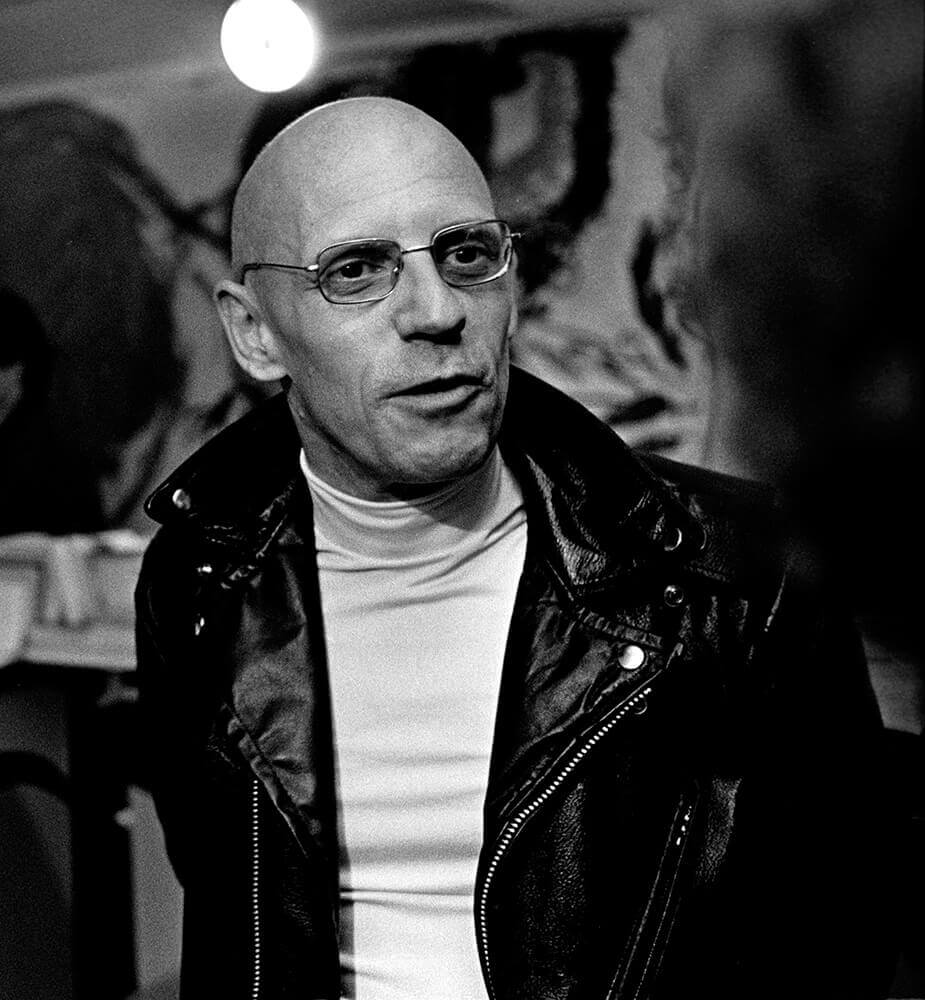
The aggregate audio file has been downsampled.

Lectures in this Seminar

square
Reading Date: October 22, 1985
right_ol
square
Reading Date: October 29, 1985
right_ol
square
Reading Date: November 5, 1985
right_ol
square
Reading Date: November 12, 1985
right_ol
square
Reading Date: November 19, 1985
right_ol
square
Reading Date: November 26, 1985
right_ol
square
Reading Date: December 10, 1985
right_ol
square
Reading Date: December 17, 1985
right_ol
square
Reading Date: January 7, 1986
right_ol
square
Reading Date: January 14, 1986
right_ol
square
Reading Date: January 21, 1986
right_ol
square
Reading Date: January 28, 1986
right_ol
square
Reading Date: February 25, 1986
right_ol
square
Reading Date: March 4, 1986
right_ol
square
Reading Date: March 11, 1986
right_ol
square
Reading Date: March 18, 1986
right_ol
square
Reading Date: March 25, 1986
right_ol
square
Reading Date: April 8, 1986
right_ol
square
Reading Date: April 15, 1986
right_ol
square
Reading Date: April 22, 1986
right_ol
square
Reading Date: April 29, 1986
right_ol
square
Reading Date: May 6, 1986
right_ol
square
Reading Date: May 13, 1986
right_ol
square
Reading Date: May 20, 1986
right_ol
square
Reading Date: May 27, 1986
right_ol
square
Reading Date: June 3, 1986
right_ol

October 29, 1985

Knowledge is not science; it is science that is a type of knowledge. Which amounts to saying that for Foucault knowledge is fundamentally a practice. Knowledge is actually composed of practices: practices of visibility, practices of statements. Or, if you wish: discursive practices (these are the statements), and non-discursive practices (these are the visibilities).

Seminar Introduction

After Michel Foucault’s death from AIDS on June 25, 1984, Deleuze decided to devote an entire year of his seminar to a study of Foucault’s writings. Deleuze analyses in detail what he took to be the three “axes” of Foucault’s thought: knowledge, power, and subjectivation. Parts of the seminar contributed to the publication of Deleuze’s book Foucault (Paris: Minuit, 1986), which subsequently appeared in an English translation by Seán Hand (Minneapolis: University of Minnesota Press, 1988).

For archival purposes, the English translations are based on the original transcripts from Paris 8, all of which have been revised with reference to the BNF recordings available thanks to Hidenobu Suzuki, and with the generous assistance of Marc Haas.

English Translation

Edited

Reviewing previous key points, Deleuze argues that the first axis consists of the historical a priori and strata as composed of stable forms of the visible and the statable, offering the example of Herman Melville’s novel, Pierre; or, The Ambiguities, to consider the shift from strata to unstratified elements of visibilities. The opening recap is summarized with the questions: what do you say, what do you see, and what do you make seen? Then, with a second aspect corresponding to the question, what is knowledge? , Deleuze shifts from strata to interstrata, in Foucault from phenomenology toward epistemology, examining knowledge as a discursive and non-discursive practice, truth as the relationship between discursive and non-discursive practices, and the rules for different types of statements. Deleuze examines how the objects of statements take on myriad aspects depending on the regime (e.g. the hospital or prison regime). As the political aspects of speaking and the visible matter to Deleuze, he comments on recent and contemporary examples of this axis, notably the “twisted vitalism” of the Holocaust, medicine without doctors or patients (malades). Reading from ‘The History of Sexuality’ I, Deleuze examines the intersection of contemporary threats of death (death sentence, nuclear war) with management of life, examples showing how Foucault’s method brings forth the supposedly hidden statements existing in plain sight.


Foucault at Liberation
Foucault in a discussion at the offices of the French newspaper Libération, 1973. Source: Monoskop.


Gilles Deleuze

Seminar on Foucault, 1985-1986

Part I: Knowledge (Historical Formations)

Lecture 02, 29 October 1985

Transcribed by Annabelle Dufourcq; time stamp and additional revisions, Charles J. Stivale

Translated by Mary Beth Mader


Part 1

About what we have to do, about what we did last time, what do you have to say? This work should imply a certain sort of collaboration for you, even if you have not read Foucault. It’s about what it awakens in you, do you see any connections to be drawn, things of that nature, in relation to what you know. [Pause] I’m smiling at you to encourage you. [Pause] Okay, it’ll come… [Pause] Who here is doing an undergraduate degree [premier cycle]? So, those of you who are undergraduates, for the next time, I would like you to hand in a small sheet of paper, with your name and address, but especially with what you are doing, which DEUG,[1] which whatever-it-is, and what your areas of interest and study are this year. So. And then, since there are not many of you, I’ll take them one by one as needed. I would like to have this next time. Okay, so . . . I’ll try to recap. I want to say, even what I’m calling your reactions, that can be anything, okay, in whatever field, depending on what we talked about . . . [Pause] Okay, I’ll try to recap.

Our last session was on the topic of: what is an archive according to Foucault? What is archaeology? What we brought to light is a very general idea, namely: seeing and speaking, or more precisely, but this “more precisely” should already seem almost startling to us, and we are not yet in a position to understand it, we just know that the terms that follow are more precise than “seeing and speaking.” Seeing and speaking, or more precisely, the visible and the statable, or, if you prefer, visibilities and statements, make up the two stable forms in each period. In the end, a substantial portion of Foucault’s corpus consists in dividing up and positioning these two forms—I would say that from History of Madness to Discipline and Punish (I’m not saying that Foucault’s books can be reduced to this, I’m saying that they include this)—distributing two forms according to the given historical period: the form of visibility, the form of statability. And I stressed once and for all that certain interpretations of Foucault that sacrifice the conception of the visible to a conception of the statement, of the statable or the sayable, are necessarily led to mutilate Foucault’s thought.

Hence, the visible and the statable comprise two stable forms in each historical period. This should perhaps even be reversed: what defines an historical period is a complex field of visibility and a complex regime of statements. In other words, an historical period is defined by what it sees and what it says. [Pause] Hence: what does “archaeology” mean? It means a discipline that analyzes archives. And what is an archive? It is the audiovisual record of an historical period, the visible and the statable. [Pause]

Consequently, it is through the visible and the statable that we will define an historical period, or that which we can now call “an historical formation.” An historical period is defined by what it sees and what it states. What we will call “an historical formation,” or Foucault sometimes says “a positivity,” is the intertwining [entrecroisement] of the two stable forms of an historical period, the seen and the said, the visible and the statable. Thus, Foucault can take a substantial portion of his corpus to be an analysis of certain historical formations. This way, he can say at the start of a recent book, at the start of The Use of Pleasure, he can say, “yes, one whole portion of my books is historical studies.”

You can see that the historical formation is defined by: a statement regime, a field of visibility. Which implies one thing in particular, and that is that all historical periods, all historical formations, do not see the same thing, do not say the same thing. Visibilities and statements are the variables of each formation. They vary from one formation to another. We saw this in detail, not in much detail, but we saw it in a bit of detail with respect to the two books which present quite striking parallels, History of Madness and Discipline and Punish. In History of Madness, the general hospital in the 17th century is the visibility of that period, the hospital makes madness be seen through one visual category or another. As Foucault says, there is an evidence, taking ‘evidence’ in the sense of visibility, there is an evidence to madness in the general hospital and under the conditions of the general hospital, namely: grouping mad people with vagabonds, jobless people, beggars, etc. This is a visibility of madness, madness is made to be seen, it is made to be seen in the framework of the general hospital. And in the 19th century, the asylum and the foreshadowing of what will be, over the course of the 19th century, the psychiatric asylum, provide a wholly other sort of visibility, that’s a wholly other way to see it.

And in parallel fashion, in the 17th century, at the same time as the general hospital makes madness be seen as one kind or another, the statements of madness, that is, the statements that concern madness, originate there equally, and are statements that revolve around the “discursive object”—as Foucault will put it—around the following discursive object: unreason. Madness is understood as unreason. Don’t say, “that goes without saying,” because . . . [Interruption of the recording] [10:29]

… Don’t say, “that goes without saying,” because unreason as an object of discourse is a perfectly original theme which undoubtedly can only arise in the Classical Age, due to the conception of reason in that age. But subsequently in the 18th century, starting in the 18th century, it is no longer in relation to reason that madness will be stated [énoncée]. It will be stated in relation to entirely different coordinates. To the extent that we can say: the 17th century: the way to see madness: the general hospital; the way to state madness: unreason. With respect to madness, that’s what comprises the historical formation of the “Classical Age.”

We saw that it’s the same thing for the prison. The prison in the 18th century. The prison regime is formed in the 18th century as what? As a new way of seeing crime. At the same time, penal law undergoes a change relative to preceding periods. What is this change? It is the formation of a new type of statement, whose discursive object, the statable object [l’objet énonciatif], is delinquency. Statement of delinquency, prison as the visibility of crime—this, too, defines an historical formation.

So, that was really the first point that I believe I can consider as basically established. There is always this confrontation, at the level of each historical formation, between the visible and the statable. What does a period make seen and see—it’s the same thing. What does it see and make seen? What does it say and make be said? It’s a very solid method, and in my view, very original. We will see why it is ‘original.’ Why, precisely, is it original? Why can Foucault say once again, at the start of The Use of Pleasure, “I do historical studies, but not the work of an historian?” Why is it the work of a philosopher? The new conception of history, what has been called the Annales School, proposes both a history of behaviors, and as I said last time, a history of mindsets. Indeed, I referred you to the example of the anthology, Comment on meurt en Anjou à telle époque [How one Dies in Anjou in a Given Period].[2] How one Dies in Anjou in a Given Period is solely a study of behavior, and also a study of a mindset since what is considered there is the way in which death was conceived, the ideas about death.

Foucault distances himself from this approach. Why? We already have all the elements to answer this question. He does not do the work of an historian. He does not at all say that historians are wrong. He says that his own business is elsewhere. And why? My answer was simply, when I wondered: “but why does he say this, and what does that mean?” My answer was “well, yes, because:” you can see that with the visible and the statable, he claims to ascend—whether he’s right or not is all the same to me—he claims to ascend to a determination of conditions. The visible or visibility is not a behavior, it is the condition under which, it is the general condition under which all behaviors of a period show themselves, are brought to light. Statements are not ideas . . . [Interruption of the recording] [15:39]

Part 2

. . . very important conception of philosophy has always defined philosophy as the search for conditions. Under what conditions is something possible? And that’s what a philosophical question was. If I ask “what is mathematics?”, I do not necessarily do philosophy. But if I ask “Under what conditions is mathematics possible,” then I am doing philosophy. “I do not do the work of an historian” for Foucault thus really means, it seems to me, that Foucault is ascending to the conditions that make the behaviors of a period possible, and the mindsets of a period possible. In other words, Foucault intends to determine pure elements. Hence, in Archaeology of Knowledge, the use of the very unexpected term, a priori. In philosophy, a priori has always meant “independent of experience,” whereas the conditions of experience are a priori, that is, the conditions of experience are not given in experience itself. The visible and the statable are the a prioris—the a prioris of what? The a prioris of a period, the a prioris of an historical formation. Whence Foucault’s very bizarre idea, we’ll have occasion to come across it again: the a prioris are historical. Whereas in Kant, for example, ‘a priori’ and ‘historical’ are opposed, here there are historical a prioris: these are the conditions for visibility, the conditions for statability, which permit the definition of a period. Thus, the visible and the statable are two pure elements. As such, they combine to define the historical formation, that is, to determine the conditions of this formation. Under what conditions is the Classical Age possible? Answer: under the conditions of these certain forms of visibility, of these certain forms of statability.

You can see that this is one thing that sets Foucault’s project apart; I’m not saying which sets it in opposition, but it shows its originality, and the impossibility of identifying it, in fact, with the work of an historian. At a pinch, I would say that historical formations are strata, stratifications. And we will see, here I’m using this word because it seems convenient to me and because it resonates well with the term ‘archaeology’—archaeology is the study of strata—and we will see that one can lend all sorts of senses to this word ‘stratum,’ but the first sense that would justify my using such a word is: a stratum is precisely a composite of visible and statable, an intertwining of visibility and statement. Such that historical formations are strata, are stratifications. And this is one whole axis, one first axis, as it were, of Foucault’s corpus: this archaeological study of stratifications, that is, of historical formations defined by the visibilities that they set out, the statabilities that they put forth.

I say “a first axis” . . . oh, is that right? Would there be other axes? We can indeed ask this question. Doubtless, there will be other axes. Seeing and speaking, the visible and the statable, from the very start, do not exhaust the whole, we can be sure of that, and from the start of his work Foucault is very conscious of this. But if there are other axes, we must wonder what their relations are with historical formations. If there are other axes, perhaps these other axes no longer have anything to do with the stratified. The stratified is defined by composition, the intertwining of two stable forms: the visible and the statable.

However, however, however . . . Is everything stable? Is everything an historical formation? Is everything a stratum? There is a sublime text by Herman Melville, the American novelist. It is so beautiful that I will read it to you. And just because I think it’s a text that would have pleased, that would have infinitely pleased, Foucault. It’s in a very great novel by Melville called Pierre; or, The Ambiguities [1852] I’ll read it to you: “Ten million things were as yet uncovered to Pierre. The old mummy lies buried in cloth on cloth; it takes time to unwrap this Egyptian king. Yet now, forsooth, because Pierre began to see through the first superficiality of the world, he fondly weens he has come to the unlayered substance. But, far as any geologist has yet gone down into the world, it is found to consist of nothing but surface stratified on surface” [ils n’ont trouvé que strate sur strate]. Did you catch that? That’s the archaeologist. “To its axis, the world being nothing but superinduced superficies. By vast pains we mine into the pyramid; by horrible gropings we come to the central room; with joy we espy the sarcophagus; but we lift the lid—and” And, and, ellipsis. “no body is there!—appallingly vacant as vast is the soul of a man!”[3]

There you have it . . . let’s be silent for a little bit because it’s, I don’t know if you are sensitive to the beauty of a text like this. So, I’ll read it while translating it into terms that are immediately close to Foucault. All the historical formations are strata, and what are we doing, we others—I’m voicing Foucault, here—we other archaeologists, what are we doing? We’re going from stratum to stratum, we’re going from formation to formation. We shouldn’t too hastily suppose that we’ve reached unstratified substance. Is there an unstratified substance? If there is an unstratified substance, it is beyond seeing and beyond speaking, beyond the visible and beyond the statable. For the visible and the statable join to constitute the strata and to form strata following one formula or another. We go from stratum to stratum, but have we reached unstratified substance? As far—so, I’m hardly transposing here—as far as the archaeologists have gone down into the depths of the earth, they have found only stratum upon stratum, they have found only historical formation upon historical formation, for all the way to its axis, the world is nothing but superimposed strata. “By vast pains we mine into the pyramid; by horrible gropings we come to the central room.”—that is, we are going from formation to formation seeking unstratified, we arrive at the unstratified substance, at least at the place of unstratified substance, the central chamber of the pyramid. All the faces of the pyramid are strata, but all of these strata are there to cover the central chamber of the pyramid, where unstratified substance bubbles. Why does it bubble? Because if the strata are solid, we must imagine the unstratified as strangely liquid, or worse, as gaseous. “We come to the central room; with joy we espy the sarcophagus.” We say: here is where the unstratified is. “We lift the lid . . . and no body is there!—appallingly vacant as vast is the soul of a man!”

So, you can perhaps sense that once we will have completed this axis, we will notice—and it should have been said from the start, might as well say it from the start—that this was only one first axis. Strata or historical formations, that is, the great composites of visible and statable, do not exhaust the thought of Foucault. There will be another axis and then perhaps still another axis. There will be plenty of axes to this thought, perhaps the novelty of Foucault is to have set up a new coordinate system.

But now we’re looking at the first dimension, only the first axis or the first dimension, of the coordinate system that I will summarize for the nth time: seeing and speaking, a combination of the visible and the statable, depending on the period, that is, according to each historical formation that is determinable as a stratum. And visibilities and statements are the pure elements of each stratification. Such that—I’m repeating—I must ask two fundamental questions of a stratum or an historical formation, which are not historical questions, but actually philosophical questions: what do you see? and what do you make seen? And what do you say? Or, using the more technical terms that we saw last time: what are your forms of proof? What are your discursivities? There you go. [Pause] That was what we dealt with last time.

And we had barely begun the second question, which was no longer “What is an archive? What is archaeology?”, that is, the search for the two pure conditions. You see why he uses, why he must appeal to, a word like ‘archaeology’ to distinguish himself from history, to distinguish himself from the historian—the archive is not history, it’s the determination of the two elements, that is, the conditions of visibility and statability. And we had opened up a second topic, that is, ‘what is knowledge [savoir]?”, “what is knowledge?”. And we said the same thing: to know is to see and to state. That made a nice sequence, it’s a bit as if, at first glance, the historical formation expressed objectively what knowledge tells us subjectively. Knowledge and historical formation . . . it still seems bizarre to us: knowledge and historical formation are but one. Knowing, in fact, is seeing and stating. That is, to know is to combine something of the visible with something of the statable. Consequently, all knowledge is historical. And that’s just about where we were. So, I repeat my invitation: Are there any comments on this first point about the archive? No? There’s no problem, no unclarity? It’s very clear? Okay, well then let’s continue. [Pause]

How can we understand this kind of identity between knowledge and historical formation? The identity of knowledge and historical formation is the archive itself. But how should we understand it concretely? Actually, knowledge has neither object nor subject. Knowledge [savoir] as Foucault conceives of it is not the knowledge [connaissance] of an object by a subject. Knowledge [savoir] has neither object nor subject. What does it have, then? Well, there’s nothing to do now but let oneself go. We’ll see that we’ll find new difficulties concerning the question “what is knowledge?”, but for now “it’s all downhill.” We know how to define knowledge: knowledge has neither object nor subject, it has elements. It has two elements: the visible and the statable. You’ll tell me: “the visible is its object and the statable is its subject.” No, not true, not true. There are two pure elements that are absolutely irreducible. In other words, there is nothing beneath knowledge or prior to knowledge.

Ah, there’s nothing prior to knowledge or beneath knowledge! Here, we’ve got to monitor our words, because we just let it be understood a while ago that there would be dimensions other than the historical formation or the stratum. But if knowledge is but one with the strata, with the historical formations, then the other dimensions, the other axes that are not reducible to the historical formation, are they not reducible to knowledge, either? No, doubtless, they are not reducible to knowledge, but they are not beneath knowledge or prior to knowledge. Can we at this point conceive of what these other axes could be? Perhaps they are beyond strata, or inter-strata, but they are not “beneath,” and they are not “prior to.”

That is what explains one thing on which Foucault insisted, it must be said, from the start, that is, his opposition to phenomenology. What form did this take? According to Foucault, there is no experience that can be called ‘wild’ or ‘originary.’ ‘Wild’ or ‘originary experience’ were terms used by [Maurice] Merleau-Ponty, and Foucault, on a number of occasions, signaled his departure from all phenomenology in this way: there is no originary experience. Even further, in Archaeology of Knowledge, he will tell us: in History of Madness, there was still an ambiguity, certain pages could lead one to believe in an originary experience of madness. That is, certain pages were still from the point of view of a phenomenology of the mad person. And he rejects this and says ‘no,’ these pages, he says, might have said this, but in any case, that’s never what he had in mind. What replaces phenomenology, is what? It is literally, says Foucault, an epistemology [une épistémologie]. An epistemology, that is, there is no experience that is not grasped in a knowledge. In other words, on a stratum, there is only knowledge, all is knowledge. Which implies what? Which implies that [savoir] knowledge, for Foucault, will have an entirely other sense than [connaître] knowing. Knowledge . . . Yes?

A student: [Inaudible remarks]

Deleuze: Why is the sentence ‘I know something’ not possible?

The student: [Inaudible remarks]

Deleuze: On the contrary. “I know something” is possible. Because statements have objects that are proper to them, objects that belong to them, that do not exist outside of them. These objects are discursive objects. So, ‘I know something’—what’s more, visibilities themselves have objects, objects that are their own. To know is to see and to state, it is to combine the visible and the statable. There are objects of visibility, there are objects of stating [objets d’énonciation], discursive objects. So, to say “I state something” is perfectly possible, “I see something” is perfectly possible. For example, “I state delinquency,” “In the prison, I see crime,” “At the general hospital, I see madness,” “I state unreason.” I would say: unreason, delinquency, are objects that are properly discursive. Prison, the general hospital, are places of visibilities. I can perfectly well say “I see something,” but this something is internal to knowledge, it’s not an object that would exist independently of knowledge or that would preexist knowledge. Thus, I can say “I know something,” provided we understand that the ‘something’ is internal to knowledge, that is, is a variable of knowledge. [Pause]

So . . . Knowledge [savoir] cannot be reduced to knowing [connaissance]—what does this mean? Further, there is a radical difference between knowledge [savoir] and science. Such that we would have to retract the word I just proposed a while ago, the word ‘epistemology,’ if it were taken in the strict sense, namely “concerning science.” In fact, Foucault’s epistemology concerns knowledge [savoir] and not particularly science. Hence, knowledge [savoir] is not necessarily scientific and cannot be reduced to a knowing [connaissance.] What does this mean? It means there are — you will see, maybe this will take us further along— that there are thresholds of statements, there are thresholds of statements. What is a threshold of statements? It’s a level on which basis a statement can be qualified as one kind of statement or another. In other words, for example, there is a threshold for scientificity. The threshold for scientificity must be defined by the features on the basis of which, when statements possess these features, those statements are deemed ‘scientific’ or ‘statements of knowing’ [énoncés de connaissance]. Moreover, analyzing these thresholds, Foucault even distinguishes a number of thresholds that refer to science: a threshold he will call that of “epistemologization;” a threshold he will call that of “scientificity;” and a threshold of “formalization.”

For example, mathematics reached the top threshold of science, the threshold of formalization. But other sciences have not attained it and accept a threshold of scientificity. However, if one thus defines science as a mode of knowledge [savoir], well, then one says that knowledge [savoir] is: any statement insofar as it its combinable with visibilities. There are thresholds of visibility that make vision become scientific. There are thresholds of the statement that make the statement become scientific. But one shouldn’t become fixated on science, because, as soon as I say that, I say to myself: well, yes, this conception of Foucault’s is very interesting.

We will see why it is very interesting, it’s very interesting because, in addition, it opens up thresholds: starting from what threshold does a statement become political? What are the thresholds of politicization of a statement? [Pause] I will say very simple things, but things that seem important for the analysis of historical formations. Understand that at this point we must be very, very careful. It’s always idiotic to say, “this has existed forever,” nothing has existed forever. Let’s take an example: anti-Semitism. There have always been anti-Semites. Okay, but saying this is of very little interest. What starts to become interesting? It’s if I ask: in what historical formations has anti-Semitism given rise to political statements? And there can be multiple answers to this: in this historical formation, in that one, too, etcetera. Or else there may be an anti-Semitism of public opinion that is not taken up into the political statements of a period, that does not enter or does not substantially enter the political statements of a period.

To put it otherwise: When do anti-Semitic statements cross the threshold of politicization? Now that’s becoming a good question. Good . . . and likewise for everything! I mean: I’ll speak of a threshold of politicization, and that amounts to what? It’s that statements imply rules of formation and we will see that this idea is so important that it will carry us very far. Every statement has its rules of formation. Well then, these formation rules are not therein exhausted, but they make possible the determination of a threshold, which means the statement belongs to one threshold or another. There are formation rules without which a statement cannot be political. There are formation rules without which a statement is not diplomatic. There are formation rules without which a statement cannot be religious, etc.

One must thus not only speak of a threshold of scientificity for possible statements, one must speak of a threshold of politicization, of a threshold of ethicization—starting when, and from which threshold, is a statement a moral statement? This does not at all go without saying, all of this—of a threshold of aestheticization . . . When one expresses, for example, problems of the sort: “when does nature take on an aesthetic value?”, that’s interesting. Either it’s a false problem, or it’s very interesting, we don’t know; only analysis will tend to let us know. But “when does nature begin to take on an aesthetic value?” means “when do statements about nature reach, cross, the aesthetic threshold of the period?” Hence: the need to find what the aesthetic threshold of the period is, and how statements on nature cross this threshold. And, likewise for visibilities; visibilities, too, have a threshold. Each period sees. The period sees, okay, but what are we to say, ultimately, about public opinion? The statements of public opinion. They, too, have a threshold.

You see: each formation . . . This now allows me to enrich the earlier notion of the archive. I was saying a while ago, I was saying—and that was the first determination—the archive is a stratification, it’s a stratum as an historical formation, that is, it was the first determination of the stratum—it’s a combination of the visible and the statable. That already makes for a certain thickness of the stratum. Now, I can add that the stratum is a stacking of varyingly oriented thresholds. A stacking of thresholds—and here this really takes into account the word ‘stratum,’ and you see how it enriches the notion of archaeology—a stacking of varyingly-oriented thresholds according to which statements can be deemed “political statements from a particular formation,” “aesthetic statements,” “scientific statements,” etc.

This will perhaps allow us to specify the idea of a regime of statements or statement regime. What does the statement regime comprise? It comprises at least three things. A statement regime comprises the determination of the stratum on which statements are produced, that is, the determination of the historical formation, the determination of the family of statements to which the statement belongs, and the determination of the threshold (is it a political statement, a juridical statement, an aesthetic statement, etcetera?). You will notice that statements in the same family can belong to different thresholds, statements of the same threshold can belong to different families. For example, in one same historical formation and at the level of one same science, that is, at the level of one same threshold, the threshold of biology, you will have evolutionary statements and anti-evolutionary statements that belong to the same formation, that is, to the same regime—and yet they are not in the same family, and nevertheless they have the same threshold. Thus, the formation, the family, the threshold, etcetera, are features of the stratum. Let’s move on.

So, knowledge [savoir] is not science, it is science that is a type of knowledge [savoir]. Which amounts to saying that for Foucault knowledge [savoir] is fundamentally a practice. Knowledge [savoir] is actually composed of practices: Practices of visibility, Statement practices [pratiques d’énoncé], or, if you wish: discursive practices (these are the statements), non-discursive practices (these are the visibilities).

And the true, what is that? Does it have a meaning? Well, yes, the true is, we always come back to this, it’s the combination of the visible and the statable. But in what case would the combination prejudice a truth? Now, here we might have a problem, and Foucault, in any case, will align himself with a history of the true. A history of the true. A history of truth. And in a certain sense, Foucault is entitled to suppose that he is realizing, at least in part, a fundamental element of Nietzsche’s enterprise, namely, a “history of truth.” But why is there a history of truth? There is a history of truth precisely because knowledge [savoir] is a matter of practice(s). Knowledge [savoir] is a matter of practice(s) and the true is the relation between discursive practices and non-discursive practices. Put otherwise, the true, the truth, is inseparable from the practices that produce it, the true, the truth, is inseparable from a procedure [procédure]. And this is what I was pointing out last time, in a way that was still very vague, namely: we can reserve the term ‘procedure’ [procédure] to designate the relation between the two practices: discursive practices of statements; and non-discursive practices of seeing, of visibility.

We keep the word ‘procedure,’ okay, good, and the true is never separable from the procedures by which one not only attains it, but one produces it. Actually, the notion of truth . . . So, here’s a statement, or what appears to be a statement—okay, it’s a statement: “I want the truth”, “I want the truth.” We’ll have reason to wonder: what is a statement? Because you can surely tell that we have not yet addressed the essential problem, namely, what does Foucault call a statement? Is it the same thing as a sentence? In any case, we’re starting off from a sentence, at least for the time being, since we lack the means to do otherwise; we’ll go very slowly in our analyses. “I want the truth.” Who is it who says that? What is this sentence? Actually, it is perhaps not a statement, we can already sense that, in fact, statements and sentences will not be the same thing. Why? Because this sentence does not tell me much. If I say to you, “Consider the sentence: ‘I want the truth,’” you immediately want to know “but who is it who can say such a thing?” There are many people who can say this, but they vary so much. Now we’re making a lot of progress, it’s always when we aren’t expecting it that we make progress, because shouldn’t we have to say that there are as many statements in the sentence “I want the truth” as there are people to say this sentence? But at the same time, we lose ground because that would mean that the statement depends on whoever says the sentence. Perhaps, but not only that. So, we’ll set that aside because we don’t have the wherewithal, but we’ll just keep it set aside. We’ll have to return to this point, it will be central for the question: what is a statement, what is the difference between a sentence and a statement? I’ll return now to: “I want the truth”, “I want the truth”. Who says that and what does he or she want when they say, “I want the truth?” What is his or her object? Because we saw in what sense, following the question that you asked, we saw in what sense one could speak about an object, about an object of a statement, about an object of visibility. “I want the truth.”

When Descartes says, “I want the truth,” if it’s Descartes who says it, he does not hide what he wants: He wants the thing in person, he wants presence. He wants evidence. Except it is not possible to attain evidence. He wants the thing in person as an idea. The thing in itself as an idea.

When in the 18th century, [David] Hume says, “I want the truth,” what does he want? He wants signs. Or even [Thomas] Hobbes, a contemporary of Descartes. He does not want the thing in person, that doesn’t mean much to him, the thing in person. He wants signs. Signs on the basis of which he could infer the true. But the true will never be given. It will always be inferred on the basis of something other than itself. The more probable the inference, the surer the truth. So look, here you go, wanting the truth—now things start to get more precise—“I want the truth” gives rise to two families of statements since… [Interruption of the recording] [56:45]

Part 3

… This is the highly nuanced idea of Foucault’s. You’ll really have to hold these two things in your mind at once. Each period says everything and shows everything. That’s one thesis. I’ll try to list them numerically. Thesis 1: each period, each historical formation, says everything and shows everything. Thesis 2: visibilities and statements are not given immediately, they must be extracted. There you go, we’ll consider these two aspects.

The first aspect goes fairly quickly, that is: there is nothing secret and nothing hidden. This comes down to saying: well, yes, if you consider statements—only, as an aside: the problem will pop back up again at us immediately afterwards. “If you consider statements . . .”, right, but how am I going to find the statements? If you consider the statements, you will surely see that everything is said, if you consider the visibilities, everything is shown, everything is given, obviously. And even, even before knowing what a statement is, or what a visibility is, you have to rid yourself of ready-made ideas. Ready-made ideas consist in believing that discourses, the discursive, hide… [Interruption of the recording; an audio distortion is heard] [58:42]

… You don’t have to be all that clever to see this. The rules that determine the politicization of a statement, that is, its political nature, you see that politicians never lie and that, in a sense, they say everything, with a radical cynicism. That is, it’s stupid to say, “they lie.” They absolutely do not lie. Take what is currently happening, whether it’s in the election campaign, the right, it says, but it says exactly what will happen to us after the elections, but we know this, we know this. [Jacques] Chirac, he’s not at all a liar, he’s a truthteller. They have no need to hide anything whatsoever from us, we know very well what will happen to us, we know it very well, they’re not hiding it from us: identity checks—right, well, we know that young guys who are a bit brown will be in for those. We can’t say they’re lying to us, they’re proclaiming it to us. That business leaders can fire employees without the ministry of labor having any say in it, we can’t say that this is being hidden from us. They say absolutely everything, they have nothing to hide, you know, politicians. Well, anyway, when they do have something to hide, those are entirely personal things: when they are corrupt, when they steal money, but, come on, that’s not what we mean, that’s not what’s important, that’s not what’s serious.

But apart from that, their programs, they are always absolutely faithful to their programs. Back at the very start, when most of you were not here, I took up another case: the speeches of the pope. There, too, one should never say that a speech is either lying or meaningless, or that it’s spouting empty words. When the pope speaks to us about the Holy Virgin, I said, and here, again, one must take into account the threshold of religiosity for statements. He is not spouting empty words, nor is he speaking anachronistically. He is speaking exactly according to the rules of the religious statement—obviously, he observes the rules of the religious statement, without which a statement would not have crossed the threshold of religiosity, and making his statements cross the threshold of religiosity is the very least the pope could do, otherwise, what would happen!?—he tells us something very important, namely, that ecumenism, that is, a religious policy about the unity of Christianities, of Catholicism and of Protestantism, etcetera—has had its day and that he is reintroducing universality, properly Catholic universalism, against ecumenism. Indeed, the problem of the Virgin being then, as now, a part of these points of friction between Catholicism and the Reformation, it goes without saying that the intense love of the pope for the Virgin implies something that the Reformed, that the Protestants, fully grasp. Thus, we can’t say that he spouts empty words, but by conforming to the rules according to which a statement is religious, he says absolutely everything. And when he kisses the earth, and he speaks all the languages, and he feels the need to say hello every time he lands in a country, speaking the language of the country—there, too, it’s not, as people say, to put on a show, it’s to claim the apostles’ gift of languages. And this has a meaning in the context of Catholic universality, this has an extremely precise meaning, namely: it’s a type of statement that says exactly what it means.

And I appealed to the text—I refer you to it, for those of you who love Proust—when, in In Search of Lost Time, Proust stages an ambassador by the name of Monsieur de Norpois, Monsieur de Norpois is given two pages in In Search of Lost Time, splendid pages in which Monsieur de Norpois explains that diplomatic language has specific rules — Foucault would say: there is a threshold for the diplomaticity of statements — And that given the rules of the diplomatic statement, the meeting reports, for example, between ministers from different countries, say exactly all that is true, there is never anything hidden. Once we know the formation rules for statements in a given domain, absolutely nothing can be hidden from us. What do you think they could hide?

When Reagan announced, for example, that he’ll lower taxes, and that, as a result, he’ll dismantle the institutions of social welfare, you can’t say that he’s lying or that he’s hiding something. It’s obvious. It’s obvious. It’s something evident. I mean: they always say . . . You can’t say that Hitler ever hid anything whatsoever. I mean, you would have, in fact, had to never have read a single line from Hitler in order to judge that Hitler hid anything whatsoever. It would be very interesting to ask oneself, it would be a problem suited to Foucault, but it’s to some extent the problem that Jean-Pierre Faye took up: what are, and how can one speak of, properly fascist statements? How do they appear? How do statements of a new type, fascist statements, appear in a political landscape? Moreover, far from hiding the goals of fascism and the means of fascism, Hitler is the initiator and the inventor of a regime of statements that from then on will be recognized as the form of Nazi statements and even of fascist statements. That’s why it’s very interesting to read the newspapers, because in a sense, everything is said, there’s nothing secret.

In addition, even in his own works, I would like… in his own works, Foucault returns a number of times and in a very interesting way to the speech of the humanitarian [philanthrope]. He will show that the humanitarian says, I mean, he says exactly everything, and only literally. To know the most obscure aspects of a period, what is apparently the most hidden, all one need do is to take literally, but quite literally, the discourse of the humanitarian. The rawest and most cynical aspects are all on display in the discourse of the humanitarian. And this will benefit us later, that’s why I’m discussing it starting now, since we’ll see that one of the bases for Foucault’s critique of humanism has its source in his critique of the humanitarian’s discourse. But to critique does not at all mean to extract what is secret. It’s a very different operation, it’s extracting the rules that a given type of statement obeys, but mind you, the rules that a given type of statement obeys are not given, but they are absolutely not secret, hidden. They are not given because they are rules. Rules are not given. What is given are the products, that is, the statements themselves, and that only if you find them following the rules.

Hence: the discourse of the humanitarian. The first great case of an analysis of the humanitarian’s discourse, that is, of the corresponding statement regime, is the liberation of the mad at the end of the 18th century and the start of the 19th century. Roughly simultaneously in America and in France. [Pause] In France, it was with [Philippe] Pinel. Pinel, who at the time is called a great humanitarian and who liberates the mad from their chains. Unchain the mad people. There you have it, unchain the mad people, and I checked before coming, Petit Larousse, “Pinel,” there is—okay, so, this is a statement, a statement—what’s said for Pinel, and why not?, is: “In the asylums, he replaced violence with gentleness. He is a great humanitarian for having done this.” And there is a famous anecdote, for which Foucault supplies the source: it’s Pinel’s son, who recounts the monumental meeting between the deformed monster and the great humanitarian. It is [Georges] Couthon, a member of the National Convention, a paralytic regicide—he had voted for the death of Louis XVI. He was infirm, paralyzed, he got around in a little cart, and Couthon comes to see Pinel at the asylum and says to him, “Friend, you yourself are mad, since they tell me that you want to free these base creatures.” Pinel looks at him from his full height and says: “Yes, citizen, but I’ll succeed.” And the other fellow says: “So much the better for you, but don’t let them escape!” And away he goes, pushed in his chair—the monster—and the great humanitarian accomplishes his feat, he breaks the chains of the mad. Okay.

Foucault is not against this, he says: “okay, so be it, but . . .” This will put us a bit on the trail of: how have we found statements? He says: you should not simply stop at this filial tale, which is very lovely, but that’s about it . . . Because you’ve got to look at the pronouncements of Pinel himself, what are those about? Well, those do interest us directly. In his pronouncements, Pinel indeed talks about: “liberating the mad, releasing them from their chains.” Now that is a doctrine, it can’t be denied, and in fact the mad will no longer be chained up, at least they are no longer immediately chained up. But what replaces the chains? Pinel does not hide this, the entire method is based on this: the mad person much constantly be seen, that is, monitored, that he be constantly seen and monitored, and constantly judged. And Pinel lets out the two important words that will put us on the trail of statements: the gaze (regard) and judgment.

In other words, what will replace material chains is the monitor’s [surveillant] look and perpetual judgment, the perpetual gaze from the monitor and perpetual judgment from the caregiver. Why do I stress this? The gaze leads us to visibility—the mad person must be visible twenty-four hours a day, and judgment leads us to a type of statement. The status of madness is still defined in terms of visibility and the statement. Perpetual looking, perpetual judgment. Why? Here, too, I can put . . . so, I can divide a sheet of paper in two, and put on one side what humanitarianism seems to be. Eliminate the chains, first thing.

Second thing, Pinel’s assurances are constant: the mad person is not guilty of being mad. In the 17th century, in the statements of unreason, the mad person was in a certain sense basically guilty of being mad, just as the devotee [le passionné] was guilty of his passions, guilty of not following reason. The concept of unreason ensured the guilt of the mad person: the mad person is guilty of being mad. Pinel’s humanitarian statement: the mad person is not guilty of being mad. But as Foucault says—but Pinel’s writings say it at much greater length—Pinel’s idea is that the mad person has stopped being guilty of being mad, the mad person is innocent, which is a great increase in humanity. But in his innocent madness, he is responsible for that which, in this madness, disturbs the moral order and the social order. The mad person is no longer guilty of being mad, he is responsible for that which, in his madness, itself innocent, disturbs the moral order and the social order.

In other words—this is terrific—what Pinel did is a magisterial move: he made statements on madness cross the moral threshold. It’s because of the disturbance the mad person brings to the moral order . . . The mad person is innocent, but this innocent madness leads him to disturb the moral and social order. He is responsible for what disturbs the moral and social order and is no longer guilty. The statement on madness crosses the moral threshold but—Foucault takes care to specify, and he is entirely right for the whole beginning of the 19th century—it does not in the slightest cross the epistemological threshold, the threshold of science. To the extent that Pinel never speaks in the name of a knowledge [connaissance] of madness, he speaks in the name of morality. It’s only quite a bit later that a psychiatry appealing to a knowledge [connaissance] of madness will develop; at that point in time, statements about madness will have crossed the threshold termed ‘epistemological.’ But what Pinel does is another thing altogether: he makes statements on madness cross the moral threshold.

Which amounts to saying what? If you follow the letter of Pinel’s discourse, you see two things there. On the one hand, you see that there are chains that are better than physical chains. What are the chains that are better than physical chains? It’s the monitor’s look and the judgment of the caregiver. What are these chains made of? It’s because if . . . Right, second point: there is a responsibility that is deeper than all guilt. That is, deeper than the guilt of being mad, there is the responsibility that the mad person has when he infringes on the moral order and the social order. The moral threshold of statements on madness. And consequently, how does the asylum operate in the 19th century as opposed to the situation in the 17th century? They break the mad person’s chains, but what are they going to confine him in? They will confine him in a kind of familial model. That’s what Foucault shows very, very well and in the end, psychoanalysis—psychoanalysis is perfect, because it consummates, it brings to perfection the project of 19th century psychiatry. It does not break with it at all, he says. For if you examine how the asylum is to be set up according to Pinel, the look and the judgment on which basis the mad person will be held responsible for disturbances he causes in the moral and social order—that’s the situation of the child in a familial model. And never will psychiatry give up this familial model. And the caregiver is not treated as a scholar, but as a father, and Pinel is the first father in this new treatment of the mad.

However, can one say that something is hidden? No. Nothing in the discourse of the humanitarian of the asylum, nothing, is hidden. Moreover, if the mad person persists in disturbing the moral and social order, at that point, yes, at that point, he must be punished. So, is he then put back in chains? Yes, they put him back in chains, frequently they put him back in chains. But otherwise, Pinel explains himself with great ingenuity, and he says, roughly—the passages Foucault provides are unequivocal, and Foucault summarizes, he does not interpret, he summarizes—that madness must no longer frighten. On the other hand, and this is the foundation for all therapies for madness at the start of the 19th century, the mad person must be afraid. The mad person must be afraid. It never occurred to the 17th century, which chained up mad people, that the mad should be afraid. I don’t mean—one mustn’t conclude the reverse—that the 17th century was terrific, because they sure saw their share of the mad! But they didn’t say “what we need is for the mad to be afraid;” they treated them like animals. But they were afraid of the mad, and that’s why they treated them like animals, because they were afraid of them. All of that changes with Pinel, really: it’s the mad person himself who should be afraid. Can you believe it? There’s no need to do any interpreting here to be able to say . . . this is actually a way that the bourgeoisie fundamentally reassures itself with regard to the problem of madness: they’re the ones who should be afraid, not us, it’s not for us, we normal ones, to be afraid of the mad, they’re the ones who should be afraid. And this theme is the fear that they should feel about what will happen if they disturb the moral and social order of the hospital.

And all the rules, all the statements on madness will be about that: a scale of penalties, the mad person is supposed to live in fear, which will prevent him precisely from disturbing the moral order and the social order. Thus, this scale of penalties runs from a shower, which is not at all presented by Pinel as a therapeutic tool, it is presented as a means for causing fear. The suddenness of the punishment! It is crucial that the punishment be sudden. And on this point the statements say it all. For example, with all the caregivers of the period you have a mad person who picks up a pebble, while strolling. The monitor is there and watches him; the mad person must constantly be monitored. He picks up his pebble and the monitor says to him, “Watch out, there! What have you got there in your hand? Drop the pebble . . .” If he holds onto the pebble . .  . He’s got to be afraid: the next time, he won’t pick up the pebble, he will have understood that he’s not supposed to pick up the pebble. He is no longer guilty of being mad, sure, right . . . but be careful, here! He is innocent, completely! He is innocent, but he is responsible for the disturbances he causes to the public order, that is, to the moral and social order. He picks up a pebble: but that’s a disturbance. It disturbs the social order . . . Okay, and so, if he doesn’t drop it, he’s in for it. And the suddenness of the punishment, once again, is a crucial factor. There we are.

Likewise, in Discipline and Punish, you find a lengthy analysis of the discourse of the prison humanitarian. And it’s very interesting because at the same time as the prison, as we’ve seen, penal law becomes a law whose statements are statements on delinquency. However, delinquency is a new category. It’s an object of a statement, it’s what I earlier called a discursive object. And we notice that in this penal law, since at that juncture there was a whole renewal, it seems that there was above all an alleviation of the punishments, an alleviation of the penalties. And the humanitarian achieves a humanization of the penalties. In particular, tortures tended to disappear slowly; the prison replaces tortures. In fact, in the period when there were no prisons, sanctions were of the type: torture, exile, forced labor. Exile, the galleys. A regime of penalties does not need prison, you know. It’s not necessary, you have legal systems without prisons. In any case, prison does not come from the law, Foucault showed this definitively. The penitentiary regime does not at all come from the law. On the contrary, you have all kinds of law that do not include prison, or that include prison only in very specific cases of very rare offences.

So, again, how does one punish in the 17th century? There are the galleys, there is exile, there are tortures, that in itself covers an impressive range of punishments. The case of lettres de cachet, where there certainly is confinement, is a case that Foucault studied very closely. We’ll come back to this very bizarre institution from the French monarchy, lettres de cachet, where, at the demand of the family—the lettre de cachet is exactly like what is today called “voluntary” placement—one locks a person up. Placement called “voluntary” in psychiatry today is the direct descendant, it seems to me, of the lettres de cachet. But prison is not necessary to a scale of penalties. Thus, when the prison comes about, at the same time penal law undergoes changes, for its part, independently, and there is what is called a quantification of punishments; instead of torturing people, they are given two years of prison, three years of prison, etc. The discourse of the humanitarian.

But here, too, Foucault says, we must look more closely. For if we make an effort to look, what do we see? And here, too, it’s easy to see, and it is said. The statements of the period stress significantly that criminality is in the process of changing. If we continue further, in the statements from today, we find statements of the same sort, the development of criminality. What does this mean? It means that between the 17th and the 18th centuries, there was a very interesting phenomenon, which has been very, very well analyzed by an historian called [Pierre] Chaunu, a contemporary, modern historian called Chaunu. He gives a very interesting history, he says that between the 17th and 18th centuries—this is roughly, I’m really condensing his study—crimes against persons regressed, while crimes of property, on the other hand, developed enormously. So, there are reasons for this, there are all sorts of reasons. Why? Because crimes against persons implied a whole 17th century regime. It’s very much tied to rural crimes and to gangs, marauding bands, insurgent peasants, and large gangs; and then, from one century to another, the urban model develops significantly, the circulation of money develops significantly, and for example frauds begin to proliferate. Large gangs are on the way out, and instead of large, rural gangs, you have the phenomenon of “tiny urban gangs,” who instead take to crimes of property.

Of course, there is still killing, but the proportion has changed a great deal, and thus it’s not so much that justice becomes less severe, on the contrary. In the statements from that time period, here is what we see: the old justice system is not severe enough for this new criminality. And in actuality, these are little frauds that in the 17th century would not even have been prosecuted, or thefts that would not been prosecuted. It’s a justice system that in a sense is too crude to register the detail of criminality. We see that once the nature of the crimes changes, and a large proportion of property crimes arises, the justice system must become more refined, it must tighten the nets. It’s got to weight crimes and delinquency in a completely different way, plus the justice of the Sovereign, the royal model of justice couldn’t grasp, as a result of the whole apparatus of justice . . . That is, as a result of these new crimes and the new criminality, a new organization of the power to punish is needed.

And the legal statements will convey, not so much a humanism, not so much an increase in the gentleness of mores, no, it’s something else. It’s not cruelty, either. It’s a kind of mutation, that is: a new statement regime, a new statement regime about criminality. Here is where the discursive object ‘delinquency’ will appear. It’s a question of seizing in the nets of justice a whole region of “petty,” in quotation marks, delinquency that escaped prior statements. Okay, so what does this mean? Well, this time, and I’m appealing to a third title of Foucault’s, it means that the law will truly . . . statements will really . . . legal statements, and not solely legal ones, but juridical statements, political statements, even technological statements will singularly change in nature, in regime.

If I try to give a very rough definition—we’ll come back, we’ll have reason to return to all these points: the power of the Sovereign. Let’s say that in the context of the French absolute monarchy, the power of the Sovereign ends near the end of the 17th century. What is the power of the Sovereign? It may be defined like this: deducting [prélever], it’s a right to deduct; they are statements on deducting. The King’s share. Or the lord’s share. What goes to the lord, deducted on what is produced, deducted on life, deducted on wealth? What does the lord have the right to deduct? What does the king, the lord of lords, have the right to deduct, both from the lords and from the people? It’s a right to deduct, it’s an operation of deduction. And moreover, it’s a right to deduction and the greatest of deductions is what? Life. It’s a right to death. It’s a right to make die. The Sovereign is the one who deducts and who in the end decides on death. That’s the old statement regime. The sovereign statement allots deductions and ultimately decides on death, that is: do I let you live, the Sovereign wonders, or do I decide for your death?

Towards the 18th century, a change begins that—I’m summarizing very, very roughly—will singularly change the statement regime, in these respects:  political, juridical, regulatory, technological, etc. It’s no longer about deducting, taking your portion of the yield, of wealth, it’s about compelling production. So, in other words, to compel the production of a useful result and to increase it tenfold. I would say that this is no longer a regime of deduction, it’s a regime of organization or gridding. The problem of power is no longer: what should be deducted from the vital forces [forces vives]? The problem of power becomes: how to compose the vital forces so that they produce maximally? In other words, it’s a problem, right, of organization or of gridding and no long one of deducting. And at the same time, the great statements, that’s what Foucault will call, if you will, “disciplinary statements”—“discipline statements,” as opposed to statements of sovereignty. “Disciplinary” is a regime, among others, it’s a statement regime, just as “sovereignty” was a statement regime.

And at the same time what is happening? At the same time, power is no longer the right to make perish. Power, just as it no longer deducts, but organizes and compels production and multiplies what is produced through its gridding, its organization, power no longer makes die; it takes as its aim the management and control of life. “The management and control of life:” we have to understand this very concretely down to the very technologies themselves that start up in the 18th century, which imply all the statistics pertaining to life. Statistics or the use of probabilities. The calculation of probabilities about wealth, populations, even about cultures—this is the beginning of our modern world.

Our modern world is disciplinary and managerial as opposed, if you will, to the world that ended, according to Foucault, near the end of the 17th century, which, itself was a world of sovereignty and was in this way deadly: the power of the prince is the ultimate decision to make die. To manage and control life—and it’s at this very point, near the start of the 18th century, that the fundamental idea that that there are no nations without demography emerges, and that all the demographic methods are used, that a nation’s power entails a whole demographics that increases. Under what conditions would demographics increase? These are the problems that at this point become the current problems of the State: marriages, deaths, births, the statistical comparison of all of this enters into the apparatus [l’appareil] of the government. But what does that mean?  At issue is no longer causing to die but controlling life even down to its smallest detail. That’s an entirely other kind of power.

So, as Foucault says, on a very lovely page, in History of Sexuality . . . You see, the abolition of the death penalty, it’s obvious that it’s a tendency of this new statement regime from the very start. It will take a long time to get there, but it goes without saying that the death penalty, in this new statement regime, is a remnant, it’s a remnant of the old sovereign power. Why? If power’s true object is the management and control of life, well, there is something really very shocking about the death penalty, to regimes of this sort. There is something very shocking, that’s why, starting in the 18th century, you have an absolute denunciation of the death penalty, which will carry on from author to author, from technocrat to technocrat, with all the arguments we saw brought out when it was at last abolished in France. But these arguments were already available; it was pointed out that they were all already found in Victor Hugo. But Victor Hugo’s arguments were all already found in the 18th century, about the fact that the death penalty had never prevented the spread of crime, etcetera. It was all there. And you’ll certainly understand that, in actuality, if power is defined as a management and a control of life in its lowliest detail—to the tune of: a woman must have three children. And all this, these are writings, these are statements that appear constantly, starting in the 18th century. So, one should not think that contraception came into being only recently. Already, the 18th century took part in the discussion on contraception, the use of contraception in the countryside. One should not think farmwomen are slow; it appears that since the 18th century, contraception in the countryside posed a very difficult problem for nations.

There exist new things, but sometimes we go wrong in our judgment about novelty, because we do not have a good method for identifying statements. But, well, anyway, you can surely tell that the death penalty, actually, is a sort of thing that is inassimilable by the new conception of power. On the other hand, as Foucault says, it’s not that death does not exist for this power, but that death is always the underside of what power has made of life. That was not the case for the Sovereign. I mean: modern death, in its relation to power, is the Holocaust. It’s no longer the death penalty, it’s the Holocaust, that is, it’s the death of entire groups, the death of entire groups [several indistinct words]. And why is the Holocaust really the modern thing, it’s the modern infamy? Well, it’s quite simple, it’s that holocausts cannot be conceived following the form, the old form of the Sovereign’s “I condemn you to death.” It’s not that… [Interruption of the recording] [1:41:24]

Part 4

… You can comprehend the extermination of a group, of a people, of a nation only if you relate it to the conditions for life that the exterminating people believes in or grants itself. And I believe that this is a very, very solid remark about the modern nature of holocausts. Namely: the groups, the exterminated peoples, are assimilated to germs, to infectious agents that threaten the life of the exterminating people. In other words, it’s in the name of a perverse vitalism, a properly demented vitalism. Take for example the extermination of the Jews by Hitler. The extermination of the Jews is done in the name of what? The Jew is assimilated to an agent that is pathological, pathogenic, which threatens the health of the pure German nation. To what did Hitler appeal? To life and to “living space” [l’espace vital]. It’s in the name of life, with a kind of race vitalism [une espèce de vitalisme de la race], a kind of twisted vitalism, that Hitler proceeds to eliminate homosexuals, to eliminate those condemned, then, as bacterial agents… [Interruption of the recording] [1:43:09]

. . . atomic weapons pose both the question of the elimination of entire peoples who will be considered as agents infectious to the life of the peoples that make use of the atomic weapon and being all the while a condition for survival—the theme of life and survival [de la vie et de la survie]. And already the survival of the German race is the fundamental theme of Hitler and all holocaust themes, atomic weaponry themes—I’m dealing with two very different categories—are perfectly comprehensible in relation to this new conception of the political: the management and control of life. … Yes?

A student: [Inaudible remarks]

Deleuze: The colonization of the Americas? . . . I’m unable to give you an answer, I would have to think about it, I don’t know. For you to ask the question, you must already have some idea of an answer, so tell me your reply.

The student: [Inaudible remarks]

Deleuze: [Deleuze repeats the question] Had there already been an argument based on “living space?” Well, that, that would surprise me. We should be clear. Right now, if you said to me “in the settler colonies of ancient Greece, was there already a ‘living space?’, I would say to you, ‘certainly not.’ Even though they had to export population, they had to export citizens, but this was absolutely not in the name of a “living space.” The idea of “living space” appears so 19th century . . . I am unable to give you an answer, but that’s an excellent example for a subject of research . . . The person who asks the question should answer it. Next week. Think about it and tell us next week.

So, I’d like to read to you, to finish this point, the page in Foucault that seems very lovely to me, it’s History of Sexuality, Volume I, p. 136.[4] You see, I’ll try to summarize the theme of the page, it amounts to saying that it’s for the same reasons that the individual death penalty tends to be abolished in modern societies and that the holocausts of peoples tend to develop. “Since the classical age the West has undergone a very profound transformation of these mechanisms of power. ‘Deduction’ [le prélèvement] has tended to be no longer the major form of power but merely one element among others, working to incite, reinforce…” Deduction exists, still, in the case of taxes. But the true form of power today is a “… power bent on generating forces, making them grow, and ordering them, rather than one dedicated to impeding them, making them submit, or destroying them. There has been a parallel shift in the right of death, or at least a tendency to align itself with the exigencies of a life-administering power and to define itself accordingly. This death that was based on the right of the sovereign to defend himself or to require that one defend him, is [now] manifested as simply the reverse of the right of the social body to ensure, maintain or develop its life. Yet wars were never as bloody as they have been since the nineteenth century, and all things being equal, never before did regimes visit such holocausts on their own populations.”

“But this formidable power of death”—and this is perhaps what accounts for part of its force and the cynicism with which it has so greatly expanded its limits—”now presents itself as the counterpart of a power that exerts a positive influence on life…”[5] –This was not the case for death determined by the Sovereign. — [Deleuze continues reading] “… as the counterpart of a power that exerts a positive influence on life, that endeavors to administer, optimize, and multiply it, subjecting it to precise controls and comprehensive regulations. Wars are no longer waged in the name of a sovereign who must be defended; they are waged on behalf of the existence of everyone; entire populations are mobilized for the purpose of wholesale slaughter in the name of life necessity: massacres have become vital. It is as managers of life and survival, of bodies and the race, that so many regimes have been able to wage so many wars, causing so many men to be killed. And through a turn that closes the circle, as the technology of wars has caused them to tend increasingly toward all-out destruction, the decision that initiates them and the one that terminates them are in fact increasingly informed by the naked question of survival. The atomic situation is now at the end point of this process: the power to expose a whole population to death is the underside of the power to guarantee an individual’s continued existence. The principle underlying the tactics of battle—that one has to be capable of killing in order to go on living [pouvoir tuer pour pouvoir vivre]—has become the principle that defines the strategy of states. But the existence in question is no longer the juridical existence of the sovereignty; at stake is the biological existence of a population. If genocide is indeed the dream of modern powers, this is not because of a recent return of the ancient right to kill; it is because power is situated and exercised at the level of life, the species, the race, and the large-scale phenomena of population.”

“On another level, I might have taken up the example of the death penalty. Together with war, it was for a long time the other form of the right of the sword; it constituted the reply of the sovereign to those who attacked his will, his law, or his person. Those who died on the scaffold became fewer and fewer, in contrast to those who died in wars. But it was for the same reason that the latter” – those who die in wars – “became more numerous and the former” – those who die on the scaffold” — become “more and more rare.”[6] — It’s for the same reasons that the death penalty is abolished and holocaust spreads. — [Deleuze continues reading]: “As soon as power gave itself the function of administering life, its reason for being and the logic of its exercise—and not the awakening of humanitarian feelings—made it more difficult to apply the death penalty. How could power exercise its highest prerogatives by putting people to death, when its main role was to ensure, sustain, and multiply life, to put this life in order? For such a power, execution was at the same time a limit, a scandal, and a contradiction,”[7] whereas the holocaust is not that, since the holocaust is the condition for the survival of the exterminating people. Beautiful pages.

Moreover, all this—I would like to conclude since you can’t take anymore—I’m concluding, I’ve finished the first point: in what sense is everything always said, in what sense are statements not hidden, the statements are not secret, and visibilities not hidden, you can see, and you can hear in your time period all that can be seen and all that can be heard. Get rid of the idea that politicians trick you, it’s worse, it’s definitively worse: if only all they did was trick us! Even, even with respect to holocausts, they don’t hide them. They don’t hide them. You see, so of course you can tell right away what you have to read in order to learn these pseudo-secrets. This and that.

Everything’s good, and that’s what Foucault’s method will be. It’s that you have to occasionally read the medical journals to see what today’s health policy is. In medical journals, you’ll read pronouncements that personally make me shudder, of the sort: we’re heading towards a medicine without doctors or patients. It’s easy to see what that means: an illness will no longer be defined by symptoms, it will be defined by images, the kind produced by scanner, etc. That is, you’ll be treated before being sick, you won’t even have the time to be sick. That is, a medicine through images instead of a medicine through signs. This is very interesting: we can’t say that they are hiding it, they are saying it. “A medicine without doctors or patients”—in fact, everything takes place between the image and the bearer of the image, by means of the detection device. It sort of sends shivers up and down your spine—but it’s said, so don’t tell us it’s hidden! You’ll say: “it’s said, but in specialized journals” . . . so what? Specialized journals are not secret. Perhaps what is part of the statement is: the speaker and the hearer—yes, okay. But that a statement implies a given speaker and is addressed to a given hearer, does that mean that it is secret? No, that does not mean that it is secret, not at all.

You will see, this last comment will surely start us off for our next analysis. Reading the military journals is likewise very, very interesting. Because there they truly hide nothing from us. We can’t say that a general is a liar. There is nothing more candid than a general. That’s a law of statements. Even out of them all—politician, diplomat—the general is the most candid! The most terrifying, too, but the most loyal. A general does not lie, he never lies. They are very interesting, the journals, the military research. There, too, you have speakers and addressees. So, there you have it.

The theme, all I wanted to say, about this, the theme that Foucault constantly reprises, it’s a rule of his method: what’s hard is to find statements where they are, but they are somewhere. It’s up to you to find them. They are not hidden. And the archive means this: put together the corpus, as Foucault says, but he uses a term very frequently used by linguists, or at least by certain linguists, put together the corpus of statements that are characteristic of an historical formation. That in itself requires a lot of ingenuity. You have to find them where they are. “Find them where they are” means both: they are not hidden, and yet it takes an effort to find them. You must construct the corpus of statements from which you start off. When you conduct research on a particular historical formation, you’ve got to build your corpus. That’s it, so, we’ll move on to the other problem: but then, if they are not hidden, they are nonetheless not given either. So: what to do? And why are they not given? That’s it! [End of the recording] [1:56:10]


Notes

[1] Abbreviation for the undergraduate degree, Diplôme d’Etudes Universitaires Générales.

[2] This is close to a title published in 1971: Les Hommes et la mort en Anjou aux XVIIe et XVIII siècles. Essai de démographie et de psychologie historiques (Paris-La Haye, Mouton, 1971). (English title would be: Men and Death in 17th and 18th Century Anjou. Essay in Historical Demography and Psychology).

[3] The Project Gutenberg Ebook of Pierre; or, The Ambiguities, www.gutenberg.org, EBook #34970, page 724.

[4] La Volonté de Savoir, pp. 179-181.

[5] History of Sexuality, Volume I, pp. 136-7.

[6] History of Sexuality, Volume I, p. 137-8.

[7] History of Sexuality, Volume I, p. 138.

French Transcript

Edited


Dans la conférence du 29 octobre 1985, les sujets de discussion comprennent: une époque se définit par ce qu’elle voit et ce qu’elle dit; l’archéologie comme une discipline qui analyse les archives; une archive comme le recueil audiovisuel d’une époque; les formations historiques et la déraison; l’énoncé de la folie, la vertu, la prison, le voir et le crime, et l’énoncé de délinquance; les a priori historiques et les strates comme composés de formes stables du visible et d’énonçables; l’écrivain américain Herman Melville et son roman Pierre ou les Ambiguïtés; comment la phénoménologie est remplacée par l’épistémologie et le savoir; le savoir est les seuils d’énoncés, pas forcément scientifique et pas nécessairement réduit à la connaissance; le savoir comme une pratique discursive et non discursive; le vrai comme le rapport entre des pratiques discursives et non discursives; les règles des différents types d’énoncés; le médecin français Philippe Pinel, son travail pour «libérez les fous», le regard et le jugement perpétuel; la folie innocente du fou et la responsabilité du trouble de l’ordre moral et social; la nécessité de la peur du fou; la soudaineté de la punition; la délinquance comme un objet d’énoncé; l’adoucissement des peines, l’exil, le supplice et le travail forcé; les énoncés disciplinaires et la gestion et le contrôle de la vie remplaçant le pouvoir souverain et la mortification; la peine de mort; l’Holocauste; la gestion de la vie et de la survie; souveraineté et populations; médecine sans médecins ni maladies, par images et sans signes; et l’archive comme le corpus d’énoncés ni cachés ni donnés.

Gilles Deleuze

Sur Foucault

1ère partie : Les formations historiques

2ème séance, 29 octobre 1985

Transcription : Annabelle Dufourcq (avec le soutien du College of Liberal Arts, Purdue University) ; l’horodatage et révisions supplémentaires, Charles J. Stivale

Partie 1

… Sur ce qu’on a à faire, sur ce qu’on a fait la dernière fois, qu’avez-vous à dire ? Ce travail doit impliquer pour vous une espèce de collaboration, même si vous n’avez pas lu Foucault. Il s’agit de ce que ça éveille en vous, est-ce que vous voyez des rapprochements à faire, des choses comme ça en fonction de ce que vous savez. [Pause] Je vous souris pour vous encourager. [Pause] Bon, ça va venir… [Pause] Qui est-ce qui est du premier cycle ici ? Alors ceux qui sont du premier cycle, pour la prochaine fois, je voudrais que vous me remettiez un petit papier, avec nom et adresse, mais surtout avec ce que vous faites, quel DEUG, quel je-ne-sais-pas-quoi, et quels sont, cette année, vos thèmes d’intérêt et de travail. Voilà et puis ensuite, comme il n’y en a pas beaucoup, je les verrai au besoin un par un. Je voudrais avoir ça la prochaine fois. Bon, alors… J’essaie de, [2 :00] j’essaie de récapituler. Je veux dire, mais même ce que j’appelle des réactions de vous, c’est n’importe quoi, hein, dans n’importe quel domaine, en fonction de ce qu’on a dit… [Pause] Bon, j’essaie de récapituler.

Notre séance précédente, c’était sur le thème « qu’est-ce qu’une archive selon Foucault ? », « qu’est-ce que l’archéologie ? » Ce qu’on a dégagé c’est une idée très générale, à savoir : voir et parler, ou plus précisément, mais ce « plus précisément » [3 :00] doit déjà nous paraître presque choquant, et on n’est pas encore en mesure de le comprendre, on sait juste que les termes qui suivent sont plus précis que « voir et parler ». Voir et parler ou plus précisément, le visible et l’énonçable, ou, si vous préférez les visibilités et les énoncés, constituent deux formes stables à chaque époque, constituent deux formes stables à chaque époque, et que finalement une grande partie de l’œuvre de Foucault consiste en une répartition et un statut de ces deux formes, je dirais de L’Histoire de la folie à Surveiller et punir — je ne dis pas que les livres de Foucault se réduisent à cela, je dis qu’ils comportent cela [4 :00] — une distribution des deux formes suivant telle ou telle époque : la forme de visibilité, la forme d’énonçabilité. Et j’insistais une fois pour toute sur ceci que certaines interprétations de Foucault qui sacrifient la conception du visible à une conception de l’énoncé, de l’énonçable ou du dicible, sont forcément amenées à mutiler la pensée de Foucault.

Donc le visible et l’énonçable constituent deux formes stables à chaque époque. Il faudrait presque même renverser : ce qui définit une époque c’est un champ complexe de [5 :00] visibilités et un régime complexe d’énoncés. En d’autres termes, une époque se définit par ce qu’elle voit et ce qu’elle dit. [Pause] D’où : « l’archéologie » signifie quoi ? Elle signifie une discipline qui analyse les archives, et qu’est-ce que c’est qu’une archive ? C’est le recueil audiovisuel d’une époque, le visible et l’énonçable. [Pause] [6 :00]

Dès lors, c’est par le visible et l’énonçable qu’on définira l’époque, ou ce qu’on peut appeler maintenant « une formation historique ». Une époque se définit par ce qu’elle voit et ce qu’elle énonce. Ce qu’on appellera « une formation historique » ou, Foucault dit parfois « une positivité », c’est l’entrecroisement des deux formes stables à une époque, le vu, le dit, le visible et l’énonçable. Donc Foucault peut considérer [7 :00] qu’une grande partie de son œuvre est une analyse de certaines formations historiques. Par-là, il peut dire, au début d’un livre récent, au début de L’Usage des plaisirs, il peut dire « oui, toute une partie de mes livres, c’est : des études d’histoire ».

Vous voyez que la formation historique se définit par : un régime d’énoncé, un champ de visibilité. Ce qui implique notamment une chose c’est que toutes les époques, toutes les formations historiques ne voient pas la même chose, ne disent pas la même chose. Les visibilités et les énoncés sont les variables de chaque formation. [8 :00] D’une formation à l’autre, elles varient. On l’a vu en détail, pas beaucoup en détail mais un petit peu, on l’a vu à propos des deux livres qui présentent des parallèles très frappants, L’Histoire de la folie et Surveiller et punir. Dans L’Histoire de la folie, l’hôpital général au XVIIème siècle est la visibilité de la folie à cette époque, l’hôpital fait voir la folie sous telle ou telle espèce visuelle. Comme dit Foucault, il y a une évidence, en prenant « évidence » au sens de visibilité, il y a une évidence de la folie dans l’hôpital général [9 :00] et dans les conditions de l’hôpital général, à savoir : grouper les fous avec les vagabonds, les chômeurs, les mendiants etc. C’est une visibilité de la folie, la folie se fait voir, elle se fait voir dans le cadre de l’hôpital général. Et au XIXème siècle, l’asile et la préfiguration de ce qui sera, dans le courant du XIXème, l’asile psychiatrique, donnent une tout autre visibilité, c’est une tout autre manière de la voir.

Et parallèlement au XVIIème siècle, en même temps que l’hôpital général fait voir la folie sous telle ou telle espèce, les énoncés de folie, c’est-à-dire les [10 :00] énoncés qui concernent la folie, sont également originaux et sont des énoncés qui tournent autour de « l’objet discursif » — dira Foucault — de l’objet discursif suivant : la déraison. La folie est comprise comme déraison. Ne dites pas « ça va de soi », car… [Interruption de l’enregistrement] [10 :29]

… Ne dites pas « ça va de soi », car la déraison comme objet de discours est un thème parfaitement original qui sans doute ne peut surgir que à l’âge classique, en vertu de la conception de la raison que cet âge se fait. Mais ensuite, au XVIIIème siècle, dès le XVIIIème siècle, ce n’est plus en rapport avec la raison que [11 :00] la folie sera énoncée. Elle sera énoncée en fonction de tout autre coordonnée. Si bien qu’on peut dire : le XVIIème siècle : manière de voir la folie : hôpital général ; manière d’énoncer la folie : la déraison. C’est ça qui fait, à l’égard de la folie, la formation historique « âge classique ».

Pour la prison, on a vu la même chose. La prison au XVIIIème siècle. Le régime prison se forme au XVIIIème siècle comme quoi ? Nouvelle manière de “voir” le crime. En même temps, le droit pénal subit une évolution par rapport aux époques précédentes. Cette évolution, c’est quoi ? C’est la formation d’un type nouveau [12 :00] d’énoncés dont l’objet discursif, l’objet énonciatif, c’est la délinquance. Enoncé de délinquance, prison comme visibilité du crime : là aussi ça définit une formation historique.

Donc c’était vraiment le premier point, là, sur lequel… que je peux, je crois, considérer un peu comme acquis, c’est toujours cette confrontation, au niveau de chaque formation historique, du visible et de l’énonçable. Qu’est-ce qu’une époque fait voir et voit — c’est la même chose — qu’est-ce qu’elle voit et fait voir ? Qu’est-ce qu’elle dit et fait dire ? [13 :00] C’est une méthode très ferme, à mon avis très originale. On va voir pourquoi « originale ». Pourquoi est-ce original précisément ? Pourquoi Foucault peut-il dire encore une fois au début de L’Usage des plaisirs, « je fais des études d’histoire, mais non du travail d’historien » ? Pourquoi est-ce que c’est du travail de philosophe ? La nouvelle conception de l’histoire, ce qu’on a appelé “l’école des Annales“, nous propose à la fois une histoire des comportements et, je vous disais la dernière fois, une histoire des mentalités. En effet je vous citais l’exemple du recueil Comment on meurt en Anjou à [14 :00] telle époque. Comment on meurt en Anjou à telle époque », c’est uniquement une étude de comportement et aussi une étude de mentalité dans la mesure où sera considérée la manière d’envisager la mort, les idées sur la mort.

Foucault se sépare de cette conception. Pourquoi ? On a tous les éléments déjà pour répondre. Il ne fait pas un travail d’historien. Il ne dit pas du tout que les historiens ont tort, il dit que son affaire à lui est ailleurs. Et pourquoi ? Ma réponse était simple, quand je me demandais : « mais pourquoi, dit-il ça et qu’est-ce que ça veut dire ? », ma réponse était « eh bien, oui parce que ». Vous voyez bien qu’avec le visible et l’énonçable, il prétend s’élever — à tort ou à raison, ça m’est [15 :00] — il prétend s’élever jusqu’à une détermination des conditions. Le visible ou la visibilité, ce n’est pas un comportement ; c’est la condition sous laquelle, c’est la condition générale sous laquelle, tous les comportements d’une époque se manifestent, viennent à la lumière. Les énoncés, ce ne sont pas des idées…. [Interruption de l’enregistrement] [15 :39]

Partie 2

… conception très importante de la philosophie a toujours défini la philosophie comme la recherche de conditions. A quelles conditions quelque chose est-il possible ? Et c’était ça la question philosophique. [16 :00] Si je demande « qu’est-ce que les mathématiques ? », je ne fais pas forcément de la philosophie, mais si je demande : « à quelles conditions les mathématiques sont-elles possibles ? », là je fais de la philosophie. « Je ne fais pas un travail d’historien » dès lors pour Foucault signifie bien, il me semble, c’est que Foucault s’élève jusqu’aux conditions qui rendent les comportements d’une époque possibles et les mentalités d’une époque possibles. En d’autres termes, Foucault prétend fixer des éléments purs. D’où, dans L’Archéologie du savoir, l’emploi du mot, très insolite, de “a priori”. A priori en philosophie, ça a toujours voulu dire « indépendant de l’expérience » ; or les [17 :00] conditions de l’expérience sont “a priori”, c’est-à-dire les conditions de l’expérience ne sont pas données dans l’expérience elle-même. Le visible et l’énonçable sont les “a priori”, les a priori de quoi ? Les “a priori” d’une époque, les “a priori” d’une formation historique. D’où l’idée très bizarre de Foucault, on aura l’occasion de la retrouver : les “a priori” sont historiques. Alors que par exemple chez Kant “a priori” et “historique” s’opposent, là il y a des a priori historiques, ce sont les conditions de visibilité, les conditions d’énonçabilité qui permettent de définir une époque. Donc le visible et l’énonçable sont [18 :00] deux éléments purs ; en tant que tels ils se combinent pour définir la formation historique, c’est-à-dire pour déterminer les conditions de cette formation. A quelles conditions l’âge classique est-il possible ? Réponse : sous les conditions de telles formes de visibilité, de telles formes d’énonçabilité.

Vous voyez que c’est une chose qui sépare, je ne dis pas que ça oppose, mais ça marque l’originalité de l’entreprise de Foucault et l’impossibilité de la ramener à, en effet, un travail d’historien. Je dirais à la limite que les formations historiques sont des [19 :00] strates, des stratifications. Et on verra — là j’emploie ce mot parce qu’il me paraît commode et parce qu’il renvoie bien au terme « archéologie » — l’archéologie est l’étude des strates, et on verra que l’on peut donner à ce mot « strate » toutes sortes de déterminations, mais la première détermination qui m’autoriserait à employer un tel mot c’est : une strate est précisément un composé de visible et d’énonçable, un entrecroisement de visibilité et d’énoncé. Si bien que les formations historiques sont des strates, sont des stratifications. Et c’est tout un axe, comme un premier axe, de l’œuvre de Foucault : [20 :00] cette étude archéologique des stratifications, c’est-à-dire des formations historiques définies par les visibilités qu’elles déploient, les énonçabilités qu’elles profèrent.

Je dis « un premier axe »… ah bon ? Est-ce qu’il y aura d’autres axes ? On peut déjà poser ce problème. Sans doute il y aura d’autres axes. Voir et parler, le visible et l’énonçable, dès le début, n’épuisent pas le tout et ça, on peut bien s’y attendre et dès le début de son œuvre Foucault en est très conscient. Mais s’il y a d’autres axes, il faudra se demander : quels sont leurs rapports avec les formations historiques ? [21 :00] S’il y a d’autres axes, peut-être est-ce que ces autres axes ne concernent plus le stratifié. Le stratifié se définit par la composition, l’entrecroisement de deux formes stables : le visible et l’énonçable.

Mais, mais, mais, mais… Est-ce que tout est stable ? Est-ce que tout est formation historique ? Est-ce que tout est strate ? Il y a un texte sublime de Herman Melville, le romancier américain. Il est si beau que je vous le lis, [22 :00] comme ça parce que je pense que c’est un texte qui aurait plu à, qui aurait plu infiniment à Foucault. C’est dans un très grand roman de Melville qui s’appelle Pierre ou les ambiguïtés [1852] — je vous le lis — : « il y avait encore des millions et des millions de choses qui ne s’étaient pas révélées à Pierre. La vieille momie est enfouie sous de multiples bandelettes. » — La vieille momie est enfouie sous de multiples bandelettes. — « Il faut du temps pour démailloter ce roi égyptien. Parce que Pierre commençait à percer du regard la première couche superficielle du monde, il s’imaginait dans sa folie qu’il avait atteint à la substance non-stratifiée. [23 :00] Mais si loin que les géologues soient descendus dans les profondeurs de la terre, ils n’ont trouvé que strate sur strate » — vous reconnaissez ? c’est l’archéologue ça – « si loin que les géologues soient descendus dans les profondeurs de la terre, ils n’ont trouvé que strate sur strate car jusqu’à son axe, le monde n’est que surfaces superposées. Et au prix d’immenses efforts, nous nous frayons une voie souterraine dans la pyramide, au prix d’horribles tâtonnements, nous parvenons à la chambre centrale ; à notre grande joie, nous découvrons le sarcophage ; nous levons le couvercle et… » — trois petits points – « il n’y a personne ! L’âme de l’homme [24 :00] est un vide immense et terrifiant. »

Voilà… on se tait un tout petit peu parce que c’est, je ne sais pas si vous êtes sensible à la beauté d’un pareil texte. Alors je le lis en le traduisant en termes immédiatement proches de Foucault. Toutes les formations historiques sont des strates, et que faisons-nous, nous autres — je fais parler Foucault — nous autres archéologues, que faisons-nous ? Nous allons de strate en strate, nous allons de formation en formation. Il ne faut pas croire trop vite qu’on a atteint la substance [25 :00] non-stratifiée. Y a-t-il une substance non-stratifiée ? S’il y a une substance non-stratifiée, elle est par-delà “le voir” et par-delà “le parler”, par-delà le visible et par-delà l’énonçable. Car le visible et l’énonçable s’épousent pour constituer les strates et pour former les strates suivant telle ou telle formule. Nous allons de strate en strate mais avons-nous atteint la substance non-stratifiée ? Si loin — alors je transpose à peine — si loin que les archéologues soient descendus dans les profondeurs de la terre, ils n’ont trouvé que strate sur strate, ils n’ont trouvé que formation historique sur formation historique, car jusqu’à son axe, le monde n’est que strates superposées. [26 :00]

“Et au prix d’immenses efforts, nous nous frayons une voie souterraine dans la pyramide, au prix d’horribles tâtonnements nous parvenons à la chambre centrale” – c’est-à-dire : nous allons de formation en formation à la recherche du non-stratifié, nous parvenons à la substance non-stratifiée, du moins au lieu de la substance non-stratifiée, la chambre centrale de la pyramide. Toutes les faces de la pyramide, c’est des strates, mais toutes ces strates sont là pour couvrir la chambre centrale de la pyramide, là où bouillonne le non-stratifié. Pourquoi est-ce qu’il bouillonne ? Parce que si les strates sont solides, il faut imaginer le non-stratifié comme étrangement liquide, ou pire, comme gazeux. « Nous arrivons à la chambre centrale de la pyramide, à notre grande joie, nous découvrons le sarcophage ; nous disons : c’est là qu’est [27 :00] le non-stratifié ; nous levons le couvercle et… il n’y a personne. L’âme de l’homme est un vide immense et terrifiant. »

Alors vous sentez que, peut-être, quand on en aura fini avec cet axe, on s’apercevra — et il fallait le dire dès le début, autant le dire dès le début — que ce n’était que un premier axe. Les strates ou formations historiques, c’est-à-dire les grands composés de visible et d’énonçable, n’épuisent pas la pensée de Foucault. Il y aura un autre axe et puis peut-être encore un autre axe. Il y aura bien des axes à cette pensée, peut-être que la nouveauté de Foucault, c’est d’avoir imposé un nouveau système de coordonnées.

Mais là nous voyons la première dimension, seulement le premier axe ou la première dimension, du système de coordonnées que je résume pour la énième fois : voir et parler,  [28 :00] une combinaison du visible et de l’énonçable suivant chaque époque, c’est-à-dire selon chaque formation historique déterminable comme strate. Et les visibilités et les énoncés sont les éléments purs de toute stratification. Si bien que, à une strate ou une formation historique — je reprends — je dois demander deux questions fondamentales, qui sont les questions non pas de l’histoire mais déjà les questions de la philosophie : qu’est-ce que tu vois ? Et qu’est-ce que tu fais voir ? Et qu’est-ce que tu dis ? Ou, suivant les termes plus techniques qu’on a vus la dernière fois : quelles sont tes évidences, quelles sont tes discursivités ? [Pause] Voilà, ça c’était notre affaire la dernière fois.

Et [29 :00] on avait à peine commencé la seconde question qui n’était plus « qu’est-ce qu’une archive ? Qu’est-ce que l’archéologie ? », à savoir, la recherche des deux conditions pures — vous voyez pourquoi il emploie, il doit invoquer un mot comme archéologie pour se distinguer de l’histoire, pour se distinguer de l’historien, l’archive ce n’est pas l’histoire, c’est la détermination des deux éléments, c’est-à-dire des conditions de visibilité et d’énonçabilité — Et on avait entamé un second thème, c’est « qu’est-ce que le savoir ? », « qu’est-ce que le savoir ? ». Et on disait la même chose : savoir, c’est voir et énoncer. Ça s’enchaînait bien, c’est un peu comme si, à première vue, la formation historique disait [30 :00] objectivement ce que le savoir nous dit subjectivement. Savoir et formation historique… ça nous paraît déjà bizarre : le savoir et la formation historique ne font qu’un. Savoir, en effet, c’est voir et énoncer, c’est-à-dire savoir, c’est combiner du visible et de l’énonçable. Dès lors, tout savoir est historique. Et on en était à peu près là. [Pause] Alors je reprends mon appel, mon appel, mon appel : Est-ce qu’il y a des interventions, que je souhaite vivement, sur ce premier point sur l’archive ? [Pause] Non ? [31 :00] Pas de problème, pas d’obscurité ? C’est très clair ? [Pause] Bon, eh bien alors, continuons. [Pause]

Comment est-ce qu’on peut comprendre cette espèce d’identité savoir-formation historique ? L’identité du savoir et de la formation historique, c’est l’archive elle-même. Mais comment la comprendre concrètement ? C’est qu’en fait, le savoir n’a ni objet, ni sujet. Le savoir, tel que Foucault le conçoit, n’est pas [32 :00] connaissance d’un objet par un sujet. Le savoir n’a ni objet ni sujet, qu’est-ce qu’il a alors ? Bien, il n’y a plus qu’à se laisser aller pour le moment. On va voir qu’on va retrouver de nouvelles difficultés au niveau de qu’est-ce que le savoir ? Mais pour le moment, on est “en descente”, nous savons comment définir le savoir : le savoir n’a ni objet ni sujet, il a des éléments. Il a deux éléments : le visible et l’énonçable. Vous me direz : « le visible est son objet, l’énonçable son sujet », non, pas vrai. Il a deux éléments purs absolument irréductibles. En d’autres termes, il n’y a rien sous le savoir ou avant le savoir.

Ah, il n’y a rien avant le savoir ou sous le savoir ! [33 :00] Il faut là, surveiller nos mots, parce que ce qu’on vient de laisser entendre tout à l’heure, c’est qu’il y aurait des dimensions autres que la formation historique ou la strate, mais si le savoir ne fait qu’un avec les strates, avec les formations historiques, alors les autres dimensions, les autres axes qui ne se réduisent pas à la formation historique, ils ne se réduisent pas non plus au savoir ? Non, sans doute, ils ne se réduisent pas au savoir, mais ils ne sont pas sous le savoir ou avant le savoir. Est-ce qu’on peut déjà imaginer ce qu’ils seraient ces autres axes ? Peut-être qu’ils sont hors-strate, ou inter-strates, mais ils ne sont pas « sous », et ils ne sont pas « avant ».

C’est cela qui explique une chose sur laquelle Foucault a insisté quand même dès le début, à savoir, [34 :00] son opposition à la phénoménologie sous quelle forme ? Il n’y a pas, selon Foucault, d’expérience dite sauvage ou originelle. Expérience sauvage ou originaire étaient des termes employés par [Maurice] Merleau-Ponty, et Foucault, à plusieurs reprises, marque sa séparation avec toute phénoménologie sous la forme : “il n’y a pas d’expérience originelle”. Bien plus, dans L’Archéologie du savoir, il nous dira : dans L’histoire de la folie, il y avait encore une ambiguïté, certaines pages pouvaient faire croire à une expérience originaire de la folie. C’est-à-dire certaines pages étaient encore dans la perspective d’une phénoménologie du fou. [35 :00] Et il récuse et il dit « non », ces pages, dit-il, aurait pu dire, mais en tout cas, ça n’a jamais été dans son esprit. Ce qui remplace la phénoménologie, c’est quoi ? C’est à la lettre, dit Foucault, une épistémologie. Une épistémologie, c’est-à-dire il n’y a pas d’expérience qui ne soit saisie dans un savoir. En d’autres termes, sur une strate, il n’y a que du savoir, tout est savoir. Ce qui implique quoi ? Ce qui implique que [36 :00] savoir, pour Foucault, va avoir un tout autre sens que connaître. Savoir… Oui ?

Un étudiant: [Propos inaudibles]

Deleuze : Quoi ? La phrase « je sais quelque chose » n’est pas possible, pourquoi ?

L’étudiant: [Propos inaudibles]

Deleuze : Si, si, « je sais quelque chose » est possible parce que les énoncés ont des objets qui leur sont propres, des objets qui leur appartiennent à eux, qui n’existent pas hors d’eux. Ces objets sont des objets discursifs. Alors “je sais quelque chose”, d’autre part, [37 :00] les visibilités elles-mêmes ont des objets, des objets qui leur sont propres. Savoir, c’est voir et énoncer, c’est combiner du visible et de l’énonçable. Il y a des objets de visibilité, il y a des objets d’énonciation, des objets discursifs. Donc dire « j’énonce quelque chose » est parfaitement possible, « je vois quelque chose » est parfaitement possible. Par exemple, « j’énonce la délinquance », « je vois le crime en prison », « je vois la folie à l’hôpital général », « j’énonce la déraison ». Je dirais : la déraison, la délinquance sont des objets proprement discursifs, la prison, l’hôpital général sont des lieux de visibilités. [38 :00] Comme ça, je peux parfaitement dire « je vois quelque chose », mais ce quelque chose est intérieur au savoir, ce n’est pas un objet qui existerait indépendamment du savoir ou qui préexisterait au savoir. Donc je peux dire « je sais quelque chose », une fois dit que le “quelque chose” est intérieur au savoir, c’est-à-dire est une variable du savoir. [Pause]

Alors… Le savoir ne se réduit pas à la connaissance, ça veut dire quoi ? Bien plus, il y a une différence radicale entre savoir et science. Si bien qu’il faudrait retirer le mot que je venais de proposer tout à l’heure, le mot « épistémologie », si on le prend dans son [39 :00] sens rigoureux, à savoir « concernant la science ». En fait, l’épistémologie de Foucault concerne le savoir et pas spécialement la science. Donc “savoir” n’est pas nécessairement scientifique et ne se réduit pas à une connaissance. Qu’est-ce que ça veut dire ça ? Ça veut dire, il y a des… — vous allez comprendre peut-être ça va nous faire avancer — il y a des seuils d’énoncés, il y a des seuils d’énoncés. Un seuil d’énoncé, c’est quoi ? C’est un niveau à partir duquel un énoncé peut être qualifié comme tel ou tel. En d’autres termes, il y a, par exemple, [40 :00] un seuil de scientificité. Le seuil de scientificité doit être défini par les caractères à partir desquels, lorsque des énoncés possèdent ces caractères, ils seront dits “scientifiques” ou “énoncés de connaissance”. Bien plus, analysant ces seuils, Foucault distingue même plusieurs seuils renvoyant à la science : un seuil qu’il appellera “d’épistémologisation”, un seuil qu’il appellera “de scientificité”, et un seuil “de formalisation”.

Par exemple, les mathématiques ont atteint le seuil supérieur de la science : le seuil de formalisation. Mais d’autres sciences, elles ne l’ont pas atteint, se contentent d’un seuil de scientificité. [41 :00] Mais, si l’on définit donc la science comme un mode de savoir, eh bien, on dit que le savoir c’est : tout énoncé en tant que combinable avec des visibilités. Il y a des seuils de visibilité qui font que la vision devient scientifique. Il y a des seuils d’énoncé qui font que l’énoncé devient scientifique. Mais il ne faut pas se braquer sur la science, parce que, à peine j’ai dit ça, je me dis : eh bien, oui c’est très intéressant, cette conception de Foucault.

On va voir pourquoi c’est très intéressant, c’est très intéressant parce que, en plus, ça ouvre les seuils : à partir de quel seuil un énoncé devient-il politique ? Quels sont les seuils de politisation d’un énoncé ? [Pause] [42 :00] Je vais dire des choses très simples, mais qui me paraissent importantes pour l’analyse des formations historiques. Comprenez qu’à ce moment-là, il s’agit d’être très, très prudent. C’est toujours idiot de dire « ça a toujours existé », jamais rien n’a toujours existé. Prenons un exemple : l’antisémitisme. Il y a toujours eu des antisémites. Bon, mais dire ça, a très peu d’intérêt. Qu’est-ce qui commence à devenir intéressant ? C’est si je demande : dans quelles formations historiques l’antisémitisme a-t-il donné lieu à des énoncés politiques ? Et la réponse peut être multiple : dans telle, dans telle aussi, etc. Sinon il peut y avoir [43 :00] un antisémitisme d’opinion qui n’est pas repris dans les énoncés politiques d’une époque, qui n’intervient pas ou qui n’intervient pas majeurement dans les énoncés politiques d’une époque.

En d’autres termes : quand est-ce que les énoncés antisémites franchissent le seuil de politisation ? Cela ça devient une bonne question. Bon… et pour tout comme ça ! Je veux dire : je parlerai d’un seuil de politisation, ça revient à dire quoi ? C’est que les énoncés impliquent des règles de formation, et on verra que cette idée est tellement importante qu’elle nous entraîne très loin. Tout énoncé a ses règles de formation. Eh bien, ces règles de formation ne s’épuisent pas là-dedans, mais comportent la détermination d’un seuil qui fait que l’énoncé appartient à tel ou tel seuil. [44 :00] Il y a des règles de formation sans lesquelles un énoncé ne peut pas être politique. Il y a des règles de formation sans lesquelles un énoncé n’est pas diplomatique. Il y a des règles de formation sans lesquelles un énoncé ne peut pas être religieux, etc.

Il ne faut donc pas seulement parler d’un seuil de scientificité pour des énoncés possibles, il faut parler d’un seuil de politisation, d’un seuil d’éthisation — à partir de quand et de quel seuil un énoncé est-il un énoncé moral ? Cela ne va pas de soi du tout, tout ça — d’un seuil d’esthétisation… Lorsqu’on dit, par exemple, des problèmes du type : « quand est-ce que la nature prend une valeur esthétique ? », c’est intéressant, ou bien c’est un faux problème ou bien c’est très intéressant, on ne sait pas ; il n’y a que l’analyse qui nous, [45 :00] tendra à nous le dire, mais « à partir de quand la nature prend-elle une valeur esthétique ? » ça signifie « quand est-ce que les énoncés sur la nature prennent-ils, franchissent-ils le seuil esthétique de l’époque ? ». Alors : nécessité de voir quel est le seuil esthétique de l’époque, comment les énoncés sur la nature franchissent ce seuil ? Et c’est la même chose pour les visibilités, les visibilités elles aussi ont un seuil. Chaque époque, elle voit. Elle voit, d’accord, mais à la limite, qu’est-ce qu’il faut dire de l’opinion ? Les énoncés d’opinion : eux aussi, il y a un seuil.

Voyez : chaque formation… Ça me permet alors d’enrichir la notion précédente d’archive. Je disais, tout à l’heure je disais [46 :00] — et c’était la première détermination — l’archive, c’est une stratification, c’est une strate comme formation historique, c’est-à-dire — c’était la première détermination de la strate — c’est une combinaison de visible et d’énonçable. Ça fait déjà une certaine épaisseur de la strate. Maintenant je peux ajouter que la strate, c’est un empilement de seuils diversement orientés. Un empilement de seuils — et là ça rend bien compte du mot « strate », et vous voyez que ça enrichit la notion d’archéologie — un empilement de seuils diversement orientés d’après lesquels les énoncés pourront être dits « énoncés politiques de telle formation », « énoncés esthétiques », « énoncés scientifiques », [47 :00] etc.

Ce qui nous permet peut-être de préciser l’idée d’un régime d’énoncé. Le régime d’énoncé comprend quoi ? Il comprend au moins trois choses. Un régime d’énoncé comprend la détermination de la strate sur laquelle les énoncés se produisent, c’est-à-dire la détermination de la formation historique ; la détermination de la famille d’énoncés à laquelle l’énoncé appartient[ et la détermination du seuil — est-ce un énoncé politique ? un énoncé juridique ? un énoncé esthétique ? [48 :00] etc… — Vous remarquerez que des énoncés de même famille peuvent appartenir à des seuils différents, des énoncés de même seuil peuvent appartenir à des familles différentes. Par exemple, dans une même formation historique et au niveau d’une même science, c’est-à-dire au niveau d’un même seuil, le seuil de la biologie, vous aurez des énoncés évolutionnistes et des énoncés antiévolutionnistes qui appartiennent à la même formation, c’est-à-dire au même régime, et pourtant ils ne sont pas de la même famille, et pourtant ils ont le même seuil. Donc la formation, la famille, le seuil, etc., sont des caractéristiques de strates. [49 :00] Continuons.

Donc savoir n’est pas la science, c’est la science qui est un type de savoir. Ce qui revient à dire pour Foucault que tout savoir est fondamentalement une pratique. Le savoir, en effet, est fait de pratiques, pratiques de visibilité, pratiques d’énoncé. Ou si vous préférez : pratiques discursives (ce sont les énoncés), pratiques non-discursives (ce sont les visibilités).

Et le vrai, qu’est-ce que c’est ? [Pause] [50 :00] Est-ce qu’il y a un sens ? Bien oui, le vrai, c’est, on revient toujours à ça, c’est la combinaison du visible et de l’énonçable. Mais dans quel cas la combinaison préjugerait-elle une vérité ? Là, on va peut-être avoir un problème, et Foucault, en tout cas, se réclamera d’une “histoire du vrai”, une histoire du vrai, une histoire de la vérité. Et, d’une certaine manière, Foucault est habilité à penser qu’il réalise, au moins en partie, un point [51 :00] fondamental du programme de Nietzsche, à savoir une “histoire de la vérité”. Mais pourquoi est-ce qu’il y a une histoire de la vérité ? Il y a une histoire de la vérité précisément parce que le savoir est affaire de pratique. Le savoir est affaire de pratique, et le vrai, c’est le rapport entre des pratiques discursives et des pratiques non-discursives. En d’autres termes, le vrai, la vérité est inséparable des pratiques qui la produisent ; le vrai la vérité est inséparable d’une procédure. Et c’est ce que j’indiquais la dernière fois de manière encore très vague, à savoir : on peut réserver le terme “procédure” pour désigner le [52 :00] rapport entre les deux pratiques, pratiques discursives d’énoncés, pratiques non-discursives de voir, de visibilité.

On garde le mot “procédure”, d’accord, bon, et le vrai n’est jamais séparable des procédures par lesquelles non seulement on l’atteint mais on le produit. En effet, la notion de vérité… Voilà un énoncé ou l’apparence d’un énoncé, enfin c’est un énoncé : « je veux le vrai », « je veux le vrai ». On aura à se demander : est-ce que c’est un énoncé ? Parce que vous sentez bien qu’on n’a pas encore abordé le problème essentiel, à savoir, qu’est-ce que Foucault appelle un énoncé ? Est-ce que c’est la même chose qu’une [53 :00] phrase ? En tout cas on part d’une phrase, enfin pour le moment, puisqu’on n’a pas les moyens de faire autrement, on va très doucement dans nos analyses. « Je veux le vrai » : qui c’est qui dit ça ? Qu’est-ce que c’est cette phrase ? En effet, ce n’est peut-être pas un énoncé, on sent déjà que, en effet, les énoncés et les phrases, ça ne va pas être la même chose. Pourquoi ? Parce que cette phrase elle ne me dit pas grand-chose. Si je vous dis « considérez la phrase “je veux le vrai” », vous avez tout de suite envie de savoir « mais qui peut bien dire une chose comme ça ? ». Il y a beaucoup de gens qui peuvent le dire, mais ils sont tellement variés. Ici on avance beaucoup, c’est toujours quand on ne s’y attend pas qu’on avance, parce que, est-ce qu’il ne faudrait pas dire alors qu’il y a autant d’énoncés dans la phrase « je veux le vrai » qu’il y a de gens pour la dire cette phrase ? [54 :00] Mais, en même temps, on recule, parce que ça voudrait dire que l’énoncé dépend de celui qui dit la phrase. Peut-être, mais pas seulement. Donc on met ça de côté, parce qu’on n’a pas les moyens, mais enfin on le retient. Il faudra revenir sur ce point, ce sera central sur la question : qu’est-ce qu’un énoncé, quelle est la différence entre une phrase et un énoncé ? Je reviens : « je veux le vrai », « je veux le vrai », qui dit ça ? Et qu’est-ce qu’il veut quand il dit « je veux le vrai » ? Qu’est-ce que c’est son objet ? Puisqu’on a vu en quel sens, d’après la question que vous posiez, on a vu en quel sens on pouvait parler d’un objet, d’un objet d’énoncé, d’un objet de visibilité. « Je veux le vrai ».

Quand Descartes dit « je veux le vrai » — si c’est Descartes qui le dit – [55 :00] il ne cache pas ce qu’il veut : il veut la chose en personne, il veut la présence. Il veut “l’évidence”. Simplement ce n’est pas possible d’arriver à l’évidence. Il veut la chose en personne en idée. La chose en elle-même, en idée.

Lorsque [David] Hume au XVIIIe siècle dit « je veux le vrai », qu’est-ce qu’il veut ? Il veut des signes. Ou [Thomas] Hobbes [56 :00] même, contemporain de Descartes. Il ne veut pas la chose en personne, ça ne lui dit pas grand-chose la chose en personne. Il veut des signes, des signes à partir desquels il pourra inférer le vrai. Mais le vrai ne sera jamais donné. Il sera toujours inféré à partir d’autre chose que lui. Il sera d’autant plus sûr que l’inférence sera probable. Tiens, et voilà que, voulant le vrai, là ça commence à se préciser : « je veux le vrai » donne lieu déjà à deux familles d’énoncés parce que… [Interruption de l’enregistrement] [56 :45]

Partie 3

… C’est très nuancée, cette idée de Foucault. Il faut bien tenir dans votre esprit les deux choses à la fois. Chaque époque dit tout [57 :00] et montre tout. Voilà une thèse, je vais essayer de numéroter : thèse 1 : chaque époque, chaque formation historique dit tout et montre tout ; thèse 2 : les visibilités et les énoncés ne sont pas immédiatement donnés, il faut les extraire. Voilà, on va donc considérer ces deux aspects.

Le premier aspect, il va assez vite, c’est-à-dire : il n’y a pas de secret et il n’y a rien de caché. Cela revient à dire : ben oui, si vous considérez les énoncés — seulement entre parenthèses, [58 :00] problème qui va nous rebondir dessus tout de suite après — Si vous considérez les énoncés…, oui, mais comment je vais les trouver, les énoncés ? Si vous considérez les énoncés, vous voyez bien que tout est dit, si vous considérez les visibilités, tout est montré, tout est donné, évidemment. Et même, avant même de savoir ce que c’est qu’un énoncé ou ce que c’est qu’une visibilité, il faut se défaire, en effet, des idées toutes faites. Les idées toutes faites ça consiste à croire que les discours, le discursif cachent… [Interruption de l’enregistrement ; on entend une distorsion sonore] [58 :42]

… Et il ne faut pas être très malin pour le connaître. Les règles qui déterminent la politisation d’un énoncé, c’est-à-dire sa nature politique, vous voyez que les hommes [59 :00] politiques ne mentent jamais et que, en un sens, ils disent tout avec un cynisme radical. C’est-à-dire, c’est bête de dire « ils mentent ». Ils ne mentent absolument pas. Prenez actuellement, que ce soit dans la campagne électorale, la droite, elle dit, mais elle dit exactement ce qui nous arrivera après les élections, mais on le sait, on le sait. [Jacques] Chirac, ce n’est pas du tout un menteur, c’est un vérace. Ils n’ont pas besoin de nous cacher quoi que ce soit, on le sait très bien ce qui va nous arriver, on le sait très bien, on ne nous le cache pas : les contrôles d’identité, bon, ça, [60 :00] on sait que les types jeunes et un peu bruns, ils les auront ; on ne peut pas dire qu’ils nous mentent, ils nous l’annoncent. Que le patronat puisse renvoyer sans que le ministère du travail ait à s’en mêler, on ne peut pas dire qu’on nous le cache. Ils disent absolument tout, ils n’ont rien à cacher, vous savez, les hommes politiques. Enfin lorsqu’ils ont à cacher, ce sont des choses tout à fait personnelles : quand ils sont corrompus, quand ils volent de l’argent, mais enfin ce n’est pas ça qu’on veut dire, ce n’est pas ça qui est important, ce n’est pas ça qui est grave.

Mais sinon leurs programmes, ils sont toujours d’une fidélité absolue à leurs programmes. Je prenais tout à fait au début, quand la plupart d’entre vous n’étaient pas là, un autre cas : les discours du pape. Là aussi, il ne faut jamais se dire d’un discours ni qu’il est mensonger, ni qu’il est insignifiant et qu’il parle pour ne rien [61 :00] dire. Quand le pape nous parle de la Sainte Vierge, je disais — et là aussi il faut tenir compte du seuil de religiosité des énoncés — il ne parle pas pour ne rien dire ou il ne fait pas de l’archaïsme, il dit exactement, d’après les règles de l’énoncé religieux — évidemment il observe les règles de l’énoncé religieux sans lesquelles un énoncé n’aurait pas franchi le seuil de religiosité, et c’est la moindre des choses que le pape fasse franchir à ses énoncés le seuil de religiosité, sinon qu’est-ce qui se passerait ? — il nous dit quelque chose de très important, à savoir que : l’œcuménisme — c’est-à-dire une politique religieuse d’unité des christianismes, du catholicisme et du protestantisme, etc. — a fait son temps [62 :00] et qu’il réintroduit “l’universalité”, l’universalisme proprement catholique contre l’œcuménisme. En effet le problème de la Vierge étant et faisant partie de ces points de friction entre le catholicisme et la réforme, il va de soi que l’amour intense du pape pour la Vierge signifie quelque chose que les réformés, que les Protestants reçoivent en plein. Donc on ne peut pas dire qu’il parle pour ne rien dire, mais, en se conformant aux règles d’après lesquelles un énoncé est religieux, il dit strictement tout. Et quand il embrasse la terre et qu’il parle toutes les langues et qu’il éprouve le besoin de dire bonjour, chaque fois qu’il débarque dans un pays en parlant la langue du pays, là aussi, ce n’est pas, [63 :00] comme on dit, pour faire du spectacle, c’est pour se réclamer du don des langues des apôtres, et cela a un sens dans l’universalité catholique, ça a un sens extrêmement précis, c’est-à-dire : c’est un type d’énoncé qui dit exactement ce qu’il veut dire.

Et j’invoquais le texte — je vous y renvoie pour ceux qui aiment [Marcel] Proust — lorsque Proust met en scène, dans La recherche du temps perdu, un ambassadeur du nom de Monsieur de Norpois, Monsieur de Norpois a deux pages dans La recherche du temps perdu qui sont des pages splendides, où Monsieur de Norpois explique que le langage diplomatique a certaines règles — Foucault dirait : il y a un seuil de « di-plo-ma-ticité » des énoncés — et que compte-tenu des règles de l’énoncé diplomatique, mais [64 :00] les comptes rendus de réunions, par exemple entre ministres de différents pays, disent exactement tout le “vrai”, il n’y a jamais rien de caché. Si l’on sait les règles de la formation des énoncés dans tel domaine, il n’y absolument rien de caché. Qu’est-ce que vous voulez qu’ils cachent ?

Lorsque Reagan annonce que, par exemple, il fera moins d’impôts et que, en revanche, il démantèlera les institutions d’assistance sociale, vous ne pouvez pas dire qu’il mente ou qu’il cache quelque chose. C’est évident. C’est évident. C’est une évidence. Je veux dire : ils disent toujours… On ne peut pas dire que Hitler n’ait jamais caché quoi que ce soit. [65 :00] Enfin il faudrait, en effet, ne pas avoir lu une ligne d’Hitler pour estimer que Hitler cachait quoi que ce soit. Ce serait très intéressant de se demander, ce serait un problème pour Foucault, mais c’est un peu le problème que Jean-Pierre Faye a traité : qu’est-ce que c’est et comment est-ce qu’on peut parler d’énoncés proprement fascistes, et comment est-ce qu’ils apparaissent ? Comment est-ce qu’apparaissent dans un champ politique, les énoncés d’un nouveau type, les énoncés fascistes ? Or, bien loin de cacher les buts du fascisme et les moyens du fascisme, Hitler est l’introducteur et l’inventeur d’un régime d’énoncés que l’on reconnaîtra à partir de là sous la forme d’énoncés nazis et même d’énoncés fascistes. C’est pour ça que c’est très intéressant de lire les journaux, parce qu’en un sens, tout est dit, pas de secret.

Or, dans son œuvre même, là, je voudrais… dans son œuvre même, Foucault revient à plusieurs reprises [66 :00] et d’une manière très intéressante sur le discours du philanthrope. Il va montrer que le philanthrope dit, mais dit exactement tout et que à la lettre, pour savoir le plus obscur d’une époque, le plus apparemment caché, il suffit de prendre à la lettre, mais à la lettre, le discours du philanthrope. Le plus cru et le plus cynique s’étale dans le discours du philanthrope. Or cela, ça nous importera pour plus tard, c’est pour ça que je le développe dès maintenant car on verra que l’une des bases de la critique de l’humanisme par Foucault prend sa source dans sa critique du discours du philanthrope. Mais critiquer ça ne veut pas dire du tout dégager le secret ; [67 :00] c’est une opération très différente, c’est dégager les règles auxquelles tel type d’énoncés obéissent, or les règles auxquelles tel type d’énoncés obéissent, elles ne sont pas données, mais elles ne sont absolument pas secrètes, cachées. Elles ne sont pas données parce que c’est des règles. Les règles ne sont pas données. Ce qui est donné, c’est les produits c’est-à-dire les énoncés mêmes et encore si on les trouve, d’après les règles.

Donc : discours du philanthrope. Premier grand cas d’analyse d’un discours de philanthrope, c’est-à-dire du régime d’énoncé correspondant, c’est la libération des fous à la fin du XVIIIème et au début du XIXème siècle, à peu près simultanément en Amérique et en France. [Pause] [68 :00] En France, c’est [Philippe] Pinel, Pinel qui est nommé à l’époque, “un grand philanthrope” et qui libère les fous de leurs chaînes, déchaîner les fous. Voilà, déchaîner les fous, et j’ai vérifié avant de venir, Petit Larousse : « Pinel », il y a — alors là, c’est un énoncé, un énoncé — il est dit pour Pinel — et pourquoi pas ? — que il a substitué la douceur à la violence dans les asiles. Par-là, c’est un grand philanthrope. Et il y a une anecdote célèbre, dont Foucault cite les sources : c’est le fils de Pinel [69 :00] qui raconte l’entrevue grandiose du monstre difforme et du grand philanthrope. C’est le conventionnel [Georges] Couthon, paralytique, régicide — il avait voté la mort de Louis XVIII, non, Louis XVI, oui, de Louis XVI — il était infirme, paralytique, il se promenait en petite voiture, il est extraordinaire, et Couthon vient voir Pinel à l’asile et lui dit : « camarade, toi-même tu es fou, car on me dit que tu veux libérer ces créatures ignobles ». Pinel le regarde de toute sa taille et dit :« oui citoyen, mais j’y arriverai ». Et l’autre dit « grand bien te fasse, mais qu’ils ne s’échappent pas ! » et il s’en va en étant poussé dans sa chaise — le monstre – [70 :00] et le grand philanthrope achève son œuvre, il casse les chaînes des fous. Bon.

Foucault, il n’est pas contre, il dit « d’accord, d’accord », mais, ça va nous mettre un peu sur la voie de : comment on a trouvé les énoncés ? Il dit : il ne faut pas en rester simplement à ce récit filial qui est très beau, mais voilà… Parce qu’il faut voir les déclarations de Pinel lui-même, il s’agit de quoi ? Eh bien, ça nous intéresse déjà directement : Pinel dans ses déclarations parle bien en effet : « libérer les fous, leur ôter leurs chaînes », ça c’est une doctrine, on ne peut pas nier et en effet, les fous ne seront plus enchaînés, du moins plus immédiatement enchaînés. Mais on remplace ça par quoi, les chaînes ? Pinel ne le cache pas, toute [71 :00] la méthode repose sur ceci : il faut que le fou soit constamment vu, c’est-à-dire surveillé, qu’il soit constamment vu et surveillé, et constamment jugé. Et Pinel lâche les deux grands mots qui vont nous mettre sur la voie des énoncés : regard et jugement.

En d’autres termes, ce qui va remplacer les chaînes matérielles, c’est le regard du surveillant et le jugement perpétuel, le regard perpétuel du surveillant et le jugement perpétuel du soignant. Pourquoi j’insiste là-dessus ? Regard nous renvoie à visibilité, que le fou soit visible vingt-quatre heures sur vingt-quatre. [72 :00] Et jugement nous renvoie à un type d’énoncé. Le statut de la folie reste défini en termes de visibilité et énoncé. Regard perpétuel, jugement perpétuel. Pourquoi ? Là aussi je peux mettre… alors je pourrais diviser une feuille en deux, mettre d’un côté ce qui paraît être la philanthropie. Supprimer les chaînes, première chose. Deuxième chose, les assurances de Pinel sont constantes : le fou n’est pas coupable d’être fou.

Au XVIIème siècle, dans les énoncés [73 :00] de la déraison, le fou était effectivement d’une certaine façon coupable d’être fou, tout comme le passionné était coupable de ses passions, coupable de ne pas suivre la raison. Le concept de déraison assurait la culpabilité du fou : le fou est coupable d’être fou. Enoncé philanthropique de Pinel : le fou n’est pas coupable d’être fou. Mais comme dit Foucault — mais les textes de Pinel le disent en beaucoup plus long — l’idée de Pinel, c’est que le fou a cessé d’être coupable d’être fou, le fou est innocent — c’est un grand gain en humanité — mais, dans sa folie innocente, il est responsable [74 :00] de ce qui, dans cette folie, vient troubler l’ordre moral et l’ordre social. Le fou n’est plus coupable d’être fou, il est responsable de ce qui, dans sa folie, elle-même innocente, vient troubler l’ordre moral et l’ordre social.

En d’autres termes — c’est formidable — ce que Pinel a fait c’est une opération magistrale, c’est : il a fait franchir aux énoncés sur la folie, il a fait franchir le seuil moral. C’est en fonction du trouble apporté par le fou à l’ordre moral… Le fou est innocent, mais cette folie innocente l’amène à troubler l’ordre moral et social. Il est responsable [75 :00] de ce qui trouble l’ordre moral et social et non plus coupable. L’énoncé sur la folie franchit le seuil moral mais, précise bien Foucault — et il a complètement raison pour tout le début du XIXème siècle — ne franchit pas du tout le seuil épistémologique, le seuil de science. Au point que Pinel ne parle jamais au nom d’une “connaissance de la folie”, il parle au nom de la morale. C’est seulement bien plus tard que se formera une psychiatrie invoquant une connaissance de la folie ; à ce moment-là les énoncés sur la folie auront franchi le seuil dit “épistémologique”. Mais ce que Pinel fait c’est tout à fait autre chose : faire franchir aux énoncés sur la folie le seuil moral.

Ce qui revient à dire quoi ? C’est que, si vous suivez la lettre du discours de Pinel, [76 :00] vous y voyez deux choses. Vous y voyez, d’une part, qu’il y a de meilleures chaînes que les chaînes physiques. Qu’est-ce que c’est que les meilleures chaînes que les chaînes physiques ? C’est le regard du surveillant et le jugement du soignant. En quoi ce sont des chaînes ? C’est parce que si… Oui, deuxième point : il y a une responsabilité plus profonde que toute culpabilité. C’est-à-dire que, plus profond que la culpabilité d’être fou, il y a la responsabilité que le fou a, lorsqu’il porte atteinte à l’ordre moral et à l’ordre social. Seuil moral des énoncés sur la folie. Et dès lors, quelle est l’opération de l’asile au XIXème [77 :00] par opposition à la situation au XVIIème ? On brise les chaînes du fou, mais on va l’enfermer dans quoi ? On va l’enfermer dans une espèce de modèle familial. C’est ce que Foucault montre très, très bien. Et finalement la psychanalyse c’est parfait, parce qu’elle achève, elle porte à la perfection l’entreprise de la psychiatrie du XIXème siècle, elle ne rompt pas du tout avec, dit-il, car, si vous cherchez quelle est l’organisation de l’asile chez Pinel, le regard et le jugement à partir duquel le fou va être tenu pour responsable des troubles qu’il provoque dans l’ordre moral et social, c’est la situation de l’enfant dans un modèle familial. [78 :00] Et la psychiatrie ne quittera plus jamais le modèle familial. Et le soignant n’est pas traité comme un savant, mais comme un père, et Pinel est le premier père de ce nouveau traitement des fous.

Or est-ce qu’on peut dire que quelque chose est caché ? Non. Rien dans le discours du philanthrope de l’asile, rien n’est caché. Bien plus, si le fou s’obstine à troubler l’ordre moral et social, à ce moment-là, oui, à ce moment-là, il faut le punir. Alors on le remet en chaînes ? Oui on le remet en chaînes, souvent on le remet en chaînes. Mais sinon, Pinel s’explique avec une très grande ingénuité, et il dit à [79 :00] peu près — les textes donnés par Foucault sont sans équivoque, et Foucault résume, il n’interprète pas, il résume — il faut que la folie ne fasse plus peur, en revanche il faut — et c’est la base de toutes les thérapeutiques de la folie au début du XIXème — il faut que le fou ait peur. Il faut que le fou ait peur. Jamais le XVIIème siècle, qui enchaînait les fous, ne s’était proposé que les fous aient peur. Je ne veux pas dire — il ne faut pas tomber dans l’inverse et dire que le XVIIème siècle, c’était formidable parce que ils en voyaient des fous ! — Mais on ne disait pas « ce qu’il faut c’est que les fous aient peur », on les traitait comme des bêtes. Mais on avait peur d’eux, et c’est pour ça qu’on les traitait comme des bêtes, parce qu’on avait peur d’eux. [80 :00] Tout change avec Pinel, en effet : il faut que le fou lui-même ait peur, vous vous rendez compte, c’est… il n’y a pas lieu d’interpréter pour dire… c’est, en effet, une manière dont la bourgeoisie se rassure fondamentalement quant au problème de la folie : c’est à eux d’avoir peur, ce n’est pas à nous ! ce n’est pas à nous les normaux d’avoir peur des fous, c’est à eux d’avoir peur. Et ce thème, c’est la peur qu’ils doivent avoir de ce qui va arriver, si ils troublent l’ordre moral et social de l’hôpital.

Et toute la réglementation, tous les énoncés sur la folie vont porter là-dessus : une échelle de sanctions, le fou devant vivre dans la peur qui va l’empêcher précisément de troubler l’ordre moral et l’ordre social. Alors cette échelle de sanctions, ça va d’une douche, qui [81 :00] n’est pas du tout présentée par Pinel comme un moyen thérapeutique, elle est présentée comme un moyen de faire peur. La soudaineté de la punition ! Essentiel que la punition soit soudaine ; et là, les énoncés disent tout, par exemple, chez tous les soignants de l’époque, vous avez un fou qui prend un caillou en se promenant, le surveillant est là et le regarde — il faut que le fou soit constamment surveillé — il prend son caillou là et le surveillant lui dit : « attention hein ! Qu’est-ce que tu as là dans la main ? Lâche le caillou… ». S’il garde le caillou… Il faut qu’il ait peur : la prochaine fois, il ne ramassera pas le caillou, il aura compris qu’il ne faut pas ramasser le caillou. Bon. Il n’est plus coupable d’être fou d’accord, ah oui… mais attention ! Il est innocent, complètement ! il est innocent, [82 :00] mais il est responsable des troubles de l’ordre public, c’est-à-dire de l’ordre moral et social qu’il entraîne. Il ramasse un caillou : mais c’est un trouble ça. Ça trouble l’ordre social… bon, eh bien, s’il ne le lâche pas, il y passe. Et la soudaineté de la punition, encore une fois, est un facteur essentiel. Voilà.

De même dans Surveiller et punir, vous trouvez une longue analyse du discours du philanthrope de prison. Et c’est très intéressant, parce que, en même temps que la prison, le droit pénal, on l’a vu, devient un droit dont les énoncés sont des énoncés sur la délinquance. Or la délinquance est une catégorie nouvelle. [83 :00] C’est un objet d’énoncé, c’est ce que j’appelais tout à l’heure un objet discursif. Et on remarque que, dans ce droit pénal, puisqu’il y a ce moment-là tout un renouvellement, il semble qu’il y ait avant tout un adoucissement des peines, un adoucissement des sanctions. Et le philanthrope arrive à une humanisation des sanctions. Notamment les supplices tendent à disparaître lentement ; la prison remplace les supplices. En effet, la prison, du temps où il n’y en avait pas, les sanctions, c’était du type : supplice, [84 :00] exil, travaux forcés. Exil, galères. La prison, ce n’est pas nécessaire, vous savez, dans un régime de sanctions. Ce n’est pas nécessaire, vous avez des droits sans prisons. La prison ça ne vient pas du droit de toute façon — Foucault l’a montré ça de manière définitive — ça ne vient pas du tout du droit le régime pénitentiaire, mais bien plus, vous avez toutes sortes de droits qui ne comportent pas la prison ou qui ne comportent la prison que dans des cas très précis et c’est très rare parmi les délits.

Encore une fois au XVIIème siècle, comment est-ce qu’on punit ? Il y a les galères, il y a l’exil, il y a les supplices, ça couvre déjà une sacrée catégorie de punitions. Les lettres de cachet, où là il y a bien enfermement, c’est un cas que Foucault a étudié de très près — on reviendra sur cette institution très bizarre dans la monarchie française, des lettres de cachet où à la demande de la famille… — c’est exactement comme le placement dit « volontaire » aujourd’hui, [85 :00] la lettre de cachet — à la demande de la famille on enferme quelqu’un. Bon, le placement volontaire, le placement dit « volontaire » en psychiatrie aujourd’hui est l’héritier direct, il me semble, des lettres de cachets. Mais la prison, ce n’est pas nécessaire dans une échelle de sanctions. Donc quand elle se forme, en même temps il y a le droit pénal qui subit des modifications pour son compte, de son côté indépendant, et il y a ce qu’on appelle une numérisation des peines, au lieu de supplicier les gens, on leur donne deux ans de prison, trois ans de prison, etc. Discours du philanthrope.

Mais là aussi, dit Foucault, il faut voir de plus près. Car si on essaie de chercher, qu’est-ce qu’on voit ? Et là aussi, c’est facile à voir et c’est dit. Dans les énoncés [86 :00] de l’époque, on insiste énormément sur ceci que la criminalité est en train de changer. On continue encore dans les énoncés de maintenant, on retrouve des énoncés du même type, l’évolution de la criminalité : ça veut dire quoi ? Ça veut dire qu’entre le XVIIème et le XVIIIème siècle il y a un phénomène très intéressant qui a été très, très bien analysé par un historien qui s’appelle [Pierre] Chaunu, un historien contemporain, moderne qui s’appelle Chaunu. Et Chaunu raconte une histoire très intéressante, il dit qu’entre le XVIIème et le XVIIIème — en gros je résume beaucoup son étude — les crimes contre les personnes ont régressé, mais en revanche, les crimes contre les biens se sont énormément développés. Alors il y a des raisons à cela, il y a des raisons de toutes sortes. Pourquoi ? Parce que les crimes contre les, les crimes contre les [87 :00] personnes, ça impliquait quoi ? Tout le régime encore XVIIème siècle, c’est très lié à des crimes ruraux et à des bandes, à des compagnies, à des jacqueries, et à des grandes bandes ; et puis voilà que, d’un siècle à l’autre, le modèle urbain se développe beaucoup, la circulation de l’argent se développe beaucoup, les escroqueries se mettent à pulluler, par exemple. Les grandes bandes sont en voie de disparition et, au lieu de grandes bandes rurales, vous avez le phénomène de toutes petites bandes urbaines [88 :00] et qui se livrent plutôt à des crimes contre les biens.

Bien sûr, on tue toujours, mais la proportion a beaucoup changé, et donc ce n’est pas tellement que ce soit la justice qui devient moins sévère, au contraire : dans les énoncés du temps on voit ceci : la justice ancienne n’est pas assez sévère pour cette nouvelle criminalité. En effet des petites escroqueries qui, au XVIIème siècle, n’auraient même pas été poursuivies ou des vols qui n’auraient pas été poursuivis. C’est une justice en un sens trop grosse pour saisir le détail de la criminalité. Lorsque la nature des crimes change et que monte une grande proportion de crimes contre les biens, comprenez que la justice doit devenir plus fine, elle doit resserrer [89 :00] ses mailles. Elle doit évaluer les crimes et la délinquance d’une toute autre manière, or la justice du Souverain, le modèle royal de la justice ne pouvait pas saisir, en fonction de tout l’appareil de justice… C’est-à-dire en fonction de ces nouveaux crimes et de la nouvelle criminalité, il faut un réaménagement du pouvoir de punir.

Et les énoncés de droit vont traduire, non pas tellement un humanisme, non pas tellement une augmentation dans la douceur des mœurs, non, il s’agit d’autre chose. Ce n’est pas non plus de la cruauté. C’est une espèce de mutation, c’est-à-dire : un nouveau régime d’énoncé, un nouveau régime d’énoncé concernant la criminalité. C’est là que l’objet discursif « délinquance » va apparaître. [90 :00] Il s’agit de saisir dans les mailles de la justice tout un domaine de « petite » (entre guillemets) délinquance qui échappait aux énoncés précédents. Alors bon, ça veut dire quoi ? Eh bien, cette fois-ci, et j’invoque un troisième livre de Foucault : ça veut dire que le droit va vraiment… les énoncés vont réellement… les énoncés de droit et pas seulement de droit, les énoncés juridiques, les énoncés politiques, les énoncés même techniques vont singulièrement changer de nature, de régime.

Si j’essaie de définir en très gros — on reviendra, on aura à revenir sur tous ces points — le pouvoir [91 :00] du Souverain, mettons qui se termine vers la fin du XVIIème siècle, dans les conditions de la monarchie absolue française — le pouvoir du Souverain c’est quoi ? Il se définirait de telle manière : prélever, c’est un droit de prélever, ce sont des énoncés de prélèvement, la part du Roi, ou la part du seigneur. Qu’est-ce qui revient au seigneur, prélevé sur la production, prélevé sur la vie, prélevé sur les richesses ? Qu’est-ce que le seigneur a le droit de prélever ? Qu’est-ce que le roi, le seigneur des seigneurs, a le droit de prélever, et sur les seigneurs et sur le peuple ? [92 :00] C’est un droit de prélèvement, c’est une opération de prélèvement. Et d’autre part, c’est un droit de prélèvement, et le plus grand des prélèvements c’est quoi ? La vie. C’est un droit de mort. C’est un droit de faire mourir. Le Souverain c’est celui qui prélève et qui décide éventuellement de la mort. C’est ça le vieux régime d’énoncé. L’énoncé souverain, il répartit les prélèvements et il décide éventuellement de la mort, c’est-à-dire : est-ce que je te laisse vivre, se demande le Souverain, ou est-ce que je décide ta mort ?

Vers le XVIIIème siècle [93 :00] commence une mutation qui — je résume très, très grossièrement — qui va singulièrement changer le régime d’énoncé, à cet égard, politique, juridique, réglementaire, technique, etc. Il ne s’agit plus de prélever, de prendre sa part, sur la production, sur la richesse ; il s’agit de “faire produire”. En d’autres termes, c’est-à-dire faire produire un effet utile et décupler l’effet utile ; je dirais ce n’est plus un régime de prélèvement, c’est un régime d’organisation ou de quadrillage. Le problème du pouvoir, c’est comment non plus : que prélever sur les forces [94 :00] vives ? Le problème du pouvoir devient : comment composer les forces vives pour qu’elles produisent un maximum. En d’autres termes, c’est un problème, oui, d’organisation ou de quadrillage et non plus de prélèvement. Et parallèlement, les grands énoncés, c’est ce que Foucault appellera, si vous voulez, « des énoncés disciplinaires », des « énoncés de discipline », par opposition aux énoncés de souveraineté. « Disciplinaire », c’est un régime, entre autres, c’est un régime d’énoncés, tout comme « souveraineté » était un régime d’énoncés.

Et parallèlement, qu’est-ce [95 :00] qui se passe ? Parallèlement, le pouvoir n’est plus le droit de faire périr, le pouvoir, de même que il ne prélève plus, mais organise et fait produire et multiplie le produit, par son quadrillage, par l’organisation, le pouvoir ne fait plus mourir, ne se donne plus comme but, ne se donne plus comme propre, la décision éventuelle de faire mourir ; il se donne comme but la gestion et le contrôle de la vie. Gestion et le contrôle de la vie : il faut le prendre très concrètement dans les techniques mêmes qui commencent au XVIIIème siècle, qui impliquent toutes les statistiques de la vie, statistiques ou [96 :00] l’emploi des probabilités, calcul des probabilités concernant les richesses, les populations, concernant même les cultures, c’est notre monde moderne qui commence.

Notre monde moderne est disciplinaire et gestionnaire par opposition, si vous voulez, au monde qui se terminerait, selon Foucault, vers la fin du XVIIème, qui, lui, était un monde de souveraineté et mortifère, au sens de : le pouvoir du prince, c’est la décision éventuelle de faire mourir. Gérer et contrôler la vie, et c’est à ce moment-là, dès le début du XVIIIème, que commence l’idée fondamentale qu’il n’y a pas de nation sans démographie, [97 :00] que toutes les méthodes démographiques sont employées, que la puissance d’une nation implique toute une démographie augmentante. Dans quelles conditions elle doit augmenter ? C’est les problèmes qui deviennent,, à ce moment-là les problèmes courants de l’Etat : les mariages, les morts, les naissances, la comparaison statistique de tout ça entre dans l’appareil du gouvernement. Mais qu’est-ce que ça veut dire ça ? La question, ce n’est plus faire mourir ; c’est contrôler la vie y compris dans ses plus petits détails. C’est un tout autre type de pouvoir.

Alors, comme dit Foucault, dans une page très belle, de La Volonté de savoir… Vous comprenez, l’abolition de la peine de mort, c’est évident que c’est une tendance de ce nouveau régime [98 :00] d’énoncé, depuis le début. Il faudra longtemps pour y arriver, mais il va de soi que la peine de mort, dans ce nouveau régime d’énoncé, c’est une survivance, c’est une survivance du vieux pouvoir souverain. Pourquoi ? Si le véritable objet du pouvoir, c’est la gestion et le contrôle de la vie, mais il y a quelque chose même de très choquant dans la peine de mort, pour les régimes de ce type. Il y a quelque chose de très choquant, c’est pour ça que dès le XVIIIème siècle, vous avez une dénonciation absolue de la peine de mort, qui va se poursuivre d’auteur en auteur, de technicien en technicien, avec tous les arguments que on a vu ressortir au moment où elle a été enfin abolie en France, mais vous les trouviez déjà ces arguments, ça a été rappelé qu’on les trouvait déjà [99 :00] totalement chez Victor Hugo. Mais les arguments de Victor Hugo, on les trouvait déjà totalement au XVIIIème siècle, sur le fait que la peine de mort n’avait jamais empêché la propagation du crime etc. Tout y était. Et vous comprenez bien que, en effet, si le pouvoir se définit comme une gestion et un contrôle de la vie dans ses plus infimes détails, à savoir, une femme doit avoir trois enfants, et tout ça c’est des textes, c’est des énoncés qui apparaissent dès le XVIIIème siècle constamment ; il ne faut pas croire que la contraception, elle existe depuis peu : déjà le XVIIIème siècle est engagé dans la discussion sur la contraception, l’utilisation de la contraception à la campagne, il ne faut pas prendre les fermières pour des retardées, il semble que dès le XVIIIème siècle, la contraception à la campagne posait un problème aux nations [100 :00] extrêmement fort.

Il y a des choses nouvelles, mais parfois on se trompe dans notre évaluation du nouveau, parce qu’on n’a pas une bonne méthode pour dégager les énoncés. Mais enfin bon, vous sentez bien que la peine de mort en effet c’est comme un truc inassimilable par la nouvelle conception du pouvoir. En revanche, comme dit Foucault, ce n’est pas que la mort n’existe pas pour ce pouvoir, mais la mort, elle est toujours l’envers de ce que le pouvoir a décidé de la vie. Ce n’était pas le cas pour le Souverain. Je veux dire : la mort moderne, dans son rapport avec le pouvoir, c’est l’holocauste, ce n’est plus la peine de mort, c’est l’holocauste, c’est-à-dire la disparition de groupes entiers, la disparition de groupes entiers [quelques mots indistincts]. Et pourquoi l’holocauste, c’est vraiment le truc moderne, c’est l’infamie [101 :00] moderne ? [Pause] Eh bien, c’est tout simple, c’est que, les holocaustes, on ne peut pas les concevoir sous la forme de, sous la vieille forme du Souverain, « je te condamne à mort », ce n’est pas ça… [Interruption de l’enregistrement] [1 :41 :24]

Partie 4

…Vous ne pouvez comprendre l’extermination d’un groupe, d’un peuple, d’une nation que si vous la rapportez aux conditions de vie que s’estime ou se donne le peuple exterminateur. Et ça, je crois que c’est une remarque très, très profonde sur la nature moderne des holocaustes. A savoir : les groupes, les peuples exterminés sont assimilés à des [102 :00] microbes, à des agents infectieux qui menacent la vie du peuple exterminateur. En d’autres termes, c’est au nom d’un vitalisme pervers, d’un vitalisme proprement dément. Prenez l’extermination des juifs par Hitler. L’extermination des juifs, elle se fait au nom de quoi ? Le juif assimilé à un agent pathologique, pathogène, qui menace la santé de la pure nation allemande. De quoi Hitler se réclame-t-il ? De la vie et de l’espace vital. C’est au nom de la vie, dans une espèce de vitalisme de la race, une espèce de vitalisme tordu, que Hitler [103 :00] procède à l’élimination des homosexuels dénoncés alors comme agents bactériens… [Interruption de l’enregistrement] [1 :43 :09]

… les armes atomiques posent à la fois la question de l’élimination des peuples entiers qui seront considérés comme les agents infectieux de la vie des peuples qui se servent de l’arme atomique et tout en étant condition de la survie, le thème de la vie et de la survie. Et déjà la survie de la race allemande est le thème fondamental d’Hitler et tous les thèmes d’holocauste, d’armement atomique — je prends deux rubriques très différentes – [104 :00] se comprennent complètement en fonction de cette nouvelle conception de la politique : gestion et contrôle de la vie. Oui ?

Un étudiant : [Propos inaudibles]

Deleuze : La colonisation des Amériques… la colonisation des Amériques [Deleuze y réfléchit]… Je ne peux pas vous répondre, il faudrait que j’y pense, je ne sais pas. Pour que vous posiez la question, il faut que vous ayez déjà l’idée d’une réponse, alors dites-moi votre réponse.

Un étudiant : [Propos inaudibles]

Deleuze [il répète la question posée] : Est-ce qu’il y avait déjà un argument d’espace vital ? Ecoutez, ça, ça m’étonnerait. Il faut s’entendre. A ce moment-là, vous me diriez « dans les colonies de peuplement de la Grèce ancienne, est-ce qu’il y avait déjà un espace vital ? », je vous dirais, « certainement pas » bien que [105 :00] : il fallait qu’ils exportent de la population, il fallait qu’ils exportent des citoyens, mais ce n’était absolument pas au nom d’un espace vital. L’idée d’espace vital, elle apparaît tellement XIXème siècle alors… Je ne peux pas vous répondre, mais c’est l’exemple excellent ça d’une recherche… C’est celui qui pose la question qui doit y répondre. La semaine prochaine : vous allez réfléchir à ça et la semaine prochaine vous nous direz.

Alors je voudrais vous lire, pour terminer ce point, la page de Foucault qui me paraît très belle, c’est Volonté de savoir, p.179-180 [Au fait, pp. 179-181 (Gallimard, 1976)]. Vous voyez, j’essaie de résumer le thème de la page, ça revient à dire que c’est pour les mêmes raisons que la peine de mort individuelle tend à s’abolir dans les sociétés modernes et que les holocaustes de peuples tendent à se développer. [106 :00] « L’occident a connu depuis l’âge classique une très profonde transformation de ses mécanismes de pouvoir. Le ‘prélèvement’ tend à n’en plus être la forme majeure, mais une pièce seulement parmi d’autres qui ont des fonctions d’incitation, de renforcement » etc. — Le prélèvement, il existe pour les impôts encore. — Mais la vraie forme du pouvoir aujourd’hui, c’est « un pouvoir destiné à produire des forces, à les faire croître et à les ordonner plutôt que voué à les barrer, à les faire plier ou à les détruire. Le droit de mort tendra dès lors à se déplacer ou du moins à prendre appui sur les exigences d’un pouvoir qui gère » — d’abord — « la vie et à s’ordonner à ce qu’elles réclament. Cette mort, qui se fondait sur le droit du souverain de se [107 :00] défendre ou de demander qu’on le défende, va apparaître maintenant comme le simple envers du droit pour le corps social d’assurer sa vie, de la maintenir ou de la développer. Jamais les guerres n’ont été plus sanglantes pourtant que depuis le XIXème siècle et, même toutes proportions gardées, jamais les régimes n’avaient jusque-là pratiqué sur leurs propres populations, de pareils holocaustes. »

« Mais ce formidable pouvoir de mort » — et c’est peut-être ce qui lui donne une part de sa force et du cynisme avec lequel il a repoussé si loin ses propres limites – « se donne maintenant » — Donc, « ce formidable pouvoir de mort » — « se donne maintenant comme le complémentaire d’un pouvoir qui s’exerce positivement sur la vie » — ce n’était pas le cas de la mort décidée par le souverain — « comme [108 :00] le complémentaire d’un pouvoir qui s’exerce positivement sur la vie, qui entreprend de la gérer, de la majorer, de la multiplier, d’exercer sur elle des contrôles précis et des régulations d’ensemble. Les guerres ne se font plus au nom du souverain qu’il faut défendre ; elles se font au nom de l’existence de tous ; on dresse des populations entières à s’entre-tuer réciproquement au nom de la nécessité pour elles de vivre. Les massacres sont devenus vitaux. C’est comme gestionnaire de la vie et de la survie, des corps et de la race que tant de régimes ont pu mener tant de guerres, en faisant tuer tant d’hommes. Et par un retournement qui permet de boucler le cercle, plus la technologie des guerres les a fait virer à la destruction exhaustive, plus en effet [109 :00] la décision qui les ouvre et celle qui vient les clore s’ordonnent à la question nue de la survie. La situation atomique est aujourd’hui au point d’aboutissement de ce processus : le pouvoir d’exposer une population à une mort générale est l’envers du pouvoir de garantir à une autre son maintien dans l’existence. Le principe : pouvoir tuer pour pouvoir vivre, qui soutenait la tactique des combats, est devenu principe de stratégie entre États ; mais l’existence en question n’est plus celle, juridique, de la souveraineté, c’est celle, biologique, de la population. Si le génocide est bien le rêve des pouvoirs modernes, ce n’est pas par un retour aujourd’hui du vieux droit de tuer ; c’est parce que le pouvoir se situe et s’exerce au niveau de la vie, [110 :00] de l’espèce, de la race et des phénomènes massifs de population. »

« J’aurais pu prendre, à un autre niveau, l’exemple de la peine de mort. Elle a été longtemps avec la guerre l’autre forme du droit de glaive ; elle constituait la réponse du souverain à qui attaquait sa volonté, sa loi, sa personne. Ceux qui meurent sur l’échafaud sont devenus de plus en plus rares, à l’inverse de ceux qui meurent dans les guerres. Mais c’est pour les mêmes raisons que ceux-ci » — ceux qui meurent dans les guerres – « sont devenus plus nombreux et ceux-là » — ceux qui meurent sur l’échafaud – sont devenus « plus rares » — c’est pour les mêmes raisons que la peine de mort s’abolit et que l’holocauste se répand – « Dès lors que le pouvoir s’est donné pour fonction de gérer la vie, ce n’est pas [111 :00] la naissance de sentiments humanitaires, c’est la raison d’être du pouvoir et la logique de son exercice qui ont rendu de plus en plus difficile l’application de la peine de mort. Comment un pouvoir peut-il exercer dans la mise à mort ses plus hautes prérogatives, si son rôle majeur est d’assurer, de soutenir, de renforcer, de multiplier la vie et de la mettre en ordre ? Pour un tel pouvoir l’exécution capitale est à la fois la limite, le scandale et la contradiction », tandis que l’holocauste ne l’est pas, puisque l’holocauste, c’est la condition de la survie du peuple exterminateur. Belles pages.

Or tout ceci — je voudrais conclure parce que vous n’en pouvez plus — je conclus, j’ai fini avec le premier point : en quel sens tout est toujours dit ? En quel sens les énoncés ne sont pas cachés, les énoncés ne sont pas secrets, [112 :00] les visibilités ne sont pas cachées, vous pouvez voir et vous pouvez entendre à votre époque tout ce qu’il y a lieu de voir et tout ce qu’il y a lieu d’entendre. Perdez l’idée que les hommes politiques vous trompent ; c’est pire, c’est bien pire : s’ils ne faisaient que nous tromper… ! Mais, même au niveau des holocaustes, ils ne les cachent pas. Ils ne les cachent pas. Vous voyez, évidemment vous sentez tout de suite qu’est-ce qu’il faut lire alors pour connaître ces pseudo-secrets. Tantôt, tantôt.

Tout est bon, et ce sera la méthode de Foucault. C’est qu’il faut lire parfois des revues médicales pour voir ce que c’est que la politique de la santé aujourd’hui. Vous lirez dans les revues médicales des déclarations qui, personnellement, me font frémir, du type : nous allons vers une médecine sans médecin ni malade. On voit très bien ce que ça veut dire : une maladie ne se définit plus par des [113 :00] symptômes, elle se définit par des images, du type scanner etc. ; c’est-à-dire : vous serez traités avant d’être malades, vous n’aurez même pas le temps de devenir malades, malades. C’est-à-dire : une médecine par images au lieu d’être une médecine par signes. C’est très intéressant ça : on ne peut pas dire qu’ils le cachent, ils le disent. « Une médecine sans médecin ni malade », en effet tout se passe entre l’image et le porteur d’image, avec l’appareil de détection ; d’une certaine manière, ça fait froid dans le dos, mais c’est dit, qu’on ne nous dise pas que c’est caché ! Vous direz : « c’est dit, mais dans des revues spécialisées »… et alors ? Les revues spécialisées ne sont pas secrètes. Ce qui fait partie de l’énoncé, c’est peut-être : le locuteur et le destinataire, ça oui. Mais qu’un énoncé implique tel locuteur et s’adresse à tel destinataire, est-ce que ça veut dire qu’il est secret ? Non, ça ne veut pas dire qu’il est secret, pas du tout. [114 :00]

On verra cette dernière remarque que je fais, elle va lancer sans doute notre analyse prochaine. De même, lire des revues des armées, c’est très, très intéressant. Parce que, là alors, ils ne nous cachent rien ; on ne peut pas dire qu’un général soit menteur. Ça : il n’y a rien de plus franc qu’un général. C’est une loi des énoncés. Même de tous, entre l’homme politique, le diplomate, le général, c’est le plus franc ! Le plus terrifiant aussi, mais c’est le plus loyal. Un général ne ment pas, il ne ment jamais. C’est très intéressant, les revues, les études militaires, là aussi il y a des locuteurs et des destinataires. Eh bien, voilà.

Le thème, tout ce que je voulais dire, c’est, à ce niveau, le thème que Foucault rappelle constamment, c’est une règle de sa méthode : le difficile, [115 :00] c’est de trouver les énoncés là où ils sont, mais ils sont quelque part : à vous de les trouver. Ils ne sont pas cachés. Et l’archive, ça veut dire ça : former le corpus — comme dit Foucault, mais il emploie un terme très souvent employé par les linguistes, ou du moins par certains linguistes — former le corpus d’énoncés qui sont caractéristiques d’une formation historique, ça implique déjà beaucoup d’invention. Il faut les trouver là où ils sont. « Les trouver là où ils sont », ça veut dire à la fois : ils ne sont pas cachés, et pourtant ça prend de la peine de les trouver. Il faut que vous construisiez le corpus d’énoncés dont vous partez. Lorsque vous faites une recherche quelconque sur une formation historique, il faut que vous construisiez votre corpus. Voilà, donc on passera à l’autre problème : mais alors, [116 :00] ils ne sont pas cachés, mais ils ne sont pas donnés non plus. Donc : qu’est-ce qu’il faut faire ? Et pourquoi ils ne sont pas donnés ? Voilà ! [Fin de l’enregistrement] [1 :56: 10]


Notes

For archival purposes, the transcription of this seminar by Annabelle Dufourcq took place starting in 2011 with the support of a Purdue University College of Liberal Arts grant. The translation was completed in 2018, and subsequent revision of the transcript and translation and time stamp were completed in December 2021 and April 2022. Additional revisions were added in February 2024.

The aggregate audio file has been downsampled.

Lectures in this Seminar

square
Reading Date: October 22, 1985
right_ol
square
Reading Date: October 29, 1985
right_ol
square
Reading Date: November 5, 1985
right_ol
square
Reading Date: November 12, 1985
right_ol
square
Reading Date: November 19, 1985
right_ol
square
Reading Date: November 26, 1985
right_ol
square
Reading Date: December 10, 1985
right_ol
square
Reading Date: December 17, 1985
right_ol
square
Reading Date: January 7, 1986
right_ol
square
Reading Date: January 14, 1986
right_ol
square
Reading Date: January 21, 1986
right_ol
square
Reading Date: January 28, 1986
right_ol
square
Reading Date: February 25, 1986
right_ol
square
Reading Date: March 4, 1986
right_ol
square
Reading Date: March 11, 1986
right_ol
square
Reading Date: March 18, 1986
right_ol
square
Reading Date: March 25, 1986
right_ol
square
Reading Date: April 8, 1986
right_ol
square
Reading Date: April 15, 1986
right_ol
square
Reading Date: April 22, 1986
right_ol
square
Reading Date: April 29, 1986
right_ol
square
Reading Date: May 6, 1986
right_ol
square
Reading Date: May 13, 1986
right_ol
square
Reading Date: May 20, 1986
right_ol
square
Reading Date: May 27, 1986
right_ol
square
Reading Date: June 3, 1986
right_ol

February 25, 1986

And I am saying: what is the outside? Should we consider it to be a simple synonym for exteriority? Not at all, and this will be decisive for everything that will follow. I would say in the first place that it seems to me, according to all the uses of the word “outside” in Foucault, that the outside no longer concerns form – exteriority concerns forms – the outside no longer concerns form, but it concerns forces.


Seminar Introduction

After Michel Foucault’s death from AIDS on June 25, 1984, Deleuze decided to devote an entire year of his seminar to a study of Foucault’s writings. Deleuze analyses in detail what he took to be the three “axes” of Foucault’s thought: knowledge, power, and subjectivation. Parts of the seminar contributed to the publication of Deleuze’s book Foucault (Paris: Minuit, 1986), which subsequently appeared in an English translation by Seán Hand (Minneapolis: University of Minnesota Press, 1988).

For archival purposes, the English translations are based on the original transcripts from Paris 8, all of which have been revised with reference to the BNF recordings available thanks to Hidenobu Suzuki, and with the generous assistance of Marc Haas.

English Translation

Edited

After a month break, Deleuze recaps the previous discussion on Foucault’s approach to power-knowledge relations, concluding that all the aspects detailed are linked together, power constituting a microphysics, fluid and evanescent relationships, the object of a strategy, a cartographic matter; knowledge constituting a macrophysics, stable relations, the object of stratification, an archival matter. But he also insists that this does not prevent a mutual presupposition between the two, with a primacy of power over knowledge, with the actualization of relations of forces or of power consisting in two simultaneous operations, and actualizing must also being differentiating following divergent pathways. This implicit chasm between the statable and the visible (Blanchot’s “non-relation), seeing and speaking as two fundamental lines of differentiation contrast with the two powers of force, the power of spontaneity and the power of receptivity, actualized in two differentiated forms. Deleuze then proceeds to consider, with Kant, the coadaptation between the form of spontaneity, the concept, and the form of receptivity, space-time, and translating this in terms of immanence in response to a student’s question, Deleuze observes that power and knowledge are each in the other, and in this precise instance, the immanent cause will be a cause which the effect actualizes, i.e., integrates and differentiates at the same time. Responding to another student, Deleuze briefly considers a possible relationship between Foucault and Artaud, then turns to forms of exteriority, how this relates to the emission of singularities, and also responds regarding the dualism of dominating and being dominated, notably the “open self” and singularities as well as the outside (le Dehors) and forces, the thought of the Outside, as well as the Open (cf. Blanchot, Heidegger, Rilke and Bergson). He further maintains that the diagram plunges into the outside, that every diagram is a distribution of singularities that is incarnated in the formation, thus coming from the outside, a series of re-linkages where the givens are as if reset, a new roll of the dice. Deleuze traces the three stages of this process, and within the diagram, Deleuze notes strange, floating singularities uncovering three aspects, the power to affect, the power to be affected, and the power to resist. Deleuze indicates for consideration the primacy of resistance in relation to what it resists, and hence, in going beyond power, he reaches the terrible line of the outside (cf. Melville and Michaux), which implies the power to transform the diagram, leading Foucault’s theme of the “death of man”, notably to the final chapter of The Order of Things.


Foucault immigration Protest
Foucault at a demonstration in support of immigrant workers, Paris, 1973. Photograph: Gilles Peress.


Gilles Deleuze

Seminar on Foucault, 1985-1986

Part II: Power

Lecture 13, 25 February 1986

Transcribed by Annabelle Defourcq; time stamp and additional revisions, Charles J. Stivale

Translated by Christopher Penfield; additional revisions, Charles J. Stivale


Part 1

…a long time ago.[1] So that a recapitulation is necessary of Foucault’s account of power-knowledge relations – relations, you will recall, which are organized according to two axes: the knowledge axis and the power axis. Well, how might we sum up power-knowledge relations? We understand clearly that in experience, we always find ourselves confronted with mixtures of power-knowledge. But that does not in the least deny philosophical analysis the right to disentangle two heterogeneous axes, a knowledge axis and a power axis, despite the fact that concrete experience always presents us with mixtures. It is exactly as if I were to assign power to be the ordinate along the vertical axis [en ordonnée] and knowledge to be the abscissa along the horizontal axis [en abscisse].

Well… and what we have seen in all that has transpired so far is how Foucault began by studying the forms of knowledge on their corresponding axis, which it is easy, in his list of books, to assign: up until Discipline and Punish. Not that power was ignored, only that it is posed implicitly, presupposed. We have seen that he already implicitly needed a certain conception of power centers [foyers], that starting from the theory of the statement, he could not form the corpora of statements without reference to power centers. We saw all of that, but it remains the case that the power axis, up until Discipline and Punish, was neither treated in its own right nor explicitly considered. It is Discipline and Punish that marks the first break in Foucault’s oeuvre, passing from the knowledge axis to the power axis.

Thus, that being said, in our summation, which should conclude this study on the power axis… We began the first term by studying the knowledge axis, so we have followed the chronological path in Foucault’s oeuvre, and next we thus took up the power axis. In the necessary recapitulation, I believe we must first posit that there is a difference in kind between power and knowledge, between the two axes. There is a difference in kind. I am reminding you of the major points, how this difference in kind is organized.

Well, the first aspect is that power mobilizes what are essentially points or affects. Points of domination or, if you prefer – it amounts to the same thing, affects being punctual –, affects that refer to the two aspects of power: the power to affect and the power to be affected. We have seen, in effect, that power consists in relations of forces, and that force is presented at once as the power to affect other forces and as the power to be affected by other forces.

These affects are thus singular points. Power, therefore, is presented as a distribution, as a distribution of singular points that are points of domination. — I am not going to go back over that here since this is a summation, so you must tell me later if it is necessary to return to certain aspects. — Whereas knowledge mobilizes not points and distributions of points, but forms, and it organizes forms. Power is informal; knowledge is the organization of forms, is fundamentally formal and formalizing. There are forms of knowledge, whereas there are only points of power, which Foucault puts very well in The History of Sexuality, Volume 1: power runs from one point to another.

The second aspect is that power consists in relations of forces (in the plural), and we have seen that force exists only in the plural, force is said in the plural. Why? Because force is inseparable from its relation to other forces. Force is the generic or abstract name for a multiplicity. Whereas – and you recall that, when I say “power is a relation of forces,” this means that the dominated force belongs no less to power than the dominant force, or, if you prefer, the power to be affected is no less constitutive of power than the power to affect – whereas knowledge is a relation of forms, and we will not conflate a relation of forces [rapport de forces] with a formal relation [relation de forme]. We have seen what these forms are, the great forms of knowledge, the two fundamental forms of knowledge: seeing and speaking, the visible and the statable. There is a form of the statable, and there is a form of the visible. The form of the statable is language, such as Foucault conceives it; the form of the visible is light, such as Foucault conceives it.

The third aspect is that power – I remind you, as always, that when we distinguish between power and knowledge, it is a matter of abstraction since, once again, the concrete only ever presents me with mixtures –, from the point of view of abstraction, I am entitled to say thirdly that power concerns non-formed matters and non-formalized functions, whereas knowledge supports and involves formed matters and formalized, finalized functions. That, no doubt, is the most important point. This is how you can distinguish the difference between what I have proposed to call categories of power and categories of knowledge.

I remind you: what, for Foucault, are categories of power? He tells us very clearly, for example, in societies of so-called sovereignty that the categories of power will be to levy any activity whatever – it’s the “whatever” [«quelconque»] that is essential – that the operation of the sovereign is to levy any activity whatever and to decide death. The Sovereign decides death in general. Whether it be death at war, or the death of convicted criminals, or any death whatever, any levy whatever. It is when you can raise a category to the coefficient of the whatever [du quelconque] that you grasp a category of power.

In disciplinary societies, that is, in modern societies, I remind you, what is a category of power? Well, he tells us: to impose any task whatever on a limited multiplicity. To impose whatever any whatever, that is discipline. Discipline as power: there is discipline as power from the moment that you impose whatever task on a small multiplicity. There you have a first category of power in disciplinary societies. And finally, when power manages life, you see that disciplinary societies are distinguished from societies of sovereignty, since instead of levying whatever activity, you impose a task on a small multiplicity, and since instead of deciding death, you manage, power manages life in a large multiplicity. You don’t tell yourself, it is a category of power, precisely because you don’t have to say who or what this concerns, which activity, you don’t know; to impose a task on whatever small multiplicity, on whatever multiplicity on condition that it be small. To manage life in relation to whatever multiplicity on condition that it be large. These are the two aspects of disciplinary power. I thus say: power concerns and mixes together non-formed matters – whatever multiplicities – and non-formalized functions – imposing whatever task.

By contrast, what will the categories of knowledge be? The categories of knowledge concern formed matters and formalized functions. It will be, for example: to educate, a knowledge of educating; to punish, a knowledge of punishing; to set to work, a knowledge of setting to work. It will be all the formalized ways of imposing precise tasks, tasks qualified by a determinate multiplicity. The ones to be punished will be the prisoners; the ones to be educated will be the children. And all that no doubt is subsumed by the category of power “to impose any task whatever on any limited multiplicity whatever,” but when it comes to categories of knowledge – to educate, to punish, to set to work, etc. –, these are obviously not the same thing.

Thus, I can say that perhaps we better understand why the concrete, by definition, only presents mixtures of power and knowledge, for experience never reveals something as strange as “to impose any task whatever on any limited multiplicity whatever”. In experience all multiplicities are qualified: it’s this or that, it is schoolchildren, prisoners, workers, soldiers, etc. Which is to say, it is always a matter of the qualified and the task itself; the imposed task is always determined, namely, it is a question of educating, of punishing, of setting to work, etc.

This is why Foucault tells us, for example, that the categories of power are of the type “to incite, to provoke…”, etc., which is to say, they do not say the quality of that to which they are applied, nor the form into which they enter, since as soon as they enter into a form, they constitute forms of knowledge. I believe that this point is the most important for evaluating the difference between power and knowledge. I will say yet another aspect, and all these aspects are linked together: power is constitutive of a microphysics, and knowledge is constitutive of a macrophysics. It is even for this reason that power has no form; that power, by definition, goes from one point to another. It is a set of infinitesimal relations, a set of fluid, evanescent relations. It is knowledge that gives them a stability. And finally, power is the object of a strategy, while knowledge is the object of a stratification. Knowledge is the object of a stratification, it being said that strategy is the use or the distribution of a non-stratified matter. Obviously, all this presupposes everything that we have done previously, but I am ready to return, if you deem it necessary, to this or that point.

For this purpose, if I were to try to give a very general approximation, I would say: yes, knowledge is a matter of archives, the archive being audiovisual, that is, an archive of sight and an archive of the statement, an archive of the visible for each period and an archive of the statable for each period. Knowledge is an archival matter; power is not an archival matter. Power is a matter of cartography, of a moving cartography, a strategic map, always reworkable, always fluid. So that up to this point, Foucault’s two words could be: until Discipline and Punish, I am an archivist; with Discipline and Punish and The History of Sexuality, Volume 1, I am a cartographer. The strategic map is millimetric. The millimetric map of power is of a different nature than the archives of knowledge. And over the archives, over the archives of strata, over the archives of stratified formations, it is necessary to superimpose strategic maps, the millimetric maps that state the relations of forces or power relations of a given period, the relations of forces or of power that correspond to such and such stratified formation. There are relations of forces that correspond to each stratified formation, but the two differ in kind as power and knowledge differ in kind. This difference in kind does not prevent concrete experience from only ever giving me mixtures of one and the other.

So, here you have the first aspect: there is a difference in kind between power and knowledge, and this point must be very, very clear. But the second aspect: that there is a difference in kind does not prevent there necessarily being reciprocal presupposition between the two. There is reciprocal presupposition, that is, the one presupposes the other and the other presupposes the one, but obviously in two different ways. The first way: knowledge is fundamentally formal, that is, it is an organization of forms, and of two forms, the form of seeing and the form of speaking, which are variable when it comes to each formation, that is, when it comes to each historical period. It remains the case that without power relations, without the relations of forces, knowledge would have nothing to actualize, and its forms would be empty forms. It is in this sense that it presupposes power. But inversely, without the forms of knowledge, power would remain punctual, fluid, evanescent, unstable, and could neither be conserved nor reproduced.

The third and final aspect: not only is there a difference in kind between power and knowledge, not only is there reciprocal presupposition between the two, but there is a primacy of power over knowledge. In what sense is there primacy? It is, or rather, they are the relations of forces or of power – I would remind you that the “forces” in “relation of forces” must always be written in the plural, and “power relation” in the singular – the power relation is the relation of forces. And well, it’s the relations of forces or of power that are causal. Causal how? I would say: as immanent cause. What are they the immanent cause of? Of forms, of historical formations, the historical formations that constitute forms of knowledge [les savoirs]. So that I can say: power necessarily implies knowledge, but knowledge necessarily presupposes power.

A student: Does power implicate [implique] or explicate [explique] knowledge?

Deleuze: Both. Both, by which I mean that implicating and explicating are never opposed to one another. To implicate, literally, is to envelop; to explicate is to develop. It goes without saying that what envelops, develops. One can say, in effect, that knowledge envelops relation of forces or of power, and equally that it develops them. What I mean is: do not think that implicating and explicating are in a relation of conflict. It is a relation of complementarity. If I say that B implicates A, I also mean that B explicates A. The contrary of implicating and explicating… implicating and explicating form a whole, and the term that would be contrary to implicating and explicating would be to complicate. So, I can say in effect: the relation of forces complicates knowledge. Which is to say: it comprehends it. What is opposed to implicating and explicating is comprehending, that is, complicating.

Hence, I can at least reply, as the outcome of this summation, I can reply to two questions that two of you asked me. The first was the following: in accepting that power is in a certain manner a cause of knowledge, or if you prefer, that the relations of forces or of power are the immanent cause of forms of knowledge, does this not restore a kind of unity? We have seen previously in what sense Foucault, in my view, made a theory of multiplicities, where unity disappeared in favor of a new status of the multiple. A status of multiplicities that could be thought without reference to something functioning like a unity. How to think the multiple in its pure state? From this point of view, then, if you have followed me in…, previously, it would be very important that the idea of an immanent cause not restore a kind of unity.

As to the question whether there is a restoration of a unity, I believe we have the answer from the moment that what plays the role of immanent cause exists only in a state of radical dispersion, that is, in the form of relations of forces, force being irreducible to any unity since force exists only in the multiplicity that relates force to force in the form of a power to affect other forces or a power to be affected by other forces. Force presents an irreducible multiplicity and can only be conceived in the multiple; thus, there is no restoration of any unity whatever.

The second question that was posed to me was the following: if there is a difference in kind between power and knowledge, won’t we have an infinite regress? The question meant the following. You will have to recall what we have learned in analyzing the domain of knowledge. We encountered the same fact of a difference in kind between the two forms of knowledge: sight and the statement, the visible and the statable. And we came across the following problem: how can there be agreement between the visible and statable when they are heterogeneous and differ in kind, to the point that we never see what we say and never say what we see? It is thus the difference in kind between the two forms of knowledge that compelled us to go beyond knowledge in order to find a reason or a cause on the basis of which, despite the difference in kind between the two forms of knowledge, these two forms would be co-adaptable. And we found it at the level of power relations. It is power relations that explain that the two forms of knowledge are co-adaptable. Why? Because power relations are informal and are not subject to the conditions of the two forms of knowledge. So, they are able to account for the coadaptation of one form to the other.

But then the question was as follows: if there is a difference in kind between power and knowledge, are we not yet again referred to a third term, a new cause that would account for the coadaptation? No. We are not referred to a new cause, to a cause of the cause, on condition that we understand how the immanent cause acts, which is to say, in what sense power relations or relations of forces are indeed the immanent cause of forms of knowledge. And well, in what sense? If I try to take a very general formula, I would say that the forms of knowledge actualize relations of forces or of power. In other words, the effect actualizes its cause, and it is the effect itself that does the actualizing. In what sense? In effect, we have seen that relations of forces by themselves, according to Foucault’s analysis, would remain completely fluid, unstable, evanescent, if they were not actualized in their effects, their effects being a stable form.

So, I would say: the effect actualizes the immanent cause, and in effect an immanent cause is a cause inseparable from its effect, that is, a cause that remains entirely virtual if one separates it from its effect; in the first place, but then what does the actualization consist in? I would remind you, these are things that we have seen more recently: according to Foucault, actualization isn’t simple, but looking closely at the texts, it seemed to me that the actualization of relations of forces or of power consists in two operations, two simultaneous operations. On the one hand, the effect actualizes insofar as it integrates. The actualization is an integration. I would say: knowledge integrates the relations of forces; forms integrate the relations of forces. [Pause] This is what Foucault tells us, it seems to me, in The History of Sexuality, Volume 1, pages 93-95. When he says that in the forms, the relations of forces then constitute a general line of force that traverses the local confrontations and connects them, proceeding based upon them… and in return, the forms will carry out redistributions, alignments, homogenizations, arrangements, and convergences. In other words, the forms align, homogenize, integrate the relations of forces or of power.

I would remind you that, concretely, we have carried out a very precise analysis, we have tried to obtain a very precise analysis where we could invoke mathematics in order to say: well yes, it’s very simple, you see in mathematics – and even if there is no need to know the math… it is enough to have a basic understanding; understanding is not difficult – in mathematics, in the theory of functions, one distinguishes two elements as differing in kind. One distinguishes the distribution [Deleuze goes to the board] of singularities, of singular points… whichever you like: points of inversion, points of tangency, nodes, foci…. You distinguish a distribution of singularities, that is one thing, and you distinguish from it the speed of the curve that is precisely called an “integral curve”, integral curve, curve of integration, the integral curve that passes through the neighborhood of the singularities.

Now, the distribution of singularities in a vector field is what we will call – no longer in mathematics, in Foucault – it’s what we will call the emission of singularities corresponding to the relations of forces, the distribution of singularities in a vector field: but what is completely different, or rather of another mathematical nature, is the speed of the integral curve that passes through the neighborhood of the singular points and that performs an integration. Here, then, we see quite well what at this level in what way the effect integrates the immanent cause, the relations of forces: it’s a distribution of singularities, [Deleuze returns to his seat] but the effect integrates, that is, the forms of knowledge will trace the curves that pass through the neighborhood of the singularities of power. This is very clear.

The second aspect in Foucault’s other text: integration. You see, we will be able to define integration in many ways. I would say: to integrate is to align, to homogenize, etc. I would equally say: to integrate is to trace the curve that passes through the neighborhood of singularities. The singularities being the points of power. The curve that passes through the neighborhood constituting the forms of knowledge. I will also say, with Foucault, that to integrate is to institutionalize. Institutions are inseparable from forms of knowledge; it is to institutionalize, to finalize. Remember, in fact, that as we have just recalled, the relations of forces or of power concern only non-formalized and non-finalized functions; when you assign a finality, you are already in the domain of knowledge. To impose whatever task on whatever multiplicity is a category of power, but to educate is a formalized and finalized function. So, too, to set to work and to punish. Thus, to integrate is to institutionalize, to finalize, to technologize, Foucault says, and to rationalize. In effect, these are the four great species, it seems to me, under which functions receive a form and a finality.

At the same time, it seems to me necessary to make this summation, and also it seems to me very abstract, but ultimately, you will have to remember a bit of what we did before, we will see… There you have it, that is the integration aspect. I would say: the effect integrates the cause, that is, the great forms of knowledge integrate the relations of forces and of power, the informal relations of forces or of power, giving them a form. Yet, yet, yet, yet… for me, that is not sufficient. It must be the case, also and again, that actualizing not only be integrating. Actualizing must also be differentiating. The effect does not integrate the immanent cause – that is, the fluctuating relations, the relations of fluctuating forces – in order to stabilize it, the effect does not integrate the relations of fluctuating forces that constitute the immanent cause, without, at the same time, introducing a differentiation. To be actualized is always to be actualized following divergent pathways, as if the whole of the cause was not able to be actualized in one go, but must be actualized in at least two divergent directions. And I told you: the very idea that to be actualized is to be differentiated, for example, is an idea that was fundamentally and … so well-developed by Bergson, that actualization inevitably implies a process of differentiation – I am not going back over that. … But you must hold in mind concrete examples.

And in fact, in Foucault, you see the actualization of relations of forces always implying large differentiations: it is at the level of the actualization of relations of forces, that is, the way in which the relations of forces are embodied in the large forms, in the large, stratified formations, it is at this level that the large differentiations of sexes appear… – You recall Foucault’s theme … at the level of punctual relations, sexuality is without sex. The difference between the sexes, the differentiation of sexes, appears at the level of the integration of sexuality. … Sexual differentiation, political differentiation, social differentiation of classes, etc. All that appears at the level of the stratified formations. It’s that the relations of forces cannot be actualized without following divergent pathways of actualization. To be actualized is to create the differentiation of pathways according to which the actualization takes place.

Now, for us, this is essential because it is the only thing that enables us to reply, once again, to the question over which we had lingered at the level of knowledge. Once again, you have a form of the visible and a form of the statable, and there is a chasm between the two. I do not say what I see, and I do not see what I say. All of Foucault’s analysis arrived at this result. There is no agreement between seeing and speaking; there is a battle between the two, and the whole theme of a battle between what I see and what I say was developed by Foucault in a masterful manner. Good, but then… we were here when we were studying knowledge: how can we even speak, can he speak of battle? Since “battle” between seeing and speaking implies at least that there be a minimum of relation, but to the point where we have steered his analysis, there is no relation. On the one hand, I see, and on the other, I say. But I do not see what I say, and I do not say what I see. Okay.

It would seem, then, that we find ourselves confronted with, as [Maurice] Blanchot put it, a non-relation between seeing and speaking, and we had ended our analysis of knowledge by saying: okay, how to explain that there is a coadaptation between seeing and speaking? Since the whole analysis of knowledge pronounces a non-relation between the two? And it is now that we are in a position to respond… [Interruption of the recording, with text overlap] [42:00]

Part 2

… pronounces a non-relation between the two? And it is now that we are in a position to respond. Seeing and speaking constitute two fundamental lines of differentiation. It is in this sense that they are in non-relation. Seeing and speaking diverge. Why, at the heart of their non-relation, are they nevertheless in relation? How to explain that a relation emerges from the non-relation, to such an extent that a battle between the two is possible? You see, the answer is that the differentiation, the divergence between the two forms, is in fact the actualization of the same informal element, the relations of forces or of power. It is precisely because the relations of forces or of power are informal that they are able to be actualized in two divergent forms, which, on their own account and by themselves, are in non-relation, but which enter necessarily into an indirect relation with each other by virtue of what they actualize. So that means the last question is: but why is the fundamental seeing-speaking differentiation well-suited to the actualization of relations of forces?

The answer will be the following: it’s that force is always in relation with other forces. In other words, force is multiple, but each force as element of a multiplicity already has two aspects: it has a power to be affected by other forces, and it has a power to affect other forces. The power of a force to affect other forces is what we will call the spontaneity of force; these aren’t Foucault’s words, but it doesn’t matter since their purpose is to make things clearer… The power of force to be… [Interruption of the recording] [45:19]

… the variation of the relation of a force with other forces. Sometimes it is affected by the others, sometimes it affects the others. But, if you recall what we learned in the first term when we were analyzing knowledge, the visible appeared to us to be the form of receptivity. In this case the form, eh, no longer power. The visible was the form of receptivity under the condition of light. [Pause] The statement was the form of spontaneity under the condition of language. Therefore, we understand that the two powers of force, the power of spontaneity and the power of receptivity, are actualized in two differentiated forms, one of which must be a form of receptivity and the other, a form of spontaneity. It is thus not by chance that power relations are actualized in sight and in speech. Not that power, which consists of informal relations, itself sees and itself speaks, but as Foucault says so well, power makes see and makes speak.

What is power itself? Itself, the conception that Foucault makes of power is quite analogous to a kind of Kafkian conception of the burrow. Power is a burrow, a tunnel, a tunnel that runs from one point to another. Power is the mole. The tunnel, the burrow, the mole, then, from one point to another. Ultimately, power is blind and mute. But it makes see, and it makes speak. As Foucault puts it in very moving passages in “The Lives of Infamous Men,” it draws us into the light briefly and compels us to speak for a moment. A complaint is lodged against me. It is very Kafkian; think of The Trial. And then, in my obscure existence, literally in my infamous existence, which is to say, without reputation, I am drawn to the light, as they say: I am brought into the spotlight. I take my turn, and then I’m off. That’s what power is, it draws us, it flings us into the spotlight, and then, okay, go on, you had your time. That’s what relations of forces are, eh. It forces me to speak. [Pause] It forces me to speak. “You will speak Tuesday at 9:00, at 10:00…”, and then, afterward, I am returned to my mute existence. Someone who is thirsty for power is someone who would like to be always in the spotlight, always compelled to speak.

So, we have foreseen this: in colloquia … or else in the night life, neon signs, you are drawn to this, good… Okay, then. Power makes speak, it makes see, it shows, it does not itself see, it shows, it does not itself speak, it compels to speak. Thus, what interests me is that… What is the question that I am asking you? … Namely: have we answered our question well if I gather together everything that we have done since the beginning? Have we provided a response to the problem that we have, namely: what are the relations between seeing and speaking if, by themselves, they are in a non-relation? It was necessary to go beyond the knowledge axis, to situate ourselves on the power axis, to discover the content of the power axis in order to understand how power relations, by being actualized in stratified formations, necessarily create two divergent forms, sight and speech, and how these forms therefore were in an indirect relation, even though directly there is no relation.

As a result, I would say: when I spoke of a kind of Kantianism of Foucault, yes, yes, if I remind you that in Kant there was not at all the same problem, but an analogous problem. Kant determined a form of receptivity: space, it doesn’t matter, it doesn’t matter that in Foucault it is light and not space. And he determined a form of spontaneity: the concept, the spontaneity of force. It doesn’t matter that in Foucault, it is the statement and not the concept. What matters to me is that in Kant, the form of spontaneity, “concept,” and the form of receptivity, “space-time,” differed in kind. And Kant encountered the question: since space-time, on the one hand, and the concept, on the other, differ in kind, how can we explain that concepts apply to space and time? How can we explain that despite the difference in kind, there is coadaptation between the form of spontaneity, the concept, and the form of receptivity, space-time? And Kant said: it’s a great mystery. That concepts can be applied to space-time when there is a difference in kind between concepts and space-time is truly mysterious. He said: this is only possible because there is a third instance.

But you understand it right away, this third instance cannot be a form. And he said: this third instance, he called it the schema of the imagination. The schema of the imagination, about which he said: it is in our soul, the most mysterious faculty, for the schema of the imagination is on the one hand homogeneous with space and time and, on the other, homogeneous with the concept. Which yielded: space-time and the concept are heterogeneous, but there is an instance, these are two heterogeneous forms, but there is a non-formal instance that is homogeneous with each of the two. You see, it was very curious.

In fact, the schema is very curious. What is it that we call a schema? It’s not the same thing as an image, it’s a spatiotemporal determination, a spatiotemporal dynamism conforming to a concept. You can experiment with it, to have schemas of the imagination, it’s quite fun. There was a school of psychology not too long ago that called themselves Husserlian, and all the time they did what they called thought experiments, like this, this is roughly what it consisted in, and they often used the same term of schema: one was given a concept, and then you tried to have not an image corresponding to a concept, but a schema of the concept. It’s funny; try this at home, eh? For example: the concept of lion. The concept of lion is the definition, for example, of the lion in a classification of natural history. Mammal with a mane and long teeth, etc., you see? That is a concept. A lion image, you see as well what that is. But a lion schema, what is that? What spatiotemporal dynamism do you put under the word “lion”? It can vary according to… I don’t know, incidentally, to what extent it can vary, it’s really quite amusing, in any case.

Ahh. And in order for you to better understand, it would be necessary to do a differential schematism, for the schematism – [Someone leaves the room] Another guy that I’ve discouraged [Laughter] — For the schematism is differential; compare the schema of the louse and the schema of the lion. The louse itself has a concept, for there is no object, however small it may be in nature and however noxious it may be, that doesn’t have its concept. But the schema, what is the spatiotemporal dynamism of the louse? [Laughter] What is its manner of being in space and time? This is not part of its concept. In vain will you turn over in all directions the concept of lion, you will not find its manner of being in space and time, namely… and already I’ve said too much about it, what I am going to say is too much image. You begin by telling yourself: the lion sleeps all day, eh; good. Then he wakes up when evening comes, five o’clock in the evening, the lion opens his eye, he sniffs the air, and he sees if there are any antelope, and it’s the lioness who hunts. Okay, all that. Good.

Try to repress what remains of images there – inside, hold on only to pure dynamisms, spatiotemporal dynamisms. [Pause] Okay, the schema. You have almost reached the schema, pure directions, pure directions in space-time. That’s what it is: you are not calling to mind a particular lion, but nor are you calling to mind conceptual characters; you call to mind pure orientations or directions, dynamisms. There is a dynamism of the lion that is the most beautiful portrait of the lion. Or else you call to mind the octopus and the eagle. The octopus and the eagle. You see, you can think them as concepts, you can give yourself an image. An octopus that is familiar to you, for example, [Laughter] and that you particularly like. [Laughter] And then an eagle. The schema is neither image nor concept. The schema, the spatiotemporal dynamism, will be at once the way the eagle flies, which is not the same thing as the way a buzzard flies or a hawk flies. The way the eagle swoops down, for what counts for birds of prey is always the descent and never the rise, obviously. Or the way they soar, or the way they build nests [fondent].

There you have a schema. You imagine an eagle, you retain the pure spatiotemporal dynamism. That is what a schema is. Whereas the octopus is not at all like that. You cannot confuse an eagle dynamism and an octopus dynamism. The octopus isn’t rapacious movement. If you think a rapacious movement in its pure state, without knowing what it’s doing, there you will have a bird of prey schema. A rapacious movement that comes from above. I would say: that is the schema of the bird of prey. That’s the trick. If you think of a movement with multiple limbs, but “limbs” is already too much of an image… with multiple paths, with stuff that sticks, with a “something that sticks,” you remove images as much as possible in order to extract the pure schema, that is, a way of being in space-time, and that gives you a schema. You understand?

And who did this for the octopus and the eagle? Who always defined animals by dynamic schemas? Lautréamont. Lautréamont never describes an animal, he states the dynamic movement. It’s never pleasant since it always results in catastrophes, but that is a schema. Now, I am not saying that… When Kant… Not all of this is Kant, it’s not Kant that I am telling you about. It is to help you understand what Kant means by schema when he tells us that a schema of the imagination is neither an image nor a concept, neither an image nor a concept, but something else, a set of spatiotemporal determinations that correspond to the concept.

I would say that the schema is homogeneous with space and time since it itself consists in spatiotemporal dynamisms, but on the other hand, it is homogeneous with the concept since it corresponds to the concept itself. So that I can say: the concept, on the one hand, and space-time, on the other, differ in kind, are heterogeneous with one another, and yet the schema of the imagination is homogeneous with space-time, on the one hand, and with the concept, on the other. That is the admirable theory of the schematism in Kant. Now, I am just saying that in Foucault, you have something similar. The visible and the statable are heterogeneous. They are in a non-relation. These are two forms in non-relation. But there is an informal element that will act as the cause of their setting-into-relation. Only in Foucault, it will not be the schema of the imagination, but the relations of forces or of power, and the relation of forces will be at once homogeneous with the form of sight and homogeneous with the form of the statement, even though the two forms are not uniform, which is to say, are not homogeneous, are heterogeneous.

It is in this sense that the problem which we encountered at the end of our study of knowledge in Foucault finds its solution here: namely, it is power relations that explain the coadaptation of the two forms of knowledge. There you have the summation that… that I wanted to make… And here I will make a solemn appeal to you, quite solemn: is this clear? Is there anything to go back over? Because, practically speaking, we have finished – practically, I say, for in fact more will remain for us for a little while, you will understand why – we have practically finished our analysis of power in Foucault. Thus: are there any points that are still obscure? Is there still anything that…. It is necessary for our summation, just now, to have been crystal clear, which I am not sure about. It is up to you to say, eh, if there is anything to go back over, or if I can go on. It’s essential because we will not go back over all this. It’s now or never.

Another student: [Inaudible remarks]

Deleuze: …of immanence? [Pause] In the general sense of the word, which is to say… I mean… in the sense in which every person using the term “immanent cause” should be in agreement on this point, about which there is no debate. A cause is immanent when it does not need to go outside of itself in order to produce its effect, and when the effect remains within it. You see, one distinguishes… yes, so then, this leads me to some… We are making rough distinctions; there is an infinite list of causes that belongs to what is beautiful in philosophy. But in general, we retain three major types of cause. In fact, many more are retained, but we will stick to three of them. Efficient cause, emanative cause, immanent cause. For philosophy is like mathematics, you won’t do it if you don’t learn it, and if you haven’t learned it… I mean: we cannot just say whatever we like, thus it’s very… it is just as precise as mathematical definitions, and we must distinguish in philosophy between what is open to debate – in what sense of debate – and what is indisputable. This topic is part of the domain…, this is not debated, that’s how it is.

The efficient cause is defined thusly: it is a cause that needs to go outside of itself in order to produce its effect. It goes outside of itself to produce its effect, and its effect is external to it, which is to say, is really distinct from it. For example: God is the cause of the world. God goes outside of himself to produce the world, and the world is external to God. I would say: God is the efficient cause of the world. You see?

Emanative cause: it is a cause the effect of which is external, but which does not need to go outside of itself in order to produce it. It is a cause that remains in itself to produce its effect, but the effect is external to the cause. It will be said that the effect emanates from the cause… Transitive, that’s efficient. Yes: efficient or transitive cause. Immanent cause, you see: it’s a scale, it’s a scale of progression.

Immanent cause: the cause remains in itself to produce, and the effect that it produces is internal to it, remaining in the cause. Among these three types of causes, you have all the transitions possible, which is what makes it possible to infinitely multiply the types of causes. For example, God and the world. God and the world, to your liking: is God an efficient cause? Is he… Take, for example, the case of an emanative cause. I would say, it’s not certain incidentally, but at first glance I would say: no longer God and the world, which, from the point of view of Christianity, is an efficient or transitive cause. God creates the world. The case of an emanative cause: the spider and the silk, but as the great philosopher [David] Hume said, what proves to me that God is not a spider? It is an important question, if God were a spider… Because if God were a spider, then from that moment the world would not be the object of an efficient cause, but the object of an emanative cause. The silk emanates from the spider. In fact, the spider remains in itself to produce…. It remains in itself to produce the silk, but as for the silk, it does not remain in the spider, it forms the web. I would say: the spider is the emanative cause of the web.

The immanent cause, you see, it’s not only that the cause remains in itself to produce, but that the effect remains in the cause. Spinoza is the greatest philosopher who developed the idea that between God and the world, there was a relation of immanence, that is, God remains in himself to produce the world, and the world remains in God. Plotinus, the philosopher of so-called “emanation,” would say, to simplify things greatly, that God is an emanative cause, that is, that the world emanates from God, meaning that the world does not remain in the cause. By contrast, Christianity tells us that God is an efficient cause, that is, that God does not remain in himself to produce the world and that the world does not remain in God. That is what will be called a creationist point of view. All this to say what in general is called an “immanent cause”. And each time that I use the term “immanent cause,” verify that it conforms well to this definition, for if not, the word “immanent” is not suitable.

In Foucault’s sense, but at the same time I retract that, since Foucault does not use the word “immanence,” telling us just that power and knowledge are each in the other. To translate this in terms of immanence does not seem to me to be exaggerated. Power and knowledge are each in the other, I would say, good… and I gave the reasons for why I thought that we can say that relations of forces or of power were the immanent cause of forms of knowledge. And in effect, this means that relations of forces, which is to say, the cause… it means a little bit more than my general definition; it follows the characteristics of the general definition, but I would add that, in this precise instance, it must be understood that the cause would remain virtual without its effect, which is to say, the immanent cause will be a cause which the effect actualizes, that is, integrates and differentiates at the same time.

So, I would say that we must now account for the general quality, the general characteristic that the immanent cause comes to determine, and further, we must add to it a more original characteristic, which is this idea of a cause undergoing actualization in its effect. [Pause] Does that answer your question?

The student: Yes, thank you, but I believe that the question that I asked remains, it’s the same question, but I do not agree if you are saying that power implies knowledge. If you say this, you are saying [some indistinct words] … you cannot do that… [some indistinct words] or knowledge would have autonomy, it would also be the cause of structures, because either there is immanence in relation to explications or implications, or there is a dialectic with the autonomy of knowledge, that is, a great [an indistinct word] …

Deleuze: That is, what?

The student: [Some indistinct words]

Deleuze: Sorry, I do not understand, will you start over? Where do you see a difficulty? You are telling me: I do not agree. With what do you not agree? Yes?

The student: If there is a relation of implication between power and knowledge because if you are saying that… [some indistinct words]

Deleuze [restating the question]: If I say that power and knowledge both presuppose one another…. Yes, if I say that?

The student: No, it’s not that. If you are saying that there is a relation of implication between… if you are saying that power implicates knowledge, you are saying that power implicates and explicates knowledge. If you are doing that, then it’s that which I do not understand; you seem to be proposing a double causality… [Deleuze begins to groan] of the relative autonomy of knowledge… [some indistinct words]

Deleuze: Listen, you are taking, you are taking one word from me, you are changing it by yourself, you’re old enough, this only verbal. I said “implicates” for convenience, I didn’t take “implicate” in a rigorous sense; that has no importance.

The student: I’m trying to understand. This is not in order to argue over the word “implicate”.

Deleuze: Fine, so what then?

The student: It is in order to understand if there is a causal relation of the kind “power explicates knowledge,” or if there is a double causality of the kind, a kind of thinking that would have a great autonomy… that’s why; it’s to reach a question that I’m asking the question. If I am asking this question, it’s not in order to argue…

Deleuze: I will say to you: okay, but the two… for me, at the same time, there is an autonomy of the two axes, knowledge power, there is an autonomy for the simple reason that these are two axes and that, moreover, they differ in kind. And at the same time, I can do nothing, things are complicated, it depends on what point of view we…. If someone says to me: is there a difference in kind? I would say: yes, there is a difference in kind between power and knowledge. Therefore, there is autonomy. If someone says to me: what relation do they have with one another? I would say: they are in a relation of cause and effect, quite simply, and there is a whole sphere of the autonomy of the effect, and yet it is immanent. So then, what does this mean? There is indeed heterogeneity between the two axes, there is a difference in kind and thus an autonomy of each axis. But at the same time the power axis would remain virtual if it did not become incarnated, if it did not become actualized in the forms of knowledge. Which does not prevent… the forms of knowledge are effects that actualize the cause – which does not prevent these effects from being autonomous, since they integrate their own cause and differentiate their own cause. So, I would say that it is both at once; it’s complicated, it all depends, there is a level where there is a strict autonomy, there is another level where there is reciprocal presupposition, there is another level where there is causality. As a result, I believe none of these points of view does away with the others, it seems to me.

There was a sentence that struck me as fairly representative in The History of Sexuality, Volume 1, on page 98. Here you are, this strikes me as representative: “Between techniques of knowledge and strategies of power, there is no exteriority” — here this would be…. When I say “no exteriority,” it means there is immanence — “…even if they have specific roles,” — “even if they have specific roles,” this is difference in kind — “…and are linked together” — “And are linked together,” this is reciprocal presupposition — “…on the basis of their difference.” Everything is contained here… There is immanence, yet autonomy, the specific function of each one… the linking together but notice a linking together on the basis of their difference in kind. There I believe, yes, to respond to your question that I now understand, we will thus start from what could be called the centers of power-knowledge. [Pause] Yeah, I… is this something of a response?

The student: [Inaudible comments]

Deleuze: It’s contradictory for you, okay. I do not want…, yes, but we’ve reached a point… You completely have the right to think that this doesn’t work; as for me, I think it works. So, if you think it doesn’t work, there are two things: either it’s me who is not doing well with what I am saying about Foucault, or else it is Foucault who doesn’t work. I would prefer, in fact, that you think… hmm, what would I prefer? [Laughter] I don’t know! As for me, I believe you have the right, but that at this point, we could speak for a long time, and I believe that we would not convince one another, eh? Me, I do not see clearly why you see a contradiction, and then, even if there is a slight contradiction, it is more a matter for me of knowing if it thus accounts for everything he tells us about the concrete mixtures. If it contradicts itself, well… contradictions are never all that serious, eh! Me, I don’t see it. I don’t see it.

Me, I believe that if you see a contradiction, it is because, in your mind, even if it’s not yet clear, you would like for the power-knowledge relations to be posed differently, and because in fact you have in mind another position on the problem, given that it goes without saying that Foucault does not exhaust all the ways of posing power-knowledge relations. It’s because you have in mind another way of posing the problem, but at this moment, this gets away from our… I believe, because personally, I see no contradiction.

So then, what you say, a contradiction, would equally apply to Spinoza, it would apply to all thought of immanence because immanence has never claimed that the effect has no specificity. For Spinoza, for example, the world remains in God. God produces the world, but it is a production of immanence, thus the world remains in God who produces it. And this does not prevent there being between the world and God a difference in kind; only, Spinoza tells us, it is not a real distinction. The world is not distinct… the world… is not to be mistaken for God, but it is not really distinct from God. Spinoza will say, in his own terminology, that there is a modal distinction between the world and God, but there is no real distinction. So then, I don’t know, have you read Spinoza? A little? Do you see contradictions in Spinoza?

The student: No, not at all…

Deleuze: Not at all? So then?

The student: For the question of immanence in Spinoza, there is not implication; God does not implicate the world.

Deleuze: “God does not implicate the world”. But yes, he does!

The student: He explicates the world

Deleuze: And it’s the same thing…

The student: [Some indistinct comment]

Deleuze: But no, it’s not at all the world! What do you mean? It is the world that implicates God and that explicates God. Once again, I will reuse my term because it is I who am inventing it: God complicates the world, and the world implicates and explicates God.

The student: You are answering on Spinoza, that’s not the question.

Deleuze [laughing]: what a feeble argument you are suddenly directing toward me. [Laughter]

The student: I agree with your book on Spinoza. I’m trying to understand the relation between explication and implication. [Pause]

Deleuze: How strange, what you are telling me! To complicate, by definition, is to hold together. Only God can complicate the world. No?

The student:Yes.

Deleuze: So God, and this was a formula of certain authors in the Middle Ages, Deus complicans, it’s beautiful: God complicates everything! [Laughter] But each of us, or indeed the world, implicates God and explicates God; or we will say that God is explicated through the world. So then, God does not explicate: he is explicated. Alright, is that okay?

The student: [Indistinct remarks]

Deleuze: God is explicated, but he does not explicate. He is explicated by way of the world, and what explicates God is the world. I say that because, in effect, for those who are not following, you have, especially around the Renaissance, but between neo-Platonism, you have there a trinity of extremely interesting notions, which are implicare, explicare, complicare. To complicate, to implicate, to explicate. And, from the Middle Ages to the Renaissance, there is an entire tradition where they develop a whole theory of complication, explication, and implication, which is very important for a logic of the Middle Ages and the Renaissance, and it’s very beautiful. Good, anyway… Are there any other points?

Another student: I would like to know … [Indistinct remarks] why there is a primacy of the statable… [indistinct remarks]

Deleuze: Yes, in fact, there you have it, inevitably when I speak of Foucault, I am necessarily compelled to go a bit further. I cannot say, I cannot get a text out for you where Foucault says that there is primacy. What makes me say that everything transpires as though there were in Foucault a primacy of the statement over the visible? Several things. The principal one is the following: that there is a book, The Archaeology of Knowledge. And in The Archaeology of Knowledge, Foucault does not speak, as he did in his previous books, he does not speak of the visible and the statable. However, he comes up with the purest and most complete theory of the statement in this work, and the visible disappeared, and instead of a duality between stating-seeing or statable-visibility, in place of such a duality, there is a duality between discursive milieu or discursive formation (to which the statement corresponds) and the milieu … [Interruption of the recording] [1:28:45]

Part 3

… He does not speak of the visible and the statable. However, he comes up with the purest and most complete theory of the statement in this work, and the visible disappeared. And instead of a duality between stating-seeing or statable-visibility, in place of such a duality, there is a duality between discursive milieu or discursive formation (to which the statement corresponds) and non-discursive milieu or formation. Thus, I can say that in The Archaeology of Knowledge, visibility as positive form is placed in parentheses, and that what is not the statement is simply designated in a negative manner: non-discursive milieu.

I say to myself: how can we explain this, that The Archaeology of Knowledge short-circuits the visible and holds onto a theory of the statement, if it is true that knowledge has two poles? It is there that I go a bit further, saying: in my view, it is because, the whole time, the statement had primacy. If the statement has primacy, we can conceive how, in a book that treats of the statement, the other pole is no longer designated except negatively, since it is not the essential pole of knowledge. That forces me to say – at least, once I have made this hypothesis that accounts for a real problem in Foucault – it forces me to say: if it is true that the statement has primacy, why would it have primacy? Why would the statement in language have primacy over the visible in light? Thus, I am again forced to go a little further and to say that yes, there would be one way of answering: ultimately, the visible is dependent on the statement, one sees only what one says, this would be a first hypothesis to verify. That is, the visible is a simple product of language. Okay.

I say to myself… so perhaps some of you could say: well yes, this hypothesis is sufficient, it’s good, it suits me. As for me, it doesn’t suit me. Why? Because then it would be necessary to dispense with the texts, the infinite number of passages in Foucault that have always posited an irreducibility of the visible to the statable. These are two irreducible forms, and I do not see how…. He never went back on these texts. Certain ones, like the text on [René] Magritte, This Is Not a Pipe, are late texts… Thus, it is impossible to construe the visible as dependent on the statable. However, when I say, “the statement has primacy over the visible,” when I say that, I am not at all saying that the visible is reduced. Having primacy over does not mean letting oneself be reduced. So, all that I am committed to is trying to say how… [Interruption of the recording] [1:32:55]

… insofar as, on the other hand, the function of language is the production of statements, a matter of producing statements, I can say: the statable is the form of spontaneity of language. Hence the importance of the difference that Foucault made – this was the object of our analyses at the beginning – the statement differs in kind, is not the same thing as a phrase or a proposition, for by discerning the statement in its difference with the phrase or proposition, I believe that Foucault wants to reveal the form in which language exercises a spontaneity. So then, if you grant me this, though it is a lot to ask, I am aware, if you grant me this, there are no longer so many difficulties.

For I can say: if the statement has primacy, it is because the statement is a form of spontaneity, whereas the visible is only a form of receptivity, and it is up to the form of spontaneity to determine the form of receptivity. The form of spontaneity, what is spontaneity? It is the act of determination. Whereas: what is receptivity? It is the form of the determinable; the receptive is that which is determinable. Therefore, to say “the statement has primacy” is to say: the statement is determinant, the visible is only the determinable. Does that clarify things? Is that clarifying?

The same student: Yes. At the same time, I do not understand, in terms of relations of power, I do not understand why the power to affect would have primacy over the power to be affected as if power … [some indistinct words] would have the primacy over the power of light. That seems a very serious problem.

Deleuze: Yes, that is a new difficulty, but I would say: at the level of relations of forces, there can no longer be any primacy; the primacy is of one form over another form, and relations of forces do not pass through forms. Thus, there is no primacy, or at least, we will see that there is a primacy, but in the relations of forces, it is a third element, which is neither the power to affect nor the power to be affected, but which will be something else. Is that okay? Is all that clear? … [Interruption of the recording] [1:36:17]

… But I think it may be the impression of many of you that this year, what we have done from the beginning seems sometimes extremely abstract. So that bothers me a lot because, obviously, that’s most unfortunate, and it shouldn’t be like that. So, I would like to add a formula for those who find that what we are doing remains abstract. This is strange for me, this doesn’t create the same effect for me, but I cannot discuss impression. I believe that to make all this concrete, we must take our bearings.

The first step, the first reference point regarding knowledge, is that things must tell you something. This must speak to you. If this tells you nothing… I am speaking… when I say, “This must speak to you,” I mean by that: it is not all about the understanding, the understanding is abstract. But if something speaks to you, then we are in the concrete. What should speak to you when it comes to the analysis of knowledge is: in what situation do we see clearly, do we realize that seeing and speaking are not the same thing? In that case, it is concrete. That is a concrete point. Speaking is not tied to seeing, but between seeing and speaking there is a battle, there is a difference in kind to such an extent that, once again, I see what I do not speak about, and I speak about what I do not see. That is very concrete, it accounts for the status of the audiovisual. And I was telling you: the whole effort of contemporary cinema, in one of its aspects, is to widen these differences, these divergences between seeing and speaking.

So, I hold onto that. I would say: if there were a concrete source of all the analyses that I have proposed to you regarding knowledge, that is, regarding the interrelation of seeing and speaking, that would be it. What takes place between seeing and speaking?

For what we have done regarding power, then… If this does not speak at all to you, it’s that either I have failed or else it’s you who do not respond to a theme, which can happen, it’s a theme that literally says nothing to you. In that case, then, I am impotent, I can only do something insofar as there is a complicity, that is, insofar as this speaks to you. When it comes to power, I would say the same thing. What is very concrete, the concrete source of all the analyses of power, what would it be? It would be this idea that, in all our experiences, even when we do not realize it, we encounter power; that is, power is always an ensemble of micro-power, and it is these micro-powers that Foucault purports to analyze.

But the idea that we constantly encounter power… this is something simple enough, yes, the idea that I cannot cross the street or that I cannot stop my car without there possibly being a cop… with a ticket…, but something this simple is enough to make everything concrete for me. We ceaselessly encounter power. Okay, then, if our life is circumscribed by micro-powers that we exercise and that are exercised upon us, the power to affect and the power to be affected, what do these relations of power consist in, etc.?

And finally, the third concrete point: is it true that these relations of power are like a fabric that accounts, for us [chez nous], for the relations between seeing, when we see, and speaking, when we speak? It seems to me that that is what’s concrete. I have the impression, then, that if these themes, these three very concrete, very simple themes… That’s not philosophy, it’s like points of reference in our lived experience. I would say: in lived experience… there you are, the lived experience that Foucault… if one has no complicity with this lived experience, then you might indeed understand everything that I say, but it will remain abstract. These three points of lived complicity, if I feel … affinity for Foucault, it is because I have participated in these three points – not in the same manner, surely, but in a different manner. If I had not participated in these three points in the name of a kind of lived experience, it’s obvious that I would do something other than a course on Foucault.

So then, if I try to restate… In your lived experience, you must have a certain problem, even if it is spontaneous or involuntary, a certain problem: what happens between seeing and speaking? I understand very well: you can be extremely intelligent, extremely creative, all that you like, and your problems might be elsewhere. I would say: what is certain is that Foucault was not the only one, even in art, since, once again, all of contemporary cinema plays on this chasm between seeing and speaking, this “between”, “what is there between seeing and speaking?”.

I would say, for example, if you take another important philosopher: in [Maurice] Merleau-Ponty, you will never find a problem of this type, since for him speaking is linked to seeing. It is a very specific realization of certain situations of vision and certain situations of speech. If you say to me on this point: why does Foucault valorize these situations of vision and speech that announce a hiatus between seeing and speaking? I will tell you: ah, well no, that amounts to saying “why does Foucault say what he says?” It’s because he is Foucault, I don’t know why, it’s what he needed to say and wanted to say, so… That should be the first complicity. The second complicity is that micro-powers form a fabric which we ceaselessly encounter in our lives. That is the experience that Foucault calls the experience of the infamous man. The infamous man is the one who, like a fly or a butterfly, collides ceaselessly…, it is fairly close to the Kafkian experience of the offices in The Castle, always an office next to the office, okay… A whole system of micro-powers.

So then, good, for me, I try to… I try to translate it through my experience. It’s not a personal experience. “Lived experience” does not mean “a personal experience,” it means “what we notice in life”. For me, I am struck by… so here I am no longer doing Foucault, I am struck…, so I told you this, in the most everyday experience of life, how one jumps from one micro-power to another. I was telling you about the distribution of micro-powers in a household, eh. When a man comes home in the evening or when a woman comes home in the evening: “what a face you’re making,” says one to the other. “Ah, what a face you’re making.” It’s funny: “what a face you’re making,” good, which is to say, the summons to speak, or the summons to show, explain yourself. I was telling you this last year because I live this, and it is necessary that you also live this or else it will be abstract. I was telling you: for me, what strikes me in life is not at all that people do not manage to express themselves, but that they are forced to express themselves when they have nothing to say. And that is power. What is the power of television? What is the power of the newspapers which have gotten out ahead of television. Okay, he calls up some poor guy and says to him: “express yourself, talk a little about your opinion.” It’s an alarming thing that in disciplinary societies, we are invited morning, noon, and night to give our opinion, but about stuff… in fact, we have not reason to have any ideas, or not often in any case, not in the form of that question there, it’s… Good, that is a micro-power. When I say to you: power makes see and makes speak, you will be forced to speak, I would say, at that moment, it is not only the television.

And in fact, in households… and it’s compulsory, I am not saying that it is bad. How can we do otherwise? To keep quiet isn’t good, it ends up being oppressive. There is no escape from all that, but it’s the slop of lived experience. If I come home tired, I claim the right not to speak. It is delicious to not speak. But it’s fantastic: to have no opinion! Ah, but it’s a joy! So then, what are people in power? They are those who do not know that it is a joy to have no opinion. To have no opinion, it’s not at all to be like the guy in the public opinion polls who responds, “I have no opinion,” eh? That one there has an opinion. It’s indeed something else. Nor is it to maintain an interiority. To not have an opinion is to empty yourself [faire le vide]. It is to empty yourself. And emptying yourself is precisely – we are getting to what I still have to say – it is a manifestation of resistance. When not having an opinion is simply not having an opinion; these requests for information are obnoxious. But when not having an opinion consists in saying “on that point I go blank because it doesn’t concern me or doesn’t interest me,” alas, that can also be bad, that can be to completely deliver oneself over to power, it can also be that; everything depends on… which means that all that is… I am making an appeal to experiences…

So, if there are some among you who do not have or are not in touch with this type of lived experience, which seems to me to be at the root of Foucault’s philosophy, then in effect this course runs the risk of not offering you very much. And that can happen, the years change, we change subjects every year, it may very well be that one year, what I have to say speaks to you and, another year, it doesn’t speak to you. But what I am trying to explain is that there are always two operations, two simultaneous operations when you have the … patience to listen to someone; you must indeed understand according to concepts, but you must also have a sphere of lived experience that intersects with what it is that the concepts are about.

A student: Was there a relation between Foucault and Artaud?

Deleuze: I don’t know… There is no specific relation, but Foucault belongs to the many who have an admiration… It goes without saying that Foucault was led to intersect with Artaud on many levels, because he had necessarily encountered him already regarding History of Madness and all throughout the period when Foucault was trying to ask himself at best what madness meant. Yes, yes, that’s right. There is a relation, generally to… What interests Foucault? Who are the great authors that Foucault admired between the end of the nineteenth century and the… Well, there is the whole group of Raymond Roussel, [Jean-Pierre] Brisset, there are the madmen of language, there is Artaud, there is [Stéphane] Mallarmé, these are Foucault’s great authors. There is Heidegger, we will see why. Yes, he knew Artaud admirably well. Did Artaud exert an influence on him? I do not think so. But there was love and admiration for Artaud, that seems clear to me.

A student: [Inaudible comments]

Deleuze: Yeah, but then, you understand, you bring me to concepts that are already too complicated, namely, what Artaud will call the void, whereas for me, I wanted to say something quite simple about lived experience, without justifying the words, namely, I only wanted to say: if you want to understand by means of concepts, you must always combine some lived complicities together with them. If you have no lived complicities, it’s not your fault, it’s because your experience is structured differently, and now, in effect, everything that I am telling you will appear to be extremely abstract. I believe. I believe. That is why I am telling you that we must always let ourselves go along with someone when we listen to them. It’s complicated: a double attention is necessary, an attention according to concepts, because if you content yourselves with the lived… you must perpetually refer to some life experience, otherwise it won’t work. Notions should always be very, very difficult. The correlative life experience should be as simple as a child. That is why examples are fun, they are always about stuff that is absolutely puerile, totally simple.

Georges Comtesse: [Some indistinct words] … it is possible, it is possible for there to be a resistance, a possible reversal. That is, if power can speak such that… [some indistinct words] …  that might be turned around, that is, it is possible that the more a man of power is deaf, blind, and mute, the more it is possible also to make him speak. This is quite interesting… [some indistinct words]

Deleuze: Yes, but Comtesse, you know, that’s normal…. What you say is very true, it’s because the man of power is not taken, is not exhausted by the relations of power. Moreover, power relations do not pass between men: as soon as there is man, there is form. Which is to say: the man of power is necessarily led to himself speak and to himself show or to himself see; he is necessarily led because he participates in the effect, participates entirely in knowledge. It is insofar as he presents himself as knowing that the man of power speaks and sees.

And in fact, concretely there are only mixtures of power-knowledge. The political man invokes a form of knowledge. He does not invoke the fact of having power, he always invokes a form of knowledge, and it’s insofar as he invokes a form of knowledge…. This is what I was telling you: power and knowledge are strictly inseparable in the concrete. It’s for that reason, and it’s insofar as he unfailingly participates in knowledge, that the political man, as you say, is necessarily also the one who speaks and the one who sees. “I see you,” eh? You look at the posters there. He watches us, he watches us in the name of a radiant future, he sees and, I don’t need to tell you, he speaks. But, if they see and they speak, it’s insofar as they are terms or elements taken up in relations of power, and it’s insofar as they are also forms – they take care of their form, as one says – forms taken up in relations of knowledge.

A student: How does that come about?

Deleuze: How does this come about? Well, listen, I am done for, you have struck a fatal blow against me [Laughter], since I thought I’d been ceaselessly explaining why power and knowledge were strictly inseparable. This comes about because power and knowledge are strictly inseparable.

The student: Concretely?

Deleuze: Not only concretely, but in the abstract, but in two different ways. In the concrete, because experience presents us only with mixtures of power-knowledge. In the abstract, because if power relations are causes, they are immanent causes, and their effect, that is, the forms of knowledge, are internal to the power relations themselves; there is no exteriority. And yet we are going to see the contrary in just a bit, but that doesn’t matter. He says “there is no exteriority” because there is nothing but exteriority, thus we cannot say that there is exteriority. At any rate, we are going to see this in just a bit to finish you off.

A student: [Inaudible comments]

Deleuze: The what?

The student: The power about which we are speaking is never mine, it is never mine because it is always exterior.

Deleuze: Everything depends on what you understand by “mine”. If that means “that of a person who is me,” then no, power is never mine. If you mean “of a singularity that is in me,” then in that case, power is yours. Which is to say, we have not yet broached this because here, too, it must be concrete: the person – or the individual, it’s already not the same thing, but let us identify them – the person or the individual, on the one hand, and the singular points or singularities, on the other, are two completely different instances.

For example: we are not leaving behind our story, thus, for example, I take my chalk. Those who would respond to one of these names, see me in just a bit. There you are… The names there, eh. There you have a form. It’s a gentleman, eh. There you are, that’s a form. Let us say that this is an individual. He says, “me”. Good, it’s a form, it’s a form. This form, I would suppose, it’s a supposition that this is an envelope of singularities. These singularities do not exist outside of him, they belong to him. But it is another domain. It is another domain.

What are these singularities? For example, you see someone, you see someone, and you say to yourself: oh, that’s weird, that guy there, everything is organized, for example, around his neck, he stands like that; and there you have the singularities of perception. You will do it with the neck in this case, though it’s not necessarily true for everyone; there are some who have a neutral neck, there are some who have a very pronounced neck, as if their entire face was organized around their neck. You will say: good! It is a singularity of that guy, of that man, you remember a kind of neck, and then you see it at the same time – and you do not understand – enter into a rage. With all the characteristics, let us say, of a paranoid rage. A bizarre guy. I will deliberately take an example, another trait that is not physical, a psychological trait. You will put “other singularity,” note them down. You make the table of singularities of someone, it’s an innocent game, disinterested and innocent. “Neck,” “explosive anger”. And then, after his anger, he says to you “goodbye,” and you say to yourself, “what a funny way to wave your hand”.

You see, it’s bizarre. This time it is a gesture, as one says, a gesture belonging only to him. Why we love or hate people is never because of their form, eh, but because of the singularities that we have noticed in them. I once knew someone whose way of saying goodbye seemed so mysterious to me that I was never able to decipher it. For… it’s important. For, when he said goodbye, he made a whole series of movements, so it was a very surprising spatiotemporal dynamism. His arm was down along his leg. First moment of dynamism: he raised his arm; his arm remained stiff, but he brought it there. And his arm still remained stiff. And he opened his hand and invited you to slide yours next to his, [Laughter] but he touched the tip of your fingers. [Laughter] Okay, when one stumble across this, one doesn’t forget. Third singularity.

I would say: we have a form, which we can call at once… we have a form… qua individual, we have a corporal form, which I would say is the organic form. We have a physical form. We have a moral form. Finally, the best among us have a metaphysical form. Many forms, eh. It is as a function of these forms that I say: my body, my soul, me, etc. I would say: that is the domain of forms.

But there is something else. Ultimately, the forms are packets or envelopes of singularities; we envelop singular points that exist only in us, and that nevertheless are not us. So then, there is such singularity: ah! It comes from my grandfather. It planted itself there, it planted itself in me. Ultimately, we are a packet… I would like for you to understand. Here too: either this speaks to you, but you must experience it like that and not force it. If you don’t experience it like that, you experience it differently, and that will be great too. But do you experience things like that? Packets of singularities, a packet of foreign bodies. As for me, I experience myself much like that: I am a packet of foreign bodies. I look like a self [moi], then, I have all the appearances of a polished self, but it is absolutely an envelope of foreign bodies; there is only that, there are only foreign bodies. So, we envelope a certain number – we don’t have infinitely many of them – of foreign bodies.

For example, think of the way that Proust describes Baron de Charlus; it is a marvel when he writes, in an unforgettable passage, “Charlus’s voice enveloped a brood of young girls”. Charlus’s voice, when Charlus suddenly begins to speak piercingly, Charlus’s voice enveloped a brood of young girls. These are the singularities of Charlus. Twelve, twenty, forty young girls haunt Charlus’s voice. There are animals in us, but not animals as forms. There are animals as singularities in us, which is not the same thing as a form; no one is ever a cow among men, but there are men who have bovine singularities.

So, I am talking about the set of singularities that I shelter in my bosom, and it’s indeed of a different nature than my forms, my body, my soul, etc. And we will find here the domain of forms and the domain of relations of forces. The relations of forces and the relations from one singular point to another. What relation is there between such a singularity – the neck – and such an explosion of anger? There is a relation of forces there. That would be an example of power.

I would say: literally speaking, what are you? It all depends on what you call “yourself,” what you call “me”. Yes, we can still say “me,” mustn’t get indignant, mustn’t say that you’ll no longer say “me,” we must speak like everyone else. We readily say “the sun rises” even though the sun does not rise, eh, it’s the earth that turns, but we continue to say “the sun rises”; there is no reason to change, no reason to say it less, it is of no importance. A certain number of people know that there is no self, but we will continue to talk about the self, because the self is precisely a habit; so, we stick to our habits. It’s not that we have the habit of telling “me” [moi], it’s the self [le moi] that is a habit. I am habituated to myself, so the self is that of habit. Well, but what am I? One can live like that, but what am I? I am a fabric of singularities. A fabric of singularities, and then my physical or psychical forms, which are curves that unite these singularities.

If you experience yourself like that, first, life will become much more pleasant to you. If you experience yourself as an integral curve, who traipses about and encircles singularities of another nature, yes, you can decide that… in any case, you don’t need to force yourself. [Laughter] Either what I am saying speaks to you or it doesn’t, and you say to yourself: he’s crazy. [Laughter] It’s a good criterion because if you say to yourself he’s being silly or he’s crazy, if you tell yourself that, it’s because you don’t have… and this is not at all a reproach, you don’t have this lived complicity when it comes to this year.

Next year, it may be that I am speaking about something else with which you have a lived complicity. If what I am saying to you sounds very confusing, since here I am speaking only about this structure of lived experience, if this speak to you, then yes, now everything that I have been recounting since the beginning makes sense, that is, you can no longer consider it to be abstract, it’s not abstract. We must simply be sensitive to this, I believe… From the point of view of concepts, it becomes quite an affair: to give a status to singularities, to give a status to the integrals that pass through the neighborhood of the singularities…. Ultimately, the integral curve will have as its product: me. And the curve encircles something quite different than me. The curve surrounds the constitutive singularities. You see, then, there may be one there that comes from a grandfather… that is, belongs to a genetic line. There is another one there that comes to me, for example, from a relationship with a friend…. This would be an acquired singularity. There is another one… that was created by me, but which me? In any case, we are constituted by singularities.

What is called a character, then, is an average of someone’s singularities. One always takes an average of singularities. So one says: ah, well yes, he usually gets angry. That’s not the singularity; the singularity is the precise circumstance of a single rage, which in a certain way contains all the others. That is the singularity. If you take an average where you conclude “ah, well yes, I am irascible,” then you are in the domain of forms, no longer in the domain of singularities, of punctual singularities. But once again, if this does not speak to you, that’s fine. If this does speak to you, that’s great, you live like that. If this does not speak to you, that’s very good too, you live differently.

A student: [Inaudible comments]

Deleuze: Ah yes, I will reply to you right away… because I was assuming… your remark is very fair, I am assuming that the other aspect goes a bit without saying since, for everyone, power consists in affecting others. What is more original is Foucault’s idea that being affected by others is just as much a part of power. Precisely, and this corresponds, to reply to someone who spoke to me a bit earlier, this corresponds precisely to Nietzsche’s idea, namely, that being dominated is just as much the will to power as being dominant. That is absolutely… it’s the transcription by Foucault of the Nietzschean idea.

The student: [Inaudible comments]

Deleuze: Oh completely! We consider the two sides, once it has been said that the two sides only approximately form a sort of dual distinction; for what matters far more are the thousand ways of being dominated and the thousand ways of being dominant, which is to say, it’s the multiplicity that counts much more than the dualism.

The student: [Inaudible comments]

Deleuze: I understand, yes, I understand. I would say… I would distinguish… I would not say “open self” and “closed self,” for at the level of the open [l’ouvert], there is no longer a self; at the level of the open, there are castings and distributions of singularities, there is no longer anything that resembles a self. …And here, too, you understand, I have always been… I do not understand, there is something that I do not understand. It’s when one does national philosophy, when one construes philosophy in terms of nationality. There was only Nietzsche who was deeply able to say, oh well yes, the Germans, their philosophy is bizarre, they think like this, here are the great traits… otherwise all the others, every time they tried something like that, it was without value. Only Nietzsche knows how to speak of English thought, German thought, French thought without succumbing to the grotesque. He doubtless had a method…. And one of the things that seems important to me is that, in these national characteristics of philosophies, the French always floundered… no, I’m wrong to say “floundered through” [patauger] because that sounds pejorative, and it’s not at all that… they have always evolved through the self [évolué dans le moi]. They made the self into a philosophical category. To such an extent that we ask, what is philosophy for us? We are always told that it begins with Descartes, “me, I think,” and of course it’s not the ordinary self, as we know and are taught, it’s not the ordinary self. And bizarrely, it is expressed in the form: “me, I think”.

The Germans, they… so the Germans do not remain at “me, I think,” which they did not find clear; they require a pure form. A pure form: the I. And the difference between the self [le moi] and the I is that the self is strictly constituted, but the I is the pure constituent. The Germans raise themselves up to the foundation, they can only breathe at the level of the foundation. …The English, it’s very curious. You know how one can recognize an English thinker? And I ask myself how. In the case of the French and the Germans, there would be means of responding. But the English are a real mystery because they are philosophers who are immediately recognizable in that, for them, the “I” means nothing. And is it by accident that they are the same ones who take as their philosophical method such and such lived experience when I say such and such word?… This was the founding act of English philosophy: I say a word – hence the attachment to language from the beginning of their philosophy – I say a word: what lived experience can I exhibit, can I show as corresponding to this word? So they’re told “I”… [Interruption of the recording] [2:15:06]

Part 4

… lived experience. This was the founding act of English philosophy: I say a word – hence the attachment to language from the beginning of their philosophy – what lived experience can I exhibit, can I show as corresponding to this word? So one says to them, “I”… – “What do you mean? Explain to me, show me!”. So, obviously, Kant himself would say, what corresponds to “I” cannot be shown. The English say: okay, that does not interest us anymore; it’s cut short. You notice that there is no discussion. For the self [le moi], they are even more cunning; it’s not that they say that it’s a word emptied of meaning; they say: ah yes, “me,” one can say “me,” only there you are, “me” is a habit. It is a habit, a custom. You realize, then, as an operation, how contrarian they are! What is for the English, and in another way for Germans was the most sacred foundation… Here, the English say, “Yes, the self, it is a manner of speaking, yes, the self is a collection of states that are associated with one another according to certain rules. Oh well yes, one can still say ‘me,’ but only if one sees there nothing other than a habit.”

So, all that is very curious. It is a way of saying that French philosophy has never digested. Never ever. It has never been able to do it… Hence the most cheerful thing in colloquia is the encounter between a French philosopher and an English philosopher. The English philosophers, then, are masters in the art of saying: “what is it that you have just said? That does not mean anything, it is nonsense!” [Laughter] Whereas to say “that is nonsense” is not a German or French argument. The Germans have other arguments. “You contradict yourself,” [Laughter] that is a French argument. For the Germans, it’s not that, they would have other arguments, eh, what would they have? I don’t know well. “You contradict yourself” is a great French argument. Whereas to say, “what you say is nonsense”, that’s something else. There are national characteristics of philosophers… It’s odd.

So why was I saying that? [A student helps Deleuze return to the topic; brief general student discussion] Ah yes, so as for me, I believe that there is no self at the level of the open, the open implies the dissolution of the self. So, what one might call the open self is the self that, opening itself, releases its singularities and then dies. It is absolutely like a flower… like a seed, eh, when it releases its spores… And there you are, yes, that is what I wanted to say: we are seeds, eh, we are seeds, full of spores. So then, in good moments… that’s what the open is.

A student: For me, I think of it differently,

Deleuze: Fine, he thinks about this differently…

The student: I understand it as [Inaudible comment] open like a door onto the world [Inaudible comments]

Deleuze: If you like, if you like, but we can add something else to make it vary a little. [Laughter] Good: we’re cracking up; in fact, what, then, would it mean “to crack up” [« s’éclater »]? The self who cracks up? Surely, then, it cracks up in very bad ways because there is only one way of cracking up, which is philosophy… [Interruption of the recording] [2:19:41]

… Certain singularities of Foucault are going past us in what I am telling you… It’s… and even if it mingles with other singularities, it doesn’t matter. Yes. But at any rate, let us move on. That is all that I wanted to say about the conditions for finding a little bit of what we did in what I said because it may not work out afterwards… What?

A student: [Inaudible comments]

Deleuze [laughing]: We do not know! So then, perhaps that means there will be no more difficulty with what I believe is an important point, which is the necessity, when it comes to terminology, of distinguishing between two terms that you find fairly frequently in Foucault. These two terms are the outside, on the one hand, and the exterior or exteriority, on the other. What I mean is that on this topic, Foucault never gives a rigorous definition; it is thus up to us as readers to see how these two terms are distributed, for I have the feeling – and this will be decisive with regard to everything that remains for us to do – I have the strong feeling that these two terms do not mean the same thing, and that Foucault does not use them in an identical sense.

When he speaks of the exterior, what is it a question of? I believe that the words “exterior” or “exteriority” in Foucault always refer to forms. There are at once forms of exteriority and an exteriority of forms, an exteriority between forms. Forms are external to one another, and at the same time, each form is a form of exteriority. For example, in The Archaeology of Knowledge, pp. 120-123, Foucault explains in what sense history is a systematic form of exteriority. Form of exteriority. What does this mean, “form of exteriority”? For Foucault, and this is one of the original points of his thought, every form is of exteriority, but what does that mean, “every form is of exteriority”? It means that it is not like in Kant, who distinguishes a form of exteriority – space – and a form of interiority – time; in Foucault, there is no form of interiority, every form is of exteriority. But why?

What are forms? As we saw, it is light as form of the visible, language as form of the statement. Good. In what sense are these forms of exteriority? It is because no form contains that of which it is the form. [Pause] In this sense, these are not forms of interiority. The role of the form is the following: that which it informs, that to which it refers, is dispersed or disseminated – I am forced to say “in it”. In fact, it is necessary to speak properly, it becomes so complicated. If forms are indeed always exterior, it is because that to which they refer exists only as dispersed, disseminated, through [sous] this form. The form is exterior because it is fundamentally dispersion or dissemination. For example: language as form contains phrases and propositions and words… That is true. But it does not contain statements. Foucault never says “language contains statements,” he always says: statements are disseminated, dispersed in language.

In other words, language is the form of interiority of words, phrases, and propositions, but it is not the form of interiority of statements; it is a form of exteriority in relation to statements, for it is in language or through language that statements are dispersed or disseminated, and it belongs to the essence of the statement to be dispersed or disseminated. Likewise, light can be said to contain things, quality, states of affairs [états de choses], but it does not contain visibilities. We have seen the differences between things and states of affairs, etc., it does not contain visibilities. Visibilities are, as Foucault tells us, a second light, made of shimmerings, reflections, etc. that exist only as dispersed through the first light; this is the Goethean conception in the pure state. In other words, light is a form of dispersion, of dissemination, and thereby a form of exteriority.

Thus, for Foucault, every form will be a form through [sous] which what it conditions is dispersed or disseminated. You see: hence this use of the word “exteriority” tied to form. I would add that forms are not only forms of exteriority, but: there is exteriority between forms. Forms are not internal to one another, and the form of the visible is external to the form of the statable. Speaking and seeing differ in kind, there is a chasm between the two, there is a hiatus between the two; in short, the two forms are exterior. There you are, this allows us to fix the use of the word “exteriority”. It should be said that I see externally [à l’extérieur], I speak externally, and between seeing and speaking, there is exteriority. Foucault summarizes that every form is exterior by saying: history – history being fundamentally the history of forms – history is the systematic form of exteriority. So much for exteriority.

You encounter another word, another word in Foucault, which is “the outside”. This word is borrowed from Blanchot. It is not without relation to what Heidegger, following [Rainer Maria] Rilke, called the Open, with a capital O. It is good to remark that a French philosopher from the same period as Heidegger fundamentally developed a theme of the open, and that is Bergson. And if there were a possible comparison to be made between Heidegger and Bergson, I believe that it would be at this level, the conception of the open in both. In any case, in Foucault, he retains the theme of the outside, not that of the open, but once again, these are two closely neighboring themes. And what concerns me is the difference between the outside and the exterior in Foucault.

For example, he will entitle an article paying homage to Blanchot “The Thought of the Outside,” and you feel right away the theme of “the thought of the outside” – there is no need to read the article at this point, no need yet – you sense right away that this will be a text trying to explain that thought is not at all defined by an interiority, but that thought only exists in a relation with the Outside, capital O, the thought of the Outside. Good.

Now, what is the outside? Should we consider it to be a simple synonym for exteriority? Not at all, and this will be decisive for everything that will follow. I would say in the first place that it seems to me, according to all the uses of the word “outside” in Foucault, that the outside no longer concerns form – exteriority concerns forms – the outside no longer concerns form, but it concerns forces. In what way? Forces come from the outside. That is the element of force. A force comes always from the outside. One force always affects another, or is affected by it, from the outside. Forces have no other element than the outside. Forces have only the outside. There is no interiority to force. Perhaps there is an interiorization of force – though afterwards, following a very complex process – but there is no interiority of force. And to designate this non-interiority of force, Foucault will make use of the word “outside”. So, what is this outside that is not to be conflated with the exteriority of forms? Here is where it gets complicated.

For I can say: the outside… For I can say as a first approximation: the outside qualifies the relation of forces, the relation of a force with another force. Which amounts to saying once again: a force affects other forces from the outside, it is affected by other forces from the outside. It is not false, though we will see that it is insufficient. If I remained at this level, I could say something: power comes from the outside and returns to the outside. I will not conflate the outside with the external world – that is a solemn declaration since, from session to session, starting now, we will be led to dig into this idea, that the outside is not to be reduced to, or conflated with, any exteriority. If it is necessary to find a formula in order to remember, even if it is only to remember, I would say that the outside is more distant than any external world. The form of exteriority designates dissemination or dispersion in Foucault, but the outside expresses pure distance. Pure distance, the distance more distant than any external world: this will be called the outside. If you ask me: but what is it? For the moment, we know absolutely nothing about it. What will Foucault do with it? How will he make use of this notion “the outside”? I am just trying to situate it, to situate it in a map. The outside is more distant than any external world, so that I could not say of any external world or of any form of exteriority, I could not say “that is the outside”. The outside is beyond all exteriority. Further away than exteriority, there is the outside.

It becomes mysterious. The outside was already mysterious in Blanchot. If we do not start from there, then in any case we will not be able to understand. But I would say indeed that saying this does not suffice for understanding. I am just saying that the exigency of the outside is to be more distant than any external world, than all exteriority. Good, but then… The relation of forces, where the forces come always from the outside and affect each other from the outside – we have seen what this was, that it is expressed in a diagram. You remember: the diagram is the exposition of a relation of forces corresponding to a stratified formation. I would already say that if the forms, if the stratified forms are forms of exteriority, then for its part, the diagram plunges into the outside, the relation of forces. I would say that the relation of forces is, how to put it, the outside of a stratified formation. It is the outside of a historical formation.

What I mean is that a historical formation has nothing outside it, nor is there anything beneath it – here we must take a great deal of precaution, it has nothing beneath it, nothing outside it. Why? It is itself a form of exteriority; how would a form of exteriority have something external to it? It has nothing outside it, but it has an outside. The outside of the formation is the set of relations of forces that govern [régissent] it, that determine [régissent] this formation, which is to say, that are incarnated in it. The set of relations of forces that are incarnated, that are actualized in a historical formation – for example, the disciplinary diagram that is actualized in modern societies, in the modern formations – is such that this diagram is the outside of the formation. It is not outside the formation – you see that I save my immanence, for it is first and foremost not outside the formation –, but it itself constitutes the outside of the formation. [Pause]

Thus, the diagram plunges into the outside. Let’s take a closer look. This will perhaps lead us further into the layers of the outside. A diagram, that is, an exposition of relations of forces – for example, the diagram of our modern formations, the disciplinary diagram, as we have seen. I warned that there are as many diagrams as one would like, that we must not let ourselves be taken in by the text of Foucault, which speaks of the diagram as reserved for disciplinary societies. There are as many diagrams as you want. I remind you that in our analyses that I would have liked to be concrete, we saw numerous diagrams; we even invented, at our own risk and peril, a diagram of primitive societies, the relations of forces such as they are presented in networks of alliance. Good, the alliances of primitive societies, the networks of alliance of primitive societies, this would be a diagram.

Next, I announced that Foucault, in his last books, discovered a Greek diagram. The Greek diagram, the relations of forces upon which the forms of the Greek city-state will depend, and from which they will result, are strangely, according to Foucault, agonistic relations, which is to say, relations of competition between free agents; that is a diagram of power, and in a certain manner the forms of the Greek city-state depend upon it. There is a feudal diagram, there is a diagram of sovereignty, the one which we have analyzed. There is a diagram of discipline; as we have seen, it is the one that is defined as imposing whatever task on small multiplicities and managing life in extensive multiplicities. It is a diagram of forces. From this, there results our modern societies, so-called disciplinary societies, by contrast to societies of sovereignty. I would say: the disciplinary societies in Europe, in Europe, the disciplinary societies followed societies of sovereignty, the hinge point being established around Napoleon. And the passage from societies of sovereignty to societies of discipline, that is, the diagrammatic mutation, the changing of diagrams taking place around Napoleon. Good.

If you understand that, I will say that the diagram, which is to say, the exposition of relations of forces, can only be grasped in a double relation with something else. On the one hand, a diagram of forces is in relation with the stratified formation that results from it, or if you prefer, of which it is the immanent cause; this is not such a problem. The disciplinary relations of forces are incarnated in formal institutions, in formalized institutions that we have previously seen (prison, factory, school, etc.). Thus, a diagram of forces is always in relation with the stratified formation that results from it; or if you prefer, the map, the strategic map is always in relation with the archives that result from it. Good. But at the same time, a diagram is related to the preceding diagram, in relation to which it marks a mutation. Which is to say, there is nothing beneath [en-dessous] the strata; but on the underside of [par-dessous] the strata, a diagram communicates with the preceding diagram. Why? Because, as we have seen, every diagram is a distribution of singularities. A distribution of singularities that is incarnated in the formation.

So, there is no first diagram, no more than there is a last diagram. Every diagram is always the mutation of a preceding diagram. Which is to say, a second roll of the dice. Every diagram is by definition a second roll of the dice, or a third, or a fourth. There is no first roll of the dice. There is no first diagram. So that every diagram is in relation with what follows from it, but also in relation with the preceding diagram of which it is the mutation… or in relation to which it performs a new distribution of singular points. The relations of forces corresponding to societies of sovereignty are not the same as the relations of forces corresponding to disciplinary societies; diagrams must be equated to two dice rolls that give solutions, that give different combinations.

So perhaps you understand better: every diagram comes from the outside. Every diagram comes from the outside: which is to say, one diagram does not follow from the preceding one, but is in relation with the preceding one… I would say to you: it’s not a chain of diagrams, they are separated from each other by the formations that each one determines. There is no chain of diagrams, but there is perpetually the second… the third diagram links back up with the second from the very fact that it performs a new distribution of singularities. The fourth links back up with the third. It is a series of re-linkages where the givens are as though reset, a new roll of the dice. They are partial re-linkages. The outside is the element of the castings of dice throws, dice throws coming from the outside.

Thus, it is no longer enough to say, as I said at the beginning…. Here are the three fundamental propositions regarding the outside, in order to understand this quite strange notion. Firstly, the outside is something other than the external world and every form of exteriority. The outside is more distant; the outside is distance in its pure state, that is, a distance that can never be approached. It is not a relative distance, but an absolute distance. Thus, the outside is more distant than any external world. Second proposition: the outside is the element of forces and their relations. Force comes from the outside, forces are affected from the outside, and thereby it is the element of the diagram; the diagram is the outside of historical formations. It is not outside the historical formation, it is the outside of the historical formation that corresponds to it or that follows from it.

Third proposition: the diagram itself comes from the outside. For the diagram is multiple, and each diagram corresponds to a drawing [tirage]; thus, each diagram is a reshuffling [retirage] since there is no first diagram, and the diagrams are ceaselessly shuffled [brassé] from the outside. Oh really?! For the moment this story is very abstract, but remember, I would add, let us always return to this example: casting of singularities, integral curve that passes through the neighborhood of the singularities, of the singular points. You recall that this was our famous thing about azert, as an example of a statement. The statement azert. Which is to say, the statement of the series of letters, singularities, in the order they take on a French typewriter. A Z E R T, Foucault told us: A Z E R T do not form a statement, but azert is a statement when I state the order of the letters on a French typewriter.

And we have seen that this amounted precisely to saying: the casting of singularities, a casting of singularities is not a statement, but on the other hand the curve that passes through their neighborhood is a statement; and Foucault told us therefore that the statement is always in relation with something else or with an outside. The outside of the statement: that is the singularities by which the statement passes. Thus, all the diagrams are shuffled by the outside. The outside is the mixing of diagrams, which makes it so that, a diagram being given, there will always be another diagram emerging in a kind of mutationism that is evident in Foucault. The diagram is agitated by mutations; the mutations come from the outside. So that, you see, I can no longer maintain – and this is the object of my third remark – I can no longer maintain the identity of levels between the outside and the relation of forces.

My three remarks are: first, there is an identity of levels between exteriority and form; second, there is an identity of levels between the outside and the relation of forces or the diagram; third…, it must be added that no, in certain regards, there is not an identity of levels, for the diagrams are drawn from the outside. The outside is, how to put it, even more distant than the diagram. The diagrams issue from the outside. What is that, then? It’s not a form, you recall, forms are exterior; the outside is not a form, but that from which the singularities emanate. Oh really? But then, if the singularities… it must be said, therefore, that the singularities exceed even the relations of forces, which will lead us very far, it’s complicated… Until now, we have identified singularities and points, relations of forces: we can no longer say that. We will say: the singularities are taken up in relations of forces – and this will be much more beautiful, even more beautiful – the singularities are taken up in relations of forces at the level of the diagrams. But as pure emissions, where do they come from? They come from the outside… You will tell me: this does not get us any further. It is by repeating this word that we will perhaps get something from it.

Let us accept this: we must go so slowly. They come from the outside. Here, there is a kind of romanticism of the outside in Foucault that is very important, very essential. We will not be surprised that if seeing and speaking find their status at the level of forms of exteriority, thinking does not find its status at the level of forms of exteriority; thinking finds its status at the level of, and in relation to, the outside. Thinking is the relation with the outside. Alright, but what does that mean? Before knowing… I always proceed with the same method. Before knowing what it means, we have every interest in drawing a consequence. If all of this means something, then we have a rude consequence, which is that the singularities exceed the relations of forces; the singularities enter into relations of forces, yes, but only to the extent that they are taken up in a diagram. Insofar as they come from the outside, they are not yet taken up in a relation of forces.

You see: there would thus be three stages. Emissions of pure singularities. Second stage: these singularities are taken up in relations of forces. Third stage: they are incarnated, actualized in forms, in forms of exteriority. Ah yes, that’s very clear! Oh, how clear it is! Eh? Very, very clear, it’s rare that I am so clear as this! Ah yes! Good. Do you want me to repeat it? You will regret it, [Laughter] you will regret this brief moment of clarity. And well… what is the essential consequence? That, in the diagram, there will be strange singularities. There will be singularities taken up in relations of forces, yes, that will happen: power to be affected – power to affect. The power to be affected and the power to affect are taken up in relations of forces.

But there will be some singularities, how to put it, that are a little floating, singularities that attest to a potential exceeding the diagram. Insofar as the diagram comes from the outside, it captures singularities that it does not manage to take up in its relations of forces. So that, in fact, the forces have not two aspects, but three. We could not say this before. First aspect: power to affect. Second aspect: power to be affected. Third aspect: power to resist. To resist is the potential of force, if you will, insofar as it does not allow itself to be exhausted by the diagram; or, in what amounts to the same thing, it is the potential of the singularity insofar as it does not allow itself to be exhausted by a relation of forces given in the diagram. There are resistances.

There are resistances, and it’s Foucault’s great passage in The History of Sexuality, Volume 1, pp. 95-96. I will read it to you: “Power relationships” – so, much more — “The existence of power relationships depends on a multiplicity of points of resistance” — Points of resistance: there are thus singularities of power, whether it be the power to be affected or the power to affect, but there are also singularities of resistance, which explain that in effect there is something that exceeds the diagram — “Their existence depends on a multiplicity of points of resistance: these play the role of adversary, target, support, or handle in power relations. These points of resistance are present everywhere in the power network. Hence there is no single locus of great Refusal, no soul of revolt,” etc. “Instead there is a plurality of resistances [that is, of singularities], each of them a special case,” and he will give us the list. Resistances “are the odd [autre] term in relations of power,” that is, are the outside of relations of power. The relations of power are the outside of the stratified formations, yet there is still an outside of relations of power. Resistances are the odd term in relations of power. Above all, there would be a misunderstanding that you will be wary of and avoid, which would be to say: ah well yes, the odd term, that is the power to be affected, it’s the other term in relation to the power to affect. That is not it at all. The power to be affected is not a resistance. The power to be affected and the power to affect are the two aspects of every power relation, but there is something other than power relations, which is the resistance to power.

Where does the resistance to power come from? It would be unintelligible if there were no singularities of resistance, and the singularities of resistance can be understood only if the diagram does not enclose the outside, but is itself stirred [brassé] by the outside, so that there can be points of resistance that are irreducible to the diagram. Do you understand a little? And it will be on this point that Foucault, in a text that is not part of a book, will suggest something that we will have to explore in more depth, namely, that resistance is even in a sense primary in relation to what it resists.

The primacy of resistance in relation to what it resists: a theme that seems very important to me, and that we will have to…. As a result, the power relation is what combats a prior resistance, what strives to overcome a prior resistance. Resistance is not second, it is first. This idea, which can appear very strange, is explained at least abstractly for us if you understand that the diagrams or relations of power are not the final word. The diagrams were, once again, distributions of singularities insofar as these singularities entered into relations of forces, but in this sense, every diagram emanates from an outside. The outside attests to its irreducibility, which is to say, to its irreducibility to the diagram itself, by inspiring irreducible points of resistance in each diagram. You understand?

And perpetually the diagrams are changing. Why? What is the force that compels the diagrams to transform [muer]? To undergo mutation. It goes without saying that if the diagram were not strewn with points of resistance, there would be no mutations. It is the points of resistance that force and bring about a mutation of the diagram, which is to say, a second drawing that comes from the outside, no less than the preceding one, which will also have its points of resistance, and a third drawing, etc., which will thus determine… not determine, which will trigger… [Interruption of the recording, with text overlap] [3:01:54]

Part 5

…to undergo mutation. It goes without saying that if the diagram were not strewn with points of resistance, there would be no mutations. It is the points of resistance that force and bring about a mutation of the diagram, which is to say, a second drawing that comes from the outside, no less than the preceding one, which will also have its points of resistance, and a third drawing, etc., which will thus determine… not determine, which will trigger the mutations. It is the moment when the points of resistance are globalized that there will be a toppling of the diagram in favor of a new diagram.

As a result… Ultimately, I could say: we’re done now. Because what is this resistance, where does it come from, all that? We must try to see, but roughly speaking, we have finished with the axis of power. Because we have already gone beyond power: we saw that, in a certain manner, there was what must now be called a line of the outside, a line of the outside, ah the terrible, terrible line of the outside! Who is it that has spoken of the line of the outside? Why do I use this express word? The line with two free ends [aux deux extrémités libres], which surrounds the whole skiff, that is, the whole stratified formation, which surrounds the whole lifeboat, and which, when it takes off [file] – it, the line of the outside – always runs the risk of carrying away a sailor; hence terrible, the line of the outside. This is [Herman] Melville’s whale line in Moby Dick. Needless to say, that Moby Dick is the absolute outside. The whale line is the line of the outside. Two free ends, but it surrounds the whole lifeboat so well that, under the weight, under the pressure of the fleeing whale, the line is strained to its limit and, in its tension, risks cutting off the head or the arm of a sailor, or carrying him off, plunging him into the water… The line of the outside, the line of the outside that takes off…

And in Foucault’s work, imagine that there is a line of the outside; what is this inspiration? Here I am posing the question seriously: does he owe something to Melville? Does he owe something… who else has spoken of the line of the outside or something equivalent? [Henri] Michaux, and yet very independently of Melville, Michaux has splendid pages on the line that twists like the lash of a raging charioteer. The line that twists like the lash of a raging charioteer… good, that is the equivalent of the line of Melville. So then, must we call Michaux’s line, the line of Melville?[2]

A student: The line of Proust as well…

Deleuze: Ah, listen, I do not think it’s the same thing, I don’t know, you will have to tell me what you mean. Must it be said that…? For the moment, we are at this point: that beyond diagrams, there is still something else, which is this line of the outside from which the diagrams emerge, from which the diagrams are derived; it is the line that throws the dice. If I dare say that it’s the line that throws the dice, then in this sense, it will be the line of Nietzsche; we could mark as nodes on this line: Melville, Michaux, Nietzsche, you can add what you like, Proust if you like, all that… and good, okay, perhaps we have gone too fast, because we have indeed seen…

Let us stick with the capacity to transform the diagram. This capacity to transform can only be explained by the line of the outside. We agree on this, but in order to not go too fast and to try to unravel such a mystery as the line of the outside, we must go back and ask: what exactly is a diagrammatic mutation, a change in the relation of forces? And we are going to run up against a theme that is so well-known in Foucault – and we will have to look at it clearly because so many stupid things are said about it –, which is the famous theme from The Order of Things, the death of man. What does it mean, “man is dead”? It may be said that this theme aroused sometimes indignation, sometimes approbation, but regardless, what is it? What does it mean? And on this point, what relation is there between Foucault and Nietzsche? In a certain manner, you sense that it signifies that we are in the midst of a mutation of the diagram… [Interruption of the recording] [3:07:06]

… it’s exactly there that, for the next time – which is still part of the analysis of power, but the conclusions – what the theme “the death of man” signifies in The Order of Things; so, if you will be able to have re-read the last chapter, or passages in the last chapter of The Order of Things for next time, that will help you. There we are, thank you. [End of the recording] [3:07:39]


Notes

[1] This is a reference to the previous session a month before, January 28, 1986.

[2] The text to which Deleuze refers is Michaux’s Misérable miracle (1967).

French Transcript

Edited

La conférence du 25 février 1986 débute par une récapitulation des discussions précédentes sur les rapports pouvoir-savoir, le rapport et le non- rapport entre voir et parler, les rapports entre les forces et les pouvoirs de réceptivité et spontanéité. Les autres sujets de discussion comprennent: Kant et le schéme de l’imagination, le concept et l’espace-temps; le poète français Comte de Lautréamont; la cause efficiente ou transitive comme une cause qui a besoin de sortir de soi pour produire son effet; le christianisme et le créationnisme; la cause émanative comme une cause dont l’effet est extérieur mais qui n’a pas besoin de sortir de lui-même puisque son effet émane de la cause; le philosophe néoplatonicien du troisième siècle Plotinus; la cause immanente comme une cause dont l’effet reste dans la cause; Spinoza; L’Archéologie du savoir de Foucault; le statut de l’audio-visuel, l’intrication du voir-parler et les situations concrètes; les formes d’extériorité chez Foucault, que toute forme est d’extériorité, et qu’entre dire et voir il y a extériorité; le dehors et les forces, la pensée dehors et l’ouvert; le poète et romancier Bohémien-Autrichien Rainer Maria Rilke; Blanchot; le philosophe allemand Martin Heidegger; Bergson; que tout diagramme vient de dehors comme une série de ré-enchaînements, l’émission de coups de dés; que le dehors est le lointain (absolu); le diagramme comme le dehors des formations historiques qui lui correspondent; que les singularités sont prises dans des rapports des forces au niveau du diagramme, elles sortent du dehors; les points de résistance et diagrammes; la ligne du dehors; et Foucault et le thème de la mort de l’Homme.

Gilles Deleuze

Sur Foucault

2ème partie : Pouvoir

13ème séance, 25 février 1986

Transcription : Annabelle Dufourcq (avec le soutien du College of Liberal Arts, Purdue University) ; l’horodatage et révisions supplémentaires, Charles J. Stivale


Partie 1

… il y a un bien longtemps [Il s’agit de la dernière séance qui a eu lieu le 28 janvier]. Si bien que est nécessaire une récapitulation sur les rapports pouvoir-savoir selon Foucault, rapports, vous vous rappelez, qui s’organisent comme deux axes : l’axe du savoir, l’axe du pouvoir. Bien.

Comment est-ce que nous pouvons récapituler les rapports pouvoir-savoir ? Il est bien entendu que, dans l’expérience, nous nous trouvons toujours devant des mixtes pouvoir-savoir. Et ça n’empêche en rien que l’analyse philosophique a tout droit de [1 :00] dégager deux axes hétérogènes : un axe du savoir et un axe du pouvoir, étant dit que l’expérience concrète nous présente toujours des mixtes. C’est exactement comme si je mettais le pouvoir en ordonnée et le savoir en abscisse. Eh bien… et tout ce qu’on a vu dans ce qui précédait, c’était : comment Foucault avait commencé par étudier les formes du savoir sur l’axe correspondant, et c’est facile, dans la liste de ses livres, d’assigner : jusqu’à Surveiller et punir, non pas que le pouvoir soit ignoré, mais il est simplement posé [2 :00] implicitement, supposé. On a vu qu’il a déjà besoin implicitement d’une certaine conception des foyers de pouvoir, que, dès la théorie de l’énoncé, il ne peut pas former les corpus d’énoncés sans référence à des foyers de pouvoir. Tout ça, on l’a vu, mais reste que l’axe de pouvoir, jusqu’à Surveiller et punir, n’est pas traité pour lui-même, ni considéré explicitement. C’est Surveiller et punir qui marque la première coupure dans l’œuvre de Foucault et qui va passer de l’axe du savoir à l’axe de pouvoir.

Ceci dit, donc, dans notre récapitulation qui doit conclure cette étude sur l’axe de pouvoir… Nous avions commencé au premier trimestre par l’étude de l’axe du savoir, donc on avait suivi le chemin chronologique de l’œuvre de Foucault, et puis, donc, on avait abordé l’axe [3 :00] de pouvoir. Dans la récapitulation nécessaire, je crois qu’il faut d’abord poser qu’entre le pouvoir et le savoir, entre les deux axes, il y a différence de nature. Il y a différence de nature. Je rappelle quels sont les grands points, comment s’organise cette différence de nature.

Eh bien, premier aspect : le pouvoir mobilise essentiellement des points ou des affects, points de domination ou, si vous préférez, ça revient au même, les affects étant ponctuels, affects qui renvoient aux deux aspects du pouvoir : pouvoir d’affecter, pouvoir d’être [4 :00] affecté. On a vu, en effet, que, le pouvoir, c’était les rapports de forces et que la force se présentait à la fois comme pouvoir d’affecter d’autres forces et comme pouvoir d’être affecté par d’autres forces. Donc ces affects sont des points singuliers. Le pouvoir, dès lors, se présente comme une répartition, comme une distribution de points singuliers qui sont des points de domination. — Je ne reviens pas là-dessus puisqu’il s’agit d’une récapitulation ; c’est vous qui me direz si c’est nécessaire de revenir sur certains aspects. — Tandis que le savoir mobilise non pas des points et des répartitions de points, il mobilise des formes et il organise des formes. Le pouvoir est informel, le savoir est organisation de formes, le savoir est fondamentalement formel et formalisateur. [5 :00] Il y a des formes du savoir tandis qu’il n’y a que des points de pouvoir, ce que Foucault dit très bien dans La Volonté de savoir : le pouvoir va d’un point à un autre.

Deuxième aspect : le pouvoir consiste en rapports de forces (au pluriel), et on a vu que la force n’existait qu’au pluriel, la force se dit au pluriel. Pourquoi ? Parce que la force est inséparable de son rapport avec d’autres forces. La force est le nom générique, le nom abstrait d’une multiplicité. Tandis que — et vous vous rappelez que, lorsque je dis « le pouvoir est rapport de [6 :00] forces », cela veut dire que la force dominée n’appartient pas moins au pouvoir que la force dominante ou, si vous préférez, le pouvoir d’être affecté n’est pas moins constitutif du pouvoir que le pouvoir d’affecter — tandis que le savoir est relation de formes, on ne confondra pas un rapport de forces et une relation de forme. On a vu quelles étaient ces formes, les grandes formes du savoir, les deux formes fondamentales du savoir : voir et parler, le visible et l’énonçable. Il y a une forme de l’énonçable, il y a une forme du visible. La forme de l’énonçable, c’est le langage tel que le conçoit Foucault ; la forme [7 :00] du visible, c’est la lumière telle que Foucault la conçoit.

Troisième aspect : le pouvoir, je vous rappelle toujours que lorsque l’on distingue pouvoir et savoir, il s’agit d’une abstraction puisque, encore une fois, le concret ne me présente que des mixtes. Eh bien, du point de vue de l’abstraction, je suis en droit de dire en troisième lieu que le pouvoir concerne des matières non formées et des fonctions non-formalisées, tandis que le savoir porte et implique des matières formées et des fonctions formalisées et finalisées. C’est ça, sans doute, le point [8 :00] le plus important. C’est par-là que vous pouvez distinguer ce que je vous proposais d’appeler des catégories de pouvoir dans leur différence avec des catégories de savoir.

Je vous rappelle : qu’est-ce que c’est pour Foucault des catégories de pouvoir ? Il nous le dit très bien, par exemple, dans les sociétés dites de souveraineté, catégories de pouvoir ce sera : prélever sur une activité quelconque — c’est le « quelconque » qui est essentiel — l’opération du Souverain, c’est prélever sur une activité quelconque et décider de la mort. Le Souverain décide de la mort en général, [Pause] [9 :00] que ce soit la mort à la guerre, que ce soit la mort du condamné, que ce soit une mort quelconque, un prélèvement quelconque. C’est lorsque vous pouvez élever une catégorie au coefficient du quelconque que vous tenez une catégorie de pouvoir.

Dans les sociétés disciplinaires, c’est-à-dire dans les sociétés modernes, je vous rappelle, qu’est-ce que c’est une catégorie de pouvoir ? Eh bien, il nous dit : imposer une tâche quelconque à une multiplicité restreinte quelconque. Imposer une tâche quelconque, c’est ça la discipline. La discipline comme pouvoir, il y a discipline comme pouvoir dès que vous imposez une tâche quelconque à une multiplicité peu nombreuse. Voilà une première catégorie de pouvoir dans les sociétés disciplinaires. [10 :00] Et enfin, lorsque le pouvoir gère la vie, vous voyez que les sociétés disciplinaires se distinguent des sociétés de souveraineté puisque, au lieu de prélever sur une activité quelconque, vous imposez une tâche à une multiplicité peu nombreuse et puisque, au lieu de décider de la mort, vous gérez, le pouvoir gère la vie dans une multiplicité nombreuse. Vous ne dites pas : c’est une catégorie de pouvoir, précisément parce que vous n’avez pas à dire de qui il s’agit, ni de quoi, quelle activité, vous ne le savez pas ; imposer une tâche à une multiplicité peu nombreuse quelconque, à une multiplicité quelconque à condition qu’elle soit peu nombreuse, gérer la vie [11 :00] relativement à une multiplicité quelconque à condition qu’elle soit nombreuse, c’est les deux aspects du pouvoir disciplinaire. Je dis donc : le pouvoir concerne et brasse des matières non-formées — multiplicités quelconques — et des fonctions non-formalisées — imposer une tâche quelconque.

Qu’est-ce que ce seront, les catégories de savoir, au contraire ? Les catégories de savoir concernent, je dis, des matières formées et des fonctions formalisées. Ce sera, par exemple : éduquer, un savoir éduquer, punir, un savoir punir, faire travailler, [12 :00] un savoir faire travailler. Ce sera toutes les manières formalisées d’imposer des tâches précises, des tâches qualifiées à une multiplicité déterminée. Ce qui sera châtié, ce seront les prisonniers ; ce qui sera éduqué, ce sera les enfants, et tout ça sans doute est subsumé par la catégorie de pouvoir, « imposer une tâche quelconque à une multiplicité restreinte quelconque ». Mais, au niveau des catégories de savoir, éduquer, châtier, faire travailler etc., ne sont évidemment pas la même chose.

Donc je peux dire, là on comprend peut-être mieux pourquoi le concret ne me présente par [13 :00] définition que des mixtes de pouvoir et de savoir car jamais l’expérience ne me livre une chose aussi étrange que « imposer une tâche quelconque à une multiplicité restreinte quelconque ». Dans l’expérience toutes les multiplicités sont qualifiées, c’est ceci ou cela, c’est des écoliers, des prisonniers, des ouvriers, des soldats, c’est ceci ou cela. C’est-à-dire c’est toujours du qualifié et la tâche elle-même, la tâche imposée est toujours déterminée, à savoir : il s’agit d’éduquer, il s’agit de châtier, il s’agit de faire travailler, etc.

C’est pour cela que Foucault nous dit, par exemple, les catégories de pouvoir sont du type « inciter, susciter » [14 :00] … etc. , c’est-à-dire elles ne disent pas la qualité de ce à quoi elles s’appliquent et elles ne disent pas la forme dans laquelle elles entrent, puisque, dès qu’elles entrent dans une forme, elles constituent des savoirs. Je crois que c’est ce point qui est le plus important pour évaluer la différence entre, entre le pouvoir et le savoir. Je dirais encore autre aspect — et tous ces aspects s’enchaînent — : le pouvoir est constitutif d’une microphysique, le savoir est constitutif d’une macrophysique. C’est même pour ça que le pouvoir n’a pas de forme, que le pouvoir, par définition, va d’un point à un autre. [15 :00] C’est un ensemble de rapports infinitésimaux, un ensemble de rapports fluents, évanescents. C’est le savoir qui leur donne une stabilité. Et enfin le pouvoir est l’objet d’une stratégie, le savoir et l’objet d’une stratification. Le savoir est l’objet d’une stratification étant dit que la stratégie, c’est le maniement ou la distribution d’une matière non-stratifiée. Evidemment, tout ça, ça suppose tout ce qu’on a fait précédemment, mais je suis prêt à revenir, si vous l’estimez [16 :00] nécessaire, sur tel ou tel point.

Au point que, si j’essaie de donner une approximation très générale, je dirais : oui, le savoir est affaire d’archives, l’archive étant audiovisuelle, c’est-à-dire archive du voir et archive de l’énoncé, archive du visible à chaque époque, archive de l’énonçable à chaque époque. Le savoir est affaire d’archive, le pouvoir n’est pas affaire d’archive. Le pouvoir est affaire d’une cartographie, d’une cartographie mouvante, une carte stratégique, toujours remaniable, toujours fluente. [17 :00] Si bien que les deux mots de Foucault pourraient être ceux-ci, au point où nous en sommes : jusqu’à Surveiller et punir, je suis un archiviste, avec Surveiller et punir et La Volonté de savoir, je suis un cartographe. La carte stratégique, elle est millimétrique. La carte millimétrique du pouvoir est d’une autre nature que les archives du savoir. Et aux archives, il faut superposer aux archives de strates ; aux archives de formations stratifiées, il faut superposer les cartes stratégiques, les cartes millimétriques qui énoncent les [18 :00] rapports de forces ou rapports de pouvoir à une époque, les rapports de forces ou de pouvoir qui correspondent à telle ou telle formation stratifiée. Il y a des rapports de forces qui correspondent à chaque formation stratifiée, mais les deux diffèrent en nature comme le pouvoir et le savoir diffèrent en nature. Ça diffère en nature, ça n’empêche pas que l’expérience concrète ne me donne jamais que des mixtes de l’un et de l’autre.

Voilà donc le premier aspect : il y a différence de nature entre le pouvoir et le savoir ; il faudrait que ce soit très, très clair ce point. Mais deuxième, deuxième aspect : qu’il y ait différence de nature n’empêche pas qu’il y ait nécessairement présupposition [19 :00] réciproque entre les deux. Il y a présupposition réciproque, c’est-à-dire l’un suppose l’autre et l’autre suppose l’un, mais évidemment de deux manières différentes. Première manière : le savoir est fondamentalement formel, c’est-à-dire qu’il est organisation de formes, et de deux formes, forme du voir, forme du parler, variables au niveau de chaque formation, c’est-à-dire au niveau de chaque époque historique. Reste que, sans les rapports de pouvoirs, sans les rapports de forces, le savoir n’aurait rien à actualiser, [20 :00] ses formes seraient des formes vides. C’est en ce sens qu’il présuppose le pouvoir. Mais inversement : sans les formes du savoir, le pouvoir resterait ponctuel, fluent, évanouissant, instable et ne pourrait ni se conserver ni se reproduire.

Troisième et dernier aspect : non seulement il y a différence de nature entre pouvoir et savoir, non seulement il y a présupposition réciproque entre les deux, mais il y a primat du pouvoir sur le savoir. [21 :00] En quel sens y a-t-il primat ? C’est, ou plutôt ce sont les rapports de forces ou de pouvoir — je vous rappelle qu’il faut écrire toujours « rapport de forces » « forces » au pluriel, ou « rapport de pouvoir » au singulier — le rapport de pouvoir, c’est le rapport des forces. Eh bien, c’est le pouvoir, ce sont les rapports de forces ou de pouvoir qui sont cause. Cause quoi ? Je dirai : cause immanente, c’est eux qui sont cause immanente de quoi ? Des formes, des formations historiques, des formations [22 :00] historiques qui constituent les savoirs. Si bien que je peux dire : le pouvoir implique nécessairement le savoir, mais le savoir suppose nécessairement le pouvoir.

Un étudiant : Le pouvoir implique ou explique le savoir ?

Deleuze : Les deux. Les deux, je veux dire impliquer et expliquer ne se sont jamais opposés. Impliquer, à la lettre, c’est envelopper ; expliquer, c’est développer. Il va de soi que ce qui enveloppe développe. On peut dire, en effet, que le savoir enveloppe les rapports de forces ou de pouvoir et, aussi bien qu’il les développe. Je veux dire : ne pensez pas que impliquer et expliquer soient dans des rapports de [23 :00] contrariété. C’est des rapports de complémentarité. Si je dis : B implique A, je veux dire aussi que B explique A. Le contraire de impliquer et expliquer… impliquer et expliquer sont un ensemble, hein, et le terme qui serait contraire à impliquer et expliquer, ce serait compliquer. Alors je peux dire en effet : le rapport de forces complique le savoir. C’est-à-dire : il le comprend. Ce qui s’oppose à impliquer et expliquer c’est comprendre, c’est-à-dire compliquer.

D’où je peux répondre au moins, à l’issue de cette récapitulation, je peux répondre à [24 :00] deux questions que deux d’entre vous m’ont posées. La première, c’était ceci : en admettant que le pouvoir soit d’une certaine manière cause du savoir, ou, si vous préférez, que les rapports de forces ou de pouvoirs soient cause immanente des formes du savoir, est-ce que ce n’est pas restaurer une espèce d’unité ? On a vu précédemment en quel sens Foucault, à mon avis, faisait une théorie des multiplicités où l’unité disparaissait au profit d’un nouveau statut du multiple, un statut des multiplicités qui pouvait être pensé sans référence à quelque chose fonctionnant comme une unité. [25 :00] Comment penser le multiple à l’état pur ? Alors, de ce point de vue, si vous m’avez suivi dans…, précédemment, ce serait très important que l’idée d’une cause immanente ne restaure pas une espèce d’unité.

Je pense que nous avons la réponse à cette question : est-ce qu’il y a restauration d’une unité à partir du moment où ce qui joue le rôle de cause immanente n’existe que dans un état de dispersion radicale, c’est-à-dire sous forme des rapports de forces, la force étant irréductible à une unité quelconque, puisque la force n’existe que dans la multiplicité qui rapporte la force à la force sous la forme d’un pouvoir d’affecter d’autres forces ou d’un pouvoir d’être affecté par d’autres forces. La force présente une irréductible multiplicité [26 :00] et ne peut être pensée qu’au multiple donc il n’y a aucune, aucune restauration d’unité.

La deuxième question qui m’était posée, c’était : s’il y a différence de nature entre pouvoir et savoir, est-ce qu’on ne va pas être renvoyé à l’infini ? La question voulait dire ceci. Il faudrait que vous vous rappeliez nos acquis quand on avait analysé le domaine du savoir. On avait rencontré le fait même d’une différence de nature entre les deux formes de savoir : le voir et l’énoncé, le visible et l’énonçable. Et on était tombé sur le problème suivant : comment peut-il y avoir mise en accord du visible et de l’énonçable alors qu’ils sont hétérogènes et [27 :00] diffèrent en nature au point qu’on ne voit jamais ce qu’on dit et qu’on ne dit jamais ce qu’on voit ? Donc c’est la différence de nature entre les deux formes du savoir qui nous forçait à sortir du savoir pour trouver une raison ou une cause d’après laquelle, malgré la différence de nature entre les deux formes du savoir, ces deux formes étaient co-adaptables. Et on la trouvait au niveau des rapports de pouvoir. C’est les rapports de pouvoir qui expliquent que les deux formes du savoir sont co-adaptables. Pourquoi ? Parce que les rapports de pouvoir sont informels et ne sont pas soumis aux conditions des deux formes du savoir. Donc ils peuvent rendre compte de la coadaptation d’une forme à une autre.

Mais alors, la question était [28 :00] celle-ci : s’il y a une différence de nature entre pouvoir et savoir, est-ce que nous ne sommes pas à nouveau renvoyés à une troisième, à une nouvelle cause qui rendrait compte de la coadaptation ? Non. On n’est pas renvoyés à une nouvelle cause, à une cause de la cause, à condition de comprendre comment la cause immanente agit, c’est-à-dire en quel sens les rapports de pouvoir ou les rapports de forces sont bien cause immanente des formes du savoir. Eh bien, en quel sens ? Si j’essaie de prendre une formule très générale, je dirais que les formes du savoir actualisent les rapports de forces ou de pouvoir. [29 :00] En d’autres termes, l’effet actualise sa cause et même l’effet c’est ce qui actualise. En quel sens ? En effet on l’a vu les rapports de forces par eux-mêmes d’après l’analyse de Foucault resteraient complètement fluents, instables, évanouissants, s’ils ne s’actualisaient dans leurs effets, leurs effets étant une forme stable.

Donc je dirais : l’effet actualise la cause immanente et, en effet, une cause immanente, c’est une cause inséparable de son effet, c’est-à-dire c’est une cause qui reste entièrement virtuelle si on la sépare de son effet. [30 :00] En premier lieu, mais alors en quoi consiste l’actualisation ? Je vous rappelle, c’est des choses, là, qu’on a vues plus récemment : l’actualisation selon Foucault, ce n’est pas facile, mais à bien regarder les textes, il me semblait que l’actualisation des rapports de forces ou de pouvoir consiste en deux opérations, deux opérations simultanées. D’une part, l’effet actualise en tant qu’il intègre. L’actualisation est une intégration. Je dirais : le savoir intègre les rapports de forces, les formes intègrent les rapports de forces. [Pause] [31 :00] C’est ce que Foucault nous dit, il me semble, dans Volonté de savoir, p. 122-124, lorsqu’il dit que, dans les formes, les rapports de forces constituent alors une ligne de force générale qui traverse les affrontements locaux et les relie, ils procèdent sur eux. En retour, les formes vont procéder à des redistributions, à des alignements à des homogénéisations, à des [32 :00] aménagements, à des mises en convergences. En d’autres termes, les formes alignent, homogénéisent, intègrent les rapports de forces ou de pouvoir.

Je vous rappelle que, concrètement, on a suivi une analyse très précise, on a essayé de dégager une analyse très précise où on pouvait invoquer les mathématiques pour dire : ben oui, c’est très simple. Vous voyez en mathématiques — et même s’il n’y a pas besoin d’en savoir… de savoir… il suffit de comprendre ; de comprendre, ce n’est pas difficile — en mathématiques, dans la théorie des fonctions, on distingue deux éléments comme différant en nature. On distingue la répartition [Deleuze se lève pour aller au tableau] des singularités, des points singuliers, les points singuliers — ce que vous voulez : des points d’inversion, des points de rebroussement, des nœuds, des foyers — vous distinguez une [33 :00] répartition des singularités, ça c’est une chose, et vous en distinguez l’allure de la courbe qui est précisément dite « courbe intégrale », courbe intégrale, courbe d’intégration, la courbe intégrale qui passe au voisinage des singularités.

Or la répartition des singularités dans un champ de vecteurs, ça c’est ce qu’on appellera — non plus en mathématiques, chez Foucault — c’est ce qu’on appellera l’émission des singularités correspondant à des rapports de forces, répartition de singularités dans un champ de vecteurs ; mais en est tout à fait différent ou plutôt est d’une autre nature mathématique, l’allure de la courbe [34 :00] intégrale qui passe au voisinage des points singuliers et qui opère une intégration. Alors là, on voit très bien à ce niveau en quoi l’effet intègre la cause immanente ; les rapports de forces, c’est une répartition des singularités, [Deleuze reprend sa place] mais l’effet intègre, c’est-à-dire les formes du savoir vont tracer les courbes qui passent au voisinage des singularités de pouvoir. C’est très clair ça.

Deuxième aspect dans l’autre texte de Foucault : l’intégration. Vous voyez, l’intégration, on pourra la définir de beaucoup de façons. Je dis : intégrer c’est aligner, homogénéiser, etc. Je dis aussi bien : intégrer, c’est tracer la courbe qui passe au voisinage des singularités, les singularités étant les points [35 :00] de pouvoir, la courbe qui passe au voisinage constituant les formes de savoir. Je dirais aussi, avec Foucault, intégrer, c’est institutionnaliser. Les institutions sont inséparables des formes de savoir, c’est institutionnaliser, finaliser. Vous vous rappelez, en effet que, on vient de le rappeler, les rapports de forces ou de pouvoir ne considèrent que des fonctions non-formalisées et non-finalisées. Lorsque vous assignez une finalité, vous êtes déjà dans le domaine du savoir. Imposer une tâche quelconque à une multiplicité quelconque, c’est une catégorie de pouvoir, mais, éduquer, ça c’est une fonction formalisée et finalisée. Faire travailler aussi. Châtier aussi. [36 :00] Donc intégrer, c’est institutionnaliser, c’est finaliser, c’est technologiser, dit Foucault, et c’est rationaliser. En effet, ce sont les quatre grandes espèces, il me semble, sous lesquelles les fonctions reçoivent une forme et une finalité.

En même temps, je voudrais presque, ça me paraît nécessaire de faire cette récapitulation et ça me paraît très abstrait, mais enfin, il faudrait que vous vous rappeliez un peu ce qu’on a fait avant, enfin on verra… Voilà, c’est ça l’aspect intégration. Je dirais : l’effet intègre la cause, c’est-à-dire les grandes formes de savoir intègrent les rapports de forces [37 :00] et de pouvoir, les rapports informels de forces ou de pouvoir, il leur donne une forme. Mais, mais, mais, mais… ça ne me suffit pas. Il faut bien, aussi et encore, qu’actualiser ne soit pas seulement intégrer. Il faut aussi qu’actualiser soit différencier. L’effet n’intègre pas la cause immanente, c’est-à-dire les rapports fluctuants, les rapports de forces fluctuants pour le stabiliser, l’effet n’intègre pas les rapports de forces fluctuants qui constituent la cause immanente sans, en même temps, introduire une différenciation. S’actualiser, c’est toujours s’actualiser [38 :00] suivant des voies divergentes. Comme si l’ensemble de la cause ne pouvait pas être actualisé d’un coup, il doit être actualisé au moins dans deux directions divergentes, et je vous disais : l’idée même que s’actualiser, c’est se différencier, par exemple, c’est une idée qui a été fondamentalement et très… si bien développée par Bergson, que l’actualisation implique forcément un processus de différenciation — je ne reviens pas là-dessus… — mais il faudrait que vous gardiez en souvenir les exemples concrets.

Et, en effet, chez Foucault, vous voyez de l’actualisation des rapports de forces implique toujours de grandes différenciations ; c’est au niveau de l’actualisation des rapports de forces, c’est-à-dire la manière dont les rapports de forces s’incarnent dans les grandes formes, dans les grandes formations [39 :00] stratifiées, c’est à ce niveau qu’apparaissent les grandes différenciations, différenciations des sexes… Vous vous rappelez le thème de Foucault, sinon, au niveau des rapports… au niveau des rapports ponctuels, la sexualité est sans sexe. La différence des sexes, la différenciation de sexes, elle apparaît au niveau de l’intégration de la sexualité, … différenciation sexuelle, différenciation politique, différenciation sociale des classes etc. Tout ça apparaît au niveau des formations stratifiées. C’est que les rapports de forces ne peuvent pas s’actualiser sans suivre des voies d’actualisation divergentes. S’actualiser, c’est créer la différenciation des voies d’après lesquelles l’actualisation se fait.

Or, pour nous, c’est essentiel car il n’y a que [40 :00] ça qui nous permette de répondre, encore une fois, à la question sur laquelle on était resté au niveau du savoir. Vous avez, encore une fois, une forme du visible et une forme de l’énonçable, et il y a béance entre les deux. Je ne dis pas ce que je vois, je ne vois pas ce que je dis. Toute l’analyse de Foucault arrivait à ce résultat. Il n’y a pas un accord du voir et du parler, il y a bataille entre les deux, et tout le thème d’une bataille entre ce que je vois et ce que je dis était développé par Foucault d’une manière magistrale. Bien, mais même… on en était là quand on étudiait le savoir [41 :00] : comment même peut-on parler, peut-il parler de bataille ? Puisque « bataille » entre voir et parler implique au moins qu’il y ait un minimum de rapport, mais au point où nous avait conduit son analyse, il n’y a pas de rapport. D’une part je vois, d’autre part je dis. Mais je ne vois pas ce que je dis et je ne dis pas ce que je vois. Bon.

Alors il semblerait qu’on se trouve devant, comme [Maurice] Blanchot disait, un non-rapport du voir et du parler et on avait terminé notre analyse du savoir en disant : bon, comment expliquer qu’il y ait coadaptation entre voir et parler puisque toute l’analyse du savoir conclut à un non-rapport entre les deux ? Et c’est maintenant qu’on est en mesure de répondre… [Interruption de l’enregistrement, sans perte de texte] [42 :00]

Partie 2

… conclut à un non-rapport entre les deux ? Et c’est maintenant qu’on est en mesure de répondre. Voir et parler constituent deux lignes fondamentales de différenciation. C’est en ce sens qu’ils sont en non-rapport. Voir et parler divergent. Pourquoi, au sein de leur non-rapport, sont-ils quand même en rapport ? Comment expliquer qu’un rapport surgisse du non-rapport, au point qu’une bataille entre les deux soit possible ? [43 :00] Vous voyez la réponse : c’est que la différenciation, la divergence des deux formes est, en fait, l’actualisation du même élément informel, les rapports de forces ou de pouvoir. C’est justement parce que les rapports de forces ou de pouvoir sont informels qu’ils peuvent s’actualiser dans deux formes divergentes qui, pour leur compte et par elles-mêmes, sont en non-rapport, mais qui entrent nécessairement dans un rapport indirect l’une avec l’autre en vertu de ce qu’elles actualisent. Du coup, dernière question : mais pourquoi la [44 :00] différenciation fondamentale voir-parler convient-elle à l’actualisation des rapports de forces ?

La réponse serait celle-ci : c’est que la force est toujours en rapport avec d’autres forces. En d’autres termes, la force est multiple, mais chaque force comme élément d’une multiplicité a déjà deux aspects : elle a un pouvoir d’être affectée par d’autres forces et elle a un pouvoir d’affecter d’autres forces. [45 :00] Le pouvoir d’une force d’affecter d’autres forces, on l’appellera spontanéité de la force, ce n’est pas des mots de Foucault, mais peu importe puisque c’est pour rendre les choses plus claires. Le pouvoir de la force d’être… [Interruption de l’enregistrement] [45 :19]

… la variation du rapport d’une force avec d’autres forces. Tantôt elle est affectée par les autres, tantôt elle affecte les autres. Mais, si vous vous rappelez nos acquis du premier trimestre, quand on analysait le savoir, le visible nous avait paru la forme de réceptivité. Cette fois-ci, la forme, hein, non plus le pouvoir. Le visible était forme de réceptivité sous la condition de la lumière. [Pause] [46 :00] L’énoncé était la forme de spontanéité sous la condition du langage. Dès lors, on comprend que les deux pouvoirs de la force, pouvoir de spontanéité, pouvoir de réceptivité, s’actualisent dans deux formes différenciées dont il faut bien que l’une soit une forme de réceptivité, l’autre une forme de spontanéité. Donc ce n’est pas par hasard que les rapports de pouvoir s’actualisent dans le voir et dans le parler. Non pas que le pouvoir, qui consiste en rapports informels, voie lui-même et parle lui-même, mais, comme dit si bien Foucault, le pouvoir fait voir et [47 :00] fait parler.

Lui-même, qu’est-ce qu’il est, le pouvoir ? Lui-même, la conception que Foucault se fait du pouvoir, c’est très analogue à une espèce de conception kafkaïenne du terrier. Le pouvoir, c’est un terrier, c’est une galerie, c’est une galerie qui va d’un point à un autre. Le pouvoir, c’est la taupe. La galerie, le terrier, la taupe alors d’un point à un autre. A la limite, le pouvoir est aveugle et muet. Mais il fait voir et il fait parler. Comme dit Foucault dans des textes très émouvants, dans « La vie des hommes infâmes » : “il nous tire à la lumière de brefs instants [48 :00] et il nous force à parler par moments”. Une plainte est déposée contre moi. C’est très kafkaïen, pensez au Procès ; voilà que, dans mon existence obscure, à la lettre, dans mon existence infâme, c’est-à-dire sans réputation, je suis tiré à la lumière, comme on dit : je suis pris sous un projecteur. Je fais mon petit tour et puis je m’en vais, quoi, hein. C’est ça le pouvoir, il nous tire, il nous flanque sous un projecteur et puis, bon, allez, tu as fait ton temps. C’est ça les rapports de forces, hein. Il me force à parler. [Pause] [49 :00] Il me force à parler ». « Tu parleras le mardi de 9h, de 10h… », et puis, après, je suis rendu à mon existence muette. Quelqu’un qui est assoiffé de pouvoir, c’est quelqu’un qui voudrait tout le temps être sous le projecteur, tout le temps amené à parler.

Alors on a prévu ça : les colloques… ou bien la vie nocturne, le néon, vous êtes tirés là, bon… Alors, bien. Le pouvoir, il fait parler, il fait voir, il montre, il ne voit pas lui-même, il montre, il ne parle pas lui-même, il force à parler. Donc ce qui m’intéresse, [50 :00] c’est que… Qu’est-ce que c’est la question que je vous pose ?… à savoir : est-ce que nous avons bien répondu à notre question, si je regroupe tout ce qu’on a fait depuis le début ? Est-ce que nous donnons une réponse au problème que nous avions, à savoir, quels sont les rapports entre voir et parler si, par eux-mêmes, ils sont dans un non-rapport ? Il fallait dépasser l’axe du savoir, s’installer dans l’axe du pouvoir, découvrir le contenu de l’axe du pouvoir pour comprendre comment les rapports de pouvoir en s’actualisant dans les formations stratifiées créent nécessairement deux formes divergentes, le voir et le parler, et comment ces formes, dès lors, étaient dans un rapport indirect, bien que directement il n’y ait pas de rapport.

Si bien que je [51 :00] dirais : lorsque je parlais d’une espèce de kantisme de Foucault, oui, oui, si je vous rappelle que, chez Kant, il n’y avait pas du tout le même problème, mais un problème analogue. Kant avait déterminé une forme de réceptivité : l’espace. Peu importe, peu importe que, chez Foucault, ce soit la lumière et pas l’espace. Et il avait déterminé une forme de spontanéité : le concept, spontanéité de la force. Peu importe que, chez Foucault, ce soit l’énoncé et pas le concept. Ce qui m’importe, c’est que, chez Kant, la forme de spontanéité « concept » et la forme de réceptivité « espace-temps » différaient en nature. [52 :00] Et Kant se heurtait à la question : puisque l’espace-temps, d’une part et, d’autre part, le concept diffèrent en nature, comment expliquer que les concepts s’appliquent à l’espace et au temps ? Comment expliquer que, malgré la différence de nature, il y ait coadaptation entre la forme de spontanéité, concept, et la forme de réceptivité, l’espace-temps ? Et Kant disait : c’est un grand mystère. Que les concepts puissent s’appliquer à l’espace-temps alors qu’il y a différence de nature entre les concepts et l’espace-temps, c’est vraiment mystérieux. Il disait : ça n’est possible que parce qu’il y a une troisième instance.

Mais, vous le comprenez tout [53 :00] de suite, cette troisième instance ne peut pas être une forme. Et il disait : cette troisième instance, il l’appelait « le schème de l’imagination », le schème de l’imagination dont il disait : c’est dans notre âme, la faculté la plus mystérieuse, car le schème de l’imagination, il est d’une part homogène à l’espace et au temps, d’autre part homogène au concept. Ce qui donnait : l’espace-temps et le concept sont hétérogènes, mais il y a une instance, ce sont deux formes hétérogènes, mais il y a une instance non-formelle qui est homogène [54 :00] à chacune des deux ; vous voyez, c’était très curieux.

En effet, le schème, c’est très curieux. Qu’est-ce qu’on appelle un schème ? Ce n’est pas la même chose qu’une image ; c’est une détermination spatiotemporelle, c’est un dynamisme spatiotemporel conforme à un concept. Vous pouvez faire l’expérience, pour avoir des schèmes de l’imagination, c’est très amusant. Il y avait une école de psychologie, il n’y a pas très, très longtemps, qui se réclamait de [Edmund Husserl [55 :00] et qui faisait tout le temps ce qu’ils appelaient des expériences de pensée, comme ça. Ça consistait en gros et ils employaient le même terme, souvent, de schème. On se donnait un concept et puis vous essayiez d’avoir non pas une image correspondant au concept, mais un schème du concept. C’est rigolo, ça ; vous ferez ça chez vous, hein ? Par exemple : concept de lion. Concept de lion, c’est la définition, par exemple, du lion dans une classification d’histoire naturelle. Mammifère à crinière à longues dents, etc. vous voyez ? ça, c’est un concept. Une image de lion, vous voyez aussi ce que c’est. Mais un schème de lion, c’est quoi ? Quel dynamisme spatiotemporel mettez-vous [56 :00] sous le mot « lion » ? Ça peut varier d’après…. Je ne sais pas, d’ailleurs, dans quelle mesure ça peut varier, c’est très, très amusant, enfin si l’on peut dire. Ahh.

Et, pour que vous compreniez mieux, il faudrait faire du schématisme différentiel, car le schématisme — bien, une que j’ai découragée… [Rires ; quelqu’un quitte la salle] Car le schématisme, il est différentiel ; comparez le schème du pou et le schème du lion. Le pou lui-même a un concept car il n’y a pas d’objet si petit soit-il dans la nature et si nocif soit-il qui n’ait son concept. Mais le schème, quel est le dynamisme spatiotemporel du pou ? [Rires] Quelle est sa manière d’être à l’espace et [57 :00] au temps ? Ça ne fait pas partie de son concept, ça. Vous aurez beau retourner dans tous les sens le concept de lion, vous ne vous y verrez pas sa manière d’être à l’espace et au temps, à savoir… et encore j’en dis trop, c’est trop de l’image ce que je vais dire. Vous commencez par vous dire : le lion dort toute la journée, hein ? Bon. Puis il se réveille quand le soir vient, 5 heures du soir, le lion ouvre l’œil, il hume l’air et il voit s’il y a de l’antilope, hein, et c’est la lionne qui chasse. Bon, tout ça. Bien.

Essayez de supprimer ce qui reste d’images là-dedans, vous ne gardez que de purs dynamismes, des dynamismes spatiotemporels. [Pause] [58 :00] Bon, le schème. Vous approchez du schème, des pures directions, des pures directions dans l’espace-temps. C’est ça, vous n’évoquez pas un lion particulier, mais vous n’évoquez pas non plus des caractères conceptuels, vous évoquez de pures orientations ou directions, des dynamismes. Il y a un dynamisme du lion qui est le plus beau portrait du lion. Ou bien, vous évoquez le poulpe et l’aigle, hein, le poulpe et l’aigle. Vous voyez, vous pouvez les penser comme concepts, vous pouvez vous donner une image, un poulpe qui vous est familier, par exemple, [Rires] que vous aimez particulièrement, [Rires] et puis un aigle. [59 :00] Ce n’est ni image ni concept, le schème. Le schème, le dynamisme spatiotemporel, ça va être à la fois : la manière dont l’aigle vole, qui n’est pas la même chose que la manière dont une buse vole ou dont un épervier vole. La manière dont l’aigle tombe, car ce qui compte c’est toujours la descente, ce n’est jamais la montée chez les oiseaux de proie, c’est évident. C’est ou bien la manière dont ils planent ou bien la manière dont ils fondent.

Voilà un schème. Vous imaginez un aigle, vous retenez le pur dynamisme spatiotemporel. C’est ça un schème, tandis que le poulpe, ce n’est pas ça du tout hein. Vous ne pouvez pas confondre un dynamisme d’aigle et un dynamisme de poulpe. Le poulpe, ce n’est pas le geste rapace. [60 :00] Si vous pensez un geste rapace à l’état pur, sans savoir ce qu’il fait, là vous aurez un schème d’oiseau de proie, un geste rapace qui vient d’en haut. Je dirais : ça c’est le schème de l’oiseau de proie. Un truc, là. Si vous pensez à un mouvement à lanières multiples, mais « lanières », c’est déjà trop une image… à chemins multiples, avec des trucs qui collent, avec un quelque chose qui colle, vous supprimez au maximum les images pour extraire le schème pur, c’est-à-dire une manière d’être à l’espace-temps, et ça vous tenez un schème. Vous comprenez ?

Et qui a fait ça pour le poulpe et l’aigle ? Qui a toujours défini les animaux par des schèmes dynamiques ? Lautréamont. Lautréamont [61 :00] ne décrit jamais un animal, il énonce le geste dynamique. Ce n’est jamais agréable puisqu’il en sort toujours des catastrophes, mais c’est ça un schème. Or je ne dis pas que… Lorsque Kant…. Tout ceci ce n’est pas, ce n’est pas du Kant que je vous raconte. C’est pour vous faire comprendre ce que Kant entend par schème, lorsqu’il nous dit un schème de l’imagination n’est ni une image, ni un concept, ce n’est ni une image, ni un concept, c’est autre chose, c’est un ensemble de déterminations spatiotemporelles qui correspondent au concept.

Je dirais que le schème est homogène à l’espace est au temps puisqu’il consiste lui-même en dynamismes spatiotemporels, mais il est, d’autre part, [62 :00] homogène au concept puisqu’il correspond au concept lui-même. Si bien que je peux dire : le concept, d’une part, et l’espace-temps, d’autre part, diffèrent en nature, sont hétérogènes l’un avec l’autre et, pourtant, le schème de l’imagination est homogène, d’une part, à l’espace-temps, d’autre part, au concept. C’est ça l’admirable théorie du schématisme chez Kant. Or je dis juste que, chez Foucault, vous avez quelque chose de semblable. Le visible et l’énonçable sont hétérogènes. Ils sont dans un non-rapport. Ce sont deux formes en [63 :00] non-rapport. Mais il y a un élément informel qui va agir comme cause de leur mise en rapport. Simplement, chez Foucault, ce ne sera pas le schème de l’imagination, ce sera les rapports de forces ou de pouvoir, et le rapport de forces sera à la fois homogène à la forme du voir et homogène à la forme de l’énoncer, bien que les deux formes soient difformes, c’est-à-dire ne soient pas homogènes, soient hétérogènes.

C’est en ce sens que le problème auquel nous nous heurtions à la fin de notre étude sur le savoir chez Foucault trouve ici sa solution : à savoir, ce sont les rapports de pouvoir qui expliquent la coadaptation des deux formes de savoir. [64 :00] Voilà la récapitulation de… que je voulais faire… Et là, je vous lance un appel solennel, bien solennel : est-ce que c’est clair ? Est-ce qu’il y a lieu de revenir ? Parce que, pratiquement, on a fini — pratiquement je dis car en fait, on va en avoir encore pour un certain temps, vous allez comprendre pourquoi — on a pratiquement fini notre analyse du pouvoir chez Foucault. Donc : est-ce qu’il y a encore des points obscurs ? Est-ce qu’il y a encore des choses qui… Il faudrait que notre récapitulation, là, maintenant, ait été lumineuse, ce dont je ne suis pas sûr. C’est à vous de dire, hein, s’il y a lieu de revenir ou si je peux avancer. Essentiel parce qu’on ne reviendra pas sur tout ça, maintenant. C’est le moment où jamais.

Un étudiant : [Propos inaudibles] [65 :00]

Deleuze : … d’immanence ? [Pause] Au sens général du mot, c’est-à-dire, heu… je veux dire… en un sens où tout, où toute personne employant le terme « cause immanente » doit être d’accord sur ce point, là, qui ne fait pas de discussion. C’est : une cause est immanente lorsqu’elle n’a pas besoin de sortir de soi pour produire son effet et que l’effet reste en elle. [66 :00] Vous voyez, on distingue… oui, alors, ça m’amène à des… On distingue en gros, il y a une liste des causes infinie ; ça fait partie des belles choses de la philosophie. Mais on retient en général trois grands types de cause. En fait, on en retient beaucoup plus, mais on va s’en tenir à trois : cause efficiente, cause émanative, cause immanente. Car la philosophie, c’est comme les mathématiques, vous n’en ferez pas si vous n’apprenez pas et si vous n’avez pas appris… je veux dire : on ne peut pas dire n’importe quoi, donc c’est très… c’est aussi précis que des définitions mathématiques, et il faut distinguer en philosophie ce qui est susceptible de discussion – en quel sens discussion – et ce qui est indiscutable. Là c’est du domaine …, ça ne se discute pas, c’est comme ça.

La cause efficiente [67 :00] se définit ainsi : c’est une cause qui a besoin de sortir de soi pour produire son effet. Elle sort de soi pour produire son effet et son effet lui est extérieur, c’est-à-dire en est réellement distinct. Exemple : Dieu est cause du monde. Dieu sort de soi pour produire le monde et le monde est extérieur à dieu. Je dirais : Dieu est cause efficiente du monde. Voyez ?

Cause émanative : c’est une cause dont l’effet [68 :00] est extérieur, mais qui n’a pas besoin de sortir de soi pour le produire. C’est une cause qui reste en soi pour produire son effet, mais l’effet est extérieur à la cause. On dira que l’effet émane de la cause…. Transitive, c’est efficient. Oui : cause efficiente ou transitive, cause immanente, vous voyez : ça fait une échelle, c’est une échelle de progression.

Cause immanente : la cause reste en soi pour produire et l’effet qu’elle produit lui est intérieur, reste dans la cause. [69 :00] Entre ces trois types de causes, vous avez toutes les transitions possibles, c’est ça qui fait que ça peut se multiplier à l’infini, les types de causes. Par exemple, Dieu et le monde. Dieu et le monde, et bien, à votre goût ; est-ce que Dieu est cause efficiente ? Est-ce qu’il est… Tiens, par exemple, cas d’une cause émanative, je dirais, ce n’est pas sûr d’ailleurs, mais à première vue, je dirais : non plus Dieu est le monde, qui, du point de vue du christianisme, c’est une cause efficiente ou transitive. Dieu crée le monde. Cas d’une cause émanative : l’araignée et la soie, mais comme disait le grand philosophe [David] Hume, qu’est-ce qui me prouve que Dieu n’est pas une araignée ? C’est une question importante, si Dieu était une araignée… Parce que si Dieu était [70 :00] une araignée, à ce moment-là, le monde ne serait pas l’objet d’une cause efficiente mais l’objet d’une cause émanative. La soie émane de l’araignée. En effet, l’araignée reste en soi pour produire — reste en soi : S-O-I — l’araignée reste en elle-même pour produire, hein ? Elle reste en elle-même pour produire la soie, mais la soie, elle, elle ne reste pas dans l’araignée, elle forme la toile. Je dirai : l’araignée est cause émanative de la toile.

La cause immanente, vous voyez, c’est que non seulement la cause reste en soi pour produire, mais l’effet reste dans [71 :00] la cause. Spinoza est le plus grand philosophe qui a développé l’idée qu’entre Dieu et le monde, il y avait un rapport d’immanence, c’est-à-dire Dieu reste en soi pour produire le monde et le monde reste en Dieu. Plotin, philosophe dit « de l’émanation », dirait en simplifiant beaucoup que Dieu est cause émanative, c’est-à-dire que le monde émane de Dieu, ça veut dire que le monde ne reste pas dans la cause. Le christianisme nous dit au contraire que Dieu est cause efficiente, c’est-à-dire que Dieu ne reste pas en soi [72 :00] pour produire le monde et que le monde ne reste pas en Dieu. C’est ce qu’on appellera un point de vue créationniste. Ceci, c’est pour dire ce qu’on appelle en général « cause immanente ». Et la cause immanente, chaque fois que vous employez ce mot, vérifiez qu’il est bien conforme à cette définition, car, sinon, le mot « immanent » ne convient pas.

Au sens de Foucault — mais en même temps je retire ce que je dis puisque Foucault n’emploie pas le mot « immanence » — il nous dit juste que pouvoir et savoir sont l’un dans l’autre. Traduire ça en termes d’immanence ne me paraît pas exagéré. Pouvoir et savoir sont l’un dans l’autre, je dirais, bon… et j’ai donné les raisons [73 :00] pour lesquelles je pensais qu’on pouvait dire que les rapports de forces ou de pouvoir étaient cause immanente des formes de savoir. Et, en effet, cela veut dire que les rapports de forces, c’est-à-dire la cause… ça veut dire un peu plus que ma définition générale, ça obéit au caractère de la définition générale, j’ajoute que, dans ce cas précis, il faut comprendre que la cause resterait virtuelle sans son effet, c’est-à-dire la cause immanente, serait une cause dont l’effet l’actualise, c’est-à-dire l’intègre et la différencie à la fois.

Donc je dirais : il faut tenir compte, à ce moment-là, de la qualité générale, du caractère général que vient de déterminer la cause immanente et, en plus, [74 :00] y ajouter un caractère plus original qui est cette idée d’une cause en voie d’actualisation dans son effet. [Pause] Ça répond à votre question ?

L’étudiant : Oui, merci, mais je crois que la question que j’ai posée, elle continue, c’est la même question, mais je ne suis pas d’accord si tu dis que le pouvoir implique le savoir. Si tu dis ça, tu dis [propos inaudibles] … on ne peut pas faire ça… [propos inaudibles] ou le savoir aurait une autonomie, il serait aussi la cause des structures, parce que ou il y a une immanence en rapport envers les explications ou implications, ou il y a une dialectique avec l’autonomie du savoir, c’est-à-dire un grand [mot indistinct] [75 :00]

Deleuze : C’est-à-dire ?

L’étudiant : [Propos indistincts]

Deleuze : Pardon, je ne comprends pas, tu recommences, hein ? Où tu vois une difficulté ? Tu me dis : je ne suis pas d’accord ; avec quoi tu n’es pas d’accord ? Oui ?

L’étudiant : S’il y a un rapport d’implication entre le pouvoir et le savoir parce que si tu dis ça… ? [Propos inaudibles]

Deleuze : [il tente de reprendre la question] si je dis que pouvoir et savoir sont en présupposition tous les deux…. Oui, si je dis ça ?

L’étudiant : Non, ce n’est pas ça. Si tu dis qu’il y a un rapport d’implication entre… si tu dis que le pouvoir implique le savoir, tu dis que le pouvoir implique et explique le savoir. Si tu fais ça, [76 :00] c’est ça que je ne comprends pas ; tu sembles proposer une double causalité [On entend les grognements de Deleuze] de l’autonomie relative de savoir… [propos inaudibles]

Deleuze : Écoute, tu me prends, tu me prends un mot, tu le changes tout seul, tu es assez grand, c’est uniquement verbal. J’ai dit « implique » par commodité, je n’ai pas pris « implique » en un sens rigoureux en effet, ça n’a aucune importance, ça.

L’étudiant : J’essaie de comprendre. Ce n’est pas faire une dispute pour un mot ; ce n’est pas pour disputer sur le mot, « impliquer ».

Deleuze : D’accord, alors ?

L’étudiant : C’est pour comprendre s’il y a un rapport causal du type « le pouvoir explique le savoir » ou s’il y a une double causalité, un type de pensée qui aurait une grande autonomie… c’est pour ça, c’est pour aboutir à cette question que je pose la question. Si je pose cette question, ce n’est pas pour disputer…

Deleuze : Je te dirais : d’accord, mais les deux… [77 :00] pour moi, à la fois, il y a autonomie des deux axes, savoir pouvoir, il y a autonomie pour la simple raison que ce sont deux axes et que, bien plus, ils diffèrent en nature. Et, en même temps, je n’y peux rien, les choses, elles sont compliquées, ça dépend de quel point de vue on… Si on me dit : est-ce qu’il y a différence de nature ? Je dis : oui, il y a différence de nature entre pouvoir et savoir. Dès lors, il y a autonomie. Si on me dit : dans quel rapport sont-ils l’un avec l’autre ? Je dis : ils sont dans un rapport de cause à effet, simplement et il y a toute une sphère de l’autonomie de l’effet, et pourtant c’est de l’immanence. Alors, qu’est-ce que ça veut dire, ça ? Il y a bien hétérogénéité entre les deux axes, il y a différence de nature donc autonomie de chaque axe. Mais en même temps, l’axe du pouvoir [78 :00] resterait virtuel s’il ne s’incarnait pas, s’il ne s’actualisait pas dans les formes du savoir. Ce qui n’empêche pas… — les formes du savoir sont effet qui actualise la cause — ce qui n’empêche pas que ces effets ont une autonomie puisqu’ils intègrent leur propre cause et ils différencient leur propre cause. Alors je dirais : c’est tout à la fois ; c’est compliqué. Tout dépend, il y a un niveau où il y a autonomie stricte, il y a un autre niveau où il y a présupposition réciproque, il y a un autre niveau où il y a causalité. Si bien que je crois qu’il n’y a aucune, aucun des points de vue qui supprime l’autre, il me semble.

Il y avait une phrase qui me paraît assez typique dans La Volonté de savoir, [79 :00] c’est page 130. Voilà, ça me paraît typique. « Entre techniques de savoir et stratégies de pouvoir, nulle extériorité » — là ce serait… je dis, « nulle extériorité », ça veut dire : il y a immanence — « même si elles ont leur rôle spécifique » — « même si elles ont leur rôle spécifique », c’est : différence de nature — « …et qu’elles s’articulent l’une sur l’autre » — « qu’elles s’articulent l’une sur l’autre », c’est présupposition réciproque — « virgule, à partir de leur différence ». [80 :00] Là il y a tout dans… Il y a l’immanence, pourtant l’autonomie, la fonction spécifique de chacun, l’extériorité… non, l’articulation, mais attention articulation à partir de leur différence de nature. Là je crois, oui, pour répondre à ta question que je comprends maintenant, on partira donc de ce qu’on pourrait appeler les foyers de pouvoir-savoir. [Pause] Ouais, je… ça répond un peu à ce que ?

L’étudiant : [Propos inaudibles]

Deleuze : C’est contradictoire pour toi, [81 :00] bon. Je ne veux pas… oui, mais on est à un point… Vous avez complètement le droit de penser que ça ne marche pas, moi je trouve que ça marche. Alors, si tu penses que ça ne marche pas il y a deux choses : ou bien c’est moi qui ne marche pas dans ce que je dis sur Foucault ou bien c’est Foucault qui ne marche pas. Je préfèrerais, en effet, que tu penses… qu’est-ce que je préfèrerais ? [Rires] Je ne sais pas ! Moi je crois que tu as le droit, mais que, à ce point, moi je crois qu’on pourrait parler longtemps et qu’on ne se convaincrait pas, hein ? Moi, je ne vois pas bien en quoi tu vois une contradiction et puis, même s’il y a une petite contradiction, il s’agit plus pour moi de savoir si ça rend compte, alors, des mixtes concrets tout ce qu’il nous dit. Si ça se contredit ou pas, ben… ça ne se contredit [82 :00] jamais, ce n’est pas très grave, les contradictions, hein ! Moi je n’en vois pas. Je n’en vois pas.

Moi je crois que, si tu, si tu vois une contradiction, c’est que, dans ta tête, même si ce n’est pas clair encore, tu voudrais que les rapports pouvoir-savoir soient posés autrement, c’est parce qu’en fait tu as dans l’idée une autre position du problème, une fois dit que ça va de soi que Foucault n’épuise pas toutes les manières de poser les rapports pouvoir-savoir. C’est parce que tu as l’idée d’une autre manière de poser le problème, mais, à ce moment-là, ça sort de notre… je crois parce que, personnellement je ne vois aucune contradiction.

Alors ce que tu dis : une contradiction, ça vaudrait également contre Spinoza, ça vaudrait contre toute pensée de l’immanence, parce que l’immanence n’a jamais prétendu que [83 :00] l’effet n’ait pas de spécificité. Pour Spinoza, par exemple, le monde reste en Dieu. Dieu produit le monde, mais c’est une production d’immanence, donc le monde reste en Dieu qui le produit. Et ça n’empêche pas qu’entre le monde et Dieu, il y a une différence de nature ; seulement, nous dit Spinoza, ce n’est pas une distinction réelle. Le monde n’est pas distinct… le monde… ouais, ne se confond pas avec Dieu, mais n’est pas réellement distinct de Dieu. Spinoza dira, dans ses termes à lui, il y a une distinction modale entre le monde et Dieu, il n’y a pas de distinction réelle. Alors, je ne sais pas moi, tu as lu Spinoza ? Un peu ? Est-ce que tu vois des contradictions dans Spinoza ? Un peu ?

L’étudiant : Non, pas du tout…

Deleuze : Pas du tout…

L’étudiant : … mais justement…

Deleuze : Ben [84 :00] alors ?

L’étudiant : La question sur l’immanence chez Spinoza, il n’y a pas d’implication ; Dieu n’implique pas le monde.

Deleuze : Dieu n’implique pas le monde. Mais si, Dieu implique le monde.

L’étudiant : Il explique le monde

Deleuze : Et c’est pareil…

L’étudiant : [Propos inaudibles]

Deleuze : Mais non, ce n’est pas du tout le monde ! Qu’est-ce que tu veux dire ? C’est le monde qui implique Dieu et qui explique Dieu. Encore une fois, je reprends mon terme parce que ce n’est pas moi qui l’invente : Dieu complique le monde et le monde implique et explique Dieu.

L’étudiant : Je crois que tu réponds sur Spinoza, ce n’est pas s’expliquer.

Deleuze [en riant] : Quel argument lâche tu me lances tout d’un coup. [Rires]

L’étudiant : Je suis d’accord avec ton livre sur Spinoza. J’essaie de savoir quel est le rapport entre l’implication et l’explication. [Pause] [85 :00]

Deleuze : Que c’est étrange, ce que tu me dis là ! Compliquer, par définition, c’est tenir ensemble. Il n’y a que Dieu qui puisse compliquer le monde. Non ?

L’étudiant : Oui.

Deleuze : Ah ! donc Dieu, et c’était une formule de certains auteurs du Moyen-Age, Deus complicans, c’est beau : Dieu, il complique tout ! [Rires] Mais chacun de nous, ou bien le monde, implique Dieu et explique Dieu ; ou bien on dira que Dieu s’explique à travers le monde. Alors Dieu n’explique pas : il s’explique. Bon, là, ça va ?

L’étudiant : [Propos inaudibles] [86 :00]

Deleuze : Il s’explique, mais il n’explique pas, Dieu. Il s’explique à travers le monde et ce qui explique Dieu, c’est le monde. Je dis ça parce que, en effet, pour ceux qui ne suivent pas, vous avez, surtout autour de la Renaissance, mais entre le néo-platonisme, vous avez là une trinité de notions, écrites en latin, extrêmement intéressante qui est implicare, explicare, complicare, compliquer, impliquer, expliquer. Et, du Moyen-Age à la Renaissance, il y a toute une tradition où ils développent toute une théorie de la complication, de l’explication et implication et qui est très importante pour une logique du Moyen Age et de la Renaissance, et c’est très beau. Oui, enfin… [87 :00] Bien. Est-ce qu’il y a d’autres points ?

Un autre étudiant : J’aimerais savoir [quelques mots indistincts] pourquoi il y a primat de l’énonçable… [Propos inaudibles]

Deleuze : Ouais. En fait voilà, en fait, forcément quand je parle de Foucault, je suis forcément amené à m’avancer un peu. Je ne peux pas dire, je ne peux pas vous sortir un texte où Foucault dit : il y a primat. Qu’est-ce qui me fait dire : tout se passe comme s’il y avait primat chez Foucault de l’énoncé sur le visible ? Plusieurs choses. La principale est celle-ci : c’est qu’il y a un livre, L’Archéologie du savoir. Et dans L’Archéologie du savoir, Foucault ne parle pas, comme dans ses livres précédents, il ne parle [88 :00] pas du visible et de l’énonçable. En revanche, il fait la plus pure et la plus complète théorie de l’énoncé dans cet ouvrage, et le visible a disparu et, au lieu d’une dualité, énoncer-voir ou énonçable-visibilité, au lieu d’une telle dualité, il y a une dualité milieu discursif, formation discursive — à quoi répond l’énoncé — et milieu… [Interruption de l’enregistrement] [1 :28 :45]

Partie 3

… Il ne parle pas du visible et de l’énonçable. En revanche, il fait la plus pure et la plus complète [89 :00] théorie de l’énoncé dans livre et le visible a disparu. Et, au lieu d’une dualité énoncer-voir ou énonçable-visibilité, au lieu d’une telle dualité, il y a une dualité milieu discursif, formation discursive (à quoi répond l’énoncé) et milieu ou formation non-discursive. Donc je peux dire que dans L’Archéologie du savoir, il y a mise entre parenthèses de la visibilité comme forme positive et que ce qui n’est pas l’énoncé est simplement désigné de manière négative : milieu non-discursif. [90 :00]

Je me dis : comment expliquer ça, que L’Archéologie du savoir court-circuite le visible et s’en tienne à une théorie de l’énoncé, s’il est vrai que le savoir a deux pôles ? C’est là où je m’avance un peu, je dis : à mon avis, c’est parce que, de tout temps, l’énoncé avait le primat. Si l’énoncé a le primat, on peut concevoir que, dans un livre qui traite de l’énoncé, l’autre pôle ne soit plus désigné que négativement, puisque ce n’est pas le pôle essentiel du savoir. Ça me force à dire, au moins — une fois que j’ai fait cette hypothèse qui rend compte d’un problème réel chez Foucault — ça me force à me dire : s’il était vrai que c’est l’énoncé qui a le primat, pourquoi aurait-il un primat ? [91 :00] Pourquoi est-ce que l’énoncé dans le langage aurait un primat sur le visible dans la lumière ? Donc je suis forcé de m’avancer encore un petit peu et de dire : eh bien oui, il y aurait une manière qui consisterait à répondre, finalement le visible est une dépendance de l’énoncé, on ne voit que ce qu’on dit, ce serait une première hypothèse à vérifier. C’est-à-dire le visible c’est un simple produit du langage. Bon.

Je me dis… alors peut-être que certains d’entre vous pourraient se dire : ah ben oui, cette hypothèse, elle est suffisante, elle est bien, elle me convient. Moi, elle ne me convient pas, pourquoi ? Parce qu’à ce moment-là, il faudrait supprimer les textes, le nombre de textes infini de [92 :00] Foucault où est toujours posée une irréductibilité du visible à l’énonçable. Ce sont deux formes irréductibles, et je ne vois pas le moyen… il n’est jamais revenu sur ces textes. Certains comme le texte sur [René] Magritte, Ceci n’est pas une pipe, sont des textes tardifs… Donc : impossible de faire du visible une dépendance de l’énonçable. En revanche, lorsque je dis « l’énoncé a le primat sur le visible », lorsque je dis cela, je ne dis pas du tout que le visible se réduise. “Avoir le primat sur” ne signifie pas se laisser réduire. Alors tout ce à quoi je m’engage, c’est à essayer de dire en quoi… [Interruption de l’enregistrement] [1 :32 :55]

… Dans la mesure où, [93 :00] d’autre part, la fonction du langage est la production d’énoncés, il s’agit de produire des énoncés, je peux dire : l’énonçable est la forme de spontanéité du langage, d’où l’importance de la différence que Foucault a faite — c’était l’objet de nos analyses au début — l’énoncé diffère en nature, n’est pas la même chose qu’une phrase ou une proposition, car en dégageant l’énoncé dans sa différence avec phrase et proposition, je crois que Foucault veut dégager la forme sous laquelle le langage exerce une spontanéité. [94 :00] Alors, si vous m’accordez ceci, mais c’est beaucoup demander, ça, j’en suis conscient, si vous m’accordez ceci, il n’y a plus tellement de difficultés.

Car je peux dire : si l’énoncé a le primat, c’est parce que l’énoncé est forme de spontanéité tandis que le visible est seulement forme de réceptivité, et il appartient à la forme de spontanéité de déterminer la forme de réceptivité. La forme de spontanéité, qu’est-ce que c’est que la spontanéité ? C’est l’acte de détermination, tandis que : que qu’est-ce que c’est que la réceptivité ? C’est la forme du déterminable ; le réceptif, c’est ce qui est déterminable. [95 :00] Dès lors : dire « l’énoncé a le primat », c’est dire : c’est l’énoncé qui est déterminant, le visible est seulement le déterminable. Est-ce que ça éclaircit ? Ça éclaircit ?

L’étudiant : Oui. En même temps, je ne comprends, en termes des rapports du pouvoir, je ne comprends pas pourquoi le pouvoir d’affecter aurait le primat sur le pouvoir d’être affecté comme si le pouvoir … [quelques mots inaudibles] aurait le primat sur le pouvoir de la lumière. Ça me paraît un problème très grave.

Deleuze : Ouais, c’est une nouvelle difficulté, mais je dirais : au niveau des rapports de forces, il ne peut plus y avoir de primat ; le primat est d’une forme sur une autre forme, les rapports de forces ne passent pas par des formes. Donc il n’y a pas de primat, ou, du moins, on verra qu’il y a un primat, mais c’est, dans les rapports de [96 :00] forces qu’il y a bien un primat, mais c’est pour un troisième élément qui n’est ni le pouvoir d’affecter ni le pouvoir d’être affecté, qui va être autre chose. Bon, ça va ? C’est clair tout ça ?… [Interruption de l’enregistrement] [1 :36 :17]

… Mais je pense que ça peut être l’impression de beaucoup d’entre vous que, cette année, ce qu’on fait depuis le début semble parfois extrêmement abstrait. Alors ça m’ennuie beaucoup parce que, évidemment, c’est le plus fâcheux, et ça ne devrait pas être comme ça. Alors je voudrais ajouter une recette pour ceux qui trouvent que ce qu’on a fait me reste abstrait. Pour moi, c’est bizarre, ça ne me fait pas cet effet, mais je ne peux pas discuter des impressions que… [97 :00] Je crois, pour rendre tout ça concret, il faut prendre des jalons.

Le premier jalon, le premier point de repère quant au savoir, c’est : il faut que les choses vous disent quelque chose. Il faut que ça vous dise quelque chose. Si ça ne vous dit rien… Je parle… quand je dis « Il faut que ça vous dise quelque chose », j’entends bien : tout ne se passe pas par une compréhension, la compréhension est abstraite. Mais si quelque chose vous dit, là on est dans le concret. Ce qui devrait vous dire quelque chose au niveau de l’analyse du savoir, c’est : dans quelle situation est-ce qu’on voit bien, est-ce qu’on se rend bien compte que voir et parler ce n’est pas la même chose ? Là c’est concret. Ça c’est un point concret. [98 :00] Parler ne s’enchaîne pas avec voir, mais entre voir et parler, il y a bataille ; il y a différence de nature au point que, encore une fois, je vois ce dont je ne parle pas et je parle de ce que je ne vois pas ; ça c’est très concret. On peut avoir l’impression que oui, ça rend bien compte du statut de l’audiovisuel. Et je vous disais : tout l’effort du cinéma, sous un de ses aspects, du cinéma contemporain, sous un de ses aspects, c’est creuser, c’est creuser ces différences, ces divergences entre voir et parler.

Alors ça, je tiens à ça. Je dis : s’il y avait une source concrète de toutes les analyses que je vous ai proposées sur le savoir, c’est-à-dire sur [99 :00] l’intrication voir-parler, ce serait là, la source concrète. Qu’est-ce qui se passe entre voir et parler ?

Pour ce qu’on a fait sur le pouvoir, alors… Si ça ne vous dit rien, c’est que ou bien j’ai raté ou bien c’est vous qui ne répondez pas à un thème ; ça peut arriver, c’est un thème qui ne vous dit rien, à la lettre. Alors là, je suis impuissant, je ne puis quelque chose que dans la mesure où il y a une complicité, c’est-à-dire que dans la mesure où ça vous dit quelque chose. Au niveau du pouvoir, je dirai la même chose. Ce qui est très concret, la source concrète de toutes les analyses sur le pouvoir, ce serait [100 :00] quoi ? Ce serait cette idée que, dans toutes nos expériences même quand on ne s’en rend pas compte, nous nous heurtons au pouvoir, c’est-à-dire que le pouvoir est toujours un ensemble de micro-pouvoirs et ce sont ces micro-pouvoirs que Foucault prétend analyser.

Mais l’idée que nous nous heurtons constamment au pouvoir… ce sont des choses aussi simples, oui, l’idée que je ne peux pas traverser la rue ou que je ne peux pas arrêter ma voiture sans qu’il y ait un flic possible, mais ça — avec une contravention — mais il me suffit d’une chose aussi simple pour que tout devienne concret. On n’arrête pas de se heurter au pouvoir. Bien, [101 :00] alors, si notre vie est comme balisée par des micro-pouvoirs que nous exerçons et qui s’exercent sur nous, pouvoir d’affecter, pouvoir d’être affecté, en quoi consistent ces rapports de pouvoir etc. ?

Et enfin, troisième point concret : est-il vrai que ces rapports de pouvoir sont comme un tissu qui rende compte, chez nous, des rapports entre voir, quand nous voyons, et parler, quand nous parlons ? C’est ça, il me semble, qui est concret. Alors, j’ai l’impression que si ces thèmes, ces trois thèmes très concrets, très, très simples… Ce n’est pas de la philosophie là, c’est comme des repères dans notre expérience vécue. [102 :00] Je vous dis : dans l’expérience vécue — voilà l’expérience vécue que Foucault — si on n’a pas de complicité avec cette expérience vécue, vous aurez beau comprendre tout ce que je dis, ça restera abstrait. Ces trois points de complicité vécus, si je me sens… en affinité avec Foucault, c’est parce que je participe à ces trois points, pas de la même manière sûrement, d’une autre manière. Si je ne participais pas à ces trois points au nom d’une espèce d’expérience vécue, c’est évident que je ferais autre chose qu’un cours sur Foucault.

Alors, si j’essaie de redire… Voilà : il faut que, dans votre expérience vécue, vous ayez un certain problème, même spontané, même involontaire, quoi, un certain problème : qu’est-ce qui se passe entre voir et parler ? [103 :00] Je conçois très bien : vous pouvez être extrêmement intelligent, extrêmement créatif, tout ce que vous voulez, et que vos problèmes ne passent pas par là. Je dis : ce qui est sûr, c’est que Foucault n’était pas le seul, même en art puisque, encore une fois, tout le cinéma contemporain joue sur cette béance entre voir et parler, cet « entre », « qu’est-ce qu’il y a entre voir et parler ? »

Je dirais, par exemple, si vous prenez un autre philosophe considérable : chez Merleau-Ponty, vous ne trouverez jamais un problème de ce type, ; pour lui, parler s’enchaîne avec voir. C’est une prise de conscience très spécifique de certaines situations de vision et de certaines situations de parole. Si vous me dites là-dessus : « pourquoi est-ce que Foucault valorise ces situations de vision et de parole où se déclare un hiatus entre voir et parler ? » je vous dis : ah ben non, ça ; ça revient à dire [104 :00] « pourquoi Foucault dit-il ce qu’il dit ? », ben c’est parce qu’il est Foucault, je n’en sais rien pourquoi, c’est ça qu’il avait besoin de dire et envie de dire, donc… La première complicité ça doit être ça. Je vous dis la seconde complicité, c’est les micro-pouvoirs qui forment un tissu auquel on ne cesse de se heurter dans notre vie. C’est l’expérience que Foucault appelle l’expérience de l’homme infâme. L’homme infâme, c’est celui qui, comme une mouche ou comme un papillon se heurte sans cesse…, c’est assez proche de l’expérience kafkaïenne des bureaux dans Le Château, toujours un bureau à côté du bureau, bon… Tout un système de micro-pouvoirs. Alors, bon.

Moi j’essaie de… j’essaie…, si j’essaie de le traduire dans mon expérience, ce n’est pas une expérience personnelle. « Expérience vécue », ça ne veut pas dire « une expérience personnelle » [105 :00] ; ça veut dire « ce qu’on remarque dans la vie ». Moi je suis frappé…, alors là je ne fais plus du Foucault, je suis frappé…, alors je vous l’ai dit, dans l’expérience de la vie la plus quotidienne, comment on saute d’un micro-pouvoir à un autre, je vous disais dans un ménage, la distribution des micro-pouvoirs, hein. Quand un bonhomme rentre le soir ou quand une femme rentre le soir : « quelle tête tu fais » dis l’un à l’autre. « Ah, quelle tête tu fais ». C’est marrant : « quelle tête tu fais », bon, c’est-à-dire la convocation à parler, ou la convocation à montrer, explique-toi. Je vous le disais l’année dernière, parce que, ça, je le vis, il faut que vous le viviez aussi ou bien c’est abstrait ; je vous disais : moi ce qui me frappe dans la vie, ce n’est pas du tout que les gens n’arrivent pas à s’exprimer, c’est [106 :00] qu’on les force à s’exprimer quand ils n’ont rien à dire. Et c’est ça le pouvoir. Qu’est-ce que c’est le pouvoir de la télé ? Qu’est-ce que c’est le pouvoir des journaux qui ont pris le pas sur la télé ? Bon, il téléphone à un pauvre type et il lui dit : « exprime-toi, dis un peu ton avis ». C’est quelque chose d’effarant, on est convié dans les sociétés disciplinaires, on est convié du matin au soir à donner notre avis, mais sur des trucs… en fait on n’a aucune raison d’avoir des idées, ou pas souvent en tout cas, pas sous la forme de cette question-là, c’est… Bien : ça c’est un micro-pouvoir. Quand je vous dis : le pouvoir fait voir et fait parler, on te forcera à parler, je dirais, à ce moment-là, ce n’est pas seulement la télé.

Et, en effet, dans les ménages… et c’est forcé, je ne dis pas que ce soit mal. Comment faire autrement ? [107 :00] Se taire, ce n’est pas bien, ça finit par être pesant. Tout ça, c’est sans issue, mais c’est la bouillie de l’expérience vécue. Si je rentre fatigué, je me réclame du droit de ne pas parler. C’est délicieux, ne pas parler. Mais c’est fantastique : ne pas avoir d’avis ! Ah, mais c’est une joie ! Alors, qu’est-ce que c’est les gens de pouvoir ? C’est ceux qui ne savent pas que c’est une joie de ne pas avoir d’avis. Ne pas avoir d’avis, ce n’est pas du tout être comme le type dans les sondages qui répond « je n’ai pas d’avis », hein ? Celui-là, il a un avis. C’est bien autre chose. Ce n’est pas non plus garder une intériorité. Ne pas avoir d’avis, c’est faire le vide. C’est faire le vide. Et faire le vide, c’est précisément, on arrive à ce que j’ai encore à dire, c’est une manifestation de résistance. [108 :00] Lorsque ne pas avoir d’avis, c’est simplement ne pas avoir d’avis, c’est fâcheux, ces demandes de renseignements. Mais lorsque ne pas avoir d’avis consiste en « sur ce point, je fais le vide, parce que ça ne me concerne pas ou ça ne m’intéresse pas », hélas, ça peut être mal aussi, ça peut être complètement se livrer au pouvoir, ça peut être aussi, tout dépend des… ce qui veut dire que tout ça, c’est… je fais appel à des expériences…

Alors s’il y en a parmi vous qui n’ont pas ou qui ne communiquent pas avec ce type d’expériences vécues qui me paraissent à la base de la philosophie de Foucault, c’est que, en effet, ce cours risque pas de leur apporter grand-chose. Et ça arrive, les années changent, on change de sujet tous les ans, il se peut très bien que, une année, ce que j’ai à dire vous dise quelque chose et, une autre année, que ça ne vous dise rien. [109 :00] Mais ce que j’essaie d’expliquer, c’est qu’il y a deux opérations toujours, deux opérations simultanées quand vous avez la…la patience d’écouter quelqu’un : il faut bien vous compreniez d’après les concepts, il faut aussi que vous ayez une sphère d’expérience vécue qui recoupe ce dont il s’agit dans les concepts.

Un étudiant : A ce propos, y a-t-il des rapports entre Foucault et [Antonin] Artaud ?

Deleuze : Je ne sais… il n’y a pas de rapport spécifique, mais Foucault fait partie de ceux très nombreux qui ont une admiration… Il va de soi que Foucault a été amené à croiser Artaud à beaucoup de niveaux, parce qu’il l’a nécessairement rencontré déjà au niveau de L’Histoire de la folie et dans toute la période où Foucault a essayé de se demander au mieux qu’est-ce que signifiait la folie. Oui, oui, ça, tout à fait. Il y a un [110 :00] rapport, généralement à… Qu’est-ce qui intéresse Foucault ? Quels sont les grands auteurs que Foucault admirait entre la fin du XIXème et le… Ben il y a tout le groupe Raymond Roussel, [Jean-Pierre] Brisset, il y a les fous du langage, il y a Artaud, il y a [Stéphane] Mallarmé, c’est des grands auteurs de Foucault. Il y a [Martin] Heidegger, on verra pourquoi. Oui, la question… enfin, il connaissait admirablement Artaud. Est-ce que Artaud a exercé sur lui une influence ? Je ne pense pas. Mais qu’il y ait eu amour, admiration d’Artaud, ça me paraît évident.

L’étudiant : [Propos inaudibles]

Deleuze : Ouais, mais là, tu comprends, tu me ramène à des notions déjà trop compliquées, à savoir ce que Artaud appellera le vide, alors que, moi, je voulais dire précisément une chose [111 :00] toute simple d’expérience vécue, sans justifier sur les mots, à savoir, je voulais uniquement dire : ben voilà, si vous voulez comprendre par notion ce dont il s’agit, il faut toujours y joindre des complicités vécues. Si vous n’avez pas les complicités vécues, ce n’est pas de votre faute, c’est que votre expérience est structurée autrement, à ce moment-là, en effet, tout ce que je dis vous paraîtra extraordinairement abstrait. Je crois. Je crois. C’est pour ça que, je vous dis, il faut toujours se laisser aller quand on écoute quelqu’un. C’est compliqué : il faut une double attention, il faut une attention d’après les concepts, parce que si vous vous contentez du vécu… il faut perpétuellement que vous renvoyiez à un vécu quelconque, sinon ça ne marche pas. Les notions doivent être toujours très, très difficiles. Le vécu corrélatif [112 :00] doit être d’une simplicité d’enfant. C’est pour ça que, le bon moment, c’est les exemples ; les exemples c’est toujours des trucs absolument puériles, tout simples, tout simples.

Georges Comtesse : [Quelques mots indistincts] … il peut y avoir, il peut y avoir une résistance, un retournement possible. C’est-à dire, si le pouvoir peut parler tel que… [quelques mots indistincts] … ça peut se retourner, ça, c’est-à-dire il est possible que plus un homme de pouvoir est sourd, aveugle et muet, plus il est possible aussi de le faire parler. C’est très intéressant… [quelques mots indistincts] …

Deleuze : Oui, mais Comtesse, tu sais, c’est normal parce que ce que tu dis, c’est très vrai, c’est parce que [113 :00] l’homme de pouvoir, il n’est pas pris, il n’est pas épuisé par les rapports de pouvoir. Bien plus, les rapports de pouvoir ne se passent pas entre hommes : dès qu’il y a homme, il y a forme. C’est-à-dire : l’homme de pouvoir est forcément amené à parler lui-même et à montrer lui-même ou à voir lui-même ; il est forcément amené puisqu’il participe à l’effet, il participe entièrement au savoir. C’est en tant qu’il se présente comme sachant que l’homme de pouvoir parle et voit.

Et, en effet, concrètement il n’y a que des mixtes de pouvoir-savoir. L’homme politique invoque un savoir. Il n’invoque pas le fait d’avoir le pouvoir, il invoque toujours un savoir et c’est en tant qu’il invoque un savoir… c’est ce que je vous disais : le pouvoir et le savoir sont strictement inséparables dans le concret. C’est pour ça et c’est en tant qu’il participe au savoir immanquablement [114 :00] que l’homme politique, comme tu dis, est forcément aussi celui qui parle et celui qui voit. « Je vous vois », hein ? Vous regardez les affiches, là. Il nous regarde, quoi, et il nous regarde pour un avenir radieux, il voit et je n’ai pas besoin de dire qu’il parle. Mais, s’ils voient et s’ils parlent, ce n’est pas en tant qu’ils sont termes, des éléments pris dans des rapports de pouvoir, c’est en tant qu’ils sont aussi des formes — ils soignent leur forme comme on dit — des formes prises dans des relations de savoir.

L’étudiant : Comment ça se fait ?

Deleuze : Comment cela se fait ? Ben là, écoute, je m’écroule, tu m’apportes un coup fatal [Rires] puisque je pensais ne pas avoir cessé d’expliquer pourquoi pouvoir et savoir [115 :00] étaient strictement indissociables. Cela se fait parce que pouvoir et savoir sont strictement indissociables.

L’étudiant : Dans le concret ?

Deleuze : Non seulement dans le concret, mais dans l’abstrait, mais de deux manières différentes. Dans le concret parce que l’expérience ne nous présente que des mixtes de pouvoir-savoir. Dans l’abstrait parce que, si les rapports de pouvoir sont causes, ce sont des causes immanentes et que leurs effets, c’est-à-dire les formes de savoir, sont intérieures aux rapports de pouvoir mêmes, il n’y a nulle extériorité. Et encore on va voir le contraire tout à l’heure, mais ça ne fait rien ! Il dit « il n’y a nulle extériorité », parce qu’il n’y a que de l’extériorité, donc on ne peut pas dire qu’il y a de l’extériorité. Enfin, on va voir ça tout à l’heure pour vous achever.

L’étudiant : [Propos inaudibles] [116 :00]

Deleuze : Le quoi ?

L’étudiant : Le pouvoir dont on parle n’est jamais le mien, ce n’est jamais le mien parce qu’ il est toujours extérieur…

Deleuze : Tout dépend de ce que vous entendez par « le mien ». Si ça veut dire « celui d’une personne qui est moi », non, le pouvoir n’est jamais le mien. Si vous entendez « d’une singularité qui est en moi », là, le pouvoir est le vôtre. C’est-à-dire, là, on n’a pas encore abordé parce que, là aussi il faudra que ce soit concret, la personne — ou l’individu, ce n’est déjà pas la même chose, mais mettons, identifions-les — la personne ou l’individu, d’une part, et d’autre part, les points singuliers, les singularités sont deux instances complètement différentes.

Par exemple : on ne dit pas notre histoire, donc, [117 :00] par exemple, je prends ma craie. Ceux qui répondraient à l’un de ces noms, vous me voyez tout à l’heure. Voilà… Les noms là, hein. Voilà une forme. C’est un bonhomme, hein. Voilà, ça c’est une forme. Mettons que ce soit un individu. Il dit « moi ». Bon, c’est une forme, c’est une forme, bien. Cette forme, je suppose, c’est une supposition, que ce soit une enveloppe de singularités. [Pause ; Deleuze écrit au tableau] [118 :00] Ces singularités n’existent pas hors de lui, elles lui appartiennent. Mais c’est un autre domaine. C’est un autre domaine.

Qu’est-ce que c’est, ces singularités ? Par exemple, vous voyez quelqu’un, vous voyez quelqu’un, vous vous dites : oh, c’est bizarre, celui-là, tout s’organise, par exemple, autour de sa nuque, il se tient comme ça, déjà vous avez les singularités de perception. Vous allez faire de la nuque, dans ce cas, ce n’est pas forcément vrai pour tous, il y en a qui ont une nuque neutre, il y en a qui ont une nuque très accusée, comme si tout leur visage s’organisait autour de la nuque. Vous allez dire : bon ! C’est une singularité de ce type-là, de cet homme-là, [119 :00] vous retenez une nuque, et puis, vous voyez en même temps — et vous ne comprenez pas — faire une énorme colère. Avec toutes les caractéristiques d’une colère, mettons, paranoïaque. Un type bizarre. Je prends exprès un exemple, un autre trait qui n’est pas physique, un trait psychique. Vous allez mettre « autre singularité », vous les notez. Vous faites le tableau des singularités de quelqu’un, c’est un jeu innocent, sans intérêt et innocent. « Nuque », « colère explosive ». Et puis, après sa colère, il vous dit « au revoir », et vous vous dites « quelle drôle de manière de tendre la main ».

Vous voyez, c’est bizarre. Cette fois-ci, c’est un geste, oh, il a un geste, [120 :00] comme on dit, un geste qui n’appartient qu’à lui. Pourquoi on aime ou on déteste les gens ? Ce n’est jamais à cause de leur forme, hein ? C’est à cause des singularités qu’on a repérées chez eux. Je connaissais quelqu’un, moi, dont la manière de dire « au revoir » me paraissait si mystérieuse que je n’ai jamais pu la déchiffrer. Car… c’est important ça. Car, quand il disait « au revoir », il faisait toute une série de mouvements, alors c’était un dynamisme spatio-temporel très étonnant. Son bras était le long de sa jambe, premier temps du dynamisme : il levait le bras ; il restait collé, le bras, mais il l’amenait là. Et le bras restait toujours collé. Et il ouvrait la main, [Rires] et on était convié à y glisser la sienne, [Rires] mais il effleurait le bout des doigts. [Rires] [121 :00] Bon, quand on tombe là-dessus, on n’oublie pas, troisième singularité.

Je dirais : nous avons une forme, qu’on peut appeler à la fois — nous avons une forme, en tant qu’individu, nous avons une forme corporelle — je dirais que c’est la forme organique. Nous avons une forme psychique. Nous avons une forme morale. Enfin, les meilleurs d’entre nous ont une forme métaphysique. Beaucoup de formes, hein ? C’est en fonction de ces formes que je dis : mon corps, mon âme, moi, etc. Je dirais : c’est le domaine des formes, ça. [122 :00]

Mais il y a autre chose. Finalement les formes sont des paquets ou des enveloppes de singularités ; nous enveloppons des points singuliers qui n’existent qu’en nous et qui, pourtant, ne sont pas nous. Alors il y a telle singularité : ah ! Elle vient de mon grand-père. Elle s’est plantée là, elle s’est plantée en moi. Finalement nous sommes un paquet… je voudrais que vous compreniez. Là aussi : ou bien ça vous dira quelque chose, mais il faut le vivre comme ça et vous ne vous forcerez pas. Si vous ne le vivez pas comme ça, vous vous vivez autrement, et ce sera très bien aussi. Mais est-ce que vous vous vivez comme ça ? Des paquets de singularités, un paquet de corps étrangers. Moi, je me vis [123 :00] bien comme ça : je suis un paquet de corps étrangers. Alors, j’ai l’air d’un moi, j’ai toutes les apparences d’un moi poli, mais c’est absolument une enveloppe de corps étrangers ; il n’y a que ça, il n’y a que des corps étrangers. Alors, on enveloppe un certain nombre — on n’en a pas une infinité — de corps étrangers.

Pensez à la manière dont, par exemple, Proust décrit le baron de Charlus. C’est une merveille quand il dit, là, dans une page inoubliable, « la voix de Charlus enveloppait une nichée de jeunes filles ». La voix de Charlus, quand Charlus tout d’un coup se met à parler aigu, la voix de Charlus enveloppait une nichée de jeunes filles. Ce sont les singularités de Charlus. Douze, vingt, quarante jeunes filles hantent la voix de Charlus. [124 :00] Il y a des animaux en nous, mais pas des animaux comme formes. Il y a des animaux comme singularités en nous ; ce n’est pas la même chose qu’une forme. Jamais personne n’est une vache parmi les hommes, mais il y a des hommes qui ont des singularités bovines.

Alors je dis, l’ensemble de singularités que j’abrite en mon sein, eh bien, c’est d’une autre nature que mes formes, mon corps, mon âme, etc. Et l’on retrouverait, là, le domaine des formes et le domaine des rapports de forces, les rapports de forces et les rapports d’un point singulier à un autre. [125 :00] Quel rapport y a-t-il entre telle singularité — la nuque — et telle explosion de colère ? Là il y a un rapport de forces. Ce serait ça le pouvoir.

Et je dis, à la lettre, vous, c’est quoi ? Tout dépend de ce que vous appelez « vous-même », ce que vous appelez « moi ». Oui, on peut toujours dire moi, il ne faut pas s’indigner, il ne faut pas dire : je ne dirai plus moi, il faut bien parler comme tout le monde. On dit bien, « le soleil se lève » alors que le soleil, il ne se lève pas, hein, c’est la terre qui tourne. On continue à dire « le soleil se lève », il n’y a aucune raison de changer, aucune raison d’en dire moins, mais ça n’a aucune importance. Un certain nombre de gens savent que le moi, il n’y en a pas, [126 :00] mais on continuera à dire « le moi », parce que le moi, c’est précisément une habitude. Alors on tient à ses habitudes. Ce n’est pas qu’on ait l’habitude de dire « moi », c’est le moi qui est une habitude. J’ai habitude avec moi-même, alors le moi, c’est celui de l’habitude. Bien, mais qu’est-ce que je suis ? Enfin, on peut vivre comme ça, mais qu’est-ce que je suis ? Je suis un tissu de singularités. Un tissu de singularités et puis mes formes visibles ou psychiques, c’est des courbes qui unissent ces singularités.

Si vous vous vivez comme ça, d’abord la vie vous deviendra beaucoup plus plaisante. Si vous vous vivez comme une courbe intégrale, là, qui se ballade et qui entoure des singularités d’une autre nature, oui, vous pouvez décider de… enfin il ne faut pas vous forcer. [Rires] Ou bien ça vous dit quelque chose ce que je dis, ou bien ça ne vous dit rien et vous vous dites : il est en train [127 :00] de délirer. [Rires] C’est un bon critère, ça, parce que si vous vous dites « mais il fait le clown » ou « il délire », si vous vous dites ça, c’est que vous n’avez pas — et, là, ce n’est pas du tout un reproche — vous n’avez pas cette complicité vécue au niveau de cette année.

L’année prochaine, il se peut que je parle d’autre chose avec quoi vous aurez une complicité vécue. Si ce que je dis vous dit quelque chose de très confus — puisque je parle uniquement, là, de cette structure du vécu — si ça vous dit quelque chose, alors, oui, à ce moment-là, tout ce qu’on raconte depuis le début est bon, c’est-à-dire vous ne pouvez plus considérer que c’est abstrait, ce n’est pas abstrait. Simplement il faut être sensible, je crois, à ceci… Du point de vue des concepts, ça devient toute une affaire : donner un statut des singularités, donner un statut des intégrales qui passent au voisinage des singularités… ; finalement la [128 :00] courbe intégrale va avoir comme produit : moi. Et la courbe, elle entoure bien autre chose que moi. La courbe, elle cerne les singularités constitutives. Alors, vous voyez, il peut y en avoir une qui vient d’un grand père, elles sont tellement… c’est-à-dire appartenir à une lignée génétique. Il y en a une autre qui me vient, par exemple, d’un rapport avec un ami… Là ce sera une singularité acquise. Il y en a une autre… est-ce que c’est moi qui l’ai créée, mais quel moi ? De toute manière on est constitué de singularités.

Alors, ce qu’on appelle un caractère, c’est une moyenne des singularités de quelqu’un. On fait toujours une moyenne des singularités. Alors on dit : ah ben oui, il a l’habitude de se mettre en colère, [129 :00] ce n’est pas ça la singularité ; la singularité, c’est la circonstance précise d’une, d’une seule mise en colère qui, d’une certaine manière, contient toutes les autres, c’est ça la singularité. Si vous faites une moyenne où vous concluez : ah ben oui, moi, je suis coléreux, vous êtes dans le domaine des formes, vous n’êtes plus dans le domaine des singularités, des singularités ponctuelles. Mais, encore une fois, si ceci ne vous dit rien, c’est excellent, c’est très bien. Si ceci vous dit quelque chose, c’est très bon, vous vivez ainsi. Si ceci ne vous dit rien, c’est très bon aussi, vous vivez autrement.

Un étudiant : [Propos inaudibles] [130 :00]

Deleuze : Ah oui, ça je vous réponds tout de suite… parce que je supposais… votre remarque est très, très juste. Je suppose que l’autre aspect va un peu de soi puisque, pour tous les gens, le pouvoir ça consiste à affecter les autres. Ce qui est plus original, c’est l’idée de Foucault que fait partie non moins du pouvoir, le pouvoir d’être affecté par les autres. Exactement, et là, ça correspond, pour répondre à quelqu’un qui parlait tout à l’heure, ça correspond exactement à l’idée de Nietzsche, à savoir qu’être dominé n’est pas moins de la volonté de puissance qu’être dominant. Ça c’est tout à fait… c’est la transcription par Foucault de l’idée nietzschéenne.

L’étudiant : [Propos inaudibles]

Deleuze : Ah complètement ! On considère les deux versants, une fois dit que les deux versants ne forment une espèce de distinction duelle que approximativement car ce qui compte bien plus, c’est les mille manières d’être dominé, [131 :00] les mille manières d’être dominant, c’est-à-dire c’est la multiplicité qui compte beaucoup plus que le dualisme.

Un étudiant : [Quelques mots indistincts] …  Par exemple, en des termes de moi fermé [mots indistincts] … ou bien le moi bourgeois et le moi radical car le moi fermé ou le moi bourgeois, ça bascule, comment dire, ça ne se rend pas compte de certaines singularités… [propos inaudibles]

Deleuze : Je comprends, oui, je comprends, je comprends ; je dirais… je distinguerais… Je ne dirais pas « moi ouvert » et « moi fermé », parce que, au niveau de l’ouvert, il n’y a plus de moi, il me semble. Au niveau de l’ouvert, il y a des jets et des répartitions de singularités, il n’y a plus rien qui ressemble à un moi. Mais là aussi, [132 :00] vous comprenez, j’ai toujours été… Je ne comprends pas, il y a quelque chose que je ne comprends pas. C’est quand on fait de la philosophie nationale, quand on fait de la philosophie comme nationalité. Il n’y a que Nietzsche qui a su faire ça profondément, qui a su dire, oh bien oui, les Allemands, c’est bizarre leur philosophie, ils pensent comme ceci, voilà les grands traits… sinon tous les autres chaque fois qu’on a tenté un truc comme ça, ça donne des pages nulles. Il n’y a que Nietzsche qui sait parler de la pensée anglaise, la pensée allemande, la pensée française sans que ça tombe dans le grotesque. Il avait une méthode sans doute… Et une des choses qui me paraît importante c’est que, dans ces caractéristiques nationales des philosophies, c’est que les Français, ils ont toujours patau…, non, j’ai tort de dire patauger parce que ça a l’air d’être péjoratif et ce n’est pas du tout ça dans mon cas. Ils ont toujours [133 :00] évolué dans le moi. Ils ont fait du moi une catégorie philosophique. Au point que nous, qu’est-ce que c’est pour nous la philosophie ? Comme on nous dit toujours : ça commence avec Descartes, « moi je pense », et, bien sûr, ce n’est pas le moi ordinaire, on le sait, on apprend ça, ce n’est pas le moi ordinaire. Et, bizarrement, ça s’exprime sous la forme : « moi je pense ».

Les Allemands, eux… alors ça, les Allemands, ils n’en restent pas au « moi je pense », qu’ils ne trouvent pas clair, il leur faut une forme pure. Une forme pure : le je. Et la différence entre le moi et le “je”, c’est que le moi est à la rigueur constitué, mais le “je”, c’est le pur constituant. Les Allemands s’élèvent jusqu’au fondement ; ils ne peuvent respirer qu’au niveau [134 :00] du fondement. Les Anglais, c’est très curieux. Vous savez à quoi on reconnaît un penseur anglais ? Et je me demande pourquoi. Dans le cas des Français et des Allemands, il y aurait des moyens de répondre. Mais les Anglais, c’est un vrai mystère parce que, eux, c’est des philosophes, et vous les reconnaissez à ceci, tout de suite : c’est que « je », pour eux, ça ne veut strictement rien dire et est-ce que c’est par hasard que c’est les mêmes qui prennent comme méthode de la philosophie « quelle « expérience vécue, quand je dis tel mot, quelle expérience vécue » ? Ça a été ça l’acte fondateur de la philosophie anglaise, ça a été : je dis un mot — d’où leur rattachement au langage dès le début de leur philosophie — je dis un mot : quelle expérience vécue, quelle expérience vécue puis-je exhiber, [135 :00] puis-je montrer comme correspondant à ce mot ? Alors on leur dit « je » … [Interruption de l’enregistrement, sans perte de texte] [2 :15 :06]

Partie 4

… l’expérience vécue » ? Ça a été ça l’acte fondateur de la philosophie anglaise, ça a été : je dis un mot — d’où le rattachement au langage dès le début de leur philosophie — quelle expérience vécue puis-je exhiber, puis-je montrer comme correspondant à ce mot ? Alors on leur dit « je »… — « Qu’est-ce que vous voulez dire ? Expliquez-moi, montrez-moi ! » — Alors, évidemment, Kant dirait lui-même, ce qui correspond à « je » ne peut pas être montré. Les Anglais, ils disent : d’accord, ça ne nous intéresse plus ; ça coupe court. Vous avez remarqué, il n’y a pas de discussion. [136 :00] Pour le moi, ils sont encore plus malins ; ce n’est pas qu’ils disent : c’est un mot vide de sens. Ils disent : ah oui « moi », on peut dire « moi », seulement, voilà, « moi » c’est une habitude. C’est une habitude, c’est une coutume. Vous vous rendez compte, comme opération, alors, s’ils sont contrariants ! Ce qui pour les Anglais, et à un autre titre pour les Allemands est le fondement le plus sacré… Là les Anglais disent « Oui le moi, c’est une manière de parler, oui, le moi c’est, oui, c’est une collection d’états qui sont associés les uns aux autres d’après certaines règles. Oh ben oui, on peut toujours dire moi, mais si on n’y voit pas autre chose qu’une habitude ».


Alors c’est très, très curieux ça. C’est une manière que la philosophie française n’a jamais digéré. Jamais, jamais. Jamais elle n’a pu se faire… D’où le [137 :00] plus gai, dans les colloques, c’est la rencontre entre un philosophe français et un philosophe anglais. Ça, alors, les philosophes anglais, ils sont passés maîtres dans l’art de : « qu’est-ce que vous venez de dire ? ça ne me dit rien ! », [Rires] « ce que vous dites, c’est un non-sens », tandis que ce n’est pas un argument allemand ou français, « c’est un non-sens ». Les Allemands, ils ont d’autres arguments. « Tu te contredis », [Rires] ça c’est un argument français. Les Allemands, ce n’est pas ça, eux ils auraient d’autres arguments, hein, qu’est-ce qu’ils auraient ? Je ne sais pas bien. « Tu te contredis », ça c’est un grand argument français. Tandis que dire « ce que vous dites est un non-sens », ce n’est pas la même chose, hein ? Il y a des caractéristiques nationales des philosophes… c’est très curieux.


Et tout ça, je disais ça pour quoi ? [Une étudiante l’aide à revenir au fil du développement ; le brouhaha général] [138 :00] Ah oui, alors moi, je crois que l’Ouvert, il n’y a pas de moi au niveau de l’Ouvert. L’Ouvert implique, vraiment, la dissolution du moi. Alors, ce qu’on peut appeler le moi ouvert, c’est le moi qui, s’ouvrant, lâche ses singularités, donc il en meurt. C’est absolument comme une fleur… comme une graine, hein, quand elle lâche ses spores… Et voilà, oui, je voulais dire, c’est ça que je voulais dire : nous sommes des graines, hein, nous sommes des graines, pleines de spores. Alors, dans les bons moments, on se… c’est ça l’ouvert.

Un étudiant : Moi je l’entends autrement…

Deleuze : Ah d’accord, il l’entend autrement.

L’étudiant : … bon, comment dire, je l’appréhende comme [propos inaudibles] [139 :00] … ouvert en tant que porte qui s’ouvre vers le monde et… [propos inaudibles]

Deleuze : Si tu veux, si tu veux, ouais, mais on peut y joindre autre chose pour varier un peu. [Rires] Bon : on éclate, alors, en effet, qu’est-ce que ça voudrait dire « s’éclater » ? Le moi qui s’éclate ? Alors, sûrement, il s’éclate par de très mauvais moyens, parce qu’il n’y a qu’une manière de s’éclater qui est la philosophie… [Interruption de l’enregistrement] [2 :19 :41]

… Certaines singularités de Foucault passent dans ce que je vous dis, c’est…. C’est… et même si ça se mélange avec d’autres singularités, ça ne fait rien. Oui. Mais enfin, avançons. [140 :00] C’est tout ce que je voulais dire sur les conditions pour retrouver un peu de ce qu’on fait dans ce que j’ai dit parce que ça risque de ne pas s’arranger ensuite… Quoi ?

Une étudiante : [Propos inaudibles]

Deleuze [en rigolant: On ne sait pas ! Alors, du coup, peut-être que ne fera plus difficulté un point important qui est, je crois, la nécessité de distinguer au niveau de la terminologie deux termes que vous trouvez assez fréquemment chez Foucault. Ces deux termes c’est, d’une part, le dehors, et d’autre part, l’extérieur ou l’extériorité. [141 :00] Je voudrais dire, à ce niveau, jamais Foucault ne donne de définition rigoureuse. C’est donc nous, en tant que lecteurs, qui avons à voir comment ces deux termes se répartissent, car j’ai le sentiment — et ça va être décisif par rapport à tout ce qui nous reste à faire — j’ai le vif sentiment que ces deux termes ne se valent pas et que Foucault ne les emploie pas en un sens identique.

Quand il nous parle d’extérieur, il s’agit de quoi ? Je crois que le mot « extérieur » ou « extériorité » chez lui renvoie toujours à des formes. [142 :00] A la fois, il y a des formes d’extériorité et il y a extériorité des formes, extériorité entre les formes. Les formes sont extérieures les unes aux autres et, en même temps, chaque forme est une forme d’extériorité. Par exemple, L’Archéologie du savoir, p. 158-161, Foucault explique en quel sens l’histoire est forme systématique d’extériorité. Forme d’extériorité. Qu’est-ce que ça veut dire « forme d’extériorité » ? Pour Foucault, et c’est un des points originaux de sa pensée, toute forme est d’extériorité, [143 :00] mais ça veut dire quoi, ça, « toute forme est d’extériorité » ? Ça veut dire qu’il n’y a pas comme chez Kant, qui distingue une forme d’extériorité — l’espace — et une forme d’intériorité — le temps –, chez Foucault il n’y a pas de forme d’intériorité, toute forme est d’extériorité. Mais pourquoi ?

Qu’est-ce que c’est que les formes ? On l’a vu, c’est la lumière comme forme du visible, le langage comme forme de l’énoncé. Bien. En quel sens ce sont des formes d’extériorité ? C’est parce que aucune forme ne contient ce dont elle est la forme. [Pause] En ce sens, ce ne sont pas des formes d’intériorité. [144 :00] Le rôle de la forme, c’est ceci : c’est que ce qu’elle informe, ce à quoi elle renvoie se disperse ou se dissémine, je suis forcé de dire « en elle » ; en effet, il faut bien parler, ça devient tellement compliqué. Si les formes sont bien toujours d’extériorité, c’est parce que ce à quoi elles renvoient n’existe que comme dispersé, disséminé, sous cette forme. La forme est d’extériorité parce qu’elle est fondamentalement de dispersion ou de dissémination. Exemple : le langage comme forme [145 :00] contient les phrases et les propositions et les mots… contient les mots, les phrases et les propositions. Ça oui. Mais il ne contient pas les énoncés. Foucault ne dit jamais « le langage contient les énoncés », il dit toujours : les énoncés se disséminent, se dispersent dans le langage.

En d’autres termes, le langage, c’est la forme d’intériorité des mots, phrases et propositions, mais ce n’est pas la forme d’intériorité des énoncés, c’est une forme d’extériorité par rapport aux énoncés car c’est dans le langage ou c’est sous le langage que les énoncés se dispersent ou se disséminent, et il appartient à l’essence de [146 :00] l’énoncé d’être dispersé et disséminé. De même la lumière peut être dite contenir les choses, les qualités, les états de choses, mais elle ne contient pas les visibilités. On a vu les différences entre les choses et les états de choses, etc., elle ne contient pas les visibilités. Les visibilités sont, nous dit Foucault, une lumière seconde, faite de miroitements, de reflets, etc., qui n’existent que comme dispersés sous la lumière première, [147 :00] c’est la conception goethéenne à l’état pur. En d’autres termes, la lumière est une forme de dispersion, de dissémination et, par-là, une forme d’extériorité.

Donc, pour Foucault, toute forme sera une forme sous laquelle se disperse ou se dissémine ce qu’elle conditionne. Vous voyez : d’où cet emploi du mot « extériorité » lié à la forme. J’ajoute : les formes ne sont pas seulement des formes d’extériorité, mais il y a extériorité entre les formes. Les formes ne sont pas intérieures les unes aux autres, [148 : 00] mais la forme du visible est extérieure à la forme de l’énonçable. Parler et voir diffèrent en nature, il y a une béance entre les deux, il y a un hiatus entre les deux, bref : les deux formes sont extérieures. Voilà, ça nous permettrait de fixer l’emploi du mot « extériorité ». Il faudrait dire que je vois à l’extérieur, je parle à l’extérieur et entre voir et parler, il y a extériorité. Que toute forme soit d’extériorité, [149 :00] Foucault le résume en disant : l’histoire — l’histoire étant fondamentalement histoire des formes — l’histoire est la forme systématique de l’extériorité. Voilà pour l’extériorité.

Vous rencontrez un mot, un autre mot chez lui qui est le dehors. Ce mot est emprunté à Blanchot. Il n’est pas sans rapport avec ce que Heidegger, après [Rainer Maria] Rilke, appelait l’Ouvert, avec un grand O. Il est bon de remarquer pour nous qu’un philosophe français à la même époque [150 :00] que Heidegger développait fondamentalement un thème de l’ouvert, c’est [Henri] Bergson. Et s’il y avait une comparaison possible entre Heidegger et Bergson, je crois que ce serait à ce niveau, la conception de l’ouvert chez les deux. En tout cas, chez Foucault, il retient le thème du dehors, non pas celui de l’ouvert mais, encore une fois, ce sont deux thèmes très voisins. Et, ce qui me soucie, c’est la différence entre le dehors et l’extérieur chez Foucault.

Par exemple, il nous dira, et il intitulera un article en hommage à Blanchot, il l’intitulera « La pensée du dehors » [1966], et vous sentez tout de suite le thème de « La pensée du dehors », il n’y a pas besoin de lire l’article au point où nous en sommes, pas encore besoin, [151 :00] vous pressentez tout de suite que cela va être un texte tentant d’expliquer que la pensée ne se définit en rien par une intériorité, mais que la pensée n’existe que dans un rapport avec le Dehors, D majuscule, la pensée du Dehors. Bon.

Or je dis que le dehors, qu’est-ce que c’est ? Est-ce qu’on doit le considérer comme un simple synonyme d’extériorité ? Pas du tout, et ça, ça va être décisif pour tout ce qui nous reste à suivre. Je dis en premier lieu qu’il me semble, d’après tous les emplois du mot « dehors » chez Foucault, que le dehors concerne non plus la forme — l’extériorité concerne [152 :00] les formes — le dehors ne concerne plus la forme mais il concerne les forces. Sous quel aspect ? Les forces viennent du dehors. Non seulement elles viennent du dehors, mais elles entrent en rapport les unes avec les autres du dehors. Le dehors est l’élément de la force, alors que l’extérieur est la substance de la forme. C’est l’élément de la force. Une force vient toujours du dehors. Une force en affecte toujours une autre ou est affectée par elle du dehors. Les forces n’ont pas d’autre élément que le dehors. Les forces n’ont que du dehors. [153 :00] Il n’y a pas d’intériorité de la force. Peut-être qu’il y a une intériorisation de la force, par après, dans un parcours très complexe, mais il n’y a pas d’intériorité de la force. Mais pour désigner cette non-intériorité de la force, Foucault se servira du mot de dehors. Si bien que qu’est-ce que c’est ce que ce dehors qui ne se confond pas avec l’extériorité des formes ? C’est là où ça se complique.

Car je peux dire : le dehors… Car je peux dire, en première approximation, le dehors qualifie le rapport des forces, le rapport d’une force avec une autre force. Ce qui revient à dire encore une fois : une force en affecte d’autres du dehors, elle est affectée par d’autres du dehors. [154 :00] Ce n’est pas faux ; on va voir que c’est insuffisant. Si j’en reste déjà à ce niveau, je peux dire quelque chose : le pouvoir vient du dehors et il retourne au dehors. Je ne confondrai pas le dehors avec le monde extérieur ; là, c’est une déclaration solennelle puisque, de séance en séance, à partir de maintenant, on sera amené à creuser cette idée, que le dehors ne se ramène, ne se confond avec aucune extériorité. S’il fallait trouver une formule, pour se rappeler, ne serait-ce que pour se rappeler, je dirais que le dehors est plus lointain que tout monde extérieur. La forme d’extériorité [155 :00] désigne la dissémination ou la dispersion chez Foucault, mais le dehors exprime le lointain pur. Le lointain pur, le lointain plus lointain que tout monde extérieur, cela s’appellera le dehors. Si vous me dites : mais qu’est-ce que c’est que ça ? Pour le moment on n’en sait absolument rien. Qu’est-ce que Foucault va faire ? Comment est-ce qu’il va se servir de cette notion « le dehors » ? J’essaye juste de la situer, quoi, de la situer dans une carte. Le dehors est plus lointain que tout monde extérieur, si bien que je ne pourrais pas dire d’un monde extérieur quelconque ou d’une forme d’extériorité quelconque, je ne pourrais pas dire « c’est le dehors ». Le dehors est au-delà de toute extériorité. Plus loin que l’extériorité, il y a le dehors.

Ça devient mystérieux. C’était déjà mystérieux, le dehors [156 :00] chez Blanchot. Si l’on ne part pas de cela, de toute manière, on ne pourra pas comprendre. Mais je dis bien qu’il ne suffit pas de dire ça pour comprendre. Je dis juste que l’exigence du dehors, c’est d’être plus lointain que tout monde extérieur et que toute extériorité. Bien, mais alors…. Le rapport de forces où les forces viennent toujours du dehors et s’affectent les unes les autres du dehors, on a vu ce que c’était, il s’exprime dans un diagramme. Vous vous rappelez : le diagramme c’est l’exposition d’un rapport de forces correspondant à une formation stratifiée. Je dirais déjà que, si les formes, si les formes stratifiées sont des formes d’extériorité, le diagramme, lui, plonge dans le dehors, le rapport de forces. [157 :00] Je dirais que le rapport de forces, il est — comment dire — il est le dehors d’une formation stratifiée. Il est le dehors d’une formation historique.

Je veux dire : une formation historique n’a rien au dehors d’elle, elle n’a rien non plus en-dessous d’elle, là il faut prendre beaucoup de précaution, elle n’a rien en dessous, rien en dehors, pourquoi ? Elle est elle-même forme d’extériorité, comment une forme d’extériorité aurait-elle quelque chose d’extérieur ? Elle n’a rien en dehors, mais elle a un dehors. Le dehors de la formation, c’est l’ensemble des rapports de forces [158 :00] qui la régissent, qui régissent cette formation, c’est-à-dire qui s’incarnent en elle. L’ensemble des rapports de forces qui s’incarnent, qui s’actualisent dans une formation historique, par exemple, le diagramme disciplinaire qui s’actualise dans les sociétés modernes, dans les formations modernes, est tel que ce diagramme est le dehors de la formation. Il n’est pas en dehors de la formation – vous voyez que je sauve mon immanence — il n’est surtout pas en dehors de la formation, mais il constitue lui-même le dehors de la formation. [Pause]

Donc le diagramme plonge dans le dehors. Voyons de plus près. [Pause] [159 :00] Cela va peut-être nous faire avancer dans ces couches du dehors. Un diagramme, c’est-à-dire une exposition de rapports de forces, par exemple, le diagramme de nos formations modernes, le diagramme disciplinaire, on a vu, j’ai prévenu, que des diagrammes, il y en avait autant qu’on voulait, qu’il ne fallait pas se laisser prendre au texte de Foucault qui parle du diagramme comme réservé aux sociétés disciplinaires. Il y a autant de diagrammes qu’on veut. Je vous rappelle que dans nos analyses que j’aurais voulu concrètes, on a vu plusieurs diagrammes. On a même inventé, à nos risques et périls, un diagramme des sociétés primitives, c’est les rapports de forces tels qu’ils sont présentés dans les réseaux d’alliance. Bon. Les alliances [160 :00] des sociétés primitives, les réseaux d’alliance des sociétés primitives, ce serait un diagramme.

Ensuite j’ai annoncé que Foucault, dans ses derniers livres, découvrait un diagramme grec. Le diagramme grec, c’est bizarrement, à savoir, les rapports de forces dont les formes de la cité grecque vont dépendre, vont découler, c’est, selon Foucault, rapports agonistiques, c’est-à-dire rapports de rivalité entre agents libres, c’est un diagramme de pouvoir ; en dépendent d’une certaine manière les formes de la cité grecque. Il y a un diagramme féodal, il y a un diagramme de souveraineté, celui-là on l’a analysé. Il y a un diagramme de discipline ; [161 :00] on l’a vu, c’est celui qui se définit : imposer une tâche quelconque à des multiplicités peu étendues et gérer la vie dans des multiplicités étendues. C’est un diagramme de forces. En découlent nos sociétés modernes, dites sociétés disciplinaires, par opposition aux sociétés de souveraineté. Je dirais : les sociétés disciplinaires en Europe, en Europe, les sociétés disciplinaires ont succédé aux sociétés de souveraineté, la charnière s’établissant autour de Napoléon. Et le passage des sociétés de souveraineté et des sociétés de discipline, c’est-à-dire la mutation diagrammatique, le changement de diagramme se faisant autour de Napoléon. Bon.

Si vous comprenez cela, je dirais que le diagramme, [162 :00] c’est-à-dire l’exposition des rapports de forces ne peut être saisie que dans un double rapport avec autre chose. D’une part, un diagramme de forces est en rapport avec la formation stratifiée qui en découle ou, si vous préférez, dont il est la cause immanente, ça ne fait pas tellement problème. Les rapports de forces disciplinaires s’incarnent dans les institutions formelles, dans les institutions formalisées qu’on a vues précédemment (prison, usine, école, etc.). Donc un diagramme de forces est toujours en rapport avec la formation stratifiée qui en découle, ou, si vous préférez, la carte, [163 :00] la carte stratégique est toujours en rapport avec les archives qui en découlent. Bon. Mais, en même temps, un diagramme est en rapport avec le diagramme précédent par rapport auquel il marque une mutation. C’est-à-dire, il n’y a rien en-dessous les strates ; mais, par-dessous les strates, un diagramme communique avec le diagramme précédent. Pourquoi ? Parce que, on l’a vu, tout diagramme est une répartition de singularités. Répartition de singularités qui s’incarne dans la formation.

Donc il n’y a pas de premier diagramme, pas plus qu’il n’y a de dernier diagramme. Tout diagramme est toujours la mutation d’un diagramme précédent. C’est-à-dire, [164 :00] c’est un second coup de dés. Tout diagramme est par définition un second coup de dés ou un troisième ou un quatrième. Il n’y a pas de premier coup de dés. Il n’y a pas de premier diagramme. Si bien que tout diagramme est en rapport avec ceux qui en découlent, mais en rapport aussi avec le diagramme précédent dont il opère la mutation ou dont il opère… ou par rapport auquel il opère une nouvelle répartition de points singuliers. Les rapports de forces correspondant aux sociétés de souveraineté ne sont pas les mêmes que les rapports de forces correspondant aux sociétés disciplinaires ; il faut assimiler les diagrammes à deux coups de dés qui donnent des solutions, qui donnent des combinaisons différentes.

Alors peut-être est-ce que vous comprenez mieux : tout diagramme vient du dehors. [165 :00] Tout diagramme vient du dehors, c’est-à-dire un diagramme ne découle pas du précédent, mais il est toujours en rapport avec le précédent, comme en état de… je vous disais : ce n’est pas un enchaînement des diagrammes, ils sont séparés les uns des autres par les formations que chacun détermine. Il n’y a pas d’enchaînement des diagrammes, mais il y a perpétuellement le second… le troisième diagramme réenchaîne avec le second du fait même qu’il opère une nouvelle répartition des singularités. Le quatrième réenchaîne avec le troisième. C’est une série de réenchaînements où les données sont comme relancées, un nouveau coup de dés. C’est des réenchaînements partiels. Le dehors, c’est [166 :00] l’élément des émissions de coups de dés, coup de dés vient du dehors.

Donc il ne suffit plus de dire, comme je disais au début… voilà les trois propositions fondamentales sur le dehors pour comprendre cette notion si étrange : premièrement, le dehors est autre chose que tout monde extérieur et que toute forme d’extériorité. Le dehors est plus loin, le dehors, c’est le lointain à l’état pur, c’est-à-dire un lointain qui ne peut jamais être approché, ce n’est pas un lointain relatif, c’est un lointain absolu. Donc le dehors, c’est plus loin que tout monde extérieur. Deuxième proposition : le dehors, c’est l’élément, [167 :00] l’élément des forces et de leurs rapports. La force vient du dehors, les forces s’affectent du dehors, et par là-même, c’est l’élément du diagramme ; le diagramme est le dehors des formations historiques. Il n’est pas hors de la formation historique ; il est le dehors de la formation historique qui lui correspond ou qui découle de lui.

Troisième proposition : le diagramme lui-même vient du dehors. Car le diagramme est multiple ; chaque diagramme correspond à un tirage, donc chaque diagramme est un retirage, [168 :00] vu qu’il n’y a pas de premier diagramme et les diagrammes ne cessent d’être brassés du dehors. Ah bon !? Pour le moment, c’est très abstrait, cette histoire, mais rappelez-vous, j’ajoute, revenons à cet exemple toujours : émission de singularités, courbe intégrale qui passe au voisinage des singularités, des points singuliers. Vous vous rappelez, c’était notre fameux truc sur azert, comme exemple d’énoncé, l’énoncé azert, c’est-à-dire l’énoncé de la série des lettres, singularités, dans l’ordre qu’elles prennent sur une machine à écrire française, A-Z-E-R-T. Foucault nous disait : A-Z-E-R-T ne sont pas [169 :00] un énoncé, mais azert est un énoncé quand j’énonce l’ordre des lettres sur une machine à écrire française.

Et on avait vu que ça revenait exactement à dire : l’émission des singularités, une émission de singularités n’est pas un énoncé, mais en revanche, la courbe qui passe à leur voisinage est un énoncé, et Foucault nous disait, dès lors, l’énoncé est toujours en rapport avec autre chose ou avec un dehors. Le dehors de l’énoncé, c’est les singularités par lesquelles l’énoncé passe. Donc tous les diagrammes sont brassés par le [170 :00] dehors. Le dehors, c’est le brassage des diagrammes qui fait que, un diagramme étant donné, il y aura toujours un autre diagramme en train de naître dans une espèce de mutationnisme qui est évident chez Foucault. Le diagramme est agité de mutations, les mutations viennent du dehors. Si bien que, vous voyez, je ne peux plus maintenir — et c’est l’objet de ma troisième remarque — je ne peux plus maintenir l’identité de niveau dehors-rapport de forces.

Mes trois remarques, c’est : premièrement il y a identité de niveau entre extériorité et forme ; deuxième remarque, il y a identité de niveau entre le dehors et le rapport de forces ou le diagramme ; [171 :00] troisième remarque… non, il faut ajouter que, à certains égards, il n’y a pas identité de niveau, car les diagrammes sont tirés du dehors. Le dehors est — comment dire — encore plus lointain que le diagramme. Les diagrammes sont issus du dehors. Qu’est-ce que c’est, ça ? Ce n’est pas une forme ; vous vous rappelez, les formes sont d’extériorité, le dehors n’est pas une forme, c’est de lui que les singularités émanent. Ah bon ? Mais alors, si les singularités… il faut dire, dès lors, les singularités dépassent même les rapports de forces. Ça va nous entraîner très loin, ça se complique, c’est bien… Jusqu’à maintenant, on [172 :00] avait identifié singularités et points, rapports de forces : on ne peut plus dire ça. On va dire : les singularités sont prises dans des rapports de forces — et ça va être beaucoup plus beau, encore plus beau — les singularités sont prises dans des rapports de forces au niveau des diagrammes. Mais en tant que pures émissions, d’où sortent-elles ? Elles sortent du dehors… Vous me direz : ça ne nous avance pas. C’est à force de répéter ce mot qu’on va peut-être en tirer quelque chose.

Acceptons : il faut aller tellement lentement. Elles sortent du dehors. Là, il y a une espèce de romantisme du dehors chez Foucault qui est très, très important, très essentiel. On ne s’étonnera pas que, si voir et parler trouvent leur statut [173 :00] au niveau des formes d’extériorité, penser ne trouve pas son statut au niveau des formes d’extériorité ; penser trouve son statut au niveau et par rapport au dehors. Penser, c’est le rapport avec le dehors. Bon, mais qu’est-ce qu’il veut dire ? Avant de savoir… je procède toujours avec la même méthode, avant de savoir ce que ça veut dire, nous avons tout intérêt à tirer une conséquence. Si tout ça veut dire quelque chose, on a une rude conséquence : c’est que les singularités excèdent les rapports de forces. Les singularités entrent dans des rapports de forces, oui, mais seulement dans la mesure où elles sont prises dans un diagramme. En tant qu’elles viennent du dehors, elles ne sont [174 :00] pas encore prises dans un rapport de forces.

Vous voyez : il y aurait donc trois stades : émissions de singularités pures ; deuxième stade : ces singularités sont prises dans des rapports de forces ; troisième stade : elles sont incarnées, actualisées dans des formes, dans des formes d’extériorité. Ah oui, c’est très clair, ça ! Ah, comme c’est clair ! Hein ? Très, très clair, c’est rare que je sois aussi clair ! Ah oui ! Bien. Vous voulez que je le répète ? Vous regretterez [Rires], vous regretterez ce court moment de clarté. Eh ben, eh bin… la conséquence [175 :00] essentielle, c’est que quoi ? Que, dans le diagramme, il va y avoir de drôles de singularités. Il va y avoir les singularités prises dans les rapports de forces, oui ; ça va être : pouvoir d’être affecté-pouvoir d’affecter. Pouvoir d’être affecté et pouvoir d’affecter, c’est pris dans des rapports de forces.

Mais il va y avoir des singularités, comment dirais-je, un peu flottantes, des singularités qui témoignent d’un potentiel excédant le diagramme. En tant que le diagramme vient du dehors, il capte des singularités qu’il n’arrive pas à prendre dans ses rapports de forces. Si bien que, en fait, les forces ont non pas deux aspects, mais trois. On ne pouvait pas le dire [176 :00] avant. Premier aspect : pouvoir d’affecter. Deuxième aspect : pouvoir d’être affecté. Troisième aspect : pouvoir de résister. Résister, c’est le potentiel de la force, si vous voulez, en tant qu’elle ne se laisse pas épuiser par le diagramme ou bien, ce qui revient au même, c’est le potentiel de la singularité en tant qu’elle ne se laisse pas épuiser par un rapport de forces donné dans le diagramme. Il y a des résistances.

Il y a des résistances, et c’est le grand texte de Foucault dans La Volonté de savoir, 126-127. Je vous le lis. [Pause] [177 :00] « Les rapports de pouvoir » — alors, bien plus — « [Les rapports de pouvoir] ne peuvent exister qu’en fonction d’une multiplicité de points de résistance » — points de résistance : il y a donc des singularités de pouvoir, soit de pouvoir être affecté, soit de pouvoir affecter, mais il y a aussi des singularités de résistance qui expliquent qu’en effet il y a quelque chose qui excède le diagramme — « Ils ne peuvent exister qu’en fonction d’une multiplicité de points de résistance : ceux-ci jouent, dans les relations de pouvoir, le rôle d’adversaire, de cible, d’appui, de saillie pour une prise. Ces points de résistance sont présents partout dans le réseau de pouvoir. Il n’y a donc pas par rapport au [178 :00] pouvoir un lieu du grand Refus — âme de la révolte », etc., « mais des résistances » — c’est-à-dire des singularités – « qui sont des cas d’espèces » — et il nous donnera la, il nous donnera la liste – « [Les résistances] sont l’autre terme, dans les relations de pouvoir » — c’est-à-dire sont le dehors des relations de pouvoir. Les relations de pouvoir sont le dehors des formations stratifiées, mais il y a encore un dehors des relations de pouvoir. Les relations de pouvoir sont l’autre terme… non, pardon : « [Les résistances] sont l’autre terme dans les relations de pouvoir ». Surtout, il y aurait un contresens dont vous vous gardez, que vous ne faites pas, ce serait de dire : ah ben oui, l’autre terme, c’est pouvoir être affecté, c’est l’autre terme par rapport à pouvoir affecté. [179 :00] Ce n’est pas ça du tout. Pouvoir d’être affecté n’est pas une résistance. Pouvoir d’être affecté et pouvoir d’affecter, c’est les deux aspects de toute relation de pouvoir, mais il y a quelque chose d’autre que les relations de pouvoir, c’est la résistance au pouvoir.

D’où vient la résistance au pouvoir ? Ce serait inintelligible s’il n’y avait des singularités de résistance, et les singularités de résistance ne peuvent se comprendre que si le diagramme n’enferme pas le dehors, mais est lui-même brassé par le dehors, si bien qu’il peut y avoir des points de résistance irréductibles au diagramme, vous comprenez un peu ? Et ça va être là que Foucault suggèrera, dans un texte qui ne fait pas partie d’un livre, il suggèrera quelque chose qu’on aura à voir plus profondément, à savoir que la résistance, même en un sens, est première [180 :00] par rapport à ce à quoi elle résiste.

La résistance première par rapport à ce à quoi elle résiste, thème qui me semble très important et qu’on aura à… Si bien que, le rapport de pouvoir, c’est ce qui combat une résistance préalable, c’est ce qui s’efforce de vaincre une résistance préalable. La résistance n’est pas seconde, elle est première. Cette idée qui peut paraître très bizarre s’explique au moins abstraitement pour nous si vous comprenez que les diagrammes ou les rapports de pouvoir n’étaient pas le dernier mot. Les diagrammes étaient, encore une fois, des répartitions de singularités en tant que ces singularités entraient dans les rapports de forces, mais, en ce sens, tout diagramme émanait d’un dehors. Le dehors témoigne de [181 :00] son irréductibilité, c’est-à-dire de son irréductibilité au diagramme même, en inspirant, dans chaque diagramme, des points de résistance irréductibles. Vous comprenez ?

Et, perpétuellement les diagrammes sont en mutation, pourquoi ? Qu’est-ce que c’est, la force qui oblige les diagrammes à muer, à entrer en mutation ? Il va de soi que si le diagramme n’était pas parsemé de points de résistance, il n’y aurait pas de mutations. C’est les points de résistance qui forcent et qui entraînent une mutation du diagramme, c’est-à-dire un second tirage qui vient du dehors, non moins que le précédent, qui aura aussi ses points de résistance, et un troisième tirage, etc. qui va, donc, déterminer… pas déterminer, qui va enclencher… [Interruption de l’enregistrement, sans perte de texte] [3 :01 :54]

Partie 5

… à entrer en mutation ? [182 :00] Il va de soi que si le diagramme n’était pas parsemé de points de résistance, il n’y aurait pas de mutations. C’est les points de résistance qui forcent et qui entraînent une mutation du diagramme, c’est-à-dire un second tirage qui vient du dehors, non moins que le précédent, qui aura aussi ses points de résistance, et un troisième tirage etc. qui va…, donc, déterminer… pas déterminer, qui va enclencher les mutations. C’est lorsque les points de résistance se globalisent qu’à ce moment-là, il va y avoir renversement du diagramme au profit d’un nouveau diagramme.

Si bien que… qu’est-ce que… A la limite je pourrais dire : on en a fini maintenant. Parce que qu’est-ce que c’est que cette résistance ? D’où ça vient, tout ça ? Il faudra essayer de le voir, mais, en gros, on a fini avec l’axe du [183 :00] pouvoir, puisqu’on a déjà dépassé le pouvoir. On a vu que, d’une certaine manière, il y avait ce qu’il faut bien appeler maintenant une ligne du dehors, une ligne du dehors, ah la terrible, la terrible ligne du dehors ! Qui est-ce qui a parlé de la ligne du dehors ? Pourquoi j’emploie ce mot exprès ? La ligne aux deux extrémités libres qui entoure toute l’embarcation, c’est-à-dire toute la formation stratifiée, qui entoure tout le canot et qui, lorsqu’elle file, elle, la ligne du dehors, risque toujours d’emporter un marin, donc terrible la ligne du dehors. C’est la ligne à baleine de Melville dans Moby Dick. Inutile de dire que Moby Dick, c’est le dehors absolu. La ligne à baleine, c’est la ligne du dehors, deux extrémités libres, [184 :00] mais elle entoure si bien tout le canot que, lorsque sous la poussée, sous la pression de la baleine qui s’enfuit, la ligne se tend et, dans sa tension, risque, là, de couper la tête ou le bras d’un matelot, ou de l’emporter, de le faire gicler dans l’eau… La ligne du dehors, la ligne de dehors qui file…

Et chez Foucault, imaginez qu’il y a une ligne du dehors, qu’est-ce que c’est que cette inspiration ? Là, je pose la question sérieusement : est-ce qu’il doit quelque chose à Melville ? Est-ce qu’il doit quelque chose… qui d’autre a parlé de la ligne du dehors ou de quelque chose d’équivalent ? [Henri] Michaux, et pourtant très indépendamment de Melville, Michaux a des pages splendides sur la ligne qui se tord comme « la lanière d’un charretier en fureur », la ligne qui se tord comme « la lanière d’un charretier en fureur », bon, [185 :00] c’est l’équivalent de la ligne de Melville. Alors faut-il l’appeler la ligne de Michaux, la ligne de Melville ? [Le texte de Michaux est Misérable miracle (1967)]

Un étudiant : La ligne de Proust aussi…

Deleuze : Ah, écoute, je ne crois pas que ce soit la même chose, je ne sais pas, tu me diras ce que tu veux dire. Est-ce qu’il faut, là, dire… ? Pour le moment, là, nous on en est là. C’est au-delà des diagrammes, il y a encore autre chose qui est cette ligne du dehors dont les diagrammes sortent, dont les diagrammes sont issus ; c’est la ligne qui lance les dés, si j’ose dire. C’est la ligne qui lance les dés, alors, en ce sens, ce serait la ligne de Nietzsche. On pourrait, on pourrait en faire comme des nœuds sur cette ligne : Melville, Michaux, Nietzsche, vous mettez tout ce que vous voulez, Proust si vous voulez, tout ça… et, bon, alors, bien, peut-être qu’on a été trop vite, parce que, on a vu bien…

Restons-en à la capacité de muer du [186 :00] diagramme. Cette capacité de muer, elle ne s’explique que par la ligne du dehors. Ça, on se l’accorde, mais pour ne pas aller trop vite et pour essayer d’y débrouiller dans un tel mystère la ligne du dehors, il faut revenir en arrière, il faut demander : qu’est-ce que c’est au juste qu’une mutation diagrammatique, un changement de rapport de forces ? Et on va buter sur un thème qui est tellement célèbre chez Foucault qu’il faut aller y voir clair parce qu’on a dit tellement de bêtises là-dessus, c’est le fameux thème des Mots et des choses, la mort de l’homme. Qu’est-ce que veut dire « l’homme est mort » ? Une fois dit que ce thème a suscité tantôt l’indignation, tantôt l’approbation, peu importe, mais que, qu’est-ce que c’est ? Qu’est-ce que ça veut dire ? Et, là, quel rapport y a-t-il entre Foucault et Nietzsche ? D’une certaine manière, vous pressentez que ça signifie que [187 :00] nous sommes en plein dans une mutation du diagramme… [Interruption de l’enregistrement] [3 :07 :06]

… c’est exactement là que, pour la prochaine fois — qui appartient encore à l’analyse du pouvoir, mais c’est les conclusions — que signifie le thème « la mort de l’homme » dans Les Mots et les choses, donc si vous pouvez avoir relu un peu le dernier chapitre, les passages du dernier chapitre des Mots et les choses la prochaine fois, ça nous aidera. Voilà, merci bien. [Fin de la séance] [3 :07 :39]


Notes

For archival purposes, the transcription of this seminar by Annabelle Dufourcq took place starting in 2011 with the support of a Purdue University College of Liberal Arts grant. The translation was completed in 2018, and subsequent revision of the transcript and translation and time stamp were completed in January 2022 and in May 2022, with additional revisions added in February 2024 and February 2026.
Lectures in this Seminar

square
Reading Date: October 22, 1985
right_ol
square
Reading Date: October 29, 1985
right_ol
square
Reading Date: November 5, 1985
right_ol
square
Reading Date: November 12, 1985
right_ol
square
Reading Date: November 19, 1985
right_ol
square
Reading Date: November 26, 1985
right_ol
square
Reading Date: December 10, 1985
right_ol
square
Reading Date: December 17, 1985
right_ol
square
Reading Date: January 7, 1986
right_ol
square
Reading Date: January 14, 1986
right_ol
square
Reading Date: January 21, 1986
right_ol
square
Reading Date: January 28, 1986
right_ol
square
Reading Date: February 25, 1986
right_ol
square
Reading Date: March 4, 1986
right_ol
square
Reading Date: March 11, 1986
right_ol
square
Reading Date: March 18, 1986
right_ol
square
Reading Date: March 25, 1986
right_ol
square
Reading Date: April 8, 1986
right_ol
square
Reading Date: April 15, 1986
right_ol
square
Reading Date: April 22, 1986
right_ol
square
Reading Date: April 29, 1986
right_ol
square
Reading Date: May 6, 1986
right_ol
square
Reading Date: May 13, 1986
right_ol
square
Reading Date: May 20, 1986
right_ol
square
Reading Date: May 27, 1986
right_ol
square
Reading Date: June 3, 1986
right_ol

January 28, 1986

Power relations are, if we may say so, molecular relations, micro-relations, which are integrated into global forms, a global integration. And these social forms of integration are what we call institutions. Hence the reversal carried out by Foucault: it is not the institution that explains power, but power that explains the institution to the extent that power relations are integrated in institutions. What, therefore, is the role of the institution?

Seminar Introduction

After Michel Foucault’s death from AIDS on June 25, 1984, Deleuze decided to devote an entire year of his seminar to a study of Foucault’s writings. Deleuze analyses in detail what he took to be the three “axes” of Foucault’s thought: knowledge, power, and subjectivation. Parts of the seminar contributed to the publication of Deleuze’s book Foucault (Paris: Minuit, 1986), which subsequently appeared in an English translation by Seán Hand (Minneapolis: University of Minnesota Press, 1988).

For archival purposes, the English translations are based on the original transcripts from Paris 8, all of which have been revised with reference to the BNF recordings available thanks to Hidenobu Suzuki, and with the generous assistance of Marc Haas.

English Translation

Edited


Over three hours, this session begins with a discussion response to a student question on the topic of subjectivities, and to situate Foucault’s thought, Deleuze provides a broad, European context of Leftist practices in relation to the events that become known as “1968”, particularly the constitution of new forms of struggle — transversal and no longer centralized — and production of a new subjectivity. Deleuze then returns to the topic of power, social forms or institutions, and power’s actualization or integration, and with reference distinctions that Foucault creates about power-knowledge, Deleuze indicates that in two specific texts, Foucault develops five aspects of the actualization of relations of forces. He then distinguishes how the concept of dualism works in this context, force as inseparable from a double power: power to affect, power to be affected, every force affecting and being affected by another, a dualism, completely subordinated to the multiplicity of forces. To address a final problem of the dual poles — hard segmentarity versus the power diagram’s supple segmentarity, Deleuze illustrates this with examples from cinema (cf. Rossellini’s “Europe ‘51”), to show Foucault’s method for exploring the social field, determining a concrete apparatus’s degree of affinity with the general diagram, the state of forces in the social field. Looking at the disciplinary diagram (Discipline and Punish), Deleuze concludes that stratified formations and diagrams are like two poles, and ultimately the concrete forms never cease to climb toward one, to descend toward the other, concluding the session with a series of examples of material techniques and social technologies as points of collective apparatuses.


Photo from a profile of Foucault in Time magazine, November 1981. Photograph: Michael Yada. SourceOpen Culture. Read the article here.


Gilles Deleuze

Seminar on Foucault, 1985-1986

Part II: Power

Lecture 12, 28 January 1986

Transcribed by Annabelle Dufourcq; time stamp and additional revisions, Charles J. Stivale

Translated by Christopher Penfield; additional revisions, Charles J. Stivale


Part 1

A student: [A question in progress] … and well, the change I was talking about myself is always [several unclear words] … the problem of the representative has not been fully addressed here, or not yet.

Deleuze: The representative… yes, if I understand correctly, it’s Marxism and existentialism. But in what sense are you calling them “representatives”?

The student: I understand. I am calling it representative since officially and actually, they are representatives, first, through advertising…

Deleuze: Yes. [Laughter]

The student: … through advertising, it’s an enormous event, that is [several words unclear] … in order to see and to know is entirely practical such that, as Foucault says, truly he doesn’t know very well how knowledge [le savoir] can occur almost in a magnetic fashion [several words unclear] … He presented his works to certain Leftist intellectuals and even from the Communist Party, and at the same time, it receives [several words unclear] of his books from Parisians.

Deleuze: Okay, yes, I understand. Very good, then, like last time we are starting with a parenthesis: what you say is so helpful that I would like you to think about it later. Thus, here, I will not, like last time, make a clarification concerning something that we have already seen in the past, but a clarification, a kind of warning that will only make sense later on.

And I am opening a parenthesis, in effect, on how to pose this problem if, for example, one is to ask: what are the relations between Foucault’s thought and Marxism, or phenomenology… or existentialism? It is a history, you see, that cannot be understood simply in terms of theories. It cannot be understood simply in terms of theories, and moreover, I believe that if you are not aware of a certain practical problem – given that Foucault’s philosophy always aligned itself with practice –, then you cannot understand how Foucault situated himself in relation to Marxism or in relation to phenomenology. What is the practical problem? I will return to a very simple theme, but we will be able to… it is more of a work program by which I am thus beginning today. A work program, and then we will try to fill in more of the detail later on.

But I am saying to myself, currently, for you, in this room, that there are a certain number of you who are too young in any case to have experienced 1968, which is unfortunate because… It’s not at all that I want to wax nostalgic about this time period, it is just that, based on the way certain authors, sometimes even those who call themselves philosophers, treat this period, one would think something is off in their heads. Reading them, one would have the impression that 1968 was a story that took place in the minds of Parisian intellectuals. … That’s not what it is, you understand. That’s not what it is. 1968 is a local effect, in France, of a series of global events and international currents of thought. So, since today there is for the time being a kind of desert that sorrows all of us, it is difficult to conceive of a recent period that was a period of profusion. But if we want to understand what happened in 1968, I believe that we must take account of a long history in which these global events and these international currents of thought were interwoven. It is in this way that I think I have already responded to your question, because it is not a matter of comparing Foucault’s thought with Marxism abstractly, or with phenomenology abstractly, but of seeing how all that is tied together and how the relations among all that cannot be separated from the events that were taking place or the currents that were taking shape in thought.[1]

And I would say: what was fundamental that took place at all levels? It was, it seems to me, a calling into question of centralism. Whether this be practical centralism in political action, or centralism at the level of centers of thought… And how was it expressed, this calling into question of practical or theoretical centralism? If I take the sequence of events, if I consider the events, then I would say, in order not to go too far back, that in a certain way, what served as the basis for this critique of centralism was the Yugoslav experience. Yes, the Yugoslav experience, and what was of very determinant importance was the rupture of Tito with Stalin and the entire theme of self-governance that came by way of Yugoslavia. That was an essential moment. Second great event… What I am saying is summary, it’s just that… I ask all those to whom this would mean something to think about these points, since we will re-encounter this later in more detail…

Second moment… Here, I am assigning singularities in a history. I say, first, the Yugoslav experience; second singularity: the double repression, the Stalinist repression in Hungary and then in Czechoslovakia. The Czechoslovakian movement was essential. The third factor that I believe was very important was the development of movements in America – all this is well before 1968 – that were opposed to syndical centralism. An entire workers’ movement that called centralism into question at the level of the trade unions. In America, someone named [Paul] Romano was very important at this level in outlining strategies, which he presented as … the strategy of a new working class, the theme of a new working class. This is important because in Europe and in France, the idea of a new agricultural syndicalism was also being outlined, with the theme: is the working classed today defined in the same way as it was at the time of Marx?

In France, the theme of a new agricultural syndicalism was developed around a thinker whose name was Serge Mallet, and the theme of, or the problem of a “new working class,” with a new strategy of struggle, is crystallizes, not at all strangely, around Sartre. Notably, with an author very close to Sartre, who is named Gorz and entitles articles and a book, “Toward a New Working Class?”. The necessity, therefore, to redefine the working class. All that agitated greatly. Practically speaking, I am only taking events into account: a new kind of struggle… The idea that a new kind of struggle was being formed, about which we have little idea because… we have little idea, but if I bring it up to you, once again, it is because I am convinced that it will reappear…

If I take into account, this time… I outlined a certain number of events, which, I am saying these intertwine with currents of thought, which were what? I believe that, at the origin of everything, to pay him this homage, there is the young Lukacs, the young Lukacs, since afterwards… I say “the young” since his great book, History and Class Consciousness [1923], is a book from his youth, and afterwards he will provide his self-criticism. But in Lukacs, in History and Class Consciousness, there appeared already and very acutely the problem of new forms of struggle, and we will see the importance of this, how to put it, of the production of a new kind of historical subject, which is to say, of a new working class. New kind of struggle and production, strictly speaking, of a new subject of history, of a new subjectivity. I would say: it is from within Marxism, in Lukacs, that the problem appeared the most clearly.

The second stage – and they know Lukacs very well – is the Frankfurt School, which greatly insists on a new kind of subjectivity and reinterprets Marxism according to a new kind of subjectivity. There are some here who know the Frankfurt School well, and later on I believe that… this is very close to Foucault, to the thought of Foucault… Later on, we will have to specify what this kind of subject was, such as was sketched by the Frankfurt School. The third stage that I believe was important: Italian Marxism, the reinterpretation of Marxism by certain Italians, and which constitutes already the germ of what will later be called autonomism. An important book in this regard is the book by [Mario] Tronti, T-R-O-N-T-I, which is translated into French… I no longer remember the title… Eric [Alliez], do you remember?

Eric Alliez: [Inaudible remarks]

Deleuze: Workers and Capital [1966], which also – in this case, according to and inspired by that which was very particular in the Italian economy and Italian politics – poses very well both the problem of new struggles, of new forms of struggle, and the problem of a new worker subjectivity. Good, here, too, within the framework of Marxism. And it is simultaneous, in France, the new movement; it is around Sartre, among others… And both Italian Marxism and Sartre’s attempt to existentialize Marxism, if you like, is entirely and precisely be situated under this general rubric of the production of a new kind of subject.

And I insist on this link that was constituted in fact and in practice between the idea of new forms of struggle and the production of a new subject. And if you look more closely, what was the nature of the link? It’s that well before 1968, what about centralism is condemned, for example, in trade-union centralism? It is the quantitative character of the demands made. And the new kind of struggle is defined by, or is presented as, promoting a new kind of demand, that is, a qualitative demand, which is to say, a demand bearing on the quality of life and not on the quantity of work, if you like, roughly speaking – what I am trying to pose is quite summary. Now, if you take seriously this theme of the qualitative demand, bearing on the quality of life, then you already have the germ of the ecologists, you have all sorts of germs whose development continues even now, but you understand how the two are linked together: a new kind of struggle, that is, struggles that are transversal and no longer centralized, and the production of a new subjectivity. The qualitative demand and the intersection of both a new kind of struggle and the production of a new subjectivity. You understand? Good.

And at the same time, in France, it was on this basis that, before 1968, groups were constituted, the many [grands] groups that came together in 1968, whether to compete with each other or to unify with one another, though in unions that were never like unifications but rather like transversal relations. It was very complicated: what happened with the students’ union? Who seized power of the students’ union? It was not just a story about students; the students’ union… managed a budget, a colossal budget! For example, it was essential when, in Strasbourg, the situationists took hold of the students’ union, and they demanded that either they be installed in the leadership or that quite heterodox budgetary regulations be imposed in relation to the central management of a budget…. All this did not take place in people’s minds; it was truly a matter of action after action…

Now, if I were outlining for France, you will ask me: what were the many groups? Well, there was, around Sartre, a first group… I am forgetting events in my rubric, I am forgetting the essential… Taking a step backward, there is the Vietnam War, the Algerian War, where there, too, one better understands what is meant by “new forms of struggle,” since nothing was foreseen; it’s not the unions who organized the struggle against the Algerian War. Moreover, what does the struggle against the Algerian War imply? Well, clearly, new forms, namely, network forms, network forms that by nature could not be centralized.

So, if you take this into account, I would thus say of a first group — “first”: not in the temporal sense, they are simultaneous — I am distinguishing a group around Sartre closely tied to the problem of the Algerian War: what was it that had to be done? What was it necessary not to do? Which networks? How to conceive a network of support for the National Liberation Front (FLN)? In what form? Etc. One group that had just split away from Trotskyism, which was Socialism or Barbarism. One group that called itself “Situationism”. One group that opposed the centralized Communist Party, which was called “The Communist Way” [« La voie communiste »], which had already been around well before 1968, in which [Félix] Guattari was already involved. And then I am passing over… But I believe that these were the principal ones, before 1968 in France.

Now, I am saying that these groups had this or that in common and this or that which differentiated them, but in any case, they took up this double problem: the production of a new subjectivity, which was not just a problem in someone’s head but, rather, something that was brought about, as if there were the emergence of a new subjectivity at the same time as the constitution of new strategic relations, that is, the emergence of new forms of struggle. And once again, you see clearly that the idea of a qualitative struggle accounts for the link between the two. Now, this is to answer your question somewhat, by which I mean, concretely this traversed and went through Marxism and existentialism, and in order to call them both into question. And this happened both from without and from without. This happened from within: it was all the reevaluations of Marxism, as much in the Frankfurt School as in Italian Marxism and Sartrean existentialism. So that I believe the question you ask… concretely, the dividing line is not, if you like, between on the one hand, for example, Foucault’s thought, and on the other hand, Marxism and existentialism; rather, Foucault’s thought can only be understood within an interior agitation that affected Marxism, existentialism, and the whole of thought [l’ensemble de la pensée] from that period.

So how is Foucault situated within all this? Before 1968, I believe, I believe…, Foucault did not… He surely had a political mind [pensée] and political positions, but they do not seem to have been expressed. They do not seem to have been expressed philosophically. After 1968, what happens for Foucault? And well, it’s obvious, if I am making this long parenthesis, it is because … one cannot understand… one cannot even pose the problem of Foucault’s political philosophy independently of this context of origin, and one cannot see and cannot wonder about Foucault’s novelty if one does not appreciate the state of the question before him. Now, the state of the question before him…, I cannot say that Foucault’s originality is to have introduced either the theme of transversal struggles or the theme of the production of a new subject. Once again, these are the givens of what was called, in its most general form, leftism. That which in its most general form was called leftism, the history of which I do not think is over, takes the following definition: leftism is the practice and the theory of a double problem.

So, there is a Marxist leftism, and there is a non-Marxist leftism; there is an existentialist leftism and a non-existentialist leftism… In any case, leftism is at the crossroads of two problems: are there today new forms of struggle? Is there today the emergence of a new subjectivity? Whether it occurs in a Marxist context or in an existentialist context… that is what leftism is. It is this double question before being an answer to these questions, but you can sense that if I pose, if one poses these two questions, the implied response is already “yes,” even if it is difficult to…, even if it is difficult to deliver this new subjectivity, even if these new forms of struggle are fragile; and well, yes, there is a new form of struggle. The new form of struggle…

So then, to what extent is this a new form of struggle? It’s not by accident, at that moment, that leftism was going to seek out the great forebears… which is to say: it will find these great forebears no doubt in the Russian Revolution, before the crushing of the Soviets, before the crushing of the workers’ councils, for the Soviet councils precisely refused centralization and promoted transversal relations from one local council to another local council, so that the theoreticians of the workers’ councils at the time of the Russian Revolution will be resuscitated by the leftists who, by contrast, will denounce in Lenin the crushing of the councils and the operation of centralization that Lenin brought about.

Okay, returning to Foucault: so when we again encounter the theme in Foucault, a theme that he integrally takes back up, both of new forms of struggle and the production of a new kind of subject, we will not say that this is the novelty of Foucault; on the contrary, it marks the site where Foucault integrates himself in the events and currents of thought that produced, in France and in other countries in 1968, other events and other quite proximate dates. This is to tell you the extent to which all that is far removed from the discussions of philosophers; on the contrary, it is… it is the philosophers who are grappling with that, but it’s not a question of theoretical discussions.

So then, I return to this: what took place for Foucault? Well, he develops his political philosophy around 1968, thus he integrates himself completely in this problematic, if we may say so, in calling “problematic” the welding of the two problems (the transversal struggles, the production of a new subject). But how did he do it? There, too, it did not happen for him in his head either. It is almost…, with Foucault, it is the period after 1968. And well, what happens? I have already signaled the strict contemporaneity of Foucault’s work, Discipline and Punish, and the organization by Foucault of a post-1968 group, the Prison Information Group (GIP), which participated very actively in the prison movement that developed after 1968 and that took place in the form… Here, too, understand, in prison it is difficult to think that there could be a very centralized movement… it can be centralized at the level of the detention center, sure, but to centralize at the level of the whole prison system is very difficult. Thus, a kind of struggle that, by nature, is rather like wildfire [cordon de poudre]. It begins in Toul and then it suddenly springs up in Rouen. What makes it take this path? And then as soon as repression cracks down on it there, it springs up elsewhere.

Good, well, the Prison Information Group, about which I have spoken a little bit, developed behind Foucault’s impetus… and, as I told you, in my opinion, it is, after 1968, one of the only leftist groups that worked effectively, an instance that reintroduced neither centralization nor hierarchy. The post-1968 groups, such as the AGP, re-established Stalinism, re-established centralization, which had always been a risk, for here, too, it’s not a matter of theory but rather practice: how can a group function without there being leaders who are reconstituted, the AGP with its leaders, it was… Good, all that… In the case of the GIP, everyone knew that it was Foucault and that the ideas came from him. It turns out that he knew how not to act like a commander, that the Prison Information Groups that formed in the provinces were not centralized around Paris, all that… Which, incidentally, had many drawbacks, but there were also advantages, and that was one.

And Foucault, after 1968, got to the point where one finds, in his pen, terms that were dear to… that were already those of Guattari before 1968. For example, around and before 1968, Guattari employed the term “transversality” to indicate the nature [caractère] of these new struggles, transversal struggles, and after 1968 one will find in Foucault the theme of transversal struggles. Guattari launched a theme of what he called the micro-politics of desire, and after 1968, one finds in Foucault the micro-physics of power. I believe that the micro-physics of power in Foucault is very different from what Guattari conceived by the term “micro-politics of desire,” but there is nevertheless an affinity.

Now, with respect to the micro-politics of power, Foucault conceived it not only theoretically and in relation to the preceding currents of thought that I have just mentioned; further, he conceived it practically in relation to the Prison Information Group that he had himself established. That is one aspect.

Now, very curious… You know, when someone renews problems, they renew them according to a rhythm… If problems do not have practical references and referents…, they are not good problems… Nothing ever just happens in one’s head. Things always take place in the world, including ideas. Ideas are worldly, not cerebral. Or rather, they are cerebral because the world is a brain. But at this level, it seems to me that Foucault stuck with the new forms of struggle. The practice was the Prison Information Group; the theory was Discipline and Punish. And it took him a long time, a very long time, though it was worth the wait, in order to arrive at the other aspect of the problem: production of a new subjectivity. So much so that he will have the problem of a new subjectivity at the same time as his last books. Which is to say, not very long before his death.

So, I would like to emphasize that. You will tell me that it nevertheless took quite a while, even though these two problems, according to what I have just said, were linked together. It took quite a while because, yes, he needed the time, surely, not in order to abstractly discover the link between the two problems, which would have been without merit, but in order to organize them in his own way according to his proper thought, in order to renew them and to experience them practically just as much as theoretically, in order to bring this renewal of the two problems to bear on a period that was not particularly favorable, since one had already begun to enter into the current desert, which has not yet been left behind, thus… and to ground this problem historically: political and social struggles, on the one hand, and on the other, the production of a new subjectivity. Yes, in order to come to innovate and to say something of importance, it took him a long time.

But I can say that his entire political philosophy under its double aspect, the new forms of struggle that find expression in Discipline and Punish and the other problem – production of subjectivity – that finds expression in one of his last books, The Use of Pleasure, and follows from… I am not saying that it is reducible to, but finds its concrete principle in this history at the moment of 1968, so that the true question, or at least one of the questions will be, you see, if we really want to understand, it is all these groups about which I have just been speaking, the Frankfurt School, Italian Marxism, the young Lukacs… how did they conceive both the new struggles and the production of subjectivity? And it is only if one understands…

For example, it is at this level that Socialism and Barbarism was not the same thing as situationism, etc., was not the same evaluation or the same… conception of what it means to be a subject… It was a rich period in the sense that it teemed, yes, all that was fairly teeming. Okay, and well, it may almost seem as though I haven’t answered your question, but for me, I would reply by saying that there is no need to oppose the thought of Foucault with Marxism, on the one hand, and existentialism, on the other. There is to be seen a whole… strictly speaking, a whole micro-agitation that is produced in Marxism, that is produced in existentialism, and Foucault’s thought will never be independent or separable from everything that thus transpired as a renewal or reinterpretation of Marxism, the developments of existentialism, even if the context proper to Foucault is very different from that of Marxism and from that of existentialism.

As a result, if I consider the theoretical structures, I can say that Foucault is very far removed from Marxism, very far removed from existentialism, but if I consider the micro-structures, which is to say, that whole agitation that renewed Marxism from within or that developed existentialism, I would say that at that moment Foucault rooted himself in all that agitation. And he will elicit from it new effects, in his own way. So that after the end of the semester, this is what we will discover, and thus I am happy to have been able to prepare it, because I would ask of those… There are among you those who know this particularly well, I believe, these currents of Italian Marxism, I know that there are some who know the Frankfurt School well, perhaps there are some who know Lukacs well; we will do one or two sessions around Foucault but centered on these themes that are common to this entire period in which Foucault is caught up.

A student: [Inaudible question]

Deleuze: Yes, yes, there is the demonstration, well, Eric knows this better than me… What are the dates, Eric?

Eric Alliez: [Inaudible reply]

The dates, the great demonstrations, the great organizations around … preceding autonomism… The book by Tronti, what year is that, do you remember?

Alliez: [Inaudible reply]

Deleuze: Oh yes! Well before! It’s 1966, Tronti, so Operaio is when?

Alliez: [Inaudible reply]

Deleuze: So what is there before 1968?

Alliez: [Inaudible reply]

Deleuze: Ah yes, there is that! Yes, yes.

Alliez: [Inaudible reply]

Deleuze: It is after 1968, then; and what are the great dates after 1968?

Alliez: [Inaudible reply]

Deleuze: and in these groups… For me, I have the feeling that there were already those who were in close relation to Sartre… there would already have been Sartreans. Incidentally, Tronti should know Sartre, eh?

Alliez: [Inaudible reply]

Deleuze: Yes, with the Situationists, since, when they took over, when the conquered the union of Strasbourg by a surprising coup, the situationists, there were Italians, the Italian movement, as we were saying, yes, yes.

Alliez: [Inaudible reply]

Deleuze: Yes, yes, yes, yes.

Another student: Is Foucault’s political thought, and principally the idea of politics as the art of cynicism and not as the art of the lie, not as ideology, the line that he said, “one always sees what one is able to see”, is it not closely tied to a conjunctural situation of Europe, that is, the engagement of the working class with imperialism, because based on that, one becomes cynical, that is, one no longer has a reason to struggle?  The question of class struggle is suppurated [supérée], yet it is a suppuration [superation] not only at the intellectual level, but it is suppurated by the conjuncture, the working class itself engaged in imperialism, and based on this, one has a conception of politics as the art of cynicism: one sees everything that one can see, but one does nothing because one does not have the interest to change…

Deleuze: This position was never Foucault’s. I mean, what you have just said, both on cynicism and no reason to act, that was never Foucault’s position.

The student: No, but his idea of politics as always… that politicians are not liars, they do not lie they tell the truth…

Deleuze: Yes.

The student: It’s true, but this cannot be explained on the basis of the engagement of the working class with imperialism because, in a country like Brazil, for example, where the politicians do not say everything that they say here, for example, I do not think that we should understand politics in the same way.

Deleuze: Why?

The student: I think that in countries like Brazil, the sites of resistance are much more obvious. One does not see all that one can see, which is to say, notions like ideology have some chance of existing, whereas in France, in Europe, notions like that of ideology because one sees no interest to change.

Deleuze: I am afraid that this formula, which is not a literal formula of Foucault, this formula that I proposed in order to make things clearer, “in a given period one always sees what one can see, and one always says all that one can say,” has led to some very serious misunderstandings, because at least in my mind, and certainly in Foucault’s thought, …it is valid everywhere and always. I mean: there are not two kinds of politics, one where one would say it and another where one would not say it.

If I take some recent examples, I can take them just as well in France as in any other country of another continent. I would say: take the electoral platform of… today… that was fully published, one can read it, and I assure you that [Jacques] Chirac and [Jean] Lecanuet say everything[2]… they say everything. We cannot say: they are liars and hypocrites who make promises that they do not keep. They make promises and they keep them. We need only read the text: they say everything. We could not say: ah, we’ve been had. When they speak of liberalism, they explain perfectly well what liberalism is, they say everything. So then, is this the characteristic of cynical countries? But there is no cynicism in saying everything… This notion of cynicism, personally, I absolutely do not understand it, there is no cynicism. One says everything that one can say, but there is no cynicism.

Now, I would ask: in South Africa, do they lie? They do not lie at all. Do they deceive? Does apartheid consist in saying…, in concealing? Yet they conceal nothing. It is very simple: it’s not by way of cynicism that one says everything, it is because one cannot do otherwise…, there is nothing to conceal. There is never anything to conceal, there is nothing behind the curtain, never anything. They say it. Only, you will tell me: they say it to whom? Now that begins to be the interesting problem. Given that they conceal nothing, to whom are they speaking? I would reply: to those who make the effort to read. So, it is very rare, which is what they take advantage of.

I will take another example: Chili. You do not say that Pinochet conceals anything. He has never concealed. Never anything. When he says: I am defending Christian civilization, he does not conceal anything if one asks him “how do you define Christian civilization?”. And well, the definition that he gives, the definitions that he gives of Christian civilization are perfectly clear. They make one’s hair stand on end, but fine, they conceal nothing. So it is not at all a principle that is only valid for old Europe, it is absolutely a principle of universal politics; they conceal nothing because they can conceal nothing, they have no reason to conceal. So, once again, if I ask the question: yes, but to whom are they speaking? I would reply: to those who know how to read. So accordingly, in a civilization this means something, not everyone can read.

So here, you could tell me: okay, sure, but precisely in so-called third world countries, there are many people where it is literally true that they do not know how to read, so clearly, something is concealed from them, or else they do not listen to discourse, they cannot listen to discourse, to the dominant discourse. This is why, we have seen this point exactly, at the beginning of the year, when we were interested in what Foucault calls a statement, we saw that one who makes the statement, which is to say, the subject… [Interruption in the recording] [46:37]

Part 2

… and those to whom the statement was addressed were variables of the statement itself. It goes without saying that if I say, “I decree general mobilization,” then I am mad. I am mad because only the president of the Republic has the power to say, “I decree general mobilization”. “I decree general mobilization” is a statement that has as its internal variable the president of the Republic who alone is entitled to it, so that if I say, “I decree general mobilization,” then it is an empty proposition that entails no consequence, other than getting me locked up if I stroll about the boulevards shouting, “I decree general mobilization”.

Thus, in this sense, I am saying that the fact that there are statements where what is said is only said to certain addressees is not at all a limitation of the statement, but rather refers to internal variables of the statement that are perfectly determinable. To whom is this addressed? It is an internal variable of the statement, according to Foucault. Good.

So then, we have finished this long parenthesis. But once again, I would like you to not forget because we will encounter this at the end of… at the end of our research, we will have to return to these points, when we will take up the question “what is a new subjectivity?”.[3] So, with that said…

Georges Comtesse: There is a point… [some inaudible words]

Deleuze: Yes?

Comtesse: [some inaudible words] … concerning the belief that politicians hide nothing, there is at least one thing that all the political parties, with no exception, all the unions with no exception conceal currently to everyone, which is that unemployment is a problem [some inaudible words] and that new technology is going to produce new workers and increase the number of workers. That is the most masked thing by all the unions and all the current political parties. Nobody says it.

Deleuze: I am afraid, Comtesse, that you’re pursuing the “I decree general mobilization” move. [Laughter] Perhaps, it’s indeed possible.

Comtesse: Not only are there mutually [some inaudible words] …, from variable capital, to support capitalists, they only say this partially. What is not said is that nearly all workers are going to be completely eliminated in the coming years, and that by the year 2000 there will remain only about 10% of the workforce, who will still work with computers and the bureaucracy and, in general, with new technology.

Deleuze: Listen, you…

Comtesse: What no one is saying currently is what will become exactly of all the people who will no longer work…

Deleuze: That is because they do not know. When you say that no one is saying this, listen, you are exaggerating, ok?

Comtesse: I was discussing this very point, precisely with the sub-assistant to Edmond Maire at [location unclear].[4] He has stated at a convention, a convention organized by the Socialist Party, that in any event, technologies in the years to come were going to favor a new production and a new increase of workers on the labor market. That is, this is completely hot air. This is something that renews the labor union blather precisely concerning the representation of workers. I absolutely disagree with Sartre who, a few years ago, went down [some unclear words].

Deleuze: Well, you see, you are saying it. So, listen, I am going to tell you, I am going to repeat for you a discourse that everyone hears, for example, from the mouth of Raymond Barre.[5] Raymond Barre’s discourse, already from the end of his time as prime minister, but especially now, his discourse has grown more and more in amplitude. It consists in telling us: you know, the idea of a statute, of a statutory guarantee of work is something that referred to a certain moment of capitalism, and Barre adds: I, who am not a demagogue, I am telling you that the statute, the statutory guarantee of work is something that is increasingly called upon to be reformed and scrutinized, and it will be necessary to think about how to accord more and more importance to work that is firstly part-time, secondly temporary, thirdly all the forms of unregulated work, and there will be a flexibility of employment that will make it so that the very notion of a statutory guarantee will be a notion for certain  privileged persons, and these privileged persons will have an interest in shutting up because they will be less and less numerous.

Grant me, Comtesse, that this is the discourse of Raymond Barre, that I’ve added nothing to it. We could not ask someone to be better at saying everything. So, when you make this important discovery, I believe that you are not the only one. We can just say that Raymond Barre takes the lead, which is to say, he prepares us, yes, well, everyone understands perfectly well what he means. He means: the unions… hey unions, stop being a pain in the ass because you are campaigning for work guaranteed by statute, yet you are already outmoded, you are already obsolete in today’s capitalism.

And here I again encounter my themes: if there was an important reinterpretation of Marxism in Italy, then why was that? It is because, in all the European countries, even before 1968, Italy was the precursor. It was the precursor with, and because of, a vast black market sector, which was integrated into its economy well before the current crisis. The Italian crisis… what made Italy very important in this whole history that I am trying to retrace is that a vast sector… really formed part of its economy and that, already, forms of part-time work, of temporary work were maintained in Italy well before they appeared in the other European countries; and it was, I believe, this sector, this very curious sector in the Italian economy, which the Italian economy needed for reasons proper to Italy well before this transpired in the other European countries. This is what made it so that, in Italy, there were all the catalysts for a kind of agitation or autonomy, you understand, for the discovery of a new sector of autonomy. Good. And well, we will rediscover all that. So, we return to our problem…

Oh dear. We return to our problem; and what is our problem? If you recall… Return, then, to our problem, which is thus: we defined these relations of power according to Foucault, and our question was, given that they are fluid, punctual, multi-punctual, diffuse, etc., how will they be stabilized? How will these extraordinarily mobile, diffuse relations of power be stabilized? How will they be stabilized, globalized? Which amounts to saying: these relations that have no form, how will they take form? In effect, power goes from one point to another, it goes from every point to every other point, but in itself the power relation is informal. And so, how will it take form, which is to say, how will it be fixed and stabilized? Or: it is strategic, but how will it be stratified? Or: how will it be actualized, since the relations of power in themselves emerge and vanish…?

Thus, ultimately, they are virtuals [virtuels]. How will they be actualized? This amounts to saying: how will they take form? How will they be stratified? How will they be actualized? It is thus the passage – this is where we were last time – it is the passage from the molecular to the molar. And Foucault’s first response is: well, yes, relations of power are informal, but they are integrated into forms. Forms, the large social forms, are integrations of multiple power relations. In other words, Foucault’s first response – and I am insisting on the fact that this is only the first response, we will see why – Foucault’s first response consists in telling us: the actualization is an integration. It is an integration. Power relations are, if we may say so, molecular relations, micro-relations, which are integrated into global forms, a global integration. And these social forms of integration are what we call institutions.

Hence the reversal carried out by Foucault: it is not the institution that explains power, but power that explains the institution to the extent that power relations are integrated in institutions. What, therefore, is the role of the institution? It is not at all to produce power, but to give to power the means to reproduce itself. In the institution, power is reproduced, which is to say, it is stratified, it becomes stable and fixed. It is thus a passage from the micro to the macro, based on what we have seen, or from the molecular to the molar. And, because it seemed to me particularly interesting and especially very beautiful in Foucault’s text, I invoked the end of The History of Sexuality, Volume 1, where Foucault invokes what he calls a sexuality without sex. A sexuality without sex, I said, and well, it’s this, a molecular sexuality. If I am trying to define sexuality as a set of power relations, as a set of relations of forces, in the plural, I would say: it is molecular sexuality.

And this is where we were, and I got tripped up last time because… I got lost in my combinatorics. I was saying: well, yes, it will help us, in order to try to understand, we will take risks – what does it mean, a sexuality without sex, a molecular sexuality, molecular loves?  So then, do we have molecular loves? Yes, surely, we have molecular loves, but what is that? What we see are global loves, but molecular loves are perhaps necessarily unconscious. Since I see in large part whom I love, but what I love in whom I love is already more obscure; it is molecular, “what I love in whom I love”. Whom I love: that is what’s molar. It is a person, and a person is a molar instance. But what do I love in her? This miniscule gesture? That miniscule gesture? Ah, that is what I love, hey! Perhaps, perhaps it is something else, but you see that it is not the same domain. Micro-loves. In our molar loves, there is always something molecular. A small lock of hair, eh, this small lock! In other words, it is always a matter of traits rather than forms. Forms are part of molar love: ah, she is beautiful! How beautiful she is! She has a Greek nose! Well, that’s how it is with forms. But dynamic traits… ah, when she… when she… [Laughter] ah, I am not in shape [en forme]… it’s amazing when she tosses her hair back, that is not a form, that is molecular. Or: oh, the way she shrugs her shoulders! And someone else sees nothing, he says: okay, so she shrugs her shoulders? This, these are our molecular loves.

And I was saying: good, let us help ourselves as best we can to understand this sexuality without sex. And I said: it seems clear to me that – he does not say this, but too bad – it is clear that he is thinking of Proust, for Proust is truly the one who has made a tableau of molecular loves, otherwise Proust cannot be understood, and so it is perfect, in this way we chance understanding both Proust and Foucault: that is more than was asked of us. And I said: see what Proust has done, and it is above all in Sodom and Gomorrah. And I began with my… [Deleuze goes to the board] there you have it… I was saying “man”… [Deleuze writes on the board] my combinatorics, in order to arrive at the threshold… if we lose ourselves in molecular loves, it will go terribly. But if we stay at the threshold, eh, at the molecular threshold, if I take up molar instances, I have: man and woman. But in order to reserve myself the right, or rather to reserve a right for all anomalies, I must split things up since the amorous relation could be: man-man or woman-woman just as much as man-woman. Thus, I have two men: M1 and M2. I have two women: W1 and W2. And then, the molecular threshold, it’s quite simple, it is that, here, if I say that I am remaining at a macro-sexuality, that amounts to saying that, well, yes, there is a centralization in the form of such and such sex, man-man, woman-woman. How do I pass over to the molecular threshold? I suppress centralization.

You see, at the same time that you are following me, you must say to yourselves that what interests us at the level of the problem where we are currently is the inverse path: how does centralization emerge? As for me, I am compelled to go in the other direction. And well, each person has two sexes at once. You will say: so it is still a matter of sexes? No, let us call these “poles”. Each person has two poles. In fact, there is only one sex, but it has two poles. Man pole and woman pole. M1, man, has two poles, small m and small w. M2 has two poles, small m and small w. Foucault has two poles, small w, small m. I obtain the global sex of someone in virtue of the prevailing pole. And still, other operations are necessary, but it doesn’t matter, we must not overly complicate things. So, the last time I was looking for the possible combinations, and I do not know what got into me, I wanted seven of them, I do not know why. It’s obviously not seven. Incidentally, I forgot the rule.

It is not difficult: with four terms, each of which is divided in two, um, I no longer remember the rule, quite simple… so that I had to redo it empirically. Now, it is quite clear that, if I start with one term, I will have 4 relations; if I take the second, I will have 3; if I take the third, I will have 2 relations; and if I take the last term, I will have only one relation, since the others are covered. It is good that I have 4 and 3, which are 7, plus 2, so 9, 10, I have 10 possible relations that will be the relations of force or power relations in micro-sexuality. So I have correctly made my list this time. I give… because I am not going to start over, it would take us a half hour…

I start with M1m, I will have: M1m in relation with M2m (one). In relation with M2w (two). In relation with W1w. In relation with W1m. So, there are my four relations. There is no need to say W2w and W2m, since it amounts to the same thing from the point of view of M1m. Okay, four relations. With M2m, M2w, W1w, W1m. Good, four relations. Four micro-relations. I will move on to Foucault, W1w. This time I have three relations, necessarily since there would be four by right, but there is one that is taken by my previous series. Thus I can only have three. So W1w will be in relation with M1w, W2w, W2m. As for the W1w-M1m relation, it is already in the previous series. So I have only 3. This gives me 7. 4+3, 7. If I now take M1w, for the same reason I will only have 2, since by right there will be 4 relations, but one will be taken up in the series M1m, and the other will be taken up in the series W1w. Thus, for M1w I will have: M2w and W1m. These are practical exercises, it is a course in sexology. [Laughter] I do not see what use you can make of it, but… we don’t know. [Laughter] And at last, if I take W1m, I have only a single relation with W2m. Thus, I have 10 relations, 10 molecular relations. This is what defines the series of molecular loves.

Hence the extraordinary passages by Proust in Sodom and Gomorrah where he says: but you know that “homosexuality” doesn’t mean very much, because a man may find with a woman the pleasures that he expects in another man. In fact, take the combination of M1m in relation with W1m. Well, yes. At this level, there is a molecular sexuality that is no longer either homosexual or heterosexual. There is a multiplicity of relations. There is a multiplicity of relations. It is a micro-sexuality. Good. I would ask, if you grant me this micro-sexuality, I would ask…: do you see our junction with Foucault’s problem, how this micro-sexuality is integrated into it? It is integrated in two ways. In two ways. I would say: there is an integration… we’ll put it like that… first, it is integrated vertically in two homosexual series. Homosexual series… There is an apparatus that is going to explode, eh? It buzzes… it’s not normal… I do not know which… it is going to blow up…. It is the M M series; the M M series is globally male homosexual. And then you have another homosexual series, W W. Now, among my ten combinations, these two series are based on six combinations. Six of the ten. In effect, three for M M, three for W W. And then I have another integration, an integration that I would say this time is horizontal. This time, it’s the four remaining series, the series that are integrated into heterosexual loves. Which is to say, in the M W series. Good.

What does this have to do with Proust? It has to do with Proust because I told you: if you take the schema of loves in Sodom and Gomorrah, perhaps you will thereby understand Proust’s thought process. There are several well-known homosexuals in In Search of Lost Time, and then there are heterosexual loves, for example, the narrator and Albertine, the narrator and Gilberte. He begins — this is what makes the whole conception of love in Proust — he begins with a kind of ensemble, a set constituted by heterosexual loves. And then, from these heterosexual loves, he extricates with anguish and horror two homosexual loves. The narrator loves Gilberte, and then he loves Albertine. He will realize that surely, surely, surely Albertine is guilty, she has loved and she will love other women. He extracts from a heterosexual love a homosexual series. And in the other case, [Deleuze taps on the board] it is the same extraction. Charlus, homosexual series. Just as Albertine secretly returns to other women, Charlus secretly returns to other men. And you recall that the idea that Charlus is homosexual, however obvious it may be, is only gradually discovered by the narrator of In Search of Lost Time, who does not take it as given: Charlus is strange, he has the look of a madman, and it is only much later that the narrator understands that this is Charlus’s secret. Even if we realize that Charlus’s secret goes way beyond this homosexuality… it doesn’t matter. Thus, he extracts from the ensemble of heterosexual loves two homosexual series, and there are some great pages by Proust on the fault, the guilt, the original guilt of loves that are guilty a priori, guilty a priori. Guilty a priori, why? Because Albertine necessarily returns to other women. That is the abominable prophecy: each sex will die individually, the sexes are separated.

And I said, simply, this is a failure of reading, an inexcusable failure, completely inexcusable to take this position. It is our taste for the tragic, as I said the last time, it is always necessary to… with the great authors, generally speaking, the tragic is always a bad moment to get past, and we must approach much more joyous shores. We say to ourselves: ah yes, what Proust calls the accursed race – in fact, there are two accursed races, the race of Sodom and the race of Gomorrah, the race of masculine homosexuality and the race of feminine homosexuality – and, you see, the set of heterosexual loves decomposes according to these two accursed series. But, but, but… I told you: Proust does not end there. He makes guilt, once again, his affair. He makes it his affair, in what form? He realizes that these two series are not the final word on sexuality, and that these two series are immersed in a kind of aggregate, a multiplicity of an entirely different nature than the set of heterosexual loves of which they are part, namely: in a sort of molecular sexuality where there is no longer sex, properly speaking, but where there are poles, where there are no longer two series, but 10 relations from one pole to another, that is, from one point to another. Ten relations from one point to another. Where here they are no longer the two forms, man and woman, that are in relation, whether to be united or to be separated, but where all kinds of relations obtain between points, the point m and the point w, which are as equally contained in the large form M as in the large form W. And that, here, you have 10 relations that constitute molecular sexuality. Good.

So then, I would say, given all this, I will move on to Foucault. Sexuality without sex is this polar sexuality, the set of the 10 relations that we have just seen; it is this molecular multiplicity, the set of relations of forces or of power that define a molecular sexuality. Accordingly, the question…, but you see: it is like a virtual, [Pause] each time with the simplest question, the simplest question of molecular sexuality, which is not, for example, a man loves a woman, but, given that a man loves a woman, what pole of himself is in relation with what pole of the woman? Is it my masculine pole that is in relation with the masculine pole of the woman? Or with the feminine pole? Or inversely, is it my feminine pole that is in relation with… That is, four relations. Four relations just for me, four relations for the other. It becomes complicated, so I ask: how does this molecular sexuality, which is so virtual, diffuse, and impossible to localize, become actualized? How does it produce something stable? A stable and fixed love? An instituted love, and institutional love?

And well, precisely, I would say that the two homosexual series are integration, the first integrations of molecular sexuality, but that heterosexual loves are like a second integration. I say this because it is very useful to me in mathematics, in the theory of the integral, where one distinguishes between what are called local integrations and global integrations. I would say: the two homosexual series are local integrations of molecular sexuality, and the heterosexual loves are the global integration of molecular loves. Sexuality without sex is integrated in sex, whether in the form of the two separated sexes, a bisexual structure, or in the form of sex as grand signifier. Sex is not sexuality, but the integral of sexuality. Hence what is meant by sexuality without sex.

This should remind you of something: when we spoke of the postulates, right at the beginning of this analysis of the notion of power, I said that for Foucault, you understand, what is the law? The law is not opposed to illegality; the law cannot be conceived outside of its correlation with illegalisms, what Foucault calls “illegalisms”. This is exactly the same thing; I believe it is the same reasoning that one finds here, namely: the law is an integration, an integration of the set of illegalisms that take place in a social field.

So that, perhaps, the following simple idea takes on a bit more thickness [consistance]: relations of forces or of power are actualized by integration, becoming integrated in institutions, and this is how they take on a stability and a fixity that they do not have in themselves. So, referring back to the institutions, family, school… in their nearly chronological order, in the chronological order of our passage through them, family, school, army, factory, prison, until the end of one’s life. Good, if we follow this exemplary order, you see, I would say that each one of these institutions is an integration of a set of relations of forces. These are, I would say, local integrations.

And what is the State? The State, in our societies, no doubt to the extent that it itself tends to summon [sommer] a smaller or greater number of local integrations – for example, to the extent that it takes charge of the school, or of a large part of the school, or to the extent that it appropriate for itself the prisons –, I would say that the State is the very model of a global and continuous integration. [Pause] As a result, for every institution, I will ask around what molar authority [instance] the integration takes place.

What is the molar authority that produces the integration of molecular relations? And I would say, for example, for the family, the molar authority has for a long time been the father. For sexuality, the molar authority is sex. For rights [le droit], or for justice, for the justice system, the molar authority is the law [la loi]. For political authority, the molar authority is the Sovereign. And we will not be surprised that between all these molar authorities there are echoes: is the Sovereign a father? Sex [le sexe] is that of the father. The sovereign etc. … The law… relation between sex and the law… All that… Good.

Hence, perhaps you will now better understand the following passage from The History of Sexuality, Volume 1. “One must suppose…” – I am reading slowly because this must be clear now… “One must suppose [rather] that the manifold [multiples] relationships of force, the manifold relations of force that take shape and come into play in the machinery of production, in families, in limited groups, and institutions … form a general line of force that traverses the local forces and links them together”.[6] In other words, the integration of power relations in molar authorities will produce what? An alignment of forces, a homogenization of forces, a serialization of forces: all of that will be brought about by integration. The integration of relations of forces will produce an alignment, a homogenization, a serialization of forces.

Hence, we can understand, we can return to something on which we spent so much time, if you recall. My story about azert and the curve…. I’ll return to it very quickly: A Z E R T, what is azert? It is an emission of points, of singularities, A Z E R T. It is five letters. The letters are the points of the alphabet. I would say: it is five singularities. These are five singular terms, five singular terms taken from the alphabet. There you are, that is what azert is, an emission of singularities. I would define them phonologically, you see, these are pitches, characteristics, according to their phonetic sounds… [Deleuze writes on the board]. Good. Let us assume here: 1, 2, 3, 4, 5, thus a combination of some singularities. Between these points, there are only ever relations of forces that are expressed as relations of powers. What does that mean at the level of letters? As we have seen, the relations of forces between letters are the relations of frequency of their grouping. Even between letters, there are relations of forces. Moreover: not only between letters, but between letters and fingers, if we’re discussing a typewriter. Alright, then, that’s all. That is the molecular level. I state “azert”. Statement. It is a statement beginning from the moment that I state it: the order of letters… [Interruption of the recording] [1:33:21]

Part 3

… In other words, I said: in the theory of equations, in the theory of analytic equations, you find the distinction between two domains. The first domain, the distribution of terms, of singular points in a vector field, corresponds to my first operation; and secondly, the integral curve, the speed [allure] of the integral curve, so-called “integral,” a curve of integration, which passes through the neighborhood of the singularities. And the mathematicians tell us that the one is inseparable from the other, yet the two do not at all possess the same mathematical reality. It is exactly that.

You see: I always distinguish the micro-domain – “distribution of singularities,” “relations of forces from one singularity to another,” “power relations” –, which is the distribution of singularities in a vector field; and on the other hand, the integration, that is, the speed of the curve that passes through the neighborhood of these singularities and that will itself constitute a statement, which is just what the pathway of integration is. I thus repeat, it should become clear how the relations of forces or of power become stratified to the extent that they become integrated. That they become integrated, they become integrated in forms. Social forms are the integrals of power relations. They are integrated in social forms. Social forms are the integrals of microphysics, the passage from microphysics to stable institutions, to a macro-physics of the social field. If you understand that, then we have nearly solved our problem, namely: how does power take form, how does power become stratified? How do we go from power relations to stratified formations?

A student: Could we say that there’s a passage from time to space?

Deleuze: Ah, [Pause] this… you are getting ahead of me. I believe that we can say it, but that it’s not easy. We can say it. So: did Foucault think it? Here, it appears striking to me, we will see the texts, together with what is ambiguous and difficult in Foucault’s texts. For a long time, Foucault not only did not believe it, but he did not want it, because for him, he wanted space everywhere, it was simply two kinds of spaces. Perhaps at the end he would have said yes. And so, your question is very complex.

Hence, I will return… understand that we have not finished treating “power-knowledge”. The stratified forms are the object of knowledge. What is knowledge? Every stratified form is knowledge. The family is a form of knowledge, the school is a form of knowledge, the factory is a form of knowledge. The factory is the knowledge of how to work [le savoir travailler]. The school is the knowledge of how to learn [le savoir apprendre]. The family is the knowledge of how to raise [le savoir élever]. These are categories of knowledge: to raise, to instruct, to put to work… hence forms of knowledge as practices, as practices of knowledge. The relations of power are integrated in the stratified forms. It is these stratified and integral forms that constitute forms of knowledge. Hence: no power without knowledge, and no knowledge without power. Why? No knowledge without power because knowledge is the integration of something other than itself. Every form of knowledge integrates relations of forces or of power. Thus, no knowledge without power: there would be nothing to integrate. Now, knowledge is the form of integration. But inversely: no power without knowledge. Why? In this case, it does not have the same meaning, but it is just as important. No power without knowledge because independently of knowledge, which is to say, of the stratified forms that integrate it, power would be evanescent, fluid, in perpetual disequilibrium, indeterminable, perpetually changing, unassignable. And the stratified forms of knowledge are necessary for localizing these relations, attributing them, fixing them, transmitting them, etc.

And in a text that strikes me as important – I already said that in the book entitled Michel Foucault by Hubert Dreyfus and Paul Rabinow,[7] [Michel Foucault, Beyond Structuralism and Hermeneutics (University of Chicago Press, 1982, 1983)], there were two texts by Foucault, and there is one that particularly interests us, where Foucault tells us precisely… there we are. He distinguishes five aspects, of what? We will see, according to the context, that it is obviously five aspects of the actualization of relations of forces. And I will start with the second; you will ask me why. Because I want to keep the first for the end. The second, he tells us: we must consider the type of objective. The type of objective. Type of objective pursued by those who act upon the action of others. You remember what was action upon action? Action upon action is the power relation, the relation of force with force. The relation of force with force is not the effect of the action on an object, but the relation of an action with an action. It is the action upon action, I will not come back to this. And well, we must consider the type of objective pursued by those who act upon the action of others. And Foucault provides a list: is it the maintenance of privileges, the accumulation of profits, the implementation of statutory authority, the exercise of a function or a job? Thus, the first factor: the type of objective.

Second factor: the instrumental modality. Thus, if you like, first factor: the type of objective pursued by power. Second factor: the instrumental modality of power, and Foucault provides a list, a list that is perfectly open, according to which power is exercised by the threat of arms, by the effects of speech, by means of economic disparities, by more or less complex mechanisms of control, or even through the intermediation of techniques, of tools. We can extend the list; thus, the second characteristic is the instrumental modality.

Third characteristic: the forms of institutionalization, which we have already developed, so I will move on. Fourth characteristic: the degrees of rationalization. Degrees of rationalization. Type of objective, instrumental modality, form of institutionalization, degrees of rationalization. What are these? They are factors of integration. What does that mean? It means: the relations of forces or the power relations, you recall, express actions upon actions, yet they take into account neither the finality… neither the finality nor even the substance upon which they bear. In effect, you recall that power relations, such as they are presented by a diagram, present us with non-formed matters and non-formalized functions. What does this mean? Here, too, you must remember. I am not saying what the substance is, and I am not saying what the finality is. The power relation, as we have seen, is to impose whatever task on whatever limited multiplicity: that is a pure relation of power.

So that does not prevent power from varying, but only as a function of spatio-temporal coordinates, namely: to impose whatever task on a limited multiplicity can be done by means of arranging, serializing, putting the elements of the multiplicity into an order or a series. Ordering, serializing, composition, etc. We have seen that there was a great variety. And you see that I indicate variables of space-time, but that I indicate no precise substance, only whatever multiplicity, and that I indicate no precise finality, only to impose a task. But why? To what end? To impose whatever task on whatever multiplicity, that is the relation of forces; and this relation of forces, even at this level of abstraction, I remind you, is subdivided, since “to impose whatever task”, once again, means to arrange, but I am not saying what I arrange nor for what end. It means to place in a series, to serialize, but I am not saying what I serialize. There you have it, good.

From this, the integration of this power relation or of these power relations, of these relations of forces, will tell us – and only the integration will tell us – what the substance is, what the finality is, what the substance of the action is, what the finality of the action is, what the means of the action are… all that only appears with the integration. For example, the school is an institution that integrates relations of forces; therefore, I can say that it is no longer a question of just any multiplicity, but rather a question of the multiplicity of students, the student as formed substance, formed matter. And the next door over, it is no longer a school but a factory. Ah yes: a factory is another formed matter, another formed substance. It is no longer the student, but the worker. And the next door over, it is the prison, another formed substance; it is no longer either a student or a worker, but a delinquent. These are formed matters. Whereas, you see, the power relation would regard non-formed matter, an institution of whatever kind, insofar as a task is imposed upon it.

Thus, it is at the level of integrations that I come to distinguish between formed matters. In effect, the power relation could not distinguish them, since it regards only non-formed matter. So it could only make these distinctions according to space and time and not according to qualities. So, too, the power relation could not determine the ends that the forces were going to serve, for the forces pursue an end only in relation to the large forms that integrate them and at the level of the large forms that integrate them. The formalized or finalized function will no longer be just to impose a task on whatever multiplicity, but to instruct for the school, to set to work for the factory, to cure for the hospital; and all that will constitute forms of knowledge.

Now, you finally understand why, in the end, we cannot speak of power without speaking of knowledge, nor speak of knowledge without speaking of power. It is because the integration is an imperceptible [insensible] and continuous process that is there from the beginning; it is only by abstraction that we can distinguish power relations from knowledge relations, yet it is a necessary abstraction, even though the concrete always presents me with mixtures of power and knowledge. The concrete can only ever present me with relations of power that are already engaged in stratified forms, which is to say, already taken up in finalized forms, in formed matters. Thus, power never ceases to be integrated in knowledge; the strategies of forces never cease to be integrated in stratified forms. You understand?

Good, if you understood that, you should at the same time jump up. You should jump up! Saying: but… that won’t do… that won’t do! Or, at least, half the story is missing. For, if you remember in the least what we did previously, then of course knowledge was a stratified form, a stratified formation, but our problem was that it was not a stratified form solely: it was two stratified forms, the visible and the enunciable, seeing and speaking. If it is true that power relations explain the stratified forms insofar as the stratified forms are the integration of power relations, how to explain that the stratified forms are traversed by this fissure that separates the visible and the enunciable? This is what I announced the explanation of.

Now, as much as you may grant that I have clearly explained how power relations are integrated in stratified forms in general, so must you deny that I have explained in the slightest bit why these stratified forms have two poles: seeing and speaking, the visible and the enunciable. Why are they necessarily traversed by this disjunction, by this fissure? And how can these power relations take account both of the fissure between seeing and speaking and of the fact that, despite this fissure, seeing and speaking are set into relation by power relations? It must be the case that power relations can explain both why, on the one hand, stratified formations are traversed by a fissure that establishes between the two parts a non-relation, and on the other hand, despite this non-relation between the two parts of knowledge, seeing and speaking, how these two parts without relation are nevertheless in relation. You see: if I have not explained this, then I’ve failed. You understand?

In other words, it must be the case that the actualization, if it is true that the relations of forces are actualized in the stratified formations, then I must find the means of showing that the integration is only one aspect of the actualization, that there is another aspect, and that this other aspect of the actualization will account for both the fissure that traverses the stratified forms and the setting-into-relation of the two parts, despite the fissure or over and above the fissure. The problem here must be luminous. It is luminous? If it is not luminous, then I will start over because if not, the following investigation will make no sense. I need something else. I need something other than the integration.

I should say: yes, the power relations are actualized by integration, but by something else as well. There must be another operation besides integration. And it is this other operation, once again, that should account for the two halves of the stratified formations, which is to say, that should account at the same time for both the irreducibility of the two forms of knowledge and for the fact that, despite this irreducibility, there is nevertheless a relation, that despite the formal irreducibility there is nevertheless a relation. I am ready to begin again if there is a difficulty here, because it’s funny, if there are any who do not understand this point, it is as if, going forward, you will no longer be able to understand anything. Thus, everyone must understand this clearly. Got it? Everything okay? There is no problem? But you understand how this works? We undertook to account for this, so we will be compelled to say either that no, there is no answer to the problem that Foucault leaves us, or else that we must find an answer… [Interruption of the recording] [1:56:02]

It is here that it becomes delicate…

Comtesse: [Inaudible comment]

Deleuze: Oh no… yes ?

Comtesse: [Some indistinct words at the start] … Only here we are, here’s the problem. If there isn’t, within matter that can still be determined or formed [some indistinct words] there is despite everything in the force relation a differential element of the force relation. This differential element of the force relation has a name: it’s the differential element of force relations, it is will [volonté]. So the question is double based on this. Is the fact of saying that the differential element of the force relation bearing upon non-formed matters [some indistinct words] is the will, is this an arbitrary name, is there an arbitrariness of that denomination, that one might cause to intervene, namely will, as differential element and not another thing. And second, is the will to knowledge, a differential element of a force relation as relation of will, is the will to knowledge the same will as that differential element? There you have it.

Deleuze: Yeah. I would respond with the following: the differential relation of force with force can be called “will”. It can be called…, what does that mean? It is a reference to Nietzsche, who reserves the word “will” to designate this differential element by which force is related to force. Did this appear in Foucault? To my knowledge, no. He does not employ the word “will” except, as you said very well, in the case of “will to knowledge,” which is fairly curious because in the book entitled The Will to Knowledge [The History of Sexuality, Volume 1], what is at issue? It is no longer an issue of knowledge, with which Foucault had engaged in the preceding books, but a question of power. Why does he call it “will to knowledge”? Fairly paradoxically, in my opinion, it is because, as we have seen, he studies not only the characteristics of power, the relation of force with force, but also the way in which relations of forces are integrated in forms of knowledge. So, the fact that he spoke of “will to knowledge” in this regard is already very interesting. As for the question: if we already referred to “will” as the differential relation of force, that is, the differential element by which force is related to force, if we called this “will”, is it the same thing as the will to knowledge, which is your question? I would say: no. Or alternatively: it is the same will, the one involved in the diffuse set of relations that it traces between forces, the other occupied already with regard to its own actualization. That is: we should not say that these are two wills, but that these are two very different states of power. So that is how I see things.

So, on this topic, I will summarize the problem because this is where you must be very vigilant. [Deleuze writes on the board] I will make a tiny drawing… Saying: basically, we are at this point, and what we have shown so far is that power relations are actualized in stratified forms that are forms of knowledge. If I go no further, this would yield the following schema. The diffuse multiplicity of power relations with its singularities between which there are relations of forces, the singularities being affects, the affects of forces… And next I can put my big stratified block that already penetrates in there… You see: all of that is a continuous process. And I would say: there, the relations of power, in a small cloud up top, are actualized in the stratified block of knowledge. There you are.

If I go no further than the previous analysis, this is all I could say. But in fact, I have a completely different problem. And I announced from the beginning that this problem must be resolved. My problem stems from the following: that in fact, I do not have one stratified block; I have two of them. Thus, my true schema is shattered. For the better, in turns out, as we will later see. And if it were not shattered, it would turn out very badly. It is shattered, it is traversed by a great central fissure. You will tell me: central fissure… well yes, it is archaeology. The archaeology of knowledge. On the one hand, there is the stratified formation of the visible, and on the other hand, the stratified formation of the enunciable. There is the block of seeing and the block of speaking. Thus it is necessary that the actualization, when I say “the relations of forces are actualized,” it is not enough for me to say that they are integrated in the stratified block of knowledge…; I am obligated to show that their actualization – that of the relations of forces – must at once account firstly for the fissure between the two blocks and for the fact that, despite the fissure, despite the non-relation of the two blocks with one another, there is nevertheless a relation from one to the other. You see? That is the task. Okay? So, there you have it, and with regard to this, we are a little bit lost.

Fortunately, Foucault gives us an invaluable indication. I will take two passages. The History of Sexuality, Volume 1, p. 94, Foucault tells us: “[relations of power] are the internal conditions of [these] differentiations”, “[relations of power] are the internal conditions of [these] differentiations”. I return to my passage in Dreyfus and Rabinow, page 316: the five criteria of integration, the five criteria of actualization, four of which I have cited… and I left the first to the side. The first is stated thusly by Foucault: “the system of differentiations that permits one to act upon the actions of others: juridical and traditional differences of status or privilege, economic differences in the appropriation of wealth and goods, differing positions within the processes of production, linguistic or cultural differences, differences in know-how and competence, and so forth. Every relationship of power puts into operation differences that are, at the same time, its conditions and its results.”[8] Every relationship of power… I would say that if there is a solution, it can be found along those lines. In a sense, I could add that I cannot say anything more. What would it be? The idea is that the actualization does not operate only by means of integration, but also by differentiation. Good.

You will tell me: but in the examples, it is not a question of seeing and speaking. No, it is not a question of seeing and speaking, because Foucault is at the moment engulfed in an entirely different problem. So, it is up to us, readers, it is up to you to see if this is suitable to you; we are compelled to propose an interpretation by basing it… Once again, I have only two things upon which to base myself: does the problem, such as we have defined it, seem to you to be a real problem for Foucault’s thought? I mean: is there or is there not really a question of the duality seeing-speaking? Those among you who think, after reading Foucault, that I have posed a problem that is not essential for Foucault, those people cannot even participate in the problem. Perhaps they are right that at that moment I am mistaken. Okay. Either I have coarsened Foucault’s thought in a direction that was not his. Or those of you, on the contrary… and here, in my opinion, there is no answer, there is no one who is right or… it is a question of reading.

If you grant me that the great seeing-speaking division is fundamental in Foucault’s thought, then from that moment on the problem is posed. Is it explicitly resolved by Foucault? I would say no. Because, when Foucault arrives at relations of power, he is barely still interested in the great seeing-speaking duality. It is not his concern. He has so many other things to do! We readers, can we splice it together? I am saying: there is a connection to be made. It seems that he gives us all the means to do so when he tells us: be mindful that the actualization proceeds not only by integration, but also implies a differentiation. What does this mean? It means that, in effect, the firm distinction – by firm, I mean “stable,” “reproducible” – the firm distinction, the firm distinctions begin at the level of the actualization. The relations of forces are transitory, mobile, diffuse, evanescent, reversible, etc. It is by being actualized that they assume a fixity, an orientation, an irreversibility. In other words, the great differentiations between governing-governed, and even more so, man-woman – which is to say, there will be many of them – only appear with the integration. Sexuality without sex ignores forms. Relations of power, relations of forces ignore forms. The differentiation of forms can only emerge with the forms themselves, that is, with the actualization. Thus, sexuality without sex ignores the formal difference of man-woman. It knows only polar differences, only the poles. It knows neither person nor thing, but only forces. Thus, the firm distinctions between governing-governed, man-woman, and still plenty of others only appear with the processes of integration.

In other words, the processes of integration have as their flip side processes of differentiation. Why? The answer is simple. I told you from the beginning, what is important in the word “virtual” is that it’s not the same thing as the word “possible”. We can say of the possible that it becomes realized when it is realized. The virtual is not realized, because it is already real, but the virtual is actualized. What the virtual is missing is not reality but actuality. Thus, I say: the real is actualized. But what does it mean for a virtual “to be actualized”? Here, out of necessity, I will invoke many other philosophers. All the philosophers who attached importance to the idea of virtuality by opposing it to the possible, saying look out! The virtual is not a possible but something else, have told us: the virtual is what is actualized, and pay attention, “to be actualized” means “to be differentiated”. “To be actualized” means not only “to be differentiated”… Why? Because to be actualized, for a virtual, is necessarily to be actualized by creating divergent pathways. The pathways of actualization are differentiations. Why? Because the idea of the actualization of a virtual has a biological origin. What is a potential that is actualized? The actualization of a biological potential or virtual? It is a differentiation.

How does the egg become actualized? By differentiation, by differentiation of the potential; it is when differentiated zones… And this is what the division of the egg will be, a fertilized egg enters into a mechanism that is called a mechanism of division. An egg has two poles… you know, it would be necessary to take up everything at the level of embryology; at any rate, I will say the minimum. There is an animal pole and a vegetal pole. This will be the potential of the egg, the virtual of the egg, relation of forces between the two poles. And when the fertilized egg is developed, which is to say, is actualized, it will be actualized in an embryo. What are the first steps of the fertilized egg? Processes of division, processes of division that will organize the differentiation. To be actualized for a virtual is always to be differentiated, at a minimum, between two pathways. To differentiate means, in effect, to trace two paths. And next, with each of the two paths, [Deleuze returns to the board] you will have a mechanism of division… [Deleuze writes on the board] You have a first differentiation, each branch is divided in turn, each branch, etc. You see? Is this drawing clear? I will draw a box around it. [Laughter] Good. There you are. That is to be differentiated. Here, I am not going beyond the letter of Foucault’s text. Actualization implies a differentiation.

So, from here, differentiations: they are multiple. I have taken two cases: the relations of forces in a social field are not actualized without differentiating themselves according to two divergent governing-governed pathways, according to two other divergent man-woman pathways, and then still other divergent pathways. Good. And let us suppose that there is a particularly important differentiation. This will be the seeing-speaking differentiation. Now I have my solution. For the moment, it is completely arbitrary. But I have my solution. I would say: in the same way, and even more so, that the virtuality of relations of forces are actualized by creating differentiations like governing-governed and man-woman, that virtuality is actualized by creating the fundamental, principal differentiation, that of seeing-speaking. This would be the first great differentiation that would condition all the others. So everything will be alright now. You see: why will it be alright? Because this means I will answer my two questions. Why is there a division when it comes to the stratified formation between seeing and speaking? The answer will be: obviously there is a division, since the relations of forces can only be actualized by creating this division. And on the other hand, despite the division of the two stratified forms, the form of seeing and the form of speaking, there is obviously a relation despite their non-relation, since effectively the relations of forces are actualized on both sides. So, everything will be quite alright. This doesn’t prevent it from being the case that everything I have just said seems completely arbitrary.

Why would there be a principal differentiation between seeing and speaking? I understand when I am told that relations of forces are actualized only by way of differentiation, that is, by creating divergent pathways along which the virtual is integrated, actualized, so much so that there will be two integrations. Integration on the side of seeing, integration on the side of speaking. If I say that yes, every actualization is a differentiation, it will suffice, for example, to think of an author like Bergson: vital impetus [l’élan vital] is a potential, vital impetus is a potential, it is actualized by creating divergent paths. What did Bergson tell us? Something very beautiful, very simple. He told — I will make a new schema so that you will understand better — there you are: you have the potential, vital impetus. He never said that it existed just as such; it is a pure virtual. Good. How to define this biological potential, this potential of life? You are going to see: Bergson defines it absolutely as a relation of forces. He says: this potential, we will define it as… or this virtuality, we will define it as follows: two things at once, which are relations of forces, to store up energy … and to detonate an explosive. This is about relations of forces. To store up energy, to detonate an explosive. For Bergson, that is what life is, a point, that’s all. It is biological potential. It is a pure virtuality.

Vital impetus is actualized: what does that mean? That means that it will be incarnated in living forms; as for it, vital impetus is formless, an impetus, a force, if you like. So, this works very well. It is an impetus, a force… What did I say? Yes, but it is even… okay. Two relations of forces that define virtuality. When this virtuality is actualized, it is actualized by creating a great differentiation, a great divergence. To be actualized is to be differentiated. And what will that yield. Everything takes place as if the virtual was too rich. So, it cannot be actualized as a block… [Interruption of the recording] [2:19:44]

Part 4

… I mean: that which is too rich to be reduced to one. So it is forced to divide itself in two, and my vital impetus, my biological virtuality, when it is actualized in forms – the form always being a form of actualization – when it is actualized in a form, in fact it must be actualized in two. A divergent direction will be necessary that integrates the first relation of forces – storing up the explosive –, but it cannot be the same form that actualizes the other relation of forces – detonating it. It will be necessary for one form to actualize the first relation – storing up the explosive –, and it will be necessary for another form to actualize the second relation – detonating the explosive. The actualization cannot do both at once. What does this yield when it comes to life? Well, it yields the two great principal forms of life: the vegetal and the animal. No longer as force but as form. The vegetal form stores up the explosive, it is even the role of what is called the chlorophylic function. The animal form detonates the explosive, it does not store it up. What is it to detonate the explosive? It is to move oneself, to move around. The animal form is thinkable only in motion; the vegetal form is possible only as immobile. Ah… won’t there be plants that move and immobile animals? That is another problem… it’s another problem, namely, hybridization… What remains of the other form in the first, we mustn’t mix everything up.

Roughly, I can say: the vegetal is firstly immobile, the animal is firstly mobile. To move oneself is to detonate an explosive; in effect it is to use energy. But storing up energy is the concern of the vegetal. But then… how could life [le vivant] detonate energy if it had not stored it up?

Yes, it’s not by chance that life eats of the vegetal. By eating of the vegetal, it procures for itself the energy that it did not know how to store up for itself, its property being to detonate, and life is condemned to eat another living being, which itself will ultimately – there will certainly be an end – will have eaten of the vegetal. Carnivores live off of herbivores, herbivores eat the vegetal, that is, absorb the energy, but… the animal, whether it be herbivore or carnivore, is that which detonates the explosive, which detonates energy. It transforms energy into movement; that is what it is to detonate. What does it mean “to fire the cannon”? Well, it’s to detonate. It is, thanks to an energy, to produce a movement of translation. That is what the animal is. Whereas the vegetal, with the roots there, you see, it takes on energy, from what? From matter. But life could not gather together in a sole and same form the two relations of forces. It could not actualize… it was necessary for the one to be actualized on the one side, the other on the other side.

Good, this luminous example [Laughter] must make us say… Fine, perhaps our answer appears a little bit less arbitrary. Which doesn’t prevent there from being an arbitrary part that remains… seeing-speaking, why is the great differentiation according to which relations of forces are actualized, why would it be seeing-speaking? It was convincing in the case of Bergson, vegetal-animal, but here, in the case of Foucault, why would the differentiation pass by way of seeing-speaking? Given that relations of forces do not themselves either see or speak. One sees and one speaks only at the level of stratified formations.

Well, but yes. It suffices to go backward; then, I believe, we will have a solution. It is this: you remember that forces are inseparable from a multiplicity. Multiplicity of forces. Multiplicity of forces means: force is in relation with other forces, whether it affects other forces or is affected by other forces. In other words, force is inseparable from a double power: power to affect, power to be affected. Every force affects and is affected by another. Dualism, still: power to affect, power to be affected. This dualism is in the service of the multiplicity; in effect, it is completely subordinated to the multiplicity of forces. That every force has a power to affect and a power to be affected depends strictly on the fact that forces are several [plusieurs], which is to say, that every force is in relation with other forces. The dualism is only a moment of the multiple or an aspect of the multiple.

This would be the great difference between two conceptions of dualism: there are philosophers for whom dualism is the product of a division of the one, and there are those for whom dualism is only a transitory stage of the multiple. Good, there you are. Thus, force has two powers. This is inscribed in force and in virtuality. Power to affect, power to be affected. Good. I am saying: when relations of forces are actualized, it necessarily must be the case that the forms in which they are actualized correspond to the double power of forces. The forms in which they are actualized must in their way renew [reprennent] the double power of the forces that are actualized: power to affect and power to be affected. [Pause] And yet this will not be the same thing.

In other words, force’s power to affect is what we will call “spontaneity of force”. Force’s power to be affected is what we will call “receptivity of force”. I am saying: when relations of forces are actualized, they must be actualized according to two divergent pathways, the one which constitutes a form of receptivity, the other which constitutes a form of spontaneity. Forces have no form. They have a spontaneity and a receptivity, but are non-formal. When they are actualized, they must be actualized according to a form of receptivity that corresponds to their proper receptivity and according to a form of spontaneity that corresponds to their proper power of spontaneity.

Well, let’s look. Here, then, the light comes on, we are finished. Because these are already-obtained gains: it would take very long if we were beginning from here, but it’s our whole first term which… The visible has for its formal condition the light, not the light as physical place, but indivisible light in the manner of Goethe. [Pause] And, as we have seen, light defines the form of receptivity. The statement has for its condition language, the “there is” of language that stands face-to-face with the “there is” of light. And language defines, as we have seen, a form of spontaneity. The “one speaks”, all that is acquired knowledge, there is no need to return to it. Well, we have our solution. Which is to say: we have answered the question, namely, relations of force, here you have it, in three propositions. I will summarize. In what way can we say – whether wrongly or rightly, I myself do not know – if our problem was well founded concerning Foucault’s philosophy, then we have at least answered the problem that this philosophy seemed to pose.

The first proposition: power relations are what account for relations of knowledge. In what sense? In a very simple sense: relations of forces are actualized in the stratified formations that are the object of knowledge. There you are, that’s the first point. The second point: but the stratified formations are double, with two faces: they have two irreducible faces, and they are traversed by a fissure, seeing and speaking, light and language, visible and enunciable. Can the relations of forces account for this differentiation of the two stratified forms? Answer: yes, with ease, for the relations of forces are only actualized by creating precisely the two divergent pathways, that is, by differentiating themselves. Why – always in this second question – why is the great differentiation that between seeing and speaking? Because seeing constitutes a form of receptivity, and speaking, a form of spontaneity; and it is according to receptivity and spontaneity that the relations of forces bring about the differentiation that actualizes them. And the third question: does there emerge, for the two stratified forms, irreducible to one another, does there emerge an indirect relation? Yes, there emerges an indirect relation, since it is the same multiplicity of forces that is actualized by differentiating itself following one and the other direction. So, everything is alright. [Pause] Think it over… see what you think about it; at any rate, that is how I see things. You have every right to have another reading of Foucault.

So, one last problem remains for us, with which I would like to conclude here today, very briefly. What is it? I have therefore as two levels the level of pure power and the level of knowledge insofar as it actualizes the relations of forces or of power. Well, concretely I never have anything but actualized relations of forces; it is a distinction of reason, that is, a distinction by abstraction that allows me to distinguish power and knowledge. The concrete, once again, only presents me with mixtures of power-knowledge. This does not prevent me from being able to distinguish the pure diagram and the stratified formations, as we have done, and to say: yes, the stratified formations actualize, integrate, and differentiate, all three at once, the relations of forces that were presented to us by the diagram. The relations of forces presented by the diagram are pure emissions of singularities, whereas the stratified formations are the curves which pass through the neighborhood. The relations of forces exhibited by the diagram are non-formed matter and non-formalized functions, and the stratified formations are formed matter, formalized and finalized substance and functions. So, all that holds.

But, you see, I have here, again, something like two poles. According to which, a concrete mixture being given to me, I can make it tend toward one pole or toward the other. What does this yield? Far below, if I remain at the level of stratified formations, I would say: oh, how well separated things are! The more I tend toward the stratified formations, the more things are distinguished, separated. What is it? Institutions. The stratified formations – I can give them their name now, following Foucault – I believe that this is what the concrete stratified formations are: the concrete formations are what Foucault calls apparatuses [dispositifs]. I would say: the school is an apparatus, the prison is an apparatus, sexuality – integrated sexuality – is an apparatus. These are concrete apparatuses; now, the more I tend toward the concrete apparatuses, the more I can say that they are well separated.

In fact, we begin by separation, our life is a succession of separations; long ago it was noticed that the act of birth was a separation, separating us from the mother, and many of us do not make it back. A first cut. Then we are small children, it’s the familial apparatus, good, and the furious father; what will he say to the kid when the kid isn’t wise? He will say: “you are no longer inside your mom”. There are few fathers who say it, but there are many who think it. For then it appears more clearly: the child goes to school. What does the schoolmistress tell him? You’re no longer at home, you’re no longer with your family, where do you think you are? You’re not at home. New separation. Then: it doesn’t work out, you go to the army; what are you told in the army? You’re no longer at school. Where do you think you are? You’re no longer at school here, you’ll see!  We thought to ourselves, okay, we’re at the end of our troubles, but… And next: the factory. “Where do you think you are?” Each time we are told “Where do you think you are?” And then, to finish, the prison: “where do you think you are? You think you’re at your mom’s house? You’ll see. You think you’re at school? This isn’t school here. You think you’re in the army? Ah, the army is nothing at all! You’ll see: we’re going to train you.”

Good, strictly speaking, it must be said that the concrete apparatuses… form segments, divided and differentiated segments. Strictly speaking, it’s what we can call a hard segmentarity. A hard segmentarity. If you want to experience a hard segmentarity, look for an office in an organization, for example, in social security. It’s not a critique, it’s terrible, bureaucracy is an example of a hard segmentarity, all the bureaucracies. You can call to ask for assistance, but no matter what assistance you ask for, someone says to you: what is the first letter of your name. Then they say: this isn’t the right office. Then we say: but the assistance I want isn’t dependent on the first letter… – No no no! Incidentally, perhaps they are right, these are profound mysteries… so I say: okay, it’s D. They tell me: but no, this here is the office of Fs. Okay, it’s truly a hard segmentarity. It’s terrible, one is absolutely like, you know, the segmentarity of earthworms – you can cut, there is always an end that moves. We are segmented just like that: family, school, army, factory, prison. And all that is very compartmentalized, a compartmentalized segmentarity.

If you tend toward the other pole, no longer the concrete apparatuses of knowledge-power, but the diagram of power, it’s completely different, and yet you pass imperceptibly from one to the other: there, everything is supple, why? It’s the same relations of forces this time, but you no longer consider compartmentalized forms; you consider non-formed matters: imposing a task on a narrow multiplicity, on a limited multiplicity, and that goes equally for the school, the factory, the prison. The diagram doesn’t specify the materials. For its part, it is completely diffuse, a segmentarity that is by contrast completely supple, diffuse. And at the level of the diagram, I cannot say that one is truer than the other because both are clear, only they appeal to two experiences, to two levels of experience; for at the level of the diagram, you will be struck by the extent to which schools already resemble prisons. As for the factories, I mean, it’s less true now, it’s less true, there has been progress, all that, but you know that not so long ago, you had to be clever to distinguish between a prison, a school… If you want an experience of prison, go see the entrance of the workers at Renault. The entrance of the workers at Renault in the early morning, it’s not prison since they enter there. If we can conceive of a day prison, as there are many day hospitals, day psychiatric hospitals, day “general” hospitals, which means that the patients arrive in the morning and then go sleep at home at night. And well, Renault is a day prison, the people go there in the morning, they go there… okay, let’s return to cinema.

What is sublime in “Europe ‘51” [1952] by [Roberto] Rossellini? For those of you who have seen and remember it. The bourgeois who reveals in turn the shantytowns and then the factory; she had never looked at the factory, and one time she looks at the factory. And it’s a factory of women, she sees the women enter the factory in the morning. She is like this, mouth open, she watches, she doesn’t believe her eyes, and she has the great line: I thought I saw the condemned. I thought I saw the condemned. She grasped something about the structural identity of the school, the factory, the prison. So then, the closer you approach to the diagram of forces, the more you say to yourself: but all that is the same, the differences are more supple, more diffuse. The more you descend into the concrete apparatuses, the more you have separated offices. But the two do not contradict one another at all; you never cease to oscillate between a supple segmentarity and a hard segmentarity. You never cease to go from the strata to the diagram and from the diagram to the strata. You never cease to go from a diffuse strategy throughout the social body to a stratification that is by contrast compact across the social body, and inversely. And if you do not hold in mind the two points of view when you do sociology, you will fail. You miss the fundamental divisions.

So that, in a certain manner, there we are, such would be Foucault’s method for the exploration of the social field. You take a concrete apparatus, whatever concrete apparatus in a social field, and you say to yourself “what is its degree of affinity with the general diagram?”, since there is a general diagram that is the state of forces in the social field. It is closer or further away, that is, it effectuates the diagram or a region of the diagram with, let us say, more or less force or efficacy. It effects the diagram more or less completely. So then, if it does not affect it very well, it has a low coefficient of effectuation, and it will thus be quite separated from the other apparatuses. If it effects the diagram at a high level of efficacy, then it will have a high level, a high coefficient, and it will be very close to the diagram.

And well, Foucault’s method seems very interesting to me, because… take, then, for a moment, a concrete apparatus: the prison, in a social formation, our disciplinary formation. It may very well be that the same apparatus changes in the evolution of a social field, of the same social field, in the transformations, in the small transformations of the same social field; it may very well be that the same concrete apparatus changes coefficients. The prison, if we take up Foucault’s analyses in Discipline and Punish, goes through three coefficients of effectuation of the disciplinary diagram. The first state: it doesn’t take… the prison as apparatus is not a term of reference for the evolution of penal law. The evolution of penal law takes place quite independently of the penitentiary regime. Good, which is to say that the prison is somewhat marginalized, that is, it does not strongly affect the diagram. It does not strongly affect the diagram of justice, it is marginalized.

The second state of the same social field: it takes hold in penal law. From that moment on it rises, it effects the diagram at a stronger coefficient.

The third state: the law asks itself the question, “couldn’t I, the law, ensure my punishments by surer means than the prison?”. The critique of the prison: perhaps punishment should do without the prison. The prison, which crossed over thresholds of coefficients and climbed up the scale of coefficients, had at the beginning effected the diagram very little, and then it rises, takes hold in penal law, better and better effectuates the diagram, and then it falls, and one asks oneself more and more… a critique of the prison appears more and more, not only among revolutionaries… If you want to understand, for example, the evolution of the death penalty, if it takes hold at a given time in the field of “justice” and then how the critique takes form… the whole critique of the death penalty was already launched in the eighteenth century. But the critique of the prisons was also completely launched… that is what’s terrible: we do not advance much because of, if you like, a radical critique of the prisons. There is no need to look for recent texts; you will find it in Victor Hugo, just like the critique of the death penalty. Thus, you have the same apparatus, the coefficient of which will change. You understand? Good. [Pause] As a result, perpetually I will now be able to say: so then, stratified formations and diagrams are like two poles, and ultimately the concrete forms never cease to climb toward one, to descend toward the other, to come close to one, to the other, to climb, descend etc. in this space of internal transformation or evolution.

And finally, last remark, but here we cannot do more, so it’s okay: we should also take into consideration the fact that when we speak of techniques, “technique” must be understood in the narrow sense of the word, as tools, machines. There is a remark that Foucault makes in Discipline and Punish, where he says: when I speak of the prison, of the prison carriage, all that, I am told that these aren’t very famous inventions, that they are even embarrassing inventions compared to blast furnaces, to electricity, to properly technological inventions. And he has a passage that is completely in his style where he concludes by saying: I would say that the small invention of the police carriage is perhaps much less, but also perhaps much more than the majority of the great technical inventions.[9]

What does he mean? I believe he means that technology remains incomprehensible by itself, which is to say, that the history of tools and machines does not exist by itself. Why not? Because, just as I told you: all periods see all that they are able to see and say all that they are able to say, according to their means, and each period has all the tools and all the machines that its apparatuses and its diagram – the apparatuses being only the actualizations of the diagram – require and support. What would that mean? It means that every material technique presupposes a social technique. This is already an idea that Marcel Mauss, the great sociologist of the French school…, it is an idea that Mauss developed very well. I thus insist on this last consequence: how does Foucault connect to and renew this theme? There is no material technique that does not presuppose a social technology. What does this mean? … I’ve gathered here what are only some examples to show you that on this point, Foucault is very much in agreement with my analyses of historians, of specialists, and I will cite the following cases: a technological series was studied in particular by Asia specialists concerning the cultivation of rice, the succession of the stick, the hoe, and the plow, a technological lineage in which the succession – the stick, the hoe, the plow – can be grasped in the same territory.

You will find a reference – I am concluding with references for those who are interested – a reference to this in [Fernand] Braudel: Civilisation matérielle et capitalisme,[10] the first tome, I no longer know the page… I thought I had marked it down… yes: 128. Which brings Braudel to say: the tool is consequence and not cause, which is a very beautiful idea. The tool is consequence and not cause, what does this mean? It’s that we do not pass from the stick to the hoe and from the hoe to the plow by way of technical perfecting; in order to go from one stage to the other, what is needed? Considerable variations are necessary. That which changes, the decisive factor, is population density and the fallowing season. What does that mean? It is to say that the hoe only appears at the moment of a certain population density, when the time of the fallow land… It means that the tool can only appear to the extent that it is required and selected by a collective apparatus.

Second example: this time, I’ve tried to borrow from very different cases. There is a great revolution in armament, the kinds of tools, in weapons. At the time of the Greek city-state, there’s what is called the hoplitic reform. A very good historian of ancient Greece, [Marcel] Detienne, studied hoplitic arms closely. He arrives at the conclusion that everything new in hoplitic weapons is inseparable from a new Greek social apparatus that is opposed to the one preceding it, so that the hoplitic weapons could not appear before this new social apparatus, this new social apparatus being what? The peasant soldier. The peasant soldier who is opposed to the archaic form of the Greek army, namely, one warrior caste that is maintained by the peasantry. But there must… the new apparatus of the peasant citizen soldier, this is a collective apparatus. The citizen, the peasant must become a soldier in order for the hoplitic weapons to be possible.

Example: one of the most original of the hoplitic weapons is a pure tool: the shield with two handles. The shield with two handles is a weapon that can be terrifying, because you see right away what that means. It means that if I flee, I condemn my partner to death. The shield with two handles is the best way to weld soldiers together. No need to say what such a weapon implies. It implies that the warrior caste is finished, and what takes form is the peasant soldier. In a warrior caste, the shield with two handles is unintelligible, impossible! It is a question of welding together foot soldiers, whereas the warrior caste is on horseback or on chariot, and this material soldering of the peasant with the peasant indicates precisely the end of the great archaic warriors and the rise of the citizen soldier. But here, you see clearly that it is the social apparatus… so much so that Detienne has a very beautiful formula, which says exactly what we just saw Braudel say when he said “the tool is consequence and not cause”; Detienne says – ah yes, it’s really good – “the technique is in a way internal to the social and to the mental”. “The technique is in a way internal to the social and to the mental”.

Another example: the plow. Technology specialists have done great research on the plow from the Middle Ages, the appearance of the plow. What happens? It replaces a kind of pre-plow, which was much less effective and was called a swing plow, which is a piece of wood with a plowshare, with a blade, a piece of wood with a blade. So we ask ourselves: is this a process of technical perfection that enables the passage from the swing plow to the plow? All the research of the historians, which is very interesting from this point of view, will confirm this aspect of a technology… the necessity of a technology that is a bit more philosophical than usual. This is what happens. It is remarked that the swing plow especially achieves its effect and its extension in a system of dry land and square fields. It’s bizarre: dry land and square fields.

I could tell you about it, why it works well in the south especially. Why? Because this piece of wood with a blade that is dragged by a cow, this swing plow, has a disadvantage, which is that … the space between furrows is necessarily very large by contrast to what will take place with the plow. Between two furrows, there is a large space; therefore, you see the necessity of dividing into squares, that is, the swing plow must be dragged both back and forth, otherwise there would be too much space. The space between furrows must be cut again, which entails in effect that the ideal form of the field corresponding to the swing plow is a squared field. And then, a dry soil, since the space between furrows is less significant if the soil is dry; if it is heavy, it’s a disaster. Now, for a long time, technology specialists have noted that the plow emerges in countries with elongated fields and heavy soil.

You see: when I say “tool”, you cannot conceptualize it independently of a collective apparatus. Yes, already at the most obvious level, the swing plow cannot be separated from a “square field-dry soil” territorial structure. By contrast, the plow will take hold in “elongated field-heavy soil”. And then that’s not all: the plow will return – here, I am going to go quickly because there are some who are tired – the plow will return to the path. Still, there must be the discovery of the horse as draft animal. The horse as draft animal is not nothing because…, which implies incidentally other technical discoveries, that is, the horse collar worn on the shoulder and the horse shoe. All this is complex. And then the plow, given its cost compared to the swing plow, implies a communal economy: okay, I am summarizing greatly, all this refers to research that is very long, very fine, and very beautiful. I am saying that the plow refers to a collective apparatus, the singularities of which, I would almost say, I can mark: elongated field, horse as draft animal, collar on the shoulder (collar worn on the shoulders of the animal), horseshoe, communal economy… you see, it is an apparatus of five or six singularities. Here again, the technical tool is incomprehensible without, and inseparable from, a collective apparatus.

Another example, to finish with: the stirrup, the stirrup is very interesting because it takes a while, it barely takes hold in the European armies; the stirrup takes hold near the ninth century, and it’s very curious because the generalization of the stirrup in the armies coincides with the reforms, with Charles Martel’s profound reforms of the army. And what does Charles Martel’s reform entail? The confiscation of the lands of the Church. You will tell me: that is quite a lot for a stirrup. Well, yes. It is quite a lot, and why? Because, what is a stirrup? A stirrup, if you define it as a relation of forces – that’s what is interesting, what relation of forces is it? It’s surprising, it is: lateral support for the rider, which is to say, the rider has a lateral balance, a lateral support and no longer just a support in front and behind provided by the saddle. What does that mean? It means that he is much less likely to be dislodged. What does it mean, that he is much less likely to be dislodged? It means that he can change the way he handles the spear… [Interruption of the recording] [3:06:15]

Part 5

… Why? Because you have entered with the animal into a new apparatus. What has changed is the man-horse apparatus. You secure your spear under the arm, and you let it rest there. You go faster and faster. The question is whether the horse is fast, for the blow will no longer be delivered by the strength [force] of the arm; it will be delivered by the strength… of the man-animal ensemble. It will be delivered by the strength of the horse. Since a horse is much stronger, at that moment, the spear assumes one heck of a role.

And what did the horsemen before do when they didn’t have stirrups, what could be the most grotesque…? But they didn’t know, they couldn’t know, I’ll say it again: they saw all that they were able to see, they said all that they were able to say. They went on horseback onto the field of battle, and then they dismounted and fought on foot. The horse was treated as a draft animal and not as a military animal. The king of England lost a famous battle because his cavalry still dismounted from their horses, whereas the others remained on horseback. There, he had to find out that it was not a game because… obviously, at that moment, these riders on foot, on the ground, what do you want them to do? It’s the battle of Hastings. Always remember that when you see an Englishman. [Laughter]

So good, what does this mean? In order to center the army around riders on horseback and no longer around combatants on foot, what must you do? You must either pay them – mercenaries – or else give them the means to pay for their weapons and their horse, which is expensive; for that, you must give them lands. For a horse, you need forage, etc. It is at the same time that the stirrup appears and will play a determinant role in the battles of feudalism, but in what form does it appear? You see that it is selected by a collective apparatus that implies: lands distributed to the lords – whereby the lords maintain the horses and pay for their weapons – and a changing of battle strategy, etc. I would say: tools are only ever the points of collective apparatuses.

So it is in this sense, then, that Foucault can say: yes, a collective apparatus, in a sense, is a small invention in relation to the great technological inventions, but in another sense, it is a much greater invention; for tools and machines are selected, are as though pre-selected, by the collective apparatuses which, strictly speaking, summon them.

It is on this point that I just wanted to conclude, which I think we have done is good. It is up to you to reflect on it; the next time, you can ask me all the questions that you like, especially since, afterward, there are the holidays… On this theme, I have almost finished on power-knowledge relations. [End of the recording] [3:10:17]


Notes

[1] Deleuze returns to this overview in terms of subjectivity in sessions 19 and 23, April 15 and May 13, 1986, and with Éric Alliez’s assistance, in session 24, May 20, 1986.

[2] Both of these are conservative, Gaullist French politicians, and Chirac will be elected President of France, 1995-2002, then re-elected against extreme right-wing Jean Marie Le Pen, 2002-2007.

[3] Deleuze is referring to the later part of this seminar, starting from session 18 onward, April 8, 1986.

[4] At the time of this session (until 1988), Edmond Maire was the general secretary of the CFDT union, a center-left labor union.

[5] Raymond Barre was a center-right politician who served as prime minister for French President Valéry Giscard d’Estaing, 1976-1981, then was elected député (until 2002), and as candidate for president in 1988 for the center-right UDF party, he lost in the first round, coming in third behind Jacques Chirac and sitting president François Mitterand (who would win a second seven-year term).

[6] The History of Sexuality, trans. Robert Hurley (New York: Pantheon, 1978), p. 94. Deleuze alters the French text slight while reading, so that this quote’s ending should be: “… traverses the local oppositions [affrontements] and links them together”, La Volonté de savoir (Paris: Gallimard, 1976), p. 124.

[7] Michel Foucault, Beyond Structuralism and Hermeneutics (University of Chicago Press, 1982, 1983)], see Dits et écrits IV, pp. 383-414 et 609-631.

[8] Michel Foucault, “Subject and Power,” Power: Essential Works of Foucault, Volume 3, ed. James D. Faubion, trans. Robert Hurley (New York: The New Press, 2001), p. 544.

[9] Deleuze considers these technological aspects with Guattari in relation to the war machine in A Thousand Plateaus, notably pp. 394-403 and 424-427. See also the sessions in the seminar on A Thousand Plateaus V.

[10] Braudel, Civilization and Capitalism [1967], transl. Sian Reynold (Berkeley: University of California Press, 1979).

French Transcript

Edited

Dans la conférence du 28 janvier 1986, les sujets de discussion comprennent: Foucault et les nouvelles subjectivités, avant et après les événements de 1968; Mai 1968 et la question du centralisme; l’expérience yougoslave; le sociologue, journaliste et militant politique français Serge Mallet; Sartre; le philosophe et journaliste social autrichien André Gorz et l’idée d’une nouvelle classe ouvrière; le philosophe hongrois György Lukács et son livre Histoire et conscience de classe; la production d’un nouveau type de sujet d’histoire; l’école de Francfort; le marxisme italien; l’autonomie; le sociologue, théoricien politique et activiste italien Romano Alquati; le philosophe et politicien italien Mario Tronti et son livre Ouvrier et capital; la revendication qualitative; l’émergence de nouvelles formes des luttes, pratiques et réseaux, à la fois transversales et non plus centralisées; le psychothérapeute et philosophe français Félix Guattari; la réévaluation du marxisme; le livre de Foucault Surveiller et punir; la microphysique du pouvoir; politique; formes sociales ou institutions, et intégrations de pouvoir ou d’actualisations; Proust et la sexualité; les formes sociales ou de savoir comme intégrant des rapports du pouvoir ou des forces; volonté et savoir; actualisation, différenciation et division; Bergson; formes animales et formes végétales; énergie et mouvement; affects et forces; le pouvoir d’affecter et le pouvoir d’être affecté; les deux conceptions du dualisme comme étant soit le produit d’une division de l’Un ou bien un stade provisoire du multiple; sociologie, formations stratifiées, diagrammes et Surveiller et punir; et les techniques matérielles, les technologies sociales et l’exemple de l’étrier.

Gilles Deleuze

Sur Foucault

2ème partie : Pouvoir

12ème séance, 28 janvier 1986

Transcription : Annabelle Dufourcq (avec le soutien du College of Liberal Arts, Purdue University) ; l’horodatage et révisions supplémentaires, Charles J. Stivale


Partie 1

Un étudiant : … et bien que le changement dont j’ai parlé moi-même est toujours [quelques mots pas clairs] … le problème du représentant n’a pas été tout à fait dégagé ici, ou pas encore.

Deleuze : Le représentant… oui, si je comprends bien c’est le marxisme et c’est l’existentialisme. Mais en quel sens est-ce que tu les appelles des « représentants » ?

L’étudiant : Je comprends. Je l’appelle des représentants car officiellement et actuellement ils sont des représentants, d’abord par le marketing…

Deleuze : Oui. [Rires]

L’étudiant : … par le marketing, c’est une énorme occasion, c’est-à-dire [quelques propos indistincts] [1 :00] … pour voir et savoir est tout à fait pratique de telle sorte que Foucault le dit, vraiment il ne sait pas très bien comment le savoir peut se passer presque d’une manière magnétique [quelques propos indistincts] Il présentait ses œuvres à certains intellectuels de gauche et même du Parti Communiste, et elle reçoit en même temps [quelques propos indistincts] de ses livres des gens de Paris.

Deleuze : Bon, oui, je comprends. Alors et ben très bien, comme la dernière fois, on commence par une parenthèse, ça m’arrange d’autant plus ce que tu dis, que je voudrais que vous y réfléchissiez pour plus tard, donc, là, je ferai, non pas une mise au point, comme la dernière fois, par rapport à quelque chose qu’on avait déjà vu, de passé, mais une mise au point, une espèce d’avertissement qui ne prendra son sens que plus tard. [2 :00]

J’ouvre une parenthèse sur, en effet, comment poser ce problème si, par exemple, on se dit : quels sont les rapports de la pensée de Foucault avec tantôt le marxisme, tantôt la phénoménologie… ou l’existentialisme ? Je dis, vous comprenez, c’est une histoire, ça, qui ne passe pas simplement par des théories. Ça ne passe pas simplement par des théories, bien plus je crois que si vous n’êtes pas conscients d’un certain problème pratique — une fois dit que la philosophie de Foucault s’est toujours réclamée de pratique — eh bien, si vous n’êtes pas conscients d’un certain problème pratique, vous ne pouvez pas comprendre comment Foucault se situait lui-même par rapport au marxisme ou par rapport à la phénoménologie. Le problème pratique, c’est quoi ? Je reviens à un thème très simple, mais on pourra le… [3 :00] c’est plus un programme de travail par quoi je commence, donc, aujourd’hui, un programme de travail et puis on essaiera de remplir plus tard plus en détail.

Mais je me dis surtout, actuellement, pour vous, dans cette salle, il y en a un certain nombre qui sont trop jeunes pour en tout cas avoir vécu 1968, c’est fâcheux parce que… Ce n’est pas du tout que je veuille faire de la nostalgie de cette époque ; c’est seulement que, à voir la manière dont certains auteurs, parfois même qui se disent philosophes, traient cette époque, on se dit que quelque chose ne va pas dans leur tête. A les lire, on aurait l’impression que 1968, c’est une histoire qui s’est passée dans la tête d’intellectuels parisiens. Ce n’est pas ça, vous comprenez. Ce n’est pas ça. [4 :00] 1968, c’est un effet local, en France, d’une série d’événements mondiaux et de courants de pensée internationaux. Alors, comme aujourd’hui il y a provisoirement une espèce de désert qui fait notre chagrin à tous, on a de la peine à concevoir une période récente qui a été une période de foisonnement. Mais si l’on veut comprendre ce qui s’est passé en 1968, je crois qu’il faut tenir compte d’une longue histoire où s’entrecroisent ces événements mondiaux et ces courants de pensée internationaux. C’est par là que je pense, par-là, déjà répondre à ta question, parce qu’il ne s’agit pas de confronter la pensée de Foucault avec le marxisme abstraitement ou avec la phénoménologie abstraitement. Il s’agit de voir comment tout ça s’est noué [5 :00] et comment les rapports entre tout ça sont inséparables d’événements qui se passaient ou de courants qui se dessinaient dans la pensée.

Et je dis : qu’est-ce qui s’est passé de fondamental à tous les niveaux ? Ça a été, il me semble, une mise en question du centralisme. Que ce soit le centralisme pratique dans l’action politique, que ce soit le centralisme au niveau des centres de pensée, une mise en question du centralisme pratique ou théorique, qui s’est exprimée comment ? Si je fais la succession des événements, si je considère les événements, [6 :00] je dirais pour ne pas remonter trop haut, d’une certaine manière, ce qui a été presque à la base de cette critique du centralisme, c’est l’expérience yougoslave. Oui, l’expérience yougoslave qui a eu une importance très, très déterminante est la rupture de [Josip Broz] Tito avec Staline et tout le thème qui venait de Yougoslavie de l’auto-gestion. Ça a été un moment essentiel. Deuxième grand événement — c’est sommaire ce que je dis, c’est juste pour… presque… ; je demande à tous ceux à qui tout ça dirait quelque chose de réfléchir sur ces points puisqu’on retrouvera un niveau plus détaillé ou plus… [7 :00] on retrouvera ça plus tard. —

Le deuxième moment… — j’assigne, là, des espèces de singularités dans une histoire — je dis, bon, expérience yougoslave ; deuxième singularité : la double répression, la répression stalinienne en Hongrie, puis en Tchécoslovaquie. Le mouvement tchécoslovaque a été essentiel. [Pause] Troisième, facteur qui a été très important, je crois, ça a été le développement de mouvements en Amérique — tout ça, c’est bien avant [8 :00] 68, hein ? — qui s’opposaient au centralisme syndical, [Pause] tout un mouvement ouvrier [Pause] qui mettait en question le centralisme au niveau des syndicats. [Pause] En Amérique, un nommé [Paul] Romano a été très important à ce niveau en dessinant les stratégies, ce qu’il présentait comme les stratégies d’une nouvelle, nouvelle stratégie, ou la stratégie d’une nouvelle classe ouvrière, le thème d’une nouvelle classe ouvrière. C’est important [9 :00] parce que, en Europe et en France, se dessinait aussi l’idée d’un nouveau syndicalisme agricole. Et le thème : est-ce que la classe ouvrière se définit aujourd’hui de la même manière qu’au moment de Marx ?

En France, le thème d’un nouveau syndicalisme agricole se développe avec un penseur qui s’appelle Serge Mallet et le thème de, ou le problème de « une nouvelle classe ouvrière », avec une nouvelle stratégie de lutte, se cristallise, pas bizarrement, se cristallise autour de Sartre. Avec notamment un auteur [10 :00] très proche de Sartre qui est [André] Gorz qui intitule des articles et un livre « Vers une nouvelle classe ouvrière ? ». Nécessité, donc, de redéfinir la classe ouvrière. Tout ça, ça agitait beaucoup. Pratiquement, là, je tiens compte juste d’événements : nouveau type de lutte… L’idée que se formait un nouveau type de lutte, dont on a assez peu idée parce que… on a assez peu idée, mais, si je vous parle de ça, encore une fois, c’est parce que je suis persuadé que ça se retrouvera… ça se retrouvera.

Si je tiens compte, cette fois-ci… j’ai dessiné un certain nombre d’événements, [11 :00] je dis : ça s’entrelaçait avec des courants de pensée, qui étaient quoi ? Je crois que, à l’origine de tout, pour lui rendre cet hommage, il y a [Georg] Lukacs jeune, le jeune Lukacs, puisqu’ensuite… je dis « le jeune » puisque son grand livre Histoire et conscience de classe [1923], est un livre de jeunesse et que, ensuite, il fera son auto-critique. Mais, chez Lukacs, dans Histoire et conscience de classe, apparaît déjà et d’une manière très aigüe le problème de nouvelles formes de lutte et, on va voir l’importance de cela, comment dire, de la production d’un nouveau type de sujet historique, [12 :00] c’est-à-dire d’une nouvelle classe ouvrière. Nouveau type de lutte et production à la lettre d’un nouveau sujet de l’histoire, d’une nouvelle subjectivité. Je dis : c’est à l’intérieur du marxisme chez Lukacs que ce problème apparaît le plus nettement.

Deuxième étape — et ils connaissent très bien Lukacs — c’est l’Ecole de Francfort, l’Ecole de Francfort qui insiste énormément sur un nouveau type de subjectivité et réinterprète le marxisme en fonction d’un nouveau type de subjectivité. Il y en a ici qui connaissent ça bien, l’Ecole de Francfort, ultérieurement, je crois que — et c’est très lié [13 :00] à Foucault, à la pensée de Foucault — ultérieurement on aura à préciser quel était ce type de sujet tel que l’esquissait l’Ecole de Francfort.

Troisième étape, je crois, qui a été importante : le marxisme italien, la réinterprétation du marxisme par certains Italiens et ce qui constitue déjà les germes de ce qui, plus tard, sera nommé « l’autonomie ». Un livre important à cet égard est le livre de [Mario] Tronti, T-R-O-N-T-I, qui est traduit en français, je ne me souviens plus du titre… Éric [Alliez], tu te rappelles ?

Éric Alliez : [Propos inaudibles]

Deleuze : Ouvrier et Capital [1966], qui lui aussi, en fonction cette fois-ci et [14 :00] avec comme inspiration ce qu’il y avait de très particulier dans l’économie italienne, dans la politique italienne, pose très bien et le problème des nouvelles luttes, des nouvelles formes de luttes, et le problème d’une nouvelle subjectivité ouvrière, bon, là aussi, dans le cadre du marxisme. Et c’est simultané, en France, nouveau moment, c’est autour de Sartre, entre autres, que se fait… Et, entre le marxisme italien et la tentative de Sartre pour existentialiser le marxisme, si vous voulez, est tout à fait et peut se résumer précisément sous cette rubrique générale : production d’un nouveau type de sujet. [15 :00]

Et j’insiste sur le lien qui s’est constitué en fait et dans les pratiques entre l’idée des nouvelles formes de luttes et production d’un nouveau sujet. Et si vous cherchez mieux le lien, quel était la nature du lien, c’est quoi ? C’est que bien avant 68, qu’est-ce qui est dénoncé dans le centralisme, par exemple, dans le centralisme syndical ? C’est le caractère quantitatif de la revendication. Et le nouveau type de lutte se définit par ou se présente comme promouvant un nouveau type de revendication, c’est-à-dire la revendication qualitative, revendication qualitative, c’est-à-dire portant sur la qualité de la vie et non pas sur la quantité de travail. [16 :00] Si vous voulez, en gros, c’est des rubriques très sommaires que j’essaie de poser, là. Or, si vous prenez au sérieux ce thème de la revendication qualitative, portant sur la qualité de la vie, vous avez déjà le germe des écologistes, vous avez toutes sortes de germes dont le développement continue maintenant, mais vous comprenez comment se lient les deux : nouveau type de lutte, c’est-à-dire des luttes transversales et non plus centralisées, production d’une nouvelle subjectivité ; la revendication qualitative et au croisement des deux : nouveau type de lutte, production d’une subjectivité nouvelle. Vous comprenez ? Bien.

Et, en même temps, en France, c’est là-dessus, que, avant 68, se constituent les groupes, les grands groupes qui [17 :00] se sont retrouvés en 68 soit pour rivaliser, soit pour s’unir, mais, dans des unions qui n’étaient jamais comme des unifications, c’était comme des rapports transversaux, c’était très, très compliqué : qu’est-ce qui s’est passé à la mutuelle des étudiants ? Qui est-ce qui a pris le pouvoir à la mutuelle des étudiants ? Ce n’était pas une histoire d’étudiants simplement, la mutuelle des étudiants… gérait un budget, un budget colossal ! Quand, à Strasbourg, par exemple, les Situationnistes se sont emparés de la mutuelle des étudiants, c’était essentiel et qu’ils ont réclamé ou qu’ils ont instauré ou imposé des règlements budgétaires tout à fait hétérodoxes par rapport à la gestion centralisée d’un budget, ça c’était…. Ce n’était pas dans la tête que ça se passait tout ça, c’était vraiment des actions et des actions…

Or si je schématise en France, vous me direz : quels étaient les grands groupes ? Eh bien, il y avait, autour de Sartre, [18 :00] un premier groupe — j’oublie dans ma rubrique des événements, j’oublie l’essentiel… — Je fais un retour en arrière, évidemment, guerre du Vietnam, guerre d’Algérie, où là aussi, là, on comprend mieux ce que veut dire « nouvelles formes de luttes » puisque rien n’était prévu, ce n’est pas les syndicats qui ont organisé une lutte contre la guerre d’Algérie, et, bien plus, la lutte contre la guerre d’Algérie implique quoi ? Ben évidemment, des nouvelles formes, à savoir des formes de réseaux, des formes de réseaux qui, par nature, ne pouvaient pas être centralisées.

Alors, si vous tenez compte, donc, je dis, d’un premier groupe – « premier », pas dans l’ordre du temps, ils sont simultanés — je distingue un groupe [19 :00] autour de Sartre très lié au problème de la guerre d’Algérie : qu’est-ce qu’il fallait faire ? Qu’est-ce qu’il ne fallait pas faire ? Quels réseaux ? Comment concevoir un réseau d’aide au FLN ? Sous quelle forme ? Etc. Bon. Un groupe qui venait d’une rupture avec le trotskysme et qui était Socialisme ou Barbarie ; un groupe qui se dénommait « Situationnisme » ; un groupe d’opposition au Parti communiste centralisé qui s’appelait « La voie », V-O-I-E, « La voie communiste » où était déjà, [20 :00] bien avant 68, où était déjà [Félix] Guattari. Et puis j’en passe…. Mais je crois que c’était les principaux, ça, avant 68, en France.

Or je dis que ces groupes avaient ceci en commun et ceci de différent : c’est que, de toute manière, ils étaient pris dans ce double problème, production d’une nouvelle subjectivité, qui n’était pas un problème dans la tête, hein, c’est quelque chose qui se faisait, c’est quelque chose qui se faisait, comme s’il y avait émergence d’une nouvelle subjectivité, en même temps que constitution de nouveaux rapports stratégiques, c’est-à-dire émergence de nouvelles formes de luttes. Et, encore une fois, vous voyez bien que l’idée d’une lutte qualitative rend compte du lien entre les deux. Or, c’est pour te répondre un peu, je veux dire, concrètement, cela traversait [21 :00] et passait par le marxisme, par l’existentialisme et pour les mettre en question tous les deux. Et ça passait à la fois à l’intérieur et à l’extérieur. Ça passait à l’intérieur : c’était toutes les réévaluations du marxisme, aussi bien dans l’Ecole de Francfort que dans le marxisme italien, que dans l’existentialisme sartrien. Si bien que je crois que la question que tu poses… concrètement, la frontière, elle n’est pas, si tu veux, entre ceci, d’une part, par exemple, la pensée de Foucault, et d’autre part, le marxisme et l’existentialisme, mais la pensée de Foucault ne peut être comprise que dans une agitation intérieure [22 :00] qui a affecté le marxisme, l’existentialisme et l’ensemble de la pensée de cette époque.

Alors comment se situe Foucault là-dedans ? Avant 68, je crois, je crois, Foucault n’a pas de… Il a sûrement une pensée politique et des positions politiques, mais elles ne me paraissent pas exprimées. Elles ne me paraissent pas exprimées philosophiquement. Après 68, qu’est-ce qui se passe pour Foucault ? Eh bien, c’est évident ; si j’ai fait cette longue parenthèse c’est parce que… on ne peut pas comprendre, on ne peut même pas poser le problème de la philosophie politique de Foucault indépendamment de ce contexte d’origine, et on ne peut pas voir et on ne peut pas se demander quelle est la nouveauté [23 :00] de Foucault si on n’est pas sensible à l’état de la question avant lui. Or l’état de la question avant lui…, je ne peux pas dire que l’originalité de Foucault soit d’avoir introduit le thème des luttes transversales, ni le thème de la production d’un nouveau sujet. Encore une fois, c’est les données de ce qu’on a appelé, sous sa forme la plus générale, « le gauchisme », ce qu’on a appelé, sous sa forme la plus générale, le gauchisme et dont je ne pense pas que ce soit une histoire finie, doit, il me semble, se définir de la manière suivante : uniquement le gauchisme est la pratique et la théorie d’un double problème.

Alors il y a un gauchisme marxiste et il y a un gauchisme non-marxiste, il y a un gauchisme existentialiste et il y a un gauchisme non-existentialiste, ce n’est pas… De toute manière, le gauchisme est au croisement [24 :00] des deux problèmes : y a-t-il aujourd’hui des nouvelles formes de luttes ? Y a-t-il aujourd’hui émergence d’une nouvelle subjectivité ? Que ça se fasse dans un contexte marxiste, que ça se fasse dans un contexte existentialiste, que ça se fasse… c’est ça, c’est ça le gauchisme. C’est cette double question avant d’être une réponse à ces questions, mais vous sentez bien que, si je pose, que si on pose ces questions, ces deux questions, la réponse impliquée c’est déjà « oui » — même si elle est dure à…, même si elle est dure à accoucher cette nouvelle subjectivité, même si ces nouvelles formes de luttes sont fragiles — eh bien, oui, il y a une nouvelle forme de luttes. La nouvelle forme de luttes…

Alors, dans quelle mesure est-ce que c’est une nouvelle forme de luttes ? Ce n’est pas par hasard, à ce moment-là, que le gauchisme va chercher les grands ancêtres, à savoir : ces grands ancêtres, elle les trouvera sans doute dans la Révolution russe, avant [25 :00] l’écrasement des soviets, avant l’écrasement des conseils ouvriers, car les conseils soviétiques refusaient précisément la centralisation et promouvaient les rapports transversaux d’un conseil local à un autre conseil local. Si bien que les théoriciens des conseils ouvriers au moment de la Révolution russe seront, comme ressuscités par les gauchistes qui dénonceront, au contraire, chez Lénine, l’écrasement des conseils et l’opération de centralisation faite par Lénine.

Bon, je reviens à Foucault : donc, quand on rencontrera le thème chez Foucault, encore une fois, thème qu’il reprend intégralement, et de nouvelles formes de luttes et de la production d’un nouveau type de sujet, on ne se dira pas : c’est ça la nouveauté [26 :00] de Foucault. C’est, au contraire, la marque dans laquelle Foucault s’insère, dans des événements et des courants de pensée qui ont produit, en France, 68 et, dans d’autres pays, d’autres événements à d’autres dates très voisines. C’est vous dire à quel point c’est loin tout ça, c’est loin, c’est loin de discussions de philosophes, c’est au contraire…, c’est les philosophes qui sont en prise avec ça, mais ce n’est pas des discussions théoriques tout ça.

Alors, je reviens à ceci : qu’est-ce qui s’est passé pour Foucault ? Ben, lui, il développe sa philosophie politique après 68, donc il s’insère complètement dans cette, si l’on peut dire, problématique, en appelant « problématique » la soudure des deux problèmes, les luttes transversales, la production d’un nouveau sujet. [27 :00] Mais comment est-ce qu’il le fait ? Là aussi ça ne se passe pas dans sa tête à lui non plus. C’est presque…, avec Foucault, c’est l’après 68. Eh bien, qu’est-ce qui se passe ? J’ai déjà signalé que sont strictement contemporains le travail de Foucault, Surveiller et punir, et l’organisation par Foucault d’un groupe post-68 qui était le Groupe Information Prison, qui a participé très activement au mouvement des prisons qui s’est développé après 68 et qui s’est fait sous forme. Là aussi, comprenez, en prison, il est difficile de penser qu’il puisse y avoir un mouvement très centralisé. Ça peut se centraliser au niveau d’une maison [28 :00] d’arrêt, oui, mais centraliser au niveau de l’ensemble des prisons c’est très difficile. Donc un type de lutte qui, par nature, est plutôt cordon de poudre. Ça commence à Toul et puis ça bondit tout d’un coup à Rouen. Qu’est-ce qui fait que ça a pris ce chemin ? Et puis dès que la répression s’abat là, ça saute ailleurs.

Bon, ben, le Groupe Information Prison — j’en ai un peu parlé — a, sous l’impulsion de Foucault, développé… et, je vous le disais, à mon avis, c’est, après 68, un des seuls groupes gauchistes qui ait effectivement marché, cas qui n’ait pas réintroduit de centralisation ni de hiérarchie. Les groupes post-68, du type l’AGP, rétablissaient son stalinisme, rétablissaient sa [29 :00] centralisation, ça a toujours été un danger, car, là aussi ce n’est pas affaire de théorie, c’est de la pratique : comment un groupe peut fonctionner sans qu’il y ait des chefs qui se reconstituent, l’AGP avait ses chefs, c’étaient… bon, tout ça… Dans le cas du GIP, tout le monde savait que c’était Foucault et que les idées venaient de lui. Il se trouve qu’il a su ne pas se conduire en chef, que les Groupes Information Prison qui se sont constitués en province n’étaient pas centralisés à Paris, tout ça… Ce qui avait beaucoup d’inconvénients d’ailleurs, mais il y avait aussi des avantages et, ça, c’est un aspect.

Et Foucault a été au point que l’on retrouve sous sa plume des termes qui étaient chers à… après 68, qui étaient déjà ceux de Guattari avant 68. Par exemple, Guattari autour de 68, [30 :00] avant 68, employait le terme « transversalité » pour indiquer le caractère de ces nouvelles luttes, les luttes transversales, et on retrouvera, après 68, chez Foucault, le thème des luttes transversales. Guattari lançait un thème de ce qu’il appelait la micro-politique du désir et, après 68, on retrouve chez Foucault la micro-physique du pouvoir. Je crois que la micro-physique du pouvoir chez Foucault est très différente de ce que Guattari concevait sous le terme « micro-politique du désir », mais il n’y en a pas moins une affinité.

Or la micro-politique du pouvoir, Foucault l’a conçue non seulement théoriquement et dans les rapports que je viens de dire, avec des courants de pensée précédents, mais il l’a conçue pratiquement [31 :00] en rapport avec le Groupe Information Prison qu’il avait lui-même instauré. Ça c’est un aspect. Or, très curieux… Vous savez, quand quelqu’un renouvelle des problèmes, il les renouvelle à un rythme… Les problèmes s’ils n’ont pas des références et des référents pratiques… ce n’est pas de bons problèmes… Jamais rien ne se passe dans la tête. Les choses, elles se passent toujours dans le monde y compris les idées. Les idées, c’est mondial, ce n’est pas cérébral, ou bien c’est cérébral parce que le monde est un cerveau. Mais, à ce niveau, Foucault en restait, il me semble, aux nouvelles formes de luttes. La pratique, c’était : le Groupe Information Prison, la théorie, c’était Surveiller et punir. [32 :00] Et il lui a fallu très longtemps, très, très longtemps, mais ça en valait la peine, pour arriver à l’autre aspect du problème : production d’une nouvelle subjectivité. Au point que le problème d’une nouvelle subjectivité, il l’aura en même temps que ses derniers livres, c’est-à-dire pas très longtemps avant sa mort.

Alors je voudrais insister là-dessus. Vous me direz : il a mis du temps quand même, alors que ces deux problèmes, d’après ce que je viens de dire, étaient liés. Il a mis du temps parce que, oui, il lui fallait du temps, sûrement, pour non pas découvrir abstraitement le lien des deux problèmes, ça, il n’y avait pas de mérite à ça, mais pour les organiser d’après sa propre pensée à lui, pour les renouveler et pour les vivre pratiquement aussi bien que les penser théoriquement, [33 :00] pour apporter ce renouvellement des deux problèmes dans une période qui n’était pas particulièrement favorable puisqu’on avait déjà commencé à entrer dans le désert actuel, dont on n’est pas sorti, donc… et fonder historiquement ce problème : les luttes politiques et sociales, d’une part, d’autre part, la production d’un nouvelle subjectivité — tout ça, oui, pour arriver à innover et à dire quelque chose d’important, il lui a fallu très longtemps.

Mais je peux dire que toute sa philosophie politique sous son double aspect, les nouvelles formes de lutte qui trouve une expression dans Surveiller et punir et l’autre problème — production de subjectivité — qui trouve une expression dans un des livres de la fin, L’Usage des plaisirs, [34 :00] eh ben, découle de… je ne dis pas que ça s’y réduit, mais trouve son principe concret dans cette histoire au moment de 68. Si bien que la vraie question, enfin que l’une des questions, ce serait, vous voyez, si l’on veut bien comprendre, c’est tous ces groupes, là, dont je viens de parler, l’Ecole de Francfort, le marxisme italien, le jeune Lukacs, comment est-ce qu’ils ont conçu et les nouvelles luttes et la production de subjectivité ? Et c’est seulement si on comprend…

Par exemple, c’est à ce niveau que Socialisme et Barbarie, ce n’était pas la même chose que le Situationnisme, etc., ce n’était pas la même évaluation, ce n’était pas la même, la même conception de ce que signifie être sujet… [35 :00] c’était une époque riche en ce sens que ça fourmillait, oui c’était assez fourmillant tout ça. Bon, eh bien, c’est presque ça. Alors, j’ai peut-être l’air de ne pas répondre à ta question, mais, pour moi, j’y réponds en disant : il n’y a pas lieu de confronter la pensée de Foucault avec, d’une part, le marxisme, d’autre part, l’existentialisme. Il y a à voir toute une — à la lettre, le mot et commode — toute une micro-agitation qui se produit dans le marxisme, qui se produit dans l’existentialisme, et la pensée de Foucault ne sera jamais indépendante ni séparable de tout ce qui s’est passé ainsi comme renouvellement ou réinterprétation du marxisme, développements de l’existentialisme, même si le contexte propre à Foucault est [36 :00] très différent de celui du marxisme et de celui de l’existentialisme.

Si bien que, si je considère les structures théoriques, je peux dire Foucault est très loin du marxisme, très loin de l’existentialisme, mais si je considère les microstructures, c’est-à-dire toute cette agitation qui renouvelait le marxisme du dedans ou qui développait l’existentialisme, je dirai, à ce moment-là, Foucault s’enracine dans toute cette agitation, et il en tirera de nouveaux effets à sa manière. Si bien que, après le changement de semestre, on retrouvera cela et donc, je suis content d’avoir pu le préparer parce que je demande à ceux… Il y en a parmi vous qui connaissent cela particulièrement bien, je crois, ces courants de marxisme italien ; je sais qu’il y en a qui connaissent bien l’Ecole de Francfort. Peut-être est-ce [37 :00] qu’il y en a qui connaissent bien Lukacs. On fera une ou deux séances autour de Foucault, mais centrées sur ces thèmes qui sont communs à toute cette époque et dans lesquels Foucault est pris.

Un étudiant : [Propos inaudibles]

Deleuze : Oui, oui, il y a le manifeste, oh, ben, Éric connaît ça mieux que moi… Et qu’est-ce que c’est les dates, Éric ?

Éric Alliez : [Propos inaudibles]

Deleuze : Eh ben, les dates, les grands manifestes, les grandes organisations autour de… précédant l’autonomie… Le livre de Tronti, c’est quelle année, tu te rappelles ?

Alliez: [Propos inaudibles]

Deleuze : Oh oui ! Bien avant ! C’est 66, Tronti, alors, [38 :00] Operaio, c’est quand ?

Alliez : [Propos inaudibles]

Deleuze : Alors qu’est-ce qu’il y a avant 68 ?

Alliez : [Propos inaudibles]

Deleuze : Ah oui, il y a ça ! oui, oui.

Alliez : [Propos inaudibles]

Deleuze : C’est après 68 alors ; et qu’est-ce que c’est les grandes dates après 68 ?

Alliez : [Propos inaudibles] [39 :00]

Deleuze : Et dans ces groupes… moi j’ai le sentiment qu’il y en avait déjà qui étaient très en rapport avec Sartre… il devait déjà y avoir des sartriens. D’ailleurs Tronti, il doit connaître Sartre, hein ?

Alliez : [Propos inaudibles]

Deleuze : Oui, chez les Situationnistes, puisque, quand ils ont pris, quand ils ont conquis, par un coup étonnant, quand ils ont conquis la mutuelle de Strasbourg, les Situationnistes, il y avait des Italiens. Il y avait le courant italien, comme on disait, oui, oui, oui. [Rires]

Alliez : [Propos inaudibles]

Deleuze : Oui, oui, oui, oui.

Un étudiant : Est-ce que la pensée [40 :00] politique de Foucault est principalement l’idée de la politique comme l’art du cynisme et non pas comme l’art du mensonge, non pas comme l’idéologie, la phrase qu’il a dite, « on voit toujours ce qu’on peut voir », n’est pas très liée à une situation conjoncturelle de l’Europe, c’est-à-dire l’engagement de la classe ouvrière avec l’impérialisme, parce qu’à partir de ça, on devient cynique, c’est-à-dire on n’a plus de raison de lutter ? La question de la lutte des classes est supérée, mais c’est une supération qui n’a pas seulement au niveau intellectuel, mais c’est supéré par la conjoncture, la classe ouvrière elle-même engagée dans l’impérialisme et, à partir de cela, on a une conception de la politique comme l’art du cynisme : on voit tout ce qu’on peut voir, mais on ne fait rien parce qu’on n’a pas l’intérêt de changer… [41 :00]

Deleuze : Cette position, ça n’a jamais été celle de Foucault. Je veux dire, ce que tu dis là, à la fois sur cynisme et aucune raison d’agir, n’a jamais été la position de Foucault.

L’étudiant : Non, mais l’idée qu’il fait de la politique toujours comme… les politiciens ne sont pas des mensongers, ils ne mentent pas, ils disent la vérité…

Deleuze : Oui.

L’étudiant : C’est vrai mais on ne peut pas expliquer ça à partir de l’engagement de la classe ouvrière avec l’impérialisme parce que, dans un pays comme le Brésil, par exemple, où les politiciens ne disent pas tout ce qu’ils disent ici, par exemple, je ne pense pas qu’on doit comprendre la politique de la même manière.

Deleuze : Pourquoi ?

L’étudiant : Je pense que dans des pays comme le Brésil, les foyers de résistance ils sont beaucoup plus évidents. On ne voit pas tout ce qu’on peut voir, c’est-à-dire les notions d’idéologie, elles ont quelque chance d’exister tandis qu’en [42 :00] France, en Europe, des notions comme celles de l’idéologie parce que on ne voit l’intérêt de changer.

Deleuze : J’ai peur que cette formule qui n’est pas une formule littérale de Foucault, que cette formule que je proposais pour rendre les choses plus claires, « à une époque on voit toujours ce qu’on peut voir et on dit toujours tout ce qu’on peut dire », n’entraîne, là, des malentendus très graves, parce que, en tout cas dans mon esprit, et à coup sûr dans la pensée de Foucault…, c’est valable toujours et partout. Je veux dire : il n’y a pas deux sortes de politique, une où on ne dirait pas et une où on dirait.

Si je prends des exemples récents, je peux les prendre aussi bien en France que dans n’importe quel autre pays d’un autre continent. Je dis : prenez la plateforme électorale [43 :00] de, aujourd’hui, qui a paru intégralement, on peut la lire, eh bien, je vous assure que [Jacques] Chirac et [Jean] Lecanuet disent tout… ils disent tout. On ne peut pas dire : c’est des menteurs et des hypocrites qui font des promesses qu’ils ne tiendront pas. Ils font des promesses et les tiendront. Il n’y a qu’à lire le texte : ils disent tout. On ne pourra pas dire : ah, on s’est fait avoir. Quand ils parlent de libéralisme, ils expliquent très bien ce que c’est que le libéralisme, ils disent tout. Alors, est-ce que c’est le propre de pays cyniques ? Mais il n’y a aucun cynisme à dire tout. Cette notion de cynisme, personnellement, je ne la comprends absolument pas, il n’y a pas de cynisme. On dit tout ce qu’on peut dire, mais il n’y a pas de cynisme.

Or je demande : en Afrique du Sud, est-ce qu’ils mentent ? Ils ne mentent pas du tout. [44 :00] Est-ce qu’ils trompent ? Est-ce que l’apartheid consiste à dire…, à cacher ? Mais ils ne cachent rien. C’est très simple : ce n’est pas par cynisme qu’on dit tout ; c’est parce qu’on ne peut pas faire autrement. Mais qu’est-ce que vous voulez qu’ils cachent ? Il n’y a rien à cacher. Il n’y a jamais rien à cacher, il n’y a rien derrière un rideau, mais jamais rien. Ils le disent. Simplement, vous me direz : ils le disent à qui ? Ça, ça commence à être le problème intéressant. Une fois dit qu’ils ne cachent rien, à qui le disent-ils ? Je réponds : à ceux qui prennent la peine de lire. Alors c’est très rare, c’est là-dessus qu’ils jouent.

Je prends un autre exemple : le Chili. Vous ne direz pas [45 :00] que [Augusto] Pinochet cache quoi que ce soit. Il n’a jamais rien caché. Jamais rien. Quand il dit : je défends la civilisation chrétienne, il ne cache pas si on lui demande « comment définissez-vous la civilisation chrétienne ? ». Eh bien, la définition qu’il donne, les définitions qu’il donne de la civilisation chrétienne sont parfaitement limpides. Elles font froid dans le dos, mais, bon, il ne cache rien. Alors ce n’est pas du tout un principe qui vaut pour la vieille Europe ; c’est un principe absolument de politique universelle : ils ne cachent rien parce qu’ils ne peuvent rien cacher, ils n’ont aucune raison de cacher. Alors, encore une fois, si je pose la question : oui, mais, à qui le disent-ils ? Je réponds : à ceux qui savent lire. Alors, là-dessus, dans une civilisation, ça veut dire quelque chose ; tout le monde ne sait pas lire.

Alors, là, tu pourrais me [46 :00] dire : ah ben oui, mais justement, dans les pays dits du tiers-monde, il y a beaucoup de gens où c’est, à la lettre, qu’ils ne savent pas lire, alors, évidemment, quelque chose leur est caché, ou bien ils n’écoutent pas le discours, ils ne peuvent pas l’écouter le discours, le discours dominant. C’est pourquoi, on a vu ce point, tout à fait au début de l’année, quand on s’est intéressé à ce que Foucault appelait un énoncé, on a vu que celui qui prononçait l’énoncé, c’est-à-dire le sujet…. [Interruption de l’enregistrement] [46 :37]

Partie 2

… et ceux à qui s’adressait l’énoncé étaient des variables de l’énoncé lui-même. Il va de soi que si je dis « je décrète la mobilisation générale », je suis fou. Je suis fou, parce que [47 :00] seul le président de la République a le pouvoir de dire « je décrète la mobilisation générale ». « Je décrète la mobilisation générale » est un énoncé qui a pour variable intérieure le président de la République qui est seul habilité. Si bien que si moi je dis « je décrète la mobilisation générale », c’est une proposition vide qui n’entraîne aucune conséquence, sauf celle de me faire enfermer si je me balade sur les boulevards en hurlant « je décrète la mobilisation générale ». Donc, en ce sens, je dis que le fait que les énoncés où ce qui est dit ne soit dit qu’à certains destinataires n’est pas du tout une limitation de l’énoncé ; ça renvoie à des variables intérieures à l’énoncé parfaitement déterminables. A qui [48 :00] ceci s’adresse-t-il ? C’est une variable intérieure de l’énoncé selon Foucault. Bon.

Alors, bien, on en finit avec cette longue parenthèse. Mais, encore une fois je voudrais que vous n’oubliiez pas parce que ça se trouvera à la fin de… pour la fin de notre recherche, on aura à revenir sur ces points quand on abordera la question « qu’est-ce que c’est qu’une nouvelle subjectivité ? ». Alors là-dessus…

Georges Comtesse : Il y a un point … [quelques mots indistincts]

Deleuze : Oui ?

Comtesse : [Quelques mots indistincts] … sur la croyance que les politiciens ne cachent rien, il y a au moins une chose que tous les partis politiques, sans aucune exception, tous les syndicats sans aucune exception [49 :00] cachent actuellement à tout le monde, c’est que le chômage est un problème [quelques mots indistincts] et que la technologie nouvelle va produire de nouveaux travailleurs et augmenter le nombre de travailleurs. C’est la chose la plus masquée par tous les syndicats et tous les partis politiques actuellement. Personne ne le dit.

Deleuze : J’ai peur, Comtesse, que tu ne fasses le coup de « je décrète la mobilisation générale ». [Rires] Peut-être, je veux bien.

Comtesse : Non seulement il y a [mots indistincts] mutuellement, du capital variable, pour le support des capitalistes, on le dit partiellement. Mais ce qu’on ne dit pas c’est que presque tous les travailleurs vont être complètement éliminés dans les années prochaines, [50 :00] et en l’an 2000, il ne restera que à peu près 10% de travailleurs qui travailleront encore avec l’informatique et la bureautique et, en général, la technologie nouvelle.

Deleuze : Écoute, tu…

Comtesse : Ce qu’on ne dit pas, et ce que personne ne dit actuellement, c’est ce que deviendront justement tous les gens qui ne travailleront plus…

Deleuze : Ça, parce qu’ils ne savent pas, ils ne savent pas. Quand tu dis : personne ne le dit, écoute, tu exagères, hein ?

Comtesse : Je discutais sur ce point-là, justement, avec le second adjoint d’Edmond Maire à la [lieu pas clair]. Il a déclaré dans un congrès, un congrès organisé par le Parti socialiste, que de toute façon, que les technologies allaient favoriser dans les années à venir une nouvelle production et une [51 :00] augmentation sur le marché du travail des travailleurs. C’est-à-dire, c’est un baratin absolu. C’est quelque chose qui renouvelle le baratin syndical concernant justement la représentation des ouvrières. Je ne suis absolument pas d’accord avec Sartre qui, il y a quelques années, descend [quelques mots indistincts].

Deleuze : Ben tu vois, tu le dis. Alors, écoute, moi je vais te dire, je vais te répéter un discours que tout le monde entend, par exemple, dans la bouche de Raymond Barre. Le discours de Raymond Barre depuis le temps où il était, déjà à la fin de son moment de premier ministre, mais à plus forte raison, maintenant, le discours a pris de plus en plus d’ampleur. Ça consiste à nous dire : vous savez, l’idée d’un statut, d’une garantie statutaire du travail est une chose qui renvoyait à un certain moment du capitalisme, [52 :00] et Barre rajoute : moi qui ne fais pas de démagogie, je vous dis : le statut, la garantie statutaire du travail est une chose appelée de plus en plus à être remaniée et mise en question, et il faudra concevoir de donner de plus en plus d’importance : au travail premièrement partiel, deuxièmement intérimaire, troisièmement à toutes les formes de travail sans statut, et il y aura une flexibilité de l’emploi qui fera que la notion même de statut qui garantit, sera une notion pour certains privilégiés et ces privilégiés auront intérêt à fermer leur gueule parce que [Rires] [53 :00] ils seront de moins en moins nombreux.

Accorde-moi, Comtesse, que c’est le discours de Raymond Barre, que je n’ajoute rien. On ne peut pas demander à quelqu’un de mieux dire tout. Alors, quand tu fais cette découverte importante, moi je crois que tu n’es pas le seul. On peut juste dire que Raymond Barre prend les devants, c’est-à-dire qu’il nous prépare, oui, eh ben, tout le monde comprend très bien ce qu’il veut dire. Il veut dire : les syndicats… hein, les syndicats, arrêtez de faire chier parce que vous militez pour un travail garanti par un statut, or vous êtes déjà démodés, vous êtes déjà démodés dans le capitalisme actuel.

Et là, je rejoins mes thèmes : s’il y a eu une réinterprétation importante du marxisme en Italie, c’est pourquoi ? C’est parce que, de tous les [54 :00] pays européens, avant 68 même, l’Italie était précurseur. Elle était précurseur avec et parce qu’un très vaste secteur du marché noir était intégré à son économie bien avant la crise actuelle. La crise italienne, ce qui a fait que l’Italie a été très importante dans toute cette histoire que j’essaie de retracer, c’est que un très vaste secteur, était vraiment, faisait partie de son économie et que, déjà, les formes de travail partiel, de travail intérimaire s’affirmaient en Italie bien avant qu’elles n’apparaissent dans les pays européens. Et ça a été, je crois, c’est ce secteur, ce secteur très curieux dans l’économie italienne, dont l’économie italienne avait besoin pour des raisons propres à [55 :00] l’Italie avant que ça ne passe dans les autres pays d’Europe. C’est ça qui a fait que, en Italie, il y avait tous les ferments pour une espèce d’agitation ou d’autonomie, vous comprenez, pour la découverte d’un nouveau secteur d’autonomie. Bon. Enfin on retrouvera tout ça. Eh bien, nous revenons à notre problème.

Oh la la. On revient à notre problème et, notre problème, c’est quoi ? Si vous vous rappelez… Alors revenez à notre problème, c’est donc : on a défini ces rapports de pouvoir selon Foucault et notre question, c’était : bon, ils sont fluents, ils sont ponctuels, multi-ponctuels, ils sont diffus etc., etc. [Pause] [56 :00] Eh bien : comment vont-ils se fixer ? Comment vont-ils se fixer, ces rapports de pouvoir extraordinairement mobiles, extraordinairement diffus ? Comment vont-ils se fixer, se globaliser ? Ce qui revient à dire : eux qui n’ont pas de forme, comment vont-ils prendre forme ? En effet, le pouvoir va d’un point à un point, il va de tout point à tout point, mais en lui-même, il est informel, le rapport de pouvoir est informel. Eh bien, comment va-t-il prendre forme, c’est-à-dire comment va-t-il se fixer et se stabiliser ? Ou bien : il est stratégique, mais comment va-t-il se stratifier ? [Pause] [57 :00] Ou bien comment va-t-il s’actualiser, puisque les rapports de pouvoir en eux-mêmes émergent, s’évanouissent ?

Donc, à la limite, ce sont des virtuels. Comment vont-ils s’actualiser ? Cela revient au même. Comment vont-ils prendre forme ? Comment vont-ils se stratifier ? Comment vont-ils s’actualiser ? C’est donc le passage — on en était là, la dernière fois — c’est le passage du moléculaire au molaire. Et la première réponse de Foucault, c’est : eh bien oui, les rapports de pouvoir sont informels, mais ils [58 :00] s’intègrent dans des formes. Les formes, les grandes formes sociales sont des intégrations des rapports de pouvoir multiples. En d’autres termes, la première réponse de Foucault — et j’insiste là-dessus : ce n’est que la première réponse, on verra pourquoi — la première réponse de Foucault consiste à nous dire : l’actualisation, c’est une intégration. C’est une intégration. Les rapports de pouvoir sont des rapports, si l’on peut dire, moléculaires, de micro-rapports, qui s’intègrent dans des formes globales, intégration globale. [59 :00] Et ces formes sociales d’intégration, c’est ça qu’on appelle des institutions.

D’où le renversement opéré par Foucault : ce n’est pas l’institution qui explique le pouvoir, c’est le pouvoir qui explique l’institution dans la mesure où les rapports de pouvoir s’intègrent dans des institutions. Dès lors, quel est le rôle de l’institution ? Ce n’est pas du tout de produire du pouvoir, c’est de donner au pouvoir le moyen de se reproduire. Dans l’institution, le pouvoir se reproduit, c’est-à-dire il se stratifie, il devient stable et fixe. C’est donc un passage du micro au macro, d’après ce qu’on a vu, ou du moléculaire au molaire. Et j’invoquais, parce que ça me semblait particulièrement intéressant et surtout très beau dans le texte de Foucault, j’invoquais la fin de La Volonté de savoir [60 :00] où Foucault invoque ce qu’il appelle une sexualité sans sexe. Une sexualité sans sexe, je disais, eh ben, c’est ça, une sexualité moléculaire. Si j’essaie de définir la sexualité comme ensemble de rapports de pouvoir, comme ensemble de rapports de forces, au pluriel, je dirais : c’est la sexualité moléculaire.

Et on en était là, et je me prenais les pieds, la dernière fois, parce que… alors je ne me retrouvais plus dans ma combinatoire. Je disais : ben oui, on va s’aider, pour essayer de comprendre, hein, on va prendre des risques : qu’est-ce que ça veut dire une sexualité sans sexe, une sexualité moléculaire, les amours moléculaires ? Alors nous avons des amours moléculaires ? Oui, [61 :00] sûrement on a des amours moléculaires, mais qu’est-ce que c’est ? Ce qu’on voit, c’est des amours globales, mais, les amours moléculaires, elles sont peut-être nécessairement inconscientes. Comme je vois en gros qui j’aime, mais ce que j’aime dans qui j’aime, ça c’est déjà plus obscur, c’est du moléculaire « ce que j’aime dans qui j’aime ». Qui j’aime : ça c’est du molaire. C’est une personne et une personne ; c’est une instance molaire. Mais qu’est-ce que j’aime en elle ? Ce geste minuscule ? Ce geste minuscule ? Ah bon, c’est ça que j’aime, tiens ! Peut-être, peut-être que c’est autre chose, mais vous voyez que ce n’est pas le même domaine. Des micro-amours. [62 :00] Dans nos amours molaires, il y a toujours du moléculaire. Une petite mèche, hein, cette petite mèche ! En d’autres termes, c’est toujours des traits, ce n’est pas des formes. Les formes, ça fait partie de l’amour molaire : ah, elle est belle ! Comme elle est belle ! Elle a le nez grec ! Bon, ça c’est des formes. Mais les traits dynamiques… ah, oh, quand elle… quand elle… [Rires] — ah je ne suis pas en forme — quand elle rejette ses cheveux en arrière, c’est formidable ; ça ce n’est pas une forme, ça c’est moléculaire. Ou bien : oh, quelle manière elle a de hausser les épaules ! Ah bon, tiens… Et l’autre il ne voit rien ; [63 :00] il dit : ah bon, elle hausse les épaules ? Ça, ce sont nos amours moléculaires.

Et je disais : bon, ben aidons-nous de tout ce que nous pouvons pour comprendre cette sexualité sans sexe. Et je disais : il me paraît évident que — il ne le dit pas, mais tant pis — c’est évident qu’il pense à Proust, car Proust est vraiment celui qui a fait un tableau des amours moléculaires et que sinon, on ne peut pas comprendre Proust, alors c’est parfait ; comme ça on risque de comprendre et Proust et Foucault ; c’est plus qu’on en demande. Et je disais : voyez ce qu’il fait, Proust, et c’est avant tout dans Sodome et Gomorrhe. Donc je partais avec mes… [Deleuze se déplace ver le tableau] voilà… Je disais « homme » [Il écrit au tableau] [64 :00] Ma combinatoire, pour arriver au seuil… si on s’enfonce dans les amours moléculaires — là, ça va être terrible, mais si on s’en tient au seuil, hein, au seuil moléculaire – si je prends des instances molaires, j’ai : homme et femme. Mais, enfin, pour me réserver le droit, ou plutôt pour réserver un droit à toutes les anomalies, je dois dédoubler puisque le rapport amoureux peut être : homme-homme, femme-femme autant que homme-femme. Donc j’ai deux hommes ; je disais, j’ai H1 et H2, et j’ai [65 :00] deux femmes, F1 et F2. Et puis, le seuil moléculaire, c’est tout simple, c’est que, là, si je dis : j’en reste à une macro-sexualité, ça revient à dire : eh bien oui, il y a centralisation sous la forme de tel ou tel sexe, homme-homme, femme-femme. Comment je passe au seuil moléculaire ? Je supprime la centralisation.

Vous voyez, en même temps que vous me suivez, il faut que vous vous disiez que ce qui nous intéresse au niveau du problème où on est actuellement, c’est le chemin inverse : comment la centralisation naît ? Moi, je suis forcé de prendre dans [66 :00] l’autre sens. Eh bien, chacun a les deux sexes à la fois. Vous direz : alors, c’est encore des sexes ? Non, appelons ça des pôles. Chacun a les deux pôles. En effet, il n’a qu’un seul sexe, mais il a deux pôles, pôle homme et pôle femme. H1, l’homme, a deux pôles, petit h et petit f. H2 a deux pôles, petit h et petit f. Foucault a deux pôles, petit f, petit h. [Pause] [67 :00] J’obtiens le sexe global de quelqu’un en vertu du pôle prévalent. Et encore, il faut d’autres opérations, mais peu importe, il ne faut pas trop compliquer. Alors la dernière fois je cherchais les combinaisons possibles et, je ne sais pas ce qu’il me prenait, j’en voulais sept, je ne sais pas pourquoi. Ce n’est évidemment pas sept. D’ailleurs j’ai oublié la règle.

Ce n’est pas difficile : avec 4 termes dont chacun est divisé en deux, je ne me souviens plus de la règle, toute simple… si bien que j’ai dû refaire empiriquement. Or c’est bien évident que, si je pars d’un terme, j’aurai 4 rapports, si je prends le second, j’en aurai 3, si je prends le troisième j’aurai 2 rapports, et si je prends le dernier, je n’aurai plus qu’un rapport puisque les autres sont couverts. C’est bien que j’ai 4 et 3 : 7, et 2 : 9, 10, j’ai 10 rapports possibles [68 :00] qui vont être les rapports de force ou les rapports de pouvoir dans la micro-sexualité, alors j’ai bien fait ma liste, cette fois-ci. Je donne… parce que je ne vais pas recommencer, ça nous prendrait une demi-heure…

Je pars de H1h, j’aurai : H1h en rapport avec H2h (un). En rapport avec H2f (deux). En rapport avec F1f, et en rapport avec F1h. Voilà mes quatre rapports. Mais il n’y a pas lieu de dire F2f et F2h [69 :00] puisque c’est la même chose du point de vue de H1h. D’accord, quatre rapports. Hein ? Avec H2h, H2f, F1f F1h. Bon, quatre rapports. Quatre micro-rapports. Je passe à Foucault, F1f. Cette fois, j’ai trois rapports, forcément puisqu’il y en aurait quatre en droit, mais il y en a un qui est pris par ma série précédente. Donc je ne peux en avoir que trois. Donc F1f sera en rapport avec H1f, F2f, [70 :00] F2h. Quant au rapport F1f-H1H, il est pris dans la série précédente. Donc je n’en ai que 3. Ça m’en fait 7, 4+3, 7. Si je prends maintenant H1f, pour la même raison j’en aurai plus que 2 puisque, en droit il y aura 4 rapports, mais l’un sera pris dans la série H1h, et l’autre sera pris dans la série F1f. Donc pour H1f j’aurais : H2f et F1h. C’est des exercices pratiques, c’est un cours de sexologie. [Rires] [71 :00] Je ne vois pas quel usage vous pouvez en faire, mais… on ne sait pas. [Rires] Et enfin, si je prends F1h, je n’ai plus qu’un seul rapport avec F2h. Donc j’ai 10 rapports, 10 rapports moléculaires. C’est ça qui définit la série des amours moléculaires.

D’où les textes extraordinaires de Proust dans Sodome et Gomorrhe où il dit : mais vous savez « homosexualité », ça ne veut pas dire grand-chose, parce qu’un homme peut trouver avec une femme les plaisirs qu’il attend d’un autre homme. En effet, prenez la combinaison [72 :00] H1h en rapport avec F1h. Eh ben oui. A ce niveau il y a une sexualité moléculaire qui n’est plus ni homosexuelle ni hétérosexuelle. Il y a une multiplicité de rapports. Il y a une multiplicité de rapports. C’est une micro-sexualité. Bien. Je demande, si vous m’accordez ça, cette micro-sexualité, je demande… et vous voyez notre jonction avec le problème de Foucault, comment s’intègre-t-elle, [73 :00] cette micro-sexualité ? Elle s’intègre de deux façons, de deux façons. Je dirais : il y a une intégration… mettons, comme ça… elle s’intègre d’abord verticalement en deux séries homosexuelles. Série homosexuelle… Il y a un appareil qui va éclater hein ? Il bourdonne… ce n’est pas normal… je ne sais pas lequel c’est… ça va sauter…. C’est la série H H, la série H H est globalement homosexuelle mâle. Et puis vous avez une autre série homosexuelle [74 :00] F F. Or, parmi mes dix combinaisons, ces deux séries s’appuient sur six combinaisons. Six sur les dix. En effet, trois pour H H, trois pour F F. Et puis j’ai une autre intégration, une intégration que je dirais cette fois-ci horizontale. Cette fois-ci, c’est les quatre séries subsistantes, les séries qui s’intègrent dans les amours hétérosexuelles, c’est-à-dire dans la série [75 :00] H F. [Pause] Bien.

En quoi ça concerne Proust ? Ça concerne Proust parce que je vous disais : si vous prenez le schéma des amours dans Sodome et Gomorrhe, peut-être est-ce que vous comprendrez dès lors le cheminement de Proust. Il y a quelques homosexuels notoires dans A La Recherche du temps perdu et puis il y a des amours hétérosexuelles, par exemple : le narrateur et Albertine, le narrateur et Gilberte. Il part — c’est ça qui fait toute la conception de l’amour chez Proust — il part d’une espèce d’ensemble, ensemble [76 :00] constitué par les amours hétérosexuelles. Et puis, de ces amours hétérosexuelles, il dégage avec angoisse et horreur deux séries homosexuelles. Le narrateur aime Gilberte et puis il aime Albertine. Il va s’apercevoir que, sûrement, sûrement, sûrement, Albertine est coupable, elle a aimé et elle aimera d’autres femmes. Il extrait d’un amour hétérosexuel une série homosexuelle. Et de l’autre côté, [Deleuze tape sur le dessin au tableau] [77 :00] c’est la même extraction, Charlus, série homosexuelle. Comme Albertine renvoie en secret à d’autres femmes, Charlus renvoie en secret à d’autres hommes. Et vous vous rappelez que l’idée que Charlus est homosexuel, si évidente qu’elle soit, n’est que découverte peu à peu par le narrateur de la Recherche, il ne se le donne pas : Charlus est bizarre, il a l’air d’un fou, et c’est bien plus tard que le narrateur comprend : ah, le secret de Charlus, c’était cela. Quitte à s’apercevoir que le secret de Charlus dépasse infiniment cette homosexualité… enfin peu importe. Donc, il extrait de l’ensemble des amours hétérosexuelles deux séries homosexuelles, [78 :00] et, là, il y a les grandes pages de Proust sur la faute, la culpabilité, culpabilité originelle des amours a priori coupables, coupables a priori. Coupables a priori, pourquoi ? Parce qu’Albertine renvoie nécessairement à d’autres femmes. C’est l’abominable prophétie : chaque sexe mourra de son côté, les sexes sont séparés.

Et je disais, simplement, c’est une faute, c’est une faute du lecteur, une faute inexcusable, tout à fait inexcusable, de s’en tenir à ça. C’est notre goût du tragique, je le disais la dernière [79 :00] fois, il faut toujours que… alors que pour les grands auteurs, généralement, le tragique, c’est toujours un mauvais moment à passer, et il nous faut aborder à des rivages beaucoup plus joyeux, on se dit : ah ben oui, ce que Proust appelle la race maudite, en fait, il y a deux races maudites, la race de Sodome et la race de Gomorrhe, la race de l’homosexualité masculine, la race de l’homosexualité féminine, et, vous voyez, l’ensemble des amours hétérosexuelles se décompose suivant ces deux séries maudites. Mais, mais, mais, mais… je vous disais : Proust, il n’en reste pas là. La culpabilité, encore une fois, il en fait son affaire. Il en fait son affaire, sous quelle forme ? Il s’aperçoit que ces deux séries, ce n’est pas le dernier mot de la sexualité et que ces deux séries baignent [80 :00] dans une espèce d’ensemble, de multiplicité d’une tout autre nature que l’ensemble des amours hétérosexuelles dont on était parti, à savoir dans une sorte de sexualité moléculaire où il n’y a plus de sexe à proprement parler, mais où il y a des pôles, où il n’y a plus deux séries, mais 10 rapports d’un pôle à un autre, c’est-à-dire d’un point à un autre, 10 rapports d’un point à un autre, où, là, ce ne sont plus les deux formes homme et femme qui sont en rapport, soit pour s’unir, soit pour se séparer, mais où toutes sortes de rapports se tendent entre des points, le point h et le point f qui est aussi bien contenu dans la grande forme H que dans la grande forme F. [81 :00] Et que, là, vous avez 10 rapports qui constituent la sexualité moléculaire. Bien.

Alors, je dis, du coup, je passe à Foucault. La sexualité sans sexe c’est cette sexualité polaire, c’est l’ensemble des 10 rapports qu’on vient de voir, c’est ça la multiplicité moléculaire, l’ensemble des rapports de forces ou de pouvoir qui définissent une sexualité moléculaire. Là-dessus, question, mais vous voyez : c’est comme un virtuel, [Pause] avec chaque fois la question la plus simple. La question la plus simple de la sexualité moléculaire, c’est, [82 :00] non pas, par exemple, un homme aime une femme, mais, un homme aimant une femme, quel pôle de lui-même est en rapport avec quel pôle de la femme ? Est-ce mon pôle masculin qui est en rapport avec le pôle masculin de la femme ? Ou bien avec le pôle féminin ? Ou inversement mon pôle féminin qui est en rapport avec… C’est-à-dire 4 rapports. 4 rapports rien que pour moi, 4 rapports pour l’autre. Ça se complique, et je demande alors : cette sexualité moléculaire, qui est tellement virtuelle, diffuse, impossible à localiser, comment est-ce qu’elle s’actualise ? Comment est-ce qu’elle produit quelque chose de stable, un amour stable et fixe ? [83 :00] Un amour institué, un amour institutionnel ?

Eh bien précisément, je dirais que les deux séries homosexuelles sont des intégrations, sont de premières intégrations de la sexualité moléculaire, mais que les amours hétérosexuelles sont comme une seconde intégration. Je dis ça parce que ça me sert, beaucoup. En mathématiques, dans la théorie de l’intégrale, on distingue les intégrations dites locales et les intégrations globales. Je dirais : les deux séries homosexuelles sont les intégrations locales de la sexualité moléculaire et les amours hétérosexuelles sont l’intégration globale des amours moléculaires. [84 :00] La sexualité sans sexe s’intègre dans le sexe, soit sous la forme des deux sexes séparés, structure bisexuelle, soit sous la forme du sexe comme grand signifiant. Le sexe n’est pas la sexualité, c’est l’intégrant de la sexualité. Voilà ce que voudrait dire : sexualité sans sexe.

Ça doit vous rappeler quelque chose ; quand on parlait des postulats, tout à fait au début de cette analyse de la notion de pouvoir, je disais : pour Foucault, vous comprenez, la loi c’est quoi ? [85 :00] La loi, elle ne s’oppose pas à l’illégalité, la loi elle ne peut pas être pensée en dehors de sa corrélation avec les illégalismes, ce que Foucault appelle les « illégalismes ». C’est exactement la même chose, je crois que c’est le même raisonnement qu’on retrouve là, à savoir : la loi, c’est une intégration ; la loi, c’est une intégration de l’ensemble des illégalismes qui ont cours dans un champ social. [Pause]

Si bien que, peut-être, prend un peu plus de consistance l’idée simple suivante : les rapports de forces ou de pouvoir s’actualisent par intégration ; ils s’intègrent [86 :00] dans des institutions, et c’est comme cela qu’ils prennent une stabilité et une fixité qu’ils n’ont pas par eux-mêmes. Si bien que, je reprends les institutions, famille, école… dans leur ordre presque chronologique, dans l’ordre chronologique de notre passage par elles, famille, école, armée, usine, prison, pour finir sa vie. Bon, si on suit cet ordre exemplaire, vous voyez : je dirais que chacune de ces institutions est une intégration d’un ensemble de rapports de forces. [87 :00] Ce sont, je dirais, des intégrations locales.

Et l’État c’est quoi ? L’Etat, dans nos sociétés, sans doute dans la mesure où il tend lui-même à sommer un nombre plus ou moins grand d’intégrations locales, par exemple, dans la mesure où il se charge de l’école, ou d’une grande partie de l’école, dans la mesure où il s’approprie les prisons, je dirais que l’Etat, c’est le modèle même d’une intégration globale et continue. [Pause] [88 :00] Si bien que pour toute institution, je demanderais autour de quelle instance molaire l’intégration se fait. Quelle est l’instance molaire qui produit l’intégration des rapports moléculaires ? Et je dirais, ben par exemple, pour la famille, l’instance molaire, ça a longtemps été le père. Pour la sexualité, l’instance molaire, c’est le sexe. Pour le droit l’instance molaire, pour la justice l’instance molaire, pour l’institution justice, l’instance molaire, c’est la loi. Pour l’instance politique, l’instance molaire, c’est le Souverain. Et on ne s’étonnera pas qu’entre toutes ces instances molaires, il y ait des échos : le Souverain est-il un père ? Le sexe est celui du père. [89 :00] Le souverain etc., enfin bon…. La loi… rapport du sexe et de la loi… Tout ça quoi… tout ça. Bien.

D’où, peut-être est-ce que vous comprenez mieux, à ce moment-là, le texte suivant de La Volonté de savoir. « Il faut supposer… » — je lis lentement parce que, là, ça doit être limpide, maintenant — « Il faut [plutôt] supposer que les rapports de force multiples, les rapports de force multiples qui se forment et jouent dans les appareils de production, les familles, les groupes restreints, les institutions … [90 :00] forment alors une ligne de force générale qui traverse les affrontements de forces et les relie » [p. 124 ; le texte intégral est : « … traverse les affrontements locaux et le relie »]. En d’autres termes, l’intégration des rapports de pouvoir, dans des instances molaires va produire quoi ? Un alignement des forces, une homogénéisation des forces, une mise en série des forces, c’est tout ça que va faire l’intégration. L’intégration des rapports de forces va produire un alignement, une homogénéisation, une sériation des forces.

D’où on peut comprendre, on peut revenir à quelque chose sur quoi [91 :00] on a passé tellement de temps si vous vous rappelez, mon histoire de AZERT et de la courbe… Je reprends très vite : A-Z-E-R-T, AZERT, qu’est-ce que c’est ? C’est une émission de points, de singularités, A-Z-E-R-T. C’est 5 lettres. Les lettres, ce sont les points de l’alphabet. Je dis : c’est 5 singularités. C’est cinq termes singuliers, cinq termes singuliers prélevés sur l’alphabet. Voilà, c’est ça AZERT, c’est une émission de singularités. Ce que je peux dire, je pourrais [92 :00] les définir phonologiquement, vous voyez, bon, ce sont des hauteurs, des caractéristiques, d’après leur son phonétique… [Deleuze écrit au tableau]. Bon, supposons, là : 1, 2, 3, 4, 5, voilà une combinaison de singularités quelconque. Entre ces points, il n’y a jamais que des rapports de forces qui expriment des rapports de pouvoirs. Ça veut dire quoi au niveau des lettres ? On l’a vu, c’est des rapports de fréquence de groupement, ça c’est des rapports de forces entre lettres. Même entre lettres, il y a des rapports de forces. Bien plus, des rapports de force non seulement entre les lettres, mais entre les lettres et les doigts, s’il s’agit d’une machine à écrire. Alors, [Pause] bon, enfin, [93 :00] c’est tout. Ça c’est le niveau moléculaire. J’énonce « AZERT ». Énoncé. C’est un énoncé à partir du moment où j’énonce : l’ordre des lettres…. [Interruption de l’enregistrement] [1 :33 :21]

Partie 3

… En d’autres termes, je disais : dans la théorie des équations, dans la théorie des équations analytiques, vous trouvez la distinction de deux domaines. Premier domaine : la répartition des termes, des points singuliers dans un champ de vecteurs, ça correspond à ma première opération, et deuxièmement la courbe intégrale, l’allure de la courbe intégrale, dite « intégrale », [94 :00] courbe d’intégration, qui passe au voisinage des singularités, et les mathématiciens nous disent bien : l’un est inséparable de l’autre, mais les deux n’ont pas du tout la même réalité mathématique. C’est exactement ça. Voyez : je distingue toujours le micro-domaine « répartition de singularités » « rapports de forces d’une singularité à l’autre », « rapports de pouvoir », c’est la répartition des singularités dans un champ de vecteurs et, d’autre part, l’intégration, c’est-à-dire l’allure de la courbe qui passe au voisinage de ces singularités et qui va constituer, elle, un énoncé, [95 :00] et c’est ça, c’est ça le chemin de l’intégration.

Je reprends, donc ; il devrait devenir clair en quoi les rapports de forces ou de pouvoir se stratifient dans la mesure où ils s’intègrent, où ils s’intègrent, et ils s’intègrent dans des formes. Les formes sociales sont les intégrants des rapports de pouvoir. [Pause] Ils s’intègrent dans des formes sociales. Les formes sociales, ce sont les intégrations de la microphysique, c’est le passage de la microphysique aux institutions [96 :00] stables, c’est-à-dire à une macro-physique du champ social. Si vous comprenez ça, on a presque résolu notre problème, à savoir : comment le pouvoir prend-il forme, comment le pouvoir se stratifie-t-il ? Comment passe-t-on des rapports de pouvoir aux formations stratifiées ?

Un étudiant : Est-ce qu’on peut dire qu’on passe du temps à l’espace ?

Deleuze : Ah, [Pause] ça… vous me devancez. Moi, je crois qu’on peut le dire, mais que ce n’est pas facile. On peut le dire. Alors : est-ce que Foucault le pensait ? Là, ça me paraît très frappant ; on verra les textes, avec ce qu’il y a d’ambigu, de difficile dans les textes de Foucault. Pendant longtemps, Foucault non seulement ne l’a pas cru, mais ne le voulait pas, parce que, pour lui, [97 :00] il voulait de l’espace partout, c’était simplement deux types d’espaces. Peut-être que, à la fin, il aurait dit oui. Et donc votre question est très complexe.

D’où je reviens. Comprenez qu’on n’a pas cessé de traiter « pouvoir-savoir ». Les formes stratifiées, c’est ça l’objet du savoir. Le savoir, c’est quoi ? Toute forme stratifiée est savoir. La famille est un savoir, l’école est un savoir, l’usine est un savoir. L’usine, c’est le savoir travailler. L’école, c’est le savoir apprendre. La famille, c’est le savoir élever. C’est des catégories de savoir : élever, [98 :00] instruire, faire travailler, voilà des savoirs comme pratiques, des pratiques de savoir. Les rapports de pouvoir s’intègrent dans des formes stratifiées. C’est ces formes stratifiées et intégrantes qui constituent des savoirs. D’où : pas de pouvoir sans savoir et pas de savoir sans pouvoir ; pourquoi ? Pas de savoir sans pouvoir parce que le savoir est l’intégration d’autre chose que lui. Tout savoir intègre des rapports de forces ou de pouvoir. Donc [99 :00] pas de savoir sans pouvoir : il n’aurait rien à intégrer. Or le savoir, c’est la forme d’intégration. Mais, inversement : pas de pouvoir sans savoir ; pourquoi ? Cette fois-ci, ça n’a pas le même sens, mais ça vaut autant. Pas de pouvoir sans savoir parce qu’indépendamment du savoir, c’est-à-dire des formes stratifiées qui l’intègrent, le pouvoir serait évanescent, fluent, en perpétuel déséquilibre, indéterminable, perpétuellement changeant, inassignable. Et il faut les formes stratifiées du savoir pour les localiser, l’attribuer, le fixer, le transmettre, etc.

Et dans un texte qui me paraît important, j’ai déjà dit que dans le livre [100 :00] intitulé Michel Foucault par Hubert Dreyfus et Paul Rabinow dans leur livre sur Foucault [Michel Foucault, Un parcours philosophique (Paris : Gallimard, 1984) ; Michel Foucault, Beyond Structuralism and Hermeneutics (University of Chicago Press, 1982, 1983) ; voir Dits et Écrits IV, pp. 383-414 et 609-631], il y avait deux textes de Foucault, il y en a un qui nous intéresse particulièrement, un texte de Foucault qui nous intéresse particulièrement, où Foucault nous dit précisément… voilà.

Il distingue cinq aspects, de quoi ? On va voir, d’après le contexte : c’est évidemment cinq aspects de l’actualisation des rapports de forces. Et je commence par le deuxième, vous me direz : pourquoi ? Parce que je veux garder le premier pour la fin. Le deuxième, il nous dit : voilà, il faut considérer [101 :00] le type d’objectif, le type d’objectif, type d’objectif poursuivi par ceux qui agissent sur l’action des autres. Vous vous rappelez ce que c’était que l’action sur l’action ? L’action sur l’action, c’est le rapport de pouvoir, le rapport de la force avec la force. Le rapport de la force avec la force, ce n’est pas l’effet de l’action sur un objet, c’est le rapport d’une action avec une action. C’est l’action sur l’action, je ne reviens pas là-dessus. Eh bien, il faut considérer le type d’objectif poursuivi par ceux qui agissent sur l’action des autres. Et Foucault donne une liste : est-ce le maintien de privilèges, [102 :00] l’accumulation de profits, la mise en œuvre d’une autorité statutaire, l’exercice d’une fonction ou d’un métier ? Donc, premier facteur : le type d’objectif.

Deuxième facteur : la modalité instrumentale. Donc, si vous voulez, premier facteur : le type d’objectif poursuivi par le pourvoir, deuxième facteur : la modalité instrumentale du pouvoir, et Foucault donne la liste, une liste tout à fait ouverte : selon que le pouvoir est exercé par la menace des armes, par les effets de la parole, à travers des disparités économiques, par des mécanismes plus ou moins complexes de contrôle, ou bien même en faisant intervenir des techniques, des outils, on peut allonger la liste, donc modalité [103 :00] instrumentale, c’est le second caractère.

Troisième caractère : les formes d’institutionnalisation, ça, on l’a développé, je passe. Quatrième caractère : les degrés de rationalisation, degrés de rationalisation. Type d’objectif, modalité instrumentale, forme d’institutionnalisation, degrés de rationalisation, qu’est-ce que c’est ? C’est les facteurs de l’intégration. Ce qui veut dire quoi ? Ce qui veut dire : les rapports de forces ou les rapports de pouvoir, vous vous rappelez, ils expriment des actions sur des actions, mais ils ne considèrent ni la finalité, [104 :00] ni la finalité ni la substance même sur laquelle ils portent. En effet, vous vous rappelez que les rapports de pouvoir, tels qu’ils sont présentés par un diagramme, nous présentent des matières non formées et des fonctions non formalisées. Ça veut dire quoi ? Là aussi, il faut que vous vous rappeliez. Je ne dis pas quelle est la substance et je ne dis pas quelle est la finalité. Le rapport de pouvoir, c’est, on l’a vu, imposer une tâche quelconque à une multiplicité restreinte quelconque, voilà un pur rapport de pouvoir.

Alors ça n’empêche pas de pouvoir varier, uniquement en fonction de coordonnées spatio-temporelles, [105 :00] à savoir : imposer une tâche quelconque à une multiplicité restreinte, ça peut être par rangement, sériation, mise en rang, mise en série des éléments de la multiplicité, mise en rang, mise en série composition, etc., etc. On a vu qu’il y avait une grande variété. Et vous voyez que j’indique des variables d’espace-temps, je n’indique aucune substance précise, multiplicité quelconque, et je n’indique aucune finalité précise : imposer une tâche, mais pourquoi ? Dans quel but ? Imposer une tâche quelconque à une multiplicité quelconque, voilà le rapport de forces, ce rapport de forces, même à ce niveau d’abstraction — je vous le rappelle — se subdivise, puisque « imposer une tâche quelconque », encore une fois, ça veut dire : ranger, [106 :00] mais je ne dis pas ce que je range, ni dans quel but. Ça veut dire mettre en série, sérier, je ne dis pas ce que je série. Voilà, bon.

Là-dessus : intégration de ce rapport de pouvoir ou de ces rapports de pouvoir, de ces rapports de forces, eh bien, l’intégration va nous dire et seule l’intégration nous dira quelle est la substance, quelle est la finalité, quelle est la substance de l’action, quelle est la finalité de l’action, quels sont les moyens de l’action — tout ça, ça n’apparaît qu’avec l’intégration. Exemple : l’école est [107 :00] une institution, elle intègre des rapports de forces. Dès lors, je peux dire : il ne s’agit plus d’une multiplicité quelconque, il s’agit de la multiplicité des élèves, l’élève substance formée, matière formée. Et, la porte à côté, ce n’est plus une école, c’est une usine. Ah bon : une usine, c’est une autre matière formée, c’est une autre substance formée. Ce n’est plus l’élève, c’est le travailleur. Et la porte à côté, c’est la prison, autre substance formée, ça n’est plus un élève ni un travailleur, c’est un délinquant. Ce sont des matières formées. Tandis que, vous voyez le rapport de pouvoir considérait la matière non-formée, une multiplicité quelconque telle qu’on lui imposait une tâche.

Donc c’est au niveau des intégrants que j’arrive à distinguer les matières [108 :00] formées. En effet, le rapport de pouvoir ne pouvait pas les distinguer puisqu’il ne considère que la matière non-formée. Donc il ne pouvait faire ces distinctions qu’en fonction de l’espace et du temps et non pas en fonction de qualités. Et de même, le rapport de pouvoir ne pouvait pas déterminer les fins que les forces allaient servir car les forces ne poursuivent de fin que par rapport aux grandes formes qui les intègrent et au niveau des grandes formes qui les intègrent. La fonction formalisée ou finalisée, ce sera, non plus imposer une tâche que à une multiplicité quelconque, mais ce sera instruire pour l’école, faire travailler pour l’usine, [109 :00] soigner pour l’hôpital, et tout ça constituera des savoirs.

Or vous comprenez pourquoi, finalement. On ne peut pas finalement parler de pouvoir sans parler de savoir, ni parler de savoir sans parler du pouvoir ; c’est que l’intégration est un processus insensible et continu, qui est là depuis le début, c’est uniquement par abstraction qu’on peut distinguer les rapports de pouvoir et des relations de savoirs, simplement c’est une abstraction nécessaire, mais le concret me présente toujours des mixtes de pouvoir et de savoir. Le concret ne peut jamais me présenter que des rapports de pouvoir déjà engagés dans des formes stratifiées c’est-à-dire déjà pris dans des formes finalisées, dans des matières formées. [110 :00] Donc le pouvoir ne cesse pas de s’intégrer dans du savoir, les stratégies de forces ne cessent pas de s’intégrer dans des formes stratifiées. Vous comprenez ?

Bon, si vous avez compris ça, vous devez en même temps comme bondir, quoi. Vous devez bondir en disant : mais… ça ne va pas… ça ne va pas ! Ou, du moins, il manque une moitié. Car, si vous vous rappelez le moins du monde ce qu’on a fait précédemment : bien sûr, le savoir, c’était une forme stratifiée, une formation stratifiée, [111 :00] mais notre problème, c’était que c’était une forme stratifiée, pas seulement : c’était deux formes stratifiées, le visible et l’énonçable, voir et parler. S’il est vrai que les rapports de pouvoir expliquent les formes stratifiées en ce sens que les formes stratifiées sont l’intégration des rapports de pouvoir, comment expliquer que les formes stratifiées soient traversées par cette fissure qui sépare le visible et l’énonçable ? C’est de ça que [112 :00] j’annonçais l’explication.

Or autant vous pouvez m’accorder que j’ai bien expliqué que les rapports de pouvoir s’intégraient dans des formes stratifiées en général, autant vous devez me refuser d’avoir le moins du monde expliqué pourquoi ces formes stratifiées ont deux pôles : voir et parler, le visible et l’énonçable, pourquoi elles sont nécessairement traversées par cette disjonction, par cette fissure ? Et comment les rapports de pouvoir peuvent rendre compte et de la fissure entre voir et parler et du fait que, malgré la fissure, voir et parler soient mis en rapport par les rapports de pouvoir ? Il faut que les rapports de pouvoir [113 :00] expliquent pourquoi les formations stratifiées, d’une part, sont traversées par une fissure qui établit entre les deux parties un non-rapport et que, en même temps, il m’explique que, malgré ce non-rapport entre les deux parties du savoir, voir et parler, que, malgré ce non-rapport, le rapport de pouvoir est capable d’expliquer que ces deux parties sans rapport soient quand même en rapport. Vous voyez : si je n’ai pas expliqué ça, ben, ça rate. Vous comprenez ?

En d’autres termes, j’en suis là : il faut que l’actualisation, il faut que, s’il est vrai que les rapports de forces s’actualisent dans les formations stratifiées, il faut que je trouve le moyen de montrer que [114 :00] l’intégration n’est qu’un aspect de l’actualisation, qu’il y a un autre aspect et que cet autre aspect de l’actualisation va rendre compte et de la fissure qui traverse les formations stratifiées et de la mise en rapport des deux parties malgré la fissure ou par-dessus la fissure. Il faut que le problème, là, il faut que ce soit lumineux. Est-ce lumineux ? Si ce n’est pas lumineux je recommence parce que sinon, ça n’a aucun sens pour la recherche suivante. Il me faut autre chose. Il me faut autre chose que l’intégration.

Je dois dire : oui, les rapports de pouvoir s’actualisent par intégration mais par autre chose aussi. Il faut qu’il y ait une autre opération que l’intégration. Et c’est cette autre opération, encore une fois, qui doit rendre compte [115 :00] des deux moitiés des formations stratifiées, c’est-à-dire qui doit rendre compte à la fois et de l’irréductibilité des deux formes de savoir et du fait que, malgré l’irréductibilité, il y a quand même rapport, que malgré l’irréductibilité formelle, il y a quand même rapport. Je suis prêt à recommencer s’il y a une difficulté, parce que c’est même plus drôle s’il y en a qui ne comprennent pas ce point, c’est comme si, ensuite, vous ne pouvez plus rien comprendre. Donc il faut que tout le monde comprenne bien cela. Ça y est ? C’est bien ? Il n’y a pas de problème ? Mais vous comprenez comment ça marche ? On s’est engagé à rendre compte de ceci, alors on va être forcé ou bien de dire : non il n’y a pas de réponse au problème que nous laisse Foucault, ou bien il faut en trouver, une [116 :00] réponse… [Interruption de l’enregistrement] [1 :56 :02]

… C’est là que ça devient délicat.

Comtesse : [Propos inaudibles]

Deleuze : Aïe… Ouais ?

Comtesse : [Propos indistincts au départ]… Seulement voilà, voilà le problème. S’il n’y a pas, dans des [117 :00] matières qu’on peut encore déterminer ou former [quelques mots indistincts] il y a malgré tout dans les rapports de force un élément différentiel du rapport de force. Cet élément différentiel du rapport de force, il a un nom : c’est élément différentiel des rapports de force, c’est la volonté. Alors la question, elle est double à partir de là. Est-ce que le fait de dire l’élément différentiel du rapport de force qui porte sur des matières non formées [quelques mots indistincts], que ça soit la volonté, est-ce que c’est un nom arbitraire, est-ce qu’il y a un arbitraire de cette dénomination-là, qu’on peut faire intervenir nommément la volonté comme élément différentiel et pas autre chose ? Et deuxièmement, est-ce que la volonté de savoir [118 :00], un élément différentiel d’un rapport de force comme rapport de vouloir, est-ce que la volonté de savoir est la même volonté que cet élément différentiel ? Voilà.

Deleuze : Ouais. Moi, je répondrais ceci : c’est que le rapport différentiel de la force avec la force peut s’appeler « volonté ». Il peut s’appeler…, ça veut dire quoi ? C’est une référence à Nietzsche qui réserve le mot « volonté » pour désigner cet élément différentiel par lequel la force se rapporte à la force. Est-ce que ça apparaît chez Foucault ? A ma connaissance : non. Il n’emploie pas le mot « volonté » sauf, comme tu l’as dit très bien, « volonté de savoir », ce qui est assez curieux parce que [119 :00] dans le livre intitulé La Volonté de savoir, il s’agit de quoi en fait ? Il ne s’agit plus du savoir dont Foucault s’est occupé dans les livres précédents, il s’agit du pouvoir. Pourquoi est-ce qu’il appelle ça « volonté de savoir » ? C’est assez paradoxal à mon avis. C’est parce que, on l’a vu, il étudie non seulement les caractères du pouvoir, rapport de la force avec la force, mais la manière dont les rapports de forces s’intègrent dans des formes de savoir. Alors, qu’il ait parlé de « volonté est de savoir » à cet égard, c’est déjà très intéressant. Quant à la question : si l’on appelait « volonté » déjà le rapport différentiel de la force, c’est-à-dire l’élément différentiel par lequel la force se rapporte à la force, si on l’appelait « volonté » est-ce que c’est la même chose que la volonté de savoir, ce qui est ta question, je dirais, non, ou bien : c’est la même volonté, l’une prise dans l’ensemble des rapports diffus qu’elle [120 :00] trace entre les forces, l’autre prise déjà au niveau de sa propre actualisation. C’est-à-dire : il ne faudrait pas dire que c’est deux volontés ; il faut dire que c’est deux états du pouvoir très différents. Enfin voilà comment je vois les choses.

Alors là-dessus, vous voyez, je résume ce problème parce que c’est là où il faut que vous soyez très vigilants. [Deleuze écrit au tableau] Je fais un tout petit dessin… Dire… en gros, nous en sommes là, ce qu’on a montré jusqu’à maintenant, c’est que les rapports de pouvoir s’actualisaient dans des formes stratifiées qui sont des formes de savoir. Ça, donnerait à la rigueur, si j’en reste là, le schéma suivant. La multiplicité diffuse des rapports de pouvoir [Deleuze écrit au tableau] [121 :00] avec ses singularités entre lesquelles il y a des rapports de forces, les singularités étant des affects, des affects de forces… Et puis je peux mettre mon gros bloc stratifié qui pénètre déjà là-dedans… Vous voyez : tout ça est un processus continu. Et je dirais : là, les rapports de pouvoir, en petit nuage en haut, s’actualisent dans le bloc stratifié du savoir. Voilà.

Si j’en reste à l’analyse précédente, je ne peux pas dire autre chose. Mais, en fait, j’ai un tout autre problème, et j’avais annoncé depuis le début que ce problème, on verrait ce qu’on verrait, il faudrait bien le résoudre. Mon problème, il vient de ceci : c’est qu’en fait je n’ai pas un bloc [122 :00] stratifié, j’en ai deux. Donc mon vrai schéma, il est cassé. Heureusement d’ailleurs, on le verra plus tard. Et s’il n’était pas cassé, ça irait très mal. Il est cassé, il est traversé par une grande fissure centrale. Vous me direz : fissure centrale… ben oui, c’est l’archéologie, archéologie du savoir. Et, d’un côté, il y a la formation stratifiée du visible, de l’autre côté, la formation stratifiée de l’énonçable. Il y a le bloc du voir et le bloc du parler. Donc il faut que dans l’actualisation, quand je dis « les rapports de forces s’actualisent », il ne suffit [123 :00] pas que je dise : ils s’intègrent dans le bloc stratifié du savoir. Il faut… je suis condamné à devoir montrer que leur actualisation — aux rapports de forces — doit rendre compte, à la fois, premièrement de la fissure entre les deux blocs et du fait que, malgré la fissure, malgré le non-rapport des deux blocs l’un avec l’autre, il y a quand même un rapport de l’un à l’autre. Vous voyez ? C’est ça cette tâche. [Deleuze revient à sa place] D’accord ? Alors, voilà, et ben là-dessus, on est, on est comme un peu perdu.

Heureusement Foucault nous donne une indication très [124 :00] précieuse. Je prends deux textes. Volonté de savoir, p.124, Foucault nous dit : « [les relations de pouvoir] sont les conditions internes de [ces] différenciations », « [Les relations de pouvoir] sont les conditions internes de [ces] différenciations ». Je reviens à mon texte in Dreyfus et Rabinow, p. 316 : les cinq critères [125 :00] d’intégration, les cinq critères d’actualisation dont j’ai cité quatre, et j’avais laissé de côté le premier. Le premier est ainsi énoncé par Foucault : le système des différenciations qui permet d’agir sur l’action des autres : différences juridiques ou traditionnelles, différences économiques ou dans l’appropriation des richesses, différences de place dans les processus de production, différences linguistiques ou culturelles, différences dans le savoir-faire et les compétences, etc. Toute relation de pouvoir met en œuvre des différenciations qui sont pour elle à la fois des conditions et des effets. [126 :00] Toute relation de pouvoir… Je dis : s’il y a une solution, c’est dans cette voie-là. En un sens, je pourrais ajouter : je ne peux pas dire plus. Qu’est-ce que ce serait ? L’idée c’est que l’actualisation n’opère pas seulement par intégration, elle opère par différenciation. Bon.

Vous me direz : mais dans les exemples, là, il n’est pas question de voir et de parler ? Non, il n’est pas question de voir et de parler, parce que Foucault est à ce moment-là engouffré dans un tout autre problème. Alors c’est à nous, lecteurs, je le dis, c’est à vous de voir si ça vous convient, c’est-à-dire on est bien forcé de proposer une interprétation en se fondant… Je n’ai pour me fonder, encore une fois, que deux choses : est-ce que le problème tel qu’on l’a défini vous paraît un vrai [127 :00] problème pour la pensée de Foucault ? Je veux dire : est-ce qu’il y a bien une question de la dualité voir-parler ou pas ? Ceux parmi vous qui pensent, à la lecture de Foucault, que j’ai posé un problème qui n’est pas essentiel pour Foucault, ceux-là, ils ne peuvent même pas participer au problème. Peut-être qu’ils ont raison : à ce moment-là, je me suis trompé, bon, ou j’ai durci la pensée de Foucault dans une direction qui n’était pas la sienne. Ceux, au contraire… et là, à mon avis, il n’y a pas de réponse, il n’y a pas quelqu’un qui a raison ou… c’est question de lecture.

Si vous m’accordez que la grande division voir-parler est fondamentale dans la pensée de Foucault, à ce moment-là, le problème se pose. Est-ce qu’il est explicitement résolu par Foucault ? Je dis : non. Parce que quand Foucault arrive aux rapports de pouvoir, il ne s’occupe plus guère de la grande dualité voir-parler. Ce n’est pas son affaire. [128 :00] Il a tellement d’autres choses à faire ! Nous, lecteurs, est-ce qu’on peut faire le raccord ? Je dis : il y a un raccord à faire. Il semble qu’il nous donne tous les moyens lorsqu’il nous dit : attention ! L’actualisation ne procède pas seulement par intégration, elle implique aussi une différenciation. Qu’est-ce que ça veut dire ? C’est que, en effet, la ferme distinction — par ferme, j’entends « stable », « reproductible » — la ferme distinction, les fermes distinctions commencent au niveau de l’actualisation. Les rapports de forces, ils sont transitoires, mobiles, diffus, évanescents, réversibles, etc. C’est en s’actualisant qu’ils prennent une fixité, une orientation, une irréversibilité. En d’autres termes, les grandes différenciations, gouvernant-gouverné, [129 :00] bien plus homme-femme — c’est-à-dire : il y en aura plein — n’apparaissent qu’avec l’intégration. La sexualité sans sexe ignore les formes. Les rapports de pouvoir, les rapports de forces ignorent les formes. La différenciation des formes ne peut naître qu’avec les formes elles-mêmes, c’est-à-dire avec l’actualisation. Donc la sexualité sans sexe ignore la différence formelle homme-femme. Elle ne connaît que les différences polaires, que les pôles. Elle ne connaît ni personne ni chose, elle ne connaît que des forces. Donc la ferme distinction gouvernant-gouverné, homme-femme, et bien d’autres encore n’apparaît qu’avec les processus d’intégration.

En d’autres termes, les [130 :00] processus d’intégration ont comme envers des processus de différenciation. Pourquoi ? La réponse est simple. Je vous le disais dès le début, ce qui est important dans le mot virtuel, c’est que ce n’est pas la même chose que le mot possible. Du possible, on peut dire qu’il des réalise, quand il se réalise. Le virtuel ne se réalise pas, lui, parce qu’il est déjà réel, mais le virtuel s’actualise. Ce dont le virtuel manque, ce n’est pas de réalité, c’est d’actualité. Donc je dis : le réel s’actualise. Mais qu’est-ce que veut dire « s’actualiser » pour un virtuel ? Là j’invoque beaucoup, au besoin, d’autres philosophes. Tous les philosophes qui ont attaché de l’importance à l’idée de virtualité en l’opposant au possible, en disant faites attention, [131 :00] le virtuel, ce n’est pas un possible, c’est autre chose, nous ont dit : le virtuel c’est ce qui s’actualise, et faites attention, « s’actualiser », ça veut dire « se différencier ». « S’actualiser » ça veut dire non seulement « se différencier »… Pourquoi ? Parce que s’actualiser pour un virtuel, c’est nécessairement s’actualiser en créant des voies divergentes. Les voies d’actualisation sont des différenciations. Pourquoi ? Parce que l’idée d’actualisation d’un virtuel, elle a une origine biologique. [Pause] Un potentiel qui s’actualise, c’est quoi ? L’actualisation d’un potentiel ou d’un virtuel biologique ? C’est une différenciation.

Comment s’actualise l’œuf ? [132 :00] Par différenciation, par différenciation du potentiel, c’est lorsque des zones différenciées… Et ce sera ça les divisions de l’œuf, un œuf fécondé entre dans un mécanisme qu’on appelle un mécanisme de division. Un œuf a deux pôle — vous savez, là, il faudrait tout reprendre au niveau de l’embryologie, enfin je dis le minimum — il y a un pôle animal et un pôle végétal. Ça, ce serait le potentiel de l’œuf, le virtuel de l’œuf, rapport de forces entre les deux pôles. Et lorsque l’œuf fécondé se développe, c’est-à-dire s’actualise, il va s’actualiser dans un embryon. Quelles sont les premières démarches de l’œuf fécondé ? Des processus de division, processus de division qui vont organiser [133 :00] la différenciation. S’actualiser pour un virtuel, c’est toujours se différencier en, au minimum, deux voies. Différencier, ça veut dire, en effet, tracer deux chemins. Et puis, chacun des deux chemins, [Deleuze revient au tableau] vous aurez une mécanique de la division, d’abord de l’œuf … [Deleuze écrit au tableau] Vous avez une première différenciation, chaque branche se divise à son tour, chaque branche, etc. Vous voyez ? C’est clair, là, ce dessin ? Je l’encadre. [Rires] Bon. Voilà. C’est se différencier. [Deleuze revient à sa place] Là, je ne dépasse pas la lettre du texte de Foucault. L’actualisation implique une différenciation. [134 :00]

Là-dessus, bon, différenciations, elles sont multiples. J’ai pris deux cas : les rapports de forces dans un champ social ne s’actualisent pas sans se différencier suivant deux voies divergentes gouvernant-gouvernés, suivant deux autres voies divergentes homme-femme et puis bien d’autres voies divergentes encore. Bien. Eh bien, supposons qu’il y ait une différenciation particulièrement importante. Ce serait la différenciation voir-parler. À ce moment-là, j’ai ma solution. Pour le moment, elle est complètement arbitraire, [135 :00] mais j’aurai ma solution. Je dirais : de même et à plus forte raison que la virtualité des rapports de forces s’actualisent en créant les différenciations gouvernant-gouverné, homme-femme, elle s’actualise en créant la différenciation fondamentale, principale, voir-parler. Ce serait la première grande différenciation qui conditionnerait toutes les autres. Alors ça irait à ce moment-là. Vous voyez : pourquoi ça irait ? Parce que du coup, je répondrais à mes deux questions. Pourquoi y a-t-il une division au niveau de la formation stratifiée entre voir et parler ? La réponse, ce serait : ben évidemment, il y a une division, puisque les rapports de forces ne peuvent s’actualiser [136 :00] qu’en la créant cette division. Et d’autre part, malgré la division des deux formes stratifiées, forme du voir et forme du parler, il y a évidemment un rapport malgré leur non-rapport, puisqu’en effet, les rapports de forces s’actualisent des deux côtés. Donc ça irait très bien. Ça n’empêche pas que tout ce que je viens de dire semble complètement arbitraire.

Pourquoi est-ce qu’il y aurait une différenciation principale passant par voir et parler ? Je comprends à la rigueur quand on me dit : les rapports de forces ne s’actualisent que par voie de différenciation, c’est-à-dire en créant les voies divergentes le long desquelles le virtuel s’intègre, s’actualise, si bien qu’il y aura deux intégrations, intégration du côté du voir, intégration [137 :00] du côté du parler. Si je dis : oui, toute actualisation est une différenciation, il suffit, par exemple, de penser à un auteur comme [Henri] Bergson : l’élan vital c’est un potentiel, l’élan vital, c’est un potentiel, il s’actualise en créant des chemins divergents. Qu’est-ce que nous disait Bergson ? Une chose très belle, très, très simple. Il nous disait — je fais un nouveau schéma pour que vous compreniez mieux — Voilà : vous avez le potentiel, élan vital. Il n’a jamais dit que ça existait comme ça, c’est un pur virtuel. Bien. Comment définir ce potentiel biologique, ce potentiel de la vie ? Vous allez voir : il le définit absolument comme un rapport de forces, Bergson. Il dit : ce potentiel, on va le définir comme ceci… ou cette virtualité on va la définir comme ceci : deux choses à la fois, qui sont des rapports de forces ; [138 :00] emmagasiner de l’énergie, ah… emmagasiner de l’énergie, faire détonner un explosif. C’est des rapports de forces ça. Emmagasiner de l’énergie, faire détonner un explosif. Pour Bergson, c’est ça la vie, un point c’est tout. C’est le potentiel biologique. C’est une pure virtualité.

L’élan vital s’actualise : ça veut dire quoi ? Ça veut dire qu’il va s’incarner dans des formes vivantes. L’élan vital est sans forme, lui, c’est un élan, c’est-à-dire une force, si vous voulez. Donc ça marche très bien, là. [139 :00] C’est un élan, c’est une force. Qu’est-ce que je disais ? Oui, mais c’est même… bon. Deux rapports de forces qui définissent la virtualité. Là-dessus, quand cette virtualité s’actualise, elle s’actualise en créant une grande différenciation, une grande divergence. S’actualiser, c’est se différencier. Et qu’est-ce que ça va donner ? Tout se passe comme si le virtuel était trop riche. Donc il ne peut pas s’actualiser en un bloc… [Interruption de l’enregistrement] [2 :19 :44]

Partie 4

… je veux dire : ce qui est trop riche pour se ramener à l’un. Alors, ça, c’est forcé de se diviser et, mon élan vital, ma virtualité [140 :00] biologique, quand elle s’actualise dans des formes — la forme étant une forme d’actualisation toujours — quand elle s’actualise dans une forme, en fait, elle doit s’actualiser dans deux. Il faudra une direction divergente qui intègre le premier rapport de forces — emmagasiner l’explosif — mais ça ne pourra pas être la même forme qui actualise l’autre rapport de forces : le faire détonner. Il faudra qu’une forme actualise le premier rapport — emmagasiner l’explosif — il faudra qu’une autre forme actualise le second rapport, faire détonner l’explosion. L’actualisation, elle ne peut pas faire les deux à la fois. Ça donne quoi au niveau de la vie ? [141 :00] Ben, ça donne les deux grandes formes principielles de la vie : le végétal et l’animal, non plus comme force mais comme forme. La forme végétale emmagasine l’explosif, c’est même le rôle de ce qu’on appelle la fonction chlorophyllienne. La forme animale fait détonner l’explosif, elle ne l’emmagasine pas. Qu’est-ce que c’est faire détonner l’explosif ? C’est se mouvoir, c’est bouger. La forme animale n’est pensable qu’en mouvement, la forme végétale n’est possible que [142 :00] immobile. Ah… est-ce qu’il n’y aurait pas des plantes qui bougent et des animaux immobiles ? Ça, c’est un autre problème, c’est un autre problème, à savoir les croisements… Qu’est-ce qui subsiste de l’autre forme dans la première, il ne faut pas tout mêler.

En gros, je peux dire : le végétal est avant tout immobile, l’animal est avant tout mobile. Se mouvoir, c’est faire détonner un explosif, en effet c’est utiliser de l’énergie. Mais emmagasiner de l’énergie, ça c’est l’affaire du végétal. Mais alors, qu’est-ce qui peut faire… comment est-ce qu’il peut faire détonner de l’énergie s’il ne l’a pas emmagasinée, le vivant ? Ben oui, ce n’est pas par hasard que le vivant, il mange du végétal. En mangeant du végétal, il se procure l’énergie qu’il n’a pas su emmagasiner de lui-même, [143 :00] sa propriété étant faire détonner, et le vivant, il est condamné ou bien à manger un autre vivant, qui lui-même aura finalement — il y aura bien une fin — aura mangé du végétal. Les carnivores vivent sur les herbivores, les herbivores mangent le végétal, c’est-à-dire absorbent de l’énergie, mais le vivant, qu’il soit le… non pas le vivant, l’animal, qu’il soit herbivore ou carnivore, c’est celui qui fait détonner l’explosif, qui fait détonner l’énergie. Il transforme l’énergie en mouvement, c’est cela faire détonner. Qu’est-ce que ça veut dire « tirer du canon » ? Eh ben, c’est ça détonner. C’est, grâce à une énergie, produire un mouvement de translation. C’est ça la forme-animal. En tant que le végétal, avec les racines là, [144 :00] vous voyez, elles prennent de l’énergie, à quoi ? A la matière.  Mais la vie ne pouvait pas réunir dans une seule et même forme les deux rapports de forces. Elle ne pouvait pas actualiser… il fallait que l’un s’actualise d’un côté, l’autre de l’autre côté.

Bon, cet exemple lumineux [Rires] doit nous faire dire… Bien, peut-être que notre réponse paraît un petit peu moins arbitraire. Ça n’empêche pas qu’une part d’arbitraire reste… voir-parler, et pourquoi est-ce que la grande différenciation suivant laquelle s’actualisent les rapports de forces, pourquoi ce serait voir-parler ? C’était convaincant dans le cas de Bergson, végétal-animal, mais, là, dans le cas de Foucault, voir-parler : pourquoi est-ce que la différenciation passerait par-là ? Une fois dit que les rapports de forces, [145 :00] eux, ils ne voient pas et ils ne parlent pas. On ne voit et on ne parle qu’au niveau des formations stratifiées.

Eh bien, si. Il suffit de revenir en arrière, alors, je crois, on a une solution. C’est ceci : vous vous rappelez que les forces sont inséparables d’une multiplicité, multiplicité de forces. Multiplicité de forces, ça veut dire : la force est en rapport avec d’autres forces, soit qu’elle affecte d’autres forces, soit qu’elle soit affectée par d’autres forces. En d’autres termes, la force est inséparable d’un double pouvoir : pouvoir d’affecter, pouvoir d’être affecté. Toute force affecte et est affectée par d’autres. [146 :00] Dualisme, encore : pouvoir d’affecter, pouvoir d’être affecté. Ce dualisme est au service de la multiplicité ; en effet, il est complètement subordonné à la multiplicité des forces. Que toute force ait un pouvoir d’affecter et un pouvoir d’être affecté dépend étroitement du fait que les forces sont plusieurs, c’est-à-dire que toute force est en rapport avec d’autres forces. Le dualisme n’est qu’un moment du multiple ou un aspect du multiple.

Ce serait ça la grande différence entre deux conceptions du dualisme : il y a les philosophes pour qui le dualisme, c’est le produit d’une division de l’un, et il y a ceux pour qui le dualisme n’est qu’un stade transitoire du multiple. Bon, voilà. Donc [147:00] la force a deux pouvoirs. Ça, c’est inscrit dans la force et dans la virtualité, pouvoir d’affecter, pouvoir d’être affecté. Bien. Je dis : lorsque que les rapports de forces s’actualisent, il faut nécessairement que les formes dans lesquelles ils s’actualisent correspondent au double pouvoir des forces. Il faut que les formes dans lesquelles ils s’actualisent reprennent à leur manière le double pouvoir des forces qui s’actualisent : pouvoir d’affecter et pouvoir d’être affecté. [Pause] [148 :00] Et pourtant, ce ne sera pas la même chose.

En d’autres termes, le pouvoir d’affecter de la force c’est ce qu’on appellera « spontanéité de la force ». Le pouvoir d’être affecté de la force, c’est ce qu’on appellera « réceptivité de la force ». Je dis : lorsque les rapports de forces s’actualisent, ils doivent s’actualiser selon deux voies divergentes, l’une qui constitue une forme, forme de réceptivité, [149 :00] l’autre qui constitue une forme de spontanéité. Les forces n’avaient pas de forme. Elles avaient une spontanéité et une réceptivité, mais non-formelles. Quand elles s’actualisent, elles doivent s’actualiser suivant une forme de réceptivité qui correspond à leur propre réceptivité et suivant une forme de spontanéité qui correspond à leur propre pouvoir de spontanéité.

Bien, cherchons. Alors, là, la lumière se fait, on a fini. Parce que ce sont des acquis précédents ; ce serait très long si on était parti de ça, mais c’est tout notre premier trimestre qui… Le visible a pour condition formelle la lumière, non pas la lumière comme lieu physique, mais la lumière indivisible à la manière de Goethe. [Pause] [150 :00] Et, on l’a vu, la lumière définit la forme de réceptivité. L’énoncé a pour condition le langage, le « il y a du langage » qui se tient face à face avec le « il y a de la lumière ». Et le langage définit, on l’a vu, une forme de spontanéité, le « on parle ». Tout ça, c’est des acquis, il n’y a plus lieu de revenir là-dessus. Bon, ben, on a notre solution. C’est-à-dire : on a répondu à la question, à savoir : les rapports de force, voilà, ça tient en trois propositions. [151 :00] Je reprends. En quoi on peut dire — à tort ou à raison, je ne sais pas, moi — si notre problème était bien fondé concernant la philosophie de Foucault, on a au moins répondu au problème qui semblait se poser dans cette philosophie.

Première proposition, eh bien, ce sont les rapports de pouvoir qui rendent compte des relations de savoir. En quel sens ? En un sens tout simple : les rapports de forces s’actualisent dans les formations stratifiées qui sont l’objet du savoir. Voilà, ça c’est le premier point. Deuxième point : mais les formations stratifiées sont doubles, bifaces, [152 :00] elles ont deux faces irréductibles, elles sont traversées par une fissure, voir et parler, lumière et langage, visible et énonçable. Est-ce que les rapports de forces peuvent rendre compte de cette différenciation des deux formes stratifiées ? Réponse : oui, aisément car les rapports de forces ne s’actualisent qu’en créant précisément les deux voies divergentes, c’est-à-dire qu’en se différenciant. Pourquoi — toujours dans cette deuxième question — et pourquoi est-ce que la grande différenciation c’est voir et parler ? Parce que voir constitue une forme de [153 :00] réceptivité et parler une forme de spontanéité, et que c’est d’après la réceptivité et la spontanéité que les rapports de forces opèrent la différenciation qui les actualise. Et troisième question : est-ce qu’il en sort, pour les deux formes stratifiées, irréductibles l’une à l’autre, est-ce qu’il en sort un rapport indirect ? Oui, il en sort un rapport indirect puisque c’est la même multiplicité de forces qui s’actualise en se différenciant suivant l’une et l’autre direction. Donc tout va bien. [Pause] [154 :00] Hein, vous réfléchirez… vous réfléchirez, vous verrez, enfin, moi, c’est comme ça que je vois les choses. Vous avez tout droit d’avoir une autre lecture de Foucault.

Alors, il nous resterait un dernier problème sur lequel je voudrais terminer, là, aujourd’hui, très vite. C’est quoi ? J’ai, dès lors, comme deux niveaux. Niveau du pouvoir pur et niveau du savoir en tant qu’il actualise les rapports de forces ou de pouvoir. Bien, concrètement je n’ai jamais que des rapports de forces actualisés, c’est une distinction de raison, c’est-à-dire de distinction par abstraction qui me permet de distinguer le pouvoir et le savoir. Le concret, encore une fois, ne me présente que des mixtes de pouvoir-savoir. [155 :00] Ça n’empêche pas que je peux distinguer le pur diagramme, on l’a fait, et les formations stratifiées et dire : oui, les formations stratifiées actualisent, intègrent et différencient, les trois à la fois, les rapports de forces qui nous étaient présentés par le diagramme. Les rapports de forces présentés par le diagramme, c’est des émissions pures de singularités tandis que les formations stratifiées, c’est les courbes qui passent au voisinage. Les rapports de forces exposés par le diagramme, c’est matière non formée et fonctions non formalisées et les formations stratifiées c’est matière formée, substance et fonctions formalisées, finalisées. Tout ça, donc ça tient.

Mais, vous voyez, [156 :00] j’ai là, à nouveau, comme deux pôles. Suivant que, un mixte concret m’étant donné, je peux le faire tendre vers un pôle ou vers l’autre. Ça donne quoi ? Tout à fait en bas, si j’en reste aux formations stratifiées, je dirais : oh, comme les choses sont bien séparées ! Plus je tends vers les formations stratifiées, plus les choses se distinguent, se séparent. C’est quoi ? Les institutions. Les formations stratifiées — je peux leur donner leur nom maintenant, d’après Foucault — je crois que c’est cela les formations concrètes stratifiées, les formations concrètes c’est ce que Foucault appelle « les dispositifs ». [157 :00] Je dirais : l’école est un dispositif, la prison est un dispositif, la sexualité — la sexualité intégrée — est un dispositif. Ce sont des dispositifs concrets. Or plus je tends vers les dispositifs concrets, plus je peux dire : ils sont bien séparés.

En effet, on commence par la séparation, notre vie est une succession de séparations, il y a bien longtemps qu’on a remarqué que l’acte de naissance était une séparation. Nous nous séparons de la mère, beaucoup d’entre nous n’en reviennent pas, une première coupure. Ensuite nous sommes petits-enfants, c’est le dispositif familial, [158 :00] bien et, le père furieux, qu’est-ce qu’il dira au gosse quand le gosse n’est pas sage ? Il lui dira, tu n’es plus dans ta maman. Il y a peu de père qui le disent, mais il y en a beaucoup qui le pensent. Car ensuite ça apparaît plus nettement : l’enfant va à l’école ; qu’est-ce que la maîtresse lui dit ? Tu n’es plus chez toi, tu n’es plus en famille, tu te crois où ici ? Ce n’est pas chez toi. Nouvelle séparation. Ensuite : ça ne s’arrange pas, nous allons à l’armée ; qu’est-ce qu’on nous dit à l’armée ? Tu n’es plus à l’école. Où tu te crois ? Tu n’es plus au lycée ici, tu vas voir ! On se dit : bon, on croyait être au bout des peines, mais… [159 :00] Et puis : l’usine : Où tu te crois ? À chaque fois, on nous dit « Où tu te crois ? » ; et, pour finir, la prison : où tu te crois ? Tu te crois chez maman ? Tu vas voir. Tu te crois à l’école ? Ici ce n’est pas l’école. Tu te crois à l’armée ? Ah ah, l’armée ce n’est rien du tout ! tu vas voir : on va te dresser.

Bon, à la lettre, il faut dire que les dispositifs concrets sont pris à chaque fois, forment des segments, des segments divisés, différenciés. A la lettre, c’est ce qu’on peut appeler une segmentarité dure, une segmentarité dure. Si vous voulez faire l’expérience d’une segmentarité dure, cherchez un bureau dans un organisme, [160 :00] par exemple, à la Sécurité sociale. Ce n’est pas une critique ; c’est terrible ! La bureaucratie est l’exemple d’une segmentarité dure, toutes les bureaucraties. Vous pouvez téléphoner pour demander un renseignement, quel que soit le renseignement que vous demandez, on vous dit : quelle est la première lettre de votre nom ; alors on dit : alors ce n’est pas le bureau. Alors on dit : mais le renseignement que je veux, ce n’est pas dépendant de la première lettre… Non, non, non ! D’ailleurs ils ont peut-être raison, c’est des mystères très profonds… ah non, alors je dis : bon, c’est D. On me dit : ah ben non, ici c’est le bureau des F. Bon, c’est vraiment de la segmentarité dure. C’est terrible, on est absolument comme vous savez : la segmentarité des vers de terre, vous pouvez couper, il y a un bout qui bouge toujours. On est segmentarisé comme ça, quoi : [161 :00] famille, école, armée, usine, prison, et tout ça, c’est très, très cloisonné, segmentarité cloisonnée.

Si vous tendez vers l’autre pôle, non plus les dispositifs concrets de savoir-pouvoir, mais le diagramme de pouvoir, c’est complètement différent, et pourtant vous passez insensiblement de l’un à l’autre : là tout est souple, pourquoi ? C’est les mêmes rapports de forces ; cette fois-ci, vous ne considérez plus des formes cloisonnées, vous considérez des matières non-formées : imposer une tâche à une multiplicité étroite, à une multiplicité restreinte. Mais, ça, ça vaut aussi bien pour l’école, l’usine, la prison. Le [162 :00] diagramme ne spécifie pas les matières. Lui, il est complètement diffus, c’est une segmentarité au contraire complètement souple, diffuse. Et, au niveau du diagramme, je ne peux pas dire que l’un soit plus vrai que l’autre parce que les deux sont évidents ; simplement ils font appel à deux expériences, à deux niveaux d’expérience. Car au niveau du diagramme, vous serez frappés de ceci : à quel point les écoles ressemblent déjà à des prisons. Quant aux usines, je veux dire, c’est moins vrai maintenant, c’est vrai que… c’est moins vrai, il y a eu des progrès, il y a eu tout ça, mais, vous savez il n’y a pas bien longtemps encore, il fallait être malin pour distinguer une prison, une école… Si vous voulez, si vous voulez, [163 :00] une expérience de prison, allez voir l’entrée des ouvriers chez Renault. L’entrée des ouvriers chez Renault au petit matin, ce n’est pas de la prison puisqu’il y entre. Si on peut concevoir une prison de jour, il y a bien des hôpitaux de jours, des hôpitaux psychiatriques de jour, il y a des hôpitaux “général” de jour, ça veut dire que, les malades, ils y arrivent le matin, hôpital de jour quoi, et puis ils vont coucher chez eux. Eh ben, Renault, c’est une prison de jour ; les gens, ils y vont le matin, ils y vont… bon, revenons au cinéma.

Qu’est-ce qu’il y a de sublime dans le “Europe 51” [1952] de [Roberto] Rossellini? Pour ceux qui l’ont vu et qui se rappellent, la bourgeoise qui fait la révélation [164 :00] tour à tour des bidonvilles et puis de l’usine ; elle n’a jamais regardé l’usine et, une fois, elle regarde une usine. Et c’est une usine de femmes, elle voit les femmes entrer à l’usine le matin. Elle est comme ça, la bouche ouverte, elle regarde, elle n’en croit pas ses yeux et elle a la grande phrase : « j’ai cru voir des condamnées ». J’ai cru voir des condamnées. Elle, elle a saisi quelque chose sur l’identité structurale de l’école, de l’usine, de la prison. Alors, là c’est : plus vous vous approchez du diagramme de forces, plus vous vous dites, mais c’est pareil tout ça, les différences sont très souples, très [165 :00] diffuses. Plus vous descendez dans les dispositifs concrets, vous avez des bureaux séparés. Mais les deux ne se contredisent pas du tout, vous ne cessez d’osciller d’une segmentarité souple à une segmentarité dure. Vous ne cessez d’aller des strates au diagramme et du diagramme aux strates. Vous ne cessez d’aller d’une stratégie diffuse dans tout le corps social à une stratification au contraire compacte à travers le corps social et inversement. Et si vous ne gardez pas les deux points de vue quand vous faites de la sociologie, vous ratez. Vous ratez les clivages fondamentaux.

Si bien que, d’une certaine manière, voilà : quelle serait la méthode de Foucault pour l’exploration du champ social ? Vous prenez un dispositif concret, un dispositif concret [166 :00] quelconque dans un champ social, et vous vous dites : « quel est son degré d’affinité avec le diagramme général ? » puisqu’il y a un diagramme général qui est l’état des forces dans le champ social. Il est plus ou moins proche, c’est-à-dire il effectue le diagramme ou une région du diagramme avec plus ou moins de, disons de puissance ou d’efficacité. Il effectue plus ou moins complètement le diagramme. [Pause] Alors, s’il ne l’effectue pas très bien, il a un bas coefficient d’effectuation, il sera donc très séparé des autres dispositifs. S’il effectue le diagramme a un haut niveau [167 :00] d’efficacité, il aura un haut niveau, un haut coefficient et il sera très proche du diagramme.

Eh bien, la méthode de Foucault me paraît très intéressante, parce que, voilà… prenez, alors, à un moment, un dispositif concret : la prison, dans une formation sociale, notre formation disciplinaire. Eh bien, il se peut qu’un même dispositif change dans l’évolution d’un champ social, d’un même champ social, dans les transformations, dans les petites transformations d’un même champ social. Il se peut très bien qu’un même dispositif concret change de coefficient. La prison, si l’on reprend les analyses de Foucault dans Surveiller et punir, traverse trois coefficients d’effectuation du diagramme disciplinaire. Premier état : [168 :00] elle n’est pas prise… la prison comme dispositif n’est pas un terme de référence pour l’évolution du droit pénal. L’évolution du droit pénal se fait tout à fait indépendante du régime pénitentiaire. Bon, c’est-à-dire que la prison est comme en marge, c’est dire qu’elle n’effectue pas bien le diagramme. Elle n’effectue pas bien le diagramme de justice, elle est en marge.

Deuxième état du même champ social : elle est prise dans le droit pénal. A ce moment-là, elle monte, elle effectue le diagramme [169 :00] à un plus fort coefficient.

Troisième état : le droit se pose la question : est-ce que je ne pourrais pas assurer mes châtiments à moi, droit, par des moyens plus sûrs que la prison. Critique de la prison : peut-être que le châtiment devrait se passer de prison. La prison qui avait franchi des seuils de coefficients, qui avait monté dans l’échelle des coefficients ; au début elle effectuait très peu le diagramme, et puis elle monte, elle est prise dans le droit pénal, elle effectue le diagramme de mieux en mieux, et puis elle chute, et on se demande de plus en plus… une critique de la prison apparaît de plus en plus, pas simplement chez les révolutionnaires… Si vous voulez [170 :00] comprendre, par exemple, l’évolution de la peine de mort, si elle est prise à un moment dans le champ « justice » et puis comment la critique se fait… toute la critique de la peine de mort a déjà été faite en plein 18ème siècle. Mais la critique des prisons aussi a complètement été faite… c’est ça qui est terrible : on n’avance pas beaucoup, parce que si vous voulez une critique radicale des prisons, il n’y a pas besoin de chercher des textes récents, vous la trouvez dans Victor Hugo, tout comme la critique de la peine de mort. Donc vous avez un même dispositif qui va changer de coefficient. Vous comprenez ? Bon. [Pause] Si bien que, perpétuellement, alors je pourrais dire maintenant : alors les formations stratifiées et [171 :00] les diagrammes sont comme deux pôles, et finalement les formes concrètes ne cessent pas de monter vers l’un, de descendre vers l’autre, de s’approcher de l’un, de l’autre, de monter, descendre, etc., dans cette espèce de transformation ou d’évolution internes.

Et enfin dernière remarque, mais là, on n’en peut plus, donc tout va bien : il faudrait aussi tenir compte de ceci, c’est que, quand on parle de technique, il faut s’entendre : la technique au sens étroit du mot, c’est les outils, les machines, et voilà. Il y a une remarque que tout Foucault impose et que, lui, fait p. 226 de Surveiller et punir, [172 :00] où il dit : quand je parle de la prison, de la voiture cellulaire, tout ça, on me dira, ce n’est pas des inventions bien fameuses, c’est même des inventions honteuses à côté des hauts fourneaux, de l’électricité, des inventions proprement technologiques, et il a une page qui est tout à fait dans son style où il termine en disant : je dirai que la petite invention de la voiture cellulaire, c’est peut-être beaucoup moins, mais aussi c’est peut-être beaucoup plus que la plupart des grandes inventions techniques. [Deleuze s’adresse à ces questions avec Guattari dans Milles plateaux, notamment aux pp. 491-502 et 530-532 ; voir aussi les séances dans le séminaire V d’ A Thousand Plateaus]

Qu’est-ce qu’il veut dire ? Je crois qu’il veut dire que la technologie reste incompréhensible par elle-même, c’est-à-dire que l’histoire des outils et des machines n’existe pas par elle-même. Pourquoi ? Parce que, tout comme je le disais, toute époque [173 :00] voit tout ce qu’elle peut voir et dit tout ce qu’elle peut dire, suivant ses moyens. Eh bien, chaque époque a tous les outils et toutes les machines que ses dispositifs et son diagramme — les dispositifs n’étant que les actualisations du diagramme — eh bien, toute époque a exactement les outils et les machines que ses dispositifs et son diagramme exigent et supportent.

Ça voudrait dire quoi ? Ça veut dire que toute technique matérielle présuppose une technique sociale. C’était une idée, déjà, que Marcel Mauss, le grand sociologue de l’école française, c’est une idée que Mauss avait très bien développée. J’insiste donc sur cette dernière conséquence : comment Foucault s’insère et renouvelle [174 :00] ce thème ? Il n’y a pas de technique matérielle qui ne suppose une technologie sociale. Ça veut dire quoi ? Je prends… là, j’ai recueilli juste des exemples pour vous montrer que sur ce point, Foucault est très en accord avec mes analyses d’historiens, de spécialistes. Je cite les cas suivants : une série technologique a été particulièrement étudiée par des spécialistes de l’Asie, à propos d’une culture du riz, c’est la succession du bâton, de la houe et de la charrue, lignée technologique où l’on saisit dans un même territoire, la succession : le bâton, le bâton fouisseur, le bâton, la houe, la charrue.

Vous [175 :00] y trouverez, vous trouverez une référence — je termine pour ceux qui ça intéresse, par des renvois — une référence à cela dans [Fernand] Braudel : Civilisation matérielle et capitalisme ou l’inverse, [Civilisation matérielle, économie et capitalisme (Paris : Armand Colin, 1967)], le tome I … tiens. Je ne sais plus la page… je croyais l’avoir marquée… oui : 128. Ce qui amène Braudel à dire : l’outil est conséquence et non plus cause, c’est une très belle idée. L’outil est conséquence et non plus cause, qu’est-ce qu’il veut dire ? C’est qu’on ne passe pas du bâton à la houe et de la houe à la charrue par perfectionnement technique, pour aller d’un stade à l’autre, il faut quoi ? Il faut des variations considérables. Ce qui change, le facteur décisif, c’est [176 :00] la densité de population et le temps de jachère. Ça veut dire quoi ça ? C’est-à-dire que la houe n’apparaît qu’au moment d’une certaine densité de population, lorsque le temps de jachère… Ça veut dire que l’outil, l’outil ne peut apparaître que dans la mesure où il est exigé et sélectionné par un dispositif collectif.

Deuxième exemple, cette fois-ci, j’essaie de l’emprunter à des cas très, très différents. Il y a une grande révolution dans les armements, les espèces d’outils, dans les armes. Au moment de la cité grecque, c’est ce qu’on appelle la réforme hoplitique, la réforme hoplitique. [177 :00] Un très bon historien de la Grèce antique, [Marcel] Detienne, a étudié de près les armes hoplitiques. Il arrive à la conclusion que tout ce qu’il y a de nouveau dans les armes hoplitiques sont inséparables d’un nouveau dispositif social qui s’oppose au précédent chez les Grecs, si bien que les armes hoplitiques ne pouvaient pas apparaître avant ce nouveau dispositif social, ce dispositif social étant quoi ? Le soldat paysan, le soldat paysan qui s’oppose à la forme archaïque de l’armée grecque, à savoir une caste de guerrier qui se fait entretenir par le paysan. Mais il faut… le nouveau dispositif du soldat citoyen paysan, ça c’est un dispositif collectif. [178 :00] Le citoyen, le paysan sera soldat pour que les armes hoplitiques soient possibles.

Exemple : une des plus originales des armes hoplitiques, c’est un pur outil, le bouclier à deux poignées. Le bouclier à deux poignées, c’est une arme qui peut faire frémir parce que vous voyez tout de suite ce que ça veut dire. Ça veut dire que si je fuis, je condamne mon copain à mort. Le bouclier à deux poignées, c’est la meilleure manière de souder les soldats les uns aux autres. Inutile de dire qu’une telle arme implique quoi ? Elle implique que : finie la caste des guerriers et que, ce qui se profile, c’est le soldat paysan. Dans une caste de guerriers, le bouclier à deux poignées est inintelligible, impossible, quoi ! Il est impossible ! [179 :00] Il s’agit de souder les rangs de fantassins alors que les castes de guerriers sont à cheval ou sur char, et cette soudure matérielle du paysan avec le paysan indique précisément la fin des grands guerriers archaïques et la montée du soldat citoyen. Mais, là, vous voyez, c’est bien le dispositif social… au point que Détienne a une très belle formule, qui dit exactement ce que vient de dire Braudel : quand il disait « l’outil est conséquences et non plus cause », Détienne, il dit — ah, oui, c’est très bien — « la technique est en quelque sorte intérieure au social et au mental », « la technique est en quelque sorte intérieure au social et au mental ». [180 :00]

Autre exemple : la charrue. La charrue, là, les technologues ont fait de grandes recherches sur la charrue aux Moyen-Âge, apparition de la charrue, qu’est-ce qui se passe ? Elle remplace une espèce de pré-charrue qui était beaucoup moins efficace et qu’on appelle l’araire, qui est un bout de bois avec un soc, avec un couteau, un bout de bois avec un couteau. Alors on se dit : est-ce que c’est un perfectionnement technique qui fait passer de l’araire à la charrue ? Toutes les recherches des historiens, qui sont très, très intéressantes de ce point de vue, elles confirmeraient cet aspect d’une technologie… la nécessité d’une technologie un peu plus philosophique que celle qu’on fait d’habitude. Il se passe ceci : on remarque que l’araire prend surtout son effet et son extension dans un régime de terre sèche [181 :00] et de champs carrés. C’est bizarre ça : terre sèche et champs carrés.

Je pourrais vous en raconter là-dessus, c’est que ça marche bien dans le Midi notamment, pourquoi ? Parce que ce bout de bois avec un couteau traîné par une vache, c’est l’araire, c’est… ça a un inconvénient : c’est que forcément ça rejette, la terre que ça rejette occupe… l’intersillon est forcément très grand contrairement à ce qui se passera avec une charrue. Entre deux sillons, il y a un grand espace. Dès lors, vous voyez la nécessité de quadriller, c’est-à-dire il faut traîner l’araire à la fois en long et en large, sinon il y aurait trop d’espace ; il faut recouper les intersillons, [182 :00] ce qui implique, en effet, la forme idéale du champ correspondant à l’araire, c’est un champ carré. Et puis, une terre sèche puisque l’intersillon est moins conséquent si la terre est sèche ; si elle est lourde, c’est la catastrophe. Or il y a très longtemps que les technologues ont remarqué que la charrue, elle émerge dans des pays à champs allongés et à terre lourde.

Vous voyez : quand je dis « l’outil », vous ne pouvez pas le penser indépendamment d’un dispositif collectif. Oui, déjà au niveau le plus évident, l’araire n’est pas séparable d’une structure territoriale « champ carré, terre sèche ». La charrue, au contraire, va prendre dans « champ allongé, terre [183 :00] lourde ». Et puis, ce n’est pas tout : la charrue, elle va renvoyer — là je vais vite parce qu’il y en a marre — la charrue, elle va renvoyer au cheval. Encore faut-il qu’il y ait la découverte du cheval comme animal de trait. Le cheval comme animal de trait, ce n’est pas rien parce que ça a été…, ce qui implique d’ailleurs d’autres découvertes techniques, c’est-à-dire le collier de cheval qui porte sur l’épaule, et le fer à cheval. Complexe tout ça. Et puis la charrue, ça implique une économie communale — bon, je résume énormément, c’est des recherches très longues tout ça, très fines, très belles — je dis :  [184 :00] la charrue renvoie à un dispositif collectif dont je peux marquer alors, je dirais presque, les singularités : champ allongé, cheval comme bête de trait, collier à épaule, collier portant sur l’épaule, sur les épaules de la bête, fer à cheval, économie communale… Vous voyez, c’est un dispositif à cinq ou six singularités. Là encore, l’outil technique est incompréhensible et est inséparable d’un dispositif collectif.

Autre exemple, pour en finir : l’étrier, très intéressant l’étrier parce que ça prend un certain moment, ça ne prend guère allant [185 :00] dans les armées européennes, l’étrier, ça prend vers le 9ème siècle, et c’est très curieux parce que la généralisation de l’étrier dans les armées coïncide avec les réformes qui sont les réformes profondes de Charles Martel, réformes d’armée de Charles Martel. Et la réforme de Charles Martel, elle implique quoi ? Confiscation des terres d’Eglise, Vous me direz : c’est beaucoup de choses pour un étrier, ça. Ben oui. C’est beaucoup de choses, pourquoi ? Parce que : qu’est-ce que c’est un étrier ? Un étrier, si vous le définissez alors comme rapport de forces — c’est tout ça qui est intéressant — quel rapport de forces ? C’est étonnant, c’est : appui latéral du cavalier, c’est-à-dire le cavalier a un équilibre latéral, un appui latéral et non plus simplement un appui devant et derrière par la selle. [186 :00] Ça veut dire quoi ? Ça veut dire qu’il risque beaucoup moins d’être désarçonné. Ça veut dire quoi, qu’il risque beaucoup moins d’être désarçonné ? Ça veut dire qu’il peut changer la manière dont il manie sa lance… [Interruption de l’enregistrement] [3 :06 :15]

Partie 5

… Pourquoi ? Parce que vous êtes entrés avec l’animal dans un nouveau dispositif. Ce qui a changé, c’est le dispositif homme-cheval. Vous calez votre lance sous le bras, et vous la laissez tranquille. Vous allez de plus en plus vite. La question, c’est que le cheval soit rapide car le coup ne sera plus donné à la force du bras, il sera donné à la force… à la force d’ensemble homme-animal. Il sera donné à la force du cheval. Comme un cheval, c’est beaucoup plus fort ; à ce moment-là, la lance, oui, elle prend un sacré rôle. Bien.

Et les cavaliers, avant, [187 :00] qu’est-ce qu’ils faisaient quand ils n’avaient pas d’étriers ? Qu’est-ce que peut être le plus grotesque… ? Mais ils ne le savaient pas, ils ne pouvaient pas le savoir. Je recommence : ils voyaient tout ce qu’ils pouvaient voir, ils disaient tout ce qu’ils pouvaient dire. Ils allaient à cheval sur le champ de bataille, et puis ils descendaient et ils se battaient à pied. Le cheval était traité comme bête de trait et pas comme bête de combat. Le roi d’Angleterre a perdu une fameuse bataille parce que ses cavaliers descendaient encore de cheval tandis que les autres restaient à cheval. Là, il a dû trouver que ce n’était pas de jeu parce que… évidemment, à ce moment-là, ces cavaliers à pied, à terre, qu’est-ce que vous voulez qu’ils fassent ? C’est la bataille de Hastings. Vous vous rappelez toujours quand vous voyez un Anglais. [Rires]

Alors, bon, ça veut dire quoi, ça ? [188 :00] Bien. Mais pour centrer l’armée sur des cavaliers à cheval et non plus sur des combattants à pied, qu’est-ce qu’il faut ? Il faut ou bien les payer — mercenaires — ou bien leur donner les moyens de payer leur armement et leur cheval, ça coûte cher ; pour ça, il faut leur donner des terres. Pour un cheval, il faut du fourrage, etc. C’est en même temps que l’étrier apparaît et va jouer un rôle déterminant dans les batailles de la féodalité, mais il apparaît sous quelle forme ? Vous voyez qu’il est sélectionné par un dispositif collectif qui implique : les terres distribuées aux seigneurs — moyennant quoi les [189 :00] seigneurs entretiennent des chevaux et paient leur armement — changement de la stratégie des batailles, etc. Je dirais : les outils ne sont jamais que des pointes de dispositifs collectifs.

Alors c’est tout à fait en ce sens que Foucault peut dire : oui, un dispositif collectif, en un sens, c’est une petite invention par rapport aux grandes inventions technologiques, mais, en un autre sens, c’est une beaucoup plus grande invention, car les outils et les machines sont sélectionnés, sont comme présélectionnés par les dispositifs collectifs qui, à la lettre, les appellent. [Pause]

C’est sur ce point que je voulais juste conclure. Ce que j’estime qu’on a fait, c’est bon. [190 :00] À vous de réfléchir. La prochaine fois, vous me poserez toutes les questions que vous voulez, surtout que, après, il y a des vacances, hein ? Sur ce thème, moi, j’en ai fini à peu près sur les rapports pouvoir-savoir. [Fin de la séance] [3 :10 :17]


Notes

For archival purposes, the transcription of this seminar by Annabelle Dufourcq took place starting in 2011 with the support of a Purdue University College of Liberal Arts grant. The translation was completed in 2018, and subsequent revision of the transcript and translation and time stamp were completed in January 2022, with additional revisions completed in May 2022 and also in February 2024 and February 2026.

Lectures in this Seminar

square
Reading Date: October 22, 1985
right_ol
square
Reading Date: October 29, 1985
right_ol
square
Reading Date: November 5, 1985
right_ol
square
Reading Date: November 12, 1985
right_ol
square
Reading Date: November 19, 1985
right_ol
square
Reading Date: November 26, 1985
right_ol
square
Reading Date: December 10, 1985
right_ol
square
Reading Date: December 17, 1985
right_ol
square
Reading Date: January 7, 1986
right_ol
square
Reading Date: January 14, 1986
right_ol
square
Reading Date: January 21, 1986
right_ol
square
Reading Date: January 28, 1986
right_ol
square
Reading Date: February 25, 1986
right_ol
square
Reading Date: March 4, 1986
right_ol
square
Reading Date: March 11, 1986
right_ol
square
Reading Date: March 18, 1986
right_ol
square
Reading Date: March 25, 1986
right_ol
square
Reading Date: April 8, 1986
right_ol
square
Reading Date: April 15, 1986
right_ol
square
Reading Date: April 22, 1986
right_ol
square
Reading Date: April 29, 1986
right_ol
square
Reading Date: May 6, 1986
right_ol
square
Reading Date: May 13, 1986
right_ol
square
Reading Date: May 20, 1986
right_ol
square
Reading Date: May 27, 1986
right_ol
square
Reading Date: June 3, 1986
right_ol

December 17, 1985

Visibility is always a picture. Why? Because visibility is a being of light before it is a solid being. Well, light, just like the statement, is an integration of singularities, singular points. And you can only define a light…and the path of a light as going from one singularity to another; that is, there are luminous series just as there are verbal series.

Seminar Introduction

After Michel Foucault’s death from AIDS on June 25, 1984, Deleuze decided to devote an entire year of his seminar to a study of Foucault’s writings. Deleuze analyses in detail what he took to be the three “axes” of Foucault’s thought: knowledge, power, and subjectivation. Parts of the seminar contributed to the publication of Deleuze’s book Foucault (Paris: Minuit, 1986), which subsequently appeared in an English translation by Seán Hand (Minneapolis: University of Minnesota Press, 1988).

For archival purposes, the English translations are based on the original transcripts from Paris 8, all of which have been revised with reference to the BNF recordings available thanks to Hidenobu Suzuki, and with the generous assistance of Marc Haas.

English Translation

Edited

Shifting now to the discussion of power, Deleuze examines a particular passage in The Archeology of Knowledge, Foucault’s choice of a statement example, AZERT (QUERTY equivalent on French keyboards). Deleuze emphasizes key points on the as a condition of designating and as neither banal nor original, but regular, a regularity implying “facultative rules” of enunciation and an emission of singularities that Deleuze demonstrates with several drawings in order to introduce the key term, a series of regular points, with all statements being serial. Elaboring the linkages between enunciation and singularities with reference to different mathematical perspectives (cf. Albert Lautman, Henri Poincaré), Deleuze shows that the statement is a function, and that for Foucault, a linkage exists between the emission of singularities and “rapports de force”, i.e., force relations, in short, knowledge as integrating force relations between things, people, letters, shadow and light, between everything. Deleuze then indicates that Foucault’s method of singularities, developed in The Archeology of Knowledge, was applicable to other domains: for the aesthetic domain, Deleuze takes Mallarmé’s poem, “A Throw of the Dice Will Never Abolish Chance”, to apply this method, concerning chance and singular points. For the social domain, the confession and related terms (sacrament, guilt) imply an envelope of singularities relating to the concept of “pastoral power” in contrast to royal power (cf. Confessions of the Flesh). Given Foucault’s shift of emphasis in his final books, Deleuze offers examples from Foucault, the constellation of singularities in the formation of psychiatry and of pathological anatomy. Linking these relations back to the knowledge series, to light as the integration of singular points, the verbal series and the luminous series, Deleuze draws from Velázquez’s Las Meninas and Roussel, arguing that the two series can be interlaced as an instances arising from another dimension, and he also insists that the Foucault-Blanchot intersection emerges within the three notions: the neutral or the “one”; the singular; and the multiple opposing the same, hence, the force relations and singularities constituting the bases for the knowledge power-system.


Foucault Defert
Daniel Defert and Michel Foucault. From Defert’s book Une vie politique: Entretiens avec Philippe Artières et Éric Favereau (Paris: Le Seuil, 2014)


Gilles Deleuze

Seminar on Foucault, 1985-1986

Part I: Knowledge (Historical Formations)

Lecture 08, 17 December 1985

Transcribed by Annabelle Dufourcq; additional revisions and time stamp, Charles J. Stivale

Translated by Samantha Bankston; additional revisions, Charles J. Stivale


Part 1

So, you see what the problem is. It coincides well with the end of the term. It’s… after painting a kind of picture of knowledge along Foucault’s lines, we were almost pushed… I mean, it wasn’t a matter of will, it wasn’t… we truly were pushed towards a second domain, that of power. And I mean: I have a feeling that this is also what happened to Foucault. Meaning, he actually started with an epistemology, or with an attempt to construct a doctrine of knowledge, and it was this doctrine of knowledge that literally pushed him towards the discovery of a new domain, which would become that of power. So much so that what we were already looking for last time was a kind of transition that caused us to shift from knowledge to power, and we proceeded by making a series of remarks, the most concrete remarks possible. And for today, we suggested closely examining a particular passage, because it is a mysterious passage from The Archaeology of Knowledge. You see, ultimately, it’s always been very embarrassing to answer the question, if this question was ever asked, but come on, come on, come on, come on: give us an example of a statement. At least now we know why we were embarrassed, such that we’re no longer embarrassed. It is very, very difficult to give an example of a statement.

In fact, statements are distinct from words, sentences and propositions, but at the same time, they are completely immanent to them. I cannot give an example of a statement without passing through what the statement is not, namely words, sentences and propositions. So, every time that I am asked for an example of a statement, I will only be able to provide a sentence or a proposition and explain why the statement is different from the sentence itself. But since it doesn’t exist outside of a sentence, it is very difficult for me to give an example. Accordingly, if someone held fast to their demand—give an example, an example of a statement! — Foucault would respond as he does in The Archaeology of Knowledge, and that’s what should be the focus of our session today. He would respond: A Z E R T, azert.[1] So, obviously, memories flood back to us. We say to ourselves, ah yes, the Stoics, for example, had a secret word, this secret word was blituri, it was a wonderfully magical word. [Pause] For the Stoics, “blituri” refers to a word that has no meaning. So, is “azert”, in this sense, the secret statement, A Z E R T? That is why pages 109-114 [82-87] from The Archaeology, which I asked you to read, if possible, should be analyzed very closely.[2]

On page 109, I will quote Foucault’s first remark. The point is to demonstrate that a statement does not necessarily imply a grammar or syntax. And, to demonstrate this, he tells us: an equation is a statement. And he adds: a curve is a statement, “A graph, a growth curve, an age pyramid, a distribution cloud are all statements” (p.109) [82]. An equation and a curve are statements. Can we say the inverse? We want to say the inverse. In any case, I immediately want to say the inverse. But under what conditions is this legitimate? Every statement is a curve. It would be important for us, it would be interesting, very interesting for us, because it would be a way of insisting on the irreducibility of the statement to the sentence. Maybe if the curve were stated it would involve a sentence, but this wouldn’t be the same sentence, it would be the curve of the sentence. But what is that, the curve of a sentence? Alright, let’s move on.

On pages 113-114 [85-86], he tells us a little more. Because he tells us what a statement is and what it isn’t, using even more unusual examples than the previous ones. A curve is a statement. This tells us a little more, because he is saying what a statement is and what it isn’t. What does not constitute a statement? Letters picked at random. Literally, a handful of letters. A handful of letters is not a statement. Letters that are picked at random literally do not constitute a statement. Um, you see this intelligent game: Scrabble, yeah? You take a handful of letters, you have a handful of letters in your hand: that’s not a statement. Fine. [Pause] However, if you copy the letters that you drew at random down on a sheet of paper: that’s a statement. If you copy them down, then it becomes a statement. We have to go slowly because he’s telling us something funny. If I write down this handful of letters, if I reproduce them on a sheet of paper, then it is a statement. A statement of what? A statement of a series of letters with no law other than that of chance. We have to remember this: a statement of a series of letters with no law other than that of chance. But my handful of letters is not a statement.

Or else — and you can see that this example is equivalent — the letters on the keyboard of a typewriter. A Z E R T. These are the first letters on the keyboard of French typewriters. These letters on the keyboard of a typewriter are not a statement. If I copy them down or say them, then it becomes a statement. A statement of what? It is the statement of the order of letters on a French machine. There you go. Suddenly, questions abound, and we think we understand. [Pause] Fine, but before you even begin to think you understand, you have to see how it ends.  Look, you recall, right?  My handful of letters is not a statement, but if I copy them onto a sheet of paper, then it becomes a statement. If I copy them onto a sheet of paper or say them, it’s a statement. A Z E R T on the keyboard is not a statement. If I say “A Z E R T” or write it down on a sheet of paper, then it is a statement.

On p. 117 [89], he concludes: “A series of signs …” — In fact, the letters from Scrabble or the letters on a keyboard are already a series of signs, they’re not yet statements – so, “A series of signs will become a statement on condition that it possesses ‘something else’,”  — “on the condition that it contains ‘something else’,” — in parentheses: “‘something else’ (which may be strangely similar to it, and almost identical, as in the example chosen)” — “‘[S]omething else,’ (which may be strangely similar to it …)”,  this is very, very strange, and that is pure Foucault, “’something else’ (which may be strangely similar to it, and  almost identical …” — So: “A series of signs will become a statement on condition that it possesses ‘something else’ (which may be strangely similar to it, and almost identical, as in the example chosen), a specific relationship that concerns itself.” You see: a series of signs, A Z E R T, becomes a statement on the condition that it contains “something else”… What is the “something else”? The same signs on the keyboard, which are not themselves a statement, yet the statement is strangely similar and almost identical.

Why do I say “this is pure Foucault”?  It’s pure Foucault, because if there’s something, a problem, a running problem, or an amusing problem… a fascinating problem that haunted him; everyone has problems that fascinate them, and for Foucault it’s the problem of the double. What is a double? And we won’t be able to get anywhere in our attempt to explicate Foucault if we don’t pass through this issue, which is the issue of the double, and the problem of the double. And that haunts him, it haunted him from beginning to end. What is a double? What does it mean to have a double? So, yeah, something else “strangely similar” and yet other, “strangely similar and quasi-identical.” This is a first for us: the first time we see the existence of the double surface in Foucault. The statement is the double of something that is “strangely similar and quasi-identical” to it. AZERT. The statement “AZERT” is the double of “AZERT” on the keyboard. And yet one is not a statement, while the other is a statement.

Well, then we say to ourselves, OK, we get it, he’s saying something banal. What would it be like to say something banal? It would be, for instance, saying something like: for there to be a statement, well, it has to be spoken or written. So, the letters on the keyboard are not a statement, but if I say the letters on the keyboard or write them down on a sheet of paper, then I am making a statement. To make a statement would imply: speaking or writing. In other words, it would be talking about something that exists. In other words, it would mean: for there to be a statement, there has to be a copy. I have to copy the sequence of letters as they are on the keyboard, or I have to copy the letters that I picked at random. At that time, there would be a statement. This is stupid. Why is it stupid?  If only because the keyboard itself, containing the letters that are not themselves a statement, is itself is a copy. Every French machine copies the French model of that machine. So if there is a copy of the conditions of enunciation, then we’d have to say: the letters on the keyboard are already statements. So that doesn’t work.

Would it be better to say: well, yes, we understand that in order for there to be a statement, there has to be a designation, and when I copy the letters from the keyboard I have a statement, because I have an instance where something is designated, and what is this something? Well, it is an instance that designates something else that is strangely similar and quasi-identical, namely: the letters on the keyboard.

So, I would say, at this point: yes, there is a statement when there is something that designates. Or, what comes down to the same thing from this point of view: there is a statement when there is something that signifies. And I would say: the designated “A Z E R T” on the keyboard is not a statement; however, when I copy it on paper…You see, I am no longer defining the statement by the condition of copying, I am defining it by the condition of designating, because the second series designates the first strangely similar and quasi-identical. That would be stupid too. Why? It would not be stupid on one condition, which would be if I were able to define the designation or signification without presupposing anything about the statement. Maybe it’s possible, I don’t know at all … [Interruption of the recording without any missing text]

Maybe it’s possible, I don’t know at all since, the statement is presupposed in traditional definitions of designation and signification. So, I cannot define the statement by designation, nor by signification, for the simple reason that these are dimensions of the statement that presuppose the statement itself.  The statement itself is what designates. The statement itself is what designates. My second remark, after having thought that I understood the matter too quickly, well, it collapsed.

Someone will say to me: well, the statement must be defined by what all the other dimensions presuppose, both the designation and the signification, namely: the statement must be defined as a signifying chain, because the signifying chain does not presuppose the statement; it is constitutive, or it can pass for being constitutive. That doesn’t work this time either! Because if I define the statement by the signifying chain, what will prevent me from saying that the signifying chain is already on the keyboard? And now I’m back to square one. And, going back to square one is like saying… I take my head in my hands and I say to myself: what is this “something else”? If the statement is fundamentally related to something else that is strangely similar and quasi-identical, then this “something else” is neither a designated, nor a signified, nor a signifier. What could it be? We’re starting over. So, this long path we took—how did it serve us? We used it to create impasses. We know that we can’t, we can’t… And then a word emerges, a word that Foucault… to which Foucault attaches a lot of importance, but that, oddly enough, he barely comments on.

It’s enough simply to take a look at the table of contents at the beginning of The Archaeology of Knowledge, and we see that, basically, the first major part—since it is the title of a part and not of a chapter—is called “Discursive Regularities”. Discursive regularities. And then we see that, in the last part, in a chapter, Chapter 2 of the fourth part is called “The Original and the Regular”. And what is the theme of this chapter on the Original and the Regular?  Basically, it consists in saying that when you want to define a statement, and he doesn’t say that it’s unimportant, but when you want to define a statement, there’s something that is unimportant, which is the criterion of the original versus the banal. When you want to know… again, you shouldn’t go too fast, because you shouldn’t conclude that Foucault is saying that a proposition said a thousand times, or a statement said a thousand times is a new statement.  No, he says that the criterion of novelty or banality doesn’t constitute the statement itself.  A banal statement is no less a statement than an original statement. In other words, “banal/original” is not a relevant distinction when it comes to knowing what a statement is.

This matters to us. Why? Because we saw that the statement was related to “one speaks”. [Pause] Well, the “one” is no more banal than original. The “one” is not the “one” of banality.  The distinction between banal and original is not relevant to the “one speaks” as a condition of any enunciation. Good. So, the statement is neither banal nor original, it is regular. “Regular”, what does that mean? That it obeys rules. What are these rules? We saw that these are very specific rules when we commented on the nature of the statement… we felt the need… I felt the need to borrow [William] Labov’s term “facultative rules” as opposed to “obligatory rules”.[3]  Thus, these are strange rules. Not every rule is a rule of enunciation. No doubt the statement involves very specific rules, the very rules that have been called “facultative rules”. The fact remains that the statement is a regularity. Alright. That would be like saying: alright, it’s a regularity, not just any regularity. So, it seems that, when I said, “facultative rule”, it implied for us that these rules are defined in relation to something, but in relation to what? Which would not be the same as obligatory rules. In other words, the enunciative rules are defined in relation to what? In relation to what? Not the original, not the banal.

The rules themselves are defined in relation to what? Now we’ll move on, maybe. Maybe…I’ll say: enunciative rules are rules that are defined in relation to singularities. They’re in relation to singularities. Ha! I seem surprised that I’ve made so much progress. And yes. Because: wouldn’t this already be a way of confirming the distinction between facultative and obligatory rules?  Facultative rules concern singularities that they regularize. While obligatory rules always concern the universal. That would be convenient. That would be a solid confirmation. But we’ll leave that.  Enunciative rules would concern singularities. I will say right away that Foucault rarely uses the word “singularities”, but he does use it. For example, in “The Discourse on Language”, you’ll find the following sentence: the “logos […] elevating singularities into concepts,” to the level of the concept.[4] And understand, even if you cut out the context, he is critiquing the logos, because the concept is universal. The logos elevates singularities to the level of the concept, that is, it transforms them into universals.

Then, here and there, Foucault uses the word “singular”, or “singularity”, but at the same time we cannot say that he makes a big deal out of their terminology. I think what happens is even more beautiful. You know, among philosophers there are always two kinds of terms at the terminological level. There are terms whose importance is explicitly noted, [Pause] such as “statement” for Foucault.  In this case, he explicitly tells you: Take note—what I mean by “statement” is not what it is meant by “sentence” or “proposition”. And then there are terms that the philosopher doesn’t feel like s/he needs… that s/he uses and does not feel the need to tell you to “pay attention”. And s/he slips it into some part of a sentence, like it’s no big deal. It’s up to you to sort out for yourselves. At that moment, these concepts are no longer explicit concepts to this philosopher, they’re implicit concepts. They are no longer concepts that announce “look!”, but are concepts that “wink” or “glance.”

I’m coming back to my theme. There you go. First of all, [Pause; sound of Deleuze moving over to the blackboard] let’s make it simple, yeah!  I mean that sounds like mathematics, but it’s not, it’s not… [Pause; he writes something on the board]. There you go. What did I do? I made an emission, an emission of singularities, three singularities, there you go. Or, as they say in mathematics, I marked three singular points. These singular points, as they are…good, I drew three singular points on a plane. One of the singularities is not on the same line. I could have made another emission of singularities, I would have… [he writes on the board]. It was a completely different emission of singularities. That’s where I made my emission of singularities, that one. Then that’s all. You will notice that my singular points are indefinite. [Pause] Ahhh. One more attempt.

I’m going to do something else. [Pause] I’ll do that, and then… Alright. What did I do? There’s a second figure. To put it simply, I would say: I have united the three singular points. I drew three lines. Good. We’re going very slowly because I think there are tons of traps. The more you think you’ve understood something right away, the less you will have understood it. At the same time, if you no longer understand any of this, it’s annoying. So, what can I say other than “I have connected my singular points?” I can say: I have regularized them. I have regularized them. Indeed, each of the lines is a line of regular points. A line of regular points unites one singularity to another or, if you prefer, I’ll introduce another term because it will be very useful to us, a regular line, a line of regular points, or, if you prefer, so I’m multiplying words, a series of regular points goes from the neighborhood — this is a mathematical notion, and you don’t need to know mathematics to know that it holds great mathematical importance — it goes from the neighborhood of a single point to the neighborhood of another single point. This is my regular line.

And the idea of a series appears. So, regularity is a series of points that go from the neighborhood of one singularity to the neighborhood of another singularity. Good. Can I… can I conceive…, at this level from before…, in my first figure, over there, my singular points were indefinite. Over there, when I regularized them, they receive a determination, namely, vertices of a triangle. But earlier, as indefinite points, they existed as singularities. They were indefinite. I had three singular points. Can I… Is it necessary that the regularization be triangular? I would say that triangular regularization is a regularity, that is, a form in which I regularized my singular points. Is that the only one, or—and let’s keep trying to fix the words, the words that will be extremely important terminologically—was another series possible with the same singular points than the “triangle” series? Oh yes, well yes, another series was possible. We see one right away…. [Interruption of the recording] [34:28]

Part 2

… And, in this second regularity — you see, it’s a second regularization — what will my third singular point be? My third singular point will be determined—it will be another determination—will be determined as follows: a point located outside the line AB through which I will draw a parallel line to AB. It will be [he writes on the board] another regularity. You can see that regularities are infinite. Because, from that point on, I might as well suggest drawing a secant. Are you alright?

Alright. I’m sticking to my two series.  Practically, you see that I might conceive an infinite number of series. What is the relationship between my two series? Convergent or divergent? Meaning, the same family or different families? In other words, you can already see that in my triangular regularization, I actually have three series. But, strictly speaking, since these three series are convergent, I can consider them a single series. I’m moving on to regularization. I’m also treating it like one series. What is the relationship between the two series? Can I extend one into the other? I don’t know in advance. Maybe, maybe. On what condition?  On the condition that a third series is set up, which includes the two previous ones.

Well, you know what it is. If you remember your elementary geometry, you know on what condition the two series will be extended. The answer is not given. Maybe they aren’t extended. In some cases, they aren’t extended They’re extended on the condition that you introduce a new regularization. What will it be? It’s… [he writes on the board] If you use one of the vertices of the triangle to raise the parallel to the opposite side. This will be the condition under which you will demonstrate that the three angles of a triangle are equal to two right angles. There you go. You will have made your series converge. Fine. Ah. It’s perfect. We’ve found almost everything. I mean, you can’t go wrong in this matter. What can we say now? Well, that’s it: a statement is a regularity; Foucault says it explicitly.

A statement is a regularity. What does that mean? What is it regularizing? It regularizes singular points. That is why it is a very particular regularity that is called a “facultative regularity”. It regularizes singular points, and to regularize means “to constitute a series that goes from the neighborhood of one singular point to the neighborhood of another singular point.” These series can be multiple. There will be as many statements as there are series. Will these statements converge? There’s no ready-made answer. You have to wait and see. Yes, if the series converge. No, if the series diverge. We saw this with “what is a family of statements?” If there is a convergence of the series, the statements will be from the same family. In other words, the statement is a regularity, but the emission of singularities is not a statement. The pure emission of singularities is not a statement. The statement presupposes it. If there is not an emission of singularities, then there is no statement.

Something else strangely similar and almost identical, what is it? The statement refers to something else that is strangely similar and almost identical: the emission of singularities. And, in fact, my indefinite singular points are strangely similar and almost identical to what the statement will be. The statement simply adds a regular line from the neighborhood of one of these points to the neighborhood of the other point. In other words, the statement contains “something else strangely similar and almost identical,” and yet this “something else” is much different from the statement. The statement is the regularity, it’s the series. All statements are serial.

Parenthetically, this is a great confirmation of a kind of anti-structuralism since Foucault never stops wanting to substitute the perspective of series for the perspective of structure. So, you can see that he is offering us a completely different solution. A Z E R T on the keyboard of the machine is not what the statement means at all. A Z E R T on the machine’s keyboard are the singularities that the statement will embody, the emission of singularities. When I copy A Z E R T onto the sheet of paper, I am doing much more than copying or designating what is on the keyboard. I’m regularizing the singularities. I’m making my series. The same thing goes for the handful of letters that are picked randomly in the game of Scrabble, and when I copy them down, I’m doing something other than designating: I’m embodying singularities, I’m regularizing them.

In other words, the small difference, the “something else”, which I’m calling a small difference—something else that can be strangely similar and almost identical—the small difference does not pass between the statement and what it is supposed to designate, nor between the statement and what it is supposed to copy, but between the regularity that it constitutes by itself and the singularities that it embodies [Pause] or it actualizes. [Pause] There you go.

Take a break. I mean, that has to be clear. What he did was… he did something wonderful, in my opinion. Within an outdated system of representation, the copy, designation, signification, and the signifier, he erected a kind of vertical dimension that redistributes everything, creating a new kind of distribution. So, obviously, what is troubling is that he does not explicitly emphasize this notion of singularity as much as he would have liked to do. In a way, it’s because it’s too close to him.

And we will see — I mean we have to wait — and in my opinion, we will see that in his entire canon, including at very different levels that no longer have anything to do with the statement, the notion of singularity is fundamental and for a very simple reason: it is the element of multiplicities. A multiplicity is a set of singularities, an emission of singularities. And it seems to me that all of his hatred of the universal and all his criticism of the universal remains incomprehensible if we do not see what he means, namely that things proceed in singularities. So why doesn’t he develop it?  I think because he is able to consider a notion that has already been attained in mathematics and physics. There you go.

I would like for you to reflect upon it yourselves. Because, if it’s not absolutely clear, I’ll go over it again, yeah! I’ll go over it again: everything else depends on it, so stay alert for two minutes of intense reflection. What seems very, very curious to me, and what seems to go without saying, but, you know, if you want to skip it…you have to fully understand how this no longer has anything to do with a relation of designation.

If I say: the statement is a regularity that embodies or actualizes singular points, then you must understand that the serial conception of the statement immediately comes out, along with all of the problems that accompany it: if we take two statements, can you say whether they are from the same family or not? Well, they’ll be from the same family if you can extend the series of one into the series of the other. If you can’t, they won’t be from the same family. You see, everything depends on this.  Ultimately, it’s a vertical construction, and a construction above all… You have: singularities…there, you could even put them in a kind of sky, we’ll see in what sense elsewhere, but singularities are in a kind of sky. Simply put, universal ideas are not what is in the sky, but singular points, small stars; it’s in this vertical construction that you have indeterminate singularities. It is a kind of Platonism of singularity. And then you have the statements that actualize them, that embody them by constituting series of regular points that go from the neighborhood of one singularity to the neighborhood of the other and that can go in multiple ways. Think about it. [Long pause]

Listen, that might seem radical, but if every statement… In fact, what I just tried to show is that every statement was a curve, and we could successfully draw the reciprocal out from Foucault’s formula: “A curve is a statement.” But conversely, every statement is a curve, a curve what? A curve that unites singularities. But nothing enables me to claim that all curves are convergent. If they are not convergent, I cannot say: the totality of curves is convergent. If that were the case, I would have irreducible families of statements. It is not at all certain that every series will come together into a single series, even if that series is infinite. [Long pause] No comments?

A woman student: [Inaudible remarks]

Deleuze: Oh, well, yes, political examples, we’ll get to that soon. Yeah, political examples are constant here. But I can’t give them yet, because… I can’t give them yet, but I promise you that I will. Actually, we are going to create a schema of non-mathematical curves… of curves that…yes, that’s right.

But I don’t want to leave mathematics right away because I need it. I need it a little bit. Because there is a great philosopher of mathematics named [Albert] Lautman, L-A-U-T-M-A-N. And in one of Lautman’s books I came across this: he comments on a famous text by [Henri] Poincaré, which says, “On curves” … A text by Poincaré called “On curves that are defined by a differential equation…”[5] It doesn’t even matter which “differential equation”; we don’t even need to understand. You will see how we can read mathematics extremely well, even at a very high level, without losing anything… [Laughter] But… while… above all, there is reason to be even more modest, because… But you can sense that the differential equation is essential for philosophy even without having done mathematics. That’s what Lautman says. “The theory of differential equations highlights two absolutely distinct realities.” Now I understand this again. Good. He announces that differential equations give rise to two heterogeneous, absolutely distinct realities. “There is a field of directions and topological accidents that can occur here, like the existence of singular points, for example.” A little further on, he says, “The existence and distribution of singularities in a vector field defined by the differential equation.”

What don’t we understand from that passage? Even if we admit that we don’t understand anything, there’s no need to… no need to… “Existence and distribution of singularities,” let’s say, okay, singularities—I’m really doing a minimal job to understand—points, points, points on a plane, like I did with my three points. I distributed singularities, I made them exist, I distributed them. “In a vector field defined by the differential equation.” The vector field, where did the vector field come from? It appeared when I had to choose between two organizations of singularities. Was I going to put each of them in relation to the other two or was I going to put the third one solely in relation to other two? These were two vector fields. You see, I don’t need to comment on “vector field”, I just need to recognize it myself.

So, I have an existence and distribution of singularities in a vector field. That’s one thing. And Lautman, along with Poincaré, tells us: and now there is something else and this other thing is the form of integral curves. As little as you know, you know that this relates differential calculus to integral calculus. We are told: there is the existence and distribution of singularities, which is the case in differential equations, but beware, the form of the integral curves is relative to what? Not to the differential equation, but to the solutions of this equation. Alright. And what is the form of integral curves? It is what determines singularities. And that is Poincaré’s main theme in this note. Singularities exist and are distributed in a vector field, but as indeterminate points. Singularities receive their determination from integral curves that pass through their neighborhood, and everything depends on what the integral curve does to the neighborhood. And I just have to go back to my example, which was rudimentary, but was shown to be totally consistent in this respect.

And I would say: in both my cases, I don’t have the same integral lines at all. So, in my two cases, the singularities are not determined in the same way. Since in one case they are determined in a triangle that I will call an “integral figure”, which passes through the neighborhood of my three singularities. In the other case, I have a completely different figure: parallel lines. For the two series to link up with one another and continue in the same series is possible, but that’s not my concern for the moment. It will be…because, effectively, a third series is needed in order for them to continue, as we have seen, and on that point Poincaré makes his great…the points will be determined based on the form that the integral curves take as they pass through the neighborhood of points. And I’ll reread Lautman: Poincaré distinguishes between a saddle, which is a determined singularity, nodes, foci and centers. Saddles, nodes, foci and centers—the words are very pretty, they are the names that singularities take on when they are determined by integral curves that pass through their neighborhood. Saddles, nodes, foci, and centers. Saddlesare defined in the following way: saddles are that by which two curves (and only two curves) are defined by the equation. So: two curves and only two curves.  Nodes are where an infinite number of curves intersect. An infinity of curves.  Foci are what curves rotate around while endlessly approaching them like a spiral.  Centers are where curves appear in the form of closed disks.

Well, it doesn’t really matter. You see, we could christen singularities according to our needs and we will have to christen them.  It’s only under the condition of the form of integral curves, or the equivalent of integral curves, passing through the neighborhood of singularities that singularities determine themselves or are determined. And, indeed, if we go back to my story and recreate my pure emission of singularities…There. [He draws on the board]. There. Three indeterminate singularities. Let’s suppose that we can do better. [He indicates the drawing on the board] I’m constructing an emission with only one singularity. But that doesn’t tell me anything about how the curve that passes through the neighborhood will look. There we are, one case. I would say, my singularity here is determined as a vertex. And we can conceive of another case. [Pause as Deleuze draws on the board]. This is even prettier. Yeah? I can conceive of yet another case… [Pause] another case. [Pause] What matters to me is that the singularity in these three cases will be determined differently according to the speed of the curve passing through the neighborhood.

Conclusion: a statement is not a structure, it is a function. It’s a function. A function that consists of what?  It consists in regularizing singularities by drawing a curve that passes through the neighborhood of these singularities. And I see that it is very complicated, and given that the statement is a function, I can conclude, even immediately deduce, that the statement is serial. [Pause] With this one-time question: how far will a series go?  Thus, the problem that Foucault posits in the beginning of the Archaeology, from the introduction of The Archaeology of Knowledge, and his deep interest in modern history as modern history, at least in one aspect under [Fernand] Braudel’s influence, has built a whole method that is referred to as “serial”. Establish series of capacities, variable temporalities, once it’s stated that any series is spatiotemporal. Good. That’s the point we’ve reached.

Still, it bothers me. We just distinguished two dimensions. It goes without saying that one does not exist independently of the other. Finally, singularities without an integral curve, or an integral curve that passes through their neighborhood: indefinite. Conversely, there is no curve that does not pass through a neighborhood of singularities. So, one is in the other, but that doesn’t mean they don’t differ in nature. The two differ in nature. One does not exist without the other; there is reciprocal presupposition, there is everything you want. We’re rediscovering all of our themes from the entire trimester. There is reciprocal presupposition, yes, but there’s still a difference in nature. There is immanence, yes, and yet there is heterogeneity. So, what would interest me would be managing to say a little bit more about indeterminate singularities.

What can I say about them? What can I say about them? I can’t even say what they consist of. I can’t say: they’re vertices of a triangle, since what constitutes them as the setting for a triangle is the regularity that embodies them. But can I say something about them in-themselves? What can I say about AZERT on the keyboard? Ah, what am I going to say about AZERT on the keyboard? So, I tried because this is much trickier than mathematics. I assure you, I did everything I could; I wanted a typing manual, I went so far as to call Pigier,[6] and they are rather unpleasant. I absolutely had to… I asked to speak to a typing teacher… I did all of that. I mean, I should have gone there myself because I came up with nothing, with nothing… So, these are assumptions I’m forced to make. Hypotheses. But any typist may know…if any of you… Anyway, what I’m about to say is wrong, but it’s easy to correct.  You can replace what I say with the truth, if you find it, [Laughter] but it won’t change anything, absolutely anything.

I tell myself: AZERT, well, why is AZERT on French machines? You see, I’m talking about AZERT on the keyboard. So, I’m putting myself on the level of “pure emissions of singularities.” What does this depend on? In the case of Scrabble letters, it’s very simple, it’s very simple because I would say: it’s an emission of chance. There is a relationship between the letters I draw, and I would say that this relationship is random. Okay, you’re going to understand right away what I’m getting at. But a random relationship is a relation of force. Picking letters at random is a force relation between those letters. If I draw letters at random, and I have, for example, A K E, I can’t say that these letters are unrelated; they have a relationship, a random relationship. The random relationship is a force relation between the letters. I’ll keep that in mind in case there’s anything to be gained from it. Alright.

The French machine says: AZERT…ah. In my opinion—this is where I’m cautiously adding information where it’s lacking, since they didn’t want to give the information to me—in my opinion, you have to take into account… I can’t say that A Z E R T is with relation… There are tons of relations, what are the relations this time? These are not random relations. I think there are two things to consider if you want to understand the keyboard of a typewriter. It is necessary to take relations of frequency or attraction into account—which comes down to the same thing—relations of frequency in groups of letters, or attraction of one letter in relation to the others. On this point, linguists have carried out very detailed studies for each language on the power of attraction of one letter on the others and on the frequencies of a particular group of letters within a language. For example, WH has a high frequency in English. The frequency in French is zero. [Pause; Deleuze hums] Hmmm. G, the letter G in French: what does it attract? It attracts U and N with a relatively high frequency. It doesn’t matter if all that’s true or false, yeah. Alright.

The letters will be spread over the keyboard. The typist is supposed to achieve the ideal, i.e., to type with both hands. Notice that it’s already a vector field, huh? The keyboard has two sides. The keyboard is vectorized. It is vectorized into two sides—at a fluid border, but a left side and a right side. What does that mean? It already means that if you have a letter—BTW, I’m presupposing all of this—if you have a letter, if you have, for example, two high frequency letters, let’s say (and grant me this even if it’s not this and is something else) G and U. So, when you type a G, there is a considerable chance or a large number of cases where the letter will be followed by a U. It is obvious that it is a good idea to distribute the G and U across both sides. [Pause] Because, if you put, for example—look at our keyboard—if you put the G here and the U just below it on the same side, you would have to hit G and U with the same finger, which would be a huge waste of time. Thus, there are factors: time, the relationship between both hands, finger spacing and frequency relations specific to a language between letters that will determine your emission of singularities, which constitute the keyboard. Allow me to call this, this set (hand relations, finger relations between each hand, frequency relations, and relations of attraction of letters), force relations between letters and fingers. [Pause] Relations of frequency of letters and dynamic relations of fingers. I would say: this is what governs the emission of singularities on a keyboard. That’s what Pigier should have said to me. Alright.

On this point, Foucault says that the statement is a regularity. That is to say: as soon as—if only fictitiously, and it can be completely fictitious—as soon as I make a curve pass through an integral that goes from the neighborhood of one singularity to another, even if it follows the same order as the keyboard, even if I seem to copy down AZERT, I create a statement since I have embodied the singularities in an integral. Why isn’t the first AZERT a statement, while the second AZERT is? It’s because the first AZERT envisages the pure emission of singularities in a vector field defined by force relations, while the second AZERT embodies these same singularities in integrals, even if the integrals only happen to be fictional. [Pause] I integrated the force relations, and thus constructed a statement. [Pause] If you understand that, then everything is in place. Now, the transition from knowledge to power. And what will Foucault call “power”? What he will call “power” — and it is time to say it once and for all… no, we’ll repeat it — what he will call “power” is any force relation, no matter what it is, except he does not use the term “force relation” for just anything.

What is a force relation for Foucault? That’s very important. But one letter has power over another, and if you don’t understand that, then you won’t understand anything about Foucault’s political philosophy.  Either a letter has power over another letter, or it doesn’t…a letter will have a power of attraction over another letter. G, assuming that G commands U quite frequently, or N; in English, let’s assume that W commands H quite frequently, you will say: W has a power of attraction. Good. All force relations are power, and power alone consists of force relations. Between two terms there are force relations, and you can say: one exercises power over the other or both of them exercise power over each other.

How do we get from knowledge to power? We have our answer, at least. We move from knowledge to power insofar as the statement forms knowledge, is an integral, operates the integration of singularities, and it is only at the end that we realize that these singularities as such maintained power relations and force relations amongst one another. In other words, knowledge is the integration of force relations, in the most general sense, which is force relations between things, between people, between letters, between light, between shadow and light, between everything you can think of. This is why Foucault will be able to create a political ontology. [Pause]

I would say that we are now able to distinguish between force relations that constitute power and the relations of form that constitute knowledge.  Relations of form are the appearance of integral curves that actualize, and what do they actualize?  They actualize singularities, the singularities that sustain force relations between them. [Pause] Hence the claim from before becomes particularly urgent: an example from something other than mathematics or linguistics, and notice that we have given another one, a linguistic example with AZERT, where we see that letters exercise… [A brief jump on the tape] The statement varies in force relations that the statement will regularize.

Are you alright? It’s, it’s… this thought seems really extraordinary to me. Right now, if you want, it’s…if I were asked…oh there are so many utterly novel things in Foucault, but this is one of the most remarkably novel points is this analysis, and it seems to me that this analysis is very extraordinary. Then why…? Yeah, fine…Well, you get some rest…What time is it? 11:00… [Interruption of the recording] [1:18:32]

… So, someone just made a very fair remark. He says this is all well and good, but if we already introduce the vector field at the level of singularities; in other words, if we already take singularities to be force relations, then it’s almost the same thing as taking them at the level of integral curves that pass through a neighborhood. It’s not untrue, it’s very…the embodiment is very… it doesn’t prevent force relations… it’s not yet the appearance of curves that pass through a neighborhood. But there is a kind of intertwining of the two.  But the appearance of curves won’t be defined by force relations. Moreover, you can see that when I invoked relations of frequency between letters in a given language, for instance, or relations of attraction between one letter and another, it was a question of any relations whatever, independent of a given integral curve.

But that doesn’t mean there’s not a kind of… exactly as we saw between the visible and the statable. If you will, everything that has been said throughout this term about the two forms of knowledge, that is, the perpetual interweaving of the visible and the statable, which although they differ in nature, one does not cease to arouse the other, to capture the other. Foucault will say exactly the same thing about power and knowledge. Here too, there will be a mutual presupposition of the two, but a relation of forces is not a relation of forms. For the very simple reason that a relation of forces—we’ll see this after the new year—is fundamentally non-formal. While integral curves always define forms. But ultimately, we will only be able to see this very gradually.

So, the main thing is that you intuit…I always do, I always appeal to your intuition because this is all new material…if it wasn’t new, I mean… and there’s a mode of philosophical intuition without which you wouldn’t understand… [Interruption of the recording] [1:21:15]

Part 3

… of pseudo-mathematics. Although, I think that when it comes to philosophy, the fact that mathematics includes a mathematical theory of singularities in its most important chapters is one of the great intersections between mathematics and philosophy. And this has always been the case. To me, it seems impossible to understand a philosopher like Leibniz without taking into account the dual affiliation of philosophy and mathematics in the notion of singularity and singular points. You see, every philosophical theory that reacted against the universal could only do so in the name of singularities, and singularities already understood in the mathematical sense, and we will see why it’s so important to Foucault to carry out a criticism of the universal as far as possible. Very good, well, well, well…So, yeah, there you go.

There are going to be all kinds of practical problems, because, you see, the method—The Archaeology of Knowledge is a book about method—so if I summarize it by saying: well, yes, it’s about constructing integrals, integral curves in the neighborhoods of singularities, then I think you’ll understand that I’m not claiming that Foucault is doing mathematics. Because he will directly apply this method to all other domains. And he’ll have the right to do so, since he will have revealed the conditions under which this method is not limited to mathematics.

So, let’s take an example. What kind of example? A social example this time, an example from the social field, because I made it clear that there is no reason to keep force relations confined; to repeat, there are force relations between the letters of the alphabet. Well, let’s take an example from the social field this time. Are there any singularities in the social field? Obviously, there are singularities in the social field. What are singularities in the social field? Are there any singularities in the aesthetic field? Yes, there are… there are plenty of them in the aesthetic field. After all, isn’t that the definition of thinking? To think is to emit singularities. If that were a definition of thought then we would understand [Stéphane] Mallarmé’s “A Throw of the Dice” better, we would understand Nietzsche’s call to play dice. To think is to roll the dice.[7]

What are singularities? These are dots on the face of the die. The face that results from a dice throw. So, does that mean we can think anything? Nothing at all. In fact, it means that we can’t think just anything at all, since the singularities I emit must form beautiful integral curves that I don’t know in advance…there are always risks. Take a stupid thought… a moronic thought [Laughter], I roll the dice, but nothing comes out.  It’s a bad toss. I would say… thinking is throwing the dice, which once again means that, yes, chance itself is a force relation, a force relation between the dots on the faces of the dice and what comes out of them? Well, maybe the integrals of philosophy are concepts, but a concept is not a universal; it’s an integral of singularities. Then there would be noetic singularities, singularities of thought? Yes, there would be noetic singularities, and to do philosophy would be to throw the dice. Alright, good. So, there will be a philosophical field with singularities. And that’s what I’d use to create concepts. Or else I wouldn’t create anything at all. Good.

But, so, let’s get back to the social field. There, I’m throwing something, I’m making a little constellation. So, of course, I am forced to appear to contradict myself, but it’s only pretense. Because I’m going to name these singularities, otherwise we wouldn’t understand anything. I am forced to name them, so I am already prejudging the integrals that will unite them. But you can correct it on your own. I’m going to make a little constellation…Oh, no. See, that’s how I do it. I’m throwing…I’m emitting a singularity. I call it “confession”. I’ll say: it’s a point of confession. There you go, it’s a singularity, a point of confession. [Pause] I’m emitting another one, there, a little higher up…a point of sacrament. [Pause] Down below, I emit a third, a point of guilt. [Pause] On the left, on the right, I’m emitting one last one, I can’t take it anymore: a point of memorization. There, that makes four, five. I can define force relations. I can define force relations between these points in a vector field. A first one: my point of confession is typically taken in a priest-user/confessor-confessed force relation. It’s a force relation in the broadest sense: it doesn’t mean the confessor slaps my face, does it? We already saw that that’s not what a force relation is. Notably, lines of attraction are force relations. Attractions are typically exercises of force. Sacrament… well, all that… Sacrament, guilt, memorization…

You see that I can make a curve pass through the neighborhood of all these points. I’m doing it hypothetically. I tell myself: oh, well, yes, there’s still something to see. What does the curve tell me? The integral will pass through the neighborhood of each of these points. Well, that’s how I start from the “point of confession” and then draw a line to the “point of sacrament”. In fact, I will have had to confess for communion, to receive communion. It’s more like the force relation of each point in the vector field, an integral curve that goes from the neighborhood of the first point to the neighborhood of the second.

Sacrament and confession: I can set up two regular lines that reach towards guilt. The sacrament is a way of redeeming primordial guilt. Confession is the declaration of secondary guilt. Well, again, if what I say is wrong, you correct it on your own, it doesn’t change anything. Memorization: the examination of conscience that precedes confession. Well, I can push my integral, my line that I’m calling the “integration” or “actualization” of singular points. How far can I… how far can I push it? How far? It is extremely variable.

Here’s the first case: I push it until I’m able to call it a special curve, that’s right, which would set the end of the series. I would say: a series ends if I can assign what mathematicians call an “envelope” (these are very convenient words) among and around the set of integral curves that actualize the series. Let’s put it this way: it’s a curve that envelops all the others. An envelope: all of these terms are pretty… it’s very pretty, an envelope of singularities. That’s good. And, simply, does such an envelope take place? There are cases where there is no envelope. It’s like mathematics, I guess. There are cases where there is no envelope. There are cases where there are. At the end of his life Foucault became more and more interested in what he called “pastoral power”. And I think the unpublished book, Confessions of the Flesh, analyzes the formation of this particular church power, pastoral power.

Pastoral power is an ancient idea that can be found in Plato, namely: grazing as the model of government. Grazing a flock is the whole theme of Plato’s Statesman…What is a good ruler? He’s the pastor of a herd. It may seem like nothing, but it is a fundamental political problem: is power pastoral? It goes without saying that Christianity takes advantage of the idea of pastoral power in its revival of Platonism with the Fathers of the Church and alters it in ways that obviously differ greatly from Plato, since they are Christian ways. And pastoral power becomes, above all, a new type of power that state power did not fulfil at that time, which, perhaps, prefigures the future State.  It could be defined in the following way (how would the force relation of pastoral power arise)? Control of everyday life.

Control of everyday life. Management of everyday life. The pastor of the herd…the human multiplicity, the human community is likened to a herd such that the pastor must take charge of the everyday details of existence for each member of the herd. This is a type of power that has no equivalent. Pastoral power is completely different from royal power. The king does not care at all about the everyday life of his subjects. The pastor takes care of the everyday life of his herd and what takes place in the mind of the herd. The king doesn’t give a damn what’s going on in people’s heads. Well, I would say: here, the pastoral schema is encompassing, it’s an envelope. [Pause]

Can I say: the series ends, therefore, it is closed by the pastoral schema? Yes, yes, from a certain point of view. Can’t it be extended?  From a certain moment in history, it’s likely that Foucault would situate the transition of the pastoral power of the Church to State power, which retains the model of pastoral power, at the end of the 18th century and the beginning of the 19th century. Specifically, one of the fundamental claims of the church’s power is to individualize those to whom it relates, to individualize its subjects, and, by the same token, to be able to control them in their everyday lives, and the State also makes this its objective through completely different means. There is, therefore, a kind of relay where pastoral power is taken over by State power, even if it entails very important changes. State power demands, or positions itself to demand, the individualization of its subjects. Good. At that moment, I can say that under this condition my series extends beyond pastoral power. There will be convergence between the pastoralized series and the state series. Between the Church series and the State series. Alright. We’ll settle for that.

What does that mean? What would the method for analysis of the social field be? The method of analysis of the social field is: to fix the singularities that are present in this field as they enter into force relations that constitute the vector field. So: to fix the constitutive singularities of such and such a social field, i.e., those that enter into force relations that correspond to this social field. The second point is to construct the institutional forms, i.e., the integral curves that actualize these force relations. The sacrament, the confessional, the power of the Church as an institution… well. Insofar as force relations and singularities are actualized, are considered to be actualized in these integral curves and in these institutions, they constitute real kinds of knowledge. [Pause] All this knowledge will be developed at the confessional level as casuistry, at the sacraments level, at the level of the Fathers of the Church, and at the level of what can be called “pastoral knowledge”, in general. And, to the extent that the force relations of singularities are embodied in these curves, statements emerge.

We’re discovering our solution again. I am looking for sexual statements in the 19th century. All we have to do now is start over again, but I think we have already taken a big enough step forward that everything is much clearer now. I’m looking to construct a corpus of sentences about sexuality and words that speak about sexuality at this particular period in time. How do I construct my corpus? I’m looking for singularities as foci of power. Focus is a bad word: there are centers of power, nodes of power, saddles of power, or whatever you want…they’re singularities. I assign my singularities, which are foci of power. I’m causing my curves to move. These curves are forms of statements. They are forms of statements that carry knowledge in themselves.

Third question: so, you see the two aspects of the serial method. First aspect… I’ll start again: you assign singularities and force relations according to where they are taken. That’s the problem with power. Second aspect: constructing integral curves, i.e., institutional integrations that produce statements. That’s the aspect: knowledge. I’m building my series. Second aspect. Third aspect: when does a series end? Variable response. It all depends on the level. Once again, there is a whole series that ends with pastoral power, but which, from another point of view, converges with State power. You can cut it off, depending on your goal, you can cut it off at some place that is closer or further away. Sometimes the duration will be short; since every series is spatiotemporal, you’ll have some series with short duration, and you can also construct series with long duration.

Note for the future that this is a problem for Foucault: Foucault has always preferred series of short duration. If you look at all of his books, except the last ones, you see that he studies periods of short duration and hates periods of long duration, because he is afraid that they will fall back into universal history. So, at most, they’re series taken over two centuries. The History of Madness; even Discipline and Punish is a 50-year series. They’re short series. And we’ll visit this problem again, except with The Use of Pleasure, where Foucault’s conversion to the long series, to long duration, bursts forth. It’s about tracing the history of something that begins with the Greeks. It is quite unusual for such a long period of time. From the Greeks to us, while passing through the Fathers of the Church. The History of Sexuality continues from the second volume of a long duration. What could have happened? If we have to start with something very specific to understand, we could even ask the question: How did Foucault change between The Will to Knowledge and The Use of Pleasure? I think that a good way to ask this question, because it involves concrete detail, would be: what could have converted Foucault toward dealing with a large series, a long series?

So, this is like the third aspect: when does a series end? And on this point, we can see quite clearly what Foucault owes to the historians of his time. We can see quite clearly what he owes to Braudel, since Braudel always dealt with series, constituted historical series and, furthermore, he distinguished series according to the length of time that they spread out.  And Braudel’s entire conception of history, as you know—perhaps I will speak more precisely about it further along, later on—is to distinguish between three kinds of duration: short duration, medium duration, and long duration, which coexist with each other. We will have to ask ourselves what the distribution of durations is with respect to series in Foucault’s thought. That’s a lot of trouble, isn’t it?[8]

So, I gave an example. My example is: related to sexuality, how do the foci of power locate themselves within singularities, in force relations that will be actualized in processes of integration, these processes of integration being constitutive of knowledge? Well, that’s Foucault’s general theme. I’ll take two examples. Two other examples that Foucault summarizes in The Archaeology of Knowledge, the example of psychiatry (pp. 233-234) [179-180]. He says: “what made it possible” – psychiatry — “what made it possible at the time that it appeared, what brought about this great change in the economy of concepts [analyses and demonstrations], was a whole set of relations…” — be careful, you will see that the terms of these relations are not knowledge — “…was a whole set of relations between…” — now I’m starting my emission of singularities again — “…between hospitalization [1], internment [2], conditions and procedures of social exclusion [3]…” — procedures of exclusion are not the same as internment — “…the rules of jurisprudence [4], industrial labor norm [5] […] in short, a whole group of relations that characterized for this discursive practice the formation of its statements”.[9]

It can’t be said any better: it is the constellation of power foci, i.e., the constellation of singularities, which will make it possible to draw the curves that constitute knowledge. Good. That’s exactly… it should be said that the social field emits a roll of the dice. You’ll tell me: Oh well, the social field emits a roll of the dice, but isn’t that starting from scratch? No, it’s not starting from scratch. Undoubtedly, the roll of the dice for each social field is partly determined by the state of the forces of the previous field. What is it? I say that because we might see that again later.  I’m saying it now for those who were here last year that it’s exactly what is referred to as a succession of semi-dependent events, or what is referred to as a Markov chain. Successive re-enchaining. Each time something is drawn at random, but according to the data of the previous draw. A succession of random draws that partially depend upon one another. Well, that constitutes a Markov chain. Social mutations can be conceived in the form of a Markov chain.[10]

It’s the same analysis that Foucault gives of pathological anatomy.  Pathological anatomy is a form of knowledge, it is a kind of knowledge that is constituted and formed in the 19th century, at the beginning of the 19th century, and at the end of the 18th century, but what was there before that? Similarly, one can ask: what was there before psychiatry? There was no psychiatry, there was something else. It was a complete redistribution of the previous field that made psychiatry possible. A new draw. Before pathological anatomy, what was there? There was the clinic. The clinic was the conquest of the 18th century. It takes a complete redistribution of clinical foci for pathological anatomy to be possible as a form of knowledge.

On pages 213-214, he says this, which was demonstrated in much more detail in The Birth of the Clinic – [Pause] Hmmm, I’m not going to find… [Pause] — here it is: pathological anatomy will discover a new field, a new object that will be an object of knowledge, and that is tissue. Tissue is… tissue is a great discovery for biology, for medicine… Good.  Pathological anatomy is formed around tissue, taking tissue as its object. But “the [preliminary] fields are constituted by the mass of population under administrative compartmented” — You will ask: how does this relate to tissues? Well, yes it does, The Birth of the Clinic clearly shows what the relationship is between the discovery of tissues and this kind of data — “…the mass of population administratively compartmented and supervised, gauged according to certain norms of life and health” — you see, those are all power relations — “…analyzed according to documentary and statistical forms of registration; they are also constituted by the great conscript armies of the revolutionary and Napoleonic period […]; they are also constituted by the institutions of hospital assistance that were defined at the end of the 18th and beginning of the 19th centuries…” etc., etc.[11]

You can see that Foucault proceeds each time by making his constellation of singularities, questioning the force relations that vectorize these singularities, and then constructs these series that are constitutive of knowledge.

Good. I can summarize in very broad terms by saying…  except, if you followed me, we’ve only done half. We’ve only done half, because: what did I just demonstrate? Well, yes, curves—now I can say curve-statement with a hyphen, so I would say: any statement is a curve-statement—and I would say: curve-statements actualize the force relations or power relations between singularities. Actualize, embody, etc. We don’t know what word to use yet, we’ll only figure that out later. Yeah. Are you alright?

But, I’m saying, I’ve only done half of our task. Only we’re so tired that the other half is going to go fast. Because, as you recall, [Pause] knowledge has two irreducible forms. The production of statements and production of light. Knowledge is light no less than language is. Knowledge intertwines light and language and much more, and we wondered how it could do so since the light-form and the language-form have nothing to do with each other and are irreducible.  We arrived at this cruel problem, since, last time, everything brought us back to this: if you stay in the dimension of knowledge, you will never understand how the two forms can be intertwined. But you can see that we have the solution. We have everything we need now. That’s good. But, at one point, we were too tired to be happy about it, as always. [Laughter] On the other hand, I can’t move on without saying the same thing.

On the other hand, it is also necessary that, on their behalf, luminosities integrate singular points that are taken up in power relations, in force relations. In other words: just as statements are curves, visibilities are tables. And yet, there is something that is bothering me, which is that Foucault uses the word “table”, which he uses so often in a much more general sense than suits both curves and visibilities. It doesn’t matter. It doesn’t matter. If we try to reserve a particular meaning for the word “table”, then we will have to say: well, yes, visibilities integrate singular points into tables and not into curve-statements. Into visibility-tables. Visibilities are tables no less than… That’s why visibilities are never things. As we saw last time, for Foucault, particularly with regard to Raymond Roussel, visibility is the label on the Evian water bottle, the letterhead of a grand hotel. Visibility is always a picture. Why? Because visibility is a being of light before it is a solid being.

Well, light, just like the statement, is an integration of singularities, singular points. And you can only define a light…and the path of a light as going from one singularity to another; that is, there are luminous series just as there are verbal series. I want to comment more on this point, but we can’t take it anymore. On this subject, I’ll point you toward two kinds of text. The famous description of [Diego] Velázquez’s painting, Las Meninas, which I’ll ask you to read from the following point of view—I am not saying that this is the only point of view to read this text, it is one possible point of view—from the following point of view: how do Velázquez’s lines of light unite and pass through neighborhoods of singularities? What will the singularities of Velázquez’s painting be? You will see that they are not reduced, they are multiple, they follow the very path of light, the way in which the path of light curves, has vertices, i.e., passes through singularities that distribute reflections, brightness, etc.  And everything culminates in the force relations between two masterly singularities, two dominant singularities: the painter and his model, the king. I’m not saying that everything can be reduced to this; on the contrary, there is a whole development of an extremely varied pictorial field populated by singularities, but certain singularities are dominant.

The two dominant ones are: the painter and his model, the painter’s gaze that sees without us seeing what he sees, and the king’s gaze that sees without being seen. I would say that it is the relationship between these two singularities, the force relations, of the painter and the king. We can ask the question: which of these two forces is stronger? The strength of the painter or the strength of the king. It all depends on the point of view. In any case, that’s what will mark the closing of the painting. This will be the envelope of the painting: the standoff between the painter and the king, but this standoff passes through the distribution of the baby, the dog, the jester, etc., etc. And you have the light of the painting which is the integration of all these singularities in a mode, in a certain mode that is Velasquez’s mode. You can conceive of other modes. If you refer to the book on Raymond Roussel, around page 150, before and after page 150, as we saw when I commented on it last time, there’s a great passage where Foucault analyzes visibilities in Roussel. Here, you have a visibility regime of a completely different type than Velasquez’s, which this time proceeds bit by bit.

While describing the bottle of mineral water, the label of the mineral water bottle, Roussel proceeds in a kind of local construction that gradually spreads, where he is constantly saying: on the right we see this, a little in the background we see that, etc. just as Foucault says, it’s as if we were moving from one niche to another niche, as if we were slipping into a succession of tiny rooms, and this succession of tiny rooms will constitute the path of light, a whole other regime of light. If you wanted to do practical exercises related to what we’re doing here…maybe we’ll do it later, you’ll take painting regimes and you’ll wonder how they are different regimes of light and what kind of singularities they include, what kind of force relations these regimes of light have.

Because, after all, there are force relations, just like I said earlier, and you know there are force relations between the letters of the alphabet. In this sense, we can talk about a politics of language: yes, from the level where there are force relations between the letters of the alphabet. There are also force relations between colors. Force relations between colors…it is even…force relations between colors…colors…you can conceive of them as singularities united by force relations in a vector field. And, if you consider any kind of color scheme, you cannot define things like cold and hot, for example in terms of color, without using forces.  If there is anyone who has shown this definitively, it is [Wassily] Kandinsky, who is only able to present colors according to the forces affected by each one, as the forces affected by each one already determine the relationship between two colors, and the painting will be the integration of this and that force relation between colors. This is why Kandinsky’s paintings are poorly referred to as being “abstract”.

So. I can say that…well…we have our solution. You’ll recall our solution: but how can the two forms be intertwined? How can the two forms of knowledge, the visible and the enunciable, intertwine when they have nothing in common? Our answer was: well, they can only be intertwined in an instance that arises from another dimension. Now we have it. We have it, the instance that is in another dimension and that explains the intertwining of the two forms of knowledge is: the distribution of singularities and force relations between singularities, which I would call a non-formal dimension, the non-formal dimension of force relations as opposed to the dimension formed by form relations, by form relations. However, we can only finish if we understand what it means to say “force relations are non-formal.”  We still have a lot to do, because how “force relations are non-formal” is a mystery.

But above all, you can see that when Foucault uses the term “force relations”, he never, ever means “exercise of violence.” So, what does it mean, since the force relation is non-formal and does not consist of violence, that is, in the destruction of form? This will be our object of study when we return next term. All I can say in conclusion is that it’s very simple.

What is in common or what is, undoubtedly, the deepest point in common between Foucault and [Maurice] Blanchot? I would say the deepest point in common is to have established, in two very different ways, a set of intimate connections between the following three notions: the neutral or the “one”, as one part; the singular, as another; and the multiple, as yet another. The neutral, or “one”, is opposed to the person. [Pause] The singular is opposed to the universal. The multiple is opposed to one and the same. The three notions are strictly… [Interruption of the recording] [2:07:48]

Part 4

…are emitted. It is the form of the distribution of singularities. [Pause] When I said: to think is to emit a throw of the dice, well, the throw of the dice is always emitted into a “one”. “One” thinks. On the side of the singular, the singular is not opposed to the “one”, since it is pre-personal, it has nothing to do with a person. Moreover, it would not be difficult to show that a singularity is already a force relation. In other words, the real subject is force. And that’s where Foucault ends up being Nietzschean. And the only misinterpretation to translate is: there is violence everywhere. That is so little of Foucault’s thought. Foucault absolutely separated force relations from the effects of violence. We’ll see why.

Finally, the singular is not opposed to the multiple. We will call a “multiplicity” a constellation of singularities in the “one”. A distribution of singularities in the “one” is precisely what a multiplicity is. I think that Foucault assigned very precise relations and status to these three terms around which Blanchot revolved as the three components of his thought, which was not Blanchot’s objective.

So, we have our answer, once again: what is this other dimension that is the only one capable of ensuring the intertwining of the two irreducible forms of knowledge? It is force relations or power. They are the ones that are embodied in the visibility-table, as they are embodied in curve-statements. It is, therefore, in the non-formal elements of the force relation and singularity that the two forms of knowledge can find a reason for their intertwining. Hence the need to move beyond knowledge towards power, even though knowledge and power are inseparable from each other, such that Foucault speaks about an inseparable complex of the power-knowledge system. What could possibly happen so that at the end of his life he would still discover a third dimension and why did he need it? That will be our guiding question.  There you go, have a good holiday, get some rest.  [End of the recording] [2:11:15]


Notes

[1] Despite the emphasis that Deleuze places on this example from Foucault, Deleuze refers to it in Foucault only briefly, pp. 78-79. However, he introduces this example in the opening chapter, “A New Archivist”, p. 2, and returns to it precisely in the context discussed here on pp. 11-12. He also refers in passing to the example in the chapter on subjectification, p. 98.

[2] The page numbers are to the French edition of L’Archéologie du savoir (Paris: Gallimard, 1969), with English edition references in brackets, trans. A. M. Sheridan Smith (New York: Harbert & Row, 1972).

[3] On these rules, see Foucault, p. 147, note 18; in a note from the first chapter, “The New Archivist”, Deleuze cites Labov’s work in Sociolinguistic Patterns (Philadelphia: University of Pennsylvania Press, 1972).

[4] In L’Ordre du discours, the French text reads “le mouvement d’un logos qui élève les singularités jusqu’au concept” (Paris : Gallimard, 1971), p. 20, hence the English translation would be “a logos that elevates singularities all the way to the concept”. We follow the translation of this passage, p. 228, in the text, “The Discourse on Language” published as an appendix to The Archeology of Knowledge (cited above, pp. 215-237), translation by Rupert Sawyer.

[5] In fact, the title of this early text by Poincaré is Sur les propriétés des fonctions définies par les équations aux différences partielles (1879) [On the properties of functions defined through equations with partial differences]. As for Lautman’s book, the full title in French is Symmétrie et dissymétrie en Mathématiques et en Physique: Le proble du temps (Paris : Hermann, 1946) that Deleuze cites partially in Foucault, p. 143, note 13.

[6] This was a well-known commerce school.

[7] This is a reference to Mallarmé’s poem, “Un coup de dés n’abolira jamais le hasard” (1897) [A toss of the dice will never abolish chance”] On this aesthetic analysis and references to Proust, Velasquez, Magritte, and Roussel, see Foucault, pp. 79-81.

[8] On Braudel and the types of duration, see Foucault, p. 148, note 31, where Deleuze refers to Braudel’s Écrits sur l’histoire (Paris: Flammarion 1977).

[9] L’Archéologie du savoir, p. 233; The Archeology of Knowledge, p. 179.

[10] On these chains as they relate to discontinuities and mutations, see Foucault, p. 86, and also Chance, see Foucault, p. 117.

[11] L’Archéologie du savoir, p. 214; The Archeology of Knowledge, pp. 163-164.

French Transcript

Edited

Dans la conférence du 17 décembre 1985, les sujets de discussion comprennent: L’archéologie du savoir de Foucault; l’énoncé et son double; l’énoncé comme le double de quelque chose qui lui est étrangement sembable et quasi identique: AZERT; la copie; règles de l’énoncé et singularités; discours et singularités; mathématiques et points singuliers; les lignes de réguliers et l’idée de séries; l’énoncé comme une régularité, une série, l’émission de singularités; le pouvoir et les rapports de forces; le savoir comme une intégration des rapports de forces; philosophie, mathématiques et singularités; le poème de Mallarmé Un Coup de Dés Jamais N’Abolira Le Hasard, le hasard et les points singuliers, les singularités de la pensée et des concepts et le philosophe allemand Friedrich Nietzsche; le champ social et les rapports de forces; le hasard comme un rapport de forces; le pouvoir pastoral et royal; l’individualisation des sujets; l’actualisation de ces individualisations par les institutions, et le savoir pastoral en général; les séries historiques de Foucault, les durées, et l’historien français Fernand Braudel; la notion d’événement et les mutations sociales; la chaîne de Markov; la lumière comme l’intégration des points singuliers; la séries verbales et la séries lumineuses; la lumière dans Les Ménines de Velasquez; Roussel; l’entrelacement du visible et de l’énonçable; la dimension informelle des relations des rapports de forces entre le visible et de l’énonçable; Foucault et Blanchot, le neutre ou le on s’opposant à la personne, le singulier s’opposant à l’universel, et le multiple s’opposant au même; et le système du savoir-pouvoir.

Gilles Deleuze

Sur Foucault

1ère partie : Les formations historiques

8ème séance, 17 décembre 1985

Transcription : Annabelle Dufourcq (avec le soutien du College of Liberal Arts, Purdue University) ; l’horodatage et révisions supplémentaires, Charles J. Stivale

Partie 1

… Alors, vous voyez, le problème. Ça coïncide bien avec la fin du trimestre. C’est… après une espèce de tableau que nous avons fait du savoir selon Foucault, nous étions comme poussés… je veux dire, ce n’était pas par volonté, ce n’était pas par… nous étions réellement poussés vers un second domaine, celui du pouvoir. Et je veux dire : j’ai le sentiment que c’est arrivé ainsi pour Foucault. C’est-à-dire qu’il a réellement commencé par une épistémologie, ou par l’essai de constitution d’une doctrine du savoir, et que c’est [1 :00] cette doctrine du savoir qui l’a littéralement poussé vers la découverte d’un nouveau domaine qui allait être celui du pouvoir. Si bien que ce qu’on cherchait déjà la dernière fois, c’était l’espèce de transition qui nous fait passer du savoir au pouvoir et on avait procédé par une série de remarques, en effet, de remarques les plus concrètes possibles. Et on se proposait pour aujourd’hui d’étudier de plus près un texte, parce que c’est un texte mystérieux de L’Archéologie du savoir. En effet, vous comprenez, on a toujours été très embarrassé pour répondre à la question, si cette question était posée, jamais, mais enfin, enfin, [2 :00] enfin, enfin : donnez-nous un exemple d’énoncé. Au moins on sait maintenant pourquoi on était embarrassé si bien qu’on ne l’est plus. C’est que c’est très, très difficile de donner un exemple d’énoncé.

En effet, les énoncés se distinguent des mots, des phrases et des propositions, mais, en même temps, ils leur sont complètement immanents. Je ne peux pas donner un exemple d’énoncé qui ne passe par ce que l’énoncé n’est pas, à savoir des mots, des phrases et des propositions. Si bien que chaque fois qu’on me réclame un exemple d’énoncé, ben, je donnerai une phrase ou une proposition et je pourrai seulement expliquer en quoi l’énoncé ne se confond pas avec la phrase même. Mais comme il n’existe [3 :00] pas hors de la phrase, il m’est très difficile de donner un exemple. Si bien que, à la lettre, si quelqu’un maintenait son exigence — un exemple, un exemple d’énoncé ! — Foucault répondrait comme il le fait, et c’est, c’est, c’est là-dessus que devrait porter notre séance aujourd’hui, il répondrait : A-Z-E-R-T, azert. Alors, évidemment, les souvenirs nous viennent. On se dit, ah ben oui, les Stoïciens, par exemple, avaient un mot secret, ce mot secret c’était « blituri ». C’était le grand mot magique, « blituri » chez les Stoïciens désigne le mot qui n’a pas de sens. [Pause] [4 :00] Alors, est-ce que « azert » est, en ce sens, l’énoncé secret, A-Z-E-R-T ? C’est pour ça que le groupe de pages de L’Archéologie [Gallimard, 1969] 109-114, que, je vous demandais de lire, si possible, il faudrait le suivre de très près.

Je retiens, dès la page 109, une première remarque de Foucault. Il s’agit de montrer qu’un énoncé n’implique pas forcément une grammaire ou une syntaxe. Et, pour le montrer, il nous dit : une équation est un énoncé. Et il ajoute : une courbe [5 :00] est un énoncé, «
un graphique, une courbe de croissance, une pyramide d’âge, un nuage de répartition forment des énoncés » (p.109). Une équation, une courbe sont des énoncés. Est-ce qu’on peut dire l’inverse ? On a envie de dire l’inverse. En tout cas, j’ai tout de suite envie de dire l’inverse. Mais à quelles conditions est-ce légitime ? Tout énoncé est une courbe. Ce serait important pour nous, ce serait intéressant, très intéressant pour nous parce que ce serait une manière d’insister sur l’irréductibilité de l’énoncé à la phrase. Peut-être que la courbe énoncée impliquerait une [6 :00] phrase, mais ce ne serait pas la phrase même, ce serait la courbe de la phrase. Mais qu’est-ce que c’est, la courbe d’une phrase ? Bon, laissons, hein ?

113-114, il nous en dit un peu plus. Car il nous dit ce qui est énoncé et ce qui n’est pas énoncé dans des exemples aussi insolites que les précédents. Une courbe est un énoncé. Là, il nous en dit un peu plus, parce qu’il nous dit ce qui n’est pas énoncé et ce qui est énoncé. Qu’est-ce qui n’est pas énoncé ? Des lettres que vous prenez au hasard. A la lettre, une poignée de lettres, [7 :00] une poignée de lettres n’est pas un énoncé. Des lettres que vous prenez au hasard, à la lettre, ce n’est pas un énoncé. Vous voyez ce jeu intelligent : le Scrabble, hein ? Vous prenez une poignée de lettres, vous avez dans la main une poignée de lettres : ce n’est pas un énoncé. Bon. [Pause] En revanche, vous recopiez les lettres sur une feuille de papier, ces lettres que vous avez tirées au hasard : c’est un énoncé. Vous les recopiez, c’est un énoncé. — Il faut aller lentement parce que c’est une drôle de chose qu’il est en train de nous dire. [8 :00] — Si je recopie cette poignée de lettres, si je reproduis ces lettres sur une feuille de papier, c’est un énoncé. Enoncé de quoi ? Eh ben, énoncé d’une série de lettres n’ayant d’autre loi que le hasard. Il faut bien retenir ça : énoncé d’une série de lettres n’ayant pas d’autre loi que le hasard. Mais ma poignée de lettres, ce n’est pas un énoncé.

Ou bien — vous pouvez voir que l’exemple est équivalent [Pause] — des lettres sur le clavier d’une machine à écrire, [9 :00] A-Z-E-R-T. Ce sont les premières lettres sur le clavier des machines à écrire françaises. Ces lettres sur le clavier d’une machine à écrire, ce n’est pas un énoncé. Si je les recopie ou si je les dis, c’est un énoncé. Enoncé de quoi ? C’est l’énoncé de l’ordre des lettres sur une machine française. Voilà. Du coup, les questions abondent et on croit avoir compris. [Pause] [10 :00] Bon, mais avant même de croire avoir compris, il faut voir comment se termine… Vous voyez, vous retenez bien, hein : ma poignée de lettres n’est pas un énoncé, si je le recopie sur une feuille de papier, c’est un énoncé. Si je les recopie sur une feuille de papier ou si je les dis, c’est un énoncé. A-Z-E-R-T sur le clavier ce n’est pas un énoncé. Si je dis « A-Z-E-R-T » ou si je le recopie sur une feuille de papier, c’est un énoncé.

Il conclut, p.117 : « Une série de signes… » — En effet, les lettres du Scrabble ou les lettres sur le clavier, c’est déjà une série de signes, ce n’est pas encore un énoncé. [11 :00] — Eh bien, « une série de signes deviendra énoncé à condition qu’elle ait à ‘autre chose’ … » — « à condition qu’elle ait avec ‘autre chose’…. » — entre parenthèses, « ‘autre chose’ (qui peut lui être étrangement semblable, et quasi identique comme dans l’exemple choisi) » — « ‘autre chose’ (qui peut lui être… », c’est très, très curieux, ça c’est du pur, pur Foucault — « ‘autre chose’ (qui peut lui être étrangement semblable, et quasi identique…. » ; donc : « une série de signes deviendra énoncé à condition qu’elle ait à ‘autre chose’ (qui peut lui être étrangement semblable, et quasi identique comme dans l’exemple choisi) un rapport spécifique, qui la concerne elle-même ». Vous voyez : une série de signes, A-Z-E-R-T, [12 :00] devient énoncé, à condition qu’elle ait avec « autre chose”… Qu’est-ce que c’est que l’autre chose ? Les mêmes signes sur le clavier qui, eux, ne sont pas un énoncé et pourtant l’énoncé est étrangement semblable et quasi-identique. [Voir à ce propos Foucault, pp. 20-21]

Pourquoi je dis « c’est du pur Foucault » ? C’est du pur Foucault, parce que s’il y a quelque chose, un problème, comme ça, un problème fluent, un problème… amusant, un problème fascinant qui l’a hanté. Chacun a ses problèmes fascinant ; chez Foucault, c’est le problème du double. Qu’est-ce que c’est qu’un double ? Et on ne pourra pas s’en sortir de tout, de tout notre essai d’explication de Foucault, si on ne traverse pas cette épreuve qui est l’épreuve du double et le problème du double. Et ça, ça le hante, ça l’a hanté du début à la fin de… [13 :00] Qu’est-ce que c’est que le double ? Qu’est-ce que c’est qu’avoir un double ? Alors, autre chose d’« étrangement semblable » et pourtant autre, d’« étrangement semblable et quasi identique ». C’est la première fois pour nous : nous voyons surgir l’existence du double chez Foucault. L’énoncé est le double de quelque chose qui lui est « étrangement semblable et quasi identique », azert. azert énoncé est le double de azert sur le clavier. Et pourtant l’un n’est pas un énoncé, l’autre est un énoncé.

Bon, alors on se dit, oh ben, c’est… on a compris, il dit une banalité. Qu’est-ce que ce serait de dire une banalité ? Ce serait, par exemple, [14 :00] dire : pour qu’il y ait énoncé, eh ben, il faut dire ou écrire. Alors les lettres sur le clavier, ce n’est pas un énoncé, mais, si je dis les lettres sur le clavier ou si je les écris sur une feuille de papier, à ce moment-là, j’énonce. Enoncer impliquerait : dire ou écrire. En d’autres termes, ce serait dire quelque chose qui existe. En d’autres termes, ce serait, en quelque sorte : pour qu’il y ait énoncé, il faut qu’il y ait une copie. Il faut que je recopie la succession des lettres telle qu’elle est sur le clavier ou il faut que je recopie les lettres que j’ai prises au hasard. A ce moment-là, il y aurait énoncé. C’est stupide. Pourquoi [15 :00] c’est stupide ? Ne serait-ce que parce que le clavier lui-même, sur lequel les lettres ne sont pas un énoncé, le clavier lui-même est une copie. Chaque machine française copie le modèle français de la machine. Donc s’il y a copie des conditions de l’énonciation, il faudrait dire : les lettres sur le clavier sont déjà des énoncés. Donc ça ne va pas.

Est-ce que ce serait mieux de dire : ah ben oui, on a compris, pour qu’il y ait énoncé, il faut qu’il y ait désignation et, lorsque je recopie les lettres sur le clavier, en effet, là, j’ai un énoncé, parce que j’ai une instance qui désigne quelque chose et qu’est-ce que c’est ce quelque chose ? Eh bien, c’est une instance qui désigne [16 :00] l’autre chose étrangement semblable et quasi identique, à savoir : les lettres sur le clavier. Donc je dirais, à ce moment-là : oui, il y a énoncé quand il y a quelque chose qui désigne. Ou, ce qui revient au même de ce point de vue : il y a énoncé quand il y a quelque chose qui signifie. Et je dirais : le désigné « A-Z-E-R-T» sur le clavier, ce n’est pas un énoncé, en revanche, quand je recopie sur le papier… Vous voyez, je ne définis plus l’énoncé par la condition de recopier, je le définis par la condition de désigner, parce que la seconde série désigne la première étrangement semblable et quasi identique. [17 :00] Ce serait idiot aussi. Pourquoi ? Ce ne serait pas idiot à une condition : ce serait que j’arrive à définir la désignation ou la signification sans rien présupposer de l’énoncé. Peut-être que c’est possible, je n’en sais rien… [Interruption de l’enregistrement, sans perte de texte grâce au chevauchement]

Peut-être que c’est possible, je n’en sais rien car, dans les définitions classiques de la désignation et de la signification, l’énoncé est présupposé. Donc je ne peux pas définir l’énoncé par la désignation, ni par la signification, pour la simple raison que ce sont des dimensions de l’énoncé qui présupposent l’énoncé lui-même. Ce qui désigne, c’est un énoncé lui-même. Ce qui désigne, c’est un énoncé lui-même. Ma seconde réponse, lorsque je croyais avoir trop vite compris, ben, elle s’écroule. [18 :00]

On me dira : eh ben, il faut définir l’énoncé par ce que toutes les autres dimensions présupposent, aussi bien la désignation que la signification, à savoir : il faut définir l’énoncé comme chaîne signifiante, parce que, là, la chaîne signifiante, elle ne présuppose pas l’énoncé, elle est constituante ou elle peut passer pour constituante. Ça ne va pas non plus cette fois-ci ! Car si je définis l’énoncé par la chaîne signifiante, qu’est-ce qui m’empêchera de dire que la chaîne signifiante est déjà sur le clavier ? Et me voilà revenu à zéro. Et, ce retour à zéro, ça revient à dire… je me prends la tête entre les mains et je me dis : qu’est-ce que c’est cet autre chose ? Si l’énoncé est fondamentalement en rapport avec autre chose d’étrangement semblable et quasi-identique, [19 :00] cet autre chose n’est ni un désigné, ni un signifié, ni un signifiant. Qu’est-ce que ça peut être ? On repart à zéro. Alors ce long chemin, ça nous a servi à quoi ? Ça nous a servi à faire des impasses. On sait que, ça, on ne peut pas, on ne peut pas, on ne peut pas… Et puis surgit un mot, un mot que Foucault… auquel Foucault attache beaucoup d’importance et que, très bizarrement, il commente assez peu.

Dès le début de L’Archéologie du savoir, il suffit de regarder la table des matières, on voit que, en gros, puisque c’est le titre d’une partie et pas d’un chapitre, que la première [20 :00] grande partie s’appelle « Les régularités discursives ». Les régularités discursives. Et puis on voit que, dans la dernière partie, un chapitre, le chapitre 2 de la quatrième partie s’appelle « L’original et le régulier ». Et quel est le thème de ce chapitre sur « L’original et le régulier » ? Ça consiste à nous dire, en gros, vous savez, quand vous voulez définir — il ne dit pas que c’est sans importance — mais quand vous voulez définir un énoncé, il y a quelque chose qui est sans importance, c’est le critère de l’original et du banal. Quand vous voulez savoir… là aussi il ne faut pas aller trop vite, parce qu’il ne faut pas en conclure que, pour Foucault, une proposition mille fois dite [21 :00] ou un énoncé mille fois dit et un énoncé nouveau… non, il dit que le critère de nouveauté ou de banalité n’est pas constitutif de l’énoncé lui-même. Un énoncé banal n’est pas moins un énoncé qu’un énoncé original. En d’autres termes, « banal-original » n’est pas une distinction pertinente quand on veut savoir ce qu’est un énoncé.

Ça nous importe. Pourquoi ? Parce qu’on a vu que l’énoncé se rapportait à « on parle ». [Pause] Ben, le « on », il n’est pas plus banal qu’original. [22 :00] Le « on » n’est pas le « on » de la banalité. Banal ou original n’est pas pertinent par rapport au « on parle » comme condition de toute énonciation. Bien. Alors, l’énoncé n’est ni banal ni original, il est régulier. « Régulier », ça veut dire quoi ? Qu’il obéit à des règles. Quelles sont ces règles ? On a vu que c’est des règles très particulières, puisque, quand on a commenté la nature de l’énoncé, on éprouvait le besoin…, j’éprouvais le besoin d’emprunter à [William] Labov le terme de règles facultatives par différence avec les règles obligatoires. [Sur ces règles, voir Foucault, p. 108, note 18 ; la référence à Labov se trouve à la page 15, note 7, Sociolinguistique (Paris : Minuit, 1976)] C’est donc de drôles de règles. Toute règle n’est pas règle [23 :00] d’énonciation. Sans doute l’énoncé implique-t-il des règles très particulières, celles-là mêmes qu’on a appelé « règles facultatives ». Reste que l’énoncé est une régularité. Bon. Ça reviendrait à dire : très bien, c’est une régularité, pas n’importe quelle régularité. Dès lors il faut croire que, lorsque je disais « règle facultative », ça impliquait pour nous que ces règles-là se définissent par rapport à quelque chose, par rapport à quelque chose, mais quoi ? Qui ne serait pas la même chose que les règles obligatoires. En d’autres termes, par rapport à quoi les règles énonciatives se définissent-elles ? Par rapport à quoi ? [24 :00] Ni l’original, ni le banal.

Par rapport à quoi les règles proprement énonciatives se définissent-elles ? Là on va avancer, peut-être. Peut-être… Je dis : les règles énonciatives sont des règles qui se définissent par rapport à des singularités. C’est par rapport à des singularités. Ha ! J’ai l’air de m’étonner d’avoir fait un si grand progrès. Eh oui. Parce que : est-ce que ce ne serait pas une manière, déjà, de confirmer la distinction des règles facultatives et des règles obligatoires ? Les règles facultatives [25 :00] concernent des singularités qu’elles régularisent, tandis que les règles obligatoires concernent toujours de l’universel. Ce serait commode. Ce serait une rude confirmation. Mais on laisse ça, hein ? Les règles énonciatives concerneraient des singularités. Ce qui est ennuyeux, c’est, je le dis tout de suite, c’est que Foucault emploie assez peu le mot « singularités », et pourtant il l’emploie. Par exemple, dans L’Ordre du discours, vous trouvez cette phrase : « le logos […] élève les singularités [26 :00] [jusqu’] au concept », au niveau du concept. [L’Ordre du discours (Paris : Gallimard, 1971)] Et, comprenez, même en coupant du contexte, c’est une critique du logos qu’il fait, parce que le concept, c’est l’universel. Le logos élève les singularités au concept, c’est-à-dire : il les transforme en universalité.

Puis, par-ci par-là, Foucault emploie le mot « singulier », « singularité », mais, en même temps, on ne peut pas dire qu’il en fasse une affaire de terminologie. Moi je crois que c’est encore plus beau. Vous savez, chez les philosophes, il y a toujours, au niveau terminologique, il y a toujours deux sortes de termes. Il y a des termes auxquels ils attachent une importance explicite, [Pause] [27 :00] par exemple, « énoncé » pour Foucault. Là il vous dit explicitement : attention, ce que j’entends par « énoncé », ce n’est pas ce qu’on entend par « phrase », « proposition ». Et puis il y a des termes que le philosophe n’éprouve pas le besoin… dont il se sert et dont il n’éprouve pas le besoin de vous dire « attention ». Et il le glisse au coin d’une phrase, comme ça. C’est à vous de vous débrouiller. Il faut, à ce moment-là, c’est… c’est des concepts non plus explicites de ce philosophe, c’est des concepts implicites. Ça n’est plus des concepts « regarde », c’est des concepts « clin d’œil » ou « coup d’œil ».

Je reviens à mon thème. Voilà. [28 :00] Premièrement. [Pause ; bruit de Deleuze qui se déplace vers le tableau] Faisons simples, hein ? Je veux dire, ça a l’air d’être des mathématiques, mais ce n’en est pas, ce n’en est pas… [Pause ; Deleuze écrit au tableau]. Voilà. Qu’est-ce que j’ai fait ? J’ai fait une émission, une émission de singularités, trois singularités, voilà. Ou, comme on dit en mathématiques, j’ai marqué trois points singuliers. Ces points singuliers, tels quels… Bon, j’ai tracé, là, sur un plan, trois points singuliers. [29 :00] Une de leurs singularités, c’est qu’ils ne sont pas sur la même ligne. J’aurais pu faire une autre émission de singularités, j’aurais fait… [Deleuze écrit au tableau]. C’était une tout autre émission de singularités. Là j’ai fait mon émission de singularités, celle-là. Puis c’est tout. Vous remarquerez que mes points singuliers sont indéterminés. [Pause] Aaah. Un effort en plus.

Je vais faire tout autre chose. [Pause] [30 :00] Je fais ça, et puis… Bon. Qu’est-ce que j’ai fait ? C’est une seconde figure. Pour parler tout simplement, je dirais : j’ai uni les trois points singuliers. J’ai tracé trois lignes. Bien. On va très lentement parce que je crois que c’est plein de pièges tout ça. Plus vous croirez avoir compris tout de suite, moins vous aurez compris. En même temps, si vous ne comprenez plus du tout, c’est embêtant. Alors, qu’est-ce que je peux dire, plutôt que « j’ai réuni mes points singuliers » ? Je dis : j’ai régularisé. J’ai régularisé. [31 :00] En effet, chacune des lignes est une ligne de points réguliers. Une ligne de points réguliers unit une singularité à une autre ou, si vous préférez — j’introduis un autre mot parce qu’il va nous être très utile — une ligne régulière, une ligne de points réguliers ou, si vous préférez, alors je multiplie les mots, une série de points réguliers va du voisinage [Deleuze écrit au tableau] — ça c’est une notion mathématique, il n’y a pas besoin de savoir les mathématiques pour savoir qu’elle a une grande importance en mathématiques [32 :00] — … va du voisinage d’un point singulier au voisinage d’un autre point singulier. Voilà ma ligne de régulier.

Apparaît l’idée de série. Donc, la régularité, c’est une série de points qui va du voisinage d’une singularité au voisinage d’une autre singularité. Bien. Est-ce que… est-ce que je peux concevoir…, à ce niveau, tout à l’heure…, dans ma première figure, là, mes points singuliers étaient indéterminés. Là, quand j’ai régularisé, [33 :00] ils reçoivent une détermination, à savoir : sommets d’un triangle. Mais, en tant que points indéterminés, tout à l’heure, ils existaient comme singularités. Ils étaient indéterminés. J’avais trois points singuliers. Est-ce que je peux… Est-ce que c’est nécessaire que la régularisation soit triangulaire ? Je dirais que la régularisation triangulaire, c’est une régularité, c’est-à-dire c’est une forme sous laquelle j’ai régularisé mes points singuliers. Est-ce que c’est la seule, ou bien – [34 :00] continuons à essayer de fixer les mots, les mots qui terminologiquement vont être très, très importants — est-ce qu’une autre série était possible que la série « triangle », avec les mêmes points singuliers ? Ah oui, ben oui, une autre série était possible. On en voit tout de suite une… [Interruption de l’enregistrement] [34 :28]

Partie 2

… Et, dans cette seconde régularité — Vous voyez, c’est une seconde régularisation — qu’est-ce que sera mon troisième point singulier ? Mon troisième point singulier se déterminera — ce sera une autre détermination — se déterminera de la façon suivante : point situé en dehors de la droite AB par lequel [35 :00] je me propose de mener une parallèle à AB. Ce sera… [Deleuze écrit au tableau] une autre régularité. Vous voyez que les régularités sont infinies. Car, à partir de ce point, je pourrais aussi bien proposer de tracer une sécante. Ça va ? Bon.

Je m’en tiens à mes deux séries. Vous voyez que, pratiquement, je peux concevoir, peut-être, une infinité de séries. Mes deux séries, elles sont dans quel rapport ? Convergentes ou divergentes ? [36 :00] C’est-à-dire : même famille ou familles différentes ? En d’autres termes, vous voyez déjà que, dans ma régularisation triangulaire, j’ai, en fait, trois séries. Mais ces trois séries, précisément parce qu’elles sont convergentes, je peux les considérer comme une seule série. Je passe à régularisation. Je la traite aussi comme une série. Quel rapport entre les deux séries ? Est-ce que je peux prolonger l’une dans l’autre ? Je n’en sais rien d’avance. Peut-être, peut-être… [37 :00] A quelle condition ? A condition de constituer une troisième série qui englobe les deux précédentes.

Eh ben vous connaissez. Si vous vous rappelez votre géométrie élémentaire, vous connaissez, à quelle condition les deux séries vont se prolonger. La réponse, elle n’est pas donnée. Peut-être qu’elles ne se prolongent pas. Dans certains cas, elles ne se prolongent pas. Elles se prolongent à condition que vous introduisiez une nouvelle régularisation. Ce sera quoi ? C’est… [Deleuze écrit au tableau] si vous vous servez d’un des sommets du triangle pour élever la parallèle au côté opposé. Ce sera la condition sous laquelle [38 :00] vous démontrerez que les trois angles d’un triangle sont égaux à deux droits. Voilà. Vous aurez fait converger vos séries. Bien. Ah. C’est parfait. On a presque tout trouvé, vous savez, là, je veux dire : on ne peut pas se tromper dans cette histoire. Qu’est-ce qu’on peut dire maintenant ? Eh ben, voilà : un énoncé, c’est une régularité, Foucault le dit explicitement.

Un énoncé, c’est une régularité. Ça veut dire quoi ? Qu’est-ce qu’il régularise ? Il régularise des points singuliers. [39 :00] C’est pour ça que c’est une régularité très particulière que l’on a appelée « régularité facultative ». Il régularise des points singuliers et, régulariser, ça veut dire « constituer une série qui va du voisinage d’un point singulier au voisinage d’un autre point singulier ». Ces séries peuvent être multiples. Il y aura autant d’énoncés que de séries. Est-ce que ces énoncés convergeront ? Pas de réponse toute faite. Il faut voir. Oui, si les séries convergent. Non si les séries divergent. On l’a vu à propos de « qu’est-ce qu’une famille d’énoncés ? ». S’il y a convergence des séries les énoncés seront de la même famille. En d’autres termes, [40 :00] voilà que l’énoncé est une régularité, mais l’émission des singularités, elle, ce n’est pas un énoncé. La pure émission de singularités, ce n’est pas un énoncé. L’énoncé la suppose. S’il n’y a pas d’émission de singularités, il n’y a pas d’énoncé.

Autre chose d’étrangement semblable et quasi-identique, qu’est-ce que c’est ? L’énoncé renvoie à autre chose d’étrangement semblable et quasi-identique : c’est l’émission de singularités. Et, en effet, mes points singuliers [41 :00] indéterminés sont étrangement semblables et quasi-identiques à ce que sera l’énoncé. L’énoncé ne fait qu’y ajouter une ligne régulière allant du voisinage d’un de ces points au voisinage de l’autre point. En d’autres termes, l’énoncé contient le « quelque chose d’étrangement semblable et quasi-identique », et pourtant ce « quelque chose » est bien autre chose que l’énoncé. L’énoncé, c’est la régularité, c’est la série. Tout énoncé est sériel.

Par parenthèse, c’est une grande confirmation de l’espèce d’anti-structuralisme, puisque Foucault n’arrêtera pas de vouloir substituer le point de vue [42 :00] des séries au point de vue de la structure. Dès lors, vous voyez qu’il nous propose une solution complètement différente. A-Z-E-R-T sur le clavier de la machine, ce n’est pas du tout ce que désigne l’énoncé. A-Z-E-R-T sur le clavier de la machine, c’est les singularités que l’énoncé va incarner, c’est l’émission de singularités. Quand je recopie A-Z-E-R-T sur la feuille de papier, mais je fais bien autre chose que recopier et je fais bien autre chose que désigner ce qu’il y a sur le clavier. Je régularise les singularités. [43 :00] Je fais ma série. Même chose pour la poignée de lettres tirée, là, au jeu du scrabble et quand je recopie, je fais autre chose que désigner : j’incarne des singularités, je les régularise.

En d’autres termes, la petite différence, l’autre chose — j’appelle petite différence, autre chose qui peut être étrangement semblable et quasi-identique — la petite différence ne passe pas entre l’énoncé et ce qu’il est censé désigner, ni entre l’énoncé et ce qu’il est censé recopier, mais entre la régularité qu’il constitue par lui-même [44 :00] et les singularités qu’il incarne [Pause] ou qu’il actualise. [Pause] Voilà.

Vous vous reposez. Je veux dire : ça, il faut que ce soit limpide. Ce qu’il a fait, c’est… il a fait quelque chose de formidable, à mon avis. Il a, au sein d’un système éculé qui est celui de la représentation, de la copie, de la désignation, [45 :00] de la signification, du signifiant…, il a érigé une espèce de dimension verticale qui redistribue tout, il a fait une nouvelle distribution. Alors, évidemment, ce qui est troublant, c’est qu’il ne dégage pas tellement, si explicitement, autant qu’on le souhaiterait, cette notion de singularité. D’une certaine manière, c’est qu’elle lui est trop proche.

Et on verra — je veux dire, il faut attendre — on verra, à mon avis, dans toute son œuvre, ensuite et à des niveaux très différents qui ne seront plus ceux de l’énoncé, la notion de singularité est fondamentale et pour une raison très simple, c’est que c’est l’élément des multiplicités. Une multiplicité, c’est un ensemble de singularités, c’est une émission de singularités. Et toute sa haine de l’universel et toute sa critique de l’universel, il me [46 :00] semble, restent incompréhensibles si l’on ne voit pas ce qu’il veut dire, à savoir que les choses procèdent par singularités. Alors pourquoi est-ce qu’il ne le développe pas ? Parce que, je crois, parce qu’il peut considérer une notion acquise en mathématique et en physique. Voilà.

Je voudrais que… vous méditiez en vous-mêmes… Parce que, si ce n’est pas absolument clair, je recommence, hein ! je recommence : tout le reste en dépend, alors vous vous… vous vous donnez deux minutes, pas de repos, mais de réflexion intense. Ce qui me paraît très, très curieux, c’est que ça a l’air d’aller de soi, mais, vous savez, si vous voulez éviter… il faut absolument comprendre en quoi ça n’a plus rien à voir avec un rapport de désignation.

Si je dis : l’énoncé [47 :00] est une régularité qui incarne ou qui actualise des points singuliers, il faut que vous compreniez qu’en sort immédiatement la conception sérielle de l’énoncé, avec en plus tous les problèmes : deux énoncés étant pris, est-ce que vous pouvez dire qu’ils sont de la même famille ou pas ? Eh ben, ils seront de la même famille, si vous pouvez prolonger les séries de l’un dans les séries de l’autre. Si vous ne pouvez pas, ils ne seront pas de la même famille. Vous voyez, tout en dépend, c’est finalement une construction verticale et plus du tout une construction… Vous avez : les singularités… là, vous pourriez même les mettre dans une espèce de ciel, on va voir en quel sens, d’ailleurs, les singularités sont dans une espèce de ciel, simplement ce n’est pas des idées universelles qui sont dans le ciel, ce sont des points singuliers, des petites étoiles, là, [48 :00] cette construction verticale, vous avez vos singularités indéterminées. C’est une espèce de platonisme de la singularité. Et puis vous avez les énoncés qui les actualisent, qui les incarnent en constituant des séries de points réguliers qui vont du voisinage d’une singularité au voisinage de l’autre et qui peuvent y aller de manières multiples. [Pause] Réfléchissez. [Longue pause] [49 :00]

Écoute, ça peut sembler radical, mais si tout énoncé là… Ce que je viens d’essayer, en effet, de montrer, c’est que tout énoncé était une courbe, que l’on pouvait très bien tirer la réciproque de la formule de Foucault, « Une courbe est un énoncé ». Mais, inversement, tout énoncé est une courbe, c’est une courbe quoi ? Qui unit des singularités. Mais rien ne me permet de dire que toutes les courbes sont convergentes. Si elles ne sont pas convergentes, je ne peux pas dire : l’ensemble des courbes est convergent. A ce moment-là, j’aurai des familles irréductibles d’énoncés. Ce n’est pas du tout sûr que toutes les séries se réunissent en une seule série même infinie. [Longue pause] [50 :00] Pas de remarques ?

Une étudiante : [Propos inaudibles]

Deleuze : Ah, ben oui, les exemples politiques, on va y venir tout à l’heure. Ouais, les exemples politiques sont constants ici. Mais, là, je ne peux pas le donner, parce que… je ne peux pas le donner encore, mais je vous le promets, je vais le faire. En effet, on va faire un schéma de courbes non-mathématiques, de courbes… de courbes… Oui, c’est juste.

Mais je ne veux pas sortir tout de suite des mathématiques parce que j’en ai besoin. J’en ai un peu besoin. [51 :00] Car il y a un… un grand philosophe des mathématiques qui s’appelle [Albert] Lautman. L-A-U-T-M-A-N. Et, dans un livre de Lautman, je tombe sur ceci : il commente un texte célèbre de [Henri] Poincaré. Texte, “Sur les courbes…” Texte de Poincaré qui s’intitulent “Sur les courbes définies par une équation différentielle…” [Au fait, le titre est : Sur les propriétés des fonctions définies par les équations aux différences partielles (1879) ; Deleuze cite partiellement le livre de Lautman Symétrie et dissymétrie en Mathématiques et en Physique : Le problème du temps (Paris : Hermann, 1946) dans Foucault, p. 85 ]  Peu importe « équation différentielle », on n’a même pas besoin de comprendre. Vous allez voir comment on peut très bien lire des mathématiques même de très haut niveau sans rien perdre… [Rires] Mais… tout en… Plutôt [52 :00] c’est une raison d’être encore plus modeste, parce que… Mais vous pouvez sentir, sans avoir fait de mathématiques, que c’est essentiel pour la philosophie. Voilà ce que dit Lautman, « la théorie des équations différentielles met en évidence deux réalités absolument distinctes ». Là je comprends encore, hein. Bon : il nous annonce que les équations différentielles suscitent deux réalités hétérogènes, absolument distinctes. « Il y a le champ de directions et les accidents topologiques [53 :00] qui peuvent y survenir comme par exemple l’existence de points singuliers ». Il dira, un peu plus loin : « existence et répartition des singularités dans un champ de vecteurs défini par l’équation différentielle. ».

Qu’est-ce qu’on ne comprend pas là-dedans ? Même en admettant qu’on ne comprenne rien… mais il n’y a pas besoin. Pas besoin. « Existence et répartition des singularités », mettons, bon, singularités — je fais vraiment l’entreprise de compréhension minimale — des points, des points, des points sur un plan, comme j’ai fait, mes trois points. J’ai réparti des singularités, je les ai fait exister, je les ai réparties. « Dans un champ de vecteurs défini par l’équation différentielle ». [54 :00] Le champ de vecteur, il apparaissait où, le champ de vecteur ? Il apparaissait quand j’ai eu à choisir entre deux organisations de ces singularités. Est-ce que j’allais les prendre chacune par rapport aux deux autres ou est-ce que j’allais prendre la troisième par rapport aux deux autres seulement ? C’étaient deux champs de vecteur. Vous voyez, je n’ai pas besoin de commenter « champ de vecteur », j’ai juste besoin de m’y reconnaître.

Donc j’ai une existence et répartition de singularités dans un champ de vecteur. Voilà une chose. Et Lautman, avec Poincaré, nous dit : et maintenant il y a autre chose et cette autre chose, c’est la forme des courbes intégrales. [55 :00] Si peu que vous sachiez, vous savez que sont en rapport le calcul différentiel et le calcul intégral. On nous dit : il y a l’existence et la répartition des singularités, ça c’est l’affaire de l’équation différentielle, mais attention, la forme des courbes intégrales, elle, elle est relative à quoi ? Non pas à l’équation différentielle, mais aux solutions de cette équation. Bon. Et qu’est-ce que c’est la forme des courbes intégrales ? C’est ce qui détermine les singularités. Et c’est le grand thème de Poincaré dans ce mémoire. Les singularités existent et sont réparties dans un champ de vecteurs, mais [56 :00] comme points indéterminés. Les singularités reçoivent leur détermination des courbes intégrales qui passent à leur voisinage et tout dépend de ce que fait la courbe intégrale au voisinage. Et j’ai qu’à reprendre mon exemple qui, lui, était rudimentaire, mais qui se révèle au moins tout à fait consistant à cet égard.

Et je dirais : dans mes deux cas, je n’ai pas du tout les mêmes lignes intégrales. Si bien que, dans mes deux cas, les singularités ne sont pas déterminées de la même façon. Puisque dans un cas elles sont déterminées dans un triangle que j’appellerai « figure intégrale », [57 :00] qui passe au voisinage de mes trois singularités. Dans l’autre cas, j’ai une tout autre figure : les parallèles. Que les deux séries s’enchaînent et se prolongent en une même série, c’est possible, mais pas mon affaire pour le moment. Ce sera… car en effet il faudra une troisième série pour qu’elles se prolongent, ça on a vu, et, en effet, là-dessus, Poincaré fait sa grande… suivant la forme des courbes intégrales qui passent au voisinage des points, les points vont être déterminés. Et je relis Lautman : Poincaré distingue — là les mots sont très jolis, c’est les noms que prennent les singularités quand elles sont déterminées par les courbes intégrales qui passent à leur voisinage — et il distingue les cols, c’est une singularité déterminée, les nœuds, les foyers et les centres. Les cols, les nœuds, [58 :00] les foyers et les centres. Les cols se définissent par ceci : les cols par lesquelles deux courbes définies par l’équation et deux seulement. Donc : deux courbes et deux seulement. Les nœuds où viennent se croiser une infinité de courbes. Infinité de courbes. Les foyers autour desquels les courbes tournent en s’en rapprochant sans cesse à la façon de spirales, les centres autour desquels les courbes se présentent sous la forme de cycles fermés.

Bon, peu importe. Vous voyez, on pourrait baptiser [59 :00] les singularités suivant les besoins et on devra les baptiser. Quand, toujours, quand la forme de courbes intégrales ou d’équivalents de courbes intégrales passent à leur voisinage, c’est seulement à cette condition que les singularités se déterminent ou sont déterminées. Et, en effet, si on revient à mon histoire, là, et on recommence ma pure émission de singularités. Là. [Deleuze dessine au tableau]. Là. Trois singularités indéterminées. Supposez même, faisons mieux. [Deleuze indique le dessin au tableau] Je fais une émission avec une seule singularité. [60 :00] Mais, ça ne me dit rien de l’allure qu’aura la courbe qui passe au voisinage. Voilà un cas. Je dirais, ma singularité, là, est déterminée comme sommet. Et on peut concevoir un autre cas. [Pause ; Deleuze dessine au tableau]. C’est plus joli même. Hein ? Je peux concevoir encore un autre cas… [Pause] Un autre cas… [Pause] Ce qui compte pour moi, c’est que la singularité [61 :00] dans ces trois cas sera déterminée de manière différente selon l’allure de la courbe qui passe au voisinage.

Conclusion : un énoncé, ce n’est pas une structure, c’est une fonction. C’est une fonction. Fonction qui consiste à quoi ? Régulariser les singularités en traçant la courbe qui passe au voisinage de ces singularités. Et je vois que c’est très compliqué, que, de ce que l’énoncé est une fonction, je peux conclure et je peux même déduire immédiatement que l’énoncé est sériel. [Pause] [62 :00] Avec la question, pour une fois : jusqu’où va se prolonger une série ? D’où le problème que pose Foucault dès le début de L’Archéologie, dès l’introduction de L’Archéologie du savoir, et l’intérêt profond qu’il éprouve pour l’histoire moderne en tant que l’histoire moderne, au moins sous un de ses aspects, sous l’influence de [Fernand] Braudel, a construit tout une méthode dite « sérielle ». Etablir des séries de portées, de temporalités variables, une fois dites toute série est spatiotemporelle. [Pause] [63 :00] Bien. On en est là.

Quand même, ça me trouble. On vient de distinguer deux dimensions. Il va de soi que l’une n’existe pas indépendamment de l’autre. Finalement les singularités sans la courbe intégrale ou une courbe intégrale qui passe à leur voisinage restent indéterminées. Inversement pas de courbe qui ne passe au voisinage de singularités. Donc l’un est dans l’autre, ça n’empêche pas qu’ils diffèrent en nature. Les deux diffèrent en nature. Ils n’existent pas l’un sans l’autre ; il y a présupposition réciproque, il y a tout ce que vous voulez. On retrouve tous nos thèmes de tout ce trimestre. [64 :00] Il y a présupposition réciproque, oui, mais il y a quand même différence en nature. Il y a immanence, oui, et pourtant il y a hétérogénéité. Alors, ce qui m’intéresserait, ce serait quand même d’arriver à en dire un peu plus sur les singularités indéterminées comme telles.

Qu’est-ce que je peux dire sur elles ? Qu’est-ce que je peux dire d’elles ? Je ne peux même pas dire en quoi elles consistent. Je ne peux pas dire : c’est les sommets d’un triangle, puisque ce qui les constitue comme mets d’un triangle, c’est la régularité qui les incarne. Mais, en elles-mêmes, est-ce que je peux dire quelque chose ? Qu’est-ce que je peux dire de azert sur le clavier ? Aah, qu’est-ce que je vais pouvoir dire de azert sur le clavier ? Alors j’ai essayé parce que, là, c’est beaucoup plus délicat [65 :00] que les mathématiques. Je vous assure, j’ai tout fait, je voulais un manuel de dactylographie, j’ai été jusqu’à téléphoner à Pigier [une école de commerce] où ils sont plutôt désagréables. Il me fallait absolument… j’ai demandé à parler à un professeur de dactylographie, tout ça. Enfin j’aurais dû y aller moi-même parce que… Je n’ai rien, je n’ai rien… Alors, c’est des hypothèses que je suis forcé de faire, des hypothèses. Mais n’importe quelle dactylo sait peut-être… si quelqu’un d’entre vous… de toute manière, ce que je vais dire est faux, mais c’est facile à corriger. Vous mettrez la vérité, si vous la rencontrez, à la place de ce que je dis, [Rires] mais ça ne changera rien, strictement rien.

Moi je me dis : azert, bon, pourquoi sur les machines françaises, azert ? Vous voyez, je parle de azert sur le clavier. Donc [66 :00] je me mets au niveau « pure émission de singularités ». Ça dépend de quoi ? Dans le cas des lettres du Scrabble, là, c’est très simple, c’est très simple parce que je dirais : c’est une émission au hasard. Il y a un rapport entre les lettres que je tire, ce rapport, je dirais, c’est un rapport aléatoire. Bon, vous allez comprendre tout de suite où je veux en venir. Mais un rapport aléatoire, c’est un rapport de force. Tirer des lettres au hasard, c’est un rapport de force entre ces lettres. Si je tire des lettres au hasard, j’ai, par exemple, A K E, je ne peux pas dire que ces lettres soient sans rapport, elles ont un rapport, [67 :00] un rapport au hasard. Le rapport au hasard est un rapport de force entre lettres. Je retiens, ça, juste, on va voir s’il y aura quelque chose à en tirer. Bon.

La machine française dit : azert… aah. A mon avis — c’est là où je mets… où je suis prudent, faute de renseignements, puisqu’on n’a pas voulu me les donner, les renseignements — à mon avis, il faut tenir compte… je ne peux pas dire que A Z E R T soient sans rapport, les… Il y a bien des rapports, quels sont les rapports cette fois-ci ? Ce n’est pas des rapports de hasard. Je crois qu’il faut tenir compte de deux choses, si l’on veut comprendre le clavier d’une machine à écrire. Il faut tenir compte de rapports [68 :00] de fréquence ou d’attraction — ça revient au même — rapports de fréquence de groupes de lettres ou d’attraction d’une lettre par rapport aux autres. Là, les linguistes ont fait, pour chaque langue, des études très poussées sur le pouvoir d’attraction d’une lettre sur les autres et sur les fréquences de tel ou tel groupe de lettres dans une langue. Par exemple, WH a une fréquence haute en anglais. La fréquence en français est nulle. [Pause ; Deleuze fredonne] Mmmhh. G, [69 :00] la lettre G en français : elle attire quoi ? Elle attire avec une fréquence relativement grande U et N. Peu importe si c’est vrai ou faux, hein, tout ça. Bon.

Les lettres vont se répartir sur le clavier. Le dactylographe est supposé atteindre à l’idéal, c’est-à-dire taper avec deux mains. Remarquez que c’est déjà un champ de vecteurs, hein ? Le clavier a deux moitiés. Le clavier, il est vectorisé. Il est vectorisé en deux [70 :00] moitiés. A la frontière fluente, mais une moitié gauche et une moitié droite. Ça veut dire quoi ? Ça veut dire déjà que si vous avez une lettre — je suppose tout ça, hein ? — si vous avez une lettre… si vous avez, par exemple, deux lettres de haute fréquence, mettons — accordez-moi si ce n’est pas, ça c’est autre chose — G et U. C’est-à-dire, lorsque vous tapez un G, il y a des chances considérables ou un grand nombre de cas où la lettre sera suivie par un U. Il est évident qu’il est bon de distribuer le G et le U dans les deux moitiés. Car, si vous mettiez par exemple — voyez notre clavier à étages — si vous mettiez le G ici et le U juste en-dessous dans la même moitié, [71 :00] il faudrait taper avec le même doigt G et U : perte de temps considérable. Donc c’est des facteurs : temps, rapports des deux mains, de l’écartement des doigts et rapports de fréquence propres à une langue entre lettres qui va déterminer votre émission de singularités constitutive du clavier. Accordez-moi que je peux appeler ça, cet ensemble (rapports des mains, rapports des doigts de chaque main, rapports de fréquence, rapports d’attraction des lettres), je peux appeler ça des rapports de force entre lettres et doigts. [Pause] [72 :00] Rapports de fréquence des lettres et rapports dynamiques des doigts. Je dirais : voilà ce qui préside à l’émission de singularités sur le clavier. Voilà ce qu’aurait dû me répondre Pigier. Bon.

Là-dessus, l’énoncé, dit Foucault, c’est la régularité. C’est-à-dire : dès que, ne serait-ce que fictivement — ça peut être complètement fictif — dès que je fais passer une courbe, une intégrale qui va du voisinage d’une singularité à une autre singularité, même si ça suit le même ordre [73 :00] que le clavier, même si j’ai l’air de recopier azert, je fais un énoncé puisque j’ai incarné les singularités dans une intégrale. Pourquoi le premier azert n’est pas un énoncé et le deuxième azert est un énoncé ? C’est que le premier azert envisage la pure émission de singularités dans un champ de vecteurs défini par les rapports de forces, le seconde azert incarne ces mêmes singularités dans des intégrales, ne serait-ce que des intégrales fictives. [Pause] J’ai intégré les rapports de forces, j’ai ainsi constitué un énoncé. [Pause] [74 :00] Si vous comprenez ça on tient tout. La transition du savoir au pouvoir. Car qu’est-ce que Foucault appellera « pouvoir » ? Ce qu’il appellera « pouvoir » — c’est le moment de le dire une fois pour toutes… non on le répètera… — ce qu’il appellera « pouvoir », c’est tout rapport de forces quel qu’il soit, simplement il n’appelle pas « rapport de forces » n’importe quoi.

Qu’est-ce qu’un rapport de forces pour Foucault ? Ça c’est très important. Mais une lettre a un pouvoir sur une autre — si vous ne comprenez pas ça, vous ne comprendrez rien à… à la philosophie politique de Foucault — une lettre a un pouvoir sur une autre, ou elle en n’a pas — une lettre aura un pouvoir d’attraction sur une autre lettre. G, à supposer que G commande U à haute fréquence, ou [75 :00] N ; à supposer qu’en anglais W commande H à haute fréquence, vous direz : W a un pouvoir d’attraction… Bon. Tout rapport de forces est pouvoir et le pouvoir consiste uniquement dans un rapport de forces. Deux termes entre lesquels il y a rapport de forces, vous pouvez dire : l’un exerce un pouvoir sur l’autre ou tous deux exercent réciproquement un pouvoir l’un sur l’autre.

Comment passe-t-on du savoir au pouvoir ? On a notre réponse, au moins, on passe du savoir au pouvoir dans la mesure où l’énoncé forme du savoir, [76 :00] est une intégrale, opère l’intégration de singularités et c’est seulement à la fin qu’on s’aperçoit que ces singularités comme telles entretenaient les unes avec les autres des rapports de pouvoir, des rapports de forces. En d’autres termes, le savoir est l’intégration des rapports de forces, au sens le plus général qui soit, rapports de forces entre choses, entre personnes, entre lettres, entre lumière, entre ombre et lumière, entre tout ce que vous voulez…. Voilà pourquoi Foucault pourra faire une ontologie politique. [Pause]

Je dirais : nous sommes en mesure maintenant de distinguer les rapports de forces qui constituent le pouvoir [77 :00] et les relations de formes qui constituent le savoir. Les relations de formes sont les allures de courbes intégrales qui actualisent et qui actualisent quoi ? Qui actualisent les singularités, lesquelles singularités entretiennent entre elles des rapports de forces. [Pause] D’où devient particulièrement urgente la réclamation de tout à l’heure : un autre exemple que mathématique, ou que linguistique, remarquez qu’on en a donné un autre, hein, exemple linguistique, avec azert, où l’on voit que les lettres exercent… [Bref saut de l’enregistrement] … L’énoncé varie dans des rapports de force que l’énoncé va régulariser.

Ça va ? C’est, c’est… ça me paraît très, très extraordinaire, [78 :00] cette pensée. Là, si vous voulez, c’est… Si, moi, si on me demandait… oh il y a tellement de choses très nouvelles chez Foucault, mais un des points de nouveauté les plus forts, c’est cette analyse, c’est, il me semble, c’est cette analyse qui me semble très, très extraordinaire. Alors pourquoi est-ce que… ? Ouais enfin… Bon, vous vous reposez un peu… Quelle heure est-il ? 11 heures…. [Interruption de l’enregistrement] [1 :18 :32]

… Alors quelqu’un vient de me… de faire une remarque très juste ; il dit c’est très joli, mais, si on introduit déjà le champ de vecteurs au niveau des singularités, c’est-à-dire si l’on prend déjà les singularités dans des rapports de forces… mais c’est presque la même chose que les prendre au niveau des courbes [79 :00] intégrales qui passent au voisinage. Ce n’est pas faux, c’est très, très, là… l’incarnation est très… ça n’empêche pas que les rapports de forces, ce n’est pas encore l’allure des courbes qui passent au voisinage. Mais qu’il y ait, qu’il y ait une espèce d’entrelacement des deux, qu’il y ait… Mais l’allure des courbes, elle ne sera pas définie par des rapports de forces. Bien plus, vous voyez bien que lorsque j’invoquais les rapports de fréquence, par exemple, entre lettres dans une langue donnée, ou les rapports d’attraction d’une lettre sur d’autres, il s’agissait de rapports quelconques indépendamment de telle courbe d’intégration.

Mais ça n’empêche pas qu’il y a une espèce de… exactement comme on a vu entre le visible et l’énonçable. Si vous voulez, tout ce qu’on a dit, pendant tout ce trimestre, [80 :00] sur les deux formes du savoir, c’est-à-dire l’entrelacement perpétuel du visible et l’énonçable, au point que, quoi qu’ils diffèrent en nature, l’un ne cesse pas de susciter l’autre, de capturer l’autre. Foucault va dire exactement la même chose entre le pouvoir et le savoir. Là aussi il y aura présupposition réciproque des deux, mais un rapport de forces n’est pas une relation de formes. Pour une raison très simple c’est que le rapport de forces — on verra ça l’année prochaine — le rapport de forces est fondamentalement informel. Tandis que les courbes intégrales, elles, elles définissent toujours des formes. Mais, enfin, on ne pourra voir ça que très progressivement.

Alors, l’essentiel, c’est que vous pressentiez… moi je fais toujours, je fais appel à votre pressentiment parce que c’est, [81 :00] comme tout ça, c’est des matières nouvelles, c’est, si ce n’était pas nouveau, je veux dire… et il y a un mode de pressentiment philosophique qui… sans lequel vous ne comprenez pas… [Interruption de l’enregistrement] [1 :21 :15]

Partie 3

… des pseudo-mathématiques. Encore que, je pense que, pour la philosophie, le fait que les mathématiques comportent, dans ses chapitres les plus importants, une théorie mathématique des singularités est un des grands croisements des mathématiques et de la philosophie, et cela de tout temps. Cela me paraît impossible de comprendre un philosophe comme Leibniz sans tenir compte de la double appartenance philosophique et mathématique de la notion de singularité, des points singuliers. Vous comprenez, toutes les philosophies qui ont réagi contre l’universel n’ont jamais pu le faire qu’au nom des singularités [82 :00] et les singularités déjà comprises au sens mathématique, et on verra l’importance pour Foucault, de mener le plus loin possible une critique de l’universel. Bon, bien, bien, bien… Alors, voilà.

Il va y avoir toutes sortes de problèmes pratiques, parce que, vous voyez, la méthode — L’Archéologie du savoir est un livre de méthode — dès lors, si je le résume en disant : eh ben oui, il s’agit de construire les intégrales, les courbes intégrales au voisinage des singularités, maintenant je pense que vous comprenez que ça ne veut pas dire que Foucault fait des mathématiques. Car cette méthode, il va l’appliquer directement à de tout autres domaines. Et il aura le droit, [83 :00] puisqu’il aura dégagé les conditions sous lesquelles cette méthode ne se cantonne pas dans les mathématiques. Alors, prenons un exemple. Un exemple… quoi ? Un exemple cette fois-ci social, car j’ai bien précisé que, les rapports de forces, il n’y a pas de raison de les maintenir, de les cantonner dans un champ social ; encore une fois, entre des lettres de l’alphabet, il y a des rapports de forces.

Eh ben, prenons cette fois-ci un exemple emprunté à un champ social. Est-ce qu’il y a des singularités dans un champ social ? Evidemment il y a des singularités dans un champ social. Qu’est-ce que c’est des singularités dans un champ social ? Est-ce qu’il y a des singularités dans un champ esthétique ? Eh oui, il y en a. il y en a plein dans un champ esthétique. [84 :00] Finalement, est-ce que ce n’est pas une définition de la pensée ? Penser, c’est émettre des singularités. Si c’était une définition de la pensée, on comprendrait mieux « Un coup de dés… » de [Stéphane] Mallarmé, on comprendrait mieux l’appel de Nietzsche au jeu de dés. Penser, c’est émettre un coup de dés. [Il s’agit du poème de Mallarmé, « Un coup de dés n’abolira jamais le hasard » (1897) ; sur cette analyse esthétique, voir Foucault, pp. 86-88]

Les singularités, c’est quoi ? C’est des points sur les faces du dé qui sort. Les faces sortantes du dé. Alors est-ce que ça veut dire qu’on peut penser n’importe quoi ? Rien du tout. Justement, ça veut dire qu’on ne peut pas penser n’importe quoi, car il faut que les singularités que j’émets forment de belles courbes intégrales et je ne sais pas d’avance… il y a toujours des risques. Une pensée débile… [85 :00] la pensée débilo, [Rires] j’émets des coups de dés, mais rien n’en sort. C’est le mauvais joueur. Je dirais… Penser, c’est émettre un coup de dés, ça veut dire, encore une fois, ben oui, que le hasard lui-même est un rapport de forces, rapport de forces entre les points sur les faces du dé et que qu’est-ce qui en sort ? Ben, peut-être que, les intégrales de la philosophie, c’est des concepts mais qu’un concept ce n’est pas un universel, c’est une intégrale de singularités. Alors il y aurait des singularités noétiques, des singularités de pensée… ? Oui, il y aurait des singularités noétiques et faire de la philosophie, ce serait des coups de dés. [86 :00] Bon, bien. Donc il y aura un champ philosophique avec des singularités. Et c’est avec ça que je fabriquerais des concepts. Ou bien que je ne fabriquerais rien du tout. Bon.

Mais, alors, revenons au champ social. Voilà, je lance, je fais une petite constellation. Alors, bien sûr, je suis forcé d’avoir l’air, mais c’est un air seulement, de me contredire. Puisque je vais les nommer, ces singularités, sinon on ne comprendrait plus rien. Je suis bien forcé de les nommer, donc, déjà, de préjuger des intégrales qui vont les unir. Mais vous corrigez de vous-mêmes. Je vais faire une petite constellation… [87 :00] Oh non. Vous voyez, je le fais comme ça, hein ? Je lance…, j’émets une singularité. Je l’appelle « confession ». Je dis : c’est un point de confession. Voilà, c’est une singularité, ça, un point de confession. [Pause] J’émets un autre, là, un peu plus haut, un point de sacrement. [Pause] En bas, j’émets, troisième, un point de culpabilité. [Pause] [88 :00] A gauche, à droite, j’en émets un dernier, j’en peux plus : un point de mémorisation. Voilà, ça m’en fait 4, 5. Je peux définir des rapports de forces. Je peux définir des rapports de forces entre ces points, dans un champ de vecteurs. Un premier : mon point de confession est pris typiquement dans un rapport de forces prêtre-usager, confesseur- confessé. C’est un rapport de forces au sens large : ça ne veut pas dire que le confesseur me donne une gifle, hein ? Un rapport de forces, on a vu que ce n’était pas ça. [89 :00] Notamment, les lignes d’attraction sont des rapports de forces. Les attractions sont typiquement des exercices de force. Sacrement…, bon, tout ça… Sacrement, faute, mémorisation…

Vous comprenez que je peux faire passer une courbe au voisinage de tous ces points. Je le fais par hypothèse. Je me dis : oh, ben oui, il y a quand même quelque chose à voir. La courbe me dit quoi ? L’intégrale qui va passer au voisinage de chacun de ces points. Eh ben, je pars comme ça de « point de confession », et puis je trace une ligne vers « point de sacrement ». En effet, [90 :00] il faut que je me sois confessé pour communier, pour recevoir la communion. Ça fait, ça… ce n’est plus le rapport de force de chaque point dans le champ de vecteurs, c’est une courbe intégrale qui passe du voisinage du premier point au voisinage du second.

Sacrement et confession : je peux tendre deux lignes régulières qui tendent vers la faute. Le sacrement est une manière de rachat de la faute primordiale. La confession est la déclaration des fautes secondes. [91 :00] Bon, là aussi, si ce que je dis est faux, vous corrigez de vous-mêmes, ça ne change rien. Mémorisation : l’examen de conscience qui précède la confession. Bon, je peux pousser mon intégrale, ma ligne que je peux appeler « d’intégration » ou « d’actualisation » des points singuliers. Je peux la pousser… Je peux la pousser jusqu’à quand ? Jusqu’où ? C’est très variable.

Premier cas : je la pousse jusqu’à ce que je pourrais appeler une courbe spéciale, c’est ça, qui fixerait la fin de la série. Je dirais : une série est finie si je peux assigner, relativement à cette assignation, si je peux assigner [92 :00] parmi et dans l’ensemble des courbes intégrales qui l’actualisent, si je peux assigner ce que les mathématiciens — c’est des mots très commodes — appelleraient une « enveloppante ». Mettons : une courbe qui enveloppe toutes les autres. L’enveloppante : c’est joli tous ces termes, c’est…, c’est très joli, l’enveloppante des singularités. C’est bien. Et, simplement, est-ce qu’il y a une telle enveloppante ? Il y a des cas où il n’y a pas d’enveloppante. C’est comme en mathématiques, je suppose. Il y a des cas où il n’y a pas d’enveloppante. Il y a des cas où il y en a. A la fin de sa vie, Foucault s’intéressait de plus en plus à ce qu’il appelait « le pouvoir pastoral ». Et le livre non publié, Les Aveux de la chair, [93 :00] je crois, analyse la formation de ce pouvoir d’église, pouvoir pastoral.

Pouvoir pastoral, c’est une vieille idée qu’on trouve chez Platon, à savoir : paître comme étant le modèle du gouvernement. Paître un troupeau, c’est tout le thème du Politique chez Platon… Qu’est-ce que le bon gouvernant ? C’est le pasteur d’un troupeau. Ça a l’air de rien, mais c’est un problème politique fondamental : le pouvoir est-il pastoral ? Il va de soi que, dans sa reprise du platonisme, le christianisme va tirer parti de l’idée d’un pouvoir pastoral, avec les Pères de l’Eglise, et va l’orienter dans des voies qui seront évidemment très loin de Platon, puisque ce sont des voies chrétiennes. Et le pouvoir pastoral, [94 :00] ce sera avant tout un pouvoir d’un type nouveau, que le pouvoir d’Etat ne remplit absolument pas à l’époque, qui, peut-être, va préfigurer les Etats futurs, à savoir…, et qu’on pourrait définir comme ceci : un rapport de force (pouvoir pastoral) qui se présentera comment ? Contrôle de la quotidienneté.

Contrôle de la vie quotidienne. Gestion de la vie quotidienne. Le pasteur du troupeau… La multiplicité humaine, la communauté humaine assimilée à un troupeau, tel que le pasteur doit s’occuper du détail quotidien de l’existence de chaque membre du troupeau. Voilà un type de pouvoir qui n’a aucun équivalent, [95 :00] le pouvoir pastoral, qui est absolument différent du pouvoir royal. Le roi ne s’occupe absolument pas de la quotidienneté de ses sujets. Le pasteur s’occupe de la quotidienneté de son troupeau et de ce qui se passe dans la tête du troupeau. Le roi s’en tape complètement de ce qui se passe dans la tête des gens. Bon, je dirais : là, avec le schéma pastoral, vous avez comme une englobante, une enveloppante. [Pause]

Est-ce que je peux dire : la série se termine donc, elle est close, elle est close par le schéma pastoral ? Oui, oui, [96 :00] d’un certain point de vue. Est-ce qu’elle ne peut pas être prolongée ? Il est probable que, à partir d’un certain moment, que Foucault assignerait fin XVIIIème début XIXème, le pouvoir d’Etat prend modèle sur le pouvoir pastoral de l’Eglise. C’est-à-dire qu’une des prétentions fondamentales du pouvoir d’église d’individualiser ceux sur qui il porte, individualiser ses sujets, et, par là-même, pouvoir les saisir dans leur vie quotidienne, eh bien, le pouvoir d’Etat va en faire son propre objet avec de tout autres moyens. [97 :00] Il y aura donc une espèce de relais où le pouvoir pastoral sera, quitte à des changements très importants, pris en relais par le pouvoir d’Etat. Le pouvoir d’Etat exige, se met à exiger l’individualisation de ses sujets. Bien. A ce moment-là, je peux dire, sous cette condition, que ma série se prolonge au-delà du pouvoir pastoral. Il y aura convergence entre la série pastoralisée et la série étatisée, entre la série d’Eglise et la série d’Etat. [Pause] [98 :00] Bon. On se contente de ça.

Ça revient à dire quoi ? Quelle serait la méthode, méthode d’analyse du champ social ? La méthode d’analyse du champ social, c’est : fixer les singularités présentes dans ce champ en tant qu’elles entrent dans des rapports de forces constitutifs du champ de vecteurs. Donc : fixer les singularités constitutives de tel champ social, c’est-à-dire qui entrent dans les rapports de forces correspondant à ce champ social. Deuxième point : construire [99 :00] les formes institutionnelles, c’est-à-dire les courbes intégrales, qui actualisent ces rapports de forces. Le sacrement, le confessionnal, le pouvoir d’Eglise en tant qu’institution… bien. Dans la mesure où les rapports de force et les singularités s’actualisent, sont considérés comme actualisés dans ces courbes intégrales, dans ces institutions, elles constituent de véritables savoirs, [Pause] tout un savoir qui va se développer [100 :00] au niveau du confessionnal comme casuistique, au niveau des sacrements, au niveau des Pères de l’Eglise, au niveau de ce qu’on pourra appeler « le savoir pastoral » en général, et dans la mesure où les singularités avec leurs rapports de forces s’incarnent dans ces courbes, surgissent des énoncés.

Nous retrouvons notre solution. Je cherche quels sont les énoncés de sexualité au XIXème siècle. On n’a plus qu’à reprendre, mais je crois qu’on a fait un grand pas en avant qui rend maintenant beaucoup plus clair. Je cherche à constituer un corpus [101 :00] des phrases concernant la sexualité, des mots qui disent la sexualité à telle époque. Comment je constitue mon corpus ? Je cherche les singularités comme foyers de pouvoirs. Foyer est un mauvais mot : il y a des centres de pouvoir, il y a des nœuds de pouvoir, il y a des colles de pouvoir, il y a tout ce que vous voulez… C’est des singularités. J’assigne mes singularités, ce sont des foyers de pouvoir. Je fais passer mes courbes. Ces courbes, ce sont les formes d’énoncés. Ce sont les formes d’énoncés qui portent en elles-mêmes un savoir.

Troisième question. Donc vous voyez les deux aspects de la méthode sérielle. Premièrement — je recommence — assigner les singularités et les rapports de forces où [102 :00] elles sont prises. Ça c’est le problème du pouvoir. Deuxième aspect : construire les courbes intégrales, c’est-à-dire les intégrations institutionnelles qui produisent des énoncés. Ça c’est l’aspect : savoir. Je construis mes séries. Deuxième aspect. Troisième aspect : quand est-ce qu’une série se termine ? Réponse variable. Tout dépend à quel niveau. [103 :00] Encore une fois, il y a toute une série qui se termine avec le pouvoir pastoral, mais qui, d’un autre point de vue, converge avec le pouvoir d’Etat. Vous pouvez faire passer la coupure, suivant votre but, vous pouvez faire passer la coupure à tel endroit ou plus loin. Parfois la durée sera courte, toute série étant spatiotemporelle, vous avez des séries à courte durée, vous pouvez construire aussi des séries à longue durée.

Remarquez, là, problème pour Foucault, mais pour l’avenir : Foucault a toujours préféré des séries à courte durée. Si vous prenez tous ses livres, sauf les livres de la fin, vous voyez qu’il étudie les courtes durées et qu’il déteste… parce qu’il [104 :00] a peur que la longue durée ramène l’histoire universelle. Donc, au maximum, c’est des séries sur deux siècles. Histoire de la folie ; Surveiller et punir, c’est même une série sur 50 ans. C’est des séries courtes. Sauf et, ça, on retrouvera ce problème, sauf avec L’Usage des plaisirs où, là, éclate la conversion de Foucault à la longue série. A la longue durée. Il s’agit de faire l’histoire de quelque chose qui commence avec les Grecs. C’est tout à fait insolite une aussi longue durée, des Grecs à nous, en passant par les Pères de l’Eglise. L’Histoire de la Sexualité se réclame, à partir du second tome, d’une longue durée. Qu’est-ce qui a pu se passer ? [105 :00] S’il faut partir de quelque chose de très, très précis pour comprendre… On peut même poser la question : en quoi y a-t-il eu changement chez Foucault entre La Volonté de savoir et L’Usage des plaisirs ? Je crois qu’une bonne manière, parce que c’est un détail concret, c’est de se demander, qu’est-ce qui a pu convertir Foucault au maniement d’une grand série, d’une longue série ?

Donc, ça, c’est comme le troisième aspect : quand est-ce qu’une série finit ? Et là, on voit très bien ce que Foucault doit aux historiens de son temps. On voit très bien ce qu’il doit à Braudel, puisque Braudel a toujours manié les séries, constitué les séries historiques et, bien plus, a distingué les séries d’après la longueur de la durée sur laquelle elles s’étalent et toute la conception de l’histoire de Braudel, vous le savez — peut-être que j’en parlerai plus précisément, [106 :00] … plus loin, plus tard — c’est distinguer trois sortes de durée : les durées courtes, les durées moyennes et les longues durées qui coexistent les unes avec les autres. Chez Foucault, on aura à se demander quelle est la distribution des durées par rapport aux séries. Tout ça, ça fait beaucoup de problèmes, hein. [Sur Braudel et les sortes de durée, voir Foucault, p. 114, note 31, où Deleuze se réfère à Braudel, Écrits sur l’histoire (Paris : Flammarion, 1977)]

J’ai donc donné un exemple. Mon exemple, c’est : à propos de la sexualité, comment les foyers de pouvoir se localisent dans des singularités, dans des rapports de forces qui vont s’actualiser dans des processus d’intégration, ces processus d’intégration étant constitutifs [107 :00] de savoirs ? Bon, ça, c’est le thème général de Foucault. Je prends deux exemples, deux autres exemples que Foucault résume dans L’Archéologie du savoir, l’exemple de la psychiatrie (pp. 233-234), il nous dit : « ce qui l’a rendue possible… » — la psychiatrie — « ce qui l’a rendue possible à l’époque où elle est apparue, ce qui a déterminé ce grand changement dans l’économie des concepts […], c’est tout un jeu de rapports… » [108 :00] — faites bien attention, vous allez voir que les termes de ces rapports ne sont pas des savoirs — « …c’est tout un jeu de rapports entre… » — là, je recommence mon émission de singularités — « … entre l’hospitalisation [1], l’internement [2], les conditions et les procédures de l’exclusion sociale [3] » — ce n’est pas la même chose que l’internement : les procédures d’exclusion — « …les règles de la jurisprudence [4], les normes du travail industriel [5] […], bref tout un ensemble qui caractérise pour cette pratique discursive la formation de ses énoncés » [p. 233].

On ne peut pas mieux dire : c’est la constellation des foyers de pouvoir, c’est-à-dire la constellation des singularités, [109 :00] qui va rendre possible le tracé des courbes constitutif de savoir. Bien. C’est exactement… il faudrait dire, là, un champ social émet un coup de dés. Vous me direz : ah bon, il émet un coup de dés, un champ social, mais, enfin, ça ne part pas de zéro ? Non, ça ne part pas de zéro. Sans doute que le coup de dés de chaque champ social est déterminé partiellement par l’état des forces du champ précédent. Qu’est-ce que c’est ? Je dis ça parce qu’on reverra peut-être ça plus tard, je le dis maintenant pour ceux qui étaient là l’année dernière, c’est exactement ce qu’on appelle une succession d’événements semi-dépendants, ou ce qu’on appelle [110 :00] une chaîne de Markov. Des ré-enchaînements successifs. A chaque fois il y a tirage au sort, mais d’après les données du précédent tirage au sort déjà tiré. Une succession de tirages au sort qui dépendent partiellement les uns des autres. Bon, ça constitue une chaîne de Markov. On peut concevoir les mutations sociales sous forme d’une chaîne de Markov. [Voir sur ces chaînes et leur rapport avec la discontinuité et la mutation, Foucault, p. 92,  et sur le Hasard, Foucault, p. 125]

Même analyse de Foucault pour l’anatomie pathologique. C’est un savoir, l’anatomie pathologique, c’est un savoir qui se forme au XIXème, au début du XIXème, à la fin du XVIIIème et qui se constitue et, auparavant, il y a quoi ? De même on peut se demander : qu’est-ce qu’il y avait avant la psychiatrie ? Il n’y a pas psychiatrie, il y avait autre chose. [111 :00] C’est toute une redistribution du champ précédent qui rendra la psychiatrie possible. Un nouveau tirage. Avant l’anatomie pathologique, il y a quoi ? Il y a la clinique. Il y a la clinique qui est la conquête du XVIIIème. Il faudra toute une redistribution des foyers cliniques pour que l’anatomie pathologique comme savoir soit possible.

Pages 213-214, il nous dit ceci, qui a été démontré en beaucoup plus long dans Naissance de la clinique – [Pause] je ne vais pas trouver… [Pause] [112 :00] — Voilà : l’anatomie pathologique va découvrir un nouveau champ, un nouvel objet qui va être objet de savoir et qui est le tissu. Le tissu, ben c’est… le tissu, c’est une grande découvert pour la biologie, pour la médecine… Bien. Là, se forme, autour du tissu, et en prenant comme objet le tissu, se forme l’anatomie pathologique. Mais « les champs [préalables] sont constitués par la masse de la population administrativement encadrée » [L’Archéologie du savoir, p. 214] — vous me direz : quel rapport avec les tissus ? Ben, si, La Naissance de la clinique montre très bien quel rapport il y a entre la découverte des tissus et des données de ce type… — « … la masse de la population [113 :00] administrativement encadrée et surveillée, jaugée selon certaines normes de vie et de santé » — vous comprenez, c’est des rapports de pouvoir tout ça — « analysée selon des formes d’enregistrement documentaire et statistique ; ils sont constitués aussi par les grandes armées populaires de l’époque révolutionnaire et napoléonienne […] ; ils sont constitués encore par les institutions d’assistance hospitalière qui ont été définies, à la fin du XVIIIème et au début du XIXème… », etc., etc. [p. 214].

Vous voyez qu’à chaque fois Foucault va procéder en faisant sa constellation de singularités, s’interroger sur les rapports de forces qui vectorisent ces singularités et puis construire ces séries qui sont constitutives des savoirs.

Bien. Je peux résumer en très gros en disant : eh ben… Seulement, si vous m’avez suivi, on n’a fait que la moitié. [114 :00] On n’a fait que la moitié, parce que : qu’est-ce que je viens de montrer ? Ben oui, les courbes — je peux dire maintenant les courbes-énoncés, avec un petit trait d’union, hein, je dirais : tout énoncé est une courbe-énoncé — et je dirais : les courbes-énoncés actualisent des rapports de forces ou des rapports de pouvoir entre singularités. Actualisent, incarnent etc. On ne sait pas encore quel mot employer, on le verra seulement plus tard. Ouais. Ça va ?

Mais, je dis, je n’ai fait que la moitié de notre tâche. Seulement on est si fatigué que ça va aller vite, l’autre moitié. Car, vous vous rappelez, [Pause] [115 :00] le savoir a deux formes irréductibles. Production d’énoncés et production de lumière. Le savoir, il est lumière non moins que langage. Le savoir, il entrelace la lumière et le langage et, bien plus, on se demandait comment il pouvait le faire puisque la forme-lumière et la forme-langage n’ont rien à voir l’une avec l’autre et sont irréductibles. On en était là, à ce problème cruel, puisque la dernière fois, tout nous avait ramené à ceci : si vous restez dans la dimension du savoir, vous ne comprendrez jamais comment les deux formes peuvent s’entrelacer. Or vous voyez bien qu’on a la solution. On a tout maintenant. C’est bien. Mais, à un moment, on est trop fatigué pour en être heureux, comme toujours. [Rires] [116 :00] L’autre côté, je ne peux pas m’en tirer sans dire la même chose.

De l’autre côté, il faut bien aussi que, pour leur compte, les luminosités intègrent des points singuliers pris dans des rapports de pouvoir, pris dans des rapports de forces. En d’autres termes : de même que les énoncés sont des courbes, les visibilités sont des tableaux. Et pourtant, il y a quelque chose qui m’ennuie, c’est que Foucault emploie le mot « tableau », qu’il emploie très souvent, en un sens beaucoup plus général qui convient aussi bien aux courbes qu’aux visibilités. [117 :00] Ça ne fait rien. Ça ne fait rien. Si l’on essaie de réserver un sens particulier du mot « tableau », il faudra dire : ben oui, les visibilités, elles, elles intègrent les points singuliers dans des tableaux et non pas dans des courbes-énoncés. Dans des tableaux-visibilités. Les visibilités sont des tableaux non moins que… C’est pour ça que les visibilités, ce n’est jamais des choses. Chez Foucault, on l’a vu la dernière fois notamment à propos de Raymond Roussel, la visibilité, c’est l’étiquette de la bouteille d’eau d’Evian, c’est le papier à en-tête du grand hôtel. La visibilité, c’est toujours un tableau. Pourquoi ? Parce que la visibilité, c’est un être de lumière avant d’être un être solide. [118 :00]

Eh ben, la lumière, tout comme l’énoncé, est une intégration des singularités, des points singuliers. Et vous ne pouvez définir une lumière que… et le chemin d’une lumière que comme allant d’une singularité à une autre, c’est-à-dire il y a des séries lumineuses comme il y a des séries verbales. Sur ce point, je voulais commenter de près, mais on n’en peut plus. Sur ce point, je vous renvoie à deux sortes de texte. La fameuse description du tableau de Vélasquez, « Les Ménines », que je vous demande de lire du point de vue suivant — je ne dis pas que ce soit le seul point de vue [119 :00] pour lire ce texte, c’est un point de vue possible — du point de vue suivant : comment les lignes de lumière, chez Vélasquez, et de quelle manière, unissent et passent au voisinage de singularités ? Qu’est-ce que ce sera, les singularités du tableau de Vélasquez ? Vous verrez qu’elles ne se réduisent pas, elles sont multiples, elles suivent le trajet même de la lumière, la manière dont le trajet de la lumière se courbe, a des sommets, c’est-à-dire elle passe par des singularités qui distribuent les reflets, les éclats etc. Et tout culmine dans le rapport de forces de deux singularités magistrales, de deux singularités dominantes : le peintre [120 :00] et son modèle, le roi. Je ne dis pas que tout se réduit à ça, au contraire, il y a tout un développement d’un champ pictural extrêmement varié, peuplé de singularités, mais il y a des dominantes dans les singularités.

Les deux dominantes, c’est : le peintre et son modèle, le regard du peintre qui voit, sans que l’on voie ce qu’il voit, et le regard du roi, qui voit sans être vu. Je dirais que c’est le rapport de ces deux singularités, rapport de forces, du peintre et du roi… On peut poser la question : qui est le plus fort de ces deux forces ? [121 :00] La force du peintre et la force du roi. Tout dépend du point de vue. En tout cas, c’est ça qui marquera la clôture du tableau. Ce sera ça, l’enveloppante du tableau : le tête à tête du peintre et du roi, mais ce tête à tête passe par la distribution de l’infante, du chien, du bouffon etc. etc. Et vous avez la lumière du tableau qui est l’intégration de toutes ces singularités sur un mode, sur un certain mode qui est le mode de Vélasquez. Vous pouvez concevoir d’autres modes. Si vous vous reportez au livre sur Raymond Roussel, autour de la page 150, avant et après cette page 150, on l’a vu, je l’ai commenté la dernière fois, [122 :00] c’est le grand passage de Foucault qui analyse les visibilités chez Roussel. Là, vous avez un régime de visibilité d’un tout autre type évidemment que celui de Vélasquez et qui procède cette fois-ci par… de proche en proche.

Comment, décrivant la bouteille d’eau minérale, l’étiquette de la bouteille d’eau minérale, Roussel procède par une espèce de construction locale qui va de proche en proche, où il nous dit constamment : à droite on voit ceci, un peu dans le fond on voit cela etc. tout comme, dit Foucault, comme si on passait d’une niche à une autre niche, comme si on enfilait une succession de loges et c’est cette succession de petites loges qui va constituer le cheminement de la lumière, un tout autre régime de la lumière. Si vous vouliez faire des exercices pratiques autour de ce qu’on fait, [123 :00] il va de soi, on le fera peut-être plus tard, vous prendriez des régimes de peinture et vous vous demanderiez en quoi ce sont des régimes de lumière différents et quel type de singularités, quel rapport de forces ces régimes de lumières…

Car, après tout, il y a des rapports de forces, tout comme je disais tout à l’heure, vous savez il y a des rapports de forces entre les lettres de l’alphabet. En ce sens, on peut parler d’une politique de la langue : oui, dès le niveau, il y a des rapports de forces entre les lettres de l’alphabet. De même il y a des rapports de forces entre les couleurs. Rapports de forces entre les couleurs… c’est même…, rapports de forces entre les couleurs… les couleurs… vous pouvez les concevoir comme singularités unies par des rapports de forces dans un champ de vecteurs. Et, si vous considérez un traité des couleurs, quel qu’il soit, vous ne pouvez pas définir des choses comme le froid et le chaud, [124 :00] par exemple, au niveau de la couleur, sans faire intervenir des forces. S’il y a quelqu’un qui l’a montré de manière définitive, c’est [Wassily] Kandinsky, qui ne peut faire une présentation des couleurs qu’en fonction des forces affectées à chacune, en tant que les forces affectées à chacune déterminent déjà le rapport entre deux couleurs et le tableau ce sera l’intégration de tel et tel rapports de forces entre couleurs. C’est pourquoi la peinture de Kandinsky est très mal dite « abstraite ».

Alors. Je peux dire que, bon, on l’a, notre solution. Vous vous rappelez, notre solution : mais comment est-ce que les deux formes peuvent s’entrelacer ? Comment les deux formes du savoir, le visible et l’énonçable, peuvent-elles s’entrelacer alors qu’elles n’ont rien de commun ? Notre réponse était : eh ben, oui, [125 :00] elles ne peuvent s’entrelacer qu’à partir d’une instance qui est dans une autre dimension. Maintenant on l’a. On l’a, l’instance qui est dans une autre dimension et qui explique l’entrelacement des deux formes du savoir, c’est : la distribution des singularités et des rapports de forces entre singularités, c’est ce que j’appellerais une dimension informelle, la dimension informelle des rapports de forces par opposition à la dimension formée des rapports de formes, des relations de formes. Encore faut-il que l’on finisse par comprendre ce que veut dire : « les rapports de forces sont informels ». Il nous reste beaucoup à faire, parce que « les rapports de forces sont informels », c’est un mystère. [126 :00]

Mais surtout, vous voyez bien que, lorsque Foucault emploie le mot « rapports de forces », il ne veut jamais, mais jamais, dire « exercice d’une violence ». Alors qu’est-ce qu’il veut dire, puisque le rapport de force est informel et ne consiste pas dans une violence, c’est-à-dire dans une destruction de forme ? Ça, ce sera notre objet dès la rentrée. Tout ce que je peux dire pour terminer, ben c’est tout simple.

Qu’est-ce qu’il y a de commun ou quel est, sans doute, le point commun le plus profond entre Foucault et [Maurice] Blanchot ? Je dirais le point commun le plus profond c’est d’avoir établi, mais de deux manières très différentes, d’avoir établi un ensemble [127 :00] de liens intimes entre les trois notions suivantes : le neutre ou le « on », d’une part ; d’autre part, le singulier ; d’autre part, le multiple. Le neutre, ou le « on », s’oppose à la personne. [Pause] Le singulier s’oppose à l’universel. Le multiple s’oppose à l’un et au même. Les trois notions sont strictement… [Interruption de l’enregistrement] [2 :07 :48]

Partie 4

… sont émises. Il est la forme de répartition des singularités. [Pause] [128 :00] Quand je disais : penser, c’est émettre un coup de dés, et ben le coup de dés est toujours émis dans un « on ». « On » pense. Le singulier ne s’oppose pas, de son côté, ne s’oppose pas au « on », puisqu’il est pré-personnel, il n’a rien à voir avec une personne. Bien plus, ce ne serait pas difficile de montrer qu’une singularité est déjà un rapport de forces. En d’autres termes le vrai sujet, c’est la force. Et c’est par là que Foucault se retrouve nietzschéen. Et justement, le seul contresens, c’est traduire : il y a de la violence partout. [129 :00] C’est si peu la pensée de Foucault. Foucault a absolument séparé le rapport de forces et l’effet de violence. On verra pourquoi.

Enfin, le singulier ne s’oppose pas au multiple. On appellera « multiplicité » une constellation de singularités dans le « on ». Une distribution de singularités dans le « on », c’est précisément ça, une multiplicité. Ces trois termes autour desquels Blanchot tournait comme les trois constituants de sa pensée, je crois que Foucault leur a assigné des rapports et un statut très précis, ce qui n’était pas l’objet de Blanchot.

Donc, on l’a, notre réponse, encore une fois : qu’est-ce que c’est que cette autre dimension qui est seule capable d’assurer l’entrelacement [130 :00] des deux formes irréductibles du savoir ? C’est les rapports de force ou de pouvoir. C’est eux qui s’incarnent dans le tableau-visibilité, comme ils s’incarnent dans les courbes-énoncés. C’est donc dans l’élément informel du rapport de force et de la singularité que les deux formes du savoir peuvent trouver la raison de leur entrecroisement. D’où nécessité de dépasser le savoir vers le pouvoir, bien que savoir et pouvoir soient inséparables l’un de l’autre, au point que Foucault, à ce niveau, parlera d’un complexe indissociable un système pouvoir-savoir. Qu’est-ce qui peut bien se passer pour qu’à la fin de sa vie il découvre [131 :00] encore une troisième dimension et pourquoi en avait-il besoin ? Ce sera tout notre objet. Voilà, ayez de bonnes vacances, reposez-vous. [Fin de l’enregistrement] [2 :11 :15]

Notes

For archival purposes, the transcription of this seminar by Annabelle Dufourcq took place starting in 2011 with the support of a Purdue University College of Liberal Arts grant. The translation was completed in 2018, and subsequent revision of the transcript and translation and time stamp were completed in January 2022, with additional revision of the translation and transcript in May 2022. Additional revisions were added in February 2024 and February 2026.
The part 2 audio file plays through stereo channel only. This coincides with the (approx.) 34:27 – 1:21:10 marks of the complete audio file.


Lectures in this Seminar

square
Reading Date: October 22, 1985
right_ol
square
Reading Date: October 29, 1985
right_ol
square
Reading Date: November 5, 1985
right_ol
square
Reading Date: November 12, 1985
right_ol
square
Reading Date: November 19, 1985
right_ol
square
Reading Date: November 26, 1985
right_ol
square
Reading Date: December 10, 1985
right_ol
square
Reading Date: December 17, 1985
right_ol
square
Reading Date: January 7, 1986
right_ol
square
Reading Date: January 14, 1986
right_ol
square
Reading Date: January 21, 1986
right_ol
square
Reading Date: January 28, 1986
right_ol
square
Reading Date: February 25, 1986
right_ol
square
Reading Date: March 4, 1986
right_ol
square
Reading Date: March 11, 1986
right_ol
square
Reading Date: March 18, 1986
right_ol
square
Reading Date: March 25, 1986
right_ol
square
Reading Date: April 8, 1986
right_ol
square
Reading Date: April 15, 1986
right_ol
square
Reading Date: April 22, 1986
right_ol
square
Reading Date: April 29, 1986
right_ol
square
Reading Date: May 6, 1986
right_ol
square
Reading Date: May 13, 1986
right_ol
square
Reading Date: May 20, 1986
right_ol
square
Reading Date: May 27, 1986
right_ol
square
Reading Date: June 3, 1986
right_ol

December 10, 1985

“Historical formation” leaves us with the idea that one era precedes what occurs in the era, whereas, for Foucault, this is just the reverse: an historical formation unfolds from a particular mode of interveaving of the visible and the sayable. That is, an historical formation unfolds from a way in which light falls, a way in which “there is language”, and from a way in which the statements of language and visibilities of light interweave.

Seminar Introduction

After Michel Foucault’s death from AIDS on June 25, 1984, Deleuze decided to devote an entire year of his seminar to a study of Foucault’s writings. Deleuze analyses in detail what he took to be the three “axes” of Foucault’s thought: knowledge, power, and subjectivation. Parts of the seminar contributed to the publication of Deleuze’s book Foucault (Paris: Minuit, 1986), which subsequently appeared in an English translation by Seán Hand (Minneapolis: University of Minnesota Press, 1988).

For archival purposes, the English translations are based on the original transcripts from Paris 8, all of which have been revised with reference to the BNF recordings available thanks to Hidenobu Suzuki, and with the generous assistance of Marc Haas.

English Translation

Edited

First reminding participants that discussion still focuses on the two irreducible forms (the form of the visible and the form of the statable), Deleuze presents Foucault’s admiration for Raymond Roussel’s work which, for Foucault, reveals a veritable battle between the visible and the statable. Deleuze indicates how, for the statable and the visible, there exists the condition (the “there is” of language, and light of the visible) and the conditioned (le conditionné) (the statement itself, and scintillation), and Foucault emphasizes the gap between the “there is” of language and the statements disseminated in language, into which the visible can seep. After the Foucault-Roussel examination, Deleuze reaches some conclusions: the first axis of Foucault’s thought is “knowledge” (savoir), with two parts for which Deleuze examines two kinds of dualism, from Descartes to Kant, through Spinoza and Bergson. A third kind interests Foucault, the one inscribed in speech, a preparatory stage of multiplicity and pure pluralism. Deleuze indicates some bases of multiplicity in mathematics, then emphasizing that the parts of knowledge are interwoven in the strata of historical formations. Hence, Deleuze suggests that the reconciliation of mutual captures of the forms can occur only in the dimension constituted by relations of power, requiring that he explain why power is the second axis. He concludes that even if power is silent and blind, it nonetheless constructs seeing and speaking, and Deleuze explores how we are made to speak through power, that is, “spotlighting” as an operation of power. Given Foucault’s interest in “lives of infamous men”, Deleuze provides three definitions of “infamy”: classical (e.g., Gilles de Rais), baroque (cf. Borges), and modern (e.g. power “spotlighting” the individual). With the “spotlight” on the “ordinary man” (cf. Foucault’s example in lettres de cachet), Deleuze concludes by outlining the three requirements between power and knowledge, particularly the primacy of power over knowledge.


Foucault with Hair
Michel Foucault at the Maison Française in Uppsala, Sweden in the 1950s. Photograph by Jean-François Miquel. Source: Open Culture.


Gilles Deleuze

Seminar on Foucault, 1985-1986

Part I: Knowledge (Historical Formations)

Lecture 07, 10 December 1985

Transcribed by Annabelle Dufourcq; time stamp and additional revisions, Charles J. Stivale

Translated by Samantha Bankston; additional revisions, Charles J. Stivale


Part 1

… So that’s where we are now. Ultimately…we aren’t moving on, but we are advancing within the same problem, and it is by dint of advancing within this problem or pushing this problem forward that we will get to the end. This problem is this: that we are still faced with two irreducible forms: the form of the visible, the form of the statable. There isn’t an isomorphic nature to these forms. In other words, there is neither a form common to the visible and the statable, nor a correspondence between the two forms. So, there is neither conformity – a common form – nor a one-to-one correspondence from one form to the other. There is a difference in nature or, according to [Maurice] Blanchot’s terminology, there is a “non-relation”, a non-relation between the visible and the statable, thus, a disjunction, a gap. This is the disjunction of light (as the form of the visible) / language (as the form of the statable).[1]

We immediately notice – and I emphasize this point because we will need to come back to it later – that one of the immediate consequences of such a point of view is a fundamental criticism of intentionality. [Pause] Or, if you prefer, it is a critique of phenomenology, at least in its vulgar form. By “vulgar”, I mean nothing pejorative, I mean: what has been retained as the most known, what has been retained as the most prevalent understanding of phenomenology is the idea of intentionality, not only of consciousness, but of syntheses of consciousness according to the famous formulation that “all consciousness is the consciousness of something.” And, from this point of view, language, one synthesis of consciousness among others, is presented as being intentional, exhibiting an intentionality towards a state of affairs, or of something. It’s as if language is aiming toward something.

We have seen how Foucault so violently opposes and rejects this intentional relation in a very simple sense: if we understand what a statement is, we see that the object of the statement is an intrinsic variable of the statement itself. So, the statement does have an object, but it has nothing to do with the visible object and nothing to do with a state of affairs. The object of the statement is an intrinsic variable or a derivative of the statement itself. It is therefore impossible for the statement to intend toward an object that is external to it. Thus, the true statement that corresponds to the visible pipe is, once again, “this is not a pipe” and not “this is a pipe,” or, to use a serious version of the same idea, the true statement that corresponds to the visible form of the “prison” is not “this is a prison”; it is “this is not a prison,” insofar as criminal law statements do not pertain to the prison.

It would therefore be easy to conclude – I’m saying this parenthetically to prepare you for an eventual discussion—that this is where Foucault’s rupture with phenomenology takes place, and we are well aware that other factors must be taken into account, that phenomenology, in its very development, in the late [Edmund] Husserl, as in [Martin] Heidegger, and in the late [Maurice] Merleau-Ponty, didn’t stop running up against the need to overcome intentionality itself, and why? It is because the history of intentionality, which we will discover again, this idea of intending, or the idea of consciousness as the consciousness of something … [Pause; interruption of the session due to an abrupt sound of a loudspeaker or a recording]

Well…, this history of intentionality was very curious because, you see, it was created to fully break with psychologism and naturalism. I’m saying this all very quickly for those who know… And intentionality typically fell back into another psychology, another naturalism. In particular, it was very difficult, and it was becoming more and more difficult given the progress of the…given the evolution of psychology, to distinguish intentionality from learning. We’ll see all of that in greater detail. Thus, the phenomenologists found themselves [Deleuze laughs] in a very strange situation because, they finally ended up having to break with intentionality. So, we can’t say to ourselves: well, here we are, Foucault breaks with phenomenology because phenomenology ends up having to break with it also. So, we will see that the Foucault/phenomenology relations are much more complicated… [Deleuze does not complete the sentence]

But for the moment we’re not there yet. We’re simply noting that there is a rupture of intentionality in favor of a kind of dualism, of difference in nature between two forms, the visible and the statable; we cannot say that the statement refers to a thing or a state of affairs. So we are in the midst of the non-relation of the visible and the statable, and yet we always fall back on the same scream… it becomes a scream, an emergency call, and yet: there must be a relation… There must be a relation between the visible prison and the statement “this is not a prison,” there must be a relationship between [René] Magritte’s visible pipe and Magritte’s statement “this is not a pipe.” Why do they have to be related? Because, as we know, the form of the visible and the form of the statable make up knowledge… If they make up knowledge, the foundation of the non-relation between the two parts of knowledge must create or cause a relation to surface. There’s no other option. And this is what I was saying: well, it’s very weird, how are we going to explain that?

Let’s reformulate the question: why does Foucault feel so much pleasure, so much amusement, and, at the same time, so much admiration when discovering and reading Raymond Roussel? The answer is simple in that in addition to the pleasure and joy that he gets from this poet, he finds sketches toward a solution to this problem, sketches of a very curious kind of solution because, in a sense, they are exemplary solutions.[2] What would we consider an exemplary solution? An exemplary solution is a solution that emerges under artificial conditions. It is therefore all the purer as it arises in relation to perfectly artificial conditions, even if it means that it can then be extended into common conditions. And, finally, perhaps there are many problems that arise in this way, at the level of artificial conditions. And, indeed, it is by employing a completely bizarre language procedure—a procedure of the statement and a procedure of visibility—that Roussel develops poems that seem to provide us with one or even several solutions to this problem. Hence, [Pause] I am trying to, I am trying to understand Foucault’s book on Roussel in accordance with Roussel’s own terms.  Close the door, please… [Interruption of the recording] [10:25]

… So, the fact that Roussel’s procedures are poetic procedures that Roussel constructed himself is one thing, but you need to pay attention to two things at the same time: Roussel’s completely artificial procedure, as well as the possibilities that this procedure gives us, the indication… [Interruption of the recording] [10:50]

… The first path that Foucault takes from Roussel is very simple and we have already tried to address it. It consists in saying: all right, the two forms, the form of the visible and the form of the statable, differ in nature, but that does not prevent them from mutually presupposing one another. That is, one presupposes the other and the other presupposes the other. In concrete terms this means that from one form to another, from the visible to the statable and from the statable to the visible, there are always mutual captures. “Capture” is not a word Foucault uses. I’m using it for convenience, uh, “mutual captures.” But, on the other hand, all the words that Foucault uses are polemical terms of violence. And you can actually see why. If the two forms are really heterogeneous and irreducible to one other, it seems like there’s a war between the two and that the primary relationship between the two can only be that of a war, of violence. One will take something from the other. The other one will then take something from that one, and it will be by tearing it off, by capturing it, by taking it. These will be strangleholds. They will be the strangleholds of fighters.

And already in This Is Not a Pipe, this theme of mutual presupposition conceived as a mutual capture of the visible and the statable is constantly presented by Foucault as a real struggle. I’m quoting page 33 from This Is Not a Pipe: “Between the face and the text…”, i.e., the visible and the statable, “between the face and the text, from one to the other, attacks are launched,” attacks are launched, “arrows shot against the opposing target, activities of undermining and destruction, spears and wounds, a battle.”  All right. It’s a battle.

We need to remember this passage so we will be less surprised when Foucault feels the need to go beyond the axis of knowledge towards the axis of power where the battle is uniquely explained. These are already passages concerning knowledge, i.e. the two elements of knowledge, the visible and the statable, and you must sense that they are entirely oriented towards the discovery of power as the real stake of the battle. Page 48: “In this broken and drifting space,” where the visible and the statable meet, “In this broken and drifting space, strange relationships are formed, intrusions occur, abrupt destructive invasions, avalanches of images in the middle of words,” avalanches of visibility in the middle of statements, “verbal flashes that crisscross drawings and shatter them.” Here too, there is an affirmation of struggle, of a stranglehold, and battle…. [Interruption of the recording] [14:58][3]

Part 2

… What can, what can, what can be torn off? We have no idea. All right, let’s see. Can Roussel help us? Roussel wrote a famous book, and Roussel was a poet at the end of the 19th century and the beginning of the 20th century, which was obviously…, which seemed strange…, you have to love it. Foucault loved it very much. The Nouveau Roman really liked Roussel, and [Alain] Robbe-Grillet wrote a very important article about Roussel. There is probably something to see here, and this is not the first time I’ve tried to establish an affinity between Foucault and the Nouveau Roman. In any case, what was so fascinating, or what is so fascinating about Roussel’s work?

Fortunately, Roussel left us a book entitled How I Wrote Certain of My Books.[4] How I wrote some of my books, not all of them, huh? Some of them. So, let’s proceed confidently: how did Roussel write some of his books? He tells us in the following way: suppose, I tell you about a strange poetic… venture, a strange poetic venture. Imagine the war cry: I’ll split words, I’ll split sentences! I’ll split sentences. This is of interest to us, since you will recall that in all our previous analyses, we’ve seen that the discovery of Foucault’s statement implied that words, sentences and propositions are split. If we could not split words, sentences and propositions, we would never discover statements. Now is the time to ask yourself: what does it mean to split words, sentences and propositions? It means constructing two sentences whose difference is infinitely small. That’s it: open the sentence, split the sentence. Construct two sentences whose difference is infinitely small. [Pause]

Roussel gives an example that animates one of his great works.[5] Here is a sentence or at least a fragment of a sentence: “The white letters on the cushions of the old billiard table (”les lettres du blanc sur les bandes du vieux billard”) You see, in this sentence, “letters (lettres)” means “signs (signes)”, “of white (du blanc)”, “white (blanc)” means the small cube that is always present on the pool table, “on the cushions (sur les bandes)”, “cushions (bandes)” means “billiard table edges”, “billiard (billard)” means billiard. “The white letters on the cushions of the old billiard table.” Consider sentence 2: “The white letters on the hordes of the old plunderer (Les lettres du blanc sur les bandes du vieux pillard).” This time, we can assume that “letters (lettres)” means “missives”, “white (blanc)” means “a white man”, “hordes (bandes)” means “hordes”, “plunderer (pillard)” means plunderer, and the fact that it refers to a white person implies that the looter is a black person. “The white man’s letters on the hordes of the old plunderer.” I have my two sentences that are distinguished by what? What Foucault would call “a small snag.” What’s the snag? Or the small difference. The little snag is: b/p. B for “billiard (billard)” versus P for “plunderer (pillard).” Otherwise the words are the same. “Les lettres du blanc sur les bandes du vieux b/pillard.”

There you go. So, b/p: you will admire that this is exactly what linguistics – Roussel having not expected it – calls “a phoneme relationship.” It’s the little snag: “Did you say b or did you say p? You said b and, if you pronounce the b’s like p’s, what did you say? Did you say, “the white letters on the cushions of the old pool table” or “the old plunderer”?  Think about how this procedure inspired so many great authors; you constantly find it in Lewis Carroll. In all respects, we can say that paradoxical language procedures are often of this type, and I am not saying that this is the only one possible. Well, I have my two sentences. I opened the sentence. That’s what it means to split the sentence, open the sentence. Why am I releasing the statement from it? Well, the statement is exactly this — if you have understood everything we did with the statement — in this artificial construction of the statement, I could ask what it is. It’s “les lettres du blanc sur les bandes du vieux (The white letters on the cushions of the old billiard table/ The white letters on the hordes of the old plunderer)” and then I write… [Deleuze looks for a piece of chalk to write on the board]

A student: We can’t see anything at all.

Deleuze: Well, you’ll add to this on your own — thank you, I need it that way — So, I write “les lettres du blanc sur les bandes du vieux (The white letters on the cushions of the old billiard table/ The white letters on the hordes of the old plunderer),” and then I put… [Pause] Here, I extracted a statement from the sentences.  You can tell me: don’t fuck with the world! Well, let’s say it’s a humorous version of something serious, if you take it that way, but we can prefer the humorous version. If someone asked me: what is a statement and how does it differ from sentences? I would say: the sentences are one or the other. They are “the white letters on the hordes of the old plunderer” or “the old billiards”. They’re one or the other. The statement is: “Les lettres du blanc sur les bandes du vieux b/p illard [b over pillard].” Why is that the statement? We already saw why.  To be serious, it is because these are completely artificial conditions, but in the natural conditions of language we saw that the statement was defined by immanent variation, by moving from one homogeneous system to another homogeneous system, the perpetual passage from one system to another. So, if I provide artificial conditions to make this clear, you need to remember everything we’ve done thus far, which was done under more serious, if less striking, conditions. But we are happy to demonstrate what we tried to show in a more serious manner previously.

So, all right, I’ve identified that: the statement. By splitting a sentence, or splitting sentences, I identified the statement. But I couldn’t clarify the statement of sentences without providing a number of visible scenarios. Where will visibility appear? As soon as I try to get one of the sentences to connect to the other. At that precise moment, I have to paint strange visible scenarios, however unlikely they may be; I have to create paradoxical visibilities to ensure the junction of the two sentences. For example, “The old plunderer”, who is King Talou in Roussel’s story, the old plunderer will have to be bound and wear a kind of fancy dress, a dress with a train. You can see that: Talou’s dress with a train. Why does he need to have a dress with a train, or why does a dress with a train have to appear in the story? Because a dress train (traine) is a tail (queue). And that “queue” is “a billiard cue (queue)”… right? And this all goes on to infinity. In each case, proliferations will have to give rise to visible proliferations that keep reconnecting Sentence 2 to Sentence 1.

Good, and just like that, Roussel constructs his whole poem where the gap between the two sentences, the gap that gives rise to the statement, cannot close without creating visibilities as well, that is, unusual spectacles like Talou’s dress with a train/tail. Well, I could elaborate this even further, but those who are interested should read How I Wrote Certain of My Books, if they haven’t done so already, or read Roussel’s great book related to this subject called Impressions of Africa.

I’ll summarize: by opening sentences, I reveal a statement, but at the same time I create and proliferate a whole series of visual images, by which sentence 2 reconnects to sentence 1. This is a typical phenomenon of capture. I opened the sentences like a jaw, and they shut on visibilities. This is exactly what we mean by capture. This is how the statement captures the visible. Sentence 2 can only reconnect to the statement through these violently visual and visualized scenarios.

However, Foucault notes that the title How I Wrote Certain of My Books excludes certain other books. And, indeed, there are books that… Oh no, I’m going to use another example because it is… uh… it is extremely pertinent. There is a poem by Roussel, which is very beautiful, well… uh… and very funny, called “Chiquenaude”, “Chiquenaude”. What is the split sentence this time? It’s: “the understudy’s lines in Forban’s play… (les vers de la doublure dans la pièce de Forban)…” You see a bandit (forban), but “Forban” is used here as a proper name, it’s the character, it’s a character named Forban.  “The understudy’s lines in Forban’s play Red Heel (les vers de la doublure dans la pièce de Forban Talon rouge)”, “heel (talon)”: a shoe heel, “red heel (talon rouge)”. There, you see. It’s a fragment of a sentence. I can say: “I heard understudy’s lines in the play Forban Red Heel“, what does that mean? The verses: well, they form a poetic unit. The understudy: it’s because I was there one night when the actor’s understudy replaced the actor. The understudy’s lines in the play, in the play called “Forban Red Heel“. It’s allegedly the name of a play. I’m constructing my sentence with a little snag. Now the snag will… uh, justify itself all the more. And I’ll say: “The understudy’s lines in the play”… until then it’s the same,”…in the play of strong (…dans la pièce fort…)” in the sense of powerful,”… strong red pants (fort pantalon rouge)”. “The moth holes in the lining of the strong red pants.” I opened up the sentence [Deleuze laughs], I opened up the sentences. I formed a jaw system, a double jaw system.

This time, the second sentence is about moths, the animal, the animal that eats our fabric. The lining, well, that’s extra material sewn into a suit. So that means literally, if you will, a shabby lining. The lining (la doublure) this time is no longer a theatre play (pièce), it’s an extra piece of sewing material. “…. of red pants.” There you go. How will sentence 2 reconnect to sentence 1? So, I have a new statement. The statement carries the immanent variation, straddling both system; it is b over p. [Pause] How will 2 rejoin 1? Well, suppose that, in the play, Forban Red Heel, there is a fairy who puts a shabby lining in the devil’s or the bandit’s pants. This shabby lining will therefore be called upon to tear apart and, in so doing, ruin the bandit’s endeavors. There you go. Sentence 2 rejoins sentence 1 since “the moth holes in the lining of the strong red pants” takes place in “the understudy’s lines in the play Forban Red Heel“. Good. If we hadn’t seen the serious version of all this, it wouldn’t make any sense. Once you have seen the serious version, you understand that, from then on, as soon as he has stated it, the statement does not split the sentences without creating visibilities through which one of the sentences rejoins the other.

Now, I was saying — back to the other aspect — good, but there are works that lack a procedure in Roussel. What are the works that lack a procedure? I think that it speaks to Foucault’s talent that his analysis of Roussel ultimately shows how the works that lack a procedure, where Roussel does not provide a key, are the inverse of the works that use a procedure. The works that lack a procedure are very, very curious in Roussel; they consist of endless descriptions. But descriptions of what? That’s why… that’s the aspect of Roussel’s work that struck the Nouveau Roman so much. Endless descriptions of what? Well, endless descriptions of what is endlessly describable by its very nature. And what is that? Strangely, what is described endlessly by its very nature are not visual things, but images and, preferably small images of a certain kind: vignettes. That’s the infinity of sight. It’s what you can only see with a magnifying glass.

Why? What is that supposed to mean? We’ll see in a moment. But in his visual non-linguistic works—of course they are descriptions in language, but they are descriptive works—in Roussel’s purely descriptive works, characterized specifically by “sight”, what is happening? Roussel spends hundreds and hundreds and hundreds and thousands of verses describing what you see in the lens of a penholder. I don’t know if they still exist, you know, but in the past they did; they were really beautiful, they must still exist in Montmartre… if you want to understand, go to Montmartre and buy a penholder… You… There is a small magnifying glass, a lens, in the… I don’t know what, there in the thing… in the handle… in the handle, you put your eye up to it and you see… and you see…it’s probably very simple these days, these days you see the Eiffel Tower and that’s it… But no, in Roussel’s time, it wasn’t like that, you saw something truly inexhaustible, a scene of eighty people… the smaller it is the more elaborate it is. There you go. The lens penholder. Another example that Roussel describes in hundreds of verses: a label of Evian water.

A third example: the letterhead from a hotel, a luxury hotel. Especially in the cities with water, amazing, huge letterhead where there is a very large hotel, and then portrayed very, very small are people taking water at the spa, and there are perhaps a hundred people taking water. This makes Roussel happy and he creates huge books, he’s happy describing: what you see in the lens of a penholder, on the label of a water bottle, or on letterhead. Think, what does that mean? Well, this time it’s the other way around. Foucault is absolutely right to say: but the works without a procedure, the works of visual description, are the opposite of the linguistic procedure. Why? You know, sometimes we see this in the movies and each of us dreams of knowing how to do it… people who swipe a card in a door and they manage to open a door, just like that. Police officers and bandits do it all the time. A small, hard card and then they literally split the door open.

Roussel’s idea is that if you slip a small vignette into something, the thing will open up. It’s a very curious idea, a crazy idea. But we can always try. You slip your little vignette between two things… and then… bang, it’s like a click, things open up. In other words, we find the exact same theme that we discovered through what seemed to me to be serious analyses: [Pause] to understand what visibility is, we have to split things up. Moreover, it is visibility that splits things up. And, in the same way, just as there is a fundamental relationship between stating and splitting sentences, there is a fundamental relationship between visibility and splitting things.

Why? Because, under conditions of the lens, the vignette, the miniature, everything you see, the gestures of the little characters, gives rise to endless statements. And this is how Roussel actually describes a character in the… uh…. on the small illustration of the Evian water bottle: “A tall woman, with a cautious coldness in her approach has a strong impression of herself and is never intimidated…” You notice that they are poems, they rhyme. “She thinks she knows almost everything; she is a bluestocking and ignores people who don’t read much; she decides when we talk about literature. Her letters, without a flat word, without any deletions, only emerge after laborious drafts.” You can see that the miniaturized gesture captured on the small illustration evokes all kinds of statements based on the woman’s attitude, yeah. According to her attitude, she is a confident woman, she has a strong impression of herself and is never intimidated, she thinks she knows almost everything, she is a bluestocking and, as a result there’s a whole flowering of statements. “… And ignores people who don’t read much”: there it takes off, until then he described the miniature image. “… And ignores people who don’t read much,” so from there, there are statements about the woman and statements from the woman herself. “She decides when we talk about literature.” In a typical fashion we hear the statement about the woman. “Her letters, without a flat word, without any deletions”, this is the typical domain of statements. You notice that I’m going quickly because we’ve spent a long time on this.

What’s going on? It’s because, as I was saying: to extract the statement you have to split things up… you have to… you have to split sentences. But when you have split the sentences, extracting the statement, you inevitably create a whole bloom of visibilities. Conversely: you split things to extract visibilities, flat visibilities, miniature visibilities, the planarity of the visible. In fact, we saw that what was visible was not the thing. Now, this planarity of the visible, you only release it by causing a proliferation of a multitude of statements. So that’s what mutual captures are all about. From the visible to the statable, from the statable to the visible, all kinds of captures will occur. And why in one way? Well, let’s go back to being serious. What did our previous schemas show? The form of the statable is twofold, as we have seen, why? Well, the form of the statable includes a condition and a conditioned. The condition is “there is language”, it’s the “there is” of language, the conditioned is the statement.

The form of the visible is twofold: [Pause] the condition is the light, the conditioned is the reflection, brightness, scintillation. [Pause] And here it is. This is what interests me. It was achieved in our previous analyses. I mean, that’s where we rediscover our serious analysis. There is something very disturbing, which is: what relation do the conditioned and the condition form in each case? Through what kind of relation? Well, it’s always, always and at all levels the same thing that comes up in Foucault. It is a relation of exteriority. It is a relation of exteriority. What does that mean? That means that the condition imposes a regime of dispersion on the conditioned, a regime of dissemination. Language is the condition of statements, but statements only exist while disseminated in language. Language is a form of exteriority with respect to statements. The same goes for the visible. It is true that light is the condition, but as a condition, it is the form in which flashes and scintillations are dispersed and disseminated. Light is the form of exteriority for reflections, flashes, and scintillations. [Pause]

Thus, in this respect, Foucault breaks away from Kant, because there is no form of interiority; any form is a form of exteriority. Let me digress, because this poses a problem. It might help us avoid poor readings of Foucault, even at an involuntary level. Uh… on their first reading, many people get the impression that Foucault is first and foremost a great thinker of confinement. And two of his main books are always invoked: one on the hospital, the asylum in the 17th century, [Pause] and the other on the prison. This impression can even apply to incredibly talented and impressive authors. For example, I am thinking of the way that Paul Virilio has criticized Foucault on several occasions. So, it doesn’t matter as long as it’s Virilio, because Virilio has his own original thought, and, in that sense, at that moment, his problem is not to understand Foucault, but if our problem is to understand Foucault, then we can’t just follow the trajectory of Virilio’s objection. Virilio said to Foucault: “But you are obsessed with confinement. And from the point of view of the worst forms of social repression, confinement is a very small thing. There is something much more important than confinement, it is the grid and the grid in open space, the open-air grid.” And when Virilio tries to summarize his critique of Foucault, he says: well, the police are not the prison, the police — as he says very well – are the roadways, the police are the roadways, that is, the control of the streets, the control of free spaces and not the spaces of enclosure.

In other words, what is dangerous is where the police act, which is at the periphery, not the dead end. It is a matter of creating a grid on free spaces, rather than constituting spaces of enclosure. So, at first glance, one might have the impression that this objection is valid. In fact, I think what Virilio says is what Foucault said all along. Undoubtedly, he said it in a different style, with a different tone…I mean, none of that is important. And that doesn’t take anything away from Virilio’s inventiveness in other respects, since, again, Virilio’s task isn’t to try to understand Foucault. But it seems obvious to me that if we pay too much attention to the theme of confinement in Foucault’s thought, which is an existent theme, and we will soon see in what sense, then we risk not understanding anything at all about the entirety of his thought. Why? Because it is extremely obvious that confinement is not a function for Foucault. And it was never a function for Foucault. Locking up is not a social function. It is an ambiguous means by which very diverse functions are carried out.

What do I mean? Something very simple. The asylum in the 17th century and the prison in the 18th-19th centuries are places of confinement. Okay, they are places of confinement, and yet they do not serve the same social function at all. When the asylum locks people up in the 17th century, and locks up madmen, vagrants, the unemployed, etc., this locking up supports which function? An exile. It’s about removing people from society. This is the “exile” function that was carried out in the 17th century in the general hospital. However, you will notice that exile is a function of exteriority, it’s about putting people outside of society. So, the world of confinement usually serves an external function: exile. They only lock up in order to exile. In the 19th century, regarding prison… you will tell me: it too is a form of exile… yes, in a way it’s a removal from society, but it is a matter of survival. The “exile”, the “inner exile” aspect of prison is about survival. In fact, it has a new function. This is because, in the space of confinement in prison, there is a very strict grid pattern. It’s a grid of daily life, from the most miniscule moments of quotidian life, the control of everyday life, the control of everydayness. This is much more important than exile, it is a function other than exile.

The prison is a place of the grid pattern. In some very brilliant passages, this allows Foucault to say: asylum is the heir to the plague… no, excuse me, the asylum is the heir to leprosy, prison is the heir to the plague. What does he mean in these beautiful passages from Discipline and Punish? He means: the leper was the perfect and pure image of exile, cut off from society. The leper colony was a function of “exile”. That’s not at all what the plague is. The plague is something else. When the plague breaks out in the city, what happens?  The plague is how this kind of control emerges, the control of the everyday life. Every morning officials pass by, and they must be told about the health of each house’s inhabitants. The rules for exposing corpses and visiting patients are codified down to the smallest detail.  According to Foucault, the plagued village is what established the grid of cities. This is a “grid” function and no longer an “exile” function. We don’t hunt down people who have the plague. Furthermore, not only is this impossible, but hunting them down would be extremely dangerous. And, when a house is afflicted with a new case of the plague, the house must declare it immediately; it is with the plague that our modern regime of everyday control emerges.

So, in this respect, Foucault can say: the prison will take over from the plague, just like the general asylum… just as the general hospital took over from leprosy. But you see that with these two spaces of confinement…we would be wrong to believe that “confinement” explains their nature…that’s not at all the case. “Locking up” is a massive generality that doesn’t tell us anything. Foucault was never the thinker of confinement for the very simple reason that, for him, any form is a form of exteriority. The function that the space of “asylum” confinement serves is the “exile” function of exteriority.  The function that the prison serves is the function of exteriority, a “grid in an open space.” And that is why criminal law, at the time of imprisonment, and criminal law in the 18th and 19th centuries is by no means centered on prison. Why? Because it imagines a much more subtle and much more advanced grid pattern. This is what Discipline and Punish tries to show: since criminal lawyers, criminal law, and jurists imagine a grid system that is coextensive with the city, the prison does not really interest them.

And when the prison asserts itself by virtue of its own origin, which is not of legal origin, which is of disciplinary origin, as we have seen, when the prison asserts itself, it is because it says… if I were to speak for the prison, I would say: “I prison…” The speech that the prison would give to lawyers and jurists, in its own defense, would be the following: “I, as a prison, am better able than anyone to fulfill the wishes of you criminal lawyers, as the great grid, that is, the control of everyday life.” Simply put, the prison would add, “I can only do it with my modest means, in a closed environment. The time has not yet come to put a grid on open space, we do not know how to do it.” But, as soon as we know how to do it, the prison will lose its usefulness. What matters is not “confinement”, but the very diverse functions of exteriority that confinement serves. And you can see why Foucault, perpetually… and Foucault would be the first to say: well obviously, what counted—in this respect his agreement with Virilio would be very profound, since there was only a misunderstanding between the two—what counts is the grid; the simple fact is that, historically, the grid first had to be tested under the artificial conditions of the prison.

But even spaces of confinement, and you’ll see that spaces of confinement are transitional stages, are variables of a function of exteriority.  Strictly speaking, they are variables of a function of exteriority, and functions of exteriority can do without these variables. Exile can function without a space of confinement and that is how madmen were treated in the Renaissance. In the Renaissance, we used to put them on a boat, leave and then off you go! They were exiled without being locked up.  As Foucault says in a very beautiful formulation, if they were in fact locked up on a boat, they were prisoners on the outside. They were prisoners on the outside: they were exiled as a function of exteriority. So: exile or grid? That is the fundamental choice, but they are two functions of exteriority. In short, spaces of confinement are secondary variables in relation to social functions, which are always functions of exteriority. What am I getting at with all this? … [Interruption of the recording] [1:01:43]

Part 3

…which has never been enough for him, which is like a kind of artificial experiment to make us understand something else. It is clear that social function are not only functions of exteriority, but every form is a form of exteriority. Why? Because a form is a condition. The form of the visible is the condition of visibilities. The form of language is the condition of statements. Now the conditioned is in a particular relationship with the condition that the conditioned only exists as dispersed in the… uh under the condition, not “in” the condition: I would be reintroducing an interiority. The condition positions the conditioned as dispersed, disseminated. [Pause] And maybe that’s the only way to understand it.

I’m coming back to Roussel’s stories from two sides: the opening of things that will lead to statements, the opening of sentences that will lead to visibility. At first sight, one might think that these mutual captures, if you followed what I said earlier…this exercise of force is purely verbal because: how are mutual captures possible if the two forms are completely foreign to one another? It’s very nice to say: there are mutual captures, but how is that possible if the form of the visible and the form of the statable… How can there be a mutual capture when the forms cannot mix together? That’s precisely the problem. How can there be a mutual capture if the forms cannot mix together? Listen to the possible answer.

It’s not a question of the forms mixing, as each of the two forms introduces a condition and a conditioned. That being said, the condition does not contain the conditioned. The conditioned is dispersed under the condition. In other words, it is between…between the conditioned and the condition of one form that something can slide into the other form. Perhaps while I’m saying this, we’re saying to ourselves: this isn’t enough. Maybe it’s one way, maybe it’s a small path toward…toward the solution we’re looking for. One small path: that both forms are forms of exteriority, at the very moment of exteriority of the condition/conditioned bond that the other can slide in. Yeah… it’s semi-convincing. Semi-convincing… Well, that’s okay, we’ll have to look elsewhere.

Simply, what do we remember from Roussel?  He already made a lot of progress, and he helped us make a lot of progress toward the idea that there were mutual captures, even if we do not know how it occurs yet. There are mutual captures, that is, you do not extract statements without creating the visible; you do not extract visibilities without proliferating statements. The two forms are absolutely heterogeneous, but they are in mutual presupposition, there is a mutual capture. All right. This is what Foucault expresses in The Birth of the Clinic and Raymond Roussel, two books from the same period, one being the serious version of the other and the other being the humorous version… what Foucault summarizes by saying: “speaking and giving visibility at the same time.” You see, it’s very important, “speaking and giving visibility at the same time”: that means, and consider this: speaking and giving visibility, or speaking and seeing are two purely heterogeneous forms and yet there is an “at the same time”, the “at the same time” is mutual capture. In other words, our whole path of small solutions that are emerging…mutual capture is able to work precisely because mutual capture is not the capture of one form by another.

It is because everything happens as if there is not only a gap between the two forms, but it is as if a gap runs across each form: a gap between light and reflections, scintillations, etc., a gap between the “there is” of language and the statements disseminated in language. So, it is in this second type of gap that the insinuation is made. The visible seeps into the statement; it is the double insinuation. There’s an insinuation of the visible into the statable, an insinuation of the statable into the visible. Thanks to this, the two forms are two heterogeneous forms, yes, but two forms of exteriority. It is therefore the exteriority that defines each so that the other can seep in and slide in.

And, at the same time, I’ll say once again: it’s only semi-convincing. We are not happy with this solution. Because it doesn’t really get us out of this, but this violence… Of course, it bears repeating: there is also violence. So, to say that it is not, that the double capture is not the capture of one form by the other, but that it is an insinuation of something thanks to the function of exteriority proper to each of the two forms…But, after all, why should the exteriority of one form be penetrable by the other? You understand, we have the feeling… yes, we have taken a step forward, but it’s not yet… we’re not yet… we’re not happy. I guess we’re not happy. No.

And then, second point, Foucault finds another solution in Roussel. Because there is a third kind of work in Roussel. We saw two types of works: works of procedural language and works of visibility or vignettes. Then there is a third kind of work, even crazier than the other two combined that Roussel…that Roussel doesn’t talk about in How I Wrote Certain of My Books, which is perhaps his most beautiful work… it seems to me… well, no, not his most beautiful work… but he creates a very curious work called: New Impressions of Africa. So I’m telling you, the procedure here is completely different. The language procedure is completely different. I’m telling you this before investigating how it can serve us.

There we are: suppose you say a sentence, you say a sentence that is comprised of three lines, for example. I have my three lines… [Deleuze writes on the board] …There, there, there. And then, between the second and the third, I insert a parenthesis…. and there you go…. between the second and the third… I’m giving you the formal schema of the procedure before giving you an example, because, strangely enough, the example is even more obscure than…, since we can’t follow the sentence anymore, you can guess — So… I’m going to clean up because it’s not going to be big enough — [Pause while Deleuze cleans the board] Thank you… [He stays at the board] These are my three verses… no… [He writes on the board] They’re just any rhymes at all, that happens, right? Suppose that, between 2 and 3… this is the first version. Second version: between 2 and 3 you introduce a parenthesis, a two-line parenthesis. So, I put it in dotted lines. [He writes on the board] That changes everything, you have 1, 2, 3, 4 and what was 3 becomes 5…You understand everything from here. Why not go to infinity? Between 3 and 4 we’ll introduce a second parenthesis marked by double parentheses; [he’s at the board] let’s say you want to add a parenthesis here – I’m putting some color on there for you — a parenthesis of three verses.

Then suddenly, you have: 1, 2, 3, 4, 5, 4 becomes 6, 3 becomes 7. In your double parenthesis of two verses you can introduce, between the two verses, a third parenthesis symbolized like that, etc. etc. etc. You’re going to say: it’s annoying because we’re going to lose track. Yes, we’re going to lose track, but at the benefit of what disorientation, at the benefit of what poetic disorder! Foucault analyzes an example. Why isn’t he going to…? This is usually the case with an infinite work. I mean, when we talk about infinite work, it’s never good if it’s an image or a metaphor. If we talk about infinite work, well, we have to do it. If we don’t do it, it doesn’t amount to anything. At that moment we should not talk about an infinite work. I can say that Roussel invented an infinite work in concrete terms. So, he doesn’t have to do it because he entreats us to do it. He goes as far as…and besides, it’s very, very complicated, I… I’m only giving you the starting point of… of… Impressions of Africa.

Foucault gives an example… [Pause as Deleuze looks in his book] Here it is. “First version”. Only we don’t have the first version, it’s Foucault who restores the versions by removing the brackets. We’re going to take a look at the text. It still stops, uh… it usually stops, well, at most… it seems that at most, and I haven’t checked, but according to Foucault, the maximum is five parentheses. That’s already a lot. These are the successive versions. This is a first group of four verses. The first version: “Skimming the Nile, I see floating by two banks covered with flowers, wings, lightning, rich green plants, one of which would be enough for twenty of our salons, thick foliage, fruits and rays of light.” You see. It’s curious, by the way, that: “rich green plants, one of which would be enough for twenty of our salons”, a single green plant that is enough for twenty salons. A mystery. All right. This is the first version. “Skimming the Nile, I see floating by two banks covered with flowers, wings, lightning, rich green plants, one of which would be enough for twenty of our salons, thick foliage, fruits and rays of light.” We still have a stranglehold, we’re fine, we’re managing to keep up, already with a little bit of effort, but we’re managing to keep up.

We stop at the end of verse 3: “one of which would be enough for twenty of our salons.” And we’ll make a two-line parenthesis. Then we get:”…flowers, wings, lightning, rich green plants, one of which would be enough for twenty of our salons,” parenthesis: “gentle salons where as soon as we turned our heels on the one that moves away we make many noises run”… Close the parenthesis and you start again, you follow one another: “thick foliage, rays of light and fruits.” Already, we don’t really know where we stand anymore. So much so that the second version is: “Skimming the Nile, I see floating by two banks covered with flowers, wings, lightning, rich green plants, one of which would be enough for twenty of our salons, (gentle salons where as soon as we turned our heels on the one that moves away we make many noises run), thick foliage, rays of light and fruits.”

Well, suppose, on that point, that since I introduced two verses in the first parenthesis, I put a double parenthesis between the first and second verses of the first parenthesis. It would be: “gentle salons where as soon as we turned on our heels (by amusing ourselves either with his cowardice or his fine talents, whatever he does or says), on the one that moves away we make noises run.” Then you land again on: “…thick foliage, rays of light and fruits.” You keep going. You introduced the first line of the double parenthesis, which is “by amusing ourselves either with his cowardice or his fine talents, whatever he does or says.” You introduce a triple parenthesis after “by amusing ourselves either with his cowardice.”

This gives you: “gentle salons where as soon as we turned our heels (by amusing ourselves either with his cowardice (distinctive strengths no matter what we do or say to them, judging the senselessness of Talion, taking a greeting for an eye and a smile for a tooth) …” you keep going…. So, I can give you the final reading again, but… to see if you follow: “Skimming the Nile, I see floating by two banks covered with flowers, wings, lightning, rich green plants, one of which would be enough for twenty of our salons (gentle salons where as soon as we turned our heels on the one that moves away, we run…”, shit. Ah, I’m going to start again [Laughter]: “at twenty of our salons (gentle salons where as soon as we turned around (by amusing ourselves either with his cowardice or his fine tal…” ahh, I can’t do it, we should… I didn’t bring the text, but where there are all the parentheses, you see how it works. [Pause] I’m not going to reconstruct this… All right.

So, why do we care about that? What serious things can we get out of it – and again, seriousness is not better… there’s nothing better than that…it’s not worth doing again, right? That’s part of it… as they say, once someone has done it, you only have to do it once and that’s it. You have to find your… [Deleuze does not finish the sentence]

I would like to point out that when it is not the… that in a very interesting preface, Foucault considered, or drew a parallel between three great manipulators of language, uh… inventors of artificial languages, of heterodox languages, like that, uh… which includes Roussel, whose analysis he had taken up in a short preface to something else, [Jean-Pierre] Brisset, and a much more contemporary American named [Louis] Wolfson who, as they say, accomplishes something and invents a language completely different from that of Roussel, and what’s interesting about Foucault’s text is how he compares the three and tries to show everyone the diversity of their respective procedures. Roussel’s procedure, Brisset’s procedure, who is also a writer in the early 20th century, and Wolfson’s procedure, who is still living today, a young American who created a kind of invention, an invention of language and a completely bizarre use of language.

However, this would not turn out to be the only case, but when it came to Roussel, Foucault dedicated his deepest analyses to him. And I just want to point out what would be interesting and that, each time, there’s a battle, there’s an internal battle within language, there is the Roussel battle, the Brisset battle, and the Wolfson battle, plus all kinds of others… for those who are interested in this topic, you should refer to the, to the… there’s an entire problem of language and schizophrenia where the bibliography is endless but very, very important, very interesting and where you would find really great information on schizophrenic languages in the Art Brut Notebooks, in particular. Or we should go back to… no, yes, whatever.

So, this new procedure, this second solution, this proliferation of parentheses, why? And in the name of what can I claim to say: well, yes, it is a second solution. If you followed along today, I don’t know, it’s not that we’re laughing a lot, but it’s not that we’re laughing, and what I’m saying is different, it’s funny; everything I’m saying today is funny. It doesn’t make us laugh, but it’s funny. Like, it’s not that we see it, but it’s visible, right? That’s the way it is. It used to be serious. Well, what interests me is how the two ultimately change places with one another: the so-called comic analysis and the serious analysis, but they’re the same, you know. Because think about the procedure in the proliferation of parentheses. What does it mean? It means: the statement has determining power. Furthermore, the statement makes an infinite determination. The statement is infinite determination. What does “infinite determination” mean? Well, it’s pretty simple; infinite determination means that, and we can see it in concrete terms, you can always cause the parentheses that separates two parts of a given sentence, two sections of the sentence, to proliferate. It is a principle in the sentence, a principle of infinite determination. And it’s even a kind of practice where you’ll be able to make your loved ones find you irresistible when you talk like that.

Ah, well, a principle of infinite determination is specific to the statement. But why does that work for us? Let me remind you of our previous serious analyses. The form of the statement is determination or spontaneity. The form of the visible is receptivity. The “there is” of language is spontaneous, the “there is” of light is receptive. And we saw, after a long analysis that I am not going to repeat, how it could be said from this point of view that Foucault was Kantian. What I was trying to translate in saying that was the following: you know, the form of the visible is the form of the determinable while the form of the statement is the form of determination. And the two forms remained strictly irreducible to one another, which was Kant’s greatest contribution, as we saw… it seemed to us that Kant’s greatest contribution was showing that the form of the determinable was irreducible to the form of determination, and thus reproaching all his predecessors for not having seen it, for having believed that determination was all about the undetermined.

And Kant told us: not at all, determination necessarily concerns the determinable and not the indeterminate, and the determinable has a form, which is not the same as that of determination. There are therefore two irreducible forms: the form of the determinable and the form of determination. Thus, the question was: if there is a relationship between the visible and the statable, determination must bear on the determinable. But how can this be since the two forms are irreducible? How can determination bear on the determinable since the form of determination is irreducible to the form of the determinable and vice versa?

Do you see why I am interested in Roussel’s procedure? The answer would be: yes, but the form of determination goes to infinity. The form of determination goes to infinity. This is what The Archaeology of Knowledge says: there are discursive formations, statements, and then there is the non-discursive, there are only discursive relations—the non-discursive is not discursive, the two forms are heterogeneous—only the discursive has discursive relations with the non-discursive. All right. It is because determination goes to infinity that it can reconnect with the determinable from then on. That is why the level of Roussel’s procedure in New Impressions of Africa gives us the key to a relation between the two forms within the non-relation. Hmmm. Do you understand?

And why do we have the same qualms as we did before? No, this is not enough yet. It’s not enough yet, why? For a very simple reason: when determination goes on forever, what will keep the determined from slipping away indefinitely?  And that’s what happens in Roussel’s final technique: you can’t see anything anymore. You can’t see anything anymore. Visibility is lost when determination wins. Visibility decreases as determination goes on to infinity. Foucault senses it, recognizes it in his own way when he talks about the “mad pursuit” in New Impressions of Africa; the mad pursuit that Roussel engages in when he wants to bring language to the level of infinite determination. But, at that moment, there were visibilities that fled with a vengeance. As the determination increases, visibility recoils.

Thus, our problem is still the same: okay, there is a battle, but the two must join forces, meet, and we are still saying: yes, everything will be explained if the two meet, but the two do not meet, the visible will not meet the statable, the statable will not meet the visible, and when faced with the prison, we will still be condemned to say: “this is not a prison,” and faced with the pipe: “this is not a pipe.”

Unless… well, we did everything we could; it’s just that we were stupid. We were stupid. Maybe we were looking for a solution where there wasn’t one. Ah, were we looking for a solution where there wasn’t one? Well, yes. Let’s get used to it. Since we did everything, we thought was possible. Now I can’t see anything else. We can’t see anything else. Huh? Well, that’s our fault. What told us that the solution would be found at the same level as the problem? It’s very common that when a problem is posed, its solution is discovered in a different dimension from its own. There is no reason to believe that a problem should be solved with elements included in the very conditions of the problem.  We can even say that the solution is often found elsewhere. We made a mistake by hoping to find a solution to emerge on the same level that the problem was posed.  We have to look for it, we needed to catch it somewhere else.[6]

How do I know that? Well, that’s the third and final way toward the solution. Mutual capture was the first way. Infinite determination was the second way. The third way is nothing at all: let’s look for another dimension to solve the problem. However, this is Kant’s way, as we have seen. When it comes to explaining how there can be a relation within the non-relation of receptivity/spontaneity, do you remember what he told us? There is a schema of the imagination, an absolutely mysterious and hidden dimension, which is not a form. It’s not a form. The schema is not a form. And, strangely enough, this schema, which is not a form, is, on one hand, adequate to space and time, i.e. to the form of the determinable and, and on the other hand, adequate to the concept, i.e. to the form of determination. The two forms, the determinable and determination, are irreducible, heterogeneous, but there is something that is homogeneous to one of the forms and to the other of the forms. Simply put, this other thing is not a form. How can something that is not a form be homogeneous to two forms that are not homogeneous between themselves? It’s a mystery. Well, Kant’s genius is that he’s trying to make us understand it. He tries to make us understand it, my problem is not, it’s not exposing like… it’s uh… I’ll ask: are we going to find an analogous move in Foucault?  Do we need to invoke another dimension to cause a relation to surface from a non-relation?

Well, yes. Another way of asking this would be: in what dimension can the fighters, the combatants meet? Since we saw, in terms of mutual captures that there was a stranglehold. In what dimension does the encounter between the fighters take place? It’s not at the level of forms, forms are unrelated. Then we need another dimension. This other dimension must be non-formal. This is what Foucault is going to explicitly say, it seems to me, in two important passages. A passage from This Is Not a Pipe about Paul Klee. Why Paul Klee? Because Paul Klee is without a doubt the greatest painter who has ever confronted signs and figures. Or, if you prefer: writing — or the statement — and the visible figure. [Longue pause]

For example…, it’s not over yet, yeah, those who haven’t gone, you have to…I beg you, go see the exhibition “Klee and Music.”

A student: Louder!

Deleuze: Ah, I’m saying you have to — I was lowering my voice because I… I was giving you advice, it was a side comment — I was saying that those who hadn’t gone have to find the time to go see the “Klee and Music” exhibition in the Beaubourg museum. There, you will see, you will understand everything about the relation… I am thinking about the paintings, in particular… there are two small paintings that are the simplest examples of what I mean. There are two small paintings that are wonderful, two small… really small paintings. There are features of a landscape, then you have: trees, fences, tufts of grass, flowers etc. that are completely separate from each other, scattered, and they are put on a musical staff. What I’m saying seems easy, right? And, in fact, if I try to recount it for you, I, well, it wouldn’t be enough to make the landscape sing, to make the garden sing. By what a wonder! Now that is genius. He does that… I assure you: you can’t look at the two versions of Klee’s garden, put on musical staff, as a simple dissociation of the elements; it’s very simple as a procedure—once again, there are much more complex procedures—but Klee is the simplest of cases, without which you wouldn’t be captivated, but you are fascinated, you are fascinated, you are not going to move on to…the garden sings. How did he do it? Well, yes, well, I think he made the signs and figures completely permeate, but what? In a dimension other than that of the painting: music. Music. Klee is the painter-musician. There is another non-given dimension and here is where the garden sings. So be it. This is what Foucault says: “Klee’s letters and figures meet in a completely different space than that of the painting”, that is, they meet in a space that is no longer that of statements, nor that of visibilities, nor that of signs, nor that of figures. Well, that’s a brief indication.

In another text, in Foucault’s analysis of Nietzsche, [Pause] he says this about the fighters, in a passage that is thus vital to us, since that is our problem, he tells us… he comments on what the Nietzschean notion of emergence means. And he says: emergence refers to a place of confrontation. Well, so far so good. In other words, a place of confrontation: there are fighters; it is the fighters’ stranglehold. “Still we must be careful not to imagine it as a closed field” (you see in parenthesis there’s a denunciation of the form of confinement), “still we must be careful not to imagine it as a closed field where a struggle would take place, or a plane where opponents would be on equal terms.” That means that the encounter does not happen on a closed field, and he adds: “Rather, it is a non-place…”, “rather, it is a non-place, a pure distance…” “A pure distance,” what is a pure distance? For those who know a little in this field, it is a notion typically used in topology, which is independent of forms, completely independent of forms.

So, it is a non-place, it is not a place, it is a non-place, it is a pure distance, namely, “the fact that adversaries do not belong to the same space. No one is responsible for an emergence, no one can take glory in it, it always occurs in the interstice.” Well, all right, the encounter of the form of the visible and the form of the statable occurs in the interstice between the two forms, so it does not imply any mixing of the two forms. It’s in a volume in tribute to Jean Hyppolite; it’s Foucault’s article on Nietzsche, p. 156, by Presses Universitaires, Hommage à Jean Hyppolite [1971].[7]

A student: It’s no longer available.

Deleuze: It’s no longer available?

Another student: Yes, you can still find it.

Deleuze: You don’t need to find it, since I’m telling you about it. [Laughter] Ah. Yes.

So, what does that mean? Okay, there’s a non-relation between the two forms. From this non-relation a relation will emerge, but the relation that emerges is in another dimension from that of the two forms, it is in a non-formal dimension. We need a non-formal instance just like the… Kant had to invoke a schema of the imagination to account for the co-adaptation of the two forms, also in a non-formal dimension, different from that of the two forms to account for the co-adaptation of the two forms. What will it be? What will it be?

And, well, there you go… time to relax, take a break… what time is it?

Lucien Gouty: 11:05 am

Go take a break, okay, and make the most of it — don’t make us chase after you — 10 minutes! [Pause; interruption of the recording] [1:44:06]

… to draw conclusions, because I’m sure it hasn’t escaped you, but we only have one more session before the holidays, and it would be nice if we could finish the first axis of Foucault’s thought, that is, learning it within the trimester. But unfortunately, I’m afraid that unless I slow down a lot I’m going to have to start the second axis… it’s not a big deal. So, let’s draw some conclusions about knowledge and the need for another dimension, another axis.

First remark: at the end of this trimester, I can claim that the first axis of Foucault’s thought was introduced under the term “knowledge”. And why is this the first axis of Foucault’s thought? Because it is of course understood that there is nothing beneath knowledge, or before knowledge. Experience is knowledge, knowledge does not refer to a prior object or subject. Subject and object are variables of knowledge, internal variables of knowledge. It’s up to you to decide if this is idealism or not. Maybe the question doesn’t make sense. It doesn’t matter. In any case, it is under this title that everything is and already was knowledge, which allows Foucault to break away from a notion dear to vulgar phenomenology, namely: there is no wild experience.

On that note, I would like to point out that, among you, since no one has interjected, since at the end of our lesson, you aren’t orally intervening, which is very good, very good… on the other hand, many of you are passing me notes after what I said and up until now, notes of great interest, that is to say, they obviously come from people who know Foucault’s texts as well as I do or even better… uh.. and in these notes, which I will quote because I have had several passed to me…I caution those of you who wrote these notes not to believe that I am not interested in them—on the contrary, but I feel like I am not yet at a point where I can take them into account in my analysis, so I am saving them for the right time, at that moment I will again take up the topic that inspired the notes. Now one of you, in particular, gave me a note telling me: it is very nice to say that there is no wild experience in Foucault, but, in any case, that does not prevent him from using the expression “wild truth”, and, uh, the person who wrote this note cited texts to me… Well, when the time comes, we will have to ask ourselves: what is meant by Foucault’s affirmation that there are “wild truths”?  Nevertheless, this implies a means of wild experience since truth is a matter of experience.

So, to approximate, I’ll say: if we stick to the first axis, there’s no place for a wild experience that would be like the soil that nourishes knowledge. Knowledge has no other nourishing ground than itself. So, the first reason why there is no wild experience at this level is that everything is knowledge and there is nothing before knowledge, nor beneath knowledge. So that’s our first set of conclusions. The second set, the second type of conclusion, is that knowledge has two parts…. [Interruption of the recording] [1:48:13]

Part 4

… even if he is less specific about visibilities in certain texts, to the point of giving them only a negative name, the non-discursive, as opposed to the discursive, it still seems that, even in this case, where this case is The Archaeology of Knowledge, it is noted that the non-discursive is irreducible to the discursive, which is to say that there is dualism. I would say: if there is dualism, don’t worry too much about it… Is there dualism? Yes, I would say: at this level there is dualism, knowledge is dual, and it is because of a lack of awareness of many thinkers who are even close to Foucault who seem to mutilate his thought. I have tried to say it – to only retain a theory of statements by not taking sufficient account of the status of light and the visible, which makes him a sort of new kind of analytic philosopher.

Well, so I think that there is dualism in terms of knowledge.[8] Only I would like to insist on quickly raising the question about the nature of dualism in general. What does it mean to be a dualist? Because, in my opinion, there are at least three dualisms. And there is only one of them that deserves the definitive title of dualism. The first kind of dualism is the real one. True dualism consists in saying: there are two, there are two and one is irreducible to the other. You can find this dualism, and if I look at authors who are truly dualistic, I would say that to my knowledge there are two in all. You can say: that’s not true, but, ultimately, that’s how I see it, it’s not a big deal. There is Descartes because, in Descartes, there is an authentic dualism between thought and extension, between the thinking substance and the extended substance, once we acknowledge that the third substance does not overcome the dualism of thought and extension at all. I would say: yes, in Descartes, there is an objective or substantive dualism. I see another one: it’s Kant, and this time it’s subjective dualism. There is dualism between two fundamental faculties which, as in Foucault’s case for knowledge, are the two constituent parts of knowledge: receptivity and spontaneity. Dualism is no longer between substances, but between the faculties of the subject, or dualism is no longer between attributes of substance, it is between the faculties of the subject, so that, from Descartes to Kant, there is a complete transformation from substance to subject. Well, that’s the first dualism.

I’d also say: there is a second kind of dualism which this time is a provisionary stage towards the One. Making two – dualism – is a means, a kind of stage towards one ultimate goal: discovering a more profound unity. I would say: this provisional dualism, [Pause] I see two examples, if we’re going to stick with two…it’s dualism after all… then, I could apply this to Spinoza. In Spinoza, there is indeed a real distinction, a dualism, between the attribute “thought” and the attribute “extended”. Only this dualism is a provisional stage towards the unity of substance which contains all attributes; it is a provisional stage towards the One.

A student: [Inaudible comments]

Deleuze: It’s a …

The student: [inaudible words] that’s not a dualism, there are [inaudible words] …

Deleuze: Yes, that… don’t complicate… don’t complicate what I’m saying, okay!… I’m just saying. It’s not… Yes, you’re right… No! Because actually, to the extent that there’s a single substance, I know that there’s an infinite number of attributes. I mean: the infinity of attributes is a consequence of the unity of substance, it is because there is only one substance that I know it cannot be satisfied by two attributes, i.e. infinity does not intervene here, infinity is a consequence of unity. What is important is the overcoming of attributes, you understand, towards a single substance from which we can conclude that there are an infinite number of attributes that are unknown to us.

The other case would be [Henri] Bergson. Bergson is famous for his dualisms. Duration and space, matter and memory, and even more: all his titles, “the two sources”, all his titles explicitly announce dualism. But, in Bergson’s case, as well, dualism is only a transitional step towards a triumphant monism. Namely: in the first stage, duration and substance are opposed… no, sorry, duration and space are opposed, there are two sources of morality and religion, matter and memory are opposed.  In the second stage: the two opposite terms are the extreme degrees of the same instance, namely, space is only the most dilated degree of duration or space is only the most dilated degree of the élan vital and duration is only the most contracted degree of the élan vital. The same élan vital passes through the two dual forms, one being its extension or dilation, the other being its contraction. So, overcoming dualism must be traversed on the way to monism. You see.

There is a third kind of dualism, because, in the end, there is something very basic: speaking is always about having duels. The duel is inscribed in speech. The duel is inscribed in language. So you will always be a dualist in words. Simply put, the question of dualism is something that starts beyond words, namely: is this dualism a real dualism in your opinion, that is, a dualism that applies to things? Is it a “provisional stage” dualism, or what is it? I would say: there are cases where dualism is no longer a “provisional stage”, but like a preparatory stage. You are going to ask me: what’s the difference? A preparatory stage. A preparatory stage towards what? If I reflect towards what… a preparatory stage of what? If I ask myself “preparatory stage of what?” I think I will see the difference between the second dualism and the third one that I am talking about right now. It would be a preparatory stage of multiplicities, in other words, it would be a preparatory stage of pluralism. It’s no longer a provisional stage towards monism, towards the One, towards a unity, but a stage… what did I say? I don’t know anymore… a stage, a stage… a provisional… no, I don’t know anymore.

Several students: Preparatory.

Deleuze:  Preparatory, yes, a preparatory stage of multiplicity and pure pluralism. That’s the one I’m interested in, this dualism, because what would that mean? Notice that my third dualism is opposed to the second, why? It’s because the notion of multiplicity, and I have always found this fascinating, is a noun. As long as you say “the multiple”, you haven’t said anything. As long as you use the adjective, you haven’t said anything because all you’ve done is add a slight animation to the One. Because, what is multiple if not one? In other words, you are, maybe, a Platonist, that’s already very good. All right. But, if you are Platonic, you are one of the large number of people who say: the multiple can only be used as an adjective. “Multiple” is an attribute. What a stroke of genius it was when, and you had to be German to do this, thinkers put the multiple in the form of a noun and constituted the notion of multiplicity: a multiplicity.

Note that a multiplicity is still strange because you would have to be a logician to comment on the “a”, the indefinite article, it is obvious that the indefinite article of “a multiplicity” cannot be the same as the indefinite article of “a man”. It wouldn’t be a small feat to turn the logic of the “a” into “a multiplicity”. It’s the indefinite article, it’s a non-unifying article. What happens when multiplicity turns into a noun? It means that it no longer refers to any unit, neither from which it would derive, nor to which it would initiate. It means: the multiple must be thought of by itself and in itself.

What would a multiple be? A multiplicity is “n – 1” (small n minus 1), it is not “n+1” because a multiplicity is what removes one from the multiple. Otherwise, a multiplicity would never be established. It’s always in subtracting the one that I get multiplicity. How to think of a multiplicity? Is a multiplicity something that can be thought about? Good. The only way to criticize the one is in the name of multiplicity. As long as I oppose the multiple to one, I have done nothing to disturb the one. If I show reasons why the multiple must be related to a multiplicity or multiplicities, then I can say: I destroyed the One. But I can’t claim to have destroyed the One until I’ve performed this operation that substantivizes the multiple. Does the multiplicity make sense?

The act by which the multiple has been erected as a substantive, that is, as a multiplicity, is a scientific act. I mean: I believe that the origin… I believe that the origin of the notion found in the great mathematician-physicist [Bernhard] Riemann and taken up by the mathematician [Georg] Cantor, at the basis of set theory. You will find it in [Edmund] Husserl, although Husserl is hardly a pluralist, but he uses this notion and it has intense scientific richness. I think Riemann is the one who gives this kind of gift to philosophy. A notion of multiplicity. Okay, we don’t know what a multiplicity is yet. I’m just saying it’s very close to Foucault’s thought. Why? If you understand everything that has just been said about the forms, the form of the visible and the form of the statable, then you understand that they are not units. I’m saying: these are conditions that disperse and disseminate statements. These are conditions that disperse and disseminate visibilities. Which is to say what? That is to say: you know, every statement is a multiplicity.

I mean, you remember, this is normal: on the one hand, a statement can only be studied in its family, that is, you can only consider a multiplicity of statements, you can never consider a single statement. It’s always necessary to consider several statements. And, on the other hand, why can’t we consider a single statement? This is because if we consider a single statement, we realize that it straddles several systems. It is not only that there is necessarily a multiplicity of statements, but the statement itself is a multiplicity. It’s a multiplicity of its internal variables, a multiplicity of its immanent variations. And the Archaeology of Knowledge, in my opinion, formally declares that statements are multiplicities, and each statement is itself a multiplicity. A statement is already a discursive multiplicity. Visibility is a non-discursive multiplicity. All right.

In short, there are only multiplicities and multiplicities of multiplicities. This is the thought of pure pluralism. It’s a very vertiginous thought, isn’t it, if you try to think about it. It’s very interesting: it has philosophical nobility, but its hidden, underground nobility has always been defeated and counterbalanced by a more imperial, more classical philosophy. All right, let’s get back to my theme.

Well, do you understand with a conception of pure multiplicities, from the point of view of a theory of pure multiplicities, what dualism would be?  In the first place, dualism will be the simplest way to distribute multiplicities in all directions, that is to say: dualisms themselves will be multiple. This will be the best and easiest way to distribute multiplicities. So I would say: yes, there are non-discursive multiplicities, there are discursive multiplicities. That’s the first aspect. [Pause] And then, I would say: there are multiplicities of statements that relate to language, language itself being a higher level multiplicity. Then there are multiplicities of visibilities. All right. All of that. To make my case about dualism, I will distribute my multiplicities. In other words, multiplicity will be a preparatory stage for what? For a distribution of multiplicities. And it is only when I realize that dualisms have proliferated, that dualisms, in turn, and finally, will reveal themselves for what they are: one type of multiplicity among others. In other words: dualism is the first step towards a typology of multiplicities. However, I believe that Foucault, in all his work, developed a typology of multiplicities.

And, if I dared to answer a question that one of you kindly asked me, namely: what is my personal relationship with Foucault, I would say that one of the things that connects me and has connected me most to him is that, uh, I was also working on an attempt to create a kind of… a typology of multiplicities, though on bases other than his, and his seem extremely profound. That’s the point… Thus: yes, there is dualism at the level of knowledge, but what does it have in store for us? In my opinion, this dualism is a methodological principle in service of the theory of multiplicity. What he frequently calls…I don’t know I should check, I have the impression…yes… He sometimes uses the word “multiplicity”, in particular, as we will see, in his theory of power, he talks about, for example…and he has a very curious formula, he talks from time to time about “human multiplicity”. A “human multiplicity”, we find the word in his writings. But he prefers the words “dispersion” and “dissemination,” which appear constantly in his work: statements are disseminated.  From a terminological point of view, his struggle against monism and dualism is based on the words “dispersion”, especially “dispersion,” which he prefers to “dissemination”. “Dissemination” will be a word more closely associated with [Jacques] Derrida… But dispersion in Foucault is a very, very important notion, and I will repeat myself once more to highlight how important the idea of dispersion is to him and emphasize how calamitous it is to consider him a thinker of confinement. He is a thinker of dispersion. However, it seems to me that the notion of dispersion is very similar and even identical—it just goes by another name—to the word “multiplicity”. Or, conversely, the word “multiplicity” is another name for what he calls “spaces of dispersion”. That is the third point I wanted to make.

Fourth point: Well, if knowing has two parts, two immanent parts, not two outer parts that he would connect with a bridge or purpose, but two immanent parts, then what is knowing? What does knowledge do with these two components? We have already seen this, to know is to intertwine, to intermingle… This is a kind of Platonic schema, yeah, it is the theme of weaving in Plato, which you find in The Republic. Conceiving the constitution of things as an intertwining, a weaving. Perhaps Foucault has kept a kind of Platonic inspiration to assist him… And his answer, then, is very original: knowing is to intertwine the visible and the statable, the statable and the visible. This is the whole aspect of the “reciprocal presupposition between the two forms and mutual capture.” Mutual capture constitutes this kind of intertwining of the visible and the statable and knowledge… there is no knowledge that does not intertwine the visible and the statable.

This interweaving is what I proposed to call “a stratum” from the beginning, and, undoubtedly, a stratum is a historical formation. But then, why use this word, which is more complicated than “historical formation”? This is because “historical formation” would be too ambiguous, “historical formation” gives us the sense of an era that precedes what is happening in this era. Whereas, for Foucault, it is just the opposite, a historical formation results from a mode of intertwining the visible and the statable; meaning, a historical formation ensues from the way the light falls, from “there is language”, and the ways that statements of language and visibilities of light are intertwined. You can only define a historical event secondarily once you have assigned a stratum, where a stratum is created by an intertwining. Hence the importance, once again, of the historical principle we’ve already seen: every historical formation says everything it can say and sees everything it can see. There’s nothing more to see, nothing more to say.

We always say everything we can, we always see everything we can see. So, the intertwining of the two forms constitutes what we will call: the relations of knowledge. No, not “the intertwining of two forms”, I would say the intertwining the visible and the statable, as the two forms are heterogeneous. So: reciprocal capture. It refers to everything we discussed today and previously about Roussel. For example, Roussel usually suggests modes of intertwining the visible and the statable by capture or double insinuation. [Pause]

Final concluding point. Thus, the radical difference in nature between the two forms dictates that the reconciliation of mutual captures or reciprocal insinuations can only be achieved in another dimension. It requires a new axis. A new axis which, no doubt, will not be the same, but might play a role similar to the schematism in Kant. [Pause] What a fruitful trimester! Especially since we know what this new axis is. We know it, or at least we expect it, we don’t know why, but we expect it. This new axis that is required by relations of knowledge and prepared by the relations of knowledge—just as we saw that dualism was preparing something—this new axis is constituted by relations of power. And we will not understand anything about Foucault’s theory of power if we do not subordinate his entire theory to the assertion that power is not a form. Forms are the forms of knowledge. Power is not a form, power is the non-formal element par excellence. And, if you don’t understand that, you don’t understand anything, so there’s no point in continuing.

There is no form of power and that is why power relations are able to set up relations of knowledge that are established between the two irreducible forms of knowledge. Power is necessarily a non-formal element. And why is that… What does that mean? It is the power relation, power relations that will account for relations of knowledge. We don’t know what that means yet, but we have everything we need already. At this point, we have everything we need to feel it, that is, to say: we were not wrong; that is precisely what Foucault thinks. I would say: power is the second axis of this thought.

I’m saying: we have everything we need to know that it will work. Why? Well, for three reasons, but three picturesque reasons… three picturesque reasons that we’ve already encountered. Well, the first picturesque reason is: the study of knowledge presupposed the constitution of a corpus. So we came up against the question: how does one compose a corpus? Either a corpus of sensible things, or a corpus of sentences, words. We had to compose a corpus out of words and sentences in order to extract statements. But how could we extract them… How could we form a corpus? Likewise, likewise: how could we form a corpus of things and states of things that would allow us to extract visibilities?

We saw that Foucault’s response was that there was never a choice, since, if you have been following along, the rules used to compose a corpus in order to extract statements cannot presuppose anything about the statements themselves. So, statements won’t lead us to the choice of a corpus, it is… the selection of words and sentences from which I will extract statements come from a historical formation, and what is that? They are centers of power and resistances to power, of course, the very centers of power and resistances to power [Pause] that make words and sentences hum… The “one speaks”.

When it comes to sexuality in the 19th century, where do we talk about sexuality? At the confessional, in school, in the medical field, and within the administrative bodies that handle biopolitics, births, marriages… And that’s always the answer, that’s the answer, in general. It strikes me that Foucault always has the same answer because…it’s the only one. The choice of a corpus… at least it has merit… there are many people who have claimed to adhere to a corpus, and to my knowledge, Foucault is the only person who insists on explicit criteria for the constitution of corpuses. And his answer, which suits him perfectly and explains the whole development of his work, as well as the entire second axis, is that: only centers of power and resistance to power can account for the words and sentences that will subsist in the constitution of a corpus. This is the first reason why we can already see that relations of knowledge extend themselves towards…exceed themselves towards power relations.

Second reason: to speak scholarly, relations of knowledge are agonistic. There’s a battle, a stranglehold; they are two fighters. The visible grabs the statement, but the statement grabs the visible even harder. And the statement continues to scream “this is not a pipe” while grabbing the pipe. All right. And the pipe keeps slipping away from the statement’s grasp… Okay, good. These mutual captures and evasions… each shoots at the other’s target and the other moves its target etc. It’s a struggle, a battle. It is a struggle, a battle, if knowledge is caught in such a battle, where do you think this battle comes from, or what process constructs or destructs power relations? That is the second picturesque remark.

Third remark: you see a second, parenthetical reason why there is no such thing as wild experience. The first reason was: everything is knowledge, there is nothing prior to knowledge, so there is no such thing as wild experience. The second reason is that knowledge itself presupposes power relations. So how could there be any wild experience; meaning, experience that escapes the imprints of power? And, in the second sense of Foucault’s criticism of wild experience, he explicitly states: there is no such thing as wild experience because all experience is already gridded and caught in power relations. You will tell me: but the power itself is wild…we will see about that, and in any case, that’s not what phenomenology called “wild experience”.

After all, that means something very simple, and that’s my final picturesque remark. Why do we need this other dimension? Why are we moving beyond knowledge to power?  Once again, it’s because knowing is the intermingling of seeing and speaking. Well. There’s nothing we can do about that. There is nothing we can do about that, Foucault says — but he frequently omits saying “always”, he makes little remarks like that — but power… power, maybe it doesn’t see and maybe it doesn’t speak. Silent and blind, he doesn’t go that far, but he does say: “almost silent”. “Almost silent.” In fact, as soon as power speaks, it constitutes knowledge. But can power speak for itself?  This matter is complicated, but we have to better understand what he means by “power”, and we’re not there yet. But even if power does not speak or see, even if it is blind and mute, it constructs seeing and speaking.

And I think that this remark that Foucault makes, even if it’s accidental, it’s very, very rich, because he’s so right…uh, there’s a point where all of a sudden… you know in… philosophy, like everywhere else: at the exact same time, you have extremely rigorous abstract demonstrations, and then all of a sudden something small occurs that is incredibly illuminating.

When Foucault says: but yes, power causes seeing and speaking—in which cases? It spotlights, it spotlights. That means something very concrete, it spotlights and then power makes people see and speak. You see. People think they speak just like that, but that’s not at all the case. They speak because power makes them speak. I mean, it’s… so, now, let’s really try to think… these are very, very simple things. All right. Uh. We invite Madame Truc who’s on TV. [Laughter]

Take a show that I think is pretty good… “Madame Today” [the French TV show Aujourd’hui Madame) [Laughter] it’s great! We bring a lady from her province, and we ask her for her opinion either on a novel or on… well. Like Raymond Devos said before, we are organizing a symposium on the subject: “We have nothing to say.” Wait, no one has anything to say…very well: we’re going to have a symposium on this. What’s making people speak? But power doesn’t stop making me speak. Now, I mean, I can say things as pathetic as: opinion polls are great… power doesn’t cease making me speak. I learned that 46% of the French think this about polls, and I say to myself: Ah great, then where am I? Uh, so obviously, there is this thing about those who don’t have an opinion, but those who have no opinion speak.  Symposia are on those and for those people who have nothing to say. Well, power keeps making us speak.

It’s not even that it’s putting lies into our mouths, it’s forcing us to speak, yeah. Once again: express yourself, comrade, but “express yourself, comrade” is the formula of power. The government never said, “Shut up, comrade.”

I mean, I take back what I just said…uh. Uh, power says: “Shut up, comrade” as soon as someone has something to say; meaning, resists. That’s right. Yes, it’s “shut up, comrade”, but otherwise power makes me speak as long as I have nothing to say and it expects me not to have anything to say… power is very cowardly, because it understands very well.  And I know that I will always be invited onto TV when I have nothing to say… On a Sunday when I have something to say, they’ll tell me: ah, no, that day doesn’t work… it shows what’s inside people’s heads, you know, uh…. All right, but, in the same way, power spotlights. The word “projector” is not a metaphor. But “spotlighting me” is an operation of power that has never stopped… [Deleuze does not finish the sentence] What are its two weapons? Making people speak, and spotlighting.

Now, that fascinated Foucault. Why? He was very sensitive to this character of power. So, you see, why I can anticipate – I’m not saying that I proved anything by making these remarks — but it’s by accumulating these very, very concrete remarks made by Foucault that we understand what he’s going to mean when he says: ultimately, power will organize the two poles of knowledge and intertwine them through a stroke of light, a stroke of language: I speak / I give you what you see. And he was fascinated by this because, as I mentioned, but, once again, here’s my last picturesque remark—we have to combine them because this notion was incredibly important to Foucault. That’s the lesson of infamous men. The lesson of infamous men is what I just said. What are vile men to Foucault? This notion, which surely touched him, both made him laugh and moved him… it moved him… how do we phrase it? I don’t know… moved him very deeply.[9]

What do infamous men mean to Foucault? I’ll tell you this: in my opinion, there are three ways of conceiving infamy.[10] That’s of interest to us, “being an infamous [person]”, [Laughter] “not to…” — that was a slip of the tongue, but you caught it on your own — Not being an infamous man is something we all care about. In order to do that you have to know what makes someone an infamous person. I believe there have been three ways of conceiving infamy. There is a first way that I will call “classic”. The classic way is to say: the person who pushes evil to its limits is infamous. This is the idea of an excess of evil. Why is it classic? Because it consists in making the infamous man who would be the opposite of one, a hero. [Pause] A hero pushes to the bitter end of a great feat, and by doing so she becomes a legend, but it is the same understanding of legend that attracts the infamous man who goes to the end of evil. Transgression, excess, the expenditure in evil; I think that the representative of the classic conception of infamy is George Bataille. What is infamy? It’s Gilles de Rais. What is the difference between Gilles de Rais and Joan of Arc? In a certain way, nothing at all. One marshalled in the other and there is no difference since Gilles de Rais goes to the limits of evil, is a man of limits, just as Joan of Arc goes to the limits of heroism.

I’m saying: this is a bad conception of infamy. On the one hand, it is not concerned with the very evidence of Gilles de Rais’s radical innocence, namely: he is a victim of power. It…, it constructs the idea of Gilles de Rais’s guilt, because it needs to, yet I do not accept the idea that Gilles de Rais is guilty simply to please Bataille. It is unjust, it dishonors a large French family and there is no reason to believe that Gilles de Rais was guilty, since he was the victim of an abominable trial, a trial shaped by power, and under the simple pretext that there has to be a man who went to the very limits of evil. So, it’s not good, I think Bataille’s book on Gilles de Rais is really bad, it’s not good.

So, let’s look for another conception since that one isn’t good, which is based on the man who goes to the limits of evil, it’s not very… no, that’s not it. There is a second conception that is much closer to [Jorge Luis] Borges. And Borges, in fact, wrote a rather strange book, A Universal History of Infamy [1935]. Needless to say, Foucault, who knew Borges very well, knew this book very well. And it’s not easy to decipher what Borges calls infamy from his text, but if we cross-reference it with other texts, I’d say: he has a baroque conception of infamy, it’s no longer a classic conception but a baroque conception. This time, infamy is not about someone from the dark side, that is, someone who goes to the limits of evil, it is something else. He is someone who is so tortuous, whose life is so tortuous, that we cannot pull a simple plot out of it – since it is always a question of inventing a plot about a life: we cannot turn Gilles de Rais’s life into a legend, the only way we can turn the story into a legend is by combining contradictory possibilities or eventualities, and that is what makes Borges happy. Each one finds… [Deleuze does not finish the sentence]

You see, these are men of very different pleasures, and Foucault will be a third one. Gilles de Rais, he feels great pleasure at the idea of a Gilles de Rais who crosses all limits and goes to the end of an experience of evil. And that brings him real pleasure, I don’t know why, because I don’t relate to this kind of pleasure. On the contrary, I experience my own pleasure in Gilles de Rais’ innocence. All right. That touches upon, I don’t know… what constitutes one person’s pleasure, what makes someone want this versus that…. And then Borges has his own pleasures that are, in my opinion, more subtle than those of Bataille. What fascinates him are truly torturous lives that are not fantastical, no… oh, no, no, they don’t do extraordinary things… sometimes they do extraordinary things, but, in any case, what they do, even if they are minimal, are so tortuous that I can only account for them by invoking successive contradictory possibilities. Alas, when that happens within a particular life, Borges is thrilled, mad with joy. A life that introduces such ruptures as… ah, well.  The life of A is so tortuous that, on one level, it is certain that A was killed by B, it is certain. It’s also equally certain that three years later it was A who killed B… [Interruption of the recording] [2:34:57]

Part 5

… the ordinary man. So, it happens that through an unfortunate combination of circumstances, he is, for a brief moment, placed under the spotlight by power and forced to explain himself to power. I’ll use examples that are very well known, examples like that, and also picturesque examples so you understand better… pfff… incestuous fathers, there are plenty, there are plenty, not only in the countryside, but also in the city. You know, one of the wrong turns that psychoanalysis took was when it claimed to discover fantasy and said that the seduction of a child by an adult was a fantasy, and no longer a childhood memory. Psychoanalysis forfeited its respectability there because it renounced the idea that many children are indeed sexually abused by their parents. At least previously, psychoanalysis seemed to me to be more solid and courageous.  It renounced this, it renounced so many things… okay, well… an incestuous father, but you have some dumb people in the countryside, a little but not all that dumb.  Yet, the day the police arrive, they don’t even understand: “What? I’m at my own home? What are you blaming me for? So, you can’t do what you want at home anymore? But she is my daughter.” If we were to say to him: “Yes, exactly, it’s your daughter,” he can’t see, he can’t see what’s so frightening about that. For him, there is nothing frightening about it. Nothing.

Chekhov. Chekhov. Chekhov’s short stories are [inaudible]. This is something from literature! Chekhov, he likes… I would say: Foucault is very close to Chekhov’s conception of infamy. There is a story by Chekhov that only tells us this: there is a peasant, he spends his time unbolting railroad nuts, because he needs the nuts to weigh down his line when he goes fishing. So, the police become fed up, they arrest him every two months, and he never understands why. So, they bring the guy to court. They bring the peasant to court. And the judge tells him: but listen, you need to realize that you can derail a train by removing the bolts like that. And the peasant laughs and says, “Oh Your Honor…”, he laughs, he wants to joke, “Your Honor…not by removing a little bolt… I’ve never done anything wrong!” He doesn’t understand anything. All right. Here’s a more tragic case and another admirable short story by Chekhov: a little girl who serves as a maid for a rich girl, a rich baby, she can’t sleep when the little baby is upset, unbearable and screams all night, etc. And in the morning, since she has to do other work, she can’t sleep, she can’t sleep and she hasn’t slept for months…you know you become a murderer when you don’t sleep and one night, as a sleepwalker, she strangles the baby and she goes back to bed and sleeps with a happy smile, a naïve, happy smile.  It’s obvious that in the morning they’re going to catch her.[11]

What’s going on? Do you understand what it means to say: “power puts a spotlight on me” and “power makes me speak”? So, Foucault personally studied a case like this in the archives, the famous trial of Pierre Rivière, I, Pierre Rivière, having slaughtered my mother, my sister, and my brother… [1975], that’s perfect, because there’s an act that becomes visible, the crime, there is the evidentiary notebook, the statement and the visible fact. It’s tremend- … the variable relations between the two since Pierre Rivière himself recounts the relationship between his crime and his notebook in a very diverse way. Well, it’s very interesting: Pierre Rivière is pulled into the spotlight and forced to speak. The vile man is the ordinary man who always has something to blame himself for, but who is drawn into the spotlight and forced to talk about what? Complaints from neighbors, a police investigation… and then it will be set in motion… and then it will extend to supporting documents. Even Pierre Rivière keeps a notebook.

In the 17th century, Foucault takes the extraordinary example of lettres de cachet.[12] (letters signed by the king to authorize someone’s imprisonment). But what are lettres de cachet?  As he shows very well, the lettres de cachet have never been the king’s arbitration, but was the equivalent in the 17th century of what is now referred to by the charming name of voluntary admittance to the mental hospital. Because, as you know, voluntary admittance does not mean that the subject asks to be put in hospital, but is the admittance is requested by family members or neighbors.

Well, voluntary admittance, in this sense, is the current form of lettres de cachet. Namely, the lettre de cachet was this: a family complained about a prodigal or debauched or alcoholic son, etc., the family would write to the king, to the department of lettres de cachet, there was an investigation, the police were in charge of the investigation.  It was very…a very just system, it was precisely a case of voluntary admittance, and then, if the investigation was successful, the guy was arrested and this was a situation where there was a prison in the 17th century, one of the rare cases of prison. There was no exile, there was a prison for the safety of families. At that time, and before he was put in prison, the guy defended himself and this wasn’t just for the nobles, yeah? Foucault provides texts that are very, very moving… of women completely… of common women who would say, “He beats me.” A battered woman demanded lettres de cachet to lock up her husband, it was the only way.  Very well…or an alcoholic husband, there would be a request for lettres de cachet, which was one of the great processes of justice within absolute monarchy.

So, all right. That’s it, you see, the life of vile men: the vile man is vile as a result of an uncertain action, certainly illegal, where he only understands half of the offense, and he is pulled into the spotlight, summoned to explain himself with words that will be his own. As Foucault says, an extraordinarily rich history of popular literature comes from this practice of lettres de cachet, and there were even writers who specialized in the genre.  Defenses on occasions where there were requests for lettres de cachet, etc. So, once again, this is a third conception of infamy that seems to me to be much closer to Chekhov’s than the two previous ones.

Well, I would say that these very small facts, these tiny remarks are not at all intended to justify the idea that power will make us understand relations of knowledge.  That wouldn’t be sufficient, but they’re meant to guide us, to make us less surprised in our anticipation for an explanation, a determination of power relations such as… such that they can… how can I say this…they can generate or can determine relations of knowledge. It is up to us, and you see that everything will be shifted according to this second axis… because I was saying, between the two forms of knowledge, there is an absolute difference in form, first of all; secondly, there’s reciprocal presupposition and mutual capture; thirdly, there’s a primacy of the statement over the visible, i.e., it is the statement that is determinant…

Well, this time, close the circle, and you’ll find the same three requirements: between power and knowledge, between power relations and relations of knowledge, there will be a difference in nature. But, secondly, between the two, there will be reciprocal presupposition and mutual capture. Reciprocal presupposition and mutual capture… the formation of what Foucault would call a system of power-knowledge (hyphen). And, thirdly, there will be primacy of power over knowledge. It is power, power relations that will play the determining role. And all knowledge will only be determinable with respect to… It will be the form of the determinable in relation to power as a determinant.

As a result, at the point we’ve reached, before we start an analysis of power… so it’s going to be fine, it’s going to coincide with… Next time we’ll have to ask ourselves: well, how to conceive, how… we need an example…a very, very basic example. This is the example that I will try to comment on next time. So, I ask that, for all those who can, look at pages 110-116 from The Archaeology of Knowledge and reflect on this, which I think is one of Foucault’s most difficult texts, so we won’t have too much time to comment on it. Foucault tells us and he invokes… it’s good, we have a feeling that it makes him laugh a lot… he invokes it a lot… he says: I’ll give you an example of a statement, it’s “AZERT”, A-Z-E-R-T. Since, in fact, it is more or less the only example he provides, we are left pondering. We say to ourselves: ah, well…? AZERT. And you know what “azert, A-Z-E-R-T” is, it’s the succession of the first letters on the keyboard of a French typewriter [QWERTY on an English keyboard]. Yeah?[13]

And he tells us: be careful, these letters on the keyboard are not a statement, but if I copy them onto a sheet of paper, then it’s a statement, the statement of the succession of letters on a French typewriter. Well, what the hell does that mean? In my opinion it is an extraordinarily difficult text; look at it because everything follows from it. And we will see that power and knowledge—if you understand this point—the relationship between power and knowledge becomes clear. Thus, only one watchword: AZERT! [Laughter] [End of the recording] [2:46:57]


Notes

[1] Deleuze introduces Blanchot’s “non-relation” in Foucault, p. 62, citing Foucault’s analysis in Ceci n’est pas une pipe (Montpellier: Fata Morgana, 1973), p. 47.

[2] Deleuze considers these “solutions” rather briefly in Foucault, pp. 52-53.

[3] On these confrontations in different sorts of texts, see Foucault, pp. 66-67.

[4] Comment j’ai écrit certains de mes livres (Paris : Alphonse Lemerre, 1935).

[5] See also Foucault’s Raymond Roussel (Paris: Gallimard, 1963).

[6] On the third way in the discussion that follows, see Foucault, pp. 68-69 as well as the start of the following chapter, on power.

[7] The Foucault article to which Deleuze is referring is translated into English as “Nietzsche, Genealogy, History”, in Language, Counter-Memory, Practice, ed. Donald F. Bouchard, trans. Donald F. Bouchard and Sherry Simon (Ithaca NY: Cornell University Press, 1977), pp. 135-164.

[8] On the successive dualisms that follow, see Foucault, pp. 83-84, as well as the start of the following chapter, on power.

[9] “The Life of Infamous Men”, 1977, transl. Paul Foss and Meaghan Morris, in Michel Foucault: Power, Knowledge, Truth (Sydney: Feral Publications, 1979), pp. 76-91.

[10] Deleuze outlines the three types briefly in Foucault, p. 145, note 3.

[11] The first story is Chekhov’s “The Malefactor”, and the second is “Sleepy”.

[12] Letters signed by the king to authorize someone’s imprisonment.

[13] Despite the importance of this example for Foucault, Deleuze refers to it in Foucault only briefly, pp. 78-79. However, he did introduce the example in the opening chapter, “A New Archivist”, p. 2, and refers in passing to the example in the chapter on subjectification, p. 98.

French Transcript

Edited

Dans la conférence du 10 décembre 1985, les sujets de discussion comprennent: le visible et l’énonҫable, et la capture et la violence entre les deux formes; une critique de l’intentionnalité et de la phénoménologie; le Ceci n’est pas une pipe de Magritte; Roussel, la condition et le conditionné du visible et de l’énonҫable, le régime de la dissémination des énoncés et des visibilités, et le seul rapport de l’extériorité (contrairement à Kant); le quadrillage à l’air libre, l’exil et l’enfermement; le théoricien culturel et philosophe français Paul Virilio; que la condition pose le conditionné comme dispersé; les captures mutuelles de l’énoncé (spontanéité ou détermination) et de la visibilité (la réceptivité); que Foucault est kantien; Roussel et la détermination et la fuite de la visibilité; l’artiste suisse-allemand Paul Klee; que selon Foucault, il n’existe pas de savoir sauvage; le dualisme du savoir et le dualisme en général, le Vrai (Descartes), le subjectif (Kant) et les philosophies de l’Un ou monisme (avec la considération du philosophe néerlandais Baruch Spinoza et du philosophe français Henri Bergson); Foucault et la dispersion des mots; le tissage de Platon et son dialogue Le politique; le savoir comme un entrelacement du visible et de l’énoncé, et les formations historiques; les rapports du pouvoir; que ce pouvoir n’est pas une forme, mais plutôt un élément informel qui rend compte des relations de savoir; l’écrivain argentin Jorge Luis Borges et l’infamie; le crime, l’inceste et le film du réalisateur de cinéma et de théâtre français René Allio, Moi, Pierre Rivière…; l’essai de Foucault La vie des hommes infâmes; les lettres de cachet; le placement volontaire; et L’archéologie du savoir de Foucault et l’énoncé.

Gilles Deleuze

Sur Foucault

1ère partie : Les formations historiques

7ème séance, 10 décembre 1985

Transcription : Annabelle Dufourcq (avec le soutien du College of Liberal Arts, Purdue University) ; l’horodatage et révisions supplémentaires, Charles J. Stivale

Partie 1

Alors voilà où nous en sommes. Nous… finalement nous n’avançons pas, mais nous remuons dans un même problème, et c’est à force de remuer dans ce problème ou de remuer ce problème qu’on va arriver au bout. Ce problème, c’est celui-ci : c’est donc toujours que nous nous trouvons devant deux formes irréductibles, la forme du visible, la forme de l’énonçable. Il n’y a pas isomorphie de ces formes. En d’autres termes, il n’y a ni forme commune au visible et à l’énonçable, ni correspondance entre les deux formes. Donc : ni conformité — forme commune — ni correspondance biunivoque d’une forme à l’autre. [1 :00] Il y a différence de nature ou, suivant le mot de [Maurice] Blanchot, il y a un non-rapport. Un non-rapport entre le visible et l’énonçable. Donc une disjonction, une béance. C’est la disjonction lumière, comme forme du visible, langage, comme forme de l’énonçable. [Deleuze introduit le terme de Blanchot, la « non-relation », dans Foucault, p. 69, en se référant à Ceci n’est pas une pipe (Montpellier : Fata Morgan, 1973), p. 47]

On remarque tout de suite — et j’insiste parce qu’on aura besoin plus tard de revenir sur ce point — une des conséquences immédiates d’un tel point de vue, c’est une critique fondamentale de l’intentionnalité. [Pause] Ou, si vous préférez, c’est une critique de la phénoménologie, au moins sous sa forme vulgaire. [2 :00] Par « vulgaire », je n’entends rien de péjoratif ; j’entends : ce qui en a été retenu comme le plus connu, ce qui a été retenu comme le plus connu de la phénoménologie, c’est l’idée d’une intentionnalité, non seulement de la conscience, mais des synthèses de la conscience, sous la forme célèbre du « toute conscience est conscience de quelque chose ». Et, de ce point de vue, le langage, synthèse de la conscience entre autres, le langage se présente comme visée, intentionnalité vers un état de chose ou quelque chose, le langage [3 :00] comme visant quelque chose.

On a vu en quel sens Foucault s’oppose très violemment et brise ce rapport d’intentionnalité ; en quel sens ? En un sens très simple : si l’on comprend ce que c’est qu’un énoncé, on voit que l’objet de l’énoncé est une variable intrinsèque de l’énoncé lui-même. Donc l’énoncé a bien un objet mais qui n’a rien à voir avec l’objet visible ou rien à voir avec un état de chose. L’objet de l’énoncé est une variable intrinsèque ou une dérivée de l’énoncé lui-même. Dès lors, il est exclu que l’énoncé vise un objet qui lui serait extérieur. Si bien que le véritable énoncé qui correspond à la pipe visible, c’est, encore une fois, « ceci n’est pas [4 :00] une pipe » et non pas « ceci est une pipe », ou, version sérieuse de la même idée, le véritable énoncé qui correspond à la forme visible « prison », ce n’est pas « ceci est une prison », c’est « ceci n’est pas une prison », dans la mesure où les énoncés de droit pénal ne comportent pas la prison.

Ce serait facile, dès lors, d’en conclure — je dis par parenthèse et pour préparer l’avenir — que la rupture de Foucault avec la phénoménologie se fait ici, mais nous savons bien qu’il faut tenir compte d’autres facteurs, que la phénoménologie, dans son développement même, aussi bien chez le dernier [Edmund] Husserl, que chez [Martin] Heidegger, que chez le dernier [5 :00] [Maurice] Merleau-Ponty, n’a pas cessé elle-même d’éprouver le besoin de dépasser l’intentionnalité, et pourquoi ? C’est que l’histoire de l’intentionnalité, on la retrouvera, cette idée de la visée ou de la conscience comme conscience d’un quelque chose…  [Pause ; interruption de la séance par le bruit abrupt d’un haut-parleur ou d’un enregistrement]

Eh bien…, cette histoire de l’intentionnalité était très curieuse parce que, vous comprenez, elle était tout entière construite pour rompre avec le psychologisme et avec le naturalisme — je dis tout ça très vite, hein, c’est pour ceux qui sont au courant, quoi [6 :00] — et l’intentionnalité retombait typiquement dans une autre psychologie, un autre naturalisme. Notamment c’était très difficile, et c’était de plus en plus difficile vu les progrès de la…, vu l’évolution de la psychologie, de distinguer l’intentionnalité du « learning ». On verra tout ça plus en détails. D’où les phénoménologues se sont trouvés [Rire de Deleuze] dans une situation très curieuse parce que, finalement, ils ont été amenés à rompre avec l’intentionnalité. Alors on ne peut pas se dire : eh ben voilà, Foucault rompt avec la phénoménologie parce que la phénoménologie est amenée aussi à faire sa rupture. Si bien qu’on verra que les rapports Foucault/ phénoménologie sont beaucoup plus compliqués que… [Deleuze ne termine pas la phrase]

Mais pour le moment, on n’en est pas là. On enregistre simplement qu’il y a une rupture de l’intentionnalité au profit d’une espèce de dualisme, de différence de nature entre les deux formes, [7 :00] le visible et l’énonçable, on ne peut pas dire que l’énoncé vise une chose ou un état de chose. Donc nous sommes au sein du non-rapport du visible et de l’énonçable, et pourtant et pourtant on retombe toujours sur le même cri… ça devient un cri là, c’est-à-dire le signal d’une urgence. Et pourtant et pourtant : il faut bien qu’il y ait un rapport… Il faut bien qu’il y ait un rapport entre la prison visible et l’énoncé « ceci n’est pas une prison », il faut bien qu’il y ait un rapport entre la pipe visible de [René] Magritte et l’énoncé de Magritte « ceci n’est pas une pipe ». Pourquoi est-ce qu’il faut qu’il y ait un rapport ? Puisque, nous le savons, la forme du visible et la forme de l’énonçable composent le savoir… S’ils composent le savoir, il faut bien qu’au fond du [8 :00] non-rapport des deux parties du savoir, s’engendre ou s’élève un rapport. On n’a pas le choix. Et d’où je disais : bon, c’est très bizarre, comment est-ce qu’on va pouvoir expliquer ça ?

Transformons la question : pourquoi Foucault éprouve-t-il tant de plaisir, tant d’amusement et, en même temps, tant d’admiration à la découverte et à la lecture de Raymond Roussel ? La réponse est simple, c’est que, outre le plaisir et la joie que ce poète lui donne, il y trouve des esquisses de solution pour ce problème et des esquisses de solution très curieuses parce que, en un sens, des solutions exemplaires. [Deleuze considère ces « solutions » très brièvement dans Foucault, pp. 59-61] Qu’est-ce qu’il faut appeler une solution exemplaire ? Il faut appeler [9 :00] une solution exemplaire une solution qui se dégage dans des conditions artificielles. Elle est donc d’autant plus pure qu’elle surgit relativement à des conditions parfaitement artificielles, quitte à ce qu’ensuite on puisse l’étendre aux conditions communes. Et, finalement, peut-être qu’il y a beaucoup de problèmes qui surgissent ainsi, au niveau des conditions artificielles. Et, en effet, c’est au niveau d’un procédé de langage, d’un procédé d’énoncé et d’un procédé de visibilité tout à fait bizarres, que Roussel va développer des poèmes qui nous apportent, semble-t-il, une [10 :00] ou même plusieurs solutions à ce problème. D’où [Pause] : j’essaie de, j’essaie de comprendre ce livre de Foucault sur Roussel en fonction de la tentative même de Roussel. — Vous fermez la porte, s’il vous plaît… [Interruption de l’enregistrement] [10 :25]

Alors, que les procédés de Roussel soient en effet des procédés poétiques, construits par Roussel lui-même, c’est une chose, mais vous devez être attentifs à deux choses à la fois : le procédé tout à fait artificiel de Roussel et les possibilités que ce procédé nous donne, l’indication… [Interruption de l’enregistrement] [10 :50]

… La première direction que Foucault dégage de Roussel, elle est très simple et on a essayé de l’aborder déjà. Ça consiste à dire : d’accord, [11 :00] les deux formes, la forme du visible et la forme de l’énonçable, diffèrent en nature, ça n’empêche pas qu’elles sont en présupposition réciproque. C’est-à-dire l’une présuppose l’autre et l’autre présuppose l’une. Ce qui veut dire concrètement que, d’une forme à l’autre, du visible à l’énonçable et de l’énonçable au visible, il ne cesse d’y avoir des captures mutuelles. « Capture », ce n’est pas un mot que Foucault emploie. Je l’emploie par commodité, hein, « des captures mutuelles ». Mais, en revanche, tous les mots que Foucault emploie sont des termes polémiques de violence. Et, en effet, vous voyez pourquoi. Si les deux formes sont réellement hétérogènes, irréductibles l’une à l’autre, [12 :00] il semble que ce soit comme une guerre entre les deux et que le premier rapport entre les deux ne puisse être que celui d’une guerre, d’une violence. L’une va prendre quelque chose à l’autre. L’autre va prendre quelque chose à l’une et ce sera par arrachement, par capture, par prise. Ce seront des étreintes. Ce seront des étreintes de lutteurs.

Et, déjà, dans Ceci n’est pas une pipe, ce thème, la présupposition réciproque conçue comme capture mutuelle du visible et de l’énonçable, ne cesse d’être présenté par Foucault comme une véritable lutte. Dans Ceci n’est pas une pipe, je cite, p.33 : « entre la figure et le texte… » [13 :00] — c’est-à-dire le visible et l’énonçable — « entre la figure et le texte, de l’un à l’autre, il y a des attaques lancées » — des attaques lancées — « des flèches jetées contre la cible adverse, des entreprises de sape et de destruction, des coups de lance et des blessures, une bataille ». Bon. C’est une bataille.

Il faut retenir un tel texte parce qu’on s’étonnera moins, ensuite, que Foucault éprouve le besoin de dépasser l’axe du savoir vers l’axe du pouvoir où la bataille s’explique singulièrement. Ça c’est déjà des textes concernant le savoir, c’est-à-dire les deux éléments du savoir, le visible et l’énonçable, et vous devez sentir qu’ils sont [14 :00] tout entiers tendus vers une découverte du pouvoir comme étant le véritable enjeu de la bataille. Page 48 : « Dans cet espace brisé et en dérive » où se rencontrent le visible et l’énonçable… « Dans cet espace brisé et en dérive, d’étranges rapports se nouent, des intrusions se produisent, de brusques invasions destructrices, des chutes d’images au milieu des mots… » — des chutes de visibilité au milieu des énoncés — « des éclairs verbaux qui sillonnent les dessins et les font voler en éclats ». Là aussi l’affirmation de la lutte, de l’étreinte, de la bataille… [Interruption de l’enregistrement] [14 :58] [Sur ces affrontements dans les deux sortes de texte, voir Foucault, pp. 72-73]

Partie 2

… Qu’est-ce que, qu’est-ce que, [15 :00] qu’est-ce qui peut être arraché ? On n’en sait rien. Bon, voyons. Est-ce que Roussel peut nous aider ? Roussel écrit un livre célèbre, donc Roussel est un poète, fin XIXème, début XXème, qui est évidemment…, qui semble étrange…, il faut aimer. Foucault aimait beaucoup. Le nouveau roman a beaucoup aimé Roussel ; il y a un article très important de [Alain] Robbe-Grillet sur Roussel. Sans doute est-ce qu’il y avait quelque chose à voir, et ce n’est pas la première fois que j’essaie de marquer une affinité de Foucault avec le nouveau roman. En tout cas, qu’est-ce qu’il y avait de si fascinant, ou qu’est-ce qu’il y a de bizarre, de si fascinant dans l’œuvre de Roussel ? Heureusement Roussel nous a laissé un livre [16 :00] qui a pour titre Comment j’ai écrit certains de mes livres [Paris : Alphonse Lemerre, 1935]. Comment j’ai écrit certains de mes livres, pas tous hein ! Certains. Donc allons-y avec confiance : comment il a écrit certains de ses livres, Roussel ? Il nous dit de la manière suivante : supposez, je vous raconte une étrange poé… entreprise, une étrange entreprise poétique. Supposez le cri de guerre : je vais fendre les mots, je vais fendre les phrases ! Je vais fendre les phrases. Ça nous intéresse, puisque vous vous rappelez que, dans toutes nos analyses précédentes, [17 :00] on a vu que la découverte de l’énoncé selon Foucault impliquait précisément que l’on fende les mots, les phrases et les propositions. Si l’on n’arrivait pas à fendre les mots, les phrases et les propositions, jamais on ne découvrirait les énoncés. C’est le moment ou jamais de se demander : mais qu’est-ce que ça veut dire au juste fendre les mots, les phrases et les propositions ? Ça veut dire : construire deux phrases dont la différence est infiniment petite. C’est ça : ouvrir la phrase, fendre la phrase. Construire deux phrases dont la différence est infiniment petite. [Pause]

Roussel en donne un exemple qui anime une de ses grandes œuvres. [18 :00] Voilà une phrase ou du moins un fragment de phrase : « les lettres du blanc sur les bandes du vieux billard ». [Voir à ce propos Foucault, Raymond Roussel (Paris: Gallimard, 1963)] Vous voyez, dans cette phrase, « les lettres » signifie « des signes », « du blanc », « blanc » signifie le petit cube qui est toujours présent sur le billard, « sur les bandes », « bandes » signifie « bordures du billard », « billard » signifie billard. « Les lettres du blanc sur les bandes du vieux billard ». [19 :00] Considérez la phrase 2 : « les lettres du blanc sur les bandes du vieux pillard ». Cette fois , nous pouvons supposer que « lettres » signifie « missives », « blanc » signifie « un homme blanc », « les bandes » signifie « la troupe », « pillard » signifie pillard et le fait que ça se rapporte à un blanc suppose que le pillard, lui, soit un noir. « Les lettres du blanc sur les bandes du vieux pillard ». J’ai [20 :00] mes deux phrases qui se distinguent par quoi ? Ce que Foucault appellera « un petit accroc ». Qu’est-ce que c’est que l’accroc, ou une petite différence ? Le petit accroc, c’est : b/p. B de « billard » sur P de « pillard ». Sinon les mots sont les mêmes. « Les lettres du blanc sur les bandes du vieux pi/bi-llard ».

Voilà. Alors b/p : vous admirerez que c’est exactement ce que la linguistique — Roussel ne l’ayant pas attendue — appelle « un rapport phonématique ». C’est le petit accroc : « tu as dit b ou tu as dit p ? Tu as dit [21 :00] b et, si tu prononces les b comme des p, qu’est-ce que t’as dit ? Tu as dit “les lettres du blanc sur les bandes du vieux billard” ou “du vieux pillard” ? Pensez que ce procédé a animé beaucoup de grands auteurs, vous le trouvez constamment chez Lewis Carroll. A tout égard on peut dire que le procédé des langages paradoxaux est souvent de ce type, je ne dis pas que ce soit le seul possible. Bien, j’ai donc mes deux phrases. J’ai ouvert la phrase. Voilà, c’est ça fendre la phrase, ouvrir la phrase. Pourquoi j’en dégage un énoncé ? Ben, l’énoncé, c’est exactement ceci — si vous avez compris tout ce qu’on a fait sur l’énoncé — dans cette construction artificielle l’énoncé, je pourrais dire c’est quoi ? C’est « les lettres du blanc [22 :00] sur les bandes du vieux… » et là j’écris… [Deleuze cherche une craie pour écrire au tableau]

Un étudiant : On ne voit rien du tout.

Deleuze : Bon, vous suppléez par vous-mêmes … merci, j’ai besoin comme ça …. Alors j’écris « les lettres du blanc sur les bandes du vieux… » et là je mets… [Pause] Voilà, j’ai extrait un énoncé des phrases. Vous me direz : il ne faut pas se foutre du monde ! [Rires] Bon, mettons que ce soit la version humoristique de quelque chose de [23 :00] sérieux, si vous y tenez, mais on peut préférer la version humoristique. Si on me dit : qu’est-ce que c’est qu’un énoncé et en quoi ça se distingue des phrases ? Je dirais : les phrases, c’est l’un ou l’autre. C’est « les lettres du blanc sur les bandes du vieux pillard » ou « du vieux billard ». C’est l’un ou l’autre. L’énoncé, c’est : « les lettres du blanc sur les bandes du vieux b/p-illard [b sur p – illard] ». Pourquoi c’est ça, l’énoncé ? On l’a vu. C’est parce que, sérieusement, là c’est des conditions complètement artificielles, mais, dans les conditions naturelles du langage, on a vu que l’énoncé se définissait par la variation immanente, c’est-à-dire par le passage d’un système homogène à un autre système homogène, le passage perpétuel d’un système à un [24 :00] autre. Donc, si je me donne des conditions artificielles où cela apparaît clairement, il faut vous rappeler tout ce qu’on a fait précédemment où cela apparaissait déjà dans des conditions plus sérieuses et, en un sens, peut-être moins frappantes. Mais là, on se contente de dégager ce qu’on a essayé de montrer sérieusement précédemment.

Alors, bon. J’ai dégagé ça : l’énoncé. En fendant la phrase, ou en fendant les phrases, j’ai dégagé l’énoncé. Mais voilà que je n’ai pas pu dégager l’énoncé des phrases sans faire surgir un certain nombre de scènes visibles. La visibilité va apparaître où ? Dès que j’essaie [25 :00] qu’une des phrases rejoigne l’autre. Il me faudra, à ce moment-là, susciter des scènes visibles tout à fait étonnantes, si invraisemblables soient-elles, il me faudra susciter des visibilités paradoxales pour assurer la jonction des deux phrases. Exemple. « Le vieux pillard », qui est le roi Talou dans le récit de Roussel, le vieux pillard devra bien être lié et avoir une espèce de travesti, une robe à traîne. [26 :00] Ça, ça se voit : la robe à traîne de Talou. Pourquoi est-ce qu’il doit avoir une robe à traîne ou pourquoi est-ce que doit surgir dans le récit une robe à traîne ? Parce qu’une traîne, c’est une queue. Et que « queue », c’est « queue de billard »… ah ? Et à l’infini tout ça. Il faudra que, à chaque fois, des proliférations fassent naître du visible qui ne cesse de rapporter la phrase 2 à la phrase 1.

Bon, et, comme ça, Roussel va construire tout son poème où l’écart entre les deux phrases, l’écart qui suscite l’énoncé, ne sera pas comblé sans susciter à son tour [27 :00] des visibilités, c’est-à-dire des spectacles insolites, la robe à traîne de Talou. Bon, je pourrais développer beaucoup, ceux que ça intéresse liront, s’ils ne l’ont pas déjà fait, Comment j’ai écrit certains de mes livres ou bien liront le grand texte de Roussel qui concerne cela et qui s’appelle Impressions d’Afrique.

Je résume : en ouvrant les phrases, je dégage un énoncé, mais, en même temps, je suscite, je fais proliférer toute une série d’images visuelles, par laquelle la phrase 2 rejoint la phrase 1. [28 :00] Voilà typiquement un phénomène de capture. J’ai ouvert, comme une mâchoire, les phrases, elles se referment sur des visibilités. C’est exactement la capture. Voilà que l’énoncé capture du visible. La phrase 2 ne pourra rejoindre l’énoncé que par l’intermédiaire de ces scènes visuelles et violemment visualisées.

Or Foucault remarque que le titre Comment j’ai écrit certains de mes livres exclut certains autres livres. Et, en effet, il y a des livres de… Ah non, je donne encore un autre exemple parce que… [29 :00] il est… il est très typique. Il y a un poème de Roussel, très beau, enfin… et très amusant, qui s’appelle « Chiquenaude », « Chiquenaude ». Cette fois-ci, la phrase fendue, c’est quoi ? C’est : « les vers de la doublure dans la pièce de Forban… vous voyez un forban, mais « forban » sert ici de nom propre, c’est le personnage, c’est un personnage qui s’appelle Forban. « Les vers de la doublure dans la pièce de Forban talon rouge », « talon » : un talon [30 :00] de chaussure, « talon rouge ». Là, vous voyez, voilà. C’est un fragment de phrase. Je peux dire : « j’ai entendu les vers de la doublure dans la pièce de Forban talon rouge », ça veut dire quoi ? Les vers : eh ben, c’est l’unité poétique. La doublure : c’est que j’y étais un soir où c’était la doublure de l’acteur qui remplaçait l’acteur. Les vers de la doublure dans la pièce, dans la pièce intitulée « Forban talon rouge ». C’est le nom supposé d’une pièce. Je construis ma phrase avec le petit accroc. Là l’accroc [31 :00] va… se justifier d’autant plus. Et je dis : « les vers de la doublure dans la pièce… », jusque-là c’est pareil, « … dans la pièce du fort… » au sens de puissant, « … du fort pantalon rouge ». « Les vers de la doublure dans la pièce du fort pantalon rouge ». J’ai ouvert la phrase [rire de Deleuze], j’ai ouvert les phrases. J’ai formé un système à mâchoires, à double mâchoires.

Cette fois, la seconde phrase, c’est les vers, l’animal, l’animal [32 :00] qui mange nos tissus. La doublure, eh ben, c’est la pièce rapportée sur un costume. Donc ça veut dire à la lettre, si vous voulez, une doublure miteuse. La doublure… Dans la pièce, cette fois-ci, c’est… ce n’est plus la pièce de théâtre, c’est la pièce surajoutée en couture, « … du pantalon rouge ». Voilà. Comment la phrase 2 va-t-elle rejoindre la phrase 1 ? Donc j’ai un énoncé à nouveau. L’énoncé, c’est le porteur de la variation immanente, à cheval sur les deux systèmes, c’est b sur p. [Pause] [33 :00] Comment 2 va rejoindre 1 ? Eh ben, supposez que, dans la pièce « Forban talon rouge », il y ait une fée qui mette, sur le pantalon du diable ou du forban, une pièce mitée, pièce mitée qui donc sera appelée à se déchirer et, par-là, à ruiner les entreprises du forban. Voilà. La phrase 2 rejoint la phrase 1 puisque « les vers de la doublure [34 :00] dans la pièce du pantalon » prend sa place dans « les vers de la doublure dans la pièce de théâtre Forban talon rouge ». Bien. Si on n’avait pas vu la version sérieuse de tout ça, ça n’aurait pas d’intérêt. Une fois qu’on a vu la version sérieuse de tout ça, on comprend que, dès lors, dès qu’il y a énoncé, l’énoncé ne fend pas les phrases sans susciter des visibilités par lesquelles une des phrases rejoint l’autre.

Or, je disais — revenons à l’autre aspect — bon, mais il y a des œuvres sans procédé chez Roussel. Qu’est-ce que c’est que les œuvres sans procédé ? Ça, [35 :00] c’est un très grand mérite de Foucault, dans son analyse de Roussel, d’avoir montré que, finalement, les œuvres sans procédé pour lesquelles Roussel ne propose aucune clef étaient l’inverse des œuvres à procédé. Les œuvres sans procédé sont très, très curieuses chez Roussel, elles consistent en d’interminables descriptions. Mais des descriptions de quoi ? C’est pour ça… c’est l’aspect par lequel le nouveau roman a été tant frappé par Roussel. Interminables descriptions de quoi ? Eh bien, interminables descriptions de ce dont la description est interminable par nature. Et qu’est-ce que c’est ? Ce dont la description est interminable par nature, bizarrement, ce ne sont pas les choses visuelles, ce sont les images et, de préférence, les petites images du type  [36 :00] les vignettes. C’est, là, l’infini de la vue. Ce qu’on ne voit qu’à la loupe.

Pourquoi ? Qu’est-ce que ça veut dire ça ? On va voir. Mais, dans ses œuvres visuelles et non plus langagières, bien sûr ce sont des descriptions par le langage, mais ce sont des œuvres descriptives … dans les œuvres purement descriptives de Roussel, du type « la vue » justement, qu’est-ce qui se passe ? Roussel passe des centaines et des centaines et des milliers de vers à décrire ce qu’on voit dans la lentille d’un porte-plume. Je ne sais pas si ça existe encore, vous savez, mais dans le temps, ça existait, c’était beau comme tout, ça doit encore exister à Montmartre, hein… — si vous voulez comprendre, vous irez à Montmartre acheter un porte-plume comme ça [37 :00] — Vous… Il y a une petite loupe, une lentille, hein, dans la…, dans la…, je ne sais pas quoi, là dans le truc… dans le manche, dans le manche, vous mettez votre œil et vous voyez… et vous voyez… ça doit être très simplifié aujourd’hui, aujourd’hui vous devez voir une Tour Eiffel et puis voilà… Mais non, du temps de Roussel, ce n’était pas comme ça, vous voyiez quelque chose de proprement inépuisable, une scène à quatre-vingts personnes… Plus c’est petit plus ça foisonne. Voilà. Le porte-plume à lentille. Autre exemple décrit par Roussel dans des centaines de vers : une étiquette d’eau d’Evian.

Troisième exemple : un papier à lettre d’hôtel, d’hôtel de luxe, [38 :00] à en-tête. Notamment dans les villes d’eau, de prodigieuses en-têtes où il y a l’hôtel, en gros, et puis les curistes, et il y a, au besoin, cent curistes en tout petit, tout petit. Ça, ça met Roussel dans la joie et il fait de gros livres, il se contente de décrire : ce qu’on voit dans la lentille du porte-plume, sur la vignette de la bouteille d’eau ou sur l’en-tête du papier à lettre. Comprenez, ça veut dire quoi ? Eh ben, cette fois-ci, c’est l’inverse. Foucault a complètement raison de dire : mais les œuvres sans procédé, les œuvres de description visuelle, c’est l’inverse du procédé linguistique. Pourquoi ? Vous savez, on voit parfois ça au cinéma et chacun de nous en rêve de savoir faire ça… les gens qui glissent une carte dans une porte, [39 :00] et ils arrivent, comme ça, à ouvrir la porte. Les policiers et les bandits font ça couramment. Une petite carte dure et puis ils ouvrent, à la lettre, ils fendent la porte.

L’idée de Roussel, c’est que, si vous glissez dans les choses une petite vignette, la chose va s’ouvrir. C’est une idée très curieuse, une idée de fou. Mais on peut toujours essayer. Vous glissez votre petite vignette entre deux choses… et puis… pan, c’est comme un déclic, les choses s’ouvrent. En d’autres termes, on retrouve exactement le thème qu’on a obtenu par des analyses qui me semblaient sérieuses : [Pause] [40 :00] pour arriver à comprendre ce que c’est qu’une visibilité, il faut fendre les choses. Bien plus, c’est la visibilité qui fend les choses. Et, de la même manière, de même qu’il y a un rapport fondamental entre énoncer et fendre les phrases, il y a un rapport fondamental entre la visibilité et fendre les choses.

Pourquoi ? Parce que, dans les conditions de la lentille, de la vignette, de la miniature, tout ce que vous voyez, c’est-à-dire les gestes des petits personnages, [41 :00] suscitent d’interminables énoncés. Et voilà comment Roussel, en effet, décrit un personnage dans le… sur la vignette de la bouteille d’eau d’Evian : « une femme grande, avec une froideur prudente dans l’abord, elle a par bonheur pour elle, une forte idée de sa personne et n’est jamais intimidée… » — vous remarquez que c’est des poèmes, ça rime, hein — « …Elle croit presque tout savoir ; elle est bas-bleu et ne fait [42 :00] aucun cas des gens qui lisent peu. Elle tranche quand on parle littérature. Ses lettres, sans un mot plat, sans une rature, n’éclosent qu’après des brouillons laborieux ». Vous voyez que le geste miniaturisé saisi sur la vignette va susciter toutes sortes d’énoncés d’après l’attitude la femme, hein. D’après l’attitude, c’est une femme sûre d’elle, « elle a une forte idée de sa personne et n’est jamais intimidée, elle croit presque tout savoir, elle est bas-bleu » — et, du coup : toute une floraison d’énoncés — « … Et ne fait aucun cas des gens qui lisent peu » — là ça décolle, jusque-là il décrivait la miniature — « … Et ne fait aucun cas des gens qui lisent peu » — dès lors, [43 :00] à partir de là, c’est des énoncés sur la femme et des énoncés de la femme elle-même. « Elle tranche quand on parle littérature ». Typiquement, là, on entend l’énoncé de la femme. « Ses lettres, sans un mot plat, sans une rature », là c’est typiquement le domaine des énoncés. Vous voyez je vais vite parce qu’on resterait très longtemps.

Qu’est-ce qui se passe ? C’est que, je disais : pour dégager l’énoncé, il faut fendre les choses… il faut… il faut fendre les phrases. Seulement, quand vous avez fendu les phrases en dégageant l’énoncé, vous suscitez immanquablement toute une floraison de visibilités. Inversement : vous fendez les choses pour dégager les visibilités, les visibilités plates, les visibilités vignettes, la planitude du visible. [44 :00] On a vu, en effet, que, le visible, ce n’était pas la chose. Or, cette planitude du visible, vous ne la dégagez qu’en faisant proliférer une multitude d’énoncés. C’est donc ça les captures mutuelles. Du visible à l’énonçable, de l’énonçable au visible, vont se produire toutes sortes de captures. Et pourquoi en un sens ? Eh ben, revenons au sérieux. Nos schémas précédents montraient quoi ? La forme de l’énonçable est double, on l’avait vu, pourquoi ? Ben, la forme de l’énonçable, elle comprend une condition et un [45 :00] conditionné. La condition, c’est le « il y a du langage », c’est le « il y a » du langage, le conditionné, c’est l’énoncé. [Pause]

La forme du visible est double : [Pause] la condition, c’est la lumière, le conditionné, c’est le reflet, l’éclat, le scintillement. [Pause] [46 :00] Or voilà, voilà ce qui m’intéresse. Ça c’est acquis par nos analyses précédentes. Je veux dire : là on retrouve l’analyse sérieuse. Il y a quelque chose de très troublant, c’est : dans quel rapport sont le conditionné et la condition dans chaque cas ? Dans quel rapport ? Eh ben, c’est toujours, toujours et à tous les niveaux, c’est la même chose qui surgit chez Foucault. C’est un rapport d’extériorité. C’est un rapport d’extériorité. Ça veut dire quoi ? Ça veut dire que la condition impose au conditionné un régime de la dispersion, [47 :00] un régime de la dissémination. Le langage est la condition des énoncés, mais les énoncés n’existent que comme disséminés dans le langage. Le langage est forme d’extériorité par rapport aux énoncés. De même pour le visible. C’est vrai que la lumière est la condition, mais, en tant que condition, c’est la forme dans laquelle les éclats, les scintillements se dispersent, se disséminent. La lumière est la forme d’extériorité des reflets, des éclats et des scintillements. [Pause] [48 :00]

Là, à cet égard, il y a rupture de Foucault par rapport à Kant, il n’y a pas de forme d’intériorité, toute forme est une forme d’extériorité. Permettez-moi d’ouvrir une parenthèse, parce que ça pose un problème, ça. Ça nous éviterait peut-être des mauvaises lectures de Foucault, même à un niveau involontaire. À première lecture, beaucoup de gens ont l’impression que Foucault est avant tout un grand penseur de l’enfermement. Et l’on invoque toujours deux de ses livres principaux, l’un sur l’hôpital, l’asile au XVIIème siècle, [Pause] l’autre sur la prison. [49 :00] Cette impression peut valoir même pour des auteurs de grand talent, de grande force, je pense à la manière, par exemple, dont Paul Virilio, à plusieurs reprises, a critiqué Foucault. Alors, ce n’est pas grave tant que c’est Virilio, parce que Virilio a une pensée lui-même originale et que, en ce sens, à ce moment-là, son problème, ce n’est pas de comprendre Foucault, mais si, à nous, notre problème, c’est de comprendre Foucault, on ne peut pas suivre l’objection de Virilio. Virilio dit, à Foucault, lui dit : mais vous êtes obsédé par l’enfermement. Alors que, même du point de vue de la pire répression sociale, l’enfermement, c’est un tout petit truc. Il y a quelque chose de beaucoup plus important que l’enfermement, c’est le quadrillage et le quadrillage en espace libre, [50 :00] le quadrillage à l’air libre. Et, quand Virilio essaye de résumer sa critique de Foucault, il dit : ben la police, ce n’est pas la prison finalement ; la police — comme il dit très bien — c’est la voirie, la police, c’est la voirie, c’est-à-dire c’est le contrôle des rues, c’est le contrôle des espaces libres et pas du tout la fermeture de l’espace.

En d’autres termes, ce qui est dangereux, c’est, là où la police agit c’est, si vous voulez le…, c’est le périphérique, ce n’est pas l’impasse. Il s’agit de quadriller un espace libre et pas du tout de constituer des espaces fermés. Alors, à première vue, on pourrait avoir l’impression que l’objection porte. [51 :00] En fait, je crois que ce que dit Virilio, c’est toujours ce qu’a dit Foucault. Sans doute, il l’a dit dans un autre style, avec un autre ton… je veux dire : ce n’est pas important, tout ça. Et ça ne supprime rien de la nouveauté de Virilio à tout autre égard, puisque, encore une fois, ce n’est pas la tâche de Virilio, essayer de comprendre Foucault. Mais ça me paraît évident que, si l’on est trop sensible, dans la pensée de Foucault, au thème de l’enfermement, qui, pourtant, est un thème existant, mais on va voir en quel sens, on risque alors de ne plus rien du tout comprendre à l’ensemble de sa pensée. Pourquoi ? Parce que c’est très évident que l’enfermement chez Foucault n’est pas une fonction. Et ça n’a jamais été une fonction pour Foucault. Enfermer n’est pas une fonction sociale. [52 :00] C’est un moyen ambigu sous lequel des fonctions très diverses s’exercent.

Qu’est-ce que je veux dire ? Une chose très simple. L’asile au XVIIème siècle et la prison au XVIIIème-XIXème sont des milieux d’enfermements. D’accord, c’est des milieux d’enfermements, et pourtant, ce n’est pas du tout la même fonction sociale. Quand l’asile enferme, au XVIIème siècle, et enferme les fous, les vagabonds, les chômeurs etc., cet enfermement est le support de quelle fonction ? Un exil. [53 :00] Il s’agit de retirer de la société. C’est la fonction « exil » qui se réalise au XVIIème siècle dans l’hôpital général. Or vous remarquerez que l’exil est une fonction d’extériorité, c’est mettre en dehors de la société. Donc, là, typiquement, le milieu d’enfermement est au service d’une fonction d’extériorité, exiler. On n’enferme que pour et par manière d’exiler. Au XIXème, la prison… vous me direz : elle aussi, c’est un exil… oui, d’une certaine manière on retranche de la société, mais c’est une survivance. [54 :00] L’aspect « exil », « exil intérieur » de la prison, c’est une survivance. En fait, elle assure une nouvelle fonction. C’est que, dans le milieu d’enfermement de la prison, s’exerce un quadrillage très strict. Quadrillage de la vie quotidienne, du moindre instant de la vie quotidienne, contrôle de la vie quotidienne, contrôle de la quotidienneté. Ça c’est beaucoup plus important que l’exil, c’est une autre fonction que l’exil.

La prison est le lieu d’un quadrillage. Ce qui permet à Foucault, dans des pages très brillantes, de dire : l’asile est l’héritier de la peste, … non, pardon, l’asile est l’héritier de la lèpre, la prison est l’héritier de la peste. Qu’est-ce qu’il veut dire, dans ces très belles pages de Surveiller et punir ? Il veut dire : le lépreux, c’était [55 :00] l’image parfaite et pure de l’exilé, le retranché de la société. La léproserie, c’était la fonction « exil ». La peste, ce n’est pas ça du tout. La peste c’est bien autre chose. Quand la peste éclate dans la ville, qu’est-ce qui se passe ? Et c’est même avec la peste qu’a surgi ce type de contrôle, ce contrôle du quotidien. Tous les matins des gens assermentés passent et on doit leur répondre sur l’état de santé des habitants de chaque maison. Les règles d’exposition des cadavres, de visite des malades [56 :00] sont codifiées dans les moindres détails. C’est avec la ville pestiférée, selon Foucault, que le quadrillage de la cité s’établit. C’est une fonction « quadrillage » et non plus une fonction « exil ». On ne chasse pas les pestiférés. Bien plus : non seulement ce n’est pas possible, mais les chasser serait extrêmement dangereux. Et, quand il y a une maison où il y a un nouveau pestiféré, elle doit faire la déclaration immédiate, c’est avec la peste que surgit notre régime moderne du contrôle du quotidien.

Donc Foucault peut dire à cet égard : la prison, elle prendra le relais de la peste, exactement comme l’asile général… comme l’hôpital général prenait le relais de la lèpre. Mais vous voyez que ces deux milieux d’enfermement, [57 :00] nous aurions bien tort de croire que, dès lors, « enfermement » explique leur nature… pas du tout. « Enfermement », c’est une grosse généralité qui ne nous dit rien. Foucault n’a jamais été le penseur de l’enfermement et pour une raison très simple : c’est que, pour lui, toute forme est une forme d’extériorité. La fonction que le milieu d’enfermement « asile » sert, c’est la fonction d’extériorité « exil ». La fonction que la prison sert, c’est la fonction d’extériorité « quadrillage en milieu libre ». Et c’est pour ça que le droit pénal, au moment de la prison, que le droit pénal au XVIIIème et au XIXème siècles, n’est nullement centré sur la prison. Pourquoi ? [58 :00] Parce qu’il rêve d’un quadrillage beaucoup plus subtil et beaucoup plus poussé. C’est ce que Surveiller et punir essaiera de montrer : que c’est parce que les pénalistes, le droit pénal, les juristes du droit pénal, rêvent d’un quadrillage coextensif à la cité que, dès lors, la prison ne les intéresse pas tellement.

Et, quand la prison va s’imposer en vertu de sa propre origine à elle, qui n’est pas une origine juridique, qui est une origine disciplinaire, on l’a vu, quand la prison s’impose, c’est parce qu’elle dit… Si je tenais le discours de la prison, je dirais : « moi prison… ». Le discours que la prison, pour sa propre défense, tient aux pénalistes, tient aux juristes, ce serait le discours suivant : moi, prison, [59 :00] je suis plus apte que personne à réaliser votre vœux à vous les pénalistes, le grand quadrillage, c’est-à-dire le contrôle du quotidien. Simplement, ajouterait la prison, je ne peux le faire qu’avec mes modestes moyens, c’est-à-dire dans un milieu clos. L’heure n’est pas encore venue de quadriller un espace ouvert, nous ne savons pas le faire. Mais, dès qu’on saura le faire, la prison perdra son utilité. Ce qui compte, ce n’est pas « enfermement », c’est les fonctions d’extériorité très diverses auxquelles l’enfermement sert. Et vous voyez pourquoi Foucault, perpétuellement — et Foucault serait le premier à dire — ben évidemment, ce qui a compté — à cet égard l’accord avec Virilio serait très profond, [60 :00] entre eux deux, il n’y avait qu’un malentendu — ce qui compte c’est le quadrillage, simplement le fait est que, historiquement, le quadrillage a dû être essayé d’abord dans des conditions artificielles qui sont celles de la prison.

Mais même les milieux d’enfermement, vous voyez que les milieux d’enfermement sont des étapes transitoires, des variables d’une fonction d’extériorité. C’est, à la lettre, des variables d’une fonction d’extériorité et les fonctions d’extériorité peuvent se passer de ces variables. L’exil peut fonctionner sans milieu d’enfermement et c’est comme ça que les fous étaient traités à la Renaissance. À la Renaissance, on les flanquait sur un bateau, allez, et puis hop. [61 :00] Ils étaient exilés sans être enfermés… si : enfermés en fait sur le bateau, mais, comme dit Foucault, dans une très belle formule, ils étaient prisonniers de l’extérieur. Ils étaient prisonniers de l’extérieur : fonction d’extériorité, ils étaient exilés. Alors : exil ou quadrillage ? Ça c’est un choix fondamental, mais c’est deux fonctions d’extériorité. Bref, les milieux d’enfermement sont des variables secondaires par rapport aux fonctions sociales qui sont toujours des fonctions d’extériorité. Où je veux en venir pour tout ça ? … [Interruption de l’enregistrement] [1 :01 :43]

Partie 3

… qui ne lui a jamais suffi, qui est comme une espèce d’expérience artificielle pour nous faire comprendre autre chose. On voit bien que non seulement les fonctions sociales sont des fonctions d’extériorité, mais que toute forme [62 :00] est une forme d’extériorité. Pourquoi ? Parce que, une forme, c’est une condition. La forme du visible, c’est la condition des visibilités. La forme du langage, c’est la condition des énoncés. Or le conditionné est, avec la condition, dans un tel rapport que le conditionné n’existe que comme dispersé dans la… sous la condition, pas « dans » : je réintroduirais une intériorité. La condition pose le conditionné comme dispersé, disséminé. [Pause]  Et peut-être que c’est la seule manière, alors, de comprendre.

Je reviens à ces histoires de Roussel, aux deux côtés : l’ouverture des choses qui va susciter [63 :00] des énoncés, l’ouverture des phrases qui va susciter des visibilités. Ces captures mutuelles, à première vue, on devait se dire, si vous m’avez suivi, mais … ce coup de force est purement verbal parce que : comment les captures mutuelles sont-elles possibles si les deux formes sont absolument étrangères l’une à l’autre ? C’est très joli de dire : il y a captures mutuelles, mais comment est-ce possible si la forme du visible et la forme de l’énonçable… Comment peut-il y avoir capture mutuelle puisque les formes ne peuvent pas se mélanger ? C’est exactement ça le problème. Comment qu’il peut y avoir capture mutuelle, si les formes ne peuvent pas se mélanger ? Ecoutez la réponse possible. [64 :00]

Il n’est pas question que les formes se mélangent, mais chacune des deux formes présente une condition et un conditionné. Etant dit que la condition ne contient pas le conditionné. Le conditionné est dispersé sous la condition. En d’autres termes, c’est entre…, c’est entre le conditionné et la condition d’une forme que peut se glisser [65 :00] quelque chose de l’autre forme. Peut-être, en même temps que je dis ça, on se dit : c’est insuffisant. C’est peut-être une voie, c’est peut-être une petite voie vers une… vers la solution que nous cherchons. Petite voie : que les deux formes soient des formes d’extériorité, à ce moment-là c’est dans l’extériorité du lien condition-conditionné que l’autre peut se glisser. Ouais… c’est à moitié convaincant. A moitié convaincant, je ne sais pas, bon. Ce n’est pas grave, il faut chercher ailleurs.

Juste : on retient de Roussel quoi ? C’est que [66 :00] il a quand même beaucoup avancé, il nous a permis de beaucoup avancer dans l’idée qu’il y avait des captures mutuelles, même si on ne sait pas encore bien comment en rendre compte. Il y a des captures mutuelles, c’est-à-dire : vous ne dégagez pas des énoncés sans susciter du visible, vous ne dégagez pas des visibilités sans faire proliférer des énoncés. Les deux formes sont absolument hétérogènes, mais elles sont en présupposition réciproque, il y a capture mutuelle. Bon. Ce que Foucault exprimera en disant, aussi bien dans La Naissance de la clinique que dans Raymond Roussel — deux livres de la même époque, l’un étant d’ailleurs la version sérieuse de l’autre et l’autre la version humoristique de l’un — ce que Foucault résumera en disant [67 :00] : « parler et donner à voir en même temps ». Vous voyez, c’est très important, « parler et donner à voir en même temps » : ça veut dire et comprenez : parler et donner à voir ou parler et voir sont deux formes absolument hétérogènes et, pourtant, il y a un « en même temps », le « en même temps », c’est la capture mutuelle. En d’autres termes, toute notre voie de petites solutions qui s’esquissent, c’est : ça peut s’arranger, la capture mutuelle, précisément parce que la capture mutuelle n’est pas la capture d’une forme par une autre.

C’est que tout se passe comme si non seulement il y avait une béance entre les deux formes, mais comme si chaque forme était traversée par une béance, [68 :00] béance entre la lumière et les reflets, scintillements, etc., béance entre le « il y a » du langage et les énoncés disséminés dans le langage. C’est donc dans ce second type de béance que se fait l’insinuation. Du visible s’insinue dans l’énoncé, c’est la double insinuation, insinuation du visible dans l’énonçable, insinuation de l’énonçable dans le visible. A la faveur de ceci que les deux formes sont deux formes hétérogènes oui, mais, deux formes d’extériorité. C’est donc dans l’extériorité qui définit chacune que l’autre peut s’insinuer et se glisser.

Et, en même temps, encore une fois je dis : ça ne va qu’à moitié. On n’est pas content de cette solution. [69 :00] Parce qu’elle ne nous sort pas vraiment de ça, mais, cette violence… Bien sûr, ça consiste à répéter : il y a une violence. Alors, dire qu’elle n’est pas, que la double capture n’est pas la capture d’une des formes par l’autre, mais qu’elle est une insinuation de quelque chose à la faveur de la fonction d’extériorité propre à chacune des deux formes… Mais, après tout, pourquoi l’extériorité d’une forme serait-elle pénétrable par l’autre ? Vous comprenez, on a le sentiment… oui, on a fait un pas, mais ce n’est pas encore… on n’est pas content. Je suppose qu’on n’est pas content. Non.

Et voilà que, deuxième point, Roussel propose [70 :00] à Foucault une autre solution. Car il y a une troisième sorte d’œuvres de Roussel. On a vu deux sortes d’œuvres : les œuvres de procédés langagiers et les œuvres de visibilité ou de vignette. Puis il y a une troisième sorte d’œuvres, alors là, plus folle que les deux autres réunies, et que Roussel, dont Roussel ne parle pas dans Comment j’ai écrit certains de mes livres et qui fait peut-être sa plus belle œuvre, il me semble, enfin, non, pas sa plus belle œuvre… qui fait une œuvre très curieuse intitulée cette fois-ci : Nouvelles impressions d’Afrique. [Pause] [71 :00] Alors je vous dis, là, le procédé est complètement différent. Le procédé langagier est complètement différent. Je vous le dis avant de chercher comment il peut nous servir.


Voilà : supposez que vous dites une phrase, vous dites une phrase, par exemple, composée de trois vers. [Deleuze va au tableau] J’ai mes trois vers [Deleuze écrit au tableau], là, là, là. Et puis, entre le second et le troisième, j’ouvre une parenthèse, voilà. Entre le second et le troisième — je vous donne le schéma formel du procédé avant de vous donner un exemple, parce que, bizarrement, l’exemple est encore plus obscur que…, puisqu’on n’arrive plus à suivre la phrase, vous pouvez deviner [72 :00] — Donc, je vais nettoyer parce que ça ne va pas être assez gros… Merci. — Voilà mes trois vers, non… [Il écrit au tableau] Ils sont des vers quelconques, ça arrive, hein ? Supposez que, entre 2 et 3… ça, c’est la première version. Deuxième version : entre 2 et 3, vous introduisez une parenthèse, une parenthèse [73 :00] de deux vers. Aussi je le mets en pointillés. [Il écrit au tableau] Ça change tout ; vous avez 1, 2, 3, 4 et ce qui était 3 devient 5. Vous avez tout compris dès maintenant. Pourquoi ne pas aller à l’infini ? Entre 3 et 4, vous allez introduire une seconde parenthèse marquée par doubles parenthèses. Mettons que vous voulez introduire une parenthèse là — je vous mets de la couleur là — une parenthèse de trois vers. [Pause] [74 :00]

Vous avez du coup : 1, 2, 3, 4, 5, 4 devient 6, 3 devient 7. Dans votre double parenthèse de deux vers vous pouvez introduire, entre les deux vers, une parenthèse tierce symbolisée comme ça. Etc. etc. etc. vous allez dire : c’est embêtant parce qu’on va perdre le fil. Oui, on va perdre le fil, mais au profit de quel dépaysement, au profit de quel trouble poétique ! Foucault analyse un exemple. Pourquoi est-ce qu’il ne va pas… ? ça, c’est typiquement le cas d’une œuvre infinie. Je veux dire, quand on parle de l’œuvre infinie, [75 :00] ce n’est toujours pas bon lorsque c’est une image ou une métaphore. Si on parle d’œuvre infinie, eh ben, il faut le faire. Si on ne le fait pas, ce n’est rien. A ce moment-là, il ne faut pas parler d’œuvre infinie. Je peux dire Roussel, lui, il a inventé concrètement une œuvre infinie. Alors il n’a pas besoin de la faire puisqu’il nous invite à la faire. Lui, il va jusqu’à… mais en plus, c’est très, très compliqué là, je… je ne donne que le point de départ de… de… des Impressions d’Afrique.

Il donne un exemple, Foucault… [Deleuze cherche dans un livre] [76 :00] Voilà. « Version première ». Seulement on n’a pas la version première, c’est Foucault qui rétablit les versions en ôtant les parenthèses. Nous on se trouve devant le texte. Il s’arrête quand même, … il s’arrête généralement, enfin le plus… il semble que le plus, je n’ai pas vérifié, mais d’après Foucault, le maximum, c’est cinq parenthèses. C’est beaucoup déjà. Voilà les versions successives. Voilà un groupe premier de quatre vers. Première version : « Rasant le Nil, je vois fuir deux rives couvertes de fleurs, d’ailes, d’éclairs, de riches plantes vertes, dont une suffirait à vingt de nos salons, d’opaques frondaisons, de fruits et de rayons ». [77 :00] Vous voyez. C’est curieux d’ailleurs, ça : « de riches plantes vertes, dont une suffirait à vingt de nos salons », une seule plante verte qui suffit à vingt salons. Un mystère. Bon. Voilà la première version. « Rasant le Nil, je vois fuir deux rives couvertes de fleurs, d’ailes, d’éclairs, de riches plantes vertes, dont une suffirait à vingt de nos salons, d’opaques frondaisons, de fruits et de rayons ». On tient encore, ça va, on arrive à suivre, déjà avec un peu de peine, mais on arrive à suivre.

On s’arrête à la fin du vers 3 : « dont une suffirait à vingt de nos salons ». Et on fait une parenthèse de deux vers. Alors ça donne : « …de fleurs, [78 :00] d’ailes, d’éclairs, de riches plantes vertes, dont une suffirait à vingt de nos salons », parenthèse : « doux salons où sitôt qu’on tournait les talons, sur celui qui s’éloigne on fait courir maints bruits »… Fermez la parenthèse et vous recommencez, vous enchaînez : « d’opaques frondaisons, de rayons et de fruits ». Déjà, là, on ne sait plus très bien où on en est. Si bien que la seconde version, c’est : « Rasant le Nil, je vois fuir deux rives couvertes de fleurs, d’ailes, d’éclairs, de riches plantes vertes, dont une suffirait à vingt de nos salons, (doux salons où sitôt qu’on tournait les talons, sur celui qui s’éloigne on fait courir maints bruits), d’opaques frondaisons, de rayons et de fruits ».

Bon, supposez, là-dessus, que, puisque j’ai introduit deux vers dans la première parenthèse, je mette une double parenthèse entre [79 :00] le premier le second vers de la première parenthèse. Ça donnerait : « doux salons où sitôt qu’on tournait les talons (en se divertissant soit de sa couardise, soit de ses fins talents quoi qu’il fasse ou qu’il dise), sur celui qui s’éloigne on fait courir maints bruits ». Là vous retombez : « …d’opaques frondaisons, de rayons et de fruits ». Vous continuez. Vous avez introduit le premier vers de la double parenthèse, c’est « en se divertissant soit de sa couardise, soit de ses fins talents quoi qu’il fasse ou qu’il dise ». Vous introduisez une triple parenthèse après « en se divertissant soit de sa couardise ».

Ce qui vous donne : « doux salons où sitôt qu’on tournait de talons (en se divertissant soit de sa couardise [80 :00] (force particuliers quoi qu’on leur fasse ou dise, jugeant le talion d’un emploi peu prudent, rendent salut pour œil et sourire pour dent)… », vous enchaînez… . Alors je peux vous redonner la lecture finale, mais… pour voir si vous suivez : « Rasant le Nil, je vois fuir deux rives couvertes de fleurs, d’ailes, d’éclairs, de riches plantes vertes, dont une suffirait à vingt de nos salons (doux salons où sitôt qu’on tournait les talons, sur celui qui s’éloigne on fait courir… » — merde, Aah, je recommence [Rires]: « à vingt de nos salons (doux salons où sitôt qu’on tournait de talons (en se divertissant soit de sa couardise, soit de ses fins tal… » — ahh, je n’y arrive pas, il faudrait… Je n’ai pas amené le texte, là, où il y a toutes les parenthèses, enfin vous avez compris. [Rires] Je ne vais pas reconstituer cette… Bon. [81 :00]

Alors en quoi ça nous intéresse ça ? Qu’est-ce qu’on peut en tirer de sérieux… Et encore une fois le sérieux, ce n’est pas mieux… il n’y a rien de mieux que ça…. Ce n’est pas la peine de le refaire, hein ? Ça fait partie des choses… comme on dit, une fois que quelqu’un l’a fait, il faut le faire une fois et c’est tout. Il faut trouver vos… [Deleuze ne termine pas la phrase]

Je vous signale que lorsque, ce n’est pas le…, que Foucault a considéré dans une préface très intéressante, a fait un parallèle entre trois grands manipulateurs de langage, … inventeurs de langages artificiels, de langages hétérodoxes, comme ça, … qui sont Roussel, dont il avait repris l’analyse dans une courte préface à autre chose, [Jean-Pierre] Brisset, et un américain beaucoup plus récent, [Louis] Wolfson qui, lui aussi, comme on dit, tient quelque chose et invente un langage à partir de tout autre principe que Roussel. [82 :00] Et justement, l’intérêt du texte de Foucault, c’est de comparer les trois et d’essayer de montrer la diversité de leur procédé à chacun, le procédé de Roussel, le procédé de Brisset qui est un écrivain du début du XXème aussi, et le procédé de Wolfson qui vit encore actuellement, qui est un jeune américain qui a fait une espèce d’invention, d’invention de langage et de traitement du langage tout à fait bizarres.

Or, donc, ce ne serait pas le seul cas, mais c’est au niveau de Roussel que Foucault a attaché les plus fortes analyses et je veux juste signaler que serait intéressant et que, chaque fois, il s’agit d’une bataille, il s’agit d’une bataille intérieure au langage, il y a la bataille Roussel, il y a la bataille Brisset, et il y a la bataille Wolfson, plus toutes sortes d’autres. Il faudrait vous reporter, ceux que ça intéresse ce point, il faudrait vous reporter [83 :00] au, au… c’est tout le problème du langage et de la schizophrénie où là, la bibliographie est interminable, mais très, très importante, très intéressante, et où vous trouveriez notamment de grands, de grands renseignements sur les langages schizophrènes dans les Cahiers de l’art brut. Ou bien il faudrait revenir au… non, oui, peu importe.

Alors, ce nouveau procédé hein, cette seconde solution, cette prolifération des parenthèses, pourquoi ? Et au nom de quoi, je prétends dire : ben oui, c’est une seconde solution. Si vous avez suivi, aujourd’hui, je ne sais pas, ce n’est pas qu’on rit beaucoup, mais, ce n’est pas, ce n’est pas qu’on rit et c’est différent ce que je dis, c’est rigolo ; tout ce que je dis aujourd’hui, c’est rigolo. Ça ne fait pas rire, mais c’est rigolo. Tout comme, [84 :00] ce n’est pas qu’on le voit, mais c’est du visible, hein ? C’est comme ça. Avant c’était du sérieux. Eh ben, ce qui m’intéresse, c’est comment finalement les deux s’échangent : l’analyse dite comique et l’analyse sérieuse, mais c’est pareil, vous savez. Parce que, réfléchissez au procédé de la prolifération des parenthèses. Ça revient à dire quoi ? Ça veut dire : l’énoncé a un pouvoir déterminant. Bien plus : l’énoncé procède à une détermination infinie. L’énoncé, c’est la détermination infinie. Qu’est-ce que ça veut dire « la détermination infinie » ? Mais c’est tout simple, la détermination infinie, ça veut dire, là on le voit concrètement : [85 :00] une phrase étant donnée, vous pouvez toujours faire proliférer les parenthèses qui séparent deux membres de la phrase, deux segments de la phrase. C’est un principe, c’est, dans la phrase, un principe de détermination infinie. Et c’est même un entraînement ; comme ça, vous ferez craquer vos proches, de parler comme ça.

Alors, bon, un principe de détermination infinie qui est propre à l’énoncé. Mais ça nous convient tout à fait, pourquoi ? Je vous rappelle nos analyses sérieuses précédentes. La forme de l’énoncé, c’est la détermination ou la spontanéité. [86 :00] La forme du visible, c’est la réceptivité. Le « il y a » du langage est spontané, le « il y a » de la lumière est réceptif. Et on a vu, à la suite d’une longue analyse que je ne reprends pas, en quoi l’on pouvait dire, de ce point de vue, que Foucault était kantien. Ce que j’essayais de traduire en disant : vous savez, la forme du visible, c’est la forme du déterminable tandis que la forme de l’énoncé, c’est la forme de la détermination. Et les deux formes restaient strictement irréductibles, [87 :00] puisque c’était l’apport le plus profond de Kant, on avait vu… L’apport le plus profond de Kant nous semblait avoir été de montrer que la forme du déterminable était irréductible à la forme de la détermination, et d’avoir ainsi reproché à tous ses prédécesseurs de ne pas l’avoir vu, d’avoir cru, dès lors, que la détermination portait sur de l’indéterminé.

Et Kant nous disait : pas du tout. La détermination porte nécessairement sur un déterminable et non pas sur un indéterminé, or le déterminable a une forme, qui n’est pas la même que celle de la détermination. Il y a donc deux formes irréductibles : la forme du déterminable et la forme de la détermination. La question, c’était dès lors : s’il y a un rapport entre le visible et l’énonçable, il faut bien que la détermination s’exerce sur le déterminable. [88 :00] Mais comment peut-elle le faire puisque les deux formes sont irréductibles ? Comment la détermination peut-elle s’exercer sur le déterminable puisque la forme de la détermination est irréductible à la forme du déterminable et inversement ?

Vous voyez : pourquoi le procédé de Roussel m’intéresse ? La réponse, ce serait : oui, mais la forme de la détermination va jusqu’à l’infini. La forme de la détermination va jusqu’à l’infini. C’est un peu ce que dit L’Archéologie du savoir : il y a des formations discursives, les énoncés, et puis il y a du non-discursif, seulement il y a des rapports discursifs — le non-discursif n’est pas discursif, il y a hétérogénéité des deux formes [89 :00] — seulement le discursif a des rapports discursifs avec le non-discursif. Bon. C’est parce que la détermination va jusqu’à l’infini que, dès lors, elle peut rejoindre le déterminable. Voilà pourquoi ce serait au niveau des Nouvelles impressions d’Afrique que Roussel nous donnerait la clef d’un rapport des deux formes au sein du non-rapport. Mmmh. Vous comprenez ?

Et qu’est-ce qui fait que, en nous, résonne le même scrupule ? Non, ça ne suffit pas encore. Ça ne suffit pas encore, pourquoi ? Pour une raison très simple : parce que qu’est-ce qui n’empêchera jamais [90 :00] que, lorsque et en tant que la détermination va à l’infini, le déterminable se dérobe à l’infini ? Et c’est bien ce qui arrive dans la dernière technique de Roussel : on ne voit plus rien. On ne voit plus rien. La visibilité se dérobe au fur et à mesure que la détermination gagne. La visibilité recule à mesure que la détermination va à l’infini. [Pause] Foucault le pressent, le reconnaît à sa manière lorsqu’il parle d’une « folle poursuite » à propos des Nouvelles impressions d’Afrique : la folle poursuite où s’engage Roussel lorsqu’il veut porter le langage au niveau de la détermination infinie. [91 :00] Mais, à ce moment-là, ce sont les visibilités qui s’enfuient à tire d’aile. A mesure que la détermination gagne, la visibilité se recule.

Car, notre problème, c’est toujours le même : d’accord il y a bataille, encore faut-il que les deux se joignent, se rencontrent. Or on en est toujours à dire : oui, tout s’expliquera si les deux se rencontrent, mais les deux se rencontrent pas, le visible ne rencontrera pas l’énonçable, l’énonçable ne rencontrera pas le visible, et nous serons toujours condamnés à dire, devant la prison : « ceci n’est pas une prison » et, devant la pipe : « ceci n’est pas une pipe ».

A moins que… bon, on a fait tout ce qu’on pouvait, c’est qu’on était bête. On était bête. Peut-être qu’on demandait une solution [92 :00] là où il n’y en avait pas. Ahh, on demandait une solution là où il n’y en avait pas ? Ben oui. Il ne faut s’y faire. Puisqu’on a fait tout ce qu’on jugeait possible. Là, moi, je ne vois plus. On ne voit plus, hein ? Eh ben, c’est notre faute. Qu’est-ce qui nous disait que la solution était donnée au même niveau que le problème ? Ça arrive très souvent, que, quand un problème est posé, il reçoive sa solution d’une autre dimension que les siennes. Aucune raison de penser qu’un problème doit être résolu avec des éléments compris dans les conditions mêmes du problème. La solution, même, on peut dire, elle vient souvent d’ailleurs. Nous faisions une erreur en voulant que la solution jaillisse au niveau même où le problème était posé. Il faut la chercher, il fallait l’attraper ailleurs. [Sur cette troisième voie, voir Foucault, pp. 74-75, et le début du chapitre sur le pouvoir]

Qu’est-ce qui me le dit, ça ? [93 :00] Ben ça, c’est la troisième et dernière voie vers la solution. Capture mutuelle était la première voie. Détermination infinie était la seconde voie. La troisième voie, ce n’est rien du tout : cherchons une autre dimension pour résoudre le problème. Or, ça, c’est la voie de Kant, on l’a vu. Quand il s’agit d’expliquer comment il peut y avoir un rapport au sein du non-rapport réceptivité-spontanéité, vous vous rappelez, qu’est-ce qu’il nous dit ? Il y a le schème de l’imagination, dimension absolument mystérieuse et cachée, et qui n’est pas une forme. Ce n’est pas une forme. Le schème n’est pas une forme. Et, bizarrement, [94 :00] ce schème qui n’est pas une forme est, d’une part, adéquat à l’espace et au temps, c’est-à-dire à la forme du déterminable et, d’autre part, adéquat au concept, c’est-à-dire à la forme de la détermination. Les deux formes, du déterminable et de la détermination, sont irréductibles, hétérogènes, mais il y a quelque chose qui est homogène à l’une des formes et à l’autre des formes. Simplement, cette autre chose, ce n’est pas une forme. Comment quelque chose qui n’est pas une forme peut être homogène à deux formes qui, elles, ne sont pas homogènes entre elles ? C’est un mystère. Bon, le génie de Kant est qu’il essaie de nous le faire comprendre. Il essaie de nous le faire comprendre ; mon problème ce n’est pas, ce n’est pas exposer comme… c’est, … Je dis : est-ce que chez Foucault on va trouver un mouvement analogue ? [95 :00] Nécessité d’invoquer une autre dimension pour faire surgir, du non-rapport, un rapport ?

Eh ben oui. Ça reviendrait à dire, aussi : dans quelle dimension les combattants, les lutteurs peuvent-ils se rencontrer ? Puisqu’on a vu, au niveau des captures mutuelles, qu’il y avait étreinte. Dans quelle dimension se fait la rencontre entre les lutteurs ? Ce n’est pas au niveau des formes, les formes sont sans rapport. Alors il faut une autre dimension. Il faut que cette autre dimension soit informelle. C’est ce que Foucault va dire, et, il me semble explicitement, dans deux textes importants. Un texte de Ceci n’est pas une pipe, à propos de Paul Klee. [96 :00] Pourquoi à propos de Paul Klee ? Parce que Paul Klee est certainement le plus grand peintre qui ait confronté les signes et les figures. Ou, si vous préférez : l’écriture — ou l’énoncé — et la figure visible. [Longue pause]

Par exemple, [97 :00] …, ce n’est pas fini, hein, ceux qui ne l’ont pas fait, il faut que…, je vous supplie, allez voir l’exposition « Klee et la musique ».

Un étudiant : Plus fort !

Deleuze : Ah, je dis qu’il faut — je baissais la voix parce que je…, je vous donnais un conseil là, ça ne faisait plus partie — Je disais que ceux qui n’y avaient pas été, il fallait que vous trouviez le temps d’aller voir l’exposition « Klee et la musique », à Beaubourg. Vous verrez, là, vous comprendrez tout sur le rapport… Je pense à des tableaux justement… Il y a deux petits tableaux, c’est le cas le plus simple de ce que je veux dire. Il y a deux petits tableaux qui sont une merveille, deux petites… tout petits. C’est les éléments d’un paysage, vous avez alors : arbres, grillages, touffes d’herbe, fleurs etc., qui sont complètement dissociés les uns des autres, disséminés et ils sont mis sur [98 :00] une portée musicale, ça paraît facile, ce que je dis, hein ? Et, en effet, si j’essaie de le reproduire, moi, eh ben, ça ne suffira pas pour faire chanter le paysage, pour faire chanter le jardin. Par quelle merveille, alors là, c’est ça le génie. Il fait ça… Je vous assure : vous ne pouvez pas regarder les deux versions du jardin, là, de Klee mis en portée musicale, par une simple dissociation des éléments, c’est très simple comme procédé — encore une fois, il a des procédés beaucoup plus complexes, Klee, mais ça, c’est le cas le plus simple — sans que vous soyez saisis, mais vous êtes fascinés, vous êtes fascinés, il n’est pas question de passer à… Vous êtes saisis par une espèce de beauté absolue : le jardin chante. Comment il a fait ? Ben oui, ben je crois que les signes [99 :00] et les figures, il les a fait complètement se pénétrer, mais quoi ? Dans une autre dimension que celle du tableau : la musique. La musique. C’est le peintre-musicien, Klee. Il y a une autre dimension non-donnée et là, le jardin chante. Soit. C’est ce que Foucault dit : « les lettres et les figures chez Klee se rencontrent en un tout autre espace que celui du tableau », c’est-à-dire se rencontrent en un espace qui n’est plus ni celui des énoncés, ni celui des visibilités, ni celui des signes, ni celui des figures. Bon, c’est une courte indication.

Dans un autre texte, l’analyse de Nietzsche qu’il a faite, [Pause] [100 :00] Foucault dit ceci à propos des combattants, texte qui, donc, nous est précieux, puisque c’est bien le problème, il nous dit… il commente ce que signifie la notion nietzschéenne d’émergence. Et il dit : « l’émergence désigne un lieu d’affrontement » — bien, jusque-là ça va, c’est-à-dire un lieu d’affrontement : il y a des lutteurs, c’est l’étreinte des lutteurs — « Encore faut-il se garder de l’imaginer comme un champ clos » — vous voyez, par parenthèse : dénonciation de la forme d’enfermement — « encore faut-il se garder de l’imaginer comme un champ clos où se déroulerait une lutte », ou comme « un plan où les adversaires seraient à égalités » [101 :00] — c’est-à-dire la rencontre ne se fait pas dans un champ clos et il ajoute — « c’est plutôt … un “non-lieu” », « c’est plutôt … un “non-lieu”, une pure distance… ». [Foucault, Dits et écrits, vol. 2, p. 144] « Une pure distance » : qu’est-ce que c’est que ça, une pure distance ? C’est une notion pour ceux qui savent un peu, dans ce domaine, c’est une notion, typiquement, de topologie et qui est indépendante des formes, tout à fait indépendante des formes.

Donc : c’est un non-lieu, ce n’est pas un lieu, c’est un non-lieu, c’est une pure distance, à savoir : « le fait que les adversaires n’appartiennent pas au même espace. Nul n’est responsable d’une émergence, [102 :00] nul ne peut s’en faire gloire ; elle se produit toujours dans l’interstice. » Bon, eh ben, d’accord, la rencontre de la forme du visible et de la forme de l’énonçable se produit dans l’interstice entre les deux formes, dès lors elle n’implique aucun mélange des deux formes. C’est dans un recueil collectif Hommage à Jean Hyppolite [1971], c’est l’article de Foucault sur Nietzsche, p. 156, aux Presses Universitaires, Hommage à Jean Hyppolite [1971]… [Voir « Nietzsche, la généalogie, et l’histoire », Dits et écrits, vol. 2, pp. 136-156]

Un étudiant : C’est introuvable.

Deleuze : C’est introuvable ?

Un autre étudiant : Si, on le trouve encore.

Deleuze : Vous n’avez pas besoin de le trouver puisque je vous le raconte. [Rires] Ah. Oui.

Alors, ça revient à dire quoi ? D’accord, [103 :00] il y a un non-rapport entre les deux formes. De ce non-rapport, un rapport va surgir, mais le rapport qui surgit est dans une autre dimension que celle des deux formes, il est dans une dimension informelle. Nécessité d’une instance informelle exactement comme le… Kant devait invoquer un schème de l’imagination pour rendre compte de la co-adaptation des deux formes, il faudra, là aussi, une dimension informelle, différente de celle des deux formes, pour rendre compte de la co-adaptation des deux formes. Qu’est-ce que ce sera ? Qu’est-ce que ce sera ?

Eh ben, voilà… repos, récréation… quelle heure il est ?

Un étudiant : 11h 05

Deleuze : Vous vous [104 :00] reposez hein, vous vous donnez vraiment — qu’on ne soit pas forcé de vous courir après — 10 minutes ! … [Interruption de l’enregistrement] [1 :44 :06]

… tirer des conclusions, car, ça ne vous échappe pas, nous n’avons plus qu’une séance avant les vacances et ce serait rudement bien que nous terminions le premier axe de la pensée de Foucault, c’est-à-dire le savoir avec le trimestre. Mais j’ai peur, hélas, à moins que je ne ralentisse beaucoup, de devoir entamer le deuxième axe… ça ne fait rien. Alors tirons des conclusions sur le savoir et l’exigence d’une autre dimension, d’un autre axe.

Première remarque : je peux considérer à la fin de ce trimestre que le premier axe de la pensée de Foucault s’est présenté sous le nom de « savoir ». Et pourquoi est-ce que c’est le premier axe de la pensée de Foucault ? [105 :00] Parce qu’il est bien entendu que, sous le savoir, ou avant le savoir, il n’y a rien. L’expérience est un savoir, le savoir ne renvoie pas à un objet ou à un sujet préalable. Sujet et objet sont des variables du savoir, des variables intérieures du savoir. A vous de décider si c’est de l’idéalisme ou pas. Peut-être que la question n’a pas de sens. Peu importe. En tout cas, c’est au nom de ceci que tout est savoir, et déjà savoir, que Foucault peut rompre avec, là aussi, une notion chère à la phénoménologie vulgaire, à savoir : [106 :00] il n’y a pas d’expérience sauvage.

Là-dessus, je précise que, parmi vous, en effet, comme il n’y a pas d’intervention, comme vous n’intervenez pas oralement et, finalement c’est très bien, très bien… En revanche, beaucoup d’entre vous me passent, après, des fiches et, jusqu’à maintenant, ce sont des fiches d’un très grand intérêt, c’est-à-dire manifestement elles viennent de gens qui connaissent les textes de Foucault aussi bien que moi ou même mieux… Et dans ces fiches, je cite cela parce que j’en ai eu plusieurs — je préviens que ceux qui font ces fiches, ils ne croient pas surtout que je m’en désintéresse, au contraire, mais que j’estime ne pas en être à un point où je peux en tenir compte dans mon analyse, mais je les garde bien pour quand le moment est venu pour moi, à ce moment-là, je reprendrai ça avec celui dont vient la fiche — Or l’un d’entre vous, [107 :00] notamment, m’a passé une fiche en me disant : c’est très joli de dire qu’il n’y a pas « expérience sauvage » chez Foucault, ça n’empêche pas que, en tout cas, il emploie le mot « vérité sauvage » et, celui qui a fait cette fiche, me cite les textes… Bon, le moment venu, nous aurons à nous demander : qu’est-ce que peut bien vouloir dire, en effet, l’affirmation de Foucault qu’il y a des « vérités sauvages » ? Ce qui implique quand même une manière d’expérience sauvage puisque la vérité est affaire d’expérience.

Donc, c’est approximatif, je dis : si l’on en reste à ce premier axe, il n’y a aucune place pour une expérience sauvage qui serait comme le sol nourricier du savoir. Le savoir n’a pas d’autre sol nourricier que lui-même. Donc la première raison pour laquelle il n’y a pas d’expérience sauvage à ce niveau, c’est que tout est savoir et il n’y a rien avant le savoir, ni sous le savoir. [108 :00] Voilà donc notre premier groupe de conclusions. Le deuxième groupe, deuxième type de conclusion, c’est que le savoir a deux parties… [Interruption de l’enregistrement] [1 :48 :13]

Partie 4

… Même si, dans certains textes, il atténue la spécificité des visibilités, au point de leur donner, de ne plus leur donner qu’un nom négatif, le non-discursif, par opposition au discursif, il semble quand même que, même dans ce cas, qui est celui de L’archéologie du savoir, même dans ce cas, est bien marqué que le non-discursif est irréductible au discursif, c’est-à-dire qu’il y a dualisme. Je dirais : s’il y a dualisme, il ne faut pas trop s’en faire… Est-ce qu’il y a dualisme ? Oui, moi je dirais : à ce niveau, il y a dualisme, le savoir est duel, et c’est faute de le remarquer suffisamment que [109 :00] beaucoup de… parfois même de penseurs proches de Foucault, il semble, mutilent sa pensée — j’ai essayé de le dire — en ne tenant pas un compte suffisant du statut de la lumière et du visible, pour ne retenir que la théorie des énoncés, qui en fait une espèce de philosophe analytique d’un type nouveau.

Eh bien, donc je crois que, au niveau du savoir, il y a dualisme. [Sur les dualismes successifs qui suivent, voir Foucault, pp. 89-90] Seulement j’insiste et, là, je voudrais très rapidement poser la question du dualisme en général. Qu’est-ce que c’est être dualiste ? Car, à mon avis, il y a au moins trois dualismes. Et il n’y en a qu’un qui mérite le nom définitif [110 :00] de dualisme. Le premier dualisme, c’est le vrai. Le vrai dualisme consiste à dire : il y a deux, il y a deux et l’un est irréductible à l’autre. Ce dualisme, vous le trouvez, si je cherche des auteurs qui sont réellement dualistes, je dirais, à ma connaissance, il y en a, avant tout, deux. On peut dire : ce n’est pas vrai, mais, enfin, moi je vois ça comme ça, ce n’est pas grave. Il y a Descartes car, chez Descartes, il y a un dualisme authentique entre la pensée et l’étendue, entre la substance pensante et la substance étendue, une fois dit que la troisième [111 :00] substance ne surmonte en rien le dualisme de la pensée et de l’étendue. Je dirais : oui, Descartes, c’est du dualisme objectif ou substantiel. J’en vois un autre : c’est Kant, cette fois-ci, c’est un dualisme subjectif. Il y a dualisme entre deux facultés fondamentales qui, comme chez Foucault pour le savoir, sont les deux parties constituantes de la connaissance : la réceptivité et la spontanéité. Le dualisme n’est plus entre substances, mais entre facultés du sujet, ou le dualisme n’est plus entre attributs de substance, [112 :00] il est entre facultés du sujet, si bien que, de Descartes à Kant, il y a toute la transformation de la substance en sujet. Bon, ça, c’est le premier dualisme.

Je dis : il y a un second dualisme qui est, cette fois-ci, une étape provisoire vers l’un. Faire deux — le dualisme — c’est une manière, comme une espèce d’étape par rapport à un but ultime : découvrir l’unité plus profonde. Je dirais : ce dualisme provisoire, [Pause] [113 :00] j’en vois deux exemples, aussi là, pour en rester à deux — c’est du dualisme… alors… — Je pourrais le dire de Spinoza. Chez Spinoza, il y a bien une distinction réelle, un dualisme, entre l’attribut « pensée » et l’attribut « étendue ». Seulement ce dualisme est une étape provisoire vers l’unité de la substance qui a tous les attributs, c’est une étape provisoire vers l’un.

Un étudiant : [Propos inaudibles]

Deleuze : C’est un… ?

L’étudiant : [Propos inaudibles] … ce n’est pas un dualisme, il y a… [Propos inaudibles]

Deleuze : Oui, ça… ne me compliquez pas…, ne me complique pas les choses, hein ?… Je dis ça comme ça. Ce n’est pas… Oui, tu as raison… [114 :00] Non ! Parce que en fait, c’est, dans la mesure où il y a une substance unique, que je sais qu’il y a une infinité d’attributs. Je veux dire : l’infinité des attributs est une conséquence de l’unité de la substance, c’est parce qu’il n’y a qu’une substance que je sais que, dès lors, elle ne peut pas se contenter de deux attributs, c’est-à-dire l’infinité n’intervient pas là, l’infinité c’est une conséquence de l’unité. Ce qui est important, c’est le dépassement des attributs, vous comprenez, vers une substance unique d’où l’on peut conclure à une infinité d’attributs qu’on ne connaît pas.

L’autre cas, ce serait [Henri] Bergson. Bergson est célèbre par ses dualismes, la durée et l’espace, la matière et la mémoire. Bien plus : tous ses titres « les deux sources », tous ses titres se réclament explicitement du dualisme. [115 :00] Mais, chez Bergson, le dualisme, là aussi, n’est qu’une étape transitoire vers un monisme triomphant. A savoir : première étape, la durée et la substance s’opposent… non, la durée — pardon — et l’espace s’opposent, il y a deux sources de la morale et de la religion, matière et mémoire s’opposent ; deuxième stade : les deux termes opposés sont les degrés extrêmes d’une même instance, à savoir l’espace n’est que le degré le plus dilaté de la durée, ou l’espace n’est que le degré le plus dilaté de l’élan vital et la durée n’est que le degré le plus contracté de l’élan vital. Un même élan vital traverse les deux formes duelles, l’une étant [116 :00] son extension ou sa dilatation, l’autre étant sa contraction. Donc dépassement du dualisme, par lequel fallait passer, vers un monisme. Vous voyez.

Il y a une troisième sorte de dualisme, parce que, finalement, il y a une chose très simple : parler, c’est toujours faire des duels. Le duel est inscrit dans la parole. Le duel est inscrit dans le langage. Si bien que vous serez toujours dualiste dans les mots. Simplement, la question du dualisme, elle se p… elle commence au-delà des mots, à savoir : est-ce que ce dualisme est un vrai dualisme selon vous, c’est-à-dire un dualisme qui vaut pour les choses ? Est-ce que c’est un dualisme « étape provisoire » ou est-ce que [117 :00] c’est quoi ? Je dirais : il y a des cas où le dualisme n’est plus « étape provisoire », mais comme étape préparatoire. Vous me direz : quelle différence ? Etape préparatoire. Etape préparatoire vers quoi ? Si je me demande vers qu… Etat préparatoire de quoi ? Si je me demande « état préparatoire de quoi ? », je crois que je verrai la différence entre le second dualisme et le troisième dont je parle maintenant. Ce serait un état préparatoire des « multiplicités », en d’autres termes, ce serait un état préparatoire du pluralisme. Non plus une étape provisoire vers un monisme, vers « l’un », [118 :00] vers une unité, mais un état… Qu’est-ce que je disais ? Je ne sais plus… un état, un état… provisoire… non, je ne sais plus.

Les étudiants : Préparatoire.

Deleuze : Préparatoire, oui, un état préparatoire des multiplicités et du pluralisme pur.

C’est celui-là qui m’intéresse, ce dualisme, parce que qu’est-ce que ça voudrait dire ? Remarquez que mon troisième dualisme s’oppose au second, pourquoi ? C’est que la notion de multiplicité, j’ai toujours trouvé que c’était une notion fascinante, parce qu’elle est au substantif. Tant que vous dites « le multiple », vous n’avez rien dit. Tant que vous maniez l’adjectif, vous n’avez rien dit parce que vous avez seulement mis un peu d’animation dans l’un. Car, qu’est-ce qui est multiple sinon l’un ? En d’autres termes, vous êtes platonicien, à la rigueur, c’est déjà [119 :00] très bien. Bon. Mais, si vous êtes platonicien, vous êtes de ceux, et même vous êtes du très grand nombre de ceux qui disent : le multiple ne peut s’employer que comme adjectif. « Multiple » est un attribut. Quel coup de force dans la pensée ce fut, lorsque — il fallait être allemand pour ça — lorsque des penseurs ont mis le multiple au substantif et ont constitué la notion de multiplicité : une multiplicité. Remarquez que, une multiplicité, c’est quand même bizarre parce que, là, il faudrait être logicien pour commenter le « une », l’article indéfini, il est évident que l’article indéfini de « une multiplicité » ne peut pas être [120 :00] le même que l’article indéfini de « un homme ». Ce ne serait pas rien de faire la logique de « un » dans « une multiplicité ». C’est l’article indéfini, c’est un article non-unifiant. Qu’est-ce que c’est lorsque la multiplicité passe au substantif ? Ça veut dire qu’elle ne se rapporte plus à une unité quelconque, ni dont elle dériverait, ni qu’elle préparerait. Ça veut dire : le multiple doit être pensé par lui-même et en lui-même.

Le multiple, ce serait quoi ? Une multiplicité, c’est « n – 1 » (petit n moins 1), ce n’est pas « n+1 » [121 :00] car, la multiplicité, c’est ce qui retire l’un du multiple. Sinon, la multiplicité ne serait jamais érigée. C’est toujours en soustrayant l’un que j’obtiens la multiplicité. Comment penser une multiplicité ? Une multiplicité, est-elle quelque chose de pensable ? Bien. La seule manière de mener une critique de l’un, c’est au nom de la multiplicité. Tant que j’oppose à l’un le multiple, je n’ai rien fait de gênant pour l’un. Si j’exhibe des raisons pour lesquelles le multiple doit être rapporté à la multiplicité ou à des multiplicités, à ce moment-là, je peux dire : j’ai détruit l’un. Mais je ne peux pas penser avoir détruit l’un tant que  [122 :00] je n’ai pas fait cette opération qui substantive le multiple. La multiplicité, est-ce que ça a un sens ?

L’acte par lequel le multiple a été érigé en substantif, c’est-à-dire en multiplicité, est un acte scientifique. Je veux dire : je crois que l’origine… je crois que l’origine de la notion est chez le grand mathématicien-physicien [Bernhard] Riemann, qu’elle est reprise par le mathématicien [Georg] Cantor, à la base de la théorie des ensembles. [Pause] Et vous la retrouverez chez [Edmund] Husserl, quoi que Husserl ne soit guère un pluraliste, mais il s’en sert de cette notion et qu’elle a une [123 :00] richesse scientifique intense. Je crois que c’est Riemann qui fait cette espèce de cadeau à la philosophie. Une notion de multiplicité. Bon. On ne sait pas encore ce que c’est qu’une multiplicité. Je dis juste que c’est très proche de la pensée de Foucault. Pourquoi ? Si vous comprenez tout ce qu’on vient de dire sur les formes, forme du visible et forme de l’énonçable, ce ne sont pas des unités. Je dis : ce sont des conditions sous lesquelles les énoncés se dispersent, se disséminent. Ce sont des conditions sous lesquelles les visibilités se dispersent, se disséminent. Ce qui revient à dire quoi ? Ce qui revient à dire : vous savez, tout énoncé est une multiplicité. [124 :00]

Je veux dire, vous vous rappelez, en effet, c’est normal : d’une part, un énoncé ne peut être étudié que dans sa famille, c’est-à-dire on ne peut considérer qu’une multiplicité d’énoncés, on ne peut jamais considérer un seul énoncé. Nécessité toujours de considérer plusieurs énoncés. Et, d’autre part, pourquoi est-ce qu’on ne peut pas considérer un seul énoncé ? C’est parce que, si l’on considère un seul énoncé, on s’aperçoit qu’il est à cheval sur plusieurs système. Ce n’est pas seulement qu’il y a nécessairement multiplicité d’énoncés ; c’est que l’énoncé lui-même est une multiplicité. Multiplicité de ses variables internes, multiplicité de ses variations immanentes. Et, ça, L’Archéologie du savoir le dit formellement, à mon avis, les énoncés sont des multiplicités et même chaque énoncé est une multiplicité. Un énoncé, c’est déjà une [125 :00] multiplicité discursive. Une visibilité, c’est une multiplicité non-discursive. Bon.

En somme il n’y a que des multiplicités et des multiplicités de multiplicités. C’est la pensée du pluralisme pur. C’est une pensée très vertigineuse, hein, si vous essayez de la penser. Très intéressant : elle a sa noblesse philosophique, mais sa noblesse cachée, souterraine, elle a toujours été battue, contrebattue par une philosophie plus impériale, plus classique. Mais bon, revenons à mon thème.

Ben, vous comprenez, dans une conception des multiplicités pures, du point de vue d’une théorie des multiplicités pures, qu’est-ce que sera le dualisme ? Le dualisme, ce sera [126 :00] le moyen le plus simple de répartir, en premier lieu, les multiplicités dans tous les sens, c’est-à-dire : les dualismes vont être eux-mêmes multiples. Ce sera la meilleure manière, la plus facile, la manière la plus facile de distribuer les multiplicités. Alors, je dirais : oui, il y a des multiplicités non-discursives, il y a des multiplicités discursives. Voilà un premier aspect. [Pause] Et puis, je dirais : il y a des multiplicités d’énoncés qui se rapportent au langage, le langage étant en lui-même une multiplicité de niveau supérieur. Puis il y a des multiplicités de visibilités. Bon. Tout ça. Je vais distribuer, à partir de dualisme, je vais distribuer mes [127 :00] multiplicités. En d’autres termes, la multiplicité sera une étape préparatoire à quoi ? A une distribution des multiplicités. Et c’est seulement quand je m’apercevrai que les dualismes ont proliféré, que les dualismes, à leur tour et enfin, se révèleront pour ce qu’ils sont : un type de multiplicité parmi les autres. C’est-à-dire : le dualisme est le premier pas pour une typologie des multiplicités. Or je crois que Foucault, dans toute son œuvre, a élaboré une typologie des multiplicités.

Et, si j’osais répondre à une question de l’un d’entre vous m’avait posée gentiment, à savoir : quel est mon rapport [128 :00] personnel avec Foucault, je dirais qu’une des choses qui m’attache et m’a le plus attaché à lui, c’est que, moi aussi je tournais autour d’une tentative pour faire une telle… une typologie des multiplicités, sur d’autres bases que les siennes, les siennes me paraissant extrêmement profondes. Voilà, ça c’est le point… C’est donc : oui, il y a dualisme au niveau du savoir, mais qu’est-ce que ça nous réserve ? Ce dualisme, à mon avis, en effet, est un principe méthodologique au service de la théorie des multiplicités. Lui, ce qu’il appelle plus souvent — je ne sais pas, il faudrait que je vérifie, j’ai l’impression — oui ! Il emploie parfois le mot « multiplicité », notamment, on le verra, au niveau de la théorie du pouvoir, il parle de, par exemple… il a une formule [129 :00] très curieuse, il parle de temps en temps de « multiplicité humaine ». Une « multiplicité humaine », on trouve le mot chez lui. Mais il préfère les mots « dispersion », « dissémination » qui sont constants chez lui : les énoncés se disséminent. Sa lutte contre… du point de vue terminologique, sa lutte contre le monisme et contre le dualisme, se fait à partir des mots « dispersion », surtout « dispersion » qu’il préfère à « dissémination ». « Dissémination », ce sera un mot plus proche de [Jacques] Derrida, … Mais la dispersion chez Foucault, ça c’est une notion qui est très, très importante, et c’est vous dire à quel point, encore une fois, j’attache de l’importance à l’idée que c’est catastrophique de le prendre pour un penseur de l’enfermement. C’est un penseur de la dispersion. Or il me semble que la notion de dispersion est très proche [130 :00] et même identique, n’est qu’un autre nom, pour le mot « multiplicité ». Ou, inversement le mot « multiplicité » est un autre nom pour ce qu’il appelle, lui, « les espaces de dispersion ». Voilà le troisième point que je voulais marquer.

Quatrième point : eh bien, si savoir a deux parties, deux parties immanentes, non pas deux parties extérieures entre lesquelles il établirait une visée ou un pont, mais deux parties immanentes, qu’est-ce que c’est savoir ? Qu’est-ce que le savoir fait avec ces deux parties constituantes ? On l’a vu, savoir, c’est entrelacer, entremêler… Là, c’est une espèce de schème assez platonicien, hein, c’est le thème du tissage chez Platon, que vous trouvez dans le Politique. Concevoir la constitution des choses comme un entrelacement, [131 :00] un tissage. Peut-être que Foucault a gardé, là, une espèce d’inspiration platonicienne qui lui sert… Et sa réponse à lui, alors, très originale, c’est : savoir, c’est entrelacer le visible et l’énonçable, l’énonçable et le visible. Ça, c’est tout l’aspect « présupposition réciproque entre les deux formes et capture mutuelle ». La capture mutuelle constitue cette espèce d’entrelaçage du visible et de l’énonçable et le savoir… il n’y a pas de savoir qui n’entrelace du visible et de l’énonçable.

Cet entrelacement constitue ce que, depuis le début, je vous proposais d’appeler « une strate » et, sans doute, une strate, c’est une formation historique. Mais, alors, pourquoi employer ce mot qui est plus compliqué que « formation historique » ? [132 :00] C’est parce que « formation historique » serait ambigu. « Formation historique » nous laisse dans l’idée qu’une époque précède ce qui se passe dans l’époque. Alors que, pour Foucault, c’est juste l’inverse, une formation historique découle de tel mode d’entrelacement du visible et de l’énonçable, c’est-à-dire une formation historique découle d’une manière dont la lumière tombe, d’une manière dont « il y a du langage » et d’une manière dont s’entrelacent les énoncés du langage et les visibilités de la lumière. Vous ne pouvez définir une formation historique que secondairement, lorsque vous avez assigné une strate, la strate étant faite d’un entrelacement. D’où l’importance, encore une fois, du principe historique [133 :00] qu’on a vu : toute formation historique dit tout ce qu’elle peut dire et voit tout ce qu’elle peut voir. Il n’y a rien de plus à voir, rien de plus à dire.

On dit toujours tout ce qu’on peut, on voit toujours tout ce qu’on peut voir. Donc l’entrelacement des deux formes constitue ce qu’on appellera : les relations de savoir. Non, pas « entrelacement des deux formes », je dirais entrelacement du visible et de l’énonçable, les deux formes, elles, sont hétérogènes. Donc : capture réciproque. Ça renvoie à tout ce qu’on a vu aujourd’hui à propos de Roussel et les autres fois. Par exemple, Roussel, typiquement, nous propose des modes d’entrelacement du visible et de l’énonçable, par capture ou double insinuation. [Pause] [134 :00]

Dernier point de conclusion. Dès lors, la conciliation des captures mutuelles ou des insinuations réciproques — et pourtant la différence de nature radicale entre les deux forme exige — ne peut se faire que dans une autre dimension. Elle exige un nouvel axe, un nouvel axe qui, sans doute, ne sera pas le même, mais, peut-être, jouerait un rôle analogue à celui du schématisme chez Kant. [Pause] Quel fructueux trimestre ! [135 :00] Surtout que nous savons quel est ce nouvel axe. On le sait, on s’y attend au moins, on ne sait pas pourquoi mais on s’y attend. Ce nouvel axe réclamé par les relations de savoir et préparé par les relations de savoir — tout comme on a vu que le dualisme préparait quelque chose – ben, ce nouvel axe est constitué par les rapports de pouvoir. Et on ne comprendra rien à la théorie du pouvoir de Foucault si on ne subordonne pas toute sa théorie à l’affirmation que le pouvoir n’est pas une forme. Les formes sont les formes du savoir. Le pouvoir n’est pas une forme, le pouvoir est l’élément informel par excellence. Et, si on ne comprend pas ça, on ne comprend rien, donc ce n’est pas la peine de continuer, quoi. [136 :00]

Il n’y a pas de forme du pouvoir et c’est pour ça que les rapports de pouvoirs sont aptes à instaurer les relations de savoir qui s’établissent entre les deux formes irréductibles du savoir. Le pouvoir est nécessairement un élément informel. Et pourquoi est-ce que c’est… Qu’est-ce que ça veut dire ? C’est le rapport de pouvoir, ce sont les rapports de pouvoir, qui vont rendre compte des relations de savoir. On ne sait pas encore ce que ça veut dire, mais on a tout déjà. A ce niveau où nous en sommes, on a tout pour le pressentir, c’est-à-dire pour se dire : on ne s’est pas trompé, c’est bien ça la pensée de Foucault. Je dirais : le pouvoir, c’est le deuxième axe de cette pensée.

Je dis : on a tout pour le pressentir que ça marche. Pourquoi ? [137 :00] Eh bien, comme trois raisons, mais trois raisons pittoresques, … trois raisons pittoresques qu’on a rencontrées toutes les trois. Eh bien, première raison pittoresque : l’étude du savoir présupposait la constitution de corpus. Dès lors, nous butions sur la question : comment peut-on composer un corpus, soit un corpus de choses sensibles, soit un corpus de phrases, de mots ? Il fallait avoir composé un corpus de mots et de phrases pour dégager les énoncés. Mais comment pouvait-on dégager… Comment pouvait-on former un corpus ? De même, de même : comment pouvait-on former un corpus de [138 :00] choses et d’états de choses d’où l’on pourrait dégager les visibilités ?

On a vu que la réponse de Foucault était nécessairement, là, il n’y avait pas le choix, puisque, si vous m’avez bien suivi, il faut que les règles d’après lesquelles on dégage un corpus dont on tirera les énoncés ne présupposent rien des énoncés eux-mêmes. C’est donc pas les énoncés qui vont nous guider dans le choix du corpus, c’est… La sélection des mots et des phrases dont je vais tirer les énoncés d’une formation historique, c’est quoi ? C’est les foyers de pouvoir et de résistance au pouvoir, bien entendu, les foyers de pouvoir et de résistance au pouvoir [Pause] autour desquels bourdonnent les mots, les phrases… Le « on parle ». [139 :00]

Pour la sexualité au XIXème siècle où est-ce qu’on parle de la sexualité ? Autour du confessionnal, autour de l’école, autour de la médecine, autour des organismes administratifs qui s’occupent de biopolitique, de naissances, de mariages… Et toujours, ça, c’est la réponse, c’est la réponse générale. Foucault, il me semble, a toujours la même réponse parce que c’est… il n’y en a pas d’autre. Le choix d’un corpus… au moins il a le mérite… il y a beaucoup de gens qui se sont réclamés d’un corpus, à ma connaissance, Foucault est le seul à réclamer des critères précis pour la constitution des corpus. Et sa réponse, qui lui convient tout à fait [140 :00] et qui explique tout le développement de son œuvre, tout le deuxième axe, c’est que : il n’y a que les foyers de pouvoir et de résistance au pouvoir qui peuvent rendre compte des mots, des phrases qu’on retiendra dans la constitution d’un corpus. Ça, c’est la première raison par laquelle on voit bien, déjà, que les relations de savoir se dégagent vers des… se dépassent vers des rapports de pouvoir.

Deuxième raison : les relations de savoir sont du type, comment dire, pour parler savant, du type agonistique. C’est une lutte, une étreinte, ce sont deux lutteurs. Le visible étreint l’énoncé, mais l’énoncé étreint le visible encore pire. Et l’énoncé continue à hurler « ceci n’est pas une pipe » en étreignant la pipe. Bon. Et la pipe ne cesse pas de se dérober à l’étreinte de l’énoncé… Enfin, c’est… Bien. Ces mutuelles captures [141 :00] avec dérobade… chacun tire sur la cible de l’autre et l’autre déplace sa cible etc. C’est une lutte, une bataille. C’est une lutte, une bataille ; si le savoir est pris dans une telle bataille, d’où voulez-vous que cette bataille vienne sinon des rapports de pouvoir en train de se faire et de se défaire ? C’est la deuxième remarque pittoresque.

Troisième remarque : vous y voyez par parenthèse une seconde raison pour laquelle il n’y a pas d’expérience sauvage. La première raison, c’était : tout est savoir, il n’y a rien avant le savoir, donc il n’y a pas d’expérience sauvage. La deuxième raison, c’est que le savoir lui-même présuppose des rapports de pouvoir. Dès lors, comment est-ce qu’il y aurait une expérience sauvage, c’est-à-dire libre des empreintes du pouvoir ? [142 :00] Et, au second sens de la critique de l’expérience sauvage chez Foucault, il le dit explicitement : il n’y a pas d’expérience sauvage parce que toute expérience est déjà quadrillée et prise dans des rapports de pouvoir. Vous me direz : mais le pouvoir est sauvage lui-même… ça on verra ; en tout cas, ce n’est pas ça que la phénoménologie appelait « expérience sauvage ».

Ce qui veut dire une chose très simple, finalement, et c’est ma dernière remarque pittoresque. Pourquoi est-ce qu’il faut cette autre dimension ? Pourquoi est-ce qu’on dépasse le savoir vers le pouvoir ? C’est que, encore une fois, savoir, c’est entremêler voir et parler. Eh ben, on n’y peut rien. On n’y peut rien, dit Foucault, mais très souvent — il ne dit pas « toujours », c’est une petite remarque comme ça qu’il fait [143 :00] — c’est le pouvoir… le pouvoir, lui, peut-être qu’il ne voit rien et qu’il ne parle pas. Muet et aveugle, il ne va pas jusque-là, mais il dira : « presque muet », « presque muet ». En effet, dès que le pouvoir parle, il constitue des savoirs. Mais, le pouvoir, est-ce qu’il peut parler par lui-même ? C’est compliqué, cette histoire, il faudra un peu savoir ce qu’il appelle « pouvoir », on n’en est pas là encore. Mais, même si le pouvoir ne parle pas et ne voit pas, s’il est aveugle et muet, il fait voir et il fait parler.

Et je crois que cette remarque, comme accidentelle de Foucault, elle est très très riche, parce qu’il a tellement raison… c’est un point où tout d’un coup… vous savez dans… en philosophie, c’est comme partout : il faut à la fois avoir ces démonstrations abstraites très rigoureuses, et puis, tout d’un coup, un petit truc qui est illuminateur. Quand Foucault dit : mais oui, le pouvoir, [144 :00] il fait voir et il fait parler, dans quels cas ? Il tire à la lumière, il tire à la lumière. Ça veut dire quelque chose de très concret, il tire à la lumière et puis il fait causer, il fait parler. Vous voyez, les gens, ils croient qu’ils parlent comme ça, mais pas du tout. Ils parlent parce que le pouvoir les fait parler. Je veux dire, c’est… alors, là, essayons de penser vraiment… c’est des choses toutes simples, toutes simples. Bon… On invite Madame Truc à la télé. [Rires]

Prenez une émission que je trouve tout à fait bien… « Aujourd’hui Madame », [Rires] c’est formidable ! [145 :00] On fait venir de sa province une dame, hein, et on lui demande son avis ou bien sur un roman ou bien sur… bon. Comme disait Raymond Devos, l’autre fois, on organise un colloque sur le sujet : « on n’a rien à dire ». Attends, personne n’a rien à dire… très bien : on va faire un colloque là-dessus. Qui c’est qui fait parler ? Mais le pouvoir n’arrête pas de me faire parler. Là, je veux dire, je dis des choses aussi minables que : les sondages, vous pensez, c’est quelque chose de formidable. Le pouvoir ne cesse pas de me faire parler. J’apprends qu’il y a 46 % des Français qui pensent ceci, je me dis : ah bon, ben, je suis dans quel truc, moi ? Alors évidemment, il y a le truc de ceux qui n’ont pas d’opinion, mais ils parlent, ceux qui n’ont pas d’opinion, c’est à la lettre le colloque sur ceux et pour ceux qui n’ont rien à dire. Bon, le pouvoir, il n’arrête pas de [146 :00] nous faire parler.

Ce n’est même pas qu’il nous mette des paroles mensongères, il nous force à parler, oui. Encore une fois : « exprime-toi, camarade », mais « exprime-toi, camarade », c’est la formule du pouvoir. Jamais le pouvoir n’a dit : « tais-toi, camarade ». Enfin, je retire ce que je viens de dire… Le pouvoir, il dit : « tais-toi, camarade » dès que quelqu’un a quelque chose à dire, c’est-à-dire résiste. Ça, oui. Là oui, c’est « tais-toi, camarade », mais sinon le pouvoir me fait parler dans la mesure où je n’ai rien à dire et il attend que je n’aie rien à dire… il est très lâche, le pouvoir, parce qu’il sait très bien. Ça, je sais qu’on m’invitera toujours à la télé quand je n’ai rien à dire. Un dimanche où j’aurai quelque chose à dire, on me dira : ah, non, c’est, ce n’est pas possible, ce jour-là. [Rires] Ça se voit sur la tête des gens, vous savez, alors … Très bien, mais, de la même manière, le pouvoir tire à la lumière. « Projecteur », ce n’est pas une [147 :00] métaphore. Mais « tirer à ma lumière », mais, ça, c’est une opération du pouvoir, il n’a jamais cessé de… [Deleuze ne termine pas la phrase] Qu’est-ce que c’est que ses deux armes ? Faire parler, tirer à la lumière.

Or…. Ça fascinait Foucault, ça. Pourquoi ? Il était très sensible à ce caractère du pouvoir. Alors, vous voyez, pourquoi je peux pressentir — je ne dis pas du tout que j’ai prouvé quoi que ce soit en prenant ces remarques — mais c’est à force d’accumuler ces remarques très, très concrètes de Foucault qu’on comprend ce qu’il va vouloir dire par : le pouvoir qui, finalement, va organiser les deux pôles du savoir et les entremêler par un coup de lumière, un coup de langage : je parle-je te donne à voir. Et ça le fascinait parce que, encore une fois, j’en ai parlé, mais, là, dernière remarque [148 :00] pittoresque, il faut le regrouper parce que c’est une notion qui touchait énormément Foucault. C’est ça, la leçon des hommes infâmes. [Référence à l’écrit, « La vie des hommes infâmes », 1977, Dits et écrits, IV, pp. 237-253] La leçon des hommes infâmes, c’est ce que je viens de dire. Les hommes infâmes, c’est quoi pour Foucault ? Cette notion qui, sûrement, le touchait, à la fois ça le faisait rire et ça l’émouvait… ça l’émouvait… — qu’est-ce qu’on dit ? Je ne sais pas — … très profondément.

Les hommes infâmes, pour lui, c’est quoi ? Je vais vous dire : à mon avis, il y a trois manières de concevoir l’infamie. [Deleuze ébauche ces trois manières brièvement dans Foucault, p. 102, note 3] Ça nous intéresse tous, « être un homme infâme », [Rires] « ne pas … », c’est un lapsus, mais vous avez corrigé de vous-mêmes. Ne pas être un homme infâme est notre souci à tous. Pour cela, il faut savoir ce que ça peut être [149 :00] un homme infâme. Je crois qu’il y a eu trois manières de concevoir l’infamie. Il y a une première manière que j’appellerai « classique ». La manière classique, c’est dire : est infâme celui qui pousse le mal à ses limites. C’est l’idée d’un excès dans le mal. Pourquoi est-ce que c’est classique ? Parce que ça consiste à faire de l’homme infâme un héros qui serait simplement le contraire du héros. [Pause] Le héros va au bout de la prouesse, et par-là même, il entre dans la légende, mais c’est la même légende qui recueille l’homme infâme qui va jusqu’au bout du mal. [150 :00] La transgression, l’excès, la dépense dans le mal, je crois que le représentant d’une conception classique de l’infamie, c’est George Bataille. Qu’est-ce que l’infamie ? C’est Gilles de Rais. Quelle différence y a-t-il entre Gilles de Rais et Jeanne d’Arc ? Aucune d’une certaine manière. L’un était le maréchal de l’autre, et il n’y a pas de différence puisque Gilles de Rais va jusqu’aux limites du mal, c’est l’homme des limites, tout comme Jeanne d’Arc va jusqu’aux limites de l’héroïsme.

Je dis : ce n’est pas bien, cette conception. D’une part, elle ne s’intéresse pas à l’évidence même qui est l’innocence radicale de Gilles de Rais, à savoir : qui est une victime du pouvoir. Elle se…, elle forge [151 :00] l’idée d’un Gilles de Rais coupable, parce qu’elle en a besoin. Or, ça, moi je n’accepte l’idée que Gilles de Rais soit coupable uniquement pour faire plaisir à Bataille, ce n’est pas juste, ça déshonore une grande famille française, et puis il n’y a pas de raison de croire à la culpabilité de Gilles de Rais qui a été victime d’un procès abominable, un procès venu du pouvoir, sous le simple prétexte qu’il faut un homme qui ait été jusqu’au bout du mal. Donc, ce n’est pas bien, ça, moi je ne trouve pas le livre de Bataille sur Gilles de Rais, je trouve que, vraiment, ce n’est pas bien, ce n’est pas bien.

Alors cherchons une autre conception si celle-là n’est pas bien, si, après tout, l’homme qui va jusqu’aux limites du mal, ce n’est pas très… non, ce n’est pas ça. Il y a une seconde conception qui est beaucoup plus proche de [Jorge Luis] Borges. Et Borges, en effet, a écrit un livre [152 :00] un peu étrange, Histoire de l’infamie [1935]. Inutile de dire que Foucault, qui connaissait très bien Borges, connaissait très bien ce livre. Et ce n’est pas facile de dégager du texte de Borges ce qu’il appelle l’infamie, mais, si on recoupe avec les autres textes, moi je dirais : c’est une conception baroque de l’infamie, non plus classique, mais une conception baroque. Cette fois, l’infamie, ce n’est pas quelqu’un du soleil noir, c’est-à-dire qui va jusqu’au bout du mal, c’est autre chose. C’est quelqu’un qui est si tortueux, dont la vie est si tortueuse, qu’on ne peut en faire le récit — puisqu’il s’agit toujours du récit d’une vie : la vie de Gilles de Rais, la… — on ne peut en faire la légende, on ne peut en faire [153 :00] le récit ou la légende qu’en cumulant des possibilités ou des éventualités contradictoires et c’est ça qui fait le plaisir de Borges. Chacun trouve… [Deleuze ne termine pas la phrase]

Vous voyez, c’est des hommes de plaisirs très différents et Foucault va en être un troisième. Gilles de Rais, il éprouve un plaisir fantastique à l’idée d’un Gilles de Rais qui transgresse toutes les limites et qui va jusqu’au bout d’une expérience du mal. Et ça lui fait un véritable plaisir, je ne sais pas pourquoi, parce que je ne participe pas à ce plaisir. Moi, au contraire, j’éprouve mon plaisir à l’innocence de Gilles de Rais. Bon. Ça, ça touche, je ne sais pas… — qu’est-ce qui fait le goût de quelqu’un, qu’est-ce qui fait quelqu’un a envie de ceci, a envie de cela ? — Et puis Borges il a des plaisirs, à mon avis, plus subtils que Bataille. [154 :00] Lui, ce qui le fascine, c’est des vies tellement tortueuses, pas fantastiques, pas… oh, non, elles ne font pas des choses extraordinaires… parfois, elles font des choses extraordinaires, mais, en tout cas, ce qu’elles font, même si c’est minuscule, c’est tellement tortueux que je ne peux en rendre compte qu’en invoquant des possibilités successives contradictoires. Alors là, quand ça se présente dans une vie, Borges est ravi, fou de joie. Une vie qui présente des ruptures telles que… ah bon… la vie de A est tellement tortueuse que, à un niveau, c’est sûr, A a été tué par B, c’est sûr. Aussi est également sûr que, trois ans après, c’est A qui a tué B… [Interruption de l’enregistrement] [2 :34 :57]

Partie 5

… l’homme [155 :00] quelconque. Ben, il arrive que, par un malheureux concours de circonstances, il soit, un bref instant, tiré à la lumière par le pouvoir et forcé de s’expliquer avec le pouvoir. Je prends des exemples, qui sont très connus, des exemples comme ça, des exemples pittoresques aussi pour que vous compreniez bien… pfff… des pères incestueux, il y en a plein, il y en a plein, pas seulement à la campagne, mais à la ville aussi… Vous comprenez, un des mauvais tournants que la psychanalyse a pris, c’est quand elle a prétendu découvrir le fantasme et a dit que la séduction de l’enfant par l’adulte, c’était un fantasme et non plus un souvenir d’enfance. Elle a signé, là, son gage de respectabilité, [156 :00] parce qu’elle a renoncé à l’idée qu’en effet beaucoup d’enfants sont l’objet d’agression sexuelle de la part de leurs parents. Au moins la psychanalyse avant était, il me semble, plus solide et plus courageuse. Elle y a renoncé, elle a renoncé à tant de choses… alors bon… un père incestueux, mais vous avez des débiles, hein, un peu débiles, pas très, à la campagne… mais, le jour où les gendarmes arrivent, ils ne comprennent même pas : « Quoi ? Ben je suis chez moi ? Qu’est-ce que vous me reprochez ? Alors on ne peut plus faire ce qu’on veut chez soi ? Mais c’est ma fille ». Si on lui dit : « Ben justement, c’est ta fille »… Il ne voit pas, lui, il ne voit pas tellement ce qu’il y a d’effarant. Pour lui, il n’y a rien d’effarant là-dedans. Rien.

Tchekhov. Tchekhov. Les nouvelles de Tchekhov c’est [mot inaudible]. C’est quelque chose dans la littérature ! Tchekhov, [157 :00] il aime bien… Je dirais : Foucault, il est très proche de la conception de l’infamie à la Tchekhov. Il y a une nouvelle de Tchekhov qui raconte uniquement ceci : il y a un paysan, il passe son temps à déboulonner les, les rails, parce qu’il a besoin de boulons pour lester sa ligne quand il pèche. Alors les gendarmes, ils en ont marre, on l’arrête tous les deux mois, et il ne comprend toujours pas. Alors ils présentent le type au tribunal. Ils présentent le paysan au tribunal. Et le juge lui dit : mais, écoute, rends-toi compte, tu peux faire dérailler un train à force d’ôter les boulons comme ça. Et l’autre rigole et il dit : « oh Monsieur le Président… », il rigole, hein, il veut plaisanter… « Monsieur le Président… ce n’est pas en ôtant un petit boulon… je n’ai jamais fait de mal ! ». Il ne comprend rien. Bon. Cas plus tragique et autre nouvelle admirable de Tchekhov : une petite fille [158 :00] qui sert de bonne à une fille de riches, un bébé de riches, elle ne peut pas dormir tant le petit bébé est déjà désagréable, insupportable et crie toute la nuit etc. Et le matin, comme elle doit faire d’autres travaux, elle ne peut pas dormir, elle ne peut pas dormir et ça fait des mois qu’elle ne dort pas… vous savez on devient meurtrier quand on ne dort pas et un soir, comme somnambule, elle étrangle le bébé et elle se recouche et elle dort avec un sourire heureux, un sourire naïf, heureux… il est évident que le matin, on va venir la cueillir.

Qu’est-ce qui se passe ? Comprenez-vous ce que veut dire : « le pouvoir me tire à la lumière » et « le pouvoir me fait parler » ? Alors Foucault a étudié personnellement un cas comme ça au niveau des archives, c’est le procès devenu célèbre de Pierre Rivière. Moi, Pierre Rivière, ayant égorgé ma mère, ma sœur et mon frère… [1975], c’est [159 :00] parfait, parce qu’il y a l’acte qui devient visible, le crime, il y a le cahier justificatif, l’énoncé et le fait visible. C’est formi… Avec des rapports variables entre les deux, puisque Pierre Rivière raconte lui-même le rapport de son crime et du cahier de manière très diverse. Bon, très intéressant : Pierre Rivière est tiré à la lumière et amené à parler. L’homme infâme, c’est l’homme quelconque qui a toujours quelque chose à se reprocher, mais qui est tiré à la lumière et amené à parler, sur quoi ? Plaintes des voisins, enquête de la police… Et là, ça va déclencher… et, dès lors, il va se répandre en pièces justificatives. Même Pierre Rivière va faire son cahier. [160 :00]

Au XVIIème siècle, Foucault prendra l’exemple extraordinaire des lettres de cachet. Or les lettres de cachet, c’est quoi ? Ce n’est pas, comme il le montre très bien, ça n’a jamais été l’arbitraire du roi, la lettre de cachet, ça a été l’équivalent au XVIIème siècle de ce qu’on appelle aujourd’hui, d’un nom si charmant, le « placement volontaire » en psychiatrie. Parce que, comme vous le savez, le placement volontaire ne signifie pas que le sujet lui-même demande à être mis à l’hôpital, mais est le placement demandé par la famille ou par les voisins. Eh bien, le placement volontaire, en ce sens, c’est la forme actuelle des lettres de cachet. A savoir, la lettre de cachet, c’était ceci : une famille se plaignait d’un fils prodigue ou débauché ou alcoolique, etc., elle écrivait au roi, enfin au service des lettres de cachet , il y avait une enquête, la police était chargée d’une enquête, c’était très… système [161 :00] très juste, c’était le placement volontaire exactement et puis, si l’enquête aboutissait, on arrêtait le type et c’était le cas où il y avait prison au XVIIème siècle, un des rares cas de prison. Il n’y avait pas exil, il y avait prison pour la sécurité des familles. A ce moment-là, et avant d’être en prison, le type se défendait, et c’était, ce n’était pas réservé aux nobles hein ! Foucault donne des textes qui sont très, très émouvants… , de femmes tout à fait… de femme de charretier qui dit : « il me bat »… Une femme battue réclamait… des lettres de cachet… hein, pour enfermer son mari… c’était le seul moyen. Bon… ou un mari alcoolique, bon, c’était une demande des lettres de cachet, c’était un des grands procédés de la justice dans la monarchie absolue.

Alors, bon. C’est ça, vous voyez, la vie des hommes infâmes, c’est : l’homme infâme, il est infâme en tant que, à la suite d’une action incertaine, bien sûr illégale, mais dont il ne se rend compte qu’à moitié, tout ça, [162 :00] il est tiré à la lumière, sommé de s’expliquer, avec des mots qui vont être les siens. D’où comme dit Foucault, une littérature populaire extraordinairement riche où il y avait même des écrivains spécialisés qui faisaient dans le genre… Défense à l’occasion d’une demande de lettre de cachet, etc. Alors, ça, c’est une troisième conception de l’infamie, encore une fois, qui me paraît beaucoup plus proche de celle de Tchekhov que des deux précédentes.

Eh bien, je dirais que ces tout petits faits, ces toutes petites remarques n’ont pas du tout pour objet de justifier l’idée que le pouvoir va nous faire comprendre les relations de savoir, ça ne suffirait pas, mais c’est fait pour nous orienter, pour faire que nous nous attendions avec moins de surprise à une explication, à une détermination des rapports de pouvoir telles que… telles que, [163 :00] en effet, ils puissent — comment dire — ils puissent engendrer ou qu’ils puissent déterminer les relations de savoir. A charge pour nous, et vous voyez que tout va être déplacé d’après ce deuxième axe. Car je disais, entre les deux formes de savoir, il y a, à la fois, différence absolue de forme, premièrement ; deuxièmement, présupposition réciproque et capture mutuelle ; troisièmement, primat de l’énoncé sur le visible, c’est-à-dire c’est l’énoncé qui est déterminant.

Ben cette fois-ci, faites tout tourner, vous retrouverez les trois mêmes exigences : entre le pouvoir et le savoir, entre les rapports de pouvoir et les relations de savoir, il y aura différence de nature. Mais, deuxièmement, entre [164 :00] les deux, il y aura présupposition réciproque et capture mutuelle. Présupposition réciproque et capture mutuelle… formateur de ce que Foucault appellera un système de pouvoir-savoir, trait d’union. Et, troisièmement, il y aura primat du pouvoir sur le savoir. C’est le pouvoir, c’est les rapports de pouvoir qui auront le rôle déterminant. Et le savoir tout entier, là, ne sera que déterminable par rapport. Ce sera la forme du déterminable par rapport au pouvoir comme déterminant.

Si bien que, au point où nous en sommes, avant de commencer l’analyse du pouvoir… donc ça va très bien aller, ça coïncidera avec… La prochaine fois, nous aurons à nous demander : eh ben, comment concevoir, comment… il nous faut un exemple, … très très… [165 :00] un exemple de base. C’est cet exemple que j’essaierai de commenter la prochaine fois. Alors je demande que, pour tous ceux qui le peuvent, vous regardiez, dans L’Archéologie du savoir, les pages 110-116 et que vous réfléchissiez à ceci — qui fait partie, il me semble, des textes les plus difficiles de Foucault, donc on n’aura pas trop de tout notre temps pour le commenter –. Foucault nous dit et il invoque — c’est bien, là, on sent que, là aussi, ça le fait beaucoup rire — il invoque beaucoup, il dit : je vais vous donner un exemple d’énoncé, c’est : « azert », A-Z-E-R-T. Comme, en effet, c’est à peu près le seul exemple qu’il donne, on reste songeur. On se dit : ah bon… ? « azert ». Et vous savez ce que c’est que « azert, A-Z-E-R-T », c’est la succession des premières lettres sur le clavier [166 :00] d’une machine à écrire française. [Malgré l’importance de cet exemple pour Foucault, Deleuze ne s’y réfère dans Foucault qu’aux pages 84-85 ; pourtant, il introduit cet exemple au début du chapitre 1, « Un Nouvel Archiviste », p. 12, et s’y réfère en passant dans le chapitre sur la subjectivation, p. 105]

Il nous dit : faites attention, ces lettres sur le clavier ne sont pas à un énoncé, mais, si je les recopie sur une feuille de papier, c’est un énoncé, l’énoncé de la succession des lettres sur une machine française. Bon. Qu’est-ce que ça peut bien vouloir dire ? A mon avis, c’est un texte extraordinairement difficile, regardez-le parce que tout en découle. Et on verra que le pouvoir et le savoir, là, si vous comprenez ce point… que, pouvoir et savoir, ça devient limpide, leur rapport. Donc un seul mot d’ordre : azert ! [Rires] [Fin de la séance] [2 :46 :57]


Notes

For archival purposes, the transcription of this seminar by Annabelle Dufourcq took place starting in 2011 with the support of a Purdue University College of Liberal Arts grant. The translation was completed in 2018, and subsequent revision of the transcript and translation and time stamp were completed in January and April 2022. Additional revisions were added in February 2024 and February 2026.

Lectures in this Seminar

square
Reading Date: October 22, 1985
right_ol
square
Reading Date: October 29, 1985
right_ol
square
Reading Date: November 5, 1985
right_ol
square
Reading Date: November 12, 1985
right_ol
square
Reading Date: November 19, 1985
right_ol
square
Reading Date: November 26, 1985
right_ol
square
Reading Date: December 10, 1985
right_ol
square
Reading Date: December 17, 1985
right_ol
square
Reading Date: January 7, 1986
right_ol
square
Reading Date: January 14, 1986
right_ol
square
Reading Date: January 21, 1986
right_ol
square
Reading Date: January 28, 1986
right_ol
square
Reading Date: February 25, 1986
right_ol
square
Reading Date: March 4, 1986
right_ol
square
Reading Date: March 11, 1986
right_ol
square
Reading Date: March 18, 1986
right_ol
square
Reading Date: March 25, 1986
right_ol
square
Reading Date: April 8, 1986
right_ol
square
Reading Date: April 15, 1986
right_ol
square
Reading Date: April 22, 1986
right_ol
square
Reading Date: April 29, 1986
right_ol
square
Reading Date: May 6, 1986
right_ol
square
Reading Date: May 13, 1986
right_ol
square
Reading Date: May 20, 1986
right_ol
square
Reading Date: May 27, 1986
right_ol
square
Reading Date: June 3, 1986
right_ol