June 12, 1984

So, life bursting forth is not something extraordinary; it’s like the Bergsonian vital force (élan vital). It’s not at all extraordinary; it’s even very tiring. It’s no great joy either. But these are people who are exhausted by life, however small, by a small life, instead of exhausting life. As a result, through them, something of life will pass and rebound … These are men in which the power of the false is no longer realized in “judging life”, but in “ensuring metamorphosis”. That’s Nietzsche’s will to power. That’s Zarathustra: I announce metamorphoses to you. They are counterfeiters. I’d say they are counterfeiters under the power small n. What is their sign? Kindness, generosity. 

Seminar Introduction

In contrast to his rather apologetic return at the start of year 2 to the Cinema material discussed in year 1, Deleuze commences year 3 with a forthright proposal to discuss the intersection of cinema with the theme of truth, time and the falsifier. Adopting this topic, that constitutes the focus of chapter 6 in The Time-Image, means that Deleuze intends to situate these thematics within the broader framework of the concepts introduced in years 1 & 2 as well as those that inform his development in The Time-Image.

For archival purposes, the English translations are based on the original transcripts from Paris 8, all of which have been revised with reference to the BNF recordings available thanks to Hidenobu Suzuki, and with the generous assistance of Marc Haas.

English Translation
Edited
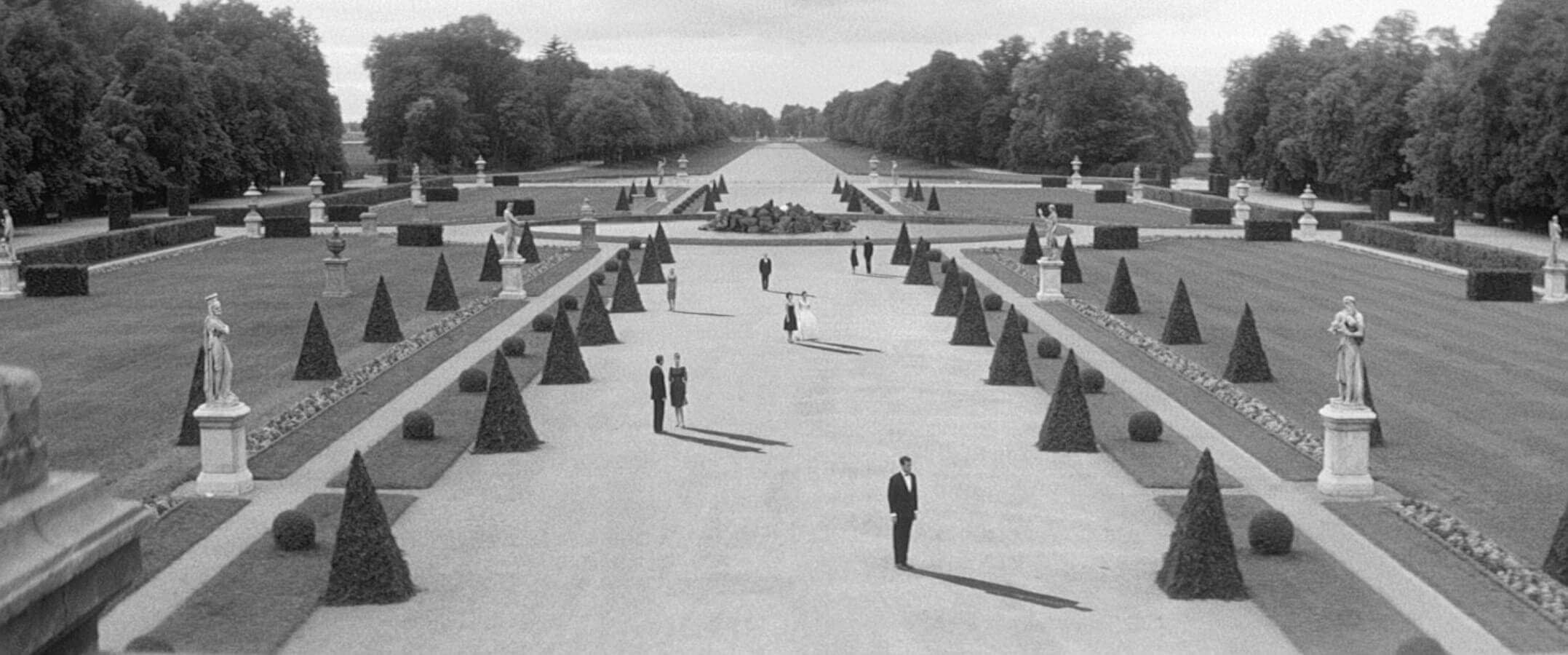
Resnais, Last Year at Marienbad
Alain Resnais, L’Année dernière à Marienbad (Last Year at Marienbad), France, 1961.


In the absence of an invited guest speaker (an American friend of Georges Comtesse knowledgeable in science fiction), Deleuze summarizes the two forms of direct time-image, with several examples (cf. Robbe-Grillet) and defines the two formulations of the direct time-image as coexistences: simultaneity of deactualized points of presents (present of present, present of past, present of future), and coexistence of sheets of virtual past (cf. Welles compared to Classical and Baroque thought and art) and sheets of virtual past without centers (cf. Resnais’s and Welles’s preoccupations). Following a brief, quite awkward intervention by the invited guest, Deleuze lists end-of-year conclusions: 1) the distinction between organic description and crystalline descriptions, or pure optical and sound descriptions; 2) relations between the real and the imaginary, leading Deleuze to define a “philosophy of the crystal”; 3) organic or spatial narrations (those of sensorimotor linkages) as distinct from crystalline narrations the latter linked  to modern films with passion as theme, a space of disparate yet adjoining aggregates. Here Deleuze joins eight facets of this space to different filmmakers considered during seminars 2 and 3; 4) the regime of an indirect time-image devolving from movement, and a crystalline regime of a paradoxical direct time-image devolving from anomalies; 5) truthful narration (linked to organic descriptions, organic narration, hodological and Euclidean spaces) and the falsifying narration (linked to the direct time-image) which points to the crisis that disturbs truth. Through these five points, Deleuze has detailed two great regimes of the image, especially their intersections, and he points out the two regimes constantly impinge on one another. To illustrate artists’ creative originality, notably of the powers of the false linked to description and narration, Deleuze points to several film examples (Varda’s “Documenteur”, Robbe-Grillet’s “L’Homme qui ment”, Welles’s “F for Fake”) and also indicates how Nietzsche endowed falsity with the power of the false. Here, Deleuze recalls the two texts studied earlier, Melville’s The Confidence-Man and Nietzsche’s “Zarathustra”, book IV (cf. Fritz Lang, Welles). Pointing to Nietzsche’s will to power as power of the false and, at its highest degree, as a will to metamorphosis, a force to create truth, Deleuze insists this is not the “truthful man’s” truth, i.e., a truth to be created, just like the task of philosophy. Deleuze closes by contrasting these two senses of truth and, indeed, of knowledge.


Gilles Deleuze

Seminar on Cinema, Truth, and Time: The Falsifier, 1983-1984

Lecture 22, 12 June 1984 (Cinema Course 66)

Transcription: La voix de Deleuze, Agathe Vidal (Part 1), Elsa Roques (Part 2) and Ian Parker, revised: SD (Part 3); Additional revisions to the transcription and time stamp: Charles J. Stivale

Translation: Graeme Thomson & Silvia Maglioni

Part 1

First of all, I’m a little annoyed because Georges Comtesse said he was going to bring in an American who had a good knowledge of science fiction and who was going to tell us something about the crystal as it occurs in science fiction. So, I said, well yes. But he is not here, and today we are in a hurry. Because… it’s the last session and… I don’t know what I’m going to do with this American, if he turns up. And in any case, we have to move forward, to finish things up, and then recapitulate on everything we’ve done, if only to convince ourselves that we’ve done a lot of work this year. This recapitulation seems to me to be essential in order to group together possible readings that you might have made in terms of the perspectives we have covered. So, there we have it, you understand?

Last time we had begun to look at what would be almost the last point that matters to me, which is this: how the direct image of time presents itself in two forms. Today, I would like to clarify this, I mean… The image of time, the direct image of time presents itself in two forms since these two forms are like the process of the differentiation of time itself. And these two forms are… the presents that pass… and the pasts that are preserved. And these two forms are complementary in a very simple way, in the sense that time is the process, or the movement, which at each moment never ceases splitting into two jets, two non-symmetrical jets: the jet of passing presents and the jet of pasts that are preserved.[1]

You remember we were saying how this has nothing to do with psychological recollection. The pasts that are preserved, are not preserved in our brain, they are not preserved in our memory. They are preserved in time. To the point that it is time itself that we can call memory. You will say to me: Presents that pass and pasts that are preserved. If this is time, why not invoke the dimension of the future? But the dimension of the future is already contained in the other two.

And so, we had begun – I had begun, but I was…  I wasn’t being very clear – I had begun by studying the pasts that are preserved.  However, I’d like to backtrack a bit, to finish very quickly with one point, because ordinarily we would have had time… this was my plan and I would have developed it afterwards… But here, I want to quickly deal with this other aspect. It’s a question of knowing, you understand me… here is our problem… we have this image, or rather, this is the direction of the direct image, of the direct time-image. But our problem is how to obtain a little bit of pure time, that is to say, a direct time-image, from the presents that pass, on the one hand, and the pasts that are preserved on the other.

What will the direct time-image consist of? We have to imagine two direct time-images, one corresponding to the movement of the passing presents, the other corresponding to the movement of the pasts that are preserved, two direct time-images each of which will give us a little time in its pure state, that is to say, a time which is no longer subordinated to movement, which is no longer deduced from movement, which no longer derives from movement. So, very quickly, I mean, regarding the presents that pass, the presents that pass do not yet constitute a direct time-image. I could even say that empirical time is confused with passing presents.

What would it take to obtain a direct time-image, that is to say a pure time, from the passing presents? The first thing we have to ask is: under what conditions do presents pass? The answer comes straight away: presents pass insofar as there is always another present that comes to replace the previous one, and another that follows it which comes in turn to replace the actual one. I mean, you see how it is always in relation to the presence of something else that something is said to be past or future. It is in relation to the presence of something else that something is said to be past or is said to be future. I would say that this is a horizontal vision… It is as if I were scrolling along a horizontal line. Here, there is a present which passes, another present… There is always something present, and it is in relation to the presence of something else, that something is past, or in relation to the presence of something else that something is not yet there. It is thus this horizontal succession of passing presents that defines the empirical form of time.

But what we saw… what we looked at vaguely this year, but much more thoroughly the previous year, was the extent to which this horizontal line referred to vertical lines, where this time, we consider what appears as an event, and instead of passing along successive events, as in the horizontal line, we remain within the event, we plunge into the event, we don’t get out of it. This was the schema that Charles Péguy had tried to draw from Bergson when he opposed history and memory, and he said: Yes, history – as Péguy understood it – consists of passing along events, while memory, true memory, consists of plunging into the event and not coming out of it.[2]

To plunge into the event, not to come out of it… what does this mean? It means that if I plunge sufficiently deeply into the event – I take for example event B – it is that the event has a law. The event is very strange, which is why it belongs to the vertical dimension, it has the strange property of being able to include within itself other events, that is to say, it can expand or contract. I mean, you can treat as a single event a period of your life, your whole life, several lives together, or ultimately the entire universe.

So, what will you have on a vertical line? You will have the projection of past events, or the retrojection of past events, and, why not, the projection of future events, and much more, even more, if you consider the expandability of the event, what you will have on the vertical line is the same event as present, as past and as future. The same event. Well, it doesn’t matter if it’s…  But what form will this take? It will no longer take the form of a present, past and future. Because this would be the horizontal line. It will take the form of three presents.

The deeper you plunge into the event, the more you grasp that there are three presents, and what are these three presents? A present of the present, a present of the past, a present of the future. According to Saint Augustine’s formula: There is no longer a present, a past or a future. There is a present of the present, a present of the past and a present of the future. What is this inner present? It is no longer the succession of the presents that pass. The succession of the presents that pass was: present, past, future. Here, what we have is a simultaneity of what should be called three peaks or points [pointes] of present [3]: present of the present, present of the past, present of the future. The event itself is the simultaneity of these three interior presents.[4]

I no longer have – here’s what’s important, and this is what will give us the first direct time-image. I’m going very quickly, as you can see, I’m going very quickly, but I’m addressing your sensibility, not your intelligence – you will no longer have a succession of presents that pass. What you will have is a simultaneity of three presents or three peaks of present. You’re no longer going to have a succession of actual presents, instead you will have a simultaneity of de-actualized presents. The succession of actual presents is present-past-future. The simultaneity of de-actualized presents is present of the present, present of the past, present of the future for the same event, all simultaneous. Precisely, insofar as they are de-actualized… being de-actualized, what they give you is a little bit of pure time, a direct time-image.

Oh, well… And it’s the same expandable event. It’s the same event that you will grasp in terms of the three simultaneous peaks of present: peak of present, implication of present, as opposed to the explication of passing presents. You will have a simultaneity of implied presents and no longer a succession of explicated presents. So… the same event will play out in the triple mode of the present of the present, the present of the past and the present of the future. What’s going on here? What is this simultaneity of peaks of a de-actualized present? Here it is – and this would be my first definition of the direct time-image – simultaneity of peaks of a de-actualized present, as opposed to the empirical form of time as a succession of passing presents. And you see that the simultaneity of the peaks of de-actualized presents corresponds to the aspect of time… to the empirical aspect of time of the passing present.

Well, let’s try to construct some examples where the event represents the simultaneity of the present tense, that is to say, the simultaneity in relation to the event, of the present of the present, the present of the past and the present of the future. A and X get to know each other in a present of the present, but they already knew each other in a present of the past, and yet they will also meet in a present of the future. If they meet in the future, they do not know each other now. If they knew each other, they wouldn’t have to get to know each other now. So, these are the peaks. They knew each other, so they don’t have to get to know each other. They don’t know each other yet. At the same time, they already knew each other: simultaneity of the three presents. It is not a simultaneity of the past, the future and the present because that would bring us back to the law of succession where they follow one another: They knew each other, they will know each other, they know each other, they have known each other. This is no longer the situation. It’s the simultaneity of the three de-actualized presents. Okay.[5]

Second example: Someone has a key, a key to open a door. Somebody doesn’t have the key anymore, that is, he has lost it. So, he had it. He still has it, so he hasn’t lost it, he has it. He finds it, that is, he will have it. So, he didn’t have it: simultaneity of the present of the present, of the present of the past, of the present of the future, whereas the present, the past, and the future cannot be simultaneous. But once they are de-actualized, the present of the present, the present of the past, and the present of the future can be simultaneous. So, it is at the same time that he no longer has the key, that he has it, and that he finds it.

Okay, third example: A young girl is abducted. Someone plots the abduction of the girl. But the way to ward it off is to carry out the abduction oneself. And carrying out this abduction is the way to avoid it happening, so that she is not abducted but at the same time she is abducted. So little is it true that she has been abducted that in the end, actually not in the end, at the same time, she will have been abducted, because she has abducted herself. Things get complicated, but schemes such as this are only complicated in appearance. This is the simultaneity of the three de-actualized presents.

What do you see here? Do you recognize something we’ve already looked at? Of course, you will recognize the films of Alain Robbe-Grillet: the key, the event with the key is taken from Trans Europ Express[6]. A and X who know each other, knew each other and will know each other, are taken from Marienbad. The abduction, which is at the same time the means of avoiding it by plotting it so that it occurs, but where it is the girl who abducts herself, is taken from Playing with Fire[7]. And then we also see a situation with a present where one betrays the other, a present where the other betrays the one, a present where neither betrays the other, a present where both betray the other, a present where both are the same person and betray each other under two different names. This is The Man Who Lies[8]. All these presents exist simultaneously as de-actualized presents, and this is the first image of time.

What is Robbe-Grillet doing in his films, through these images that he produces? And which would explain why he insists on telling us that these images are in the present. But once again, these cinema images are so little in the present, so little are they naturally present that it takes all the artifice Robbe-Grillet can muster in order to produce this type of image that would be in the present. And indeed, it is a very specific present, a completely de-actualized present, where therefore the present of the past, the present of the future, the present of the present are, strictly speaking, simultaneous. So much so that in Robbe-Grillet’s mysteries, I see nothing… I see nothing that can be related to either linguistics or the signifier. What seems interesting to me is that these images in the present that Robbe-Grillet creates constitute a direct time-image, a fundamental figure of time, namely the simultaneity of peaks of present.

So, to put it simply, it can be distributed… well, yes: X in Last Year at Marienbad, the man X, he is in a present of the present… no, sorry, he is in a present of the past, meaning he knew A, the woman. But the woman A, she is in a present of the future. She didn’t know… she doesn’t know X, but she will know him. And the difference between the two simultaneous presents produces a third present: M, the great hypnotist. According to the law that behind a hypnotist there is always another hypnotist: A, the woman, is the hypnotized, X is the hypnotist, M is the hypnotist behind the hypnotist. So, you have this structure. But it’s not that important, I’m just mentioning it as an example. But from this point of view, far from escaping time, Robbe-Grillet gives us a very important figure of time.

And this bothers me a little in comparison with the others, which is why I didn’t speak about it last time. Because if I start on the second pole, we are faced with a dimension of cinema that… I mean, are there any other filmmakers besides Robbe-Grillet, who have gone in this direction of exploring the simultaneity of de-actualized presents? I think there are. But strangely enough, they are fewer than those who have pursued the other direction that has been taken by cinema, it’s not an equal balance. Because this other direction is… and here we’ll find a very interesting problem. I said that the other figure… is one that we don’t draw from the presents that pass but from the pasts that are preserved. And in this case, what is the figure of time… what figure, what direct time-image do we draw from it? No longer the simultaneity of the peaks of de-actualized present, but, as we have seen, the co-existence of sheets of a virtual past.[9]

And so here I approach what I began to look at last time. So, this will be the second major direct time-image. In fact, chronologically speaking, it was actually the first to emerge in cinema. This coexistence of sheets of virtual past came first. Why do I use the term sheets of past?  I think I explained this the last time. Once again, it is because these sheets of past must not be confused with sheets of recollections. Recollection-images will be taken from the sheets of past insofar as I settle on a given sheet. But insofar as I settle on a given sheet, say this one… or this one here …  these sheets do not consist of recollection-images. I form my recollection-images from these sheets of past. These sheets of past are not preserved in me, they are preserved in time. Fine.

And here again, I will adopt exactly the same reasoning as I did before regarding peaks of present. From the point of view of the empirical form of time, we have succession. They succeed one another in relation to the former presents that they were. But the sheets of past do not succeed one another in relation to an actual present to which the evocation refers. They are all coexistent. Again, as Fellini says, we are at the same time the child, the adult and the old person.  They come one after the other in relation to the former presents, yes, but not in relation to the actual present to which the evocation refers, where I settle on one sheet rather than another. According to Bergson all these coexisting sheets design, as we have seen, the cone of memory. Coexistence of virtual sheets of past. Recollection-images are something else altogether, they are actualizations of such and such a point on any given sheet.

So, I have my two formulas of the direct time-image. I define one as the coexistence… or rather as the simultaneity of peaks of de-actualized presents: present of the present, present of the past, present of the future. I define the second as the coexistence of sheets of virtual past. As I was saying, the first filmmaker… the figure, it seems to me, who introduced the time-image, the direct time-image, into cinema – whatever preparations had taken place before – I don’t mean to say that it came to him just like that – was Welles. I’ll take Citizen Kane as the first example, and it’s no small achievement![10]

You… you have the sheets of past, the depth of field being, as I said another time, a factor of temporalization much more than of spatialization. You have the sheets of Kane’s virtual past that all coexist, and we settle on one, or on another, on the pretext of discovering what Rosebud is. Here you will tell me that he fabricates a bundle of recollection-images from this. But this is of no interest, that’s not where the main interest lies. And the proof that it’s of no real interest is that, as I told you before, Citizen Kane immediately sets out how useless and vain these recollection-images are. Finding out what Rosebud was is of no importance. The recollection-image, when it is found, is found for no one and by no one and is left to burn alone in the hearth. The recollection is fundamentally useless.

And when I was trying to establish a progression, in Welles’ films, I said not only that The Magnificent Ambersons denounces this uselessness even more emphatically, since, as the old Major says, and the voice-over confirms, nobody cares about this anymore. So why does he make a film about it? Because what interests him is something else altogether: sometimes the recollection-image is useless, sometimes it is at best impossible to recall, and these cases correspond to the two disorders, the two fundamental disorders that Bergson analyzed with regard to the recollection-image. And the disorders of psychological memory reveal… they are like keys that reveal the process of temporalization. For example, in The Lady from Shanghai, recollections cannot be summoned since what is at stake is the past of others, and particularly mysterious others at that. And Mr Akardin goes yet a step further, since it is a question for Arkadin of making his own past impossible to recall. What we have, therefore, is an exploration of the sheets of a purely virtual past, independent of their actualization in recollection-images, where all these sheets of virtual past coexist.

You will ask me, what do these sheets give us, since they don’t even give us recollection-images? Again, in Ambersons or in Citizen Kane, they do give us some, even if they are useless. But from The Lady from Shanghai on, they no longer give us any. So, what do they give us? They don’t… the sheets of the virtual past, when I settle on them thanks to this leap in time, which is no greater or smaller than the leap I make in space to perceive something outside of myself, so, what will it give us? The sheets of past do not, how shall I say… the sheets of the past no longer deliver recollection-images to me, images that no-one cares about. What they will give us instead are hallucinatory presences. The past of the infernal trio of The Lady from Shanghai will emerge through the hallucinatory presence of these three demonic characters, and you might especially remember the emergence of the character called Grisby in the film, this kind of hallucinatory emergence that occurs all the time. It’s one of the most beautiful things in Welles’ cinema. For Arkadin, the characters who are part of a relay and who represent so many different sheets of past, assume a kind of hallucinatory presence.

And all of this culminates in The Trial, where there are only hallucinatory presences, since The Trial turns around the same problem. Namely – and here the depth of field will fully assume its temporalization aspect – that K receives a visit from the police who come to his room one morning. The low-angle view, the low-angle depth of field will mark K’s search for the equivalent of Rosebud: on what sheet of past lies the secret of whatever it is I am accused of? And he launches into his investigation, which is an investigation in time and not in space. Is it this? Is it this one? Is it there? Is it there? Is it in my childhood, is it in my youth, is it…? Where is it? Where is my fault? It is not there, it is not that. He has no recollection-image.  One the other hand, what we have are hallucinatory presence everywhere: hallucinatory presence of the girls. Hallucinatory presence of the lawyer. Hallucinatory presence of the lawyer… no, sorry, of the student. Everywhere, hallucinatory presences. These are the hallucinatory presences that will be the witnesses to the sheets of virtual past, and time will be the mixing-up of these sheets of virtual past.

So that in the end, we would have to say… you see, Welles’ cinema – and here I’m going really, really quickly, since we don’t have much time left – Welles’ cinema is very interesting. Of course, it’s a cinema that remains centered. There is a center, even if this is only the center of recall that generally coincides with one or more deaths. Kane is dead, Kane has just died. From here, the summoning of the sheets of past begins. This center is a fundamental component of Welles’ cinema, and some fine commentators have remarked on it, on the fact that it is not simply a given center that exist of its own accord, or one that coincides with an event, such as the death of someone. It’s a vocal center, and Welles has always considered the position of a radiophonic center as something essential for cinema. Michel Chion has shown this very, very well. And indeed, remember that Welles came from radio, he never abandoned the theme of a radiophonic center.[11]

And apart from that, what interests me, in accordance with all we have studied this year, is the prodigious mutation that he makes the notion of center undergo. He keeps a center, but he makes the notion of center undergo a prodigious mutation. It is that – very quickly I would like to take up again an idea, because now or never is the moment to make our groupings – a theme that Michel Serres has analyzed very well in relation to the 17th century. Welles is often asked in his interviews: What century do you belong to, in your view? And the answers are varied. They tell him that he is a Renaissance man, and generally he is not very pleased by this. Or that he’s a Shakespearean man, and he’s not thrilled with that either. Just to add one more answer to the others, he’s a 17th century man. Which doesn’t mean he’s behind his own times, of course. He’s a neo-17th century man.

In what sense would he be a 17th century man? I’ll tell you. In Serres’ book, Le système de Leibniz[12], there are what seem to me some very fine passages on the truth about what is called the “classical” world. You know that the classical and the baroque are more or less the same thing. So, the classical is something that can refer to many things except the age of wisdom and reason. And he says, all right, what happens, what is it that defines the world of the 17th century? What defines the 17th century world, is the collapse of centers. They no longer have a center. It’s a situation of pure panic and this is the classical world. What does it mean to say that there is no longer a center? It’s pure panic, they have no center… It means that the world is losing all its centers. We can always discuss this matter: Is it the earth that revolves around the sun, or the sun that revolves around the earth? This presupposes at least the idea that there is a center, whether it is the sun or the earth, at the same time as they fully discover the infinite… this is again what defines the 17th century, it is also this kind of innocence with regard to the infinite. This way of thinking about the infinite. At the same time that it… [Interruption of the recording] [41:56]

… Their center, their center of balance. Masses lose their center of gravity, movements lose their center of revolution. That is to say, there is no longer a center meaning a center of configuration. To put it in the terms we’re using here: there is no longer a sensory-motor center, in the sense that the sensory-motor center is a center of configuration.

Hence, if they can save themselves from this, it will be through an extraordinary mutation of the notion of center. According to Serres’ analysis, this mutation of the notion of center will generally take place – and in this respect the two key authors would be Leibniz and Pascal – the mutation of the notion of center will occur particularly in two new disciplines, among others, two new disciplines that are of interest to us since we can only call them scientific-artistic disciplines. The first of these is projective geometry and the other is its complement, or reciprocal, what Leibniz calls the theory of shadows – that is to say, the projective, if you like, and the tenebrous. And here I’m getting more and more sketchy [indistinct words] … in terms of the figure that constitutes projective geometry, there is no longer a center, in terms of a center of configuration, bodies no longer have a center.

It just seems so… As I’m speaking you should apply what I’m saying to Welles’ cinema. No, don’t apply it, but try to feel how Welles’ images will be of this nature. If there is an author for whom bodies no longer have a center – except when they die, in which case they find a kind of center… Welles’ images are always at an angle. In the case of both depth of field and the cutaway shot, the image is always askew, at a tilt. Well, let’s go back, let’s go back to…

In projective… what happens in projective geometry? What used to be the only center has become simply a point of view. Strangely enough, what we find again here is the cone, and we will see that this is not unrelated to our problem. You have a point of view: top of the cone, position of the eye. This is a center, okay, and this center is a point of view. This is a real mutation. The center is no longer a center of configuration, the center becomes a point of view. What else do we have? There is an object we would call geometral, and there are sections of the cone in the form of planes. So that Bergson, as we have seen, presented us with a very, very rudimentary schema of the cone – we should always begin with what is simplest – since he only considered parallel cuts, parallel to the apex and parallel to the base. Whereas in projective geometry you can consider not only parallel cuts but also transversal cuts, as well as cuts that pass through the peak, or cuts that pass through the sides of the cone etc., etc. You can consider all sorts of planes, therefore all sorts of sheets, and each time, the projection of the so-called geometral object will vary in such a way that each projection can be considered a metamorphosis or anamorphosis of another, a visual metamorphosis and anamorphosis.[13]

What has happened on account of projective geometry? I would say in our terms, in the terms we have been using, that it has substituted a purely optical center for the sensory-motor center. That’s what has happened. And this marks the advent of a new type of cinema. The way Welles participates in this cinematic mutation, which has substituted purely optical situations for sensory-motor ones, is in the transformation he forces centers to undergo, which is the equivalent of the revolution in projective geometry in which centers cease to be centers of configuration of bodies and become centers of points of view that place bodies in a perpetual relationship of metamorphosis with one another. But finally – and this, I would say, to resolve a question, but I’m going too fast here – projective geometry is, if you like, the equivalent of rapid montage, of Welles’ chopped-up montage. Each image is like a projection of a point of view with metamorphoses occurring from one image to the next.

For example, in the rapid cutting of The Lady from Shanghai, Grisby, the lady from Shanghai, and the lawyer Bannister, constantly switch places from one image to another. There is no longer any center but an optical one, and these three diabolical figures are like its metamorphosis. Each one, each is the metamorphosis of the others. The rapid montage corresponds completely to the optical center of a projective geometry. Again, I’m not saying that Orson Welles applies Pascal, it would be disastrous to say that. All I’m saying is that what you have is a kind of 17th century resonance happening somewhere else, at a much later time.

But it isn’t hard for you to understand, even from the little I say, that there is something projective geometry doesn’t give us. It cannot distinguish a circle, that is to say a plane figure, from the border of a section of a sphere. As Leibniz says in his own terms, it cannot distinguish a flat surface from a convex or concave surface. In any case it will still be a circle. What I mean by this is that, in terms of a circle, the projective will not give you the means to distinguish between the section of a sphere and the form of a plane figure. Also, as we say in the 17th century, we must add to projective geometry a theory of shadows that will give us reliefs, concavities and convexities through shadowed areas, and for this, we reuse the cone, but we redistribute its elements. Instead of having an optical center – that is to say, the point of view of the eye, the geometral object and the projection on the planes of intersection, which was the triadic formula of projective geometry – we will have a light source, with the light source being in S and no longer the eye. We will no longer have a geometral object, instead we will have opacity. We will no longer have projection, rather we will have a distribution of chiaroscuro, areas of shadow… We don’t return to the old conception of the center. The center is simply no longer an optical center, it is a luminous center that will accentuate reliefs, constitute shadow areas. And what is this? It is the formula that corresponds to depth of field. That’s what it is.

As for the way Welles manages to reconcile his two great procedures, he always said that they were relative and interchangeable and so on, though to my mind they are not entirely interchangeable. They correspond to two extremely profound aspects: Welles’ so-called rapid or chopped-up editing actually corresponds to the projective, while the depth of field sequence shot corresponds to the tenebrous, that is, to the theory of shadows. And in both cases, we see the constitution of hallucinatory presences, the series of projections that transform into one another, or the shadowy areas that determine the different zones of chiaroscuro. And this is what the coexistence of sheets of past will give us, and not simple extractions. So, this is highly obscure, it’s very obscure, but it’s good to end… to leave you on a note of obscurity.

So, let’s imagine this – I’m going faster and faster – imagine this… what can happen here? Well, we were in the middle of saying how this is the direction that… the direction that the second direct time-image takes in the search for the coexistence of virtual sheets of past. And what will this coexistence of the virtual sheets of past give us? Either the projection of hallucinatory presences or else the darkening of these same hallucinatory presences. And if we consider a film like The Trial, it is clear how it has retained a profound element of Kafka’s work. Everything, everything here is auxiliary to the court! That is to say: girl, lawyer, screaming girl, lawyer, cathedral priest cathedral priest, co-accused, office colleague – I’m trying to make a list, I’ll probably forget some – woman with webbed fingers, files, legal files and so on. A hallucinatory presence of one and the same thing, which does not exist outside of these metamorphoses. Who are the Jews? They are the screaming girls. Who are the screaming girls? They are the homosexual painter. Who is the homosexual painter? He’s the lawyer and so on. Okay. You see how the sheets, the coexistence of the virtual sheets of past will give us hallucinatory presences. This is what… [indistinct word]

So, let’s go one step further, because after all, we can say: Well, yes, he completely transformed the notion of center, but he nonetheless kept a center. All right, this center suited us because it was a purely optical center, yes. But suppose we remove the center. That is to say, there is no longer even a center of recall. If we remove the center and there is no longer any center of recall, then the virtual sheets of past, the sheets of virtual past will be unleashed. They will begin to function on their own account and compete among themselves. There is no longer a center of recall, or else each virtual sheet can serve as a center in relation to another and vice versa. This will complicate things, it will complicate things in theory, but not at all in terms of vision. You simply have to let yourself be transported by it. And indeed, who is the greatest disciple of Welles, and at the same time the most independent? It seems to me that it is Resnais. He will be the filmmaker who takes up Welles’ problem of the virtual sheets of past. But everything will lead him… everything will lead him, to eliminate the centers. There is no longer a center, there are only virtual sheets that will play the role of a possible center in relation to one another.

And if we very quickly try to compile a list of Resnais’ films, I would almost like to do so in chronological order. But I’m isolating the first example, because it seems to be the most complicated, whereas in fact it’s the simplest. This is Je t’aime, je t’aime. Because here, it seems that there still is a center.[14]

Well, you see, there’s this the guy who they put in a time capsule – I talked about this a little bit last time – from where he will go back in time to relive a specific moment. But, as I was saying, mice may be able to relive a specific moment. Animals might be able to relive a precise instant, at least, so we suppose. But human beings cannot. Why not? Because every precise moment pertains to a sheet, so if the experiment fails, this is the reason. Instead of reliving his precise instant, which is to say the moment when he came out of the water while Catrine was lying on the beach, instead of reliving this instant… the guy will not be able to relive it without slipping. As the instant pertains to several sheets, he will not be able to relive it without slipping or jumping sometimes onto this sheet, sometimes onto another sheet and so on. And then step by step, on sheets from the time before Catrine to sheets from the time after Catrine and so on. And so we have a coexistence of all the sheets of past, and this will be the subject of Je t’aime, je t’aime, sheets that will accelerate, get mixed-up with each other, and then fragment. For the moment I’ll leave aside the question of how these sheets of the past fragment. In any case, they will never provide us with a single instant. They will always remain sheets, they will always be continuums of the past, the coexistence of all the continuums… [Interruption of the recording] [1:02:12]

Part 2

… From this point, let’s try to follow the films in chronological order. Resnais’ cinema is quite simple to understand, it is not at all… it is not theoretical. It is always the same problems that obsesses him, you only have to make the list. It is always the coexistence of sheets of past, without a center. He himself will be the figure that occupies the center.[15]

I’ll start with Last year in Marienbad. I can’t quite keep to a chronological order. What is the situation in Last year at Marienbad? I can say that it is still a common past. There is something common, namely: A and X, X the man and A the woman: have they already met, have they not met? In addition to the even more complex questions, I’ll stick to the simplest one. The answer is not difficult: X settles on a sheet where he has met A, A settles on a sheet where she has not met X. She settles on a sheet where she has not yet met X, and X settles on a sheet where he has already met A.

I point this out, and this is what, for me, creates the challenge: we have never seen such a coherent film made by two authors who understand it in two completely opposite ways. This is surely the secret of fruitful collaborations, because Robbe-Grillet makes the film – considering that he is much more than the screenwriter, as everyone recognizes – in my view, Robbe-Grillet makes the film by conceiving it not at all in terms of a linguistic signifier, but in the form of a simultaneity of peaks of present, discontinuous peaks of present. And Resnais makes the film by conceiving it as a coexistence of continuous sheets of past. The great thing is that it works. But that’s how it is, the most wonderful collaborations come from having absolutely different things in your head. That’s how it works.

At a stretch, we could distribute them. One could say that the woman, A, is closer to Robbe-Grillet, and that the man, X, is closer to Resnais, because A jumps from one point of present to another, she jumps in a discontinuous mode, from one point of present to another, sometimes denying that she has met him, sometimes half convinced. While the man tries to envelop the woman in his sheets of past. If it’s not this one you recognize, it must be that one, and so on. He jumps from one sheet of past to another, in an attempt to wrap the woman in a sheet of past. So, we could resolve the matter by saying that one character refers to Robbe-Grillet, and the other to Resnais. But in the end, in Last Year in Marienbad, this still works because in this story of sheets of past, there is something they have in common. Have they met, yes or no?

If I move on to Hiroshima mon amour [1959], here you see… Resnais detaches, he really detached things through a very interesting idea because here we have two sheets of past, Hiroshima-Nevers, which have nothing to do with one another. And each of the two will serve as the past for the other, just as they will in turn serve as the present in relation to the other. There is a confrontation of the two sheets of past. With this difference: that the Japanese man wants to chase her away… he does not want the woman to enter his sheet of past at all. “You’ve seen nothing in Hiroshima”. While she draws him with all her strength into her own sheet of past. You are the German; you are the same as the German. The challenge in Hiroshima mon amour is that this time… You see how the memory detaches itself from the individual. How can two people make a memory when they have nothing in common? This is the first step towards a supra-psychological memory.

With Muriel, it seems to me that people get lost wondering what is true, what is false, regarding the recollections that arise in Muriel. For me it makes no difference. This isn’t what interests me in the film. What interests me is that the problem becomes even more complicated. Here Resnais takes a big step. This time, it is not just a memory shared by two people. It is a memory that exists on several levels and through several characters. Two levels: World War II and the Algerian War – and three, four, or even more characters. There’s at least three, right? At least four? Four at least, who will divide up and confront… who will each confront what happens. And what counts is not at all whether the hotelier is more or less convinced by a lie, and that he was never in Algeria. Because, as Robbe-Grillet cannily remarked, there is no greater reason to believe that Bernard, the soldier, the former conscript, was really in Algeria either, or even that he saw Muriel there or… [indistinct words] Indeed, the question, you see, is never that of recollection-images, it’s the hallucinatory presences. What hallucinatory presences will emerge from this play of sheets and continuums of virtual past?

One step further, I would say, concerns the revolution, I don’t know… I’m not sure which revolution it was… anyway the next film, after Muriel, about the Spanish civil war…

A student: The War is Over?

Deleuze: The War Is Over, sorry… Yes, The War Is Over[16]. Here you have… – I have to go faster and faster – you have a memory that is so present, a memory on three levels. It’s a kind of world-memory and even – and this is something that will interest Resnais a lot in the films that follow – a memory-age of the world. You see, he goes from a memory for two, to a memory for several, to a world memory, all the memory of the world[17], to the infinity of… [indistinct word] ages of the world.

And The War Is Over will confront and will stir together three ages of Spain, and in each of these ages, there will be Spain in its totality. As I said, at each level, you have the whole of the past. There is the age of the civil war and of those who remained more or less connected to the civil war. There is an age which seems to be the age of the future, the age of the young radical terrorists. But here, there is no longer a clear distinction between the already and the not yet. It is a continuum. And then there is the level of the hero, who wants to break with the recollection-images of the civil war, and who also finds that the politics of the radical terrorists are no good – because this concerns the specific politics of the last phase of the Franco regime. Okay. Three ages of Spain, and these are what continue to mix together… There is no center, each one serves as a relative center in relation to the others.

With My American Uncle[18], the theme of a memory-age of the world becomes more complicated… it becomes even more complicated – not at all from the point of view of the images, these are all films of an extreme clarity – since you have three characters, each of whom stirs up his or her own sheets of past, confronting them with those of the others, here too through processes of fragmentation, distribution, overlapping, exclusion. All of which has the curious effect of bringing out what is constant, of bringing out the constants of each sheet. This is the contribution of Henri Laborit[19] who for each sheet distinguishes: territory, line of flight out of the territory, blockages of the lines of flight. So that, thanks to these constants, the sheets of the past can go beyond humans, that is to say, they can apply to animals. And here we have the great reconciliation of man and mouse, which was forbidden and excluded in Je t’aime, je t’aime. This really is the ages of the world, including the island, the island and its treasure, with sheets of a sub-human past, that is to say the animal, and also the superhuman, the cosmic.

And then his latest film, Life is a Bed of Roses[20], is even more exemplary in this regard: three ages of the world, three ages of the world that come into confrontation. And this time, why does Life is a Bed of Roses still represent progress, from the point of view of his work as a whole, Resnais’ frantic pursuit of this problem that haunts him so intensely? It is because this time, each of the ages of the world, or the sheets of past, have absorbed their characters. They no longer refer to characters. It is they themselves that have become characters. Whereas before, they referred to characters, each of whom possessed several sheets of past. Now, however, the sheets have swallowed up their own characters. Okay, but if there is no longer a center, how do we explain this?

Here again, I would like to do something similar to what I did in the case of Orson Welles, but I apologize because normally, if we weren’t in such a hurry, I would take more precautions, because I am afraid that this will seem like I’m applying these ideas. And then, I’m a bit embarrassed, because Isabelle Stengers is here, and this bothers me because, because I would like to recount a story that she knows much better than I do. In the book by Ilya Prigogine and Isabelle Stengers, Order Out of Chaos,[21] we see at one point an operation that is very, very, very charming, very, very interesting, that mathematicians call “the baker transformation”. You will understand why I mention it. And Isabelle will understand why, I hope, that I’m giving such a rudimentary presentation of it, one that is oversimplified to the point of being false.[22]

But I’m happy with this, since it’s sufficient for the task at hand. I give myself a square – I have the right, we have the right to give ourselves a square, we have the right, not at all because everyone has the right, but we, we in particular, have the right to give ourselves a square, since what we call a sheet of past is actually a square, a continuum, this is what a sheet of past is. The baker stretches his sheet or his square, and he stretches it – he’s a talented baker – into a rectangle whose width is half that of the square, and whose length is double that of the square. Okay? Are you following me? You have to follow me, because what I’m saying will be important, even if it will probably make her laugh. This rectangle, no need to make it, I divide into two halves, which I call A and B… Is that all right? With these, imagine that I continue being a baker and I take the B half and put it on top of A. I could have done the opposite, which is to say the story is more complicated than it seems. So, I have a square that I can mark with an AB division. Do you follow me? This is what I did, I stretched it, then I took the B half and I put it back on top of A. So I found my square again, but this time with an AB division.

I’ll call this square 2. I take my square 2, and stretch it. I don’t complicate the shape, I pull it in the same direction. At the same time, you can imagine that if I pulled it in another direction, it would give something else equally interesting. But we mustn’t overcomplicate things, we mustn’t… so again I pull it into a rectangle, under the same conditions of half the width and double the length. Now, what am I going to get? I can divide my rectangle. But I have the remaining division of my original square, to the point that now my rectangle has on one side AB and also on the other side AB. There, I stretched it well… And I do the same thing as before: I put the second half on top of the first and I obtain a new square, this time with four divisions, which taken in order are A, B, A, B. Well, that’s enough for me.

What I just said is almost wrong, but no problem with that, it’s an example of clarity. Because it goes without saying that one can stretch in all possible directions, so you will also have vertical divisions. You can number the transformations according to the number of divisions. Okay. First point: you can number the transformations according to the number of divisions. Second point: if you include everything – and even if you only include the figures I just made – you can already understand that if I take a region of my original square, however small, there will always be a moment, at the end of n number of transformations, when two points, however close they may be in the region, will be fragmented insofar as they will now be in different divisions.

So, first principle: once a transformation has occurred, you can always calculate the age of the transformation according to the number of transformations – what we call the age of the transformation. Second point: for a region however small, there will always be, at the end of a certain number of transformations, a moment when two points in a region, however close they are, will become fragmented, as they will find themselves in different divisions.

Do you understand? So, my apologies to Isabelle Stengers who must be cringing at this… but you must understand that all that matters from here on is that, if I understand correctly, it involves two considerations, … on the one hand, probabilistic considerations… a probabilistic space, and on the other hand, a topological space – be careful not to confuse these two things – and which in mathematics produce problems that go infinitely beyond the idea of the baker. Is this clear?

Now, why am I telling you all this? It’s not for fun, or as a tribute to Isabelle. I’m telling you because it seems obvious to me that… not that Resnais is doing a baker transformation, no, that’s not what he is doing. However, Resnais’s problem in cinema is something like the problem of the baker transformation in physical mathematics. If you take one of Resnais’ admirable early short films, Van Gogh[23]. What does he do in Van Gogh? What do you find in Van Gogh? He proceeds by making tracking shots within paintings of the same period. You see what he does, the way he zooms in within the frame. It’s a journey through the different paintings of the same period. Here once again I would say that as with Orson Welles, the tracking shot becomes a factor of temporalization, much more than of spatialization. What we have is an exploration of the past. And it is not by chance that Resnais once said that every time there is a work of art, or even just a reading of a text, there is memory. It is not a question of a recollection-image. It is not a psychological memory.

So, this is what he does. As he approaches the last period, the Provençal period, the tracking shots get faster while the fragmentations are subject to cuts that are more and more rapid. Both fades and cuts multiply until the final black[24]. From one period to another of Van Gogh, what we have are the sheets of past, the continuums of past. He did this well… and this explains why it was necessary for Resnais not to film a painting, and then another painting, but to establish a continuum corresponding to a period, one that covers several paintings. The tracking shot goes deep into the paintings and does not recognize the borders that separate one painting from another. Each time it therefore establishes continuums. And what will happen from one continuum to the next? There will be a reorganization…[25] [Interruption of the recording] [1:27:59]

… and the fragmentations that occur on this sheet. And this is something constant in Resnais, it’s almost his formula. And what is this formula? It’s not a formula that he just applies, it’s a formula that comes from the heart, it’s… it responds to his problem. It’s exactly what I said earlier about Orson Welles, but in a completely different way. Orson Welles’ reconciliation of rapid montage with the long sequence shot has never been a problem for him. Why not? We saw the answer in Welles’ cinema. I really believe it’s because the rapid chopped-up montage creates the conditions for a kind of projective view, while the sequence-shot takes care of what the projective cannot give – because projective images are necessarily flattened – it accounts for the distribution of shadows, the areas of shadow and the reliefs. So, here the conciliation is obvious, there is no problem. He requires both techniques as the means of his creation.

In the case of Resnais, I would say, the same thing applies but for a completely different reason. With Resnais, how do we reconcile the rapid editing that, for example, dominates Muriel, and the famous tracking shots, Resnais’ long tracking shots? It’s the same thing. The tracking… Resnais needs both. And that makes these the two components of his art, because here the trackings shots take care of the sheets of transformation and the age of those sheets, while the rapid montage conveys the state of fragmentation that corresponds to them.

I summarize: our two direct time-images had to be quite distinct from the empirical form of time. We found them, we defined them in the following way: on the one hand, simultaneity of peaks of de-actualized present, on the other hand, coexistence of sheets of virtual past and the transformation of these sheets among one another. In both cases, we will speak, to take up the expression of… I don’t know if I told you about him, a great Russian novelist who seems to me very close to Resnais… I would like to know if Resnais knows his work, his name is Andrei Bely, and he wrote a novel, a masterpiece called Petersburg, which spoke of the identity of the city and of what he, Bely, called the cerebral game, that is to say, the identity between the topology, of the topology of the city and the cerebral game – and in his novel, he invents a biology of shadows, saying that as long as one has not made the biology of shadows, one will not understand the precise identity between the topological city and the cerebral game.[26]

To say that – if we were to continue, if we were to continue another year, which we won’t – these two direct time-images would necessarily lead us to a new exercise of thought. It’s clear in the case of Resnais, and equally so for Robbe-Grillet. What this cinema, what this cinema tends to, is a cerebral game. Not at all in the ludic sense, but as a determination of the exercise of thought, that is to say, cinema becomes thought at the same time as it liberates the time-image. This is more or less our schema.

So, we would have two things left to do. Comtesse, did you bring your friend? Where is he? If you would be so kind, as I still have some conclusions to draw, what we have to do is… Well, Comtesse told me that you could suggest a few research paths for a field that I’m not at all familiar with, which is the use of crystalline ideas in science fiction. Since what we have called the crystal-image, or the crystal, doesn’t include any of this, because… But I would like you to cover as much as possible – and I’m sorry to insist on this – in ten minutes, because I don’t have much time. You can just give us some directions for further research… if we want to see the role of the crystal-image in science fiction, what do we need to do, and how do you conceive it… but please be very brief… forgive me but this is my last session. Like this… Oh, no, maybe we can hear better here, yes.

A student: [points out to Deleuze the title of another Resnais film, Providence]

Deleuze: Ah! Yes, I wanted to talk about that! Providence… which is the closest of his films to Bely! My God, I forgot Providence, one of Resnais’ most beautiful films… you should have told me. Well, you can start.

John Vandow: I’m very happy to be here. My name is John Vandow [approximate name] and I’m a science-fiction writer. I haven’t published much. But I would consider people like Borges, Joyce and also Malcolm Lowry as science fiction writers, and there’s also somebody called Pynchon, Thomas Pynchon, who’s not very well known, even in the United States. He wrote a big book called Gravity’s Rainbow, but he refuses to give interviews. We haven’t mentioned this book, but for me it also forms a part of this cluster of new ideas. I looked, I looked up the word crystal in the dictionary, and I found two things. My dictionary is an English dictionary… But I think you have to look at one dictionary, and then another, and then another, because if you look at one dictionary, you have an idea, and you are sure of something. But if you look in several dictionaries, you find different things, and suddenly you are no longer sure. I believe that we build our intelligence through uncertainty, not certainty, because if we are certain of something, it’s like we know it, and so we don’t think about it anymore.

In my dictionary I found: “ice” and “crust”. This was something… the etymology of the word crystal. And I thought… at that moment, I also thought about Poe, Edgar Allan Poe, who wrote a book called The Narrative of Arthur Gordon Pym of Nantucket (1838). He wrote a sequel to that book which was called something like The Pyramid or The Ice House.[27] The narrative comes from a true story of someone who thought that there was a paradise in the South Pole … that we would find something, a hole in the earth, and in this hole we would find a paradise… and some… And the United States government gave this man money. He went on a trip, but he never returned. Maybe he found this hole, I don’t know. But it is a real story.

And there are people who think things like, things that are really crazy, really crazy. This morning I thought… I’m in the middle of a book called – I have two books here – How to Build a Flying Saucer? And another – it’s very good, it’s very interesting – and another one called The Life of Nicolas Tesla. And this morning I looked in the… in the… you know, this little book where there are all the streets… there’s a street called Edison Street, but not a Tesla street. And it’s Tesla who gave us all these lamps, he gave us the fluorescent lamp, he also invented the electron microscope, and he also gave us the alternating current. It was Edison who discovered direct current, wasn’t it? Well, Tesla gave us alternating current. He died in the United States, in New York, in extreme poverty. And when he died, the cops came to his apartment, and they took all his notes. It was… it was, I think it was the FBI or something, and they took all his notes, all his… And he, the only thing he wanted to do was to… In this book, this big book here, there’s a whole chapter called, wait… the crystal planet, the crystal planet. And here it talks about Tesla’s genius. And Tesla wanted, he wanted… he made experiments with the earth, with the idea of providing electricity for everybody, by digging a hole in the earth, and by capturing the electricity. I don’t know how he did it, and with that, he… You know, in the United States… in the state of New York, I think, there’s been six or seven deaths, because people didn’t… a family of six died because they didn’t pay their electricity bill. And Tesla wanted to make electricity available to everyone.

Deleuze: Listen, you’ll have to forgive me for interrupting you but I’m afraid we don’t have time for this. What you are saying is very interesting, but what we were hoping for in terms of this perspective – but it goes far beyond our work of this year, we would need another year – what Comtesse had spoken to me about concerned a very precise point: the possibility that you could tell us in which direction, and in which classic science-fiction films, can we find themes linked to the crystal. Didn’t Comtesse tell you this? Didn’t he tell you?

John V: I’m starting to work on a story of another… it’s not about Tesla, it’s about a guy… a drunk living in Chicago… his name is… Ted Serios. And he, he cut up, he made photographs, he made photographs using only his brain…[28]

Deleuze: Ah, okay. Yes, yes, but I see you’re working on a whole different problem than ours, which regarded science fiction films and the crystal, right? There seems to have been some confusion. Listen, I would be very happy if next year you would be so kind as to come back one day, because I will be talking about the brain next year. But that’s enough for the moment, thank you.

John V: Thank you very much. [Interruption of the recording] [1:44:58]

Part 3

So, listen, having said that, we still have… we still have only – it’s not out of personal vanity that I want to do this – but what I’d like you to have, if you don’t already have it, though surely you already do – is a feeling of the whole of what we have covered and the reasons we’ve gone through all this, anyway. I mean, the group of notions, so we’ll be able to say… well, that’s one thing completed. I think that if I had to draw conclusions… because my dream would after all be to… but I’ll tell you my dream afterwards. Now I want to quickly draw my conclusions. Okay.

As a first level, we focused on – I’m not following the chronological order of what we did, I’m summarizing the whole – at a first level, I think we considered the distinction between two types of descriptions. I would like to point out that this is a subject – and this is not to be complacent about it – it’s a fashionable subject, in the best sense, since notably thanks to Gérard Genette[29] there are, both in the field of modern logic and in modern literary criticism, some very interesting and very profound studies on the meaning, nature and role of descriptions, both in terms of a logic and a literary criticism of descriptions. I think that the point of view we took was such that I didn’t have to quote them, not for lack of admiration, but because my problem was another one.  For my part, I’ve just tried to distinguish between two types of descriptions, and it would be up to you, if you’re interested, to see in what ways they overlap or don’t overlap with other people’s distinctions in this regard.

Organic description, of which I said that this would be any description that presupposes the independence of its object, even if this isn’t actually true – the question is not to know if the presupposition is correct – in this respect we have a set corresponding to an organic description if it presupposes the independence of its object, that is to say, if it refers to a supposedly independent object. And to this I opposed the crystalline description that I distinguished… that I defined as a description that stands for itself, that presents itself as its own object and that only refers to other descriptions that may repeat, modify or contradict it in the well-known mode of repetition-variation. These descriptions I called more precisely pure optical and sound descriptions. So, this allowed us to see a certain number of things related to descriptions, and in particular, we based our reflections here upon what seems to me to be the major text in this regard, Robbe-Grillet’s theoretical work and his theory of description.[30]

As a second major point, we dealt with the relation between the real and the imaginary, here again, to distinguish two types of relation. According to a first type of relation that we will call organic, the real and the imaginary are opposed as two poles of existence, one defined by legal, or causal connections, the other defined by pure appearance in consciousness. We opposed to this another regime of the real and the imaginary, where, this time, though the distinction between real and imaginary remained valid, the two distinct terms became indiscernible. What do I mean by an indiscernible distinction? It means that there are always two images, one called real and the other called virtual, but they don’t stop running after each other and swapping roles. And this is when we started talking about the crystal-image properly speaking. Here we had a second stage of research that culminated in the idea, once again, of an indiscernible distinction at the level of the crystal-image, which led us to consult a certain number of texts, those of Bergson among others, and also to consider this independently of Bergson… to attempt to give a certain status to the crystal, in the sense of a philosophy of the crystal, just as at the end of the 19th century we had philosophies of nature.[31]

As a third point, we were no longer talking about descriptions, but we entered the domain of narrations, where we distinguished a first type of narration that was again organic or spatial. And this type of organic or spatial narration was defined by the development of sensory-motor connections or sensory-motor sequences. A narration is organic when it follows sensory-motor connections. Now you may say to me that it is difficult not to bring language into narrative, but I don’t care either way. There are narratives without language, and when language intervenes, it inserts itself into sensory-motor connections and develops sensory-motor connections of its own, so I see no reason why we have to consider language a special instance in this respect, from the point of view of narrative itself. That it intervenes and what it engenders would constitute another problem that we haven’t had time to go into this year.[32]

This spatial, organic narration, which proceeds through sensory-motor sequences, referred to a double space. Concretely, a hodological space, h-o-d-o-l-o-g-i-c-al. Abstractly, a Euclidean space. What is a hodological space? It is a lived, dynamic space, defined by paths – hence its name – goals, obstacles or resistances, detours, in short, by a distribution of centers of forces. This notion of hodological space was the creation of the German-American psychologist Kurt Lewin. Okay. So, there we have the group for organic spatial narrative.[33]

To this we opposed a narrative that, once again, we should call temporal or crystalline. Why? Because here there isn’t such a thing as a lived space… Oh yes, no, I forgot about the others… Why would Euclidean space correspond to the abstract form? Because as I tried to say, Euclidean space seems to me the abstract schema of the resolution of tensions within hodological space, that is to say, that Euclidean space is precisely the space where the tensions between forces are resolved according to laws of minimum and maximum. In terms of maximum, the shortest path… of obstacles, for example. The tension will be resolved according to a path and Euclidean space seems to me to be the space of this abstract resolution.

At the other pole, I would say, we have a crystalline or temporal narrative, another lived space and other abstract spaces. These are spaces that are – how shall we put it – pre-hodological or post-hodological, either one or the other. That is to say, they are spaces which cannot even be said to be pre-hodological, since we are not even in the position of having to choose between paths, or to look for the best path. There is no path. Space has not yet been structured into goal, means, obstacle. There is an overlap of perspectives. In this sense, pre-hodological space is a space before choice, one does not choose. There are simply overlapping perspectives, and one always belongs to several neighboring but disparate sets.

You will find these forms of pre-hodological spaces in cinema, not by chance, in a series of modern films that all revolve around the same theme, passion. This is the space of passion. And indeed, passion is the opposite of action. Hodological space is the space of action. But there is a space of passion. You are in a state of passion when you belong simultaneously to disparate and yet neighboring sets. The space is not structured in such a way that you take one path rather than another. You belong to two sets simultaneously. This is passion. This marks the extremities of the Nouvelle Vague, and the cinema after the Nouvelle Vague. It goes without saying that among the great films of this movement, we can already think of Jean-Luc Godard, notably in Every Man for Himself, Passion[34], where the term “passion” acquires a highly specific meaning, and Prénom Carmen. But you will also find them in many other estimable, highly estimable Nouvelle Vague filmmakers – I leave it to you to guess who I’m referring to – some of whom are great in their own right, but who willingly acknowledge Godard’s influence.

But you also have another type of lived space, which is the space after choice, that is to say, the choice that has been made once and for all, and which continues to recommence as a firm spiritual determination. And this is the Dreyer-Bresson tendency. And between the two, between the pre-hodological space of non-choice and the supra-hodological, post-hodological space of firm spiritual decision, as in Dreyer and Bresson, there are important lines of communication, it goes without saying, since Godard, for example, owes a lot to them. So this second direction would already be very varied. And abstractly, all new spaces correspond to these lived forms. Abstractly speaking, I would say, that they all constitute types of paradoxical space.

If I again begin the list, which we looked at a little bit this year, and which we had already seen the year before… Disconnected space: I mention very quickly Antonioni, Bresson, Ozu, Godard, Cassavetes. Empty or amorphous space: Ozu, Antonioni, though not in the same way. Those two especially, in terms of their empty spaces, I think, are the two great masters, and again, not at all in the same way. Space… – but write this down with multiple scare quotes – “quantum” space – here I’m getting out of my depth, we should find another word, don’t you think? Quantum space of the Robbe-Grillet type, the jumps between presents, the peaks of present, and our jumping from one to another. Probabilistic space of the Resnais type, for which see our previous analysis on the transformations of the sheets. Crystallized spaces: Herzog, Tarkovsky. So, all this has given us a new group of notions and paths of study.

Fourth point: In terms of the regime that I could equally call organic or spatial or sensorimotor, what do we find in this space? There is an indirect image of time, since the image of time derives from movement, and we dwelt on this for a long, long time, since through Platonism and Neoplatonism we had mixed the destiny of philosophy in with it.[35]

In the other case, that of the temporal or crystalline narrative with its paradoxical spaces, there is on the contrary a direct time-image, and instead of the time-image being deduced from movement, it’s… – it’s not movement itself, that would be too easy, it’s not movement that is deduced from time – it’s the anomalies of movement that are deduced from the direct time-image. This is the reign of false continuity, false continuity being one of the anomalies of movement, among others. But it is obvious that false continuity can be used for its own sake, it’s no miracle solution. Every regime of images generates its own nullities, its catastrophes, its idiocies, its abominations, so one is intrinsically no better than any other. It is quite obvious that false continuities for their own sake are of no interest and become nonsensical unless they are founded on… any technique becomes stupid if it is not founded on a reason which, like it or not, which we can only call metaphysics. Meaning that if there is nothing in the time-image that requires these breaks in space, then false continuity has no place, and you can multiply them all you want, but you will only make something idiotic. When a collaborator of Resnais says that in Last Year at Marienbad, you won’t find a single real continuity shot, she knows what she is saying, but she also knows why Resnais needs false continuity. If you can’t say why – Godard said it a thousand times better than I can – if you can’t say why you need a tracking shot here rather than a panning shot, don’t do either. Better, don’t do anything.

So, I ask myself, why does the second, crystalline, regime of images, give us a direct time-image? For a simple reason: the paradoxical spaces we were talking about, pre-hodological, post-hodological and non-Euclidean, these paradoxical spaces are of a character that cannot be explained spatially. Contrary to Euclidean space, they are therefore already direct presentations of time, and they can only be described and traversed by aberrant movements, that is to say by false movements. The direct time-image is effectuated by false movement, of which false continuity is only one possible case. And this is a fourth group of notions that brought us to a close examination of Bergson’s conception of time, as well as the time-images of a number of filmmakers. You will see that… no, not right away.

Last point: I can oppose, in the same terms, to a type of narration that I will call
“truthful” – it doesn’t matter if it’s true or false, it claims to be true. It’s the claim that defines it as truthful. It claims to be true, whether it is true or not. Truthful narratives refer to organic descriptions, they refer to narratives that are spatial or organic, they refer to hodological, or Euclidian spaces – to this I opposed a falsifying narration. But then we were faced with the following problem, which for us was an urgent one: why is the direct time-image necessarily related to a falsifying narration?

We have solved this problem at several levels, considering first that time has always been the one and only factor capable of putting the notion of truth in crisis, and this under two forms that were already well known from Antiquity on: in virtue of time, the impossible must proceed from the possible, and the past cannot necessarily be true. And under these two forms, that the past is not necessarily true, and that the impossible proceeds from the possible, truth was shaken by an immense crisis. In other words, it was never movement that challenged the notion of truth, it was time. Truth has always accommodated itself perfectly to movement, but never to the aberrations of movement. I mean, truth has always accommodated itself to movement perfectly as long as there were centers of movement. On the other hand, when there is an aberration of movement, it’s because the time-image has become primary, as we’ve seen. You see how well everything is linked here. The crisis of truth was undoubtedly brought about by the aberrations of movement in astronomy, in physics… but in terms of logic, it was brought about by what the aberrations of movement continue to hide from us, namely, the direct presentation of time. Since once again movement will be all the more aberrant if it depends on time, and not the reverse. This should be absolutely clear, right, crystal clear, crystal clear.  No, since… [indistinct words]

And in what forms does the time-image constantly generate falsifying narratives? The fact is that the direct image-time has both forms. No longer do we have – which is why we had all sorts of levels – no longer do we have indiscernible distinctions between real and imaginary, but an undecidable alternative between different sheets of past. Which means that the past is not necessarily true… Undecidable alternative between sheets of the past, this means that the past is not necessarily true. This is what I would call the Welles-Resnais tendency… [Interruption of the recording] [2:13:48]

… the inexplicable distinctions between peaks of present, which implies different presents, each of which are possible, but incompossible with each other – incompossible, this notion of Leibniz that we have analyzed. These presents, each of which is possible but incompossible with the others are nevertheless simultaneous. In one present, one betrays the other; in another, the other betrays the one; in a third, neither betrays the other; in a fourth, they both betray each other; in a fifth, one betrays the other, but it is the same person and so on. This would be the Borges-Robbe-Grillet tendency.[36]

That’s the fifth point, I’ve almost reached the end. An adventitious addendum to the five points. Through these five points, it is thus each time that two regimes that can be distinguished, two regimes of description, two regimes of narration, if you take… in short, we have two great regimes of the image. A word of caution: it goes without saying that they constantly encroach upon each other. A great filmmaker has one foot in one regime, another foot in the other, that’s what makes things interesting. You can’t say, Ah, it’s this or it’s that… especially not – and not only that, perpetual encroachment, all of that, but each, each great filmmaker has their own way of handling things. They don’t apply readymade recipes. Great filmmakers encounter one another, they don’t apply each other’s methods. Resnais does not apply Welles. When it tries to apply Godard, post-nouvelle vague cinema is not very good. But when it takes an independent path, as it does in the case of Philippe Garrel or Jacques Doillon for example… you see what I mean?

But what would be interesting would be to look for the specificity of each great filmmaker. Let me take an example. For example – I try to summarize everything now – I say the modern regime, with all its nuances, and at the same time I say it’s not modern, I can take out every word, every word I say. I can say, it’s not a regime, there’s always another encroaching. I can say that it is not modern; it already exists, but not in this form. Well, it’s still modern… well, whatever you prefer. Don’t take this literally.

I could say that the regime we’ve been studying this year is the one that unites crystalline or, if you prefer, pure optical and sound descriptions with falsifying narrations. Right. But if that’s what we see all the time in the cinema today – this linking of pure description, of pure optical-sound description, therefore no longer sensory-motor, with falsifying narrations that are no longer true, that is, that no longer claim to be true – if that’s what makes us happy, assuming that it makes us happy, let’s look at how each filmmaker proceeds. To take two recent examples who… well, these two are not even among the greatest, I mean they are very important filmmakers but they are not among the greatest directors in cinema.

Let’s take Agnès Varda. Agnès Varda… I take her recent film Documenteur.[37] The title enters fully into our problem: the documentary has become docu-menteur [liar]. That is to say, it remains “docu-“, meaning description, and it is linked to a falsifying narration. Indeed, the documentary aspect of Varda’s film is no longer sensory-motor. What is it? Pure optical and sound description: the walls, the city, graffiti on the walls, the city to which she connects a narrative that is composed of what? Disconnected gestures. A woman who has lost her sensory-motor patterns after losing the man in her life. Perfect. I would say that in her, in her… I’m not saying that all of Agnès Varda’s work can be summed up in this way. What I’m saying is that in the case of this particular film, the link between pure optical and sound description and falsifying narration is established in the way I just explained.

I take another example, to show you how varied the methods can be. Robbe-Grillet is another filmmaker who constantly proceeds using the two poles. The descriptions are pure descriptions, that is, they are not supposed to refer to independent objects. What we have is a description that is repeated, denied, and so on and he has even elaborated the theory of this. But he also produces it in practice. And the narrative is eminently falsifying. Robbe-Grillet’s best film is without doubt The Man Who Lies but the man who lies is not a liar, he is not a liar. He is the man of the falsifying narration, which is something else entirely, as we have seen. But how does he proceed in his distribution? He makes a strange distribution. I would say that in Robbe-Grillet’s work – and this applies to all his films – you know what it is that plays the role of pure optical and sound description? Well, it’s the erotic scenes, the erotic scenes. In his films, the erotic scenes have the value of pure description.

And he himself says this, though he says it in another way, in a way that always amuses me because, he says: Do you know why I do sadistic scenes? And you say no – even if you do know, you don’t say it, so you say no, I don’t know. Well, it’s because women are always jumping around and this annoys me. That is to say, the sadistic scenes – but here I think he’s joking; well, whether he’s joking or not, what does it matter? – The sadistic scenes in Robbe-Grillet always have the function of attaining an immobilization, an immobilization that will produce a purely descriptive image. In fact, the woman starts becoming agitated and then at some point she is tied up. She is tied up. We can call this what we want. Some find these scenes highly erotic. It depends on the viewer, it depends on the viewer. But erotic or not, its function is to ensure a description that no longer refers to anything other than itself, a purely optical description. It consists in binding… it consists in tying a woman up. So why does he always tie up women? That’s his business, that’s his conceptual problem. But anyway, it’s a question of immobilizing the image. Okay. This is one way of immobilizing the image. Because it’s not necessarily using the methods of the experimental cinema that you freeze the image. You have to be able to use all kinds of methods. So, for Robbe-Grillet, it’s this.

And what about the falsifying narrative? If it is true that the erotic scenes in Robbe-Grillet’s work take care of the pure descriptions, what produces the falsifying narrative? All the different means of transportation, all kinds of transportation, it could be a car, a hay wagon, a boat, a motorbike – Robbe-Grillet is really fond of motorbikes.[38] Okay? Do you follow me? But why? Why is it that the means of transport take on the role of the falsifying narrative? Why? Because in Robbe-Grillet’s work all the different means of transport are sources of false movements, and falsifying narration takes place in these false movements.

I’m only taking two examples here, which is just to say that it’s not a question of applying a formula. It’s through their own particular talent that each filmmaker generates their pure descriptions and their falsifying narrations and moves from one to the other. And if it’s gratuitous, it will be a failure, it will be a film that does nothing other than copy, it will be either bad Godard, or bad So-and-so, etc. One cannot say that this regime of images saves us from mediocrity any more than others. But if it is founded upon necessity, upon affectivity, that is to say, metaphysics, then it will be wonderful.

Hence the last remark: what has collapsed in the passage from pure descriptions to falsifying narrations? All will to truth. But in favor of what? In favor of the power of the false. What brings about the power of the false, or rather what elevates the false? Because the false in itself is not very interesting. Actually, the false is not at all interesting. What is important is to give a power to the false. In philosophy, as we have seen, there was the false and then there was Nietzsche who gave the false a power of the false, just as he most radically questioned the notion of truth. Right. And why? When does the false assume a power? Well, precisely when it frees itself from any model of truth, when it does not present itself as true. The error is to present what is false as true. The false assumes its power when it is freed from any model of truth. And what is it that permits the false to free itself from any model of truth? It is time, in the double form of undecidable alternatives between sheets of past and inexplicable distinctions between points of present.

At this point, what figure is established from one end of the falsifying narrative to the other, or if you prefer, from description to the narrative, from the beginning of pure description to the end of the falsifying narrative? The forger. Why is the forger not a liar? It is because the liar is localizable, whereas the forger cannot be localized. They are there at every point on the chain. Why is this so? Because the power of the false implies and requires an irreducible multiplicity, the series, the series of degrees of power, the series of exponents. It is not astonishing when we ask ourselves: what is a forger? What is a forger? There have been many books on forgers. If you ask yourself what a forger is, you’ll have great trouble finding an answer since the question is badly posed. The question is badly posed. The forger does not exist in terms of…  without a plurality whereby they always refer to another forger behind them. There is no hypnotist who does not refer to another hypnotist standing behind them.

So, what did we have on this? There were the two great texts on which we based our idea, two great texts, or rather three great texts, three great works on which we based this idea: Melville’s prodigious novel – since it is without doubt the most unusual book of the whole 19th century – The Confidence Man. And then an admirable book that is a masterpiece of both poetry, philosophy and literature… the last book, book IV of Thus Spoke Zarathustra, in which Nietzsche presents us with the list of “higher men”, in quotation marks, the examples of “higher men” all being forgers, each of whom refers to the next forger in a process of metamorphosis. And in cinema, we have Welles, whose oeuvre culminates in the great series of forgers of his last film… F for Fake, which reflects, precisely, on the power of the false.

But we have seen that, from the point of view of Nietzsche as well as, undoubtedly, Melville, if it is true that the chain of forgers destroys every concept and every model of truth, on the other hand, its conclusion is not that everything is equal, everything being false. Because to say that everything is false is a stupid and banal proposition. As Nietzsche says, once again, in one of his most beautiful sentences, “We have abolished the world of truth, but we have also abolished the world of appearances”[39]. Only the half, the half… I don’t know what, only they think that to abolish the world of truth is to ensure the triumph of the world of appearances. No, to abolish the world of truth… the world of appearances is the false that presents itself as true.

I would say that if there is one great man, one great genius of cinema who did this, who abolished the world of truth, and brought the world of appearances to the cinema, it was Fritz Lang. He is the greatest filmmaker of appearances – so what I’m saying is in no way restrictive – a kind of Protagoras in philosophy. But, ah… after Lang, there is Welles. It was not sufficient to abolish the world of truth by retaining the world of appearances. It was necessary to do something else; it was necessary to go beyond Protagoras, that is, Heraclitus. There is no longer either truth or appearance. It is at this moment that the false becomes the power of the false. Not everything on the chain has the same value. The power of the false is multiple, just as the superior person is multiple. Nietzsche speaks of the multiple cry of the superior person. The power of the false is multiple, there is no single power, by definition power has several exponents. You will have a series, power exists only as a series of powers. Do not ask yourself: What is a forger? Since there are always several forgers.

What does it mean to say that not everything has the same value? We tried to analyze this. Not everything has the same value because if they are all forgers… even the truthful man, as we have seen, the truthful man finally realizes – and here we have another phrase of Nietzsche’s that you should know by heart – “even the truthful man realizes that he has never stopped lying”. Good. The truthful man is the first power of the false. And then, the power of the false is also what Nietzsche called “the will to power”. And here he plays between two extreme degrees, two powers, of which Nietzsche will be careful not to say which is better than the other. He leaves the choice to you. To you… to you to put yourself where you want, in the chain of forgers. At one end, the forger is the one who wants to judge life, either in the name of values superior to life, and that is the truthful man, or in the name of himself as an “higher man”. Both of these are forgers. They are part of the same chain.

With Orson Welles, if you think of Touch of Evil, Vargas is the truthful man, the one who, while his wife is being tortured, searches the archives for the truth and who says: I want the truth. And behind Vargas, the truthful man, who is already a complete forger, there is Quinlan, the forger. One wants to judge life in the name of a value superior to life, the truth. The other wants to judge life for himself and arrogates to himself the right to judge since he considers himself a superior being. This is the only difference between the truthful man and the forger for Nietzsche. They are equal, they are the first two powers. The forger refers to other forgers, as the figures of the forger multiply. They both represent degrees of the will to power, in terms of which the will to power has become a will to dominate life.

Now, according to Nietzsche, all this power of the will to power, all this degree of the will to power expresses life. Even those who claim to judge life in the name of a higher value can only express life. They simply express an exhausted life, an impotent life. Only impotent life wishes to judge life from the point of view of a value higher than life. All forgers recognize themselves by the fact that they have prostheses. Certainly, there are some people who have prostheses who are not forgers. One can conceive of a Zarathustra with prostheses. But in any case, the forgers, the real man… Quinlan with his cane is a forger, the crutches of the lawyer Bannister in…[40] Welles has seen it all, wonderfully.

So, what remains? Someone who is much a forger as the others, but to a different power. Who is this finally? Someone who does not express any sense of strong health nor great strength, but who expresses a gushing life, a life that is not exhausted. Life exhausts them, so they can be as sick as the others[41]. I’m not offering much consolation, am I? They can be even sicker, life exhausts them, but they do not exhaust life. This is the great Nietzschean criterion. Do you exhaust life or is it life that exhausts you? If it is life that exhausts you, you are good; if it is you who exhausts life, you are bad. If you judge, you are bad. If you dominate, you are bad.

The will to power at its last power is, as Zarathustra will say, “virtue that gives”. It is goodness, generosity; there is no other will to power, or there is no other. It is life in the ascendant. And again, it’s not a question of health. One can forfeit existence in an ascending life as much as one can save one’s skin in an exhausted life.

There are exhausted people who never finish dying. They are the most dangerous. Why is this? This is the scorpion. As Welles who is fully Nietzschean says: the frog is an idiot, and the scorpion is a bastard. This is pure Nietzsche. The frog is literally the truthful man, because in the fable – I don’t have time to recount it all to you, this fable from Mr. Arkadin[42] – the frog is the truthful animal because it believes in the pact, it believes that the scorpion will not sting it because they have made a pact. This is Vargas, the man of truth. The frog wants the truth. The forger is the scorpion. He will sting, he will sting himself, he will sting even if it means dying. He can’t help it, he’s the great forger. The frog is an ass – or rather, I quote exactly – “the frog is an ass, the scorpion is a bastard”.

So, what remains? All manner of things. The scorpion’s life is an exhausted life, it only knows how to sting, that’s all it knows how to do. It’s a completely exhausted life. The lawyer Bannister in The Lady from Shanghai knows only how to sting. Quinlan in Touch of Evil knows only how to fake evidence. They only know how to do one thing. What a life. What a life. That’s what Nietzsche means. He says very, very simple things: a sick life, an exhausted life, a degenerate life, is not a life that lacks strength; it can have a colossal strength. But it is invested in one thing only, to sting, to sting, its only concern is to sting. It’s the great scorpion, it’s Hitler, it’s whatever you like. It’s… Okay.

So, gushing life is nothing particularly extraordinary; it’s like the Bergsonian élan vital, you know, it’s not at all extraordinary, it’s even very tiring, it’s no great joy either. But these are people who are exhausted by life, even a small one, even a small life, instead of themselves exhausting life. So that through them, something of life will pass and bounce back. Something… these are people for whom the power of the false no longer lies in judging life but in ensuring its metamorphoses.

This for Nietzsche is the will to power. This is Zarathustra: I announce the metamorphosis. They are forgers. They are forgers, I would say, to the power of n. What is their sign? Goodness, generosity. Welles never ceases waxing lyrical over Falstaff. He tells us: Falstaff is the character of my life.[43] Of course, he’s a liar, a braggart, whatever you say, but you won’t understand him if you don’t understand that he’s good. And Welles, who can no longer hold back, adds: he’s good like bread and wine. This could be a phrase of Zarathustra. Welles’ two characters, Welles’ two positive characters, are Falstaff and Don Quixote. They are men of metamorphosis, men of metamorphosis, men who turn the will to power into the will to metamorphosis. Sometimes they have another name. When they can be, they are artists.

So that neither Welles, or Nietzsche, or anyone else, have ever considered things to be equal between an artist and their copyists. That the power of forgery is the only power there is never meant that any forger was worth the same as an artist. Do you know why the genius forger, who makes counterfeit Vermeers is worth nothing in comparison to Vermeer himself? For a very simple reason: it is because the forger does not know how to change, whereas Vermeer does know how to change. And if we go back to the chain as it occurs in the famous case of the Vermeer forger, a chain similar to that in Welles’ F for Fake[44], you will see that the painting expert, the truthful man, is himself a forger. He judges, he judges: ah this is a Vermeer, this is a real Vermeer. No, that is not a true Vermeer! And he is wrong, why? Because behind the truthful man, there is always a forger, even in him.

Indeed, according to what criteria does the expert judge the veracity, the truth of a Vermeer? According to the criteria that he as a truthful man has established concerning Vermeer’s style. Now, the forger has perfectly studied the expert’s criteria regarding Vermeer’s style. Hence the expert can say that these are real Vermeers, since they meet all the criteria for being so. So, behind the expert, the truthful man, was a forger. And what’s more, he was feeding him with his own substance. It never occurred to the expert that what defined Vermeer as a great artist was that Vermeer himself changed. Now, the expert cannot change – at the most, he will distinguish periods of Vermeer. But Vermeer was exhausted by life and died. So, at that point he must have stopped changing, so obviously, obviously… But the expert believes that he does not change. And behind the expert, the forger himself is unable to change and so will make his fake Vermeers.

What distinguishes a fake Vermeer from a real Vermeer? A real Vermeer has a power of metamorphosis, whereas a fake Vermeer is like a judgment on Vermeer, which fulfills and carries out the criteria of judgment, period. Nothing in it changes or will change. The lowest degree of the will to power according to Nietzsche is the will to judge, that is, to dominate life, while its highest degree is the will to metamorphosis, as announced by Zarathustra, Dionysus and characters simpler than these. So, there you have it.

It is in this sense that narration as the power of the false can finally be said to be creative. But what will it create? At that point, we no longer have any problem with using the word “truth”. It will create truth. This means that truth is neither a model nor a copy, it is something to be created. Now, truth in so far as it is to be created, has nothing to do with the truth of the truthful man, that is, the truth that is to be found.

Philosophy is the enterprise of the creation of truth, that is, of the will to power in its highest degree. Behind the higher person, there is the superman. And who are these higher men so bitterly denounced by Zarathustra? The superman is announced, and the superman is not at all something extraordinary. The superman is simply the one who “knows” how to pass through his different metamorphoses.

You have all kinds of expressions; Rimbaud who did not use the expression superman spoke of one who knows how to take responsibility for giving even animals the power of metamorphosis.[45] As long as you know how to change – “change” here not meaning simply to change one’s mood, though each time there can be a possible counter-meaning – as long as you know how to really change, you will be on the side of goodness, of generosity, of art. Whereas when you start knowing how to do only one thing, with your little anger, your venom, your sting, that can do only one thing, only that! Your bite, all the ways you will judge life and believe yourself superior to life, all this will make you a pathetic wretch.

Well, after this lesson in morality… That’s it, we’re finished… Oh no, I would have liked – no, it’s too late – I would have liked to know if Isabelle Stengers was suffering when I… because, I must say, I would have liked to talk less and let her explain for ten minutes how it is in fact much more complicated than this. But in the end… [Isabelle Stengers makes a comment that we don’t hear, but that makes Deleuze laugh.]

Well, well, I wish you all a good rest, good work, all that… Hey, Miss Dolbenne, I need Miss Dolbenne. Isn’t she here? Does anybody know Miss Dolbenne? … [End of the session] [2:48:00]

Notes

[1] See the beginning of chapter 5 of The Time-Image, pp. 98-100.

[2] Deleuze refers to Péguy in The Time-Image, p. 91. Moreover, Deleuze discusses Péguy in sessions 2, 4 and 22 of the Cinema seminar II, November 23 and December 7, 1982, and May 31, 1983; in session 15 of the seminar on Leibniz and the Baroque, April 28, 1987. See also at the end of chapter IV of What is Philosophy? pp. 111-113.

[3] In the translation of The Time-Image the terms “peaks” and “points” or sometimes “shining points” are used interchangeably to convey this notion of the present.

[4] Deleuze refers to Saint Augustine’s formula in The Time-Image, p. 114. See also session 15 of this seminar, March 27, 1984, in particular the intervention of Eric Alliez.

[5] On this analysis and the one that follows, see The Time-Image, p. 103.

[6] In Trans Europ Express (1966), starring Jean-Louis Trintignant and Marie-France Pisier, a director, his scriptwriter and his producer take a trip on the Trans-Europ-Express. During the journey, they imagine the scenario of a film about drug trafficking from Paris to Antwerp. Very quickly, the script and the changes they make in it in their discussions begin to shape their surrounding reality.

[7] Playing with Fire (orig. Le jeu avec le feu, 1975). When Carolina (Anicée Alvina), the daughter of a wealthy banker (Philippe Noiret), is reported kidnapped, it is upsetting to him even though he knows it isn’t true as the kidnappers have taken the wrong person. The banker hires a seedy detective (Jean-Louis Trintignant) to find his daughter and hide her safely away. The young woman soon finds herself in a place where all kinds of perversions are practiced. There, a near-double of her father whips and then seduces her. Eventually, she and the detective leave, after extorting the kidnapping money from the girl’s father.

[8] The Man Who Lies (orig. L’homme qui ment, 1966) is a film written and directed by Robbe-Grillet starring Jean-Louis Trintignant, which tells the story of a man sometimes calling himself Jean and sometimes Boris, who turns up in a village somewhere in Central Europe that had been occupied by the German Army during the Second World War. Mourning the death of an unseen friend, he is taken in by the family of the dead rebel. His conflicting tale gives rise to doubts about his story. Robbe-Grillet’s film leaves the viewer to decide if he is telling the truth or covering up for his deeds leading to the death of the Resistance fighter. For this film, Trintignant won the Silver Bear for Best Actor at the 18th Berlin Film Festival.

[9] On the cinema of Robbe-Grillet and Alain Resnais see The Time-Image, pp. 103-109.

[10] On Welles’ cinema see The Time-Image, pp. 110-116, as well as the previous session.

[11] For the reference to Chion and the concept of acousmètre, see The Time-Image, p. 323, note 24. See also Chion’s The Voice in Cinema (trans. Claudia Gorbman) New York: Columbia UP, 1999, where he delineates different aspects of the acousmètre (a voice we hear whose source is hidden or unknown) as it is used in cinema. On the theme of the center in Welles, see pp. 142-147.

[12] See Michel Serres, Le système de Leibniz, Paris: PUF, 1968.

[13] On Bergson’s second great schema, see The Time-Image, p.294, note 22 (from Matter and Memory). Regarding the point of view and projective geometry, see session 3 of the seminar on Leibniz and the Baroque, November 18, 1986.

[14] On Je t’aime je t’aime, see the previous session, as well as The Time-Image, pp. 116-125.

[15] On Resnais’ cinema see section 3 of chapter 5 of The Time-Image, pp. 116-125.

[16] The War is Over (orig. La Guerre est finie, 1966), starring Yves Montand, Ingrid Thulin and Geneviève Bujold, tells the story of a weary, aging Spanish revolutionary living in Paris three decades after the Spanish Civil War, where he becomes involved in a plot to overthrow Franco and his fascist government. The film was withdrawn from Cannes so as not to offend Franco’s government.

[17] All the Memory in the World (orig. Toute la memoire du monde, 1956) is a short film by Alain Resnais, with a text by Remo Forlani, about the Bibliothèque Nationale in Paris. Deleuze probably makes indirect reference to it here as an essay on the potentials and limits of dutifully archived human knowledge in relation to the theory of the world-brain that he will develop in the next year’s seminar.

[18] My American Uncle (orig. Mon oncle d’Amerique, 1980) is a comedy-drama film by Alain Resnais starring Gerard Depardieu, Nicole Garcia, Roger Pierre and neurobiologist and philosopher Henri Laborit. The film uses Laborit’s theories about human behaviour as a framing device around the narratives of three protagonists, all from different social backgrounds and inhabiting different working milieus, whose destinies become strangely intertwined. Throughout the film the episodes involving one or more of the central characters are interwoven with more essayistic passages in which Laborit voices (and experimentally demonstrates) some of his own theories, echoes of which Resnais then sometimes comically and surreally weaves back into the narrative.

[19] Henri Laborit (1914-1995) was a neurobiologist who was an actor and narrator in My American Uncle, and whose writings play an important role in the film.

[20] Life Is A Bed of Roses (Orig. La vie est un roman, 1983) is a 1983 French film directed by Alain Resnais from a screenplay by Jean Gruault, starring Vittorio Gassman, Fanny Ardant, Geraldine Chaplin and Pierre Arditi. The film interweaves three stories that all take place at different times in the same Ardennes forest location: a medieval fairytale about an exiled dragon-slaying prince; a story set immediately before and after World War 1 about a Count who builds a castle where he conducts an experiment to wipe people’s memories and allow them to be born anew; and a comic tale involving ideological conflict and academic skulduggery at an education conference staged at the castle in the 1980s.

[21] Ilya Prigogine and Isabelle Stengers, Order out of Chaos (based on La Nouvelle Alliance, Paris: Gallimard, 1979), London: Verso, 2018.

[22] On the transformation of the baker and Resnais, see The Time-Image, pp. 118-121, and page 301 note 31 (cf. reference to Prigogine and Stengers). More generally, see L’Abécédaire, “N for Neurology”, as well as Negotiations, New York: Columbia University Press, 1997, pp. 124-126.

[23] Van Gogh (1950) is an early short documentary film by Resnais, written by Gaston Diehl and Robert Hessens narrating the life of the Dutch painter through a visual exploration by the camera of the different periods of his art. The film is notable for the way Resnais films the paintings such that our view of them is almost always inside the frame of the canvas, while his own editing and framing dramatizes the subjects in a manner that points to his later cinematic style.

[24] At the end of the film Resnais invents an unusual hybrid between a lateral tracking shot and a fade to black as the camera tracks across Van Gogh’s last painting, Wheatfield with Crows, towards an erased black area on the right of the canvas that gradually invades the whole of the frame.

[25] On this precise point, see The Time-Image, p. 120.

[26] “[…] the biology of shadows has not yet been studied; and so I tell you this – never come to terms with a shadow: you will not understand its demands; in Petersburg it will enter into you through the bacilli of all kinds of diseases that are swallowed in the very water that comes through the taps …” See Andre Bely, Petersburg (trans. David McDuff) London: Penguin, 2011, epub edition. On Bely and the connection with Resnais, see The Time-Image, p. 125, 213 and note 42, p. 302.

[27] Actually, it was Jules Verne who wrote the sequel to Gordon Pym, under the title The Sphinx of the Ice (1897)

[28] Ted Serios (1918-2006) was an unemployed American hotel worker who claimed to be able to produce polaroid photographs using the power of his thoughts alone, which were dubbed “thoughtographs”. Though his claims were supported by a psychiatrist, Jules Eisenbud, who wrote a book on Serios, they were later debunked as fraudulent by photography experts.

[29] Gérard Genette (1930-2018) was a literary scholar and structuralist theorist who had a broad impact on the development of narratology. Among his most well-known books are Figures I-III (translated as Figures of Literary Discourse) and Palimpsests.

[30] Alain Robbe-Grillet, For A New Novel: Essays on Fiction, (trans. Richard Howard) NY: Grove Press, 1965. On the question of description in Robbe-Grillet, see in particular sessions 2 and 3 of this seminar (Cinema III), November 22 and 29, 1983.

[31] This is a continuous reflection starting from session 9, January 24, 1984. As for the image-crystal, Deleuze approaches it slowly from session 14, March 20, 1984, and accelerates this examination from session 18, May 15, 1984.

[32] This is an ongoing reflection from session 3 of this seminar (Cinema III, November 29, 1983.

[33] On hodological space and Kurt Lewin, see session 18, May 15, 1984, and also The Time-Image, pp. 127-143 and p.217.

[34] Passion (1982) is a film by Jean-Luc Godard, starring Isabelle Huppert, Hanna Schygulla, Jerzy Radziwilowicz and Michel Piccoli. The second film of Godard’s so called “middle period”, it recounts the adventures of a film director who wrestles with his producer over a seemingly impossible film he is trying to make on the subject of passion, involving elaborate tableaux-vivant reconstructions of several historical paintings, while his attention drifts to the disenchanted wife of a factory owner and a female factory-worker who is trying to organize a strike.

[35] These discussions begin in session 11, February 7, 1984, and continue during the rest of the seminar, in particular in sessions 12-17.

[36] Deleuze introduces the distinction “truthful” / “falsifying” in session 3 and continues to develop this in more detail throughout the seminar, hence the subtitle, “The Falsifier”.

[37] Documenteur (1981) is a film by Agnes Varda made during a stay in Los Angeles in the early 1980s. The title is a pun on the French words for documentary (documentaire) and liar (menteur), a juxtaposition that has informed Varda’s filmmaking since the beginning of her career. Tracing the alienation of a recent divorcée newly arrived in L.A. with her young son, Documenteur uses interior monologue to underscore the woman’s status as an outsider, vividly using Los Angeles to evoke her sense of loneliness. In this film Varda blurs the line between fiction and documentary by incorporating elements from her L.A. documentary Mur murs and by casting her own son.

[38] See for example the highly artificial scenes of a woman riding a motorbike at night that punctuate La Belle Captive (1981).

[39] In the Cambridge edition of Nietszche’s works, this phrase, from Twilight of the Idols, reads: “The true world is gone: which world is left? The illusory one, perhaps? But no! we got rid of the illusory world along with the true one!”. See F. Nietzsche, The Anti-Christ, Ecce Homo, Twilight of the Idols and Other Writings, (trans. Judith Norman), Cambridge: Cambridge UP, 2005 p. 171

[40] The Lady from Shanghai (1948).

[41] One of Deleuze’s last texts, concerning Beckett is called “The Exhausted”. See Essays Critical and Clinical (Trans. D.W. Smith and M. Greco), Minneapolis: Minnesota UP, 1997, pp. 152-174.

[42] Mr Arkadin (1955) is a film by Orson Welles starring himself, Akin Tamiroff and Michael Redgrave in which a criminal-turned-detective is employed by Gregory Arkadin, an oligarch of Russian origins claiming to suffer from amnesia, to piece together his own story by tracking down his former associates. But Arkadin’s real plan is to use the investigator to locate these people, all of whom have knowledge about his shady past, so he can eliminate them. Like many of Welles’ projects Arkadin suffered production troubles and interference and several versions of the film exist, including one heavily cut and renamed Confidential Report which for a long time was the only version to circulate in the Anglophone world.

[43] Chimes at Midnight (1965) is a film by Orson Welles, based on Shakespeare plays Henry IV Pts. 1 and 2, but also collaging scenes from Henry V, Richard II and The Merry Wives of Windsor and starring Jeanne Moreau, Margaret Rutherford, John Gielgud, Marina Vlady, Keith Baxter and Welles himself as Falstaff, a role he had long coveted.

[44] F for Fake (1973) is an experimental documentary essay film by Orson Welles, thought to be his last feature film until the recent discovery and restoration of The Other Side of The Wind. Featuring himself, Oja Kodar, Elmer de Hory, Joseph Cotten, Gravy Graver and Francois Reichenbach, it begins by recouning the story of art forger De Hory and those who knew him before evolving into a playful meditation on forgery, authenticity and fabulation that Welles connects to aspects of his own biography, while inventing among other things, a fictitious anecdote involving Picasso and Welles’ wife Kodar.

[45] Rimbaud’s exact sentence in his letter to Paul Demeny (May 15, 1871) is: “The poet is truly the thief of fire. He is responsible for humanity, even for the animals”, see Arthur Rimbaud, Complete Works, Selected Letters, University of Chicago Press, 1966.

French Transcript

Edited

Gilles Deleuze

Sur Cinéma, vérité et temps : le faussaire, 1983-1984

22ème séance, 12 juin 1984 (cours 66)

Transcription : La voix de Deleuze, Agathe Vidal (1ère partie), Elsa Roques (2ème partie) et Ian Parker, correction : SD (3ème partie) ; révisions supplémentaires à la transcription et l’horodatage, Charles J. Stivale

Partie 1

Premièrement je suis embêté parce que Georges Comtesse, il m’avait dit qu’il allait amener un Américain qui connaissait bien la science-fiction et puis qui nous raconterait des choses sur le cristal dans la science-fiction. Alors j’avais dit, eh ben oui, alors. Mais il n’est pas là, et puis on est pressé, aujourd’hui. Car, donc, c’est la dernière fois, et puis… Alors je ne sais pas ce que je vais faire de l’Américain, s’il arrive, moi. Et puis, on a à avancer, à terminer, et puis on à faire quand même une récapitulation de l’ensemble pour se persuader à chacun que, pendant l’année, nous avons beaucoup travaillé. Cette récapitulation, elle me paraît essentielle parce que, pour regrouper les lectures éventuelles, que vous auriez faites dans nos perspectives. [1 :00] Alors, voilà, vous comprenez ?

On avait entamé la dernière fois, presque le dernier point qui m’importait et qui était ceci : [Pause] l’image directe du temps se présente sous deux formes. Je voudrais aujourd’hui, être d’une clarté, enfin… L’image du Temps et l’image directe du temps se présentent sous deux formes parce que ces deux formes sont comme [Pause] le procès de la différenciation du Temps en lui-même. Et ces deux formes, c’est [Pause] [2 :00] les présents qui passent, [Pause] les passés qui se conservent. Et ces deux formes sont complémentaires d’une manière très simple, c’est que le temps est le processus ou le mouvement qui ne cesse de se diviser à chaque instant en deux jets, jets non symétriques : le jet des présents qui passent et le jet des passés qui se conservent. [A ce propos, voir le début du chapitre 5 de L’Image-Temps, pp. 129-131]

Vous vous rappelez qu’il ne s’agit plus du tout de la mémoire psychologique. Les passés qui se conservent, ne se conservent pas dans notre cerveau, ils ne se conservent pas dans notre mémoire. Ils se conservent dans le Temps. Si bien que c’est le Temps [3 :00] lui-même qu’on peut appeler mémoire. Vous me direz : présent qui passe et passé qui se conserve, et c’est ça le Temps : pourquoi pas invoquer la dimension du futur ? Mais c’est que la dimension du futur, elle est dans les deux autres. [Pause]

Et on avait commencé — mais j’avais commencé, un peu, pas de la manière la plus claire — j’avais commencé par l’étude des passés qui se conservent. Mais je voudrais faire un peu marche arrière, pour en finir très vite avec un point, parce que normalement on aurait eu le temps — ça allait, mon plan — j’aurais développé ensuite… Mais là, je veux vite régler au contraire, l’autre aspect. Il s’agit de savoir, vous me comprenez, voilà notre problème. C’est ça l’image, enfin, c’est ça, la direction [4 :00] de l’image directe, de l’image-temps directe. Bon. Mais notre problème, c’est comment tirer un peu de temps pur, c’est-à-dire une image-temps directe, des présents qui passent, d’une part, et d’autre part, des passés qui se conservent?

Qu’est-ce que ce sera l’image-temps directe ? On doit s’attendre à deux images-temps directes, l’une qui correspond au mouvement des présents qui passent, l’autre qui correspond au mouvement des passés qui se conservent, deux images-temps directes qui chacune présenteront un [5 :00] peu de temps à l’état pur, c’est-à-dire un temps qui n’est plus subordonné au mouvement, qu’on ne déduit plus du mouvement, qui ne découle plus du mouvement. Alors très vite, je veux dire pour les présents qui passent, les présents qui passent, ce n’est pas encore une image-temps directe. Je peux dire même que le temps empirique se confond avec les présents qui passent. [Pause]

Pour atteindre à une image-temps directe, c’est-à-dire un temps pur, à partir des présents qui passent, qu’est-ce qu’il faudrait? Je demande : à quelles conditions les présents passent-ils ? La réponse est immédiate : [6 :00] les présents passent dans la mesure où il y a toujours un autre présent qui vient remplacer le précédent, et un suivant qui vient remplacer l’actuel. Je veux dire, comprenez, c’est toujours par rapport à la présence d’autre chose [Pause] que quelque chose est dit passé ou futur. C’est relativement à la présence d’autre chose qu’une chose est dite passée ou est dite future. Je dirais que c’est une vision horizontale. [Pause ; Deleuze va au tableau] [7 :00] C’est comme si je défilais le long d’une ligne horizontale. [Pause] Il y a ici [Deleuze marque son dessin] un présent, il passe, un autre présent… Il y a toujours quelque chose de présent, et c’est par rapport à la présence d’autre chose, qu’une chose est passé, ou par rapport à la présence d’autre chose qu’une chose n’est pas encore. C’est donc cette succession horizontale des présents qui passent, qui définit la forme empirique du temps.

Mais on avait vu, on avait vu, vaguement cette année, puis l’autre année beaucoup plus à fond, à quel point cette ligne horizontale [Pause; Deleuze écrit au tableau] [8 :00] renvoyait à des lignes verticales, où cette fois-ci, on considère ce qui se présente comme événement, et au lieu, comme dans la ligne horizontale, de passer le long d’événements successifs, on reste dans l’événement, on s’enfonce dans l’événement, on n’en sort pas. [Pause] C’était notamment le schéma que [Charles] Péguy tentait de tirer de Bergson lorsqu’il opposait l’histoire et la mémoire, et il nous disait : oui, l’histoire — telle qu’il l’entendait lui, Péguy — consiste à passer [9 :00] le long des événements, tandis que la mémoire, la vraie mémoire, consiste à s’enfoncer dans l’événement, à ne pas en sortir. [Sur Péguy, Deleuze se réfère à lui dans L’Image-Temps, p. 132, note 2, dans Clio (1931) ; Deleuze considère Péguy ou cet ouvrage dans la séance 2, 4 et 22 du séminaire du Cinéma 2, le 23 novembre et le 7 décembre 1982, et le 31 mai 1983 ; dans la séance 15 du séminaire sur Leibniz et le Baroque, le 28 avril 1987 ; et à la fin du chapitre IV de Qu’est-ce que la philosophie ? pp. 106-108]

S’enfoncer dans l’événement, ne pas en sortir, qu’est-ce que ça veut dire ? Ça veut dire, si je m’enfonce suffisamment dans l’événement — je prends par exemple l’événement B – c’est que l’événement, il a une loi. L’événement il est très bizarre, et c’est par là qu’il appartient à la dimension verticale, c’est qu’il a l’étrange propriété de pouvoir comprendre en soi les autres événements, c’est-à-dire d’être extensible ou rétrécible. Je veux dire, vous pouvez traiter comme un seul et même événement, une période de votre vie, votre vie tout entière, plusieurs vies ensemble, [10 :00] à la limite l’univers entier.

Si bien que sur une ligne verticale, vous allez avoir quoi ? Vous allez avoir la projection des événements passés, ou la retrojection des événements passés, pourquoi pas la projection des événements futurs, et bien plus, et bien encore, si vous considérez l’extensibilité de l’événement, ce que vous allez avoir sur la ligne verticale, c’est l’événement comme présent, le même événement comme passé, le même événement comme avenir. Bon, peu importe que ce soit… [Deleuze se tourne vers le tableau, d’où quelques mots indistincts] [11 :00] Mais vous allez l’avoir sous quelle forme ? Non, plus, sous forme d’un présent, passé, futur. Car ça, c’est la ligne horizontale. Vous allez l’avoir sous la forme de trois présents.

Plus vous vous enfoncez dans l’événement, plus vous saisissez trois présents qui sont quoi ? Un présent du présent, un présent du passé, un présent du futur. Suivant la formule de Saint Augustin : il n’y a plus du présent, du passé, du futur ; il y a un présent du présent, un présent du passé, et un présent du futur. Qu’est-ce que c’est ce présent intérieur ? Ce n’est plus la succession des présents qui passent ; la succession des présents qui passent, c’était : [Pause] [12 :00] présent, passé, futur. Là, vous avez une simultanéité de ce qu’il faudrait appeler trois pointes de présents : présent du présent, présent du passé, présent du futur. [Pause] L’événement lui-même, c’est la simultanéité, de ces trois présents intérieurs. [Deleuze se réfère à Saint Augustin à ce propos dans L’Image-Temps, p. 132 ; voir aussi la séance 15 du séminaire actuel, le 27 mars 1984 avec l’intervention d’Eric Alliez]

Je n’ai plus – voilà ce qui est important, et c’est ça qui va nous donner la première image-temps directe ; je vais, très vite comme vous le remarquez, je vais très vite, mais je m’adresse à votre sentiment, pas à votre intelligence — vous n’allez plus avoir succession de présents qui passent. Vous allez avoir une [13 :00] simultanéité de trois présents ou de trois pointes de présents ; vous n’allez plus avoir une succession de présents actuels, vous allez avoir une simultanéité de présents désactualisés. La succession des présents actuels, c’est présent-passé-futur ; la simultanéité des présents désactualisés, c’est présent du présent, présent du passé, présent du futur pour le même événement, tous simultanés. Précisément, dans la mesure où ils sont désactualisés, en tant que désactualisés, ils vous donnent un peu de temps pur, une image-temps directe.

Ah bon, alors… Et c’est le même événement extensible. C’est le même événement, que vous saisirez sous les trois pointes simultanées de présents : pointe de présent, implication de présent, [14 :00] par opposition à l’explication des présents qui passent. Vous allez avoir une simultanéité de présents impliqués et non plus une succession de présents expliqués. Alors… C’est le même événement qui se jouera, sur le triple mode du présent du présent, du présent du passé, du présent du futur. [Pause] Qu’est-ce qui se passe ? Qu’est-ce que c’est, ça, cette simultanéité, des pointes de présent désactualisé ? Voilà, [Deleuze écrit au tableau] et ce serait ma première définition, de l’image-temps directe : simultanéité des pointes de présents désactualisés, par opposition à la forme empirique du temps [15 :00] comme succession des présents qui passent. Et vous voyez que la simultanéité des pointes de présents désactualisés correspond à l’aspect du temps, à l’aspect empirique du temps du présent qui passe.

Eh bien, essayons de fabriquer des constructions où l’événement représente la simultanéité des pointes de présents, [Pause] c’est-à-dire la simultanéité par rapport à l’événement, du présent du présent, du présent du passé, du présent du futur. [Deleuze dessine au tableau] A et X [Pause] se connaissent dans un présent du présent, [Pause] [16 :00] mais ils se connaissaient déjà dans un présent du passé, mais ils se connaîtront dans un présent du futur. [Pause] S’ils se connaîtront, ils ne se connaissent pas. [Pause] S’ils se connaissaient, ils n’ont pas à entrer en connaissance présentement. Eh ben, c’est les pointes. Ils se connaissaient, donc ils n’ont pas à se connaître. [Pause] [17 :00] Ils ne se connaissent pas encore. En même temps, ils se sont déjà connus ; simultanéité des trois présents. Ce n’est pas une simultanéité du passé, du futur et du présent car on serait ramené à loi de la succession ; ça se succède. Ils se sont connus, ils se connaîtront, ils se connaissent, ils se sont connus. Ça, ce n’est plus ça du tout. C’est la simultanéité des trois présents désactualisés. Bon. [Sur cette analyse et celle qui suit, voir L’Image-Temps, p. 133]

Deuxième exemple : [Pause] [18 :00] Quelqu’un a une clé, hein ? Une clé pour ouvrir une porte. Quelqu’un n’a plus la clé, [Pause] c’est-à-dire il l’a perdue. Donc il l’avait. [Pause] Il l’a encore, donc, il ne l’a pas perdue, il l’a. [Pause] Il la trouve, c’est-à-dire il l’aura. Donc, il ne l’avait pas : simultanéité du présent du présent, du présent du passé, du présent du futur, alors que le présent, le passé, et le futur ne peuvent pas être simultanés. Mais le présent du présent, [19 :00] le présent du passé et le présent du futur désactualisés peuvent être simultanés. Et c’est à la fois, que il n’a plus la clé, qu’il l’a, et qu’il la retrouve.

Bon, troisième exemple. On enlève une jeune fille. [Pause] On conjure l’enlèvement de la jeune fille. [Pause] Mais le moyen de le conjurer est la manière de faire l’enlèvement lui-même. [Pause] [20 :00] Et faire cet enlèvement, c’est la manière d’éviter qu’elle se fasse, si bien qu’elle n’est pas enlevée, tout en l’ayant été ; c’est qu’elle est si peu enlevée qu’à la fin, pas à la fin, en même temps, elle sera enlevée, parce qu’elle s’enlève elle-même. Ça se complique, des schémas aussi compliqués que ça, en apparence, c’est la simultanéité des trois présents désactualisés.

Qu’est-ce que vous reconnaissez là ? Vous reconnaissez, quelque chose que l’on a vu ? Vous reconnaissez les films de [Alain] Robbe-Grillet : [Pause] la clé, l’événement de la clé, est emprunté [21 :00] à “Trans-Europe Express” [1966]. A et X, [Pause] ils se connaissent, ils se connaissaient, ils se connaîtront, sont empruntés à “Marienbad” [1961]. L’enlèvement qui est en même temps le moyen de le conjurer, si bien qu’en étant conjuré il se produit, mais c’est la fille qui s’enlève elle-même, est emprunté au “Jeu avec le feu” [1975]. On voit aussi, il y a un présent où l’un trahit l’autre, [Deleuze écrit au tableau] un présent où l’autre trahit l’un, un présent où aucun ne trahit, un présent où tous les deux se trahissent, [22 :00] un présent où les deux sont le même et se trahissent sous deux noms différents, c’est “L’Homme qui ment” [1968]. Tous ces présents sont simultanés en tant que présents désactualisés ; c’est la première image du temps.

Qu’est-ce qu’il fait, Robbe-Grillet, dans son film, là, dans le film d’images qu’il produit ? Et voilà pourquoi il nous dit tellement : « les images sont au présent ». Mais encore une fois, elles sont si peu au présent, les images du cinéma, elles le sont si peu naturellement, qu’il faut tous les artifices de Robbe-Grillet pour produire ce type d’images au présent. Et en effet, c’est un présent très, très spécial, c’est un présent complètement desactualisé, où dès lors, le présent du passé, le présent du futur, le présent du présent sont strictement simultanés. Si bien que dans les mystères de Robbe-Grillet, je ne vois rien, je ne vois rien [23 :00] qui puisse se rapporter ni à la linguistique ni au signifiant. Ce qui me paraît intéressant, c’est que l’image au présent de Robbe-Grillet est une image-temps directe, est une figure fondamentale du Temps, à savoir la simultanéité des pointes de présents. Alors simplement, ça peut se distribuer, ben oui : X dans “L’Année dernière à Marienbad”, l’homme X, il est dans un présent du présent… non pardon, il est dans un présent du passé, à savoir : il a connu A, la femme. Mais la femme A, elle, elle est dans un présent du futur. [24 :00] Elle n’a pas connu, elle n’a pas connu X, mais elle le connaîtra. Et la différence entre les deux présents simultanés produit un troisième présent : M, le grand hypnotiseur. Suivant la loi que derrière un hypnotiseur, il y a toujours un autre hypnotiseur, A, la femme, c’est l’hypnotisée, X c’est l’hypnotiseur, M c’est l’hypnotiseur derrière l’hypnotiseur. Bon, vous avez cette structure. Peu importe, hein ? Je dis ça comme ça. Mais de ce point de vue, loin d’échapper au temps, [25 :00] Robbe-Grillet nous donne une figure très importante.

Et ça me gêne un peu par rapport aux autres ; c’est pour ça, que je n’en avais pas parlé la dernière fois. Parce que si je pars sur le deuxième pôle, on se trouve quand même devant une dimension de cinéma… Est-ce que d’autres auteurs que Robbe-Grillet sont allés dans cette direction de la simultanéité des présents désactualisés ? Je crois que oui. Mais bizarrement, ce n’est pas égal avec l’autre direction où s’est enfoncé le cinéma ; ce n’est pas égal. Car l’autre, c’est… et puis on va trouver un très curieux problème. Je disais l’autre figure, on ne la tire pas des présents qui passent ; on la tire des passés qui se conservent. Et cette fois-ci, quelle figure du temps, quelle figure, quelle image-temps directe on en tire ? Non [26 :00] plus la simultanéité des pointes de présents désactualisés, mais, on l’a vu, la coexistence des nappes de passé virtuel. [Sur le cinéma de Robbe-Grillet avec Resnais, voir L’Image-Temps, pp. 133-137]

Et je rejoins à la limite ce que j’avais commencé à faire la dernière fois. Si bien que ce sera la seconde grande image-temps directe. En fait chronologiquement, ça a été la première qui s’est introduite dans le cinéma. C’était la première : coexistence des nappes de passé virtuel. Pourquoi j’emploie le terme de « nappes de passé » ? Je l’ai justifié, je crois, la dernière fois. Encore une fois parce que ces nappes de passé, il ne faut surtout pas les confondre avec des nappes de souvenirs. [Pause] Les images-souvenirs seront empruntées [27 :00] aux nappes de passé dans la mesure où je m’installe sur une telle nappe. Mais, [Deleuze écrit au tableau] dans la mesure où je m’installe sur une telle nappe, celle-ci, celle-ci, [Deleuze écrit au tableau] mais ces nappes ne consistent pas en images-souvenirs. Je forme mes images-souvenirs à partir de ces images de nappes de passé. Ces nappes de passé ne se conservent pas en moi, elles se conservent dans le Temps. Voilà.

Et, là aussi, je ferai exactement le même raisonnement que tout à l’heure pour les pointes de présents. Du point de vue de la forme empirique du Temps, [Pause] il y a succession. [28 :00] Elles se succèdent relativement aux anciens présents qu’elles ont été. [Pause] Mais les nappes de passé ne se succèdent pas par rapport à l’actuel présent dont parle l’évocation. Elles sont toutes coexistantes. Comme le dit Fellini encore une fois, c’est à la fois que nous sommes l’enfant, l’adulte et le vieillard. Ça se succède par rapport aux anciens présents, oui, mais pas par rapport à l’actuel présent dont parle l’évocation, où je m’installe sur une nappe plutôt que sur une autre. Toutes ces nappes coexistant, c’est, on l’a vu, [29 :00] le cône de la mémoire, selon Bergson. Coexistence des nappes virtuelles de passé. Les images-souvenir, c’est tout à fait autre chose, ce sont des actualisations de tel point, sur telle nappe.

Donc, j’ai mes deux formules d’images-temps directes. Je définis l’une comme la coexistence, comme la simultanéité des pointes de présents désactualisés : présent du présent, présent du passé, présent du futur. Je définis la seconde comme : la coexistence des nappes de passé virtuel. Et je disais, le premier — et c’est lui, et c’est lui, il me semble, qui a introduit l’image-temps dans le cinéma, l’image-temps directe dans le cinéma — quelles aient été les préparations, je ne veux pas dire que c’est venu tout [30 :00] d’un coup comme ça. C’est [Orson] Welles. Je donnerai comme premier exemple “Citizen Kane” [1941], et c’est si peu ! [Sur le cinéma de Welles à ce propos, voir L’Image-Temps, pp. 138-151, aussi bien que la séance précédente]

Vous, vous avez, des nappes de passé, la profondeur de champs étant, comme, je le disais une autre fois, un facteur de temporalisation, beaucoup plus que de spatialisation. Vous avez les nappes de passé de Kane virtuel qui coexistent toutes, et on s’installe sur l’une, sur l’autre, sous le prétexte de savoir : qu’est-ce que « Rosebud » ? [Pause] Vous me direz, bon mais il en sort des images-souvenirs. Aucun intérêt, ce n’est pas ça qui est intéressant. La preuve que ce n’est pas intéressant, [31 :00] que ce n’est pas ça qui était intéressant, c’est que comme je vous le disais, “Citizen Kane” déclare immédiatement l’inutilité et la vanité des images souvenir, [Pause] à savoir ce qu’est « Rosebud » n’a aucune importance. C’est l’image-souvenir, quand elle est trouvée, n’est trouvée pour personne et par personne et brûle toute seule dans l’âtre. Le souvenir est fondamentalement inutile.

Et quand j’essayais d’établir une progression, dans les films de Welles, je disais non seulement, sur “La Splendeur des Amberson” [1942], l’inutilité va être accusée encore plus, puisque, comme dit le vieux Major, et comme dit la voix off, [32 :00] tout ça n’intéresse plus personne. Donc pourquoi il fait un film là-dessus ? Parce que ce qui l’intéresse, c’est tout à fait autre chose : tantôt l’image souvenir est inutile, tantôt au mieux, elle est inévocable, et ça correspond aux deux troubles, aux deux troubles fondamentaux que Bergson analysait, lorsque l’image-souvenir, mais les troubles de la mémoire psychologique, nous disent et sont comme des clés sur le processus de la temporalisation. Voyez, dans “La Dame de Shanghaï” [1948], les souvenirs sont devenus inévocables puisque c’est le passé des autres, et d’autres particulièrement mystérieux. Et dans “[Mister] Akardin” [1955], c’est encore un pas de plus, puisque il s’agit pour Arkadin de rendre son propre passé inévocable. [33 :00] Il y a donc exploration des nappes de passé purement virtuel, indépendamment de leur actualisation dans des images-souvenir, où toutes ces nappes de passé virtuel coexistent.

Vous me direz, mais qu’est-ce qu’elles donnent, puisqu’elles ne donnent même pas d’images-souvenir ? À partir de, encore dans les “Amberson” ou dans “Citizen Kane”, elles en donnent, même si c’est inutile ; à partir de “La Dame de Shanghaï”, elles n’en donnent plus. Alors, qu’est-ce qu’elles donnent ? Elles ne… les nappes de passé virtuel, quand je m’installe en elles par ce saut dans le temps, [Deleuze indique le tableau en parlant] qui n’est pas moins grand ni plus grand que le saut que j’opère dans l’espace pour percevoir quelque chose hors de moi, ben, qu’est-ce que ça va me donner ? [34 :00] Les nappes de passé ne me, comment dirais-je, les nappes de passé ne me livrent plus des images-souvenir dont tout le monde se moque éperdument, elles vont délivrer des présences hallucinatoires. [Pause] Le passé du trio infernal de “La Dame de Shanghaï” va surgir comme la présence hallucinatoire des trois diaboliques, et vous vous rappelez, notamment le surgissement du personnage qui s’appelle Grisby dans le film, cette espèce de surgissement hallucinatoire, tout le temps. C’est une des plus belles choses du cinéma de Welles. Pour “Arkadin”, tous les personnages-relais, [35 :00] qui représentent autant de nappes de passé, prennent une espèce de présence hallucinatoire.

Ça culmine enfin dans “Le Procès”, où il n’y a plus que des présences hallucinatoires, puisque “Le Procès” aussi c’est le même problème. À savoir, et la profondeur de champs y retrouve son côté facteur de temporalisation. K [Pause ; Deleuze écrit au tableau] reçoit la visite de la police le matin dans sa chambre. Contre plongée, contre plongée, profondeur de champ, qui va marquer la recherche de K à savoir, l’équivalent de « Rosebud » : sur quelle nappe de passé gît le secret de ce que l’on me reproche ? [36 :00] Et il se lance dans son enquête, c’est une enquête dans le temps et pas une enquête dans l’espace. Est-ce là ? Est-ce là ? Est-ce là ? Est-ce là ? [Deleuze indique une nappe dessinée différente à chaque question] Est-ce dans mon enfance, est-ce dans ma jeunesse, est-ce… Où est-ce ? Où est la faute ? Ce n’est pas simple, ce n’est pas simple. Il n’a aucune image-souvenir, en revanche, présence hallucinatoire partout : présence hallucinatoire des fillettes. Présence hallucinatoire de l’avocat. Présence hallucinatoire de l’avocat, … de l’étudiant. Partout, présence hallucinatoire. Ce sont les présences hallucinatoires qui vont témoigner pour [37 :00] les nappes de passé virtuel, et le Temps va être le brassage des nappes de passés virtuels.

Si bien qu’à la limite, [Pause] il faut dire, vous voyez, dans le cinéma de Welles — et là, je vais vraiment, très, très vite, on n’ a plus le temps — dans le cinéma de Welles, il y a quelque chose de très curieux, c’est un cinéma bien sûr, qui reste centré. Il y a un centre, ne serait-ce que le centre d’évocation qui coïncide généralement avec une mort, « Kane est mort, Kane vient de mourir ». À partir de là, [Deleuze indique une nappe particulière] partent les évocations de nappes de passé. [Pause] [38 :00] Ce centre, il est très fondamental dans le cinéma de Welles, et de très bons commentateurs l’ont marqué, parce que ce n’est pas simplement un centre donné, comme ça, ou qui coïncide avec un événement, la mort de quelqu’un. C’est un centre vocal, et Welles a toujours considéré comme essentiel pour le cinéma la position d’un centre radiophonique. Michel Chion l’a très, très bien montré. Et en effet, rappelez-vous que Welles venait de la radio, il n’a jamais abandonné le thème d’un centre radiophonique. [Sur la référence à Chion à ce propos, voir L’Image-Temps, p. 152, note 26 ; sur le thème du centre chez Welles, voir pp. 186-192]

Et indépendamment de ça, ce qui m’intéresse, conformément à toute notre [39 :00] étude cette année, c’est la prodigieuse mutation qu’il fait subir à la notion de centre. Il garde un centre, mais il fait subir une prodigieuse mutation à la notion de centre. C’est que — je voudrais reprendre très vite un thème, c’est le moment ou jamais de faire des regroupements — un thème que Michel Serres à très bien analysé au niveau du 17ème siècle. On demande souvent à Welles dans ses interviews, on lui dit : vous, vous êtes un homme de quel siècle à votre avis ? Alors les réponses, elles sont variées ; on lui dit : oh vous, vous êtes un homme de la Renaissance, et généralement ça ne l’enchante pas, ne l’enchante pas. [40 :00] Vous êtes un homme Shakespearien, ça ne l’enchante pas non plus. Quitte à ajouter une réponse à d’autres réponses, c’est un homme du 17ème siècle ; ça ne veut pas dire qu’il est en retard sur son époque, hein ? C’est un néo-17ème siècle.

En quel sens ça serait un homme du 17ème siècle ? Parce que je vous dis, dans le livre de Serres, Le système de Leibniz [Paris : PUF, 1968], il y a des pages qui me paraissent très, très belles sur la vérité sur ce monde qu’on appelle « Classique ». Vous savez que le Classique et le Baroque, c’est à peu près la même chose. Donc le Classique, c’est quelque chose qui est tout ce que vous voulez sauf l’âge de la sagesse et de la raison. Et il dit, très bien, qu’est-ce qui se passe, qu’est-ce qui définit le monde du 17ème siècle ? Ce qui définit le monde du 17ème siècle, [41 :00] c’est l’écroulement des centres. Ils n’ont plus de centre ; c’est la panique, c’est ça le monde classique. Qu’est-ce que ça veut dire, ils n’ont plus de centre, c’est la panique, ils n’ont plus de centre ? Ça veut dire vraiment que le monde perd tous ses centres. On peut toujours discuter : est-ce que c’est la terre qui tourne autour du soleil ou le soleil qui tourne autour de la terre ? Ça suppose au moins l’idée qu’il y ait un centre, que ce soit le soleil ou la terre, en même temps qu’ils découvrent pleinement l’infini — là aussi ce qui définit le 17ème siècle, c’est aussi cette espèce d’innocence à l’égard de l’infini. Cette manière de penser l’infini. — En même temps qu’il… [Interruption de l’enregistrement] [41 :56]

… leur centre, [42 :00] leur centre d’équilibre, quoi. [Pause] Les masses perdent leur sens de gravité, les mouvements perdent leurs centre de révolution. C’est-à-dire il n’y a plus de centre comme centre de configuration. Je dirais dans notre langage: il n’y a plus de centre sensori-moteur ; le centre sensori-moteur, c’est un centre de configuration. [Pause]

D’où s’ils peuvent s’en tirer, c’est par une extraordinaire mutation de la notion de centre. [Pause] [43 :00] Suivant l’analyse de Serres, cette mutation de la notion de centre va se faire entre autres — et à cet égard les deux auteurs fondamentaux, c’est Leibniz et c’est Pascal — la mutation de la notion de centre va se faire entre autres, et de manière privilégiée, dans deux nouvelles disciplines, deux nouvelles disciplines-là qui nous intéresse parce qu’il faut les appeler « scientifico-artistique », « scientifique-artistique », l’une étant la géométrie projective et l’autre son complément ou sa réciproque, que Leibniz appelle [44 :00] « la théorie des ombres », c’est-à-dire « la projective », si vous voulez, et la « ténébreuse ». [Pause] Et si vraiment je deviens de plus en plus rudimentaire, [Deleuze se tourne loin du micro, d’où quelques mots indistincts] … la figure constituant la géométrie projective, il n’y a plus de centre comme centre de configuration, les corps n’ont plus de centre.

Ça me paraît tellement… Vous en même temps que je parle, appliquez ça au cinéma de Welles ; ne l’appliquez pas mais sentez à quel point les images de Welles vont être comme ça. S’il y a un auteur chez qui les corps n’ont plus de centre — sauf quand ils meurent, ils retrouvent une espèce de centre — l’image de Welles, elle est tout le temps [45 :00] une image en bascule ; aussi bien dans le cas de la profondeur de champ que dans le cas du plan de coupe, il y toujours une bascule dans l’image. Bon, revenons, revenons à…

Un projectif, qu’est-ce qui se passe dans la géométrie projective ? Vous avez le seul centre qui est devenu un point de vue. [Pause] Bizarrement, on retrouve le cône, et on va voir que ce n’est pas sans rapport avec notre problème. Vous avez un point de vue : sommet du cône, position de l’œil. C’est un centre, d’accord ; ce centre est un point de vue. C’est une vraie mutation, ça. [46 :00] Le centre n’est plus un centre de configuration ; le centre devient un point de vue. Qu’est-ce qu’il y a d’autre ? Il y un objet nommé « géométral », [Pause] et il y a des coupes du cône, des plans. Si bien que comme on a vu, Bergson, il a donné son schéma du cône très, très, très rudimentaire, lui aussi — Il faut aller toujours au plus simple — puisqu’il n’a considéré qu’un coupe parallèle, parallèle au sommet, parallèle à la base. [Pause] Dans la projective, vous pouvez considérer des coupes parallèles, vous pouvez considérer des coupes [47 :00] transversales, vous pouvez considérer des coupes qui passent par le point, vous pouvez considérer des coupes qui passent par les côtés du cône etc., etc. On peut considérer toutes sortes de plans, donc toutes sortes de nappes, et chaque fois, la projection de l’objet dit « géométral » variera de telle manière que chaque projection pourra être considérée comme une métamorphose, ou une anamorphose de l’autre, métamorphose et anamorphose visuelles. [Sur le schéma de Bergson, voir L’Image-Temps, p. 108, note 21 (de Matière et mémoire), et sur le point de vue et la géométrie projective, voir la séance 3 du séminaire sur Leibniz et le Baroque, le 18 novembre 1986]

Qu’est-ce qu’a fait la géométrie projective ? Elle a substitué au centre sensorimoteur, je dirais, dans mon langage, dans le langage qu’on a employé, elle a substitué au centre sensori-moteur, un centre purement optique. Voilà ! [48 :00] C’est l’avènement d’un nouveau cinéma. [Pause] La manière dont Welles s’inscrit dans cette mutation cinéma qui substituait aux situations sensorimotrice des situations optiques pures, c’est la transformation qu’il fait subir aux centres qui est l’équivalent de la révolution de la géométrie projective où les centres cessent d’être des centres de configuration de corps pour devenir des centres points de vue par rapport auxquels les corps sont en rapport perpétuel de métamorphose les uns avec les autres. [Pause] Mais enfin — et ça, je dirais, pour résoudre une question, mais là je vais trop vite — la projective c’est, si vous voulez, l’équivalent [49 :00] du montage court, du montage haché chez Welles. Chaque image est comme une projection d’un point de vue avec métamorphose d’une image à l’autre.

Par exemple, dans le montage court de “La Dame de Shanghaï”, Grisbi, la dame de Shanghaï, l’avocat Bannister, et tout le temps, basculent d’une image à l’autre. Il n’y a plus de centre que optique, et ces trois diaboliques sont comme la métamorphose. Chacun, chacun est la métamorphose des autres. Le montage court correspond tout à fait au centre optique d’ une géométrie projective. Encore une fois je ne dis pas que Orson Welles [50 :00] applique Pascal ; ça serait une catastrophe de dire ça. Je dis, voilà, voilà en quoi il y a une espèce de résonance 17ème siècle, ce qui se passe tout à fait ailleurs, beaucoup plus tard.

Mais ce n’est pas difficile, que vous compreniez, si peu que je dise, que la projective, il y a quelque chose qu’elle ne nous donne pas. Elle ne peut pas distinguer un cercle, c’est-à-dire une figure plane, [Pause] des bords d’une coupe d’une sphère. Comme dit Leibniz dans son langage, elle ne peut pas distinguer une surface plane d’une surface convexe ou concave. De toute [51 :00] manière, ce sera un cercle. Je veux dire que le cercle, soit la coupe d’une sphère dans ce sens, la coupe d’une sphère dans ce sens, ou une figure plane, la projective ne vous donnera pas les moyens de distinguer. [Pause] Aussi, comme on dit au 17ème siècle, faut-il joindre à la géométrie projectile une théorie des ombres qui, elle, nous donnera les reliefs, les concavités, convexités par plages d’ombre, et pour ça, on réutilise le cône, mais on en redistribue les éléments. Au lieu d’avoir : centre optique, c’est-à-dire point [52 :00] de vue de l’œil, [Pause] objet ou géométral, projection sur les plans d’intersection, ce qui était la formule trinitaire de la géométrie projective, on va avoir : source lumineuse, la source lumineuse est en S et non plus l’œil. On ne va plus avoir objet géométral ; on va avoir opacité. On ne va plus avoir projection ; on va avoir répartition du clair-obscur, plage d’ombre. [Pause] On ne revient pas à [53 :00] l’ancienne conception du centre. Le centre simplement n’est plus tout à fait un centre optique, c’est un centre lumineux qui va accuser les reliefs, constituer des plages d’ombre. Et qu’est-ce que c’est que c’est, ça ? C’est la formule qui répond à la profondeur de champ. Voilà.

Et quant à la question de savoir comment se concilient les deux grands procédés de Welles — il a toujours dit qu’ils étaient relatifs, interchangeables, tout ça — je crois qu’ils ne sont quand même pas tout à fait interchangeables. Ils répondent à deux aspects très profonds : le montage dit court ou haché chez Welles correspond vraiment à la projective. [Pause] [54 :00] Le plan-séquence avec profondeur de champ correspond à la ténébreuse, c’est-à-dire à la théorie des ombres. [Pause] Et dans les deux cas, vous voyez fondé [Pause] la constitution des présences hallucinatoires, la série des projections qui se transforment les unes dans les autres, ou bien les plages d’ombre qui déterminent toutes les zones du clair-obscur. [Pause] Et c’est ça que la coexistence des nappes de passé va nous livrer, et non pas de simples [mot indistinct]. [Pause] [55 :00] Alors, oh c’est très obscur, c’est très obscur, mais c’est bien de terminer, de se quitter sur une obscurité.

Alors, imaginez là-dessus — je vais de plus en plus vite — imaginez là-dessus, qu’est-ce qui peut se passer là ? Eh ben, on est en train de dire, ah, ben, oui, c’est bien la direction où, la direction où s’engage la seconde image-temps directe, à la recherche de la coexistence des nappes virtuelles de passé. Cette coexistence des nappes virtuelles de passé va nous donner quoi ? Soit la projection des nappes hallucinatoires, [Pause] soit les enténèbrements [Pause] [56 :00] des mêmes présences hallucinatoires. Et si vous considérez un film comme “Le Procès”, c’est évident comme il a retenu de Kafka quelque chose de profond. Tout, tout ici est auxiliaire de la justice ! C’est-à-dire : fillette, avocat, fillette hurlante, avocat, prêtre de la cathédrale, [Pause], prêtre de la cathédrale, [Pause] co-accusé, collègue de bureau — je cherche à faire la liste ; j’en oublierai sûrement — etc., etc., femme aux doigts palmés, dossiers, dossiers juridiques, [57 :00] etc., etc., une présence hallucinatoire d’une seule et même chose, qui n’existe pas hors de ces métamorphoses. Qui sont les juifs ? Ce sont les fillettes hurlantes. Que sont les fillettes hurlantes ? C’est le peintre homosexuel. Qu’est-ce que le peintre homosexuel, etc. ? C’est l’avocat. Bien. Vous voyez les nappes, la coexistence des nappes virtuelles de passé va nous délivrer des présences hallucinatoires. C’est qui est [mot indistinct].

Alors un pas de plus, parce qu’après tout, on peut dire : ben oui, mais il complètement transformé la notion de centre, mais il a gardé un centre. [58 :00] D’accord, ce centre nous convenait puisque c’était un centre purement optique, eh oui. Mais supposez qu’on supprime le centre. C’est-à-dire, il n’y a même plus de centre d’évocation. Si on supprime le centre et qu’il n’y a même plus de centre d’évocation, voilà que les nappes virtuelles de passé, les nappes de passé virtuel vont se déchaîner. Elles vont se mettre à valoir et à concourir pour elles-mêmes. [Pause] Il n’y a plus de centre d’évocation, ou bien c’est chaque nappe virtuelle qui peut servir de centre par rapport à l’autre et réciproquement. Ça va compliquer, [59 :00] ça va compliquer en théorie, mais pas du tout à voir. Simplement il faudra se laisser aller. Et en effet, quel est le plus grand disciple de Welles, et en même temps le plus indépendant ? Il me semble que c’est [Alain] Resnais. C’est lui qui reprend le problème de Welles, des nappes virtuelles de passé. Mais tout le porte, tout le porte, lui, à supprimer les centres. Il n’y a plus de centre, il n’y a plus que des nappes virtuelles qui vont jouer l’une par rapport à l’autre le rôle de centre éventuel et à charge de revanche. [Pause]

Et si l’on essaie de faire, très vite alors, une espèce de recensement des [60 :00] films de [Resnais] [Pause], je voudrais le faire presque en chronologie. Mais le premier, je l’extrais, parce que ça à l’air d’être le plus compliqué, en fait c’est le plus simple. C’est “Je t’aime, je t’aime” [1968]. [Pause] Parce que là, il semble qu’il y ait encore un centre. [Voir la séance précédente sur ce film, aussi bien que L’Image-Temps, pp. 155-164]

Bon, vous voyez, c’est le type, on le flanque dans sa capsule à remonter le temps — j’en ai un peu parlé la dernière fois — et puis, il va remonter pour vivre un instant précis. Mais je disais, les souris peuvent revivre un instant précis. Les bêtes peuvent revivre un instant précis, du moins, on le suppose ; les hommes pas, pourquoi ? Parce que tout instant précis appartient à une nappe, si bien que si l’expérience rate, c’est pour ça. Le type, au lieu de vivre son instant précis, c’est-à-dire le moment où il sortait [61 :00] de l’eau alors que Catrine était étendue sur la plage, au lieu de revivre cet instant, il ne pourra pas le revivre sans basculer ; comme l’instant appartient à plusieurs nappes, il ne pourra pas le revivre sans basculer, tantôt sur telle nappe, tantôt sur telle autre nappe, etc., et puis de proche en proche, sur des nappes d’avant Catrine, des nappes d’après Catrine, etc., etc. Et vous aurez une coexistence de toutes les nappes de passé [Pause] qui va faire l’objet [Pause] de “Je t’aime je t’aime”, qui vont se précipiter, qui vont se brasser les unes les autres, alors, qui vont se fragmenter. Je laisse de côté pour l’instant la question de comment expliquer qu’elles se fragmentent, ces nappes de passé. De toute manière, elles [62 :00] ne nous donneront jamais un instant ; c’est toujours des nappes, c’est toujours des continuums de passé, coexistence de tous les continuums… [Interruption de l’enregistrement] [1 :02 :12]

Partie 2

… À partir de là, faisons, suivons mieux l’ordre chronologique. Tout simple, l’histoire Resnais ; il est, pas du tout que, ce n’est pas de la théorie. C’est tellement un problème qui l’obsède que vous n’avez qu’à faire la liste. C’est toujours : coexistence de nappes de passé, sans centre. C’est lui qui va servir de centre. [L’étude du cinéma de Resnais qui suit correspond à la section 3 du chapitre 5 de L’Image-Temps, pp. 151-164]

Je commence par “L’année dernière à Marienbad”. Je ne peux pas suivre tout à fait l’ordre chronologique. « L’année dernière à Marienbad », qu’est-ce qui se passe ? [Deleuze écrit au tableau] [63 :00] Je peux dire: c’est encore quand même un passé commun. Il y a quelque chose de commun, à savoir : A et X, [Deleuze écrit au tableau] X l’homme et A la femme, se sont-ils rencontrés déjà, ne se sont-ils pas rencontrés ? En plus des questions encore plus complexes, je garde vraiment le plus simple. La réponse, elle n’est pas difficile : X s’installe sur une nappe où il a rencontré A, A s’installe sur une nappe où elle n’a pas rencontré X. Elle s’installe sur une nappe où elle n’a pas encore rencontré X, et X s’installe sur une nappe où il a déjà rencontré A. [Pause] [64 :00]

Je le signale, et c’est ça qui, pour moi, fait problème : c’est qu’on n’a jamais vu un film aussi cohérent fait par deux auteurs qui le comprennent autant de deux manières absolument opposées. C’est même sûrement le secret des collaborations fécondes, parce que Robbe-Grillet fait le film — une fois dit qu’il a été plus que scénariste, ce que tout le monde reconnaît – Robbe-Grillet fait le film en le concevant, à mon avis, en le concevant non pas du tout sous les espèces d’un signifiant linguistique, mais sous les espèces d’une simultanéité de pointes de présent, de pointes discontinues de présent. [65 :00] Et Resnais fait le film en le concevant comme une coexistence de marques continues du passé. La merveille, c’est que ça ait marché. Mais c’est comme ça, les collaborations les plus merveilleuses viennent de ce qu’on a dans la tête des choses absolument différentes. C’est comme ça que ça marche.

À la rigueur, on pourrait les distribuer. On pourrait dire que la femme A est plus proche de Robbe-Grillet, et que l’homme X est plus proche de Resnais parce que la femme A, elle saute bien d’une pointe de présent à une autre, elle saute bien sur un mode discontinu, d’une pointe de présent à une autre, tantôt niant qu’elle l’ait rencontré, tantôt à moitié convaincue. Tandis que l’homme, lui, il essaie d’envelopper la femme de ses nappes de passé. [66 :00] Si ce n’est pas celle-là que tu veux, c’est celle-là, etc., il saute d’une nappe de passé à une autre, pour essayer d’envelopper la femme dans une nappe de passé. Alors, ça pourrait s’arranger en disant un personnage revient à Robbe-Grillet, un personnage revient à Resnais. Mais enfin, dans “L’Année dernière”, ça marche encore parce que, cette histoire de nappes de passé parce qu’il y a bien quelque chose de commun. Oui ou non, se sont-ils rencontrés ? [Pause]

Si je passe à “Hiroshima [mon amour]” [1959], là vous voyez, Resnais, il décolle, décollait, avec quelque chose de très curieux car ce sont deux nappes de passé, Hiroshima-Nevers, et qui n’ont rien avoir l’une avec l’autre. [Pause] [67 :00] Et chacune des deux va servir de passé à l’autre, qui, à son tour, chacune, va servir de présent par rapport à l’autre. Là, il y a affrontement des deux nappes de passé. Avec cette différence que le Japonais veut chasser, il ne veut pas du tout que la femme entre dans sa nappe de passé. « Tu n’as rien vu à Hiroshima ». Tandis que, elle, l’attire de toutes ses forces dans sa nappe de passé à elle. « Tu es l’Allemand ; tu es le même que l’Allemand ». Le problème d’ “Hiroshima mon amour”, ça va être, cette fois-ci… Vous voyez que la mémoire décolle de l’individu. [68 :00] Comment se faire une mémoire à deux lorsque les deux n’ont rien de commun ? C’est le premier pas d’une mémoire supra-psychologique. [Pause]

Avec “Muriel” [1963], ça m’est bien égal, moi il me semble que les gens ils se perdent en se demandant qu’est-ce qui est vrai, qu’est-ce qui est faux, dans les souvenirs invoqués de “Muriel”. Ce n’est pas ça qui est intéressant pour moi. C’est que le problème se complique encore ; là Resnais fait un grand pas. Cette fois-ci, ce n’est pas une mémoire à deux. C’est une mémoire, d’une part, à plusieurs niveaux, et à plusieurs personnages. [Pause] [69 :00] Deux niveaux : la guerre, la guerre mondiale et la guerre d’Algérie, [Pause] et trois, quatre, autant que vous voulez de personnages. Trois au moins, non ? Quatre au moins, quatre au moins, qui vont se répartir, et qui vont affronter, qui vont affronter, ce qui survient. Et ce qui compte, ce n’est pas du tout que l’hôtelier soit plus ou moins convaincu de mensonge, et qu’il n’ait jamais été en Algérie, parce que, comme le remarquait perfidement Robbe-Grillet, il n’y a pas plus de raisons de croire que Bernard, le soldat, l’ancien appelé, ait été vraiment en Algérie ou même qu’il y ait vu Muriel ou… [Deleuze se tourne vers le tableau, d’où quelques mots indistincts] [70 :00] En effet, la question, comprenez, ce n’est jamais des images-souvenirs, c’est des présences hallucinatoires. Quelle présence hallucinatoire va sortir du jeu des nappes de passé virtuel et des continuums de passé ?

Un pas de plus, je dirais, la révolution, je ne sais plus quoi ? Je ne sais plus quoi, la révolution… Enfin… [Pause] Le film suivant, après « Muriel », sur la guerre d’Espagne… “La guerre est finie”, pardon, oui, “La guerre est finie” [1966]. Là vous avez – il faut que j’aille de plus en plus vite – vous avez une mémoire qui tend tellement à se dégager, que c’est une mémoire à trois niveaux. [Pause] [71 :00] C’est une espèce de mémoire-monde, et même — ce qui va intéresser beaucoup Resnais dans ses films suivants — une mémoire-âge du monde. Voyez, il passe d’une mémoire à deux, une mémoire à plusieurs, à une mémoire-monde, et toute la mémoire du monde, à l’infini de [mot indistinct], mémoire-âge du monde.

Et “La guerre est finie” va affronter, va brasser trois âges de l’Espagne, et à chacun de ces âges, il y a la totalité de l’Espagne. Comme je disais, à chaque niveau, il y a tout le passé. Il y a l’âge de la guerre civile et de ceux qui sont restés plus ou moins annexés à la guerre civile. Il y a l’âge, qui paraît l’âge du futur, l’âge des jeunes terroristes radicaux, mais [72 :00] là ce n’est plus du tout une distinction, pas encore-déjà qui intervient, c’est un continuum. Et puis il y a le niveau propre au héros, qui veut à la fois rompre avec les images-souvenirs de la guerre civile, et qui trouve aussi que la politique des terroristes radicaux est une mauvaise politique, parce que une politique spécifique à la fin du régime Franco. Bon. Trois âges de l’Espagne, [Pause] et c’est ça qui ne cesse de se brasser, de se… Il n’y a pas de centre, chacun sert de centre relatif par rapport aux autres.

Avec “Mon oncle d’Amérique” [1980], le thème d’une mémoire-âge du monde se complique, [73 :00] se complique encore — pas du tout du point de vue des images, tout ça c’est des films extrêmement clairs — puisque vous avez trois personnages, dont chacun brasse ses nappes de passé, les affronte à ceux des autres, là aussi dans des processus de fragmentation, de répartition, de recoupement, d’exclusion. Avec un effet curieux pour dégager ce qui est constant, pour dégager des constantes de chaque nappe. Ça c’est l’apport [Henri] Laborit [neurobiologiste qui est un acteur et un narrateur dans le film, et dont les écrits et les propos constituent un aspect important du film] qui distingue dans chaque nappe : territoire, ligne de fuite hors du territoire, blocage des lignes de fuite. Si bien qu’à la faveur de ces constantes, les nappes de passé peuvent dépasser l’homme, [74 :00] c’est-à-dire s’appliquer à l’animal. C’est la grande réconciliation de l’homme et de la souris, telle qu’elle était interdite et exclue par “Je t’aime, je t’aime”. C’est vraiment les âges du monde, y compris l’île, l’île et son trésor, avec des nappes de passé sub-humaines, c’est-à-dire animales, et surhumaines, c’est-à-dire cosmiques.

Et puis le dernier, “La vie est un roman” [1983], bon là, c’est encore plus typique : trois âges du monde, trois âges du monde qui rentrent en confrontation. Et cette fois-ci, mais pourquoi ça représente encore un progrès, « La vie est un roman », du point de vue de l’œuvre, de la poursuite éperdue de Resnais de ce problème, tellement il a ce problème qui le hante ? C’est parce que cette fois, les âges du monde, ou les nappes de passé ont chacune absorbé leurs personnages. Elles ne renvoient plus à des personnages. C’est elles-mêmes [75 :00] qui sont devenues des personnages. Tandis qu’avant, ça renvoyait à des personnages dont chacun avait plusieurs nappes de passé. Là maintenant, les nappes ont englouti leurs propres personnages. Bon, mais alors s’il n’y a plus de centre, comment ça se fait ?

Là aussi, je voudrais faire un peu la même chose que pour Orson Welles, mais en m’excusant parce que je prendrais plus de précautions, si on n’était pas si pressé, parce que j’ai très peur que ça vous paraisse de l’application. [Pause] Et puis, je suis très ennuyé, parce que Isabelle Stengers est là. Ça m’embête parce que, parce que je voudrais raconter une histoire qu’elle connaît beaucoup mieux que moi. Dans le livre justement de [Ilya] Prigogine et d’Isabelle Stengers, La Nouvelle Alliance [Paris : Gallimard, 1979], [76 :00] on voit à un moment une opération qui est très, très, très charmante, très, très intéressante, que les mathématiciens appellent « la transformation du boulanger ». Vous allez comprendre pourquoi je la place là. Et Isabelle, elle va comprendre pourquoi, je l’espère, j’en donne une présentation grotesque, tellement elle est simple, simplifiée au point d’être fausse. [Sur la transformation du boulanger et Resnais, voir L’Image-Temps, p. 155-158, et la page 156 note 20 (référence à Prigogine et Stengers) ;  plus généralement, voir L’Abécédaire de Gilles Deleuze, « N comme neurologie », aussi bien que Pourparlers (Paris : Minuit, 1990), pp. 168-172]

Je me contente de ceci, c’est très suffisant pour ça. Je me donne un carré — j’ai le droit, nous avons le droit de nous donner un carré, nous avons le droit non pas du tout parce que tout le monde a le droit, mais nous, nous particulièrement, nous avons le droit de nous donner un carré, puisque ce que nous appelons nappe de passé, [77 :00] c’est ça, ça c’est un carré, ça c’est un continuum, une nappe de passé, voilà — Le boulanger étire sa nappe, son carré, et il l’étire — il est un bon boulanger — en un rectangle dont la largeur est la moitié du carré, et la longueur, le double du carré. Hein ? Vous me suivez là ? Il faut me suivre, parce ça va être important, mais elle, ça va la faire rire, hein ? [78 :00] Ce rectangle, pas besoin de le faire, je le divise en deux moitiés, que j’appelle A et B. [Pause ; Deleuze écrit au tableau] Ça va ? Là-dessus, je continue en tant que boulanger, et je prends la moitié B et je la mets sur A. J’aurais pu faire l’inverse, c’est vous dire que ce n’est pas fini, cette histoire. J’ai donc un carré, et je peux marquer la partition AB. Vous me suivez ? J’ai fait ça, j’ai étiré, puis j’ai pris la moitié B et je l’ai remise là-dessus : j’ai retrouvé mon carré, [79 :00] mais avec une partition AB.

Je l’appelle, c’est mon carré 2. Je prends mon carré 2, [Pause] et je l’étire. Je ne complique pas, je le tire dans la même direction. En même temps, pensez dans vos têtes que si je le tire dans une autre direction, ça va donner des choses très intéressantes, hein ? Mais il ne faut pas exagérer, il ne faut pas… Je le tire à nouveau en un rectangle, dans les mêmes conditions, de largeur moitié, et de longueur double. Là, qu’est-ce que je vais avoir ? Je peux diviser mon rectangle. [80 :00] Mais, j’ai la partition de mon carré qui reste, au point que mon rectangle présente [Deleuze continue à écrire au tableau] d’un côté AB et de l’autre côté AB. Hein, je l’ai bien tiré, j’ai fait ça. [Pause] Et je fais la même chose : ma seconde moitié, je l’enfile sur la première. [Deleuze continue à écrire] J’obtiens un nouveau carré, cette fois-ci [81 :00] à [Pause] quatre partitions. Si je prends dans l’ordre : A, B, A, B. [Pause] Bon, ça me suffit, moi.

Ce que je viens de raconter est même à la limite faux, donc aucun problème ça, c’est un exemple de clarté. Car il va de soi que l’on peut faire intervenir là-dessus des étirements dans toutes les directions possibles, vous aurez également des partitions verticales. [Pause ; Deleuze écrit au tableau] Vous pouvez numéroter les transformations d’après le nombre [82 :00] de partitions. Voilà. Premier point : vous pouvez numéroter les transformations d’après le nombre de partitions. [Pause] Deuxième point : si vous faites intervenir tout — et même si vous ne faites intervenir que ça, que les figures que j’ai faites — vous pouvez déjà comprendre que, si je prends une région de mon carré originel, si petite soit-elle, [Pause] il y aura toujours un moment, à l’issue d’un nombre « petit n » [83 :00] de transformations, où deux points si proches qu’ils soient de la région seront fragmentés dans la mesure où ils se trouveront dans des partitions différentes. [Pause]

Donc, premier principe: une transformation étant donnée, vous pouvez toujours calculer l’âge de la transformation d’après le nombre des transformations – on appelle ça [mot indistinct] de la transformation — ; deuxième point : une région si petite qu’elle soit, il y aura toujours, à l’issue d’un nombre suffisant de transformations, un moment où deux points si rapprochés que vous voulez de la région, seront [84 :00] fragmentés parce que pris dans des partitions différentes. Vous comprenez ? Alors je m’excuse beaucoup auprès d’Isabelle Stengers ; elle doit souffrir énormément mais, tout ce qui compte, à partir de là, comprenez que ça engage à la fois des considérations, si je comprends bien, d’une part, des considérations probabilitaires, d’espace probabilitaire, et d’autre part, d’espace topologique — pas les deux confondus — et qui donnent en mathématiques évidemment des problèmes qui dépassent infiniment le thème du boulanger. Est-ce que c’est clair ?

Or, pourquoi je raconte ça ? Ce n’est [85 :00] quand même pas pour le plaisir, ou par hommage à Isabelle. Je raconte ça parce que ça me paraît évident que, non pas que Resnais fait de la transformation de boulanger, non, il n’applique pas ça ; le problème de Resnais dans le cinéma est quelque chose comme le problème de la transformation du boulanger en mathématiques physiques. Si vous prenez un des premiers courts-métrages admirable de Resnais, c’est “Van Gogh” [1947], qu’est-ce qu’il fait dans “Van Gogh” ? Qu’est-ce que vous trouvez dans “Van Gogh” ? Il procède par travelling à l’intérieur des tableaux d’une même période. Voyez ce qu’il fait, donc il fait sauter les cadres. C’est un voyage à travers les tableaux différents [86 :00] d’une même période. Je dirais, une fois de plus, comme chez Orson Welles, le travelling est facteur de temporalisation, beaucoup plus que de spatialisation : c’est une exploration de passé. Et ce n’est pas par hasard que Resnais a dit un jour : chaque fois qu’il y a œuvre d’art, ou même lecture, il y a mémoire. Il ne s’agit pas d’une mémoire image-souvenir. Il ne s’agit pas d’une mémoire psychologique.

Donc, il fait ça, voilà. À mesure qu’il s’approche de la dernière période, de la période provençale, les travellings se font plus rapides, [87 :00] les fragmentations de plus en plus hachées. [Pause] Les fondus se multiplient, ou bien les coupures, jusqu’au noir final. D’une période à l’autre de Van Gogh, c’est les nappes de passé, des continuums de passé. Il a assuré… Et c’est pour ça que c’était nécessaire à Resnais de ne pas faire un tableau, et puis un autre tableau, mais d’établir un continuum correspondant à une période, et couvrant plusieurs tableaux. Le travelling s’enfonce dans les tableaux, et ne connaît pas les bords qui séparent un tableau d’un autre. Il instaure donc des continuums chaque fois. Et d’un continuum à l’autre, qu’est-ce qu’il va y avoir ? Il va y avoir remaniement… [Interruption de l’enregistrement] [Sur ce point précis, voir L’Image-Temps, p. 157] [1 :27 :59]

[Pause] [88 :00] … et des fragmentations qui se produisent sur cette nappe. [Pause] Et c’est constant, c’est la formule de Resnais. Et c’est la formule de quoi, ça ? Ce n’est pas une formule qu’il applique, c’est la formule de son cœur, quoi, c’est, ça répond à son problème. C’est exactement ce que je disais tout à l’heure pour Orson Welles, mais d’une toute autre manière. La conciliation chez Orson Welles du montage court et du long plan-séquence n’a jamais fait de problème pour Welles. Pourquoi ? On a vu la réponse chez Welles. C’est que, je crois vraiment que le montage court se charge d’une espèce de projective, [89 :00] tandis que le plan-séquence se charge de ce que la projective ne peut pas donner — car les images de la projective sont forcément des images aplaties — se charge de la répartition des ombres, des plages d’ombre, et des reliefs. Donc la conciliation est évidente, il n’y a pas de problème. Il a besoin des deux comme moyens de sa création.

Chez Resnais, je dirais, c’est la même chose, mais pour une tout autre raison. Chez Resnais, comment se concilient le montage haché qui triomphe, par exemple, dans “Muriel”, et les fameux travellings, les longs travellings de Resnais ? C’est la même chose. Le travelling, Resnais a besoin [90 :00] des deux. Et ça fait deux composantes de son art, parce que le travelling se charge [Pause] de la nappe de transformation et de l’âge de cette nappe, [Pause] et le montage haché se charge de l’état de fragmentation qui lui correspond. [Longue pause]

[91 :00] Je résume : nos deux images-temps directes devaient être tout à fait distinctes de la forme empirique du temps. Nous les avons trouvées, nous les avons définies sous la forme suivante : d’une part, simultanéité des pointes de présent désactualisé, d’autre part, coexistence des nappes de passé virtuel et transformation de ces nappes les unes avec les autres. [Pause] Dans les deux cas, on parlera — pour reprendre l’expression là de, je ne sais pas si je vous en avait parlé, d’un romancier russe [92 :00] très grand qui me paraît très proche de Resnais ; j’aimerais bien savoir si Resnais le connaît, qui s’appelle [Andrei] Biély, qui a écrit un roman, un chef d’œuvre qui s’appelle Petersbourg, qui parlait de l’identité de la ville et de ce qu’il appelait, lui, Biély, le jeu cérébral, c’est-à-dire l’identité de la topologie, de la topologie de la ville et du jeu cérébral — et dans son roman, il invente dedans une biologie des ombres, en disant : tant qu’on n’aura pas fait la biologie des ombres, on ne comprendra pas l’identité, précisément, de la ville topologique et du jeu cérébral. [Sur Biély et le rapprochement avec Resnais, voir L’Image-Temps, p. 164 et la note 41]

Pour dire que — si on avait à continuer, si on avait à continuer une autre année, ce qu’on ne fera pas — ces deux images-temps directes, [93 :00] elles doivent nous ouvrir sur un certain exercice de la pensée. Et chez Resnais, c’est évident. Chez Robbe-Grillet aussi, c’est évident. Ce que ce cinéma, ce à quoi ce cinéma tend, c’est un jeu cérébral — pas du tout au sens ludique — comme détermination de l’exercice de la pensée, c’est-à-dire, le cinéma devient pensée en même temps qu’il libère l’image-temps. [Pause] Voilà à peu près notre schéma.

Alors il nous resterait deux choses. Comtesse, tu as amené ton ami ? Où il est ? Comprenez, si vous avez la gentillesse, comme j’ai encore des conclusions à tirer, [94 :00] il faudrait… voilà, Comtesse m’a dit que vous pourriez nous donner juste quelques directions de recherche sur un domaine que je ne connais pas du tout, et qui est l’utilisation de thèmes cristallins dans la science-fiction. Alors nous, ce qu’on a appelé ici « image-cristal », ou « cristal », ça n’intervient pas, ça, hein, parce que… Mais je voudrais que vous le fassiez au maximum — et je m’excuse de vous demander ça — en dix minutes, parce que je n’ai pas le temps. Juste que vous nous donniez des directions de recherche, si on veut voir le rôle de l’image-cristal en science-fiction, qu’est-ce qu’il faut, et comment vous le concevez, vous, mais que vous soyez très bref — pardonnez-moi parce que c’est ma dernière séance. [Pause ; on change de places] Comme… oh, non, peut-être qu’on entend mieux ici, oui. [Pause] [95 :00] – [Quelqu’un signale à Deleuze le titre d’un autre film de Resnais] Ah ! Je voulais en parler ! C’est “Providence” qui est le plus proche de Biély, ah ! Mon Dieu, j’ai oublié “Providence”, un des plus beaux Resnais, ah… il fallait me le dire. — Bon, vous y allez.

John V : Je suis très heureux d’être ici. Je m’appelle John Vanderdout [nom approximatif] et j’écris de la science-fiction. Je n’ai pas publié beaucoup. Mais pour moi, les gens comme Borges, Joyce et aussi Malcom Lowry sont des écrivains de la science-fiction, et il y a aussi [96 :00] quelqu’un qui s’appelle Pynchon, Thomas Pynchon, pas très connu du tout, même aux Etats-Unis. Il a écrit un gros livre qui s’appelle Gravity’s Rainbow [1973]. Mais il refuse d’avoir des interviews. On a oublié ce titre, mais lui aussi, il fait partie, pour moi, de cette bande… des idées nouvelles. Je regardais, je regardais le mot « cristal » dans le dictionnaire, et j’ai trouvé deux choses. Mon dictionnaire, c’était un dictionnaire [97 :00] anglais. Mais je crois qu’il faut regarder un dictionnaire, et après un autre, et après un autre, parce que si on regarde donc un seul dictionnaire, on a une idée, et on a la certitude de quelque chose. Mais si on regarde dans plusieurs dictionnaires, on trouve des différentes choses, et tout d’un coup, on n’est pas certain. Moi je crois qu’on augmente l’intelligence avec l’incertitude, pas la certitude, parce que si on est certain de quelque chose, on sait, et on ne comprend plus.

Dans mon dictionnaire, j’ai trouvé : la glace et le croûte. C’était [98 :00] quelque chose… l’étymologie de ce mot cristal. Et j’ai pensé aussi… à ce moment, j’ai pensé aussi de Poe, Edgar Poe, qui a écrit un livre qui s’appelle Le voyage de Gordon Pym. [Au fait, The Narrative of Arthur Gordon Pym of Nantucket (1838)] Il a écrit une suite de ce livre qui s’appelle quelque chose comme « La pyramide » ou « La maison de glace ». [Au fait, il s’agit de Jules Verne qui a écrit cette suite, sous le titre Le Sphinx des glaces (1897)] Cette histoire vient d’une vraie histoire de quelqu’un qui a pensé que, au pôle Sud, il y a un paradis, [99 :00] qu’on va trouver quelque chose, un trou dans la terre, qu’on va trouver dans son trou un paradis, et des… Et des états des Etats-Unis a donné de l’argent à cet homme. Il a fait un voyage. Il n’est jamais retourné. Peut-être il a trouvé ce trou, je ne sais pas. [Rires] Mais c’était une vraie histoire.

Et il y a des gens qui pensent des choses comme, des choses qui sont vraiment fous, vraiment fous. Ce matin j’ai pensé, je suis en train de lire un livre qui s’appelle – j’ai deux livres ici — Comment construire une soucoupe volante ? [100 :00] Et un autre — c’est très bien, c’est très intéressant – et un autre qui s’appelle La Vie de Nicolas Tesla. Et ce matin, j’ai regardé dans le… dans le… vous savez, il y a ce petit livre où il y a toutes les rues… il y a, il y a une rue qui s’appelle la rue d’Edison, mais pas une rue de Tesla. Et c’est Tesla qui nous a donné toutes ces lampes-là, il a donné la lampe fluorescente, il a donné aussi le microscope électronique, et aussi il a donné le courant alternatif. C’est Edison qui a donné [101 :00] le courant continu, n’est-ce pas ? Et lui [Tesla] il a donné le courant alternatif. Il est mort aux Etats-Unis, à New-York, très pauvre. Et quand il est mort, les flics sont venus dans son appartement, et ils ont pris toutes ses notes. C’est, c’étaient, je crois, du FBI, ou quelque chose comme ça, et ils ont pris toutes ses notes, toutes ses… Et lui, la seule chose qu’il a voulu faire, c’est de… Dans ce livre, gros livre ici, il y a tout un chapitre qui s’appelle, attends, [Pause] le cristal-planète, la planète-cristal. Et lui, il [le chapitre] parle de son génie. Et [102 :00] Tesla, il a voulu, il a voulu… il a fait des expériences même d’avoir de l’électricité pour tout le monde, avec la terre, en creusant un trou dans la terre, et en capt[ant] l’électricité, je ne sais pas comment il l’a fait, et avec ça, il a… Vous savez, aux Etats-Unis, il y a, dans l’état de New-York, je crois, il y a eu six ou sept morts, parce que les gens n’ont pas, n’ont pas… une famille de six personnes [est morte] parce qu’ils n’ont pas payé sa note de l’électricité. [103 :00] Et lui [Tesla] a voulu faire avoir l’électricité pour tout le monde.

Deleuze : Écoutez, il faut me pardonner de vous interrompre parce que j’ai peur qu’on n’ait pas le temps. Ce que vous dites est bien intéressant. Ce que nous espérions dans la perspective — mais ça déborde beaucoup notre travail de cette année, il faudrait une autre année — ce dont Comtesse m’avait parlé, c’était un point très précis : la possibilité que vous auriez de nous dire dans quelle direction, et dans quel grands films de science-fiction, apparaissent des thèmes liés au cristal. Il ne vous a pas dit ça, Comtesse ? [Pause] Il ne vous a pas raconté ça ?

John V : Je commence à faire une histoire d’un autre… ce n’est pas Tesla, [104 :00] c’est, c’est quelqu’un, un ivrogne, à Chicago… qui s’appelle [nom indistinct]… et lui, il a coupé, photographiait, a fait des photographies avec son cerveau… [Rires]

Deleuze : Ouais, d’accord. [Rires] Ouais, ouais, mais je vois que vous êtes dans un tout autre problème que le nôtre, là, et qui était la science-fiction dans le cinéma et le cristal, hein ? Il semble qu’il y ait eu confusion. [Pause] Écoutez, moi je serai très heureux si l’année prochaine vous avez la gentillesse de revenir un jour, parce que sûrement je parlerai du cerveau, là, l’année prochaine. Mais, voilà, je vous remercie beaucoup.

John V : Merci beaucoup. [Interruption de l’enregistrement] [1 :44 :58]

Partie 3

[105 :00] Alors, écoutez, il nous reste, ceci dit, [Pause] il nous reste uniquement, ce n’est pas par coquetterie que je souhaite le faire — que vous ayez, si vous ne l’avez pas déjà, mais vous l’avez sûrement déjà — le sentiment de l’ensemble de ce qu’on a fait et pourquoi on l’a fait, quand même. Je veux dire, quel groupe de notions au sens où on dit : eh ben voilà, ça c’est une chose de faite. Moi, je crois que si j’avais à tirer les conclusions, parce que mon rêve, ce serait après… Je dirai mon rêve après, je vais vite tirer mes conclusions. Voilà.

À un premier niveau, on s’est attaché à — je ne suis pas dans l’ordre chronologique de ce qu’on a fait, je fais [106 :00] l’ensemble — à un premier niveau de cet ensemble, moi, je crois qu’on a considéré la distinction entre deux types de descriptions. Je signale que c’est un sujet, et ça ce n’est pas pour en être content, c’est un sujet à la mode, au sens le meilleur, puisqu’il y a aussi bien dans la logique moderne que dans la critique littéraire moderne, notamment du côté de [Gérard] Genette, des études très intéressantes et très profondes sur le sens, la nature et le rôle des descriptions, à la fois une logique et une critique littéraire des descriptions. Je crois que le point de vue dont on s’est placé était tel [107 :00] que, je n’ai pas eu à les citer, pas par manque d’admiration, mais parce que mon problème était autre, et que pour mon compte, j’ai juste essayé de distinguer deux types de descriptions ; ce serait à vous si ça vous intéresse de voir en quoi ils recoupent et ne recoupent pas d’autres distinctions chez d’autres types, chez d’autres gens.

Description organique dont je disais que c’est toute description qui présuppose l’indépendance de son objet, même si ce n’est pas vrai — la question n’est pas de savoir si cette présupposition est juste — il y a à cet égard un décor d’une description organique s’il présuppose l’indépendance de son objet, c’est-à-dire s’il renvoie à un objet supposé indépendant. Et j’y opposais la description cristalline que je [108 :00] distinguais, que je définissais comme une description qui vaut pour elle-même, qui se présente elle-même comme son propre objet et qui ne renvoie qu’à d’autres descriptions, lesquels descriptions la répètent, la modifient, la démentent sur le mode fameux d’une répétition-variation. Ces descriptions, plus précisément, je les appelais « descriptions optiques et sonores pures ». [Pause] Donc, ça nous avait fait voir un certain nombre de choses liées aux descriptions, et notamment nous [109 :00] nous étions appuyés sur ce qui me paraît le texte majeur à cet égard, la théorie chez Robbe-Grillet, la théorie de la description de Robbe-Grillet. [Voir surtout les séance 2 et 3, le 22 et le 29 novembre 1983]

En deuxième grand point, nous nous sommes occupés des rapports entre le réel et l’imaginaire, et là encore, pour distinguer deux types de rapports. D’après un premier type de rapport qu’on appellera « organique », le réel et l’imaginaire s’opposent comme deux pôles d’existence, l’un défini par les connexions légales, [Pause] [110 :00] ou causales, l’autre défini par la pure apparition à la conscience. [Pause] On y opposait un autre régime du réel et de l’imaginaire où, cette fois-ci, la distinction du réel et de l’imaginaire restait valable, mais les deux termes distincts devenaient indiscernables. Distinction indiscernable: qu’est-ce que ça voulait dire? Ça voulait dire, il y a toujours bien deux images, l’une dite réelle l’autre dite virtuelle, mais elles ne cessent pas de se courir après et [111 :00] d’échanger leurs rôles. Et c’est là que nous parlions d’image-cristal à proprement parler. [Pause] C’était un second stade de recherche qui culminait dans l’idée, encore une fois, d’une distinction indiscernable au niveau de l’image-cristal et qui nous avait entraîné à voir un certain nombre de textes, entre autres ceux de Bergson, et à considérer, indépendamment de Bergson, à essayer de donner un certain statut au cristal, au sens d’une philosophie du cristal, comme il y avait à la fin du 19ème siècle, des philosophies de la nature. [Pause] [Il s’agit d’une réflexion continue à partir de la séance 9, le 24 janvier 1984, et sur l’image-cristal, Deleuze l’aborde lentement à partir de la séance 14, le 20 mars 1984, et accélère cet examen à partir de la séance 18, le 15 mai 1984]

En troisième [112 :00] point, nous ne parlions plus des descriptions, mais nous entrions dans le domaine des « narrations », et nous distinguions un premier type de narration, là encore, organique ou spatial. [Pause] Et ce type de narration organique ou spatiale se définissait par le développement des chaînes sensorimotrices, des enchaînements sensorimoteurs. Une narration est organique lorsqu’elle suit des schèmes sensori-moteurs. Vous me direz, c’est difficile de ne pas introduire le langage dans la narration ; ça m’est égal. Il y a [113 :00] des narrations sans langage, et quand le langage intervient, lui-même s’insère dans des schèmes sensorimoteurs, a lui-même des schèmes sensorimoteurs qui lui sont propres, donc je ne vois aucune raison de faire du langage une instance spéciale à cet égard, du point de vue de la narration même. Qu’il intervienne et qu’est-ce qu’il amène, ça serait un autre problème qu’on n’a pas eu le temps de traiter cette année. [Il s’agit d’une réflexion continue à partir de la séance 3, le 29 novembre 1983]

Cette narration spatiale, organique, qui procède par enchaînements sensorimoteurs renvoyait à un double espace. [Pause] Concrètement, un espace hodologique, h-o-d-o-l-o-g-i-q-u-e ; Abstraitement, un espace [114 :00] euclidien. Qu’est-ce qu’un espace hodologique ? C’est un espace vécu, dynamique, défini par des chemins — d’où son nom — [Pause] des buts, des obstacles ou des résistances, des détours, bref, par une distribution de centres de forces. Cette notion d’espace hodologique a été créée par le psychologue allemand-américain Kurt Lewin. [115 :00] Voilà. Ça forme le groupe de la narration spatiale organique. [Sur l’espace hodologique et Lewin, voir la séance 18, le 15 mai 1984, et aussi L’Image-Temps, pp. 167-169, 264-265]

Nous y opposions une narration qu’on devrait appeler, là encore, temporelle, cristalline. [Pause] Pourquoi ? [Pause] Parce qu’il n’y a ni même espace vé… Ah oui, non j’ai oublié pour les autres… Pourquoi l’espace euclidien pour la forme abstraite ? Parce que comme j’avais essayé de le dire, l’espace euclidien me semble le schème abstrait des résolutions [116 :00] de tensions dans l’espace hodologique, à savoir, l’espace euclidien est précisément l’espace où les tensions des forces se résolvent d’après des lois de minimum et de maximum. [Pause] Le plus court chemin pour les maximum — d’obstacles, par exemple — la tension se résoudra d’après un parcours et l’espace euclidien me semble l’espace de cette résolution abstraite.

À l’autre pôle, je dis : une narration cristalline ou temporelle, un autre espace vécu et d’autres espaces abstraits. [117 :00] Ce sont des espaces, comment dirait-on, pré-hodologique ou bien post-hodologique, l’un ou l’autre. C’est-à-dire, ce sont des espaces où l’on ne se trouve même pas pré-hodologique, parce qu’on ne se trouve même pas dans la situation d’avoir à choisir entre des chemins, ou à chercher le meilleur chemin. Il n’y a pas de chemin ; l’espace ne s’est pas encore structuré en but, moyen, obstacle. [Pause] Il y a chevauchement de perspectives. En ce sens, l’espace pré-hodologique [118 :00] est un espace d’avant le choix, on ne choisit pas. Il y a des perspectives qui s’empiètent, et on appartient toujours à plusieurs ensembles voisins mais disparates.

Au cinéma, vous trouverez ces formes d’espaces pré-hodologique, et ce n’est pas par hasard, dans une série de films modernes qui tournent tous autour d’un même thème, la passion. C’est l’espace de la passion. Et en effet, la passion, c’est le contraire de l’action. L’espace hodologique, c’est l’espace d’action. Il y a un espace de passion. Vous êtes en état de passion lorsque vous appartenez simultanément à des ensembles disparates et pourtant voisins l’un de l’autre. L’espace n’est pas structuré de telle manière que vous preniez un chemin plutôt qu’un [119 :00] autre. Vous appartenez à deux ensembles simultanément. C’est la passion. C’est l’extrême de la Nouvelle vague, et c’est le cinéma d’après la Nouvelle vague. [Pause] Il va de soi que les grands films de ce cinéma, vous pouvez les chercher déjà chez [Jean-Luc] Godard, notamment dans “Sauve qui peut [la vie]” [1979], et dans “Passion” [1982], où « passion » a un sens extrêmement particulier, et dans “Prénom Carmen” [1983]. [Pause] Mais vous les trouverez aussi chez beaucoup d’auteurs estimables, très estimables de la [120 :00] Nouvelle vague — je vous laisse le soin de les deviner [Rires] — et dont certains sont très grands, mais reconnaissent volontiers l’influence de Godard.

Mais vous avez aussi un autre type d’espace vécu, qui est l’espace d’après le choix, c’est-à-dire, le choix une fois pour toutes et qui ne cesse de se recommencer comme ferme détermination spirituelle. [Pause] Et ça c’était la tendance Dreyer-Bresson. Et entre les deux, entre l’espace pré-hodologique du non-choix et l’espace supra-hodologique, post-hodologique, [121 :00] de la ferme décision spirituelle, chez Dreyer et chez Bresson, il y a des communications immenses, il va sans dire, puisque Godard, par exemple, doit beaucoup. Donc ça serait déjà très varié cette seconde direction. Et abstraitement, de tous nouveaux espaces correspondent ces formes vécues. Abstraitement, je dirais, ce sont tous les espaces paradoxaux que vous voulez.

Si je recommence la liste, qu’on a un peu revue cette année, qu’on avait vue déjà dans l’année d’avant. Espace déconnecté, je dis très vite : Antonioni, Bresson, Ozu, Godard, [122 :00] Cassavetes. [Pause] Espace vide, amorphe : Ozu, Antonioni, pas sous le même aspect. Eux deux surtout, pour les espaces vides, je crois que c’est les deux grands maîtres, et encore, et ce n’est pas du tout de la même façon. Espace — alors entre, avec douze guillemets quoi — espace quantique — mais là j’ai honte, il faudrait trouver un autre mot, hein ? — espace quantique du type Robbe-Grillet, c’est les sauts de présent, les pointes de présent, on saute de l’une à l’autre. [123 :00] Espace probabilitaire du type Resnais, voir l’analyse précédente, sur les transformations de nappes. [Pause] Espace cristallisé : [Pause] Herzog, Tarkovski. [Pause] Bon, [Pause] tout ça nous a formé un nouveau groupe de notions et d’études.

Quatrième point : [Pause] Dans le régime [124 :00] que je peux appeler aussi bien — là je multiplie les mots – que je peux appeler organique ou spatial ou sensorimoteur, [Pause] dans cet espace, qu’est-ce qu’il y a ? Il y a image indirecte du temps parce que l’image du temps découle du mouvement, et on est resté là-dessus longtemps, longtemps, puisque nous y avions mêlé le sort de la philosophie à travers le platonisme et le néoplatonisme. [Pause] [Il s’agit des discussions qui commence avec la séance 11, le 7 février 1984, et continue à vrai dire pendant le reste du séminaire, mais surtout les séance 12 à 17]

Dans l’autre cas, la narration temporelle, cristalline, à espace [125 :00] paradoxal, il y a au contraire image-temps directe, et au lieu que l’image-temps se déduise du mouvement, ce sont — ce n’est pas le mouvement, ce serait trop facile — ce n’est pas le mouvement qui se déduit du temps, c’est les anomalies du mouvement qui se déduisent de l’image-temps directe. C’est le règne des faux-raccords, entre autres, les faux-raccords étant une anomalie du mouvement parmi les autres. Mais c’est évident que les faux-raccords sont gratuits ; il n’y a pas de solution miracle. Tout régime d’images engendre ses nullités, ses catastrophes, ses crétineries, ses abominations, donc il n’y a pas une meilleur que l’autre. Il est bien évident que des faux-raccords qui sont gratuits, n’ont aucun intérêt, sont des bêtises s’ils ne sont pas fondés sur… toute technique [126 :00] est stupide si elle n’est pas fondée sur une raison, qu’on le veuille ou non, qu’il faudra bien appeler : métaphysique. À savoir, si quelque chose dans l’image-temps ne nécessite pas ces ruptures d’espaces, le faux-raccord n’a rien à faire, et vous pourrez les multiplier, vous ne ferez que des pitreries. Lorsqu’une collaboratrice de Resnais dit, dans “L’année dernière à Marienbad”, vous ne trouverez pas un seul vrai raccord, elle sait ce qu’elle dit, mais elle sait aussi pourquoi Resnais a besoin de faux-raccords. Si vous ne pouvez pas dire pourquoi — Godard l’a dit mille fois mieux que moi — si vous ne pouvez pas dire pourquoi il vous faut un travelling ici plutôt qu’un panoramique, ne faites ni l’un ni l’autre. [127 :00] Alors ne faites rien.

Voilà, bon, alors je dis : mais pourquoi est-ce que le second régime, cristallin, me donne une image-temps directe ? Pour une raison simple, c’est que les espaces paradoxaux dont on parlait, pré-hodologiques, post-hodologiques et non-euclidiens, ces espaces paradoxaux ont des caractères qui ne s’expliquent pas de façon spatiale. Ils sont donc déjà des présentations directes du temps, contrairement à l’espace euclidien, [Pause] et ils ne peuvent être décrits et parcourus que par des mouvements aberrants, c’est-à-dire, par de faux mouvements. [128 :00] L’image-temps directe s’effectue dans le faux mouvement, dont le faux-raccord n’est qu’un des cas. [Pause] Et c’était un quatrième groupe de notions qui nous a fait étudier du plus près possible la conception du Temps chez Bergson et l’image-temps chez un certain nombre de cinéastes. Remarquez que… non, pas tout de suite. [Il s’agit de réflexions pendant les dernières séances du séminaire, de 17 à 21]

Dernier point : je peux opposer dans les mêmes termes, un type de narration que j’appellerai « véridique » [129 :00] — peu importe qu’elle soit vraie ou fausse, elle prétend au vrai. C’est ça sa prétention qui la définit comme véridique. Elle prétend au vrai, qu’elle soit vraie ou pas vraie. [Pause] — La narration véridique renvoyait aux descriptions organiques, renvoyait aux narrations spatiales, organiques, etc., aux espaces hodologiques, à l’espace euclidien, et nous y opposions une narration falsifiante. [Pause] Nous tombions alors devant le problème, qui était pour nous un problème urgent : [130 :00] pourquoi l’image-temps directe est-elle fondamentalement en rapport avec une narration falsifiante? [Pause]

Nous avons réglé ce problème à plusieurs niveaux, en considérant d’abord que le Temps avait toujours été le seul et unique facteur capable de mettre en crise la notion de vérité, et cela sous deux formes déjà bien connues de l’Antiquité : en vertu du Temps, l’impossible doit procéder du possible, [131 :00] et le passé n’est pas être nécessairement vrai. Et sous ces deux formes, le passé n’est pas nécessairement vrai, et du possible procède l’impossible, la vérité était secouée par une crise immense. En d’autres termes, ce n’est jamais le mouvement qui a mis en question la notion de vérité, c’est le Temps. [Pause] La vérité s’est toujours parfaitement accommodée du mouvement, mais jamais des aberrations de mouvement. Je veux dire, la vérité s’est toujours parfaitement accommodée du mouvement tant que le mouvement avait des centres. [Pause] En revanche, quand il y a aberration du mouvement, c’est parce que l’image-temps est devenue première, on l’a vu ; [132 :00] voyez, tout est bien lié là. La crise de la vérité s’est sans doute, elle est amenée par les aberrations de mouvement en astronomie, en physique, [Pause] mais en logique, elle est amenée par ce que les aberrations du mouvement nous cachent encore, à savoir, la présentation directe du Temps, puisque encore une fois, le mouvement sera d’autant plus aberrant qu’il dépendra du Temps, et non l’inverse. Ça devrait être limpide tout ça, hein, limpide, cristallin. Ah non, puisque [quelques mots indistincts]

Et sous quelles formes est-ce que l’image-temps engendrait sans cesse [133 :00] une narration falsifiante ? C’est que l’image-temps directe avait les deux formes. Non plus du tout — c’est pour ça qu’on avait toutes sortes de niveaux — non plus du tout les distinctions indiscernables entre réel et imaginaire, mais alternative indécidable entre nappes de passé. Le passé n’est pas nécessairement vrai. [Pause] Alternative indécidable entre nappes de passé, ça veut dire le passé n’est pas nécessairement vrai. C’est ce que j’appellerais la tendance Welles-Resnais… [Interruption de l’enregistrement] [2 :13 :48]

… les distinctions inexplicables entre pointes de présent, [Pause] ça, ça veut dire [Pause] [134 :00] des présents tous possibles chacun, mais incompossibles les uns avec les autres — « incompossible », notion de Leibniz que nous avons analysée — des présents dont chacun est possible mais qui sont incompossibles les uns avec les autres, n’en sont pas moins simultanés. Dans un présent, l’un trahit l’autre ; dans un autre, l’autre trahit l’un ; dans un troisième, aucun ne trahit l’autre ; dans un quatrième, ils se trahissent tous deux ; dans un cinquième, l’un trahit l’autre, mais c’est le même, etc. C’est la tendance Borges-Robbe-Grillet. [Pause] [135 :00] [A vrai dire, Deleuze introduit les distinctions « véridique » – « falsifiant » à partir de la séance 3, mais continue à développer toutes les distinctions détaillées ici pendant tout le séminaire, d’où le sous-titre, « le faussaire »]

Cela c’est le cinquième point, je touche au bout. Remarque adventice aux cinq points : à travers ces cinq points, c’est donc chaque fois deux régimes qui se distinguent, deux régimes de description, deux régimes de narration, si vous prenez, bref, c’est deux grands régimes de l’image. Remarque de prudence : il va de soi qu’ils empiètent constamment l’un sur l’autre — un grand auteur a un pied dans un régime, un autre pied dans l’autre, c’est ça qui fait le charme des choses. Vous ne pouvez pas dire « ah, c’est ceci ou c’est cela », surtout pas — et non seulement ça, empiétement perpétuel, tout ça, mais chacun, chaque grand auteur à son maniement. Ce n’est pas des recettes qu’ils appliquent. Ils se rencontrent, les grands auteurs, ils ne s’appliquent pas les uns les autres. Resnais n’applique pas [136 :00] Welles. Le cinéma d’après la Nouvelle vague, ben, quand il l’applique, Godard, il n’est pas très bon. Quand il prend son indépendance avec [Philippe] Garrel, avec [Jacques] Doillon. Voilà. Vous comprenez ?

Mais ce qui serait intéressant c’est de chercher la spécificité de chaque grand auteur. Alors je prends un exemple. Par exemple — j’essaye de tout résumer — je dis : le régime moderne, avec toutes les nuances, je dis ce n’est pas moderne en même temps, je peux retirer chaque mot, chaque mot que je dis. Je peux dire, ce n’est pas un régime ; il y a toujours empiétement. Je peux dire ça ce n’est pas moderne ; ça existe déjà, mais pas sous cette forme. Bon, c’est quand même moderne… enfin tout ce que vous voulez. Vous corrigez de vous-même.

Je pourrais dire : le régime qu’on a étudié cette année, c’est celui qui [137 :00] unit des descriptions cristallines ou, si vous préférez, optiques et sonores pures, à des narrations falsifiantes. Bon. Mais si c’est bien ça qu’on voit aujourd’hui tout le temps au cinéma — ce lien de description pure, de description optique-sonore pure, donc non plus sensorimotrice, avec des narrations falsifiantes non plus véridiques, c’est-à-dire, qui ne prétendent plus au vrai — si c’est ça qui fait notre joie, à supposer que ça fasse notre joie, voyez comment les auteurs procèdent. Je prends deux exemples récents que, que, bon, deux, et même pas parmi les plus grands, c’est des auteurs très importants mais pas parmi les plus grands auteurs de cinéma.

Je prends Agnès Varda. Agnès Varda, je prends son film récent “Documenteur” [1981] ; le titre entre pleinement [138 :00] dans notre problème : le documentaire est devenu docu-menteur. Ça veut dire, il reste « docu- », c’est-à-dire description, et il s’enchaîne avec une narration falsifiante. En effet, l’aspect documentaire du film de Varda n’est plus du tout sensorimoteur. C’est quoi ? Description optique et sonore pure : les murs, la ville, les dessins sur les murs, la ville, à quoi s’enchaîne une narration faite de quoi ? De gestes déconnectés. Une femme qui a perdu ses schèmes sensorimoteurs en perdant l’homme de sa vie. Parfait. Je dis dans son, dans son… je ne dis pas que [139 :00] toute l’œuvre d’Agnès Varda se résume à ça ; en tout cas, je dis que dans ce film précis, le lien de la description optique et sonore pure avec la narration falsifiante s’établit comme je viens de dire.

Je prends un autre, pour vous montrer à quel point les formules sont variées. Chez Robbe-Grillet, [Pause] lui aussi, c’est un auteur qui ne cesse de procéder avec les deux pôles. Les descriptions sont de pures descriptions, c’est-à-dire ne sont pas sensées renvoyer à des objets indépendants. C’est une description qui se reprend, se dément, etc. ; il en a fait la théorie. Il en fait aussi le concret. Et la narration est éminemment falsifiante. Le meilleur film de Robbe-Grillet, c’est sûrement “L’homme qui ment” [1968] et l’homme qui ment n’est pas un menteur, ce n’est pas un menteur ; c’est l’homme de la narration falsifiante qui est tout à fait autre chose, on l’a vu. Mais lui, comment il procède dans sa [140 :00] distribution ? Il fait une drôle de distribution. Je dirais que chez Robbe-Grillet — et ça, ça vaut pour tous ses films — vous savez ce qui joue le rôle de description sensorimoteur pure ? Eh ben, c’est les scènes érotiques, les scènes érotiques. Chez lui, les scènes érotiques ont la valeur de pure description.

Et il le dit, il le dit d’une autre manière, d’une manière qui me réjouit toujours parce que, il dit : « Vous savez pourquoi je fais des scènes sadiques ? » ; alors on dit « Non », si vous le savez, vous ne lui dites pas, on dit « Non, on ne sait pas ». « Eh ben, c’est parce qu’il y a toujours une femme qui bouge et ça m’agace ». C’est-à-dire la scène sadique — mais là je crois qu’il plaisante ; enfin il plaisante, il ne plaisante pas, qu’est-ce que ça peut faire ? — la scène sadique chez Robbe-Grillet a toujours pour fonction d’arriver à une immobilisation, [141 :00] à une immobilisation qui va donner une image purement descriptive. En effet, la femme, elle commence par s’agiter et puis on l’attache. On l’attache. Alors, tout est vrai. C’est une scène hautement érotique, dit-on ; [Rires] ça dépend des gens, ça dépend des gens. Mais érotique ou pas, ça a pour fonction d’assurer une description qui ne renvoie plus à autre chose qu’elle-même, une description purement optique. Il s’agit d’attacher, il s’agit d’attacher la femme. Alors pourquoi il attache toujours des femmes ? Ça c’est son affaire, [Rires] c’est son problème. Mais bon, il s’agit d’immobiliser l’image. Bon. C’est un moyen comme un autre d’immobiliser l’image. Car ce n’est pas forcément avec des moyens du cinéma expérimental [142 :00] que l’on immobilise l’image. Il faut se servir de tous les moyens. Alors pour Robbe-Grillet, c’est ça.

Et la narration falsifiante? Si c’est vrai que c’est les scènes érotiques chez Robbe-Grillet qui se chargent des descriptions pures, qu’est-ce qui se chargent de la description falsifiante? Tous les moyens de transport, tous les moyens de transport, voiture, charrette à foin, bateau, moto ; il aime beaucoup la moto, Robbe-Grillet. Hein ? Vous me suivez ? Pourquoi ? Et pourquoi que les moyens de transport se chargent de la description falsifiante ? Pourquoi ? Parce que tous les moyens de transport chez Robbe-Grillet sont les sources des faux mouvements et que la narration falsifiante s’effectue dans le faux mouvement. [143 :00]

Là je ne prends que deux exemples, juste pour dire : il ne s’agit pas d’appliquer une formule ; c’est chacun par son talent et son génie propre que les auteurs engendrent leurs descriptions pures, leurs narrations falsifiantes et passent de l’une à l’autre. Et si c’est gratuit, ça sera raté, ça sera un film qui ne cessera de copier, ce sera ou du mauvais Godard, ou du mauvais Untel, Untel, etc. On ne peut pas dire que ce régime des images nous sauve de la médiocrité plus que d’autres. Et si c’est fondé en nécessité, en affectivité, c’est-à-dire, en métaphysique, à ce moment-là, ce sera une merveille.

D’où dernière remarque : [144 :00] des descriptions pures aux narrations falsifiantes, qu’est-ce qui s’est écroulé ? Toute volonté de vérité, au profit de quoi ? Au profit de la puissance du faux. Qu’est-ce qui amène la puissance du faux, ou plutôt qu’est-ce qui élève le faux ? Parce que le faux ce n’est pas très intéressant ; le faux, ce n’est pas du tout intéressant. C’est qui est important, c’est de donner au faux de la puissance. En philosophie, on l’a vu, il y avait le faux et puis il a eu Nietzsche qui a donné au faux une puissance du faux, en même temps qu’il mettait en question le plus radicalement la notion de vérité. [145 :00] Bon. Et pourquoi ? Quand est-ce que le faux prend de la puissance ? Eh ben, précisément quand il se dégage de tout modèle de vérité, quand il ne se présente pas comme vrai. L’erreur, c’est l’acte qui consiste à présenter le faux comme vrai. Le faux prend sa puissance quand il se dégage de tout modèle de vérité.  Qu’est-ce que peut dégager le faux de tout modèle de vérité? Le Temps, sous la double forme des alternatives indécidables entre nappes de passé et des distinctions inexplicables entre pointes du présent. [Pause]

À ce moment-là, [146 :00] d’un bout à l’autre de la narration falsifiante, ou si vous préférez, de la description à la narration, du début de la description pure à la fin de la narration falsifiante, qu’est-ce qui s’étale ? Le faussaire. Pourquoi le faussaire n’est-il pas un menteur? C’est que le menteur est localisable, le faussaire est illocalisé. Il est sur toute la chaîne. Pourquoi? Parce que la puissance du faux implique et exige une irréductible multiplicité, la série, la série des degrés de puissance, la série des exposants. Ce n’est pas étonnant quand on se demande: qu’est qu’un faussaire? Qu’est-ce qu’un faussaire? Il y a eu des livres sur les faussaires. Quand on se demande [147 :00] « qu’est-ce que c’est un faussaire ? », on a toutes les peines du monde à y répondre parce que la question est mal posée. La question est mal posée. Le faussaire n’existe pas d’après… sans une pluralité sur laquelle il renvoie toujours à une autre faussaire derrière lui. Il n’y a pas d’hypnotiseur qui ne renvoie pas à un autre hypnotiseur derrière.

Et c’était quoi ? C’était les deux grands textes sur lesquels on s’est appuyés, deux grands textes, trois grands textes, trois grandes choses sur lesquelles nous nous sommes appuyés : le prodigieux roman de Melville puisque que c’est sans doute la chose la plus insolite de tout le 19ème siècle, Le Grand escroc. [Pause] C’était le livre admirable qui est un chef-d’œuvre de poésie, [148 :00] de philosophie, de littérature : le dernier livre, le livre IV de [Ainsi parlait] Zarathoustra, où Nietzsche nous présente la liste des hommes « supérieurs », entre guillemets, les hommes « supérieurs » étant tous des faussaires dont chacun renvoie au faussaire suivant. C’est la métamorphose. Et dans le cinéma, Welles dont l’œuvre culmine avec la grande série de faussaires de “Vérités et illusions” son dernier film, [Au fait, “Vérité et Mensonges” (“F for Fake”, 1973)], et avec une réflexion sur, précisément, la puissance du faux. [Pause]

Mais nous avons vu qu’aussi bien du point [149 :00] de vue de Nietzsche que, sans doute, de Melville, s’il est vrai qui la chaîne des faussaires détruisait tout concept et tout modèle de vérité, en revanche, elle n’a pas pour conclusion: tout se vaut, tout est faux. Car tout est faux, c’est une proposition stupide et banale. Comme dit Nietzsche, encore une fois, dans une de ses plus belles phrases: « nous avons aboli le monde de la vérité, mais nous avons aboli “aussi” le monde des apparences ». Il n’y a que les demis… les demis… les demis-je ne sais pas quoi, qui pensent que abolir le monde de la vérité, c’est faire triompher le monde, le monde des apparences. Non, abolir le monde de la vérité… le monde des apparences, c’est le faux qui se présente [150 :00] encore pour vrai.

Je dirais qu’il y a un grand homme, un grand génie du cinéma qui a fait ça, qui a aboli le monde de la vérité, et il a fait venir au cinéma le monde des apparences. C’est le plus grand cinéaste des apparences — donc, ce n’est pas restrictif ce que je dis — c’est Fritz Lang. C’est une espèce de Protagoras en philosophie. Mais, ah… après Lang, il y a Welles. Il ne suffisait pas d’abolir le monde de la vérité en gardant le monde des apparences. Il fallait faire quelque chose d’autre ; il fallait aller au-delà de Protagoras, c’est-à-dire, Héraclite. Il n’y a plus ni vérité ni apparence. C’est à ce moment-là que le faux devient puissance du faux. Tout ne se vaut pas sur la chaîne. La puissance du faux est [151 :00] multiple, tout comme l’homme supérieur est multiple. « Le cri multiple de l’homme supérieur », dit Nietzsche. La puissance du faux est multiple, il n’y a pas une seule puissance, par définition ; la puissance, c’est à plusieurs exposants. Vous aurez une série, la puissance n’existe que sous forme d’une série de puissances. Ne vous demandez pas: « qu’est qu’ “un” faussaire? » puisqu’il y a toujours plusieurs faussaires.

« Tout ne se vaut pas », ça veut dire quoi ? On a essayé de le voir. Tout ne se vaut pas parce que si c’est tous des faussaires… Même l’homme véridique, on l’a vu, l’homme véridique s’aperçoit finalement, autre phrase de Nietzsche qu’il faut savoir par cœur, « l’homme véridique s’aperçoit finalement qu’il n’a jamais cessé de mentir ». Bon. L’homme véridique, c’est la première [152 :00] puissance du faux. [Pause] Et puis, la puissance du faux, c’est aussi bien ce que Nietzsche appelait « la volonté de puissance ». Et voilà qu’elle joue entre deux degrés extrêmes, deux puissances, dont Nietzsche se gardera de dire l’une vaut mieux que l’autre. Il vous laisse le choix. À vous… à vous de vous mettre là ou vous voulez, dans la chaîne des faussaires. À un bout, le faussaire, c’est celui qui veut juger la vie, soit au nom des valeurs supérieures à la vie, et ça, c’est l’homme véridique, soit [Pause] au nom de lui-même comme homme supérieur. [153 :00] Ça c’est le faussaire. Ils font partie de la même chaîne.

Chez Orson Welles, si vous pensez à la “Soif du mal” [1958 ; “Touch of Evil”], c’est Vargas, l’homme véridique, celui qui pendant qu’on massacre sa femme, compulse les archives, cherche la vérité et dit : je veux la vérité. Et derrière Vargas, l’homme véridique, qui est déjà complètement un faussaire, il y a Quinlan, le faussaire. L’un veut juger la vie au nom de valeur supérieure à la vie, la vérité. L’autre veut juger la vie par lui-même ; il s’arroge le droit de juger parce qu’il s’estime supérieur. C’est la seule différence entre l’homme véridique et le faussaire pour Nietzche. Ils se valent, [154 :00] ce sont les deux premières puissances. Le faussaire renvoie à d’autres faussaires, comme les figures du faussaire se multiplient. Cela ils représentent le degré de la volonté de puissance, la volonté de puissance est devenue, sous ce degré, un « vouloir dominer la vie ». [Pause]

Or, selon Nietzsche toute cette puissance de la volonté de puissance, tout ce degré de la volonté de puissance exprime la vie. Même ceux qui prétendent juger la vie au nom d’une valeur supérieure, ils n’expriment que la vie. Simplement ils expriment une vie épuisée, une vie impotente. Seule la vie impotente veut juger la vie du point de vue d’une valeur supérieure à la vie. [Pause] [155 :00] Tous les faussaires se reconnaissent à ce qu’ils ont des prothèses. Certes, certains ont des prothèses et ne sont pas des faussaires. On peut concevoir Zarathoustra avec des prothèses. Mais en tout cas, les faussaires, l’homme véridique, Quinlan est le faussaire, la canne de Quinlan, l’appareil de l’avocat Bannister dans… [“La Dame de Shanghaï”, 1948], etc., Welles a vu ça, à merveille.

Bon, et alors qu’est-ce qui reste ? Bon, eh ben, aussi faussaire que les autres, mais à une autre puissance, il y a quoi finalement ? Celui qui n’exprime pas du tout une forte santé, pas du tout une grande force, mais qui exprime une vie jaillissante, [Pause] une vie non épuisée. La vie les [156 :00] épuise, donc ils peuvent être aussi malade que les autres. Là, je vous console, hein ? Ils peuvent être même encore plus malades, la vie les épuise, mais eux, ils n’épuisent pas la vie. C’est le grand critère nietzschéen. Épuisez-vous la vie ou est-ce la vie qui vous épuise ? Si c’est la vie qui vous épuise, vous êtes bon ; si vous épuisez la vie, vous êtes mauvais. Si vous jugez, vous êtes mauvais. Si vous dominez, vous êtes mauvais.

La volonté de puissance à sa dernière puissance s’appelle, dira Zarathoustra, « vertu qui donne ». Elle est bonté, générosité ; il n’y a pas d’autres volontés de puissance, ou il n’y en a plus d’autres. C’est la vie ascendante. Et encore une fois, ce n’est pas une question de santé. [157 :00] On peut laisser sa peau dans une vie ascendante autant que garder la sienne dans une vie épuisée. Il y a des épuisés qui ne finissent pas de mourir. Ce sont les plus dangereux. Pourquoi ? C’est le scorpion. Comme dit Welles, là qui est pleinement nietzschéen : la grenouille est une idiote, et le scorpion est un salaud. [Rires] C’est du Nietzsche pur. La grenouille, c’est l’homme véridique, à la lettre, puisque la grenouille dans la fable — je n’ai pas de temps de vous la raconter, c’est la fable de M. Arkadin — la grenouille, c’est l’animal véridique parce qu’il croit au pacte ; il croit que le scorpion ne le piquera pas puisqu’ils ont fait un pacte. [Pause] C’est Vargas, c’est l’homme de la vérité. La grenouille veut la vérité. [158 :00] Le faussaire, c’est le scorpion. Il piquera lui-même, il piquera de toute façon, quitte à en crever. Il ne peut pas s’en empêcher, c’est le grand faussaire. La grenouille est un âne – plutôt là je cite exactement – « la grenouille est un âne, le scorpion est un salaud ». [Notons qu’un des derniers textes de Deleuze, à propos de Beckett, s’intitule « L’Épuisé », dans Samuel Beckett, Quad et d’autres textes pour la télévision (Paris : Minuit, 1992)]

Qu’est-ce qui reste ? Il reste tout ce que vous voulez. Le scorpion, c’est une vie épuisée, il ne sait plus que piquer, il sait que ça, il ne sait faire que ça. C’est une vie complètement épuisée. L’avocat Bannister dans “La Dame de Shanghaï” ne sait plus que piquer. Quinlan dans “La Soif du mal” ne sait plus que truquer les preuves. Ils ne savent plus faire qu’une chose. Quelle vie. Quelle vie. [159 :00] C’est ça que veut dire Nietzsche. Il dit des choses très, très simples : une vie malade, une vie épuisée, une vie dégénérescente, ce n’est pas une vie qui manque des forces ; ils peuvent avoir une force colossale. Elle est investie dans un seul truc, piquer, piquer, il s’agit uniquement de piquer. C’est le grand scorpion, c’est Hitler, c’est tout ce que vous voulez. C’est… Bon.

Alors, la vie jaillissante, ce n’est pas quelque chose d’extraordinaire ; c’est comme l’élan vital bergsonien, vous savez, ce n’est pas du tout extraordinaire, c’est même très fatigant, ce n’est pas la grande joie non plus. Mais c’est des gens qui sont épuisés par la vie, même petite, par une petite vie, au lieu d’épuiser la vie. Si bien que par eux, quelque de chose de la vie passera et rebondira. Quelque chose… eux, c’est des hommes [160 :00] où la puissance du faux s’effectue non plus dans « juger la vie », mais dans « assurer les métamorphoses ».

C’est ça la volonté de puissance pour Nietzsche. C’est ça, Zarathoustra : je t’annonce la métamorphose. C’est des faussaires. [Pause] C’est des faussaires, je dirais, sous la puissance petit n. Quel est leur signe? Bonté, générosité. Welles ne cesse de délirer en termes lyriques sur Falstaff ; il nous dit : « Falstaff est le personnage de ma vie » [“Falstaff”, 1965]. Bien sûr, il est menteur, râbleur, tout ce que vous voulez, mais voilà, vous ne le comprenez pas si vous n’avez pas saisit qu’il est bon. Et Welles qui [161 :00] ne se retient plus, ajoute : il est bon comme le pain et le vin. Ça pourrait être signé Zarathoustra, ça. Les deux personnages de Welles, les deux personnages positifs de Welles, c’est Falstaff et Don Quichotte [1957]. C’est des hommes des métamorphoses, c’est les hommes de la métamorphose, c’est ceux qui érigent la volonté de puissance en volonté de métamorphose. Là, ils ont un autre nom, quand ils le peuvent, ce sont des artistes.

Si bien que jamais Welles, ou Nietzsche, ou n’importe qui, n’a considéré qu’entre un artiste et son copieur, les choses se valaient. Il n’y a que la puissance du faux n’a jamais voulu dire que n’importe quel faussaire valait un artiste. Vous savez pourquoi le faussaire génial, faisant des faux Vermeer, [162 :00] reste nul par rapport à Vermeer ? Pour une raison très simple : c’est parce que le faussaire ne sait pas changer, et que Vermeer lui, il sait changer. Et si vous reprenez la chaîne au niveau de l’affaire célèbre du faussaire de Vermeer, chaîne équivalente à celle de “Vérité et mens”…”Vérité et illusions” [“Vérité et mensonges”, F for Fake] de Welles. Vous aurez l’expert en peinture, l’homme véridique, c’est un faussaire. Il juge, il juge : ah ça c’est du Vermeer, ça c’est un vrai Vermeer. Non, ça ce n’est pas un vrai Vermeer ! Et il se trompe, pourquoi ? Parce que derrière l’homme véridique, il y a toujours un faussaire, même en lui.

En effet, l’expert, il juge de la véracité, de la vérité des Vermeer d’après quoi ? D’après les critères que lui, homme véridique, [163 :00] il a établi concernant le style de Vermeer. Or, le faussaire a parfaitement étudié les critères de l’expert sur le style de Vermeer. D’où l’expert peut dire : ce sont de vrais Vermeer, ils répondent à tous les critères. L’expert, l’homme véridique, avait un faussaire derrière lui. Et bien plus, il le nourrissait de sa propre substance. Il ne venait pas à l’expert l’idée simple que ce qui définissait Vermeer comme grand artiste, c’était que Vermeer, lui, changeait. Or, ni l’expert ne change ; à la rigueur, il distinguera des périodes de Vermeer. Mais Vermeer a été épuisé par la vie, il est mort. Donc il a bien dû arrêter ses changements, alors évidemment, évidemment. [164 :00] Mais l’expert croit que ça ne change pas. Et le faussaire derrière l’expert, il ne sait pas plus changer, il fera ses faux Vermeer.

Qu’est-ce que distingue un faux Vermeer d’un vrai Vermeer ? Un vrai Vermeer à une puissance de métamorphose, un faux Vermeer est comme un jugement sur Vermeer, qui remplit et qui effectue les critères de jugement, un point, c’est tout. Plus rien ne change ni ne changera. La volonté de puissance selon Nietzsche a son plus bas degré dans la volonté de juger, c’est-à-dire, de dominer la vie, son plus haut degré dans la volonté de métamorphose, telle que l’annonce Zarathoustra, Dionysos et des personnages plus simples. Bon, voilà.

C’est en ce sens que la narration [165 :00] comme puissance du faux peut être dite, finalement, créatrice. Créatrice de quoi ? À ce moment-là, nous n’avons plus d’inconvénients à employer le mot « vérité ». Elle sera créatrice de vérité. Ce qui veut dire :  la vérité n’est ni un modèle, ni une copie, elle est quelque chose à créer. Or, la vérité en tant qu’elle est à créer, n’a rien à voir avec la vérité de l’homme véridique, c’est-à-dire de la vérité qui est à trouver.

La philosophie est l’entreprise de la création de la vérité, c’est-à-dire, de la volonté de puissance sous son degré supérieur. Derrière l’homme supérieur, il y a le surhomme. Et qu’est-ce que c’est, les hommes supérieurs, sont aigrement dénoncés par Zarathoustra ? [166 :00] Le surhomme est annoncé, et le surhomme, ce n’est pas du tout quelque chose d’extraordinaire. Le surhomme, c’est l’homme qui « sait » passer dans les métamorphoses. Voilà.

Vous avez de toutes sortes d’expressions, Rimbaud disait, il n’employait pas l’expression surhomme : celui qui sait « charge[r] des animaux même » de la puissance de métamorphose ». [La phrase de Rimbaud, dans sa lettre à Paul Demeny du 15 mai 1871, est : « [Le poète] est chargé de l’humanité, des animaux même », Œuvres complètes (Paris : Gallimard, Pléiade, 1972), p. 252] Tant que vous saurez changer – « changer », ça ne veut pas dire changer d’humeur, chaque fois il peut y avoir un contre-sens possible — tant que vous saurez « changer », vous serez du côté de la bonté, de la générosité, de l’art. Quand vous vous mettrez à ne plus savoir faire qu’une chose, votre petite colère, votre venin, votre piqûre, faire une chose, ça ne peut-être que ça ! Vos morsures, tout ça, [167 :00] vous jugerez la vie, vous vous croirez supérieurs à la vie et vous serez des pauvres types. Voilà !

Eh bien après cette leçon de morale… Voilà, c’est fini… Ah non, j’aurais voulu — non c’est trop tard — j’aurais voulu juste savoir si Isabelle Stengers, elle n’a pas trop souffert… parce que, il faut dire, j’aurais voulu parler moins et qu’elle veuille bien pendant dix minutes indiquer qu’en fait, c’était beaucoup plus compliqué que ça, mais enfin… [Stengers fait un commentaire qu’on n’entend pas, mais qui fait rire Deleuze]

Bon, eh ben, je vous souhaite de bons repos, du bon travail, tout ça, quoi. Eh, mademoiselle Dolbenne, il me la faut, Mademoiselle Dolbenne. Elle n’est pas là? Personne ne la connaît, mademoiselle Dolbenne? [Fin de l’enregistrement] [2 :48 :00]

Notes

For archival purposes, the augmented and new time stamped version of the complete transcription was completed in July 2021, and the translation was completed in June 2023. Additional revisions were completed in February 2024, November 2025, and February 2026. [NB: The transcript time stamp is in synch with the WebDeleuze recording link provided here.]
Lectures in this Seminar

square
Reading Date: November 8, 1983
right_ol
square
Reading Date: November 22, 1983
right_ol
square
Reading Date: November 29, 1983
right_ol
square
Reading Date: December 6, 1983
right_ol
square
Reading Date: December 13, 1983
right_ol
square
Reading Date: December 20, 1983
right_ol
square
Reading Date: January 10, 1984
right_ol
square
Reading Date: January 17, 1984
right_ol
square
Reading Date: January 24, 1984
right_ol
square
Reading Date: January 31, 1984
right_ol
square
Reading Date: February 7, 1984
right_ol
square
Reading Date: February 28, 1984
right_ol
square right_ol
square right_ol
square right_ol
square right_ol
square right_ol
square right_ol
square right_ol
square right_ol
square right_ol
square right_ol

June 5, 1984

But what is a great composition signed by Visconti? It’s the description of a world that doesn’t belong to creation. That is, it’s the description of an artificial world, in the sense of fundamentally unnatural. Unnatural, what does that mean? It means, according to your taste, outside the order of nature or the order of God. This world is made by whom and for whom? I’m saying it’s an aristocratic world. I would like you to sense at the same time, at the same time as I am speaking — I don’t even need to develop it — the affinities with Proust. It was no coincidence that he wanted to make a film, that he could not make. This is obvious, because it seems obvious to me that Proust has the same conception of worldliness. It’s a world outside the laws of nature and God.

Seminar Introduction

In contrast to his rather apologetic return at the start of year 2 to the Cinema material discussed in year 1, Deleuze commences year 3 with a forthright proposal to discuss the intersection of cinema with the theme of truth, time and the falsifier. Adopting this topic, that constitutes the focus of chapter 6 in The Time-Image, means that Deleuze intends to situate these thematics within the broader framework of the concepts introduced in years 1 & 2 as well as those that inform his development in The Time-Image.

For archival purposes, the English translations are based on the original transcripts from Paris 8, all of which have been revised with reference to the BNF recordings available thanks to Hidenobu Suzuki, and with the generous assistance of Marc Haas.

English Translation

Edited
Visconti, White Nights
Luchino Visconti, Le notti bianche (White Nights), 1957.


As he did previously, Deleuze identifies “regimes of crystal-images”, several already identified (the perfect crystal-image, Ophuls; the cracked crystal-image, Renoir) and a third regime (the germinal crystal-image, Fellini) in which the signs of time are reversed, where the gallop of passing presents leads to death while the conserved pasts are those leading toward salvation through the refrain. Then, introducing a fourth regime (the crystal-image in decomposition, Visconti), with Visconti’s conception of “mondanité” (worldliness) likened to Proust’s, Deleuze calls this a world outside the laws of nature and God, one that is also a “pure crystal”, a world of aristocrats imbued with knowledge of art which, ironically, separates them from any possibility of creation. In Visconti’s films, Deleuze suggests that History, while not itself in decomposition, accelerates the crystal’s decomposition process, and approaching the topic of what it is that “sees” within the crystal, Deleuze suggests that a direct time-image reveals itself in this crystal, i.e., time’s essence, leading him to the hypothesis of two direct time-images, one founded on the present, the other on the past. Deleuze considers each figure: first, the conserved past, and returning to Bergson’s schema of the inverted cone, Deleuze argues that time is the coexistence of all one’s sheets (nappes) of the past, but each section of this past has a particular limit, one’s actual present. This coexistence of virtual sheets of past (as distinguished from recollection-images), i.e., the first figure of the direct time-image, leads Deleuze first to Resnais’s “Je t’aime, je t’aime”,  then to consider how these sheets of the past emerge from paradoxical spaces reveal time’s perpetual state of crisis (cf. Welles, from “Citizen Kane” to “A Touch of Evil”). Deleuze concludes by suggesting that projective geometry, i.e., depth of field, explains choppy, brief montage, and that shadow is introduced through depth of field as a correlate of projective geometry.


Gilles Deleuze

Seminar on Cinema, Truth, and Time: The Falsifier, 1983-1984

Lecture 21, 05 June 1984 (Cinema Course 65)

Transcription: La voix de Deleuze, Arthur Graff and Dior Nda (Part 1), Fernando López Rodríguez, Correction: Neuza (Part 2) and Fofana Yaya and Antoine Garraud (Part 3); additional revisions to the transcription and time stamp, Charles J. Stivale

Translation: Graeme Thomson & Silvia Maglioni

Part 1

Today you can give me your final papers for the credits. So, now we only have this session and the next one, which means we have to go very quickly.

So… the last time we’d reached this point: after defining the crystal-image, we tried to distinguish the different states of the crystal, that is to say, the regimes of the crystal-image. And then we remarked how an oeuvre like that of Ophüls could be presented in the form of a perfect, or supposedly perfect, crystal. The perfect crystal is an ideal form that we tried to define.

And then we saw a second crystalline state, the diamond with a flaw or the crystal from which something escapes, the cracked crystal. And in a way that seemed to us to determine – though not necessarily – that seemed to us to determine the regime of Renoir’s cinema, where we indeed have a crystal-image represented by the theater, the stage, from which something always escapes, for example from the back of the stage. But what is it that escapes? Well, the question is, in the crystal or on the stage – and this is Renoir’s main problem in cinema – where does the theater begin, where does life begin?[1] We can say that in a way life is what escapes from the crystal.

But why should we need the crystal? It seems to me that in this regard, you see – I never tire of repeating this – we must consider that all artists, including filmmakers, are in part thinkers. So, Renoir, well, he is actually a thinker, it’s just that he doesn’t think outside of his work, that is to say he thinks through cinematographic images. But thinking through cinematographic images is just as good as thinking through music or thinking through colors and lines, and so on. These are all forms of thought. And once again, we can say that among these forms of thought there is also philosophy, but it has no special privileges. It simply has its own world of creation.

So, if I treat Renoir as a thinker, I have to pose the following question: what does it mean exactly to ask where theater ends and life begins? It may sound like a commonplace, but no, not at all, providing we ask…  providing we apply it in the context of a specific work. Because it seems to me that Renoir’s idea, though it’s an involuntary, unconscious idea… I don’t know, I don’t know what to say… because there really is nothing to know. It’s not an idea that springs from reflection, it’s an idea that is all part of his way of living and his way of seeing life.

His idea is that in the crystal, or on stage, one never stops trying out roles. His idea is that a role is not something that is played by a perfect actor. Some people have this idea. The role is something that is played by a supposedly perfect actor. For Renoir, this is not the case, and as I said, this is why he’s sometimes been accused, by those who don’t like his work, of improvising. It’s actually nothing to do with improvisation. I believe that it is a deliberate choice. A role is not something that is played by a supposedly perfect actor. It is something that is tried out. And theater is the place where people try out roles.

Therefore, we can say that this is the only aspect – though I’m not saying there is any real resemblance between these two authors – this is an aspect that Renoir has in common with Brecht. One of Brecht’s fundamental ideas, in fact, is that ultimately theater and pedagogy are the same thing. And we can say that in a way Renoir reinterprets this idea of the equivalence between theater and pedagogy. But in Renoir, this assumes a different meaning from the one Brecht gives it. Theater is fundamentally a form of education, or we can also say that education is theater, since education and theater are both places where one tries out roles.

So, what do we mean by this? Both in the crystal-image and on stage, we never stop trying out roles until… until what happens? Until we find the right one, that is to say, until each person finds the role of their own life. The role of my life is not given in advance, but I can’t be sure I will ever find it. In which case, I will remain on stage. But if in one way or another I manage to find the role of my life, then I leave the stage. That’s why the crystal-image always presents a crack through which something leaks, escapes, or can leak. And at that moment, theater ends. Theater is the creator of a new reality.[2]

You see, Renoir has an idea of a theater that creates, which is again very different from other conceptions of theater. Theater is indeed the creator of a new reality in the sense that theater is the place where one tries out roles, but only until one finds an authentic role, the role of one’s life, and then one leaves the theater. One leaves theater, but not to fall back into reality. One leaves theater to enter a new reality that was created as one tried out different roles. It seems to me that this is what marks Renoir’s optimism, that is to say, his belief in the future, his belief in a reality to be created. And I would say… just take any Renoir film. They vary a lot, he has his moments of pessimism where one can’t get out of the crystal, where one is condemned to try out every role, and change roles, and there is no way out. This sometimes happens in his films, when things are going badly for Renoir, or for the world. But when things go well, this is the form they take.

In other words, I would say that between the two dimensions of time – the past that is preserved and the present that passes – Renoir places positive emphasis on the present that passes. The pasts that are preserved, are preserved on stage and they go back to the stage. The passing present is the direction of time that issues from the crystal and, as it does so, creates a new reality. The passing present is the gallop. One leaves the crystal at a gallop. The end of French Cancan, the wild cancan at the end of the film, is a great exit, it’s the great exit into life. It’s at a gallop that one comes out of the crystal, while the roles of the past, that is to say, what we would call… – I won’t go back over this because we’ve already looked at it – what we would call the little refrain, turns round and round in the crystal. This is the round of the roles that we have tried one by one. So, here we have a second figure of the crystal.

But, as I said, it doesn’t end there because there is a third figure. Now in a sense Fellini would represent the third, third state of the crystal. And Fellini is very interesting, I would say, because if you take a Fellini film, well, it is neither a perfect crystal nor a crystal from which something escapes either from the base, or through a background, if we remember the role of depth of field in Renoir. Fellini is something else altogether. It’s another world, but it remains another crystal world. In terms of his problem of how to get out or remain inside, be neither in nor out… Fellini, as I said, represents the crystal returned to the state of its seeds, the crystal in the process of its formation, perpetually in the process of formation. For if the crystal is perfect, as in the case of Ophüls, we know that the perfect crystal is an ideal. Indeed, the crystal is never perfect. And the crystal is never perfect because it never ceases to grow. The crystal will not cease to grow insofar as it still has, as we have seen, a milieu to crystallize. What is more, in itself it is only a limit. The crystal is a pure limit between the so-called crystalline seed and the crystallizable milieu. So, in a sense it will never stop growing.

It is this aspect… you see, one could say this for each of the filmmakers we are dealing with, we could say that, yes, each of them has seized upon a fundamental aspect of the crystal. They have grasped a particular crystalline state – so the crystal related to these seeds is the crystal perpetually in the process of formation. If you understand this, it’s not surprising that in Fellini’s work, for example, it seems to me that it is no longer a question of getting out of the crystal, it’s a question of forming it and making it grow constantly. And this will be the first great opposition, it seems to me, the first great difference between Renoir and Fellini.

For Fellini, it is no longer a question of getting out. But in the beginning – because if we had more time, we would look at things more closely, and it goes without saying that every oeuvre has its own evolution – in the beginning Fellini does not have a perfect formula for this. He gets there, he gets there very, very slowly, by dint of work. In his first films, it’s still a question of getting out. If you take a film like La Strada, if you take… it’s a kind of cinema that is still part of Neorealism from the point of view of wandering. It’s still about getting out, leaving. But very quickly, as Barthélemy Amengual[3] points out quite eloquently, for Fellini, very quickly it becomes something else, it’s no longer a question of getting out. Why? Because there is no exit. But not at all in the sense that one would say there is no way out, not at all in the way in Ophüls’ films there is no way out. Because if there is no way out in Ophüls, it is because of the supposedly perfect state of the crystal.[4]

With Fellini, it’s not at all like that. If there is no way out of the crystal, it is because the problem lies elsewhere. It’s because the problem is how to get in, since there are only seeds. And the seeds are the entrances. So, finally, the crystal itself will be, in a manner of speaking, the transversal of all the seeds or, what amounts to the same thing, the transversal of all the entrances. There will only be entrances, hence the honeycomb structure of this type of cinema. Each honeycomb is an entrance, hence the transversal of all the entrances… Amengual too says this very well in what seems to me a very fine text on Fellini: it is no longer the model of theater, nor the model of the circus, it is the model of the Luna Park. It’s always a Luna Park. Because a Luna Park is a series of honeycombs. It’s not even… it’s more profound than that, Fellini goes through the circus, he goes through many things – but the real structure that suits him suited is a Luna Park type structure. This honeycomb structure is something you find in its pure state, for example, in certain sets of Satyricon. So, as I said there are only entrances, and this is what constitutes the entrances. Each entryway is no more than a seed of the crystal, and what is the crystal? I wouldn’t say it’s the sum of these seeds. It’s the transversal of the seeds, that is to say the passage from one entrance to another through a partition or membrane.

Well, if that’s what I was saying… Let’s quickly take… right away there’s a problem, and we can see very clearly that the relationship, for example, between life and spectacle could be said to be common to all the authors we are studying here, but it is posed in a very different way by Renoir and by Fellini. It is obvious that they pose it in completely different ways because in Fellini the problem is this: supposing that there are always multiple entrances that also constitute crystalline seeds, there are some that will abort and some that will succeed, though we can’t know in advance which ones. It would be too good if we knew it in advance. What does an aborted entrance mean? It means, if you remember our previous analyses, it means a face that becomes opaque. And what does a successful entrance mean? It means an entrance that becomes a face, that becomes the city.

Hence the special role that light plays in Fellini’s work, which cannot be the same as the light in Renoir, which cannot be the same as the light in Ophüls. In Ophüls, from beginning to end the light is crystalline. If you look at Madame de… for example, what we have is a crystalline light. It is among the most beautiful ever, but you have to understand in what sense. The handling of light also implies something that is closely related to thought, that is to say, it is not simply for aesthetic reasons that a director needs a particular type of light. Everything, everything is always connected with his thinking.

So, I would say, take films like… I’ll take three examples here: Roma, and, finally, the masterpiece The Clowns… is that what it’s called?

Student: Yes.

Deleuze: The Clowns, right?

Student: Yes.

Deleuze: Okay, in The Clowns… what do you see? What is the film composed of? What is the subject, taking the word subject in the flattest way possible? What is the idea? The subject strictly merges with an examination of all the possible ways of entering the subject. This is Fellini’s diabolical trick. There is no other… there is no other theme. There is no theme other than how to enter the theme.[5]

So, indeed, we can say that this is very modern. But whether it’s modern or not, what counts is that he lives it. He lives it. To fully imagine this, we should find a comparison in order to make it more human. Remember when you were doing your baccalaureate. Well, we can imagine all kinds of candidates. There is the candidate who makes his perfect plan in advance… that’s the Ophülsian, right? He makes his perfect crystal. There is the candidate who makes his crystal, and the crystal has to leak, and he spends the last hour improvising. I’ve known people like that, it was interesting, they were Renoirians. And then there is the one, this is more worrying, you have someone that will take the whole four hours of the exam to understand how to get into the subject. He explores all the angles from which he can approach the matter. This would be a Fellinian. But you see how in order to succeed with this method, you have to be a genius, otherwise you will have gotten to the end without having found an entrance. He will examine all the possible entryways into the subject, and the subject will become fused with this. The treatment of the subject will be one with the examination of all the possible ways of entering the subject.

So, as I said, take Roma for example… I’m going very quickly here. We have the historical entry, the psychological entry through childhood memories, the archaeological entry through the discovery of the fresco, the geographical entry by the ring road. When Fellini has examined all the ways of entering Rome, he stops, it’s over, the film is finished. Some of these will become opaque. As I said, the fresco hardly has time to appear before it vanishes. It is a process of becoming opaque. A particular entrance becomes opaque, and it’s the one we thought had the most potential. At the same time, we shouldn’t exaggerate, since these entryways become quite mixed. The frescoes are discovered during a dig to construct the subway or something of that order. The childhood recollection fresco and the historical entrance through the Rubicon passage contaminate one another, forming a short-circuit. There are entrances that work, and others that don’t. But the description of an entrance that does not work can be crucial. An entrance that becomes opaque can be crucial because it leads us to the discovery of the entrance that will, on the other hand, become limpid.

In , this is even more evident. Well, not really, it’s the same thing, but thanks to Fellini’s genius, it varies each time, this structure of multiple entryways varies each time… We have… here we should follow things in the order they happen, but I can’t fully remember, it doesn’t matter… I’ll just describe it as it come to me… It begins with a nightmare. This is an entrance, but into what? We don’t know. In , we don’t know what we’re entering into exactly because it all begins with a nightmare. The nightmare in the tunnel that continues in the dream, that continues by way of different states of the body such as fever, depression, and this is where everything will come to pass, memories, fantasies, whatever you like. So what is all this related to, what is the work in question? In , it’s about making a work. And what is the work composed of? Well, it’s a matter of all the possible ways of entering the work, that’s it.

In The Clowns, the situation is even clearer. But the same thing works for every one of Fellini’s films. Regarding The Clowns, I remember the order of entrances a little better. The first would be the childhood memory which aborts, becomes opaque. Here one could follow the order, but the first is a limpid, childhood memory, which Fellini presents as his childhood passion for the circus and clowns. But this becomes opaque because the child is afraid of clowns, so this entryway becomes opaque through the image of the idiot clown, the idiocy of the clown. And then it closes.

The second entrance – it doesn’t matter if I I’ve remembered it wrongly, anyway – the second entrance is of a completely different type, it’s a sociological entrance: an investigation. The adult Fellini’s crew go to interview clowns, old clowns. But here too things don’t work out, because the crew is as clownish as the old clown and, in this confusion between the crew and the old clowns, things becomes opaque

The third entryway, the most grotesque, is the one that we can call archeological: Fellini’s team drag their feet in the television archives where Fellini is treated like a dog. I like this entrance a lot, but it becomes opaque right away… [Tape interrupted] [26:10]

… the archaeological investigation, the research in the archives, so well, we’re better sticking to the imaginary. And here we have a great scene, one could say a kinetic entryway, but in what way kinetic? Imaginary kinetics, that is to say, a kind of movement-of-the-world type of entrance. And this is the great scene, which is almost dream, or almost nightmare, the great famous scene of the clowns’ hearse, and of its metamorphosis into a champagne bottle. It’s a splendid scene, where the clowns chase after each other in a kind of gallop, the great gallop, this is a third entrance. You’ll notice that in this third entrance, there is one clown who cannot keep up, since the whole theme is the death of the clowns, and the clowns are very old. So, one clown can’t keep up, this old clown who is out of breath and has abandoned the procession – for us this is a sign that this is not yet the right entrance. Yet we have made progress from one entrance to the next, it’s not just that… but we’ll have to find another entrance.

And now, in a last attempt, the old clown, still out of breath, stands up and calls for his dead companion. He picks up his trumpet and sends out a call and, miraculously, the dead clown’s trumpet answers. And the two trumpets echo each other. Now we have an entrance. Which doesn’t mean that it cancels out the others, it’s the sonic entry. It’s no longer the kinetic entry, it’s the sonic entry where one trumpet responds to another. As Proust would say, it is as if it were… as if it were a beginning of world. A solitary trumpet responds to another solitary trumpet as if it were a beginning of world. Fine, okay.

But you see how it develops from this moment on. I was saying how we have a first opposition, so to speak, between Fellini and Renoir, because in Renoir, it’s a question of knowing if one can get out of the crystal, and how. In Fellini, contrariwise, it is a question of knowing whether one can enter it, and how. And then the second great opposition is that the signs of time will be reversed. With Renoir, what counted was the gallop of the presents that pass. Why? He was the one affected by the positive sign. Why was this? Because it is he, with the gallop of French Cancan, it is he who allowed us to leave the crystal. At the same time, a new reality was created. But the round of the pasts that are preserved, made of all the roles that we had tried out, remained in the crystal. You see how here salvation is on the side of the gallop of the passing presents, while the preserved pasts are what fall back into the crystal.

In Fellini, it comes as no surprise that what we have is the exact opposite. The gallop of the presents that pass is what will at the same time make the entrances through which they pass more and more opaque. Where do they gallop? To the tomb. The movement of passing presents, far from being the creator of a new reality, is nothing more than the passage that runs to the tomb. This can clearly be seen in Fellini’s tracking shots, and in something for which he became a master, the parade of monsters. A tracking shot scrolls through a series of monsters who are all lined up, monstrous individuals, old women caked in make-up, disfigured men.[6]

And what is amazing about these tracking shots? The fact that they are rather slow doesn’t prevent them from giving us the impression of a kind of gallop. Where are they running to? Where are they running to? Yet they don’t seem to move. It’s the camera that moves. The tracking shot, this slow tracking shot, conveys the rapid race of the characters to the grave. How are these monsters filmed? It’s amazing. They are filmed exactly… You see, Fellini’s tracking shots produce the following effect: it’s as if the camera scrolled through the line of monsters, these horrible, abject individuals who resemble nothing other than birds of prey, a whole parade in which you have all these immobilized birds of prey. And as the camera passes, it’s as though it were disturbing them. You know how there are rules about looking at birds of prey. You are not supposed to look directly at them, are you? They don’t like that. So, it seems as though the camera passes across the birds of prey. And each time, we have a bird of prey more monstrous than the one previous and less monstrous than the one that follows and that, when it is disturbed, dives – here we have Fellini’s famous camera look – dives for a very brief moment into the camera, which then scrolls past and passes on to another bird of prey. This is it, we have indeed what we can call a gallery of monsters. And these are the presents that pass. Where do they go? Towards death. Just like the line of priests, that long line of priests in .

You see, unlike Renoir – and this is without doubt Fellini’s own specific problem, which is different from Renoir’s problem – it is clear that the presents that pass are now affected by the negative sign, whereas the pasts that are preserved, that is to say what we referred to as the refrain when we were looking at the question of sound, will be the chance for salvation. It is this that will guide us to the right entrance. The clowns’ gallop is the present that passes and goes towards death. But the trumpet that answers the other solitary trumpet: this is the refrain and is indeed the entrance to salvation.

And why is it that the preserved pasts mark the chance of salvation in Fellini? It is not at all because he is fixated on the past, or at least it’s not because he is fixated on the past in the sense of recollection. I don’t believe that Fellini has the slightest taste for recollection, nor for fantasy. Or at least it’s not what counts. What counts are the good and bad entrances. What is important is not recollection, or the cult of recollection. What counts is that in the past that is preserved we have the chance to begin again.

One of Fellini’s most beautiful phrases is a purely Bergsonian phrase: “we are constructed in memory”, we are constructed in memory – colon. I’m wrong to say colon because I’m quoting inaccurately but it doesn’t matter. We are constructed in memory: childhood, adulthood and old age coexist within us. Childhood, adulthood, and old age coexist within us. This means that it is not a question of recollection-images that refer to a series of former presents which succeed one another. It is now, and beyond all recollection, that the child, the adult and the old person coexist in us. This is the chance we have to begin again, to reach this supra-psychological pure recollection – we’ll see how this poses all sorts of problems – this coexistence of different regions: childhood, adulthood, old age, means that it is always possible, or we are always given the chance, to begin again.[7]

And to take what I personally find is one of Fellini’s finest images – everyone has their favorites – among the finest of his images is an image from Amarcord, where the summer season is over, and the first snowflakes begin to fall. And we have the idiotic, grotesque approach of the high school students as they make their way to the Grand Hotel, which during the summer season they would only approach with great caution and a certain slyness. And they arrive before the hotel, which is now closed, and which has now become their turf. And in an extraordinary sequence we immediately recognize all the different roles among the high school students: you have the class clown, the shy, diligent student… there are, well, you have all the different types of high school students, and there are about six or seven of them. And there’s one in particular, the shy one, who is covered in… who has a lot of spots. You can’t say he actually dances, but he walks straight ahead with little dancing steps, he walks in a straight line. And there is another one who turns slowly around on the spot. Then there is the one – this is the class clown – who plays on imaginary musical instruments while contorting his body. All of this is splendid, because what we see is a veritable science of distances. Fellini needs to show that they are a group and at the same time that each is alone, on his own within the group.

And there’s an art here – I imagine he took meticulous measurements – this is a sequence that would be very long to comment on. You have to see it first, to be able to comment on it. But anyway… So, there’s one who turns around on the spot, one who moves in a straight line and so on, and their movements more or less intersect but always at a distance. It is as if they had become, and we see them becoming… – it is not a question of recollection, it is not recollection at all, we are beyond recollection here, and yet what we have is the profoundest memory – they become, and we become with them, contemporaries of all seasons, in the literal sense of this word “season”, of all the seasons of the Grand Hotel, of all the seasons of the past and future, and they have the chance to begin again. So, there is always a kind of Christianity hidden in this because it’s quite close to what we saw in previous years when I was trying to comment a little on Charles Péguy, this chance to begin again that comes from plunging back into the event. This is exactly the image we have in Amarcord.[8]

So, you see why the signs are reversed. It is now the past which is preserved, which is affected by the sign of time as the positive chronic sign that contains the chance of all possible recommencements. Whereas the other aspect of time, the movement of the presents that pass, far from creating a future, is nothing more than the race to the grave. If we want to compare the two in the same image: the line of priests in 8½, where are they running to with their grotesque little tumblers and their big bellies, their vulgar manners and so on? They are running towards the grave. They are running towards their death. And then a luminous young girl, Claudia, emerges from the line to hand out the tumblers, and for a moment the question arises: is she the right entrance? And it is as if the race to the grave of the passing presents were opposed by the refrain, that is to say, the chance to begin again that is represented by the young girl with the tumblers. In it will later be revealed how the girl with the tumblers was not a good entrance. Well, we had to try it. It will probably give us something anyway.

So, you see, it’s almost the opposite here. I was saying that from a sonic perspective, to take up what we did on the refrain and the gallop, where some of you helped me so much, it’s clear that in Fellini, it is the refrain that represents or assumes the positive sign of time, that is to say, the chance to begin again. It is the little refrain that becomes the positive element of time while the gallop is now the negative element. What we have is a reversal of Renoir, but a reversal for the most serious reasons, that is to say, for philosophical reasons, by which I mean reasons related to thought.[9]

So, are we now done with the stages of the crystal? No, I still have one left, and then since you are accompanying me in all this, perhaps you will find others you want to add. I do not pretend to exhaust the various stages of the crystal. But I see something that would be very interesting if it existed: the crystal in decomposition. Is there such a thing as a decomposing crystal? Of course there is, and you don’t have to look very hard to find it. But it’s curious how it’s the filmmakers who were most influenced by Renoir, who…  though it’s not a case of them saying: now I’m going to do the opposite of Renoir. No, no. It’s that their passage through Renoir probably made them aware of a problem and of their personal ability to transform the problem.

One filmmaker who creates images that to me can only be understood in terms of this process of the crystal decomposing is Luchino Visconti.[10] So now I would have… I don’t see any other stages but once again… So, now I would have my four… that’s right, four filmmakers who correspond to the four states of the crystal. There too, it’s too good to be true, so it can’t be true; but that doesn’t matter, since it will be. The case of Visconti is very interesting… What happens in Visconti’s films? Again, he doesn’t immediately arrive, he doesn’t arrive at his magic formula straight away. Visconti must have worked a lot to come to this awareness of what he really thought.

It is true that he is an aristocrat. The others are not… they’re not aristocrats. And it’s true that he has an aristocratic way of thinking. And what does it mean to think in an aristocratic way? My hypothesis would be that it is in The Leopard that Visconti begins having all the elements of his cinema at his full command. This doesn’t mean that the films he made before this were imperfect, no, but we can say that it is from The Leopard on that he is in full control of his work. And once again, his films from before were already sublime. But what do we learn from The Leopard? If there is something for which Visconti is very famous it is his great compositions, these great Viscontian compositions, which are aristocratic compositions that bring into play what are aristocratic circles: the ball at the old Prince’s house, the music room in The Innocent, the luxurious hotel of Death in Venice, the picnic in The Leopard – all these great compositions typical of Visconti.

But what constitutes a great Viscontian composition? It is the description of a world that does not belong to creation. That is to say, it is the description of an artificial world, artificial in the sense of being fundamentally unnatural. What does unnatural mean? It means, depending on your taste, outside the order of nature or outside the order of God. By whom and for whom is this world made? I said it was an aristocratic world. And as I say this, I would like you to be able to sense – and I don’t even need to develop this – his affinities with Marcel Proust. It is not surprising that he wanted to make a film of Proust, which in the end he was unable to do. It seems obvious, because I would say that Proust has a similar conception of high society as a world existing outside the laws of both nature and God.

Who are these aristocrats? They are old aristocrats who come from old money. They are certainly not the nouveaux riches. The nouveaux riches no longer understand the aristocratic world. Are we speaking only of the formerly rich aristocrats of the great families? No, we’ll see later that this is not yet sufficient as an answer, but for the moment we’ll leave it at that. It is the old Prince, formerly rich, but now on the verge of ruin, who maintains certain rites whose secret eludes all those who are not part of them. Take Proust’s work, where, for example we have the rites of the Guermantes that remain completely incomprehensible to those outside their milieu and that will eventually lead to their disgrace, since the great Charlus, who in actual fact is the leader of the Guermantes clan, the great Charlus means nothing to the Verdurins, he is nothing because everything… The Verdurins don’t understand, or rather they understand something else. But they are nouveaux riches who though very close to art and not simply vulgar nouveaux riches, have no comprehension of this world, the aristocratic world whose rites can only be understood by those who practice them.

And that’s the sign of high society. If you are not high-society and you arrive in a high-society milieu, the signs of high society are the most indecipherable in the world. That’s why a non-high-society person can only make blunders. And why there is a kind of very special intuition of high-society mores. Because the laws of high society never coincide with the laws of society in general. The first law of high society is that someone who is socially powerful will not be received and will be considered unacceptable, while someone who is apparently of no consequence socially speaking will, on the contrary, be celebrated. The relationship between high society and sociality is completely inverted… The laws are not the same. So, it’s a very, very obscure world, this world, and yet it’s a pure crystal.

Now it seems to me, that regarding its artificial character, we see this admirably expressed by the priest, the old Prince’s personal priest in The Leopard. The priest explains to the people in a restaurant or café I think, I don’t remember exactly where… he arrives and explains: Oh, you cannot understand these people… you cannot understand them because they have… – and here I quote more or less exactly what he says – because they have invented a world, they have created a world that is not part of the order of creation. It is a world that was not intended by God. This is amazing! God has planned for everything except this completely twisted world of the aristocracy. He foresaw the nouveaux riches, he foresaw the poor, he foresaw oppression, he foresaw everything except the Duchess of Guermantes’ manner of greeting and speaking to people. This was something God never foresaw. Okay. So, what we have here is a world outside the laws of creation.

And the priest continues: so that what seems to you to be of great importance, seems to them to have no importance whatsoever. For example, war, and it’s not that they don’t suffer on account of war, they lose their wealth, they sometimes even lose their limbs. It doesn’t matter. For them, it’s nothing more than a series of adventures. They have so many centuries behind them, and they have been through so many wars. One more, one less makes no difference… it’s all an adventure. And the priest adds: what seems puerile and of no importance to you is for them of inordinate and crucial importance. And here we have the Prince’s picnic. In a country devastated by war, the Prince has only one idea, to organize his picnic. One might think that this is because he is indifferent, because, etc. … No, as the priest says, these people are strange, they don’t think like us. The really important business of state is to have a picnic. It’s a bizarre world!

What is it about these aristocrats that really forms the first element – not the first chronologically speaking – but the first logical element of this cinema of Visconti with its great compositions? What are these admirable compositions that he draws from it? Well, these are strange people, they are people who… here’s what I already find important about them. Visconti is highly conscious of one thing, the fact that they are not artists. They are not creators. I admire this element of Visconti, the way he underlines how the real creators are elsewhere… they are, in terms of their own lives, extremely shabby individuals. The real creator is Wagner. Well, Wagner does not live in an aristocratic world, but he will mercilessly extract from Ludwig II all that he can procure from him.[11] And true artists are very pragmatic individuals, because they use everything to serve their work. The only things that matter are their work and their loves. The artist is a cynic.

So these aristocrats are not artists, they are not creators. But neither are they simply art lovers. They are better than that. The only thing we need to say is that they are people who have a profound knowledge of art. They know it through what we may call an intimate acquaintance. They surround themselves with art, that’s it. Like the old professor in Conversation Piece[12], who has a typically aristocratic temperament. But here is their problem: they have a profound and vital knowledge of art, and it is this very knowledge that separates them from art and from the life of art. They are unable to create.

We could say the same thing in a different way. They never cease desiring to be free and claiming to be free but what they have is an empty freedom that consists in simply trying out roles. The true artist is not free. Who is it that can claim to be free? Constantly Ludwig II, in Visconti’s own film, Ludwig, never stops saying how he wants to be free. But what does his freedom consist of? It’s an empty freedom, as empty as the castles he commands, and which consists in trying out roles and continually extracting roles, as in the admirable scene with the actor who breaks down, if you remember, extracting roles from an exhausted actor who in the end can go on no longer, saying, please, please, I can’t take it anymore, while Ludwig II tells him: Act, act, act out a role, play another role, act, you’re here to act!  And the actor collapses, that is to say, the true artist cannot hold out. Wagner will not be able to hold out. But the actor doesn’t hold out any better. So, what does all this show, what is this world outside of creation that obeys laws which are no longer either those of nature or of God? It’s a world – and this is not only true for the present – it’s a world that does not cease and has never ceased to decompose. 

And this is the second element of Visconti, these worlds outside of everything, outside of the laws of nature and divine laws, are irresistibly swept away in a process of decomposition. And this abjection is the second element of Visconti’s cinema. It is the decomposition of the crystal. It is the process of becoming opaque. Everywhere there is abjection, everywhere incest, everywhere murder, everywhere death and everywhere organic rot, moral abjection…. And this describes the organic decay of Ludwig II. It’s the abjection of his love affairs with his valets. [Tape interrupted, text repeated below] [58:53]

Part 2

… And then, it is the also abjection of the two lovers in Senso[13]. Everywhere there is incest and death. It is the abjection of Sandra… Sandra? Sanda? Sandra? Sanda? So you see. It’s everywhere! It is the abjection of the hero of The Innocent[14]. It is the process of becoming opaque that leads, finally, to it becoming impossible for the hero of The Innocent to distinguish between his wife and his mistress. There is a wonderful process of becoming opaque at work here. Okay. I would say – I don’t have time to fully develop this – I would say that this is the second element of Visconti’s work. It is a very rich oeuvre.

The third element – which is quite striking – is History, with a capital H. This is not to be confused with the previous element. We could say that History accelerates the decomposition of the crystal, but it is not to be confused with this decomposition. History, in a sense, is one of the elements… Visconti is one of the authors most able to make History present in cinema, and at the same time he does this in a very original way. It always seems to me that History… intervenes like an oblique view, or a slanting ray that arrives to precipitate or even shatter the crystalline world of the aristocrats and which proceeds in two different ways: sometimes it is off-screen in which case it is very interesting, because in a certain way, it becomes all the more present for being off-screen: that is to say, we do not see it.

In Ludwig we don’t see it. We don’t see History for a very simple reason: Ludwig II doesn’t want to hear about it. And yet, my god, it is so present, it knocks at the door. It knocks at the door of the crystalline world. And it will leave nothing behind, it will raze everything to the ground. But we won’t see it. Indeed, what happens in Ludwig? The great historical element here is Prussia’s rise to power, which begins with the war, the failed war, and then the Prussian takeover. These are the two great historical episodes, which do not appear. The war appears only in indirect form, where Ludwig, appalled, realizes that his brother has gone mad because of this war in which he was caught up. And Ludwig’s reaction is: don’t tell me about it! don’t tell me about it! I don’t want to hear about it! And the Prussian takeover will be the same: it will lead to Ludwig’s abdication, but he still doesn’t want to hear about it. I would say that in Ludwig, history is all the more present for the fact that we literally never see it. But Visconti’s art suffices to make it present: we read it in the brother’s madness, in the brother’s progressive madness, we read it in Ludwig’s own end, which sees him interned, interned under the invisible hand of Prussia.

Sometimes, on the contrary, it is visible, as in The Damned[15], where we have struggle between the SA and the SS: the liquidation of the SA by the SS, all of which is shown.[16] In Senso, the famous battle of Senso that shows the Italian movement and not long afterwards, the dismissal of the Garibaldians by the regular Italian army[17], all this is explicitly shown. It was even more present in the uncut versions. But even when History is explicitly shown for its own sake, our view of it is oblique. The battle in Senso will completely obliterate this world, it will be like a kind of ray that will shatter the crystalline world of the two abject lovers. You see? And this would be the third element of Visconti’s cinema. And we feel how they are competing, since History will bring about the rise of the nouveaux riches. This is a historical fact, the rise of the nouveaux riches that will precipitate the decomposition of the crystalline world of the rich, accelerate the organic decay of the rich… No, no, I don’t mean the rich per se, I mean the aristocracy.

And then, obviously, all this is already very fine, but you feel that it doesn’t yet constitute a system, it is not a complete system. There is a fourth element that arises. And Visconti’s fourth great element is… something splendid arises, something really splendid. An inconceivable splendor, an unheard-of splendor arises, and it has the characteristic of arising too late. So, we could call this aristocratic pessimism. But also, again, there is immediately… what does it matter if it is too late, so long as it happens? Aesthetic optimism, since it happens too late in all respects except one, the work of art. It is never too late for the work of art.

And this is Visconti’s refrain: Too late, too late. I can only think of the famous poem by Edgar Allan Poe, “Nevermore… nevermore”… “The Raven” as a possible literary equivalent. Poe’s “Nevermore” and Visconti’s “Too late”, it seems to me, have the same intensity and the same grandeur. So, what is this “too late”? Too late for whom? Too late for what? Too late… Notice that this theme runs through all of Visconti’s films. In The Leopard, the obsessive theme is that it is “too late for Sicily”. Even the new regime will not be able to do anything for Sicily. Too deeply mired in death, it is too late for Sicily. But it is also too late for the old Prince.

For the old Prince – and this is a “too late” that has no equivocation, I mean no ambiguity – for the old Prince something extraordinary has occurred: to save his family from ruin, he has authorized the marriage of his favorite nephew to the daughter of a nouveau riche family. And this marriage, I might add, is a love marriage between the nephew and the daughter of the nouveaux riches. But, but, but… for a short while, the daughter of the nouveaux riches is clearly struck by the old Prince. I don’t want to insinuate at all… I insist, there is no ambiguity at all, it’s not that she is in love with him. She is simply fascinated by the old Prince. She loves her young beau, meaning the nephew, but she is fascinated by the old Prince, and she dances with the old Prince. And in a scene that in my view must be one of the most beautiful sequences of Visconti’s cinema, there is the Viscontian composition – the ball in the Prince’s mansion – and there is an amazing moment where they each look at the other, the young woman and the old man. And there they are close to one another, but beyond everything, beyond bodies and souls, they are close to one another, they are… and the nephew is completely cancelled out… it’s Alain Delon, who plays the role very well! And Alain Delon looks, he looks at this couple… it’s all very beautiful, this scene is quite exquisite… and of course it only lasts a moment. And of course, the young woman is not really in love with the Prince, and of course the Prince knows this. Maybe in his head he says to himself: Ah, if I were… if I were fifty years younger, well yes, I would have married her myself. But of course, the old Prince would never have married her in any case. He might tell himself that but that’s not what counts. It is beyond the ages that they are devoted to one another in an almost… in an almost unutterable way: too late, too late…

In Senso, we have the abject lovers and in particular the Austrian officer, the cowardly Austrian officer, who never stops telling the Countess who has betrayed the cause of the Garibaldians for him… he never stops telling her how it is too late. Can’t you see that it is too late for our love? And he wallows in abjection all the more because this too late continues to echo. In Conversation Piece, the old art professor, who is not an artist but an aristocrat, who surrounds himself with works of art, is invaded by an unbearable, vulgar family of real scoundrels. And the professor has a revelation: that the biggest scoundrel among all these invaders would, in truth, be his lover by nature and his son by culture. And here too, we hear the sound of this too late, too late.

I don’t need to add Death in Venice[18]. Death in Venice presents us with someone who is much less of an artist, but I think it’s stupid to equate the composer in Death in Venice with Gustav Mahler, because this isn’t the case at all. The composer in Death in Venice may be an artist – so this would seem to contradict what I said earlier about the aristocrat not being an artist – but in reality, he is much more of an aristocrat than an artist. Indeed, it is formally stated that his work is fundamentally intellectual, that his work is a kind of algebra of music. You can say whatever you like about Mahler’s work, but you can’t say that it is musical algebra, nor that it is dryly intellectual. But here we have an artist who is too much of an intellectual. His music is a failure because it’s too abstract. He is an aristocrat of art, not an artist. And what does he receive? He receives a revelation of sensible beauty. But in what form? In a form dear to Visconti: that of a young boy.

So, what is this too late? There’s no point in asking whether Visconti is obsessed with homosexuality or not. Because I notice that in the list of examples that I gave, the too late only concerns homosexuality in two cases: Conversation Piece and Death in Venice. In the other cases, by contrast, the revelation of sensible beauty passes by way of heterosexuality. In fact, we should say that there are two modes of revelation of sensible beauty. It is, and this is very common… What is Beauty? It is the unity of humanity and nature. It is not by chance that Visconti remained a Marxist, in what was a strange and aristocratic form of Marxism. He invented an aristocratic Marxism. Beauty is the unity of humanity and nature. Fine. Simply one can conceive the unity of humanity and nature in two ways: one can conceive it as sensible unity or as sensual unity. The sensible unity of humanity and nature is landscape or rather, much more profoundly, the unity between human beings and their milieu, The Earth Will Tremble[19], where we see the unity of the fishermen with the island.

As for the sensual unity of humanity and nature, there it is a question of… one cannot… well yes, but it’s not of much interest… For Visconti, most often – and I am glad of this “most often”, which removes him from a too precise interest in developments that aren’t really of great importance – most often, it is through homosexuality. In his view, it is homosexuality that more frequently opens the way to a sensual unity between man and nature, or that gives it greater scope to occur, and this was apparent from his very first film, Obsession[20] where the homosexual gypsy… the homosexual gypsy offered a way out for the hero from his entanglement with the woman in their criminal love conspiracy. But not always. In the case of The Leopard, the sensual unity that occurs is between a man and a woman. So, it seems to me that Visconti is not exclusively concerned with the theme of homosexuality.

So, what is this revelation that comes too late? Once again, I repeat, it comes too late for everyone except the work of art. It’s this “too late” that will constitute the very dimension of the work of art. And this too is very, very Proustian, completely Proustian. This is what I called the fourth crystalline state, this kind of decomposing crystal. So, there we have our four states. Once again, I invite you to find others.

On this point, we can move on to another problem, which is the continuation of this, but what is it? It’s… the last time, and also today up to the point we’ve now reached, what is it I’ve been doing? I’ve spent my time describing the crystal-image from different points of view. I’ve described it from two points of view: the elements that compose it and the stages through which it passes. So now we can think about what naturally follows and what naturally follows is not limited to this. We see something in the crystal; the crystal-image refers to a seer, it’s a cinema of seers. We see something in the crystal, and what do we see in the crystal? We know it, I’m not going to repeat all that. We know it, we know it well… it is the direct time-image. Time no longer results indirectly from movement. What is revealed in the crystal is a direct time-image. We see it in the crystal. So what is this direct time-image? A bit of time in its pure state, we know that too. We have already confirmed all this, so we have made a lot of progress. We see time in its very foundation, that is, time insofar as it makes all presents pass and preserves the whole of the past. It makes all the presents pass and preserves the whole of the past simultaneously… at the same time. I would say that for us, in terms of the current state of our analysis, is finally the essence of time.

And this is what I will call the first schema, the first great Bergsonian figure. Namely, at each moment, time divides, differentiates, into two simultaneous jets, one of which makes all presents pass, while the other preserves the whole of the past. This is differentiation, the figure of the differentiation of Time, Time as a process proceeds by way of differentiation. So what I can say of time is that it simultaneously makes the present pass and preserves the past. And this is what I see in the crystal.[21]

Well, clearly the question I would now ask is: might there not actually therefore be two direct time-images? In this way I would be able to grasp pure time in terms of two direct images, one based on the present, the other on the past. A pure time, but then, what would this consist of? Neither the empirical past, nor the empirical present. So what can it be? I will have two direct figures of time. Is this possible, and what would they consist of?

So, do you want a little rest? It’s going to get a little tough now. But not for long, okay? Three… three minutes! Three… One has already passed! [Tape interrupted] [82:00]

… Okay, the first figure. It looks quite simple. As the first figure we take the past which is preserved. So, it appears simple, this past that is preserved. It appears simple, but that’s precisely the misunderstanding we have to avoid. Because the past that is preserved has nothing to do with a recollection we may have preserved. And this is what we’ve been talking about for a long time now. We have spent our time denouncing the flashback, saying that not only the flashback but also the recollection-image itself is insufficient. The past that is preserved has nothing to do with a recollection that is preserved, because at the very least, however vague the formula, we can say that though our recollections may be preserved within us, the past is not preserved in us. So where is the past preserved? According to our scheme, according to all we have said, the past… the past is preserved in time. This is… this is the great Bergsonian idea: time is not an agent of destruction of the past, time is what preserves the past, it is the preserver of the past.

Of course, it’s easy to say this, but it is a very obscure idea, and why? And what is this past that is preserved in time? If you repeat this to yourself until you start to consider each term of the formula “the past is preserved in time”, you must sense that here we are dealing with a very paradoxical figure of time. If the past is preserved in time, then time will assume a strange figure. What figure will this be? It will be the second great Bergsonian figure: it will be his famous cone.[22] There we have “S”, Bergson’s inverted cone. There is “S” which is the actual present. And the cone is time, or the whole of the past. So how is the past preserved in time? In the form of as many sections of the cone as you wish. And, from here, one dives in, wishing to complicate everything by noting that Bergson considers only the simplest sections, that is to say, the sections parallel to the base. What would happen if he considered also oblique sections? Then we would never be done, because it’s already so complicated, I mean this looks quite simple.[23]

And by what right does he tell us – and here his texts are not easy, we’re on chapter three of Matter and Memory and what we have here are some very odd passages where what is in question is the essence of time and where he tells us that in each section of the cone, there is the whole of our past? In each section of the cone, there is the whole of my past. That is, I can… s1, s2, little s3…  So, all my past is there. Where, in my head? Not at all! It’s in time. And what does he mean by this? We’re sinking into obscurity. Aah… the traffic is heavy in this room! All these sections coexist, but with what do they coexist? They coexist with one another, and with large S. So what is this large S? The actual present, which is nothing other than the most contracted section of my whole past. All my past coexists both with itself and with the actual present. Where does this happen? In time. It coexists in varying degrees that correspond to s1, s2, s3.

Well, these are not… What does coexist mean here? It means not succeeding one another. Let’s suppose that… There, it’s not exactly what Bergson says, because his texts are so complicated, so I’ll just mention what I want to draw from them. Let’s suppose that here I have my childhood, there my youth, my adolescence, there my adulthood, or things – we can multiply the sections – there, my old age. As for you, your cone terminates before mine, but that doesn’t change anything. You will also have all your sections, and whatever moments you take, you will have a multiplicity of sections. In the Bergson-Fellini manner I can say that I am constructed in memory. My childhood, my adolescence, my adulthood and my old age coexist, they coexist in relation to my actual-present; my actual-present is just a more contracted degree of my past, of the whole of my past. Each time, there is the whole of my past; the whole of my past up to a certain point. There, in the childhood section, for example, it stops at the end of my childhood, okay.

But listen carefully: even if it is true that these different segments of the past follow one another, from what point of view does this happen? From the point of view of the former presents that they were. Each one has its own limit: the end of my childhood, the end of my adolescence, etc. From the point of view of their relative limits, they follow one another, that is, from the point of view of the former presents that they were. But from the point of view of the past that they are, they have a common limit which is my actual present. And there, they don’t follow one another, they coexist. Do you understand? Besides, there is nothing to understand, you just have to let it flow.

Okay, so the whole of my past coexists with itself in its different ages, from the point of view of the actual present, which is simply the most contracted degree of my past. So I would say that time is the coexistence of all these sheets of past. All these sections are sheets of past, each of which holds all of my past up to a certain relative point, but all of which has a common limit which is my actual present. All these sheets of past coexist, and time is the coexistence of all the sheets of past… time is the coexistence of all the ages preserved in it.

Aaaah… One could immediately ask, who does this remind us of in terms of cinema, but let’s not get things in a muddle. It’s beautiful. Let’s suppose that this is a beautiful idea, yet this is not sufficient… What makes it necessary? What makes it necessary, that is: why would we say this?

The first point to note here – you mustn’t get things confused – but then what fascinates me in chapter three of Matter and Memory is that Bergson sometimes makes the distinction quite admirably, but other times he slips up and then it’s as though the whole distinction became muddled. I would say, even if it means overdetermining the texts, that you mustn’t confuse these sheets of past with recollection-images, like when you say: “I recall my childhood”. Why? What is the difference? It’s that recollection-images… No. It’s that these coexisting sheets of past are virtual, they have no psychological reality. This is why Bergson lays claim to a metaphysics of memory, and why he is able to identify memory with time itself. It is not a recollection-image. It is what he calls pure recollection, placing this in opposition to the recollection-image, and telling us to beware that pure recollection in no way resembles the recollection-images we draw from it. I draw recollection-images from these sheets of past, but on what condition? We will see in a minute. Though I draw my recollection-images from these sheets of past, these sheets of past do not themselves consist of recollection-images. They make recollection-images possible, but they are not the same thing. They are pure recollections, sheets of past that have no other existence than virtual. They are purely virtual.[24]

But remember our rule: the virtual has a reality; the virtual may have no actuality, but it has a reality. Okay. So you will understand me when I say that recollection-images are images in the process of actualization. We have studied this countless times recently. Whereas the sheets of past are purely virtual, they are purely virtual. They exist only in time. They are not actualized in an image that we have at our disposal. They don’t even resemble the recollection-images that we will draw from them.

Hence the question: what is going on here? More than this, Bergson says that pure recollection stands behind the recollection-image, and even behind the perception-image. You remember the wonderful text that I quoted last time or the time before last. “as the hypnotizer stands behind the hallucinations he provokes”.[25] They are hypnotizers, magnetizers, they stand behind the recollection-image the way a magnetizer or hypnotizer stands behind the hallucinations that they provoke. That is to say, they do not look alike. At this point our question is: but why does he need to tell us this? Why is it that recollection-images are not sufficient for him? Why does he feel the need to invoke these virtual sheets of past that constitute the whole coexistence and essence of time? There must be a reason, otherwise everything collapses! One cannot just say: because it’s elegant!

The answer is this: because otherwise, the very formation of recollection-images would be incomprehensible. This is his idea, namely that a recollection-image is different from an imaginary image. Why and how? When you say: I remember this episode from my childhood, you don’t take the recollection-image for a dream. You might have false recollections, which would be a whole other problem that for the moment is not our concern. But the recollection is different in nature from the imaginary image. Why? Following Bergson, – and here you can very well say, I don’t follow, it doesn’t matter – following Bergson, the Bergsonian answer is this: if the recollection-image has a characteristic mark, it is because it relates to the past. What he says is quite simple. Now, no matter how much we turn it around in all directions, we will not find within it the thing that relates it to the past.

In other words: the recollection-image will only relate to the past if it is in the past that we have gone in search of it. For me this is blinding, it’s completely luminous. There are some who will remain absolutely closed to this argument, they will be right, but they shouldn’t bother me with objections. They will be right. It just means that this is not for them, but something else will be. This is not bad; you just have to follow the process of the reasoning.

You have a recollection-image: Oh, I remember my mother beating me when I did this. So, okay. You remember this. You don’t confuse it with something you imagined. You say, I’m sure. You’re sure, okay. It may turn out not to be true, but that doesn’t change anything. You invoke a mark of the past that constitutes the difference in nature between a recollection-image and an imaginary image. Where does this come from? You could say that there is a sign in the recollection-image, which already justifies this difference in nature, it is up to you to say what it is. Bergson doesn’t see one. He says that you can turn a recollection-image around in all directions, but you will not find the mark of the past that would distinguish it from the imaginary image. If it has this mark, it owes it to something else: it’s something it receives. And from what does it receive the mark? From something in the past where it has gone to look for it.

In other words, this happens in the same way that for us to perceive an object as real – and here Bergson anticipated all the analyses of phenomenology – it is necessary to exit oneself and be, as the phenomenologists would say, in the object. That is to say, it is in the real as such, that we perceive the object, it is in the world – this idea of “being in the world” – it is not in us, it is in the world that we perceive things. Or rather, we perceive things where they are. This is where Bergson goes much further than phenomenology because he believes that the same argument, the same reasoning, can be valid also for memory. Namely, that just as we perceive things not in us but in the world where they are, so too we also grasp the past where it is: in time itself.

We exit ourselves to jump into a region of the past. We settle on a sheet.  We jump – this is the expression he uses – we immediately settle on it. We jump into a region of the past, and we explore it – we don’t yet have any recollection, any recollection-image – we explore this region. If we find what we are looking for, but in another form – it is all a matter of presentiment, or post-sentiment – then such and such a point of the sheet of past will be actualized in a recollection-image. This recollection-image will be marked by the past, but only because it is in the past that we have been seeking it. But in the place where we went in search of it, there was not yet a recollection-image. Recollection-images will be formed from the sheets of the past on which we settle.

And all the sheets of the past coexist among themselves. And he continually refers us to the example I have often evoked, the very striking example, where I am looking for a recollection. Where have I seen this guy? I pass someone and say to myself, where have I seen this guy? I’m sure I know him from somewhere, where? That is, I try to form a recollection-image. How do I try to form it? Well, I grope around, I grope. At first, I have a confused impression that it was a long time ago. I say to myself: ah well! Perhaps, perhaps it’s a former colleague. I move to a region of the past, I grope: nothing responds. And yet, it may be there, there may be a point in this region, a virtual point, but I overlook it. I can’t find it.

So, I come back to S, my actual present, and I send out a new probe that will take me to another sheet of past. No, no, it’s not a former colleague. No, no. Maybe it’s… maybe it’s an old army buddy. So I jump from the past where I was, I move to another region, and again I grope around. So I put a kepi on his head, a hat, like this. I try, but I tell myself it doesn’t work. And all this constitutes a whole domain of retention, as Husserl would say, to speak in terms other than Bergsonian; a whole domain of retention that precedes the recollection-image. I am still just groping around. I try to make him march in step, but I say to myself, no, it wasn’t in the army.

I come back to S. It’s not necessarily in this sense, it can be in another order. I say to myself, a childhood friend from school. And I try to find childlike features on his face. And then I make his cheeks a little firmer and more rounded, I make him smaller, and I ask myself if this works, that is to say, will the recollection-image “take” on this sheet of past? You see how there is always a hypnotist behind it. Each time I have to address myself to a hypnotist, a magnetizer who will tell me yes or no. And I say to myself, oh no, this won’t work. That’s not where I met this guy. So I might find him or not find him, it doesn’t matter. You see why – I’m answering my question – why Bergson feels the need to distinguish the virtual sheets of past and to radically distinguish them from the recollection-images that will arise from these virtual sheets? Because there is an immediate, very important consequence for cinema You will understand why… why certain filmmakers – and I’m not saying they need to read Bergson –find themselves at the heart of this question. I say this in advance, so the plot thickens.

Suppose a case: there are two people. Let’s call one A, let’s call the other X. They are both in S. Here X settles in a region of his own past, any region; he jumps into a region of his own past, and he gropes around. And the answer that comes to him from the hypnotist, that is, from this section, is: “Yes, you knew A”. Aha! I, X, knew A. I jumped on that sheet. At the same time, A jumps onto another sheet of her own past. She gropes around, and she doesn’t find anything that can be embodied in X. She didn’t know X. She has never known X. X, the hypnotist, knew A. A is in danger of being hypnotized by X, she doesn’t have her own hypnotist. This is just a sketch of the story.

So, perhaps the story can be told in another way. No doubt it can be told in another way. No doubt it must be told another way too. But it can already be told like this. You must have recognized an aspect of Last Year at Marienbad here, one that I would say particularly corresponds to the point of view of Resnais, and which, strangely enough, you will not find from the point of view of Robbe-Grillet. But that doesn’t matter.

I take another example by Resnais, from a very fine film, Je t’aime, je t’aime, which is really one of the most profound films ever made on the question of time.[26] I remind you, for those who haven’t seen it, that it concerns a point of view from a pod-like structure that plays exactly the role of a crystal-image, but an opaque crystal. I would even say that it’s one of the finest opaque crystal images in cinema, something similar to frosted glass[27]. A man will be made to go back in time to a precise moment, and Resnais continually insists that this is not a flashback, it’s not a recollection-image. And he says that the hero is supposed to relive a moment of his past. And disasters will occur. He’s enclosed there in the crystal along with a little mouse. The mouse will emerge unharmed, having supposedly relived an instant from its own past, without being damaged. And here, Resnais is very ambiguous about whether or not it has relived a moment of its past. Regarding this, he is very discreet. But, for the man, the experience will be catastrophic because he won’t be able to return to S, except at the very end, when he will be brought back in a state of death. Okay.

What happened here? Je t’aime, je t’aime has a structure that will be of immense importance for us and that regards the essence of time. So I just want to make one small remark for the moment. I’m interested in the question of why the mouse gets away with it while the man does not? It’s that… it’s a mystery, I know, I know. So, all right, I put myself in the mouse’s shoes, this little mouse that’s supposed to be able to relive a moment of its past like that. Why is this? It’s the animal state. It is not too difficult for the mouse, it can… let’s allow it this possibility, it can relive a moment of its past. But a man cannot. Why is the man unable to do this? That is to say, why is it that the experience conceived by the diabolical scientists can only be valid for the mouse, because if they had given it a minute’s thought, that is to say, if they had read some Bergson, they would never have put the man in the pod. They would have known that the man could only make the machine break down. It’s obvious! They’re idiots, that is to say, they haven’t done enough philosophy! If had, they would have known that a man cannot relive a moment of his past. And why can’t a man relive a moment of his past? Not because he can’t relive the past, but because he can’t relive the moment… [Tape interrupted] [1:56:30]

Part 3

… he can very easily relive the past through memory, that yes, it’s something we never stop doing. But I can’t relive the moment. Why not? Because any past moment that I relive belongs to a sheet of past, pertains to a continuum, as we would say in Latin. Right? A continuum. Every moment pertains to a continuum. I wish to relive the past, but at that moment, what I relive is a continuum of the past, that is to say, a sheet, a sheet of past. The man cannot abstract a moment from the sheet to which it belongs. So, it’s clear that the sheets of past jam the machine and that the hero of Je t’aime, je t’aime is thrown from sheet to sheet, and can’t get out of the machine. The scientists were criminals because they didn’t think about the difference between man and mouse.

If I settle on a sheet of past, I will find the sought-after moment only by going over the whole sheet. I can contract it, I can scan it at full speed; I can scan the sheet, but I cannot abstract an instant from it. An instant always pertains to a particular sheet or even to several sheets. And, in fact, the precise moment of Je t’aime, je t’aime is the moment when the hero came out of the sea and saw the woman with whom he went on to live, whose name was Catrine. Instead of reliving this precise moment, according to the machine’s program, he will relive all the sheets of past which involve this moment, either directly or indirectly. He will be tossed from sheet to sheet, causing the machine to shudder and groan. So I would say that in the end, just permit me to state that the first figure of time would be the coexistence of virtual sheets of past, the present being only one of these sheets, the most contracted. So there we have the first direct time-image.

Except that these are therefore not recollection-images, since recollection-images are what derive from them. These are the sheets of past that make recollection-images possible. So, you might ask me how we obtain these sheets of past, since we can’t rely on recollection-images to provide them? They precede recollection-images, they are the foundation of recollection-images. But luckily, we have the answer. We have it in what we called paradoxical spaces. You will say to me: Aah! but this reintroduces space, so everything is ruined! But no, we have seen that it does not reintroduce space. What we called paradoxical spaces, that is, disconnected spaces, desertified spaces, crystallized spaces, crystallized milieux, probabilistic spaces that we have not yet studied, topological spaces and so on, an infinite list. As opposed to Euclidean space, in what way do they appear? As spaces which do not themselves account for their spatial characteristics, that is to say as spaces whose spatial characteristics are paradoxical for the simple reason that they can only be explained by time… [Tape interrupted] [2:01:16]

… and as we have seen, depth of field, in Welles for example, through the particular spaces where it is established, is, as we have seen, a factor of temporalization, that is to say it is an exploration of sheets of past. It is in time that the character moves through the depth of field. We also saw this in Visconti’s tracking shots, for example, in Sandra. It is in time that a character goes back, either through a tracking shot of the Resnais type or of the Visconti type. So, regarding the first figure, where can I find it? In terms of the history of cinema, where do I find it?

In cinema, I see it in the work of two filmmakers in particular: Welles and Resnais. And here, the homage to be paid once again to Welles is that, in my view, he is the first filmmaker to introduce and construct direct time-images in cinema, and this was a fantastic adventure, and that, once again, depth of field is not a question of space, depth of field is a factor of temporalization, depth of field is the basis of the time-image, of a completely new time-image.

And, from Welles to Resnais, we see a kind of relationship that is extremely interesting, but if we were to draw out – which is always an arbitrary matter – if we were to extract, independent of all the rest of their cinematographic context, the essential thought behind it, we would see that both of them fit in with… they equally play on this idea of time as the coexistence of all the virtual sheets of past. Except that each has a very different manner of exploring this, though the two methods fit together very well. I’m not saying that this is the only kind of time-image, there are many. What’s more, they are endlessly subdivided.[28]

I just want to say very quickly regarding Welles… I can just do a quick survey. The way… try to imagine that this Bergsonian schema, though I’m not applying it abstractly to Welles, is something that chimes quite naturally with a number of Welles’ films, a strange adventure that will bring some brio to this struggle, I would say. Everything starts with Citizen Kane. Now, everyone knows that in Citizen Kane, we can always begin from the notion that the characters are witnesses to a given period of Kane’s life. But everyone knows too that this is an inadequate reading, that even if this is the case – and of course this is the situation – there is something else at stake too, something more profound. It is that each of their testimonies in fact constitutes a sheet of past that contains the whole of Kane’s life. At which point you will tell me, the whole of Kane’s life up to a given moment. Yes, up to a given moment in relation to the former presents that these moments were, and which contains all of Kane’s life more or less contracted in relation to the actual present. And what is it that defines this present? The fact that Kane is dead, Kane has just died.

So we see that the key depth of field scenes in Citizen Kane have two roles: first, to embody the maximum contraction from which the recall of the sheets of past will begin. By this I don’t mean the summoning of a recollection. One has to settle on a certain sheet of past for recollection to become possible. So the contraction is the point from which I jump onto a sheet of past. And the other aspect of depth of field is, on the contrary, its uniquely lateral aspect, namely the fact that once they have jumped onto a sheet of past, it is in the past itself that the character moves. When Kane crosses the depth of field of the entire corridor that unites him with the journalist-friend with whom he will break off relations, and whose review he will finish himself, the spectator reads, actually reads the image under the heading: “this was their break-up”. They don’t at all read it in the form of “this will be the breakup”. Along with the character himself we are in the process of walking in the past, of exploring a sheet of past from which recollection-images will arise. Good.

Okay. But let’s return for a moment to this question of the recollection-image. I settle on a sheet of past, and the recollection-images come down and become embodied, at which point I say: Ah yes, here is the recollection I was looking for. They become embodied, I go and look for the recollection-image in a sheet of past. It does not pre-exist; the sheet does not present us with a recollection-image. But one point of the sheet, if I land on it well, will become embodied, it will descend in an S and become embodied or actualized in a recollection-image. Except that something might happen. Fortunately, accidents do happen.

And in his psychiatric theory of the brain… Bergson, in his psychiatric theory of the brain, said that there are two possible accidents that an happen regarding recollection.[29] In any case – not in any case – in the first case you are in S, the actual present; you jump onto a sheet of past, you find the point you were seeking in this sheet. Then this point descends and as it descends, it is embodied in a recollection-image. Do you follow me? Except that in the first case that can occur, the recollection descends without problem, only to encounter sensory-motor disorders in S.

These sensory-motor disorders are in S, the actual present. You have sensory-motor disorders, so the recollection-image descends without a hitch, but you don’t know how to use it. If you like, you have apraxia – that’s not quite the right usage but it’s just in order to simplify things – you have apraxia without amnesia. It’s not common, well I don’t know if it’s common now in hospitals. You know this is the tragedy, this is the real tragedy in the way doctors are trained. It’s the fact that people are increasingly treated at home, you know! And it’s terrible, terrible. Young doctors, that’s why young doctors… it’s chilling, hospital patients have become very, very thin on the ground. I mean, in the old days at the hospital, you used to see… you used to see some, you used to see some incredible cases, but now they’ve been put out on the street. This is not so well-known, but we used to see people who had perfectly preserved recollections, but who were unable to use them in any way, meaning that a recollection, even if it is perfectly embodied, might turn out to be empty.

For example, someone might be able to describe in perfect detail the streets in their neighborhood. I’ll take an example: yes, there’s this street that intersects with so-and-so street, you know, this is how they describe it, quite accurately. But when we take them there, they don’t know, they don’t know how to orient themselves. Here we would say that this is a case of apraxia with preserved recollections. You see? In other words, the recollection has become unusable. What has been struck? The sensory-motor movements through which I could make use of the recollection-image are in S. I have settled on a sheet of past, a point of this past has been actualized in a recollection-image, but I no longer know what to do with it, given the sensory-motor disorders I have either at the medullary level, at the level or at the level of the cerebellum, or at the cerebral level. Are you familiar with such cases? It can be useful to know all this.

Another example would be so-called cases of amnesia that Bergson will interpret in a very specific way. For Bergson, in my view, the case of amnesia is even worse. Here, what I can no longer manage is the movement of recall, that is to say, I can no longer jump. It’s not the person who makes use who has disappeared in me, it’s the one who jumps, the dancer thanks to whom I am able to settle on a sheet of past.  I can no longer evoke the past. Here is what we call true amnesia. There are all kinds of particular cases, but that doesn’t change anything.  Nonetheless I insist on this aspect of Bergson, because Bergson is, to the best of my knowledge, the only philosopher who has influenced psychiatry… along with Heidegger. Heidegger through the work of Binswanger, but that would really be… No, no, what I’m saying is nonsense. There was Schelling too, and then there was a whole school of German psychiatry at the end of the 19th century. So it is in fact quite common for philosophers to be interested in psychiatry! And, those were good times, those were good times because psychiatry was in a better state. They let the subjects stay in hospital, which was a great advantage for everyone involved.

You see, Bergson will tell us that in the case of amnesia, the sheets of past have in no way disappeared. It’s simply that the subject can no longer reach them. They have become impossible to recall, but they have not disappeared because in themselves they are virtual. They have the reality of the virtual.

Why am I telling you this? Let’s try to introduce a progression in the films of Welles. Citizen Kane, here I’m talking about S: Kane is dead, Kane has just died. And I have something to look for. What is Rosebud? Witnesses will be summoned to jump onto the different sheets of past, always presumably in terms of the same question: Is it on this sheet? Is it on this sheet and in this region of the past that … is it in this vestige of the past that the point called Rosebud lies?  And all kinds of sheets will be explored, and it is in time that they will be explored. Of course, we won’t find a Rosebud. And yet, childhood itself is explored, but we miss this Rosebud. Good!

And then only at the end, when the removal men are emptying Kane’s mansion, they throw away the childhood sled that is inscribed with the word “Rosebud”. They throw it on the fire that is blazing in the fireplace. The recollection has finally become embodied, but no-one is interested. The mystery is solved. It was in the childhood sheet that Rosebud lay, but no one cares. The recollection is unusable. And far from being a filmmaker who is turned towards the past, Welles will develop the sheets of the past with a purpose… and we will see why he passes through the sheets of past? But his first idea, Welles’s first great idea is the radical uselessness of the recollection-image. Either it is not actualized, or it is actualized for no-one, that is to say, it is useless. What a lovely idea! So why all these explorations, again so many…? Let’s stick with this problem.

Second great film: The Magnificent Ambersons and here, what remained localized with the Rosebud story becomes generalized and explodes – it’s amazing! – It concerns the ruin of an entire family, the precipitous ruin of a family through a system of levels. Here you will find everything you want regarding temporalization and depth of field as it relates to temporalization. In The Magnificent Ambersons, it is… it is even more evident than in Kane. But what is new is the affirmation of a generalized uselessness. Namely, what I find here, the heart of The Magnificent Ambersons is really the moment when Welles’ famous voice says this: “and now it came at last” – I’m not quoting exactly, I’m reconstructing – at last, the final ruin, the ruin of the Amberson family. At last, their ruin was final – that is, they passed through all those levels, all those sheets of past where the Amberson family had dwelt. “But, those who had so longed for it were not there to see it. And they never knew it” – they had been dead for a long time – “Those who were still living had forgotten all about it”[30] – meaning those who wanted it didn’t even remember that they had wanted it. This is unthinkable! It really is. I mean, all the recollections…  you have all manner of recollections in The Magnificent Ambersons but accompanied by a sneer: Aha! They’re finished!  Those bastards are done and dusted! But nobody is interested anymore. And this is the story of The Magnificent Ambersons, it’s the fact that nobody’s interested in it anymore, and this is the incredible thing.

And this is redoubled by one of the most beautiful scenes in Ambersons, the one where the Major dies. You remember, it occurs about halfway through the film? The great death scene of the Major who says to himself: “Ah, yes” – it’s a visionary death – “Ah yes, I’m going to die”. I don’t know, he says something of that order. Yes, I’m going to the grave, I’m going to a place where I’m not even sure I’ll be recognized as an Amberson.[31] Which is natural, where I’m going, which is to the last judgement. Amberson or not, who cares? In other words, it’s all useless.

So, I would say that the first two great films by Welles involved an exploration of the sheets of past that would reveal the obvious fact that recollection is unusable. You will say to me that this is a rather negative conclusion. No, because, from the fact that recollection is unusable, something fundamental emerges, namely that time consists in the coexistence of all the sheets of past, but as a result, time never ceases to be in permanent crisis.[32] And, it is in terms of this permanent crisis of time – because time is what stirs up all the coexisting sheets of past, and what never ceases to stir them – it is in terms of this stirring of all the sheets of past that recollection is unusable, that is to say, of no interest to anyone.

Time as permanent crisis. And in an interview where an interviewer says to Welles: “Yes, in The Magnificent Ambersons, you capture a great moment of crisis in the city that coincides with the advent of the automobile,” his reply is, “If it hadn’t been that, it would have been something else. I don’t know of a time that is not in a state of permanent crisis.”[33]  So for us, the notion of time as permanent crisis now completes this idea of the coexistence in time of virtual sheets of past. The link between the two is the perpetual stirring of these sheets. The permanent crisis is the state of permanent stirring of the sheets of past.

But let’s continue with the chronological examination, and you can immediately sense that after two films like this, which demonstrate the unusable character of recollection, he takes a step further, as if he were a Bergsonian without knowing it. But the good Bergsonians are always those who don’t know it! Because it will occur quite naturally, and here, I’m not forcing things. Listen to me carefully, I’m not forcing things at all, I only seem to force them, but I don’t really force them. What does he show us next? He tackles another aspect of the question: the moment when the past becomes impossible to recall and yet for all that does not cease to be real. Note that I say real, I don’t say actual. It cannot be recalled, that is to say, it is impossible to actualize. But it has all the reality of the virtual, it is there, it is there, weighing all the more because of the impossibility of recalling it. So here, it’s no longer a question of apraxia, it’s something much more disturbing. And this is the concern of Welles’ third great film, The Lady from Shanghai. Because what is The Lady from Shanghai about? He states it very simply: it’s about someone who is caught up, literally caught up in the past of others, in the past of an infernal trio, a poor guy who is literally caught up in the past of a demonic trio.

So here it’s quite obvious that in this situation – a privileged situation – it’s quite clear that the past in question cannot be evoked since it is the past of the others. The poor guy knows nothing of this past, and neither do we as spectators. We too know nothing. All we know is that it’s a very grim past. What happened between them? And what is being prepared in relation to this past? What settling of scores? And each one has their own sheet of past. The woman has a sheet of past from the Far East. What went on in the Far East to make her the current mistress of Chinatown? Where does she get this power from? A past that is impossible to recall. And he, Bannister, the lawyer, the husband, where did he acquire his extraordinary scorpion-like viciousness? Where did he get his crutches, his prosthetics? How did he acquire them? Was he born crippled birth? And the third guy, who appears on the scene like a kind of bewildered sniggering half-wit, what does he want? Does he want to be killed? He wants to organize a fake murder that will turn out to be a real murder. But why? What’s going on with these people?

So, what was quite amusing – well, not exactly amusing because… – in many interviews Welles has shown how little regard he has for Minnelli. So, I say to myself that this isn’t exactly fair because, if there is someone in cinema whose problem – which he didn’t owe to Welles – whose problem, for a long time, was the question of someone who becomes absorbed by the past of others or by the dream of others, it’s Minnelli. It’s certainly Minnelli! All of Minnelli’s films turn around this question. Someone who willingly or unwillingly is introduced into the dream or the past of another or others and who will try to cope as best they can with the dangers of being engulfed like this.

By this I don’t mean to say that Welles is a disciple of Minnelli, but what I am saying is that this fortunate encounter between the two means that Welles’ harsh judgement of Minnelli is somewhat unfounded, though I suppose like everyone else they had their own scores to settle. So it doesn’t matter. So, here again we see that the past is just as unusable as it is in the first two films. It is the past that cannot be recalled, and which becomes all the more powerful for this impossibility. And this is a typical case, since it concerns the past of others. So Welles could not leave it at this all too simple given situation, to express what he had to say. He sets up a privileged situation that everyone can understand. Of course, I can’t recall the past of people I don’t know. They hired me to pilot their boat, I don’t know their past. So under very simple conditions this past becomes impossible to recall.

One step further is Mr. Arkadin. For what is Arkadin about? It’s about how to make your own past incapable of being recalled. It is no longer the past of others. How to make one’s own past impossible to recall? And in the beginning, the investigator, if you remember Arkadin – it’s one of the depth of field scenes – the investigator as he crosses the courtyard, emerges from the past where he has been exploring the different sheets of Arkadin’s past. And, each time, Arkadin has followed him and eliminated the point likely to become embodied in a recollection-image, that is, the witnesses to his past. How to make it impossible to recall… That’s how? The theme seems to be “killing the witnesses of the past”, which is a highly melodramatic theme. The philosophical theme that is no less present in the film is: how to make one’s own past impossible to recall? But why do all this? Why do it? Well, for a simple reason, a very simple reason, it’s that at this level it’s no longer time… the useless recollection would return us to the idea of time as permanent crisis that stirs up these sheets of past. But what does the impossible recollection take us back to? Here, the sheets of past are stirred, but not simply by the crisis, the perpetual crisis of time. They are stirred by something deeper, which is an originary becoming.

Here it’s almost… I’m jumping to this, too bad! This time Welles is much closer this time to Nietzsche for whom originary becoming refers to the earth! It is life, it is life that arises from the earth, that is to say, autochthonous life. Autochthonous, meaning: “coming directly from the earth”. The autochthons. And the earth from which they spring is a muddy earth, it is the earth of origins, it is becoming, what Nietzsche will call becoming. And it is a land that stirs all the elements, water, air. It is an earth that does not distinguish itself from the other elements. And this is the splendid earth of Macbeth that Bazin beautifully described as precisely this indeterminate element where the earth, strictly speaking, the waters, fire, all of these are mixed in a kind of originary becoming.[34] This is primordial time. And what we see in Welles’ cinema from one end to the other is that the characters die in damp, muddy earth, they drag themselves through muddy earth… [Tape interrupted] [2:32:52]

… the end of the inspector in Touch of Evil[35], the famous pasteboard sets of Macbeth. Well, you see that, I would say… so why do I refer to all this? Because… What time is it?

Student: Five to.

Deleuze: Five to! So, there’s not much time left, and you might have had enough already… Where are we… why all this? It’s because, in my view, there’s something very important that happened with Welles’ cinema.  I’ll state it very briefly like this, and then we’ll be done. What happened very quickly is that the center no longer had the same role. There is a transmutation of the notion of center, which is fundamental, which is fundamental to… I mean, bodies no longer have a center. Neither bodies nor souls have a center any longer. There is no center anymore, what we have instead is this lack of center, the acentric. Why is this? Because there is no longer a center of force, you understand? Because for Welles, given that he is also Nietzschean, a force always relates to another force. Force is the relation of one force to another.

Thus, here force is never related to a center but only to other forces. These forces are absolutely decentered, which is what marks Welles’ greatness. The autochthonous earth, the land of the autochthons is really without center. There’s no more center, there’s no more center in the sense we intend when we speak of the center of a body, the center of a configuration, center of a mass, center, of whatever you like. Hence, he will re-establish the center, and this will be a completely new type of center: it will be a question of optical centers, optical centers of perspective. This is exactly the passage from classical physics to perspective geometry, to projective geometry. The center will be the point of view, but not at all the point of view on a thing. It will be the constitutive point of view of projection, things will now exist only as projections. It is not at all a point of view on something. Projective geometry has never been a point of view on something, which would be a subjective optical center. Projective geometry consists of constituent optical centers, that is to say, that the optical center will constitute a thing that is nothing more than its perspective or the metamorphosis of inter-related perspectives.

So I should really explain all this, but in fact it’s really quite simple. As I said, it’s an optical center, and this explains everything in Welles’ cinema. That is to say that geometry, the equivalent of a projective geometry, is what explains his rapid, chopped-up editing. The depth of field is precisely the correlative of projective geometry, that is to say, what in mathematics was called the theory of shadows. It is through depth of field that the shadow is introduced, which is the direct correlate of projective geometry.

Well, I don’t know, we’ll see, but the next seminar will be the last. [Tape ends] [2:36:56]

Notes

[1] As in the previous seminar, Deleuze misquotes this line from The Golden Coach, spoken by Anna Magnani: “Where does theatre end and life begin?”

[2] See The Time-Image, pp. 87-88.

[3] Born in Algeria, Barthélemy Amengual (1919-2005) was a French film critic, educator and essayist. A partisan of Algerian independence, he lived and worked in Alger until 1968, creating cine-clubs, publishing monographs on directors such as Chaplin, Pabst, Eisenstein and Pudovkin, and contributing to reviews such as Les Cahiers du cinéma, Positif, L’Écran français, Jeune cinema and CinémAction. Among his best-known books are Présence et évocation au cinéma (1953) and Clefs pour le cinema (1971).

[4] Deleuze’s cites Amengual’s articles on numerous occasions in The Time-Image, see p. 5, 89, 184, 281 n. 8, 282 n. 15, 291 n. 21, 296 n. 31, 299 n. 21. These articles appeared in the review Études cinématographiques, published by Lettres Modernes, Minard. See in particular “Fellini I and II” that according to Deleuze appears in vol. 15 (28-29), “Federico Fellini, 8 1⁄2” (1964), and vol. 44 (127-130), “Federico Fellini 2. Aux sources de l’imaginaire” (1981).

[5] On Fellini and these themes in light of the crystal-image, see The Time-Image, pp. 88-92.

[6] Deleuze often refers to Fellini during this year, notably in sessions 2 and 4 (November 22 and December 6) and in sessions 9, 14, and 20 (January 24, March 20 and May 29).

[7] On these words of Fellini and the questions of memory, see The Time-Image, pp. 98-100.

[8] On Amarcord, memory and Péguy see The Time-Image, pp. 91-92.

[9] On the gallop and the refrain see session 14, March 20, 1984, and the beginning of session 18, May 15, 1984.

[10] Regarding the decomposing crystal in Visconti, see The Time-Image, pp. 94-97. On Visconti see also session 8, January 17, 1984.

[11] Ludwig II of Bavaria was Wagner’s patron.

[12] Conversation Piece (It. Gruppo di famiglia in un interno, 1974) is a film by Luchino Visconti, starring Burt Lancaster, Silvana Mangano, Helmut Berger and Romolo Valli. The story concerns a cultivated old professor, whose life is disturbed when a vulgar Countess along with her family and younger lover install themselves in the apartment above his. Despite the family’s debauched ways, the professor finds himself increasingly drawn to the young lover of the countess, a former gigolo and left-wing activist, with whom he shares a passion for art. However, inviting the group to dinner at his apartment leads to some startling revelations that have tragic consequences.

[13] Senso (1954) is a historical melodrama by Visconti starring Alida Valli and Farley Granger. Set against the backdrop of the Italian war of independence, it tells the story of an Italian countess who falls for a young Austrian officer, unleashing a mad passion that will see her betray both her Garibaldian cousin and the independence cause only for her manipulative lover to humiliate and abandon her, provoking her to a final act of vengeance. 

[14] The Innocent (It. L’innocente, 1976) was Visconti’s last film. Based on Gabriele D’Annunzio’s novel The Intruder and starring Giancarlo Giannini, Laura Antonelli and Jennifer O’Neil, it tells the story of a Roman aristocrat who neglects his wife in favour of his demanding mistress until she falls in love with a novelist who gives her a child before dying of a tropical disease. Intolerant of the newborn child, the aristocrat exposes it to the elements, causing it to die, and his wife, who knows he is responsible for the death, to leave him. Finally, after a failed attempt at reconciliation with his mistress and unable to come to terms with what he has done, he shoots himself.

[15] The Damned (It. La caduta degli dei, 1969) is a historical drama film by Luchino Visconti starring Dirk Bogarde, Ingrid Thulin, Helmut Berger, Umberto Orsini and Charlotte Rampling. Set in the German of the 1930s, in the period when Hitler seized power, the story concerns a wealthy family of German industrialists who become entangled in business with the Nazis, a decision that leads, through endless machinations, betrayals and counter-betrayals, to their disintegration and eventual destruction and to the party seizing control of their industrial empire.

[16] The Sturmabteilung SA was the original paramilitary wing of the Nazi Party. It played a significant role in Hitler’s rise to power in the 1920s and 1930s. Its primary purposes were providing protection for Nazi rallies and assemblies, disrupting and fighting against the paramilitary units of the opposing parties. Most of its leading figures were liquidated by the SS in a 1934 massacre that became known as “The Night of the Long Knives”, depicted in The Damned.

[17] Senso suffered several cuts due to the intervention of the Italian Ministry of the Armed Forces, notably a scene in which the cousin of the Countess and his Garibaldian Veneto partisans are told by an officer of the Regular Army that they will not be needed in the battle against the Austrians, that the army will win or lose alone. It appears this is the dismissal Deleuze is referring to here.

[18] Death in Venice (It. Morte a Venezia, 1971) is a film by Luchino Visconti based on the novella by Thomas Mann and starring Dirk Bogarde, Bjorn Andresen, Silvana Mangano and Marisa Berensen. The second film in Visconti’s German trilogy, it concerns a fastidious German composer who goes to stay at a luxurious hotel on the Venice Lido on account of his failing health. There, he is struck by the apparition of a beautiful boy, the son of a Polish family. His attraction to the boy leads him to question his own overly cerebral approach to music and to pursue the elusive phantom of the youth through a Venice stricken by cholera, precipitating his own eventual demise.

[19] The Earth Will Tremble (Orig. La terra trema, 1948) is Luchino Visconti’s second feature film. Considered a key work of Neorealism and loosely based on Giovanni Verga’s 1881 novel I Malavoglia, the film uses a cast of non-professional actors to document in three distinct movements the economic and personal decline of a family of poor Sicilian fishermen and women, as their livelihood is ruined by shipwreck and abstract economic forces.

[20] Obsession (Orig. Ossessione, 1943) is a film by Orig. Visconti, based on James M. Cain’s 1934 novel The Postman Always Rings Twice. Often considered an early work of Neorealism, the story concerns a drifter who stops at a gas station where he becomes romantically involved with the wife of the owner, a passion that eventually leads the couple to plot his murder.

[21] In fact, according to Deleuze in The Time-Image, this is Bergson’s “second great schema” from Matter and Memory (see p. 294, note 22), which he emphasizes at the beginning of Chapter 5: “There are, therefore, already, two possible time-images, one grounded in the past, the other in the present. Each is complex and is valid for time as a whole. We have seen that Bergson gave an assured status to the first image. This is the model of the inverse cone.” See p. 98.

[22] See again the aforementioned diagram in The Time-Image p. 294, note 22.

[23] The following discussion corresponds to the first section of chapter 5 of The Time-Image.

[24] On pure recollections, see The Time-Image, pp. 53-54, 56-57, 79-80, and in this context particularly pp. 122-123.

[25] Deleuze quotes Bergson on this subject in The Time-Image, p. 123.

[26] Je t’aime, je t’aime (1968) is a film directed by Alain Resnais from a screenplay by science-fiction writer Jacques Sternberg and starring Claude Rich and Olga Georges-Picot. Structured through a vertiginous interplay of fragmented, discontinuous scenes, it concerns a man who after a failed suicide attempt is recruited by a group of scientists for an experiment in which he will be placed in a special pod and transported back in time to relive a precise moment of his past. However, this initial moment triggers a labyrinthine chain reaction of memories in which the man becomes lost as he tries to piece together the mystery of his doomed relationship with his depressive lover, Catrine, believing himself to be responsible for her accidental death while contaminating and modifying his spiralling recollections with the present-day thoughts they trigger and are triggered by. Regarding Deleuze’s commentary on Resnais’s cinema, including Je t’aime, je t’aime, see The Time-Image, pp. 116-125.

[27] Contrary to Deleuze’s recollections, the strange pod that forms the opaque crystal of Je t’aime je t’aime, actually has a more organic form, its outside resembling something between a pumpkin-like vegetable and a cerebellum, while the interior in which both protagonist and mouse are ensconced seems upholstered in a kind of velour-like material which on closer inspection looks more like veined and marbled skin.  

[28] On Welles’ cinema in this regard, see The Time-Image, pp. 109-116.

[29] Deleuze quotes Bergson on this subject, from Matter and Memory, in The Time-Image, p. 145, note 19.

[30] In the film, Welles’s voice off narration at this point is focused in particular on George Amberson’s “comeuppance”, though it is implied that this is meant to embody the ruin of the entire Amberson dynasty.

[31] In the film, the Major’s thoughts at this point are voiced indirectly by Welles’ voice-off narrator.

[32] In The Time-Image, it is from page 112 that Deleuze develops these perspectives on the crisis of time.

[33] Welles’ words, attributed by Deleuze to Michel Estève, appear in a different form in The Time-Image, p. 299, note 22. “The very foundations of existence are tragic. Man is not living, as people are fond of saying, in a transient crisis. The whole thing has always been a crisis.”

[34] In Bazin’s words: “Those cardboard sets; those barbarous Scots, dressed in animal skins, brandishing crosslike lances of knotty wood; those strange settings trickling with water, shrouded in mists which obscure a sky in which the existence of stars is inconceivable, literally form a prehistoric universe – not that of our ancestors, the Gauls or the Celts, but a prehistory of the conscience at the birth of time and sin, when sky and earth, water and fire, good and evil, still aren’t distinctly separate. Macbeth is at the heart of this equivocal universe, as is his dawning conscience, the very likeness of the mud, mixture of earth and water, in which the spell of the witches has mired him.” See Andre Bazin, Orson Welles: A Critical View (trans. var.) Venice CA: Acrobat Books 1991, epub version.  

[35] Touch of Evil (1958) is a film by Orson Welles, starring Charlton Heston, Janet Leigh, Marlene Dietrich and Welles himself, which recounts the investigation of a Mexican prosecutor to unravel a series of murders in a Mexican border town whose corrupt sheriff has a reputation for planting evidence in order to win convictions. Like most of Welles’ films after Citizen Kane, Touch of Evil suffered major studio interference leading to its initial release in truncated form. It was only restored to the director’s original vision in the 1990s. 

French Transcript

Edited

Gilles Deleuze

Sur Cinéma, vérité et temps : le faussaire, 1983-1984

21ème séance, 05 juin 1984 (cours 65)

Transcription : La voix de Deleuze, Arthur Graff et Dior Nda (1ère partie), Fernando López Rodríguez, Correction: Neuza (2ème partie) et Fofana Yaya et Antoine Garraud (3ème partie) ; révisions supplémentaires à la transcription et l’horodatage, Charles J. Stivale

[Nota Bene : Afin de rendre cette transcription accessible à ceux qui la liront en écoutant les CDs produits chez Gallimard sous le titre Gilles Deleuze Cinéma (2006), nous indiquons ci-dessous, d’une part, les chapitres des six disques successifs entre crochets (ici, disque VI à partir de la minute 35) suivi de la durée de chaque piste, et d’autre part, avec les notes dans le document, l’indication des omissions éventuelles de segments de la transcription dans la production des CDs.]

Partie 1

Aujourd’hui vous me donnez les derniers papiers d’UV éventuellement. Alors il nous reste cette séance et la prochaine. Et donc il faut aller très vite.

Alors bon, [Bruits de chaises] on en était à ceci la dernière fois : c’était, une fois que nous avions défini l’image-cristal, on essayait comme ça de distinguer des états du cristal, [Pause] c’est-à-dire des régimes d’images-cristal. Et alors on a comme ça — je fais des indications — on supposait qu’une œuvre comme celle de [Max] Ophuls pouvait se présenter sous forme de cristal parfait, [1 :00] supposé parfait. C’est un idéal, le cristal parfait, et j’avais essayé de le définir. [Bruit de porte grinçante]

Et puis on avait vu un second état cristallin, c’était le diamant à crapaud ou le cristal par lequel quelque chose fuit, le cristal fêlé. Et ça nous semblait déterminer d’une manière possible — pas nécessaire — ça nous semblait éventuellement déterminer le régime de [Jean] Renoir où il y a bien image-cristal représentée par le théâtre, la scène, mais où toujours quelque chose « fuit », [2 :00] par exemple, par le fond de la scène. Et qu’est-ce qui fuit ? Eh ben, c’est que dans le cristal ou sur la scène, d’où le thème de Renoir perpétuellement, « Où commence le théâtre ? Où commence la vie ? » Eh bien, la vie, d’une certaine manière, c’est ce qui fuit du cristal.

Mais pourquoi fallait-il le cristal? Là il me semble, c’est par-là, vous comprenez, que… je répète tout le temps dans la vie, il faut considérer les artistes, y compris les auteurs de cinéma comme des… toujours un aspect par lequel ce sont des penseurs, simplement. Alors Renoir, bon ben, c’est un penseur simplement, il ne pense pas hors de son œuvre, c’est-à-dire il pense par image cinématographique. Mais penser par image cinématographique, ça vaut bien penser par musique [3 :00] ou penser par couleurs et lignes, etc. Ce sont des formes de la pensée. Et encore une fois, dans les formes de la pensée, la philosophie existe mais n’a pas de privilège spécial. Elle a son monde de création.

Eh bien, si je traite Renoir comme penseur, je pose la question : bien, qu’est-ce que c’est que ça ? Ça paraît un lieu commun : « Où commence le théâtre ? », « Où commence la vie ? », tout ça. Non, cela n’en est pas un du tout ; si vous le prenez, si vous le replacez comme on dit, dans le contexte d’une œuvre. Car l’idée de Renoir, il me semble, l’idée mais comme involontaire, inconsciente, je ne sais pas moi, je ne sais pas quoi dire, il n’y a pas, il n’y a pas à savoir : ce n’est pas une idée de la réflexion, c’est une idée profondément qui ne fait qu’un avec sa manière de vivre, avec sa manière de voir la vie.

Son idée, c’est que dans le cristal ou sur la  [4 :00] scène, on ne cesse pas d’essayer des rôles. Son idée, c’est que le rôle, ce n’est pas quelque chose qui est joué par un acteur parfait. Ça, il y en a qui ont cette idée. Le rôle, c’est quelque chose qui est joué par un acteur supposé parfait. Chez Renoir, ce n’est pas du tout ça, et je vous disais, c’est pour ça qu’on l’a parfois accusé, ceux qui ne l’aiment pas, d’improvisation. Ce n’est pas du tout une improvisation. Moi, je crois que c’est quelque chose de délibéré chez lui. C’est que le rôle, ce n’est pas quelque chose qui est joué par un acteur supposé parfait ; c’est quelque chose qui est essentiellement « essayé ». Le théâtre, c’est le lieu où des gens « essayent » des rôles.

Et par-là, [5 :00] ce serait le seul côté — je ne dis pas qu’il y ait la moindre ressemblance entre les deux auteurs — ce serait le seul côté par lequel Renoir rejoindrait un aspect de [Bertholt] Brecht. Brecht avait une idée fondamentale qui est, finalement, le théâtre et l’éducation ne font qu’un. Renoir, d’une certaine manière, réinterprète cette idée, d’une identité du théâtre et de l’éducation. Mais chez lui, vous voyez quel sens elle prend, qui est assez différente du sens que Brecht lui donne. Le théâtre est fondamentalement une éducation parce que, ou l’éducation est un théâtre parce que éducation et théâtre, c’est l’instance sous laquelle on « essaie » des rôles.

Alors ça veut dire quoi, ça ? Dans l’image-cristal ou sur la scène, on ne cesse pas d’essayer des rôles jusqu’à, jusqu’à, jusqu’à quoi ? Jusqu’à ce qu’on trouve le bon, [6 :00] c’est-à-dire, jusqu’à ce que chacun trouve le rôle de sa propre vie. Le rôle de ma vie n’est pas donné d’avance, seulement, pas sûr que je le trouve. À ce moment-là, je resterai sur la scène. Si je trouve le rôle de ma vie d’une certaine façon, je sors de la scène. C’est pour ça que l’image-cristal a toujours une fêlure par laquelle quelque chose fuit ou peut fuir. À ce moment-là, finit le théâtre. Le théâtre est créateur d’une nouvelle réalité. [Voir à ce propos L’Image-Temps, pp. 1116-117]

Comprenez, c’est ça l’idée d’un théâtre créateur chez Renoir, et c’est très différent, encore une fois, de beaucoup d’autres conceptions du théâtre. Le théâtre est vraiment créateur d’une nouvelle réalité en ce sens que le théâtre [7 :00] est le lieu où l’on « essaie » des rôles, mais dans la mesure où on trouve le rôle authentique, le rôle de sa vie, on sort du théâtre. On sort du théâtre, mais pas pour retomber dans la réalité ; on sort du théâtre pour entrer dans une réalité nouvelle qui s’est créée au fur et à mesure de l’essai des rôles. Il me semblait que c’était ça qui faisait l’espèce d’optimisme final de Renoir, c’est-à-dire sa croyance en un avenir, sa croyance en un futur, sa croyance en une réalité à créer. Et je vous disais, prenez n’importe quel film de Renoir. Ça varie beaucoup ; il a ses moments de pessimisme où on ne pourra pas sortir du cristal, où on est condamné à essayer tous les rôles, à changer de rôles, sans issue, [8 :00] tout ça. Ça arrive chez lui, quand les choses vont mal pour Renoir, ou pour le monde. Mais quand ça va bien, c’est sous cette forme.

En d’autres termes, je dirais des deux dimensions du temps voyez, le passé qui se conserve et le présent qui passe, Renoir met l’accent positif sur le présent qui passe. Les passés qui se conservent, se conservent sur la scène. Ils retombent sur la scène. Le présent qui passe, lui, c’est la direction du temps qui sort du cristal et qui, à mesure qu’il en sort, crée une nouvelle réalité. Le présent qui passe, c’est le galop. On sort du cristal [9 :00] par un galop. La fin de “French Cancan” [1954], le french cancan endiablé de la fin de “French Cancan”, c’est la grande sortie, c’est la grande sortie dans la vie. C’est au galop qu’on sort du cristal, tandis que les rôles passés — c’est-à-dire ce qu’on appellerait, je ne reviens pas là-dessus parce que c’est ce qu’on a vu précédemment, ce qu’on appellerait la petite ritournelle — ça tourne dans le cristal. C’est la ronde des rôles qu’on a successivement essayés. C’est donc une seconde figure du cristal.

Puis j’avais dit, mais ça ne se termine pas là, il y a une troisième figure, et j’avais commencé. Eh bon, je disais, [Federico] Fellini en un sens, c’est bien, ce serait le troisième, troisième état du cristal. [10 :00] Et là Fellini, c’est très curieux, je vous le dis, parce que, considérez un film de Fellini, bon ben lui ce n’est ni le cristal parfait, ni le cristal qui fuit au fond, par un fond, d’où le rôle de la profondeur de champ chez Renoir. Fellini, c’est tout à fait autre chose ; c’est encore un autre monde, mais un monde cristal de plus. Avec son problème de en sortir, y rester, pas en, pas en, pas en sortir, etc. Fellini, je vous disais, eh ben, c’est le cristal rapporté à ses germes, c’est le cristal en voie de formation, et perpétuellement en voie de formation. Car si, dans le cas d’Ophuls, le cristal est parfait, on a bien vu que le cristal parfait est un idéal. [11 :00] Le cristal de fait n’est jamais parfait. Le cristal de fait n’est jamais parfait parce il ne cesse pas en droit de croître. Le cristal ne cessera de croître dans la mesure où il aura toujours, on l’a vu, du milieu à cristalliser. Bien plus, en lui-même, il n’est que limite. Le cristal est pure limite entre le germe dit cristallin et le milieu cristallisable. Donc en un sens il ne cessera pas de croître.

Or c’est cet aspect — voyez, on pourrait dire de chacun des auteurs là dont on s’occupe : ah ben oui, chacun a retenu un aspect fondamental du cristal ; il a retenu un état cristallin — alors le cristal rapporté à ces germes, c’est le cristal toujours en voie de formation. [12 :00] Si vous comprenez ça, on ne s’étonnera pas que dans une telle œuvre, dans celle de Fellini, il me semble, il ne puisse plus s’agir de sortir du cristal puisqu’il s’agit de le former et de le faire croître sans cesse. Et ce sera la première grande opposition, il me semble, la première grande différence entre Renoir et Fellini. [Pause]

Chez Fellini, il ne s’agit plus de sortie — au début car tout ça, si on avait le temps, on verrait les choses de plus près, ça va de soi qu’une œuvre a une évolution — au début, Fellini ne tient pas ses formules toutes faites. Hein, il y arrive, il y arrive très, très lentement, à force de travail. Au début, il s’agit encore de sortir ; si vous prenez “La Strada” [1954], si vous prenez encore…  c’est un cinéma encore qui s’inscrit dans le néoréalisme [13 :00] du point de vue de l’errance. Il s’agit encore de sortir, de partir. Mais très vite comme [Barthélemy] Amengual le signale très bien, chez Fellini très vite, il ne s’agit plus de sortir. Pourquoi ? Il n’y a pas de sortie. Mais pas du tout au sens où on dirait il n’y a pas d’issue, pas du tout au sens où chez Ophuls, il n’y a pas de sortie. Parce que si chez Ophuls il n’y a pas de sortie, c’est au nom de l’état parfait supposé du cristal, on ne peut pas en sortir. [Les citations des articles d’Amengual par Deleuze dans L’Image-Temps, p. 12, note 7 ; p. 82, note 19 ; 119, note 30, offrent une documentation assez vague ; il s’agit d’une série, Études cinématographiques, publiée par Lettres Modernes chez Minard, notamment de « Fellini I et II » selon Deleuze, c’est-à-dire vol. 15 (28-29) « Federico Fellini, ‘8 ½’ » (1964), et vol. 44 (127-130) « Federico Fellini 2. Aux sources de l’imaginaire » (1981)]

Chez Fellini, ce n’est pas du tout pour ça. S’il n’y a pas de sortie du cristal, c’est parce que le problème est ailleurs. C’est parce que le problème : c’est comment y entrer, puisqu’il n’y a que des germes. Et que les germes sont des entrées. [Pause] [14 :00] Si bien que finalement le cristal lui-même, ce sera, si l’on peut dire, la transversale de tous les germes ou, ce qui revient au même, la transversale de toutes les entrées. Il n’y aura que des entrées d’où la structure alvéolaire de ce cinéma ; chaque alvéole est une entrée, d’où comme [ici l’enregistrement se répète, à partir de la fin de la phrase précédente : la transversale de toutes les entrées… »] le dit très bien aussi Amengual dans un texte qui me paraît très, très bon sur Fellini, d’où ce n’est plus le modèle du théâtre, ni le modèle du cirque, c’est le modèle de Luna Park. C’est toujours un Luna Park. [15 :00] Pourquoi ? Parce que Luna Park, c’est une série alvéolaire. Ce n’est même pas — c’est plus profond, il passe par le cirque, il passe par tout ce que vous voudrez — mais la vraie structure qui lui est adéquate, c’est une structure de type Luna Park. La structure alvéolaire, vous la trouvez à l’état pur, par exemple, dans certains décors du “Satyricon” [1969]. Bon alors, je dis : il n’y a que des entrées, et c’est ça qui constitue les ent… Chaque, chaque entrée n’est qu’un germe cristallin, et qu’est-ce que le cristal ? Je ne dirais pas que c’est la somme de ces germes ; c’est la transversale des germes, c’est-à-dire le passage d’une entrée à une autre à travers une cloison.

Bon si c’est ça, je disais… Prenons, vite… Il y a tout de suite un problème alors, et on voit très bien que le rapport, par exemple, spectacle-vie [16 :00] pourrait être dit commun à tous les auteurs que j’étudie, mais il est posé de manière très différente par Renoir et par Fellini. Évidemment il est posé d’une manière complètement différente parce que chez Fellini, le problème va être celui-ci : une fois dit qu’il y a toujours de multiples entrées qui sont autant de germes cristallins, il y en a qui avortent, il y en a qui réussissent, seulement je ne le sais pas d’avance. Ce serait trop beau si je le savais d’avance. Qu’est-ce que ça veut dire « une entrée qui avorte » ? Ça veut dire, si vous vous rappelez nos analyses précédentes, ça veut dire une face qui devient [17 :00] opaque. Qu’est-ce que ça veut dire « une entrée qui réussit » ? Ça veut dire, une entrée qui devient une face, qui devient la ville.

D’où le rôle spécial de la lumière chez Fellini qui ne peut pas être le même que la lumière chez Renoir, qui ne peut pas être le même que la lumière chez Ophuls. Chez Ophuls, la lumière est d’un bout à l’autre cristalline. Si vous considérez “Madame de” [1953], par exemple, c’est une lumière cristalline de Ophuls ; c’est parmi les plus belles qui soient, mais comprenez en quel sens. Le maniement de la lumière, ben, implique aussi quelque chose qui est étroitement apparenté à la pensée, c’est-à-dire ce n’est pas pour des raisons simplement esthétiques qu’un auteur de cinéma a besoin de tel [18 :00] régime de lumière. Tout, là tout est lié, c’est lié aussi à sa pensée.

Alors bon, je dis, prenez des films, je prends trois exemples, prenez “Roma”, prenez “Huit et demi”, prenez enfin le chef-d’œuvre, “Les Clowns”, c’est comme ça que ça s’appelle ?

Un étudiant : Oui.

Deleuze : Les Clowns hein ? Ouais ?

L’étudiant : Oui.

Deleuze : Oui, “Les Clowns” [1970], qu’est-ce que vous voyez ? De quoi est fait le film ? Quel est le sujet au sens le plus plat du mot sujet ? Quel est le thème ? Le thème se confond strictement avec l’examen de toutes les manières d’entrer dans le thème. C’est ça le coup diabolique de Fellini. [19 :00] Il n’y a pas d’autre, il n’y a pas d’autre thème. Il n’y a pas d’autre thème que : « comment entrer dans le thème ». [Sur Fellini et ces thèmes à la lumière du cristal, voir L’Image-Temps,  pp. 117-124]

Alors en effet, on peut dire c’est très moderne cette manière. Moderne ou pas, ce qui compte c’est que, c’est que lui, il vit ça. Il vit ça. Pour l’imaginer, on pourrait comparer ça pour rendre ça plus humain à notre niveau. Rappelez-vous quand vous présentiez le baccalauréat. Bon, on peut concevoir toutes sortes de types de candidats. Il y a le candidat qui fait son plan parfait d’avance, ça c’est Ophuls hein ? Il fait son cristal parfait. Il y a le candidat qui fait son cristal, et puis il faut que ça fuit, et il garde la dernière heure pour improviser. [20 :00] J’en ai connu des comme ça, c’était intéressant, ça c’était des « Renoiriens ». [Rires] Et il y a celui, ça, c’est plus inquiétant, mais il y en a pour qui pendant les quatre heures de l’examen va se demander comment entrer dans le sujet. [Rires] Par quel bout, par quel bout prendre ce truc ; ça, c’est un « Fellinien ». Seulement justement, vous voyez que pour réussir avec cette méthode, là il faut le génie, sinon on arrive à la fin, et puis on n’a pas trouvé d’entrée. Là il va faire l’examen de toutes les entrées dans le sujet, et le sujet se confondra ; le traitement du sujet ne fera qu’un avec l’examen de toutes les manières d’entrer dans le sujet. [21 :00]

Alors je vous disais, prenez « Roma », bon, je vais très vite là. Vous avez l’entrée historique, l’entrée psychologique par souvenir d’enfance, l’entrée archéologique par découverte de la fresque, l’entrée géographique par le périphérique, bon. Quand il aura fait l’examen de toutes les manières d’entrer dans Rome, il s’arrête, c’est fini, le film est fini. Certaines se seront opacifiées ; je vous disais, la fresque à peine apparue, disparaît. C’est un processus d’opacification. Une entrée s’est opacifiée, pourtant on aurait pu croire qu’elle était la plus riche. En même temps, [22 :00] il ne faut pas exagérer, ces entrées, elles se mélangent ; les fresques sont découvertes quand on creuse pour faire le métro ou je ne sais plus quoi. Bon, tout ça ; la fresque souvenir d’enfance et l’entrée historique par le passage du Rubicon se contaminent, se court-circuitent, bon. Il y a des entrées qui marchent, et d’autres qui ne marchent pas. Mais la description d’une entrée qui ne marche pas peut être fondamentale. Une entrée qui s’opacifie peut être fondamentale parce que, nous amener à découvrir l’entrée qui va, elle en revanche, se faire limpide.

Dans “Huit et demi” [1963], c’est encore plus évident — enfin pas plus ; c’est la même chose, simplement avec génie, ça varie chaque fois, cette structure des entrées multiples chez Fellini –vous avez, il faudrait même [23 :00] prendre dans l’ordre, mais je n’ai pas présent à l’esprit, ça n’importe pas, donc je dis en désordre, si, si, non, ça commence par… un cauchemar. C’est une entrée, dans quoi ? On ne sait pas. Dans “Huit et demi”, on ne sait pas dans quoi on entre car ça commence par un cauchemar. Le cauchemar-là dans le tunnel, qui se poursuit en rêve ; [Pause] ça se poursuit par états de corps : la fièvre, la dépression, [Pause] et tout y passera, les souvenirs, les fantasmes, tout ce que vous voulez. [Pause] [24 :00] Les rapports alors, quelle est l’œuvre ? — Il s’agit de faire une œuvre dans “Huit et demi” — quelle était l’œuvre à faire ? Eh ben, c’est toutes les manières possibles d’entrer dans l’œuvre, et puis voilà.

“Les Clowns” [1970], c’est encore plus net, mais pour chaque Fellini, ça marcherait. “Les Clowns”, là, je me souviens un peu plus de l’ordre même des entrées. La première, c’est le souvenir d’enfance. Elle avorte, elle devient opaque ; là on pourrait suivre absolument, mais elle est d’abord limpide, souvenir d’enfance, ce que Fellini présente comme son goût à lui, enfant, pour le cirque et les clowns. Mais ça s’opacifie parce que l’enfant a peur des clowns, et cette entrée alors devient opaque sur l’image [25 :00] du clown débile, la débilité du clown. Elle se ferme.

Deuxième entrée — peu importe si mon souvenir me trompe, mais enfin — deuxième entrée alors d’un tout autre type, entrée sociologique : enquête. L’équipe de Fellini adulte va aller interviewer des clowns, ou de vieux clowns. [Pause] Là aussi ça ne rend pas, parce que l’équipe, elle est aussi clownesque que le vieux clown, et ça s’opacifie dans cette espèce de confusion de l’équipe et des vieux clowns.

Troisième entrée, la plus grotesque, qu’on pourrait dire archéologique : l’équipe de Fellini va traîner les pieds dans les archives de la télévision où Fellini se fait [26 :00] recevoir comme un chien. Moi j’aime bien cette entrée-là. Bon, là elle devient opaque tout de suite. [Interruption de l’enregistrement] [26 :10]

… l’enquête archéologique, la recherche d’archive, alors bon, vaut mieux l’imaginaire. Il y a la grande scène, on pourrait dire une entrée kinésique, mais kinésique sous quelle forme ? Kinésique imaginaire, c’est-à-dire une espèce d’entrée « mouvement de monde ». Et c’est la grande scène quasi rêvée, ou quasi-cauchemar, la grande scène célèbre du corbillard des clowns, de la métamorphose en bouteille de champagne, [27 :00] etc. C’est une splendide scène, où les clowns se courent les uns après, derrière les autres, là dans une espèce de galop, de galopade, la grande galopade, une troisième entrée. Vous remarquerez qu’à cette troisième entrée, un clown n’a pas pu suivre puisque tout le thème, c’est la mort des clowns, les clowns sont vieux. Un clown n’a pas pu suivre ; il y a le vieux clown essoufflé qui a abandonné le cortège, ce qui pour nous doit être le signe que ce n’est pas encore la bonne entrée. Pourtant on a fait des progrès d’une entrée à l’autre, ce n’est pas simplement que… mais il faudra trouver une autre entrée.

Et voilà que, dernière tentative, le vieux clown essoufflé se lève et va évoquer son compagnon mort. [28 :00] Il prend sa trompette et lance un appel, et miracle, la trompette du clown mort répond. Et les deux trompettes entrent en écho. [Pause] Là on tient une entrée. Ça ne veut pas dire qu’elle annule les autres ; c’est l’entrée sonore. Ce n’est plus l’entrée kinésique ; c’est l’entrée sonore où une trompette répond à une autre trompette. Pour parler comme Proust, et c’était comme si c’était, comme si c’était un commencement de monde. Une trompette solitaire répond à une trompette solitaire comme dans un commencement de monde. [29 :00] Bon, voilà.

Mais alors voyez comment ça se pose, dès lors. Je disais il y a une première opposition, si vous voulez, entre Fellini et Renoir puisque chez Renoir, il s’agit de savoir si l’on peut et comment sortir du cristal. Chez Fellini, au contraire, il s’agit de savoir si l’on peut et comment y entrer. Et puis la seconde grande opposition, c’est que les signes du temps vont être inversés. Chez Renoir, ce qui comptait, c’était le galop des présents qui passent. Pourquoi ? C’est lui qui était affecté du signe positif. Pourquoi ? Parce que c’est lui, galop du “French Cancan”, c’est lui qui nous faisait sortir du cristal. En même temps, une nouvelle réalité se créait. [30 :00] Et la ronde des passés qui se conservent, au contraire, restaient dans le cristal ; c’était l’ensemble des rôles qu’on avait essayés. Vous voyez, le salut, c’était du côté du galop des présents qui passent, tandis que les passés qui se conservent retombaient dans le cristal.

Chez Fellini, il n’y a pas lieu de s’étonner, c’est juste le contraire. [Pause] Le galop des présents qui passent, c’est ce qui va en même temps rendre de plus en plus opaque les entrées par lesquelles il passe. [31 :00] Où galopent-ils ? A la mort. [Pause] Le mouvement des présents qui passent, loin d’être créateur d’une nouvelle réalité, n’est plus rien que le passage à la mort. On le voit bien dans les travellings de Fellini et dans une chose dont il est devenu le spécialiste génial, dans le défilé des monstres. Un travelling parcourt une série de monstres alignés, d’individus monstrueux, vieilles femmes très maquillées, [Pause] hommes défigurés. [Deleuze se réfère souvent à Fellini pendant cette année scolaire, notamment aux séances 2 et 4 (le 22 novembre et le 6 décembre 1983) et aux séances 9, 14, et 20 (le 24 janvier, le 20 mars, et le 29 mai 1984)]

Et qu’est-ce qui il y a de [32 :00] prodigieux dans ces travellings ? Ils sont lents ; ça n’empêche pas — c’est des lents travellings — ça n’empêche pas de donner l’impression d’une espèce de galopade. Où courent-ils ? Où courent-ils ? Pourtant ils ne bougent pas. C’est la caméra qui bouge, ça ne fait rien. Le travelling, le lent travelling, vaut pour la course rapide des personnages à la mort. Ils sont comment pris, ces montres ? C’est prodigieux. Ils sont pris exactement, hein, le travelling de Fellini, donne l’effet suivant : c’est comme si la caméra défilait sur sa file de monstres, d’individus immondes, quoi, abjects, et c’est comme si c’était des oiseaux de proies, un défilé où il y aurait [33 :00] autant d’oiseaux de proies immobilisés et à mesure qu’elle passe c’est comme si elle dérangeait. Vous savez, il y a des règles pour regarder les oiseaux de proie ; il ne faut pas les regarder, hein ? Ils n’aiment pas ça. Alors c’est comme si elle passait le long des oiseaux de proie. Et chaque fois, il y a un oiseau de proie plus monstrueux que le précédent et moins monstrueux que le suivant qui est comme dérangé et qui plonge — c’est les fameux regards caméra de Fellini — et qui plonge un très bref instant dans la caméra. Ça défile, ça passe à l’autre oiseau de proie. Là vous avez, vous avez en effet ce qu’il faut appeler une « galerie de monstres ». Et c’est les présents qui passent ; où vont-ils ? A la mort. Par exemple, la file des curistes dans “Huit et demi”, [34 :00] la longue file des curistes.

Vous voyez, à l’inverse de Renoir — et c’est forcé vu le problème de Fellini et sa différence avec le problème de Renoir, c’est complètement forcé — c’est forcé que les présents qui passent soient maintenant affectés du signe négatif, tandis que les passés qui se conservent, c’est-à-dire ce qu’on appelait quand on s’en occupait du point de vue sonore, la ritournelle, c’est elle qui va être la chance de salut. C’est elle qui va nous guider pour la bonne entrée. La galopade des clowns, c’était le présent qui passe et qui allait à la mort. Mais la [35 :00] trompette qui répond à la trompette solitaire, ça c’est la ritournelle, ça c’est l’entrée du salut.

Et pourquoi est-ce que les passés qui se conservent, c’est des saluts ou la chance du salut chez [Fellini] ? Pas du tout parce qu’il est fixé au passé ; en tout cas, pas du tout parce qu’il serait fixé au passé au sens de souvenir. Je ne crois pas du tout que Fellini ait le moindre goût pour le souvenir, ni pour le fantasme. Tout ça, c’est, ce n’est pas ça qui compte. Ce qui compte, c’est les bonnes entrées et les mauvaises entrées. Ce qui est important, c’est que, il ne s’agit pas du souvenir, ce n’est pas un culte du souvenir. C’est que dans le passé qui se conserve, il y a la chance du recommencement.

[CD VI.1, durée 6 :25] Un des plus beaux mots de Fellini est un mot purement bergsonien, alors c’est : nous sommes construits en mémoire, nous sommes construits en mémoire, deux points [36 :00] — j’ai tort de dire deux points car je cite inexactement alors, mais ça n’a pas d’importance – « Nous sommes construit en mémoire : [deux points] l’enfant, l’adulte et le vieillard coexistent en nous ». L’enfant, l’adulte et le vieillard coexistent en nous, c’est au moins dire qu’il ne s’agit pas d’images-souvenir renvoyant à d’anciens présents successifs, qui se succèdent les uns les autres. C’est maintenant et au-delà de tous souvenirs, que l’enfant, le vieillard, l’adulte coexistent en nous. C’est ça la chance du recommencement, atteindre à cette mémoire supra-psychologique — on verra, ça pose toutes sortes de problèmes, ça — à cette coexistence des régions [37 :00] : enfance, adulte, vieillard, tel que soit toujours possible, ou donné, ou donnable, la chance d’un recommencement. [Sur ces propos de Fellini et les questions du souvenir, voir L’Image-Temps, pp. 129-131, c’est-à-dire les premiers paragraphes du chapitre V]

Et si je prends moi, personnellement — chacun à ses images préférées — une des images de Fellini que je trouve la plus belle, parmi les plus belles, c’est une image de “Amarcord” [1973] où la saison, la saison estivale est finie, et la neige, les premiers flocons de neige, se mettent à tomber. Et il y a l’avance stupide et grotesque des lycéens, qui ne s’approchaient du Grand Hôtel qu’avec beaucoup de précaution et de sournoiserie tant qu’il y avait la saison, qui arrivent devant le grand hôtel qui est maintenant fermé, et c’est devenu leur domaine. [38 :00] Et, dans une séquence extraordinaire, on reconnaît facilement là les rôles : il y a des lycéens, il y a le pitre, il y a le bon élève timide, il y a je ne sais plus quoi encore, il y a des, enfin, il y a toutes les variétés de lycéens ; ils sont six ou sept. Et il y en a un, le timide, qui est plein, qui a plein de boutons là. On ne peut pas dire qu’il danse, mais il marche, mais avec des petits pas de danse, tout droit ; il marche en ligne droite. Il y en a un autre qui tourne sur lui-même, tout ça dans des mouvements assez ralentis. Il y en a un autre, le pitre, qui joue avec des instruments de musiques imaginaires en se contorsionnant, tout ça, hein, splendide, parce qu’il y a une science des distances. Il faut, pour Fellini, montrer que à la fois, ils sont un groupe et que chacun est seul pour lui-même dans ce groupe. [39 :00]

Et là, il y a un art — je suppose qu’il a pris ses mesures, que c’est une image qu’on, qui serait très longue à, à commenter ; il faudrait d’abord la voir, pour pouvoir la commenter. Mais bon, mais… — Et alors il y en a un qui tourne sur soi, un qui va en ligne droite, tout ça, ils s’entrecoupent plus ou moins mais toujours à distance, etc. C’est comme si ils étaient devenus, et là on les voit devenir — ce n’est pas du souvenir, ce n’est pas du tout du souvenir, on est par-delà le souvenir, et pourtant c’est le plus profond de la mémoire — c’est-à-dire ils deviennent, et on devient avec eux, le contemporain de toutes les saisons, au sens propre du mot saison, de toutes saisons du Grand Hôtel, de toutes les saisons passées et à venir, la chance du recommencement. [40 :00] Alors qu’il y ait toujours une espèce de christianisme larvée là-dedans, car c’est assez proche de ce qu’on a vu d’autres années lorsque que j’essayais de commenter un peu [Charles] Péguy, cette chance du recommencement qui vient de ce qu’on remonte dans l’événement. C’est exactement cette image d’”Amarcord.” [Sur “Amarcord”, le souvenir, et Péguy, voir L’Image-Temps, pp. 120-122]

Bon, alors vous voyez pourquoi les signes s’inversent ? C’est le passé qui se conserve, qui est affecté du signe du temps, du signe chronique positif puisqu’il contient la chance de tous les recommencements possibles. Tandis que l’autre aspect du temps, le mouvement des présents qui passent, loin de créer un futur, n’est rien d’autre que la course au tombeau. Si vous voulez là, dans une même image, comparer les deux : la file des curistes dans “Huit et demi”, où courent-ils avec leurs grotesques petites timbales, leurs gros ventres, [41 :00] etc., leurs manières, leur vulgarité, etc. ? Ils courent à la mort. Ils courent à la mort. Et voilà que de la file est extraite une jeune fille lumineuse, Claudia [Cardinale] qui va distribuer les timbales et un moment se pose la question : est-ce elle, la bonne entrée ? Et c’est comme si, à la course à la mort des présents qui passent s’opposait la ritournelle, c’est-à-dire la chance du recommencement, représentée par la jeune fille aux timbales. Il se révèlera plus tard que la jeune fille aux timbales n’était pas une bonne entrée dans “Huit et demi”. Bon, il fallait la tenter ; elle nous apporte sans doute quelque chose, voilà. [42 :00]

Alors c’est presque l’inverse, en effet. Je disais sonorement pour rattraper ce qu’on avait fait sur la ritournelle et le galop et où certains d’entre vous m’avaient tant aidé, c’est forcé que chez Fellini, c’est la ritournelle qui représente ou qui assume le signe positif du temps, c’est-à-dire la chance du recommencement. C’est la petite ritournelle, l’élément positif du temps tandis que le galop est l’élément négatif du temps. C’est un Renoir renversé, mais renversé pour les plus sérieuses raisons, c’est-à-dire pour des raisons philosophiques, c’est-à-dire pour des raisons de pensée. [Sur le galop et la ritournelle, voir la séance 14, le 20 mars 1984, et sur l’aide offert à Deleuze, voir le début de la séance 18, le 15 mai 1984]

[CD VI.2, durée 28 :53] Alors est-ce [43 :00] qu’on a fini avec les étapes cristales ? Non, j’en ai encore un, et puis si vous m’accompagnez dans tout ça, peut-être que vous, vous en trouverez encore d’autres ; je ne prétends pas les épuiser, les étapes cristales. Mais je vois quelque chose qui serait très intéressant si ça pouvait exister, ce serait le cristal en décomposition. La décomposition du cristal, est-ce que ça existe ? Evidemment ça existe ; il n’y a pas besoin de chercher longtemps. Mais c’est curieux comme c’est des types qui sont passés par Renoir qui… Mais ce n’est pas qu’ils disent : « je vais faire de l’anti-Renoir ». Non, non. C’est que leur passage par Renoir les fait sans doute prendre conscience d’un problème et leur capacité personnelle de transformer le problème. [Pour ce qui suit, le cristal en décomposition chez Visconti, voir L’Image-Temps, pp. 124-128 ; sur l’histoire chez Visconti, voir aussi la séance 8, le 17 janvier 1984]

Celui qui fait vraiment des images, qu’il me semble ne peuvent se comprendre [44 :00] que par le processus de décomposition du cristal, c’est [Luchino] Visconti. Alors là j’aurais, moi je, je ne vois pas d’autres états, mais, encore une fois… J’aurais donc mes quatre — ça tombe bien quatre auteurs qui correspondent aux quatre états cristallins ; là aussi, c’est trop beau pour être vrai, alors ça ne doit pas être vrai ; mais enfin ça, ça ne fait rien, ça le sera. — Chez Visconti, c’est curieux, hein, Visconti. Qu’est-ce-qui se passe ? Là aussi il n’arrive pas, il n’arrive pas à sa formule magique du coup. Qu’est-ce qu’il aura travaillé, Visconti, pour arriver à savoir ce qu’il pensait lui-même. [Pause]

C’est vrai que c’est un aristocrate ; les autres ne le sont pas, ne sont pas des aristocrates, les autres. Mais c’est vrai qu’il pense d’une manière aristocratique. [45 :00] Et qu’est-ce-que c’est penser de « manière aristocratique » ? [Pause] Je considérerais, mon hypothèse, ce serait que, que c’est à partir du “Guépard” [1963] que Visconti entre en pleine possession des éléments de son cinéma. Ça ne veut pas dire que avant c’était imparfait, non, mais à partir du “Guépard”, il a la maîtrise, il a complètement la maîtrise de son œuvre. Et encore une fois, avant, avant, c’était déjà sublime, bon. Or qu’est-ce qu’on apprend même là du “Guépard” ? Il y a quelque chose pourquoi Visconti est très, très connu, ce sont les grandes compositions, les grandes compositions signées Visconti, qui sont des compositions aristocratiques, mettant en jeu des milieux aristocratiques : le bal chez le vieux Prince, [46 :00] le salon de musique dans “L’Innocent” [1976], le grand hôtel dans “La Mort à Venise” [1971], le pique-nique du “Guépard”, tout ça, ses grandes compositions signées Visconti.

Mais qu’est-ce que c’est une grande composition signée Visconti ? C’est la description d’un monde qui n’appartient pas à la création. C’est-à-dire, c’est la description d’un monde artificiel, au sens de fondamentalement non naturel. « Non naturel », ça veut dire quoi ? Ça veut dire, suivant votre goût, en dehors de l’ordre de la nature ou de l’ordre [47 :00] de Dieu. [Pause] Ce monde est fait par qui et pour qui ? Je dis, c’est un monde aristocratique. Je voudrais que vous sentiez en même temps, en même temps que je parle, je n’ai même pas besoin de le développer, les affinités avec [Marcel] Proust. Ce n’est pas par hasard qu’il voulait faire un film, qu’il n’a pas pu faire. C’est évident, parce qu’il me semble évident que Proust se fait la même conception de la mondanité. C’est un monde hors des lois de la nature et de Dieu.

Qu’est-ce que c’est que ces aristocrates ? Ce sont de vieux aristocrates, anciennement riches. Ce n’est surtout pas les nouveaux riches ; les nouveaux riches ne comprennent plus [48 :00] le monde aristocratique. Est-ce que c’est seulement des aristocrates anciennement riches, de grandes familles ? Non, on verra tout à l’heure que ce n’est pas encore une réponse suffisante, mais pour le moment, on s’en tient là. C’est le vieux Prince, anciennement riche en passe d’être ruiné, bon, et qui maintient, comme des rites dont le secret échappe à tous les gens qui n’en font pas partie. Pensez, chez Proust par exemple, les rites des Guermantes qui ne sont absolument pas compris hors du milieu des Guermantes, ce qui fera même leur malheur, puisque le grand Charlus qui est vraiment le chef de tous les Guermantes, le grand Charlus chez les Verdurin n’est plus rien, [49 :00] n’est plus rien parce que tout, tout son… Ne comprennent pas, les Verdurin, ils ne comprennent pas, ils comprennent autre chose, les Verdurin. Mais c’est des nouveaux riches qui sont très proches de l’art, qui ne sont pas simplement de nouveaux riches, mais ils ne comprennent pas ce monde. C’est le monde aristocratique dont les rites sont, ne sont plus compris que par ceux qui les pratiquent.

Et c’est bien le signe de la mondanité. Si vous n’êtes pas mondain et que vous arrivez dans un milieu mondain, les signes de la mondanité sont les plus indéchiffrables du monde. C’est pour ça qu’un non mondain ne peut faire que des gaffes et qu’il y a une espèce d’intuition très spéciale de la mondanité car les lois de la mondanité ne coïncident jamais avec les lois de la société. Les premières lois de mondanité, c’est que quelqu’un de socialement puissant ne sera pas reçu et sera estimé non recevable et quelqu’un [50 :00] d’apparemment minable socialement sera, au contraire, fêté. Il y a un rapport mondanité-socialité qui est complètement opposé, complètement… Les lois ne sont pas les mêmes. Donc c’est un monde très, très, très obscur, ce monde, et pourtant c’est un pur cristal.

Or il me semble, dans son caractère artificiel, c’est admirablement dit par l’abbé, l’abbé personnel du vieux Prince dans “Le Guépard”. L’abbé explique au peuple dans un restaurant, dans un café, il me semble, je ne sais plus où, il arrive, et puis il explique au peuple, il dit : « Oh ces gens vous ne pouvez pas les comprendre… vous ne pouvez pas les comprendre car ils ont… » — là je cite à peu près exactement ce que dit l’abbé – « car ils ont inventé un monde, ils ont créé un monde qui ne fait pas partie [51 :00] de l’ordre de la création. C’est un monde qui n’a pas été prévu par Dieu ». C’est épatant, ça ! Dieu a tout prévu sauf ce monde complètement tordu des aristocrates. Il a prévu les nouveaux riches, il a prévu les pauvres, il a prévu l’oppression, il a prévu tout, sauf la manière de saluer et de parler de la duchesse de Guermantes. Ça, Dieu ne l’a jamais prévu. Bon. C’est un monde hors des lois de la création.

Et l’abbé continue : « Si bien que ce qui vous paraît pour vous d’une grande importance, ne leur paraît d’aucune importance ». Par exemple, la guerre, et ce n’est pas qu’ils ne souffrent pas de la guerre, ils y perdent leur fortune, ils y perdent parfois [52 :00] de leurs membres. Ça ne fait rien. Pour eux, c’est, c’est des péripéties. Ils ont tant de siècles derrière eux, il y a eu tant de guerres derrière eux. Une de plus, une de moins… toute péripétie. Et ajoute l’abbé, « ce qui en revanche vous paraît puéril, n’avoir aucune importance, est pour eux démesuré et de toute urgence ». C’est le pique-nique du Prince. Dans un pays dévasté par la guerre, le Prince ne va avoir qu’une idée, organiser son pique-nique. Alors on pourrait croire que c’est parce qu’il est indifférent, parce que, etc… Non, comme dit l’abbé : « ces gens sont bizarres, ils ne [53 :00] pensent pas comme nous ». La vraie affaire d’état, c’est le pique-nique, bon. C’est un monde bizarre !

Qu’est-ce que c’est ces aristocrates qui forment vraiment le premier élément — pas le premier chronologiquement — mais le premier élément logique de ce cinéma de Visconti avec les grandes compositions, les admirables compositions qu’il en tire ? Eh ben, c’est des gens bizarres, c’est des gens… C’est ça qui m’importe déjà beaucoup, c’est que Visconti est très conscient d’une chose, ce ne sont pas des artistes. Ce ne sont pas des créateurs. Bien plus, ça, j’aime bien chez Visconti, qu’il a marqué que les vrais créateurs étaient autrement, étaient, étaient, quant à leur vie, très minables. Le vrai créateur, c’est [54 :00] [Richard] Wagner. Eh ben, Wagner, il ne vit pas dans un monde aristocratique. Il tirera sans pitié de Louis II tout ce qu’il pourra en tirer. [Louis II de Bavière était le mécène de Wagner] Et c’est un homme très pragmatique, le véritable artiste, puisque il fait tout servir à son œuvre. Et il n’y a qu’à son œuvre et à ses amours ; c’est un cynique, l’artiste.

Donc ces aristocrates, ce n’est pas des artistes, ce n’est pas des créateurs. Mais ce ne sont pas simplement non plus des amateurs d’art. [Pause] C’est mieux que ça ; il ne faut pas d’autres mots : ce sont des gens qui savent profondément l’art. [Pause] Ils le « savent » [55 :00] d’un savoir, d’un savoir tellement intime. Ils s’entourent d’art, voilà, comme le vieux professeur aussi “Violence et passion” [1974] qui a un tempérament typiquement aristocratique. Seulement voilà leur problème : ils savent profondément l’art et d’une manière vitale, et ce savoir les sépare de l’art et de la vie de l’art. Ils sont bien incapables de créer.

On pourrait dire la même chose d’une autre façon : ils ne cessent de vouloir être libres et de se réclamer de la liberté, [Pause] [56 :00] mais c’est une liberté vide qui consiste à essayer des rôles. Le vrai artiste n’est pas libre. Qui est-ce qui se réclame de la liberté ? Constamment Louis II, dans le film même de Visconti [“Ludwig”, 1973], Louis II ne cesse pas de dire : « Je veux être libre ». Mais en quoi consiste sa liberté ? Une liberté vide, aussi vide que les châteaux qu’il commande, et qui consiste à essayer des rôles et à tirer toujours des rôles dans la scène admirable avec l’acteur qui craque, si vous vous la rappelez, à tirer des rôles d’un acteur exténué qui finit par ne plus en pouvoir et par dire « pitié, pitié, je n’en peux plus », pendant que Louis II lui dit : « Joue, joue, joue un rôle, joue un autre rôle, joue, tu es là pour jouer ». [57 :00] Et l’acteur se liquéfie, c’est-à-dire le véritable artiste ne tient pas le coup. Wagner ne tiendra pas le coup. Mais l’acteur ne tient pas d’avantage le coup. Bon, c’est ça qui montre que déjà ce monde hors de la création, qui obéit à des lois qui ne sont plus celles ni de la nature ni de Dieu, bien, est quoi ? Est un monde — et ça ne vaut pas seulement pour maintenant — est un monde qui ne cesse pas et n’a jamais cessé d’être en décomposition. [Pause]

Et c’est le deuxième élément de Visconti, ces mondes en dehors de tout, en dehors des lois de la nature et des lois divines, sont irrésistiblement emportés dans un processus de décomposition. [58 :00] Et c’est l’abjection comme deuxième élément de Visconti. C’est la décomposition du cristal. C’est le processus d’opacification. Abjection partout, partout l’inceste, partout le meurtre, [Pause] partout la mort et le pourrissement organique, partout l’abjection morale, aaah… [Pause] Et c’est le pourrissement organique de Louis II. C’est l’abjection de ses amours avec ses valets. [Interruption de l’enregistrement ; cette dernière phrase se répète ci-dessous] [58 :53]

Partie 2

… Et puis, c’est l’abjection de ses amours [59 :00] avec ses valets. Et puis, c’est l’abjection des deux amants de “Senso” [1954], partout l’inceste et la mort. C’est l’abjection de “Sandra” [1965]. — Sandra ? Sanda ? Sandra ? Sanda ? Eh ben, vous voyez. — Partout ! C’est l’abjection du héros, de “L’Innocent”. C’est le processus d’opacification avec, finalement, l’impossibilité pour le héros de “L’Innocent” [1976] de distinguer sa femme et sa maîtresse. Là, il y a un beau processus d’opacification. Bien. Je dirais – là, je n’ai pas le temps de développer — je dirais, c’est le deuxième élément, de l’œuvre de Visconti. C’est une œuvre très riche !

Le troisième élément — il est [60 :00] percutant — c’est l’Histoire, avec un grand « H ». Elle ne se confond pas avec le précédent. Je peux dire que l’Histoire, elle accélère la décomposition du cristal, mais elle ne se confond pas avec cette décomposition. L’Histoire, en un sens, c’est un des éléments… Visconti est un des auteurs qui a su rendre l’Histoire le plus présent au cinéma, et en même temps, et en même temps, il le fait d’une manière très originale. Il me semble toujours que l’Histoire… [ici, les dernière moitié de la phrase précédente se répète] … au cinéma, et en même temps, et en même temps, il le fait d’une manière très originale. Il me semble toujours que l’Histoire, elle intervient comme une vue rasante, ou comme [61 :00] un rayon rasant, qui vient précipiter ou même couper le monde cristallin des aristocrates et qui procède de deux manières différentes : tantôt elle est hors champ, et là c’est très intéressant, parce que d’une certaine manière, elle est d’autant plus présente qu’elle est hors champ : c’est-à-dire, on ne la voit pas.

Dans Louis II, dans “Ludwig”, on ne la voit pas. On ne verra pas l’Histoire pour une raison très simple : c’est que Louis II ne veut pas en entendre parler. Et pourtant, Dieu qu’elle est présente : elle frappe à la porte. Elle frappe à la porte du monde cristallin. Elle n’en laissera rien subsister, elle rasera tout. On ne la verra pas. [Pause] En effet, dans “Ludwig”, qu’est-ce qui se passe ? [62 :00] Dans le grand élément historique qui est la prise de pouvoir par la Prusse, qui est d’abord la guerre, la guerre ratée, et puis la prise de pouvoir par la Prusse, qui sont les deux grand épisodes historiques, n’apparaissent pas. La guerre n’apparaît que sous la forme indirecte, où Ludwig, effaré, s’aperçoit que son frère est comme devenu fou de cette guerre à laquelle lui, le frère participait. Et la réaction de Ludwig, c’est : qu’on ne m’en parle pas ! qu’on ne m’en parle pas ! Je ne veux rien entendre de tout ça ! Et la prise de pouvoir par la Prusse, ce sera la même chose : elle entraînera l’abdication de Ludwig, mais il ne veut rien en savoir. Je dirais que dans “Ludwig”, l’Histoire est d’autant plus présente, qu’à la lettre, [63 :00] on ne la voit jamais. Mais l’art de Visconti suffit à la rendre présente : on la lit dans la folie du frère, dans la folie progressive du frère, on la lit dans la fin même de Ludwig lorsque il est interné, il est interné sous la main invisible de la Prusse. [Pause]

Parfois, au contraire, elle est visible : c’est “Les Damnés” [1969]. [Pause] La lutte des S.A. et des S.S. : la liquidation des S.A. par les S.S, tout ça est montré. “Senso”, la fameuse bataille de “Senso”, [Pause] le mouvement italien [64 :00] et très vite, la liquidation des garibaldiens par l’Armée régulière italienne, tout ça est explicitement montré ; elle l’était même dans les versions non coupées, elle était même encore plus dans les versions non coupées. Mais, même lorsque l’Histoire est explicitement présentée vaut pour elle-même, elle procède par cette vue rasante. La bataille de “Senso” va précisément raser ce monde, va être comme une espèce de rayon qui va couper le monde cristallin des amants abjects, des deux amants. Voyez ? Et ça ce serait le troisième élément de Visconti. Et sentez comment ils se compénètrent, puisque l’Histoire va amener la montée des nouveaux riches. Ça, c’est une donnée historique, la montée des nouveaux riches qui  [65 :00] va précipiter la décomposition du monde cristallin des riches, qui va accélérer le pourrissement organique des riches — non, non, pas des riches — des aristocrates.

Et puis, évidemment, tout ça serait très beau déjà, mais vous sentez que ce n’est pas un système, ce n’est pas un système complet : il y a un quatrième élément qui surgit. Et le quatrième grand élément de Visconti, c’est… [Pause] C’est : quelque chose de splendide survient, quelque chose de splendide. Une splendeur inconcevable, une splendeur inouïe survient, et [66 :00] il lui appartient de survenir trop tard. Alors, on peut appeler ça « pessimisme aristocratique ». Mais aussi, encore il y a immédiatement, qu’importe que ce soit trop tard puisque cela survient ? Optimisme esthétique, et puisque ça survient trop tard, à tout égard, sauf à un égard : l’œuvre d’art. Ce n’est jamais trop tard pour l’œuvre d’art.

Et, c’est la ritournelle de Visconti : « trop tard, trop tard ». Je n’y vois de correspondant possible, cette fois dans la littérature, que le poème célèbre d’Edgar [Allan] Poe, le « never [67 :00] more, never more », « Le Corbeau ». Le « never more » de Poe et le « trop tard, trop tard » de Visconti, me paraissent de la même intensité et de la même grandeur. Qu’est-ce que c’est ce « trop tard » ? Trop tard pour qui ? Trop tard pour quoi ? Trop tard… Remarquez que cela scande, strictement, tous les films de Visconti. [Pause] Dans “Le Guépard” : « Trop tard pour la Sicile », c’est le thème obsédant ; même le nouveau régime ne pourra rien pour la Sicile, trop enfoncé dans la mort, trop tard [68 :00] pour la Sicile, mais également trop tard pour le vieux Prince.

Car le vieux Prince — et c’est un « trop tard » qui ne comporte aucune équivoque, je veux dire aucune ambiguïté — car le vieux Prince… Il s’est passé quelque chose d’extraordinaire : pour sauver la famille, il a autorisé le mariage de son neveu préféré avec une fille de nouveaux riches. Et ce mariage, je précise, est un mariage d’amour entre le neveu et la fille de nouveaux riches. Mais, mais, mais… un court moment, manifestement la fille de nouveaux riches est frappée par le vieux prince. Je ne veux pas du tout dans ce sens, j’insiste, il n’y a pas du tout d’ambiguïté, pas du tout qu’elle en soit amoureuse : elle comme ça, elle est fascinée par [69 :00] le vieux Prince. Elle aime le petit gars, enfin le neveu, mais elle est fascinée par le vieux Prince, et elle danse avec le vieux Prince. Et dans une scène qui m’a paru une des plus belles images de Visconti, il y a la composition de Visconti, le bal, dans la demeure du Prince et, il y a un moment prodigieux où ils se regardent tous les deux, la jeune fille et le vieux. Et ils sont l’un à l’autre, mais par-delà tout, par-delà les corps et les âmes, ils sont l’un à l’autre, ils sont… et le neveu est complètement annulé — c’est Alain Delon, qui joue très bien ! Alain Delon regarde, il regarde ce couple, très, très beau, ça, très, très beau. — [70 :00] Et bien sûr ça ne dura qu’un instant. Et bien sûr, la jeune fille n’est pas amoureuse du Prince, et bien sûr, le Prince sait bien que — peut-être que dans sa tête à la rigueur il se dit : « ah, si j’aurais eu, j’aurais eu, cinquante ans de moins, ben oui, c’est moi qui l’épousais ». Il ne l’aurait pas épousé d’ailleurs, le vieux Prince ! Il peut se dire ça, mais ce n’est pas ça qui compte. — Par-delà les âges, ils sont voués l’un à l’autre d’une manière presque… [Pause] d’une manière indicible : « trop tard, trop tard… » [Pause]

Dans « Senso », les amants abjects et notamment l’officier autrichien, le lâche officier autrichien, ne cesse de dire à la Comtesse qui a trahi la cause des garibaldiens [71 :00] pour lui, ne cesse de dire, « trop tard ». « Tu ne vois que notre amour est trop tard ? » Et il se vautre dans l’abjection d’autant plus que ce « trop tard » ne cesse de résonner. Dans “Violence et Passion” [1974], le vieux professeur artiste, pas artiste mais aristocrate, qui s’entoure d’œuvres d’art, est envahi par une famille vulgaire, insupportable, de véritables canailles. [Pause] Et le professeur a une révélation : c’est que le plus canaille de tous ces envahisseurs est, en vérité, aurait dû être en vérité, [Pause] [72 :00] son amant de nature et son fils de culture. Et là aussi résonne : « trop tard, trop tard ».

Je n’ai pas besoin d’ajouter “La Mort à Venise” [1971]. “La Mort à Venise” nous présente beaucoup moins un artiste, mais je trouve que rapprocher le musicien de “La Mort à Venise” de [Gustav] Mahler est stupide, parce que ce n’est pas du tout le cas. Le musicien de “La Mort à Venise” est un artiste, donc ça semblerait contredire ce que j’ai dit précédemment sur l’aristocrate qui n’est pas un artiste, mais il est beaucoup plus un aristocrate qu’un artiste. En effet, il est dit formellement que son œuvre est [73 :00] fondamentalement intellectuelle, que son œuvre est une espèce d’algèbre de la musique. On peut dire tout ce qu’on veut de Mahler, mais pas que c’est une algèbre de la musique, ni que c’est une œuvre sèchement intellectuelle. [Pause] C’est un artiste trop intellectuel : il a raté son œuvre parce qu’il a fait une œuvre abstraite. C’est un aristocrate de l’art, ce n’est pas un artiste. Et qu’est-ce qu’il reçoit ? Il reçoit la révélation de la beauté sensible. Sous quelle forme ? Sous une forme chère à Visconti : un jeune garçon.

Alors, qu’est-ce que c’est que ce « trop tard » ? Ça n’a aucun intérêt de se demander si Visconti est obsédé par l’homosexualité ou pas. [74 :00] Parce que je remarque que dans la liste des exemples que j’ai donnée, le « trop tard » ne concerne l’homosexualité que dans deux cas : “Violence et Passion” et “Mort à Venise”. Dans les autres cas, c’est des cas au contraire, où la révélation de la beauté sensible passe par l’hétérosexualité. En fait, il faudrait dire qu’il y a deux modes de révélation de la beauté sensible. C’est, et c’est très normal, le Beau, c’est quoi ? C’est l’unité de l’homme et de la nature. Ce n’est pas par hasard que Visconti est resté marxiste, d’un marxisme étrange et aristocratique. Il a inventé un marxisme aristocratique. Le Beau, c’est l’unité de l’homme et de la nature. Bon. Simplement on peut la concevoir de deux manières, l’unité de l’homme et de la nature : on peut la concevoir comme unité [75 :00] sensible ou comme unité sensuelle. L’unité sensible de l’homme et de la nature, c’est le paysage ou plutôt, bien plus profondément, l’unité de l’homme et du milieu, « La Terre tremble » [1948], l’unité des pêcheurs et de l’île. [Pause]

L’unité sensuelle de l’homme et de la nature là, c’est, c’est une question, on ne peut pas… ben oui, mais ça n’a pas beaucoup d’intérêt… Pour Visconti le plus souvent — et je me réjouis de ce « le plus souvent », que ce soit ôte tout intérêt ou à des développements trop précis qui n’auraient aucune importance — le plus souvent, c’est l’homosexualité. L’homosexualité contient une unité sensuelle de [76 :00] l’homme et de la nature selon lui, ben finalement, plus fréquente, ou qui a plus de chances, et ça apparaissait dès son premier film, dès “Obsession” [1943] où l’homosexuel gitan, le gitan homosexuel, proposait une issue au héros empêtré dans sa relation amoureuse criminelle avec la femme. Mais pas toujours, pour une fois. Dans le cas du “Guépard”, c’est une unité sensuelle homme-femme. Il faut dire qu’il n’est pas du tout, il ne me semble pas du tout que Visconti soit obsédé par ce problème de l’homosexualité.

Bien… Alors, qu’est-ce que c’est que cette révélation qui vient trop tard ? Encore une fois, je me répète, elle vient trop tard pour tous sauf pour l’œuvre d’art. [Pause] [77 :00] C’est elle qui va constituer la dimension même de l’œuvre d’art, ce « trop tard ». Et là aussi c’est très, très proustien, complètement proustien. Alors c’est ça que j’appelais le quatrième état cristallin, cette espèce de cristal en décomposition. [Pause] Bon… Voilà nos quatre états. Encore une fois, je fais un vite appel à vous pour que vous en trouviez d’autres.

[CD VI.3, durée 10 :17] Là-dessus, [Pause] on peut passer au problème, à la suite ; la suite, c’est quoi ? C’est… la dernière fois et jusqu’à maintenant, et cette fois-ci et jusqu’à maintenant, qu’est-ce que j’ai fait ? J’ai passé mon temps à, bon, décrire, de points de vue différents, [78 :00] l’image-cristal. Je l’ai décrite de deux points de vue : les éléments qui la composent ; les étapes par lesquelles elle passe. On pense à la suite naturelle, notre suite naturelle, ce n’est pas tout ça : on voit quelque chose dans le cristal ; l’image-cristal renvoie à un voyant, c’est un cinéma de voyants. On voit quelque chose dans le cristal, et qu’est-ce qu’on voit dans le cristal ? On le sait, je ne reprends pas tout ça. On le sait, on le sait bien… c’est l’image-temps directe. Le temps n’est plus conclu indirectement du mouvement ; [Pause] c’est une image-temps directe qui se révèle dans le cristal. On la voit dans le cristal. Qu’est-ce que c’est que cette « image-temps directe » ? [79 :00] Un peu de temps à l’état pur, on le sait aussi. Tout ça, c’est de l’acquis, donc on a fait beaucoup de progrès. C’est le temps dans sa fondation même, c’est-à-dire, le temps en tant qu’il fait passer tout présent et conserve tout passé. Il fait passer tout présent et conserve tout le passé simultanément, en même temps. Je dirais : c’est ça pour nous, enfin, dans l’état actuel de notre analyse, c’est ça, « l’essence » du temps.

Et c’est ce que j’appellerai le premier schéma, la première grande figure bergsonienne, à savoir, à chaque instant, le temps se divise, se différencie, en deux gestes simultanés : [Pause] [80 :00] l’un qui fait passer tout présent, l’autre qui conserve tout le passé. C’est la différenciation ; la figure de la différenciation du temps, le temps comme étant processus, procède de la différenciation. [Pause] Donc, je dis du temps qui, à la fois, il fait passer le présent et conserve le passé. Et c’est ça ce que je vois dans le cristal. [Pause] [En fait, selon Deleuze dans L’Image-temps, il s’agit du « second grand schéma de Bergson » (de Matière et mémoire), p. 108, note 21, qu’il souligne au début du chapitre 5, « à la fois le temps fait passer le présent et conserve en soi le passé … deux images-temps possibles, l’une fondée sur le passé, l’autre sur le présent. … Bergson donnait un statut très ferme à la première. C’est le schéma du cône renversé », p. 129]

Bon, ma question c’est qu’évidemment, peut-être à ce moment-là qu’il y a deux images-temps directes. Je vais pouvoir saisir [81 :00] le temps pur en fonction de deux images directes, une fondée sur le présent, une fondée sur le passé. [Pause] Un temps pur, mais alors, qu’est-ce que c’est ? Ni le passé empirique, ni le présent empirique. [Pause] Qu’est-ce que ça peut être, ça ? Je vais avoir deux figures directes du temps. Est-ce possible, et en quoi est-ce qu’elles consistent ?

Bon, voulez un petit repos ? Ça va être un peu dur. Mais pas longtemps, hein ? Trois [82 :00], trois minutes ! trois ! [Pause] il y en a déjà une ! [Rires] [Interruption de l’enregistrement]

… [Pause] Voilà, première figure, [Pause] ça a l’air tout simple, on prend comme première figure le passé qui se conserve. [Pause] Alors, ça a l’air simple, le passé qui se conserve. [83 :00] Ça a l’air simple, mais c’est justement le contresens à éviter. Car le passé qui se conserve, ça n’a rien avoir avec un souvenir que nous aurions conservé. Et ça, on tourne autour de ça depuis déjà longtemps. On a passé notre temps à dénoncer le flash-back, à dire mais ce n’est pas seulement le flash-back, c’est l’image-souvenir elle-même qui est insuffisante. Le passé qui se conserve n’a rien à voir avec un souvenir qui se conserve parce qu’à la rigueur on peut dire, si vague que soit la formule, nos souvenirs se conservent en nous, mais le passé ne se conserve pas en nous. Où se conserve le passé ? [84 :00] Le passé, d’après notre schéma, d’après ce qu’on a dit : le passé se conserve dans le temps. C’est… c’est la grande idée bergsonienne : le temps n’est pas agent de destruction du passé ; le temps conserve le passé, c’est le conservatoire du passé.

Mais on peut dire toujours ça, c’est très obscur, et pourquoi ? Et qu’est-ce que c’est que ce passé qui se conserve dans le temps ? Si vous vous répétez ça jusqu’à que vous preniez en considération chaque terme de la formule « le passé se conserve dans le temps », vous devez pressentir que c’est une figure très paradoxale du temps. Si le passé se conserve dans le temps, mais le temps va avoir une drôle de figure. Quelle figure ? [85 :00] Ce sera la deuxième grande figure bergsonienne : ce sera le fameux cône. [Deleuze écrit au tableau ; voir le schéma dans L’image-temps, p. 108, note 21] Là, il y a « S » ; le cône renversé de Bergson [dans Matière et mémoire]. Il y a « S » qui est l’actuel présent. Et le cône, c’est le temps ou l’ensemble du passé. [Pause] Comment le passé se conserve-t-il dans le temps ? Sous forme d’autant de sections du cône que vous voudrez. Et, d’où alors, on se précipite en voulant ajouter des [86 :00] difficultés, en constatant simplement que Bergson ne considère que les sections les plus simples, c’est-à-dire, des sections parallèles à la base. [Pause ; Deleuze dessine au tableau] Qu’est-ce qui se passerait s’il considérait des sections obliques ? On n’aurait pas fini parce que ça était déjà tellement compliqué, ça a l’air simple, ça. [La discussion suivante correspond à la section initiale du chapitre 5 de L’Image-Temps]

Et de quel droit nous dit-il — et les textes ne sont pas simples, c’est chapitre trois, Matière et mémoire ; il y a des textes très, très curieux où il s’agit d’essence du temps — et il nous dit : « à chaque section du cône, il y a tout notre passé » ? [87 :00] A chaque section du cône, il y a tout mon passé. C’est-à-dire je peux… « s1 », « s2 », petit « s3 »… [Deleuze écrit au tableau] Bon, tout mon passé est là. Où, dans ma tête ? Pas du tout ! Dans le temps. Et [Pause] qu’est-ce qu’il veut dire ? On s’enfonce dans l’obscurité. [Rires ; Deleuze essaie de revenir à sa place à travers les étudiants] — Aahhh, … le trafic, ça ! –  [Rires ; pause] [88 :00] Toutes ces sections coexistent, elles coexistent avec quoi ? Elles coexistent les unes avec les autres, et avec grand « S ». Si bien que grand « S », qu’est-ce que c’est ? L’actuel présent : ce n’est rien d’autre que la section la plus contractée, de tout mon passé. [Pause] Tout mon passé coexiste avec soi et avec l’actuel présent. [Pause] Où ça ? Dans le temps. Il coexiste à des degrés divers qui correspondent à « s1 », « s2 », « s3 ». [89 :00]

Bon, ce ne sont pas…  « Coexiste », ça veut dire quoi ? Ça veut dire « ne pas se succéder ». Supposons que… [Pause] là, [Deleuze indique son dessin au tableau] ce n’est pas ce que dit Bergson, tellement les textes sont compliqués, pour ça que je dis ce que je veux à partir de là. Supposons que là, j’ai mon enfance, [Deleuze continue à marquer le dessin] là ma jeunesse, mon adolescence, là mon état adulte, ou des choses — on peut multiplier les sections — là, ma vieillesse. Vous, votre cône à vous, il s’arrête avant le mien, [90 :00] mais ça ne change rien. Vous aurez aussi toutes vos sections, quoi, et quelques moments que vous preniez, vous avez une multiplicité de sections. Je dis à la manière de Fellini-Bergson [Rires] : je suis construit en mémoire ; mon enfance, mon adolescence, mon état adulte et ma vieillesse coexistent, [Pause] coexistent par rapport à mon actuel présent ; mon actuel présent n’est qu’un degré plus contracté de mon passé, de tout mon passé. A chaque fois, il y a tout mon passé ; tout mon passé jusqu’à un certain point. Là, dans la section enfance, par exemple, ça s’arrête à la fin de mon enfance, d’accord.

Mais écoutez-moi bien : il est vrai [91 :00] que ces différents segments de passé se succèdent du point de vue de quoi ? Du point de vue de l’ancien présent qu’elles ont été. [Pause] Chacune à une limite qui lui est propre : fin de mon enfance, fin de mon adolescence, etc. Du point de vue de leurs limites relatives, elles se succèdent, c’est-à-dire, du point de vue des anciens présents qu’elles ont été. Mais du point de vue du passé qu’elles sont, elles ont une limite commune qui est mon actuel présent. Et là, elles ne se succèdent pas, elles coexistent. Vous comprenez ? D’ailleurs il n’y a rien à comprendre, il n’y a qu’à se laisser aller.

Voilà : tout mon passé coexiste avec soi [92 :00] dans ses différentes âges, du point de vue de l’actuel présent, qui n’est que le degré le plus contracté de mon passé. Bon. [Pause] Je dirais que le temps, c’est la coexistence de toutes ces nappes de passé. Toutes ces sections sont des nappes de passé dont chacune retient tout mon passé jusqu’à un certain point relatif, mais tout ayant une limite commune qui est mon actuel présent. Toutes ces nappes de passé coexistent : le temps, c’est la coexistence [93 :00] de toutes les nappes de passé ; le temps, c’est la coexistence des âges qui se conservent en lui.

[CD VI.4, durée 8 :48] Aaaah… On pourrait tout de suite dire, à qui ça nous fait penser au cinéma, mais on ne mélange pas. C’est beau. Supposons que cette idée soit belle, ça ne suffit pas : qu’est-ce qui la rend nécessaire ? Qu’est-ce qui la rend nécessaire, c’est-à-dire : pourquoi dire ça ?

Premier point à remarquer : ne confondez surtout pas… mais alors ce qui me fascine dans le chapitre trois de Matière et mémoire, c’est que tantôt Bergson fait admirablement la distinction, tantôt ça glisse et tout se passe comme si la distinction [94 :00] se brouillait. — Quitte à durcir les textes, je dis, ne confondez surtout pas ces nappes de passé avec des images-souvenir, comme lorsque vous dites : « je me souviens de mon enfance ». Pourquoi ? Quelle différence ? [Pause] C’est que les images-souvenir… Non. C’est que ces nappes de passé coexistantes sont virtuelles ; elles n’ont pas d’existence psychologique. C’est pour ça que Bergson se réclame [95 :00] d’une métaphysique de la mémoire, et qu’il peut identifier la mémoire et le temps. Ce n’est pas de l’image-souvenir. C’est ce qu’il appelle des « souvenirs purs », en opposant l’image-souvenir et le souvenir pur, et en disant : attention, le souvenir pur ne ressemble pas aux images-souvenir que nous en tirons. Je tirerai des images-souvenir de ces nappes de passé ; à quelle condition ? On le verra tout à l’heure. Je tirerai mes images-souvenir de ces nappes de passé, mais ces nappes de passé ne consistent pas en images-souvenirs. Elles rendent possible les images-souvenirs ; elles n’en sont pas. Ce sont des souvenirs purs, ce sont des nappes de passé qui n’ont pas d’autre existence que virtuelle. [96 :00] Elles sont purement virtuelles. [Sur les souvenirs purs, voir L’Image-Temps, pp. 74-75, 77-78, 106-107, et surtout dans ce contexte 160-161]

Mais rappelez-vous de notre règle : le virtuel a une réalité ; le virtuel n’a pas d’actualité, mais il a une réalité. Bon. Vous allez comprendre. Donc, je dis : les images-souvenir, ce sont des images en voie d’actualisation. On l’a étudié ça dix fois récemment. Tandis que les nappes du passé, ce sont des purs virtuels, ce sont de pures virtuels. Elles n’existent que dans le temps. Elles ne se sont pas actualisées dans une image que nous avons. [Pause] Elles ne ressemblent même pas aux images-souvenir que nous allons en tirer. [Pause] [97 :00]

D’où la question : mais qu’est-ce que c’est cette histoire ? Bien plus, Bergson dit : le souvenir pur se tient derrière l’image-souvenir, et même derrière l’image-perception. Vous vous rappelez le texte si beau que je citais la dernière fois ou l’avant-dernière fois. « Comme le magnétiseur derrière les hallucinations qu’il provoque ». [Deleuze cite Bergson à ce propos dans L’Image-Temps, p. 161] [Deleuze écrit aux tableau] Ce sont des magnétiseurs, des hypnotiseurs ; ils se tiennent derrière l’image-souvenir comme le magnétiseur ou l’hypnotiseur, derrière l’hallucination qu’ils provoquent. C’est-à-dire, qu’ils ne ressemblent pas. Notre question, c’est : mais [98 :00] quel besoin il a de raconter tout ça ? Pourquoi est-ce que les images-souvenir ne lui suffisent pas ? Pourquoi éprouve-t-il le besoin d’invoquer des « nappes virtuelles de passé » qui constituent toute coexistence et qui constituent l’essence du temps ? Il faut qu’il y ait une raison, sinon tout s’écroule ! On ne peut pas dire, parce que c’est joli !

La réponse est celle-ci : sinon, la formation même d’images-souvenir serait incompréhensible. C’est son idée à lui, à savoir : une image-souvenir se distingue d’une image imaginaire. Pourquoi, comment ? [Pause] Quand vous dîtes : je me [99 :00] souviens de cet épisode de mon enfance, [Pause] vous ne prenez pas l’image-souvenir pour un rêve. [Pause] Vous pouvez avoir des faux souvenirs ; ça, c’est un tout autre problème qui ne nous intéresse pas du tout pour le moment. Mais, l’image-souvenir se distingue en nature de l’image imaginaire. Pourquoi ? Suivant Bergson — là ben, vous pourrez très bien dire, moi je ne marche pas, je ne suis pas, peu importe — suivant Bergson, la réponse bergsonienne, c’est celle-ci : si l’image-souvenir a une marque caractéristique, c’est parce qu’elle se rapporte au passé. Tout simple ce qu’il dit. Or, on aura beau la retourner dans tous les sens, [100 :00] on ne trouvera pas en elle ce qui la rapporte au passé. [Pause]

En d’autres termes : l’image-souvenir ne se rapporte au passé que si c’est dans le passé que nous avons été la chercher. [Pause] C’est lumineux ; pour moi, c’est lumineux. Là vous comprenez, c’est question de goût ; il y en a qui resteront absolument fermés à cet argument, ils auront raison ; qu’ils ne m’embêtent pas avec des objections, ils auront raison. C’est que ce n’est pas pour eux, mais autre chose sera pour eux. Ce n’est pas mal ; [Pause] il faut suivre juste le progrès du raisonnement.

Vous avez une [101 :00] image-souvenir : « Ah ! Je me souviens que ma mère m’a battu quand j’ai fait ceci ». Bon, d’accord. Tu t’en souviens. Tu ne confonds pas ça avec une imagination. Tu dis « j’en suis sûr ». Tu tiens, bon. Ça peut se révéler faux ; ça n’empêche pas. Tu invoques une marque de passé qui fait la différence de nature entre une image-souvenir et une image imaginaire. D’où ça vient ? [Pause] Vous pouvez dire : il y a dans l’image-souvenir un signe, qui justifie déjà cette différence de nature, à charge pour vous de dire lequel. Bergson n’en voit aucun. Il dit : vous aurez beau retourner une image-souvenir dans tous les sens, vous n’y trouverez pas la marque de passé, qui la distingue de l’image imaginaire. [102 :00] Si elle possède cette marque, elle la doit à quelque chose d’autre : elle la reçoit. Et de quoi la reçoit-t-elle ? Ça, c’est dans le passé qu’elle a été la chercher.

En d’autres termes : de même que pour percevoir un objet comme réel — ce par quoi Bergson anticipait toutes les analyses de la phénoménologie — il faut sortir de soi et être, comme diraient les phénoménologues, et être « à l’objet ». C’est-à-dire, c’est dans le réel en tant que tel, que nous percevons l’objet ; c’est dans le monde — le thème de « l’être dans le monde » — ce n’est pas en nous, c’est dans le monde que nous percevons la chose. Ou si vous préférez : nous percevons la chose là où elle est. [103 :00] C’est là où il va beaucoup plus loin que la phénoménologie, c’est qu’il pense que le même argument, le même raisonnement vaut pour le souvenir. A savoir : de même que nous percevons la chose non pas en nous mais là où elle est dans le monde, nous saisissons le passé là où il est : [Pause] dans le temps même.

Nous sortons de nous-mêmes pour sauter dans une région du passé. Nous nous installons sur une nappe. [Pause] « Nous sautons », cette expression apparaît [104 :00] ; nous nous installons d’emblée. Nous sautons dans une région de passé, et nous l’explorons — nous n’avons encore aucun souvenir, aucune image-souvenir — ; nous explorons cette région. [Pause] Si nous trouvons ce que nous cherchons mais sous une autre forme — tout est question de pressentiment, ou de post-sentiment — alors tel point de la nappe de passé va s’actualiser dans une image-souvenir. Cette image-souvenir sera marquée par le passé, uniquement parce que c’est dans le passé que nous avons été la chercher. Mais là où nous avons été la chercher, il n’y avait pas encore d’image-souvenir. [105 :00] Les images-souvenir se formeront à partir des nappes de passé dans lesquelles nous nous installons.

[CD VI.5, durée 7 :48] Et toutes les nappes de passé coexistent entre elles. Et il nous redonne toujours l’exemple que j’ai souvent évoqué, l’exemple très frappant. Je cherche un souvenir : où j’ai vu ce type ? Je croise quelqu’un et je dis « où j’ai vu ce type ? Je suis sûr de l’avoir quelque part, où ? » C’est-à-dire, j’essaie de former une image-souvenir. Comment j’essaie de la former ? Bon, je tâtonne, je tâtonne. Je dis, j’ai d’abord une impression confuse que, c’est il y a longtemps ; je me dis : ah bon !… [Pendant toute cette partie, il tape le tableau en indiquant le schéma] Je me disais : [106 :00] ce ne serait-il pas, ce ne serait-il pas un ancien collègue ? Je m’installe dans une région du passé, je tâtonne : rien ne répond. Et pourtant, il se peut que ça soit là, qu’il y ait un point de cette région, un point virtuel, mais je passe à côté. Je ne trouve pas.

Alors, je reviens en « S », mon actuel présent, et je lance une nouvelle sonde qui va m’amener à une autre nappe de passé. Ah non, ce n’est pas un ancien collègue ! ah, non, ah, non. C’est peut-être… c’est peut-être un copain de régiment. Donc… [Ici, l’enregistrement répète les trois dernières phrases :] Alors, je reviens en « S », mon actuel présent, et je lance une nouvelle sonde qui va m’amener à une autre nappe de passé. [107 :00] Ah non, ce n’est pas un ancien collègue ! ah, non, ah, non. C’est peut-être… c’est peut-être un copain de régiment. Donc [Fin de la répétition] je saute des nappes de passé, je m’installe dans une autre région, et je tâtonne. Alors j’y mets un képi sur la tête, un chapeau, comme ça. J’essaie, je me dis donc : ça ne marche pas. Et tout ça, c’est tout un domaine de rétention, comme dirait [Edmund] Husserl, pour parler un autre langage que bergsonien ; tout un domaine de rétention qui précède l’image-souvenir. Je tâtonne complètement. J’essaye de le faire marcher au pas, je me dis, je me dis, non, ce n’est pas au régiment.

Je reviens en « S », nous ; pas forcément dans ce sens, ça peut être dans un autre ordre. Je me dis [108 :00] : « un ami d’enfance, à l’école ». Et j’essaie de retrouver sur sa tête des traits d’enfant. Et ça alors, je lui rends les joues un peu plus fermes, arrondies, je le fais plus petit, et je me dis : « est-ce que ça marche ? », c’est-à-dire est-que l’image-souvenir va prendre sur cette nappe de passé là ? Vous voyez toujours, il y a le magnétiseur derrière, un hypnotiseur. Chaque fois je m’adresse à l’hypnotiseur, à un magnétiseur qui va me répondre : oui ou non. Et je me dis, « oh non, un type comme ça, alors ça, non ». Alors je peux trouver ou ne pas trouver, peu importe.  Vous voyez pourquoi — je réponds à ma question — pourquoi Bergson éprouve-t-il le besoin de distinguer les nappes virtuelles [109 :00] de passé et les distinguer radicalement des images-souvenir qui prendront naissance à partir de ces nappes virtuelles ? Car, il y a une conséquence de cinéma immédiate, très importante. Vous allez comprendre pourquoi — je ne peux pas dire qu’il y ait besoin de lire Bergson — pourquoi certains cinéastes sont en plein dans cette histoire. Je le dis d’avance pour que le problème s’épaississe. [Pause]

Supposez un cas : il y a deux personnes. Appelons l’une A, appelons l’autre X. [Pause ; Deleuze marque le tableau] Ils sont tous les deux en « S ». [Pause] [110 :00] Voilà que X s’installe dans une région de son propre passé, [Pause] n’importe laquelle ; il saute dans une région de son propre passé, et il tâtonne. Et la réponse qui lui vient de l’hypnotiseur, c’est-à-dire, de cette section, c’est : « oui, tu as connu A ». Aha ! Moi, X, j’ai connu A. J’ai sauté sur cette nappe. En même [111 :00] temps, A saute sur une autre nappe de son passé à elle. [Pause] Elle tâtonne, et elle ne trouve pas, rien qui puisse s’incarner en X. Elle n’a pas connu X. [Pause] X, hypnotiseur, [Pause] a connu A ; [Pause] A risque d’être hypnotisée par X ; elle n’a pas son propre hypnotiseur. C’est un petit bout ça. [Sur Resnais et l’étude qui suit de « Je t’aime, je t’aime », voir L’Image-Temps, pp. 155-164]

Bon, peut-être que l’histoire [112 :00] peut se raconter tout autrement ; sûrement elle peut se raconter autrement ; sûrement elle doit se raconter autrement aussi. Mais elle peut déjà se raconter comme ceci. Vous avez reconnu un aspect de “L’Année dernière à Marienbad” [1961]. Je dirais que cet aspect, notamment, vous le trouverez du point de vue de [Alain] Resnais, et bizarrement vous ne le trouverez pas du point de vue de [Alain] Robbe-Grillet. [Pause] Alors, ça ne fait rien.

Je prends un autre exemple chez Resnais, dans un très beau film, “Je t’aime, je t’aime” [1968] qui concerne alors vraiment un des films les plus profonds sur le Temps. Je vous rappelle pour ceux qui ne l’ont pas vu qu’un point de vue dans une capsule qui joue exactement le rôle d’image-cristal, mais un cristal [113 :00] opaque. C’est même une de plus belles images-cristal opaques du cinéma, une espèce de truc [mot indistinct] comme du verre boursouflé, opacifié. Et, on va lui faire remonter le temps jusqu’à un instant précis, et Resnais insiste de tout temps sur : ce n’est pas du flash-back ; ce n’est pas de l’image-souvenir. Et il dit : le héros est censé revivre un instant de son passé. Il va y avoir des catastrophes. On l’a encapsulé, là dans le cristal avec une petite souris. La souris en sort sans dommage. Elle est censée avoir revécu son instant passé, sans dommage. [114 :00] Là, Resnais est très ambiguë sur la preuve pourquoi qu’elle a revécu l’instant passé. Là, il est très discret. Mais, pour l’homme, ça va être la catastrophe parce qu’on n’arrivera pas à le ramener en « S », sauf tout à fait à la fin ; on le ramène à l’état de mort. Bon.

Qu’est-ce qui s’est passé ? Là il y a une structure de « Je t’aime, je t’aime » qui serait très importante pour nous quant à l’essence du temps. Aussi je ne dis qu’une chose minuscule pour le moment. Je m’intéresse à la question : pourquoi la souris s’en sort-elle et pas l’homme ? C’est que… Un mystère, je le sais, je le sais. Donc, tout va bien. [115 :00] Je me mets à la place de la souris ; la petite souris, elle est supposée pouvoir revivre un instant passé comme ça. Pourquoi c’est… c’est l’état animal. [Pause] Il n’y a pas trop de difficultés pour elle : elle peut, accordons-lui cette possibilité, elle peut revivre un instant passé. Mais l’homme, il ne peut pas. Pourquoi l’homme ne peut pas ? C’est-à-dire, pourquoi l’expérience des savants diaboliques ne pouvait valoir que pour la souris et s’ils avaient réfléchi deux minutes, c’est-à-dire, s’ils avaient lu Bergson, ils ne l’auraient pas mis dans la capsule, l’homme. Ils auraient su que l’homme ne pouvait que faire craquer la machine. C’est évident ! [116 :00] C’est des cretins, c’est-à-dire, ils n’ont pas fait assez de philosophie. [Rires] [Fin du CD VI] Ils auraient su qu’un homme ne peut pas revivre un instant passé. Et pourquoi est-ce qu’un homme ne peut pas revivre un instant passé ? Pas parce qu’il ne peut pas revivre le passé, mais parce qu’il ne peut pas revivre l’instant… [Interruption de l’enregistrement] [1 :56 :30] [Notons que le CD VI se termine au milieu de l’exemple qu’élabore Deleuze sans résoudre la question à laquelle il s’adresse.]

Partie 3

… Il peut très bien revivre le passé par la mémoire, ça oui, on ne cesse pas de le faire. Mais je ne peux pas revivre l’instant. Pourquoi ? Parce que tout instant passé que je revis, appartient à une nappe de passé, appartient à un continuum, comme on dirait en latin. Hein ? [117 :00] Un continuum. Tout instant appartient à un continuum. Je veux bien revivre du passé ; à ce moment-là, je revivrai un continuum de passé, c’est-à-dire une nappe, une nappe de passé. [Pause] L’homme ne peut pas abstraire un instant de la nappe auquel il appartient. Donc, c’est forcé que les nappes de passé enrouent, enrayent la machine et que le héros de “Je t’aime, je t’aime” soit baladé de nappes en nappes, et ne puisse pas sortir de la machine. Les savants étaient criminels parce qu’ils n’ont pas réfléchi à la différence de l’homme et de la souris.

Si je m’installe sur une nappe de passé, je ne trouverai l’instant cherché [118 :00] qu’en reparcourant toute la nappe. Je peux la contracter, je peux la parcourir à toute allure ; je peux parcourir la nappe, impossible d’abstraire un instant. Un instant appartient toujours à une nappe ou même à plusieurs nappes. Et, en effet l’instant précis dans “Je t’aime, je t’aime”, c’est l’instant où le héros sortait de la mer et croisait la femme avec qui il vivait et qui s’appelait Catherine Minc. Au lieu de revivre cet instant précis, comme c’était programmé dans la machine, il va revivre toutes les nappes de passé auxquelles cet instant participe directement ou indirectement. Il va être ballotté de nappes en nappes, [Pause] aux craquements de la machine. [119 :00] Alors je dirais, à la limite, accordez-moi ça juste : [Pause] la première figure du temps, ce serait la coexistence des nappes virtuelles de passé, [Pause] le présent n’étant qu’une de ces nappes, la plus contractée. Bon, voilà, c’est ça la première image-temps directe.

Seulement, seulement, ce ne sont donc pas des images-souvenirs puisque les images-souvenir [120 :00] en découlent. Ce sont les nappes de passé qui rendent possibles les images-souvenir. Alors vous me direz, comment on les a, ces nappes de passé, puisque on ne peut pas les attendre des images-souvenir ? Elles précèdent les images-souvenir, elles fondent les images-souvenir. La réponse, on l’a, Dieu merci. On l’a, c’est ce qu’on appelait « les espaces paradoxaux ». Vous me direz : Aaaah ! Mais c’est réintroduire l’espace, tout est foutu ! Non, ce n’est pas réintroduire l’espace, on l’a vu. Ce que nous appelions « espaces paradoxaux », à savoir, les espaces déconnectés, les espaces vidés, les espaces cristallisés, les milieux cristallisés, les espaces probabilitaires qu’on n’a pas encore étudiés, les espaces topologiques etc., liste infinie. Par opposition à l’espace euclidien, se présentent comment ? [121 :00] Comme des espaces qui ne rendent pas compte eux-mêmes de leurs caractères spatiaux, c’est-à-dire comme des espaces dont les caractères spatiaux sont paradoxaux pour la simple raison qu’ils ne peuvent s’expliquer que par le temps… [Interruption de l’enregistrement] [2 :01 :16]

… que, on l’a vu, la profondeur de champ. Par exemple, chez [Orson] Welles, avec l’espace particulier dans lequel elle s’établit, est, on l’a vu, un facteur de temporalisation, c’est-à-dire c’est une exploration de nappes de passé. C’est dans le temps que le personnage se meut sous la profondeur de champ. On a vu de même que les travellings de Visconti, par exemple, dans “Sandra”. C’est dans le temps que le personnage remonte à la faveur d’un travelling du type Resnais [122 :00] ou du type Visconti. Bon, et donc première figure, où est-ce que je la trouve ? Si j’essaie de lire un peu de cinéma, où je la trouve ?

Dans le cinéma, je vois particulièrement deux auteurs : c’est Welles et c’est Resnais. Et là, l’hommage à rendre une fois de plus à Welles, c’est que, à mon avis, c’est le premier auteur qui ait introduit et construit dans le cinéma des images-temps directes, et que ça a été une aventure fantastique, et que, encore une fois, la profondeur de champ n’est pas affaire d’espace, que la profondeur de champ est un facteur de temporalisation, que la profondeur de champ est la base de l’image-temps, d’une image-temps tout à fait [123 :00] nouvelle, voilà ! [Pause]

Et, de Welles à Resnais, il y a une espèce de rapport qui est très, très curieux, mais tous les deux, si vous voulez, s’inscriraient, si on en dégageait — ce qui est toujours arbitraire — si l’on en dégageait la pensée indépendamment de tout le reste de ce contexte cinématographique qui est l’essentiel, si l’on en dégageait la pensée, on verrait qu’ils jouent fondamentalement sur ce thème : le temps comme coexistence de toutes les nappes virtuelles de passé. Seulement, ils en jouent tous les deux sans doute de manière très différente, et ça s’enchaîne rudement bien. Je ne dis pas que ce soit la seule image-temps, il y en a beaucoup. Bien plus, elles se [124 :00] subdivisent indéfiniment. [Sur le cinéma de Welles à ce propos, voir L’Image-Temps, pp. 143-151]

J’essaie de dire très rapidement pour Welles. Je peux juste faire des trucs de sondage. Comment… essayez de vous persuader que ce schéma bergsonien, je ne l’applique pas de manière abstraite à Welles, mais que un certain nombre de films de Welles s’insèrent tout naturellement avec une drôle d’aventure qui va apporter un peu d’animation à ce combat, voilà ! Tout commence par “Citizen Kane” [1941]. Or chacun sait que dans “Citizen Kane”, on peut toujours partir de l’idée que ce sont des témoins de telle période de la vie de Kane. Tout le monde sait aussi que ce n’est pas suffisant, [125 :00] que c’est ça, bien sûr, c’est ça, mais il y a autre chose aussi, et cette autre chose est plus profonde. C’est que chaque témoignage est en fait une nappe de passé qui contient toute la vie de Kane. Vous me direz : toute la vie de Kane jusqu’à tel moment ? Oui, jusqu’à tel moment par rapport aux anciens présents que ces moments ont été, et qui contient toute la vie de Kane plus ou moins contractée par rapport à l’actuel présent qui est défini par quoi ? : « Kane est mort, Kane vient de mourir ! ».

Bon, c’est que les grandes scènes en profondeur de champ dans “Citizen Kane”, elles ont deux rôles : tantôt assumer la contraction maximale [126 :00] d’où va être lancée l’évocation des nappes de passé. Je ne dis pas l’évocation du souvenir ; il faut s’installer dans une nappe de passé pour que le souvenir soit possible. Donc la contraction, c’est : le point à partir duquel je saute dans une nappe de passé. Et l’autre aspect de la profondeur de champ, c’est au contraire cette fois son aspect latéral unique, à savoir : lorsque j’ai sauté dans une nappe de passé, c’est dans le passé que le personnage se meut. Lorsque Kane traverse la profondeur de champ, tout le couloir qui l’unit au journaliste-ami avec lequel il va rompre, et lui, il va terminer son article, le spectateur lit, il lit l’image sous la rubrique [127 :00] « ce fut leur rupture ». Il ne la lit pas du tout sous la forme « ça va être la rupture ». « Ce fut leur rupture » : nous sommes en train, avec le personnage même, de marcher dans le passé, d’explorer une nappe de passé d’où les images-souvenir descendront, surgiront. Bon.

Alors ! Mais revenons à cette histoire d’images-souvenir. Je m’installe dans une nappe de passé, et les images-souvenir en descendent et viennent s’incarner et je dis : « Ah ! Ben oui, voilà le souvenir dont j’avais besoin ». [Pause] Elles s’incarnent, je vais chercher [128 :00] l’image-souvenir dans une nappe de passé. Elle ne préexiste pas ; la nappe ne présente pas d’image-souvenir. Mais un point de la nappe, si je tombe bien dessus, va s’incarner, va descendre en « S » [Deleuze tape le tableau avec insistance] et s’incarner, et s’actualiser en image-souvenir. Seulement, qu’est-ce qui peut se passer ? Heureusement, il se passe des accidents.

Et Bergson dans sa théorie psychiatrique du cerveau, [Pause] dans sa théorie psychiatrique du cerveau, Bergson, il disait : il y a deux accidents possibles avec la mémoire. [Deleuze cite Bergson à ce propos, de Matière et mémoire, dans L’Image-Temps, p. 145, note 19] De toute manière — non pas de toute manière — premier cas [129 :00] : vous êtes en « S », l’actuel présent ; vous sautez dans une nappe de passé, vous trouvez le point cherché dans cette nappe. Ce point, alors, descend et en même temps qu’il descend, s’incarne dans une image-souvenir. Vous me suivez ? Seulement, premier cas qui peut se produire : le souvenir descend, seulement vous avez des troubles sensori-moteurs en « S ».

Les troubles sensori-moteurs, ils sont en « S » dans l’actuel présent. Vous avez des troubles sensori-moteurs, alors l’image-souvenir descend bien, mais vous ne savez pas vous en servir. [Pause] [130 :00] Si vous voulez, vous avez une apraxie – ce n’est pas l’usage tout à fait mais c’est pour simplifier — vous avez une apraxie sans amnésie. Ce n’est pas courant, enfin je ne sais pas si maintenant on ne voit plus rien dans les hôpitaux, vous comprenez ? C’est le drame, c’est le drame pour la formation des médecins. C’est que les gens sont tellement soignés à domicile, hein ! Et c’est terrible, c’est terrible. Les jeunes médecins, c’est pour ça que les jeunes médecins, ça fait froid dans le dos, le matériel hospitalier est devenu très, très mince. Enfin dans le temps à l’hôpital, [Rires] on en voyait, on en voyait des… on en voyait des beaux, maintenant ils sont sur le trottoir. On voyait, ce n’est pas fameux, des gens [131 :00] ont des souvenirs absolument intacts, mais ils ne peuvent rien en faire, c’est-à-dire le souvenir s’incarne bien, ça peut être vide.

Par exemple ils décrivent parfaitement le détail des rues de leurs quartiers. Je prends un exemple : oui, il y a la rue untel qui croise la rue untel, hein, ça se décrit comme ça, admirablement. Et on les amène, ils ne savent pas, ils ne savent pas se diriger. On dira qu’il y a apraxie avec conservation de souvenirs. Vous voyez ? En d’autres termes, le souvenir est devenu inutilisable. Qu’est-ce qui est frappé ? C’est en « S », les mouvements sensori-moteurs [132 :00] par lesquels je pourrais utiliser l’image-souvenir. Je me suis installé dans une nappe de passé ; l’actualisation du point passé en image-souvenir s’est faite, mais je ne sais plus rien en faire vu mes troubles sensori-moteurs [Bruit d’un toux] au niveau médullaire, au niveau du cervelet ou au niveau cérébral. Voyez ce cas ? Ça peut vous servir dans la vie, tout ça.

Autre cas : le cas dit d’amnésie que Bergson va interpréter d’une manière très particulière. Le cas de l’amnésie pour Bergson, c’est un cas qui, à mon sens, est pire ; ce que je ne peux plus faire, c’est le mouvement d’évocation, c’est-à-dire je [133 :00] ne peux plus sauter. Ce n’est pas l’usager qui a disparu en moi, c’est le sauteur, c’est le danseur par lequel je m’installe dans une nappe de passé ; je ne peux plus évoquer le passé. Là, il y a amnésie vraie alors, il y a toutes sortes de cas particuliers, ça ne gêne pas ça. Mais j’insiste sur cet aspect de Bergson parce que Bergson, à ma connaissance, est strictement le seul philosophe qui a influencé la psychiatrie avec Heidegger, hein ! [Bruits d’avion] [Martin] Heidegger par la voie de [Ludwig] Binswanger, mais ce serait vraiment les… Non, non, c’est idiot ce que je dis. Il y a eu [Friedrich] Schelling aussi, et il y a eu toute une psychiatrie allemande à la fin du 19e siècle. Non, non, il est courant que les philosophes [Rires] s’intéressent à la psychiatrie ! [Pause] [134 :00] Et, c’était le bon temps, c’était le bon temps parce que la psychiatrie était dans un meilleur état. Ils laissaient les sujets dans les hôpitaux, ce qui présentait un grand avantage pour tout le monde, voilà ! [Pause ; Deleuze tape le tableau de nouveau]

Voyez, Bergson va nous dire : dans le cas de l’amnésie, les nappes de passé n’ont absolument pas disparu. Simplement le sujet ne peut plus les atteindre. Elles sont devenues inévocables ; elles n’ont pas disparu parce qu’en elles-mêmes, elles sont virtuelles. Elles ont la réalité du virtuel.

Bon ! Pourquoi je vous raconte ça ? Essayons d’introduire une progression dans les films de [135 :00] Welles. “Citizen Kane”, [Pause] je parle de « S » : « Kane est mort, Kane vient de mourir » : j’ai quelque chose à chercher. Qu’est-ce que Rosebud ? Les témoins vont être convoqués pour sauter dans les nappes de passé avec toujours la même question supposée : Est-ce dans cette nappe ? Est-ce sur cette nappe et dans cette région passé que gît … est-ce dans ce gisement du passé que gît le point Rosebud ? [Pause] Hein ? Et [136 :00] toutes sortes de nappes vont être explorées, et c’est dans le temps qu’elles seront explorées. Bien sûr, on ne trouvera pas de Rosebud. Et pourtant, l’enfance elle-même est explorée, mais on passe à côté de Rosebud. Bon !

Et puis à la fin, [Pause] quand les déménageurs déménagent le palais de Kane, jettent le traîneau d’enfance sur lequel est écrit “Rosebud”. Ils le jettent ; dans le foyer brûle un feu. Le souvenir s’est incarné mais n’intéresse personne. [138 :00] Le mystère s’est résolu : c’était dans la nappe d’enfance que gisait Rosebud, mais tout le monde s’en fout. Le souvenir est inutilisable. Et loin d’être un auteur tourné vers le passé, Welles va développer les nappes de passé dans un but que l’on va voir pourquoi il passe par les nappes de passé ? Mais la première idée, la première grande idée de Welles, c’est l’inutilité radicale de l’image-souvenir. Ou bien elle ne s’actualise pas, ou bien elle ne s’actualise pour personne, c’est-à-dire elle est inutilisable. Mais, c’est une belle idée, ça ! Alors pourquoi toutes ces explorations, encore une fois tant de… On garde ce problème.

Deuxième grand film : “La splendeur des Amberson” [1942], et là, ce qui restait localisé avec l’histoire Rosebud prend une généralité et éclate — c’est épatant ! — c’est la ruine d’une famille, c’est la ruine précipitée d’une famille à travers un système de paliers. [Pause] Vous retrouverez tout ce que vous voudrez sur la temporalisation, la profondeur de champ liée à la temporalisation. Dans “La splendeur des Amberson”, c’est, c’est encore plus évident que dans “Kane”. [139 :00] Mais, ce qu’il y a de nouveau, c’est l’affirmation d’une inutilité généralisée. A savoir, ce que je trouve là, le cœur vraiment de “La splendeur des Amberson”, c’est lorsque la célèbre voix de Welles dit ceci : « et enfin » — je ne cite pas exactement, reconstitué – « et enfin, la ruine définitive, la ruine de la famille des Amberson, et enfin leur ruine fut définitive ». C’est-à-dire ils sont passés par tous les paliers, par toutes ces sections du passé où la famille des Amberson se trouvait. « Mais, ceux qui s’y intéressaient, à cette ruine, ceux qui s’y intéressaient étaient morts depuis [140 :00] longtemps. [Pause] Et ceux qui la souhaitaient ne se rappelaient même plus qu’ils l’avaient souhaitée ». C’est impensable ! Vraiment. Je veux dire, tout le souv… tout le souvenir que vous voulez de “La splendeur des Amberson” avec le ricanement : « Ah ! ah ! C’est bien fini ! Ils sont bien finis ces salauds-là » ; ça n’intéresse plus personne. Et, c’est ça l’histoire de, de “La splendeur des Amberson”, c’est le fait que ça n’intéresse absolument plus personne, et c’est ça la merveille.

Et, c’est redoublé par l’une des plus belles scènes de “La splendeur” : c’est lorsque le Major meurt. Vous vous souvenez, [141 :00] vers le milieu ? La grande mort du Major, qui dit : « Eh, oui » — c’est une mort de visionnaire — « Eh ! oui, je vais vers la mort ». Il dit à peu près tout ça, je ne sais plus. « Oui, je vais vers la mort, je vais vers un lieu où je ne suis même pas sûr que je serai reconnu comme un Amberson. » C’est naturel, là où je vais, vers le jugement dernier ; Amberson ou pas Amberson, on s’en fout pas mal. En d’autres termes, tout ça est inutilisable.

Bon, je dirais que les deux premiers grands films de Welles, c’était l’exploration des nappes de passé pour qu’en sorte l’évidence : le souvenir est [142 :00] inutilisable. Vous me direz : Bon, mais, eh, c’est une conclusion négative. Non, parce que, de ce que le souvenir est inutilisable va rejaillir quelque chose de fondamental, à savoir : le temps, c’est la coexistence de toutes les nappes de passé, mais du coup le temps ne cesse d’être en crise permanente. [Dans L’Image-Temps, c’est à partir de la page 147 que Deleuze développe ces perspectives sur la crise du temps] Et, c’est en fonction de la crise permanente du temps — parce que le temps, c’est ce qui brasse toutes les nappes de passé coexistantes, et qui ne cesse de les brasser — c’est en fonction de ce brassage de toutes les nappes de passé que le souvenir est inutilisable, c’est-à-dire n’intéresse personne. [Pause] [143 :00]

Le temps comme crise permanente, et dans une interview où l’on dit à Welles : « Oui, dans “La splendeur des Amberson”, vous saisissez un grand moment de crise de la ville qui coïncide avec l’avènement de l’automobile ». Il dit : « Si ça n’avait pas été ça, ça aurait été autre chose. Je ne connais pas de temps qui ne soit en état de crise permanente ». [Les propos de Welles, attribués par Deleuze à Michel Estève, paraissent de façon différente dans L’Image-Temps, p. 147, note 21 : « La base même de l’existence est tragique. L’homme ne vit pas, comme on nous le répète, une crise passagère. Tout est crise depuis toujours »] Donc, le temps comme crise permanente vient compléter maintenant pour nous l’idée de la coexistence des nappes virtuelles de passé dans le temps. Le lien des deux, c’est le perpétuel brassage de ces nappes. La crise permanente, c’est l’état de brassage permanent des nappes de passé.

Mais continuons dans l’examen chronologique, et vous sentez tout de suite qu’après deux films comme ça, qui montrent le caractère [144 :00] inutilisable du souvenir, il fait un pas de plus comme quoi il est bergsonien sans le savoir. Mais les bons bergsoniens, c’est toujours ceux qui ne le savent pas, quoi ! Parce qu’il va passer naturellement, et là, je ne force pas les choses. Ecoutez-moi bien, je ne les force pas du tout, j’ai l’air de les forcer ; je ne les force pas. Qu’est-ce qu’il nous montre après ? Il s’attaque à un autre aspect de la question : quand le passé devient inévocable et pourtant ne cesse pas d’être réel. Je dis réel ; je ne dis pas actuel. Il est inévocable c’est-à-dire inactualisable, il a toute la réalité du virtuel, il est là ; il est là, pesant d’autant plus qu’il est inévocable. Ah ! Alors là, c’est, ce n’est plus, ce n’est plus l’apraxie, c’est quelque chose de beaucoup [145 :00] plus inquiétant. Et, c’est le troisième grand film de Welles. C’est “La Dame de Shanghai” [1947]. Car, de quoi s’agit-il dans “La Dame de Shanghai” ? Il y dit une chose très simple : quelqu’un qui est happé, littéralement happé par le passé des autres, par le passé d’un infernal trio, un pauvre type littéralement absorbé dans le passé d’un trio démoniaque.

Alors c’est bien forcé, là, la situation, elle est, elle est privilégiée ; c’est bien forcé que le passé soit inévocable, c’est le passé des autres. [146 :00] Le pauvre type, il ne connaît rien de ce passé, et nous, spectateurs, on ne connaîtra rien de ce passé. On sait juste que c’est un passé rudement lourd. Qu’est-ce qu’il y a eu entre eux ? Qu’est-ce qui se prépare en fonction de ce passé ? Quel règlement de comptes ? Et chacun a sa nappe de passé. La femme a une nappe de passé venue d’Orient. Qu’est-ce qui s’est passé en Orient pour qu’elle soit la maîtresse actuelle du quartier chinois ? D’où elle tient ce pouvoir ? Passé inévocable. Et lui, Bannister, l’avocat, le mari, d’où il tient cette extraordinaire méchanceté de scorpion ? D’où il tient ces appareils orthopédiques, ces prothèses ? Comment il a eu ça ? De naissance tout ça ? Et le troisième, qui surgit là comme une espèce d’ahuri, ricanant, [147 :00] qu’est-ce qu’il veut ? Il veut se faire tuer ? Il veut organiser un faux meurtre qui se révélera un vrai meurtre. Pourquoi ? Qu’est-ce qu’ils ont entre eux tous ces types-là ?

Alors, ça faisait bien rire parce que — enfin bien rire, non pas parce que… — dans de nombreuses interviews, Welles a montré le peu d’estime qu’il a pour [Vincente] Minnelli. Alors, je me dis, ce n’est quand même pas juste tout ça parce que, s’il y a quelqu’un dans le cinéma qui a eu comme problème — alors qu’il ne devait pas à Welles — comme problème, longtemps, la question de quelqu’un qui est absorbé par le passé des autres ou par le rêve des autres, c’est Minnelli. C’est Minnelli, ça ah ! Tous les films de Minnelli, c’est ça ! C’est quelqu’un qui est introduit bon gré, mal gré dans le rêve ou le passé des autres [148 :00] et qui va s’en tirer comme il peut pour affronter les dangers d’une telle absorption.

Alors je ne dis pas que Welles soit ainsi un disciple de Minnelli mais je dis que cette heureuse rencontre fait que la sévérité de Welles pour Minnelli, elle n’est peut-être pas fondée, mais enfin ils peuvent avoir leur règlement de comptes comme chacun. Donc ça, ça n’a aucune importance. Bon, et là encore vous voyez, le passé, ce n’est plus le passé inutilisable comme dans les deux premiers films. C’est le passé inévocable et d’autant plus puissant qu’inévocable. Et là, le cas est typique puisque c’est le passé des autres. Si bien que Welles ne pouvait pas en rester à ces données trop faciles pour asséner ce qu’il avait à dire. Puisque, il donnait, pour que tout le monde le comprenne, une situation privilégiée. Evidemment, je ne peux pas évoquer [149 :00] le passé de personnes que je ne connais pas. Elles m’ont engagé pour conduire leur bateau ; je ne connais pas leur passé. Donc, le passé est inévocable dans des conditions très simples.

Un pas de plus, “Mr Arkadin” [1955] ; car Arkadin, c’est quoi ? C’est comment rendre inévocable son propre passé. Ce n’est plus le passé des autres. Comment rendre inévocable son propre passé ? Et l’enquêteur, au début, si vous vous rappelez “Arkadin” — ça fait partie des grandes scènes en profondeur de champ — où l’enquêteur, qui traverse la cour, surgit du passé et il a exploré les différentes nappes de passé d’Arkadin. Et, à chaque fois, Arkadin le suivait et tuait le point [150 :00] susceptible de s’incarner en image-souvenir, c’est-à-dire le témoin de son passé. Comment rendre inévocable … Alors, là ? Le thème, ça l’air d’être « tuer les témoins du passé », c’est le thème mélodramatique, ça. Le thème philosophique qui n’est pas moins présent dans le film, c’est : comment rendre inévocable son propre passé ? Mais pourquoi faire tout ça ? Pourquoi ? Eh ben, pour une raison simple, une raison très simple, c’est que : ce n’est plus le temps à ce niveau-là ; le souvenir inutilisable, ça nous ramenait à, le temps comme crise permanente, qui brasse ces nappes de passé. Le souvenir inévocable, ça nous ramène à quoi ? Là, [151 :00] les nappes de passé sont brassées, mais pas simplement par la crise, par la crise perpétuelle du temps. Elles sont brassées par quelque chose de plus profond qui est un devenir originel.

Là, presque… je saute, tant pis ! Welles, ce serait beaucoup plus proche cette fois de Nietzsche : le devenir originel, c’est la terre ! C’est la vie, c’est la vie qui sort de la terre, c’est-à-dire la vie autochtone. Autochtone, ça veut dire : « qui sort directement de la terre ». Les autochtones, et la terre dont sortent les autochtones, c’est une terre boueuse, c’est la terre des origines, [152 :00] c’est le devenir, c’est ce que Nietzsche appellera « le devenir ». Et c’est une terre qui brasse tous les éléments, l’eau, l’air. C’est une terre qui ne se distingue pas des autres éléments. Et c’est la splendide terre de “Macbeth” [1948] que [André] Bazin a décrit splendidement comme étant précisément cet élément indéterminé où la terre à proprement parler, les eaux, le feu, tout ça se mélange, dans une espèce de devenir originel [Pause] : c’est le temps primordial. Et, chez Welles, d’un bout à l’autre, les personnages meurent dans une terre mouillée, ils se traînent dans une terre mouillée… [Interruption de l’enregistrement] [2 : 32 :52]

[Répétition des phrases précédentes :] où la terre à proprement parler, les eaux, le feu, tout ça se mélange [153 :00] dans un devenir originel : c’est le temps primordial. Et chez Welles, d’un bout à l’autre, les personnages meurent dans une terre mouillée, ils se traînent dans une terre mouillée. [Fin de la répétition] La fin de l’inspecteur dans “La soif du mal” [1958], les célèbres décors en carton-pâte de “Macbeth”. Bon, vous voyez que, je dirais, et alors pourquoi tout ça ? Parce que… quelle heure il est ?

Un étudiant : Moins cinq.

Deleuze : Moins cinq ! Alors il n’y a plus beaucoup de temps, et puis vous en avez peut-être assez — Alors, on en est à : pourquoi tout ça ? C’est que, à mon avis, il y a quelque chose de très important qui s’est produit chez Welles. Ben ! Je le dis très vite comme ça, [154 :00] ça sera fini. Ce qui s’est produit très vite, c’est que le, le centre n’y a plus du tout le même rôle ; il y a une transmutation de la notion de centre, et qui est fondamental, qui est fondamental aux… je veux dire les corps n’ont plus de centre. Les corps et les âmes n’ont plus de centre. Il n’y a plus de centre, c’est un manque de centre, acentré. Pourquoi ? Parce qu’il n’y a plus de centre de force, vous comprenez ? Parce que pour Welles, étant donné là aussi qu’il est nietzschéen, la force, elle est tout le temps en rapport avec la force. La force, c’est le rapport de la force avec la force.

Donc, la force n’est jamais rapportée à un centre mais rapportée à d’autres forces. Les forces sont absolument décentrées, c’est ça qui est formidable chez lui. C’est vraiment sans centre, c’est la terre autochtone, la terre des autochtones. Plus de centre, plus de centre au sens de [155 :00] centre d’un corps, centre d’une configuration, centre d’une masse, centre… de tout ce que vous voulez. D’où il va rétablir le centre, et ça va être un tout nouveau type de centre : ça va être des centres optiques, centres optiques de perspective. C’est exactement le passage de la physique classique à la géométrie perspective, à la géométrie projective. Le centre, ce sera le point de vue, pas du tout le point de vue sur une chose. Mais, le point de vue constitutif de la projection, les choses n’existeront que comme des projections. Ce n’est pas du tout un point de vue « sur » quelque chose. La géométrie projective n’a jamais été un point de vue « sur » quelque chose ; ça, se serait un centre optique subjectif. [156 :00] La géométrie projective, c’est des centres optiques constituants, c’est-à-dire, le centre optique va constituer une chose qui n’est plus rien que sa perspective ou la métamorphose des perspectives entre elles.

Donc tout ça, il faudrait que j’explique ; c’est très simple en fait. Je dis : c’est un centre optique, et puis, ça explique tout dans Welles. C’est-à-dire, la géométrie, l’équivalent d’une géométrie projective, c’est ce qui explique le montage haché, le montage court. La profondeur de champ, c’est exactement le corrélat de la géométrie projective, c’est-à-dire, c’est ce qu’on appelait en mathématiques la théorie des ombres. C’est avec la profondeur de champ que s’introduit l’ombre qui est le corrélat strict de la géométrie projective.

Bon, enfin, je ne sais pas, on verra, mais la prochaine fois, c’est la dernière fois. [Fin de l’enregistrement] [2 :36 :56]

Notes

For archival purposes, the augmented and new time stamped version of the complete transcription was completed in July 2021. The translation was completed in March 2023. Additional revisions were completed in February 2024. [NB: The transcript time stamp is in synch with the WebDeleuze recording link provided here.]
Lectures in this Seminar

square
Reading Date: November 8, 1983
right_ol
square
Reading Date: November 22, 1983
right_ol
square
Reading Date: November 29, 1983
right_ol
square
Reading Date: December 6, 1983
right_ol
square
Reading Date: December 13, 1983
right_ol
square
Reading Date: December 20, 1983
right_ol
square
Reading Date: January 10, 1984
right_ol
square
Reading Date: January 17, 1984
right_ol
square
Reading Date: January 24, 1984
right_ol
square
Reading Date: January 31, 1984
right_ol
square
Reading Date: February 7, 1984
right_ol
square
Reading Date: February 28, 1984
right_ol
square right_ol
square right_ol
square right_ol
square right_ol
square right_ol
square right_ol
square right_ol
square right_ol
square right_ol
square right_ol

May 29, 1984

To be an actor is to try roles until you find the right one. And the good one is one where you are no longer an actor. Who would that be? You recognized him of course. It seems to me that this corresponds to Renoir exactly. Renoir is crystal images of a very particular type. … In literature it would connect with Maupassant. … What was the Maupassant element? You could say that in the 19th century, you know, the French novel conquered something amazing. It created a kind of unity with poetry, fantastic because it took as, and it was able to make the stanza into the basic narrative element. This is one of Flaubert’s strokes of genius… As a result, [the novel] has attained a sort of identity with poetry. … I’m just saying for Maupassant, something that’s not at all in Flaubert. Maupassant’s solution, … I believe it’s through the stanza that it… begins as a kind of description through interior monologue of someone who sees something from behind a window. A pane of glass separates him, and Maupassant whole stanza is as if the pane melts and becomes living water, living water on which something is happening. The description-narration sequence in Maupassant is done in a very particular way. … Now for Renoir, I think he has this completely. Things are presented as if through a window, and they gradually turn into narrations about flowing water. I will say the pane of glass, it is the crystal, it is the crystal image, but there is always a crack through which flowing water forms and passes, bursting water flowing that carries oof the characters who will be saved.

Seminar Introduction

In contrast to his rather apologetic return at the start of year 2 to the Cinema material discussed in year 1, Deleuze commences year 3 with a forthright proposal to discuss the intersection of cinema with the theme of truth, time and the falsifier. Adopting this topic, that constitutes the focus of chapter 6 in The Time-Image, means that Deleuze intends to situate these thematics within the broader framework of the concepts introduced in years 1 & 2 as well as those that inform his development in The Time-Image.

For archival purposes, the English translations are based on the original transcripts from Paris 8, all of which have been revised with reference to the BNF recordings available thanks to Hidenobu Suzuki, and with the generous assistance of Marc Haas.

English Translation

Edited

Krzsztof Zanussi’s “Illumination”

With the help of an invited lecturer, Jouanny, Deleuze asks him tp speak about crystallography as a means to form a philosophical concept from the “crystal-image”. To Jouanny’s suggestion of two axes for the crystal-image (a light-color axis and a space axis), Deleuze states his preference for three axes, with Welles’s “The Immortal Story” fulfilling these aspects (cf. The Time-Image, ch. 4). Recalling the three pairs of circuits previously proposed (actual-virtual, clear-opaque, seed-milieu), Deleuze opts for the latter as a viable axis, referring in this regard to a Polish filmmaker, Krzsztof Zanussi’s film “Illumination,” to illustrate the clear-opaque circuit within the dramatic importance of actors, with other circuits considered (Tod Browning’s “Freaks,” films by Hitchcock and Kon Ichikawa). Then Deleuze proposes the boat as a third site for circuits (cf. in paintings by Turner; in literature, Melville’s “Benito Cereno”) which also links to the germ-milieu pair, then returning to cinema (cf. Fellini’s “And The Ship Sails On”, and in opposing ways, Herzog’s “Heart of Glass”, and Tarkovski’s “The Mirror”), Deleuze takes up spatial considerations within geometry, notably Riemann spaces where the interconnection of its spatial parts remains undetermined (cf. Resnais, Ozu, Antonioni, Bresson). Summing up the yearlong analysis, Deleueze contrasts action occurring within the movement-image which corresponds to an indirect representation of time and the crystal-image which one “sees” within it, namely, the pure optical and sound image corresponding to a direct presentation of time. With time seen in its very foundation, Deleuze summarizes four states of the crystal-image (cf. Ophuls, Renoir, Fellini), multiple entries requiring additional reflection in the final sessions.

Gilles Deleuze

On Cinema, Truth and Time: The Falsifier, 1983-1984

20th session – May 29, 1984 (Seminar 64)

Transcription: La voix de Deleuze, Guadalupe Deza (Part 1), Magalí Bilbao Cuestas (Part 2), Suellen Muniz / Revision: Nadia Ouis (Part 3); additional revisions to transcription and time stamping, Charles J. Stivale

Translation: Graeme Thomson & Silvia Maglioni

Part 1

I come back to the practical exercise we were doing… a practical exercise that I would even like to stretch out, extend. I mean, what we are doing…  is not our essential subject, but we can take advantage of what we are doing here to ask ourselves an additional, methodological question that would concern – and this is what I would like to extend – that would concern the relation, the possible relationships – but these relationships are to be constructed, because they don’t pre-exist – the possible relationships there can be between philosophy, science, literature, and also art.

If I try to define as vaguely as possible – that is, in terms of purely nominal definitions – art, philosophy and science, I would say that science is a system of operators, and it would be up to me – if that was our subject – to define these operators. But I’ll I just call them operators, even if we don’t know what these operators are, though you understand, they have a much greater extension than, for example, the five mathematical operators. In mathematics, anyone can give a content to this term. In the most elementary mathematics, we give a content to the meaning of the notion of operator. But to draw a definition, an adequate determination of a science, one must be able to explain in what way there are physical operators and chemical operators, and what the differences are between mathematical operators, physical operators and chemical operators.

But at the point we have reached, since what interested us was the crystal… the way crystallography speaks to us about the crystal is, in fact, a scientific notion that concerns physico-chemical operators. I would say that the role of philosophy, and the problems it deals with, is not to reflect on science, nor to compose the history of science. If that’s what it was, it would be a disaster. Once again, scientific scholars are sufficient for this, as they think very well about science. But that is not philosophy’s concern. The role of philosophy, the field of philosophy, is to compose a systematics of concepts, and by systematics I mean the art of inventing, discovering and creating concepts. If this was my subject, it would be up to me to show that a philosophical concept, as a philosophical figure, is something very different from the operator as a scientific figure. Science is devoid of any concept, that is not its concern. So, what I would like to say here is that if I were to talk about the relationship between philosophy and science, I would need to develop this further.[1]

If I were to attempt in the same rudimentary fashion to pose the question: what is art? And also: what is literature? I would start from a similarly basic definition. And I would say that, in spite of the objections that immediately come to us, art is the activity that consists in discovering, creating, inventing characters. And this notion of character seems fundamental to me. To this, one might immediately say: yes, but nonetheless, we shouldn’t exaggerate. The notion of character works at best only for the most superficial novels, or for the most superficial theater plays. So we cannot really define literature, and even more so art, in terms of this notion of character. But we shall see. We should really make an analysis of this third figure, the character.

I suppose one might raise the following objection: you want to define art through the figure of the character, but it isn’t clear this works in the case of music. To which we would say, well, at first glance, it’s true it’s not clear as regards music. But you have to look more closely. It goes without saying that in opera, there are characters. Of course, opera is not music. At least it’s not the whole of music. But I think, for example, of a little text by Debussy on Wagner, an interesting text where he says oh, Wagner’s leitmotivs are something that annoys me – this is what Debussy himself says. Because musically speaking, they are exactly like signs. They are signs. They are like signs that mark the appearance on stage of a character: the Wagnerian leitmotif. It’s a way of saying… it’s not that Debussy was wrong, it simply means that he wasn’t interested in using Wagner’s procedures. But anyone who loves Wagner knows that the leitmotif is something much more than just a sign to mark the appearance and reappearance of the same character.

What is the leitmotif? I would say, for example, that it is a rhythmic theme that has become a character in itself. Olivier Messiaen, trying to define something which for him is essential in music at the level of rhythmic values, tells us that the musical act, or one aspect of the musical act consists in the fact that rhythms are no longer attached to characters; it is they themselves who form characters, and they constitute a very important musical figure, which he himself refers to as a “rhythmic character”. It’s in this sense that we might be led to consider the figure of the character as no longer purely attached to the usual sense we give to characters, although we would also keep this ordinary meaning, but as something that should be extended in a sense perhaps be more appropriate to painting, independently of the question of whether it is figurative or not. In painting, we might speak of colors becoming characters. There are rhythmic values in painting where the rhythms themselves function as characters.

So, let’s suppose that this is the case. I am confronted with scientific operators… in culture, throughout culture, I find myself confronted with scientific operators, with artistic figures, and with philosophical concepts. In my view there is no reason why there shouldn’t be a rich current of exchanges among them, provided that it is never conceived in an applied sense. It is not a question of applying something from one field to another. Everyone knows that if you take a scientific operator and apply it to philosophy, it only leads to disasters. But there are also – how can I put it? – translations, or transductions, that would lead from a scientific operator to a philosophical concept, and vice versa. And vice versa.

I would say, for example, that there is no point in applying the Bergsonian concept of time, or duration, to science, since this would be an operation that would make no scientific sense, yet it can inspire new scientific operators. I would even say that philosophical concepts can inspire literary or artistic characters. Conversely, under what conditions can a relationship between literature and philosophy exist? Can we extract a philosophical concept from a character, or from a type of character, for example in a novel? That would be a way to establish a kind of relationship where different disciplines could work together, each in its specific role, without one being a reflection on the other.

And so, if today I’m adding literature, it’s because I’d like to talk about it a little bit in terms of the problem we are faced with. Because our task didn’t fall from the sky, it continues from everything we’ve done so far. We reached a point where we were trying to form a philosophical concept: the crystal-image. A philosophical concept… On top of that we added the history of cinema and so on. Okay. We thought that cinema would perhaps offer us applications, or direct transductions of this. But we still had to form our concept of the crystal-image. And so we began to call science to our aid by asking ourselves, in terms of a fairly open field of research that could vary considerably and where each of us could pursue their own path. So now we should make a table of… This is why I’m not asking you to learn from science since, for most of us it’s too late anyway. But you don’t have to learn it in order to make use of it. You don’t even have to understand it in order to make use of it.

We all know so little about crystallography… so my first question was: well, what can we draw from crystallography? That is to say, what character could we extract that would work with –  – that would work with a possible philosophical concept? We didn’t ask anything more. Perhaps, then, we can now turn to the other side and ask: What in literature, what character, what mode of narration, would allow us to extract, to enrich… what could we draw from literature that would be capable of nurturing or multiplying the characters of our concept of the crystal-image? Do you see? If you understand that, I believe that you… it can help you advance in your own research. So, this was the point we’d got to. Really, it’s like a kind of… it’s not a game, it’s a kind of research. Fine. So you, you and you… what can you draw from crystallography?

So last time Jouanny had started to speak about something very interesting, and I think that if he wants to finish, we can take up the question again, keeping in mind all you said the last time. If it was a question of sketching, or trying to form, a concept of the crystal-image, a philosophical concept, what would you draw from crystallography, even as a very separate matter? We have operators in crystallography, fine. But which ones are we going to draw upon in order to extract from them a conceptualizable character that, if need be, would even be cause for much amusement among a society of crystallographers? It doesn’t matter, it’s of no importance, no importance at all. What science laughs at, philosophy takes seriously, and vice versa, and vice versa. And with a vengeance, always with a vengeance. So…

Jouanny: To go back to the order of the different operators that we could use, the… [indistinct words] for example, which you mentioned last time…

Deleuze: I would actually prefer to hear your own…

Jouanny: Mine? Well, precisely, I take back this one in particular because… [indistinct words] it is richer… [indistinct words] We spoke about cinema since… [indistinct words] the limpid and the opaque, and the stone, the quartz or crystal… [indistinct words] In any case… [indistinct words] since we spoke a lot last time… and I believe that there are very interesting things in this mechanism of the limpid and the opaque. Because it plays a lot on a certain construction of this… that is to say the physical particularity which I had heard a lot about last time… [indistinct words] And it’s very interesting to see how diamond dealers talk, or people in general, the way they talk about stones. For them… the way they regard them as individuals with their own character, their clarity, their… way of being alive.

Deleuze: No, individual is better, they are individuals…

Jouanny: They are all different from each other, they all have a rich particularity, they all have flaws that sometimes give them a very interesting quality of… [indistinct words] which makes them less commercial. So this is… [indistinct words]

Deleuze: This aspect of individuation is good, because it’s something I had dropped, you see? So, it’s very, very good… Yes, it’s very good… So, you would retain the individuation aspect.

Jouanny: It’s very interesting because when you talk to someone… [indistinct words] At least for them, they really feel like they’ve met people with an interior richness… [indistinct words]. And even regarding the exterior, it’s the same. They feel capable of something, they are very proud of what they have done and very happy. They can’t stop talking about the reflection of such and such a stone that they have managed to find, how… [indistinct words] perception, how they are going to manage to use it, by what trick, what mirror effect, what facet effect they are going to manage to magnify or increase the… [indistinct words] of stones. All this… [indistinct words] of the operators.

Deleuze : Yes, yes, yes…

Jouanny: [indistinct words] Especially when we started talking about the color of stones. Because at the beginning, well, I thought that the color of stones was relatively defined, that obviously diamond… [indistinct words] had blue minerals, ruby had red minerals, emerald had green minerals, whereas we’ve seen, on the contrary, that the diamonds that have the most interesting… [indistinct words] blue color… [indistinct words] red color… [indistinct words] yellow color, because we can get much more interesting mirror reflections from them. Diffracting the light of each color is more interesting because if the light was white you could make the… [indistinct word] that was red or yellow pass through, you often get very interesting reflections, especially with diamonds… [indistinct words] for the opaque, precisely… [indistinct words]

As for rubies and emeralds, there are rubies and emeralds that can be crystallized from two different colors. That is, a ruby can be both… It will change color according to the light it reflects, and this is exciting for diamond dealers. And for certain qualities of emeralds, we have emeralds that can, quite frankly, be of two different qualities, of both green and blue. We can have a sampling of colors that is very, very interesting because by cutting the stone in… How shall I put it? We can have a sampling of colors that is very, very interesting because by cutting the stone in… in crystalline, we manage to obtain effects of variation in tone which may go from light green to a very dark blue. And for them this is obviously something… [indistinct word] Then, they have a stone that they are particularly interested in, it is the alexandrine, which has a power – it is a kind of emerald – which has the peculiarity of being composed of three colors at the same time, and which can pass from an emerald green color in sunlight, to a ruby red color in artificial light. And we can clearly see a whole spectrum appearing through this stone. We really have something quite rare here, quite difficult to find, something exceptional.

So, what interests them in particular are the effects of light that can be obtained from different stones, in terms of changes in color. In any case, for rubies and emeralds, it is this capacity to make use of a double constitution, a triple constitution of the crystal which, when we look at it, gives different colors because precisely… [indistinct words] When light arrives, we can have a mixture of a kind of white with a little yellow in it, with a kind of white which veers towards green and a white that… [indistinct words]. So, we arrive at a mixture of colors that is very interesting because since people have two eyes, they never see a stone from a just one angle, and the effects that can be obtained from a stone multiply more and more… [indistinct words]. But essentially, they are interested in… [indistinct words] of the stone, that is to say there are no imperfections of the stone that could make it slightly… [indistinct words].

On the other hand, the second quality… [indistinct words] of sapphire, that concerns other stones as well, is that if it has some types of imperfection, that is to say when there are, inside its structure, light metallic effects, light metallic atoms inside, thanks to this small peculiarity of the stone we manage to obtain… [indistinct words]. It is because, it is interesting… it is because it allows us to see… [indistinct words] It is quite big, and it manages to move on different planes. That is to say, each of the different planes of the structure that we cannot see with the naked eye and that we feel in the planning of the star form, takes off and moves on the surface of the stone, it passes from plane to plane and causes an effect that we call shooting star, several shooting stars that move inside the stone. So, in the same… [indistinct word], there are two effects that interest us a lot. It’s what we call polychromy, which happens when a stone tries to be… [indistinct words] by several atoms of different colors, or sometimes… [indistinct words] which is preferable, or slight metallic alterations, atoms that… [indistinct words] and they can cause either… [indistinct words] effects, or effects like cat’s eyes, which is to say outright metallic… [indistinct words] that have developed inside the stone, and develop straight, in a straight shape, and give the impression, when you look at it, that an eye opens up, a bit like a cat’s eye… [indistinct words] able to see inside… [several indistinct phrases] And for them, indeed… [indistinct words] And this is when one recognizes this… [indistinct words], that one recognizes the individual, each time through accidents of crystallization which can be completely original.

So, speaking of diamonds, I want to go back to the problem of the opaque, because in stones which are not very limpid, that are quite thick, where the material is not very translucent or transparent… these stones can be cut very thin, very, very fine, so that one can still try to obtain a slight transparency so we have the impression that light can pass through them. So, when we are dealing with stones that are translucent, like diamonds, we always try to cut it so that it is deep, and we obtain a black… [indistinct words] in the background. Or, in any case, a thickness that can become opaque. Thus sometimes, dealing with extremely opaque stones, we end up cutting them into hollows, obtaining a dark… [indistinct word] and on one side of the stone a certain thinness. On the side where it’s thicker, we obtain a rather interesting effect in terms of light. One can make it slightly translucent in the middle, while the sides remain completely opaque. As for diamonds, it’s completely the opposite, that is to say, it’s usually cut in the shape of a sliver, a bit like an arrow, and so you wouldn’t look at the tip of the arrow but you would look at its base. In this way, if you look at the cut stone from the middle, you have the maximum depth at the bottom, and yet you can get a slight opaque effect, which is multiplied by the fact that the facets on each side are… [indistinct words] on both sides of the arrow, and the mirror effect reflects the light back to… [indistinct words]

Deleuze: That is useful in helping us draw a possible definition of a crystalline space.

Jouanny: [indistinct words] the shape of the crystal… [indistinct words] and it’s a cone, if you like, it’s a cone so you could bring it to participate… [indistinct words] not the tip… and these cones are going to be cut either into… [indistinct words] on the facets, or… [indistinct words] The most talented diamond cutters try to make wafers that fit inside this cone so that they obtain more brilliance on the surface… [indistinct words] and on which they try to… [indistinct words] opacity in the center and a mirror effect on the sides. Something very important to bear in mind is… [indistinct words] the size is actually the cone on the surface. The cone on the surface contains a very small part that could be… [indistinct words] a square that can be made on the surface, and we can cut it very slightly, obviously at a point that is a very small cone which is tiny, but that we can still see with the eye in order to reconcentrate… [indistinct words] It’s interesting to see this play between the opaque and the limpid, where the stones that are the most limpid and the most transparent can be worked in a kind of opacity in order to… [indistinct word] the depth… [indistinct words] extremely transparent and one can try to make them deeper, and thus the stones that are opaque can be made… [indistinct words]

Deleuze: Yes, it’s very clear. Yes.

Jouanny: So, these phenomena interested me… [indistinct words]. But there are a lot of ways for diamond dealers to work, and to make diamonds of lesser quality they have rubies… [indistinct words] Several diamonds of different qualities. However, what I didn’t know was that you can make… [indistinct words] you can mix crystals with each other. That is to say, we can have a diamond which has a part which is limpid and a part which is… [indistinct words] So, in this case, we would cut the diamond at a certain height, and between the two places we would put… [words indistinct] another diamond that would be sealed in the metallic attachment and not through the stone’s embellishment. That would allow us, with these two diamonds, to make one, in order to… [indistinct words]. Or one can even mix emeralds with diamonds to obtain a kind of diamond emerald… [indistinct words] which can be placed between two diamonds, usually right at the top of the cone… [indistinct words] and can be replaced by a colored stone or a good quality diamond, even if this doesn’t have the ideal clarity… [indistinct words] and so the other part is slightly… [indistinct word] There is a whole gymnastics of light going on here… [indistinct words]

Deleuze: I’m very interested in all of this. It’s perfect for us because, if we retain the essence of what you just said, you can draw two axes from it: a light/color axis and a space axis. That’s good because I didn’t keep these in mind, I didn’t think of them. So this could be added to… and when you defined this particular space, that we could call crystalline space, I would say that regarding our concern, our specific concern about cinema, it seems to me like an exact description, I’m not saying of space in general, but of certain spaces in the films of Orson Welles, where you have a certain opacity in the centre and in the background… for those of you who have seen one of Welles’ films where he plays a lot on crystalline colors… The Immortal Story.[2] I mean, it’s not a question of applying, you see… He just extracted two characters… Fine. So, I would like to follow up on this but I don’t know if, of course… He drew out two axes, he identified two axes. As I was saying, I had three, I had three axes. But that doesn’t prevent…  obviously, we’ll now have to add the two he came up with.

So, you remember our starting point? Independently of these axes, our starting point was this: a crystal-image is a two-sided image, or what we called, taking up a term of Gaston Bachelard – but giving it another meaning – a mutual image. Indeed, for Bachelard, a mutual image means an image that participates in several elements. According to him the crystal-image always participates in at least two elements: earth-air, earth-fire, earth-I don’t know what… and it is mutual, or bifacial.[3]

We ourselves said that a mutual image is the coalescence of an actual image and its virtual image.[4] And we relied on Bergson to be able to grasp this coalescence. But for us this also corresponded to the phenomenon of paramnesia, that is to say the coexistence of an actual image, of an image that is present, and its coexisting past. The coexistence of the present and its own past is what Bergson presents as the recollection of the present, the coalescence of the present and its recollection, the coalescence of the past with the present that it was. We must add to this that according to Bergson the past does not come after the present but is strictly contemporary with the present that it was. This gave us our starting point: the coalescence of an actual image and its virtual image.

But that was only our starting point. In order to obtain a crystal-image, we said, it is not enough simply to have this coalescence. It is necessary that this coalescence determines an exchange: namely that the virtual image becomes actual and that the actual image becomes virtual. In other words, the crystal is a circuit… [Tape interrupted] [31:57]

… occurs. Starting from the coalescence of an actual image and its virtual image, that is to say its mirror image, the circuit is established as if by itself. The virtual image becomes actual, the actual image becomes virtual. But in what way? The virtual image, namely the mirror image, will become actual and will become all the more actual as the mirror multiplies its facets – either through two facing mirrors, or through Venetian mirrors, or a multiplicity of mirrors. So, to go back to what he just said… to what Jouanny just said regarding size: the more the mirror multiplies its facets, the more the virtual image becomes actual, that is to say, it captures the actual image to the point that the actual image becomes virtual. In what form? The real character is no longer distinct from their mirror images. Not only are they no longer distinct from their mirror images, but they have passed into the mirror images, yet at the same time are repulsed by the mirror images to the point that the actual character is pushed out of field and becomes virtual.

As I was saying, it seems to me that one of the greatest creators of crystal-images in cinema is Orson Welles. Take for example the famous ending of The Lady from Shanghai. The multiplication of mirrors has made the two characters, the man and the woman, indistinguishable from their multiplied images. Each of them shoots into the mirrors until all the mirrors are broken and the characters regain their actuality and realize that they were standing side by side all the time, and so can finally shoot each other. So, they only recover their actuality by killing each other. So here we have a circuit: actual image-virtual image. Do you see? The virtual image becomes more and more actual as it absorbs and captures the character, while the actual image becomes more and more virtual as the character is pushed out of field, at least momentarily. He will only regain his actuality by breaking the mirror. We have a circuit. This circuit I call crystal-image, and the famous ending of The Lady of Shanghai is a prime example.

So this is my first axis. But we sense that this is not enough to found a concept of the mirror-image. It would be too thin. It’s already something, but it’s too thin, so fortunately we can’t stop there. Because I am saying something simple here: the exchange will be renewed according to a second axis, the exchange will be renewed according to a second axis. Namely, if I were to summarize, I would say that the virtual image which has become actual presents itself as limpid while the actual image that has become virtual passes into opacity. It remains abstract for the moment, but it is a very comprehensible form of abstraction. You see, it works… it’s a second axis.

And at the same time, it renews the exchange. Why does it renew the exchange? I repeat, since we can understand… To understand is to understand the abstract. While the concrete is something else, you have to feel it. The virtual image that has become actual becomes limpid at the same time as the actual image that has become virtual passes into opacity. But, but… perhaps under the influence of certain factors, the limpid is called upon to become opaque, and the opaque to become limpid. I would therefore have a second circuit: a circuit of the limpid and the opaque that would form the second axis of the crystal-image and that would follow the determination of the crystal-image as a mutual image, that is, as an image within which an exchange takes place. For that is essentially what it is: a mutual image is an image that is inseparable from an exchange.

Now, what I retain from crystallography, just as Jouanny drew out certain characters, is a character that I present to you in the most rudimentary form possible. Listen, there’s nothing to understand. I take as an example a body like sulfur, a crystallizable body. Sulfur can crystallize, crystallography tells us, you don’t need to have studied to be able to grasp that. Sulfur can crystallize in several forms, including two principal forms: a form called… – this is self-explanatory, even if you don’t know the meaning of the words, that’s good, you can also look it up in your dictionary later – it can crystallize either in a form they call “octahedral” – you know what an octahedron is… you may know what it is, or you can look it up in the Larousse – or in a form called “prismatic”.

Why am I delving into this? You see, under normal conditions – I emphasize, normal conditions, but what do we mean by normal conditions? – under normal conditions, octahedral sulfur, which has crystallized in octahedral form, octahedral sulfur is said to be stable. And what does stable mean in this case? It means something very simple: it means that the formation thus prepared remains limpid. Under these same conditions, prismatic sulphur is metastable with respect to the octahedral. What does metastable mean here? Never mind, you can look it up in your dictionary, but a good one… such as the Larousse, okay? It means that such a preparation, after a certain time, becomes opaque. And why does it become opaque? Because on its lattice, small octahedrons are formed which make it opaque, tiny octahedrons which make it opaque.

I can therefore say that my two mutual crystalline forms – octahedral and prismatic – are distributed, one being limpid, remaining limpid, while other becomes opaque in normal conditions. Here, by normal conditions – and this will be of concern to me, obviously, this will be of concern to me for the future – I refer to the conditions of the milieu. So, you see, I’ve introduced the notion of milieu, and it comes as a surprise. We’ll have to justify it, especially in terms of the temperature of the milieu. Namely, what I have just described, between the two crystalline forms of sulfur, one limpid and the other opaque, is valid for so-called ordinary temperatures, that is to say, if one wants to be scholarly about it, up to about 95 degrees. What happens above that? The following marvel occurs: it reverses. It’s the prismatic sulfur that is in stable equilibrium, and that remains limpid, while the octahedral sulfur becomes opaque. Well, you can see that here I have my abstract circuit. I no longer have an actual-virtual circuit, where the actual becomes virtual and the virtual becomes actual. I have a limpid-opaque circuit where, depending on the conditions, the limpid becomes opaque and the opaque becomes limpid. In what way does this second circuit follow on from the first? We trust in the abstraction of the concept, and yes, it proceeds automatically.

I repeat my initial formula: when the actual… No, sorry, when the virtual becomes actual, in accordance with the first axis, there is limpidity. When the actual becomes virtual, it passes into opacity. You see how here, just as happened before with the actual and the virtual, the limpid and the opaque change places.

It’s time to make all this concrete. But before I make it concrete, we have to make one last effort. I introduced the idea of milieu. I’m not allowed to introduce it. Why did I introduce the idea of milieu? I introduced it, invoking temperature conditions. Fortunately, to save everything, we realize that the notion of milieu participates in a third axis: a third crystalline axis, and that in the end there is no crystal. There are crystal-images, yes, but there is no crystal. Why is that? Because the crystal itself is not a relation. That’s why this is a mutual image.

So, you will tell me yes, it is a relation between the actual and the virtual. And I will tell you, Yes, but not only. As a relation, it is something else. As a relation, it is essentially something else: it is the third axis. There is no crystal, there are only seeds and the milieu. And the crystal is a pure limit between a seed said to be crystalline and a milieu said to be crystallizable.

Can we say, then, that seed-milieu inevitably constitutes a third axis? Can we say that there is a circuit there too? Yes, there is a circuit. For a very simple reason, it is the simple continuation through the three axes. Because the actual and the virtual do not cease to change places under different forms. Why is that? It’s because I can also say, as for this last couple – no longer actual-virtual, no longer limpid-opaque but seed-milieu – I can say, and I must say, two things at once: the seed is the virtual element that causes an actual amorphous milieu to crystallize.

What does amorphous mean here? You see how joyful this is. We travel in abstraction, but it’s a very, very vivid abstraction. There is no need to lay anything concrete underneath for the moment. You have to trust that the concrete will follow. What does amorphous mean here? We know, we saw it last time. The amorphous is that which does not have any privileged direction. We recall that the crystal was defined, in the most general way, by having a privileged direction. Thus, the amorphous is that which does not present a privileged direction. I would say, in the operation of crystallization, the seed is a virtual element that causes an actual amorphous milieu to crystallize.

As soon as I say that, I don’t want to say the opposite occurs, but I want to talk about the other half of the circuit. Namely, this amounts to saying that there must be a condition. For the amorphous milieu to crystallize, what does it require? It must have a crystallizable structure. And crystallography defines very well this potentiality of the crystallizable structure. I would therefore say that the seed is the actual element that causes a matter, or a milieu, that is actually amorphous to crystallize. I now say that the seed is the actual element that causes a milieu to virtually crystallize. At the level of the seed and the milieu, the actual and the virtual have changed places under or upon a third circuit. So now I have my three circuits.

Now we could add a color circuit, and why not. Well, all this may feel like it doesn’t mean anything. It may not mean anything, but we cling to our concept. I would call the concept of the crystal-image the determination of an image possessing three axes according to which the actual becomes virtual and vice versa, the limpid becomes opaque and vice versa. So, we have two exchanges. Plus, an exchange between seed and milieu also takes place. So here we have the three developments of our starting definition: the coalescence of the actual and the virtual. Okay? So, it will obviously become clearer if we look for concrete examples. The concrete, as we saw in the case of the first axis, is not difficult. It was very clear, and if it is not clear, I’ll start again, right? So, since you don’t want me to start again…

Second axis: what’s going on? What is happening here? I would say, according to my first axis, that the virtual image becomes actual. But in which case does it happen? We are forgetting here the whole history of crystallography. We are forgetting… We think about everyday things, alas, not yet. We will try to make a detour. We’ll pay one last tribute to science. Well, yes, the scientist… I mean, it’s no longer about science, it’s about the character of the scientist. The scientist offers us a limpid image of himself. Because the scientist says to us: what do I do if not pure science? I have nothing to hide, I am a man of science. We will need Nietzsche to discover that, under the limpidity of the scientist, strange opacities are hidden, opacities with which we have become very familiar. The scientist produces a limpid image of himself, even when he is not specialized in crystallography. Good.

But this is the luminous scientist of official science. And we know that this limpid image can arise only if there is another image that comes to the surface. The luminous scientist of official science forms a kind of couple with a more obscure scientist who has renounced the light of official or pure science, who confines himself to quite humble tasks in the darkness of a small laboratory, and who no longer believes so much in pure science. What is this story? A limpid image and an opaque image of science. Ah, yes… the luminous scientist of pure science, the obscure scientist of the small hidden science.

There is a rather odd filmmaker, a Polish director, very odd, whose name is Krzysztof Zanussi.[5] He claims – and I tell you this can be verified – to have a scientific background, and the fact is that most of his films feature two scientists who become characters. And there’s always a scientist with a bright future ahead of him who’s involved in pure science, and who goes to international symposiums which are places of light. And he has a former schoolmate who was as brilliant as he was, but who has given up any luminous career, and works at obscure little tasks, usually in meteorology.

And Zanussi is part of that Dreyer tradition… I mean, where sometimes you have science, sometimes religion in Dreyer’s case, sometimes faith, sometimes philosophy, as part of the story and these become the subject of the most ordinary… what are literally the most banal and everyday dialogues. This was Dreyer’s incredible, incredible achievement. Zanussi too, in terms of scientific discourse, gives us these two scientists who converse with one another, and who explain themselves, and the more they explain themselves, the more the limpid becomes opaque, and the more the opaque becomes suffused with a very strange light, a light that is not so clear, because, is it the light of science or is it rather the light of something else that would be closer to faith? And in a beautiful image, a beautiful case of the mutual image, Zanussi creates a relation between a shot that representing a the luminously drawn human brain lit up on a blackboard, which would be the scientific brain… [Tape interrupted] [59:06]

Part 2

… the limpid image, which he follows with an image of the opaque cranium of a monk at prayer, seen from behind. You can see immediately what he is getting at. The film is called The Illumination.[6] Illumination is an Augustinian theme, from Saint Augustine. Zanussi, like all Poles, is an Augustinian. So why… Serge Daney wrote what I think is a very good text on the situation of cinema in Eastern European countries where he says that, after all, not surprisingly it’s not only Zanussi who proceeds in this way. Because in the end, writers and film-makers are only allowed to criticize science. As for the other powers… the power of science is something they can prod and attack. But the other powers, such as the political power, are something they cannot criticize. So, indeed, they take it out on what they can. Zanussi for example will criticize the power of science. Meaning that while you can criticize Trofim Lysenko[7], you can’t criticize Stalin. Well, we’ll let you criticize Lysenko, yes, we’ll let you criticize science.[8]

Hence, we have this very strange entity that is Zanussi’s cinema, where all of history, then science-faith, will be placed under the rubric – alas a Nietzschean one – In what way, we too, are still pious[9] In what way are we too still pious? it is… here, when the limpid image of science becomes opaque. Why does this happen? At the same time, Zanussi will show that these scholars who claim to embody pure science, limpid science, are in fact animated by an extremely dubious and opaque will to power and are conducting a business which, for sure, is not clear. And at the same time, the opaque scientist, reduced to small obscure tasks, becomes limpid and enjoys a strange light which is perhaps no longer that of science but that of illumination. In what way are we still pious? The limpid has become opaque and the opaque has become limpid. Or rather, is it like that? Not quite, not quite. There is always a measure of uncertainty, uncertainty between the two, a kind of uncertainty principle. And who ultimately depends on what? I’m introducing the third axis here, and we’ll see that it depends on the milieu.

And what is interesting in Zanussi’s cinema are the exteriors, the milieu, the milieu that is fundamentally a meteorological milieu, a meteorological milieu that is very related, snowy landscapes, very, or liquid landscapes, that constantly risk tipping the limpid into the opaque and the opaque into the limpid. And here, I don’t know, I think I’ve already said this, there is something, in fact, that is very striking in Eastern European cinema or in Soviet cinema, it’s that precisely because it’s not based on movement-images like American cinema, they have an extraordinary taste for materials.[10] It is a cinema of materials, a cinema of heavy materials. This they owe to Alexander Dovzhenko[11], a great elder statesman of cinema. And, in general, they will retain this Russian tradition of bringing heavy materials into cinema. The close-ups in their films will not be close-ups of Greta Garbo. They will be close-ups of pumpkins – see Dovzhenko – and pumpkins in the wet earth, heavy matter, dense still life compositions. This never occurred in American cinema, because, for other reasons… because of its very virtues, it went so far in pursuing the movement-image that materials could not follow. The taste for materials, for heavy materials, if you think today of someone like Sergei Parajanov or Andrei Tarkovsky, or Zanussi himself, who is Polish, this taste for heavy materials is the characteristic of an image that does not regard movement as the essential element of the image.

So okay… I’ll leave it at that before making a transition to something else. In Zanussi’s cinema, if you have been following me, you could say that he presents us with scientists, but what are these scientists? He makes them into actors. Yes, obviously, he makes them into actors, he makes them dramatic beings par excellence. Now, the dramatic being par excellence is the actor. And everything that seems unusual to us in Zanussi, in terms of these men of science confronted in their limpid-obscure, limpid-opaque couple, with the opaque becoming limpid and the limpid becoming opaque, would surprise us less if we were informed that they are actors.

Why? What is the first face of the actor? The actor… let’s try to construct a paradox of the actor, which has nothing to do with Diderot’s paradox…[12] There are many possible paradoxes. What is another paradox of the actor? You can sense that the actor’s paradox is the adventure of the limpid and the opaque. This will confirm what we are saying. Why? The actor is attached to their role. Yes, the actor is attached to their role but what does this mean? We romanticize, we dramatize things. The actor is a monster… well, it’s not that the actor is a monster, it is monsters who are actors. Monsters are born actors. Why? Because they are by nature attached to their role. The actor is only attached to their role by will and by chance, but the monster is attached to his role by nature and fate. Why? Because their role is made up of their shortcomings or what they have in excess. The limbless man or the Siamese twin. You should already understand what I’m getting at here, as far as cinema is concerned.[13]

Okay, but whether we’re speaking of a natural actor, that is to say the monster, or an accidental actor, that is to say the actor by profession… what does it mean to be attached to one’s role? The role is the virtual image. Indeed, the role is a virtuality. The role is a virtuality, the role is a virtual image. The actor is an actual character. The actor as an actual character gives their actuality to the virtual image, that is to say to the role. They make the role exist, or one may say they embody the role. To the extent that the actor is attached to their role, they make the virtual image actual, and the virtual image of the role becomes limpid. This is the clarity, the sublime clarity of art.

So, what Zanussi told us about the man of science was true, but it was much more true about the actor, and it is more familiar and much more concrete to us when we’re speaking about the actor. But what happens here? Now the actor has given all their actuality to the virtual image of the role, and thus, the image of the role has become limpid. This is Hamlet in person. From then on, the actor’s actuality has gone elsewhere. The actor’s actuality has passed into the virtual, the virtual becoming actual and by the same token limpid, while the actor’s actuality as a person is pushed off-screen, it is pushed back, and falls back, into the opaque. Behind the mask, that is to say, behind the role, is a dark and somber face. This has been said a lot about clowns. Well, you can fill in the blanks yourself. The somber face behind the clown’s mask, is something whose actuality has passed into the opaque, and thus has become virtual. At the same time that the virtual image of the role becomes actual, that is to say limpid, the actuality of the actor becomes virtual and passes into the opaque.

Passes into the opaque? What do we mean by this? A dark and somber face behind the mask? We are left with no choice, we are left with no choice. In terms of this other aspect, the actor is a criminal. Under their private aspect, which is repressed by their public role and which passes into the opaque, their private activity can only be that of a criminal. This is the actor’s opacity, the criminal project that inspires them as a private person. And though this criminal project may be of a very different nature, it doesn’t matter what it is, it will always be criminal. It can be the project of a vigilante, it can be an act of revenge, it will always be a criminal activity. But let’s not overdo it. No, we must not exaggerate. It’s the idea of the actor that I’m talking about, it’s not the actors themselves, right? It’s the concept of the actor. I would say that the concept of the actor is the mutual relationship between two images: the limpid image, the image of the public role that has become limpid, and the image of a secret and private criminal activity that has become opaque.

A great genius of cinema built his entire oeuvre on this theme and on this circuit. This is the American filmmaker Tod Browning[14], whose film Freaks[15] is particularly well known in France, but he made many other movies, as early as the silent era. He straddles the gap between silent and talking films. And what can be found in all of Browning’s work is a reflection on the circus monster or the clown, on the circus artist, the circus actor who, for him, condenses the essence of the actor. And what is the kind of story that Browning’s films recount? He is a truly great director because he brought to the screen this type of story, which to my knowledge would have no equivalent in French except perhaps in the great 19th century popular novels of Gaston Leroux[16], to give one random example.

Freaks is particularly well known: the actors are the freaks, the monsters of the Barnum circus. All their actuality passes into the virtual image of their role, they are attached to their role and by this measure, becomes actual. The two Siamese twins, the limbless man, the…  I, I don’t mean to make fun of them, but also the adorable morons, the incredible duo of morons, the hydrocephalic ones and so on, they all perform their roles in the full light of the circus stage. And they are simultaneously led to undertake a private revenge, in the night beneath flashes of lightning, when they will pursue the able-bodied woman who has despised and deceived them, and they will converge towards her during the night, pursuing their opaque, criminal activity of taking revenge, following which the normal woman will find herself transformed into a monster more pitiable than themselves. You remember how beautifully this is shown under the lightning… well for those who have seen the film.[17]

There are other Browning films that show how obsessed he was with this. One story, one of the most beautiful of all stories happens in Freaks, where there is a fake limbless man who really does have his arms cut off, that is, he makes his role limpid, he gives the role all of his actuality by becoming a freak. He really does have his arms cut off for love, because he is in love with a horsewoman who cannot bear the hands of men. Only in Gaston Leroux do we find an equivalent of these proofs of love of a similarly high degree of poetry. To have one’s arms cut off because one is in love with a woman who cannot bear the hands of men, that is to say, a cold horsewoman. What story could be more beautiful? But at the same time, as he passes into the limpidity of limblessness, he somehow reconquers something of his actuality by pursuing a private revenge, namely, in the attempt to assassinate his rival, since the horsewoman has meanwhile allowed herself to be seduced by a man who has arms. It’s one of the most beautiful love stories in the world. Okay.

In another Browning film[18], we have the ventriloquist Echo, who can only speak through the mouth of his puppet… [Tape interrupted] [1:18:04]

… he pursues a criminal enterprise. Here he is disguised as a lady, he becomes a transvestite. And the crime committed – opaque activity – this opaque activity will become limpid at the moment the role is interrupted, when the role becomes again opaque and the opaque activity bursts into the open. Because it is an innocent who is arrested and the criminal Echo is a good man in the end, he will confess his crime through the mouth of the one who is unjustly accused. Here once again, we have some splendid images. All of Browning’s work turns around this. It is not at all, as has sometimes been said, a reflection on the spectacle. It’s a circuit. There will be filmmakers who will make such a reflection… but Browning doesn’t do this at all. What interests him is neither the theme of the theater nor the circus. What interests him is the status of the actor and the relationship between the actor and the monster. And why is he interested in the freak? He is interested in this transformation, this limpid-opaque, opaque-limpid exchange. Not surprisingly, here we have a type of image that one can recognize in advance, a completely stifling kind of atmosphere, an abnormal slowness as if everything took place in a kind of glass cage, in a kind of… well, what else can be said. Browning’s atmospheres have marked the history of cinema, and you will recognize them immediately. So okay.

Is this enough for us? Immediately I say to myself, this is a theme that has continued throughout time. There are two great films, two very interesting films that indirectly derive from Browning: a film by Hitchcock called Murder[19], and the film I mentioned earlier by Kon Ichikawa, An Actor’s Revenge.[20] In both films we find the Browning pattern to the point that – I can’t believe that Browning didn’t have an influence both on Hitchcock and on Ichikawa – where the role, the crystalline role, the limpid role, passes into the opaque, that is to say, into private revenge, into crime, at the same time as the opaque is discovered in broad daylight and interrupts the role. And we have an opaque-limpid, limpid-opaque exchange.

Hitchcock’s Murder is the story of a transvestite, and even more so Ichikawa’s An Actor’s Revenge also turns around the figure of a transvestite. Moreover, Ichikawa goes very far, since he combines what at that time, it seems to me, was something very new, in terms of European cinema at least. He combines landscapes with hermetic black backgrounds. There are some splendid black backgrounds in An Actor’s Revenge that show very precisely the succession of the limpid and the opaque and their exchange. And this becomes very refined, that is to say that at the level of the technique used to produce the images you have this limpid-opaque circuit.

So let’s continue, let’s keep our momentum. We can no longer… What is it that resembles a circuit or I might say a ring, a circular track, what is it that resembles a ring? We had the scientific amphitheatre with Zanussi, but the amphitheater ends up becoming a circus ring. We have the stage or the circus ring as a place, a place where the genesis of the crystal-image occurs. What could we add to this? There is no need… we can make the list as heteroclite as we want as long as the coherence of this heteroclite list is guaranteed by the concept.

Perhaps there’s a third thing that can function as a circuit. What would this be? It’s a ship, a ship. A ship is a crystal. That’s odd, yet it seems so obvious to me. A ship is a crystal, do you see? The ship is a crystal-image. Not necessarily, you might say. Even in cinema, there are ships that are not necessarily crystal-images. Well, if there are ships that are not crystal-images, it is because they are not really ships. When they are real ships, then they are crystal-images. And this for the simple reason that the ship as ship is a crystal. You’ll say, yes but this is like saying… it’s like we’re turning in circles.

Why is it a crystal? It doesn’t look like one, yet those who know about ships also know that they are  crystals. I added something, those who know about ships… What do they know, knowing about ships? They know something that the greatest painter of ships and boats knew: splitting in two is not an accident that happens to the ship, although it is a catastrophic accident. It is one of the powers of the ship: to split and sink is one of the powers of the ship. Oh really! In fact, the greatest painter of ships is Turner[21]. Turner’s favorite situation is – and here we can talk about the crystal-image in painting – is a ship splitting in two from the middle, as a result of a boiler explosion or a cannonball hit, a ship in flames that splits from the middle. I’m not doing justice to the paintings… if I had to speak about the paintings themselves, I would obviously draw something else from Turner, because what is interesting is the following: what does he do with such a figurative situation, as far as painting is concerned, that is to say, in terms of the regime of color and the regime of light? Turner is undoubtedly one of the greatest colorists and perhaps the greatest painter of light in the whole the history of painting. In any case, we cannot say that the ship splits by accident. The ship is only realized in its essence as a ship by splitting in two, or by exploding. This is what Turner makes us believe, this is what he offers us.

Well, it splits in two. Does this really help us? Yes, because it’s clear that the ship has a limpid side and an opaque side, and that being a ship means having a limpid side and an opaque side, and that nothing can do this better than a ship. You will tell me, why not a house? Why couldn’t a house be a circus? A ship is a circus, that is to say a circuit. A house is neither a circus nor a circuit. One can make a circuit in a house, of course one can. But at that point, you’re treating it like a ship. Why does a ship have a limpid side and an opaque side? Namely, why is a ship a crystal?

The greatest ship writer – parallel to the greatest painter of ships – the greatest writer about ships is, as we all know, the American writer Hermann Melville. And Hermann Melville asks this question, he never ceases to ask this question, in all of his work: what, in the end, is a ship? It’s not possible to write about ships after Melville. I mean, anyone who writes about ships after Melville is a brazen writer. There are subjects that should be considered exhausted once a genius has confronted them. So, yes, I say to myself that novelists who still talk about ships are a lost cause.[22]

So, what does Melville tell us concerning what a ship really is? He says that a ship, well yes, he says a ship may look like a house but it is not a house. Why isn’t it a house?

“In the case of the ship there is this addition” – as opposed to the house – “that the living spectacle it contains, upon its sudden and complete disclosure, has, in contrast with the blank ocean which zones it” – allow me to comment as I go along – “in contrast with the blank ocean” – here he is forced to introduce the idea of the milieu. It is in relation to a milieu, in relation to the liquid milieu on which it sails, that the ship will reveal its strange crystalline property.

In any case, let’s continue. “The living spectacle it contains, upon its sudden and complete disclosure, has, in contrast with the blank ocean which zones it, something of the effect of enchantment.” – He doesn’t speak as if he’s observing a ship from afar, does he? He’s there, he’s lived on ships – “The ship seems unreal; these strange costumes, gestures, and faces, but a shadowy tableau just emerged from the deep, which directly must receive back what it gave.” [23] Is there a better expression for this than that the limpid becomes opaque? Why does the limpid become opaque on a ship, “in contrast with the blank ocean”?  But we are not able to say what this means, this “in contrast with the blank ocean”, the empty ocean for which the ship has a limpid face and an opaque face.

Indeed, in terms of one of its sides, everything on a ship must be visible, nothing must escape, first of all because everything must be tidy as in a Japanese house. Everything must be visible to the eye of the captain, and everything can be visible only to the extent that the sailors coincide with their roles. It seems as if a real dramaturgy takes place on the ship, and it is only to the extent that this limpid dramaturgy rises up on the boat, that the eye of the captain sees everything, that everything is in order.  The dramaturgy of departure. Of course, things are no longer like that, there are no more sailing ships, but this is all about sailing ships. Think about the captain’s orders, this kind of pantomime in which the sailors indulge, climbing the rigging and so on, all this, this, what is all a kind of real liturgy that ascends into the limpid sky. This is what Melville will call the ship above decks and this is the limpid face of the boat. The sailors are attached to their roles and pass into their roles. The virtual image of the role becomes actual and presents itself as a limpid image. Phantasmagoria, a real liturgy or dramaturgy, a phantasmagoria where everything is visible.

But the ship above decks, where everything is visible and limpid, is opposed to the black ship below, the black ship below decks. So, according to its height, the two sides, there is what is above the water and what lies under the water? Because what’s down there? What’s down there is the settling of scores between the crewmen. It is the obscure violence of the crewmen, the settling of scores between the sailors who go down into the hold to settle their accounts. It is all the invisible and the opaque, and the two will not cease changing places. The settling of accounts will be discovered and the roles interrupted, the limpid roles interrupted, and as the opaque is discovered, it will become limpid. But, as the role is interrupted, the limpid will slip into the opaque and a circuit will be formed of which Melville knows the secret, and which you will find in Moby Dick.  The limpid face of the ship is the whale hunt, where everything is in order, everything is visible. On a whaler, everything must be in order, it’s a matter of life and death; not a single piece of rigging can be out of place, or a crewman could be swept overboard. We’re talking about old-time whaling, of course. Right. What about the opaque ship? The opaque side is the dark madness of Captain Ahab, the dark madness of Captain Ahab, who betrays the laws of whaling and leads his crew to their deaths.

So, in this great short story “Benito Cereno” there is the limpid side of the ship, the ship above decks, with the Spanish captain who is assisted by a crew of black sailors who are extremely attentive to him, and everything is moving, this kindness of the black sailors towards their Spanish captain seems extremely touching. And to the American captain, who has boarded the ship, and who sees this spectacle, it all seems strange to him, and yet everything is visible. This is the limpid side. And it is only at the last moment that he will discover the opaque side, that this drama is in fact a black comedy, and that these black sailors, so kind to the Spanish captain, are in fact rebels who seized the ship, overwhelming the crew – who slipped into the opaque side – and who all the time remained close to the captain, but armed with knives – and this too is the opaque side – so that if the captain made one wrong move, he would die and all the crew would die with him. The great short story “Benito Cereno” shows you the circuit: limpid side of the ship-opaque side, opaque side-limpid side, and here we have a circuit where the opaque becomes limpid and the limpid opaque.

Well, whether or not this is an obsession of Melville’s, this play of the limpid and the opaque on the ship, what it does is to make the ship into a crystal-image. But we are already on our third axis, since this is not independent of the ship’s situation. Alone on an immense sea, the boat is like a seed about which we can ask ourselves: Will it manage to seed the sea or not? And a recent film – I’m making a bit of a detour here, but it’s to try to be concrete – there’s a recent, quite beautiful film by Fellini, And the Ship Sails On,[24] that has taken on board something of Melville’s genius. For those of you who have seen And the Ship Sails On, you will certainly remember that the ship keeps splitting, and that it even splits along three axes, where each time the limpid and the opaque change places. I would say that And the Ship Sails On is a typical case of a crystal-image film.

First axis: the ship above decks and the ship below decks, the dark side of the stokers and the limpid side… of what? Of the drama that the passengers are supposed to play: they have brought the ashes of a singer to scatter at a precise spot. And there is already an exchange when the passengers go to see the stokers and the stokers coerce them to… the stokers coerce them into have a singing contest in front of them. So here, something about the stokers becomes limpid while the others slip into opacity, in what is a very, very beautiful scene.

The second axis of the ship’s splitting, this time on deck, no longer up and down but across, not across, I don’t know what, I can’t find the word… yes, laterally, laterally. The boat takes refugees on board, shipwrecked people, politically shipwrecked people. And on the deck, ropes are set up so as to avoid mixing. The limpid side: the passengers; the opaque side: the poor proletarian castaways. The opaque will become limpid and the limpid will become opaque with the great moment of the dance where there is a mixing of passengers to a Bartokian folk theme, and where the two groups mix and exchange their determinations.

Third axis: the dark warship arrives, the admirable warship constructed by Fellini that is completely opaque, that has only small firing slits, tiny loopholes, and it claims the poor shipwrecked proletarians as prisoners of war or worse, rather as… And the two ships confront each other, like the limpid side and the opaque side. And the exchange is so well realized that a young terrorist cannot help himself from making a last gesture – in the end the shipwrecked people are to be delivered to the warship – and in a final gesture that, as usual, happens all of a sudden, just like that, the little terrorist throws a bomb, and God forbid, it has to fall right into a loophole of the opaque warship, and the two ships are blown apart, and in their destruction they are returned to the sea like sterile seeds. They will not sow the sea. End of the world, end of the film. Okay, very good!

This is the story of the ship, and it is in this sense that the ship is a crystal. But we still have a last point to examine. You will have noticed it yourselves, we brought in the idea of the milieu, and indeed, if the ship is a crystal, it is in the sense that it forms a seed in relation to the milieu, namely the sea. And here we find our last actual-virtual cycle, our last circuit. We must say at the same time that the seed is the virtual element of which we ask ourselves: Will it sow the amorphous milieu, for example the sea? And we must also say that it is the actual element which, if it succeeds, will sow the sea, but this time as a virtually crystallizable milieu and no longer as an actually amorphous milieu. The actual has become virtual at the same time that the virtual has become actual. We always come back to this same confirmation of the crystal-image.

And who would they be, who are they, these great authors who grasp hold of a crystal-image, not at an actual or at a virtual level, not at the limpid-opaque level, but at the level of seed-milieu? In terms of literature, it would again be Melville. But if I think of cinema – to hurry things up because I don’t have much time, we must go quickly – a splendid film that without a doubt gives us one of the most beautiful crystal-images, I think, among the most beautiful in the whole history of cinema, is Heart of Glass[25] by Werner Herzog.[26] So how does Herzog’s Heart of Glass unfold? The search for the ruby glass, the search for the secret of the ruby glass, well… the crystal-image contains all that Jouanny said about colors, it would be necessary to re-examine Heart of Glass in this respect, to find this ruby glass. So, presumably it would confirm Jouanny’s analysis, in terms of the search for ruby glass.

But there is more to it than this. It appears there is another story. Actually, it’s not another story, it’s the same one. The search will take on catastrophic proportions, namely, the glass factory will be consumed by flames. Okay. But at the same time, the milieu does not remain indifferent, and under hallucinatory visions that accompany the film, admirable hallucinatory visions of landscapes, one passes from a state of the world to another state of the world, I mean from the world-milieu, from a state of the world-milieu to another state of the world-milieu. The first state of the world-milieu is a flat world that ends at the edge of an abyss. And here Herzog’s images are sublime. But this vision of the world, or this first state of the world, gives way to hallucinatory visions of another type. Which is to say, at the same time as the text says: “I see a new land, I see a new land”, there arise crystalline landscapes, eminently crystalline landscapes, which testify to the existence of an infinite world and which, not surprisingly for Herzog, derive straight from German Romantic painting. If you think of the great crystalline landscapes of German Romanticism… [Tape interrupted] [1:46:38]

Part 3

… I would say that there is a passage between the world as an actually amorphous milieu, the flat world that ends at the edge of a chasm, to a world endowed with infinite crystallizable potentialities, that is to say to the virtually crystallizable world. And it is the ensemble that composes the seed-milieu, the seed being the ruby glass, and the milieu passing from its amorphous state to its crystalline state. This time the seed will have sown the milieu, though admittedly at the price of a catastrophe, the universal blaze of the factory.

And what is so open in Herzog’s work… I fear we will find – it is not that the two directors are similar – but we will find an equivalent – and this shouldn’t surprise us – in Russian cinema, but this time a closed and dark equivalent, whereas in Herzog’s work things are quite radiant. But when we move to Russian cinema, it becomes…  it obviously becomes less, less… it closes in. Because if there is an author, if there is a Soviet… a contemporary Russian director who works with the crystal-image, it seems to me that it is Tarkovsky[27]. But with Tarkovsky, it goes without saying… I mean, it goes without saying that we’re dealing with a crystal-image. Take  Mirror[28] for example. A film like Mirror is entirely composed of a revolving crystal, a revolving crystal that, if you wish, you can – depending on the circumstances – grasp as two-sided or four-sided, two-sided or four-sided.

The two-sided crystal is composed of the two women, the hero’s mother and the hero’s wife. The hero is off-screen. There are only two sides. But there is also a four-sided crystal, if you bring in the two couples: the hero’s mother and the child that the hero was, the hero’s wife and the child that the hero has with this woman. And it’s a crystal that’s barely solid. Even in the houses, we feel the dampness of Tarkovsky’s images. And you have those beautiful images of the woman washing her hair against a wall that is itself completely dripping. It’s always raining in Tarkovsky’s houses, always. It’s a crystal, but one that has barely condensed from its liquid state. And yet this crystal holds like a seed in a milieu.

Herzog seems almost optimistic since Herzog has the vision of a universe that crystallizes. Tarkovsky, on the other hand, is unable to believe in this, and his personal four-headed crystal – the mother, the child he was, the woman, the child he has – this rotating crystal turns through all points of the horizon to question the milieu… What question does it ask the milieu? It asks the milieu the following question: What is Russia? What is Russia? What is Russia? A question that must clearly be understood as a metaphysical question, one in which we are still metaphysicians: what is Russia?

And what will be the answer? There will be no answer because the question will mean: what burning bush – and here we have the theme of the perpetual burning bush in Tarkovsky – what fire would be capable of staunching this wet earth? Not a heavy liquid vision at all. The crystals are liquid crystals, and everything closes. It closes in on itself. Think of the end of Solaris,[29] what we have is always this questioning of the milieu: the milieu won’t crystallize, it’s too liquid for that. What is Russia? What is Russia? It is a question, for Tarkovsky, it is a metaphysical question as it is for all Russians. The Russians are the only people to have framed the question of their country as a metaphysical question. This is already the case in Dostoyevsky: What is Russia? as a metaphysical question. In France, it is hard to imagine a French author asking himself: What is France? in the sense of a metaphysical question because that would just make everybody laugh. But in Russia, it seems quite normal to everyone. It’s the ultimate metaphysical question: What is Russia for them? It’s strange… Yes, but… well, what does all this mean?

Well, you see, this is what we have just introduced. If you remember all that we did on disconnected spaces, empty spaces, now we have to add this… We’re not finished yet, since I had mentioned probabilistic spaces, topological spaces, which are not scientific notions. Once again, I insist on this: I am not applying science to aesthetics, which would be stupid. Again, remember our method. When I was talking about Riemannian spaces, what did I mean? What I was doing… following the method I was proposing, I extracted a scientific operator from Riemannian operators which defined a scientific space. Okay. We’re not going to get mired in this because otherwise we’d be doing mathematics, and I wouldn’t be able to get involved. I simply extract a character, of whom I obviously ask whether what I’m doing makes any sense. But not even a mathematician could answer this. And after all, mathematicians are quite nice people. They will tell me that it is not a misunderstanding, no. It’s of no interest to us as mathematicians, but it’s not a misunderstanding.

So, I would say that as regards Riemannian space, the character I extract from it in the interests of philosophy would be a space the connection of whose parts is not determined, or not predetermined, that is to say a space whose parts are connected to one another, but which can be so connected in an infinite number of ways. So, I’m not doing mathematics here. I propose that by way of convention we call this a Riemannian space, because it is a case to which a certain number of Riemannian operators refer. So, if I find these in art, it will not be because artists apply Riemann’s mathematical formulas. I will find that, for example, cinema produces very peculiar spaces through its own means, spaces whose parts are disconnected or can be connected in multiple ways.

In previous years, I ‘ve tried to show, for example, Bresson’s spaces, where connections are made from one to the other and are not predetermined. Here I would say, well, this is the aesthetic equivalent of a Riemannian space. Regardless of whether or not Bresson knows what a Riemannian space is, it doesn’t really matter. It’s obvious that there are probabilistic spaces, for example, in Alain Resnais’ work. But this does not mean that Resnais applies probability calculations to make his films. Or that there are spaces we should call amorphous, in a very specific sense, meaning empty spaces, spaces that are fundamentally, essentially empty. We have seen this in Ozu, or in Antonioni, but it is not that they apply anything either. It is through their own means as artists that they produce spaces with this conceptual character.

And again, you could ask yourself what the role of the hand is in Bresson, and in what way this would constitute the originality of Bresson, since disconnected spaces, spaces whose parts are not connected in a univocal way are what you find in all kinds of films today. It’s a constant of modern cinema. But what I think is unique to Bresson is this idea of the hand, that the connections between spaces will be tactile and that it is the hand that will connect one piece of space to another. So, it’s not a prehensile hand. It is, oddly enough, a space-constituting hand, and this is why Bresson’s cinema is tactile, almost entirely tactile. And it’s also why Bresson’s close-ups are not close-ups of faces, they’re close-ups of hands. Only the hand connects different parts of space.[30] Okay. With Ozu, what you have are empty spaces. And to this we can now add the crystallized milieu. In the work of a certain number of directors also the crystallized milieu has this function.[31]

So if you allow me this whole idea of the crystal-image, I would say that what we have seen is a crystal-image based on three or four axes. Three, if you content yourself with mine, or four if you add Jouanny’s axis concerning light and color, bearing in mind that his other axis, that of space, coincides, I think, with my milieu… so, crystallized milieu, that’s all fine. And then what you can all do is add other axes, find things other than the ship, other than the circus or the ship. So, we would now have one last problem to tackle which is… an important one. But one which defines the different axes, you could almost say the elements of the crystal. And I would say that the major elements of the crystal are actual-virtual, limpid-opaque, seed-milieu. There would be one last study to make, a very different one, concerning crystal states. Every crystal state unites all these elements. But there are very different crystal states depending on how these elements are brought together.

Would you like a little rest? Yes? Not too long… You can go out, but come back or I’ll… [Tape interrupted] [1:58:19]

… Here we enter… I want to say, therefore, that owing to an excess of professional conscience I will be giving two more courses. And so, between today and the other two sessions, could you please give me, those who want the credits, could you please give me your little green cards. The little green cards. There you are. The time has come.

So, you see, we’ve reached, fortunately we’ve still got two and a quarter more sessions, we’ve reached our last problem of the year. But regarding this last problem of the year, we’re so far ahead in it that I wonder if we couldn’t shorten it by one class now. Because once we have established all the axes of the crystal-image, we know what we see in the crystal-image, and as I was just reminded, all this forms part of a world in which the movement-image has collapsed, that is to say, where cinema has ceased to be a cinema of action in order to become a cinema of the seer. Because one does not act in the crystal. You can move a lot, you can move around in the crystal, right? There are many things that happen in the crystal, but we don’t act in the crystal. We act in real milieux but we don’t act in crystalline milieux. On the other hand, what we do in the crystal, which is as valuable as acting, is to see. We see. And it is this cinema of seers that sometimes in a very simple sense – and someone reminded me that, indeed, Heart of Glass runs under the sign of hypnosis[32], but it is not the only case, it’s not the only case where hypnosis will intervene since, for example, hypnosis, in a very different sense from Herzog’s, is also a major theme in Alain Resnais’ films. His is a cinema of seers.

Now, if it is true that we see in the crystal-image, while we act in the movement-image,
what exactly do we see? Our answer is… you have known this from the very start, since everything has been focused on this… we see the direct time-image. So, we shouldn’t confuse the crystal-image with the time-image. The crystal-image concerns paradoxical organizations of space. That is to say, it seems to me, that we should still consider the crystal-image a type of space – whether it be disconnected spaces, empty spaces, crystallized milieux and so on. These are still spaces, but the kind of spaces which, contrary to Euclidean space, have a character that can no longer be explained spatially, that require factors other than space to account for their own spatial character.

So, we again come back to our formula, that what derives from the movement-image is an indirect image of time. But, on the other hand, in the pure optical and sound image, or in the crystal-image, what we see is a direct time-image. It is the direct presentation of time as opposed to the indirect representation of time. To the movement-image there corresponds an indirect representation of time. To the pure optical and sound image, or to the crystal-image, since the crystal-image is the development of the pure optical and sound image, to the crystal-image there corresponds a direct presentation of time. This is what we see in the crystal. But in what form do we see it? Let me recapitulate: we already have our answer, there is no need to go back to this, it is Bergson who gave it to us, or at least he gave us our starting point.

What we see is time in its very foundation, that is to say, time in so far as at each moment it differentiates itself at the same time into two dissymmetrical jets: the present that passes and tends towards the future, and the past that is preserved. The past does not come after the present, the past does not occur after the present, it is coexistent with it. So that time is divided at every moment into the present which passes and the past which is preserved. The past is not preserved in our heads, it is preserved in time itself. Time is not the movement of the loss of the past or the destruction of the past… [Tape interrupted] [2:04:13]

…in quotation marks because it is not a movement. This élan that splits into two dissymmetrical jets and that makes all presents pass, that on one side makes all the presents pass and on the other side simultaneously preserves all of the past… this is what we see in the crystal.

But before going on, we should very quickly review the states of the crystal in relation to… It’s as if I had two, two contemporary aspects of time, the aspect under which all presents pass, the aspect under which all the past is preserved. And here… the splitting of these two aspects is never complete, and we know why it is never complete. It is never complete because each time it is reinjected into the actual-virtual circuit. So it’s a tendency, it’s a redoubling that never ends. As Bergson will say, it is a redoubling that does complete itself or that only completes itself in exceptional circumstances – we will have to see what these are. Okay, so all this is clear.

So what we should do today – but I would like to go very, very quickly – is to look at these crystal states so that next time, I mean the next two times, the last two times, we will be able to tackle this question of the direct image of time. In this way, we will inevitably encounter the powers of the false, because it is obvious that the image of time is the power of the false. And we will be very happy because we will have completed our year.

I would say, I imagine – again, you can make your own list – I imagine four states of the crystal. So it has to work, it has to work at all costs, at all costs for me, I mean! You can create other states, in which case you will have to come up with other examples, or  other research. I myself see four states of the crystal.

There is a perfect crystal – which doesn’t exist, though it doesn’t matter since we are talking about concepts – a finished crystal. As we have seen, there is no such thing as a finished crystal, since the crystal always denotes the limit between a crystalline seed and a milieu to be crystallized. There are only crystals which have been arrested in their development. But we can forge the ideal concept: the ideal crystal would be a completed crystal, a perfect crystal. The second state of the crystal is a crystal that has defects – Jouanny has just spoken about this – so here I will use what Jouanny said. If we think of the diamond, it’s what we call with a very pretty word, for example, the flaw in a diamond, like a kind of crack at the bottom of the diamond, a little feathering, the feathering of a break. This is the second state of the crystal, cracked crystal, flawed crystal. The third state of the crystal is the crystal in formation. You can see that this is very different from the finished crystal, because here it is only grasped in terms of its seeds and then returned to its seeds. Then the fourth state of the crystal would the crystal in decomposition. I don’t seem to see any others.

So, we could say, well, we must… If we’re not able to find clear examples, if this doesn’t work very well… but then again if we do find examples, it’s because they are more than just examples. It’s because we already had them in our heads before we formulated these four crystal states. So, I would say – to go very quickly… I’m concentrating entirely on cinema for the end of this session, and we will find the…  so, what’s going on here? Among the directors who concern themselves with matters that are close to the circus, since we have taken the circus as a particular case of a crystalline place par excellence, among the great directors of the crystal-image, the first that immediately springs to mind is Max Ophüls. Well, this perfect… What is going on in the films of Ophüls? It seems obvious to me. He makes crystal-images that refer to perfect crystals. Crystals that are frozen, cold, perfect. I’m exaggerating of course, this is just my impression.

What shows us that here we have a perfect crystal? The fact that one does not enter it and one does not leave it. In literature it’s a little bit like what we find in Raymond Roussel’s Impressions of Africa, where you have characters who perform their feats in glass cages.[33] And in the perfect crystal, there can only be one sole movement, the circuit, that is to say Ophüls’s La ronde[34]. Here there is no outside, there is no milieu. In the perfect crystal, there is no longer any milieu. There is only a milieu in relation to the seed. In a supposedly perfect crystal, there is no longer any milieu, the milieu is inside the crystal. The milieu is inside the crystal, and there is no other. As one might have said of Ophüls, there is no outside of the set with Ophüls, there is only a reverse side of the set.

And the other side of the coin gathers up the dead. The living move around in the crystal. On the other side of the set are the ones who die, while those who live are reinjected into the crystal. Perpetual reinjection of the fellow into the crystal, remember in La ronde, where you have the very beautiful episode of the masked old man who dances, who dances in the crystal. He dies and the doctor takes him home and removes his mask, in this splendid image where he undoes the mask and we realize that behind this frozen mask of a young man is the face of a repulsive old man, and the doctor can thinks of only one thing, to return to the ball and re-enter the round; he is reinjected into the round. In Lola Montès… [35] the images that move me the most in Lola Montès are when the ringmaster, who has this very strange relationship with Lola, a combination of ruthless exploitation and love, keeps putting Lola Montès back on stage, who, drunk and feverish at the same time, having drunk and having the flu, can no longer take it. And he makes his affectionate asides, saying things like: “Lola, are you alright? Are you alright, Lola, are you okay?” And every time, he puts her back in the ring.[36]

I could talk about the waltzes, the famous waltzes of Ophüls, which go completely in this direction and in this figure of the round as, precisely, the only thing that can happen. I could invoke the whole of Madame de…[37], and in particular the role of the earrings, of the circuit of the earrings in Madame de… and so on, in order to establish this idea of Ophüls’ cinema as a state of a perfect crystal. So that there is no way out. The two aspects of time, the presents that pass and the past that is preserved, recreate the round in the circus ring – see Lola Montès. All of Lola’s former presents, her princely loves, her royal loves, her riches, etc., were already tending towards the circus as their final goal. And the circus collects and preserves them all as virtual images. Okay, fine.

To hurry things up some more, I would say we have one more step to make. Which is fine. I’m not saying it will be any better; it’s up to you to see in which state of the crystal you situate yourself, in which you recognize yourself more. I say to myself, we have one further step to take, let’s suppose that the crystal is cracked, what would this mean? It would mean that everything would still be there happening in the crystal, but in such a way that at least some element would probably leak from it, and it would leak from the base.

In the crystal we still have the round, but it is unraveling. And how does it unravel? It becomes a gallop, to return to the theories we looked at before of the refrain and the gallop. Now the refrain, the round, will give way to a gallop that plunges to the bottom of the crystal and escapes.[38] In other words, the past that is preserved – and this is what interests us concerning the future image of time – the past that is preserved will remain in the crystal, in all its vain uselessness. Whereas the present that is passing will go for a gallop that will let it escape from the crystal and create a future, create a new reality outside the crystal.  It’s as if in the crystal the characters had tried out different roles and that, as a result of these roles, they will either remain stuck in the crystal because they failed in some way, or they will slip through the crack in the crystal because they will have succeeded, having found their true role. Here we can find the whole question of the actor at another level, where acting is about trying out roles until you find the right one, and the right one would be when you’re no longer an actor. What would this idea refer to? You recognized it, of course. It seems to correspond precisely to the cinema of Jean Renoir.[39]

With Renoir we have crystal-images of a very particular type. Renoir, Renoir, Renoir… who could we compare him to in literature? In literature, he could be compared to Guy de Maupassant. Alas, he wanted to be an Émile Zola, but Zola doesn’t work for him. That’s why The Human Beast[40] isn’t one of Renoir’s best films, though it’s still better than a bad film. But it’s not the element of Zola that… So, what was the Maupassant element? You could say that in the 19th century, you know, the French novel, it achieved something amazing. It attained a kind of fusion with poetry. This was something fantastic since it was able to take the form of the stanza and make it into a basic element of the novel. This is one of Flaubert’s strokes of genius. And all that has been said, all that Proust, for example, remarked on so beautifully regarding Flaubert’s use of the imperfect and the role of the imperfect in Flaubert’s work, must, in my view, be understood in terms of this fantastic discovery, to have introduced the stanza form into the novel so effectively, and to have reached a kind of identity between the novel and poetry.

Except that Flaubert’s stanzas – if it’s true that Flaubert, Maupassant and Zola, all compose in a kind of stanzaic form, which would the fundamental element of their style, splendid in itself – we don’t see the same type of stanza form in each of the three. I don’t have time to go into this… I just want to mention an element in Maupassant that we don’t at all find in Flaubert. Maupassant’s solution – and it’s certainly not the best, because he’s in no way the greatest of the three – his solution is, I think to construct his stanzas… – and this is why the use of the imperfect tense in Flaubert’s work which is not the same as in Zola’s work, is certainly not the same as it is in Maupassant’s work – Maupassant is quite amusing. The way I myself see it, the verse begins as a kind of description within the interior monologue of someone who sees something behind glass. A window separates him, and the whole of Maupassant’s stanza is as if the window “thawed” and became flowing water, water that flows where something happening. The sequence of description-narration in Maupassant is composed in a very specific way, description as though through a window, narration as if borne along the current of water, and the two combine wonderfully in Maupassant’s art because it is as if the window had liquefied and become a stream of water.

I believe that this is what characterizes Renoir’s cinema. Things are presented as if through a glass window, and they are imperceptibly transformed into a narrative on a waterway. I would say that the glass is the crystal, the crystal-image, but there is always a crack through which a stream of water forms and passes, a galloping stream of water that carries away the characters who will be saved. The others will remain behind the glass. The others will remain in the crystal. What am I thinking about here? I’m thinking of a constant idea in Renoir and in his handling of actors. There’s been a lot of commentary among those who are not fond of Renoir, and who always criticize Renoir’s use of improvisation, the way the actors seem to improvise. That there’s no direction of the actors and whatnot. And of course, André Bazin has written some very wonderful things about this, showing that – and this goes without saying – that this element of improvisation is fully intentional on the part of Renoir, because in his cinema actors never play a role. The actors play a role that consists in playing another role, which indeed gives the impression of an amazing improvisation.[41]

For those who remember The Rules of the Game, Julien Carette[42] plays a poacher, but a poacher who himself plays the role of a butler; this is pure Renoir. It’s not simply a doubling of roles, it’s much more, it’s much more clever than that, it’s much more alive in Renoir’s mind. If you take Boudu Saved from Drowning[43], Michel Simon plays the role of a tramp, but a tramp who reluctantly tries to play roles, the roles that are imposed on him by the intimate theater and the fantasies of the bookseller and the bookseller’s wife. So an actor plays a role that consists in playing other roles. This is the great trying-out of roles. That’s what happens in the crystal, and what will emerge from this? Something will emerge if the character has found his or her true role. It will come out in the form of a gallop, or if you prefer, it will come out along the stream of water, which amounts to the same thing. When Boudu tires of acting out the fantasies of the bookseller and his wife, he will escape along the stream of water.

In French Cancan[44], when the little girl has found the role of her life, she returns to the stage and participates in the final gallop. It is the gallop that pulls along the presents that pass and that will save them, while the round is what remains for the roles of the condemned. In The Rules of the Game, obviously… depth of field is such a key component of The Rules of the Game, where it arranges the appearance of a crack in the very background. Here everything is organized in the form of a crystal-image, of a circuit where the exchange between actual and virtual never ceases. You have the actual image of the guests and the virtual image of the hunted animals, if you recall the scene of the hunt, or again the actual image of people, of the living, and the virtual image of the automata that are collected in… here we see Renoir fascination with automata. Then you have the actual image of masters and the virtual image of servants; actual image of servants, virtual image of masters. A whole system of rhymes that are distributed in the depth of field. Good. The whole of The Rules of the Game is based on this.

And then a question arises. It’s Truffaut who poses it, but it’s amazing how bad the answer he gives is. Now I’m sure… Truffaut asks: Who is it that doesn’t play by the rules? I think the question is good. There is someone who doesn’t play by the rules of the game. But his answer is that it’s the aviator. For those who remember the film, this is a completely idiotic and irrational answer! The aviator is acting completely within the rules of the game. When the woman says to him: “Come on, take me away from here, let’s go”, the aviator says: “Oh listen, first I have to introduce you to my mother”, that is to say that he is completely within the rules of the game: he refuses to escape, he remains in the crystal-image, he continues the round, he is completely part of the game. There is only one character who does not follow the rules of the game: this is the one who is neither outside nor inside, neither master nor servant, namely the gamekeeper. He is the only one who is banned from entering the chateau. The others are either masters or servants. Only the gamekeeper is neither master nor servant, he is the only one who is not allowed to enter the chateau, and he is the only one who will fire his gun, that is to say, who will produce a crack in the crystal, who will make the crystal shatter. So here it’s through violence. When Renoir is pessimistic, it is through violence.

But Renoir has a very optimistic temperament, very optimistic both politically and as an individual. And he thinks that the crystal-image is the selection of roles so that at least a small number of people find their true role, that is, the role of their life. As Camilla says in The Golden Coach: “Where does the theater begin, where does life begin?”[45]

This is Renoir’s question: where does theater begin, where does life begin? And in this he means something very precise. As long as you remain within the crystal, you’ll play only theatrical roles, and that’s all. It might be good, or it might not be good, more or less, but you’ll be done beforehand. Only, this can be useful has a utility: by dint of shuffling roles, by dint of being a poacher who wants to play the butler, you will perhaps end up finding your role. And when you have found your role, you will escape with the flow of the water. You’ll no longer be playing a role, you’ll already be out of the crystal. This is, it seems to me, the fundamental idea of Renoir’s cinema. And it’s very beautiful because it is not a theoretical idea. It is an idea… an idea that is a fundamental part of how his work is constructed.

So, I would say – I’m going very quickly here, it would take long analyses each time – if you take the admirable The River[46], one of Renoir’s finest films, it’s obvious. Around the Hindu kiosk, the three young girls try out their roles. More than that, the kids try out their roles. The little brother tries out his role as a snake charmer, and he dies because he gets bitten. And then there’s the little girl with her big teeth, a real little English girl, she’s perfect, she tries out the role of her first love there. And then, when the little brother dies, it’s dramatic, she wants to kill herself because she feels responsible. But she doesn’t. Instead, she goes to the river – and we have some very beautiful images of the river – whereas the kiosk was there to observe life through a glass – but this becomes the river and so Harriet will be saved. She has found her role. She finds her role by abandoning the role she plays in her first love. Good.

So this is Renoir, well, this is part of Renoir’s cinema anyway. So the action can suddenly jump. He introduces flaws everywhere in the crystal. There has to be a flaw, if necessary a gamekeeper who shoots at the crystal-image, or running water that passes through the crystal. This is salvation. So much so that for him, of the two jets of time, the past that is preserved is the one that is condemned, it will remain in the crystal where it will merge with exhausted and dead roles, with the shells of roles, while the present that passes will escape from the crystal to create life. Hence his conception of the French Revolution or the Popular Front, politically speaking.

So, let’s continue. Regarding the seeds… where do we find them? In Fellini, we find them in Fellini.[47] Fellini had a formidable idea. For him it is no longer a question of getting out of the crystal the way it is for Renoir, because one can no longer escape. But neither is it the same situation we have in Ophüls of a closed and finished crystal. Fellini poses a brilliant question. But you must understand, these are not abstract questions! To create a work, you have to have a concern of your own, even if others say: Are you crazy? Why are you so obsessed with this? And then you have to stick to this concern, you have to say: I am right, I am right, I am right! Well, Fellini’s brilliant idea, and it took him a long time to realize is this: the only problem is how to enter. It’s not how to remain inside or how to get out, it’s how to enter, how to get into something.

If you push this idea far enough, this idea of how I can enter, of course by enter we mean the crystal, we find that there are only entrances? How to enter what? No answer because there is nothing but entrances. So, what is the crystal here? It is the totality of its seeds. And what constitutes the set of seeds? It is the set of entrances. The crystal is the transversal line connecting all the entrances. There are only paid entries, as they say, only paid admissions. And how does Fellini make his films? The film is finished when he has juxtaposed all the possible entrances. Then it’s finished. And when someone asks him: how long will this film last? he replies, for as long as the money lasts. But money is the other side of the crystal. Yes, it is! As long as there are paid entries, there will be film. When the money supply is switched off, the entries will cease. It’s very simple.

Hence, what the critic Barthélemy Amengual has clearly identified as the structure, what he calls the honeycomb structure in the films of… the niches, the successive niches, the honeycomb structure we find in Satyricon[48], which shows that there are only entrances. That there are only entrances, I give very quickly two, three typical examples. 8 ½ … but this applies to all of Fellini’s cinema, beginning from a certain period, again he didn’t find this idea right away. An idea like that, you understand, is something you have for life. It’s enough to create an entire oeuvre, an idea like this. When I say it, it sounds completely flat, but when it becomes work of art, well, it’s a work of art. It’s successful.[49]

8 ½, The Clowns, Roma. What is Roma? But literally speaking, we will never see Rome. What we will see is the list, according to Fellini, of all the ways one can enter Rome. So, there is the historical entrance: you can enter Rome through its history. Archaeological entrance: you can enter Rome through its frescoes. Urban entrance: you can enter Rome by the ring road. Memorial entrance: you can enter Rome through childhood recollections. Sometimes two entrances are mixed. The crossing of the Rubicon, the historical entrance to Rome, is presented in the form of a ridiculously tiny stream that a school class crosses, led by a priest – a childhood memory – and so we have two entrances that contaminate one another. There is the entrance by the ring road, the entrance by the frescoes, the entrance by anything you want. And the film Roma is made by threading all these entrances together, the transversal line of all these entrances will be Rome. Rome is the transversal line of all the entrances to Rome, and of all the ways one can enter Rome. The crystal is no more than the set of these seeds or the ordination of these seeds, the putting in order of these seeds. Simply, what is very important for us is that not all entrances are equal. But we can’t know this in advance. There are some that don’t work. Luckily for us, there are some that turn out to be limpid, though others become obscure and opaque, closing up on themselves, such as the entrance by way of the frescos, where the frescos fade and everything falls into opacity.

Well, I think there’s another seminar now. We’ll see… this is the point we’ve got to now, and that’s all for today.

Notes

[1] One recognizes here the terms and principles that Deleuze and Guattari will develop for their final collaboration, What is Philosophy? – though in this work they prefer to speak of science in terms of producing “functions” rather than “operators”.  See What Is Philosophy? (trans. Hugh Tomlinson, Graham Burchell), NY: Columbia UP, 1996.

[2] The Immortal Story (1968) is a film by Orson Welles, based on a short story by Isaac Dinensen (Karen Blixen) and starring Welles himself and Jeanne Moreau. It tells the story of a rich, dying merchant who becomes obsessed with a folk tale, involving a rich old man who pays a sailor to get his wife pregnant, to the point that he wishes to turn it into reality, dispatching his friend to find two young people who will take up the roles of the tale. Initially produced for French television and intended to be the first part of a two-part anthology film of Blixen short stories (the second part of which was later cancelled), it was the shortest feature film Welles ever made and one of the few he made in color.

[3] See The Time-Image p 69, where Deleuze quotes Bachelard from his Earth and Reveries of Will: An Essay on the Imagination of Matter (trans. Kenneth Haltman) Dallas: Dallas Institute Publications, 2002.

[4] Regarding coalescence, Deleuze quotes from Matter and Memory and Spiritual Energy in The Time-Image, p. 68.

[5] Krysztof Zanussi (1939) is a Polish film and theatre director, producer and screenwriter. His films, which often revolve around scientific and philosophical themes, include The Structure of Crystals (1969), Family Life (1971), The Illumination (1973), Camouflage (1977), Spiral (1978) and A Year of the Quiet Sun (1984), which was awarded the Golden Lion at the Venice Film Festival.

[6] The Illumination (Iluminacja, 1973) is a Polish film drama directed by Zanussi which recounts in elliptical form the life story of a scientist who is forced by family life and economic difficulties to abandon a promising career for mundane work in a hospital, where he eventually assists in the treatment of brain-related ailments.

[7] Trofim Lysensko (1898-1976) was a Ukrainian Soviet agronomist who rose to be a powerful and feared scientific authority under Stalin, but whose Lamarckian theories regarding plant and seed heredity and health, which led to catastrophic famine in the stalinist Soviet Union, were later denounced as pseudoscientific.

[8] The text by Serge Daney to which Deleuze refers here appears in La rampe (Paris: Cahiers du Cinéma-Gallimard, 1983). For this reference and Zanussi’s cinema in general, see The Time-Image, pp. 70-71.

[9] Deleuze quotes this sentence of Nietzsche twice in The Time-Image, p. 75 and p. 171, without specifying the source. In fact, it comes from The Gay Science, (trans. Josefine Nauckhoff), Cambridge: Cambridge UP, 2001, book 5, paragraph 344. p. 200.

[10] On the comparison between Soviet and American cinema, see sessions 9 and 11 of the seminar The Classification of Signs and Time, January 25 and February 22, 1983.

[11] Aleksandr Dovzhenko (1894-1956) was a Ukrainian screenwriter, film producer and director, who brought international recognition to the Soviet film industry during the 1930s. Many of his films concern the Russian Civil War (1918–20) and the collectivization period (late 1920s to early 1930s), and are characterized by emotional intensity and mystical symbolism. Zvenigora (1928), Dovzhenko’s first important feature film, is a lyrical history of the Ukrainian people from their Viking origins to the Russian Revolution, while other well-known films include Arsenal (1929), Zemlya (The Earth, 1930), Ivan (1932), Aerograd (also known as Frontier, 1935) and Michurin (Life in Blossom, 1946).

[12] This is a reference to Paradoxe sur le comédien (Paradox of Acting, written in 1773 and published 1830), where Diderot argues that great actors must possess judgment and penetration without “sensibility”, i.e., without actually experiencing the emotions they are portraying as characters on the stage.

[13] On the actor, see The Time-image, p. 72

[14] Tod Browning (1880-1962) was an American film director, producer and actor whose career spans both the silent and early sound eras. A former vaudeville and circus performer, Browning is best known for directing a series of exotic and grotesque melodramas the most famous of which is Freaks (1932) but which also include The Unholy Three (1925), The Black Bird (1926), Dracula (1931) and Devil Doll (1936). His films were a major influence on the early work of contemporary filmmakers such as David Lynch and Tim Burton.

[15]Freaks (1932) is a film produced and directed by Tod Browning, starring Wallace Ford, Leila Hyams, Olga Baclanova and Roscoe Ates. Set against the backdrop of a travelling French circus, the film follows a conniving trapeze artist who joins a group of carnival sideshow performers with a plan to seduce and murder a dwarf in the troupe to gain his inheritance. However, her plot proves to have dangerous consequences..

[16] Gaston Leroux (1868-1927) was a French journalist and author of detective fiction, best known for writing the novel The Phantom of the Opera (Le Fantôme de l’Opéra, 1909), which has been made into several films and stage productions, notably the 1925 film starring Lon Chaney and Andrew Lloyd Webber’s 1986 musical.

[17] On the cinema of Tod Browning see The Time-Image, pp. 72.

[18] Here Deleuze refers to Browning’s The Unholy Three (1925), starring Chaney as a transvestite ventriloquist who teams with a dwarf (Harry Earles), a strongman (Victor McLaglen) and a pickpocket (Mae Busch) to go on a crime spree that culminates in murder.

[19] Murder! is a 1930 British thriller film co-written and directed by Alfred Hitchcock and starring Herbert Marshall, Norah Baring and Edward Chapman. It tells the story of an actress in a travelling theatre group, who is murdered, while another member of the group is found suffering from amnesia standing by the body holding the murder weapon. A juror, convinced of the woman’s innocence, has only a short time to discover the real murderer before her scheduled execution.

[20] See Session 18, May 15, 1984.

[21] William Turner (1775-1851) was an English Romantic painter and printmaker known for his expressive colouring and light effects, imaginative landscapes and turbulent sea paintings.

[22] Deleuze speaks about the role of the ship in Melville in The Time-image, pp. 72-73.

[23] The previous quote comes from Melville’s novella “Benito Cereno” (1856), a fictionalized account about the revolt on a Spanish slave ship captained by Don Benito Cereno.

[24] And the Ship Sails on (E la nave va, 1983) is a film by Federico Fellini, set in 1914, which tells the story of a cruise ship that sets sail from Naples with a group of opera singers, musicians and patrons of the arts who wish to spread the ashes of a beloved soprano near Erimo, the isle of her birth. During the voyage, the eccentric passengers discover a group of Serbian refugees camped on the deck of the ship, taken on board by the captain the previous night. A camaraderie begins to develop between the two groups until the moment the ship is intercepted by an Austrian warship which demands the handover of the refugees. Entirely fabricated in Rome’s Cinecittà studios with the help of production designer Dante Ferretti, the film ends with Fellini revealing the artificiality of the ship set behind the camera.

[25] Heart of Glass (orig. Herz aus Glas, 1976) is a film by Werner Herzog. Set in the 18th century it tells the story of a Bavarian glassblowing factory that produces a brilliant ruby glass. When the master glass blower dies, the secret of producing it is lost. The owner of the factory becomes obsessed with the ruby glass, believing it to have magical properties. But with the loss of the secret, he descends into madness along with the rest of the people of the town.

[26] Werner Herzog (b. 1942) is a German film director, actor, producer and writer. Along with Wim Wenders, Rainer Werner Fassbinder, Volker Schlöndorff and Edgar Reitz, he was one of the key figures in the New German Cinema movement of the late 1960s. Moving between fiction and documentary and often blurring the lines between the two, his films are known for their unorthodox shooting methods and visionary images. Among the most celebrated are Fata Morgana (1971), Aguirre, the Wrath of God (1971), The Enigma of Kaspar Hauser (1972), Stroszek (1974), Heart of Glass (1976), Nosferatu the Vampyr (1979),  Woyzeck (1979), Fitzcarraldo (1982) and Where the Green Ants Dream (1984) .

[27] Andrei Tarkovsky (1932-1986) was a Russian film director, considered one of the most influential in the history of modern cinema. His meditative films fused narrative fiction and poetry in metaphysical explorations of the nature of time, art and memory. The relatively few feature films he made are all regarded as significant masterpieces of the form: Ivan’s Childhood (1962) Andrei Rubliev (1966 ) Solaris (1972) Mirror (1975), Stalker (1979) Nostalghia (1983) and The Sacrifice (1986).

[28]Mirror (orig. Zerkalo, 1975) is a semi-autobiographical film by Andrei Tarkovsky whose nonlinear structure is interlaced with dreams, poems (those of his father Arseny), memories, archives and oneiric jumps back and forth across time.

[29] Solaris (1972) is a science-fiction film by Tarkovsky based on the novel by Stanislav Lem. One of the most acclaimed of Tarkovsky’s works, it tells the story of a cosmonaut and psychologist who is dispatched to investigate mysterious transmissions coming from a space station orbiting the ocean planet Solaris. There the psychologist, devastated by the recent suicide of his wife, comes to experience the same strange phenomena of that afflict the Solaris crew, as the planetary energy field produces simulacra both of his wife and his childhood memories..

[30] See Session 7, January 10, 1984

[31] On Ozu and empty spaces, see sessions 9 and 10, January 24 and session 31, 1984.

[32] Whether or not Deleuze was aware of the fact, in this regard it’s interesting to note that Herzog reportedly hypnotized the entire cast of Heart of Glass, with the exception of the actor who plays the hillside giant whose apocalyptic visions from above provide a lucid counterpoint to their delirium.

[33] Deleuze quotes Raymond Roussel discussing the cinema of Ophüls in The Time-image, p. 83.

[34] La Ronde is a 1950 film directed by Max Ophüls and based on Arthur Schnitzler’s 1897 play La Ronde. Set in Vienna in 1900, it recounts ten amorous encounters across the social spectrum, from a street prostitute to a nobleman, with each scene involving one character from the previous episode. The French expression la ronde denotes a circular dance and also means circling around, doing the rounds, a round of drinks.

[35]Lola Montès (19550 was Ophüls’ last completed film, a daring experimental dramatization of the life of the notorious courtesan and showgirl, played by Martine Carol. The film charts the course of Montès’s scandalous past through the invocations of the bombastic ringmaster (Peter Ustinov) of the American circus where she has ended up performing.

[36] See the discussion on Ophüls (also in comparison with Renoir) in The Time-image, pp. 83-87.

[37] Madame de… (1953) is a film by Max Ophüls starring Danielle Darrieux, Charles Boyer and Vittorio De Sica. An adaptation of Louise de Vilmorin’s fin de siècle novel, also known as The Earrings of Madame de, it tells the story of an aristocratic woman known simply as Madame de . . . who sells a pair of earrings given to her by her husband to pay off some debts, setting off a chain reaction of financial and carnal consequences that ends in tragedy.

[38] On the gallop and the ritornello see session 14, March 20 1984.

[39] The discussion on Renoir follows the section on Ophüls in The Time-image, pp. 84-88.

[40] The Human Beast (Orig. La bête humaine) is a 1938 film directed by Jean Renoir featuring Jean Gabin and Simone Simon, loosely based on the 1890 novel La Bête humaine by Émile Zola. It was remade in 1954 by Fritz Lang, with Glenn Ford and Gloria Grahame, as Human Desire.

[41] See André Bazin, Jean Renoir, Da Capo Press, 1992.

[42] Julien Carette (1897-1966) was a French actor who appeared in more than 120 films between 1931 and 1964, including La Règle du Jeu (1939), La Grande Illusion (1937) and Sylvie et le fantôme (1946).

[43] Boudu Saved from Drowning (Boudu sauvé des eaux, 1932) is a film by Renoir starring Michel Simon that tells the story of a homeless Parisian man who takes a suicidal plunge into the Seine and is rescued by a wealthy bookseller who brings him home for dinner. Touched by his story, the bookseller and his wife allow Boudu to live in their house so they can “reform” him into a model bourgeois citizen but an unexpected turn of events thwarts their plans.

[44] See session 14, March 20, 1984 of this seminar.

[45] Deleuze corrects his citation of this line from Renoir’s The Golden Coach, “Where does the theater end and life begin?” in The Time-image, p. 295, n. 29.

[46] The River (Orig. Le Fleuve, 1951) is a film by Jean Renoir, his first in color, based on the novel by Rumer Godden and shot entirely on location in India, with Indian filmmaker Satyajit Ray as assistant director. The story follows a teenage girl’s coming of age, her first love and the tragedy that befalls her younger brother.

[47] This discussion on Fellini follows that on Renoir in The Time-Image, pp. 88-92.

[48] Satyricon (1969) is a film by Fellini that follows the exploits of two pansexual young men – the handsome scholar Encolpius and his lusty friend Ascyltus – as they move through a landscape of pagan excess. Fellini described the film as “examining ancient Rome as if this were a documentary about the customs and habits of the Martians.”

[49] Deleuze’s cites Amengual’s articles on numerous occasions in The Time-Image, see p. 5, 89, 184, 281 n. 8, 282 n. 15, 291 n. 21, 296 n. 31, 299 n. 21.  These articles appeared in the review, Études cinématographiques (Minard: Lettres Modernes).

French Transcript

Edited

Gilles Deleuze

Sur Cinéma, vérité et temps : le faussaire, 1983-1984

20ème séance, 29 mai 1984 (cours 64)

Transcription : La voix de Deleuze, Guadalupe Deza (1ère partie), Magalí Bilbao Cuestas (2ème partie) et Suellen Muniz, correction : Nadia Ouis (3ème partie) ; révisions supplémentaires à la transcription et l’horodatage, Charles J. Stivale

Partie 1

Je reviens à l’exercice pratique dans lequel nous étions, exercice pratique. Je voudrais même l’étirer, l’allonger. Je veux dire, à propos de ce que nous faisons, ce n’est pas notre thème essentiel, mais nous profitons de ce que nous faisons pour poser une question méthodologique accessoire qui concernerait — je voudrais même l’étendre — qui concernerait les rapports, les rapports possibles — mais ils sont à construire les rapports, ils ne préexistent pas — les rapports possibles, philosophie, sciences, littérature ou même art.

Si j’essaye de définir le plus vaguement — c’est-à-dire, au niveau des définitions vraiment nominales — l’art, la philosophie et la science, je dis : [1 :00] la science, c’est un système d’opérateurs, bon, à charge pour moi — si c’était notre sujet — de définir les opérateurs. Je dis juste, eh ben, des opérateurs, même si on ne sait pas bien ce que c’est, des opérateurs, vous comprenez, ça a une extension beaucoup plus grande que, par exemple, les cinq opérateurs mathématiques. En mathématiques, n’importe qui peut mettre un contenu sous le sens ; dans les mathématiques les plus élémentaires, on met un contenu sous le sens de la notion d’opérateur. Ça ne peut devenir une définition, une détermination adéquate de la science, que si l’on est capable d’expliquer en quoi il y a des opérateurs physiques et des opérateurs chimiques, quelles sont les différences entre des opérateurs mathématiques, des opérateurs physiques et des opérateurs chimiques.

Mais au point où nous en sommes, puisque ce qui nous intéressait, c’était le cristal, [2 :00] la manière dont la cristallographie nous parle du cristal est, en fait, une notion scientifique, c’est à partir d’opérateurs physico-chimiques. Je dis, la philosophie, son problème, ce n’est pas réfléchir sur la science, ni faire l’histoire des sciences. Si c’est ça, c’est la catastrophe. Encore une fois les savants suffiraient très bien ; ils réfléchissent très bien sur la science. La philosophie ne s’occupe pas de ça. La philosophie, elle, son domaine, c’est d’être une systématique des concepts, et par systématique, ça veut dire, un art d’inventer, de découvrir, de créer des concepts. À charge pour moi, alors, si c’était mon sujet, de montrer qu’un concept philosophique, en tant que figure philosophique, est quelque chose de très différent de l’opérateur en tant que figure scientifique. La science [3 :00] est dénuée de tout concept, ce n’est pas son affaire. Alors, ce que j’aurais envie de dire, si j’avais à parler des rapports philosophie-science, il faudrait le développer. [On reconnaît ici les termes et les principes que Deleuze, avec Guattari, développera pour leur collaboration finale, Qu’est-ce que la philosophie ? (Paris : Minuit, 1991)]

Si j’essaie, dans les mêmes conditions extrêmement rudimentaires, de dire : qu’est-ce que l’art ? — mais pas seulement : qu’est-ce que la littérature ? — je partirais d’une définition aussi plate. Et je dirais, malgré les objections qui nous viennent immédiatement, eh ben, l’art, c’est l’activité qui consiste à découvrir, créer, inventer des personnages. Et ce serait la notion de personnage qui me paraîtrait très fondamentale. Alors, immédiatement on se dit : oui, mais quand même, il ne faut pas exagérer. La notion de personnage, à la rigueur, ça marche pour le plus superficiel du roman, ça marche pour le plus superficiel [4 :00] du théâtre. Mais enfin, on ne peut pas définir même la littérature, et à plus forte raison l’art, par cette notion de personnage. Il faut voir. Il faudrait vraiment faire une analyse de cette troisième figure, le personnage. [Pause]

Je suppose qu’on me fasse une objection : vous voulez définir l’art par la figure du personnage, mais enfin, ce n’est pas évident pour la musique. Bon, on dirait : non, en apparence, ce n’est pas évident pour la musique. Mais il faut voir de plus près. Il va de soi que dans l’opéra, il y a des personnages. Bon, l’opéra, ce n’est pas la musique. Ce n’est pas toute la musique. Mais je pense, par exemple, à un petit texte de Debussy sur Wagner, un texte intéressant. Il dit oh, les leitmotivs, chez [5 :00], chez Wagner, ça m’embête, dit Debussy en son nom, en son nom propre. Parce que c’est exactement, musicalement, comme des écriteaux. C’est des écriteaux. C’est comme des panneaux qui marquent l’apparition sur scène d’un personnage : le leitmotiv wagnérien. C’est une manière de dire — ce n’est pas que Debussy avait tort — ça veut dire : il ne veut pas employer les procédés de Wagner. Mais, n’importe qui aimant Wagner sait bien que le leitmotiv est bien autre chose qu’un écriteau qui marquerait l’apparition et la réapparition du même personnage.

Qu’est-ce que c’est le leitmotiv ? On dirait, par exemple, que c’est un thème rythmique devenu lui-même personnage. [Pause] [6 :00] [Olivier] Messiaen, essayant de définir quelque chose d’essentiel dans la musique, selon lui, au niveau des valeurs rythmiques nous dit : l’acte musical consiste en ceci, ou c’est un des aspects de l’acte musical, que les rythmes ne sont plus attachés à des personnages ; c’est eux qui forment des personnages, et ils constituent une figure musicale très importante, qu’il commente lui-même sous le nom de « personnage rythmique ». C’est en ce sens qu’on pourrait être amené à développer la figure du personnage de telle manière qu’elle ne soit plus attachée simplement au sens ordinaire de personnage, bien qu’on garde aussi ce sens ordinaire, mais qu’on puisse lui donner une extension qui conviendrait peut-être à la peinture, indépendamment de la question de savoir [7 :00] si elle est figurative ou pas. En peinture, il faudrait parler de couleurs devenant personnages ; il y a des valeurs rythmiques de la peinture où les rythmes fonctionnent comme, eux-mêmes, des personnages.

Alors, supposons que ça soit juste. Je me trouve devant des opérateurs scientifiques, dans la culture, dans l’ensemble de la culture, devant des opérateurs scientifiques, devant des personnages artistiques, devant des concepts philosophiques. Je dis, il n’y a pas de raison pour qu’il n’y ait pas un riche courant d’échanges, à condition de jamais le concevoir comme « applicatoire ». Il ne s’agit pas d’appliquer quelque chose d’un domaine à l’autre. Chacun sait que si l’on s’empare d’un opérateur scientifique, et qu’on l’applique à la philosophie, ça ne donne que des catastrophes. [8 :00] Mais c’est ainsi aussi qu’il y a des — comment dirait-on ? — des traductions, ou des transductions, qui peuvent aller d’un opérateur scientifique à un concept philosophique, et inversement. Et inversement. [Pause]

Je dirais, par exemple, que le concept bergsonien de temps, ou de durée, [Pause] n’a aucune raison d’être appliqué en sciences, opération qui n’aurait aucun sens, mais peut inspirer de nouveaux opérateurs de type scientifique. [Pause] [9 :00] Je dirais même que des concepts philosophiques peuvent inspirer des personnages littéraires ou artistiques. Inversement, les rapports littérature-philosophie seraient dans quelles conditions ? Peut-on extraire d’un personnage, ou d’un type de personnage, par exemple romanesque, un concept philosophique ? Ce serait comme ça qu’on pourrait établir alors des espèces de rapports où les disciplines joueraient, chacune spécifiquement, sans que l’une soit une réflexion sur l’autre.

Et c’est donc, si j’ajoutais aujourd’hui la littérature, c’est que je voudrais en parler un [10 :00] petit peu au niveau du problème où on en était, où nous, notre tâche, elle nous n’est pas venue du ciel puisqu’elle poursuit tout ce qu’on a fait précédemment. On en était au point d’essayer de former un concept philosophique, « image-cristal », concept philosophique, bon. Là-dessus s’ajoutent les histoires de cinéma et tout ça, bon. On pensait qu’il y aurait, peut-être, des applications ou de transductions directes avec le cinéma. Mais il fallait encore former notre concept d’image-cristal. Et là, on avait commencé à convoquer la science en se demandant, dans une recherche très libre, et qui peut varier. Chacun de nous pourrait avoir ses… il faut faire une table du type… C’est pour ça que je ne vous convie pas à apprendre de la science puisque, pour la plupart d’entre nous, c’est trop tard. Mais il n’y a [11 :00] pas besoin d’apprendre pour se servir. Il n’y a pas même besoin, tout à fait, de comprendre pour se servir.

C’est si peu que les uns et les autres d’entre nous sachent de cristallographie, ma première question, c’était : eh ben, qu’est-ce qu’on va retenir de la cristallographie comme : quel caractère pourrait-on extraire qui convienne avec — convenir avec — qui convienne avec un concept philosophique éventuel ? On n’en demandait pas plus. Peut-être que, alors, on peut se retourner en même temps de l’autre côté : qu’est-ce qui, dans la littérature, quel personnage, quel mode de narration, [12 :00] nous permettrait d’extraire, d’enrichir, et qu’est qu’on retiendrait dans la littérature, capable d’alimenter [Pause] ou de multiplier les caractères de notre concept « image-cristal » ? Vous voyez ? Si vous comprenez ça, je crois que vous… ça peut vous avancer enfin, dans les types de recherches qui sont les vôtres. Et alors, on en était là. Vraiment, c’est comme une espèce de, ce n’est pas un jeu, c’est une recherche, eh ben, toi, toi et toi, qu’est que tu retiens de la cristallographie ?

Alors Jouanny, [l’étudiant qui a présenté dans la séance précédente], la dernière fois avait commencé une intervention qui était très bonne, et moi, là, je crois que s’il veut bien terminer, là je reprends la question donc, compte tenu de tout ce que tu as dit la [13 :00] dernière fois : s’il s’agissait de tirer ou d’essayer de former un concept « image-cristal », un concept philosophique, [Pause] qu’est-ce que tu retiens de la cristallographie, même comme très séparé ? Alors, on a des opérateurs en cristallographie, bon ; lesquels on va retenir pour en extraire un caractère conceptualisable de telle manière que, au besoin, une société de cristallographes se marre ? Ça ne fait rien, aucune importance, aucune importance. Quand la science rit, la philosophie prend son sérieux, et inversement, et inversement, quoi, à charge de revanche, à charge de revanche toujours. Alors…

Jouanny : Pour reprendre dans l’ordre des différents opérateurs qu’on pourrait utiliser, le [mots indistincts] par exemple, dont tu parlais la dernière fois…

Deleuze: Moi, [14 :00] je préférerais les tiens…

Jouanny : Ah ! les miens? Mais bon, justement, que reprends celui-là en particulier parce que [mots indistincts] qu’il est plus riche [mots indistincts] on parlait du cinéma puisque [mots indistincts] le limpide et l’opaque, et la pierre, le quartz ou un cristal ainsi [mots indistincts] en tout cas [mots indistincts] qu’on avait beaucoup parlé la dernière fois…, et je crois qu’il y a de choses très intéressantes dans le mécanisme du limpide et de l’opaque. Parce qu’il joue énormément sur une certaine construction de ça, c’est-à-dire de la particularité physique, que j’avais beaucoup entendu parler la dernière fois [mots indistincts]. Et c’est très intéressant de voir comme les diamantaires parlent, ou même les individus — pour parler des pierres – pour eux, [mots indistincts] de leurs caractères: la clarté, leur… la façon d’être vivant. [Propos indistincts] [15 :00]

Deleuze: Non, « individu » est meilleur, ce sont des individus…

Jouanny : Ce sont tous différents les uns des autres, ils ont tous une riche particularité, ils ont tous parfois des défauts que leur donnent une très bonne qualité de [mots indistincts] les rendre moins commercial. Donc ce statut [mots indistincts]…

Deleuze: L’aspect individuation, c’est bien, parce que, moi, je la laisse tomber, tu vois? Alors, c’est très, très bon…, oui c’est très bon… Toi, tu retiendrais l’aspect individuation.

Jouanny : C’est très intéressant parce que vraiment quand on parle avec quelqu’un [mots indistincts]. En tout cas pour eux, ils ont vraiment l’impression d’avoir rencontré des riches individus à l’intérieur [mots indistincts]. Même pour l’extérieur, c’est un peu pareil. On est capable de quelque chose, ils sont très fiers de ce qu’ils ont fait et très contents ; ils n’arrêtent pas de parler du reflet de telle pierre qu’ils ont réussi à trouver, comment [mots indistincts] la perception, [16 :00] comment ils vont réussir à l’utiliser, par quelle astuce, quel effet miroir, quel effet de facette ils vont réussir à magnifier ou augmenter le [mots indistincts] des pierres. Tout ça, [mots indistincts] des opérateurs.

Deleuze : Si, si, si, si, si

Jouanny : [mots indistincts] en particulier quand on a commencé à parler de la couleur des pierres. Parce que au début, bon, je pensais que la couleur de la pierre était relativement définie, qu’évidemment le diamant [mots indistincts] des minéraux bleus, que le rubis avait des minéraux rouges, que l’émeraude avait des minéraux verts, et on a vu, tout à fait au contraire, que les diamants qui ont les plus intéressants justement [mots indistincts] couleur bleu, [mots indistincts] couleur rouge, [mots indistincts] couleur jaune, parce qu’on peut en tirer des reflets miroirs beaucoup plus intéressants. Diffracter la lumière de chaque couleur, c’est plus intéressant parce que si la lumière était blanche on pouvait faire traverser le [mot indistinct] qui était rouge ou jaune, on pouvait souvent tirer [17 :00] des reflets très intéressants, et surtout pour le diamant [mots indistincts] pour l’opaque, justement, [mots indistincts].

Mais pour les rubis et pour les émeraudes, il y a des rubis et des émeraudes qui ont la chance d’être cristallisés à partir de deux couleurs différents. C’est-à-dire qu’un rubis peut être à la fois rouge et à la fois rouge-orangé, c’est ça que leur donne un pouvoir d’éclat plus particulier ; il va changer de couleur pour la lumière qu’il reflète, et donc à ce moment-là, c’est passionnant pour les diamantaires. Et pour certaines qualités d’émeraudes, on arrive à avoir des émeraudes qui peuvent, carrément, être de deux qualités différentes à la fois vert et bleu. On peut avoir un échantillonnage des couleurs qui est très, très intéressant parce qu’en taillant la pierre en — comment dire? — en « cristallin », on arrive à [18 :00] obtenir des effets de changement de ton qui fait passer carrément d’un vert clair à in bleu très foncé, et ça, c’est évidemment pour eux quelque chose de [mot indistinct]. Alors, ils ont une pierre qui chez eux les intéresse particulièrement, c’est l’alexandrine qui a un pouvoir — c’est une sorte d’émeraude — et qui a une particularité d’être fait de trois couleurs à la fois, et qui peut passer, au soleil, d’une couleur vert émeraude, et à une lumière artificielle, à une couleur rouge rubis, et on voit carrément tout un spectre apparaître à travers cette pierre. Et là, on a vraiment quelque chose de très rare, de très difficile à trouver, et quelque chose d’exceptionnelle.

Donc, ce qui les intéresse en particulier donc, ce sont les effets de lumière qu’on peut obtenir à partir des différentes pierres, dans les changements de couleurs. En tout cas pour les rubis et aussi pour les émeraudes, c’est cette capacité d’utiliser donc d’abord cette [19 :00] double constitution, triple constitution du cristal qui lui donne, quand on le regarde, des différents couleurs parce que justement [mots indistincts] quand la lumière arrive, on peut avoir un mélange d’un blanc avec un peu de jaune, avec un blanc qui fait vert et un blanc [mots indistincts]. Donc on arrive à un mélange des couleurs qui est très intéressant parce que l’individu a deux yeux, donc il ne voit jamais la pierre d’un seul angle, donc se multiplient de plus en plus les effets qu’on peut obtenir de la pierre [mots indistincts]. Mais lui, il s’intéresse essentiellement à [mots indistincts] de la pierre, c’est-à-dire absolument aucune imperfection de la pierre qui pourrait la rendre légèrement, légèrement [mots indistincts].

Alors par contre, la deuxième qualité [mots indistincts] de saphir également, dont il concerne des pierres, s’il possède quelques types d’imperfection, c’est-à-dire que là, à l’intérieur de sa structure, de légers effets métalliques, de légers atomes métalliques [20 :00] qui sont à l’intérieur, parce que grâce à cette petite particularité de la pierre, on arrive à obtenir [mots indistincts]. C’est parce que, c’est intéressant, parce que ça permet de voir [mots indistincts] aussi grand qu’ils arrivent à se déplacer sur les plans. C’est-à-dire, chacun des plans différents de structuration qu’on ne peut pas voir à l’œil nu et qu’on sent dans la planification de l’étoile, se décolle et se déplace en surface de la pierre, elle passe de plan en plan et provoque un effet qu’on appelle d’étoile filante, plusieurs étoiles filantes qui se déplacent à l’intérieur de la pierre. Alors dans la même [mot indistinct], il y a deux effets qui nous intéressent beaucoup donc, c’est ce qu’ils appellent le « polychromisme », c’est où la pierre essaye d’être [mots indistincts] par plusieurs atomes de couleurs différents, ou parfois [mots indistincts] légèrement préférable, ou alors, de légères altérations métalliques [21 :00], des atomes qui [mots indistincts] provoquent soit des effets de [mot indistinct], soit des effets comme l’œil du chat, qui sont carrément des [mot indistinct] métalliques qui se sont développés à l’intérieur de la pierre, qui vont tout droit, en forme droite, et donnent l’impression, quand on la regarde différemment, qu’un œil s’ouvre comme un œil du chat, [mots indistincts] légèrement en mesure de voir à l’intérieur [plusieurs phrases indistinctes]. Et pour eux, effectivement [mots indistincts]. C’est là-dedans qu’on reconnaît cette [mots indistincts], qu’on reconnaît l’individu, parce que à chaque fois au nom des accidents de cristallisation qui peuvent être tout à fait originaux.

Alors pour le diamant, je veux [22 :00] revenir sur le problème de l’opaque, parce que justement dans les pierres qui sont très peu limpides, donc très épaisses, où la matière est relativement peu translucide et transparente, cette pierre peut être taillée très, très mince, très, très fine, de façon que tout de même, essayer d’obtenir légèreté transparente à partir d’elle, et on a un tout petit peu l’impression de que la lumière peut la traverser. Alors quand on a affaire avec des pierres qui sont effectivement translucides comme le diamant, on essaye à tout prix de le tailler de façon que elle soit profonde, de manière à obtenir un noir, [mots indistincts] dans le fond, en tout cas, une épaisseur qui puisse devenir opaque. Alors on en arrive avec certaines pierres très opaques à les tailler en creux et donc d’obtenir un sombre [mot indistinct] de cette pierre sur un côté une certaine minceur. Sur les côtés où elle est plus épaisse, donc on obtient un effet assez intéressant pour la lumière. [23 :00] On peut la rendre légèrement translucide au milieu alors qu’elle est totalement opaque sur les côtés, et pour le diamant, c’est tellement l’inverse, c’est-à-dire qu’on le taille généralement en forme d’éclat, c’est-à-dire, comme une flèche, et donc on ne regarderait pas la pointe de la flèche par sa base. De cette façon-là, si on regarde la pierre taillée par le milieu, on a le maximum de profondeur au fond de cette pierre, et on obtient pourtant un léger effet opaque, qui est multiplié par le fait que les facettes de chaque côté [mots indistincts] sont [mot indistinct] des deux côtés de la flèche, or l’effet miroir renvoie toute la lumière vers [mots indistincts].

Deleuze: [C’est] intéressant, ça, pour la définition possible d’un espace « cristallin ».

Jouanny : [mots indistincts] la forme du cristal [mots indistincts], et c’est un cône en fin du compte, si vous voulez ; c’est un cône donc que l’on pourrait amener à participer [mots indistincts], et non pas la pointe, et ces cônes vont être taillés soit en [mots indistincts] sur les facettes, [24 :00] soit [mots indistincts] les plus talentueux des diamantaires qui essaient de faire des paquettes qui rentrent à l’intérieur de ce cône de façon à avoir plus d’éclat à la surface, [mots indistincts] et sur laquelle on essaie de [mot indistinct] l’opacité dans le centre et des effets de miroir sur les côtés. [Mots indistincts] une chose très, très importante pour [mots indistincts] la taille de la pièce, c’est effectivement le cône à la surface. Le cône à la surface a légèrement une toute petite partie qu’on pourrait [mots indistincts] par un carré qu’on peut faire à la surface, et on retaille immédiatement très, très légèrement évidemment en pointe un tout petit cône qui est minuscule, qu’on voit quand même à l’œil de façon à reconcentrer [mots indistincts]. C’est intéressant de voir ce jeu entre l’opaque et aussi le limpide, [25 :00] où la pierre qui est la plus limpide et la plus transparente peut être travaillée dans une espèce d’essai d’opacité pour [mot indistinct] le profondeur [mots indistincts] tellement transparent et essayer de les rendre plus profond, et donc pour les pierres effectivement opaques, essayer de les rendre [mots indistincts].

Deleuze: Oui, c’est très clair, oui.

Jouanny : Donc, c’est un peu les phénomènes qui m’ont intéressé [mots indistincts]. Alors il y a des tas de façons de jouer pour les diamantaires, effectivement par quoi ils vont rendre des diamants de moins bonne qualité, ils ont des rubis [mots indistincts], plusieurs diamants de qualités différentes. Alors ce que je ne savais pas, c’est que on arriverait à faire [mots indistincts] on peut mélanger des cristaux les uns avec les autres. C’est-à dire qu’on peut avoir un diamant qui a une partie [26 :00] effectivement limpide et une partie [mots indistincts]. Alors, en ce cas-là on couperait le diamant à une certaine hauteur, et on placerait entre les deux endroits [mots indistincts] un autre diamant qui serait scellé dans l’attache métallique mais qui ne scellerait pas par la garniture de la pierre et qui permettrait comme ça donc, avec deux diamants, d’en faire qu’un seul, histoire de [mots indistincts]. [Deleuze essaie d’intervenir, mais Jouanny continue] Ou alors même on peut mélanger en ce cas-là des émeraudes avec des diamants pour obtenir des espèces d’émeraudes à diamant [mots indistincts] qui est accolé ou placé entre deux diamants, en général juste avant, juste à l’arrivée du cône vers le haut [mots indistincts] est remplacé par une pierre de couleur ou un diamant de bonne qualité alors que celui-ci n’avait pas justement la limpidité idéale [mots indistincts] [27 :00] et donc l’autre partie est légèrement [mot indistinct] vers le haut [mots indistincts]. Il y a toute une gymnastique des lumières [mots indistincts].

Deleuze : Ça m’intéresse beaucoup, c’est parfait parce que, si je retiens l’essentiel de ce que tu viens de dire, toi, tu retiendrais deux axes : tu retiendrais un axe « lumière-couleur », et tu retiendrais un axe « espace ». [Pause] C’est bien parce que moi, je ne les retiens pas, ceux-là, parce que je n’y pensais pas. Alors ça pourrait s’ajouter à… et quand tu définissais l’espace particulier, qu’on pourrait appeler « espace cristallin », et je me disais quant à notre souci, notre souci accidentel concernant le cinéma, ça me paraissait la description exacte, je ne dis pas de n’importe quel espace, [28 :00] mais de certains espaces d’Orson Welles, où il y a opacité centrale et dans le fond. [Pause] De même, pour ceux qui ont vu un film de Orson Welles où il joue beaucoup de couleur cristalline, c’est “Une histoire immortelle” [1968 ; “The Immortal Story”]. Je veux dire, il ne s’agit pas d’appliquer, vous comprenez ? Il vient d’extraire deux caractères… bon, voilà. Alors moi, je voudrais enchaîner avec lui, je ne sais pas si, bien sûr… Lui, il retient deux axes, il vient de dégager deux axes. Moi, je vous disais, j’en retenais trois, je retenais trois axes. Et lui, ça n’empêche pas sans doute… Il faudra en ajouter, les deux siens.

Alors, [29 :00] vous vous rappelez notre point de départ ? Indépendamment de ces axes, le point de départ auquel on était arrivé, c’était ceci : une image-cristal, c’est une image biface, ou ce qu’on appelait, en reprenant un terme de [Gaston] Bachelard, mais en lui donnant un autre sens, une « image mutuelle ». En effet, chez Bachelard, « image mutuelle », ça veut dire une image qui participe à plusieurs éléments. L’image-cristal selon lui participe toujours à, au moins, deux éléments : terre-air, terre-feu, terre-je ne sais plus quoi, toujours comme ça, elle est mutuelle ou biface. [Voir L’Image-Temps, p. 94, où Deleuze cite Bachelard de son La Terre et les rêveries de la volonté (Paris : Corti, 1948), p. 290]

Nous, on disait, une image mutuelle, c’est la « coalescence » d’une image actuelle et de son image [30 :00] virtuelle. [Quant à la coalescence, Deleuze cite Matière et mémoire et L’Énergie spirituelle, dans L’Image-Temps, p. 93] Et nous nous étions appuyés sur Bergson pour saisir cette coalescence. Mais, on s’était dit que ça correspondait tout à fait au phénomène de la paramnésie, c’est-à-dire la coexistence d’une image actuelle, [Pause] d’une image même présente et de son passé coexistant. La coexistence [Pause] du présent [Pause] et de son passé, ce que Bergson présente comme le souvenir du présent, coalescence du présent [31 :00] et de son souvenir, coalescence du passé avec le présent qu’il a été. Une fois dit que c’est en même temps, selon Bergson, que le passé ne vient pas après le présent, mais est strictement contemporain du présent qu’il a été. Ça, ça nous donnait notre point de départ : coalescence [Pause] d’une image actuelle et de son image virtuelle.

Mais ça c’était une base. Pour qu’il y ait image-cristal, on disait, il ne suffit pas, cette coalescence. Il faut que cette coalescence détermine un échange : à savoir que l’image virtuelle devienne actuelle et que l’image actuelle devienne virtuelle. En d’autres termes, le cristal est un circuit … [Interruption de l’enregistrement] [31 :57]

… [32 :00] se produit. [Pause] On part de la coalescence d’une image actuelle et de son image virtuelle, c’est-à-dire son image en miroir, [Pause] et le circuit s’établit comme de lui-même. L’image virtuelle devient actuelle, l’image actuelle devient virtuelle. Dans quelle mesure ? L’image virtuelle, c’est-à-dire, l’image en miroir, [Pause] va devenir actuelle et va devenir d’autant plus actuelle, que le miroir va multiplier ses facettes, [Pause] soit [33 :00] deux miroirs face à face, soit des miroirs vénitiens, soit multiplicité de miroirs. Alors, on pourrait reprendre ce qu’il vient de dire, ce que Jouanny vient de dire, sur la taille. Plus le miroir multiplie ses facettes, plus l’image virtuelle devient actuelle, c’est-à-dire, capture l’image actuelle [Pause] au point que l’image actuelle devient virtuelle. Sous quelle forme ? Le personnage réel n’est plus distinct de ses images en miroir. Non seulement il n’est plus distinct de ses images en miroir, il est passé dans les images en miroir, mais il est repoussé par les images en miroir et le personnage actuel passe hors champ [Pause] [34 :00] et il devient virtuel. [Pause]

Et je disais, une fois dit qu’il me semble que Orson Welles est un des plus grands créateurs au niveau cinématographique d’images-cristal, je disais, prenez la fin célèbre de “La Dame de Shanghai” [1948]. La multiplication des miroirs a fait que les deux personnages, l’homme et la femme, ne se distinguent plus de leurs images multipliées. [Pause] Chacun tire dans les miroirs jusqu’à ce que, les miroirs s’étant brisés, les personnages retrouvent leur actualité, s’aperçoivent qu’ils étaient de tout temps côte à côte, [35 :00] et peuvent enfin se tirer l’un dans l’autre. Donc ils ne récupèrent l’actualité qu’en se tuant. Il y a donc un circuit là : image actuelle-image virtuelle. Vous voyez ? L’image virtuelle devient d’autant plus actuelle, qu’elle absorbe et capture le personnage, l’image actuelle devient d’autant plus virtuelle que le personnage est repoussé hors champ, au moins momentanément. Il ne reconquerra son actualité qu’en brisant le miroir. Vous avez un circuit. C’est ce circuit que j’appelle « image-cristal », avec exemple privilégié, là, la fin célèbre de “La Dame de Shanghai”.

C’est donc mon premier axe. [36 :00] Mais on sent bien que ça ne suffit pas pour fonder un concept d’image-miroir. Ce serait trop mince. C’est déjà quelque chose, mais c’est trop mince, et puis heureusement on ne peut plus s’arrêter. Car je dis une chose simple : l’échange va être relancé d’après un second axe ; l’échange va être relancé d’après un deuxième axe. À savoir, si je résume, je dirais : l’image virtuelle devenue actuelle se présente comme limpide en même temps que l’image actuelle devenue virtuelle passe dans l’opacité. [37 :00] Ça reste abstrait pour le moment, mais c’est l’abstrait le plus compréhensible. Voyez, ça marche… c’est bien un deuxième axe.

Et en même temps, ça relance l’échange. Pourquoi ça relance l’échange? Je reprends: puisque on peut comprendre… Comprendre, c’est comprendre de l’abstrait. Ensuite le concret, c’est autre chose, il faut le sentir. L’image virtuelle devenue actuelle se fait limpide en même temps que l’image actuelle devenue virtuelle passe dans l’opaque. Mais, mais, peut-être que sous certains facteurs, le limpide est appelé à devenir opaque, et l’opaque à devenir limpide. [38 :00] J’aurais donc, un second circuit : circuit du limpide et de l’opaque qui formerait le deuxième axe de l’image-cristal et qui poursuivrait la détermination de l’image-cristal comme image mutuelle, c’est-à-dire, comme image à l’intérieur de laquelle un échange se fait. Car c’est essentiellement ça : une image mutuelle, c’est une image qui est inséparable d’un échange. [Pause]

Or, je retiens de la cristallographie, moi, exactement comme Jouanny en a retenu certains caractères, un caractère que je vous présente sous la forme la plus rudimentaire qui soit. [Pause] Vous l’écoutez ; il n’y a rien à comprendre, hein ? Je prends comme exemple un corps alors comme le soufre, un corps cristallisable. [Pause] [39 :00] Le soufre peut cristalliser, nous dit-on en cristallographie ; alors pas besoin d’avoir fait des études pour retenir ça. Le soufre peut cristalliser sous plusieurs formes dont deux formes principales : une forme dite — ça se comprend tout seul, de soi-même, même si vous ne savez pas le sens des mots, hein, c’est bien ; vous regarderez dans votre dictionnaire, tout ça — il peut cristalliser sous une forme dite « octaédrique », voyez un « octaèdre » — on sait ce que c’est, ou regardez-le dans le Larousse — ou bien sous une forme dite « prismatique ». [Pause]

Pourquoi je me lance là-dedans ? Voilà. Dans les [40 :00] conditions normales — je souligne les conditions normales, qu’est-ce que ça veut dire les conditions normales ? — dans les conditions normales, le soufre octaédrique, qui a cristallisé sous forme octaédrique, le soufre octaédrique est dit « stable ». Et qu’est-ce que ça veut dire « stable » ? Ça veut dire une chose très simple : c’est que la formation ainsi préparée [Pause] reste limpide. [Pause] Dans ces mêmes conditions, le souffre prismatique est « métastable » [41 :00] par rapport à l’octaédrique. Qu’est-ce que veut dire « métastable » ici ? Peu importe tout ça, dictionnaire, hein, mais du niveau du Larousse, hein ? Ça veut dire qu’une préparation ainsi préparée, au bout d’un certain temps s’opacifie. Pourquoi elle s’opacifie ? Parce que sur son réseau se constituent de petits octaèdres [Pause] qui la rendent opaque, de minuscules octaèdres qui la rendent opaque. [Pause] [42 :00]

Je peux donc dire : mes deux formes cristallines, mutuelles, octaédriques et prismatiques, se distribuent l’une comme limpide, restant limpide, l’autre comme devenant opaque dans les conditions normales. Tiens, dans les conditions normales, ça va m’engager, évidemment, ça va m’engager pour l’avenir. C’est des conditions de « milieu ». Tiens, voilà, j’ai introduit une notion de « milieu », [Pause] et qui vient par surprise. Il faudra la justifier, et notamment dans des conditions de « température » du milieu. À savoir, ce que je viens de décrire, entre les deux formes cristallines du soufre, l’une limpide et l’autre opaque, [43 :00] vaut pour les températures dites ordinaires, c’est-à-dire pour être très savant, jusque autour de 95 degrés. [Pause] Au-dessus, qu’est-ce qui se passe ? Il se passe la merveille suivante : ça se renverse. [Pause] C’est le soufre prismatique qui est en équilibre stable, [Pause] et qui est et reste limpide, c’est le soufre octaédrique qui devient opaque. [44 :00] Bon, constatez que j’ai mon circuit abstrait. Je n’ai plus un circuit actuel-virtuel, où l’actuel devient virtuel et le virtuel devient actuel. J’ai un circuit limpide-opaque où, suivant les conditions, le limpide devient opaque et l’opaque devient limpide. En quoi ce second circuit s’enchaîne-t-il avec le premier ? Nous faisons confiance à l’abstraction du concept, eh ben oui, ça s’enchaîne tout seul.

Je recommence ma formule de départ : quand l’actuel… [Pause] non, quand le virtuel devient actuel, conformément au premier axe, [45 :00] il y a limpidité. Quand le virtuel devient actuel [au fait, quand l’actuel devient virtuel ; Deleuze renverse ce pair sans se corriger], il passe dans l’opacité. [Pause] Seulement voilà, tout comme tout à l’heure — l’actuel et le virtuel s’échangeaient, le limpide et l’opaque s’échangent.

Il serait temps de rendre ça concret. Mais avant de le rendre concret, un dernier effort : j’ai introduit l’idée de « milieu ». Je n’ai pas le droit de l’introduire. Pourquoi j’ai introduit l’idée de « milieu » ? Puisque je l’ai introduit en invoquant les conditions de température. [Pause] Heureusement pour tout sauver, on s’aperçoit que la notion de milieu participe à un troisième axe : un troisième axe cristallin, [Pause] [46 :00] et qu’à la limite, il n’y a pas de cristal. Il y a des images-cristal, oui, mais il n’y a pas de cristal. Pourquoi ? Parce que le cristal, ce n’est pas un rapport. C’est pour ça que c’est une image mutuelle. [Pause]

Alors, vous me direz oui, c’est un rapport entre l’actuel et le virtuel. Et je vous dirais, oui, mais pas seulement. Et vous me direz : bon, c’est un rapport entre le limpide et l’opaque. Oui, mais pas seulement. En tant que rapport même, il est autre chose. En tant que rapport, il est essentiellement autre chose : c’est la troisième axe. Il n’y a pas de cristal, il n’y a que des germes et du milieu. Et le cristal [47 :00] est une pure limite entre un germe dit « cristallin » et un milieu dit « cristallisable ». [Pause]

Est-ce qu’on peut dire, alors, que germe-milieu constitue, évidemment, un troisième axe ? Est-ce qu’on peut dire qu’il y a circuit là aussi ? Oui, il y a circuit. Pour une raison très simple, c’est que c’est la simple continuation à travers les trois axes : c’est l’actuel et le virtuel qui ne cessent de s’échanger sous des formes différentes. Pourquoi ? C’est que je peux aussi bien dire, quant à ce dernier couple — non plus actuel-virtuel, [48 :00] non plus limpide-opaque, mais germe-milieu — je peux dire et je dois dire deux choses à la fois : le germe est l’élément virtuel [Pause] qui fait cristalliser un milieu actuellement amorphe. [Pause]

Qu’est-ce que veut dire « amorphe » ? — Vous voyez comme c’est gai ; on voyage dans l’abstraction, mais c’est une abstraction très, très vivante. Il n’y a pas besoin de mettre quoi que ce soit de concret encore là-dessous. Il faut faire confiance, le concret, il suivra. — Qu’est-ce que veut dire amorphe ? On le sait, on l’a vu la dernière fois. Amorphe, c’est ce qui ne présente aucune direction privilégiée. [49 :00] On se rappelle que le cristal était défini, de la manière la plus générale, par la présentation d’une direction privilégiée. Amorphe : ce qui ne présente pas comme tel, de direction privilégiée. Je dis, dans l’opération de cristallisation, le germe est un élément virtuel qui fait cristalliser un milieu actuellement amorphe.

À peine j’ai dit ça, je dis non pas le contraire, mais je dis l’autre moitié du circuit. À savoir, ce qui revient à dire que [Pause] il faut bien, là aussi, une condition. Pour que le milieu actuellement amorphe cristallise, il faut qu’il ait quoi ? Il faut qu’il ait une structure cristallisable. [50 :00] Et la cristallographie définit très bien cette potentialité de la structure cristallisable. [Pause] Je dirais donc, le germe, tout à l’heure je disais, le germe est l’élément actuel qui fait cristalliser une matière actuellement, ou un milieu actuellement amorphe ; je dis maintenant, le germe est l’élément actuel [Pause] qui fait cristalliser un milieu virtuellement cristallisable. Au niveau du germe et du milieu, l’actuel et le virtuel se sont échangés sous un ou sur [51 :00] un troisième circuit. J’ai mes trois circuits. [Pause]

Alors il faudrait y ajouter un circuit des couleurs, pourquoi pas. [Pause] Bon. Eh ben, tout ça, on a l’impression que ça ne veut rien dire. Ça ne veut peut-être rien dire, mais on tient notre concept. J’appellerais « concept d’image-cristal » [Pause] la détermination d’une image possédant trois axes d’après lesquels l’actuel devient virtuel et inversement, [Pause] le limpide devient opaque et inversement, [Pause] [52 :00] deux échanges, et s’opère également l’échange du germe et du milieu. [Pause] Et c’est les trois développements de notre définition de départ : coalescence de l’actuel et du virtuel. [Pause] D’accord ? Alors, ça va devenir lumineux évidemment si on cherche le concret. Le concret, on l’a vu pour le premier axe ; il ne fait pas de difficulté, lui ; il était très clair, et s’il n’est pas clair, je recommence hein ? Donc, comme vous ne voulez pas que je recommence. [Rires]

Deuxième axe, qu’est-ce qui se passe ? Qu’est-ce qui se passe ? [Pause] [53 :00] Je dis, d’après mon premier axe, l’image virtuelle devenait actuelle, dans quel cas ça se produit ? On oublie alors, toute l’histoire de la cristallographie. On oublie…, on pense à des choses tout à fait quotidiennes, hélas, pas encore. On va à essayer de faire un détour. On va, quand même, rendre un dernier hommage à la science. [Pause] Eh ben, oui, le savant, je dis bien, il ne s’agit plus de la science, il s’agit du personnage du savant. Le savant nous offre de lui-même une image limpide. Car le savant nous dit : qu’est-ce que je fais sinon de la science pure ? Je n’ai rien à cacher, [54 :00] je suis un homme de science. [Pause] Il faudra Nietzsche pour découvrir que, sous la limpidité du savant, d’étranges opacités se cachent, opacités avec lesquelles nous sommes devenus très familiers. Le savant produit de lui-même une image limpide, même quand il ne s’occupe pas de cristallographie. Bon. [Pause]

Mais c’est le savant lumineux de la science officielle. [Pause] Et l’on sait que à côté, cette image limpide ne se dresse pas sans que n’affleure une autre image [55 :00] : le savant limpide de la science officielle est comme en couple avec un savant plus obscur qui a comme renoncé à la lumière de la science officielle ou de la science pure, qui se cantonne au besoin dans des besognes très humbles, [Pause] dans l’obscurité d’un petit laboratoire, et qui au besoin ne croit pas tellement à la science pure. [Pause] Qu’est-ce que c’est que cette histoire ? Une image limpide et une image opaque de la science. Ah oui, [Pause] [56 :00] le savant lumineux de la science pure, le savant obscur de la petite science cachée.

Il y a un cinéaste assez curieux, un Polonais, très curieux qui s’appelle [Krzysztof] Zanussi. Il prétend — et c’est avéré, je vous dis — avoir une formation scientifique, et le fait est que dans la plupart de ses films, il met en scène deux savants qui deviennent personnages. Et il y a toujours un savant qui est promis à un brillant avenir et qui s’occupe de la science pure, et qui fréquente les colloques internationaux [Rires] et qui sont des lieux de lumière. [57 :00] Et il a un ancien camarade d’école qui était aussi brillant que lui, mais qui a renoncé à toute carrière lumineuse, qui travaille à d’obscures petites tâches, généralement de météorologie.

Et Zanussi fait partie de cette tradition [Carl] Dreyer, je veux dire, où tantôt la science, tantôt la religion dans le cas Dreyer, tantôt la foi, tantôt la philosophie, passent et font l’objet des dialogues les plus ordinaires et les plus, à la lettre, les plus triviaux, les plus quotidiens. Ce fut cette incroyable, cette incroyable réussite de Dreyer. Zanussi, là, au niveau des discours scientifiques, [58 :00] il met ces deux savants qui parlent l’un avec l’autre, et ils s’expliquent, et plus ils s’expliquent, plus le limpide devient opaque, et plus l’opaque [Pause] se nimbe d’une très étrange lumière, lumière qui n’est pas si claire, car, est-ce la lumière de la science ou est-ce la lumière de quelque chose d’autre qui serait plus proche de la foi ? Et dans une belle image mutuelle, un beau cas d’image mutuelle, Zanussi met en rapport un plan qui représente le cerveau lumineusement dessiné [59 :00] et éclairé sur un tableau : le cerveau scientifique… [Interruption de l’enregistrement] [59 :06]

Partie 2

… l’image limpide, auquel il fait succéder la boîte crânienne opaque d’un moine en prière, vue de dos. Vous voyez toute de suite où il veut en venir. Le film s’appelle “Illumination” [1973]. Illumination, c’est un thème augustinien, de Saint Augustin. Zanussi, comme tous les Polonais, est Augustinien. Alors bon, pourquoi que… Serge Daney a écrit une page qui me paraît très bonne sur cette situation du cinéma dans les pays de l’Est où il dit, finalement, ce n’est pas étonnant qu’il n’y a pas que Zanussi qui procède [60 :00] comme ça. C’est que finalement les écrivains et les hommes de cinéma, on ne leur laisse guère critiquer que la science. Les autres pouvoirs, le pouvoir de la science, ils peuvent y toucher, ils peuvent y toucher. Les autres pouvoirs, le pouvoir politique, pas question, ils n’y touchent pas. Alors, en effet, ils se rabattent sur ce qu’ils peuvent. Zanussi, il va critiquer le pouvoir de la science. Je veux dire, on peut critiquer [Trofim] Lysenko, mais on ne peut pas critiquer finalement Staline. Bon, on vous laisse critiquer Lysenko, ça oui, bon, on vous laisse critiquer la science. [Le texte de Daney auquel Deleuze se réfère est La rampe (Paris : Cahiers du Cinéma-Gallimard, 1983) ; pour cette référence et aussi sur Zanussi, voir L’Image-Temps, pp. 95-97]

D’où cette espèce de chose très étrange qui est le cinéma de Zanussi où toute l’histoire, alors science-foi, va se retrouver sur la rubrique, hélas nietzschéenne, « en quoi nous sommes encore pieux » [Deleuze cite cette phrase de Nietzsche deux fois dans L’Image-Temps, p. 101, 222, sans préciser la source ; il s’agit de Le Gai savoir,  paragraphe 344] En quoi nous sommes encore pieux, c’est… voilà, l’image limpide [61 :00] de la science devient opaque. Pourquoi ? En même temps que Zanussi va montrer que ces savants qui se réclament de la science pure, de la science limpide, sont en fait animés d’une volonté de puissance extrêmement louche et opaque et mènent une affaire qui, à coup sûr, n’est pas claire. Et parallèlement, le savant opaque, réduit à de petites besognes obscures, devient limpide et jouit d’une étrange lumière qui n’est peut-être plus celle de la science mais qui est celle de l’illumination. En quoi nous sommes encore pieux ? Voilà que le limpide est devenu opaque et que l’opaque est devenu limpide. Ou plutôt, est-ce que c’est comme ça ? Non pas tout à fait, pas tout à fait. Il y a toujours incertitude, [62 :00] incertitude entre les deux, une espèce de principe d’incertitude. Et qui finalement dépend de quoi ? J’introduis là, le troisième axe déjà, on verra, dépend du milieu.

Et ce qu’il y a d’intéressant dans le cinéma de Zanussi, c’est les extérieurs, le milieu, le milieu qui est fondamentalement un milieu météorologique, milieu météorologique qui est très lié, des paysages de neige, très, ou des paysages liquides, qui risquent de faire basculer constamment le limpide en opaque et l’opaque en limpide. [Pause] Et là, je ne sais pas, je crois l’avoir déjà dit, il y a quelque chose, en effet, qui est très frappant dans le cinéma de l’Est ou dans le cinéma soviétique, c’est que précisément parce que ce n’est pas un cinéma fondé comme le cinéma américain sur l’image-mouvement, [63 :00] ils ont un goût extraordinaire des matières. [Sur le comparaison entre cinéma soviétique et cinéma américain, voir les séance 9 et 11 du séminaire sur Cinéma 2, le 25 janvier et le 22 février 1983] C’est un cinéma des matières ; c’est un cinéma des matières lourdes. Ils le doivent à [Alexander] Dovjenko, un grand auteur ancien. Chez tous, ils garderont ça, la tradition russe fera intervenir les matières lourdes dans le cinéma. Les gros plans chez eux ne seront pas des gros plans de Greta Garbo ; ce seront des gros plans de citrouilles — voir Dovjenko — et de citrouilles dans la terre humide, des matières pesantes, des natures mortes, denses. Ça dans le cinéma américain n’y est jamais arrivé, parce que, pour des autres raisons, en raison de sa vertu même, c’est qu’il est allé tellement loin dans l’image-mouvement, que les matières ne suivaient pas. Le goût des matières, des matières lourdes, si vous pensez aujourd’hui à [64 :00] [Sergueï] Paradjanov, ou à [Andreï] Tarkovski, à Zanussi, lui qui est Polonais, le goût des matières lourdes, ça c’est le propre d’une image qui ne considère pas que le mouvement est l’essentiel de l’image.

Bon, mais, voilà… j’en reste là pour faire transition avec quoi ? C’est que dans le cinéma de Zanussi, si vous m’avez suivi, on a envie de dire : il nous présente des savants, mais qu’est-ce que c’est ces savants ? Il en fait des acteurs. Oui, évidemment, il en fait des acteurs, il en fait des êtres dramatiques par excellence. Or, l’être dramatique par excellence, c’est l’acteur. Et tout ce que nous paraît insolite chez Zanussi, au niveau des hommes de science confrontés dans leur couple limpide-obscur, limpide-opaque, l’opaque devenant limpide et le limpide devenant opaque, nous étonnerait moins, si on nous disait : ce sont des acteurs.

Pourquoi ? [65 :00] C’est que, quelle est la première face de l’acteur ? L’acteur, essayons de construire un paradoxe de l’acteur, qui n’a rien à voir avec le paradoxe de [Denis] Diderot [Il s’agit d’une référence au Paradoxe sur le comédien, rédigé pendant les années 1770, publié en 1830]; il y a beaucoup de paradoxes possibles. Un autre paradoxe de l’acteur, c’est quoi ? Vous le sentez bien, le paradoxe de l’acteur, c’est l’aventure du limpide et de l’opaque. [Pause] Ça va nous confirmer. Pourquoi ? L’acteur est accolé à son rôle. L’acteur est accolé à son rôle ; ça veut dire quoi ? On romantise, on dramatise les choses. L’acteur est un monstre ; ce n’est pas que ce soit l’acteur qui soit un monstre, c’est les monstres qui sont des acteurs. [66 :00] Les monstres sont des acteurs nés. Pourquoi ? Parce que eux, ils sont par nature accolés à leur rôle. L’acteur, acteur n’est accolé à son rôle que par volonté et par hasard, mais le monstre, il est accolé à son rôle par nature et destin. Pourquoi ? Parce que son rôle est constitué de ce qu’il manque ou de ce qu’il a en trop. Homme tronc ou siamoise. [Pause] Vous devez comprendre déjà où je veux en venir, quant au cinéma. [Sur l’acteur, voir L’Image-Temps, p. 97]

Bon, mais que ce soit l’acteur naturel, c’est-à-dire le monstre, ou l’acteur accidentel, c’est-à-dire l’acteur par profession, [Pause] [67 :00] être accolé à son rôle veut dire quoi ? Le rôle, c’est l’image virtuelle ; en effet, le rôle est une virtualité. Le rôle est une virtualité, le rôle est une image virtuelle. L’acteur est un personnage actuel. [Pause] L’acteur en tant que personnage actuel donne son actualité à l’image virtuelle, c’est-à-dire au rôle ; il fait exister le rôle, il, comme on dit, il incarne le rôle. Dans la mesure où l’acteur est accolé à son rôle, [Pause] [68 :00] il rend actuelle l’image virtuelle, [Pause] et l’image virtuelle du rôle devient par-là même limpide. [Pause] C’est la clarté, la sublime clarté de l’art. [Pause]

Donc ce que Zanussi nous racontait sur l’homme de science, c’était vrai bon, mais c’était bien plus vrai de l’acteur, et cela nous est plus familier, beaucoup plus concret quand on parle de l’acteur. Seulement qu’est-ce qui se passe ? Voilà que l’acteur a donné toute son actualité à l’image virtuelle du rôle, et par-là, [69 :00] l’image du rôle est devenue limpide. [Pause] C’est Hamlet en personne. [Pause] Dès lors, l’actualité de l’acteur est passée ailleurs. Puisqu’elle est passée, l’actualité de l’acteur est passée dans le virtuel, le virtuel devenant actuel et par la même limpide, l’actualité de l’acteur comme personne passe comme hors champ, elle est repoussée, et elle retombe dans l’opaque. Derrière le masque, [70 :00] c’est-à-dire derrière le rôle, un sombre visage. On l’a beaucoup dit des clowns, ça. Bon, vous pouvez compléter de vous-même, quoi. Le sombre visage derrière le masque du clown, son actualité est passée dans l’opaque, et par-là même, est devenue virtuelle. [Pause] En même temps que l’image virtuelle du rôle devenait actuelle, c’est-à-dire limpide, l’actualité de l’acteur devient virtuelle et passe dans l’opaque.

Passe dans l’opaque ? Mais qu’est-ce que ça veut dire ? Sombre visage derrière le masque ? On n’a pas le choix ; on n’a pas le choix. L’acteur est [71 :00] un criminel sous cet autre aspect. Sous son aspect privé, qui est refoulé par son rôle public, qui est passé dans l’opaque, son activité privée ne peut être que celle d’un criminel. C’est ça l’opacité de l’acteur, c’est le projet criminel qui l’inspire en tant que personne privée. Et ce projet criminel peut être de nature très différente, peu importe, il sera toujours criminel. Ça peut être le projet d’un justicier, ça peut être une vengeance, ce sera toujours une activité criminelle. Mais il ne faut pas exagérer. [72 :00] Non, il ne faut pas exagérer. C’est l’idée de l’acteur dont je parle ; ce n’est pas les acteurs, hein ? C’est le concept d’acteur. Je dis le concept d’acteur est le rapport mutuel entre deux images : l’image limpide, l’image devenue limpide du rôle public, l’image devenue opaque d’une activité criminelle secrète et privée. [Pause]

Un très grand génie du cinéma a construit toute son œuvre sur ce thème et sur ce circuit. C’est l’Américain Tod [73 :00] Browning, dont on connaît en France particulièrement un film “Freaks” [1932], mais qui en fit bien d’autres, dès le muet. Il est à cheval sur le muet et le parlant. Et ce qui intéresse toute l’œuvre de Browning, c’est une réflexion sur le monstre de cirque ou sur le clown, sur l’artiste de cirque, sur l’acteur de cirque qui, pour lui, condense l’essentiel de l’acteur. Et qu’est-ce que c’est que les histoires de Browning ? C’est un grand, c’est vraiment un grand auteur parce qu’il a amené son type d’histoire, qui à ma connaissance n’aurait d’équivalent que dans les grands romans populaires du 19ème siècle chez Gaston Leroux, [74 :00] par exemple, [Pause] je dis au hasard.

“Freaks” est particulièrement connu : les acteurs sont des monstres, ce sont les monstres du cirque Barnum. Toute leur actualité passe dans l’image virtuelle de leur rôle ; ils sont accolés à leur rôle et, par-là, devient actuel. Les deux siamoises, l’homme tronc, les… là, je, sans me moquer, les adorables débiles, les deux débiles incroyables, là, les hydrocéphales, etc., ils mènent leurs rôles en pleine lumière de la scène du cirque. [Pause] [75 :00] Et simultanément, ils sont amenés à entreprendre une vengeance privée, dans la nuit sous les éclairs, quand ils vont poursuivre la femme normale qui les a méprisés et trompés, et ils vont converger vers elle dans la nuit, poursuivant leur activité opaque, criminelle, leur vengeance à l’issue de laquelle, la femme normale se retrouvera monstre, pire qu’eux-mêmes. Vous vous rappelez, si c’est beau là, dans les éclairs, enfin pour ceux qui ont vu le film. [Sur Browning, voir L’Image-Temps, pp. 97-98]

Or d’autres films de Browning qui montrent à quel point c’était une obsession chez lui, ça. Une histoire, une [76 :00] des plus belles histoires du monde, est dans un film de “Freaks” qui raconte ceci : un faux homme-tronc se fait vraiment couper les bras, c’est-à-dire, rend son rôle limpide ; il donne toute son actualité à son rôle, il devient monstre. Il se fait vraiment couper les bras par amour car il est amoureux d’une écuyère qui ne supporte pas la main des hommes. Il n’y a que dans Gaston Leroux que je trouve des équivalents de ces preuves d’amour de la plus haute poésie. Se faire couper les bras parce qu’on est amoureux d’une femme qui ne supporte pas la main des hommes, c’est-à-dire d’une froide écuyère. [77 :00] Quoi de plus beau ? Mais en même temps qu’il passe ainsi dans la limpidité de homme-tronc, [Pause] il va comme reconquérir quelque chose de son actualité en poursuivant une vengeance privée, à savoir, la tentative d’assassiner son rival car, entre temps, l’écuyère s’est laissé séduire par un homme qui avait des bras. [Rires] C’est une des plus belles histoires d’amour du monde. Bon.

Autre film de Browning [Il s’agit de “Le Club des trois” [1925 ; “The Unholy Three”], le ventriloque Écho ne peut plus [78 :00] parler que par la bouche de sa marionnette… [Interruptions de l’enregistrement] [1 :18 :04]

… Il poursuit une entreprise criminelle, tiens, déguisé en dame, travesti. [Pause] Et le crime fait — activité opaque — , cette opacité va devenir limpide à son tour en même temps que le rôle est interrompu, le rôle redevient opaque, l’activité opaque éclate au grand jour. Car comme c’est un innocent qui est arrêté et que le criminel Écho est un bon homme dans le fond, il va confesser son crime par la bouche de celui qui est injustement accusé. Là aussi : images splendides. Toute l’œuvre de Browning est ça. [79 :00] Ce n’est pas du tout, comme on a l’a dit parfois, une réflexion sur le spectacle. C’est un circuit. Il y aura des cinéastes qui feront une réflexion ; lui Browning, pas du tout. Ce qui lui intéresse, ce n’est pas du tout le thème du théâtre, ni même du cirque. Ce qui l’intéresse, c’est le statut de l’acteur et le rapport de l’acteur et du monstre. Et ce qui l’intéresse dans le monstre, c’est quoi ? C’est cette transformation, cet échange limpide-opaque, opaque-limpide. Il ne faudra pas s’étonner que c’est un type d’images que vous reconnaissez d’avance, une espèce d’atmosphère complètement étouffante, une lenteur anormale comme si tout ça se déroulait dans une espèce de cage de verre, dans une espèce de… bon, ce que l’on peut dire d’autres, ouais. Bon, [80 :00] l’atmosphère à la Browning qui a marqué le cinéma, on la reconnaît immédiatement. Bon, voilà.

Est-ce que ça nous suffit ? Immédiatement je me dis, c’est un thème qui a essaimé. Je vois deux grands films, deux films très intéressants qui dépendent indirectement de Browning, c’est un film de [Alfred] Hitchcock qui s’appelle “Meurtre” [1930], et le film dont j’ai déjà parlé de [Kon] Ichikawa “La vengeance d’un acteur”, [Voir la séance 18, le 15 mai 1984] où vous retrouvez exactement le schéma Browning — au point que là, je ne peux pas croire qu’ il n’ait pas eu d’influence de Browning, aussi bien sur Hitchcock que sur… [Ichikawa] — où le rôle, le rôle cristallin, le rôle limpide, passe dans l’opaque en même temps que l’opaque, c’est-à-dire dans la vengeance privée, dans le crime, en même temps que l’opaque, [81 :00] se découvre au grand jour et interrompt le rôle. Échange opaque-limpide, opaque-limpide [selon les formules précédentes, il veut dire : limpide-opaque].

Et “Meurtre” d’Hitchcock est construit sur un travesti, et à plus forte raison “La vengeance d’un acteur” d’Ichikawa est construit sur un travesti. Bien plus, Ichikawa va très loin, puisqu’il fait succéder ce qui à cette époque, il me semble, était très nouveau, en tout cas pour le cinéma européen : il fait succéder des paysages avec des fonds noirs hermétiques. Il y a de splendides fonds noirs dans “La vengeance d’un acteur” qui montrent très précisément la succession du limpide et de l’opaque et leur échange. À un point très savant, c’est-à-dire qu’au niveau de la technique même des images, vous avez ce circuit limpide-opaque.

Alors continuons, continuons dans la [82 :00] foulée ; on ne peut plus… Qu’est-ce qui ressemble à un circuit ? Je dis un circuit, qu’est-ce qui ressemble à une piste ? On a eu l’amphithéâtre de la science avec Zanussi, et l’amphithéâtre, c’était finalement une piste de cirque. On a la scène ou la piste de cirque comme lieu, comme lieu d’établissement de genèse de l’image-cristal. Qu’est-ce qu’on pourrait y joindre ? Oh il n’y a pas besoin, on peut faire la liste aussi hétéroclite qu’on veut du moment que le concept garantit la cohérence de cette liste hétéroclite.

Il y a une troisième chose qui fonctionne comme circuit, peut-être, c’est quoi ? C’est un bateau, le bateau. Un bateau, c’est un cristal. C’est bizarre ça. Ça me [83 :00] paraît évident. Un bateau, c’est un cristal, qu’est-ce que vous voulez ? Le bateau, c’est une image-cristal. Pas forcément, vous me direz. Même au cinéma, il y a des bateaux qui ne sont pas forcément des images-cristal. Oui, s’il y a des bateaux qui ne sont pas des images-cristal, c’est qu’ ils ne sont pas des bateaux. Quand c’est des bateaux-bateaux, [Rires] alors c’est des images-cristal. C’est pour la raison simple que le bateau en tant que bateau est un cristal. Vous me direz, oui, ça revient à dire… ça tourne en rond tout ça. [Rires]

Pourquoi c’est un cristal ? Ça n’a pas l’air, et pourtant ceux qui connaissent les bateaux savent que c’est un cristal. J’ai ajouté quelque chose, “ceux qui connaissent les bateaux”. [Rires] Qu’est-ce qu’ils connaissent, en connaissant les bateaux ? Ils savent déjà quelque chose que le plus grand peintre de bateaux savait : se fendre [84 :00] n’est pas un accident qui survient au bateau, encore que ce soit un accident catastrophique. C’est une puissance propre au bateau ; se fendre et couler est la puissance du bateau. Ah bon ! Le plus grand peintre de bateaux, c’est [J.M.W. ] Turner. [Pause] La situation favorite de Turner, c’est — là on pourra parler d’image-cristal en peinture — c’est un bateau qui se fend en deux à partir du milieu, dans une explosion de chaudière ou dans un boulet reçu, un bateau en flammes [85 :00] à partir du milieu et qui se fend. Je parle mal de la peinture ; si j’avais à parler de peinture, évidemment je retiendrais autre chose de Turner parce ce qui est intéressant, c’est : qu’est-ce qu’il tire d’une telle situation figurative, quant à la peinture, c’est-à-dire quant au régime de la couleur et quant au régime de la lumière ? Puisque Turner est sûrement, est sans doute un des plus grands coloristes et peut-être le plus grand luministe de toute l’histoire de la peinture. En tout cas, on ne peut pas dire : le bateau se fend par accident. Le bateau ne se réalise comme bateau essentiel qu’en se fendant en deux, en explosant. Voilà ce que nous fait croire, voilà ce que nous apporte Turner.

Bon, il se fend en deux, est-ce que ça nous avance vraiment ? [86 :00] Eh oui, car il est bien évident que le bateau a une face limpide et une face opaque et que c’est ça être un bateau et que être un bateau, c’est avoir une face limpide et une face opaque, et que rien d’autre que les bateaux n’y arrivent. Vous me direz, pourquoi pas une maison ? Pourquoi une maison ne serait pas un cirque ? Un bateau, c’est un cirque, c’est-à-dire un circuit. Une maison, ce n’est pas un cirque, ni un circuit. On peut faire un circuit dans une maison, on peut. À ce moment-là, on la traite comme un bateau. [Rires] Pourquoi un bateau a-t- il une face limpide et [87 :00] une face opaque ? C’est-à-dire pourquoi un bateau est-il un cristal ? [Pause]

Le plus grand littérateur de bateaux — à côté du plus grand peintre de bateaux — le plus grand littérateur de bateaux est bien connu, c’est l’Américain, Hermann Melville. Et Hermann Melville, pose la question, ne cesse pas de poser la question, dans toute son œuvre : qu’est-ce qu’un bateau ? Ce n’est pas possible d’écrire sur les bateaux après Melville. Je veux dire, ceux qui écrivent sur les bateaux depuis Melville sont des écrivains éhontés. Il y a des sujets qu’il convient de considérer comme épuisés une fois qu’un génie est passé par là ; alors oui, je me dis les romanciers qui parlent encore de bateaux, [88 :00] hein, perdu d’avance. [Deleuze parle du rôle du navire chez Melville dans L’Image-Temps, p. 98]

Alors bon, qu’est-ce qu’il nous dit, Melville, quand il s’agit de dire ce que c’est qu’un bateau ? Il nous dit un bateau, ben oui, il dit : ça peut ressembler à une maison, mais ce n’est pas une maison. Pourquoi que ce n’est pas une maison ? [La citation suivante est de la nouvelle « Benito Cereno » de Melville] « Le cas du navire offre cette particularité » — par opposition à la maison – « Le spectacle vivant qu’il recèle, à l’instant soudain qu’il est révélé, produit en quelque sorte, par contraste avec l’océan vide qui l’environne » — permettez-moi de commenter au fur et à mesure — « par contraste avec l’océan vide » — il est forcé, lui [89 :00] aussi, d’introduire en avance l’idée de milieu. C’est par rapport à un milieu, par rapport au milieu liquide sur lequel est le bateau, que le bateau va révéler son étrange propriété cristalline.

En tout cas, continuons: « le spectacle vivant qu’il recèle à l’instant soudain qu’il est révélé, produit en quelque sorte par contraste avec l’océan qui l’environne, l’effet d’un enchantement » — il ne parle pas en temps qu’il regarde un bateau de loin, hein ? Il y est, il a vécu sur les bateaux – « Le navire parait irréel, ces costumes, ces gestes, et ces visages étrangers semblent n’être qu’un mirage fantomatique surgi des profondeurs qui reprendront bientôt ce qu’elles ont livrées » — Peut-on dire mieux que le limpide [90 :00] devient opaque? Pourquoi le limpide devient opaque sur un bateau? — « Compte tenu du milieu » — mais ça on n’est pas capable de dire ce qu’il veut dire, ce « compte tenu du milieu » — l’océan vide, pour quoi le bateau a une face limpide et une face opaque.

En effet, d’après l’une de ses faces, tout doit être visible sur le bateau, rien ne doit échapper, d’abord parce qu’il faut que tout soit rangé autant que dans une maison japonaise. Tout doit être visible: l’œil du capitaine, [Pause] et tout ne sera visible que dans la mesure où les matelots coïncideront avec leurs rôles. On dirait qu’une véritable dramaturgie s’exerce [91 :00] sur le bateau, et c’est uniquement dans la mesure où une dramaturgie s’élève limpide sur le bateau, que l’œil du capitaine voit tout, que tout est en ordre. Dramaturgie du départ. Évidemment ce n’est plus maintenant comme ça, il n’y a plus de bateaux, mais il s’agit des bateaux à voiles tout ça. Pensez, les ordres du capitaine, cette espèce de pantomime auquel les matelots se livrent, les montées dans les cordages, tout ça, tout ça, tout ça, toute cette espèce de véritable liturgie qui monte dans le ciel limpide. C’est ce que Melville appellera « le bateau d’en haut » et c’est la face limpide du bateau. [92 :00] Les matelots sont accolés à leur rôle et passent dans leur rôle. [Pause] L’image virtuelle du rôle devient actuelle [Pause] et se présente comme image limpide. Fantasmagorie, une véritable liturgie, dramaturgique, fantasmagorie, tout est visible.

Mais voilà qu’au bateau d’en haut, où tout est visible et limpide, s’oppose le noir bateau d’en bas, [Pause] le noir bateau d’en bas. [Pause] Donc suivant la hauteur, [93 :00] les deux faces et ce qui dépasse l’eau, qui est sous l’eau. Car qu’est-ce qu’il y a en bas ? Ce qu’il y a en bas, c’est le règlement de compte entre le machiniste. C’est l’obscure violence des machinistes ; c’est les règlements de comptes entre les matelots qui descendent dans la cale pour régler leur compte. C’est tout l’invisible et l’opaque, [Pause] et les deux ne vont pas cesser de s’échanger. Les règlements de comptes vont être découverts et les rôles interrompus, les rôles limpides interrompus, [94 :00] et à mesure que l’opaque sera découvert, il deviendra limpide. Mais, à mesure que le rôle sera interrompu, le limpide glissera dans l’opaque et se formera un circuit dont Melville a le secret, et que vous allez trouver dans Moby Dick [1851], la face limpide du bateau, la chasse à la baleine. Tout est en ordre, tout est visible. Sur un baleinier, il faut surtout que tout soit tellement en ordre, c’est question de vie ou de mort ; il ne faut pas qu’un seul filin ne soit pas comme il faut, il risque d’emporter un bonhomme. Nous parlons de la chasse à la baleine de l’ancien temps, bien sûr. Bon. Et le bateau opaque ? La face opaque, c’est la folie obscure du capitaine Achab, [95 :00] la noire folie du capitaine Achab, qui trahit les lois de la chasse à la baleine et qui entraîne son équipage à la mort.

Ou dans l’admirable nouvelle “Benito Cereno” [1855], il y a la face limpide du bateau, le bateau du dessus, [Pause] un capitaine espagnol qui est assisté par des noirs pleins d’attentions pour lui, et tout paraît émouvant, très émouvant, dans cette gentillesse des noirs pour le capitaine espagnol. Et le capitaine américain, qui a abordé, là, et qui voit ce spectacle, ça lui paraît bizarre, mais tout est visible. C’est la face limpide, et c’est au dernier [96 :00] moment qu’il découvrira la face opaque, que cette dramaturgie était en fait une comédie noire, que ces noirs, si gentils pour le capitaine espagnol, étaient des révoltés qui s’étaient emparés, qui avaient mis l’équipage en bas — l’équipage avait glissé dans la face opaque — et qui tout le temps collaient au capitaine, mais avec des couteaux, c’est la face opaque, que si le capitaine faisait un geste en trop, il y passait et tout l’équipage y passait avec lui. L’admirable nouvelle “Benito Cereno” vous fait assister au circuit : face limpide du bateau — face opaque, face opaque — face limpide, et c’est un circuit où l’opaque devient limpide et le limpide opaque.

Bon, que ce soit l’obsession de Melville, ce jeu du limpide et de l’opaque dans le bateau, je dis, [97 :00] ça fait bien du bateau une image-cristal. Mais, on est déjà sur notre troisième axe puisque ce n’est pas indépendant de la situation du bateau. Seul sur une mer immense, le bateau est comme un germe dont on se dit : arrivera-t-il à ensemencer la mer ou pas ? [Pause] Et voilà qu’un film récent — je perds du temps, mais c’est pour essayer d’être concret — un film récent bien beau, le Fellini, “Et vogue le navire” [1983], a retenu quelque chose du génie de Melville. Car pour ceux qui ont vu “Et vogue le navire”, vous vous rappellerez que le bateau ne cesse de se fendre, et qu’il se fend même suivant trois [98 :00] axes, [Pause] où chaque fois le limpide et l’opaque s’échangent. Je dirais “Et vogue le navire” est un cas typique de film image-cristal.

Premier axe : le bateau d’en haut et le bateau d’en bas, la face obscure des soutiers, la face limpide de quoi ? De la dramaturgie que les passagers sont censés jouer : ils emmènent les cendres d’une chanteuse, pour jeter les cendres là dans un endroit précis. [Pause] Et se produit déjà un échange lorsque les passagers vont voir les soutiers et que les soutiers les forcent à… [prononcé : aaaaaahh], et les soutiers les [99 :00] forcent à faire un concours de chant devant eux. Alors là, il y a quelque chose chez les soutiers qui devient limpide et les autres qui glissent dans l’opaque, dans une très, très belle scène.

Deuxième axe de fente du bateau, cette fois-ci sur le pont, non plus de haut en bas mais en largeur, non pas en largeur, en je ne sais pas quoi, en profon[deur] – non, enfin je ne trouve pas le mot – [Quelqu’un lui suggère le mot] latéral, latéralement. Le bateau recueille des réfugiés, des naufragés, des naufragés politiques. Et sur le pont, on établit des cordes pour ne pas mélanger. La face limpide : les passagers ; la face opaque : les pauvres naufragés prolétaires. L’opaque [100 :00] va devenir limpide et le limpide va à devenir opaque avec le grand moment de la danse qui se mélange, sur le type « musique de Bartok », [Pause] et où les deux groupes se mêlent et échangent leur détermination.

Troisième axe : le sombre navire de guerre arrive, l’admirable navire de guerre construit par Fellini qui est complètement opaque, qui n’a que de petites meurtrières, de minces meurtrières, et il réclame les pauvres prolétaires naufragés comme prisonniers de guerre ou pire, plutôt comme… bon. Et les deux navires s’affrontent, comme la face limpide et la face opaque. Et l’échange se fait si bien qu’un petit terroriste [101 :00] n’a pas pu s’empêcher, dans un dernier geste — finalement les naufragés vont être livrés au navire de guerre — et dans un geste qui est comme d’habitude, là, comme ça, le petit terroriste lance une bombe, et Dieu fait, il faut qu’elle tombe en plein dans la meurtrière du navire de guerre opaque, et les deux navires s’abîment, se fendent l’un l’autre, s’abîment, sont rendus à la mer comme des germes stériles. Ils n’ensemenceront pas la mer. Fin du monde, fin du film. Bon, très bien !

Voilà l’histoire du bateau, et c’est dans ce sens que le bateau est un cristal. [Pause] Resterait évidemment le dernier point [102 :00] : c’est que vous l’avez remarqué vous-mêmes, on a fait intervenir l’idée du milieu, et en effet, le navire est un cristal, au sens où c’est un germe par rapport au milieu, la mer. [Pause] Et on retrouve notre dernier cycle actuel-virtuel, notre dernier circuit. Il faut dire à la fois que le germe est l’élément virtuel dont on se dit : ensemencera-t-il le milieu amorphe, la mer, par exemple ? Et il faut dire aussi, [Pause] c’est l’élément actuel [Pause] qui, s’il réussit, ensemencera [103 :00] la mer, mais cette fois-ci comme milieu virtuellement cristallisable et non plus comme milieu actuellement amorphe. L’actuel est devenu virtuel en même temps que le virtuel devenait actuel. On retombe toujours dans la même confirmation d’image-cristal. [Pause]

Et qui ce serait ça, qui c’est, les grands auteurs qui saisissent une image-cristal, non pas au niveau actuel ou virtuel, non pas au niveau limpide opaque, mais au niveau germe, milieu ? Ce serait Melville encore, pour la littérature. Mais si je pense au cinéma — pour aller vite parce que je n’ai pas le temps, pour aller vite — un splendide film qui donne sans doute une des plus belles images-cristal je crois, parmi les plus belles de l’histoire [104 :00] du cinéma, c’est “Coeur de verre” [1976] de [Werner] Herzog. Alors comment ça se développe “Cœur de verre” d’Herzog ? La recherche du verre rouge, la recherche du secret du verre rouge, bon, là les images-cristal alors tout ce que Jouanny a dit sur les couleurs, il faudrait revoir “Cœur de verre” à cet égard, pour y trouver notablement ces verres rubis. Donc, vraisemblablement ça donnerait raison aux analyses de Jouanny à cet égard, la recherche du verre rubis.

Mais il n’y a pas que ça. En apparence, il y a une autre histoire ; ce n’est pas une autre histoire, c’est la même. La recherche va prendre des proportions catastrophiques, à savoir, la fabrique de verre va flamber. [105 :00] Bon. Mais en même temps, le milieu ne reste pas indifférent, et sous des visions hallucinatoires, qui accompagnent le film, d’admirables visions hallucinatoires de paysages, on passe d’un état du monde à un autre état du monde, du monde du milieu, d’un état du monde-milieu à un autre état du monde-milieu. Le premier état du monde-milieu, c’est un état du monde plat, qui se termine au bord d’un gouffre. Et là, les images d’Herzog sont sublimes.

Mais, mais cette vision du monde, ou ce premier état du monde, fait place à des visions hallucinatoires d’un autre type, à savoir, en même temps que le texte dit [106 :00] : « je vois une terre nouvelle, je vois une terre nouvelle », et ce sont des paysages cristallins, éminemment cristallins, qui témoignent pour un monde infini et [Pause] qui ressemblent, ce qui n’étonne pas d’Herzog, et qui dérivent tout droit de la peinture romantique allemande. Si vous pensez aux grands paysages cristallins du Romantisme allemand… [Interruption de l’enregistrement] [1 :46 :38]

Partie 3

… Je dis que là il y a un passage entre le monde comme milieu actuellement amorphe, [Pause] le monde plat qui se termine au bord d’un gouffre, au monde [107 :00] doué de potentialités cristallisables infinies, c’est-à-dire au monde virtuellement cristallisable. Et c’est l’ensemble qui fait le germe-milieu, le germe étant le verre rubis, et le milieu passant de son état amorphe à son état cristallin. Le germe cette fois-ci aura ensemencé le milieu, il est vrai au prix d’une catastrophe, le flamboiement universel de la fabrique.

Et ce qui est ouvert ainsi dans l’œuvre d’Herzog, j’ai peur qu’on en retrouve — ce n’est pas qu’ils se ressemblent ces auteurs — qu’on en retrouve un équivalent, et ce n’est pas étonnant, dans le cinéma russe, mais un équivalent fermé, un équivalent sombre alors que c’est éclatant chez Herzog. En passant chez les Russes, ça devient, [108 :00] évidemment ça devient moins, moins… Ça se referme. Car s’il y a un auteur, s’il y a un Soviétique, un auteur russe actuel qui manie l’image cristal, ça me paraît être Tarkovski. Mais chez Tarkovski, ahhhh, ça ne va pas de soi. Je veux dire, ça va de soi que c’est de l’image-cristal. Prenez “Le Miroir” [1975], un film comme “Le Miroir” est fait d’un cristal tournant, un cristal tournant que vous pouvez à votre choix — tantôt, tantôt — saisir comme à deux faces ou à quatre faces, biface ou quadriface.

Biface, c’est [109 :00] les deux femmes, la mère du héros et la femme du héros. Le héros, lui, est en hors champ. Il n’y a que deux faces. Mais aussi, c’est un cristal à quatre faces, si vous faites intervenir les deux couples : la mère du héros et l’enfant que le héros a été, la femme du héros et l’enfant que le héros a de cette femme. Et c’est à peine un cristal solide. Même dans les maisons, ça sue l’humidité chez Tarkovski. Et les belles images de la femme qui se lave les cheveux contre un mur qui est complètement dégoulinant. Il pleut toujours dans les maisons, tout ça. C’est du cristal, mais à peine dégagé de son état liquide. [110 :00] Et ce cristal se tient comme un germe dans un milieu.

Seulement Herzog est presque optimiste puisque Herzog a la vision d’un univers qui cristallise. Tarkovski n’arrive pas à y croire, et de son cristal personnel à quatre têtes — la mère, l’enfant qu’il a été, la femme, l’enfant qu’il a — de ce cristal tournant qui se tourne en tous les points de l’horizon, pour interroger le milieu, pour poser quelle question au milieu ? Pour poser au milieu la question : qu’est-ce que la Russie ? Qu’est-ce que la Russie ? Qu’est-ce que la Russie ? Question qu’il faut comprendre comme question évidemment métaphysique, en quoi nous sommes encore métaphysiciens, qu’est-ce que la Russie ?

Et quelle sera la réponse ? Il n’y aura pas de réponse parce que la question voudra dire : quel buisson ardent [111 :00] — thème du buisson ardent perpétuel chez Tarkovski — quel feu serait capable d’étancher cette terre humide ? Pas du tout une vision liquide pesante. Les cristaux sont des cristaux liquides, et ça se referme. Ça se referme. Pensez à la fin de “Solaris” [1972], tout ça, c’est toujours cette interrogation sur le milieu : le milieu ne cristallisera pas, il est trop liquide pour ça. Qu’est-ce que la Russie ? Qu’est-ce que la Russie ? C’est une question, pour Tarkovski, c’est une question métaphysique comme pour tous les Russes. Les Russes, c’est les seuls à avoir érigé la question de leur pays en question métaphysique. C’est déjà dans Dostoïevski : qu’est-ce que la Russie comme question métaphysique ? En France, on imagine mal un auteur français se demandant « qu’est-ce que la France ? » au sens d’une question métaphysique parce que [112 :00] ça fait rigoler tout le monde. [Rires] Mais en Russie, ça paraît tout à fait normal à tout le monde. C’est la question métaphysique par excellence : qu’est-ce que la Russie, hein, pour eux… C’est curieux… Oui mais… voilà, ça revient à dire quoi ?

Ben, vous voyez c’est ce qu’on vient d’introduire ; si vous vous rappelez tout ce qu’on a fait sur les espaces déconnectés, les espaces vides, il faut y joindre… On n’a pas fini puisque j’avais annoncé des espaces probabilitaires, des espaces comme topologiques, qui ne sont pas des notions scientifiques. Encore une fois, j’insiste là-dessus : je n’applique pas de la science à de l’esthétique ; ce serait stupide. Encore une fois, voyez la méthode. Quand je parlais d’espaces riemanniens, ça voulait dire quoi ? Je faisais, suivant la méthode que je vous proposais, j’extrais un opérateur scientifique à des opérateurs [113 :00] riemanniens qui définissent un espace scientifique. Bon. On ne va pas se mêler de ça parce qu’à ce moment-là, on ferait des mathématiques, je n’en serai pas capable de m’en mêler. J’extrais un caractère dont je demande juste évidemment est-ce que ce n’est pas un contresens ? Mais ce n’est même pas un mathématicien qui pourra me le dire. Et puis, ils sont très gentils, les mathématiciens ; ils me diront, ce n’est pas un contresens, non. Ça ne nous intéresse pas en tant que mathématiciens, mais ce n’est pas un contresens.

Alors je dis, un espace riemannien, le caractère que j’en extrais pour la philosophie, c’est un espace dont le raccordement des parties n’est pas déterminé, n’est pas prédéterminé, c’est-à-dire un espace dont les parties se raccordent de proche en proche, mais peuvent être raccordées d’une infinité de manières. Bon. [Pause] Là, je ne fais pas des mathématiques. Je peux dire, appelons ça par convention, « espace riemannien » parce que c’est le cas auquel renvoie un certain nombre [114 :00] d’opérateurs riemanniens. Du coup, si je les trouve en art, ce ne sera pas parce que les artistes appliquent des formules mathématiques de Riemann. Je constaterai que, par exemple, le cinéma produit des espaces très particuliers par ses moyens propres, espaces dont les parties ne sont pas raccordées ou dont les parties peuvent être raccordées de multiples façons.

J’ai essayé de le montrer les autres années, par exemple : l’espace de [Robert] Bresson où le raccordement se fait de proche en proche et n’est pas prédéterminé. Je dirais, très bien, c’est l’équivalent esthétiquement d’un espace riemannien. Indépendamment de ceci, à savoir si Bresson sait ce que c’est un espace riemannien, ça ne se pose même pas. Qu’il y ait des espaces probabilitaires, par exemple, chez [Alain] Resnais, ça paraît évident. Ce qui ne veut pas dire que Resnais applique des calculs de probabilité pour faire des films. Qu’il y ait des [115 :00] espaces qu’il faudra appeler amorphes, en un sens très particulier, à savoir les espaces vides, et les espaces fondamentalement, essentiellement vides, on l’a vu chez [Yasuhiro] Ozu, chez [Michelangelo] Antonioni, ce n’est pas non plus qu’ils appliquent. C’est avec leurs moyens à eux en tant qu’artistes qu’ils produisent des espaces qui ont ce caractère conceptuel.

Et encore une fois, si on se demande quel est le rôle de la main chez Bresson, pourquoi est-ce que c’est l’originalité de Bresson parce que des espaces déconnectés, des espaces dont les parties ne sont pas connectées d’une manière univoque, encore une fois on trouve ça chez toute sorte de types aujourd’hui. C’est une constante du cinéma moderne. Ce qui me paraît propre à Bresson, c’est l’idée de la main, à savoir que les connexions de l’espace seront tactiles et que c’est la main qui va raccorder les portions d’espaces de proche en proche. Donc ce n’est pas une main préhensive ; c’est très bizarrement une main constitutive d’espace, et c’est pour ça que le cinéma de Bresson est tactile [116 :00] et entièrement tactile. Et c’est pour ça que les gros plans chez Bresson, ce n’est pas des gros plans de visage, c’est des gros plans de mains. Il y a que la main qui raccorde les morceaux espaces. [Voir la séance 7 du séminaire actuel, le 10 janvier 1984] Bon. Chez Ozu, ce sont des espaces vides. Là, on peut en rajouter, hein, les milieux cristallisés. Les milieux cristallisés, là aussi, chez un certain nombre d’auteurs apparaissent avec cette fonction. [Pause] [Sur Ozu et les espaces vides, voir les séances 9 et 10 du séminaire actuel, le 24 et le 31 janvier 1984]

Alors si vous m’accordez toute cette histoire de l’image-cristal, je dis, on a vu une image-cristal fondée sur trois ou quatre axes. Trois, si vous vous contentez des miens, quatre si vous y joignez celui de Jouanny concernant la lumière et la couleur, une fois dit que son autre axe, l’espace, je pense qu’il coïncide avec le mien, milieu, [117 :00] donc, milieux cristallisés, donc tout va bien. Et puis ce que vous pouvez faire chacun, c’est rajouter d’autres axes, trouver d’autres trucs que le bateau, que le cirque, que le bateau. Bon, on aurait un dernier problème qui est, bon, très bien. Mais ça, ça définit les axes, presque, les éléments du cristal. Je dirais, les grands éléments du cristal sont actuel-virtuel, limpide-opaque, [Pause] germe-milieu. Il y aurait une dernière étude à faire, très différente, les états de cristaux. Tout état de cristal réunit chacun tous ces éléments. Mais il y a des états cristallins très différents suivant [118 :00] la manière dont ces éléments sont réunis.  [Pause]

Vous voulez un petit repos ? Oui ? Alors pas longtemps ? Vous sortez et vous revenez sinon alors je… [Interruption de l’enregistrement] [1 :58 :19]

… nous entrons, ah, je précise que donc, par excès de conscience professionnelle, je ferai encore deux cours. Et puis voilà, et puis, donc entre aujourd’hui et les deux autres fois, vous me donnez, ceux qui veulent l’U.V., vous me donnez vos petites fiches vertes. [Rires] Les petites fiches vertes. Voilà. L’heure est venue.

Bon alors, vous comprenez, on atteint [119 :00] heureusement, on en a pour deux fois et quart, on atteint notre dernier problème de l’année. Mais notre dernier problème de l’année, on est tellement avancés dedans que je me demande si on ne pourrait pas raccourcir d’un cours, maintenant. [Rires] Car une fois donnés les axes de l’image-cristal, nous savons ce que nous voyons dans l’image-cristal, et comme on vient de me le rappeler très justement, tout ça fait bien partie d’un monde où l’image-mouvement s’est écroulée, [Pause] c’est-à-dire où le cinéma a cessé d’être un cinéma d’action pour devenir un cinéma de voyant. Car on n’agit pas dans le cristal. On peut beaucoup bouger, se remuer dans le cristal, [120 :00] hein ? Il se passe plein de choses dans le cristal, mais on n’agit pas dans le cristal. On agit dans les milieux réels ; on n’agit pas dans les milieux cristallins. En revanche, ce qu’on fait dans le cristal, et ça vaut bien agir, c’est voir. On voit. [Pause] Et c’est ce cinéma de voyant, là en un sens très simple parfois, et là, quelqu’un me rappelait que, en effet, “Cœur de verre” est sous le signe de l’hypnose, mais ce n’est pas le seul cas, ce n’est pas le seul cas où l’hypnose interviendra puisque, par exemple, l’hypnose est un thème en un sens très différent de chez Herzog, et l’hypnose est aussi un grand thème chez Resnais. C’est un cinéma de visionnaires.

Or s’il est vrai qu’on voit dans l’image-cristal, alors qu’on agit dans l’image-mouvement, [121 :00] qu’est-ce que qu’on voit ? Notre réponse, elle est…Vous la savez, dès le début puisque tout était centré là-dessus depuis le début, on voit l’image-temps directe. Donc on ne confondra pas l’image-cristal avec l’image-temps. [Pause] L’image-cristal, c’est des organisations paradoxales d’espace. C’est-à-dire, il me semble, il faudrait dire, l’image-cristal, c’est encore de l’espace, que ce soit les espaces déconnectés, les espaces vides, les milieux cristallisés, tout ça. C’est encore de l’espace, mais voilà, c’est des espaces, mais qui, contrairement à l’espace euclidien, ont des caractères qui ne s’expliquent plus spatialement, qui ont besoin de faire intervenir d’autres facteurs que l’espace, pour rendre compte de leurs caractères spatiaux. [122 :00]

Si bien que, on revient toujours à notre formule, de l’image-mouvement découle une image indirecte du temps. Mais, en revanche, dans l’image optique et sonore pure, dans l’image-cristal, on voit une image-temps directe. C’est la présentation directe du temps par opposition à la représentation indirecte du temps. A l’image-mouvement correspond une représentation indirecte du temps. A l’image optique et sonore pure, ou à l’image-cristal, puisque l’image-cristal est le développement des images optiques et sonores pures, à l’image-cristal correspond un présentation directe du temps. C’est ça qu’on voit dans le cristal, et sous quelle forme le voit-on ? Je récapitule : nous avons notre réponse. [123 :00] Il n’y a pas lieu de revenir là-dessus, c’est Bergson qui nous l’a donnée, il nous a donné en tout cas le point de départ.

Ce que nous voyons, c’est le temps dans son fondement même, c’est-à-dire le temps en tant que à chaque instant, il se différencie en deux jets dissymétriques, les présents qui passent et tendent vers l’avenir, les passés qui se conservent, en même temps. Le passé n’est pas après le présent, le passé ne survient pas après le présent, il en est coexistant. Si bien que le temps se divise à chaque instant en présent qui passe et en passé qui se conserve. [Pause] Le [124 :00] passé ne se conserve pas dans notre tête ; il se conserve dans le temps lui-même. Le temps n’est pas le mouvement de la perdition du passé ou la destruction du passé… [Interruption de l’enregistrement] [2 :04 :13]

… entre guillemets parce que ce n’est pas un mouvement. Cet élan qui se divise en deux jets dissymétriques [Pause] et qui fait passer, qui d’un côté fait passer tous les présents et d’un autre côté simultanément, conserve tout le passé, voilà ce qu’on voit dans le cristal.

Si bien qu’il faudrait une très rapide revue des états du cristal avant par rapport à… C’est comme si j’avais deux, deux aspects contemporains du temps, l’aspect sous lequel tous les présents passent, l’aspect sous lequel [125 :00] tout le passé se conserve. Et là… Et la scission de ces deux aspects ne va jamais jusqu’au bout, et on sait pourquoi elle ne va jamais jusqu’au bout : elle ne va jamais jusqu’au bout puisque, à chaque fois, c’est réinjecté dans le circuit actuel-virtuel. Donc c’est une tendance, c’est un dédoublement qui n’en finit jamais de se faire, qui, Bergson dira, c’est un dédoublement qui n’aboutit pas ou qui aboutit dans des circonstances exceptionnelles — il faudra voir lesquelles. Donc tout ça est limpide.

Si bien que ce qu’il faudrait faire aujourd’hui — mais je voudrais là alors aller très, très vite — c’est comme voir ces états de cristal pour que la prochaine fois on soit en mesure d’attaquer directement, les deux prochaines fois, les deux dernières fois, l’image directe du temps. [126 :00] On retrouverait comme cela les puissances du faux, parce qu’il est évident que l’image du temps c’est la puissance du faux. Et on serait bien contents puisqu’on aurait fini notre année.

Je dis, moi j’imagine — là aussi, vous pouvez faire votre liste — moi j’imagine quatre états du cristal. Alors il faut que ça marche, il faut que ça marche à tout prix, à tout prix pour moi ! Vous vous pouvez en faire d’autres états, alors il vous faudra faire d’autres exemples, ou d’autres recherches. Moi je vois quatre états du cristal.

Il y a un cristal parfait — il n’existe pas, aucune importance, nous parlons de concepts — un cristal achevé. On l’a vu, il n’y a pas de cristal achevé puisque le cristal est toujours la limite [127 :00] d’un germe cristallin et d’un milieu à cristalliser. Il n’y a que des cristaux arrêtés dans leur développement. [Pause] Mais on peut forger le concept idéal : l’idéalité du cristal, c’est un cristal achevé, un cristal parfait. [Pause] Deuxième état du cristal, c’est un cristal qui a des défauts — Jouanny vient d’en parler — alors là, c’est là que je me servirai de ce que Jouanny a dit. Si on pense au diamant, c’est ce qu’on appelle d’un mot bien joli, par exemple, le « crapaud » dans un diamant, [Pause] comme une espèce de fêlure au fond du diamant, [128 :00] un petit étoilement, l’étoilement d’une cassure. Ça c’est le deuxième état du cristal, cristal fêlé, cristal crapaud. Troisième état du cristal, le cristal en formation. Voyez qu’il se distingue fort du cristal achevé puisque là, il est uniquement saisi en fonction de ses germes et rapporté à ses germes. [Pause] Puis un quatrième état du cristal : le cristal en décomposition. Il me semble que je n’en vois pas d’autres. [Pause]

Alors on se dirait, bon, [129 :00] voyez, ça doit… Si on ne trouve pas d’exemples évidents, voyez que ça ne marche pas très bien, et si on trouve des exemples, c’est que c’est autre chose que des exemples. C’est qu’on l’avait déjà dans la tête avant de former ces quatre états de cristal. Alors moi, je dirais — pour aller très vite, là, c’est pour, là je ne parle plus que de cinéma c’est pour la fin de cette séance, on retrouvera le… — qu’est-ce qui se passe ? Parmi les auteurs qui justement s’occupent de choses voisines du cirque, puisqu’on a retenu le cirque comme un cas particulier, comme un lieu cristallin par excellence, l’image-cristal d’auteurs, j’en vois un premier, c’est [Max] Ophuls. [Pause] Bon, Ophuls parfait, qu’est-ce que c’est ? Ça me paraît évident. [130 :00] Lui, il fait des images-cristal qui renvoient à des cristaux parfaits. C’est gelé, c’est froid, c’est parfait. Je dis n’importe quoi ; c’est comme ça, des impressions.

Qu’est-ce qui nous montre que c’est un cristal parfait ? On n’y entre pas et on n’en sort pas. C’est un peu en littérature l’équivalent de ce qui apparaîtrait chez Raymond Roussel, dans  les Impressions d’Afrique [Paris : Lemerre, 1910], des personnages qui exécutent leurs prouesses dans des cages de verre. [Deleuze cite Roussel dans le contexte d’Ophuls dans L’Image-Temps, p. 111] Et dans le cristal parfait, il ne peut y avoir que un mouvement, le circuit, c’est-à-dire “La ronde” [1950]. Et il n’y a pas de en-dehors, il n’y a pas de milieu. Dans le cristal parfait, [131 :00] il n’y a plus de milieu. Il n’y a de milieu que par rapport au germe. Dans un cristal supposé parfait, il n’y a plus de milieu, le milieu est intérieur. Le milieu est intérieur au cristal, il n’y en a pas d’autre. Comme on a pu dire d’Ophuls, il n’y a pas d’extérieur du décor chez Ophuls, il n’y a que un envers du décor.

Et l’envers du décor, il ramasse les morts. Les vivants s’agitent dans le cristal. [Pause] L’envers du décor, c’est ceux qui meurent, et les vivants sont réinjectés dans le cristal. Réinjection perpétuelle du gars dans le cristal, rappelez-vous dans “La ronde”, l’épisode très beau du vieillard masqué qui danse, qui danse dans le cristal. [132 :00] Il meurt, le médecin le ramène chez lui, défait le masque, cette image splendide, tout ça, défait le masque. On s’aperçoit que ce masque figé de jeune homme cache un vieillard infect, et le médecin ne pense qu’à une chose, recourir au bal et rentrer dans la ronde ; il est réinjecté dans la ronde. “Lola Montès” [1955], les images, moi, qui m’émeuvent le plus dans “Lola Montès”, c’est lorsque Monsieur Loyal, qui a avec Lola ce rapport très bizarre d’exploitation sans pitié et d’amour, ne cesse de réinjecter sur scène Lola Montès qui, à la fois ivre et fiévreuse, ayant bu et ayant la grippe, n’en peut plus. Et il a des apartés familiers du type : « Lola, ça va ? Ça va, Lola, ça va ? » Et chaque fois, [133 :00] il la réinjecte dans le circuit. [Voir la discussion d’Ophuls dans L’Image-Temps, pp. 111-116]

Bon. Je pourrais parler des valses, des fameuses valses d’Ophuls qui vont tout à fait dans ce sens et dans cette figure de la ronde comme, précisément, la seule chose qui puisse se passer. Je pourrais invoquer tout “Madame de…” [1953], et notamment le rôle des boucles d’oreilles, du circuit des boucles d’oreilles qu’il y a dans “Madame de…”, etc., pour fonder cette idée du cinéma d’Ophuls comme état du cristal parfait. Si bien qu’il n’y a pas de sortie, les deux aspects du temps, le présent qui passe et le passé qui se conserve, font la ronde dans la piste du cirque, voir “Lola Montès”. Tous les anciens présents de Lola, ses amours princières, [134 :00] ses amours royales, ses richesses, etc., tendaient déjà vers le cirque comme vers leur but final. Et le cirque les recueille et les conserve tous comme autant d’images virtuelles. Donc voilà, bon.

Pour aller plus vite, je me dis, un pas de plus. C’est très bien ça, je ne dis pas que ce soit mieux ; c’est vous, vous voyez à quel état du cristal vous appartenez, dans lequel vous vous reconnaissez le mieux. Je me dis, un pas de plus, supposons que le cristal soit fêlé, ça veut dire quoi ? Ça veut dire que d’une manière ou d’une autre, il y a bien tout ça, tout se passe dans le cristal, mais de telle manière que quelque chose au moins risque d’en fuir, et d’en fuir par le fond. [Pause]

Il y a bien la ronde dans le cristal, mais elle se défait. [135 :00] Et elle se défait en quoi ? Elle se transforme en galop, pour revenir aux histoires qu’on avait vu précédemment, ritournelle et galop. Voilà que la ritournelle, la ronde, va donner lieu à un galop qui s’engouffre dans le fond du cristal et qui s’enfuit. [Sur le galop et la ritournelle, voir la séance 14, le 20 mars 1984] En d’autres termes : les passés qui se conservent, là ça nous intéresse quant à l’image future du temps, les passés qui se conservent resteront dans le cristal, inutiles, vains. Tandis que les présents qui passent vont prendre un galop qui va les faire sortir du cristal et créer un avenir, et créer une nouvelle réalité hors du cristal. [Pause] C’est comme si dans le cristal [136 :00] les personnages avaient essayé des rôles et que, à l’issue de ces rôles, ou bien ils resteront dans le cristal parce qu’ils auront raté, ou bien ils fileront dans la fêlure du cristal parce qu’ils auront réussi et qu’ils auront trouvé leur véritable rôle. On retrouverait tout le thème de l’acteur à un autre niveau. Être acteur, c’est essayer des rôles jusqu’à ce qu’on trouve le bon, et le bon, c’est celui où on n’est plus acteur. [Pause] Qui ce serait ça ? Vous l’avez reconnu, bien sûr. Il me semble que ça répond exactement à [Jean] Renoir. [137 :00] [La discussion de Renoir suit celle d’Ophuls dans L’Image-Temps, pp. 113-117]

Renoir, c’est les images-cristal d’un type très particulier. Renoir, Renoir, Renoir, en littérature il a rapport avec qui ? En littérature, il aurait rapport avec [Guy de] Maupassant. Hélas, il a voulu faire du [Émile] Zola, mais pour Zola, ça ne marche pas. C’est pourquoi “La Bête humaine” [1938] n’est pas un très, très bon film de Renoir, mais enfin c’est mieux qu’un mauvais film, mais ce n’est pas dans l’élément Zola que… Alors qu’est-ce que c’était que l’élément Maupassant ?  On pourrait dire qu’au 19ème siècle, vous savez, le roman français, il a conquis quelque chose de stupéfiant. Il a fait une espèce d’unité avec la poésie. Fantastique parce qu’il a pris comme, et il a su faire de la strophe l’élément romanesque de base. [Pause] Ça, c’est un des coups de génie de [Gustave] Flaubert. Et [138 :00] tout ce qu’on dit, et tout ce que [Marcel] Proust, à commencer par lui, a dit de si beau sur l’imparfait chez Flaubert et le rôle de l’imparfait chez Flaubert, il me semble, doit se comprendre à partir de cette découverte fantastique, avoir introduit la strophe dans le roman, si bien, avoir atteint une espèce d’identité du roman et de la poésie,

Seulement les strophes de Flaubert — si c’est vrai que Flaubert, Maupassant, Zola, composent par strophes, c’est ça leur véritable unité d’écriture et que c’est splendide — ce n’est pas le même type de strophes chez les trois. Là, je n’ai pas le temps parce que… Je dis juste pour Maupassant quelque chose qui n’est pas du tout dans Flaubert. La solution de Maupassant, et c’est sûrement pas la meilleure, ce n’est pas le plus grand des trois, sa solution à lui, moi, [139 :00] je crois c’est que sa strophe, elle est construite — c’est pour ça que l’imparfait chez Flaubert, ce n’est pas la même chose que l’imparfait chez Zola, et ce n’est pas du tout la même chose que l’imparfait chez Maupassant — c’est très marrant, Maupassant. Moi tel que je le vois, c’est, la strophe commence comme une espèce de description au monologue intérieur de quelqu’un qui voit quelque chose derrière une vitre. Une vitre le sépare, [Pause] et toute la strophe de Maupassant, c’est comme si la vitre se dégelait et devenait de l’eau vive, de l’eau vive sur laquelle quelque chose se passe. L’enchaînement description-narration chez Maupassant se fait d’une manière très particulière, description comme à travers une vitre, [140 :00] narration au fil de l’eau, et les deux s’unissent merveilleusement dans l’art de Maupassant parce que c’est comme si la vitre s’était liquéfiée et était devenue cours d’eau.

Or chez Renoir, moi, je crois qu’il a tout à fait ça. Les choses sont présentées comme à travers une vitre, et elles se transforment insensiblement en narration sur cours d’eau. Je dirais, la vitre, c’est le cristal, c’est l’image-cristal, mais il y a toujours une fêlure par laquelle se forme et passe un cours d’eau, un cours d’eau au galop qui entraîne les personnages qui seront sauvés. Les autres, ils resteront [141 :00] derrière la vitre. Les autres, ils resteront dans le cristal. Je pense à quoi ? Je pense qu’il y a un thème constant chez Renoir et dans son maniement d’acteurs. On a beaucoup parlé, ceux qui n’aiment pas Renoir, ils critiquent toujours l’improvisation chez Renoir, la manière dont les acteurs ont l’air d’improviser. Il n’y a pas de direction d’acteurs, tout ça. Et évidemment, [André] Bazin a écrit des choses très belles là-dessus, en montrant que — et ce qui va de soi — que cette improvisation est parfaitement voulue par Renoir parce que chez lui, l’acteur ne joue jamais un rôle. L’acteur joue un rôle qui consiste à jouer un autre rôle, ce qui donne en effet une impression d’improvisation étonnante. [Voir Bazin, Jean Renoir (Paris : Champs libre, 1971)]

Pour ceux qui se rappellent un peu : “La règle du jeu” [1939], Carette joue un braconnier, mais un braconnier qui joue à être maître d’hôtel ; [142 :00] ça c’est du pur Renoir. Ce n’est pas du tout simplement un dédoublement de rôle, c’est bien plus, c’est bien plus malin que ça, c’est bien plus vivant dans l’esprit de Renoir. Si vous prenez “Boudu sauvé des eaux” [1932], Michel Simon joue le rôle d’un clochard, mais un clochard qui s’efforce de jouer des rôles, les rôles que lui imposent le théâtre intime et les fantasmes du libraire et de la libraire. [Pause] Alors, un acteur joue un rôle qui consiste à jouer d’autres rôles. C’est la grande mise à l’épreuve des rôles. C’est ce qui se passe dans le cristal, et qu’est-ce qui en sortira ? [Pause] Il en sortira quelque chose si le personnage a trouvé son vrai rôle. [143 :00] Il en sortira dans un galop, ou si vous préférez, ce qui revient au même, il en sortira au fil de l’eau. Quand Boudu en aura marre de jouer les fantasmes du libraire et de la libraire, il se tire au fil de l’eau.

Dans “French cancan” [1955], quand la petite a trouvé le rôle de sa vie, elle revient sur la scène et participe au galop final. C’est le galop qui entraîne les présents qui passent et qui va les sauver, tandis que la ronde reste pour les rôles de condamnés. “La règle du jeu”, et évidemment, là, la profondeur de champ si présente dans “La règle du jeu” est précisément la marque de la fêlure, de la fêlure qui est au fond. Tout est organisé dans une image-cristal, sous forme de circuit. [144 :00] Il y a… où actuel et virtuel ne cessent de s’échanger, image actuelle des hommes, image virtuelle des animaux chassés, si vous vous rappelez la scène de la chasse, image actuelle des hommes aussi ou des vivants, image virtuelle des automates collectionnés dans… Et fascination de Renoir pour les automates ; image actuelle des maîtres, image virtuelle des domestiques ; image actuelle des domestiques, image virtuelle des maîtres. Tout un système de rimes qui s’échelonnent en profondeur de champ. Bon. Toute “La règle du jeu” est fondée là-dessus.

Et puis il y a une question. Truffaut pose la question alors, et c’est stupéfiant [145 :00] à quel point il y répond mal. Là je suis sûr… Truffaut dit : qui est-ce qui ne joue pas la règle du jeu ? Je crois que la question est bonne ; il y a quelqu’un qui ne joue pas la règle du jeu. Mais lui répond, c’est l’aviateur. Pour ceux qui se rappellent le film, c’est idiot, cette réponse, enfin c’est idiot… ce n’est pas raisonnable ! L’aviateur, il est complètement dans la règle du jeu. Quand la femme lui dit : « Aller, enlève-moi, partons », l’aviateur lui, il dit, « ah écoute, il faut d’abord que je te présente à ma mère », c’est dire qu’il est complètement dans la règle du jeu : il refuse l’évasion, il reste dans l’image-cristal, il continue la ronde, il est complètement dans le coup, lui. Il n’y en a qu’un et le seul qui ne suit pas la règle du jeu : c’est celui qui n’est ni dehors ni dedans, ni maître ni domestique, à savoir le garde-chasse. C’est le seul qui soit interdit du château. [146 :00] Les autres ou bien sont des patrons, ou bien des domestiques. Il n’y a que le garde-chasse qui n’est ni patron ni domestique, c’est le seul qui n’ait pas le droit d’entrer dans le château, et c’est le seul qui foutra des coups de fusil, c’est-à-dire qui fera fuir le cristal, qui fera éclater le cristal. Alors là, c’est par violence. Quand Renoir est pessimiste, c’est par violence.

Mais Renoir a un tempérament très optimiste, très optimiste à la fois politiquement et individuellement. Et il pense que l’image-cristal, c’est la sélection des rôles pour que au moins un petit nombre de personnes trouvent leur vrai rôle, c’est-à-dire le rôle de leur vie. Comme il est dit dans Camilla, dans “Le Carrosse d’or” [1952], comme il est dit : « où commence le théâtre, où commence la vie ? » [147 :00] [Deleuze cite cette question de la manière suivante dans L’Image-Temps, p. 116, note 28 : « où donc finit le théâtre, où commence la vie ? »] C’est la question de Renoir : où commence le théâtre, où commence la vie ? Et ça veut dire quelque chose de très précis. Tant que vous serez dans le cristal, vous agiterez des rôles de théâtre, et puis voilà ; ce sera bien, ce ne sera pas bien, plus ou moins bien, mais vous serez faits d’avance. Seulement, ça a une utilité : à force de brasser des rôles, à force d’être un braconnier qui veut jouer au maître d’hôtel, voilà, vous finirez peut-être par trouver votre rôle. Et quand vous aurez trouvé votre rôle, vous filerez sur l’eau courante. Vous ne jouerez plus un rôle, vous serez déjà sortis du cristal. C’est ça, il me semble, l’idée fondamentale de Renoir. Elle est très belle parce que ce n’est pas une idée théorique. C’est une idée, c’est une idée qui ne fait qu’un avec la construction de son œuvre.

Alors bon, je dirais — je vais là vraiment très, très vite, il faudrait de longues analyses à chaque fois — si vous prenez l’admirable “[Le] Fleuve” [1951], un des plus grands Renoir, c’est évident. Autour du kiosque [148 :00] hindou, les trois jeunes filles essaient leurs rôles. Bien plus, les gosses essaient leurs rôles. Le petit frère essaie son rôle de charmeur de serpents, et il en meurt puisqu’il se fait piquer. Et puis il y a la petite fille avec ses grandes dents là, une vraie petite anglaise, elle est parfaite, elle essaie le rôle de son premier amour là. Et puis bon, quand le petit frère est mort, c’est une chose, bon. Elle a envie de se suicider parce qu’elle se sent responsable. Et puis non, elle va vers le fleuve – là, de très belles images du fleuve — alors que le kiosque, c’était voir la vie à travers une vitre, c’est devenu le fleuve. Harriet sera sauvée : elle a trouvé son rôle. [149 :00] Elle a trouvé son rôle tout en abandonnant le rôle de son premier amour. Bon.

C’est ça Renoir, enfin c’est ça, une partie de Renoir. Si bien que l’action pourrait sauter ; lui, il met des crapauds partout dans le cristal. Il faut qu’il y ait un crapaud, au besoin un garde-chasse qui tire dans l’image-cristal, ou bien l’eau courante qui passe à travers le cristal. C’est le salut. Si bien que pour lui, des deux jets du temps, le passé qui se conserve est condamné, il restera dans le cristal et se confondra avec les rôles épuisés et morts, avec les carapaces de rôles, et le présent qui passe sortira du cristal pour créer la vie. D’où sa conception de la Révolution française politiquement ou du Front Populaire politiquement.

Voilà bon, et on passe, [150 :00] bon. Je dirais, les germes, qui c’est ? C’est Fellini, c’est Fellini. [La discussion de Fellini suit celle de Renoir dans L’Image-Temps, pp. 117-124] Fellini, il a fait un coup formidable. Chez lui il ne s’agit plus de sortir du cristal, comme chez Renoir, on ne sort plus. Mais ce n’est pas non plus comme chez Ophuls, un cristal achevé. Chez Fellini, il a une question géniale. Mais vous comprenez, ce n’est pas des problèmes abstraits, ça ! Pour faire une œuvre, il faut avoir un souci à soi, même que les autres disent : mais tu es fou ? Qu’est-ce que c’est que ce souci-là que tu as ? Et puis il faut y tenir à ce souci, il faut dire : j’ai raison, j’ai raison, j’ai raison ! Eh bien, l’idée géniale de Fellini, et il a mis du temps pour s’en rendre compte, c’est : le seul problème, c’est comment entrer. Ce n’est pas comment rester ni comment en sortir, c’est comment entrer, comment entrer dans quelque chose.

Si vous la poussez assez loin, cette idée, [151 :00] mais comment que je peux entrer, sous-entendu dans le cristal ? Il n’y a que des entrées, comment entrer dans quoi ? Pas de réponse, il n’y a que des entrées. Qu’est-ce que c’est que le cristal ? C’est l’ensemble de ses germes. Qu’est-ce que c’est que l’ensemble des germes ? C’est l’ensemble des entrées. [Pause] Le cristal, c’est la transversale de toutes les entrées. Il n’y a que les entrées qui paient, comme on dit, il n’y a que les entrées des payantes. [Pause] Et un film de Fellini, c’est fait comment ? Il a tout fini quand il a juxtaposé toutes les entrées possibles. Il a fini. Comme il dit, on lui dit jusqu’à quand ça va durer ce film ? Il dit, tant qu’il y aura de l’argent, le film durera. [Rires] Mais l’argent, c’est l’envers du [152 :00] cristal. Ben oui ! Tant qu’il y aura des entrées payantes, à enchaîner, il y aura du film. On lui coupe ses crédits, ben il arrête d’entrer. Tout simple.

D’où ce qu’a très bien dégagé un critique qui s’appelle [Barthélemy] Amengual, la structure, ce qu’il appelle la structure alvéolaire dans les films de…, les niches, les niches successives, la structure alvéolaire type “Le Satyricon” [1969] qui montre assez que il n’y a que des entrées. Qu’il n’y ait que des entrées, j’en donne très rapidement deux, trois exemples typiques. “Huit et demi” [1963] — mais ça vaut pour tout le cinéma de Fellini, à partir d’une certaine époque, encore une fois il ne l’a pas trouvé tout de suite. Une idée comme ça, vous comprenez, on en a pour la vie. [153 :00] Ça suffit à faire une œuvre, une idée comme ça, et quand je le dis, ça paraît complètement plat, mais lui, quand c’est œuvre d’art, ben, c’est œuvre d’art. C’est réussi. — [Les citations des articles d’Amengual par Deleuze dans L’Image-Temps, p. 12, note 7 ; p. 82, note 19 ; 119, note 30, offrent une documentation assez vague ; il s’agit d’une série, Études cinématographiques, publiée par Lettres Modernes Minard, notamment de « Fellini I et II » selon Deleuze, c’est-à-dire vol. 15 (28-29) « Federico Fellini, « 8 ½ » (1964), et vol. 44 (127-130) « Federico Fellini 2. Aux sources de l’imaginaire » (1981)]

“Huit et demi”, “Les clowns” [1970], “Roma” [1972]. « Roma » c’est quoi ? Mais à la lettre, on ne verra jamais Rome. On verra la liste, selon Fellini, de toutes les manières d’entrer dans Rome. Alors, entrée historique : on peut entrer dans Rome par l’histoire. Entrée archéologique : on peut entrer dans Rome par les fresques. [Pause] Entrée urbaine : on peut entrer à Rome par le périphérique. [Pause] Entrée [154 :00] mémorielle : on peut entrer dans Rome par des souvenirs d’enfance. Parfois deux entrées se mélangent. Le passage du Rubicon, entrée historique dans Rome, est présentée sous forme du petit ruisselet ridicule qu’un collège mené par un curé franchit, souvenir d’enfance, deux entrées se sont contaminées. Il y a l’entrée par le périphérique, l’entrée par les fresques, l’entrée par tout ce que vous voulez. Et le film “Roma” est fait de l’enfilement de toutes ces entrées, la transversale de toutes ces entrées va être Rome. Rome, c’est la transversale de toutes les entrées dans Rome, et de toutes les manières d’entrer dans Rome. Le cristal n’est plus que l’ensemble de ces germes ou l’ordination de ces germes, la mise [155 :00] en ordre de ces germes. Simplement, ce qui est très important pour nous, c’est que toutes les entrées ne se valent pas. Mais on ne peut pas savoir d’avance. Il y en a qui ratent. Merveille pour nous, il y en a qui se révèlent limpides, il y en a qui s’obscurcissent et deviennent opaques : elles se ferment. L’entrée par les fresques : les fresques s’effacent, l’opacité tombe.

Bon on verra, je crois qu’il y a un autre cours. Tant pis, on verra, on en est là, et voilà bon. [Fin de l’enregistrement] [2 :35 :40]

Notes

For archival purposes, the augmented and new time stamped version of the complete transcription was completed in July 2021. The new translation was completed in February 2023. Additional revisions were completed in February 2024. [NB: The transcript time stamp is in synch with the WebDeleuze recording link provided here.]
Lectures in this Seminar

square
Reading Date: November 8, 1983
right_ol
square
Reading Date: November 22, 1983
right_ol
square
Reading Date: November 29, 1983
right_ol
square
Reading Date: December 6, 1983
right_ol
square
Reading Date: December 13, 1983
right_ol
square
Reading Date: December 20, 1983
right_ol
square
Reading Date: January 10, 1984
right_ol
square
Reading Date: January 17, 1984
right_ol
square
Reading Date: January 24, 1984
right_ol
square
Reading Date: January 31, 1984
right_ol
square
Reading Date: February 7, 1984
right_ol
square
Reading Date: February 28, 1984
right_ol
square right_ol
square right_ol
square right_ol
square right_ol
square right_ol
square right_ol
square right_ol
square right_ol
square right_ol
square right_ol

May 22, 1984

What I have just discovered — but I could not discover it before — the big circuits, you can see that my big circuits, recollection-images and even dream-images and same world-images rest entirely on this small circuit. It’s just a spinning top, it’s all out of balance. Everything is based on the small circuit, the small circuit, the minimum circuit of an actual image and its own virtual image, nothing more. On one condition: it is this coalescence, there is no longer a chain of current events, there is coalescence of an actual image and its virtual image. It’s this coalescence that we call crystal-image.

Seminar Introduction

In contrast to his rather apologetic return at the start of year 2 to the Cinema material discussed in year 1, Deleuze commences year 3 with a forthright proposal to discuss the intersection of cinema with the theme of truth, time and the falsifier. Adopting this topic, that constitutes the focus of chapter 6 in The Time-Image, means that Deleuze intends to situate these thematics within the broader framework of the concepts introduced in years 1 & 2 as well as those that inform his development in The Time-Image.

For archival purposes, the English translations are based on the original transcripts from Paris 8, all of which have been revised with reference to the BNF recordings available thanks to Hidenobu Suzuki, and with the generous assistance of Marc Haas.

English Translation

Edited

Joseph Losey’s “Eve”

Deleuze reviews the shift toward the actual image that ceases its linkage with other actual images, entering into a circuit with the virtual image, forming a consolidated coalescence of actual image and virtual image. He asks: what is this virtual image? and then reviews the three conclusions regarding the recollection-image and the dream-image. Deleuze moves beyond this frame by considering the movement from being-in-the-world to a “societizing” (mondanisation) giving rise to states of estrangement or enchantment (féerie). Drawing from various filmmakers (cf. René Clair, Murnau, Donen, Minnelli), Deleuze suggests the shift from sensorimotor linkage to pure optical and sound situation, then focuses on the inner circuit to find the coalescence between actual image and virtual image. With Bergson’s help, Deleuze grasps this coalescence as the objective coexistence of present and past, subjective coexistence of perception and recollection, and contemporaneity of both. Deleuze argues that Bergson’s “mirror reflection” is a coalescence between an actual and its own virtual image, called a crystal-image, the site of an actual-virtual exchange. To develop its 360-degree effect, Deleuze refers to different filmmakers (Losey, Max Ophuls), then expands the crystal-image definition with three pairs or dimensions (virtual-actual; clear-opaque; seed-milieu), and while he had intended to stop, an invited speaker,  Jouanny (first or last name not indicated), considers the variability of the crystal’s properties (anisotropy) and aspects of the process of crystal germination and crystallization, consideration of which Deleuze will continue, both the spatial aspects of the crystal image as well as a possible non-chronological time.

Gilles Deleuze

On Cinema, Truth and Time: The Falsifier, 1983-1984

19th Session, May 22, 1984 (Seminar 63)

Transcription: La Voix de Deleuze, Rudy Pascarella (Part 1), Catherine Gien Duthey (Part 2), unattributed (Part 3); additional revisions to transcription and time stamp, Charles J. Stivale

Translation: Graeme Thomson & Silvia Maglioni

Part 1

Our problem, you will recall, is this: if we take an actual image that is cut off from its sensory-motor linkages, that is to say a situation that is no longer sensory-motor but which is a pure optical or sound situation, pure optical or sound… someone finds themselves in an optical-sound situation to which they no longer react – either because they have no desire to react or because they can no longer react – when an actual image is cut off from its motor extension or extensions, it is no longer linked to other actuals. So, our problem is: What is it that happens here exactly?

It must form a circuit. But with what? Either it will remain alone, in which case we’ll be done with it, or it will somehow function, though its functioning will no longer be of the linkage type, since actual links with actual. We will call this linkage of actuals a connection, a sensory-motor connection. When an actual image is cut off from its motor extensions, either there is no longer a linkage, or there is nothing at all, and it remains suspended in the void, or else – and this would be very different from a linkage, we’ll see why later on – it will enter into… it will form a circuit. A circuit with what? Not with actual images. So we are left with no choice. We can say that our hypothesis is that, in this case, an actual image will form a circuit with something virtual, with a virtual image. Instead of a sequence of actual images that are linked together, we will have a coalescence, a consolidate of actual images and virtual images.

So, this is what our question was. Our question was: what is this virtual element? What is a virtual image? And that was the point we had got to: an actual image that is no longer linked, or that is for one reason or another cut off from its sensory-motor extensions, in such a way that there is no longer an actant, a character who acts, and there is only – but here “only” means something much more – namely that there is finally no longer an actant but a seer. Well, such a situation… this kind of pure optical-sound situation, distinguished from a sensory-motor situation, is what we called a description. So, let me start again: what does a description in terms of an actual image relate to? It is no longer linked with other actuals, it forms a circuit with one or more virtual images.

That’s how we began to consider this idea of the virtual image, the coalescence of actual images and virtual images… but what does this mean exactly? So, we passed from one hypothesis to another, and last time we said – and this point, we must be very clear on this, otherwise all is lost, otherwise I’ll have to start all over again. If it is not clear, as it is clear in my head, it does not mean… You understand, there are things in what I say that are not clear for me, but which are perfectly clear for you, bizarrely enough. But on the other hand, things that are very clear for me are not necessarily so for you. So, I am ready to go back, it’s important that we don’t have any more problems regarding this point, so that you are… if you’re not interested in my question, it’s… So, I suppose that all this is quite clear, you don’t have any questions, there’s no problem? Good.

Our first hypothesis was this… well, it’s quite simple: a description, that is to say a situation cut off from its motor extensions, would form a circuit with recollection-images; it is these recollection-images that would constitute the virtual image we are looking for. There would be a coalescence between an actual description and recollection-images. Fine. We have already seen this, now we should go on… In Plato’s dialogues too, we have a succession of hypotheses. Bear in mind that we cannot eliminate these. From each hypothesis, there will be some little thing we want to retain but that cannot be valid in terms of the hypothesis itself, it can only be valid at the level of a more profound hypothesis.

So, our first answer, as we saw last time, is: No, no, absolutely not. All things considered, the recollection-image cannot provide us with the virtual image we are seeking. And why not? Because the recollection-image is not a virtual image. Aahhhh! The recollection-image is not a virtual image… but nonetheless its status is quite strange. Because nor is it an actual image. No, it’s not an actual image either. The recollection-image… you recall that the expression recollection-image is an expression used by Bergson, and he states it very clearly, even if we don’t yet understand what he means. So, you see, we proceed according to our method of feeling in a kind of philosophical sentimentalism. We have just a vague feeling when he tells us that the recollection-image is a virtuality, but a virtuality in the process of being actualized. It is in this sense that it does not correspond to a virtual image. Why, what does this mean, even if for the moment we cannot expect to understand much?

In an extraordinary text by Bergson, he tries to distinguish between what he calls pure recollection and the recollection-image.[1] Roughly speaking, he tells us – here I just want to retain the points that are problematic… so please don’t ask me what he means, for the moment at least… we’re just harvesting what he says… – he tells us that pure recollection is a virtuality. He adds that it is by nature unconscious. He even adds: an original virtuality. So we should not look for pure memories in our consciousness. Our consciousness will provide us only with recollection-images. So, why does he speak of pure recollection? In the name of what? We cannot answer this yet. For the moment, let’s try to follow what he says: pure recollection-virtuality. But the recollection-image is not pure recollection. Moreover, the recollection-image does not resemble pure recollection.

The recollection-image is the actualization of a pure recollection. Why is this? Because as Bergson says: If you look at a recollection-image from all angles – that is, what we usually call memory – if you turn it around and look at it from every angle, you will not find within it the thing that characterizes it, namely, the mark of the past. So, what constitutes the mark of the past in a recollection-image? He tells us that the recollection-image must borrow the mark of the past that distinguishes it from some other image. It has to borrow something that we will call pure recollection.

But then, if it is pure recollection that communicates the mark of the past that is inherited by the recollection-image that actualizes it, what then is the relation between pure recollection and the recollection-image? It is not a relationship of resemblance. Pure recollection does not resemble the recollection-image that actualizes it. Pure recollection is a pure virtuality. And in another astonishing text,[2] Bergson says that pure recollection stands behind the recollection-image… it stands behind the recollection-image as the hypnotizer stands behind the hallucinations he provokes. Splendid metaphor, but is this something more than a mere metaphor? Considering the kind of cinema we are dealing with, our heart can only leap: pure recollection stands behind the recollection-image as the hypnotizer stands behind the hallucination he provokes. So now we can say, well, well, well… there’s something very close to this in Last Year at Marienbad. There, we indeed have a hypnotizer who stands behind recollection-images – whether true or false – as he does behind the hallucinations he provokes.

So, the recollection-image… I’ll just reiterate here that the recollection-image is not the same as pure recollection. Which means I can’t say that a recollection-image is the virtual image I was looking for, for the simple reason that the recollection-image is not the virtual image – the virtual image is pure recollection – and does not resemble a virtual image. The recollection-image is the process of actualization of the virtual image, the process of actualization of pure recollection. So, to our regret, we have to give up the first hypothesis that the recollection-image would be the virtual image we were looking for, and last time we said, fine!

Let’s move on to a broader circuit. In what way broader? Because, because… Oh, thank you for the chalk! You can tell that the year is drawing to a close because the pieces are getting smaller and smaller… You see, I’m sticking with it because the size doesn’t matter. Here are my pure descriptions, which are actual images. Remember how we start with a description, we make a circuit, we come back to another description, we make another circuit, and so on. So, these are my descriptions as actual images… here we have a circuit, with recollection-images, another circuit, another group of recollection-images, another circuit… I can conceive of increasingly broad circuits that mobilize a greater and greater number of recollection-images. Okay, so that would give me this figure… you see, it’s very clear, if you read it in terms of…[3]

So, I can only say… Oh no, these circuits where we had placed all our hopes are failing us. They do not give us real virtual images. So, perhaps they were not broad enough. We would have to discover a circuit – and this is our second hypothesis – if we can discover a circuit sufficiently vast to include all the various circuits of recollection-images, and that would borrow from all these circuits of recollection-images – from this one here, say, or that one over there… – wouldn’t this give us the virtual images we were seeking? And this was our second hypothesis: the dream-image. The dream-image would be the virtual image we were seeking, in correlation with an actual image.

And when I say that the dream-image indeed develops over an extremely broad circuit that in a certain way, as we have seen, envelops all the other circuits… the dream-image is indeed a series of anamorphoses that never stop leaping from one circuit to another. I go back to one of the examples I mentioned before, the example of Entr’acte by René Clair. What do we see here? The streetlights of the city, the streetlights of the square – which I seem to remember is Place de la Concorde – the streetlights of the square are transformed into heaps of cigarettes that are standing upright, and then these upright cigarettes are transformed into the columns of a Greek temple. So, the anamorphoses of the dream mobilize different recollection-image circuits. Thus, we might say to ourselves: It’s in the dream-image – and not in the recollection-image – it’s in the dream-image that we can find the virtual image we are seeking. Well, I think we already sensed this at the end of our last seminar. But the answer is, once more, no. No to this second hypothesis. It’s not that it’s the same – it’s better, it’s nonetheless better than the first one – but it still isn’t satisfactory. Why is this? What is the difference between a dream-image and a recollection-image?[4]

As I was saying, the recollection-image is a virtual image in the process of actualization, so it is not the pure virtual image that we were looking for. What is a dream-image? It’s a set of images… yes, that’s how I would define dream-images… they are a set of images, each of which is a virtuality that is actualized in the one that follows, which in turn is a virtuality that is actualized in the one that follows and so on, ad infinitum. And this is what the whole circuit of the dream consists of. So, the street lamps in Place de la Concorde are a virtuality that is inseparable from the movement by which this virtuality is actualized, but instead of being actualized directly, it is actualized in another image, the image of the cigarettes, which in their turn are a virtuality that is actualized in a third image, the image of the temple columns, and so on ad infinitum. You have a system of unhinging where it is no longer a virtual image that is actualized for its own sake, but a virtual image that is actualized in another image, which in turn is a virtuality that is actualized in another, ad infinitum. This is the world of the dream, which is indeed completely different from the regime of recollection and of recollection-images.

But then, sadly, we have to recognize that this second hypothesis does not work either. Dream-images are not virtual images but images in the process of actualization, though in a completely different way than the recollection-image. The difference with recollection-images is that here it is always another image that actualizes the previous one. But this doesn’t work, this doesn’t work either.

So, let’s not lose our momentum… is this okay, are you following me? It’s enough if you follow me, though I realize it’s tiring. So, anyway, our third hypothesis, we can always say to ourselves, our third hypothesis – because we’ve been talking about this sporadically all year long, so all the more reason now to recapitulate it – is that we haven’t yet reached a sufficiently broad circuit. What would this be, a circuit that was sufficiently broad to give us a virtual image? It would be the world or the universe as image, the world or the universe as image. And what would it be? It would no longer be recollection, but neither would it be dream. So, what would it be? It might be something terrible.

The world and the universe as image… what do I mean by this? The world is indeed a virtuality, the universe is indeed a virtuality. If you take the phenomenological notion of being-in-the-world, or if you take the Kantian notion of world as horizon, as horizon of experience… Kant, for example, tells us that the world is an Idea, with a capital “I”. What does this mean? It means that, by definition, the world is not given. It is a virtuality in the sense that it is a representation that has no direct object, it has only indirect objects. And what are these indirect objects? They are the set of objects of experience. Or, if you prefer, the set of all causal series, the set of causal series all the way to infinity. But in this object, it finds only an indirect object, one that constitutes the horizon of all possible objects of experience, unless it becomes actualized.

When does it become actualized? When the world becomes actualized, it’s no reason to celebrate. When the world becomes actualized, it ceases to be the horizon of all possible images. To become what? To become an atmosphere, or quality, or movement of a certain type of image. At this point, being-in-the-world gives way to what someone, whom I will quote later, calls worldizing. Worldizing is the condition of being seized by the world. This passage from being-in-the-world to worldizing is something to which the psychiatrist Ludwig Binswanger,[5] B-I-N-S-W-A-N-G-E-R, gives great importance. The phenomena of worldizing which are constantly occurring, and even through which one can – in a Binswangerian perspective – define psychosis, that is to say, that psychosis occurs as if it were defined by a worldizing affecting the whole of space-time.[6]

What does this mean? The world, by worldizing itself in this psychotic form, takes on certain qualities or certain movements – a certain viscosity, a certain precipitation – which designate both qualities and movements. What is special about these qualities and movements? Literally speaking, they are qualities of the world and movements of the world, they are qualities of the world or movements of the world. Worldizing consists in the emergence of qualities and movements of the world. What does this mean? It’s quite complex. A little before Binswanger, a great French psychiatrist called Eugène Minkowski[7] was already researching spatio-temporal structures in psychosis. It goes without saying that the space-time of the melancholic, the space-time of the schizophrenic, are not at all of the same type. These space-time phenomena are fundamental when the world ceases to be a virtuality – that is to say the horizon of a possible experience or being-in-the-world – to become quality and movement of the world, a worldizing.

What use is this to us? You see, this is directly useful for us since it corresponds to our third hypothesis. When situations are no longer sensory-motor, when they are cut off from their motor extension, it means that there is no longer a subject in the situation capable of reacting through movements of their own. But something is always possible. And at what cost? Simply, it is always possible that the world takes upon itself the movement of which the subject is incapable. So, you can understand why this is our third hypothesis: when I find myself in situations cut off from their motor extension, that is, in situations such that the individual no longer reacts through movements of their own, the world makes up for the failure of the subject. It is the movement that takes up… No, sorry, it is the world that takes up the movement of which the subject is no longer capable, or no longer knows how to make. These movements of the world, independently of any psychiatric analysis, immediately attain their qualitative character: viscosity, rigidity – here all kinds of psychiatric profiles are possible – and fluidity.

There are fluid movements of the world. Binswanger analyzed these in terms of a phenomenon to which he gave great importance, that is to say, the “flight of ideas” in certain psychoses, the flight of ideas which defines these fluid movements of the world, a space-time that is completely fluid. There are strangely viscous space-times, in psychotic hysteria – hysteria always has this psychotic basis – in hysteria where the psychotic basis doesn’t simply appear, where you have phenomena of extreme viscosity… You have all these movements-qualities of the world that make up for the subject’s motor impotence.

On a more cheerful note – I allude to this for those who are interested in psychiatry and are therefore already familiar with this whole Binswanger school, which is very interesting and which to a great extent was taken up in France by Maurice Merleau-Ponty. Okay. It’s very interesting, and if I had time, I would develop further connections. There are great similarities between Binswanger and the French psychiatrist Minkowski, father of the current professor Alexandre Minkowski who I think specializes in delusions… so don’t confuse him with the old Minkowski who is no longer with us. Minkowski was a Bergsonian psychiatrist, one who called himself Bergsonian, who constantly claimed to be a Bergsonian, since these world movements were of qualitative duration. You see the link with the qualitative duration that Bergson invoked? Minkowski made psychiatric use of it in terms of these movements and qualities of the world.

So, this is quite useful. You can see immediately how Binswanger created an existential analysis, as we call it, in opposition to Freudian analysis, since for him diagnosis was entirely based on an analysis of worldizations, and not on an analysis of the libido. What interested him ultimately was space-time, which is to say the way patients experienced space-time, and in what qualitative form, and this is what he called worldizing, when the world ceased to be the horizon of experience, or being-in-the-world, and was transformed into its qualities and its particular movements, which took upon themselves the very movement that the subject was no longer capable of making.

But to move on to lighter matters, I’d now like to mention a space we could call that of enchantment or the enchanting [féerie]. Don’t get me wrong, I don’t mean to compare psychiatry to a generalized enchantment. So, what do we call enchantment? What we call enchantment, it seems to me, corresponds to a state of things when the subject has become incapable of making a movement, and the world makes up for the failure of the subject, that is to say, it takes up the movement that the subject can no longer make. If we look for what would constitute the essence of enchantment, it is always a movement of the world, a movement of the world that replaces the movement that one no longer makes. So much so that the most magical things – the enchantment may be that of nature, or it may be artifice – enchantment is the magic carpet, the conveyor belt – I mention these now because we’ll need them later on to look at cinema – it’s for example the escalator or the slide, where movements of the world replace those of the subject. We’ll see why I feel the need to situate enchantment not in terms of fairies, but in terms of… because fairies by themselves don’t do much else.

It is no longer the child that saves itself, it is the world that saves the child. The child is paralyzed by fear, but it is the world that takes charge of the movement they no longer know how to make, and the whole world unrolls like a magic carpet that will carry them away to safety. Enchantment. A truly great film, The Night of the Hunter, lets us witness this taking over of movement by the world.[8] If you remember, the escape on a boat of the two children, greeted by the whole of nature, where the boat glides along as if on a conveyor belt, while they are pursued by the maleficent power of the silhouette… the unforgettable silhouette of Robert Mitchum, which is like a Chinese shadow, that is to say, he too is cut off from his own movement – for those who remember The Night of the Hunter –  when Mitchum pursues the two children into the cellar but all you see is his shadow, a shadow on the wall. We see his hooked hands reaching for the children and everything is a Chinese shadow-play. In this way, we find ourselves confronted with depersonalized, pronominalized movements. It’s the path that slips away, it’s the path that unfolds and so on. Pronominal… pro-no-mi-na-li-za-tion, pro-no-mi-na-li-za-tion, depersonalization, since the movement has become movement of the world and no longer of the subject. It is these two characteristics that define the worldizing of movement.

So, is this really a third hypothesis? Yes. I mean, of course, you find all this in dream. In dream, you find a lot of depersonalized, pronominalized movements of worldizing. You can find some aspect of this, but I don’t think it’s something that pertains exclusively to dreams. That’s why dream has another formula: what pertains precisely to dreams is this actual-virtual, actual-virtual, the actual-virtual unhinging that we just spoke of in terms of a more or less broad circuit. But the great circuits of worldizing that may appear in dreams are not specific to dream. They can also be found in states of reverie. And we can find them in states of imagination, but this would be a very complex case that we don’t have time to analyze here. If we have to express it as an idea, I’ll just say there are cases where they belong… Yes, they do appear in dreams.

I’m thinking of a very important film, a film by Murnau – long lost, though I hear it’s recently been rediscovered – called Phantom.[9] Now, in Lotte Eisner’s book on Murnau, there is a very long description of a courtyard, an extraordinary set that Murnau created. You will perhaps understand even better what can be called a movement of the world. Murnau… I don’t remember, there’s a small detail that I don’t remember… I should have reread the text – it’s the guy who did the set for Murnau, who explains very well what he did.[10] There’s the façade of a row of houses, the façade of houses on one side of the street. What I don’t remember is whether they are real houses– as far as I remember they were real houses, so it must have been shot on location – or whether it was a set, but it doesn’t really matter. Although I think it is even better, even more beautiful if they are real houses? Are they real houses?

Student: [Inaudible]

Deleuze: Almost, almost real. So, maybe his… anyway, they might have been real houses, provided he found a street that was half-destroyed, with a kind of wasteland on the other side where there were no houses. There, on the other side of the street, on the wasteland side, he erects some set houses, not even proper houses, just facades of houses. These are the three house facades of the set, which slide on rails. They are mobile, they slide on rails. A very complex system of lighting, of spotlight projections and their reflections cause the shadows of the fake houses to be projected on the sunlit side of the real houses. You see? At this point he shoots. We never see this set part, it seems to me we only see it on the sunlit houses, and on the street itself.

A carriage crosses the street at high speed. It’s a dream, right? I forgot to say it’s a dream. The hero is chasing the carriage, at full speed. You, you will say that he’s running yes, okay, he’s running, no matter. He makes a movement, it doesn’t matter what it is. What matters is that at the same time, the facades run at full speed on their rails, so that the shadows of the projected facades run at full speed across the real, or pseudo-real, houses, with the effect that the hero is propelled by the movement of the shadows. You have a three-level movement: the carriage running, the hero running, the shadows of the houses chasing the hero. It’s a splendid montage of sets.[11] Well, I would say that this is a movement of the world. In this case, however, the hero moves too, yes, he moves, but this doesn’t mean there isn’t a movement of the world that propels him. The world has taken the primary movement upon itself. In this sense, you can recognize a sort of dream image, but one which is not necessarily a dream. I would say that this is much more an image of enchantment.

So, let me just conclude this point. It’s here, in the little that I mentioned… it’s here that I saw the essence of something that has a certain affinity with dream, but that we know very well is not dream: the musical comedy. Indeed, the musical is much closer to what we usually call enchantment. But what does the musical consist in? [Tape interrupted] [45:58]

… The set is depicted as a set, that is to say, we find ourselves in pure optical and sound situations… We have seen before how this is the very definition of description, when the set no longer refers to or supposes the independence of its object. One is thus confronted with a set-description, a pure optical-sound situation. And on the other hand, what is dance? Well, these pure sets or descriptions will no longer be linked up with actions, they will form a circuit with movements of the world.

You see, it’s again our… it’s our third level. But once more it’s the same idea: instead of a linkage between sensory-motor situation and the character’s movement, we now have a completely different case: the set, that is to say, the pure optical-sound situation, and the movement of the dance. Dance is not an action, dance is not a motivity. Dance is a depersonalization of movement, a pronominal… Oh, you can complete it yourself. Although I’ve sometimes used more difficult terms, but this one… pronominalizing of movement, this is a movement of the world, so it takes nothing away from the genius of the dancer, because a movement of the world cannot be produced by itself. It takes all the genius of the dancer to depersonalize movement and make it a movement of the world. And, as I was saying, what is it that shows the relationship between dance and the movement of the world? If we stay with the musical, it is because dance is also a matter of center of gravity. You dance when you embody a center of gravity that no longer belongs to you.[12]

And as I have already said, it’s of course no surprise that there are two great styles of dancers, or two great dancers. In the musicals there are of course more but only these two are particularly remarkable. Because there are two ways to depersonalize the center of gravity. Either, as Kafka said, you make it sink into yourself. But how is this done? You make it sink into yourself like a rifle bullet, and when it sinks into your squat body – you have to have a squat, heavy-set body, I’m talking about the stocky dancer, the muscular dancer – the stocky, muscular dancer has to make his or her center of gravity sink into him or herself like a rifle bullet, in such a way as to liberate the mannequin of the dancer.

And to make the center of gravity descend, he will not hesitate to make movements – and here you recognize the beginnings of Gene Kelly’s dances – that have great amplitude, very accentuated arm movements that will cause the bather doll or the mannequin that is the dancer to rise up. The center of gravity sinks. It is the method of the stocky body, the compact body. In the other method, that of Fred Astaire, the center of gravity is projected outwards to the limit. It passes through the silhouette or sometimes even continues into the shadows, passing through all the lines traced by the silhouette. This is the method of the slim body, the body without thickness of Astaire, whether he is in the shadow, and here we have Astaire’s famous dance with his shadows…[13] And I said, well yes, this is dance as a movement of the world.

So here I have a couple that form a kind of circuit. You see, I’m no longer faced with a sequence of actuals, I’m faced with the actual image cut off from its motor extension, that is, the set-description, which will form a circuit with processes of worldizing, dance as a movement of the world. What will this circuit be? It is that, in the end, the set-description will be presented for what it is: a flat view, a postcard view. And the movement of the world will give a space to this flat view. This is the secret of Stanley Donen. This is Donen’s secret in his musical comedies: sets that become veritable postcards, and the movement of the dancer that becomes a movement of the world which will give a depth to the flat view and trace a whole space around it, trace a space-time around the flat view.[14]

There would be a stage that would be even more… This, it seems to me, is Donen’s formula, though I don’t know for sure. But there is a formula that in a sense, from the point of view of concepts, goes even further, which is that of Minnelli. Minnelli. And undoubtedly it is Minnelli who brings the musical comedy closest to dream. Yet it’s not the same thing as being in a dream. What is going on in Minnelli’s cinema? I believe that there are two things. If you take – I don’t want to say that it’s any better, it’s not to say that it’s better, it’s to try to distinguish them – if we go back to Donen’s formula, it was set-description, flat view and movement of the world that traces a whole space around these flat views, or that gives a spatial dimension to these flat views.

Minnelli makes two discoveries. These two discoveries make Minnelli a giant of a filmmaker. The first discovery is that if you give movement to the world, you cannot stop there, meaning that there will be as many worlds as there are sets. There will not be one single movement of the world for a series of sets, there will be as many worlds as there are sets-descriptions, to the point that each actual image will have its own world. There is a very important discovery in Minnelli’s films, which is the plurality of worlds. And then these worlds are no longer flat views, and they take on the rather psychopathological aspect of absorbent worlds. They absorb the hero, and they are almost dream worlds, but these worlds are dangerous, nightmare worlds, with their women-panthers and brutal wardens with their long nails and so on.  But what is the movement of dance here? It will be very different. You see, here, we will have a completely different circuit from Donen’s. It’s no longer flat-view, movement of world that provides expansion. It will be: absorbent universe, as many universes as there are images. Each image has its own universe, each image has its own world.[15]

And what will the dancer’s movement be in this case? It will be like entering a world without becoming caught up in it, and maintaining the possibility of passing from one world to another and then to another. And the dancer is the one who each time will enter a world, will enter an absorbent universe, but will not allow himself to be caught up in it, and will pass on to another world. Well, if this is what concerns Minnelli… at each level there will be a kind of absorbent capacity of the universe, or of the world, an absorbent world – we would have to consult Binswanger to see if there aren’t any clinical profiles of absorbent worlds in psychosis – and in Minnelli’s cinema this becomes more playful, although… it’s still heavy. I don’t know if Minnelli was completely all there, but his is a world that seems very, very close to pathology. And why? Because there is a problem, there is a crazy problem, there is a crazy problem in Minnelli, which I think is very, very interesting, and which constitutes a real philosophical, metaphysical, or even schizophrenic problem: Is it possible – and how, and at what cost – to enter into the dreams or the past of others?

You see how the other’s dream or the other’s past is the absorbent universe, the absorbent world, and this is why there’s a plurality of worlds. Minnelli’s characters will always be characters who are… Even when the film isn’t a musical, this is Minnelli’s entire obsession, the obsession of his whole oeuvre, but it’s particularly visible in the musical which gives us the sweet enchanting version… though when it goes out of the musical, it’s no longer so enchanting. I don’t want to say that it becomes more serious, but we can see more clearly what lies behind such a vision of things, namely, these absorbent worlds, as if each of us was the possible victim, not of someone else, but of someone else’s world and someone else’s dreams. What could be more horrible than being caught up in someone else’s dream? If I was only caught up in my own dream, I would always be able to get away, I would always be able to get out, I would always manage to get back to reality.

Remember, for example… for those who remember Minnelli’s films, Brigadoon[16] is the epitome of a closed universe, an absorbent universe, where the hero can only see the real world from which he has become disconnected through a kind of vast high-angle shot. He is absorbed in the past of an Other, with a capital O. If you take musicals like Yolanda and the Thief or The Pirate[17]– the first one featuring Astaire, the other featuring Kelly… What is Astaire’s role here? In the light-hearted mode of the musical comedy, he is someone who becomes absorbed in a young girl’s dream. It’s a psychotic situation, becoming absorbed in someone’s dream, a psychotic situation.[18] Besides, it’s very close to the situation of falling in love, but this is what is psychotic about love-affair type situations and it’s a terrible thing, and the culmination of this will be in one of Minnelli’s masterpieces, The Four Horsemen of the Apocalypse[19], where the hero allows himself to become absorbed in a generalized nightmare, and this is Minnelli’s perpetual theme.

So, in terms of his constant theme, dance becomes something quite different from what it was in Donen’s cinema. While in Donen it was the movement of the world that once again expanded the set-description presented as a flat view, in the films of Minnelli dance comes to mean much more. It represents an entry or insertion into an absorbent world, while avoiding its dangers, and the passage from one world to another. Even when it’s not a musical comedy. I think for example of a film that was broadcast on TV not long ago, I believe, which is called Undercurrent[20] It’s a very interesting film in which the heroine marries someone and, after marrying him, finds out that she is trapped in his nightmare. But in the depth of his nightmare, there is the dream of her husband’s brother, and it is by allowing herself to become absorbed in her husband’s nightmare that she will experience an absolute psychotic situation, and through which she will find salvation by penetrating the dream of her husband’s brother. Minnelli’s film is very cleverly set up and very well composed. And once again, the husband’s brother, the dream that will gently come to absorb the young woman – since she has no other way out other than to be absorbed by either her husband’s nightmare or by the dream of her brother-in-law – is obviously played by the great Robert Mitchum. Fine.

Okay, I’ve summarized a few points. We have a lot of other things to do. I would say that this is my third answer, but, alas, it’s not really satisfactory. Though it’s a little better each time, a little better… [Tape interrupted] [1:03:49]

Part 2

… between the actual image and the virtual image, this time there would be a circuit between the set-description and the movement of the world, as opposed to the linkage of actuals that occurs in sensory-motor situations. Does this give us the virtual? Does the movement of the world give us the virtual we are seeking? We have already seen that it doesn’t. No. Alas, it doesn’t give us the virtual we are looking for, since the movement of the world is precisely the actualization of the world itself as virtuality. An actualization, we must add, that takes place in a fairytale or psychotic space-time.

At the end of all this, we are back to point zero. What is the virtual image with which our actual image   coalesces? Precisely because we have to ask the question again, everything has now changed. And we can say, well, clearly we took the wrong direction. We were looking for larger and larger circuits. We were looking for broader and broader circuits and we wanted our actual image to form a circuit with groups of recollection-images. It was already quite broad, and then with dream-images, it became even broader, and then again with world-images it got broader still.

So we can say, well, we would have to take the opposite path, since all these relatively large circuits… Can you close the door please? All these relatively broad circuits… what are they based on? Wouldn’t they necessarily have a narrow base? If we go back to my diagram, wouldn’t there be an extremely small minimum circuit? So that I would almost have this: actual image / virtual image.

If I found… I would have to find something that would form a circuit with the actual image and that would have no greater extension than this actual image, so, a very small circuit that would function as the inner point of all the other circuits. You see, this would be like the end of the spinning top… the spinning top. Let’s suppose a spinning top that keeps getting broader and broader, a conical spinning top that has larger and larger circuits that turn, but whose sharp base point turns on itself. This is the smallest circuit, which is what we need.[21] You see how we got it wrong, we were mistaken. We were looking towards the broadest, whereas it is towards the narrowest that we should have been looking, the smallest. Only, is there a still smaller one? Well, yes, and if there is a smaller one, you will see that we have our coalescence. We will have the coalescence of an actual image and a virtual image.

What would be the proof of this? It would be better to say that the coalescence of an actual image with a virtual image will be given to us when we are able to say that this is the coalescence of an actual image with its own virtual image. Its own. The virtual image must be the virtual image of this actual image. In that case I will have the minimum circuit, I will have the basis of all the other circuits, I will have the minimum circuit, the smallest circuit in the world. Whereas before I was seeking it in the vast circuits of the world, so now we have to reverse the direction, but we have to come back to something I’ve already started on several times and that I now want to group together, because they are absolutely fundamental, a second series of extraordinary texts… When Bergson poses a question, you can understand it objectively and subjectively at the same time.[22]

Objectively, he asks: When does the past appear? Does the past appear when the present is no longer? And subjectively, he asks: When does a recollection form? Does a recollection form when the perception has vanished? For example, I perceive this table, I turn away, I remember the table that I perceived. And he is the first to pose this very interesting question, that is to say… I believe that, if we pose the question, we can only answer the way Bergson does. There had to be the idea of posing it, and it’s odd that we had to wait so long for this question to be asked… Time!

Bergson’s answer is that it is obviously not when the present has disappeared that the past is formed. Just as it is obviously not when a perception has disappeared that the recollection of it is formed. Why? Because in that case, the past would never form and a recollection would never appear, it would never be formed. We could wait forever. We have no choice: either there will be no recollection and there will never be a past, there will only ever be the present. Or the past must be there at the same time as the present of which it is past. In other words, there must be a contemporaneity between the past and the present that it was. Or, what amounts to the same thing, a recollection must be formed at the same time as perception takes place and there must be a strict coexistence between the perception and its recollection, as there is a strict coexistence or contemporaneity between the present and the past… no, sorry, between the past and the present that this past has been. So, objective coexistence of present and past, subjective coexistence of perception and recollection, contemporaneity of both. Which amounts to saying what? The paradox is that there is a recollection of the present. The past is strictly contemporary with the present that it has been, it is at the same time that the present is present and that it passes. If it waited until it was no longer in order to pass, it would never pass and there would never be any recollection. What prevents us from seeing this?

So, you can see that Bergson’s idea is very simple. Recollection… I will mark it here: recollection. R is strictly contemporaneous with perception, and the past is strictly contemporaneous with the present that once was: actual image/virtual image. You will tell me that if this were true, we would be able to seize this recollection of the present. But no, we can’t. If there is a recollection of the present that is contemporaneous with the present itself, why wouldn’t my consciousness be able to seize it? Because by nature it is useless. That doesn’t prevent it from existing. How many useless things exist? The law of consciousness is utility. When is it that I need the past? When do I need to evoke the past? The Bergsonian answer is very simple: I need to evoke the past in function of a new present. It is always in function of a new present, and it is in function of the requirements of a new present that I need to evoke the past.

But when I am in the present, in the moment the present appears, I never need to evoke the recollection of this present. I would need the recollection of this present only when it is no longer present, when there is a new present in relation to which the old present, that is to say, the recollection, will be useful to me. Yet the contemporaneous recollection of the present is of no interest to me. I mean, I have a recollection of everything that is present in the moment that it is present. But this recollection of the present is of no use to me, and it is in my interests to repress it. I will only evoke it once I exit this moment, if it is of use to me in my new present. For example, when I meet someone, I say: Oh yes, this morning such and such happened. It’s useful to me in terms of the new present. But in that very moment, the past that was contemporaneous with the present was of no interest to me. In other words, I don’t grasp it, it remains at an unconscious level. This direct recollection of the present, this recollection that is always contemporaneous with the present that it was, remains at an unconscious level. It will only become conscious in the form of recollection-images, in relation to a new present to come.

Except in one case: Imagine a kind of disorder – again, I’m speaking of pathologies – a kind of pathological disorder that doesn’t permit me to adapt anymore. If there is a failure of adaptation, then I will simultaneously grasp the present as present and its own contemporaneous recollection. I will grasp the same thing as both perception and recollection. I will seize the same thing simultaneously as present and as past.

You can see that this proves our theory. For if these kinds of phenomena exist, even as pathologies, they can only be explained insofar as there is a recollection that is contemporaneous with the present. Otherwise, such states would be inexplicable. But this condition exists, and it is very well-known under the label, I believe, of paramnesia. But what is paramnesia exactly, which is sometimes also referred to as a feeling of déjà vu? It is certainly not a recollection. When we cannot explain a phenomenon of paramnesia, we invoke a reminiscence, we try to reduce it by giving it the impression of familiarity. This impression of familiarity, well, this impression of familiarity is like a feeling of resemblance. The present situation reminds me of something. Reminiscence. What does it remind me of?

Paramnesia has absolutely nothing to do with this. You can say, it’s a question of degree. But it’s not a question of degree. There is also a difference of degree between having hair and being bald. This doesn’t mean that from one degree to the other you don’t have a qualitative leap, that there isn’t a qualitative transformation. Fine. Paramnesia is not at all a feeling of familiarity. It is the certainty of having already lived the present in its smallest details, in each of its particularities. It is a phenomenon of belief: one experiences the same thing as it is being lived and as it has already been lived.

Some subjects… just as there can be talented hypnotizers, some subjects have the gift of paramnesia. Some perfectly normal subjects have experiences, in fact all of us have experiences of reminiscence, of the type: Hey, this reminds me of something! Paramnesia, which is different from reminiscence, is a much rarer occurrence. Especially since it sometimes lasts an extremely short time… no more than a few seconds. You are in a garden with four people. All of a sudden, you have the certainty that the moment you are experiencing is something you have already lived down to the slightest detail. There is a sentence by a great Russian novelist called Andrei Bely[23] that I find so amazing that… I mean, it’s always… in any case, it’s something we’ll have the occasion to speak about it again, but at one point he says: “it was all just an irritation of the cerebral membrane, unless it was a chronic malfunction…  of the cerebellum, perhaps?”[24] I think about this in relation to ideal types. What was announced as being the advent of a nervous thought, that is, of a new form of cerebral excitation, turns out to be the deficiency of the cerebellum in its pure state… and this is always the problem of the image and its caricature. One can never escape it, there isn’t a single new image that doesn’t give rise to, or that is sometimes even be preceded by, its caricatures, its doubles.

So as for paramnesia, would this be an excitation of the cerebral membrane or a deficiency of the cerebellum? In the case of pathology, it has to be admitted that it isn’t in psychosis that we find cases of paramnesia. Real cases of paramnesia relate to what we call processes of dementia. There is a type of dementia that is very interesting, well, very… it’s called pre-senile dementia, which is a very, very interesting disease. You know how dementia is quite different from psychosis, because as you know, dementia is defined by processes of neuronal degeneration… when you have, as always happens, processes of degeneration or a deficiency of the cerebellum. There is a disease that I don’t have time to explain to you right now, though there’s always time if you’re unlucky enough to have it. It’s called pre-senile dementia because it doesn’t arrive at the same process of degeneration as you have in full senile dementia, what is commonly known as cerebral softening. No, it doesn’t attack the same nerve regions, and I believe that, not to slander her in any way, I think the tragic destiny of Rita Hayworth was to succumb to Pick’s disease, a form of pre-senile dementia which can be quite dramatic, at least I believe so… In Pick’s disease, you have very severe phenomena of paramnesia. [An indistinct name] lived through all of this; he lived exactly through all of these positions, all these situations…

So, you see, in paramnesia, Bergson is able to find a crucial proof of a first fundamental paradox of time. If I were to summarize this paradox, I would say that that whatever you do, you cannot escape the following situation: that the past must coexist with its own present. Our mistake is to always evaluate the past in relation to a new present in terms of which it is past, so we do not know how to evaluate the past in terms of the present that it was.

If we bring out this other dimension, we realize that the past is strictly contemporaneous with the present that it was. Or if you prefer, that recollection is strictly contemporaneous with perception. Bergson’s text is very beautiful, I’ll read you a short passage from it, providing I can find it. Page 114. [Pause] “The more we reflect, the more impossible it is to imagine any way in which the recollection – he puts it much more eloquently than I can, I would have been better to just stick to reading you the text – The more we reflect, the more impossible it is to imagine any way in which the recollection can arise if it is not created step by step with the perception itself. Either the present leaves no trace in memory, or it is twofold at every moment, its very up-rush being in two jets, one of which falls back towards the past whilst the other springs forward towards the future.”[25] [Pause]

Well, in the second sentence, he says something that’s quite new. It’s one and the same. If it is true that there is coexistence, contemporaneity of perception and memory, that is, of the past and the present that this past has been, if the two are contemporaneous, how can we explain it? It is necessary that at each moment, time splits into two dissymmetrical jets, one of which springs towards the future while the other falls back into the past. At that moment, the coexistence of present and past directly expresses this differentiation of time at each instant.[26]

You see that Bergson is in the process of throwing out all schemata of time based on succession, all the schemata of time that take the form of succession, to replace them with a movement of differentiation. At each moment, time differentiates into two streams, one that falls back into the past while the other tends towards the future, or if you prefer – what amounts to the same thing – time differentiates into two dissymmetrical jets, one of which makes all the present pass while the other preserves the whole of the past. And time will be no more than the repetition of this perpetual splitting, of this perpetual differentiation, of this movement of differentiation. In these two jets, I repeat, one of which makes all of the present pass – it is the present that passes – and the other of which preserves the whole of the past, it is the past that is preserved, and each time, you have a coexistence of the past that is preserved and the present that passes, a strict contemporaneity of one with the other. Yet they differ in nature, these two directions differ in nature.

In other words, if I say that the past and the present, that recollection and perception, are strictly contemporaneous, I say that recollection is the mirror image of the present… no, I mean recollection is the mirror image of perception, or, if you prefer, the past is the mirror image of the present. Is this what Bergson says? Fortunately, he does say this. He says it when he writes… here it is: [Tape interrupted] [1:31:53]

… “A virtual existence,” – that’s what’s written here, isn’t it? Comma – “a mirror image”. Period. “Every moment of our life” – every moment of our life – “presents two aspects” – at the same time – “It is actual and virtual, perception on the one side and recollection on the other… Our actual existence, then, whilst it is unrolled in time, duplicates itself all along with a virtual existence, a mirror-image.”[27]

Regarding this mirror image, this virtual image, you will say to me: But is this a recollection-image? No, it’s a pure recollection. Maybe it’s becoming clearer? It is not a recollection-image. It will become a recollection-image in relation to a new present. But in relation to the present that it was, it is not a recollection-image. Why not? Because it is a purely virtual image. Why is it a purely virtual image? Because it is not an image in the process of actualization. Indeed, it is the correlate of the actual image. It does not have to be actualized, since it is “one of the two sides” of a two-sided image whose other side is actual. It is the virtual face of an image whose other face is actual. It does not have to be actualized. It will be actualized, that is, it will become a recollection-image in relation to a new present, but in relation to the present that it was, it is not a recollection-image, it is a mirror image, that is, a pure recollection. It does not need to be actualized.

So, finally, we have our answer, we have the beginning of our answer. But between which two elements is the coalescence is effectively produced? Between an actual image and its virtual image. And its virtual image does not present itself as a recollection-image, it presents itself as a mirror image, a reflection.

Is everything okay up to now? If all this is okay, you’re all set for the follow-up. What I have just discovered, but I wasn’t able to discover before. The big circuits, you see how my big circuits of recollection-images and then dream-images and even world-images, all rest on this little circuit. It’s no more than a spinning top. It’s all in complete disequilibrium. Everything rests on the smallest circuit, the smallest circuit, the minimum circuit of an actual image and its own virtual image. Nothing more. On one condition, which is this coalescence. There is no longer a linkage of actuals, instead there is a coalescence of an actual image with its virtual image. It is this coalescence that we call crystal-image.

And why do we call it crystal-image? I call it crystal-image on one condition: that such a coalescence triggers an exchange. That is, if there is coalescence between an actual image and its virtual image, the virtual image must become actual in a certain sense, just as the actual image must become virtual in another. In other words, a crystal-image must become the place of an exchange, it must correspond completely to what Gaston Bachelard called a “mutual” image. What he meant by a mutual image was simply that the crystal-image always involved more than one element, that is to say, it participated at the same time in earth and fire, or earth and water, or earth and ice, or earth and something else. For us, “mutual image” will mean that we cannot establish a consolidate in the minimal form of an actual image and its virtual image unless the actual and virtual exchange places. At that moment, when such an exchange occurs, we will indeed have a crystal-image.[28]

Why will this be a crystal image? This is what we’ll have to look at. I mean, we’re not finished, it’s by no means over. But we can see it right now, just as a way of getting started on our problem. You see how we start from the simplest thing. If I say a crystal-image, I don’t yet know if the term is justified. For me, right now, a crystal-image is an actual image and its mirroring virtual image. So, it doesn’t have to be actualized, it has no need to be actualized. So, there we have the consolidate of the two which is the crystal-image.

Okay, but after the consolidate, what is the formula? Of course, the two images are distinct, only they are indiscernible. A diabolical fate will make them distinct but indiscernible, in the sense that they are distinct because they are two, but I don’t know which is one and which is the other. A terrible situation. Distinct but indiscernible, this is the philosophy of the 17th century in terms of the theory of degrees, or of the… they didn’t have an adequate conception for such a painful, lamentable situation. Distinct but indiscernible. Why? Why? Because as soon as you establish coalescence, what happens? I’ll start with the simplest case. We would call crystal-image the couple or the circuit formed by the actual image and the mirror-image. Once you have this, you have a circuit.

Here I want to mention Joseph Losey, or you could also cite Max Ophüls. This is where we find circuits, devices, famous 360-degree circuits obtained, as Losey says, with the help of mirrors, adding that it is better to use Venetian mirrors. You remember the presence of mirrors in Eve[29], or in The Servant[30]. So what does this circuit constructed with 360-degree devices and with the help of mirrors give us? What does it mean? It means that once you have your consolidate, there is no way of stopping it.[31] Meaning that the virtual image captures the actual character. The mirror image performs a capture. It captures. Insofar as it captures the actual character, it becomes actual. On one condition, which is that the actual character becomes virtual, and indeed, he will be pushed out-of-field. The virtual becomes actual at the same time that the actual becomes virtual.

This becomes very clear when the facets – hence my appeal to Venetian mirrors through Losey – when the facets multiply. The more the facets of the mirror multiply, the more the actuality of the actual image, the more the actuality of the actual character will pass into the multiplied virtual images, for example, where the same actual character is seen in a thousand facets at once. There is a great expressionist film that shows this: a couple or a tightrope walker are seen in the spectators’ hundred pairs of binoculars. The multiplication of the facets of the virtual image will make it more and more capable of capturing the actual at the same time as the actual will be thrown out-of-field and will no longer exist outside of the mirror, that is to say, it will itself become virtual.

It suffices to put two mirrors face to face for the actual character to vanish, to become virtual, while the mirror image takes up the actuality. A famous case is Citizen Kane, where Kane passes between two facing mirrors. An even more famous case where it is enough to multiply the mirrors so that these multiplied mirrors capture the actual image as a whole, its actuality being only one virtuality among others, and where the characters, the actual characters, will only be able to regain their actuality by smashing all the mirrors, discovering that all the time they were standing side by side, and killing each other in the process – this is the famous finale of The Lady from Shanghai[32]. The few remarks I make here are perhaps enough for us to sense that we will find all the figures of the crystal image in the cinema of Orson Welles.

So, I would say that as soon as we have defined – our way of proceeding is, if you like, relatively rigorous – as soon as we have defined the crystal-image in terms of the coalescence of an actual image and its virtual image, we find that we have set off on a first path. If the coalescence occurs, there is an exchange between actual and virtual, the virtual becomes actual and the actual becomes virtual. It is not so much the coalescence of the actual and the virtual that defines the crystal-image as this exchange between the two, where the former never ceases to become the latter and where the latter never ceases to cease to become the former. There is thus an exchange between the actual and the virtual.

You see, first degree, a very general definition, I would even say a nominal definition of the crystal-image: coalescence of the actual image and its virtual image.[33] The first aspect that follows from this: exchange of the actual and virtual in the crystal-image. So, my question is: And then what happens? Because this isn’t sufficient for us. So I repeat my question from last time, what possible occurrences will there be? That is to say, what aspects will we be able to… is there anything that links to this first state of the actual-virtual exchange? You can easily sense how this isn’t sufficient for us. This can’t be the end of the story. So we have to search, we have to seek out other elements. Are there other determinations of the exchange? Are we done with the question of the actual and the virtual? Listen, please, just five minutes break but no more, right? Five minutes, you come back in five minutes. [Tape interrupted] [1:47:22]

There are two couples that should not be confused, that should not be logically confused: real-possible and actual-virtual, I mean, it’s fundamental… that’s why another dream I have, even if it will never happen, is to do a course in terminology. As a practical philosophical exercise. You see how virtual is not opposed to real, virtual is opposed to actual. What is opposed to real is possible. Hence what is possible is either realized or not realized. While the virtual is either actualized or not actualized. The virtual as virtual – meaning, not actualized – can be conceived as having its full reality. I can speak of a reality of the virtual as such. Hence, for example, is a formula of Proust in the purest French: “réels sans être actuels, idéaux sans être abstraits” (“real without being present, ideal without being abstract”).[34] The virtual has a reality, there is a reality of the virtual. You see? This changes everything. When I say the actual image and its virtual image, the whole thing is real. The virtual is not at all a possible. And this is a simple statement of logic.

So, obviously, this holds sway over many things since, in the philosophers you know, in the thinkers whose work you know, you might wonder… a choice is being made regarding these kinds of problems. There are those who have bet on the real-possible couple and then, you have those who have bet on the actual-virtual couple. Generally speaking, philosophers of the actual-virtual couple are critical of the notion of the possible, saying that the possible is a false notion. So things get very complicated.

But for the moment I come back to exactly the point we are at now: we have a first element of the crystal-image. This first element is actual-virtual. So I say, here is the first element. What form does this element take? I don’t say “how is it realized” because it already is real. It is perfectly real in the same way as the circuit of exchange where the actual becomes virtual at the same time that the virtual becomes actual, distinct and yet indiscernible. Distinct because there is always an actual image and its virtual image. Indistinguishable because we cannot know which is the one and which is the other… [Tape interrupted] [1:50:52]

Part 3

… since there is an exchange. I would say this is the first dimension, and I return to what I asked you to do last time. If you want to do some research, well, as I was telling you, here we are trying to see if we can form a notion of the crystal-image. Now already, some of you told me, during our short break out in the cold, that at this first actual-virtual level I was leaving out many elements. Because who is it that deals with this question of virtual images? It’s the field of optics. Okay, I myself employ the term virtual image, but I have justified my use of this in a way that wouldn’t be orthodox with regard to optics. Fine. But it doesn’t matter. I would say to you that regarding this first actual-virtual dimension, if you wanted to pursue it – I admit I’ve only just touched upon it – you would have to look into the field of optics and see what you can glean from this.

And I repeat my invitation. It’s not simply a question of applying optics, it is not a question of giving you an optical diagram and then applying it. It is a question, as I said last time, of extracting from scientific schemata certain characteristics that might pertain to a philosophical concept. It’s not a question of applying them. What you have to do is to take up scientific operators and transform them into conceptual dimensions. That’s all. If you can do that, you won’t have to worry about whether something can be stated scientifically. Actually, you will be very surprised to find that the scientists – who are much more intelligent than they say – will tell you upfront… they’ll tell you that what you’re saying may sound highly odd but yes, it can be discussed. Provided you don’t have the pretense of reflecting on the sciences or you don’t try to apply their schemata to areas that are not well suited to them, you can get along very well with scientists, and at that point they can they teach you a great deal.

Hence the question I was asking. So, though we are seeking another element, and then another still that would constitute new elements of the crystal-image, for the moment we only have a first element. The crystal-image is the base point of the spinning top, but it has other elements. It is the point of the spinning top, but it contains other elements since it is a coalescence. It is a circuit: actual image/its virtual image. This is not the only case. For those who know a bit about the Epicurean atom, the Epicurean atom is indecomposable, and yet it has parts. The physical point has parts, the mathematical point also. The physical point has parts, or rather it has elements. It has indivisible elements. So, there is no problem there. I would say that here it’s from crystallography that we want… that we want to extract something. If it fails, then it fails, too bad… they’ll tell us all this is ridiculous. But if it works, then so much the better. It’s the crystallographers who we should be asking for elements. But we shouldn’t expect them to treat us as if we wished to do crystallography. I mean, they know very well… they will understand very easily if we can explain to them what it is we’re seeking. It is not a question of going back to school and making up for the knowledge that we do not have.

It’s a question of managing to make a capture, a graft, grafting bits of science onto philosophical concepts, grafts of science that will not be elaborated scientifically but that will nonetheless have relations of resonance with what science does. So, making a graft of science consists in making selections, independently of the linkages that connect the scientific operators themselves. That’s why I would like to say – before explaining what will happen – I would like to tell you what I wish to retain from crystallography. I have my first dimension, actual-virtual, and their exchange, okay. And then, I don’t know what else, let’s suppose I developed this in relation to optics, which I didn’t do. It’s up to you to do this if you’re interested.

And then I browse through a crystallography textbook. And I come across something that comes up all the time: opaque-limpid. This is crystallography. Except that these are not concepts. Science does not form concepts. We will see that they are operators. They are chemical operators. There are geometric, algebraic, physical, chemical operators. Crystal-limpid is… no, sorry, opaque-limpid is a crystallographic operator. I say to myself: ah! I might not understand anything. What I mean is that if you don’t first have the idea, you’ll never have it. So, I say to myself, well, that’s good, and I put it aside. What does this mean? I decide I’m going to keep this dimension of opaque-limpid, and I accompany it with a question: Could we say that there is a real crystallographic exchange where the limpid becomes opaque and the opaque limpid? That would be nice. Because if the hypothesis can be verified, I could say that this would be a continuation of the actual-virtual exchange. I will have to show that the actual-virtual exchange is resumed in terms of an opaque-limpid exchange, the opaque becoming limpid and the limpid becoming opaque.

So, to define the crystal-image I have my first couple: actual-virtual and, as luck would have it, a second couple then comes to me: opaque-limpid. And I sense how nice this is, and that it represents a displacement. On one line I will have actual-virtual, then the couple will shift to form a new exchange, engender a new exchange, between the limpid and the opaque. And lo and behold: we will have made the limpid and the opaque a dimension of a philosophical concept.

Leafing through my crystallography manual, I notice a third element, a third pair of things that I like the look of, and that keeps coming back. It’s a question of “taste. That’s why there’s no point in saying to me: well, of course, many other things are possible. Flipping through your manual, you will take a liking to others. I skip a lot of this stuff! I take up operators just like that to see if I can do something with them.

So, the third couple that comes up all the time is: seed and milieu. Seed-milieu, because the crystal doesn’t exist. Oh, it doesn’t exist? No, a crystal doesn’t exist, a crystal is a limit. Everyone knows that a crystal grows from its edges, it grows from the edges. It is a border. A border between what two things? Between a seed said to be “crystalline” and a milieu said to be “crystallizable”. So the crystal is what the seed has crystallized from a crystallizable milieu. What a strange kind of existence! You see, seed-milieu, in its turn, will also constitute an exchange. I don’t yet know how. Here I have my three couples: actual-virtual, opaque-limpid, seed-milieu.

I would say that if I didn’t have these three dimensions, I would give up on my crystal-image. These three are sufficient for me, and you can make all the objections you like. You can tell me that they are not enough for you. You can tell me you need more, you can tell me you require more. But I say, I’m fine with this. You see in what sense that there is never any reason to make objections. There is a reason to do otherwise, or to do better, to add dimensions, fine. Add others, that would also be great. We’ll see what works, what doesn’t. The question is: will we have formed a consistent concept, that is to say, a truly coalescent crystal-image, where the exchange… So you see, for my purposes I would define the crystal-image as the place of a triple exchange: actual-virtual, opaque-limpid, seed-milieu.

And I would say that in cinema – but we could do the same research in painting – I would say that in cinema what I call crystal-images are images that combine these three dimensions, though we have to see which filmmakers make… which authors make use of crystal-images and in what way this matters to us. And so, this is what I wanted to do. You’ll grant me that this is still a hypothesis, given that I haven’t completely justified my first dimension of actual-virtual and their exchange. But regarding the other two, it’s a program that I’ve just sketched out, a program that is once again solely connected to my own taste. It’s what I feel like doing.

Beneath concepts, as Nietzsche said, there is always a dimension of “what I feel like doing”. Why? Why? Why this rather than something else? These are not questions worth asking, it’s just a waste of time. Why this rather than something else? If it’s a question of something else, do it yourself, or let someone else do it. That way there will be no question of why this rather than something else. Because if you ask why this rather than something else, you might as well let someone else do it, okay. In any case, there will never be any discussion. There will only be work that converges. Or else, there will be work that comes to a dead end. Philosophy has never proceeded by way of discussion or objection. So, well, there you have it.

So, I would like to finish on this point. There is a guy here who, for reasons of his own, happens to be both a cinephile and someone who has studied crystallography from a scientific point of view. And we had an agreement that was more or less… if it’s still okay with him, I asked him to go over everything he knows about crystallography – because he knows more than I do – under the conditions that I just stated: not to try and furnish us with crystallographic schemata that would be beyond us, but so he could do the way I did with the three dimensions I managed to extract…  he may well come up with the same, but then I’m sure it will be from a different point of view, or he could shed some light, to cite just one example, on a very exciting field in crystallography, which is – I say this for those who know, for the mathematicians here, though I don’t know if he’s going to speak about it – that of isotropy and anisotropy. Namely, crystals have often been defined as anisotropic bodies, that is to say, bodies whose properties vary in value according to the directions they take, which is a very interesting notion. Without doubt we can draw something from this regarding the crystal image. It is an anisotropic image, whose properties vary according to its directions.

This is something I’ve completely skipped up to now. Another case would be those very, those extremely bizarre things we call liquid crystals. I can’t see a way to use liquid crystals, which nonetheless concern the image, which concern the question of the image, other than in what would be a highly secondary sense, because I can’t manage… I’m not able to make a proper dimension out of these. We could conceive of a liquid exchange… liquid-solid, I don’t know. So, this means that nothing is prefigured in advance in research of this type. Hence my question. And if you want, those who are interested, you should add some paths, depending on your own taste. But Jouanny, what direction would you take in research of this kind?

Jouanny: [inaudible comments] There are several… [indistinct words] here, and very often we see great things that might develop in relation to this work. Because for crystals that are anisotropic, the other problem which arises is that when, finally, you take a particular regime that has developed while it was crystallizing, a certain form will be obtained. Whereas at other temperatures and other pressures, a different crystallized form will result with other physical or chemical properties, and it can happen that other compounds that don’t have the same chemical form, are not at all… as soon as you have the same crystalline form, there are properties which can be assigned in relation to that form… [indistinct words] It varies enormously according to the molecule you begin with and then according to the geometric form. So, it cannot really be said that there can be crystalline forms that go in a certain direction, with certain properties.

Deleuze: No, no!

Jouanny: I didn’t manage to… [indistinct words] That’s why I have not done any research in this direction. As for liquid crystals, it is… [indistinct words] although it is possible that… [indistinct words] but liquid crystals are a type of matter that is not so much liquid as it is not completely solid. It’s enough to heat it up or let something pass through it for a crystallization to form all of a sudden that causes it to change color, a process which is used in… [unintelligible words] This is much more than just playing on a difference in color in a product because its characteristics change. So, I couldn’t really see how… since it wasn’t particularly related to the structure or construction in terms of faces or facets or directions… [inaudible words] but was really a change in nature… [inaudible words] Basically, that’s how it works.

Deleuze: You don’t see the possibility of situating liquid crystals in opposition to the two amorphous states – which we are anticipating since we haven’t yet spoken about them. Roughly speaking, the amorphous would be what does not have a privileged direction. Crystalline would be what has privileged directions.

Jouanny: But the problem is that liquid crystals are almost… [indistinct words] they have one type of organization as fluids, and another as solids. So, you can’t really say that this is a liquid. It’s not mercury, for example, that you can even cause to flow. They are really crystals that are at the beginning of a fluid state, or that are at the beginning of a solid state. They are in between the two.

Deleuze: So, wouldn’t you say that they have a possible role in amorphous-crystalline circuits?

Jouanny: I don’t know. In any case, their nature… they don’t teach us much. They can teach us something about the phenomenon of crystallization. This begins all of a sudden, in a matter of a few seconds they can pass from a liquid form, or almost liquid to a solid form. But they cannot teach us how a phenomenon of germination might function.

Deleuze: Germination…

Jouanny: … germination, which is quite different.

Deleuze: Ah, yes… okay.

Jouanny: There is a problem in terms of dynamics. Regarding germination, there is a big problem… [indistinct words] There is a big problem owing to the fact that… [indistinct words] As soon as one side is completed, a new one must be able to start, and this can take a long time. There has to be a very slow physical phenomenon –which chemists are desperately trying to speed up – that causes it. This is a phenomenon that is highly present in the problems of directed crystallization, and which is absolutely not the case with liquid crystals.

Deleuze: Yes, yes, yes. What you just said is really important because it lets us foresee what will our conclusion will be, namely, that the spatial properties of the crystal-image are very particular and cannot be explained. In particular, the fact that there are privileged directions, which imply a whole space that is ultimately – what I’m saying here is almost nonsensical – irreducible to Euclidean space. That is to say, it can no longer be interpreted directly in terms of spatial structures, but necessarily brings a vector of time into play. It is this relation of the crystal-image to time that will ultimately be the essential rapport for us.

Jouanny: There is a phenomenon that is relatively difficult to perceive… [indistinct words] and for the chemists, that is to say, for those who want to prepare any… [indistinct word] The only thing… [indistinct words] was not perfect, that is, there is an impure… [indistinct word] they are dealing with mechanisms that are not perfect… [indistinct words] is that one would like to bring out a better-quality product. We were constantly confronted with a lack of technique, that is to say… [indistinct words] We are confronted with a problem, that we cannot go fast, that is to say, to do it all in one go. A chemical reaction requires time to take place, and we cannot accelerate it by increasing the… [indistinct words] or by increasing concentrations, or else we will no longer obtain the desired product, that is to say, we capture the mercury or… [indistinct words] we can no longer obtain it.

So, until now, we could think that better techniques, or more perfection, would let us go faster in obtaining a result, whereas now, in chemistry, we are confronted with a problem of time which means that a reaction allows us to have this result for such and such a time, and we cannot go beyond this limit, or else we must find another way to create the molecules… [indistinct words] So in the case of crystals or diamonds, for example… [indistinct words] to make synthetic diamonds, or else there is the case… [indistinct words] a problem that cannot be solved because it takes an enormous amount of time… [indistinct words] for carbon atoms to be placed correctly and to germinate in relation to the others, in order to obtain… [indistinct words] and so we might indeed think that this is a pure form of time, since we cannot manage to make… [indistinct words] and accelerate its progression [indistinct words].

Then there is another phenomenon that is interesting in relation to… [indistinct words] speaking of time. It is that in the germination of a crystal, when the first reactions of crystallization begin to take place – those of a diamond for example – the only thing that allows the diamonds to develop are the movements of the world, as we call them, that is to say, the fact that the external milieu which, after a certain number of years, a hundred or two hundred years, causes… [indistinct words] where a certain number of conditions gather around this diamond, provoking a single germination, or perhaps two, and all this is totally conditioned by the fact that the earth or the soil… [indistinct words] rub against each other and bring them into contact with the atoms [indistinct words] It’s here… [indistinct words] the mechanism, we could think in terms of the élan vital where… [indistinct words] matter changes its state because… [indistinct words]. It’s nature itself that creates a movement, that creates a phenomenon that causes this matter to appear. Again, maybe we can’t move something… [indistinct words] What is interesting about crystals is that when we see the development of crystals, we realize that in plants… [indistinct words] but we see that in crystals we are dealing with a more elaborate form… [indistinct words]

Deleuze: So, you see that could be our conclusion, at least so far: the crystal-time relation. But then, since you just said that there isn’t much we can get out of anisotropy, nor from liquid crystals, what would you consider usable characteristics?

Jouanny: There is something that greatly interests me in cinema, or in crystal-images in advertising: the fact that they have something that does not function in terms of the chronological order of events. When we observe the development of crystallization, the phenomenon of crystallization, we see that as soon as a seed exceeds it, it develops in a whole series of… [inaudible words] germination, all the atoms that are crystallizing one after the other are not placed in a chronological order. That is to say, this facet does not have a sense of development that could be… [indistinct words] going backwards. This happens in many different ways that aren’t exactly anarchic but neither are they chronological. Since the four or five facets of the crystal develop in a quite similar manner, even if independently of each other, this means… [indistinct words] not well organized, but we have a mass… [indistinct words] All this is… [indistinct words] There is no logic in terms of a chronological order, first of all because you have to wait sometimes hundreds of years… [indistinct words]. So, there’s a whole series of phenomena that are quite definitely asynchronous… [indistinct words]

Deleuze: This is very important. It’s very important because in my view it would allow us to say that, translated in terms of the concept that we are looking for – and this will already be our conclusion – we must distinguish the crystal-image – assuming that we have managed to define it, that we have completely defined it – we must distinguish the crystal-image from what we see in the crystal. So, moving on, we will once again find our idea of the seer. There is always… [Tape interrupted] [2:18:00]

… I would say that this is what we see in the crystal. It is our reversal between movement-image and time-image. The time-image gives itself to the crystal. Therefore, this cannot be a chronological time, which is essentially a sensory-motor time, one that unfolds in a perfectly Euclidean space and in real milieus. Because, thanks to something we have not yet analyzed, namely the seed-milieu couple, we will realize that the milieu changes completely in meaning and ceases to be a real milieu when it becomes a crystallized milieu or even one that can be grasped as crystallizable. So, the milieu that is integrated into the crystal is a crystallized milieu that no longer has anything to do with a real milieu, again, with a real milieu, hence the particular characteristics of the space that it occupies. And therefore, this time that we see constituted in the crystal-image, is necessarily… must necessarily be a non-chronological time.

So, regarding this question, we are faced with several problems… about which you can perhaps tell us something more. We can say that the direct time-image is necessarily the image of a non-chronological time while the indirect image of time always maintains some relation with chronology, even when chronology is shaken or overturned. But there are many ways to constitute a non-chronological time, particularly in relation to the new nature of milieus: the crystallized milieu, the Riemannian space, the topological space that I was talking about last time. So many ways. So, in the end, I would say that we should speak in terms of non-chronological time, because regarding probabilistic time… I don’t dare say quantic time but a time with discontinuous jumps… There will be all kinds of figures of non-chronological time.

I’m very interested in the fact that you just talked about the necessity of introducing a non-chronological time in the process of crystallization. This is an area of crystallography that I’m not familiar with. To the best of your knowledge, have physicists and chemists tried to give this non-chronological time a particular status? I mean, our immediate conclusion was that these must be probabilistic times. Or perhaps not… for at the same time, I tell myself that they surely can’t be probabilistic times.

Jouanny: [Inaudible remarks. He is probably addressing the problem chemists have in producing crystals of as perfect a quality as possible] And this can give rise to a plane that will develop in the form of a spiral. Instead of developing flatly, all of a sudden… [indistinct words] by precisely placing the parasitic atom, almost naturally, or by trying to… [indistinct words] a crystal development that proceeds in a spiral and not with each facet facing the other. This is actually very interesting because on account of this spiral, the crystal grows a little to one side, since it doesn’t contain a large milieu within, but it doesn’t show this. This allows us to have crystals of a very large… [indistinct word] real though not perfect crystals which grow in a spiral and that, precisely in order to resist this problem of chronology, manage to have… [indistinct word] classically pure… [indistinct word] But as for probability, indeed… [indistinct word]

Deleuze: We can work from this aspect. Can we think of it in the following way: that the time we see in the crystal, that is to say, that belongs to the crystal, is in any case a non-chronological time, but there is no reason to think that it doesn’t have a unity that is not negatively determined? So, there is not a single non-chronological time; there are all sorts of non-chronological times. When non-chronological time passes through planes, if I understand correctly, it is very much linked at that point to the anisotropic aspect, because the planes pass through privileged directions. That is to say, there is a relationship with anisotropy as its basis. You wouldn’t have this planar organization, if these privileged directions didn’t exist.

So, I can say, in terms of the development of the planes – I withdraw my word “probabilistic” which is surely not very apt – there is already a certain type of non-chronological time in the precise sense that you just mentioned. It is not arranged… the points of the network are not arranged according to a chronological order of connections. So, this is a first type of non-chronological time. When you invoke the synthetic operation, which you define very well and I find very interesting, what gives rise to this kind of spiral, a spiral of catastrophes, doesn’t re-establish a chronology. Obviously, there’s another type of non-chronological time. And I have the feeling that there must be all sorts of figures of non-chronological time. Would you agree with this? This would work well for me because it would be what remains for us to explore following the crystal-image, precisely the figures of time that we discover in the crystal-image whose only point in common is this negative character.

Being direct images, direct time-images are not chronological, since chronology is the subordination of time to movement. If you reverse the subordination between time and movement, if you ensure the independence of time – which the crystal-image does – obviously you can no longer have a chronological time. You have precisely what we can call real time.  But real time can be a multiplicity composed of many very different times. Are there others? I can already see several possible types, but I can’t connect them to the crystal. Because, as you say, there are indeed phenomena of fragmentation. And these phenomena of fragmentation will be essential for us.

Anne Querrien: [Inaudible remarks. Her question concerns the application of these perspectives to music]

Jouanny: [Indistinct remarks]

Deleuze: Regarding parallels with music, at this point I want to tell you about… I remember a text that I read a long time ago, it must have been five or six years ago, a text by Pierre Boulez that presented… that fell under the general topic “musical time”. And I was struck by this. He analyzed four or five works, a work by Ligeti, a work by Messiaen, one by Carter and a work of his own. Yes, I think it was these four.[35]

And in all four cases, he identified – I have to find this text, it’s very interesting – he identified a type of non-chronological time, and in particular I remember that he made a very rapid analysis of probabilistic time in Messiaen, whereas Boulez, who was a student of Messiaen, absolutely didn’t want a probabilistic time. So, we should see if we couldn’t – because it’s clear that the idea, the idea of a sonorous crystal which we’ve talked about a little bit this year, is perfectly well founded, if only because of the sonorous properties of crystal.

So, starting from the sound dimension of the crystal, which should be taken into account – but this is not strictly connected with what we are saying – we could rediscover musical times which are themselves by nature non-chronological times. There is indeed a chronological time in music, which is the cadence or the measure, but musical time is by nature a non-chronological time, rhythmic time is by nature non-chronological, and this is not the only case. So, in all these respects…

What you add here seems to me highly important, and ultimately it sets us on the path towards our conclusion following… But then, I come back to my last question because you could develop it the next time, or else, since what interests you is the question of time, if you want, you can take it up again when we get there, since I think you have very eloquently opened up this question. Do you have any paths, apart from this discovery of non-chronological time, are there any aspects of crystalline networks that you think we should retain in the same way as the opaque-limpid or seed-milieu?

Jouanny: [Inaudible words] The problem of crystals… [inaudible words] more or less limpid. But also… [indistinct words] when we look at a crystal, it will become opaque or limpid… [indistinct words]

Deleuze: Okay, so much the better, so much the better, this will be the exchange!

Jouanny: Yes, an exchange. It depends on which side it becomes clear, on which… and here we can bring in the mirror… [Inaudible remarks]

Deleuze: Listen, all this is very interesting, but I have to stop you because there’s a class afterwards, we have these problems every time. This is what we need. Keep hold of this for the next time, okay? What you can do, if you don’t mind… next time, you can begin with these two ideas of the crystal… You can think about that, unless you have something else to add. And you can develop from there. You brought up new aspects regarding the limpid-opaque question, and that of the seed-milieu. You’ve already spoken about the seed-milieu a little today but next time you can go on from there. [End of the recording] [2:31:58]

Notes

[1] Deleuze develops these points in The Time-Image, pp. 45-49.

[2] The passage Deleuze refers to here, from Mind-Energy, is the following: “The recollection of a sensation is capable of suggesting the sensation, I mean of causing it to be born again, feeble at first, then stronger and stronger in proportion as the attention is more fixed upon it. But the recollection is distinct from the sensation it suggests; and it is precisely because we feel it behind the sensation it suggests, as the hypnotizer is behind the hallucination he provokes, that we localize its cause in the past.” See Henri Bergson, Mind-Energy (trans. H. Willdon Carr), Westport, London: Greenwood Press, 1975, pp. 161-162. 

[3] The figure he draws corresponds roughly to that of Bergson that Deleuze presents in The Time-Image, p. 289, note 4.

[4] See the reflection on this difference in The Time-Image, pp. 56-59.

[5] Ludwig Binswanger (1881-1966) was a Swiss psychiatrist and pioneer in the field of existential psychology, the first physician to combine psychotherapy with existential and phenomenological ideas, a concept developed in his 1942 book Grundformen und Erkenntnis menschlichen Daseins (Basic Forms and Knowledge of Human Existence).

[6] Deleuze indirectly refers to Binswanger’s theories in The Time-Image, pp. 59-60, 291 n. 19.

[7] Eugène Minkowski (1885-1972) was a French psychiatrist of Polish origin, known for his incorporation of phenomenology into psychopathology and for exploring the notion of “lived time”. A student of Eugen Bleuler, he was also associated with the work of Ludwig Binswanger and Henri Ey and was influenced both by phenomenology and the vitalistic philosophy of Henri Bergson.

[8] The Night of the Hunter (1955) is a film directed by Charles Laughton from a screenplay by James Agee and starring Robert Mitchum, Shelley Winters and Lillian Gish. Combining elements of fairy-tale and film noir, the film centres around a psychotic killer who upon his release from prison poses as a minister and begins to prey upon the family of his former cellmate who, before his execution, revealed to him that that he had hidden a large sum of cash from a bank robbery to provide for them after his death. Much maligned upon its release, Laughton’s first and only film as a director is now widely considered a masterpiece of post-war American cinema. See The Time-Image, pp. 59-60.

[9] Phantom (1922) is a German expressionist film directed by F.W. Murnau and starring Alfred Abel and Lya De Putti. The film is the retrospective account of a clerk and aspiring poet who is knocked down by a woman in a carriage driving two white horses, and who subsequently becomes obsessed with her to the point where he is propelled into a life of debt and crime.

[10] The description of the set, given by Murnau’s production designer Hermann Warm, is as follows: “The left side of the street was actually built, with houses of cheap material. Between the houses were quite large spaces, which were invisible because they were hidden by hoardings. In this way I gave the impression of a long street of uninterrupted façades: it had to be a long street because the coach with the white horses was supposed to gallop along it. The right side of the street was faked. The gabled fronts of the houses were made of plywood and mounted on sloping rails so that they could be made to move faster and faster. Behind all this, still on the right, was a ramp with very powerful arcs, so that the moving houses could throw their shadows on the opposite side of the street, where the buildings were motionless and bathed in livid moonlight. In this way we succeeded in making it look as if the shadows of the houses were pursuing the young man as he ran after the carriage.” See Lotte H. Eisner, Murnau, London: Secker & Warburg, 1973 p. 99.

[11] On Murnau’s Phantom see The Time-Image, p. 59.

[12] On the musical and dance, see the previous sessions, especially Seminar 17, April 24, 1984.

[13] In George Stevens’ Swingtime. See Seminar 17, note 58.

[14] On Donen and the musical, see the two previous sessions, 17 and 18. See also The Time-Image, pp. 61-62.

[15] On Minnelli and these discoveries see The Time-Image, pp. 63-64.

[16] Brigadoon (1954) is a film directed by Vincente Minnelli adapted from the Broadway musical by Frederick Loewe and Alan Jay Lerner and starring Gene Kelly and Cyd Charisse. The story concerns two hunters who chance upon the mythical Scottish village of Brigadoon which only appears to outsiders once every hundred years. One of the men falls under the spell of a village girl but he is told that no villager can ever leave Brigadoon, or the village will cease to exist.    

[17] Yolanda and the Thief (1945) and The Pirate (1948) are musical comedies directed by Vincente Minnelli, the first starring Fred Astaire, the second featuring Gene Kelly and Judy Garland. The stories of both films concern men who are trapped into playing dangerous fantasy roles when they become caught up in a young girl’s dreams.

[18] Deleuze refers to this aspect of Minnelli in L’Abécédaire, “I for Idea”.

[19] The Four Horsemen of the Apocalypse (1962) is a film drama directed by Vincente Minnelli starring Glenn Ford, Ingrid Thulin, Charles Boyer and Lee J. Cobb. Mainly set during the early years of World War II, after the fall of France, the story concerns two half-brothers with Argentinian roots, one a dilettante artist, the other a Nazi. Their paths fatally cross at a family gathering, causing the death of their grandfather who has a vision of the four horsemen of the apocalypse, foreshadowing the impending catastrophe of the war, which sees the artist joining the French resistance when he has a crisis of conscience after falling in love with the wife of a resistance leader, while his Nazi half-brother, now an official in the SS, becomes his enemy.

[20] Undercurrent (1946) is a film-noir directed by Vincente Minnelli and starring Katherine Hepburn, Robert Taylor and Robert Mitchum. The story concerns a scientist’s daughter who becomes involved with and marries a rich and successful businessman but soon realizes that he has an obsessive hatred of his brother, who has mysteriously disappeared, but who she discovers has a sensitive poetic nature similar to her own that begins to intrigue and finally captivate her.

[21] See what Deleuze calls “Bergson’s second great scheme” in The Time-Image, p. 294, note 22.

[22] Deleuze develops this path in The Time-Image, starting on page 78.

[23] Andrei Bely (1880-1934), whose real name was Boris Bugayev, was a Russian novelist and poet who was part of the symbolist movement and later an adherent of anthroposophy. His most famous work is the novel Petersburg, which concerns a young man who has been given a bomb and charged with the mission of assassinating his bureaucrat father but who is prone to what are often surrealistic perambulations and digressions. Vladimir Nabokov considered it the third greatest masterpiece of modern literature after Joyce’s Ulysses and Kafka’s “The Metamorphosis”, pushing Proust’s Recherche into fourth place.

[24] See Andrei Bely, Petersburg, (trans. David McDuff) Penguin Classics epub edition, 2011.

[25] See Henri Bergson, Mind-Energy, op. cit., Chapter 5, pp. 159-160 (translation modified). In a curious modification of the text, Deleuze elides Bergson’s description of the two jets as being “symmetrical” (“c’est qu’il se dédouble à tout instant, dans son jaillissement même, en deux jets symétriques”), going on to substitute the opposite term “dissymmetrical” in his own recapitulation of the passage. See also The Time-Image, pp. 81-82, and p.295 note 23, where Deleuze explains these perspectives of Bergson.

[26] Deleuze describes this splitting with the same terms in The Time-Image, p. 82, and adds a diagram that Bergson “does not feel the need to draw”, pp. 294-295, n. 23.

[27]See Bergson, Mind-Energy, op. cit., Chapter 5, p.165. Deleuze continues the paragraph in The Time-Image, p. 81. “For the present moment, always on the move, the elusive boundary between the immediate past that is already no longer and the immediate future that is not yet, would be reduced to a mere abstraction if it were not precisely the mobile mirror that ceaselessly reflects perception in recollection.” (Translation modified)

[28] See The Time-Image, p. 69, where Deleuze quotes Bachelard from his La Terre et les rêveries de la volonté, Paris: Corti, 1948, p. 290.

[29] Eve (1962) is a film directed by Joseph Losey based on a novel by James Hadley Chase and starring Jeanne Moreau, Stanley Baker and Virna Lisi. The story concerns a writer whose novel is transformed into a hit film and whose success is threatened by his attraction to a capricious call girl (the Eve of the title), to whom he drunkenly confesses that the novel was actually written by his dead brother.   

[30] The Servant (1963) is a film directed by Joseph Losey from a screenplay by Harold Pinter and starring Dirk Bogarde, James Fox, Sarah Miles and Wendy Craig. The story concerns an unscrupulous and resourceful young man who takes a job as the manservant of a rich but ingenuous and weak-willed upper-class Londoner and who, after insinuating into the house a girl he initially claims to be his sister, gradually turns the tables on his master who retreats into a drunken infantilism.

[31] Regarding this subject and what follows see The Time-Image, pp. 69-70.

[32] The Lady from Shanghai (1947) is a film directed by an uncredited Orson Welles and starring himself, Rita Hayworth and Everett Sloan. The story concerns an Irish sailor who, falling for a femme fatale, becomes involved in a byzantine plot to fake the death of her husband before being framed for his actual death. The film is remembered especially for its audacious finale featuring a shootout in a hall of mirrors.

[33] On this subject, see The Time-Image, pp. 68-69.

[34] See Proust and Signs (trans. Richard Howard), Minneapolis: University of Minnesota Press, 2000, p. 61.

[35] The works in question are: György Ligeti, Concerto de chambre, (1969); Olivier Messiaen, Modes de valeur et d’intensité (1949-1950); Elliott Carter, A Mirror on Which to Dwell (1975) and Pierre Boulez, Éclats (1965-1970). Besides these four, there is also Claude Debussy’s La Mer or Dialogue of the Wind and the Sea. They were played during a 1976 IRCAM seminar at which Deleuze was invited to give a paper, “Making inaudible forces audible”. See Edward Campbell, Music After Deleuze, London: Bloomsbury, 2013, pp. 101-102.

French Transcript

Edited

Gilles Deleuze

Sur Cinéma, vérité et temps : le faussaire, 1983-1984

19ème séance, 22 mai 1984 (cours 63)

Transcription : La voix de Deleuze, Rudy Pascarella (1ère partie), Catherine Gien Duthey (2ème partie), et [non attribué] (3ème partie) ; révisions supplémentaires à la transcription et l’horodatage, Charles J. Stivale

Partie 1

Ce problème, vous vous le rappelez à coup sûr, c’est : si nous supposons une image actuelle coupée de ses enchaînements moteurs, c’est-à-dire une situation qui n’est plus sensori-motrice, mais qui est une situation optique ou sonore pure, optique ou sonore pure, quelqu’un se trouve dans une situation optique et sonore à laquelle il ne réagit plus, soit qu’il ne veuille pas y réagir, soit qu’il ne puisse plus y réagir, là, quand une telle image actuelle est coupée de son prolongement ou de ses prolongements [1 :00] moteurs, elle ne s’enchaîne plus avec d’autres actuels. Notre problème est : qu’est-ce qui se passe ? [Pause]

Elle doit entrer en circuit, [Pause] avec quoi ? Ou bien elle va rester toute seule, et on va en avoir fini, ou bien elle va fonctionner, son fonctionnement ne peut plus être du type enchaînement, puisque l’actuel s’enchaîne avec de l’actuel. [Pause] Un enchaînement d’actuels, on appellera ça une « connexion », « connexion sensorimotrice ». [Pause] Quand l’image actuelle [2 :00] est coupée de ses prolongements moteurs, il n’y a plus d’enchaînement, ou bien il n’y a rien du tout, et elle reste suspendue dans le vide, ou bien — ce qui est très différent d’un enchaînement, on verra pourquoi tout à l’heure — elle va entrer dans, elle va former un circuit, en circuit avec quoi ? Pas avec des actuels. Donc on n’a pas de choix ; on dit, notre hypothèse, c’est que dans ce cas, l’image actuelle va entrer dans un circuit avec du virtuel, avec une image virtuelle. Au lieu d’un enchaînement d’images actuelles les unes avec les autres, on va avoir une « coalescence », une « consolidé » d’images actuelles et d’images virtuelles. [Pause] [3 :00]

C’était ça notre problème. Notre problème c’était : bon, mais qu’est-ce que c’est que ce virtuel ? Qu’est-ce que c’est qu’une image virtuelle ? [Pause] Et c’était bien la situation où nous étions : une image actuelle qui ne s’enchaîne plus, ou qui est coupée de ses prolongements sensorimoteurs, pour une raison ou pour une autre, de telle manière qu’il n’y ait plus un actant, un personnage actant, et qu’il y ait seulement — mais « seulement » veut dire quelque chose de beaucoup plus — à savoir qu’il y ait « enfin » non plus un actant, mais un voyant. [Pause] Eh ben, une telle situation … une telle situation optique-sonore pure, dans sa distinction [4 :00] avec les situations sensori-motrices, c’est ce qu’on appelait « description ». Si je recommence : avec quoi une description comme image actuelle est-elle en rapport ? Elle ne s’enchaîne plus avec d’autres actuels ; elle forme un circuit avec une ou des images virtuelles.

Mais on lançait comme ça ce thème d’image virtuelle, coalescence d’images actuelles et images virtuelles, bon, mais qu’est-ce que ça veut dire ? Et voilà que nous passions d’hypothèse en hypothèse, et la dernière fois, nous disions — ce point, ça, il faut que ce soit très claire, sinon tout est perdu, sinon je recommence, si ce n’est pas claire, comme c’est clair dans ma tête, ça ne veut pas dire… Vous comprenez, hein, donnant donnant, les choses qui ne sont pas claires pour moi, même dans ce que je dis, elles le sont pour vous bizarrement, [5 :00] mais inversement des choses très claires pour moi ne le sont pas forcément pour vous ; alors, je suis tout près à revenir, il faut que sur ce point, il n’y ait plus de problème, que vous soyez… si vous ne sympathisez pas avec mon problème, c’est… [Pause] Alors, je suppose que c’est très clair, il n’y a pas de questions là-dessus, il n’y a pas de problème. Bon. —

Notre première hypothèse a été celle-ci, ben. C’est tout simple : une description, c’est-à-dire une situation coupée de ses prolongements moteurs, formerait circuit avec des images-souvenir ; ce sont les images-souvenir qui seraient l’image virtuelle cherchée. Il y aurait coalescence avec une description actuelle et des images-souvenir. Bon. [6 :00] On a vu, il faudrait procéder… il arrive dans les dialogues de Platon qu’il y ait comme ça une succession d’hypothèses ; comprenez qu’on ne va pas les éliminer. De chaque hypothèse, il y aura un petit quelque chose à garder, mais qui ne pourra pas valoir sur le niveau de l’hypothèse même, qui ne pourra valoir que au niveau d’une hypothèse plus profonde.

Alors, notre première réponse, on l’a vu la dernière fois, c’est : non, non, réflexion faite, réflexion faite, ah non, l’image-souvenir ne peut pas nous fournir l’image virtuelle à la recherche de laquelle nous sommes. Et pourquoi ? Parce que l’image-souvenir n’est pas une image virtuelle. Ahhhh, l’image-souvenir n’est pas une image virtuelle, [7 :00] mais peut-être que son statut est bizarre. [Pause] Ce n’est pas non plus une image actuelle ; non, ce n’est pas non plus une image actuelle. L’image-souvenir, l’expression-là, « image-souvenir », est une expression employée par Bergson, et il le dit très fermement, même si on ne comprend pas encore bien ce qu’il veut dire, ben, on procède d’après notre méthode de sentiment, un sentimentalisme philosophique. [Pause] On a un vague sentiment lorsqu’il nous dit : l’image-souvenir, c’est une virtualité, mais une virtualité en train de s’actualiser. [8 :00] C’est dans ce sens qu’elle ne nous donne pas l’image virtuelle. Pourquoi, qu’est-ce que ça veut dire, si peu qu’on puisse comprendre encore ?

Un texte extraordinaire de Bergson essaie de distinguer ce qu’il appelle le souvenir pur et l’image-souvenir. [Deleuze développe ces points dans L’Image-Temps, pp. 64-68] Il nous dit, en gros — je retiens juste ces points qui font problème, eh… tout ça, il ne faut pas me demander ce qu’il veut dire, pour le moment, eh… on ne peut pas, on recueille ce qu’il dit… — il nous dit : le souvenir pure est une virtualité. Il ajoute qu’il est par nature inconscient ; [Pause] il ajoute même : une « virtualité originelle ». [9 :00] Donc il ne faut pas chercher dans notre conscience des souvenirs purs ; notre conscience nous donnera des images-souvenir. Alors, pourquoi est-ce qu’il parle de souvenir pur ? Au nom de quoi ? À ça, on ne peut pas encore répondre. On essaye de le suivre : souvenir pur-virtualité. Mais l’image-souvenir, ce n’est pas le souvenir pur. Bien plus, l’image-souvenir ne ressemble pas au souvenir pur.

L’image-souvenir est l’actualisation d’un souvenir pur. Pourquoi? Parce qu’il dit : retournez dans tous les sens que vous voudrez une image-souvenir que vous avez — c’est-à-dire ce qu’on appelle ordinairement souvenir — retournez dans tous les sens, vous ne trouverez pas en lui [10 :00] ce qui le caractérise, à savoir : la marque du passé. Qu’est-ce qui constitue la marque du passé dans une image-souvenir ? Il nous dit : il faut bien que l’image-souvenir emprunte la marque du passé qui la distingue de toute autre image ; il faut bien qu’elle l’emprunte à quelque chose qu’on appellera « souvenir pur ». [Pause]

Mais alors, si c’est le souvenir pur qui communique à l’image-souvenir qui l’actualise, la marque du passé dans l’image-souvenir hérite, quel est le rapport entre le souvenir pur [11 :00] et l’image-souvenir? Ce n’est pas un rapport de ressemblance. Le souvenir pur ne ressemble pas à l’image-souvenir qui l’actualise ; le souvenir pur est une pure virtualité, et dans ce texte aussi étonnant auquel je pense [Il s’agit de L’Energie spirituelle (1919), chapitre V], Bergson dit : le souvenir pur se tient derrière l’image-souvenir, derrière l’image-souvenir, comme le magnétiseur se tient derrière les hallucinations qu’il suggère. Splendide métaphore, mais est-ce qu’il est aussi autre chose qu’une métaphore ? [Pause] Du point de vue du cinéma qui nous occupe, notre cœur bondit : le souvenir pur se tient derrière l’image-souvenir comme le magnétiseur [12 :00] se tient derrière l’hallucination qu’il suggère. [Pause] On dit, tiens, tiens, tiens, mais ça a quelque chose de très étroit à voir avec “L’année dernière à Marienbad” [1961] ; il y a bien un magnétiseur qui se tient derrière des images-souvenir — vraies ou fausses — comme derrière des hallucinations qu’il suggère.

Bon, l’image-souvenir. Je rétiens juste : l’image-souvenir ne serait pas la même chose que le souvenir pur. [Pause] [13 :00] Si bien que, je ne peux pas dire : l’image-souvenir, c’est l’image virtuelle que je cherchais, pour la simple raison que l’image-souvenir n’est pas l’image virtuelle. L’image virtuelle, c’est le souvenir pur et ne ressemble pas à l’image virtuelle. L’image-souvenir est le processus d’actualisation de l’image virtuelle, le processus d’actualisation du souvenir pur. Donc, à notre grand regret, nous devons renoncer à la première hypothèse selon laquelle l’image-souvenir serait l’image virtuelle cherchée, et la dernière fois on disait « Bon ! »

Passons à un circuit plus large — pourquoi plus [14 :00] large ? Parce que [Pause ; Deleuze cherche de la craie] parce que — oh, merci, là ; l’année se termine parce qu’elles sont de plus en plus petites [Rires] — vous verrez, je ne passe pas parce que ça n’a aucune importance. [Deleuze se place devant le tableau] Ça, c’est [Deleuze écrit au tableau] mes descriptions pures, images actuelles. Vous vous rappelez : on part d’une description, on fait un circuit, on revient à une autre description, on fait un autre circuit, etc., donc, mes descriptions comme image actuelle, voilà un circuit, images-souvenir, un autre circuit, [Deleuze marque le dessin rapidement] [15 :00] autre groupe d’images-souvenir, un autre circuit : je peux concevoir des circuits de plus en plus vastes, mobilisant un nombre de plus en plus grand d’images-souvenir. Hein, j’aurais donc dans cette figure, voyez, elle est très claire, si vous la lisez sous… [La figure qu’il dessine correspond grosso modo à celle de Bergson que Deleuze présente dans L’Image-Temps, p. 65, note 4]

Bon, je dis, eh ben non, ces circuits-là dans lesquels nous avions mis notre espoir nous font défaut ; ils ne donnent pas des véritables images virtuelles. Alors peut-être ils n’étaient pas assez vastes. Il faudrait découvrir un circuit ; deuxième hypothèse : si l’on découvrait un circuit tellement vaste [Deleuze marque le dessin rapidement] qu’il englobe tous les circuits d’image-souvenir, [Pause] [16 :00] et qui empruntait à tous les circuits d’image souvenir — celui-ci, celui-là — est-ce que ça ne vous donnerait pas les images virtuelles cherchées? Et c’était notre deuxième hypothèse ; c’était : l’image-rêve. L’image-rêve serait l’image virtuelle que nous cherchions en corrélation avec une image actuelle.

Et quand je dis, en effet, l’image-rêve se développe sur un circuit très vaste qui, d’une certaine manière, enveloppe tous les circuits, on l’a vu : c’est en effet, l’image-rêve, un ensemble d’anamorphoses qui ne cessent de sauter d’un circuit à un autre. Je reprends l’exemple parmi tous ceux [17 :00] que j’avais donnés, l’exemple d’ “Entr’acte” de René Clair [1924], qu’est-ce qu’on voit ? Les réverbères de la ville, les réverbères de la place, je crois, de la Concorde, à mon souvenir, les réverbères de la place se transforment en amas de cigarettes qui tiennent verticalement, les cigarettes verticales se transforment en colonnes d’un temple grec. Bon, les anamorphoses de rêve mobilisent tour à tour des circuits d’image-souvenir différents. Alors, on aurait peut-être une chance de se dire : eh ben, c’est dans l’image-rêve, en effet, — ce n’est pas dans l’image-souvenir – c’est dans l’image-rêve que se présente l’image virtuelle que nous [18 :00] cherchons. Eh ben, la réponse, on la pressentait, je crois, à la fin de la dernière fois, la réponse à nouveau, ça va être : non, cette deuxième hypothèse, ce n’est pas qu’elle soit égale — elle vaut, elle vaut mieux, elle vaut mieux que la première, quand-même — mais elle n’est pas encore satisfaisante. Pourquoi ? Parce que, quelle différence est-ce qu’il y a entre une image-rêve et une image-souvenir ? [Voir la réflexion sur cette différence dans L’Image-Temps, pp. 77-80]

Je disais, l’image-souvenir, c’est une image virtuelle en voie d’actualisation, donc ce n’est pas l’image virtuelle pure que nous cherchions. Une image-rêve, c’est quoi? [Pause] [19 :00] C’est un ensemble d’images dont chacune [Pause] — oui, je les définirais comme ça, les images-rêve — un ensemble d’images dont chacune est une virtualité qui s’actualise dans la suivante, laquelle à son tour est une virtualité qui s’actualise dans la suivante, etc., à l’infini, et ce sera tout le circuit du rêve. [Pause] Voilà que les réverbères de la place de la Concorde sont une virtualité inséparable du mouvement [20 :00] par lequel cette virtualité s’actualise, mais au lieu de s’actualiser directement, elle s’actualise dans une autre image, image des cigarettes, qui à leur tour sont une virtualité qui s’actualise dans une troisième image, image des colonnes du temple, etc., à l’infini. Vous avez un système de décrochage où ce n’est plus une image virtuelle qui s’actualise pour son compte, c’est une image virtuelle qui s’actualise dans une autre image, laquelle à son tour est une virtualité qui s’actualise dans une autre, à l’infini. C’est le monde du rêve, et c’est en effet complètement différent du régime de la mémoire et de l’image-souvenir.

Mais du coup, nous voyons avec tristesse [21 :00] que cette deuxième hypothèse ne nous va pas non plus, d’une toute autre manière que l’image-souvenir. Les images-rêve sont des images non pas virtuelles, mais en voie d’actualisation ; la différence avec les images-souvenir, c’est que c’est toujours une autre image qui actualise la précédente. [Pause] Mais ça ne va pas, ça ne va pas non plus.

Alors toujours emportés par notre élan… ça va, vous suivez bien ? Ce n’est rien de difficile, hein ? Il suffit de suivre, mais c’est très fatigant aussi. — Alors, troisième hypothèse, on peut toujours se dire, troisième hypothèse — parce que ça, on en a parlé de manière éparse pendant tout cette année, donc raison de plus pour la récapituler là — c’était que on n’a pas [22 :00] encore atteint un circuit suffisamment large. Qu’est-ce qu’il y a encore, comme circuit de plus large et qui pourrait nous donner une image virtuelle ? Ce serait [Deleuze écrit au tableau] le monde ou l’univers en tant qu’image, [Pause] le monde ou l’univers en tant qu’image. [Pause] Qu’est-ce qu’il y a de plus large ? Là ce ne serait plus la mémoire, ce ne serait plus le rêve non plus ; qu’est-ce que ce serait ? Ce serait peut-être des choses terribles.

Le monde et l’univers en tant qu’image, [23 :00] ça veut dire quoi ? Le monde est bien une virtualité, l’univers est bien une virtualité. Si vous prenez la notion phénoménologique d’être-dans-le-monde, [Pause] ou si vous prenez la notion kantienne de monde comme « horizon », comme « horizon de l’expérience » Kant, par exemple, nous dit le monde est une Idée, avec un grand i,  qu’est-ce que ça veut dire? Ça veut dire que, par définition, le monde n’est pas donné ; [Pause] c’est une virtualité en ce sens que c’est une représentation qui n’a pas d’objet [24 :00] direct ; elle n’a d’objets qu’indirects. Quels sont ces objets indirects ? C’est l’ensemble des objets de l’expérience, [Pause] ou si vous préférez : l’ensemble de toutes les séries causales, l’ensemble de toutes les séries causales à l’infini. [Pause] Mais, il ne trouve dans cet objet qu’un objet indirect, il constitue l’horizon de tous les objet de l’expérience possible, [Pause] [25 :00] à moins qu’il s’actualise. [Pause]

Quand est-ce qu’il s’actualise ? Quand le monde s’actualise, ce n’est pas la joie. Quand le monde s’actualise, il cesse d’être l’horizon de toutes les images possibles, pour devenir quoi ? [Pause] Pour devenir comme atmosphère, ou qualité, ou mouvement [Pause] d’un certain type d’image. [Pause] [26 :00] À ce moment-là, l’être-dans-le-monde fait place à ce que quelqu’un, que je vais citer tout à l’heure, appelle « mondanisation ». La mondanisation, c’est le fait d’être happé par le monde. [Pause] Ce passage de l’être-dans-le-monde à la mondanisation, c’est ce à quoi le psychiatre [Ludwig] Binswanger, b-i-n-s-w-a-n-g-e-r, attache la plus grande importance. Les phénomènes de mondanisation, qui se trouvent constamment, et même par lesquels on peut, dans une perspective biswangerienne, définir la psychose, [Pause] [27 :00] c’est-à-dire : il se passe comme si la psychose se définissait par des mondanisations affectant l’ensemble espace-temps. [Pause] [Deleuze se réfère à Binswanger dans L’Image-Temps, pp. 80-81]

Ça veut dire quoi ? Le monde, en se mondanisant sous cette forme psychotique, prend certaines qualités ou certains mouvements — viscosité, précipitation — [Pause] qui désignent à la fois des qualités et des mouvements. Qu’est-ce qu’elles ont de particulière ces qualités et ces mouvements ? À la lettre, ce sont des qualités de monde et des mouvements de monde ; [28 :00] ce sont donc des qualités de monde ou des mouvements de monde. La mondanisation consiste dans l’émergence de qualités de monde et de mouvements de monde. [Pause] Ça veut dire quoi ? Complexe ! Un très grand psychiatre français, qui s’appelle [Eugène] Minkowski, un peu avant Binswanger, faisait déjà des études sur les structures spatio-temporelles dans la psychose. Il va de soi que l’espace-temps du mélancolique, l’espace-temps du schizophrène, [Pause] ne sont pas du tout du même type. Ces phénomènes d’espace-temps, ils sont fondamentaux lorsque [29 :00] le monde cesse d’être une virtualité, c’est-à-dire l’horizon d’une expérience possible, l’être-dans-le-monde, pour devenir qualité et mouvement de monde, mondanisation.

À quoi ça nous sert, ça ? Comprenez : ça nous sert directement, parce que c’est bien notre troisième hypothèse pour nous. Lorsque les situations ne sont plus sensori-motrices, lorsqu’elles sont coupées de leur prolongement moteur, [Pause] ça veut dire qu’il n’y a plus de sujet dans la situation qui réagisse par des mouvements qui lui sont propres. [Pause] Mais il est toujours possible – à quel prix ? [30 :00] – simplement, il est toujours possible que le monde prenne sur soi le mouvement dont le sujet est empêché. [Pause] Alors, comprenez pourquoi c’est notre troisième hypothèse [Pause] : quand je me trouve dans des situations coupées de leur prolongement moteur, c’est-à-dire dans des situations telles que l’individu ne réagit plus par des mouvements qui lui sont propres, le monde supplée à la défaillance du sujet. C’est le mouvement qui se charge… Non ! C’est le monde qui se charge du mouvement que le sujet ne peut plus ou ne sait plus faire. [Pause] [31 :00] Ces mouvements de monde, ils arrivent tout de suite, indépendamment de toute analyse psychiatrique, à le reconnaître à leur caractère qualitatif — la viscosité, la rigidité — là, tous les tableaux psychiatriques sont possibles [Pause] — la fluidité.

Il y a des mouvements de monde fluides ; Binswanger les a particulièrement analysés dans un phénomène auquel il a donné toute son importance, qui est la « fuite des idées » dans certaines psychoses, la fuite des idées, c’est-à-dire qui définissent des mouvement de monde fluides d’un espace-temps – d’une fluidité… Il y a des espaces-temps étrangement [32 :00] visqueux, dans les hystéries psychotiques — les hystéries, ça a toujours là ce fond psychotique — dans les hystéries où le fond psychotique alors fait plus qu’affleurer, vous avez là des phénomènes de viscosité très très, très… vous avez tout ce que vous voulez, vous avez des qualités-mouvements de monde qui suppléent à l’impuissance motrices du sujet.

Pour parler plus gaiement — je fais là allusion, pour ceux que la psychiatrie intéresse, donc qui connaissent déjà toute cette école de Binswanger, qui est très intéressante, et qui a été reprise en France en grande partie par [Maurice] Merleau-Ponty, eh… bon…  — c’est curieux, parce que si j’avais le temps, je ferais les [33 :00] liaisons, il y a de grandes ressemblances entre Binswanger avec le psychiatre français Minkowski ; c’est le père de l’actuel professeur [Alexandre] Minkowski qui s’occupe des délires, je crois, bon, donc ne confondez pas le vieux Minkowski qui est mort. Et Minkowski était un psychiatre bergsonien, qui se disait lui-même bergsonien, qui se réclamait constamment de Bergson, puisque ces mouvements de monde étaient de durée qualitative. Vous voyez le lien, la durée qualitative que Bergson invoquait, Minkowski en faisait un usage psychiatrique au niveau de ces mouvements et qualités de monde.

Alors ce n’est pas mal ; vous voyez tout de suite en quoi Binswanger a créé en effet une analyse existentielle, comme on dit, par opposition à l’analyse freudienne, [34 :00] puisque pour lui, tout le diagnostic reposait sur une analyse des mondanisations, et non pas sur une analyse de la libido. Ce qu’il lui intéressait finalement, c’était l’espace-temps, c’est-à-dire la manière dont les malades vivaient l’espace-temps, et c’est-à-dire sous quelle forme qualitative. Et c’est cela qu’il appelait la mondanisation, lorsque le monde cessait d’être l’horizon d’expérience, ou être-dans-le-monde, pour passer dans ses qualités et ses mouvements particuliers qui prenaient sur soi le mouvement même que le sujet n’était plus capable de faire.

Mais je dis, pour évoquer des choses bien plus gaies, je dis : [35 :00] un espace qu’on appelle la « féerie ». Loin de moi de comparer la psychiatrie avec une féerie généralisée, mais qu’est-ce qu’on appelle la « féerie » ? Ce qu’on appelle une féerie, il me semble, c’est l’état de choses suivant : lorsque le sujet est devenu incapable de faire un mouvement, et que le monde supplée à la défaillance du sujet, c’est-à-dire se charge lui-même du mouvement que le sujet ne peut plus faire. Chercher ce qui fait l’essence de la féerie est toujours un mouvement de monde, un mouvement de monde qui remplace le mouvement que vous ne faites plus. Si bien que les choses les plus féeriques — féerie, [36 :00] ça peut-être la nature, mais ça peut-être l’artifice — la féerie même, c’est le tapis roulant — je dis ça parce qu’on en aura besoin tout à l’heure fort pour le cinéma — c’est l’escalator, c’est le toboggan, là où des mouvements de monde remplacent les mouvements du sujet. [Pause] On verra pourquoi j’éprouve le besoin de situer la féerie non pas au niveau des fées, mais au niveau… parce que les fées, elles ne font pas autre chose. [Pause]

Ce n’est plus l’enfant qui se sauve, c’est le monde qui sauve l’enfant. [37 :00] L’enfant est paralysé par la peur, mais c’est le monde qui se charge du mouvement qu’il ne sait plus faire, et le monde tout entier se développe comme un tapis roulant, qui va l’emporter et le mettre à l’abri, féerie. Un très grand film, “La Nuit du Chasseur” [1955 ; de Charles Laughton] fait assister à cette prise en charge du mouvement par le monde. [Voir L’Image-Temps, p. 81] Si vous vous rappelez, la fuite en barque des deux enfants, salués par toute la nature, où la barque y glisse comme sur un tapis roulant, pendant qu’ils sont poursuivis par la puissance maléfique de la silhouette, silhouette inoubliable de [Robert] Mitchum, [38 :00] qui est comme une ombre chinoise, c’est-à-dire qui, lui aussi, est coupé de son mouvement propre — pour ceux qui se rappellent “La Nuit du Chasseur” — où dans la cave, Mitchum poursuit les deux enfants, mais se saisit en ombre, hein, ombre sur le mur, il a ses mains crochues qui se tendent sur les enfants, là, et tout est en ombre chinoise. C’est-à-dire : on se trouve devant des mouvements dépersonnalisés, pronominalisés. C’est le chemin qui se dérobe, c’est le chemin qui se déroule, etc., etc., pronominal… — oh là là… pro-no-mi-nalisation, pro-no-mi-na-li-sa-tion, pro-no-mi-na-li-sa-tion — dépersonnalisation, [39 :00] puisque le mouvement est devenu mouvement du monde et non plus du sujet. Ce sont ces deux caractères qui définissent la mondanisation du mouvement.

Alors, est-ce que c’est vraiment une troisième hypothèse ? Oui. Je veux dire, bien sûr, on trouve tout ça dans le rêve. Dans le rêve, on trouve beaucoup de mouvements dépersonnalisés, pronominalisés et mondanisés. On en trouve, mais je ne crois pas que ça appartienne exclusivement aux rêves. C’est pour ça que le rêve a une autre formule : ce qui appartient précisément aux rêves, c’est ce décrochage virtuel-actuel, virtuel-actuel, virtuel-actuel, dont on vient de parler sur un circuit moyen. Mais le grand circuit de la mondanisation qui peut apparaître dans les rêves, [40 :00] ce n’est pas le propre du rêve. On le trouve aussi dans des états de rêverie ; on le trouvait dans des états d’imaginaire, là, très complexes, pour lesquels on n’a pas le temps de chercher. S’il fallait chercher alors une idée, je dis juste : il y a des cas où ils appartiennent… oui, ça apparaît dans des rêves.

Je pense à un film très important, c’est un film de [F.W.] Murnau — longtemps perdu ; il paraît qu’on l’a retrouvé — qui s’appelle « Fantôme ». Or, dans le livre de Lotte Eisner sur Murnau [F.W. Murnau (Paris : Losfeld, Le Terrain Vague, 1964)], il y a une très longe description d’un cour… d’un décor extraordinaire monté par Murnau. Vous allez là peut-être encore mieux comprendre ce qu’on peut appeler un mouvement de monde. Murnau, il disposait – je ne [41 :00] me souviens plus, ici il y a un petit détail dont je me souviens plus ; pour ça, j’aurais dû relire le texte — c’est le type qui a fait le décor, pour Murnau, qui a expliqué très bien ce qu’il avait fait. Il y a une façade de maison, [Deleuze dessine au tableau] une façade de maisons d’un côté de la rue. Ce dont je ne me souviens plus, c’est si c’est des maisons réelles — je crois dans mon souvenir que c’est des maisons réelles — donc c’est tourné en extérieur, ou bien si c’est du décor, mais ça ne changerait rien. Je crois bien, c’est mieux encore, c’est plus beau si c’est des maisons réelles. Ce n’est pas des maisons réelles ?

Un étudiant : [Inaudible]

Deleuze : Presque, hein, presque réelles. Alors, peut-être sont… de toute manière, ça aurait pu être des maisons réelles, à condition qu’il ait trouvé une rue dont l’autre partie était détruite, sans maisons, [42 :00] terrain vague. Là, de l’autre côté de la rue, du côté terrain vague, il dresse uniquement des maisons décor, même pas des maisons, des façades de maisons décor. [Pause] Ça, c’est les trois façades de maison décor, qui coulissent sur des rails. [Pause] Elles sont mobiles, elles coulissent sur rails. Un système très complexe d’éclairage, de projecteurs, et de renvois de projecteurs, [Deleuze dessine au tableau] fait que les ombres des fausses maisons se projettent sur la face ensoleillé des vraies maisons. [Pause] [43 :00] Voyez ? À partir de là, il tourne ; on ne verra jamais cette partie-là, on ne voit que ça, ça, il me semble avec les maisons éclairées, et la rue.

Un carrosse traverse la rue à vive allure. C’est un rêve, hein ? J’ai oublié de dire que c’est un rêve. Le héros poursuit le carrosse, à toute allure. Vous, vous me direz, il court, oui, d’accord, il court, pas d’importance. Il a un mouvement, pas d’importance. Ce qui compte, c’est que en même temps, les façades défilent [44 :00] à toute allure sur leur rails, si bien que les ombres des façades projetées défilent à toute allure sur les maisons réelles, ou pseudo-réelles, et que l’effet est que le héros est poussé par le mouvement des ombres, vous avez un mouvement à trois niveau : le carrosse qui s’enfuit, le héros qui cour après, les ombres des maisons qui poursuivent le héros. Splendide comme montage de décor. [Sur “Fantôme” et ce décor, voir L’Image-Mouvement, p. 76, note 28] Bon, je dirais : ça, c’est du mouvement de monde. Dans ce cas pourtant, le héros se meut, oui, il se meut, [45 :00] mais ça n’empêche pas qu’il y a un mouvement de monde qui le pousse. Le monde a pris sur soi le mouvement principal. Pour ça, vous pouvez reconnaître une espèce d’image de rêve, mais pas forcément de rêve. Je dirais beaucoup plus : oui, c’est une image de féerie.

Et alors, j’en reviens juste pour conclure ce point ; je dis, c’est là que m’avait paru dans le peu que j’ai dit à propos d’autre chose, que m’avait paru l’essentiel de quelque chose qui est en affinité avec le rêve, et dont nous savons très bien pourtant que ce n’est pas du rêve, à savoir : la comédie musicale. La comédie musicale, elle est beaucoup plus proche, en effet, à ce qu’on appelle ordinairement féerie. Or, en quoi consiste la comédie musicale ? [Interruption de l’enregistrement] [45 :58]

[46 :00] … le décor se dépeint comme décor, cela veut-dire : nous nous trouvons dans des situations optiques et sonores pures. [Pause] On a vu, c’est la définition de la description, quand le décor ne renvoie plus et ne suppose plus l’indépendance de son objet. On se trouve donc devant à des décors-description, un point, c’est tout, situation optique et sonore pure. [Pause] Et d’autre part, qu’est-ce qu’est la danse ? Eh ben, ces décors ou descriptions purs ne vont plus s’enchaîner avec des actions ; ils vont faire circuit avec des mouvements de monde. [Pause] [47 :00]

Voyez, c’est toujours notre — c’est le troisième niveau — mais c’est toujours notre thème : au lieu d’un enchaînement situation sensorimotrice-mouvement du personnage, vous avez un tout autre cas : décor, c’est-à-dire situation optique et sonore pure, et mouvement de la danse. La danse n’est pas une action, la danse n’est pas une motricité ; [Pause] la danse est une dépersonnalisation de mouvement, une pronominali… — oh, vous complétez de vous-même, [48 :00] hein ? Pourtant j’en ai dit parfois des mots plus durs, hein, pourtant celui-là… — pronominalisation de mouvement, c’est un mouvement de monde. Alors, ça ôterait au génie du danseur, parce que un mouvement de monde, ça ne se fait pas tout seul. Il faut tout le génie du danseur pour dépersonnaliser le mouvement et en faire un mouvement de monde. Et, je vous disais, qu’est-ce qui montre évidemment le rapport de la danse avec le mouvement de monde ? Si on en reste aussi à la comédie musicale, c’est que la danse, c’est aussi une affaire de centre de gravité. [Pause] Vous dansez lorsque vous faites que votre centre de gravité ne vous appartient plus. [Pause] [49 :00] [Sur la comédie musicale et la danse, voir les séances précédentes, surtout la séance 17, le 24 avril 1984]

Et je vous disais, oui, ce n’est pas par hasard qu’il y a deux grands styles de danseurs, ou deux grands danseurs. Dans la comédie musicale, il y en a plus, mais enfin il y en a deux qu’on remarque avant tout, ça a été… Parce qu’il y a deux manières de dépersonnaliser le centre de gravité : ou bien, comme disait Kafka, vous faites en sorte qu’il s’enfonce en vous – seulement faire en sorte… comment ? – vous faites en sorte qu’il s’enfonce en vous comme une balle de fusil, et quand il s’enfonce en vous dans votre corps trapu, — trapu, il faut avoir un corps trapu ; je parle du danseur trapu, du danseur musclé — le danseur trapu, [50 :00] musclé doit faire que son centre de gravité s’enfonce en lui comme une balle de fusil, de telle manière que soit libéré le mannequin qu’est le danseur.

Et pour faire descendre le centre de gravité, il n’hésitera pas à faire des mouvements, où vous reconnaissez des débuts de danse de [Gene] Kelly, des mouvements très, à grande amplitude, et des mouvements de bras, des mouvements de bras très accusés, qui vont faire lever le petit baigneur ou le petit mannequin qu’est le danseur. Le centre de gravité s’enfonce. C’est la méthode du corps trapu, du corps compacte. L’autre méthode, celle de [Fred] Astaire, que le centre de gravité soit projeté à la limite. [Pause] [51 :00] Il parcourt la silhouette ou même il part dans l’ombre ; il parcourt toutes les lignes de la silhouette. Ça c’est la méthode du corps mince, du corps mince et sans épaisseur d’Astaire, qu’il soit dans l’ombre, et ce sera la fameuse danse d’Astaire avec ses ombres. Et je disais, ben oui, c’est la danse comme mouvement de monde.

Alors, j’ai bien, j’ai bien un couple, une espèce de circuit. Voyez, je ne me trouve plus du tout devant un enchaînement d’actuels. Je me trouve devant l’image actuelle [52 :00] coupée de son prolongement moteur, c’est les décors-description, qui va faire circuit avec des processus de mondanisation, la danse comme mouvement de monde. Quel va être le circuit ? C’est que, à la limite, le décor-description se présentait pour ce qu’il était : une vue plate, une carte postale. [Pause] Et le mouvement de monde va donner un espace à cette vue plate. [Pause] C’est le secret de [Stanley] Donen. C’est le secret de Donen dans la comédie musicale : les décors qui deviennent des véritables cartes [53 :00] postales, et le mouvement du danseur qui devient un mouvement de monde, qui va donner une profondeur et tout un espace autour de la vue plate, qui va tracer un espace-temps autour de la vue plate. [Pause] [Sur Donen et la comédie musicale, voir les deux séances précédentes, 17 et 18 ; voir aussi L’Image-Temps, pp. 83-85]

Il y aurait un stade encore plus, alors… ça, c’est, il me semble, c’est la formule de Donen, mais je ne sais pas. Mais il y a une formule qui en un sens, va plus loin du point de vue des concepts : c’est [Vincente] Minnelli, c’est Minnelli, et sans doute chez Minnelli, c’est celui qui rapproche le plus la comédie musicale du rêve. Ça n’empêche pas, ce n’est pas la même chose que dans le rêve. Chez Minnelli, qu’est-ce qui se passe ? Je crois qu’il se passe deux choses. Si vous prenez [54 :00] — je ne veux pas dire que ce soit mieux, il ne s’agit pas de dire que c’est mieux, c’est pour essayer de les distinguer — si vous revenez à la formule de Donen, c’est donc décor-description-vue plate et mouvement de monde qui trace tout un espace autour de ces vues plates, ou qui confère un espace à ces vues plates.

Chez Minnelli, il fait deux découvertes ; il y a deux découvertes qui fait que Minnelli est un cinéaste astronomique. [Pause] Première découverte, c’est que si l’on donne du mouvement au monde, on ne peut pas s’arrêter ; [Pause] c’est-à-dire il y aura autant de mondes [55 :00] que de décors. Il n’y aura pas un mouvement de monde pour un ensemble de décors ; il y aura autant de mondes que de décors-descriptions, et à la limite, chaque image actuelle aura son monde. Il y a chez Minnelli une découverte très importante qui est la pluralité des mondes. Et alors ces mondes ne sont plus des vues plates, et ils prennent alors l’aspect assez psycho-pathologique de mondes absorbants. Ils absorbent le héros, et ce sont des mondes presque oniriques, mais des mondes dangereux, des mondes de cauchemar, avec des [56 :00] femmes-panthères, des gardiennes griffues avec des grands ongles, tout ça. Bon. [Pause] Mais, qu’est-ce que c’est que le mouvement de danse ? Il va être très différent. Voyez là, c’est, c’est un autre circuit que celui de Donen. Ce n’est plus vue plate-mouvement de monde qui donne de l’expansion ; ça va être : univers absorbant, autant d’univers que d’images ; chaque image a son univers, chaque image a son monde. [Sur Minnelli et ces découvertes, voir L’Image-Temps, pp. 85-87]

Et le mouvement du danseur, ça va être quoi ? Ça va être comme à entrer dans un monde sans se faire happer, et garder la possibilité de passer d’un monde à l’autre, à un autre. [57 :00] Et le danseur, c’est celui qui chaque fois entrera dans un monde, entrera dans un univers absorbant, mais ne s’y laissera pas happer, et passera à un autre monde. Bon, si c’est ça Minnelli… et à chaque niveau il y aura comme la capacité absorbante de l’univers, du monde, un monde absorbant — il faudrait chercher dans Binswanger, s’il n’y a pas des tableaux cliniques des mondes absorbants dans la psychose — et chez Minnelli, ça devient plus gai, quoi que, quoi que… ce soit lourd. Je ne sais pas si Minnelli allait très, très bien, mais c’est un monde qui paraît très, très proche de la pathologie. Et pourquoi ? Parce que il y a un problème, il y a un [58 :00] problème fou, il y a un problème fou chez Minnelli, je crois, très, très intéressant, qui est un véritable problème philosophique, métaphysique ou schizophrénique : est-il possible, et comment et à quel prix, d’entrer dans les rêves ou dans le passé des autres ? [Pause]

Voyez, le rêve ou le passé de l’autre, c’est ça l’univers absorbant, le monde absorbant, et c’est pour ça qu’il y a une pluralité de mondes. Les personnages de Minnelli seront des personnages qui sont toujours — même quand ce n’est pas de la comédie musicale, c’est la hantise de Minnelli dans toute la, dans la totalité de son œuvre — mais ça se voit particulièrement dans la comédie musicale, et ça en donne une version [59 :00] douce, féerique, mais, quand il sort de la comédie musicale, ce n’est plus de la féerie là. Je ne veux pas dire que ça devienne plus sérieux, mais on voit mieux les arrière-fonds d’une telle vision des choses, à savoir, ces mondes absorbants, comme si chacun de nous était la victime éventuelle, non pas de quelqu’un d’autre, mais du monde de quelqu’un d’autre et des rêves de quelqu’un d’autre. Quoi de plus horrible que être happé dans le rêve de quelqu’un ? Si je ne suis happé que dans mon rêve à moi, je m’en tirerais toujours, je m’en tirerais toujours ; j’arriverais toujours à rejoindre le réel.

Et rappelez-vous, par exemple, pour ceux qui se rappellent les films de Minnelli, “Brigadoon”, [60 :00] c’est le type même d’un univers clos, d’un univers absorbant, où le héros ne voit que dans une plongée infinie de monde réel avec lequel il a rompu. Il est absorbé dans le passé d’un Autre avec un grand A. Si vous prenez des comédies musicales ou des films, des comédies musicales du type “Yolanda [et le voleur]” [1945] ou “Le Pirate” [1948], l’une avec Astaire [“Yolande”], l’autre avec Kelly [“Le Pirate”, aussi avec Judy Garland], qu’est-ce que c’est Astaire ? Sur le mode léger de la comédie musicale, c’est quelqu’un qui se laisse absorber dans le rêve d’une jeune fille. C’est une situation psychotique, une situation psychotique, se laisser absorber dans [61 :00] le rêve de quelqu’un. [Deleuze se réfère à cet aspect de Minnelli dans L’Abécédaire de Gilles Deleuze, « I comme Idée »] D’ailleurs c’est très proche d’une situation amoureuse, mais ce qu’il y a de psychotique dans les situations amoureuses, c’est ça, c’est terrible, jusqu’à un des chef-d’œuvre de Minnelli, où le héros se laissera absorber dans un cauchemar généralisé, “Les Quatre Cavaliers de l’Apocalypse” [1964], et c’est son thème constant.

Donc, son thème constant… la danse chez lui devient quelque chose de tout à fait différent de ce qu’elle était chez Donen, car, alors que chez Donen, c’était le mouvement de monde qui donnait, encore une fois, de l’expansion au décor-description posé comme vue plate, là chez Minnelli la danse serait beaucoup plus : l’entrée, [62 :00] l’insertion, dans un monde absorbant, en évitant les dangers, et le passage d’un monde à un autre. Même quand c’est des comédies pas musicales, je pense, par exemple, à une comédie qu’on a redonnée à la télé, il me semble, il n’y a pas longtemps, qui est “Lame de Fond” [1946 ; “Undercurrent”], c’est très intéressant, c’est à force d’aller… L’héroïne a épousé quelqu’un, dont elle va découvrir que, en l’épousant, elle s’est fait happer dans le cauchemar de ce quelqu’un. Mais au fond du cauchemar de ce quelqu’un, il y a le rêve du frère du mari du quelqu’un, et c’est en se laissant absorber dans le cauchemar de son mari [63 :00] qu’elle connaîtra la situation psychotique absolue, qu’elle connaîtra le salut en pénétrant dans le rêve du frère du mari. C’est très savamment combiné, composé, Minnelli, hein ? Et là encore, le frère du mari, le rêve qui va absorber en douceur la jeune femme, puisqu’elle n’a pas d’autres issues, d’être absorbée par le cauchemar du mari ou par le rêve du beau-frère, c’est toujours évidemment le grand Mitchum. Voilà !

Bon, je résume ; on a bien d’autres choses à faire. Je dis, c’était ma troisième réponse, mais, hélas, elle n’est pas si satisfaisante, c’est un peu plus, chaque fois, un peu plus… [Interruption de l’enregistrement] [1 :03 :49]

Partie 2

… entre l’image actuelle et l’image virtuelle, ce serait, cette fois-ci, [64 :00] un circuit entre le décor-description et le mouvement de monde, [Pause] par opposition avec l’enchaînement des actuels dans les situations sensorimotrices. [Pause] Est-ce que ça nous donne le virtuel ? Est-ce que le mouvement de monde nous donne le virtuel cherché ? On a déjà vu, non hélas, encore hélas. Il ne nous donne pas le virtuel cherché car le mouvement de monde est précisément l’actualisation du monde lui-même en tant que virtualité. [Pause] L’actualisation, simplement, il faut ajouter : dans un espace-temps féerique ou psychotique. [Pause] [65 :00]

Fin de tout ça, on retombe à zéro. Quelle est l’image virtuelle avec laquelle notre image actuelle entre en coalescence ? Mais justement, du fait qu’on repose la question, tout a changé, et on dit, ben forcément, on s’était trompé de direction. C’est que, on a cherché de plus en plus large ; on a cherché des circuits de plus en plus larges. Notre image actuelle, on a voulu qu’elle fasse un circuit avec des groupes d’images-souvenir, c’était déjà large, et puis avec des images-rêves, c’était encore plus large, et puis avec des images-monde, c’était encore plus large.

Alors on se dit, ben non, il fallait prendre le chemin inverse [66 :00] car tous ces circuits relativement larges — elle ne peut pas fermer, la porte ? — tous ces circuits relativement larges, sur quoi est-ce qu’ils reposent ? Est-ce qu’ils n’auraient pas une base étroite ? [Pause] Est-ce que, si vous reprenez mon schéma, est-ce qu’il n’y aurait pas là un petit circuit minimum ? Si bien que j’aurais presque, [Deleuze écrit au tableau] ça : image actuelle/image virtuelle.

Si je trouvais… il faudrait que je trouve quelque chose qui fasse circuit avec l’image actuelle et qui n’ait pas plus d’extension [67 :00] que cette image actuelle, donc, un tout petit circuit qui fonctionnerait comme pointe intérieure de tous les autres circuits, voyez, qui serait comme la pointe de la toupie, la toupie qui tourne. Supposons une toupie qui ne cesse de s’agrandir, hein, une toupie conique, elle a des circuits de plus en plus larges qui tournent, mais la pointe qui tourne sur elle-même, c’est le plus petit circuit, c’est ça qu’il nous faut. [Voir ce que Deleuze appelle « le second grand schéma de Bergson » dans L’Image-Temps, p. 108, note 21] On se trompait, vous comprenez ? On se trompait. On cherchait dans le plus large, alors que c’est dans le plus étroit qu’il fallait chercher, dans le plus petit. [Pause] Seulement est-ce qu’il y a un plus petit ? [Pause] [68 :00] Ben oui, [Pause] s’il y a un plus petit, comprenez, on la tient, notre coalescence. On aura coalescence d’une image actuelle et d’une image virtuelle.

Qu’est-ce qui, qu’est-ce qui nous donnera la preuve ? Je dirais mieux, la coalescence d’une image actuelle et d’une image virtuelle nous sera donnée lorsque nous pourrons dire : c’est la coalescence d’une image actuelle et de son image virtuelle, la sienne. Il faut que l’image virtuelle soit l’image virtuelle de cette image actuelle. J’aurai le minimum de circuit, j’aurai la base de tous les autres circuits, j’aurai le circuit minimum, le plus petit circuit du monde. Alors que j’allais chercher [69 :00] dans les grands circuits du monde, il faut donc inverser la direction, mais il faut revenir à ce que j’ai déjà entamé plusieurs fois, que là je vais regrouper, juste, parce que c’est indispensable, une seconde série de textes extraordinaires, de textes, lorsque Bergson lance une question, vous pouvez entendre de manière objective ou subjective à la fois. [Deleuze développe cette direction dans L’Image-Temps, à partir de la page 105]

Objectivement, il demande [Pause] quand est-ce que le passé apparaît ? Est-ce que le passé apparaît quand le présent n’est plus ? [Pause] Subjectivement, il demande quand est-ce que le souvenir se forme ? [70 :00] Est-ce que le souvenir se forme lorsque la perception a disparu ? Par exemple, je perçois cette table, je me détourne, je me rappelle la table que j’ai perçue. [Pause] Et il est le premier à poser cette question très intéressante, c’est-à-dire, je crois que, si on pose la question, on ne peut pas répondre autrement que Bergson. Il fallait avoir l’idée de la poser, c’est curieux qu’il ait fallu attendre si longtemps pour poser cette question. [Pause ; Deleuze se tourne vers le tableau] Temps !

Et la réponse de Bergson, c’est que, ce n’est évidemment pas quand le présent a disparu que le passé se forme. Ce n’est évidemment pas quand la perception a disparu que le souvenir se forme. [71 :00] Pourquoi ? Parce qu’à ce moment-là, le passé ne se formerait jamais et le souvenir n’apparaîtrait jamais, ne se formerait jamais ; on pourrait toujours attendre. On n’a pas le choix : ou bien il n’y aura pas de souvenir, et il n’y aurait jamais de passé, il n’y aura que du présent. Ou bien il faut bien que, d’une part, [Pause] le passé soit là en même temps que le présent dont il est le passé. En d’autres termes, il faut qu’il y ait une « contemporanéité » entre le passé et le présent qu’il « a été ». [Pause] [72 :00] Ou, ce qui revient au même, il faut que le souvenir se forme en même temps que la perception a lieu [Pause] et qu’il y ait stricte coexistence entre la perception et son souvenir comme il y a stricte coexistence ou contemporanéité entre le présent et le passé… [Pause] non, entre le passé et le présent que ce passé a été. Donc coexistence objective du présent et du passé, coexistence subjective de la perception et du souvenir, contemporanéité des deux. Ce qui revient à dire quoi? Le paradoxe : [73 :00] il y a un souvenir du présent. [Pause] Le passé est strictement contemporain du présent qu’il a été, en effet ; c’est en même temps que le présent est présent et qu’il passe. S’il attendait de n’être plus pour passer, il ne passerait jamais, il n’y aurait jamais de souvenir. Qu’est-ce qui nous empêche de voir ça ? Voilà.

Donc vous voyez le thème de Bergson est très simple. Le souvenir, hein ? — Je vais le marquer [Deleuze écrit au tableau], le souvenir « s » [74 :00] — est strictement contemporain de la perception, ou le passé est strictement contemporain du présent qu’il a été, image actuelle/image virtuelle. [Pause] Vous me direz, bon, si c’était vrai, on pourrait saisir ce souvenir du présent. Non, on ne peut pas. Il y a un souvenir du présent contemporain du présent lui-même. [Pause] Pourquoi ma conscience ne pourrait pas le saisir ? Parce que par nature, il est inutile ; [75 :00] ça ne l’empêche pas d’exister. Combien de choses inutiles existent ? La loi de la conscience, c’est l’utilité. Quand est-ce que j’ai besoin du passé ? Quand est-ce que j’ai besoin d’évoquer le passé ? La réponse bergsonienne est très simple : j’ai besoin d’évoquer le passé en fonction d’un nouveau présent. C’est toujours en fonction d’un nouveau présent, et c’est en fonction des exigences d’un nouveau présent que j’ai besoin d’évoquer le passé. [Pause]

Mais je n’ai jamais besoin, un présent étant donné, au moment où il est donné, d’évoquer le souvenir de ce présent. [76 :00] J’aurai besoin du souvenir de ce présent quand ce présent ne sera plus présent, quand il y aura un nouveau présent en fonction duquel l’ancien présent, c’est-à-dire le souvenir, pourra me servir. Mais le souvenir contemporain du présent, il n’a pour moi aucun intérêt. [Pause] Je veux dire, j’ai le souvenir de tout ce qui est présent en même temps que c’est présent. Ce souvenir du présent, il ne me sert pas ; j’ai tout intérêt à le refouler. Je ne l’évoquerai que lorsque je serai sorti d’ici, si cette évocation me sert pour mon nouveau présent. [77 :00] Par exemple, je rencontre quelqu’un ; je dis : ah ben, oui, ce matin, il s’est passé ceci. Ça me sert en fonction d’un nouveau présent. Mais sur le moment, le passé qui est contemporain du présent n’offre pour moi aucun intérêt. Si bien que je ne le saisis pas, il reste inconscient. Ce souvenir direct du présent, ce souvenir toujours contemporain du présent qu’il a été, reste inconscient. [Pause] Il ne deviendra conscient que sous forme d’images-souvenir, en rapport avec un nouveau présent ultérieur.

Sauf dans un cas : supposez une espèce de trouble [78 :00] — là aussi, parlons de pathologie — une espèce de trouble pathologique qui fait que je n’arrive plus exactement à m’adapter. [Pause] Si c’est un raté de l’adaptation, et là je vais saisir simultanément le présent en tant que présent et son propre souvenir contemporain. [Pause] Je vais saisir la même chose comme perception et comme souvenir. Je vais saisir [79 :00] en même temps la même chose comme présent et comme passé.

Remarquez que c’est une preuve. Car s’il y a bien ces phénomènes même dans des données pathologiques, ces phénomènes ne pourront s’expliquer que dans la mesure où il y aura bien un souvenir contemporain du présent. Sinon ces états seront inexplicables. Or cet état existe. Il est bien connu sous le nom, je crois, de « paramnésie ». La paramnésie, qu’on appelle parfois sentiment de « déjà vu » ou de « déjà vécu », il faut juste comprendre ce que c’est. Ce n’est surtout pas une réminiscence. Quand on ne peut pas expliquer les phénomènes de paramnésie, [80 :00] on invoque une réminiscence ; on essaie de les réduire à l’impression d’une familiarité. L’impression d’une familiarité, bon, mais l’impression d’une familiarité, c’est comme un sentiment de ressemblance. Cette situation présente me dit quelque chose. Réminiscence. Qu’est-ce que ça me rappelle ?

La paramnésie n’a strictement rien à voir avec ça. On peut dire, c’est une différence de degré. Ça ne veut rien dire une différence de degré. Il y a aussi une différence de degré seulement entre avoir des cheveux et être chauve. Ça n’empêche pas que d’un degré à l’autre, il y a saut qualitatif, il y a transformation qualitative. Bon. La paramnésie, ce n’est pas du tout le sentiment [81 :00] d’une familiarité. C’est la certitude d’avoir vécu le présent déjà dans ses moindres détails, dans chacune de ses particularités. C’est un phénomène de croyance ; on vit la même chose comme en train d’être vécu et déjà vécu.

Certains sujets, tout comme il y a des bons magnétiseurs ou pas, certains sujets sont doués pour la paramnésie. Certains sujets parfaitement normaux ont des expériences, tous on a des expériences de réminiscence, du type, « tiens, ça me dit quelque chose ». La paramnésie dans sa différence de nature avec la réminiscence, c’est plus rare. Surtout que elle dure parfois mais, un instant très, très… [82 :00] quelques secondes quoi. Vous êtes dans un jardin avec quatre personnes ; tout à coup, vous traverse la certitude que ce moment que vous êtes en train de vivre, vous l’avez déjà vécu dans son moindre détail. [Pause] Il y a une phrase d’un grand romancier russe qui s’appelle [Andrei] Biély que je trouve si belle que, je veux dire, c’est toujours — d’ailleurs on aura l’occasion d’en reparler — il dit à un moment : « Est-ce excitation de la membrane cérébrale, trois petits points… ou bien déficience du cervelet ? ». [Rires] Je pense à ça, parce que, à cause des idéaux-types, ce qu’on nous annonçait comme [83 :00] étant l’avènement d’une pensée nerveuse, c’est-à-dire, d’une nouvelle forme de l’excitation cérébrale se révèle la déficience du cervelet à l’état pur, [Rires] et c’est toujours le problème de l’image et sa caricature. On ne peut jamais s’en tirer, il n’y a pas d’image nouvelle qui ne suscite, ou parfois fois même ne soit précédée par ses caricatures, ses doubles.

Alors pour la paramnésie, est-ce que c’est excitation de la membrane cérébrale ou déficience du cervelet ? Dans le cas de la pathologie, il faut avouer que, ce n’est même pas les psychoses qui présentent les cas de paramnésie. Les vrais cas de paramnésie, c’est ce qu’on appelle les « processus de démence ». Il y a un type de démence qui est très intéressant, enfin très… c’est ce qu’on appelle les « démences pré-séniles », notamment une [84 :00] maladie très, très intéressante. Vous savez, la démence, ça se distingue tout à fait de la psychose, puisque que vous savez la démence se définit par des processus de dégénérations nerveuses, quand il y a, il y a toujours des processus de dégénération, déficience du cervelet, quoi. Il y a une maladie, la « maladie de Pick » [Une maladie semblable à, pourtant distincte de la maladie d’Alzheimers] — je n’ai pas le temps de vous expliquer ce que c’est ; il y sera toujours temps si vous l’avez, [Rires] je crois, hélas — c’est ce qu’on appelle les démences pré-séniles puisque elles n’atteignent pas, ce n’est pas les même processus de dégénérescence que dans les démences séniles, que dans ce qu’on appelle vulgairement le ramollissement cérébral. [Rires] Non, ce n’est pas les même régions nerveuses qui sont attaquées, et je crois bien que, je ne voudrais pas faire de diffamation, je crois bien que le destin tragique de Rita Hayworth, c’est une maladie de Pick, c’est une démence [85 :00] pré-sénile, qui se déroule dans des conditions dramatiques, je crois, je crois. Eh bien, dans la maladie de Pick, il y a des phénomènes de paramnésie très, très frappants. [Nom indistinct] le dira ; il a vécu tout ça, il a exactement vécu toutes ces positions, toutes ces situations. [Le nom indistinct que Deleuze prononce très doucement ressemble à « Wyler », mais rien dans la biographie de ce cinéaste ne suggère sa connaissance de la maladie ou de Hayworth]

Alors, voyez que, dans la paramnésie, Bergson peut trouver une véritable épreuve cruciale pour un premier paradoxe fondamental du temps. Je dirais, si je résume ce paradoxe, quoi que vous fassiez, vous ne pouvez pas échapper à la situation suivante : il faut que le passé coexiste avec son propre présent. [Pause] Notre tort, c’est que nous jugeons toujours le passé par rapport [86 :00] à un nouveau présent en fonction duquel il est passé. Donc nous ne savons pas juger le passé en fonction du présent qu’il a été.

Si nous dégagions cette autre dimension, nous nous apercevrions que le passé est strictement contemporain du présent qu’il a été. Ou si vous préférez, que le souvenir est strictement contemporain de la perception. Le texte de Bergson est très beau, j’en lis un court passage, [Pause] à condition que je le trouve. [Pause] Cent quatorze… [Pause ; Deleuze cherche la page exacte] « Plus on y [87 :00] réfléchira, moins on comprendra que le souvenir » — il dit beaucoup plus clairement que moi, j’aurais mieux fait de me tenir à ça là, de vous lire ça – « Plus on y réfléchira, moins on comprendra que le souvenir puisse naître jamais, s’il ne se crée pas au fur et à mesure de la perception même. Ou le présent » — ou bien le présent – « ne laisse aucune trace dans la mémoire ou c’est qu’il se dédouble à tout instant dans son jaillissement même, en deux jets dont l’un retombe vers le passé, tandis que l’autre s’élance vers l’avenir ». [Pause] [Bergson, L’Energie spirituelle (1919), chapitre 5 ; dans L’Image-Temps, Deleuze explique ces perspectives de Bergson et en donne la référence, p. 109, note 22]

Ben, dans la seconde phrase, il dit quelque chose d’un peu nouveau. [88 :00] Ça ne fait qu’un. S’il est vrai qu’il y a coexistence, contemporanéité de la perception et du souvenir, c’est-à-dire du passé et du présent que ce passé a été, si les deux sont contemporains, comment expliquer, il faut qu’à chaque instant, [Pause] le temps se dédouble en deux jets dissymétriques, dont l’un s’élance vers l’avenir et dont l’autre tombe dans le passé. A ce moment-là, la coexistence du [89 :00] présent et du passé exprime directement cette différenciation du temps à chaque instant. [Deleuze décrit ce dédoublement avec les mêmes termes dans L’Image-Temps, p. 109, et y ajoute un schéma que Bergson « n’éprouve pas le besoin de dessiner », note 22]

Voyez que Bergson est en train de flanquer en l’air tous les schémas successifs du temps, tous les schémas du temps qui empruntent la forme de la succession, pour y substituer un mouvement de la différenciation. À chaque moment, le temps se différencie en deux jets, l’un qui tombe dans le passé, l’autre qui tend vers l’avenir, ou si vous préférez, ça revient strictement au même : se différencie en deux jets dissymétriques, dont l’un fait passer tout présent et dont l’autre conserve tout le passé. [Pause] [90 :00] Et le temps ne sera que la répétition de cette perpétuelle scission, de cette perpétuelle différenciation, de ce mouvement de la différenciation. [Pause] Dans ces deux jets, je répète, dont l’un fait passer tout présent, c’est le présent qui passe, et dont l’autre conserve tout le passé, c’est le passé qui se conserve, et à chaque fois, coexistence du passé qui se conserve et du présent qui passe, stricte contemporanéité de l’un et de l’autre. Pourtant ils diffèrent en nature ; les deux directions diffèrent en nature. [Pause] [91 :00]

En d’autres termes, si je dis le passé et le présent, le souvenir et la perception sont strictement contemporains, je dis : le souvenir, c’est l’image en miroir du présent… Non, le souvenir, c’est l’image en miroir de la perception ou, si vous préférez, le passé, c’est l’image en miroir du présent. Est-ce que Bergson le dit? Heureusement il le dit. Il le dit lorsqu’il écrit… [Deleuze trouve la citation] Voilà. [Interruption de l’enregistrement] [1 :31 :53]

… « [ainsi] d’une existence virtuelle » [92 :00] — c’est écrit, hein ? virgule – « d’une image en miroir ». Point. « Tout moment de notre vie » — tout moment de notre vie – « offre donc deux aspects » — en même temps – « il est actuel et virtuel, perception d’un côté et souvenir de l’autre… Notre existence actuelle au fur et à mesure qu’elle se déroule dans le temps, se double ainsi d’une existence virtuelle, d’une image en miroir » [Bergson, L’Energie spirituelle, ch. V ; Deleuze continue à citer ce même paragraphe dans L’Image-Temps, p. 109 : « (car l’instant présent, toujours en marche,) limite fuyante entre le passé immédiat qui n’est déjà plus et l’avenir immédiat qui n’est pas encore, (se réduirait à une simple abstraction s’il n’était précisément) le miroir mobile qui réfléchit sans cesse la perception en souvenir. » Deleuze omet les mots mis entre parenthèses]

Cette image en miroir, cette image virtuelle, vous me direz : mais, mais c’est une image-souvenir ? [93 :00] Non, c’est un souvenir pur. Peut-être est-ce que ça devient plus clair ? Ce n’est pas une image-souvenir. Elle deviendra image-souvenir par rapport à un nouveau présent. Mais par rapport au présent qu’elle a été, ce n’est pas une image-souvenir. Pourquoi ? C’est une image purement virtuelle. Pourquoi c’est une image purement virtuelle ? Ce n’est pas une image en voie d’actualisation. En effet, elle est le corrélat de l’image actuelle. Elle n’a pas à s’actualiser, puisqu’elle est « l’un des deux côtés » d’une image biface dont l’autre face est actuelle. Elle est la face virtuelle d’une image dont l’autre face est actuelle. Elle n’a donc pas à s’actualiser. [94 :00] Elle s’actualisera, c’est-à-dire elle deviendra image-souvenir par rapport à un nouveau présent, mais par rapport au présent qu’elle a été, elle n’est pas une image-souvenir, elle est une image en miroir, c’est-à-dire un souvenir pur. [Pause] Elle n’a pas à s’actualiser.

Enfin, nous tenons notre réponse, nous tenons le début de notre réponse. La coalescence se fait effectivement entre quoi et quoi? Entre une image actuelle et son image virtuelle, et son image virtuelle qui ne se présente pas comme une image-souvenir, mais qui se présente comme une image en miroir, un reflet. [Longue pause] [95 :00]

Ça va jusque-là ? Si ça va, vous êtes tout prêts à la relance. Ce que je viens de découvrir, mais je ne pouvais pas le découvrir avant. Les grands circuits, [Deleuze revient au tableau] vous voyez bien que mes grands circuits images souvenir et même images rêve et même images monde, reposent tout entier sur ce petit circuit. Ce n’est qu’une toupie ; tout ça est en déséquilibre absolu. Tout repose sur le plus petit circuit, le petit circuit, le circuit minimum d’une image actuelle et de sa propre [96 :00] image virtuelle. Rien de plus. À une condition : c’est cette coalescence. Il n’y a plus enchaînement d’actuels ; il y a coalescence d’une image actuelle et de son image virtuelle. C’est cette coalescence que nous appelons « image-cristal ».

Et pourquoi on appelle ça « image-cristal » ? J’appelle ça image-cristal à une seule condition : [Pause] une telle coalescence déclenche un échange. [Pause] C’est-à-dire, s’il y a coalescence entre une image actuelle et son image virtuelle, [97 :00] il faudra bien que l’image virtuelle devienne actuelle d’une certaine façon, et que l’image actuelle devienne virtuelle d’une autre façon. En d’autres termes, il faudra qu’une image-cristal soit le lieu d’un échange, qu’elle corresponde tout à fait à ce que [Gaston] Bachelard appelait une image « mutuelle ». Pour lui, simplement, une image mutuelle, ça voulait dire que l’image-cristal faisait toujours intervenir plus d’un élément, c’est-à-dire participait à la fois de la terre et du feu, ou de la terre et de l’eau, ou de la terre et de la glace, ou de la terre et etc. Pour nous, « image mutuelle » voudra dire que vous ne pouvez pas établir un consolidé sous la forme minima d’une image actuelle et de son image virtuelle sans que nécessairement [98 :00] l’actuel et le virtuel ne s’échangent. À ce moment-là, ce sera bien une image-cristal, quand il y aura un tel échange. [Voir L’Image-Temps, p. 94, où Deleuze cite Bachelard de son La Terre et les rêveries de la volonté (Paris : Corti, 1948), p. 290]

Pourquoi que ce sera une image-cristal ? Ça c’est ce qu’il faudra voir ; je veux dire, ce n’est pas, ce n’est pas fini, ce n’est pas fini. Mais on peut le voir tout de suite, juste, et là, juste pour lancer notre problème. Comprenez, [Pause] on part du plus simple. Je dis, eh ben, une image-cristal, je ne sais pas encore si le mot est justifié. Une image-cristal pour moi maintenant, c’est une image actuelle et son image virtuelle en miroir. [Deleuze écrit au tableau] Donc, elle n’a pas à s’actualiser, [99 :00] elle n’a pas à s’actualiser. Voilà : le consolidé des deux, c’est l’image-cristal.

Bon, mais après le consolidé, quelle est la formule ? Oui, les deux images sont distinctes, seulement elles sont indiscernables. Un sort diabolique va faire qu’elles sont bien distinctes mais indiscernables en ce sens qu’elles sont distinctes parce qu’elles sont deux, mais je ne sais pas laquelle est l’un et laquelle est l’autre. Situation terrible. Distinctes mais indiscernables, ça, la philosophie du 17ème siècle dans sa théorie des degrés, ou des…, n’avait pas la conception d’une situation si douloureuse, si pathétique. Distinctes mais indiscernables. Pourquoi ? Pourquoi ? [100 :00] Parce que dès que vous établissez la coalescence, qu’est-ce qui va se passer ? Le cas le plus simple, je commence par-là : on appellerait « image-cristal » le couple ou le circuit formé par l’image actuelle et l’image dans un miroir. À peine vous vous donnez ça, vous avez bien un circuit.

J’invoque [Joseph] Losey ; on pourrait invoquer [Max] Ophüls aussi. Il y a des circuits, d’appareils, fameux circuits de 360 degrés, [bruit d’un avion qui survole] comme dit Losey, à l’aide de miroirs. Il ajoute même il vaut mieux des miroirs vénitiens. Rappelez-vous “Eva” [1962] ; dans “Le Servant” [1963], les miroirs. [101 :00] Bon, le circuit d’appareils 360 degrés avec l’aide de miroirs, qu’est-ce que ça nous donne ? Qu’est-ce que ça veut dire ? C’est que dès que vous avez votre consolidé, hein, vous ne pouvez pas l’arrêter. [Voir à ce propos et ce qui suit L’Image-Temps, pp. 94-95] À savoir l’image virtuelle capte le personnage actuel. [Pause] L’image en miroir procède à une capture. Elle capte. [Pause] Dans la mesure où elle capte le personnage actuel, elle devient actuelle. À une condition, c’est que le personnage actuel devienne virtuel, [102 :00] et en effet, il va être repoussé hors champ. [Pause] Le virtuel devient actuel en même temps que l’actuel devient le virtuel.

Ça se voit très bien lorsque les facettes — d’où mon appel aux miroirs vénitiens à travers Losey — lorsque les facettes se multiplient. Plus les facettes du miroir se multiplieront, [Pause] plus l’actualité de l’image actuelle, plus l’actualité du personnage actuel passera dans les images virtuelles multipliées, [Pause] par exemple, le même personnage actuel vu dans mille facettes à la fois. Il y a un grand film expressionniste [103 :00] là-dessus : un couple ou un équilibriste est vu dans les cent paires de jumelles des spectateurs. La multiplication des facettes de l’image virtuelle va la rendre de plus en plus apte à capter l’actuel en même temps que l’actuel va être rejeté hors champ, n’existera plus hors du miroir, c’est-à-dire deviendra virtuel pour son compte.

Il suffit de mettre deux miroirs face à face pour que le personnage actuel s’évanouisse, devienne virtuel alors que l’image en miroir s’empare de l’actualité. Cas célèbre, “Citizen Kane” [1941], où Kane passe entre deux miroirs. Cas encore plus célèbre : [104 :00] il suffit de multiplier les miroirs pour que les miroirs multipliés capturent toute l’image actuelle, [Pause] l’actualité n’étant plus qu’une virtualité parmi d’autres, et les personnages, les personnages actuels ne pourront récupérer leur actualité qu’en brisant tous les miroirs, en découvrant qu’ils étaient de tout temps l’un à côté de l’autre, et en se tuant l’un l’autre, scène célèbre de “La Dame de Shanghaï” [1948]. Le peu que je dis là suffit peut-être à nous faire sentir que chez Orson Welles, on trouvera toutes les figures de l’image-cristal.

Bon, je dis, à peine on a défini [105 :00] — si vous voulez là, notre progression est relativement rigoureuse — à peine on a défini l’image-cristal par coalescence d’une image actuelle et de son image virtuelle, qu’on s’est trouvé lancé dans une première voie. Si la coalescence se fait, il y a échange de l’actuel et du virtuel ; le virtuel devient actuel et l’actuel devient virtuel. C’est moins la coalescence de l’actuel et du virtuel qui définit l’image-cristal que l’échange entre les deux, où l’un ne cesse pas de devenir l’autre et où l’autre ne cesse pas de devenir l’un. Il y a donc échange de l’actuel et du virtuel. [106 :00]

Voyez, premier degré, définition très générale, je dirais définition nominale de l’image-cristal : coalescence de l’image actuelle et de son image virtuelle. [A ce propos, voir L’Image-Temps, pp. 92-93] Premier caractère qui en découle : échange de l’actuel et du virtuel dans l’image-cristal. Bon, ma question est : et puis après ? Ça ne peut pas nous suffire. C’est là que je refais mon appel de la dernière fois, qu’est-ce qui va pouvoir se passer ? C’est-à-dire quels caractères on va pouvoir … est-ce qu’il y a quelque chose qui s’enchaîne avec ce premier état, cet échange actuel-virtuel ? Ça ne nous suffit pas, vous sentez bien ; ça ne peut pas, ça ne peut pas finir comme ça. Donc il faut chercher, il faut [107 :00] chercher d’autres choses. Est-ce qu’il y a d’autres déterminations de l’échange ? Est-ce qu’on en a fini avec l’histoire de l’actuel et du virtuel ? [Pause] Écoutez, soyez gentils… cinq minutes, mais pas plus hein ? Cinq minutes, vous revenez dans cinq minutes. [Interruption de l’enregistrement] [1 :47 :22]

… Il y a deux couples qu’il ne faut pas confondre, qu’il ne faut pas confondre logiquement : possible-réel, virtuel-actuel, je veux dire, est fondamental — c’est pour ça que dans mon rêve, aussi ça serait, mais je ne le fais jamais, de faire un an un cours de terminologie. Ce serait des exercices pratiques de philosophie. — Vous comprenez, virtuel ne s’oppose pas à réel, virtuel s’oppose à actuel. [108 :00] Ce qui s’oppose à réel, c’est possible, voilà. D’où le possible se réalise ou ne se réalise pas. Le virtuel s’actualise ou ne s’actualise pas. Le virtuel en tant que virtuel, c’est-à-dire non actualisé, peut être conçu comme ayant une pleine réalité. Je peux parler d’une réalité du virtuel en tant que telle. D’où par exemple, une formule de Proust dans le plus pur français : « réels sans être actuels », réels sans être actuels, « idéaux sans être abstraits ». [Voir Proust et les signes (Paris : PUF, 2003), p. 76 ; trans. Richard Howard (Minneapolis : University of Minnesota Press, 2000), p. 61 ] Le virtuel a une réalité, [109 :00] il y a une réalité du virtuel. Comprenez ? Ça change tout, je veux dire. Quand je dis, l’image actuelle et son image virtuelle, l’ensemble est réel. Le virtuel n’est pas du tout un possible. Pour ça, c’est une simple remarque de logique.

Alors ? Évidemment ça commande énormément de choses parce que, dans les philosophes que vous connaissez, chez les penseurs que vous connaissez, vous pouvez vous demander… Là il y a un choix aussi dans les genres de problèmes. Il y a ceux qui ont parié pour le couple possible-réel et puis, il y a ceux qui ont parié pour le couple virtuel-actuel. Généralement les philosophes du couple virtuel-actuel font une critique de la notion du possible et disent le possible est une fausse notion. Donc là, il y a beaucoup de complications.

Mais pour le moment j’en reviens exactement où nous en sommes : nous [110 :00] avons un premier élément de l’image-cristal : ce premier élément, c’est actuel-virtuel. Je dis, voilà le premier élément. Cet élément se présente sous quelle forme ? Je ne dis pas « se réalise » puisqu’il est réel. Il est parfaitement réel comme le circuit d’échange [Pause] où l’actuel devient virtuel en même temps que le virtuel devient actuel, distinctes et pourtant indiscernables. Distinctes puisqu’il y a toujours une image actuelle et toujours une image virtuelle. Indiscernables car vous ne savez pas laquelle est l’une et laquelle est l’autre… [Interruption de l’enregistrement] [1 :50 :52]

Partie 3

…Voyez, puisque ça s’échange. [111 :00] Je dis, c’est la première dimension, et je reviens à mon appel de la dernière fois. Si vous faites une recherche, bon, je vous le disais, bon, voilà, on est en train d’essayer de voir si on peut former une notion d’image-cristal. Déjà, certains d’entre vous m’ont dit, pendant notre courte recréation au froid que, à ce premier niveau actuel-virtuel, je laissais tomber énormément de choses. [Pause] Parce que dans le domaine des images virtuelles, qui s’occupe de ça ? L’optique. Bon. Moi-même, j’emploie le mot « image virtuelle », mais j’ai justifié mon emploi en un sens qui n’est pas orthodoxe quant à l’optique. Bon. Mais pas d’importance. Je vous dis : cette première dimension actuel-virtuel, si vous vouliez là poursuivre — je prétends en avoir dit vraiment le minimum — il faudrait vous adresser à l’optique, et voir ce que vous pouvez [112 :00] en tirer.

Et je recommence mon appel : il ne s’agit pas simplement d’appliquer de l’optique ; il ne s’agit pas de vous donner un schéma d’optique, et puis de l’appliquer. Il s’agit, comme je vous le disais la dernière fois, d’extraire des schémas scientifiques certaines caractéristiques qui pourront appartenir à un concept philosophique. Ce n’est pas une tâche d’application. [Pause] Vous allez retenir des opérateurs scientifiques pour les transformer en dimensions conceptuelles, [Pause] bon, et puis c’est tout. À ce moment-là, vous n’aurez pas grand souci de : est-ce que ça peut se dire scientifiquement ? et à ce moment-là, vous serez très étonnés que les hommes de science — ils sont beaucoup plus intelligents qu’on ne le dit — vous disent d’avance, c’est très curieux ; ils vous disent, mais oui, mais oui, [113 :00], bon, à ce moment-là, il y a moyen de parler. Si on ne prétend pas réfléchir sur les sciences et si on ne prétend pas appliquer des schémas à des domaines qui ne leur conviennent pas, on peut très bien s’entendre avec les hommes de sciences, et ils vous apprennent à ce moment-là beaucoup.

D’où la question que je lançais, bon. Si nous sommes à la recherche d’un autre élément, et puis d’un autre encore, de nouveaux éléments de l’image-cristal, nous n’avons là qu’un premier élément. L’image-cristal est un point, mais elle a des éléments. C’est le point de la toupie, mais avec des éléments puisque c’est coalescence. C’est un circuit, image actuelle-son image virtuelle. Ce n’est pas le seul cas. Pour ceux qui connaissent un peu l’atome épicurien, l’atome épicurien est indécomposable, et pourtant il a des parties. Le point physique a des parties, le point mathématique aussi, le point physique a des parties, ou plutôt il a des éléments. [114 :00] Il a des éléments insécables. Donc il n’y a pas de difficultés là. Je dis, c’est la cristallographie dont on veut, à laquelle on veut arracher quelque chose. Si ça rate, ça rate, tant pis, bon, ben, on se fera, ben, ils diront : c’est ridicule, tout ça. Si ça marche, très bien, à ce moment-là. C’est les cristallographes à qui il faut demander des choses. Il ne faut pas leur demander de nous traiter comme si on voulait faire de la cristallographie. C’est-à-dire, là aussi, ils savent très bien, ils comprennent très bien si on leur explique ce qu’on veut. Il ne s’agit pas de revenir à l’école et de suppléer les savoirs que nous n’avons pas.

Il s’agit d’arriver, ben, à faire une « capture », une greffe, des greffes de science sur des concepts philosophiques, des greffes de science qui ne se développeront pas scientifiquement, et qui pourtant auront des rapports des résonances avec ce que fait la [115 :00] science. Alors, faire une greffe de science, ça consiste à, déjà, faire des sélections, indépendamment des enchaînements qui unissent des opérateurs scientifiques eux-mêmes. C’est pour ça, je voudrais dire — avant de vous expliquer ce qui va se passer — je voudrais dire, moi, ce que je retiendrais de la cristallographie. J’ai ma première dimension, actuel-virtuel et leur échange, voilà. Et puis, je ne sais rien d’autre, supposons, j’ai développé dans le sens de l’optique, ce que je n’ai pas fait ; à vous de le faire si ça vous intéresse.

Et puis, je feuillette un manuel de cristallographie. Et je tombe sur quelque chose qui revient tout le temps : [Pause] limpide-opaque. [Pause] Ça, c’est de la cristallographie. Seulement, [116 :00] ce n’est pas des concepts. La science ne forme pas de concepts. On le verra : c’est des opérateurs. C’est des opérateurs chimiques. Il y a des opérateurs géométriques, algébriques, physiques, chimiques. Limpide-cristal, c’est… Pardon, limpide-opaque, c’est un opérateur cristallographique. Je me dis : tiens, je peux ne rien comprendre. Ce que je veux dire, c’est que si vous n’avez pas l’idée d’abord, vous ne l’aurez jamais. Je me dis bon, c’est bon ça. Je le mets de côté. Ça veut dire quoi ? Pour moi, je vais retenir cette dimension, limpide-opaque, avec question : est-ce qu’il n’y pas un échange proprement cristallographique où le limpide devient l’opaque et l’opaque [117 :00] limpide ? Ça serait bien. Car si l’hypothèse est vérifiée, je pourrais dire : c’est la suite de l’échange actuel-virtuel. [Pause] Il faudra que je montre que l’échange actuel-virtuel est relancé par un échange limpide-opaque, l’opaque devenant limpide et le limpide devenant opaque. [Pause]

J’aurais donc mon premier couple pour définir l’image-cristal : actuel-virtuel et bonheur, bonheur, un second couple m’arrive : limpide-opaque. Et je sens qu’il est très joli, et que c’est un déplacement : j’aurais actuel-virtuel sur une ligne. Le couple se déplacera et formera un nouvel échange, nourrira un nouvel échange, [118 :00] entre le limpide et l’opaque. Et joie : on aura fait du limpide et de l’opaque, une dimension d’un concept philosophique.

Si je feuillette mon manuel de cristallographie toujours, et je vois que réapparaît tout le temps un troisième truc, un troisième couple qui, moi, me plaît. C’est question de « goût » ; c’est pour ça qu’il ne faut pas me dire : bon, bien sûr, il y a autre chose qui est possible. Vous, ça va être d’autres qui vous plairaient, si vous feuilletez votre manuel. J’en laisse tomber énormément ! Je prends des opérateurs comme ça, pour voir si je peux en faire quelque chose.

Alors, troisième couple qui revient tout le temps, c’est : germe et milieu. [Pause] Germe-milieu, parce que le [119 :00] cristal, ça n’existe pas. Ah tiens ça n’existe pas. Non, un cristal, ça n’existe pas ; un cristal, c’est une limite. Chacun sait qu’un cristal, ça croit par les bords, croissance par les bords. C’est une limite. Limite entre quoi et quoi ? Limite entre un germe dit « cristallin » et un milieu dit « cristallisable ». Bon, et le cristal, c’est ce que le germe a fait cristalliser d’un milieu cristallisable. C’est une drôle d’existence ! Voyez, germe-milieu, d’avance, va constituer aussi un échange. Je ne sais pas encore bien comment. Voilà que j’ai mes trois couples : actuel-virtuel, [120 :00] opaque-limpide, germe-milieu.

Si je n’ai pas ces trois dimensions, je dis, je renonce à mon image-cristal. Moi, ces trois-là me suffisent. Là-dessus, vous pouvez me faire toutes les objections du monde. Vous pouvez me dire : eh ben, moi, elles ne me suffisent pas. Vous pouvez me dire : moi, il m’en faut d’autres ; vous pouvez me dire : moi, il m’en faut plus. Moi, je dis : moi, ça me va. Voyez en quel sens il n’y a jamais lieu de faire des objections. Il y a lieu de faire autrement, ou de faire mieux, ajoutez-moi des dimensions, très bien. Prenez-en d’autres, très bien aussi. On verra ce qui marche, ce qui ne marche pas. La question, c’est : est-ce qu’on aura formé un concept consistant, c’est-à-dire vraiment coalescent d’image-cristal, où l’échange… Alors voyez, je définirais du coup l’image-cristal pour mon compte, [121 :00] comme le lieu d’un triple-échange : actuel-virtuel, opaque-limpide, germe-milieu.

Et je dirais, au cinéma — mais on pourrait faire la même recherche dans la peinture – je dirais, au cinéma ce que j’appelle des images-cristal, c’est finalement des images qui réunissent ces trois dimensions, quitte à voir quels sont les auteurs qui font, qui procèdent par images-cristal et en quoi ; ça nous importe. Et alors, voilà ce que je voulais faire. Vous m’accordez tout ça à titre d’hypothèse, puisque j’ai justifié un tout petit peu d’une manière insuffisante ma première dimension actuel-virtuel et leur échange. Mais sur les deux autres, c’est un programme que je viens de dessiner, et programme uniquement lié, encore une fois, à mon [122 :00] goût à moi. C’est ça dont j’ai envie.

Sous les concepts », comme disait Nietzsche, il y a toujours un “j’ai envie”. Pourquoi ? Pourquoi ? Pourquoi ça plutôt qu’autre chose ? Ce n’est pas des questions à se poser ; c’est autant de temps perdu. Pourquoi ça plutôt qu’autre chose ? Si c’est autre chose, faites-le, que quelqu’un le fasse. Alors à ce moment-là, il n’y aura pas de question « pourquoi ça plutôt qu’autre chose ? », puisque « pourquoi ça plutôt qu’autre chose encore ? », que le troisième le fasse, très bien. De tout manière, il n’y aura jamais lieu de discuter. Il n’y aura que des travaux convergents. Ou bien, il y aura des travaux qui tombent dans une impasse. Jamais de discussions, la philosophie n’a jamais procédé par discussion ni objection. Alors, bon, voilà.

Alors, là-dessus, moi, c’est ça là-dessus, c’est là-dessus que je voudrais qu’on finisse. Il y a ici quelqu’un qui, pour des raisons qui sont les siennes, est à la fois à cheval sur [123 :00] le cinéma et a fait des études où il a rencontré la cristallographie d’un point de vue scientifique. Et j’ai dit notre pacte, c’était un peu… si ça lui convient toujours, c’était un peu, lui, revoir tout ce qu’il sait en cristallographie — il en sait plus que moi — sous les conditions que je viens dire : pas essayer de nous donner des schémas de cristallographie qui nous dépasseraient, mais voir, lui — tout comme c’est comme ça, moi, j’ai dit d’abord, mes trois dimensions que j’extrayais — si lui — ça peut bien être les mêmes, mais à ce moment-là je suis sûr que ce sera d’un autre point de vue — ou lui peut repérer, par exemple, je cite juste un cas-là, en cristallographie, un domaine très passionnant, qui est celui — je le dis pour ceux qui savent, pour les mathématiques, je ne sais si il va en parler — l’isotropie et l’anisotropie. À savoir, le cristal a été [124 :00] souvent défini comme un corps anisotrope, c’est-à-dire dont les propriétés varient de valeur suivant les directions. C’est une notion très intéressante. Sûrement, quant à l’image-cristal, on peut en tirer quelque chose à savoir : c’est une image « anisotrope », dont les propriétés varient suivant les directions.

Ça, moi, j’ai laissé tomber complètement. C’est un cas. Autre cas que je prends : il y a des choses très, très bizarres qu’on appelle les « cristaux liquides ». Moi, je ne vois le moyen de me servir des cristaux liquides qui pourtant concernent l’image, qui concerne le, des problèmes d’image, que d’une manière très, très secondaire, parce que je n’arrive pas. Je n’arrive pas à en faire une dimension propre. On pourrait concevoir un échange liquide… liquide-solide, je ne sais pas. On pourrait ! Donc c’est dire que rien n’est préfiguré d’avance dans une telle recherche. D’où alors ma question, [125 :00] et si vous voulez, ceux à qui ça convient, il faut ou bien suivant leur goût que vous ajoutiez les directions, c’est : quelle direction Jouanny donnerait pour une recherche de ce genre ?

Jouanny : [Propos parfois inaudibles] … Il y a plusieurs [mots indistincts] là, c’est très souvent qu’on voit grandes choses qui peuvent se développer par rapport à ce travail. Parce que pour les cristaux qui sont anisotropes, l’autre problème qui se pose par rapport à ça, c’est que, quand enfin on prend un régime particulier, qui se développait en cristallisant, ils vont obtenir une certaine forme. A d’autres températures, en d’autre pression, il y aura une forme différente cristallisée, il y aura d’autres propriétés physiques ou chimiques. Et il y arrive que d’autres opposés, qui ne sont pas dans la même formule chimique, n’est pas du tout… dès qu’il y a la même forme cristalline, il y a des propriétés qui peuvent être assignées comme cette forme-là [mots indistincts]. [126 :00] Cela varie énormément selon la molécule de départ et selon ensuite la forme géométrique. Donc on ne peut dire véritablement qu’il pourrait y avoir des formes cristallines allant dans la direction, dans un certain sens, avec certaines propriétés.

Deleuze : Non, non !

Jouanny : Je n’ai pas réussi à [mots indistincts]. C’est pour ça que je n’ai pas trop cherché dans cette direction. Pour les cristaux liquides, c’est [mots indistincts] bien qu’il soit possible que [mots indistincts], mais les cristaux liquides, bon, sont une matière qui n’est plus tellement liquide et qui n’est pas encore tout à fait solide. Il suffit de la chauffer ou de faire passer un truc à l’intérieur pour que, d’un seul coup, se forme une cristallisation qui le fasse changer de couleur qui est utilisé dans [mots inaudibles]. C’est beaucoup plus que jouer sur une différence de couleur d’un produit parce qu’il change de caractéristiques. [127 :00] Donc je ne voyais pas tellement comment… étant donné que ce n’était pas lié particulièrement à la structure ou à la construction en forme de faces ou de facettes ou directions, [mots inaudibles] c’est vraiment un changement de nature [mots inaudibles] En gros, c’est ça.

Deleuze : Tu ne vois pas la possibilité de les situer, les cristaux liquides, par opposition aux deux états — dont là on devance, dont là on n’a pas encore parlé — amorphes. L’amorphe, c’est en gros ce qui n’a pas de direction privilégiée. Cristallin, c’est ce qui a des directions privilégiées.

Jouanny : Mais le problème c’est que les cristaux liquides ont presque [mots indistincts] ils ont une organisation [128 :00] en tant que fluides, et ils en ont une autre en tant que solides. Donc on ne peut pas vraiment dire que c’est un liquide. Ce n’est pas du mercure, par exemple, qu’on peut faire couler à la limite. Ce sont vraiment des cristaux qui sont en état de fluidité qui commence, et qui sont en état de solide qui commence également. Ils sont à cheval entre les deux.

Deleuze : Donc, est-ce qu’ils n’auraient pas un rôle possible dans les circuits amorphe-cristallin ?

Jouanny : Je ne sais pas. En tout cas, leur nature… [Pause] Ils ne nous apprennent pas grand-chose. Ils nous apprennent quelque chose sur le phénomène de cristallisation : ça commence d’un seul coup en quelque seconde, ils peuvent passer d’une forme liquide ou presque à une forme solide. Mais ils ne nous apprennent pas comment peut fonctionner un phénomène de la… germination.

Deleuze : … de germination.

Jouanny : … germination qui est lui tout à fait différent.

Deleuze : Ah, oui, ah, oui, ça, d’accord. [129 :00]

Jouanny : Il y a un problème de dynamique. Pour la germination, il y a un gros problème [mots indistincts]. Il y a un gros problème qui est dû au fait que [mots indistincts]. Il faut, dès qu’une face est terminée, qu’une nouvelle puisse s’amorcer, et cela peut prendre énormément de temps. Il faut qu’il y ait un phénomène physique très lent — et que les chimistes cherchent désespérément à accélérer — qui le provoque. C’est un phénomène totalement présent que l’on a avec les problèmes de cristallisation dirigée, que l’on n’a absolument pas avec les cristaux liquides.

Deleuze : Ouais, ouais, ouais, ouais. C’est déjà important ce que tu viens dire parce que ça nous laisse pressentir ce qui sera finalement notre conclusion, à savoir, que les propriétés spatiales de l’image-cristal sont très particulières et ne peuvent pas s’expliquer. Notamment, le fait qu’il y ait des directions privilégiées, qui impliquent tout un espace [130 :00] qui finalement — là je dis presque, je dis une bêtise — qui est irréductible à l’espace euclidien, à savoir, ne peuvent plus s’interpréter directement en fonction de structures spatiales, mais mettent nécessairement en jeu un vecteur temps. C’est le rapport image-cristal/temps qui va être finalement le rapport essentiel pour nous.

Jouanny : Il y a un phénomène qui est relativement difficile à percevoir [propos indistincts] et pour les chimistes, c’est-à-dire pour eux quand on veut préparer un [mot indistinct] quelconque. La seule chose [mots indistincts] n’était pas parfait, c’est-à-dire qu’il y a un [mot indistinct] impur, ils ont affaire à des mécanismes pas au point, [mots indistincts] c’est qu’on voudrait faire apparaître un produit de meilleure qualité. On était constamment [131 :00] confronté à un manque de technique, c’est-à-dire [mots indistincts] On est cruellement confronté à un problème, que l’on ne peut pas aller vite, c’est-à-dire d’un seul coup. Une réaction chimique doit avoir un temps pour avoir lieu, et qu’on ne peut plus l’accélérer en augmentant les [mots indistincts] ou en augmentant des concentrations, ou alors on ne tient plus le produit désiré, c’est-à-dire, on capte le mercure ou [mots indistincts], on n’arrive plus à l’obtenir.

Alors, jusqu’à présent, on pourrait penser qu’on a plus de techniques, ou qu’on a plus de perfection, pour aller plus vite, pour arriver à un résultat, alors que maintenant, en chimie, on est confronté à un problème de temps, qui fait qu’une réaction permet d’avoir tel produit pour tel temps, et on ne peut plus dépasser cette limite, ou alors ils faut trouver une autre façon de créer les molécules, [mots indistincts] Alors pour les cas où les cristaux ou les diamants [132 :00], par exemple [mots indistincts] pour faire des diamants synthétiques, ou alors il y a le cas [mots indistincts] un problème qu’on n’arrive pas à résoudre parce qu’il faut un temps fou [mot indistinct] parce que les atomes de carbone se placent correctement et germinent par rapport aux autres pour justement obtenir [mot indistinct], et donc on peut effectivement penser que c’est une forme pure de temps, on n’arrive pas à fabriquer [mots indistincts] et accélérer sa progression [mots indistincts].

Alors il y a un autre phénomène qui est intéressant par rapport à [mots indistincts] parler du temps. C’est que, effectivement, la germination d’un cristal quand commence à se provoquer les premières réactions de cristallisation, d’un diamant par exemple, la seule chose qui permette à ces diamants de se développer sont les « mouvements du monde », comme on les appelle, [133 :00] c’est-à-dire que le milieu extérieur qui, au bout d’un certain nombre de cent, deux cents ans font que [mots indistincts] selon que un certain nombre de conditions se trouvent regroupés autour de ce diamant pour que se provoque justement une germination et peut-être une deuxième, et que tout ça est totalement conditionné par le fait que la terre ou le sol [mots indistincts] se frotter l’un contre l’autre et les mettre en présence des atomes [mots indistincts]. C’est qu’ici, [mots indistincts] mécanisme, on pourrait penser à l’élan vital où [mots indistincts] la matière change d’état parce que [mots indistincts]. C’est vraiment la nature qui elle-même crée un mouvement, qui crée un phénomène qui provoque l’apparition de cette matière. Encore, peut-être qu’on ne peut pas bouger quelque chose [mots indistincts]. [134 :00] Là, ce qui est intéressant dans le cristal, c’est quand on voit [propos inaudibles] le développement des cristaux, on s’est aperçu que chez des êtres végétaux [mots indistincts] qu’on s’aperçoit que chez les cristaux, on a affaire à une forme plus élaborée [mots indistincts] [135 :00] [mots indistincts]…

Deleuze : Alors toi, là, jusqu’à maintenant, cela pourrait être notre conclusion, le rapport cristal-temps. Mais alors, auparavant, puisque que tu dis, que toi non plus, tu ne tirerais pas grand-chose de l’anisotropie, ni grandes choses des cristaux liquides, toi alors, qu’est-ce que tu retiendrais comme caractéristiques utilisables ?

Jouanny : Il y a une chose qui m’intéresse beaucoup dans les films, dans les images-cristal dans la publicité, c’est qu’il y a une chose qui ne fonctionne pas dans l’ordre chronologique des événements. Quand on observe le développement de la cristallisation, le phénomène de cristallisation, [136 :00] on s’aperçoit que dès qu’apparaît un germe qui le dépasse, celui-ci se développe dans toute une série de [mots inaudibles] la germination, tous les atomes qui vont se cristalliser les uns après les autres ne se placent pas dans un ordre chronologique. C’est-à-dire, cette face n’a pas un sens de développement qui pourrait être [mots indistincts] aller en arrière ; ça se fait dans tout un tas de façons, pas anarchiques, mais tout à fait de façon non chronologique. Etant donné que les quatre ou cinq faces de cristal se développent également, de façon indépendante les unes des autres, cela fait que [mots indistincts] pas véritablement organisée, on a une masse [mots indistincts] [137 :00] Tout cela est [mots indistincts]… il n’y a pas le raisonnement d’un ordre chronologique, d’abord parce qu’il faut attendre parfois des centaines d’années [mots indistincts]. Donc, il y a toute cette série de phénomènes qui sont vraiment asynchrones [mots indistincts]

Deleuze : Ça, c’est très important. C’est très important parce que ça nous permettrait de dire que, à mon avis, traduit dans le concept que l’on cherche — mais ça sera déjà notre conclusion — c’est qu’il faut distinguer le cristal — à supposer qu’on l’ait défini, donc qu’on l’ait complètement défini — il faut distinguer l’image-cristal, et ce qu’on voit dans le cristal. Là, on reprend donc, on retrouverait, notre thème du voyant. Il y a toujours… [138 :00] [Interruption de l’enregistrement] [2 :18 :00]

Je dis : C’est ça qu’on voit dans le cristal. C’est tout notre renversement image-mouvement/image-temps. L’image-temps, elle se livre dans le cristal. Dès lors, ça ne peut pas être le temps chronologique qui lui est fondamentalement à un temps sensorimoteur, et qui se déploie dans un espace parfaitement euclidien, et qui se déploie dans des milieux réels. Car, grâce à ce qu’on n’a pas encore analysé, à savoir le couple germe-milieu, on s’apercevra que le milieu change complètement de sens, cesse d’être un milieu réel quand il devient un milieu cristallisé ou même un milieu saisi comme cristallisable. Si bien que le milieu qui est intégré au cristal [139 :00] est un milieu cristallisé qui n’a plus rien à voir à voir avec un milieu réel, encore une fois, avec un milieu réel, d’où les caractères particuliers de l’espace qu’il prend. Et ce temps, donc que l’on voit dans l’image cristal ainsi constituée, c’est nécessairement, et il fallait nécessairement que ce soit un temps non-chronologique.

Alors, là-dessus, on se trouve devant des problèmes, où toi, tu sais peut-être d’avance. C’est que, on dira, l’image-temps directe, c’est forcément l’image d’un temps non-chronologique alors que l’image indirecte du temps, elle garde toujours des rapports avec la chronologie même quand la chronologie est bouleversée. Mais il y a bien des manières de faire un temps non-chronologique, et en rapport avec la nouvelle nature des milieux, milieu cristallisé, [140 :00] espace riemannien, espace topologique dont je parlais la dernière fois, tout ça, il y a bien, bien des manières. Si bien que à la limite, moi je dirais : il faudrait parler de temps non-chronologique parce que temps probabilitaire, de temps non-chronologique parce que temps, je ne n’ose pas dire quantique, mais avec sauts discontinus. Il y aura toutes sortes de figures de temps non-chronologique.

Alors, m’intéresse beaucoup que, là, tu viens de parler de la nécessité, dans le processus de cristallisation, d’introduire un temps non-chronologique. Du coup, là, c’est un domaine que je ne connais pas du tout en cristallographie. Est-ce qu’à ta connaissance, ces temps non-chronologiques, est-ce [141 :00] qu’il y a des physiciens et des chimistes qui ont essayé de lui donner un statut ? Notamment, ce à quoi on pensait immédiatement, c’est que c’est des temps probabilitaires. Ou est-ce que ce n’est pas… Et en même temps je me dis, ce n’est sûrement pas des temps probabilitaires.

Jouanny : [Propos inaudibles ; il s’adresse au problème pour les chimistes de produire des cristaux de qualité aussi parfaite que possible] [142 :00] Et cela peut provoquer un plan qui va se développer en spirale. Au lieu se développer à plat, d’un seul coup, [mots indistincts] en plaçant précisément l’atome parasite, en fin de compte, presque de nature, ou en essayant de [mots indistincts] d’un développement de cristal qui va en spirale et non plus du tout en face les uns par rapport aux autres. C’est effectivement très intéressant parce que, à cause de cette spirale, le cristal va se développer un peu sur le côté, ne va pas avoir un grand milieu à l’intérieur, mais ça ne paraît pas évidemment. Ça nous permet d’avoir des cristaux d’un très grand [mot indistinct] parfois, des cristaux réels et pas des cristaux parfaits, qui se développent en spirale et qui permet d’avoir, justement pour résister à ce problème de chronologie ou [mot indistinct] classiquement pur [mots indistincts] [143 :00] Mais pour la probabilité, effectivement, [mots indistincts]…

Deleuze : On pourrait s’arranger. Est qu’on peut s’arranger sur le mode suivant : le temps qu’on voit dans le cristal, c’est-à-dire qui appartient au cristal, est de toute manière un temps non-chronologique, mais il n’y a aucune raison à considérer qu’il n’a pas d’unité qui soit déterminée négativement ? Donc, il n’y a pas un temps non-chronologique ; il y a toutes sortes de temps non-chronologiques. Lorsque le temps non-chronologique [144 :00] passe par des plans, si je comprends bien, c’est très lié, alors, au caractère anisotrope, parce que les plans passent par des directions privilégiées. C’est-à-dire, là, il y a un rapport avec l’anisotropie comme base. Il n’y aurait pas cette organisation planique, s’il n’y avait pas les directions privilégiées.

Donc, je peux dire, à ce niveau du développement des plans — je retire mon mot « probabilitaire » qui est sûrement mal adapté — il y a déjà un certain type de temps non-chronologique au sens exact que tu viens de dire ; ça ne se dispose pas, les points du réseau ne se disposent pas suivant un ordre de connexions chronologique. Donc c’est un premier type du temps non-chronologique. Lorsque tu invoques l’opération synthétique, [145 :00] que tu définis très bien, moi, ça me plaît beaucoup, là, ce qui fait naître cette espèce de spirale, de spirale de catastrophes, ça ne rétablit pas une chronologie ; évidemment c’est un autre type de temps non-chronologique. Et j’ai le sentiment que, sûrement il y en a toutes sortes de figures de temps non-chronologiques. [Pause] Est-ce que ça irait, ça ? Moi, ça m’irait bien parce que c’est ce qui nous resterait à faire après l’image-cristal, précisément les figures du temps qu’on découvre dans l’image-cristal, qui ont en commun, qui ont uniquement en commun ce caractère négatif.

Étant des images directes, des images-temps directes, elles ne sont pas chronologiques, puisque la chronologie, c’est la subordination du temps au mouvement. Si vous renversez la subordination du temps-mouvement, si vous assurez [146 :00] l’indépendance du temps, ce que fait l’image-cristal, évidemment vous ne pouvez plus avoir un temps chronologique. Vous avez précisément ce qu’on peut appeler, ben, le « vrai temps », quoi. Mais le vrai temps, ça peut être une multiplicité de temps très, très différents. Est-ce qu’il y en a d’autres, tout ça ? Moi, je vois déjà plusieurs types possibles, mais je n’arrive pas à les rattacher au cristal. Parce qu’en effet, il y a des phénomènes de fragmentation, comme tu dis. Les phénomènes de fragmentation vont être essentiels.

Anne Querrien : [Propos inaudibles ; la question concerne l’application de ces perspectives à la musique]

Jouanny : [Propos indistincs, à cause du changement de direction pour répondre] [147 :00]

Deleuze : Je vais vous dire là, à propos de… des parallèles avec la musique, je me souviens d’un texte [148 :00] que j’ai lu, il y a longtemps déjà, il y a cinq, six ans, un texte de [Pierre] Boulez qui présentait, qui était sous le thème général : « le temps musical ». Et j’avais été frappé par ceci : il analysait quatre œuvres ou cinq œuvres, une œuvre de [György] Ligeti [« Concerto de chambre », 1969], une œuvre de [Olivier] Messiaen [« Modes de valeur et d’intensité », 1949-1950], une œuvre de [Elliott] Carter [« A Mirror on Which to Dwell », 1975] et une œuvre de lui-même [« Éclats », 1965-1970]. Oui, je crois que c’est les quatre. [Il s’agissait de cinq œuvres : à part les quatre nommés ci-dessus, il y a aussi « La Mer » (ou “Dialogue of the Wind and the Sea”) de Claude Debussy]

Et dans les quatre cas, il dégageait – c’est très intéressant, il faut que je trouve ce texte – il dégageait un type de temps non-chronologique. Notamment je me rappelle qu’il faisait, très rapidement, une analyse du temps probabilitaire chez Messiaen, alors que lui, Boulez, qui était pourtant élève de Messiaen, il ne voulait surtout pas un temps probabilitaire. Donc là, il faudrait voir si [149 :00] on ne pourrait pas… parce que c’est évident que l’idée, dont on a un petit peu parlé dans le courant de cette année, l’idée de cristal sonore, est parfaitement fondée, ne serait-ce que par les propriétés sonores du cristal.

Donc à partir de la dimension sonore du cristal, dont il faudrait tenir compte — mais ça ne s’enchaîne pas avec ce qu’on dit — on pourrait redécouvrir des temps musicaux qui, eux-mêmes, sont des temps par nature non-chronologiques. Il y a bien un temps chronologique, qui est la cadence ou la mesure, en musique, mais le temps musical est par nature un temps non-chronologique ; le temps rythmique est par nature non-chronologique, et encore, et ce n’est pas le seul cas. Donc, à tout cet égard…

Alors là, ce que tu ajoutes me paraît très, très important, et finalement ça nous lance pour la conclusion après le… Mais alors, [150 :00] je reviens à ma dernière question, parce que tu pourrais le développer ou la prochaine fois, ou bien, toi, ce qui t’a intéressé, c’est le temps, et si tu veux bien, tu reprendras quand on en sera là, puisque tu as lancé le thème, il me semble, parfaitement. Est-ce que tu as des directions, avant cette découverte du temps non-chronologique, est-ce qu’il y a des aspects du réseau cristallin qui te paraissent devoir être retenus autant que opaque-limpide ou germe-milieu ?

Jouanny : [Propos inaudibles au départ, puis pause] … Le problème des cristaux [Propos inaudibles] plus ou moins limpides. Mais également [mots indistincts] que l’on regarde un cristal va devenir opaque ou devenir limpide, [mots indistincts, Deleuze commence à parler]

Deleuze : Eh, [151 :00] tant mieux, tant mieux, ça va être l’échange !

Jouanny :  … oui, l’échange. Ça dépend de quel côté ça s’éclaire, de quel… et là, on peut faire entrer le miroir… [Propos inaudibles ; Deleuze doit l’interrompre]

Deleuze : Écoute, c’est très intéressant, mais il faut que je t’arrête, parce qu’il y a un cours après, on a chaque fois des histoires. Voilà ce qu’il faut. Tu retiens ça, hein ? Ce que tu vas faire, si tu veux bien, c’est toi qui commences la prochaine fois, sur les deux thèmes cristal… Tu réfléchis si tu n’en as pas d’autres à ajouter, et tu développes, tu as apporté des choses nouvelles sur limpide-opaque et sur germe-milieu. Germe-milieu, tu en as un peu parlé aujourd’hui, mais c’est toi qui commencerais la prochaine fois. [Fin de l’enregistrement] [2 :31 :58]

Notes

For archival purposes, the augmented and new time stamped version of the complete transcription was completed in July 2021. The translation and revised transcription were completed in January 2023. Additional revisions were completed in February 2024. [NB: The transcript time stamp is in synch with the WebDeleuze recording link provided here.]

Lectures in this Seminar

square
Reading Date: November 8, 1983
right_ol
square
Reading Date: November 22, 1983
right_ol
square
Reading Date: November 29, 1983
right_ol
square
Reading Date: December 6, 1983
right_ol
square
Reading Date: December 13, 1983
right_ol
square
Reading Date: December 20, 1983
right_ol
square
Reading Date: January 10, 1984
right_ol
square
Reading Date: January 17, 1984
right_ol
square
Reading Date: January 24, 1984
right_ol
square
Reading Date: January 31, 1984
right_ol
square
Reading Date: February 7, 1984
right_ol
square
Reading Date: February 28, 1984
right_ol
square right_ol
square right_ol
square right_ol
square right_ol
square right_ol
square right_ol
square right_ol
square right_ol
square right_ol
square right_ol

May 15, 1984

I mean, if I want to constitute a crystal-image philosophical concept, what am I entitled to retain from crystallography? … This problem, in my opinion, is found everywhere, and if we could solve it, understand, we would have made a big step in the question of science-philosophy relationships. Namely, by what right can philosophy at any given time draw from the concepts of science? Why do I say: draw concepts from science? Because science does not operate by concepts. … The concept is a philosophical determination; it is the determination of philosophy as such. To build, invent, create a concept, this is what it is to do philosophy. Philosophy has no other content and has no other purpose. Which implies that science does not operate through the concept. … Through what does it operate? Let’s say … very briefly, that it operates through an operator. … By what right do we derive a concept of scientific operator or of several scientific operators? I believe that if we manage to show concerning the crystal-image “in what way” we can use it and “under what conditions” we can use crystallography to identify … a concept of crystal-image or a crystal concept, we will have taken a big step. On a specific example, we will have the possible science-philosophy relationships. … How is a crystal image different from a simple image?

Seminar Introduction

In contrast to his rather apologetic return at the start of year 2 to the Cinema material discussed in year 1, Deleuze commences year 3 with a forthright proposal to discuss the intersection of cinema with the theme of truth, time and the falsifier. Adopting this topic, that constitutes the focus of chapter 6 in The Time-Image, means that Deleuze intends to situate these thematics within the broader framework of the concepts introduced in years 1 & 2 as well as those that inform his development in The Time-Image.

For archival purposes, the English translations are based on the original transcripts from Paris 8, all of which have been revised with reference to the BNF recordings available thanks to Hidenobu Suzuki, and with the generous assistance of Marc Haas.

English Translation

Edited


René Clair’s “Entr’acte

Deleuze explores facets of the direct time-image in cinema, turning to the special conditions of the crystal-image, i.e., the means to grasp a direct time-image in person, “a bit of time in a pure state”. Drawing on crystallography to define the crystal-image as something consolidated from two images thereby creating a crystal circuit, Deleuze argues that the actual becomes virtual while the virtual simultaneously becomes actual, thus a crystal-image as a time seed in which time is visible. To develop these hypotheses, Deleuze returns to the sensorimotor situation of the movement-image with its characteristics, and this review lets Deleuze turn to the other side, the non-sensorimotor situation, cut off from sensorimotor extensions. Then, to examine such situations, Deleuze considers different examples, e.g., manifestations of “pure description”, e.g., decors in musical comedy (cf. Donen), exteriors (cf. Italian Neo-Realism and French New Wave). Moreover, other types of space emerge, notably disconnected parts and jump cuts (cf. Resnais, Antonioni, Cassavetes), and Deleuze points to the possibility of linking images in a circuit between actual and virtual images, maintaining that what the non-extended situation connects with is the recollection-image, Here, with Bergson’s term “attentive recognition”, Deleuze outlines the circuit process between actual and virtual, coalescing a consolidation of levels of recollection (cf. Marcel Carné’s “Le Jour se lève”), a virtuality attempting to be actualized as a function of an actual present. Distinguishing the recollection-image from the flashback, Deleuze suggests (cf. Mankiewicz) how the filmmaker employs fundamental bifurcations of time in the recollection-image. Explaining the virtual-actual circuit process, Deleuze shifts toward the role of the dream-image (cf. Bergson’s explanations of sleep and dreaming; cf. René Clair, Buñuel, Harry Hathaway, Buster Keaton). Deleuze concludes by promising to continue to explore the actual-virtual circuit and then to enter fully into the crystal-image in the following class.

Gilles Deleuze

Seminar on Cinema, Truth, and Time: The Falsifier, 1983-1984

Lecture 18, 15 May 1984 (Cinema Course 62)

Transcription: La voix de Deleuze, Haniel Occo; revisions: S.D. (Part 1), Suellen Muniz (Part 2) and Pierre Carles (Part 3); additional revisions to the transcription and time stamp, Charles J. Stivale

English translation: Graeme Thomson & Silvia Maglioni

Part 1

Well, then. What despair this weather makes you feel! Don’t you think? Doesn’t it make you despair? This kind of weather really depresses me, you know, it makes me melancholic. So, anyway, let’s get to work. It will be good if we can just get back to work. Who was it that… there’s someone that day I was asking you for help with the refrain and the gallop – and it seems that my appeal was successful, since some of you came up with some really interesting things – there’s someone who gave me some notes about rock music.

Student: That was me.

Deleuze: Oh, and you didn’t put your name. But your notes are amazing! If what they say is true, it’s great.[1]

Student: But that’s the problem, I don’t know if it’s true!

Deleuze: Well, the reaction I have is that it’s too good to be true. Even I can sense that it’s a bit exaggerated, that the classifications you make are necessarily somewhat forced, but they are very, very good. So, I say to myself, this is so beautiful that it must be true, and at the same time it’s too good to be true. You always think both at the same time. But it’s a great little text, you know? If it’s true, you should write about it for a rock magazine. Don’t you think?

Student: I don’t know if they would publish it.

Deleuze: No? Oh, yes. Rock magazines sometimes publish some quite difficult articles, when they find the music interesting. It’s a very good text, don’t you think? Yes.

Student: [Inaudible remarks]

Deleuze: Yes, yes, but… it is quite a problem, isn’t it? I mean, the problem is really that of arriving at something… One never speaks very well about what one knows thoroughly, while on the other hand, one speaks very badly about what one doesn’t really know. It’s all very complicated. You must always speak at the limit of what you know. You mustn’t fall into what you don’t know, but then again you mustn’t simply recount what you do know. It’s difficult. Whether you’re writing or thinking or whatever, it’s always on the borderline between what you know and what you don’t know. That’s why these are spiritually dangerous exercises, but only spiritually, so in the end it’s not so serious. Except when you break down. When you break down… there are two ways of breaking down: either you say only what you know, which is pointless because what you know is what everyone else knows, so there’s no need to say it. Or else we make the radical leap into what we don’t know, and that’s where… It’s difficult, difficult. And that’s always the case, even for literature. It’s a matter of one’s own judgement. Caution. This is what caution is. You make a start, you take a bite of what you don’t know. And at the same time, not too much, not too much. Reveal your fragile side, but with a strong side to back it up. What you have to show is the more fragile side, but if someone objects, you bring out the strong flank. That’s also the position of the damned in the circles of Dante’s Inferno.[2]

All this to say that it logically follows… Now, where are we… where did we get to? You remember, it was a long time ago, I don’t know exactly, but the last time I was trying to say that, in fact, we should now get started on our analysis of a direct time-image. What is this direct time-image, since all this time we’ve been insisting that there is such a thing? Moreover, we have made some headway in the analysis of this direct time-image, but only from the point of view of philosophical concepts, through Kant, though Kant was just the beginning of a long story. And here we come back to a problem, which is: what exactly is a direct time-image? And by direct time-image, you recall that we meant something that, from the point of view of time, would be radically different from the indirect image of time, which was a time-image that would result from movement. I suppose all this is relatively clear.

So, I can say – because this is going to keep us occupied us now for a certain number of sessions – I can say at least, what our schema will be. Regarding this question of a direct time-image, does that mean that it is something simply given, just like that? Is it the object of an experience? No, it’s obviously more complicated than that. It is direct, yes, but not under just any condition. Certain conditions must be fulfilled for us to be able to gain access to a direct time-image. What we saw last time was something that consisted in this: that if we went back to the cinematic image, we would be entitled to question the illusion that this image is in the present tense. Which is to say that there is a direct time-image in cinema. And we saw… we had just started on this idea that the cinematographic image is not necessarily in the present. It’s an illusion. What’s more, those who say that the cinematographic image is in the present haven’t even properly analyzed the nature of movement in cinema, meaning that the whole question of anomalies in movement has completely escaped them. So, I would say that there is a direct time-image in cinema that refers to certain conditions, but what are these conditions?

So, for the sake of clarity, I can try to draw out this idea, even before… by leaving it in obscurity as it were. So, what is it that I want to try and show in this series then, in this new phase of our work? It’s something that connects to the very first part of this research, the idea that the direct time-image really exists and that it appears under certain particular conditions. I would say that the direct time-image appears in particular conditions that are those of a type of image that we must qualify, that we must define and describe, and that we will call the crystal-image.[3]

So, the problem is redoubled. What is a crystal-image? Notice that in this schema, I’m almost giving you – and here I don’t have to justify myself because the whole continuation of this will constitute an attempt… If I do this, it’s perhaps to help you follow – since as always this promises to be quite tortuous – it’s to help you follow the main idea. Notice that we distinguish what are like two dimensions. There would be certain very specific images – which there could also be in life, I don’t know – in any case, in cinema, we would have these very specific images, like this, that we could call crystal-images. And what we would see in the crystal is the direct time-image, time itself, a little time in its pure state. So, let’s not confuse the two. We’re not saying that the crystal-image is the direct time-image. We’re only saying that the crystal-image is the condition for grasping a direct time-image in the sense that what we see in the crystal is time itself. Obviously, we will have to justify this.

And so our first task would be to ask: what is a crystal-image? What is a crystal-image? Here, a problem arises that might interest us on a completely different level, namely that to understand what a crystal-image is, we can ask ourselves – and here I want to encourage you to do your own research – but how do we conduct this research? If you have the desire, if you have the feeling or if you simply have some reason to want to construct a concept like the crystal-image, you already have some directions in which to think. Namely that the crystal denotes a certain state of matter that is a concern of physics. The discipline that deals with it is called crystallography. This is not the first time that we will be faced with the possibility or the necessity of making philosophical use of science.

But as a side problem, I would pose the question: what is a scientific use of science? And how would a philosopher dare to use science? That is to say, not simply to make a history of science, which scholars could do perfectly well if they so desired, but to make a philosophical use of science. Isn’t that what we see being denounced all around us? And indeed, there are many dangers. I see two fundamental dangers in any philosophical use of science: the first danger is that the use is metaphorical, that is to say, we use scientific notions purely as metaphors. The second danger, no less great, is of scientific notions being applied to fields that are not their own. In one case, the metaphorical use, science is only used implicitly, and this allows for a complete arbitrariness. In the other case, science is used explicitly, but it’s extremely painful to see an application of what makes sense only in one scientific field to other fields which are completely different. It’s in this sense that we’re always a little embarrassed when we’re told, for example, regarding art, that such and such an approach is analogous to quantum physics. You might think it’s interesting, but what is, what is… [Tape interrupted] [14:18]

… rigorous, so that we can make a philosophical use of scientific concepts. And what do we have to do? What do we have to do to arrive at that? I mean, if I want to constitute a philosophical concept of the crystal-image, what am I entitled to retain from crystallography, in such conditions that my reference to crystallography will not be merely metaphorical, but at the same time, will not consist in applying crystallography to a domain which is not its own? In my view this is a problem that can be found everywhere, and if we were able to solve it, I think we would have taken a big step in addressing the problem of the relationship between science and philosophy. Namely, what right does philosophy have to draw concepts from science at a given moment?

Why do I say: draw concepts from science? Because science does not operate by concepts. I have said a thousand times, and perhaps one day I will be able to say it better, philosophy is the invention of concepts as such. The concept is a philosophical determination; it is the determination of philosophy as such. To construct, to invent, to create a concept is to do philosophy. Philosophy has no other content and no other goal.[4] Which implies that science does not operate by concepts. And indeed, science does not operate by concepts. By what does it operate by? Let us say, in a very cursory manner, that it operates by operators.[5] Here I’m laying a mass of problems before you.

What right do we have to draw a concept from a scientific operator or from several scientific operators? I believe that if, in speaking of the crystal-image, we manage to show in what way and under what conditions we can use crystallography to bring out what is not given in crystallography – because that is not its business – namely a concept of the crystal-image or a concept of crystal, we will have taken a big step. In terms of one precise example, we might extract the possible relations between science and philosophy. And when I say crystal-image – and this is the nature of research – I already have a vague idea in my head, that is to say, I have a hypothesis. Let’s just try to specify what this hypothesis consists in, without even knowing where it’s taking us, which might after all be a dead end.

How does a crystal-image differ from the image as a whole? Let’s forget the word
crystal, which for the moment I’m using arbitrarily. I would say that I need a word to designate a very specific type of image: this would be those images where an exchange occurs, images where an exchange occurs. Bachelard, in his theory of the imagination, speaks very eloquently of such images: he finds a very apt word for them, he calls them “mutual images”, double images, well, mutual images, images where an exchange occurs.[6] I’ll just say, because for the moment this is what I want – I have no particular reason, we’ll see if it stands up – that a mutual image where an exchange takes place, if there is an exchange, is what I would like to call crystal-image. I no doubt have the impression that an exchange takes place in a crystal, and that moreover, each time an exchange takes place, an exchange in a particular sense of the word, there is a crystalline formation. But what is this exchange?

Let’s go one step further. The exchange is between what and what? I would say, still in the same confusion – this is our hypothesis – still in the same confusion, I would say, let’s try to define a crystal-image. For the moment there is nothing scientific about any of this. I’m following my own little path. I’m trying to form a pre-concept, a philosophical pre-concept.

So, here’s what I would say: a crystal-image would be a consolidate of two images between which an exchange occurs. I introduce the notion of consolidate, a consolidate of two images between which an exchange necessarily occurs. Under what conditions does an exchange necessarily occur between two images?

You see how I find myself pushed from question to question. And this is how I proceed. I don’t even know what I mean. You’ll tell me I’m cheating. No, I go back to the time when I didn’t know what I wanted to say. And I tell you that it can only be a consolidate between an image that we’ll call actual and an image we’ll call virtual. You see: actual image, virtual image, once again we’re referring to science. In optics they distinguish between the actual image and the virtual image. That comforts me a lot. I say to myself, look! crystallography and optics are sufficiently linked for there to be a crystallographic optics. Very good. And so, if I can find optical notions to define the crystal-image, that’s even better! I still don’t understand anything of what I’m saying. I just say, well, let’s suppose, we could – I use the conditional – we could define the crystal-image as the consolidate of an actual image and a virtual image. What does this give me and what would be the law of exchange? The consolidate of the actual image and the virtual image would be such that the virtual would become actual and the actual virtual.

If this is what the adventure is about, then it’s far from over. It would only be the beginning. Fortunately, the rest of the adventure should provide something a little more concrete, since for the moment we’re in the dark. I’d just say: would that be enough for you? Wouldn’t you be happy if we could define the crystal-image like this? And if you tell me that it doesn’t work for you, we can agree that it doesn’t work for you. If you say to me that we have to see, fine, we have to see. So, would it be okay for you if we started from this point, in the conditional, that the crystal-image would be a mutual image, that is to say, the consolidate of an actual image and a virtual image, in such a way that a circuit or exchange is established between the two? The crystal circuit would consist in this, in the actual becoming virtual at the same time as the virtual becomes actual. I would have a crystal-image which would be a circuit of actual image and virtual image.

And here in my recollections – because that’s how you search for things… bits and pieces come back to you – here, I recall a strange expression of Bergson’s. He talks about coalescence – you see, that’s a scientific term too – he refers to the coalescence of an actual image and a virtual image. Bergson doesn’t speak about crystal. It’s odd how his metaphors are not crystalline but magnetic. Though we may have occasion to discover why these Bergsonian metaphors are magnetic. In any case, he speaks about something completely different from the crystal-image but he’s really speaking about a mirror phenomenon. He speaks of the coalescence of an actual image and its mirror image, coalescence of an actual image and a virtual image.[7] Well, wouldn’t that be a definition of our crystal-image, the coalescence of an actual image and a virtual image? Let’s suppose that all this can be justified, that is to say, that what I ask of you is this mode of pre-comprehension. I can’t yet say to you: have you understood? What I have just said, in fact everything I have been saying since the beginning is, strictly speaking, incomprehensible, since nothing has been justified.

These are just paths of research, and in themselves paths of research are a kind of amorphous soup. Except that something must emerge from them. The hypothesis that emerges for us, you see, we’ve already called crystallography and optics to our aid, but in what form have we summoned them? We summoned them in a quite rudimentary form, as terms… just like that. You can sense that what we’re doing here is performing a transplant. We’re taking things from science that have a very rigorous scientific status, and we’re grafting them onto concepts. But will they take? Will these transplants take? Such is the danger of research.

So, to sum up – and our whole idea would be to explore this path – the crystal-image would be a coalescence or a consolidate of actual images and virtual images. And this is what we would call a seed of time. It would not yet be time. But in the crystal-image thus defined, we would see time. In the crystal-image thus defined, the direct time-image, that is to say, the time-image for itself, would emerge, a time-image no longer depending on movement, but, on the contrary, being such that movement now depends upon it. So, if I call the crystal-image a seed of time, it is because it is not time itself, but something in which we see time. This is our hypothesis in a nutshell.  

So, if it’s a matter of making this relatively clear, you see that what I’m asking of you now is exactly what I would call pre-comprehension. That is, it must remain obscure, but obscure in such a way that you vaguely recognize something in it. Nothing more. It is not yet a concept. What I have here is a pre-concept which, as you see, occupies an intermediate point between some rather vague scientific data and certain philosophical pathways to come. So, if we want to conduct this research on the crystal-image and its manner of giving us a direct time-image, of delivering to us, of revealing to us a direct time-image that would be like what we see inside the crystal, well, we will have to begin again from our bases, the relatively solid bases that form our starting point, where it’s no longer a question of making a hypothesis but of going back to a terrain where we have acquired a number of certainties.

And what constitutes this terrain is exactly the following. Remember how the movement-image was defined? I keep coming back to this point, which I don’t want to develop at all because for me it is the basis for everything that follows. The movement-image develops according to a model. This model is the sensory-motor situation or the sensory-motor schema. How do we define this sensory-motor schema, which is the real foundation of the movement-image?

First aspect: the image refers to a supposedly independent object or, what amounts to the same thing, to a supposedly real milieu. I said this last time, if you remember, we must give the maximum weight to this word “supposedly”. It is not a question of knowing whether the milieu, or the object, is really independent of the image. It’s a question of whether the image itself presupposes the object to be independent of it, even if this is not true, that is, even if the presupposition is not effectuated.

I would say that here the object is grasped as something really distinct from the image even if it is not really distinguished from it. It is conceived as really distinct, the image posits it, supposes it, as independent. And as I told you last time, this is something that can happen, for example, in cinema, whether you shoot on location or shoot on a set. There can be a set, and the set is supposed to stand for… for example, streets in a studio are supposed to stand for real streets. So, the set/location distinction is completely irrelevant in this respect. This is the first aspect of the sensory-motor schema: the image presupposes the independence of both milieu and object.

Second aspect: the sensory-motor schema, thus founded, presents itself as a succession of actuals, a series of actual terms: object, situation, action, new object, new action, new object and so on, a succession of actuals that are linked by the intermediary of actions that are themselves actual. I open the door, I enter the room, I do something, I leave the room and so on, what we have here is a chain of actual terms.

Third aspect: it is a space… the sensory-motor scheme unfolds in a space where precisely the actual terms of the type: excitation, response, new excitation, new response and so on, are linked together. Everything is actual. And indeed, in the sensory-motor image, everything is actual. It’s the actual sequence of a situation and an action. What I’m saying that is this clearly implies a lived space, but what is this space? There’s a term… because there’s one philosopher who has exhaustively analyzed this kind of space who speaks about “hodological” spaces, with an “h”, hodological, that is, a space of itineraries, of paths. He was a philosopher of German origin, who emigrated to America at the time of Hitler, named Kurt Lewin[8], L-E-W-I-N, and he wrote a very beautiful theory of so-called hodological spaces.[9]

And these hodological spaces are structured according to goals and obstacles. Goals and obstacles, now what are they? They are a confrontation of forces, the centers of forces between which tensions are exerted. For example, we can see very well how goals and obstacles constitute a space populated by centers of forces between which tensions are exerted. For example, you have a hen there, you have grain there, so you have a first force that is exerted. The hen’s tendency is to take the grain. And then you have an obstacle, an opposing force that is exerted. The hen bumps up against the fence, for example. You see, it’s a hodological space, it’s not complicated. What interests me is how hodological space… I would say, you know, Lewin’s hodological space, for example, is very interesting because I would say it’s the lived form of Euclidean space. And this is less obvious. It’s the lived form of Euclidean space, or if you prefer, Euclidean space is the abstract form of hodological spaces.

Why do I say that? Because the centers of forces from which tensions arise imply a space, already imply a space where tensions tend to be resolved. Euclidean space is the resolution of the tensions of hodological spaces. Indeed, there is something that appears to me to be like an insufficiency in Lewin’s theory. In order to apprehend something as an obstacle that thwarts my search for a goal, one must already have an idea of how to get around it, perhaps a false idea, but one must already have an idea of how to get around the obstacle. The organization of a space into goal-obstacle already implies a resolutive vision of tensions.

I mean… I go back to my example of the hen. In this situation, the hen has her grain there, she sees it, she’s dying to get to it, okay, and then there’s the fence. It turns out that the hen understands nothing, she understands nothing. She comes, she bumps into the fence, she panics, she screams, she clucks, she comes back, she bumps into the fence again. Disaster. They say hens are not intelligent. Well. But I ask: this unintelligent hen, let’s not get carried away, in what sense is she unintelligent? Is it because she can’t overcome the obstacle? No, it’s worse than that. Before being able to overcome the obstacle… why she doesn’t she know how to overcome the obstacle? It’s not difficult. It’s because she doesn’t grasp it as an obstacle. She is not in a hodological space. Hodological spaces are already very elaborate spaces, spaces of a very particular kind. To seize the fence as an obstacle is to have already overcome it. It implies an organization of perceptual space.

Who is it that will grasp the fence as an obstacle? Precisely an animal that, after a more or less long period of learning, would be able to find the solution. The hen will never do that. She will never make that graceful curve that I will explain later. The hen will never do that. At a stretch, if she’s lucky, she’ll cluck and cluck, and then purely by chance, she’ll manage to circumvent the fence. You see, you can say that this has happened by chance, precisely as a consequence of the nature of her path, which will, properly speaking, be a probabilistic path. We have to imagine that she is in a strange space. The hen would exist in a space that we shouldn’t call hodological, a space of a completely different nature.

So, I’m just saying – and here I go back to this story of hodological space – the organization of a spatial field into obstacle-goal can only be done with reference to what is already a resolution of tensions, or at least a possible resolution. What shall we call this resolution of tensions, as opposed to chance? Here I would say that the tension between the attraction that the grain exerts and the repulsion that the obstacle exerts, is resolved in the case of the pure curve that circumvents the fence. And what resolves the tensions here? The best movement for the result in question. What do we mean by the best movement for the result in question? We mean the most economical movement. Any other movement would apply a longer path. In other words, let’s say, the minimum movement for the maximum result.

The resolution of tensions is produced according to what science calls – I’m being very cursory here, but deliberately so, and here I can find a much more complex scientific notion – the resolution of tensions is produced according to what science refers to as the laws of extremum.

What are laws of extremum? The laws of extremum have long been well known in mathematics and physics, for example in optics. They are the so-called laws of minimum and maximum. For example, the deviation of light through a prism follows the laws of extremum, that is, the most direct trajectory. All this is very well known. Hodological space is a space populated by centers of force between which tensions are exerted, these tensions being resolved by laws of extremum, meaning of minimum and maximum.

I insist on this because for me this is the very criterion of the actual. The successions of actuals are made in this way. And what is Euclidean space? Euclidean space is the space in which tensions are resolved according to laws of extremum. For me this is a fine definition, I mean, it’s an interesting definition of Euclidean space, a space in which the resolution of tensions that is determined in this space… a space in which tensions are determined and in which the resolution of tensions occurs according to laws of extremum. For example, what will be called “mechanism” in biology, or “dynamism” itself? What we will call mechanism in biology is, in a very precise sense, a theory that considers that everything in the organism is actual, everything is actual, that an organism is a succession of actual terms.

But what does it mean in concrete terms, that the organism is a succession of actual terms? It means that biological relations obey laws of extremum. That’s why they are answerable to a mechanistic physics. For example, take the example of an artery and a territory to be irrigated, an organic territory to be irrigated. You will have to show why the irrigation path should be this rather than that, and you will show this by invoking laws of extremum. By showing that the irrigation path, that is, the path that goes from the artery to the territory that needs to be irrigated… that this path is of such a nature that any other path would be less economical. This is a law of the minimum. A famous English author, D’Arcy Thompson, wrote a book on the application of these laws of extremum.[10] The example I just gave is a simple one, but in very complex cases, D’Arcy Thompson tries to show how biological structures can be explained by laws of extremum, minimum and maximum. So, I would say that Euclidean space is exactly like this, it’s the space, or the projection of the space in which… in which tensions are resolved according to laws of extremum, that is, according to minima and maxima.

What I want to keep in mind is simply this: in the sensory-motor image, everything is a succession of actuals, and what I just tried to show is why the sensory-motor image naturally plunges into a Euclidean space. So, if you can bear with me, how are we going to define this? As a succession of actuals and resolutions of the corresponding tensions from one actual to another. There, that’s all I want to say, but I will draw, or rather reiterate the conclusion of this analysis, to which I’ve added some things I hadn’t said before. The conclusion is that regarding the movement-image, we can always decide that it is an image of time, but an indirect image of time. On the one hand, it’s an indirect image of time, on the other hand, it’s an image of chronological time. So, I have my grouping now, I have a more solid, more consistent grouping: sensory-motor image, succession of actuals, Euclidean space, indirect image of time, chronological time. Now we have to consider this… here we are no longer in the realm of hypothesis; here I am not appealing to your pre-comprehension, but to your full understanding.

Student: By focusing the movement-image on the sensory-motor idea, it seems to me that the only movement-image that is fully sensory-motor is the action-image. Already in the affection-image and in the mental-image… aren’t both the affect and the relation of the mental-image already virtual and not completely actual?

Deleuze: You’re taking me back in time there. I can say two things. I can say that, in principle, you’re right. It’s like saying that there is never a pure pole, that in fact, we always have mixtures, the movement-image and something else. But more precisely, we can still maintain that if the affection-image, the mental-image, all those things we saw in the previous years – I specify this for those who weren’t here the previous years but I don’t want to go back over all this, so I’m really speaking only for those who were here those other times – if you’re right, this is only half the story. Because if I take the sensory-motor image, the affection-image, the mental-image, and many other images, of course, these will show something new. But this something new, in spite of everything, will function within the sensory-motor scheme.

So, if there were only the sensory-motor schema, you would not be able to account for this new element. It would be absorbed into the sensory-motor schema, that is to say, the affection, as we have seen, is what would intervene between an excitation and a reaction. So you could always say: Ah, yes, it intervenes between an excitation and a reaction, but that doesn’t prevent it from also being something else. Yet what would count is only that it occurs “between”, that from that point it becomes integrated within the sensory-motor schema. And you couldn’t say anything else. If you can say: Ah, but in the affection-image, in the mental-image, there is something that is irreducible to the sensory-motor image, and I’m going to show you what it is… it’s only because you have already positioned yourself in the domain of images that are no longer sensory-motor, but the affection-image or the mental-image were not in themselves sufficient to define. Do you understand? The idea must come to you from elsewhere, so that you will say: Ah, yes, already there was an overspill of affections. But if you remain in the sensory-motor image, you won’t even notice this overspill of affections. You will say that affections come between an excitation and a reaction when the one does not immediately extend into the other, that is, when it is not just a simple reflex. And you won’t be able to say anything else. To discover what is irreducible to the sensory-motor in affect, you must have a sensory-motor… sorry, I mean a non-sensory-motor domain that the affect itself is insufficient to enable you to discover.

From here I move on to the other side, which is precisely this domain of the non-sensory motor. And here again, we have some solid elements to which I would like to add, just as I did earlier, having just reconstructed my starting point. Well, yes, I say, we’ve just seen how the indirect image of time and Euclidean space or chronological time – it doesn’t matter now, we can put it all together, I think I’ve justified it – depended on the sensory-motor schema or the sensory-motor situation. But we cannot deny that there are images that refer to situations which are not sensory-motor.

But what are situations that are not sensory-motor? This would be all the situations that are cut off from their motor extension, not accidentally cut off but essentially cut off from their sensory-motor extension. You see that the situation – here we really have to go slowly because all this is quite tricky – you see that the situation is actual. I still have a starting point that is actual. I insist on this point, it’s an actual image. Only there is no longer a succession of actuals. This actual does not link up with another actual. I am in a situation that is cut off from any motor extension.

What would I say, for example… well, yes, nothing more can be done. Nothing more. So we’ve seen that it can be done in a thousand ways, there’s nothing to do, nothing can be done. When we were talking about it another year – I don’t know what to do, I don’t know what to do – it can be embodied in all sorts of ways. It can be embodied in the dead times, in the dead times of everyday banality. But it can also be embodied in the key moments of limit-situations. Nothing more to do, I’m done, I’m going to die. That’s not a sensory-motor situation. It’s curious that Bergson, the gentlest of philosophers, the one who has always been the most tender of philosophers, was forever fascinated by limit-situations which were, as he himself says, the vision of the hanged and drowned, of dying men. You know, the famous sweeping vision, where the whole past of an individual flashes before his eyes. Remember what Godard does in Every Man for Himself [11], where the character hit by a car says: I can’t be dead because my life hasn’t flashed before my eyes. But Godard, I think, has a very profound reason for saying this. And the profound reason, I can tell you right away, is that for a very long time, cinema in a certain way, particularly modern cinema, a cinema that was already modern, has taken as its model, if only implicitly, the vision of the dying, of the hanged and drowned. This is an actual situation, but one that is not sensory-motor… [Tape interrupted] [1:00:1

Part 2

… from actual image to actual image. Everything becomes blurred, good. We’ll go back to this later. Everything gets fuzzy. Okay.

What can we say about such a situation that does not extend into action? We’ll say that it’s a situation that merges completely with its description. It’s a pure description. That’s why – I won’t come back to this since it’s something we attained the very first term – it’s a pure description, that is, the image stands for its object. There is no longer any independence of the object in relation to the image, even supposedly. Indeed, I am no longer in the state of an actant, of taking action. I am in the state of a seer: I see. Strangely, this action of which I have become incapable is replaced by – false or true – a strange faculty of clairvoyance. I have the impression of seeing something, my whole past. In this situation, I discover myself to be more or less a seer, a visionary.

In other words, I literally find myself before an image that merges with its own object. That’s why it no longer extends into action, it stands for its own object. That’s what we called a description at the beginning of the year, remember? An image that stands for its own object: that’s what a description is.[12] And what we proposed was a logic of descriptions. I remind you that the notion of description is very important from the point of view of logic, and I would define description as an image that stands for its own object, that is to say, that no longer presupposes the independence of its object.  

You see how this is once again an actual description, it’s an actual image, that’s essential. The situation is indeed actual, and here again, I see no relevance in the distinction, if I think in terms of cinema, between set and exterior location. Situations that are not sensory-motor can be obtained just as well through a set as through an exterior location. In terms of the set, all the descriptions declare themselves to be descriptions; they form non-sensory-motor situations, that is to say, what before we called pure optical and sound situations. A pure optical and sound situation is the same thing as a description. It is a situation cut off from its sensory-motor extension. It is actual, but it no longer extends into another actual; it is cut off from its linkage with other actuals, it is cut off from its motor succession.

Now, I ask, how can a pure optical and sound situation be obtained? What creates a pure optical and sonic situation is a set that presents itself as a set, that is to say, that does not apply to an object. And we’ve seen this. I’ll mention a few examples: we’ve seen it in the musical, for example, the master of which is Stanley Donen.[13] What is very interesting about cinema is that very often the architects of pure optical and sound situations begin by giving you a sensory-motor image, that is to say, a sensory-motor situation – which they do to make you feel the difference – after which they substitute a pure optical and sound situation. In Donen’s work, for example, you have city views and these images of the city refer to the city as a supposedly independent object, but then this sensory-motor image is replaced by a postcard cliche, which is a pure optical-sound image.

Another example, a Japanese director, Ichikawa[14]. There’s a great film, a really interesting film, which I’ll have the occasion to talk about later, since it’s fundamental for our analysis, it will be fundamental for us in the analysis of the crystal image. It was shown with the title An Actor’s Revenge[15], and it’s very, very good. In Japanese, I don’t know, I think it’s The Ghost of something… I don’t know what, Ghost of… well, you know. He adopts a very curious procedure, a procedure where he gives us a landscape, which is a very beautiful landscape bathed in yellow mist, and then he suddenly substitutes a painted backdrop, a painted backdrop that presents itself as a painted backdrop, again with yellow mist. It reminds me of a filmmaker like Syberberg, who will also find a role for the painted backdrop. The role of the painted backdrop in cinema is very important, it is fundamental because it typically establishes pure optical and sound situations. So, whether we’re talking about Syberberg or Ichikawa or whoever, there are many who do this.

I would say that this establishing can happen through the famous sets of the musicals. This is what the sets of Hollywood musicals are. They throw you into pure optical and sound situations. You see you can already extend what I’m saying, that these are situations which are actual situations, but ones which induce dreams, or something that might resemble a dream. Indeed, if I don’t react, I must nonetheless do something. If there is no… Even if there is no motor extension, something has to happen. What will these pure optical-sound situations induce, since they don’t extend, since they have no motor extension? This will be the problem of their functioning, because they still work. There you have my first aspect, these pure optical and sound situations that turn us into seers. But what precisely do we see? Here you see my whole idea of the crystal-image, and in the crystal-image, what we see is time. We’re not there yet but you can sense that step by step, that’s where we’re heading.

Well, but then, I would say that this can be achieved just as easily on location, the establishment of pure optical and sound situations. As I said last time, here the difference between set and exterior location is not always relevant, just as we saw earlier, it’s not at all relevant because, because, because, because… What is neo-realism? It’s the establishment of pure optical and sound situations in exterior locations. Neorealism is not an effect of reality, not at all, not at all. It’s not… nor is it a surplus reality, no. The only definition for me of the term “Italian realism” – it was they who invented it, I think, I think it was them… They had a precedent, in a completely different context – since it was the context of a set – they had the precedent of the musical. They had precursors, that’s something we can always find. But it was they who invented pure optical and sound situations in exterior locations, namely: putting someone in a situation where they don’t know what to do, whether the situation is banal or extraordinary. This is what marks the birth… this is the constitutive act of the new realism, this is why it upset cinema, because it produced this great rupture with the sensory-motor schemas, the well-oiled sensory-motor schemas that defined American action cinema. What constitutes the break with American action cinema, in terms of this collapse of sensory-motor schemes, is Italian neo-realism.[16]

So, if we really want to discover what was the essential act of Rossellini and De Sica – and also of Antonioni, but in a completely different way – the two directors, the two who were fundamental in proposing this kind of collapse of sensory-motor schemas are definitely Rossellini and De Sica. This is the first phase of Rossellini’s cinema. Of course, later he will change. He will step into this breach and will go on to develop a very singular form of cinema. But the act of his first period, his first period, as one might speak of a painter’s periods, is to produce the collapse of sensory-motor schemas. Which doesn’t imply a character who no longer moves, I’d like to clarify this. The character might move a lot, but it will be – we’ve seen this in previous years – in what mode? In the mode of shuffling or stalling [piétiner][17], moving in a to-and-fro, strolling or wandering, and no longer of taking action in response to a situation.[18]

And what are these characters who are stalled or wandering around or moving back-and-forth? They’re seers, visionaries. And if we ask ourselves, once again, what is the Nouvelle vague? In what way is the French new wave ahead of Italian neo-realism? It’s on this point, that the nouvelle vague can take for granted the collapse of sensory-motor schemas, that is to say, there is no longer any action cinema. There is a visionary cinema, yes, which we will gradually learn is no less entertaining, no less animated than the other. But what’s certain is that we no longer have a sensory-motor extension. These are characters that are caught up in pure optical and sonic situations. This is the first aspect of this new domain. So, whether these are sets or exterior locations, they are nonetheless pure descriptions, which is to say, images that stand for their own object, like postcard views.

Second point: from this moment on, one shouldn’t be surprised that – this will take us a little further – one shouldn’t be surprised that we’re no longer dealing either with Euclidean space nor hodological space. Entirely new spaces will increasingly arise in cinema. The sensory-motor schema, if you like, functioned in a concrete, lived hodological space, and in an abstract Euclidean space, which was the space corresponding to the movement-image. In this new situation, there will no longer be a hodological space because – I come back to the example of the hen here – when we are in a situation where there is no motor extension, we are much closer to the hen, which is to say… well, what is a hen? It’s very interesting and you mustn’t think about this in purely negative terms, meaning that here we are not even in a state of being able to distinguish what would be an obstacle and what a goal. First of all, there are no more goals. And how could there be obstacles? Obstacles, obstacles, it all depends on what we call obstacles. What we have here are vague and scattered obstacles.

In the situation in which I find myself, we are no longer in a position to distinguish what is an obstacle and what a means of overcoming it. Why is this? It’s because we are below this level, we find ourselves confronted with a space that is literally pre-hodological, a kind of space of wandering, a space where the centers of forces cannot organize themselves into goal-means-obstacle, because there is a perpetual overlapping of perspectives. More than this, there is a perpetual overlap because space cannot be constituted, by which I mean hodological or Euclidean space cannot be constituted. It will be a space of stalling, shuffling, wandering, pacing back-and-forth, a space of strolling or going on a trip [balader]. And as we’ve seen, when I speak of a space of strolling or stalling. it’s by way of opposition to hodological space, but it also has an abstract form. Just as there was an abstract form of hodological space – which was Euclidean space – there are abstract forms of the space of strolling or wandering, the space of overlapping, the space of a back-and-forth movement. These all have abstract forms. It’s not because it’s a hen rather than a dog that it’s less mathematically complicated. On the contrary, what do we have here?

Well, as we have seen, in my view, there will be two principal forms: they will either be spaces whose parts do not join up. Hodological space already presupposes connection, and the connection of the parts is of the Euclidean type, and it’s insofar as the parts join up that tensions can be established between such and such a point… between one part, and another. But before, before tensions can be established between the joined-up parts, the parts must be connected. Now a space of wandering is a space where the parts are not connected. I mean that Euclidean space is a space where the connection of one part to another is univocal. Why? Because it is achieved by a minimum path. I go back to my idea which in the end is the only thing new about what I said earlier, that there is a profound accord between Euclidean space and the resolution of tensions according to minimum laws, or according to laws of extremum.

But one can conceive of other types of space where while a given section of the space can be defined, its connection with a neighboring section is not because it can be made in an infinite number of ways. So here I come back to the problems of before. Under what conditions can we make use of a scientific notion in philosophy? A space such that there is no univocal connection of its parts is something well known in mathematics, it’s a Riemannian space[19]. As such, it’s not a concept, it’s an operator. It is an operator of equations and functions. It has a perfectly scientific status. Okay.

How can we make use of Riemannian space without it becoming metaphorical and without it consisting in applying a scientific domain to a non-scientific domain? My first answer would be that we can try something like this: we extract from the mathematical operator a characteristic, a characteristic that has very little importance for the scientist, namely: a space whose parts are not univocally connected. And out of this characteristic borrowed from the mathematical operator, we make a philosophical concept, a space of coming and going, a space of wandering which will be defined as follows: a space whose parts are disconnected.[20]

We’ve seen that cinema – we looked at this in previous years – the extent to which cinema makes use of such spaces. Antonioni’s disconnected spaces are famous, as are those of all the great directors who systematically operate through false continuity shots. As Resnais said of Last Year at Marienbad, by way of justification he said that there wasn’t a single connection that was not a false connection in Last Year at Marienbad. One might say that false continuity in cinema typically marks the constitution of a disconnected space. At this point I could perhaps afford to say – with less naivety than if I hadn’t taken the previous precautions –   I could speak of Riemannian space as a concept, given that Riemannian will now refer to the characteristic I wanted to extract from Riemann’s scientific operators, namely the disconnectedness of the parts of a space.

So, in the case of Antonioni, you find this in all his spaces of false continuity, you find it in the moment… well, we already discussed this extensively the other time. But his wouldn’t be the only case. With Cassavetes… Cassavetes strikes me as one of the greatest creators, one of the greatest directors of disconnected spaces. I mean, not only in his cinema verité side but in also in his fiction films, where you never completely know when one bit of space connects to another bit of space. It all remains indeterminate, but in terms of a singularly positive indeterminacy. But in the end, once again, Antonioni and Cassavetes don’t have all that much in common. So we can immediately conclude that each case, each of these cases, contains all sorts of sub-cases.

But I would say that we shouldn’t stop there, because while pure optical and sound situations refer, for example, to disconnected spaces precisely because they no longer have a motor extension, they can also refer to other types of space. These won’t quite be Riemannian spaces. I would… So, we can really get going now. If we have avoided the two dangers, then philosophy is strictly entitled to make scientific borrowings.  In a space of wandering, stalling or shuffling about of the “hen and fence” type, we must really speak in terms of a probabilistic space, which has a completely different structure from so-called Riemannian spaces, that is to say disconnected spaces. So not only would I have disconnected spaces, I would also have probabilistic spaces which can be very, very interesting in themselves. Moreover, I might also have… the thing they have in common is that they are in any case opposed to Euclidean space.[21]

I might also have spaces that in mathematics would be called topological spaces, which again, just like Riemannian spaces, are not at all Euclidean spaces. So, we should go and take a look at the work of other directors, and one in particular, whose work in any case we will have to consider before the end of this year. In this sense, his work has a great originality, because… this would allow me to position what I’m talking about in relation to the Nouvelle vague which, it seems to me, makes use especially of disconnected spaces, though what I’m saying here is a bit… but I believe that there is one great director of probabilistic spaces and topological spaces, and that is Resnais, in whose films one finds some very intriguing types of space. We’ll see this, we’ll look at it as we continue with our analysis.

So that’s my second aspect. First aspect: pure description, that is to say, pure optical and sound situation. Second aspect: the space that corresponds to them is no longer hodological space, but a space of stalling or wandering. It’s no longer Euclidean space, it’s a space that is sometimes Riemannian, sometimes probabilistic and sometimes topological.

Third aspect: this is all very well, but so far, I’ve only defined the optical and sound situation in a negative manner, as something that doesn’t extend into another actual term. It’s an actual image, but it doesn’t extend into another actual. There’s no longer a succession of actuals, and it’s exactly because of this that the space wavers. So, if there is no longer a succession of actuals, there must be something else. Yes, there has to be something. It’s an actual image, but there’s no longer a succession of actuals, yet there has to be something. You can already sense from earlier where we’re heading. It would be a very satisfactory answer if we could say that there is necessarily no longer any succession from one actual term to another in a Euclidean space. But there is a circuit between the actual image and a virtual image.  How wonderful it would be if we could say that. We would have joined up with our initial hypothesis. Instead of a succession of actual images linked to each other, I would have a circuit, a circuit from an actual image to a virtual image that would then return to the actual image, which would itself return to another virtual image that would return to the actual image, which would return, etc., etc., etc. I would have an expanding circuit, where actual and virtual would never stop exchanging in a mutual image. That would be wonderful We could say then that we’ve found it.

What would it be, what would such a circuit consist in? And immediately a response presents itself, it comes to us so immediately that we already know it must be false, but that doesn’t matter, we have to traverse it anyway. And so we would say, well yes, the matter is quite clear, we have a solution, only it’s no more than an apparent solution. It looks like, it’s very… It’s quite clear. When a situation no longer extends into action, when an actual perception no longer extends into action, it enters into a circuit with something else. And what is this something else? It enters into a circuit with a recollection-image, it enters into a circuit with a recollection. The actual perception-image enters into a circuit with a recollection-image. The pure optical and sound situation enters into a circuit with recollection-images, thus, the vision of the drowned and the hanged, a situation that has lost its motor extension. I am going to die – the actual situation of “I am going to die” enters into a circuit with all the recollection-images of my entire life – I see my life flashing before my eyes. And here Bergson adds: at cinematographic speed. For cinema, in its heyday, often abused stories of visions of the dying.[22] It must be said that as regards cinema, it was in German expressionism, that’s where it happened…  Do you follow me? That’s it! I would say that there is a circuit of actual perception-image and virtual recollection-image. The recollection-image is the virtual image, and the perception-image is the actual image. When perception does not extend into action, it enters into a circuit with a virtual recollection-image.

Examples… I can give you two examples: one from life at its most concrete and one from cinema. I always take the example that corresponds to what Bergson calls “attentive recognition”. I’m walking down the street, I pass someone, and I say to myself: I’ve already seen that person somewhere. Yes, I am in a pure optical and sonic situation. Why? Because I don’t know… I literally don’t know what to do. If I pass someone in the street and I say to myself: Oh, yes, it’s my pal, it’s my pal, it’s my pal Julot… I’m in a sensory-motor situation, since the mere perception of my friend causes me to say: Hello, how are you, and the kids? And so on and so forth. I link the actual with the actual. And how are you? What have you been up to? – that’s the best way to put it – what have you been up to? I go from actual to actual. Okay. But then I pass someone and say to myself: I’m sure I’ve seen that guy before. As Bergson put it very eloquently, speaking of attentive recognition, I extract a description from him, it’s something that happens almost spontaneously, that is to say, I retain certain of his characteristics. That’s what my actual image is: where did I see that face? Meaning, for example, where did I see that sly look? Where might I have seen such a cunning look?[23]

So there, you see, this is a description. I call it D1. I don’t know what to do. I have no motivity, I’m in a pure optical and sound state. I say to myself: Ah, if I could hear his voice, it might tell me something. I make an appeal – here I use very Bergsonian terms – I make an appeal, an appeal to what? To myself, to my depths. And no doubt, I have a sensation as to what this appeal consists in. Wouldn’t it have been at school? That sounds familiar. Isn’t he a school friend? Wasn’t he at school? This is not a recollection, but a region of memory, and what I’m doing is exploring this region of memory. How can I explore my past? We already touched on this question last time and it’s something that will crop up again.

I explore. What does explore mean here? It means, well, a kind of overview, an overview of this region, a panoramic vision of the region to see if something in the area corresponds. I try to find it, I recapitulate, I visualize the scene: school – nothing corresponds – and I come back to this guy, you see?  

And returning to the guy, I extract another characteristic from him: Ah! Not only does he have shifty eyes… not only does he have shifty eyes but – and this is why the region I’m exploring gets slightly larger – also his mouth is a bit twisted. So, I have a description that I call D2, and again I make my appeal: Wouldn’t it be more likely it was in the army? And I summon this new region of my past. You notice how – and we’ll need this later – all these regions are strictly coexistent in relation to the situation. There is no relation of succession, they are coexisting regions: school region, region etc., all coexist with respect to the situation under consideration. If you understand all this, we are very close to the fundamental paradoxes concerning the essence of time, which for the moment is absolutely not a question of succession.

Then I convene my army sheet which I call S2. But nothing comes, still nothing. So, I go back to another description, D3. And I summon a new region of the past, and so on. until finally there’s a glimmer of light: Ah, yes! It’s, it’s… – depending on the situation – it’s someone from… No, I see, it’s him, there, I’ve got it, I’ve got it, it’s someone I met in such and such circumstances. But sometimes I get no reply, I tire of exploring my regions: Never mind, maybe I’ve never even met the guy – something like that – Maybe I saw him in a dream… Ah, maybe I saw him in a dream? So, you see, wouldn’t this be the circuit of circuits? Wouldn’t it be the circuit that envelops all the other circuits? There it is! There is the
figure! Actual image, virtual image, which each time enter into a circuit. Each actual image will be defined by a pure description, each virtual image by a memory or zone of recollection, and the actual image and virtual image will coalesce to form a consolidate with many more layers that are added to one another and that are superimposed on each other.[24]

Second example from cinema, where we have this same figure that would be useful to me: a famous film by Marcel Carné, Le jour se lève.[25] What do we see in Le jour se lève? Because at first glance, it seems to contradict some of what I’ve just said, but in reality, not at all. There is, at least, what appears to be a pure optical and sonic situation. The hero is barricaded in a hotel room in a no-exit situation, and we know right from the start that he will die, that he’s besieged by the police, and also that he committed a crime in that same hotel room not long before. The hero is Jean Gabin. There is a description of the hotel room, in a state that I call D1. And the hero, Gabin, holed up in his hotel room, summons his recollections. But what is really interesting in Carné’s film is that he has understood something regarding the phenomenon of memory, namely, it is not a question of making continuous flashbacks. It’s a question of multiplying the circuits, of superimposing the circuits, each time returning to the basic description, that is to say, the description of the hotel room.

You have the hotel room at D1, in the D1 state, and a circular flashback in which the hero summons a region from his past. Back to the hotel room, but in the meantime, with the police laying siege to the room, the description of the room has changed. Bullet holes, the reinforcement of the barricades the man has made. So, this is D2, a new flashback and a new circuit of an area. And each time we will have a D1-S1, D2-S2, D3-S3 circuit. Okay, fine.

Lucien Gouty: At the end, I think he breaks the mirror…

Deleuze: At the end… well, yes, we can’t bring the mirror in right away. The mirror will have a fundamental role, yes. Oh yes, we’re not quite done with this problem yet. But this is all I need for the moment. Our question is very simple: does the recollection-image… does the circuit formed between actual perception-image or pure optical-sound situation and the recollection-image, does this circuit provide us with an answer to our previous question? [Tape interrupted] [1:46:25]

Part 3

… Why is this too easy? We’ve seen it in part. What time is it? This is exhausting. Five minutes to twelve? Ooh! Don’t you want a rest? Don’t you? I can’t go on. A little rest, okay? [Tape interrupted] [1:46:47]

… That’s right, so, you’re… Why don’t we get our answer? I say this to reassure you, that it’s only a matter of being scrupulous. If you follow every moment carefully, you’ll see there is no more difficulty. No more difficulty. Why is it that… well, basically, I would say, we’re in the middle of looking for the virtual image that enters into a relationship with an image, that forms a circuit with an actual image at the point when this actual image no longer has a motor extension. You see how in any case, when the actual image no longer has a motor extension, it forms a circuit with a virtual image or else remains in the void. It can happen that it remains in the void, but at that point, there’s nothing more to say, we don’t know anything, we’ve finished our year. Well, maybe it will remain in the void, perhaps…  Or else it forms a circuit. If it forms a circuit, it’s not with an actual image, but with a virtual image. But with what virtual image? We just came close to a kind of solution, which is that it would be with a recollection-image.

And then thunderbolts start raining down on our heads. No! It is the god who says no. The god has said no. And why did the god pronounce this unequivocal no? It’s because after all, the recollection-image is not, or is not entirely, a virtual image. But what do we mean by not entirely? And this, it seems to me, is the grandiose force of Bergson, once again, in Matter and Memory, to have shown this in a definitive manner, in my view – when I say in a definitive manner I mean according to me – that the recollection-image is not a virtual image but a virtuality in the process of becoming actualized. This is exactly what Bergson’s thesis says. It is a virtuality in the process of becoming actualized, but becoming actualized in relation to what? It’s a virtuality in the process of becoming actualized according to a new present, that is, according to the actual present… as a function of the actual present that evokes it. So perhaps this virtuality indicates the path towards what we are looking for, but it does not yet give us what we are looking for. It is in the process – it is no longer an actual image, but it is not yet a virtual image – it is already in the process of becoming actualized in function of the requirements of the new present, meaning according to the requirements of the actual image.

Now this we have seen, and it allows me to regroup things. In the first term, we saw a strange thing, which we saw as two things, one of which was in danger of hiding the other, even if the latter was more important than the former. We saw that the flashback in cinema was a derisory procedure, that it was a purely conventional derisory procedure that gave us no real past. The flashback operates like a sign of the type “Attention! This is the past!”, but it’s a purely external sign, a purely conventional sign. Hence the first conclusion we arrived at: the flashback is radically insufficient in relation to the recollection-image.

But if it is radically insufficient in relation to the memory-image, it is for a more profound reason. This more profound reason is that the recollection-image is itself radically insufficient in relation to the past. And that’s the most important thing. And why is this? It is here, once again, that Bergson’s idea appears to me to be the most profound, namely: the recollection- image bears the mark of the past only insofar as it is in the past that we went in search of it. The recollection-image does not have its own mark, it only inherits its mark. It has the mark of the past only because it is in the past that we went to fetch it. In other words, there is something deeper than the recollection-image. There is something deeper in the past than the recollection-image, from which the recollection-image borrows the mark of the past. Hence Bergson’s splendid formula: just as we perceive things where they are present – meaning in matter and space – we remember them where they are in the past and in time.[26]

Well, as I was saying, we’ve already seen this, we’ve seen that the great flashback directors were filmmakers who themselves denounced the flashback’s inadequacy. That is to say, they are directors for whom both the flashback and the recollection-image always receive their necessity from elsewhere, that is to say, always receive their mark from elsewhere. And perhaps you don’t recall this, but we devoted a fairly long analysis to the case of the greatest director of flashbacks in cinema, Mankiewicz. And our conclusion regarding Mankiewicz was exactly this: that the flashback is a procedure that Mankiewicz himself considered completely derisory, that is, without any value in itself. He gives us recollection-images, but these recollection-images must receive their necessity from elsewhere. And the necessity, the absolutely brilliant necessity that Mankiewicz discovered, was the idea – which suits us perfectly – that time is in essence a bifurcating power, that it is time that bifurcates, and that simply the bifurcations of time are so subtle that they cannot be grasped at the moment they occur but can only be grasped later. We cannot say it any better: the recollection-image has no necessity in itself. The recollection-image receives its necessity from something else, which is time itself. And it is from time itself that the recollection-image receives the mark that distinguishes it from other images, namely the mark of the past.

The bifurcation of time cannot be grasped at the time, the bifurcation of time can only be grasped afterwards. The bifurcations of The Barefoot Contessa[27], which constitute the whole duration of the film, the bifurcations of Cleopatra[28], the queen of bifurcation, the queen of undulation, can never be grasped in the moment, in the instant. Hence, if Mankiewicz uses flashbacks and passes through recollection-images, it is because he has a much deeper conception of time that justifies this use, that makes it necessary and that infinitely overflows it. This overflow is the extraordinary conception of a time that forks, that splits and that never stops splitting, just as one speaks of a hair’s split ends. Time in Mankiewicz’s cinema is extraordinary, it’s a forked time, it’s a forked time and the splits and re-splits. It never ceases, it never ceases to split. It’s like a lock of split ends.

So we understand that if the bifurcations of time are such that they can’t be grasped in the moment, if they are micro-bifurcations, then you can only grasp them afterwards. So, yes, you need flashbacks, you need the recollection-image, but it’s not the flashback and the recollection-image that count. What counts is what gives the flashback and the recollection-image their full necessity, namely the cinematographic conception of a time that forks, and this is Mankiewicz’s art, to present this time that forks, which makes him one of the great filmmakers of time.[29]

Well, I just wanted to remind you, to explain that in itself the recollection image cannot provide an answer to our question: what is the virtual image that enters into coalescence with the actual image? Because the recollection-image is not a virtual image, it is a virtuality in the process of becoming actualized, which therefore refers to a deeper virtual. Okay. You understand? Is that illuminating enough? Is it clear? Listen, today it’s certainly clear, isn’t it? It’s definitely clear.

So, another possible answer, while we’re at it: Well, okay, I don’t know, we’ll have to see. Suppose I say to myself: okay, it isn’t the recollection-image that is able to form a circuit with the actual image. That’s not what it is. That will still be a mixed solution – I’m not saying that it won’t produce some extremely fine works – but it will be a mixed, hybrid solution. It won’t provide a solution to our problem. And immediately, you’ll say to me: oh, but then, we see another solution. We see another solution, which would be the dream-image.

The dream-image would be the virtual image that enters into a circuit with pure actual images. Why is this? And indeed, as I was saying, isn’t the dream-image the maximum envelope, the external envelope that surrounds all the circuits of recollection-images and that finally feeds on all these circuits? The panoramic dying vision. My whole life flashing before my eyes at cinematographic speed. This would be the dream-image. Well, let’s see if it works.

And indeed, the dream-image seems a good answer to our question; again, we have a hope, and yet you sense it will be an endless disappointment. But one must have hope. If you don’t have hope, the game no longer works, and that’s no fun at all. It might even be tedious. Every time a little hope must stir in us. “Oh, I think have the solution”, because that’s how it is when you are searching for something, it’s painful, you have to suffer, right? You think you have it, and then it’s gone, you have nothing at all. The next day, you say to yourself: this isn’t working, it’s not working at all.

But at first sight, it seems to be going very well. Because… I take up some of Bergson’s famous commentaries on dreams. Bergson puts it very eloquently, when he asks: what is a dreamer? Or rather, what is a sleeper? A sleeper is not someone who no longer receives external stimuli. On the contrary, while we are sleeping, we receive many external stimuli, for example: a draught of air passes over my feet which are sticking out beneath the blanket… this is an external stimulus. Or the metal head of the bed collapses on my neck, that would be an external stimulus. What’s more, even before I fall asleep, several things with very poetic names happen to us that we sometimes call entoptic lights, sometimes hypnagogic spots, which literally lead to sleep, or else phosphenes. All these beautiful phenomena – you can produce phosphenes easily, right now even, if you close your eyes, and press two fingers very hard into the eyes, until you see motes of colored, modulating dust which are the phosphenes. Anyway, in short, hypnagogic spots, entoptic lights and phosphenes basically all belong to the same family.

And, in the phenomena of falling asleep when you pass from the threshold of wakefulness to sleep, very often you experience entoptic glows with all their marvelous colors, like those of the phosphenes, which can be very beautiful. Every child… what child hasn’t pressed their thumbs into their eyes to produces these wonders? There are even some violet ones, but you have to wait for them, because this really is a birthing of colors, a genesis of colors. If I recall well, you have to go quite far before you reach violet.

What does all this mean? The thing that falls on my neck, the air current at my feet, the entoptic glows, or the phosphenes, what’s all this about? My neighbor’s dog barking… the sleeper continues to have what are perfectly actual sensations. Simply, as Bergson says very well – and this suits us perfectly – they no longer have a motor extension. Why is that? Because, as he says, to sleep is to become disinterested.[30] There is no longer a motor chain. There is no longer a chain to follow. That is to say, when I’m asleep and my neighbor’s dog barks, I don’t go to the window to shout – or else it would be my double – to shout “Shut up, you, lousy dog!”, which is a motor response… or else to drop a stone on its head. Or if the bar falls on my head, if I don’t wake up, I won’t get up. I may turn over and this will animate my dream. But turning over isn’t a motor response; it’s something that gives rise to a new sensation. I would say that the sleeper is, by nature, given over to pure optical and sound sensations that are cut off from their motor extension, since the motor extension is the criterion of the waking state. All right? Fine.

So, what will it do? Again, either it will remain like that in a void, or else it will form a circuit. Well, remaining in the void is what I do when I’m not yet asleep. Floating in the void is what I’m doing when I see phosphenes. I produce phosphenes, you see it’s a real aesthetic activity, producing phosphenes with my thumbs like this – there, I already see some that I can describe to you, and it’s very… oh! It’s amazing! There I had a really lovely one, a little ball of gold, when my eye… a little sphere of gold which then became like a square of a checkered tablecloth, a grid. And it was yellow, you see, the hue of gold, and if I remember rightly with this gold it will begin to sting. You have to go through it, and then you have to see, it can vary depending on the individual and the condition of their eyes. This is all quite possible to do? Can I get to the violet one? Here we go again… marvelous! Now it’s scattering into little dots and bigger dots, but they vary enormously… Ouch, ouch, there are lines… lines, stripes… stripes, ah but now nothing ‘s changing. Oh, this is amazing, no it’s like bubbles. Yes, there are bubbles coming in, water bubbles, gas bubbles, gas bubbles bursting on a surface which is the surface of my eye. What else? But it’s still… ouch, ouch, ouch, it’s changing. It makes your head spin too. You see, I can’t see anything… I see you as phosphenes, how lovely you look. So, oh now I want to go back there.

Yes, notice that Sartre in The Imaginary, also has a very fine passage on phosphenes, where he says that phosphenes float in the void. In the void. You don’t assign them to a space: they just float there. Exactly like particles in a ray. They are not caught in a particular space-time, they float for themselves, they remain in the void. But when you are sleeping, you are subject to sensations, sensations that are cut off from their sensory-motor extension. With what are they going to form a circuit? With images, dream-images. And what will this produce?

I’ll take an example from Bergson: I begin with a phosphene – he was lucky, he had obtained a beautiful phosphene… or perhaps it’s just an observation he makes – a green spot, a green spot with white circles. So here we have an actual sensation. And with what does it form a circuit?  “A lawn spangled with daisies.”[31] You see, this connects and immediately transforms into… You sense that if I say, “a lawn spangled with daisies” and no more than that, we have an association of ideas, but this isn’t yet a dream. It’s not a dream. When does it start to take shape as a dream? The sleeper is unaware of the entoptic light, the green surface with white circles. On the other hand, there is his dream, the image of a lawn spangled with white flowers… but this really only becomes a dream because the image is immediately transformed into a billiard table covered with balls. The one is already the other. And at the same time the dream will constitute… it will constitute a strange story which when you wake up will cause you to say: where did I come up with something like that? Where did I go? In one and the same space-time, in one and the same story, the daisies turn into billiard balls. There’s a story, for example, there’s a character who is in both of these situations. You see? The whole of these transformations, or anamorphoses, are no longer simply free associations– taken together the anamorphoses constitute the dream itself.

Obviously for cinema, for cinema this is essential, it’s a godsend. Everyone knows that cinema… but at the same time, what already convinces us that this can’t be the solution to our problems is that in all the examples we take from cinema, you see how we are taken a long way back. It was a very old cinema that still believed its vocation was linked to a kind of production of dream-images. But which cinema was this? That’s of great interest to us. It was European cinema, it was European cinema that saw – even the French school, or the pre-war German school – it was European cinema that saw this as a way of asserting its originality – I don’t want to say in a gratuitous way – of asserting its originality in relation to American cinema, that is to say, the cinema of sensory-motivity. And both the French and the Germans – meaning the Expressionists – will make films the main part of which, or even the entire film, consists in a dream. And regarding dream, I can’t think of a single American film that would be a dream. There may be some, you’ll tell me there’s one famous case that people are always quoting, Peter Ibbetson[32], but this is obviously not a dream film; it’s a mock-dream film that doesn’t at all resemble… – we’ll look at this case – but dream films to the best of my knowledge only occur in European cinema, and in any case, Peter Ibbetson would be a very late example. So, there’s something interesting here: will the dream-image give us an answer to our question? Is it the dream, the virtual image that comes to coalesce with actual sensations? You see how this is a second level of our answer?

We have to take a closer look at how dream-construction functions in cinema. I’ll take some examples that show an image anamorphosis, and this is what would ensure the virtual image. It would be exactly this series of images anamorphoses that would constitute the greatest circuit since it can in fact borrow from all the regions of my past. Insofar as it can borrow from all the regions of my past, it constitutes the greatest circuit. You see? I’ll give you some examples. Oh yes, when I said before that there were no dream images in American cinema, I was wrong. There is one, there is one… but it is a very unusual example.

Here, I’d like to take three examples. Entr’acte[33] by René Clair. In Entr’acte there is an image anamorphosis that will become famous, this is the dancer’s tutu seen from below, which becomes a flower. You see, photographing the dancer as she dances on a mirror before revealing herself as a woman with a beard is a pathetic gag. And then, the camera films her from below on a glass plate and the tutu becomes a corolla while the dancer’s legs become stamens. Good. In Entr’acte, there is a series of anamorphoses that continue over a longer sequence: we have the city lights, gas lamps that turn into piles of upright cigarettes that are planted in the ground and that transform into the columns of a Greek temple that are in turn transformed into silos.[34] Fine.

A series in… is it Un chien andalou or is it Le chien andalou? Un chien andalou[35]. In
Buñuel’s Un chien andalou we have a famous series consisting of a tuft of underarm hair, sea urchins, a lock of hair, a lock of cut hair, a circle of onlookers. Here you have a very beautiful… you have a very beautiful series of anamorphoses.[36]

The only American example I can think of is Buster Keaton. In a famous dream – but Buster Keaton is not the only one, though his way of working is so technically bizarre – in Sherlock Jr.[37], where the series is: actual situation, actual situation, we see Buster Keaton himself, falling off a garden seat. This is the actual situation. Obviously, he’s in a state of complete hypnosis, of sleep… and this imbalance of the chair will turn into a precipice over which he leans – and this will produce some unforgettable images that are among the greatest things in the history of cinema, this series of anamorphoses in the style of Buster Keaton – him leaning over the edge of a precipice, which turns into a lion’s mouth where he sticks his head, which then turns into a cactus in a desert where he tries to sit before it becomes a small rock lashed by waves, a little rocky islet lashed by the waves, from which he dives, but by then it becomes a field of snow into which he plunges only to finally find himself back in the garden where he started with the seat. There, the circuit is perfect.[38]

From the point of view of cinema, we can’t help but notice that there were two methods. It’s not easy. How do you account for these anamorphoses? Technically speaking, there are two methods, two equally interesting methods. You might have your own preference… Oh, we have to finish. What time is it?

Student: Quarter to one.

Deleuze: So, I still have… I still have a little time. I’ll say this very quickly, if you compare the two methods, there’s one that in that epoch can rightly be called avant-garde. Which is why it might not be the best. We’ll call “avant-garde” this method that makes use of every way of manipulating the image to obtain these anamorphoses, which can be physical or chemical manipulation, physical manipulations such as double exposures, cross-fades or dissolves. I’m not even talking about camera movements, all the possible camera movements, all the unusual camera movements, high angle, low angle, and in the laboratory, all the various chemical manipulations you can do to images. What is the advantage of this? You obtain a kind of continuity of anamorphoses, by superposition or by cross-fading. What is the other advantage? You end up with a pure kinetic abstraction consisting of pure, abstract movements. So you can bring the image to pure abstraction. A typical example of this tendency is René Clair’s Entr’acte, where, with the joy of a true pioneer he makes use of every technique that was available at the time.

Buñuel makes a formal statement. He says: It makes me laugh that they called Un chien andalou an avant-garde film when in my mind it was completely anti-avant-garde. It was a declaration of war on the avant-garde. And it’s very clear what he means. If you look at Un chien andalou, it’s quite simple, there is a minimum of effects, a minimum of technical effects. The anamorphoses are produced through clear montage-cuts. I think there have been very precise analyses of the movements of the camera in Un chien andalou and we can count very, very few. There is perhaps one low angle shot and there may be one or two accelerations of the film-speed. There is a refusal of all the ways the image can be manipulated, which is what makes the film interesting and why we can consider him an anti-avant-gardist.

How does he obtain this effect? He obtains it by a method that can only be called a method of unhinging. Each image becomes unhinged from the others, each image is detached from the others. You will tell me that in order to obtain anamorphosis, there must be a continuum. Yes, but it’s the same case with Buster Keaton, where you have a fantastic attempt to create a series of anamorphoses simply by detaching the image. What a challenge! There would be no difficulty today because there is a process, which would not look as good, but which is in fact easy to do, which is transparency. In the dream of Sherlock Jr., it would be enough to make transparencies. But when Buster Keaton made Sherlock Jr., the process of transparency was unknown; there were no transparencies. You had to, you had to – and Buster Keaton explained this – you had to be extraordinarily meticulous in your technique to keep the character in exactly the same position through the succession of sets. So much so that each set can be out of sync with the others while the character follows the movements that correspond to each set. So we will be seized by what are still the character’s sensory-motor sequences, but with each successive image unhinging itself from the previous one, with the result that these sensory-motor sequences at most are no more than a façade.

So obviously, in this way, you can’t obtain, you can’t arrive at pure abstraction. You will have, for example, in the example I gave you of the circular model – the sea urchin which becomes hair which becomes a circle of onlookers and so on – you will have a circular form, but this will never lead to the abstract form of the circle. You will have a circular form, but it will never lead to the abstract form of the circle. It will always be caught up in images that are permanently detached from one another. So here we have two very different methods. So, this is what we have this time. We no longer have circuits of relative recollection-images. We have a circuit that, theoretically speaking, could go on indefinitely.

So, the question we must ask is: Is it here that we will find the virtual image that relates to the actual image we started with? The answer for the next time is: No, no, no, it won’t be here. That’s it. So next time we’ll settle all this very quickly, and we’ll finally enter the crystal-image. [End of the session] [2:27:33]

Notes

[1] This refers to the discussion in Session 14, March 29, 1984.

[2] These remarks recall, on the one hand, A Thousand Plateaus (1980), especially Plateau 6 on the body without organs, and the expression of the need for caution, “And how necessary caution is, the art of dosages, since overdose is a danger.See A Thousand Plateaus (trans. Brian Massumi), Minneapolis: Minnesota UP, 1987, p. 160. On the other hand, Deleuze expresses this sentiment about speaking of what one knows on several occasions, notably in the preface to Difference and Repetition, and in his letter to Michel Cressole, Letter to a Harsh Critic : “What one says comes from the depths of one’s ignorance, the depths of one’s own underdevelopment.” – reprinted in Negotiations (trans. Martin Joughin), New York: Columbia UP, 1995, p. 16.

[3] Chapter 4 of The Time-Image is entitled “The Crystals of Time“, which obviously corresponds to the developments in this session.

[4] With Guattari, Deleuze will be able to “say it better” in What is Philosophy? (trans. Hugh Tomlinson & Graham Burchell), New York: Columbia UP, 1994.

[5] In What is Philosophy? The term used for science will be “functions”. See also the development of these remarks in session 15 of the seminar on Leibniz and the Baroque, April 28, 1987.

[6] See The Time-Image, p. 69, where Deleuze quotes Bachelard from his La Terre et les rêveries de la volonté, Paris: Corti, 1948, p. 290.

[7] See The Time-Image, p. 68. Here Deleuze appears to be referring to two passages of Bergson, the first from Matter and Memory: “For, on the one hand, complete perception is only defined and distinguished by its coalescence with a memory-image, which we send forth to meet it.” See H. Bergson, Matter and Memory, op. cit. p. 127; and the second from Mind-Energy: “The memory seems to be to the perception what the image reflected in the mirror is to the object in front of it. The object can be touched as well as seen; acts on us as well as we on it; is pregnant with possible actions; it is actual. The image is virtual, and though it resembles the object, it is incapable of doing what the object does. Our actual existence then, whilst it is unrolled in rime, duplicates itself all along with a virtual existence, a mirror-image.” See H. Bergson, Mind-Energy, (trans. H. Willdon Carr), Westport, London: Greenwood Press, 1975 p. 165.

[8] Kurt Lewin (1890-1947) was a German-American psychologist. Widely acknowledged to be the founder of social psychology, he was a pioneer in the study of group dynamics and organizational development. As part of his work on genidentity, a theory he developed according to which objects could be considered as multiple entities that exist in phases, changing from minute to minute of their existence, he introduced the concept of hodological space, describing the simplest route or itinerary that could be achieved, according to one’s goals, through the resolution of different fields of forces, oppositions and tensions.

[9] Deleuze speaks briefly of hodological spaces in The Time-Image, see pp. 127-128, p. 203. He returns to the question in analyzing the cartographic space of the unconscious in the essay “What Children Say” in Essays Critical and Clinical (trans, Daniel W. Smith & Michael Greco), Minneapolis: Minnesota UP, 1997, pp. 61-67.

[10] Sir D’Arcy Wentworth Thompson (1860-1948) was a Scottish biologist, mathematician, classics scholar and a pioneer of mathematical and theoretical biology. His most well-known work, which Deleuze refers to here, is the 1917 book On Growth and Form, which was instrumental in the development of the scientific theory of morphogenesis, the process by which patterns and body structures form in plants and animals.

[11] Every Man for Himself (orig. Sauve qui peut (la vie), 1980) is a film by Jean Luc-Godard, co-written with his partner Anne-Marie Miéville and starring Isabelle Huppert, Jacques Dutronc and Nathalie Baye. Exploring connections between the parallel lives and existential situations of a call girl and a filmmaker and his estranged partner and daughter, the film marked Godard’s return to commercially distributed cinema after a long hiatus exploring the possibilities of video and television, some techniques of which, such as the slow-motion break-down and analysis of images, he incorporated into the film. The climactic scene Deleuze mentions here is one in which Godard deliberately evokes the ending of his first film A bout de souffle where a dying Jean-Paul Belmondo utters a similar phrase, marking how Godard considered this film his “second birth” into cinema.    

[12] See session 1, November 8, 1983.

[13] See the previous session, April 24, 1984.

[14] Kon Ichikawa (1915-2008) was a Japanese director and screenwriter. Emerging in the post-war period, along with Akira Kurosawa and Mikio Naruse, as part of the generation immediately following Ozu and Mizoguchi, his films ranged across many different genres. He is most well-known for the string of films he made in collaboration with his screenwriter wife, Natto Wada, between the 1950s and 60s including the anti-war dramas The Burmese Harp (1956) and Fires on the Plain (1959), Odd Obsession (1959), Ten Dark Women (1960) and An Actor’s Revenge (1963).

[15] An Actor’s Revenge (orig. Yukinojō henge, 1963) is a film by Kon Ichikawa starring Kazuo Hasegawa, Fujiko Yamamoto and Ayako Wakao, which tells the story of a 19th century kabuki actor, a female impersonator who plots to take revenge himself on the three men who drove his parents to ruin and suicide. The film’s deliberate extension of artificial theatrical space to the off-stage, where the actor persist in the female mannerisms of his onstage persona, is coupled with its use of elaborate lighting and montage effects, making the film a key early work of Japanese new wave cinema. 

[16] The Time-Image begins with a discussion of Italian neo-realism. See Ch. 1, “Beyond the Movement-Image.”

[17] Here Deleuze employs the verb piétiner, which in French can mean to trample or tread on something, or else to shuffle along, to become stalled, to get nowhere. Here we have translated it in the latter sense.

[18] On the subject of Italian neo-realism, see sessions 8 and 9, January 17 and 24, 1984.

[19] Riemannian space describes a space where the parallel translation of a vector between two given points is a path-dependent operation, that is, it gives different results along different paths. In A Thousand Plateaus Deleuze and Guattari initially refer Riemannian space to the idea of patchwork, which they describe as “an amorphous collection of juxtaposed pieces that can be joined together in an infinite number of ways.” See G. Deleuze & F. Guattari, A Thousand Plateaus (Trans. Brian Massumi), Minneapolis: Minnesota UP, pp. 485-486, 488. See also The Time-Image p. 129, where Deleuze relates the idea to the disconnected, fragmented spaces of Bresson’s films.

[20] On these spaces, see sessions 6, 11 and 14 in the seminar Cinema 2, December 21, 1982, February 22 and March 15, 1983; sessions 4, 7 and 9 in the current seminar, December 6, 1983 and January 10 and 24, 1984; see also The Time-image, pp. 5-16 and elsewhere.

[21] Deleuze refers to these spaces in several contexts in The Time-Image, pp. 169, 277.

[22] Deleuze refers to the visions of the dying in ibid, pp. 55-56.

[23] See Matter and Memory, pp. 98-99; see also ibid, p. 44, note 1.

[24] For an illustration of this circuit in Bergson, see ibid, pp. 44-47.

[25] Daybreak (orig. Le jour se lève,1939) is a film directed by Marcel Carné from a screenplay by the poet Jacques Prévert, based on a story by Jacques Viot and starring Jean Gabin, Jules Berry and Arletty. Considered a key work of poetic realism, the film concerns an iron foundry worker who shoots and kills a dog trainer, his rival for the affections of the girl he loves, before locking himself in his apartment. There besieged by the police, he begins to recollect the events that brought him to this situation.

[26] This is not actually Bergson’s formula but Deleuze’s own, which he reiterates in slightly different form, and expands upon, in The Time-Image: “just as we perceive things where they are present, in space, we remember where they have passed, in time, and we go out of ourselves just as much in each case. Memory is not in us; it is we who move in a Being-memory, a world-memory.” See The Time Image, op. cit. Ch. 5 “Peaks of Present and Sheets of Past: fourth commentary on Bergson,” p. 98.

[27] The Barefoot Contessa (1954), is a film written and directed by Joseph L. Mankiewicz and starring Ava Gardner, Humphrey Bogart, Edmond O’Brien, Marius Goring and Rosanno Brazzi, which recounts the tragic story of a dancer turned movie star and the men she becomes involved with, from the perspectives of two of the men who knew her best, the washed-up film director who first discovers her and his unscrupulous publicist colleague. 

[28] Cleopatra (1963) is a film directed by Joseph L. Mankiewicz with a screenplay adapted by Mankiewicz, Ranald MacDougall and Sidney Buchman from the 1957 book The Life and Times of Cleopatra and from histories by Plutarch, Suetonius, and Appian and starring Elizabeth Taylor in the title role alongside Richard Burton as Marc Antony and Rex Harrison as Caesar. Recounting the struggles of Cleopatra, the young queen of Egypt, to resist the imperial ambitions of Rome, the film had a troubled production history with Mankiewicz being called to replace the original director, Rouben Mamoulian and rewriting the screenplay himself. Mankiewicz eventually disowned the finished film on which he did not have final cut and which was some two hours shorter than his preferred version. For more on this film and on forking time in Mankiewicz’s cinema see the seminar Cinema 3 Session 7, Jan 10, 1984.    

[29] On flashbacks and bifurcations in Mankiewicz and Marcel Carné, see The Time-Image, pp. 48-54.

[30] “In place of attaching myself to life, I detach myself from it. Everything has become indifferent to me. I have become disinterested in everything. To sleep is to become disinterested. One sleeps to the exact extent to which he becomes disinterested. A mother who sleeps by the side of her child will not stir at the sound of thunder, but the sigh of the child will wake her. Does she really sleep in regard to her child? We do not sleep in regard to what continues to interest us.” See Henri Bergson, Dreams (trans. Edwin E. Slosson), London: T. Fisher Unwin, 1914, p. 53.

[31] Ibid. p. 56 (translation modified).

[32] Peter Ibbetson (1935) is a film directed by Henry Hathaway and starring Gary Cooper and Ann Harding. It recounts the story of a boy and a girl who are separated in childhood and then drawn together by destiny years later. Though he is unjustly imprisoned for murder, they have the ability to dream themselves into each other’s consciousness and so are able to partly live together in a dream-world.

[33] Entr’acte is a short silent experimental film by René Clair. Now considered a masterpiece of dada and surrealist cinema, it was made to accompany a ballet-play based on and featuring work by the artist Francis Picabia. Picabia himself appears in the first scene of Entr’acte along with the composer Erik Satie, and the film also features brief appearances by Marcel Duchamp and Man Ray. 

[34] On these effects and these same films, see The Time-Image, pp. 57-59.

[35] Un chien andalou (1929), a.k.a. An Andalusian Dog, is a short film directed by Luis Bunuel from a screenplay he wrote with the surrealist painter Salvador Dali, with sequences connected by a freely associative dream-logic.

[36] The sequence Deleuze mentions actually cuts directly via an iris effect from the sea-urchins to the circle of onlookers who surround a man gazing at a severed hand on the ground. 

[37] Sherlock Jr. (1924) is a film by Buster Keaton about a hapless film projectionist who dreams of being a detective and who finds himself banished from the house of the girl he loves after being framed for a petty theft he did not commit. Returning to his job he falls asleep while projecting a crime mystery film which in his unconscious mind becomes the setting for his idealized dream-self, Sherlock Jr. the world’s greatest detective, to solve the mystery afflicting his life, whose stakes in this dream-film are raised to comically dramatic proportions.

[38] Here Deleuze only partly recounts this sequence from Sherlock Jr., which begins with the Buster Keaton character, a film projectionist, asleep in the projection booth, at which point he begins to dream of leaving his post and entering the film he is projecting, whose events he substitutes with the drama of his own life and where his dream-self is thrown from scene to disconnected scene more or less in the sequence that Deleuze describes.  

French Transcript

Edited

Gilles Deleuze

Sur Cinéma, vérité et temps : le faussaire, 1983-1984

18ème séance, 15 mai 1984 (cours 62)

Transcription : La voix de Deleuze, Haniel Occo, relecture : S.D. (1ère partie), Suellen Muniz (2ème partie) et Pierre Carles (3ème partie) ; révisions supplémentaires à la transcription et l’horodatage, Charles J. Stivale

 Partie 1

Bon, alors. [Pause] Quel désespoir, ce temps ! [Pause] Non ? Vous n’avez pas de désespoir ? Moi, j’ai un grand désespoir avec ce temps, [Pause] une mélancolie, quoi. [Pause] Alors, bon, mais travaillons quand même. [Pause] Ça serait bon, si on va travailler. [Pause] Qui est-ce qui m’a ?… Il y a quelqu’un, du temps où j’avais fait un appel à propos de ritournelle et galop, appel fructueux puisque certains d’entre vous m’ont donné des choses très riches. [1 :00] Il y a quelqu’un qui m’a fait une note sur le rock.

Un étudiant : C’est moi.

Deleuze : Ah, et tu n’as pas mis ton nom. Et, c’est épatant ta note, si c’est vrai, c’est formidable. [Il s’agit de la discussion dans la séance 14, du 29 mars 1984]

L’étudiant : Mais c’est ça le problème : je ne sais pas si c’est vrai ! [Rires]

Deleuze : La réaction qu’on a, c’est que c’est trop beau pour être vrai. Mais même, j’entends bien que ça doit être forcé, que les classifications que tu fais doivent être forcées, mais elles sont très, très bonnes. Alors je me dis, à la fois c’est tellement beau que c’est sûrement vrai, et c’est trop beau pour être vrai. On se dit toujours les deux à la fois. Mais c’est un petit texte excellent, hein ? Si c’est vrai, tu devrais en faire un texte pour une revue de rock. Non ?

L’étudiant : Je ne sais pas s’ils publient.

Deleuze : Non ? Oh si. Ils publient parfois des choses très difficiles, les revues de rock, quand ils s’intéressent à la musique. C’est un très bon texte, hein ? Ouais.

L’étudiant : [Propos inaudibles] [2 :00]

Deleuze : Ouais, ouais, mais … C’est tout un problème, hein ? Je veux dire, le problème, c’est vraiment arriver… On ne parle jamais très bien de ce qu’on sait à fond, et d’autre part, on parle très mal de ce qu’on ne sait pas. Très compliqué, tout ça. Il faut parler toujours à la limite de ce qu’on sait. Il ne faut pas tomber dans ce qu’on ne sait pas, mais il ne faut pas raconter ce qu’on sait. C’est difficile. Qu’on écrive, qu’on réfléchisse, tout ça, c’est toujours à cette bordure entre ce qu’on sait et ce qu’on ne sait pas. C’est pour ça que c’est des exercices spirituellement dangereux, mais uniquement spirituellement alors, ce n’est pas [3 :00] très grave. Sauf quand on craque, alors quand on craque, il y a deux manières de craquer : ou bien on ne dit plus que ce qu’on sait, [Pause] et ce n’est rien parce ce qu’on sait, c’est ce que tout le monde sait, alors pas la peine de le dire. Ou bien alors on fait le bond radical dans ce qu’on ne sait pas, et c’est de là que … difficile, difficile. Et c’est vrai même pour la littérature, toujours. C’est une question d’appréciation de chacun. Prudence. La prudence, c’est ça. Entamer, mordre sur ce qu’on ne sait pas. Et en même temps, pas trop, pas trop. [4 :00] Découvrir son flanc fragile, mais avec un flanc fort derrière. Alors ce qu’il faut montrer, c’est le flanc fragile. On vous fait une objection, vous tendez le flanc fort : [Pause] c’est la position des condamnés dans les cercles de l’enfer de Dante. [Ces propos rappellent, d’une part, Mille plateaux (1980), notamment le plateau 6 sur le corps sans organes, et l’expression du besoin de la prudence, « Avec quelle prudence est nécessaire l’art des doses, et le danger, overdose » (p. 198) ; d’autre part, Deleuze exprime ce sentiment quant au parler de ce qu’on sait à plusieurs reprises, notamment dans la préface de Différence et répétition (1968), et dans sa lettre à Michel Cressole, « Lettre à un critique sévère », repris dans Pourparlers (1991), p. 16 : « On parle du fond de ce qu’on ne sait pas, du fond de son propre sous-développement à soi. »]

Tout ceci pour dire — ça s’enchaîne – où est-ce que… [Deleuze rigole], où est-ce que nous en sommes ? Vous vous rappelez, quoi que ce soit il y a déjà longtemps, toute la dernière fois ce que j’avais essayé de dire, c’est que, en effet, il fallait maintenant que nous entrions dans l’analyse d’une image-temps directe. Qu’est-ce que c’est que cette image-temps directe, [5 :00] puisque tout le temps, on n’a pas cessé de dire il y a en a une ? [Pause] Bien plus, on a avancé dans l’analyse de cette image-temps directe mais du point de vue des concepts philosophiques, [Pause] avec Kant, mais enfin c’était le début d’une longue histoire, Kant. Et nous voilà revenus alors à un problème, qui est donc : qu’est-ce qu’une image-temps directe ? Et par image-temps directe, vous vous rappelez que nous entendons quelque chose qui, du point de vue du temps, se distingue radicalement de l’image indirecte du temps c’est-à-dire, une image-temps qui serait conclue du mouvement. Donc tout cela, je suppose, c’est relativement clair.

Alors je peux dire, parce que ça va nous occuper un certain nombre de séances, je peux dire au moins, [6 :00] quel sera notre schéma. Toujours cette histoire, une image-temps directe, est-ce que ça veut dire qu’elle est donnée comme ça ? Elle fait l’objet d’une expérience ? Non, c’est évidemment plus compliqué que ça. Elle est directe. Oui, mais pas dans n’importe quelle condition. Il faudra remplir cette condition pour accéder à une image-temps directe. Ce que nous avons vu la dernière fois, c’est quelque chose qui consistait en ceci : si nous revenions à l’image cinématographique, nous étions en droit de mettre en question l’illusion d’après laquelle cette image serait au présent. Ce qui revient à dire qu’il y a une image-temps directe au cinéma. Et nous avions [7 :00] vu juste, on avait lancé ce thème : non, l’image cinématographique n’est nullement nécessairement au présent. C’est une illusion. Bien plus, ceux qui nous disent, « l’image cinématographique est au présent », ils n’ont vraiment pas bien analysé même la nature du mouvement au cinéma, à savoir, leur a échappé complètement tout le problème des anomalies de mouvement. Donc, il y a une image-temps directe au cinéma, je dis cela renvoie à certaines conditions, mais quelles conditions ? [Pause]

Si bien que je peux, c’est pour plus de clarté, essayer de dégager le thème, avant même que, en le laissant dans son obscurité tel quel, qu’est-ce que je voudrais essayer de montrer [8 :00] dans cette série alors, dans cette nouvelle partie de notre travail ? C’est quelque chose qui se renoue avec la toute première partie de ce travail, à savoir que l’image-temps directe existe parfaitement et qu’elle apparaît dans certaines conditions particulières. Je dirais : l’image-temps directe apparaît dans des conditions particulières qui sont celles d’un type d’image que l’on doit qualifier, que l’on doit définir, décrire, et que nous appellerons « l’image-cristal ». [Le chapitre 4 de L’Image-Temps s’intitule « Les cristaux de temps », qui correspond évidemment aux développements dans cette séance]

Le problème redouble. Qu’est-ce qu’une image-cristal ? Remarquez [9 :00] que dans ce schéma, je vous donne presque — et là je n’ai pas à me justifier parce que c’est toute la suite qui va être une tentative — c’est peut-être pour vous aider à suivre — comme ça va être relativement tortueux comme toujours — c’est pour vous aider à suivre le thème principal. Remarquez que nous distinguons donc comme deux dimensions : il y aurait certaines images très particulières — qui pourraient aussi être dans la vie, je ne sais pas — en tout cas, dans le cinéma, comme ça, il y aurait des images très particulières qu’on pourrait appeler des images-cristal. Et l’image-temps directe, le temps en personne, un peu de temps à l’état pur, c’est ce qu’on verrait dans le cristal. [Pause] [10 :00] Donc nous ne confondons pas les deux. Nous ne disons pas : l’image-cristal, c’est l’image-temps directe. Nous disons: l’image-cristal serait la condition pour saisir une image-temps directe au sens où le temps en personne, c’est ce qu’on voit dans le cristal, [Pause] évidemment à charge pour nous de justifier tout ça.

Et la première tâche, ce serait : qu’est-ce qu’une image-cristal ? Qu’est-ce qu’une image-cristal ? Là, se pose un problème qui peut nous intéresser à de tout autre niveau, à savoir, pour savoir ce que c’est qu’une image-cristal, on se dit — là je fais appel à vous en tant que vous poursuivez vous-même des recherches — comment on fait dans [11 :00] une recherche ? Si on a envie, si on a le pressentiment, si on a des raisons quelconques, de vouloir construire un concept comme celui de l’image-cristal, on a déjà des directions de pensée. À savoir, bon, le cristal, c’est un certain état de la matière dont la physique nous entretient. La discipline qui nous en entretient s’appelle « cristallographie ». Ce n’est pas la première fois que on se trouvera devant la possibilité ou la nécessité de faire une utilisation philosophique de la science.

Mais comme problème annexe, je pose la question de savoir : qu’est-ce qu’une utilisation scientifique [12 :00] de la science ? [Pause] Comment le philosophe oserait-il se servir de la science ? C’est-à-dire non pas seulement faire simplement une histoire des sciences, ce à quoi les savants suffiraient amplement, s’ils voulaient le faire, mais faire une utilisation philosophique de la science, n’est-ce pas ce qui est dénoncé de toute façon à droite, à gauche ? Et en effet, il y a bien des dangers. Je vois deux dangers fondamentaux dans toute utilisation philosophique de la science : que l’utilisation soit métaphorique, premier danger, c’est-à-dire que l’on fasse une utilisation purement métaphorique de notions scientifiques. [Pause] [13 :00] Deuxième danger non moins grand : que l’on fasse une application de notions scientifiques à des domaines qui ne sont pas les leurs. [Pause] Dans un cas, l’utilisation métaphorique, la science n’est plus utilisée qu’implicitement, et ça permet tout l’arbitraire du monde. Dans l’autre cas, la science est utilisée explicitement, mais c’est extrêmement pénible de voir une application de ce qui n’a de sens que dans un domaine scientifique à de tout autres domaines. [14 :00] C’est en ce sens qu’on est toujours un peu gêné lorsqu’on nous dit, par exemple à propos de l’art : oh ben ça, c’est un art analogue à la physique quantique; on se dit c’est intéressant, mais enfin qu’est-ce que, qu’est-ce que… [Interruption de l’enregistrement] [14 :18]

… rigoureuse, pour que l’on puisse faire une utilisation philosophique de concepts scientifiques. Et qu’est-ce qu’il faut faire ? Qu’est-ce qu’il faut faire pour ça ? Je veux dire, si je veux constituer un concept philosophique d’image-cristal, qu’est-ce que je suis en droit de retenir de la cristallographie, [Pause] dans des conditions telles que ma référence à la cristallographie ne sera pas simplement métaphorique, mais en même temps, ne consistera pas à [15 :00] appliquer la cristallographie à un domaine qui n’est pas le sien ? Ce problème, à mon avis, on le retrouve partout, et si on arrivait à le résoudre, comprenez, on aurait fait un grand pas dans la question des rapports science-philosophie. À savoir, de quel droit la philosophie peut-elle à un moment donné tirer des concepts de la science ?

Pourquoi je dis : tirer des concepts de la science ? Parce que la science n’opère pas par concepts. J’ai dit mille fois, et peut-être qu’un jour j’arriverai à le dire mieux, la philosophie, c’est l’invention des concepts en tant que tels. Le concept est une détermination philosophique ; c’est la détermination de la philosophie comme telle. Construire, inventer, créer un concept, c’est faire de la philosophie. La philosophie n’a pas d’autre contenu et n’a pas d’autre but. [16 :00] [Avec Guattari, Deleuze arrivera « à le dire mieux » dans Qu’est-ce que la philosophie ? (Paris : Minuit, 1991)] Ce qui implique que la science, elle, n’opère pas par concept. Et en effet, la science n’opère pas par concept. Par quoi opère-t-elle ? Disons, de manière très sommaire, qu’elle opère par « opérateur ». [Le terme qui sera utilisé pour la science dans Qu’est-ce que la philosophie ? sera « fonctions » ; voir aussi le développement de ces propos dans la séance 15 du séminaire sur Leibniz et le Baroque, le 28 avril 1987] Je ne dis pas ce que c’est qu’un opérateur, s’agissant d’un concept tout ça. Je vous mets en présence d’une espèce de masse de problèmes.

De quel droit tirer un concept d’un opérateur scientifique ou de plusieurs opérateurs scientifiques ? Je crois que si on arrive à propos de l’image-cristal, à bien montrer « de quelle manière » nous pouvons nous servir, et à quelles conditions nous pouvons nous servir de la cristallographie pour dégager ce qui n’est pas donné dans la cristallographie, parce que ce n’est pas son affaire, un « concept » de l’image-cristal ou un concept de cristal, [Pause] [17 :00] on aura fait un grand pas. Sur un exemple précis, on arrache les rapports possibles science-philosophie. Et quand je dis « image-cristal », c’est le propre d’une recherche, j’ai bien une vague idée dans la tête, c’est-à-dire j’ai comme une hypothèse. Cette hypothèse, essayons juste de la préciser, sans même savoir où elle nous emmène ; ça peut être une impasse.

En quoi une image-cristal se distingue d’une image tout court ? [Pause] Oublions le mot « cristal » ; je l’emploie arbitrairement pour le moment. Je dis, voilà j’ai besoin d’un mot pour désigner un type d’image très particulier [Pause] [18 :00] : c’est des images où se produisent un échange, des images où se produisent un échange. [Gaston] Bachelard dans sa théorie de l’imagination parle très bien de ces images ; il trouve un mot très satisfaisant pour ces images, il les appelle des « images mutuelles », des images doubles, bon, des images mutuelles, des images où se produit un échange. [Voir L’Image-Temps, p. 94, où Deleuze cite Bachelard de son La Terre et les rêveries de la volonté (Paris : Corti, 1948), p. 290] Je dis juste, parce que pour le moment j’ai envie — je n’ai aucune raison, on verra si c’est justifié — une image mutuelle ou une image où se produit un échange, s’il y en a, je voudrais l’appeler [19 :00] « image-cristal ». Sans doute que j’ai l’impression que dans un cristal se produit un échange, et que bien plus, chaque fois que se produit un échange, en un sens particulier d’échange, il y a formation cristalline. Mais quel échange ?

Faisons un pas de plus. L’échange se fait entre quoi et quoi ? Je dirais toujours dans la même confusion — c’est notre hypothèse — toujours dans la même confusion, je dirais, essayons de définir une image-cristal. Alors tout ça ne me donne rien de la science pour le moment. Je vais là mon petit chemin ; j’essaie de former un pré-concept, un pré-concept philosophique. [Pause] [20 :00] Je dirais, voilà : une image-cristal, ce serait [Pause] un « consolidé » de deux images entre lesquelles l’échange se produit. [Pause] J’introduis la notion de « consolidé », consolidé de deux images entre lesquelles un échange se produit nécessairement. Dans quelles conditions un échange se produit-il nécessairement entre deux images ?

Vous voyez, je suis poussé de question en question. Je continue, comme ça. Moi-même je ne sais pas ce que je veux dire. Vous me direz que je triche. Non, je me remets au moment où je ne savais pas ce que je voulais dire. [21 :00] Je dis, ça ne peut-être qu’un consolidé entre une image qu’on appellera « actuelle » et une image qu’on appellera « virtuelle ». Tiens, image actuelle, image virtuelle, c’est à nouveau être renvoyé à la science. L’optique distingue l’image actuelle et l’image virtuelle. Ça me réconforte beaucoup. Je me dis, ah bon, tiens, la cristallographie et l’optique sont assez liés pour qu’il y ait une optique cristallographique. Très bien, bon. Et que je retrouve des notions optiques pour définir l’image-cristal, bon, ça va de mieux en mieux ! Je ne comprends toujours rien à ce que je dis. Je [22 :00] dis juste, ben supposons, on pourrait — j’emploie le conditionnel — on pourrait définir l’image-cristal comme le consolidé d’une image actuelle et d’une image virtuelle. [Pause] Qu’est-ce que ça me donne et quel serait la loi de l’échange ? Le consolidé de l’image actuelle et de l’image virtuelle serait tel que le virtuel deviendrait actuel et l’actuel virtuel.

Si c’est ça l’aventure, elle est loin d’être finie. Ce ne serait que le début. Heureusement il faudrait que la suite de l’aventure donne quelque chose [Deleuze rigole] d’un peu de concret là-dedans, puisque on va en aveugle. Nous [23 :00] disons juste : est-ce que ça ne vous satisferait pas ? Est-ce que ça ne vous irait pas qu’on définisse l’image-cristal… Alors si vous me dites : non ça ne me va pas, on est d’accord, ça ne vous va pas. Si vous me dites, il faut voir, parfait, il faut voir. Est-ce que ça ne vous irait pas qu’on parte de ceci, au conditionnel : l’image-cristal serait une image mutuelle, c’est-à-dire le consolidé d’une image actuelle et d’une image virtuelle, de telle manière qu’un circuit s’établisse entre les deux, l’échange ? Le circuit cristallin consistera en ceci : l’actuel devient virtuel en même temps que le virtuel devient actuel. J’aurais une image cristal. Ce serait un circuit image actuelle, image virtuelle. [24 :00]

Et voilà que dans ma mémoire — c’est bien comme ça qu’on recherche, que des lambeaux vous reviennent — voilà que dans ma mémoire surgit une expression bizarre de Bergson. Il nous parle de « coalescence » — tiens, c’est un mot scientifique ça aussi — il nous dit : coalescence d’une image actuelle et d’une image virtuelle. [Deleuze se réfère à la fois à Matière et mémoire (1896) et à L’Énergie spirituelle (1919) ; voir L’Image-Temps, pp. 93-94] Il ne parle pas de cristal, Bergson. Ses métaphore ne sont pas cristallines ; c’est bizarre, elles sont magnétiques. Mais on aura peut-être à rencontrer pourquoi est-ce qu’elles sont magnétiques, les métaphores bergsoniennes. En tout cas, il parle de tout à fait autre chose que de l’image-cristal, mais il parle bien d’un phénomène de miroir. Il dit : coalescence d’une image actuelle et de son image en miroir, coalescence d’une image [25 :00] actuelle et d’une image virtuelle. Bon, est-ce que ça ne serait pas une définition de notre image-cristal, coalescence d’une image actuelle et d’une image virtuelle ? Supposons que tout ceci soit justifié, c’est-à-dire que ce que je vous demande, c’est ce mode de pré-compréhension. Je ne peux pas vous dire : est-ce que vous avez compris ? Ce que je viens de dire, tout ce que je dis depuis le début est à proprement parler incompréhensible puisque rien n’est justifié.

C’est des directions de recherches, et des directions de recherches, ça a cet état de bouillie, quoi. Simplement il doit en sortir quelque chose. L’hypothèse qui en sort pour nous, vous voyez, on a convoqué déjà la cristallographie, l’optique, mais on l’a convoqué sous quelle forme ? On les a convoqués sous forme de vraiment rudimentaire, de termes, [26 :00] comme ça. Sentez qu’on est en train de faire de la transplantation. On est en train de prendre à la science des choses qui ont un statut scientifique très rigoureux, et on est en train d’en faire des greffes de concept. Mais est-ce qu’elles vont prendre ? Est-ce que ces greffes vont prendre ? C’est ça le danger de la recherche.

Alors je résume — tout notre thème, ce serait d’explorer cette direction –, l’image-cristal serait une coalescence ou un consolidé d’images actuelles et d’images virtuelles. Et c’est cela qu’on appellerait : un « germe de temps ». [Pause] Ce ne serait pas encore le temps. [Pause] [27 :00] Mais dans l’image-cristal ainsi définie, on verrait le temps. Dans l’image-cristal ainsi définie, surgirait l’image-temps directe, c’est-à-dire l’image-temps pour elle-même, c’est-à-dire une image-temps qui ne dépend plus du mouvement, mais qui est telle que, au contraire, c’est le mouvement qui dépend d’elle. Donc si j’appelle l’image-cristal « germe de temps », c’est parce qu’elle n’est pas le temps, mais qu’on voit le temps en elle. C’est l’ensemble de l’hypothèse. [Pause]

Alors bon, s’il s’agit de rendre ça relativement clair, [28 :00] vous comprenez, ce que je réclame de vous là, c’est exactement ce que j’appelle la précompréhension. C’est-à-dire, ça doit rester obscur, mais ça doit être obscur de telle manière que vous y reconnaissiez vaguement quelque chose. [Pause] Rien de plus. Ce n’est pas encore un concept. Je dispose là d’un pré-concept qui, vous voyez, est intermédiaire entre des espèces de données scientifiques très vagues, des directions philosophiques à venir. Si bien que s’il s’agit de mener cette recherche sur l’image-cristal et sa manière [29 :00] de nous donner une image-temps directe, de nous livrer, de nous dévoiler une image-temps directe qui serait comme ce qu’on voit à l’intérieur du cristal, eh ben, il faut repartir sur nos bases, sur nos bases relativement solides, sur notre point de départ, où là il ne s’agit plus de faire de l’hypothèse. Il s’agit de retrouver un terrain où on a acquis certaines certitudes.

Et ce terrain, c’est exactement le suivant. C’est, vous vous rappelez, l’image-mouvement se définit comment ? Je ne cesse de revenir sur ce point que je ne développe plus du tout parce qu’il est [30 :00] pour moi la base de tout ce qui suit. L’image-mouvement se développe suivant un modèle. Ce modèle, c’est la situation sensorimotrice ou le schème sensorimoteur. [Pause] Comment définir ce schème sensorimoteur, [Pause] qui est vraiment constitutif de l’image-mouvement ? [Pause]

Premier caractère, l’image renvoie à un objet supposé indépendant ou, ce qui revient au même, à un milieu supposé [31 :00] réel. [Pause] Je le disais la dernière fois, si vous vous rappelez, il faut attacher la plus grande importance à « supposé ». Il ne s’agit pas de savoir si le milieu et, ou l’objet, est réellement indépendant de l’image. Il s’agit de constater que l’image elle-même « présuppose » que l’objet en est indépendant même si ce n’est pas vrai, c’est-à-dire, même si la présupposition n’est pas effectuée. [Pause]

Je dirais : l’objet est saisi [32 :00] comme réellement distinct de l’image même s’il n’en est pas réellement distingué. Il est conçu comme réellement distinct ; l’image le pose, le suppose comme indépendant. Et je vous le disais la dernière fois, ça peut arriver, par exemple, dans le cinéma ; ça arrive aussi bien si vous tournez en extérieur ou si vous tournez en décor. [Pause] Il peut y avoir un décor, et le décor suppose qu’il vaut pour, par exemple, les rues en studio supposent valoir pour des rues réelles. [Pause] Donc la distinction décor-extérieur n’est pas du tout pertinente à cet égard. C’est ça le premier [33 :00] caractère du schème sensorimoteur : l’image présuppose l’indépendance du milieu et de l’objet.

Deuxième caractère : le schème sensorimoteur, ainsi fondé, se présente comme un enchaînement d’actuels, comme un enchaînement de termes actuels : [Pause] objet ou situation, action, nouvel objet, nouvelle action, nouvel objet, etc., un enchaînement d’actuels par l’intermédiaire d’actions, [34 :00] elles-mêmes actuelles. J’ouvre la porte, j’entre dans la pièce, je fais quelque chose, je sors de la pièce, etc., c’est un enchaînement de termes actuels.

Troisième caractère : c’est un espace ; le schème sensorimoteur se déploie dans un espace où précisément s’enchaînent les termes actuels du type : excitation, réponse, nouvelle excitation, nouvelle réponse, etc. Tout est actuel. Et en effet, dans l’image sensorimotrice, tout est actuel. [35 :00] C’est l’enchaînement actuel d’une situation et d’une action. [Pause] Je dis que ça implique bien un espace vécu, qui est quoi ? Il y a un terme, parce qu’un philosophe a beaucoup analysé cet espace, en parlant d’espaces « hodologiques » avec un « H », hodologique, c’est-à-dire un espace d’itinéraires, de chemins. C’est un philosophe d’origine allemande, émigré en Amérique au moment de Hitler, qui s’appelait Kurt Lewin, L-E-W-I-N, qui a fait une très belle théorie des espaces dits hodologiques. [Deleuze parle brièvement des espaces hodologiques dans L’Image-Temps, p. 167]

Et ces espaces hodologiques, c’est des espaces structurés en [36 :00] fonction des buts et des obstacles. [Pause] Buts et obstacles, qu’est-ce que c’est ? C’est des affrontements de forces, c’est des centres de forces entre lesquelles s’exercent des tensions. Par exemple, buts et obstacles, on voit très bien en quoi c’est un espace peuplé de centres de forces entre lesquelles s’exercent des tensions. [Deleuze se lève pour aller au tableau] Par exemple, [Deleuze dessine un schéma] vous avez une poule là, vous avez du grain là, vous avez donc une première force qui s’exerce. C’est la tendance de la poule à aller prendre le grain. [37 :00] Et puis là, vous avez un obstacle, une force contraire qui s’exerce. La poule, elle se tape sur le grillage, par exemple. Voyez, c’est un espace hodologique, pas compliqué. [Deleuze revient à sa place] Ce qui m’intéresse, c’est comment l’espace hodologique… moi, je dirais, vous savez, l’espace hodologique de Lewin, par exemple, c’est très intéressant parce que je dirais que c’est la forme vécue de l’espace euclidien. Et ça, c’est moins évident. C’est la forme vécue de l’espace euclidien ou si vous préférez, l’espace euclidien, c’est la forme abstraite des espaces hodologiques.

Pourquoi est-ce que je dis ça ? [Pause] Parce que [38 :00] les centres de forces d’où se dégagent des tensions impliquent un espace, impliquent déjà un espace où les tensions tendent à être résolues. L’espace euclidien, c’est la résolution des tensions des espaces hodologiques. En effet, il y a une chose qui m’apparaît être comme l’insuffisance de Lewin. Pour appréhender quelque chose comme obstacle qui vient contrarier ma recherche d’un but, il faut déjà avoir une idée sur la manière, au besoin une idée fausse, [39 :00] mais il faut déjà avoir une idée sur la manière de contourner l’obstacle. L’organisation d’un espace en but-obstacle implique déjà une vision résolutive des tensions. [Deleuze rentre au tableau]

Je veux dire, je reviens à mon exemple de la poule [Deleuze développe le schéma]. La poule dans cette situation, elle a son grain là, elle le voit, elle en meurt, bon, et puis il y a le grillage. La poule, il se trouve qu’elle ne comprend rien, ne comprend rien. Elle vient, elle se cogne contre le grillage, elle s’affole, elle crie, elle piaille, elle revient, elle se retape contre le grillage. Catastrophe. On dit que la poule n’est pas [40 :00] intelligente. [Rires] Bon. Mais je demande : cette poule non intelligente, il ne faut pas charrier, en quoi n’est-elle pas intelligente ? Est-ce que c’est parce qu’elle ne sait pas surmonter l’obstacle ? C’est bien pis. Avant de ne pas savoir surmonter l’obstacle et pourquoi elle ne sait pas surmonter l’obstacle ? Ce n’est pas difficile. C’est parce qu’elle ne saisit pas ça comme obstacle. Elle n’est pas dans un espace hodologique. Les espaces hodologiques sont déjà des espaces très élaborés, ou bien d’un type très spécial. Saisir le grillage comme un obstacle, mais c’est déjà l’avoir surmonté ; ça implique une organisation de l’espace perceptif.

Qui est-ce qui va saisir [41 :00] le grillage comme un obstacle ? Précisément l’animal qui, au bout d’un temps plus ou moins long d’apprentissage, trouverait la solution. La poule, jamais elle ne fera ça ; jamais elle ne fera cette courbe gracieuse sur laquelle je vais m’expliquer tout à l’heure. Jamais elle ne fera ça, la poule. À la rigueur, elle peut avoir de la chance, alors à ce moment-là, elle fait tous ces trucs en piaillant, et puis, comme on dit, par hasard, elle a contourné le grillage. Vous voyez, vous pouvez dire : c’est par hasard, précisément en fonction de la nature de son parcours, qui sera un parcours proprement [42 :00] probabilitaire. Il faut croire qu’elle est dans un drôle d’espace. La poule, elle, elle serait plutôt dans un espace qu’il ne faudrait pas appeler hodologique, dans un espace qui a une autre nature.

Donc, je dis juste — je reviens à mon histoire d’espace hodologique — l’organisation d’un champ spatial en obstacle et but ne peut se faire qu’en référence déjà avec une résolution des tensions, résolution au moins possible, qu’est-ce qu’on appellera « résolution des tensions », par opposition au hasard ? Je dis, là, la tension [43 :00] entre l’attirance que le grain exerce et la répulsion que l’obstacle exerce, est résolu dans le cas de la courbe pure qui déborde le grillage. Qu’est-ce que c’est que cette résolution de tension ? Le meilleur mouvement pour le résultat considéré. Qu’est-ce que ça veut dire le meilleur mouvement pour le résultat considéré ? Ça veut dire le mouvement le plus économique. Tout autre mouvement appliquerait un plus long trajet. [Pause] En d’autres termes, mettons, le minimum de mouvement pour le maximum de résultat. [Pause] [44 :00]

La résolution des tensions se fait suivant ce que la science appelle – là, je suis très sommaire, mais c’est vraiment exprès, et je retrouve une notion scientifique là, beaucoup plus complexe — la résolution des tensions se fait suivant ce que la science appelle des « lois d’extrémum ». Qu’est-ce que c’est des lois d’extremum ? Les lois d’extremum, elles sont bien connues en mathématiques et en physique, par exemple en optique, depuis très longtemps. C’est des lois dites de minimum et de maximum. Par exemple, la déviation de la lumière à travers un prisme suit des lois [45 :00] d’extremum, c’est-à-dire, la trajectoire la plus directe. Tout ça, c’est très connu. J’en tire ceci : c’est que l’espace hodologique est un espace peuplé de centres de force entre lesquels s’exercent des tensions, ces tensions étant résolues par des lois d’extrémum, c’est-à-dire de minimum et de maximum.

J’insiste là-dessus car pour moi, c’est le critère même de l’actuel. Les enchaînements d’actuels se font de cette manière. Et l’espace euclidien, c’est quoi ? L’espace [46 :00] euclidien, c’est l’espace dans lequel [Pause] s’opère la résolution des tensions suivant des lois d’extremum. C’est une très belle, c’est une définition pour moi, je ne sais pas, pour moi, intéressante de l’espace euclidien, un espace dans lequel la résolution des tensions, qui est déterminée dans cet espace, c’est un espace dans lequel sont déterminées des tensions et dans lequel la résolution des tensions se fait suivant des lois d’extremum. Par exemple, qu’est-ce qu’on appellera « mécanisme » en biologie ou « dynamisme » même ? Ce qu’on appellera mécanisme en biologie, eh ben, [47 :00] en un sens très précis, c’est une théorie qui considère que dans l’organisme, tout est actuel, tout est actuel, [Pause] qu’un organisme est un enchaînement de termes actuels.

Mais qu’est-ce que ça veut dire concrètement ça, l’organisme est un enchaînement de termes actuels ? Ça veut dire que les relations biologiques obéissent à des lois d’extremum. C’est par là que [Pause] elles sont justiciables [Pause] d’une physique mécaniste. Par [48 :00] exemple, vous considérez une artère et un territoire à irriguer, un territoire organique à irriguer. Il faudra montrer pourquoi la voie d’irrigation est celle-ci plutôt qu’une autre, et vous le montrerez en invoquant des lois d’extremum. En montrant que la voie d’irrigation, c’est-à-dire le chemin qui va de l’artère au territoire à irriguer, que ce chemin est de telle nature que tout autre chemin serait moins économique. C’est une loi de minimum. [Pause] Un auteur anglais célèbre, D’Arcy Thompson, [49 :00] a écrit un livre sur l’application de ces lois d’extremum. [Sans doute, Forme et Croissance (On Growth and Form, 1917)] L’exemple que je viens de donner est simpliste, mais dans des cas très complexes, D’Arcy Thompson essaie de montrer comment les structures biologiques s’expliquent par des lois d’extremum, de minimum et de maximum. Donc je dirais, vous savez l’espace euclidien, c’est exactement ça, c’est l’espace ou c’est la projection de l’espace dans lequel, dans lequel les tensions se résolvent suivant des lois d’extremum, c’est-à-dire suivant des minima et des maxima. [Pause] [50 :00]

Voilà, je retiens ceci : dans l’image sensorimotrice, tout est enchaînement d’actuels et ce que je viens d’essayer de montrer, c’est pourquoi l’image sensorimotrice plongeait naturellement dans un espace euclidien. Voilà, vous m’accordez tout ça, et comment se définira-t-elle ? Comme un enchaînement d’actuels et de résolutions des tensions correspondantes d’un actuel à un autre. Voilà, [Pause] je ne précise plus, mais j’en tire, je rappelle la conclusion de toute cette analyse, là où j’ai ajouté des choses que je n’avais pas dites avant. La conclusion, c’est que de l’image-mouvement, on peut toujours conclure [51 :00] à une image du temps, mais c’est une image indirecte du temps. [Pause] D’une part, c’est une image indirecte du temps, d’autre part, c’est l’image d’un temps chronologique. Voilà, j’ai donc mon groupe, maintenant j’ai un groupe plus ferme, plus consistant : image sensorimotrice, enchaînement d’actuels, espace euclidien, image indirecte du temps, temps chronologique. Ça, il faut que ce soit, là on n’est plus dans le domaine de l’hypothèse ; là je ne fais pas appel à votre précompréhension, mais à votre compréhension.

Un étudiant : Si vous centrez l’image-mouvement sur le thème [52 :00] sensorimoteur, il me semble que la seule image-mouvement qui soit pleinement sensorimotrice, c’est l’image-action. Déjà dans l’image-affection et dans l’image-mentale, aussi bien l’affect que la relation de l’image-mentale sont déjà virtuels et pas complètement actuels ?

Deleuze : Tu me ramènes au passé. Je peux dire deux choses. Je peux dire : en principe, tu as raison. Ça revient à dire qu’il n’y a jamais un pôle à l’état pur, que en fait, on a toujours des mélanges, l’image-mouvement et autre chose. Mais plus précisément, on peut maintenir quand même que si l’image-affection, l’image-mentale, toutes ces choses qu’on a vues les autres années — je précise ça pour ceux qui n’étaient pas là les autres années ; il ne s’agit pas de revenir sur tout ça, donc je parle uniquement pour ceux qui étaient là les autres années — si tu as raison, ça n’est qu’à [53 :00] moitié. Car si je me donne l’image sensorimotrice, l’image-affection, l’image-mentale, et bien d’autres images encore, bien sûr, témoigneront de quelque chose de nouveau. Mais ce quelque chose de nouveau, malgré tout, s’insérera dans le schème sensorimoteur.

Si bien que, s’il n’y avait que le schème sensorimoteur, tu ne pourrais pas rendre compte de ce quelque chose de nouveau. Il serait absorbé dans le schème sensorimoteur, c’est-à-dire, l’affection, on l’a vu, c’est ce qui interviendrait entre une excitation et une réaction. Alors tu pourrais toujours dire : ah, mais ça intervient entre une [54 :00] excitation et une réaction, mais ça n’empêche pas que c’est autre chose. Ce qui compterait, ce serait uniquement que ça intervient « entre », que dès lors le schème sensorimoteur l’intègre. Et tu ne pourrais pas dire autre chose. Si tu peux dire : « ah mais dans l’image-affection, dans l’image-mentale, il y a quelque chose d’irréductible à l’image sensorimotrice, et je vais vous montrer ce que c’est », c’est uniquement parce que tu t’es déjà installé dans le domaine d’images qui ne sont plus sensorimotrices, mais que l’image-affection ou l’image-mentale ne pouvaient pas suffire à définir. Tu comprends ? Il faut que l’idée te vienne d’ailleurs, pour que tu dises : ah oui, déjà alors les affections débordaient. Mais si tu restes dans l’image sensorimotrice, tu ne t’apercevras [55 :00] même pas que les affections débordent. Tu diras : les affections, elles viennent entre une excitation et une réaction quand l’un ne se prolonge pas immédiatement dans l’autre, c’est-à-dire quand ce n’est pas un simple réflexe. Et tu ne diras pas autre chose. Pour découvrir ce qu’il y a dans l’affect d’irréductible au sensorimoteur, il faut que tu disposes d’un domaine sensorimoteur que l’affect ne suffit pas — domaine non sensorimoteur, que l’affect ne suffit pas à te faire découvrir.

D’où je passe à l’autre versant, précisément ce domaine du non sensorimoteur. Et là aussi, c’est des choses sûres auxquelles je voudrais ajouter, tout comme tout à l’heure, je viens de refaire là, mon point de départ. Eh ben oui, [56 :00] je dis, on vient de voir comment l’image indirecte du temps et l’espace euclidien ou le temps chronologique — peu importe maintenant ; on peut mettre tout ça dans un même ensemble ; je pense l’avoir justifié — dépendait du schème sensorimoteur ou de la situation sensorimotrice. Mais voilà, fait brut : il y a des images qui renvoient à des situations qui ne sont pas sensorimotrices.

Mais des situations qui ne sont pas sensorimotrices, c’est quoi ? C’est toutes les situations [Pause] qui se trouvent coupées de leur prolongement moteur, coupées pas accidentellement, qui se trouvent essentiellement coupées de leur prolongement sensorimoteur. Remarquez que [57 :00] la situation — là il faut vraiment aller doucement parce que c’est délicat, tout ça — remarquez que la situation est actuelle. J’ai encore un point de départ actuel. J’insiste là-dessus, c’est une image actuelle. Seulement il n’y a plus enchaînement d’actuels. Cet actuel ne s’enchaîne pas avec un autre actuel. Je suis dans une situation coupée de tout prolongement moteur.

Qu’est-ce que je dirais, par exemple, ben oui, [Pause] il n’y a plus rien à faire. Plus rien à faire. Alors on l’a vu ça, ça peut se réaliser de mille façons, il n’y a rien à faire. [58 :00] Quand on en parlait une autre année — je ne sais pas quoi faire, je ne sais pas quoi faire — ça peut s’incarner de toutes sortes de façons. Ça peut s’incarner dans les temps morts, dans les temps morts de la banalité quotidienne. [Pause] Mais ça peut s’incarner aussi dans les temps forts des situations limites. [Pause] Plus rien à faire, je suis fait, quoi, je vais mourir. Ce n’est pas une situation sensorimotrice, ça. [Pause] Qu’il est curieux que Bergson, le plus doux des philosophes, ait toujours été le plus tendre des philosophes, [59 :00] ait toujours été fasciné par des situations limites qui étaient, comme il dit lui-même : la vision des pendus, noyés et mourants. Vous savez, la fameuse vision panoramique, où tout le passé d’un individu défile sous ses yeux. Rappelez-vous ce que Godard en a tiré dans « Sauve qui peut (la vie) » où le personnage renversé par une voiture dit : je ne suis pas mort puisque ma vie n’a pas défilé sous mes yeux. [Rires] Mais Godard, je crois, a une raison très profonde de dire ça. Et la raison profonde, je peux la dire tout de suite : c’est que pendant très longtemps, le cinéma d’une certaine manière, un cinéma moderne, déjà [60 :00] moderne, a pris pour modèle, même implicitement, la vision des mourants pendus et noyés. Ça, c’est une situation « actuelle » mais elle n’est pas sensori[motrice]… [Interruption de l’enregistrement] [1 :00 :19]

Partie 2

… d’image actuelle à image actuelle. [Pause] Tout se brouille, bien. On va le retrouver tout à l’heure : tout se brouille. Bon, alors. [Pause]

Qu’est-ce qu’on dira d’une telle situation qui ne se prolonge pas en action ? [61 :00] On dira, c’est une situation qui se confond strictement avec sa description. C’est une description pure. C’est pour ça — je ne reviens pas là-dessus puisque c’est un acquis de notre tout premier trimestre — c’est une description pure, c’est-à-dire l’image vaut pour son propre objet. Il n’y a plus du tout indépendance de l’objet par rapport à l’image, même supposée. En effet, je ne suis plus en état d’actant, d’agissant ; je suis en état de voyant : je vois. Bizarrement, cette action dont je suis devenu incapable est remplacée par — fausse ou vraie – une [62 :00] étrange faculté de voyance. J’ai l’impression de « voir » quelque chose, tout mon passé. Dans cette situation, je me découvre plus ou moins être un voyant, un visionnaire. [Pause]

En d’autres termes, je suis à la lettre devant une image qui se confond avec son propre objet. C’est pour cela même qu’elle ne se prolonge plus en action, elle vaut pour son propre objet. C’est ça qu’on appelait au début de l’année une description, vous vous rappelez ? Une image qui vaut pour son propre objet, c’est une description. [63 :00] [Voir la séance 1, le 8 novembre 1983] Et nous, on proposait une logique des descriptions. Je vous rappelle que la notion de description est très importante du point de vue logique, et moi, je définirais la description comme une image qui vaut pour son propre objet, c’est-à-dire qui ne présuppose plus l’indépendance de son objet. [Pause]

Remarquez c’est une description encore une fois « actuelle », c’est une image actuelle, ça c’est essentiel. La situation est bien actuelle, et là encore, il n’y a aucune pertinence dans la distinction alors si je me place au niveau du cinéma : décor ou extérieur. Des situations qui ne sont pas sensorimotrices, vous pouvez aussi bien les obtenir par décor que par extérieur. [Pause] En décor, [64 :00] c’est toutes les descriptions qui se déclarent comme descriptions ; elles forment des situations non sensorimotrices, c’est-à-dire ce qu’on appelait, des situations optiques et sonores pures. Une situation optique et sonore pure ou une description, c’est la même chose ; c’est une situation coupée de son prolongement moteur. Elle est actuelle, mais elle ne se prolonge plus dans un autre actuel ; elle est coupée de ses enchaînements avec d’autres actuels, elle est coupée de ses enchaînements moteurs. [Pause]

Or, je dis, qu’est-ce qui peut réaliser une situation optique et sonore pure ? Ce qui réalise une situation optique et sonore pure, c’est le décor qui se présente comme décor, c’est-à-dire qui ne vaut pas pour un objet. [Pause] [65 :00] Et on l’a vu, je cite quelques exemples, on l’a vu pour la comédie musicale, par exemple, le génie de ça, c’est [Stanley] Donen. [Voir la séance précédente, par exemple, le 24 avril 1984] Ce qui est très intéressant dans le cinéma, c’est que très souvent chez les constructeurs de situations optiques et sonores pures, ils commencent par vous donner une image sensorimotrice, c’est-à-dire une situation sensorimotrice — c’est pour vous faire sentir la différence — à laquelle ils substituent une situation optique et sonore pure. Chez Donen, vous avez, par exemple, des vues de ville ; ces images de ville renvoient à un objet supposé indépendant, la ville, et cette image, [66 :00] alors, sensorimotrice est remplacée par une image carte-postale, qui, elle, est une image optique sonore pure.

Autre exemple, chez un Japonais, [Il semble que Deleuze se tourne vers Hidenobu Suzuki et chuchote : Un Japonais ! d’où les rires] [Kon] Ichikawa. Il y a un grand film, très intéressant, dont il faudra que je parle plus tard puisqu’il est fondamental pour l’analyse, il nous sera fondamental pour l’analyse de l’image-cristal. Il a été présenté en France sous le titre “Vengeance d’un acteur” [1963], c’est très, très bien. Le film en japonais, je ne sais plus, c’est “le fantôme de…”, [67 :00] je ne sais pas quoi, “fantôme de…”, enfin, vous voyez. [Rires] Il a un procédé très curieux, un procédé où il flanque un paysage, notamment un très beau paysage avec du brouillard jaune, il y substitue brusquement une toile peinte, toile peinte qui se présente comme toile peinte, avec brouillard jaune. Je pense à un cinéaste comme [Hans Jürgen] Syberberg qui trouvera aussi un rôle de la toile peinte. Le rôle de la toile peinte au cinéma, il est très important, il est fondamental parce qu’il instaure [68 :00] typiquement des situations optiques et sonores pures. Donc que ce soit Syberberg, que ce soit Ichikawa, que ce soit, enfin, il y en a beaucoup comme ça.

Instauration, je dis, ça peut se faire par les fameux décors de la comédie musicale, les fameux décors de Hollywood, c’est précisément ça : vous flanquer dans des situations optiques et sonores pures. Remarquez, vous pouvez déjà me prolonger, voyez bien que c’est des situations qui sont des situations actuelles, mais elles sont inductrices de rêves, ou de quelque chose qui ressemble au rêve. En effet, si je ne réagis pas, il faut bien que je fasse quelque chose ; s’il n’y a pas prolongement moteur, il va bien falloir que quelque chose se passe. Qu’est-ce que ces situations optiques sonores [69 :00] pures vont induire, puisqu’elles ne se prolongent pas, puisqu’elles n’ont pas de prolongement moteur ? Ça va être ça le problème de leur fonctionnement, elles fonctionnent. Voilà, voilà mon premier caractère, ces situations optiques et sonores pures qui font de nous des « voyants ». Mais justement, qu’est-ce qu’on voit ? Voyez tout mon thème, image-cristal, mais dans l’image-cristal, on voit quelque chose qui est le temps. On n’est pas encore là, mais sentez qu’à tous petits pas, c’est vers ça qu’on ira.

Bon, mais alors, je dis, mais ça peut se faire aussi bien en extérieur, l’instauration de situations optiques et sonores pures. Je le disais la dernière fois ; c’est par là que, là aussi, tout comme tout à l’heure, décor et extérieur, la différence n’est pas toujours pertinente, [Pause] [70 :00] pas du tout pertinente parce que, parce que, parce que… Le néoréalisme, c’est quoi ? C’est l’instauration dans les extérieurs de situations optiques et sonores pures. Le néoréalisme, ce n’est pas un effet de réalité, pas du tout, pas du tout. Ce n’est pas, ce n’est même pas plus de réalité, ce n’est pas ça. La seule définition pour moi du mot « réalisme italien », c’est eux qui l’ont inventé, je crois, je crois que c’est eux qui l’ont inventé. Ils avaient comme précèdent dans un tout autre contexte — puisque c’était un contexte de décor ça — ils avaient comme précèdent la comédie musicale. Ils avaient des précédents, on peut toujours en trouver. Mais c’est eux qui ont inventé dans le film d’extérieur, des situations optiques et sonores pures, à savoir : mettre quelqu’un dans une situation où il ne sait plus que faire, que la situation soit banale ou qu’elle soit extraordinaire. C’est ça, l’acte de [71 :00] naissance, c’est ça l’acte constitutif du nouveau réalisme, c’est par là qu’il a bouleversé le cinéma, parce qu’il a fait la grande rupture des schèmes sensorimoteurs, des schèmes sensorimoteur bien huilés qui définissaient le cinéma d’action américain. La rupture avec le cinéma d’action américain, c’est le néoréalisme italien en fonction de cet écroulement des schèmes sensorimoteurs. [L’Image-Temps commence avec une discussion du néo-réalisme italien, ch. 1, « Au-delà de l’image-mouvement »]

Si bien que si on cherche vraiment l’acte essentiel de [Roberto] Rossellini et de [Vittorio] De Sica, en ce moment-là — et de [Michelangelo] Antonioni, mais d’une autre manière Antonioni, je dirais — les deux-là, les deux-là qui ont été fondamentaux, avec qui s’est, qui se sont proposés cette espèce-là d’écroulement des schèmes sensorimoteurs, c’est Rossellini et De Sica, Rossellini  première [72 :00] manière, bien sûr ; ensuite, il ne s’en tiendra pas là. Il foncera dans cette brèche, et il développera alors un cinéma très particulier. Mais l’acte de son premier cinéma, de sa première période, comme on peut parler de la période d’un peintre, c’est l’écroulement des schèmes sensorimoteurs. Ça ne veut pas dire un personnage qui ne bouge plus, là aussi je précise. Il peut s’agiter énormément le personnage, ce sera — on l’avait vu d’autres années — c’est sur le mode de quoi ? Sur le mode du piétinement, du va et vient, de la balade et non plus de l’action comme réponse à une situation. [Pause] [A ce propos pour le néo-réalisme italien, voir les séances 8 et 9, le 17 et le 24 janvier 1984]

Et ce personnage en balade, en mouvement, en va et vient, c’est quoi ? C’est un voyant, c’est un visionnaire. [Pause] [73 :00] Et si vous vous demandez, encore une fois : qu’est-ce que la nouvelle vague ? En quoi la nouvelle vague française est en tête du néo-réalisme italien ? C’est sur ce point : la nouvelle vague peut considérer comme acquis l’écroulement des schèmes sensorimoteurs, c’est-à-dire il n’y a plus de cinéma d’action. [Pause] Il y a un cinéma de visionnaire, oui, dont on apprendra petit à petit qu’il n’est pas moins amusant, pas moins agité que l’autre. Mais à coup sûr, ce n’est plus du prolongement sensorimoteur ; c’est des personnages qui se trouvent pris dans de situations optiques et sonores pures. Voilà le premier point de ce nouveau domaine. Ce sont donc, que ce soit des décors ou des extérieurs, [74 :00] ce sont des descriptions pures, c’est-à-dire des images qui valent pour leur propre objet, type : la carte postale. [Pause]

Deuxième point : dès lors, il ne faudra pas vous étonner que — ça va nous faire un peu plus avancer — il ne faudra pas vous étonner que ce ne soit pas l’espace euclidien ni l’espace hodologique, il va y avoir montée dans le cinéma de tous nouveaux espaces. [Pause] Le schème sensorimoteurs, effectué, [75 :00] si vous voulez, dans un espace hodologique concret, vécu, et un espace euclidien abstrait, c’était l’espace correspondant à l’image-mouvement. Là dans cette nouvelle situation, il ne va plus y avoir d’espace hodologique parce que — je reviens à la poule [à propos du schéma déjà considéré] — quand on est dans une situation où il n’y a pas de prolongement moteur, on est beaucoup plus proche de la poule, c’est-à-dire, c’est quoi une poule ? C’est très intéressant ; il ne faut pas le saisir purement négativement, c’est-à-dire on n’est même pas en état de distribuer ce qui est obstacle et ce qui est but. D’abord, il n’y a plus de buts, et comment y aurait-il des obstacles ? Des obstacles, des obstacles, [76 :00] tout dépend de ce qu’on appelle obstacles. [Pause] C’est des obstacles « diffus ».

Dans la situation où je me place, on n’est plus de tout en état de distribuer ce qui est obstacle et ce qui est moyen. Pourquoi ? On en a en deçà ; [Pause] on se trouve devant un espace, à la lettre, pré-hodologique, [Pause] une espèce d’espace de piétinement, un espace où les centres de forces ne peuvent pas s’organiser [77 :00] en but-moyen-obstacle parce qu’il y a perpétuellement chevauchement de perspectives. Bien plus, il y a perpétuellement chevauchement parce que l’espace n’arrive pas à se constituer, sous-entendu l’espace hodologique ou euclidien n’arrive pas à se constituer. [Pause] Ça va être un espace du piétinement, du va et vient, un espace de la balade, bon. Et on l’a vu, quand je dis un espace de la balade et du piétinement, c’est pour l’opposer à l’espace hodologique, mais il y a une forme abstraite. [78 :00] De même qu’il y avait une forme abstraite de l’espace hodologique — c’était l’espace euclidien — il y a des formes abstraites de l’espace de piétinement, de l’espace du chevauchement, de l’espace du va et vient, il y a des formes abstraites. Ce n’est pas parce que c’est de la poule plutôt que le chien, que c’est moins compliqué mathématiquement. Au contraire même, c’est quoi ?

Eh ben, on l’a vu : à mon avis, il y aura deux grandes formes : ou bien ce seront des espaces dont les parties ne se raccordent pas. L’espace hodologique, il suppose déjà un raccordement, et le raccordement des parties est du type euclidien, et c’est dans la mesure où les parties sont raccordées, que les tensions peuvent s’établir entre tel point, telle partie et telle [79 :00] autre. Mais avant, avant que des tensions s’établissent entre parties raccordées, il faut que les parties soient raccordées. Or un espace du piétinement, c’est un espace où les parties ne sont pas raccordées. Je veux dire : l’espace euclidien est un espace où le raccordement d’une partie à une autre est univoque. Pourquoi ? Parce qu’elle se fait par un chemin minimum. Je retrouve mon idée qui est finalement la seule idée originale de ce que j’ai dit tout à l’heure, à savoir qu’il y a un accord profond entre l’espace euclidien et la résolution des tensions suivant des lois minimums, ou suivant des lois d’extremum. [Pause]

Mais vous pouvez concevoir d’autres types d’espaces [80 :00] où une portion d’espace peut être définie, mais pas son raccordement avec la portion voisine, le raccordement avec la portion voisine peut se faire d’une infinité de manières. Alors là je reviens à mes problèmes. Dans quelles conditions peut-on utiliser une notion scientifique en philosophie ? Un espace tel qu’il n’y ait pas raccordement univoque des parties, il est bien connu en mathématiques, c’est un espace riemannien. [Pause] En tant que tel, ce n’est pas un concept, c’est un opérateur. C’est un opérateur d’équations et de fonctions ; il a un statut parfaitement scientifique. [Pause] [81 :00] Voilà !

Comment se servir de l’espace riemannien sans que ce soit métaphoriquement et sans que ça consiste à appliquer un domaine scientifique à un domaine non scientifique ? Ma première réponse, ce serait, on peut essayer ceci : on dégage de l’opérateur mathématique [Pause] une caractéristique, [Pause] une caractéristique qui a extrêmement peu d’importance pour le savant, à savoir : espace dont les parties ne sont pas raccordées de manière univoque. [Pause] [82 :00] Et de cette caractéristique prélevée sur l’opérateur mathématique, on fait un concept philosophique, [Pause] espace de va et vient, espace de piétinement qui se définira par ceci : espace dont les parties sont déconnectées. [Pause] [Sur ces espaces, voir les séances 6, 11 et 14 dans le séminaire Cinéma 2, le 21 décembre 1982, le 22 février et le 15 mars 1983 ; les séances 4, 7 et 9 dans le séminaire actuel, le 6 décembre 1983 et le 10 et 24 janvier 1984 ; voir aussi L’Image-Temps, pp. 13-26 et ailleurs]

On a vu que le cinéma — les autres années, on l’a vu — à quel point le cinéma utilisait de tels espace. Les espaces déconnectés sont [83 :00] célèbres chez Antonioni, sont célèbres chez tous les grands auteurs qui opèrent par faux-raccords systématiquement. Comme disait [Alain] Resnais de “L’année dernière à Marienbad” [1961], il disait, il justifiait : il n’y a pas un seul raccord qui ne soit un faux-raccord dans “L’année dernière à Marienbad”. On dira que le faux-raccord est typiquement dans le cinéma, la constitution d’un espace déconnecté. À ce moment-là, je pourrais peut-être dire avec moins de stupidité que si je n’avais pas pris les précautions précédentes, on pourrait parler d’un espace riemannien comme concept, [Pause] une fois dit, que « riemannien » renverra la caractéristique que j’aurais extrait des opérateurs [84 :00] scientifiques de Riemann, à savoir le caractère non connecté des parties de l’espace.

Alors, chez Antonioni, vous trouvez ça dans tous les espaces de faux-raccords, vous trouvez ça, sur le moment…, enfin on en avait beaucoup parlé l’autre fois. Mais ce ne serait pas le seul cas. Chez [John] Cassavetes, Cassavetes, Cassavetes m’apparaît un des plus grands auteurs, un des plus grands auteurs d’espaces déconnectés. Je veux dire, pas seulement dans son coté cinéma-vérité mais dans son cinéma de fiction. On ne sait jamais quand un morceau d’espace se connecte à une autre chez lui, absolument. Ça reste indéterminé, mais d’une indétermination singulièrement positive. Bon, mais, enfin, [85 :00] encore une fois, entre Antonioni et Cassavetes, il n’y a pas grand-chose à voir. On en conclut tout de suite que chaque cas, chacun de ces cas contient lui-même toutes sortes de sous-cas.

Mais je dis, il ne faudrait pas s’en tenir là, parce que, voyez, les situations optiques et sonores pures renvoient, je dis, par exemple, à des espaces déconnectés précisément puisque elles n’ont plus de prolongement moteur, mais elles renvoient aussi à d’autres types d’espaces. Plus tout à fait des espaces riemanniens, je ferais… Alors, on peut y aller maintenant. Si on a évité les deux dangers, la philosophie est strictement en droit [Pause] de faire des emprunts scientifiques. [Pause] Dans un espace [86 :00] de piétinement, du type « la poule et le grillage », il faudra parler réellement d’espace probabilitaire, [Pause] qui est une tout autre structure que les espaces dits riemanniens, c’est-à-dire les espaces déconnectés. Je n’aurais pas seulement des espaces déconnectés, j’aurais des espaces probabilitaires qui peuvent être très, très intéressants, ces espaces probabilitaires. Bien plus, j’aurai peut-être là aussi… leur point commun, c’est que de toute manière, ils s’opposent à l’espace euclidien. [Deleuze se réfère à ces espaces dans plusieurs contextes dans L’Image-Temps, pp. 169, 277]

J’aurais peut-être aussi des espaces qu’on appellerait en mathématiques, des espaces topologiques, [Pause] [87 :00] qui à leur tour, et alors là, ne sont vraiment pas des espaces euclidiens, ne sont pas de tout pas plus que les espaces riemanniens, ne sont pas des espaces euclidiens. Alors il faudrait aller chercher du côté d’autres auteurs, alors comme il n’en a un, qu’on sera amenés à voir, de toute façon avant la fin de cette année. Il a une grande originalité, parce que ça me permettrait de nous situer par rapport — la Nouvelle vague, elle utilise surtout, il me semble, là ce que je dis là un peu… — après elle utilise surtout les espaces déconnectés, mais je crois qu’il y a un grand auteur d’espaces probabilitaires et d’espaces topologiques, c’est Resnais, c’est Resnais dont les types d’espaces sont très, très intrigants. Ça, on le verra, on le verra à mesure qu’on avancera dans notre analyse.

Ça c’est donc mon second caractère. Premier caractère : description pure, [88 :00] c’est-à-dire situation optique et sonore pure. Deuxième caractère : l’espace qui leur correspond n’est plus l’espace hodologique, mais un espace de piétinement, ce n’est plus l’espace euclidien, c’est un espace tantôt de type riemannien, tantôt de type probabilitaire, tantôt de type topologique. [Pause]

Troisième caractère : c’est très joli, tout ça, mais la situation optique et sonore, je l’ai uniquement définie de manière négative : elle ne se prolonge pas dans un autre terme actuel. C’est une image actuelle, mais elle ne se prolonge pas dans un autre actuel ; il n’y a plus enchaînement d’actuels, c’est même pour ça que l’espace vacille. [Pause] Alors, il n’y a plus d’enchaînement d’actuels, il faut bien qu’il y ait quelque chose. Oui, il faut bien qu’il y ait [89 :00] quelque chose. C’est une image actuelle, il n’y a plus d’enchaînement d’actuels, il faut qu’il y ait quelque chose. Vous sentez depuis tout à l’heure où on se dirige tout droit. Ce serait une réponse très satisfaisante si l’on pouvait dire : forcément, il n’y a plus d’enchaînement d’un terme actuel dans un autre terme actuel dans un espace euclidien. Mais il y a « circuit » de l’image actuelle avec une image virtuelle. Quel bonheur ce serait si l’on pouvait dire ça. On aurait rejoint notre hypothèse. Au lieu d’un enchaînement d’images actuelles les unes avec les autres, [90 :00] j’aurais : circuit, mise en circuit d’une image actuelle à une image virtuelle qui reviendrait à l’image actuelle, qui renverrait à une autre image actuelle, qui reviendrait à l’image actuelle, qui renverrait, etc., etc., etc. J’aurais un circuit grossissant, où actuel et virtuel ne cesseraient de s’échanger dans une image mutuelle. Ce serait notre bonheur. On dirait : voilà, on tient tout.

Qu’est-ce que ce serait, qu’est-ce que ce serait un tel circuit ? Et immédiatement une réponse nous vient, elle nous vient si immédiatement que nous savons déjà qu’elle est fausse, mais ça ne fait rien, il faut passer par elle. Et nous dirions, eh ben oui, c’est très clair, cette histoire-là, [91 :00] c’est une solution, seulement c’est une solution purement apparente. On dirait, c’est très clair : quand une situation ne se prolonge plus en action, quand une perception actuelle ne se prolonge plus en action, elle entre en circuit avec quelque chose d’autre.

Et qu’est-ce que c’est ce quelque chose d’autre ? Elle entre en circuit avec une « image-souvenir », elle entre en circuit avec un souvenir. L’image-perception actuelle entre en circuit avec une image-souvenir. [Pause] [92 :00] La situation optique et sonore pure entre en circuit avec des images-souvenir, ainsi, la vision des noyés et des pendus, [Pause] situation qui a perdu son prolongement moteur. Je vais mourir — la situation actuelle « je vais mourir » entre en circuit avec l’ensemble des images-souvenirs de toute ma vie — je vois ma vie défiler sous mes yeux. Ajoute Bergson : à une vitesse cinématographique. Car le cinéma, à sa belle époque, il a abusé des histoires de « vision des mourants ». Il faut dire que pour le cinéma, c’était l’expressionnisme allemand, alors il y a été… [Pause] [93 :00] Vous me suivez ? Voilà ! Je dirais : il y a un circuit image-perception actuelle et image-souvenir virtuelle ; image-souvenir, c’est l’image virtuelle, l’image-perception, c’est l’image actuelle. Quand la perception ne se prolonge pas en action , elle entre en circuit avec une image virtuelle du souvenir. [Deleuze se réfère à la vision des mourants dans L’Image-Temps, pp. 75-77]

Exemples, je donne deux exemples : un tiré de la vie la plus concrète et un tiré du cinéma. [Pause] [94 :00] Je reprends toujours l’exemple qui correspond à ce que Bergson appelle « la reconnaissance attentive ». Je marche dans la rue, je croise quelqu’un, je me dis : celui-là, je l’ai vu quelque part. Oui, je suis dans une situation optique et sonore pure. Pourquoi ? Parce que justement, je ne sais pas quoi faire. Si je croise dans la rue quelqu’un et que je me dis, « ah, ben oui, c’est mon copain, c’est mon copain, c’est mon copain Julot », je suis dans une situation sensorimotrice puisque rien que la perception de mon copain me fait arriver lui dire bonjour, comment vas-tu, et les enfants, etc., etc., etc. J’enchaîne [95 :00] de l’actuel avec de l’actuel — « et comment ça va ? Qu’est-ce que tu deviens ? », on ne peut pas dire mieux, « qu’est-ce que tu deviens ? » — j’enchaîne de l’actuel avec de l’actuel. Bon. Mais je passe devant quelqu’un là : « ah, où je l’ai vu, celui-là ? » Voilà ! Et, comme dit très bien Bergson à propos de la reconnaissance attentive, j’en extrais une description ; ça se fait tout seul, c’est-à-dire j’en retiens certains caractères. C’est ça, mon image actuelle, c’est ça : où j’ai vu cette tête-là ? Je veux dire : où j’ai vu, par exemple, où j’ai vu ce regard fourbe ? Où est que j’ai pu avoir vu un pareil regard fourbe ? [Pause] [96 :00] [Bergson, Matière et mémoire, pp. 249-251 ; voir L’Image-Temps, p. 62, note 1]

Alors là, voyez, c’est une description ; je l’appelle D1. Je ne sais pas quoi faire ; je n’ai pas de motricité. Je suis en état optique et sonore pur, je me dis : « ah, si j’entendais sa voix, ça me dirait peut-être ». Je lance un appel – là, j’emploie des termes tout à fait bergsoniens — je lance un appel, un appel à quoi ? À moi-même, à mes profondeurs. Et sans doute, j’ai un pressentiment : cet appel consiste, « est-ce que ça ne serait pas à l’école ? Ça me dit quelque chose. Est-ce que ce n’est pas un copain d’école ? [Pause ; Deleuze écrit au tableau] [97 :00] Est-ce que ce n’est pas à l’école ? » Ce n’est pas un souvenir ; c’est une « région » de souvenir, et j’explore cette région de souvenir. Comment est-ce que je peux explorer mon passé ? On le retrouvera, on avait déjà abordé ça, la dernière fois.

« J’explore », ça veut dire quoi « explorer » ? Ça veut dire, eh ben, une espèce de panorama, un panorama de cette région, une vision panoramique de cette région pour voir si quelque chose dans la région me répond. [98 :00] J’ai beau chercher, je récapitule, je me donne ma vision : école — rien ne répond — et je reviens au type, vous voyez ? [Pause ; Deleuze écrit au tableau]

Et revenant au type, j’en extrais un autre caractère, « ah, il n’a pas seulement les yeux fourbes ; il a les yeux fourbes et puis » — et c’est pour ça que la région que je prends est un peu plus grande – « et puis cette bouche un peu de travers ». [Rires] J’ai une description que j’appelle D2, et je lance [Pause] [99 :00] mon appel. « Est-ce que ce ne serait pas plutôt au régiment ? » Et je convoque une nouvelle région du mon passé. Admirez — on en aura bien besoin pour plus tard —toutes ces régions sont strictement coexistantes par rapport à la situation. Il n’y a pas de rapport de succession, c’est des régions coexistantes : région école, région etc., toutes coexistent par rapport à la situation considérée. Si vous comprenez tout ça, on est tout près de paradoxes fondamentaux concernant l’essence du temps, absolument pas d’affaires de succession, pour le moment. [100 :00]

Alors je convoque ma nappe régiment que j’appelle S2. Rien, toujours rien. Bien, je reviens, [Pause ; Deleuze écrit au tableau] une description D3. Je convoque une nouvelle région de passé, etc., etc., jusqu’à ce qu’enfin une lueur, « ah, c’est, c’est » — au besoin – « c’est quelqu’un de n’importe quoi… ah, non, je vois, voilà, c’est lui, voilà, ça y est, je le tiens, ça je le tiens, bon, c’est quelqu’un que j’ai connu dans telles circonstances ». Parfois ça ne répond pas ; [101 :00] je me lasse d’explorer mes régions, « tant pis, peut-être que je ne l’ai jamais connu. » Quelque chose comme ça ! « Peut-être que je l’ai vu en rêve… Ah ! peut-être que je l’ai vu en rêve ? » Ah, tiens ! [Pause ; Deleuze écrit au tableau] Est-ce que ce ne serait pas le circuit des circuits ? Est-ce que ce ne serait pas le circuit qui envelopperait tous les autres circuits ? Voilà ! Voilà la figure ! Image actuelle, image virtuelle qui chaque fois entre en circuit, chaque image actuelle sera définie par une description pure, chaque image virtuelle par un souvenir ou une zone de souvenirs, [102 :00] et l’image actuelle et l’image virtuelle entreront en coalescence, formeront un consolidé avec bien plus des « couches » qui s’ajoutent les unes aux autres, qui se superposent les unes aux autres. [Pause] [Pour une illustration de ce circuit chez Bergson, voir L’Image-Temps, pp. 62-66]

Deuxième exemple de cinéma, [Pause] c’est la même figure qui me servirait : un film célèbre de [Marcel] Carné, “Le jour se lève” [1939]. [Pause] Qu’est-ce qu’il y a dans “Le jour se lève” ? Car, à voir, ça a l’air de contredire certains points de ce que j’ai dit, mais en fait non. [103 :00] Il y en a au moins apparemment une situation optique et sonore pure, à savoir le héros se trouve dans une situation sans issue, barricadé dans une chambre d’hôtel, on sait dès le début qu’il va mourir, qu’il est assiégé par la police, puis qu’il a commis un crime dans cette même chambre d’hôtel récemment. Voilà. Le héros, c’est [Jean] Gabin. [Pause ; Deleuze écrit au tableau] Il y a description de la chambre d’hôtel, à tel état que j’appelle donc D1. Et le héros, Gabin, dans sa chambre d’hôtel, convoque ses souvenirs, [Pause] mais ce qui est intéressant dans le film de Carné, c’est qu’il a très bien compris quelque chose [104 :00] du phénomène mémoire, à savoir, il ne s’agit pas de faire des espèces de flash-backs continus. Il s’agit de multiplier les circuits, de superposer les circuits, avec chaque fois retour à la description de base, c’est-à-dire à la description de la chambre d’hôtel.

Vous avez la chambre d’hôtel à D1, dans l’état D1, et flash-back circulaire où le héros évoque une zone de son passé. Retour à la chambre d’hôtel, mais entre-temps, la police assiégeant la chambre, la description de la chambre a changé : marques des balles tirées, [105 :00] renforcement des barricades que le type a fait. C’est donc D2, nouveau flash-back, circuit d’une zone. [Pause ; Deleuze écrit au tableau] Et chaque fois nous aurons un circuit D1-S1, D2-S2, D3-S3. [Pause] Ouais, bon.

Lucien Gouty : À la fin, je crois qu’il casse le miroir…

Deleuze : À la fin… eh ben oui, on ne peut pas le faire intervenir tout de suite, le miroir. Le miroir aura des rôles fondamentaux, ouais. Oh oui, ce n’est pas fini, ce problème-là. Pour ce dont j’ai besoin là, pour le moment, c’est tout. [106 :00] Notre question, vous voyez, elle est très simple : est-ce que l’image-souvenir, et est-ce que le circuit image-perception actuelle ou situation optique-sonore pure et l’image-souvenir, est-ce que ce circuit nous donne une réponse à notre question précédente ? … [Interruption de l’enregistrement] [1 :46 :25]

Partie 3

… Pourquoi c’est trop facile ? On l’a vu en partie. Quelle heure il est ? C’est épuisant tout ça. Midi moins cinq ? Ouh là là ! Vous ne voulez pas un repos ? Hein ? Moi, je n’en peux plus. Un tout petit repos, hein ? [Interruption de l’enregistrement] [1 :46 :47]

… C’est juste, alors, toi c’est… Pourquoi est-ce qu’on ne tient pas notre réponse ? Je dis, pour vous rassurer, [107 :00] c’est uniquement affaire de minutie. Si vous suivez bien chaque moment, il n’y a plus aucune difficulté. Plus de difficulté. Pourquoi est-ce que… voilà, en gros, je dirais, nous sommes en train de chercher quelle peut être l’image virtuelle qui entre en rapport avec une image, qui entre en circuit avec une image actuelle lorsque cette image actuelle n’a plus de prolongement moteur. Voyez, puisque là, c’est de toute rigueur, quand l’image actuelle n’a plus de prolongement moteur, elle entre en circuit avec une image virtuelle ou sinon, elle reste dans le vide. Ça peut arriver qu’elle reste dans le vide, mais à ce moment-là, il n’y a plus rien à dire, on ne sait pas, on a fini notre année. [108 :00] Tiens, peut-être bien qu’elle reste dans le vide, peut-être… [Rires] Ou bien, elle fait circuit. Si elle fait circuit, ce n’est pas avec une image actuelle ; c’est avec une image virtuelle. Avec quelle image virtuelle ? On vient d’approcher d’une esquisse de solution : ce serait avec une image-souvenir.

Et là-dessus, le tonnerre nous tombe sur la tête. Non ! C’est le Dieu qui dit non. Le Dieu a dit non. Et pourquoi le Dieu a-t-il dit non, [Pause] sans nuances ? Parce qu’après tout, l’image-souvenir n’est pas, [109 :00] ou n’est pas tout à fait, une image virtuelle. Qu’est-ce que ça veut dire « n’est pas tout à fait » ? Et ça, c’est la force grandiose, il me semble, de Bergson, encore une fois, dans Matière et mémoire, de l’avoir montré de manière définitive, pour moi — quand on dit « de manière définitive », ça veut dire pour moi, quoi — l’image-souvenir n’est pas une image virtuelle, c’est une virtualité en train de s’actualiser. C’est exactement le compte-rendu de la thèse de Bergson. C’est une virtualité en train de s’actualiser, et de s’actualiser en fonction de quoi ? C’est une virtualité en train de s’actualiser en fonction d’un [110 :00] nouveau présent, c’est-à-dire, en fonction du présent actuel, en fonction du présent actuel qui l’évoque. [Pause] Donc peut-être nous met-elle sur la voie de ce que nous cherchons, mais elle ne nous donne pas ce que nous cherchons.  Elle est « en train » — ce n’est plus une image actuelle, mais ce n’est pas encore une image virtuelle — elle est déjà en train de s’actualiser en fonction des exigences du nouveau présent, c’est-à-dire en fonction des exigences de l’image actuelle.

Or, ça on l’a vu, et ça me permet de regrouper. Au premier trimestre, on a vu une drôle de chose, on a vu [111 :00] comme deux choses, dont l’une risquait de nous cacher l’autre, mais dont l’autre était plus importante que l’une. On a vu que le flash-back au cinéma était un procédé dérisoire, que c’était un procédé dérisoire purement conventionnel et qui ne nous livre aucun passé. Le flash-back opère comme un écriteau du type « attention, c’est du passé », mais c’est un écriteau purement extérieur, c’est un écriteau purement conventionnel. D’où déjà une première conclusion que nous avions : le flash-back est radicalement insuffisant par rapport à l’image-souvenir. [Pause] [112 :00]

Mais s’il est radicalement insuffisant par rapport à l’image-souvenir, c’est pour une raison plus profonde. La raison plus profonde, c’est que l’image-souvenir est elle-même radicalement insuffisante par rapport au passé. Et c’est ça le plus important. [Pause] Et pourquoi ? C’est là, encore une fois, que le thème de Bergson m’apparaît le plus profond, à savoir : l’image-souvenir ne porte en soi la marque du passé que dans la mesure où c’est dans le passé que nous avons été la chercher. [Pause] L’image-souvenir ne dispose pas de sa propre [113 :00] marque ; elle hérite de sa marque. Elle n’a la marque du passé que parce que c’est dans le passé que nous avons été la prendre. En d’autres termes, il y a quelque chose de plus profond que l’image-souvenir. [Pause] Il y a dans le passé quelque chose de plus profond que l’image-souvenir, à quoi l’image souvenir emprunte la marque du passé. D’où la formule splendide de Bergson : « De même que nous percevons les choses là où elles sont, nous nous souvenons » — c’est-à-dire dans la matière et dans l’espace – « nous nous souvenons des choses là où elles sont, dans le passé et dans le temps. » [Pause] [114 :00]

Bon, et ça on l’a vu je disais, on a vu que les grands auteurs à flash-back étaient des grands auteurs qui dénonçaient eux-mêmes l’insuffisance du flash-back. C’est-à-dire, ce sont des auteurs chez qui, tant le flash-back que l’image-souvenir, reçoit toujours sa nécessité d’ailleurs, c’est-à-dire reçoit toujours sa marque d’ailleurs. Et peut-être vous ne vous le rappelez plus, mais on a consacré une assez longue analyse au cas du plus grand auteur à flash-back de cinéma, à [Joseph] Mankiewicz. [Voir la séance 7 du séminaire actuel, le 10 janvier 1984] Et notre conclusion sur Mankiewicz, c’était exactement ceci : le flash-back est un procédé que Mankiewicz lui-même estime complètement dérisoire, c’est-à-dire [115 :00] sans aucune valeur par lui-même. Il nous livre des images-souvenir, mais ces images-souvenir doivent recevoir leur nécessité d’ailleurs. Et la nécessité, la nécessité tout à fait géniale que Mankiewicz découvrait, c’était l’idée — ça nous convient à merveille — que le temps dans son essence est une puissance « bifurquante », c’est le temps qui bifurque, et que simplement les bifurcations du temps sont si subtiles qu’on ne peut pas les saisir sur le moment où elles se font ; on ne peut les saisir que par après. On ne peut pas mieux dire : l’image-souvenir n’a pas sa nécessité en elle-même. L’image-souvenir [116 :00] reçoit sa nécessité d’autre chose qui est le temps en personne. Et c’est du temps en personne qu’il reçoit la marque qui distingue l’image-souvenir des autres, à savoir la marque du passé.

Le temps qui bifurque ne peut pas être saisi sur le moment, la bifurcation du temps ne peut être saisie que par après. Les bifurcations de “La comtesse aux pieds nus” [1954], qui constituent la durée de “La comtesse aux pieds nus”, les bifurcations de “Cléopâtre” [1963], la grande bifurquante, la grande ondoyante, ne peuvent jamais être saisies sur le moment, à l’instant. D’où si, si Mankiewicz utilise le flash-back et passe par des images-souvenir, c’est parce qu’il a une conception [117 :00] du temps beaucoup plus profonde qui justifie cette utilisation, qui la rend nécessaire et qui la déborde infiniment. Ce débordement, c’est la conception extraordinaire d’un temps qui bifurque et qui ne cesse de bifurquer, exactement comme on parle d’un cheveu fourchu. Le temps chez Mankiewicz, c’est extraordinaire, c’est un temps fourchu ; c’est un temps fourchu et refourchu ; il ne cesse de, il ne cesse de faire fourche. C’est comme une mèche de cheveux fourchus.

Alors là on comprend : si les bifurcations du temps sont telles que vous ne pouvez pas les saisir sur l’instant, si c’est des micros-bifurcations, vous ne pouvez les saisir que par après. Alors là d’accord, oui, [118 :00] il vous faut le flash-back, il vous faut l’image-souvenir, mais ce n’est pas le flash-back et l’image- souvenir qui comptent. Ce qui compte, c’est ce qui donne au flash-back et à l’image-souvenir la pleine nécessité, à savoir la conception cinématographique d’un temps qui bifurque et l’art qu’a Mankiewicz de présenter ce temps qui bifurque, ce par quoi Mankiewicz est un des grands cinéastes du temps. [Sur le flash-back et les bifurcations chez Mankiewicz et Marcel Carné, voir L’Image-Temps, pp. 67-75]

Bon, je viens juste de rappeler, d’expliquer, que donc l’image-souvenir elle-même ne peut pas nous donner une réponse à notre question, « qu’est-ce que l’image virtuelle qui entre en coalescence avec l’image actuelle ? » Car l’image-souvenir n’est pas une image virtuelle, c’est une virtualité en train de s’actualiser qui renvoie donc à un virtuel plus profond. D’accord, compris ? Lumineux ? [119 :00] Clair ? Écoutez aujourd’hui, c’est clair, hein ? Ça… c’est clair. [Rires] C’est clair.

Alors, autre réponse possible, pendant qu’on y est : eh ben d’accord, je ne sais pas, il faut voir. Supposez que je me dise : d’accord, j’ai compris, ce n’est pas l’image-souvenir qui peut faire circuit avec l’image actuelle. Ce n’est pas ça. Ce sera encore une solution mixte — je ne dis pas que ça ne fera pas de très belles œuvres — et ce sera une solution mixte, bâtarde. Ce ne sera pas encore, on n’arrivera pas comme ça à résoudre notre problème. Et tout de suite, on me dit : ah, mais alors, on voit une autre solution. On voit une autre solution : ce serait l’image-rêve. [120 :00] L’image-rêve, elle, ce serait l’image virtuelle qui entre en circuit avec des images actuelles pures. Pourquoi ça ? Et en effet, c’est comme je disais, [Deleuze va au tableau et y écrit] l’image-rêve, est-ce que ce n’est pas l’enveloppe maximum, l’enveloppe extérieure qui entoure tous les circuits d’images-souvenir et qui finalement se nourrit de tous les circuits ? Vision panoramique et mourante. Toute ma vie défile sous mes yeux à une vitesse cinématographique. [Pause] [121 :00] Ce serait l’image-rêve. Bon, essayons.

Et en effet, l’image-rêve semble bien répondre à notre question ; à nouveau, nous avons un espoir, et vous sentez, ça va être perpétuellement la déception. [Rires] Mais il faut que vous ayez l’espoir. Si vous n’avez pas d’espoir, ce n’est plus le jeu, ce n’est plus amusant du tout. C’est même des longueurs. Il faut que à chaque fois l’espoir naisse en nous, « ah je tiens la solution », parce que, c’est comme ça quand vous cherchez quelque chose : il vous faut passer par combien de douleurs, hein ? Vous croyez tenir, et puis non, rien du tout. Le lendemain, vous vous dites : ça ne va pas du tout, ça ne va pas du tout.

À première vue, ça va très bien. Car, je reprends des textes célèbres de Bergson sur le rêve. Il le dit très bien Bergson ; [122 :00] il dit, voilà : qu’est-ce que c’est un rêveur ? Ou plutôt qu’est-ce que c’est un dormeur ? Un dormeur, ça n’est pas quelqu’un qui ne reçoit plus d’excitations du dehors. [Pause] Au contraire, en dormant, on reçoit pleins d’excitations du dehors, par exemple : un courant d’air, là, passe sur mes pieds qui ont débordé la couverture, [Rires] c’est une excitation du dehors. La barre du lit tombe sur mon cou, [Rires] c’est une excitation du dehors. Bien plus, avant de m’endormir, de célèbres choses, aux noms variés tellement poétiques, se sont produites, [123 :00] que l’on appelle tantôt lueurs entoptiques, [Pause ; Deleuze écrit au tableau] tâches hypnagogiques, c’est-à-dire mot à mot qui mènent au sommeil, ou phosphènes. Toutes ces belles choses, des phosphènes, vous pouvez les produire facilement, facilement, dès maintenant. Si vous fermez les yeux, enfoncez deux doigts très fort dans les yeux, [Rires] jusqu’à ce que naisse cette espèce de poussière colorée et changeante qui désigne les phosphènes. Peu importe, les tâches hypnagogiques, les lueurs entoptiques, les phosphènes sont [124 :00] en gros d’une même famille. Bref.

Et, dans les phénomènes d’endormissement quand vous passez du seuil de la veille au sommeil, vous avez, très souvent, des lueurs entoptiques parfois très belles, avec ces couleurs, avec ces merveilleuses couleurs de type phosphènes, enfin tout ça, tous les enfants — quel enfant n’a pas enfoncé ses pouces dans ses yeux jusqu’à produire ces merveilles ? Il y a des violets… Il faut attendre, parce qu’il y a une naissance des couleurs, c’est une genèse des couleurs. Dans mon souvenir, pour atteindre le violet, il faut aller loin. [Rires]

Qu’est-ce que ça veut dire tout ça ? Le truc qui me tombe sur le cou, le courant [125 :00] d’air dans mes pieds, les lueurs entoptiques, bon, les phosphènes, bon, qu’est-ce que c’est que tout ça ? Le chien de ma voisine qui aboie… Le dormeur, il continue à avoir, parfaitement, des sensations actuelles. Simplement, comme dit très bien Bergson — ça nous convient à merveille — elles n’ont plus de prolongement moteur. Pourquoi ? Parce que comme il dit, dormir, c’est se désintéresser. Il n’y a plus de chaîne moteur. Il n’y a plus de chaîne qui fasse suivre. C’est-à-dire quand je dors, ben, et que le chien de ma voisine aboie, je ne me mets pas à la fenêtre pour crier, ou sinon c’est mon double, pour crier « tais-toi, sale chien ! », ce qui est une réponse motrice… ou un grand caillou sur la tête. [Rires] [126 :00] Là, je reçois la barre ; si je ne me réveille pas, je ne me lève pas. Je me retourne peut-être, et alors ça va animer le rêve. Ce n’est pas une réponse motrice de se retourner ; c’est faire naître une nouvelle sensation. Je dirais, le dormeur, par nature, est livré à des sensations optiques et sonores pures, coupées de leur prolongement moteur, puisque le prolongement moteur est critère de l’état de veille. [Pause] D’accord, d’accord.

Alors qu’est-ce qu’il va faire ? Là aussi, ou bien il va rester comme ça dans le vide, ou bien il va faire un circuit. [Pause] Eh bien, rester dans le vide, c’est ce que je fais, mais lorsque je ne dors pas. Rester [127 :00] dans le vide, c’est ce que je fais lorsque j’ai des phosphènes. [Deleuze rentre à sa place] J’ai des phosphènes, vous voyez ; c’est une activité si esthétique que je suis producteur du phosphène par mes pouces – tiens, j’en ai déjà – [Rires] Je peux les décrire, et ça va très… oh ! C’est épatant ! [Rires] J’en ai eu un très beau parce que j’avais une petite boule d’or, là, hein, le temps que mon œil, petite boule d’or-là qui est devenue comme carreau d’une nappe, un réseau. Et c’était le jaune, hein ? C’était l’or. Je crois que l’or dans mon souvenir, c’est, c’est par l’or que ça doit passer dans l’expérience piquante. Il faut le faire, hein ? Et puis il faut voir ; ça varie peut-être d’après les individus, d’après les états des yeux. [128 :00] Ça c’est très possible, hein ? Est-ce que je peux avoir le violet ? [Rires] [Pause] Ça y est, ça recommence… [Pause, Deleuze continue à faire l’essai] c’est une merveille ! Là maintenant, ça éclate en petits points et gros points, mais ça varie complète… Aïe, aïe, aïe, des traits… des traits, des rayures… des rayures, mais rien ne change. Oh ! Ça c’est épatant, c’est comme des bulles maintenant. [Rires] Si, arrivée de bulles, bulles d’eau, bulles de gaz, bulles de gaz qui éclatent sur une surface qui est la surface de mon œil, quoi. [Pause] Quoi d’autre ? Mais ça reste… aïe, aïe, aïe, ça change. [Rires] [Pause] Ça fait tourner la tête en plus. [129 :00] Voyez, hein, je ne vois plus rien… Je vous vois comme phosphènes, vous êtes charmants. [Rires ; pause] Alors j’ai envie d’y retourner [Rires, Deleuze aussi].

Bon. Oui. Remarquez, Sartre aussi, dans L’Imaginaire a une très belle page sur les phosphènes où il dit : « les phosphènes, c’est dans le vide ». C’est dans le vide : vous ne les assignez pas dans un espace ; ils se tiennent, comme ça. C’est absolument comme des particules dans un rayon. Ils ne sont pas pris dans un espace-temps, ils valent pour eux-mêmes, ils sont dans le vide. Mais quand vous dormez, vous êtes soumis à des sensations. Ces sensations sont coupées de leur prolongement sensorimoteur. Elles vont faire circuit avec quoi ? Des images, des images-rêve. Ça va donner quoi ?

Je prends un exemple de Bergson : je pars d’un phosphène — lui il avait de la chance ; il avait obtenu un beau phosphène… ou c’est peut-être une observation qu’il se fait — une tâche verte, une tâche verte avec des ronds blancs. [Pause ; Deleuze dessine au tableau] Voilà, bien, [Pause] c’est une sensation actuelle. Il forme circuit [131 :00] avec quoi ? [Pause] « Prairie garnie de pâquerettes », [Pause] vous voyez, « qui s’enchaînent et qui deviennent immédiatement ». Vous sentez que si je dis « prairie garnie de pâquerettes » et c’est tout, il y a une association d’idées, il n’y a pas un rêve. Ce n’est pas un rêve. Quand est-ce que ça commence à se dessiner comme rêve ? Ça, le dormeur en est inconscient de la lueur entoptique, surface verte avec ronds blancs. En revanche, son rêve : image d’une prairie garnie de pâquerettes. [132 :00] Mais il n’y a de rêve que parce que cette image se transforme immédiatement en [Pause ; Deleuze écrit au tableau] : tapis de billard garnie de boules. [Pause] L’un est déjà l’autre. Et le rêve constituera à la fois, constituera une étrange histoire dont vous direz en vous réveillant : où est-ce que j’ai été prendre une chose comme ça ? Où ? Dans un seul et même espace-temps, dans une même histoire, les pâquerettes se transforment en boules de billard. Il y a une histoire, par exemple, un personnage, [133 :00] qui est à la fois dans l’un et dans l’autre. Vous voyez ? L’ensemble de ces transformations, ou anamorphoses — ce ne sont plus des associations d’idées — l’ensemble de ces anamorphoses constitue le rêve. [Pause]

Évidemment pour le cinéma, [Pause] pour le cinéma, c’est essentiel, c’est pain béni. Chacun sait que le cinéma — mais en même temps, ce qui nous fait déjà dire : ce n’est pas cette solution-là qui répondra à nos problèmes — c’est que dans tous les exemples qu’on prend du cinéma, voyez, nous sommes ramenés bien en arrière : c’est dans un très vieux cinéma que le cinéma a cru sa vocation liée à une espèce de production [134 :00] d’images-rêve. Mais quel cinéma c’était ? Là, ça nous intéresse beaucoup. C’était le cinéma européen, c’était le cinéma européen qui voyait — voire l’école française, l’école allemande, d’avant-guerre — c’est le cinéma européen qui voyait une manière d’affirmer son originalité — je ne veux pas dire d’une manière gratuite — d’affirmer son originalité par opposition au cinéma américain, c’est-à-dire au cinéma de la sensorimotricité. Et tant les Français que les Allemands, les Expressionnistes, vont faire des films ou bien dont la partie principale, ou même le tout, est un rêve. Et le rêve, un film américain [135 :00] de rêve, je n’en connais pas. Il y en a peut-être, vous me direz qu’il y a un exemple célèbre toujours cité, “Peter Ibbetson” [1935, de Henry Hathaway], ce n’est évidemment pas un film de rêve ; c’est un film de simili-rêve qui ne se présente pas du tout comme — on verra ce cas — mais un film de rêve, ça n’apparaît que dans le cinéma européen, à ma connaissance, et encore “Peter Ibbetson”, c’est très tardif. Alors là il y a quelque chose d’intéressant : est-ce que l’image-rêve va nous donner une réponse à notre question ? Est-ce que c’est le rêve, l’image virtuelle qui vient s’accoler, qui vient faire coalescence avec les sensations actuelles ? Voyez, c’est un second niveau de notre réponse.

Il faut regarder d’un peu plus près comment ça procède au cinéma, la construction d’un rêve. [136 :00] Je prends des cas, alors qui, en effet, anamorphose d’images : c’est ça qui assurerait l’image virtuelle. Ce serait cette anamorphose d’images dans une série qui constitue le plus grand circuit puisque, en effet, il peut emprunter à toutes les régions de mon passé. En tant qu’il peut emprunter à toutes les régions de mon passé, c’est le plus grand circuit. Voyez ? Je donne quelques exemples. [Deleuze reprend sa place] Ah si, quand j’ai dit qu’il n’y avait pas d’images-rêve dans le cinéma américain, il y en a une, il y en a une… mais justement c’est quelqu’un de tellement insolite que… [Deleuze ne termine pas la phrase]

Voilà, je prends trois exemples. “Entr’acte” de René Clair [1924]. [Pause] Il y a dans “Entr’acte” une anamorphose d’images qui restera célèbre, [137 :00] c’est le tutu de la danseuse vue d’en dessous, qui devient fleur. Voyez, photographier la danseuse étant elle dansant sur une glace avant de se révéler femme à barbe, c’est des plaisanteries misérables. Et puis, la caméra la prend d’en dessous sur plaque de verre et le tutu fait corolle et les jambes de la danseuse font étamines. Bon. Dans « Entr’acte », il y a une série d’anamorphoses plus poursuivie sur une plus longue continuité : il y a lumières de la ville, becs de gaz qui se transforment en amas de cigarettes dressées, des cigarettes plantées, amas de cigarettes qui se transforme en colonnes d’un temple grec, [138 :00] qui se transforment en silos. Bon. [Pause] [Sur ces effets et ces mêmes films, voir L’Image-Temps, pp. 77-80]

Série dans… c’est « Un chien andalou » [1929 ; le titre est bien “UN chien andalou”] ou « Le chien andalou » ? « Un chien andalou » ? « Le chien andalou ». « Le chien andalou » ? Dans « Le chien andalou » de Buñuel, une série célèbre : touffe de poil, oursins, chevelure circulaire, chevelure taillée circulairement, cercle de badauds. Là, vous avez une très belle, vous avez une très belle série d’anamorphoses. [Pause]

Le seul exemple américain que j’ai à donner, c’est Buster Keaton. [Pause] [139 :00] Dans un rêve fameux — mais là Buster Keaton, ce n’est pas le seul égard, est tellement bizarre techniquement dans sa technique de cinéma — dans « Sherlock Junior » [1924] où la série, c’est : situation actuelle, situation actuelle, c’est lui, Buster Keaton, en déséquilibre sur une chaise dans un jardin. Ça, c’est la situation actuelle. Évidemment, il est en état d’hypnose complète, d’endormissement, de… et ça va se transformer en, ce déséquilibre de la chaise, en précipice sur lequel il se penche — et ça va faire des images inoubliables qui font partie des plus grandes choses de l’histoire du cinéma, cette série d’anamorphoses à la Buster Keaton [140 :00] — précipice sur le bord duquel il se penche, lequel se transforme en gueule de lion dans laquelle il introduit sa tête, qui se transforme en cactus sur lequel il s’assoit dans une étendue, dans un espace désertique, [Pause] lequel cactus devient une île battue par les flots, un petit îlot battue par les flots, d’où il plonge, mais ça a eu le temps de devenir un champ de neige dans lequel il tombe, et enfin il se retrouve dans le jardin, dans le point de départ avec la chaise. Là, le circuit est parfait.

On ne peut pas ne pas remarquer du point de vue du cinéma, quand même, [Deleuze revient au tableau] qu’il y a eu deux méthodes parce que ce n’est pas facile. Comment rendre compte [141 :00] de ces anamorphoses ? Je vois techniquement, il y a deux méthodes, deux méthodes également intéressantes. Vous pouvez avoir votre préférence… Ouh là là, il va falloir finir. Quelle heure est-il ?

Un étudiant : Une heure moins le quart.

Deleuze : Alors j’ai encore… je suis dans mes limites. Je dis très vite, si vous comparez les deux méthodes, il y en a une qui peut être dite à juste titre, à l’époque, d’avant-garde. C’est même pour ça qu’elle n’est peut-être pas la meilleure. On appellera « méthode d’avant-garde » celle qui utilise toutes les manipulations de l’image pour obtenir ces anamorphoses, manipulations physiques ou chimiques, manipulations physiques du type surimpression, fondu, [142 :00] je ne parle même pas de mouvements d’appareils, tous les mouvements d’appareils possibles, tous les mouvements d’appareils insolites, les plongées, les contre-plongées, et en laboratoire, toutes les manipulations chimiques possibles d’images. Quel est l’avantage ? Vous obtenez une espèce de continuité des anamorphoses, par superposition ou par fondu. Quel est l’autre avantage ? Vous débouchez à la limite dans une pure abstraction cinétique, dans une pure, dans des mouvements abstraits. Vous pouvez, vous pouvez porter l’image à de pures abstractions. Exemple typique de cette tendance, c’est « Entr’acte » où René Clair, avec une joie là réellement, une joie [143 :00] de pionnier, utilise tout, tout ce qu’on pouvait faire à l’époque, dans « Entr’acte ». [Pause]

Buñuel a une déclaration formelle. Il dit, ça me fait marrer qu’on ait traité de — « le Chien andalou » je ne sais pas quoi, « Chien andalou » — de film d’avant-garde alors que dans mon esprit, c’était de l’anti-avant-garde. C’était une déclaration de guerre à l’avant-garde. Et on comprend très bien ce qu’il veut dire. Si vous regardez le « Chien andalou », c’est tout simple : il y a un minimum d’effets, minimum d’effets techniques. Les anamorphoses font l’objet d’un montage « cut », coupure. [144 :00] Je crois, on a compté, on a compté ; il y a eu des analyses très précises faites sur les mouvements d’appareils dans le “Chien andalou”, il y en a très, très peu. Il y a peut-être une contre-plongée. Il y a peut-être une ou deux accélérations. Il y a refus de tous les moyens, de toutes les manipulations de l’image ; c’est même ça qui le rend certainement intéressant. C’est donc un anti-avant-gardiste. pré

Comment il l’obtient ? Il l’obtient alors, par une méthode qu’il faut appeler une « méthode de décrochage ». C’est chaque image qui décroche de l’autre, c’est chaque image qui se décroche de l’autre. Vous me direz, il faut bien, pour assurer l’anamorphose, qu’il y ait une constante. Oui, c’est le même cas chez Buster Keaton, fantastique tentative pour constituer une série d’anamorphoses par pur décrochage de l’image. [145 :00] Quelle difficulté ! Il n’y aurait pas de difficulté aujourd’hui parce qu’on a un procédé, qui ne ferait pas très bon, mais en fait qui est facile à manier : la transparence. Il suffirait de faire des transparences dans le rêve de “Sherlock Junior”. Quand Buster Keaton a fait “Sherlock Junior”, le procédé de la transparence est inconnu ; il n’y a pas de transparence. [Pause] Il faut, il faut — et Buster Keaton s’est expliqué là-dessus — il faut une minutie technique extraordinaire pour que le personnage garde exactement la même position à travers la succession des décors. Si bien que chaque décor peut être en décrochage avec l’autre, le personnage, lui, enchaînant les mouvements qui correspondent à chaque décor. Si bien que on va être pris entre les enchaînements [146 :00] encore sensorimoteurs du personnage, mais avec les décrochages des images successives elles-mêmes qui font que ces enchaînements sensorimoteurs ne sont plus à la rigueur que pour la façade.

Alors évidemment, dans cette voie, vous ne pouvez pas obtenir, déboucher dans l’abstrait. Vous aurez, par exemple, dans le cas que j’ai donné dans le régime circulaire — l’oursin qui devient cheveu qui devient cercle de badauds etc. — vous aurez une forme circulaire, mais ça ne débouchera jamais dans la forme abstraite du cercle. Ce sera toujours pris dans des images en décrochage permanent les unes sur les autres. Ça, c’est deux méthodes très, très différentes. Bon, alors, voilà : on a ça cette fois-ci … on n’a plus de circuits d’images-souvenir relatifs. On a un circuit de rêve qui, en droit, [147 :00] peut se poursuivre à l’infini.

La question que nous posons, c’est : est-ce que c’est là que nous allons trouver l’image virtuelle qui entre en rapport avec l’image actuelle de départ ? Réponse pour la prochaine fois : non, non, non, ça ne sera pas là. Voilà. Alors la prochaine fois, on, on réglera tout ça, la fin, très vite, et on entrera enfin dans l’image-cristal. [Fin de l’enregistrement] [2 :27 :33]

Notes

For archival purposes, the augmented and new time stamped version of the complete transcription was completed in July 2021. The English translation was completed in December 2022. Additional revisions were completed in February 2024. [NB: The transcript time stamp is in synch with the WebDeleuze recording link provided here.]

Lectures in this Seminar

square
Reading Date: November 8, 1983
right_ol
square
Reading Date: November 22, 1983
right_ol
square
Reading Date: November 29, 1983
right_ol
square
Reading Date: December 6, 1983
right_ol
square
Reading Date: December 13, 1983
right_ol
square
Reading Date: December 20, 1983
right_ol
square
Reading Date: January 10, 1984
right_ol
square
Reading Date: January 17, 1984
right_ol
square
Reading Date: January 24, 1984
right_ol
square
Reading Date: January 31, 1984
right_ol
square
Reading Date: February 7, 1984
right_ol
square
Reading Date: February 28, 1984
right_ol
square right_ol
square right_ol
square right_ol
square right_ol
square right_ol
square right_ol
square right_ol
square right_ol
square right_ol
square right_ol

April 24, 1984

It’s the movement-image which derives from the time-image and not the reverse, and that is why movement is only presented in the form of an aberration of movement, and that is why that this is the reign of the jump cut (faux-raccord). And you will tell me, but there were also jump cuts before. Obviously there have always been jump cuts with the cinema, only everything changes; it is a question of evaluation, they knew it. Once again, Epstein said the deepest things about aberrations of movement in the movement-image itself. But what is important is that as far as these authors went in the aberrations of movement, aberrations of movement were related to movement-images; they were accidents of movement-images. As a result, the time-image remained the indirect image of time concluded from movement-images, taking account of aberrations. What changed? What is it? It is that between the beginning of the war and the end of the war, in the period of the Second World War, the cinematographic image indeed undergoes a mutation, namely the aberration of movement is no longer related to movement . The aberration of movement is valid for itself; the only movement that exists is aberrant, and henceforth, the aberrant movement depends on the time-image.

Seminar Introduction

In contrast to his rather apologetic return at the start of year 2 to the Cinema material discussed in year 1, Deleuze commences year 3 with a forthright proposal to discuss the intersection of cinema with the theme of truth, time and the falsifier. Adopting this topic, that constitutes the focus of chapter 6 in The Time-Image, means that Deleuze intends to situate these thematics within the broader framework of the concepts introduced in years 1 & 2 as well as those that inform his development in The Time-Image.

For archival purposes, the English translations are based on the original transcripts from Paris 8, all of which have been revised with reference to the BNF recordings available thanks to Hidenobu Suzuki, and with the generous assistance of Marc Haas.

English Translation

Edited

Gene Kelly in Stanley Donen’s “Singin’ in the Rain”

Stating his annoyance at losing the two following Tuesdays (1 & 8 May) to national holidays, Deleuze summarizes the year’s work to date, with the session’s third segment to be a double inquiry: to see how a direct image of time or time-image is constructed, as well as “time” as a concept, and to understand the relations between this concept as philosophical and this image as aesthetic. Taking issue with Robbe-Grillet, Deleuze asserts that cinema’s time is instead an indeterminate temporality, and that the more that aberrations of movement gain independence, so too the time-image ceases depending on movement. To demonstrate that montage becomes the operation through which time relations are determined in a direct time-image, Deleuze first points to Welles, Fellini, and Dreyer and considers the problem of depth of field as a cinema technique (cf.  Bazin and Jean Mitry; the history of painting; and then diverse filmmakers). Referring to “Citizen Kane”, Deleuze considers depth of field as a function of temporalization, inserting the viewer into a direct time-image (cf. Visconti, Robbe-Grillet and Resnais’ “Marienbad”). Deleuze then shifts to the “flat image” that causes an experience of time in a pure state (cf. Dreyer and Ozu), i.e., cases of an indeterminate direct time-image. This leads Deleuze to the emergence of pure optical and sound situations, a “clairvoyant cinema” (cinéma de voyant), also a “cinema of strollers” in any-spaces-whatever (cinéma de balade). Deleuze proposes decors in American musical comedy as developing their own value, hence dancers  emerging within these pure optical and sound situations, i.e., the rhythmic relations of time-image (cf.  Donen). Deleuze closes on the importance of non-localizable links evident in dance cinema, between pure optical and sound situations and world movements, i.e., direct time-images or rhythms creating circuits across different planes of actual images linked to virtual images, to be discussed at the next session.

Gilles Deleuze

Seminar on Cinema, Truth, and Time: The Falsifier, 1983-1984

Lecture 17, 24 April 1984 (Cinema Course 61)

Transcription: La voix de Deleuze, Lucie Picandet (Part 1), Adrien Pequignot (Part 2) and Pablo Gomez (Part 3); additional revisions to the transcription and time stamp, Charles J. Stivale

Translation: Graeme Thomson & Silvia Maglioni


Part 1

We’re in the dark… here… so there’s nothing to distract us anymore! But then there is something both pleasant and unfortunate… something that’s never happened to me before… Mayday falls on a Tuesday. This has never happened before. So, I was vaguely expecting it, but now that it’s happening, it’s too late. I’m not even happy about it anymore. But then, what bothers me frankly is that I think, I think… Does anyone know… the 8th is also a holiday, right? So, I’m thinking, oh no, this is too much, this is really too much! Therefore, we’ll have to… So, that’s going to be 15 days that we’ll have to skip, two whole sessions. I’ll have to extend my contract until June, even if I’ll be on my own, right? I’ll be coming here. So, we won’t be meeting again until… which bothers me, because today, I don’t know what to do because I need some kind of continuity, but let’s see… So, our next session will take place on…

Student: May 15.

Deleuze: May 15? Yes. So, May 1st and May 8th… is it true that the 8th is a holiday?

Student: Yes, yes, yes.

Deleuze: Does it say that? Does it say Victory? VE Day…[1]

So, last time, we had finished with a large group of concepts… If we have to summarize the major themes of what we did, roughly speaking, we can say that during the first term we covered the force of time-powers of the false and the crisis of truth, while during the second term we focused on the philosophical reversal of the relation between time and movement. I hope you’ve understood that the two are connected… Okay.

And what remains for us to do, in this third term, is a two-fold research program, at the same time, to try to elaborate, or to see, how an image of time, a direct image of time, a direct time-image, as well as a concept of time itself, is constructed. What would be the relationship between this concept as a philosophical concept and this image as an aesthetic image? Perhaps at the very end, one would be able to say, yes but these three parts are… [Deleuze doesn’t finish the sentence] So, my question refers to this whole second part that occupied us for an entire term – movement, time and the reversal of the relation between time and movement – and that we ended last time, quite arbitrarily, with Kant… Are there any questions, any points that you find problematic? Are there any…? All this is very difficult, so we mustn’t think we have to understand everything. When I say points, I mean… Are there any clarifications you’d like me to make? Was that okay last time, on Kant? Fine.

So now we’ll just move on, and since I don’t know exactly what I said in the first term, you can tell me what we covered and what we didn’t cover. So now I’ll move on by going back to the question of the image and how, in terms of the image, we run into the same adventure as the one we have tried to analyze at the level of the concept.

Indeed, we can say that for a long time, the image of time was derived from the movement-image. I remember that we covered this well during the first term. And how was it derived from the movement-image? In the case of cinema, it was through the intermediary of montage. It was the montage of movement-images that gave… that produced an image of time, an indirect image of time.

What do we mean by this? Immediately we can see that there is something odd about this.
Because such an operation is only valid if we think that the cinematographic image, in itself and directly, exists in the present. And it seems to me that for a long time, and even now, we have what is like a strange postulate, a pseudo-commonplace that is invoked by saying: cinema knows only one temporality, the present tense, the cinematographic image is in the present.

And those people who think this – or who pretend to think that, because people are very complicated… do they really think or do they pretend to think? – Those who pretend to think this, are obviously not perturbed – and I insist on this from the very beginning because we’ve already seen it a little bit – are obviously not perturbed by an argument that would consist in saying, but wait a minute, what about the flashback? Because once again, the flashback – and we saw this, if I remember well, we saw this on one occasion when I was speaking about Mankiewicz, which is to say, a director who makes extensive use of the flashback[2] – the flashback is a conventional procedure the reason for which lies elsewhere. The need for it must come from elsewhere. In itself, the flashback is exactly like a signpost. It’s a sign, it’s a sign saying: “Past this way!” It doesn’t transform the nature of the image. It’s what we would call… it’s what in philosophy we would call an extrinsic denomination. It doesn’t prevent the image from being in the present. It’s just as if there were a sign: “Pretend this is in the past”. It’s not because there’s a fade-out or because you have a little cross-dissolve that plays exactly the role of a sign: “Watch out! Conventionally speaking, we’re now in the past.”

So, the flashback argument doesn’t contradict this idea that the cinematic image is in the present. What compromises this idea from the start, what gives us to think that it’s a bizarre idea… is something else. You understand, however, that it’s all one: in the schema movement-image, montage, indirect image of time that derives from movement-images through the intermediary of montage, from this very vague schema, one passes quite easily to: image in the present, montage, synthesis of time, which distributes past and future in the succession of movement-images, in the succession of presents – it’s the same thing. In the same way that montage extracts an indirect image of time from movement-images, so too does montage extract a synthesis of time from images in the present that will distribute past and future in the passing present… No problem there.[3]

I would say this commonplace that cinema knows only one temporality, that the cinematographic image knows only one temporality, which is the present tense, meaning the present indicative tense, is something routinely stated but that nobody really believes. It’s false. It’s absolutely false. It’s absolutely false. I mean… I’m taking a step back; we had seen, and I’m not going to go back to this, that one filmmaker… for example, I find it astonishing that a filmmaker as modern as Pier Paolo Pasolini, in his theory – even though certain aspects of Pasolini’s theories are surprisingly modern, and even prophetic – on this point, sticks to the old scheme: movement-image, montage, indirect image of time, or what amounts to the same thing: image in the present, montage, synthesis of time distributing present and future in the succession of passing presents.

But I would say no, no, that’s not right. It doesn’t fit because, once again, what we need to immediately question is the idea that the cinema-image exists in the present. Why? I take the case of Alain Robbe-Grillet[4]. Because Robbe-Grillet is not only an extremely important author and filmmaker. Of all the great authors, he is probably the most cunning or the most malicious in his declarations. He very often says: as everyone knows, the cinematographic image is in the present tense. This is even the way he distinguishes himself from Alain Resnais. He says: Oh, myself and Resnais, yes of course, we made Last Year at Marienbad [5] but as for Resnais… what interests him is the architecture of time and so on, so this led to a lot of misunderstandings in our collaboration. And Robbe-Grillet said: But as everyone knows, there is no problem, there is no problem of memory in cinema. There is no problem of time because the cinematographic image is in the present tense.[6]

You cannot read a sentence like this without seeing that it is just one of the provocations Robbe-Grillet so loves to make. Why is this? Because the viewer’s immediate question is: if the cinematographic image is immediately in the present and naturally in the present, if this is an immediate fact of the cinematographic image, why on earth does Robbe-Grillet have to go to such lengths and use such complex means to produce cinematographic images in the present? Because the fact is that it’s not that easy, and that, independently of his collaboration with Resnais, Robbe-Grillet’s entire work will consist in the constitution of images in the present to the point that one can only think that his films cannot naturally be in the present, since it requires such tortuous means and such complex structures to produce these present tense images.

Consequently, if he requires very complicated means to produce images in the present, for example, phenomena of postcard production, very peculiar spaces, systems of repetition, of erasure (gommage), of destruction and creation as he says – an image being both the erasure/reduction and the creation of another image, and so on[7] – in order to obtain a pure present or to obtain pure presents, it seems to mark a clear confirmation that the present is not at all a natural given of the image. And much more, it even gives us a little something more, namely that, yes but of course, the present itself implies time. The present is no less a matter of time than the past.[8]

At this point, we could simply say: well actually, the cinematographic image is fundamentally temporal, and its dimension is not the present, it is an indeterminate time. An indeterminate time, that would suit us well enough…So, an indeterminate time, well yes, time is indeterminate. The cinematographic image would be time as indeterminate. But what does this mean? We don’t know. We don’t know yet.

Let’s try to proceed by an alternative route. Let’s start again, since we’re not the ones stretching the comparison. I was saying that the same thing happened in cinema in a much shorter period of time as to what occurred in the history of thought over a longer period of time and which we saw in the second term. Do you remember what our theme was? We claim to derive time from movement, but here we run into aberrations of movement. And the more these aberrations of movement become independent, the more the time-image ceases to depend on movement, or the concept of time ceases to depend on movement, and a reversal takes place, and it is now movement that depends on time. This doesn’t mean that there is no longer any movement; it means that through a kind of on-the-spot jump, the relation between time and movement is reversed.

Now, we have seen all this from the beginning, just as I said, but from the Greeks onwards movement presented aberrations such that time no longer derived from movement but, in relation to the aberrations of movement it would assume its independence or tended to assume its independence. Now the cinematographic image presents us with the same adventure. The more that aberrations of movement contained in the movement-image… because the movement-image is not separable from aberrations of movement, the movement-image in cinema is not separable from aberrations of movement, aberrations of all kinds, and this is true from the beginning.

Think of the simplest of these aberrations – I think I already mentioned it if I remember well… Ah, but you tell me, you intervene if we have to go back over it – the simplest aberration of movement, it seems to me, can be expressed very simply: it’s the fact that I as an immobile spectator can follow a movement. So, you’ll say to me, in cinema you often have a moving body that disappears; yes, you often have a moving body disappearing in cinema, but it also happens that I as an immobile spectator, I as an immobile body, follow a movement in the process of being made. At which moment I don’t consider myself as mobile or as being part of a moving body that accompanies the movement. I experience myself as immobile, and yet I am/follow this movement in the process of being made. This is an absolutely unnatural condition. In terms of the simplest thing, we could say about how cinematographic perception differs from natural perception, this already constitutes a starting point. I’m not saying that it’s sufficient, but it’s a basis. I am there, and I follow the movement. That is to say, I am given a tracking shot. Now what’s interesting is that I don’t put myself in the movement of the tracking shot, but it’s in being immobile that I follow the movement, such that the moving body doesn’t move away as the movement is made. What is this movement that is made and yet at the same time does not move away from a stationary point? Well, it’s an aberration of movement.

The perpetual changes in proportion of the image, I can say, are also aberrations of movement. The switch from a long shot to a close-up was an aberration of movement. So perpetual changes of proportion imply aberrations of movement. False continuity involves aberrations of movement. Yes, you’ll tell me, but false continuity implies montage. So, can we still maintain an idea of movement-image, montage, and the image of time that derives from it? No. No, we obviously can’t maintain this because first of all, not all aberrations of movement presuppose montage: there are aberrations of movement that occur within the same shot, independently of montage. And when there is montage, the aberrations of movement imply a new conception of montage.

The makers of modern cinema will maintain that montage is the fundamental act of cinema. You may have already guessed who I’m referring to… in my view, the director who invented the time-image, the first one to do so was Orson Welles. Welles always maintained, even contrary to those who believed there were profound mysteries to discover in the sequence shot and in depth of field – for example, the famous text by André Bazin, in which Bazin suggests that with depth of field montage assumes what is only a secondary role – Welles always disagreed very strongly with this, saying that depth of field or not, or whether a rapid shot or a sequence shot, montage remained for him the essential cinematic act. So, the question is not or, at least, not completely that of the disappearance of montage.[9]

But even when montage remains the quintessential cinematographic act, its meaning changes. Indeed, it is no longer the operation by which one draws an indirect image of time from movement-images. So, what is it now? It is the operation… it is no longer – here I’m being careful with my words – it is no longer the operation by which I extract an indirect image of time from movement-images. It becomes the operation by which I determine the relations of time in a direct time-image – you see? – by which I determine my relations of time in a direct time-image. Montage, as Welles says quite rightly, montage remains the quintessential cinematic act, but both its meaning and overall function changes.

Someone, I think, understood this very well… it’s in the issue of “L’Arc”[10] dedicated to Federico Fellini, an article by Robert Lapoujade, where Lapoujade says that in modern cinema, there’s a tendency to secondarize or even eliminate montage as much as possible – he refers to Marguerite Duras and Jean-Marie Straub – and another tendency where montage remains, but it’s no longer the old-style montage. And he proposes… he says – this is his own formula, but in my view, he doesn’t explain it, just uses it in reference to Fellini – he says that Fellini represents a case where we have montage, meaning there is no tendency to make montage secondary. There is fully montage, only it’s a new type of montage. And Lapoujade proposes to call this montrage. He says that what we have is the substitution of montrage for montage.[11]

Ok, but it’s still montage, and he would say this is true also for Welles. Here there is no tendency to secondarize or exclude montage; there’s simply a new conception of montage. He doesn’t explain this well, it seems to me, but in any case, I myself don’t quite understand what he means by montrage, as opposed to the old-style montage. What I would put in this…  but at this point, I prefer another word to montrage. I would simply say, well, and I repeat: yes, the old montage consisted in constructing an indirect image of time from movement-images, whereas the new montage consists in determining the relations of time in a direct time-image.

So, my first conclusion – I’ll proceed like this, it’s a question of research and what we’re trying to say is…  my first conclusion would be: actually, whether there is montage or not, in any case, it’s not montage that counts. What counts is metaphysics. And I’m not saying this as a philosopher. It’s because all the great filmmakers have said this. This is what all the major cinema auteurs have said, isn’t it? Technique is not a question of doing what you want with it, technique is something that follows. Technique follows. It all depends on what you want to say. That’s why – and I’m not the only one who says this – the great cinema auteurs are thinkers. And the great directors, the great directors have always said: we think and it’s because we think that we use a particular technique rather than another, so it’s not surprising that every great filmmaker jumps from one technique to another, according to their needs, according to the needs of what they have to say, according to the requirements of what they have to say.

So, all I can say is that my question of what constitutes a direct time-image is not related to whether there is montage or not. In fact, it’s related to something else. It’s not the difference between montage and absence of montage that is relevant here. Therefore, neither is it the difference between a sequence shot and a short shot. No, it’s something else. What is it? All we have for the moment as a starting point is: well, yes, it was necessary that aberrations of movement assumed a kind of independence from movement for time to become… [Tape interrupted] [29:11]

… Okay, what we have is no longer: movement-image / montage / indirect time-image. What we have is: aberration of movement / direct time-image, where movement subsists only in so far as it requires a direct time-image. It is the movement-image that depends on the time-image and not the reverse, and that’s why movement now only exists as an aberration of movement. And that’s why we are in the domain of false continuity.

But you will tell me, you will tell me, yes but also before, there was false continuity. Of course, there has always been false continuity in cinema. But everything changes here. It’s a question of re-evaluation, they knew that. Again, Jean Epstein said the most profound things about aberrations of movement within the movement-image itself.[12] But the important point is that no matter how far these directors went in exploring aberrations of movement, these aberrations of movement remained tied to the movement-image, they were considered accidents of the movement-image, so the time-image remained the indirect image of time that derived from these movement-images, taking into account their aberrations. What changed? What changed is that, between the beginning and the end of the war, which is to say during the Second World War, the cinematographic image underwent a mutation… That is to say: aberration of movement is no longer related to movement; aberration of movement exists on its own account. There are now only aberrant movements, from which point aberrant movement depends on the time-image, instead of an indirect image of time depending on a movement-image.

And perhaps this is why we weren’t able to see it before, and the reason it took this mutation for us to do so, so that what had already prepared it in the old cinema could become visible to us today. That’s why Dreyer was so misunderstood and why the false-continuity shots of Gertrud were met with such incomprehension. These are the conditions in which we find ourselves. A short while ago, I was speaking to someone about music, about the case of certain genius composers who find themselves stuck in a very curious situation, but how this impasse becomes the very essence of their work. That is to say, though they belong to an era, they are so far ahead of it that they lack the proper means. We were saying how this was the case – a very famous case in music – the case of Edgard Varèse[13], when he required certain means and he himself said that the means he required were ones he didn’t yet have. And it would be a long time before these means appeared in the obvious form of the synthesizer. Nonetheless – and this was the way Varèse lived. Though he lacked the means, it didn’t prevent him from composing perfect works, did it? Yet he saw himself as lacking the right means, and the richness of his work comes precisely from the fact that it prefigures the means that were lacking, it anticipates the means that were lacking. Well, Dreyer’s is a similar case. His case is quite similar. It’s quite obvious that Gertrud – I wouldn’t go as far as to say that it cannot be understood, because understanding is not so important – but it cannot be experienced… in terms of the nature of its images, it will only be able to be grasped when a revolution has occurred that provides the means that were missing, that were missing both for Dreyer himself and for his viewers.[14]

So now we are faced with the idea that the cinematographic image – you see I’m just summarizing the point I’ve got to – is neither in the present, I would say this is literally a joke, though it’s a good joke… It’s a good joke. I really like the page where Robbe-Grillet writes: as everyone knows, the cinematographic image is in the present. But it’s pure buffoonery, you know it’s clownery, deliberate clownery, I think, in the case of Robbe-Grillet. He loves making a fool of his readers, it’s one of his favorite tricks. Fine. But no, the only conclusion I can draw is: the cinematographic image is not the movement-image, nor is the cinematographic image in the present.[15]

And we are faced with the meagre conclusion that though the cinematographic image is of course in movement, once again, it doesn’t equate to the movement-image since its movement depends on time. So, there is a time-image, and this time-image, this direct time-image that might be considered the ground of cinema and regarding which we could say that once produced, once it appears… for the moment we could even add that it was there right from the beginning. Except that we couldn’t see it. Before, we could see it only indirectly. We could only see it as what derived, through montage, through the intermediary of montage, from movement-images.

Now, whether we have montage or not, there exists a direct time-image. Even when there is montage, there is a direct time-image that is directly expressed through aberrations of movement. At the same time as aberrations of movement become independent from movement, the indirect image of time gives way to a direct time-image… All this is extremely varied, it’s very… you understand, it’s… We’re trying to find a direction. That’s my first point. So, are there any questions? Are there any…?

So, what we’re now saying to ourselves is… yes, but the time-image isn’t something we can find just anywhere. It will become quite complicated since in some cases it passes through the new form of montage, while in other cases, it tends towards a secondarization of montage. In some cases, it emerges in the sequence shot, but in other cases it passes through chopped-up shots, subjected to this new form of montage that Lapoujade calls montrage and that I call the determination of the relations of time in the direct time-image, which suits us well, since we have seen that the direct time-image is precisely the non-present character of the cinematographic image, and therefore constitutes an indeterminate time-image, an indeterminate time. And indeed, one way of determining this indeterminate time-image would be to determine the relations of time in the direct time-image.

Is this okay for you. We can intuit many things now. Are you alright with this? You can stop me, if you’re not… and then I will start again. Everything okay? So, let’s try to make this more concrete. What does this mean? And we’re still at the level of feelings, impressions; these are just impressions.

So, yes, the first kind of impression, I see images in modern cinema that, at first glance, seem to be movement-images, yet at the same time, we as spectators cannot look at them without telling ourselves that they must be something else. I mean, they are movement-images in the sense that there’s a character who moves, or else there’s something that moves, but we as spectators realize that something else is at stake here. It could be because this movement-image no doubt represents or presents sufficient aberrations for us to say that what we have here is something other than a movement-image.

Fine, so what would this be? First case – and here I would like to distinguish two cases – faced with certain movement-images, we tell ourselves that it is no longer a question of traversing space. We are no longer concerned with a local change. It’s not simply a question of displacement in space, it’s also – and I insist on this “also” – or rather, it’s not only a question of displacement in space, but equally of plunging into, or exploring, time. It’s no longer merely a movement in space, it’s also an exploration of time. And the impression of strangeness the movement gives us derives from this. It’s also an exploration in time, or if you like, it’s an exploration of the past. It is in time that the character moves. It is a past that they explore.

So now I’m going to immediately jump to something that will help us move forward, though it’s still purely a hypothesis. I immediately say to myself that this is not because there’s a recollection, it’s nothing to do with the flashback, there is no flashback here. Fortunately, this impression is absolutely independent of that. We just saw or remembered how the flashback was a signpost. But here there is no flashback that functions as a signpost or that tells us: “watch out, this is the pseudo-past”. No, it’s much deeper than that. We have the impression that the character is moving through time, is exploring a past. I’m not saying that he has a recollection. Of course, you’ll tell me… Ah, but… You can tell me what you like but you can’t ask me what this means. All you can say to me is: do you realize what you’re committing yourself to?

And I say, oh yes, I realize what I am committing myself to. From now on I commit myself, to distinguishing and to showing the necessity of making a distinction between exploring the past and having a recollection. I would say that in certain images, the character gives us the impression of exploring a past, of exploring in time, and not of moving in space. It’s as if the place or places the character occupies in space were doubled by a place that he occupies in time, a place irreducible to the one he occupies in space. As Proust said, we occupy a place in time that is incommensurable with that which we occupy in space.[16] Well, it is as though these images were able to develop or deploy this place that the character occupies in time.

Now you will ask me for examples. Examples! First example: a depth of field shot, a sequence shot with depth of field in Welles. It seems to me there’s something here we haven’t commented on so far. I’m saying this, though I’m not really sure, but it’s my impression. At an important moment in film criticism, the question of depth of field was an object of controversy. Today it’s been largely put to rest because we’ve become sensitive to other aspects, but if I come back to this problem, and it was one of Bazin’s great merits to pose it, how exactly was the question posed? Well, it was posed in two ways. The question was posed in the form: to what extent, firstly, to what extent is depth of field new, meaning technically new? Bazin’s answer was that it was new, whereas Mitry’s answer was rather – but we’ll see that this debate becomes really complicated – “But wait a minute, it’s been used since the very beginning” – you see how here we find a problem somewhat analogous to that of our starting point. And the second question was not whether it was new or not, but what was the function of depth of field? To which Bazin’s answered: the function of depth of field is to give us more reality, an “additional reality”. While Mitry’s response was – but again this is just superficially because the matter is very complicated – that this isn’t so. Depth of field is as constraining as any other process and gives the viewer no additional freedom and no gain in reality.[17]

If I recall this polemic before coming to the examples, it is to say something that will have as much importance as this question of depth of field. My first remark concerns: is it new or not? I pass over the technical problems of film, which I’ll leave to the cinema experts who know more about it. Is it a new procedure or not? The answer seems to me obviously, the one given by Bazin: yes, with Welles there is something new in his use of depth of field. Why? Yet it’s true that, from its very beginnings, cinema employed and was indeed forced to employ – at that time, it had no choice – depth of field. I say it had no choice because it obviously had no other option as long as the camera was not mobile, when it took in all fields at once, or rather all shots at once. All this goes without saying.

But what do we call depth of field? I think that here again we mustn’t confuse – just as we mustn’t confuse indirect time-image and direct time-image – we mustn’t confuse depth in field and depth of field. Depth, in terms of the depth in the field, exists since the beginning of cinema, and you already find a perfect example in Griffith. You’ll see that this is a story that’s exactly the same as what happened in painting.

If I describe this fragment of the history of painting – isn’t there a bigger piece of chalk I can use? – where we encounter…  and that doesn’t mean they ignore it, does it? Let’s say that for a certain time, depth is something that was obtained through a superposition or juxtaposition of planes, from near to far. You have your painting, you have a foreground, a second plane, a third plane, a background and so on. You see… – and feel free to correct what I say – I would say that this is in no way an inferior solution to other solutions, absolutely not. It has its own perfection. This form of juxtaposition of distinct planes that produces depth is something you’ll find very well explained, for example, in the classic text by Heinrich Wölfflin… [18] “Principles of Art History [19].  No? Yes? Never mind! In any case, it’s a great classic of art history.

Of course, this can take extremely complex forms, because the planes can curve and they curve differently, it can produce extremely complicated figures, figures of great complexity and concavity. But generally speaking, what do these figures refer to? You have real depth through the succession of planes, from foreground to background. But you will notice that these planes are autonomous. Which doesn’t mean that they don’t have a harmony and that they don’t collude with one another. Of course, there is harmony, it’s even a fundamentally harmonic type of painting. But, in certain sense, whatever harmonies there are between the planes, each plane is only concerned with itself and with its own function.

But what does it mean to say that each plane has its own function? It means that characters who are in some kind of relation will be on the same plane, side by side. So, for example, you’ll have a foreground with two characters: again, there can be an extremely interesting curvature; in Raphael, you find some extremely beautiful curvatures of the foreground, wonderful curvatures. That’s why it’s not a question of saying that this is a solution that has noy yet been perfected. Of course not, it is a solution to the problem of depth. It’s what I call depth in field.

So, let’s imagine you have Adam and Eve… Adam and Eve side by side. This is very important because there are some very well-known images by Welles in Citizen Kane, which are precisely images without depth of field where the couple, Kane and his wife, are pictured side by side.[20] So you also have this in cinema. And in a completely different context, which we’ll come back to, you have Dreyer’s famous side by side shots. The characters there are really side by side. I say in a completely different context – because in Dreyer’s case, there is only a single plane[21], so this was another solution, where there isn’t a succession of planes. When there’s only a single plane or shot, we have a type of image that we’ll encounter with the problem of the time-image.

But let’s go back to painting, where then you’ll have a second plane, for example, which will be an open interior, that is to say: columns supporting a house, with windows and so on. Here we have a second plane that performs its own task, where windows match other windows, and columns match other columns. In the background, through the windows or through the openings between the columns, you have a landscape that itself performs its own task. The collusion in the painting obviously derives from a whole system of harmonies. As I said this type of painting has a profound sense of harmony, a whole system of harmony between the different planes. And the formula is: each plane performs its own task, abiding by the law of existing side by side. Depth is obtained through the succession of distinct planes and through curvatures, the curvatures of each plane which already constitute a kind of aberration, which would be like the equivalent of an aberration of movement in a cinema image. There may be all these aberrations which can lead us quite far, but none of this prevents the whole from abiding by this formula: that depth is given through a succession of distinct planes, each of which performs its own task. Okay.

Now what happens in the 17th century in this respect? What is the mutation that occurs in the 17th century? The 17th century mutation… I can express it in several ways. Something that is almost unimaginable happens: Adam and Eve are no longer side by side. That’s one way of expressing it, Adam and Eve are no longer side by side. In a famous Tintoretto painting, you have Adam who is here… therefore necessarily with his back turned, and you have Eve who is there, and what happens here? You have the diagonal of Adam stretching towards Eve, the two figures not being on the same plane.[22] The diagonal establishes a direct relationship between two planes, between two distinct planes; the distinct planes have ceased to perform their own task. Above all, you can forget the idea that this is old; it’s not old. You see how there is a depth here that is no longer depth in the field, there is a depth of field.

Is this the only form? No. In Rubens, who in this respect is particularly significant, in Rubens you can have something that seemingly maintains the old structure. You have a character placed alongside another character, and just behind there is another character side by side with yet another… You think this is the side-by-side configuration, indeed you can assign to each character the person who is beside him. Except that between the characters on the left and those on the right, a gap emerges and imposes itself, a gap that would be unimaginable in the old model. Everything plunges into this gap that prevents me from relating characters on the same plane to one another. Everything courses, everything rushes through the gap. As Wölfflin says, the painting is “internally hollowed out.” Here we have a second case, it’s this hole through successive planes that prevent the planes from performing their own task. And this is a constant feature of Rubens’ paintings…  [Tape interrupted] [59:00]

Part 2

… Third example: Vermeer. I think three is a good number… You have this celebrated element in Vermeer… It’s that there will be a lateral expansion of the foreground, a lateral expansion of the foreground accompanied by a narrowing, a radical narrowing of the background, into an extremely sharp vanishing line, a decrease in… no, sorry, I mean an increase in the dimensions of the foreground and a decrease in the dimensions of the background, so there is a visible ceiling that is necessarily caused by the compression of the dimensions of the background. I insist on this, so you will immediately be able to see where I’m heading: an apparent ceiling, I said. Also, before, there were visible ceilings, but they didn’t convey the same sense, they didn’t produce the same spatial effect. You have light in the background, the famous Vermeer light, there, along with the possibility of the foreground being occupied by shadow, or by shadows. Okay.[23]

In this third example, we see a direct communication between foreground and background or between near and far. Foreground and background communicate directly and are in connection with one another. This is a third way of… Here we break with the autonomy of the successive planes. In other words, what we have is a new type of depth. And I would say that this is what we would call depth of field. Depth of field does not refer simply to an image where there is depth but refers to an image where depth is treated in such a way that it does not allow any autonomy to each of the planes, making one plane communicate immediately with another, that is to say, it establishes a system of diagonal relationships. Otherwise, there is no reason to speak of depth of field, although there may be depth in the image.

So, I’ll take up the question again, this time at the level of…  but I might add, how should we understand it? When Paul Claudel analyzes Rembrandt, which he does splendidly – and this will be my last example – and, in particular, Rembrandt’s treatment of depth, he tells us how Rembrandt attains a kind of vibration, which we could call an invitation to recollection. It resembles an invitation to recollection.[24]

So now we have a small part of the answer, at least, to the first question. Okay, depth existed from the beginning, only, as Mitry reminds us – and Mitry is absolutely right on this point – only here, it was perhaps a depth in the field, it was not a depth of field in cinema. For there was a succession of planes, from near to far, with each plane performing its own task. The good thing is that Mitry says this without acknowledging that the same thing happened in painting. He says it when he analyzes a famous scene from Griffith’s Intolerance, the conquest of Babylon. He says that here we have a depth, only this depth is such that each shot remains independent. In the first plane, you have those facing the assault of the conquerors. You have a second plane where the second line of defenders are busy. And there’s a third plane – I don’t know – where there are women who are helping to prepare weapons, etc. Each plane performs its own task.[25]

So, this is the very example Mitry proposes, which shows that, in a certain sense, he is right, he is right in relation to Bazin. Yet there is a novelty in Welles’ use of depth of field, but why? Because Welles is not, as he himself says, a man of the Middle Ages… nor is he, as Bazin says, a man of the Renaissance: in this respect, he is a man of the 17th century. The depth that he establishes, the depth of field in his work, is, it seems to me, exactly the same as the depth of Vermeer. It is the same as Vermeer’s depth. Why is this, and how does he obtain it? Because he redoubles this depth with the help of wide-angle lenses. And what are these wide-angle shots? They are what allows him to laterally exaggerate the dimensions of the foreground while shrinking the dimensions of the background, all of which makes the visible ceilings necessary, the famous visible ceilings of Welles. And, in this respect, between the depth of field in Welles and the techniques of Vermeer, I see no difference, no difference at all. This is depth of field.

So, to answer the question: is this new? I would say, yes, from Welles onwards, it seems to me that there is clearly a depth of field that comes only from this procedure, or rather, one that is acknowledged as such. Not only would I speak about the resemblance to Vermeer, but I would also say as that with this new sense of depth of field you no longer have… you no longer have a plane that is sufficient in itself. There is always a character on one plane addressing a character on another plane. That is to say, you always have diagonal relations that replace… direct diagonal relations that come to replace horizontal relations, horizontal relations existing on the same plane.

Now, though I attribute this to Welles, that’s actually not quite true because everyone knows that he had in fact at least two very important precursors. Namely, this was already the case in The Rules of the Game[26] where you clearly have this space where characters who relate to one another are never on the same plane, and where you also have a constant direct communication between foreground and background. It is the famous depth of field that we find in The Rules of the Game. And finally, among the elders of cinema, the great directors of early cinema, the first to do this, the very first, I suppose one could say that he was the one who invented the procedure, was Erich von Stroheim. And it’s in Stroheim’s Greed that I think you find this very special depth of field where a character in the background directly calls – and not only through the voice, sometimes it’s only by way of the diagonal of the light – for example, to a character in the foreground. So that foreground and background have ceased to perform their own autonomous function and instead exist only in reacting to one another. You have this, for example, in the hero who enters the scene at the back of the room, and the woman in the foreground who is startled by his entrance. He opens the door and a ray of light make a diagonal connection from one to the other. And the woman is startled. You have a direct summoning from background to foreground.[27]

Hence, as regards the first question, it seems to me that there isn’t so much…  But why am I telling you all this? We’ll see what happens regarding the time-image. Second problem, what is the function of such a procedure? This is the problem that interests us the most. What is the function of depth of field? Once again, I take up Bazin’s answer. It’s a gain in reality. That is to say, instead of imposing on us – I mean something very simple – instead of the image imposing a prefigured, pre-existing reality upon us, we are placed in the presence of a voluminous reality in relation to which we are free and are able to construct our own reality. Mitry objects that this is not the case, that depth of field, even when understood in this way, is equally restrictive, and obviously, we would wish to agree with him. We want to agree with him because when you have a diagonal, this is also restrictive. You are compelled to follow it. Tintoretto’s diagonal, where you have Adam in the foreground and Eve in the second plane is a diagonal that completely imposes itself in the painting. You are not in front of a voluminous reality, where you are free to trace your own path. The path is imposed upon you, no less than in the other case.

But Bazin’s thesis was much more complicated. He wasn’t just saying that depth of field corresponds to a function of reality or a gain in reality. Because he was the first to say that depth of field produces an excess of theatricality. And this is very interesting. It produces an excess of theatricality, that is to say – he wasn’t stupid, far from it – he knew very well that Renoir in particular, in The Rules of the Game, uses it in the service of a theatrical function. And so depth of field produces an excess of theatricality. Excess, meaning excessive in relation to theatre itself, an uber-theatre. Cinema adds this extra dimension to theatre by the very fact of its being cinema. Bazin offers an excellent example in William Wyler[28], who uses a fixed camera to film a closed set: This would be pure theatre, were it not for the fact that cinema, because it is cinema, is able to transform theatre. This is what constitutes the excess of theatricality. It transforms theatre, providing the director is good enough, providing he knows how to use this excess of theatricality that is typical of cinema. It’s not enough to film a play to obtain the excess of theatricality, you must have the spark of an idea.

Bazin analyzed an example in Wyler’s work, taken from The Little Foxes.[29] Here you have a fixed camera and depth of field, since you know that Wyler took up depth of field, but without using a wide angle. His depth of field is much more… Bazin says that there’s the motionless heroine in the center of the room, in the center of the salon, motionless and icy, motionless and hard. Then there is her husband, the greatest actor there ever was, that is, the most elegant, the only actor who attained a true elegance, namely Herbert Marshall[30]. I say this both for those of you who love this actor and for those of you who don’t know him, so you can go and discover some of his films… Herbert Marshall who is ill, who is having a heart attack. And he asks his wife, the inexorable fox, to go and fetch his medicine. But she remains where she is, she remains motionless. And Herbert Marshall goes out, in a truly cinematographic phenomenon he goes out of frame. You’ll tell me that he could be going backstage in a theatre. But in saying this, you must at the same time sense that the two things are in no way connected, because the question now is, how he going to come back in? Cinema doesn’t have this problem. He’ll reenter the scene in the background from the left, from the staircase that he mounts to go and get the medicine himself, and on which he collapses… [Tape interrupted] [1:15:17]

You’ll tell me, that this is a cinematic form of theatre, but even so, I don’t see exactly how we could obtain it. I suppose you could obtain it through a very special arrangement of the stage, where you have the backstage there, where the guy runs into a tunnel, so that he can come back in here and collapse, yes, but then, if you arranged the stage like this, you would say that the theatre was borrowing from cinema, that is, the stage would be treated as a frame.

So, well, Bazin’s thesis is much more complex, since he himself says that depth of field produces an excess of theatricality. Only he argues that this excess of theatricality, with respect to theatre itself, is at the service of the real. Hence the coherence of his thesis. He could say, in any case, that depth of field has a function of reality and that it gives us a gain in reality. Compared to actual theatre, the excess of theatricality that cinema conveys ensures a gain in reality. So, if you look at this thesis as a whole, you see it’s more complex than it seemed at first.

So why do I say this? It’s because here, I have just one comment to make. I’m not sure that everything in depth of field occurs between the function of theatricality and the function of reality, even in terms of the organization Bazin proposed, that is to say, an excess of theatricality that ultimately serves to give us an additional reality. Because there’s something that strikes me at the moment – we’re gathering elements to try to move forward – I notice that very often depth of field is linked, I won’t say to a recollection-image, but very often, the use of depth of field is linked to an effort to evoke a recollection. And generally, this happens in the form of a contraction: it is through contraction – notably the contraction of the background – that depth of field implies the affirmation of this link with the search for a recollection. Needless to say, Citizen Kane seems to presents itself…  even if this is not the whole story it appears to be a search for recollections.

But there is more to it. There’s a famous depth-of-field scene in The Magnificent Ambersons[31] – this is the famous scene that Bazin commented on extensively.[32] But what surprises me is that he speaks about it but then doesn’t build upon his analysis. It’s the scene in the kitchen where – for those who can remember it – where there’s the boy, the little Amberson eating with his poor old aunt, and what’s is this scene about? It’s a rather complicated scene, but it’s shot in depth of field. As Bazin himself says, the young boy, while eating, has only one desire: to get his aunt to stir a recollection in herself. What he’s trying to do is to get his aunt to tell him whether or not his mother was accompanied by someone on a previous trip long before. So, this isn’t directly connected – I take up Claudel’s terms – with a recollection, but with an invitation to remember, it’s a typical scene involving the invitation to remember, or rather it’s in connection with an invitation to remember that this scene in depth of field is set up.

What concerns me here is not the recollection-image. What interests me is the prior effort. It’s in terms of a situation of invitation or evocation, of memorization, a function of memorization, and in relation to the other aspect of depth of field, what we have is not contraction, but, on the contrary, expansion, the kind of depth produced by the phenomenon of wide-angle photography. So, what’s going on here? This is also true of the great depth of field scenes where someone moves in Citizen Kane, for example the great scene where Kane moves to join his close friend the journalist which will mark the moment of rupture in their relationship. And he traverses a whole corridor in depth of field to get to the office where the journalist works. Okay. This is where I would say, rightly or wrongly, that we have the impression that Kane does not simply move in space, but in another way and at the same time, he explores… No, it’s not him who’s exploring, since he’s dead. He makes us explore. His movement, his movement causes us to explore a layer of the past, a region of the past.[33] Here it seems to me that the depth of field irrefutably marks a moment of rupture that has already happened: this was the moment of rupture, not this will be the moment of rupture. Depth of field causes movement in space give way to an exploration of the past as such.[34]

In other words, my answer, if I could add to Bazin’s, would be that depth of field is a function of temporalization. And it reverses – this is what I was trying to say before – it reverses – although it’s not the only way of doing it, as we shall see in a moment – it reverses the relation between movement and time. Movement in space is now merely the index of something deeper, namely the exploration of a sheet of past. It’s no longer “this is the moment of rupture” or “this will be the moment of rupture”, but “this was the moment of rupture”. This was the moment of rupture between the two men: that is the inexorable feeling that we get from depth of field. So, both as contraction and as expansion, it is a function of temporalization. At this level, I believe that theatricality and reality become secondary to … the fact that the character moves in time. The character makes us explore a sheet of past.[35]

I would say – and this is not difficult – it all amounts to saying that depth, when it is true depth, when it is depth of field and not depth in the field, is a temporal dimension. It is not a dimension of space. It places us in time. It is torn from space and propels us into time.  Depth of field shows us the place that Kane occupies in time, a place incomparable to the one he occupies in space. And that’s why depth of field is literally torn from space. It substitutes space with time. It introduces us into the direct time-image.

On the same topic, I take another director, Visconti. Because it’s by accumulation that… because if you like, it’s by accumulating materials… we can only reach firm conclusions by accumulating examples. This time we have a tracking shot… Visconti is famous for his tracking shots… there’s a famous tracking shot at the beginning of Sandra. At the beginning of Sandra[36] there is a car moving on a road. We’ll say that this is a movement-image. Okay. What makes this image so odd? It is literally full of aberrations. You can see what I’m getting at right away: it’s precisely these aberrations of movement in the tracking shot that make it something other than a movement-image. It’s already a time-image on which movement depends, for which movement is only the index. And indeed, for most of the shot, we don’t see the passengers in the car. Only when the car stops, do we see the young woman get out, which happens twice. Once, she buys herself a black headscarf that she puts on her head. Another time, I don’t know what, I have the impression she buys some bread from the country or I don’t know what, she buys herself something else.[37] We understand, we will understand that she is coming back to the family home. It is a return. An invitation to remember. It’s not at all a flashback.

I am trying to explain that the invitation to remember is something absolutely specific, that recollection itself is a banality that is of no interest, but that on the other hand, the invitation to remember, or the exhortation to remember, the evocation of a memory, is a fundamental dimension of time and of the constitution of time. It pertains to the constitution of time. Recollection itself is literally useless. We’ll see why it serves no purpose. It serves no purpose, or even worse, it is harmful. But the search for a memory and the exploration of the past is something else.

Again, I come back to my theme: but then, you will tell me, isn’t exploring the past the same thing as recollection? No. But this will have to be shown. For the moment I’m sticking to it, I can’t say why yet. I don’t yet have sufficient material to be able to say how exploring the past has nothing to do with having a recollection. What’s more, you only have recollections when you have finished exploring, so you could well do without having recollections. Exploring the past is good. Having recollections is very, very, very bad. Explore your past but destroy all your memories. Suppress your memories or else you’ll suppress yourself. There was someone in the first term who told me that it’s the same thing, it is exactly the same.  He said: “You suppress the things you adore and you suppress yourself. But the things you adore are memories, childhood memories, oh… To explore the past is a different kind of adventure because when you explore the past, what you explore is always the past of others, you are not exploring your own past. You have certain recollections of your past, and nearly always, by nature, they are lousy recollections. But exploring the past is always cosmic. Kafka said: “The history of my art undermines world history”. It means the same thing; it means exploring the past, not our recollections.

So, as I was saying, Sandra goes back to her home town. There will be flashbacks, there will be, oh there will be. I’m not saying there won’t be, but we have to see in what way. It’s all very precise, very, very precise. We have to see in what way the flashback intervenes, and how it is completely derisory in comparison to… It arrives always too late, of course, and is of no interest in itself. Everything has already happened, only once you’ve begun to explore the past, it’s inevitable that recollection-images in the forms of flashbacks start tumbling down like debris. But what interests me now has nothing to do with that. The fact is that while the long tracking shot journeying back to Sandra’s childhood home appears to take place in space, we know from the beginning that it’s an exploration in time, that it’s an exploration of a sheet of past, of a region of the past. And yet, there is no recollection-image. Or at least, no recollection-image is shown. What I want to say here is that the heroine plunges into time more than she moves in space. And Visconti’s image shows us this. That’s what this tracking shot is, it is this sinking into time. Of course, there is a displacement in space, obviously. But it’s like a petrified time. A displacement in space, but with these aberrations of movement it is only there to emphasize something deeper, namely the sinking into time. Here too, the beginning of Sandra is already a direct time-image.

And there’s a very minor short film by Visconti, which is not very well known in France, at least that’s my impression. You can see that it’s one of his obsessions, and that the tracking shot, the way he uses it, has this function. It’s a film which lasts only a few marvelous, marvelous, minutes and which is called Appunti su un fatto di cronaca.[38] Have you seen it? Appunti su un fatto di cronaca… There is something very moving in it, and you can see it clearly, in its pure state, here. The story is about a little girl who was raped, murdered and thrown into a well. And the few minutes of Visconti’s film also consist in a very slow tracking shot in which no one appears, which reconstructs, which simply follows the path the little girl took, that is to say, from her house, along the road, a very impoverished road, to a vacant lot, and the well is in this vacant lot. There’s a foleyed soundtrack, a muffled sound as if evoking distant steps, a struggle, the body thrown in the well, and that’s it. It’s an amazing film. It’s a kind of… it’s wonderful, much more convincing than…  more moving than if he had shown the little girl being raped and thrown into the well. It’s very powerful.[39]

Well, you would have to be a Visconti to manage this. It’s not enough to have the idea, again you have to be able to do it. Here, we can feel how much the pseudo-movement in space becomes an index of the exploration region of the past. It’s a zone of the past that is being explored. It’s a direct time-image which at the same time has…  it’s an invitation to remember, and at the same time, there is no recollection-image. There is no flashback, which would be a catastrophe, which would show the little girl, for example, being thrown into the well. There is a voice-off commentary. Here again, everything I’m saying, you see how everything I’m saying is something we have to add to our collection of materials, it’s clear that the voice-over, in terms of the question of the direct time-image, the voice of a commentator – we might think of Welles – the voice of a commentator will take on a very specific meaning, which will not be the same as commentaries that might accompany the classic movement-image. Okay, fine.

I could cite other examples of the same nature, such as in Last Year at Marienbad, where the spatial movement becomes completely detached from space, here too through processes that essentially concern and pass by way of the sound-image, for example, the hero who traverses long corridors, long tracking shots – here conceived by Resnais, since he too is a great director of tracking shots – where there is no direct sound. As the voice-off says… here too, as the voice-off commentary says, and puts it admirably, I don’t remember the exact phrase, the footsteps are muffled, it’s as if the ear of the person walking was too distant, the ear of the person walking was too far away, that is to say, that literally, he is not in the same time.[40] The shift, that is to say, the soundless character of the movement, will produce a kind of unmooring, where the aberration of movement will give free rein to a direct time-image. It is in time that the character moves.[41]

So, as I said, regarding my first case of direct time-image – and I repeat – it is certainly not in the flashback that we will find it. Though I suppose we will still have to take a closer look. All this is hypothesis. But what I’m saying is that recollections presuppose something much more profound and that this something is the exploration of the past, the exploration of zones of the past. You will say to me: but how can you explore zones of the past without recollections? And I will tell you conversely, how can you have a recollection, where will you go to look for it, if not by exploring zones of the past? Let’s leave it at that: what comes first, the recollection-image, the memory, or the exploration of zones of the past? What are the differences between the two? Let’s leave it at that for the moment. Okay.[42]

I’ll move on to my second case. As I said, my first case of direct time-image would be the invitation to remember, that is, the exploration of zones of the past or sheets of past as something absolutely different from recollection, Now, under certain conditions the cinematographic image is capable of offering this type of exploration. That’s all.

Second major case: here it is no longer a question of images that make us explore a zone of the past. I would say, it’s the images that give us – and this is not quite the same thing – a little time in its pure state. So, is this a second case? We’ll have to see. Indeed, it is likely that there are many kinds of time-image. Just as there are very particular types of movement-image, as we saw all last year, so too there are also very different kinds of time-image. That is to say, it’s no longer a question of exploring a sheet of past or a zone of the past; it’s something else. What does this concern? It concerns, let’s say, contemplating a bit of time in its pure state. So, in terms of such images, there is all the more reason for the reversal, all the more reason for a radical reversal of the rapport between time and movement. So, what does this consist in? Well, in my view, there is often – though not always – no technical rule. This second case is much more accomplished by a new type of image, which this time is the flat image, the image without depth. It is the image that presents itself in its flatness.

And obviously, if questions relating to depth of field have lost a lot of their relevance in cinema, it’s not only because we’ve become more aware of their relative importance. Even in Welles’ work, it certainly wasn’t the main question. Welles never stopped saying, regarding depth of field versus cut-up shots, that in the end, for him, it amounted to the same thing. It is secondary requirements that make him choose between one or other of the procedures. And in my view, what he means by this is that, whatever the case, he will construct his time-images. either through depth of field or through a new conception and manipulation of montage, what Lapoujade calls montrage.

But here, I’m speaking about something else again, since the flat image is something we find everywhere, this first formula I was talking about earlier, where there’s only a single plane, or almost only a single plane. There is a single plane with a minimum of depth. This reduced depth, this flat image, this flatness of the image is something you find in many of today’s directors. You find it in the work of Hans-Jürgen Syberberg[43]. What’s more, you have directors who have employed both. I’m thinking of Renoir, who employed the flat image, for example, in The Golden Coach, while he used depth of field in The Rules of the Game. So as regards the flat image… fine.

Someone who can be considered almost one of the founders of the flat image – just as I was looking for the founder of depth of field in the true sense of the word – is Dreyer. He inaugurated this image that repudiates depth. And Dreyer says over and over: what does he want to attain through the flat image? What does this repudiation of the third dimension mean to him? It’s the possibility of directly revealing a fourth or fifth dimension by cancelling the third dimension. Indeed, depth is very ambiguous, depth, we can say as well that as introducing depth in the field, it puts time in space, it makes it a sacred dimension of space. As depth of field, it frees time from space. It is a hinge.[44]

So, Dreyer is quite justified in thinking that it is better to suppress depth. Let’s suppress depth, because, in any case, it remains too ambiguous, that is for him, according to him. If we suppress depth, and if we proceed by way of a flat space, then with Dreyer’s famous characters placed side by side, and the false continuity shots between one plane and another – aberration of movement – the false continuity shots, the multiplicity and constancy of these false continuity shots, we will obtain a direct communication between the two dimensions of the flat image, and a fourth and fifth dimension, the fourth and fifth dimension which Dreyer will call time or spirit. What the flat image will produce and present is a little time in its pure state… [Tape interrupted] [1:46:19]

Part 3

… in a completely different way, after all, we had already seen this, we had seen it in a different way in Ozu’s cinema. If you remember in the first term,[45] I grouped together Ozu’s achievements, the role the still lifes played and in what sense we proposed to distinguish them from simple landscapes. Because what do Ozu’s famous still lifes, which also present us with flat or almost flat images, do in terms of their function? They are pure forms through which we evaluate a change. For example, a fruit bowl, a fruit bowl, a piece of fruit, golf clubs, a bicycle propped against a wall, all of which ensure the flatness of the image… the bicycle propped against the wall. Referring to these still lifes by Ozu… referring to these still lifes by Ozu, we evaluate a change. For example, the famous still life with a vase, where first we see the daughter smiling as she looks at her sleeping father. Then a long shot, a flat long shot, a flat long shot of the vase, then back to the girl who has tears in her eyes.[46] Depending on the still life, we evaluate a change. In this case, the passage from smile to tears. The still life is the form of a change.

As Kant says and as Ozu shows – I apologize for this assimilation – the form of change does not itself change, for a simple reason, once again, it’s that if the form of change – and this is a very Japanese kind of reasoning – if the form of change were itself to change, it would have to change into a form which, in turn, would not change, and so on ad infinitum. And if this second form were to change, it would have to change into a form which in its turn would not change, and so on. The form of what changes does not itself change. Kant’s definition of time, as we have seen, was the unchanging form of what changes, the non-changing form of what changes, the immutable form of what changes. This is Ozu’s still life. A little time in its pure state, that’s what Ozu’s still lifes give us, the unchanging form of what changes, which is inseparable from the actual change. Change is the passage from smile to tears, while the unchanging form of this change, is the still life, the vase. So Ozu is obviously being coy when he uses a perfectly mobile object to compose a still life, the still life with the bicycle, which is indeed a marvelous image.[47] You see a bicycle propped against a wall, but don’t think it suffices to prop a bicycle against a wall to compose a still life. That would be like thinking it’s enough to draw a fruit bowl to be Cézanne.

So, I would say this is another type of time-image. This time, it’s through an excess of flatness that the direct time-image will present itself, no longer in the form of an exploration in time, but in the form of a contemplation of time, no longer an exploration of a sheet of past, but a contemplation of a little time in its pure state. Again, a direct image of time.

And if I try to summarize this, I would say, so what is relevant and what isn’t here? What is relevant and what is not? What is relevant is not the difference between the shot… the sequence shot and montage. In the direct time-image, we may still have montage, simply it takes on a new meaning. Montage may tend to disappear, but that’s not what matters.

Second question, then, what is relevant?  Is it a question of depth, the image in depth or the flat image? No, that’s not it either. Which implies that, if we talk about the birth of cinema, let’s say that it isn’t accomplished through any unity or complexity of shot or montage and so on. It is still elsewhere. It is still elsewhere. The shot, the organization of shots, the montage or absence of montage, all these are derived elements. Derived elements of what? They are derived elements of something deeper, namely the direct apprehension of time by the image.

I want to alert you, on the one hand, to an interview with Andrei Tarkovsky in “Positif”, number 249, entitled “De la figure cinématographique”[48] and then in Cahiers du cinéma, number 358, the April [1984] edition, there’s a very good commentary on this interview by Michel Chion[49], and the whole theme is Tarkovsky trying to explain what a cinematographic figure is. Well, he says, it’s neither a matter of the shot, nor of the montage of shots, nor of the sequence shot. It’s something else. There’s something that runs through all this and that prevents – this is what interests me in particular – that prevents us from being able to treat cinema as an organization of language-like units. Which amounts to saying that cinema is modulation. Cinema is modulation; if it’s a language, it’s an analogical language. It’s not, it’s not a binary language, it’s not a digital code. So, those who are very advanced will immediately say to me: ah but what about the video image, the electronic image? The electronic image would seem to me to confirmation this, because in the electronic image, what is performed are grafts, grafts of digital code, grafts of digital code that will give this modulation unsuspected powers. And it won’t at all be… it won’t at all be an image articulated in the manner of a language.

So, in this interview, it seems to me that Tarkovsky touches upon something extremely profound.  The cinematographic figure isn’t… it cannot be defined at the level of the shot, no more than it can be at the level of montage, it cannot be that. We can almost say that it cannot be defined in isolation. So, what is it? It seems to me that what he calls the cinematographic figure is, I would say, exactly what I call the direct time-image. It’s the direct time-image.

The direct time-image is very strange, since it is in fact a bit like Bergson’s theory, the immediate givens which, by definition, are not immediately given, since they must be found. I could say in a sense that the direct time-image is never directly given. Why do I call it direct time-image? I call it direct time-image because it does not result from movement. On the contrary, it is movement. I cannot grasp it without understanding that it is movement which depends on it, and that from that point on movement is guided by its aberrations. This is what the direct time-image is. This is the cinematographic figure.

So, it can appear in a shot, or it can arrive through montage, but once again, montage will no longer be the same montage that draws an indirect image of time from the movement-image. It will be a completely different operation; it will be the montage… a new montage, a neo-montage, insofar as it determines the relations of time in an indeterminate direct time-image. The indeterminate direct time-image is what I tried to show in both these cases, this bizarre exploration of the past that precedes any recollection that can be evoked, these explorations of sheets of past, or these presentations of time in its pure state. Whether this happens through a single shot, as in a still life in Ozu, or whether through montage, whether it’s through a flat image or through an image with depth of field and so on. In other words, the direct time-image, it seems to me, constitutes the most fundamental definition of cinema.

Except that we haven’t made much progress, because all we have done is to advance a set of hypotheses: that’s all. In order to…  not to say what this time-image, which would be the most important in cinema, is but to try to help us understand in what direction… that the first point I wanted to make today. So, let’s start with… Do you want a little pause? Perhaps you want a rest? Are you too hot? Okay, fine… [Tape interrupted] [1:59:13]

… You can make the connection yourself. I mean, the link goes without saying, because these are things we’ve already looked at, but we need to… It bothers me that we are going to miss two classes, because they would have been necessary for us to be able to develop these points. You’ll just have to remember this, okay? You’ll have to make an effort to remember for when we meet again.

So, you remember, I may as well present the former situation and the new one, in the following way. I would say, in the old situation, finally, what determines everything is the sensory-motor schema. What is the sensory-motor schema? It’s the sequence of situations and actions in which the characters are caught up. So that the formula would be exactly – and you find at this level everything we’ve just seen – the formula would be exactly: the sensory-motor situation or situations are such that an indirect image of time is created by montage. What do we call “montage”? Well, this time, it will literally be sensory-motor montage… [Tape interrupted, very long pause] [2:01:23]

… Montage will be the set of sensory-motor linkages such that the sensory-motor situation generates an indirect image of time. This is what we can call a cinema, to use a complicated word, of the actant, since I need a term that is not simply actor – there are always actors, or  not as the case may be, but it doesn’t matter – a cinema of the actant. So, what happens at this level? Well, we saw that it corresponded completely to what Bergson called sensory-motor recognition, or habitual recognition, or automatic recognition. We go from an actual object to another actual object that is situated on the same plane. There is a situation, an action, a new situation, another action: situations are linked up on the same plane. Good.

I said, now, the act, what is the fundamental act of the new cinema? Of course, there was already this – I’m not going over this again – there was all this in the old cinema, but there the conditions were not given for it to emerge in its pure state, just as from the beginning, there were aberrations of movement. What’s happening here? I hear something, there’s something making a whistling sound, an awful sound, like it’s going to explode. When it whistles…  I’m the one who gets it in the ear… Anyway, so what’s going on in the new cinema?  As we’ve already seen, what happens – so I’m going very quickly – is the emergence of pure optical and sound situations.

And I was saying, what we have here is a cinema of the seer. You have characters who are caught up in situations but the problem for them is no longer how to react. They don’t believe in that anymore, that’s not the problem. The problem is that they see something, it is to see. So they may move, and once again they move a lot. We saw this two years ago, but it’s no longer an action, it’s a stroll/ballad [balade]. It’s a stroll, a wandering. Instead of triggering an action that will react to the situation, the pure optical and sonic situation triggers a stroll in the double sense of stroll and ballad, because the stroll/ballad, [bal(l)ade] can be sung. So, it’s a cinema of the seer.[50]

So that I could say exactly – and this is where you will be able to make the connection yourself, between the previous point of view, and this point of view, the current point of view, which here I take up again – I could say first: sensory-motor situation ➛ indirect image of time obtained by sensory-motor montage. Second case, pure optical and sound situation ➛ direct image of time. For what does the seer see? They see time. And here, once again, time is no longer subordinated to movement as it is in the sensory-motor situation. It no longer passes through sensory-motor linkages. It has value in itself, and it is now the movement, which is to say the stroll/ballad, that depends on time. Action was movement insofar as time depended on it. The wandering stroll/ballad, on the contrary, is movement insofar as it depends on time.[51]

And you see how complicated this is, because you see to what extent it constitutes a new image. In terms of the status of the old image, the sensory-motor status, sound images and the visual images exist in a certain relation. And what is this relation? The relation between the sound and the visual component of the image is obviously determined by the sensory-motor schema. If I define the new cinema by the collapse of sensory-motor schemas, it goes without saying that sound and vision will form complete different and unusual relations with respect to the old cinema. So, it’s a cinema of the seer, where time no longer depends on movement, but movement depends on time, and at this point, movement is only the movement of the stroll/ballad, a wandering in indeterminate spaces, in any-space-whatevers, in disconnected spaces and so on. These are all things we’ve already looked at.

From the point of view of recognition, you remember how this new status – the pure optical and sound situation that will give us a direct time-image – referred not to automatic sensory-motor recognition but to what Bergson called attentive recognition. And what happened in this attentive recognition? This is what happened. I would start with an actual image. And what is an actual image? It is a pure optical and sound situation. Also earlier there was an actual image, but in this case the actual image was a sensory-motor image. The sensory-motor image was an actual image that passed from itself to another actual image. What we had was a sensory-motor linkage of actual images on the same plane.

Here, on the contrary, now, with the pure optical and sound situation… I won’t go back to the examples; for those who don’t remember, think of… Yes, I say, there’s something irrelevant there too, in trying to decide what is relevant or irrelevant. It doesn’t matter… confronted with a cinema of pure optical and sound situations, it doesn’t matter whether we’re talking about a studio set or exteriors. That’s not where the difference will be.

In pure optical and sound situations, it’s true that the set obviously takes on a completely new value compared to sensory-motor situations. Because, you remember, in sensory-motor situations, everything that constitutes a description, everything that takes the form of a set, refers to a supposedly independent object, supposedly independent. In a sensory-motor cinema, I can make a set, that is, instead of shooting on location, construct a set. This set stands for something that I can conceive as independent of it… For example, the street in the studio stands for the actual street. The set stands for something else, even if that something else is not given, since it is the set that gives it. It gives it in a certain way, in its own fashion, but here the description of the situation always refers to an object that is supposedly independent of the description. So, there can very well be a set, yet this set still presupposes the independence of its object. There can also be exterior locations. In this case, from these exteriors the camera takes images that stand for a supposedly independent exterior. But when you have a pure optical-sound situation, it’s no longer like this. Though here again, we can proceed either by way of set or by way of exterior location.

So, whether one shoots on a set or on location is not the point. It’s well known that Italian neo-realist cinema began by shooting on location. But this didn’t matter. What counts is that it obtained and created pure optical-sound situations. For example, the key situation for Rossellini – I’m just reminding you of this since we’ve been over it many times – here, we can identify a new type of image that American cinema was absolutely incapable of assimilating – well, at first at least, though it caught up later, namely an optical and sound situation where the character doesn’t know what to do. He knows even less what to do insofar as the whole situation invites him to see. But to see what? This is the whole question, to see what? What kind of voyance?[52]

And Rossellini’s characters, the foreign woman in Stromboli, the bourgeois woman in Europe ‘51, the traveler in that other film…[53],  the boy in Germany Year Zero, all these figures are caught up in pure optical and sound situations and, according to what the situation is, they see. But what do they see? They don’t see the situation. It is the situation that makes them see. They do not react. All they can do is wander. But in the case of neorealism, it’s the exteriors that produce pure optical and sound situations. In other cases, if there was… if there was even a… It’s strange, if in classical cinema we could think of a precursor to these pure optical situations, what would it be? Well, in the cinema… you’d have to look for it where sets present themselves as pure sets.

When a set claims to stand only for itself, how can this be relevant to what I’m saying… it can’t be relevant, can it? When a set is presented as only standing for itself as a set, when it doesn’t claim to refer to an object or situation supposedly independent of it…  [Noise of someone leaving the room] That’s annoying, damn! Anyway, let’s proceed. What happens to a set that stands only for itself as a set, that asserts itself as a set, that is, that produces a pure optical and sound situation? It’s needn’t necessarily be a studio set. Once again, neo-realism will…  But this happens in the musical. Which is very odd because it’s all a zig-zagging movement, it’s very complicated. It seems to me that in American cinema, the musical was the first time they discovered an art of pure optical and sound situations that did not extend into motor activity. You might say, that it didn’t produce an external motor action apart from that. No, because the pure optical and sound situation gave birth to a dancer in the character, because, after all, what is dance? Well, it can be many things. It may be a motivity, but it’s not a motivity of the person. It’s what we could call a supra-personal motivity.[54]

The set, that is to say, the set as set, the set that stands for itself, no longer extends into movement. It is a pure optical and sound situation. And if it extends into something it will be through dance, a dance that is above all rhythm, that is to say, time, time-image. What constitutes dance is a movement that is pronominalized, a depersonalized movement. And, of course, there is the genius of the dancer; naturally, you have the genius of the dancer. But what is the genius of the dancer? The genius of the dancer or the genius of dance is to cause a movement to arise from a person that exceeds him or her and that is ultimately a movement of the world. So, the sensory-motor schemas are broken by, or in favor of, a relation between pure optical and sound situations, the set, direct time-image, dance as rhythm. What arises is a dancer who replaces the actant, the character who acts.

If you take the films of Stanley Donen – remember he’s the director who made Singin’ in the Rain[55] – if you take Donen, there’s a constant procedure in his films: the city becomes a set, it’s already becoming a postcard image. It wasn’t Robbe-Grillet who invented the postcard image in cinema, nor was it Daniel Schmid, it’s not… they take it up and use it in a completely different context, they will use it in a completely new way. But those who invented it were the makers of American musical comedies. In Donen’s films, for instance, you often have an image of a city that flattens out to become a postcard-image, and at that point we have an instantaneous passage from a sensory-motor situation – image of the city – to a purely optical and sound situation – postcard image.

And it’s a function of the flattened image, which is an absolutely flat image, which is a pure set, a set that claims only to stand for itself as set, and which will unfold not through movement, but through dance. You will have a pairing between pure optical or sound situation – or what amounts to the same thing, postcard/flat image – and the rhythm of the dance that will give life and depth, that will produce a whole world, that will constitute a world around this flat perspective. And in the musical, you have a strange thing going on besides the use of colors in the set, where the optical situation is fundamentally full of color.

But this is very important, because if you think about it, what is a dancer? I’ll tell you, a dancer… a dancer is a question of center of gravity, a question of center of gravity. There are two ways to lose one’s center of gravity. You have to lose your center of gravity. The center of gravity is movement. Ahhhhh! You could define movement in terms of the ordinary path taken by the center of gravity. What defines movement are the laws of gravity. The ordinary paths and latitudes of gravity are what movement is. But if you want to dance, what do you do? You have two procedures, you have two methods, if you want to dance, two infallible methods – actually there is a third which is very recent but we’re not going to consider that here. So you have two old reliable methods, okay?

If you want to dance, you have to make your center of gravity sink into your body like a bullet, or like a plumb line that you let go. Who was it that did that? Oddly enough, it was Kafka. Kafka… for me, he’s a dancer. A prodigious art of postures. You can’t understand The Castle without seeing the extraordinary dance of… the land surveyor. But… I would say, this is how Kafka puts it. And Kafka talks about how the center of gravity sinks into his body like a, like… yes, like a rifle bullet, and then? It’s something like that… you should look at the Diaries. It’s a big book, it will take ages to find the passage in question. I swear he says this. It’s a method, it’s the method and at that moment, from your body a dancer is born. Not easy to apply of course, but infallible if you succeed. You have to see Kafka’s body, right? It’s enough to look at the images, the pictures of Kafka. But there is another method: to make the center of gravity float around you, or at least, around the perimeter – which is not easy – around the perimeter, at the border between you and the outside world. Here too, you make a dancer arise within you. So, these are the two ways, plus the more contemporary third method which, in fact, renews a lot of things.

And so, you understand… do you understand what I am describing? There are two great… basically, you have two great dancers in the American musical. Just two. Fred Astaire and Gene Kelly. How does Kelly dance? How does he dance? Kelly has a powerful stocky little body, he’s a prodigious dancer. If you see him, if you see him in Invitation to the Dance[56], he literally gives birth to the dance… what is exciting in the musical is the way in which, in a thousand different ways, he goes from a sensory-motor movement, that is to say, from ordinary steps to dancing. Sometimes it happens in the form of a decisive break, sometimes surreptitiously, yet neither of these procedures corresponds fully to the style of Astaire or Kelly. In the surreptitious passages, we see very clearly that dance is not a sensory-motivity. Dance is the constitution, a kind of rhythmic constitution of a movement of the world as an extension of pure optical and sound situations. It is the opposite of a sensory-motor extension. Sensory-motivity must be cancelled for the dancer to be born.[57]

Which is to say that, as I was insisting from the beginning, there is movement in the time-image. Obviously, movement has not disappeared, but now it is movement that depends on time. Movement depends on rhythm. So, what I want to say is, how does Kelly dance? Well, you can see that he does everything to lower the center of gravity in his muscular, stocky body. He even adds to it. And as he launches his movements, almost like a pendulum movement that brings down the center of gravity, so the dancer is born. Astaire is a completely different case. Astaire, on the other hand, has a kind of slim body, completely flattened. It’s a flat image. And, from his very first steps, it’s as if the center of gravity was at the border of the figure and traced the border of the figure, or even – it only takes one more, small step – was in its shadow. Hence, the summit of Astaire’s genius is the famous dance with his shadows, where he dances with his own shadows, he dances with his own shadows because it is in the shadows that we find his center of gravity.[58]

So you have these two opposing styles. I think… for those of you who remember the wonderful text by Heinrich von Kleist, “On the Theatre of Marionettes”, Kleist’s great text on puppet theater… He tells us that there are two types of grace. Obviously, this isn’t going to please Astaire, but you can modulate what I’m saying. There is the raw grace of a man devoid of intelligence and the divine grace of pure self-consciousness. The bear and the god. This corresponds exactly to the difference – if you remove the pejorative sense of “devoid of intelligence” – I think Kelly performs a dance, that does indeed refer to a grace of being devoid of intelligence. But, here, devoid of intelligence becomes a huge compliment, it has enormous value. Astaire, on the contrary, performs a dance of pure self-consciousness. These are the two extremes of Kleist, the two ways of being a marionette. Fine.

Why am I saying all this? I’m saying all this to assert… you see, the set is… whether interior or exterior, that’s not what counts. What counts is being able to obtain pure optical and sound situations. This long excursus on dance is something I won’t need to go over again. You need only remember the elements, even if you don’t agree fully, since I made it only to say that in the musical, you do not have sensory-motor linkages. You have, on the contrary, connections that I will call – and the name will be useful – non-localizable connections, following the expression used in physics or chemistry in speaking of non-localizable liaisons. You have non-localizable connections, because where and when does the dance begin? You have non-localizable connections between pure optical and sound situations, on the one hand, and a movement of the world, on the other. In other words, the sensory-motor schema has collapsed, so that these movements of the world are in fact time-images, they are rhythm. That’s why I wished to develop this, but I would add that it shows how pure optical and sound situations can be both simple sets and also exterior locations, as occur in the early phase of Neorealism.

So then, what’s going on here? I would just like to finish on this point, what is happening? What I’m saying, is that this has nothing to do with sensory-motor recognition, where I pass from an actual image to another actual image while staying on the same plane, through a series of sensory-motor linkages. Here, I have an actual image. And in fact, it is cut off from its extension. I can no longer pass from an actual image to another actual image. I have an actual image that is the pure optical and sound situation. There is no longer any sensory-motor linkage that would let me pass to another actual image. So, what happens? Well, this actual image, this purely optical and sonic situation, will make me see: I become a seer. The dancer is a seer of a certain type. Look at Minnelli, the identification you find in all of Minnelli’s work between the dancer and the seer. This is a fundamental element in Minelli. And this would provide me with some very strong arguments regarding… well, never mind. What was I saying? Yes, the pure optical and sound situation is not linked to any extension. I can’t pass from one actual image to another. So, I have an actual image. My question is: what happens then? How does it continue? By sequence, by non-localizable connections. Non-localizable connections, you see how this implies a time-image. I’m stuttering more and more, it must be these time-images!

Well, but… you see I always return to the actual image, I’m stuck there, in the pure optical and sound situation. I’m caught in an actual image. How does it continue? And through what? I have no choice: it can only be prolonged through the virtual. Instead of an actual image passing into another actual image on the same plane, there will be a linkage of an actual image to one or more virtual images on different planes. Oh, but what is the virtual image? I’ll return to my eternal example: the bourgeois woman in Europe ‘51. She sees the factory, a pure optical and sonic situation, the factory siren and so on, and she says: “I thought I was seeing convicts”, “I thought I was seeing convicts”. Notice that she doesn’t say, “I remember, or it reminds me of a prison”. I thought I was seeing convicts. A pure optical and sonic situation that makes her see something. What does Rossellini’s art consist in? The convicts are a virtual image. There is a circuit of actual image-virtual image. A bad filmmaker would have suddenly shown an image of a prison. That’s not possible, because an image of a prison would be another actual image. The image must remain virtual. I thought I was seeing convicts.

There will be, and this is where I would like to finish, the image, the pure optical and sound situation is an actual image that will enter into a circuit with one or more virtual images, passing through different planes. What are these virtual images? What are they? What are these virtual images that linked up with the actual image by means of non-localizable linkages? If I can answer that, we’re home and dry. We will know what the time-image is. So, from… [The recording stops abruptly, and then the start of the following recording appears here momentarily] … Oh fine, ah, ah. [End of the recording] [2:33:22]


Notes

[1] Deleuze refers here to VE (Victory in Europe) Day on the 8th of May, a holiday which celebrates the end of World War II and the liberation of the French people.

[2] See Session 7, January 10, 1984.

[3] On these questions of philosophy that translate into cinema, see The Time-Image, op. cit., pp. 34-37.

[4] Alain-Robbe Grillet (1922-2008) was a writer and film director who was one of the key figures of the French Nouveau roman a literary movement that set out to replace psychology, characterization and linear time-flow in the novel with pure surface description, temporal and spatial disorientation and a degree of meta-fictional self-awareness, elements which seeped into Robbe-Grillet’s filmmaking practice. His most well-known films include The Immortal One (orig. L’Immortelle, 1960), Trans-Europe Express (1965), The Man Who Lies (orig. L’homme qui ment, 1968), Eden and After (orig. L’Eden et après, 1970) and Progressive Slidings of Pleasure (orig. Glissements progressifs du plaisir, 1974).

[5] Last year at Marienbad (Orig. L’année dernière à Marienbad, 1960) is a film directed by Alain Resnais from a screenplay by Alain Robbe-Grillet and starring Giorgio Albertazzi and Delphine Seyrig. Partly inspired by Adolfo Bioy Casares novella The Invention of Morel, the film concerns a man and the woman he may or may not have met and had a relationship with (she seems to deny knowing him) in the luxurious though lugubrious hotel of Marienbad (or some such similar place). In the film, the couple appear to inhabit different regions of time, while their supposed relationship is further thwarted by a third character, a sinister master of ceremonies who may or may not be the woman’s husband. Along with Resnais’ previous film Hiroshima mon amour, on which he worked with Marguerite Duras, the film represents a quite unique collaboration between director and screenwriter, with Robbe-Grillet clearly having input also in directorial decisions.

[6] On the question of the present tense in cinema, see The Time-Image, op. cit., pp. 37-39.

[7] The reference is to Robbe-Grillet’s book For a New Novel (trans. Richard Howard), New York: Grove Press, 1965, where gommage is often translated simply as “destruction”, whereas it can mean both “erasure” and “reduction”. See Sessions 3 and 9 (1983) and Sessions 4 and 5 (1983-1984). See also The Time-Image, pp. 7, 12, 37, 69.

[8] On these questions in Resnais and Robbe-Grillet, see The Time-Image, op. cit., pp. 101-105.

[9] On Welles’ use of depth of field, see The Time-Image, op. cit., pp. 39, 105-106.

[10]L’Arc” was a trimestral French cultural review that ran between 1958 and 1986.

[11] See The Time-Image, op. cit., p. 59. Here Deleuze quotes Lapoujade without giving the date of the issue of “L’Arc”, 45 (1971). See also Session 9 on January 24, 1984.

[12] On Epstein, see Session 9, January 24, 1984; see also The Time-Image, op. cit., p. 36.

[13] Edgar Varèse (1883-1965) was a French (later American) composer who pioneered the use of concrete sounds in music. His deployment of unusual, organic rhythms and often harsh percussive timbres had a great influence on the development of musique concrète, electro-acoustic, electronic and noise music as did his conceptual ideas on music as organized sound or noise, sound-masses and crystallisations. Though Varèse produced relatively little music in his lifetime, many of compositions had a paradigm shifting importance. His most celebrated pieces include Ameriques, Ionisation (the first classical music work to feature only percussion instruments) Ecuatorial, which Varèse conceived for theremin and later adapted for ondes Martenot (two early electronic instruments that anticipated the modern analogue synthesizer) and Deserts, one of the first works to make use of manipulated electronic tape sounds (anticipating today’s digital sampling).  

[14] On Gertrud, see The Time-image, op. cit., p. 41.

[15] See Deleuze’s reference to Robbe-Grillet’s discussion of description in The Time-image, op. cit., p. 7 and especially pp. 45-46. For Robbe-Grillet’s reflections on the nature and temporality of the cinema image, see For a New Novel op. cit, pp. 21, 144-145, 149, and especially 151-152 in relation to the supposed “present-tense” of cinema. See also Deleuze’s analysis of Robbe-Grillet in sessions 18 and 19 of the Seminar on Cinema 1, May 11 and 18, 1982.

[16] Deleuze refers to Proust in The Time-image, op. cit., p. 288, note 20, in relation to a passage in Le temps retrouvé (Finding Time Again, trans. Ian Patterson, London & New York: Penguin Classics 2003, epub edition; also translated as Time Regained). The relevant passage here is: “[…] puppets steeped in the intangible colors of the years, puppets which were an expression of Time, Time which is normally not visible, which seeks out bodies in order to become so and wherever it finds them seizes upon them for its magic lantern show. As intangible as Golo had once been on my bedroom doorknob in Combray, the new, almost unrecognizable d’Argencourt stood there as the revelation of Time, which he rendered partially visible.

[17] On Welles and depth of field, see The Time-image, op. cit., pp. 38-39. On the debate between Bazin and Mitry, see The Time-Image, note. 16, pp. 298-299.

[18] On Wölfflin, see Session 6 of the seminar on Painting, May 19, 1981. See also the seminar on Leibniz and the Baroque, sessions 1 and 2, October 28 and November 4, 1986. Cfr. also The Time-Image, op. cit., p. 298, note 13, and The Movement-image, op. cit., p. 221, note 25.

[19] See Heinrich Wölfflin’s article, “Principles of Art History” in The Art of Art History: A Critical Anthology (Donald Preziosi ed.), Oxford: Oxford UP, 1998.

[20] In this regard, see The Time-Image, op. cit., pp. 105-106.

[21] In French, the word plan denotes both geometrical “plane” and cinematographic “shot”.

[22] The reference here is to The Temptation of Adam and Eve, circa 1550. However, contrary to what Deleuze says, in the painting it is Eve who reaches from the background plane towards Adam in the foreground.

[23] According to Deleuze, in note 13, p. 221, in The Time-Image: “Wôlfflin analyses the baroque spaces of the seventeenth century on the basis of Tintoretto’s diagonals, the anomalies of dimension in Vermeer, the gaps in Rubens, etc.”

[24] Deleuze quotes Claudel in The Time-image, p. 298, note 14: “Sensation has aroused recollection, and recollection in turn reaches and successively destroys the superimposed layers of memory”, The Eye Listens, (trans. Elsie Pell) New York: The Philosophical Library, 1950, p. 40 (translation modified).

[25] See on this subject The Time-image, op. cit., pp. 298-299, note 16.

[26] The Rules of the Game (orig. La règle du jeu, 1939) is a film by Jean Renoir starring Nora Gregor, Paulette Dubost, Julien Carette, Marcel Dalio and Renoir himself as a jocular but somewhat sinister master of ceremonies. Most of the action of the film is set during a gathering at a lavish country estate where, between rabbit hunting parties and various other episodes, including a masked ball, involving misidentifications and jealous misunderstandings in which both the gamekeeper and his wife are caught up, the story unfolds of a young pilot trying to win back his beloved from the rich landowner she has married. Initially criticized, cut and banned by the French government during the war for its critical portrayal of the callous French upper classes, the film was eventually restored and is now considered a masterpiece of world cinema.

[27] On Renoir and Stroheim, see The Time-image, op. cit., p. 108.

[28] William Wyler (1902-1981) was a German-born American director, one of the most successful of the classic Hollywood era, though more a craftsman than an auteur. Ranging across several genres, his most significant films include Jezebel (1938), The Little Foxes and Mrs Minniver (both 1941), The Best Years of Our Lives (1946), Roman Holiday (1953) The Big Country (1958) and Ben Hur (1959).

[29] The Little Foxes (1941) is a film directed by William Wyler based on a play by Lilian Hellmann, starring Bette Davis, Henry Marshall and Teresa Wright. The story, set in the Deep South, revolves around the scheming of avaricious siblings to gain control of the fortune of the sister’s dying husband which they want to invest in a business venture.

[30] Herbert Marshall was an English stage and screen actor who found fame in Hollywood after appearing in Hitchcock’s Murder (1930), Lubitsch’s Trouble in Paradise (1932) and Sternberg’s Blonde Venus (1932). He went on to appear in a number of key films of the 40s and 50s including Hitchcock’s Foreign Correspondent (1940), Wyler’s The Little Foxes (1941) and Otto Preminger’s Angel Face (1953)  

[31] The Magnificent Ambersons (1942) is a film by Orson Welles, his second after the critical triumph of Citizen Kane. Starring Joseph Cotten, Ann Baxter, Tim Holt and Agnes Moorhead, the film is an adaptation of the novel by Booth Tarkington about the declining fortunes of a prominent Midwestern family and the concurrent rise of a man they once snobbishly spurned who becomes a wealthy and successful automobile manufacturer. Welles’ experience of making the film marked the beginning of his disillusionment with the Hollywood system, owing to the fact it was brutally cut and the ending changed by the studio after a negative preview screening while the director was in Brazil making the US government funded travelogue, It’s All True. Though the negatives of the removed footage were later destroyed, making restoration of Welles’ original vision impossible, it is still considered one of the greatest films of the classic Hollywood era.

[32] See The Time-image, op. cit., p. 112.

[33] Regarding the scene of the moment of rupture between Kane and his journalist friend Leland in Citizen Kane, it is worth mentioning that the scene has two mirroring parts, the first where Kane walks across the floor of the newsroom to Leland’s office where the drunk journalist has just written a review panning Kane’s talentless opera singer wife, the second where Leland himself walks across the newsroom to where an infuriated Kane, enlarged in the foreground, is rewriting the review in more favourable terms and who announces that he is fired.

[34] See Chapter 5 of The Time-Image, “Peaks of Present, Sheets of Past”.

[35] See The Time-Image, op. cit., pp. 109-11.

[36] Sandra (a.k.a. Vaghe Stelle dell’Orsa, 1965) is a film by Luchino Visconti starring Claudia Cardinale, Jean Sorel and Michael Craig, which revolves around the incestuous relationship between Sandra and her brother which is rekindled when she returns to her family home in Volterra from Paris with her fiancé. Trying to hide this secret from him, with tragic results, she at the same time tries to reveal the secret of her mother and stepfather who she believes denounced her Jewish father to the Nazis.

[37] Here Deleuze partly misremembers the details of the scene he evokes from Sandra, though this in no way invalidates his analysis of its function. The film actually begins with a short prelude scene at a high society party in a plush Parisian house where Sandra appears visibly troubled by the melancholy music the pianist is playing, Cesar Franck’s Prelude, Chorale and Fugue. This cuts to the scene of the couple’s car journey south which occupies the opening credit sequence, and which is shot from within the car itself so for most of the sequence we see only the passing landscape. The sense of the journey plunging into time is underlined by the continuation of the same music on the soundtrack. When we do eventually see the car, Sandra is already wearing a black headscarf while its approach towards Volterra, the town of her ancient family home, is shot from behind so we only see the backs of the couple’s heads, with the image focusing on the streets and buildings ahead.

[38] Appunti su un fatto di cronaca (1951) is a documentary short by Luchino Visconti.

[39] Deleuze comments on both this film and Sandra in The Time-Image, op. cit., p. 38.

[40] The phrase Deleuze refers to here, by Robbe-Grillet, is worth repeating in full, in terms of the mesmeric Peguy-like flow of its accumulating repetition, which in the film fades in and out of hearing as it accompanies the opening tracking shots like a loop: “Silent rooms where footsteps are absorbed by carpets so heavy, so thick that one hears no step, as if the very ear were far away, far away from this numb, barren decor, far from this elaborate frieze beneath the cornice with its branches and garlands like dead leaves, as if the floor were still sand and gravel, or stone slabs over which I advanced once again…” (text taken from English subtitles of Last Year in Marienbad; cf. the French text in Robbe-Grillet’s ciné-roman, L’Année dernière à Marienbad [Paris: Minuit, 1961], p. 27).

[41] On Resnais’ tracking shots, see The Time-Image, op. cit., pp. 116-125.

[42] On the zones of the past, see The Time-image, op. cit., pp. 54-55.

[43] Hans Jürgen Syberberg (b. 1935) is a German film director, most well-known for his lengthy works that combine film with Brechtian theatre techniques and operatic staging. These include the so-called German Trilogy comprising Ludwig: Requiem for a Virgin King (1972), Karl May (1974) and Hitler: a Film from Germany (1977) and his film version of Wagner’s Parsifal (1982).

[44] On this subject, see The Time-Image, op. cit., p. 178.

[45] See sessions 9 and 10, January 24 and 31, 1984.

[46] This scene occurs in Ozu’s Late Spring (1949) starring Setsuko Hara in the first of six films she made with Ozu along with Ozu’s longtime actor-collaborator Chishū Ryū. The film tells the story of a young woman who lives with her widowed father and who does not wish him to remarry, which he wants to do partly to compel her to find a suitable partner with whom to continue her life.

[47] The image Deleuze refers to here appears in A Story of Floating Weeds, a 1934 silent film set in the world of kabuki theatre which Ozu remade as Floating Weeds in colour and with sound in 1958.

[48] Deleuze gives the number as 249, December 1981, in The Time-image, p. 288, note 25.

[49] Michel Chion (b. 1947) is an experimental music composer and film and sound theorist, author of several seminal texts on the relationship between sound and image in cinema including The Voice in Cinema, Audio-Vision: Sound in Cinema and Music in Cinema.

[50] Deleuze speaks of strolling or wandering every year: see Sessions 17, 18, and 19 of the Cinema 1 Seminar (4, 11, and 18, 1982); Sessions 10 and 14 of the Cinema 2 Seminar (February 1 and March 15, 1983); and Session 10 of the current seminar, January 31, 1984. See also The Time-image, op. cit., pp 9, 41, 88, 103, 185.

[51] See The Time-Image, pp. 40-41, for this precise discussion.

[52] On Rossellini’s cinema, especially Europe ’51 and Stromboli see Session 18 of the Cinema 1 seminar, May 11, 1982; Session 23 of the Cinema 2 seminar, June 7, 1983; and sessions 8 and 9 of the current seminar, January 17 and 24, 1984. See also The Time-image, op. cit., pp. 1-2, 19, 23, 45-6, 171-2, 247-8, 251-2.

[53] Voyage in Italy (a.k.a. Viaggio in Italia, 1954) is a film by Rossellini, the last in the trilogy of post-war film he made with Ingrid Bergman, following Stromboli and Europe ’51. Also starring George Sanders, the film follows an estranged couple on a journey through Italy during which the woman wanders off alone to discover the country’s ancient history, until they meet again and go to look at the ruins of Pompei where they are shown the recently uncovered remains of another couple who perished there, an experience that prompts a seemingly miraculous reconciliation during a religious procession in Naples. 

[54] On the musical, see Session 11 of the Cinema 1 seminar, March 2, 1982, and Sessions 9 and 14 of the current seminar, January 24 and March 20, 1984; see also The Time-image, op. cit., pp. 60-63.

[55] Regarded as one of the greatest of the Hollywood musicals, Singin’ in The Rain (1952) was co-directed by Stanley Donen in collaboration with its star, Gene Kelly, who directed and choreographed the film’s numerous dance routines including the spectacular “Broadway Melody” sequence.

[56] Invitation to the Dance (1956) is an anthology dance film directed by Gene Kelly following three films he co-directed with Stanley Donen. An unusual aspect of the film is that it has no spoken dialogue only music, dance and mime.

[57] On Kelly and Astaire, see The Time-image, op. cit., p. 61.

[58] Swing Time (1936) is a musical comedy by George Stevens starring Fred Astaire and Ginger Rogers. Astaire plays gambler and dancer trying to raise money to secure his marriage who on meeting a young dance instructor begins dancing with her and falls in love. In terms of its choreography, the film is considered by many to be among the finest of the ten musical comedies Astaire made in partnership with Rogers.

French Transcript

Edited

Gilles Deleuze

Sur Cinéma, vérité et temps : le faussaire, 1983-1984

17ème séance, 24 avril 1984 (cours 61)

Transcription : La voix de Deleuze, Lucie Picandet (1ère partie), Adrien Pequignot (2ème partie) et Pablo Gomez (3ème partie) ; révisions supplémentaires à la transcription et l’horodatage, Charles J. Stivale

Partie 1

C’est l’ombre. [Rires] Ici… [Pause ; bruit de chaises] Plus rien ne nous distrait. [Pause ; les bruits continuent] Alors il y a quelque chose à la fois d’agréable et de fâcheux : [Pause ; les bruits continuent et on entend les grognements de Deleuze] [1 :00] ne m’est arrivée cette chose — que le 1er mai tombe un mardi — jamais. Alors je l’attendais vaguement, mais maintenant que ça arrive, c’est trop tard ; ça ne me fait même plus plaisir. Mais du coup, ce qui m’embête franchement, c’est que je crois, je crois, est-ce que quelqu’un sait, le 8 aussi est férié. [Rires] Du coup je me dis, c’est trop, c’est trop. Alors il faudra,… Donc ça va faire 15 jours qui sautent, deux fois. Donc moi, il faudra que je prolonge en juin, même tout seul, hein ? [Rires] Je viendrai, ici. Donc, on ne se retrouvera… ce qui me gêne, moi, [2 :00] là, parce que aujourd’hui, je ne sais pas bien quoi faire parce que là, j’aurais besoin d’une continuité, mais enfin. Donc notre prochaine séance aura lieu dans…

Une étudiante : Le 15 mai.

Deleuze : Le 15 mai ? Oui, le 1er mai et le 8 mai. C’est sûr que le 8 est férié ?

L’étudiante : Oui, oui, oui. [Pause]

Deleuze : C’est écrit ? Il y a écrit « victoire » ? Victoire. [Pause] [Il s’agit d’un jour férié pour la Victoire en Europe, la capitulation des Allemands en 1945]

Bon ! Alors, la dernière fois, on avait fini un grand groupe, puisque si je résume, moi, si je résume les grands thèmes de ce qu’on a fait, en gros, le premier trimestre, c’était : force du temps-puissance du faux [3 :00] et crise de la vérité ; deuxième trimestre, c’était : le renversement philosophique du rapport temps-mouvement. Que les deux s’enchaînent, j’espère que vous l’avez vu ; pas de problème.

Et ce qui nous reste à faire, c’est, dans ce troisième trimestre, une double recherche sur, à la fois essayer de construire ou de voir comment se construit une image du temps, une image directe du temps, une image-temps directe, aussi bien qu’un concept « temps ». [Pause] Quels seraient les rapports entre [4 :00] ce concept comme concept philosophique et cette image comme image esthétique ? Peut-être que tout à fait à la fin, on serait capable de le dire.

Mais donc ces trois parties se… [Deleuze ne termine pas la phrase] Si bien que, juste ma question, là c’est sur toute cette seconde partie qui nous a occupé un trimestre — le mouvement, le temps et le renversement du rapport temps-mouvement — et que on a achevé, arbitrairement, avec Kant la dernière fois, est-ce qu’il y a des problèmes, est-ce qu’il y a des points qui font problème ? Est-ce que… Tout ça est très difficile, donc il ne faut pas tout comprendre, quand je dis des points… Est-ce qu’il y a des précisions à apporter ? Ça allait, Kant, la dernière fois ? [Pause] [5 :00] C’est bien.

Alors on repart comme ça, et là, comme je ne sais plus très bien ce que j’ai dit le premier trimestre, c’est vous-même qui pouvez me dire : ça, on l’a fait ça ; ça, on ne l’a pas fait. Je repars comme ça, alors, on se déplace, et on revient au problème de l’image, et au niveau de l’image, on retrouve la même aventure que celle qu’on a essayé d’analyser au niveau du concept. [Pause]

En effet, nous pouvons dire que pendant longtemps, [Pause] [6 :00] l’image du temps a été conclue de l’image-mouvement. Ça, je me rappelle, on l’avait bien vu au premier trimestre. Et elle a été conclue de l’image-mouvement, [Pause] comment ? Dans le cas du cinéma, par l’intermédiaire du montage. C’est le montage des images-mouvement qui donnait, qui produisait une image du temps, dès lors, image indirecte du temps. [Pause]

Ce qui revient à dire quoi ? Immédiatement on voit bien qu’il y a là quelque chose de bizarre. [7 :00] C’est qu’une telle opération ne vaut que si l’on pense que l’image cinématographique, en elle-même et directement, est au présent. Et il me semble que pendant longtemps et encore maintenant, c’est comme un étrange postulat, une pseudo-évidence qu’on invoque en disant : le cinéma ne connaît qu’un temps, le présent de l’indicatif ; l’image cinématographique est au présent.

Et ceux qui pensent ça — ou qui font semblant de penser ça parce que c’est très compliqué, les gens, est-ce qu’ils pensent ou est-ce qu’ils font semblant ? — ceux qui font semblant de penser ça ne sont évidemment pas gênés — et ça, j’insiste là-dessus dès le début parce que on l’avait un peu vu déjà [8 :00] – ne sont évidemment pas gênés par un argument qui consisterait à dire « mais voyons, le flash-back ». Parce que encore une fois, le flash-back — et on l’avait vu, dans mon souvenir, on l’avait vu une fois où je parlais de [Joseph] Mankiewicz, c’est-à-dire d’un auteur qui utilise le flash-back [Voir la séance 7, le 10 janvier 1984] — le flash-back est un procédé conventionnel qui n’a pas sa raison en lui-même. Il doit recevoir sa nécessité d’ailleurs. En lui-même, le flash-back, c’est exactement comme un écriteau ; c’est un écriteau, c’est un panneau : « ici, passé ». Ça ne transforme pas la nature de l’image. C’est ce qu’on dirait… c’est ce qu’on appellerait en philosophie une « dénomination extrinsèque ». Ça n’empêche pas l’image d’être au présent. Simplement c’est comme si il y avait un écriteau : « faites comme si c’était du passé ». Ce n’est pas parce qu’il y a un fondu et parce qu’il y a un petit clapotement qui joue [9 :00] le rôle exactement d’un écriteau, « Attention, par convention, c’est du passé ».

Donc, l’argument du flash-back ne gêne pas cette idée que l’image cinématographique est au présent. Ce qui compromet cette idée dès le début, ce qui nous fait croire que c’est bizarre cette idée, [Pause] c’est bien autre chose. Vous comprenez pourtant que ça ne fait qu’un : dans le schéma image-mouvement, montage, image indirecte du temps qui dérive des images-mouvement par l’intermédiaire du montage, de ce schéma très vague, on passe tout facilement à : image au présent, montage, [Pause] synthèse du temps [10 :00] qui distribue passé et avenir dans la succession des images-mouvement, dans la succession des présents ; c’est pareil. C’est de la même manière que le montage extrait des images-mouvement une image indirecte du temps, et que le montage extrait des images présentes une synthèse du temps qui distribue le passé et l’avenir dans le présent qui passe. [Pause] Pas de problème. [Sur ces questions de philosophie qui se traduisent en cinéma, voir L’Image-Temps, pp. 50-54]

Je dis bon, [Pause] ce lieu commun que le cinéma ne connaît qu’un temps, que [11 :00] l’image cinématographique ne connaît qu’un temps qui est le présent, et le présent de l’indicatif, ça se dit, ça se dit, mais enfin personne n’y croit. C’est faux. C’est absolument faux. C’est absolument faux. Enfin, je fais un retour en arrière ; on avait vu, là je ne reviens pas là-dessus, que celui, par exemple, là c’est étonnant, qu’un cinéaste aussi moderne que [Pier Paolo] Pasolini, dans sa théorie — quoique certains aspects de ces théories de Pasolini soient étonnamment modernes, et même anticipatrices — sur ce point, garde le vieux schéma : image-mouvement, montage, image indirecte du temps, ou ce qui revient au même : image au présent, montage, synthèse du temps qui distribue [12 :00] le présent et l’avenir dans la succession des présents qui passent. [Pause]

Mais je dis non, non, ça ne va pas, tout ça. Ça ne va pas parce que, encore une fois, ce qui est à mettre en question immédiatement, c’est que l’idée que l’image-cinéma soit au présent. Pourquoi ? Je prends le cas [Alain] Robbe-Grillet. Parce que Robbe-Grillet, ce n’est pas seulement un auteur extrêmement important ; c’est sans doute de tous les auteurs importants, le plus rusé ou le plus malicieux dans ses déclarations. Il dit très souvent : comme chacun sait, l’image cinématographique est au présent de l’indicatif. C’est même comme ça qu’il se démarque de [Alain] Resnais. Il dit : oh moi, Resnais, oui bien sûr, [13 :00] on a fait “L’année dernière à Marienbad” [1961], mais Resnais, lui, ce qui l’intéresse, c’est des architectures de temps, tout ça alors, ça a entraîné beaucoup d’équivoque dans notre collaboration. Et Robbe-Grillet dit : mais comme chacun sait, il n’y a pas de problème ; il n’ y a pas de problème de la mémoire au cinéma. Il n’y a pas de problème du temps parce que l’image cinématographique est au présent de l’indicatif. [Sur la question du présent en cinéma, voir L’Image-Temps, pp. 54-56]

On ne peut pas lire ces phrases sans saisir qu’il s’agit d’une provocation telle que les aime beaucoup Robbe-Grillet. Pourquoi ? Parce que la question immédiate du spectateur, c’est : si l’image cinématographique est immédiatement au présent et naturellement au présent, si c’est une donnée immédiate de l’image cinématographique, pourquoi diable [14 :00] Robbe-Grillet se donne-t-il tant de peine et emploie-t-il des moyens si complexes pour produire des images cinématographiques au présent ? Parce qu’enfin, le fait est que ce n’est pas tellement facile, et que, indépendamment de sa collaboration avec Resnais, toute l’œuvre de Robbe-Grillet sera la constitution d’images au présent au point qu’il faut bien croire qu’elle n’est pas naturellement au présent, puisqu’il lui faut des moyens tellement tortueux, des structures tellement complexes pour produire des images au présent.

Du coup, s’il lui faut des moyens très compliqués pour produire des images au présent, par exemple, des phénomènes de production de cartes postales, des espaces très particuliers, des systèmes de reprises, [15 :00] de gommage et de création comme il dit — une image étant à la fois gommage et création d’une autre image, etc., etc. [La référence est au livre de Robbe-Grillet, Pour un nouveau roman (Paris : Minuit, 1963) ; voir les séances 3 et 9, le 6 décembre 1983 et le 24 janvier 1984, et L’Image-Temps, pp. 13-15, 44, 93] — pour obtenir un pur présent ou pour obtenir des purs présents, c’est comme la confirmation évidente que le présent, ce n’est pas du tout une donnée naturelle de l’image. Et bien plus, ça nous donne même un petit quelque chose de plus, à savoir que, mais le présent lui-même implique le temps. [Pause] Le présent, il n’est pas moins du temps que le passé. [Pause] [Sur ces questions chez Resnais et Robbe-Grillet, voir L’Image-Temps, pp. 133-138] [16 :00]

Au point où on en est, on pourrait juste dire : vous savez, l’image cinématographique, elle est fondamentalement temporelle, et sa dimension, ce n’est pas le présent, c’est un temps indéterminé. Un temps indéterminé, ça nous irait assez. [Pause] Bon, un temps indéterminé, ben oui, le temps est indéterminé. Qu’est-ce que ça veut dire ? L’image cinématographique serait du temps comme indéterminé. On ne sait pas encore. On ne sait pas encore.

Essayons de prendre une bifurcation. Reprenons, puisque ce n’est pas nous qui forçons la comparaison. Je disais : la même chose s’est passée dans le cinéma, dans une période [17 :00] beaucoup plus courte que ce qui s’est passé dans l’histoire de la pensée dans une période plus longue, et qu’on a vue dans notre second trimestre. [Pause] Vous vous rappelez notre thème ? On prétend dériver le temps du mouvement, mais voilà qu’on se heurte à des aberrations de mouvement. [Pause] Et plus les aberrations de mouvement prennent de l’indépendance, [Pause] plus l’image-temps cesse de dépendre du [18 :00] mouvement, ou le concept de temps cesse de dépendre du mouvement, opère le renversement, et c’est le mouvement qui dépend du temps. Ça ne veut pas dire qu’il n’y a plus de mouvement ; ça veut dire que dans une sorte de saut sur place, le rapport du temps et du mouvement se renverse. [Pause]

Or, on a vu que dès le début, tout comme je disais, mais dès les Grecs, [Pause] le mouvement présentait des aberrations telles que le temps ne découlait plus du mouvement mais, rapporté aux aberrations du mouvement, allait prendre une indépendance ou tendait à prendre une indépendance, voilà que l’image cinématographique nous présente [19 :00] la même aventure. [Pause] Plus les aberrations de mouvement contenues dans l’image-mouvement, l’image-mouvement n’est pas séparable d’aberrations du mouvement, l’image-mouvement au cinéma n’est pas séparable d’aberrations du mouvement, aberrations de toutes sortes, et ça, dès le début.

Pensez à la plus simple de ces aberrations – là, j’en ai parlé, je crois dans mon souvenir ; ah, mais vous me dîtes, vous intervenez s’il faut reprendre des choses — l’aberration de mouvement la plus simple, il me semble, on peut l’exprimer très simplement : c’est le fait pour moi, spectateur immobile, de pouvoir suivre un mouvement. Alors vous me direz, il arrive souvent au cinéma que le mobile disparaisse ; oui, il arrive souvent au cinéma que le mobile [20 :00] disparaisse, mais il arrive aussi souvent que, moi, spectateur immobile, je suive un mouvement en train de se faire, en tant qu’immobile ; je ne me prends pas à ce moment-là comme mobile ou comme étant dans un mobile qui accompagne le mouvement. Moi, je me vis comme immobile, et je suis le mouvement en train de se faire. C’est une condition absolument antinaturelle. Au niveau du plus simple à dire sur la perception cinématographique par opposition à la perception naturelle, c’est déjà une base. Je ne dis pas du tout que ce soit suffisant, c’est une base. Moi je suis là, et je suis le mouvement. C’est-à-dire on me donne un travelling. Or c’est très intéressant que je ne me mets pas dans le mouvement du travelling, mais c’est en tant qu’immobile que je [21 :00] suis le mouvement, donc le mouvement tel que le mobile ne s’éloigne pas de moi en même temps que le mouvement se fait. Qu’est-ce que c’est que ça ? Un mobile qui se fait et qui ne s’éloigne pas d’un point immobile. Bon, c’est une aberration de mouvement. [Pause]

Les changements de proportion perpétuels de l’image, je peux dire, sont aussi des aberrations de mouvement. Le passage d’un plan d’ensemble à un gros plan était une aberration de mouvement. Donc les changements perpétuels de proportion impliquent des aberrations de mouvement. Les faux-raccords impliquent des aberrations de mouvement. [Pause] Vous allez me dire, mais le faux-raccord, ça suppose le montage. [22 :00] Donc, est-ce qu’on ne peut pas maintenir une idée image-mouvement, montage, image du temps qui découle ? Non. Non, on ne peut évidemment pas la maintenir parce que d’abord toutes les aberrations de mouvement ne supposent pas le montage : il y a des aberrations de mouvement dans un plan même, indépendamment du montage. Et quand il y a montage, les aberrations du mouvement impliquent une nouvelle conception du montage.

Les types du cinéma moderne, ils maintiendront que le montage, c’est l’acte fondamental du cinéma. Vous avez peut-être pensé à celui, à mon avis, celui qui a inventé l’image-temps, le premier, c’est [Orson] Welles. Welles a toujours maintenu, même contre ceux qui [23 :00] voulaient découvrir des mystères profonds dans le plan-séquence et dans la profondeur de champ — par exemple, les pages célèbres de [André] Bazin où Bazin suggère qu’avec la profondeur de champ le montage prend un, ne prend plus qu’un aspect secondaire –Welles a toujours démenti très fort. Il a dit : profondeur de champ ou pas, ou plan court, plan séquence ou plan court, le montage restait pour lui l’acte cinématographique essentiel. Donc la question n’est pas, ou du moins n’est pas totalement, celle d’une disparition du montage. [Sur la profondeur de champs chez Welles, voir L’Image-Temps, pp. 55-56, 138-140]

Mais même lorsque le montage reste l’acte cinématographique essentiel, il change de sens. En effet, il n’est plus l’opération par laquelle on tire une image indirecte du temps à partir d’images-mouvement. [24 :00] Qu’est-ce qu’il est ? Il est l’opération, il n’est plus — là je surveille mes mots — il n’est plus l’opération par laquelle j’extraie des images-mouvement une image indirecte du temps. Il devient l’opération par laquelle je détermine les rapports de temps dans une image-temps directe [Pause] – voyez ? — par laquelle je détermine mes rapports de temps dans une image-temps directe. Le montage, comme dit Welles très bien, le montage reste l’acte cinématographique essentiel mais change de signification et change complètement de portée.

Quelqu’un, je crois, l’a très bien vu, c’est dans le numéro [25 :00] de L’Arc sur [Federico] Fellini, l’article de [Robert] Lapoujade, où Lapoujade dit : dans le cinéma moderne, il y a une tendance à secondariser ou à éliminer au maximum le montage [Pause] — il cite [Marguerite] Duras, [Jean-Marie] Straub — et une autre tendance où le montage subsiste, mais ça n’est plus l’ancien montage. [Pause] Et il propose de dire, il dit — c’est sa formule à lui, mais à mon avis, il ne l’explique pas, il l’emploie à propos de Fellini — il dit : Fellini est un cas où il y a montage, il n’y a pas tendance à [26 :00] secondariser le montage. Il y a pleinement montage, seulement c’est un nouveau type de montage. Et Lapoujade propose d’appeler ça « montrage ». Il dit, c’est la substitution du montrage au montage. . [Voir L’Image-Temps, p. 59 où Deleuze cite Lapoujade sans donner la date du numéro de L’Arc, 45 (1971) ; voir aussi la séance 9 le 24 janvier 1984]

Bon, mais ça reste du montage, il le dirait aussi pour Welles. Il n’y a pas du tout la tendance à secondariser ou à exclure le montage ; il y a une nouvelle conception du montage. Il n’explique pas bien, il me semble ; en tous cas je ne comprends pas bien, lui, ce qu’il entend par « montrage », par différence avec l’ancien montage. Moi, ce que je mettrais sous cette… mais à ce moment-là, je préfère un autre mot que « montrage ». Je dirais simplement enfin, plutôt je répète : ben oui, l’ancien montage consistait à construire à partir des images-mouvement une image indirecte du temps tandis que le nouveau montage consiste à [27 :00] déterminer les rapports de temps dans une image-temps direct.

Si bien que ma première conclusion – je vais comme ça, c’est de la, c’est de la recherche là ; on essaie de dire — ma première conclusion, ce serait : vous savez, montage ou pas montage, de toute manière, ce n’est pas le montage qui compte. Ce qui compte, c’est la métaphysique. Et ça, ce n’est pas en tant que philosophe que je dis ça. C’est parce que ils l’ont tous dit, les cinéastes. Les auteurs de cinéma, ils l’ont tous dit, hein ? La technique, bon, ce n’est pas qu’on en fait ce qu’on veut, mais la technique, elle suit. La technique, elle suit. Tout dépend ce que vous voulez dire. C’est par là que les auteurs de cinéma, ce n’est pas moi qui le veux, c’est des penseurs. Et les auteurs de cinéma, les grands auteurs qui ont toujours dit : on pense et c’est parce qu’on pense que on emploie telle technique [28 :00] plutôt qu’une autre, alors ce n’est pas étonnant qu chaque grand auteur saute d’une technique à une autre, suivant les besoins, suivant les besoins de ce qu’il a à dire, suivant les exigences de ce qu’il a à dire.

Alors tout ce que je peux dire, c’est que mon problème « qu’est-ce qu’une image-temps directe ? » n’est pas lié à montage ou pas montage. [Pause] C’est donc lié à autre chose. Ce n’est pas la différence montage-pas montage qui est pertinente. Dès lors, ce n’est pas non plus la différence plan-séquence/plan court. Non, c’est autre chose. C’est quoi ? Tout ce qu’on tient pour le moment comme point de départ, c’est : eh ben oui, il a fallu que les aberrations de mouvement [29 :00] prennent une sorte d’indépendance par rapport au mouvement pour que le temps [se libère]… [Interruption de l’enregistrement] [29 :11]

… Il n’y a plus image-mouvement/montage/image indirecte du temps. Il y a aberration de mouvement/image-temps directe, et le mouvement ne subsiste que pour autant qu’il exige une image-temps directe. C’est l’image-mouvement qui dépend de l’image-temps et pas l’inverse, et c’est pour ça que le mouvement ne se présente plus que sous forme d’aberration de mouvement. Et c’est pour ça que c’est le règne du faux-raccord.

Et vous me direz, vous me direz, mais avant, il y avait aussi des faux-raccords. Évidemment, il y a toujours eu des faux-raccords au cinéma. Seulement tout change. C’est une question d’appréciation ; [30 :00] ils le savaient bien. Encore une fois, [Jean] Epstein a dit les choses les plus profondes sur les aberrations de mouvement dans l’image-mouvement elle-même. [Sur Epstein, voir la séance 9, le 24 janvier 1984 ; voir aussi L’Image-Temps, p. 53] Mais ce qui est important c’est que si loin que ces auteurs allaient dans les aberrations de mouvement, les aberrations de mouvement étaient rapportées à des images-mouvement, c’étaient des accidents de l’image-mouvement, [Pause] si bien que l’image-temps restait l’image indirecte du temps conclue des images-mouvement, compte tenu des aberrations. Ce qui a changé, c’est quoi ? Ce qui a changé, ben, c’est que, [Pause] entre le début de la guerre [31 :00] et la fin de la guerre, dans la période de la seconde guerre, l’image cinématographique subit bien une mutation, à savoir : l’aberration du mouvement n’est plus rapportée au mouvement, l’aberration de mouvement vaut pour elle-même. Il n’y a plus de mouvement qu’aberrant, et dès lors le mouvement aberrant dépend de l’image-temps, au lieu qu’une image indirecte du temps dépende d’une image-mouvement.

Et ça, peut-être qu’on ne pouvait pas le voir avant, et qu’il a fallu la mutation pour que ce qui la préparait dans l’ancien cinéma nous devienne aujourd’hui visible. C’est pour ça que [Carl] Dreyer a rencontré une telle incompréhension ; c’est pour ça que les faux-raccords de “Gertrud” [1964], ont rencontré une telle incompréhension. Les conditions, on se trouve. Là tout à l’heure, je parlais à [32 :00] quelqu’un à propos de la musique, de ces cas de certains génies qui se trouvent dans une situation de coinçage très curieuse, de coinçage où ils tirent en même temps toute leur œuvre, à savoir : ils appartiennent à une époque, et ils sont tellement en avance que des moyens leur manquent. On disait, c’était le cas, c’est un cas très célèbre en musique, c’est le cas de [Edgard] Varèse, lorsque il lui faut des moyens et qu’il dit lui-même qu’il lui faut des moyens dont il ne dispose pas encore. Et il faudra attendre, longtemps, longtemps, avant que ces moyens surgissent sous la forme évidente des synthétiseurs, bon. Mais — et Varèse se vivait comme ça — les moyens me manquent, ce qui ne l’a pas empêché de faire une œuvre parfaite, hein ? Mais il se vivait comme manquant de moyens, et la richesse de son œuvre venait [33 :00] de ce que justement elle préfigurait sur des moyens manquant ; elle anticipait sur des moyens manquants. Eh ben, Dreyer, c’est un peu ça. C’est un peu ça. C’est bien évident que “Gertrud”, je ne dis pas, ne peut pas être compris — parce que comprendre ce n’est rien — mais ne peut être vécu, ne peut être saisi dans la nature de ces images que lorsqu’une révolution s’est faite [Pause] telle qu’elle fournit les moyens qui manquaient, qui manquaient à la fois et à Dreyer et aux spectateurs de Dreyer. [Pause] [Sur ce film de Dreyer, voir L’Image-Temps, p. 59]

Alors bon, nous voilà devant l’idée que, maintenant, l’image cinématographique – voyez, je recueille le point où j’en suis [34 :00] — elle n’est ni au présent… à la lettre je dirais tout ça c’est une blague, c’est bonne blague, enfin bonne… C’est une bonne blague. Moi, j’aime beaucoup le pages de Robbe-Grillet là où il dit comme ça : oh, comme chacun sait l’image cinématographique est au présent. Mais c’est une clownerie, quoi, c’est une clownerie, une clownerie volontaire, là, je crois, dans le cas de Robbe-Grillet. Il adore prendre ses lecteurs pour des idiots ; c’est un de ses jeux favoris, quoi, bon. Mais non, ma seule conclusion, c’est : l’image cinématographique n’est pas l’image-mouvement, l’image cinématographique n’est pas au présent. [Voir la discussion de la description chez Robbe-Grillet dans L’Image-Temps, p. 15 et surtout pp. 63-64 ; pour la référence au texte de Robbe-Grillet, voir Pour un nouveau roman (Paris : Minuit, 1963) pp. 65-66, 126-127, et 140 ; voir aussi l’analyse que fait Deleuze de Robbe-Grillet dans les séances 18 et 19 du séminaire sur le Cinéma 1, le 11 et le 18 mai 1982]

Et on se trouve devant la mince conclusion que l’image cinématographique, bien sûr, est en mouvement, mais encore une fois, elle n’est pas l’image-mouvement parce que [35 :00] son mouvement dépend du temps. Il y a donc une image-temps, et cette image-temps, pour le moment, cette image-temps directe qui serait alors le fond du cinéma et dont on pourrait dire, une fois qu’elle est produite et une fois qu’elle apparaît, on peut ajouter même, et de tout temps, elle était. Seulement, on ne pouvait pas la voir ; avant on ne pouvait la voir, on ne pouvait la voir qu’indirectement. On ne pouvait la voir que comme conclue des images-mouvement à partir du montage, par l’intermédiaire du montage.

Maintenant montage ou pas montage, il y a une image-temps directe. Même quand il y a montage, il y a une [36 :00] image-temps directe qui s’exprime directement dans les aberrations de mouvement. C’est en même temps que les aberrations de mouvement ont pris leur indépendance par rapport au mouvement et que l’image indirecte du temps a fait place à une image-temps directe. [Pause] Tout ça, c’est très varié, c’est très… vous comprenez, c’est… On essaie de dégager une direction. Ça, c’est mon premier point. Alors est-ce qu’il y a des problèmes ? Est-ce qu’il n’y a pas… ?

Si bien que, sentez, on est en train de se dire, mais l’image-temps, on ne la trouvera pas ici ou là. Ça va être assez compliqué parce que dans certains cas, elle passe par le nouveau montage, dans d’autres cas, [37 :00] elle tend à une secondarisation du montage ; dans certains cas, elle émerge dans le plan-séquence, dans d’autres cas, elle passe par des plans hachés, traités avec ce nouveau montage que Lapoujade appelle « montrage », que moi j’appelle détermination des rapports de temps dans l’image-temps directe, qui convient très bien, puisqu’on a vu que l’image-temps directe, c’est précisément le caractère non présent de l’image cinématographique et que par-là, c’est une image-temps indéterminée, c’est un temps indéterminé. Et en effet, une manière de déterminer cette image-temps indéterminée, ce sera déterminer les rapports de temps dans l’image-temps directe.

Tout va bien enfin, tout ça. On a des tas de pressentiments pour le moment. Ça va ? Vous m’arrêtez, hein, si ça ne va pas, et puis je recommence. Ça va, non ? [38 :00] Alors essayons de rendre ça plus concret. Qu’est-ce ça veut dire, ça ? Et on reste au niveau des sentiments, des impressions ; c’est des impressions.

Eh ben, oui, premier genre d’impression : je vois des images qui, à première vue, paraissent des images-mouvement dans le cinéma moderne, et en même temps, nous, spectateurs, nous ne pouvons pas les regarder sans nous dire qu’il s’agit d’autre chose. J’entends, c’est des images-mouvement en ce sens qu’il y a un personnage qui bouge ou qu’il y a quelque chose qui bouge, et nous spectateurs, nous nous disons : il s’agit aussi d’autre chose. [Pause] [39 :00] Ça ne peut être que parce que, sans doute, cette image-mouvement représente ou présente des aberrations suffisantes pour que nous nous disions, [Pause] c’est autre chose qu’une image-mouvement, ça. [Pause]

Voilà. Qu’est-ce que c’est ? Premier cas — je voudrais distinguer deux cas — devant certaines images-mouvement, nous nous disons : il ne s’agit plus de franchir de l’espace. Nous ne sommes plus dans un changement local. Il ne s’agit pas d’un déplacement dans l’espace, mais il s’agit aussi — j’insiste sur « aussi » — ou il ne s’agit pas seulement d’un déplacement dans l’espace, il s’agit aussi [40 :00] d’un enfoncement ou d’une exploration dans le temps. Il ne s’agit plus d’un déplacement dans l’espace ; il s’agit aussi d’une exploration du temps. [Pause] Et l’impression d’étrangeté du mouvement vient de cela. Il s’agit aussi d’une exploration dans le temps, ou si vous préférez, il s’agit d’une exploration du passé. C’est dans le temps que le personnage se meut. C’est un passé qu’il explore.

Immédiatement je bondis sur quelque chose parce que là, ça va nous faire avancer, ça reste à l’état de pure [41 :00] hypothèse. Je me dis tout de suite : ce n’est pas parce qu’il y a souvenir, ce n’est pas parce qu’il y a flash-back ; il n’y a pas de flash-back, là. Cette impression est absolument indépendante heureusement. On vient de voir ou de rappeler que le flash-back, c’est un écriteau. Il n’y a aucun flash-back qui fasse écriteau ou qui nous dise « attention, c’est du pseudo-passé ». Non, c’est bien plus profond. On a l’impression que le personnage se déplace dans le temps, c’est-à-dire qu’il explore un passé. Je ne dis pas qu’il a un souvenir. Vous me direz, ah mais, mais vous me direz tout ce que vous pourrez me dire, ce n’est pas, « qu’est-ce que ça veut dire tout ça ? » Tout ce que vous pouvez me dire, c’est : rends-toi compte de à quoi tu t’engages ?

Et je dis : oh oui, je me rends compte de à quoi je m’engage. Je m’engage, [42 :00] dès lors à l’avenir, à distinguer et à montrer la nécessité de distinguer : exploration du passé, et avoir un souvenir. Je dis : dans certaines images, le personnage nous donne l’impression d’explorer un passé, de faire une exploration dans le temps, et non pas de se déplacer dans l’espace. C’est comme si la place que le personnage ou les places que le personnage occupait dans l’espace, se doublaient d’une place qu’il occupe dans le temps, place irréductible à celle qu’il occupe dans l’espace. [43 :00] Comme disait [Marcel] Proust, nous occupons dans le temps une place incommensurable à celle que nous occupons dans l’espace. [Deleuze se réfère à Proust à ce propos précis dans L’Image-Temps, p. 56, note 20, dans Le Temps retrouvé, (Paris : Gallimard, Pléiade, 1968) IIIl, p. 924] [Pause] Eh bien, ces images, c’est comme si elles développaient, déployaient cette place que le personnage occupe dans le temps. [Pause]

Vous me direz des exemples, des exemples. [Pause] Premier exemple : plan avec profondeur de champ, plan-séquence avec profondeur de champ chez Welles. [Pause] Il y a une chose, il me semble qu’on n’a pas bien remarquée ; là je le dis, enfin je ne sais pas, tout ça. Là c’est mon [44 :00] impression. La profondeur de champ, ça a été un objet de polémique à un grand moment de la critique cinématographique, aujourd’hui c’est un peu liquidé parce qu’on est sensible à d’autres aspects, mais si je reviens à ce problème tel que ça a été un des grands mérites de Bazin de le poser, la question a été posée, comment ? Ben, elle a été posée de deux manières, la question. La question a été posée sous la forme : dans quelle mesure, première question, dans quelle mesure la profondeur de champ est-elle nouvelle, techniquement nouvelle ? [Pause] La réponse de Bazin étant : elle est nouvelle. [45 :00] La réponse de [Jean] Mitry étant plutôt … mais on va voir que c’est très compliqué cette polémique, étant plutôt : mais voyons, elle a été employée de tous temps — voyez qu’on retrouve un problème un peu analogue à celui de notre point de départ –. Et deuxième problème, non pas est-elle nouvelle ou pas, mais quelle est la fonction de la profondeur de champ ? La réponse de Bazin étant : la profondeur de champ a pour fonction de nous donner un plus de réalité, un « plus de réalité ». [Pause] La réponse de Mitry étant [46 :00] — là encore en apparence mais les choses sont très compliquées — étant : rien du tout. La profondeur de champ est aussi contraignante [Pause] que tout autre procédé et ne donne au spectateur aucune liberté supplémentaire, aucun gain de réalité. [Pause] [Sur Welles et le profondeur de champ, voir L’Image-Mouvement, pp. 41-43, et sur le débat entre Bazin et Mitry, voir p. 43, note 25, et surtout L’Image-Temps, p. 142, note 15]

Si avant de venir aux exemples, je rappelle cette polémique, c’est pour dire ceci : ce sera autant de fait quant à cette histoire « profondeur de champ ». Ma première remarque concerne : est-elle nouvelle ou pas ? Je passe sur les problèmes techniques de pellicule, etc., que ceux qui s’occupent de cinéma connaissent. Est-elle nouvelle ou pas ? [47 :00] La réponse me paraît évidemment, celle que donnait Bazin : oui, il y a une nouveauté de la profondeur de champ avec Welles. Pourquoi ? Pourtant c’est vrai que le cinéma, dès ses débuts, emploie et est forcé d’employer — à ce moment-là, il n’avait pas le choix — emploie la profondeur de champ. Il n’avait pas le choix, je dis, ben il n’avait évidemment pas le choix déjà, tant que la caméra n’était pas mobile, quand elle prenait l’ensemble des champs à la fois, l’ensemble, pardon, l’ensemble des plans à la fois. Tout ça, ça va de soi.

Mais qu’est-ce qu’on appelle « profondeur de champ » ? Je crois que là aussi il ne faudrait pas confondre — tout comme il ne faut pas confondre image indirecte du temps et image-temps directe — ben il ne faut pas confondre profondeur dans le champ et profondeur [48 :00] de champ. La profondeur comme profondeur dans le champ, elle existe au début du cinéma, et vous la retrouvez déjà parfaitement chez [D.W.] Griffith. Seulement voilà, c’est une histoire qui est exactement la même que celle de la peinture.

Si je décris ce fragment historique de la peinture — il n’y en a pas un petit peu plus grand ? [Pause ; il s’agit d’un bout de craie ; Deleuze se déplace lentment vers le tableau] [49 :00] — vous rencontrez, et ça ne veut pas dire qu’ils ignorent, hein ? Mettons que pendant un certain temps, la profondeur, vous l’obtenez sous forme d’une superposition ou de juxtapositions de plans du proche au lointain. Vous avez votre tableau, vous avez un avant-plan, un second plan, un troisième plan, un arrière-plan. Voyez. — Et surtout vous corrigerez ce que je dis — J’aurais l’air de dire que c’est une solution inférieure à d’autres solutions, absolument pas. Elle a sa perfection. [50 :00] Cette espèce de juxtaposition des plans distincts qui vous donnent une profondeur, vous trouverez ça très bien expliqué, par exemple dans le livre classique de [Heinrich] Wölfflin, Principes fondamentaux de l’histoire de l’art, Gallimard, collection Idées [1915]. — Non ! Oui ! Peu importe. [Rires] Enfin c’est un grand classique de la peinture. – [Sur Wölfflin, voir la séance 6 du séminaire sur Painting, le 19 mai 1981, et voir aussi le séminaire sur Leibniz et le Baroque, les séances 1 et 2, le 28 octobre et le 4 novembre 1986 ; voir aussi L’Image-Mouvement, p. 126, note 1, et L’Image-Temps, p. 140, note 12]

Bien entendu, ça peut prendre des formes extrêmement complexes, parce que les plans peuvent s’incurver et s’incurver différemment, ça peut prendre des figures extrêmement compliquées de complexité, de concavité. Mais en gros, cette figure renvoie à quoi ? Vous avez une véritable profondeur par la succession des plans, [51 :00] de l’avant-plan à l’arrière-plan. Mais vous remarquerez que ces plans sont autonomes. Ça ne veut pas dire qu’ils n’aient pas une harmonie et qu’ils ne conspirent pas les uns avec les autres. Bien sûr, il y a une harmonie ; c’est même une peinture fondamentalement harmonique. Mais, d’une certaine manière, quelles que soient les harmonies entre les plans, chaque plan n’a affaire qu’avec soi-même et mène sa propre affaire.

Chaque plan mène sa propre affaire, ça veut dire quoi ? Ça veut dire : les personnages en relation seront sur le même plan, côte à côte. Donc vous aurez un avant-plan par exemple avec deux personnages : encore une fois, il peut y avoir une courbure extrêmement intéressante ; chez Raphaël, [52 :00] vous trouvez de très, très belles courbures de l’avant-plan, courbures merveilleuses. C’est pour ça qu’il ne s’agit pas de dire, ah c’est une solution qui n’est pas encore parfaite. Évidemment pas, c’est une solution de la profondeur. C’est ce que j’appelle la « profondeur dans le champ ».

Alors, supposons, vous avez Adam et Eve, mais Adam et Eve côte à côte. C’est très important parce que il y a des images de Welles dans “Citizen Kane”, bien connues, qui sont précisément des images sans profondeur de champ où le couple, Kane et sa femme, sont côte à côte. [A cet égard, voir L’Image-Temps, pp. 138-140] Vous avez ça dans le cinéma aussi. Dans un tout autre contexte sur lequel on reviendra, vous avez les fameux côte à côtes [53 :00] de Dreyer. Les personnages là, sont vraiment côte à côte. Je dis dans un tout autre contexte — parce que chez Dreyer, il n’y a qu’un plan, alors ça a été encore une autre solution ; ce n’est pas une succession de plans. — Quand il n’y a qu’un plan, ça c’est un type d’images et qu’on rencontrera avec le problème de l’image-temps.

Mais j’en reviens à la peinture, ensuite vous aurez un second plan, par exemple, qui sera un intérieur ouvert, c’est-à-dire : [Deleuze dessine au tableau] colonnes qui soutiennent une maison, etc., avec des fenêtres, ça c’est un second plan qui mène sa propre affaire, où les fenêtres répondent aux fenêtres, les colonnes répondent aux colonnes. A l’arrière-plan à travers les fenêtres ou à travers les [54 :00] ouvertures entre colonnes, vous avez un paysage qui lui-même mène sa propre affaire. La conspiration du tableau vient évidemment de tout un système harmonique ; je disais, c’est une peinture profondément d’harmonie, tout un système d’harmonie entre les plans. Mais la formule, c’est : chaque plan mène sa propre affaire, et la loi, c’est la loi du côte à côte. La profondeur est obtenue par la succession des plans distincts et les courbures, les courbures de chaque plan qui sont déjà comme des espèces d’aberrations, qui seraient comme l’équivalent dans une image-cinéma d’une aberration de mouvement. Toutes les aberrations, peut-être que ça peut même aller très loin, et ça n’empêche pas que c’est cette formule : la profondeur [55 :00] est donnée par une succession de plans distincts dont chacun mène sa propre affaire. Voilà.

Qu’est-ce qui se passe au 17ème [siècle] à cet égard ? Qu’est-ce que c’est la mutation 17ème ? La mutation du 17ème, je peux l’exprimer de plusieurs façon. [Pause] Voilà quelque chose qui est presque inimaginable : Adam et Eve ne sont plus côte à côte. [Pause] C’est une manière de l’exprimer, Adam et Eve ne sont plus côte à côte. Dans un Tintoret célèbre [« La tentation d’Adam et Eve », circa 1550], vous avez Adam [56 :00] qui est là, [Deleuze dessine au tableau] dès lors nécessairement tourné, et vous avez Eve qui est là, et qu’est-ce qui s’impose ? La diagonale d’Adam qui se tend vers Eve, les deux n’étant pas sur le même plan. S’établit par la diagonale un rapport direct entre deux plans, entre deux plans distincts ; les plans distincts ont cessé de mener chacun leur propre affaire. Surtout ôtez-vous l’idée que c’est vieux ; ce n’est pas vieux. Comprenez, il y a une profondeur qui n’est plus profondeur dans le champ, il y a une profondeur de champ. [Pause] [57 :00]

Est-ce que c’est la seule forme ? Non. [Pause] Chez Rubens, qui alors à cet égard est particulièrement significatif, chez Rubens, vous pouvez avoir en apparence maintien de l’ancienne structure. Vous avez un personnage côte à côte avec un personnage, juste derrière un autre personnage côte à côte avec un autre. [Pause] On se dit, c’est du côte à côte, en effet ; à chaque personnage, vous pouvez assigner son côte à côte. Seulement voilà, entre les personnages de gauche et les personnages [58 :00] de droite, se dessine et s’impose une trouée, ce qui, là, est inimaginable dans la formule précédente. Tout s’engouffre dans une trouée qui m’empêche de rapporter les personnages sur le même plan l’un à l’autre. Tout file, tout file dans la trouée. Comme dit Wölfflin : le tableau se creuse intérieurement. C’est un second cas, c’est la trouée à travers les plans successifs qui empêche les plans de mener leur propre affaire. Et ça c’est constant chez Rubens [Pause]… [Deleuze fredonne, puis interruption de l’enregistrement] [59 :00]

Partie 2

… Troisième exemple : Vermeer. – Je crois que trois, c’est bon. — [Pause] Vous avez quelque chose de célèbre chez Vermeer. [Pendant cette présentation, Deleuze indique son dessin au tableau] C’est, il va se produire une expansion latérale de l’avant-plan, expansion latérale de l’avant-plan, [Pause] rétrécissement, rétrécissement radical de l’arrière-plan, en une ligne de fuite extrêmement accusée, [Pause] diminution de… [Deleuze se corrige] grandissement des dimensions d’avant-plan, diminution des dimensions d’arrière-plan, [Pause] plafond apparent, forcément, par l’écrasement des dimensions de l’arrière-plan. J’insiste puisque vous voyez tout de suite où je veux en venir : plafond apparent, je dis bien. Avant il y avait aussi des plafonds apparents ; ils n’ont pas le même sens, ils ne produisent pas le même effet spatial du tout. Lumière dans le fond, la fameuse lumière Vermeer, là, possibilité que l’avant-plan soit occupé par l’ombre, par des ombres. [Pause] Bon. [Selon Deleuze, dans la note 12, p. 140, dans L’Image-Temps, « Wölfflin analyse les espaces baroques du 17ème suivant les diagonales du Tintoret, les anomalies de dimensions de Vermeer, les trouées de Rubens, etc. »]

Dans le troisième exemple, [61 :00] on voit une communication directe de l’arrière-plan à l’avant-plan, ou du proche et du lointain. [Pause] L’avant-plan et l’arrière-plan communiquent directement et valent l’un pour l’autre. C’est une troisième manière de… [Pause] On brise avec l’indépendance des plans successifs. En d’autres termes, naît un nouveau type de profondeur. Je dis : c’est ça qu’on appelle profondeur de champ. La profondeur de champ ne signifie pas une image où il y a profondeur, mais signifie une image [62 :00] où la profondeur est traitée de telle manière qu’elle ne laisse aucune indépendance à chacun des plan, et fait communiquer immédiatement un plan avec un autre, c’est-à-dire établit un système de relation diagonale. Sinon, il n’y a pas lieu de parler de profondeur de champ, bien qu’il y ait une profondeur dans l’image. [Pause]

Alors je reprends la question, cette fois-ci au niveau du… Ou bien, oui, j’ajoute, du coup, comment est-ce qu’il faudrait comprendre ? Lorsque [Paul] Claudel analyse, et il analyse splendidement Rembrandt — que je donnerai comme dernier exemple [Pause] — et le [63 :00] traitement de la profondeur chez Rembrandt. Il nous dit, Rembrandt atteint la vibration ; on dirait une « invitation au souvenir ». On dirait une invitation au souvenir. [Deleuze cite Claudel dans L’Image-Temps, p. 142, note 13 : « la sensation a éveillé le souvenir, et le souvenir, à son tour atteint, ébranle successivement les couches superposées de la mémoire », « L’œil écoute » dans Œuvres en prose (Paris : Gallimard, Pléiade, 1989), p. 195)].

On a un petit bout de réponse, en tous cas, pour la première question. D’accord, la profondeur existe dès le début, seulement, comme le rappelle Mitry – Mitry, il a tout à fait raison — seulement voilà, c’était peut-être une profondeur dans le champ, ce n’était pas une profondeur de champ dans le cinéma. Car il y avait succession de plans du proche au lointain, chaque plan menant sa propre affaire. [64 :00] Or ce qu’il y a de bien, c’est que c’est Mitry lui-même qui le dit, sans penser que la même histoire fut produite en peinture. Il le dit en analysant une scène célèbre de “Intolérance” [1916] de Griffith, lorsque Babylone est conquise. Il dit : il y a une profondeur, seulement cette profondeur est telle que chaque plan est indépendant. Au premier plan, vous avez ceux qui supportent l’assaut des conquérants. Vous avez un deuxième plan où s’affaire la seconde ligne de défenseurs. Un troisième plan — je ne sais plus –, où il y a des femmes qui aident, qui préparent les armes, etc. Chaque plan mène sa propre affaire. [Voir à ce propos L’Image-Temps, p. 142, note 15]

Donc c’est l’exemple même invoqué par Mitry qui montre assez que, [65 :00] d’une certaine manière, il donne raison, il donne raison à Bazin. Il y a une nouveauté de la profondeur de champ chez Welles, pourquoi ? Parce que Welles n’est pas comme il dit un « homme du Moyen Âge » ; ce n’est pas non plus comme dit Bazin « un homme de la Renaissance » : à cet égard, c’est un homme du 17ème. La profondeur qu’il établit, la profondeur de champ chez lui, c’est exactement, il me semble, c’est exactement la profondeur Vermeer. C’est exactement la profondeur Vermeer. Pourquoi, et comment il l’obtient, lui ? Parce qu’il double la profondeur, en plus, avec les grands angulaires. Et les grands angulaires, c’est quoi ? C’est ce qui lui permet une exagération latérale des dimensions d’avant-plan, un rétrécissement des dimensions d’arrière-plan qui rend nécessaire les plafonds apparents, les fameux plafonds apparents de Welles. [Pause] [66 :00] Et, à cet égard, entre la profondeur de champ chez Welles et les techniques de Vermeer, je ne vois aucune différence, aucune différence. C’est de la profondeur de champ.

Donc à la question : est-ce que c’est nouveau ? Oui, à partir de Welles, il me semble qu’il y a de toute évidence une profondeur de champ qui vient uniquement de ceci, ou plutôt qui se reconnaît : non seulement j’invoquais la ressemblance avec Vermeer, mais je dirais aussi bien, vous n’avez plus, comme il y a une telle profondeur de champ au sens nouveau, vous n’avez jamais plus un plan qui se suffit à lui-même. Il y a toujours un personnage sur un plan qui s’adresse à un personnage sur un autre plan. C’est-à-dire, vous avez toujours des relations diagonales qui se substituent, des relations diagonales directes qui se substituent aux relations horizontales, aux relations horizontales sur le même plan. [Pause] [67 :00]

Or, quand j’assigne Welles, c’est faux puisque chacun sait que, en fait, il y avait au moins deux précurseurs très importants. À savoir que, c’est déjà le cas de “La règle du jeu” [de Jean Renoir ; 1939] où vous avez absolument cet espace où jamais les personnages qui ont affaire l’un avec l’autre ne sont sur le même plan, et où vous avez aussi communication directe de l’arrière-plan et de l’avant-plan perpétuellement : c’est la fameuse profondeur de champ que vous trouvez dans “La règle du jeu”. Et enfin, parmi les anciens du cinéma, parmi les grands auteurs du premier cinéma, le premier qui avait fait ça, le premier, et je suppose qu’on pourrait presque dire que c’est lui qui a trouvé ça, c’est [Erich von] Stroheim. [68 :00] Et chez Stroheim, c’est dans “Les rapaces” [1924] que vous trouvez, je crois, cette profondeur de champ très spéciale où le personnage de l’arrière-plan interpelle directement, n’interpelle pas seulement de la voix, ne serait-ce que par la diagonale de la lumière, par exemple, un personnage de l’avant-plan. Si bien que l’avant-plan et l’arrière-plan ont cessé de mener chacun leur propre affaire pour, au contraire, n’exister que comme réagissant l’un sur l’autre. C’est, par exemple, le héros qui entre au fond de la pièce, et la femme en avant-plan qui sursaute avec — il ouvre la porte — un rai de lumière en diagonale de l’un à l’autre. Et la femme sursaute. Vous avez une interpellation directe de [69 :00] l’arrière-plan à l’avant-plan. [Sur Renoir et Stroheim, voir L’Image-Temps, p. 141]

Alors pour le premier problème, il me semble qu’il n’y aurait pas tellement… Pourquoi je raconte tout ça ? On va voir quant à l’image-temps. Deuxième problème, quelle est la fonction d’une telle chose ? C’est là le problème qui nous intéresse le plus. Quelle est la fonction de la profondeur de champ ? Encore une fois, je reprends la réponse de Bazin. C’est un gain de réalité. [Pause] C’est-à-dire, au lieu de nous imposer — je veux dire une chose très simple — au lieu que l’image nous impose une réalité préfigurée, préexistante, on nous met en présence d’une réalité volumineuse par rapport à laquelle nous sommes libres et construisons nous-même nos vies. [Pause] [70 :00] Mitry objecte que rien du tout : la profondeur de champ, même ainsi comprise, est aussi contraignante, et évidemment, on a envie de lui donner raison. On a envie de lui donner raison parce que quand vous avez une diagonale, c’est aussi contraignant. Il faut bien que vous la suiviez. La diagonale du Tintoret, lorsque vous avez Adam à l’avant-plan et Eve au second plan, c’est une diagonale qui s’impose absolument dans le tableau. Vous ne vous trouvez pas devant une réalité volumineuse, là, où vous pouvez tracer vos propres chemins. Le chemin vous est imposé, non moins que dans l’autre cas.

Seulement voilà, la thèse de Bazin, elle était beaucoup plus compliquée [71 :00] : il ne se contentait pas de dire : profondeur de champs égale fonction de réalité ou gain de réalités. Parce qu’il était le premier à dire : la profondeur de champ donne un surcroît de théâtralité. Et ça, c’est très intéressant. Ça donne un surcroît de théâtralité, c’est-à-dire — il n’était pas idiot, loin de là — il savait très bien que, notamment, Renoir s’en sert au profit d’une fonction de théâtralité dans “La règle du jeu”. Et puis une profondeur de champ donne un surcroît de théâtralité. [Pause] Un surcroît, ça veut dire un surcroît de théâtralité par rapport au théâtre lui-même, un « surthéâtre ». Le cinéma en rajoute sur le théâtre, [Pause] [72 :00] uniquement parce qu’il est cinéma. Bazin donnait un excellent exemple chez [William] Wyler qui maintient sa caméra fixe, qui filme une scène fermée : du pur théâtre. [Pause] Seulement le cinéma parce qu’il est cinéma transforme le théâtre. C’est ça, le surcroît de théâtralité. Il transforme le théâtre si le metteur en scène est quand même suffisamment bon, s’il sait utiliser ce surcroît de théâtralité qui appartient normalement au cinéma. Il ne suffit pas de filmer une pièce pour avoir le surcroît de théâtralité ; il faut avoir la petite idée.

Bazin analysait un exemple chez Wyler, emprunté à “La vipère” [1941 ; “Little Foxes”]. [73 :00] [Deleuze continue à utiliser le tableau tout en parlant] Vous avez : caméra fixe, profondeur de champ, puisque vous savez que Wyler a repris la profondeur de champ, mais sans grand angulaire. La profondeur de champ est beaucoup plus… Il dit, il y a l’héroïne immobile au centre de la pièce, au centre de la salle, immobile et glacée, immobile et dure. Il y a son mari, le plus grand acteur qui fut au monde, c’est-à-dire le plus élégant, le seul acteur qui ait vraiment été élégant, à savoir Herbert Marshall. — Je dis ça pour ceux qui aiment cet acteur et pour ceux qui ne le connaissent pas, que vous alliez le regarder une fois — Herbert Marshall qui est malade, et qui a sa petite crise cardiaque. Et il demande [74 :00] à sa femme, inexorable, la vipère, d’aller lui chercher son médicament. Et elle reste, elle reste immobile. Et Herbert Marshall sort, phénomène proprement cinématographique, il passe hors champ. Vous me direz : il pourrait aller en coulisse, dans un théâtre. En même temps que vous me dites ça, vous devez sentir que ça n’a aucun rapport supposé, en même temps, parce que… La question, c’est par où il va rentrer ? Le cinéma n’a pas ce problème. [75 :00] Or, il rentrera par le fond à gauche, d’un escalier pour aller chercher lui-même son médicament, et il s’écroule sous… [Interruption de l’enregistrement] [1 :15 :17]

… Vous me direz, alors c’est du théâtre cinématographique, et même, je ne vois pas comment on peut l’obtenir. On pourrait l’obtenir avec une disposition scénique très spéciale, je suppose, où là vous auriez la coulisse, où le type courrait dans un tunnel, ce qui lui permettrait de revenir là, pour s’écrouler, oui, parce que, à ce moment-là, si vous montiez un tel dispositif scénique, vous diriez : le théâtre a emprunté au cinéma, c’est-à-dire, [76 :00] la scène a été traitée comme un cadre.

Alors, bon, la thèse de Bazin est beaucoup plus complexe, puisqu’il dit lui-même la profondeur de champ nous donne un surcroît de théâtralité. Seulement ce qu’il maintient, c’est que ce surcroît de théâtralité par rapport au théâtre lui-même est au service du réel. D’où l’unité de sa thèse, il pourra dire : de toute manière, la profondeur de champ a une fonction de réalité, elle nous donne un gain de réalité. Le surcroît de théâtralité du cinéma par rapport au théâtre assure un gain de réalité. Voyez l’ensemble, mais l’ensemble de la thèse est plus complexe qu’il ne semblait d’abord.

Bon, pourquoi je dis ça ? C’est que [77 :00] là, moi j’aurais juste une remarque. C’est que je ne suis pas sûr que tout se passe dans la profondeur de champ entre fonction de théâtralité et fonction de réalité, avec même l’organisation que proposait Bazin, à savoir un surcroît de théâtralité qui finalement sert et nous donne un plus de réalité. [Pause] Parce que, il y a quelque chose qui me frappe pour le moment. — On accumule des données pour essayer d’avancer, là. — Je remarque que très souvent, la profondeur de champ est liée, je ne dis pas, à une image-souvenir. [78 :00] Très souvent, la profondeur de champ est liée à un effort pour évoquer le souvenir. [Pause] Et généralement, c’est sous la forme contraction : c’est par la contraction que la profondeur de champ implique — notamment la contraction de l’arrière-plan — que s’affirme ce lien avec la recherche d’un souvenir. [Pause] Inutile de dire que “Citizen Kane” se présente apparemment, a cette apparence, même si ce n’est pas simplement ça cette apparence, comme la recherche de souvenirs.

Bien plus, [79 :00] dans une scène en profondeur de champ célèbre de “La splendeur des Amberson” [1942], c’est la fameuse scène que Bazin commentait beaucoup. [Voir L’Image-Temps, pp. 146-147] Mais ce qui m’étonne, c’est qu’il dit et il n’en tire pas partie. C’est la scène de la cuisine où il y a — pour ceux qui se rappellent un peu — où il y a le garçon, le petit Amberson qui mange avec sa pauvre vieille tante, et il s’agit de quoi ? C’est une scène assez compliquée, mais en profondeur de champ. Bazin lui-même le dit, le jeune garçon tout en mangeant n’a qu’un désir : induire sa tante à réveiller en elle un souvenir. Il s’agit pour lui d’obtenir de la tante de savoir [80 :00] si sa mère à lui, le garçon, était accompagnée ou non par quelqu’un, dans un voyage précédent. Donc c’est en liaison avec — je reprends les termes de Claudel — non pas avec un souvenir, mais avec une invitation au souvenir, typiquement une scène d’invitation au souvenir, en rapport avec une invitation au souvenir que cette scène en profondeur de champ s’établit.

Je ne m’occupe pas de l’image-souvenir. Ce qui m’intéresse, c’est l’effort préalable. C’est en fonction d’une situation d’invitation ou d’évocation, de mémorisation, d’une fonction de mémorisation, [Pause] [81 :00] et sous l’autre aspect de la profondeur de champ, ce n’est pas la contraction ; c’est, au contraire, l’expansion, l’espèce de profondeur des phénomènes des grands angulaires. Eh bien, qu’est-ce qui se passe ? C’est là aussi les grandes scènes en profondeur de champ, où quelqu’un bouge dans “Citizen Kane”, la grande scène, par exemple, où Kane va rejoindre le journaliste, son ami intime, et ça va être la rupture. Et il traverse en profondeur de champ tout un couloir pour aller jusqu’au bureau où travaille le journaliste. Bon. [82 :00] C’est là que je dis : à tort ou à raison, nous avons l’impression que Kane ne se déplace pas simplement dans l’espace, mais d’une autre manière et en même temps, il explore… Non, ce n’est pas lui qui explore, il est mort. Il nous fait explorer. Son mouvement, son mouvement à lui nous fait explorer une nappe de passé, une région passée. La profondeur de champ signe de manière irréfutable, il me semble: ce fut la rupture, et non pas ça va être la rupture. [Pause] La profondeur de champ fait que le mouvement dans l’espace fait place à une exploration [83 :00] du passé comme tel. [Le chapitre 5 de L’Image-Temps s’intitule « Pointes de présent, nappes de passé »]

En d’autres termes, à ma réponse, si je me permettais d’en joindre une à celle de Bazin, ce serait : la profondeur de champ est fonction de temporalisation. Et elle renverse — voilà où je voulais en venir — et elle renverse — bien que ce ne soit pas le seul moyen, on va le voir tout à l’heure — et elle renverse le rapport mouvement-temps. Le mouvement dans l’espace n’est plus qu’un indice de quelque chose de plus profond, à savoir l’exploration d’une nappe de passé. Non pas « c’est la rupture » ou « ça va être la rupture », mais « ce fut la rupture ». Ce fut la rupture entre les deux hommes : voilà le sentiment invincible que me donne la profondeur de champ. Donc aussi bien [84 :00] comme contraction que comme expansion, c’est une fonction de temporalisation. À ce niveau, moi je crois que théâtralité et réalité deviennent secondaires par rapport … le personnage se déplace dans le temps. Le personnage vous fait explorer une nappe de passé. [Pause] [Voir à ce propos L’Image-Temps, pp. 143-146]

Je dirais, et ce n’est pas difficile : ça revient à dire que la profondeur, quand elle est vraie profondeur, quand elle est profondeur de champ et pas profondeur dans le champ, c’est une dimension temporelle. Ce n’est pas une dimension de l’espace. Elle nous met dans le temps. [Pause] [85 :00] Elle est arrachée à l’espace, elle nous propulse dans le temps. La profondeur de champ nous montre la place que Kane occupe dans le temps, place incomparable à celle qu’il occupe dans l’espace. Et c’est pour ça que la profondeur de champ, à la lettre, s’arrache à l’espace. [Pause] Elle substitue le temps à l’espace ; elle nous introduit dans l’image-temps directe.

Dans la même rubrique, [Pause] [86 :00] je prends un autre auteur : [Luchino] Visconti — parce que c’est en accumulant que, parce que si vous voulez, comme c’est de l’accumulation de matériaux, nos conclusions fermes, elles ne peuvent venir que si on a accumulé des exemples. — Il y a un cette fois-ci un travelling – les travellings de Visconti sont célèbres – il y a un travelling célèbre qui est le début de “Sandra”. [1965] Et le début de “Sandra”, c’est une voiture qui suit une route. On dira que c’est une image-mouvement. Bon. Qu’est-ce qui fait que cette image est bizarre ? Elle est, à la lettre, elle est pleine d’aberrations. Vous sentez tout de suite où je veux en venir : c’est que c’est précisément ces aberrations de mouvement [87 :00] dans le travelling qui font que c’est autre chose qu’une image-mouvement. C’est déjà une image-temps dont le mouvement dépend, dont le mouvement n’est plus que l’indice. Et en effet, la plupart du temps, on ne voit pas les passagers de la voiture. Dès que la voiture s’arrête, on voit la jeune femme en sortir, et deux fois. Et une fois, elle s’achète un fichu noir qu’elle met sur sa tête. Une autre fois, je ne sais plus quoi, j’ai l’impression qu’elle s’achète un pain du pays ou je ne sais pas quoi, elle s’achète autre chose. On comprend, on comprendra qu’elle revient dans la maison de famille. C’est un retour. Invitation au souvenir. Pas du tout : il n’y a pas de flashback, [88 :00] pas du tout.

Je suis en train d’essayer d’expliquer que l’invitation au souvenir est quelque chose d’absolument spécifique, que le souvenir, c’est une plate banalité qui n’a aucun intérêt, qu’en revanche, l’invitation au souvenir, l’exhortation au souvenir, l’évocation du souvenir, ça c’est une dimension fondamentale du temps et de la constitution du temps. Ça appartient à la constitution du temps. Le souvenir, à la lettre, ça ne sert à rien. On verra pourquoi ça ne sert à rien. Ça ne sert à rien ou même pire : c’est nocif. Mais la recherche du souvenir et l’exploration du passé, ça c’est quelque chose.

J’en reviens toujours à mon thème : mais alors l’exploration du passé, vous allez me dire, ce n’est pas la même chose que le souvenir ? Non. Il faudra bien le montrer. Je le garde, je ne peux pas le dire encore. Je n’ai pas assez de matériau pour pouvoir dire en quoi explorer [89 :00] le passé, ça n’a rien à voir avec avoir un souvenir. Bien plus, on n’a des souvenirs que quand on a fini l’exploration, si bien qu’on pourrait bien se passer d’avoir des souvenirs. Explorer le passé, ça c’est bon. Avoir des souvenirs, c’est très, très, très mauvais. Explorez votre passé, détruisez tout souvenir. Supprimez vos souvenirs ou supprimez-vous vous-même. Il y a quelqu’un, au premier trimestre, il m’a dit : oui, mais ça revient au même, ça revient exactement au même. Lui, il disait : supprimez vos adorations ou supprimez-vous vous-mêmes. Or les adorations, c’est des souvenirs, de mon enfance, oh… [mots indistincts] [Rires] Explorer le passé, c’est une aventure d’une tout autre mesure parce que, quand vous explorez le passé, ce que vous explorez, c’est toujours le passé des [90 :00] autres ; vous n’explorez pas votre passé. De votre passé, vous avez des souvenirs et toujours, par nature, des souvenirs minables. Explorer le passé, c’est toujours cosmique. Quand Kafka parlait, il disait : « L’histoire de mon art mine l’histoire mondiale ». Ça veut dire la même chose ; ça veut dire explorer le passé, et pas les souvenirs.

Bon, alors, je dis, « Sandra », là, elle fait le retour au village natal. Il y aura du flash-back, il y en aura, oh il y en aura. Je ne dis pas, mais il faudra voir. C’est très précis tout ça, très, très précis. Il faudra voir en quel cas le flash-back intervient, et de quelle manière il est complètement dérisoire par rapport… Il arrive évidemment toujours trop tard, il n’a aucun intérêt lui-même. Tout est fait avant, seulement une fois qu’on s’est lancé dans l’exploration [91 :00] du passé, il faut bien que tombent, un peu comme des résidus, des images-souvenirs en flash-back. Mais le point où j’en suis ce n’est pas ça du tout. C’est que le long travelling de retour à la maison natale de Sandra à l’air de se faire dans l’espace. Et en fait, nous savons dès le début que c’est une exploration dans le temps, que c’est une exploration d’une nappe de passé, d’une région du passé. Et pourtant, elle n’a aucune image-souvenir. Ou du moins, elle ne le montre pas. Je veux dire, l’héroïne s’enfonce dans le temps plus qu’elle ne se déplace dans l’espace. Et l’image de Visconti le montre. Le travelling est cela : c’est cet enfoncement dans le temps. Bien sûr, il y a un déplacement dans l’espace, [92 :00] évidemment. Mais c’est comme du temps pétrifié. [Pause] Un déplacement dans l’espace, mais avec ces aberrations de mouvement, il n’est plus là que pour faire valoir quelque chose de plus profond, à savoir l’enfoncement dans le temps. Là aussi, le début de “Sandra” est déjà une image-temps directe.

Et il y a — et qui n’est pas très connu en tous cas en France, je crois — il y a un tout petit film de Visconti, on voit bien que c’est une de ses obsessions, et que le travelling tel qu’il l’utilise a cette fonction, qui dure quelques minutes, merveille, merveille, et qui s’appelle “Notes sur un fait divers” [1953]. Tu l’as vu ? “Notes sur un fait divers”, [93 :00] c’est quelque chose de très émouvant, et on voit bien, mais à l’état comme pur, là. Le fait divers, c’est une petite fille qui s’est fait violée, a été assassinée et jetée dans un puits. Bon, et les quelques minutes du film de Visconti, c’est là aussi un très lent travelling — il n’y a personne — et qui reconstitue, qui suit uniquement le trajet de la petite, c’est-à-dire, depuis sa maison, de la rue, la rue très, la rue très pauvre, un terrain vague, le puits dans le terrain vague. Il y a un [94 :00] bruitage, un bruitage sourd comme lointain, évoquant des pas, une lutte, le jet dans le puits, un point, c’est tout. C’est une merveille. C’est une espèce de… C’est d’une beauté, c’est plus convaincant que… C’est plus émouvant que s’il avait montré la petite fille en train d’être violée, jetée dans le puits. C’est d’une force. [Deleuze commente ce film et “Sandra” dans L’Image-Temps, pp. 55-56]

Bon, il faut sans doute être Visconti pour réussir. Il ne suffit pas d’avoir cette idée, il faut le faire, encore. Là, on sent bien à quel point c’est le pseudo-mouvement dans l’espace et l’indice de l’exploration d’une région passée. C’est une zone de passé qui est explorée. [Pause] [95 :00] C’est une image-temps directe avec, en même temps, c’est une invitation à se souvenir, et en même temps, il n’y a aucune image-souvenir. Il n’y a pas un flash-back, qui serait la catastrophe, et qui montrerait la petite, par exemple, en train d’être jetée dans le puits. Il y a un commentaire. Là aussi, tout ce que je dis, comprenez, tout ce que je dis, il faut y ajouter dans notre ramassage de matériau, c’est évident que la voix off, dans le problème de l’image-temps directe, la voix d’un commentaire, la voix d’un commentateur — pensez à Welles — la voix d’un commentateur va prendre un sens spécifique très particulier, là aussi qui ne sera pas le même que les commentaires éventuels qui surgissaient par rapport à l’image-mouvement classique. [Pause] [96 :00] Bon, voilà.

Je pourrais citer d’autres exemples de même nature dans “L’année dernière à Marienbad” où le mouvement dans l’espace décolle complètement de l’espace, là aussi avec des procédés qui concernent essentiellement et qui passent essentiellement aussi par l’image-son, par exemple, le héros qui traverse de longs couloirs, long travelling, et là aussi de Resnais — puisque lui aussi est un grand auteur de travellings — et où il n’y a de pas de bruits. Comme dit le commentaire — et là aussi comme dit le commentaire — comme dit le commentaire, et il le dit admirablement, je ne sais plus comment, les pas étant étouffés, « c’est comme si l’oreille de celui qui marche était trop distante », l’oreille de celui qui marche [97 :00] était trop distante, c’est-à-dire à la lettre qu’elle n’est pas dans le même temps. Le décalage, c’est-à-dire le caractère là sans bruits du mouvement, va opérer une espèce de décrochage, où l’aberration de mouvement, là, va donner libre cours à une image-temps directe : c’est dans le temps que le personnage se déplace. [Sur les travellings de Resnais, voir L’Image-Temps, pp. 151-164 ; la phrase exacte à laquelle Deleuze se réfère est « comme si l’oreille elle-même était très loin, très loin du sol, des tapis, très loin de ce décor lourd et vide, très loin de cette frise compliquée qui court sous le plafond, avec ses rameaux et ses guirlandes, comme des feuillages anciens, comme si le sol était encore de sable ou de graviers », Alain Robbe-Grillet, L’Année dernière à Marienbad (Paris : Minuit, 1961), p. 27]

Alors je dis mon premier cas, l’image-temps directe, ce n’est — je confirme — assurément pas du côté du flash-back qu’on va le trouver. Mais enfin, il faudra voir ça de plus près, hein, je suppose. Tout ça, c’est des hypothèses. Mais je dis, c’est que les souvenirs présupposent quelque chose de beaucoup plus profond. Ce quelque chose de plus profond, c’est l’exploration du passé, l’exploration des zones de passé. Vous me direz : mais comment explorer les zones [98 :00] de passé sans souvenirs ? Et je vous dirai inversement, comment voulez-vous avoir un souvenir et où irez-vous le chercher si ce n’est pas lorsque vous explorez des zones de passé ? Gardons ça : qu’est-ce qui est premier, l’image-souvenir, le souvenir, ou bien l’exploration des zones de passé? Quelles différences entre les deux? On laisse ça, on garde ça. Bon. [Sur les zones de passé, voir L’Image-Temps, pp. 74-75]

Je passe à mon second cas. Je dirais, mon premier cas, donc, d’image-temps directe, ce serait l’invitation au souvenir comme absolument différente du souvenir, c’est-à-dire l’exploration des zones de passé ou des nappes de passé. [99 :00] Or, l’image cinématographique est capable, dans certaines conditions, [Pause] de nous donner de telles explorations. C’est tout. [Pause]

Deuxième grand cas, ce n’est plus les images qui nous font explorer une zone de passé. Je dirais, c’est les images qui nous donnent — ce n’est pas tout à fait la même chose — un peu de temps à l’état pur. Alors est-ce que c’est un second cas ? Ça, il faudra voir. En effet, il est probable que des images-temps, il y en a beaucoup. [100 :00] Il y a des images-mouvement de type très particulier, on l’a vu toute l’année dernière. Mais il y a des images-temps aussi très différentes. C’est-à-dire que là, il ne s’agit plus d’explorer une nappe de passé, une zone de passé ; il s’agit d’autre chose. Il s’agit de quoi? Il s’agit, mettons, de contempler un peu de temps à l’état pur. Alors au niveau de telles images, à plus forte raison le renversement, à plus forte raison, mais là aussi, le renversement temps-mouvement s’est fait radicalement. Alors, qu’est-ce que c’est, ça ? Eh ben, à mon avis, souvent, pas toujours, il n’y a pas de règle technique. Ce second cas est beaucoup plus réalisé alors par un nouveau type d’image, cette fois-ci, l’image plane, [Pause] [101 :00] image sans profondeur. [Pause] Elle est l’image qui se présente dans sa planitude. [Pause]

Et évidemment, si les questions de la profondeur de champ ont beaucoup perdu de leur actualité dans le cinéma, ce n’est pas seulement parce qu’on a pris conscience de plus en plus de leur relativité, ou que même chez Welles, ce n’était sûrement pas l’essentiel. Welles n’a pas cessé de dire, quant au fait de la profondeur de champ, quant au fait des plans hachés,  mais finalement, pour moi, ça revient au même. C’est des nécessités assez secondaires qui font que je choisis entre l’un ou l’autre des procédés. [102 :00] Et à mon avis, ce qu’il veut dire, c’est que de toute manière, il fera de l’image-temps, soit par la profondeur de champ, soit par une nouvelle conception et un nouveau maniement du montage, ce que Lapoujade appelle « montrage ».

Mais là, je vais même parler d’autre chose puisque l’image plane, bon, c’est partout, la première formule dont je parlais tout à l’heure, puisque là, il n’y a plus qu’un plan, ou il n’y a presque plus qu’un plan. Il y a un plan avec un minimum de profondeur. [Pause] Cette profondeur réduite, cette image plane, planitude de l’image, vous la trouvez chez beaucoup d’auteurs [103 :00] aujourd’hui. [Pause] Vous la trouvez chez [Hans-Jürgen] Syberberg. Bien plus, d’ailleurs, les mêmes ont manié un des deux. Je pense à Renoir, il a manié l’image-plane, par exemple, dans “Le carrosse d’or” [1952], quitte à manier la profondeur de champ dans “La règle du jeu”. Image plane, bon.

Presque un des fondateurs de l’image-plane — tout comme je cherchais le fondateur de la profondeur de champ au vrai sens du mot — c’est Dreyer. Il inaugure l’image qui répudie la profondeur. [Pause] Et Dreyer le dit et le redit : qu’est-ce qu’il [104 :00] veut obtenir avec une image-plane ? Cette répudiation de la troisième dimension, pour lui c’est quoi ? C’est la possibilité de révéler directement une quatrième ou une cinquième dimension en annulant la troisième dimension. En effet, la profondeur, et c’est très ambigu là, la profondeur, on peut dire aussi bien qu’en tant que profondeur dans le champ, elle met le temps dans l’espace, elle en fait une sainte dimension de l’espace ; en tant que profondeur de champ, elle libère le temps de l’espace. C’est une charnière. [Pause] [A ce propos, voir L’Image-Temps, p. 228]

Si bien que Dreyer est tout à fait fondé à penser [105 :00] qu’il vaut mieux écraser la profondeur. Écrasons la profondeur, parce que, de toute manière, elle reste trop ambiguë, pour lui, selon lui. Si on écrase de la profondeur, et si on procède dans un espace-plan, alors avec les fameux personnages de Dreyer côte à côte, et les faux-raccords d’un plan à un autre — aberration de mouvement –, les faux-raccords, la multitude et la constance des faux-raccords, à ce moment-là, vous allez avoir une communication directe entre les deux dimensions de l’image-plane, et une quatrième et cinquième dimension, quatrième et cinquième dimension auxquelles Dreyer donnera les noms de « le temps », « l’esprit ». [Pause] [106 :00] Un peu de temps à l’état pur sera produit et sera présenté par l’image-plane… [Interruption de l’enregistrement] [1 :46 :19]

Partie 3

… d’une toute autre manière, après tout, on l’avait vu, on l’avait vu d’une autre manière pour Ozu. Si vous vous rappelez au premier trimestre [Voir les séances 9 et 10, le 24 et 31 janvier 1984], là je regroupe un résultat pour Ozu, on avait vu le rôle de nature morte, et en quoi on s’est proposé de le distinguer des simples paysages. Car les fameuses natures mortes d’Ozu, qui présentent aussi des images planes ou presque planes, [107 :00] qu’est-ce qu’ils ont par fonctions ? Ce sont des formes pures en fonction desquelles nous évaluons un changement. Par exemple, un compotier, un compotier et un fruit, des clubs de golf, une bicyclette posée contre le mur, ça assure la planitude de l’image, bicyclette contre le mur. En référence avec ces natures mortes d’Ozu, ou bien là, en référence avec ces natures mortes d’Ozu, on évalue un changement. Par exemple, la fameuse nature morte au vase, [108 :00] où il y a la fille qui regarde en souriant son père qui dort. Long plan, long plan plat, long plan plat du vase, retour à la fille qui a les larmes aux yeux. En fonction à la nature morte, on évalue un changement. Dans ce cas, le passage du sourire aux larmes. La nature morte est la forme d’un changement. [Pause]

Comme dit Kant et comme le montre Ozu — là je m’excuse d’une pareille assimilation — la forme du changement [109 :00] ne change pas elle-même, pour une raison simple, encore une fois, c’est que si la forme du changement — et c’est très japonais comme raisonnement ça — si la forme du changement changeait, il faudrait qu’elle change dans une forme qui, elle, à son tour, ne changerait pas, à l’infini. Et si cette seconde forme changeait, il faudrait qu’elle change dans une forme qui, à son tour, ne changerait pas, etc., etc. La forme du changement ne change pas ; la définition du temps par Kant, comme on l’a vu, forme immuable de ce qui change, forme non-changeante de ce qui change, forme immuable de ce qui change, c’est la nature morte d’Ozu. [Pause] Un peu de temps à l’état pur, c’est ce que nous donne la nature mort d’Ozu, forme immuable du changement, inséparable du [110 :00] changement. Le changement, c’est le passage du sourire aux larmes ; la forme immuable du changement, [Pause] c’est la nature morte, le vase. Alors, coquetterie d’Ozu, évidemment quand il se sert d’un objet parfaitement mobile, pour en faire une nature morte, la nature morte à la bicyclette, qui, en effet, est une merveille. Ça en effet, vous voyez la bicyclette le long du mur ; il ne faut pas, il ne faut pas vous dire qu’il suffit de mettre une bicyclette contre le mur, et vous avez votre nature morte. Sinon vous croiriez aussi bien qu’il ait suffi de dessiner un compotier pour être Cézanne, quoi.

Alors là, je dis, c’est un autre type d’image-temps. Cette fois-ci, c’est par excès de la planitude [111 :00] que l’image-temps directe va être présentée, non plus sous forme d’une exploration dans le temps, mais sous forme d’une contemplation du temps, non plus exploration d’une nappe de passé mais contemplation d’un peu de temps à l’état pur. À nouveau, image directe de temps.

Et si j’essaie de résumer tout ça, je dirais, alors qu’est-ce qui est pertinent, qu’est-ce qui ne l’est pas ? [Pause] Qu’est-ce qui est pertinent et qu’est-ce qui ne l’est pas ? [Pause] [112 :00] Ce qui est pertinent, ce n’est pas la différence [Pause] plan/plan-séquence/montage. [Pause] Dans l’image-temps directe, le montage peut subsister, simplement il prend un nouveau sens. Le montage peut tendre à disparaître, mais ce n’est pas ça qui compte. [Pause]

Deuxième question alors, ce qui est pertinent : est-ce que c’est profondeur, image en profondeur, ou image-plane ? Non, [113 :00] ce n’est pas ça non plus. [Pause] Ce qui implique que, si l’on parle d’une naissance du cinéma, qu’on dise du coup qu’elle ne se réalise dans aucune unité ni complexité du type plan, montage etc. Elle est encore ailleurs. Le plan, l’organisation des plans, le montage ou l’absence de montage, tout ça, sont des dérivés. Des dérivés de quoi ? Ce sont des dérivés de ce quelque chose de plus profond, à savoir l’appréhension directe du temps par l’image. [Pause] [114 :00]

Je vous signale, d’une part dans Positif, le numéro 259, une interview de [Andrei] Tarkovski sous le titre « De la figure cinématographique » [Deleuze donne le numéro comme 249, décembre 1981, dans L’Image-Temps, p. 60, note 25], et dans les Cahiers du cinéma, numéro 358, le dernier numéro, celui d’avril [1984], un commentaire très bon de cette interview par Michel Chion, et tout le thème, c’est Tarkovski essayant dire : la figure cinématographique, c’est quoi ? Ben il dit, ça n’est ni affaire de plan, ni affaire de montage de plan, ni affaire de plan-séquence. C’est autre chose. Il y a quelque chose qui traverse tout ça [115 :00] et qui empêche — c’est ça qui m’intéresse particulièrement — et qui empêche que le cinéma soit traité comme une organisation d’unités du type langage. Ce qui revient à dire, ben oui, le cinéma, c’est de la modulation. Le cinéma, c’est de la modulation ; si c’est du langage, c’est un langage analogique. Ce n’est pas, ce n’est pas un langage binaire ; [Pause] ce n’est pas un code digital. Alors, ceux qui sont très en avance, ils me diront tout de suite : ah mais l’image vidéo, l’image électronique. L’image électronique, ça me paraîtrait une confirmation, parce que dans l’image électronique, ce qui est opéré, ce sont à la lettre des greffes, des greffes de code digital, des greffes de code digital qui vont donner à la modulation des [116 :00] pouvoirs insoupçonnés. Et ça ne va pas de tout être, et ça ne va pas de tout être une image articulée à la manière d’un langage.

Alors Tarkovski, eh bien là, il tourne autour de quelque chose, il me semble, de très profond dans cette interview : la figure cinématographique, ce n’est pas, ça ne peut pas définir au niveau du plan, ça ne peut pas se définir au niveau du montage, ça ne peut pas être ça. Presque, ça ne peut pas se définir isolément, ça ne peut… alors c’est quoi ? Pour moi, ce qu’il appelle la figure cinématographique, c’est, il me semble, il me semble, c’est exactement ce que j’appelle l’image-temps directe. C’est l’image-temps directe.

Alors l’image-temps directe, elle est très bizarre, puisque, en fait, c’est un peu comme l’histoire de Bergson, les données immédiates qui, par définition, ne sont pas immédiatement données, puisqu’il faut les trouver. L’image-temps directe, je pourrais dire en un sens, elle n’est jamais directement donnée. Pourquoi j’appelle ça [117 :00] image-temps directe ? J’appelle ça image-temps directe parce qu’elle n’est pas conclue du mouvement ; c’est au contraire le mouvement. Je ne peux pas la saisir sans m’apercevoir que c’est le mouvement qui dépend d’elle, et à ce moment-là, le mouvement est conduit par ses aberrations, c’est ça l’image-temps directe, c’est ça la figure cinématographique.

Alors ça peut apparaître dans un plan, ça peut passer par le montage, mais encore une fois, le montage ne sera plus le montage qui tire une image indirecte du temps à partir de l’image-mouvement. Ce sera une tout autre opération ; ce sera le montage, le nouveau montage, le néo-montage, en tant qu’il détermine les rapports de temps dans une image-temps directe indéterminée. L’image-temps directe indéterminée, c’est ce que j’ai essayé de montrer dans les deux cas, cette bizarre exploration du passé qui précède tout souvenir évocable, [118 :00] ces explorations de nappes de passé, ou ces présentations de temps à l’état pur. Que ça passe par un seul plan, comme une nature morte d’Ozu, ou que ça passe par un montage, que ça passe par une image-plane ou par une image en profondeur, etc., en d’autres termes, l’image-temps directe serait la définition, il me semble, la plus fondamentale du cinéma.

Seulement voilà, on n’a pas avancé tellement, parce que tout ça a fait un ensemble d’hypothèses, un point, c’est tout, pour… pas du tout pour dire ce que c’est que cette image-temps qui serait le plus important du cinéma, mais pour essayer presque de nous faire comprendre en quelle direction… ça c’était mon premier point aujourd’hui. On va quand même commencer… Vous voulez [119 :00] un peu de repos, ou pas ? [Pause] Vous voulez un peu de repos ? [Pause] Vous avez trop chaud ? [Pause] Bon, bien. Bon… [Interruption de l’enregistrement] [1 :59 :13]

Vous ferez le lien vous-même. Je veux dire le lien va de soi, là, parce que c’est des choses qu’on a vues, mais dont il faut… Ça m’embête ces deux fois qui vont manquer, parce que c’était nécessaire pour enchaîner ; il faudra que vous vous rappeliez, hein ? Vous ferez un effort de souvenir quand on se retrouvera, hein ?

Alors, vous vous rappelez, je peux aussi bien présenter l’ancienne situation et la nouvelle, de la manière suivante. Je dis, dans l’ancienne situation, finalement, ce qui [120 :00] détermine le tout, c’est le schème sensorimoteur. [Pause] Le schème sensorimoteur, c’est quoi ? C’est les enchaînements de situations et d’actions dans lesquelles des personnages sont pris. [Pause] Si bien que la formule serait exactement — et vous retrouvez à ce niveau tout ce qu’on vient de voir — la formule serait exactement [Pause] : la situation ou les situations sensorimotrices sont telles [Pause] [121 :00] qu’une image indirecte du temps en découle par montage. Qu’est-ce qu’on appellera « montage » ? Ben, cette fois-ci, ce sera à la lettre les montages sensorimoteurs… [Interruption de l’enregistrement ; longue pause] [2 :01 :23]

… Le montage sera l’ensemble des enchaînements sensorimoteurs tels que la situation sensorimotrice engendre une image indirecte du temps. C’est ce qu’on peut appeler un cinéma, alors, pour employer un mot compliqué, d’ « actant », [122 :00] puisqu’il me faut un mot qui ne soit pas « acteur » — « acteur », il y en a toujours, ou il n’y en a pas, peu importe — un « cinéma d’actant ». Qu’est-ce qui se passe à ce niveau ? Ben, on avait vu, ça correspondait tout à fait à ce que Bergson appelait la reconnaissance sensorimotrice, ou la reconnaissance habituelle, ou la reconnaissance automatique. On passe d’un objet actuel à un autre objet actuel situé sur un même plan. Il y a une situation, une action, une nouvelle situation, une autre action ; on enchaîne les situations sur un même plan. Bon. [Pause] [123 :00]

Je disais, quel est l’acte, là, quel est l’acte fondamental du nouveau cinéma ? Bien sûr, il y avait déjà ça — je ne recommence pas — il y avait déjà tout ça dans l’ancien, mais les conditions n’étaient pas données pour que ça se dégage à l’état pur, tout comme dès le début, il y avait des aberrations de mouvement. Eh bien, qu’est-ce qui se passe ? – [Deleuze s’adresse à quelqu’un près de lui] Il y a quelque chose, il y a un appareil qui siffle, là, très mauvais ça, il va exploser. [Rires] Quand ça siffle… et c’est moi qui reçois tout [Rires] — alors, qu’est-ce qui se passe dans le nouveau cinéma ? – [On arrête l’appareil] Ah ! — Il se passe, on l’a vu ça, donc je vais très vite : émergence des situations optiques et sonores pures. [Pause] [124 :00]

Et je disais, c’est un cinéma de voyant. [Pause] Vous avez des personnages qui sont pris dans des situations ; le problème pour eux ce n’est plus de réagir. Ils n’y croient plus, ce n’est pas ça le problème. Le problème, c’est qu’ils voient quelque chose, [Pause] c’est de voir. Alors ils ont beau bouger, encore une fois ils bougent énormément. Ça on l’avait vu il y a deux ans, et c’est plus de tout une action, c’est une balade. C’est une balade. Au lieu de déclencher une action qui va réagir sur la situation, la situation optique et sonore pure déclenche une balade, au double sens de se balader et de la ballade, [125 :00] et la ballade poète chantée. C’est un cinéma de voyant, donc. [Au fait, Deleuze parle de « la balade » chaque année : voir les séances 17, 18, et 19 du séminaire Cinéma 1, le 4, 11, et 18 mai 1982 ; les séances 10 et 14 du séminaire Cinéma 2, le 1er février et le 15 mars 1983 ; et la séance 10 du séminaire actuel, le 31 janvier 1984, voir aussi L’Image-Mouvement, pp. 169, 280-287]

Si bien que je pourrais dire exactement — et c’est par-là que vous pourrez faire le lien vous-même, entre le précédent point de vue, et ce point de vue, et le point de vue actuel, que je reprends — je pourrais dire, situation sensorimotrice à image indirecte du temps obtenue par montage sensorimoteur. Deuxième cas, situation optique et sonore pure à image directe du temps. Car qu’est-ce qu’il voit, le voyant ? Il voit le temps. Et là, à nouveau, le temps n’est plus subordonné au mouvement comme dans la situation sensorimotrice [126 :00] ; il ne passe plus par des enchaînement sensorimoteurs. Il vaut par lui-même, et c’est le mouvement, c’est-à-dire la balade, qui dépend du temps. L’action, c’était le mouvement en tant que le temps en dépend. La balade, c’est, au contraire, le mouvement en tant qu’il dépend du temps. [Voir L’Image-Temps, pp. 58-59, pour cette discussion précise]

Et remarquez que c’est très compliqué, parce que comprenez à quel point c’est une nouvelle image. Dans l’ancien statut de l’image, dans le statut sensorimoteur, les images sonores et les images visuelles sont dans un certain rapport. Quel est ce rapport ? Le rapport entre le sonore et le visuel de l’image est évidemment déterminé par les schèmes sensorimoteurs. [127 :00] Si je définis le nouveau cinéma par l’écroulement des schèmes sensorimoteurs, il va de soi que le sonore et le visuel vont entrer dans des rapports absolument différents et insolites par rapport à l’ancien cinéma. Donc c’est un cinéma de voyant où le temps ne dépend plus de mouvement, mais le mouvement dépend du temps, et à ce moment-là, le mouvement n’est plus que le mouvement de la balade, balade dans les espaces indéterminés, dans les espaces quelconques, dans les espaces déconnectés, etc. Tout ça, on l’a vu.

Du point de vue de la reconnaissance, vous vous rappelez, ce nouveau statut — la situation optique et sonore pure qui va nous livrer une image-temps directe — renvoyait à, non plus la reconnaissance automatique sensorimotrice, [128 :00] mais à ce que Bergson appelait la reconnaissance attentive. Et dans la reconnaissance attentive, qu’est-ce qui se passait ? Il se passait ceci. Je partais d’une image actuelle. Une image actuelle, c’est quoi ? C’est la situation optique et sonore pure. Tout à l’heure, il y avait aussi image actuelle, seulement l’image actuelle, c’était une image sensorimotrice. L’image sensorimotrice, c’était une image actuelle qui passait d’elle-même à une autre image actuelle. Il y avait enchaînement sensorimoteur d’images actuelles, sur un même plan.

Là, au contraire, maintenant, avec la situation optique et sonore pure… je ne reviens pas sur les exemples ; pour ceux qui ne se rappellent pas, pensez à… oui, je dis, il y a quelque chose qui n’est pas pertinent, là aussi, dans la recherche des pertinences ou des pas pertinences. Peu importe que, comme vous vous trouvez devant un cinéma dans des situations optiques [129 :00] et sonores pures, peu importe que ce soit des décors ou de l’extérieur. Ce n’est pas là que la différence se fera.

Dans les situations optiques et sonores pures, c’est vrai que les décors prennent une valeur évidemment tout à fait nouvelle par rapport aux situations sensorimotrices. Car, vous vous rappelez, dans les situations sensorimotrices, tout ce qui est description, tout ce qui est décor, renvoie à un objet supposé indépendant, supposé indépendant. Dans un cinéma sensorimoteur, je peux faire un décor, c’est-à-dire, je ne tourne pas en extérieur, je peux faire un décor. Ce décor vaut pour quelque chose que je peux concevoir comme indépendant [130 :00] ; par exemple, la rue en studio vaut pour la rue. Le décor vaut pour autre chose, même si cet autre chose n’est pas donné puisqu’il le donne ; il le donne d’une certaine manière, à sa manière à lui, mais toujours, la description de la situation renvoie à un objet supposé indépendant de la description. Donc il peut très bien y avoir décor et quand même ça présuppose l’indépendance de l’objet. Il peut y aussi avoir extérieur. À ce moment-là, la caméra prélève dans l’extérieur les images d’extérieur supposé indépendant. Quand la situation est optique-sonore pure, ce n’est plus du tout ça. Là aussi on peut procéder ou par décor ou par extérieur. [Pause]

Donc, ce n’est [131 :00] pas la distinction pertinente, tourner en décor ou tourner en extérieur. Il est bien connu que le néoréalisme italien a commencé à tourner en extérieur. Bon, aucune importance. Il obtenait et il installait des situations optiques-sonores pures. À savoir, situation clé de [Roberto] Rossellini — je la rappelle juste pour mémoire, puisque on est resté là-dessus des tas de fois – là, on voit bien que c’est un nouveau type d’image que, que le cinéma américain ne pouvait absolument pas, enfin, assimiler au début — ensuite il s’est rattrapé — à savoir une situation optique et sonore, et le personnage ne sait pas que faire. Il sait d’autant moins que faire que toute la situation l’invite à voir. À voir quoi ? C’est toute la question, à voir quoi ? [132 :00] Quelle voyance ? [Sur le cinéma de Rossellini, surtout “Europe ‘51” et “Stromboli”, voir la séance 18 du séminaire Cinéma 1, le 11 mai 1982 ; la séance 23 du séminaire Cinéma 2, le 7 juin 1983 ; et les séances 8 et 9 du séminaire actuel, le 17 et 24 janvier, 1984 ; voir aussi L’Image-Temps, pp. 8-9, 30-31, 63-66, 222-224, 322-329]

Et les personnages de Rossellini, l’étrangère de “Stromboli” [1950], la bourgeoise de “Europe 51” [1952], la voyageuse de truc, là, le petit enfant de “Allemagne [année zéro]” [1948], tout ça, sont dans des situations optiques et sonores pures et, en fonction de ces situations, ils voient. Qu’est-ce qu’ils voient ? Ils ne voient pas la situation. C’est la situation qui les fait voir. Ils ne réagissent pas. Ils ne peuvent que se balader. Mais dans le cas du néoréalisme, c’est les extérieurs qui donnent des situations optiques et sonores pures. Dans d’autres cas, s’il y avait, s’il y avait même un… [133 :00] c’est curieux, s’il y avait un précurseur des situations optiques pures dans le cinéma classique, ce serait quoi ? Enfin dans le cinéma… il faudrait le chercher lorsque les décors se présentent eux-mêmes comme purs décors.

Lorsqu’un décor ne prétend valoir que pour lui-même, voyez à quel point ce n’est pas pertinent pour mon histoire, Ooh là là, [Rires] ce n’est pas pertinent. Quand un décor se présente lui-même comme ne valant que comme décor, quand il ne prétend pas renvoyer à un objet ou à une situation supposée indépendante de lui, — [Il y a le bruit répété de quelqu’un apparemment qui quitte la salle assez bruyamment] c’est embêtant ça, merde, merde — eh ben, on est dans la même situation. [134 :00] Ça se passe où, le décor qui ne vaut que comme décor, qui s’affirme comme décor, c’est-à-dire qui fournit une situation optique et sonore pure ? Ce n’est pas forcément un décor. Encore une fois, le néoréalisme le fera, ça a été dans la comédie musicale. Ce qui est très curieux parce que tout ça, c’est en zigzag, parce que c’est très compliqué les choses. La comédie musicale dans le cinéma américain, ça a été la première fois, il me semble, où ils ont découvert un art des situations optiques et sonores pures qui ne se prolongeait pas en motricité. Vous me direz, qui ne se prolongeait pas en motricité à part ça ? Eh non, puisque la situation optique et sonore pure faisait naître un danseur dans le personnage, parce que la danse, c’est quoi ? Ben c’est tout ce que vous voulez. [135 :00] C’est peut-être une motricité, mais ce n’est pas une motricité de la personne. C’est ce qu’on pourrait appeler une motricité supra-personnelle. [Sur la comédie musicale, voir la séance 11 du séminaire Cinéma 1, le 2 mars 1982, et séances 9 et 14 du séminaire actuel, le 24 janvier et le 20 mars 1984 ; voir aussi L’Image-Temps, pp. 82-99]

Le décor, c’est-à-dire, le décor comme décor, le décor qui vaut comme décor, [Pause] ne se prolonge plus en mouvement. Il est situation optique et sonore pure. [Pause] Et s’il se prolonge, ce sera en danse, danse qui est avant tout rythme, c’est-à-dire temps, image-temps. Ce qu’est la danse, c’est un mouvement à la lettre pronominalisé, un mouvement dépersonnalisé, et bien sûr, il y a le génie du danseur ; bien sûr, le génie du danseur, mais le génie du danseur, c’est [136 :00] quoi ? Le génie du danseur ou le génie de la danse, c’est faire surgir d’une personne un mouvement qui la dépasse et qui à la limite est un mouvement de monde. Donc, les schèmes sensorimoteurs sont brisés par, au profit d’un rapport entre situations optiques-sonores pures, décor, image-temps directe, la danse comme rythme. Un danseur s’élève qui remplace l’actant, le personnage agissant.

Si vous prenez les films de [Stanley] Donen — voyez, c’est celui qui a fait « Chantons sous la pluie » [1952] — si vous prenez Donen, il y a un procédé constant chez lui : la ville qui devient un décor ; c’est déjà un [137 :00] procédé de carte postale. L’image-carte postale au cinéma, ce n’est pas Robbe-Grillet qui l’invente, ce n’est pas [Daniel] Schmid, ce n’est pas… ils la recueillent et ils s’en servent dans un tout autre contexte ; ils s’en serviront d’une manière complètement nouvelle. Mais, ceux qui l’ont inventé, c’est les types de la comédie musicale américaine, où chez Donen, par exemple, vous avez fréquemment une image de ville qui s’aplatit pour devenir image-carte postale, et là vous avez exactement alors, saisi sur le vif, le passage d’une situation sensorimotrice, image de la ville, à une situation purement optique et sonore : l’image-carte postale.

Et c’est en fonction de l’image aplatie, qui est une image absolument plate, qui est un pur décor, un décor qui ne prétend valoir qui pour [138 :00] lui-même en tant décor, et qui va s’enchaîner non pas avec du mouvement, mais qui va s’enchaîner avec la danse. Vous allez avoir le couple situation optique ou sonore pure — ou ce qui revient au même, carte postale/image plate — et le rythme de la danse qui va donner vie et profondeur, qui va donner tout un monde, qui va constituer un monde autour de la vue plate. Là vous avez un drôle de truc dans la comédie musicale, outre l’usage des couleurs dans le décor, où là, alors, la situation optique est une situation fondamentalement colorée.

Mais c’est très important, ça, parce que si vous y pensez, un danseur, c’est quoi, là ? Un danseur,  [139 :00] je vais vous dire, c’est, un danseur, c’est une histoire de centre de gravité, une histoire de centre de gravité. Il y a deux manières de perdre le centre de gravité. Il faut perdre le centre de gravité. Le centre de gravité, c’est le mouvement. [Pause] Ahhhhh. On pourrait définir le mouvement par le parcours ordinaire du centre de gravité. Ce qui définit le mouvement, c’est les lois de la gravité. Les parcours ordinaires et les latitudes de la gravité, c’est le mouvement. Si vous voulez danser, qu’est-ce que vous faites ? Vous avez deux manières, vous avez deux méthodes, si vous voulez danser, deux méthodes infaillibles — non, plus une troisième récente, mais, non, [140 :00] n’en tenons pas compte. — Vous avez deux méthodes sûres, anciennes, hein ?

Si vous voulez danser, il faut faire que votre centre de gravité s’enfonce dans votre corps comme une balle de fusil, ou comme un fil à plomb que vous lâchez. [Pause] Qui c’est qui a fait ça ? Bizarrement, c’est [Franz] Kafka. Kafka ; c’est un danseur, pour moi. C’est un art des postures prodigieux. On ne peut pas comprendre Le Château sans voir la danse extraordinaire de, de, de l’arpenteur. Mais, je dis, c’est un mot de Kafka. Et Kafka, c’est le centre de gravité s’enfonce dans mon corps comme un, comme… [Deleuze perd le fil momentanément ; les étudiants l’aident] ouais, une balle de fusil, et puis ? [141 :00] Ça, c’est quelque chose comme ça [Rires] ; voyez le Journal. Comme il est gros, d’ici que vous retrouviez là, le passage… Enfin je vous jure qu’il le dit. C’est une méthode ; c’est la méthode ; à ce moment-là, de votre corps naît un danseur. Pas facile à appliquer évidemment, mais c’est infaillible si vous réussissez. Il faut voir le corps de Kafka, hein ? Si vous voyez les images, les photos de Kafka, bon. Il y a une autre méthode : faire flotter le centre de gravité au tour de vous, ou du moins, au pourtour — pas facile ça — au pourtour, à la limite de vous et du monde extérieur. Là aussi, vous faites lever un danseur en vous. C’est les deux manières, plus la troisième qui, [142 :00] en effet, renouvelle beaucoup de choses actuelles, quoi.

Et alors comprenez, vous comprenez, qu’est-ce que je suis en train de décrire ? Il y a deux grands, en gros, il y a deux grands danseurs dans la comédie musicale américaine. Eh ben, c’est tout, c’est tout. C’est Fred Astaire et [Gene] Kelly. Comment il danse, Kelly ? Comment il danse, Kelly ? Il a un petit corps râblé, puissant, Kelly, hein, ce prodigieux danseur. Si vous le voyez, si vous le voyez « Entrez dans la danse » [Invitation à la danse, 1956], à la lettre, faire naître la danse, ce qui est passionnant dans la comédie musicale, c’est la manière dont, de mille manières variées, il passe du mouvement sensorimoteur, c’est-à-dire du pas, à la danse. Tantôt il passe en accusant la rupture, tantôt il passe insensiblement, [143 :00] et l’un comme l’autre d’ailleurs, là ça ne coïncide pas avec style Astaire ou style Kelly, dans les deux cas. Ou bien les passages insensibles, et là on voit très bien que la danse, ce n’est pas la sensorimotricité ; la danse, c’est la constitution, c’est l’espèce de constitution rythmée d’un mouvement de monde en prolongement des situations optiques et sonores pures. C’est le contraire d’un prolongement sensorimoteur. Il faut annuler la sensorimotricité pour que le danseur naisse. [Sur Kelly et Astaire, voir L’Image-Temps, pp. 82-84]

C’est pour dire que, c’est ce que je vous disais depuis le début, il y a du mouvement dans l’image-temps. Évidemment le mouvement n’a pas disparu, mais, à ce moment-là, c’est le mouvement qui dépend du temps. Le mouvement dépend du rythme. Alors ce que je veux dire, c’est, comment il danse, Kelly ? Eh ben, on voit très bien qu’il fait tout pour faire descendre son centre de gravité dans son [144 :00] corps épais, râblé. Il en rajoute, même. Et, à mesure qu’il précipite comme ça les mouvements, presque des mouvements de balancier qui font descendre le centre de gravité, que naît le danseur. Astaire, complètement différent. Astaire — c’est en effet deux styles tout à fait opposés — Astaire, au contraire, c’est une espèce de corps mince, complètement aplati. C’est une image plate. Et, dès les premiers pas, c’est comme si le centre de gravité était le pourtour de la silhouette et traçait le pourtour de la silhouette, [145 :00] ou bien plus, il n’y a qu’à faire un petit pas de plus, était dans son ombre. D’où, le sommet du génie de Astaire, la fameuse danse avec les ombres, où il danse avec ses propres ombres, il danse avec ses propres ombres parce que c’est dans les ombres que sont son centre de gravité.

C’est donc deux styles opposés. Je pen… pour ceux qui se rappellent ce texte admirable de [Heinrich von] Kleist, « Théâtre des marionnettes », le grand texte de Kleist sur le théâtre des marionnettes, c’est… Il nous dit qu’il y a deux types de grâces. Évidemment ça a l’air désagréable pour Astaire, mais vous allez, vous corrigez de vous-même. Il y a la grâce brute d’un homme dépourvu d’intelligence, et la grâce divine d’une pure [146 :00] conscience de soi. Le dieu et l’ours. Ça répond exactement à la différence — si vous supprimez ce qu’il y a de péjoratif dans « dépourvu d’intelligence » — je crois que Kelly fait une danse, en effet, qui renvoie à une grâce de l’être dépourvu d’intelligence. Mais, là, dépourvu d’intelligence devient un immense compliment, il y a une valeur. Astaire fait, au contraire, la danse d’une pure conscience de soi. C’est les deux extrêmes de Kleist, c’est les deux manières d’être marionnette. Bon.

Pourquoi que je dis tout ça ? Je dis tout ça pour dire, vous voyez bien, le décor, ce n’est pas un décor ou extérieur, ce n’est pas ça qui compte. Vous pouvez [147 :00] obtenir des situations optiques et sonores pures ; ce long passage sur la danse, je n’aurai plus besoin de la faire ; au détour, il faudrait que vous vous rappeliez les éléments même si vous n’êtes pas d’accord, parce que je l’ai fait uniquement pour dire : mais dans la comédie musicale, vous n’avez pas du tout des enchaînements sensorimoteurs. Vous avez, au contraire, des liens que j’appellerai — alors, là justement le nom va me servir — des liens non localisables, suivant l’expression de la physique lorsqu’elle parle de liaisons non localisables, ou en chimie. Vous avez de liaisons non localisables, car, où et quand commence la danse ? Vous avez des liaisons non localisables entre situations optiques et sonores pures, d’une part, et mouvement de monde, d’autre part. En d’autres termes, le schème sensorimoteur s’est écroulé, si bien que ces mouvements de monde, c’est en fait des images-temps, c’est du rythme. [148 :00] C’est pour ça que je développais ça, mais j’ajoute que ça montre assez que les situations optiques et sonores pures, ça peut être de purs décors, aussi bien que ça peut être des extérieurs, comme dans le néoréalisme à ses débuts.

Mais alors, qu’est-ce qui se passe ? Je voudrais juste finir là-dessus, qu’est-ce qui se passe ? Je dis, ce n’est plus du tout la reconnaissance sensorimotrice, où je passe d’une image actuelle à une autre image actuelle en restant sur le même plan, par enchaînements sensorimoteurs. Là, j’ai une image actuelle. Et justement, elle est coupée de son prolongement. Je ne peux plus passer d’une image actuelle à une autre image actuelle. J’ai une image actuelle qui est la situation optique et sonore pure. Il n’y a plus d’enchaînement sensorimoteur qui me ferait passer à [149 :00] une autre image actuelle. Alors, qu’est-ce qui se passe ? Eh bien, cette image actuelle, cette situation uniquement optique et sonore, va me faire voir : je deviens un voyant. Le danseur, c’est un voyant d’un certain type. Voyez [Vincent] Minelli, l’identité dans toute l’œuvre de Minelli du danseur et du voyant. Ça, il est fondamental chez Minelli – tiens, ça me donnerait de très forts arguments sur … enfin peu importe ; qu’est-ce que je disais ? — Oui, la situation optique et sonore pure, elle, elle ne s’enchaîne avec aucun prolongement. Je ne peux pas passer d’une image actuelle à une autre. J’ai donc une image actuelle. Ma question c’est : qu’est-ce qui se passe ? Comment se prolonge-t-elle ? [Pause] [150 :00] Par enchaînement, par liaison non localisable. Des liaisons non localisables, comprenez que, ça implique une image-temps. Tiens, je bégaie de plus en plus, ça doit être les images-temps.

Bon, mais, je reviens toujours… Bon, image actuelle, je suis bloqué là, dans la situation optique et sonore pure ; je suis pris dans une image actuelle. Comment elle se prolonge ? Et avec quoi ? Je n’ai pas le choix : elle ne peut se prolonger qu’avec du virtuel. [Pause] Au lieu qu’il y ait passage d’une image actuelle à une autre image actuelle sur le même plan, il y aura enchaînement d’une image actuelle avec une ou des images virtuelles sur des plans différents. [151 :00] Ah bon, image virtuelle, mais qu’est-ce qu’est, ça ? [Pause] Je reviens à mon exemple éternel : la bourgeoise d’ “Europe 51”. Elle voit l’usine, situation optique et sonore pure, [Pause] la sirène de l’usine, etc., et elle dit : « J’ai cru voir des condamnés », « j’ai cru voir des condamnés », elle le dit. Admirez, remarquez qu’elle ne dit pas, « je me souviens, ou ça me rappelle une prison » ; « j’ai cru voir des condamnés ». Situation optique et sonore pure, ça lui fait voir quelque chose. Qu’est-ce que c’est que l’art de Rossellini ? Les condamnés, c’est une image virtuelle. [152 :00] Il y a un circuit image actuelle-image virtuelle. Un mauvaise cinéaste, il aurait mis une image de prison, tout d’un coup. [Pause] Ce n’est pas possible, parce qu’une image de prison, ça aurait été une autre image actuelle. Il faut que l’image reste virtuelle. « J’ai cru voir des condamnés ».

Il va y avoir, et c’est là que je voudrais terminer, l’image, la situation optique et sonore pure est une image actuelle qui va faire circuit avec une ou des images virtuelles, en passant par des plans différents. Qu’est-ce que c’est que ces images virtuelles ? [Pause] [153 :00] Qu’est-ce que c’est ? Qu’est-ce que c’est que ces images virtuelles qui s’enchaînent avec l’image actuelle par l’intermédiaire de liaisons non localisables ? Si je réponds à ça, on a gagné ; on sait ce que c’est que l’image-temps. D’où à partir de… [L’enregistrement est brusquement coupé et le début de l’enregistrement suivant y paraît très brièvement] Oh alors, ah, ah. [Fin de l’enregistrement] [2 :33 :22]


Notes

For archival purposes, the augmented and new time stamped version of the complete transcription was completed in July 2021. The translation and revised transcript were completed in December 2022. Additional revisions were completed in February 2024. [NB: The transcript time stamp is in synch with the WebDeleuze recording link provided here.]

Lectures in this Seminar

square
Reading Date: November 8, 1983
right_ol
square
Reading Date: November 22, 1983
right_ol
square
Reading Date: November 29, 1983
right_ol
square
Reading Date: December 6, 1983
right_ol
square
Reading Date: December 13, 1983
right_ol
square
Reading Date: December 20, 1983
right_ol
square
Reading Date: January 10, 1984
right_ol
square
Reading Date: January 17, 1984
right_ol
square
Reading Date: January 24, 1984
right_ol
square
Reading Date: January 31, 1984
right_ol
square
Reading Date: February 7, 1984
right_ol
square
Reading Date: February 28, 1984
right_ol
square right_ol
square right_ol
square right_ol
square right_ol
square right_ol
square right_ol
square right_ol
square right_ol
square right_ol
square right_ol

April 17, 1984

Kant will insist enormously on this: there is an irreducibility of spatio-temporal differences to specific or conceptual differences. I retain only this aspect for the moment. Extensive movement supposes time from the point of view of the relation between the parts of time, the relation between the parts of time being succession. The conclusion of this point, however tiny it is, is already great. I cannot define time by succession. Succession is a time mode. What time mode? Succession is the mode of the relationship between the parts of time. From that moment on, you understand, we are wary. We say good, from such simple things, he is already entitled to conclude that time cannot be defined by succession since succession defines only the relationship between the parts of time. Stating that, you have to expect the worst; well, you have to expect the worst, and this is very difficult because many people define times by the order of succession; now we have Kant who refrains from defining times by succession.

Seminar Introduction

In contrast to his rather apologetic return at the start of year 2 to the Cinema material discussed in year 1, Deleuze commences year 3 with a forthright proposal to discuss the intersection of cinema with the theme of truth, time and the falsifier. Adopting this topic, that constitutes the focus of chapter 6 in The Time-Image, means that Deleuze intends to situate these thematics within the broader framework of the concepts introduced in years 1 & 2 as well as those that inform his development in The Time-Image.

For archival purposes, the English translations are based on the original transcripts from Paris 8, all of which have been revised with reference to the BNF recordings available thanks to Hidenobu Suzuki, and with the generous assistance of Marc Haas.

English Translation

Edited

Rimbaud: “I is an other”

To consider Kant’s role in the reversal of movement and time, Deleuze first summarizes earlier work, time’s place in Antiquity depending on movement, but also anomalies of movement marked in Antiquity. Deleuze then considers “how Kant operates” by following his path through the Critique of Pure Reason in several points: movement is in time and not the reverse, time depending on nothing but itself, i.e., “time out of joint”. Kant creates a radical change in the status of truth, with everything under time collapsing and time’s synthesis bearing on its modes: succession, simultaneity, and permanence. Linking this to the matter of the “I” and “me” as phenomena in time, Deleuze applies Rimbaud’s “’Je’ est un autre” [I is an other] as identical with Kant’s position, in contrast with Descartes’s philosophical “Je pense, donc je suis,” suggesting that the Kantian cogito is “cracked” (fêlé) by the thread of time. Deleuze notes three deepening levels for time’s independence, with the third as truth losing its ancient model of privileged positions and instants, appearing instead as the production of “the new”. Deleuze announces that henceforth the seminar will confront direct images of time, first asking: what precisely are these?

Gilles Deleuze

Seminar on Cinema, Truth, and Time: The Falsifier, 1983-1984

Lecture 16, 17 April 1984 (Cinema Course 60)

Transcription: La voix de Deleuze, Ana Lanfranconi (Part 1), Dimitri Bellois (Part 2) and Fabienne Kabou (Part 3); additional revisions to the transcription and time stamp, Charles J. Stivale

Translation: Graeme Thomson & Silvia Maglioni

Part 1

Would you mind closing the door? Our question is: how did this emergence of a time-image function or occur – could you close it? – how did the emergence of a time-image arise? Or, what amounts to the same thing: how did the subordination of time to movement become reversed?

And we dwelt for a long, long time on what we could roughly call ancient philosophy in order to show how, of course, it’s true, they had an image of time such that time depended on movement. But at the same time there were so many anomalies of movement that the more these anomalies of movement were taken into consideration, the more time tended to reverse its dependence, and instead of depending on movement, it was now movement that depended on time. And this was sensed, this was experienced… was experienced by ancient thinkers either in the form of crisis or in the form of fear.

So, since we dwelt on this point for a very long time because it was something that interested me, and then we finished it up before the holidays. Regarding this point, are there any… meaning on all these points, do you have any remarks, or is everything fine? Did you have… by “is everything fine”, I mean have you forgotten everything, or do you remember it all, though in the end it makes no difference. So, everything is fine.

And then I’ll skip over a lot of things, since otherwise this would never end, and I had said, it seems to me that the very act – but an act infinitely prepared by what precedes it, as we have seen – the very act of the reversal of the movement-time relation, occurs with Kant. It is Kant who draws the conclusions of all that preceded, concerning these anomalies: he gathers together all the anomalies to perform the reversal.

I remind you, in fact, that my whole idea from before will founder if you don’t take this into account: yes, in antiquity, in all sorts of different ways, time depends on movement, but this can be firstly the extensive movement of the world, and then it can be the intensive movement of the soul. But even insofar as it depends on movement, where time depends on movement, where the time-image is drawn from movement, even in this measure, the thinkers of antiquity are the first to notice anomalies of movement and, in terms of these anomalies, they risk getting into this sort of seesaw game where, regarding the anomalies, it is time that will subordinate movement instead of remaining subordinate to it.

So, when I say that Kant, in a way, draws the consequences of all the cosmological and psychological anomalies – movement of the world, movement of the soul – he draws the consequences of all the psychological and cosmological anomalies in order, in a way, to perform this very reversal – to perform it, in any case, in philosophy – this reversal of movement in relation to time. It is now time that will, in a sense, be primary in relation to movement. This is more important than if there were no more movement; that’s why we sometimes express ourselves as if there were no longer any movement and then there was time. It sometimes happens that, indeed, movement has assumed no more than a secondary value; other times this is not the case. On the contrary, it may have retained its full value, but it just happens to be subordinate to time, instead of the other way around. So, all the time you have to consider all the various nuances.

Now, today I would like us to see, so as to finish with this whole philosophical part, to see precisely how Kant operates. And as always with Kant – I arrived here pretty exhausted today, not at all because it’s the beginning of the university term – it’s that every time I have to speak about Kant – and this has already happened to me, but not to this extent – I say, oh well, it’s this is all done and dusted as far as I’m concerned, I mean I really know him well. And then I plunge back into the texts, and again there are knots that even I can’t unravel. Last night I thought I had it all worked out, but then this morning I realised that it wasn’t the case at all.

So, I’m going to go very slowly, and you mustn’t blame me because… you mustn’t blame me because I feel how odd all this is. Every time, every time, it has this effect on me. I say to myself, I can grasp it, and then nothing, I don’t grasp anything, and it’s difficult, because… I say to myself, the only way when you take one of Kant’s texts, you’re confronted with a very difficult language, a language that’s extremely rigorous, very hard, difficult to read – it’s not, it’s not like Descartes, which appears to be very easy to read – but this difficulty is already evident in his style. When you read it, if you manage to extract something from it, you say to yourself: But what he says is so simple. There are, as it were, three stages: you read a page and you think, where is the subject? where is the verb? And so on – of course, it’s translated from German, and you think, well – if you take the German text, it’s difficult.

Second impression, by dint of work, you extract propositions, and you say to yourself: ah but yes, but what he’s saying is completely obvious. But you’re already caught up in the cogs and you’ll see that these pseudo-commonplaces lead to things that pose such problems that, in the end you almost want to use a language that is other than philosophical, you almost want to use poetic language, to try to… And after all, that’s what he did himself, when you consider his last work – which he wrote when he was very old, extremely old, when others would have long since finished writing – his last work, that is, his third Critique, the Critique of Judgment, reaches an intensely poetic level of expression.

So then, what I would like to do is to follow my path, and then even… don’t worry if there are moments of great confusion, you just tell me, right? And we’ll try to sort it out. The first point, it seems to me, is that when you look at the Critique of Pure Reason, we see him formally affirming that time depends on movement… no sorry, I mean that movement depends on time, and not at all the other way around. And this is even the element of what he calls, or one of the main elements of what he himself calls a revolution in philosophy. It is movement, well, it is movement that depends on time, but the way he demonstrates this, at the beginning of the Critique of Pure Reason seems to be like child’s play. And it is indeed… only what does it hold in store for us? It is. How does he proceed?

It seems to me that he proceeds like this. I multiply – so that’s my first point – I multiply the subdivisions.

a) He tells us roughly: Extensive movement – that is, local movement of the kind that is defined by a change of position, change of position of a moving body – extensive movement presupposes time. Why? Because it necessarily takes place across different space-times. In other words, extensive movement assumes different times. Extensive movement is that which occurs in different times. In other words, extensive movement refers to the notion of succession.

Now what is succession? Succession is the relationship between different parts of time. Succession is the relationship between different parts of time. All this is elementary. I’m already able to draw the conclusion that I can consider time from the point of view of the relationship between its parts. This is a first aspect of time.

So, if extensive movement refers to succession, that is, to the relation of parts of time, I see that it also refers to time in its first aspect. Which means what? The first aspect of time is the relation between its parts. This means that time is composed of infinite times. Time is composed of infinite times, okay. There are therefore parts of time and the relation between these parts is succession. Time is composed of times. Notice already that, if I think about what I’m saying, it would be enough for me to conclude that time is not a concept. Why? Because a concept is not composed of something that is homogeneous to it. A concept is divided into other concepts according to differences that are called “specific”. For example, mammals are divided into lions, oxen, etc. But time is different, it is divided into times, it is divided into parts of time. Kant will insist enormously on this: spatio-temporal differences are irreducible to specific or conceptual differences. I retain only this aspect for the moment. Extensive movement presupposes time from the point of view of the relation between the parts of time, the relation between the parts of time being succession. The conclusion to this point, however small, is already formidable. I cannot define time by succession.

Succession is a mode of time. What mode of time is it? Succession is the mode of the relationship between the parts of time. From this point on, you understand – we become suspicious – we say to ourselves, well, from such simple things, he’s already entitled to conclude that time cannot be defined by succession, since succession only defines the relationship between the parts of time. In what, in what… we must expect the worst here; well, we must expect the worst, and this is quite difficult because many people have defined time by the order of succession.

Here Kant forbids himself from defining time by succession. And see what he suggests to us: it is because we have defined… among other things, it is because we have defined time by succession that we have made it dependent on movement. If we had realized that time cannot be defined by succession, because succession defines only the relation between the parts of time, then we would not have been able to make time itself dependent on movement. We would have realized that, on the contrary, it is only extensive movement which occurs according to a principle of succession, that is, according to the relation between successive parts of time – it is the parts of time which are successive. This is the first point. Are you okay with this so far? You tell me as we go along because it’s… [Deleuze doesn’t finish the sentence]

b) Second aspect, same thing for intensive movement. What is intensive movement? Extensive movement is that which occurs across different times, following the rule of succession. What is intensive movement? It’s what occurs all at once. What is all at once has a name, we call it simultaneous as opposed to successive. The successive is what occurs at different times; the simultaneous is what occurs all at once. In what way is intensive quantity at the same time? In two ways, I think, and we’ve looked at this, so I’m not going back to it. I’ll just mention them but only to remind you. First, because its multiplicity is a virtual multiplicity, its plurality is not successive. The plurality contained in thirty degrees is not successive. When you say that it is thirty degrees, the thirty degrees are given all at once. And the second reason, I would say, is that different degrees of intensity can fill one and the same space-time. I mean, fifteen degrees of heat doesn’t fill the room any less than thirty degrees of heat; so even if this seems quite basic, it’s still very important.

In terms of these two aspects, intensive quantity can be defined as that which fills a time. In other words, I have a second aspect of time. Succession allowed me… [Tape interrupted] [20:56]

… he used simultaneity to define space. He said that time is the order of successions, whereas space is the order of simultaneities. Kant says no. Simultaneity belongs to time, as does succession. Simultaneity is all at once, and the “all at once” belongs no less to time than the “at different times”. Again, this all quite basic. It’s child’s play.  

But this is a second aspect of time. Succession is the determination of a relationship between the parts of time; simultaneity is the determination of an eventual content of time. That which fills a time, that which is all at once. I no longer consider time in terms of its series, I consider time in terms of its content. The series is the relationship between the parts, whereas I envisage it in its content, that is, in what comes to fill a length of time. And I must also say that I cannot define time by succession, since succession only concerns the series of time, that is, the relation between its parts. And equally I must consider simultaneity itself as a second mode of time, no longer time considered in terms of the relation between its parts, but time considered in relation to the content that comes to fill it. In other words, I can define time itself neither in terms of intensive quantity, nor in terms of intensive movement, nor in terms of extensive movement.

I can already guess… I can already guess what the consequences will be; we’re not done exhausting them. Why is that? Because, in the end, there will be no world, there will be no soul. You remember how the soul was the substance from which intensive movement derived. While the world was the substance from which extensive movement derived. There will be no more soul or world, except, perhaps, in a radically new sense. What will there be, for the moment? Well, we don’t even have time for the moment; we don’t even have time! All I can say is that time does not depend on movement. So, then, what is time? Is it succession? No, it is not succession, since succession is only the determination of the relationship between its parts; it is only the series of time. Is it simultaneity? No, it is not simultaneity; simultaneity, the “all at once”, is only the determination of the content of time.

So what is time? What else is there but succession and simultaneity? There is permanence. And indeed, permanence is what is at all times. Succession is the rule of what occupies different times; simultaneity is the rule of what is at the same time; permanence is the rule of what is at all times. Of that which occupies all time, we say that it is permanent, that it lasts. Indeed, in a certain way, time is permanence. It is neither the successive, nor the simultaneous, neither succession, nor simultaneity. It is permanence.

What does this mean? Time as something permanent, yes, yes, but at the same time, what exists in time does not cease to change. What exists in time does not cease to change, either according to the relations of succession, of extensive movement, or according to the movement of intensive quantity. That which exists in time does not cease to change, both from the point of view of content and from the point of view of the parts of time. Hence Kant’s definition: yes, time is the form of what changes, but the form of what changes does not change. The immutable form of that which changes. This is what time will be.

At the same time, I have already gone too far. The immutable form of that which changes, but why? Why would this be a definition of time? “Immutable form of that which changes”: see that, at least, has an advantage: at least in appearance, I no longer define it either by succession or by simultaneity. I have discovered a third aspect of time: permanence, the immutable form of what changes.

Well, does this help me make progress? Why is time, as a form of what changes, necessarily an immutable form? Because if the form of what changes itself changes, it would have to change in another time. There would be a nesting of times. This is difficult. Of course, the form of what changes cannot itself change. It would have to change in another form that would not itself change.

Well, let’s accept all that, I mean, it’s beyond discussion, it’s already so difficult to understand that we have no desire to discuss it. But at the same time, what does it mean to speak about the immutable form of what changes? Would this be the definition of time? No, no, because permanence is in time. I mean, the immutable form of what changes, maybe that’s what time is, but I can never actually perceive this form. I cannot perceive it, hence Kant’s formula: at the same time as he defines time as the immutable form of that which changes, he tells us that time cannot be perceived in itself.

What is, in fact, the permanent? The permanent is what in time is the correlate of time itself. It is the correlate of time as it appears in time. Permanence is the permanence of something in time. What is this permanent something? This something permanent, you must understand, is in time. I could say, and I will be able to say that it is what passes through successive states or it’s what possesses simultaneous states; it’s this something in time, that I call permanent, whose states will be said to be successive or simultaneous. For example, I say of the table that it is white and rectangular; this is a simultaneous attribution. I say of the table, that it blackens, this would be a successive attribution: from white, it becomes black. The permanent is the subject, the table. The permanent is in time. It is the perceived representative. It is, in time, the perceived representative of time that itself cannot be perceived.

And again, with this table I have taken a spatial example, that is, one that is only indirectly relevant to time. Let’s take a directly temporal example. This is no longer the thing, but the Self. I would say that the Self has such and such a state, in a given time: this is intensity, the intensity of its sensation. I would also say that the Self passes from one state to another state: this is its succession. And I would say, finally, that there is a permanence of the Self through these states. The Self is in time. The temporal Self is the correlate in time of the form of time, which is imperceptible in itself. Good. First point completed. [Tape interrupted] [34:20]

Part 2

… I would just like you to be able to sense that the image of a time that no longer depends on anything other than itself is beginning to emerge. It is movement that is in time, it is not time that stems from movement. What does this mean? Well, it means something fantastic in terms of time.

So let me move on to my second point. As far as time is concerned, this means that there is no originary time. This is why… all this is already so difficult that I’m not going to complicate things by giving you details… I’m just proposing a schema, okay. I know it’s not perfect… That’s why I’m saying this without being too specific, without developing anything. All the interpretations of Kantianism that restore an originary time to Kantianism seem to me… they seem to me to be quite regrettable, especially the phenomenological interpretation that reconstitutes an originary time in Kantianism. This seems terrible to me because I would say that Kant’s most profound novelty is to tell us that there is only derived time, that is to say that there is actually no derived time since there is no originary time. And I would rather say, there is only ordinary time. There is only ordinary time, this is the scary message. Scary, we’ll see why it’s all scary. Kant’s more or less frightening message is that there is no time but ordinary time. Why does this sound – if we’re paying attention – why does this affirmation that there is only ordinary time sound so odd?

Again, when we think of the philosophers of antiquity, we see there is an originary time for them. Why? So there is also a derived time. There is an originary time for them precisely because time depends on movement. And oddly enough, it is precisely because time depends on movement that there will be an originary time. Indeed, how will originary time be defined? It will be defined according to the privileged positions through which the world passes and according to the privileged instants through which the soul passes. The originary time of the Ancients is either the time of the Platonic planetarium, as we have seen, meaning it is privileged because it is defined by the privileged positions of the Cosmos, which is why it’s cyclical. Or it is the time of the soul, which is originary because it is defined by the instants, the nûn as we saw before the holidays, those instants which do not presuppose time and which are privileged instants through which the soul passes. In other words, originary time is necessarily a time that measures the movement of the Cosmos, the extensive movement of the Cosmos or that measures the intensive movement of the soul. It is a time that is defined by reference either to the privileged positions of a moving body, or to the privileged instants of a soul.

We’ve just seen how Kant suppressed all that. Here, time has swallowed up succession. It has swallowed up simultaneity. And it has swallowed up permanence. It has done all that. It can no longer be related either to privileged positions in space or to privileged instants in the soul. It is literally the time of the any-instant-whatever or the any-position-whatever of the moving body. Why? I can say the any-position-whatever of the moving body since, in this case, it is extensive movement that depends on time. It is a time made up of any-positions-whatever and any-instants-whatever. It is ordinary time. There will no longer be any way to mark privileged instants or privileged positions.

In other words, it is the time of everyday banality. For Kant, there is no other time than the time of everyday banality. So, once again, to speak of an originary time in Kant seems to me to take away with one hand everything given to him with the other, that is, to make him a disciple of Plato and Plotinus. If I had, in this sense, to identify Kant’s novelty, I could say that he is the first to substitute the couple originary time-derived time with the single idea of a time of everyday banality: all time is ordinary. Now, we’re a long way from having finished exploring something of this nature.

That’s why, and in this sense that I want to bring in – I already tried to do this some years ago but I wanted to come back to it because we can never be done with it… well, me at least – this is where we have to bring in something, a kind of poetic formula that would be the equivalent of what Kant tells us.[1] And the poetic formula, I see it in Hamlet, when Shakespeare makes Hamlet say: “The time is out of joint.” It’s out of joint. Or, what is exactly the same, the formula we encountered on another occasion this year, Borges’ formula: “the labyrinth that consists of a single straight line that is invisible and endless.”[2]

Okay, and what today we tend to consider – because we’re at risk of not understanding anything – what we consider to be a childish representation of time, namely a straight line, is on the contrary the most paradoxical, and it’s Kant who comes up with this idea. At the beginning of the Critique of Pure Reason, he tells us that we “represent the temporal sequence through a line progressing to infinity, in which the manifold constitutes a series that is of only one dimension and infer from the properties of this line to all the properties of time.”[3] It is he who gives us the image of time as the straight line of a linear time.

You will say, Well, so what? You might even think that this shows that Kant is, as we say, outdated, since we can say that nonetheless all the efforts of the philosophies of time have been precisely to break with this elementary representation of time. But thinking in this way we understand nothing. We understand nothing because, as we shall see, Kant is the first to break with this representation of time that he gives us at the beginning… he’s a man who didn’t wait for others to catch up. I mean afterwards we can work in more and more advanced directions, but what we must see first is that in the unilinear representation of time, there is something absolutely new and that this novelty can never be denied. It is a novelty that is dated and signed, I mean, signed by Kant in such and such a year, and regarding this point, we can of course go elsewhere, we can go in other directions, we can sense say that we need to go further, but it will all be beginning from this point.

It is only in a superficial sense that one would criticize the unilinear representation because from a certain point of view it cannot be criticized. From what point of view is it uncriticizable? It is uncriticizable from the only point of view that counts for Kant, namely, to indicate to us that time cannot be understood in terms of privileged positions or privileged instants. Time can only be understood in terms of any-positions-whatever of the moving body and in terms of any-instants-whatever of the soul. In other words, we no longer have the time of the rural world or of the monastery.

What do I call the time of the rural world? It’s the time that gives rhythm to work and to the days; it’s the great periodicity that implies that time is understood in relation to privileged positions through which a moving body – in this case the earth – passes, the cycle of the seasons, and so on. So, I would say regarding the time of the rural world, that yes, this is the originary time. It is the originary time, in the sense that it derives from the movement of the world. The movement of the world passes from one privileged position to another.

Monastic time, the time of the monastery, no longer concerns the hours of the working day, even though they worked hard in Christian monasteries. This time, it is a question of the hours of the soul, it is the hours of the soul that are punctuated by prayers. Indeed, one must not confuse the hours of the soul with the instants of nature. They are not at all the same thing. There is a whole monastic time which is not the same thing as rural time, but here it would be necessary… I’ll leave this whole aspect aside. But we should see what monastic time consists in. Why do we need to see this? Because in a way, monasteries are the places that have harvested the intensive conception of the intensive movement of the soul. If agricultural work is par excellence what harvests the extensive movement of the world, it is the monastery that gathers up the intensive movement of the soul and that opposes the privileged instants, or that at least distinguishes, the privileged instants of prayer and the privileged positions of work.

Now for Kant, there are no longer any monasteries, nor rural world. This is true. Where do you imagine the time of everyday banality first arose? Outside the monasteries and the countryside, it could only arise in the towns and cities. I really believe – I say this without any irony, in any case it’s not funny – he is the first philosopher of the cities, the first philosopher of the cities. He took his little walk in Königsberg, he took his little walk in the countryside there, every morning, but actually every time he speaks about nature, he’s really speaking as someone from the city, as someone who comes from the city, he’s the philosopher of ordinary time.

So now you’ll tell me that his bringing us everyday banality is not such a… The question is not whether it is of this or that value, it is that it is a conception of time that has no equivalent. It tore time away from the monasteries, just as it it tore time away from the rural world. You will tell me that he did not do this alone. Of course, he didn’t do it alone, but it’s not by chance, it’s not by chance that he was a Lutheran. And no doubt, the thought of Martin Luther is complicated. But, if we have to broadly define a Reformation movement, regardless of all the differences involved – I’m really just giving a general overview here – what would be a key point that appears in Luther, that appears very clearly and that is developed with Calvin, taking on an inordinate importance in the movements that follow. What would this be? The assertion that there is only one time, ordinary time, and that it is in this time that we win our salvation. The destruction of all originary time. The time is out of joint, time is no more than a straight line where you can distinguish neither privileged positions nor privileged instants. You will win your salvation according to the laws of daily life. You will not take refuge in a monastery which is fundamentally a place of cheating. And you will not work the earth, although of course, you have to work the earth, but that’s not what counts, it’s not that. You will go into business.

As Max Weber admirably shows, the profession of faith, in terms of the Reformation, is idenitified… I mean that the two meanings of the word “profession” become intimately related: the profession of faith and the temporal professions. So much so that, with regard to Kant, we must take up again all of Max Weber’s theses on the importance of Protestantism in the formation of a capitalist time – because here again I’m only trying to open up pathways… the more pathways we can open up, the better – if you think about what capitalist time is, it’s precisely a time that is no longer either monastic or rural. It’s obvious that it will necessarily be a time of the future. And how is it defined? In exactly the same manner: there are no privileged positions, there are no privileged instants. Marx will make his analysis, will make in his… in his own way, his splendid analysis of this time in saying that capitalism discovered abstract time.

And what does abstract time mean? It obviously means time related to the any-instant-whatever and no longer to the privileged instant. He discovered abstract time at the same time as he discovered the time of mechanical work, as opposed to agricultural work, which proceeds by privileged positions, privileged instants. This is the secular and urban time of which we will say that time is money. And time is money, if this formula has a meaning – and it already appears… Max Weber already provides all kinds of references, it already appears in the milieu of the Reformation – “time is money” means, very precisely, time taken at any of its moments. Money is the course of time, that is, the increase of money is the passage from one any-instant-whatever to another any-instant-whatever. Money is time, time is money.[4] So here we have the discovery of an abstract time. You will tell me that an abstract time is not a good thing. But you have to understand. Here again, abstract – I think I’ve already said it regarding something else – abstract means two things. Taken at face value, it’s the opposite of concrete, okay. But it turns out that this abstract is the concrete of the city, of capitalism, of the Reformation, etc. I’m not mixing up the abstract with the concrete.  I’m not mixing everything up, I’m merely indicating different openings. This is what the time is out of joint, or off its hinges, means. Again, remember, the hinges, what are they? It’s exactly what allows a door to turn.

What does the door of the world turn around? It turns around an axis, the axis of the world, and as it turns around the axis, it passes through privileged positions of the moving body. This is time, from the time when it was on its hinges. Hamlet tells us that the time is out of joint, that is to say, time is no more than an infinite straight line. Once again, it has become the time of ordinary life. Does this mean that ordinary life was something discovered? That before there was no ordinary life. There already was such a thing, and these are things that have been covered quite well. From time immemorial, there has been capitalism, okay. Of course, there has always been capitalism, already, in the Greek city, already in the countryside with the land tax. There has always been capitalism but we’ve looked at all this and I don’t need to go back over it.

I could come back to this from another point of view, but we don’t have time. I’ve said from the beginning: beware, the Ancients had already encountered this, that the movement on which time depended encountered so many anomalies that time shook off its subordination and became independent, that is, it became ordinary time. Yes, but for them, these anomalies were precisely what had to be restrained each time, even if it meant running up against another anomaly. One just had to deal with them and get out somehow. But to take them as a model would be to establish ordinary time as the one and only time! Time is a labyrinth, yes, but a labyrinth that consists of a single straight infinite line. The time is out of joint. That is, it has become a straight line. There is no longer a door of time. There is no longer any originary time. So, nor is there any longer a derived time. But how terrible this is!

Is everything okay? No questions? I would like you to feel this… If there was something I had to reproduce, it would in some sense be the way that Kant, completely unshakeable, traces his path. It begins – it really should be set to music, that – with his little remarks on succession, simultaneity, permanence, and then all of a sudden, there’s this kind of tremendous cymbal crash. There is nothing but ordinary time. You have never had anything but ordinary time. And how is all this related to civilization? We’re a long way from Luther, somehow. Kant is a Lutheran. This all comes from Luther. It is not by chance that he remains a Lutheran, very, very… profoundly Lutheran. Still, it’s very odd. So here we are with this thread. This time, the immutable form of what changes, that’s it, that’s what ordinary time is. And at the same time, it cannot be perceived in itself. It cannot be perceived in itself. What is this unconscious of thought, this straight line of time?

Now you will tell me that it can be perceived in itself. No! I can always perceive a spatial representation of the straight line. I take up the text I quoted earlier: We “represent the temporal sequence through a line progressing to infinity, in which the manifold constitutes a series that is of only one dimension, and infer from the properties of this line to all the properties of time “. No problem. But he adds: “with the one exception that the parts of the former are simultaneous” – the parts of the line in space – “with the sole difference that the parts of the former are simultaneous but those of the latter” – meaning time – “always exist successively.” It’s a straight line, fine, but we’ve seen that this is normal, it’s not that he defines time by succession. We have seen that the relations between parts of time was what defined succession. So, if time is a straight line, it is a very special line since the parts of this line will not be simultaneous, they will be successive.

What is this time? What is this unilinear time that defines ordinary life? All I can say at this point is: goodbye to the previous conceptions of truth – in order to bring together a little of what we have been doing this year. Understand, once again, that the conceptions of truth that, for the sake of convenience, I call classical, presented us with a truth that was essentially still to be discovered. What was the task of philosophy? It was to discover the truth. And what did this imply? The idea of a pre-existing truth, with philosophy defined as the search for this truth. So, it’s not enough to say, well, we don’t believe in this anymore. Since when? Now we could say, since Nietzsche. No! Do we have to go back to Hegel, or to Kant? Perhaps. If there’s something new in Nietzsche – and I would say there is something new – it’s not simply in terms of no longer believing in truth, although Nietzsche is right to say that he’s the first to question truth. He is right, yet at the same time it’s much more complicated, so we’ll let it lie.

But philosophy as a search for truth implies a pre-existence of the true in relation to the search. It’s a matter of discovering the truth. Well yes, there was a truth to be discovered, it’s a truth that is in me. For you, it must be obvious now, it is a truth that is in me. A privileged proposition …. It’s not a truth that ignores movement, as they say, it’s not an eternity-type truth, not necessarily, but it’s a truth that refers to the privileged positions of a moving body, and to the privileged instants of a soul.

Now if there is only ordinary time, you see that there is no truth to be discovered. That seems obvious to me, it’s obvious. If there is a radical change in the status of truth, it’s here: if there are no longer any privileged positions, nor privileged instants. That’s why it’s terrible, if you reintroduce Kant once again, and I’ll specify for those who are familiar with him, there’s an admirable – it goes without saying that it can still be admirable – there’s an admirable commentary on Kant by Heidegger, where everything rests on the idea that in Kant there is an originary time and that it’s even Kant who would be the inventor of an originary time.

I don’t want to play the clown; I understand that even in Heidegger, “originary time” has a meaning that is itself new. This does not prevent him from distinguishing between an originary time with privileged points… and a derived time. Now, in whatever sense we take this, it is this very distinction that, in my view, Kant abolishes. So that if we reintroduce it, in one way or another, in whatever way we reintroduce it, it is, it seems to me, the novelty of Kant that crumbles. So, I always come back to this… [Tape interrupted] [1:06:56]

… the immutable form of that which changes, but as such, we cannot perceive it. And why does it seem to us that this is a kind of nihilism? Everything collapses. But why? Everything falls apart in term of the three aspects. I return to my three aspects of time: succession, simultaneity, permanence.

From the point of view of succession, what do I have? If I ask now, what do these three aspects tell me about time? Succession tells me this: a straight line whose parts are successive, which is to say that they are undone as they are made. This would be the first aspect.

Regarding the second aspect, or the second mode of time, the simultaneous or the point of view of content. This is the production of intensive quantities, but there is no longer a privileged instant. Therefore, I cannot define intensive quantity as it should be defined, which is to say as that whose magnitude is apprehended by its distance from zero, since if there is no privileged instant, every instant equals zero. This time, from this second point of view, from the point of view of content, time is no longer a set of parts that unravel as they are made, it is an instant that empties as it fills.

Suffice it to say that from the third point of view, from the point of view of permanence, it’s a permanence that never ceases undoing itself and emptying itself. I am devoured, I in time, I am devoured by time that I don’t even perceive in itself. I am eaten up by something that I don’t perceive. You understand, even if you think of Bergson, it all depends on this. I mean, Bergson will be opposed to Kant: ah, yes, he will be violently opposed to Kant, but all this is just a starting point, it’s inevitable. It’s inevitable. In a certain sense, there’s no opposition, everyone goes through this, all the philosophers that follow Kant will go through it. They won’t go back on the achievements of Kant. And all of this is what Kant achieved.

So, how is he going to deal with all of this? How will he deal with it? He’ll tell us… That’s where we’ll see the equivocation. He will tell us, be careful, there’s a synthesis of time. Time, the immutable form of what changes, very good. We have seen this, it’s something we have already developed. So there is a synthesis, there is a synthesis of time, but we must not confuse the synthesis of time with time itself. Obviously, you can see right away, it seems to me that Heidegger, when he reintroduces an originary time, it’s because he regards the synthesis of time as being itself an originary time. But this isn’t the case, at least it seems to me that it’s not true. Why isn’t it true? Because, in fact, the synthesis of time does not concern time as such; it concerns only the modes of time. That is to say, it concerns: the successive, that is to say, the relations between the parts of time; the simultaneous, that is to say, the eventual content of time; the permanent, that which carries the simultaneities and successions.

That’s what the synthesis concerns. It does not concern time itself, and it absolutely cannot be – it’s very odd, well… – it seems clear to me that it cannot be concerned with time itself, but only with the modes of time, which is to say, succession, simultaneity, permanence. It can only be concerned with… well, if you have understood, we’re talking about the straight-line labyrinth and there is no synthesis that can address it as time.

On the other hand, however, there is a synthesis that can be exercised upon the modes of time and if salvation exists, it will be here. Our salvation will lie here, and what does it consist in? Here I’ll go quite quickly because I don’t have much time. Yes, this synthesis will have three aspects, one that corresponds to succession, one corresponding to simultaneity, and one that corresponds to permanence. So I would say: first aspect, not a synthesis of time but synthesis of the succession of the parts of time. This must not be confused with a mode of time, with a property of time.

Now, what does this synthesis consist in? It consists in this, that the intelligence performs certain operations, or consciousness; let’s say, to establish a term, the “I”. We will see why I introduce this term. The “I”, consciousness that says “I”, what does it do? It makes a synthesis but what does that mean? Well, time under the aspect of succession, that is, of the relation of its parts, gives me parts that are undone at the same time as they are made, since they are successive. What consciousness or the “I” can do is to determine a present. I apprehend a present. You’ll tell me, but it’s not, it’s not within my possibilities to apprehend a present. But it is! It’s within your possibility; we never stop living in this way. The act of consciousness is the apprehension of a present, the fixing of a present. Why? Well, because we have at our disposal a wide variety of possibilities.

I, for example, my present, let’s take our respective situations. I’m here, I’m giving the lecture, you are there listening. Third case, one of you intervenes. When I arrive here, I have, let’s say, a present lasting two hours. I mean, I don’t have the impression of the time passing. It’s as if I’ve fixed this, and my whole act of consciousness consists in fixing this kind of time lapse, a two-hour present, that is to say that these two hours constitute the present. You who are there listening… that’s why, for me, they go by very quickly…but for you, they don’t pass quickly at all, except for the times when things work well enough for you to be able to enter into my present. When that happens, everything is great, you live the same time as I do.

That’s why I can’t get bored. That’s why, in general, the one who speaks is never bored, or else it’s a disaster if he’s bored. They have to change jobs at all costs. They’re not bored because all this, all this time constitutes a present. You, your presents, let’s say, as long as you haven’t let go of your present, they are a kind of duration of understanding: for example, ten minutes of attention before you let go. Five minutes of distraction where you’re thinking of something else, you think of something else, you think: “Oh, this is going to last a long time? well… You have also determined a present. The one who intervenes, they too have  determined, at least confusedly… what they have to say, why they want to intervene, the motives for making the intervention also determine a present. These are very different presents.

Just as, if you like, every organism – it’s been said a thousand times – every animal organism has its mode of presentification, that is to say, it has its minimum of present time, which passes more or less quickly. It is obvious that the present of a fly is not the same as the present of an elephant and so on. It also depends on the perceptual horizon, it can depend on a thousand factors. And if you’re looking for an equivalent in space, for example, I say: this table is – I don’t know, I may be wrong, but it doesn’t matter – it’s one meter long. You see.

I apprehend a certain space or I apprehend a certain time. That’s what I call fixing a present.  I apprehend the length of the table, that is to say, I understand it, I apprehend it, I grasp it as a whole, just as I grasp in a single present a certain passage of time. This doesn’t pertain to time itself. It pertains to a synthesis that is exercised over the parts of time. My mind has this power to fix a present. You see how it is a variable present. I fix and keep fixing variable presents. This is what Kant will call: synthesis of apprehension, the first aspect of synthesis.

This isn’t sufficient because I can vary it. All of a sudden, I say to myself, well, I’m going to take half the table as a unit of measurement, or a quarter of the table, twenty centimeters for example, I’ll take that as a unit of measurement. At that moment, it’s the twenty centimeters that I apprehend as one thing, as a present. In any case, I operate apprehensions, simple apprehensions, the fixing of a present in time. But this wouldn’t work if I didn’t also dispose of another power as a mind, as an “I”. Through apprehension, I determine a part of time, a variable part of time. It is also necessary that there’s something other than apprehension, namely reproduction by which… I apprehend… no, not I apprehend, I no longer apprehend, I reproduce the parts of the past. In other words, I retain the recollection of it. If I arrived at the next part having forgotten the previous one, I would be in the case we saw earlier, namely that of parts that come undone in the same moment as they are made. Whereas here, firstly by apprehension, I determine a variable present, and secondly by reproduction, I reproduce the former presents in the actual present.

And finally, the third aspect of the synthesis, what Kant calls recognition. Because what I apprehend and reproduce, I relate to a supposedly permanent term. This is the table. Oh yes, it’s the table! Oh yes, it’s you! I recognize. To recognize is to relate the apprehended present and the reproduced former presents to the permanence of something. I say, “Hello Peter”, I recognize him. And Kant will develop his famous theory of synthesis with these three aspects: apprehension, reproduction, recognition. Only, once again, understand what I’m saying here: in my view, this synthesis is not at all about time itself, it concerns only the parts of time. In other words, it is a successive synthesis of succession.

The same thing, there will be a synthesis which will be exercised on, not time itself, but on the content of time. You see that the first synthesis – apprehension-reproduction-recognition – the first synthesis is of great interest, it enables us to escape the exhausting regime of parts of time that are undone at the same time as they are made. Now I need another synthesis to escape the other danger, that is, the instant that empties itself at the same time that it fills. This will be another synthesis, this time an intensive synthesis which I’ll just mention very quickly, where Kant employs a discovery of the 17th or 18th century, that is, infinitesimal calculus, to arrive at the idea – I’m going very, very fast here – to arrive at the idea of an intensive quantity. He interprets, which for mathematicians is very strange, but in that epoch it was understandable.

Already Leibniz was against this. He was a better mathematician than Kant, right? He makes a connection between differentials, between differential relations and intensive quantities, and this is a very intelligent move, it seems to me very intelligent, but here I’m speaking for those who know a little bit of mathematics. He brings them together, obviously, though it would take a lot of explanation to say why. Because the great achievement of, or one of the great achievements of differential calculus at its origin, is the discovery that there are relative zeros which are not absolute zeros. That is to say that zero over zero is a formula that concerns difference. And this is even what constitutes a differential ratio. A differential ratio equals zero over zero. Why, why, why? Shall I tell you… or shall I not? It’s going to complicate things. Maybe it’s not worth it, maybe it’s not worth it. Who cares, let’s forget it.

I mean, just remember this: it is that, what he will try to show us is that intensive quantities are subject to a synthesis which ensures that, however close they are to zero, there is always an infinity of degrees that separate them from zero, so that in the end, nothing can make us arrive at the conclusion that there is an empty space or an empty time. There is no empty time or, at least, no time can be proved to be empty. No time can be proved to be empty because, however small the intensity, even if it is below our threshold of perception – this synthesis of intensity is one that has much more to do with the unconscious than with consciousness –, even if it lies below our threshold of perception, there is such an infinite number of degrees below the threshold of our perception that we cannot conclude from the fact that we see nothing in space and time… we cannot conclude from this that there is nothing in space and time. Okay. Fine.

You see that this question of synthesis, the synthesis made by the “I”, in one case it concerns the relations of time and in another case the content of time. Well, but once again, it doesn’t concern time itself. What does this mean? Well, this is why it cannot in any way restore an originary time. But then, what will happen? Synthesis is an activity or, as he says in his language, it is a spontaneity. It is exercised on the parts of time and on the content of time. It is the act of the “I”.

On the other hand, what is there in time? What is in time is “me”, the self. Myself follows/is in time [Moi suis/suit dans le temps], I am in time[5]. How is it that I am in time? I am in time in the triple form of a permanence, of something permanent that passes from one state to another and has simultaneous states, or if you prefer, in the form of a permanence of something that experiences a sensation – intensive quantity – that passes from one sensation to another – relation of one time to another time – and finally that poses itself in time as permanent, according to the three aspects we saw previously. So, I, as myself, am in time, and “I”, understand well: Myself is/follows in time and “I” make a synthesis of the relationships of time and of what is in time. Good. Do you want a rest? Because the next part’s going to be hard. But at least it will be short… So, let’s have a little break. [Tape interrupted] [1:31:49]

Part 3  

… a very interesting question, just now, which I will try to answer. But once again, if you’re interested in reading Kant, you should do so; don’t let yourself be swayed. Be incorruptible, okay? Put some originary time back into Kant, do all that, you’re free to do so.

This is the problem we are in, and this is our last problem, regarding this question of the formidable independence of time. Once again, I repeat: Myself is/follows in time. I would say as well, that I appear, that I, as me, as myself, appears, in time – being and appearing, “Me” in the language of Kant – “Me” is a phenomenon in time, an appearance in time.

“I” is an act that performs a synthesis not of time itself, but of what is in time and of the parts of time. If you bear this in mind… you might say why does it matter. Well yes! I would say, you must understand, me, well, every one of us is in time, and in time, we experience intensive sensations, we pass from one sensation to another, and, as long as we live, we remain, we endure. That is the “me”, myself… And on the other hand, how can we deny that our acts of consciousness perform a synthesis of what appears in time and of the parts of time, syntheses of content and of the parts of time? And what performs this synthesis is the “I” of consciousness. Okay.

Hold on to these two things, these two things which it seems to me we have now made very clear. But you can’t escape, you can’t escape. It’s not: “I” cannot say “me”, it’s: “Me” that cannot say “I”. Me cannot say I. Because in fact, “me” is my existence as I appear in time and endure in time. “I” is the act of synthesis that operates on the parts of time and the content of time. “Me” cannot say “I”, yes, and yet in a certain way, it must say it. “Me” is separate from “I”, and yet “me” and “I” have an internal relation.

By what are they separated? You can already anticipate it: it is the pure form of time that separates “I” and “me”. It’s literally like a kind of crack in the cogito: the straight line of time separates the “I” and the “me”, this is even its function. The straight line of time separates the “I” and the “me”. In what way? In such a way that, if I look for a poetic equivalent, I can only say one thing: “I is another”, “I is another”, implying other than me. I am separated from myself by the thread of time. “I” is another. I cannot say “I am me”, because “I” can only be thought of as other than myself. “I” can only think…  or rather “Me” can only think “I” as another.

“I is an other”, after all, you will tell me, let’s be serious, everyone knows that this is a famous formula of Rimbaud’s. “I is an other”, says Rimbaud. Well, what does he mean? He says it in two places, I remind you, for those who want to look at the text. He says it in two very beautiful letters, in the same year, in the same month, which makes us suspect that he was writing the same letter to different correspondents, but it was worth it. He wrote it to George Izambard in May 1871 – there I put 1971 – in May 1871[6] and he wrote it to Paul Demeny, D-e-m-e-n-y, also in May ’71… “I is an other”. On one hand, you understand that saying “I am another” would be a platitude… I am always other than I am. To try to say what he means, he says: “I is an other”. He intentionally creates a grammatically incorrect formula. Fine.

So, okay. You’ll tell me, that was already enough with Hamlet… well, why? Because – I’m reading a text by Kant: “I cannot” – I’m reading it slowly – “I cannot determine my existence as that of a self-active being,” – allow me, for those who know a little bit about Kant, by self-active being he means the “I” – “I cannot determine my existence as that of a self-active being, rather I merely represent the spontaneity of my thought…” “I cannot determine my existence as that of a self-active being, rather I merely represent the spontaneity of my thought, i.e. of the determining, and my existence always remains only sensibly determinable” – sensibly and not intellectually – “and my existence always remains only sensibly determinable.” In other words, I cannot determine my existence as that of a spontaneous being, but I cannot help representing spontaneity to myself.[7]

In what way? “This spontaneity is the reason I call myself an intelligence.” In other words, I cannot determine my existence as that of an “I” because I am a “me” in time. But I necessarily represent the spontaneity of “I” as an other that is over me or in me. “Me” cannot determine my existence as that of an “I” but “me” necessarily represents the “I” to myself as an other, as an “I”. What I mean is that here it seems to me that literally… and I quote

from the current edition…  in this text of Kant, and I’m referring to the first edition,[8]  I don’t see any difference between this text of Kant and the formula “I is an other”.  Why? Or rather I do see one.

If you refer to Rimbaud’s text, the text is splendid, both texts are splendid. But we notice something very, very comical, that Rimbaud – who had nonetheless attended his classes, he had attended high school from time to time, he didn’t go much, but he did a little bit – well, he’s an Aristotelian. He’s Aristotelian. He’s a pure Aristotelian. The whole context of these two letters of Rimbaud is a purely Aristotelian one. For he tells us, in the first case that “I is another. So what if a piece of wood discovers it is a violin” And in the other letter he varied this, you will appreciate the variation when he says: “I is another. If the brass wakes as a bugle…”[9]

Now why do I say, he’s an Aristotelian? Because you see that the opposition he establishes, the distinction, rather, that he establishes, is between matter and form. “I” is another because “I” is a mold that organizes a particular matter, just as the form of the violin organizes the matter wood, and as the form of the bugle organizes the matter brass. I’m not forcing the text by saying it’s a purely Aristotelian text. It’s a text that develops the idea of a molding, a molding of a matter. The “I” is the molding of a matter. “I is an other.”

In relation to this, I wouldn’t say that… in a way what I’m saying doesn’t make any sense…  but somehow Kant is something else entirely, because if we were to lend him the formula “I is another”, you might feel that we’re only beginning to sense what it means. It means: The me who is/follows and who appears in time cannot determine my existence as that of an “I”, but instead I must represent the “I” as another. And through this “I” that I represent to myself as another, I am or I discover myself, I call myself an intelligence. Intelligence is the other in me. However, Kant is not at all Aristotelian, because here the “I” is the act of synthesis that concerns the whole of the possible content of time and the relations of time. In other words, it is no longer the moulding of a matter, it is an infinite modulation of phenomena, the infinite modulation of what appears. That’s well put what I just said, that’s good. No, I’m so unhappy with all this that when I say that’s good…

You see, it’s quite different. It’s a bit like in music, if we go from partitioned forms, partitioned musical forms, to what is precisely called infinite modulation, continuous modulation – and I hope the musicians here won’t contradict me on this, otherwise I’ll collapse – I mean, it’s the passage from an Aristotelian music to a music that, of course, existed already as early as the time of Bach, but which will flourish with pre-Romanticism and Romanticism, where the genres of infinite modulation begin to dominate.

So, the “I” in Kant, the synthesis, is precisely what will perform the infinite modulation of everything that appears in time. At that moment, me, myself, who appears in time, cannot say “I”; on the other hand, I can and I must represent this “I” as an other who says… who says something in me. And what is it that separates me, once again, what separates “me” from “I”? The thread of time.

Let’s take this up again through another phrase, and then you’ll understand everything: I’m asking what is the difference – of course, for those who don’t have a background in philosophy this will all be very painful, but we’ll finish today, and then, who knows, it might say something to you – what is the difference between the cogito in Descartes, the “I think” – the sacred formula of philosophers – between the “I think” in Descartes and the “I think” in Kant? It is not difficult; well, it is not that it’s difficult, it is very difficult… Descartes says this: “I think, therefore I am,” and it doesn’t stop there. “I think, therefore I am,” comma, “I am a thing that thinks.” “I think, therefore I am, I am a thing that thinks”.

If you did a bit of Descartes when you passed your high school exams, you will remember that he has very strong doubts, he doubts everything, but that doesn’t mean he doubts in the sense of, maybe the table doesn’t exist, he’s not stupid, right? That’s something Descartes’ doubt never meant. He has no doubt at all about the existence of the table, but only about the certainty of the knowledge he has of the table. The doubt concerns the knowledge of the thing, not the thing itself. It is a search for certainty, not a search for existence. So he doubts, he doubts everything. He doubts things, that is, the knowledge of things. He doubts mathematical knowledge, he doubts all knowledge. And he says: but at the moment I doubt, there is one thing I cannot doubt. It’s that I, who doubt, think. And the famous cogito appears. Why? Because I can doubt all the knowledge I want except one, namely the knowledge that I doubt. And the knowledge that I doubt is precisely…that to doubt is to think. So, there’s one thing I can’t deny, I can deny everything, everything I want, but there’s one thing I can’t deny, and that is that, by doubting, I think, or by denying, I think. Hence the formula “I think, therefore I am, I am a thing that thinks”.

In such a formula of the Cartesian cogito, you see, there is “I” think. I would say the “I”, the “I think”, is what we call a determination. Indeed, the “I think” determines me. “I think” equals determination. The “I am” itself is an indeterminate existence. I say I am, but I don’t say what I am at all. “I am” equals indeterminate existence. I am a thing that thinks, well, that’s simple. The determination “I think” has determined the indeterminate existence “I am”. The determination “I think” has determined the indeterminate existence “I am” so that I say, “I am a thing that thinks” and in so doing I present a determined existence. Determined by what? By the determination. So there is a unity of the determined. So, I am a thing that thinks. there is a unity of determination, of the indeterminate and the determined. That’s why, according to Descartes, this is the foundation of all knowledge.

So here’s what Kant tells us. Descartes went too fast, he was in too much of a hurry. And Kant offers us his own cogito, and you’ll see how strange it looks. [Tape interrupted] [1:53:00]

… In other words, “I” determines the relationships of time and the content of time. “I” performs the synthesis. Thus, “I think” is a determination. It is quite true, says Kant, that “I think” implies “I am”. To think, one must exist, so “I think” implies “I am”. Only
the “I am” by itself is an indeterminate existence. “I am” is a purely indeterminate existence. You see, Descartes would not say otherwise.

But Descartes added… Descartes, he immediately added that the “I think” gives a determination to the indeterminate existence, so I can say, I am a thing that thinks. “I am” constitutes an indeterminate existence, but as I think, as “I think” gives a determination to “I am”, in the form: “I am a thing that thinks”, I am determined by thinking. My existence is determined by the “I think”. I am a thing that thinks.

Kant says: not at all, it’s not the case. For it may be very true that “I think” is a determination. It may also be very true that this determination implies an indeterminate existence, “I am”. But nothing as yet tells us in what form this indeterminate existence will be determinable. He wants four terms, – that’s what the creation of concepts involves – he wants four terms: whereas Descartes was satisfied with only three terms. Descartes played with determination, indeterminate existence and the determined, the resulting determined. Kant demands four terms: determination, the indeterminate, the determinable, the determinate.

No doubt, “I think” implies “I am”, but this still does not tell us in what form my existing “I am” is determinable. The “I think” is a determination that is exercised on the parts and on the content of time. It implies an “I am”, indeterminate existence. But in what form is my indeterminate existence determinable by the “I think”? This is what Descartes failed to ask. If you understand this, you’ve understood everything. Everything becomes clear beginning from Kant because the answer is self-evident. In what form is my indeterminate existence determinable by the “I think”? Kant’s answer is: in the form of time.

But in the form of time, I am not an “I”. I am a “me”, a self that appears in time, that undergoes changes. I am, as he says, a receptive being in time. So that as for “me”, I cannot say “I”. I am separated from the “I” by the form of time. And that’s why it’s a catastrophe when one tries to relate the synthesis to time itself because at that point one removes everything that’s new in Kant. “A stream not very deep… death”, ah Mallarmé![10] Another poem. A stream not very deep… death, that’s it, this is Kant, a stream not very deep… time. A stream not very deep…  time, this would be the thread of time that separates the “me” in time from the “I”. So that this me cannot say “I”, but I have to represent the “I” as another who exercises its synthesis upon me.

Ah, that’s perfect, what I just said is exactly the right formula. Yes, I won’t be able to find it again… this me cannot say “I”, but I have to represent the “I” as another who exercises its synthesis upon me. This is Kant, practically word for word. “I” is another. If you remove this aspect, everything in Kant is ruined. The cogito is, to the letter, fissured by the thread of time. “Me” is separated from “I” by time.

So, it would be enough to… this is where the new independence of time appears as something fundamental. I would say, there are three forms, there are three increasingly profound levels of the independence of time. First level, the discovery of an ordinary time that rejects in advance any distinction between an originary time and a derived time. Secondly, second level: the arising of a pure form of time that separates the “me” and the
“I” and makes the “I” an other.

And the third level is what we still have to look at, but we will not look for it in Kantianism, although it is present there, namely… What emerges from this in terms of the transformation of the problem of truth? What comes out of it? Because once again, truth sheds its old model by which it referred to privileged positions and privileged instants. In other words, truth can no longer be discovered. Well, if it can no longer be discovered, what happens? It can only appear as the formation of something new, that is, the production of the new, what the English or Americans would later call “emergence” or “creativity,” a kind of radical transformation.

And indeed, creativity or emergence will be the possibility of the productions of an ordinary time. The production of the new will be the correlate… the production of the new will be the correlate of ordinary time in the same way that the discovery of the true was the correlate of originary time for the Ancients. And I would say that all of modern philosophy, from Kant on, will ask the question… whether in Germany or in England, America or France, everyone will ask the question, how, in relation to ordinary time, is the production of something new possible?

Georges Comtesse: Can I ask a question about… [indistinct word]?

Deleuze: Yes?

Comtesse: [Inaudible words] … the analysis that you made with respect to Kant by saying that there could be an originary time and the instants, the instants analyzed as any-instants-whatever, so there are no longer any privileged moments but in the demonstration that you made both in Descartes and in Kant, even if Kant’s cogito can be said to be cracked, the mere fact that someone says or imagines they can say, or ask themselves… [indistinct words] I think, and even from there, let’s suppose, to say or affirm the being of the subject is to say, no, the being of the subject, the attribution of derived being is not immediate, I think, in the procedure of the cogito. However, to maintain that time, although… [indistinct word] to say that time is linked precisely to being, to an “I”, isn’t this being of the “I” precisely a privileged position?

Deleuze: Mmmm… mmm…

Comtesse: That is to say, another privileged position that is no longer the same simply as the privileged position of a moving body, of a rigid body in space, or of an intensive state of the soul… [indistinct words]?

Deleuze: Yes, yes, yes… If you say…

Comtesse: … and by the reintroduction, then, of a certain limit of modern philosophy that begins with Descartes, the reintroduction of another privileged condition in the form of the being of the subject, whatever the problem of the attribution of the being of the subject which is a remnant of time, a thing in the sense of a soul, a “me”, etc.

Deleuze: If I’m not distorting what you’re telling me… what you’re saying only applies to Kant, right? I mean, you’re telling me: in Kant, there is the permanence of a center. He restores a privileged instance in the form of a center which is the subject, since in fact, when he presents what he calls the revolution he performs, he says: well, for me, things revolve around the subject. Things revolve around the subject, right? So of course, this subject is another. “I” is another. But that doesn’t prevent there being a center, there is a center. Kant’s philosophy remains a so-called transcendental philosophy involving a so-called transcendental subject, and we will see what sense transcendental will take here, since it is precisely, other than me, in a sense that it is not the subject, you and me. And Comtesse says: that doesn’t prevent there being a center. But this center… if you will, what you’re saying is very complicated, because okay, there’s a center, but it so happens that this center is always thought of as being an other. So, if you like, there is a center, but as for me, I am perpetually decentered with respect to this center.

So, I would say that what you’re telling me seems to me completely valid for Kant, but we cannot extend  it to others, because, from Kant on, you will find all manner of efforts to suppress the subject, all the efforts you can think of to arrive at a kind of acentric world where there is no longer any center, or where there is a possibility that there is no longer a center.

Student: [Inaudible]

Deleuze: At this point – this is a very good question –  if I remove the center, does time cease to be ordinary? I would say, yes that’s a great question because it leaves things open. My answer would be, in any case, even if time at that moment ceases to be that of daily banality, it is not a return to originary time. We will therefore have new figures of time. But what you will not find, I believe, what will have disappeared forever, at least in a rigorous sense, is the idea of privileged positions and privileged instants. Of course, we will still be able to use the expression “privileged instants” in an aesthetic sense, but not at all in the sense of privileged instants of the soul or privileged positions in astronomy. But your question is excellent: if we arrive at acentric worlds, doesn’t the ordinary thread, doesn’t time in turn cease to be ordinary time? One could almost say that this is the point we’ve got to. At that point, the problem bounces back, the problem bounces back, but there will be no return to the past. There will be no going back.

So, we’re almost there. In order to fix the point where we have arrived today, we can say we’ve now finished examining the philosophical aspect of this question of the time-movement reversal, that is to say how philosophy attained a kind of independence or autonomy of time in relation to movement.

So, in what sense have we arrived? Well, instead of an image… instead of an indirect image of time, we will find ourselves confronted, in a very different way – so I’ll take up your question – in a very different way, we will find ourselves confronted with direct time-images. But what are direct time-images? What are they? Because before it seemed to us that time could only be derived from movement-images. If we now say that there must be, and we must attain direct time-images, in what form will arrive at them? What are they? What will they consist in, these direct time-images which no longer derive from movement, since it is, on the contrary, movement which now depends on these direct time-images? You where we are…

Think about it, if there are points that you still find too difficult, we can come back to them next time if you want. [End of the recording] [2:09:43]


Notes

[1] See the seminar on Kant that took place in March and April 1978 on time out of joint. See also Session 1, March 14, 1978. See also session 5, December 13, 1983.

[2] Jorge Luis Borges, “Death and the Compass” in Collected Fictions (trans. Andrew Hurley) London: Penguin, p. 156. See also Session 3, November 29, 1983.

[3] See Immanuel Kant, Critique of Pure Reason (trans. Paul Guyer and Allen W. Wood), Cambridge: Cambridge UP, 1998, p.180.

[4] In this regard, in The Protestant Ethic and the Spirit of Capitalism, Weber quotes extensively from a sermon by Benjamin Franklin, : “Remember, that time is money. He that can earn ten shillings a day by his labor, and goes abroad, or sits idle, one half of that day, though he spends but sixpence during his diversion or idleness, ought not to reckon that the only expense; he has really spent, or rather thrown away, five shillings besides. Remember, that credit is money. If a man lets his money lie in my hands after it is due, he gives me the interest, or so much as I can make of it during that time. This amounts to a considerable sum where a man has good and large credit, and makes good use of it. Remember, that money is of the prolific, generating nature. Money can beget money, and its offspring can beget more, and so on.” See Max Weber, The Protestant Ethic and the Spirit of Capitalism and Other Writings (eds. Trans. Peter Baehr and Gordon C. Wells), London: Penguin, 2002.

[5] Here Deleuze appears to introduce a slightly Derridean grammatical glitch in his reasoning by playing on the double sense of suis/suit (the equivalence of the 1st person of the verb to be – suis – with the 1st and 3rd person of the verb to follow – suis/suit) in relation to “me” when he says Moi suit dans le temps instead of the more commonplace Moi, je suis dans le temps, as if to say that the consciousness of “me” as a self in time is also something that “follows” from the I’s synthesis of apprehension, reproduction and recognition. We have chosen to translate moi , which in French also conveys the idea of the “self” by alternating between “me” and “myself”.

[6] The appearance of the formula in the two letters is as follows. First to Georges Izambard (his teacher), Rimbaud writes: “The problem is to attain the unknown by disorganizing all the senses. The suffering is immense, but you have to be strong, and to have been born a poet. And I have realized that I am a poet. It’s not my doing at all. It’s wrong to say: I think. Better to say: I am thought. Pardon the pun. I is an other. So what if a piece of wood discovers it’s a violin, and the hell with those who can’t realize, who quibble over something they know nothing at all about!”; Then to Paul Demeny (poet and publisher): “For I is an other. If brass wakes as a bugle, it is not its fault at all. That is quite clear to me: I am a spectator at the flowering of my thought: I watch it, I listen to it: I draw a bow across a string: a symphony stirs in the depths, or surges onto the stage.”: See Arthur Rimbaud, Complete Works, (Trans. Paul Schmidt) New York: Harper Collins, p. 113-115.

[7] See Immanuel Kant, Critique of Pure Reason, op. cit.  p. 260.

[8] Here Deleuze makes reference to a French edition of Critique de la raison pure, published by PUF.

[9] See note 5

[10] “Amazing only as naively agreed/ His lips not drinking there or ceasing breath/A stream not very deep and slandered death.” See the poem “Tomb of Paul Verlaine,” 1897 (trans. Hubert Creekmore) in Stephane Mallarmé, Selected Poetry and Prose (ed. Mary Ann Caws) New York: New Directions, 1982.

French Transcript

Edited

Gilles Deleuze

Sur Cinéma, vérité et temps : le faussaire, 1983-1984

16ème séance, 17 avril 1984 (cours 60)

Transcription : La voix de Deleuze, Ana Lanfranconi (1ère partie), Dimitri Bellois (2ème partie) et Fabienne Kabou (3ème partie) ; révisions supplémentaires à la transcription et l’horodatage, Charles J. Stivale

Partie 1

Vous voulez bien fermer? Notre thème, c’est: [Pause] comment a opéré ou comment s’est produit le dégagement d’une image-temps — vous voulez fermer? [Pause] — comment s’est produit le dégagement d’une image-temps ? Ou, ce qui revient au même: comment s’est renversé le rapport de subordination temps-mouvement?

Et on est resté longtemps, longtemps, longtemps, sur — ce qu’on peut appeler en gros — la philosophie antique pour montrer comment, bien sûr, c’est vrai, [1 :00] ils se faisaient du temps une image telle que le temps dépendait du mouvement. Mais qu’en même temps, il y avait tellement d’anomalies du mouvement que plus ces anomalies du mouvement étaient prises en considération, plus le temps tendait à renverser sa dépendance, et au lieu de dépendre du mouvement, c’était le mouvement qui dépendait du temps et que cela était pressenti, cela était vécu — soit sous la forme de crise, soit sous la forme de peur — était vécu par les penseurs de l’Antiquité.

Alors, comme on est resté très longtemps sur ce point donc, cela m’intéressait, et puis ce point, on l’a terminé, avant les vacances. [2 :00] Sur ce point, est-ce qu’il y a des… sur tous ces points, est-ce qu’il y a des remarques, ou est-ce que tout va bien? Est-ce que vous avez… par « tout va bien », j’entends que vous ayez tout oublié, que vous vous rappeliez tous, c’est pareil. Donc, tout va bien.

Et puis je saute bien des choses puisque sinon, ça n’en finirait pas, et j’avais dit, il me semble que l’acte même — mais un acte infiniment préparé par ce qu’il précède, on l’a vu — l’acte même du renversement du rapport du mouvement-temps, c’est Kant. C’est Kant qui tire les conclusions de tout ce qui a précédé, concernant les anomalies: il recueille toutes les anomalies [3 :00] pour faire le renversement.

Je vous rappelle, en effet, que tout mon thème d’avant s’écroule si vous ne tenez pas compte de ceci: oui, dans l’Antiquité, de toutes sortes de façons différentes, le temps dépend du mouvement, mais ça peut être d’abord le mouvement extensif du monde, ça peut être le mouvement intensif de l’âme. Mais même dans la mesure où il dépend du mouvement, où le temps dépend du mouvement, où l’image-temps est tirée du mouvement, même dans cette mesure, les penseurs de l’Antiquité sont les premiers à marquer des anomalies de mouvement et, au niveau de ces anomalie, risquent de se faire cette espèce de jeu de bascule où, au niveau des anomalies, c’est le temps qui va se subordonner le mouvement au lieu de rester subordonné au mouvement. [4 :00]

Alors, quand je dis, Kant, d’une certaine manière, tire les conséquences de toutes les anomalies cosmologiques et psychologiques — mouvement du monde, mouvement de l’âme –, il tire les conséquences de toutes les anomalies psychologiques et cosmologiques pour, en quelque sorte, opérer ce renversement même [Pause] — l’opérer, en tout cas, en philosophie — ce renversement du mouvement par rapport au temps, c’est maintenant le temps qui va être en quelque sorte premier par rapport au mouvement. C’est plus important que s’il n’y avait plus de mouvement ; c’est pour ça qu’on s’exprimera parfois comme s’il n’y avait plus de mouvement et qu’il y avait du temps. Parfois c’est que, en effet, le mouvement a pris une valeur tellement secondaire ; [5 :00] d’autres fois ce n’est pas ça. Il peut, au contraire, avoir gardé sa pleine valeur, mais il se trouve qu’il est subordonné au temps, au lieu que ce soit à l’inverse. Il faut donc introduire tout le temps des nuances.

Or, je voudrais qu’on voie aujourd’hui, pour en terminer avec toute cette partie philosophique, c’est précisément: comment Kant opère. Et comme toujours chez Kant — là, j’arrive assez effondré maintenant, pas du tout parce que c’est la rentrée — c’est… chaque fois que j’ai à parler de Kant — ça m’est déjà arrivé, mais pas à ce point-là — je dis, oh ben, c’est déjà tout fait pour moi, quand même je le connais. Et puis, je me remets dans des textes, et à nouveau il y a des choses dont j’arrive même à me tirer, je n’y arrive pas. Hier soir, je croyais que c’était très au point, mais puis ce matin, je me suis aperçu que pas du tout.

Alors, je vais aller très lentement, et puis il ne faut pas m’en vouloir parce que… il ne faut pas m’en vouloir [6 :00] parce que je sens que c’est curieux. Chaque fois, chaque fois, il me fait cet effet-là. Je me dis, je le tiens, et puis rien du tout, je ne tiens rien du tout, et c’est difficile, parce que… Je me dis, la seule manière quand vous prenez un texte de Kant, vous voyez un langage quand même très dur, un langage extrêmement rigoureux, très dur, c’est difficile à lire. Ce n’est pas, ce n’est pas du Descartes, qui semble se lire très facilement, mais vue la difficulté, elle est déjà dans le style. Quand vous lisez ça, si vous arrivez à en extraire quelque chose, vous vous dites : Mais comme c’est simple ce qu’il dit. Il y a comme trois temps: on lit une page, on se dit, où est le sujet? où est le verbe? tout ça — bien sûr, c’est traduit de l’allemand, et on se dit, bon — si vous prenez le texte allemand, c’est difficile.

Deuxième impression, [7 :00] à force de travail, vous en extrayez des propositions, et vous vous dites: ah mais oui, mais c’est complètement évident ce qu’il dit. Mais vous êtes déjà pris dans un engrenage, et vous allez voir que ces pseudo-évidences débouchent sur des choses qui posent de tels problèmes, que finalement on a presque envie de prendre un autre langage que philosophique, on a presque envie de prendre un langage poétique, pour essayer de… Et après tout, c’est ce qu’il a fait lui-même puisque sa dernière œuvre — quand il était pourtant bien vieux, bien vieux, là où les autres ont fini depuis longtemps d’écrire — sa dernière œuvre, c’est-à-dire, sa troisième Critique, la Critique du jugement, atteint une expression poétique intense.

Alors, bon, ce que je voudrais là, c’est suivre mon chemin, et puis même, vous ne vous inquiétez pas s’il y a des moments de confusion très grands, vous me [8 :00] le dites, juste, hein ? Et on essaie de débrouiller. Le premier point, il me semble, c’est quand on regarde la Critique de la raison pure, on voit à la fois affirmer formellement « le temps dépend du mouvement » … non pardon, « le mouvement dépend du temps », et pas du tout à l’inverse. Et c’est même l’élément de ce qu’il appelle, ou un des éléments principaux, de ce qu’il appelle lui-même une révolution en philosophie. [Pause] C’est le mouvement, bon, c’est le mouvement qui dépend du temps, mais la manière dont il le montre, au début de la Critique de la raison pure semble être enfantine. [9 :00] Et elle l’est, seulement qu’est-ce cela nous réserve? Elle l’est. Comment est-ce qu’il procède?

Il me semble qu’il procède comme ceci. Je multiplie — donc ça c’est mon premier point — je multiplie les subdivisions.

a) Il nous dit à peu près, le mouvement extensif — c’est-à-dire, le mouvement local, qu’il se définit par changement de position, changement de position d’un mobile – le mouvement extensif suppose le temps. Pourquoi ? Parce qu’il se fait nécessairement dans des espace-temps différents. [Pause] En d’autres termes, le mouvement extensif [10 :00] suppose des temps différents. [Pause] Le mouvement extensif, c’est ce qui est dans des temps différents. En d’autres termes, le mouvement extensif renvoie à la notion de succession. [Pause] Qu’est-ce que c’est la succession? [Pause] La succession, c’est le rapport entre les parties du temps ; la succession, c’est le rapport entre des parties de temps. [11 :00] Tout ça est élémentaire. [Pause] J’en tire déjà la conclusion que je peux considérer le temps du point de vue du rapport entre ses parties. [Pause] C’est un premier aspect sur le temps.

Si le mouvement extensif renvoie à la succession, c’est-à-dire, au rapport des parties de temps, je vois que par-là même, il renvoie au temps sur son premier aspect. [12 :00] Ce qui veut dire quoi? Premier aspect du temps, c’est le rapport entre ses parties. Ce qui veut dire que le temps est composé de temps à l’infini ; le temps est composé de temps à l’infini, soit. Il y a donc des parties de temps ; le rapport entre ces parties, c’est la succession. Le temps est composé de temps, remarquez déjà que, si je réfléchis à ce que je suis en train de dire, ça suffirait pour me faire conclure que le temps n’est pas un concept. [Pause] Pourquoi? [Pause] [13 :00] Parce que le concept n’est pas composé de quelque chose qui lui est homogène. [Pause] Un concept se divise en d’autres concepts suivant des différences qu’on appelle « spécifiques ». Par exemple, les mammifères se divisent en lion, bœuf, etc. Mais le temps est différent, il se divise en temps, il se divise en parties de temps. Kant insistera énormément sur ceci: il y a une irréductibilité des différences spatio-temporelles [14 :00] aux différences spécifiques ou conceptuelles. [Pause] Je ne retiens que cet aspect pour le moment. Le mouvement extensif suppose le temps du point de vue du rapport entre les parties de temps, le rapport entre les parties de temps étant la succession. [Pause] La conclusion de ce point, si minuscule soit-il, elle est déjà formidable. Je ne peux pas définir le temps par la succession.

La succession, c’est un mode du temps. Quel mode du temps? [15 :00] La succession, c’est le mode du rapport entre les parties de temps. [Pause] Dès ce moment-là, vous comprenez — on est en train de se méfier — on se dit bon, à partir de choses si simples, il est déjà en droit de conclure que le temps ne peut se définir par la succession puisque la succession définit uniquement le rapport entre les parties du temps. En quoi, en quoi, il faut s’attendre au pire-là ; ben, il faut s’attendre au pire, et cela est bien difficile parce que beaucoup de gens ont défini les temps par l’ordre de succession.

Voilà que Kant s’interdit de définir les temps par la succession. Et voyez [16 :00] ce qu’il nous suggère: c’est parce qu’on a défini, entre d’autres choses, c’est parce qu’on a défini le temps par la succession qu’on l’a fait dépendre du mouvement. Si on s’était aperçu que le temps ne peut pas se définir par la succession, parce que la succession ne définit que le rapport entre les parties du temps, alors on n’aurait pas pu faire dépendre le temps lui-même du mouvement. On se serait aperçu que, au contraire, c’est le mouvement extensif qui se fait suivant la succession, c’est-à-dire, suivant le rapport entre les parties de temps successives — c’est les parties de temps qui sont successives. [Pause] [17 :00] Là, le premier point. Ça va jusqu’à là? Vous me dites au fur et à mesure, parce que c’est… [Deleuze ne termine pas la phrase]

b) Deuxième aspect, [Pause] même chose pour le mouvement intensif. [Pause] Qu’est-ce que c’est le mouvement intensif? Le mouvement extensif, c’est ce qui est dans des temps différents, suivant la règle de la succession. Le mouvement intensif, c’est quoi? [18 :00] C’est ce qui est, « en même temps ». [Pause] Ce qui est « en même temps », cela a un nom, c’est le simultané qu’on oppose, en effet, au successif. Le successif, c’est ce qui est dans des temps différents ; le simultané, c’est ce qui est en même temps. En quoi la quantité intensive est-elle en même temps?  [Pause] De deux manières, je crois, et on l’a vu, donc je ne reviens pas là-dessus. Je l’indique, je le rappelle. D’abord, parce que sa multiplicité [Pause] est  [19 :00] une multiplicité virtuelle, [Pause] sa pluralité n’est pas successive. La pluralité contenue dans trente degrés n’est pas successive. Quand vous dites: « il fait trente », le trente degrés est donné en même temps. Et deuxième raison, il me semble, [Pause] c’est que des degrés différents d’intensité peuvent remplir un seul [20 :00] et même espace-temps. Je veux dire, une chaleur de quinze degrés ne remplit pas moins cette pièce [Pause] qu’une chaleur de trente degrés ; si c’est enfantin, c’est très important.

Sous ces deux aspects, la quantité intensive pourra être définie comme ce qui remplit un temps. [Pause] En d’autres termes, j’ai un deuxième aspect du temps: [Pause] la succession … elle me permettait… [Interruption de l’enregistrement] [20 :56]

 … il se servait de la simultanéité pour définir [21 :00] l’espace. Il nous disait: « le temps, c’est l’ordre des successions ; l’espace, c’est l’ordre des simultanéités ». Kant nous dit: Non, la simultanéité appartient au temps, de même que la succession. La simultanéité, c’est en même temps, le « en même temps » n’appartient pas moins au temps que dans des temps différents. C’est enfantin, encore une fois ; tout ça est enfantin. [Pause]

Mais c’est un second aspect du temps. La succession, c’est la détermination d’un rapport entre les parties de temps ; la simultanéité, c’est la détermination d’un contenu éventuel du temps. [22 :00] Ce qui vient remplir un temps, ce qui est en même temps. [Pause] Je n’envisage plus le temps dans sa série, [Pause] j’envisage le temps dans son contenu. La série, c’est le rapport entre les parties ; j’envisage dans son contenu, c’est-à-dire, dans ce qui vient remplir un temps. Et je dois dire à la fois, je ne peux pas définir le temps par la succession puisque la succession ne concerne que la série du temps, c’est-à-dire, [23 :00] le rapport entre ses parties. Et aussi bien, je dois considérer la simultanéité [Pause] comme elle-même un second mode du temps, non plus le temps envisagé dans le rapport entre ses parties, mais le temps envisagé par rapport au contenu qui vient le remplir. En d’autres termes, je ne pourrais définir le temps ni par la quantité intensive, ni par le mouvement intensif, ni par le mouvement extensif. [Pause]

Je peux déjà deviner, [24 :00] je peux déjà deviner les conséquences ; on n’a pas fini de les épuiser. Pourquoi? Parce que, à la limite, il n’y aura pas de monde, il n’y aura pas d’âme. Vous vous rappelez: l’âme, c’était la substance dont découlait le mouvement intensif ; le monde, c’était la substance dont découlait le mouvement extensif. Il n’y aura plus d’âme ni de monde, sauf, peut-être, en des sens radicalement nouveaux. Qu’est-ce qu’il y aura, pour le moment? Ben, on n’a même pas le temps pour le moment ; on n’a même pas le temps ! Tout ce que je peux dire, c’est, le temps ne dépend pas du mouvement. Et, alors, qu’est-ce qu’il est, le temps? Est-ce qu’il est succession? Non, il n’est pas [25 :00] succession, puisque la succession, c’est seulement la détermination du rapport entre ses parties ; c’est seulement la série du temps. Est-ce qu’il est simultanéité? Non, il n’est pas simultanéité ; la simultanéité, le « en même temps », c’est seulement la détermination du contenu du temps. [Pause]

Alors, qu’est-ce qu’il est, le temps? [Pause] Qu’est-ce qu’il y a d’autre que succession et simultanéité? Il y a la permanence. Et en effet, la permanence, c’est ce qui est en tout temps. La succession, c’est la règle de ce qui est dans des temps différents ; la simultanéité, c’est la règle de ce qui est en même [26 :00] temps ; la permanence, c’est la règle de ce qui est dans tout temps. De ce qui est dans tout temps, on dit que cela est permanent, que cela dure. [Pause] En effet, d’une certaine manière, le temps, c’est la permanence. Ce n’est ni le successif, ni le simultané, ni la succession, ni la simultanéité ; c’est la permanence.

Qu’est-ce que ça veut dire, ça? [Pause] Le temps comme quelque chose de permanent, oui, oui, mais en même temps, [27 :00] ce qui est dans le temps [Pause] ne cesse pas de changer. Ce qui est dans le temps ne cesse pas de changer, soit suivant les rapports de succession [Pause] du mouvement extensif, [Pause] soit suivant le mouvement de la quantité intensive. [Pause] Ce qui est dans le temps ne cesse pas de changer, à la fois du point de vue du contenu et du point de vue des parties du temps. [Pause] [28 :00] D’où la définition de Kant: oui, le temps, c’est la forme de ce qui change, mais la forme de ce qui change, ne change pas. Forme immuable de ce qui change, tel sera le temps. [Pause]

En même temps, je me suis déjà trop avancé. « Forme immuable de ce qui change », et pourquoi? Et pourquoi c’est une définition du temps? « Forme immuable de ce qui change » : voyez que, au moins, ça a un avantage: en apparence, au moins, je ne le définis plus ni par la succession ni par la simultanéité. J’ai découvert un troisième aspect du temps: la permanence, forme immuable de ce qui change. [29 :00]

Bon, voilà, est-ce que ça m’avance vraiment? Pourquoi est-ce que le temps comme forme de ce qui change, est nécessairement forme immuable? Parce que si la forme de ce qui change, change elle-même, il faudrait qu’elle change dans un autre temps. Il y aurait emboîtement de temps. C’est difficile tout ça. Forcément, la forme de ce qui change ne peut elle-même changer. Il faudrait qu’elle change dans une autre forme qui elle-même ne changerait pas.

Bien, acceptons tout ça, je veux dire, ce n’est pas à discuter tout ça, c’est déjà tellement difficile à comprendre qu’on n’a pas envie de discuter sur tout ça. Mais en même temps, forme immuable de ce qui change, ça veut dire quoi ? Est-ce que c’est ça la définition de temps? [Pause] Non, [30 :00] non, parce que, la permanence, elle est dans le temps. Je veux dire, forme immuable de ce qui change, peut-être que c’est ça le temps, mais je ne peux jamais percevoir la forme immuable de ce qui change. Je ne peux pas la percevoir, d’où la formule de Kant: en même temps qu’il définit le temps comme forme immuable de ce qui change, il nous dit « le temps ne peut être perçu en lui-même ».

Qu’est-ce que c’est, en effet, le permanent? Le permanent, c’est dans le temps, le corrélat du temps lui-même. C’est le corrélat du temps tel qu’il apparaît dans le temps. La permanence, c’est la permanence de [31 :00] quelque chose dans le temps. Qu’est-ce que c’est, ce quelque chose de permanent? Ce quelque chose de permanent, comprenez, c’est dans le temps ; je pourrais dire, et je vais pouvoir dire: c’est lui qui passe par des états successifs ou c’est lui qui possède des états simultanés ; c’est ce quelque chose dans le temps, que j’appelle permanent, [Pause] dont les états seront dits successifs ou simultanés. [Pause] Par exemple, je dis de la table, qu’elle est blanche et rectangulaire, c’est une attribution simultanée. Je dis de la table, qu’elle noircit, [32 :00] c’est une attribution successive: de blanche, elle devient noire. Le permanent, c’est le sujet, la table. Le permanent est dans le temps. Il est le représentant perçu ; il est dans le temps, le représentant perçu, du temps qui ne peut pas être perçu. [Pause]

Et encore j’ai pris un exemple spatial, c’est-à-dire, qui ne vaut pour le temps qu’indirectement avec la table-là. Prenons un exemple directement temporel. Ce n’est non plus la chose, mais le « moi ». [Pause] Je dirais que le [33 :00] « moi » a tel ou tel état, dans un temps donné [Pause] : c’est l’intensité, l’intensité de la sensation. [Pause] Je dirais aussi que le « moi » passe d’un état à un autre état : c’est la succession. Et je dirais, enfin, qu’il y a une permanence du « moi » à travers ces états. Le « moi » est dans le temps. Le « moi » temporel est le corrélat dans le temps, de la forme du temps, imperceptible en elle-même. [34 :00] [Pause] Bien. Voilà le premier point achevé. [Interruption de l’enregistrement] [34 :20]

Partie 2

… Je voudrais juste que vous sentiez que commence à naître l’image d’un temps qui ne dépend plus de rien d’autre que soi. C’est le mouvement qui est dans le temps ; ce n’est pas le temps qui découle du mouvement. [Pause] Qu’est-ce que ça veut dire? Mais, ça veut dire quelque chose de fantastique au niveau du temps.

Je passe alors à mon second point. [Pause] [35 :00] Au niveau du temps, ça va vouloir dire: il n’y a pas de temps originaire. C’est pour ça que tout ça est déjà tellement difficile que je ne vais pas compliquer et vous donner des détails ; là, je vous propose un schéma, bon. Déjà, il n’est pas au point… C’est pour ça que je dis bien sans préciser, sans du tout développer. Toutes les interprétations du Kantisme qui restaurent dans le Kantisme un temps originaire me paraissent, me paraissent dès lors tout à fait fâcheuses, notamment l’interprétation phénoménologique qui reconstitue dans le Kantisme un temps originaire. Ça me paraît terrible parce qu’il me semble que la plus profonde nouveauté de Kant, c’est de nous dire « il n’y a de temps que dérivé », c’est-à-dire qu’il n’y a pas de temps dérivé puisqu’il n’y a pas de temps originaire. [36 :00] Et je dirais plutôt, « il n’y a de temps qu’ordinaire ». Il n’y a de temps qu’ordinaire, voilà le message affolant. Affolant, on va voir pourquoi c’est affolant tout ça. Le message plus ou moins affolant de Kant:  « il n’y a de temps qu’ordinaire ». Pourquoi ça retentit, ça — si nous sommes attentifs — pourquoi ça retentit bizarrement cette affirmation qu’il n’y a de temps qu’ordinaire?

Encore une fois, dans la mesure où nous pensons aux Anciens, [Pause] il y a pour eux un temps originaire. Pourquoi? Il y a un temps dérivé dès lors. Il y a un temps originaire, pour eux, précisément parce que le temps dépend du mouvement. [Pause] [37 :00] C’est curieux, c’est précisément parce que le temps dépend du mouvement qu’il va y avoir un temps originaire. En effet, le temps originaire sera défini comment? Il sera défini en fonction des positions privilégiées [Pause] par lesquelles le monde passe et en fonction des instants privilégiés par lesquels l’âme passe. [Pause] Le temps originaire des Anciens, c’est ou bien le temps du planétaire platonicien, on l’a vu, à savoir il est privilégié parce qu’il se définit dans les positions privilégiées du Cosmos. [Pause] [38 :00] C’est même pour ça qu’il est cyclique. [Pause] Et le temps de l’âme, il est originaire parce qu’il se définit par les instants, les nûn tels qu’on l’a commenté avant les vacances, ces instants qui ne supposent pas le temps et qui sont des instants privilégiés par lesquels l’âme passe. [Pause] En d’autres termes, le temps originaire, c’est nécessairement un temps qui mesure [Pause] le mouvement du Cosmos, le mouvement extensif du Cosmos ou qui mesure le mouvement intensif de l’âme. [Pause] [39 :00] C’est un temps qui se définit par référence, soit aux positions privilégiées d’un mobile, d’un corps mobile, soit aux instants privilégiés d’une âme. [Pause]

On vient de voir comment Kant supprimait tout ça. [Pause] Voilà que le temps a englouti la succession. Il a englouti la simultanéité, il a englouti la permanence. [Pause] Il a fait tout ça. Il ne peut plus se rapporter ni à des positions privilégiées dans l’espace, [40 :00] ni à des instants privilégiés dans l’âme. [Pause] C’est le temps de, à la lettre, de l’instant quelconque [Pause] ou de la position quelconque du mobile. Pourquoi? Je peux dire « position quelconque du mobile » puisque, à ce moment-là, c’est le mouvement extensif qui dépend du temps. C’est un temps fait de positions quelconques et d’instants quelconques: c’est le temps ordinaire. Il n’y aura plus aucun moyen de marquer les instants privilégiés ou des positions privilégiées. [Pause] [41 :00]

En d’autres termes, c’est le temps de la banalité quotidienne. Pour Kant, il n’y a pas d’autres temps que le temps de la banalité quotidienne. Si bien qu’encore une fois, parler d’un temps originaire chez Kant me paraît retirer d’une main tout ce qu’on lui donne d’une autre, c’est-à-dire en faire un disciple de Platon et de Plotin. Si j’avais, à ce niveau, à dégager la nouveauté de Kant, c’est que c’est le premier à substituer au couple temps originaire-temps dérivé, l’unicité d’un temps de la banalité quotidienne: tout temps est ordinaire. [Pause] Or, là on n’a pas fini de [42 :00] sonder une pareille chose.

C’est pour ça, et dès ce niveau-là, je fais intervenir — j’avais essayé de le faire une année mais là je voulais justement reprendre ça parce que ce n’est jamais au point, enfin pour moi — c’est là qu’il faut faire intervenir quelque chose, une espèce de formule poétique qui serait l’équivalent de ce que nous dit Kant. [Voir le séminaire sur Kant qui a eu lieu en mars et avril 1978 ; sur le temps est hors de ses gonds, voir la séance 1, le 14 mars 1978 ; voir aussi la séance 5, le 13 décembre 1983] Et la formule poétique, je la vois dans Hamlet, lorsque Shakespeare fait dire à Hamlet: « le temps est hors de ses gonds ». Il est sorti de ses gonds. Ou, ce qui revient exactement au même, la formule qu’on a rencontrée à un autre moment cette année, la formule de Borges : [Pause] [43 :00] « Un labyrinthe qui se compose d’une seule ligne droite, un labyrinthe qui se compose d’une seule ligne droite et qui est indivisible, incessant ». [Voir surtout la séance 3, le 29 novembre 1983] [Pause]

Ouais, et ce que nous considérons comme aujourd’hui — et parce qu’on risque de ne rien comprendre — ce que nous considérons comme une représentation puérile du temps, à savoir une ligne droite, c’est au contraire le plus paradoxal, et c’est Kant qui nous l’amène. Au début de la Critique de la raison [44 :00] pure, il nous dit, « nous représentons la suite du temps par une ligne qui se prolonge à l’infini et dont les diverses parties constituent une série qui n’a qu’une dimension, et nous concluons des propriétés de cette ligne à toutes les propriétés du temps » [Chapitre I, première partie, deuxième section, B.47.4 (6b)]. C’est lui qui nous amène l’image du temps comme ligne droite d’un temps linéaire.

Vous me direz, ben quoi? Vous penserez même que ça montre que Kant est, comme on dit, dépassé puisqu’on peut dire que, mais, tous les efforts des philosophies du temps, ça a été précisément de briser avec cette représentation élémentaire du temps. A ce moment-là, on ne comprend rien. On ne comprend rien parce qu’on va voir que Kant est le premier à briser avec cette représentation du temps, bon, qu’il nous donne au [45 :00] départ un homme qui n’a pas tellement attendu les autres. J’entends bien qu’ensuite, on peut travailler dans des sens de plus en plus poussés, mais ce qu’il faut voir, c’est que dans la représentation unilinéaire du temps, il y a quelque chose d’absolument nouveau et que cette nouveauté-là, elle ne sera jamais démentie. C’est une nouveauté datée et signée, je veux dire, Kant: telle année, et sur ce point, on pourra aller ailleurs, on pourra aller dans d’autres directions, on pourra en un sens dire qu’on va plus loin, mais ce sera à partir de ça.

C’est seulement en apparence que l’on critiquera la représentation unilinéaire parce qu’elle est incritiquable d’un certain point de vue. De quel point de vue elle est incritiquable? Elle est incritiquable [46 :00] du seul point de vue qui compte pour Kant, à savoir nous indiquer que le temps ne sera pas compris à partir de positions privilégiées, ni d’instants privilégiés. Le temps ne pourra être compris qu’en fonction de positions quelconques du mobile et en fonction d’instants quelconques de l’âme. En d’autres termes, il n’y a plus de temps de la campagne, de temps du monastère.

Qu’est-ce que j’appelle le temps de la campagne? Le temps de la campagne, c’est le temps qui rythme les travaux et les jours ; c’est les grandes périodicités qui impliquent que le temps est compris [47 :00] par rapport à des positions privilégiées par lesquelles un mobile — la terre – passe, le cycle des saisons, etc. Alors, je dirais du temps de la campagne, oui, c’est le temps originaire. C’est le temps originaire ; voyez en quel sens : en ce sens où il découle du mouvement de monde. Le mouvement de monde passe d’une position privilégiée à une autre. [Pause]

Le temps monacal, le temps du monastère, ce ne sont plus les heures du travail quoi qu’on y travaille, et même qu’on y travaille très dur dans les monastères chrétiens, mais [48 :00] cette fois, c’est les heures de l’âme, c’est les heures de l’âme rythmées par les prières. En effet, il ne faut pas confondre les heures de l’âme avec les instants de la nature. Ce n’est pas pareil du tout. Il y a tout un temps monacal qui n’est pas la même chose que le temps rural, mais là il faudrait…, j’ai renoncé à tout cet aspect. Il faudrait voir ce que c’est, le temps monacal. Pourquoi il faudrait voir? Parce que d’une certaine manière, les monastères, ce sont eux qui ont recueilli la conception intensive du mouvement intensif de l’âme. [Pause] Si les travaux agricoles recueillent par excellence le mouvement extensif du monde, [49 :00] c’est le monastère qui recueille le mouvement intensif de l’âme et qui oppose les instants privilégiés, ou qui distingue du moins, les instants privilégiés de la prière par rapport aux positions privilégiées du travail. [Pause]

Et pour Kant, il n’y a plus ni monastères ni campagnes ; c’est vrai, tout ça. Le temps de la banalité quotidienne, où voulez-vous que ça naisse? En dehors des monastères et des campagnes, ça ne peut naître que dans les villes. Moi, je crois réellement — je dis ça sans rire, ce n’est pas drôle d’ailleurs — c’est le premier philosophe des villes, le premier philosophe des villes. Il faisait sa petite promenade à Königsberg, il faisait sa petite promenade dans la campagne là, tous les matins, mais enfin [50 :00] chaque fois qu’il parle de la nature, c’est vraiment quelqu’un des villes qui sort de la ville, c’est le philosophe du temps ordinaire.

Alors, vous allez me dire, pour nous apporter la banalité quotidienne parce que ce n’est pas tellement… La question, ce n’est pas de savoir si c’est tellement ceci ou tellement cela ; c’est que c’est une conception du temps qui n’a pas d’équivalent. Il a arraché le temps aux monastères, il a arraché le temps à la campagne. Vous me direz qu’il n’a tout de même pas fait cela tout seul. Evidemment, il n’a pas fait ça tout seul, mais ce n’est pas par hasard, ce n’est pas par hasard qu’il est luthérien. [Pause] [51 :00] Et sans doute, [Martin] Luther, c’est compliqué. Mais, si l’on définit en gros un mouvement de la Réforme, indépendamment de toutes les différences – là je fais vraiment du survol –, qu’est-ce que ce sera en pointe apparaissant chez Luther, apparaissant très nettement, se développant chez Calvin, prenant une importance démesurée dans les sectes suivantes, c’est quoi? L’affirmation qu’il n’y a qu’un seul temps, le temps ordinaire et que c’est dans ce temps que nous faisons notre salut, [Pause] la destruction de tout temps originaire. Le temps est hors de [52 :00] ses gonds, le temps n’est plus qu’une ligne droite où tu ne distingueras ni position privilégiée, ni instant privilégié ; tu feras ton salut suivant les lois de la vie quotidienne ; tu ne te réfugieras pas dans un monastère qui est le lieu d’une tricherie fondamentale ; et tu ne travailleras pas la terre, mais bien sûr, il faut travailler la terre, mais ce n’est pas ça, ce n’est pas ça ; tu feras des affaires.

La profession de foi s’identifie, comme le montre admirablement Max Weber, au niveau de la Réforme, la profession, les deux sens du mot « profession » s’identifient: la profession de foi et la profession temporelle. Si bien qu’il faut à propos de Kant reprendre [53 :00] l’ensemble des thèses de Max Weber sur l’importance du Protestantisme dans la formation d’un temps capitaliste — car là aussi j’essaie là d’ouvrir uniquement des voies ; plus vous en aurez d’ouvertes, mieux ce sera — Si vous pensez à ce que c’est que le temps capitaliste, c’est précisément un temps qui n’est plus ni monacal ni rural. [Pause] Que ce sera forcément un temps de l’avenir, c’est évident. Et il se définit comment? Exactement de la même manière: il n’y a pas de positions privilégiées, il n’y a pas d’instants privilégiés. [Pause] Marx fera l’analyse, fera dans ses… [54 :00], à sa manière à lui, l’analyse splendide de ce temps en disant, « Le capitalisme a découvert le temps abstrait ».

Et qu’est-ce que ça veut dire le temps abstrait? Ça veut dire évidemment le temps rapporté à l’instant quelconque et non plus à l’instant privilégié. Il a découvert le temps abstrait en même temps qu’il découvrait le temps du travail mécanique, par opposition au travail agricole qui procède par positions privilégiées, instants privilégiés. [Pause] C’est le temps laïc et urbain dont on dira « le temps, c’est de l’argent ». Et le temps, c’est de l’argent, si la formule a un sens, et elle apparaît déjà, Max Weber en donne déjà toutes sortes de citations, elle apparaît déjà dans le milieu réformiste, le temps, c’est de l’argent, ça signifie très précisément : le temps pris à [55 :00] n’importe quel de ses moments. L’argent, c’est le cours du temps, c’est-à-dire, l’augmentation de l’argent est le passage d’un instant quelconque à un instant quelconque. L’argent, c’est du temps ; le temps, c’est de l’argent. Mais donc, découverte d’un temps abstrait. Vous me direz que ce n’est pas bien un temps abstrait. Mais, il faut comprendre. Là encore, abstrait, je crois que je l’ai déjà dit à propos d’autre chose : abstrait, ça veut dire deux choses. [Pause] Pris tout court, c’est l’opposé de concret, d’accord. Mais il se trouve que cet abstrait-là, c’est le concret de la ville, du capitalisme, de la Réforme, etc. [56 :00] Je ne mélange pas tout ; j’indique des ouvertures différentes. [Pause] C’est ça, le temps hors de ses gonds. Encore une fois, rappelez-vous, les gonds, c’est quoi? C’est exactement ce autour de quoi tourne la porte.

La porte du monde, elle tourne autour de quoi? Elle tourne autour d’un axe, l’axe du monde, et en tant qu’elle tourne autour de l’axe, elle passe par des positions privilégiées du mobile. [Pause] Ça, c’est le temps, du temps où il était dans ses gonds. Hamlet nous dit, le temps est hors de ses gonds, c’est-à-dire le temps n’est plus [57 :00] qu’une ligne droite à l’infini. Il est devenu, encore une fois, le temps de la vie ordinaire. Est-ce que ça veut dire que la vie ordinaire est découverte? Non, avant il n’y avait pas de vie ordinaire. Il y en avait une déjà, là c’est des choses qui ont été assez bien dites. De tout temps, il y a eu du capitalisme, d’accord. Evidemment, de tout temps, il y a eu du capitalisme, déjà, dans la cité grecque, déjà dans les campagnes avec la rente foncière. Mais, de tout temps, il y en a eu ; c’est ce qu’on a vu, je n’ai plus besoin de revenir là-dessus.

Je pourrais revenir là-dessus d’un autre point de vue, mais on n’a pas le temps. J’ai bien dit depuis le début : mais attention, les Anciens, ils avaient déjà rencontré cela, que le mouvement [58 :00] dont dépendait le temps rencontrait tellement d’anomalies que le temps secouait sa subordination, devenait indépendant, c’est-à-dire devenait un temps ordinaire. Ben oui, mais pour eux, ces anomalies c’était justement ce qu’il fallait chaque fois ligoter, quitte à rencontrer une autre anomalie. Il fallait s’en tirer, il fallait faire avec. Mais les prendre comme modèle, c’est ça, ériger le temps ordinaire comme seul et unique temps ! Le temps est un labyrinthe, oui, mais un labyrinthe qui se compose d’une seule ligne droite à l’infini. Le temps est hors de ses gonds. C’est-à-dire il est devenu ligne droite. [59 :00] Il n’y a plus de porte du temps. Il n’y a plus de temps originaire. Il n’y a donc plus de temps dérivé non plus. [Pause] Seulement, c’est terrible ça !

Ça va? Pas de… ? Je voudrais que vous sentiez. Si j’avais quelque chose à restituer, ce serait une espèce de machin dont Kant trace son chemin, il est complètement imperturbable. Ça commence — ça serait vraiment à mettre en musique, quoi, ça — par ses petites remarques sur la succession, la simultanéité, la permanence, et puis tout d’un coup, il y a cette espèce de [60 :00] coup de cymbale formidable. Il n’y a plus que du temps ordinaire. Vous n’avez jamais eu que du temps ordinaire. Et avec tout ça, en quoi c’est lié dans la civilisation? C’est loin de Luther pourtant. Kant est luthérien. Ça découle de Luther. Ce n’est pas par hasard qu’il reste luthérien, très, très profondément luthérien. C’est quand même très curieux. Alors nous voilà avec ce fil. Ce temps, forme immuable de ce qui change, c’est ça, c’est ça, le temps ordinaire. Et en même temps, il n’est pas perçu en lui-même, il n’est pas perçu en lui-même. Qu’est-ce que c’est que cet inconscient de la pensée, cette ligne droite du temps ?

En effet, vous me direz: il est perçu en lui-même. Non ! Je peux toujours [61 :00] percevoir une représentation spatiale de la ligne droite. Je reprends le texte que je citais tout à l’heure: « Nous représentons la suite du temps par une ligne qui se prolonge à l’infini et dont les diverses parties constituent une série qui n’a qu’une dimension et nous concluons des propriétés de cette ligne à toutes les propriétés du temps ». Pas de problème. Mais il ajoute: « avec cette seule exception que les parties de la première sont simultanées » — les parties de la ligne dans l’espace – « avec cette seule exception que les parties de la première sont simultanées tandis que celles du second » — à savoir du temps « sont toujours successives ». C’est une ligne droite, bien, mais on l’a vu, c’est normal, ce n’est pas qu’il définisse le temps par la succession. On a vu que les rapports entre [62 :00] les parties de temps définissaient la succession. Donc, si le temps est une ligne droite, c’est une ligne très spéciale puisque les parties de cette ligne ne seront pas simultanées, elles seront successives.

Qu’est-ce que c’est ce temps? Qu’est-ce que c’est ce temps unilinéaire qui définit la vie ordinaire? Tout ce que je peux dire au point où j’en suis, c’est que, adieu les conceptions précédentes de la vérité pour unir un peu tout ce qu’on a fait cette année. Comprenez, là encore, que les conceptions que j’appelle là, par commodité, classiques de la vérité nous présentaient une vérité essentiellement à découvrir. Qu’est-ce que c’était que la tâche de la philosophie? [63 :00] C’était découvrir la vérité, ce qui impliquait quoi? L’idée d’une préexistence du vrai, la philosophie définie comme recherche de la vérité. [Pause] Alors, il ne suffit pas de nous dire, eh ben, on n’y croit plus, depuis quoi? Alors, on peut dire, depuis Nietzsche ; non ! Il faut encore remonter depuis Hegel, ou depuis Kant ? peut-être. S’il y a du nouveau chez Nietzsche, et il y a du nouveau, ce n’est pas simplement à ce niveau que nous ne croyons plus dans la vérité, quoique Nietzsche ait raison de dire « je suis le premier à mettre en question la vérité ». Il a raison, à la fois c’est trop compliqué ; alors on laisse tomber.

Mais, [Pause] [64 :00] la philosophie comme recherche de la vérité, ça implique une préexistence du vrai par rapport à la recherche. Il s’agit de découvrir le vrai. Eh ben oui, une vérité était à découvrir, c’est une vérité qui est en moi. Pour vous, ça doit être maintenant évident, c’est une vérité qui est en moi. Une proposition privilégiée …. Ce n’est pas une vérité qui ignore le mouvement comme on dit, ce n’est pas une vérité-éternité, pas nécessairement, mais c’est une vérité qui renvoie aux positions privilégiées d’un mobile, aux instants privilégiés d’une âme. [Pause] [65 :00]

S’il n’y a que du temps ordinaire, comprenez, il n’y a pas de vérité à découvrir. Ça, ça me paraît évident, évident. S’il y a un changement radical dans le statut de la vérité, c’est là: s’il n’y a plus ni positions privilégiées, ni instants privilégiés. C’est pour cela que c’est terrible, si vous réintroduisez encore une fois du Kant, là je précise pour ceux qui connaissent, il y a un admirable — ça va de soi que ça peut admirable quand même — il y a un admirable commentaire de Kant par Heidegger, tout repose sur l’idée qu’il y a chez Kant un temps originaire et que c’est même Kant qui serait [66 :00] l’inventeur d’un temps originaire.

Je ne veux pas faire le pitre ; j’entends bien que chez Heidegger même, « temps originaire » a un sens qui est lui-même nouveau. Cela n’empêche pas qu’il fasse la distinction entre un temps originaire avec des points privilégiés [quelques mots indistincts] et un temps dérivé. Or, en quelque sens qu’on le prenne, c’est cette distinction même que, pour moi, Kant abolit. Si bien que si on la réintroduit, d’une manière ou d’une autre, de quelque manière qu’on la réintroduise, c’est, il me semble, la nouveauté de Kant qui s’effrite. Alors bon, j’en reviens toujours à ça … [Interruption de l’enregistrement] [1 :06 :56]

… la forme immuable [67 :00] de ce qui change, mais à ce titre, on ne peut pas le percevoir. Et pourquoi il nous semble que c’est une espèce de nihilisme ? Tout s’écroule ; pourquoi? Tout s’écroule sous les trois aspects. Je reviens à mes trois aspects du temps: succession, simultanéité, permanence.

Du point de vue de la succession, qu’est-ce que j’ai ? Si je demande maintenant, en quoi ces trois aspects, qu’est-ce qu’ils me disent sur le temps ? [Pause] La succession me dit ceci : ligne droite [Pause] dont les parties sont successives, [Pause] c’est-à-dire, elles se défont à mesure [68 :00] qu’elles se font. [Pause] Voilà pour le premier aspect.

Pour le deuxième aspect, [Pause] ou le deuxième mode du temps, le simultané ou le point de vue du contenu, [Pause] c’est la production de quantités intensives, mais il n’y a plus d’instant privilégié. [Pause] Dès lors, je ne peux pas [69 :00] définir la quantité intensive comme il le faudrait, c’est-à-dire comme ce dont la grandeur s’appréhende par sa distance à zéro, car s’il n y a pas d’instant privilégié, tout instant égale zéro. [Pause] Cette fois-ci, de ce second point de vue, le temps n’est plus un ensemble de parties qui se défont à mesure qu’elles se font, c’est un instant qui se vide à mesure qu’il se remplit, du point de vue du contenu. [Pause] [70 :00]

Autant dire que du troisième point de vue, du point de vue de la permanence, c’est une permanence qui ne cesse pas de se défaire et de se vider. [Pause] Je suis rongé, moi dans le temps, je suis rongé par le temps que je ne perçois même pas en lui-même ; je suis rongé par quelque chose que je ne perçois pas. [Pause] Vous comprenez, même si vous pensez à Bergson, tout ça en dépend. Je veux dire, Bergson il s’opposera énormément à Kant ; ah, oui, il s’opposera énormément à Kant, mais, tout ça, c’est des points de départ, c’est forcé. [71 :00] C’est forcé. À un certain niveau, il n’y a aucune opposition, tout le monde passe par là, tous les philosophes après Kant passeront par là. Ils ne reviendront pas sur les acquis, sur les acquis de Kant. Et tout ça, c’est des acquis de Kant.

Donc, comment il va s’en tirer ? Comment il va pouvoir s’en tirer ? Il va nous dire… C’est là qu’on va comprendre l’équivoque. Il va nous dire, attention, il y a une synthèse du temps. Le temps, forme immuable de ce qui change, très bien. On a vu, ça on a développé ; eh bien, il y a une synthèse, il y a une synthèse du temps, il ne faut pas confondre la synthèse du temps avec le temps. Evidemment, vous comprenez tout de suite, il me semble que Heidegger, lui, quand il réintroduit un temps originaire, c’est parce qu’il considère que la [72 :00] synthèse du temps est elle-même un temps originaire. Mais ce n’est pas vrai, enfin il me semble que ce n’est pas vrai. Pourquoi? Parce que, en fait, la synthèse du temps ne porte pas sur le temps comme tel ; [Pause] elle porte sur les modes du temps. C’est-à-dire, elle porte sur : le successif, c’est-à-dire les rapports entre les parties de temps ; le simultané, c’est-à-dire le contenu éventuel du temps ; le permanent, ce qui porte les simultanéités et les successions. [Pause]

C’est là-dessus que porte la synthèse. Elle ne [73 :00] porte pas sur le temps lui-même, et elle ne peut absolument pas porter — c’est très curieux ; enfin, peu importe — ça me paraît évident qu’elle ne peut pas porter sur le temps, elle ne peut porter que sur les modes du temps, c’est-à-dire succession, simultanéité, permanence. Elle ne peut porter que… bon, en effet si vous avez saisi, c’était le labyrinthe ligne droite, il n’y a pas de synthèse qui puisse porter sur lui comme temps.

Mais en revanche, il y a une synthèse qui peut s’exercer sur les modes du temps et s’il y a un salut, ça va être là. Ça va être là, notre salut, et ça va être quoi ? Là, je vais très vite parce que je n’ai pas le temps. Ben oui, cette synthèse, elle va avoir comme trois aspects, [74 :00] un qui correspond à la succession, un qui correspond à la simultanéité, un qui correspond à la permanence. [Pause] Je dirais donc : premier aspect, non pas synthèse du temps mais synthèse de la succession des parties du temps. [Pause] Il ne faut surtout pas la confondre avec un mode du temps, avec une propriété du temps.

Or, en quoi consiste cette synthèse? Elle consiste en ceci, c’est que l’intelligence [Pause] fait certaines opérations, ou la conscience ; disons pour fixer un terme, le « je ». [75 :00] On verra pourquoi j’introduis ce terme. Le « je », la conscience qui dit « je », qu’est-ce qu’elle fait ? Elle fait une synthèse, ça veut dire quoi ? Ben, le temps sous l’aspect de la succession, c’est-à-dire du rapport de ses parties, me donne des parties qui se défont en même temps qu’elles se font, puisqu’elles sont successives. Ce que peut faire la conscience ou le « je », c’est déterminer un présent. J’appréhende un présent. [Pause] Vous me direz, mais ce n’est pas, ce n’est pas dans ma possibilité d’appréhender un présent. Mais si ! C’est dans votre possibilité ; on ne cesse pas de vivre comme ça. [76 :00] L’acte de la conscience est l’appréhension d’un présent, la fixation d’un présent. Pourquoi ? [Pause] Eh ben, parce qu’on jouit d’une large variation possible.

Moi, par exemple, mon présent, prenez nos situations comparées. Moi, je suis là, je fais le cours ; vous, vous écoutez. Troisième cas, l’un de vous intervient. Moi quand j’arrive ici, j’ai, mettons, un présent de deux heures ; je veux dire, moi je n’ai pas l’impression que le temps passe. [77 :00] J’ai comme fixé, et tout mon acte de conscience consiste à fixer cette espèce de laps de temps, un présent de deux heures, c’est-à-dire, ces deux heures sont présentes. [Pause]  Vous qui écoutez, c’est pour ça que, pour moi, elles passent finalement très vite, tandis que pour vous, elles ne passent pas vite du tout, sauf, sauf les fois où ça marche suffisamment pour que vous veniez dans mon présent. À ce moment-là, tout va bien, vous vivez le même temps que moi.

C’est pour ça que moi, je ne peux pas m’ennuyer. C’est pour cela qu’en général, celui qui parle, il ne s’ennuie pas, ou alors c’est la catastrophe s’il s’ennuie. [Rires] Il faut qu’il change de métier à tout prix. Il ne s’ennuie pas parce que tout ça, toute cette durée, c’est [78 :00] un présent. Vous, vos présents, mettons, tant que vous n’avez pas lâché vos présents, c’est des espèces de durée de compréhension : par exemple, dix minutes d’attention, puis vous lâchez. Cinq minutes de distraction, vous pensez à autre chose, vous pensez à autre, vous pensez : tiens, ça va durer longtemps, tout ça ? Bon… [Rires] Vous avez aussi déterminé un présent. Celui qui intervient, il a aussi, lui, il a déterminé, du moins confusément, ce qu’il a à dire, pourquoi il veut intervenir, ce pourquoi les mobiles pour lesquels il intervient déterminent aussi un présent. C’est des présents très différents les uns des autres.

Tout comme, [79 :00] si vous voulez, chaque organisme — ça a été dit mille et mille fois — chaque organisme animal a son mode de présentification, c’est-à-dire a ses minima de présent, [Pause] plus ou moins rapides. Il est évident que le présent d’une mouche n’est pas le même que le présent d’un éléphant, bon, tout ça, bon. Cela dépend aussi de l’horizon perceptif, cela dépend de mille et mille choses. Et, si vous cherchez un équivalent dans l’espace, par exemple, je dis : cette table elle fait — je ne sais pas, je me trompe mais ça a aucune importance — elle fait un mètre. Voilà.

J’appréhende un certain espace ou j’appréhende un certain temps. C’est ça que j’appelle « fixer un présent ». [80 :00] J’appréhende la longueur de la table, c’est-à-dire, je la comprends, je l’appréhende, je la saisis en un [présent], tout comme je saisis en un seul présent un certain passage de temps. Ça n’appartient pas au temps ; ça appartient à une synthèse qui s’exerce sur les parties du temps. Mon esprit a ce pouvoir de fixer un présent. Vous voyez, c’est un présent variable. Je fixe et je ne cesse de fixer des présents variables. C’est ce que Kant appellera : synthèse de l’appréhension, premier aspect de la synthèse. [Pause]

Ça ne suffit pas [81 :00] parce que je peux le faire varier. Tout d’un coup, je me dis tiens, je vais prendre comme unité de mesure la moitié de la table, ou un quart de la table, vingt centimètres par exemple, je vais prendre ça comme unité de mesure. À ce moment-là, c’est les vingt centimètres que j’appréhende en un présent. De toute manière, j’opère des appréhensions, des appréhensions simples, la fixation d’un présent dans le temps. [Pause] Mais ça ne marcherait pas si je n’avais aussi un autre pouvoir en tant qu’esprit, en tant que « je ». Par l’appréhension, je détermine une partie de temps, une partie de temps variable. Il faut aussi que par autre chose que l’appréhension, à savoir la reproduction, j’appréhende… [82 :00] non, pas j’appréhende, je n’appréhende plus, je reproduise les parties passées. En d’autres termes, j’en conserve le souvenir. Si j’arrivais, en effet, à la partie suivante en ayant oublié la précédente, je serais dans le cas de tout à l’heure, qui était le nôtre tout à l’heure, à savoir des parties qui se défont à mesure qu’elles se font. Tandis que là, premièrement par l’appréhension, je détermine un présent variable, deuxièmement par la reproduction, je reproduis les anciens présents dans l’actuel présent. [Pause]

Et enfin, troisième aspect de la synthèse, ce que Kant appelle la « recognition ». [83 :00] Car ce que j’appréhende et reproduis, je le rapporte à un terme supposé permanent. C’est la table. Ah oui, c’est la table ! Ah oui, c’est toi ! Je « reconnais ». Reconnaître, c’est rapporter [Pause] le présent appréhendé et les anciens présents reproduits à la permanence d’un quelque chose. [Pause] Je dis « Bonjour Pierre », je le reconnais. Et Kant développera sa fameuse théorie de la synthèse [84 :00] avec les trois aspects : l’appréhension, la reproduction, la recognition. Seulement, encore une fois, comprenez ce que je dis : à mon avis, cette synthèse ne porte absolument pas sur le temps lui-même, mais elle porte sur les parties du temps. En d’autres termes, c’est une synthèse successive de la succession. [Pause]

Même chose, il y aura une synthèse qui s’exercera sur, non pas le temps lui-même, mais sur le contenu du temps. Vous voyez que la première synthèse — appréhension [85 :00] -reproduction-recognition — la première synthèse, elle a un grand intérêt, c’est de faire échapper au régime tuant des parties du temps qui se défont en même temps qu’elles se font. Il faut une autre synthèse pour que j’échappe à l’autre danger, à savoir, l’instant qui se vide en même temps qu’il remplit. Ce sera une autre synthèse, celle-là, une synthèse intensive sur laquelle je passe très vite, où Kant utilise une découverte du 17ème, 18ème [siècles], c’est-à-dire le calcul infinitésimal, pour en tirer l’idée juste — là je vais très, très vite, hein ? — pour en tirer l’idée qu’une quantité intensive, il interprète, ce qui pour les mathématiciens est quand même très bizarre, mais à l’époque, ça se comprend.

Déjà Leibniz ne voulait pas ça. Il était meilleur mathématicien que Kant, [86 :00] hein ? Il fait un rapprochement entre les différentiels, entre les rapports différentiels et les quantités intensives, et c’est très intelligent ; ça me paraît très, très intelligent, mais là, je parle pour ceux qui savent un tout petit peu de mathématiques. Il les rapproche, évidemment, il faudrait beaucoup de développements pour dire pourquoi. Parce que le grand acquis de, ou un des grands acquis du calcul différentiel à son origine, c’est la découverte qu’il y a des zéros relatifs qui ne sont pas des zéros absolus. C’est-à-dire que « zéro sur zéro » est une formule qui concerne la différence. Et c’est même ça un rapport différentiel. Un rapport différentiel égale zéro sur zéro. Pourquoi, pourquoi, pourquoi ? Je vous le dis, je ne vous le dis pas ? Ça va compliquer. Ce n’est peut-être pas la peine, ce n’est peut-être pas la peine. [87 :00] Quand même, merde, allez privons-nous.

Je veux dire, retenez juste ceci : c’est que, ce qu’il va essayer de nous montrer, c’est que les quantités intensives sont soumises à une synthèse qui fait que, si proches qu’elles soient de zéro, il y a toujours une infinité de degrés qui la sépare de zéro, si bien qu’à la limite, rien ne peut nous faire conclure à l’existence d’un espace ou d’un temps vide. Il n’y a pas de temps vide ou, du moins, aucun temps ne peut être prouvé comme vide. Aucun temps ne peut être prouvé comme vide parce que, si faible que soit l’intensité, même si elle est en dessous de notre seuil de perception [88 :00] — ça c’est une synthèse qui est beaucoup plus de l’inconscient que de la conscience, cette synthèse de l’intensité –, même si c’est en dessous de notre seuil de perception, et il y a une infinité de degrés en dessous du seuil de notre perception qui fait que nous ne pouvons pas conclure de ce que nous ne voyons rien dans l’espace et dans le temps, nous ne pouvons pas conclure à ce qu’il n’y a rien dans l’espace et dans le temps. Bon. Alors, voilà. [Pause]

Vous voyez que ce thème de la synthèse, la synthèse faite par le « je », dans un cas il porte sur les rapports de temps, dans un autre cas sur le contenu du temps. [Pause] Bon, mais encore une fois, il ne porte pas sur le temps lui-même. [Pause] [89 :00] Qu’est-ce que ça va faire ? C’est par-là qu’elle ne restaure en rien un temps originaire. Mais alors, qu’est-ce qui va se passer ? La synthèse est une activité ou, comme il dit dans son langage, c’est une « spontanéité ». [Pause] Elle s’exerce sur les parties du temps et sur le contenu du temps. Elle est l’acte du « je ».

D’autre part, qu’est-ce qu’il y a dans le temps ? Ce qu’il y a dans le temps, c’est « moi ». « Moi » suis dans le temps. Comment est-ce que [90 :00] je suis dans le temps ? Je suis dans le temps sous la triple forme d’une permanence, d’un quelque chose de permanent qui passe d’un état à un autre et qui a des états simultanés, ou si vous préférez, sous forme d’une permanence, d’un quelque chose qui éprouve une sensation — quantité intensive –, qui passe d’une sensation à une autre [Pause] — rapport d’un temps à un autre temps –, [Pause] et enfin qui se pose dans le temps comme permanent, suivant les trois aspects qu’on a vus précédemment. Bien, moi je suis dans le temps, [91 :00] et « je », comprenez bien : « moi » suis dans le temps et « je » fais une synthèse des rapports de temps et de ce qui est dans le temps. [Pause] Bon.

Vous voulez un repos parce que ça va être dur. Il ne reste pas beaucoup de choses dures [Deleuze parle à voix très bas] … parce que… Un petit repos. [Interruption de l’enregistrement] [1 :31 :49]

Partie 3

…une question très intéressante, là à l’instant, à laquelle je vais essayer de répondre. [92 :00] Mais encore une fois, des lectures de Kant, pour ceux que ça intéresse, il faut les faire ; ne vous laissez pas influencer. Soyez incorruptibles, hein ? Remettez du temps originaire chez Kant, faites tout ça, vous êtes libres, hein ? [Pause]

Voilà le problème dans lequel on est, et c’est notre dernier problème, sur cette histoire de cette formidable indépendance du temps. Encore une fois, je recommence : « moi », suis dans le temps. Je dirais aussi bien, « moi » apparais dans le temps — être et apparaître, « moi » dans le langage de Kant – « moi » suis un phénomène dans le temps, suis une apparition dans le temps. [Pause] [93 :00]

« Je » est un acte [Pause] qui opère une synthèse non pas du temps lui-même, mais de ce qui est dans le temps et des parties du temps. [Pause] Si vous avez bien cela à l’esprit, pourquoi ça importe, ben oui ! Je dis : moi, comprenez, moi, eh ben, chacun de nous est dans le temps, et dans le temps, il éprouve des sensations intensives, il passe d’une sensation à une autre, et, tant qu’il vit, il permane, il dure. C’est ça le « moi ». Et d’autre part, comment nier que vos actes de [94 :00] conscience opèrent une synthèse de ce qui apparaît dans le temps et des parties du temps, des synthèses du contenu et des parties du temps ? Et ce qui opère cette synthèse, c’est le « je » de la conscience. [Pause] Bon.

Tenez bien ces deux choses-là, ces deux choses qu’il me semble qu’on vient de rendre d’une clarté très grande. Mais vous ne pouvez pas échapper ; mais vous ne pouvez pas échapper. Ce n’est pas : « je » ne peux pas dire « moi » ; c’est : « moi » ne peux pas dire « je » ; « moi » ne peux pas dire « je ». [95 :00] Parce que en effet, « moi », c’est mon existence en tant que j’apparais dans le temps et que je dure dans le temps. « Je », c’est l’acte de la synthèse qui opère sur les parties du temps et du contenu du temps. « Moi » ne peut pas dire « je », oui, et pourtant d’une certaine manière, il faut bien qu’il le dise. [Pause] « Moi » est séparé de « je », [Pause] [96 :00] et pourtant « moi » et « je » ont un rapport intérieur.

Par quoi sont-ils séparés? [Pause] Vous le sentez d’avance : c’est la pure forme du temps qui sépare « je » et « moi ». [Pause] C’est à la lettre comme une espèce de fêlure du cogito: la ligne droite du temps sépare le « je » et le « moi », c’est même ça sa fonction. La ligne droite du temps sépare le « je » et le « moi ». De quelle manière ? De manière à ce que, si je recherche un [97 :00] équivalent poétique, je ne puisse dire qu’une chose : « je est un autre », « je est un autre », sous-entendu un autre que moi. « Je » suis séparé de moi-même par le fil du temps. « Je est un autre » ; je ne peux pas dire « je suis moi », car « je » ne peux être pensé que comme un autre que moi. « Je » ne peux penser – « moi » plutôt ne peut penser le « je » que comme un autre.

« Je est un autre », après tout, vous me direz, il ne faut quand même pas charrier, bon, tout le monde sait que c’est une formule célèbre de Rimbaud. [98 :00] « Je est un autre », dit Rimbaud. Bon, qu’est-ce qu’il veut dire ? Il le dit à deux endroits, je le rappelle, pour ceux qui voudront aller voir le texte. Il le dit dans deux lettres très belles, la même année, le même mois, ce qui permet de soupçonner qu’il écrivait un peu la même lettre à des correspondants différents, mais ça valait la peine. Il l’écrit à George Izambard en mai 1871 — là j’ai mis 1971 [Rires] –, en mai 1871 [Voir Œuvres complètes (Paris : Gallimard, Pléaide, 1972) pp. 248-249], et il l’écrit à Paul Demeny, d- -e-m-e-n-y, en mai 71 [le 15 mai ; voir même édition, pp. 249-251]. « Je est un autre ». D’une part, vous comprenez bien que dire « je suis un autre » est une platitude ; je suis toujours autre que je ne suis. Pour essayer [99 :00] de dire ce qu’il veut dire, il dit : « je est un autre ». Formule volontairement incorrecte, alors bien.

Alors, bien. Vous me direz, ça suffisait déjà avec Hamlet, [Rires] bon, pourquoi ? Parce que — je lis un texte de Kant : [Pause] « Je ne peux pas » — je le lis lentement – « je ne peux pas déterminer mon existence comme celle d’un être actif et spontané » — accordez-moi, pour ceux qui connaissent un tout petit peu Kant, un être actif et spontané, c’est le « je » — « je ne peux pas déterminer mon existence comme celle d’un être actif [100 :00] et spontané, [Pause] mais » – mais – « je me représente seulement la spontanéité de mon acte de penser » ; « je ne peux pas déterminer mon existence comme celle d’un être actif et spontané mais je me représente seulement la spontanéité de mon activité de penser » de mon acte de penser , « et mon existence n’est jamais déterminable que d’une manière sensible » — et non pas intellectuelle – « et mon existence n’est jamais déterminable que d’une manière sensible ». En d’autres termes, je ne peux pas déterminer mon [101 :00] existence comme celle d’un être spontané, mais je ne peux pas m’empêcher de me représenter la spontanéité. [Il s’agit de la Critique de la raison pure, dans la section « Analytique transcendantale », section 2, paragraphe 25 (B 157), note 2]

Comme quoi ? « Cette spontanéité fait que je m’appelle une intelligence ». En d’autres termes, je ne peux pas déterminer mon existence comme celle d’un « je » car je suis un « moi » dans le temps. Mais je me représente nécessairement la spontanéité du « je » comme un autre sur « moi » en moi. « Moi » ne peux pas déterminer mon existence comme celle d’un « je », mais « moi » me représente nécessairement le « je » [102 :00] comme un autre, en tant que « je ». Je veux dire, il me semble que, à la lettre — là, je cite dans l’édition courante française là des Presses Universitaires, c’est page 136, ce texte de Kant, comme il renvoie à la première édition, p. 136 dans la note en petits caractères. — Je ne vois aucune différence entre ce texte de Kant et la formule même « je est un autre », pourquoi ? Ou plutôt j’en vois une.

Si vous vous reportez au texte de Rimbaud, le texte est splendide, les deux textes sont splendides. Mais on s’aperçoit d’une chose très, très comique, [103 :00] c’est que Rimbaud — qui quand même avait suivi des classes, avait été au lycée de temps en temps ; il n’y allait pas beaucoup mais un petit peu – ben, il est aristotélicien. Il est aristotélicien. Il est purement aristotélicien. Tout le contexte de ces deux lettres de Rimbaud est un contexte aristotélicien à l’état pur. Car il nous dit, dans un cas [à Izambard], « je est un autre. [En effet, si le bois se réveille violon, est-ce sa faute ?] » [Les mots entre crochets ne se trouvent pas dans la lettre ; après « Je est un autre », on lit : « Tant pis pour le bois qui se trouve violon, et Nargue aux inconscients, qui ergotent sur ce qu’ils ignorent tout à fait ! », édition précitée, p. 249] Et dans l’autre [à Demeny], il a varié, vous serez sensibles à la variation, il dit : « je est un autre. [En effet], si le cuivre s’éveille clairon, [est-ce sa faute ?] » [La phrase se termine, « il n’y a rien de sa faute », édition précitée, p. 250] Je dis, il est aristotélicien, pourquoi ? [104 :00] Puisque vous voyez que l’opposition qu’il établit, la distinction, plutôt, qu’il établit, est entre matière et forme. « Je » est un autre parce que « je » est un moule qui organise une matière, exactement comme la forme violon vient organiser la matière bois, exactement comme la forme clairon vient organiser la matière cuivre. Là je ne force pas le texte en disant c’est un texte purement aristotélicien. C’est un texte qui développe le thème : un moulage, un moulage d’une matière. Le « je » est [105 :00] le moulage d’une matière. « Je est un autre ».

Après, je ne dirais pas par-là, d’une certaine manière ça n’a pas de sens ce que je dis… d’une certaine manière, Kant, c’est tout à fait autre chose, car si on lui prêtait la formule « je est un autre », vous sentez peut-être qu’on commence seulement peut-être à sentir ce qu’elle veut dire. Ça veut dire : « moi » qui suis et qui apparais dans le temps, je ne peux pas déterminer mon existence comme celle d’un « je », mais je dois me représenter le « je » comme un autre. Et par ce « je » que je me représente comme un autre, je suis ou je me découvre, je m’appelle, une intelligence. [106 :00] L’intelligence, c’est l’autre en moi. [Pause] Seulement, Kant n’est pas du tout aristotélicien car le « je, » c’est l’acte de synthèse qui porte sur l’ensemble du contenu possible du temps et des rapports de temps. En d’autres termes, ce n’est plus le moulage d’une matière, c’est modulation infinie des phénomènes, modulation infinie de ce qui apparaît. Ça c’est bien, ce que je viens de dire, c’est bien. Non, je ne suis tellement pas content de tout ça que quand je dis, c’est bien… [Rires]

Vous voyez, c’est tout à fait différent. C’est un peu comme en musique si l’on passe des formes cloisonnées, des formes musicales cloisonnées, à ce qu’on appelle précisément la modulation infinie, la modulation continue [107 :00] — surtout que les musiciens ou les musiciennes ne me contrarient pas, parce que je m’écroule à ce moment-là. — Je veux dire, c’est le passage d’une musique aristotélicienne à une musique, quoi, qui bien sûr était déjà là dès Bach, mais qui éclatera avec le pré-Romantisme et le Romantisme, où s’imposent des genres d’une modulation infinie.

Eh ben, le « je » chez Kant, la synthèse, c’est précisément ce qui va opérer la modulation infinie de tout ce qui apparaît dans le temps. À ce moment-là, moi, qui apparais dans le temps, je ne peux pas dire « je » ; en revanche, je peux, je dois me représenter « je » comme un autre qui dit, [Pause] qui dit quelque chose en moi. [Pause] Et qu’est-ce [108 :00] qui me sépare, encore une fois, qu’est-ce qui sépare « moi » de « je » ? Le fil du temps.

Reprenons ça sur une autre phrase, et vous allez tout comprendre : je demande quelle est la différence — alors bien sûr, pour ceux qui ne sont pas philosophes de formation, c’est des moments pénibles, mais on en termine aujourd’hui, et puis, on ne sait jamais, ça peut vous dire quelque chose — quelle différence y a-t-il entre le cogito chez Descartes, le « je pense », formule sacrée des philosophes, entre le « je pense » chez Descartes et le « je pense » chez Kant ? Ce n’est pas difficile ; enfin ce n’est pas difficile, c’est très difficile… Descartes dit ceci: « je pense, donc je suis, » et ça ne s’arrête pas là. « Je pense donc je suis », virgule, « je suis une chose qui pense. » [109 :00] « Je pense, donc je suis, je suis une chose qui pense ».

Si vous avez fait un peu de Descartes quand vous avez passé votre bacho, vous vous rappelez, il doute très fort, il doute de tout, mais ça ne veut pas dire qu’il doute au sens de, peut-être que la table n’existe pas, il n’est pas idiot, hein ? Ça n’a jamais voulu dire ça, le doute de Descartes. Il doute, non pas du tout de l’existence de la table, mais de la certitude de la connaissance qu’il a de la table. Le doute porte sur la connaissance de la chose et non pas sur la chose. Il s’agit d’une recherche de certitude, et non pas d’une recherche d’existence. Donc, il doute, il doute de tout. Il doute des choses, c’est-à-dire de la connaissance des choses. Il doute de la connaissance mathématique, il doute de toutes les connaissances. Et il dit : mais au moment où je doute, il y a une chose dont je ne peux pas douter. C’est que, moi qui doute, je pense. [110 :00] Et apparaît le fameux cogito. Pourquoi ? Puisqu’en effet, je peux douter de toutes les connaissances que je veux sauf d’une seule, à savoir la connaissance que je doute. Et la connaissance que je doute, eh ben, c’est précisément : douter, c’est penser. Donc, il y a une chose que je ne peux pas nier, je peux tout nier, tout ce que je veux, mais il y a une chose que je ne peux pas nier, c’est que, en doutant, je pense, ou en niant, je pense. D’où la formule « je pense, donc je suis, je suis une chose qui pense ».

Dans une telle formule du cogito cartésien, vous voyez, il y a « je » pense. Je dirais le « je », le « je pense », c’est ce qu’on appelle une « détermination ». [111 :00] En effet, le « je pense » me détermine. [Pause] « Je pense » égale détermination. « Je suis » tout court, c’est une existence indéterminée. Je dis je suis, mais je ne dis pas du tout ce que je suis. « Je suis » égale existence indéterminée. Je suis une chose qui pense, eh ben, c’est tout simple. La détermination « je pense » a déterminé l’existence indéterminée « je suis ». La détermination « je pense » a déterminé l’existence indéterminée « je suis » si bien que je dis, « je suis une chose qui pense » [112 :00] et ainsi, je présente une existence déterminée. Déterminée par quoi ? Par la détermination. Il y a donc unité du déterminé. Donc, je suis une chose qui pense ; il y a unité de la détermination, de l’indéterminé et du déterminé. [Pause] C’est pour ça que c’est le fondement de toute connaissance selon Descartes.

Eh ben, voilà ce que nous dit Kant : il a été trop vite, il s’est trop pressé, Descartes. Et Kant, lui, nous propose son cogito à lui, et vous allez voir qu’il a une drôle d’allure. [Interruption de l’enregistrement] [1 :53 :00]

… En d’autres termes, « je » détermine les rapports de temps et le contenu du temps. « Je » opère la synthèse. Donc, « je pense » est une détermination. Il est bien vrai, dit Kant, que « je pense » implique « je suis ». Pour penser, il faut être, donc « je pense » implique « je suis ». Seulement « je suis » par soi-même est une existence indéterminée. « Je suis », c’est une existence purement indéterminée. Vous voyez, Descartes ne dirait pas le contraire.

Mais chez Descartes, il ajoutait, Descartes, lui, Descartes ajoutait tout de suite : donc le « je pense » donne une détermination [114 :00] à l’existence indéterminée, et je peux dire, je suis une chose qui pense. « Je suis », c’est une existence indéterminée, mais comme je pense, « je pense » donne une détermination au « je suis », sous la forme : « je suis une chose qui pense ». Je suis déterminé par la pensée. Mon existence est déterminée par le « je pense », je suis une chose qui pense.

Kant dit : rien du tout, pas de ça. Car il est très vrai que le « je pense » est une détermination. Il est très vrai aussi que cette détermination implique une existence indéterminée, « je suis ». Mais rien ne nous dit encore sous quelle forme cette existence indéterminée sera déterminable. Il veut quatre termes, [115 :00] — c’est ça une création de concepts — il veut quatre termes: là où Descartes se contentait de trois termes. Descartes jouait la détermination, l’existence indéterminée, le déterminé, le déterminé qui en résulte. Kant, il veut quatre termes : la détermination, l’indéterminé, le déterminable, le déterminé.

Sans doute, « je pense » implique « je suis », mais ça ne nous dit pas encore sous quelle forme mon existant « je suis » est déterminable. Le « je pense » est une détermination qui s’exerce sur les parties et sur le contenu du temps. Il implique un « je suis », [116 :00] existence indéterminée. Mais sous quelle forme mon existence indéterminée est-elle déterminable par le « je pense » ? Voilà ce que Descartes n’a pas su demander. [Pause] Si vous comprenez ça, vous avez tout compris. Tout s’éclaire de Kant, car la réponse est toute donnée. Sous quelle forme mon existence indéterminée est-elle déterminable par le « je pense » ? Réponse de Kant: sous la forme du temps. [Pause]

Mais sous la forme du temps, je ne suis pas un « je ». Je suis un « moi » qui apparaît dans le temps, qui subit des changements. Je suis, comme il [117 :00] dit, un être réceptif dans le temps. Si bien que « moi », je ne peux pas dire « je ». Je suis séparé du « je » par la forme du temps. Et c’est pour ça que c’est une catastrophe de faire porter la synthèse sur le temps même parce qu’à ce moment, vous supprimez tout ce qu’il y a de nouveau chez Kant. « Un peu profond ruisseau, la mort », Mallarmé ah ! [Il s’agit du poème, « Tombeau », 1897 ; voir Œuvres complètes (Paris : Gallimard, Pléiade, 1945), p. 71] Encore un vers. Un peu profond ruisseau, la mort, c’est ça, Kant, c’est un peu profond ruisseau, le temps. Un peu profond ruisseau, le temps, c’est le fil du temps qui sépare le « moi » dans le temps et le « je ». Si bien que moi je ne peux pas dire « je », mais je dois me représenter le « je » comme un autre qui exerce sa synthèse sur moi. [118 :00]

Ah, ça c’est parfait, ce que je viens de dire, c’est exactement la formule. Oui, je ne vais pas la retrouver, je ne peux pas dire « moi » ne peut pas dire « je », mais dois me représenter le « je » comme un autre qui exerce sa synthèse sur moi. Mot à mot, c’est ça, Kant, c’est ça. « Je » est un autre. [Pause] Si vous supprimez cet aspect, tout est fichu de Kant. Le cogito est, à la lettre, fêlé par le fil du temps. « Moi » est séparé de « je » par le temps. [Pause] [119 :00]

Alors, il suffirait de… c’est là qu’apparaît fondamentale, la nouvelle indépendance du temps. [Pause] Je dirais, il y a trois formes, il y a trois niveaux de plus en plus profonds de l’indépendance du temps. Premier niveau, la découverte d’un temps ordinaire qui récuse d’avance toute distinction d’un temps originaire et d’un temps dérivé. [120 :00] Deuxièmement, le dégagement, deuxième niveau : le dégagement d’une pure forme du temps comme séparant le « moi » et le « je » et faisant du « je » un autre. [Pause]

Et troisième niveau, c’est ce qui nous reste, mais qu’on ne recherchera pas dans le Kantisme bien qu’il y soit, à savoir : qu’est-ce qui en ressort pour la transformation du problème de la vérité ? Qu’est-ce qui en ressort ? Puisque encore une fois, la vérité perd son vieux modèle par lequel elle renvoyait aux positions privilégiées et aux instants privilégiés. En d’autres termes, la vérité [121 :00] ne peut plus être découverte. [Pause] Bon, si elle ne peut plus être découverte, qu’est-ce que… Elle ne peut plus paraître que sous l’aspect de la formation de quelque chose de nouveau, c’est-à-dire la production d’un nouveau, ce que les Anglais ou les Américains appellerons plus tard « l’émergence » ou « la créativité », une espèce de transformation radicale.

Et en effet, la créativité ou l’émergence, ce sera la possibilité des productions d’un temps ordinaire. La production du nouveau va être le corrélat, [122 :00] hein, la production du nouveau va être le corrélat du temps ordinaire, exactement comme la découverte du vrai était le corrélat du temps originaire chez les Anciens. Et je dis, toute la philosophie moderne à partir de Kant posera la question aussi bien en Allemagne, en Angleterre et en Amérique qu’en France, posera la question, comment en fonction du temps ordinaire la production de quelque chose de nouveau est-il possible ? [Pause]

Georges Comtesse : Je peux poser une question sur [mot indistinct] ?

Deleuze : Oui ?

Comtesse : [Propos inaudibles au départ] … analyse que tu as faite à l’égard de Kant en disant [123 :00] qu’il pourrait y avoir un temps originaire et les instants, les instants analysés comme instants quelconques, donc il n’y a plus de moments privilégiés, mais [bruit d’un avion] dans la démonstration que tu as faite aussi bien chez Descartes que chez Kant, même si le cogito de Kant peut être dit « fêlé », le seul fait que quelqu’un dit ou s’imagine pouvoir dire que, quand même, de se demander [mots indistincts] « je pense », et même à partir de là, supposons-le, dire ou affirmer l’être du sujet, et dire, non, l’être du sujet, on dit l’attribution de l’être dérivé, on n’est pas immédiat, je crois, dans la procédure du cogito. Seulement, [124 :00] soutenir là-dessus que le temps, bien que [mot indistinct], bien que [mot indistinct], dire que le temps est lié précisément à l’être, à un « je », est-ce que ce n’est pas cet être du « je » précisément une position privilégiée ? [Deleuze en prend note en murmurant « mm, mm »] C’est-à-dire, une autre position privilégiée qui n’est plus la même simplement que la position privilégiée d’un mobile, d’un corps rigide dans l’espace, ou d’un état intensif de l’âme, [mots indistincts] ?

Deleuze : Oui, oui, oui … Si tu dis…

Comtesse : … et par la réintroduction donc d’une certaine limite de la philosophie moderne qui commence avec Descartes, la réintroduction d’une autre condition privilégiée sous la forme de l’être du sujet, quel que soit le problème de l’attribution de l’être du sujet qui est un reste du temps, [125 :00] une chose dans le sens d’une âme, un moi, etc.

Deleuze : Si je ne déforme pas, tu me dis… ce que tu dis ne vaut que pour Kant, hein ? Je veux dire, tu me dis : chez Kant, il y a la permanence d’un centre. Il restaure quand même une instance privilégiée sous la forme d’un centre qui est le sujet, puisqu’en effet, quand il présente ce qu’il appelle la révolution qu’il opère, il dit : eh ben, avec moi les choses tournent autour du sujet. Les choses tournent autour du sujet, bon. Alors bien sûr, ce sujet est un autre. « Je est un autre ». Mais ça n’empêche pas, il y a un centre, il y a un centre. Ça, la philosophie de Kant reste une philosophie dite transcendantale impliquant un sujet dit transcendantal, voyant quel sens va prendre transcendantal, puisque précisément, il est autre que moi, en un sens que ce n’est pas le sujet, vous et moi. Et Comtesse dit : [126 :00] ça n’empêche pas, il y a un centre. Mais ce centre, si tu veux, c’est très compliqué ce que tu dis, parce que d’accord, il y a un centre, mais il se trouve que ce centre est toujours pensé comme un autre. Alors, si tu veux, il y a bien un centre, mais moi, je suis perpétuellement décentré par rapport à ce centre.

Alors, je dis, ce que tu veux, ce que tu dis me paraît tout à fait valoir pour Kant, mais il ne faut pas l’étendre aux autres, parce que, à partir de Kant, tu auras tous les efforts pour supprimer le sujet, tous les efforts que tu veux et pour arriver à une espèce de monde acentré où là il n’y a plus de centre, où il y a des chances pour qu’il n’y ait plus de centre.

Un étudiant : [Inaudible]

Deleuze : À ce moment-là, est-ce que, alors ça c’est une très bonne question, si je supprime le centre, est-ce que le temps cesse d’être ordinaire ? Je dis, oh c’est épatant cette question parce que on la laisse ouverte. [127 :00] Moi, ma réponse, ce serait, en tout cas, même si le temps à ce moment-là, cesse d’être celui de la banalité quotidienne, ce n’est pas un retour au temps originaire. Ce sera alors de nouvelles figures du temps. Mais où vous ne retrouverez pas, je crois ce qui aura disparu pour toujours, c’est du moins au sens rigoureux, l’idée des positions privilégiées et des instants privilégiés. Bien sûr, on pourra retrouver l’expression « instants privilégiés » en un sens esthétique alors, mais non plus du tout en un sens des instants privilégiés de l’âme ou des positions privilégiées de l’astronomie. Mais votre question est excellente : si on arrive à des mondes acentrés, en effet est-ce que le fil ordinaire, est-ce que le temps ne cesse pas d’être à son tour un temps ordinaire ? On pourrait dire presque, on en est là. À ce moment-là, le problème rebondit, le problème rebondit, mais il n’y aura pas de retour au passé. Il n’y aura pas de retour. [128 :00]

Alors, presque, on en est là. Moi, pour fixer un point où on est arrivé aujourd’hui, on en a fini avec l’examen de l’aspect philosophique de cette question du renversement temps-mouvement, c’est-à-dire comment en philosophie s’est fait une espèce de prise d’indépendance ou d’autonomie du temps par rapport au mouvement.

Alors, on en est là, en quel sens ? Eh ben, au lieu d’une image, voilà, au lieu d’une image indirecte du temps, on va se trouver devant, de manière très diverse — alors je reprends votre thème — de manière très diverse, on va se trouver devant des images-temps directes. Seulement qu’est-ce que les images-temps directes ? Qu’est-ce que c’est ça ? Parce que généralement, il nous semblait bien que le temps ne pouvait que découler [Pause] [129 :00] d’images-mouvements. Si on dit maintenant, il faut qu’il y ait, et il faut atteindre à des images-temps directes, sous quelle forme est-ce qu’on y arrivera ? Qu’est-ce que c’est ? Qu’est-ce que ce sera, ces images-temps directes qui ne découlent plus du mouvement puisque c’est, au contraire, le mouvement qui dépend de ces images-temps directes ? Voyez où on en est. [Quelques mots indistincts ; Deleuze parle brièvement à voix très basse]

Réfléchissez, s’il y a des points qui vous paraissent trop difficiles, on reviendra sur des points si vous voulez la prochaine fois. [Fin de l’enregistrement] [2 :09 :43]


Notes

For archival purposes, the augmented and new time stamped version of the complete transcription was completed in July 2021. The translation and updated transcription were completed in November 2022. Additional revisions were completed in February 2024. [NB: The transcript time stamp is in synch with the WebDeleuze recording link provided here.]

Lectures in this Seminar

square
Reading Date: November 8, 1983
right_ol
square
Reading Date: November 22, 1983
right_ol
square
Reading Date: November 29, 1983
right_ol
square
Reading Date: December 6, 1983
right_ol
square
Reading Date: December 13, 1983
right_ol
square
Reading Date: December 20, 1983
right_ol
square
Reading Date: January 10, 1984
right_ol
square
Reading Date: January 17, 1984
right_ol
square
Reading Date: January 24, 1984
right_ol
square
Reading Date: January 31, 1984
right_ol
square
Reading Date: February 7, 1984
right_ol
square
Reading Date: February 28, 1984
right_ol
square right_ol
square right_ol
square right_ol
square right_ol
square right_ol
square right_ol
square right_ol
square right_ol
square right_ol
square right_ol

March 27, 1984

The extensive movement is marked by privileged points, privileged positions of the mobile. And we have seen that this is how the extensive movement constituted its own order in philosophy, which considers movement as a movement of the world, and which therefore will derive time from movement in the form: “Time is the number or measure of the movement of the world ”.

Seminar Introduction

In contrast to his rather apologetic return at the start of year 2 to the Cinema material discussed in year 1, Deleuze commences year 3 with a forthright proposal to discuss the intersection of cinema with the theme of truth, time and the falsifier. Adopting this topic, that constitutes the focus of chapter 6 in The Time-Image, means that Deleuze intends to situate these thematics within the broader framework of the concepts introduced in years 1 & 2 as well as those that inform his development in The Time-Image.

For archival purposes, the English translations are based on the original transcripts from Paris 8, all of which have been revised with reference to the BNF recordings available thanks to Hidenobu Suzuki, and with the generous assistance of Marc Haas.

English Translation

Edited

Augustine of Hippo

Deleuze first returns to several previous points: the Greek nûn, or the “pure now”; the late Neo-Platonists term complicatio for all the intersecting degrees of power or copresence belonging to eternity (the aiôn). Concluding that the nûn is power-action which also engenders time through a process of self-distinguishing, Deleuze argues that time will be the measure of intensive quantity and movement of the soul, and then considers the effects of power’s zero degree and the ideal collapse (chute), matter’s extension into space. He thus sees a pure instant creating a synthesis between past and future and links this synthesis to a solemn fear of these forms of time throughout history, drawing from Plato’s Parmenides and from the Russian novelist Mikhail Saltykov on the pure nothingness of the drunken stupor. At the session’s 90-minute mark. Eric Alliez intervenes to discuss St. Augustine, outlining points in which Plotinus and St. Augustine overlap to some degree, and Alliez and Deleuze engage in dialogue about distinctions that St. Augustine developed in syntheses of time in contrast to the Neo-Platonists. After Deleuze’s summary of three indirect images of time, he lists a sequence of anomalies as possible difficulties and offers alternative responses, notably, saving the harmony of the soul or accepting time being “out of joint”.  Emphasizing the disturbance and crisis of truth with the powers of the false, Deleuze says the result for cinema after World War II is to reconstruct direct time-images, with Kant on deck for the next session, the philosopher who constructed the first time-image.


Gilles Deleuze

Seminar on Cinema, Truth, and Time: The Falsifier, 1983-1984

Lecture 15, 27 March 1984 (Cinema Course 59)

Transcription: La voix de Deleuze, Jennifer Simonet; Revision: Natacha Musléra (Part 1), Hammurabi Rubio Parra (Part 2) and Stéphanie Mpoyo Ilunga (Part 3); Additional revisions to the transcription and time stamp, Charles J. Stivale

Translation: Graeme Thomson & Silvia Maglioni


Part 1

Deleuze: So I would prefer, yes… things regarding the gallop, you must have plenty of examples… There’s someone who just told me she had some. Where is she? Where is she? Ah! I would prefer, if you don’t mind, as I have another text, I have a text on the gallop too… that we keep it for when we come back, okay?

Student: [Inaudible remarks]

Deleuze: You won’t forget the idea, will you? Or is it very brief… your idea?

Student: [Inaudible remarks]

Deleuze: You don’t like to speak in public? Wonderful! You know, I don’t think anyone does, aside from a few crazy people who speak all the time. You are perfectly normal. Because public speaking can only be justified by serious professional reasons related to the salary system, otherwise… So, you can give me a little note! Do you like writing notes?

Student: Yes, if you like…

Deleuze: Yes!

Student: [Inaudible remarks]

Deleuze: To the link between refrain and polyphony? Yes, yes. So, does it bother you to voice it orally? Because you don’t like talking, right?

Student: [Inaudible remarks]

Deleuze: So, you’re going to give me a little note on that.

Student: [Inaudible remarks] but in public I don’t know…

Deleuze: Ah, orally, just for my ears! Ah, right! I didn’t understand… I said to myself, what does she want? I didn’t understand, I said to myself, so what does she want? No, listen, if you don’t mind… Is it easier for you to write it?

Student: I don’t express myself well in French so…

Deleuze: Yes, yes, yes… I don’t care if it’s just a draft.

Student: I prefer to do it orally.

Deleuze: Oh well! Listen, we can sort this out when we come back next term. But you mustn’t forget your idea. So, you’ll tell me orally…

Student: Okay.

Deleuze: And then I’ll respond to you. Well, okay. So, Éric, tell me, does that suit you? How do we go about this? Is it you who’s going to begin, or shall I? I’d rather say what I have to say… and then you can add some things on Saint Augustine, okay? Is that okay? So, we need to go quite fast.

Here we have, very precisely, three points, three points to look at, not in total, three points to look at to begin with, that is to say to finish with this business of time and the movement of the soul. I want to clearly distinguish them because it is our only chance to get through this.

The first point regards the question we looked at last time concerning nûnnûn, which like all words, all Greek words obviously poses enormous translation problems… Like all Greek words, it is very, very difficult. Those who have studied Latin will recognize that in Latin they have the same root in the form nunc which is taken from… which is formed from… nûn, which is to say the now. So, while the Latins say nunc, the Greeks say nûn. This is the now, but the now in what sense? Because there are many other words that we can use to say the now…

So… So, we had an idea… though it doesn’t apply to all the senses of the word. So, what would nûn be in a certain sense? It would be… Let’s try to translate it like this: the instant, but not just any instant. Literally not just any instant. So, what is the instant of which we would say that it is not just any instant? We would call such an instant a privileged instant. So Nûn, in a certain sense… one of its meanings would be the privileged instant. The privileged instant… but what do we mean by privileged? In what way is it privileged? We don’t really need to spend much time on this question. Why not? Because we already know the answer. We have seen how the Greeks defined extensive movement, local movement, transport from one place to another, in terms of privileged positions, whether these were cardinal points or zodiacal signs, or whether they were privileged points on planes that are parallel, perpendicular, or oblique to each other and which constitute the planetarium.

So extensive movement is marked by privileged points, privileged positions of the moving body. And we have seen how this was the way extensive movement constituted its own order in philosophy, which considered movement as world movement, and which, from that point on, would derive time from movement in the form: time is the number or the measure of the world’s movement. So, there are privileged positions.

So, in the same way, there are also privileged positions in the intensive movement of the soul. We call these privileged positions the nûn. Okay. I insist on this: even if I translate nûn as privileged moment, I don’t consider it in terms of time – or even privileged instant − I don’t mean time. Here I use instant in the sense of instance, instare: that which stands or keeps within itself. And that’s what we say, but then where do these nûn come from, since they don’t presuppose time?

Our answer was very simple: all powers – since what the Neoplatonists offer us is a dialectic of powers – I won’t come back to that − all powers coexist, in various capacities, according to the degree of power under consideration. In various capacities, they are all caught up inside each other. The late Neoplatonists will employ a splendid term to describe this: complicatio. All degrees of power become complicated within each other. And this co-presence of all the degrees of power belongs to eternity, that is, to the aîon. You notice how I don’t include time in this.

Ah, but, but, but… we have seen that all these degrees of power, all these powers, the degrees of power, what are they? To remind you, it’s important, they are very strictly defined. Otherwise, you would be doing Nietzsche. You must avoid all these dangers. You must not Nietzschify the Neoplatonists. Alas! they had nothing to… − not alas, by the way − they had nothing to do with him, did they? What we can call degree of power in terms of Neoplatonism is always the One, with a capital O, right? The One to such and such a power, One to the power of N, One to the power of n, One to the power of n-1, to the power of n-2, to the power of n-3. This is what constitutes the serial dialectic of the Neoplatonists.

So, if all the degrees of power… none of this is worth… I mean, everything I say would be ridiculous, or completely arbitrary, if you didn’t attach the definitions I propose. Even if you do attach the definitions I propose, at that point, let’s say it’s still debatable, it’s arguable, right? Why not… if you want to. But you mustn’t neglect the definitions, otherwise it loses all meaning.

Well, I would say that this co-presence of all degrees of power in the aîon does not exclude that they distinguish themselves from one another. I don’t say that they are distinct. I say that they distinguish themselves. There is a “self-distinction” that is one with an internal distinction. They are not distinct in the sense that the parts of an extensive quantity are distinct. The parts of an extensive quantity distinguish themselves, to continue in Latin for the joy of it: partes extra partes, each part being external to another part. This is not the case with degrees of power. If they distinguish themselves, they distinguish themselves only from within, and internal distinction consists in a self-distinction, in a being in the process of self-distinction.

In this respect, for those who would be interested in this point, there is a good article by Marie-Claire Galpérine on time in Damascius[1] where she insists on this ‘being in the process of self-distinction’ − the Greeks having the form to indicate this, they have a pronominal form which is called the reflexive − which you can find in Les études philosophiques, an obscure but scholarly review, Les études philosophiques[2], July 1980, and which is one of the rare recent texts published in France on Damascius. Oh! Oh…

So please grant me this internal distinction, however mysterious it may be. These degrees of power are distinguished, yes, but they are distinguished from within. You see that this is way to resolve things, and Plotinus will say the same thing as regards souls. Souls distinguish themselves from the universal soul and from each other, yes, but through a very particular kind of distinction, which is not an external distinction. They communicate from within, and are perpetually caught up in the act of differentiating themselves, in a kind of process of self-differrentiation, the self-differentiation of the soul, the self-differentiation which marks distinction, meaning internal distinction.

So, I would say that nûn consists in the act, in the power-act, the power-act by which a degree of power, and in particular the soul – since it is in terms of the soul that everything is decided – above all the soul, distinguishes itself. Distinguishes itself from what? Well, it distinguishes itself from both the higher and lower degrees, and from the higher and lower powers. So, we will say that the nûn is the power-act by which the soul distinguishes itself in a mode… under a mode of intrinsic distinction, under a pronominal mode… by which it distinguishes itself from superior unities and inferior unities. You see that this does not involve time, it only involves the series of… that are included in the aîon, ah… if you can understand this, that the nûn is fundamentally the act of self-distinction oneself, the process of self-distinction, and it is by this self-distinction that the nûn engenders time. Hence the thesis becomes extremely simple, it becomes irrefutable. Time will be the measure of intensive quantity, the measure of the intensive movement of the soul.

Well, but how?  How, merely by way of the fact that it is a process of selfdistinction, does the nûn constitute time? I’m going to simplify my schema, which was not very successful last time, so I’m going to focus only on a little part of the schema. So here… I give myself three points: A, B, C. In fact, these are three powers. So, it’s 1 to a power, 1 to another power, 1 to a third power. It descends. Then there’s B. Let’s say this is the soul. You remember the schema. As I said, what does the nûn of the soul consist of? That is to say, in what does this self-distinction of the soul consist? I don’t ask what the soul’s distinction consists in? There is no distinction of the soul, there is only a self-distinction of the soul. So, what does the self-distinction of the soul consist in? It consists, as we have seen, in this, which will give us a nice little drawing. I stop for a moment. [Pause]

And now I continue… The two are not symmetrical, let’s see. Well, this is a very nice figure – it’s not one they made, it’s just one I made for you, only for you – it will become very pretty if I add a fourth term, D, as a still lower power. For if I add a fourth term, what does the nûn of C consist in? The nûn of C consists in this… See how pretty it is, because they all nest together. See, it’s like a series of rings encircling each other… No… can’t you feel…  the way our souls blossom from there. It’s, it’s a mystical figure, you know? You have to live it. If you live it, you will save your soul, but if you don’t live it, it’s the fall. Think about it.

So, well… that’s what self-distinction is all about! And what does this consist in? Each nûn is an act of self-distinction, it is the self-distinction of the corresponding power, it is the self-distinction of the considered degree of power. And what does this self-distinction consist in? On the one hand, it leans − everything is in the pronominal − it leans towards an outside, that is to say, the outside, which is to say what lies below. It leans towards what lies below. It leans… be careful, eh? That’s why, unfortunately, a drawing can’t really render this. It’s a vector. That’s why I put in a little arrow. So, my soul leans towards what is below. In Plotinus, it’s… pros allo. It is the leaning towards something else. It pours itself out, it gives of itself, and yet remains within itself. It is nûn, and it remains in its nûn. It leans, and it is… it is enough for it to lean, that in a certain way from this very inclination, this bending towards, it causes the lower degree to proceed. This, as we have already seen, is the the procession, or the project.

But at the same time, it stays within itself, and it holds itself back. Yes, because if it fell into the lower degree, you see… It holds back. It doesn’t even have to hold back. By leaning pros allo, by leaning towards the other, it stays within itself. Ahhh, so that, if it leans, and if something proceeds from this leaning, it must also be said that it returns to itself at the same time as it leans, at the same time as it makes something proceed from itself, a procession. At the same time that it makes what proceed? You see, it’s the procession of the degrees of power…. At the same time that it makes something proceed from itself, it returns to itself. It returns to itself, but you will say to me: But this is not what this schema shows. Ha ha. Of course not! But it does! Because by coming back to itself… returning to itself is necessarily to return to that from which it itself proceeds, namely, the higher degree from which it proceeds. To return to oneself is to return within oneself to that from which one proceeds… and this is the movement of conversion.

And the unity of this procession and conversion will be contemplation. Everything is contemplation. We are all contemplation, since contemplation is the contemplation of what comes after, below, meaning procession. The soul leans out. And this is the contemplation of itself, the return to itself, the folding back upon itself, and it is the contemplation of what it proceeds from, that is to say the return within itself to what it proceeds from. Everything is contemplation.

So now we’re making headway. If the nûn is the power-act of self-distinction, you see in what sense this must be… It is that each nûn is like the self-distinction of a procession and a conversion, of an impetus and a return, an inclination and a reflection…  an expectation and recollection. In other words, each nûn, in the movement of self-distinction, necessarily distinguishes something that functions as a pure future and something that functions as a pure past. The nûn is the matrix of time. Ah…

And it is not the least of the Neoplatonist paradoxes that allows them to arrive at this notion. It seems to them… Yet Plotinus does not analyze it. He is a kind of great philosopher-poet. He is a philosopher-poet-teacher. It’s rare to have all three together. I do not want to say that he says it formally, but his texts completely insist upon this idea. It is very odd. For him it is always syntheses that define souls. And you see that it is indeed the idea of self-differentiation, of the process of self-differentiation. The soul is defined by a synthetic act – Third Ennead, Ennead Three: here we have the whole theme of the synthetic act of the soul. And never will it be said, even by Kant, never will it be said so powerfully, as with this idea of the synthetic act of mind and soul.

The nûn is really a synthesis. But it is the synthesis that divides. Indeed, the synthetic act is the process of self-distinction, and this process of self-distinction performs the distinction perpetually being made between a past and a future. What is a synthesis that divides? That’s a very odd idea. It has a name, after all it’s not… it’s not impossible, it has a name. In logic and in the theory of the syllogism, it’s called disjunctive synthesis.

And the theory of syllogism − I’ll have to cover this one year or another − the theory of syllogism distinguishes − and this will be very important, even in Kant’s case − three main types of syllogisms: one of which is called “categorical”, of the type “All men are mortal”; another is called “hypothetical”, of the type “If it’s day, there must be light”; and the third, which is said to be “disjunctive”, of the type “A living being is either immortal or mortal”.

So, to simplify a lot we could say that…we could say that Aristotle is the great theorist of the categorical syllogism. Simplifying less we could say that the whole theory of Aristotelian substance is subordinated to the categorical syllogism, although Aristotle also theorizes other syllogisms. But precisely speaking, it’s not by chance that the fundamental category in Aristotle’s theory of substance is the one to which the categorical syllogism corresponds. The Stoics were the ones who concocted a great theory of the hypothetical syllogism, thanks to a theory of events that is very particular to them. And because the boxes of thought have always been filled since the dawn of time, well, there remained the disjunctive syllogism, the great theory of disjunctive syllogism elaborated by the Neoplatonists.

You will ask me about Plato… what did he contribute? Well, he was the first one. It was not clear. For him the idea of synthesis was not yet free from the idea of analysis. Plato is undoubtedly the greatest theoretician of analysis. So here, it would be like… it becomes so schematic that it’s too beautiful − no, actually it’s too bad − Plato, the great theorist of analysis, Aristotle, the great theorist of the categorical synthesis; the Stoics with hypothetical synthesis, ahh… The Neoplatonists, disjunctive synthesis. Now everything is clear, it’s all wrapped up, okay. Well, it’s pretty pathetic! But okay…

You see in what sense I can say that the nûn is constitutive – in its synthetic power-act, procession-conversion – that the nûn is constitutive of an originary time: the pure future of procession, the leaning towards, and the pure past of conversion. In fact, where does the privilege of the past that I mentioned last time derive from? My schema captures it very well. The privilege of the past comes from this: nothing would work, nothing of the whole would function if the conversion did not go beyond the procession, in the sense that it goes back not to the term from which the procession began but always to the higher term. So, the real matrix of time is conversion, you see? I mean, it’s… Fine. That’s the first point.

So, when I talk about “pure past” and “pure future”, you have to understand what I mean. I mean that this should not be confused with “that which contains an element that would be past”. I can say what is past; I can say what is future, what is to come, but on what condition can I say what is past or what is to come? I can only say it if I have a form of the past and a form of the future. This is what I was trying to explain last time. There are presents that are passing − we don’t know that yet, but I’m getting ahead of myself − there are former presents, but you have to understand. It’s amazing that I can grasp them as though they were the past. If I didn’t have a form of past, I wouldn’t be able to grasp what is passing as past, or I wouldn’t be able to grasp what is past as past.

I must have a form of the idea of the past. What is not yet, I grasp as future, yes, I seize as future what is not yet. But only on one condition, that I have a form of future into which I pour what is not yet. But this form of pure past, this form of pure past, is what I was trying to get at when I said last time that I grasp my former present as past, but I would never be able to grasp my former present as past if I did not have at my disposal a past that had never been present. It’s obvious. In other words, what is past can never account for the form of the past in which I grasp it.

This is the synthesis of the nûn, as a disjunctive synthesis and as constitutive of an originary time. The originary time is the time that never ceases to distinguish itself with each nûn, following each nûn, as pure past and pure future. This is the originary time… a past that has never been present, a future that will never be present. I need this in order to be able to grasp the coming present as future, and the former present as past. So, now I can say: the nûn is the constitution of an originary time. And if someone says to me that it was Kant who said that, I would answer: Oh no, no, no, no. But Heidegger says that Kant said that, and I say: No, no. But it is Heidegger who says that Kant said that, so it’s not our fault. And with great respect, we have to say: Well, no, it’s not Kant who said this. Kant may have said it again, he may have completely changed the meaning of what he was repeating… [Tape interrupted] [40:49]

Well, why do we need a second point? Why doesn’t it end there? Ah… That’s the good thing, because I keep telling you, right? You, you can stop wherever you want, right? If you’ve had enough, you can stop there, I tell you that’s fine. That’s enough. That’s enough, I don’t need to… very well. I think it’s quite legitimate. Just a little. You take a part. Ah… Preferably the part you understand, but the perverse thing is that, in general, you tend to choose the part you don’t understand.

Why doesn’t it end there? Well, because there’s this business that we’re trying to hide. I don’t know if you sense this, that we’re trying to hide it because we are so afraid of it. It’s a fear that penetrates us, an abominable fear, and this fear, we hardly dare name it. It’s that right from the beginning, what has worried us is this business of zero. There is a zero, at the very bottom, there. Perhaps, at the limit, perhaps this zero is a limit? But it’s there. There is a zero at the very bottom of the series. And that’s why, like it or not, we are always led to stall before facing that zero. What is it doing there, and what will happen because of it?

That’s my second point, it’s the return of the zero. We allowed ourselves that, okay, we allowed it to ourselves, but what are we going to do with it, or rather what is it going to do to us, once we have allowed it to ourselves? So, you’re going to say to me, ah but why did you allow it to yourself? We couldn’t do otherwise. We didn’t allow it to ourselves. Nothing would hold if we didn’t allow it to ourselves. And why would nothing hold if we didn’t allow it to ourselves? But because it was as important as… as at the other end of the series, what we called 1 to the power of N, that is, the 1 beyond the One. The 1 deeper than the One, the bottomless, groundless depth, the source of light. [Sound of someone arriving] You are late… [Laughter] Ah…  [Noise of the door]

We had to allow ourselves this. Why? Do you remember what intensive movement or intensive quantity is? It is a multiplicity grasped as One. That suits us. It’s a multiplicity grasped as One, as opposed to extensive quantity where multiplicity is grasped as everything, and not as One. That is to say, it is a multiplicity grasped as a degree of power, as One under a given power. Now, this multiplicity which cannot be grasped as One, cannot be grasped as One because of its indecomposable distance from zero, its indecomposable distance from zero. So, we cannot escape the zero. This is the whole intensive quantity, and the whole intensive movement that occurs between one and zero, as opposed to extensive quantity, which would be one, two, three, four, five, six, seven, small n. The intensive quantity requires a binarity of the type one-zero, given that the One will pass through all the powers. But each time, the multiplicity of the intensive quantity understood as One – but understood as One in terms of what? In terms of the nûn – each time, this multiplicity can only be evaluated by the distance of its degree of power from zero.

So, zero is something I couldn’t avoid. And consumed by the idea that I couldn’t avoid it, once again, we’ve bought ourselves time. We haven’t lost sight of it, but we’ve gained time before facing this zero… but what does this zero mean? And I said last time, understand that, the more we go down the series of powers, the more the virtual multiplicity contained in each degree of power, or in each unity… the more this virtual multiplicity tends to become actual. That is to say, the more the process of self-distinction – that is to say, the internal distinction – the more this internal distinction tends to appear as an external distinction, one that is wholly made and no longer in the process of being made − an extrinsic distinction according to which the terms become external to one another − the more I descend the scale, the more the internal distinctions give way to distinctions which tend to be external. I’m translating here, I can translate because we’ve been working on this for a long time: the more the figures of light give way − imagine, it’s very gradual, it’s even rather like a dream − the more the figures of light give way to rigid figures. The rigid figure is the regime of extrinsic distinction. There is the blackboard, there the wall, there the chair. These are extrinsic distinctions where I count: one, two, three, four, five.

Could I do this for souls? No, oh no, oh no! The souls were caught up in the movement of selfdistinction. I couldn’t say one, two, three, four. Fine, but the more I tend towards my zero, the more rigid geometrical figures will replace figures of light. The more rigid the figures, the more limits will be formed, that is to say, it is the whole internal distinction that now vacillates in favor of another regime of distinction. It is, if you like, the reign… what takes shape, and what I see through the figures of light, what I see through a figure of light, are these rigid forms.  So, I might as well say: the more the ideal fall tends to become a real fall. And that’s what the zero meant. The zero meant − the zero was an abominable snigger − it meant, you think you’re falling ideally like sunlight, but you don’t know that you’re already trapped in a real fall.

Indeed, what was the ideal fall? The ideal fall was the indecomposable distance from one degree of power to zero. Light falls. Light falls but it doesn’t mean that I have to pick it up from the ground. It means that it stays up. The fall of light is the prototype of the ideal fall. It was the procession-conversion. There was no real fall at all, since at the same time as the procession was occurring, conversion prevented it from becoming a real fall… and gathered it up at the same time as it was taking place. The conversion did not come after the procession. It has to be simultaneous. So, well, the closer we get to zero, well, the more all this is threatened. What emerges, through the figures of light, are the rigid figures I bump into and which cause me pain. It is the order of bodies, it is the real fall of my soul in a body. That’s what it is.

But you will say to me, if you’ve been following me, you will say: well, let’s accept even that. But why this reign? At most, what we can see is that the reign of extrinsic distinctions or of rigid geometric figures… at most we see that this is the reign of matter and space. Space will be the form of exteriority. The form of external distinctions. It is in terms of space that I can say that the table is not the chair. Space is the receptacle of bodies, partes extra partes, in the exteriority of their parts.

So, I can say, okay, this is all fine, matter as it fills space, as it expands or not even expands, because it doesn’t expand. It is the soul which expands by proceeding. I would say of matter that it extends in space. To say it again in Latin, where the distinction is quite clear, it’s not extensio extensio would be procession, the soul that assumes an extensio in its leaning − it’s rather extensum, that is to say the extended, in the past participle. So, let’s leave that aside for a moment… But in what way is it zero? They go quickly at this point, don’t they? They go quickly because I think that all the Greeks already understood it, but we have to pretend that we are not Greeks, so… Why do they call this “zero” when it’s still something? They might be a bad thing, these rigid figures, but in the end, they are something. This matter is something. How can it be assimilated to degree zero?

Well yes, listen well: it is enough to make a small conversion. When they say something is degree zero, it’s zero, it’s non-being, what do they mean by this? In my view this is not well expressed, it’s not well explained in the manuals. They say that matter for the Greeks is equivalent to non-being. But it’s not that at all. Matter is something, it is clearly something. Rigid bodies are clearly something. Rigid bodies constitute something from the point of view of matter and space. If they can be said to be zero, it is therefore from a completely different point of view. But from what point of view? Our answer would be: from the point of view of time. Unless you temporalize them, you cannot see why matter and rigid bodies equate to zero. Why would extrinsic distinction be zero? You have to place it in time.

What does this mean? It means that the temporality proper to matter and to rigid bodies is the present that passes, the present that passes. There is the table. I look away, there is the wall, the table, the wall. I know that outside… though I would need time to go there… is a small garden. It is delightful, and then you have the dangerous boulevard, and so on. But here, we are sheltered by the rigid figure of this classroom. And if I go out… Ah well, okay, the present passes. What does this mean, the present that passes? What passes from this point of view, what is no longer, is zero, what is not yet from the point of view of time. What is no longer is zero. What is not yet is zero. What is, is zero. Why is that? Because it is the limit between a “not yet” and a “no longer”. This is what St. Augustine will say in wonderful terms.

But these two times, the past and the future, you shouldn’t confuse them with the pure past and the pure future as we have just seen. They mean what is past and what is to come. But these two times, what is past and what is to come, how do they come about, since what is past is no longer, and what is to come is not yet? The present itself, if it were always present without being lost in the past, would no longer be time, it would be eternity. So if, in order to be time, the present must lose itself in the past, how can we affirm that it “is”, it too, since the only reason for its being is to be no more? In fact, if we have the right to say that time “is”, it is because it is moving towards non-being… [Tape interrupted] [59:50]


Part 2

… Well, whatever, fine. But what is this present that is passing? The limit of a “not yet” and a “no longer”, what would this be? As he just said, it moves towards non-being. It is a vanishing. It is a vanishing. It is a limit of time, a limit between “what is past” and “what is to come”. It is a limit as close to zero as one can imagine. You will say to me, well, we should not introduce differentials. Why shouldn’t we introduce differentials in the case of the Greeks? Is it because they ignore differentials, these so-called vanishing quantities? No, they don’t ignore them, it’s just that what they do doesn’t resemble so-called infinitesimal calculus. It resembles something that clearly exists for them and that in terms of our geometries we would call the “method of exhaustion”, which includes a whole theory of limits and of the approach of a limit. So, I could say that it is indeed a pure vanishing.

But I mean, what is this pure vanishing present, the pure limit between what is not yet and what is no longer, so in this sense, pure non-being? It too is an instant. It is an
instant. It is an instant, only this instant is not the nûn. This instant is not a nûn, obviously. The nûn was the privileged instant and there I tried to comment on what “privileged” meant. I would say: it is the instant that is the present which passes. So, what is this pure vanishing? It is the any-instant-whatever. It is the any-instant-whatever. That which is zero is any-instant-whatever.

So now I have two instants. How come? Where did this instant come from, this business of zero? We have seen that we cannot escape it. The simple but global answer would be: okay, the nûn performs a synthesis. And within the synthesis that it performs, it distinguishes a pure past and a pure future, through which it founds an originary time. But at the same time, it must be reflected in an instant of a completely different nature. And this is the bad reflection. This instant of a completely different nature is the any-instant-whatever, the passing present, non-being or a pure vanishing.

And you understand why it must be reflected before? Because it is upon this present that passes that the synthesis will be exerted. The synthesis of the nûn as a privileged instant will be exerted on the instant that passes as an any-instant-whatever. Or at least if it happened
this way, we would be saved, and if we are saved, it is because it happens in this way. This is the only way to conjure up the zero; the zero is real. It’s the only way to conjure up the zero, which is to say the rush towards nothingness of the any-instant-whatever. The zero is exactly this: the rush towards nothingness of the any-instant-whatever. The rush to zero, the rush to zero, the rush to nothingness of the any-instant-whatever, is what we will call the derived time, the passing present, the pure vanishing. Well, there are two cases. Let’s look at the first one, which is the hardest: the synthesis of the nûn is exerted on the passing present. I am saved, saved, saved. It’s not easy, is it? You can’t just lead any kind of life to achieve that, it doesn’t happen in your head. It’s achieved through an exemplary life, a truly Neoplatonic life which is the life of contemplation.

So then, why am I saved? I’m saved because, if you think about it… Oh no! Oh, is that noise from next door? Well, we have to do worse! Yes, it really bothers me… It’s like… Why are we saved? I don’t know anymore. I mean, it goes without saying. We are saved because the instant that passes, if it succeeds in being submitted to the synthesis of the nûn, at that moment, the former presents, the present instants that are now past are no longer nothing, they are no longer “no longer anything”. They fill the pure past for a certain length of time. Namely, they fill the pure past in as much as I have recollections, and the moments to come fill the pure future in as much as I have expectations. So, the passing present receives a measure − that is, the originary time receives a measure − of the derived time… No, shit! Rhaaa [Deleuze growling] I mean, the derived time receives a measure of the originary time, so that I can say two things: the originary time is at the same time the number of the intensive movement and the measure of the derived time. And I could speak, at that moment, of a more or less derived time, a derived time that would be more or less long, depending on whether I will be able, through the nûn, to encompass more or less of the former present − of the present that has passed − and to anticipate more or less of the future − of the present that is not yet here. So, I will be saved. I will have submitted the derived present to the order of originary time.

Or else, and then, or else… or else, it is the real fall: the nûn is released. It remains with its pure past and future, but its pure past and future remain empty. It falls into its double. It is reflected in the any-instant-whatever, in the pure vanishing. And in this pure vanishing reflects, undoes itself. And so I run from object to object, forgetting the preceding object, unable to foresee the next. I run, I run, but like the passing present, I run to the grave, I run towards non-being. Lost.

Triumph of derived time. The derived time has shaken its model. It has freed itself from the yoke of the nûn. It has freed itself… but at what price? To drag us to death. We run, we become agitated. We become agitated in the vanishing. We keep on vanishing from object to object. And some will call it the dissipation of the soul[3], others will call it the distension of the soul[4], others will call it the diversion of the soul[5]. They will describe it very differently, but it will always be under the sign of one and the same fear, the fear linked to time of which Paul Claudel spoke.[6] And the fear linked to time of which Claudel spoke, is the revelation of the creature’s nothingness. And this fear will increase as we pass from Neoplatonism to Christianity and will take on enormous proportions. And the fear of time is very precisely the anxiety that derived time will withdraw from the order of originary time Or, if you prefer, the fear and panic that the any-instant-whatever may destitute the privileged instant, destitute the nûn.

I am sure that you have understood from the depths of your soul. Anyway, if you haven’t understood from the depths of your soul, there’s point in me repeating it because it can only be understood from the depths of your soul. Okay. And if you haven’t understood from the depths of your soul, it’s because you’re more taken by other philosophies, so it doesn’t matter to you or to me anyway.

But one last confirmation and I’ll be done. I make a third point only to… It would be good then − if what I’m saying is somewhat true − to find a word in the terminology that distinguishes itself from nûn. If nûn is the privileged moment, how can we speak about the Greeks’ any-instant-whatever? It’s funny; they have a word. They have a word − but again, that doesn’t mean we can translate it as “any-instant-whatever”, because that would be only one of its meanings. And it’s a very beautiful word, very difficult to pronounce. So, I’m telling you this because you’ll have to practice it. And then to translate it – because like nûn it has all sorts of meanings – you can always translate it as “now” but… Ah! And what’s more it’s such a long word… This is the word of loss; the word of salvation is nûn, and the word of loss is – with a grave here – exaiphnès, exaiphnès [ἐξαίφνης]. And what does exaiphnès mean, according to the Greek dictionary? It means suddenly, the sudden. It’s both an adverb and a noun, it means sudden, suddenly.

But then Plato… Plato wrote a sublime text that he called Parmenides.[7] And Parmenides is a text that will be seminal for the Neoplatonists, a text of reference, to the point that the great texts of the disciples of… the greatest texts – the ones that were preserved, in any case – of the disciples of Plotinus, Plotinus’s own disciples, are titled and presented as commentaries on Parmenides. We still have two magnificent commentaries on Parmenides, which modern commentators have generally done no more than reiterate − which doesn’t take that much effort, but they haven’t always admitted it − it’s a commentary on Parmenides made by Proclus and another commentary on Parmenides made by Damascius under the title Problems and Solutions Concerning First Principles.[8]

Now, Parmenides, if you come to read it one day, or even if you just take a look at how it’s constructed, you’ll see that it’s a pretty crazy book, since it develops a whole set of paradoxes − it is the great development of Platonic paradoxes − and he employs a very strange method. It concerns the One. What is the One? He proceeds by way of hypotheses.

First hypothesis − I’m not going to mention all of them because there are many, too many to recount… so I’ll tell you only the first three because these are the ones that interest me in order to wrap up this point. If the One is not, in the sense of being “superior to being”, if the One is more than being, what must we conclude from this? You see immediately, if the One is superior to being, the first thing we must conclude is that it is not. But then what does it mean that the One is not? It corresponds − you imagine how happy the Neoplatonists were at this! − it corresponds to One to the power of N. All sorts of delightful paradoxes will arise from this.

Second hypothesis: If the One is, what is the result? You can see it immediately: If the One is, the first consequence is that it is two, and this is annoying for the One. If the One is, it is necessarily two since when I say, “The One is one” and when I say, “The One is”, I say two things. And it is not in the same way that it is one and that it is. So, if I say “the One is”, I say that it is two. If it is two, I’m still not out of the woods because it’s going to leap out, well. In any case, it’s going to be bad, it’s bad news. [Laughter]

Third hypothesis: If the One is less than being, if the One is inferior to being, then what happens is even worse. And then, there are four other hypotheses, that is to say, in all, there are seven hypotheses. We’ll remain with the first three. I would say that the second one launches − and I think this is the launching of a notion in philosophy, that it’s here that it becomes a philosophical concept – it launches the idea of nûnnûn being precisely the synthesis. You see why it is the second hypothesis, the synthesis of being and the One which in itself generates time. So, I believe − except that we should examine whether the nûn had already appeared in the Presocratics, but I’d be surprised… I’d swear it doesn’t, in any case, it might have appeared as a word, in the sense of an ordinary word − but it’s Plato who makes nûn into a philosophical concept. Fine.

But the third hypothesis gives us… and this is probably also Plato’s doing, because I don’t think it’s Heraclitus. I mean, what is there in Heraclitus? We no longer know since almost nothing has survived, but still we sense a little… there are ways we can navigate through this, you understand, because when Plato borrows a notion from his predecessors – it’s not that the Greeks had no sense of citation, though they don’t explicitly cite – but he assumes a certain tone which is not the same as when he forges a notion himself. He assumes a certain tone, which is always a critical tone, which is like winking to the reader to guide them by referring to an already well-known theory.

In the third hypothesis, he launches the concept of exaiphnès, which is not at all like nûn, and which is explicitly defined as a vanishing, as a vanishing, and as any-instant-whatever in its becoming. You see how different this is, it’s not the synthetic axis that will constitute time. It’s the instant in its becoming. So, I’m not going to develop this at all, since it would take us far from our current research. I am not saying that these two notions in Plato coincide with what we have drawn from them. Please don’t mix them up. I will just say that Plato already proposes a distinction between the two notions, and that this distinction, although very different from the one we claim to discover in the texts of the Neoplatonists, this distinction will be very interesting for the future of Neoplatonism.

So, I’ve answered the question: in what way does the regime of geometric distinctions equate to zero? And in precisely what way do we risk our salvation? And here I would like to − because they are pervaded by these things, not necessarily by Neoplatonism, but by a certain conception that is very… well, it’s closer to the order of procession-conversion – I would like to end by reading, precisely… My point is always to try to make you understand that it is completely normal to treat the world of rigid distinctions as a kind of nothingness or as a kind of introduction to nothingness, provided we interpret it no longer in terms of space but in terms of time. See, that was my whole point: the world of rigid figures, if you don’t interpret it… if you don’t keep it within strictly spatial terms and if you introduce time, if you interpret it in terms of time, it will lead you directly to pure nothingness.

And here I take a Russian novelist named Saltykov[9] from the late 19th century, S-a-l-t-y-k-o-v. And I’ll just read you something about the state of an alcoholic, as only Russians know how to describe it… no, yes… that would be a good subject for a thesis, I say, if any of you want to do a thesis on this, the difference between the Russian alcoholic and the American alcoholic in the two literatures, they, they’re the not at all the same at all, you know, not the same at all, given that they both drink a lot, right? They’re not like the French. I’m not even talking about the Japanese with their sake, because that’s a disaster. So then, you could do a thesis, comparative world literature, the alcoholic in comparative world literature. But in any case, the Russian alcoholic would have a special place.

So here we have the poor alcoholic Saltykov, and what does he say?[10] Listen carefully: “His feeble imagination tried to create images” – he was nostalgic for the nûn, he wanted to lean towards the outside – “his blunted memory attempted to pierce the mists of the past” – he tried to repeat the conversion, to bring the nûn back to himself – “but the images were broken and meaningless, and the past remained dim and formless. There was no recollection, either bitter or sweet, as though an impervious wall” – rigid figure – “as though an impervious wall separated the past from the present. Stepan” – the character is called Stepan – “was completely filled by the present, which seemed like a prison cell” – it is not the present of the privileged moment, it is not the present of the nûn – “in which he would be locked up for eternity without consciousness of time or space. His mind took in nothing but the room, the stove, the three windows in the front wall” – again, rigid bodies – “the room, the stove, the three windows in the front wall, the squeaking wooden bed with its mattress worn thin, and the table with the bottle…” − so he is in the element of the rigid figure. What could be more geometric than all these figures? − “As the contents of the bottle decreased and his head grew hotter and hotter, even this boresome sense of the present gradually faded…” [Tape interrupted] [1:26:50]

… geometric form dissolves, but it is only to the benefit of the figures of light. They fall into the blackness, they fall into the zero. “Finally, the darkness itself vanished and its place was taken by a phosphorescent sheen” – this is nothingness – “It was an endless void” – well, he says it, so much the better, he really says it, yes, he says it. You see? – “It was an endless void with not a color or a sound, but radiant with sinister splendor…” – one might as well say, with no recollection, no expectation – “Before his eyes the stove…” − Ah, here we have a return to a rigid figure − “Before his eyes the stove. His thought was so filled with this image…” − and of course he clings to it… the any-object-whatever, he clings to the any-object-whatever, and the any-object-whatever is the object that presents itself at the any-instant-whatever – “Objects of immediate perception filled his mind so completely that it was closed to other impressions…” Then the window took the place…You see, here we have the succession of presents passing: after the stove, the window… Then the window took the place of the stove, the window, the window, the window! He needed nothing. − I don’t need anything, I don’t need anything… – “He filled his pipe and lighted it. It dropped from his nerveless fingers. His tongue mumbled something, but seemingly by force of habit only. He sat in silence and stared at one point. He felt an intense craving to start drinking again, to raise the temperature of his body… to grasp a nûn, but alas, all the nûn were…” – The end of the sentence is something I’ve added … Forgive me, I couldn’t help myself. But, on the other hand, everything else is actually in the text and shows this passage from the geometric object to nothingness, from the point of view of time. Fine.

So, do you understand all this? We’ve almost, we’ve finished a large part. And I would like to continue, just before we take a little rest, I would like to continue because I know – I’m not being vain when I say this − I know the Neoplatonists quite well but I know Saint Augustine very, very badly.

Now there’s Éric, who works a lot on this and who knows Saint Augustine very well.  So, my question to Éric is: Éric, just as you did a marvelous study regarding the history of Aristotle’s great crisis – regarding the time of chrematistics as opposed to the time of the economy – I would like you to follow up… In your view does Saint Augustine fit into this schema to some extent? Is it, in your opinion, a quite different case? Or could we at least agree on a middle position, that he renews the scheme in the direction of Christianity, but that he keeps something essential? This is what I would like you to tell us.

Éric Alliez: Yes, I have devoted myself, to be brief…I can make a kind of comparative outline of a certain number of the major positions shared between Plotinus and Augustine [inaudible words] a certain number of… [inaudible words] that you have made.[11]

Deleuze: You were stupid to stop the recorder, right? [Deleuze addresses someone near him, but not Hidenobu Suzuki, to whom we owe all the recordings we use here, because he continues with the recording despite the very low sound] You stop your recorders because it’s not me talking but maybe it’s because they can’t pick him up… if you can speak as loud as you can, huh?

Éric: Yes, and I want to show… because in fact it’s very interesting how [Inaudible remarks] in my reading of Saint Augustine and Plotinus’ Ennead [Inaudible remarks] I have the impression that…

Deleuze: I see someone smoking, am I right?

Éric: I’ll put it out right away. [Laughter]

Deleuze: The person speaking has the right to smoke. But no one else! We’re going to stop soon so you’ll be able to go and smoke outside, in two minutes, in… [Alliez suggests pausing right now] No, no, no! because we will lose the focus… There’s… There’s just…

Éric: I have the impression that… [inaudible words] is absolutely heterogeneous, and at the same time, that a certain number of propositions can more or be superposed from Plotinus onto Augustine. So, I think that one of the great commonplaces in the history of philosophy… is indeed the supposed Neoplatonism of Augustine. What I would also like to show is that through a shift that seems to me to be completely irresistible, that is to say, the schema gives me, on the one hand, and on the other hand, the same… [inaudible words] I believe that in the end Augustine is irreducible to the Neoplatonists, and indeed Augustine announces something completely different in terms of a new subjectivation of time.

So, in terms of this kind of very, very schematic outline, well, I’ll start with a quotation from Plotinus, and I think it’s a kind of treatise that has been spoken about at length in the third Ennead [inaudible words], and Plotinus writes that it suffices to say that movement could cease to occur only at certain intervals in time. Now this is precisely where Augustine begins from in book 11 of the Confessions in his critique of Aristotle, and he will obviously develop this hypothesis, referring to cultural tradition. But this reversal is important in relation to Aristotle, since in Plotinus as in Augustine we come to measure the movement of a body by means of time. This is practically stated in book 11 of the Confessions, the references to which I will give later. Okay.

So, that would be the first point, still being very schematic, and this quotation that I think you already gave [inaudible words] from Plotinus[12], where we find: “But an all too meddling nature, that wanted to be in charge of itself, to belong to itself, and chose to seek for more than its present state, put itself in motion, and time put itself, too, in motion” – time too, that is, “time reposing in being”, which we find in an obviously completely Christianized form in Augustine with the famous thesis of [Inaudible remarks]… thus time reposing in being set itself in motion and moved towards an ever renewing future. So, the first thing that we might notice is that in Augustine too we have an approach to time that is defined firstly by the future in terms of the quest for love. He too is cynical as Plotinus is in a phrase that I believe, comes from the sixth Ennead, concerning what is missing, and so we find my first remark in the third Ennead. On the other hand, Augustine is no longer on the side of this ideal fall… [inaudible words] on the side of the real fall. For Augustine, on the contrary, here again, it’s not exactly a quotation I’m going to give you, but it’s practically word for word: Once Adam set love of self against love of God, human beings lost their stability in temporal duration”. Stability in time, well, that’s… [inaudible word] Well, that brings us to my second point.

Deleuze: If you allow me to interrupt you very quickly, because this is a point where you are fundamentally right. For Christianity, there is no longer an ideal fall. The ideal fall is a very, very Christian concept, I mean very anti-Christian, which Christianity cannot support because it negates the creation. It is the negation of the creation, so if there is a point where, indeed, Neoplatonism will have no possible equivalent, it is in this admirable idea of the ideal fall. There, I am completely in agreement.

Éric: [Inaudible remarks, probably on the distinction that Deleuze has just mentioned] What is also important in this citation I have just given you… [Inaudible remarks] is that I believe it offers a spiritualization of movement… [Inaudible remarks with the sound of an airplane] So, in this ideal, the life of the soul in its distension occupies time. To say that time and the life of the soul confronting each other in the movement in which the soul passes from one [inaudible words] doesn’t permit us to say something, and we understand why… [inaudible words]

Deleuze: That’s the synthesis, right? It’s the synthesis, it’s the synthetic affinity.

Éric: And if, considering that the anterior and posterior are in life and in the movement of the sky, one says that this is time because time is something to do with movement. If one refuses also to see in it something of a movement that is more real, which itself contains elements of the anterior and posterior… we commit a great absurdity by granting to an inanimate movement – meaning the anterior and posterior – the movement of the world, and consequently, time. Especially if we deny to this movement the image proper to the inanimate movement from which anterior and posterior derive, because the movement is spontaneous.  It produces each of its own acts one after the other, generating a passage from one to the other…

Deleuze: You mean to say it’s the movement of the soul that comes first because it is what constitutes the posterior and anterior…

Éric: There is a deterritorialization of movement, and again, I don’t think… I think it’s a rather different shift… Anyway, I don’t think you find the same movement in Augustine. I think it’s quite a different problem to… [inaudible words] Yes, the third point, well, I apologize because I’m giving these points a little… [inaudible word]

Deleuze: No, it’s good, it’s good, it’s good. It’s good to have a bit of disorder.

Éric: The third point is… I think that the Neoplatonic origin is unquestionable… a definition of eternity as substance and no longer as attribute. I think that here Augustine’s references to Neoplatonism are clearly explicit, whereas, in general, he tends to blur the Neoplatonic origin of concepts.

The fourth point is obviously – and here I must be completely impartial – the relationship between distentio and the famous Neoplatonic… I think that… [inaudible name] in his commentary on book 11 of the Confessions [inaudible words] makes a very big mistake in attributing to Augustinism the fact of referring distentio in the end to the triple presence. I think that here, the Neoplatonic and Augustinian origin is questionable, and that, I think [inaudible words]. So, there, effectively… then, regarding this, the same shift between ideal fall and real fall, insofar as the distentio, is also, and perhaps first of all… [inaudible words] The real fall, that is to say that…

Deleuze: Absolutely!

Éric: Obviously, the distentio makes the fall the permission…

Deleuze: Because, do you agree that the ideal fall would be called extensio?

Éric: Absolutely.

Deleuze: There is an extensio of the soul, and this is the ideal fall. Whereas the real fall is the distentio.

Éric: It is very interesting… [inaudible words] to consider this ambiguity for Christianity, to imagine the ideal fall contains this very, very important distinction… [inaudible words] between what he calls expectatio futurum and extensio ad superiora. Schematically speaking, the distentio is the quest [inaudible words] for the future.

Deleuze: Yes, yes, yes…

Éric: The perpetual movement… the desperate attempt [inaudible words]. Now at the end of Book 11, referring to a certain number of passages [inaudible words], Augustine thus marks this distinction between expectatio futurum, that is to say the movement of perpetual quest towards the future, which is determined, moreover, by self-love, and on the other hand, extensio ad superiora, that is to say, a movement of a pure horizontal and vertical nature which, in a certain way, is inspired by the movement of Neoplatonic conversion, and indeed, the term there is extensio. So, of course, I don’t want to say that this is the ideal fall and the real fall, but I think that if we want to try to find a comparable movement…

Deleuze: A remnant, a residue of this notion, yeah, yeah…

Éric: … The distinction… I mean, the idea of… that you mentioned seems interesting to me… [inaudible words] So there you have an outline that’s really quite pathetic because it’s completely mangled.

Deleuze: No, there are four points of comparison, yes, four points, all at once, yes.

Éric: On the other hand, there is a gap that seems to me to be quite [inaudible words], which is effectively a gap between the ideal fall and the real fall. One would be tempted to draw a parallel between, on one hand, the time of the soul… in the third Ennead… and on the other a relative time that he discusses in the sixth Ennead. So, in this passage in the sixth Ennead, Plotinus writes what is for me one of the most [inaudible word] texts. And this is where Plotinus appears to say something which is very complicated because in the Ennead… [inaudible words]. So [inaudible words] space and time are on the same plane if we consider beings in their manifestations as… [inaudible words]

So, it is possible that place and time are types of relation, place because it is the container of the body, and time because it is the measure of movement, that is to say, the interval between its beginning and its end. So here, indeed, we have the impression that the movement of this relative time, is in a certain way, a derived time. Here we go back to a problematic which is, nevertheless…  But obviously, if we go back to the origin of beings, [inaudible words] we realize that this is not yet spatial, but it is already temporal. But obviously, it is not the same time because in the soul, as Plotinus says especially in the fourth Ennead, the anterior and posterior exist in another way than they do in temporal things. And of course, this time of the soul which is the true time, therefore not relative time, but an image… [ inaudible word]

Well, on the one hand, in Plotinus, there is this movement between a time of the soul and this relative time, this time of the sensible, let’s say, of phenomena, phenomenal time. Now, in Augustine, we could say that more or less the same thing occurs, since, finally, there is a rather surprising parallel between Book 11 of the Confessions and Book 11 of The City of God.[13] Regarding Book 11 of the Confessions, therefore in the Confessions, I developed very briefly, four examples, the time [inaudible words] of the soul, time therefore as distentio in the triple present. Augustine says there is no past, there is no future, there is only a past present, and a present… [ inaudible words].

On the other hand, in book 11, chapter 11 of The City of God… book 11, chapter 4, we have: “For if eternity and time are rightly distinguished by this, that time does not exist without some movement and transition, while in eternity there is no change, who does not see that there could have been no time had not some creature been made, which by some motion could give birth to change—the various parts of which motion and change, as they cannot be simultaneous, succeed one another—and thus, in these shorter or longer intervals of duration, time would begin? Since then, God, in whose eternity is no change at all, is the Creator and Ordainer of time, I do not see how He can be said to have created the world after spaces of time had elapsed, unless it be said that prior to the world there was some creature by whose movement time could pass.”[14]

So here too, in a very, very different way, we see a return [inaudible words], that is to say this kind of presence [inaudible words] is what seems to me completely different. This time is far from being a derived time – as in the case of Plotinus in the sixth Ennead – and to a certain extent [inaudible words] it is what Augustine calls creaturely time, time as a creature. So there is a very odd tension [inaudible words] between, on the one hand, a creaturely time and, on the other hand, this time defined by the distentio of the soul, here distentio [inaudible words]. So I think that the relationship to Aristotle is quite different. Well, I think this is completely in line with what you showed [inaudible words], that is to say that in any case – and here I speak in both cases– it’s again a question of time as an image [inaudible word], that time passes in a way [inaudible word]. I believe that there is a shift [inaudible words] between Augustine and Plotinus. Well, on that note, I note the parallel between two Books 11: Book 11 of the City of God and Book 11 of the Confessions and I…

Deleuze: You tell me when I can intervene.

Éric: Of course.

Deleuze: No, no, I mean when you’ve finished a point so that I can… Only when you’ve finished your point, I don’t want to cut you off at all.

Éric: Well, I just wanted to say that ambivalence also appears both in The City of God and within the Confessions. In both cases you have a double approach.

Deleuze: Here’s my concern, Éric. Once again, you know Saint Augustine better than I do. I have the feeling that there are all the shifts you want, that there is nonetheless a distinction between originary time and derived time in Saint Augustine, and that there is not simply… And that derived time is the present that passes. The originary time is the reflected present, reflected in the form of the present of the present, the present of the past, the present of the future, since this is what will allow us to say that one time is slower than another. Whereas the present of the present… the present of the present, of the past, of the future, the tripled present, is actually an originary synthesis, and the passing present is no more than a derived time that will receive its measure from the originary time. So, the point where I would agree with you in advance is that Augustine probably does not conceive the synthesis of originary time in the same way as do Plotinus and the Neoplatonists. But there are these two aspects of time: originary time and derived time. You would agree, I think…

Éric: [Inaudible remarks]

Deleuze: Ah, well, okay… okay, okay… yes, yes, so it’s me who hasn’t quite understood then… [Tape interrupted] [1:52:48]

Part 3

Deleuze: So, yes?

Éric: Simply… he raises the problem…

Deleuze: He is much more afraid than the others. I mean Christianity, for the reason you said, because there is no more ideal fall, all falls are real, the fear of time, which is the sign, which is the signature that we are no more than nothingness, as Claudel says, when he ends on the fear of time, which means that we as creatures are no more than nothingness, that we are nothingness in the bosom of God. So, they have a fear of time that the Greeks had no reason to have. It is necessary to reverse the commonplace assumption. The commonplace assumption would consist in saying that the Christians discovered time, while the Greeks ignored time because they only believed in cycles etc. All this is nonsense! It’s not that at all. Moreover, it seems to me that the Greeks are much less afraid of time than the Christians. It’s true that the Christians discover time, if you call discovering time discovering it in fear and trembling; they are the ones who experience fear and trembling with regard to time. As for the others, it is not that they ignore time, neither historical time, nor physical time, nor cosmological time and so on. They’re perfectly aware of all that, but for them, it is a question of situations, which are crises much more than fears! There are great crises where they will all die, they know, the crisis of the city, crisis of history, crisis of everything! Would you agree with that?

Éric: Yes, you’re very much in line with what Kant… says about Augustine [Inaudible remarks].

Deleuze: Yeah, yeah!

Éric: … to set out to conquer time only after having proved the transcendent position of the soul in relation to time.

Deleuze: Yes, yes! but this transcendent position is an act of synthesis constitutive of an originary time.

Éric: Exactly! To conclude, I’d like to point out what is a bit of an enigma, the anomaly that Augustine expresses in relation to this schema, which is that in Plotinus, the dimensionality, the vectorization of time, is very clearly marked by past, present and future. We can find a certain number of examples of this in the Enneads. What seems to me important here, following an argument Merleau-Ponty[15] makes which seems to me very, very convincing –and curiously, he also quotes Augustine at one point, who completely misses this movement – In any case, his demonstration remains… and I believe that this movement, this movement of dimensionality, of past, present, future, always refers back in a certain way to a circular type of movement. So the image of circular time has been found in more than one… [Inaudible remarks] It has been found many times since then, and it’s more… [Inaudible remarks] So, it’s in the second Ennead and in the sixth Ennead, I think, that we find the finest explorations of this. The universal soul circulates around God; it surrounds him with its love, it slides as much as it can around him, not being able to direct itself towards him, so it moves around him. And then time is like a line that seems to go on and on, although it depends on a central point around which it turns. Wherever this line advances, it retains the image of this point which itself does not move and around which it wraps itself in circular motion… On the other hand, in Augustine, what is quite surprising is that the dimensionality of time is completely reversed, that is to say that time comes from the future to go towards the past, and you find this both in the Confessions and in The City of God.

Deleuze: That’s important! A primacy of the future? Yes! Because indeed it is not the same future. It’s not the future of a procession, it’s not the future of a “leaning towards the outside”… Yeah, yeah!

Éric: Hence the importance of this…

Deleuze: Hence the importance of the theory of the future? That would be the real novelty of Saint Augustine, to break with the theory of contingent futures of the Ancients, to make a new theory of futures, which would fit − for those who remember then, at that time, in what we did in the first quarter, when we encountered the problem of contingent futures − the naval battle which will take place tomorrow or which will not take place tomorrow[16]… Fine. As for me, in all of what you said, there is only one point where I can’t follow you, where all the fibers of my being protest. Only certain texts prove you right, it’s a question of evaluating these texts. You will find all the texts you want where you may be right to speak of a circular time in Plotinus, but I believe that these are secondary texts which are homages to Plato, and I don’t believe in them at all. I don’t think there’s anything circular about it, because there can’t be a circular time of the soul, no. What there can be is metempsychosis. But this is a very, very important point. The idea of the reincarnation of souls and that of the eternal return, which is to say of circularity, are two absolutely different ideas that people tend to confuse, as you do when you go too fast.

There is for the Neoplatonists an idea they cling to which is called palingenesis[17], that we could call circulation, metempsychosis, change of lives, of the soul etc. But what is very striking that this is an idea which has completely different origins from the astronomical eternal return, that is to say of the rotatory movement… it’s completely different.

But Éric is indeed right in saying that this poses a problem of interpretation, a very delicate one, because in Plotinus you will find all the texts, all the circular metaphors you like. But in my view, these are absolutely nothing but metaphors and tributes to Plato and to Plato’s circular movement. It’s his way of recuperating Plato, saying: yes, yes, I’m a Platonist, but I don’t think that in his own thought he includes anything like a circular movement. And for a simple reason, which is that the movement of powers cannot in any way be circular. Conversion is not circulation. There is not… if you like, there is not and there cannot be at the same time circularity and procession-conversion. It’s too… circularity is a physical or cosmological movement. I don’t believe that a movement of the soul can be circular in nature. And again, for a simple reason, which is that… even from the point of view of metempsychosis, what is the problem? It is not to ensure the birth wheel − or simply the wheel, as we say, though it is wrong to talk about a wheel − it is to get out of the birth wheel. That is to say, that it is not circular. Palingenesis is fundamentally linked to the idea of an exit, which is to say, it can’t be a circle because one does not come out of a circle; a circle is by definition closed. The reason I insist on this is that both historically, mythically, and in every sense, the two notions, the notion of rebirth of the soul and the notion of astronomical eternal return are completely different and have completely different origins. However, this doesn’t mean that you aren’t absolutely right about the terminology Plotinus uses. He pays his homage to Plato, but unlike you I don’t see it as anything other than a homage.

Éric: [Sound extremely low] No, I mean that this is something that also bothers me because it’s true that, in a way, I come back to this definition that at the beginning of my work I had completely rejected, so it’s really a common place, between Greek circular time and Christian linear time…

Deleuze: Yes, you mustn’t, you mustn’t do that.

Éric: For the Greeks, there is clearly an overlap of a certain number of texts [Inaudible remarks] involving conceptions of linear time and that conversely in Augustine we can find what are almost cyclical conceptions, so it plays both ways…

Deleuze: What’s more, the Christians took over all the cyclical conceptions that you can think of.

Éric: [Inaudible words] What made me reintroduce these texts of Plotinus a little bit is that, at first, I had indeed taken them as metaphors, but it’s this opposition that seems to me to have occurred between past, present, future and the future

Deleuze: That’s the very important point, a synthesis of originary time that would be organized according to the future. So, I’m not surprised that you invoke Merleau-Ponty, because Sartre and Merleau-Ponty were very keen on a synthesis of time that would be determined by the future, that would be determined according to the future, because they reproached Husserl and Heidegger for not having understood this question of the primacy of the future. There would indeed be a French Augustinism… of the French existentialists which would be very good, which would be, … perfect, perfect, perfect.

Éric: [Inaudible words] the famous book by Husserl…

Deleuze: If Sartre had known that…

Éric: [Inaudible words] Lessons on the consciousness of time[18] opens with a tribute to Augustine.

Deleuze: Merleau-Ponty?

Éric: No, Husserl!

Deleuze: Ah, I don’t remember, the Lessons on Time, you say?

Eric: Yes! It starts with a tribute to Augustine; I don’t remember the exact phrase.

Deleuze: Ah yes, the Lessons on the Intimate Consciousness of Time, yes, yes, yes, yes… yes but Husserl’s a “theologian so he knew… he knew Augustine very well, yes, he knew them all. He’s a father of the church, Husserl… Besides, all his disciples… Is that it? Are you done?

Éric: Yes, but I just wanted to add…

Deleuze: That’s really good.

Éric: [Inaudible words] In conclusion, what is quite funny is this ambivalence, therefore, of the compression of time in Augustine, it is these consequences in terms of the problem of usury since, in fact, we can play certain texts of Augustine against Augustine himself, because the great argument for justifying the [inaudible word] of God is that we cannot sell time, time belongs only to God. Here, in fact, Augustine’s texts on time, which is God’s creature, are explicitly deployed. But what is very curious is that in the 11th and 12th centuries, certain “Augustinians” would take issue with this, by playing, on the contrary, on the idea of time in the Confessions, that is to say, by setting Augustine against himself…

Deleuze: Oh yes! So… in what century was that?

Éric: [Lost words, covered by Deleuze’s voice]

Deleuze: Saint Augustine, which century is it?…

Éric: Saint Augustine? Fifth…

Deleuze: Fifth! He comes before Damascius. That’s funny. And the Augustinians you say, when was that?

Éric: The Augustinians I’m talking about were from the 12th century.

Deleuze: Twelfth, yeah, yeah!

Éric: And the famous condemnation of… [inaudible words] in 1255 will try to put the brakes on by saying, by forbidding…[19]

Deleuze: Eric, I love you when you pronounce this famous sentence… [Deleuze chortles] followed by a completely unknown name! [General laughter, including Deleuze]

Eric: In fact, there are three books.

Deleuze: There are what?

Éric: There are three books by Pierre Duhem…[20]

Deleuze: You see how culture corrupts! [Laughter] Duhem wrote three books on this famous condemnation. [Deleuze continues laughing]

Éric: [Inaudible, interspersed with laughter]

Deleuze: Well, well, well. Well, listen, that’s perfect, because that gives us a complete framework. So yes, I’m running late. We’ll pause for five minutes and then we’ll start again, but don’t take long. I’ll tell you what, yes… a little pause. What time is it, exactly? [Tape interrupted] [2:06:46]

… Deleuze: Well, I think we’re on vacation until the 27th… Ah, no! Sorry, until the 17th… until the 17th, right?

Various students: Yes, that’s right…

Deleuze: Until the 17th, until the 17th of April, the 17th of April is a Monday

A student: No, it’s a Tuesday…

Deleuze: No, a Monday… So, we’re on vacation until the morning of the 17th…

Student: Until Tuesday morning.

Deleuze: So that’s until Monday the 16th? Are we on vacation until then or until the 17th?

Hidenobu Suzuki: No, no, no. We start again on the 16th.

Deleuze: Well, that’s what I said.

Deleuze: So then, I’m running a bit late. I’ll conclude: Here are exactly the conclusions we are able to draw for the moment. I see three groups of conclusions… we have considered three images that we can call indirect images of time, three kinds of indirect images of time.

First image of time: time as a measure of extensive motion, in Plato and Aristotle. Such a time refers to the idea of privileged positions through which a moving body passes.

The second study we made: time as the second form of time as an indirect image. This time, it is time as a number of the intensive movement of the soul, in Plotinus, the Neoplatonists and briefly in Saint Augustine. This second conception implies the position on the intensive movement of privileged instants, the nûn.

Third order of research, which at first glance had nothing to do with all of this, and not even at a second glance: since cinema presented itself as the movement-image, the corresponding image of time was obtained by montage, thus as an indirect image of time. This indirect image of time had two aspects, as if by chance: time as deriving from the movement of the world or extensive movement, movement in space, and this was the great cinema of movement; on the other hand, time as deriving, also through montage, from a supposed movement of the soul, and here we had the great cinema of light, even if light was conceived in a very different way by German Expressionism and by the French school. But time as arising from a movement of the soul with the problem of the fall, and so on. I’m not saying that the soul… that Murnau is a Neoplatonist. I’m just saying that cinema on its own account has managed to recreate problems that philosophy had traversed in its own way but hadn’t managed to resolve.

Second set of results − that was our first set of research − second set: everywhere we noticed … what, what made this position difficult, to conclude the time of movement, that is to say, to draw from extensive or intensive movement, an image of time which could only be an indirect image? What were the difficulties in this? Well, the difficulties lay in this: in all domains… [Tape interrupted] [2:12:56]

… anomaly of extensive movement in all domains. Astronomical aberration, that is to say aberration in the movement of the planets; physical anomaly as one approaches the earth: Aristotle’s sublunary world… political anomaly with the crisis of the Greek city; economic anomaly shown in exemplary style by Aristotle, as forms develop that can already be called forms of a pre-capitalism. In this first direction, what we have is a crisis of time as an indirect image of movement, of extensive movement. It is fundamentally a crisis, the fundamental concept here is that of crisis.

In the second direction, time as an indirect image of the intensive movement of the soul, here too a formidable anomaly develops, namely the real fall and the derived time, that time which runs to nothingness. Hence what we have this time is fear and not crisis, it will be the sign of fear, fear of derived time gaining its independence, that is to say, ceasing to submit to the demands of originary time.

In a whole other domain, that of cinema, the movement-image has never been separable from anomalies of movement, anomalies that are intrinsically cinematographic. Of these anomalies, false continuity would be an example though only one example among a thousand others. When do anomalies in movement culminate in the cinema? We gave our response in the first term: it is when a failure of the sensory-motor schema occurs, that is to say, when the situation no longer naturally continues in action, in normal action, when there is a deliberate failure, a questioning of the sensory-motor schema. At this point, it becomes very difficult, in terms of all these anomalies of movement, to maintain time as a simple indirect image of movement. Here time tends to become independent, to shake off its dependence on movement.

Third result, third group of results: from here on, in the three fields under consideration we are faced with a choice. Either to try to save the primacy of movement over time, the only question being, at what cost?  Or else, to not only accept, but to desire this liberation of time from movement, which will mean: autonomy of derived time, collapse of the idea of an originary time. There is only derived time, so that derived time is no longer derived time.

We are embarking on an adventure where we will have to capture a direct image of time, a direct time-itself or if you prefer time itself, a little bit of time in its pure state! It is movement that will depend on time and no longer time that will result from movement, and this was the second term of the alternative. In the first term of the alternative, we try to save what can be saved and to maintain derived time according to the demands of the synthesis of originary time, but at what price?

First possibility: maintaining a rural life, time, maintaining a rural life. The time of daily life, derived time is the time of daily life, of every-day banality, this is what derived time is. Well, it is necessary to maintain this time of daily life it in spite of everything, and to find conditions where it will take on a rhythm, whatever aberrations there are, where it will take on the rhythm of the cardinal points or the seasons. In the sublunary world one needs to place oneself in the best conditions to receive the effects of the most perfect extensive movement. And so it is to save a rural community, because it is the peasants who are close to… etc., who are close to works and days. Works and Days is the title of a book by Hesiod[21], whose theme is conformity with nature. Conformity with nature means, maintaining derived time, under the requirements of an originary time which itself refers to the great rhythms of nature, to the great rhythms of the world and of nature. In terms of the Greek city, this represents the rural reaction; it represents someone like Aristophanes, in his hatred of Socrates, in the hope of saving the Greek city by constituting agricultural communities. It represents the whole reaction against an imperialist and commercial Athens. From then on, it is an anti-democratic movement but a very strange one; it is against Athenian democracy but also against Athenian imperialism and the commercial politics of Athens. It tries to reconstitute the city on the basis of agricultural communities. It’s already in ruins, it’s already in ruins by the time of Plato and Aristotle, sorry, I meant Aristophanes, so let’s not talk about it anymore.

Or else save the harmony of the soul. If one saves the harmony of the soul… You see how it’s no longer conformity, it’s no longer in accord with nature, it’s the harmony of the soul, accordance with the world, these two profoundly Greek ideas, accordance with the world, harmony of the soul. The harmony of the soul is much closer to the Neoplatonists. Plotinus says: “Like a taut string, like the taut string of a lyre communicates itself to strings that were previously still”[22]. Is that what Plotinus says? The harmony of the soul was already one of Plato’s great themes in Phaedo[23]: how can we save the harmony of the soul, which will allow us to maintain derived time under the direction of originary time, which originary time will measure the intensive movement of the soul? This will not be done without prayers; it is no longer a question of works and days. It’s a question of matins and prayers – is that what they call them: matins, vespers and prayers? In other words, it is no longer rural life, it is monastic life. And monastic life had… and the question of monastic life played a fundamental… a fundamental role between the third century… the Neoplatonists themselves were not exempt from such a movement; there are entire chapters, there is a whole essay by Plotinus on prayer, in an absolutely unchristian sense, but about prayer nonetheless – this is when the Greeks introduce a notion of prayer that is completely different from the old prayers to the gods of polytheism. There is what we call a monasticism, a Neoplatonic monasticism.

How is it achieved? Maintaining an activity down here on earth, of course, while giving oneself the conditions to save the harmony of the soul, that is to say to save time as number of the intensive movement of the soul. The monastic life is the other… is another term of the alternative, salvation. Only, as we know well from history, both rural and monastic life generated the enemy they were supposed to fight, which was also generated by other means. Both the monasteries and the rural agglomerations engendered the city to the point where, in a way, agriculture became the invention of the town and not of the peasantry. Agriculture will only progress by mixing seeds, by forming stocks, which was precisely what occurred in urban agglomerations, constituting large markets. What rural life claimed to ward off on the one hand, it produced on the other: daily life, the daily banality of urban time. And monastic life… everyone knows how the monasteries were one of the other sources of the town − the town and city arose from all kinds of sources − and monasteries are the source of numerous cities, the city being constituted around the monastery. Here too, in an extremely moving vision of history, the monastery gives rise to the enemy it hoped to ward off.

What does this mean, the time of the city? Daily banality ceases to be punctuated by the seasons and ceases to be harmonized by the monastery. There was daily banality in the work of the peasant, and in the prayer of the monk; daily banality was constant. But there it was attuned to the rhythm of the seasons, attuned to the rhythms of nature, or harmonized with prayers and cults. The city is the unleashing, and that’s why to be a philosopher one can only be a philosopher of the city, now. This is why philosophers always get lost in the big forests. What do I mean by that? The city is unleashing of daily banality, which is to say, derived time that has lost all dependence, as much in relation to the extensive movement of the world as to the intensive movement of the soul. The city is worldless and soulless! That’s the city.

Derived time rises, asserts itself for its own sake, breaks all its moorings. It becomes the only time that exists; there is only one time, there is no more originary time. Time is out of joint, off its hinges.[24] What were these hinges of time? They were either the privileged positions through which the moving body passed, namely the cardinal points, or the privileged instants through which the soul passed. Time is out of joint, this means there is no more originary time. There is only a derived time. From here on, derived time is no longer a derived time, once again it is the only time that exists. The time of daily banality, there is no other time than that of daily banality.

Who is it that becomes aware of this? The one who becomes aware of this, the ones who become aware of this, are those of the Reformation movement, as Max Weber showed quite definitively despite the criticisms that were made of him, criticisms that never focused on the essential of Weber’s text, the spirit of Protestantism and capitalism.[25] It is with the Reformation that the question of faith, and the question of daily activity, of the activity of daily banality, of temporal activity, as Luther says, temporal activity, that is to say, everyday banality, merge to the point that the word profession… profession takes on the two meanings we now recognize: profession of faith and professional activity, and a union is established, one that for both Greeks and Catholics would be a monstrous union of temporal activity, which is no longer subject to a model, whether this model be that of rhythmic attunement or that of harmony.

And Luther will not go very far in this sense, for reasons I do not have time to develop, but on the other hand, Calvin and the Methodists will go very far in this sense. And we will find a phenomenon analogous to that which Éric analyzed in Aristotle[26] namely, this time of daily banality, which gains complete independence and which makes… which reveal itself to be a generator of something, a generator of money. Time is the form in which money produces money, usury, credit, and usury and credit, please God.

What should we conclude from this? We will have to conclude simply that the anomalies in both extensive and intensive movement became such that time could no longer remain subordinated to movement. No longer able to remain subordinated to movement, derived time was unleashed. Derived time thus unleashed, time could no longer have a model; it was time itself that would become the model of all things and this model would take on another meaning.

So, the consequences are the following. First: derived time would overthrow originary time, the only time would become the time of the any-instant-whatever, first consequence. So that it is movement that would be related to time, that is, to the any-instant-whatever, and no longer time to movement, that is, to the privileged instant. You see, the two formulas are not symmetrical: when time is related to movement, this implies that it is related to the privileged position of the moving body. On the contrary, when movement is related to time, it implies that it is related to derived time, that is, it is related to the any-instant-whatever, which will be the basis of the scientific revolution between the 15th and 17th centuries.

Second consequence: it is the whole notion of truth that vacillates − because I’m not planning to come back to this, it’s up to you to connect it up with what we did in the first term − this time of nothingness, this time that rushes towards nothingness, this time of the any-instant- whatever, this derived time is precisely the power of the false. The models of truth were the two models that subjected time, either to extensive movement or to intensive movement, so here we have a crisis of the very concept of truth!

Final consequence: The daily banality of urban life will become the key problem. All the powers of the false are unleashed. Rural society disintegrates, our monasteries collapse. We are in a new element of thought, of the free philosophy which gives itself the task of thinking this extraordinary spurt of linear time, related to any-instant-whatever, the time of daily banality, the time of the city, urban time. For all these reasons, philosophy will find itself confronted with the necessity of constructing direct time-images.

And for all these reasons, cinema, in a completely different way, will find itself with its own problems, will find itself confronted with the necessity when the sensory-motor chains that maintained time’s subordination to movement have collapsed, when all sorts of false continuities have multiplied, when all these marvels of cinema arise. That is to say, after the war, cinema will find itself faced with the task of constructing direct time-images on its own behalf. We are at this point: who is the one, the philosopher who first constructed the direct time-image? It is Kant that I would have liked to work on today, I will do this, very quickly, after the holidays, and to finish the year we will return to direct time-images in cinema. I wish you a very good vacation! [End of the recording] [2:38:00]


Notes

[1] See Marie-Claire Galpérine, “Le Temps intégral selon Damascius” in Les études philosophiques”, No. 3, July-September 1980, PUF.

[2] “Les études philosophiques” is a quarterly journal of philosophy and history of philosophy founded in 1926 by Gaston Berger and published by PUF (Presses Universitaires de France).

[3] Here, judging from the context, Deleuze is most probably referring to Leibniz’s reflections on the dangers to the soul of being confronted with an excess of objective reality, when he writes: “When our soul is brought to a crossroads of thinking it is always inclined to that side where the greater objective reality is presented; but this event can be harmful to its perfection and happiness if those realities are very many and very small. This can be called dissipation of the soul, which happens when we are stupefied and is similar to a body’s motion that is lost because of a blow to the mass, where the impetus is dispersed through innumerable parts of the body. And so we must fortify ourselves against this dissipation of the soul with the most constant attention to our goal, to certain general rules of truths, and to the laws of living once prescribed and made familiar to us by repeated use of thinking and acting.” See Gottfried Wilhelm Leibniz, Sämtliche Schriften und Briefe, Series VI, Volume 4, Deutsche Akademie der Wissenschaften p. 2724 (trans. Lloyd Strickland).

[4] Saint Augustine (354-430) ponders the idea of time as a distension of the soul (or mind) – which in some English editions is translated simply as “extension” or “extendedness” – in chapter 25 of “Time and Eternity”, the 11th Book of the Confessions. “It may happen that a short line, if pronounced slowly, takes longer to read aloud than a longer line taken faster. The same principle applies to a poem or a foot or a syllable. That is why I have come to think that time is simply a distension. But of what is it a distension? I do not know, but it would be surprising if it is not that of the mind itself.” See Saint Augustine, Confessions, (Trans. Henry Chadwick), Oxford, New York: Oxford  UP, 1991.

[5] On Pascal’s idea of “diversion” see Seminar Cinema 2.22.

[6] See Claudel’s L’art poétique (Paris: Mercure de France, 1907), discussed by Deleuze in the previous seminar.

[7] Parmenides is often considered one of the most enigmatic among Plato’s dialogues. It is set in Athens during a supposed meeting between Parmenides and Zeno of Elea, the two great philosophers of the Eleatic school, and a young Socrates. The occasion of the meeting was the reading by Zeno of his treatise defending Parmenidean monism against the partisans of plurality.

[8] See Damascius, Problems and Solutions Concerning First Principles, (ed. Sarah Ahbel-Rappe) Oxford: OUP, 2010.

[9] Mikhail Saltykov-Shchedrin (1826-1889) is one of the most controversial writers of his day. Described by his contemporaries as a “writer of sarcasm and corrosive analysis”, he was uncompromising in his biting satirical attacks on society and the state. His most famous works include the family chronicle novel The Golovlyov Family (1880) and the political novel The History of a Town (1870).

[10] See Mikhail Saltykov-Shchedrin, The Golovlyov Family, The Overlook Press, 2013.

[11] As certain passages in this intervention are inaudible, for a fuller account of Alliez’s remarks on Augustine see Chapter 3, “The Time of Novitas: Saint Augustine”, pp. 77 -136 in Éric Alliez, Capital Times – Tales from the Conquest of Time, trans. George Van Der Abeele (Minneapolis, London: Minnesota UP, 1996).

[12] See Plotinus Ennead III, 7. 11 p. 347.

[13] The City of God was written about 413–426 CE in response to pagan claims that the sack of Rome by barbarians in 410 was one of the consequences of the abolition of pagan worship by Christian emperors. Augustine responded by asserting that Christianity saved the city from complete destruction and that Rome’s fall was the result of internal moral decay. He outlined his vision of two societies, that of the elect (“the City of God”) and that of the damned (“the City of Man”). These two cities are symbolic embodiments of the two spiritual powers – faith and unbelief – that have contended with each other since the fall of the angels. They are inextricably intermingled on this earth and will remain so until time’s end. The City of God is divided into 22 books: the first 10 refute the claims to divine power of various pagan communities while the last 12 retell the biblical story of humankind from Genesis to the Last Judgment.

[14] See Augustine, The City of God, Book 11, Chapter 4.

[15] Maurice Merleau-Ponty (1908-1961) was a French philosopher and public intellectual and the leading proponent of existentialism and phenomenology in post-war France. Best known for his work on embodiment, perception, and ontology, he also made important contributions to the philosophy of art, history, language, nature and politics. Associated in his early years with the existentialist movement through his friendship with Jean-Paul Sartre and Simone de Beauvoir, Merleau-Ponty played a central role in the dissemination of phenomenology, which he sought to integrate with Gestalt psychology, psychoanalysis, Marxism and Saussurian linguistics.

[16] The theory of contingent futures (or future contingents) is developed by Aristotle in Chapter 9 of On Interpretation. The passage to which Deleuze alludes here is the following: “A sea-fight must either take place to-morrow or not, but it is not necessary that it should take place to-morrow, neither is it necessary that it should not take place, yet it is necessary that it either should or should not take place to-morrow. Since propositions correspond with facts, it is evident that when in future events there is a real alternative, and a potentiality in contrary directions, the corresponding affirmation and denial have the same character.”

[17] The term palingenesis comes from Ancient Greek παλιγγενεσία (rebirth) – formed from πάλιν (again) and γένεσις (birth).

[18] See Edmund Husserl, Leçons pour une phénoménologie de la conscience intime du temps (Paris: PUF, 1964).

[19] The condemnation Alliez refers to here is the condemnation that took place in 1210, 1270 and 1277, by the University of Paris, of Aristotle’s treatises on physics.

[20] Pierre Duhem (1861-1916) was a French physicist, historian and philosopher of science. As a physicist, he championed energetics, holding generalized thermodynamics as foundational for physical theory. In philosophy of science, he is best known for his work on the relation between theory and experiment, arguing that hypotheses are not straightforwardly refuted by experiment. Moreover, he wrote groundbreaking work in Medieval science defending an idea of continuity between medieval and early modern science. See Études sur Léonard da Vinci (Paris: A. Hermann, 1906-1913).

[21] Works and Days is a didactic poem written by the ancient Greek poet Hesiod around 700 BC. It is composed in dactylic hexameter. At its center is a farmer’s almanac in which Hesiod instructs his brother Perses in the agricultural arts. In the poem, Hesiod also offers his brother extensive moralizing advice on how he should live his life.

[22] This appears to be Deleuze’s own paraphrase of the following passage from Ennead IV: “As in

the case of a single string that is tensed; for when it has been touched at the lower end, it vibrates at the upper end, too. And often when one string is touched another experience a sort of sense-perception of that due to their being in concord and being tuned to a single scale. But if in one lyre a vibration can be transmitted from another, to the extent that they are in sympathy, so, too, in the universe is there a single harmony, even if it be composed of opposites; yet it is composed of things that are all the same and akin, even when they are opposites.”

[23] Phaedo is one of the best-known dialogues of Plato’s middle period, along with the Republic and the Symposium. The philosophical subject of the dialogue is the immortality of the soul. It is set in the last hours prior to the death of Socrates. In the dialogue, Socrates discusses the nature of after-life on his last day before being executed by drinking hemlock.

[24] On this subject, see Deleuze’s reflections on Hamlet in Seminar 12 of February 28, 1984.

[25] Max Weber (1864-1920) is one of the most important social theorists of the twentieth century, along with Karl Marx and Emil Durkheim. Weber’s wide-ranging contributions gave critical impetus to the birth of new academic disciplines such as sociology as well as to the significant reorientation in law, economics, political science and religious studies. Among his most famous books are The Protestant Ethic and the Spirit of Capitalism (1904-05), Economy and Society (1922) and General Economic History (1923).

[26] See session 11 of February 7, 1984.


French Transcript

Edited

Gilles Deleuze

Sur Cinéma, vérité et temps : le faussaire, 1983-1984

15ème séance, 27 mars 1984 (cours 59)

Transcription : La voix de Deleuze, Jennifer Simonet, relecture : Natacha Musléra (1ère partie), Hammurabi Rubio Parra (2ème partie) et Mpoyo Ilunga Stéphanie (3ème partie) ; révisions supplémentaires à la transcription et l’horodatage, Charles J. Stivale

Partie 1

Deleuze : Alors je préfèrerais, oui… Des choses sur le galop, vous devez en avoir plein… Il y a quelqu’un qui vient de me dire qu’il en avait. Où est-elle? Où est-elle? Ah ! Je préfèrerais, si ça ne vous ennuie pas, comme là j’ai un autre texte, j’ai un texte sur le galop aussi… que l’on remette à la rentrée, hein?

Une étudiante : [Propos inaudibles]

Deleuze : Vous n’allez pas perdre l’idée, si? [Rires] Ou alors, c’est très court… votre idée?

L’étudiante: [Propos inaudibles]

Deleuze : Vous n’aimez pas parler publiquement? Alors, épatant ! [Rires] Vous savez, je crois que personne, sauf quelques fous, ne parle toujours. [Rires] Vous êtes normale. Alors, [1 :00] parler publiquement, ça ne peut se justifier que par des raisons professionnelles sérieuses liées au régime du salariat, sinon… [Pause] Alors, voilà, vous allez me faire une petite note ! Vous aimez bien écrire?

L’étudiante : [Rires] Oui, si vous voulez.

Deleuze : Oui, je veux !

L’étudiante : [Propos inaudibles]

Deleuze : Au lien ritournelle-polyphonie? Oui, oui. Alors, cette idée, ça vous ennuie de la dire oralement? Puisque vous n’aimez pas parler, hein?

L’étudiante : [Propos inaudibles] [2 :00]

Deleuze : Alors, vous allez me faire une petite note là-dessus.

L’étudiante : [Propos inaudibles]mais publiquement, je ne sais pas…

Deleuze : Ah, oralement à moi tout seul ! [Rires] Ah, d’accord ! D’accord. Je ne comprenais pas, je me disais « Mais alors, qu’est-ce qu’elle veut? » [Rires] Non, écoutez, si ça ne vous ennuie pas… Vous écrivez facilement?

L’étudiante : Je m’exprime mal en langue française, alors…

Deleuze : Oui, oui, oui, oui, mais ça m’est égal que ce soit vraiment du brouillon…

L’étudiante : Je préfère le faire oralement.

Deleuze : Ah bon ! Alors écoutez, il faut qu’on fixe ça à la rentrée. Mais, donc il ne faut pas que vous perdiez votre idée. Vous me la direz oralement…

L’étudiante : D’accord.

Deleuze : Et puis moi, je vous la dirai. [Rires] Bon, alors. Dis-moi Éric, ça te va? Comment on fait? C’est toi qui commences, [3 :00] ou c’est moi? Moi, je préfèrerais dire ce que j’ai à dire… et puis tu corriges sur Saint Augustin, hein? Ça te va? D’où, nécessité d’aller vite.

Nous avons, très précisément, trois points, trois points à voir, pas en tout, trois points à voir pour commencer, c’est-à-dire pour en finir avec cette histoire du temps et du mouvement de l’âme. Je les distingue bien parce que c’est notre seule chance pour nous débrouiller là-dedans.

Le premier point, c’est donc cette histoire qu’on a vue la dernière fois du nûn, le nûn, [Pause] qui pose évidemment des [4 :00] problèmes de traduction énormes comme tous les mots, comme tous les mots grecs. [Pause ; Deleuze va au tableau] Comme tous les mots grecs, c’est très, très difficile. Ceux qui ont fait du latin reconnaissent que les Latins ont la même racine [Deleuze écrit au tableau] sous la forme nunc qui est tiré de… qui est formé de… nûn, [Deleuze écrit au tableau], c’est: le maintenant, que voici. Donc les Latins, eux, disent le nunc. Les Grecs, [5 :00] eux, disent le nûn. C’est le maintenant, mais le « maintenant » en quel sens? Parce qu’il y a beaucoup d’autres mots pour dire le « maintenant ». [Pause]

Alors… Alors, nous, on avait une idée… Ça ne vaut pas pour tous les sens, hein ? Le nûn, en un certain sens, ce serait quoi? Ce serait… essayons de le traduire comme ça: « l’instant, mais pas n’importe quel instant ». Pas n’importe quel instant, à la lettre. Quel est l’instant dont on dit « ce n’est pas n’importe quel instant »? Un tel instant, on dira que c’est un « instant privilégié ». [6 :00] Le nûn, en un certain sens, en l’un de ses sens, serait: l’instant privilégié. L’instant privilégié, mais privilégié, ça veut dire quoi? En quoi privilégié? Nous, on n’a déjà pas cette question à se poser trop. Pourquoi ? Parce qu’on le sait déjà. Nous avons vu que le mouvement extensif se définissait, le mouvement extensif des Grecs, le mouvement local, transport d’un lieu à un autre, se définissait par des positions privilégiées, [Pause] que ce soit les points cardinaux, que ce soit les signes [7 :00] zodiacaux, que ce soit les points privilégiés sur les plans parallèles, perpendiculaires, obliques les uns aux autres qui constituent le planétarium.

Donc le mouvement extensif est marqué par des points privilégiés, des positions privilégiées du mobile. Et on a vu que c’est comme ça que le mouvement extensif constituait son ordre propre dans la philosophie, qui considère le mouvement comme mouvement de monde, et qui, dès lors, va dériver le temps du mouvement sous la forme : le temps, c’est le nombre ou la [8 :00] mesure du mouvement de monde. Donc il y a des positions privilégiées.

Eh bien, de même, il y a des positions privilégiées dans le mouvement intensif de l’âme. Ces positions privilégiées, nous les appelons des nûn. Bon. J’insiste sur ceci: même si je traduis nûn par « moment privilégié », je ne me donne pas le temps — ou « instant privilégié » — je ne me donne pas le temps. Je prends « instant » au sens de « instance », « instare »: ce qui se tient en soi-même. [Pause] Et ça, on l’a vu, d’où viennent ces nûn alors, puisqu’ils ne supposent pas le [9 :00] temps?

Notre réponse était très simple: toutes les puissances — puisque c’est une dialectique des puissances que les néo-platoniciens nous offrent, je ne reviens pas là-dessus — toutes les puissances coexistent, à des titres divers, suivant le degré de puissance que vous considérez, à des titres divers, elles sont toutes prises les unes dans les autres. Les néo-platoniciens tardifs auront un terme splendide pour désigner ça: la complicatio. [Pause] Tous les degrés de puissance sont compliqués les uns dans les autres. Et cette coprésence [10 :00] de tous les degrés de puissance appartient à l’éternité, c’est-à-dire à l’aîon. Vous voyez que je ne me donne pas le temps. [Pause ; Deleuze écrit au tableau]

Ah, mais, mais, mais on a vu que tous ces degrés de puissance, toutes ces puissances, les degrés de puissance, c’est quoi? Pour vous rappeler, là, c’est important, la définition est très stricte. Sinon, vous feriez du Nietzsche. Sinon, il faut aussi éviter tous les dangers. Il ne faut pas nietzschéiser les néo-platoniciens. Hélas ! ils n’avaient rien à… — pas hélas, d’ailleurs — ils n’avaient rien à faire avec ça, hein ? C’est ce qu’on peut appeler « degré de puissance » chez les néo-platoniciens, c’est toujours [11 :00] l’« Un », avec un grand U, hein ? [Deleuze écrit au tableau] L’« Un », sous telle ou telle puissance, l’Un puissance grand N, l’Un puissance n, l’Un puissance n – 1, puissance n – 2, puissance n – 3. C’est ça qui fait la dialectique sérielle des néo-platoniciens.

Donc si tous les degrés de puissance, tout ça, ça ne vaut… Je veux dire, tout ce que je dis, c’est ridicule, ou c’est complètement arbitraire, si vous n’attachez pas les définitions que je propose. Même si vous attachez les définitions que je propose, à ce moment-là, mettons que c’est toujours discutable, ça peut se discuter, hein ? Pourquoi pas… si on y tient. Mais il ne faut pas négliger les définitions, sinon ça, ça perd tout sens. [12 :00]

Ben, je dis que cette coprésence de tous les degrés de puissance dans l’aîon n’exclut pas qu’ils se distinguent les uns des autres. Je ne dis pas « ils sont distincts ». Je dis « ils se distinguent ». Il y a un « se distinguer » qui ne fait qu’un avec une distinction interne. Ils ne se distinguent pas au sens où les parties de la quantité extensive se distinguent. Les parties de la quantité extensive se distinguent, toujours pour parler latin, pour notre joie: « partes extra partes », chaque partie étant extérieure à l’autre partie. Il n’en est pas ainsi des degrés de puissance. S’ils se distinguent, ils ne se distinguent que du dedans et la distinction interne [13 :00] consiste en un « se distinguer », en un « en train de se distinguer ».

A cet égard, pour ceux que ce point intéresserait, il y a un bon article de Marie-Claire Galpérine, sur le temps chez Damascius [« Le Temps intégral selon Damascius »] où elle insiste sur cet « en train de se distinguer » — les Grecs ayant la forme pour indiquer ça, ils ont une forme pronominale qui s’appelle le réfléchi — [Pause] qui est dans Les études philosophiques, revue obscure mais sérieuse, Les études philosophiques juillet 1980, [14 :00] qui est un des rares textes récents en France sur Damascius. Oh ! Oh… oh…

Vous m’accordez donc cette distinction interne, si mystérieuse qu’elle soit. Voilà que ces degrés de puissance se distinguent, oui, mais ils se distinguent du dedans. Voyez que c’est une manière de concilier, et Plotin dira la même chose, pour les âmes. Les âmes se distinguent et de l’âme universelle et des unes des autres, oui mais d’un type de distinction très particulier, qui n’est pas une distinction externe. Elles communiquent du dedans, et elles sont perpétuellement emprises dans l’acte de « se différencier », dans une espèce de « se différenciant », le « se différenciant » de l’âme, le « se différenciant » qui est la distinction [15 :00], la distinction interne. Bon.

Alors je dis juste, le nûn consiste dans l’acte, dans l’acte-puissance, dans la puissance-acte par laquelle un degré de puissance, et notamment l’âme, puisque c’est au niveau de l’âme que tout se décide, et avant tout l’âme, se distingue. Se distingue de quoi? Eh bien, se distingue et des degrés supérieurs et des degrés inférieurs, et des puissances supérieures et des puissances inférieures. Donc, nous dirons que le nûn est la puissance-acte par laquelle [16 :00] l’âme se distingue sur un mode… sous un mode de distinction intrinsèque, sous un mode pronominal se distinguent des unités supérieures et des unités inférieures. Vous voyez que ça n’engage pas le temps, ça engage uniquement la série de — comprise dans l’aîon, ah… seulement voilà — si vous comprenez ça, que le nûn est fondamentalement l’acte de se distinguer comme le « se distinguer », le « en train de se distinguer », par là-même le nûn engendre le temps. D’où la thèse devient extrêmement simple, [17 :00] ça devient imparable, tout ça. Le temps, ce sera la mesure de la quantité intensive, la mesure du mouvement intensif de l’âme.

Bon, mais comment, du fait même qu’il est processus de « se distinguer », comment le nûn constitue-t-il le temps ? [Pause] Je reprends en simplifiant mon schéma, qui n’avait pas eu beaucoup de succès la dernière fois, [Rires] alors j’en reprends un petit bout du schéma. [18 :00] Voilà… [Deleuze se déplace avec un certain effort] Je me donne trois points: A, B, C [Deleuze écrit au tableau] En fait, c’est trois puissances. Donc c’est 1 sous une puissance, 1 sous une autre puissance, 1 sous une troisième puissance. Ça descend. Après c’est B. Mettons que ce soit l’âme. Vous vous rappelez le schéma. Je dis, « en quoi consiste le nûn de l’âme? ». C’est-à-dire, en quoi consiste le « se distinguer » de l’âme? [19 :00] Je ne dis pas en quoi consiste la distinction de l’âme? Il n’y a pas de distinction de l’âme, il n’y a qu’un « se distinguer » de l’âme. Alors en quoi consiste le « se distinguer » de l’âme? Il consiste, là je le fais, puisque, il consiste, on l’a vu, en ceci mais qui va nous donner une petite charmante [mot indistinct] … J’arrête là. [Pause]

Et, je continue [Pause ; Deleuze écrit au tableau] voilà. Les deux ne sont pas symétriques, voyons. Si bien, c’est très jolie, cette figure — ils ne la font pas, c’est moi qui l’ai faite pour vous, uniquement, rien que pour vous — Elle va devenir très jolie si j’ajoute un quatrième terme, D comme puissance encore inférieure. Car si j’ajoute un quatrième terme, en quoi consiste le nûn de C? [Deleuze écrit au tableau] [Pause] Le nûn de C consiste en ceci: [Deleuze écrit au tableau]. Voyez si c’est joli, parce que ça s’emboîte. Hein, c’est comme une série d’anneaux, qui s’emboîtent… – non, je ne le sens pas [Rires] nos âmes s’épanouissent de là. [21 :00] C’est, c’est une figure mystique ça, vous comprenez? Il faut la vivre. Si vous la vivez, vous sauverez votre âme ; si vous ne la vivez pas, c’est la chute. [Rires] Pensez-y. [Deleuze écrit au tableau] [Pause]

Alors, bon, [Pause] c’est ça le « se distinguer » ! Et en quoi consiste-t-il? Chaque nûn est un « se distinguer », c’est le « se distinguer » de la puissance correspondante, c’est le « se distinguer » du degré de puissance considéré. Et ce « se distinguer » [22 :00] consiste en quoi? D’une part, il se penche — tout est au pronominal — il se penche vers un dehors, c’est-à-dire le dehors, c’est un dessous. Il se penche vers ce qui est en-dessous. [Pause] Il se penche, attention, hein ? C’est pour ça que, hélas, les dessins ne peuvent pas rendre compte. C’est un vecteur, ça. C’est pour ça que j’ai mis une petite flèche. Eh bien, mon âme, elle se penche vers ce qui est en-dessous. Chez Plotin, c’est… [Deleuze écrit au tableau] pros allo. [Pause] [23 :00] C’est le « pencher vers autre chose ». Elle « s’épanche », elle se donne, [Pause] et pourtant elle reste en soi. Elle est nûn, et elle reste dans son nûn. Elle se penche, et c’est, il suffit qu’elle se penche pour, d’une certaine manière, faire procéder de son inclinaison, elle s’incline, et par-là fait procéder de sa propre inclinaison, le degré inférieur. C’est, on l’a vu, la procession, ou le [24 :00] projet. [Pause ; Deleuze écrit au tableau]

Mais en même temps, elle reste en soi et elle se retient. Oui, parce que si elle tombait dans le degré inférieur, heh,… Elle se retient. Elle n’a même pas à se retenir. En se penchant pros allo, en se penchant vers l’autre, elle reste en soi. Ahhh, si bien que, si elle se penche, et si quelque chose procède de son inclinaison, il faut dire aussi qu’elle revient à soi en même temps qu’elle se penche, [25 :00] en même temps qu’elle fait procéder quelque chose de soi, procession. En même temps qu’elle fait procéder quel… Voyez, procession des degrés de puissance… En même temps qu’elle fait procéder quelque chose de soi, elle revient sur soi. Elle revient sur soi, mais vous allez me dire: « Mais ce n’est pas ce que montre ce schéma ». Heh, heh, heh, évidemment ! Mais si ! Parce que, en revenant sur soi… Revenir sur soi, c’est nécessairement revenir sur ce dont elle procède elle-même, à savoir, le degré supérieur dont elle procède. Revenir sur soi, c’est revenir en soi sur ce [26 :00] dont on procède, [Pause] et c’est le mouvement de la conversion.

Et l’unité de la procession et de la conversion, ce sera la contemplation. Tout est contemplation. Nous sommes tous contemplation, puisque la contemplation, c’est la contemplation de ce qui vient après, en-dessous, procession. L’âme se penche. C’est la contemplation de soi-même, le retour à soi, le retour sur soi, et c’est la contemplation de ce dont soi-même on procède, c’est-à-dire [27 :00] le retour en soi, à ce dont on procède soi-même. Tout est contemplation.

Eh bien, on avance. Si le nûn est l’acte-puissance du « se distinguer », vous voyez en quel sens… C’est que, chaque nûn est comme l’auto-distinction d’une procession et d’une conversion, d’un élan et d’un retour, [Pause] d’une inclination, et d’une réflexion, [Pause] [28 :00] d’une attente, et d’un souvenir. [Pause] En d’autres termes, chaque nûn, [Pause] dans le mouvement de « se distinguer lui-même », distingue nécessairement quelque chose qui fonctionne comme un pur futur et quelque chose qui fonctionne comme un pur passé. Le nûn est la matrice du temps. Ah… [Pause] [29 :00]

Et ce n’est pas un des moindres paradoxes des néo-platoniciens que d’arriver à cette notion. Elle leur paraît… Alors Plotin, il ne l’analyse pas. C’est une espèce de philosophe-poète très grand. C’est un philosophe-poète-professeur. C’est rare de réunir les trois. Je ne veux pas dire qu’il le dise formellement, mais ses textes qui l’imposent complètement. C’est très curieux ; chez lui c’est toujours des synthèses qui définissent les âmes. Et vous voyez que c’est bien l’idée du « se différenciant », du « en train de se distinguer ». [Pause] L’âme se définit par un acte synthétique — Troisième Ennéade, [30 :00] Ennéade trois : c’est tout le thème de l’acte synthétique de l’âme. Et jamais ce ne sera dit, même par Kant, jamais ça ne sera dit aussi fort, que cette idée de l’acte synthétique de l’esprit et de l’âme. [Pause]

Le nûn est réellement une synthèse. Or, c’est la synthèse qui divise. En effet, l’acte synthétique, c’est le « en train de se distinguer », et le « en train de se distinguer » opère la distinction perpétuellement en train de se faire entre un passé et un futur. Qu’est-ce que c’est « une synthèse qui divise » ? C’est très curieux, ça. [31 :00] Ça a un nom, ce n’est pas après tout, ce n’est pas impossible, ça a un nom, c’est qu’on appellera en logique et dans la théorie du syllogisme, on appellera ça « une synthèse disjonctive ».

Et la théorie du syllogisme — il faudra que je fasse ça, une année — la théorie du syllogisme distingue — et ça sera très important, jusque encore chez Kant — trois grands types de syllogismes, dont l’un est dit « catégorique », du type « tous les hommes sont mortels » ; [Pause] dont l’autre est dit « hypothétique », [32 :00] du type « s’il fait jour, il fait clair » ; [Pause] et dont le troisième est dit « disjonctif », [Pause] du type « le vivant est ou bien immortel, ou bien mortel ». [Pause]

On pourrait dire que, là alors en simplifiant beaucoup, on pourrait dire que Aristote est le grand théoricien du syllogisme catégorique. [Pause] [33 :00] On pourrait dire, en simplifiant moins, toute la théorie de la substance aristotélicienne est subordonnée au syllogisme catégorique, bien que Aristote fasse aussi la théorie des autres syllogismes. Mais précisément, ce n’est pas par hasard que, la catégorie fondamentale chez Aristote, c’est celle de substance à laquelle correspond le syllogisme catégorique. Ceux qui ont fait une très grande théorie du syllogisme hypothétique, ce sont les Stoïciens grâce à une théorie des événements qui leur est toute particulière. [Pause] Comme les cases de la pensée sont toujours remplies puisque Dieu existe, [34 :00] eh ben il restait le syllogisme disjonctif, la grande théorie du syllogisme disjonctif élaboré par les néo-platoniciens.

Vous me direz Platon, qu’est-ce qu’il avait, lui? Eh ben, il était le premier. Ce n’était pas clair. L’idée de synthèse n’est pas encore chez lui dégagée de celle de l’analyse. Platon est sans doute le plus grand théoricien de l’analyse. Alors là, ça serait comme, ça devient tellement schématique que c’est trop beau — non, c’est trop, c’est trop mal, quoi, hein ? — Platon, grand théoricien de l’analyse, Aristote, grand théoricien de la synthèse catégorique ; Stoïciens, [35 :00] synthèse hypothétique, ahh… néoplatoniciens, synthèse disjonctive. Voilà, tout est clair, empaqueté, voilà. Lamentable ! [Rires] Bon, alors. [Pause]

Voyez en quel sens je peux dire: le nûn est constitutif, dans son acte-puissance synthétique, procession-conversion, le nûn est constitutif d’un temps originaire: [Pause] le futur pur de la procession, le « se pencher vers », [36 :00] et le passé pur de la conversion. En fait, d’où vient le privilège du passé que je signalais la dernière fois ? Mon schéma en rends très bien compte : le privilège du passé vient de: rien ne marcherait, rien ne fonctionnerait de l’ensemble si la conversion ne dépassait la procession en ce sens que, elle ne remonte pas au terme dont est partie la procession, mais elle remonte toujours au terme supérieur. [Pause] Donc, la vraie matrice du temps, c’est la conversion, hein ? Enfin, c’est… Voilà. C’est le premier point.

Alors quand je dis « passé pur » et « futur pur », comprenez ce que je veux dire. Je veux dire que [Pause] [37 :00] il ne faut pas confondre ça avec « ce qui a quelque chose qui serait passé ». Je peux dire ce qui est passé ; je peux dire ce qui est futur, ce qui est à venir, mais à quelle condition je peux dire ce qui est passé ou ce qui est à venir? Je ne peux le dire que si je dispose d’une forme du passé et d’une forme du futur. C’est ce que j’essayais d’expliquer la dernière fois. Il y a des présents qui passent — ça on ne sait pas encore, mais je devance — il y a des anciens présents, mais, rendez-vous compte ! C’est prodigieux que je les saisisse comme du passé. Si je ne disposais pas d’une forme de passé, [38 :00] mais je ne saisirais pas ce qui passe comme du passé, ou je ne saisirais pas ce qui est passé comme du passé.

Il faut que j’aie l’idée de la forme du passé. Ce qui n’est pas encore, je le saisis comme avenir, oui, je le saisis comme avenir, ce qui n’est pas encore. À une seule condition, c’est que j’aie une forme d’avenir dans laquelle je coule ce qui n’est pas encore. Mais cette forme de passé pur, cette forme de passé pur, c’est ce que j’essayais de dire en disant la dernière fois : je saisis mes anciens présents comme passés, mais jamais je ne saisirais mes anciens présents comme passés si je ne disposais d’un passé qui n’a jamais été présent. C’est forcé. En d’autres termes, jamais [39 :00] ce qui est passé ne peut rendre compte de la forme du passé sous laquelle je la saisis.

C’est cette synthèse du nûn, en tant que synthèse disjonctive et en tant que constitutive d’un temps originaire. Le temps originaire, c’est le temps qui ne cesse de se distinguer à chaque nûn, suivant chaque nûn, en passé pur et futur pur. C’est ça le temps originaire, [Pause] un passé qui n’a jamais été présent, un futur qui ne sera jamais présent. J’ai besoin de ça pour saisir les prochains présents comme futurs, et les anciens présents comme passés. [40 :00] Voilà, donc je peux dire maintenant: [Deleuze écrit au tableau] le nûn est la constitution d’un temps originaire. [Pause] Et si on me dit « C’est Kant qui a dit ça », je dis, oh ben non, ça non, non. Or Heidegger dit « Kant a dit ça », alors ce n’est pas notre faute. Et avec un grand respect, il faut dire : Eh bien non, ce n’est pas Kant qui a dit ça. Kant l’a peut-être redit, il a peut-être changé complètement le sens de ce qu’il redisait… [Interruption de l’enregistrement] [40 :49]

Eh ben, pourquoi il faut un second point ? Pourquoi que ça ne s’arrête pas là ? [41 :00] Ah… C’est ça qu’il y a de bien, parce que je ne cesse de vous dire hein ? Vous, vous pouvez arrêter là où vous voulez, hein ? Si vous en avez assez, vous arrêtez là, je vous dis c’est très bien. Ça me suffit. Ça me suffit, je n’ai pas besoin de… très bien. Je trouve ça très légitime moi ; un bout, quoi, vous prenez un bout. Ah… De préférence celui que vous comprenez, mais la perversité est telle que, généralement, on choisit le bout qu’on ne comprend pas.

Pourquoi que ça ne s’arrête pas là ? Eh bien parce qu’il y a cette histoire qu’on essaie de se cacher. Je ne sais pas si vous le sentez, qu’on essaie de se cacher parce qu’on en a, on en a très peur. C’est une peur qui nous pénètre, c’est une peur abominable, et cette peur, on ose à peine la désigner. C’est que depuis le début, ce qui nous soucie, [42 :00] c’est cette histoire de zéro. C’est qu’il y a un zéro, tout à fait en bas, là. [Deleuze indique le dessin au tableau] Peut-être que, à la limite, peut-être que c’est une limite, ce zéro ? Mais enfin il est là. Il y a un zéro tout en bas de la série. [Pause] Et ça alors, on aimait bien et c’est pour ça que, qu’on le veuille ou non, on est toujours amené à gagner du temps avant d’affronter ce zéro. Qu’est-ce qu’il vient faire, et qu’est-ce qui va se passer à cause de lui ?

C’est ça mon deuxième point, c’est le retour du zéro. On se l’est donné, [43 :00] d’accord, on se l’est donné, mais qu’est-ce qu’on va en faire, ou plutôt qu’est-ce qu’il va nous faire, une fois qu’on se l’est donné ? Du coup, vous allez me dire, ah mais pourquoi vous vous l’êtes donné ? On ne pouvait pas faire autrement. On ne se l’est pas donné. Rien ne tenait si on ne se le donnait pas. Et pourquoi, rien ne tenait si on ne se le donnait pas ? Mais parce qu’il était aussi important que le, que à l’autre bout de la série, [Deleuze indique le schéma au tableau] ce qu’on a appelé le 1 puissance grand N, c’est-à-dire, le 1 au-delà de l’Un. Le 1 plus profond que l’Un, le sans-fond, la source de la lumière. [44 :00] – [Bruit de quelqu’un qui arrive] Vous êtes en retard… [Rires] [Pause] Ah… [Bruit de la porte]

Il fallait bien se le donner. Pourquoi ? Vous vous rappelez ce que c’est que le mouvement intensif ou la quantité intensive ? C’est ce dont la multiplicité est saisie comme Un. Ça, ça nous convient. C’est ce dont la multiplicité est saisie comme Un, par opposition à la quantité extensive, où la multiplicité est saisie comme tout, et pas [45 :00] comme Un. C’est-à-dire c’est ce dont la multiplicité est saisie comme degré de puissance, comme Un sous une puissance. [Pause] Or, cette multiplicité qui ne peut être saisie comme Un, ne peut être saisie comme Un que par sa distance indécomposable à zéro, indécomposable à zéro. Donc, on ne pouvait pas échapper au zéro. C’est toute la quantité intensive, et c’est tout le mouvement intensif qui se passe entre 1 et zéro, par opposition à la quantité extensive, un, deux, trois, quatre, cinq, six, sept, petit n. La quantité intensive me demande une binarité du type un-zéro, une fois dit que le Un passera par toutes les [46 :00] puissances. Mais chaque fois, la multiplicité de la quantité intensive comprise comme Un — comprise comme Un dans quoi ? Dans le nûn — chaque fois, cette multiplicité ne pourra être évaluée que par la distance du degré de puissance à zéro. [Pause]

Donc, zéro, je ne pouvais pas y échapper. Et pénétré de l’idée que je ne pouvais pas y échapper, encore une fois, on a gagné du temps. On ne l’a pas perdu, mais on a gagné du temps avant d’affronter ce zéro, car qu’est-ce-que ça veut dire ce zéro? Et je disais la dernière fois, comprenez que, plus nous descendons [47 :00] la série des puissances, plus la multiplicité virtuelle contenue dans chaque degré de puissance, dans chaque unité, plus cette multiplicité virtuelle tend à devenir actuelle. C’est-à-dire plus le « en train de se distinguer », c’est-à-dire la distinction interne, plus la distinction interne tend à apparaître comme une distinction extérieure, toute faite et non pas en train de se faire — une distinction extrinsèque d’après laquelle les termes [48 :00] deviennent extérieurs les uns aux autres –, plus je descends l’échelle, plus les distinctions internes font place à des distinctions qui tendent à être extérieures. Je traduis là, je peux traduire parce que là on est resté longtemps là-dessus : plus les figures de lumière [Pause] laissent place — imaginez, c’est très progressif ; c’est même, c’est assez comme dans un rêve — plus les figures de lumière laissent place à des figures rigides. La figure rigide, c’est le régime de la distinction extrinsèque. Là le tableau, là le mur, là la chaise. C’est des distinctions extrinsèques, ça, [Pause] [49 :00] où je compte : un, deux, trois, quatre, cinq.

Est-ce que je pouvais faire ça pour les âmes? Non, oh non, oh non ! [Pause] Les âmes, elles étaient prises dans le mouvement du « se distinguer », je ne pouvais pas dire un, deux, trois, quatre. Bon alors, mais plus je tends vers mon zéro, plus les figures rigides géométriques vont remplacer les figures de lumière. Plus le rigide, plus les limites vont se former, c’est-à-dire c’est toute la distinction interne qui vacille au profit d’un autre régime de la distinction. C’est, si l’on veut, le règne, [50 :00] ce qui se dessine, et ce que j’aperçois à travers les figures de lumière, ce que j’aperçois à travers une figure de la lumière, ce sont ces formes rigides. [Pause] Alors bon, autant dire : plus la chute idéale tend à devenir une chute réelle. Et c’est ça que signifiait, le zéro. Le zéro signifiait — le zéro était un ricanement abominable — il signifiait, tu crois tomber idéalement comme la lumière du soleil ; tu ne sais pas que tu es déjà pris dans une chute réelle. [51 :00]

En effet, qu’est-ce-que c’était la chute idéale? La chute idéale, c’était la distance indécomposable d’un degré de puissance à zéro. [Pause] La lumière tombe. La lumière tombe, ça ne veut pas dire qu’il faut que je la ramasse. Ça veut dire qu’elle reste en haut. La chute de la lumière est le prototype de la chute idéale. [Pause] C’était la procession-conversion. Il n’y avait pas du tout chute réelle, puisqu’en même temps que la procession se faisait, la conversion l’empêchait d’être une chute réelle [Pause] et la reprenait en même temps qu’elle se faisait. La conversion [52 :00] ne venait pas après la procession. Il faut bien rendre tout ça simultané. Alors, bon, voilà, plus on s’approche de zéro, eh bien, plus tout ça est menacé. Ce qui pointe, à travers les figures de lumière, c’est les figures rigides contre lesquelles je me cogne, blessantes. C’est l’ordre des corps, c’est la chute réelle de mon âme dans un corps, hein ? Voilà.

Mais vous allez me dire, si vous m’avez suivi, vous allez me dire : bon, acceptons même ça. Mais pourquoi le règne ? On voit bien, à la rigueur, que le règne des distinctions extrinsèques ou des figures géométriques rigides… [Pause] [53 :00] on voit bien, à la rigueur, que c’est le règne de la matière et de l’espace. L’espace, ce sera la forme de l’extériorité. La forme des distinctions extérieures. C’est dans l’espace que je peux dire « la table n’est pas la chaise ». L’espace, c’est le réceptacle des corps, « partes extra partes », dans l’extériorité de leurs parties.

Donc je peux dire, tout ça, d’accord, c’est la matière en tant qu’elle remplit l’espace, en tant qu’elle s’étend ou même pas qu’elle s’étend, elle, elle ne s’étend pas. C’est l’âme qui s’étend en procédant. Je dirais de la matière qu’elle est étendue dans l’espace. [54 :00] Pour parler toujours latin, ils font très bien la distinction, ce n’est pas de l’extensio — l’extensio, ce serait la procession ; l’âme prend une extensio en se penchant — c’est l’extensum : l’étendu, participe passé. Alors bon, que ce soit tout ça matière… Mais en quoi c’est zéro ? Là ils vont vite quand même, hein ? Ils vont vite parce que je pense que tous les Grecs comprenaient déjà, mais nous, on a besoin de faire semblant de ne pas être les Grecs, ah alors… Pourquoi est-ce qu’ils appellent ça « zéro » alors que quand même c’est une chose ? C’est peut-être mauvais, ces figures rigides, mais enfin c’est quelque chose, cette matière, c’est quelque chose. Comment ils peuvent assimiler ça au degré [55 :00] zéro ? [Pause]

Eh ben oui, écoutez-moi bien : il suffit de faire une petite conversion. Quand ils disent c’est le degré zéro, c’est le zéro, c’est le non-être, qu’est-ce qu’ils veulent dire ? Je crois que ce n’est pas bien dit, pas bien expliqué dans les manuels. On dit : « la matière pour les Grecs, c’est le non-être », bon. Ce n’est pas ça du tout. La matière, c’est quelque chose, c’est parfaitement quelque chose. Les corps rigides, c’est parfaitement quelque chose. Les corps rigides, c’est quelque chose du point de vue de la matière et de l’espace. Si ça peut être dit zéro, c’est donc d’un tout autre point de vue. De quel point de vue? Notre réponse, on l’a : du point de vue du temps. [56 :00] Si vous ne temporalisez pas, vous ne voyez pas pourquoi matière et corps rigides égalent zéro. Pourquoi la distinction extrinsèque, c’est zéro? Il faut le mettre dans le temps.

Ça veut dire quoi? [Pause] Ça veut dire que la temporalité propre à la matière et au corps rigide, c’est le présent qui passe, [Pause] le présent qui passe. [57 :00] Il y a la table. Je détourne les yeux, il y a le mur, la table, le mur. Je sais que, au dehors, il me faudrait du temps pour y aller, il y a le petit jardin. C’est délicieux, et puis il y a le boulevard dangereux, tout ça, ceci cela. Ah là, on est à l’abri dans la figure rigide de cette classe. Et si je sors, ah bon, d’accord. Le présent passe ; ça veut dire quoi le présent qui passe ? [Pause] Ce qui passe de ce point de vue, [58 :00] ce qui n’est plus, c’est zéro, ce qui n’est pas encore du point de vue du temps. Ce qui n’est plus, c’est zéro. [Pause] Ce qui n’est pas encore, c’est zéro. Ce qui est, c’est zéro. Pourquoi? Parce que c’est la limite entre un « pas encore » et un « ne plus ». C’est ce que dira St Augustin dans des termes merveilleux. [Pause] [59 :00]

Mais ces deux temps, le passé et l’avenir, ne les confondez pas avec le passé pur et l’avenir pur tel qu’on vient de voir, hein? Ça veut dire ce qui est passé et ce qui est à venir. Mais ces deux temps, ce qui est passé et ce qui est à venir, comment sont-ils, puisque ce qui est passé, n’est plus, et que ce qui est à venir n’est pas encore ? Le présent même, s’il était toujours présent sans se perdre dans le passé, ne serait plus temps, il serait éternité. Donc si le présent, pour être temps, doit se perdre dans le passé, comment pouvons-nous affirmer qu’il « est », lui aussi, puisque l’unique raison de son être, c’est de n’être plus ? De sorte qu’en fait, si nous avons le droit de dire que le temps « est », c’est parce qu’il s’achemine au non-être… [Interruption de l’enregistrement] [59 :50]

Partie 2

[Pause] [60 :00] Bon, peu importe, ouais. Mais qu’est-ce que c’est, ce présent qui passe ? Limite d’un « pas encore » et d’un « ne plus », qu’est-ce que c’est ? Comme il vient de dire, il s’achemine au non être. C’est un « évanouissant ». C’est un évanouissant. C’est une limite de temps, limite entre un « ce qui est passé » et un « ce qui est à venir ». C’est une limite aussi proche de zéro qu’on voudra. Vous me direz bon, il ne faut pas introduire les différentiels. Pourquoi il ne faut pas introduire les différentiels pour les Grecs ? Parce qu’ils ignorent les différentiels, les quantités dites [61 :00] évanouissantes. Non, ils ne les ignorent pas, simplement ça n’a pas à l’allure du calcul dit infinitésimal ; c’est à l’allure de quelque chose qui existe parfaitement chez eux et qu’on appelle dans nos géométries la « méthode d’exhaustion » et qui comprend toute une théorie des limites et de l’approche d’une limite. Donc, je peux dire, c’est, en effet, un pur évanouissant. [Pause]

Mais, bon Dieu, ce présent pur évanouissant, pure limite entre ce qui n’est pas encore et ce qui n’est plus, donc en ce sens, pur non-être, qu’est-ce que c’est ? C’est un instant aussi. C’est un « instant ». C’est un instant, seulement cet instant n’est pas le nûn. [62 :00] Cet instant n’est pas un nûn, ça, évidemment. Le nûn, c’était l’instant privilégié. J’ai essayé de commenter ce que voulait dire « privilégié ». Je dirais : c’est l’instant qui est le présent qui passe. Ce pur évanouissant, c’est quoi ? C’est l’instant quelconque. C’est l’instant quelconque. Ce qui est zéro, c’est l’instant quelconque. [Pause]

Voilà, maintenant j’ai deux instants. Comment ça se fait? D’où est venu cet instant quelconque, cette histoire de zéro? On a vu qu’on ne pouvait pas y échapper. La réponse facile mais globale, ce serait: d’accord, le nûn opère une synthèse. Et dans la synthèse qu’il opère, [63 :00] il distingue un passé pur et un futur pur, par là il fond un temps originaire. Mais en même temps, il doit se réfléchir dans un instant d’une toute autre nature. Et ça, c’est la mauvaise réflexion. [Pause] Cet instant d’une toute autre nature, c’est l’instant quelconque, le présent qui passe, le non-être ou le pur évanouissant.

Et vous comprenez pourquoi il doit bien se réfléchir avant? C’est parce que c’est sur ce présent qui passe qui va s’exercer la synthèse. La synthèse du nûn en tant qu’instant privilégié va s’exercer sur l’instant qui passe en tant qu’instant quelconque. Ou du moins si ça se faisait [64 :00] ainsi, on serait sauvé, et quand on est sauvé, c’est que ça se fait ainsi. C’est la seule manière de conjurer le zéro ; le zéro est réel. La seule manière de conjurer le zéro, c’est-à-dire la course au néant de l’instant quelconque. Le zéro, c’est exactement ça: la course au néant de l’instant quelconque. La course au zéro, la course à zéro, la course au néant de l’instant quelconque, c’est ce qu’on appellera le « temps dérivé », le présent qui passe, le pur évanouissant. [Pause] Eh bien, de deux choses l’une. Voyons la première qui est la plus dure: la synthèse du nûn s’exerce sur [65 :00] le présent qui passe. [Pause] Je suis sauvé, sauvé, sauvé. [Pause] Ce n’est pas facile, hein? Il ne faut pas mener n’importe quelle vie pour ça ; ça ne se fait pas dans la tête. Ça se fait grâce à une vie exemplaire, une vie véritablement néoplatonicienne qui est la vie de la contemplation. [Pause]

Bon alors, pourquoi je suis sauvé? Je suis sauvé parce que — réfléchissez bien – [Un bruit de grincement s’étend à l’extérieur] Ah non! [Pause] Ah! C’est à côté ? [66 :00] [Rires ; bruits des étudiants]… Enfin, on doit faire pire, nous ! [Deleuze rigole] Oui, ça me gêne, hein? C’est vraiment… — Pourquoi qu’on est sauvé? Je ne sais plus, moi. Enfin, ça va de soi, quoi. [Rires] On est sauvé parce que l’instant qui passe, s’il arrive à être soumis à la synthèse du nûn, à ce moment-là, les anciens présents, les présents passés ne sont plus rien, ils ne sont plus « plus rien ». [Pause] Ils remplissent le passé [67 :00] pur [Pause] sur une certaine longueur. [Pause] A savoir, ils remplissent le passé pur autant, pour autant que j’ai de souvenirs, et les instants à venir remplissent le futur pur pour autant que j’ai d’attente. Si bien que le présent qui passe reçoit une mesure — c’est-à-dire le temps originaire reçoit une mesure — du temps dérivé… Non! Merde! Rhaa [Grognement de Deleuze] … Le temps dérivé reçoit une mesure du temps originaire si bien que je peux dire deux choses: le temps originaire est à [68 :00] la fois le nombre du mouvement intensif et la mesure du temps dérivé. Et je pourrais parler, à ce moment-là, d’un temps plus ou moins… d’un temps dérivé, un temps dérivé plus ou moins long suivant que je serai capable, par le nûn, d’englober plus ou moins d’anciens présents — de présents qui ont passé — et d’anticiper plus ou moins de futur — des présents qui ne sont pas encore là. — Donc, je serai sauvé. [Pause] J’aurai soumis le présent dérivé à l’ordre du temps originaire. [Pause] [69 :00]

Ou bien — et alors là — ou bien, [Pause] ou bien, c’est la chute réelle : le nûn se relâche. [Pause] Il reste avec son passé et son futur pur, mais son passé pur et son futur pur restent vides. [Pause] Il tombe dans son double. Il se réfléchît dans l’instant quelconque, dans le pur évanouissant. Et dans ce pur évanouissant, il se réfléchit, il se défait. [Pause] Et je cours d’objet en objet, oubliant [70 :00] l’objet précédant, incapable de prévoir le suivant. Je cours, je cours, mais comme le présent qui passe, je cours au tombeau, je cours au non-être. Perdu. [Pause]

Triomphe du temps dérivé. Le temps dérivé a secoué son modèle. Il s’est libéré du joug du nûn. Il s’est affranchi, à quel prix ? Nous entraîner à la mort. Nous courons, nous nous agitons. Nous nous agitons dans l’évanouissant. Nous ne cessons de nous évanouir d’objet en objet. [71 :00] Et les uns appelleront ça « la dissipation de l’âme » et les autres appelleront ça « la distention de l’âme », et les autres appelleront ça « le divertissement de l’âme ». Ils le décriront très différemment, mais ce sera toujours sous le signe d’une seule et même peur, la peur liée au temps dont parlait [Paul] Claudel. [Il s’agit de l’œuvre de Claudel, L’art poétique (Paris : Mercure de France, 1907), considérée par Deleuze dans la séance précédente]. Et la peur liée au temps dont parlait Claudel, c’est la révélation du néant de la créature. Et cette peur va augmenter quand on passera du néoplatonisme au christianisme et va prendre une proportion énorme. Et la peur du temps, c’est très précisément l’angoisse que le temps dérivé se soustrait à l’ordre du temps [72 :00] originaire. Ou, si vous préférez, la peur panique que l’instant quelconque destitue l’instant privilégié, destitue le nûn. [Pause]

Je suis sûr que vous avez compris du fond de votre âme. De toute manière, si vous n’avez pas compris du fond de votre âme, ce n’est pas la peine que je recommence puisque ça ne peut être compris que du fond de l’âme. [Rires] Ah voilà. Et si vous n’avez pas compris du fond de l’âme, c’est que ce sont d’autres philosophies qui vous conviennent, donc, de toute manière aucune importance ni pour vous ni pour moi.

Mais, dernière confirmation et j’en aurai fini. J’en fais un troisième point uniquement d’appui. Ce serait bien alors — si ce que je dis est un peu vrai — il faudrait que dans la terminologie, il y ait un mot qui se distingue du nûn. [73 :00] Si le nûn, c’est l’instant privilégié, comment pouvons-nous parler de l’instant quelconque chez les Grecs? C’est rigolo ; ils ont un mot. Ils ont un mot — mais là aussi, ne faites pas dire que ça veut dire « instant quelconque », car ce sera un de ces sens. — Et c’est un très beau nom, très difficile à prononcer. Alors je vous le dis parce qu’il faudra vous exercer. Et là, pour le traduire en français on peut, comme il a toutes sortes de sens ; c’est comme nûn, on peut toujours le traduire par le « maintenant » mais… [Pause] ah! Comme il est long en plus… [Rires ; Deleuze écrit au tableau] — Ça c’est le mot de la perte ; le mot du salut, c’est le nûn, et le mot de la perte, c’est: [Pause] [74 :00] – avec accent grave là — « exaiphnès », « exaiphnès » [ἐξαίφνης]. Et « Exaiphnès », qu’est-ce que ça veut dire dans les dictionnaires, dans le langage courant grec? Ça veut dire « le soudain ». C’est un adverbe, c’est un substantif, ça veut dire « soudain », « brusquement » ; « soudain, « brusquement ».

Mais voilà que Platon [75 :00], Platon écrit un texte sublime qu’il appelle le Parménide. Et voilà que le Parménide est un texte que pour les néoplatoniciens sera un texte de base, de référence, au point que les grands textes des disciples de… les plus grands textes qui nous ont été conservés, en tout cas, des disciples de Plotin, cette fois de Plotin, s’intitulent et se présentent comme des commentaires du Parménide. Il nous reste deux magnifiques commentaires du Parménide, que les commentateurs modernes généralement n’ont fait que recopier — ce qui n’est pas très, très fatigant, mais ils ne l’ont pas toujours dit d’ailleurs –, c’est un commentaire du Parménide fait par Proclus [76 :00] et un commentaire du Parménide fait par Damascius sous le titre Des Premiers Principes.

Or, le Parménide, si vous le lisez un jour, si vous regardez même comment c’est constitué, vous verrez que c’est un livre assez dément puisque il développe tout un ensemble de paradoxes — c’est le grand développement des paradoxes platoniciens — et qu’il emploie une méthode très curieuse. Il porte sur l’Un, qu’est-ce que l’Un ? [Deleuze écrit au tableau] Il procède par hypothèses. [Pause]

Première hypothèse — je ne vais pas vous les dire toutes parce qu’il y en a beaucoup, beaucoup ; je vous en dis les trois premières parce que c’est elles qui m’intéressent pour finir ce point — : [77 :00] si l’Un n’est pas, au sens de « supérieur à l’être », si l’Un est plus que l’être, qu’est-ce qu’il faut en conclure ? Vous voyez tout de suite, si l’Un est supérieur à l’être, la première chose qu’il faut en conclure c’est qu’il n’est pas. Mais alors qu’est-ce que ça veut dire « l’Un n’est pas » ? Ça correspond — vous pensez si les néoplatoniciens étaient contents! — Ça correspond à l’Un puissance grand N. Il va en sortir toutes sortes de paradoxes délicieux.

Deuxième hypothèse: si l’Un est, qu’en résulte-t-il ? Vous voyez tout de suite : si l’Un est, la première conséquence c’est qu’il est deux, — c’est embêtant pour l’Un – [78 :00] si l’Un est, c’est forcément il est deux puisque quand je dis « l’Un est un » et quand je dis « l’Un est », je dis deux choses. Et ce n’est pas de la même manière qu’il est un et qu’il est. Donc, si je dis « l’Un est », je dis: il est deux. S’il est deux, je ne suis pas sorti de l’affaire parce que ça va bondir ça, bon. En tout cas, ça va mal, ça tombe mal. [Rires]

Troisième hypothèse : si l’Un est moins qu’être, si l’Un est inférieur à l’être, donc, là c’est encore pire ce qui se passe. Et puis, il y a quatre autres hypothèses, c’est-à-dire en tout, il y a sept hypothèses. On en reste aux trois premières. Je dis la seconde lance — et je crois que c’est le lancement de la notion en philosophie, que c’est là que ça devient un concept philosophique — lance l’idée du nûn, [Pause] [79 :00] le nûn étant précisément la synthèse. Voyez pourquoi c’est en seconde hypothèse, la synthèse de l’être et de l’Un [Pause] qui en tant que telle engendre le temps. Donc je crois — sauf il faudrait examiner chez les présocratiques si le nûn apparaît chez eux, mais ça m’étonnerait… je jurerais que non… en tout cas, il peut apparaître comme mot au sens d’un mot ordinaire — mais c’est Platon qui fait du nûn un concept philosophique. Bien.

Mais la troisième hypothèse nous livre… et c’est sans doute, Platon aussi parce que je ne crois pas que ça soit du tout dans Héraclite. Enfin dans Héraclite, qu’est-ce qu’il y a ? Puisque il ne nous reste quasiment [80 :00] rien, mais quand même on sent un petit peu, il y a des moyens de se guider, vous comprenez, parce que quand Platon emprunte une notion à des prédécesseurs – ce n’est pas que les Grecs n’avaient aucun sens de la citation, donc ils ne citent pas — mais il prend un certain ton qui n’est pas le même que quand il forge lui-même une notion. Il prend un certain ton et notamment toujours un ton critique, qui est comme un clin d’œil pour guider le lecteur qui fait référence à une théorie déjà bien connue.

Dans la troisième hypothèse, il lance le concept de exaiphnès, et qui n’est pas du tout comme le nûn, et qui est explicitement défini comme un évanouissant, comme un évanouissant, et comme l’instant quelconque dans le devenir. Vous voyez, c’est très différent ; [81 :00] ce n’est pas l’axe synthétique qui va constituer le temps. C’est l’instant dans le devenir. Alors, ça, je ne vais pas du tout le développer puisque ça nous entrainerait tout à fait ailleurs que notre recherche actuelle. Je ne dis pas que les deux notions chez Platon coïncident avec ce qu’on en a tiré, nous. Surtout ne mélangez pas. Je dis uniquement que Platon propose déjà une distinction entre les deux notions et que cette distinction, bien que très différente de celle que nous prétendons découvrir chez les néo-platoniciens, que cette distinction est très intéressante pour l’avenir du néo-platonisme. [Pause]

Alors, j’ai répondu à la question : en quoi le régime des distinctions géométriques, c’est zéro ? [82 :00] Et en quoi précisément nous y risquons notre salut ? Et là, je voudrais — parce qu’ils sont imprégnés quand même de ces choses, pas de néoplatonisme forcément, mais d’une certaine conception très, enfin très, très « procession-conversion » — je voudrais pour finir lire précisément, mon point, c’est toujours :  essayer de vous faire comprendre qu’il est très normal de traiter le monde des distinctions rigides comme une espèce de néant ou comme une espèce d’introduction au néant, si on ne l’interprète plus en termes d’espace, mais en termes de temps. Voyez, c’était tout là ma remarque : le monde de figures rigides, si vous ne l’interprétez pas, si vous ne le maintenez pas strictement en termes d’espace et si vous y introduisez le temps, si vous [83 :00] l’interprétez en termes de temps, il vous mènera directement au pur néant.

Et je prends un romancier russe qui s’appelle [Mikhail] Saltykov, de la fin du 19ème, S-A-L-T-Y-K-O-V. Et je vous lis juste l’état d’un alcoolique, comme seuls les Russes savent le décrire… non, oui, [Pause] ça serait un bon sujet de thèse, je dis, si quelqu’un parmi vous veut faire une thèse là-dessus, la différence entre l’alcoolique russe et l’alcoolique américain dans les deux littératures, [Rires] ça, ce n’est pas du tout pareil, hein, pas du tout pareil, une fois dit qu’ils boivent beaucoup tous, hein ? Ce n’est pas comme les Français. Je ne parle même pas des Japonais [84 :00] avec le saké parce que là, c’est la catastrophe, quoi. [Rires] Et ben alors, on peut faire une thèse, la littérature comparée mondiale, l’alcoolique dans la littérature comparée mondiale. Mais enfin, le Russe tiendrait une place de choix.

Voilà, voilà le pauvre alcoolique de Saltykov, qu’est-ce qu’il dit ? [Pause] Écoutez bien: « Son esprit affaibli, s’efforçait de créer des images » — il avait la nostalgie du nûn, il voulait se pencher au dehors [85 :00] — « sa mémoire engourdit tendait de pénétrer dans la région du passé » — il essayait de refaire encore la conversion, de rappeler le nûn à soi — « …mais ces images étaient décousues, absurdes, et le passé ne lui renvoyait aucun souvenir [Pause] ni amer ni joyeux, comme si un mur solide » — figure rigide – « comme si un mur s’était élevé une fois pour toutes entre lui et la minute présente. Devant lui, Stepan » — il s’appelle Stepan – « Devant lui, Stepan n’avait désormais que le présent sous forme d’une prison herméneutiquement fermée. » [86 :00] — Ce n’est pas le présent de l’instant privilégie, ce n’est pas le présent du nûn — « …dans laquelle avait disparu sans laisser de trace et l’idée de l’espace et l’idée du temps. La chambre, le poêle, les trois fenêtres… » — c’est ça les corps rigides — « La chambre, le poêle, les trois fenêtres, le lit de bois qui grinçait, son matelas mince et aplati, la table et la bouteille que se trouvait dessus, son esprit ne cherchait pas d’autres horizons. » — Donc, il est dans l’élément de la figure rigide. Quoi de plus géométrique, que toutes ces figures — « Mais à mesure que le contenu de la bouteille diminuait, à mesure que sa tête s’échauffait… »… [Interruption de l’enregistrement] [1 :26 :50]

… forme géométrique fonde, mais ça n’est plus qu’au profit des figures de lumière. Elles tombent dans le noir, [87 :00] elles tombent dans le zéro. « L’obscurité elle-même disparaitrait, et enfin sa place apparaissait une étendue parsemée de lueurs phosphorescentes » — c’est du néant, ça — « C’était le vide… » — Ben il le dit, tant mieux… eh ben oui, il le dit, hein ? — « C’était le vide infini désolé, n’émettant aucun son qui réveille à la vie. Plongé dans une lumière sinistre. Pas une pensée, pas un désir » — On dirait aussi bien, « pas un souvenir, pas une attente » — « Devant ses yeux le poêle » — Ah, il y a un retour à une figure rigide — « Devant ses yeux le poêle. Sa pensée se remplissait si bien de cette image… » — et évidemment il s’y accroche: l’objet quelconque ; il s’accroche à l’objet quelconque et l’objet quelconque, c’est l’objet [88 :00] qui se présente à l’instant quelconque — « Sa pensée se remplissait si bien de cette image qu’elle ne recevait aucune autre impression. Puis, la fenêtre prenait place. » — Voyez la succession des présents qui passent ; après le poêle, la fenêtre — « Puis, la fenêtre prenait la place du poêle, la fenêtre, la fenêtre, la fenêtre. Il n’avait besoin de rien. »  — Je n’ai besoin de rien, de rien — « Sa pipe se bourrait et s’allumait machinalement et lui tombait des mains avant qu’il eût achevé de la fumer. Il marmottait quelque chose mais il était évident que c’était seulement par habitude. Le mieux est de rester tranquille sans rien dire et de fixer un point. Il serait bon de se remettre à boire en ce moment. Il serait bon d’élever la température de l’organisme pour rattraper un nûn, mais hélàs tout nûn n’était… » [89 :00] [Rires] la fin est rajoutée … [Rires] Pardonnez-moi, je n’ai pas pu m’empêcher. Une dernière honnêteté m’a… Mais, en revanche tout le reste est bien dans le texte et montre ce passage de l’objet géométrique au néant, du point de vue du temps. Voilà.

Alors, vous comprenez ça? On a presque, on a fini un grand bout. Et je voudrais enchaîner, juste avant qu’on se donne un petit repos, je voudrais enchaîner parce que moi je connais — ne voyez aucune vanité dans ce que je dis — je connais assez bien les néoplatoniciens, en revanche Saint Augustin, je connais très, très mal.

Éric, là, qui travaille beaucoup et qui connaît très bien Saint Augustin. Alors, ma question à Éric [90 :00] c’est: tout comme tu avais fait, tu avais fait une merveille pour l’histoire de la grande crise d’Aristote, là, le temps de la chrématistique par opposition au temps de l’économie, je voudrais là que tu enchaînes sous la forme : est-ce que Saint Augustin, d’après toi, se coule dans ce schéma dans une certaine mesure ? Est-ce qu’à ton avis, c’est au contraire très différent ? Est-ce qu’on pourrait au moins s’entendre sur une position moyenne, qu’il renouvelle le schéma dans le sens du christianisme, mais qu’il en garde quelque chose d’essentiel? Voilà ce que je voudrais que tu dises.

Éric Alliez : Oui. Moi, je me suis consacré en style télégraphique, [91 :00] je fais justement une espèce de squelette comparative d’un certain nombre des grandes positions entre Plotin et Augustin [mots indistincts] un certain nombre de [mots indistincts] que tu as faits. [Voir aussi, pour des détails importants, le chapitre 3, “Le temps de Novitas: Saint Augustine” dans Éric Alliez, Les Temps capitaux, Tome 1, Récits de la conquête du temps, préface de Gilles Deleuze, (Paris, Éditions du Cerf, 1991)].

Deleuze : Vous êtes bêtes d’arrêter, la machine, hein ? [Deleuze s’adresse à quelqu’un près de lui, mais non pas à Hidenobu Suzuki, à qui nous devons tous les enregistrements que nous développons ici, car il continue avec l’enregistrement malgré le son très faible] Vous arrêtez les machines parce que ce n’est pas moi qui parle mais c’est peut-être parce qu’elles ne prennent pas que… si tu peux parler le plus fort que tu peux, hein ?

Éric: Oui, et montrer parce que en fait c’est très curieux comme [Propos inaudibles] dans ma lecture de Saint Augustin et de l’Ennéade de Plotin [Propos inaudibles] j’ai cette impression que…

Deleuze: J’en vois qui fume, hein ?

Éric : J’éteins tout de suite. [Rires]

Deleuze : Celui qui parle a le droit de fumer, ça. [Rires] Les autres, non! On va s’arrêter, vous allez pouvoir fumer vraiment dehors, dans deux minutes, dans… [Alliez suggère une pause tout de suite] non, non, non! parce qu’on sera coupé d’attention… Il y a… Il y a juste…

Éric: J’ai cette impression que [mots indistincts] absolument hétérogène, [92 :00] et en même temps, qu’un certain nombre de propositions sont plus ou moins superposables, donc, de Plotin à Augustin. Donc, je crois que l’un des grands lieux communs dans l’histoire de la philosophie, c’est effectivement le fameux néoplatonisme donc d’Augustin. Simplement ce que je voudrais montrer aussi, c’est que à travers un décalage qui me semble tout à fait irrésistible, c’est-à-dire le schéma me donne, d’une part et d’autre part, le même [mots indistincts] je crois qu’il y a une irréductibilité en définitif d’Augustin aux néoplatonistes, et effectivement Augustin annonce tout à fait autre chose du côté d’une nouvelle subjectivation du temps.

Alors, au niveau de cette espèce donc de squelette très, très schématique, bon, moi je partirai [93 :00] donc d’une citation de Plotin, et je crois que c’est une espèce de traité dont on a abondamment parlé de la troisième Ennéade [mots indistincts], et Plotin écrit, « il suffit de dire que le mouvement pourrait cesser de n’avoir lieu que par intervalles dans le temps ». Or c’est précisément de là que part également Augustin dans le livre 11 des Confessions dans sa critique d’Aristote, et il va approfondir cette hypothèse en utilisant évidemment la tradition, disons, culturelles. Mais ce renversement est important par rapport à Aristote puisque chez Plotin comme chez [94 :00] Augustin, on en arrive à mesurer le mouvement d’un corps par le temps. La phrase est pratiquement dans le livre 11 des Confessions dont je vous révélerai plus tard les références. Bon.

Donc, ça ce serait le premier point, toujours de manière aussi télégraphique, et cette citation je crois que tu as donné [mots indistincts ; il s’agit de l’Ennéade III, 7] chez Plotin où on trouve : « La nature, curieuse d’action, qui voulait être maitresse d’elle-même et être à elle-même, choisit le parti de rechercher mieux que son état présent. Alors elle bougea et lui aussi [se mit en mouvement] » — lui aussi, c’est-à-dire « le temps reposant dans l’être » qu’on retrouve sous une forme évidemment complètement christianisée chez Augustin avec la fameuse thèse de [Propos inaudibles] donc « [le temps reposant dans l’être] se mit en mouvement et ils se dirigèrent [95 :00] vers un avenir toujours nouveau. » Donc, la première chose déjà que nous pouvons remarquer, c’est que également chez Augustin, il y a une approche du temps qui est définie d’abord par l’avenir à la quête de l’amour. Lui-même il est cynique comme chez Plotin dans une phrase, je crois, de la sixième Ennéade, à travers le manque, et on retrouve ma première remarque dans la troisième [Ennéade]. Bon, par contre chez Augustin, alors évidemment, on n’est plus du côté de cette chute idéale tout à fait [mots indistincts] et du côté de la chute réelle. Pour Augustin, au contraire, là aussi, ce n’est pas exactement une citation, enfin c’est pratiquement mot à mot, « Lorsque Adam eut opposé l’amour de soi à l’amour de Dieu, les hommes perdirent la stabilité dans la durée ». La stabilité dans la durée, bon, c’est donc [mot indistinct]. Bon, cela nous mène à mon deuxième point. [96 :00]

Deleuze: Tu me permets de te couper très vite parce qu’en effet, là c’est un point où tu as fondamentalement raison. Pour le christianisme, il n’y a plus de chute idéale. Ça, la chute idéale, est un concept très, très chrétien, très même, très anti-chrétien, que le christianisme ne peut pas supporter puisque c’est la négation de la création. C’est la négation de la création alors ça, si il y a un point où, en effet, le néoplatonisme n’aura aucun équivalent possible, c’est pourtant dans cette idée si admirable de la chute idéale. Là, je suis tout à fait d’accord.

Éric: [Propos inaudibles ; il s’agit de quelques remarques sur cette distinction que Deleuze vient de soulever] [97 :00] Ce qui est important aussi dans cette citation que je viens de donner… [Propos inaudibles ; Alliez baisse la voix après l’interruption de Deleuze] il s’agit, je crois, d’une spiritualisation du mouvement [Propos inaudibles avec le bruit d’un avion] … Donc, dans cet idéal, la vie de l’âme dans la distension occupe le temps ; dire que le temps et la vie de l’âme se confrontant dans le mouvement dans lequel l’âme passe d’un [mots indistincts] ça ne nous laisse pas dire quelque chose, et on comprend pourquoi [mots indistincts]. Et si,…

Deleuze: Ça, c’est la synthèse, hein ? [98 :00] C’est la synthèse, c’est l’affinité synthétique.

Éric: Et si, considérant que l’antérieur et le postérieur sont dans la vie et le mouvement du ciel, on dit c’est le temps car le temps est quelque chose du mouvement. Si l’on refuse aussi d’y voir en nous quelque chose d’un mouvement plus réel, qui lui aussi contient de l’antérieur et le postérieur. On commet une grande absurdité en accordant à un mouvement inanimé, l’antérieur et du postérieur, donc le mouvement du monde, et par conséquent, le temps, et en le refusant, à ce mouvement, à l’image duquel pourtant le mouvement inanimé existe à ce mouvement, d’où proviennent définitivement l’antérieur et le postérieur car le mouvement est spontané. Chacun de ses propres actes, il les produit l’un à la suite de l’autre, [99 :00] il engendre un passage de l’un à l’autre. [Propos inaudibles]

Deleuze : C’est-à-dire c’est le mouvement de l’âme qui est le premier parce que c’est lui qui constitue le postérieur et l’antérieur…

Éric: Il y a une déterritorialisation du mouvement, et je ne pense pas, là aussi, je crois que c’est un décalage plutôt différent, en tout cas, je ne pense pas qu’on trouve le même mouvement chez Augustin. Je crois que le problème est tout à fait différent que chez [mots indistincts] [Pause]

Oui, le troisième point, bon, je m’excuse parce que je donne ces points de manière un peu [mot indistinct]…

Deleuze : Non, c’est bien, c’est bien, c’est bien. Il faut être un peu désordonné.

Éric : Le troisième point, c’est… là, je crois que l’origine néo-platonicienne est incontestable [100 :00] [quelques mots indistincts], une définition de l’éternité comme substance, et non plus comme attribut. Je crois que là, les références néo-platoniciennes d’Augustin sont absolument explicites, alors que, en général, il y a de la part d’Augustin un certain type de brouillage de l’origine néo-platonique.

Le quatrième point, c’est évidemment, là il faut que je sois tout à fait impartial, le rapport entre la distentio et la fameuse [mot indistinct], donc néo-platonicienne. Je crois que [nom indistinct] dans son commentaire au livre 11 des Confessions [mots indistincts], il me semble faire un très, très grosse erreur en [101 :00] spécifiant, par exemple, l’Augustinisme sur le fait de référer la distentio donc à la fin du triple présence. Je crois que là, l’origine néo-platonicienne et augustinienne est contestable, et ça, je crois [mots indistincts]. Donc, là, effectivement… alors, sur ce, le même décalage entre chute idéale et chute réelle, dans la mesure où la distentio, c’est aussi, et peut-être d’abord [mots indistincts] la chute réelle, c’est-à-dire que…

Deleuze : Tout à fait, oui.

Éric : Évidemment, la distentio fait de la chute la permission…

Deleuze: Parce que tu es d’accord, la chute idéale sera nommée extensio ?

Éric: Tout à fait.

Deleuze : Il y a une extensio de l’âme, c’est la chute idéale. La chute réelle, c’est la [102 :00] distentio.

Éric : Il est très curieux [mots indistincts] sur cette ambiguïté pour le christianisme d’imaginer la chute idéale, c’est cette distinction très, très importante [mots indistincts] entre ce qu’il appelle expectatio futurum et extensio ad superiora. Schématiquement, la distentio, c’est la quête [mots indistincts] vers le futur. [Deleuze : Oui, oui, oui] Le mouvement perpétuel [mots indistincts], la tentative désespérée [mots indistincts]. Or à la fin du livre 11 en se référant à un certain nombre de passages [mots indistincts], Augustin donc marque cette distinction entre expectatio futurum, c’est-à-dire le mouvement de quête perpétuelle vers le futur [103 :00] déterminé d’ailleurs par l’amour de soi, et d’un autre côté, l’extensio ad superiora, c’est-à-dire un mouvement d’un pur horizontal et vertical qui, d’une certaine manière, s’inspire du mouvement de la conversion néo-platonicienne, et effectivement, le terme-là, c’est extensio. Donc, bon, bien sûr, je ne veux pas dire que c’est la chute idéale et la chute réelle, mais je veux dire que si on veut essayer de trouver un mouvement comparable…

Deleuze : Un reste, un résidu de cette notion, ouais, ouais, ouais…

Éric : … la distinction [mots perdus dans les « ouais, ouais » de Deleuze] Je veux dire, l’idée d’un « internel » dont tu avais parlé me semble intéressante [mots indistincts]. [Pause] Bon, voilà une squelette [104 :00] tout à fait, tout à fait lamentable parce que c’est vraiment complètement maché…

Deleuze : Non, c’est quatre points de comparaison, oui, quatre points, à la fois, oui.

Éric : Par contre, il y a un décalage qui me semble assez [mots indistincts] effectivement un décalage entre chute idéal et chute réelle. On aurait la tentation de faire un parallèle entre, d’un côté, donc ce temps de l’âme [mots indistincts] le troisième Ennéade, et un temps [mot indistinct] ou un temps relatif dont il parle, par contre, dans le sixième Ennéade. Donc, à cette citation-là, Plotin dit dans ce sixième Ennéade, pour moi, l’un des textes le plus [mot indistinct] [105 :00], c’est dans le sixième Ennéade, où Plotin a l’air de dire, et qui est très compliqué parce que dans l’Ennéade, [mots indistincts]. Alors [mots indistincts] l’espace et le temps sont sur le même plan si l’on considère les êtres dans leurs manifestations comme [mots indistincts].

Alors il est possible que le lieu et le temps sont des relations, le lieu parce qu’il est le contenant du corps, et le temps parce qu’il est la mesure du mouvement, c’est-à-dire l’intervalle entre son commencement et sa fin. Alors là, effectivement, on a l’impression que le mouvement de ce temps relatif, d’une certaine manière, un temps dérivé, on rejoint une problématique qui est, quand même, [mots indistincts] [106 :00]. Mais si, évidemment, on remonte les êtres à leur origine, [mots indistincts] nous nous apercevons que ceci n’est pas encore spatial, mais déjà temporel. Mais évidemment, ce n’est pas le même temps car dans l’âme, et comme le dit Plotin surtout dans le quatrième Ennéade, l’antérieur et le postérieur sont d’une autre manière plus dans les choses temporelles. Et bien sûr, ce temps de l’âme qui est le temps véritable, non le temps relatif, mais une image [mot indistinct].

Bon, il y a, d’un côté, chez Plotin, ce mouvement entre un temps de l’âme et ce temps relatif, ce temps disons authentique, des phénomènes, le temps phénoménal. Or, chez Augustin, on voudrait dire qu’il se passe un peu la même chose puisque, enfin, [107 :00] il y a bien un parallèle assez surprenant entre le livre 11 des Confessions et le livre 11 de La Cité de Dieu. Dans le livre 11 des Confessions, donc, dans les Confessions, j’ai développé très brièvement, donc quatre exemples, le temps [mots indistincts] de l’âme, le temps donc comme distentio dans le triple présent, Augustin disant qu’il n’y a pas de passé, il n’y a pas de futur, il n’y a qu’un présent passé, et un présent [mots indistincts].

Par contre, donc, dans ce livre 11, ce chapitre 11 de La Cité de Dieu, [Pause] donc c’est 11, chapitre 4, [108 :00] « si en effet, la vraie différence entre l’éternité et le temps est que le temps ne passe pas sans changements successifs tandis que l’éternité n’admet aucun changement, qui ne voit que le temps n’aurait pas existé, ou n’avait fait des créatures déplace telle ou telle chose à un mouvent quelconque. Car ce changement, ce mouvement où tel élément et tel autre, ils ne peuvent exister ensemble, pour faire de la place ou se succèdent par des intervalles de durée ou plus courtes ou plus long, vont donner naissance au temps. Ainsi, puisque Dieu, dans l’éternité exclue le moindre changement, est le créateur et l’ordinateur des temps, comment dire qu’il a créé le monde après [mots indistincts] ? »

Alors là aussi, de manière très, très [109 :00] différente, on voit bien un retour [mots indistincts], c’est-à-dire cette présence comme ça [mots indistincts] est ce qui me semble complètement différent, c’est que ce temps, loin d’être un temps dérivé comme dans le cas donc de Plotin dans la sixième Ennéade et d’une certaine manière dans [mots indistincts] c’est ce que Augustin appelle le temps créature, le temps en tant que créature. Donc il y a une tension très étrange dans le [mots indistincts] entre, d’un côté, un temps créature et, d’un autre côté, donc, ce temps défini par la distentio de l’âme, là la distentio ennemie, mais le mouvement d’une certaine manière est [mot indistinct]. Donc je crois que le rapport à Aristote est tout à fait différent. [110 :00] Bon, ça va tout à fait, je crois, dans le sens de ce que tu as montré [mots indistincts], c’est-à-dire que de toute manière, et là je [mot indistinct] dans les deux cas, il s’agit encore du temps en tant qu’image… [mot indistinct] que le temps passe de manière [mot indistinct]. Je crois que là il y a un décalage [mots indistincts] entre donc Augustin et Plotin. Bon, sur ce, j’ai mis parallèle entre deux livres 11, le livre 11 de La Cité de Dieu et le livre 11 des Confessions et je…

Deleuze : Tu me dis quand je peux intervenir. [110 :36]

Éric : Bien sûr. [Pause]

Deleuze : Non, non, quand je dis ça, c’est que tu aies fini un point pour que je puisse … que tu aies fini ce point, je ne veux pas te couper du tout.

Éric : Bon, je voulais simplement dire que l’ambivalence apparaît également à l’intérieur de La Cité de Dieu et à l’intérieur des Confessions. Il y a là où une double approche est toujours menée. [111 :00]

Deleuze: Voilà mon souci, Éric, encore une fois tu connais Saint Augustin mieux que moi. Moi, j’ai le sentiment que, il y a bien tous les décalages que tu veux, qu’il y a quand même une distinction temps originaire-temps dérivé chez Saint Augustin, qu’il n’y ait pas simplement… eh… et que, le temps dérivé, c’est le présent qui passe. [Pause] Le temps originaire, c’est le présent réfléchi sous forme de présent du présent, présent du passé, présent du futur, puisque c’est ça qui permettra de dire un temps est plus lent qu’un autre. Alors, que le présent du présent, le présent du présent [112 :00] du passé du futur, le présent détriplé, est réellement une synthèse originaire, et que le présent qui passe, lui, n’est qu’un temps dérivé qui recevra sa mesure du temps originaire. Si bien que le point où je serais d’avance d’accord avec toi, c’est que sans doute il ne conçoit pas la synthèse du temps originaire de la même manière que Plotin et les néoplatoniciens. Mais il y a bien les deux aspects du temps: temps originaire et temps dérivé. Là tu serais d’accord, j’ai cru que…

Éric : [Propos inaudibles]

Deleuze : Ah! bon, bon, d’accord… d’accord, d’accord… oui, oui, c’est moi qui n’ai pas bien compris alors… [Interruption de l’enregistrement] [1 :52 : 48]

Partie 3

Deleuze : Alors, oui ?

Éric : Simplement, [Pause] il pose quand même le problème… [113 :00]

Deleuze : Il a beaucoup plus peur que les autres. Je veux dire le christianisme, pour la raison que tu as dite, parce que il y a plus de chute idéale, toutes les chutes sont réelles, la peur du temps, qui est le signe, qui est la signature que nous ne sommes que néant, comme dit Claudel, quand il termine sur la peur du temps, qui signifie que nous sommes néant en tant que créatures, que nous sommes néant au sein de Dieu, ils ont une peur du temps, que les Grecs n’avaient pas raison d’avoir. Il faut renverser le lieu commun. Le lieu commun, ça consiste à dire : les Chrétiens découvrent le temps, les Grecs ignoraient le temps puisque ils ne croyaient qu’aux rotations, etc., toutes ces bêtises-là ! Ce n’est pas ça du tout. Bien plus, il me semble que les Grecs ont beaucoup moins peur du temps que les Chrétiens. [114 :00] Les Chrétiens, c’est vrai, qu’ils découvrent le temps, si l’on appelle découvrir le temps, le découvrir dans la crainte et le tremblement ; c’est eux qui ont la crainte et le tremblement vis-à-vis du temps. Les autres, ce n’est pas qu’ils ignorent le temps, ni le temps historique, ni le temps physique, ni le temps cosmologique, tout ça. Ils connaissent parfaitement tout ça, mais pour eux, c’est des situations, il y a des crises beaucoup plus que des peurs ! Il y a des grandes crises, dont ils vont tous crever, ils le savent, crise de la cité, crise de l’histoire, crise de tout ce qu’on veut, mais hein ! Tu serais d’accord avec ça ?

Éric : Oui ! Tu vas tout à fait dans le sens de ce que dit Kant [Propos inaudibles] pour Augustin  [Propos inaudibles]

Deleuze : Ouais, ouais !

Éric : … de se lancer à sa conquête du temps qu’après avoir prouvé la position transcendante de l’âme [115 :00] par rapport au temps.

Deleuze : Ouais, ouais ! Mais cette position transcendante est un acte de synthèse constitutif d’un Temps originaire.

Éric : Tout à fait ! Alors j’en arrive pour conclure à ce qui est quand même un peu l’énigme, l’anomalie qu’a Augustin par rapport à ce schéma, c’est que chez Plotin, la dimensionnalité, la vectorisation du temps, est très nettement marquée par passé, présent, futur. Ça, on peut trouver un certain nombre de citations effectivement dans les Ennéades. Ce qui me semble important là, en suivant d’ailleurs un raisonnement que fait [Maurice] Merleau-Ponty et qui me semble très, très bon et curieusement, il cite un moment donné Augustin, qui passe complètement à côté de ce mouvement. En tout cas, sa démonstration demeure [116 :00] et je crois que ce mouvement, ce mouvement de dimensionnalité : passé, présent, futur, se ramène toujours d’une certaine manière à un mouvement de type circulaire. Donc l’image du temps circulaire compte chez certains plus d’un [Propos inaudibles] On l’a retrouvée à maintes reprises depuis, aussi et c’est plus [Propos inaudibles] Bon, c’est dans la deuxième Ennéade et dans la sixième Ennéade, je crois, qu’on retrouve les meilleurs, les meilleurs développements là-dessus. L’âme universelle circule autour de Dieu ; elle l’environne de son amour, elle se glisse autant qu’elle peut autour de Lui, ne pouvant être dirigée vers Lui, elle se meut autour de Lui. Et ensuite le temps est comme une ligne, qui paraît se prolonger encore, bien qu’elle dépende d’un point central autour duquel elle tourne. Partout où cette ligne s’avance, elle garde l’image de ce point [117 :00] qui lui-même ne se déplace pas et autour duquel elle s’enroule circulairement, [quelques mots indistincts]. Par contre, chez Augustin, ce qui est assez surprenant, c’est que la dimensionnalité du temps est tout à fait inversée, c’est-à-dire que le temps vient du futur, pour aller vers le passé et cela on le trouve aussi bien dans les Confessions que dans La Cité de Dieu.

Deleuze : Ça c’est important ! Un primat du futur ? oui ! Parce qu’en effet ce n’est pas le même futur. Ce n’est pas le futur d’une procession, ce n’est pas le futur d’un « se pencher dehors »… c’est… ouais, ouais, ouais !

Éric : D’où l’importance de cet…

Deleuze : D’où l’importance de la théorie du futur ? Ce serait ça la véritable nouveauté de Saint Augustin, rompre avec la théorie des futurs contingents des Anciens, pour faire une nouvelle théorie des futurs, [118 :00] qui s’insérerait — pour ceux qui se rappellent alors, à ce moment-là, dans ce qu’on a fait dans le premier trimestre, lorsqu’on est tombé sur le problème des futurs contingents — la bataille navale qui aura lieu demain ou qui n’aura pas lieu demain… ouais. Moi, dans ce que tu as dit, il n’y a qu’un point où je ne peux pas te suivre, là où toutes mes fibres protestent. Seulement les textes te donnent raison, c’est une question d’évaluation des textes. Tu trouveras tous les textes que tu veux, ça, tu as raison pour parler chez Plotin d’un temps circulaire, mais je crois que c’est des textes secondaires qui sont des hommages à Platon, mais je ne crois pas du tout ça. Je crois qu’ils n’ont absolument rien de circulaire, parce que le temps circulaire, il ne peut pas y avoir un temps circulaire de l’âme, non. Ce qu’il peut y avoir, c’est de la métempsychose. Mais c’est un point très, très important, le thème de la réincarnation des âmes et le thème de l’éternel retour, c’est-à-dire de la circularité, sont deux thèmes absolument différents, [119 :00] que l’on confond, mais on confond ça quand c’est du vite fait.

Il y a, chez les néoplatoniciens, ce à quoi ils tiennent, c’est ce qu’on appelle la « palingénésie », quoi, qu’on peut appeler une circulation, la métempsychose, le changement des vies de l’âme, etc. Mais c’est très frappant que c’est une idée qui a des origines complètement différentes de celles de l’éternel retour astronomique, c’est-à-dire du mouvement rotatoire, complètement différente.

Alors là où Éric a raison, c’est qu’en effet, cela pose un problème d’interprétation ça, très délicat, parce que vous trouverez chez Plotin tous les textes, toutes les métaphores circulaires que vous voudrez. Pour moi, ce n’est absolument que des métaphores et des hommages à Platon et au mouvement circulaire de Platon. C’est sa manière de récupérer Platon et dire : mais oui, oui je suis quand même Platonicien, [120 :00] mais je ne crois pas que, en lui-même, il intègre quoi que ce soit d’un mouvement circulaire. Pour une simple raison, c’est que le mouvement des puissances ne peut absolument pas être circulaire. La conversion n’est pas une circulation. Il n’y a pas, si tu veux, il n’y a pas, il ne peut pas y avoir circularité, procession, conversion. C’est beaucoup trop, la circularité, c’est un mouvement physique ou cosmologique. Je ne crois pas qu’un mouvement de l’âme puisse être de circularité. Et pour une raison simple, c’est que même du point de vue de la métempsychose, le problème, c’est quoi ? Ce n’est pas d’assurer la roue des naissances — comme on dit, la roue, mais c’est à tort qu’on dit une roue — c’est de sortir de la roue des naissances. C’est dire à quel point ce n’est pas circulaire. La palingénésie, elle est fondamentalement liée à l’idée d’une sortie, c’est-à-dire ce n’est pas un cercle parce qu’on ne sort pas d’un cercle ; un cercle, c’est fermé par définition. [121 :00] Si j’insiste là-dessus, c’est que, historiquement, mythiquement, en tous les sens, les deux thèmes, le thème des renaissances de l’âme et le thème de l’éternel retour astronomique sont absolument différents et ont des origines absolument différentes. Ça n’empêche pas que tu as absolument raison sur le vocabulaire de Plotin ; il rendra son hommage à Platon, mais moi, je n’y vois rien d’autre qu’un hommage, contrairement à toi.

Éric : [son très faible] Non, je veux dire que là, c’est aussi quelque chose qui me gêne parce que là, c’est vrai que d’une certaine manière, je reviens à cette définition donc qu’au début de mon travail, j’avais complètement rejeté entre donc c’est vraiment un lieu commun : temps circulaire grec et temps linéaire chrétien…

Deleuze : Oui, il ne faut surtout pas, il ne faut surtout pas ça.

Éric : C’est une évidence que, bon, chez les Grecs, il y a un recoupement d’un certain nombre de textes [Propos inaudibles] tout à fait [122 :00] chez les Grecs, des conceptions de temps linéaire et qu’inversement on peut tout à fait trouver chez Augustin des conceptions presque cycliques, donc cela joue dans les deux sens…

Deleuze : Bien plus, les chrétiens, ils ont repris toutes les conceptions cycliques qu’on veut.

Éric : [Quelques mots indistincts] Ce qui m’a fait quand même réintroduire un tout petit peu ces textes de Plotin, c’est que, dans un premier temps où j’avais effectivement un peu pris comme des métaphores, c’est quand même, cette opposition qui me semble être intervenue entre passé, présent, futur et structure.

Deleuze : Là, c’est le point très important, une synthèse du temps originaire qui serait organisée en fonction du futur. Du coup, ça ne m’étonne pas que, comme par hasard tu invoques Merleau-Ponty, parce que Sartre et Merleau-Ponty, ils tenaient énormément à une synthèse du temps qui serait déterminée par le futur, qui serait déterminée en fonction du futur, puisqu’ils reprochaient à Husserl et Heidegger de ne pas avoir compris ça : le primat du [123 :00] futur. Là il y aurait en effet un Augustinisme des Français, des existentialistes français qui seraient très bien, qui seraient, … parfait, parfait, parfait.

Éric : [Quelques mots indistincts] le fameux livre de [Husserl]…

Deleuze : Si Sartre avait su ça…

Éric : [très faible son] [Quelques mots indistincts] … « Leçons sur la conscience du temps » s’ouvre sur un hommage à Augustin.

Deleuze : De Merleau-Ponty ?

Éric : Non, de [Edmund] Husserl !

Deleuze : Ah ! Je ne me souviens pas, les Leçons sur le Temps, tu dis ? [Leçons pour une phénoménologie de la conscience intime du temps (Paris : PUF, 1964)]

Éric : Oui ! Ça commence par un hommage à Augustin ; je ne me rappelle plus exactement la phrase.

Deleuze : Ah oui, « Leçons sur la conscience intime du temps » oui, oui, oui, oui… oui mais Husserl, c’est un « théologien » alors, il connaissait, il connaissait très bien, il connaissait très bien Augustin, oui, il les connaissait tous. C’est un père de l’église, Husserl [Rires, y compris Deleuze] [124 :00] D’ailleurs tous ses disciples… [Rires] C’est fini ? Tu as fini ? …

Éric : Oui, je voudrais juste…

Deleuze : C’est rudement bien.

Éric : [mots indistincts] : En conclusion, ce qui est assez marrant, c’est cette ambivalence donc de la compression du temps chez Augustin, c’est ces conséquences en fait au niveau du problème de l’usure puisque, en fait, on va jouer certains textes d’Augustin contre Augustin puisque donc le grand argument pour justifier la condition de Dieu, c’est : on ne peut vendre le temps, le temps n’appartient qu’à Dieu. Là, effectivement donc on se sert explicitement des textes d’Augustin sur le temps, créature de Dieu. Mais ce qui très curieux, c’est que aux onzième, douzième siècle, des « Augustiniens » vont [125 :00] s’inscrire en faux par rapport à cette question, en faisant jouer au contraire le temps des Confessions, c’est-à-dire en jouant Augustin contre lui…

Deleuze : Ah ouais ! Bon… en quel siècle tu dis ?

Éric : [Mots perdus, couverts par la voix de Deleuze]

Deleuze : Saint Augustin, c’est quel siècle ?… Oui …

Éric : Saint Augustin ? Cinquième…

Deleuze : Cinquième ! Il est avant Damascius. C’est rigolo, tout ça. Et les Augustiniens que tu dis, c’est quand ?

Éric : Les Augustiniens que je dis, c’est le douzième siècle.

Deleuze : Douzième, ouais, ouais !…

Éric : Et la fameuse condamnation de [mots indistincts] en 1255 va essayer de mettre le holà en disant, en interdisant [mot indistinct] … [Il s’agit de la condamnation, au fait, en 1210, 1270 et 1277, par l’université de Paris, notamment des traités de physique d’Aristote ; Pierre Duhem a écrit plusieurs livres sur la science au Moyen Âge, notamment Études sur Léonard da Vinci (Paris : A. Hermann, 1906-1913, 3 volumes)].

Deleuze : Éric je t’aime, quand tu dis la fameuse condamnation [Deleuze rigole] suivie d’un nom complètement inconnu. [Rires, y compris Deleuze qui rigole]

Éric : De fait, il y a [126 :00] trois livres.

Deleuze : Il y a quoi ?

Éric  : Il y a trois livres de [Pierre] Duhem …

Deleuze : Tu vois comme la culture corrompt ! [Rires] Duhem, il a fait trois livres sur la fameuse condamnation. [Deleuze continue à rigoler]

Éric : [Inaudible, entrecoupé de rires]

Deleuze : Bon, bon, bon. Ben, écoute, c’est parfait, là, parce que ça nous fait un ensemble. Alors ben oui, je vais être en retard. On se repose cinq minutes et puis on se retrouve mais pas longtemps. Je vais vous dire, oui… un petit repos. Quelle heure vous avez, au juste ? [Interruption de l’enregistrement] [2 : 06 :46]

… Deleuze : Et bien je crois qu’on est en vacances jusqu’au 27… [Pause] ah ! non ! jusqu’au 17… [Rires ; bruits divers] [127 :00] jusqu’au 17, c’est ça non ?

Diverses voix : Oui c’est cela…

Deleuze : Jusqu’au 17, jusqu’au 17 avril, le 17 avril est un lundi

Une étudiante : Non c’est un mardi…

Deleuze : Non un lundi… [Bruits divers] Alors on est en vacances jusqu’au 17 au matin…

Une étudiante : Jusqu’au mardi matin.

Deleuze : C’est ça jusqu’au lundi 16 alors ? On est en vacances jusque-là ou jusque-là ?

Hidenobu Suzuki : Non, non, non. On reprend le 16.

Deleuze : Ben, c’est ce que je disais. … [Pause] Bon alors, je suis un peu en retard. Je termine : Voilà exactement les conclusions que nous sommes en mesure de tirer pour le moment. Je vois trois groupes de conclusions : [Pause] nous avons considéré trois images [128 :00] qu’on peut appeler « images indirectes du temps », trois sortes d’images indirectes du temps. [Pause]

Le temps, première image, le temps comme mesure du mouvement extensif, chez Platon et chez Aristote. [Pause] Un tel temps renvoie à l’idée de positions privilégiées par lesquelles passe un mobile. [Pause]

Deuxième étude que nous avons faite : le temps comme la [129 :00] seconde forme de temps comme image indirecte. Cette fois-ci, c’est le temps comme nombre du mouvement intensif de l’âme, [Pause] chez Plotin, les néo-platoniciens et brièvement chez Saint Augustin. [Pause] Cette seconde conception implique la position sur le mouvement intensif d’instants privilégiés, nûn.

Troisième ordre de recherche qui, à première vue, n’avait rien à voir et à seconde vue non plus : tant que le cinéma s’est présenté comme [130 :00] image-mouvement, [Pause] l’image correspondante du temps était obtenue par montage, donc comme image indirecte du temps. Cette image indirecte du temps avait deux aspects, comme par hasard : le temps comme découlant du mouvement du monde ou du mouvement extensif, du mouvement dans l’espace, [Pause] et c’était le grand cinéma mouvement ; [Pause]  [131 :00] d’autre part, le temps comme découlant, par montage également, d’un mouvement supposé de l’âme, et c’était le grand cinéma de la lumière, même si la lumière était conçue de manière très différente par l’Expressionisme allemand et par l’école française. Mais le temps comme découlant d’un mouvement de l’âme avec le problème de la chute, tout ça, je ne dis pas que l’âme, d’où [F.W.] Murnau, soit néo-platonicien. Je dis que le cinéma a recréé pour son compte des problèmes que la [132 :00] philosophie pour son compte avait traversés, je ne dis pas résolus.

Deuxième ensemble de résultats — ça c’était notre premier ensemble de recherche — deuxième ensemble : partout on constatait des ab… Qu’est-ce qui, qu’est-ce qui rendait cette position difficile, conclure le temps du mouvement, c’est-à-dire, tirer du mouvement extensif ou intensif, une image du temps qui ne pouvait être qu’une image indirecte, dès lors ? Quelles étaient les difficultés ? Eh ben, les difficultés tenaient en ceci : c’est que dans tous les domaines… [Interruption de l’enregistrement] [2 :12 :56]

… anomalie du mouvement [133 :00] extensif, dans tous les domaines, aberration astronomique, c’est-à-dire aberration dans le mouvement des planètes ; anomalie physique à mesure que l’on se rapproche de la terre : le monde sublunaire d’Aristote ; [Pause] anomalie politique avec la crise de la cité grecque ; anomalie économique indiquée de manière exemplaire par Aristote, à mesure que se développe des formes qu’on peut déjà appeler formes d’un pré-capitalisme. [134 :00] Dans cette première direction, c’est une crise du temps comme image indirecte du mouvement, du mouvement extensif. C’est fondamentalement une crise, le concept fondamental est celui de crise.

Dans la seconde direction, le temps comme image indirecte du mouvement intensif de l’âme, se développe aussi une formidable anomalie, à savoir la chute réelle et le temps dérivé, ce temps qui court au néant. [Pause] [135 :00] D’où peur, cette fois-ci et non plus crise, cela va être le signe de la peur, peur que le temps dérivé prenne son indépendance, c’est-à-dire cesse de soumettre aux exigences du temps originaire. [Pause]

Dans le tout autre domaine du cinéma, l’image-mouvement n’a jamais été séparable d’anomalies du mouvement, anomalies proprement cinématographiques. [Pause] De ces anomalies, [136 :00] les faux-raccords sont un exemple et seulement un exemple parmi mille autres. [Pause] Quand est-ce que les anomalies du mouvement culminent dans le cinéma ? Notre réponse a été au premier semestre : c’est lorsque se produit une faillite des schémas sensori-moteurs, c’est-à-dire lorsque la situation ne se prolonge plus naturellement en action, normalement en action, lorsqu’il y a une faillite délibérée, une mise en question des schémas sensori-moteurs. A ce moment-là, il devient très difficile, en fonction de toutes ces anomalies du mouvement, [137 :00] de maintenir le temps comme une simple image indirecte du mouvement. Le temps tend à prendre son indépendance, à secouer sa dépendance à l’égard du mouvement. [Pause]

Troisième résultat, troisième groupe de résultats : dès lors, on se trouve devant un choix dans les trois domaines envisagés : ou bien tenter de sauver le primat du mouvement sur le temps — [Pause] la seule question, c’est à quel prix ? — [Pause] [138 :00] ou bien non seulement accepter, mais vouloir cette libération du temps à l’égard du mouvement, ce qui voudra dire : autonomie du temps dérivé, effondrement de l’idée d’un temps originaire. Il n’y a plus que du temps dérivé si bien que le temps dérivé n’est plus un temps dérivé. [Pause]

On s’engage dans une aventure où il faudra saisir une image directe du temps, une image-temps directe ou si vous préférez le temps en personne, un peu [139 :00] de temps à l’état pur ! C’est le mouvement qui dépendra du temps et non plus le temps qui se conclura du mouvement, dans le second terme de l’alternative. Premier terme de l’alternative : on essaie de sauver ce qui peut être sauvé et de maintenir le temps dérivé sous les exigences de la synthèse du temps originaire, à quel prix ? [Pause]

Première possibilité : maintenir une vie rurale, le temps, maintenir une vie rurale. [Pause] [140 :00] Le temps de la quotidienneté, le temps dérivé, c’est le temps de la vie quotidienne, le temps de la quotidienneté, de la banalité quotidienne, le temps dérivé. Eh ben, le temps de la quotidienneté, il faut le maintenir malgré tout, et se mettre dans des conditions où il sera rythmé, quelles que soient les aberrations où il sera rythmé par les points cardinaux ou les saisons. Il faut dans le monde sublunaire se mettre dans les meilleures conditions pour recevoir les effets du mouvement extensif le plus parfait. [Pause] Et c’est pour sauver une communauté rurale, [141 :00] car c’est le paysan qui est proche de… etc., qui est proche des « travaux et des jours ».

Les Travaux et les Jours sont le titre d’un livre d’Hésiode ; [Pause] c’est le thème d’une conformité avec la nature. [Pause] Conformité avec la nature, ça veut dire, on maintiendra le temps dérivé, sous les exigences d’un temps originaire qui lui-même renvoie au grand rythme de la nature, au grand rythme du monde et de la nature. Dans la cité grecque, ça représente la réaction rurale ; ça représente [142 :00] quelque chose comme Aristophane, dans sa haine de Socrate, l’espoir de sauver la cité grecque en constituant des communautés agricoles. Ça représente toute la réaction contre une Athènes impérialiste et commerçante et commerciale. Dès lors, c’est un mouvement anti-démocratique mais très curieux ; il est contre la démocratie athénienne mais aussi contre l’impérialisme athénien et la politique commerciale d’Athènes. Il essaie de reconstituer la cité sur base de communautés agricoles. C’est déjà foutu, c’est déjà foutu au moment de Platon et d’Aristote, pardon, et d’Aristophane, alors n’en parlons plus.

Soit sauver l’harmonie de l’âme. Si l’on sauve l’harmonie de l’âme [143 :00] – voyez, ce n’est plus la conformité, ce n’est plus l’accord avec la nature, c’est l’harmonie de l’âme, l’accord avec le monde — ces deux thèmes profondément grecs — accord avec le monde, harmonie de l’âme — l’harmonie de l’âme, c’est beaucoup plus proche des néo-platoniciens. Plotin dit : « comme une corde tendue, comme la corde tendue d’une lyre se communique à des cordes jusque-là immobiles ». Ah bon, il dit cela, Plotin ? L’harmonie de l’âme, c’était déjà un grand thème du Phédon de Platon : comment sauver l’harmonie de l’âme, qui nous permettra de maintenir le temps dérivé sous la direction du temps originaire, lequel temps originaire mesurera le mouvement intensif de l’âme ? [144 :00] Cela ne se fera pas sans prières ; ce n’est plus les travaux et les jours. C’est les mâtines et les prières — c’est comme ça qu’on dit ? — il faudra les mâtines, les vêpres et les prières ; en d’autres termes, ce n’est plus la vie rurale, c’est la vie monacale. Et la vie monacale a eu… et le problème de la vie monacale a eu un rôle fondamental, fondamental entre le troisième siècle — les néo-platoniciens eux-mêmes ne sont pas exempts d’un tel mouvement ; il y a des chapitres entiers, il y a tout un essai de Plotin sur la prière, [145 :00] en un sens absolument pas chrétien, mais sur la prière — c’est à ce moment-là que les Grecs introduisent une notion de prière qui est complètement différente de la vieille prière aux dieux du polythéisme. Il y a, comme on dit, un « monachisme », un « monachisme néo-platonicien ».

Comment faire ? Tout en gardant une activité ici-bas, bien sûr, mais se donner les conditions de sauver l’harmonie de l’âme, c’est-à-dire de sauver le temps comme nombre du mouvement intensif de l’âme. La vie monacale est l’autre, est un autre terme de l’alternative, le « salut ». Seulement voilà, comme nous le savons bien par l’histoire, aussi bien la vie rurale que la vie monacale ont engendré l’ennemi qu’elles étaient censées combattre, [146 :00] qui s’engendrait aussi par d’autres moyens. Aussi bien les monastères que les agglomérations rurales ont engendré la ville au point même que, d’une certaine manière, l’agriculture est l’invention de la ville et pas des paysans du tout. L’agriculture ne va progresser que par mélange de germes, par formation de stocks, qui se faisaient précisément dans des agglomérations urbaines, et constitution de grands marchés. Ce pour quoi, ce que la vie rurale prétendait conjurer d’un certain côté, elle le produisait d’un autre côté : la vie quotidienne, la banalité quotidienne du temps de la ville. Et la vie monacale, chacun sait que [147 :00] les monastères sont une des autres sources que la ville — la ville a toutes sortes de sources — et que les monastères sont sources de villes nombreuses, la ville se constituant autour du monastère. Là aussi, là aussi, dans une vision de l’histoire extrêmement émouvante, le monastère suscite l’ennemi qu’il souhaitait conjurer.

Qu’est-ce que ça veut dire ça, le temps de la ville ? La banalité quotidienne cesse d’être rythmée par les saisons et cesse d’être harmonisée par le monastère. Il y avait de la banalité quotidienne dans le travail du paysan, dans la prière du moine ; la banalité quotidienne est constante. Mais voilà, elle existait en tant que [148 :00] accordée au rythme des saisons, accordée à des rythmes de la nature, ou harmonisée par les prières et les cultes. La ville, c’est le déchaînement, et c’est pour ça qu’être philosophe, ça ne peut être que philosophe de la ville, maintenant. C’est pour ça que les philosophes se perdent toujours dans les grands bois. [Rires] Qu’est-ce que je veux dire ? La ville, c’est la banalité quotidienne déchaînée, c’est-à-dire c’est le temps dérivé qui a perdu toute sa dépendance, autant par rapport au mouvement extensif du monde que par rapport au mouvement intensif de l’âme. La ville  [149 :00] est sans monde et sans âme ! Elle est la ville.

Le temps dérivé monte, s’affirme pour lui-même, rompt toutes ses amarres. Il devient le seul temps qui existe ; il n’y a qu’un seul temps, il n’y a plus de temps originaire. Le temps sort de ses gonds. [Référence à « Hamlet » ; à ce propos, voir la séance 12 du 28 février 1984] Qu’est-ce que c’était que « les gonds du temps » ? C’étaient soit les positions privilégiées par lesquelles passaient le mobile, à savoir les points cardinaux, soit les instants privilégiés par lesquels passaient l’âme. Le temps sort de ses gonds, ça veut dire il n’y a plus de temps originaire. Il n’y a plus qu’un temps dérivé. Dès lors le temps dérivé n’est pas un temps dérivé encore une fois, c’est le seul temps qui soit. Le temps de la banalité [150 :00] quotidienne, il n’y a pas d’autre temps que celui de la banalité quotidienne.

Qui prend conscience de cela ? Celui qui prend conscience de cela, ceux qui prennent conscience de cela, c’est le mouvement de la Réforme, comme Max Weber l’a montré d’une manière définitive malgré les critiques qu’on lui a faites, critiques qui ne portaient jamais sur l’essentiel du texte de Weber, sur l’esprit du protestantisme et le capitalisme. C’est avec la Réforme que la question de la foi, et la question de l’activité quotidienne, de l’activité de la banalité quotidienne, de l’activité temporelle, comme dit Luther, [151 :00] l’activité temporelle, c’est-à-dire la banalité quotidienne, se joignent au point que « profession », « profession » prend les deux sens que nous lui connaissons : profession de foi, activité professionnelle, et que se fait cette union qui, tant pour les Grecs que pour les Catholiques, serait une union monstrueuse de l’activité temporelle, qui n’est plus soumise à un modèle, que ce modèle soit celui de l’accord rythmique ou celui de [Pause] l’harmonie. [Pause]

Et Luther n’ira pas très loin dans cette voie [152 :00] pour des raisons que je n’ai pas le temps de développer, mais en revanche, Calvin et les Méthodistes iront très loin dans cette voie. Et l’on retrouvera un phénomène analogue à celui que Éric analysait chez Aristote [Lors de la séance 11 du 7 février 1984], à savoir, ce temps de la banalité quotidienne qui prend toute son indépendance et qui fait qu’il se révèle générateur de quelque chose, générateur d’argent. Le temps, c’est la forme sous laquelle l’argent produit de l’argent, usure, crédit, et l’usure et le crédit plaisent à Dieu. [Pause]

Qu’est-ce qu’il faudra en conclure ? Il faudra en conclure juste que les anomalies du mouvement tant extensif qu’intensif sont devenus telles [153 :00] que le temps ne pouvait pas maintenir sa subordination au mouvement. Ne pouvant pas maintenir sa subordination au mouvement, le temps dérivé se déchaînait. Le temps dérivé se déchaînant, le temps ne pouvait plus avoir un modèle ; c’était lui qui allait devenir le modèle de toutes choses et « modèle » allait prendre un autre sens.

Donc les conséquences sont les suivantes. Le temps dérivé renverserait le temps originaire, le seul temps deviendrait le temps de l’instant quelconque, première conséquence. [Pause] Si bien que c’est le mouvement qui serait rapporté au temps, c’est-à-dire à l’instant quelconque, et non plus le temps au mouvement, c’est-à-dire à l’instant privilégié. [154 :00] Voyez, les deux formules ne sont pas symétriques : quand le temps est rapporté au mouvement, ça veut dire qu’il est rapporté à la position privilégiée du mobile. Au contraire, quand le mouvement est rapporté au temps, ça veut dire qu’il est rapporté au temps dérivé, c’est-à-dire qu’il est rapporté à l’instant quelconque, ce qui sera la révolution scientifique entre le quinzième et le dix-septième siècle.

Deuxième conséquence : [Pause] c’est toute la notion de vérité qui vacille [Pause] — car je ne reviens pas là-dessus, il faut que vous-mêmes fassiez la soudure avec notre premier trimestre — ce temps néant, ce temps qui court au néant, [155 :00] ce temps de l’instant quelconque, ce temps dérivé, c’est précisément la puissance du faux. Les modèles de vérité, c’étaient les deux modèles qui soumettaient le temps, soit au mouvement extensif soit au mouvement intensif, donc crise du concept de vérité !

Dernière conséquence : la banalité quotidienne de la vie urbaine va devenir le problème fondamental. Toutes les puissances du faux se déchaînent ; [Pause] la société rurale s’abîme, [156 :00] nos monastères s’écroulent. [Pause] Nous sommes dans un nouvel élément de la pensée de la libre philosophie qui se donne pour tâche de penser cet extraordinaire jaillissement d’un temps linéaire, rapporté à l’instant quelconque, temps de la banalité quotidienne, temps de la ville, temps urbain. Pour toutes ces raisons, la philosophie se trouvera devant la nécessité de construire des images-temps directes. [Pause]

Et pour toutes ces raisons, [157 :00] le cinéma, d’une toute autre manière, se trouvera avec ses problèmes à lui, se trouvera devant la nécessité lorsque les chaînes sensori-moteurs qui maintenaient une subordination du temps au mouvement se seront écroulées, lorsque les faux-raccords se seront multipliés, lorsque toutes ces beautés du cinéma surgiront. C’est-à-dire après la guerre, le cinéma se trouvera devant la tâche de construire pour son compte des images-temps directes. Nous en sommes à ceci : quel est celui, quel est le philosophe qui a construit le premier l’image-temps directe ? C’est Kant que j’aurais souhaité faire aujourd’hui, je le ferai, à toute vitesse, à la rentrée et on reviendra, pour finir l’année, aux images-temps directes au cinéma. Voilà je vous souhaite de très bonnes vacances ! [Fin de l’enregistrement] [2 :38 :00]


Notes

For archival purposes, the augmented and new time stamped version of the complete transcription was completed in July 2021. The translation was completed in October 2022 as well as a revised transcription. Additional revisions were completed in February 2024. [NB: The transcript time stamp is in synch with the WebDeleuze recording link provided here.]


Lectures in this Seminar

square
Reading Date: November 8, 1983
right_ol
square
Reading Date: November 22, 1983
right_ol
square
Reading Date: November 29, 1983
right_ol
square
Reading Date: December 6, 1983
right_ol
square
Reading Date: December 13, 1983
right_ol
square
Reading Date: December 20, 1983
right_ol
square
Reading Date: January 10, 1984
right_ol
square
Reading Date: January 17, 1984
right_ol
square
Reading Date: January 24, 1984
right_ol
square
Reading Date: January 31, 1984
right_ol
square
Reading Date: February 7, 1984
right_ol
square
Reading Date: February 28, 1984
right_ol
square right_ol
square right_ol
square right_ol
square right_ol
square right_ol
square right_ol
square right_ol
square right_ol
square right_ol
square right_ol

March 20, 1984

There are crystal images; the crystal or the crystal image is not only optical, it is sound. Any crystal reveals time. So, there are sound crystals of time. According to Guattari who invented this notion of time crystal, according to Guattari, the refrain is the sound crystal of time par excellence. A little refrain … That’s where we are. And now I’ve told myself … after all, the refrain is perfect, but it’s not enough. Something else would be needed, either in the crystal or in the same position in the crystal. There’s something needed to spin the crystal, to make it move. The refrain, fine, that’s good, but I tell myself that after all, that’s only one aspect. Why do I say that to myself, I have absolutely no idea. This is what is called an inspiration. I tell myself: “Well no, the refrain is good, it’s perfect, but I want something else”. If I want it, I’ll find it. And now I tell myself: “What can I oppose to the refrain?” I’m daydreaming. I mean, this is almost a lesson; not a lesson, a proposition of methodology. See, I feel like Felix is ​​only telling us half of it.

Seminar Introduction

In contrast to his rather apologetic return at the start of year 2 to the Cinema material discussed in year 1, Deleuze commences year 3 with a forthright proposal to discuss the intersection of cinema with the theme of truth, time and the falsifier. Adopting this topic, that constitutes the focus of chapter 6 in The Time-Image, means that Deleuze intends to situate these thematics within the broader framework of the concepts introduced in years 1 & 2 as well as those that inform his development in The Time-Image.

For archival purposes, the English translations are based on the original transcripts from Paris 8, all of which have been revised with reference to the BNF recordings available thanks to Hidenobu Suzuki, and with the generous assistance of Marc Haas.

English Translation

Edited

Tex Ritter’s “Do not forsake me, My Darlin'” and Gary Cooper in Zimmerman’s “High Noon”

Hoping to finish the philosophical aspect of the time-image, Deleuze proposes a deeper analysis of the crystal-image, expressing the need to consider both its optical and sound properties as well as their links to time. With Guattari’s The Machinic Unconscious cited as a source for the crystal as concept, Deleuze reflects on music in film, notably the western (“High Noon”), musical comedy, the Fellini-Rota intersection, and creation of different kinds of refrain-gallop pieces (cf.  Clément Rosset on the refrain-gallop), and then the refrain qualities of Ravel’s “Boléro”. Then, returning to his discussion of the intensive movement of the soul following the series of powers, Deleuze points particularly to Nicholas of Cusa’s concept “possest”, that is, immanence, power (puissance), hypostasis, a path of emanation from one degree to the next in a complex movement of procession, emanation, and conversion. He then emphasizes Kant’s debt to the Neo-Platonists for his understanding of this concept, and moving into a “second part,” Deleuze asks: how is time going to emerge as number of this movement? To answer, he draws details from Neo-Platonists’ distinctions, notably from Damascius, on “aiôn”, regarding eternity and powers in order to reach the fundamental activity of the soul, that reaching the “pure now” (or nûn). Citing Paul Claudel on the knowledge of time, Deleuze moves forward with the generative difference for movements of time linked to “the fear of God” as well as to the time of crisis. To conclude, he asks for the next session: how will the synthesis of originary time itself operate and then bring forth fear? To address this, Deleuze suggests finishing the consideration of Plotinus, then proceeding to consider Saint Augustine, followed by Kant.

Gilles Deleuze

On Cinema, Truth, and Time: The Falsifier, 1983-1984

Seminar 14, 20 March 1984 (Cinema Course 58)

Transcription from La voix de Deleuze: Elsa Roques (Part 1), M. Sarrazin (Part 2) Laura Cecilia Nicolas / correction Désirée Lorenz (Part 3); Additional revisions to the transcription and time stamp: Charles J. Stivale

Translation: Graeme Thomson & Silvia Maglioni


Part 1

We only have one more Tuesday, oh, sorry… we only have one more Tuesday [March 27] before Easter. Just like every year, I’ve only managed to do half of what I wanted to do, not even. So, I’d like to get the whole philosophical side of the time-image done by the Easter holidays – it’s only by making a commitment that I can force myself to do. So, for today and then next week we’ll be dealing with Kant, and then we will chart the overall consequences of what happened in philosophy and likewise what happened in cinema. That way, we’ll be very happy and then we can go on vacation. And in the last term, we should have enough to establish a clear status of the crystal-image the way began analyzing it in the first term so that it would be, you know. It would be perfect! It is perfect! It’s obvious that I’m announcing this program because we won’t be sticking to it.

Today I’ve made a perfect schema, extremely precise, except nobody can see it. [Laughter] So that way it’s even more perfect. If you could see it, I could get on with my knitting while you copy it, since there would be nothing else to say. But seeing as you can’t see it, I’ll have to explain.

But before that if I may, I’d like to make a digression. I want to make a digression that has nothing to do with where we are now, but I need your help, I need your thoughts on this because, I don’t know, but some of you may be able to come up with things I don’t know or that I’m missing. So, for now we’re going to completely forget where we are. But it will still relate to what we’re doing this year.

You will recall that, as I was saying just now, in the first term we spent a lot of time sketching out a primary status for what we called the crystal-image. Okay. So, this is where I’m going to digress for a moment and explain what I’d like you to think about, so that before the Easter holidays, those of you who come up with something can pass it on to me. Okay.

What I am saying here is something quite messy that’s bothering me in the work I’m doing. So it may be that some of you…  So, when we studied the crystal-image in the first term, and when we tried to define it in terms of a first dimension which was, not the confusion, but the undecidability between dream and the imaginary, we presented it in an optical manner, and indeed, the crystal has optical properties. But the crystalline notion, the notion of crystal, of the crystal-image, seems to me so rich that it not only has optical properties. The crystal is also sonorous, it also has acoustic properties. And it has many other kinds of properties: electrical properties, properties of all types. We’ll see this in the third term, after the Easter break. We’ll come back to this point.[1]

Now, something we established in the first term was that the crystal-image is fundamentally linked to time. You remember in what form that was? It was in a very simple form. What do we see in the crystal? What do we see in the crystal ball? What we see in the crystal ball is non-chronological time. This is of great interest to us as far as cinema is concerned, but it’s also highly interesting in terms of philosophy. Right. So in this sense, the crystal is indeed and can rightly be called a crystal of time insofar as what we see in the crystal is time in its foundation. It is the foundation of time that we see in the crystal. If that were true, it would be beautiful.

In this respect, as is only natural, I want to attribute this notion to the person to whom it belongs, which is the least I can do. The person who came up with the notion of the crystal of time by considering the crystal from a sound perspective was Félix Guattari, who developed this theme of sound-crystals conceived as crystals of time. He developed it in a book he wrote by himself, called The Machinic Unconscious.[2] And this sound-crystal of time is something he links, for reasons of his own, to a musical phenomenon he calls the refrain: the refrain would be a sonorous crystal of time. You can see how rich this idea is, but I’m not trying to comment on it here. He applies it in particular to a study on Proust and on the little phrase, the little musical phrase in Proust. Well, I don’t want to comment on it because, I mean, all that concerns me is that it might tell you something, that it can tell you a little something, that you will say to yourselves, Ah, yes! I imagine a certain number of you will find this interesting.

This is where we are. You see that there are crystal-images; the crystal or crystal-image is not only optical, it is also sonorous; every crystal reveals time. So there are sound-crystals of time. According to Guattari, who invented this notion of the crystal of time… according to Guattari, the refrain is the sound-crystal of time par excellence, a little refrain. That’s where we are. And here I thought to myself… It’s always like this, we take turns. That’s why I’m calling for a relay, which you would also take up in relation to myself. Just as I’m trying to take this up from Félix, you could also take it up from me, provided that you report back to me, just as I’ll report back to Félix. So it would go up and come back down and so on. This is what collective work is all about.

I say to myself… After all, well, the refrain is perfect, but it’s not sufficient. We would need something else, either within the crystal, or else something that wouldn’t occupy the same position in the crystal. We would need something to make the crystal turn, to make it move. The refrain is a good start, but I would say that after all, it is only one aspect of the question. Why do I think that? I have no idea. It’s what we call an inspiration… an inspiration can be great. But I say to myself: well, the refrain is fine, it’s perfect, but I want something else. And If I want it, I will find it for sure. And now I ask myself: what I can oppose to the refrain?

I’m daydreaming. I mean, it’s almost… not exactly a lesson, more a proposition of methodology. You see, I feel as though Félix is only telling us half the story. Again, why do I have that impression? I don’t need to justify myself. But what would the other half be? Oh yes, it would be… I find myself thinking: why don’t we try to oppose something to it then… What is the refrain? It’s linked to the roundelay, the roundelay, birdsong, birdsong, and Félix and I, at one point, spent a lot of time looking at birdsong. We worked so much on this, oh my, oh my! To the point when we could no longer stand birdsong. And ever since then I can no longer bear listening to the sound of birds, it’s awful, especially as we were looking at technical notions, since bird song is very technical. At one point, we knew everything there was to know, but I’ve forgotten everything.

Birdsong, well, I say to myself… ah, this is something we find in music. So that would be a fork in the road for me. In music, there was a great period for birdsong, with the polyphony of the Middle Ages and the Renaissance. There’s one famous composer, a great French composer called Janequin[3], though every composer attempted imitating birdsong in polyphony. So this gives me one direction, there are the famous lines – I can’t sing them, but there’s an admirable version you can find among the recordings of Janequin’s music – the famous “fri, fri, fri, fri, fri”. They form a little refrain, a delicious little refrain. I suppose that there will be some among you who know Janequin, so those are the ones I’m addressing now. I would like to know some more details about music related to birdsong in the Middle Ages and during the Renaissance, it’s a possible direction: how are the pieces structured? Why is polyphony linked to the refrain? What is this link between polyphony and the refrain? Well, these are already some of the notions that are beyond my grasp. But if you come up with some, if you come up with some lines of research in this regard, I will be extremely happy.

But no sooner do I indicate this musical direction than I find myself saying: Well yes, there is another thing I have in mind. What is it that can be distinguished, that can be distinguished and that posits itself only insofar as it can be distinguished, in such a way that we would find ourselves becoming Hegelians in the blink of an eye? Well, I’ve found it, it’s the gallop, it’s the gallop. And I say to myself, here again without any justification, it must seem obvious to you. It’s the gallop. Ah, the gallop? Yes, the gallop, the gallop is not a refrain. It’s a linear vector that precipitates, that increases its speed. You will tell me: the roundelay can also increase its speed. But it isn’t a line, it is not a line of… it is not a vector. Ah, the gallop. For this to work, the gallop would have to be as important a musical element as the refrain. But I’m making some headway, I’m talking to myself. I’m making a lot of headway.

So this is what I would like to demonstrate now, just to piss off musicians and musicologists, because it’s always fun to do that. I would say that the two great moments of music, the two great movements of music, are the refrain and the gallop. That way, we are sure either to be misunderstood or to have insults hurled at us. These are two invaluable advantages. To be insulted as incompetent, pathetic and what have you. The gallop… You have to remember that it’s not a balanced movement. The gallop, in music, is only instrumental. You can perhaps make vocal gallops, but it’s mainly instrumental. The refrain, the polyphony, is fundamentally vocal. During the Middle Ages and the Renaissance, birdsong imitation is fundamentally vocal.

So, I meet this guy – just to give you an example of what I would like to see – I meet this guy who tells me that indeed, there are gallops. And in the schools of the Middle Ages, which we only rediscovered very recently, you find these gallops. So I ask him, What do you mean by gallops? And he says, I don’t really recall. So that creates a blockage. You see, you think you’ve found a path, but it’s blocked. He says, In the 14th century, and he mentions some names that are completely unknown to me. And he says that in the music of the troubadours, there are instrumental gallops. And then he says to me, But in Janequin – this guy I’m talking about obviously knows his Janequin – there is one piece, La Bataille, that has a descriptive, instrumental gallop. And I want to embrace him. That would work, you could say that there are two non-symmetrical poles: gallops and refrains. In other words, music would have the horse and the bird as its main elements. Ah, it would have… So now I’ll have to break the sad news to Félix that there is also the horse! Well. What conclusions can we draw from this? Because it’s no joke.

I’m going to make a jump into film music now because it gives me, it gives me something I can… There is a niggling problem in film music. Which is: is there a musical specificity of film music, or would film music, if it were good, be simply good music, period? You know that it is rarely good. Here I’m putting aside what is a completely different problem, the use of great music in cinema. Like you have in the last Godard film[4] and others This is a special problem that raises all sorts of questions. This is a special problem, but it’s not the one I want to pose just now. Which is the problem of a film score.

Now, in film music, the way the problem is normally posed is that we are told – there are many film composers who say this – there is no reason why film music should be specific. They deny its specificity. And there are others who recognize its specificity, but they do so badly in my view, because they recognize it in a Hegelian way. And this is the case of Eisenstein, and in a slightly different way Adorno. Both of whom are Hegelians. To recognize the specificity of film music in a Hegelian manner is something that goes without saying. It consists in saying: film music is auditory, sonorous, like all music, but it is inseparable from the optical, from the visual image. It must enter into a relationship of dialectical opposition with the visual image such that a superior synthesis is born. Eisenstein and Adorno don’t conceive this dialectical synthesis in the same way. Yet both conceive of film music as inseparable from a dialectical synthesis between sound and vision, that is, they insist that music must not accompany the image. It must have its own autonomy, but precisely this effect of the auditory on the visual[5] must create a third reality, which is the cinematographic reality. You see?

I would say that this is no good, and it’s no good because it places the emphasis on the relationship between the two. But it has to be in the music qua music that something like a specificity of film music appears. That’s what I would like to show. Again, why? I don’t care, but that’s what I would like to do. So, I was saying: wouldn’t film music unveil these two hidden elements, elements present in all music, in their pure state? It would bring them out in a pure state, and it would be precisely here, in terms of the givens of the visual image, that these constitutive elements of all music would be unleashed: the gallop and the refrain, Ah well! Whether good or bad is of no importance. So what would that give us?

I’ll take the simplest examples, the most obvious first. The western. The western: well, there you have galloping music. You have the descriptive gallop themes that accompany the great gallops of the Western. And grafted onto this great gallop in the western, you have a little refrain that rises up, usually on the harmonica. Since the holidays are approaching, I’d like to sing you some songs… but one of the best examples in this sense, because the music is very fine, as is the composer, excellent, very fine – I can’t remember his name, but it’s something like Tiomkin[6] – the theme from High Noon[7] with the famous little refrain that continually returns: “Do not forsake me, oh my darlin”[8]… this little refrain that is grafted onto the riding music, the gallop music. Okay.

Then we have the musical, which is even more about the music itself. I mean, don’t get me wrong, if you look at the whole of the musical genre, you will find these two clear musical elements. But it’s not bad music, the music of the great American musical. You see these two great lines, right? The gallop can be of all types. And here I make an aside within the aside; think of Honegger[9], who did an enormous amount of film music. The sound of the train is already gallop music, it’s typically a gallop. It’s a great gallop, train music. So what has cinema done with train music, and sometimes in a very, very beautiful way? And, of course, none of this prevents the train from having its little harmonica with its dancing refrain. There is always this complementarity of birds and horses.

So, in the musical, what do you have? You have two great moments, two great movements. What has the musical ever done? For example, with Berkeley[10], when it’s not yet very individuated, where really is the troupe, it really is the collective. It’s obvious what that produces: a strange gallop that we might as well call the step. In a lot of musicals, you have a military element, a sexualized military element which often emerges in the form of a troupe of girls. The girls form a sub-proletariat, the sub-proletariat of Hollywood, of the poor and unfortunate. What do they do? They make a train, they march in step, they march like soldiers and so on. And at the same time, they’re very rhythmic steps. This is the galloping aspect. In the great films of Fred Astaire or Gene Kelly, you find this fundamental form of the step. And then you have the little song, you have the little refrain.

So that works. I could say that the gallop and the refrain… wouldn’t they therefore be the two pure manifestations of film music? Here I would need more rigorous confirmations, but I can anticipate them. More rigorous confirmations. Well, I can already see one and obviously what will disturb everything is that I’m linking this to the problem of time. Don’t worry, we’re not wasting time, you know, because this will already be material for the third term so I won’t have to come back to the sound aspect of the crystal – except in relation to what you’re able to come up with by next week. But whatever you are going to bring me, it must be before the Easter break – because… if what we see in the crystal, therefore, or in the case of sound, if what we hear in the crystal is the very foundation of time, if it is time itself that we hear in the crystal, if it is the noise of time, then the noise of time must be double. And indeed, what is the gallop? The gallop is the cavalcade of the present passing by. Accelerated speed, the cavalcade of the present passing by: that’s what a gallop is. And what is the refrain? The refrain is the round of the pasts that are preserved. Oh, that’s good, I hadn’t had that idea before. That’s very good.

So here we have what are like two figures of time that correspond to the gallop and refrain. We don’t know what the sign of each is. The sign is variable. So, let’s try to distribute things. So, we introduce a new couple: life-death. What I would like to show you, as you already know, is how an idea can gradually be enriched, little by little. Here I introduce two criteria: sign of life-sign of death. And I say to myself, there are directors for whom life is on the side of the gallop. Life is the cavalcade of passing presents. I know of at least one, a great film director for whom life is the cavalcade of passing presents, and who will find a perfect sound expression in French Cancan [11] and this is Renoir.  And death is the never-ending round of the past that is preserved and that puts pressure on us. The melancholy of “Do not forsake me…”, the little song that plunges us into the past, that brings us back to the past, that brings tears to our eyes. That little refrain is death.

Another possibility is that the cavalcade of passing presents goes fast, it makes us run. But where do we run to? Not at all within life: we run towards the grave. Where are they running to? They are running toward the grave. And on the contrary, the little refrain would be real life. It is what saves us from the race to the grave. It is the proof of the eternal. It is what will alight upon us like a halo, like a sonorous halo, and remove us, if only for a moment, from the race towards the grave. Here, the signs are reversed: it is the refrain that contains life, and the gallop that leads us to death.

Is there a great film director who has done this? Yes, and he’s probably the one who has had the strangest alliance with one of the greatest film composers, and this is Fellini. With Fellini, you have constant gallops. Fellini’s composer was Nino Rota[12]. And Nino Rota is, I think, a great composer, an excellent composer. And Nino Rota built all his music on what? The gallop and the refrain. And in Fellini, what goes with a gallop, what constitutes a gallop, are Fellini’s famous tracking shots that pass along a line, for example the line of spa-guests in 81⁄2, with their little receptacles[13]. Where are they going with their little receptacles? They are heading towards death. These famous Fellini faces, these famous Fellini heads, which are filmed in a very slow tracking shot. There are very slow gallops. They are caught in a slow gallop, and where each one in turn stares at the camera as if they were a bird of prey taken by surprise, surprised by the light.

You know, those Fellini faces that stare at the camera all of a sudden, and seem extraordinarily disturbing, as though perpetually caught in malicious thoughts or actions. These kinds of monsters, the whole series of monsters from Satyricon[14] the series of monsters from 81⁄2 and so on.  Here you have a guy always with a little music which very often accompanies a hurried walk. That’s what’s so striking about Nino Rota. You’ll notice that when Rota does music for directors other than Fellini, for example, for Visconti, it’s very good music – he notably did the music for Rocco and His Brothers – but it doesn’t work. I mean, it seems to me that it doesn’t work so well. If we look for a case where there was an encounter, just as there is sometimes an encounter between a great director and a great actor, well, if there was a real encounter in the history of cinema between a great composer and a great director, it was the Fellini-Rota encounter.

And then, from this hurried walk, or from those long Fellini tracking shots, all of a sudden, optically speaking, someone emerges from the line. For example, the face as though pure and purified, the apparently freshly cleansed face of Claudia Cardinale, the dreamed-of nurse who distributes receptacles to the spa-guests, the line of spa-guests. And then it’s no longer a gallop. Around this face forms a luminous circular halo that extracts it from the line, and that is already like a visual refrain, at the same time as Rota’s music produces a real sound refrain. The refrain here is the mark of election, it is the chance that someone may be saved from this perpetual race to the grave. Lost, saved, lost, saved… Lost is the line of spa-guests running to their deaths; saved perhaps is the haloed nurse on whom the refrain alights for a moment. At the end of 81⁄2 will everything be saved? It seems that under the guidance of the white child who plays the flute, a kind of round is organized where it seems that everything will be saved. Or will everything be lost? At the end of Casanova, the death machine, the gallop reaches its supreme stage in the great dance with the mechanical doll. And the breaking, the breaking, in the debris of this woman machine, nothing will be saved, everything will be swept away by death.

But Fellini is neither fully within one nor the other, neither in the supposedly happy ending of 81⁄2 nor in the supposedly tragic ending of Casanova. And the best proof of this, it seems to me, is Orchestra Rehearsal[15]. Because in Orchestra Rehearsal you have the orchestra rehearsal in its pure state, and what does that mean? Well, it constitutes the two elements, it constitutes them initially in an autonomous manner, and then mixes them more and more in such a way as to show that we can never know in advance what will be lost or saved. And what about the end? For those who remember, it will be a splendid gallop of the violin. Because here we have a gallop – violins are a fantastic, wonderful galloping instrument – a splendid galloping glissando of the violin, a kind of sliding violin gallop. Right. And in this violin gallop a little musical phrase takes shape, a little phrase. Then the gallop resumes, as does the little phrase. And there is a compenetration of the two elements, in the form: is it saved? Is it lost? Saved, lost, saved, lost… And it is very beautiful. In this respect Orchestra Rehearsal seems to me a great, great success.

Well, then, we could say that about cinema: film music would play with these two fundamental elements and would as if by reaction make them the fundamental elements of all possible music. But they would have to be present in the music itself. This is where I come back to the questions I was asking. So, I would say that there is some research to be done around the Middle Ages on gallops and refrains and the relation between the two. If we skip centuries… La bataille would interest me a lot, for example.

But if we skip forward a few centuries – there, as I’ve already inquired anyway – there is Clément Rosset, who is a very good philosopher of music, whom I asked about this.[16] In particular, he has recently written, in the latest issue of the Nouvelle Revue Française[17], an article on the refrain in which he takes up the question of the refrain. It’s good, because he agrees with Félix and me on this question. But he talks only about the refrain.

So I asked him, and he said quite simply, Well – you see, that’s what gathering information involves, trying to find something, you can’t be expected to find everything by yourself, it’s too tiring all by yourself, and I don’t know anything about this – so he said, he answered me, he told me: “Well, yes, I think you can without fear” – that’s his way, that’s his style – “and with good historical and musical reason, oppose the refrain to the gallop”. He also said: “In the 19th century, the gallop is a lively dance of Austro-Hungarian origin, which concludes the ball, it’s the climactic moment of the evening”. Now, you see, this bothers me because what interests me is not what comes before and what comes after. What interests me is that there are two things that differ in nature, but the fact that one is organized before and the other after is of no interest to me. But, in the end, “one finds traces of this in many of Offenbach’s finales, such as the famous final gallop at the end of act three of La vie parisienne. Before that, the galop is not so much a separate dance as an accelerated coda that ends a dance sequence” – he holds to the idea that the gallop is an ending.

This isn’t wrong in terms of one form of gallop which is the farandole, concerning which there is a brilliant director, namely Jean Grémillon. You find a farandole in all of Grémillon’s films.[18] Grémillon would be the director of gallops-farandoles…” Before that, the gallop is less a separate dance than an accelerated coda that concludes a sequence of dances, a series of counter-dances, quadrilles, and this has been the case since the Renaissance, it seems to me” – so perhaps there are some Spaniards here, eh? I would need them now… last year there were some Spanish people, but now when I need them there don’t seem to be any – “It’s still found, for example, today, in the… – how do you pronounce it, jota, right? jota – the jota, that is danced in Aragon. A sequence of returns of the same very simple theme – so, there we have the refrain – a sequence of returns of the same very simple theme, sometimes faster, sometimes slower, but which ends with a sort of frenzied gallop, which the Spaniards call estribillo…” Ah! They call it estribillo, you see? – from the verb estribo. I am still reading Rosset’s letter: “From estribo, which means stirrup: this is the idea of galloping. Estribillo also literally refers to the line that is repeated at the end of the stanza to mark the end. It seems to me that there is a similar phenomenon in rock songs.”

So, I say to myself, he’s talking about rock. Let’s take the succession of American singers: the crooners and the rockers. There’s something that bothers me a lot about this. Crooners, it’s very simple, it’s the song-refrain. Okay, okay, okay. It’s the little refrain. That’s what the crooners were. When the rockers arrived, I would say, well, the rockers obviously implied the imposition of a kind of gallop, and this is quite normal, it’s understandable. We’d had enough, we’d had it up to hear with refrains, so we went for a gallop. What kind of gallop? A very, very, important gallop. But there’s something that doesn’t work here? You see, I look in my English dictionary, this is the extent of the research I have to do, right? And where does “rock” come from, or “rocker”? And I realize, in a way, I was thinking it would be good if it was rocks, a tumbling. A galloping of rocks. But it doesn’t come from stones at all. It comes from a completely different kind of “rock”, which is the lullaby, the rocking movement. So now I don’t understand anything anymore. Why did the rockers call themselves rockers, when they were opposed to the crooners, who were the real rockers? There is something that is not clear…[19] [Interruption of the recording] [40:43]

There is something scandalous about this that we have to resolve. It’s not a very serious objection, but we have to make sense of it somehow. It’s troubling. But fortunately, fortunately, we can forget about it for now though I would like you to help me make sense of it.

And, finally, what is the great… And in fact, Rosset, in his article on the refrain, invokes it – that great piece of music that is among the most beautiful that we should really analyse and analyse in detail, this very simple, really very simple music; it’s obviously the celebrated Bolero[20], the famous Bolero. And what is the Bolero? You have a little phrase. Here, it would be typical of, of… and to think that Ravel wanted it like that. It’s a little phrase, a famous little phrase that you all have in your head, because once you hear it you never forget it. Ravel used to say: what have I done? Nothing else but that: I invented a little phrase, and I knew how to orchestrate it. Because the little phrase, in the whole duration of the Bolero, there is absolutely no change. I mean, there’s no melodic change, and no rhythmic change. There’s no rhythmic change in the whole of the Bolero. There’s only a change of speed, a change of intensity, and a change of orchestration, because indeed, it is an orchestration. But the resumption of the little phrase follows a gallop, which leads to the splendid end, which is not an extinction of the refrain, but a real “breaking” of the refrain. It breaks exactly the way a plate breaks, which is to say the pieces fly apart at the extreme speed of the gallop. So there you would have, in terms of this famous piece of music by Ravel, a way to build a simple matrix with the two elements, refrain and gallop. So, there you have it.

That’s all I wanted to say. Anything you could give me, I mean, by way of association, in any field, whether classical music… Let me give you an example. But I don’t have the record. I could have bought it. I seem to remember, but it’s a confused memory, that an extremely beautiful lied by Schubert, which is called, I think, the Maiden and Death or Death and the Maiden… Yes, Death and the Maiden [21] [the students correct Deleuze]. So, it isn’t a lied? My memory must be confused? It’s a quartet. Well, my question is: isn’t there a slow gallop? I remember a very strange kind of gallop, which would not be surprising, in fact. The gallop in this case would be typically deathlike. But you see, I don’t really remember it, to the point that I thought it was a lied.

So, anything you might find, in the music you know, whether it’s classical music, whether it’s rock, whether it’s medieval music, whether it’s a question of any technical knowledge you might have about the role of the different instruments in the gallop.  All of that. I consider it a mere detail to find a way out of this troubling rock business, which is urgent… well, actually it’s not that important. I would be profoundly grateful for anything you could give me, in this sense. And of course, I’ll give you twelve credits for your whole life, even more.  There you go, well. That’s what I meant. It’s like a call for proposals. Right. On that note, let’s move on. So, I would like you to tell me next week, if you have found anything, whatever it is, because after that it will be too late, it will be too late for me anyway. So be nice and try to dig up some things. Once again, we’ll keep it all aside for this course, you can be sure of that. As for the sound-crystal, we’ll discuss it more in the third term.

So, here we go, let’s get back to where we were. And why did I make this schema, which you can’t miss? Does anyone see my diagram? No one? What a life! What a life! Now I’ll explain it to you. We were at this point: we had seen the first half, we had seen and we hadn’t quite finished the first half. What defines the soul is an intensive movement, or we could say that there is an intensive movement of the soul. As for the second half, you know in advance what it is going to be: time is the number of the intensive movement of the soul. So, time depends on the soul and not on the world. This is the splendid tradition of Neoplatonism, which goes from the 3rd century to the 6th century, from Plotinus to Damascius[22].

Now we still have to finish with the first point. There is an intensive movement of the soul. The soul determines an intensive movement. Actually, it is not true to say that it is the soul that determines it, but it is in terms of the soul that the intensive movement appears more clearly. We will see why this is. I take a quote from Damascius, the last of the great Neoplatonists. Damascius says, and here the translation is exact, the translation is almost word for word: “Like a sponge” – an admirable text, and here too it’s something you should learn by heart – “Like a sponge, the soul loses nothing of its being but becomes porous and rarified or densely compacted.”[23] We have seen how density or saturation, scarcity or rarefaction constitute the two intensive poles. Of what? Of density, density being an intensive quantity. Just like a sponge, without losing anything of its being, the soul can become only more dense or more rarified. Here we have the very illustration of… [Deleuze does not finish the sentence]

So, I would say that this is what I was presenting as a dialectic, one that is both very different from what Hegel’s dialectic will be, but also very different from what Plato’s dialectic consisted in. It’s the quintessential Neoplatonic dialectic, for which I can’t think of any other word than the word used by Iamblicus: serial dialectic. It is a series.

So, I can pick this up again since my schema was already quite advanced the last time. So I’ll start from there. Now I would say that if I give myself a scale, you see, I also give myself a series, I say that at the bottom, this series tends towards zero. What is this zero? Well, when we’ve understood that, we’ll have finished what we have to do. This series tends to zero, and its starting point is 1 to the nth power, it’s there. You will tell me that I put something there. Yes. Yes. [A student indicates wanting to ask a question] — Please, not now, okay? — 1 to the power of n, I say, 1 to the nth power, let’s give it a name: it’s what the Neoplatonists will call the One, with a big O, “the participable One”. Participable, what does that mean? It means that the following degrees will participate in this One, will participate in this power. Why? Necessarily so, since they emanate from that first power, and emanating from that first power, proceeding from that first power, they participate in it. That is to say, they receive its effect. They take part in it. Yet this first power has no part. So they participate in it in another way than following the part. This is self-evident. Therefore, 1 to the nth power will be said to be the participable One.

This means that the following degree, the following degree, which we would normally call 1 to the power of n-1, well, this will be precisely the second power, that is, the one that participates in the participable One. Plotinus calls this second power “spiritedness”, soul-being or “thought being”, once it has been established that in terms of this second power, there is a unity, an absolute unity of being and thought. But you see that here the unity is no longer that of the One, it is that of being and thought. This unity of being and thought is what Plotinus calls the noûs, in Greek, or noos, which is conventionally, and quite badly, translated as “intelligence” insofar as it comprehends all intelligibles.

I will therefore say that the second power, 1 to the power of n-1, participates in the first power, 1 to the nth power. Following the participable One, there is spiritedness. This spiritedness participates in the participable One. Why are being and spirit one? Precisely because they participate in the One. Is that clear? From 1 to the power of n-1, will somehow derive a third power: 1 to the power of n-2. This will be a lower power. It will participate in spiritedness. And this third power which participates in spiritedness, and which through spiritedness participates in the participable One, is what Plotinus will call “the soul,” psykhḗ [ψυχή]. You see, and then, there it varies. I took something that’s useful to me. I’m not saying it’s exact. And then you have a third, a fourth… Fourth power: physis, nature, which participates in the soul. The cosmos, and then the appearing or appearance of phenomena, that is, physis in its sensible splendor, which is to say physis considered as a set of phenomena which forms a still lower power, etc., etc., etc., down to zero. Again, what this zero is remains a mystery.

First question: why did I do… when I put dotted lines at the bottom? You see, my schema is becoming clearer, I hope, as I comment on it. I put dotted lines at the bottom because in a sense, it goes on forever. There will be a whole series of powers before we get to zero. Eventually, each thing taken in its individuality will itself be a power.

And why did I put up at the top… Ah, what do you call these little dashes… dotted lines… Why did I put these dotted lines up there, with 1, this time, to the power of N, but N written with a capital letter? It’s because, as is well known, the Neoplatonists in their excellent attempt to always erect the One above Being, were never done with the question of depth. It is a dialectic of depth. Now, that’s what I was trying to show… I’m not going back to this: depth can only emanate from the bottomless.

The “bottom” or “ground” is something that the Germans, and Schelling in particular will remember. Schelling was very familiar with Neoplatonism. I don’t mean to say he was a Neoplatonist, but he knew their philosophy very well. When Schelling teaches us that beyond the ground, that is to say, the Grund, there is the Abgrund, the bottomless or groundless abyss, and that beyond the Abgrund, we have the Urgrund, which is beyond the bottomless or groundless. And he will write these splendid passages, which will form the foundations of German Romanticism, playing on Urgrund, Abgrund and Grund. Though they are not the same thing, these passages already have singular echoes with the Alexandrians, particularly with Damascius. Therefore, I would say that 1 to the power of N is the deepest, but it’s nonetheless already the participable One. So it has to “come out” of something. The deepest must derive from something, from a bottomless depth. And this bottomless depth is the imparticipable One. The imparticipable One, meaning that it is impossible to participate in this One, this power… [Interruption of the recording] [59:54]


Part 2

So, what is the function of this imparticipable One, which retreats to infinity? In Damascius, it’s very moving, this imparticipable One, which we can’t even touch; every time we touch it, it recedes, since at most, through the mist of being we can glimpse the participable One. The imparticipable One is inconceivable. It is the inconceivable in its pure state. It is the unthinkable. But it is necessary that what thought thinks must also include the unthinkable. The unthinkable will be the imparticipable One.

But then what is its function? It is necessary for the whole series. Because, very strangely, it is the imparticipable One that gives a participable… [indistinct words]. If there were no imparticipable, there would be neither participation of being in the participable One, nor the participable One in which being participates. Always, Damascius is the one who would say: “Behind every One, there is a One that is even more One”. That is to say, a One, which is nothing more than One; this is the bottomless or groundless. Good! So, for those who can see – maybe try to turn the light off, that way we’d see my schema better, if you can try to turn it off. Can you see it better? No? Obviously, you’re not likely to see it, I’m blocking your view I see… Wherever I stand, I’m blocking someone’s view… Well, then, you can turn the lights back on… Sorry, you can turn them back on if you like.

Let’s take an average situation. You see, when I centered everything on the soul, I wasn’t exactly justified, but I already thought that you would be able to correct it on your own. I wasn’t exactly justified, since the soul, in fact, arrives with the third power. But it doesn’t matter, it’s of no importance. Because I can very well say that the higher powers are higher souls, and that the lower powers are lower souls. If I took the soul, it was because it is in it that the movement of “becoming dense” and “becoming rarified” is revealed in its pure state, precisely in relation to what we are going to see now. It is the element most adapted to producing the things which follow and to turning back to things which came previously. It occupies a kind of key position. But we can’t say that this is a dialectic of the soul; it’s a dialectic in which the soul is one of the degrees of power among others, in the series of the bottomless or groundless.

So, let’s look at my schema of the soul. I’ll draw in pink, since today I have different colored chalks, so the soul is 1 to the power of n -2. That’s it, that’s where the soul is. First movement: it opens itself, pours itself out. It gives of itself. It turns towards what follows it. It turns towards what follows it. It gives of itself. It gives of itself, but what does this mean? The Neoplatonic gift… it’s a philosophy of the gift. Giving means: giving to participation, giving to participation. It gives of itself so as to participate. What does it give of itself to participate in? Well, to what participates in it, or to what will participate in it. Namely, that which comes after the soul, which is to say, nature.

So, I have a first movement, which is what I put here in red: the soul, in giving of itself, pours itself into nature. It produces nature. It produces nature. This production is what – and I quote this word, because it will be important to us later on in terms of a modern author who is strangely dependent on this whole story, though he’s a great, extremely modern author – the word that the Neoplatonists will use is: poiesis, that is to say, a production-creation. You see… by giving of itself to something that is not yet, what it gives itself to, it makes, it produces by giving of itself. All of this is full of love. It’s very religious, it’s full of love. It is very powerful. It’s something that you have to live. If you like, these are concepts, they are at the same time philosophical concepts. But I always go back to my refrain: if you don’t redouble them with affects, they mean nothing, they are worth nothing. These people lived like that, they were holy men. They were holy men, non-Christians, non-Christians, right? Yeah. They were men… Ah, what men they were! And better yet, what philosophers!

So this poiesis by which the soul will produce the lower power that follows it, this movement that goes from 1 to the power of n -2 to 1 to the power of n -3; this movement that goes from – I could as well say, from the first power, to the second, from the second to the third, from the third to the fourth, from the fourth to the fifth – this is something the Neoplatonists call procession or emanation. The next term proceeds from the previous one, or emanates from it. Each degree of power, taken by itself, will be a -manence[24]. What we call -manence is something that dwells within itself. It dwells within itself. That which remains within itself, we will call -manence”. Because we’re mixing Latin and Greek to show that we know all languages. Manere is to remain. So, -manence is what in Greek we would call a hypostasis. And you can hardly read or browse Plotinus and even more so his successors, without coming across the Greek expression, hypostasis on almost every page.

Or, as I said, it’s a power, but it’s not a power that opposes itself, it’s not a power in the Aristotelean sense. In Aristotle, it’s very different; in Aristotle, a power or potency is opposed to the act[25]. Potency is what is in potentia. For example, wood is a statue in potentia. A statue… if I make a statue out of wood, the material is its potency while the form is the act. Excuse me for those who know Aristotle, not that what I’m saying is wrong, but what I’m saying is so rudimentary that… Obviously, Aristotle goes beyond this point of view, but in the end, in his thought there will always remain a distinction, and even an opposition, between being in potentia and being in act. For the Neoplatonists, the act is always the act of potency itself. The act is the expression of potency as such.

It goes so far that a Renaissance philosopher, who I just mentioned briefly before, Cardinal Cusa, came up with an admirable concept. Cusa created a wonderful concept, a very, very fine concept. But you have to know a little, you have to know Latin to understand it, because it’s only worthwhile because of the term. He wanted to explain in opposition to Aristotle, this unity of potency and act, that the act was always an act of potency as potency. And he created this concept – he made it a real concept of his philosophy – the concept of possest. He spoke about about possest, the possest. For those who haven’t studied Latin, let me explain: posse, p, o, double s, e, is the infinitive of the verb “to be able”. Posse means “to be able”, “to have the power to do”. The third person of the verb pouvoir, he/she can, is potest, potest. The Cardinal creates a barbaric word, but a formidable one nonetheless, namely, he creates the word – assuming that it corresponds to a notion – “posse-est, which could be translated as – I don’t see any other way of translating it – “is-ability”… “is-ability”.  Why does he need to forge a barbaric word, “possest“, the concept of “is-ability”? To show that power considered as a power is act. Well, in any case, I can say of each of my degrees of potency that it is -manence, potency, hypostasis, which is to say “possest” or “is-ability”.[26] From one degree to the following degree, or from one degree to the inferior degree, I have a path which that of procession and emanation.

You see that -manence is the act by which a power or potency remains in itself. Emanation is the act by which the lower power proceeds from the higher power. Hence my little red marks from P2 to P3, from P3 to P4, from P4 to P5, from P1 to P2: I have an emanation, a procession. But a thing doesn’t emanate from P1, which is to say that P2 doesn’t emanate from P1 without turning back to where it came from. P3 doesn’t emanate from P2 without turning back towards where it came from. This is the complementary movement of procession or emanation, namely conversion. Each power turns back toward that from which it proceeds, and no power proceeds from a higher power without turning back to that from which it proceeds.

As soon as I say that, it is clear that, it is obvious that what I have just said is inexact. Because conversion does even better than that. Conversion is not satisfied with being the symmetrical inverse of emanation. That’s what’s great, that’s what’s really beautiful. And this, I insist, is what we often risk not seeing. At this point, the serial dialectic is turned into something very linear. Whereas you’re now going to see how you obtain a beautiful spiral and even a series of interlocking spirals. Aaaah!

I’ll say, for the sake of clarity… let’s say that B proceeds from A. No, that’s not what I’ll say. Let’s say that C proceeds from B. Power 3 proceeds from power 2. But in the conversion, power 3 doesn’t simply convert to power 2, it converts to that from which power 2 itself proceeds. Hence, in fact, it couldn’t be otherwise. Since the power from which it proceeds… power 2 from which power 3 proceeds, could only exist by converting itself back to the preceding power. So, the power that proceeds from a power must convert not only towards the power from which it proceeds but also to the power from which that power – the one from which it proceeds – proceeds itself. And this means – damn, I’ve put this in pink – that the conversion has two degrees of power.

So that you will have a formidable movement, where each time, the conversion will go back up the line. It will unite all the powers, putting them into each other. Do you understand? I would say that the third power proceeds from the second power, but also that the third power converts to the first power. So it goes on like that, it goes on by way of a great conversion, a great procession. Each time, the conversion takes up not only the procession – because otherwise there would be a rupture in the series – but ensures something akin to a reunification of the whole series, at each stage of conversion. It’s beautiful, quite beautiful. Good. Oh my, I can hardly go on!

So that should explain something to you? To finish up with all this, in what sense does this constitute intensity? Every degree of power is a unity. That’s why it is intensity. Every degree of power is a unity. That’s the first point.

[Second point]. Each unity contains a virtual multiplicity. Each unity contains a virtual multiplicity, namely: the multiplicity of terms that proceeds from it, or the multiplicity of powers that proceeds from it.

Third point: why is this multiplicity virtual? Because when it is actualized – here you have to understand it in a flash, it is not a question of reasoning it out – it is because the multiplicity contained in a power is necessarily virtual. It is the multiplicity of degrees that proceeds from that power. Now this multiplicity when it is actualized… it is indeed actualized, but in what form is it actualized? In the form of the following power which, at that moment, functions as a unity. And this unity in turn contains a virtual multiplicity, the multiplicity of the following degree. But when this multiplicity is actualized, it is actualized under the unity of the following degree. So, it is still a virtual multiplicity. A diabolical trick! The multiple will not cease to be a multiplicity comprised… The multiple will not cease to be comprised in the One since it will be purely virtual and it will only be able to actualize itself in the form of a new One, which proceeds from the One that contained the multiplicity.

Aaaaah… Yes? Does that work for you? What do you expect? We’re no longer in Alexandria. You understand that over time, you understand that… there are things we can only grasp now, right? Okay. Well, then… But that’s not all! Oh, that’s not all. That’s why I come back to my theme, because this is what interests me, we’re getting closer to more modern matters.

But then again, we have absolutely no right to treat Kant’s famous text on intensive quantities as an original text by Kant. And this matters a lot to me in terms of what we have to do next week. Where is the novelty of Kant? Because again, of course there is a novelty of Kant, but the chapter on intensive quantities in Critique of Pure Reason entitled “Axioms”… no, “Anticipations of Perception”… [27] Kant is not new in this respect, since what Kant tells us is present throughout the Middle Ages and goes back to the Neoplatonists. He asks, what is an intensive quantity? He tells us that it is a magnitude, a quantity whose magnitude is apprehended as a unity. A degree of heat of any kind, whether it be a hundred degrees, a thousand degrees, ten thousand degrees, or three degrees, well, the intensive quantity is always apprehended as a power, one. So it is a quantity whose magnitude is apprehended as a unity in which plurality is virtual. And indeed, thirty degrees is not two times fifteen degrees. It contains two times fifteen degrees, but only virtually. It is not by adding fifteen degrees to fifteen degrees that you make thirty degrees. Otherwise, as Diderot once wittily remarked, it would be enough to add snowballs to make heat. So intensive quantity is not additive, it is not additive, that’s clear. It is extensive quantity that is additive.

Thus, Kant tells us: 1) The intensive quantity is that in which the magnitude is apprehended as unity; 2) Therefore, it is that in which multiplicity or plurality is virtual; 3) It can only be represented by its approach to a negation equal to zero. That is, by its indecomposable distance to zero, provided that the inferior degree will itself be defined by its indecomposable distance to zero, and that we will therefore have a nesting of indecomposable distances. But we will not be able to say by how much. We can say that one distance is smaller than another, but we can’t say by how much. This is Kant’s definition of intensive quantity.

I’m just saying that there’s nothing new here. So, all those who have relied – and we’ll see that this is a powerful school of interpretation of Kantism – who have relied on the chapter on intensive quantities to understand the whole of the Critique of Pure Reason, by definition, seem to me to be completely missing the point, since this was not where Kant’s novelty lies. What’s more, it makes Kant, at that point, a kind of Platonist, and that’s not by chance. Those who – there, I’ve said too much – those who interpreted Kant in terms of the theory of intensive quantities… actually it was a very interesting German school of the end of the 19th, beginning of the 20th century, whose main representative was Hermann Cohen[28], a very, very remarkable but unknown philosopher. He was never well known in France, anyway, but he was a very, very important philosopher. Well, Hermann Cohen’s whole interpretation concerns, on one hand, intensive quantities, and as we’ve already remarked, it consists in Platonizing… in Platonizing Kant. And this is why he inevitably misses the novelty of Kantianism. All of Heidegger’s interpretation, concerning Kantism, is directed – that’s why it’s important to know it at least – is directed against Cohen’s interpretation. We’ll see why. But here the question would be: doesn’t Heidegger also, in a different way, completely miss the novelty of Kantianism? Can we say that? Yes, we can say that. Is it true? You be the judge. Well, that’s that. But anyway, we’re not talking about this right now.

But, you see, it’s inevitable, and, how can extensive quantity be defined if not in opposition to this. So, extensive quantity, I would say, is that whose multiplicity… it’s a magnitude whose multiplicity is always actual. And then, second aspect, it’s what… it’s a magnitude whose multiplicity is always actual and… [Interruption of the recording] [1:26:51]

… [which is to say it is a width], whereas intensive quantity is a depth. Except that… Except that. Except that, before we’re done – we’re getting to the point of this first part – before we’re done, something else must be said. The more I descend – you’ll tell me that this will change everything! No, it doesn’t change everything. But you have to be sensitive to this descent of intensity… [sound of a door closing; Deleuze says a few indistinct words] The more I descend and the more I consider -manences projecting the world, the more I consider the lower powers, that is to say, to speak like Damascius, the rarified powers, rarified as opposed to dense, the rarefied powers! Let’s place 1 to the power of N at zero. I have a whole scaling of powers that are less and less dense and more and more rarefied.

Well, the further I go down my scale of powers, the more the multiplicity tends to become actual. It tends to. It gets more complicated. The more the width, that is, the extensive quantity, tends to become present, and therefore, the more the ideal fall – since we saw that already in the highest power, we had an ideal fall, in the sense that light falls without ceasing to remain within itself, without ceasing to be a -manence that remains in itself… it falls in this ideal fall of light which is not a real fall – well, the more I go down the scale of intensities, the more the ideal fall tends to be doubled by a real fall. And the three become one. The more the multiplicity tends to become actual, the more the width asserts itself at the expense of depth and the more the fall tends to become real instead of merely ideal.  Do you understand? In other words, it loosens. The further down I go, the more my scale of intensities loosens. Okay

Are you still with me or do you need a little pause?… Oh, yeah? Well… We have to open the windows again… Well, not for long then, eh? Four-minute pause. Four minutes! [Interruption of the recording] [1:30:47]

This is our second part… you see what our second part is about? It’s sad to have to close the door when there’s such a beautiful sun outside, but it’s really bothering me right now.

See, our second part is precisely… Well, once we have this extremely complex intensive movement of the soul, how will time arise as the number of this movement? To understand this, we must first consider something that is self-evident: eternity. Eternity is what the Greeks call aiôn. It is the famous Greek aiôn. I have to schematize this too, because there are many other things involved, and in aiôn, there are already all sorts of things. Aiôn, what does aiôn designate? Aion designates the fact that everything is together, that all the powers are inside one another. They are inside one another, both the powers that follow and the ones that precede. The powers that follow are in those that precede through emanation, while the preceding powers are in those that follow by way of conversion, which is to say conversion of the following powers. The following powers grasp the preceding ones by conversion. The preceding powers grasp and contain the following ones by emanation, by procession. This interiority of powers inside each other is aiôn or eternity.

So, we’ve already stated the essential point. The fact they are inside one another doesn’t prevent them from distinguishing themselves. If you understand this, you’ve understood everything. It’s enough to understand this, and. I repeat: it doesn’t prevent them from distinguishing themselves. I would add that perhaps it prevents them from being distinct. But the Neoplatonists are very careful with the terms they use. It doesn’t prevent them from distinguishing themselves. Maybe it doesn’t prevent them from being either distinct or distinguished. Why? Being distinct or distinguished is what we’ll call the state of an extrinsic difference. The chalk distinguishes itself from the table. [Chalk falling on a table] The wall distinguishes itself from the wall perpendicular to it. – No! Oh no, what am I saying? Oh no, I got it all wrong. – The chalk is distinct from the table. Poor chalk, it cannot distinguish itself, how could you expect it to? The chalk is distinct from the table. And it is distinguished. But it is distinguished by me, by me, by the noûs, by the soul. It is distinct in itself, from an external distinction. I mean, the chalk is outside the table. So what is the external distinction? It’s the status of extensive quantities, partes extra partes: extensive quantity is defined by the exteriority of its own parts. This is what the Greeks in their own terms – I emphasize these words because they’re very important – this is what the Greeks call the domain of tà álla. Tà álla, tà álla… what is tà álla? It is the others! And it is written “t-a”, neutral article “a-l-l-a”: tà álla. It’s the others in the neuter. That’s it! I would say tà álla is the actual multiplicity or the extensive quantity. It is the extrinsic distinction.

Now, there is no question of there being an extrinsic distinction between powers. That would be against the demands of the Aion, against the demands of eternity. The requirements of eternity are that all powers must always be together! In other words, all powers are together insofar as they are One! In other words, they do not exist in the realm of tà álla. Any single power cannot be other to another. But while it is true that the powers are not distinct or distinguished, aiôn does not require or prevent them from distinguishing themselves. The Greeks have a verb in the pronominal that works perfectly, they use the term in the pronominal to indicate this. And they have another word than tà álla to mean “others”. They have the word héteros, which has given us “heterogeneity”, and which is therefore very difficult to…  so rich is this word in the Greek in its difference from tà álla… so it’s very difficult to translate. They obtain a noun from this, which is heterotès, heterotès, heterotès. See, you can’t even call it otherness. The best translation of heterotès would be the fact or the act, the power-act of distinguishing oneself, the distinguishing itself grasped in its power-act. The powers are all taken together, but they are distinguished by an internal distinction.  Heterotès and not tà álla.

Why do they distinguish themselves? All the degrees of power are taken together in the aiôn, and yet one degree does not become confused with another. The set of processions and conversions puts all the powers together in the aiôn, but at the same time the set of conversions and processions distinguishes each degree of power from the others. Each degree of power is grasped in the act of distinguishing itself from the others. In what sense does it distinguish itself from the others? In the sense that the others, meaning those that follow it, proceed, while it converts itself to these others, meaning those whom it precedes. There is a distinguishing oneself taken at its source as a distinction internal to aiôn. In this sense, it is taken in the act of its internal and pronominal distinction, of its reflected distinction, a distinguishing oneself from the other, heterotès, with an h-e-t, heterotès, h-e-t-e-r-o-t -e-s, with a grave. Your body and mine – but again, we should look more closely at this – are tà álla, while our souls, our souls are in the realm of heterotès. It’s an internal distinction. They are distinguished within the soul. And this distinction is inseparable from a process of distinguishing oneself… of distinguishing oneself. Okay.

Insofar as each degree of power distinguishes itself from the others and is caught up in the process of distinguishing itself, we will say that it is a nûn. You’re learning a lot of words today, aren’t you? A nûn – I have no more space on the board… no, there, I still have a little room… It is a nûn. And here again, it’s very difficult to translate this Greek word, nûn – n-û with a circumflex-n – it’s a nûn. I can’t say anything more than that. So if we try to put it differently something, what would it be? It’s a “pure now.” You’ll tell me, that by saying this I’m already giving myself time. Not at all, I give myself the aiôn, that’s all. The eternal. The Greek nûn, or at least the Neoplatonic one, does not presuppose time. They are not stupid. It doesn’t presuppose time. I would define this “now” as the “point-act” of the internal distinction within the aiôn. So, I give myself nothing of time. Each degree of power is a now, insofar as it distinguishes itself from within from the other degrees of power. The nûn would be its distinguishing itself from time. Fine.

You can sense that we already have the starting point of this generation of time, of this genesis of time in Neoplatonism. The nûn will obviously be the matrix of time, but why? It’s Plotinus’ stroke of genius, and it was a real stroke of genius… because to my knowledge, this is really the first, the first great text that tells us what the activity of the soul as soul is. The activity of the soul as soul is synthesis, it is synthesis. Third Ennead, Chapter 8, Book 7, “On Eternity and Time”. It is in this key chapter that we learn that the principal activity of the soul is the nûn, therefore synthesis.

Oh, but you will tell me I’m going too quickly. Why nûn? You have understood that the nûn does not suppose time. The nûn is the pure now, that is, the “distinguishing itself” of each power insofar as it distinguishes itself from within from the other powers. Is that clear? Are you ok with that? I’m going slowly, because I think I’m reaching the point of exhaustion, and I imagine you are too… Okay. All right.

But what right do I have to already be saying that this is synthesis? The nûn is the synthesis. You understand, if I can show you this, we’re home free. Because, if it’s a synthesis, what is it the synthesis of? It’s the constitutive synthesis of time. The Neoplatonists – I say this because we often treat it… The Neoplatonists were the first to conceive that time was inseparable from a synthesis of time. And according to them, it is the soul that performs… whose very essence is to perform the synthesis of time. And when one claims to discover this idea in Kant, even by transforming it a little, by saying that it’s not quite the same in Kant, this is absurd because once again Kant couldn’t have been the first to say this, since it had already been said, and it had been said by Plotinus. But Kant doesn’t really appreciate having to…

So why is nûn the synthesis of time? In a sense, we have already said it; there is nothing left to do but to repeat it. Notice how odd it is. The nûn is two things for the moment. It is the distinguishing oneself, and it is the synthesis. But how can the act of distinguishing oneself be a synthesis? [Interruption of the recording] [1:48:15]


Part 3

This is strange. In fact, it’s usually the opposite. Distinction is normally analysis. Synthesis is what unites. It’s strange… it’s also part of the astonishing Neoplatonic discoveries. It is through synthesis that it is distinguished. It is through synthesis that distinction arrives at the pronominal. This distinguishing oneself… perhaps things distinguish themselves tà álla, and that would refer to analysis. But distinguishing oneself is the very act of synthesis.

Why? Why synthesis? Why the nûn, the now, the now of the eternal, the now that is included in the eternal, just as each degree of power is included in the aiôn, how is the nûn…  in what way is the nûn a synthesis? Well, we’ve seen it; where? It already creates. Each nûn as a degree of power that internally distinguishes itself is grasped in the act of distinguishing itself from the inside. In what sense does it distinguish itself from the inside? It distinguishes itself from the inside of the other degrees of power and does so by two simultaneous movements: the movement by which the following powers proceed from it, and the movement by which it turns back and converts itself to the preceding powers. This is its act of distinguishing itself. Insofar as subsequent powers proceed from it and insofar as it turns itself back toward the preceding powers, it distinguishes itself both from the preceding powers and from those that follow, right?

As for the movement by which it turns towards the following powers, let’s call it projection, project. It projects itself. It pro-tends itself, protension. It leaps forward. Whereas as for the movement by which it turns back towards the preceding powers, the movement of conversion, let us call this retention, recollection, memory. In other words, in its “distinguishing itself,” each degree of power as nûn distinguishes itself in act and at the same time constitutes what distinguishes it, namely a past and a future.

What is time? The nûn does not presuppose time. We have seen that. Time is the product of the distinction by the nûn of a future and a past in the nûn. Time is the product of the internal distinction of a future and a past in the now, the past referring to conversion, the future referring to procession, leaping towards, turning towards. In other words, time is the product of the synthesis performed by the nûn.

What is this synthesis? It is the distinction in time – no, sorry, I got that wrong – it is the distinction within the now of a past and a future. And at each level, for each nûn, for each degree of power, for each power, there will be a constitution of time, there will be a synthetic constitution of time. And the synthetic constitution of time is the act by which the nûn divides into a past and a future. The past and the future are not dimensions of a pre-existing time. The past and future are the expression of the internal distinction proper to the nûn, proper to the now.

What will show this? It is very simple. What is this past and this future, this past of conversion and this future of procession? That is, we will have to say that the nûn, insofar as it divides into past and future, is the originary time. It’s the originary time. What does this mean? Why originary time? It’s quite simple. Time, why would it be originary time? It’s perhaps that there is another time, but another time that will spring from from the originary time… because for the moment, what we have is something very striking. I spoke about past and future. But when I say it is the nûn that divides into past and future, I must also say that it divides into the past in its pure state and the future in its pure state. What do I mean by “pure future” and “pure past”? I mean that the past and the future are forms. Well, yes, they are indeed forms!

Before I can say – listen to me, this will be the last difficult thing you’ll have to understand today – before I can say that something is past – this is a point that has never changed, I don’t even think it’s possible to discuss it, but just remember that when you’ve grasped it, it will change your whole life. There isn’t a single philosopher in disaccord with this, everyone agrees – so, how can I say that something is past?  There must be a form of the past. Where would the past come from? Where does the past come from? If you answer me: well, the past isn’t complicated, it’s a former present, it’s a present that is no longer, I would say, no, not at all. I didn’t talk about the present. The nûn is not the present, as we have seen, it’s something completely different from the present. But suppose someone who is not a philosopher says: well, yes, the past is the former present, isn’t it? it’s a present that is no longer. Of course, it is no longer. But I ask myself under what conditions can I grasp it as past. Under what conditions can I grasp the former present as past?

Same thing on the other side. Can I say that the future is the present to come? Not at all, I can’t say that. The present to come is a past… I mean a present that is not yet, period. But under what conditions can I say future? Under what conditions can I treat the former present as a past, and the present to come as a future? That is, under what conditions can I treat the present that is no longer as a past and the present that is not yet as a future?

Answer: under the condition that I have a form of present and a form of future that I could apply, on the one hand, to the present that is not yet, and on the other hand, to the present that is no longer. If the form of the past did not come from elsewhere, I would never say that the former present is past. I wouldn’t have the opportunity to do so because it would no longer be. For me to be able to say that it is past, the idea of the past must come from elsewhere. So where does the idea of the past come from? Where does the idea of the present come from? In other words… No, sorry, I meant to say, where does the idea of the future come from? There is a pure past and a pure future. And what is a pure past and a pure future? It is not difficult. A pure future is a future that will never be present. A pure past is a past that has never been present, that is to say, a pure form: form of the past, form of the future. In other words, I can only treat a form present as a past because I have the idea of a past that has never been present. If I did not have the idea of a past that has never been present, I would never be able to grasp former presents as past.

But the Greeks had known this from the beginning, they had known it since Plato. Because Plato had always said that memory is based on something deeper called reminiscence. And he said that reminiscence is what I recall having seen in another life. Of course, at this point all the Greeks were laughing. They knew that it was just a manner of speaking, that is, a myth, at a time when they no longer believed in myth, when they had long since stopped believing in myth. For Plato, it was necessary to speak in this way because speaking is very difficult when ideas are complicated. You have to invent a language. It can only be expressed like this.

What he really means is that reminiscence is the recollection of a past that was never present. So mythologically, it translates as: recollection of a present, or recollection of something that was present in another life. But in fact, he obviously means something much more rigorous, namely that you could never grasp the present, you could never grasp the former present of your life as past, if you did not have a past as a pure idea, as a pure form. And the pure form of the past is obviously a past that has never been present. You must have the form of the past in order to apprehend the former present as past. So I repeat: you must have a past that has never been present in order to apprehend the former present as past. It’s brilliant. The same thing goes for the future.

The soul is the synthesis, or rather the nûn. The nûn, the now, is the synthesis that produces time. Or if you prefer, it is the synthesis of time. It is the constitution of originary time. And what is originary time? So you see why synthesis and distinction are one and the same, they merge completely. What is originary synthesis? Well, it is the distinction of a past and a future in each nûn, in each now.

Do you understand this a little bit now or are you lost? So here we have the beginning of our answer. The soul, in fact, produces the number or measure of the intensive quantity because in its synthetic activity, it constitutes an originary time that measures intensity. Hence the fundamental question: What does it mean to say that one time is longer than another? It’s not difficult. One time being longer than another, refers to this: that time is extensio, time is the extension that corresponds to intensity. What is this extensio? The extensio that corresponds to intensity is the extent of the past and the future that corresponds to each nûn. One time will be said to be longer than another when the corresponding nûn produces a greater past and future than another nûn. Thus, there will be longer and shorter times.

An admirable modern text takes up all of this – and I urge you to add it to the list of readings I proposed to you – an admirable text entitled Art poétique by Paul Claudel[29]. It’s a text that’s only a few pages long, about forty pages in all. Very strangely, I don’t understand why – but I haven’t read the introduction, maybe it’s explained in the introduction – it’s not included among Claudel’s prose works published in La Pléiade[30]. So, that’s very, very odd, even though it’s one of Claudel’s most beautiful prose texts. Why, they don’t explain it. Maybe they’re planning a second volume, I don’t know, I haven’t read the introduction.

But this admirable text Art poétique – Claudel at the same time was a very great poet – but you see that… you won’t be surprised to find there isn’t single sentence about poetry in this text. On the other hand, it’s a text placed under the sign of Saint Augustine. St. Augustine knew something about Neoplatonism, even if he made some very important changes to it.  Art poétique is a return to the Plotinian, Neoplatonic theme of poiesis, of that action-creation which is, precisely, synthesis. And I’ll read you… he precedes his very fine text with an even more beautiful summary, which he actually conceives in a humorous style as a kind of lesson. It is a treatise. Art poétique is made up of three treatises, the first of which, the one I’m interested in, is called “Connaissance du temps” (“Knowledge of Time”), and it’s a great text on time. And I’m going to read you a few passages from the summary of the text, the summary that Claudel made himself: “The generative difference” – I take words here and there like that, but you won’t have any trouble understanding; the generative difference is the internal distinction, it’s the act of nûn – “space or the finished drawing” – drawing as in actual drawing – “space or the finished drawing, time or the drawing in the process of being made”.

Here again, you have to be careful, because if you hadn’t read Plotinus, you would say to yourself: This is Bergson, Claudel is influenced by Bergson, his famous distinction between the “made” and the “in the making”. Not at all. This is a trap. An abominable trap. Be careful not to fall into it. So this gives us – the same goes for Bergson as for Kant – we often say, Oh yes, the Bergsonian distinction between the “made” and the “being made”! If that’s all Bergson had told us, well then this wouldn’t at all be Bergson. Those who first said this and who said it fully and who said it once and for all, no need to repeat, are the Neoplatonists. So I again take up my theme: if Bergson tells us something new, and God knows he tells us new things, it won’t be about the difference between the “made” and the “being made”. It will obviously lie elsewhere, it goes without saying. Because the “made” and the “in the process of being made”, as Claudel well knows, come from the Neoplatonists and Saint Augustine.

The finished space or drawing – that is, the drawing once it is made – is the domain of tà álla, the external, extrinsic distinction. The generative difference, or the drawing that is in the process of being made, is the heterotès, the internal distinction, the “distinguishing itself”. And Claudel continues: “The drawing that is being made in a universal movement that is time”. One cannot put it better, one cannot better summarize the generative difference, or the drawing in the process of being made, which is to say the internal distinction. This is what time is, time which receives its genesis from the nûn, in the nûn, namely the power-act of the distinction in the process of being made. This is pure Neoplatonism. And he goes on: “The origin of movement is the quivering of matter in contact with a different reality, the Spirit” – the fall to zero.  Two points; notice here something that arises suddenly which will be crucial for us next time – “the fear of God”. What does he mean by this? And finally, the argument with which the summary ends: “The past is the ever-increasing sum of the conditions of the future”. We might as well say that in the generative synthesis of time, which consists in the distinction of the past and the future in the nûn, there is a primacy of the… [Interruption of the recording] [2:12:54]

It doesn’t matter, we don’t have time. What I just want to emphasize is this fear of God! What a marvel, the fear of God. It took a convert like Claudel to be able to rediscover, to resurrect this notion of the fear of God. So, what can this fear of God be? Well, let’s take a look at it even if we don’t have a particular talent for this. What is it then? We’ll always have the chance to be afraid of God. And the fear of God is… no, it’s not funny, it’s not funny at all, but we understand. God is what never ceases to perform the ideal fall all through the nûn, and through eternity. But here we sense that in terms of this question of time, the ideal fall is really nothing, the ideal fall is the fall of light, it is the fall of the angels. But it’s not the devil.  But now the ideal fall redoubles. It will be redoubled more and more by a real fall and there will be no ideal fall without a real fall.

We might as well translate this in terms of time: there will be no productive synthesis of an originary time without a derived time being released into nature, and where will this derived time lead us? This is no laughing matter. It’s a serious business. The real fall redoubles a fall which is the ideal fall, the fear of God. In other words, we have the same movement: from time as a measure of intensive quantity, a fundamental anomaly will be born, just as a fundamental anomaly was born from time as a measure of extensive quantity.

This is where our two studies strictly converge. Simply that the anomaly that arose from extensive quantity and time as a measure of extensive quantity… what was this anomaly? We had very clearly identified it, if I may say so. We said it that was the crisis, it was the crisis in physics, in politics, in the city, and in economics. It was the great crisis, the great world crisis. Necessarily so, since it was the movement of the world that time measured. So, when we consider time as a measure of the intensive movement of the soul, a no less terrible anomaly will arise, one that is perhaps even more terrible. And it will no longer be crisis, it will be fear. It will be the time of fear, and no longer the time of crisis. And it will be the fear of the soul and no longer the crisis of the world.

So, there can be only one way out: smash all of this, smash it all, make anomalous time arise and rule; accept anomalous time; join with anomalous time. At what cost? Overcoming fear, overcome the crisis. At this point, it will be necessary, painfully necessary. to turn away from Plotinus and turn away from Plato and turn away from Aristotle and turn away from Saint Augustine. Then what? Make the reformation, become Lutheran, become Calvinist. It won’t be fun. But we’ll have to try it! Immanuel Kant. Though in the end, we won’t have finished with Plotinus.

So, this is exactly the point I’ve reached: this synthesis of originary time, how will it bring about fear? How will it operate and how will it bring about fear? And perhaps we’ll understand this better by going from Neoplatonism to Saint Augustine. Which we’ll do very quickly next time, since we’ll conclude all this and then pass on to Kant very quickly. That’s all for today. Don’t forget my little question of the gallop, eh? [End of the recording] [2:18:08]


Notes

[1] See sessions 2 and 3 of the first term, November 22 and 29, 1983.

[2] See Félix Guattari, The Machinic Unconscious (trans. Taylor Adkins), Los Angles: Semiotext(e), 2011, p. 280. Deleuze refers to Guattari’s idea of a “crystal of time” also in the last session of the previous seminar, Classification of Signs and Time, 2.23.

[3] Clément Janequin (c. 1485-1558) was a French composer who lived during the Renaissance. The programmatic chansons for which Janequin is famous were long pieces with multiple sections, and usually involved the clever imitation of natural or man-made sounds. Le chant des oiseaux imitates bird-calls, while La chasse reproduces sounds of a hunt. La bataille (Escoutez tous gentilz), which is probably Janequin’s most celebrated work, written after the French victory over the Swiss Confederates at the Battle of Marignano in 1515, imitates battle noises, including trumpet calls, cannon fire and the cries of the wounded.

[4] Here Deleuze is referring to First Name: Carmen (Orig. Prénom: Carmen, 1983), a film by Godard starring Maruschka Detmers, Jacques Bonaffé, Myriam Roussel and Godard himself. The story, loosely based on Bizet’s opera, Carmen, concerns a young woman, sometimes known as Carmen, who plans and stages a bank robbery that goes wrong where a fatal meeting with a bank guard leads to the two becoming fugitives from the law. Interspersed with scenes of the robbery and the lovers’ flight to a seaside hideaway belonging to Carmen’s uncle, a washed-up filmmaker (played by Godard), are images of another young woman, a violinist who is part of a string quartet grappling with the challenges of playing one of Beethoven’s late quartets.

[5] Here in the tape recording Deleuze makes the mistake of saying ‘sound’ when it is clear from the logical flow that he means ‘visual’.

[6] Dimitri Tiomkin (1894-1979) was a Russian-born film composer best known for his soundtracks to Western films including most notably Howard Hawks’s Red River, The Big Sky and Rio Bravo, King Vidor’s Duel in the Sun and Fred Zinnemann’s High Noon. He is also remembered for his scores for a number of Hitchcock films including Shadow of a Doubt, Strangers on a Train and Dial M for Murder (before Bernard Hermann became Hitchcock’s regular composer).

[7] High Noon (1952) is a western directed by Fred Zinneman and starring Gary Cooper, Grace Kelly and Lloyd Bridges. The story, which takes place in the real time of the film’s duration, concerns a small town marshal whose sense of courage and duty is tested when he has to choose between facing alone a band of killers who are about to descend on the town or leaving with his wife. The film is considered by many to be partly an allegory of America under the communist witch-hunts of Senator Joseph McCarthy.  

[8] The theme song of High Noon, composed by Tiomkin with lyrics by Ned Washington, became a country & western hit for singer Ted Ritter.

[9] Arthur Honneger (1892-1955) was a Swiss composer, one of the members of the circle of composers known as Le six. His most famous works are the opera Antigone, with a libretto by Jean Cocteau, and the orchestral piece Pacific 231, inspired by train sounds. Honneger’s love of trains was well-known, prompting him to say at one point, in a statement that would no doubt have pleased Deleuze: “I have always loved locomotives passionately. For me they are living creatures and I love them as others love women or horses.” He was also known for the music he wrote for the films of Abel Gance, notably J’accuse (1919), La Roue (1923) and the multi-screen epic, Napoléon (1927).

[10] Busby Berkeley (1895-1976) was an American choreographer and film director, most famous for his strikingly complex, often highly abstract and geometrical dance sequences involving large groups of dancing girls. Though Berkeley actually directed relatively few of the many films he was involved in, the singularity of his choreographies has elevated him to the status of a grand auteur. Among his most famous films are 42nd Street, Gold Diggers of 1933, Footlight Parade (all 1933), Dames (1934) and The Gang’s All Here (1943).

[11] French Can Can (1955) is a French-Italian musical written and directed by Jean Renoir and starring Jean Gabin and Françoise Arnoul. The film is a homage to the Parisian café-concert culture of the 19th century with its popular singers and dancers, while visually evoking Impressionist painting including that of Renoir’s own father, Pierre-Auguste. Significantly, it also marked Renoir’s return to French cinema after a long Hollywood exile that began in 1940.

[12] Nino Rota (1911-1979) was an Italian film composer, known for his collaborations with Federico Fellini and Luchino Visconti and for the music he wrote for Francis Ford Coppola’s Godfather trilogy. Rota’s compositional style often involved pastiched incorporation of themes from existing classical music, a tactic for which he was as much criticized as praised. Among his most celebrated scores are those for Fellini’s I Vitelloni (1953), La Strada (1954), Le Notti di Cabiria (1957), La Dolce Vita (1960), Otto e Mezzo (1963) and Amarcord (1973) and Visconti’s Senso (1954), Le Notti Bianchi (1957) and Rocco e I Suoi Fratelli (1960), as well as The Godfather and The Godfather Part II (for which he won an Oscar).

[13] 81⁄2 (Orig. Otto e mezzo, Italy, 1963) is a film by Federico Fellini starring Marcello Mastroianni, Anouk Aimée and Claudia Cardinale which follows the surrealistic adventures of a blocked filmmaker, as he struggles between dream and reality to make (and equally not to make) a science-fiction film in 1960s Rome.

[14] Fellini’s Casanova (Orig. Il Casanova di Fellini, 1976) is a film directed by Federico Fellini from a screenplay he co-wrote with his frequent collaborator Bernardino Zapponi adapted from Casanova’s autobiography and starring Donald Sutherland and Tina Aumont. In detached, almost mechanical style, the film follows Casanova’s adventures and his decent into debauchery even as he strives to keep alive the flame of his one true love, Henriette, and to gain respect as a writer in a world whose decadence knows no bounds.

[15] Orchestra Rehearsal (Orig. Prova d’Orchestra, 1978) is a satirical film by Federico Fellini in which the members of an Italian orchestra mount a chaotic strike against their authoritarian German conductor. The film initially takes the form of a TV style documentary in which the different members of the orchestra are questioned by a reporter, voiced by Fellini himself, and who reveal themselves to be quarrelsome, arrogant and highly opinionated.

[16] For some of Deleuze’s letters to Rosset, see Lettres et autres textes (Paris: Minuit, 2015) pp. 19-25; Letters and Other Texts, ed. David Lapoujade (New York: Semiotext(e), 2020), pp. 19-25.

[17] Presumably issue 373, February 1984.

[18] On Grémillon’s farandoles, see especially session 15 of the Cinema 2 seminar, March 22, 1983. Gremillon’s farandole scenes include those in Misdeal (Maldone, 1928), The Lighthouse Keepers (Gardiens de phare, 1929) and that which occurs near the end of Summer Light (Lumiere d’été, 1943) in counterpoint to an imminent tragedy.

[19] Deleuze’s confusion about the sense of ‘rock’ here probably derives from an unfamiliarity with African American culture for which the term ‘rock and roll’, like ‘jazz’ before it, and like ‘house’ would be in later decades, is a euphemism for sex. Actually, the first uses of the expression ‘rock and roll’ date back to the jazz and blues age where it appears in songs like Trixie Smith’s 1938 hit, “My Daddy Rocks Me (with one steady roll)”. In this sense, it could be argued that the aspect of the gallop that Deleuze wishes to attribute to rock music, in opposition to the lulling melodic crooners of the 1940s, might be found in the accelerating movement of sexual intercourse in its rush towards le petit mort.

[20] The Bolero (1928) is a single movement work for large orchestra composed by Maurice Ravel, one of Ravel’s last completed works. Based on the Spanish dance and musical form known as bolero, it began its life as a simple one-finger piano melody that Ravel played to a friend and, impressed by what he called its intensive quality, decided to systematically repeat in a long-form composition (one of the reasons the piece is considered a forerunner to minimalism). Though the ostinato rhythm underpinning the piece remains the same throughout, the melodic line which begins diatonically then divides into two melodies, the second of which incorporates more jazz and modal elements, in such a way that the repetitive mechanical rhythm is gradually subjected to passages of syncopation. 

[21] Death and the Maiden (1824) is the more common name given to Franz Schubert’s String Quartet No. 14 in D minor, composed when Schubert was dying and not published until three years after his death. It is now regarded as one of the cornerstones of the string quartet repertoire. Deleuze is not wholly mistaken, however, in remembering it as a Lied, as Schubert had previously written a song with the same title in 1817, the piano accompaniment to which became the principal melodic line of the quartet’s second movement.  

[22] Damascius (c. 458-after 538) was the last scholar of the Neoplatonic Athenian school. He left Athens after emperor Justinian I had the Athenian school closed down (around 529 AD) and most probably sought refuge in the court of the Persian King Chrosroes before being allowed back into the Byzantine Empire. His surviving works consist of three commentaries on the works of Plato, and a metaphysical text entitled Difficulties and Solutions of First Principles, which is the last surviving independent philosophical treatise from the Late Academy. It traces a survey of Neoplatonist metaphysics and offers a discussion of transcendence and a compendium of late antique theologies.

[23] See Damascius quoted in Gregory Shaw, “The Role of Aesthesis in Theurgy” in Iamblichus and the Foundations of Late Platonism (Eugene Afonasin, John Dillon, John F. Finamore eds.) Leiden, Koninklijke Brill NV, 2012 p. 98.

[24] Manence in English exists only as a root (of words such as immanence, permanence etc). It derives from the latin manere (to remain) and more distantly from the Proto-Indo-European root men-, meaning ‘to think’.

[25] Here, in relation to Aristotle’s conception, we have decided to translate puissance additionally as “potency”, echoing translations of Giorgio Agamben’s work on Aristotle where “potency” is described in a subtle distinction from Deleuze, as the power to withdraw from acting, to withhold action, or to act through not acting.

[26] On Nicholas of Cusa and the “possest”, see session 3 of the seminar on Spinoza, December 9, 1980, and session 17 of the seminar on Leibniz and the Baroque, May 12, 1987. Here we have decided to translate the word with a neologism of our own, “is-ability”.

[27] See Immanuel Kant, Critique of Pure Reason, (trans. eds. Paul Guyer, Allen W. Wood), Cambridge: Cambridge UP, 1998, pp. 290-295.

[28] Hermann Cohen (1842-1918) was a German Jewish philosopher and one of the founders of the Marburg school of Neo-Kantianism, which dominated academic philosophy in Germany from the 1870s until the end of the First World War. Earlier German philosophers finding inspiration in Kant tended either towards speculative, metaphysical idealism, or sought to address philosophical questions with the resources of the empirical sciences, especially psychology. In contrast, Cohen’s interpretation of Kant offered a vision of philosophy that maintained its independence from empirical psychology, without at the same time simply lapsing back into uncritical metaphysics. Cohen focused on a wide range of topics, writing about epistemology, philosophy of science, ethics, law, political theory and aesthetics.

[29] See Paul Claudel Art poétique, Paris: Mercure de France, 1907, p. 8.

[30] Established in 1931, the “Bibliotheque de la Pléiade”, an imprint of Gallimard, is a French editorial collection of classic literary authors’ complete works. Entry into the Pléiade is considered a major acknowledgement of an author’s importance and is rarely accorded to living writers. Claudel was one of those to be included while still alive and current exceptions include Milan Kundera and Mario Vargas Llosa. 

French Transcript

Edited

Gilles Deleuze

Sur Cinéma, vérité et temps : le faussaire, 1983-1984

14ème séance, 20 mars 1984 (cours 58)

Transcription : La voix de Deleuze, Elsa Roques (1ère partie), M. Sarrazin (2ème partie) et Laura Cecilia Nicolas, correction : Désirée Lorenz (3ème partie) ; révisions supplémentaires à la transcription et l’horodatage, Charles J. Stivale

Partie 1

Il n’y a plus qu’un mardi, oh, pardon… il n’y a plus qu’un mardi [le 27 mars] avant Pâques ; comme tous les ans, j’ai fait la moitié de ce que je voulais faire, même pas. Alors je voudrais que d’ici les vacances de Pâques — c’est en prenant des engagements que je vais me forcer — avoir fini tout l’aspect philosophique de l’image-temps. Donc aujourd’hui et puis la semaine prochaine, ce serait Kant, et puis on ferait les grands résultats globaux de ce qui s’est passé pour la philosophie et de ce qui s’est passé pour le cinéma. Comme ça, on serait bien content et puis on irait en vacances. Et, au dernier trimestre, on aurait de quoi former un statut solide de l’image-cristal telle qu’on avait [1 :00] commencé son analyse au premier trimestre si bien que ça ferait, voyez. Ce serait parfait ! c’est parfait ! Il est évident que ce programme je l’annonce puisqu’on ne le tiendra pas.

Aujourd’hui j’ai fait un schéma extrêmement parfait, d’une grande perfection, mais que personne ne voit. [Rires] Donc il est encore plus parfait. Si on le voyait, d’ailleurs, je pourrais faire mon tricot pendant que vous le recopieriez, puisqu’il n’y a rien d’autre à dire. Comme vous ne le voyez pas, il va falloir que je m’explique.

Avant, si vous le permettez, je fais une parenthèse. Je fais une parenthèse, une qui ne concerne pas du tout le point où nous en sommes, mais [2 :00] j’ai besoin de vous, j’ai besoin de votre réflexion parce que, je ne sais pas, mais il se peut que certains d’entre vous puissent m’amener des trucs que moi, je n’ai pas ou dont je manque. Donc on oublie tout à fait le point où nous en sommes. Mais ça concerne quand même ce qu’on fait cette année.

Vous vous rappelez que, comme je le disais à l’instant, dans le premier trimestre, on s’est beaucoup occupé d’esquisser un premier statut de ce qu’on appelait l’image-cristal. Bon. C’est là-dessus que j’ouvre une parenthèse, et que je vous explique ce à quoi je voudrais que vous réfléchissiez, pour qu’avant les vacances de Pâques, ceux qui ont trouvé quelque chose me le passent. Voilà.

Je dis très en désordre quelque chose qui m’ennuie dans mon travail. Alors il se peut que certains d’entre vous… L’image-cristal, quand on l’a étudiée au [3 :00] premier trimestre, et quand on a essayé de la définir par une première dimension qui était, non pas la confusion, mais l’indécidabilité du rêve et de l’imaginaire, on l’a présentée de manière optique, et en effet, le cristal a des propriétés optiques. Mais la notion cristalline, la notion de cristal, de l’image-cristal, m’apparaît tellement riche qu’il n’y a pas seulement des propriétés optiques. Le cristal est aussi sonore, il a aussi des propriétés acoustiques. Il a bien d’autres propriétés encore: des propriétés électriques, des propriétés, enfin, de toute nature. On verra ça au troisième trimestre, après Pâques ; on reviendra sur ce point. [Voir les séance 2 et 3 du premier trimestre, le 22 et le 29 novembre 1983]

Or, [4 :00] que l’image-cristal soit fondamentalement liée au temps, ça, on l’a acquis au premier trimestre. Vous vous rappelez sous quelle forme, sous une forme très simple. Qu’est-ce qu’on voit dans le cristal? Qu’est-ce qu’on voit dans la boule du cristal? Ce qu’on voit dans la boule du cristal, c’est le temps non chronologique. [Pause] Ça nous intéresse beaucoup pour le cinéma, mais ça nous intéresse beaucoup pour la philosophie aussi. Bien. En ce sens, le cristal est bien et peut à juste titre être appelé un cristal de temps dans la mesure où ce que l’on voit dans le cristal, c’est le temps dans sa fondation. C’est la fondation du temps que l’on voit dans le cristal. Si c’était vrai, ce serait [5 :00] beau.

A cet égard, comme ça va de soi, je rends à celui à qui ça appartient, c’est la moindre des choses. Celui qui a formé la notion de cristal de temps en considérant le cristal d’un point de vue sonore, c’est Félix Guattari, qui a développé ce thème des cristaux sonores conçus comme cristaux de temps. Il l’a développé dans un livre qu’il a fait seul, et qui s’appelait L’inconscient machinique [Fontenay-sous-bois : Recherches, 1979] Et le cristal sonore de temps, il le lie, pour des raisons qui sont les siennes, il le lie à un phénomène musical qu’il nomme la ritournelle: [6 :00] la ritournelle, ce serait un cristal sonore de temps. On voit bien que c’est une idée très riche, peu importe, je n’essaie pas de la commenter. Lui, il applique ça notamment à une étude sur Proust et concernant la petite phrase, la petite phrase musicale chez Proust. Bon, je n’essaie pas de commenter parce que, je veux dire, tout ce qui me soucie c’est que ça vous dise quelque chose tout ça, c’est que ça vous dise un petit quelque chose, que vous vous disiez: “ah bon, oui, je suppose”, qu’un certain nombre d’entre vous se dise: “ah bon, c’est intéressant.”

On en est là. Voyez, il y a des images cristal ; le cristal ou l’image-cristal n’est pas seulement optique, elle est sonore ; tout cristal révèle le temps. Donc il y a des cristaux sonores de temps. [7 :00] Selon Guattari, qui invente cette notion de cristal de temps, selon Guattari, la ritournelle, c’est le cristal sonore de temps par excellence, une petite ritournelle. On en est là. Et voilà que moi je me suis dit… C’est toujours comme ça, on prend des relais. C’est pour ça que je fais appel à un relais, que vous prendriez aussi par rapport à moi. Tout comme moi, j’essaie de prendre un relais par rapport à Félix, vous vous pourriez aussi prendre un relais par rapport à moi, à condition de me le rapporter tout comme moi je rapporterai à Félix. Ça remonterait, ça redescendrait, tout ça, c’est ça, le travail collectif.

Moi, je me dis, après tout, bon, la ritournelle, c’est parfait, mais ça ne suffit pas. Il faudrait aussi, il faudrait autre chose, qui serait ou bien dans le cristal, ou bien qui n’aurait pas la même position dans [8 :00] le cristal. Il faudrait quelque chose pour faire tourner le cristal, pour le faire bouger. La ritournelle, bon, c’est bien, mais je me dis qu’après tout, ce n’est qu’un aspect. Pourquoi je me dis ça ? Je n’en sais absolument rien. C’est ce qu’on appelle une inspiration ; une inspiration, ça peut être formidable. Je me dis: ben non, la ritournelle, c’est bien, c’est parfait, mais je veux quelque chose d’autre. Si je le veux, je vais bien le trouver. Et voilà que je me dis: alors tout ça, à quoi je peux opposer la ritournelle?

Je rêvasse. Je veux dire, c’est presque une, pas une leçon, une proposition de méthodologie. Voyez, j’ai l’impression que Félix ne nous dit qu’une moitié. Encore une fois, pourquoi cette impression? Je n’ai pas à me justifier. Qu’est-ce que ce serait l’autre moitié? [9 :00] Ah ben oui, ce serait, je me dis: pourquoi est-ce qu’on n’essaierait pas d’opposer alors… La ritournelle, c’est quoi? C’est lié à la ronde, le rondeau, le chant des oiseaux, le chant des oiseaux, et Félix et moi, on s’est beaucoup occupé à un moment du chant des oiseaux. Qu’est-ce qu’on a travaillé là-dessus, oh là, là! On n’en pouvait plus du chant des oiseaux. Depuis, je ne supporte plus d’entendre un oiseau, [Rires], affreux, surtout que c’était des notions techniques ; c’est très technique, le chant des oiseaux. A un moment, on en savait lourd, mais j’ai tout oublié.

Le chant des oiseaux, bon, je me dis: ah, dans la musique. Alors là-dessus, ça me fait un embranchement. Dans la musique, il y a eu une grande période du chant des oiseaux, avec la polyphonie [10 :00] du Moyen-Âge et de la Renaissance. Il y a un musicien célèbre, un grand musicien français, [Clément] Janequin, mais tous faisaient du chant des oiseaux en polyphonie. Alors ça me donne une direction, il y a les fameux — je ne peux pas les chanter, mais c’est l’édition admirable, on trouve les disques de Janequin — les fameux « fri, fri, fri, fri, fri ». Ils forment une petite ritournelle, délicieuse petite ritournelle. Je suppose que parmi vous, il y en ait qui connaissent Janequin ; bon, c’est à ceux-là que je m’adresse. J’aimerais bien des petits détails là-dessus, sur le chant des oiseaux au Moyen-Âge et pendant la Renaissance, c’est une direction : comment ils s’organisent? Pourquoi la polyphonie est-elle liée à la ritournelle? Qu’est-ce que c’est ce lien polyphonie et ritournelle? Bon, ça c’est déjà certaines des notions qui me dépassent. Mais si vous les apportez, [11 :00] si vous m’apportez des directions de recherche, je serai vraiment content.

Mais à peine j’ai indiqué cette direction musicale que je me dis, ben oui, je l’ai, mon autre truc. Qu’est-ce que c’est qui distingue, qui se distingue et en même temps ne se pose qu’en se distinguant, si bien qu’on se retrouverait hégelien en moins que d’un clin d’œil ? Eh ben, j’ai trouvé, c’est le galop, c’est le galop. Je me dis, là aussi pas de justification, ça doit vous paraître évident. C’est le galop, ah le galop ? Eh oui, le galop, ce n’est pas une ritournelle, le galop. C’est un vecteur linéaire, avec précipitation, vitesse accrue. Vous me direz : la ronde aussi peut prendre une vitesse accrue, d’accord. Mais ce n’est pas une [12 :00] ligne, ce n’est pas une ligne de…, ce n’est pas un vecteur. Ah, le galop. Pour que ça marche, il faudrait que le galop soit un élément musical aussi important que la ritournelle. Ah mais, j’avance, hein, là je parle tout seul. J’avance, j’avance énormément.

Voilà que je vois ce que je voudrais montrer, rien que pour faire râler les musiciens, les musicologues, c’est toujours une joie. Je dirais, les deux grands moments de la musique, les deux grands mouvements de la musique, c’est la ritournelle et le galop. Comme ça, on est sûr ou bien de ne pas être entendu ou bien d’être injurié. [Rires] C’est deux avantages inappréciables. Injurié sous la forme de : « incompétent, lamentable », tout ça. [13 :00] Le galop, en même temps, ce n’est pas en équilibre. Le galop, en musique, il n’est qu’instrumental. On peut peut-être faire des galops vocaux, hein, mais c’est avant tout instrumental. La ritournelle, la polyphonie, elle est fondamentalement vocale. Le chant des oiseaux, il est fondamentalement vocal, au Moyen-Âge et à la Renaissance.

Alors, voilà qu’un type — c’est pour vous donner un exemple de ce que je souhaite — voilà qu’un type me dit: « mais en effet, il y a les galops ». Et dans les écoles du Moyen-Âge, qu’on a redécouvert que très récemment, il y a des galops. Je lui dis, comment ça, il y a des galops? Il me dit: « je ne sais plus très bien ». Bon. Ça se bouche. Voyez, une direction, on croit que ça y est, ça se bouche. Il dit: « 14ième siècle », il me cite des [14 :00] noms, pour moi des musiciens absolument inconnus. Il me dit: « du côté des troubadours, il y a des galops instrumentaux ». Et puis il me dit: « mais chez Janequin » — là, il connaît bien Janequin, ce monsieur en question – « il y a une bataille de Marignan, il y a une bataille de Marignan avec du galop descriptif, instrumental ». Je lui dis: « dans mes bras! » [Rires] Ça marcherait, on pourrait dire qu’il y a deux pôles non symétriques: les galops et les ritournelles. En d’autres termes, la musique aurait pour éléments principaux le cheval et l’oiseau. Ah, elle aurait pour… Alors j’annoncerai à Félix cette triste nouvelle, [Rires] [15 :00] qu’il y a le cheval aussi. Bon. Qu’est-ce qu’on peut tirer de ça ? Je veux dire, ce n’est pas pour rigoler tout ça. [Pause]

Je fais un saut dans la musique de cinéma parce que ça me donne un, ça me donne alors quelque chose de… Il y a un problème qui traîne au niveau de la musique de cinéma. C’est: y a-t-il une spécificité musicale de la musique de cinéma, ou est-ce que la musique de cinéma, si elle était bonne, serait de la bonne musique, un point, c’est tout? Vous savez qu’elle est rarement bonne. Je mets de côté ce qui est un tout autre problème, l’usage dans le cinéma de grandes musiques. Par exemple, dans le dernier Godard, et [16 :00] d’autres exemples. [“Prénom : Carmen”, 1983] Ça, c’est un problème spécial qui pose toutes sortes de questions d’ailleurs. Mais c’est un problème spécial, ce n’est pas celui-là que je veux poser. C’est le problème d’une musique de cinéma.

Or, dans la musique de cinéma, le problème tel qu’on le pose classiquement, c’est, tantôt on nous dit: il y a beaucoup de musiciens de cinéma qui le disent, il n’y a aucune raison qu’il y ait une spécificité de la musique de cinéma. Ils nient la spécificité. Et il y en a d’autres qui reconnaissent la spécificité, mais ils la reconnaissent mal à mon avis, parce qu’ils la reconnaissent de manière hégélienne. Et c’est Eisenstein, et c’est d’une manière à peine différente, Adorno. Tous les deux sont hégéliens. Reconnaître la spécificité de la musique de cinéma de [17 :00] manière hégélienne, il n’y a pas à s’en faire. Ça consiste à dire: la musique de cinéma est auditive, sonore, comme toute musique, mais elle est inséparable de l’optique, de l’image visuelle. Elle doit entrer dans des rapports d’opposition dialectique avec l’image visuelle de telle manière qu’en naisse une synthèse supérieure. Ce n’est pas de la même manière que Eisenstein et Adorno conçoivent cette synthèse dialectique. Tous deux conçoivent la musique de cinéma comme inséparable d’une synthèse dialectique visuelle-sonore, c’est-à-dire ils insistent : la musique ne doit pas accompagner l’image. Elle doit avoir sa propre autonomie, mais précisément la réaction de l’auditif sur le sonore doit créer une troisième réalité. C’est la réalité cinématographique, vous voyez. [18 :00]

Alors je dis, ce n’est pas bien, parce que, ce n’est pas bien puisque c’est préférer un rapport entre les deux. Il faut que ce soit dans la musique en tant que musique que quelque chose comme apparaisse comme de spécifique à la musique de cinéma. C’est ça que je voudrais. Encore une fois, pourquoi — ça m’est égal, mais – pourquoi, c’est ça que je voudrais. Alors j’ai, je dis, eh ben voilà : est-ce que la musique de cinéma ne dégagerait pas à l’état pur ces deux éléments cachés dans toute musique? Mais elle les ferait ressortir à l’état pur, et précisément là, en fonction des données de l’image visuelle, à savoir dans la musique de cinéma éclaterait ces deux éléments constituants de toute musique: le galop et la ritournelle, ah bon ! qu’elle soit bonne ou mauvaise. Hein ? Alors ça donnerait quoi ça?

Je prends les exemples les plus simples, les plus nuls d’abord, le western. Le western: [19 :00] eh ben, il y a la musique-galop. Il y a le galop descriptif qui accompagne les grandes galopades du western. Et comme greffée sur ce grand galop du western, il y a la petite ritournelle qui s’élève, généralement à l’harmonica. Je voudrais vous chanter des choses comme les vacances approchent, mais un des exemples les meilleurs en ce sens, parce que la musique est très bonne, le musicien est très bon, très, très bon — je ne me souviens plus de son nom, c’est quelque chose comme Tiomkin [Dimitri Tiomkin] – “Le train sifflera trois fois” [High Noon, 1952], avec la fameuse petite ritournelle qui revient tout le temps : « si toi aussi tu m’abandonnes, oh mon unique amour ! » « Si toi aussi tu m’abandonnes, oh mon unique amour » vient comme la petite ritournelle [20 :00] qui se greffe, là, sur la musique chevauchée, la musique-galop. Bon. [Il s’agit de la chanson de Tex Ritter, « Do Not Forsake Me, Oh My Darling »]

La comédie musicale : là, ça concerne encore plus la musique. Je dis, il ne faut pas s’y tromper, si vous prenez l’ensemble de la comédie musicale, vous y voyez nettement deux éléments musicaux. Mais ce n’est pas une musique nulle, la musique de la grande comédie musicale américaine, hein ? Vous y voyez deux grandes, bon. Le galop, ça peut-être de toutes sortes. Je fais une parenthèse dans la parenthèse ; pensez à [Arthur] Honegger qui a fait énormément de musique de cinéma. Le train, c’est une musique de galop, typiquement un galop. C’est un grand galop, la musique de train. [21 :00] Bon, ça, le cinéma, qu’est-ce qu’il en a tiré parti, et parfois de manière très, très belle, de la musique de train ? Et ça n’empêche pas: dans le train, il y a le petit harmonica qui danse la ritournelle. Il y a toujours la complémentarité, les oiseaux et les chevaux.

Alors, dans la comédie musicale, qu’est-ce que vous avez? Vous avez deux grands moments, deux grands mouvements. Qu’est-ce que ça a apporté déjà, la comédie musicale? Par exemple, avec [Busby] Berkeley, quand ce n’est pas encore très individué, quand c’est vraiment la troupe, quand c’est vraiment du collectif. C’est évident, ce que ça apporte : c’est un curieux galop qu’on appellera aussi bien « le pas ». Dans énormément de comédies musicales, vous avez un élément militaire, un élément militaire sexualisé souvent sous forme de la troupe des girls. Les girls, c’est un sous prolétariat, c’est le sous prolétariat  [22 :00] d’Hollywood, les pauvres, les malheureuses. Qu’est-ce qu’elles font? Elles font le train, elles font le pas, elles marchent comme des militaires, etc. Et en même temps, c’est des pas très rythmiques. Ça, c’est l’aspect galop. Dans les grands films de Fred Astaire ou de [Gene] Kelly, vous trouvez cette forme fondamentale du pas. Et puis vous avez la petite chanson, vous avez la petite ritournelle.

Donc ça marche. Le galop et la ritournelle, je peux dire : est-ce que ce ne serait pas, donc, les deux manifestations pures de la musique de cinéma ? Il me faudrait des confirmations plus sérieuses. Je les pressens. Confirmations plus sérieuses… Eh ben, j’en vois une ; évidemment [23 :00] ce qui va tout troubler, c’est que je relie ça au problème du temps. On ne perd pas de temps, vous savez, parce que ce sera autant de fait pour le troisième trimestre, quand je n’aurai plus à revenir sur l’aspect sonore du cristal — sauf avec tout ce que vous allez m’apporter la semaine prochaine ; il faut que ce soit avant Pâques ce que vous allez m’apporter — parce que, [Pause] si ce qu’on voit dans le cristal, donc, dans le cas sonore, si ce qu’on entend dans le cristal, c’est la fondation même du temps, si c’est le temps lui-même qu’on entend dans le cristal, si c’est le bruit du temps, il faut donc que le bruit du temps soit double. Et en effet, qu’est-ce que c’est que le galop ? Le galop, c’est la cavalcade des présents qui passent : vitesse accélérée, [24 :00] la cavalcade du présent qui passe: c’est ça un galop. [Pause] Et la ritournelle, c’est quoi? La ritournelle, c’est la ronde des passés qui se conservent. Ouh qu’est-ce que c’est bien ça, je n’avais pas ça, cette idée-là. C’est très bien, ça.

Voyez, j’aurais donc comme deux figures du temps qui correspondent à galop et ritournelle. Je ne sais pas quel est le signe de chacun. Le signe est variable. Je veux dire, essayons de distribuer. Alors on introduit un nouveau couple: vie-mort. Ce que je voudrais vous montrer, c’est, vous le savez déjà, c’est comment une idée [25 :00] petit à petit peut s’enrichir. Là j’introduis deux critères : signe de vie-signe de mort. Et je me dis, il y a des auteurs pour qui la vie, elle est du côté du galop. La vie, c’est la cavalcade des présents qui passent. [Pause] J’en connais un au moins, un grand auteur de cinéma pour qui la vie, c’est la cavalcade des présents qui passent, et qui trouvera un expression parfaite sonore dans le “French Cancan” [1955], c’est donc [Jean] Renoir. [Pause] Et la mort, c’est la ronde qui n’en finit pas des passés qui se conservent et qui font pression [26 :00] sur nous. Mélancolie, « oh si toi aussi tu m’abandonnes », [Pause] la petite chanson qui nous enfonce dans le passé, qui nous ramène au passé, qui nous arrache des larmes sur nous-mêmes. La petite ritournelle, c’est la mort.

Autre possibilité: la cavalcade des présents qui passent va vite, elle nous fait courir. Mais où courons-nous? Pas du tout dans la vie: nous courons au tombeau. [Pause] Où courent-ils? Mais ils courent au tombeau. [27 :00] Et au contraire, la petite ritournelle, c’est la vraie vie. C’est ce qui nous sauve de la course au tombeau. C’est l’épreuve de l’éternel. [Pause] C’est ce qui va se poser sur nous comme une auréole, comme une auréole sonore, et nous soustraire, ne serait-ce qu’un instant, à la course au tombeau. Là, les signes sont inversés: c’est la ritournelle qui contient la vie, et le galop qui nous mène à la mort.

Y a-t-il un grand auteur de cinéma qui a fait ça? Oui. C’est sans doute celui qui a eu les noces les plus étranges avec un des plus grands musiciens de cinéma, c’est [Federico] Fellini. [28 :00] Chez Fellini, il y a perpétuellement des galops. [Pause] Le musicien de Fellini, c’était Nino Rota. Nino Rota, je crois, est un grand musicien, excellent musicien. Et Nino Rota a construit toute sa musique sur quoi? Galop, ritournelle. Et chez Fellini, ce qui s’accompagne d’un galop, et ce qui constitue un galop, c’est les fameux travellings de Fellini, qui passent sur une file. C’est, par exemple, la file des curistes dans “Huit et demi” [1963], avec leurs petites timbales. Où vont-ils avec leurs petites timbales? Ils vont à la mort. Ces fameux visages de Fellini, ces fameuses têtes de Fellini, qui sont [29 :00] prises en un travelling très lent. Il y a des galops très lents. Ils sont pris dans un galop ralenti, et où chacun à son tour fixe la caméra comme s’il était un oiseau de proie-là surpris, surpris par la lumière.

Vous savez, ces visages de Fellini qui fixent tout d’un coup la caméra, et qui semblent être extraordinairement inquiétants, qui semblent être comme surpris perpétuellement dans une mauvaise pensée, dans une mauvaise action. Ces espèces de monstres, toute la série des monstres de “Satyricon” [1969], la série des monstres de “Huit et demi” tout ça. Là vous avez, le type est toujours avec une petite musique, qui s’accompagne très souvent d’une marche précipitée. [Pause] C’est ce qui est très frappant chez Nino Rota. Vous remarquerez que quand Rota fait de la musique pour d’autres que Fellini, par exemple, pour [Luchino] Visconti, c’était de la très bonne musique, [30 :00] il a fait notamment la musique de “Rocco [et ses frères]” [1960], ça ne marche pas. Je veux dire, il me semble en tout cas que ça marche beaucoup moins. Si on demande un cas où il y a eu rencontre, tout comme il y a rencontre parfois entre un grand metteur en scène et un grand acteur, ben s’il y a eu rencontre dans l’histoire du cinéma entre un grand musicien et un grand metteur en scène, c’est la rencontre Fellini-Rota.

Et puis, de cette marche précipitée, ou de ces longs travellings de Fellini, tout d’un coup, optiquement, quelqu’un sort de la file. C’est, par exemple, le visage comme pur et purifié, le visage comme lavé de Claudia Cardinale, l’infirmière rêvée qui distribue les timbales aux curistes, à la ligne des [31 :00] curistes. Et là, ce n’est plus un galop. Autour de ce visage se forme une lumière circulaire qui l’extrait de la file, et qui est déjà comme une ritournelle visuelle, en même temps que la musique de Rota produit une véritable ritournelle sonore. La ritournelle, c’est la marque d’élection, c’est la chance que quelqu’un soit sauvé de cette perpétuelle course au tombeau. Perdu, sauvé, perdu, sauvé… Perdue la file des curistes qui courent à la mort ; sauvée peut-être l’infirmière auréolée sur laquelle se pose un instant la ritournelle. [32 :00] A la fin de “Huit et demi”, est-ce que tout sera sauvé? Il semble, sous la conduite de l’enfant blanc, à la flûte, s’organise une espèce de ronde où il semble que tout sera sauvé. Ou bien est-ce que tout sera perdu? A la fin de “Casanova” [1976], la machine de mort, le galop atteint son stade suprême dans la grande danse avec la poupée mécanique. Et la cassure, la cassure, les débris de cette femme machine, rien ne sera sauvé, tout sera emporté par la mort.

Mais Fellini n’est ni dans l’un, ni dans l’autre, ni dans la fin supposée heureuse de “Huit et demi”, ni dans la fin supposée tragique de “Casanova”. Et ce qui le prouverait le plus, il me semble, c’est “Prova d’orchestra” [“Orchestra Rehearsal”, 1978]. [33 :00] Car dans “Prova d’orchestra”, vous avez à l’état pur la répétition d’orchestre, qui a quel sens? Eh ben, constituer les deux éléments, les constituer d’abord de manière autonome, et puis les mélanger de plus en plus pour montrer qu’on ne sait jamais d’avance ce qui sera perdu ou sauvé. Et toute la fin, ça va être quoi? Ça va être un splendide galop de violon, pour ceux qui se rappellent. Car il y a un galop — les violons sont un instrument de galop fantastique, formidable — un splendide galop glissé, comme une espèce de, un sorte de galop glissé de violon. Bon. Et, dans ce galop de violon se forme une petite ritournelle, une petite phrase. Puis le galop reprend, et la petite phrase reprend. [34 :00] Et là se fait une compénétration des deux éléments, sous la forme : sauvé, point d’interrogation ? Perdu, point d’interrogation ? Sauvé, perdu, sauvé, perdu… Et c’est très beau. “Prova d’orchestra” à cet égard m’apparaît une grande, grande réussite.

Bon, donc, on pourrait dire ça du cinéma : la musique de cinéma jouerait de ces deux éléments fondamentaux et en ferait comme par réaction les éléments fondamentaux de toute musique possible. Encore faudrait-il que ce soit là dans la musique. C’est là que je reviens aux questions que je me pose. Donc je dis, il y a des recherches à faire au niveau du Moyen-Âge sur les galops et les ritournelles et le rapport entre les deux. Si on saute bien des siècles, “La Marignan”, ça m’intéresserait beaucoup, par exemple. [35 :00]

Si on saute des siècles – là, comme j’ai quand même déjà demandé des renseignements — il y a Clément Rosset, qui est un très bon philosophe de musique, à qui j’ai demandé. [Pour quelques lettres de Deleuze à Rosset, voir Lettres et autres textes (Paris : Minuit, 2015) pp. 19-25 ; Letters and Other Texts, ed. David Lapoujade (New York : Semiotext(e), 2020), pp. 19-25] Notamment, il vient d’écrire, dans la dernière Nouvelle Revue Française, dans le dernier numéro de la Nouvelle Revue Française [sans doute, le numéro 373, février 1984], un article sur la ritournelle où il reprend le problème de la ritournelle. C’est bien, parce qu’il nous donne raison, à Félix et à moi. Mais, il parle de la ritournelle.

Alors je lui ai dit, je lui ai dit, comme ça, bon — voyez, c’est ça prendre des renseignements, essayer de chercher quelque chose, on n’est pas censé tout trouver tout seul, c’est trop fatiguant tout seul, tout ça, et puis je n’m’y connais pas, moi — alors il dit, il me répond, il me dit : Eh bien oui, « je crois que vous pouvez sans crainte » — c’est sa manière, c’est son style [36 :00] – « et avec bonne raison historique et musicale, opposer la ritournelle au galop ». « Au 19ème siècle » — lui, il dit que le Moyen-Âge, il dit qu’il ne voit pas — Il dit : « Au 19ème siècle, le galop est une danse vive, d’origine austro-hongroise, qui met fin au bal, bouquet de la soirée ». Remarquez que ça m’embête, parce que ce qui m’intéresse, ce n’est pas ce qui vient avant et ce qui vient après ; ce qui m’intéresse, c’est qu’il y ait deux choses qui diffèrent en nature, que ça s’organise l’un avant, l’un après, ça je voudrais laisser tomber ça. Mais enfin, « on en trouve trace dans maintes finales d’Offenbach, confère le célèbre galop final de la fin de l’acte trois de ‘La Vie parisienne’. Auparavant, le galop est moins une danse à part, qu’une coda accélérée qui met fin à un [37 :00] enchaînement de danse » — lui il tient à l’idée : le galop termine.

Ce n’est pas faux non plus d’une forme de galop qui est la farandole, qui aura dans le cinéma un auteur génial, à savoir [Jean] Grémillon. Il y a une farandole dans tous les films de Grémillon. [Sur les farandoles chez Grémillon, voir surtout la séance 15 du séminaire Cinéma 2, le 22 mars 1983] Grémillon, ce serait l’auteur de galops-farandoles – « auparavant, le galop est moins une danse à part, qu’une coda accélérée qui met fin à un enchaînement de danse, suite de contre-danses, quadrilles, et cela dès la Renaissance me semble-t-il » — alors peut-être qu’ici, il y a des Espagnols, hein ? Il me faudrait, il y a eu une année où il y avait des Espagnols, et puis là où j’ai besoin d’Espagnols, il ne va pas y en avoir — « Ça se retrouve par exemple encore aujourd’hui, dans la… » – comment est-ce qu’on prononce, jota, non ? jota – « jota, dansée en Aragon. Suite de retours d’un même thème [38 :00] très simple » – ça c’est donc la ritournelle – « suite de retour d’un même thème très simple, tantôt plus rapide, tantôt plus lent, mais qui se termine par une sorte de galop endiablé, que les Espagnols appellent ‘estribillo’ » – ho, ho, ho ! Ils appellent ça, estribillo, vous vous rendez compte ? – « de estribo » — je lis toujours la lettre de Rosset – « de estribo, étrier : c’est donc l’idée de galopade. ‘Estribillo’ désigne aussi littéralement le vers que l’on répète à la fin de la strophe pour marquer cette fin. Il me semble qu’il y a un phénomène un peu analogue dans les morceaux de rock ».

Alors, je me dis, quand même il parle du rock. [39 :00] Prenons la succession des chanteurs américains : les crooners et les rockers. Il y a quelque chose qui m’embête beaucoup là-dedans. Les crooners, c’est tout simple, c’est la chanson ritournelle. Bon. C’est la petite ritournelle. Les crooners, c’était ça. [Pause] Quand les rockers sont arrivés, moi je me dirais, bon, les rockers, ça a été évidemment l’imposition d’un galop, et c’est normal, normal. On en avait plein, plein, on n’en pouvait plus de la ritournelle, [Rires] on est passé au galop. Quel galop ? Alors un galop très, très, très important. [Pause] Qu’est-ce qui ne va pas ? Vous comprenez ? [40 :00] Je regarde dans mon dictionnaire anglais, c’est vous dire s’il faut faire des recherches, hein ? Et d’où ça vient « rock », « rocker » ? Et je m’aperçois, à la rigueur, je me disais, ce serait bien, des cailloux, ça dégringole. C’est un galop de cailloux. Mais ça ne vient pas du tout de cailloux. Ça vient d’un tout autre « rock », qui est la berceuse, le mouvement de bascule. Alors là, je n’y comprends plus rien. Pourquoi les rockers se sont-ils nommés les berceurs, alors qu’ils s’opposaient aux crooners, qui étaient les vrais berceurs ? Il y a quelque chose qui n’est pas clair… [Rires épars] [Interruption de l’enregistrement] [40 :43]

… Il y a là quelque chose de scandaleux. Ça il faut à tout prix arranger ça, c’est une objection pas très sérieuse, mais il faut s’en tirer, ça c’est dramatique. Et puis ça donc, ça m’embête. [41 :00] Mais heureusement, heureusement, alors on oublie ça, mais j’aimerais bien que vous me trouviez une manière de s’en tirer.

Et enfin, quel est le grand — d’ailleurs Rosset, dans son article sur la ritournelle, l’invoque — le grand, le morceau de musique, parmi les plus beaux qu’il faudrait analyser, analyser en détail, très simple, c’est une musique très, très simple ; c’est évidemment le fameux « Boléro », le fameux « Boléro ». Qu’est-ce que c’est, le « Boléro » ? Vous avez une petite phrase. Là, il serait typique de, de… et à croire que Ravel l’aurait voulu comme ça. C’est une petite phrase, un petite phrase célèbre que vous avez tous dans la tête, puisque vous l’avez entendue une fois pour ne plus jamais l’oublier. Ravel, il disait : qu’est-ce que j’ai fait ? Rien d’autre que ça : j’ai inventé une petite phrase, [42 :00] et j’ai su l’orchestrer. Car la petite phrase, dans toute la durée du « Boléro », ne change absolument pas. Je veux dire, il n’y a aucun changement mélodique, et aucun changement rythmique. Il n’y a aucun changement rythmique dans tout le « Boléro ». Il y a uniquement changement de vitesse, changement d’intensité, [Pause] et changement d’orchestration, puisqu’en effet, c’est une orchestration. Alors bon, mais la reprise de la petite phrase se fait suivant un galop, qui va aboutir à la splendide fin, qui n’est pas une extinction de la ritournelle, [43 :00] mais qui est un véritable « cassage » de la ritournelle. Elle se casse absolument comme une assiette se casse, c’est-à dire les morceaux volent en éclats, à l’extrême de la vitesse du galop. Donc là vous auriez, au niveau d’une musique célèbre de Ravel, comment on peut construire une matrice simple avec les deux éléments, ritournelle et galop. Voilà.

Voilà tout ce que je voulais dire. Tout ce que vous pourriez m’apporter, je veux dire, par association d’idée, dans n’importe quel domaine, musique classique… Je prends un exemple, par exemple. Mais je n’ai pas le disque. J’aurais pu l’acheter. Je crois me rappeler, mais c’est un souvenir confus, qu’un lied extrêmement beau de Schubert, [44 :00] qui s’appelle, je crois bien, « La jeune fille et la mort », c’est ça, ou « La mort et la jeune fille » [Les étudiants confirment le titre et donnent aussi des précisions] « La jeune fille et la mort » [« Le Quatuor à cordes en ré mineur »]. Ce n’est pas un lied ? Voyez si mes souvenirs sont confus. Ah bon ? C’est un quatuor. Bon, eh ben, ma question c’est : est-ce qu’il n’y aurait pas là un galop ralenti ? J’ai le souvenir d’une espèce de galop très curieux, qui ne serait pas étonnant, en fait. « La jeune fille et la mort » : le galop-là serait typiquement mortuaire. Mais là voyez, je n’ai pas souvenir de ça, au point que je croyais que c’était un lied.

Donc tout ce que vous pourriez trouver, dans les musiques que vous connaissez, que ce soit la musique classique, que ce soit le rock, que ce soit la musique du Moyen-Âge, que ce soit des connaissances [45 :00] que vous auriez, techniques, sur le rôle des différents instruments dans le galop, tout ça. Je considère comme un simple détail me tirer de difficulté pour l’affaire du rock, ce qui est urgent, enfin ce qui n’a pas grande importance. Tout ce que vous pourriez m’apporter, en ce sens, vous auriez ma reconnaissance très profonde. Et bien entendu, je vous donnerai douze U.V. pour toute votre vie, même plus. [Rires] Voilà, bon. C’est ce que je voulais dire. C’est comme un appel d’offre, quoi. Bien. Là-dessus, on y va. Alors je voudrais, si vous avez trouvé ça, quoi que vous trouviez, [46 :00] vous me le racontez la semaine prochaine, parce qu’après je sens qu’il sera trop tard, il sera trop tard pour moi. [Pause] Soyez gentils, cherchez. Encore une fois, tout ça, alors, gardez-le aussi de côté quant à ce cours, hein, ce sera fait. Le cristal sonore, on en parlera plus au troisième trimestre.

Bon, eh bien, on y va, là-dessus, on recolle avec le point où on en était. Et pourquoi j’ai fait ce schéma, qui ne vous échappe pas ? Est-ce que quelqu’un le voit, mon schéma ? Personne ? Quelle vie. Quelle vie. Là je vais vous l’expliquer. On en était à ceci : [47 :00] on avait vu la première moitié, on avait vu et on n’avait pas tout à fait fini la première moitié. Ce qui définit l’âme, c’est un mouvement intensif, ou il y a un mouvement intensif de l’âme. La seconde moitié, vous savez d’avance ce qu’elle va être : le temps, c’est le nombre du mouvement intensif de l’âme. Donc, le temps est une dépendance de l’âme et non pas du monde. C’est la tradition de ce splendide néoplatonisme, qui va du 3ième siècle au 6ième siècle, de Plotin à Damascius.

Il nous reste à finir donc le premier point: il y a un mouvement intensif de l’âme. [48 :00] L’âme détermine un mouvement intensif. Que ce soit l’âme qui le détermine, en fait ce n’est pas vrai, mais c’est au niveau de l’âme que le mouvement intensif apparaît plus clairement. On va voir pourquoi. Je prends une citation de Damascius, le dernier des grands néoplatoniciens. Damascius dit, et là la traduction est exacte, elle est mot à mot, la traduction: « tout comme les éponges » — texte admirable ; là aussi, il faut l’apprendre par cœur – « tout comme les éponges, virgule, sans rien perdre de son être, l’âme est seulement [49 :00] plus dense ou plus rare ». On a vu: densité ou saturation, rareté ou raréfaction, c’est les deux pôles intensifs. De quoi? De la densité, la densité étant une quantité intensive. A la manière des éponges, sans rien perdre de son âme, elle est seulement plus dense ou plus rare, l’âme. Voilà l’illustration même de… [Deleuze ne termine pas la phrase]

Alors je dis bien, c’est donc ça, ce que je présentais comme une dialectique, à la fois très différente de ce que sera la dialectique chez Hegel, mais très différente aussi de ce qu’était la dialectique chez Platon. C’est la dialectique proprement néoplatonicienne, [50 :00] pour laquelle je ne vois pas d’autre mot que le mot dont s’est servi Jamblique: la dialectique sérielle. C’est une série.

Alors, je peux reprendre, puisque ce schéma, il était très entamé la dernière fois. Je pars de là. [Deleuze se place devant le tableau] Je dis, si je me donne un échelonnement, vous voyez, je me donne une série, je dis : en bas, cette série tend vers zéro. Qu’est-ce que ce zéro ? Ben, quand on l’aura vu, on aura fini ce qu’on a à faire. Cette série tend vers zéro, [51 :00] et son point de départ, c’est 1 puissance n, c’est là. Vous allez me dire : tu as mis quelque chose là-dessus. Oui. Oui. – [Un étudiant peut-être veut poser une question] Pas pour tout de suite, hein ? — 1 puissance n, je dis, 1 puissance n ; donnons-lui un nom : c’est ce que les néoplatoniciens appelleront l’Un, avec un grand U, « l’Un participable ». Participable, ça veut dire quoi ? Ça veut dire que les degrés suivants participeront à cet Un, participeront à cette puissance. Pourquoi ? Forcément, puisqu’ils émaneront de cette première puissance ; émanant de cette première [52 :00] puissance, procédant de cette première puissance, ils y participent. C’est-à-dire ils en reçoivent l’effet. Ils y prennent part. Pourtant cette première puissance n’a pas de partie. Donc ils y participent d’une autre manière que suivant la partie. Ça, ça va de soi. Donc, 1 puissance n sera dit l’Un participable.

Ce qui veut dire que le degré plus bas, le degré suivant, que nous allons nommer normalement 1 puissance n – 1, [Pause] eh ben, ce sera précisément la [53 :00] seconde puissance, c’est-à-dire celle qui participe de l’Un participable. Cette seconde puissance, Plotin lui donne pour nom : « l’être esprit », « l’être pensé ». Une fois dit qu’au niveau de cette seconde puissance, il y a une unité, une unité absolue de l’être et de la pensée. Mais vous voyez que l’unité n’est plus celle de l’Un, elle est celle de l’être et de la pensée. Cette unité de l’être et de la pensée, Plotin l’appelle aussi bien : le noûs, en grec, ou noos, que l’on traduit par convention, et très mal, « l’intelligence en tant qu’elle comprend tous les [54 :00] intelligibles ».

Je dirai donc que la seconde puissance, 1 puissance n – 1, participe de la première puissance, 1 n, 1 puissance n. Après l’Un participable, il y a l’être esprit. L’être esprit participe de l’Un participable. Pourquoi l’être et l’esprit ne font-ils qu’un? Précisément parce qu’ils participent de l’Un. [Pause] Ça va? De 1 [puissance] n – 1, va sortir d’une manière ou d’une autre, une troisième puissance: 1 [puissance] n – deux. [55 :00] Elle sera inférieure. Elle participera de l’être esprit. [Pause] Et cette troisième puissance qui participe de l’être esprit, et qui par l’intermédiaire de l’être esprit, participe de l’Un participable, c’est ce que Plotin appellera « l’âme », psykhḗ [ψυχή]. [Pause] Voyez, et puis, là ça varie. J’ai pris un truc qui me convient. Je ne dis pas que ce soit exact. Et puis vous avez un trois, quatre… Quatrième puissance: la physis, la nature, qui participe [56 :00] de l’âme. Le cosmos, et puis l’apparaître ou l’apparition de phénomènes, c’est-à-dire la physis dans sa splendeur sensible, [Pause] c’est-à-dire la physis considérée comme ensemble de phénomènes, qui forme une puissance encore inférieure, etc., etc., etc., jusqu’à zéro. Encore une fois, toujours mystère pour ce zéro.

Première question: pourquoi j’ai fait… alors que j’ai mis des pointillés en bas? — Vous voyez, mon schéma s’éclaircit, j’espère, à mesure que je le commente. — J’ai mis des pointillés en bas parce qu’en un sens, ça va à l’infini. Il y aura toute une série de puissances avant zéro. Finalement, [57 :00] chaque chose prise dans son individualité sera elle-même une puissance.

Et pourquoi j’ai mis là-haut des petits – ah, comment ça s’appelle, des petits tirets… des pointillés – pourquoi j’ai mis là-haut des pointillés, avec 1, cette fois-ci, puissance N, mais N écrit en majuscule ? C’est que, c’est bien connu : les néoplatoniciens, dans leur excellente tentative d’ériger toujours l’Un au-dessus de l’être, n’ont jamais fini avec la profondeur. C’est une dialectique en profondeur. Or, c’est ce que j’essayais de montrer… je ne reviens pas là-dessus: la profondeur, elle ne peut émaner que d’un sans-fond.

Le « fond », [58 :00] les Allemands, et Schelling se rappellera tout ça. Schelling, il connaissait rudement le néoplatonisme. Je ne dis pas qu’il est néoplatonicien, mais il connaissait très, très bien. Quand Schelling nous apprendra qu’au-delà du fond, c’est-à-dire du Grund, il y a le Abgrund, le sans-fond, et que au-delà du Abgrund, il y a le Urgrund, par-delà tout fond, par-delà le sans-fond. Et qu’il écrira ces pages splendides, qui vont être les bases du Romantisme allemand sur le jeu du Urgrund, de l’Abgrund et du Grund. Ces pages ne sont pas la même chose, mais ont de singuliers échos [59 :00] déjà, chez les Alexandrins, notamment chez Damascius. Si bien que, je dirais que 1 puissance N, c’est le plus profond, mais c’est quand même déjà de l’Un participable. Donc il faut bien que lui-même « sorte » de quelque chose. Il faut que le plus profond sorte de quelque chose, d’un sans-fond. Et le sans-fond, lui, c’est l’Un imparticipable. L’Un imparticipable, impossible à participer [vue l’explication précédente, cette phrase sans doute se termine : à cet Un, à cette puissance] … [Interruption de l’enregistrement] [59 :54]

Partie 2

… [60 :00] Alors quelle est la fonction de cet Un imparticipable, qui recule à l’infini ? Chez Damascius, c’est très émouvant, cet Un imparticipable, qu’on ne peut même pas toucher ; chaque fois que on le touche là, il recule puisque au mieux, on peut apercevoir à travers la brume de l’être, l’Un participable. L’Un imparticipable, c’est inconcevable. C’est l’inconcevable à l’état pur. Il est le non pensable. Mais il faut que la pensée pense, y compris le non pensable. Le non pensable, ça sera l’Un imparticipable. [Pause]

Mais alors quelle est sa fonction? Il est nécessaire à toute la série. Parce que, très bizarrement, c’est l’Un imparticipable qui donne un participable [quelques mots indistincts]. Si il n’y avait pas l’imparticipable, il n’y aurait ni participation [61 :00] de l’être à l’Un participable, ni l’Un participable auquel participe l’être. Toujours, Damascius, c’est celui qui dirait: « Derrière tout Un, il y a Un encore plus Un ». C’est-à-dire un Un, qui n’est plus rien que Un ; c’est le sans-fond. Bon! D’où pour ceux qui voient — peut-être essayer d’éteindre ? Peut-être que on verrait mieux mon schéma, si vous essayez d’éteindre. On le voit mieux ? Non ? [Rires] Évidemment, on ne risque pas de le voir, je le bouche, je m’aperçois… D’où que je sois, je le boucherai à quelqu’un alors… Bon, alors, vous rallumez… Pardon, alors, vous rallumez, si vous voulez bien. [Pause] [62 :00]

Prenons, une situation moyenne. Voyez, quand j’ai tout centré sur l’âme, je n’avais pas exactement le droit, mais je pensais déjà que vous corrigeriez de vous-même. Je n’avais pas tout à fait le droit puisque l’âme, en fait, elle vient en troisième puissance. Mais ça n’a aucune importance, aucune importance. Parce que je peux très bien dire que les puissances supérieures sont des âmes supérieures, que les puissances inférieures sont des âmes inférieures. Si j’ai pris l’âme, c’est parce ce que c’est en elle que se révèle à l’état pur le mouvement du « devenir dense » et du « devenir rare », précisément en fonction de ce qu’on va voir. Elle est la plus apte à produire les choses suivantes et à se retourner sur les choses précédentes. Elle a une espèce de position clé. [Pause] [63 :00] Mais on ne peut pas dire que ce soit une dialectique de l’âme ; c’est une dialectique où l’âme est un des degrés de puissance parmi les autres, dans la série du sans-fond.

Alors, regardez bien, mon schéma sur l’âme. J’ai mis en rose, disposant de craies de couleurs différentes, donc l’âme, c’est 1 [puissance] n – 2. C’est ça, elle est là, l’âme. Premier mouvement : elle s’épanche. Elle se donne. Elle se tourne vers ce qui la suit. [Pause] Elle se tourne vers ce qui la suit. Elle se donne. [64 :00] Elle se donne, ça veut dire quoi ? Le don néo-platonicien… c’est une philosophie du don. Donner, ça veut dire: donner à participer, donner à participer. Elle se donne à participer. À quoi se donne-t-elle à participer ? Eh bien, à ce qui en participe, ou à ce qui va en participer. A savoir ce qui vient après l’âme, c’est-à-dire la nature.

Donc j’ai un premier mouvement, c’est cela que j’ai mis en rouge : l’âme en se donnant, s’épanche dans la nature. Elle produit la nature. [Pause] Elle produit la nature. Cette production, c’est ce que — et je cite ce mot, parce qu’il va nous être important tout à l’heure pour un auteur moderne qui dépend étrangement [65 :00] de toute cette histoire, bien qu’un grand auteur très moderne — le mot dont se serviront les nouveaux platonicien, c’est : la poiesis, c’est-à-dire une production-création. Voyez. En se donnant à un quelque chose qui n’est pas encore, ce à quoi elle se donne, elle le fabrique, elle le produit en se donnant. C’est très amoureux tout ça. C’est très religieux, c’est très amoureux. C’est très fort. Il faut vivre tout ça. Si vous voulez, c’est des concepts, c’est en même temps des concepts philosophiques. Mais je reprends toujours ma ritournelle : si vous ne les doublez pas avec des affects, ça ne veut rien dire tout ça, ça ne vaut rien. [66 :00] Ils vivaient comme ça, c’étaient de saints hommes. C’étaient de saints hommes, non chrétiens, non chrétiens, hein ? Ouais. C’étaient des hommes… Ah, quels hommes c’étaient ! Et mieux, quels philosophes !

Alors, cette poiesis par laquelle l’âme va produire la puissance inférieure qui la suit, ce mouvement qui va donc de 1 [puissance] n – 2 à 1 [puissance] n – 3. Ce mouvement qui va de — je dirais aussi bien, de la première puissance, à la seconde, de la seconde à la troisième, de la troisième à la quatrième, de la quatrième à la cinquième [67 :00] — les néoplatoniciens l’appellent : « procession » ou « émanation ». Le terme suivant, procède du précédent, ou il en émane. Chaque degré de puissance, pris en lui-même, sera une « manence ». Qu’est-ce que l’on appelle une « manence » ? Il demeure en soi-même. Il reste en soi. Ce qui reste en soi, nous l’appelons : « manence ». Car on mêle le latin et le grec pour montrer que l’on pratique toutes les langues. Manere, c’est demeurer. Donc une « manence », en grec, c’est ce que l’on appellera une « hypostase ». [68 :00] Et vous ne pouvez pas guère rencontrer, lire du Plotin et à plus forte raison ses successeurs, sans rencontrer à peu près à toutes les pages, l’expression grecque hypostase.

Ou bien, je disais, c’est une puissance, mais ce n’est pas une puissance qui s’oppose, ce n’est pas une puissance à la manière d’Aristote. Chez Aristote, ça a beaucoup changé ; chez Aristote, la puissance s’oppose à l’acte. La puissance, c’est ce qui est en puissance. Par exemple, le bois est en puissance de statue. Une statue, si je fais une statue en bois, la matière, c’est la puissance, la forme, [69 :00] c’est l’acte. Pardon pour ceux qui connaissent Aristote, non pas que ce que je dis soit faux, mais ce que je dis est tellement rudimentaire que… Evidemment, Aristote dépasse ce point de vue, mais enfin, restera chez lui, toujours, une distinction et même une opposition entre l’être en puissance et l’être en acte. Pour les néoplatoniciens, l’acte, c’est toujours l’acte de la puissance elle-même. L’acte, c’est l’expression de la puissance en tant que telle. [Pause]

Ça va tellement loin, qu’un philosophe de la Renaissance, dont je vous avais juste dit un mot, juste un mot, a créé un concept admirable, le Cardinal de Cues. [70 :00] Le Cardinal de Cues a créé un concept formidable, très, très beau. Mais il faut savoir un peu, il faut savoir le latin pour le comprendre, parce qu’il ne vaut que par son mot. Il voulait expliquer contre Aristote, cette unité de la puissance et de l’acte, que l’acte était toujours acte de la puissance en tant que puissance. Et il a créé le concept — il en faisait un véritable concept de sa philosophie — le concept de « possest ». Il parlait du « possest », le « possest ». Pour ceux qui n’ont pas fait de Latin, je m’explique : posse, p, o, deux s, e, c’est l’infinitif du verbe pouvoir. Posse, cela veut dire le pouvoir. [Pause] [71 :00] La troisième personne du verbe pouvoir, il peut, c’est potest, potest. Le Cardinal crée un mot barbare, mais un mot formidable, à savoir, il crée le mot, à condition que cela réponde à une notion : « posse-est », que l’on pourrait traduire en français, je ne vois pas d’autre manière de le traduire : [Pause ; Deleuze écrit au tableau] l’ « est-pouvoir », le « est-pouvoir ». [Pause] [72 :00] Pourquoi est-ce qu’il exprime le besoin de forger un mot barbare, le « possest », le concept, de l’ « est-pouvoir » ? Pour marquer que le pouvoir en tant que pouvoir est acte ? Bon! En tout cas, je peux dire de chacun de mes degrés de puissance qu’il est « manence », puissance, hypostase, c’est-à-dire « possest ». D’un degré au degré suivant, d’un degré au degré inférieur, j’ai un chemin qui est: la procession, l’émanation. [Sur Nicolas de Cues et le « possest », voir la séance 3 du séminaire sur Spinoza, le 9 décembre 1980, et la séance 17 du séminaire sur Leibniz et le Baroque, le 12 mai 1987]

Voyez: la « manence », c’est l’acte par lequel la puissance reste en soi. L’émanation, c’est l’acte par lequel la [73 :00] puissance inférieure procède de la puissance supérieure. [Pause ; Deleuze sifflote] D’où mes petits machins rouge de P2 à P3, de P3 à P4, de P4 à P5, de P1 à P2: j’ai une émanation, une procession. [Pause] Mais quelque chose ne sort pas de P1, c’est-à-dire : P2 ne sort pas de P1 sans se [74 :00] retourner vers ce dont il sort. [Pause] P3 ne sort pas de P3 sans se retourner vers ce dont il sort. C’est le mouvement complémentaire de la procession ou de l’émanation, à savoir la « conversion ». Chaque puissance se retourne vers ce dont elle procède, et aucune puissance ne procède d’une puissance supérieure sans se retourner vers ce dont elle procède.

À peine je dis ça qu’il est clair que, il est évident que ce que je viens de dire est inexact. Car la conversion, elle fait encore mieux que ça. [75 :00] La conversion ne se contente pas d’être le symétrique inverse de l’émanation. C’est ça qui est beau, c’est ça qui est très beau. Et c’est ça, souvent, j’insiste que l’on risque souvent de ne pas voir. À ce moment, la dialectique sérielle, on en fait un truc très linéaire. Tandis que vous allez voir comment on obtient une belle spirale et même des spirales imbriquées les unes dans les autres. Aaaah.

Je dis, pour plus de clarté, mettons : B procède de A. Non, ce n’est pas ça que je dis. Je dis : C procède de B. Puissance 3 procède de puissance 2. [76 :00] Mais dans la conversion, puissance 3 ne se contente pas de se convertir à puissance 2, il se convertit à ce dont procède puissance 2 elle-même. D’où, en effet, c’est bien forcé, c’est forcé. Puisque la puissance dont procède, la puissance 2 dont procède puissance 3 n’existait elle-même qu’en se convertissant vers la puissance précédente. Il faut donc que la puissance qui procède d’une puissance se convertisse, non pas seulement vers la puissance dont elle procède mais vers la puissance dont procède la puissance dont elle procède. [77 :00] Ce qui nous donne – ah ben zut, je l’ai fait en rose – ce qui nous donne la conversion, elle a comme deux degrés de puissance.

Si bien que vous allez avoir un mouvement formidable, où chaque fois, la conversion va remonter. Ça va unir les puissances, les mettre les unes dans les autres. Vous comprenez ? Je dirais: la puissance 3 procède de la puissance deux, mais la puissance 3 « se convertit » à la puissance 1. Si bien que ça avance comme ça, ça avance par une grande conversion, une grande procession. Chaque fois, la conversion reprend non seulement la procession — parce que sinon, il y aurait scission dans la série — elle assure comme la réunification de toute la série, à chaque stade de la conversion. C’est beau, très beau. Bon. [78 :00] Ouh la, la, je n’en peux plus !

Alors ça doit vous expliquer quelque chose? Pour finir avec tout ça. Pourquoi c’est de l’intensité? Chaque degré de puissance est une unité. Voilà pourquoi, c’est de l’intensité. Chaque degré de puissance est une unité. Voilà, ça c’est le premier point.

Chaque unité contient une multiplicité virtuelle. Chaque unité contient une multiplicité virtuelle, à savoir: la multiplicité des termes qui en procède, la multiplicité des puissances [79 :00] qui en procède. [Pause]

Troisième point: pourquoi cette multiplicité est-elle virtuelle? Parce que quand elle s’actualise — là vous devez comprendre d’un éclair ; ce n’est pas du raisonnement — c’est parce que la multiplicité contenue dans une puissance est nécessairement virtuelle. C’est la multiplicité des degrés qui procède de la puissance. Or cette multiplicité quand elle s’actualise, elle s’actualise en effet, mais elle s’actualise sous qu’elle forme? Sous la forme de la puissance suivante [80 :00] qui, à ce moment-là, fonctionne comme une unité. Et cette unité contient à son tour une multiplicité virtuelle, la multiplicité du degré suivant. Mais quand cette multiplicité s’actualise, elle s’actualise sous l’unité du degré suivant. Donc c’est toujours une multiplicité virtuelle. Astuce diabolique! Le multiple ne cessera pas d’être une multiplicité comprise… Le multiple ne cessera pas d’être compris dans l’Un puisque, il sera purement virtuel et que il ne pourra s’actualiser que sous la forme d’un nouvel Un, qui procède de l’Un qui contenait la multiplicité.

Aaaaah… [81 :00] Oui ? Ça marche ? [Pause] Qu’est-ce que vous voulez, c’est qu’on n’est plus à Alexandrie. Vous comprenez ça dans le temps, vous comprenez ça… Il y a des choses qu’on comprend maintenant, hein ? Bon. Alors. Mais ce n’est pas tout ! Oh, ce n’est pas tout. D’où je reviens à mon thème, parce que celui-là, il m’intéresse, on se rapproche quand même de choses plus modernes.

Mais enfin, encore une fois, on n’a absolument pas le droit de traiter le texte fameux de Kant sur les quantités intensives comme un texte original de Kant. Et ça m’importe beaucoup dans ce qu’il nous reste à faire la semaine prochaine. Où est la nouveauté de Kant ? Car encore une fois, Dieu qu’il y a une nouveauté de Kant, mais le [82 :00] chapitre sur les quantités intensives intitulé, dans La Critique de la raison pure : « Axiomes »… non, « Anticipation de la perception », ce n’est pas là que Kant est nouveau, puisque Kant nous dit ceci, qui traîne dans tout le Moyen-Âge, et qui remonte aux néoplatoniciens. Il nous dit: « Qu’est-ce qu’une quantité intensive? » Il nous dit: « C’est une grandeur, c’est une quantité dont la grandeur est appréhendée comme unité ». [Pause] Un degré de chaleur quel qu’il soit, que ce soit cent degrés, mille degrés, dix milles degrés, ou trois degrés, eh ben, la quantité intensive est toujours appréhendée comme une puissance, 1. C’est donc une quantité dont la grandeur est appréhendée comme unité, [Pause] [83 :00] dans laquelle la pluralité est virtuelle. Et en effet, trente degrés, ce n’est pas deux fois quinze degrés. Ça contient deux fois quinze degrés, mais virtuellement. Ce n’est pas en ajoutant quinze degrés à quinze degrés que vous faites trente degrés. Sinon, comme disait déjà Diderot spirituellement, il suffirait d’additionner des boules de neige pour faire de la chaleur. [Rires] Bon. La quantité intensive, elle n’est pas additive, elle n’est pas additive, c’est évident. C’est la quantité extensive qui est additive.

Donc, Kant nous dit : la quantité intensive, c’est ce dont la grandeur est appréhendée comme unité, premier caractère, donc, c’est dans quoi la multiplicité ou la pluralité est virtuelle, [84 :00] deuxième point ; troisième point, et ne peut être représentée que par son rapprochement à la négation égale = zéro. C’est-à-dire, par sa distance indécomposable à zéro, une fois dit que le degré inférieur sera, lui aussi, défini par sa distance indécomposable à zéro, et qu’il y aura emboîtement de distances indécomposables. On ne pourra pas dire de combien. On pourra dire qu’une distance est plus petite qu’une autre, on ne dira pas de combien. C’est ça la définition de la quantité intensive chez Kant.

Je dis juste : il n’y a rien de nouveau là. Si bien que, tous ceux qui se sont appuyés — et on verra que c’est une école puissante d’interprétation du Kantisme — qui se sont appuyés sur le chapitre sur les quantités intensives pour comprendre l’ensemble de La Critique de la raison pure, par définition, ça me semble de passer complètement à côté, puisque ce n’était pas là la nouveauté de Kant. Bien plus, ça fait de Kant, [85 :00] à ce moment-là, une espèce de Platonicien, et ce n’est pas par hasard. Ceux qui, là, je, j’en ai trop dit… Ceux qui ont interprété Kant en fonction de la théorie des quantités intensives, c’est une école allemande très intéressante de la fin 19ème, début 20ème, dont le principal représentant était Hermann Cohen, qui était un philosophe très, très remarquable, pas connu. Il n’a jamais été connu en France, mais c’était un philosophe tout à fait, tout à fait important. Bon, eh ben, toute l’interprétation d’Hermann Cohen porte à la fois, d’une part, sur les quantités intensives, et comme on l’a toujours remarqué, consiste à platoniser, platoniser Kant. Et c’est forcé qu’il rate la nouveauté du Kantisme. Toute l’interprétation de Heidegger, concernant le Kantisme, est dirigée — c’est pour ça que c’est important de la savoir au moins — est dirigée contre l’interprétation de Cohen. On verra pourquoi. [86 :00] La question ce serait : est-ce que d’une toute autre manière, Heidegger lui aussi, ne rate pas complètement la nouveauté du Kantisme ? Est-ce qu’on peut dire ça ? Oui, on peut dire ça. Est-ce que c’est vrai ? À vous de juger. Bon. Enfin, on ne parle pas de ça pour le moment.

Mais, vous voyez, c’est forcé, et, comment se définira la quantité extensive? Enfin par opposition. Eh ben, la quantité extensive, je dirais, c’est ce dont la multiplicité, c’est une grandeur dont la multiplicité est toujours actuelle. [Pause] Et dès lors, second caractère, c’est ce dont… c’est donc une grandeur dont la multiplicité est toujours actuelle, et… [Interruption de l’enregistrement] [1 :26 :51]

… [à la lumière de la phrase d’après] [qu’elle est une largeur] alors que la quantité intensive, c’est une profondeur. [Pause ; Deleuze chantonne] [87 :00] Sauf que ! Sauf que ! Sauf que, avant d’en avoir fini — on touche au but de cette première partie — avant d’en avoir fini, il faudrait dire quelque chose. [Deleuze va au tableau] Plus je descends — vous me direz : ça va tout changer ! Non, ça ne change pas tout, mais, et il faut être sensible à cette descente de l’intensité — [Bruit d’une porte qui se ferme ; Deleuze dit quelques mots indistincts] Plus je descends et plus je considère des « manences » pour projeter le monde, plus je considère des puissances basses, c’est-à-dire, pour [88 :00] parler comme Damascius, des puissances rares. Par opposition aux puissances denses, les puissances raréfiées ! Donnons 1 puissance grand N à zéro : j’ai tout un échelonnement de puissances, de moins en moins denses, de plus en plus raréfiées.

Eh bien, plus je descends mon échelle de puissances, [Pause] plus la multiplicité tend à devenir actuelle. Elle tend. Ça se complique. Plus la largeur, c’est-à-dire la quantité extensive, tend à se présenter, [89 :00] [Pause] et donc, plus la chute idéale — puisqu’on a vu que, déjà dans le plus haut, il y avait une chute idéale au sens où la lumière tombe sans cesser d’être en soi, sans cesser d’être une « manence » qui reste en soi, elle tombe, chute idéale de la lumière, qui n’est pas une chute réelle – eh bien, plus je descends l’échelle des intensités, plus la chute idéale tend à se doubler d’une chute réelle. Et les trois ne font qu’un. Plus la multiplicité tend à devenir actuelle, plus la largeur s’affirme au détriment de la profondeur, plus la chute tend à devenir réelle au lieu de simplement idéale. [Deleuze sifflote] Vous comprenez? [90 :00] En d’autres termes, ça se détend. Mon échelle des intensités se détend plus je la descends. [Pause] Voilà.

Vous tenez bon encore ou vous avez besoin d’un petit repos?…  Ah?… Il faut rouvrir les fenêtres!… Bon, mais alors, pas longtemps, hein?… Quatre minutes de repos. Quatre minutes! [Interruption de l’enregistrement] [1 :30 :47]

… C’est-à-dire notre seconde partie, vous voyez de quoi il s’agit dans notre seconde partie?… C’est triste, fermer la porte quand il y a [91 :00] un si beau soleil, mais ça me troublerait beaucoup là!

Voyez, notre seconde partie, c’est exactement… Eh bien, une fois donné ce mouvement intensif de l’âme extrêmement complexe donc, comment le temps va-t-il surgir comme le nombre de ce mouvement ? [Pause]  Pour le comprendre, il faut d’abord considérer une chose qui va de soi : l’éternité. [Pause] L’éternité, ils l’appellent [92 :00] aiôn. C’est le célèbre aiôn grec. Il faut que je schématise aussi, hein, parce qu’il y a bien d’autres choses, et dans l’aiôn, il y a déjà toutes sortes de choses. [Deleuze écrit au tableau] L’aiôn, qu’est-ce-que désigne l’aiôn ? L’aiôn, il désigne ce fait que tout est ensemble, que toutes les puissances sont les unes dans les autres. Elles sont les unes dans les autres, tant les puissances suivantes que les précédentes. Les puissances suivantes sont dans les précédentes par émanation, les [93 :00] puissances précédentes sont dans les suivantes par conversion, par conversion des suivantes. Les puissances suivantes saisissent les précédentes par la conversion. Les puissances précédentes appréhendent et contiennent les suivantes, par émanation, par procession. Cette intériorité des puissances les unes dans les autres, c’est l’aiôn ou l’éternité.

Seulement, on vient de dire déjà l’essentiel : qu’elles soient les unes dans les autres, ne les empêche pas de se distinguer. [94 :00] Si vous comprenez ça, vous avez tout compris. Ça suffit de comprendre ça. Je répète : ça ne les empêche pas de se distinguer. J’ajoute, peut-être que ça les empêche d’être distinctes. Mais les néo-platoniciens sont très attentifs aux mots qu’ils emploient. Ça ne les empêche pas et se distinguer. Peut-être que ça ne les empêche pas d’être distincts ou distingués. Pourquoi? Être distinct ou distingué, c’est ce qu’on appellera l’état d’une différence extrinsèque. [95 :00] La craie se distingue de la table. [Bruit de craie qui tombe sur une table] Le mur se distingue du mur qui lui est perpendiculaire. — Non! O là là, qu’est-ce que je raconte? O, mais non, je me suis tout trompé. — La craie est distincte de la table. La pauvre, elle ne se distingue pas, comment vous voulez qu’elle se distingue? La craie est distincte de la table. Et, elle est distinguée. Elle est distinguée par moi, par moi, par le noûs, par l’âme. Elle est distincte en soi, d’une distinction extérieure. Je veux dire, la craie est hors de la table. La distinction extérieure, c’est quoi? C’est le statut des quantités extensives, « partes [96 :00] extra partes »: la quantité extensive se définit par l’extériorité de ses propres parties. C’est ce que les Grecs dans leurs mots à eux — je fixe ces mots parce que c’est très important — c’est ce que les Grecs appellent le domaine des « tà álla ». « Tà álla», « tà álla », [Deleuze chante ces mots] c’est quoi « tà álla »? C’est les autres ! Et ça s’écrit: « ta », article neutre [Deleuze écrit en même temps au tableau] « álla » : « tà álla ». C’est les autres au neutre. Voilà! Je dirais « tà álla », c’est la multiplicité actuelle ou la quantité extensive. C’est la distinction [97 :00] extrinsèque.

Bon, il n’est pas question que, entre les puissances, il y ait une distinction extrinsèque. Ce serait contre les exigences de l’aiôn, contre les exigences de l’éternité. Les exigences de l’éternité, ce qu’en même temps, c’est que toutes les puissances soient ensemble ! [Pause] En d’autres termes, toutes les puissances sont ensemble en tant qu’elles sont Un ! En d’autres termes, elles ne sont pas du domaine des tà álla. Une puissance n’est pas autre qu’une autre. [Pause] [98 :00] Mais l’aiôn n’exige pas et n’empêche pas que, s’il est vrai que les puissances ne sont pas distinctes ni distinguées, il est vrai pourtant qu’elles se distinguent. Les Grecs ont parfaitement un verbe au pronominal, ils emploient le terme au pronominal pour indiquer cela. Et ils ont un autre mot que tà álla, les autres. Ils ont le mot héteros, qui a donné chez nous « hétérogénéité » et donc il est très difficile de dire — tant ce mot est riche chez les Grecs dans sa différence avec [99 :00] álla — donc il est très difficile de traduire. Ils en tirent un substantif, qui est heterotès, l’heterotès, heterotès. Voyez, on ne peut même pas dire l’altérité. La meilleure traduction de l’heterotès ce serait le fait ou l’acte, la puissance « acte » de se distinguer, le « se distinguer » saisi dans sa puissance acte. Les puissances sont toutes prises ensemble, mais elles se distinguent d’une distinction interne. Heterotès et non pas tà álla. [100 :00]

Pourquoi est-ce qu’elles se distinguent ? Tous les degrés de puissance sont pris ensemble dans l’aiôn, mais un degré ne se confond pas avec un autre. L’ensemble des processions et des conversions met toutes les puissances ensemble dans l’aiôn, mais en même temps l’ensemble des conversions et des processions distingue chaque degré de puissance de l’autre. Chaque degré de puissance est pris dans l’acte de se distinguer des autres. Il se distingue des autres, en quel sens ? En ce sens que les autres procèdent, ceux qui le suivent, et qu’il se convertit vers les autres, ceux qu’il précède. [101 :00] Il y a un « se distinguer » pris dans sa source comme distinction interne à l’aiôn. En ce sens, est pris dans l’acte de sa distinction interne et pronominal, de sa distinction réfléchie, un « se distinguer » de l’autre, heterotès, avec un h, h, e, t, heterotès, h, e, t, e, r, o, t, e accent grave, s. Votre corps et le mien, mais encore, il faudrait voir de plus près, c’est des tà álla ; nos âmes, nos âmes, c’est du domaine de l’heterotès. [102 :00] C’est une distinction interne. Elles se distinguent au sein de l’âme. Et cette distinction est inséparable d’un processus de « se distinguer », du « se distinguer ». Voilà. [Pause]

En tant que chaque degré de puissance se distingue des autres et est pris dans le processus du « se distinguer », on dira qu’il est un « nûn ». Vous en apprenez des mots, hein ? Un nûn — je n’ai plus de place… là, j’ai une petite place… [Pause ; Deleuze écrit au tableau] [103 :00] — Il est un nûn. Et là aussi, c’est bien difficile de traduire ce mot grec, le nûn — « n », « u », accent circonflexe, « n » — C’est un nûn. Je ne peux pas dire autre chose. [Rires] Alors si on essaie de dire autre chose, c’est quoi ? C’est un « pur maintenant ». Vous me direz : mais, tu te donnes le temps, déjà ! Pas du tout, je me donne l’aiôn, c’est tout. L’éternel. Le nûn grec, ou du moins néo-platonicien, ne présuppose pas le temps. Ils ne sont pas idiots. Il ne présuppose pas le [104 :00] temps. Je définirais le « maintenant » comme le point acte de la distinction interne au sein de l’aiôn. Je ne donne donc rien du temps. Chaque degré de puissance est un maintenant. En tant que il se distingue du dedans des autres degrés de puissance. Le nûn, c’est le « se distinguer » du temps. [Pause] Voilà!

Vous sentez que déjà, on tient le point de départ de cet engendrement du temps, de cette genèse du temps dans le néo-platonisme. Le nûn va être évidemment la matrice du temps, [105 :00] mais pourquoi ? Coup de génie de Plotin, ça, coup de génie. À ma connaissance, c’est vraiment le premier, le premier grand texte qui nous dit quelle est l’activité de l’âme en tant qu’âme. L’activité de l’âme étant en tant qu’âme, c’est la synthesis, c’est la synthèse. Troisième Ennéade, chapitre 8, livre 7, « De l’éternité et du temps ». C’est dans ce chapitre fondamental que nous apprenons que l’activité fondamentale de l’âme, c’est le nûn, donc la synthèse.

Oh, mais [106 :00] vous me direz, comme tu vas vite. Pourquoi le nûn ? Vous avez compris que le nûn ne supposait pas le temps. Le nûn est le pur maintenant, c’est-à-dire le « se distinguer » de chaque puissance en tant qu’elle se distingue du dedans des autres puissances. Ça va ? Hein ? Je vais lentement, parce que je crois que je n’en peux plus, je suppose que vous non plus vous n’en pouvez plus… Bon. D’accord ça, ça va.

Mais de quel droit je viens de me dire que c’est la synthèse ? Le nûn, alors c’est la synthèse. Vous comprenez, si je montre ça, on a gagné. Parce que, si c’est la synthèse, c’est la synthèse de quoi ? C’est la synthèse constitutive du temps. [Pause] Les néo-platoniciens — je le dis parce que l’on traite ça tellement — sont les [107 :00] premiers à avoir conçu que le temps était inséparable d’une synthèse du temps. Et selon eux, c’est l’âme qui opère, dont l’essence même est d’opérer la synthèse du temps. Et quand on prétend découvrir cette idée chez Kant, même en la transformant un petit peu, mais en disant que ce n’est pas tout à fait pareil chez Kant, c’est absurde parce qu’encore une fois Kant ne peut pas avoir dit ça, puisque ça avait déjà été dit, et ça avait été dit par Plotin. Sauf que Kant n’apprécie pas tellement d’être…

Alors pourquoi le nûn est-t-il la synthèse du temps? En un sens, on l’a déjà dit ; il n’y a plus qu’à reprendre. C’est curieux, remarquez. Le nûn, c’est deux choses [108 :00] pour le moment. C’est le « se distinguer », et c’est la synthèse. Mais comment l’acte de « se distinguer » peut-il être synthèse? [Interruption de l’enregistrement] [1 :48 :15]

Partie 3

… C’est curieux ça. C’est même généralement le contraire. La distinction, c’est l’analyse. La synthèse, c’est ce qui réunit. C’est bizarre ; ça fait partie aussi des étonnantes découvertes néoplatoniciennes. C’est par la synthèse que ça se distingue. C’est par la synthèse que la distinction arrive au pronominal. Le « se distinguer », peut-être que les choses distinguent tà álla, peut-être que ça, ça renvoie à l’analyse. [109 :00] Mais le « se distinguer » comme acte, ça c’est la synthèse elle-même.

Pourquoi ? Pourquoi synthèse ? Pourquoi le nûn , le « maintenant », le maintenant de l’éternel, le maintenant compris dans l’éternel, tout comme chaque degré de puissance est compris dans l’aiôn, comment le nûn… [Pause ; Deleuze semble avoir de la difficulté à revenir à sa place] comment le nûn est-il une synthèse ? Eh ben, on l’a vu ; où ? Déjà ça crée. Chaque nûn en tant que degré de puissance qui se distingue du dedans est saisi dans l’acte de se distinguer du dedans. Il se distingue du dedans comment ? [110 :00] Il se distingue du dedans des autres degrés de puissance par deux mouvements simultanés : le mouvement par lequel des puissances suivantes en procèdent, le mouvement par lequel il se retourne et se convertit vers les puissances précédentes. Voilà son acte de se distinguer. En tant que des puissances suivantes en procèdent et en tant qu’il se retourne lui-même vers les puissances précédentes, il se distingue des puissances précédentes et des puissances suivantes, hein ? [Pause] [111 :00]

Le mouvement par lequel il se tourne vers les puissances suivantes, appelons-le « projection », [Pause] projet. Il se projette. Il se pro-tend, « protension ». Il s’élance. [Pause] Le mouvement par lequel il se retourne vers les puissances précédentes, la conversion, appelons-la [112 :00] « rétention », [Pause] recueillement, [Pause] mémoire. [Pause] En d’autres termes, dans le « se distinguer », chaque degré de puissance en tant que nûn distingue en acte et constitue ce qui le distingue : un passé et un futur. [Pause] [113 :00]

Qu’est-ce que le temps? Le nûn ne présuppose pas le temps. On l’a vu. Le temps est le produit de la distinction [Pause] par le nûn d’un futur et d’un passé dans le nûn. [Pause] Le temps est le produit de la distinction interne [Pause] d’un futur et d’un passé dans le maintenant, [Pause] [114 :00] le passé renvoyant à la conversion, le futur renvoyant à la procession, s’élancer vers, se retourner vers. En d’autres termes, le temps est le produit de la synthèse effectuée par le nûn. [Pause]

Qu’est-ce que la synthèse ? C’est la distinction dans le temps — non, pardon, j’ai fait un contresens — c’est la distinction dans le maintenant d’un passé et d’un futur. Et à chaque niveau, pour chaque nûn, pour chaque degré de puissance, pour chaque puissance, il y aura constitution du temps, il y aura constitution synthétique du temps. Et la constitution synthétique du temps, c’est l’acte par lequel le nûn se divise en un [115 :00] passé et un futur. [Pause] Le passé et le futur ne sont pas des dimensions d’un temps préexistant. [Pause] Le passé et le futur sont l’expression de la distinction interne propre au nûn, propre au maintenant.

Qu’est-ce qui va le montrer ? C’est très simple. Qu’est-ce que c’est ce passé et ce futur, ce passé de la conversion et ce futur de la procession ? C’est-à-dire, il faudra dire : le nûn, en tant qu’il se divise en passé [116 :00] et en futur, c’est le « temps originaire ». C’est le temps originaire. [Pause] Qu’est-ce que ça veut dire ça? Pourquoi temps originaire? C’est tout simple. Le temps, pourquoi c’est du temps originaire? C’est peut-être qu’il y a un autre temps, mais un autre temps qui va découler du temps originaire parce que pour le moment, il y a quelque chose de très frappant. J’ai parlé de passé et de futur. Mais, quand c’est le nûn qui se divise en passé et en futur, je dois dire qu’il se divise en [117 :00] passé à l’état pur et futur à l’état pur. Qu’est-ce que ça veut dire « un pur futur » et « un pur passé »? Ça veut dire que le passé et le futur sont des formes. [Pause] Ben oui, c’est des formes!

Avant que je puisse dire — là écoutez-moi, c’est la dernière chose difficile à comprendre pour aujourd’hui — avant que je puisse dire quelque chose est passé — là c’est un point qui n’a pas vieilli, je crois que l’on ne peut même pas le discuter ça ; seulement ça change toute la vie quand on comprend ça ; ce n’est pas, ce n’est pas matière à discussion, il n’y a pas de philosophes qui puissent dire autre chose, tout le monde est d’accord là-dessus – comment je puisse dire que quelque chose est passé ? Il faut qu’il y ait une forme du passé. [118 :00]

D’où que ça viendrait, le passé ? D’où que ça vient, le passé ? Si vous me répondez : ben, le passé, ce n’est pas compliqué, c’est un ancien présent, c’est un présent qui n’est plus. Non, pas du tout. Je n’ai pas parlé de présent. Le nûn, ce n’est pas le présent, on l’a vu, tout à fait autre chose que le présent. Mais supposez que quelqu’un de pas philosophe dise : ben oui, le passé, c’est l’ancien présent, quoi. Non. Non, c’est un présent qui n’est plus. Bien entendu, il n’est plus. Je me demande à quelles conditions je peux le saisir comme passé. À quelles conditions je peux saisir l’ancien présent comme passé ?

Même chose de l’autre [119 :00] côté. Est-ce que je peux dire : le futur, c’est le présent à venir ? Pas du tout, je ne peux pas dire ça. Le présent à venir, c’est un passé… c’est un présent qui n’est pas encore, un point, c’est tout. À quelles conditions je peux dire : le futur ? À quelles conditions je peux traiter l’ancien présent comme un passé, et le présent à venir comme un futur ? C’est-à-dire, à quelles conditions puis-je traiter le présent qui n’est plus comme un passé et le présent qui n’est pas encore comme un futur ?

Réponse : à condition que je dispose d’une forme de présent et d’une forme de futur que je pourrais appliquer, d’une part, au présent qui n’est pas encore, d’autre part, au présent qui n’est plus. Si la forme du passé ne vient pas d’ailleurs, je ne dirais jamais [120 :00] que l’ancien présent est passé. Je n’aurais pas l’occasion puisqu’il ne sera plus du tout. Pour que je puisse dire : c’est du passé, il faut que l’idée de passé vienne d’ailleurs. D’où me vient l’idée de passé ? D’où me vient l’idée de présent ? En d’autres termes – non, [Deleuze se corrige : [d’où vient] l’idée de futur – il y a un passé pur et un futur pur. Et qu’est-ce qu’un passé pur et un futur pur ? Ce n’est pas difficile. Un futur pur, c’est un futur qui ne sera jamais présent. Un passé pur, c’est un passé qui n’a jamais été présent, [Pause] c’est-à-dire une pure forme: forme du passé, forme du futur. En d’autres termes, [121 :00] je ne peux traiter un ancien présent comme un passé que parce que je dispose de l’idée d’un passé qui n’a jamais été présent. [Pause] Si je n’avais pas l’idée d’un passé qui n’a jamais été présent, jamais les anciens présents je pourrais les saisir comme passé.

Or ça les Grecs, ils le savent depuis le début, ils le savent depuis Platon. Car Platon avait toujours dit : la mémoire, elle se fonde sur quelque chose de plus profond qu’on appelle la « réminiscence ». Et il disait : la réminiscence, c’est ce dont je me souviens comme l’ayant vu dans une autre vie. Mais, à ce moment-là, tous les Grecs rigolent. [122 :00] Ils savent que c’est une manière de parler, c’est-à-dire un mythe, à un moment où on ne croit plus au mythe, et il y a longtemps qu’on ne croit plus au mythe. Pour Platon, c’est nécessaire de parler comme ça parce que parler, c’est très difficile ; les idées, c’est compliqué. Il faut inventer un langage. Il peut s’exprimer que comme ça.

Ce qu’il veut dire en fait, c’est que la réminiscence, c’est le souvenir d’un passé qui n’a jamais été présent. Alors mythologiquement, ça se traduit par : souvenir d’un présent, ou souvenir d’un quelque chose qui a été présent dans une autre vie. Mais en fait, il veut dire évidemment quelque chose de beaucoup plus rigoureux, à savoir : jamais les présents, jamais les anciens présents de votre vie, vous ne pourriez les saisir comme passé, si vous ne disposiez pas d’un passé comme idée pure, comme forme [123 :00] pure. Et la forme pure du passé, c’est évidemment un passé qui n’a jamais été présent. Il faut que vous disposiez de la forme du passé pour appréhender les anciens présents comme passés. Si bien que je recommence : il faut que vous disposiez d’un passé qui n’a jamais été présent pour appréhender les anciens présents comme passé. Lumineux! Même chose pour le futur. [Pause]

L’âme, c’est la synthèse, ou le nûn plutôt. Le nûn, le maintenant, c’est la synthèse qui produit le temps. [Pause] Si vous préférez, c’est la synthèse du temps. C’est la constitution [124 :00] du temps originaire. Et qu’est-ce que le temps originaire ? Donc vous voyez que pourquoi synthèse et distinction ne sont qu’un, ils se confondent absolument. Qu’est-ce que la synthèse originaire? Eh bien, c’est la distinction d’un passé et d’un futur dans chaque nûn, dans chaque « maintenant ». [Pause] [Deleuze revient à sa place]

Vous comprenez un petit peu ou ça ne va pas du tout, là ? Dès lors, on a le début de notre réponse. L’âme, en effet, produit [125 :00] le nombre ou la mesure de la quantité intensive parce que dans son activité synthétique, elle constitue un temps originaire qui mesure l’intensité. [Pause] D’où la question fondamentale : mais alors, qu’est-ce que veut dire « un temps plus long qu’un autre » ? Pas difficile. Un temps plus long qu’un autre, renvoie à ceci : c’est que le temps, c’est l’extensio, le temps, c’est l’extension qui correspond à l’intensité. Qu’est-ce c’est que cette extensio ? L’extensio qui correspond à l’intensité, c’est [126 :00] l’étendue du passé et du futur qui correspond à chaque nûn. Un temps sera dit plus long qu’un autre lorsque [Pause] le nûn correspondant produira un passé et un futur plus grands [Pause] qu’un autre nûn. Il y aura ainsi des temps plus ou moins longs. [Pause]

Un texte admirable, moderne, reprend tout cela — et je vous demande instamment de le prendre aussi dans la liste des lectures que je vous [127 :00] proposais — texte admirable intitulé L’Art poétique de Paul Claudel [Paris : Mercure de France, 1907]. C’est un texte qui n’a que quelques pages, une quarantaine de pages. Très bizarrement, je ne comprends pas pourquoi — mais je n’ai pas lu l’introduction, ils l’expliquent peut-être dans l’introduction — il n’est pas repris dans l’œuvre en prose de Claudel publiée dans La Pléiade. Alors, c’est très, très curieux ça, alors que c’est un des plus beaux textes en prose de Claudel. Pourquoi, ils ne l’expliquent pas. Peut-être qu’ils prévoient un second tome, je ne sais pas, je n’ai pas lu l’introduction.

Mais ce texte admirable L’Art poétique — à la fois Claudel est un très grand poète — mais vous voyez que, vous ne serez pas étonnés qu’il n’y ait pas une phrase sur la poésie dans ce texte. En revanche, ce texte est mis sous le signe de Saint [128 :00] Augustin. Saint Augustin, il en connaît un bout dans le néoplatonisme, même s’il lui fait subir des changements très importants. L’Art poétique, c’est le retour au thème plotinien, néoplatonicien, de la poiesis, de cette action-création qui est précisément la synthèse. Et je vous lis… il fait précéder son texte très beau d’un résumé encore plus beau dont il le conçoit vraiment d’une manière humoristique comme une espèce de leçon. C’est un traité. L’Art poétique est fait de trois traités, dont le premier, celui qui m’intéresse, s’intitule « Connaissance du temps », et c’est un grand texte sur le temps. Et je lis quelques passages du résumé du texte, mais résumé fait par Claudel lui-même : « La différence génératrice » [129 :00] — je pique des mots comme ça, mais vous n’avez plus de peine à comprendre ; la différence génératrice, c’est la distinction interne, c’est l’acte du nûn – « l’espace ou le dessin fini » — dessin comme dessiner – « l’espace ou le dessin fini, le temps ou le dessin qui est en train de se faire » [p. 8].

Là aussi, il faut faire attention, parce que si vous n’étiez pas passés par Plotin, vous vous diriez : mais c’est du Bergson, Claudel est influencé par Bergson, la fameuse distinction du « fait » et du « en train de se faire ». Rien du tout. Piège. Abominable piège. Ne tombez pas dedans, surtout. Du coup, ça nous donne — même raisonnement pour Bergson que pour Kant [130 :00] — on dit souvent : ah oui, la distinction bergsonienne entre le « tout fait » et le « en train de se faire » ! Si Bergson ne nous avait dit que ça, ben ça ce ne serait rien du tout Bergson. Ceux qui nous ont dit ça et qui l’ont dit pleinement et qui l’ont dit une fois pour toutes, pas besoin de le répéter, c’est les néo-platoniciens. Donc je reprends toujours mon thème : si Bergson nous dit quelque chose de nouveau, et Dieu qu’il nous dit des choses nouvelles, ce ne pas sur le « tout fait » et le « en train de se faire ». Ce sera évidemment ailleurs ; on n’a pas le choix. Car le « tout fait » et le « en train de se faire », Claudel le sait bien, ça vient des néo-platoniciens et de Saint Augustin.

L’espace ou le dessin fini — c’est-à-dire le dessin une fois fait — c’est le domaine des tà álla, la distinction extérieure, [131 :00] extrinsèque. La différence génératrice, ou le dessin qui est en train de se faire, c’est l’heterotès, la distinction interne, le « se distinguer ». Et Claudel enchaîne : « Le dessin qui est en train de se faire en un mouvement universel qui est le temps ». On ne peut pas dire mieux, on ne peut pas résumer mieux la différence génératrice, ou le dessin en train de se faire, c’est-à-dire la distinction interne, voilà ce qu’est le temps, qui reçoit sa genèse du nûn, dans le nûn, à savoir l’acte-puissance de la distinction en train de se faire. C’est du pur néoplatonisme. [132 :00] Et il continue : « L’origine du mouvement est le frémissement de la matière au contact d’une réalité différente, l’Esprit » — la chute à zéro, deux points ; remarquez là éclate quelque chose qui va être fondamental pour nous la prochaine fois – « : la peur de Dieu ». Qu’est-ce qu’il veut dire là ? Et enfin, l’argument, le résumé se termine par : « Le passé est la somme sans cesse croissante des conditions du futur ». Autant dire que dans la synthèse génératrice du temps, qui consiste dans la distinction du passé et du futur dans le nûn, il y a primat du… [Interruption de l’enregistrement] [2 :12 :54]

… Peu importe, on n’a pas le temps. [133 :00] Ce sur quoi je veux juste insister, c’est que « la peur de Dieu » ! Quelle merveille, « la peur de Dieu ». Il fallait un converti comme Claudel pour pouvoir retrouver, pour ressusciter cette notion-là : la peur de Dieu. Eh bien, la peur de Dieu, qu’est-ce que ça peut-être ? Ben, prenons la même si on n’est pas doué pour ça. Qu’est-ce que c’est alors ? On aura toujours l’occasion d’avoir peur de Dieu. Et la peur de Dieu, c’est tout ce qui de, non, ce n’est pas drôle, ce n’est pas drôle du tout, mais on comprend. Mais Dieu, c’est ce qui ne cesse à travers tous les nûn, et dans l’éternité, d’opérer la chute idéale. Mais voilà qu’on sent qu’avec cette histoire du temps, la chute idéale, ce n’est rien la chute idéale, c’est la chute de la lumière, c’est la chute des anges. Mais ce n’est pas le diable. [134 :00] Mais voilà que la chute idéale, elle se double. Elle va se doubler de plus en plus d’une chute réelle et qu’il n’y a pas de chute idéale sans chute réelle.

Autant le traduire en termes de temps : il n’y aura pas, il n’y aura pas synthèse productrice d’un temps originaire sans que ne soit lâché dans la nature un temps dérivé, et un temps dérivé qui va nous mener où ? Là, on ne va pas rigoler. Là, fini de rire. La chute réelle double une chute, la chute idéale, la peur de Dieu. En d’autres termes, on a le même mouvement : du temps comme mesure de la quantité intensive va naître une anomalie fondamentale, tout comme du temps mesure de la quantité extensive, naissait une anomalie fondamentale.

C’est par là que nos deux études [135 :00] se rejoignent strictement. Simplement, l’anomalie qui naissait de la quantité extensive et du temps comme mesure de la quantité extensive, c’était quoi cette anomalie ? On l’avait très bien assignée, très bien si j’ose dire ; on avait dit que c’était la « crise ». C’était la crise de la physique, de la politique, de la cité, et de l’économique. C’était la grande crise, c’était la grande crise mondiale. Forcément, puisque c’était le mouvement monde que le temps mesurait. Eh bien, lorsqu’on va considérer le temps comme mesure du mouvement intensif de l’âme, il va en naître une anomalie non moins terrible, peut-être plus terrible encore. Et ce ne sera [136 :00] plus la crise, ce sera la peur. Ce sera le temps de la peur, et non plus le temps de la crise. Et ce sera la peur de l’âme et non plus la crise du monde.

Si bien qu’il n’y aura qu’une manière de s’en sortir : casser tout ça, casser tout ça, faire surgir et prendre pour règle le temps anomal ; accepter le temps anomal ; épouser le temps anomal. À quel prix ? Pour vaincre la peur, pour vaincre la crise. A ce moment-là, il faudra, mais le cœur saignant, se détourner de Plotin et se détourner de Platon [137 :00] et se détourner d’Aristote et se détourner de Saint-Augustin. Alors quoi? Faire la réforme, devenir luthérien, calviniste. Ça ne sera pas la joie. Il faudra essayer ça! Emmanuel Kant. Mais enfin, on n’a pas fini avec Plotin.

Donc, j’en suis exactement à ceci : cette synthèse du temps originaire, comment va-t-elle entraîner la peur ? Comment va-t-elle opérer elle-même et comment va-t-elle entraîner la peur ? Et ça, peut-être qu’on comprendra mieux en passant du néo-platonisme à Saint Augustin. Ce qu’on fera très vite la prochaine fois puisqu’on fera cette fin et puis [138 :00] Kant très vite. Voilà. N’oubliez pas ma petite histoire du galop, hein ? [Fin de l’enregistrement] [2 :18 :08]


Notes

For archival purposes, the augmented and new time stamped version of the complete transcription was completed in July 2021. The translation was completed in October 2022. Additional revisions were completed in February 2024. [NB: The transcript time stamp is in synch with the WebDeleuze recording link provided here.]


Lectures in this Seminar

square
Reading Date: November 8, 1983
right_ol
square
Reading Date: November 22, 1983
right_ol
square
Reading Date: November 29, 1983
right_ol
square
Reading Date: December 6, 1983
right_ol
square
Reading Date: December 13, 1983
right_ol
square
Reading Date: December 20, 1983
right_ol
square
Reading Date: January 10, 1984
right_ol
square
Reading Date: January 17, 1984
right_ol
square
Reading Date: January 24, 1984
right_ol
square
Reading Date: January 31, 1984
right_ol
square
Reading Date: February 7, 1984
right_ol
square
Reading Date: February 28, 1984
right_ol
square right_ol
square right_ol
square right_ol
square right_ol
square right_ol
square right_ol
square right_ol
square right_ol
square right_ol
square right_ol

March 13, 1984

The English, they have words that I’ve even forgotten! To say, “fill yourself”, fill yourself, satisfy yourself, rejoice, there is “enjoy” in there. There are texts by [Samuel] Butler which are admirable: “on the grass which contemplates … the wheat which contemplates and which contemplating itself, and which contemplating what it proceeds from and contemplating itself, fills with an image of itself “, that is, is completed. See, there is the double metaphor of the seed it develops, and the mirror. It’s not narcissism at all, right? When I contemplate myself, I fill myself with an image of myself through which I produce. So, the first principle, the One from which I start in whatever degree from my series, the One about which I say it contemplates itself, is self-contemplation, but by that very fact, it produces. What does it produce? Well, it produces virtual multiplicity, that it contains as One. And this virtual multiplicity comes from the One, as they say. It’s the procession. And what is this virtual multiplicity? It’s contemplation as well.

Seminar Introduction

In contrast to his rather apologetic return at the start of year 2 to the Cinema material discussed in year 1, Deleuze commences year 3 with a forthright proposal to discuss the intersection of cinema with the theme of truth, time and the falsifier. Adopting this topic, that constitutes the focus of chapter 6 in The Time-Image, means that Deleuze intends to situate these thematics within the broader framework of the concepts introduced in years 1 & 2 as well as those that inform his development in The Time-Image.

For archival purposes, the English translations are based on the original transcripts from Paris 8, all of which have been revised with reference to the BNF recordings available thanks to Hidenobu Suzuki, and with the generous assistance of Marc Haas.

English Translation

Edited

Stan Laurel as Deleuze’s “model”

Starting with a review of four key points of distinction between Plato and Plotinus and their eras, Deleuze then addresses the basic problem: what is the nature of the movement of the soul as an intensive movement? Arguing that time is inseparable from a collapse (chute) of the soul, Deleuze explores the differences of this term from Plato to Plotinus, and then in a lengthy discussion of Plotinus’s Ennead, he links this to understanding the shift of light that falls or collapses (in several senses). Drawing on Bergson’s comments on Plotinus, Deleuze notes that in the intensive quantity, each unit is actual and encompasses a virtual multiplicity, in a spiral fashion. Asking whether this intensive quantity encompasses the distances to which it is both inferior and the superior, he also asks: in what sense is disaggregation or the fall real and/or ideal? With the focal problem being how to reconcile an ideal collapse with a real collapse, Deleuze returns to the questions of powers, noting that at each degree of power is contemplation and that the conversion of virtual multiplicity occurs by linking superior and inferior powers within a spiral returning infinitely to contemplation (cf. Byzantine art, Maldiney, Seurat). Concluding that the intensive movement of the soul is an aggregate, with time as the new number or measure of this special movement and as a synthesis operated by the soul, Deleuze proposed for the next session to comment on Kantian innovation in contrast to Neo-Platonism and intensive movement.

Gilles Deleuze
On Cinema, Truth and Time: The Falsifier, 1983-1984

13th session, March 13, 1984 (lecture 57)

Transcription: Anita Lanfranconi (Part 1), Charlène Thévenier (Part 2) and Désirée Lorenz (Part 3)

Additional revisions to transcription and time-stamping: Charles J. Stivale

Translation: Graeme Thomson & Silvia Maglioni

[Note that following the February 28th session, there was an unscheduled week off, with no audible explanation in the recordings. It is clear that this seminar directly follows the February 28 session.]


Part 1

My hair has turned whiter… you’re not very polite, you could say: “No! No! It’s not true!” Well, okay… At least you will recall that we are studying a reversal. A reversal is no big deal, but it is nonetheless something of considerable importance. It’s when, you see… time was for a long time defined – I don’t want to fix things too much, this is just a flight of inspiration − time was long defined, or rather it was long sought, looked for, in terms of a movement of the world or the body in general. And when I say we mustn’t fix things too much, well, of course, the soul was already in question here since the soul, in a certain way, refers to a body. It refers to the world, there is a soul of the world, there is a soul of the body… obviously all this is possible. The fact remains that time was sought more in terms of the world and of the body and could thus be given a definition, an approximate definition, namely, it would be the measure or the number of the extensive quantity or of the extensive movement of the world or of a body in general. I insist on this point since it is in any case our main theme this year, because all of this is directly related to, and could even be considered the development of, what we looked at in the first trimester, namely, a Platonic conception of truth.

And then I said: what’s going on here? Well, what’s going on here is a very, very important moment in the history of thought, whereas we are trying to… Here, if you like, what I would like to try to do, following the last session, is to bring this very important moment to life a bit more. This moment which occurs very late, after Jesus Christ, but in complete ignorance of Christianity, which occurs with the School of Alexandria, with Plotinus, beginning from the third century CE, and which explodes − not that it hadn’t been prepared in advance, obviously it had been prepared in advance − and what does this reversal consists in? Time will no longer be sought in terms of the world or of a body in general, it will be sought in terms of the soul; it will be sought in terms of the soul. Well, but you see, and this is what is important for our schema, I can say in advance that it remains subordinate to movement. It’s simply that this will in no way be the same movement.

Instead of being the number or measure of the extensive movement of the world or of a body in general, it will be the number and measure – hence, it will remain subordinate to movement – but it will be the number and measure of the movement proper to the soul, namely, the intensive movement of the soul. And there could be all kinds of mixtures between the two; there could be all manner of co-mingling within this new conception. Moreover, there could be all kinds of elements within the old conception that were preparing the new one. So, as I was saying earlier, even if you don’t want to fix things too much, in the end you have to fix them somewhat to make it clear that, even if it was prepared, what we have here is something completely new.

None of this means that we don’t remain wholly within the atmosphere of… time being only captured in an indirect image. Time is not seized… The hour has not yet come when philosophy will confront itself with a direct image of time. And, I would say that this reversal perhaps brings us closer to this hour when… so anyway, time will now be the number or measure of the intensive movement of the soul, now that time depends on the soul and not on the world or the body in general. This implies that the terms number and measure change their meaning. Indeed, the number and measure of an intensive quantity cannot be of the same type as the number and measure of an extensive quantity, that is, of local movement. We’ll have to find another meaning; we’ll have to find another theory of number, and here too, this could have been prepared by Plato, of that there is no doubt. No, it’s complicated.

And then, what we saw last time is that, at the same time, we have the same difference, and the same relationships too, but the difference that we can trace, it seems to me, between the School of Alexandria, that is to say, Neoplatonism, and Plato or Platonism, is the same that we can draw, from the point of view of art, between Byzantine and Greek art… And what we saw last time was like an introduction to this that clearly shows it – and which, I’ll summarize very quickly – concerning four fundamental points, four fundamental points that enable us to distinguish between Plato and Plotinus on the one hand, and Greek art and Byzantine art on the other.

The first fundamental difference concerns form, namely that in Plato, in a certain way too − if you also there, if you fix this too much, it becomes… it borders on a misunderstanding, but if you allow for the necessary nuances, it becomes quite precise I think − in Plato, form is geometrical − my God, I’m rushing things in saying this − that is to say that form is above all a rigid configuration. And what defines it? What defines a rigid configuration? It’s an intersection of planes. It’s a matter of planes in relations that are parallel, perpendicular or intersecting. Form is therefore a rigid configuration defined by an intersection of planes, that is to say, by a distribution of privileged positions on these planes, once again, plane of the ecliptic, plane of the equator, the whole of astronomy, the whole of geometrical astronomy.

With Plotinus − and yet he will often borrow and pass by way of Plato’s vocabulary; that’s what makes things fascinating and means that the texts have to be interpreted… – with Plotinus, even when he returns to Platonic terms, one feels that the atmosphere is quite different, it is another atmosphere, it’s not the same world. It is that, for him, form is no longer a rigid configuration; form is above all a form of light, it is a figure of light. And rigid figures are simply the consequences… of figures of light. What does this mean? And in what way? And how will these figures of light ultimately emerge from the rigid figures? It’s that mathematics and geometry will become subordinated to a whole optics. Primacy of the figure of light over the rigid figure.

I’ll make a short parenthesis here: this isn’t completely without relevance to cinema. I mean, I’m thinking of treatises from the beginnings of cinema, the great text, for example, the great text by Abel Gance on luminous architecture, it’s an idea that we will find at the beginning of the 20th century: the architecture of lights.[1] Moreover, we can also find a dark version of this idea… There’s a very fine book that you have to read − and I will tell you another time why you should read it before the end of the year – there’s a book by Paul Virilio which is called… a book on the relations between cinema and war, called The Logistics of Perception.[2] And Virilio reminds us that at the very end of the war the Nazis, when everything had already been destroyed, when Berlin had been completely destroyed, launched attempts, in what was an act of total madness, right up to the end, they would send off their trains of deportees etc., as if they still had time. There, in the ruins of Berlin, Berlin was reborn, thanks to the famous Nazi minister Albert Speer who rebuilt Berlin using only light beams. It became literally a city of light, meaning that the beams of the anti-aircraft searchlights were supposed to reconstruct the destroyed architecture using columns of light.

Well, then, from Gance to this diabolical version of the Nazis, this idea which, in fact, arises at the beginning of the twentieth century and which continues with an architecture of light that in fact was only taken up again by the Nazis, well, if we had to look for the distant ancestor, the distant ancestor of this idea of an architecture of light before being an architecture of stone, it was Byzantine art and the philosophy of Plotinus. So that was the first point, the substitution of the form of light for the geometric form, that is to say, for form defined as a rigid configuration.

Second point, which no longer concerns form but concerns depth, what the Greeks call bathos, b-a-t-h-o-s. And I was saying, from a Platonic or classical Greek perspective, depth is always contained or enveloped, that is to say, it is subordinated. But what is it subordinated to? It is subordinated to width and length. The philosophical process that we call “division” in Plato − how we divide a concept? − is a process that is, in Plato’s own words, occurs in terms of width and length. What does it mean to say that width and length enclose depth, or domesticate depth, subordinate depth? The Greeks of the classical age are afraid of depth. And, indeed, what will come to domesticate depth in Greek art? It is the foreground. It is the foreground which, in fact, will be the determining plane, the fundamental plane because it is the one which will determine the other planes, because it is with it and in relation to it that the other planes will enter into relationships of intersection. There will be a primacy of the foreground (avant-plan). The figure is defined by the foreground, and it encloses the depth within its width and length. And all of Greek statuary adheres to this general criterion. The most powerful instances of Greek sculpture are those which immediately appear in the foreground.

As I said, referring to Plotinus, as well as to Byzantine art, here we witness a fundamental phenomenon which is the liberation of depth, the liberation of bathos. Liberation of depth as something bottomless[3], and this bottomless depth is light itself. Light comes from bottomless depth. Light is bathos itself. So that this light will present itself as a series of powers, a series of powers. Depth will consist in a series of… – and it comes back to the same thing at another level – width and length will simply be the consequence of depth and of the spacing out  (chalonnement) of depth’s powers, just as I said earlier that geometric figures, rigid figures will be no more than the consequence of figures of light. Here I would say ­– and it comes back to stating the same thing in other terms – width and the length will be no more than the consequence of depth and of the tiering (étagement) of its powers.

Therefore, the division… the Platonic division – they might claim to be Platonists, but the division will no longer be, as it is in Plato, in terms of width and length. The division, as a process of thought, meaning the way in which a concept is divided, will now be a division in terms of depth. The god will no longer divide himself in terms of width, or solely in terms of width in order to produce all the different types of gods − the god of this, the god of that, the god of the other. Instead, the primary god will be spaced out in depth according to a series of powers… Zeus one, Zeus two, Zeus three, Zeus to the power of four, Zeus to the power of five etc. What will be discovered is the bathos of division. Of course, you understand, they will not wholly renounce division in terms of width, that of the different gods? But division by width will have to be subordinated to division in terms of depth. I mean that the different gods can only appear in relation to a certain power of Zeus in depth. For example, it is at the level of Zeus to the power of four that certain gods will appear. Whereas at the level of Zeus to the power of three, the power of two, the more you go up… It’s as though the tiering of degrees of depth, that is to say, a movement in terms of intensity, would come to express itself at such or such a level in the width-based divisions. It is now width and length that will depend on depth, whereas formerly it was width and length that imprisoned depth. So here we have the liberation of depth, which is something essential in art, particularly in Byzantine art.

That was the second point, you see… Third point: it was no longer a question of form or depth, it was something that directly concerned movement. From this it follows that movement was no longer an extensive or local movement – which amounts to the same thing – local movement being, in fact, a movement such that the moving body passes from one place to another place, that is to say, from one privileged point to another privileged point on a plane. So planar movement is no longer the passage of a rigid body from one position to another. That goes without saying, it’s a natural consequence. Since the figure is no longer the rigid figure, movement can no longer be the passage of the rigid body from one position to another. So, what will it be? It will be the movement of light itself. Light does not illuminate rigid bodies in movement, because they are only a consequence. The rigid body in movement does no more than reflect the light.

Well, long before that, that is, at a much deeper level, there is another type of movement, namely that light is in itself movement. It is in itself movement, but in what sense? In the sense that it creates forms. And there will be as many types of movement as there will be types of light. The light of the sun is not movement in the same sense – that is to say in terms of the tiering of depths – as… the light of the sun has a higher power than that of the moon. Also, the movement of solar forms is not the same as the movement of lunar forms. And ultimately, local movement, which is to say extensive movement, is in its turn only an extreme consequence of the movements of light in and by itself. In Byzantine art, the movement is that of light. It is not the movement of a form that reflects light.

You see how these three points are exactly the same, at three different levels: from the point of view of form; from the point of view of the bottomless, that is to say, of bottomless depth; from the point of view of movement. If I try to summarize them in a fourth formula, I would say: it is the idea of illuminations that replaces the idea of transport. And you will say to me: But light, light… Plato never stops talking about it! Of course, and then what? Well yes, he talks about it, he talks about it all the time but only as a geometrical optic. It is a light subordinated to transport. Whereas what does it mean to say that illumination replaces transport? They thought that…  it’s very simple, you just have to look closely at the whole play of metaphors both in Plato and in Plotinus. It’s not… it’s another world, a whole other world to ours, a whole other very strange world.

I mean, what is it that ceaselessly occurs in Platonism? What happens in Platonism is something we saw in relation to the doctrine of truth in Plato. What is fundamental is the model-copy, the model-copy relation. What does the demiurge, the one who fabricates the world, do? Ultimately, he makes it using one eye and one hand: he contemplates the model and he makes the copy. I would say that the key metaphor here is the imprint. And the imprint is, indeed, a theory of plans[4]. It is the imprint. Or, if you prefer, I would say that it’s a philosophy that is dominated by the concept of impression, in the true sense of the word. The demiurge “imprints” the mark of the model upon the matter. It is the domain of the stamp, model-copy.

In Plotinus, we might say that the same thing occurs, but this isn’t the case. If you try to live these metaphors, for him, it’s not at all a question of model-copy and for a very simple reason: it’s that the demiurge – he may invoke the demiurge, but this isn’t at all the same demiurge as Plato’s – it’s no longer a demiurge that contemplates with one eye and produces with one hand. It is a strange power that needs only to contemplate in order to produce. It does not produce because it contemplates; it produces by contemplating, because it contemplates. It is contemplation that is itself production. What does this mean? It means that the relation is no longer that of model-copy, that is, it is no longer a question of printing. The great notion, this time, is expression. Light expresses itself. And we will see this in the two fundamental metaphors that will replace the model-copy. This will be source-mirror, on the one hand and seed-development on the other.

And this will mark philosophy for a long time, it will mark philosophy up until the Renaissance. It will be a philosophy of expression: the seed expresses itself in the tree, the mirror expresses the light. And during the Renaissance, you’re will continually have, for example, right up to the famous cardinal Nicholas of Cusa of the 15th century, who will be of fundamental importance for all modern thought.[5] You will have entire pages discussing whether something is more like a seed or more like a mirror? This is not Plato; it derives from Plotinus. It’s no longer the domain of model-copy. That’s all over. Because the model-copy is still a tactile model. Here it derives from the optical model. Well, there you have it. That was my starting point, regarding this sort of Alexandrian or Byzantine revolution.

What we have to show is in what way, then − this is where we are now − what we have to show is in what way this new conception of time, by which I mean, time being the number or the measure of the intensive movement of the soul, really emerges, necessarily emerges, You see what we still have to do, today, what we still have to do is to understand why the soul has an intensive movement. What is this intensive movement? If you have been following these initial points, you should already be able to sense it. We already have all the elements we need to be able to define it, but still we have a hard task ahead of us: to show how the soul is inseparable from an intensive movement that is no longer a local transport, that is no longer an extensive movement, and to show how this intensive movement can be measured by a number, which will be time. But again, this is what matters to me: the number or the measure of an intensive movement cannot be of the same type as the number or the measure of an extensive movement, of a movement in space, of a local movement which passes from one position to another.

Hence, my first problem: what is the nature of the movement of the soul? This is my first problem: what is the nature of the soul’s movement taken as an intensive movement? If I know this, I will have made a great deal of progress on the figure of time. Well, we know this, we know it. We know it, and here I always come back to the fundamental difference between intensive quantity and extensive quantity. For how is the extensive quantity thought?[6] It is necessarily thought in terms of the part and the whole, and its regime is the exteriority of parts. We call an extensive quantity a quantity where the presentation of the Whole presupposes that of the parts and where these parts are external to one another. We will say of the parts that they compose the Whole. As such, one part does not contain another. What contains the parts is – even if it is a part, it is a part in relation to another Whole – What contains the parts is always a Whole, it is the Whole of these parts. Do you understand?

Whereas what is the paradox of the intensive quantity? It is that it cannot be thought in terms of the following relation, that is to say in terms of the part-whole relation; it can only be thought in terms of a profoundly paradoxical relation which is the one-zero relation. It operates with one and zero. It does not operate with part-Whole. Part-Whole are the two poles of extensive quantity; one-zero are the two poles of intensive quantity. Why does it start with one-zero? Well, yes, one-zero… It is because intensive quantity is that whose magnitude can be apprehended only as a single unity. Understand well! that whose magnitude, whatever it may be, can only be apprehended as a single unity… [Interruption of the recording] [34:02]

… Forty degrees is not composed of forty times one degree. Whereas forty meters is composed of forty times a meter. Forty times a degree is a degree; forty degrees is not forty times a degree. Forty degrees is a quantity that can only be understood as a unity exactly like thirty degrees, like a hundred degrees, etc. Any intensive quantity is such that its magnitude can only be apprehended as a unity.

You will say to me, “We know that: it is the definition that Kant gives of intensive quantity”. Yes, I don’t mind, because I think that here we have a major misunderstanding regarding Kant − and when we talk about Kant, we’ll have to come back to this point − it’s a major misunderstanding regarding Kant, and one that has led to some very unfortunate interpretations of Kantianism – if anything can be said to be unfortunate in this field – that has led to some extremely unfortunate interpretations, to believe that Kant provided an “original” definition of intensive quantity. And there is even a whole theory among the Germans who base their understanding of Kant’s novelty on the Kantian theory of intensive quantities, whereas, in my view − and it’s obvious that I’m right, there’s no choice − Kant merely took up the most traditional of the definitions of intensive quantity, although it can’t be denied he has a great novelty but that’s not where his novelty lies.

Once we’ve rejected this objection, I would say, well yes, the intensive quantity is the one whose magnitude can only be apprehended as a unity, but that is not enough. What will enable us to distinguish two unities, since every quantity is intensive and has a magnitude that can only be apprehended as a unity? You understand, the second aspect of intensive quantity follows directly from this, I don’t even have the choice anymore. What will distinguish two intensive quantities is the variable distance of the unity under which one apprehends its magnitude from zero. The distance of forty degrees from zero will be greater than the distance… greater? Yes, greater. But what does “greater” mean here? We’ll leave it in quotation marks − it will be greater than the distance of thirty degrees from zero.

However, distances are indecomposable. Otherwise, they would be extensive quantities. The distance from thirty degrees to zero is indecomposable, the distance from forty degrees to zero is indecomposable. So how can you say that one is greater than the other? Very simple. This is what we call an “ordination”. I don’t say by how much because I don’t have to say by how much. You will say no, I say it’s ten degrees… not at all. I don’t say it’s ten degrees. I will say this when I have translated the intensive quantities into extensive quantities. I can only say that there is an ordination of distances that are all indecomposable, and that forty degrees is further away, more distant from zero than thirty degrees. Ah, well! So that’s the distance to zero. That’s why I say that the intensive quantity is no longer thought in terms of the part-whole relation, but in terms of the unity-zero relation.

Is this supposed to astonish us? Oh, no! It is not supposed to astonish us! It is that intensive quantity is depth. You don’t have a little piece of chalk? I would like to make a… I would like to make a little drawing… No? No little drawing… It’s depth. I would say, everything happens in intensive quantity in terms of the one-zero relation. What does this mean? It means that the intensive quantity is inseparable from scale. The ordination of indecomposable distances is called scale.

So, what will the scale be? A power of one, in intensive quantities… there is no 1, 2, 3, 4, 5, 6. This would be the extensive use of number. What is there? Is there at least first, second, third, fourth? Ah, but we’re moving too quickly just saying first, second, third, fourth. It’s the ordinal number. That’s already more interesting, it’s closer to the intensive. But where does the ordinal number come from? Ah, I have only one idea in this regard, it’s that the ordinal number is extremely Neoplatonic, but I don’t know, it’s that the ordinal number, in fact, derives from the powers. It derives from the powers. You can’t understand anything about the ordinal number… Logicians have made all possible attempts, in my view, modern logicians since Russell[7], they’ve made all manner of attempts to find the origin of the ordinal number, either from the cardinal, or from itself. They have always failed − and always in my view, it’s a feeling I have – they have always failed for a very simple reason, it’s because the only possible origin of the ordinal number is the power. You have to consider that powers come first with respect to ordinal numbers.

In other words − never mind, I’m not going to develop this − it’s…  I ask you what is intensive quantity? It’s not 1, 2, 3, 4, 5, 6, or at least the number of the intensive quantity is not 1, 2, 3, 4, 5, 6. It’s 1 to the power of one, 1 to the power of 2, 1 to the power of 3, 1 to the power of 4, 1 to the nth power… I mean that each intensive quantity has a magnitude that can only be grasped as a unity, yes. I can specify: each intensive quantity has a magnitude that is grasped as a unity under a determinable power. 1 to the power of 3 is not the same thing as 1 to the power of 4 from the point of view of intensities.

What is the series of powers? The series of powers, each of which is apprehended as a unity under this or that power, is depth. You see in what sense the intensive quantity is thought in relation to the two unique terms – one and zero − since each intensive quantity will have a magnitude grasped as a unity under such and such a power, and the scale of powers will be determined with respect to zero. 1 to the power of 1, 1 to the power of 2, 1 to the power of 3, 1 to the nth power… zero. No sooner do I say this than in your hearts you will say, no, no! You will say to yourself, That’s not possible. Or, at least, it’s much too basic. Because… you could say to me, if you’re right, we need to redraw the schema. And I answer: of course, let’s redraw it, to anticipate your desires, let’s rework it. The expression of intensive movement will obviously not be… I need a piece of chalk… I’d like to do like Laurel and Hardy. You know the way Laurel used to light his thumb? I’d write with my fingers, I’d write with chalk… Don’t you have a little chalk there? It’s powerful, a little piece of chalk… Oh, besides, considering what I have to write, it’s still… it’s coming, it’s coming… [someone has found a piece chalk] Great! Ah, well! I can’t believe it! Thank you very much.

Okay. I would say that this formula is quite shocking. What’s good about what I just said, if I may say so? What is good is the idea that… phew, that intensive quantity…  Ouch! ouch! Crushing one of my leg bones with the frame of a chair, that’s not very platonic, is it. Okay. That’s the secret of intensive quantity, so let’s develop the secret. You know? To mark a power, as it were, while… [Deleuze draws on the board] While, then, I can oppose… Ah no! It’s not finished… [Deleuze draws on the blackboard for quite a long time] You see? This is the extensive quantity, I mean the number of the extensive quantity. This is the number of the intensive quantity, apparently…

Student: Can I make a small, fatuous comment?

Deleuze: No, not right away, in two minutes, you can make your fatuous remark… I have a hope that it will no longer be necessary. But… this is very shocking! It’s absurd, it’s absurd. Why did we have to go through this? We have to go slowly. We have to put it back in its proper place. It’s because… how should we go about it? You have to, you have to be guided to the intensive quantity, so obviously that’s why I began with 1… but that’s not the movement of intensive quantity.

We have to re-establish the series in terms of depth, which would be the true formula of intensive quantity: 1 to the nth power, which is the bottomless… And then? And then what? What will we put after that? You can invent it, it’s not in Plotinus; he didn’t state it because he thought about it so much that he didn’t feel the need to say it. And then, he didn’t have this symbolism, but here, I specify, it can’t be in Plotinus, though it is there in spirit, it is there in light. I give the credits for the second semester to the one who… it’s not up to me to validate it, I have no choice.

So, there is 1 to the nth power, 1 to the power of n-1, 1 to the power of n-2…, etc., zero: there we have shown our scaling in terms of depth, you have the power of the bottomless in 1 to the nth power, the One-beyond-all, what the Neoplatonists will call the One-beyond-all, which is bottomless depth. This depth is the succession of what they will call “hypostases”[8], which are the powers. And here we understand that each one is defined by what exactly? By its distance from zero. 1 to the nth power has a…  Everything becomes luminous! 1 to the nth power is at an indivisible distance from zero. How can you say that it is by nature greater…greater than what? Greater, in terms of depth, than 1 to the power of n-1? And you will never say that 1 to the power of n = 1 to the power of n-1 +1. That would be strictly geometrical nonsense…  mathematical nonsense, arithmetical nonsense.

There, you hold, you hold to your series of powers from a bottomless depth, and you have justified the initial idea, which you will find in Kant. But not by chance. There are those who are surprised by this, by the chapter on intensive quantity in Kant’s Critique of Pure Reason, which is a brilliant chapter of four pages. But it’s not surprising for us! Since, again, it is not an original chapter of Kantianism. He doesn’t need more than four pages to recall things that, up until the Renaissance continued to encumber the treatises. It’s only because we’ve lost it that it comes back to us fresh, and we say: “Ah, Kant!” when it’s not. Again, I don’t want to say that Kant is not new, but if you don’t situate the novelty of an author where it should be, if you don’t correctly assign an author’s own creations to their proper place, you’re screwed, because then you distort everything. This was the drama of many German Neo-Kantians. They stole things from Kant, saying that this was the Kantian revolution… when Kant mightn’t have been that at all. It’s very unfortunate, it’s very unfortunate, hence the misadventures of Heidegger. Well, so there you see? So, the silly remark… is it still in the room?

Student: It’s in relation to the nature of numbers which constitutes a limit. If we look at natural numbers, we would have to say that the 1s that appear above the limit, meaning 1 to the power of 1, 1 to the power of 2, 1 to the nth power, are not the same thing as the 1s below the limit, as in 1 to the nth power, 1 to the power of n-1 and so on.

Deleuze: Well, I think that none of them are… natural number, natural number. A long time ago the Greeks came up with this notion of the natural number, yes. But I would even say of the set 1 to the power of n-1 and so on that none is… since, it is a unity, it is literally what it will become necessary to call or what will later be called… the numbers called “numbering” numbers. They are numbering numbers as opposed to numbered numbers, the numbers of extension, the numbers of extensive quantity, being numbered numbers.

So, indeed, the origin of a theory of ideal numbers or of numbering numbers is in Plato. Fortunately, in texts that we have lost. How do we know this? Well, we know it from Aristotle. We know from Aristotle and other commentators that Plato’s teachings included a famous theory of numbering numbers, which we have tried to reconstruct. All I said is that there are already elements in Plato – I don’t want to say that it’s a radical revolution – but all we know is that the theory of numbering numbers in Plato is very different from this idea of a series of powers. It’s something else altogether. They are supra-geometric numbers, but they will precisely account for the order of geometric combinations. So, it wouldn’t be, it wouldn’t bother us. So this is the first point. But I’m adding things… do you understand?

Hence, regarding extensive movement, I said how it is the fact of a body changing position, a body which passes from one privileged point to another as defined on a plane or planes, according to what we had seen previously. Here, I can no longer say this. Intensive movement, defined through the relation of the series of powers to zero, that is to say through the ordination of indecomposable distances, will be inseparable, not from a change of position but, let’s say, from a fall, from a fall. But then again, we always come back to the same thing… oh, but the idea that time is inseparable from a fall and a fall of the soul, is not so new, it’s not specifically Plotinian, since it already appears in Plato. Ah yes, there is even a famous myth, the myth of Phaedrus[9], to explain this story of time and the fall of the soul. So okay, it’s already in Plato, this idea of time and its relation with the fall of the soul.

Well, yes, but that’s not what counts here. What counts is that with Plotinus we have − alas, not purely, we can’t have everything at once – we have a fantastic renewal of the idea of fall…  the idea of fall, and this fall is completely new. Because for Plato it’s not so problematic. The fall is a real fall, it’s a degradation. One falls into the body, the soul falls into the body, it’s a fall, I would say, to put it simply that it’s a pejorative fall.

In this sense, notice how Plato is closer, he is closer to the Christians than Plotinus, and this is obvious. Among his contemporaries, Plotinus… but Plato is closer to the Christians, closer to the fall in the Christian sense, though are things really as simple as that for the Christians? Whereas here, you feel the fall, I hasten to say, of course, that this will all continue, and in Plotinus the fall remains a fall, let’s say a real fall, a real fall. To say that time depends on the soul is to say that it is the number or measure of the fall of the soul. And Plotinus states this formally, in the third Ennead, in the chapter on time.

So it’s not a matter of disputing this. The point is that “fall” becomes an extremely ambiguous term because it has two meanings, and that, for the Neo-Platonists, the fall is not only real. Moreover, there is no real fall without there also being, more profoundly, an ideal fall. What does this mean, an ideal fall? It is a fall that does not need to occur for it to be a fall. It is the most beautiful of falls. It is the fall that is not a degradation.

For ultimately, what is it that experiences a real fall? It’s the rigid figures. You have to be rigid to fall… to have a real fall. Light falls, but an ideal fall is perpetually ideal. That is, it doesn’t need to actually fall in order to fall. Light falls. I, a rigid body, fall when I stumble. But light falls… [Interruption of the recording] [1:00:40]

Part 2

… Light falls, the ideal fall: it has a famous name in painting, a very beautiful name, and even in physics, one says…. Oh, I lost my chalk again, I can’t write it down! They say… what? Is it there? Oh, I don’t have my glasses.

Student: It’s there, under the paper.

Deleuze: Under the paper? Ah, ha ha! They say that light, that light falls. Imagine this: here is the sun. [Deleuze draws on the board] What do you find in many paintings, many paintings from the Renaissance and again in the 17th century? I make a cloud, you see? What is this figure that ensures such beautiful effects of light in the paintings we love? [In French] it is said of light that it falls in “glories” (gloires) or splendors[10], but we should use the plural, in good French. These are the “splendors of light”, light falls in splendors. Ah well, light falls in splendors, that is the ideal fall. The ideal fall, I would say the ideal fall is the distance of any-power-whatever to zero, keeping in mind that the power cannot be defined independently of this distance to zero. This is an ideal fall. If, on the other hand, a power runs through the series of powers up to zero, then it is a real fall. Do you follow me? Light falls in splendor, light falls… light falls. Yes, but it is an ideal fall, though strangely enough it is also accompanied by a real fall. In Plotinus, it will be both, but the two will not merge.

It’s the same ambiguity that one might experience in front of a neighboring notion: degradation or disintegration. I would say that there can be both a positive and a negative sense to these. Disintegration can be the movement by which light itself breaks up, or by which its power diminishes. But when Paul Claudel, in some splendid pages, comments on Rembrandt’s The Night Watch − he writes two or three pages that are among the finest that have been written on this painting − the disintegration of a group by light, what does that mean this time? It means that the group taken as a rigid figure − hear me well − the group taken as a rigid geometric figure is undone to the benefit of a form of light. This time, the disintegration is no longer the movement by which light loses its power, but on the contrary the movement by which light imposes its power against the rigidity of geometrical forms. The disintegration of light introduced into a group.[11]

Light falls, here it is, a marvelous text, Plotinus’s finest text which is in the third Ennead, in the great text that I just mentioned, on contemplation: he makes nature speak. I read this text, and here we have the Plotinian style in its purest form, it’s quite beautiful. Alas, when I say “Plotinian style”, I have an idea about the Plotinian style and the style of the Neoplatonists: they are teachers, they are great teachers. But alas, we only know their works through the disciples who took notes. So this is a bit annoying, it’s clearly annoying. But it’s a style which seems… first of all it seems difficult, it’s very difficult, almost unintelligible. With Plotinus it’s okay, but with the others, it becomes hard, very hard. At least in the translations. You’d have to be an expert Hellenist to be able to read the original texts.

But all the same, one can gather up their marvels even through translations that are not very good, and then they have such beautiful names. I haven’t told you the names of Plotinus’ successors: there’s Proclus, in order, he’s not bad; and then the great Iamblicus, the great Jamblicus. They were all called Diadochos, these were the successors, the leaders of the school: the Diadochos. So, there was Proclus Diadochos, the “great Plotinus Diadochos” and the “little Proclus Diadochos”, Iamblicus Diadochos and then the last of the Diadochi, and here I forgot to look in the Larousse… No, I looked in the Larousse, but it’s not there, in the Petit Larousse, so it must be in the Grand Larousse, so you can look for it… I don’t know for sure, but if I recall, it was between the 7th and the 9th century CE, very late, during the Byzantine era. His name was Damascius, Damascius, it seems to me, I read that a long time ago, and I have only this dazzling memory… I read what I could find of these people, and I remembered them with wonder, it’s wonderful. And Damascius… why did I say that? Yes… yes!

So those who speak about their style speak about the use of verbs. And that’s understandable because I imagine the position of the listeners who take notes, they can’t obviously render the style; they take notes in abbreviated form. There is only one thing that the notes fully preserve and that’s the verbs. It’s the verbs, you can’t change them, you can’t summarize them, you can’t… So, they have a force… it is perhaps for other reasons, it is perhaps because it is a very dynamic philosophy, a deeply dynamic philosophy. It is at the level of the verbs that the great Diadochi run riot, especially Iamblicus. It is he who launches the great theory; we should assign to each exactly what they… anyway he was the one who launched the great theory of the series, he was the first to make a dialectic of the series, of the series in depth. Which means that all this is very important, very important.

So, I come back to my Plotinus text, 3-8, third Ennead chapter 8: “And if one were
to ask…” − I read quite slowly − If one were to ask nature why it produces, if nature were willing to listen and answer the questioner, it would say” – and now she’s going to speak, listen, it’s nature who speaks – ” You should not…” − and she speaks very well – “you should not ask,” – says nature – “You should not ask but understand and fall silent yourself.” This is a technique that I have learned quite well from nature: whatever question I am asked, I answer, or I would answer from now on: You should not ask but understand and fall silent yourself!

“As I am silent” − says nature, and then I’ll cut a bit from the text – “and not accustomed to speak. Understand what, then?” − it is always nature who speaks – “Understand what, then? That what comes to be… that what comes to be is my vision, in my silence” – Good! – “that what comes to be is my vision, in my silence… and that since I come to be from this sort of contemplation” – I am born from a contemplation, not only nature, but you, you, and me. You must not believe that… you will tell me, we are born from our parents. Yes, but our parents are themselves contemplations. And how did they make us, our parents? By contemplating each other and filling each other with contemplation, nature says… – “Since I come to be from this sort of contemplation, it is necessary for me to have a contemplation-loving nature. And my contemplating produces an object of contemplation…” – We will need this later, that’s why I insist. I, Nature, I am a product of a contemplation, first point. Second point: I, Nature, contemplate. Third point: I, Nature, by contemplating, in turn produce.

“And my contemplating produces an object of contemplation ” – we are okay with this − “just as geometricians draw lines as they contemplate.” – Aha, this is the fundamental moment of the text! – “Just as geometricians draw lines as they contemplate…” – What is it? A wink at Plato. We will say: oh no, this doesn’t work. It no longer fits, it no longer fits. Why does he say this, all of a sudden? Why does Nature say this? She was in the process of telling us something completely different and Plotinus has to go and tell us… what a trap, this text, just as we were beginning to understand… This is very philosophical: the moment you understand, everything is taken away from you. It is not that. Oh, no, it is not that! Just as geometricians draw lines as they contemplate… Geometricians contemplate with one eye − that’s the Platonic version anyway − with one eye they contemplate the idea and with the other hand… they contemplate the ideal triangle, and with the other hand they trace the triangle on the board. It is the model-copy relation, the rigid figure. “Just as geometricians draw lines as they contemplate…” – No, that doesn’t work at all! – “And my contemplating produces an object of contemplation, just as geometricians draw lines as they contemplate…” – it does not work anymore, it’s half-baked.

But fortunately, Plotinus doesn’t abandon us, and he tells us that Nature adds: “But without my drawing” – so she doesn’t draw. But without my drawing, this seems no more than a little poetic flourish, but not at all. What he says here is: be careful, I’m not just regurgitating what Plato wrote. It was fundamental for Plato that the geometer draws… Why was that? It’s not the act of drawing in itself, we don’t care about that. It’s that the very act of drawing leads us to the Platonic concept of model-copy. The demiurge contemplates the model and makes the imprint, reproduces, we’ve seen all that… But Plotinus didn’t want this anymore. “But without my drawing” − that is to say, it is no longer the domain of printing, it is no longer a model-copy relation – “…while I contemplate, the lines of bodies come to exist… while I contemplate…” In other words, I don’t need anything else but to contemplate. To contemplate is to produce. My parents don’t need to contemplate an ideal model, the child they would like, with their eye, while, dare I say it, they fornicate, that is, try to reproduce the imprint… No, the Plotinian parents only have to contemplate each other, to fill each other with their mutual contemplation in order to produce. They do not draw, they do not print, they express themselves.

“But without my drawing, while I contemplate, the lines of bodies come to exist as though falling out of me” – This is the text that we needed! I swear, it’s written like this. And then, those who know a little bit of Greek, who have studied Greek, you can check the Greek text… the word “falling”, the word “falling”, in the most rigorous sense of the word, they fall out of me. They fall in splendors, and this is not at all Platonic. Never a triangle fell from the idea of the triangle in Plato, never![12]

What’s more, it takes all the violence of the demiurge to force the idea to accept that it be produced. It never falls. You see, that is the ideal fall. It falls out of me, nature says. There is no need for a geometer to draw the lines of rigid bodies. In other words, the figure of the bodies is a figure of light which falls out of itself in the manner of light before being a real figure, sorry… before being a geometrical figure in which the model would fall according to a real fall. What comes first is an ideal fall. One-zero as the formula of intensive quantity expresses the ideality of the fall. What is ideal is the fall. Do you realize that… Then of course he will say, of course he will say that the fall is a bad thing. And yes, there will be a fall in terms of the rigid bodies, there will be whatever you desire. But before there is an actual fall in terms of bodies, yes, before this bad fall, there will be the fall in splendor. Bodies of light falling from the light source as rays fall from the sun. [Interruption of the recording] [1:20:05]

… appearances that are so unchristian, or at least they are of an Eastern Christianity that is very different from Western Christianity. This is the ideal fall. It is the art of falling in the way that light falls. It is to fall in splendor. This is the splendor of Byzantine art.

Ooh So, where are we? You understand this? I mean, regarding this matter of one-zero, if we accept the real expression of intensive quantity, this is what it will be: from bottomless depth to the order of depths, and that’s what it is; this is what the intensive movement of the soul consist in. Does it imply a real fall? Answer: yes. It implies a real fall, the old Platonic idea. Is it confused with the real fall, another old platonic idea? Answer: no. Because the real fall is only an accessory consequence of something even deeper than the ideal fall, which is to fall in splendor.

So, what must be said in order to finish with this first point? What is the relation? In my series of depths, what is the relation between one unity and another? Since all intensive quantities, again, are apprehended as unities under this or that power. You see, I can now transform the Kantian formula: “apprehend as a unity in relation to zero” into “apprehend as a unity under such and such a power”. But what relation is there between 1 to the power of n-1 and 1 to the power of n-2? What relation is there between two unities in terms of the order of their depth? We have to go right to the end.

The Neoplatonists propose the following idea to have done with this nature of intensive movement; they will tell us that it is a division. Intensive quantity is not composed of parts, it is extensive quantity, as we have seen, which is composed of parts. But each intensive quantity apprehended as a unity, at any level of the series, contains all the following, unlike the extensive quantity, where one part never contains another. As we say, the formula of extensive quantity is partes extra partes, it is the exteriority of the parts. A part does not contain another part, unless it is a Whole in relation to some other part that it contains, that is, it is not a part in relation to this part. Whereas here, I can see that each unity contains all the following ones. In what form? It contains them, but in what sense? I would say that it contains them virtually… It contains them virtually. What does it mean to say that it contains them virtually? It doesn’t contain them actually, because actuality is the law of extensive quantity. It contains them virtually, which means that each intensive quantity has a magnitude apprehended as a unity and, by the same token, a multiplicity apprehended as virtuality, a multiplicity apprehended as virtual.

Each unity contains those that follow but contains them virtually. What does it mean that is contains them virtually? It means that it is not composed by the following ones but it decomposes. Again, the fall. It decomposes in the following. So… it decomposes in those that follow, does it? But if it decomposes in those that follow, then the virtual becomes actual. Yes. It decomposes in those that follow. When a unity decomposes in the following unity, the virtuality that it contained becomes actual. But at what price? That a new unity is born, 1 to the power of n-2, but a new unity which in its turn virtually contains those that follow. It contains those that follow virtually, which to say that to it decomposes in those that follow. It decomposes in those that follow, which means that the multiplicity becomes actual. Yes, it becomes actual, but it becomes actual as a unity… So, we have n-2, which in its turn will virtually contain the following unities. It will decompose in the unities that follow. But when it decomposes in the following ones, it is the following one that becomes an actual unity, an actual unity that virtually includes those that follow it and which therefore decomposes in the following ones. But when it decomposes in the following ones, the multiplicity becomes actual; yes, it becomes actual but no longer as a multiplicity, it becomes actual as a unity which in its turn includes a virtual multiplicity. Is everything OK? You see this sort of process of division where at each stage of division I change unity. And a unity that includes a virtual multiplicity, by virtue of that virtual multiplicity, divides into a new present unity which in turn includes a virtual multiplicity according to which it divides, etc., ad infinitum. To infinity. We’ll see, right?

Well, it is in this sense that when Bergson comments on Plotinus, he will come up with a very good formula, he will say… What will Bergson say? He will say in Creative Evolution: For Plotinus and the Alexandrians, ” The position of a reality… the position of a reality…” − 1 to the power of n, 1 to the power of n-1, since reality will be the position of an intensive quantity as a unity − “The position of a reality implies the simultaneous position of all the degrees of reality intermediate between it and nothing.” − we will see the importance of this word – “implies the simultaneous position of all the degrees of reality intermediate between it and nothing”[13] −  here Bergson must have been translating. Let me restate that, you can translate it onto our schema: the position of any-reality-whatever, for example, 1 to the power of n-1…  the position of a reality implies, envelopes, the simultaneous position of all the degrees of reality, 1 n-2, 1 n-3, 1 n-4, and so on… it implies the simultaneous position of all the degrees of reality intermediate between it and zero, meaning nothing. Do you understand?

In terms of this scheme, in terms of this scheme, which you have to remember because it will be very important to us, each unity is actual. In intensive quantity, each unity is actual and as such, includes, contains, a virtual multiplicity. The virtual multiplicity is actualized in the other unities, each of which in turn contains a virtual multiplicity that will be actualized in the other unities. It’s a spiral, you see, it’s a spiral.[14]

Is everything okay? All this has to be crystal clear. So, it can… You may not like it, you may say to yourself: oh no, that’s not my world, but you shouldn’t be surprised that it resonates through the centuries. For example, it will be the world of Robert Delaunay, though he doesn’t need to have read Plotinus for me to make the comparison I made last time. I’m not saying that there won’t be changes, that there won’t be other elements in Delaunay’s work and so on, but it will be Delaunay’s world. It will be this world of luminous forms. Okay. It’s all too beautiful.

Here we are, we have barely finished, we have barely finished with this first point on the nature of the intensive movement of the soul, where we can answer that it is the ideal fall. You see now what I call the ideal fall, the fall in splendors. And I would fall in splendors, and I would never again, I who speak – Here I am nature − I would never again speak of my splendor again, I would say my splendors. I would say my splendors because my splendors are all these things, all these powers that I contain, whose virtual multiplicity I contain and which is actualized in the descending series of powers. And I fall in splendors.

So there you have it, it should be very clear, otherwise I’ll just start all over again. For me it’s okay, we can say to ourselves that it’s worth a year’s work if it helps you understand Plotinus a little, it’s good. I find that all this is so current. It’s very…  light, light, we haven’t made much progress on our research on light. You understand, this is something else than the idea of the truth being luminous and so on. This is a drama, it’s a cosmic drama for light. Which light are we referring to, and what is this fall to which we are invited? It’s very sly because to leap into the ideal fall… you can’t make an ideal fall without also making a real fall, you understand? Ah but if you make a real fall, what will happen? Won’t it impede the ideal fall? Well, here we’re at an impasse.

Let’s try to see, let’s attempt the ideal fall, and you’ll see if you fall. So, there’s a bad way to go about this, it’s to believe that you can fly. But we are not able to fly, are we? It’s clear, it means… as for me…. This isn’t the way it should be understood, there’s a misunderstanding here. It’s something else, it means something else. Does it mean risking a real fall to attain the ideal fall? That’s too prosaic, it’s not that, it’s not that, no. Does it mean that in the real fall there is already the ideal fall? That would be more Christian. But does that suit us? I don’t see why not. But this must imply something else altogether. So, what would it be? What is it? What is it? Well, Nature, it’s Nature that speaks, it’s not God or Christ who speaks in Plotinus, it’s Nature.

Well, in any case, we can’t know because for the moment, three difficulties have landed on our backs when we thought we had solved everything. Three difficulties, it’s not fair. I would say that the first difficulty is…strictly speaking I have just shown that each degree of power, each unity of power contains the lower powers since it contains the virtual multiplicity in depth. But does it contain the higher powers? Does the intensive quantity contain not only distances which are inferior to it, inferior to its degree, but also those which are superior. So this is my first problem.

Second problem, where we have to zoom out a little: the disintegration, the fall, in what sense is it real or ideal or real-ideal?

Then, there’s the third problem: what is zero? This is something that concerns us. What is zero? What is zero? Well, I mean, there is an answer that we are immediately given, which we feel is very logical: zero is what is rigid. It’s the rigid, that is to say, in terms of various aspects, zero will be matter. It will also be the form of the matter. It will be the geometric. How is this possible? This is a real conversion with respect to Platonism, because all this, the whole domain of rigid forms and matter, will now be on the side of zero. But how can we say that all this equates to zero? It’s too hurried to say that it’s without soul. No, it’s not sufficient to say that this is because it is not animated by the soul, or because it is drawn, as Plotinus says of the geometer who is forced to draw his triangle on the board. None of this is sufficient, it is not rational. From what point of view will the Neoplatonists be able to identify matter, including the form of matter, meaning geometry, with the degree of zero? Now things are getting exciting.

You could say that Plato was already doing this. And yes, Plato was probably already doing it, but he had his ow reasons that can no longer be the same ones, on account of all the Plotinian reversals. They cannot be the same reasons, and you can already sense the answer we will arrive at. And obviously, matter, extension, geometry undoubtedly equate to zero, but we will still have to learn from which very particular point of view. Well, here too, we have no choice, fortunately. They will be forced, even if they don’t actually do so, but they have to do this − we’re waiting for them to do this − they will have to show that if matter, extension, space and geometry are on the side of zero, it’s not from the point of view of space, but from the point of view of time. That is, it is the zero of time. And what does this imply? A definition of time. This implies a definition of time such that time will be understood in terms of its unity. Time will be the series of powers. But why? How? It is not enough to just say all this. Whose limit will be zero and rigid figures will obviously not be zero in space, but rigid figures will be zero in time! And depth, depth as it emerges from the bottomless will be the order of time, and the order of time will be this order of powers and their distances, their indecomposable distances.

This, after all, is not surprising since, if you follow one of the first reversals of Plato that we have seen in Plotinus, it is indeed a matter of showing that width and length, that is, the determinations of space are no more than the final consequences of depth, that is, of the figures of light. The rigid figure is the zero degree with respect to the figures of light. Only it is necessary that time passes by way of the series of figures of light. Time will be the whole series of figures of light. But then how will he be able to measure it? That is… how will he be able to measure… he says… I don’t know anymore; we have to take a break for 10 minutes, or 5 minutes because it’s too hot… [Interruption of the recording] [1:41:55]

In a sense, here we have a formula, the first formula that could reconcile everything, or put us on the way to reconciling the real fall with the ideal fall. One would say that the more one descends, the more one descends in the series of powers, the more one descends in the series of deep powers, the more the ideal fall tends to become a real fall, just as the more the virtual multiplicity contained in the One tends to become an actual multiplicity.  The more also the One with a capital O – 1 to the nth power − the more also the One loses its power, the more width and length, which is to say extension, tend to imprison depth, and the more rigid and geometrical forms tend to prevail over forms of light.

We could say that, but it wouldn’t be sufficient because this series of powers that constitute the depth emanating from the bottomless… we have seen how this series of powers in its ideal-real fall constituted intensive movement and yet intensive movement is even more complicated. It is even more complicated than this, because what is it that happens at each degree, at each degree of power, meaning, with each unity? The intensive quantity apprehended in the magnitude and apprehended as a unity, we can now call a degree or a power, whatever… [Interruption of the recording] [1:45:33]

Part 3

What happens at each degree, at each degree of power? Everything happens as if you have three terms. These are the famous Neoplatonic triads. Ah, those triads! They are the triads of light. You have the One under such and such a power. The One under such and such a power… let’s say that it is the principle in relation to what comes after. It is itself contemplation. Indeed, it acts by contemplating. But then what does it contemplate? Because it does not contemplate models. It contemplates itself. It is a self-contemplation.

What does “contemplate” mean? Actually, the English will retain this. The English are Neoplatonists, you know! All of English Romanticism is Neoplatonist. You can think of Coleridge. Coleridge is one of the greatest modern Neoplatonists. Coleridge is fantastic! They know Plotinus very well, the English, they love that. Just as they love the Alexandrians, they adore all that! Why did I say that? Yes, well, you see… if I said that, well…

Several students: Contemplate!

Deleuze: Oh yes! The English have words, which I have forgotten to mention, they say fill yourself, satisfy yourself, rejoice – there is “enjoy” in there. There are some admirable texts by Samuel Butler on the grass that contemplates, the wheat that contemplates and that contemplates itself, that contemplates what it proceeds from and contemplates itself, fills up with an image of itself, that is to say, completes itself. See, there is the double metaphor of the seed it develops and the mirror. This isn’t a question of narcissism. When I contemplate myself, I fill up with an image of myself through which I produce.[15]

So, the first principle, the One from which I begin at any degree of my series, the One of which I say that it contemplates itself and is contemplation of itself. But by this very fact, it produces. So, what does it produce? Well, it produces the virtual multiplicity that it contains as One. And this virtual multiplicity proceeds from the One, as they say. It is the procession. And what is this virtual multiplicity? It too is contemplation. It is contemplation in itself! It is contemplation in itself, which literally issues from contemplation of the self. The first principle contemplates itself, and in contemplating itself produces a virtual multiplicity that is itself a contemplation. But how can this virtual multiplicity avoid passing to the actual, that is, avoid making the real fall? Because precisely in so far as it is comprised in the One, in so far as it is comprised in the degree apprehended as One, the virtual multiplicity that this One contains, includes and returns to the One. This is what the Neoplatonists will call “conversion”.

And the act by which the virtual multiplicity makes its return to the One that it has produced by contemplation, this act of conversion is itself a contemplation, a contemplation of that from which it proceeds. So that at each degree, you have the envelopment of the intermediate degrees between that degree and zero, an envelopment which occurs according to a kind of circular line where the degrees inferior to the unity in question make their return to the superior unity. That’s why I said, in fact, that it’s not a line, it’s a perpetual spiral. And you have the famous triad: the One as principle; that which proceeds from the One, meaning the virtual multiplicity; that which returns to the One, but which will return to the One in the form of the next unity, which in turn will contain a multiplicity, which will return to the One, but will do so in the form of the unity… the next unity, and so on ad infinitum.

So, because we don’t have any more time, I don’t want to develop this now, but this would be the moment to take up again, in fact, the whole topic of the regime, the regime of light and color in… Byzantine art. There are some marvelous pages by Henri Maldiney… Maldiney, spelled M.A.L.D.I.N.E.Y… in a book called Regard, parole, espace, from page 242 on, where he makes a close analysis of mosaics.[16] If I try to draw from it − it is among the most beautiful things that have been written, that have been written on Byzantine art − and strangely he does not make the connection with Delaunay at all, but I believe that he takes up another point of view. For him, the only great modern painter who has grasped Byzantine art, and has drawn something completely new from it, is Georges Seurat[17], oddly enough… it’s Seurat. And there is a wonderful demonstration by Maldiney, well, better than a demonstration, he writes something extremely profound on this, but anyway…[18]

I’m trying to say how there is a Byzantine circuit which is absolutely − but now I need my chalk, I’ve lost my chalk – I’ve drawn the schema in a very small corner, because I have no more space… so I would say, here you have a Byzantine mosaic, though you won’t recognize it. And you have a fall, a great fall of light. Obviously, what I’m saying is silly, what I’m saying is silly… It falls, it falls in splendors. And I’m saying that what I say is silly because I would have to be able to speak of all these moments at once. So, all the objections that spring to mind for those who know a little bit about Byzantine art, you can keep them for yourselves because my schema will only function once you put it all together. But I am forced to introduce it little by little, which makes for some terrible misunderstandings.

You have a line of falling which, for me, corresponds precisely to this bottomless depth. And so, I would say that above all it goes, that what determines it − but I’m saying this by way of abstraction – that what determines it, is the passage from saturated to rarefied. From saturated to rarefied is what we call the chromatic scale. Byzantine art marks the birth of the two scales, the two modern scales, the chromatic scale… So, if it is a color − but you will immediately say to me: you don’t yet have the right to speak about color! But I’ll do it anyway − if it is a color, we will have the saturated form of the color and the rarefied form of the color.

So, what do the Byzantines do? They make one resonate with the other. From the point of view of the components of the mosaic, the small cubes or pseudo cubes, which are called tesserae, what do we have here? We have two types of tesserae, one called smalt, that’s the correct term, and the other, marble, white marble. Of course, the smalt tesserae are colored, and it is by way of abstraction that I say… that I extract a fundamental determination of the Byzantine mosaic: the black. And strangely, this black is not at all that of darkness. This black is light. You ask me how this is possible? Wait, wait. Undoubtedly… Isn’t the Byzantine black actually light in its pure state? And it’s precisely because of this that we always find it depicted in these colors. But I cannot yet speak of colors. So, accept the idea of a black sun, a black light. This is light. Black is the bottomless depth of light. Okay? It’s the saturated form, the saturated form par excellence. It will resonate with the white of the marble. The white of the marble, let’s show it like this. Like that. This in its pure state would be the chromatic scale.

And, in terms of depth… you find, between saturated black and… between oversaturated black, between oversaturated black and rarefied white, you have all the powers. Black is 1 to the nth power… saturation, degree of saturation or rarefaction. Is everything okay up to this point? So… what’s going on? What’s going on with the chromatism? There, it’s already passed to white. At each level of saturation, you have a virtual multiplicity. Each level is a unity, right? We have seen this. And each time, this virtual multiplicity is that of forms, of pure forms. This is the ideal fall. The ideal fall will be presented as the resonance of the oversaturated black in the rarefied white marble. Imagine how beautiful this already is.

But I say that actually this moment does not exist in pure form in the Byzantine mosaic. You will not find a single example. Here I’m making an abstract schema… The further down I go, the more the luminous forms become − I would say − become colored, the more the pure forms of light become colored. Why colors? Well of course, colors! What is happening here? It’s no longer division in terms of depth. The colors are tones, it’s the diatonic scale. It is a division in terms of width. I can conceive a moment in my ideal fall from the oversaturated to the rarefied, from the black to the white marble, from the black of the smalt to the white of the marble, I can conceive a moment where the colors are completely distinguishable from one another. Indeed, there, there is already color. Colors are always a matter of division in terms of width. You see? Why?

Three colors, three colors, the golden yellow… three Byzantine colors: golden yellow, blue, green, the green that I put here at the crossing, and which is a mixture of the yellow and blue. But here we don’t yet have the colors, they are very contained, they exist virtually, it is the virtual multiplicity of the corresponding degree of light, of the luminous power. But the more I descend, the more the colored forms gain autonomy in relation to the forms of light. And here I had, for example… And that’s when I realize that here… I have my colors: golden yellow, blue, green, and that if I was already speaking about their presence before, it was submerged in the forms of light, and that it was by conversion that I was able to speak about them before. And I was right to speak about them before, even if they were still only virtual. Okay.

But each one, each one of these colors… you see, here is my division in terms of width that will only become actual, let’s say, at this level, at the level of this power here. And even when it takes on actuality, its color will in turn be so subordinated to the chromatic scale of depth − that’s the trick: it’s the equivalent of Plotinus’s trick, subordination of division in width to division in depth − my division in width is so subordinated to my division in depth, that each color will assume its saturated form in a smalt and its rarefied form in marble. And you will have these echoes, these resonances, between, for example, a green smalt and a white marble that tends to green… or between a blue smalt, a saturated form of blue, and a bluish marble, a marble tending towards blue. From where we get a whole space of diffusion, where it is firstly light, and secondly the color which creates the space, as Maldiney puts it very well. You see the rigid figures there. Already the color figures… the color figures are already less pure than the figures of light, and yet they are inseparable. But that’s not all. Third moment… [Interruption of the recording] [2:06:07]

… that is to say, to the division in depth. So, you will have a tendency of the colors toward saturation, as well as to rarefaction, on both sides, the yellow, the green, the blue, or rather the yellow, the blue, the extremes, undergoing an operation that will bring them to saturation. And what is this the operation by which each color in its turn becomes oversaturated? This is the production of the fourth color, namely, the production of purple, the production of red, the famous incandescence that will correspond to the oversaturation of the color, where the saturation of yellow, the saturation of green, the saturation of blue will give this kind of reddish glowing light through which the whole circuit recommences. At each instant, you see the chromatic scale producing the diatonic scale which again produces the chromatic scale. And it is this circuit that will constitute the circuit of luminous forms and color forms in Byzantine art. In the case of Plotinus too, divisions in width will still exist, but always subordinated to the great division in depth, relaunching this division in depth which will itself refuel them, refuel the divisions in width and so on.[19]

Whew! So now we get to the essential problem, the one I was just hoping to get to. Perfect, perfect, that’s good. At this point, we only have one problem left. It is that, ok, through all this I have just defined, I’ve precisely defined the intensive movement of the soul, the intensive movement of the soul which would be all of this taken together, which is therefore firstly the series of powers in depth and secondly – because it’s not as simple as that  – the way this is accompanied by divisions in length that are taken up in the system,

So what is time? Time will be precisely the new number or the new measure of this very particular movement that we have defined as the movement of intensive powers. How will it function? Well, this will be Plotinus’s splendid answer, and I can’t say to what extent it is new in the philosophy of Plotinus’s time, and it is that Plotinus discovers something that will then continue through the whole of Kantianism and so on, namely that time is a synthesis. Time is a synthesis. What does this mean? It is a synthesis operated by the soul. In other words, time is the act of synthesis that the soul effectuates on its own intensive movement. The soul carries out a synthesis of intensive movement. And the soul is itself the synthesis of its own intensive movement, and the synthesis of intensive movement is time.

So that when one lends to Kant − hence the second remark that I will develop next time − when one lends to Kant the idea of a discovery of time in its relation to synthesis, one is guilty of a major misunderstanding because this is the aspect, the only aspect, on the contrary, which Kant retains of Neoplatonism. Once again, the novelty of Kant is absolute and profound, but it is not here that it lies. The first to have defined time as an act of synthesis which concerns intensive movement and therefore by which the soul determines its own intensive movement – and this is what constitutes time – is Plotinus in the third Ennead. Well, that’s what we’ll look at next time. [End of the recording] [2:11:19]


Notes

[1] This probably refers to a text by Gance that appeared in Pierre Lherminier’s L’Art du cinéma (Paris: Seghers, 1960). See Cinema 1: The Movement Image, op. cit., p. 224, note 19.

[2] Paul Virilio, War and Cinema: The Logistics of Perception [Translated by Patrick Camiller], London: Verso, 2009. Virilio’s seminal text explores how the technologies of cinema and warfare have developed a fatal interdependence, analysing these conjunctions from a wide range of perspectives. It offers a detailed technical history of weaponry, photography and cinematography, discussing films and military campaigns.

[3] Sans-fond which here we translate as “bottomless” or “bottomless depth” is a term Deleuze employs extensively in in both this and the previous lesson. The same term appears in Difference and Repetition in relation to the shift between Platonism and Neoplatonism but where it is given the more properly philosophical sense of “groundless” in Deleuze’s discussion of the conditions of philosophical claims.

[4] Here Deleuze begins using the word plan in the double sense it has in French, both as geometric plane and as ‘plan’ in the sense of a project or outline.

[5] Nicholas of Cusa (1401-1464), also referred to as Nicholas of Kues and Nicolaus Cusanus, was a German Catholic cardinal, philosopher, theologian, jurist, mathematician and astronomer. He is considered one of the first German proponents of Renaissance Humanism. Deleuze often refers to him in his writings. See seminars 1 and 4 on Leibniz, April 15 and May 6, 1980; seminars 2, 3, 8, and 11 on Spinoza, December 2 and 9, 1980, January 27 and February 17, 1981; seminar 24 on Foucault, May 20, 1986; and seminar 17 on Leibniz and the Baroque, May 12, 1987.

[6] Here Deleuze makes the mistake of saying intensive when he actually means extensive.

[7] Bertrand Russell (1872-1970) was a British philosopher, logician and social reformer. He was a founding figure in the analytic movement in Anglo-American philosohy, and recipient of the Nobel Prize for Literature in 1950. Russell’s contributions to logic, epistemology, and the philosophy of mathematics established him as one of the foremost philosophers of the 20th century. To the general public he is also known as a campaigner for peace and as a popular writer on social and political issues.

[8] Hypostasis from the Greek ὑπόστασις, meaning ‘foundation’ or ‘essence’. The Neoplatonists believed that beneath the surface, phenomena present themselves to our senses in terms of three higher spiritual principles or hypostases. For Plotinus these are ‘the soul, ‘the intellect’ and ‘the one’.

[9] Platos’ Phaedrus is a dialogue between Plato’s protagonist, Socrates, and Phaedrus, an interlocutor in several dialogues. The dialogue was presumably composed around 370 BCE, about the same time as Plato’s Republic and Symposium. Discussions revolve around the nature of the soul, logos, the art of rhetoric and how it should be practiced, metempsychosis and love. One of the dialogue’s central passages is the famous Chariot Allegory, which presents the human soul as composed of a charioteer pulled by two winged-horses, a “good” horse tending upward towards the divine, and a bad horse tending downward towards material embodiment and passions.

[10] Deleuze’s use of gloires (glories) to evoke the fall of light has no equivalent in English where the word “glory” is saturated with connotations of pomp on the one hand and religion on the other. The closest translation that conveys a similar sense of magnificently falling light would be “splendor” as in Tennyson’s use of the word in the line “The splendor falls on castle walls” from the eponymous poem. This is the term we use here, though pluralizing it as Deleuze does with gloire.

[11] Claudel writes, a propos of the painting: “An arrangement in imminent danger of disintegration, it is easy to prove that that is the whole explanation of the Night Watch. The entire composition from front to back is arranged on the principle of an ever-increasing movement like a sandbank beginning to crumble. The two characters in the foreground are on the march, those in the second ranks have already taken a step forward, while those in the background are only beginning to measure the extent of the road they have to travel whose direction is indicated by the hand of the philosopher on the right, but already, like tiny grains of sand that begin to flow apart, the little boy on the right with the powder-horn and the little dog on the left have started to leap forward. See Paul Claudel, The Eye Listens [Translated by Elsie Pell], New York: Philosophical Library, 1950. pp. 48-49. Deleuze also refers to Claudel’s text in the seminar on Painting, Session 6, May 19, 1981.

[12] See Plotinus, The Enneads (Lloyd P. Gerson ed.) Cambridge: Cambridge UP, 2018 pp. 358-359 

[13] Henri Bergson, Creative Evolution, (Trans. Arthur Mitchell), New York: Random House, 1944. p. 351 (translation modified).

[14] Deleuze gives a brief explanation of the intensive quantity of light, as well as of the fall, in Cinema 1: The Movement Image, pp. 117-118. “There is indeed an abstract kinetic art (Richter, Ruttmann), but the extensive quantity, the shifting in space, are like the mercury which indirectly measures the intensive quantity, its rise or fall. Light and shadow no longer constitute an alternative movement in extension and enter into an intense struggle which has several stages.”

[15] On Samuel Butler and his conception of pleasure see Seminar 13 on Leibniz and the Baroque, March 17, 1987.

[16] French philosopher Henri Maldiney (1912-2013) was one of the main representatives of the phenomenological tradition. His prolific writings focused primarily on psychiatry and aesthetics. Maldiney was a friend of the psychiatrist Jean Oury, who founded the Le Borde clinic where Guattari also worked, and whose practices were influenced by Maldiney’s writings on schizophrenia. In his book Regard Parole Espace (Lausanne: L’Âge d’homme, 1973), which is composed of a series of essays, the earliest written at the beginning of the 1950s, Maldiney develops the concepts of “sensing”, “rhythm” and “openness to the event”. Whether they concern painting or psychiatry, they all have one central concern: to think our opening onto the world from our perception and its necessary spatialization at the point where words take root. His writings are often considered a renewal of phenomenology.

[17] Georges Seurat (1859-1891) was a French post-Impressionist artist who devised the painting techniques known as divisionism, or chromoluminarism, and pointillism (using myriad tiny coloured dots which interact optically) which as well as initiating Neo-Impressionism would have an indirect influence on later schools of painting from Cubism in the 1920s to Pop and Op art in the 1960s to contemporary digital pixel-based art. Seurat’s most well-known paintings include A Sunday Afternoon on the Island of La Grande Jatte (1884–1886) and Bathers at Asinères (1884).

[18] Deleuze often refers to Maldiney. See A Thousand Plateaus, “The Smooth and the Striated”; see also session 9 of the seminar on Spinoza, 13 January 1981 and session 1 of the seminar on Painting, 31 March 1981.

[19] Deleuze develops this analysis of chromatism in numerous contexts. He talks about Goethe and his Theory of Colours in session 6 of the seminar on Painting, May 19, 1981. Moreover, he discusses Jacob Böhme and Goethe in sessions 16 and 17 of the seminar on Cinema 2, April 12 and 19, 1983.

French Transcript

Edited

Gilles Deleuze

Sur Cinéma, vérité et temps : le faussaire, 1983-1984

13ème séance, 13 mars 1984 (cours 57)

Transcription : La voix de Deleuze, Anita Lanfranconi (1ère partie), Charlène Thévenier (2ème partie) et Désirée Lorenz (3ème partie) ; révisions supplémentaires à la transcription et l’horodatage, Charles J. Stivale

[Notons qu’à la suite de la séance du 28 février, une semaine de congé imprévue a eu lieu, sans explication audible dans les enregistrements. Pourtant, il est clair que la séance actuelle suit directement celle du 28 février sans lacune.]

Partie 1

Mes cheveux ont blanchi plus… [Pause] Vous êtes des malpolis, vous pouviez dire : « Non ! non ! mais non ! » [Rires] … Enfin… Voilà… [Pause] Au moins, vous vous rappelez : on étudie un renversement. Un renversement, ce n’est pas une affaire, mais c’est quelque chose quand même de très important. C’est lorsque, voilà, le temps fut longtemps défini — pour pas durcir [1 :00] les choses, il s’agit d’une inspiration –, fut longtemps défini ou plutôt il fut longtemps cherché, recherché, du côté d’un mouvement du monde ou du corps en général. Et quand je dis il ne faut pas durcir, ben, bien sûr, l’âme était déjà en question là-dedans puisque l’âme, d’une certaine manière, elle renvoie à un corps. Elle renvoie au monde, il y a une âme du monde, il y a une âme du corps… c’est possible, évidemment, tout ça… Reste que le temps était cherché plutôt du côté du monde et du corps et, à ce moment-là, pouvait recevoir une définition, une approximation, à savoir, il serait la mesure ou le nombre de la quantité [2 :00] extensive ou du mouvement extensif du monde ou d’un corps en général. J’insiste là-dessus puisque, quand même, c’est notre thème fondamental de l’année que tout cela se rattache directement, et même, est le développement de ce qu’on a vu là, dans le premier trimestre, à savoir, une conception platonicienne de la vérité.

Et puis je disais : qu’est-ce qui se passe ? Eh ben, il se passe un moment très, très important dans l’histoire de la pensée alors que nous, on essaie… Là, si vous voulez, ce que je voudrais essayer depuis de la dernière fois, c’est le rendre un peu vivant, ce moment très important. Ce moment qui se produit très tard, après Jésus Christ, mais dans l’ignorance complète du christianisme, qui se produit avec l’École d’Alexandrie, avec Plotin, [3 :00] à partir du 3ème siècle après Jésus-Christ, et qui éclate — pas du tout qu’il n’était pas préparé avant, évidemment il a été préparé avant — et ce renversement consiste en quoi ? Le temps, il ne sera plus cherché du côté du monde ou d’un corps en général, il sera cherché du côté de l’âme ; il sera cherché du côté de l’âme. Bon, mais vous voyez, et c’est ça qui est important pour notre schéma, je dis d’avance qu’il reste subordonné au mouvement. Simplement, ce ne sera plus du tout le même mouvement. [Pause]

Au lieu d’être le nombre ou la mesure du mouvement extensif du monde ou d’un corps en général, il sera le nombre et la mesure [4 :00] – par-là, il restera subordonné au mouvement — mais il sera le nombre et la mesure du mouvement propre à l’âme, à savoir, le mouvement intensif de l’âme. Et il pourrait y avoir tous les mélanges entre les deux ; il pourrait y avoir des compénétrations entre cette nouvelle conception. Bien plus, il pourrait y avoir toutes sortes d’éléments préparant la nouvelle conception dans l’ancienne. Aussi, je disais tout à l’heure, il ne faut pas durcir, et alors là, il faut durcir les choses pour bien marquer que, même si c’était préparé, il y a quelque chose de tout à fait nouveau.

Ça n’empêche pas qu’on reste dans l’atmosphère complète de… le temps n’est saisi que dans une image indirecte. Le temps n’est saisi… L’heure n’est pas encore venue où la philosophie affrontera une image directe [5 :00] du temps. Et, je dis : mais ce renversement peut-être nous rapproche de cette heure où, [Pause] voilà, que le temps va être le nombre ou la mesure du mouvement intensif de l’âme, voilà que le temps est une dépendance de l’âme et non du monde ou du corps en général. Ça implique que « nombre et mesure » changent le sens. En effet, le nombre et la mesure d’une quantité intensive ne peut pas être du même type que le nombre et la mesure d’une quantité extensive, c’est-à-dire du mouvement local. Il faudra trouver un autre sens ; il faudra trouver une autre théorie du nombre, et là aussi, elle pourra être préparée chez Platon, ça n’empêche pas. [6 :00] Non, c’est compliqué.

Et, alors, ce qu’on a vu la dernière fois, c’est que, en même temps, la même différence que, et les mêmes rapports aussi, mais la même différence que l’on peut faire, il me semble, entre l’École d’Alexandrie, c’est-à-dire le néoplatonisme, et Platon ou le platonisme, c’est la même qu’on peut faire, du point de vue de l’art, entre l’art byzantin et l’art grec. [Pause] Et, ce qu’on a vu la dernière fois, c’était comme une introduction à cela, qui montre bien et que je résume très rapidement et qui portait sur quatre points fondamentaux, quatre points fondamentaux pour distinguer [7 :00] Platon et Plotin d’une part, et aussi bien l’art grec et l’art byzantin.

La première différence fondamentale concerne la forme, à savoir que chez Platon, d’une certaine manière aussi — si vous là aussi, si vous durcissez trop, ça devient des… ça frôle le contresens ; si vous mettez des nuances nécessaires, c’est exact, je crois — chez Platon, la forme est géométrique — alors, Dieu que je vais vite en disant ça — c’est-à-dire la forme est avant tout configuration rigide. Définie par quoi ? Qu’est-ce qui définit une configuration [8 :00] rigide ? C’est une intersection de plans. C’est des plans dans des rapports de parallélisme, de perpendicularité, d’intersection. La forme, elle est donc une configuration rigide définie par une intersection de plans, c’est-à-dire par une répartition de positions privilégiées sur ces plans, encore une fois, plan de l’écliptique, plan de l’équateur, toute l’astronomie, toute l’astronomie géométrique. [Pause]

Avec Plotin — et pourtant souvent il empruntera et passera par le vocabulaire de Platon ; c’est ça qui rend les choses fascinantes, quoi, qui fait que les textes doivent être interprétés, [9 :00] doivent être… — chez Plotin, même quand il reprend les termes platoniciens, on sent que l’atmosphère est toute autre, c’est une autre atmosphère, ce n’est pas le même monde. C’est que, chez lui, la forme n’est plus une configuration rigide ; la forme est avant tout une forme de lumière, c’est une figure de lumière. Et les figures rigides ne sont que des conséquences [Pause] des figures de lumière. Qu’est-ce que ça veut dire ? Et à quel titre ? Et comment est-ce que des figures de lumière sortiront en dernier instant des figures rigides ? Les mathématiques, la géométrie deviennent subordonnées à toute une optique. [10 :00] Primat de la figure de lumière sur la figure rigide. [Pause]

Je fais une courte parenthèse là : ce n’est pas tout à fait indifférent au cinéma. Je veux dire, je pense aux traités du début du cinéma, au grand texte, par exemple, au grand texte de [Abel] Gance sur l’architecture lumineuse, c’est un thème qu’on retrouvera au début du XXème siècle : l’architecture de lumières. [La référence semble être un écrit de Gance paru dans un recueil de Pierre Lherminier, L’Art du cinéma (Paris : Seghers, 1960), pp. 163-167 ; voir L’Image-Mouvement, p. 68, note 17). Bien plus, la version noire, on la trouvera… Il vient de paraître un très beau livre qu’il faut que vous lisiez — et je vous dirai une autre fois pourquoi il faut que vous le lisiez avant la fin de l’année — c’est le livre de Paul Virilio qui s’appelle… sur les rapports du cinéma avec la guerre, et qui s’appelle Logistique de la perception [Paris : Editions de l’étoile, 1984]. Et Virilio rappelle [11 :00] que les Nazis, à la fin de la guerre, quand déjà tout était détruit, quand Berlin était détruit, se lançaient dans des tentatives, c’est complètement de la folie tout ça, quoi, tout comme jusqu’au bout, ils enverront leurs trains des déportés, etc., comme s’ils avaient encore le temps. Là, dans Berlin détruit, Berlin renaissait à lui, car le célèbre ministre nazi [Albert] Speer reconstruisait un Berlin uniquement avec des faisceaux lumineux. C’était à la lettre une ville de lumière, c’est-à-dire les faisceaux de DCA [défenses contre avions] étaient censés en même temps reconstruire des colonnes lumineuses, à la place de l’architecture détruite.

Bon, alors, en effet, de Gance à cette version diabolique [12 :00] des Nazis, ce thème qui, en effet, commence au début du XXème siècle et n’a pas fini l’idée d’une architecture de lumière, qui en fait n’est que reprise par les Nazis, eh ben, s’il fallait chercher le lointain ancêtre, le lointain ancêtre de l’idée d’une architecture de lumière, avant d’être une architecture de pierre, c’est l’art byzantin, c’est la philosophie de Plotin. Ça, c’était le premier point, donc : la substitution de la forme de lumière à la forme géométrique, c’est-à-dire à la forme comme configuration rigide.

Deuxième trait, il concernait non plus la forme mais la profondeur, ce que les Grecs appellent le bathos, b-a-t-h-o-s. [13 :00] Et je disais, dans une perspective platonicienne ou de Grèce classique, la profondeur est toujours contenue ou enveloppée, c’est-à-dire elle est subordonnée. Elle est subordonnée à quoi ? Elle est subordonnée à la largeur et à la longueur. Le processus philosophique qu’on appelle « division » chez Platon — comment diviser un concept ? — est un processus qui se fait, selon les termes mêmes de Platon, en largeur et en longueur. Qu’est-ce que ça veut dire : la largeur et la longueur enferment la profondeur, domestiquent la profondeur, se subordonnent la profondeur ? Les Grecs de l’âge classique redoutent [14 :00] la profondeur. Et, en effet, ce qui va domestiquer la profondeur dans l’art grec, c’est quoi ?  C’est l’avant-plan. C’est l’avant-plan qui, en effet, va être le plan déterminant, le plan fondamental parce qu’il va déterminer les autres plans, parce que c’est avec lui et par rapport à lui que les autres plans entreront dans des rapports d’intersection. Il y aura primat de l’avant-plan. La figure est définie par l’avant-plan, et elle enferme la profondeur dans sa largeur et sa longueur. Et toute la statuaire grecque répond à ce critère sommaire. Les moments forts de la sculpture sont ceux qui viennent [15 :00] en même temps en avant-plan.

Tandis que, je disais, avec Plotin, tout comme avec l’art byzantin, vous assistez à un phénomène fondamental qui est la libération du profond, la libération du bathos. Libération de la profondeur comme « sans-fond », et ce sans-fond, c’est la lumière même. La lumière vient du sans-fond. La lumière, c’est le bathos même. Si bien que cette lumière va se présenter comme une série de puissances, [Pause] une série des puissances. [16 :00] Le profond, ça va être une série de puissances, un échelonnement de puissances en profondeur, tel que la largeur et la longueur ne seront plus que des conséquences, exactement tout comme je disais tout à l’heure, les figures géométriques, les figures rigides ne seront plus que la conséquence des figures de lumière. Là je dis, et ça revient au même à un autre niveau, la largeur et la longueur ne seront plus que les conséquences de la profondeur et de l’étagement des puissances en profondeur.

Si bien que la division prendra, la division platonicienne, et ils pourront dire qu’ils sont platoniciens, seulement voilà que la division ne sera plus, comme chez Platon, selon la largeur et selon la longueur. La division comme processus de la pensée — comment un concept [17 :00] se divise-t-il ? — sera une division en profondeur. Le dieu ne se divisera plus en largeur, ou ne se divisera plus seulement en largeur, pour donner les espèces de dieu — le dieu de ceci, le dieu de cela, le dieu de cela [Pause] — mais le dieu s’étagera en profondeur, suivant une série de puissances — Zeus un, Zeus deux, Zeus trois, Zeus puissance quatre dieux, Zeus puissance cinq, etc. — sera découvert le bathos de la division. [Pause] Alors, bien sûr, ils ne renonceront pas à la division en largeur, les différents dieux, vous comprenez ? Il faudra que la division [18 :00] en largeur se subordonne à la division en profondeur. Je veux dire, les différents dieux, ils ne pourront apparaître qu’en rapport avec une certaine puissance de Zeus en profondeur. Par exemple, c’est au niveau de Zeus puissance quatre que les différents dieux apparaîtront. Au niveau de Zeus puissance trois, puissance deux, puissance plus vous remontez… Comme si c’était l’étagement des degrés de profondeur, c’est-à-dire un mouvement de l’intensité, qui allait s’exprimer à tel ou tel niveau dans les divisions suivant la largeur. C’est la largeur et la longueur qui dépendront de la profondeur alors que, tout à l’heure, c’étaient la largeur et la longueur qui emprisonnaient la profondeur. Libération de la profondeur qui est quelque chose d’essentiel dans l’art, essentiellement dans l’art byzantin. [Pause] [19 :00]

Ça c’était le deuxième point, vous voyez que… [Deleuze ne termine pas la phrase] Troisième point : il ne s’agissait plus ni de la forme ni de la profondeur, il s’agissait directement du mouvement. [Pause] Ça en découle. Le mouvement n’était plus le mouvement extensif ou local — c’est pareil — le mouvement local, c’est, en effet, un mouvement tel que le mobile passe d’un lieu à un autre lieu, c’est-à-dire d’un point privilégié à un autre point privilégié sur un plan. [Pause] Ben, le mouvement plan n’est plus le passage d’un corps rigide d’une position à une autre. Ça va de soi, ça s’enchaîne, puisque la figure n’est plus la figure [20 :00] rigide, le mouvement ne peut plus être le passage du corps rigide d’une position à une autre. Donc, qu’est-ce qu’il va être ? Ce sera le mouvement de la lumière même. [Pause] La lumière n’illumine plus des corps rigides en mouvement, car ça ce n’est qu’une conséquence. Le corps rigide en mouvement, il ne fait que réfléchir la lumière. [Pause]

Eh ben, bien avant cela, c’est-à-dire bien plus profond, il y a un autre type de mouvement, à savoir : la lumière est en elle-même mouvement. Elle est en elle-même mouvement [21 :00] — en tant que quoi ? — en tant qu’elle crée des formes. Et il y aura autant de mouvements qu’il y aura de lumières. La lumière du soleil n’est pas mouvement au même sens, c’est-à-dire suivant l’étagement des profondeurs. La lumière du soleil a une puissance plus haute que la lumière de la lune. Aussi le mouvement des formes solaires n’est pas le même que le mouvement des formes lunaires. [Pause] Et à la limite, le mouvement local, c’est-à-dire le mouvement extensif, n’est plus, à son tour, qu’une extrême conséquence [22 :00] des mouvements de la lumière en elle-même et par elle-même. Dans l’art byzantin, le mouvement est celui de la lumière. Il n’est pas celui d’une forme qui réfléchit la lumière. [Pause]

Voyez, ces trois points, c’est exactement le même, à trois niveaux : du point de vue de la forme ; du point de vue du sans-fond, c’est-à-dire de la profondeur ; du point de vue du mouvement. Si j’essaie de les résumer en une quatrième formule, je dirai : c’est le thème des illuminations qui vient remplacer le thème du transport. [Pause] Et vous me direz : « Mais la lumière, [23 :00] la lumière, Platon, il ne cesse pas d’en parler ! » Évidemment, et puis après ? Bien oui, il en parle, il en parle tout le temps. C’est une optique géométrique. [Pause] C’est une lumière subordonnée au transport. [Pause] L’illumination remplace le transport. Qu’est-ce que ça veut dire ? Ils pensaient que… tout simple, il suffit de regarder de près même tout le jeu des métaphores aussi chez Platon et chez Plotin. Ce n’est pas… c’est un autre monde, quoi, un autre monde du nôtre, un autre monde très curieux.

Je veux dire, qu’est-ce qui se passe dans le Platonisme, perpétuellement ? [24 :00] Ce qui se passe dans le Platonisme, on l’a vu à propos de la doctrine de la vérité chez Platon. Ce qui est fondamental : c’est le rapport modèle-copie, modèle-copie. Qu’est-ce que fait le démiurge, celui qui fabrique le monde ? Il les fait finalement d’un œil et d’une main : il contemple le modèle et il fabrique la copie. Je dirais : la métaphore clé, c’est l’empreinte. Et l’empreinte, c’est, en effet, une théorie des plans. [Pause] C’est l’empreinte. [Pause] [25 :00] Ou, si vous préférez, je dirais, c’est une philosophie qui est dominée par le concept de l’impression, au vrai sens du mot. Le démiurge « imprime » dans la matière la marque du modèle. C’est du domaine du tampon, modèle-copie.

Chez Plotin, on dirait souvent que c’est pareil, mais rien du tout. Si vous essayiez de vivre les métaphores, et, chez lui, ce n’est plus du tout, ce n’est pas modèle-copie pour une raison très simple : c’est que le démiurge, il a beau invoquer le démiurge, ce n’est plus du tout le démiurge de Platon. [26 :00] Ça n’est plus un démiurge qui contemple d’un œil et qui produit d’une main. C’est une étrange puissance à qui il suffit de contempler pour produire. Il ne produit pas parce qu’il contemple ; il produit en contemplant, du fait qu’il contemple. C’est la contemplation qui est production par elle-même. Ça veut dire quoi, ça ?  Ça veut dire que le rapport n’est plus du tout modèle-copie, c’est-à-dire n’est plus du tout l’impression. [Pause] Le grand thème, c’est, cette fois-ci, [27 :00] l’expression. [Pause] La lumière s’exprime. Et on va le voir dans les deux métaphores fondamentales qui vont remplacer le modèle-copie. Ça va être source-miroir, d’une part ; d’autre part, germe-développement.

Et ça va marquer la philosophie pour longtemps, ça va marquer la philosophie jusqu’à la Renaissance. Ça va être une philosophie de l’expression : le germe s’exprime dans l’arbre ; [Pause] [28 :00] le miroir exprime la lumière. [Pause] Et dans la Renaissance, vous allez avoir tout le temps, par exemple, jusque chez le fameux cardinal Nicolas de Cues, 15ème siècle, qui va avoir une importance fondamentale pour toute la pensée moderne. Vous allez avoir des pages entières, c’est-y plutôt comme un germe ou c’est-y plutôt comme un miroir ? Ce n’est pas du Platon ; ça dérive de Plotin, ça. Ce n’est plus du tout le domaine modèle-copie. C’est fini. Car modèle-copie, c’est un modèle tactile. Là, il dérive du modèle optique. [Pause] Bon, voilà. C’était ça mon point de départ, [29 :00] sur cette espèce de révolution alexandrine ou byzantine. [Deleuze se réfère souvent à Nicolas de Cues ; voir les séminaires 1 et 4 sur Leibniz, le 15 avril et le 6 mai 1980 ; les séminaires 2, 3, 8, et 11 sur Spinoza, le 2 et 9 décembre 1980, le 27 janvier et le 17 février 1981 ; le séminaire 24 sur Foucault, le 20 mai 1986 ; et le séminaire 17 sur Leibniz et le Baroque, le 12 mai 1987]

Ce qu’il faut montrer, c’est en quoi, alors — c’est là où nous en sommes — ce qu’il faut montrer, c’est en quoi, vraiment, il en sort, nécessairement, cette nouvelle conception du temps, à savoir, le temps, c’est le nombre ou la mesure du mouvement intensif de l’âme. Vous voyez ce qu’il nous reste à faire, aujourd’hui, ce qu’il nous reste à faire, c’est : pourquoi est-ce que l’âme a un mouvement intensif, qu’est-ce que c’est ce mouvement intensif ? Si vous avez suivi ces premiers points, vous le pressentez déjà. On a déjà tous les éléments pour pouvoir définir, on se trouve devant quand même une rude tâche : montrer comment l’âme est inséparable d’un mouvement intensif [30 :00] qui n’est plus du tout un transport local, qui n’est plus un mouvement extensif, [Pause] et montrer comment ce mouvement intensif peut être mesuré par un nombre, qui sera le temps. Mais encore une fois, c’est ça qui m’importe : le nombre ou la mesure d’un mouvement intensif ne peut pas être du même type que le nombre ou la mesure d’un mouvement extensif, d’un mouvement dans l’espace, d’un mouvement local qui passe d’une position à une autre.

D’où, premier problème : qu’est-ce que c’est que la nature du mouvement de l’âme ? Voilà mon premier problème : qu’est-ce que c’est que la nature du mouvement de l’âme comme mouvement intensif ? Si je sais ça, j’aurai beaucoup avancé sur la figure du temps. Eh ben, on le sait, [31 :00] on le sait. On le sait, et je reviens toujours à la différence fondamentale entre la quantité intensive et la quantité extensive. Car la quantité intensive [Deleuze veut dire “extensive”], de quelle manière est-elle pensée ? Elle est nécessairement pensée sur les espèces de la partie et du Tout, et son régime, c’est l’extériorité des parties. On appelle quantité extensive, une quantité où la présentation du Tout suppose celle des parties [Pause] [32 :00] et où les parties sont extérieures les unes aux autres. [Pause] On dira des parties qu’elles composent le Tout. En tant que telle, une partie n’en contient pas une autre. Ce qui contient les parties c’est, même si c’est une partie, c’est une partie par rapport à un autre Tout. Ce qui contient les parties, c’est toujours un Tout, c’est le Tout de ces parties-là. Compris tout ça ?

Tandis que le paradoxe de la quantité intensive, c’est quoi ? C’est qu’elle ne se laisse pas penser dans le rapport suivant conformément au rapport parties-tout ; elle se laisse penser dans un rapport profondément paradoxal qui est le rapport un-zéro. [33 :00] Elle opère avec un et zéro. Elle n’opère pas avec parties-Tout. [Pause] Parties-Tout, c’est les deux pôles de la quantité extensive ; un-zéro, c’est les deux pôles de la quantité intensive. Pourquoi commence à un-zéro ? Eh bien, oui, un-zéro… C’est que la quantité intensive, c’est : ce dont la grandeur ne peut être appréhendée que comme unité. Entendez bien ! ce dont la grandeur, quelle qu’elle soit, ne peut être appréhendée [34 :00] que comme unité… [Interruption de l’enregistrement] [34 :02]

… C’est que quarante degrés, ce n’est pas composé de quarante fois un degré. [Pause] Tandis que quarante mètres, c’est composé de quarante fois un mètre. Quarante fois un degré, c’est un degré ; quarante degrés, ce n’est pas quarante fois un degré. Quarante degrés est une quantité qui ne peut être appréhendée que comme unité exactement comme trente degrés, comme cent degrés, etc. Toute quantité intensive est telle que sa grandeur ne peut être appréhendée que comme unité.

Vous me direz, « ça, on la connaît celle-là : c’est la définition que Kant donne [35 :00] de la quantité intensive ». Eh oui, [Pause] ça ne me gêne pas, parce que je crois que c’est un très grand contresens sur Kant — et quand on parlera de Kant, on aura à revenir sur ce point — c’est un très grand contresens sur Kant et qui a engagé des interprétations très fâcheuses du Kantisme, s’il peut y avoir quelque chose de fâcheux dans ce domaine, et qui a engagé des interprétations extrêmement fâcheuses, que de croire que Kant donnait là une définition « originale » de la quantité intensive. Et il y a même toute une interprétation chez les Allemands qui se fondent sur la théorie kantienne des quantités intensives pour comprendre la nouveauté de Kant, alors que, à mon avis — et c’est évident que j’ai raison, il n’y a pas le choix — Kant n’a fait que reprendre la plus traditionnelle des définitions de la quantité intensive [36 :00] si bien que, à coup sûr, il a une grande nouveauté, mais ce n’est pas là, qu’est sa nouveauté.

Une fois cette objection donc repoussée, je dis : ben oui, la quantité intensive, c’est celle dont la grandeur ne peut être appréhendée que comme unité, et ça ne suffit pas alors. Qu’est-ce qui va distinguer deux unités puisque toute quantité est intensive, a une grandeur qui ne peut être appréhendée que comme unité ? Vous comprenez le second caractère de la quantité intensive en suit directement, je n’ai même plus le choix : eh ben, ce qui va distinguer deux quantités intensives, c’est la distance variable de l’unité sous laquelle on appréhende sa grandeur avec zéro. [Pause] [37 :00] La distance de quarante degrés avec zéro sera plus grande que la distance — plus grande ? Oui, plus grande ; ça voudra dire quoi, « plus grande » ? On laisse entre guillemets — ça sera plus grande que la distance de trente degrés avec zéro.

Pourtant, les distances sont indécomposables. Sinon, ça serait de la quantité extensive. La distance de trente degrés à zéro est indécomposable, la distance de quarante degrés à zéro est indécomposable. Alors, comment dire que l’une est plus grande que l’autre ? Tout simple. C’est ce qu’on appelle une « ordination ». Je ne dis pas de combien parce que je n’ai pas à dire de combien. Vous me direz, « si » ; je dis, c’est dix degrés ; [38 :00] rien du tout. Je ne dis pas c’est dix degrés. Je le dirai lorsque j’aurai traduit les quantités intensives en quantités extensives. Je peux juste dire qu’il y a une ordination des distances toutes indécomposables, et que quarante degrés est plus loin, plus distant de zéro que trente degrés. Ah, bon ! C’est donc la distance à zéro. Voilà pourquoi je dis : la quantité intensive n’est plus pensée sous les espèces du rapport parties-Tout, mais sous les espèces du rapport unité-zéro.

Est-ce que c’est fait pour nous étonner ? Oh, non ! Ce n’est pas fait pour nous étonner ! C’est que la quantité intensive, c’est le profond ; c’est le profond. — Vous n’avez pas un petit bout de craie… ? [39 :00] Je voudrais faire un… Je voudrais faire un petit dessin… Non ? Pas de petit dessin. — C’est le profond. Je dis, tout se passe dans la quantité intensive dans le rapport un-zéro. Ça veut dire quoi, ça ? C’est que la quantité intensive est inséparable d’une échelle. On appelle « échelle » l’ordination des distances indécomposables. [Pause]

L’échelle, ça sera quoi ? ! puissance un, dans les quantités intensives ; il n’y a pas : 1, 2, 3, 4, 5, 6. Ça, c’est l’usage extensif du nombre. Qu’est-ce qu’il y a ? Est-ce qu’il y au moins un premier, deuxième, troisième, quatrième ? Ah, mais ça… ça va trop vite de dire premier, deuxième, [40 :00] troisième, quatrième. C’est le nombre ordinal. Ça c’est déjà plus intéressant, c’est plus proche de l’intensif. Mais le nombre ordinal, d’où il vient ? Ah, je n’ai qu’une idée là-dessus, c’est que le nombre ordinal d’ailleurs, il est tellement néoplatonicien, mais je ne sais pas, c’est que le nombre ordinal, en fait, il vient des puissances. Il vient des puissances. On ne peut rien comprendre au nombre ordinal. Les logiciens, ils ont fait toutes les tentatives, à mon avis, les logiciens modernes, ils ont fait depuis [Bertrand] Russell, ils ont fait toutes les tentatives pour engendrer le nombre ordinal, soit à partir du cardinal, soit par lui-même. Ça a toujours foiré — et toujours à mon avis, c’est des sentiments comme ça — ça a toujours foiré parce que, pour une raison simple, parce que la seule origine possible du nombre ordinal, c’est la puissance. Il faut considérer que les puissances sont premières par rapport au nombre ordinal.

En d’autres termes — peu importe, je ne développe pas ça — c’est… [41 :00] je dis, la quantité intensive, c’est quoi ? Ce n’est pas 1, 2, 3, 4, 5, 6, ou du moins le nombre de la quantité intensive, ce n’est pas 1, 2, 3, 4, 5, 6. C’est 1 puissance un, 1 puissance 2, 1 puissance 3, 1 puissance 4, 1 puissance petite n… [Pause] Je dis: chaque quantité intensive a une grandeur qui ne peut être saisie que comme unité, eh oui. Je peux préciser : chaque quantité intensive a une grandeur qui est saisie comme unité sous une puissance déterminable. [Pause] 1 puissance 3, ce n’est pas la même chose que 1 puissance 4, du point de vue des intensités. [42 :00]

Qu’est-ce que c’est, la série des puissances ? La série des puissances, dont chacune est appréhendée comme unité sous telle ou telle puissance, c’est le profond. [Pause] Vous voyez en quel sens la quantité intensive est pensée avec les deux termes uniques — l’un, le zéro –, puisque chaque quantité intensive aura une grandeur saisie comme unité sous telle ou telle puissance, et l’échelle des puissances sera déterminée par rapport à zéro. 1 puissance 1, 1 puissance 2, 1 puissance 3, 1 puissance petit n, [43 :00] …, zéro. A peine que je dis ça que dans vos cœurs vous dites : « ah ben non. Non ! » Vous vous dites, « ce n’est pas possible. Ou, du moins, c’est beaucoup trop sommaire. » Car, vous me dites : « si tu as raison, il faut remanier le schéma ». Et je réponds : évidemment, remanions-le ; [Pause] pour aller ainsi au-devant de vos désirs, remanions-le. L’expression du mouvement intensif ne sera évidemment pas là… — il me faut un bout [de craie]… J’aimerais faire comme Laurel et Hardy ; vous savez comme Laurel allumait son pouce, [44 :00] moi j’écrirais avec mes doigts, j’écrirais à la craie… Vous n’avez pas une petite craie là ? [Pause] C’est fort, une petite craie … ! Ô, d’ailleurs, pour ce que j’ai à écrire, c’est quand même… Elle arrive, elle arrive… [Pause ; quelqu’un a cherché de la craie] Formidable ! Ah bon ! On n’y croit pas dans mon adresse ! Merci beaucoup. —

Voilà. Je dis, c’est très choquant, cette formule. Ce qui est bon de ce que je viens de dire, si j’ose dire ? Ce qui est bon, c’est l’idée que… [Pause] ouf, que la quantité intensive… [45 :00] — aïe ! ouille ! [Deleuze se cogne] Écraser l’os d’une jambe contre l’armature d’une chaise, ça ce n’est pas tellement platonicien [Rires] — Voilà. C’est ça le secret de la quantité intensive, alors développons le secret. [Pause] Vous savez ? Marquer une puissance, comme ça convient, tandis que… [Deleuze dessine au tableau] … Tandis que, alors, [Pause] je peux opposer… ah non ! Ce n’est pas fini ! [Pause ; Deleuze dessine au tableau assez longtemps ; on entend les clic, clic de la craie qui font éclater de rires les participants] [46 :00] Vous voyez ? Ça, c’est la quantité extensive, enfin, c’est le nombre de la quantité extensive. Ça, c’est le nombre de la quantité intensive, en apparence…

Un étudiant : Est-ce que je peux faire une petite remarque idiote ?

Deleuze : Non, pas tout de suite, dans deux minutes, tu fais la remarque idiote, [Rires] j’ai un espoir qu’elle n’aura plus lieu d’être faite. [Rires] Mais ! C’est très choquant, ça ! C’est absurde, c’est absurde. Pourquoi il fallait bien [47 :00] passer par là ? Il faut aller doucement. Ça, il faut le remettre à l’endroit. C’est parce que… comment vous voulez se débrouiller ? Il faut bien, il faut bien prendre des guides sur la quantité intensive, alors évidemment je commençais par 1… mais ce n’est pas ça le mouvement de la quantité intensive.

C’est à rétablir la série suivant la profondeur, et suivant la profondeur, la vraie formule de la quantité intensive : [Pause] 1 puissance n, qui est le sans-fond… Et après ? Et après ? Qu’est-ce que vous allez mettre après ? On peut [48 :00] inventer, ce n’est pas dans Plotin ; ça, il ne l’a pas dit parce qu’il le pensait tellement qu’il n’éprouvait pas le besoin de le dire. Et puis, il n’avait pas ce symbolisme, mais là, je précise, ça ne peut pas être dans Plotin, mais ça y est en esprit, ça y est en lumière. [Pause] Je donne l’UV du second semestre à celui qui…, ce n’est pas à moi de le valider, je n’ai pas le choix. [Pause]

Il y a 1 puissance n, 1 puissance n-1, 1 puissance n-2…, etc., zéro : là vous avez montré notre échelonnement [49 :00] selon la profondeur, vous avez la puissance du sans-fond dans 1 puissance n, l’Un-au-delà-de-tout, ce que les néoplatoniciens appelleront l’Un-au-delà-de-tout, [Pause] qui est le sans-fond du profond. Le profond, c’est la succession de ce qu’ils appelleront les « hypostases », qui sont les puissances. [Pause] Et là, on comprend que chacune se définit par quoi ? Par sa distance par rapport à zéro. 1 puissance n a une… – là, tout devient lumineux — 1 puissance n a une distance indivisible à zéro. [50 :00] Comment vous pouvez dire qu’elle est par nature plus, plus quoi ? Plus grande, suivant la profondeur, que 1 puissance n-1. Et vous ne direz jamais que 1 puissance n = 1 puissance n-1 +1. Ça serait strictement un non-sens géomé… [Deleuze se corrige] mathématique, un non-sens arithmétique.

Là, vous tenez, vous tenez votre série des puissances à partir d’un sans-fond, [Pause] et vous avez justifié l’idée de départ, que vous [51 :00] retrouverez chez Kant. Mais, ce n’est pas par hasard. Il y en a qui s’étonnent de ceci, que dans La Critique de la raison pure de Kant, le chapitre sur la quantité intensive, qui est un chapitre génial qui a quatre pages. Ça n’a rien d’étonnant pour nous ! Puisque, encore une fois, ce n’est pas un chapitre original du Kantisme. Il n’a pas besoin de plus de quatre pages pour rappeler des trucs qui, jusqu’à la Renaissance, n’ont pas cessé d’encombrer les traités. Seulement comme on l’a perdu, ça nous revient tout frais, et on dit : « Ah, Kant ! » alors que pas du tout. Encore une fois, je ne veux pas dire que Kant n’est pas nouveau, mais si vous n’assignez pas la nouveauté d’un auteur là où elle est, et les créations d’un auteur là où elles sont, vous êtes foutus, parce qu’à ce moment-là, vous déformez tout, quoi. [52 :00] Ça a été le drame de beaucoup de néokantiens allemands. Ils ont piqué dans Kant là des trucs en disant : c’est ça la révolution kantienne, et puis que Kant peut-être que ce n’est pas ça. C’est très fâcheux, c’est très fâcheux, d’où les mésaventures de Heidegger. Enfin, bon, voilà, vous voyez ? Alors, la remarque idiote, elle subsiste ?

L’étudiant : C’est par rapport à la nature des nombres qui est une limite. Si on voyait dans les nombres naturels, il faudrait dire que les 1 qui apparaissent au-dessus de la limite, donc 1 puissance 1, 1 puissance 2, 1 puissance n, ce n’est pas la même chose que les 1 qui sont sous la limite, que le 1 puissance n, 1 puissance n-1… [53 :00]

Deleuze : Ben, je crois que déjà aucun n’est… nombre naturel, nombre naturel ; il y a longtemps que les Grecs ont décollé déjà avec la notion de nombre naturel, oui. Mais, je dirais même de l’ensemble 1 puissance n-1, aucun n’est… puisque, c’est une unité, c’est à la lettre ce qu’il faudra appeler ou ce qui recevra plus tard un nom, c’est les nombres dites « nombrants ». C’est des nombres nombrants par opposition aux nombres nombrés, les nombres de l’extension, les nombres de la quantité extensive, étant des nombres nombrés.

Alors, en effet, l’origine d’une théorie des nombres idéaux ou des nombre nombrants, elle est dans Platon. Heureusement, dans des textes qu’on a perdus. Comment on le sait ? Eh ben, on le sait par Aristote. On sait par Aristote et par d’autres commentateurs que dans l’enseignement [54 :00] de Platon, il y avait une théorie célèbre des nombres nombrants, que l’on a essayé de reconstituer, tout ça. Tout ce que j’ai dit, c’est qu’il y a bien donc déjà des éléments chez Platon — je ne veux pas dire que c’est une révolution radicale — mais tout ce qu’on sait, c’est que la théorie des nombres nombrants chez Platon est très indépendante de cette idée d’une série de puissances. C’est tout à fait autre chose. C’est des nombres supra géométriques, mais qui vont précisément rendre compte de l’ordre des combinaisons géométriques. Donc ça ne serait pas, ça ne serait pas gênant. Voilà donc ce premier point. Mais, j’ajoute, alors, vous comprenez ?…

Dès lors, du mouvement extensif, je disais, c’est le fait d’un corps [55 :00] qui change de position, qui passe d’un point privilégié à un autre défini sur un plan ou des plans, d’après ce qu’on avait vu précédemment. Là, je ne peux plus dire ça. [Pause] Le mouvement intensif, défini dans le rapport de la série des puissances à zéro, c’est-à-dire dans l’ordination des distances indécomposables, il va être inséparable, non pas d’un changement de position mais, disons-le, d’une chute, d’une chute. Mais alors raison de plus, on revient toujours au même… oh, mais [56 :00] l’idée que le temps soit inséparable d’une chute et d’une chute de l’âme, ce n’est quand même pas tellement nouveau, ce n’est pas tellement plotinien, puisque c’est en plein dans Platon. Eh oui, eh oui ! Il y a même tout un mythe célèbre, le mythe du Phèdre, pour expliquer cette histoire du temps et de la chute de l’âme. Bon, d’accord, c’est en plein dans Platon, l’idée du temps et du rapport avec la chute de l’âme.

Ben oui, mais ce n’est pas ça qui compte. Ce qui compte c’est que, avec Plotin se fait — hélas pas purement, on ne peut pas tout avoir d’un coup, pas purement — une fantastique… un fantastique renouvellement de l’idée de chute, de l’idée de chute, et cette chute est tout [57 :00] à fait nouvelle. Parce que chez Platon il n’y a pas tellement de problèmes. La chute, c’est vraiment une chute réelle, c’est une dégradation. [Pause] On tombe dans le corps, l’âme tombe dans le corps, c’est une chute, je dirais, pour parler tout simple, c’est une chute péjorative.

En ce sens, remarquez, Platon, il est plus proche, il est plus près des chrétiens que ne l’est Plotin, et c’est forcé. Plotin parmi ses contemporains… il est plus près des chrétiens, Platon, d’une chute [58 :00] au sens chrétien, mais chez les chrétiens, est-ce que c’est aussi si simple que ça ? Tandis que là, vous sentez la chute, je m’empresse de dire, bien sûr, ça continuera, et chez Plotin la chute reste une chute, disons alors, une chute réelle, une chute réelle. Dire que le temps dépend de l’âme, c’est dire qu’il est le nombre ou la mesure de la chute de l’âme. Et Plotin le dit formellement, dans la troisième Ennéade, dans le chapitre sur le temps.

Donc, il ne s’agit pas de discuter ça. Ce qu’il s’agit de dire, c’est que « chute » devient un terme extrêmement ambigu parce qu’il y a deux sens, et que, chez les néo-platoniciens, la chute n’est pas seulement réelle. [59 :00] Bien plus, il n’y a pas de chute réelle sans qu’il y ait aussi et plus profondément, une chute idéelle, idéale. Qu’est-ce que ça veut dire, une chute idéale, idéelle ? C’est une chute qui n’a pas besoin de se faire pour être une chute. C’est la plus belle des chutes. C’est la chute qui n’est pas une dégradation. [Pause]

Finalement, qu’est-ce qui connaît une chute réelle ? C’est les figures rigides. Il faut être rigide pour tomber, [Pause] [60 :00] pour avoir une chute réelle. La lumière, elle tombe, mais une chute idéale est perpétuellement idéale. [Pause] C’est-à-dire qu’elle n’a pas besoin de tomber pour tomber. La lumière tombe. Moi, corps rigide, je tombe quand je trébuche. Mais la lumière tombe… [Interruption de l’enregistrement] [1 :00 :40]

Partie 2

… La lumière tombe, la chute idéelle : elle a un nom célèbre en peinture, un nom très beau, et même en physique. On dit…. — Oh, j’ai perdu ma craie, donc je ne peux pas l’écrire — On dit — Quoi ?  [61 :00] Elle est là ? Oui, je n’ai pas mes lunettes.

Un étudiant : Elle est là, sous le papier.

Deleuze : Sous le papier ? Ah, ha ha. — On dit que la lumière, que la lumière tombe, imaginez ceci : voilà le soleil. [Deleuze dessine au tableau] Qu’est-ce que vous trouvez là dans beaucoup de tableaux, beaucoup de tableaux de la Renaissance et encore au 17ème ? Je fais un nuage, hein ? . [Deleuze dessine au tableau] Qu’est-ce que c’est que cette figure qui assure de si belles lumières dans les tableaux que nous aimons ? On dit de la lumière qu’elle tombe en « gloires », [62 :00] mais au pluriel, en bon français. [Pause] Ce sont les « gloires de la lumière », la lumière tombe en gloires. Ah bon, la lumière tombe en gloires, voilà la chute idéelle. La chute idéelle, je dirais la chute idéelle, c’est [Pause] la distance d’une puissance quelconque à zéro et tandis que la puissance ne peut pas être définie indépendamment de cette distance à zéro, chute idéelle. [Pause] [63 :00] Si, au contraire, une puissance parcourt la série des puissances jusqu’à zéro, là c’est une chute réelle. Vous me suivez ? [Pause] La lumière tombe en gloires, la lumière tombe, la lumière chute. Oui, mais c’est une chute idéelle ; elle s’accompagne aussi d’une chute réelle, bizarrement. Chez Plotin, ce sera les deux, mais les deux ne se confondront pas. [Pause]

C’est la même ambiguïté que l’on pourrait éprouver devant une notion voisine [64 :00] : dégradation ou désagrégation. [Pause] Je dirais, il y a un sens positif et un sens négatif. [Pause] La désagrégation, ça peut être le mouvement par lequel la lumière elle-même se désagrège, ou par lequel sa puissance diminue. [Pause] Mais, lorsque [65 :00] dans des pages splendides, Paul Claudel commente « La Ronde de Nuit » de Rembrandt et qu’il dit : ce qu’on y voit avant tout, c’est la désagrégation d’un groupe par la lumière — il écrit deux ou trois pages qui sont parmi les plus belles écrites sur ce tableau — la désagrégation d’un groupe par la lumière, ça veut dire quoi cette fois-ci ? Ça veut dire que le groupe comme figure rigide — entendez-moi bien — le groupe comme figure rigide géométrique est défait au profit d’une forme de lumière. [Pause] [66 :00] Cette fois-ci, la désagrégation n’est plus le mouvement par lequel la lumière perd sa puissance, mais au contraire le mouvement par lequel la lumière impose sa puissance contre la rigidité des formes géométriques. La désagrégation de la lumière introduite dans un groupe. [Pause] [Le texte de Claudel est L’œil écoute (1946) ; Deleuze s’y réfère dans la séance 6 dans le séminaire sur Painting, le 19 mai 1981]

La lumière tombe, voilà, texte merveilleux, le plus beau texte de Plotin qui soit, troisième Ennéade, dans le grand texte dont je vous avais dit juste un mot, sur la contemplation [67 :00] : il fait parler la nature. Je lis le texte, et c’est du style Plotin à l’état pur, c’est de toute beauté. Hélas quand je dis « style Plotin », j’ai une idée sur le style Plotin et le style des néoplatoniciens : c’est des professeurs, c’est des grands professeurs. Alors, hélas, on ne connaît leurs œuvres que par les disciples qui ont pris des notes. Alors c’est embêtant ça, c’est évidemment embêtant. Mais c’est un style qui paraît… d’abord c’est difficile, c’est très difficile, c’est presque inintelligible. Chez Plotin ça va, mais chez les autres, ça devient dur, c’est très dur. Les traductions, il faudrait être un helléniste à fond pour pouvoir les lire.

Mais quand même, on en recueille les beautés à travers les traductions même pas bonnes, [68 :00] et puis ils ont de si beaux noms. Je ne vous ai pas dit leurs noms, les successeurs de Plotin : c’est, dans l’ordre c’est Proclus, ça ce n’est pas mal ; un formidable, Jamblique, le grand Jamblique. Ils s’appelaient tous Diadoques, c’étaient les successeurs, les chefs de l’école : les Diadoques. Alors il y avait « Diadoque Proclus », le « grand Diadoque Plotin » et le « petit Diadoque Proclus », le « Diadoque Jamblique » et puis le dernier des Diadoques, et là j’ai oublié de regarder dans le Larousse… non, j’ai cherché dans le Larousse, mais il n’y est pas, dans le Petit, mais il doit être dans le Grand, alors vous chercherez… Je ne sais absolument plus, mais dans mon souvenir, c’est entre le 7ème et le 9ème siècle après J-C, très tardif quoi, en pleine ère byzantin, ça coïncide pleinement. [69 :00] Il s’appelle Damascius, Damascius, il me semble, j’ai lu ça il y a longtemps, et j’ en ai gardé un souvenir ébloui de ses… J’ai lu ce que j’ai pu de ces gens-là, et j’en ai gardé un souvenir ébloui, c’est formidable. Et Damascius… pourquoi je disais ça ? Oui… Oui !

Alors ceux qui parlent de leurs styles, c’est dans les verbes. Et ça se comprend parce que j’imagine la position des auditeurs qui prennent des notes, ils ne peuvent pas évidemment restituer le style ; ils prennent des notes en abrégé. Il n’y a qu’un truc qui peut passer à travers les notes, c’est les verbes. C’est les verbes… là, on ne peut pas les changer, on ne peut pas les résumer, on ne peut pas… Si bien qu’ils ont une force… c’est peut-être pour d’autres raisons, c’est peut-être parce que c’est une philosophie très dynamique, une philosophie profondément dynamique. C’est au niveau des verbes [70 :00] qu’ils se déchaînent les grands Diadoques, notamment Jamblique. C’est lui qui lance la grande théorie ; il faudrait assigner à chacun ce qui… c’est lui qui lance la grande théorie des séries, c’est le premier à faire une dialectique des séries, des séries en profondeur. C’est-à-dire que tout ça, c’est très important, très important.

Alors je reviens à mon texte de Plotin. 3 – 8, troisième Ennéade, chapitre 8 : « Si l’on demandait » — je lis un peu lentement – « si l’on demandait à la nature pourquoi elle produit et si la nature consentait à écouter et à répondre, elle dirait » — elle va parler, attention, hein, c’est la nature qui parle – « il eût fallu… » — et elle parle [71 :00] très bien – « il eût fallu » dit la nature « il eût fallu, au lieu de m’interroger, comprendre et se taire » — Ça c’est une technique que j’ai assez bien reçue de la nature : quelle que soit la question qu’on me pose, je réponds, je répondrais à partir d’aujourd’hui : il eût fallu au lieu de m’interroger, comprendre et se taire. –

« Comme moi-même je me tais » — dit la nature, ça je coupe – « je n’ai pas l’habitude de parler, que fallait-il comprendre ? » — c’est toujours la nature qui parle – « que fallait-il comprendre ? Que ce qui est produit, que ce qui est [72 :00] produit est l’objet de ma contemplation silencieuse » — bien [Pause] – « ce qui est produit est l’objet de ma contemplation silencieuse. Née moi-même » — au féminin, la nature – « née moi-même d’une contemplation » — je suis née d’une contemplation, non seulement la nature, mais vous, vous, moi. Il ne faut pas croire que… vous me direz, on est né de nos parents, oui, mais nos parents sont des contemplations. Et comment ils nous ont fait, nos parents ? En se contemplant et en se remplissant de leur contemplation, dit la nature, hein ? [Rires] [Pause ; Deleuze rigole] [73 :00] – « Née moi-même d’une contemplation, j’ai une nature amie de la contemplation et ce qui contemple en moi produit un objet de contemplation ». On va en avoir besoin tout à l’heure, c’est pour ça que j’insiste. Moi Nature, je suis produite d’une contemplation, premier point. Deuxième point : moi Nature, je contemple. Troisième point : moi Nature, en contemplant, je produis à mon tour.

« Et ce qui contemple en moi, produit un objet de contemplation » — alors là, ça va — « comme les géomètres en contemplant [74 :00] écrivent… » — Ah, ah, c’est le moment fondamental du texte ! — « Comme les géomètres en contemplant, écrivent ». Qu’est-ce que c’est ? Coup d’œil à Platon. On se dit : oh ben non alors ça, ça ne va plus là. Ça ne va plus, ça ne va plus. Pourquoi il dit ça là tout d’un coup ? Pourquoi la nature dit ça ? Elle était en train de nous dire tout à fait autre chose ; il nous dit Plotin — quel piège, ce texte, au moment où on commençait à comprendre… Ça, c’est très philosophique : au moment où vous comprenez, on vous retire tout. Ce n’est pas ça, ah, ben non, ce n’est pas ça… comme les géomètres en contemplant écrivent. Les géomètres, ils contemplent d’un œil — c’est la version platonicienne en tout cas — ils contemplent d’un œil l’idée et de l’autre main, [75 :00] ils contemplent le triangle idéal, et de l’autre main, ils tracent le triangle de craie sur le tableau. C’est le rapport modèle-copie, figure rigide. « Comme les géomètres en contemplant écrivent », alors ça ne va plus du tout. « Ce qui contemple en moi produit un objet de contemplation. Comme les géomètres en contemplant écrivent », ça ne va plus, complètement boiteux.

Mais heureusement, Plotin ne nous abandonne pas, et il ajoute : « Mais moi, mais moi Nature… mais moi je n’écris pas ». « Mais moi, je n’écris pas », ça à l’air d’être comme ça, un petit truc poétique, mais rien du tout, il dit : attention, je ne vous reflanque pas du Platon. S’il est [76 :00] fondamental que le géomètre écrive pour Platon… Pourquoi ? Ce n’est pas le fait d’écrire ; ça on s’en tape. C’est que le fait d’écrire signifie la conception platonicienne modèle-copie. Le démiurge contemple le modèle et fait l’empreinte, reproduit, on n’a vu que ça ; Plotin n’en voulait plus. « Mais moi je n’écris pas » — c’est-à-dire ce n’est plus du domaine de l’impression, ça n’a plus le rapport modèle-copie. « C’est quand je contemple, c’est quand je contemple qu’apparaissent les lignes des corps », « c’est quand je contemple qu’apparaissent les lignes des corps ». En d’autres termes, je n’ai [77 :00] pas besoin d’autre chose que de contempler. Contempler, c’est produire. Mes parents n’ont pas besoin de contempler un modèle idéal ; l’enfant qu’ils voudraient avec leur œil, pendant que, si j’ose dire, ils forniquent, c’est-à-dire qu’ils essaient de reproduire l’empreinte. [Pause] Non, les parents plotiniens n’ont qu’à se contempler, se remplir de leur contemplation mutuelle pour produire. Ils n’écrivent pas, ils n’impressionnent pas, ils s’expriment.

« Mais moi je n’écris pas, c’est quand je contemple qu’apparaissent les lignes des corps, on dirait qu’elles tombent de moi ». Voilà [78 :00] le texte qu’il fallait. Je vous jure, hein, il est écrit. Et puis, ceux qui savent un peu de grec, qui ont fait du grec, vous pourrez vérifier le texte grec, le mot « tomber », le mot « tomber » est au sens le plus rigoureux du mot, ça tombe de moi. Ça tombe en gloires, ça c’est pas du tout Platonicien. Jamais un triangle n’est tombé de l’idée de triangle chez Platon, jamais !

Bien plus, il faut tout une violence qui est celle du démiurge pour forcer l’idée à accepter d’être produite. Jamais ça ne tombe. Voyez, c’est ça la chute idéelle. Ça tombe de moi, dit la nature. Il n’y a pas besoin d’un géomètre qui trace les lignes des corps rigides ; en d’autres termes, la figure des corps est une figure de [79 :00] lumière qui tombe d’elle-même à la manière de la lumière avant d’être une figure réelle, avant d’être, pardon, une figure géométrique dans laquelle le modèle tomberait suivant une chute réelle. Ce qui est premier, c’est une chute idéelle. Un-zéro comme formule de la quantité intensive exprime l’idéalité de la chute. Ce qui est idéal, c’est la chute. Rendez-vous compte que… Alors bien sûr, il dira, bien sûr, il dira que c’est très mal la chute. Eh oui, il y aura une chute dans les corps rigides, il y aura tout ce que vous voulez. Mais avant qu’il y ait une chute réelle dans les corps, oui, avant cette mauvaise chute, il y aura la chute en gloires. Les corps de lumière qui tombent de la source [80 :00] lumineuse comme les rayons tombent du [soleil]… [Interruption de l’enregistrement] [1 :20 :05]

…les apparences c’est si peu chrétien ou du moins c’est d’un christianisme oriental qui est très différent du christianisme occidental. Ça, c’est la chute idéelle ; c’est l’art de tomber à la manière dont la lumière tombe. C’est tomber en gloires ; c’est ça la splendeur de l’art byzantin.

Ouh, ouh, ouh, alors, bon, où qu’on en est ? Alors vous comprenez ça ? [Deleuze se déplace au tableau] Alors je veux dire, avec cette histoire de un-zéro, si vous acceptez la véritable expression de la quantité intensive, c’est celle-ci : du sans-fond [81 :00] à l’ordre de la profondeur, et c’est ça ; le mouvement intensif de l’âme c’est ça. Est-ce-que ça implique la chute réelle ? Réponse : oui. Ça implique la chute réelle, vieux thème platonicien. Est-ce que ça se confond avec la chute réelle, vieux thème platonicien ? Réponse : non. Car la chute réelle n’est qu’une conséquence accessoire de quelque chose de plus profond que la chute idéelle, tomber en gloires. [Pause]

Dès lors, qu’est-ce qu’il faut dire [82 :00] pour en finir avec ce premier point ? Qu’est-ce que c’est le rapport ? Alors, dans ma série de profondeur, qu’est-ce que c’est le rapport entre une unité et une autre ? Puisque toute les quantités intensives, encore une fois, sont appréhendées comme unités sous telle ou telle puissance. Vous voyez, je peux maintenant transformer la formule kantienne : « appréhender comme unité par rapport à zéro » en « appréhender comme unité sous telle ou telle puissance ». Mais quel rapport y a-t-il entre 1 puissance n-1 et 1 puissance n-2 ? etc. … Quel rapport y a-t-il entre deux unités dans l’ordre de la [83 :00] profondeur ? Il faut aller jusqu’au bout.

Les néoplatoniciens nous proposent l’idée suivante pour en finir avec cette nature du mouvement intensif ; ils nous diront : c’est une division. La quantité intensive n’est pas composée de parties, ça c’est la quantité extensive, on l’a vu, qui est composée de parties. Mais chaque quantité intensive appréhendée comme unité, à un niveau quelconque de la série, contient toutes les suivantes [84 :00] par opposition à la quantité extensive. Jamais une partie ne contient l’autre partie. Comme on dit, la formule de la quantité extensive, c’est « partes extra partes », c’est l’extériorité des parties. Une partie n’en contient pas une autre, à moins d’être un Tout par rapport à cet autre qu’elle contient, c’est-à-dire de ne pas être une partie par rapport à cette partie. Tandis que là, je peux noter que chaque unité contient toutes les suivantes. Sous quelle forme ? Elle les contient, attention, en quel sens ? Je dirais, elle les contient virtuellement. [Pause] Elle les contient virtuellement ; ça veut dire quoi qu’elle les contienne virtuellement ? Elle ne les contient [85 :00] pas actuellement, parce que actuellement, c’est la loi de la quantité extensive. Elle les contient virtuellement ; ça veut dire que : chaque quantité intensive a une grandeur appréhendée comme unité et, par-là même, une multiplicité appréhendée comme virtualité, une multiplicité appréhendée comme virtuelle. [Pause]

Chaque unité contient les suivantes mais les contient virtuellement. Qu’est-ce que ça veut dire : les contient virtuellement ? Ça veut dire qu’elle n’est pas composée par les suivantes mais elle se décompose. Toujours la chute. [86 :00] Elle se décompose dans les suivantes. Ah bon, elle se décompose dans les suivantes ? Mais si elle se décompose dans les suivantes, alors le virtuel devient actuel. Oui. Elle se décompose dans les suivantes. Quand l’unité se décompose dans l’unité suivante la virtualité qu’elle contenait devient actuelle. Mais à quel prix ? C’est que naisse une nouvelle unité, 1 puissance n-2, mais une nouvelle unité qui à son tour contient les suivantes virtuellement, contient les suivantes virtuellement, c’est-à-dire se décompose dans les suivantes. Se décompose dans les suivantes, ça veut dire que la multiplicité devient actuelle. Oui, elle devient actuelle, [87 :00] mais elle devient actuelle en tant qu’unité, [Pause] hein, n-2, qui à son tour va contenir les suivantes virtuellement. Elle va se décomposer dans les suivantes. Mais quand elle se décompose dans les suivantes, c’est la suivante qui devient unité actuelle, unité actuelle qui comprend virtuellement les suivantes, qui donc se décompose dans les suivantes. Mais quand elle se décompose dans les suivantes, la multiplicité devient actuelle ; oui, elle devient actuelle non plus comme multiplicité, elle devient actuelle comme unité qui à son tour comprend une multiplicité virtuelle. Ça va ? [Rire] [88 :00] Vous voyez cette espèce de processus de la division où à chaque étape de la division, je change d’unité. Et une unité qui comprend une multiplicité virtuelle, en vertu de cette multiplicité virtuelle, elle se divise dans une nouvelle unité actuelle qui comprend à son tour une multiplicité virtuelle en fonction de laquelle elle se divise, etc., à l’infini. A l’infini, on verra, hein ?

Bon, c’est en ce sens que quand Bergson commentera Plotin, il aura une très bonne formule, il dira… Qu’est-ce qu’il dira, Bergson ? Il dira dans L’Évolution créatrice : pour Plotin et les Alexandrins, « la position d’une réalité… la position d’une réalité… » — 1 puissance n, 1 puissance n-1, puisque la réalité, ce sera la position d’une quantité intensive comme unité — « la position [89 :00] d’une réalité implique » — on verra l’importance de ce mot – « implique la position simultanée de tous les degrés de réalité intermédiaires entre elle et le pur néant » — là, il a dû traduire quelque chose, Bergson. Je reprends, vous traduisez sur notre schéma : la position d’une réalité quelconque, exemple : 1 puissance n-1, [Deleuze fredonne en regardant le tableau] la position d’une réalité [90 :00] implique, enveloppe, la position simultanée de tous les degrés de réalité, 1 n-2, 1 n-3, 1 n-4, etc., implique la position simultanée de tous les degrés de réalité ; intermédiaires entre elle et zéro, et le néant. [Pause] Vous comprenez ?

Par ce jeu, par ce jeu qu’il faut que vous reteniez parce que on en aura rudement besoin, chaque unité est actuelle. Dans la quantité intensive, chaque unité est actuelle et à ce titre, comprend, contient, une multiplicité virtuelle. La multiplicité virtuelle s’actualise dans les autres unités dont chacune [91 :00] à son tour contient une multiplicité virtuelle qui s’actualisera, hein, dans les autres unités. C’est un colimaçon, quoi ; c’est, vous voyez, c’est une spirale. [Deleuze offre une explications brève de la quantité intensive et la lumière, aussi bien que de la chute, dans L’Image-Mouvement, pp. 74-75]

Tout va bien ? Tout ça doit être limpide, quoi. Alors ça peut… Vous pouvez ne pas aimer, quoi, vous pouvez vous dire : oh ben non, ce n’est pas mon monde ça, mais il ne faut pas vous étonner que ça résonne à travers les siècles. Par exemple, il n’a pas besoin de lire Plotin pour reprendre une comparaison que je faisais la dernière fois, ce sera le monde de [Robert] Delaunay. Je ne dis pas qu’il n’y aura pas des changements, qu’il n’y aura pas d’autres éléments chez Delaunay, etc., ce sera le monde de Delaunay tout ça. Ce sera ce monde des formes lumineuses, bon. Mais voilà, voilà hélas, tout est trop beau.

Nous voilà, à peine nous venons de terminer, [92 :00] à peine nous venons de terminer ce premier point sur la nature du mouvement intensif de l’âme où nous pouvons répondre : c’est la chute idéelle. Vous voyez maintenant ce que j’appelle la chute idéelle, la tombée en gloires. Et je tomberais en gloires, et je ne dirais plus jamais ma gloire, moi qui parle — je suis la nature là, hein — je ne dirais plus jamais ma gloire, je dirais mes gloires. Je dirais mes gloires puisque mes gloires, c’est tous ces trucs-là, c’est toutes ces puissances que je contiens, dont je contiens la multiplicité virtuelle et qui s’actualisent dans la série descendante des puissances. Et je tombe en gloires.

Bon, eh ben voilà, ça devrait être très clair, sinon je recommence tout, je m’en fous. Pour moi, c’est bien, si [93 :00] on peut se dire, ça vaut une année de travail si vous comprenez un peu Plotin, c’est bien. Je trouve que c’est tellement actuel tout ça. C’est très… la lumière, la lumière, on n’a pas tellement avancé sur la recherche de la lumière. Vous comprenez, c’est quand même autre chose que l’idée de la vérité qui serait lumineuse, tout ça. Ça, c’est un drame, c’est un drame cosmique pour la lumière. Quelle est la lumière, et qu’est-ce que c’est que cette chute à laquelle on nous convie, hein ? C’est très sournois parce que se lancer dans la chute idéale, seulement voilà, vous ne pouvez pas faire la chute idéale sans faire aussi la chute réelle, vous comprenez ? Ah mais seulement, si vous faites la chute réelle, qu’est-ce que ça va faire ? Est-ce que ça ne va pas empêcher la chute idéale ? Ça alors, c’est une impasse.

Essayons pour voir, essayez la chute idéale, vous verrez bien si vous tombez. Alors il y a [94 :00] une mauvaise manière de prendre ça, c’est croire qu’on est capable de voler, alors ça, bon. On n’est pas capable de voler, hein ? Alors c’est sûr, ça veut dire, je le dis, moi alors, du coup ce n’est pas comme ça qu’il fallait la comprendre, il y a un contresens. C’est autre chose, ça veut dire autre chose. Est-ce que ça veut dire risquer la chute réelle pour avoir la chute idéale ? C’est plat, ce n’est pas ça, ce n’est pas ça, non. Est-ce que ça veut dire que dans la chute réelle, il y a la chute idéale ? Ce serait plus chrétien ça. Bon, ça vous convient ? Pourquoi pas. Ça doit être autre chose encore. Alors quoi ? C’est quoi ? Hein ? Eh ben, la Nature, c’est la Nature qui parle, ce n’est pas le Dieu ni le Christ qui parle chez Plotin, c’est la nature.

Bon, en tout cas, on ne peut pas savoir parce que [95 :00] pour le moment, trois difficultés nous tombent sur le dos quand on croyait avoir tout résolu ; ce n’est pas juste, trois difficultés. Je dis que la première difficulté c’est, à la rigueur, je viens de montrer que chaque degré de puissance, chaque unité de puissance contenait les puissances inférieures puisqu’elle contient la multiplicité virtuelle en profondeur. Mais est-ce qu’elle contient les puissances supérieures ? Est-ce que la quantité intensive contient non seulement les distances qui lui sont inférieures, qui sont inférieures à son degré, mais contient aussi les distances supérieures ? J’ai un problème. [96 :00]

Deuxième problème, enfin il faudra bien en sortir un petit peu : la désagrégation, la chute, en quel sens est-ce qu’elle est réelle, idéale et idéale réelle ?

Puis, troisième problème : qu’est-ce que c’est le zéro ? Alors là, ça, ça nous touche. Qu’est-ce que c’est que le zéro ? Qu’est-ce que c’est que zéro ? Bien, je veux dire, il y a une réponse qu’on nous donne tout de suite, et on sent que c’est très logique : le zéro, c’est le rigide. C’est le rigide, c’est-à-dire, sous des aspects divers, le zéro, ça va être [97 :00] la matière ; ça va être aussi la forme de la matière. Ça va être le géométrique. Comment c’est possible ? Là c’est une vraie conversion par rapport au Platonisme parce que tout ça, ça va être du côté du zéro, tout le domaine des formes rigides et de la matière. Mais comment dire que c’est zéro tout ça ? Quand même, c’est vite dit parce que c’est sans esprit ; non, s’ils n’avaient que ça à dire, parce que ce n’est pas animé par l’esprit, parce que ça s’écrit, comme il dit du géomètre qui est forcé de tracer son triangle sur le tableau. Tout ça non, ça ne suffit pas, ce n’est pas raisonnable, ça. De quel point de vue est-ce que les néoplatoniciens vont pouvoir [98 :00] identifier la matière, y compris la forme de la matière, c’est-à-dire la géométrie, avec un degré zéro ? Ça devient passionnant.

Vous me direz : mais Platon le faisait déjà. Et oui, sans doute Platon le faisait déjà, mais il avait des raisons qui ne peuvent plus être celles, en vertu de tous les retournements plotinien, ça ne peut pas être les mêmes raisons, et vous sentez la réponse qu’on va avoir. Et évidemment, la matière, l’extension, la géométrie sont sans doute zéro, mais il faudra qu’on nous dise de quel point de vue très particulier. Eh bien, là aussi, on n’a pas le choix, heureusement. Ils seront bien forcés même s’ils ne le font pas, il faut qu’ils le fassent — on les attend là — il faudra qu’ils montrent que si la matière, [99 :00] l’extension, l’espace et la géométrie sont du côté de zéro, c’est non pas du point de vue de l’espace, mais du point de vue du temps. C’est-à-dire que c’est le zéro du temps. Ce qui implique quoi ? Une définition du temps, ce qui implique une définition du temps telle que le temps sera compris en fonction de ses unités. Le temps, ce sera la série des puissances. Mais pourquoi ? Comment ? Ça ne suffit pas de le dire tout ça. Dont la limite sera zéro et les figures rigides évidemment ne seront pas zéro dans l’espace, mais les figures rigides [100 :00] seront zéro dans le temps ! [Pause] Et le profond, le profond comme sortant du sans fond, ce sera l’ordre du temps, et l’ordre du temps, ce sera cet ordre des puissances et de leurs distances, et de leurs distances indécomposables. [Pause]

Ce qui, après tout, n’est pas fait pour nous étonner puisque, si vous suivez un des premier renversement de Platon qu’on ait vu chez Plotin, il s’agit bien de montrer que la largeur et la longueur, c’est-à-dire, [101 :00] les déterminations de l’espace ne sont que les conséquences dernières de la profondeur, c’est-à-dire des figures de lumière. La figure rigide, c’est le degré zéro par rapport aux figures de lumière. Seulement il faut que le temps passe par la série des figures de lumière. Le temps, ce sera toute la série des figures de lumière. Mais alors comment il pourra mesurer ? Ça c’est… [Pause] Comment il pourra mesurer ? Il dit … On, on ne sait plus ; on se repose 10 minutes, 5 minutes parce qu’il fait trop chaud. [Interruption de l’enregistrement] [1 :41 :55]

[Bruits des étudiants qui reviennent et de Deleuze qui attend] [102 :00] En un sens, voilà la formule, la première formule qui pourrait tout concilier, ou nous mettre sur la voie d’une conciliation entre chute réelle et chute idéelle. On dirait : plus on descend, plus on descend dans la série des puissances, plus on descend dans la série des puissances profondes, [Pause] plus la chute [103 :00] idéelle tend à devenir une chute réelle, plus aussi la multiplicité virtuelle contenue dans l’Un tend à devenir une multiplicité actuelle, plus aussi l’Un avec un grand U — l’Un 1 apostrophe grand U-n, c’est-à-dire le 1 puissance n — plus aussi l’Un perd de sa puissance, plus aussi la largeur et la longueur, c’est-à-dire l’extension, [104 :00] tendent à emprisonner la profondeur, plus aussi les formes rigides et géométriques tendent à l’emporter sur les formes de lumière.

On pourrait dire ça, mais ça ne suffirait pas car cette série des puissances qui constituent la profondeur émanant du sans-fond, cette série de puissances, on a vu comment dans sa chute idéelle-réelle, elle constituait le mouvement intensif et pourtant le mouvement intensif [105 :00] est encore plus compliqué. Il est quand même encore plus compliqué que ça, parce que, parce que qu’est-ce qui se passe à chaque degré, à chaque degré de puissance, c’est-à-dire à chaque unité ? La quantité intensive appréhendée dans la grandeur et appréhendée comme unité, nous pouvons l’appeler maintenant un degré ou une puissance, peu importe… [Interruption de l’enregistrement] [1 :45 :33]

Partie 3

Qu’est-ce qui se passe à chaque degré, à chaque degré de puissance? [Pause] Tout se passe comme si vous aviez trois termes. Ce sont les fameuses triades néo-platoniciennes. Ah! Ces triades-là! Ce sont les triades de lumière. [Pause] [106 :00] Vous avez l’Un sous telle ou telle puissance. [Pause] L’Un sous telle ou telle puissance, [Pause] disons que c’est le principe par rapport à ce qui vient après. [Pause] Il est lui-même contemplation. En effet, il agit « en contemplant ». Mais alors qu’est-ce qu’il contemple? Puisqu’il ne contemple pas des modèles. Il se contemple soi-même. [107 :00] Il est contemplation de soi.

Qu’est-ce que ça veut dire « contempler »? Mais les Anglais, ils garderont ça. Les Anglais, c’est des néo-platoniciens, vous savez! Tout le Romantisme anglais, il est néo-platonicien. On peut penser à [Samuel] Coleridge. Coleridge, c’est un des plus grands néo-platoniciens modernes. Fantastique, Coleridge! Ils connaissent très bien Plotin, les Anglais, ils adorent ça. Les Alexandrins, ils adorent, ils aiment beaucoup! Pourquoi je disais ça? Oui, eh bien, vous voyez… si je disais ça, enfin…

Plusieurs étudiants : Contempler !

Ah oui! Les Anglais, ils ont des mots, que j’ai oubliés d’ailleurs, [Rires] pour dire « se remplir de soi-même », se remplir de soi-même, se satisfaire, se réjouir, il y a du « enjoy » là-dedans. [108 :00] Il y a des textes de [Samuel] Butler qui sont admirables sur l’herbe qui contemple, le froment qui contemple et qui se contemplant, et qui contemplant ce dont il procède et se contemplant lui-même, se remplit d’une image de lui-même, c’est-à-dire, s’achève. Voyez, il y a la double métaphore du germe qui se développe et du miroir. Ce n’est pas du tout du narcissisme, hein. Quand je me contemple moi-même, je me remplis d’une image de moi-même par laquelle je produis. [Sur Butler et « enjoyment », voir le séminaire 13 sur Leibniz et le Baroque, le 17 mars 1987]

Donc, le premier principe, le Un dont je pars à quelque degré que ce soit de ma série, le Un dont je dis qu’il se contemple lui-même, il est [109 :00] contemplation de soi. Mais par-là même, il produit. Qu’est-ce qu’il produit ? Ben, il produit la multiplicité virtuelle qu’il contient en tant qu’Un. [Pause] Et cette multiplicité virtuelle, elle procède de l’Un, comme ils disent. C’est la procession. Et qu’est-ce qu’elle est, cette multiplicité virtuelle ? Elle est contemplation aussi. Elle est contemplation en soi ! [Pause] [110 :00] Elle est contemplation en soi qui, à la lettre, sort de la contemplation du soi. Le premier principe se contemple lui-même, et en se contemplant, produit la multiplicité virtuelle comme étant en soi contemplation. Mais comment cette multiplicité virtuelle ne passe-t-elle pas à l’actuelle, c’est-à-dire, ne fait-elle pas la chute réelle ? Parce que précisément en tant qu’elle est comprise dans l’Un, en tant qu’elle est comprise dans le degré appréhendé comme Un, la multiplicité virtuelle que cet Un contient, comprend, fait retour à l’Un. C’est ce que les néo-platoniciens appelleront la « conversion ». [111 :00]

Et l’acte par lequel la multiplicité virtuelle fait retour à l’Un qu’il a produit par contemplation, cette conversion est elle-même une contemplation, contemplation de ce dont elle procède. Si bien qu’à chaque degré, vous avez enveloppement des degrés intermédiaires entre le degré et zéro, cet enveloppement se faisant suivant une espèce de ligne circulaire où les degrés inférieurs à l’unité considérée font retour à l’unité supérieure. C’est pour cela que je disais, en fait, ce n’est pas une ligne ; ça se déplace en spirale perpétuellement. [112 :00] Et vous avez la fameuse triade : l’Un comme principe ; ce qui procède de l’Un, la multiplicité virtuelle ; ce qui fait retour à l’Un, mais ce qui va faire retour à l’Un sous forme de l’unité suivante, qui à son tour va contenir une multiplicité, qui va faire retour à l’Un, mais faire retour à l’Un sous forme de l’unité, etc., de l’unité suivante, tout ça à l’infini.

Alors là, je ne voudrais pas, parce qu’on n’a plus le temps, je ne voudrais pas développer ça, mais ce serait le moment de reprendre, en effet, tout le thème du régime, du régime et de la lumière et de la couleur dans le… dans… [113 :00] dans le… dans l’art byzantin. Il y a des pages merveilleuses de [Henri] Maldiney, dans Maldiney : M.A.L.D.I.N.E.Y, un livre qui s’appelle Regard, parole, espace [Lausanne : L’Age d’homme, 1973] page 242 suivantes, où il analyse de très près des mosaïques. Si j’essaie d’en tirer — c’est parmi les plus belles choses que l’on ait écrite, qu’on ait écrite sur l’art byzantin — et lui, bizarrement il ne fait pas du tout le rapprochement avec Delaunay, mais je crois qu’il se place d’un autre point de vue. Pour lui, le seul grand peintre moderne qui ait saisi l’art byzantin et qui en ait tiré quelque chose de complètement renouvelé, c’est [Georges] Seurat bizarrement. C’est Seurat. Et il y a une démonstration de Maldiney très, très belle, enfin, mieux qu’une démonstration, il y a quelque chose de très, très [114 :00] profond, mais enfin peu importe. [Deleuze se réfère souvent á Maldiney ; voir plusieurs références dans Mille plateaux,  pp. 383, 615, 618-619 ; dans la séance 9 du séminaire sur Spinoza, le 13 janvier 1981, dans la séance 1 du séminaire sur Painting, le 31 mars 1981]

J’essaie de dire en quoi il y a un circuit byzantin qui est absolument — alors il me faut ma craie, j’ai perdu ma craie — Je mets le schéma en tout petit dans un coin, vraiment parce que je n’ai plus de place. [Deleuze a de la difficulté à trouver un endroit où écrire au tableau] Je dirais voilà, vous avez une mosaïque byzantine, vous n’allez pas reconnaître. Vous avez une chute, une grande chute de la lumière. … Évidemment, ce que je dis est idiot, ce que je dis est idiot … [115 :00] Ça tombe, ça tombe en gloires. Et je dis : ce que je dis est idiot parce qu’il faudrait que je puisse dire tous les moments à la fois. Donc toutes les objections qui vont venir à tous ceux qui connaissent un peu l’art byzantin, vous les gardez puisque mon schéma, il ne fonctionne qu’aussitôt où vous mettez tous ensemble. Moi je suis forcé de l’introduire petit à petit, ce qui fait alors des contresens abominables.

Vous avez une ligne de chute qui, pour moi, répond exactement à cette profondeur sans fond. Et donc, je dirais qu’elle va surtout, que ce qui est déterminant en elle — mais c’est par abstraction que je dis ça — ce qui est déterminant en elle, c’est du saturé on va au raréfié. [116 :00] Du saturé au raréfié, c’est ce qu’on appelle la gamme chromatique. L’art byzantin, c’est, c’est, c’est la naissance des deux gammes, des deux gammes modernes, la gamme chromatique. Alors si c’est une couleur — mais vous allez me dire tout de suite : couleur, tu n’as pas le droit ! je me le donne — si c’est une couleur, on aura la forme saturée de la couleur, et la forme raréfiée de la couleur.

Qu’est-ce que font les Byzantins ? Ils font résonner l’un avec l’autre. Du point de vue des composantes de la mosaïque, les petits cubes ou des pseudos cubes qu’on appelle des tessères, ça donne quoi ? Ça donne deux types de tessères, les unes nommées « smalt », c’est le mot, et les autres, tessères de marbre, de marbre blanc. [117 :00] Bien sûr, les smalts sont colorés, et c’est par abstraction que je dis, j’en extraie une détermination fondamentale de la mosaïque byzantine : le noir. Et bizarrement, ce noir, ce n’est pas du tout celui des ténèbres. Ce noir, c’est la lumière. Vous me direz, comment c’est possible ça ? Attendez, attendez. Sans doute… est-ce que le noir byzantin, c’est la lumière à l’état pur ? Mais précisément parce que c’est la lumière à l’état pur, elle se trouve toujours dans ces couleurs. Mais les couleurs, je ne peux pas me les donner encore. Donc, acceptez l’idée d’un soleil noir, une lumière noire. C’est le sans-fond de la lumière, le noir. D’accord ? C’est la forme saturée, la forme saturée par excellence. Elle va résonner avec le blanc du marbre. Le blanc du [118 :00] marbre, faisons comme ça. Voilà ! Ça à l’état pur, ce serait la gamme chromatique.

Et, en profondeur, [Pause] vous trouvez, entre le noir saturé et le, entre le noir sursaturé, voilà, entre le noir sursaturé et le blanc raréfié, vous avez toutes les puissances. Le noir, 1 puissance n, [Pause ; Deleuze écrit au tableau en le tapant] saturation, degré de [119 :00] saturation et de raréfaction. Ça va là, jusque-là ? Bon… Qu’est-ce qui se passe ? Qu’est-ce qui se passe au chromatisme ? Là, c’est déjà passé au blanc. À chaque niveau de saturation, vous avez une multiplicité virtuelle. Chaque niveau est une unité, hein ? On l’a vu. Et chaque fois, cette multiplicité virtuelle, c’est celle des formes, des formes pures. C’est la chute idéale. La chute idéale [120 :00] se présentera comme la résonance du noir sursaturé dans le marbre blanc raréfié. Imaginez comme déjà ça peut être beau.

Mais je dis bien, ce moment n’existe pas à l’état pur dans la mosaïque byzantine. Vous ne trouverez aucun exemple. Je fais un schéma abstrait. [Mots indistincts] Plus je descends, plus les formes lumineuses se — je dirais — se colorent, plus les formes de pure lumière se colorent. Les couleurs, pourquoi ? [121 :00] Ben oui, les couleurs ! C’est quoi ? Ce n’est plus de la division en profondeur. Les couleurs, ce sont les tons, c’est la gamme diatonique. C’est une division en largeur. [Pause] Je peux concevoir un moment dans ma chute idéelle du sursaturé au raréfié, du noir au marbre blanc, du noir du smalt au blanc du marbre, je peux concevoir un moment où les couleurs sont bien discernables les unes des autres. En effet, là, il y a déjà couleur. C’est toujours de la division [122 :00] en largeur, les couleurs. Voyez, hein ? Pourquoi ?

Trois couleurs, trois couleurs, [Pause] le jaune or… trois couleurs byzantines : le jaune or, le bleu, [Pause ; Deleuze écrit au tableau] le vert, le vert que je mets ici, dans le croisement, et qui est le mélange du jaune et du bleu. Mais là, les couleurs, elles ne sont pas encore, elles sont très contenues, elles sont virtuellement, c’est la [123 :00] multiplicité virtuelle du degré de lumière correspondant, de la puissance lumineuse. Mais plus je descends, plus les formes colorées prennent de l’autonomie par rapport aux formes de lumière. Et j’avais, par exemple, là… Et c’est là que je m’aperçois que… là j’ai bien mes couleurs : jaune or, bleu, vert, et que si je parlais déjà de leur présence avant, c’était noyée dans les formes de lumière, et que c’était par « conversion » que j’en parlais avant. Et j’avais raison d’en parler avant, mais que avant elles n’étaient encore que virtuelles. Bon. [124 :00]

Mais chacune, chacune de ces couleurs. Voyez, voilà ma division en largeur, qui ne prendra une actualité que, mettons, à ce niveau-là, au niveau de cette puissance-là. Et même quand elle prend une actualité, sa couleur va à son tour tellement être subordonnée à la gamme chromatique en profondeur — c’est ça, le coup : c’est l’équivalent du coup de Plotin, subordination de la division en largeur, à la division en profondeur — que tellement subordonnée ma division en largeur à ma division en profondeur, que chaque couleur va avoir sa forme saturée dans un smalt et sa forme raréfiée dans un marbre. [125 :00] Et vous aurez ces échos, ces résonances, entre, par exemple, un smalt vert et un marbre blanc verdissant, [Pause] ou entre un smalt bleu, forme saturée du bleu, et un marbre bleuâtre, bleuissant. D’où tout un espace de diffusion, où c’est premièrement la lumière, deuxièmement la couleur qui crée l’espace, comme dit très bien Maldiney. Voyez les figures rigides là-dedans. Déjà les figures de couleur sont, les figures-couleur sont déjà, sont déjà moins pures que les figures de lumière, [126 :00] et pourtant elles sont inséparables. Mais ce n’est pas tout. Troisième moment… [Interruption de l’enregistrement] [2 :06 :07]

… c’est-à-dire, à la division en profondeur. Alors, vous allez avoir [Pause] une tendance des couleurs à la saturation, tout comme à la raréfaction, des deux côtés, [Pause] le jaune, le vert, le bleu, ou plutôt le jaune, le bleu, les extrêmes, subissant l’opération qui va les reporter à la saturation. Et l’opération par laquelle les couleurs à leur tour sont sursaturées, c’est quoi ? [127 :00] C’est la production de la quatrième couleur à savoir, à savoir la production du pourpre, la production du rouge, la fameuse « incandescence » qui va répondre à la sursaturation de la couleur, où la saturation du jaune, la saturation du vert, la saturation du bleu va donner cette espèce de lueur rougeoyante par laquelle tout le circuit est recommencé. À chaque instant, vous voyez la gamme chromatique qui donne la gamme diatonique qui redonne du chromatique. Et c’est ce circuit que va constituer le circuit des formes lumineuses et des formes couleur dans l’art byzantin. Dans le cas de Plotin là aussi, [128 :00] les divisions en largeur vont exister, mais toujours subordonnées à la grande division en profondeur relançant la division en profondeur qui les refournit elle-même, qui refournit les divisions en largeur, etc. [Deleuze développe cette analyse du chromatisme dans plusieurs contextes : à propos de Goethe et son Traité des couleurs, dans la séance 6 du séminaire sur Painting, le 19 mai 1981 ; à propos de Jacob Böhme aussi bien que Goethe dans les séances 16 et 17 du séminaire sur Cinéma 2, le 12 et le 19 avril 1983]

Ouf ! Si bien qu’on arrive maintenant au problème ; j’espérais juste en arriver là. Parfait, parfait, ça tombe bien. C’est, à ce moment-là, on n’a plus qu’un seul problème. C’est que si je viens de définir, dans tout ça, j’ai défini précisément : le mouvement intensif de l’âme. Le mouvement intensif de l’âme, c’est tout cet ensemble. C’est donc, première réponse, c’est la série des puissances en profondeur. Deuxième réponse : ah, ce n’est pas si simple que ça puisque ça s’accompagne des divisions en longueur qui sont reprises dans le système. [129 :00]

Eh bien, qu’est-ce que le temps ? Voilà que le temps va être précisément le nouveau nombre ou la nouvelle mesure de ce mouvement très particulier qu’on a défini comme mouvement de la puissance intensive. Comment va-t-il faire ? Eh ben voilà, ça va être la réponse splendide de Plotin et dont je ne peux pas dire à quel point elle est nouvelle dans la philosophie à l’époque de Plotin, à savoir Plotin découvre quelque chose qui va ensuite, va traverser tout le Kantisme, tout ça, à savoir le temps, c’est une synthèse. Le temps, c’est une synthèse. Qu’est-ce que ça veut dire ? C’est une synthèse que l’âme opère. En d’autres termes, le temps, c’est l’acte de la synthèse [130 :00] que l’âme effectue sur son propre mouvement intensif. L’âme opère une synthèse du mouvement intensif. Et elle-même, elle est en elle-même la synthèse de son propre mouvement intensif, et la synthèse du mouvement intensif, c’est ça le temps.

Si bien que quand on prêtera à Kant — d’où la seconde remarque que je développerai la prochaine fois — quand on prêtera à Kant l’idée d’une découverte du temps dans son rapport avec la synthèse, on ne fait qu’un contresens majeur car c’est l’aspect, c’est le seul aspect, au contraire, par lequel Kant conserve concerne le néo-platonisme. Encore une fois, la nouveauté de Kant est absolue et profonde, mais ce n’est pas là qu’elle réside. Les premiers à avoir défini le temps [131 :00] comme acte d’une synthèse qui porte sur le mouvement intensif et donc par lequel l’âme détermine son propre mouvement intensif, et c’est ça le temps, c’est Plotin dans la troisième Ennéade. Bon, c’est ce qu’on verra. [Fin de l’enregistrement] [2 :11 :19]


Notes

For archival purposes, the augmented and new time stamped version of the complete transcription was completed in June 2021. The translation was completed in September 2022. Additional revisions were completed in February 2024. [NB: The transcript time stamp is in synch with the WebDeleuze recording link provided here.]

Lectures in this Seminar

square
Reading Date: November 8, 1983
right_ol
square
Reading Date: November 22, 1983
right_ol
square
Reading Date: November 29, 1983
right_ol
square
Reading Date: December 6, 1983
right_ol
square
Reading Date: December 13, 1983
right_ol
square
Reading Date: December 20, 1983
right_ol
square
Reading Date: January 10, 1984
right_ol
square
Reading Date: January 17, 1984
right_ol
square
Reading Date: January 24, 1984
right_ol
square
Reading Date: January 31, 1984
right_ol
square
Reading Date: February 7, 1984
right_ol
square
Reading Date: February 28, 1984
right_ol
square right_ol
square right_ol
square right_ol
square right_ol
square right_ol
square right_ol
square right_ol
square right_ol
square right_ol
square right_ol